SDGZINE_SE14_STGEORGES2025

Page 1


Turning the school into a lab/ Special Documentation SDGzine

The last 7 years Addictlab has been involved in organising and rolling out the STEAM activities at the St George’s International School during the Summer Camps in July and August. STEAM is Science, Technology, Engineering, Art and Mathematics, but we tend to believe we go beyond that.

Our SDGFabLab at the University of Geneva serves as a research center to build a holistic vision on education. The concept of mixing creative disciplines has been Addictlab’s field of interest for the last 28 years, combing art, fashion, design, technology, sustainability, engineering and more.

So we have turned the school into a lab, with over 10 locations with different disciplines and trained facilitators. The art room, the VR room, the computing lab, the WASTE lab, the robotics room, the chemistry lab: it’s all part of a plan to inspire and teach a lot of children from different cultures and backgrounds.

Organisation

How do you do this? We need a truly talented team. And an innovative lesson plan combining tradional tools and state of the art devices.

And boxes. Lots of boxes. Because behind this all is a modular and mobile creative lab concept: at Addictlab we now have about 250 boxes with different techniques, tools, machines and devices.

All of them tested, not just for one student but to be appropriate for bigger numbers. All is organised in a database, linked to another database of activities: what can we do with those tools, in line with what SDGs, the Sustainable Development Goals.

Documentation.

This magazine is a photo documentation of the Summer 2025 Camps.

SDGZINE.ORG is an initiative from Jan Van Mol, the ADDICTLAB ACADEMY and partners contributing to the sustainable development goals of the United Nations.

Editorial board

This magazine was created with the help of students from the 3 Summer Camp Sessions.

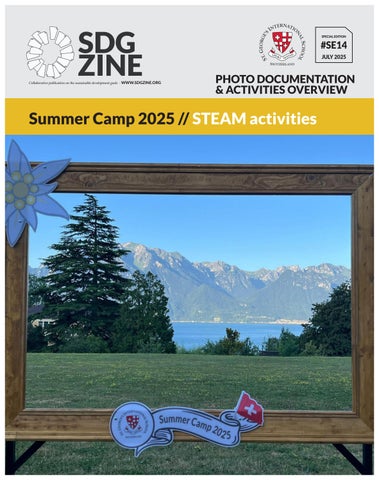
Cover Image
PhotoFrame by Jane, created by Addictlab

Welcome Day

Months of preparation went ahead of that first Sunday, to make sure that on Welcome Day, both parents and students feel excited, and relieved. For the parents to leave their kids in an inspiring and controlled environment. For the kids to start a journey of discovery and camaraderie, paving the way to new friendships and learning subjects.

Changing the school into a lab

Not one location for STEAM..., but 10 dedicated spots. Every morning we meet in the Assembly hall, after which all groups go to their respective lab spaces for the day with one of the trained facilitators.

All STEAM activities linked to the SDGS

Addictlab is running the SDG Fablab in the SDG Solution Space. All activities are linked to create awareness, educate or even hand over solutions on the Sustainable Development Goals from the United Nations

Profiling: We know what we teach, but do we know who we raise?

The Creative Chemistry Table was created 26 years ago by Jan Van Mol when he founded Ad!dict Creative Lab. The aim is to merge creative disciplines, to be inspired by other fields and cultures, and obtain more depth in the creation process.

Through the years leading up til now, Ad!dict Creative Lab or short addictlab, has conducted a large amount of brainstorming sessions, published over 35 books or magazines, and set up ideation processes for companies and organisations from Thalys trains, Lexus, Diesel, the chocolate and design industries, to governments and cities as well as institutions such as the University of Geneva.

Today, the Creative Chemistry table consists of 145 disciplines or human ‘capabilities’, 76 character cards, the 17 sustainable development goals and more. This card set is a concrete package from a proven methodology to allow groups of people and individuals to think out of the box. It’s a unique tool for collective intelligence.

All students of the Summer Camp use these cards to profile themselves. What do they like? How do they see their future? What is important to them personally?

3 boxes.

1. Creative Chemistry cards.

About 145 creative disciplines. Divided into 14 categories, these are fields where we can be creative in. From photography to medicine, from tattoo to government. Categories go from Public Sphere, over Communication to Critical Thinking.

2. Character & profiling cards.

About 50 character cards based on the IB profile (International Baccalaureat). Cards on a person’s character and learner. ‘I am curious’, ‘I like to share’ and more.

3. Sustainable Development Goals cards.

The 17 Sustainable Development Goals as defined by the United Nations for 2030. We added 3 cards for an easy visualisation of the impact you create while designing or having ideas: how will your idea create a positive or negative impact on each of the 17 SDGs? And how can you adapt that idea?

More cards.

Emotion cards.

8 basic emotions cards. Evident to use for personal profiling , but also because our ideas or ideation capabilities will be influenced by current, past or future emotions.

Gender cards.

To allow diverse gender profiling we added ‘male’, ‘female’ and ‘other’ genders.

Senses.

5 senses cards adding all 5 senses for future use.

IP Cards.

Currently, the Addictlab Academy is joining forces with WIPO (world intelectual property organisation) to add IP protection, patents and help to protect your ideas to the card set.

“The first STEAM class organized for the kids was about themselves. They had to find four cards from the creative chemistry cards to show what they like doing. After putting their four picked cards they would write some sentences about it like their name, where they are from and why did they pick those cards. Then we add their picture on the paper and their creative chemistry cards are done. That is what the STEAM class did for the first day. “

Group work: Create a Stop Motion Movie on one of the Sustainable Development goals

Group work: Create a Stop Motion Movie on one of the Sustainable Development goals

Week 1 / Coding: Introduction to Microbit and AI

“The first project in the STEAM class was about MicroBit Ai. They would get a MicroBit chip they would try to train with the programming in the computer. The objective was to have the Microbit chip in a box with a phone and when someone tries opening the box the microbit would start making a noise to alarm that the box is opened. It was a really fun project to do because to teach the kids more about Ai and a part of STEAM.”

STEAM Student

Week 1 / Coding: Introduction to Microbit and AI

Week 1 / Understanding electric circuits and motors.

Understanding electric circuits

Week 1 / Understanding electric circuits and motors.

Week 1 / Robotics: building & coding

Week 1 / Logic thinking with a Mechanical Computer

“The Turing Tumble was a nice project to teach all kids. They had to make the marbles fall in the right order. They had to put unique pieces to lead the marbles to make sure the sequence was correct. It helped them thinking of unique and fun strategies.

It also helped them understand about how a computer works, because in the computer they find how to get data and solve strategies to do that. With coding you have to find unique strategies, facing a lot of dificulties to solve.

The project was a really fun way to have kids learn about how a computer works.” - STEAM Student

Week 1 / Collaborative mechanical constructions.

Week

1 / 3D Printing

“The kids learned about 3D and how it works the Project. Was to make a keychain with your name on it. They used a website called Tinkercad to make their design. After making their design in Tinkercad we printed the keychains using the 3D printer and attached the keychain ring and the 3D keychain project was done.” - STEAM Student

Week 1 / art / printing / stamping / linocut.

Week 1 / art / printing / stamping /

Week 1 / guided visit to Geneva / CERN

“Visiting CERN was very fun. The kids received Addictlab’s CERN quest. They basicly had to answer questions - they would get the answers from the exibitions and the activities.

They tried fun activities and challenges and their was a suprise for the winner of the CERN quest. It was a fun excursion at CERN.”

STEAM student

Building a Chain reaction machine

A. CODING & ROBOTICS

Week 2 / dedicated week

B. ART / Lego Printing

Week 2 / dedicated week

C. DIY & Makerspace / solar powered cars

“The Solar Powered Car project was a fun project for the kids to learn and build. It was a way to teach kids how the solar panel works. So they had to build a car with wooden pieces, then the solar panel had to be connected to a motor and the motor moves when the solar panel is in the sun. We put the car outside for the solar panel to be in the sun. It was a really nice project for us to learn about the solar powered car. “

- STEAM Student

Swiss National Day

Final Day / awards

Exhibition & documentation

Mail info@sdgzine.org for more information or questions.

Turn static files into dynamic content formats.

Create a flipbook