100% DEDICATED TO INDUSTRY Migrating from PLC-5 to ControlLogix After Rockwell Automation discontinued the PLC-5 Control System and recommended that users migrate to its ControlLogix PLC platform, some users try to source parts on e-commerce sites, where they’re often expensive and without any warranty. Eventually, they will have to face the limited life of the PLC-5 and risk failure and significant downtime without a replacement.
Solutions
• Rockwell ControlLogix • FactoryTalk Studio5000 • iFIX Ethernet (IGS) Benefits • Higher performance system • More reliability • No need to hold obsolete hardware • Reduced maintenance costs • Can modify control system without needing a shutdown
Challenge
Our customer in the oil & gas industry had been pleased with the robust nature of the PLC-5 but felt that the time had come to make the change to the Control Logix L72 processor-based solution. They wanted to reduce the risk associated with a product that was no longer supported. They knew that while the needed hardware and support are available for those choosing to migrate over, there was going to be more involved in the changeover than simply replacing hardware. Getting it wrong could cause functionality and downtime issues. A custom solution with help from control systems integration experts was needed to ensure quality parts were used and labour costs could be saved, A Actemium Automation project team was assigned to help them get through the migration with limited disruption to their business — and a request to install with less than a day’s notice.
Solution
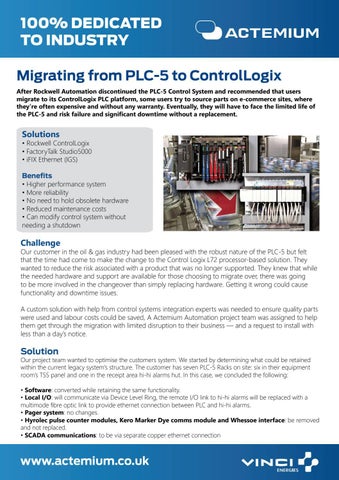
Our project team wanted to optimise the customers system. We started by determining what could be retained within the current legacy system’s structure. The customer has seven PLC-5 Racks on site: six in their equipment room’s TSS panel and one in the receipt area hi-hi alarms hut. In this case, we concluded the following: • Software: converted while retaining the same functionality. • Local I/O: will communicate via Device Level Ring, the remote I/O link to hi-hi alarms will be replaced with a multimode fibre optic link to provide ethernet connection between PLC and hi-hi alarms. • Pager system: no changes. • Hyrolec pulse counter modules, Kero Marker Dye comms module and Whessoe interface: be removed and not replaced. • SCADA communications: to be via separate copper ethernet connection
www.actemium.co.uk
100% DEDICATED TO INDUSTRY PLC hardware conversion Rockwell Automation I/O conversion modules provide a fast and efficient way to convert 1771 PLC-5 I/O to 1756 ControlLogix I/O. The I/O conversion can be accomplished without removing any field wires from the existing swing arm — virtually removing the risk of wiring errors. The existing swing arms fit directly onto the edge connector of the conversion modules. The cables are pre-wired and have a connector for the conversion module on one end and a removable terminal block (RTB) on the other end. The I/O signals are routed through the conversion module and the cable to the appropriate terminals on the I/O module. Each chassis was replaced with a base plate that uses the same footprint as the PLC-5 hardware. Each I/O module was replaced with the correct equivalent module and associated conversion module and cable. Software conversion The software was converted from Rockwell Automation programming language RSLogix5 to Rockwell Automation Studio 5000 using Rockwell-provided tools. The only software functions that needed to be amended or improved were those the conversion tool highlighted as being unable to be converted. A serial remote I/O network enables PLC communication to additional I/O racks. This communications protocol was replaced with a local ethernet network to takes advantage of Rockwell Automation Device-Level Ring (DLR) topology. The DLR ring required an EN2TR module in each chassis. The RIO link to the receipt area hi-hi alarms building is more than 100m away, with no direct equivalent in ControlLogix. The remote rack could be left as is and a RIO link established from the new CLX CPU to the existing hardware in the hi-hi alarms building. An alternative
option is to replace the cable with a new fibre optic ethernet link and create a device-level linear network, using Rockwell Automation ETAP modules at either end to convert between fibre and copper. An EN2TR module was required in each rack. The ETAP units require a 24v supply and a new PSU was fitted in each panel for this purpose. A new fibre link was installed between the main building’s TSS panel and the hi-hi alarms building, with a patch box at each end. A patch cable between the patch box and ETAP was needed. Installation method The PLC5 migration hardware used the same footprints as the original PLC5 racks, which allowed for straightforward installation. The existing wiring was not interfered with during installation; the original wiring arm was incorporated into the new hardware. During the installation process, it was necessary to isolate 230v power from the PLC racks. Each rack is fed from an MCB from the TSS power distribution in the TSS panel. In some cases, there were two panels fed from the same MCB. New power cabling was installed from MCB to ControlLogix PLC rack because the power supply terminals are in a different location and the existing wiring would not reach. To reduce workload, the new CPU rack, fibre optic link (Esso) and fibre optic ETAPs and PSUs were installed ahead of the shutdown installation. The CPU was tested to ensure that the following comms links were working correctly: 1. Link to hi-hi alarms building 2. Radio pager 3. Blenders 4. CCR5.
The upgraded hardware consisted of 17-slot racks to replace the existing 16-slot racks. They were connected to the CPU via a Device Level Ring. Each rack required a 1756-EN2TR ethernet module in addition to the I/O module hardware.
www.actemium.co.uk