LOUIS OSMAN
LOUIS OSMAN
It was not long before a commission came his way. Sir Leslie Gammage, chairman of the General Electric Company was approaching his 70th birthday and his colleagues at GEC wanted to present him with a gift. They approached Louis who in turn had conversations with Sir Leslie. He designed a whisky decanter with four goblets, complete with a leather box to assist transportation. The terminal to the decanter’s amethyst monde4 that formed the decanter’s stopper was a peregrine falcon with outstretched wings that David Wynne modelled. The entire piece was made at Gerald Benney’s workshop at Whitfield Place in 1956.
Hughes even suggested that he use Philip Popham3 as his silversmith. Although the Abbott favoured Louis’ designs, they had to be declined on the basis that they exceeded the budget. Graham Hughes is of the view that the dislike of the knife was the start of Louis Osman’s career as a silversmith. However, Gerald Benney also claims to have been instrumental in the change from architect to silversmith. The Osmans’ home was an open house and they had a wide circle of friends, which included the young sculptor David Wynne. He introduced Louis to Gerald Benney. The two men were both very sociable and became friends. In 1956 Gerald suggested that Louis should be invited to assist in the judging of a competition held each year at the Company’s hall. Perhaps Graham Hughes anticipated what would happen. Louis was extremely critical of the entries adding that he felt sure he could do better. Gerald Benney immediately challenged him to try and placed his workshop at his disposal. Louis accepted both the challenge and the offer.
3. Senior Tutor in the School of Silversmithing and Jewellery at the Royal College of Art. 4. A faceted sphere. 5. Source, page 88, Louis Osman (1914-1996) – The life and work of an architect and goldsmith by Jenny Moore (Tiverton, 2006). 6. The dish was cast by The Morris Singer Company Limited. Following the merger of Burleigh Arts and Nautilus Fine Art in 2003, Art Founders Limited was formed. It acquired the Morris Singer name in 2005. The company now trades as Morris Singer Art Founders. The business operates from Braintree, Essex. 7. The skilled task of forming the edges with a hammer was undertaken by Desmond Clen-Murphy.
358
Although Louis had started a new career, he never actually gave up being an architect. He studied silversmithing and it was not long before he had found his own style. Interestingly, he favoured a strong medieval look like Michael Bolton, the other self-taught silversmith who also features in this volume. Louis wanted his work to be hand-crafted and to look as if it was made by hand. Indeed, he was proud of the fact that the tool marks were visible even on his most prestigious pieces. Another characteristic of his work was that he favoured the finer Britannia standard silver that has a richer colour and is also more malleable, and therefore easier to hand-raise, than sterling silver. Similarly when using gold, he favoured 22-carat and fine gold, which is the purest
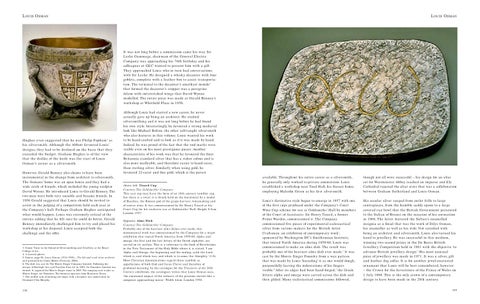
Above, left: Tizard Cup Courtesy The Goldsmiths’ Company This cast cup may have the form of an 18th century tumbler cup, but there is a twist: it is firmly held on the horizontal by a model of Bacchus, the Roman god of the grape harvest, winemaking and of course wine. It was commissioned by Sir Henry Tizard as his Court Cup for his exclusive use at Goldsmiths’ Hall. Height 8.5cm. London 1957. Opposite: Alms Dish Courtesy The Goldsmiths’ Company Probably one of the heaviest alms dishes ever made, this monumental work was commissioned by the Company for a major exhibition that toured North America from 1959-60. Alpha and omega, the first and the last letters of the Greek alphabet, are carved on its surface. This is a reference to the book of Revelations in the New Testament of the Holy Bible where it is stated, ‘I am Alpha and Omega, the beginning and the ending, saith the Lord, which is, and which was, and which is to come, the Almighty.’ (1:8). Most Christian denominations regard these symbols as appellations of both God and Jesus Christ and therefore of profound meaning. In the catalogue for the Treasures of the 20th Century exhibition, the cataloguer writes that Louis Osman uses, ‘the emotional impact of the richness of the precious metals like a composer approaching music’. Width 44cm. London 1958.
available. Throughout his entire career as a silversmith, he generally only worked to private commission. Louis established a workshop near Toad Hall, his Sussex home, employing Malcolm Green as his first silversmith.
though not all were successful – his design for an altar set for Westminster Abbey reached an impasse and Ely Cathedral rejected the altar cross that was a collaboration between Graham Sutherland and Louis Osman.
Louis’s distinctive style began to emerge in 1957 with one of the first cups produced under the Company’s Court Wine Cup scheme for use at Goldsmiths’ Hall by members of the Court of Assistants: Sir Henry Tizard, a former Prime Warden, commissioned it. The Company commissioned five pieces of experimental ecclesiastical silver from various makers for the ‘British Artist Craftsmen: an exhibition of contemporary work’, sponsored by Washington DC’s Smithsonian Institute, that toured North America during 1959-60. Louis was commissioned to make an alms dish. The result was probably one of the heaviest alms dish ever made.5 It was cast by the Morris Singer Foundry from a wax pattern that was made by Louis ‘kneading’ it as one would dough, purposefully leaving the indentations of his fingers visible.6 After its edges had been hand-forged,7 the Greek letters alpha and omega were carved across the dish and then gilded. Many ecclesiastical commissions followed,
His secular silver ranged from cutlet frills to large centrepieces, from the humble caddy spoon to a large covered rice bowl that the British Government presented to the Sultan of Brunei on the occasion of his coronation in 1968. The latter featured the Sultan’s enamelled insignia as a finial that was the work of Dilys Osman, his enameller as well as his wife. Not satisfied with being an architect and silversmith, Louis also turned his hand to jewellery. He was successful in this medium, winning two second prizes in the De Beers British Jewellery Competition held in 1961 with the objective ‘to advance British jewellery design’. His most unusual piece of jewellery was made in 1971. It was a silver, gilt and leather dog collar. It is for another jewel-encrusted ornament that Louis will be best remembered, however – the Crown for the Investiture of the Prince of Wales on 1 July 1969. This is the only crown of a contemporary design to have been made in the 20th century. 359