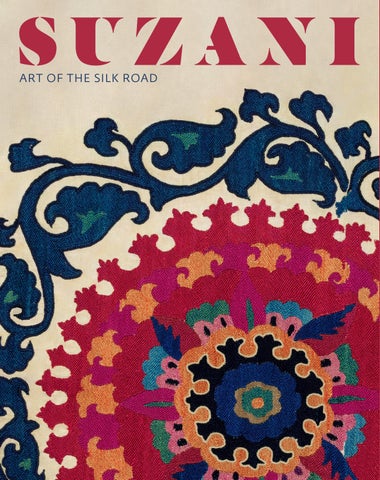
SUZANI ART OF THE SILK ROAD
ERBER JACKETCOVER_FINAL_01122025.indd 1
17/12/2025 12:58
Contents
Suzani: Art of the Silk Road © 2025 Hali Publications Ltd. © for the texts Dietlinde and Christian Erber, Penny Oakley, Katja Schmitz-von Ledebur, Eleanor Sims, Markus Voigt All rights reserved. No part of this publication may be reproduced or used in any form or by any means – photographic, electronic or mechanical, including photocopying, recording, taping or information storage and retrieval systems – without permission of the publishers. Published and produced by Hali Publications Ltd., 6 Sylvester Path, London E8 1EN, United Kingdom www.hali-publications.com
On the Nature of Collecting Katja Schmitz-von Ledebur
6
Scenes in the Life of a Collecting Couple Dietlinde and Christian Erber
9
Acknowledgements Dietlinde and Christian Erber
13
History and Trade
14
Personal Reflections on Suzanis and Suzani Collectors Markus Voigt
16
A Brief History of the Suzani-producing Region Penny Oakley
28
Trade Routes and Potential Design Influences Penny Oakley
36
info@hali.com Design by Misha Anikst British Library Cataloguing-in-Publication Data: a catalogue record for this book is available from the British Library ISBN 9781898113898 Cover: Suzani border fragment, no. 65 The study of the textiles featured in this publication was based on high-resolution photographs
The Suzanis
44
Introduction to Suzanis Penny Oakley
46
A Note on Dating Markus Voigt
67
Catalogue Penny Oakley
68
Motifs and Stitches
356
Birds and Other Creatures Hidden in Flowering Gardens Eleanor Sims
358
To the Point Christian Erber
362
Bibliography
372
Appendix
378
Rovnoye
Krasnyy Kut
Oral
Akhtubinsk
R u s s i a
Astrakhan'
Svetlograd
Nevinnomyssk
rokhladnyy
Nal'chik
Beslan
South Ossetia
Karaton
Kazalinsk
Nukus Khujayli
Stepan Razin
Khanaqin
Ilam
Kermanshah Borujerd
Arak
Kuhdasht
Aligudarz
Andimeshk Dezful
An Nasiriyah
Izeh
Sabzevar
Soltanabad
Fariman Kashmar
Kashan
I r a n
Faridan
Tagtabazar
Juymand
Tayyebat Qayen
Gorian
Herat
Afghanistan nd
Pul-i-Alam
a
Taiwara Ardakan
Kabul
Shindand Birjand
lm He
Ghazni
Hotan
Panj
Chah-e Ab
Khorog Mazar
Feyzabad
Kangxiwar
Gilgit Gilgit
Pakistan
Asadabad
Saidu
Jalalabad
Bamian Panjab
Yecheng Pishan
Pol-e Khomri
Charikar
Karokh
C h i n a
Shule
Tajikistan
Baghlan
Sar-e Pol
Qaleh-ye Now Chaghcharan
Kashi
Daroot-Korgon
Taloqan
Meymaneh
Torbat-e Heydariyeh
Fergana
Kunduz
Mazar-e Sharif
Mashhad
Tabas
Nain
Esfahan
Shaartuz
Torbat-e Jam
Ferdows Boshruyeh
Najafabad
Yoloten
Saragt
Andijon Osh
Kulob
Qurghonteppa
Aqchah
Aksu
Kyrgyzstan
Nau Ura Tyube
Bayramaly Andkhvoy
Neyshabur
Semnan
Varamin
Golpayegan
Shahr-e Kord
Gorgan
Kaakhka
im Tar
Mardan
Tangi
Peshawar Wah Hangu Rawalpindi
Gardiz
Khost
d In
us
Ind u
s
Skardo
Muzaffarabad
Srinagar Islamabad C Gujar Khan
Jhelum Gujrat
Rutog
Ind u
he
na
b
India
Jammu Pathankot
s
27 Shiquanhe
Su
gge
26 Shush
Sari
Farij Quchan
Mary Tedzhen
Kuqa
Sen
Iraq
Qom
Malayer
Khorramabad
Al Kut
Tehran
Robat Karim
Darreh Gaz
Minudasht
Babol
Karaj
a
Sanandaj
Bojnurd
Kokand Quqon
Dushanbe
Shahrisabz
Guzar
ary
Qazvin
uD
As Sulaymaniyah
Zanjan
Ashgabat
Karakol
Kochkorka
Dzhirgatal
Qarshi Kitab
Am
Chardzhou
Gonbad-e Kavus
ria
Kattakurgan
Kizyl-Arvat
Rasht
Khavast Jizzakh Khujand
Navoi
Bukhara Samarkand
Bandar-e Anzali Sowma eh Sara
Nurata
a
Tu r k m en i s ta n
Lankaran
Dargan-Ata
a rd Sy
Neftcala
Ysyk-Kol
Merke
Namangan
Piskent
Narynkol
Naryn
Tashkent
ary
Orumiyeh
Turkmenbashy
Astara
Ardabil
Dzhambul Shymkent
Khiva
uD
Tabriz
Kuytu
Kol'zhat
Almaty
Bishkek
Arys
Urganch
Tashauz
Ali-Bayramly
Masalli
Blagoveshchenka
Uzbeki stan
Takhiatash
Am
Khvoy
Ili
Kizil-Tal
Qyzylorda
Chimbay
Xankandi Yerevan Ganca NagornoAzerbaijan Sumqayit Karabakh Baku Agdam Imisli Fuzuli s ak Calilabad Ar
Bole
Yining
Kungrad
Oguz
Xankandi
Shihe
Usu
Chiili
Caspian Sea
Xacmaz
Druzhba
Lake Balkhash
Dzhusaly
Aral Sea
Aqtau
Karamay
Taldyqorghan
ria
Qusar
Lepsi
Novokazalinsk
Derbent
Rustavi
NaxcivanAzerb.
K a z a k h s t a n
a rd Sy
Tbilisi
Toli
Balqash
Saryshaghan
Makhachkala
Tacheng Emin
Zhezqazghan
Aral
Kaspiysk
Armenia Vanadzor Hrazdan
gdir
U
North Aral Sea
Kizlyar
Gori
Dmanisi
Kul'sary
Beyneu
Groznyy
K'ut'aisi
Georgia
Zhezqazghan
Kaspiyskiy
Mozdok
Taskesken
Shalqar
Makat
Atyrau
Kamyzyak
Pyatigorsk
Zaysan
Ayagoz Zhayrang
Dossor
Zyryanovsk
Oskemen
Kaynar
Emba
Kharabali
Elista Ipatovo
Semey
Georgiyevka
nj
Gigant
Rakhmanov Bulaqtary
Qaraghandy
Shakhtinsk
Turgay
Temir
s
Pa
Tselina
Saran
Arqalyq
Oktyabr'
Oktyabr'
Kotel'nikovo
Astana Temirtau
Oktyabr'
Leninogor
Irt y
t
a
Oktyabr'
Algha
Gornyak
Ekibastuz
Svetlyy
Dombarovskiy
Aqtobe l Ura
Vo lg
n Do Tsimlyansk
Atbasar Isim
Yasnyy
Orsk
Akbulak
Volzhskiy
Yesil'
Novotroitsk
Dubovka
Volgograd
Shakhty
Novouzensk
Nikolayevsk
Dzhetygara
Energetik
Gay
Sol'Iletsk
Zmeinogorsk
Zhetiqara
ka n
Don
Saraktash
Orenburg
Kamyshin
Log Millerovo Kamensk-Shakhtinskiy
hashuri
Perevolotskiy
Ya r
Mikhaylovka
Pervomaysk
Ozinki
A Brief History of the Suzani-producing Region
have been little more than raiding expeditions. The Manghit emirs of Bukhara regularly attacked Shakhrisyabz, but were usually repulsed, so they just destroyed the crops and went away again, leaving a legacy of malnutrition in the area.9 It remains to be seen if this Manghit-Keneges contest has any relevance to the suzani story, but the high status of the Keneges leadership and their possible involvement in suzani production should perhaps be borne in mind. The warring barons formed only the small but powerful nucleus of society, but they seemed able to whip up huge armies at short notice. But rather than actually vanquishing a foe, much of the conflict in the region seems to have run to little more than raids and skirmishes, with the prospect of profitable loot usually the prime stimulus. However, the dominant event of the 19th century was the Russian conquest, which caught the rulers of Transoxiana unawares. The Russians had proceeded slowly at first, following a policy of advance, stop, consolidate, make a plausible excuse for the relevant misdemeanour, then advance again. The Central Asian khans had little concept of the power of Tsarist Russia, nor the dangers posed by her disciplined modern armies. Their habitual adversaries were from their own world. These rulers could have offered a much more successful defence had they cooperated to form a united front. But, instead of supporting a neighbour-state in time of peril, they were far more likely to attack it while it was distracted by defending itself from the Russians. Even frontiers were not fully understood, in the sense of a finite border marked on a map, so they tended to be fluid. The natural barriers of desert and mountain range usually sufficed. Initially, Russian ambitions in Transoxiana seem to have been limited to establishing a defined frontier bordering the steppe, and to expanding her trade in the area. It has been said that the conquest was propelled by Russian industrial capitalists eager to establish a wider market for their products, but this seems to
4 4 Main entrance into Shakh-i Zindeh mosque. Samarkand, photograph by Sergei Mikhailovich ProkudinGorskii, ca. 1905–1915. Library of Congress, Prints & Photographs Division, Prokudin-Gorskii Collection, LC-DIG-ppem-02129
their exile in Tashkent (on Bukharan pensions at the behest of the Russians), and thought highly of Jura Beg, but less of Baba Beg.12 James Pickett mentions that 500 Shakhrisyabz households were forcibly moved to Bukhara city and to Charjui by the emir of Bukhara, contrary to Russian orders.13 Might this be relevant to the movement of suzani designs and motifs from place to place? Business apart, there was little interaction between the local population and the
have been Leninist propaganda. It appears to be more that ministers in St
Russians, whose new settlements were usually near the old cities, but separate. A
Petersburg, distanced from the situation, were encouraged by the war-hawks in
high proportion of the recent Russian arrivals were workers in the new factories or
the military high command. More importantly, successive tsars, with an eye to
on the railway. Given their lowly status, they would have been more susceptible to
imperial prestige, were very set on the idea and not to be deterred.10
the socialist, anti-monarchist doctrines of the Russian Revolution in 1917, which
Events moved fast after the fall of Tashkent in 1865. Bukhara surrendered in 1868 and by doing so was allowed to retain its local autonomy as a protectorate,
might explain the violence of the ensuing upheavals in Transoxiana.14 It was once thought that Russia conquered Central Asia only to get at its cotton
unlike those that resisted. Jizzakh and Ura Tube fell in 1866, and Kokand also
plantations, as American supplies dried up during the Civil War (1861–65).
became a protectorate, but was absorbed into the Russian empire in 1876. In 1873,
However, the Central Asian cotton of the day was unsuitable for Russian looms,
Khiva became a protectorate too.
and the quality improved sufficiently only following the introduction of American
11
The Keneges leaders Jura Beg and Baba Beg yielded to Russian troops and
seed long after the conquest.15
Shakhrisyabz was handed back to the emir of Bukhara in 1870. The American
Little changed in Central Asia until the coming of the railways—‘the Devil’s
scholar, diplomat and explorer Eugene Schuyler got to know them both during
carriage’, to use the local description. Goods could now be transported more
32
33
Introduction to Suzanis
between intentional symbolism and what might have become merely traditional decorative motifs. However, as fertility symbols and for protection against the Evil Eye, the talismanic and defensive elements of the designs appear to have retained their importance. Among a largely illiterate populace, the ‘magical’ aspects of the old superstitions seem still to have been well entrenched in Central Asian society. The border of any carpet, suzani or other artefact signifies the Gate of Heaven, the portal to the Gardens of Paradise to which all Muslims aspire on their demise. The field represents these gardens, and often has a repeat that appears to continue endlessly beneath it, thus representing God’s limitless omnipotence. A frame, the border, appears to have been dropped randomly over an unending design and is often slightly asymmetrical, but this only enhances the sense of infinity. Some suzanis, more often from the Shakhrisyabz area, have an inner and/or outer border guard repeat of small trefoils or spearheads alternating with tiny knops or buds. This is like a mystical protective palisade: facing outwards, it repels any evil, and looking inwards it keeps the goodness in. The in-and-out border, usually of flowers on undulating vines and leaves, is a variant of this
9 9 Embroidered floorspread, Mughal India, 18th century. LACMA, M.79.9.6, From the Nasli and Alice Heeramaneck Collection, Museum Associates Purchase
weave, which tended to wear away to leave the paler cotton lining showing through. The richness of the silk background made a striking foil for the vibrant colours of the embroidery. Embroidery and stitches
concept. The Evil Eye was a very real danger in the eyes of the suzani world, and
All embroidery was in silk, apart from occasional small details in vermillion wool
even today it is still alive and well in many societies.
(shol). Apparently imported from India, this fine wool was used only sparingly,
The pomegranate, with its three identifying tufts, is a universal symbol of fertility, and thus appropriate for nuptial embroideries, and is depicted in many shapes
probably because it would have been expensive after all the transport costs and multiple taxes and customs dues it had accrued along the way.
and sizes. Some are highly visible, overt symbols of fertility, while others are more
The two stitches that differentiate the suzani family are basma and kanda khayöl.
discreet and harder to detect. It is shown in profile either complete or split open
Both are variants of single thread couching, and done in one operation, unlike the
to reveal the seeds within, thus emphasising the reference to fertility.
Turkish atma, which involved three separate stages.66 Basma was preferred in
Certain flower species also carry their own meanings, but they are usually
most suzani areas, but also occurs on the earliest Turkmen embroidered
stylised beyond recognition to comply with the Muslim ban on depicting living
asmalyks,67 which suggests some sort of link, either through geographical
things. This was observed more strictly by Sunnis, who predominated in
proximity, related local workshops, or just a shared preference. It was rarely used
Central Asia.
in Shakhrisyabz, where kanda khayöl predominated and is often cited as a clue to
It is thought that some designs represent the moon (the Tashkent palak) or the sun (the large medallion suzani), although some or all may have had other origins.
attribution. Kanda khayöl was used in other regions too, but only sparingly for details. A looser laid and couched stitch, more like atma, is found very occasionally on suzanis.68
Materials
With basma, a strand of silk is laid across a pattern section, and then couched
The background fabric of suzanis was usually a white cotton known as baz, boz or
down at regular intervals with the same thread, roughly at right angles, creating
karboz, which was handwoven locally in narrow strips about 12 in (30 cm) wide.
a textured effect not unlike basket work. On some examples it can be exquisitely
Latterly, Russian-manufactured cotton was often preferred—usually a twill
fine. Kanda khayöl is similarly worked, but the couching stiches are longer and lie
resembling modern curtain lining. All-silk ikat or silk-and-cotton ikat was used
almost parallel with the laid thread, creating a smoother, more lustrous surface.
occasionally, sometimes with spectacular results.65
Chain-stitch was also popular in its various forms, including tambour work (iroqi)
Some of the so-called ‘Lakai’ embroideries were worked on plain silk in a variety of colours, but often purple or yellow. This was usually a fine, lightweight tabby
62
which was done on a frame with a fine hook and was much quicker. Strangely, given that cross-stitch was used prolifically in the suzani region for caps, belts
63
Circle in the Centre
6 Suzani Probably Bukhara area 196 × 287 cm Probably second half 19th century EDC 76
This suzani is a typical example of the so-called large-
descendant—probably at several removes from the
medallion type, a distinctive group with huge central
original—of a patchwork or of an appliqué panel?
lozenges and fiery, kaleidoscopic designs that have
The proposal that these bizarre suzanis were tomb
baffled art historians for decades. The sun and the
covers now makes more sense. Both the high cost of
moon have both been suggested as their inspiration,
the unusually thick silk embroidery thread, and its
as well as possible roots in the earlier arts of the steppe.
generous use, imply a special purpose for them,
However, there may be a more mundane solution to
perhaps for an important tomb, shrine or mausoleum.
the puzzle.
Valuable textiles were used in the Islamic world as
They divide roughly into ‘cool’ and ‘hot’ types. A lot of the white background is visible on the former, thus
sarcophagus covers for the elite, often in several layers. Kashmir shawls were luxury items and status
cooling the heat from the medallion. The embroidery
symbols, so the remains of damaged pieces may well
on the latter covers most of the field so that, with its
have been reused on something as significant as a
layers of vivid oranges and reds, it seems to radiate
tomb cover. A large-medallion suzani in Berlin even has
heat, like a furnace. On the ‘cool’ type, the medallion is
a Kashmiri boteh in the upper left-hand field.1
always hexagonal, or nearly so, and this example and
If they were tomb covers, they were probably just one
some others have spiked finials that echo the designs of
stage in a series of replacements. This might explain
Ottoman velvet yastıks, and some rugs.
the evolution away from something long forgotten
The background of the medallion is of contiguous, cusped, concentric circles in alternate shades of cerise-
that was perhaps initially more conventional. The central disc is the Axis Mundi in cross-section
pink and orange, as is the norm for the whole
so, in this form, the tiny middle spot represents the
large-medallion group. It creates a sense of blazing,
portal to Paradise through which the soul of the
pulsating colour. Laid over this, the skeleton of the
deceased would pass. Corroborating this theory, each
design is formed by one vertical and one horizontal
suzani is bristling with protective symbols, as if to
barber’s-pole stripe bordered by tiny urns or trefoils. Two
make sure that the soul was well guarded en route to
more bands, set diagonally, are edged either with pairs
the next world. Here, this roundel is surrounded by
of outward-facing leaves or with foliar kotchak, or ram’s
inward-facing protective ram’s horns, to keep the
horn, motifs—all protective devices. Each strip, like a
goodness in, and many of the motifs in the field are
patterned ribbon, runs from side to side beneath the
also defensive.
central disc. This combination forms an eight-point star,
The medallion itself is fringed by what appear to be
indicating the points of the compass, with a
vicious teeth—of wolves perhaps? These face outwards,
superimposed circle representing the world axis.
to repel any evil, and form a formidable barrier. The
Additional vertical bands resemble the bias-cut strips
corner flowers are microcosms of the main medallion,
of striped Kashmir or Kerman shawl-cloth that were
as back-up, and they too are surrounded by defences, in
used to bind the edges of decorative textile panels. They
the form of pointed trefoils and more teeth. Overall, the
might even be copied from the printed cotton
imagery presents quite a bastion of protection against
imitations sometimes seen on suzanis, which would put
any evils that might be targeting the departing soul.
this large-medallion type firmly in the second half of the 19th century. Many of the smaller sections are like scraps of differently patterned cloth, including a chequerboard repeat. So are we looking at a
86
1. Museum für Islamische Kunst, Berlin, BA (Leihgabe J.-R.-Becher Archiv Berlin) and Helmecke 2009, p. 19, no. 1.
87
Lattices
33 Suzani Probably Shakhrisyabz 168 × 245 cm Late 19th–early 20th century EDC 10
The lattice has come a long way from the possibly court-inspired designs on earlier suzanis and, though recognisably from the same design sources as the classic Shakhrisyabz, the style has altered over the years. The leaves in the lattice, each with only one serrated side, enclose an interesting variety of floral and vegetal motifs, including the ubiquitous pomegranate which is depicted in several different ways. The main borders carry the familiar floral roundels, each enclosed by a pair of foliar stems, alternating with the two types of quincunx, the so-called ‘four-and-one’ formation. One has the usual four flowers, and the other the quartet of small palmettes, which is sometimes likened to a lamp with four fire-bowls. Hexagonal red stars—three in the border and one in the field—all have three pale-blue, lobed petals attached to the outer edges which alternate with others in purple or a pale-yellowish cream. The outlines of the stars and of the inner petals on a few of the flowers are in alternating black and white, or other contrasting combinations. These are often associated with the so-called ‘Lakai’ suzanis, and with the small nomadic embroideries which can be more confidently attributed to this community. The narrow guard stripes are in red and white, also in the ‘Lakai’ manner. These ‘Lakai’ suzanis are generally thought to have a connection with the Shakhrisyabz region.
182
183
Endless Repeat
49 Suzani Ura Tube (?) 184 × 238 cm Second half 19th century EDC 26
Despite an even more complex pattern, there is more
Several stems from the field have erred into the
logic to the design of this second deconstructed trellis
border, giving a false sense of continuity. The border is,
than on no. 48. The concave diamond or lozenge from
in fact, more conventional than the field, with the
the Herati pattern has been turned sideways, so it
arachnoid flowers and cartwheel blossoms alternating
resembles a shaped square, which now has a spidery
on discernibly undulating vines and leaves. The corner
flower at each corner. The yellow and blue centre of each
solutions in the border are all the same, and well
one can be seen more clearly here to be a pomegranate in
executed, a feature more usually associated with
the style of the embroidered Jodhpur tentage.1
Persia, and quite rare on suzanis. As in no. 48, there are
Arranged in offset rows between these flowers are multicoloured floral candelabra reminiscent of fuchsia
no minor borders, just narrow red lines to separate the two areas.
blossoms, similar to those on no. 48, and also of Indian inspiration, as seen on the floor-spread in LACMA.2 Some of the spidery flowers have become cartwheels,
1. See footnotes for no. 48. 2. LACMA, M.79.9.6.
and act as fillers between the main motifs. The eccentric pirouettes of the leaves and stems add a feminine vivacity to an already hyperactive creation.
230
231
SUZANI ART OF THE SILK ROAD
ERBER JACKETCOVER_FINAL_01122025.indd 1
17/12/2025 12:58