FOREWORD
BY CHRISTINE THEODOROPOULOS Dean of the College of Architecture and Environmental Design California Polytechnic State University, San Luis Obispo
As an educator-architect, Sigrid Miller Pollin espouses the academic tradition of reflective practice informed by theoretical discourse and enriched by collaborations with colleagues in allied disciplines. She is also an extraordinary role model, particularly for women who continue to be underrepresented leaders in the field of architecture. As a sole practitioner, Sigrid leverages her intersecting identities (designer, artist, teacher, family member, administrator, business owner) to create a distinctive body of work.
Her career in the academy has been equally influential. She set new directions for design education for the established program at California State Polytechnic University Pomona, where she was the first woman promoted to the rank of full professor, and the first to chair the department. Under her leadership experimentation flourished as the department transformed its design curriculum to integrate technology with aesthetics. As one of the founding faculty of the successful new architecture program at the University of Massachusetts Amherst, she continues to inspire students and colleagues through her commitment to design excellence and interdisciplinary collaboration.
Sigrid’s creative process uncovers the unique essences of places to shape sustainable architecture that participates in nuances of climate, orientation, and topography. In arid Riverside, California the Jumping Rocks Houses are elegant variations on topographic theme and an early example of Sigrid’s particular interest in architecture’s fit to site. Likewise, on the historic University of Massachusetts campus, Gordon
Hall and Crotty Hall derive spatial richness as they step through a gently sloping landscape. And in the speculative realm, Sigrid’s drawing and painting treats line as the trace of topography. Simultaneously exuberant and economical, her projects reveal a unified approach to sustainable design that combines social and ecological imperatives.
Throughout her work, Sigrid interweaves playful, unexpected elements that humanize into bold concepts. Surprise spaces, flashes of vibrant color, sculptural details and strategic views impart distinctive identity to building interiors. The houses she designed for her family, Jumping Rocks III in Riverside and the 1290 Studio and Residence in Amherst, Massachusetts, are especially interesting as spatial-social experiments. Although they differ in their fit to particular landscapes, they share a feminist approach to shaping space that sustains the simultaneous dualities that define contemporary life. Be it work-play, personal-professional, individual-family, parents-children, or partner-partner, Sigrid embraces the value of those intersections by making places for each that acknowledge the other.
Sigrid Miller Pollin draws deeply from her personal experience to further the relevance of architectural practice and education. In doing so she enables us to transcend the status quo with grace and power.
BIOGRAPHY

Sigrid Miller Pollin, FAIA was born in Trenton, New Jersey and spent most of her youth in Rhode Island. She received a Bachelor of Arts degree in Art History from Vassar College in 1971 and a Master of Architecture degree from Columbia University in 1975. Before moving to Amherst, Massachusetts with her family in 1998, she was Chair and Professor of Architecture in the College of Environmental Design at the California Polytechnic University Pomona. Sigrid is Professor of Architecture Emerita at the University of Massachusetts, Amherst Department of Architecture and principal of Miller Pollin Architecture.
Sigrid has practiced architecture and been registered through the National Council of Architectural Registration Board (NCARB) in New York, California, Nevada, and Massachusetts. Her work has been published in numerous publications over the years including Global Architecture, Progressive Architecture, Hauser Magazine in Germany, Ville Giardini in Italy, Boston Home, and Design New England. It has been featured in various books including World Cities Los Angeles and 21st Century Houses: 150 of the World’s Best. She has received architectural awards from AIA New England, Inland California AIA, Western Massachusetts AIA, and the Boston Society of Architects.
In 2009 Sigrid was elected to the American Institute of Architects College of Fellows. In 2010 she was awarded a UMass Amherst Chancellor’s Award for Creative Activity. She was also selected to give the campus-wide Distinguished Faculty Lecture in 2010. In 2017 she received the Women in Design Award of Excellence from the Boston Society of Architects.
Miller Pollin’s design studios at UMass Amherst have been grounded by her experience in practice, and inspired by the interpretive possibilities of site and the integration of environmental concerns with inventive design. Sigrid has produced LEED Gold and Platinum projects and recently completed Crotty Hall, a net-zero energy academic building at UMass Amherst.
Throughout her long career in architecture she has explored connections between art and architecture. In 2011 Sigrid began collaborating with architect Stephen Schreiber and landscape architect Jane Thurber in exhibits of drawings, bas reliefs and paintings related to interpretations of patterns found in the landscape, called Field Notes. The overlaps they have explored between art and architecture, the natural environment and the built environment have led to a total of eight collaborative exhibits thus far. In 2018 an exhibit of architectural models produced in California and Massachusetts by Miller Pollin Architecture was held at the John Olver Design Building Gallery at UMass Amherst. In fall of 2018 Miller Pollin’s mixed media drawings exploring the cellular structure of selected plants were featured in a three-person show at UMass’s Hampden Gallery along with works by New York artists Joan Weber and Paula Elliot. She describes this recent body of work as “looking inward beyond the surface and into the space that nature creates every day.”
Sigrid has been involved with strengthening the identity and the opportunities for women in architecture since her professional career began in New York City and California. In her role as a teacher she has mentored hundreds of young aspiring architects. Among other related activities, she participated in the Women, Design, Theory series in Los Angeles, the CD entitled “You Can be A Woman Architect” produced by Margot Siegal, and in 2011 organized and participated in the Smith College lecture series entitled “Daughters of Invention.” She, along with three other female AIA Fellows, founded the Western Massachusetts Women in Architecture organization in 2017.
Sigrid and her husband, economist Robert Pollin, have two daughters — Hannah Pollin-Galay of Tel Aviv and Emma Grock of Carlton, Oregon. They are the very proud grandparents of Leah and Ruthie Pollin-Galay and Laila Grock.
BY SIGRID MILLER POLLIN
Before we began collaborating on this book, Meg Vickery and I had been engaged in a number of discussions about the relationship of work life to home life. From my perspective, even as a college student, I wanted to think that there could be a way to have a family and a satisfying work life and that these could complement each other. Practically speaking, I chose architecture, thinking I could ultimately work at a home studio and be near my family. This wasn’t as simple as I had imagined but ultimately it did come to fruition. Meg and I decided that, in compiling the work in this volume, we could show how it has been possible to build a small but highly engaging architectural practice tailored as much as possible to allow time and space for raising kids with my husband, Bob Pollin.
The nature of my approach to an architectural practice has been very personal. It is a practice built on direct relationships with my clients. As is true with many small practices, I often found commissions from whomever came through the door. I was able to jump-start my practice in California by specifically targeting local developers. I thought of my work as creative production that emerged out of investigating questions in conjunction with a wide variety of client aspirations and circumstances. I think that Meg has seen this in part as a feminist approach to nurturing a professional practice. So we decided to take a personal approach to grouping projects in categories according to a project’s potential offered either by the client, site, budget, or program. This seemed like a more focused way to organize the work rather than in a chronological sequence or by the dry categories of residential, commercial, and institutional.
We conceived this book as something that would both record my work while also providing reflections on the fluidity of approaches to projects. In my experience, every client calls for translations at every turn. The thorny job of the architect is to take large amounts of information and transform this information into physical form. This is always the case, regardless of a project’s scale. In this sense we architects are simplifiers. The imperatives of site, program, and client goals interweave with larger aspirations of providing human comfort and hopefully, when everything comes together, an aesthetic contribution.
I was engaged as both the developer and the architect in some of these projects. Having myself as my client was different than the client-commissioned projects. These personal projects brought different rewards. For example, with the Jumping Rocks project that included my own family’s home as one of the three houses on a dramatic 10-acre site in Riverside, California, I was able to investigate challenges and tenets that have interested me throughout my career. These include, among other things, searching for the genetic imprint of any given site and the essential relationships between built form and the natural environment.
Eight categories emerged as we looked at structuring this book: Researching, Interpretations, Home, Transformations, Community Housing, Questions, Learning and Performing, and Drawing and Painting.
The goal of projects in the Researching category was to create environments conducive to in-depth study as well as collegiality. The two university building projects in this category, Gordon Hall and Crotty Hall, house largely faculty and graduate student research offices. They also include group spaces such as conference rooms and common areas for meeting and socializing. Interpretations are projects that evolved through introducing metaphor as a guide in the design process. Such metaphors include built form as rock formations, the eye as a space opening up to a large view, the structure of a leaf as a shelter, a protective masque as a southern sun-sheltering element, and a cocoon-like transparent form as a chamber. Home is simply home—the base from which we operate in the larger arena. Transformations are essentially renovations—in a couple of cases aiming to make “silk purses from sow’s ears.” They are generally modestly budgeted projects. Community Housing is a glimpse into multi-unit dwelling as a building type for providing affordable housing. Questions includes my submissions into various architectural competitions. Competitions allow architects the opportunity to pose theoretical problems and investigate answers that stretch beyond the daily practice. The Learning and Performing projects shown here include educational facilities outside of mainstream schools.
In all phases of my architecture practice, I have maintained a strong interest in both linkages between art and architecture and in creating artwork as a counterpoint to architectural projects. Architectural projects are inevitably team-based whereas art pieces allow for immediate, individual expression and decision-making. The last section of the book, Drawing and Painting, includes examples of artwork completed for exhibits outside of the architectural profession.
My work in art and architecture continues. In 2019, I retired from the academic studio after 35 years of teaching. This step will allow me more time for exploring the critical issues that we face as architects in our current era. I look forward to opportunities for creating more translations with time, building from the ideas and projects presented in this book.
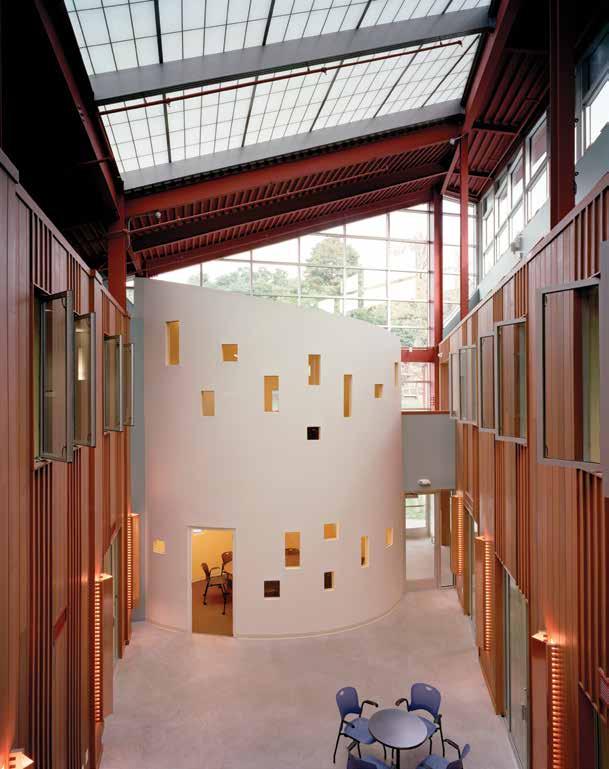
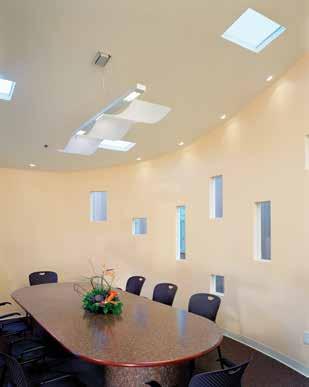
The angled roof and oval conference rooms frame the glazing of the northern façade. Below, radiant floor heating in the concrete warms the space with comfort and efficiency.
CROTTY HALL
University of Massachusetts
Amherst, Massachusetts | 2017 |
Crotty Hall, on the southeastern edge of the University of Massachusetts Amherst campus, is a remarkable building designed to operate under stringent net zero energy and emissions standards. It is located just south of Miller Pollin’s Gordon Hall of 2003 and houses the UMass Department of Economics. Its name honors Economics Professor Emeritus James Crotty and his wife Pamela. The site is extremely narrow and the challenges of designing a building for this site were daunting. The overarching goal was to allow an architectural solution to emerge out of this virtual sliver of land and, at the same time, accommodate the requirements of a robust program of 35 offices, four conference rooms, a small kitchen/café and a sprinkling of student lounge spaces.
As in her previous work, Miller Pollin began with the site and its contours; a gentle slope downwards toward the west, a tight boundary line and restricted street access.
To accommodate setback requirements and a driveway between Gordon and the new construction, the street façade was limited to a 27’ width.
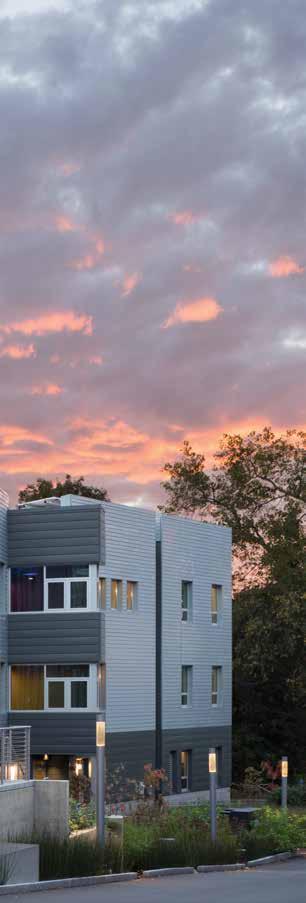
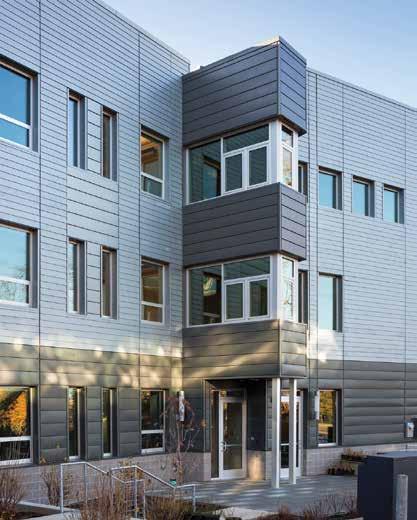
The building stretches westward away from the road. Miller Pollin angled the building approximately two thirds of the way down the length of the site just as the slope begins to level out as a way of folding the north and south elevations. The fold softens the length of these façades. By breaking the orthogonal geometry at various points, she simultaneously created interest in the interior spaces and signaled the two entrances on the north side. Crotty Hall’s angled form embraces the northern exterior space between the two buildings. The exterior is clad in two tones of zinc siding—warm gray siding that refers to the western aluminum cladding and
gray ground face plinth of Gordon Hall, and a charcoal gray similar to the metal roof of Gordon Hall. While the approach via North Pleasant Street is modest and narrow, as visitors approach from the north, the building provides a concluding sight-line and a powerful presence as it spreads across the hillside.
Interior corridors break into “nodes”—small entry spaces for groupings of four offices. Punctuating the progression through the building in this way opens up the long expanse: spaces narrow and billow out as one walks through its length. These office nodes are further articulated by dropped, translucent ceilings of warm, indirect, LED lighting that complements the white opaque glazing of the offices and clerestory windows of the corridors. As seen elsewhere in Miller Pollin’s work, she compresses and opens spaces to express different functions. Lighting emphasize these shifts. Through a combination of lighting techniques, changes in materials, and gentle spatial manipulations, Miller Pollin creates subtle variations that break up the regularity of the office block.
Construction began with the drilling of eight geothermal wells 450 feet deep as the primary ground water source for heating and cooling the building. The building has a tight, super-insulated envelope, triple glazing and a sophisticated system of sensors that can adjust air flow to an office if the window is opened. A computerized system notifies occupants when the weather conditions are right for natural ventilation with operable windows. A high efficiency solar array on the roof produces a significant portion of the electricity for the
building, and a dashboard on the first floor is intended to allow occupants access to real-time data on energy use, heating and cooling loads, and renewable energy production.
This building is beautiful with its rich blending of materials, colors, and lighting. It is also the first building on campus designed to operate under net zero standards. The design places a high level of value on spatial variety even within a constrained building envelope. Color and light bring warmth and comfort to public and private spaces. The site design reflects an integrated
approach to sustainability by knitting together the architecture and the landscape architecture. The terraced rain gardens that line the northern bank of the building are fed by run-off from the roof, which is directed into vertical channels rendered in a dark gray zinc on the north elevation. The run-off irrigates the native plantings on the site. The plantings, in turn, filter the storm water as it flows down to a local wetland area. As these plantings mature, they will provide a soft, transparent layer composed of colorful perennials, woody plants and small deciduous trees between the driveway and the gray zinc of Crotty Hall.
1. Crotty Hall
Existing Gordon Hall
Haigis Mall
Campus Visitors Center 5. Visitor Parking
STRAW AVENUE
Florence, Massachusetts | 2012 |
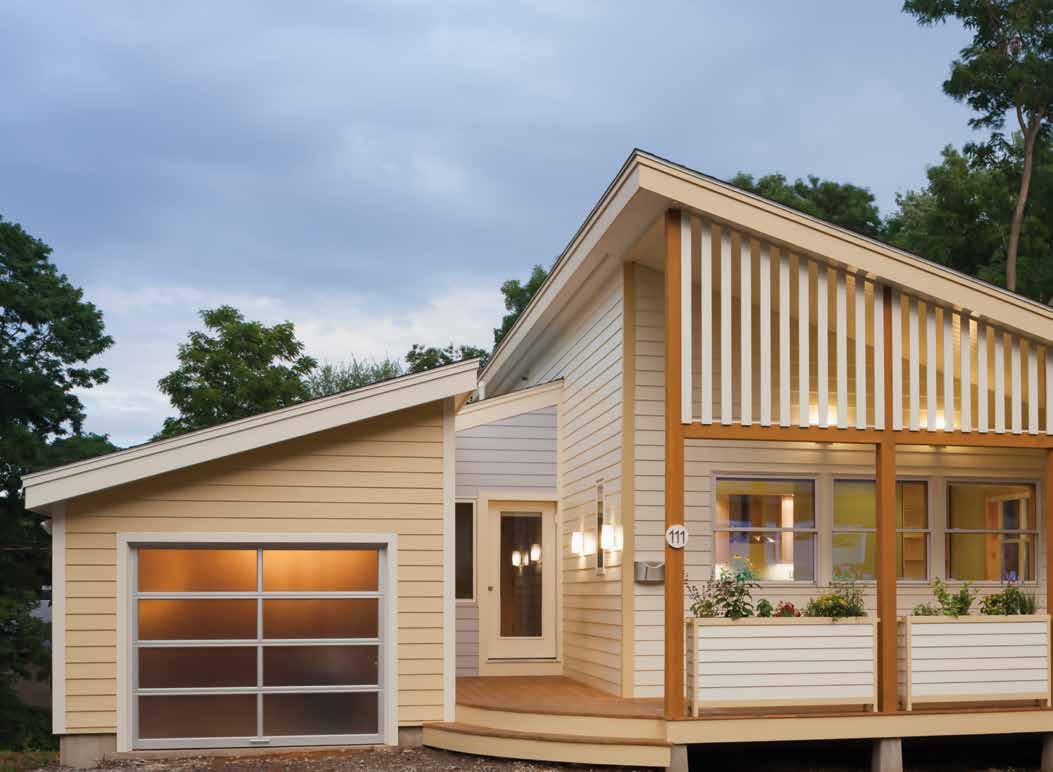
Often residential lots with challenging topography lie vacant for years while neighborhoods grow up around them. This was the case on Straw Avenue in Florence, Massachusetts. Straw Avenue is a modest street with easy access to local shops, schools, and offices. This small lot sheers down steeply to the east, away from the road. Looking to downsize, a couple bought the lot and hired Miller Pollin to design a house for them. Typical of her design process, this project is informed by the environment, by the steep slope and the scale of the residential neighborhood.
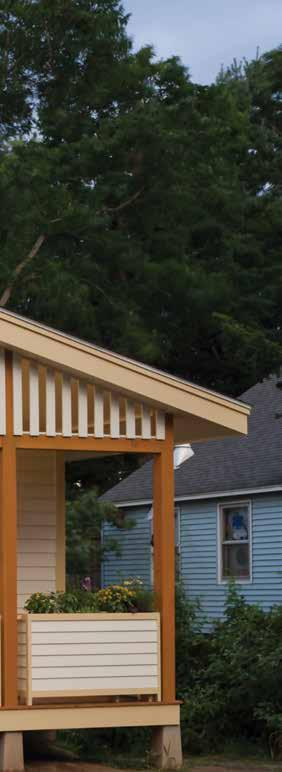
Miller Pollin designed a modern bungalow that breaks free of the context’s traditional gabled and ranch houses while respecting the scale of the neighborhood. The street façade presents a friendly front porch beneath an overhanging roof angled to maximize solar gain for the photovoltaic and solar hot water panels. Typical of Miller Pollin’s earlier houses, such as the Mount Vernon residences, she articulates different spaces with varied volumes. In this case, the roof-angle slopes to the north over the more private spaces of the house, creating a strong intersection of two volumes. Color also defines the volumes, shifting from the yellow of the garage to the blue of the larger volume to the east. This division of parts is clearly recognized from the back of the house where the blue, white, and yellow parts meet and define interior spaces.
There is a simple elegance to the house. The front porch shelters the living room from the western sun. Planters are finished with the same clapboard siding used on the house. The street level includes an entry
foyer and open kitchen/dining/living area. The couple’s bedroom extends away from the street, as does a master bath and study. Stairs off the central corridor lead to a suite of rooms which include a bedroom, bath, and laundry room, and an office. A separate entrance provides privacy and independent access to the lower floor. As the drawings illustrate, the house is carefully positioned on the inclined site in both plan and section. Miller Pollin’s design is informed by the topography, with a respect for the existing slope. Varied ceiling heights and a rich interior color palette organize different regions in the home.
The site and house have many sustainable aspects and design features that contribute to its LEED Platinum Certification, the highest designation for sustainable building under the U.S. LEED system. The angled roofs are thickly insulated with dense pack cellulose and the windows are dual-glazed, low E with fiberglass frames for easy care and efficiency. The walls are two by six inches and densely packed with locally sourced cellulose insulation, then wrapped with a rigid insulation. Clerestory windows catch breezes for natural ventilation. Rain garden swales manage water down the steep slope and native plantings prevent soil erosion. While LEED certification at any level requires great attention to materials and site management, many of these approaches have been part of Miller Pollin’s architectural approach for decades.

RANSOHOFF HOUSE
Los Angeles, California | 1998 |
In 1996, Sigrid’s sister and brother-in-law, Lori and Steve Ransohoff, purchased a mid-century modern post and beam residence in the Brentwood area of Los Angeles. The original house, designed by Hap Gilman in 1960, was a single-level, three-bedroom home nestled in the foothills below what is now the Getty Center. This location was once the site of Greta Garbo’s home and pool house. Garbo’s house burned down in the Bel Air fires of November 1960, but the pool house remained.
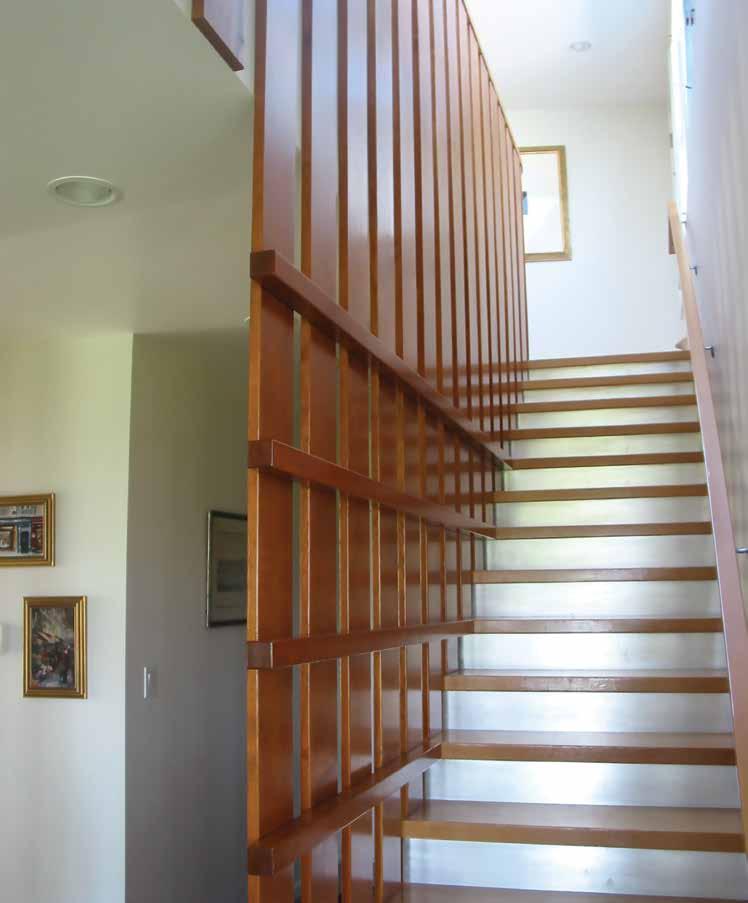
With three children and several large dogs, the Ransohoffs wanted to create more living space—two new bedrooms, a larger kitchen, and dining area. They commissioned Miller Pollin to renovate the dining area and add a new kitchen, an upper level den, and two children’s bedrooms. The challenge was clearly to maintain the integrity of the beautiful original post and beam structure while adding a significant amount of new space. Miller Pollin developed a scheme for a two-level addition. The stairs to the new second level combine polished stainless steel risers, clear Douglas fir treads, and screen wall planking. With many hours of homework ahead, the two children who would inhabit the second level needed places to study. The programmatic invention of a “crow’s nest” was cantilevered from each of the two new bedrooms, providing a quiet study place overlooking the nearby mature live oak trees. The house and addition are largely clad in white stucco, but the studies are wrapped in weathering copper whose tone plays off of the hue of the redwood frame of the original house. Horizontal plaster reveals and window mullions on the addition harmonize with the horizontality of the Gilman design.
CURTAIN SERIES
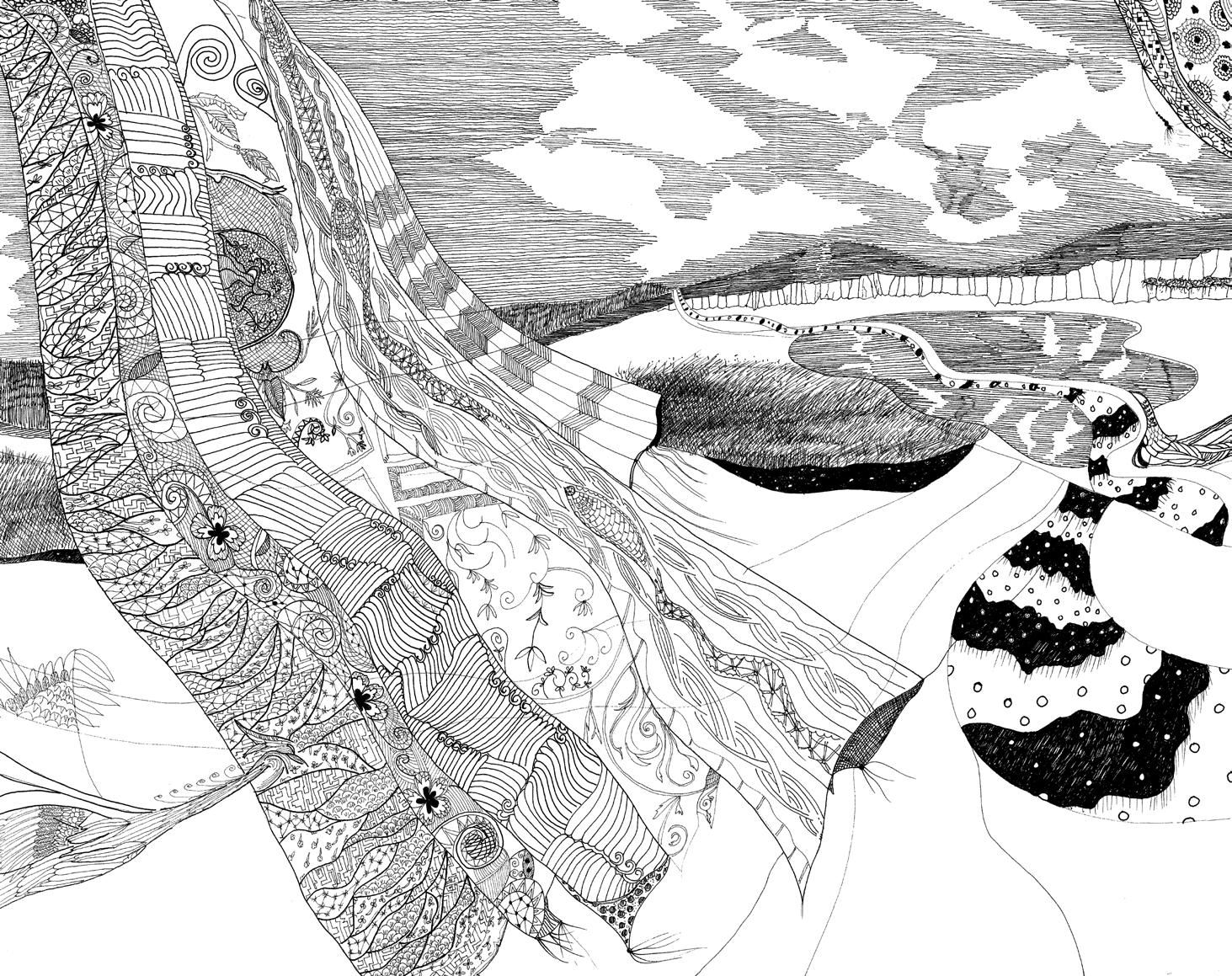
This Miller Pollin drawing series focuses us outward to a broad landscape from an interior perspective. In these intricate pen and ink drawings, we gaze through patterned, breeze-blown curtains to the patterns and perspective of the natural landscape.
The curtain motifs are derived from a range of sources, including traditional Japanese fabric designs and Western lace stitching. Miller Pollin takes cues from repetitions historically associated with feminine fabric and embroidery.
The imagery pairs the vastness of the landscape with intimate glimpses through invented curtains. In all of the drawings a fanciful “bird-plant” tassel floats through the curtain openings, animating the foreground. Through complex line work, the drawings often take on the qualities of traditional plate etching.