miro Van Vreckem
miro Van Vreckem
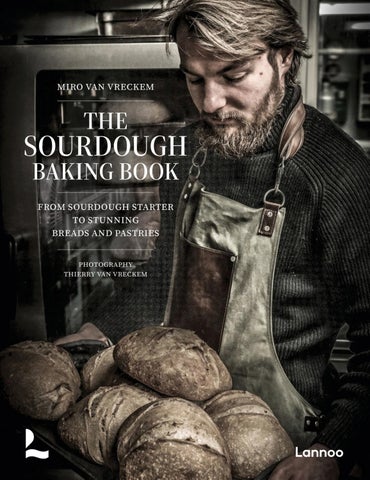
From Sourdough Starter to Stunning BreadS and PaStrieS
PhotograPhy thierry Van Vreckem
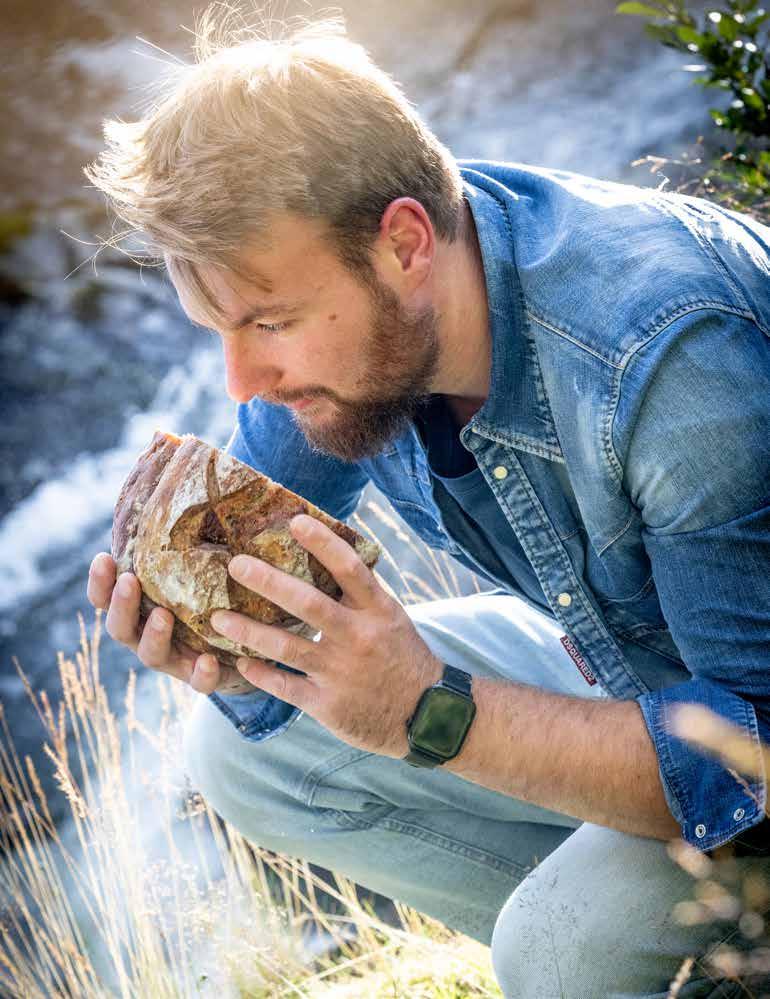
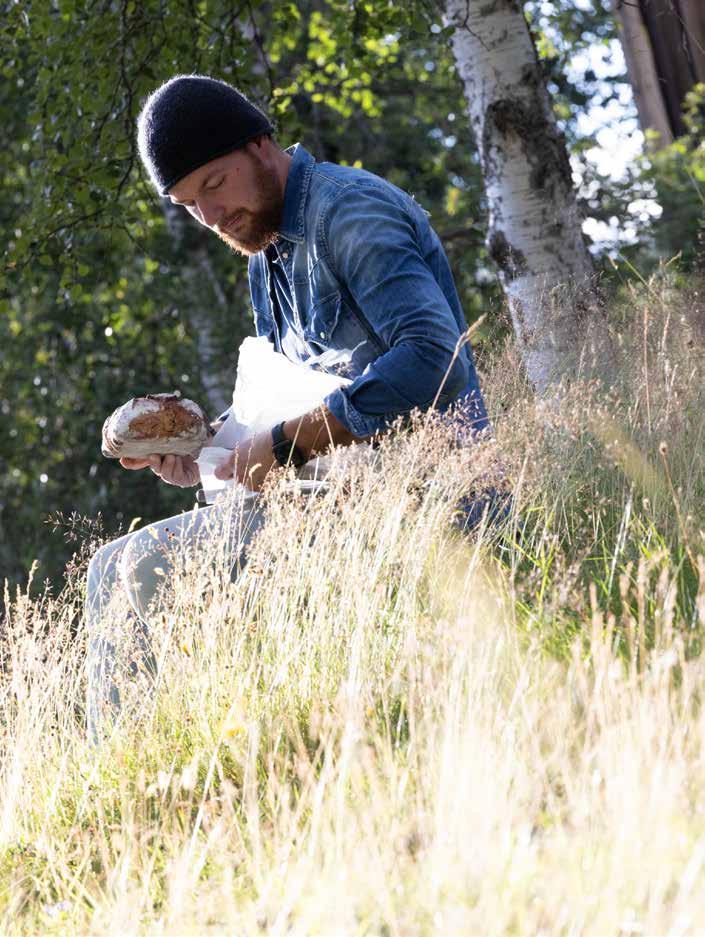
What drives a young man from the outskirts of brussels to leave all that’s familiar in his life behind him and move to the far north of norway? Where the wild, untamed landscape is bathed in the gentle glow of the northern lights for six months of the year? To choose a simple life there, a life of silence, close to the earth, close to himself?
and there, to discover his calling: the noble art of baking bread. not simply bread, by any means, but its most ancient and purest expression: sourdough. a living organism that you must breathe life into, feed, nurture, protect. a child of flour and water that will only grow with patience, attention, and love.
I, too, have found my way to this miracle in the time after my retirement—not out of some romantic attraction, mind you, but out of necessity: The energy crisis gradually deprived my community of its best bakers, until the day came I could no longer get the bread that spoke to my soul: honest, artisan sourdough. It was only when I tried it myself that I understood how demanding the craft is. You must understand the technique, of course; but then, you must devote
yourself to it fully. a whole year long I struggled, tried, failed. Until finally, bread came from my oven that filled me with pride—a loaf that I dared to love. now I nurture my sourdough every day. I say hello to it in the morning, I check how it’s breathing, I give it some flour, water, a drop of honey. It’s like a small, defenseless creature that I must feed. every ten days, the ritual repeats: knead, wait, proof... four times, a whole day long. and then, the next morning: I bake. Three loaves, three little promises. always with the same excitement in my heart: what will they become? and so a love was born from necessity. a passion, arisen as slowly as the dough itself. and then I think of Miro: a young life who made the choice for fire and for total commitment. for the hard road, with the unbounded courage of youth. a life that rises as a sourdough rises: lifted by patience, nourished by passion, and imbued with love. for a life like that, I can have only the utmost respect.
Werner LoenS
Chief Inspector of the Michelin Guide for the Benelux, 1987–2024
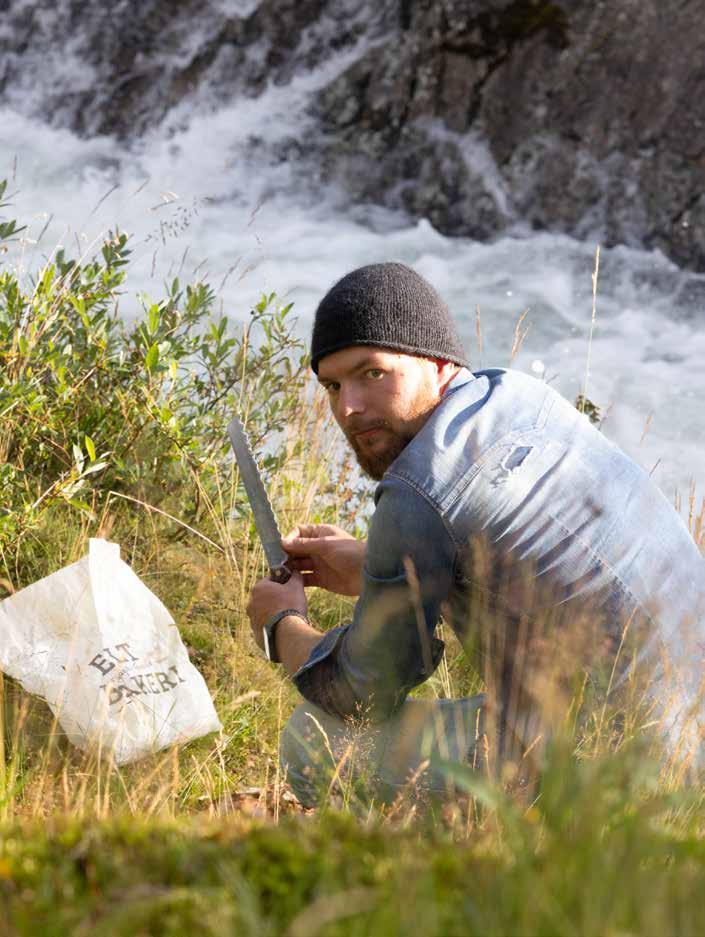
I was born in bever, a small, quiet town just on the edge of the flemish-speaking part of belgium. It’s rural, green, and I’m sure that’s where the seeds of my love of nature today were planted; there aren’t many places left in belgium where you find the beauty and tranquillity you can still find in bever. I was outside a lot, but I spent most of my time growing up at the Kunsthoeve, a wonderful arts and crafts centre. It was an environment full of creativity, where people made something beautiful with their hands and where, from a very early age, I learned what it really meant to look and feel. That atmosphere has always inspired me, and really made me who I am today. at home, we organised cooking camps and art camps. There was always something to do.
I’ve been fascinated by bread my whole life. I started baking bread, pizzas and cookies at home as a child, and I never stopped. always with yeast, because it was always available and always worked. for me, yeast is literally child’s play. but for a long time, one thing eluded me: the mysterious workings of sourdough. Too difficult, too mysterious, something to learn later.
Thanks to Jan, andries, and Karolien for all the knowledge you shared with me. You helped me tremendously getting started, and I can still turn to you whenever I need help. I really appreciate that.
When the time came to go to secondary school, I went to the horticultural school in Melle, and there my interest grew for all things soil, crop growing, and homesteading. by age 14, I was starting to foster the dream of living fully self-sufficiently. books and tV programmes about the untamed wilderness of the wild north excited me terribly, and I consumed them voraciously. I dreamed of moving to alaska, though that was, of course, unrealistic and far too far away. but my parents understood that it really was my dream, so
one summer they decided we would visit norway. We chose Røros, a historic town in the remote middle of the country. We got to know the town well, and from the age of 15, I travelled there every holiday to work and learn the language and culture.
In the summer, I worked on a farm in Røros. I helped with the cows, sheep and huskies, and learned what it meant to live with nature. The cottage I lived in was not luxurious; it had no real conveniences, or even running water! but what started as a summer holiday gradually became a plan for the future. The farmers who I worked for could see my enthusiasm and commitment, and they welcomed me back every year. and with their help, when I was 17, I got in touch with the Tana videregående skole, an agricultural school all the way in the far north of norway, on the border with Russia and finland.
all I had to do was have a few of my school transcripts translated, and to my surprise and delight, they admitted me to attend my final year of secondary school there. In Tana, the world’s northernmost school, a place where reindeer were as common as cows were at home, I found exactly what I was looking for: a life close to nature, education that was both practical and meaningful, and room to grow; not only personally, but to literally grow things!
I was the very first belgian to study there, something I still look back on with pride. My whole time there, I continued baking: at first still adding yeast, perhaps out of habit, but at some point something started to gnaw at me. More and more, I kept hearing about sourdough, that enigmatic “living” bread, slowly fermented, full of flavor and character. but still, I held back. sourdough still seemed too difficult, too technical, too sensitive. I had no idea where to start, and I kept putting it off as something to get to at some point in the future.
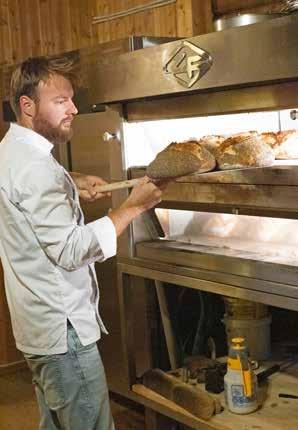
Until the moment came when I just tried it. It was with Karin, a very good friend, a fellow belgian who lived in norway. after a lot of trial and error, fits and starts, and a few failures, we finally started to see life in our starter. The bubbles, the unique odour, the movement… they were fantastic. When we baked our first loaf with our own sourdough starter, there was no going back. I had never experienced anything like that alluring sourness, unique texture, and heavenly aroma. I was hooked; completely under the spell of sourdough. What once seemed too difficult to try became my daily ritual, my craft, my passion.
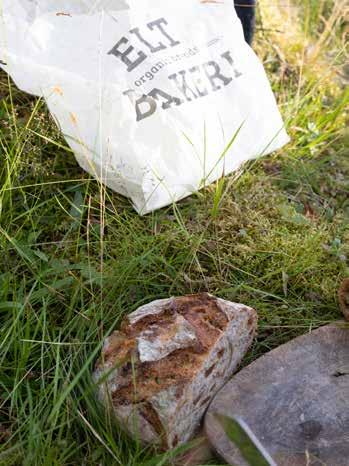
In 2022, I established my bakery eLt bakeri in the mountain village of sollia, on the edge of the Rondane, a national park, and officially started selling bread in norway. Really, the main reason I did was because I missed the good food of southern europe. I regret to say that in norway, most of the food would disappoint
most any of us “from the south.” There aren’t many bakeries at all, and sourdough bakeries? forget it.
from the beginning, my mission was clear: only sourdough pastries, made only with pure ingredients, locally milled flour, and the most important ingredient: time. My baked goods quickly found their way into local shops, hotels, and markets, as well as directly to customers who really tasted the difference.
The bakery became a place where everything came together: my roots, my norwegian future, love for the craft, and the quest for simplicity. later came the international contacts, including with top Italian bakers through eataly in Turin and Milan. nowadays, I often get visits from other bakers looking to get started with sourdough. and I’m happy to share what I know with them. I also regularly give courses to dedicated home bakers and dining establishments to help them get started with sourdough bread.
In 2024, I was voted among the top 10 bakers in norway; I was also nominated for, and made it to the final round, of the “bakery of the year” competition, but I was ultimately disqualified because I didn’t have a diploma in baking studies–at least, not then.
so that year I went straight to amaury Guichon’s prestigious Pastry academy in las Vegas, where I further developed my skills. I am very grateful that two great chefs, Michel ernots and amaury Guichon, make their knowledge available in this academy, which students with a real passion for baking come to from all over the world to learn and to dedicate themselves to developing the most fantastic products. That experience changed my life, not to mention opened a whole new world of baking. once back in norway, I expanded my range with new products and improved the quality of the bakery with what I had learned.
When I look back at the journey, it’s not the success in business or the sales that I appreciate most. It’s the feeling of having introduced people to new things, and having succeeded at that in a tiny mountain village of just a few hundred inhabitants. and here, they appreciate it too.
sourdough is more than just another way of making bread. It’s an ancient tradition, deeply rooted in human history. More than six thousand years ago, even before the earliest civilisations made their mark on the world, humans had already discovered the miracle of natural fermentation.
The oldest traces of fermented bread, dating back to around 3000 Bc, are in egypt, where archaeologists have found baking ovens and bread moulds in tombs, as well as murals showing scenes of bakers at work.
It’s very likely this discovery happened by accident: a mixture of ground grain and water forgotten in the sun, perfect conditions for the wild yeasts in the air to begin fermenting the mixture. The result? a leavened, flavorful bread.
This natural, spontaneous fermentation remained the basis for all bread production well into modern times.
The art of sourdough spread, first via trade along the nile, and later through contact between peoples around the Mediterranean, across africa, to asia, and into europe.
The Greeks elevated the craft of baking and built public bakeries. The Romans later absorbed this knowledge and spread it further via their roads and legions. In the Roman empire, bread and wine–both products of natural fermentation, by the way–were soon basic staples.
In medieval times, the “daily bread” was quite literal, and literally the foundation of their diet. for the common people, sourdough breads baked with local grains were the primary source of energy. every community had its own miller and baker, and sourdough was a living cultural heritage. starters were passed down from generation to generation, cherished as family treasures.
In monasteries, bread baking was refined into a high art. Monks developed techniques to better control fermentation by experimenting with aspects like temperature and hydration; their insights are still the foundation of how we make sourdough bread today.
The industrial revolution changed everything. by the 19th century, baker’s yeast had been developed: first in liquid form, later as cubes of fresh yeast. This controlled yeast made bread baking faster and more
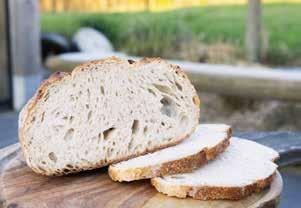
Traditional bread with kamut — see p. 78
consistent. Gradually, this form of bread superseded sourdough, with its slower fermentation and complex flavors, and traditional breadmaking began to fade into the background.
In the 20th century, especially after World War ii, speed and efficiency became primary considerations, and bread became a mass-market product. The delicate art of sourdough breadmaking almost completely disappeared from modern life.
but in the 1970s a renewed interest in artisan bread arose, fuelled by movements that embraced natural foods and local craftsmanship. bakers began reaching back to old techniques. They rediscovered the power of long fermentation, the deep flavor of sourdough and the magic of bread that is truly alive.
Today, sourdough symbolises a new framework of values: slow, honest, with respect for grain and craft. In a time of renewed focus on sustainability, biodiversity
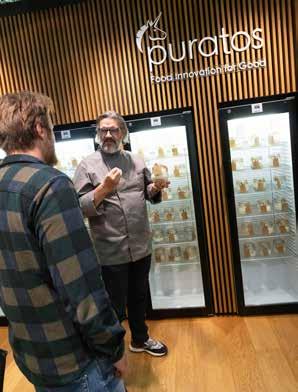
The sourdough library was primarily established to preserve the biodiversity of sourdoughs.
and local food production, sourdough is taking on new meaning.
artisan bakers are working with ancient grains like emmer, einkorn and spelt, and using historical methods to ferment them. old mills are once again producing stone-ground flour, and starter cultures are cherished as living heritage. Initiatives like the Puratos sourdough library show that the world today recognises that sourdough is not just one way of making bread; it is culture. Put your hands deep into a soft, fermented dough, and you feel it: the same power that the first bakers felt, six thousand years ago.
a sourdough bread is by no means just another loaf. It’s a living story that never ends. every starter we feed, every dough we knead, puts us in contact with thousands of years of history. sourdough is eternal.
ambassadeurs du Pain arose in france in 2005 out of a love of craftsmanship and a desire to breathe new life into the traditional baking profession. In a world becoming ever more industrialised and focused on expediency, the founders–including some of the biggest names in french baking, such as Dominique Planchot, Pierre nury and amandio Pimenta–wanted to build an international network of professionals standing for quality, respect for the product, and the use of natural processes such as sourdough starters and slow fermentation.
Today, the association has members in over 25 countries across europe, asia, the americas, africa and the Middle east. from france to Japan, from brazil to lebanon, and from canada to south Korea, there are bakers everywhere who have joined the ambassadeurs du Pain and are promoting the movement’s core values. each country has its own representatives and organises regional or national selections for the international competitions held by the association.
one of their most prominent initiatives is the biennial international competition le Mondial du Pain, in which teams of bakers from around the world pit their craftsmanship, taste, technique, and innovation against each other to produce the best bread. It is no ordinary competition; it is a celebration of the craft and an opportunity for both new and veteran bakers to enrich and pass on their knowledge.
The association places a high priority on education, with training, workshops and technical exchanges being a strong focus. They publish technical manuals, teach in baking academies, and are committed to preserving ancient grain varieties and using natural fermentation methods like sourdough. Their goal is twofold: to not only bake high-quality bread, but to help consumers to re-learn what good bread is.
What makes the ambassadeurs du Pain unique is their holistic vision: they approach bread as culture, as tradition, as both an everyday staple and a modern, forward-looking craft. sustainability, local raw materials, educating the next generation, and the use of sourdough are key features of the movement. far from being regressive reactionaries, they are future-builders: bakers who believe that the future of bread lies in its past.
In a world where many bakers are having to adapt to unprecedented speed and volume, ambassadeurs du Pain choose quality, authenticity and time, in the conviction that the power of bread lies in its simplicity, slowness and connection with people. They are reinventing baking as an act of care and pride, with sourdough as the living heart of their mission.
slow food is a global movement dedicated to promoting food produced ethically, sustainably and authentically. specifically, the slow food movement began in Italy in 1986 in the wake of Italian activist carlo Petrini’s campaign against the opening of a McDonald’s in the historic heart of Rome. It became a response to the
rise of a “fast food” culture revolving entirely around speed, efficiency, and food as a mass-made product. but the movement’s goals quickly expanded to include the preservation of agricultural biodiversity and the restoration of natural heritage.
sourdough, with its deep roots in the traditional art of baking, plays an important role in the philosophy of slow food. It is an example of how artisanal foods, produced slowly and with natural ingredients, not only promote health at the individual level but also preserve biodiversity and cultural traditions.
slow food also engages in bread-related activities worldwide, including conservation projects for unique breads or cereals in danger of disappearing in many countries. These efforts are giving old techniques and forgotten flavors a future. It is a way of keeping food cultures alive, with efforts grounded in reality and a focus on the communities working with them.
To the slow food movement, sourdough is the embodiment of traditional and sustainable food. It is an icon of local, artisan production, with bakers preparing their dough by hand and embracing the patience of the fermentation process.
one of slow food’s most important goals is to strengthen local communities by connecting them to their food production. sourdough bakeries are often small-scale, local businesses that have a direct relationship with their customers and the communities they serve. These bakeries typically rely on local, organic ingredients, and their products reflect the unique flavors and traditions of their region.
The foundation of any sourdough bread is a sourdough starter. Making a sourdough starter the simple way means simply mixing flour and water and letting it ferment naturally. The process creates a living brew of wild yeasts and lactic acid bacteria in the dough, which combine to both make your bread rise and develop a complex of flavors. sourdough needs to be nurtured daily. Immediately after feeding with flour and water, the sourdough starts fermenting and extracting nutrients from the flour. This causes the sourdough to grow.
but sourdough is more than just a way to make a bread rise. It’s an ecosystem of bacteria and yeasts in a symbiotic relationship. This natural fermentation process makes flavors deeper, but also makes the bread easier to digest, and ultimately gives each loaf a unique character. The science behind sourdough offers both hobby bakers and professional chefs the ability to refine the baking process and consistently achieve exceptional results.
a sourdough can last your whole life if you maintain it properly.
The choice of flour has a major influence on the activity and taste of your sourdough. The most commonly used types are listed below.
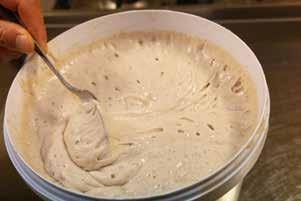
Sourdough, ready to use
White flour Wheat flour with a light colour and mild flavor.
Rye flour Rich in nutrients, this flour will make a more acidic starter.
Whole-grain rye With a coarser texture, this flour can absorb more water than sifted flour. It will make a darker, coarser starter.
Spelt flour contains less gluten and also absorbs slightly less water. This may make your starter feel more runny.
Kamut This grain is trickier for beginners to work with. It contains more sugars, so your starter will peak fast. It has a slight nutty flavor that makes for a good combination with wheat or another cereal. Kamut also absorbs less water than rye or wheat, so your sourdough may feel runnier.
Einkorn Very rich in nutrients and an excellent choice for feeding your starter. einkorn will give your sourdough a deeper flavor. It is low in gluten, so your sourdough will collapse faster after peaking.
Emmer Gives rich aromas to the bread and an artisanal end result. The bread will be less airy than with modern wheat varieties.
Flour: when starting out with making sourdough yourself, it’s best to start with just rye flour. It contains more nutrients than wheat, so it will give your sourdough a good start in life. once your starter becomes active and reliable, you can change over to a mix of rye and wheat or other grains. This will have an effect on the colour, texture, flavor and acidity of your breads.
The most commonly used starter is the liquid sourdough starter. This means that you always use equal amounts of flour and water when feeding the starter.
→ Water: spring water or filtered water is best.
→ A glass jar or plastic container: to keep your starter in and let you keep a close watch on the fermentation process.
→ A metal or wooden spoon or spatula: for stirring and mixing.
Tip
To feed your starter, always use 50% rye flour and 50% wheat flour as a base. This will give your starter a light brown colour and enough nutrition from the rye.
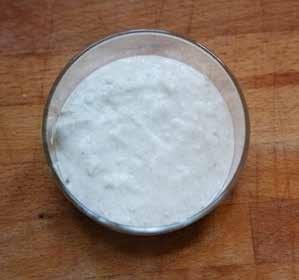
→ combine 25 grams of rye flour with 25 grams of lukewarm water in a glass jar or plastic container.
→ stir well and let the mixture stand, loosely covered with a lid, for 48 hours at room temperature (about 22–23 °c).
→ You may already start to see some light fermentation.
→ Throw away half the starter from day 1 (or use it; see p. 63), keeping 25 grams. add another 25 grams of rye flour and 25 grams of lukewarm water and stir well.
→ let it stand, loosely covered, for 24 hours at room temperature (about 22–23 °c).
The starter that you throw away is called the “discard.” You can incorporate it into bread dough. This young discard has built up almost no microflora yet, so many bakers throw it away. however, you can knead it into a yeast dough or make pancakes with it (see Sweet Sourdough, p. 97).
You are now using the formula 1.1.1 (see p. 17). You will see this formula come up a lot in the sourdough world. It means that your ratio is equal grams of starter (or sourdough), flour and water (25 grams of starter, 25 grams of flour, 25 grams of water).
You will continue to use this formula for making your own starters, at least at the beginning. The stronger your starter becomes, the more you can adjust the formula. later you can go to 1.2.2, which means twice as much flour and twice as much water as starter. some true fanatics even go as high as 1.10.10.
Days 4–10: Stronger growth
→ Throw away another 50 grams today (or use it, as described, in a yeast dough or pancakes), so you go back to 25 grams of sourdough starter. add another 25 g of rye flour and 25 g of lukewarm water (returning to 1.1.1) and stir well.
→ let this starter stand, loosely covered, for 24 hours at room temperature (about 22–23°c).
→ Repeat this step daily until (and including) day 10.
→ Your starter should look better every day. You should notice a slightly sour smell.
→ from day 5, it should be rising nicely and forming air bubbles.
If you don’t observe any rising after day 5, the most likely reason is that your starter is too cold. Try using warmer water or moving the starter to a warm place, like on top of your fridge. still nothing? Then it might be your flour. Try with a different rye flour and continue feeding. You don’t necessarily have to start over from scratch, but keep following the steps as described for days 4–10. The sourdough will extract all the nutrients and sugars from the flour you are now feeding it daily. This will make it start bubbling and rising. once it has largely used up all the nutrients in the flour, you will see it sink back down. That’s a natural signal that it’s time to feed it again.
at this point the sourdough should smell pleasantly sour and have an airy, frothy texture. now you can use your starter to make your first sourdough bread! Keep in mind that your starter is still very young, which will mean big air pockets in your bread; this is typical of young starters. There is a lot of wild yeast activity going on, but the lactic acid bacteria are not yet balanced. To get them in balance, keep discarding starter and feeding it daily.
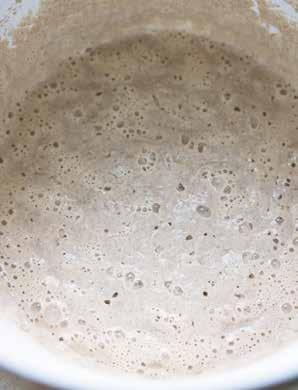
Active sourdough smells pleasantly tangy and has a light, foamy texture.
Tip
for the first few weeks of baking with sourdough, add 1% (of the weight of the flour) baker’s yeast to the bread dough. This will give you a balanced rise while still keeping the sourdough flavor.
care
by taking good care of your starter and feeding it regularly, you will build a strong and reliable base for all your sourdough breads.
→ Keep discarding 50 grams daily (or incorporate it into a bread dough; see p. 63) and starting again with 25 grams of sourdough. Then go back to adding another 25 g of rye flour and 25 g of lukewarm water and stirring well. The older your starter becomes, the more you can trust the formula. on average, you can expect to be baking nice, airy sourdough breads after 14 days.
→ If you want to build up a lot of starter because you need to make several loaves at a time, just feed without discarding any starter: in other words, if you have 75 grams of starter, add 75 grams of flour and 75 grams of water. This will get you to 225 grams. This is in keeping with the 1.1.1. template (see Day 3: Feeding and observing, on building up your starter, on p. 15).
→ When making a bread dough, it is always important to reserve some starter and not use it all, otherwise you’ll have to start all over again.
→ once you’ve built up a reliable sourdough starter, you can set aside a jar of it in the freezer so you always have something to fall back on if something goes wrong.
sourdough is also perfect for drying and rehydrating later. This is very easy to do; simply spread a thin layer of your dough on a piece of baking paper and let it dry out in the open air. You can then grind it in a pestle and mortar and store it in a jar for when you need it.
If your sourdough is at room temperature, you should maintain it by feeding it daily. If you don’t bake that often, then after day 14 put your sourdough in the fridge and feed it weekly. but before you bake your next bread, let it come back to room temperature two days ahead of time.
Day 1 combine in a glass jar or plastic container. 25 g flour + 25 g water fermentation
Day 2 fermentation fermentation
Day 3
Day 4
Discard + feed
Discard + feed
Day 5 Discard + feed
Days 6 to 14
Discard + feed
Day 14Further care
Discard 25 g starter feed with 25 g flour + 25 g water light fermentation
Discard 50 g starter feed with 25 g flour + 25 g water light fermentation
Discard 50 g starter feed with 25 g flour + 25 g water every day your starter will be fermenting faster.
Discard 50 g starter feed with 25 g flour + 25 g water
If you’re storing your sourdough cold, you can feed it once per week. If you’re storing your sourdough at room temperature, you can feed it daily. The warmer it is, the faster the fermentation will happen. Discard 50 g starter feed with 25 g flour + 25 g water
If your sourdough is already decently active, you can now start baking bread. Keep feeding for a few more days as long as it’s growing.
If you want to keep making more sourdough, you don’t always have to discard the old starter. add 1.1.1, 1.2.2 or more to the old starter to build up a lot of dough for multiple loaves quickly.
DAY 1
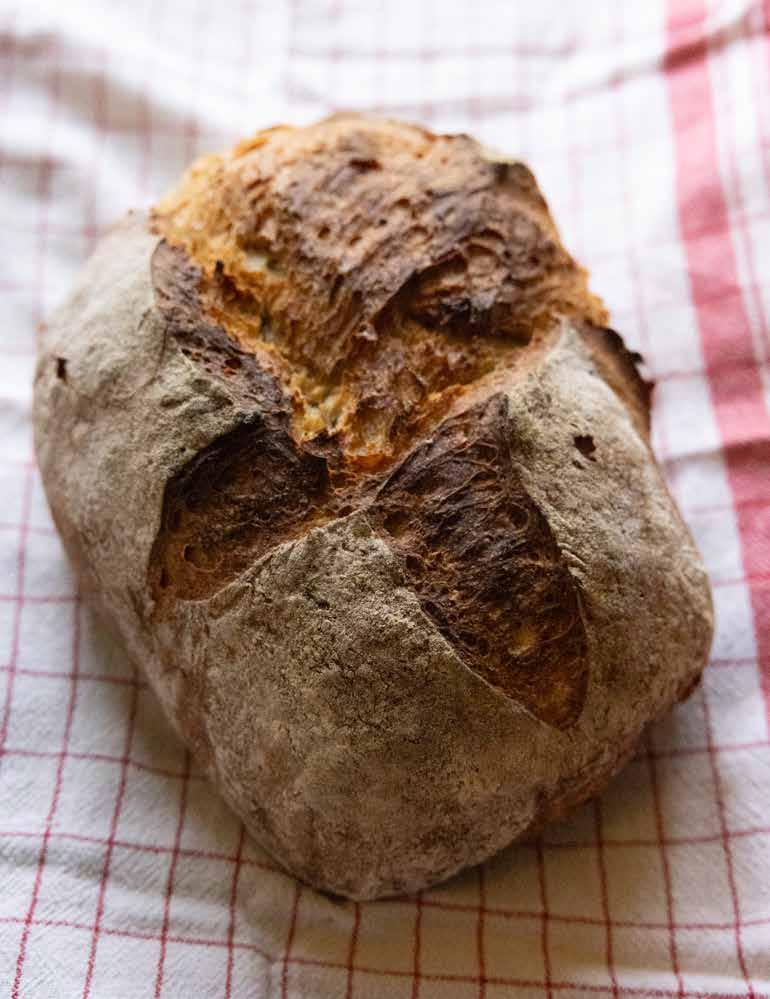
an everyday bread made from a mix of wheat and rye. farmhouse bread contains rye because in bygone days, when wheat was harvested by hand, rye often inadvertently ended up in the wheat.
Ingredients for preparing the sourdough
10 g sourdough starter
20 g wheat flour
20 g rye flour
40 g water
DAY 2
Ingredients for the mixing bowl
450 g wheat flour
50 g rye flour
50 g oat flakes
380 g water
13 g salt
90 g risen sourdough from day 1
DAY 1
combine all the ingredients for the sourdough and let rise for 12 hours at room temperature.
DAY 2
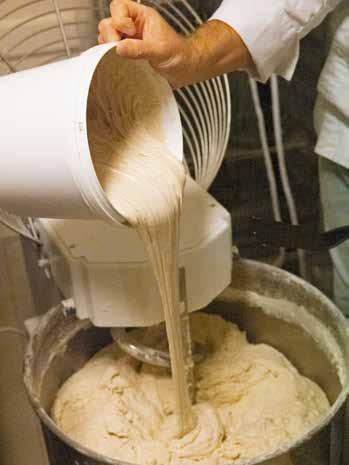
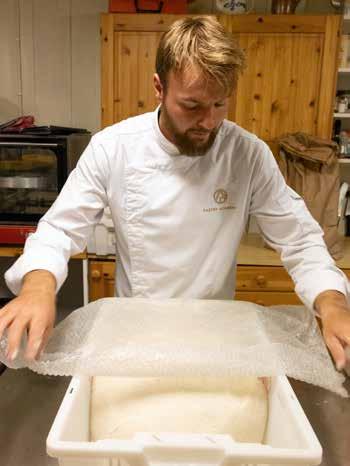
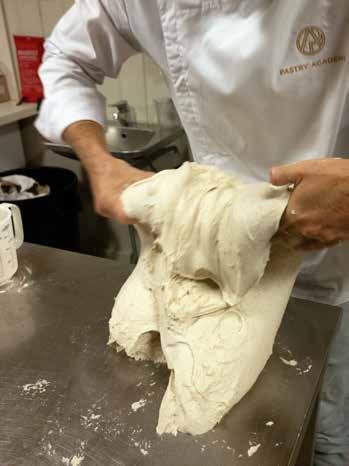
Place all ingredients in the mixing bowl. Knead for 4 minutes at low speed and 6 minutes at high speed or until the dough temperature reaches 23 °c cover the dough with cling film to prevent it from drying out. let the dough rest for 10 minutes in the mixing bowl. stretch and fold your dough three times, each 30 minutes apart. let the bread rise for approximately five hours, until it has nearly doubled in volume. shape the dough and place it in a floured proofing basket, covered with a kitchen towel, in the fridge overnight.
DAY 3
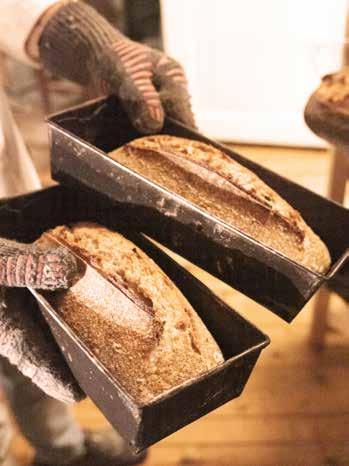
Place the dough on a baking sheet. score it in a traditional manner and bake the bread for 15 minutes at 235 °c; lower the heat to 220 °c and bake for a further 30 minutes. Make sure that you have sufficient steam in the oven during baking (see The importance of moisture, p. 39).
DAY 1
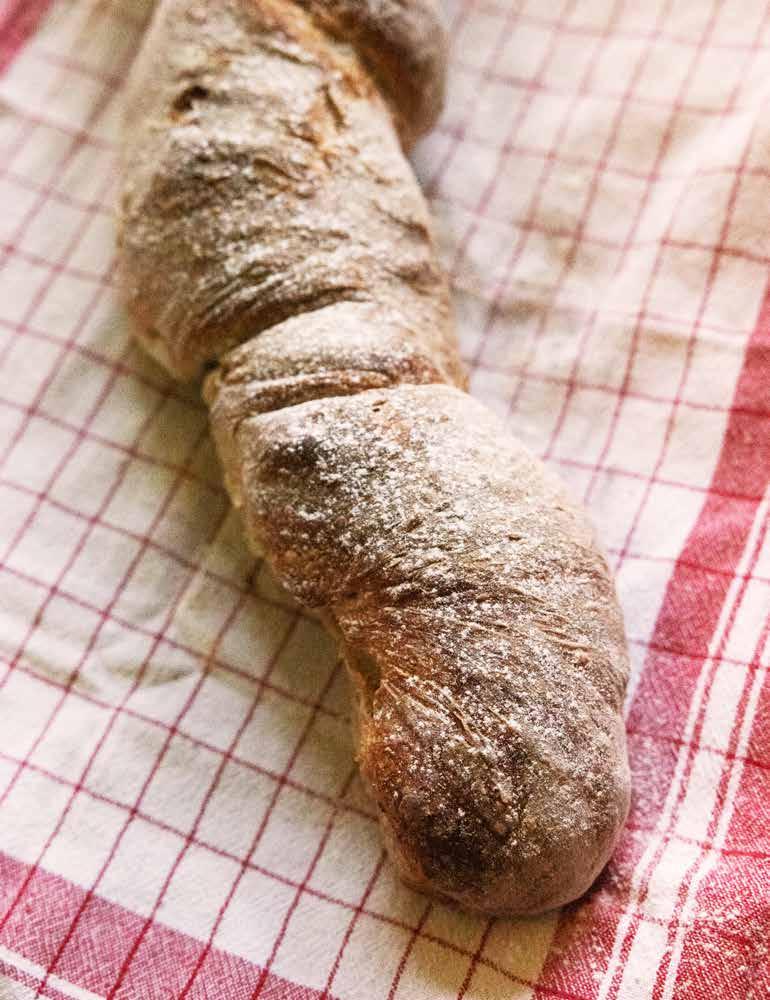
This is a simple bread you can make even if you haven’t mastered shaping a sourdough bread yet. It’s quick, but still has a touch of artisanship. a nice addition to a tapas plate or served with soup.
Ingredients for preparing the sourdough
20 g sourdough starter
40 g wheat flour
40 g water
DAY 2
Ingredients for the mixing bowl
500 g wheat flour
50 g oat flakes
350 g water
13 g salt
100 g risen sourdough from day 1
DAY 1
combine all the ingredients for the sourdough and let rise for 12 hours at room temperature.
DAY 2
Place all the ingredients in the mixing bowl. Knead for 4 minutes at low speed and 6 minutes at high speed or until the dough temperature reaches 23 °c cover the dough with cling film to prevent it from drying out. let the dough rest for 10 minutes in the mixing bowl. stretch and fold the dough once. let the bread rise for approximately 5 hours, until it has nearly doubled in volume. Remove the dough from the bowl and turn it a couple of times. Place in a floured proofing basket covered with a kitchen towel. let it rise for another two hours at room temperature. Place the dough on a baking sheet. bake the bread for 15 minutes at 235 °c, reduce heat to 220 °c, and bake for a further 30 minutes.
Make sure that you have sufficient steam in the oven during baking.
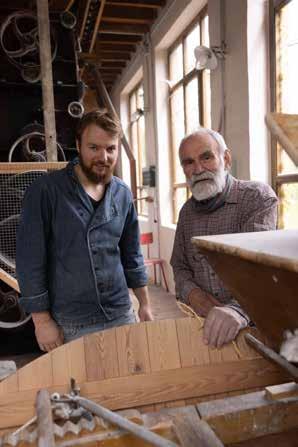
In the tranquil countryside west of brussels, where the morning mist lingers long over the fields and the River Mark is lined with pollarded willows, you will find the heetveldemolen: an old water mill with a wooden wheel and a stone heart. here they still mill flour the way they used to: with attention, time and running water.
When I arrived there, hubert, the miller, was already waiting for me in his work shirt. The air was thick with the scent of freshly ground flour: warm, nutty, almost herbal. “come in,” he said in a low, calming voice.
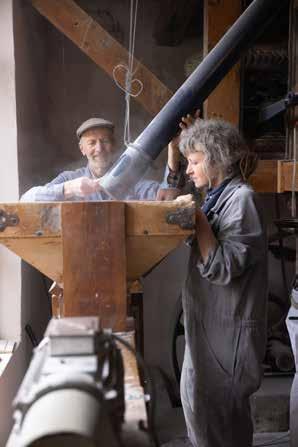
he accompanied me inside past sacks of heritage grain to the rhythmic creaking of giant gears. his hands spoke of craftsmanship. This mill is his world. as well as his wife Monique’s: it was her family that bought the mill, once upon a time, driven by the will to
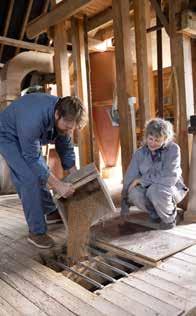
preserve something that otherwise would have been lost. What started out as a restoration project became a life project.
Today, she and her husband continue that work. Together they are a couple that not only manages the mill, but also embodies a way of life: slow, honest, rooted in ground and grain.
The mill grinds slowly, powered by the river. stoneground flour leaves the building without having lost germ, bran, or character. “The grain tells you what it needs,” hubert said, inspecting a handful of spelt flour. “and we listen.”
Wheat, spelt, emmer, einkorn, even kamut: what this mill grinds is heritage grains from local farmers. The result: flour with aroma, texture, and life–miles away from the factory flour most people know. I could
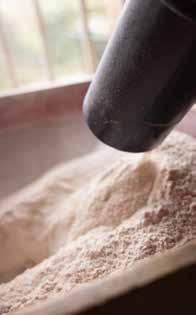
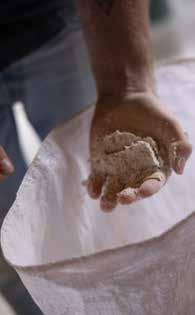
feel the difference just by touching it. for sourdough bakers, this is not an ingredient; it’s a partner.
What struck me is the rhythm. everything there happens at the tempo of water, wind and season. no clock that forces, no production that pushes. hubert and Monique work with respect for the mill, for each type of grain, and for the traditional cycle in which nothing needs to be, and in which nothing can be, hastened.
hubert showed me how the grain, sourced from local farmers, is hoisted up and then slowly fed into the millstones–shaped with precision by hubert and Dirk themselves–that grind the grain, without heating or crushing it.
“That’s how you keep the natural enzymes, the germ, the bran, intact,” hubert explained to me. “our flour is living flour, and you can taste it.”
The mill grinds grains that are thousands of years old and are coming back into the spotlight. With each, hubert knows what he’s doing: every grain demands its own setting and its own attention. “You can’t just force everything down through the same stones. every grain has its own character.” for anyone who works with sourdough, this flour is worth its weight in gold. It still has all the nutrients from the grain, ready for fermentation.
The bread that we took out of the oven was compact, crispy, and full of character, just like the place itself. Pure, honest bread, grown right here, miles away from the fluffy white bread in the supermarkets of brussels. and so the cycle goes: the farmer who sows, the miller who mills, the baker who kneads, the man who eats. each their own craft, all in their own time.
DAY 1
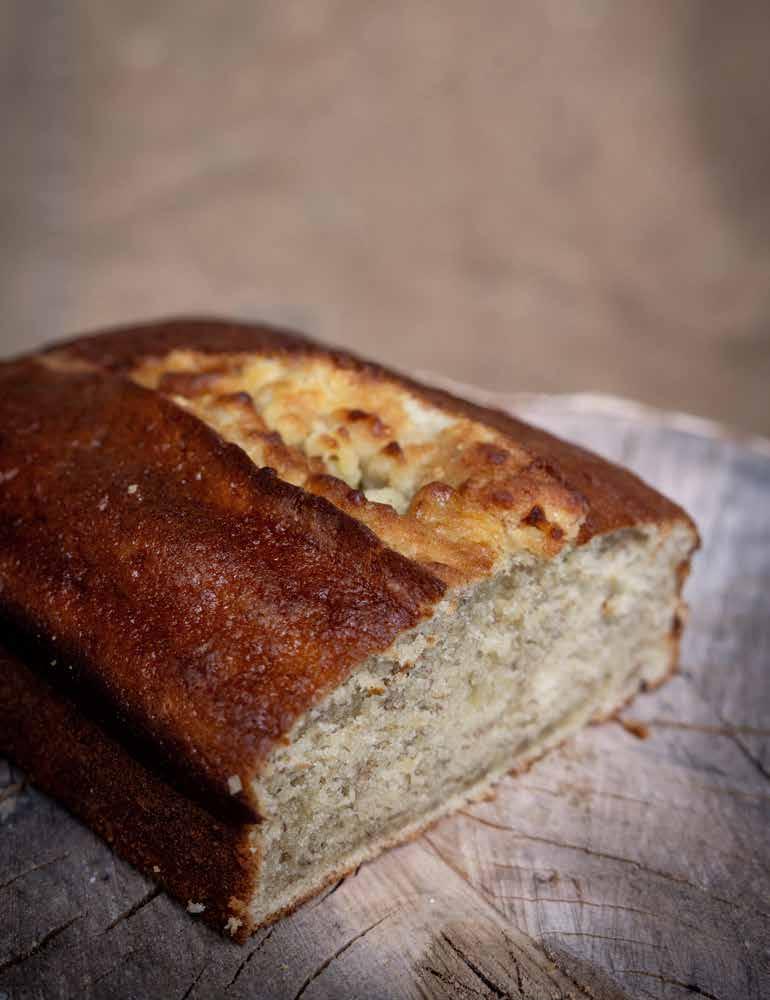
This delicious little recipe is my own upgrade to the banana bread recipe I picked up during my studies in las Vegas. The sourdough adds a subtle edge that does the sweetness of the banana bread good. It’s much more balanced than a typical sweet banana bread. as always, the blacker the bananas you use, the better.
Ingredients for the mixing bowl
210 g overripe bananas
2.6 g salt
2.6 g baking soda
200 g sugar
100 g neutral oil
100 g eggs
150 g wheat flour
160 g active sourdough or discard (inactive sourdough)
1 vanilla pod
Topping chopped walnuts
DAY 1
Preheat the oven to 180 °c. combine the baking soda, salt and wheat flour in a bowl and set aside.
In the bowl of a mixer, mix the bananas with the sugar and sourdough for 4 minutes at high speed. add the eggs and mix for 2 minutes more at high speed until the eggs are incorporated. Reduce the speed to medium and gradually add the baking soda, salt and wheat flour mix (approximately 1/3 at a time) to the bananas. When the dry ingredients are incorporated, add the neutral oil and continue to mix for another 2 minutes. Transfer the batter into a greased baking tin and sprinkle with walnuts. bake at 180 °c for 40 minutes or until done.