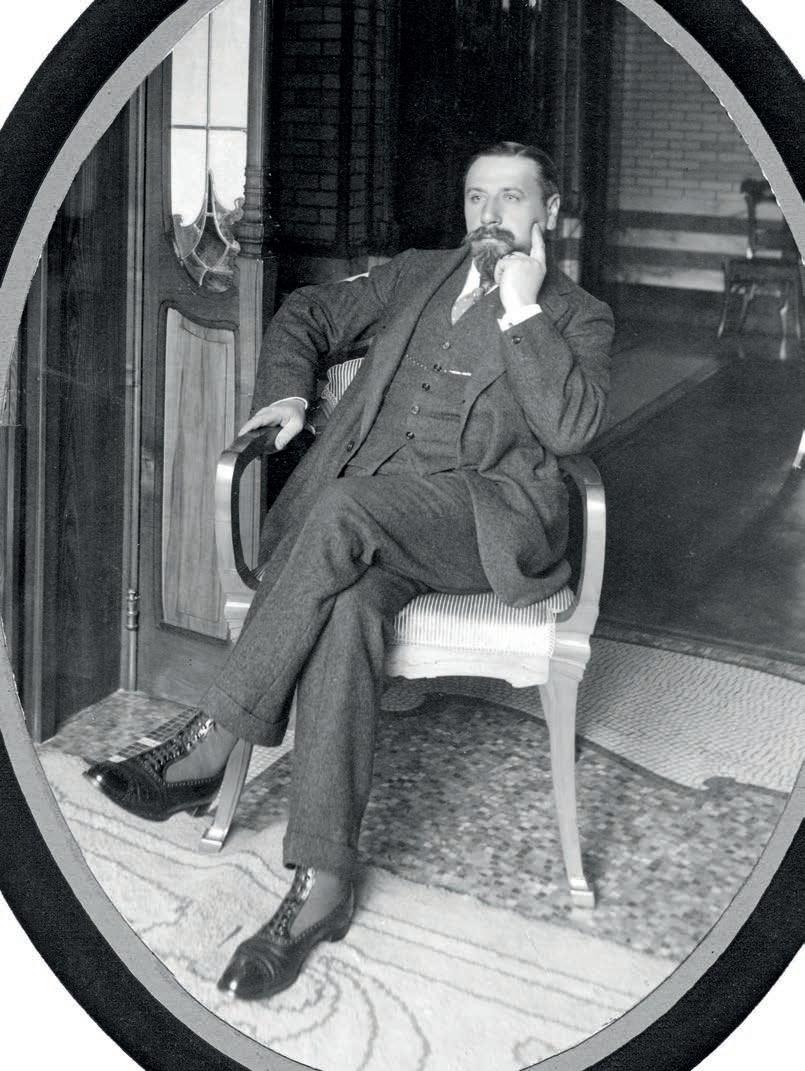
Portrait of Victor Horta in the conservatory of his home on Rue Américaine, circa 1902.
By the time Victor Horta was commissioned to design the Hôtel Solvay in 1894, he was already a well-established architect. After many years as an apprentice, he had been entrusted with designing two residences for friends, the engineers Eugène Autrique and Émile Tassel in 1893. The innovative design of the Hôtel Tassel garnered Horta significant attention from the press and the public. This small townhouse, located near Avenue Louise at 6 Rue Paul-Émile Janson, represented a revolution in building techniques at the close of the 19th century. Horta employed metal, making it visible on the building’s exterior and interior. This construction method had previously been utilised for long-span bridges and expansive exhibition halls, such as the Galerie des Machines by Ferdinand Dutert and Victor Contamin at the 1889 Universal Exhibition in Paris, as well as for greenhouses, such as the Royal Greenhouses in Laeken (1874, 1886) by Horta’s mentor, Alphonse Balat, railway stations including Paris’ Gare du Nord (1861–1864), department stores, for instance Paul Sédille’s Paris’ Le Printemps (1881), and market halls, namely Victor Baltard’s Halles Centrales in Paris (1845–1870). The metal lintels and columns enabled the arrangement of numerous windows in any configuration, an impossibility with stone or brick masonry, where solid and void sections must be aligned for stability. Inside, arches
or beams were supported by thin columns, with load-bearing partition walls removed to create open spaces and allow light to circulate freely. Horta held his mentor, architect Alphonse Balat, in high regard, yet he recognised that a new architectural style was necessary to address the needs of an evolving society. His clients, mostly industrialists and merchants who had amassed their fortunes through hard work and business success, sought to present an image distinct from that of the nobility or the old bourgeoisie, characterised by conservative tastes and a tendency to emulate ancient styles. Horta’s diligent reading of Eugène Viollet-le-Duc’s Entretiens sur l’architecture inspired him to introduce metal frames into private architecture.1 Viollet-le-Duc, a French architect and theorist, believed that the principles of construction and forms of Gothic art could be applied to metal architecture. Horta sought to create a style based on combinations of curves. Nevertheless, traces of Gothic architecture can be seen in features such as the double fan-shaped windows – drawn from the English Perpendicular style – that crown the grand staircase of the Hôtel Solvay. Curves and arabesques emphasise the flexibility of metal, and Horta’s originality is evident in his use of industrially produced flat iron combined with cast iron for the supports instead of wrought iron. The stones on the façades also boast curves that soften the angles. The architect was particularly fond of the white stone from Euville or Gobertange, which showcases delicate ornamental modelling. This necessitated the creation of three-dimensional plaster models to ensure that the stonemasons could accurately follow Horta’s designs. Horta wanted to establish his sculpture studio, which he later set up in the basement of his office at 23 Rue Américaine. When constructing the Hôtel Solvay, it seems likely that the models were produced in the workshops of ornamentalist Georges Houtstont, from whom Horta rented a house on the Chaussée de Charleroi.2 As evidenced in the architect’s accounts,
‘I compare myself to a blazing meteor whose fire swiftly faded into the void.’
[Victor Horta]*
these models were charged to the client per item. For example, on 5 November 1901, Solvay paid an advance of 1,500 francs for the furniture models (in contrast to Horta’s fees for 1899, which totalled 3,000 francs). The invoice for the furniture owed to Pelseneer totalled a staggering sum of 257,913.59 francs. Regrettably, the account books from the outset of the hotel’s construction have not been preserved.3
In his book, L’architecture privée au XIXe siècle, sous Napoléon III, French author César Daly makes a distinction between aristocratic hôtels particuliers of the past and modern private residences. ‘There are still similarities in the general layout, but in terms of new conventions and the amenities of modern life, the modern mansion has requirements of little concern in earlier times: everything that contributes to hygiene, comfort, convenience, and discretion. It is no longer sufficient for a salon to be richly adorned and elegantly furnished; it must also be warm and well ventilated.’ 4 Daly also emphasised the need to accommodate public and private life: entertaining guests with grandeur, while enjoying a comfortable domestic existence. For the Hôtel Solvay, Horta adopted the spatial arrangement he recommended for a grand townhouse. On the ground floor, a porte-cochère – a covered carriage entrance – gave access to the garden and stables at the rear of the plot, alongside the kitchen, cloakroom, and parlour. The main floor was dedicated to receptions, while the primary bedroom and family quarters occupied the first floor. The second floor housed the children’s rooms, their governess, and visiting guests, while a third, attic storey accommodated the servants’ rooms. Horta pioneered the implementation of the latest technologies that ensured comfort and hygiene in the home, including electric lighting, steam-powered central heating, auxiliary gas heating, natural ventilation, and modern sanitary installations.
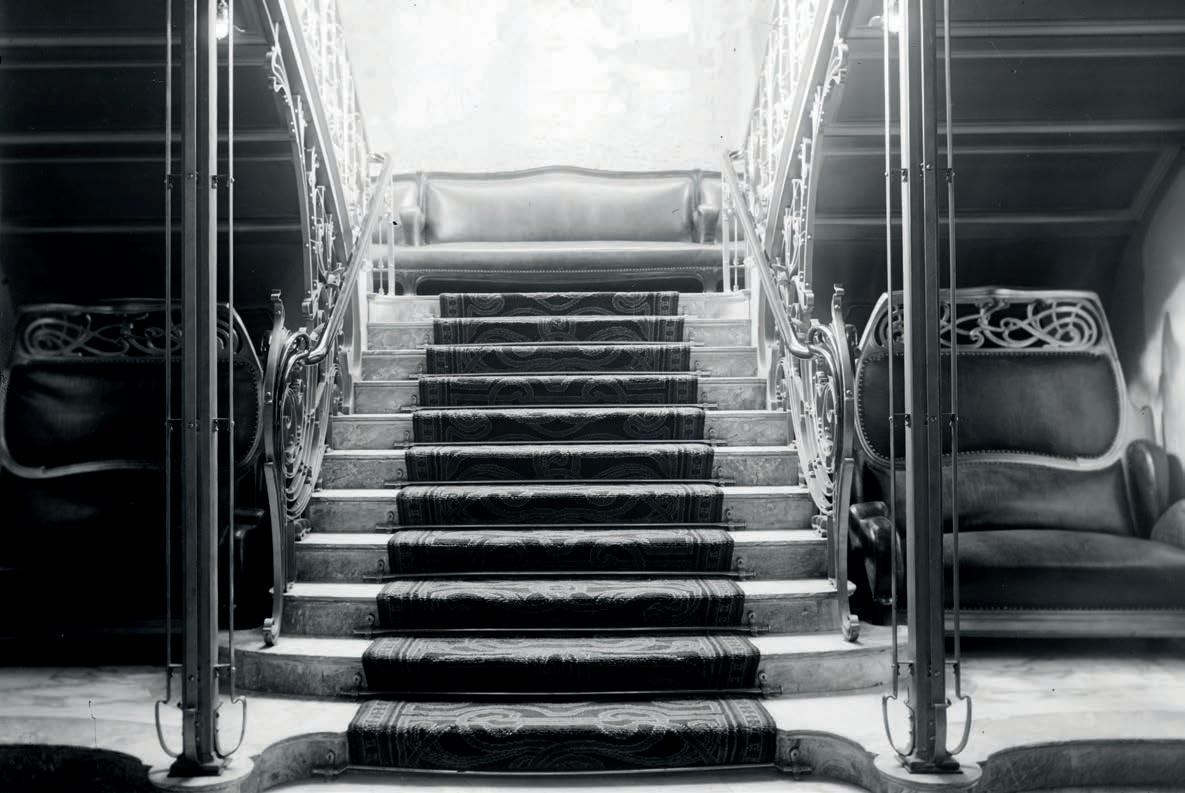
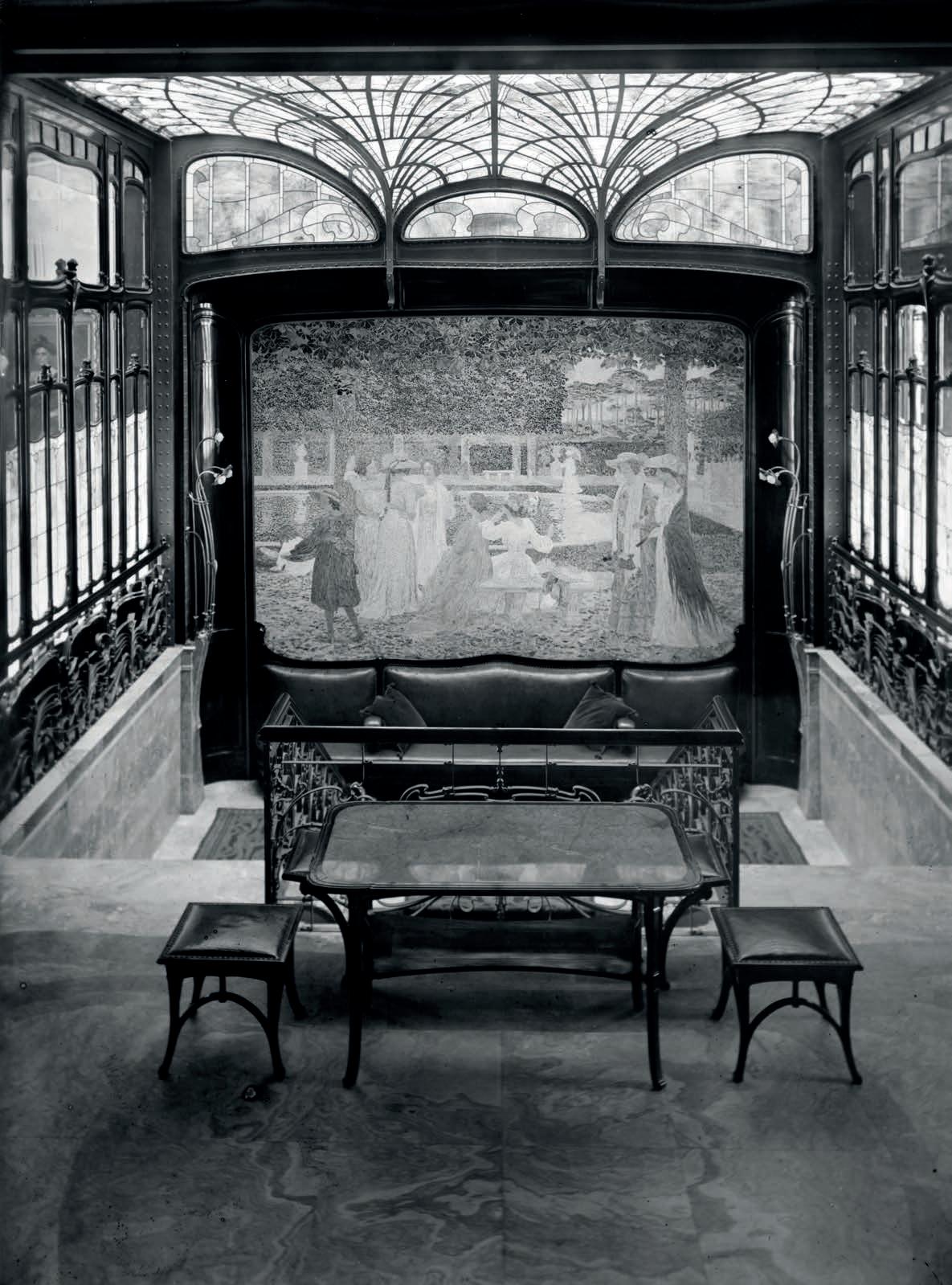
Start of the grand staircase. The historic photograph shows the abundance of light that once filled the main landing. This image is from before 1902, the year Van Rysselberghe’s painting was installed.
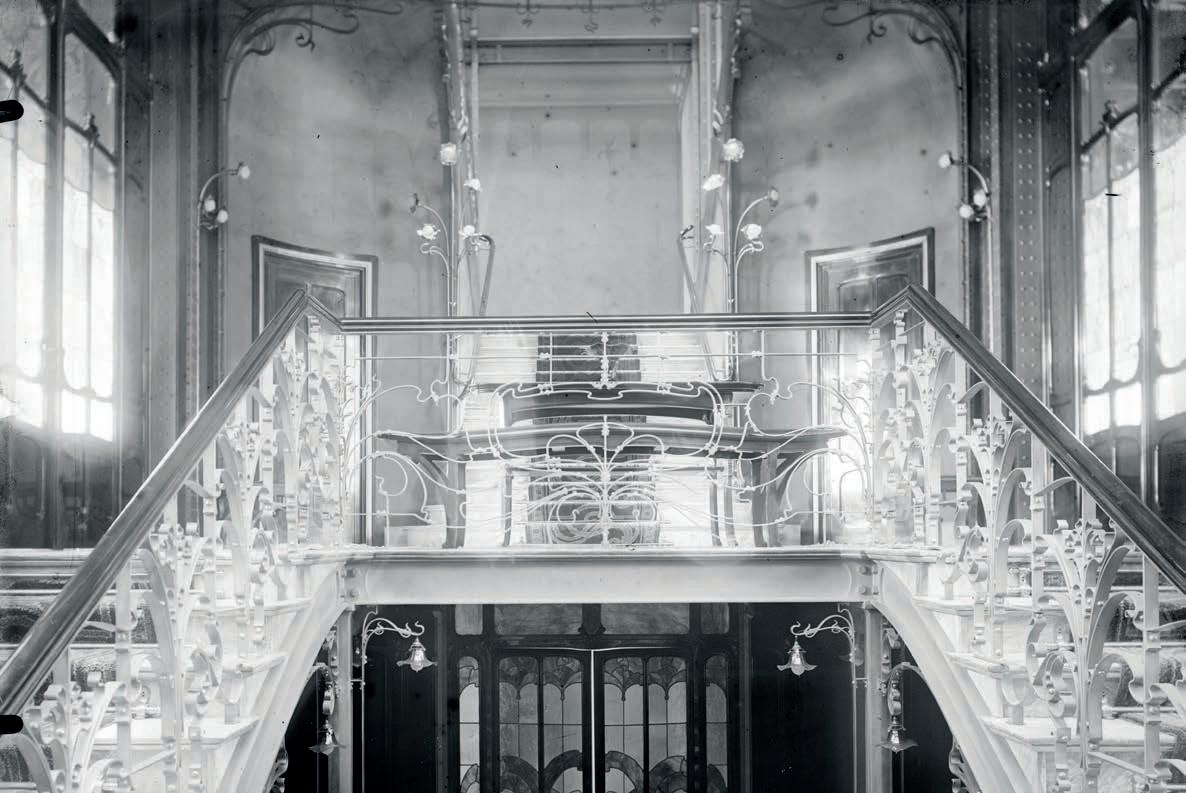
View from the first mezzanine landing towards the piano nobile.
The two pioneering Art Nouveau architects in Brussels, Victor Horta and Paul Hankar, shared a common ambition: to deviate from imitating historical styles. In the same year that Horta built the Hôtel Tassel, Hankar constructed his house and studio at 71 Rue Defacqz. The two men had met at Brussels’ Royal Academy of Fine Arts, where they forged a friendship – an unusual occurrence for Horta, who generally preferred the company of painters and sculptors over fellow architects. In his Mémoires, Horta recalls that only one or two individuals were ever welcomed into his “inner circle”, Hankar among them.5 Both men were devoted readers of Eugène Viollet-le-Duc, whose vivid exhortations encouraged architects to abandon pastiche. ‘By erecting monuments with fragments gathered from all sides – from Greece and Italy, from arts remote from our time and civilisation –we are merely accumulating the limbs of corpses. By tearing these limbs from the bodies that possessed them, we deprive them of life and cannot reconstitute a living work.’ 6 Inspired by such statements, Horta and Hankar endeavoured to create a vibrant, personal architecture that was fully attuned to the needs of modern life. Their clients, often newly wealthy and unencumbered by longstanding family traditions, saw in them not only architects but also interior designers. Both
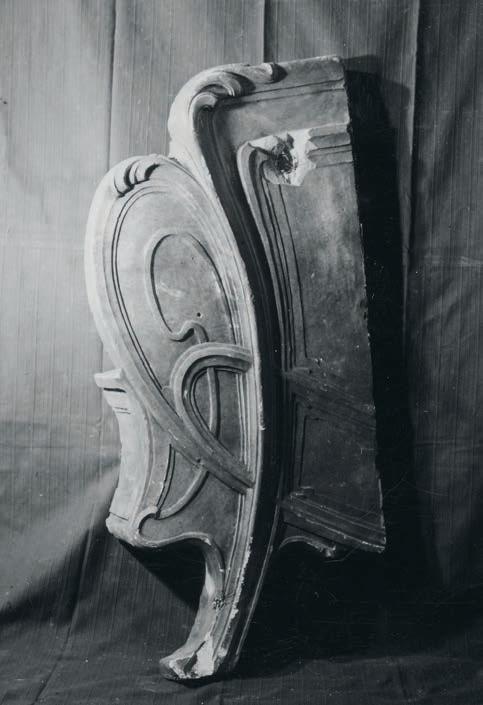
Life-sized plaster model of the headboard from the bedroom of Mr and Mrs Solvay.
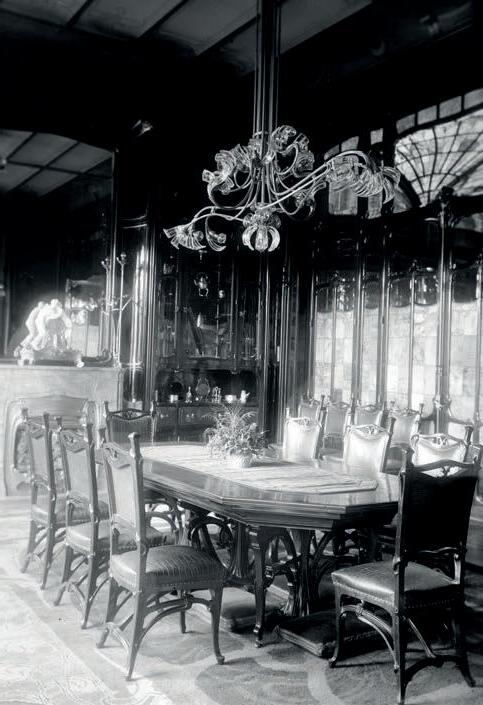
This photograph of the dining room shows the complexity of the lighting: natural light coming from the garden during the day and reaching into the staircase, and artificial light in the evening, emphasising the warm tones of the stained glass in contrast with the cool gleam of the crystal petals on the chandelier.
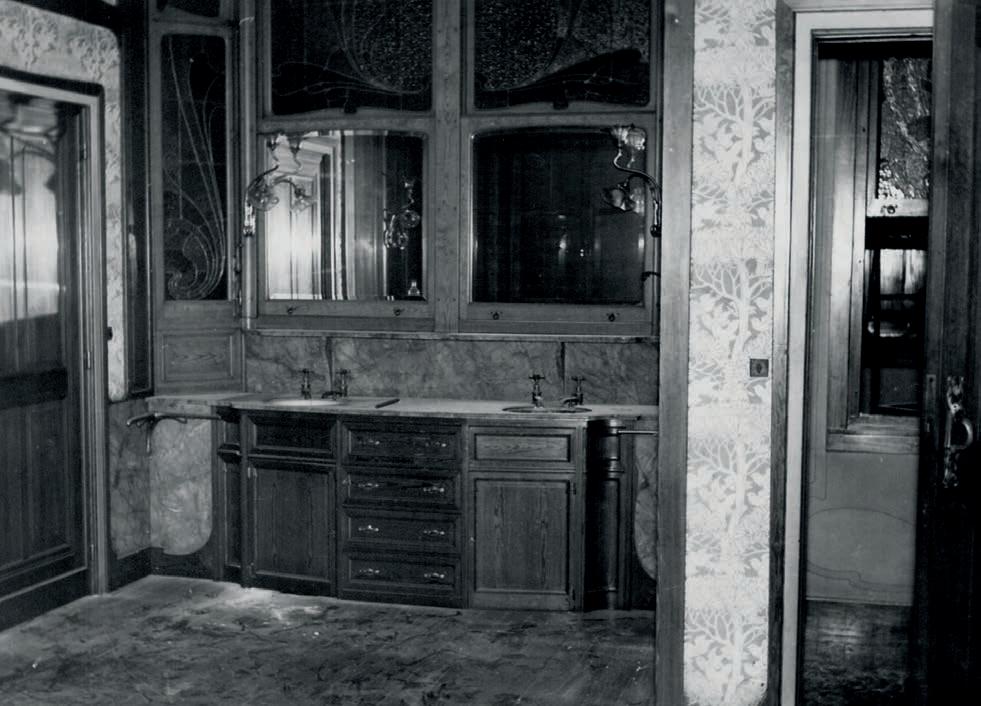
This document shows one of the washbasins from the bedrooms on the second floor, before their removal to create a single room now spanning the filled-in southern light well.
men aimed to establish complete harmony between architecture and décor, paying close attention to every practical detail of domestic life. The first magazine devoted to the decorative arts, The Studio, published in England from 1893, bore the motto “Use and Beauty” on its cover. While Art Nouveau manifested in various forms across Europe, the version developed by Horta and Hankar was noted for its structural clarity and ornamental language rooted in abstract linearity. This aesthetic was frequently caricatured, particularly in France, where, for a brief period, the nation was eclipsed in the decorative arts; its formerly preeminent “good taste”, epitomised by regal styles, was now widely imitated. In contrast, Belgium stood at the forefront of artistic modernity, welcoming leading figures of contemporary art and music to its salons: Seurat, Whistler, Gauguin, Max Liebermann, César Franck, Gabriel Fauré, Debussy, and Verlaine, among others.7 In 1897, Horta presented a set of furniture at the Salon de La Libre Esthétique, only to be sharply critiqued in the Revue des Arts décoratifs, which accused him of having ‘twisted paintings with stringy arabesques.’8 A few years later, in 1900, in his publication Le mobilier contemporain orné d’après la nature, the French glassmaker Émile Gallé denounced what he perceived as an intrusion of the decorative arts by ‘earthworms and tapeworms,
The bench on the main landing of the grand staircase provides an ideal vantage point to appreciate the architectural landscape designed by Horta, sheltered from the modern city, and inviting reflection on Verlaine’s line ‘Toutes mes langueurs rêvassent.’ (Brussels, August 1872)
pseudo-kelp and frantic vermicelli’.9 Gallé, a firm adherent of the “floralist” camp, opposed the “linearists”, as described by art critic Julius Meier-Graefe.10 The issue of ornament was fundamental to the emergence of a new style. A return to nature was widely regarded as the ideal remedy to rejuvenate artistic invention, a view further encouraged by the growing fascination with Japanese art. In the preface to the inaugural issue of Le Japon Artistique in 1888, Siegfried Bing highlighted nature as a ‘constant guide’ for the Japanese artist: ‘the inexhaustible source from which he draws his inspiration.’11 Yet Horta’s ornamentation was neither naturalistic nor overtly floral; he did not wish the origin of his motifs to be recognisable. Only a handful of botanical sketches in his hand have survived. In a note entitled ‘The Search for Spontaneous Floral Composition’, he remarked that it was usually easy for him to invent decorative motifs derived from plants: ‘In most cases, a satisfactory outcome was achieved at once. Yet, there were times when conceiving a comparable motif, true to the lines I cherished, would demand hours, even days.’12 Although one can discern the structure of a tree, a plant, or an animal’s head in its composition, Horta’s arabesque motif remains resolutely abstract.
“Art is the ornament of life”
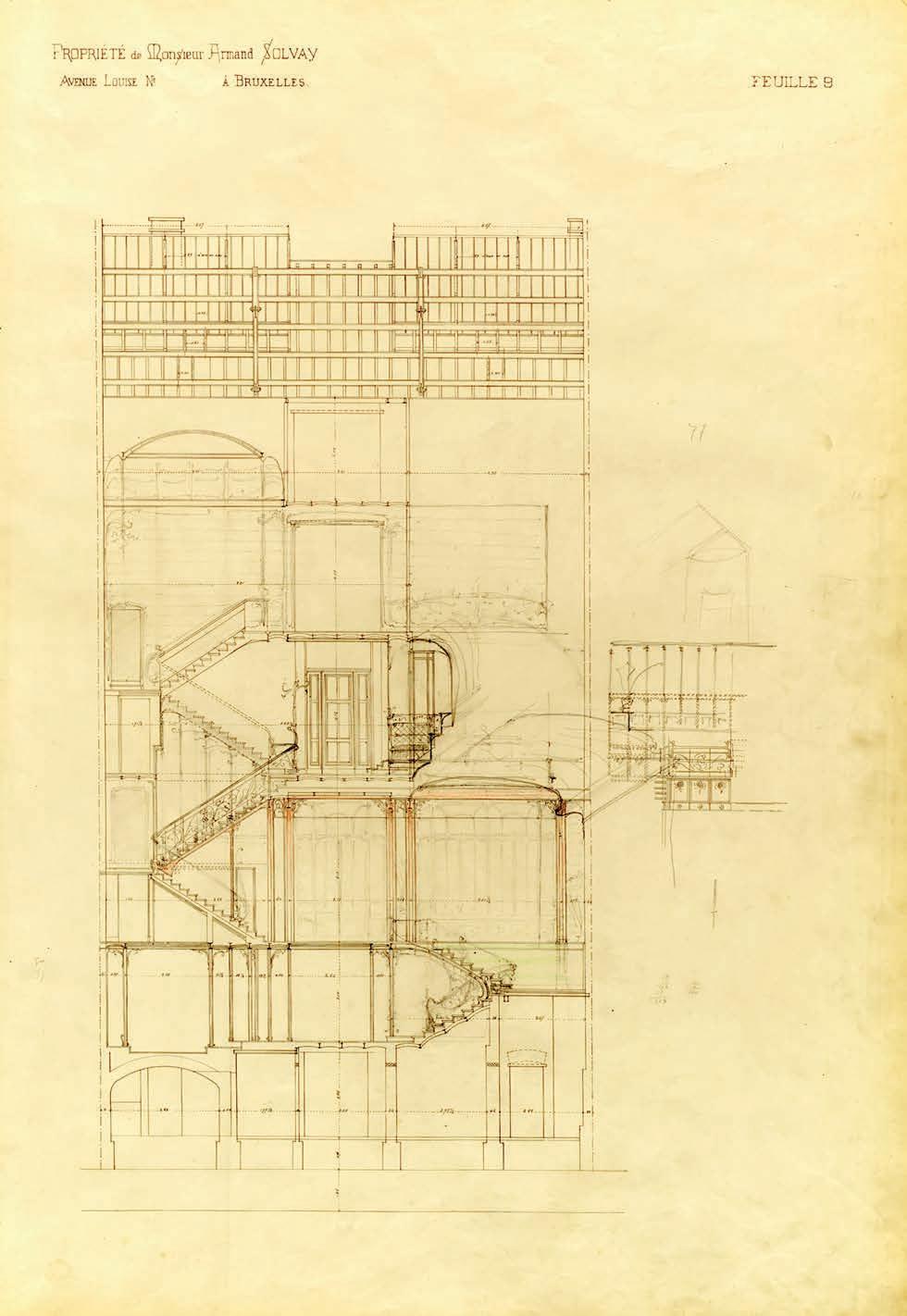
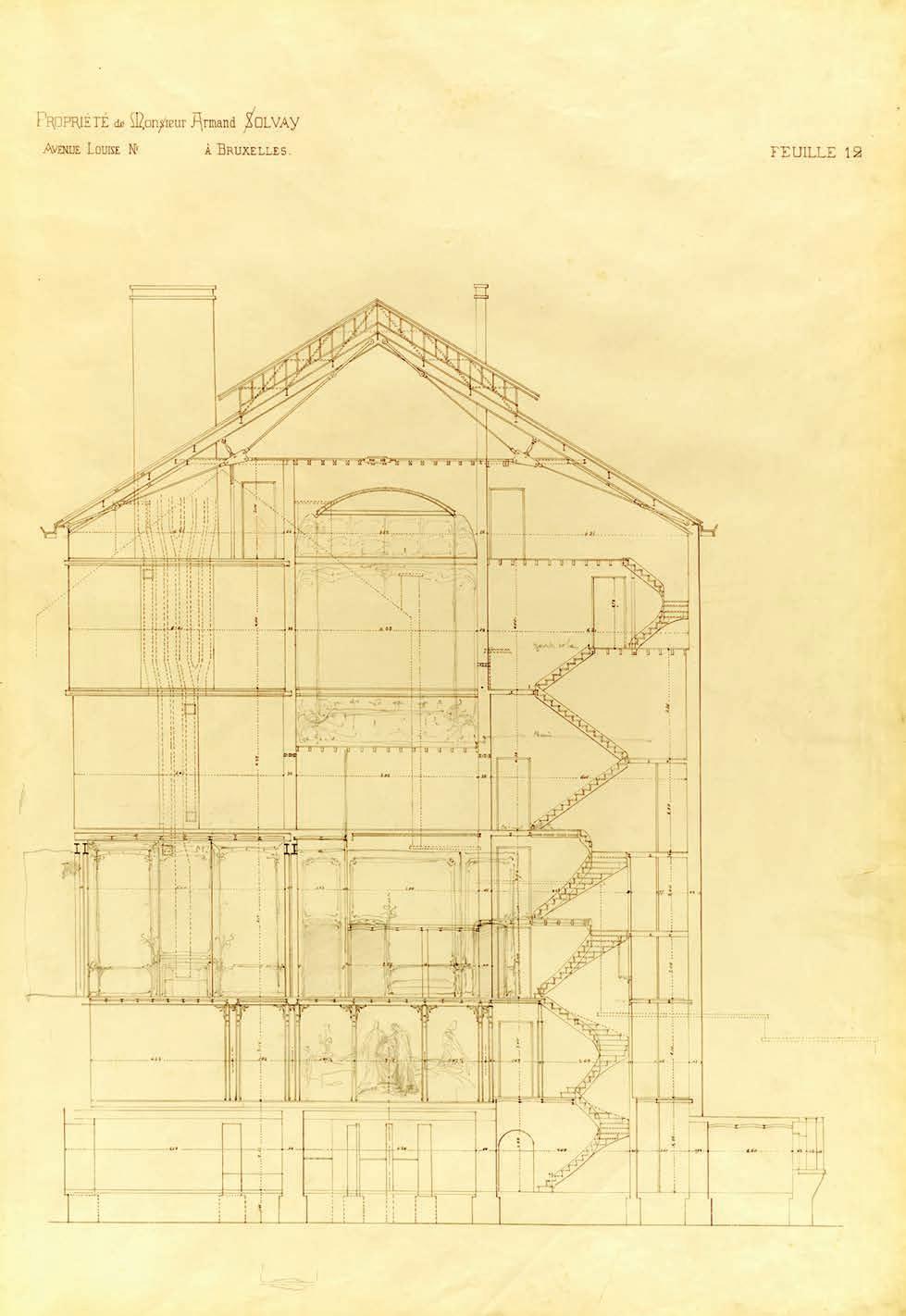
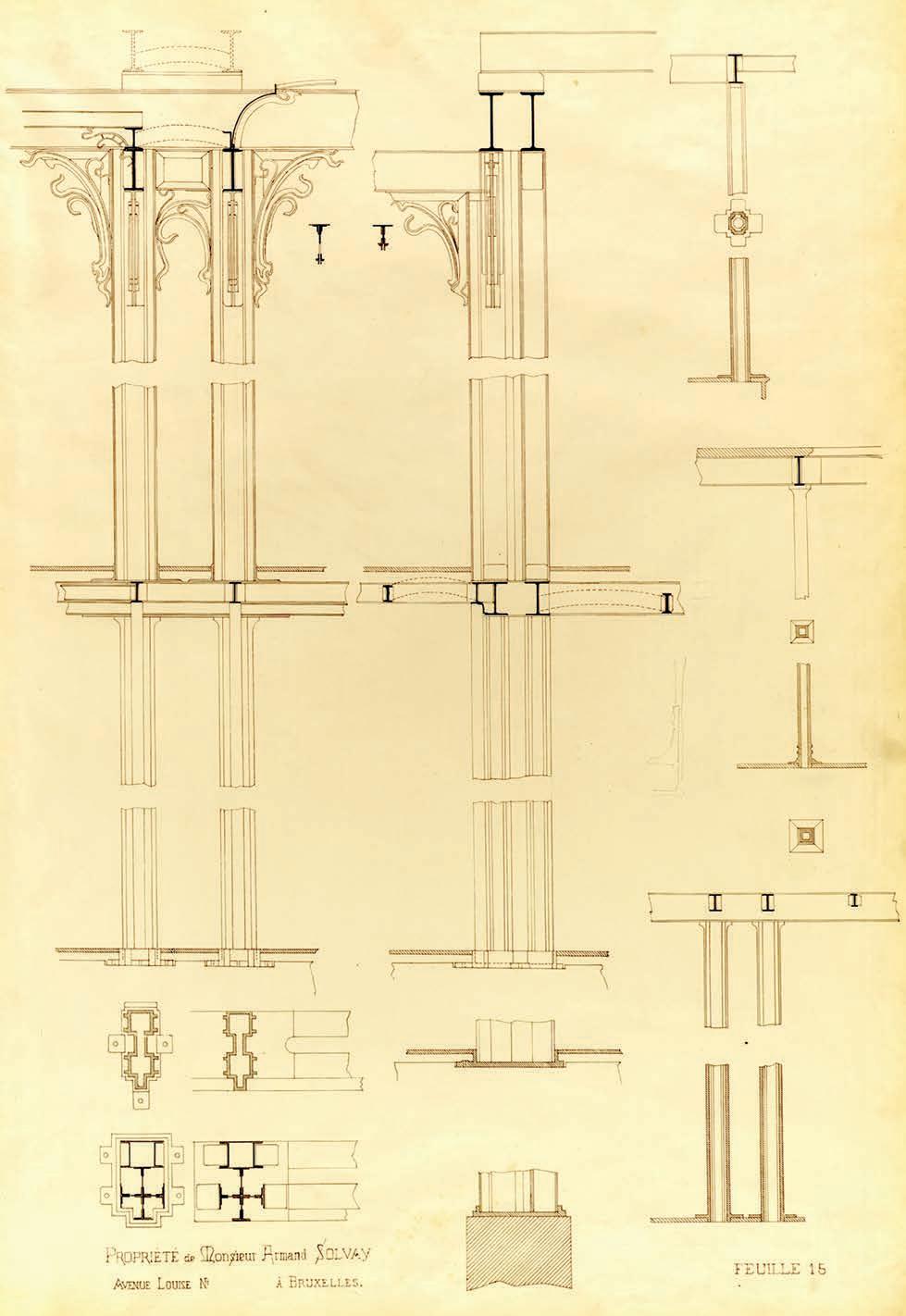
An album of architectural plans for the Hôtel Solvay, annotated in Horta’s own handwriting, has miraculously survived. It was donated to the Horta Museum in Saint-Gilles by the Fondation Jean Delhaye.
Section through both light wells (sheet 9).
NEXT PAGES
Section through the carriage entrance, showing the service staircase on the right (sheet 12).
Drawing of the beams designed for the carriage passage and reception hall: they were made in a simplified manner (sheet 15).
Art Nouveau flourished during a period regarded as the twilight of traditional craftsmanship. While age-old skills were still practised, machines were becoming increasingly dominant. In England, the Arts and Crafts movement appeared in response to the growing supremacy of industrial production, the subjugation of workers to machines, and the increasing division of labour. In his 1890 utopian novel News from Nowhere, William Morris wrote, ‘So that it may be fairly said that the great achievement of the 19th century was the making of machines which were wonders of invention, skill, and patience, and which were used for the production of measureless quantities of worthless make-shifts.’13 Art Nouveau sought to reconcile the fine arts with the applied arts, and, for a brief period, crafts were showcased in art salons alongside painting and sculpture. For example, the Hôtel Solvay was built with the collaboration of thirty artisans and specialist firms – a figure that highlights the exceptional coordination required throughout the building process. The imprint of industry is unmistakable in the metal structures.
Art Nouveau sought to combat ugliness, calling upon artists to engage with everyday life. Envisioning the home as a Gesamtkunstwerk – a total work of art – Henry van de Velde proclaimed that ‘art is the ornament of life’. However, this ideal of a life ennobled by beauty and shaped by artistic endeavour was brought to an abrupt end with the outbreak of the First World War.
6 January 1861. Born in Ghent, the son of Victor-Pierre Horta, a shoemaker.
1874. Entered the Ghent Academy of Fine Arts and was awarded his first medal in 1878 in the “Elements of Architecture” competition.
1879-1880. Worked with a decorator in Paris and returned to Ghent following his father’s death.
1881. Settled in Brussels, married Pauline Heyse, and enrolled at the Royal Academy of Fine Arts. Joined the office of Alphonse Balat, whom he would always regard as his mentor.
1888. Initiated into the Freemasons at the Amis Philanthropes lodge in Brussels.
1890. Birth of his daughter, Simone, ‘the woman I loved most.’14
1892. Designed the Lambeaux Kiosk (Parc du Cinquantenaire), remodelled the Van Cutsem mansion, and was appointed professor at the Polytechnic Faculty of Université Libre de Bruxelles (ULB), a post he held until 1911.
1893. Commissioned for the Autrique House and the Hôtel Tassel.
1894. Engaged to design the Frison, Winssinger, and Solvay residences.
1895. Commissioned for the Hôtel van Eetvelde.
1896. Commissioned by the Belgian Workers’ Party to design the Maison du Peuple (inaugurated 1899).
1897. Exhibited at the Salon de la Libre Esthétique in Brussels.
1898. Acquired land at 23–25 Rue Américaine in Saint-Gilles, where he would build his home and architectural office.
1900. Commissioned for the Hôtel Aubecq.
1901. Moved into his home on Rue Américaine and received further commissions, including the department store L’Innovation (Rue Neuve), and the Hôtel Roger.
1902. Participated in the Esposizione internazionale d’Arte decorativa moderna (International Exhibition of Modern Decorative Arts) in Turin.
1903. Commissioned for the Hôtel Max Hallet and the Grand Bazar Anspach.
1906. Divorced. Commissioned for the Brugmann Hospital in Jette (inaugurated 1923), and also participated in the Esposizione Internazionale del Sempione (Milan International Exhibition).
1907. Produced the first designs for the Museum of Fine Arts in Tournai (opened 1928).
1908. Married Julia Carlsson.
1909. Commissioned for the Wolfers department store, Rue d’Arenberg.
1911. Commissioned for Brussels Central Station (inaugurated posthumously in 1952).
1913. Appointed Director of the Royal Academy of Fine Arts in Brussels, which he sought to reform. Elected to the Royal Academy of Belgium, Fine Arts Class, Architecture Section.
1915-1919. Lived in the United States, travelling extensively to lecture.
1919. Commissioned for the Palace of Fine Arts in Brussels (opened 1928). Appointed professor at the Higher Institute of Fine Arts in Antwerp, where he remained until 1927.
1925. Oversaw the Belgian Pavilion of Honour at the International Exhibition of Modern Decorative and Industrial Arts.
1932. Ennobled with the title of baron.
1939. Began writing his Mémoires. Simone, his daughter, died the same year.
1947. Died. Buried at Ixelles Cemetery.
Texts
Françoise Aubry
Photographs
Gilles van den Abeele
except for:
Horta Museum (Brussels): p. 6 > p. 21
Edouard Hannon: Solvay: p.22
Stijn Bollaert p. 30
The archives of the City of Brussels TP 74610: p.152-153
Barbara Van der Wee Architects: (see @)
Graphic design and layout
Dominique Hambÿe
Translation and proofreading
Paula Cook
Éditions Racine / Lannoo Publishers
Tour & Taxis – Entrepôt royal Avenue du Port, 86C / bte 104A
B-1000 Brussels
Tel. +32 (0)2 646 44 44 www.racine.be
Subscribe to our newsletter and receive regular information about our publications and activities.
All rights reserved. No part of this publication may be reproduced, stored in a retrieval system and/or transmitted in any form or by any means, electronic, mechanical or otherwise, without the prior written permission of the publisher. Text and data mining of (parts of) this publication are expressly not permitted. All rights are reserved, including those for text and data mining, AI training and similar technologies. No part of this book may be reproduced or adapted in any form or by any means in any country.
ISBN: 978-23-902-53501
Legal deposit: D/2025/6852/20
Printed in Europe