FONDATION GANDUR POUR L’ART 12, rue Michel-Servet 1206 Geneva, Switzerland www.fg-art.org
Jean Claude Gandur
Founder and chairman
Scientific Direction
Fabienne Fravalo
Curator of the decorative arts collection, Fondation Gandur pour l’Art, Genève
Authors
Vincent Bastien, scientific collaborator, Château de Versailles (VB)
Michèle Bimbenet-Privat, honorary general curator, Musée du Louvre, Paris (MBP)
Agnès Bos, general delegate, Comité des travaux historiques et scientifiques (CTHS), Aubervilliers (AB)
Fabienne Fravalo, curator of the decorative arts collection, Fondation Gandur pour l’Art, Geneva (FF)
Aziza Gril-Mariotte, professor of art history, Aix-Marseille Université, CNRS TELEMME, and general director, Musée des Tissus et des Arts décoratifs, Lyon (AGM)
Caroline Heering, professor of art history, Université catholique de Louvain (CH)
Carl Magnusson, art historian (CM)
Hélène Malice, PhD student, Université catholique de Louvain / FNRS (HM)
Sophie Mouquin, senior lecturer of modern art history, Université de Lille, UMR 8529 – IRHiS (SM)
Anne Perrin, professor of modern art history, Université de Toulouse Jean Jaurès (AP)
Miriam E. Schefzyk, associate curator, J. Paul Getty Museum, Los Angeles (MS)
Susanne Thürigen, head of the collection of scientific instruments, weapons, and hunting materials, Germanisches Nationalmuseum, Nuremberg (ST)
Marjorie Trusted, honorary research fellow, Victoria and Albert Museum, London (MT)
Editorial Direction
Carolina Campeas Talabardon
Vice-Chairwoman, Fondation Gandur pour l’Art, Genève
Translation revision Emma Lingwood
Photographs
Thierry Ollivier
André Longchamp (pp. 57, 111, 113, 115, 121, 123, 125, 163-165, 177-179, 217, 237, 253-255, 257, 267)
Studio Sebert (pp. 45-47, 75)
Design
Enzed, Lausanne revised by 5 Continents Editions, Milan, for the present edition
Fonts URW É gyptienne et Stag
Paper
GardaMatt 170 g/m 2
5 CONTINENTS EDITIONS
Piazza Caiazzo, 1 20124 Milan, Italy www.fivecontinentseditions.com
Editorial Coordination
Aldo Carioli in collaboration with Lucia Moretti
Art Direction
Stefano Montagnana
Editing Charles Gute
Translations
Julia McLaren (from French), Gérard Goodrow (from German)
Colour Separation
Pixel Studio, Bresso, Italìy
All rights reserved.
Fondation Gandur pour l’Art, Genève For the present edition © 2025 – 5 Continents Editions S.r.l.
No part of this book may be reproduced or utilized in any form or by any means, electronic or mechanical, including photocopying, recording, or any information storage and retrieval system, without permission in writing from the publisher.
ISBN 978-12-5460-094-8
Distributed by ACC Art Books throughout the world, excluding Italy. Distributed in Italy and Switzerland by Messaggerie Libri S.p.A.
Cover
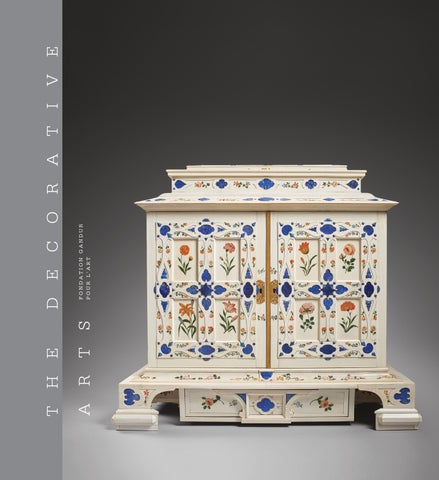
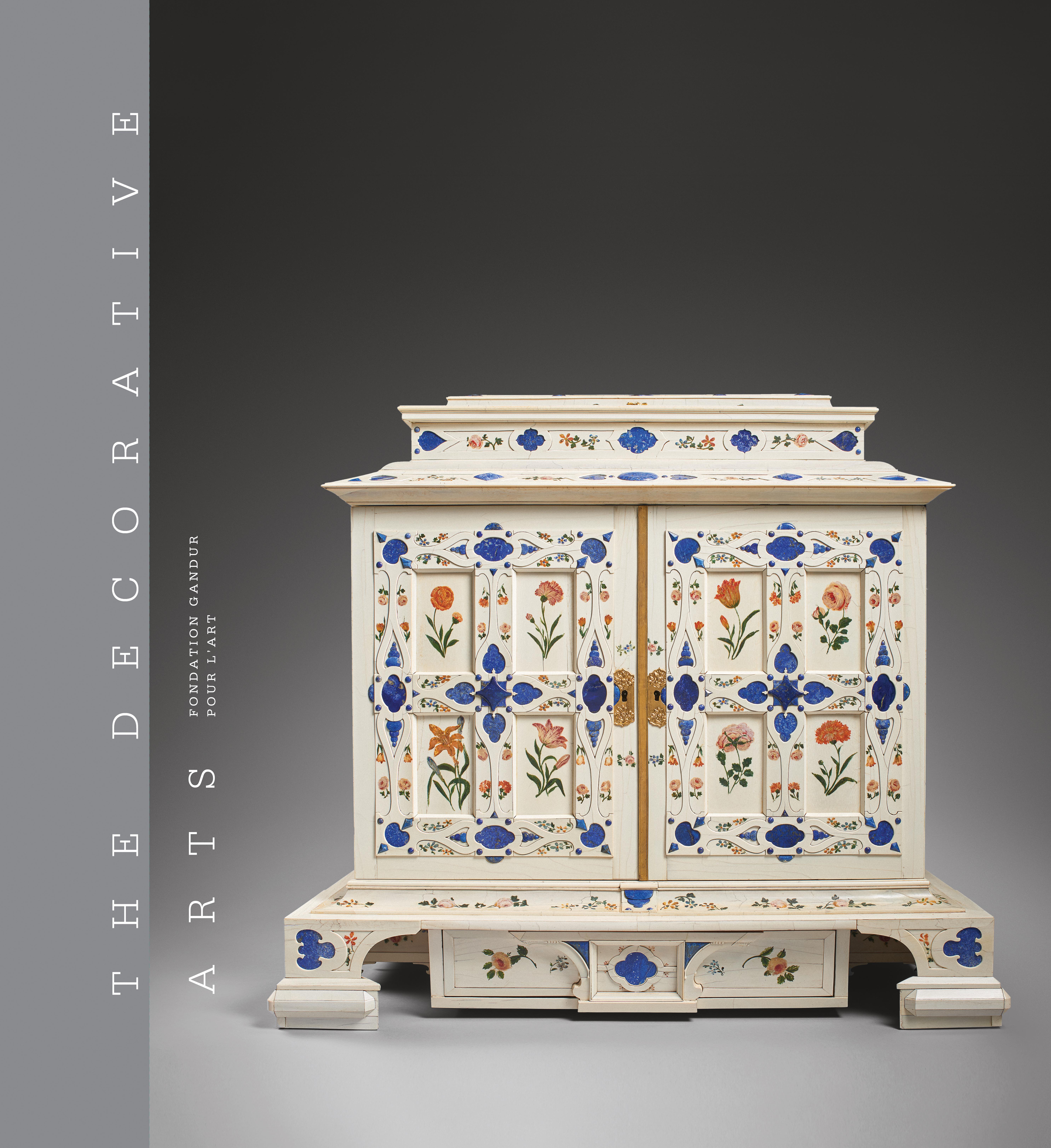
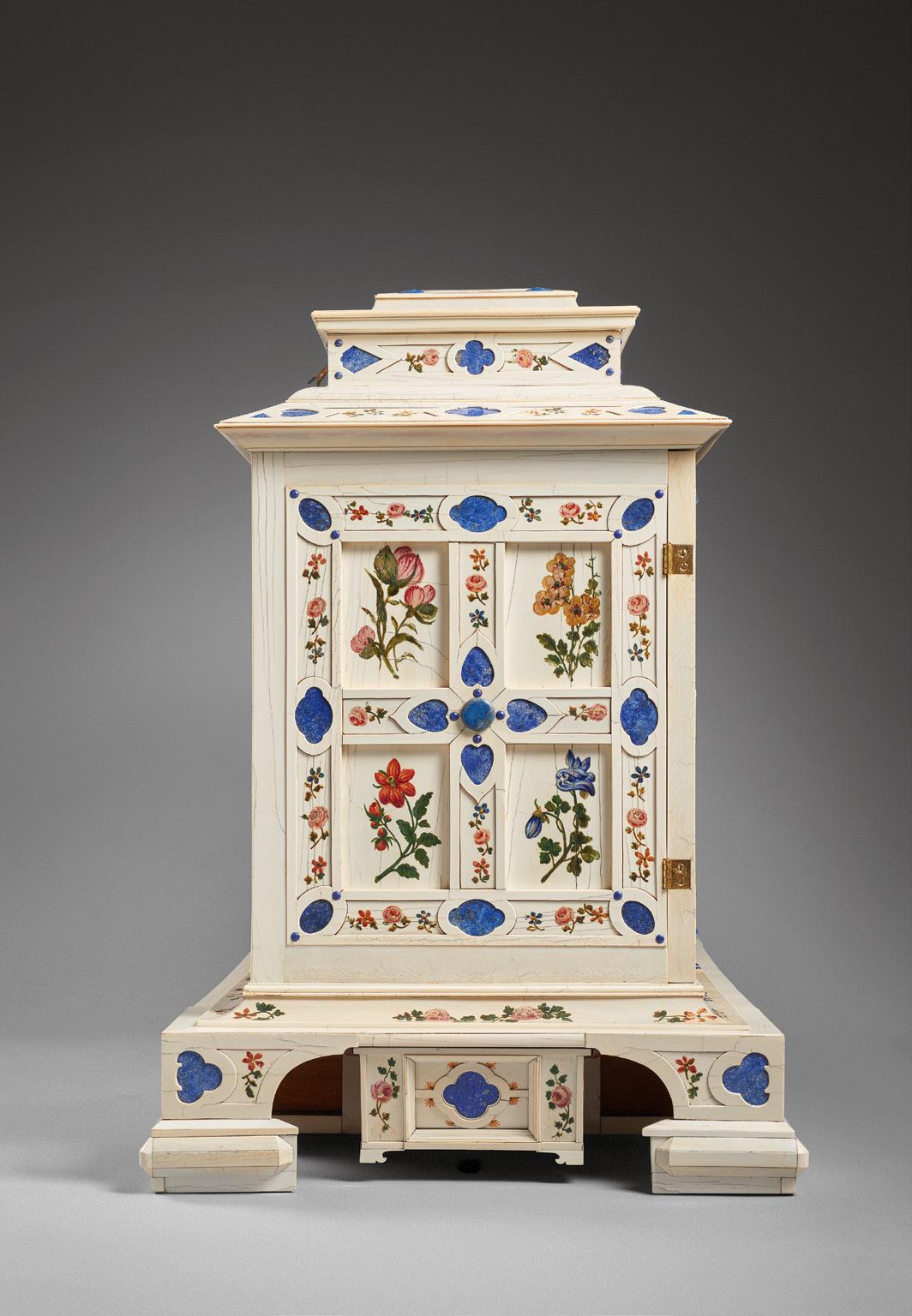
Melchior Baumgartner (attr.), Portable cabinet, circa 1650, Augsburg, 68.8 × 76.2 × 48 cm
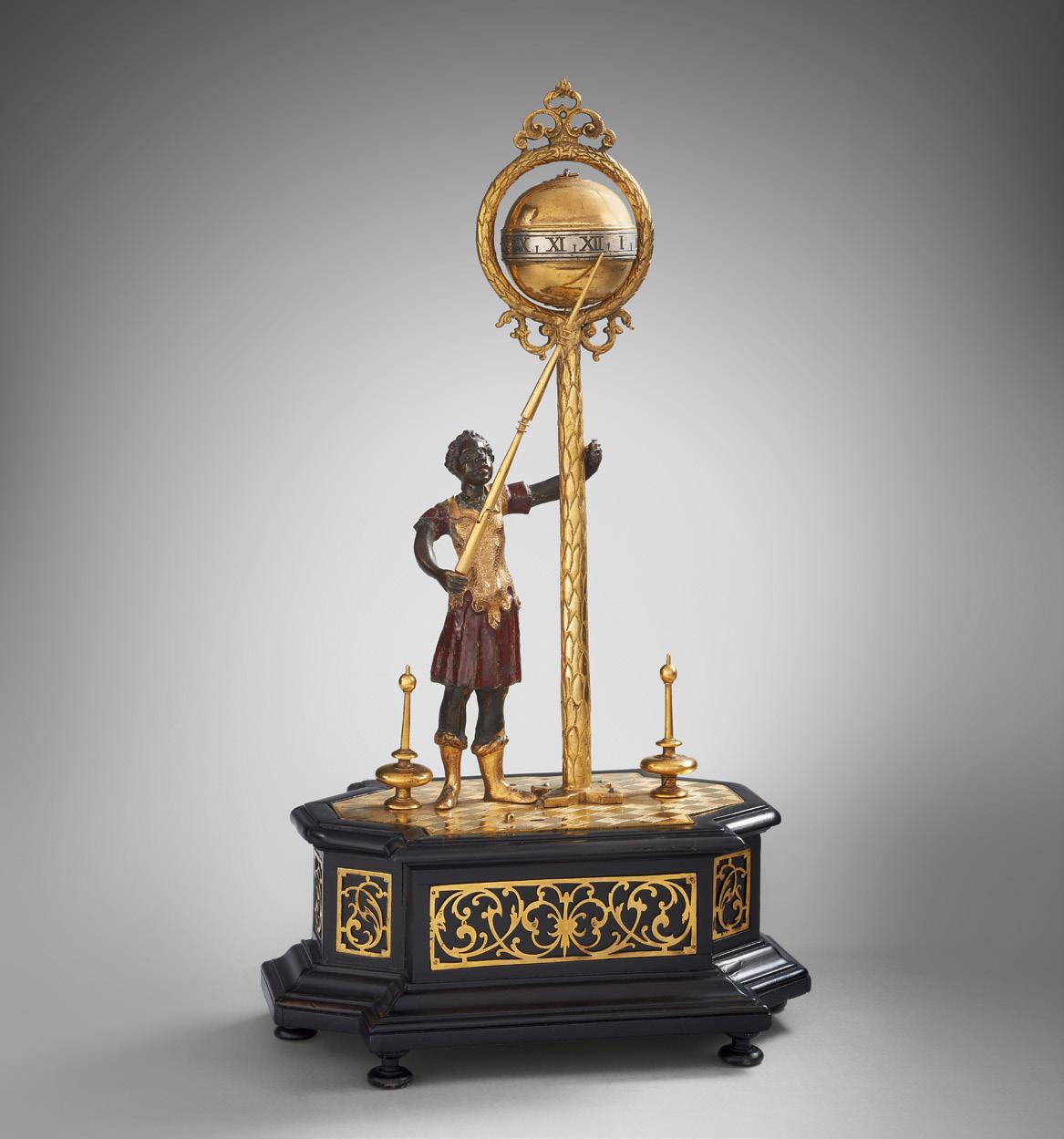
Circa 1630
Southern Germany
Ebony, copper, gilded brass, and silver 30.5 × 17 × 11.5 cm
FGA-AD-HORLO-0008
CONDITION
Missing: animal at the foot of the figure Restorations: colour of the costume restored (before acquisition); some ebony mouldings completed (Sébastien Évain, Paris, 2020)
PROVENANCE
Marc-Arthur Kohn, Paris, 18 March 2011, lot no. 51
EXHIBITIONS
Les Inventeurs du temps, Trésors de la haute époque horlogère (1500-1700) 2009
L’Horlogerie à Genève, Magie des métiers, trésors d’or et d’émail 2011-2012
BIBLIOGRAPHY
Sénéca 2009, cited and col. repr. p. 110, cat. no. 37
2. Automaton clock
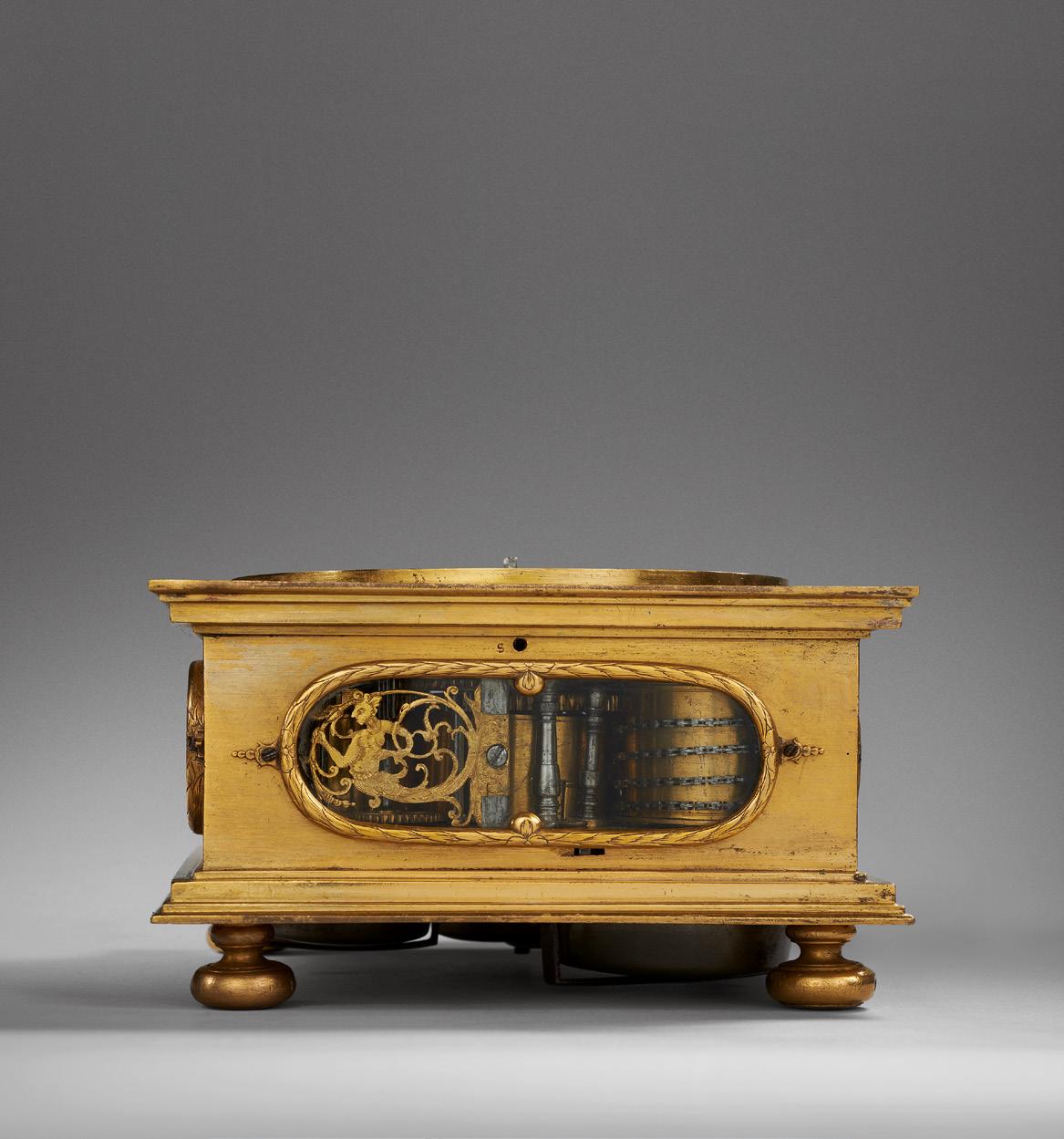
An octagonal, contoured ebony base sits on six turned feet and is decorated on all sides with ornamental gilded metal fretwork. On a metal plate, also gilded and engraved, set into the top of the base, stands the figure of a young “Moor” dressed as an ancient Roman general, accentuated in gold and red. He holds a sceptre with which he indicates the hours engraved in Roman numerals (I-XII) on a silver ring, surrounding a golden sphere, which rotates on its axis once every twelve hours, while the “Moor” turns his head from right to left on the hour. Placed at the top of a palm-like tree, around which the “Moor” wraps his arm, this sphere is surrounded by a wreath of leaves. The two finials on either side of the “Moor” are unusual features. Indeed, in the large group of southern German automaton clocks with “Moors”, 1 there are usually small monkeys or jumping dogs at the feet of the figure. In front of the feet of this “Moor”, there is also a small elevation: it is quite possible that an animal figure once stood here. The case encloses the movement with a foliot and verge escapement and hour-striking mechanism. 2
Black Africans were certainly present in Europe in the sixteenth and seventeenth centuries. Initially, enslaved Africans were brought to Europe by two main routes, from the eastern Mediterranean or from North Africa. At first, they made up only a small percentage of the slaves living in Europe, but over the course of the sixteenth century, the trade in African slaves gradually replaced the trade in Circassian or Slavic slaves. The result was an increasing African presence in Europe. However, Black Africans did not necessarily remain slaves for life; there were opportunities to be freed and integrated into society within a generation. 3 For many early modern depictions of Africans, no explicit attributes can be found, nor can any precise statement be made about the legal status of the person depicted – slave, emancipated, free. While the figures striking the hours on the tower clock made by the Nuremberg clockmaker Paulus Schuster in 1587 can be clearly identified as Black slaves (Staatliche Kunstsammlungen Dresden, Mathematisch-Physikalischer Salon, inv. D V 8), the appearance of the “Moor” on this clock conserved by the Fondation Gandur pour l’Art is ambivalent. He, too, has a utilitarian function, comparable to the “Turks” or Ottomans who take his place in other versions. On the other hand, he is ennobled by his clothing, and in alternative versions 4 he even wears a crown. In other variants of this type of clock, the “Moor” is replaced by a “savage man” or a “savage woman”. The common denominator here is undoubtedly the Other: the fascination – both positive and negative – of the extraordinary, the foreign, or the unknown, embodied in a position of servitude.
1 Maurice 1976, t. 2, pp. 54-55, cat. nos. 368-373.
2 Vente de prestige – Antiquité et Haute Époque Marc-Arthur Kohn auction catalogue, 18 March 2011, pp. 131-132, lot no. 151.
3 Lowe 2012, pp. 13-33.
4 See Maurice 1976, t. 2, pp. 54-55, cat. nos. 368-373.
55. Commode
Pierre Hache
Circa 1740-1745
Grenoble
Walnut and fir frame, maple burr, poplar burr, stained sycamore maple, olive, boxwood, walnut, and yew veneer, brass and gilt bronze
82.7 × 144.2 × 66.8 cm
“HACHE A GRENOBLE” stamped on the rim of the middle drawer
FGA-AD-MOBI-0088
CONDITION
Restorations: handles of lower drawer and right handle of middle drawer changed (before acquisition); shims inserted in drawers, handles changed, regilded, and finished with shellac and “wax polish” (CREOD, Gentilly, 2022)
PROVENANCE
Vera Neumann Collection, Château de Gingins, Switzerland
Hôtel des Ventes, Geneva / Gingins, 27 April 2013, lot no. 314
BIBLIOGRAPHY
Rouge 2005, cited p. 246, col. repr. no. 108
1
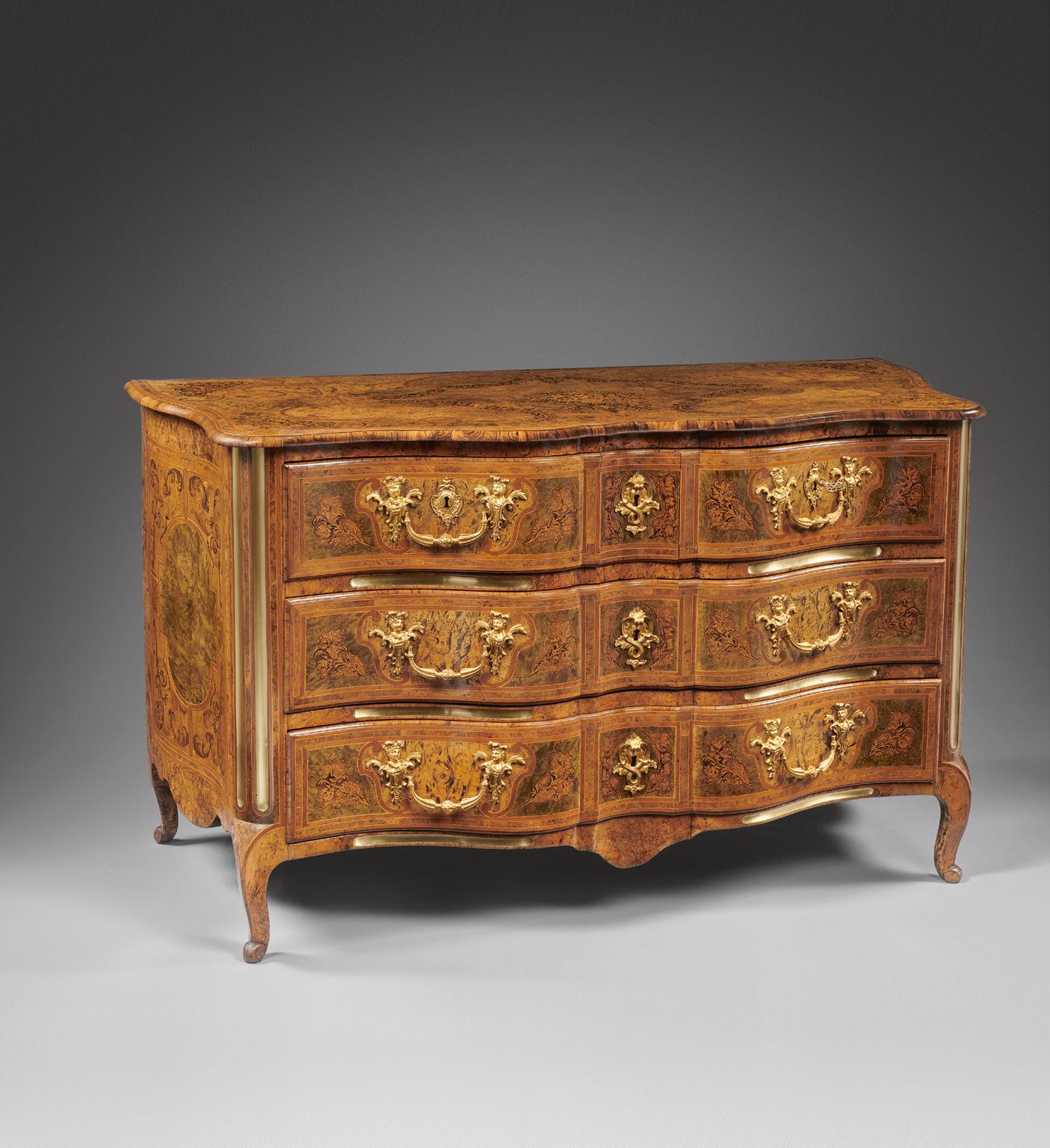
Pierre Hache belonged to the third generation of Grenoble ébénistes and was the grandson to the dynasty’s founder, Noël Hache, and son of Thomas Hache. Like his ancestors, he made a name for himself in creating furniture, constituting a body of work of a rare coherence. The use of native woods, of a common decorative grammar – notably the “Italian marquetry” motif – and the repetition of identical forms are all characteristic of this dynasty. This visual signature is evident in the Fondation Gandur pour l’Art commode. It was part of Vera Neumann’s Collection and is stamped “Hache à Grenoble” on the drawer rim, as is often the case.
Although the tombeau shape, with its three rows of drawers and curves on all sides, may seem conventional, the marquetry and gilt bronzes reveal the ébéniste’s ability to innovate. The marquetry in native woods – maple burr, poplar burr, stained sycamore maple, olive, boxwood, walnut, and yew – is used on all surfaces: drawers, sides, and top. Floral and plant scrolls arranged in a bouquet give order to the composition, providing a contrast between the burr wood backgrounds and the fruitwood decoration. This principle, in which the beauty of burr grain replaces that of tortoiseshell, is close to the “Boulle” marquetry technique and demonstrates a genuine expertise in the choice of wood species and the finest cutting of its components. The ébéniste has skilfully arranged burr specimens in cartouches with double trims or in frames, creating truly abstract compositions on the top, in the centre of the drawers, and on the sides. The bronze decoration provides rhythm to the commode thanks to the hinged “valet” pull handles, depicted in the form of busts topped with feathers, the shell cartouche escutcheons, and the brass fluting outlining the sides and crosspieces separating the drawers. The pull handles and fluting can be found on other commodes attributed to Thomas Hache or his son Pierre, 1 as well as on numerous works stamped or attributed to Étienne Doirat. Other ébénistes , such as Mathieu Criaerd, Louis Delaitre, Jacques Denizot, François Mondon, Louis-Simon Painsun, and Guillaume Schwingkens used relief “valet” handles, while the escutcheons form part of Étienne Doirat and François Garnier’s repertoire. By adopting bronzes that were highly regarded by Parisian craftsmen, Pierre Hache produced refined work that remained true to Grenoble’s distinctive character, rivalling the greatest ébénistes of his time.
Including: Rouge 2005, pp. 241-247 and 254-257; Artcurial, Paris, 27 March 2012, lot no. 189; Leclere, Paris, 19 February 2016, lot no. 253; Rennes Enchères, Rennes, 17 April 2023, lot no. 146; Galerie Pellat de Villedon, Versailles; Rigot antiquaires, Lyon; Galerie Gérardin et Cie, Lyon.
Circa 1700
France
Fir wood frame, partially gilded leather, iron, and Domino paper
30 × 60 × 30 cm
FGA-AD-OBJ-0095
CONDITION
Corresponds to the assumed original condition
PROVENANCE
Dupont et Associés, Morlaix, 7 August 2018, lot no. 780
BIBLIOGRAPHY
Unpublished work
65. Chest bearing the coat of arms of the Prince of Condé
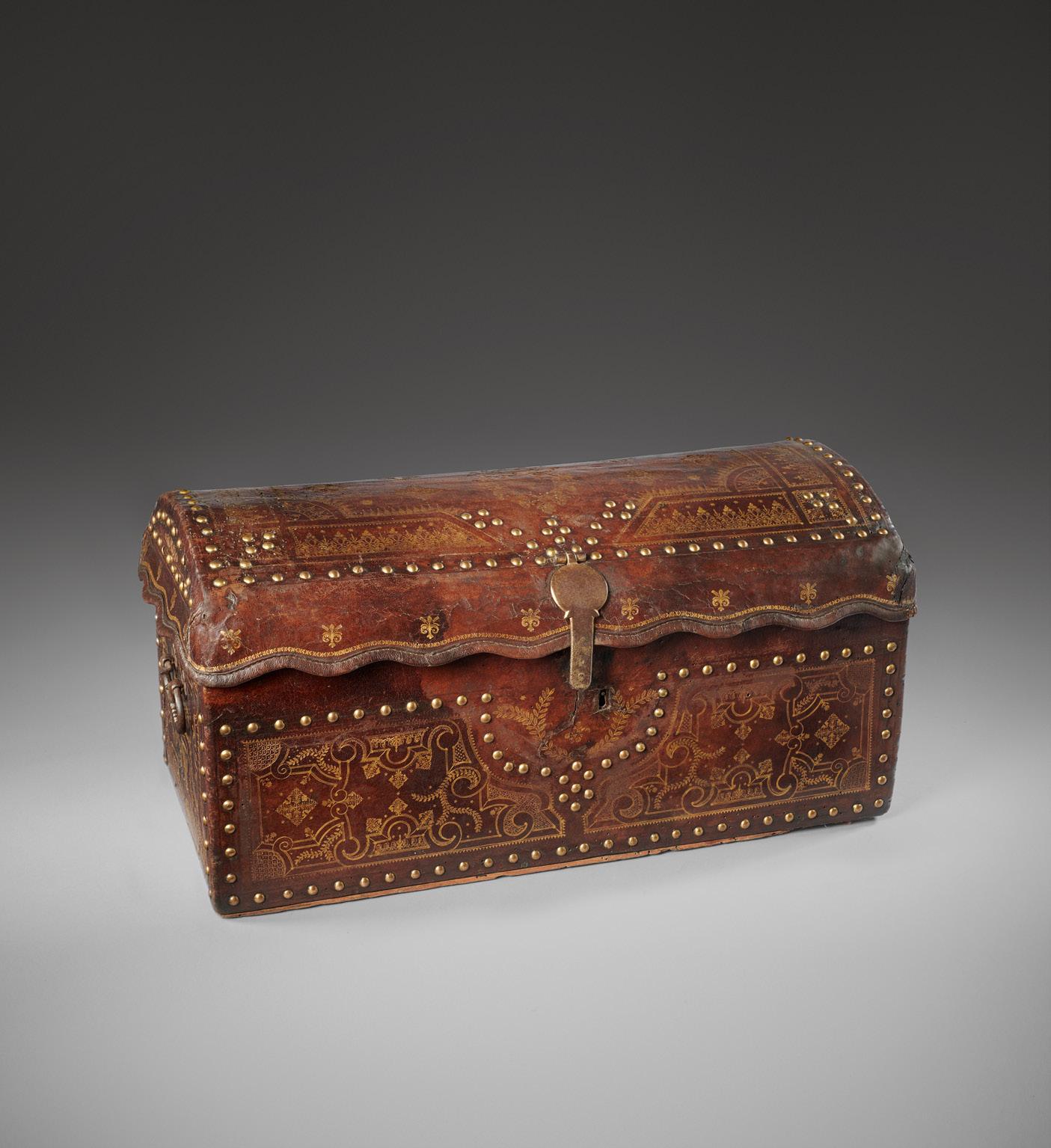
Stamped with the Condé coat of arms in the centre of its lid, this small leather-clad chest is a perfect example of the luxury of everyday accessories. Travel was a common activity in the early eighteenth century, requiring the production of a wide range of objects, not least chests. This were used for storage, providing quick access to the items they contained. The chest conserved by the Fondation Gandur pour l’Art has a domed lid and side handles typical of the models used when travelling. Its fir frame, fairly common in size, is clad in leather on the outside and Domino paper on the inside. Its good condition is all the more remarkable given that the leather used – Morocco leather – is fragile. Travel chests were often made from Russian leather, a “metamorphosed hide” 1 of unrivalled strength, appreciated for its suppleness and rot-proof properties, favoured by European chest makers. The Fondation piece, similar to a chest once thought to have belonged to Louis XIII (Musée de la Voiture, Compiègne, inv. MV 69 D1), is seemingly of French manufacture and dates from the early eighteenth century.
All sides have been adorned by a small stamp before being framed with nails. Cartouches of florets, olive leaves, scales, and a scattering of stars in frames bordered by small triangles decorate the two main sides, while the two ends are decorated with a vase from which olive branches emerge. On the lid, the Condé coat of arms is framed by quatrefoils edged with mantling and a frieze of floral motifs, stylised fleurs-de-lys, and stars. The wealth of this decorative vocabulary is echoed on the inside, where the Domino paper, with beautifully bright colours, alternates friezes of ribbons and foliage with friezes of leaves and seeds. This type of patterned paper reflects the care that has been put into this box, which is both elegant and useful.
The refinement of this chest is undoubtedly due to the prestige of its commissioner, one of the House of Condé princes. Other chests of comparable luxury are known, such as those for the royal family in the second half of the century. The Menus Plaisirs craftsmen, such as Pierre Vente and Antoine Lanson, produced a number of similarly luxurious chests for María Teresa Rafaela of Spain, 2 Maria Leszczyńska (Château de Versailles, inv. V 5029), 3 Marie Antoinette (Musée de la Voiture, Compiègne, inv. MV 69 D3; Château de Versailles, inv. VMB 14268), Mesdames (Musée du Louvre, Paris, inv. OAR 334), as well as Marie Joséphine of Savoy.4
1 Mouquin 2017, p. 16.
2 Aguttes, Neuilly-sur-Seine, 17 December 2019, lot no. 143; Osenat, Versailles, 24 May 2020, lot no. 38.
3 Aguttes, Neuilly-sur-Seine, 22 September 2020, lot no. 59.
4 Osenat, Versailles, 15 November 2020, lot no. 61 (see also: Osenat, Versailles, 24 May 2020, lot no. 59).