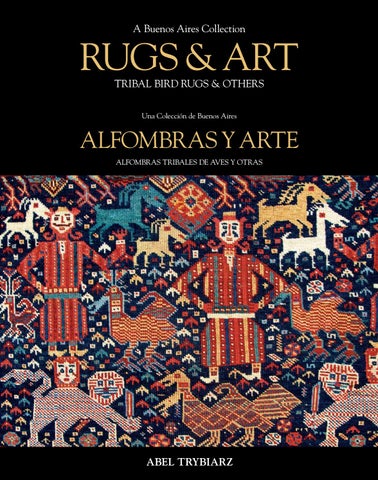
A Buenos Aires Collection
Abel Trybiarz is an architect, sculptor, draftsman and painter who has dedicated himself passionately to these disciplines. One of the remarkable characteristics of his work is his combination of all of them. Artworks are integrated from the outset in his architecture, included as an essential part of the projects. They can be seen in more than thirty buildings in Buenos Aires, present in the street in front of them, or incorporated in the interiors as part of the architecture.
RUGS & ART
THE AUTHOR
RUGS & ART TRIBAL BIRD RUGS & OTHERS Una Colección de Buenos Aires
ALFOMBRAS Y ARTE ALFOMBRAS TRIBALES DE AVES Y OTRAS
Esta colección de alfombras tribales, construida a lo largo de muchos años por un artista y arquitecto de Buenos Aires, contiene en su núcleo una magnífica selección de ejemplares de alfombras “de aves” y de otras tipologías, características de la Confederación Khamseh del suroeste de Persia, elaboradas durante el siglo XIX y principios del XX. Además, hay un número menor de ejemplos relacionados, producidos por nómades vecinos, las tribus Qashqa’i y Afshar, así como dos grupos fuertemente focalizados: alfombras de diseño “de ojo de cerradura” y “Kazak Shikli”, de la región de Transcaucasia. Los lúcidos textos bilingües del coleccionista/autor, que explican su pasión y sus elecciones en la formación de la colección, son tanto más interesantes por su perspectiva como artista y arquitecto exitoso, que trabaja en la capital argentina.
EL AUTOR
ABEL TRYBIARZ
www.abeltrybiarz.com
This fine tribal rug collection has been built over many years by a Buenos Aires artist/architect. It has at its heart a superb selection of ‘bird’ design and other characteristic knotted-pile rugs woven by the nomadic tribes of the Khamseh Confederation in southwestern Iran during the 19th and early 20th centuries. In addition, there are smaller numbers of kindred weavings made by neighbouring South Persian nomads such as the Qashqa’i and the Afshar, as well as two highly focussed groups of Shikli Kazak and ‘keyhole’ design village rugs from the Transcaucasian region. The collector/author’s lucid bilingual texts explaining his collecting passion and choices are informed by his perspective as a successful artist and architect working in the Argentinian capital.
ALFOMBRAS Y ARTE
www.abeltrybiarz.com
Abel Trybiarz es arquitecto, escultor, dibujante y pintor y se ha dedicado con pasión a estas disciplinas. Una de las características notables de su trabajo es su binación de todas ellas. Las piezas de arte se integran en su obra arquitectónica; de hecho se incluyen como parte esencial en sus proyectos, desde el principio. Se pueden ver en más de treinta edificios de Buenos Aires, donde están presentes en la calle, frente a ellos, o incorporadas en los interiores como parte de la arquitectura.
RUGS & ART
ABEL TRYBIARZ
ISBN 9781898113577
CONTENTS
ÍNDICE
Foreword
10
Presentación
11
Introduction
12
Introducción
13
The Rugs
20
Las alfombras
20
22
Bird Rugs of Southern Persia
Alfombras de aves del sur de Persia
22
Classical Medallions Design
24
Diseño clásico de medallones
24
All-Over Birds Design
90
Diseño de trama de aves
90
Diverse Designs
124
Diseños diversos
124
Rugs with People and Animals
146
Alfombras con personajes y animales
146
Boteh Design Rugs
184
Alfombras con diseños boteh
184
The ‘Arab Jinni’ Rug
210
La alfombra “Arab Jinni”
210
Caucasian Rugs
226
Alfombras del Cáucaso
226
Diverse Designs
228
Diseños diversos
228
‘Keyhole’ Design Rugs
240
Diseños de “ojo de cerradura”
240
Shikli Kazak Rugs
254
Alfombras Kazak Shikli
254
Art & Rugs
268
Arte y alfombras
268
271
270
‘The Freud Rugs’
294
“Las alfombras de Freud”
294
Map
296
Mapa
296
Glossary
298
Glosario
298
Notes
300
Notas
301
Bibliography
302
Bibliografía
302
Artworks by Abel Trybiarz
6 Contentslassical Medallion Designs
Obras de arte de Abel Trybiarz
Contenidos 7
FOREWORD
PRESENTACIÓN
For Argentinian architect and artist Abel Trybiarz, collecting oriental carpets is much more than a mere hobby, for he regularly incorporates them in his stand-alone artworks and in temporary art installations in the city of Buenos Aires. And it is with an artist’s complex personal sensibility that his large collection of antique heirloom rugs from the nomadic tribes of southwestern Persia, as well as a handful of Transcaucasian village rugs with very specific designs, has been assembled, through the international market, since he bought his first rug in Istanbul in 1982.
Para el arquitecto y artista argentino Abel Trybiarz, coleccionar alfombras orientales es mucho más que un mero hobby, ya que las incorpora habitualmente en sus obras de arte individuales y en instalaciones artísticas temporarias, en la ciudad de Buenos Aires. Y es con la compleja sensibilidad propia de un artista como su gran colección, formada por antiguas piezas, herencia de las tribus nómades del sudoeste de Persia, así como por un conjunto de alfombras de aldeas de Transcaucasia con diseños muy específicos, ha sido reunida a través del mercado internacional, a partir de la compra de su primera alfombra en Estambul, en 1982.
The Trybiarz Collection presents a tightly focused range of types and designs, and is substantial in both quantity and quality. It offers readers a splendid record of nineteenth and early twentieth century rugs woven primarily for their own domestic use by the tribal women of the moieties of the Khamseh (the largest group by a considerable margin) and Qashqa’i Confederations of Fars, and by the Afshar tribe of southern Persia, as well as so-called Shikli and ‘keyhole’ design village rugs from the Caucasus region.
La Colección Trybiarz presenta un fuerte enfoque hacia un rango determinado de tipologías y diseños, y es trascendente tanto en cantidad como en excelencia. Ofrece a los lectores un magnífico testimonio de alfombras de fines del siglo XIX e inicios del XX, tejidas, principalmente para su propio uso doméstico, por mujeres de las tribus que integraban las confederaciones Khamseh (la gran mayoría de los ejemplares) y Qashqa’i, de la provincia de Fars, y por la tribu Afshar, del sur de Persia, junto a las así llamadas Shikli y de “diseño de ojo de cerradura”, de la región del Cáucaso.
Only knotted-pile rugs are included – there are none of the tribal transport bags, animal bands and trappings and flat-woven covers that one might expect to find in a conventional ‘academic’ collection of ethnographic rugs – and several pieces are arguably ‘best of type’. Indeed, in terms of rugs from the region it stands comparison with better known specialist private collections in the United States, Germany and the United Kingdom, as well as in Iran itself. But comprehensiveness and relative quality are not what governs Abel’s collecting. As an evident romantic whose own artistic endeavours contain powerful Freudian undertones, he is, rightly, enamoured with the sensuality, the three-dimensionality, the tactile malleability, and the brilliance of natural colour of these wool-pile weavings. He is excited by their almost overwhelming density of both abstract and figurative design elements which are replete with symbolism that is capable of meaningful interpretation. Above all, he is driven by a fascination with the life stories, real and imagined, that these rugs have woven into their very fabric.
Solamente están incluidas alfombras “de pelo anudado” –no hay aquí bolsas para carga tribales, adornos para animales o mantas de tejidos planos, que uno esperaría encontrar en una colección “académica” convencional orientada hacia lo etnográfico–, y algunas de las piezas son posiblemente “las mejores de su tipo”. En efecto, en estos términos la colección es comparable a las colecciones privadas especializadas más conocidas de los Estados Unidos, Alemania y el Reino Unido, así como del mismo Irán. Pero la exhaustividad y la relativa calidad no son los parámetros que rigen las elecciones de Abel. Como un romántico evidente, cuyos propios impulsos artísticos contienen potentes ideas freudianas, él se enamora en forma directa de la sensualidad, la tridimensionalidad, la maleabilidad al tacto y el brillo de los colores naturales de estas piezas tejidas en lana. Se emociona por la casi abrumadora densidad de elementos de diseño tanto abstracto como figurativo, repletos de simbolismos pasibles de significativas interpretaciones. Por encima de todo, él está impulsado por una fascinación por las historias de vida, reales e imaginarias, que estas alfombras han ido tejiendo en su propia trama.
Daniel Shaffer Daniel Shaffer
10 Foreword
Presentación 11
This imposing Arab-Khamseh rug represents the classic design of medallions with multi-coloured stepped outlines. In the medallions, ‘chickens’ are arranged along each side of a vertical column of palmettes. The midnight-blue field can hardly be seen, as the weaver has covered it with randomly placed chickens, rosettes, palmettes and flowers. In the central medallion, lost among the birds, is a single comb motif, a symbol of cleanliness rituals. No creature with more than two legs is included. The wool is excellent, the dyes are saturated, and the very narrow, unpretentious borders are an archaic characteristic. Formerly part of the Anton Danker Collection, the rug was exhibited in April and May 1966 at the State Art Museum in Wiesbaden, Germany, and published by Heinrich Jacoby in Masterpieces of the Art of Oriental Weaving, where it is attributed to the ‘Gashgai’ tribe.8 In light of later assessments by James Opie and Detlef Maltzahn, it seems more accurate to assign it to the Arab tribes from the Khamseh Confederation.9
26 Classical Medallions Design
Esta majestuosa alfombra muestra el clásico diseño de medallones con bordes escalonados multicolores; éstos están poblados de gallinas ordenadas a ambos lados de una línea vertical de palmetas. El campo, azul noche, apenas se ve, cubierto como está por gallinas, rosetas, palmetas y flores que la tejedora dispuso caprichosamente. En el medallón central, perdido entre las gallinas, hay un único diseño de peine, un símbolo ritual de la higiene. Ningún ser de más de dos patas está presente en el diseño. La lana es excelente, los tintes son saturados, las guardas simples y muy angostas son una característica arcaica. Esta pieza formó parte de la Colección Anton Danker, fue exhibida en abril y mayo de 1966 en el Museo Estatal de Arte de Wiesbaden, Alemania, y se publicó en el libro Obras maestras del arte del tejido oriental, donde es atribuida a la tribu Gashgai.8 A la luz de las observaciones de James Opie y de Detlef Maltzahn, la atribución a las tribus Arab, de la Confederación Khamseh, resulta más acertada.9
1. KHAMSEH – ARAB 3.14 x 1.57 m Late 19th century | Finales del siglo XIX
Diseño clásico de medallones 27
7. QASHQA’I 2.80 x 1.53 m Late 19th century | Finales del siglo XIX This Qashqa’i rug, though similar to the two on the preceding pages, is markedly different because of the powerful design of its main border, with its medallions surrounded by extensions that finish in ‘animal heads’.15 The deeply saturated colours suggest that the master dyers used an extensive quantity of dyes and applied considerable dedication to obtaining so much intensity of hue from natural sources. In this case, as in both the preceding ones, medallions and field are outlined by solid-and-void (reciprocal) ‘animal-head’ pattern stepped guards, reminiscent of the magical power attributed to that which is secret (in this case, the power of the hidden: the ‘void’ representation of the ‘rain bird’ heads).16 Two minute feminine figures represent the weaver’s signature, one in the upper medallion and a second on a red background to the left of the lower medallion. This piece shares many characteristics with the famous Qashqa’i rug that covers Sigmund Freud’s psychoanalytic couch, to be found in his house in London, now a museum (see ‘The Freud Rugs’). Esta alfombra, similar a los dos ejemplos de la página precedente, se diferencia notablemente por su borde principal de potente diseño con sus medallones rodeados de prolongaciones terminadas en “cabezas de animales”.15 Los colores nos hablan de maestros tintoreros, de grandes cantidades de tinturas y enorme dedicación para lograr esta intensidad de tonos a partir de elementos naturales. En este ejemplar y en los dos precedentes, tanto los medallones como el campo están enmarcados por guardas escalonadas con diseño recíproco (lleno y vacío) de “cabezas de animales”, una reminiscencia del poder mágico atribuido a lo secreto (en este caso, el poder de lo oculto: la representación “vacía” de las “cabezas del ave de la lluvia”).16 Dos minúsculas figuras femeninas firman su obra, una en el medallón central y otra sobre el fondo rojo, a la izquierda del medallón inferior. Esta pieza comparte muchas características con la famosa alfombra Qashqa’i que cubre el diván de psicoanálisis de Sigmund Freud, que se encuentra hoy en la casa-museo que lleva su nombre, en Londres (ver “Las alfombras de Freud”).
36 Classical Medallions Design
Diseño clásico de medallones 37
78 Classical Medallions Design
Diseño clásico de medallones 79
78 Classical Medallions Design
Diseño clásico de medallones 79
108
109
108
109
71. KHAMSEH (?) 1.96 x 1.54 m Late 19th century | Finales del siglo XIX These two rugs, both probably Khamseh, present an unusual design with only one medallion. However, they create very different effects. The rug in Plate 71 has a mostly dark palette, full of mystery; it is the work of a weaver determined to fill even the smallest spaces with motifs from her iconographic repertoire. The field is packed with geometric motifs, amulets and peacocks, but the weaver has taken the liberty of including exquisite filigree in the main border. At the opposite extreme, the rug illustrated in Plate 72 explodes with brilliant
126 Diverse Designs
colours, transmitting joy. The deep red field displaying attractive gazelles with large eyes is relatively loose, and is surrounded by an extraordinary geometric main border, and a breath-taking inner frame. The spandrels are filled with polychrome lines that in the narrow vertical sections are transformed into squares, while in the four intermediate triangles the weaver appears to be undecided: in parts the lines continue and in parts they break up, forming squares.
72. KHAMSEH 2.25 x 1.16 m First quarter 20th century | Primer cuarto del siglo XX Estas dos piezas, probablemente Khamseh, que presentan el inusual diseño de un solo medallón, nos trasmiten sensaciones muy diferentes; la 71, con su paleta sombría, llena de misterio, es obra de una tejedora decidida a llenar hasta el más mínimo espacio con motivos de su repertorio iconográfico; el campo está atestado de dibujos geométricos, amuletos y pavos reales, pero ella se permite, en la guarda principal, una exquisita filigrana. En el extremo opuesto, la alfombra 72 estalla con su brillante colorido y nos comunica alegría. El campo, de un rojo
profundo, está relativamente despejado, con sus simpáticas gacelas con grandes ojos, rodeado por la extraordinaria guarda principal geométrica y el asombroso marco interno, que en los ángulos presenta líneas policromas que, en los tramos angostos verticales, se transforman en cuadrados, mientras que en los cuatro triángulos intermedios la tejedora se muestra indecisa: en partes continúan las líneas y en partes éstas se fragmentan formando cuadrados.
Diseños diversos 127
The Middle East and the Caucasus in the late 19th - early 20th century, showing approximate rug weaving areas El Medio Oriente y el Cáucaso a fines del siglo xix - inicios del siglo xx, con las áreas aproximadas de tejido de alfombras
RUSSIAN EM P IRE
SHIKLI
BLACK SEA
KAZAK
KUBA
CAUC AS U SM OU NT AI N
S SHIKLI KAZAK GENJE
GENJE CHILA
KUBA SHIRVAN
BAKU
CHILA
KARABAGH
OT TOM A N EM P IRE
SHIRVAN
Russia
BLACK SEA
Kazakhstan
Georgia Azerbaijan
en m Ar
Turkey
CASPIAN SEA
Uzbekistan
ia CASPIAN SEA
MEDITERRANEAN SEA
Turkmenistan
P ERSIA
Syria
Lebanon
Egypt
Israel
Jordan
BAKU
Iraq Iran Afghanistan
Ottoman Empire Imperio Otomano
F
Russian Empire Imperio Ruso Russian influence zones Zonas de influencia rusa British influence zones Zonas de influencia británica
KHAMSEH
Oman
INDIAN OCEAN
(su K m ham m er seh ca m ps )
S IN TA
Pakistan
UL G
Saudi Arabia
N
AN SI
R PE
SEA
Persia
RED
British Empire Imperio Británico
(su Qa mm shq er a’i ca mp ZA s) GR OS M O U FARS
(w Qas int hq er a’i ca mp s)
Afshar
AFSHAR
SHIRAZ
Khamse h (winter camps)
PERSIAN GULF
QASHQA`I
A Buenos Aires Collection
Abel Trybiarz is an architect, sculptor, draftsman and painter who has dedicated himself passionately to these disciplines. One of the remarkable characteristics of his work is his combination of all of them. Artworks are integrated from the outset in his architecture, included as an essential part of the projects. They can be seen in more than thirty buildings in Buenos Aires, present in the street in front of them, or incorporated in the interiors as part of the architecture.
RUGS & ART
THE AUTHOR
RUGS & ART TRIBAL BIRD RUGS & OTHERS Una Colección de Buenos Aires
ALFOMBRAS Y ARTE ALFOMBRAS TRIBALES DE AVES Y OTRAS
Esta colección de alfombras tribales, construida a lo largo de muchos años por un artista y arquitecto de Buenos Aires, contiene en su núcleo una magnífica selección de ejemplares de alfombras “de aves” y de otras tipologías, características de la Confederación Khamseh del suroeste de Persia, elaboradas durante el siglo XIX y principios del XX. Además, hay un número menor de ejemplos relacionados, producidos por nómades vecinos, las tribus Qashqa’i y Afshar, así como dos grupos fuertemente focalizados: alfombras de diseño “de ojo de cerradura” y “Kazak Shikli”, de la región de Transcaucasia. Los lúcidos textos bilingües del coleccionista/autor, que explican su pasión y sus elecciones en la formación de la colección, son tanto más interesantes por su perspectiva como artista y arquitecto exitoso, que trabaja en la capital argentina.
EL AUTOR
ABEL TRYBIARZ
www.abeltrybiarz.com
This fine tribal rug collection has been built over many years by a Buenos Aires artist/architect. It has at its heart a superb selection of ‘bird’ design and other characteristic knotted-pile rugs woven by the nomadic tribes of the Khamseh Confederation in southwestern Iran during the 19th and early 20th centuries. In addition, there are smaller numbers of kindred weavings made by neighbouring South Persian nomads such as the Qashqa’i and the Afshar, as well as two highly focussed groups of Shikli Kazak and ‘keyhole’ design village rugs from the Transcaucasian region. The collector/author’s lucid bilingual texts explaining his collecting passion and choices are informed by his perspective as a successful artist and architect working in the Argentinian capital.
ALFOMBRAS Y ARTE
www.abeltrybiarz.com
Abel Trybiarz es arquitecto, escultor, dibujante y pintor y se ha dedicado con pasión a estas disciplinas. Una de las características notables de su trabajo es su binación de todas ellas. Las piezas de arte se integran en su obra arquitectónica; de hecho se incluyen como parte esencial en sus proyectos, desde el principio. Se pueden ver en más de treinta edificios de Buenos Aires, donde están presentes en la calle, frente a ellos, o incorporadas en los interiores como parte de la arquitectura.
RUGS & ART
ABEL TRYBIARZ
ISBN 9781898113577