ROSENFELD
RIVER CROSSINGS
Co-curator Jason Rosenfeld, PhD, is Distinguished Chair and Professor of Art History at Marymount Manhattan College. He co-curated the John Everett Millais exhibition at the Tate Britain, London, which then toured to Amsterdam, Kitakyushu, and Tokyo from 2007 to 2008. He also co-curated Pre-Raphaelites: Victorian Avant-Garde, which traveled from London to Washington, DC, Moscow, Tokyo, and Turin (2012–2014). Rosenfeld has written a major monograph on Millais (Phaidon, 2012) as well as numerous articles and books on nineteenth-century and contemporary art. Co-curator Stephen Hannock is an American Luminist painter known for his atmospheric landscapes and incendiary nocturnes. His experiments with machine-polishing the surfaces of his paintings give his work its trademark luminous quality. The larger vistas also incorporate diaristic text that weaves throughout the composition. His design of visual effects for the 1998 film What Dreams May Come won an Academy Award. His works are in collections worldwide, including The Metropolitan Museum of Art, the Whitney Museum of American Art, the Yale University Art Gallery, and the National Gallery of Art, Washington, DC.
contemporary art comes home
Curator and writer Marvin Heiferman organizes projects about photography and visual culture for institutions including the Museum of Modern Art, Smithsonian Institution, International Center of Photography, Whitney Museum of American Art, and the New Museum. A writer for numerous publications and websites, including The New York Times, Art in America, Artforum, Design Observer, Gagosian Quarterly, and Aperture, his most recent book is Photography Changes Everything (Aperture, 2012). Maurice Berger is Research Professor and Chief Curator at the Center for Art, Design and Visual Culture, University of Maryland, Baltimore County, and Curator of the National Jewish Archive of Broadcasting at The Jewish Museum in New York. His essay series, Race Stories, “a continuing exploration of the relationship of race to photographic portrayals of race,” appears monthly on the Lens blog of The New York Times. His critically acclaimed exhibitions have appeared in numerous national and international venues.
55000
Printed in Canada
Unprecedented in its concept and execution, the exhibition River Crossings: Contemporary Art Comes Home intertwines two historic sites with world-renowned contemporary art in a setting that was the genesis of American art in the early nineteenth century. This unique presentation is chronicled in this beautifully illustrated and informative publication that accompanies the landmark exhibition. A stunning account of this distinguished exhibition at Cedar Grove, the home of Thomas Cole, founder of the Hudson River School, and Olana, Frederic Edwin Church’s home and property, the publication takes the reader through this unparalleled exhibition and complements the original intent of these two extraordinary painters with innovative, contemporary art of our time. As with the accomplished Cole and his stellar student Church, for the artists participating in River Crossings it is all about the river…the Hudson River. Cole and Church dared to try new techniques, bringing exciting, fresh perspectives of the untamed fields and forests in the Hudson River Valley to a cultural audience hungry for a truly American approach to art. In turn, the contemporary artists in this exhibition—Chuck Close, Martin Puryear, Cindy Sherman, Gregory Crewdson, Don Gummer, and Maya Lin, among the 30 participating artists —clearly were influenced and inspired by Cole’s and Church’s adventurous spirit and the Hudson River Valley landscape, as evidenced in the contemporary artists’ harmonious artwork. In addition to the book’s captivating plate section, including artist biographies and narratives, insightful essays by notable authors give knowledgeable background on the continuity of the American artistic tradition in one of the nation’s most historic areas. As co-curator Jason Rosenfeld remarked, “The show aims to highlight the continued vitality of the Hudson River Valley as an important site of contemporary artistic production.” River Crossings: Contemporary Art Comes Home is a reflection of the inspiration found in the Hudson River Valley by Cole and Church, and the continuation of that discovery by contemporary artists—a palpable encounter with the natural environment.
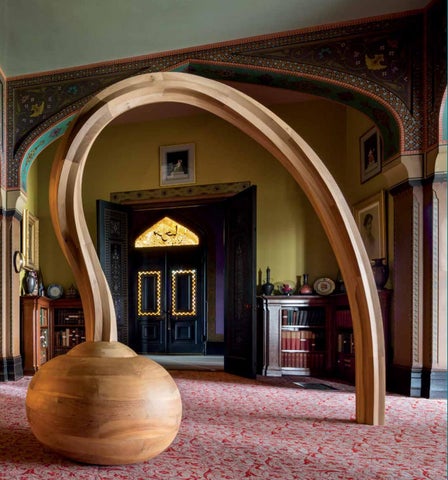
Front cover: Martin Puryear, Question, 2010–2014 (plate 37) in the Court Hall at Olana. Photograph: © Peter Aaron.
ISBN 9780988855793 ISBN 978-0-9888557-9-3
9 780988 855793
contemporary art comes home
91 color, 17 black-and-white images
Distributed to the trade by D.A.P. / Distributed Art Publishers Price $ 50.00 US
Founded in 2011, THE ARTIST BOOK FOUNDATION creates, shares, and preserves artist books that offer the richest visual presentations and most informed narratives of artists’ lives and work. A 501 (c)(3) organization, The Artist Book Foundation’s three primary initiatives are a Library Donation Program, providing approximately 10 percent of each print run to public, art, and university libraries in the United States; The Archive, a collection of both print and digital books focused primarily on artists’ monographs and catalogues raisonnés dating from 1880; and the biennial Younger Artist Series Award that celebrates mid-career work with the publication of a first monograph for a chosen artist under the age of fifty.
RIVER CROSSINGS
>
Back cover: Jerry Gretzinger, Jerry’s Map, 1963 to present (plate 13) in the Second-Floor Hallway at the Thomas Cole National Historic Site. Photograph: © Peter Aaron.
RIVER CROSSINGS contemporary art comes home
RIVER CROSSINGS CONTEMPORARY ART COME S HOME
by JASON ROSENFELD preface by Stephen Hannock foreword by Ken Burns essays by Marvin Heiferman Maurice Berger
THE ARTIST BOOK FOUNDATION bo sto n new yo rk lo ndo n
CONTENTS Preface 6 Stephen Hannock Foreword 9 Ken Burns River Crossings: “an unbounded capacity for improvement by art” 12 Jason Rosenfeld The Changing Nature of Nature’s Image 22 Marvin Heiferman
★
The Ghosts of the Hudson Valley 28 Maurice Berger
★
Thomas Cole National Historic Site Profile 34 Elizabeth B. Jacks and Kate Menconeri thomas cole site artist biographies with a rtwork narratives 36 Jason Rosenfeld Olana Profile: “Artists and Friends” 84 Evelyn Trebilcock, Mark Prezorski, and Rena Zurofsky olana artist biographies with artwork narratives 86 Jason Rosenfeld acknowledgments 112 Elizabeth B. Jacks executive director, thomas cole national historic site
Rena Zurofsky interim president, the olana partnership
checklist of additional works by site: frederic edwin church, thomas cole, and other artists 114 index 116
4
PREFACE
Stephen Hannock, The Oxbow, Flooded, for Frank Moore and Dan Hodermarsky (Mass MoCA #196), 2013 (plate 15) at Thomas Cole National Historic Site.
6
i have always been a fan of Kurt Vonnegut. The work and the man. His simple but profound observations have come to my rescue on many occasions. But it is perhaps his facility with time travel that I have employed most frequently. I have never visited Tralfamadore, but important conversations have taken place between my painter-self and the likes of Rembrandt van Rijn, J.M.W. Turner, Arthur Dove, Michelangelo Merisi da Caravaggio, and Jacob Lawrence. . . . And then Thomas Cole and Frederic Edwin Church. If Cole and I were on the west porch of his house in Catskill 150 years ago, along with his teenage student Church, we just might muse on the art we would find on his walls and dotting his lawn in the third millennium. Would the paintings and sculptures be “landscape” in nature? Would the new phenomenon of photography be dominant? As an artist who has been motivated by the Tonalists, Luminists, and earlier nineteenth-century American painters, the obvious place to start might be with the art that excites me now. For an artist who paints compositions with a horizon, I’m actually not inspired by many “landscape paintings.” I see my work more as set designs or cinematic “establishing shots” for diaries that will be written throughout a given composition. Artists of my generation and beyond frequently find their way into these diaries. Who is to say it wouldn’t be these artists occupying the walls of Cedar Grove and Olana in 2015? This is where Jason Rosenfeld and I began our effort to introduce the nineteenth-century American painters to works of art in 2015. Along the way, artists’ referrals and an appreciation for recent history helped fill in the rest (that is, before the Civil War it would have been impossible to convince Cole and the young Church, et al., that the slaves in America would be freed…and then in the early twentieth century that this little community downriver called Harlem would spawn a culture that would impact the entire world). I would personally like to thank Jock Reynolds for allowing the Yale University Art Gallery’s recently acquired Oxbow of mine to be loaned for this show with only a couple of months’ notice. This painting was the first domino in our succession of choices for both houses. The Oxbow, Flooded, for Frank Moore and Dan Hodermarsky (Mass MoCA #196) (plate 15) shows the same nook in the Connecticut River that was first drawn by Thomas Cole in 1833 and then painted by him in 1836 (fig. 1). And it was from this familiar starting point that the art was selected.
A special note: Frank Moore (plates 30 and 31) to whom my Oxbow painting in the show is dedicated, was one of the most renowned artists to assemble a major body of work while afflicted with fullblown AIDS. It was Frank who designed the AIDS ribbon. He is also the reminder that any discussion of art in the third millennium has to include recognition of the devastating impact that AIDS has had worldwide, and specifically on American culture. The kitchen alcove servants’ quarters in the basement of Cedar Grove struck us as an eerie reminder of the cots in Greenwich Village cold-water flats that were offered to sick friends early on in the 1980s. It is in this space that we set up our installation that includes two pieces by Frank Moore and Duncan Hannah’s Little Swing (plate 29) Last, profound thanks to Sara Griffen, now the retired director of The Olana Partnership, and to Betsy Jacks, the director of the Thomas Cole National Historic Site. It was their persistent velvet headlocks that left me with no other choice than to notify friends and acquaintances that this exhibition was an idea that should be brought to life. Henry Geldzahler used to tell us that there was no such thing as a good idea for a painting or a bad idea for a painting. Just good paintings and bad paintings. After too many years of chatter about whether contemporary art in these particular nineteenth-century homes is a good idea or a bad idea, the show is here. Let the discussion begin. Stephen Hannock North Adams, Massachusetts June 2015
7
FOREWORD The Snake, the Clearwater, the Columbia. The Green, the Tampa, the Colorado. The Yellowstone, the Missouri, the Mississippi. The Ohio. The Tennessee. The Cumberland. The Hudson. we are a continent of rivers; they are the avenues of our early advancement and aspirations in a new world. On this continent we could begin anew, liberated from the bonds of European tyranny, smallness, certainty. Here we would find our own way, improvising as we went. It would be an act of faith. We would trust people—for the first time—to govern themselves. We would allow people to worship God as they saw fit. In this new American catechism we would find ourselves, and God, in a Nature not (yet) spoiled. We would worship in cathedrals made by Nature, not by the hand of man. Our “transcendentalism” would fit our individuality—an individuality that seemed to effortlessly merge the civic and the political with the spiritual and the mysterious. In no short time, our art would follow, shunning the formalized dogma of Religion and State. Our art would be liberated by and in Nature, an ecstatic expression of possibility and renewed faith. And here on the banks of the Hudson River, we would invent this new artistic vocabulary to accompany our political and religious revolutions, a set of manners and assumptions and aesthetics that comes down to us today as wholly us, ourselves—naïve, earnest, inquisitive, restless, scared, lonely, uplifted, and corrupt. Those first baby steps created an American art that continues to this day, manifested in new urges and impulses. . . . And that is why the sullied old River still inspires. Ken Burns Walpole, New Hampshire April 2015
View across the Hudson River from Olana.
8
9
RIVER CROSSINGS “an unbounded capacity for improvement by art” Origins in 1836, in his “Essay on American Scenery,” the Lancashire-born progenitor of American landscape painting, Thomas Cole (1801–1848), in elevated language that betrayed his twin aspirations to be an artist and a poet, imagined the possibilities for the Hudson River to be lined someday with edifices to match those beside the great rivers of Europe, where he had grown up: The Rhine has its castled crags, its vine-clad hills, and ancient villages; the Hudson has its wooded mountains, its rugged precipices, its green undulating shores—a natural majesty, and an unbounded capacity for improvement by art. Its shores are not besprinkled with venerated ruins, or the palaces of princes; but there are flourishing towns, and neat villas, and the hand of taste has already been at work. Without any great stretch of the imagination we may anticipate the time when the ample waters shall reflect temple, and tower, and dome, in every variety of picturesqueness and magnificence.1 Only a quarter-century after Cole’s death in 1848, his most important pupil, Frederic Edwin Church (1826–1900), would do much to fulfill his master’s prediction in building Olana across the Hudson from Cedar Grove, Cole’s property in Catskill. River Crossings extends Cole’s description of the future of the Hudson River and its valley to the present. This exhibition seeks to expand Cole’s architectonic and aesthetic mandate at both these historic properties, and to trace the “improvement by art” wrought in the Hudson Valley since the Church family decided to give up Olana, in 1964, and for the first time to employ these two great pilgrimage sites of American art history together to reveal this continuous story of novel and complex artistic creation. The Thomas Cole National Historic Site and Olana were ground zero for advanced contemporary art in America in the mid-to-late nineteenth century. Cole showed his latest works in the public rooms of Cedar Grove in the hopes of attracting patrons, and Church reserved space in his neo-Persian domestic temple to display his own art. Prior to Cole, advanced artistic endeavors in America hugged the Atlantic coastline and congregated in urban centers: Boston, New York, and up the Delaware River in Philadelphia. It was the particular innovation of the initial members of what has become known as the Hudson River School to head deep into the countryside in search of subjects, and to settle in those same environs. For Cole, and then Church, as for artists in the present, it was essential not only to be away from New York City and its din, but also to be able to get back to Thomas Cole National Historic Site, porch, west view.
JASON ROSENFELD
it swiftly. Cole and the young Church were dependent on the steamboat. Later in life, Church took to the rails, as one does today, up the main Albany trunk line. But that seemingly paradoxical accessibility and removability has proved a fundamental necessity in the making of great art. Art historian Robert Storr has written that the point of a museum retrospective “is not to historicize the new but to refresh the historical, in the process giving the public a chance to see where the art of their time really went, regardless of where it was supposed to go.”2 River Crossings is not a retrospective on a single artist—in its broad selection of artists it does just the opposite. It is not a comprehensive exploration of the art of Cole and Church; in fact, they are secondary players, in an aesthetic sense, in the display. It is an attempt to “refresh the historical,” as all exhibitions, even contemporary art shows, must do. It aims to think anew about these Hudson River School artists, members of what Angela Miller has called, more appropriately and in less geographically narrow terms, the first New York School, and to trace their legacy not in a literal way, but in terms of the broader aims of their practices, in the art of the present.3 The selection includes only a few artists whose works pay direct homage to that of Cole and Church, artists who by no means simply retread earlier landscape traditions. River Crossings acknowledges the importance of the two titanic inceptors of American art, and the houses that they crafted and lived in, and seeks to illuminate a continuity of spirit with contemporary artists who live and work in the region, or have a connection to its byways and towns. Most of the artists in this exhibition are geographically linked to the broadly defined Hudson River region. Some, like Cindy Sherman (plates 17–20) and Elizabeth Murray (plate 14), had connections to Buffalo early in their careers. The Erie Canal, which formed a newly sprouted tendril of the Hudson snaking west upon its opening in 1825, the year Cole began to spend time upstate, provides an aqueous connection to the Buffalo region. And Buffalo is of course near to Niagara, an important subject for both of these nineteenth-century artists, and accessible by rail for Cole, who went there in 1847. Some, like Stephen Hannock (plates 15 and 16), Gregory Crewdson (plate 12), Chuck Close (plate 35), Stephen Petegorsky (plates 8–11), and Joel Sternfeld (plate 2), have connections with the Pioneer Valley in western Massachusetts, in particular the run of the Connecticut River near Mount Holyoke made famous in the history of art and the American popular imagination in Cole’s View from Mount Holyoke, Northampton, Massachusetts, after a Thunderstorm —The Oxbow of 1836 (fig. 1).4 A presiding theme in this exhibition is the connection between New York City and the migration of artists north in search of remove, new
13
ociety, the pursuit of civilization has its drawbacks. Human vicissiS tudes intervene despite the best aesthetic intentions. The artists in this exhibition well continue Cole’s social and cultural inquiry.
Concept
Fig. 1. Thomas Cole (1801–1848), View from Mount Holyoke, Northampton, Massachusetts, after a Thunderstorm—The Oxbow, 1836. Oil on canvas, 51 1/2 x 76 in. (130.8 x 193 cm). Gift of Mrs. Russell Sage, 1908 (08.228). The Metropolitan Museum of Art, New York, NY. Image copyright © The Metropolitan Museum of Art. Image source: Art Resource, NY.
sites of inspiration, studio space, and cheaper rents. After Cole and Church and their followers, the next generation of artists to move upriver were those of the Harlem Renaissance, who populated the northernmost extremities of Manhattan and often took the river and the railway as theme, as represented in the art of Romare Bearden (plate 26), who also advanced the aesthetic of collage and assemblage in a manner that has had a great impact on succeeding artists such as Rashaad Newsome (plate 32), Sienna Shields (plate 27), Kianja Strobert (plate 25), and Jerry Gretzinger (plate 13). In more recent times, artists have felt the lure of the Hudson Valley once again, as rents have risen in New York City’s artist enclaves both traditional and new in Soho, Williamsburg, DUMBO, and Bushwick. Cole’s call for improvement by art was an aim shaped by the idea of the United States’ national construction—that the hand of human endeavor is necessary for the transformation of wilderness by culture, for the establishment of a history, and the evolution of a civilization. Cole’s point of view in “Essay on American Scenery” in 1836 was 14
steeped both in the romantic and the picturesque. Sensitive to environmental change, Cole’s opposition to the railway and deforestation has been well documented.5 But while Church put Cole’s ideas into practice, as the dramatic sight of turreted Olana looming atop what was then called Sienghenberg (“Long Hill”) and inching closer as it is approached from the river can attest, neither artist anticipated improvement as a veer into despoilment, and the ecological disasters perpetuated by industry and development in the mid-twentieth century. Our unfortunate collective inheritance has been taken up pointedly by a number of artists in River Crossings, such as Maya Lin (plate 40) and Valerie Hegarty (plate 36). And Angie Keefer and Kianja Strobert in their modestly scaled but powerful Empire State (plate 24) address the same mid-twentieth-century period’s predilection for high modernism, and its often deleterious and dehumanizing effects in the design of the Governor Nelson A. Rockefeller Empire State Plaza in Albany. As Cole readily acknowledged in his ambitious painted series The Course of Empire (1833–1836), now at the New–York Historical
The striking centerpiece of the segment of River Crossings at Olana is Martin Puryear’s Question (plate 37). Form notwithstanding, this work crystallizes this central idea of the art in this exhibition, which is to see Puryear’s title not as a description of his tulip poplar, ash, and pine sculpture’s curvaceous resemblance to a punctuation mark, or as identifying an interrogative or an expression of doubt. Rather, it should be interpreted as a directive. Question. Always. Question tradition, authority, primacy, materials, vision, reasoning, motivation, validity, history. This is what Puryear’s elegant and elevated art has always done, and the artists in this exhibition do just that, in the spirit of their professional forebears, Cole and Church, who questioned the low status of landscape painting in aesthetic culture, who objected to the hegemony of European traditions, who challenged the economic structure of the art market and contemporary modes of display. Who settled in an Elysian landscape and advocated for its preservation, just as The Olana Partnership allied with conservation groups does today. The artists in River Crossings have taken as a prime directive the need to question our world and its received aesthetic canons; they see the drive to make art as equally fulfilling an innate impulse and a desire to communicate. Their openness to expansive readings of their art is indicated by their collective agreement to have their works shown in spaces never conceived for contemporary art as defined in the present era, in natural light levels that challenge the modern eye’s need for saturation and growing preference for LEDs, on walls that may be neither plumb nor stark white, and in environs that might include an old guitar, nineteenth-century sombreros, old and heavily framed landscape sketches, stenciled doors, a monkey skull, and low ceilings. On carpets, below moldings, above mantelpieces, around doorways, amidst beds, steamer trunks, majolica, cabinets of curiosities, bitumen- marred works after old masters, and in the basement. Witness: in Thomas Cole’s cramped bedroom at Cedar Grove, Charles LeDray’s whimsical, compelling, locally engaged, and unexpected installation. Village People consists of 73 delicately fabricated, miniature caps that flow in an unimpeded and gently undulating line around the upper section of all four walls (plate 28). One ball cap reads “Araxes” in stately seriffed gold on deep blue. The name is Greek for the Persian “Aras” and denotes a river in ancient Asia Minor and present-day Turkey, Armenia, Azerbaijan, and Iran. In book eight of Virgil’s Augustan-era epic, The Aeneid, this waterway assumes a personality: It is angry at human attempts to span it, and the poet described it as pontem indignatus Araxes: “Araxes chafing under his bridge.”6 The text forms a description of the shield, forged by Vulcan, that Venus gives her son Aeneas, and upon whose surface is depicted “the story of Italy and the triumphs of the Romans”—events that will
occur to the Trojan prince’s progeny in Italy. Araxes comes at the end of the description, listed amongst conquered tribes and lands including rivers such as the Euphrates. Araxes represents a river, and a region, not yet conquered by Rome, a river still unbridged, though apocryphally Alexander the Great had built one across it, and in battle Mark Antony was said to have crossed it twice. Thus Aeneas’s shield looks into the future, beyond the events of Virgil and Augustus’s, present, and at Araxes, the river that prides itself on resisting being crossed.7 LeDray’s wordplay in his hats is a measure of the commitment to context that so many of the artists who have collaborated on this show have demonstrated. For Araxes is not just a river of antiquity, but it flowed past “Olane,” described in book eleven, chapter fourteen of Strabo’s Geographica (first century bc/first century ad) as a “strong fortress” near the city of Artaxata in contemporary Armenia, that supposedly overlooked the river and the Garden of Eden.8 In the second century bc, Polybius also mentions an “Olana” in northern Italy, one of the mouths of the River Po emptying into the Adriatic with, like the town of Hudson, a safe anchorage harbor.9 Rivers are a consistent element in these historical references. It is uncertain where LeDray unearthed the obscure name Araxes; if not in Virgil, then perhaps it refers to the private biopharmaceutical company, in a doff to corporate culture commonly found on his hats, or maybe to Karl-Heinrich Ulrichs’ Araxes: Call to Free the Nature of the Urning from Penal Law, a publication in 1870 that was an early call for lesbian and gay rights. On the wall in Cole’s bedroom the “Araxes” hat hangs in a stretch between caps reading “Karnak 19 Flashing Cement” and “Athens Generating Plant” to the left, and at right “Marcellus” followed by “Afrodite Nassau,” forming a run of classically inspired names. History, however, is blended with locality in LeDray’s work: the Athens power plant is less than four miles from the Thomas Cole Site on Route 9W; Marcellus may refer to the town in Onondaga County, New York; and Afrodite is the name of a Hudson River oil and chemical tanker registered in the Bahamas. Araxes: the river that resists being crossed. For a long time, the broad Hudson below Albany, similarly, would not be crossed by any structures except railway bridges, until the rise of the automobile led to the construction of the Bear Mountain Bridge in the Highlands, opened 1924, then the Mid-Hudson Bridge at Poughkeepsie in 1930, then finally the Rip Van Winkle Bridge at Catskill in 1935, 110 years after Cole first came north. This replaced the more aquatic and less aerial transit that had persisted from Cole’s day. River Crossings celebrates the efforts of artists not only to cross the river east and west, but also to navigate it north and south, up and down from New York City. Hudson and Catskill, towns separated by this broad and deep river, part of the trunk of the ancient Hudson fjord, were linked first by ferries. Transport was ever key to the evolution of these towns. Hudson bears the oldest continually operating rail station in the state (1875). In Church’s day four rail lines converged there, and the artist could, and did, take a fairly direct train to Boston, an impossibility today.10 15
THE CHANGING NATURE OF NATURE’S IMAGE it was in the early 1850s, just a few years after Thomas Cole’s death, that a town 65 miles south of his home in Catskill, New York, became known as Daguerreville, forever linking New York and the Hudson River Valley’s imaging culture as firmly to photography as it was to painting and the fine arts. Members of the Lewis family made their fortune there after building a factory on Quassaic Creek, a tributary of the Hudson between Newburgh and New Windsor, to manufacture the compact and accordion-bellowed cameras that enabled the era’s camera-operating entrepreneurs to keep up with the public’s demand for photographic images of themselves and the landscapes they moved through.1 Nearby in Orange County, the Reverend Levi Hill was among the first to experiment with the hand-coloring of daguerreotypes.2 Farther north, the enterprising Platt D. Babbitt leased a retail perch at the edge of Niagara Falls where, in 1853, he sold souvenir daguerreotypes (fig. 4) that miniaturized the colossal cascades, establishing a marketplace for tourist images that helped nineteenth-century Americans to more conveniently commune with nature and consider the sublime.3 If Thomas Cole, founder of the Hudson River School of painting, died before photography’s allure and popularity became widespread, Frederic Edwin Church, one of Cole’s star pupils, was among the first generation of artists to mature in an image world driven by photography. Church is not believed to have taken photographs himself but he assembled a substantial collection of approximately 2,000 of them during his lifetime. That archive—which still exists and is largely intact—served as a source of research and inspiration for Church’s own artworks, proved useful in the design and construction of Olana, and fueled his wide-ranging interests in the history of civilization, the sciences, and the spiritual, as well as the natural world. Throughout his career, Church produced abundant drawings and studies, picking and choosing from their carefully observed details to create the spectacular landscape paintings for which he became so widely celebrated. He was known, too, to work from photographs and even, in some instances, to paint on top of them to create working sketches. “Church in many respects was the most remarkable painter of the phenomena of nature I have ever known,” wrote William James Stillman, one of his former students who later abandoned painting to become a journalist and photographer.4 Church’s powers of observation and precise draftsmanship contributed greatly to the impact and popularity of his work, as Stillman went on to critically note:
Fig. 4. Platt D. Babbitt (1823–1879), Niagara Falls, Winter View, 1850–1859. Daguerreotype, 81/4 x 71/4 in. (21 x 18.4 cm). Acc. no. OL.1981.604. Collection Olana State Historic Site, Hudson, New York, New York State Office of Parks, Recreation and Historic Preservation.
His mind seemed a camera obscura in which everything that passed before it was recorded permanently, but he added in the rendering of its record nothing which sprang from human emotion . . . . The primrose on the river’s brim he saw with a vision
MARVIN HEIFERMAN
as clear as that of a photographic lens, but it remained to him a primrose and nothing more to the end. All that he did or could do was the recording, form and colour, of what had flitted past his eyes, with unsurpassed fidelity of memory; but it left one as cold as the painting of an iceberg.5 Even if that awesome chilliness were the case, as mid- to late- nineteenth century taste began to shift from the romantic and lyrical toward a greater appreciation of scientific precision and industrial spectacle, Church’s clear vision reflected and even helped to reinforce a new and photographically defined cultural zeitgeist. In the spring of 1859, the public display of Church’s huge and panoramic painting, Heart of the Andes (fig. 5), drew more than 12,000 enthusiastic viewers to the Studio Building on West 10th Street to see what was widely acknowledged to be the most popular display of a single artwork in Manhattan.6 Each of them paid a 25-cent admission fee. Many used opera glasses to take in the startling details in a landscape painting that measured nearly 6 feet high and 10 feet wide and looked even larger, theatrically installed in a huge, curtained frame and dramatically lit by filtered skylight. Men and women alike reported becoming dizzy and faint in the painting’s presence, simultaneously exhilarated and terrified as they felt themselves becoming immersed in its epic sweep and specificity.7 New Yorkers flocking to see Church’s majestic painting were not, however, unfamiliar with spectacle, the overwhelming nature of representational detail, and the thrill of image immersion. Not far from Church’s studio in lower Manhattan, visitors to P. T. Barnum’s American Museum and to Mathew Brady’s photographic portrait studio were similarly awed and impressed by displays of unusual “natural” attractions and images depicting greatness of various kinds. By 1859, the collecting and viewing of stereographic photographic images had become so widespread that, one month after Church’s painting was displayed, Oliver Wendell Holmes noted: The mind feels its way into the very depths of the picture . . . . Then there is such a frightful amount of detail, that we have the same sense of infinite complexity which Nature gives us. A painter shows us masses; the stereoscopic figure spares us nothing—all must be there, every stick, straw, scratch, as faithfully as the dome of St. Peter’s, or the summit of Mont Blanc, or the ever-moving stillness of Niagara.8 Not surprisingly, Church—the creator of other and equally impressive landscape paintings such as Niagara (1857) and The Icebergs (1861)—owned a number of Babbitt’s daguerreotypes of the Falls, numerous albumen prints of icebergs, and stereographic cards
23
Fig. 5. Frederic Edwin Church (1826–1900), Heart of the Andes, 1859. Oil on canvas, 66 1/8 x 119 1/4 in. (168 x 302.9 cm). Bequest of Margaret E. Dows, 1909 (09.95). The Metropolitan Museum of Art, New York, NY. Image copyright © The Metropolitan Museum of Art. Image source: Art Resource, NY.
Fig. 7. Unidentified photographer, Court Hall, Main House at Olana, 1880–1890. Albumen print, 61/8 x 83/8 in. (15.6 x 21.3 cm). Acc. no. OL.1993.7. Collection Olana State Historic Site, Hudson, New York, New York State Office of Parks, Recreation and Historic Preservation.
Fig. 6. Camillus Farrand (published by E. & H.T. Anthony and Company, New York), View Within the Crater of Pinchinca, Looking Down from the Side of the Great Eastern Wall, c. 1860. Stereograph, 3 x 6 in. (7.6 x 15.2 cm). Acc. no. OL.1986.218. Collection Olana State Historic Site, Hudson, New York, New York State Office of Parks, Recreation and Historic Preservation. 24
mass-produced on Lower Broadway by E. & H. T. Anthony and Company (fig. 6), all of which suggest that he, too, was transfixed by and valued all varieties of photographic illusion. As Thomas Weston Fels documented in Fire & Ice: Treasures from the Photographic Collection of Frederic Church at Olana, Church purchased these photographs, and others, during his travels to South America, Mexico, the Caribbean, Europe, and the Middle East. He collected works by some of the medium’s early pioneers, including Eadweard Muybridge, Carleton Watkins, Désiré Charnay, Francis Frith, and Samuel Bourne. The photographic images in Church’s collection were, in comparison to the bravura of his painted work, humble in their materiality, but served as “a source of inspiration and armchair travel, offering reminders of favorite locations, details of architecture, culture, and nature and supplementing his actual travels with images of places he was unable to visit himself.”9 The grand scale, hyperrealism, and far-flung geographic sites featured in Church’s acclaimed works underscore the nineteenth cen
tury’s growing desire to contextualize humanity’s place in the physical world based upon new perspectives provided by science’s most up-todate findings. Church himself was deeply influenced by the research of Alexander von Humboldt, the German naturalist and geographer. Charles Darwin’s On the Origins of Species was published and widely discussed the same year Church’s Heart of the Andes was exhibited. Darwin’s subsequent volume, The Expression of the Emotions in Man and Animals (1872), was among the first books to be illustrated with photographs. Not surprisingly, in the following decades the public’s taste for allegorical art would give way to an omnivorous hunger for photographic fact and proof. It was William Henry Jackson’s majestic photographs of Yellowstone that helped convince the United States Congress of the need to establish the first of the country’s national parks in 1872. In 1889, National Geographic magazine, which would soon introduce twentieth-century audiences to lush landscapes unimaginable and 25
THOMAS COLE NATIONAL HISTORIC SITE
32
THOMAS COLE NATIONAL HISTORIC SITE PROFILE “I must wait for time to draw a veil over the common details, the unessential parts, which shall leave the great features, whether the beautiful or the sublime, dominant in the mind.” —Letter from Thomas Cole to Asher B. Durand, January 4, 1838, in Louis Legrand Noble, The Life and Works of Thomas Cole (1853; ed. Elliot S. Vesell, Cambridge, MA, Belknap Press of Harvard University Press, 1964), 185.
thomas cole’s description of the effects of the passage of time as to “draw a veil” over his memory of things he had seen is an apt metaphor for the way his art is perceived today—through a veil of our own cultural norms and expectations. For each visitor to the Thomas Cole National Historic Site or Olana, and for each artist in River Crossings, what pierces the veil is personal and unique. The two historic sites have frequently hosted curators and scholars who expound on what aspects of the nineteenth-century artists’ work are relevant today, but in 2015 it is artists from our own time who are exploring that question. This exhibition is an opportunity to see that visual conversation between artists across centuries. The Thomas Cole National Historic Site is the former home of the artist Thomas Cole (1801–1848), the founder of the art movement known as the Hudson River School, and Olana is the home of Frederic Edwin Church (1826–1900), one of the movement’s most celebrated artists. Church, who first traveled to Catskill to study with Cole, later built Olana directly across the river from his mentor. Today the two sites stand two miles apart on either side of the Hudson, linked by the Rip Van Winkle Bridge. Together these historic homes and studios tell the story of the origin and the apex of the Hudson River School of landscape painting, considered to be the country’s first major art movement. In recent decades, the Thomas Cole site and Olana have placed increased emphasis on the connections between their nineteenth-century stories and the issues and themes that are relevant today. In addition, the two historic sites have sought to strengthen the connection between the two organizations, presenting themselves as a single destination and resource. River Crossings is one of the largest and most visible initiatives that fulfills these goals, uniting the two historic sites as well as connecting the past and the present. This exhibition breaks new ground in many ways, but it is not the first time that new and innovative art has been shown at the residences of Thomas Cole and Frederic Church. It began with Cole himself, who would have hung his latest works, probably still wet from the studio, on the walls of the East and West Parlors in his Catskill home. As an artist, poet, essayist, and architect, Cole’s vision of wild and untouched scenery with majestic mountains and tangled forests stood
34
in contrast to the gentle landscape images that had come before. Critics, patrons, and fellow artists embraced his work enthusiastically, and Cole became the leader of an informal alliance of artists that included Church, Asher B. Durand, Sanford Gifford, Jasper Francis Cropsey, and other painters, as well as literary figures such as William Cullen Bryant and James Fenimore Cooper. Together they established a notion of America as a new Eden, a concept that still resonates with artists, environmentalists, and landscape enthusiasts to this day. The exhibition’s co-curators, Stephen Hannock and Jason Rosenfeld, have selected artists and artworks that shed light on the connections between nineteenth-century American art and contemporary times, and that speak to the historic environments in which they are installed. That dialogue takes on a special significance because the artworks will be placed into the very spaces where, it can be argued, a uniquely American art began. The juxtaposition of, for example, Frederic Church’s formal rooms, complete with original nineteenth-century furnishings and a dramatic view of the Hudson River, with Maya Lin’s Silver River–Hudson (plate 40), seemingly dripping down the wall, invites reflection on the issue of loss and our associations with the great waterway then and now. The goals of the project are to engage both current and new audiences with a presentation that differs from the traditional house museum tour, enabling visitors to access the historic spaces from a different angle, to provoke new ideas about the meaning of the art and history of the mid-nineteenth century, and to encourage audiences to confront the vast cultural shifts that distinguish Cole and Church’s time from our own. Throughout his life, in both writing and painting, Cole expressed a deep fascination with the passage of time. Perhaps his best-known work on this topic is the epic series entitled The Course of Empire, but in 1838 the artist created two other works that invite consideration of the present as a redolent scene of what has happened in the past. In one painting, two knights on horseback duel in front of cheering spectators near a luminous castle. In the second, the same castle is depicted in ruins, abandoned and overgrown. Cole titled the festive scene Past and the ruin Present.1 The 2015 exhibition River Crossings: Contemporary Art Comes Home invites a similar consideration of the scenes before us—the homes of Cole and Church—where the past is everywhere in evidence. Nearly 170 years after Cole’s death, his home provides the visitor with historically accurate settings where the stories of history can be told. At its core, the purpose of the Thomas Cole National Historic Site is to facilitate the connection between Cole’s vision and the people and ideas of our own time. It is perhaps by looking at the present that we might best deepen our understanding of Cole and his import today, and perceive our moment not as ruinous, as in Cole’s painting of 1838, but celebrate it as resurgent.
In this unique exhibition, location matters, as does the fact that it is an artist-initiated exhibition. Artists, including Cole himself, have continually mined history to activate new ways of thinking about what history means in the present moment. One can look to precedents by artists who re-invent the space of a museum or shine new light on historic artifacts, such as Fred Wilson’s Mining the Museum at the Maryland Historical Society in 1992, Mark Dion’s numerous projects, and Andy Warhol’s Raid the Icebox at Rhode Island School of Design Museum in 1970. Equally appropriate is the vision of venues that have animated historic sites with contemporary projects such as those realized at the Eastern State Penitentiary in Philadelphia, the Tenement Museum in New York City, the Isabella Stewart Gardner Museum and the Paul Revere House in collaboration with the Institute of Contemporary Art in Boston, to name only a few. Presenting contemporary works within a historic site can refreshingly break conventions of seeing work on the blank walls of the white cube. So what will it mean to place contemporary artworks into the homes and landscapes of two of the most innovative and influential painters of nineteenth-century America? What new conversations will be initiated in this juxtaposition and how will it enable us to see both historic and contemporary works anew? For instance, how might a series of Cindy Sherman’s images of herself from the 1970s (plates 17–20) seem on the gold walls of Cole’s 1830s parlor, as compared to seeing these works on the white walls of a gallery, a context that is now supposed to be the newly traditional way to display art (see p. 56)? The historic rooms will be enriched by the artworks themselves, such as Stephen Hannock’s Oxbow (plate 15), which pays homage to Cole but also includes writing and collage that reference events that are important to Hannock’s own life. Is this entire exhibition not a rich landscape of relationships and ideas across time and space? One of the most compelling questions this exhibition poses is what mattered most in Cole and Church’s time, and what persists in importance today. It is hoped that River Crossings will give artists a central role in the discussion, provoke a renewed interest in history, and shed light on the unexpected and meaningful ways in which past and present remain inextricably linked.
o n e x hi b i t at t he t ho m as co l e si t e Kiki Smith Joel Sternfeld Thomas Nozkowski Stephen Petegorsky Gregory Crewdson Jerry Gretzinger Elizabeth Murray Stephen Hannock Cindy Sherman Angie Keefer Kara Hamilton Kianja Strobert Romare Be arden Sienna Shields Charles LeDray Duncan Hannah Frank Moore Rashaad Newsome Don Gummer
Elizabeth B. Jacks and Kate Menconeri Catskill, NY April 2015
1. Both were painted for P.G. Stuyvesant and are now in the Mead Art Museum, Amherst College, Massachusetts. See William H. Truettner and Alan Wallach, eds., Thomas Cole: Landscape into History (New Haven and London: Yale University Press, 1994), 94–96.
35
KIKI SMITH (b. 1954)
Kiki Smith grew up in New Jersey, crossing the Hudson to New York City in the late 1970s. More recently she has moved to Catskill, New York, and has become a valued supporter of the Thomas Cole Historic Site. She is the daughter of the American sculptor Tony Smith (1912–1980), who is associated with the Minimalism movement. Her father’s preference for bronze is evident in Wolf with Birds III (plate 1), although this is not her most familiar medium. It is a bas-relief composition with a small wolf in right profile and two doves, in identical poses, flitting from lower left to upper right across the mammal’s body. Smith cast this sculpture in bronze with gold leaf, and tiny specks of red and other colors dapple its matte surface. Since the 1990s, Smith has been interested in depicting nature in her work, often in the form of finely designed etchings, woodcuts, photographs, and lithographs, among other media, and as in the art of Valerie Hegarty (plate 36), Maya Lin (plate 40), and Letha Wilson (plates 43 and 44) there is an environmental imperative in her productions. Birds have a symbolic
resonance for the artist, linked to the soul, “with associations ranging from the Holy Spirit to the fragility of the environment,” and the use of white birds that recall the image of the dove in Catholic art are consistent with a strain of religiosity that runs through her oeuvre.1 Fragility is less evident in the form of the wolf, whose claws are sharp and pronounced, and whose depicted hide is striated to convey a sense of coursing fur, but rough and metallic to the core, like a magnified etching. The sensitivity of the exquisitely naturalistic depiction is belied by the boldness of execution and expression in this prideful creature, calmly moving through space.
1. See material related to her exhibition at MoMA, New York, NY, in 2003–2004, Kiki Smith: Prints, Books & Things: http://www.moma.org/interactives/exhibitions/2003/ kikismith/flash.html.
PLATE 1
Wolf with Birds III, 2010. Bronze with gold leaf, 44 1/2 x 54 x 2 1/2 in. (113 x 137.2 x 6.4 cm), unique. Collection of Maria and Conrad Janis. © Kiki Smith, courtesy Pace Gallery. Photograph: Kerry Ryan McFate, courtesy Pace Gallery. Kiki Smith, Wolf with Birds III, 2010 (plate 1) in the Staircase/Entry.
36
37
STEPHEN HANNOCK (b. 1951)
Hannock’s painting practice is a sophisticated channeling of the subject matter and scope of Cole and Church, and in his large works it is overlaid with pasted materials redolent of his own experience and inscribed across sections of the surface with block-print text that serves a similar function. No mere topographical transcriptions, Hannock’s personalized landscapes serve as panoramic and cinematic templates for the artist’s stories, presented as stream of consciousness, nostalgic musings, or the recitation of autobiographical history. Born in Albany, New York, Hannock went to college in the Connecticut River Valley, where he first began to use the Oxbow as a subject. He later lived in Manhattan and now has a studio in North Adams, Massachusetts, and considers MASS MoCA his home institution. In 2013, Hannock became the first artist to receive the Frederic E. Church Award from The Olana Partnership. As Church did, Hannock rides the rails between Albany/Hudson and New York City, and was inspired on one such journey by the dusk effects on the river looking west from Garrison to paint Homage to the River Keeper (plate 16), the larger version of which, with written text, is in the Albany Institute of History & Art. In it, the hills of Highland Falls on the river’s right bank, dotted with will-o’-the-wisp-like lights, merge with the fog-enshrouded Hudson below. As in nearly all of Hannock’s paintings, there is no foreground; instead, vision is led directly into distance. Despite the moniker given to Cole and Church of being members of the “Hudson River School,” these artists rarely focused on the river itself as subject. Its impressive breadth defeated them. Often it lies, narrowed and diminutive, in the paralleled middle ground
of their landscapes, but the river is too wide and normally too rigidly linear to provide the kind of circuitous incident that the Connecticut does, in the marvel of the Oxbow. Hannock’s The Oxbow, Flooded, for Frank Moore and Dan Hodermarsky (MASS MoCA #196) (plate 15) is the latest iteration of his trademark depiction of this location, one that has been his subject for more than 20 years. In his transformation of Cole’s image from The Metropolitan Museum of Art (fig. 1), Hannock has flooded the omega-shape bend of the Connecticut River in this view from Skinner Park on Mount Holyoke and added railway embankments and highways, while expanding the mountain range to the west. Close viewing of the work will reveal the pasted papers and scrawled text lying under layers of acrylic and oil glazes, polished using power sanders in the artist’s original and luminescent style. It is dedicated to Dan Hodermarsky, who first stirred a passion for art in Hannock while teaching him in high school at Deerfield Academy, and Hodermarsky’s nephew Frank Moore, whose works are featured in River Crossings in the Kitchen Alcove at Cedar Grove (plates 30 and 31). Hannock’s Oxbow hangs on the east wall of the West Parlor in Cole’s house, its back to the Hudson that streams past the property less than 2,500 feet to the east. But as noted above, the Hudson was more conduit than subject for these artists. And, as Church brilliantly realized at Olana, it could be corralled into performing as a picturesque motif through distance, being viewed from a height and being dwarfed to a degree by the majesty of the Catskills range beyond. This is what Hannock has done to the Connecticut River in his stirring and winged views of the Oxbow.
PLATE 15
The Oxbow, Flooded, for Frank Moore and Dan Hodermarsky (Mass MoCA #196), 2013. Polished mixed media on canvas over panel, 48 x 72 x 1 in. (121.9 x 182.9 x 2.54 cm). Collection of Yale University Art Gallery, gift of Tiger and Caroline Williams, Class of ‘84. Photograph: David Lachman.
52
53
STEPHEN HANNOCK
Stephen Hannock, Homage to the River Keeper, 1993 (plate 16) in the West Parlor.
Homage to the River Keeper, 1993. Polished oil on canvas, 30 x 241/8 in. (76.2 x 61.3 cm). Bowdoin College Museum of Art, Brunswick, Maine; gift of the artist. Photograph courtesy of Bowdoin College Museum of Art. PLATE 16
54
55
CINDY SHERMAN (b. 1954)
Along with the work of Chuck Close (plate 35) and the recently deceased On Kawara (1932–2014), Sherman’s exploration of cultural identity and art history in her photographic self-portraiture, or perhaps better described as her photographs in which she uses herself as model, represents the most compelling and conceptually consistent body of work in contemporary art today. Raised on Long Island in Huntington Beach, New York, Sherman studied fine arts at SUNY Buffalo State College, which is where she began her career.1 The present series of 12 prints made in 2011 derive from the last work she made before moving to Manhattan from Buffalo in July 1977, a set of 35 cutout images of herself as various characters linked with hands touching titled Line-up for Linda from Robert (fig. 2).2 Four images are included in this exhibition. The original cut-outs showed her transformation from posed standing in a long white dress to wearing a long black dress, with interstitial images resulting in her seeming to be an aviator or jockey, a toreador, then donning a mask and satin jump pants,
and evolving into a type of dominatrix figure or carnival-clad reveler. Such transitional identities, treated almost like the stop-motion nineteenth-century photographs of Eadweard Muybridge (1830–1904), and joined in a grouping like paper dolls, were transformed in the present prints into full-sheet works that reveal the environs of her Buffalo studio, with visible outlet and plugs, a seam in the wall board, her shadow on the left, and the calculatedly positioned cropped edge of a stool. This privileges the process, technique, and fiction over the emphasis on transformation and tradability in the original Line-up of 1977.
Untitled #507, Untitled #502, Untitled #505, Untitled #501, 1977/2011. Gelatin silver prints, images: 83/4 x 67/8 in. (22.2 x 17.5 cm); frames: 17 x 15 in. (43.2 x 38.1 cm). Collection of the artist. Courtesy of the artist and Metro Pictures, New York, NY.
1. For this period, see Gabriele Schor, Cindy Sherman: The Early Works 1975–1977 (Ostfildern, Germany: Hatje Cantz Verlag, 2012). 2. Ibid., 78–80.
Cindy Sherman, Untitled #507, 1977/2011; Untitled #502, 1977/2011; Untitled #505, 1977/2011; and Untitled #501, 1977/2011 (plates 17–20) in the West Parlor. 56
left to right, top to bottom
PLATE 17
PLATE 18
PLATE 19
PLATE 20
57
OLANA STATE HISTORIC SITE
82
83
OLANA PROFILE: ARTISTS AND FRIENDS “I have frequently heard of the beautiful and romantic scenery about Catskill . . . it would give me the greatest pleasure to accompany you in your rambles about the place, observing nature in all her various appearances.” —Frederic Edwin Church (age 18) to Thomas Cole (age 43), May 20, 1844
thus began one of the great friendships in American art, as well as a great love affair between Frederic Edwin Church and the Hudson River Valley landscape. In 1845, under Thomas Cole’s tutelage, Church created Scene from Red Hill, a graphite-and-chalk sketch, his earliest-known rendering from the property now known as Olana, showing the Hudson Valley and the town of Catskill, where Cole resided. 1 Cole probably directed his student to the scenic location, having himself sketched from the same place. Over the next decade, Church tested his talent in far-flung locales (most famously, the Andes and Niagara Falls), but he had his eye on acquiring land in the Hudson Valley. After his marriage in 1860, Church bought land at the base of Red Hill, from which he had sketched fifteen years earlier. He and his wife lived with the Cole family while they built Cosy Cottage, their first home on the property. Ultimately he purchased the entire hillside, securing the hilltop and its sublime 360-degree views just before embarking for Europe and the Middle East in 1867. He built his Moorish fantasy near its pinnacle from 1870 to 1874, later adding a studio wing featuring a bird’s-eye view over the property of his late teacher. Church spent the rest of his life designing, planting, and sculpting the landscape to resemble the paintings that had made the Hudson River region famous. Church’s relationship with the Coles lasted long beyond Thomas Cole’s early death. Cole’s son Theodore was the first property manager at Olana and worked directly with Church to implement his largescale vision for the landscape, including a working and ornamental farm. As Theodore Cole wrote to Church in 1868, “It is a pleasure for me and no task to be of any service for you. I always feel almost as if I was doing something for my own Brother when I am doing anything for you.”2 The families spent a great deal of time together in ensuing decades, visiting each other across the Hudson River. Church had numerous Cole works at Olana and worked with Theodore Cole to assist in finding clients for the sale of his father’s pieces to benefit the family, at times offering paintings from his own collection for sale to help assist in this effort. And in 1888, Church purchased Cole’s large canvas View of the Protestant Burying Ground, Rome (c. 1833–1834, Olana) from a Boston gallery for display in his home, a definitive statement of the former pupil’s steadfast and personal dedication to Cole’s enduring legacy.
84
Besides Cole’s work, Church hung paintings by other artist friends in his home, including Martin Johnson Heade, Jervis McEntee, Charles de Wolf Brownell, and Worthington Whittredge. These works can still be seen on the walls today. Many more artists partook of Church’s frequent invitations to come paint the incredible views from and within Olana. So, when the acclaimed artist Stephen Hannock proposed the exhibition that has become River Crossings and brought in the art historian and curator Jason Rosenfeld as co-curator, notice had to be paid. Dynamic dialogues and exchanges were an integral part of experiencing Olana during Church’s lifetime. During the 1880s, Olana became a salon for the Churches’ friends, including artists, writers, musicians, and scientists, to meet and share their ideas and experiences. While the British painter Marianne North showed her sketches of plants and flowers from Brazil to Japan there, local artist Benjamin Bellow Grant Stone asked for Church’s sage advice. Many artists just wandered the magnificent landscape for inspiration. The main house at Olana is itself a prime example of an artistic collaboration between Church and the famed architect Calvert Vaux. The artists in River Crossings continue that broad conversation, exploring their creative process, artistic muse, and the role of art in defining the American spirit. At Olana, Martin Puryear’s Question (plate 37) mirrors the arches of the Court Hall and frames the view out to the Hudson River through the Ombra. Across from the Ombra, in the historic location of Church’s Japanese scroll of the death of Buddha, hangs Chuck Close’s Self-Portrait (Yellow Rain Coat) (plate 35). Close explores faces as if they are landscapes, subject to myriad interpretations. Church was as much an explorer as an artist, pushing the geographic borders of the Hudson River School into South America, and Lynn Davis shares Church’s love of adventure: her photographs of exotic locales such as the Arctic and the American natural wonder Niagara Falls speak directly to Church’s sketches displayed above them (plates 38 and 39). Olana can be seen as a 250-acre naturalistic earthwork with an exceptional sense of place; Church created an experience for his guests and fellow artists. Within his three-dimensional naturalistic composition, he designed more than five miles of carriage roads to guide movement through native woodlands, past open meadows, around an artificial lake, above orchard fields—all in conversation with the atmospheric effects and sublime views of the Hudson River Valley. In River Crossings, the work of Don Gummer (plates 47–50) will highlight and continue that conversation for a new audience in new ways. Significantly, it is a sign of the evolution within America’s perception of its own culture and art that this exhibition has specifically “come home” to Thomas Cole and Frederic Church. Against all odds and
against all fashion, the Church family kept Olana intact well into the twentieth century. In a visionary leap of faith in the 1960s, art historian David Huntington rallied forces to save Olana from destruction. Since that time, under a strong public/private partnership, Olana has continued to thrive as a historic site, a museum, an artist-designed landscape and park, a studio, and a source of inspiration for countless visitors from near and far. It is the legacy of Cole and Church that has fueled this combination of preservation and transformation, and has brought us to this exhibition.
o n e x hi b i t at o l a n a Chuck Close Valerie Hegart y Martin Purye ar Lynn Davis Maya Lin Elijah Burgher
Evelyn Trebilcock, Mark Prezorski, and Rena Zurofsky Hudson, New York April 2015
Letha Wilson Will Cot ton Charles LeDray
1. Olana Collection, dated May 1845, OL1980.1333A. 2. Theodore Cole to Frederic Edwin Church, November 29, 1868, Collection of Olana State Historic Site, OL.1998.1.176.
Don Gummer Elyn Zimmerman
85
CHUCK CLOSE (b. 1940)
Raised and educated in Washington State, Close came east in 1961 having earned a scholarship to the Yale Summer School of Art and Music in Norfolk, Connecticut. It was on a road trip that summer that he first visited Olana; seeking water, and finding himself stuck inland in northwestern Connecticut, he gravitated toward rivers like the Hudson.1 He subsequently moved to the Connecticut River Valley, teaching at the University of Massachusetts, Amherst, from 1965 to 1967, where he first started working with photography. Close adapted his characteristic large-scale, full-face portraiture technique to tapestries in 2005. Woven in an edition of 10 on a Jacquard Dornier loom in Belgium that has been programmed to accept a scanned image, they are comprised of nearly 18,000 Italian dyed-cotton warp threads in 8 colors and weft threads in 10 varieties. These combine optically to produce more than one hundred colors.2 The source image is a 24-by-20inch Polaroid that is then transformed into a digital “weave file” at Magnolia Editions in Oakland, California, so it can be understood by the loom programming.3 Close has also produced this composition across other media: as a more than six-foot-tall watercolor pigment print and in small-scale multiples using felt stamps and oil paints. With its shimmering, exquisite, light-responsive surface, the tapestry combines the medieval with the digital and is evidence of Close’s constant seeking out of new materials, methods, and effects. The artist’s remarkable project of unsparing self-revelation is now in its 48th year, eclipsing Rembrandt van Rijn’s (1606–1669) similar enterprise by seven years. Its modern introspective majesty matches the achievement of the Dutch painter, as Close continues similarly to document and share the transformations of a life. Chuck Close, Self-Portrait (Yellow Raincoat), 2013 (plate 35) on the Stair Hall wall. 1. Conversation with the author, April 10, 2015. 2. Lilly Wei, “Face Time,” in Chuck Close: Selected Paintings and Tapestries 2005–2009 (New York: PaceWildenstein, 2009), 8. 3. Nick Stone, Self-Portrait (Yellow Raincoat) (Oakland, CA: Magnolia Editions, 2013), http://www.magnoliaeditions.com/artworks/self-portrait-yellow-raincoat-2/. See also Stone, “Tapestries at Magnolia Editions” (2014), http://www.magnolia editions.com/wp-content/uploads/2014/12/About_Magnolia_Tapestries2.pdf.
Self-Portrait (Yellow Raincoat), 2013. Jacquard tapestry, 93 x 76 in. (236.2 x 193 cm). Private collection. © Chuck Close in association with Magnolia Editions, Oakland. Photograph courtesy of the artist and Pace Gallery. PLATE 3 5
86
87
VALERIE HEGARTY (b. 1967)
Born in Burlington, Vermont, Hegarty received her BA at Middlebury, her BFA from the Academy of Art College in San Francisco, and her MFA from The Art Institute of Chicago. She has lived in Brooklyn since 2003, has served on the National Advisory Board for the preservation of Olana since 2010, and had a Yaddo Residency in Saratoga Springs in 2011. Her unique dialogue with past art involves meticulously re-creating famed American artworks from the nineteenth century, then despoiling them through fire and manhandling, making it appear as if they have been through a conflagration, or storm, or fusillade, or attacked by animals. She has shown her works at Marlborough Chelsea and in other gallery spaces, but they achieve an added potency when seen in museums, as in the period rooms at the Brooklyn Museum in 2013, or in a historic house such as Olana. In Picnic with Downy Woodpecker and Table and Chair with Pileated Woodpecker, Hegarty engages with a consistent theme: “the cyclical nature of the world’s fortunes, in which nations rise and fall.”1 But as in Cole’s and Church’s ruminations on faulty human endeavor, Hegarty’s work is about the possibility of rebirth amid destruction, though not necessarily a rebirth involving people. Picnic is Hegarty’s garish acrylic reproduction on canvas of Cole’s meditative A Pic-Nic Party (1846, Brooklyn Museum) treated with an intensified Thomas Kinkade palette, and here frame and canvas are seemingly shot full of holes in an arc rising from lower left to upper right. But then the culprit is revealed, at left, in the form of a faux-taxidermical downy woodpecker that is poking at the fake foam-core and papier mâché frame in its endless quest for insects. In the furniture piece, a crow-size pileated woodpecker, also native to the Hudson River Valley but threated with extinction, goes to town on a mahogany card table, as if these mechanical beings from nature itself are taking their revenge on human intervention into the environment and transformation of natural materials. In Hegarty’s work, often the materials of art, changed for human aesthetic delectation, are in chaotic and melancholy ways attempting to return to their natural state—frames transform into branches, metals return to ores in the form of rust, animals assist in this resilient process. The environs of the Hudson Valley, modern issues of conservation, and the art made in the region, have been key for Hegarty in developing these potent themes of constructed destruction.2
1. Elyse A. Gonzales, Ruins in Contemporary Art: The Stumbling Present (Santa Barbara, CA: Art, Design & Architecture Museum, 2013), 104. 2. See Autumn in the Hudson Valley with Branches, a Jasper Francis Cropsey-inspired work installed on Manhattan’s High Line in 2009–2010. http://art.thehighline.org/project/ valeriehegarty/.
88
Detail of Picnic with Downy Woodpecker.
P L AT E 36
Picnic with Downy Woodpecker, 2013. Canvas, stretcher, foam molding, acrylic paint, paper, glue, sand, gold foil, and feathers, 46 x 321/2 x 5 in. (116.8 x 82.6 x 12.7 cm); and Table and Chair with Pileated Woodpecker, 2013. Table: foam-core, acrylic paint, paper, glue, sand, and feathers, 36 x 32 x 24 in. (91.4 x 81.3 x 61 cm); chair: 36 x 19 x 17 in. (91.4 x 48.3 x 43.2 cm). Collection of the artist.
89
WILL COTTON (b. 1965)
Cotton grew up in the Hudson Valley and has said that early experiences at Olana communicated to him that artists “could live in a total fantasy world of their own making.” This freeing revelation has played out in his art. After studying at Cooper Union and New York Academy of Art, he evolved a painting style wherein landscapes are formed of confections and baked creations, and are interspersed with people. Like the English painter Thomas Gainsborough (1727–1788) in the late-eighteenth century, who built miniature landscape dioramas in his studio using twigs, glass, pebbles, grasses, and broccoli for trees that he then transformed into paintings, Cotton bakes the materials that he then uses in his paintings. The results, carefully painted but with a
slight blur, as if seen through clouded glass, are not the trite subject matter of chocolate boxes, but rather grand style portraits such as the one on view in the corridor at Olana, hanging across the doorway to the studio from Charles Loring Elliott’s (1812–1868) portrait of Church (1865). With its tenebrist background and eruptive chapeau of macaroons, Cotton’s portrait (plate 45) bears a striking likeness to Baroque works from Europe and also Spanish and Portuguese colonies in America, wherein sitters would often be festooned with textured clothing and headgear, leavened with witty doffs of the cap to the performative samba-style aesthetic of Carmen Miranda.
Untitled, 2014. Oil on linen, 34 x 24 in. (86.4 x 61 cm). Private collection. Photograph courtesy Mary Boone Gallery.
Will Cotton, Untitled, 2014 (plate 45) in the Corridor. PLATE 4 5
100
101
DON GUMMER (b. 1946)
Unlike Gummer’s twinned sculptures at Cedar Grove that lead visitors straight across the property (plates 33 and 34), at Olana his four works encourage a more circuitous perambulation, along the touring road that Church built in the forest and around the lake (plates 47–50). They are positioned so that strollers may unexpectedly come upon them in the rolling woodlands, designed with curves and changes in elevation derived from English Georgian-era garden design. While their forms seem to echo the verticality of the multiple turrets of the Church house, Gummer has placed them within the woods so that Olana is difficult see through the branches of the trees when they are in full leaf. But less obscured views are possible in late autumn, when the trees are bare. The sculptures swirl and spin like tops, tornadoes, or waterspouts on their concrete or metal bases. The multicolored Uniting Blue and Red (plate 50) resembles a Fernand Léger (1881–1955) Contrast of Forms painted geometric abstraction come to vivid plas-
tic life, with its translucent red-and-blue-stained panels, elevated by twisting strands of alternately solid and perforated rectangular bronze boxes. Spanish Guitar (plate 49) expands the play of solid and void that Pablo Picasso (1881–1973) first assayed in his similarly themed wall-relief sculptures of 1912–1914, while the shimmering water, foliage, and sunlight play through its shard-like punched-out elements. In a similar vein, at almost seven feet tall, House of Music (plate 47) is a just under half-size model for a commissioned monument outside the Hibicki Concert Hall in Kitakyushu, Japan (1993). Its Cubo-Furturist spiraling and curving forms on firm vertical supports may call to mind the evocative gestures of a conductor, and a physical sense of tones, mixed with the openwork designs of Russian Constructivism, such as Vladimir Tatlin’s (1885–1953) ambitious and soaring design for a Monument to the Third International (1919).
Passage, 1993. Cast bronze on concrete base, 1061/2 x 66 x 56 in. (270.5 x 167.6 x 142.2 cm). Collection of the artist. Courtesy Don Gummer.
House of Music (model), 1993. Cast bronze on concrete base, 80 x 56 x 52 in. (203.2 x 142.2 x 132.1 cm). Collection of the artist. Courtesy Don Gummer.
P LATE 47
104
PLATE 4 8
105