Author of bestsellers, Pure & Simple: Homemade Indian Vegetarian Cuisine and Pure & Special: Gourmet Indian Vegetarian Cuisine, Vidhu Mittal is a well-known culinary expert based in Delhi, India. She has been conducting cookery classes for over 20 years besides making regular contributions to magazines and specialized websites.Vidhu developed an interest in cooking very early in her life and what was a hobby became a passion that she loves sharing with others. A vegetarian, Vidhu has created a wide range of recipes that retain and enhance natural flavours, textures, colours, and above all, these recipes are simple and easy. Compared to traditional Indian cookery, which can sometimes be too rich and elaborate, her recipes are healthy and appealing. She has constantly been evolving her recipes and enjoys experimenting.
Praise for Pure & Simple: Homemade Indian Vegetarian Cuisine
Praise for Pure & Special: Gourmet Indian Vegetarian Cuisine
‘An amazingly lucid, simple and thoughtful book... Vidhu Mittal’s Pure and Simple: Homemade Indian Vegetarian Cuisine excels in its step-bystep photographs for over 100 classic and contemporary vegetarian recipes.’
‘Her first smart move is expanding the new age Indian cook’s larder by adding goosefruit leaves, Indian water chestnut and lotus stems to the repertoire, in addition to vegetables usually perceived as being “Western”, such as olives, broccoli, and sweet basil. Her second is creating accessible recipes that can be served anywhere in the world... Mittal’s meticulously crafted recipes aims to prove that Indian cooking can be light, healthy and stylish.’
The Times of India ‘Inventive, practical and appealing, Vidhu’s cookbook is for beginners whom she describes as “busy young professionals who have trouble using salt, oil and spice in the right proportions”. Her recipe instructions are meticulous and very basic, so even Mama’s boys can use this book to cook some phenomenally tasty food.’
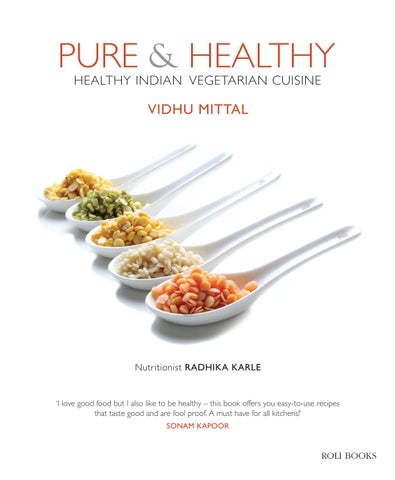
Nutritious food cooked with clean and fresh ingredients brings together well-known author Vidhu Mittal and nutritionist Radhika Karle to devise a plan for your health and well-being. Presented in an easyto-follow format and step-by-step photographs, these recipes will help you rediscover and explore traditional Indian vegetables and ingredients like millets, sorghum and ragi – all packed with vital nutrients and minerals. With its blend of traditional dishes and innovative renditions, Pure & Healthy is packed with recipes suitable for everyone, including practical weekly menu suggestions for those with medical conditions such as diabetes, gluten allergies and thyroid issues. It also helps how food groups and servings can be determined and distributed.
The Hindu
Connecting with the cycle of nature by eating fresh, seasonal and local, Pure & Healthy is a joyful celebration of Indian food that is delicious and wholesome.
Mid-Day
Vidhu graduated with Home Science as her major. She has a diploma in Fashion Designing and has travelled widely in India and abroad. She loves entertaining friends and family and enjoys playing bridge.
Radhika Karle holds a master’s degree in Nutrition and Dietetics. She has more than ten years of work experience as a nutritionist and personal trainer at a leading fitness centre in the United States. Her clients include Sonam Kapoor, Swara Bhaskar, Jacqueline Fernandez, Kunal Kapoor and Naina Bachchan.
Nutritionist RADHIKA KARLE
‘I love good food but I also like to be healthy – this book offers you easy-to-use recipes that taste good and are fool proof. A must have for all kitchens!’ ISBN: 978-81-942068-1-1
Cover Pure Healthy 17 9 2019.indd 1
SONAM KAPOOR
30/09/19 5:01 PM
INTRODUCTION
F
ood and nutrition form a vital part of our overall well-being. The idea for this book first took shape when I was diagnosed with gluten allergy and began trying out new gluten-free dishes that were appetizing without compromising on taste. I soon realized that there are many who are interested in similarly easy recipes that can cater to specific nutritional requirements for diabetes, weight management, heart problems, etc., as well as for those who just want to eat healthy. The aim of this book is to get you back to your kitchens to create truly healthy food that nourishes you, inside and out, without making compromises and taking away the joy of eating. Healthy food nourishes mind and body, helps boost immunity and provides energy to perform everyday tasks. My research for balanced and wholesome diets led me to explore traditional vegetables and ingredients like millets, sorghum and ragi – all packed with vital nutrients and minerals, offering several health benefits. Over the years, these traditional ingredients have disappeared from our kitchens; rediscovering them has filled my food journey with a renewed sense of excitement and joy. My focus has since been to make use of these natural, fresh, healthy and preservative-free ingredients that are nutritious and wholesome. A variety of these ingredients are easily available, and have been innovatively combined in the book to make delicious and visually appealing dishes by accentuating colour and natural flavour, breaking the myths of healthy food being bland, insipid and uninspiring. Radhika Karle, a well-known nutritionist, helped me establish the right proportions of all ingredients by balancing each dish with the appropriate nutrients and calories. She has done nutritional analyses and calorie counts for each recipe. We have also drawn out interesting meal plans that are suitable to general well-being and can also cater to specific dietary needs. These plans specify suitable portions size and provide a balance of carbohydrates, proteins and fats. As with my previous books, simplicity remains the very essence of all recipes – each recipe has easyto-understand steps supported by stepwise photographs, followed by useful hints and tips. I hope you find in this book the subtle flavours and varying textures of homely Indian food, and take part in a joyful rediscovery of our healthy food roots. I have always found cooking to be not only therapeutic but also helpful in knitting the family together with lots of love and affection. Nothing brings people together like food does; I strongly recommend that each one of us cooks at least one meal for the family ourselves, and relish its therapeutic benefits by enjoying the process. I hope you and your loved ones enjoy trying out these recipes as much as I have enjoyed bringing these simple, pure and healthy recipes together for you. Vidhu Mittal
0.2 prelims 1 8 2019.indd 7
11/09/19 12:42 PM
ACKNOWLEDGEMENTS A cookbook is a collective effort with contributions from many. I would like to thank those who helped make it happen. Abhishek Poddar was a motivator, who helped with the creative design, aesthetics and vision of the book. Radhika Karle, whose tireless efforts, invaluable inputs and deep knowledge of nutritional value made this book possible. She has been an amazing partner full of ideas, and accepts no compromise. Sanjay Ramchandran, whose endless patience and passion for perfection helped bring out the true essence of each recipe through exquisite photographs; his love for food helps. Jagdish Babu DK systematically and patiently sorted thousands of photographs, and helped select and reorganize them diligently. Priya and Nasreen helped type the recipes from just outlines to final draft stages; their days of hard work are reflected in this book. Team at Roli, for putting together the design, careful editing, compilation and final production. And most importantly, my husband Som, our children Nidhi, Tarang and Siddharth and our domestic help, Jasmine, who helped and supported me through my journey of this book. Our two grandchildren, Sudha and Amitdeep, were my constant critics as they tried out these new dishes. Their approval was the ultimate test.
Pure & Healthy || 8
0.2 prelims 1 8 2019.indd 8
11/09/19 12:42 PM
BEING HEALTHY
Suggestions from the Expert
P
ure & Healthy focuses on clean and nutritious eating with fresh ingredients. Natural ingredients that were regularly consumed by our forefathers, but which have reduced in popularity over time, are therefore an important part of the recipes. Ghee, a fat that greatly aids in the absorption of fat-soluble vitamins (vitamins A, D, E and K) as well as in digestion, has been added to the book. Rice bran oil is also back on the shelf for its proportionate amount of monounsaturated and polyunsaturated fats, both of which are heart-healthy. And when it comes to desserts, the idea was not to recommend unhealthy dishes but to provide recipes for more wholesome options. For a truly successful weight management plan, then, one must not and need not starve oneself. Instead, it is important to understand the number of calories and the distribution of macronutrients – carbohydrates, protein and fat – in your meal plan. The number of servings of each of the food groups (starch, fruit, vegetables, beans/legumes and fat) can be determined from here and then distributed throughout the day. To this end, each recipe in the book has a recommended portion per serving, and is measured in a standardized way with measuring teaspoons (1 tsp = 5 ml), tablespoons (1 Tbsp =15 ml) and measuring cups (1 cup = 200 ml). Dry measurements will differ in weight due to their volume and texture. Pure & Healthy encourages simple and effective lifestyle improvements that can bring about positive body composition changes. Along with the recipes this book has to offer, here are some tips to help you begin your wellness journey: • Eat fresh, seasonal and local foods. Avoid processed and packaged foods. • Drinking a minimum of two litres of water per day is a good place to start. Water plays a major role in regulating body temperature, transporting water-soluble vitamins and aiding in digestion. • Avoid excess amounts of tea and coffee as they further dehydrate the body. • Exercise every day for 30–45 minutes at a moderate to high intensity. Include a combination of cardiovascular exercise, resistance training and stretching in your weekly exercise routine. • Keep a check on your vitamin D3 and vitamin B12 levels. Vitamin D3 plays a major role in converting calcium into a form that the body can absorb, therefore ensuring bones stay strong. Vitamin B12 helps convert food to energy that the cells of the body can then absorb and utilize. • The most important part of your wellness journey will be your rest and recovery time as this is truly what is going to ensure you see results. 7–8 hours of consecutive, undisturbed sleep are of utmost importance to allow the body to recover from exercise and to build lean body mass. Supported by my learnings at the Yogendra Institute in Mumbai, India and my master’s degree in Nutrition and Dietetics from Texas Woman’s University, Houston, I have worked with Vidhu to bring together ancient Ayurvedic practices with nutritional sciences to the pages of Pure & Healthy. So try a recipe at the next party you host, and see how pleasantly surprised your guests will be when they hear it is filled with pure and healthy ingredients! Be and remain healthy, Radhika Karle
9 || Pure & Healthy
0.2 prelims 1 8 2019.indd 9
11/09/19 12:42 PM
know your fruits & dried fruits
Apple (seb): This fruit comes in different varieties and colours. The skin colour varies from green to pink to bright red. Below the skin, there is off-white, crispy, juicy pulp. It is used in salads, drinks, desserts, etc. Apples are rich in dietary fibre and help in the digestive process.
Papaya (papita): This fruit is oval in shape, and both the raw and the ripe fruit are relished. Raw papaya is made into salads and curries, whereas the ripe variety is used as a table fruit. It is rich in antioxidants and is anti-inflammatory. It treats constipation and improves digestion.
Avocado (makhan fal): This pear-shaped fruit has uneven green skin with yellowish-green flesh inside. The skin and the big seed inside are discarded. Avocado flesh is used in salads, to make guacamole and is relished on breads. It is rich in fibre and heart-healthy fatty acids.
Pomelo (chakotra): This fruit is large with a light green or yellow rind, usually one inch-thick. Pomelo fruit segments can be yellow or pink in colour. The fruit has a tangy taste. It is used to make drinks and salads. This fruit improves digestion and contains potassium, vitamin C and dietary fibre.
Banana (kela): This fruit is generally elongated and curved with soft flesh inside. The peel colour varies from green to yellow, to brown when ripe. It is used in smoothies and desserts. Banana is rich in potassium and high in dietary fibre, which makes you feel fuller for longer. Kiwi fruit: This is an oblong berry with downy, brownish-green skin. It has vibrant deep green flesh with small and crunchy edible black seeds. Kiwi fruit is often used in salads, drinks, desserts, etc. It is a rich source of vitamin A, vitamin C, dietary fibre and antioxidants. Mango (aam): It is the king of fruits. Both ripe and raw mangoes are used. The raw mango has green skin and white flesh that is sour in taste. The ripe mango’s skin colour varies from green to yellow, and has orange flesh and non-edible seed inside. It helps to purify the blood and is rich in antioxidants.
Star Fruit (kamrak): This yellowish-green fruit has five wings, edible skin and thick flesh. It has a waxy coat. It can be enjoyed as a fruit, pickled or as a jam. It is rich in dietary fibre, vitamin C, B vitamins and antioxidants. Strawberry: This cone-shaped fruit belongs to the rose family and comes in various sizes. Its colour ranges from pale orange to bright red, and its flavour from sweet to tart. Strawberries have a short shelf life. They can be relished in drinks, desserts, preserves, etc. They are packed with vitamins, fibre and antioxidants. Watermelon (tarbooj): This oblong fruit is green in colour, sometimes with white bands running from end to end. Watermelon is a popular summer fruit – sweet and crunchy, it is 91 per cent water. It is used in drinks and salads. It is rich in antioxidants and vitamin C.
Orange (santra): This fruit is covered with thick green to yellow skin. The orange inside is divided into pulpy, juicy segments. It is used to make drinks, salads and desserts, and in some vegetable preparations. It is a rich source of vitamin C and acts as an antioxidant.
Pure & Healthy || 10
0.2 prelims 1 8 2019.indd 10
11/09/19 12:42 PM
Almonds (badam): This nut is highly nutritious, usually eaten raw and also made into a beverage (almond milk). Slivered almonds are used as a garnish on Indian desserts and salads. It is rich in protein, vitamin E and dietary fibre, keeping the heart healthy and lowering cholesterol.
Fox nuts (makhana): Also known as gorgon nuts, fox nuts are the seeds of the flowering plant that belongs to the water lily family. Fox nuts are white with a few dark spots. They are used to make sweets and savoury Indian delicacies. Fox nuts are rich in antioxidants and magnesium.
Amaranth seeds (ramdana): These seeds are procured from the Amaranth plant. They are tiny, round seeds that are a pale, white colour. Roasted, popped amaranth seeds are used in Indian desserts. They are rich in antioxidants, dietary fibre and vitamin C.
Pine nuts (chilgoza): Ivory-coloured and slender, pine nuts have a thin, soft brown shell and are often toasted to accentuate their natural nutty flavour. The unique crunch and flavour of pine nuts are used to enhance salads, vegetable preparations, desserts, etc. They are rich in protein, iron and monounsaturated fats.
Black raisins (kali kishmish): Raisins are dried black grapes. They are used in certain Indian desserts. They are high in fibre, and their rich iron content makes them a natural blood purifier when it comes to treating anaemia.
Pistachios (pista): Pale green and encased in a hard beige shell. Pistachios can be used whole, chopped or slivered as a garnish. They are packed with dietary fibre and vitamins A and E.
Dates (khajoor): A dried fruit that comes from the date palm tree. Dates have a honey sweetness and are enjoyed both ripe and semidried. They are a delicious addition to dips, chutneys and desserts. They are a rich source of protein and iron.
Pumpkin seeds (kaddu ke beej): These seeds are hulled and roasted before use. They are olive green inside and have a sweet, nutty flavour. Pumpkin seeds are enjoyed as a crunchy dressing on salads. They are rich in antioxidants, iron and dietary fibre.
Figs (anjeer): They are pear-shaped fruits available in dried form. They are sweet to taste and filled with natural fibre. Figs are used to make salads, sweeteners, jams and ice-creams. They are rich in iron and high in fibre.
Sunflower seeds (surajmukhi ke beej): These seeds are dehulled kernels from their shells. They can be used for garnishing on soups and salads or as a mid-time snack. Sunflower seeds are rich in antioxidants and proteins.
Flax seeds (alsi ke beej): Also known as linseeds, they comes in two different colours: brown and yellow. Flax seeds are tiny, nutty-flavoured seeds. For better absorption and digestion, grind them before use. They are high in dietary fibre and help to lower cholesterol.
11 || Pure & Healthy
0.2 prelims 1 8 2019.indd 11
11/09/19 12:43 PM
Welcoming LENTILS & Millets
The edible seeds of peas and beans are known as lentils but are also referred to as ‘pulses’. They are often paired with rice and Indian breads as well as added to salads and soups. A variety of lentils exist with colours that range from yellow to red, orange to green, brown to black. Lentils are sold in many forms: with or without the skin, whole or split. They contain high levels of protein, vitamin B1, dietary fibre and minerals.
De-husked, split Bengal gram, roasted (bhuni chana dal)
Red kidney beans (rajmah)
Black chickpea (kala chana)
Skinned, split green gram (dhuli moong dal)
Black-eyed peas (lobhia dal)
Split green gram (chilka moong dal)
Butter beans (vaal)
Whole green gram (sabut moong dal)
De-husked, split black gram (dhuli urad dal)
Whole red lentil (kale masoor)
De-husked, split Bengal gram (chana dal)
Yellow lentil (arhar dal)
Moth bean (moth)
Pure & Healthy || 12
0.2 prelims 1 8 2019.indd 12
11/09/19 12:43 PM
Millets have been an important staple food in Indian history. Millet grains are a repository of protein, fibre, vitamins and minerals. Either they are used whole in Indian preparations or made into flour. Since the flour texture is coarse, it requires patience to make them into dough and, later, when rolling and cooking them into a bread. The higher nutritional value of a cooked millet dish keeps you full for a longer time. Millets are the most versatile ingredient, and are used to prepare idlis, dosas, khichdi, etc.
Sorghum (jowar)
Amaranth (ramdana)
Buckwheat (kuttu)
Pearl millet (bajra)
Barnyard millet (samvat ke chawal)
Finger millet (ragi)
Quinoa (samvat ke chawal)
13 || Pure & Healthy
0.2 prelims 1 8 2019.indd 13
11/09/19 12:43 PM
Tomato Relish Tamatar Ki Chutney
INGREDIENTS 1 tsp Rice bran oil Pinch, Asafoetida (hing) 1/8 tsp Cumin (jeera) seeds 1 medium / 75 gm Onion (pyaz), peeled, cut into medium cubes (see pg. 215) 1 tsp Ginger (adrak), finely chopped ½ tsp Green chillies (hari mirch), finely chopped ¼ tsp Red chilli (lal mirch) powder 4 medium / 375 gm Tomatoes (tamatar), roasted, peeled, cut into medium cubes (see pg. 224) 2 Tbsp Water Salt, to taste 2 tsp fresh Coriander (dhaniya) leaves, finely chopped, to garnish
METHOD • Heat 1 tsp oil in a pan for 30 seconds over medium heat. Add the asafoetida, cumin seeds, onion, ginger and green chilli, and sauté over medium heat for a minute. Add the chilli powder, tomatoes, water and salt to taste. • Mash well with a masher, reduce the heat and cook until the mixture is semi-thick.
Serves: 7 (1 & ¾ cup) Suggested portion per serving: 2 Tbsp
per serving
Calories
2 tbsp 16
Fat (grams)
0
Carbohydrates (grams)
3
Protein (grams)
1
• Garnish with fresh coriander. Mix and serve.
• Tomatoes are a good source of lycopene, a powerful antioxidant beneficial for maintenance of good vision, prevention of heart disease and possibly reducing the risk of Alzheimer’s. Pure & Healthy || ACCOMPANIMENTS || 186
3.2 pure & healthy rice bread accompaniments desserts 1 8 2019.indd 186
11/09/19 12:02 PM
Tricolour Stuffed Okra Tirangi Bhindi
INGREDIENTS 12 / 55 gm tender, medium Okra (bhindi) 1½ Tbsp / 30 gm Onion (pyaz), finely chopped 1½ Tbsp / 70 gm Tomatoes (tamatar), finely chopped 1½ Tbsp / 50 gm Cucumber (khira), finely chopped Salt, to taste ¼ tsp Chaat masala 2 tsp fresh Coriander (dhaniya) leaves, finely chopped A few drops of lemon juice
per serving
Serves: 3 (12 pieces) Suggested portion per serving: 4 pieces
METHOD • Trim both the ends of the okra. Slit vertically with a sharp knife, keeping the vegetable intact. • Steam the okra in a double boiler / vegetable steamer for 3 minutes. Remove and set aside to cool. • Mix the chopped onion, tomatoes, cucumber, salt, chaat masala, fresh coriander and lemon juice. Stuff this filling into the steamed okra evenly and serve.
4 pieces
Calories
8
Fat (grams)
0
Carbohydrates (grams)
2
Protein (grams)
0
• Okra is packed with valuable nutrients like sodium and potassium, which help in proper muscle contraction in the body, thus avoiding cramps. 187 || ACCOMPANIMENTS || Pure & Healthy
3.2 pure & healthy rice bread accompaniments desserts 1 8 2019.indd 187
11/09/19 12:02 PM
Tangy Date Chutney Khajoorki Saunth
INGREDIENTS 100 gm soft Dates (khajoor), washed 3½ tsp Mango powder (amchur) 2¾ cups / 550 ml (2¼ + ½) Water ¼ tsp Black salt (kala namak) ¼ tsp Spice mix (garam masala) (see pg. 222) ½ tsp roasted Cumin (bhuna jeera) powder (see pg. 222) For the Masala: Pinch, Asafoetida (hing) ½ tsp Coriander (dhaniya) powder ½ tsp Red chilli (lal mirch) powder
METHOD • In a pan over medium heat, add the washed dates with 2¼ cups / 450 ml water and bring the mixture to a boil. Simmer for 2 minutes and leave to cool at room temperature. Set aside. • Reserve the water for later use. Remove the seed of each date. Set aside. • Blend the dates with the reserved water in a mixer to a smooth paste and strain through a sieve. Set aside. • In a pan, mix mango powder with the remaining water, sieved date mixture and black salt. Bring this mixture to a boil, stirring occasionally. Simmer for 15 minutes or until the mixture is semithick. Set aside to cool. • In a flat pan over medium heat, dry roast the Masala ingredients, stirring frequently until light golden brown. Set aside. • Add the garam masala, roasted cumin and the dry roast Masala ingredients to the cooked mixture. Mix well and serve. • Refrigerate any leftovers and consume within 15 days.
per serving
Calories
1½ tbsp 48
Fat (grams) Carbohydrates (grams)
0 12
Protein (grams)
• Dates are a great source of fibre. However, they must be consumed with a good amount of fluid in order to aid in digestion.
0
• This chutney has a special place in Indian kitchens, with the mango powder giving an extra tartness to this accompaniment.
Pure & Healthy || ACCOMPANIMENTS || 188
3.2 pure & healthy rice bread accompaniments desserts 1 8 2019.indd 188
11/09/19 12:02 PM
Author of bestsellers, Pure & Simple: Homemade Indian Vegetarian Cuisine and Pure & Special: Gourmet Indian Vegetarian Cuisine, Vidhu Mittal is a well-known culinary expert based in Delhi, India. She has been conducting cookery classes for over 20 years besides making regular contributions to magazines and specialized websites.Vidhu developed an interest in cooking very early in her life and what was a hobby became a passion that she loves sharing with others. A vegetarian, Vidhu has created a wide range of recipes that retain and enhance natural flavours, textures, colours, and above all, these recipes are simple and easy. Compared to traditional Indian cookery, which can sometimes be too rich and elaborate, her recipes are healthy and appealing. She has constantly been evolving her recipes and enjoys experimenting.
Praise for Pure & Simple: Homemade Indian Vegetarian Cuisine
Praise for Pure & Special: Gourmet Indian Vegetarian Cuisine
‘An amazingly lucid, simple and thoughtful book... Vidhu Mittal’s Pure and Simple: Homemade Indian Vegetarian Cuisine excels in its step-bystep photographs for over 100 classic and contemporary vegetarian recipes.’
‘Her first smart move is expanding the new age Indian cook’s larder by adding goosefruit leaves, Indian water chestnut and lotus stems to the repertoire, in addition to vegetables usually perceived as being “Western”, such as olives, broccoli, and sweet basil. Her second is creating accessible recipes that can be served anywhere in the world... Mittal’s meticulously crafted recipes aims to prove that Indian cooking can be light, healthy and stylish.’
The Times of India ‘Inventive, practical and appealing, Vidhu’s cookbook is for beginners whom she describes as “busy young professionals who have trouble using salt, oil and spice in the right proportions”. Her recipe instructions are meticulous and very basic, so even Mama’s boys can use this book to cook some phenomenally tasty food.’
Nutritious food cooked with clean and fresh ingredients brings together well-known author Vidhu Mittal and nutritionist Radhika Karle to devise a plan for your health and well-being. Presented in an easyto-follow format and step-by-step photographs, these recipes will help you rediscover and explore traditional Indian vegetables and ingredients like millets, sorghum and ragi – all packed with vital nutrients and minerals. With its blend of traditional dishes and innovative renditions, Pure & Healthy is packed with recipes suitable for everyone, including practical weekly menu suggestions for those with medical conditions such as diabetes, gluten allergies and thyroid issues. It also helps how food groups and servings can be determined and distributed.
The Hindu
Connecting with the cycle of nature by eating fresh, seasonal and local, Pure & Healthy is a joyful celebration of Indian food that is delicious and wholesome.
Mid-Day
Vidhu graduated with Home Science as her major. She has a diploma in Fashion Designing and has travelled widely in India and abroad. She loves entertaining friends and family and enjoys playing bridge.
Radhika Karle holds a master’s degree in Nutrition and Dietetics. She has more than ten years of work experience as a nutritionist and personal trainer at a leading fitness centre in the United States. Her clients include Sonam Kapoor, Swara Bhaskar, Jacqueline Fernandez, Kunal Kapoor and Naina Bachchan.
Nutritionist RADHIKA KARLE
‘I love good food but I also like to be healthy – this book offers you easy-to-use recipes that taste good and are fool proof. A must have for all kitchens!’ ISBN: 978-81-942068-1-1
Cover Pure Healthy 17 9 2019.indd 1
SONAM KAPOOR
30/09/19 5:01 PM