
OAK AND INFLUENCES
A party every Sunday: my Brazilian roots
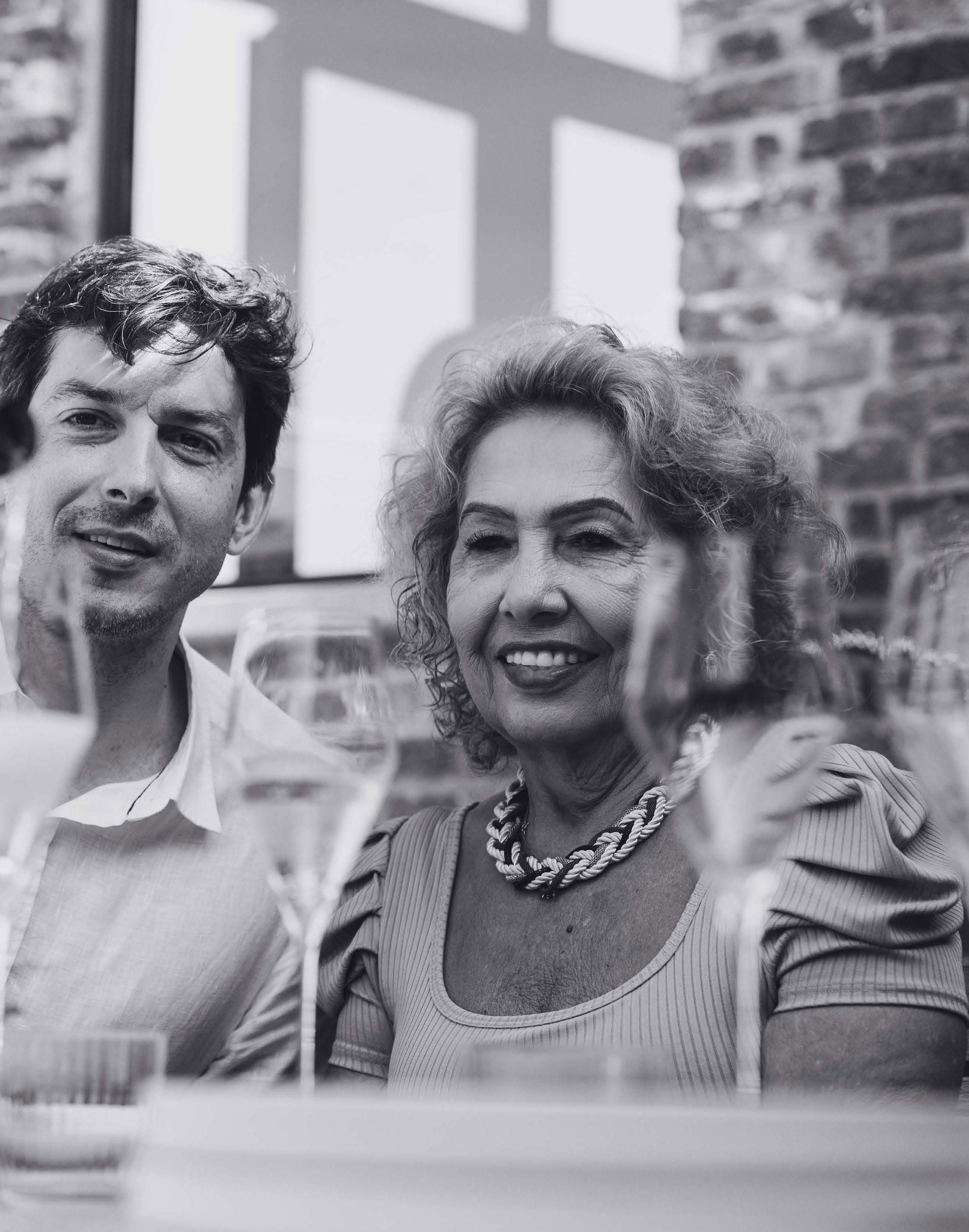
I was born in 1981 in Manaus, the gateway to Brazil’s Amazon region, the son of an Italian father and a Brazilian mother. I lived there until I was 17 years old. So, my homeland plays a major role in my life. My rather direct personality was largely formed there. The jokes that sound normal there can get you into a lot of trouble here.
Brazil was also important in shaping my relationship with food. I remember vividly how we ate five meals a day: breakfast, lunch, a late afternoon meal, dinner; and later in the evening, porridge with milk. Although, that tradition may have changed by now; I don’t know if my nephews still do it. The world has become so cosmopolitan that you can’t help but lose some of your culture. One thing I do know: go to a Brazilian barbecue today, and you’ll know it’s a serious thing.
Sometimes you’ll find traces of my grandmother’s cooking in what we offer at OAK. We used to live next door to her. I remember going there in the afternoons to drink coffee and eat bread with ham and cheese, even though ham and cheese were relatively new in our culture. Certainly for us: we were not exactly well-off. We ate mostly bread or a type of tapioca pancake with butter. And tucumã, a yellow palm fruit. And fried banana with cinnamon and sugar. Sadly, my grandma and I never cooked together; she died when I was 18 years old. I wasn’t really into cooking at that age, only eating and other mischief. I had a big appetite growing up.
I also remember my birthdays when I was a young boy. A birthday party didn’t just last a couple of hours. It was a huge event, an experience to remember. We invited guests over and ate brigadeiros, a type of chocolate ganache with condensed milk – a typical birthday treat. This was followed by a full dinner, with lots of savoury snacks, chips, sandwiches with delicious fillings, like chicken salad, and to finish it off: cake and a procession of sweets.
In southern culture, the weekend is synonymous with eating and spending time together. In fact, every Sunday was a celebration. My parents, my brother who was a year older than me, our cousins, our grandparents: everyone came together for barbecues that lasted all day with fish, meat, consommé, onion salad with vinegar and olive oil, tomato salad, and so on. Brazil has a rich cuisine, with plenty of meat and carbs from sources such as flour, rice, and beans. It also has African influences. But it’s always simple. Nothing more than well-prepared, delicious food. Not refined or lavish like in Belgium or France. There’s no fine-dining scene. I personally have some issues with that concept as well. In my opinion, a prepared-to-perfection and beautifully presented vol-au-vent is a perfect dish for fine-dining. I don’t believe the term has to be linked to the idea of luxury.
Those bygone Sundays may sound lavish, and they were to some extent. But until I was 10 or 12 years old, we couldn’t ask for anything extra at the supermarket. And, exceptions were rare. Biscuits and such didn’t come until later. My mother took care of the children while my father worked in places like the gold mine and tried to make ends meet. Together they tried their hardest to raise two children. And those children weren’t exactly the quiet type. My brother and I were rascals. We fought a lot.
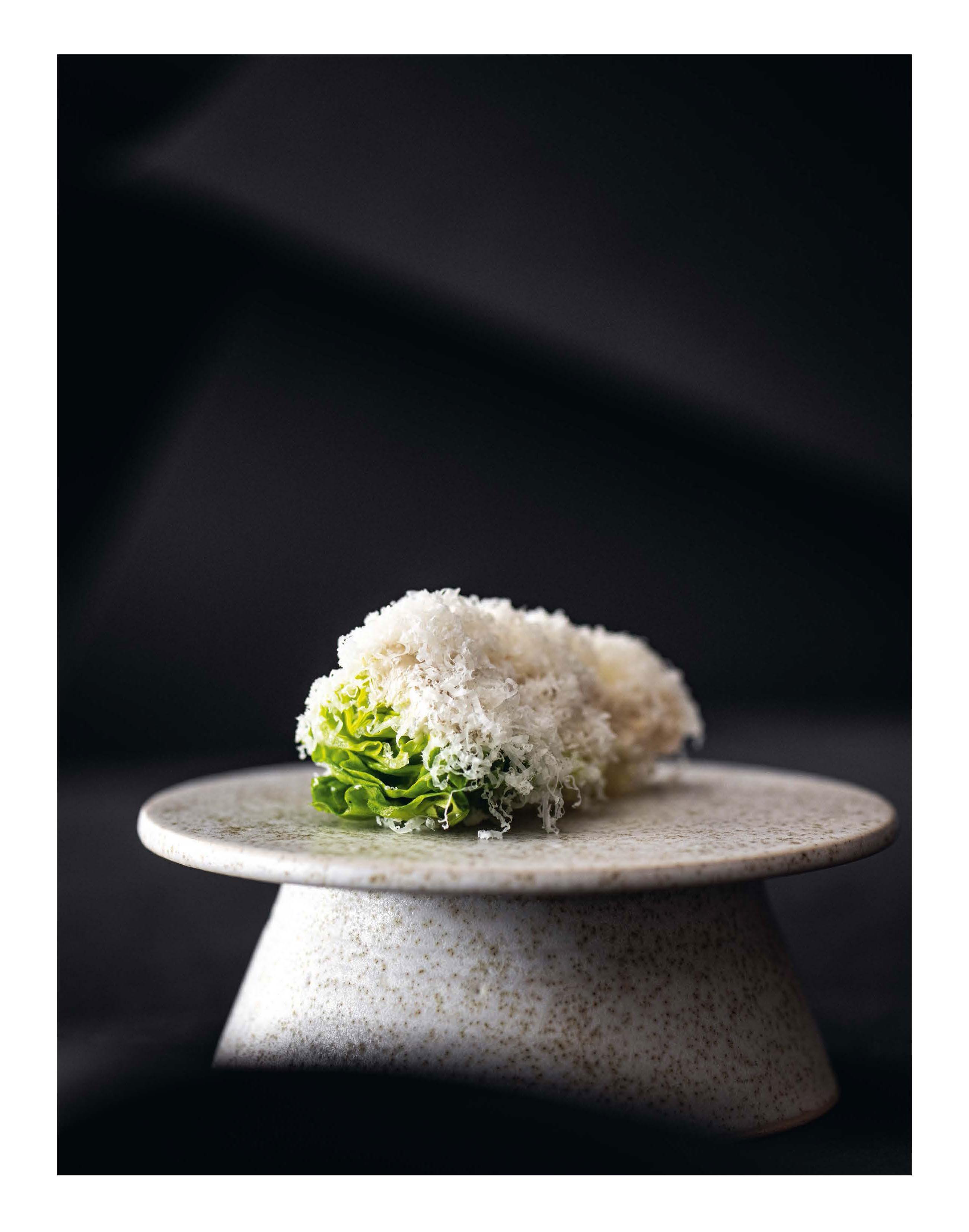
Caesar salad
20 min. cooking time
At OAK this was my first creation. I was introduced to caesar salad for the first time when I lived in the US. Everyone thinks that this dish always includes chicken; even now, guests come to our restaurant asking about the chicken. I have to laugh every time. I think this little appetizer has become a hit on the menu because it’s an ultra-fresh start to a meal. The dressing is more than enough for this recipe. Keep the rest handy for a sandwich or another salad.
8 people
2 heads of little gem lettuce
75 g anchovy fillets (without if you want it vegetarian)
Maldon salt to taste
dressing
100 g egg yolk
45 g Cabernet Sauvignon vinegar, and extra on the side
1 teaspoon ground black pepper
3 g fresh garlic, minced very fine
10 g salt
5 g mustard
80 g water
160 g Parmesan cheese, and extra for shaving on top
1 litre vegetable oil
Preparation
Cut each head of little gem into quarters and set aside.
For the dressing, whisk together all ingredients, except the oil, in a stand mixer, using the same technique as for making mayonnaise. i.e. slowly add the oil until you have a smooth consistency in which all the ingredients are mixed together. Season further with salt if necessary.
Place the little gem quarters on a serving platter. Drizzle with the extra vinegar and sprinkle with the Maldon salt. Cover the little gem with the dressing and garnish with a few curls of Parmesan cheese. Let the meal begin!
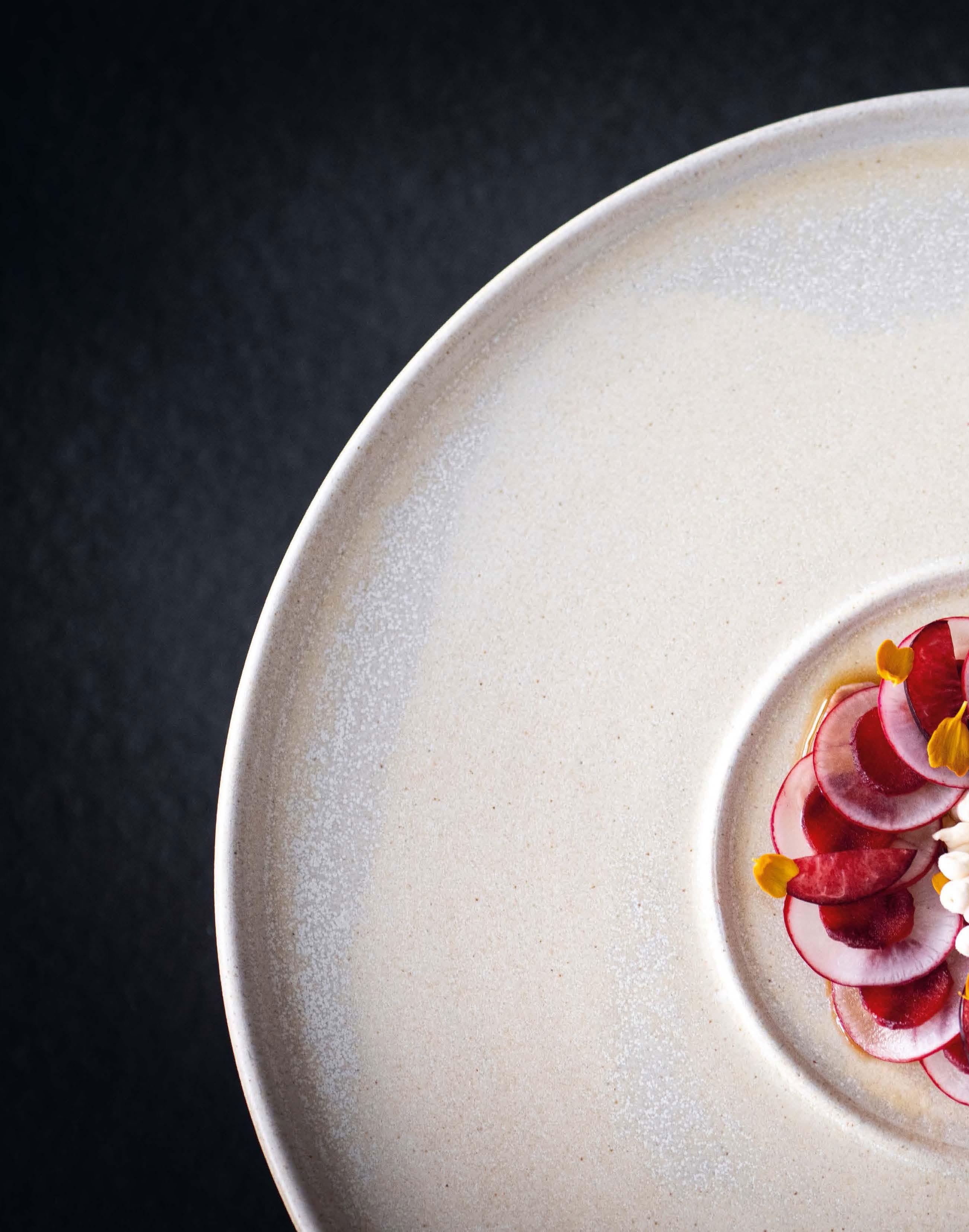
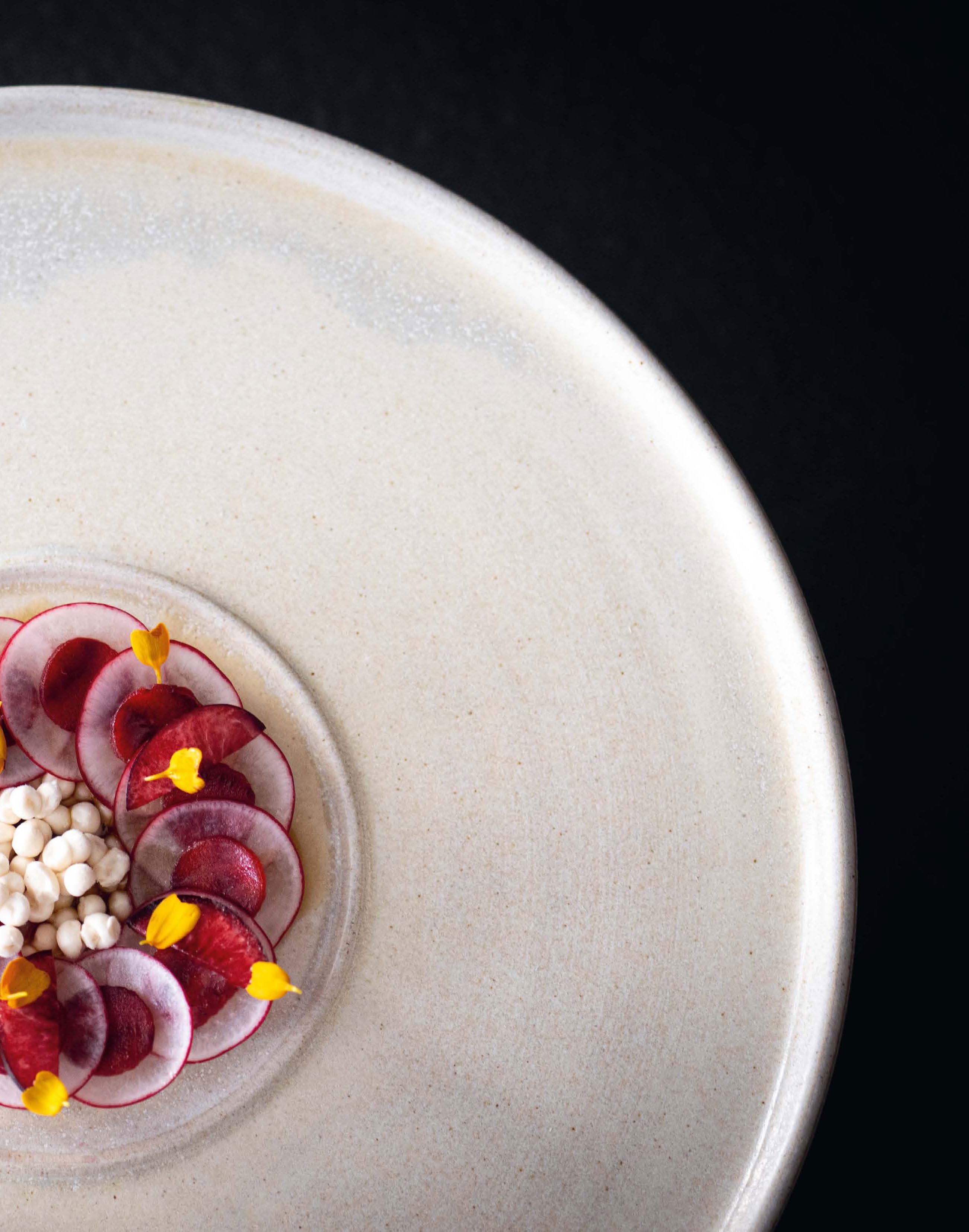
Bonito with plums
45 min. cooking time
This dish was born out of the frustration that comes with using flowers and herbs. We didn’t want to use flowers here. Still, it is a great way to challenge yourself to work in great detail. And the combination of apple and jalapeño pepper is perfect for me!
2 people Preparation
200 g bonito (white tuna) salt
50 g crème fraiche
20 g sweet miso
50 g aged soy sauce
1 tablespoon lime zest, finely grated
2 plums
100 g cherry powder
jalapeño green apple vinaigrette
5 green apples
2 jalapeño peppers
1 tablespoon lime juice, optional
For the vinaigrette, put the apples in a juicer. Pour the juice through a sieve and pour it into a Thermomix. Add two whole jalapeño peppers if you like it spicy. If that’s too much for you, use one and remove the seeds. Blitz everything briefly on full speed. If you don’t have a Thermomix, use a blender on the highest speed. Pour the juice through a sieve. Taste it. Add lime juice if the juice needs a little more acidity. Pour half of the vinaigrette into an ice cube tray and place in the freezer. Preserve the rest separately.
Clean and fillet the fish. Place it on a grid. Sprinkle with salt and let rest for 10 minutes. Rinse off the salt under cold water and put the fish in the fridge.
Mix the crème fraiche with the miso. Season with salt. Put the mixture in a piping bag. Set aside. Cut the fish lengthwise into a thin long strip. Sprinkle with the aged soy sauce and some lime zest. Cut the plums into half-moon shapes. Make sure you do this quickly so that the plums don’t colour.
Roll up the fish strip and lay it on its side. Spoon some crème fraiche into the centre of the fish roll. Push a frozen vinaigrette cube into the crème fraiche. Place the plum half-moons on top. Sprinkle with the cherry powder and spoon the reserved vinaigrette around the fish roll.
White asparagus with tonburi
25 min. cooking time
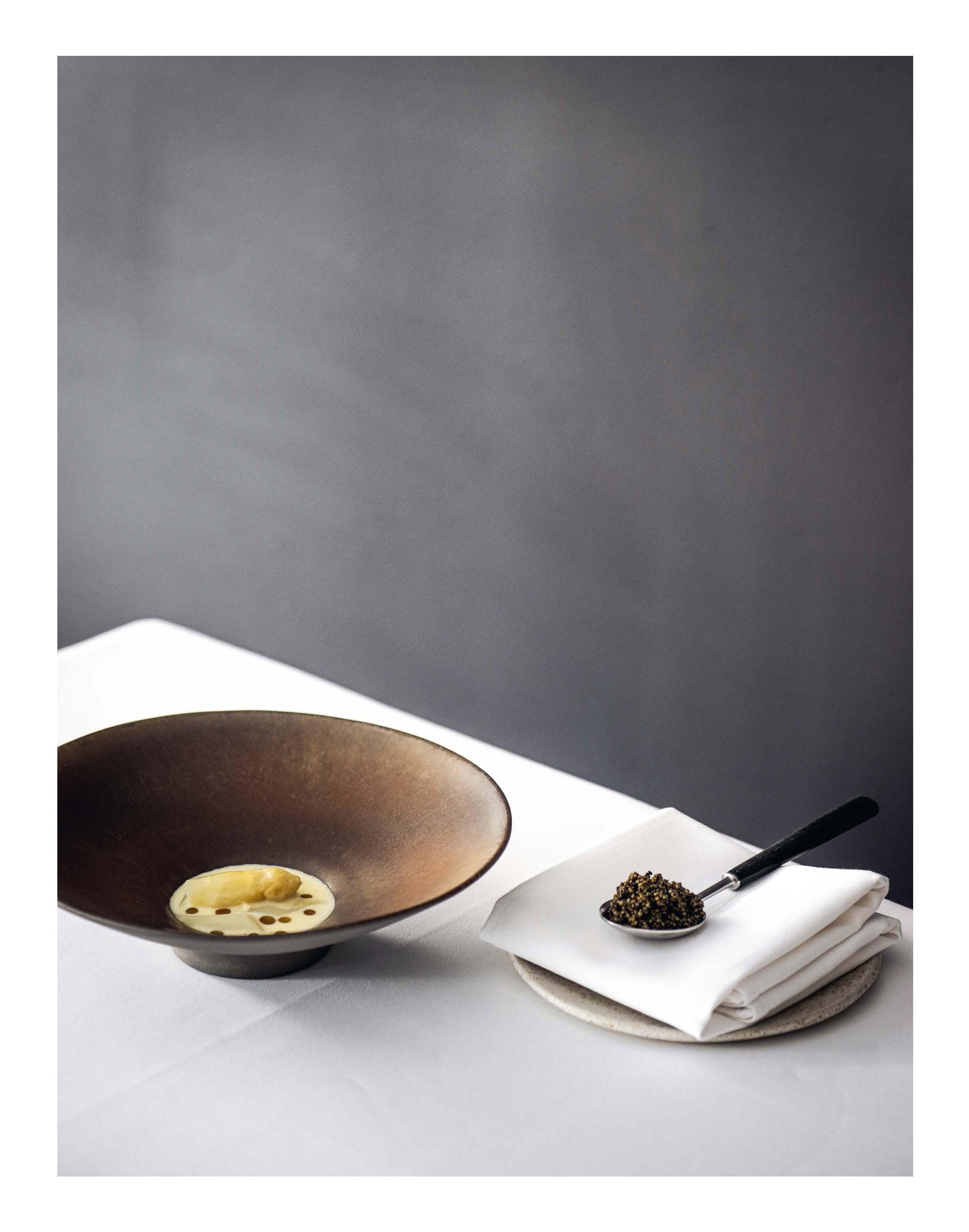
This is one of those dishes that everyone loves because it’s so warm and cosy. Moreover, it is a vegetarian dish. I really like this. Which is funny, because I’m usually a green asparagus lover.
6 people Preparation
1 bunch of white asparagus (fresh)
10 g butter
a dash of olive oil
100 g risotto rice a dash of white wine
a knob of butter, plus extra to glaze
1 tablespoon citrus vinaigrette (see basic recipe p. 21)
salt
60 g tonburi (‘field caviar’, 10 g per person)
sauce
200 g liquid from fermented asparagus (see basic recipe p. 28)
50 g butter
Peel the asparagus and remove the hard ends. Save the peels and ends. Place the asparagus in a vacuum bag with the butter. Vacuum seal the bag. Preheat the steam oven to 80°C and steam the asparagus for 10 minutes, checking every 2 minutes. They should not be overcooked.
Heat water in a pan to 70°C. Put all the peelings and ends in a pan and let it steep for 30 minutes. Save this water to cook your risotto.
Place a pan with the olive oil over medium heat. Toast the rice in it. Deglaze with the white wine and gradually add the reserved asparagus liquid, cooking until the risotto is al dente.
For the sauce, put the liquid from fermented asparagus in a bowl with the butter. Set aside a little liquid for the risotto. Blend both ingredients into a smooth sauce.
Put some risotto in a pan and heat it with some of the asparagus juice and the butter. Continue to shake the pan over medium heat until the butter has melted. Then add the citrus vinaigrette. Season with salt to taste. Set aside, but keep warm. Remove the asparagus from the vacuum bag and cut into 5 centimetre pieces. Glaze all the asparagus pieces in a pan with some butter. Add salt to taste.
Place the risotto in the centre of a serving bowl. Place the glazed asparagus pieces on top and sprinkle with the tonburi. Heat the sauce and pour it over the dish.
+ Tonburi is mainly available online.
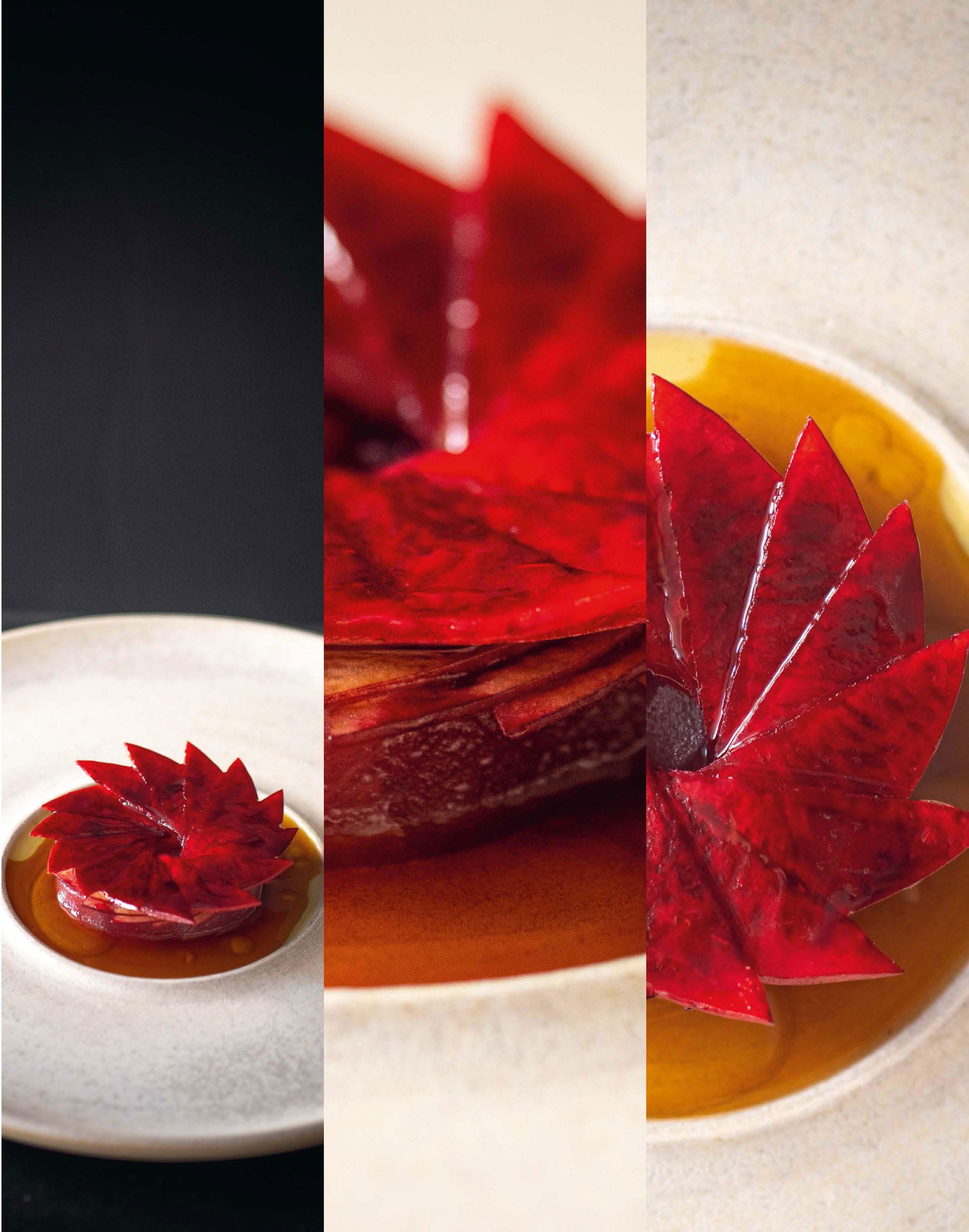
Skrei with celeriac and truffle sauce
2 hours cooking time
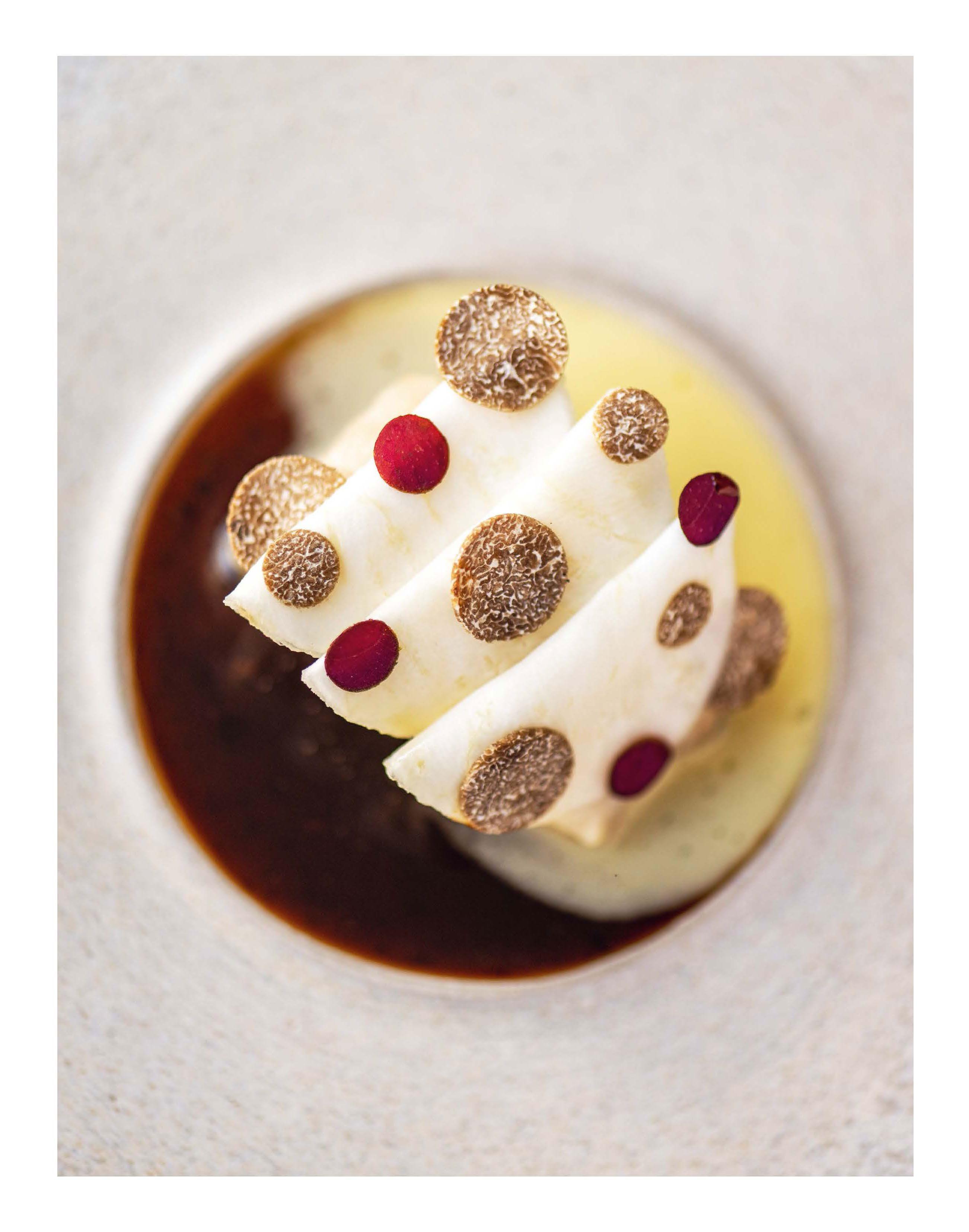
We’re always delighted when it’s skrei season again. After all, this Norwegian cod is such a beautiful white fish. This is a fantastic recipe, if you do it right. I think the secret is in using ripe truffles!
2 people Preparation
200 g skrei filet salt
celeriac sauce
1 celeriac
10 g soft butter
a dash of olive oil, plus extra for basting
500 g milk
250 g butter
250 g truffle jus (see basic recipe p. 26), plus extra grated truffle
Sprinkle the skrei all over with salt and let it sit for 30 minutes. Set aside.
Preheat the oven to 160°C. Cut the celeriac in half. Slice one half as thinly as possible. Cut small rounds from the celeriac slices with a circle cutter. Spread the slices with the butter on a baking tray and place in the oven until the celeriac slices are cooked. Roast the other half of the celeriac in the oven until caramelized. Cut in half again and let both halves soak in the milk.
Rinse the skrei under cold water. Divide the fillet into portions. Place them in a bowl and drizzle with olive oil. Place the tray in a steam oven at 80°C for 15 minutes.
For the celeriac sauce, place a large pan with the celeriac milk over medium heat and let the milk reduce until you have a strong celeriac flavour. Emulsify with the butter (generally the ratio is 50/50, i.e. 100 ml milk to 100 g butter, but that decision is up to you).
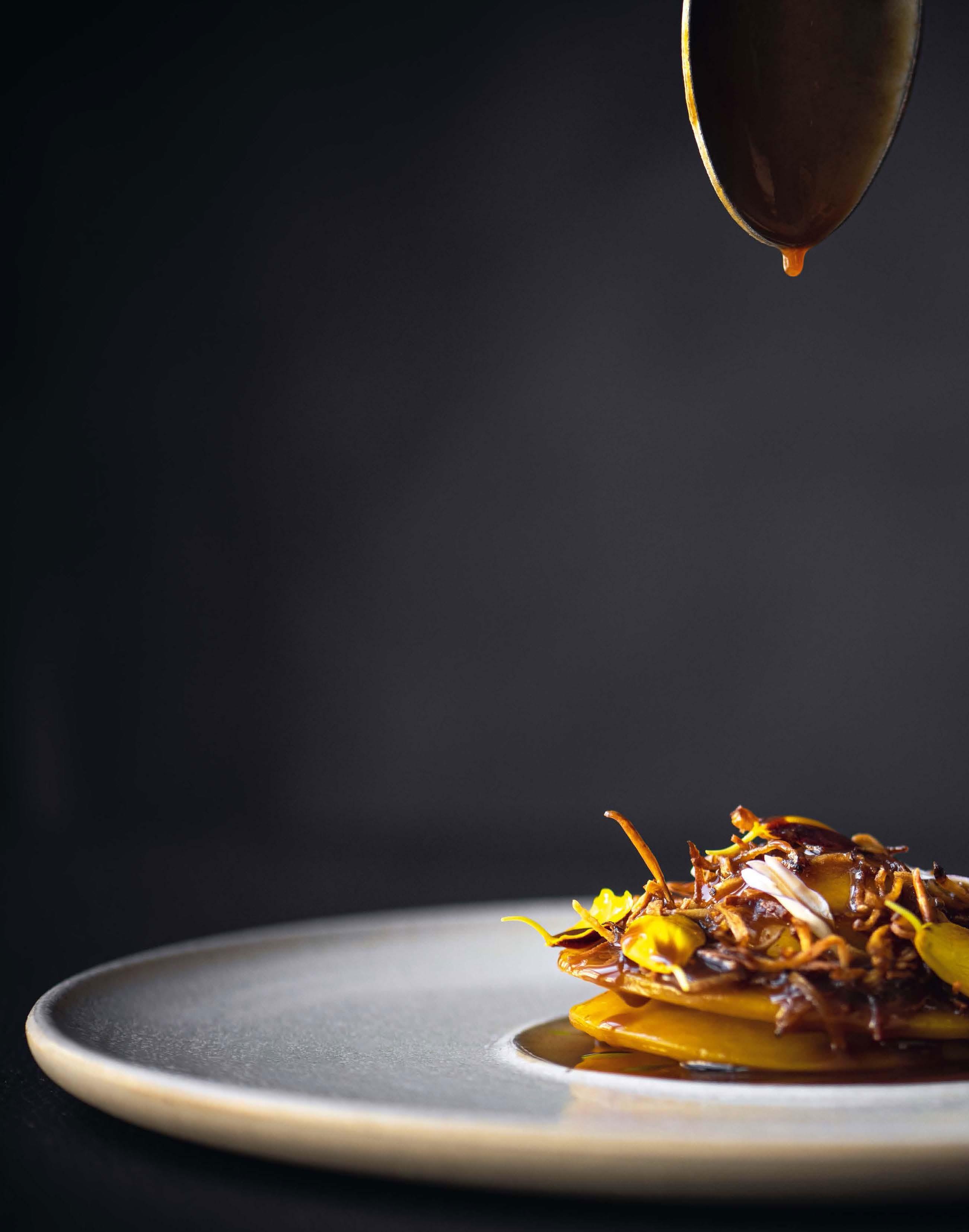
Prepare the truffle jus. Place the skrei in the centre of a plate. Place a few slices of celeriac and a slice of fresh truffle on top of the fish. Spoon some of the celeriac sauce on top and then some truffle jus.
Enjoy!
Mango mousse with passion fruit
1 hour cooking time
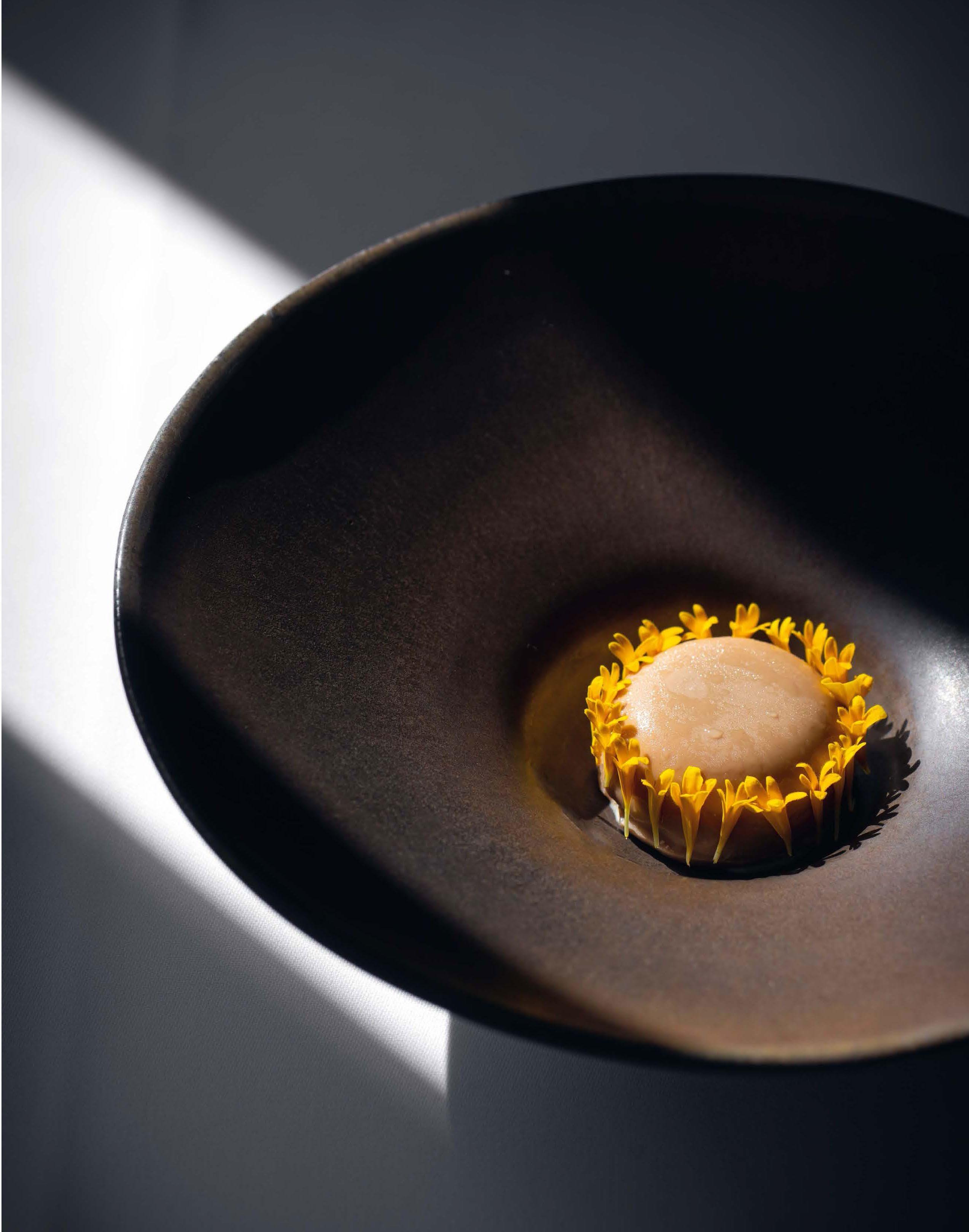
It’s like the sun is on your plate. For me, this is the perfect sunny dessert: fresh and full of flavour… at least if you like mango.
6 people Preparation
1 mango
2 pieces of combava (kaffir lime)
200 g caramel chocolate
150 g cocoa butter
3 tablespoons of vanilla oil (see basic recipe p. 29)
mango mousse
250 g mango coulis
200 g Italian meringue (see basic recipe p. 31)
passion fruit pearls
125 g yoghurt
250 g passion fruit, pulp only
125 g icing sugar
5 g gelatin leaves, soaked
3 litres liquid nitrogen (optional)
edible flowers
For the mango mousse, mix 200 grams of the mango coulis with the Italian meringue in a bowl. Stir together and put the mixture in a piping bag. Peel the mango. Cut the flesh into very small cubes. Finely chop the skin of both combavas and fold them through the mango cubes. Add 30 grams of the mango coulis and mix together. Set aside.
Pipe the mango mousse into a round silicone mould. Fill only halfway. Arrange a spoonful of mango cubes on top and cover with the mousse again. Put in the freezer.
Melt the chocolate and cocoa butter in a pan at 40°C. Remove the frozen mousse from the freezer. Dip the balls in the melted chocolate. Set aside in the fridge.
Mix the yoghurt, passion fruit and icing sugar together. Heat a small amount of this mixture to 40°C and stir in the soaked gelatin. Mix this small amount with the rest of the mixture and allow to set in the refrigerator.
Place the stiffened mixture in a plastic squeeze bottle. Put liquid nitrogen in a bowl and squeeze drops of passion fruit mixture from the bottle, they will freeze immediately. Take the pearls out of the bowl and put them in the freezer. (If you don’t have liquid nitrogen, you can also place the passion fruit mixture in a container in the freezer, and break the ice into small pieces instead.)
Spoon the remaining mango coulis (two tablespoons per person) into a small bowl and stir in the vanilla oil. Remove the mango balls from the refrigerator and place them on a serving platter. Arrange some edible flowers around the mango balls. Garnish with the mango coulis and the pearls.
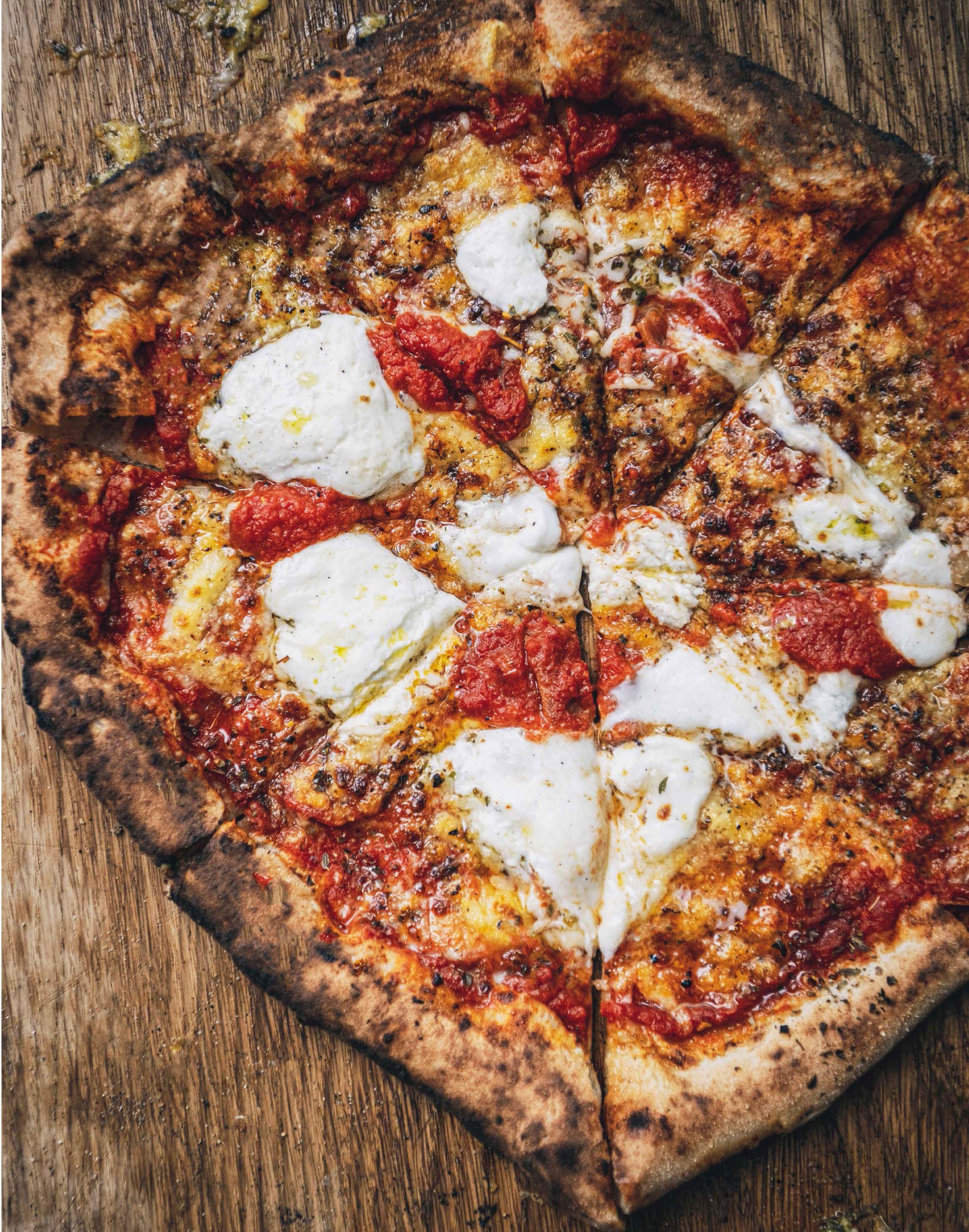
Pizza with burrata and tomato
6 hours preparation time (dough) + 45-60 min. cooking time
The secret of a good pizza is not to overload the dough. Less is more. This is one of my favourite pizzas. Simple, not complex, and with welldefined flavours! Make sure you choose high quality products because that is where your pizza will shine.
2 people Preparation
sauce dash of olive oil
2 cloves of garlic
500 g San Marzano tomatoes, halved + 2 sprigs of fresh basil pepper and salt
600 g pizza dough (see recipe p. 158)
250 g burrata cheese
5-6 cherry tomatoes
100 g grated mozzarella
Place a pan with the olive oil over low heat, add the garlic and cook until it turns golden brown. Add the tomatoes and simmer for 10 minutes. Blend the tomato mixture with a hand mixer and then reduce together with the basil until you have a homogeneous sauce. Season with salt and pepper.
Preheat the oven to 340°C (pizza oven) or maximum temperature (normal oven.)
Divide the pizza dough into two, 300 g portions and roll out with the rolling pin. Spread the sauce over the pizzas and top with burrata, cherry tomatoes and grated mozzarella.
Bake the pizzas: 2 minutes in a pizza oven or about 10 minutes in a convection oven on a pizza stone.
Now let the fun begin!
+ San Marzano tomatoes are available at a number of greengrocers and online.