M i l l a i s
S k e t c h
M I L L A I S
A S K E TC H
M i l l a i s
S k e t c h
A S K E TC H
In t ro d u c t i o n by
J A S O N RO S E N F E L D p. 7
Thoughts on our ar t of today
J O H N E V E R E T T M I L L A I S p. 25
Millais: a sketch
M A R I O N H A R RY S P I E L M A N N p. 41
List of illustrations, p. 95
Note on the text, p. 96
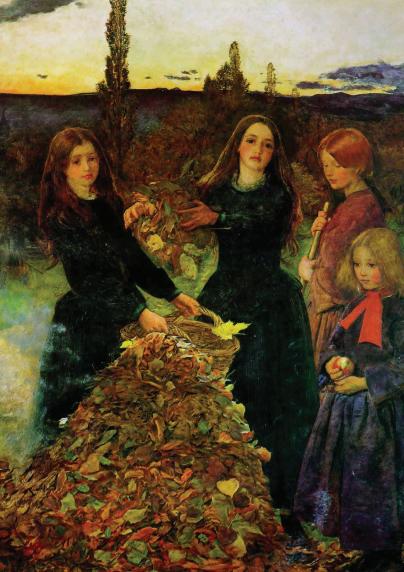
Opposite title page: Autumn Leaves, 1855-6
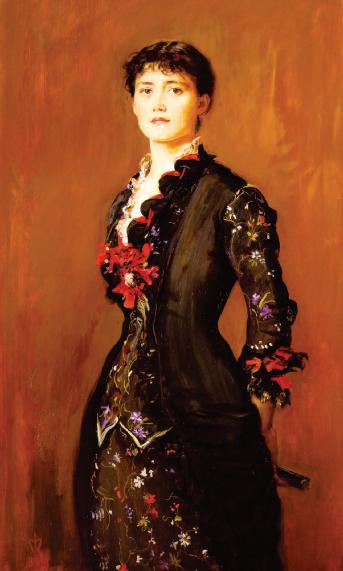
Opposite: Louise Jopling, 1879
JASON R OSENFELD
Millais was just eleven when he entered the Royal Academy of Ar ts (RA) schools, still to this day their youngest ever student. All signs pointed to the child prodig y following the standard career path of a Joshua Reynolds or a Thomas Lawrence. But in the autumn of 1848, Millais and six other ar t students including Dante Gabriel Rossetti and William Holman Hunt for med the secret Pre-R aphaelite Brotherhood (PRB), in a challenge to contemporar y aesthetics that Rossetti would later describe as ‘the visionar y vanities of half-a-doz en boys’. He was half correct. For Pre-R aphaelitism was indeed visionar y, as well as radical, transfor ming ever y genre its ar tists worked in, from por traiture to landscape to religious and historical paintings. And Millais was its most talented practitioner. While the PRB channelled ar t from before the time of the followers of R aphael in order to invigorate the ar t of the present, the Brothers did not
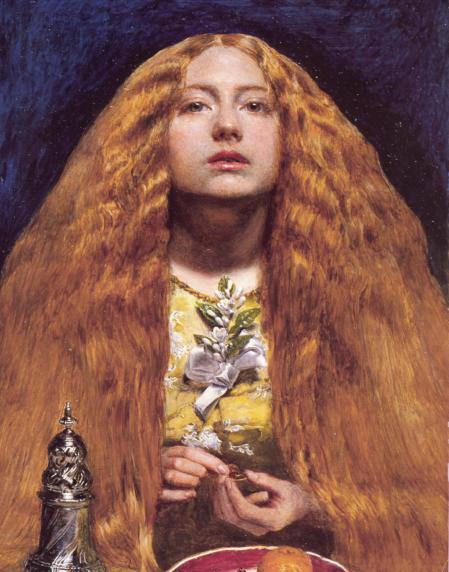
Opposite: The Bridesmaid, 1851
Netherlandish works, but instead used the most moder n materials and depended on their own perceptive abilities to rethink both the process and product of ar t in the 1840’s and 50 ’ s. Hunt may have been the most committed member of the movement in ter ms of theor y and religiosity, and Rossetti its most poetic and literarily romantic, but Millais was its most creative member, and his pictures the most varied. The sheer quality and distinctness of each of his paintings of the 1850’s is unmatched by any Wester n ar tist of the period.
But Millais was no natural rebel. He never forswore the RA, where he was protected by a number of academicians amenable to his aims and awed by his talent; and indeed it can be tempting to see his subsequent career as a yielding to academicism, and the Victorian appetite for jingo, mawkishness and sentiment. Cer tainly there is no gainsaying his public success, which ear ned him a substantial for tune, the life of a gentleman (including considerable time spent fishing, shooting and stalking), a baronetcy and something approaching a state funeral. And he
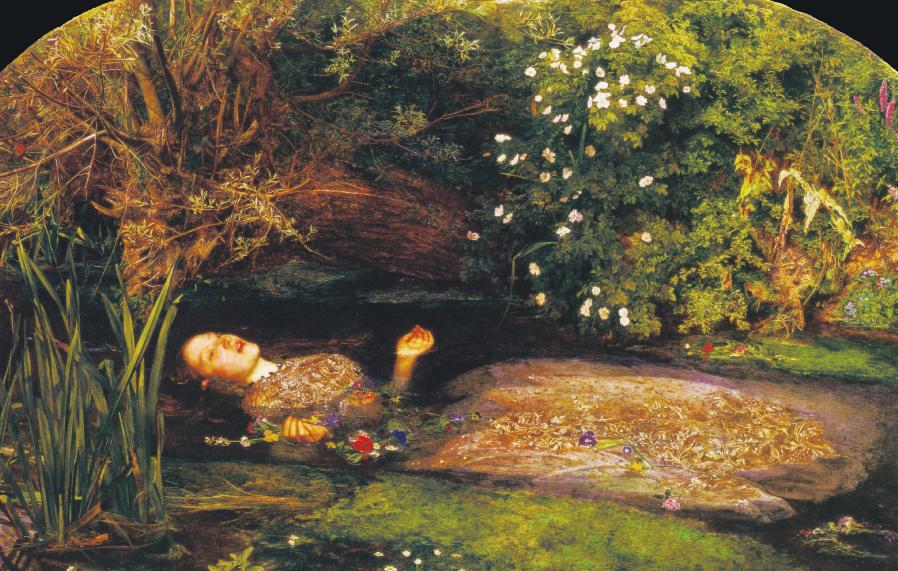
Previous pages: Ophelia, 1851-52
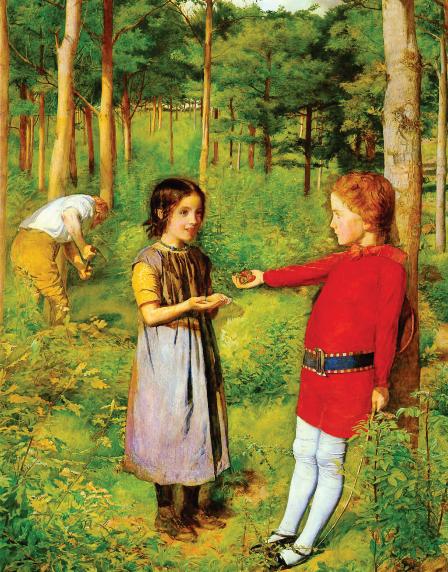
Opposite: The Woodman’s Daughter, 1851-52
cer tainly could paint with an eye to the imperial theme with histor y paintings such as The Nor th-West Passage (Tate) and The Boyhood of Raleigh (Tate). In time he came to be acknowledged as the nation’s por traitist, with canonical images of eminent leaders and ar tists
s u c h a s Gl a d s t o n e ( N P G , C
i
t C h u rc h , O
f o rd ) , Disraeli (NPG), Tennyson (Lady Lever Ar t Galler y), Bulwer-Lytton (V&A), – paintings against which small scale black-and-white photographs, despite that medium’s c l a i m t o a u t
chance.
Ye t i t w
Brotherhood career simply as a sell-out. R ather, his abandonment of the tightly painted and hallucinatorily bright Pre-R aphaelite style, with its heavy dependence on literar y sources, was a move towards a looser, less strident style more apt to appeal to the sense and to the viewer’s personal experience. This is evident in his most resonant work, Autumn Leaves (1855-6; Manchester City Ar t Galler y), with its novel constr uction of female beauty (castigated at the time as vulgar) and nostalgic tone. Such works presage the Aesthetic Movement in British ar t and its call for a subjectless ‘ ar t for ar t’s sake’. At the same time, Millais honed his delicacy of touch and
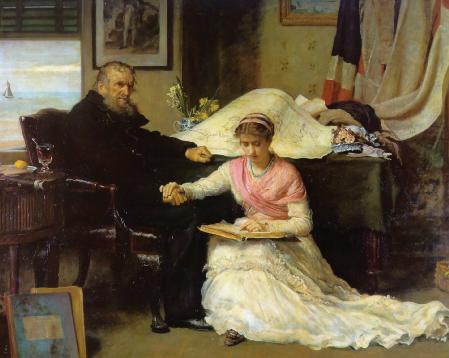
The North-West Passage: ‘It might be done, and England should do it’, 1874
psychological acuity in his book and periodical illustrations, producing masterly and topical work for authors such as Trollope, Tennyson and Collins.
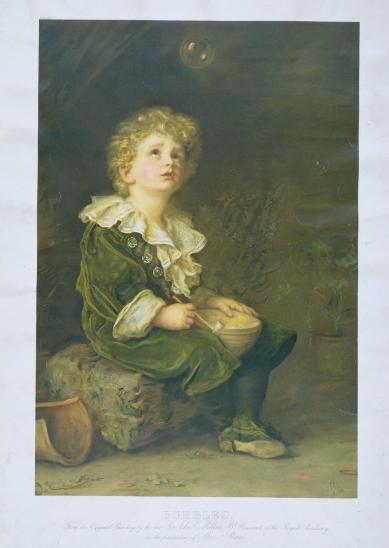
If we keep this innovative, affective approach in mind, it will not only allow us to appreciate more fully the psychological interest of paintings like The Boyhood of Raleigh, but also to appreciate more sympathetically the ‘fancy pictures’ whose reputation has perhaps sunk lowest of all Millais’ work. These por traits, often of children, reprised 18th centur y examples by Reynolds, Romney and Gainsborough and were eagerly consumed in the for m of prints in popular jour nals after works like Cherr y Ripe (private collection) and in their use in adver tising as in the famous case of Bubbles (Unilever, on loan to Lady Lever Ar t Galler y). These pictures, while not his most impor tant works (and the ar tist himself never claimed they were), nonetheless represent a continuity of humanism in Millais, por traying children not solely as doll-like bearers of romantic ideals of innocence but, rather, as conveyors of a deep sense of inner life. It is this essential humanity – so unexpected after the Pre-R aphaelite work – that is the leit-motif of M. H.
Opposite: Bubbles, 1886, in a chromolithograph of the following year
Spielmann’s valedictor y Sketch of Millais’ life, reprinted in this volume. Spielmann (1858-1948) was a highly successful jour nalist and editor of The Magazine of Ar t. This staid publication Spielmann transfor med after his arrival in 1887 into a cheerleader for British ar t. For perhaps the first time, ar tists were treated as celebrities and personalities, their names printed in capital letters to jump out at the reader. Exhibitions were trailed, works promoted, networks of contacts established. Spielmann was par ticularly tireless in soliciting ar tists to write criticism and give readers insights into their thinking and practice.
The magazine’s for mer antipathy to Millais’ work of the
Spielmann’s arrival Millais was persuaded to contribute his Thoughts on the ar t of today, reprinted here. These remain the ar tist’s only published reflections on painting. The essay is pithy rather than scintillating – Millais was better with paint than in print, and he knew it – but is hear tfelt and illuminating. Some of the essay addresses painterly issues such as the disastrous use of asphaltum by Reynolds and others in the cause of pleasing conventional taste (the excellent condition of Millais’ own paintings show how careful he was as a technician). But the main
theme of the essay is Millais’ call for individuality and variety in ar t, a trait evident in his own exceptional powers of invention across his entire career. His concluding preference for Rembrandt’s ability to conceal the ‘whole science of painting’ in his late works, over Velázquez’ too evident power of execution may come as a surprise. For the Old Master ar tist Millais was most linked to in his lifetime was the Spaniard, but Millais’ late works, the landscapes in par ticular, bear closer links with this idea of Rembrandt and the spirit of the Ovidian tag Ars celare ar tem: it is ar t to conceal ar t. For Millais, tr ue ar t emerges from labour and experience, the workings of which are invisible to the uninitiated but which hold the key, as Ruskin had written of Tur ner decades before, to aesthetic revelation.
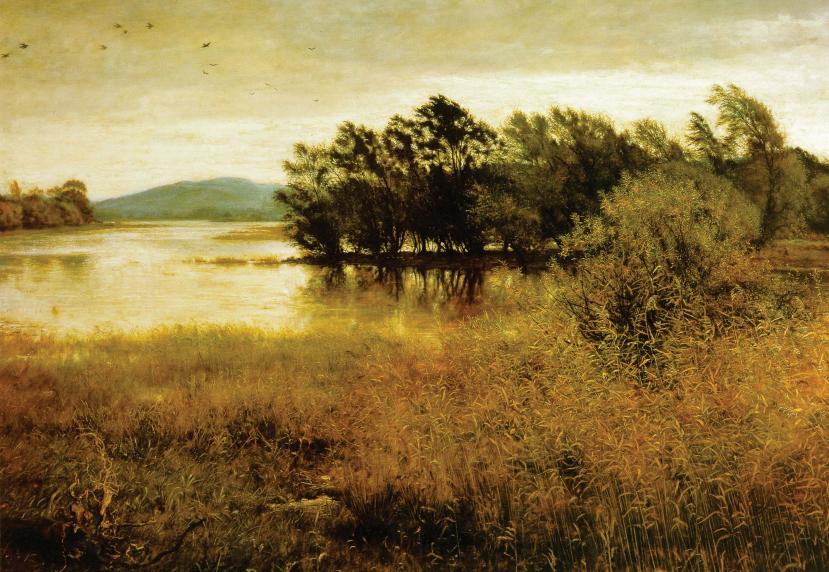
Spielmann’s greatest enthusiasm. Almost forgotten today, this remarkable series of over twenty large-scale landscapes was painted in the out-of-doors in Per thshire over Millais’ long summer holidays. These are a revelation – each individualistic, none picturesque nor Impressionistic, a poetic compilation of Tur ner and Constable sharpened by Millais’ own exacting eye.
The Lonely Tower, c. 1879
Overleaf: Chill October, 1870
Millais’ ar ticle was successful enough to provoke a rejoinder from Watts, who called it ‘crisp and interesting’ and then took issue on the subject of Old Master technique. Spielmann meanwhile remained close to Millais for the remaining eight years of the ar tist’s life, up to the last miserable months when Millais, the cheer ful and fluent talker, was str uck dumb by cancer of the throat –an agony with which Spielmann unexpectedly opens the Sketch. Although this intimate and suitably Victorian introduction testifies to the ver y personal affection in w h i c
Spielmann’s public, the Sketch in fact focusses clearly on Millais’ work; his personality and private life are only touched on in the context of the work. There is little about Millais the social or the family man with eight children, though his r unaway marriage with Effie Ruskin was one of the most astonishing love scandals of the Victorian era, and it was Millais’ last request of Queen Victoria that she receive Effie, hither to not acceptable at cour t. (The Queen graciously complied.) Nor is there much attention paid to Millais’ public spiritedness in facilitating the foundation of the National Por trait Galler y, the Tate, or the Ar tists’
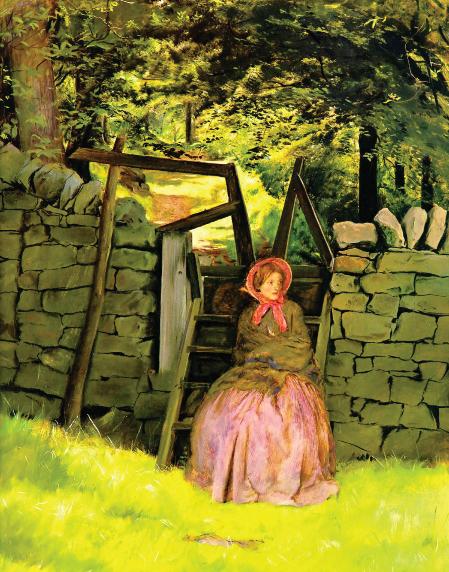
Opposite: Waiting, 1854; the figure may be Effie
which ever and anon lights up the handsome face, and strikes the key-note to all that is tender in his work, all that is g raceful and loveable in his pictures of passion or of beauty, in woman, man, or child. And then ag ain I see him: little changed; the kindness of his manner what it ever was, the geniality of his friendship as gentle and cordial as before the cloud had g athered. But it is dif ficult to hear him now, and the strain of talking is g reat. He stops in the cour se of a sentence, and pointing in apolog y to his throat, he laughing ly rounds of f the conver sational fragment with a knowing side-shake of the head. Once more I see him, forgetful of his dying self, striding of f to the hospital to cheer a member of the Academy lying ill – for he is now the President, and father of his f lock. T hen, he vanishes from sight – to his room of sickness, agony, and death. And word comes out to us of his heroism, his gentleness, his patient suf fering, whispered tales of the old whitebearded man, wasted, wor n, and dumb, but bright and handsome still – who yet has a war m and lusty g rip for the one or two who may say good-bye, and a faint smile of happy g reeting that shows he is the old Millais still. And then ––– We are spared the rest. And this is the end of a bright and sunny life – the cruel lining to a cloud of pur ple and of gold.