
Looking at Manet
introduced by
ROBERT LETHBRIDGE
Introduction by
ROBERT LETHBRIDGE
p. 7
A new way to paint: Édouard Manet, p. 24
I. The Man and the Artist, p. 29
II. His Works, p. 57
III. His Public, p. 91
My portrait by Manet: memories of the sitting, p. 103
The influence of Manet: Preface to the catalogue of the memorial exhibition p. 113
List of illustrations p. 142
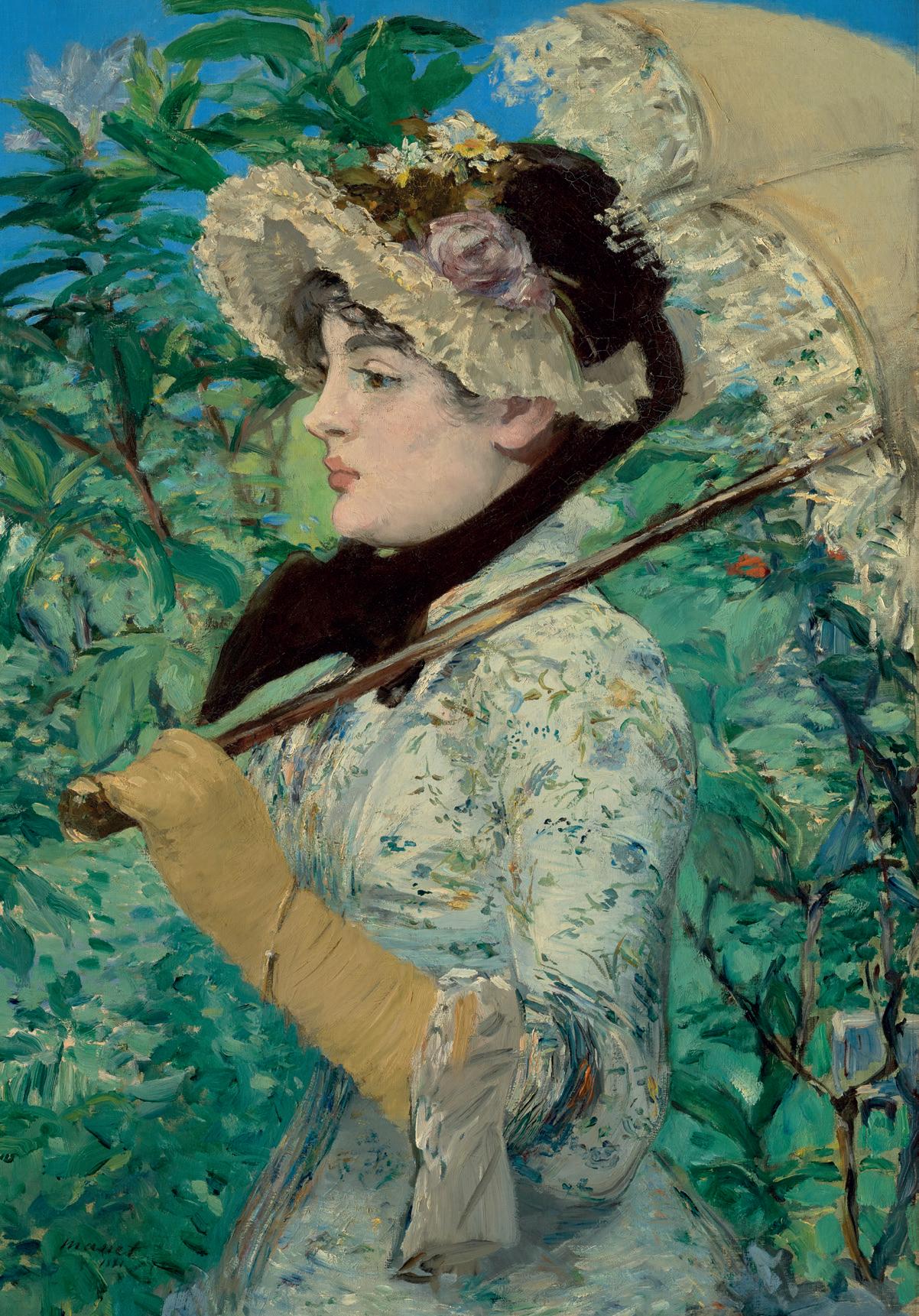
Opposite: Jeanne (Spring), 1881
ROBERT LETHBRIDGE
Émile Zola (1840-1902) was once considered the leading European novelist of his generation. Of his twentyvolume Rougon-Macquart cycle (1871-92), works like L’Assommoir (1877) and Germinal (1885), with their brutally realistic description of working-class life, remain classics of 19th-century fiction. The judgments of posterity, however, should not obscure the fact that, to contemporaries, Zola was also known as a prominent journalist and art critic. Many novelists and poets simultaneously wrote for the newspapers, particularly as a way of earning a living at the beginning of their careers. Only a very small number focused directly on the visual arts. In Zola’s case, such an interest was largely as a result of personal connections. It was sparked by sharing a childhood and schooldays with Cézanne in Aix-en-Provence. From 1866 onwards, he was part of a group of young artists who met at the Café Guerbois in the Batignolles district of Paris. They included some of the major figures of the Impressionist movement. And it is not by chance that, in Henri Fantin-Latour’s Un atelier aux Batignolles of 1870 (Musée d’Orsay, Paris), Manet at his easel is
ROBERT LETHBRIDGE
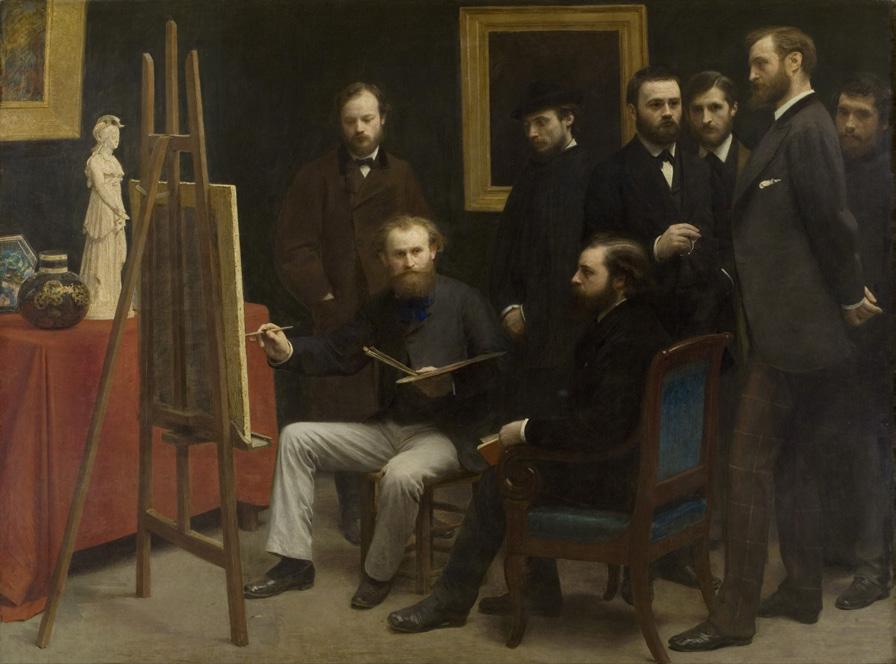
A Studio in the Batignolles Quarter (1870) by Henri Fantin-Latour. Manet, seated, painting Zacharie Astruc; standing, left to right, Otto Scholderer, Auguste Renoir, Émile Zola, Edmond Maître, Frédéric Bazille and Claude Monet
surrounded not only by Monet, Renoir and others such as Frédéric Bazille (who would have become no less famous had he survived the Franco-Prussian War), but also – as the sole professional writer in the painter’s circle – by Zola himself. This is equally true, in the same year, of Bazille’s L’Atelier de la rue de la Condamine (Musée d’Orsay, Paris), in which Zola is depicted in similar company. What also sets him apart is the fact that his writing
on painting is sustained over three decades. A number of his own novels include fictional painters, culminating in L’Œuvre (1886) which, with its composite portraits and reconfigured art-criticism, represents a summa of Zola’s long engagement with the painters of his time. Among these, Manet’s place is an exceptional one. Even in his very last essay on painting, in 1896, Zola repeated that he remained the most significant painter of the period. Manet was the artist whose work received Zola’s most refined critical reflection, deepened through the contacts afforded by a lifelong personal friendship. At Manet’s death in 1883, at the tragically early age of 51, Zola was one of the pall-bearers at his funeral. But, in the years 1866-68, the most striking feature of his writing on Manet is the way in which commentary becomes an apologia for the critic. There is no reason to doubt the sincerity of Zola’s views of Manet’s wonderful talent; but neither would it be unfair to suggest that his art criticism was designed to further his own reputation and proclaim his own æsthetic principles (at the crucial moment prior to embarking on Les Rougon-Macquart) as much as those of the painter. In choosing to defend an artist as controversial as Manet, Zola successfully obtained for himself what he considered to be the enviable notoriety already achieved by the painter. Manet, by contrast, was an unwilling leader of an embryonic
ROBERT LETHBRIDGE
avant-garde. It was perceived as such by virtue of submissions rejected by the annual Salon (which, with its commissions and prizes, could make or break an artistic career), and in particular by the Salon des Refusés (‘Salon of the Rejects’) of 1863, which included three of his paintings, amongst them Le déjeuner sur l’herbe (Musée d’Orsay, Paris, reproduced pp. 70-71). Many of his works during the 1860s had been greeted with hilarity and incomprehension by the critical establishment. For Zola, his was the perfect cause to champion.
In his extended study of Manet, published in the Revue du XIXe siècle on 1 January 1867 and reproduced here (pp. 21-102), and even more so in a precursor Salon article devoted to Manet (L’Evénement, 7 May 1866), Zola takes the opportunity to write about himself, both directly and by implication. In the press, he underlines his own audacity and courage as a critic in daring to attack the arbiters of public taste, and refers to the hostility he will incur as a result of his admiration for Manet’s work.
In his less aggressive Édouard Manet, étude biographique et critique, he explicitly prefigures the ‘book which I propose to write on my artistic beliefs’ (p. 45). His references to Manet as an ‘analytical painter’ are grounded in the same pseudoscientific jargon characteristic of his own emerging Naturalism. And the consistent recourse to the notion of the painter’s ‘language’ is itself revealing. He
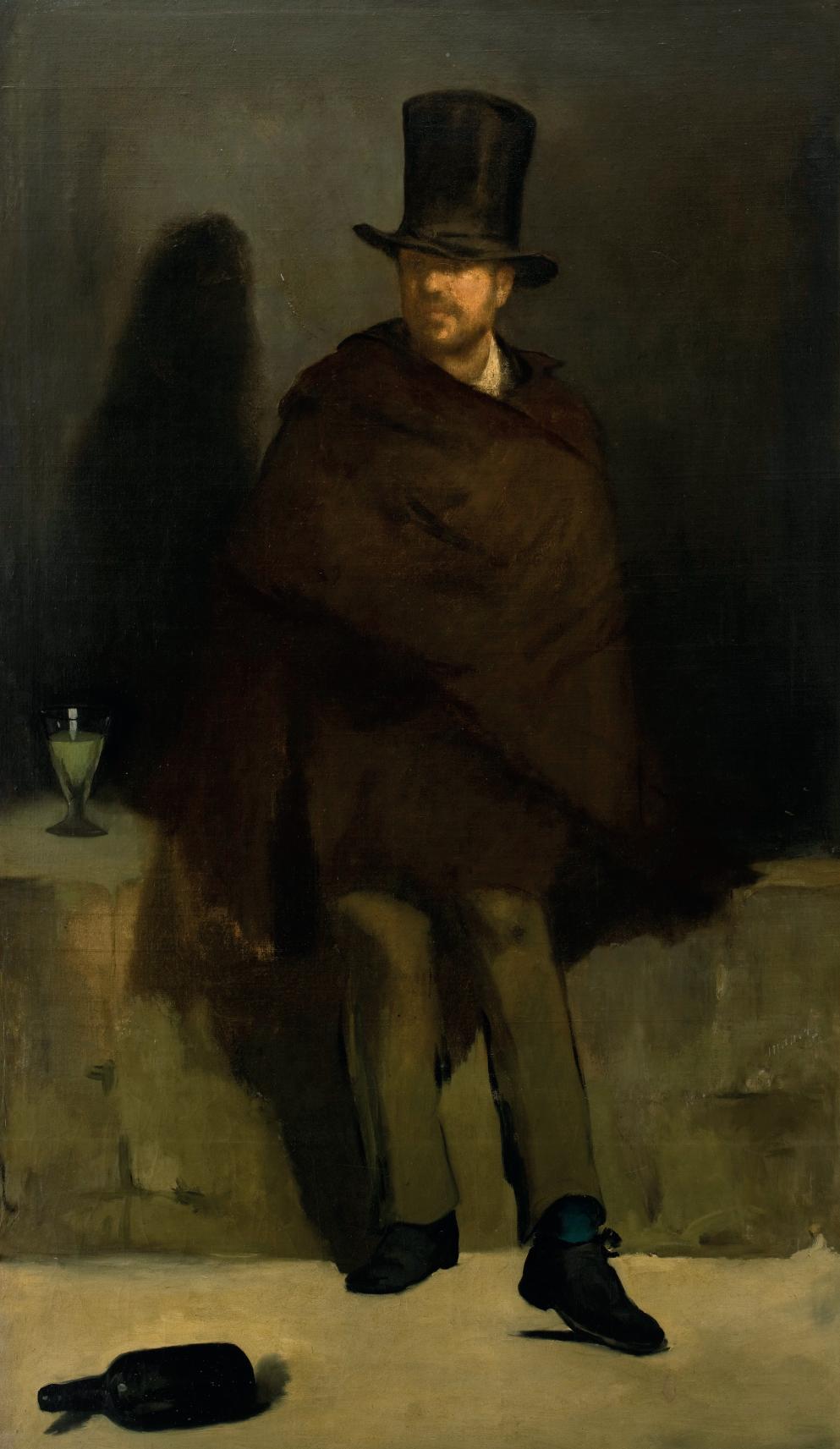
allows Manet his apprenticeship – Couture, Le buveur d’absinthe (1859, Ny Carlsberg Glyptotek, Copenhagen, p. 31) and his ‘Spanish phase’ exemplified by L’enfant à l’épée (1861, Metropolitan Museum of Art, New York, p. 61) – but reserves his praise for a ‘unity’ synonymous with ‘originality’, of which the unspoken model is Zola himself. But there is also a forward-looking optimism inseparable from his valuation of a ‘solidity’ (of ‘masses’ and simplified contrasts through Manet’s suppression of intermediate semi-tones) equally applicable to the writer’s own compositional practice. At this stage, he expresses his confidence in both their future places in the pantheon of art. His later disappointment with Manet coincides with the painter’s subsequent further development, in the fractured brushwork of his more properly Impressionist pictures of the 1870s, at odds with Zola’s theoretical priorities. And it explains why Manet, viewed from the preface to his 1884 retrospective (pp. 113-39), is considered a transitional figure (‘pointing the way to others’) in Zola’s narrative of the modernist advance. His own seminal role in positioning Manet within that narrative occupies such a celebrated chapter in the histories of nineteenth-century French art that both the insights and limitations of his writing on individual paintings are too seldom situated in the polemical context that determines his focus. His 1867 study is overtly
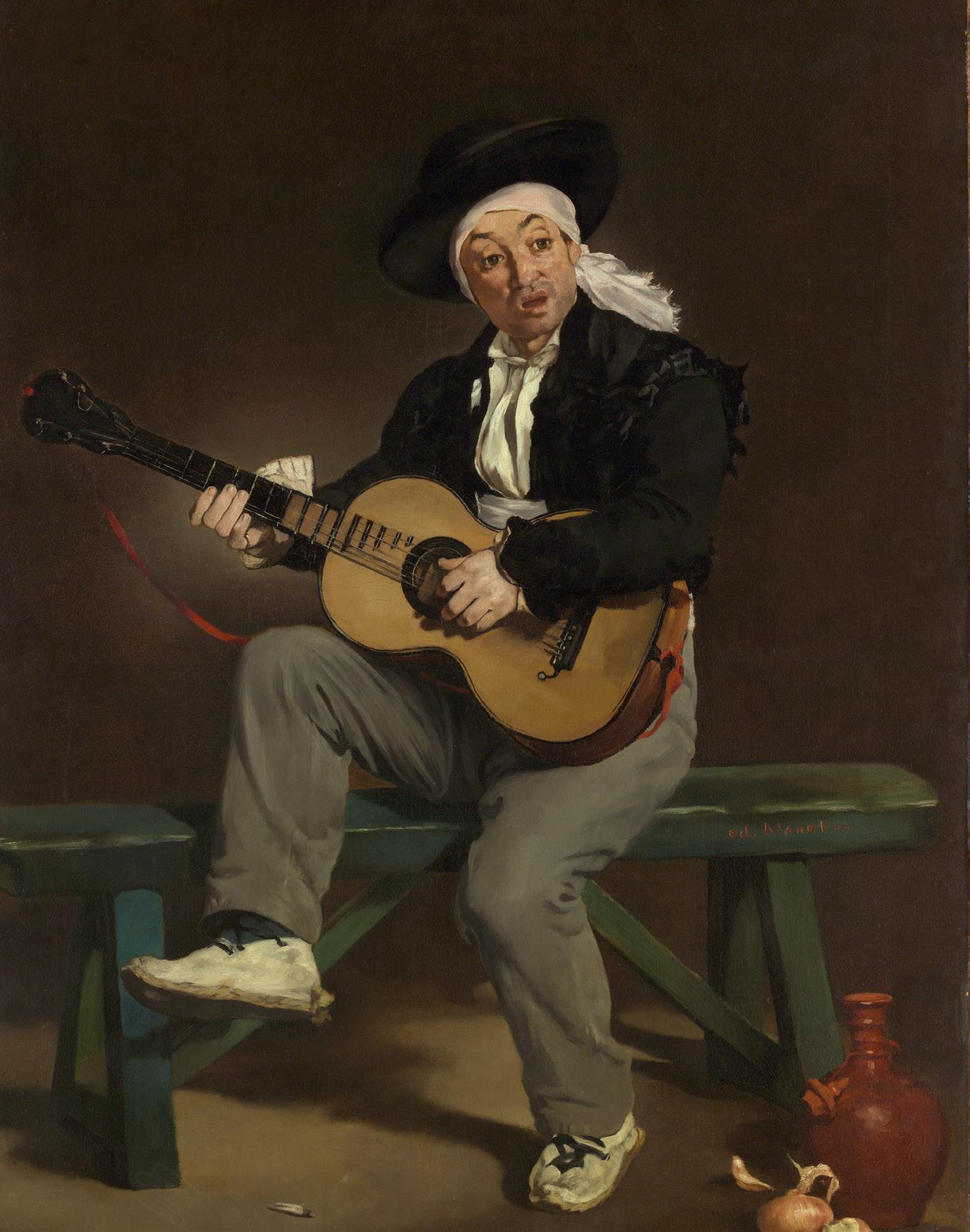
generated by a visit to Manet’s studio during which he saw between 30 and 40 canvases originally being prepared for the Universal Exhibition. In practice, Zola only considers in any detail 15 of the 56 works ultimately shown at the painter’s alternative exhibition at the Avenue de l’Alma (literally) opposite the official one. The vast majority of those singled out for discussion can be correlated – and even in the space allocated to each of them – to the hostility, either registered or anticipated –of their reception, thereby justifying the final section of the study devoted to a diatribe against the philistinism of ‘The Public’. The paragraphs on La musique aux Tuileries (1862, National Gallery, London, pp. 66-67) and Le Christ mort et les anges (1864, Metropolitan Museum of Art, New York, p. 75) evoke the negative reactions to them, notwithstanding the latter’s successful submission to the Salon of 1865. Zola claims to like Le joueur de fifre (Musée d’Orsay, Paris, p. 82), rejected in 1866. Those accepted, like Le chanteur espagnol (1860, Metropolitan Museum of Art, New York) or Jésus Insulté par les Soldats (1864, Art Institute of Chicago), generally serve his purpose less well.
Integral to that purpose is Zola’s more wide-ranging opposition to the imperial regime of Napoleon III, as
Opposite: Le chanteur espagnol, 1860
ROBERT LETHBRIDGE
his reference (at the beginning of his January study) to its ‘orderly police state’ (p. 29) makes clear. Even art criticism, contemptuous of officially sanctioned works and genres, is thereby politically informed. The provocative association of his name with Manet’s continued throughout 1867, to the extent that the latter is described, in the anti-republican columns of L’Univers illustré, as ‘the Zola of painting’! Manet hesitated before approving Zola’s suggestion to republish his study in brochure form to coincide with the opening, on 24 May, of his private exhibition, almost certainly because of unease about such blatant exercises in publicity. A further opportunity to exploit the occasion lay in Zola’s efforts to secure from Manet drawings to illustrate a new edition of his Contes à Ninon (1864). Success was assured, he promised his publisher, owing to Manet’s notoriety and the virulent response to the exhibition. Though this project finally came to nothing (its residual trace is the dedication to Manet of his 1868 novel Madeleine Férat), Manet repaid Zola for his efforts by agreeing to paint his portrait. Zola sat for this between November 1867 and February 1868, and it was exhibited at the annual Salon a few months later. It was now Manet’s turn to present Zola to the public. In that sense, the painting had the same tactical function as Zola’s earlier pen-portrait of Manet, designed to
counter the popular misconception of the artist as a ‘Bohemian’ and ‘slovenly dauber’ (p. 27). In its general conception and internal reference to Zola’s 1867 study of the painter (the title on its blue cover serving as Manet’s signature), the portrait testified not only to their friendship but also, like Fantin-Latour’s grouping of contemporary artists, to a common commitment to a new æsthetic programme. At the same time, however, the painting has been cited as evidence of Manet’s penchant for calling attention to himself in concealed but insistent ways, and is therefore not unlike the less discreet self-advertisement present in Zola’s earlier studies of the artist. For if the portrait provided a corrective to Zola’s image in the eyes of conservative critics, it has also been argued that Manet unconsciously transferred to his subject a large measure of his own physical distinction and sartorial elegance.
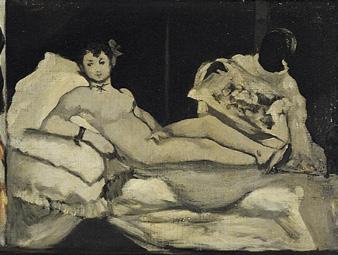
Of the painting’s compositional elements that refer directly to particular aspects of Zola’s interpretation of Manet’s art, none is more telling than the reproduction of Olympia (1863, Musée d’Orsay, Paris; see pp. 1 & 104) within it. In wittily turning the courtesan’s gaze towards the writer at his desk, Manet seems to declare both his own appreciation, and Olympia’s acknowledgement, of Zola’s efforts to defend her reputation. For this painting, violently attacked on both æsthetic and moral grounds at the Salon of 1865, was, in Zola’s words, ‘Manet’s
ROBERT LETHBRIDGE
masterpiece’ (p. 74). In his analysis of it are to be found some of the most perceptive pages of Zola’s art criticism. On the other hand, much of the portrait’s iconography suggests that Manet was also pointing to a complexity in his own art that Zola had not really understood.
For Zola’s critical perspective is informed by contradiction. He is at pains to rebut charges of immorality by insisting that Olympia is devoid of meaning. He tries to move the debate away from its ‘scandalous’ subject by arguing that the picture is merely a structure of colours. That same emphasis is to be found in his presentation of Le déjeuner sur l’herbe, in which the human figures are considered as being subordinate to tonal imperatives. And Zola thereby initiates the purely formalist approach to Manet’s art that has been so influential since. Awkwardly juxtaposed, however, is his emphasis on those realistic features of Olympia subverting the traditions and pictorial euphemisms of the female nude across the centuries. Nowhere is this more problematic than in his untenable dismissal of affinities between Baudelaire and Manet, brought into sharpest relief by Zola’s devaluation of Olympia’s cat (viewed by the critics as the painting’s most outrageously erotic marker) as having no other function than providing a counterbalancing black stain at the right-hand edge of the painting. In Zola’s Thérèse Raquin, prepared at precisely the same time as
his reflections on Olympia, it is possible to discern numerous analogies of theme and technique, not least his own Baudelairean substitutions of the female and the feline in the shape of a black cat associated with the sexual vicissitudes of the novel’s plot. Together with its fictional painter (whose work obliquely recalls Manet’s), described as a ‘poet’, the text’s symbolic register may itself testify to a sensitivity to Manet for which Zola is seldom given credit, so prevalent are the orthodoxies of his public statements.
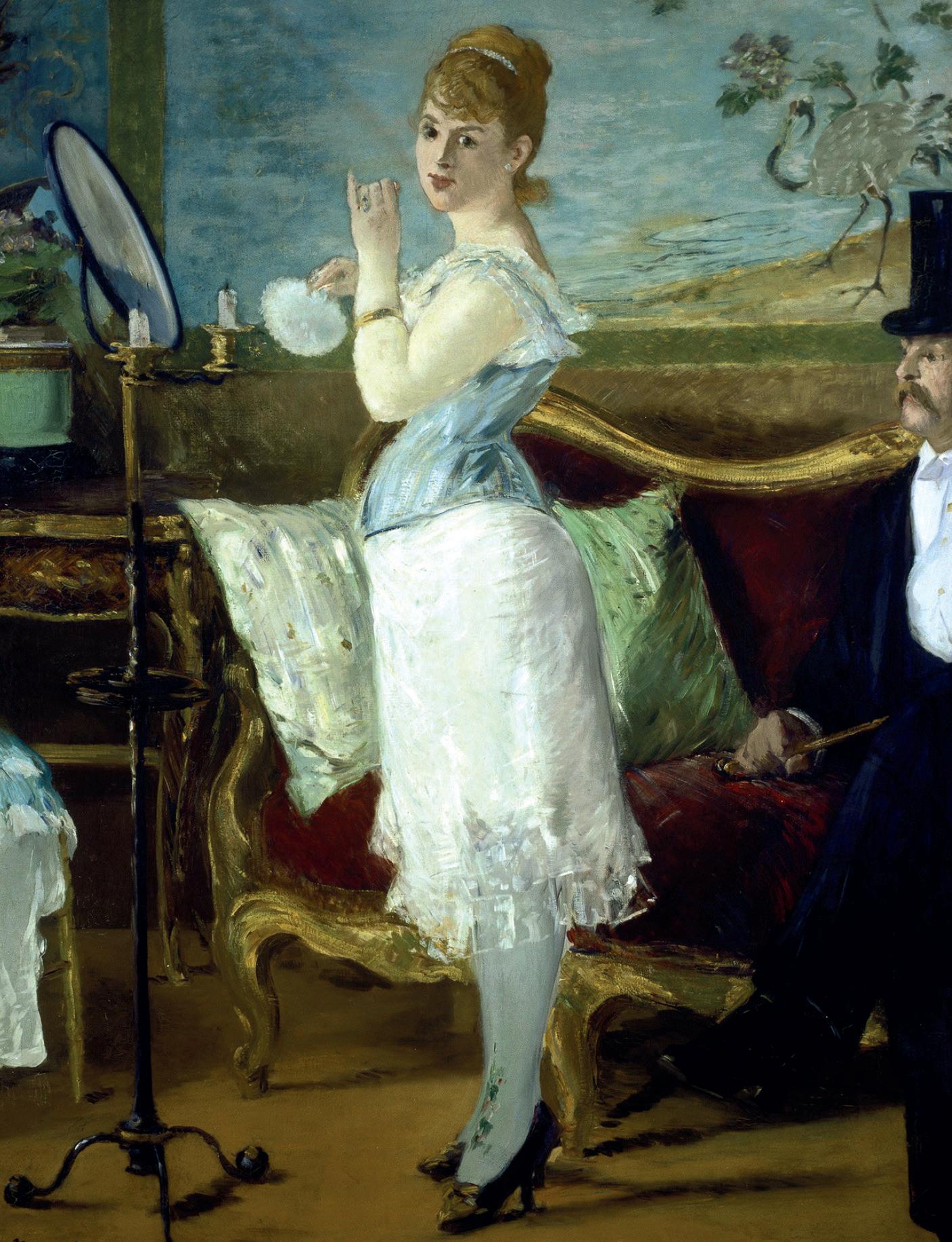
What is certain is that Zola, more than any other writer of the period, enjoys a set of interchanges with Manet notable for their creative and critical importance. Both contemporaries and modern art historians, whether or not in agreement with his emphases, accord Zola the pre-eminence he deserves in directing attention to Manet’s modernity and greatness. And those interchanges go both ways. Manet’s Nana of 1877 (Kunsthalle, Hamburg, illustrated overleaf), to take only one example, was clearly inspired by an episode in L’Assommoir in which the heroine’s daughter, also called Nana, starts her life as a prostitute; and Zola’s Nana (1880) has two scenes that almost exactly replicate Manet’s painting. In L’Œuvre, Zola has fully exploited his familiarity with Manet’s life and work. Authorial nostalgia for the militant solidarity of the late 1860s is
overlaid by an ironic distance from those heroic struggles. More generally, Zola’s own review of his 1868 portrait (pp. 103-12) is perhaps symptomatic of a mirroring relationship, sometimes distorted by the tensions between identification and the differences between writing and painting. Zola seems oblivious to the implications of his blank stare, the fallen pince-nez without which he could not see and his apparent blindness to the visual objects on display: these range from Velázquez to Japanese prints and the volume of Charles Blanc’s Histoire des peintres de toutes les écoles at its centre, all of them essential components of Manet’s art that Zola had failed to mention in his commentary and that eloquently refute his denial of the painter’s intentionality. But, on the other hand, Zola was given the portrait by Manet and it continued to occupy pride of place in his various homes. Towards the end of his life, he even experimented in photographing it, thus completing the self-conscious patterning, across the years, of Zola looking at Manet looking at him.
Opposite: Nana, 1877
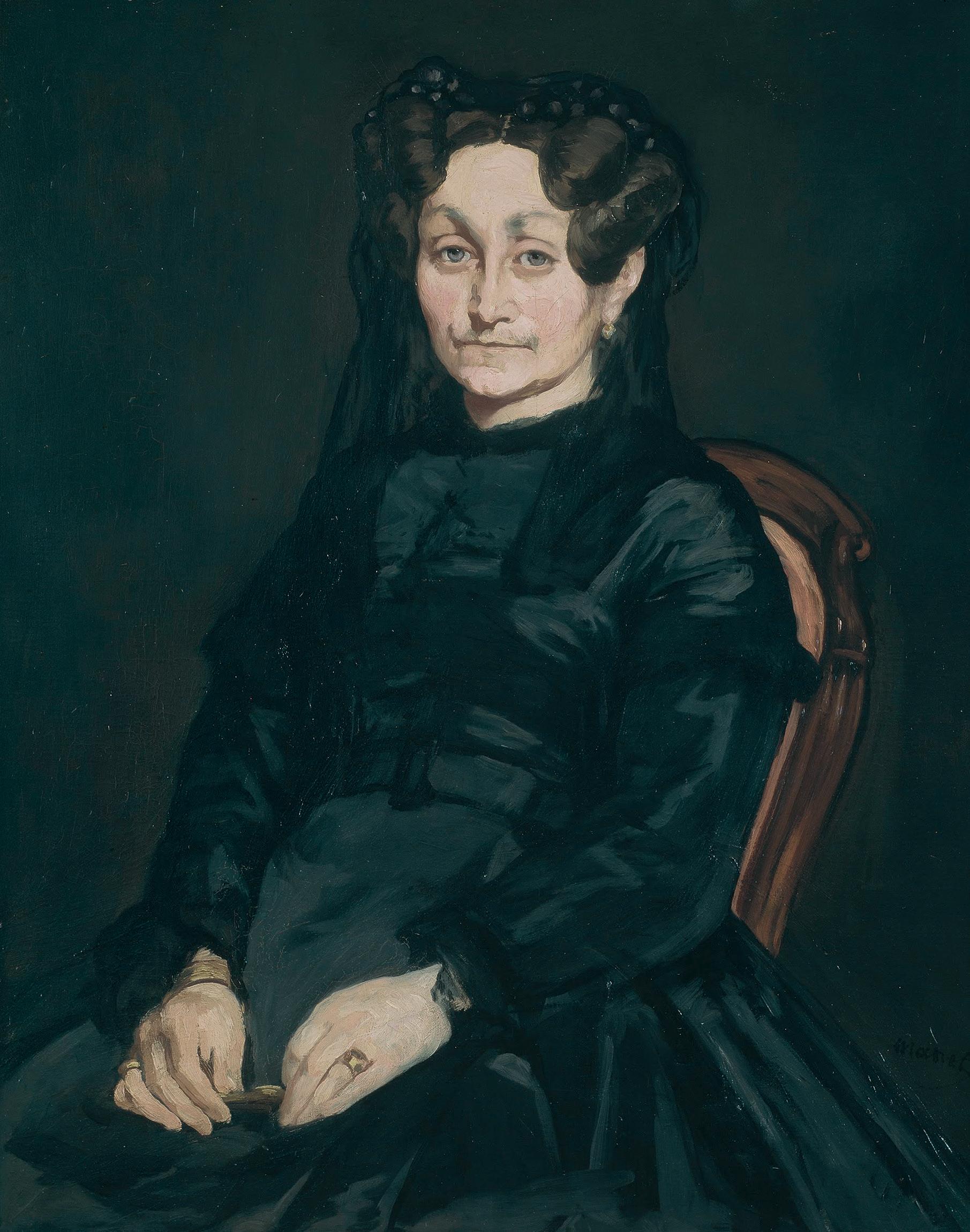
Overleaf: Madame Auguste Manet, 1863
n e w w a y t o p a i n t :
d o u a rd Ma n e t
Before this study appeared in book for m in Mes Haines, it was published on 1 Januar y 1867 in the Revue du XIX Siècle (edited by Arsène Houssaye), under the title of ‘Une nouvelle manière de peindre: Édouard Manet’; then it appeared for a second time in brochure for m. Zola undertook this eulog y of Manet after visiting the ar tist’s studio. Zola had already expressed his enthusiasm for Manet’s innovating talent in an ar ticle in L’Evénement of 7 May 1866, which had brought De Villemessant’s jour nal a quantity of letters of protest from indignant readers. De Villemessant responded on 14 May with an ar ticle entitled ‘Justice de la Paix de l’Evénement’, which gave his own views on the scandal. Now that there was talk of a new religion of which Manet was the God and Zola the p ro p h e t , De Vi
Pelloquet, a ‘specialist’, would write three ar ticles in his newspaper for those people who did not like Manet’s painting, which would act as a ‘corrective and counterb
‘judgments’, Solomon-De Villemessant c o
. But Zola, disapproving of this ‘sharing out’, resigned from the paper.
It is a d
i s h b i t by b i t t h e
per sonality of an artist. Such a labour is always dif ficult and it is really only possible to give a complete and truthful picture when a man ’ s life work is already achieved – when he has already given all that is expected of his talent. In that case the whole can be analysed; ever y aspect of his genius can be studied, a precise and exact portrait can be drawn, without fear of losing sight of certain characteristics. In this case the critic gets the most profound pleasure in saying to himself that he can now dissect an individual; that it is a question of the anatomy of an org anism; and that later he will be able to reconstruct, as in real life, a man in possession of all his limbs, all his nerves, all his heart, all his dreams and all his senses.
But on studying the painter Manet, today, I cannot taste such joys. T he fir st outstanding works of the artist are not more than six or seven year s old. I would not be able to pass a final judgment on him from the thirty or forty canvases which I have been allowed to see and appreciate. Here there is no quest i o n o f
reached that restless age when his talent is developing and g rowing. Up to now he has no doubt developed only one side of his per sonality; too much lies ahead
of him, too much future; he runs too many risks of all sorts for me to attempt to sum up in these pages his portrait in one definitive stroke.
I certainly would never have undertaken to trace the simple silhouette that I am now allowed to present, if I had not been moved to do so by particular and strong reasons.
Circumstances have made Édouard Manet, who is quite young, into a most unusual and instructive subject for study. T he ver y odd place which the public –and even the critics and his artist colleagues – have accorded him in contemporar y art struck me as something which should be carefully studied and explained. And here it is not only the per sonality of Édouard Manet that I am tr ying to analyse, but the whole of our artistic movement itself and contemporar y opinion on æsthetics.
A curious situation has arisen, and this situation can be summed up in two words. A young painter has obeyed, in a ver y straightforward manner, his own per sonal inclinations concer ning vision and under standing; he has begun to paint in a way which is contrar y to the sacred rules taught in schools. T hus, he has produced original works, strong and
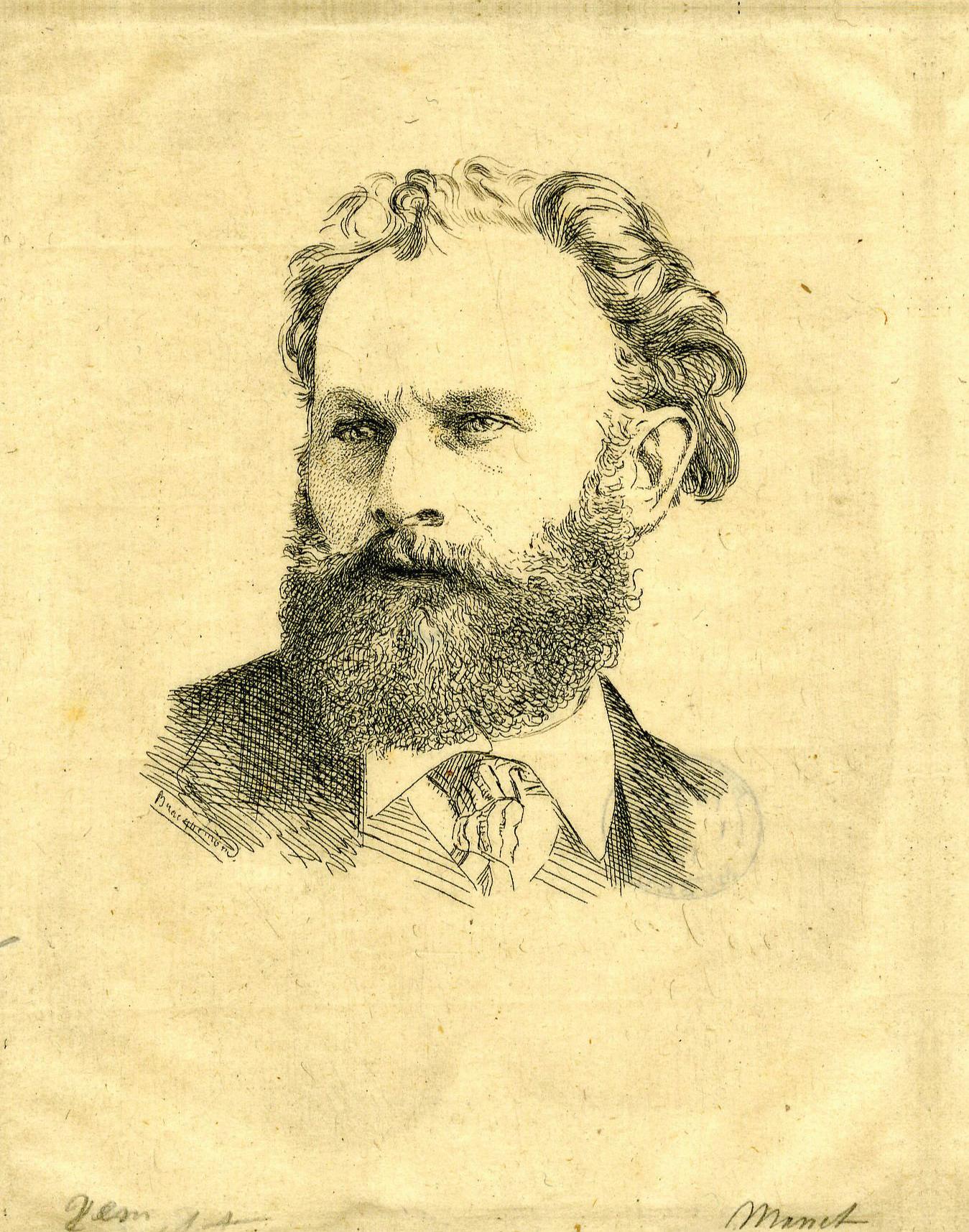
Opposite: Édouard Manet, 1867, by Félix Bracquemond, used as frontispiece to the pamphlet edition of Zola’s essay
bitter in f lavour, which have of fended the eyes of people accustomed to other points of view. And now you find that these same people, without tr ying to under stand why their eyes have been of fended, abuse this painter, insult his integ rity and talent; and have tur ned him into a sort of g rotesque lay-figure who sticks out his tongue to amuse fools.
Isn’t such a commotion an interesting subject for study? Isn’t it a reason for an inquisitive, unbiased man like myself to halt on his way in the presence of the mocking, noisy crowds which sur round the young painter and pur sue him with their hoots of derision?
I picture myself in the middle of a road where I meet a g ang of young ruf fians who are throwing brick-bats at Édouard Manet. T he art critics – pardon, I mean the police – are not doing their job well. T hey encourage the row instead of calming it down, and even – may God forgive me! – it looks as though the policemen themselves have enor mous brick-bats in their hands. Already, it seems to me, there is something decidedly unpleasant about this scene which saddens me – me a disinterested passer-by, calm and unbiased.
I go up to the ruf fians and question them; I question the police, I even question Édouard Manet himself. And I become more and more convinced about
something. T he reason for the anger of the young ruf fians and the weakness of the police is explained to me. I am given to under stand what crime it is that this pariah whom they are stoning has committed. I go home and pre pare, for the sake of truth, the of ficial evidence which you are about to read.
Obviously, I have only one object in mind – to calm down the blind anger of the rowdies and to tr y to make them retur n to a more common-sense point of view, and, at all costs, to stop them making such a din in the street. I ask them not only to criticize Édouard Manet fairly but also all original artists who will make their appearance. I extend my plea further – my aim is not only to have one man acce pted, but to have all art acce pted.
Taking Édouard Manet’s case as typical of the way really original per sonalities are received by the public, I protest ag ainst this rece ption, and from the individual I proceed to a question which touches all real artists.
T his article, I re peat, for several reasons, will not be a definitive portrait. It is a simple summar y of the existing state of af fair s. It is an of fical account of the reg rettable inf luence – as it seems to me – that centuries of tradition have had on the public as far as art is concer ned.
Édouard Manet was bor n in Paris in 1833. I have only a few biog raphical details concer ning him. In this orderly police state of our s, an artist’s life is the same as that of any quiet bourgeois; he paints his pictures in his studio as other s sell pe pper over their counter s. T he long-haired types of 1830, thank heavens, have completely disappeared, and our painter s have become what they ought to be – people living the same life as ever yone else.
After spending some year s with the Abbé Poiloup at Vaugirard, Édouard Manet finished his education at the Collège Rollin. At the age of seventeen, on leaving college, he fell in love with painting. What a ter rible love that is – parents tolerate a mistress, even two; they will close their eyes if necessar y to a straying heart and senses. But the Arts! Painting for them is the Scarlet Woman, the Courtesan, always hung r y for f lesh, who must drink the blood of their children, who clutches them, panting, to her insatiable lips.
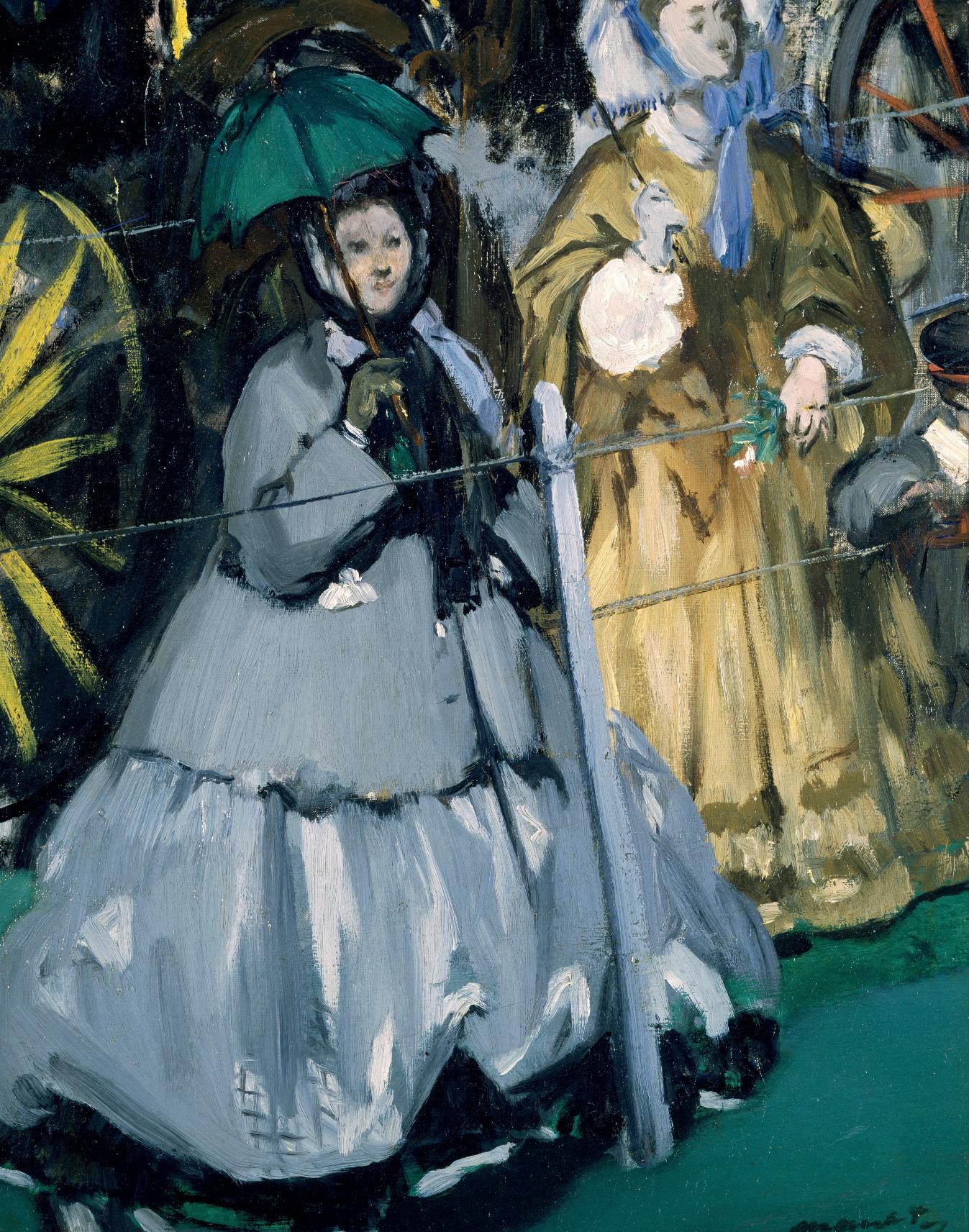
Opposite: Femmes à la course, 1866
Here is Org y unforgivable, Debaucher y – the bloody spectre which appear s sometimes in the midst of families and upsets the peace of the domestic hearth.
So, of course, at the age of seventeen, Édouard Manet was embarked as a cadet on a ship bound for Rio de Janeiro. Undoubtedly, the Scarlet Woman, t h at C o u r t e s a n , a lw ay s h u n g r y fo r f re s h bl o o d , embarked with him, and surrounded by the clear, empty vastness of sky and ocean, succeeded in seducing him. She appealed to his f lesh, she dangled before his eyes sparkling horizons and spoke to him of passion, in the sweet and compelling language of colour. On his retur n, Manet was given up entirely to Infamy. He quit the sea and visited Italy and Holland. But he had not yet found his feet; he wandered around like a young innocent and wasted his time. As evidence of this, he entered the studio of T homas Couture as a pupil, and stayed there for nearly six year s, his hands tied by prece pts and counsels, wallowing in complete mediocrity, not knowing how to find his way.
T here was a particular trait in his make-up, which prevented him from acce pting these fir st lessons, but the inf luence of this artistic education, which went ag ainst his natural inclination, had an ef fect on his
Opposite: Le buveur d’absinthe, 1858-59