L i v e s o f
Pa o l o Ve r o n e s e
L i v e s o f
Pa o l o Ve r o n e s e
B Y
G I O RG I O VA S A R I ,
R A F FA E L E B O RG H I N I , A N D
C A R LO R I D O L F I
Tra n s l a t e d a n d w i t h a n i n t ro d u c t i o n by
X AV I E R F. S A LO M O N

P A L L A S A T H E N E
In t ro d u c t i o n by
X AV I E R F. S A LO M O N p. 7
Li ve s o f Pa o l o Ca l i a r i Ve ro n e s e
G I O RG I O VA S A R I , 1 5 6 8 p. 27 R A F FA E L E B O RG H I N I , 1 5 8 4 p. 35 C A R LO R I D O L F I , 1 6 4 8 p. 43
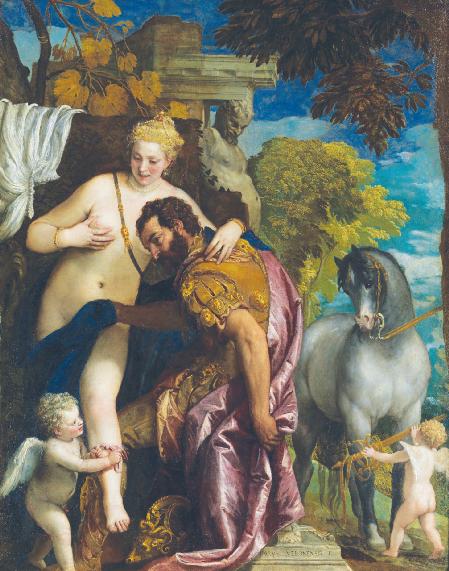
Opposite: Mars and Venus united by Love, c. 1570-75
XAVIER F. SALOMON
On 11 March 1553, four young painters from Verona presented a petition to Cardinal Ercole Gonzaga in Mantua. A year earlier, Battista del Moro (1514-74), Domenico Br usasorci (1516-67), Paolo Farinati (15241606) and Paolo Veronese (1528-88), had been commissioned to paint four altarpieces for chapels in the cathedral of Mantua. The paintings were now ready and the ar tists complained that not only had they not been paid, but no one had even come to collect the paintings. A prestigious public commission from a cardinal for the foreign Gonzaga cour t in Mantua was a sign of great favour for the four painters, and especially for Paolo, who at twenty-four was the youngest of the quar tet. Veronese signed the document as Paolo Spezapreda, as a reference to his training as a stonecutter. Both his father, Gabriele (b. 1497), and grandfather, Piero (b. 1474) were spe zaprede, and Paolo’s elder brother Francesco (b. 1520) had also followed in the family’s footsteps.
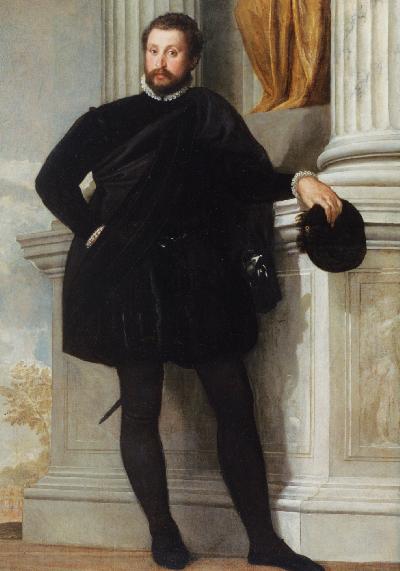
Opposite: Portrait of a man, ca. 1565. At one stage thought to be a self-portrait
x av i e r f. s a l o m o n
Only three years before the petition to Cardinal Gonzaga, Giorgio Vasari (1511-74) had published in Florence his influential Lives of the Painters, Sculptors, and Architects, in which he compiled the biographies of the foremost ar tists of the past and of his own age, culminating in the Life of Michelangelo. For the most par t, the artists in Vasari’s Lives were Tuscan. The third book, dedicated to the ar tists of what Vasari called the ‘maniera moder na ’ , included a few Venetians: Giorgione, Girolamo d a Tre v i s o, Pa l m a i l Ve c c h i o, L o re n z o L o t t o, a n d Sebastiano del Piombo. Considering Vasari’s interests and the scope of the work, it is hardly surprising that in the 1550 edition of the Lives, there was no mention of the young stonecutter Paolo from Verona.
Paolo, however, had already decided to abandon his family’s career and, aged thir teen, in 1541, he was recorded as training and living in the house of the painter Antonio Badile in Verona. In 1551, Paolo was at work on his first significant commission, when, together with Battista Zelotti, he decorated the Villa Soranza at Treville. A year later came the Gonzaga commission for the altarpiece in Mantua. The documentation linked to the Mantua project is also the last mention of Paolo in Verona; by 1555 he was established in Venice, renting a studio in the parish of Santi Apostoli. With his move to Venice, Veronese’s career took off. Paolo’s ar tistic skills were
i n t r o d u c t i o n
already manifest in his early works and patrons admired his style, so eloquently described by Marco Boschini in 1660: ‘the supreme Gods allowed him [ Veronese] to inser t their por traits in his works; and because of this ever y figure by Paolo has something celestial. Architecture put into his hands the most well-conceived and propor tioned outlines, which I wish someone would use in the most decorous buildings. Invention has made him its arbiter in placing and ordering groups in narratives, decorating them with the most weighty for ms and expressions of characters, so sumptuously dressed, that they might ser ve as model and instr uctions for princes and how they should appear majestic in front of the world. In conclusion, all the Graces had the ambition of always assisting him; so that he can be called the delight of the world, because in him there is ever ything that one would look for in pictorial ar t and in universal taste’. Already in 1553, he had been working on par t of the ceiling for the Hall of the Council of Ten in the Doge’s Palace – the political and social hear t of the city – and under such good early auspices, the career that followed was remarkable. In 1555 came the commissions for paintings at San Sebastiano and the altarpiece for the high altar of the cathedral of Mo n t a g n a n a . In t h e c o n t ra c t f o r t h e Mo n t a g n a n a
Transfiguration, of 3 June 1555, Paolo had already abandoned Spezapreda as his sur name and had taken the more
i n t r o d u c t i o n
glamorous and aristocratic name of Caliari, which he was to use for the rest of his life.
By the time Vasari reviewed his Lives and published a second version of them ‘almost completely done anew ’ in 1568, other contemporar y ar tists from the Veneto had been added to the third book: Fra Giocondo, Liberale da Verona, Matteo dal Nassaro, Battista Franco, and Titian. Paolo Veronese, for ty years old and remarkably successful, was included, but no full life was dedicated to him.
Between the lives of Girolamo and Bar tolomeo Genga, and that of Sodoma, Vasari included the biography of his good friend, the Veronese architect Michele Sanmicheli. Within this Life, Vasari incorporated that of Sanmicheli’s nephew Gian Girolamo, and a series of shor t biographies of young painters from Verona ‘ wor thy of being ment i o n e d’ ( ‘
) . T h e s e we re Domenico del Riccio (Br usasorci) and his son Felice, Ber nardino India, Eliodoro Forbicini, Battista Zelotti and Paolo Veronese – whom Sanmicheli ‘loved as if they were his own sons ’ – and Paolo Farinati. The few pages Vasari dedicated to Veronese can be considered as a ‘life’ to all intents and purposes, as they represent the first contemporar y account which includes essential infor mation
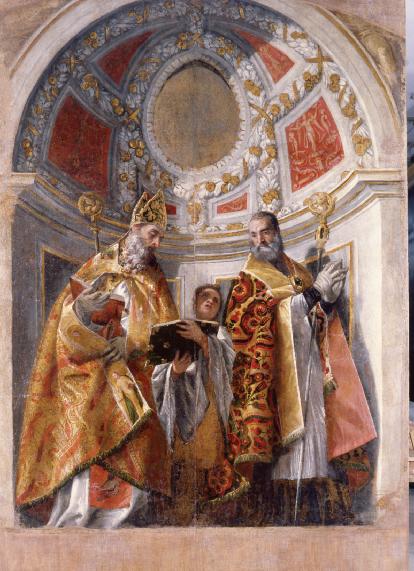
Opposite: Saints Geminianus and Severus, ca. 1560
x av i e r f. s a l o m o n
on his early career. Paolo also made a few inter mittent appearances in the lives of other ar tists. In the shor t biography of Domenico Br usasorci, Vasari recorded the Mantua commission in full: ‘what moved the Duke to c o m m i s s i o n
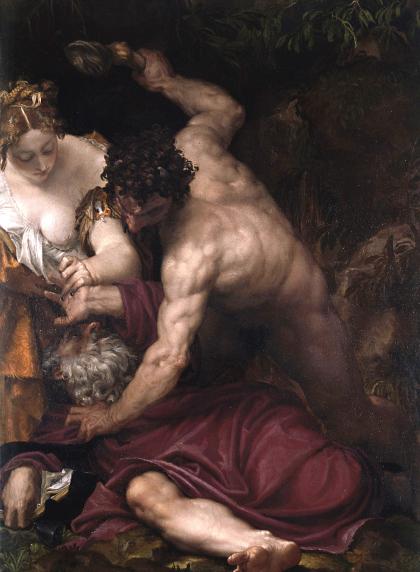
ra i n Mantua] was his having seen and much liked his manner in an altarpiece, which Domenico had painted long before in the cathedral of Mantua in the chapel of Saint Margaret, in competition with Paolino, who executed that of Saint Anthony, with Paolo Farinati, who painted that of Saint Mar tin, and with Battista del Moro, who executed that of the Magdalene. All which four ar tists from Verona had been summoned there by Cardinal Ercole of Mantua, in order to ador n that church, which had been reconstr ucted by him following the design of Giulio Romano.’ The same commission was repor ted in the lives of Paolo Farinati and in that of Garofalo and Gi r o l a m o d a C a r p i . Ve r o n e s e ’ s p a i n t i n g w a s t h e re described in full: ‘and one, which was the best of the group, although all of them are most beautiful, in which is Saint Anthony Abbot beaten by the devil in the guise of a woman, who tempts him, is by the hand of Paolo Veronese’. In the same biography, writing about Mantua
Opposite: The Temptation of St Anthony, 1552
x av i e r f. s a l o m o n
and its surroundings, Vasari also mentioned the altarpieces in the abbey church of San Benedetto Po and especially ‘three by Paolo Veronese, which are the best’. In the life of Battista Zelotti, instead, Vasari listed some of Veronese’s earliest works painted together with Battista: the frescoes for the Da Por to family in Thiene, the Villa Soranza, the façade of the house of Antonio Cappello in Venice, and the ceiling for the Hall of the Council of Ten.
Va s a r i’s b i o g ra p h y o f Pa o l o – e n d e a r i n g l y c a l l e d ‘Paolino’ because of his young age (Vasari records him as being just over thir ty, while in fact Paolo was for ty by the time the Lives were published) – demonstrates the high esteem in which Veronese was already held. An early period of study under Giovanni Caroto is not mentioned by other sources, but other wise Vasari accurately proceeded to record Veronese’s early works, from the Da Por to and Soranza to Villa Barbaro at Maser, from the great Venetian public commissions (the Doge’s Palace and San Sebastiano) to the magnificent Feasts painted for refectories (those for San Nazaro in Verona, and the Marriage Feast at Cana for San Giorgio Maggiore where ‘if I remember well, one can see there more than a hundred and fifty heads, all different and painted with great care’). Already by the mid-1560s some of Veronese’s works were disappearing and Vasari recorded the fact: the frescoed façade of the house of a merchant which ‘the sea-air is
x av i e r f. s a l o m o n
consuming slowly’. Vasari seemed to have been par ticularly keen on the idea of competitions between ar tists, not only in the case of the Mantuan canvases, but also in the passing references in the life of Tintoretto (included in the life of Battista Franco) of Veronese’s par ticipation in the competitions for the Hall of the Great Council and for the Scuola di San Rocco. Vasari, indeed, concluded Veronese’s life with a detailed account of the competition for the ceiling of the Librar y of Saint Mark’s in 1556-57, and of Paolo’s victor y over his colleagues.
Vasari’s account of Veronese’s first twenty years of activity is remarkably accurate, if shor t. Considering the writer’s renowned bias for ever ything Florentine it is significant that a few pages were dedicated to Paolo at all.
About thir ty years later, however, the painter Annibale Carracci did not agree. In his annotations to Vasari’s Lives he indignantly commented: ‘I have known this Paolino and I have seen his beautiful works. He deser ves to have a great volume written in praise of him, for his pictures prove that he is second to no other painter, and this fool passes over him in four lines. And just because he was not Florentine.’
Veronese’s next biographer, R affaele Borghini (15371588) was also Florentine. In 1584, almost twenty years after Vasari’s Lives, he published Il Riposo di Raffaele Borghini in cui della pittura e della scultura si favella,
de’ più famose opere loro si fa menzione, e le cose principali appar tenenti a dette ar ti s’ingegnano (‘ The “Riposo” of R affaele Borghini, in which painting and sculpture are discussed, the most famous works are mentioned, and the main elements of those ar ts are taught’). Not strictly biographical, Il Riposo is a compendium of ar tistic theor y and lists of works by famous ar tists. Inevitably Borghini relied profoundly on Vasari. The text, divided in four books, takes the for m of imaginar y dialogues which take place between Ber nardo Vecchietti, B a c c i o Va l o r i , Gi r o l a m o Mi c h e l o z z i a n d R i d o l f o Si r i g a t t i , i n Ve c c h i e t t i’s v i l l a o f ‘ Il R i p o s o ’ o u t s i d e Florence. When Borghini’s book was published, Veronese was still alive, at the end of his career. Borghini provided in his shor t biography of Veronese more infor mation than Vasari. He correctly repor ted that Paolo had studied with Antonio Badile (rather than Giovanni Caroto), but mistakenly thought that Badile was Veronese’s uncle. In ter ms of Paolo’s early career, Borghini wrote about most of the public works already mentioned by Vasari (the Mantua altarpiece, the ceiling of the Hall of the Council of Ten, t h e t o n d i f o r t h e Li b ra r y, t h e a l t a r p i e c e s f o r S a n Benedetto Po) but focused mainly on Veronese’s Feasts for 17 i n t r o d u c t i o n
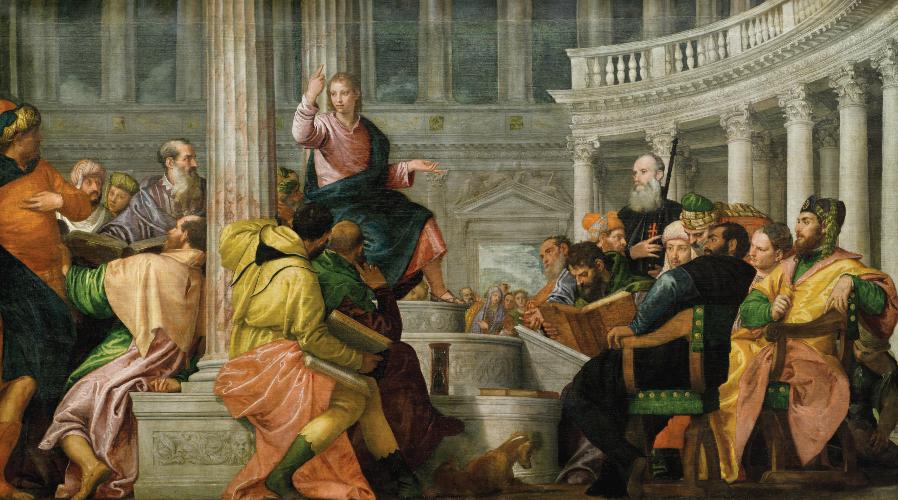
Overleaf: Christ among the Doctors, ca. 1560
All work oil on canvas, unless otherwise stated. p. 1: Detail of ceiling decoration of Sala dell’Olimpo, fresco, ca. 1560
Villa Barbaro at Maser
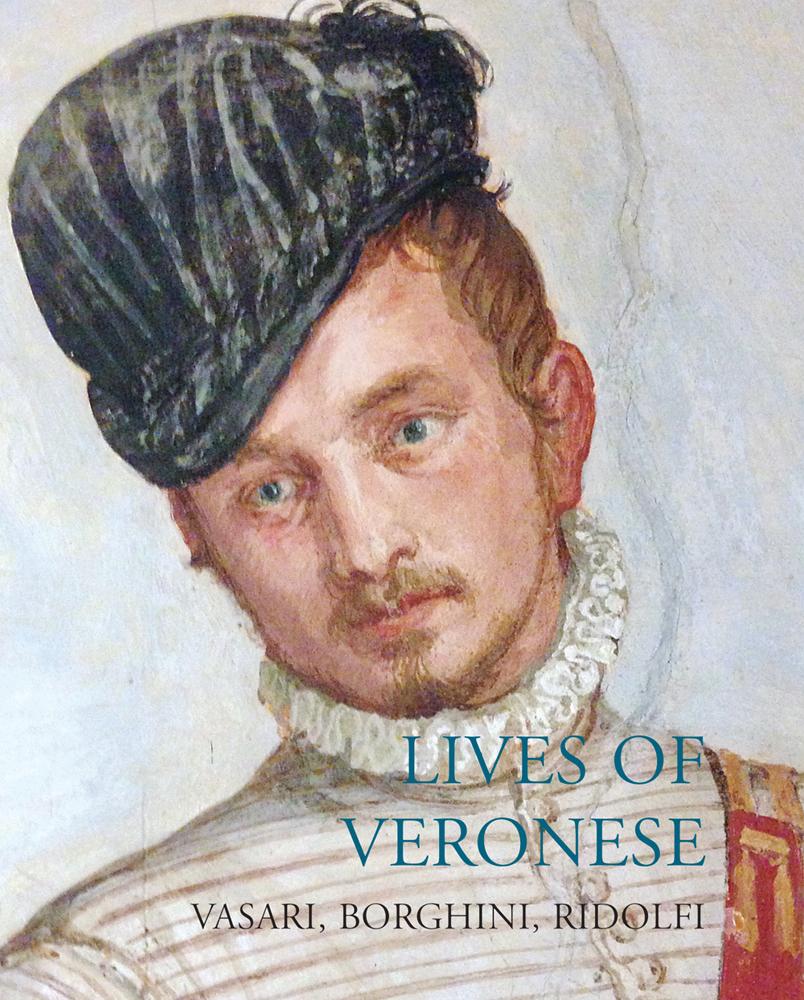
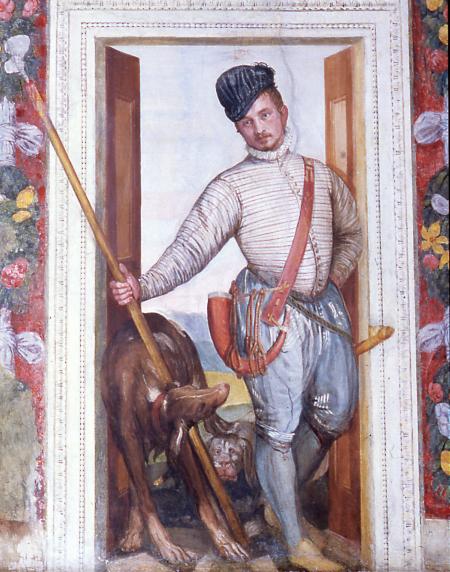
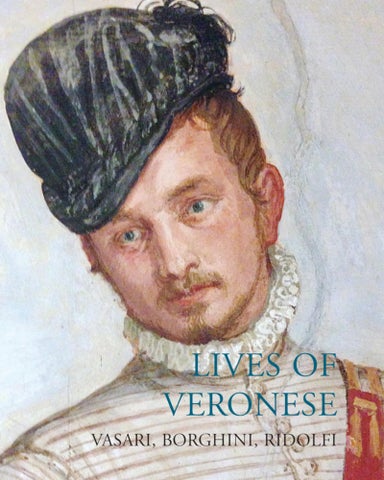
p 2: Young huntsman, wall decoration, fresco, ca 1560
Villa Barbaro at Maser
p 4: Mars and Venus united by Love, ca 1570-75, 206 x 161 cm, Metropolitan Museum of Art, New York
p 6: Portrait of a Man, ca 1565, 191 x 134 cm, J. Paul Getty Museum, Los Angeles
p. 10: Sts Geminianus and Severus, ca. 1560, 343 x 240 cm, Galleria Estense, Modena
p. 13: The Temptation of St Anthony, 1552, 198 x 149 cm, Musée des Beaux Arts, Caen
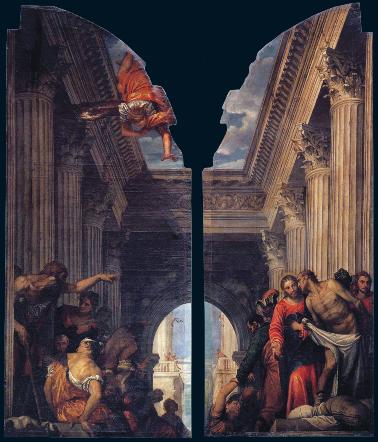
p. 15: Christ at the Pool of Bethesda, ca. 1560, 490 x 190 cm, San Sebastiano, Venice
pp. 18-19: Christ among the doctors, ca. 1560, 236 x 430 cm, Museo del Prado, Madrid
p. 23: Judith and Holofernes, ca. 1585, 195 x 176 cm, Museo di Strada Nuova, Genoa
p. 28: Architectural decoration, fresco, ca. 1560, Villa Barbaro at Maser
p. 32: The Triumph of Virtue over Vice, 1554-56, 295 x 165 cm, Doge’s Palace, Venice
p. 36: The Consecration of St Nicholas, 1562, 286 x 175 cm, National Gallery, London
pp. 40-41: Venus and Adonis, ca. 1580, 162 x 191 cm, Museo del Prado, Madrid
p. 44: The Choice Between Virtue and Vice, ca. 1565, 219 x 169 cm, Frick Collection, New York
p. 47: Wisdom and Strength, ca. 1565, 215 x 167 cm, Frick Collection, New York
p 51: The Virgin and Child with Saints and Donors (Pala Bevilacqua Lazise), 1548, 223 × 172 cm, Museo di Castelvecchio, Verona
p 52: Livia da Porto Thiene and her daughter Deidamia, 1552, 208 x 121 cm, Walters Art Museum, Baltimore
p 61: Servant opening door, wall decoration, fresco, ca 1560
Villa Barbaro at Maser
p. 62: Giustiniana Barbaro and a maid, Sala dell’Olimpo, ca. 1560
Villa Barbaro at Maser
pp. 64-5: Ceiling of the Stanza di Bacco, ca. 1560, Villa Barbaro at Maser
p. 71: Arithmetic and Geometry, 1556, 230 cm, Biblioteca Nazionale Marciana, Venice
p 83: Venice and Juno, ca 1555, 365 x 147 cm, Doge’s Palace, Venice
p 84: Youth and Old Age, ca 1555, 286 x 150 cm, Doge’s Palace, Venice
p 89: The Baptism of Christ, ca 1560, Il Redentore, Venice
p. 90: Marriage Feast at Cana, 1562-3, 666 x 990 cm, Musée du Louvre, Paris
pp. 94-95: The Feast in the House of Levi, 1573, 560 x 1280 cm, Venice, Accademia
p. 96: Detail from The Feast in the House of Levi, 1573, Venice, Accademia
p. 99: The Adoration of the Kings, 1573, 355 x 320 cm, National Gallery, London
p. 100: Venice, Hercules and Ceres, ca. 1575, 309 x 328 cm, Accademia, Venice
pp. 106-107: Christ and the Centurion, ca. 1570, 192 x 297 cm, Museo del Prado, Madrid
p. 109: St Helena, ca. 1570, 197 x 116 cm, National Gallery, London
p. 113: The Finding of Moses, ca. 1575-80, 57 x 43 cm, Museo del Prado, Madrid
pp. 126-127: St John the Baptist and St Memma, ca. 1560, each 246 x 120 cm, Galleria Estense, Modena
p. 132: Mystic Marriage of St Catherine, ca. 1565-70, 337 x 241 cm, Accademia, Venice
p. 137: The Virgin and Child with Saints (Pala Bonaldi), ca. 1562, 341 x 193 cm, Accademia, Venice
pp 142-143: St Francis receiving the stigmata, ca 1582, 437 x 259 cm, Accademia, Venice
pp 154-155: Family of Darius before Alexander, ca 1565-67, 236 x 475 cm, National Gallery, London
pp 160-161: Youth of the Sanuto Family between Virtue and Vice, ca 1580, 102 x 153 cm, Museo del Prado, Madrid
p. 175: Allegory of the Battle of Lepanto, ca. 1572, 169 x 137 cm, Accademia, Venice