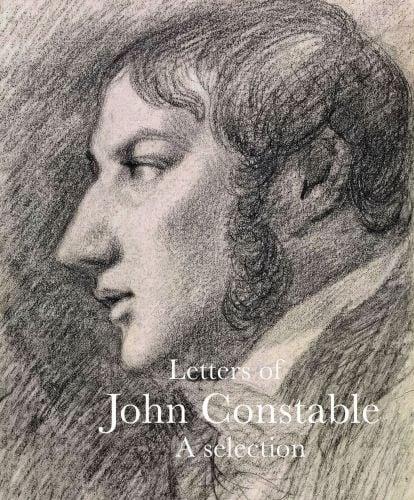
Letters of John Constable
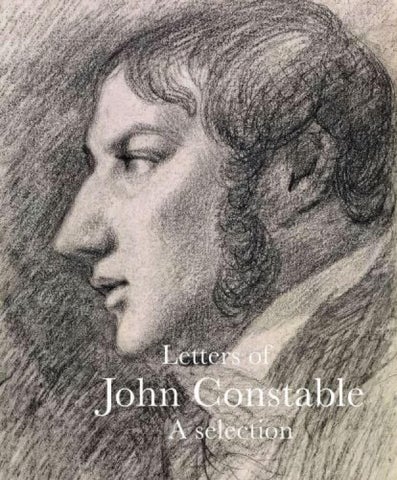
A selection chosen, edited and introduced by
Chronology, p. 8
Cast of characters, p. 16
Introduction, p. 23
Note on the text, p. 62
Further reading, p. 63
Letters of John Constable p. 65
Obituary, p. 241
Introduction to English Landscape, p. 245
List of illustrations, p. 252
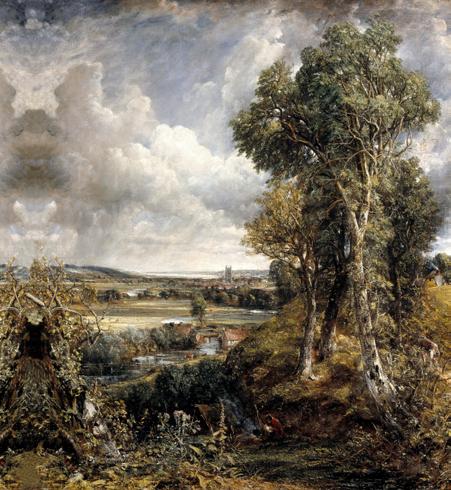
Fronstispiece: Te Vale of Dedham, 1828
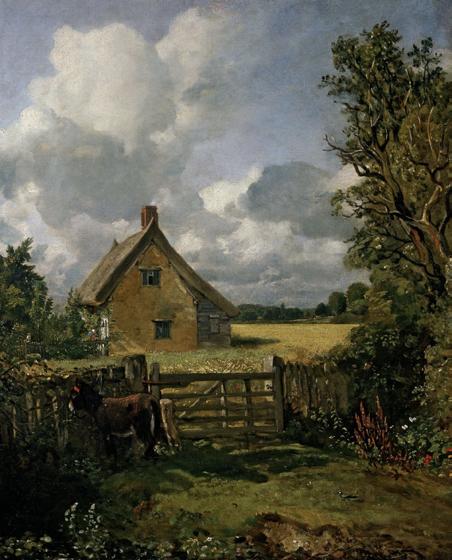
Opposite: Cottage in a Cornfield, c. 1815, finished 1833
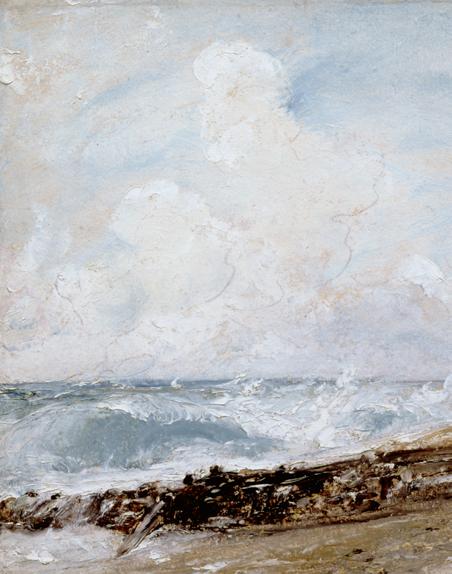
Overleaf: Coast scene near Brighton, 1824-8
1764 Golding Constable inherits Flatford Mill
1767 Golding Constable marries Ann Watts
1776 Birth of John Constable
c. 1792 JC begins to work for his father
1795 JC introduced to Sir George Beaumont, whose mother lives at Dedham
1796 or 1797 Meets Canon Fisher, later Bishop of Salisbury
1799 Obtains consent from parents to study art in London. Admitted probationer at Royal Academy Schools.
Begins friendship with Richard Ramsay Reinagle
1800 Admitted to Life Academy
1801 Tour of Derbyshire with Daniel Whalley, his cousin
1802 Turns down post of drawing master at Marlow Military Academy, returning to East Bergholt in the summer to made studies from nature. Father buys him a studio in East Bergholt
1803 Spends one month travelling along Tames estuary on a voyage on an East Indiaman, making sketches of shipping, including of the Victory moored at Chatham
1804 Paints portraits in Suffolk, mainly local farmers
1806 Tour to Lake District
1807 Exhibits views of Lake District at RA. Introduced to Lord Dysart and commissioned by him to make copies of family portraits
1810 Lord Dysart buys a landscape by Constable from the RA exhibition
1811 First visit to Salisbury, to stay with Bishop Fisher and his wife. Meets the Bishop’s nephew John Fisher (later Archdeacon) who was to become his closest friend. Takes lodgings at 63 Charlotte Street
1813 Sits next to Turner at RA banquet, admiring his ‘wonderful range of mind’
1815 Death of Ann Constable, Constable’s mother, in spring. In summer paints a great deal outdoors in very fine weather. Stays at East Bergholt into the autumn to be close to his father whose health is failing
1816 Enclosure of East Bergholt Common. Death of Golding Constable. Visits Wivenhoe Park to paint views on the park for General Slater-Rebow. Marries Maria Bicknell in London in the autumn, then honeymoons in Dorset and Wiltshire
1817 Exhibits small portrait of John Fisher at the RA, also Flatford Mill (Tate).Takes house in Keppel St, Bloomsbury. Long summer holiday with Maria in Suffolk. Birth of first child, John Charles
1819 John Fisher installed as Prebendary, moves into Leadenhall in Salisbury Cathedral Close. JC exhibits White
Horse (Frick), the first of his River Stour ‘six-footers’, at RA; it is bought by Fisher, who hangs it at Leadenhall the following year. Birth of second child, Maria Louisa. Elected Associate Royal Academician
1820 Exhibits second Stour ‘six-footer’, Stratford Mill (National Gallery, London) at RA. Long summer visit with Maria and family to stay with the Fishers
1821 Birth of Charles Golding Constable, third child. Exhibits third Stour ‘six-footer’, Te Hay Wain (National Gallery, London) at the RA. Starts painting sky studies in oils in Hampstead
1822 Exhibits fourth Stour ‘six-footer’, View on the Stour near Dedham (Huntington Library and Art Collections) at RA. Continues to paint cloud studies in Hampstead. Birth of Isabel Constable, their fourth child, in Hampstead. Moves from Keppel Street to 35 Charlotte Street (former house and studio of Joseph Farington who died the previous year)
1823 Exhibits Salisbury Cathedral from the Bishop’s Grounds (V & A Museum, London) at RA. Extended stay with Sir George Beaumont at Coleorton in Leicestershire
1824 Exhibits fifth Stour ‘six-footer’, Te Lock (private collection, formerly Tyssen Coll) at the RA. Sells on first day of the exhibition. Purchase for the nation of the picture collection of banker John Julius Angerstein, to be exhibited at his house, 100 Pall Mall, until a new building
for the collections was to open in Trafalgar Square in 1837. Constable installs family in lodgings in Brighton so Maria can benefit from sea air. Te Hay Wain and View on the Stour near Dedham purchased by Anglo-French dealer John Arrowsmith and exhibited at the Paris Salon (at the Louvre). Constable awarded a gold medal
1825 Exhibits sixth Stour ‘six-footer’, Te Leaping Horse, at the RA exhibition. Birth of Emily, fifth child. Death of Bishop Fisher. Quarrels with Arrowsmith
1826 Exhibits Te Cornfield (National Gallery, London) at the RA. Paints portrait of Mrs Treslove. Birth of Alfred Abram, sixth child
1827 Death of Sir George Beaumont. Exhibits Te Chain Pier, Brighton (Tate Britain, London) at the RA. Takes a permanent residence for the family in Hampstead, at 6 Well Walk. Takes two eldest children on a visit to Flatford, where the young John Constable enjoys fishing
1828 January, Birth of Lionel Bicknell Constable, seventh child, at Well Walk. Exhibits Dedham Vale (National Gallery, Scotland) at RA. November, death of Maria Constable in Hampstead
1829 February, elected Royal Academician. Exhibits Hadleigh Castle (Yale Center for British Art, New Haven) at RA. Stays with John Fisher in Salisbury twice. Starts working on print series, English Landscape, with engraver David Lucas
1830 Serves on Hanging Committee for the forthcoming exhibition at RA. Exhibits Helmingham Dell (Nelson Atkins Museum of Art, Kansas City) at RA
1831 Visitor at RA Schools. Serves for a second time on the RA hanging committee. Exhibits Salisbury Cathedral from the Meadows (Tate Britain and partners) at RA. Attends coronation of William IV in Westminster Abbey. Ill towards end of year with rheumatic fever
1832 Exhibits Te Opening of Waterloo Bridge (Tate Britain) at RA. Summer; fifth and final part of English Landscape published. Death of John Fisher. Death of assistant Johnny Dunthorne
1833 June: delivers first lecture on landscape painting to the Literary and Scientific Society of Hampstead. JC’s friend and future biographer C. R. Leslie leaves for America to take up a teaching post at West Point
1834 Ill again with rheumatic fever. C. R. Leslie and his family return to England. Exhibits only watercolours at RA exhibition, including Te Mound of the City of Old Sarum (V & A, London). July: leaves Well Walk permanently. Stays with brewer George Constable (no relation) in Arundel, Sussex. September: joins C. R. Leslie and his family as guests of 3rd Earl of Egremont at Petworth
1835 Sells Te Valley Farm (Tate Britain) to collector Robert Vernon before showing it at the Royal Academy exhibition. June: delivers second lecture on landscape to
Literary and Scientific Society at Hampstead. Stays with George Constable in Arundel, Sussex. Son Charles Golding starts as midshipman
1836 Exhibits Te Cenotaph (National Gallery, London) at the RA, and Stonehenge (watercolour, V & A , London), the last RA exhibition to take place at Somerset House before the move to a new building in Trafalgar Square. Delivers four lectures on landscape at the Royal Institution. Gives third (and final) lecture on landscape in Hampstead
1837 Working over the winter on Arundel Mill and Castle (Toledo Museum of Art). Visitor in Life Class at RA Schools. 1st April: dies in Charlotte Street in early hours of the morning. Arundel Mill exhibited posthumously at the new RA premises in Trafalgar Square. Te Cornfield given by subscribers to the National Gallery towards end of the year
1843 Publication of first edition of C. R. Leslie, Memoirs of the Life of John Constable Esq, R.A.
1845 Publication of second (revised) edition of Leslie’s Memoirs
1888 Family collection including contents of JC’s studio left to the V&A by his last surviving child, Isabel
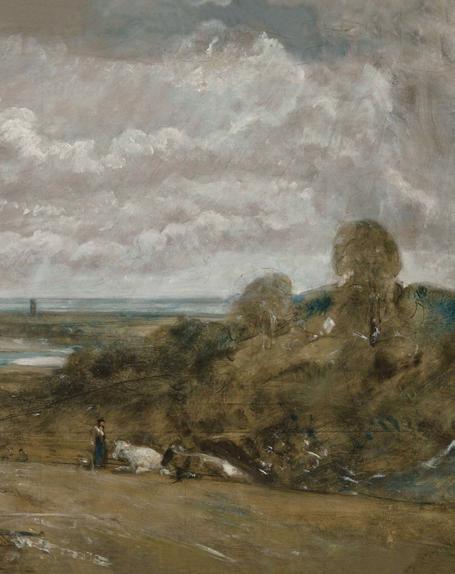
Overleaf: Dedham from Langham, late 1820s
SIR GEORGE BEAUMONT, BT. (1753-1827) Collector, patron, arbiter of taste and amateur artist (exhibited work at Royal Academy as ‘Honorary Exhibitor’). Befriended JC in the latter’s early years in London, having first been introduced to him at Dedham, Essex, c. 1795. JC stayed at Beaumont’s country estate, Coleorton, Leicestershire, for six weeks in 1823, copying Old Masters (mainly Claude) and sketching in the landscaped grounds. Beaumont’s collection of Old Masters and contemporary British art was bequeathed as an early foundation gift to the National Gallery, London. Although Beaumont gave JC much support, he never purchased one of his paintings.
ABRAM CONSTABLE (1783-1862) Younger brother of JC. Trained to succeed their father Golding Constable in running the family milling and farming business, thus freeing John to train as an artist in London. After Golding’s death in 1816, moved with their sister, Mary (1781-1865) back to Flatford Mill where he continued to run the family business and thus provide his siblings with an income. Retired (and sold the family businesses) in 1846.
ANN CONSTABLE (1748-1815) Mother of JC. Born Ann Watts, daughter of a London cooper, married Golding Constable in 1767. JC was the fourth of their six children. A regular correspondent with her son, often sending him parcels of food or coal in the winter months, and encouraging him to work hard but to keep an eye on his health. Enabled introductions on her son’s behalf to influential visitors to Suffolk or Essex, such as Sir George Beaumont (q.v.). Died of a stroke in 1815, which first came on when she was working in her newly planted flower garden at East Bergholt House.
GOLDING CONSTABLE (1739–1816) Father of JC. Inherited Flatford Mill, and much adjacent land, from a distant relation, and became a prosperous farmer and corn merchant. Owned a fleet of barges for transporting milled corn down the navigable river Stour for onward shipment, by sea, to London. In 1772–4 built substantial mansion, East Bergholt House, to house his growing family; JC born there in 1776. Originally opposed JC’s hopes to study as an artist, but relented when a younger son, Abram (q.v.) became of age and showed suitable ability to be trained up in the family business instead.
MARIA CONSTABLE, née BICKNELL (1788–1828) Wife of JC. Daughter of Charles Bicknell, solicitor to the Prince
Regent and to the Admiralty. Met JC in Suffolk, probably as early as 1800 when still only twelve, on a visit to her maternal grandfather, the Revd Dr Durand Rhudde, Rector of East Bergholt-cum-Brantham. JC declared his love for Maria in 1809, but given the opposition of Dr Rhudde, the couple did not marry until autumn 1816, shortly after Golding Constable’s death when JC came into his inheritance. Maria bore JC seven children. Her life was cut short at 41 following a long struggle with tuberculosis.
JOHN DUNTHORNE (c. 1770–1844) Plumber, painter, glazier and enthusiastic amateur artist. Lived next door to East Bergholt House, home of the Constable family, and became regular sketching companion of the young JC in Suffolk in the 1790s. Corresponded with JC in the latter’s early years in London when training to become an artist at the RA schools. Teir friendship was broken in 1816, but renewed again in the 1830s.
JOHN (‘JOHNNY’) DUNTHORNE (1798-1832) Son of John Dunthorne (q.v.). As a boy worked for JC in East Bergholt, grinding colours for him, and in the following years occasionally supplied drawings of local features for JC when the latter was working on Suffolk subjects in his London studio. From 1820 until about 1829 worked, at intervals, with JC as an assistant in his London studio, helping set
his palette, ‘squaring’ or tracing compositions, drawing in outlines, even partially painting some of JC’s second versions of compositions (both landscapes and portraits). From 1827 exhibited his own paintings at the RA, and by 1830 had established himself as a picture-cleaner and restorer. JC was greatly moved by Dunthorne’s premature death in 1832, especially as it followed soon after that of his friend Archdeacon John Fisher (q.v.).
ARCHDEACON JOHN FISHER (1788–1832) JC’s closest friend, with whom he had an extensive and remarkable correspondence, which affords important insights into the artist’s character and aims as a painter. Tey probably first met in Salisbury in 1811, when JC was invited to stay at the Bishop’s Palace by Bishop John Fisher (q.v.), the archdeacon’s uncle. Te younger John Fisher was ordained priest in 1812, and thanks to preferment from his uncle, obtained multiple livings, becoming vicar of Osmington in 1813, Archdeacon of Berkshire in 1817, and Canon Residentiary at Salisbury Cathedral in 1819. Te latter position came with a house, Leadenhall, in the Cathedral Close, where JC spent extended stays in 1820 and 1829. Te Archdeacon was an important patron to JC, buying Te White Horse and Salisbury Cathedral from the Bishop’s Grounds, both of which hung at Leadenhall. Died in 1832 in France.
BISHOP JOHN FISHER (1748–1825) From a well-connected clerical family. Appointed preceptor to fourth son of George III, Edward (later Duke of Kent), hence his nickname the ‘King’s Fisher’. Canon at Windsor in 1786, and later tutor to Princess Charlotte, daughter of Prince Regent. Appointed rector of Langham in Suffolk in 1790, meeting the young JC there a few years later, and giving him significant help in his early career. Bishop of Exeter in 1802 and Bishop of Salisbury in 1807. An amateur artist himself, commissioned paintings from JC, for which the artist always remained grateful, honouring the Bishop’s memory shortly after the latter’s death with a landscape, Te Glebe Farm, 1826, featuring Langham Church.
CHARLES ROBERT LESLIE (1794-1859) Born in London to American parents. Raised in Philadelphia then returned to London to train as an artist, eventually becoming a Royal Academician. Specialised in mainly small, narrative pictures. Close friend to, and regular correspondent with, JC mainly in second half of latter’s life. Wrote an important biography of JC in 1843, revised 1845 and often reprinted. Also liaised closely with JC’s family on sorting the contents of his studio following his death, as well as with the engraver, David Lucas (q.v.), on publishing further, posthumous subjects from JC’s paintings for English Landscape.
DAVID LUCAS (1802-1881) Mezzotint engraver, born in Northamptonshire and trained by printmaker S.W. Reynolds. Came to attention of JC in 1829, subsequently working in close collaboration with the painter in the preparation of 22 mezzotint plates for English Landscape, published in five parts between 1830 and 1832. An extensive correspondence survives between the two men, revealing how demanding JC could be of Lucas’s translation of his paintings into mezzotint form, frequently requesting many corrections at proof stage. Two other, large single plates by Lucas, Te Lock and Te Cornfield, were also published in JC’s lifetime. Lucas’s artistic reputation rests chiefly on his successful collaboration with JC. He died in Fulham Union workhouse in 1881 and was buried in a pauper’s grave nearby.
mrs sarah skey, née bicknell (1775–1840) Elder halfsister of Maria Bicknell (later Maria Constable, q.v.), who often went to stay with her at Spring Grove, Bewdley, Worcestershire. Towards the end of 1811 Maria wrote from Spring Grove entreating JC to cease thinking of her. Instead, he jumped onto a coach to Worcester to persuade Maria to change her mind. Mrs Skey – effectively defying her father’s wishes – welcomed him at Spring Grove, and the romance between JC and Maria was renewed at a critical stage in its early development.
The work of the British landscape painter John Constable (1776–1837) is today widely celebrated by a national audience (and, increasingly, an international one as well). Paintings such as Flatford Mill, 1817 (Tate Britain), or The Haywain, 1821 (National Gallery, London), have gained familiarity (if not overfamiliarity) through extensive reproduction on posters, mugs or tea towels. Showing scenes in Suffolk, where Constable had spent his childhood, these paintings are often idealized in the popular imagination as representing the quintessence of an English rural idyll. Together with his direct contemporary, and rival, J. M. W. Turner, John Constable is today a household name. Constable did not, however, achieve this level of fame in his own lifetime. In the second half of his career his paintings certainly became more widely noticed, and appreciated, by British critics who indeed often compared them with those of Turner. Constable was also widely praised in Paris in 1824, when Te Haywain was exhibited at the Louvre, and nearly acquired by the French nation.
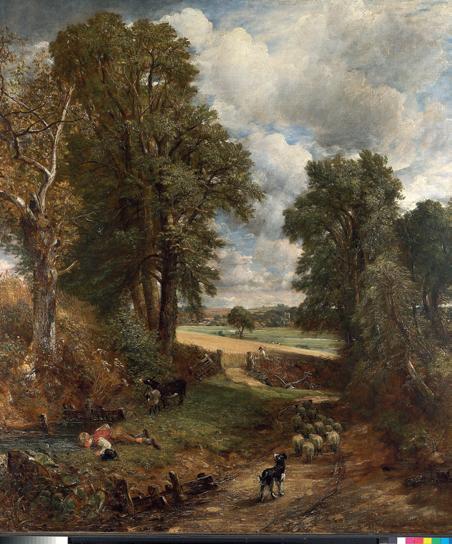
Opposite: The Cornfield, 1826
This was a remarkable achievement given how much livelier, and more firmly established, the art community was in France than Britain at this date.
Such press interest in his own lifetime would not, however, have been enough to guarantee Constable’s presentday fame. Artistic reputations notoriously wax and wane. Moreover, in the years following Constable’s death in 1837, only one of his paintings, Te Cornfield, 1826, was on public view in Britain, acquired by subscribers in 1838 in his memory for the National Gallery, London. But one of the most perceptive of Constable’s obituarists (and the only one to remark on Constable’s success in France), writing in Bell’s Weekly Messenger, anticipated that the distinctiveness of Constable’s style (which he called the artist’s ‘peculiarity’) would ‘render his works lasting and valuable in the eyes of all true judges of art, when many of the common-place productions of his contemporaries are sunk in oblivion’.
Little would this obituarist have known that a biographer was waiting in the wings to pen an influential memoir of Constable’s life and work that would help this very prediction come to pass. This was the artist C. R. Leslie, a close friend towards the end of Constable’s life. A Londoner by birth, but an American by ancestry, Leslie had first got to know Constable about 1820, a few years after the latter had settled permanently in London
following his marriage to Maria Bicknell in 1816. At this point Constable was beginning to make a name for himself at the Royal Academy with his large-scale exhibition canvases of Suffolk subjects, known as ‘six footers’ (measuring approximately 6 feet, or 174 cm, in width). Indeed the first of these – Te White Horse, 1819 (Frick Collection, New York) – effectively earned Constable his longcoveted election as an associate Royal Academician in 1819. Leslie, himself a painter (of mainly small-scale subject pictures), later claimed that it was because he so admired Constable’s landscape art that he subsequently came to know him personally. The close bond between the two was cemented when both became fathers and, in ensuing years, godparents to each other’s children. In writing his Memoirs of the Life of John Constable, Leslie decided to base them chiefly on his subject’s letters and own writings, a not uncommon device at the time, serving to add an air of authenticity to such accounts. However there was also the advantage that Leslie had often been in correspondence with the artist himself, so knew what an impressive and engaging letter writer he was. Acting to some extent as a father figure to Constable’s children in the years following their father’s death, Leslie was given full access to Constable’s papers, and able to select for citation in the
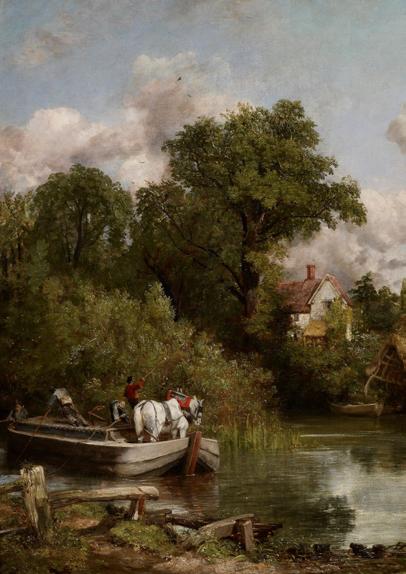
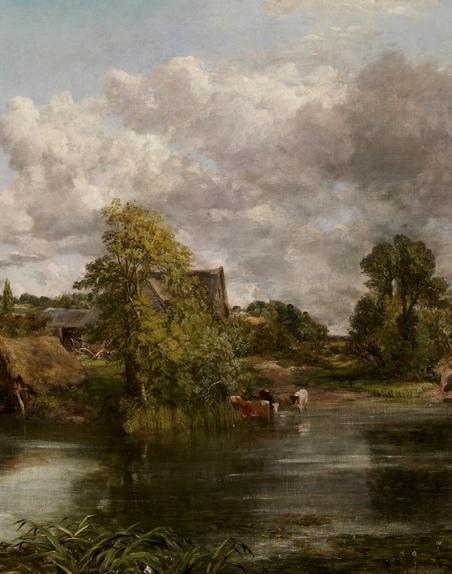
Overleaf: A Scene on the River Stour (‘The White Horse’), 1819
Memoirs interesting memoranda Constable had made, quotations from poetry or his thoughts on landscape. These latter included the important notes Constable had made for the Lectures on Landscape painting he delivered towards the end of his life at the Royal Institution, the Worcester Atheneum and at the Hampstead Literary and Scientific Society. Above all, Leslie had access – and cited extensive excerpts from – those remarkably insightful, and today especially celebrated, letters between Constable and his other most important friend, Archdeacon John Fisher. Fisher and Constable seem to have first met around 1811 through the former’s uncle, also John Fisher (who was Bishop of Salisbury at the time). Despite a considerable age difference, they soon became fast friends, and were to exchange in their letters personal news interlaced with thoughts about art, nature, literature, and religion, often leavened with gossip about characters or events in the clerical world. They were united in their firm support of the established Anglican Church, and it was to Fisher (as well as, sometimes, to Maria) that Constable would air his prejudices about Nonconformists (his particular targets being Baptists or Calvinists, p. 176). It was also to Fisher that Constable wrote perhaps his single most famous letter, from Hampstead in 1821, about his original inspiration in becoming a painter (‘I should paint my own places best – Painting is but another word for feeling.
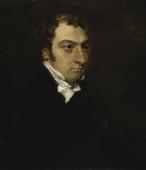
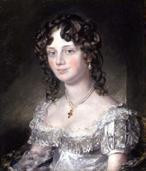
Archdeacon John Fisher and his wife Mary, 1816
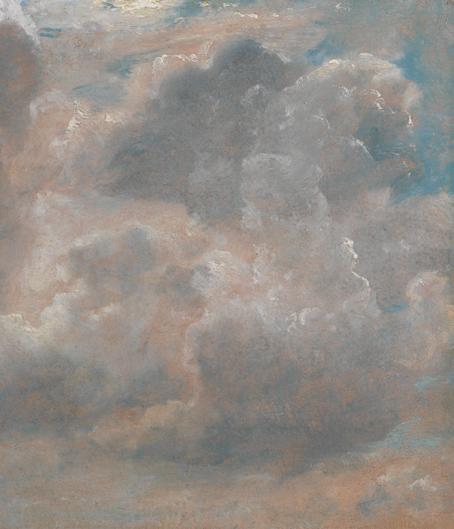
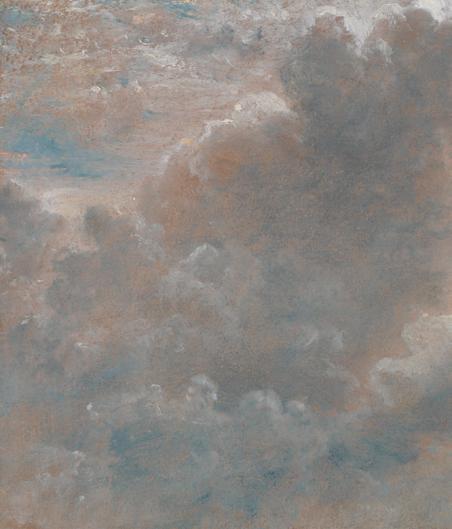
I associate my “careless boyhood” to all that lies on the banks of the Stour’); and about his motives in making his cloud studies in oils in Hampstead around this date (‘It will be difficult to name a class of landscape, in which the sky is not the “key note”, the standard of “Scale”, and the chief “organ of sentiment”) (p. 125).
After Fisher’s death in 1832, Constable wrote to Leslie saying how powerfully his friend’s death had affected him as ‘we …confided in each other entirely’. Leslie himself thenceforward became Constable’s chief confidant. Leslie’s Memoirs were first published in 1843, but became
Overleaf: Cloud Study, 1822. Inscribed: ‘Augt 1 1822 11 o’clock A.M. Very hot with large climbing clouds under the sun. Wind westerly.’
FEBRUARY
Dear Dunthorne
I am this morning admitted a student at the Royal Academy; the figure which I drew for admittance was the Torso. I am now comfortably settled in Cecil Street, Strand, No. 23. I shall begin painting as soon as I have the loan of a sweet little picture by Jacob Ruisdael to copy. Since I have been in town I have seen some remarkably fine ones by him, indeed I never saw him before; yet don’t think, by this, I am out of conceit with my own, of which I have seen a print, ’tis of the same size and reversed. I shall not have much to show you on my return, as I find my time will be more taken up in seeing than in painting. I hope by the time the leaves are on the trees, I shall be better qualified to attack them than I was last summer. All the time that you can conveniently spare from your business may be happily spent in this way, perhaps profitably, at any rate innocently. …
Smith’s friend Cranch has left off painting, at least for the present. His whole time and thoughts are occupied in exhibiting an old, rusty, fusty head, with a spike in it,
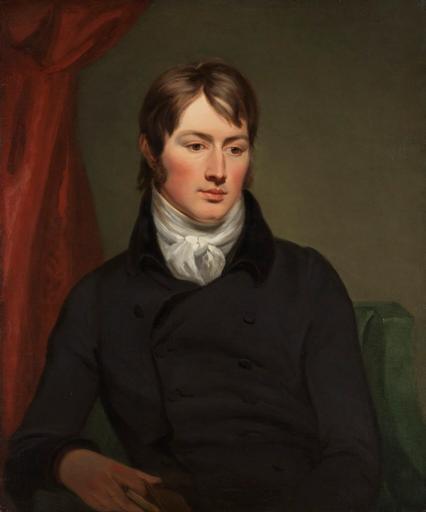
Opposite: Portrait of Constable by Ramsay Richard Reinagle, c. 1799. Te two artists were at the Royal Academy Schools together and shared lodgings
which he declares to be the real embalmed head of Oliver Cromwell!* Where he got it I know not; ’tis to be seen in Bond Street, at half a crown admittance.
How goes on the lay figure? I hope to see it finished when I return, together with some drawings of your own from nature. …
John Constable
Dear Dunthorne
… About a fortnight back, I was so fully in the hope of making an immediate visit to Bergholt that I deferred writing. I then knew nothing of the anatomical lectures which I am at present attending, and which will be over in about a week or ten days.
I am so much more interested in the study than I expected, and feel my mind so generally enlarged by it, that I congratulate myself on being so fortunate as to have attended these lectures. Excepting astronomy, and that I know little of, I believe no study is really so sublime, or goes more to carry the mind to the Divine Architect. Indeed the whole machine which it has pleased God to form for the accommodation of the real man, the mind,
* Now buried in the garden of Sidney Sussex College, Cambridge
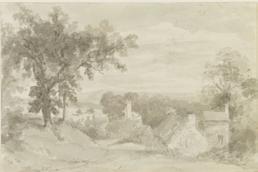
Te entrance to the village of Edensor, Derbyshire, August 1801
during its probation in this vale of tears, is as wonderful as the contemplation of it is affecting. I see, however, many instances of the truth, and a melancholy truth it is, that a knowledge of the things created does not always lead to a veneration of the Creator. Many of the young men in this theatre are reprobates.
I have done little in the painting art since I have been in town yet. A copy of a portrait and a background to an ox for Miss Linwood is all.* I have not time to say half I could wish about my Derbyshire excursion, therefore, I will say nothing… .
John Constable
* Mary Linwood (1755–1845) embroidery artist
MAY
My dear Dunthorne, I hope I have done with the business that brought me to town with Dr. Fisher. It is needless now to detail any particulars as we will make them the subject of some future conversation – but it is sufficient to say that had I accepted the situation offered* it would have been a death blow to all my prospects of perfection in the Art I love. For these few weeks past I believe I have thought more seriously on my profession than at any other time of my life – that is, which is the surest way to real excellence. And this morning I am the more inclined to mention the subject having just returned from a visit to Sir G. Beaumont’s pictures. – I am returned with a deep conviction of the truth of Sir Joshua Reynolds’s observation that ‘there is no easy way of becoming a good painter.’ It can only be obtained by long contemplation and incessant labour in the executive part. And however one’s mind may be elevated, and kept up to what is excellent, by the works of the Great Masters –still Nature is the fountain’s head, the source from whence
* Of drawing master at the newly-founded Marlow Military Academy, precursor to Sandhurst.
all originality must spring – and should an artist continue his practice without referring to nature he must soon form a manner, & be reduced to the same deplorable situation as the French painter mentioned by Sir J. Reynolds, who told him that he had long ceased to look at nature for she only put him out.
For these two years past I have been running after pictures and seeking the truth at second hand. I have not endeavoured to represent nature with the same elevation of mind – but have neither endeavoured to make my performances look as if really executed by other men.
I am come to a determination to make no idle visits this summer or to give up my time to commonplace people. I shall shortly return to Bergholt where I shall make some laborious studies from nature – and I shall endeavour to get a pure and unaffected representation of the scenes that may employ me with respect to colour particularly and any thing else – drawing I am pretty well master of.
Tere is little or nothing in the exhibition worth looking up to – there is room enough for a natural painture. Te great vice of the present day is bravura, an attempt at something beyond the truth. In endeavouring to do something better than well they do what in reality is good for nothing. Fashion always had, & will have its day – but Truth (in all things) only will last and can have just claims on posterity.
I have received considerable benefit from exhibiting –it shows me where I am, and in fact tells me what no body else could. Tere are in the exhibition fine pictures that bring nature to mind – and represent it with that truth that unprejudiced minds require.*
Tese are reflexions that at this time I should have written for my own use – but as I know that I could not write to you on a subject that would be more agreeable, I send you them as a letter.
And indeed I have had much ado to keep my mind together enough to write to be understood owing to a reumatick pain in one side of my head, particularly in my teeth and lower jaw, which has caused one cheek to swell very much. I believe I got cold at Windsor as I was there in the late severe weather.
Should you want any thing in the pencil† way &c let me know next week for I hope the next to leave London.
Remember me kindly to your wife & believe me to be sincerely yours
John Constable
* Constable had just exhibited at the Royal Academy for the first time; the painting was a landscape, but is untraced. † ‘Paintbrush’; the word does not usually mean a graphite pencil until after Constable’s lifetime.
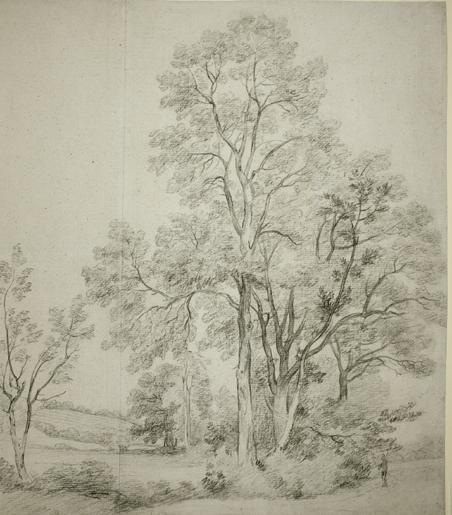
Opposite: A Stand of Elm Trees, c. 1802
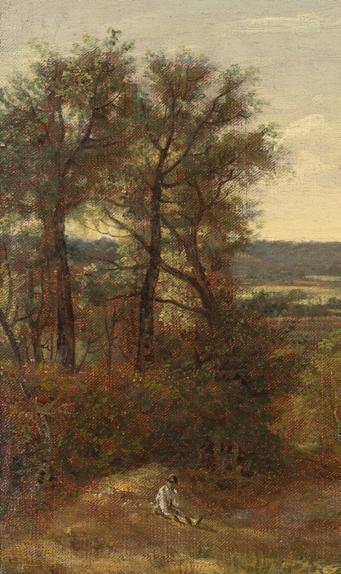
Overleaf: Dedham Vale, 1802
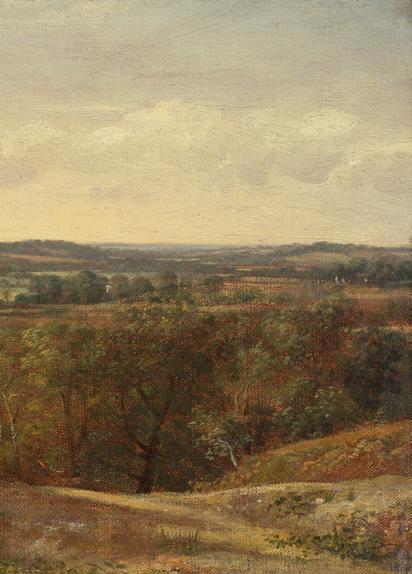
It proves the truth of Sir Joshua Reynolds’ idea that the virtuous man alone has true taste. Tis book is an addition to my estate – Carpenter got it for me 2 Vol. Octavo.
Stothard was amused with your mention of his pilgrims – but said he believed many of his prints were to be found amongst the Hottentots.*
I dined last week at Sir G. Beaumont’s – met Wilkie, Jackson & Collins. It was quite amusing to hear them talk about Martin’s picture. Sir G. said some clever things about it – but he added, even allowing the composition to be something (its only merit), still if the finest composition of Handel’s was played entirely out of tune what would it be? It was droll to hear Wilkie say ‘Gentlemen ye are too severe’ – and then say something ten times worse than had yet been said. Sir G. says he will not go out of town without painting me a picture –
My best regards to all your family – believe me my dear Fisher always most sincerely yours John Constable.
Dr Gooch has just left my door. He says all is going well upstairs –
* Tomas Stothard (1755–1834) had scored a success with Te Canterbury Pilgims, commissioned by a publisher for engraving. It led to Stothard’s rift with Blake who accused him of stealing his composition.
OCTOBER
My dear Fisher
I trust you will pardon this delay of mine in replying to your last long and very kind letter – I fully expected to have been with you at this time – but I have had many interruptions but what has prevented me has been a good deal of Indisposition in my family. which has made it almost impossible for me to leave home. Our time expires at this place this month – and when I have settled my family in Keppel Street I shall be able to make you a visit for a few days, should it be then convenient to you to receive me.
I have not been idle and have made more particular and general study than I have ever done in one summer, but I am most anxious to get into my London painting room, for I do not consider myself at work without I am before a six foot canvas – I have done a good deal of skying –I am determined to conquer all dificulties and that most arduous one among the rest, and now talking of skies –It is quite amusing and interesting to us to see how admirably you fight their battles: you certainly take the best possible ground for getting your friend out of a scrape –‘(the examples of the great masters)’. Tat landscape
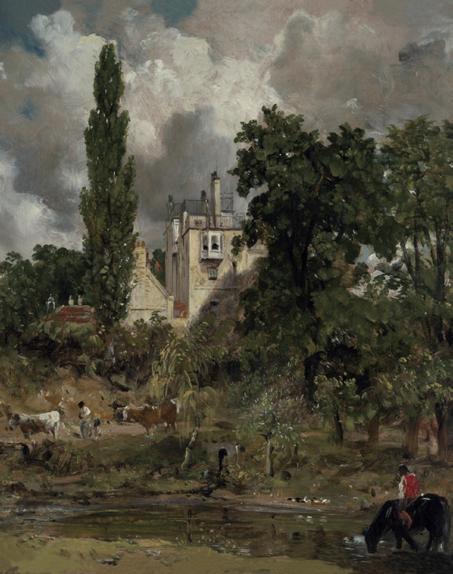
painter who does not make his skies a very material part of his composition – neglects to avail himself of one of his greatest aids. Sir Joshua Reynolds speaking of the ‘Landscape’ of Titian & Salvator & Claude – says ‘Even their skies seem to sympathise with the subject’. I have often been advised to consider my sky – as a ‘white sheet drawn behind the objects’. Certainly if the sky is obtrusive – (as mine are) it is bad, but if they are evaded (as mine are not) it is worse, they must and always shall with me make an effectual part of the composition. It will be difficult to name a class of landscape, in which the sky is not the ‘key note’, the standard of ‘scale’, and the chief ‘organ of sentiment’. You may conceive then what a ‘white sheet’ would do for me, impressed as I am with these notions, and they cannot be erroneous. Te sky is the ‘source of light’ in nature – and governs every thing. Even our common observations on the weather of every day, are suggested by them but it does not occur to us. Teir difficulty in painting both as to composition and execution is very great, because with all their brilliancy and consequence, they ought not to come forward or be hardly thought about in a picture – any more than extreme distances are.
But these remarks do not apply to phenomenon – or what the painters call accidental effects of sky – because they always attract particularly.
Opposite: Te Grove, Hampstead, c. 1821-2
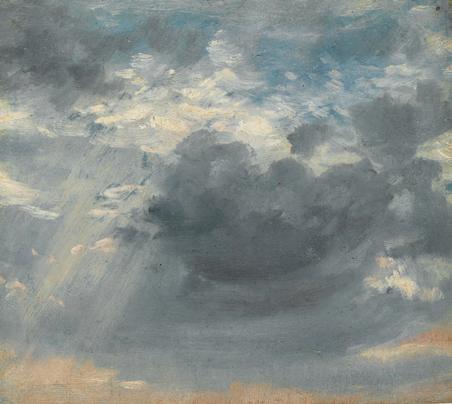
Cloud Study, summer 1821
I hope you will not think I am turned critic instead of painter. I say all this to you though you do not want to be told – that I know very well what I am about, & that my skies have not been neglected though they often failed in execution – and often no doubt from over-anxiety about them – which alone will destroy that easy appearance which nature always has – in all her movements. [...] How strange it is that we should prefer raising up all manner of difficulties in painting – to truth and common sense.
How much I can imagine myself with you on your fishing excursion in the new forest, what river can it be? But the sound of water escaping from mill dams, so do willows, old rotten banks, slimy posts, & brickwork. I love such things – Shakespeare could make anything poetical – he mentions ‘poor Tom’s’ haunts among sheep cots – & mills – the water[mist?] & the hedge-pig. As long as I do paint I shall never cease to paint such places. Tey have always been my delight – & I should indeed have delighted in seeing what you describe in your company ‘in the company of a man to whom nature does not spread her volume or utter her voice in vain’.
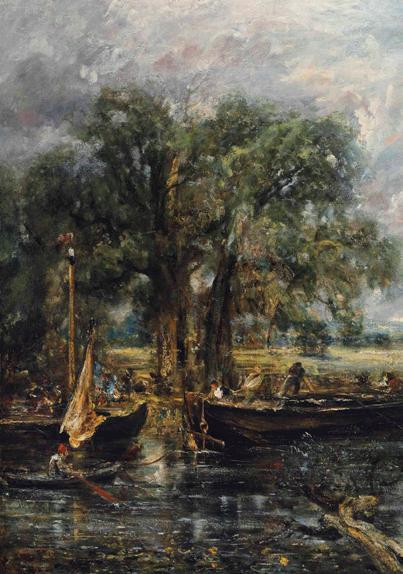
But I should paint my own places best – Painting is but another word for feeling. I associate my ‘careless boyhood’
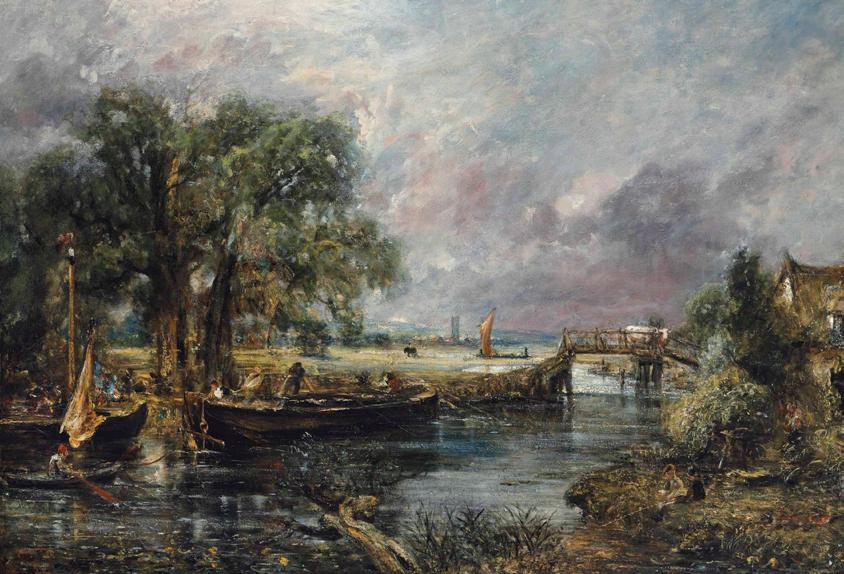
Overleaf: View on the Stour near Dedham (full size study), c. 1821-2
List of illustrations
All works are by John Constable and are oil on canvas unless stated otherwise. Measurements given height before width. Images from holding institutions unless noted.
p. 1 Detail from Stratford Mill (‘Te Young Waltonians), 1820 127 x 182 9 cm. National Gallery, London
p. 2 Te Vale of Dedham, 1828. 145 x 122 cm. Te National, Edinburgh
p. 4 Cottage in a Cornfield, c. 1817–33. 62 x 51.5 cm. Victoria and Albert Museum, London
pp. 6-7 Dedham from Langham, late 1820s. 62 x 99 cm. With Christies, 5 July 2018
pp. 14-15 Coastal scene near Brighton, c. 1824-28. Oil on paper, mounted on canvas, 33 x 50.8 cm. Detroit Institute of Arts, Detroit, MI
p. 22 Te Cornfield, 1826. 143 x 122 cm. National Gallery, London
pp. 26–27 A Scene on the River Stour (‘Te White Horse’) 1819. 131 x 188 cm. Frick Collection, New York City, NY
p. 29 (left) Archdeacon John Fisher, 1816. 36 x 30 cm. Fitzwilliam Museum, Cambridge
p. 29 (right) Mrs Mary Fisher, 1816. 36 x 31 cm. Fitzwilliam Museum, Cambridge
pp. 30–1 Cloud Study, 1822. Oil on paper laid on canvas, 30.5 x 50.8 cm. Yale Center for British Art, Paul
Mellon Collection, New Haven, CT
pp. 34–5 Malvern Hall, Warwickshire, 1809. 51 x 77 cm. Tate, London
p. 36 Landscape with Goatherd and Goats (after Claude), 1823. 65 x 59 cm.
Art Gallery of New South Wales, Sydney
p. 39 Study of the Trunk of an Elm Tree, c 1821. Oil with charcoal and white chalk on paper, 30.6 x 24.8 cm. Victoria and Albert Museum, London
pp. 42-3 Osmington Village, 1816–17. 26 x 31 cm. Yale Center for British Art, Paul Mellon Collection, New Haven, CT
p. 45 Maria Constable and two of her children, c. 1820. Oil on mahogany, 17 x 22 cm. Tate Britain, London
pp. 48–9 Fen Lane, East Bergholt, c. 1817. 69 x 93 cm. Tate Britain, London
pp. 52 Te Chain Pier, Brighton, 1827. 130 x 180 cm. Tate Britain, London
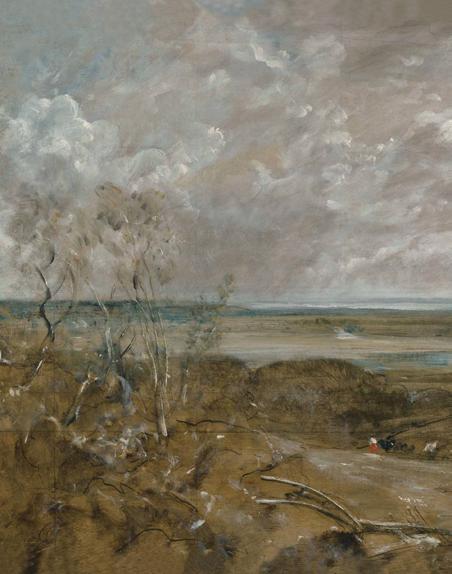
p. 55 Hampstead Heath, c. 1820–30.
45 x 36 cm. Yale Center for British Art, Paul Mellon Collection, New Haven, CT
pp. 58–9 Te Opening of Waterloo Bridge (‘Whitehall Stairs, June 18, 1817’), 1829–31. 131 x 218 cm. Yale
Center for British Art, Paul Mellon Collection, New Haven, CT
p. 64 Ramsay Richard Reinagle, Portrait of Constable, c. 1799. 76 cm x 64 cm. National Portrait Gallery, London
p. 67 Te entrance to the village of Edensor, Derbyshire, August 1801. Pencil and sepia wash on paper, 17 x 25.7 cm. Victoria and Albert Museum, London
p. 70 A Stand of Elm Trees, c. 1802. Black chalk on paper, 52 x 44.6 cm.
Te Art Institute of Chicago, Chicago, IL
pp. 72–3 Dedham Vale, 1802. 33 x 42 cm. Yale Center for British Art, Paul Mellon Collection
p. 74 (left) Ann Constable, c. 1815. 77 x 64 cm. Tate Britain, London
p. 74 (right) Golding Constable, 1815.
76 x 63 cm. Tate Britain, London
pp. 76–7 Flatford Mill from the lock, c. 1810. Oil on beige laid (?) paper, mounted on canvas, 19 x 24.1 cm.
Te Clark Art Institute, Williamstown, MA
p. 79 View toward the Rectory, East Bergholt, 1810. Oil on canvas laid on panel, 15.6 x 24.8 cm. Philadelphia Museum of Art, Philadelphia, PA
p. 80 Maria Bicknell, c. 1805–9. Graphite on paper, 48.8 x 34.8 cm.
Tate Britain, London
pp. 86-7 Autumnal Sunset near East
Bergholt, c. 1812. Oil on paper later laid down on canvas, 16 x 31.8 cm.
Victoria and Albert Museum, London
p. 90 Landscape with a double rainbow, 28 July 1812. Oil on paper laid on canvas, 33.7 x 38.4 cm. Victoria and Albert Museum, London
p. 96 Landscape – Boys Fishing, 1813. 100-126 cm. Anglesey Abbey, Lode, Cambridgeshire, Fairhaven Collection (National Trust),
pp. 100-101 Woodland Landscape, 1815. Oil on board, 38 x 63 cm. With Christie’s 7 December 2021
p. 105 Maria Bicknell, Mrs. John Constable, 1816. Oil on canvas, 31 x 25 cm. Tate Britain, London
p. 108 Dog watching a rat, Dedham, 1 August 1831. Pencil and watercolour on paper, 18.5 x 22.6 cm. Victoria and Albert Museum, London
p. 110-1 Wivenhoe Park, 1816. 56 x 101 cm. National Gallery of Art, Washington DC
p. 112 Te Fishing Lodge, Wivenhoe (also known as Te Quarters behind Alresford Hall), 1816. Oil on paper later laid down on canvas, 34 x 52 cm. National Gallery of Victoria, Melbourne
pp. 114–5 Te Beach at Weymouth, 1816. 53 x 75 cm. National Gallery, London
p. 117 One of the artist’s sons with a dog, c. 1821-3. Oil on board 28.9 x 24.5 c.
Private collection
pp. 118–9 Stratford Mill (‘Te Young Waltonians), 1820. 127 x 182.9 cm.
National Gallery, London
p. 124 Te Grove, Hampstead, 1821–2 36 x 30 cm. Tate Britain, London
p. 126 Cloud Study, 1822. Oil on paper, 13.3 x 14.9 cm. Fitzwilliam Museum, Cambridge
pp. 128–9 View on the Stour near Dedham (full size study), c. 1821–2. 129 x 185 cm. Private collection with Christie’s
p. 133 Page from one of Constable’s surviving sketchbooks, used 1813–15. Pencil on paper, 9.6 x 12.4 cm (closed sketchbook). Victoria and Albert Museum, London
pp. 136–7 Salisbury Cathedral from the Bishop’s Grounds (original version), 1823 88 x 112 cm. Victoria and Albert Museum, London
p. 139 Gillingham Mill, 1823–7. 63 x 52 cm. Victoria and Albert Museum, London
p. 144 Stone in the Grove of Coleorton Hall dedicated to Richard Wilson, 28 November 1823. Pencil and grey wash on paper, 11.5 x 18.1 cm. Victoria and Albert Museum, London
pp. 146–7 Scene on the Downs, near Brighton, 1824. Oil on light card, 11.5 x 15.9 cm. With Christies 7 December 2010
pp. 152–3 Sir Richard Steele’s Cottage, Hampstead, 1831–2. 21 x 29 cm. Yale Center for British Art, Paul Mellon Collection, New Haven, CT
p. 157 Mouse with a piece of cheese, 1824. Oil on grey paper, 10.1 x 13.3 cm.
British Museum, London
pp. 160–1 Te Hay Wain, 1831–2. 130 x 185 cm. National Gallery, London
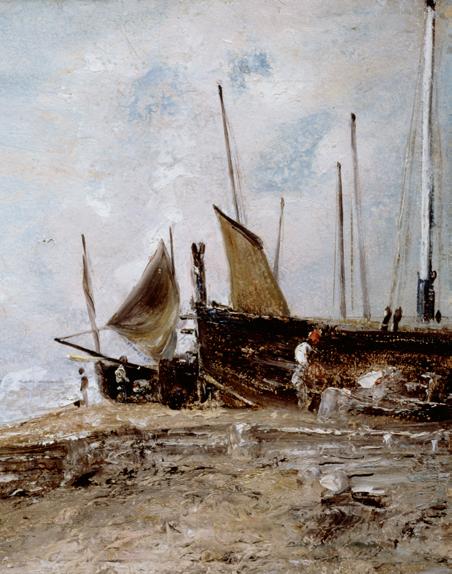
pp. 164–5 Scene on the beach at Brighton, c. 1824. Pen, pencil and grey wash on paper, 18.1 x 26.4 cm. Victoria and Albert Museum, London
p. 167 Brighton Beach with Colliers, 19 July 1824. Oil on paper, 14.6 x 24.8 cm. Victoria and Albert Museum, London
pp. 174–5 Te Leaping Horse, 1825. 129 cm x 188 cm. Royal Academy of Arts, London
pp. 180–1 Branch Hill Pond, Hampstead, 1824–5. 87 x 103 cm. Virginia Museum of Fine Arts, Richmond, VA
p. 186 Mrs Treslove, 1826, retouched 1829 76 x 64 cm. Private collection
p. 188 John Charles and Minna playing coach and horses, c. 1822. Pencil and watercolour on paper, 8.4 x 18.9 cm. Private collection
p. 189 Minna playing Bo-Peep, c. 1822. Oil on millboard, 18 x 10 cm. Private collection
pp. 194–5 A Boat passing a Lock, 1826. 102 x 127 cm. Royal Academy of Arts, London
pp. 198–9 David Lucas after John Constable, Te Spring, c. 1831, mezzotint on paper, progress proof with annotations and corrections by John Constable. Image size 155 x 215 cm.
British Museum, London
p. 201 Lord Brougham with coronet at
the coronation of William IV, 9 September 1831. Part of letter of that date. p. 210 Study of Poppies, 1814–32 56 x 71 cm. Victoria and Albert Museum, London
p. 213 John Charles and Maria Louisa (‘Minna’) fishing from a barge at Flatford Mill, 5 October 1827, . Pen and grey ink, grey wash on paper, 32.5 x 22.5 cm. With Christies 5 July 2011
p. 215 A winter landscape with figures on a path, a footbridge and windmills beyond (after Jacob van Ruisdael), 1832. 56 x 71 cm. With Sothebys 22 May 2019
pp. 218–9 Te Glebe Farm (first version). 1827. 46 x 60 cm. Detroit Institute of Arts, Detroit, MI
pp. 226–7 Arundel Mill and Castle, 1837. 72 x 100 cm. Toledo Museum of Art, Toledo, OH
p. 229 Study of cottages on high ground (Sussex), c. 1834 or 1835. Pencil and watercolour on paper, 13 x 21.1 cm. Victoria and Albert Museum, London
pp. 234–5 Stonehenge, 1835. Watercolour on paper, 38.7 x 59.1 cm. Victoria and Albert Museum, London
p. 236 View on the Stour: Dedham Church in the distance, 1832–6. Pencil and sepia wash on paper, 20.3 x 16.9 cm. Victoria and Albert Museum, London
p. 155 Study of the fallen figure of the saint in Titian’s St Peter Martyr, 1836. Bistre and sepia wash on paper, 100.5 x 176 cm. Victoria and Albert Museum, London
p. 240 Cenotaph to the Memory of Sir Joshua Reynolds, 1836. 132 x 109 cm. National Gallery, London
p. 244 David Lucas after John Constable, Frontispiece to Mr. Constable’s English Landscape. East Bergholt. Suffolk. ‘Fond Recollections round thy memory twine’. 1831 Plate mark 23.3 x 24 cm. British Museum, London
p. 246 David Lucas after John Constable, Mill near Brighton, 1831. Plate mark 18 x 12.5 cm. British Museum, London
p. 249 David Lucas after John Constable, Vignette to Mr. Constable’s English Landscape: Hampstead Heath, Middlesex. ‘Ut Umbra sic Vita.’, 1831. Plate mark 16.7 x 22.8 cm. British Museum, London
First published 2026 by Pallas Athene (Publishers) Limited
2 Birch Close, N19 5XD
www.pallasathene.co.uk
Editorial selection, introduction and layout © Pallas Athene 2026
ISBN 978 1 84368 287 5
Printed in England
Selection made, edited, introduced and annotated by Anne Lyles, with Alexander Fyjis-Walker Series editor: Alexander Fyjis-Walker Editorial assistant: Patrick Davies
Tis book is dedicated to the memory of
DICK HUMPHREYS art historian, curator, dear colleague and friend
AL & AFW