NAVAL PLATFORM WITH CANNONS
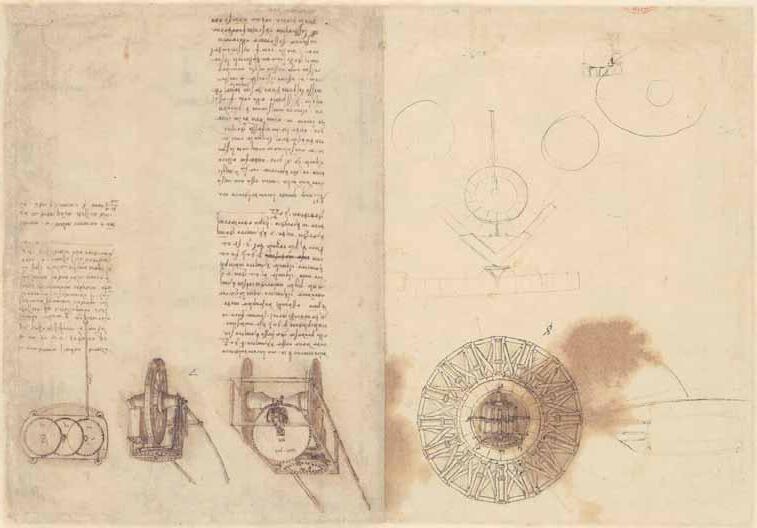
1r
P EN , INK , ANDWASH
10.3 X 7.7 IN (261 X 195 MM )
C . 1500–1504
This is the opening folio to the entire Codex Atlanticus. To the left, it offers a very elaborate drawing of a vaguely circular platform (in fact, it is a polygon with 16 sides), at the center of which we can clearly see a double paddlewheel, informing us that this is a sort of floating platform. The paddlewheel, which provides for the movement of this curious vessel, is activated by a system of toothed wheels, which in turn are moved by four cranks (three on one side and one on the opposite side). But the real peculiarity consists in the fact that this platform is armed with 16 cannons around its perimeter, each arranged in perfect mirror image with
Folio
an opposing cannon. It is thus a sort of "battleship," capable of producing a series of shots in succession, capable of covering the entire surrounding zone with firepower, even though we should probably assume that the guns would be fired in pairs, each with its corresponding counterpart, to cancel out the backward movement owing to force of recoil. It would also appear that the entire vessel was covered by a conical protective roof. Lastly, on the right half of the folio, we can see two carriage-mounted instruments using which—as the captions inform us—one could measure miles (to the left) and paces (to the right).
STUDY OF ARTILLERY FIRE
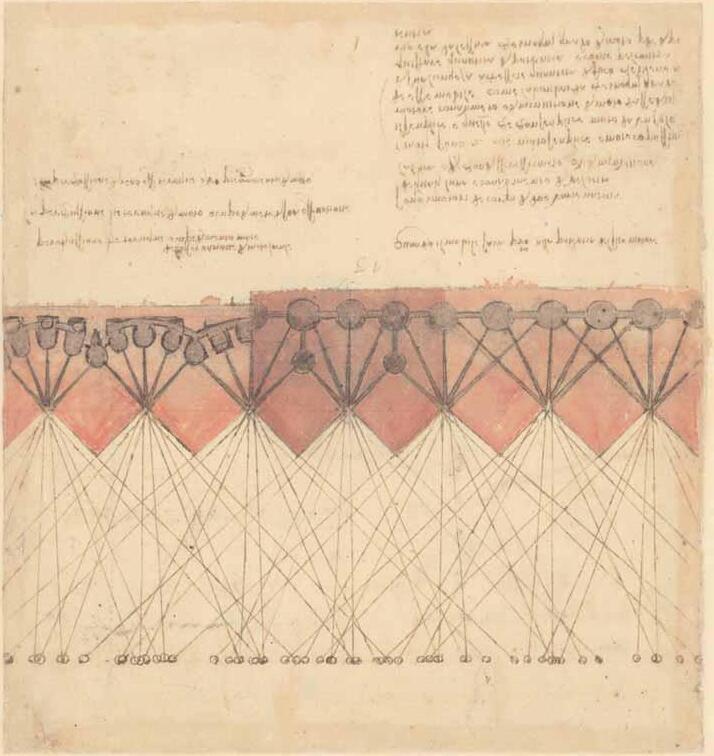
This drawing stands out for Leonardo's use of watercolor: in fact, by making use of different degrees of color intensity, he was able to highlight three different solutions to the problem he wanted to illustrate. The defensive structure is designed with triangular points. Inside, there are numerous firearms arranged, allowing multiple shots, drawn using black circles connected to one another. In the first section, the firearms are arranged along a line; in the second (indicated using a darker color), two smaller firearms are added, and positioned farther in advance with respect to the normal line; in the third section, they are arranged in semicircular groups. Multiple shots are delivered by the cannons, all of which exit through loopholes situated in the inner corners of the triangular structure. For each projectile, the trajectory is indicated with precision: the final result is a mesh indicating how the artillery fire is able to minutely cover the area in front of the fortification. The top line, defined by a row of small circles to indicate the balls launched by the bombards, indicates the maximum line of the range.
1502–1504
Folio 767r
GIANT SLINGSHOT
Folio 145r
P EN , INK , ANDWASH
6.8 X 12 IN (172 X 305 MM ) - C . 1485 AND 1500
This very precise and highly finished drawing depicts a giant slingshot: the sling itself, with projectile in launching position, is connected to two staves, or antennas, which in turn are connected to two toothed wheels held in tension by twisted cords. Once the wheels are liberated of tension, the staves would violently thrust forward the two
antennas, causing the sling to launch its projectile abruptly. The geared device for putting the wheels under tension was conceived by Leonardo in a flexible manner, so that it was possible to program a more or less violent launching force on the basis of greater or lesser tension of the wheels themselves. It seems that this drawing ought
to be dated around 1485, but the caption below, datable to 1500, demonstrates that Leonardo returned to these designs for war machines to further improve them. The text speaks about the possibility of adjusting the force of the launch based on the tension of the device.
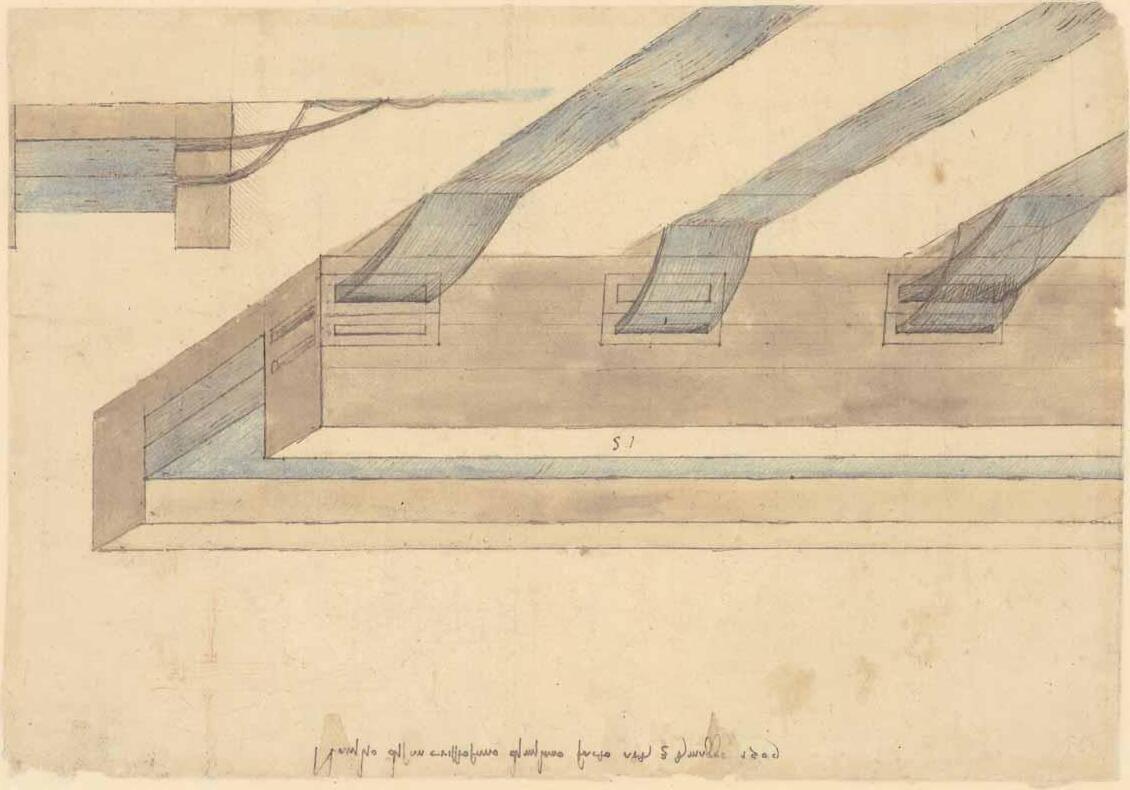
NAVIGLIO AT SAN CRISTOFORO
At the top, in Leonardo's hand (with reverse writing) we see the inscription Navilio di San Crisstofano di Milano facto addì 3 di maggio 1509 (“Naviglio at San Cristoforo in Milan, done on May 3, 1509”). The very neat drawing, embellished with blue wash, is thus dated and refers to the tract of the Naviglio Grande in Milan in front of the church of San Cristoforo. Leonardo's interest for Milan's water supply is shown by the fact that his name was attributed (rightly or wrongly) to the locks that regulated the various water levels of the Naviglio. In this case, however, the problem seems to have been something different, namely how to exploit the water from the canal and how to regulate its flow, for optimal use for purposes of irrigation in the surrounding countryside, or for all the other uses that the numerous hydraulic machines scattered among the other folios of the Codex have described to us. The drawing, as in many other cases, is twofold: the larger one presents the course of the Naviglio shown in perspective; the smaller one in the lower right corner shows a section view. We can clearly see that Leonardo envisioned the possibility of draining out water by making use of two superposed outlets, showing in series the three methods that could be used for opening them. In the first case, to the left, both are opened together, thus allowing a double issue of water; in the middle case, only the upper outlet is open; and in the last case, only the lower outlet.
Folio 1097r
11.6 X 8 IN (295 X 204 MM ) - C . 1509
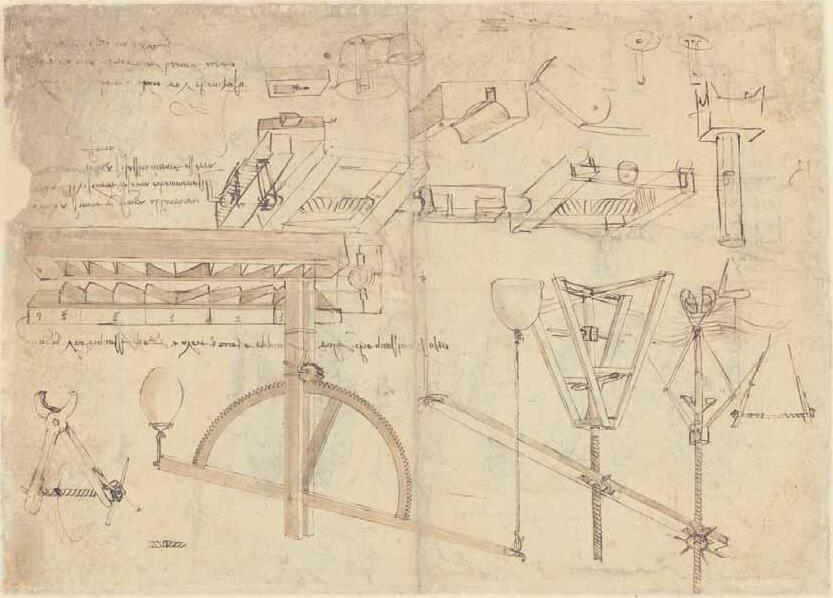
HYDRAULIC INSTRUMENTS AND OTHER SCREW DEVICES
This beautiful folio is scattered with numerous drawings. However, only certain devices refer to problems of hydraulics, beginning with the large machine in the upper left. This is a sort of crane, the arm of which is made to rotate and raise (or lower) by means of a large screw supported by pyramidal scaffolding. The arm, in turn, supports another screw, to the bottom of which a sort of tongs is connected for gripping submerged objects, as indicated by the waves sketched above the tongs. The tongs then open or close their grip owing to a system of levers activated by a bolt running along the screw. Additionally, the drawings in the lower part of the folio would appear to refer to the construction of siphons for lifting water. The other drawings represent a large crane, maintained in equilibrium by two counterweights and driven by a toothed half-wheel, maneuvered by crank; a large pair of tongs, the grip of which is driven by a crankoperated screw; farther down, two beams that fit together along opposing triangular teeth; and at the center, two frames connected by a double screws.
Folio 30r
P ENANDINK
10.9 X 15.2 IN (278 X 385 MM )
C . 1480–1485
MACHINE FOR MANUFACTURING FILES
Folio 24r - P ENANDINK ; 10.7 X 7.6 IN (272 X 193 MM ) - C . 1478–1480
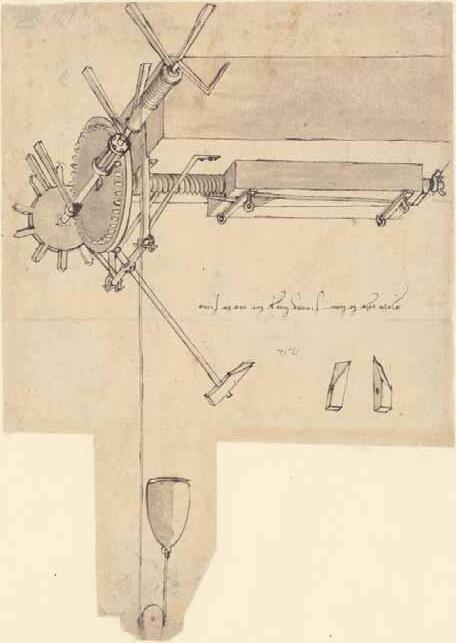
In this case as well, Leonardo has designed a very ingenious device, which can be said to be fully automatic, for speeding up the production process and lowering costs resulting from manual labor. This is a machine for engraving files: a large counterweight is raised by a cord wrapped around a crank-operated drum; as the weight descends, it causes the hammer with the engraving tip to descend, and at the same time it moves backward the support holding the piece of metal to be engraved and transformed into a file. Off to the side we can see details of two engraving tips. Leonardo's caption (this time written from left to right) is quite clear: “Method by which files engrave themselves.”
MACHINE FOR SHARPENING NEEDLES
Folio 933r - P EN , INK , ANDBLACKCHALK - 16.9 X 11 IN (430 X 280 MM ) - C . 1493
The design of this machine finds its raison d'être within the context of the development of the textile industry in Lombardy, with the need to devise increasingly productive automated mechanisms. This device, by means of transmission of movement provided by leather straps, allowed one to easily and rapidly sharpen the needles that would then be utilized in the frames. The last sentence of the brief autograph caption (to be read, therefore, from right to left) explains, among other things, that the machine was to be used in such a manner that the needle would be sharpened (Leonardo used the verb ammolare, “to soften” or archaically, “to sweeten”) first on the side with the eye and then on the side with the tip.
MACHINE FOR MANUFACTURING ROPES
Folio 13r
P ENANDINK , WATERCOLORRETOUCHES , TRACESOFBLACKCHALK -
6.7 X 14.8 IN (169 X 375 MM ) - C . 1514–1516
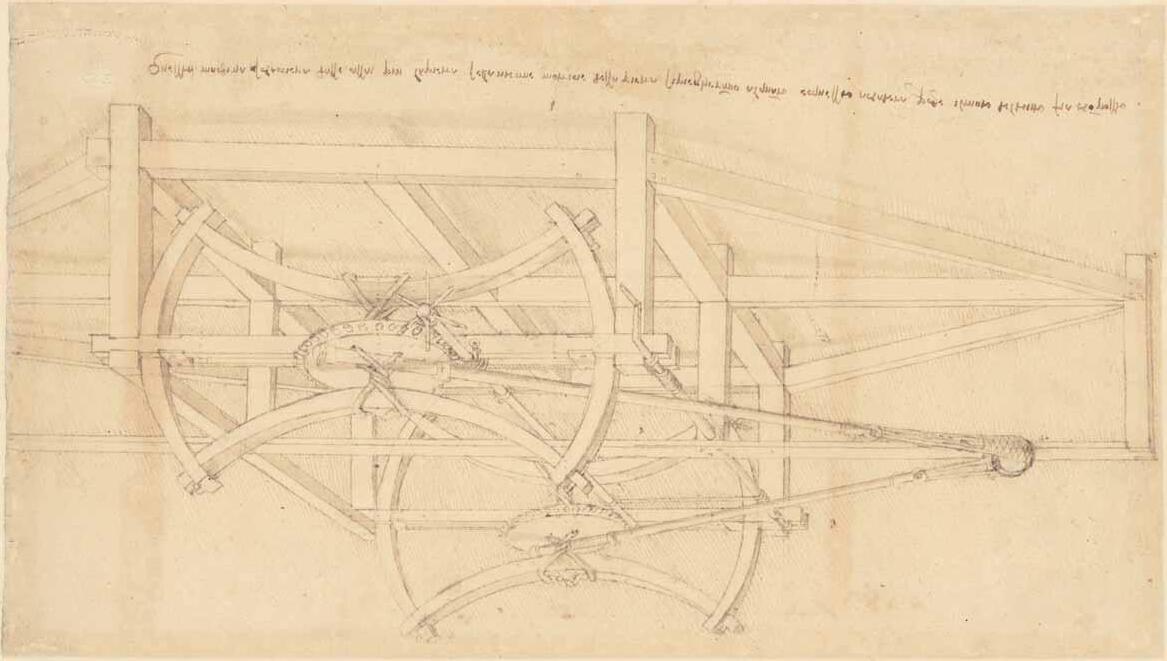
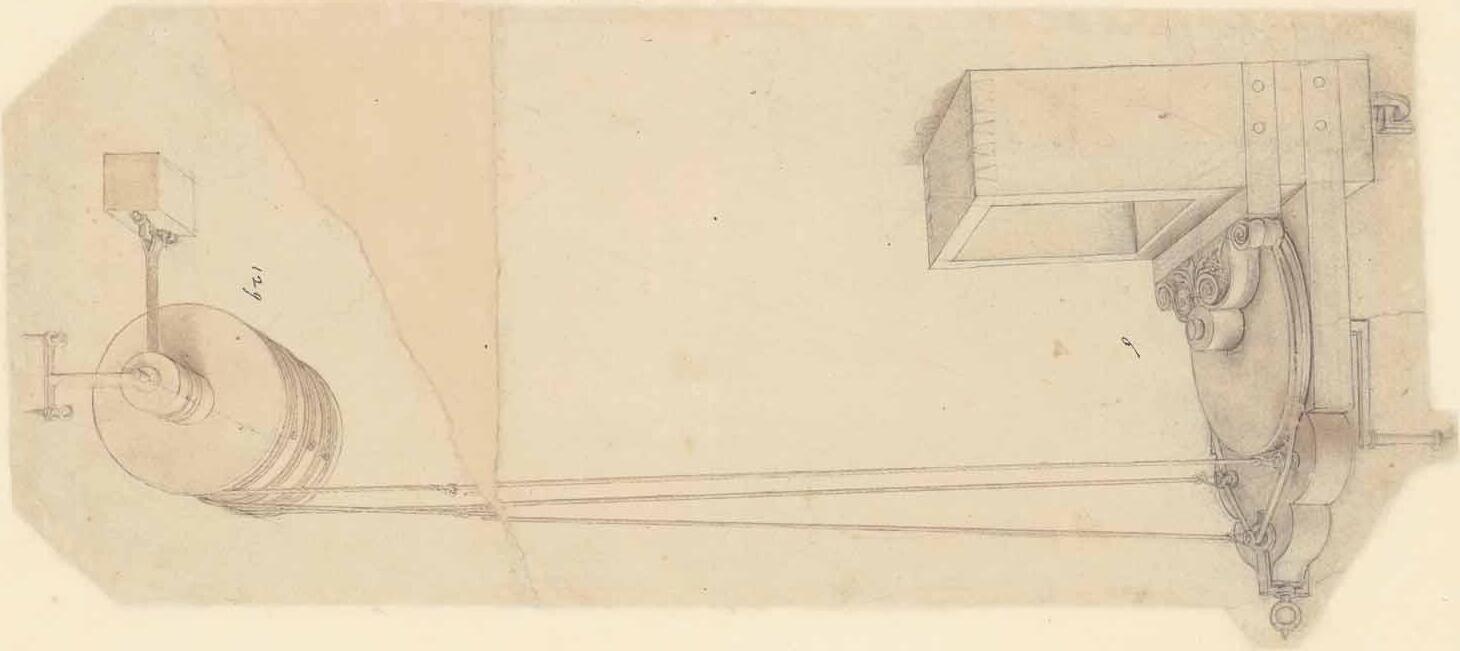
In this case as well, Leonardo drew a machine for making ropes with meticulous refinement and particular attention to effects of chiaroscuro. Like the preceding, this was probably designed during his sojourn in Rome at the Vatican. We can see the large drum driven by the crank behind, with the bobbins on which the strands are wound. On the
opposite side, a cylindrical drum of large dimensions keeps the cords under tension by means of a mass acting as counterweight. By comparison with the preceding drawing, here Leonardo wanted to pay even greater attention to the aesthetic presentation of the machine, with numerous decorations in curved lines seemingly foreshadowing a
somewhat baroque taste. Lastly, it has been pointed out that the bolt at the top of the machine (probably having the function of tensioner) has the form of a diamond ring.
This would be a sort of emblem of nobility, inserted into this device as a tribute in honor of Giuliano de’ Medici, Leonardo's patron during his Roman years.
STUDIES FOR A STRONGHOLD
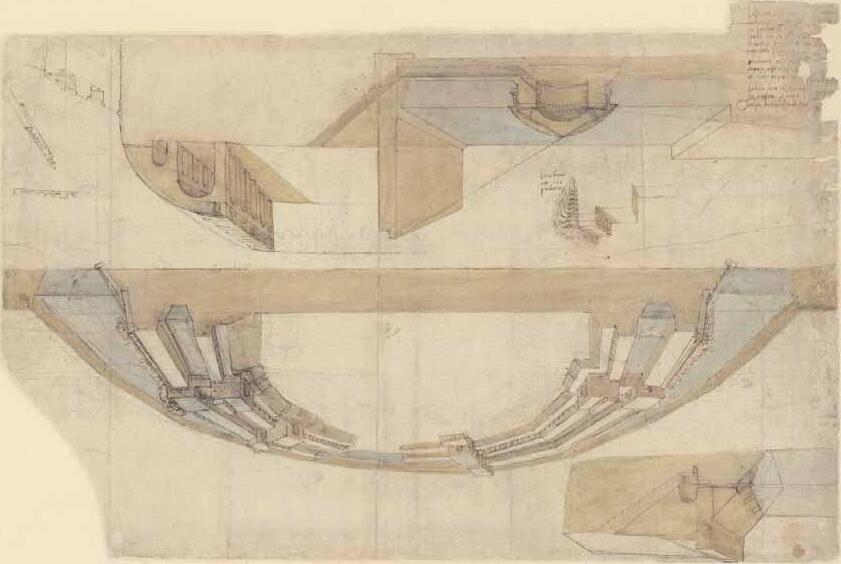
This is one of Leonardo's best elaborated architectural projects, noteworthy also for its use of watercolor. The subject is one half of a large stronghold, shown in perspective obliquely from above, appearing at the central part of the folio. The stronghold is surrounded by a broad moat followed by two raised walls, with a second, intermediary moat. In the upper left corner, we see a detail of the defensive wall, shown in section. We can see that there was even an underground tunnel planned, which could be accessed via a steep staircase. Standing out in the lower part, we see the drawing of the moat, also reproduced in section view. Inside it, submerged in the water, we see a singular construction with obvious defensive purposes; then, to the right, in beautiful perspective, a piece of a circular portico has been drawn. Lastly, there is a curious small sketch positioned between the two larger drawings. It represents a brief section of the defensive wall, protected on the outside by a coating of hay, a somewhat empiric system for cushioning the blows of enemy artillery. The brief caption reading “wetted and muddied” would appear to allude to this.
B LACKPENCIL , PEN , INK , ANDWASH 17.3 X 11.6 IN (439 X 294 MM ) C . 1502–1503
Folio 116r
MECHANICAL WING
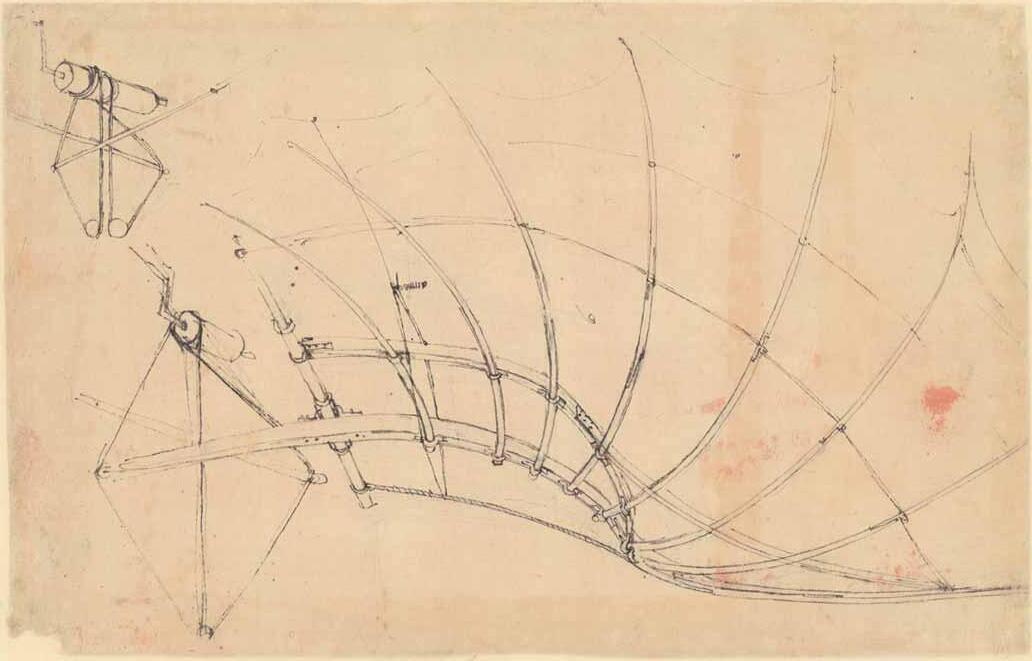
This folio conserves the drawing of a large mechanical wing, the bearing structure of which, similar to a skeleton, is emphasized with particular precision. In fact, right at the center of the wing, Leonardo has written, with his usual backward handwriting, the word “cloth,” seemingly to indicate that the structure was then to be covered with fabric. In the right part of the drawing we can clearly see the mechanism for giving movement to the wing: a crankoperated winch that moves the rope with an alternating movement so as to produce the beating of the wing itself. According to certain scholars, this project for an artificial wing could be interpreted as part of an apparatus of stage machinery designed to simulate the beating of wings, rather than as an actual device for mechanical flight.
Folio 858r I NKONPAPER
6.8 X 10.7 IN (173 X 271 MM )- C . 1478–1480