Inspiring ART MUSEUMS
1 VERBEKE FOUNDATION
Westakker 2
Kemzeke
East Flanders
+32 (0)3 789 22 07 verbekefoundation. com
Here is one of the strangest spots in Belgium. It looks like a junk yard next to a motorway, out in the middle of nowhere. But this unexpected location is home to one of the most astonishing private art collections in Europe. It’s not easy to find, even with the best map. You have to look out for the McDonald’s sign poking above the trees. Then you might spot a small sign pointing to the Verbeke Foundation. Turn off the road here and look for a parking space among the rusting cranes and heaps of wood. Geert Verbeke used to run a road haulage business on this site. He turned the place over to art in the summer of 2007. It has slowly evolved into a rambling, overgrown collection with strange rusting sculptures hidden among the trees and odd art creations stored in an enormous glass greenhouse. Verbeke has acquired some striking art works over the years, including a giant vase by Andrea Branzi that once stood in the courtyard of the Ghent Design Museum, a group of realistic horse sculptures by Ronald de Winter and a collection of Theo Jansen’s curious moving creatures called Strandbeesten. Visitors receive a little map to navigate around the site, which lists more than 60 works dotted around the wilderness. Some are so well hidden almost no one ever finds then, like Ryan Mendoza’s The
White House, an abandoned Detroit building in a remote clearing in the woods.
The collection also includes the vast Archive for the Future by the Dutch artist Jacobus Kloppenburg, which occupies a warren of little rooms inside 13 stacked shipping containers. Most of Kloppenburg’s works were destroyed by Amsterdam city council when it removed 52.000 kilos of art from his house in 13 containers. Here you can see all that remains.
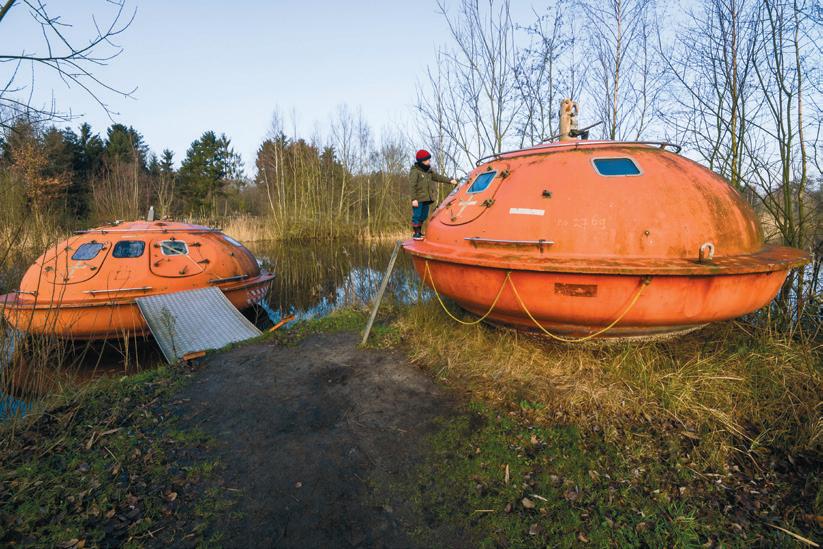
The Verbeke foundation provides space where artists can work on temporary projects while living in a small farmhouse. It also has a restaurant with a terrace, an artificial lake and two art installations where you can spend the night.
1 VERBEKE FOUNDATION
Forgotten HISTORY
36 BRÛLY-DE-PESCHE
Brûly-de-Pesche
Namur
Brûly-de-Pesche is a tiny village in the Ardennes reached along a deserted road. You could easily pass through without realising anything about its extraordinary history. But stop to look at the information board near the church and you begin to realise the importance of this place. It began in the early summer of 1940 when German troops evacuated 28 villages in the region, including Brûly-de-Pesche, forcing 27.000 people out of their homes. It was the start of one of the largest secret operations of the Second World War. For 22 days, this tiny village near the French border became Hitler’s command centre for the invasion of France.
The village is still dotted with buildings briefly occupied by the Nazi leaders. The local school became a command centre where generals bent over large maps as tanks moved closer to Paris. The church was converted into a cinema where Hitler would watch German propaganda newsreels on a screen put up in front of the altar.
A massive concrete bunker was built in the woods to protect Hitler from air attacks. Two Bavarian chalets were constructed nearby as a canteen and officers’ mess. The trees around the bunker were painted with white fluorescent stripes to mark a route through the woods in the dark. They led to a stone amphitheatre and a small pool in a clearing
where Hitler met military leaders such as Göring and Von Ribbentrop.
Most of these places where history was made are still standing, including the path near the church where Hitler performed a little dance after he was told France had fallen and the church where the surrender document was translated into French and typed out.
The site was forgotten for many years until a new visitors centre opened in 2015. Its focus is less on Hitler’s brutal invasion plan and more on the lives of ordinary Belgian families forced to leave their homes in 1940. It includes a fascinating section on resistance fighters who hid in the forest at the end of the war. Once you have visited the site, you can follow hiking trails in the woods or eat lunch in the friendly local restaurant La Fontaine.
37 THE FATAL ROCK
Marche-les-Dames Namur
A quiet path runs through the woods to the rocks where King Albert I fell to his death in 1934. You get there across a railway line and then up a steep trail through the trees. The rocher fatal (death rock) is closed off by a low wall to stop people getting too close. There is nothing to say what happened in this haunting, forgotten spot.
The country woke up to hear the news on the radio on the morning of 18 February. The King had fallen while climbing alone near the village of Marche-lesDames. It made no sense. He was an experienced climber who had tackled some of the hardest peaks in the Alps, so why did he fall during a simple beginner’s ascent? Some people still believe in a conspiracy.
Exceptional ARCHITECTURE
71 WINTER GARDEN IN THE URSULINE CONVENT
Bosstraat 9
Onze-Lieve-VrouwWaver
Antwerp
+32 (0)15 75 77 28
visitwintertuin.be
The winter garden of the Ursuline Convent is one of the most beautiful art nouveau buildings in the country. The only problem is it is hidden inside a Catholic convent school. It used to be almost impossible to visit, but now you can book to join a guided tour on Sunday afternoons. The winter garden was designed to impress wealthy parents who were looking for a good boarding school for their daughters. It is a stunning art nouveau space with a vaulted iron roof, stained glass windows and palm trees in pots. The guided tour takes in other surprising spaces, including empire-style interiors, galleries with tiled floors, and a beautiful corridor lined with 35 neat little rooms where girls sat at pianos practising their pieces.
Guided tours from March to October on Sundays at 2.30 pm, reservation is recommended.
72 PALACE OF THE PRINCE-BISHOPS
Place SaintLambert 18
Liège
It can look forbidding from the outside. You have to squeeze past a barrier to enter the courtyard. Sometimes armed police block the entrance because the building is now occupied by law courts. But it was originally a palace built in the 16th century in the early renaissance style of Italy. The courtyard is surrounded by an arcade
with columns decorated in grotesque style. The bizarre faces, monsters and vegetation add to the menacing atmosphere of the courts. Look carefully in the arcade near the entrance and you will find a bronze plaque embossed with the last letter Georges Simenon wrote before he died.
73 ROYAL LODGE, GROENENDAAL
O.L.V. van Loretopad
(near Groenendaal station)
Hoeilaart
Flemish Brabant
A strange forgotten pavilion stands deep in the forest to the south of Brussels. It was built by King Albert I in 1924 as a royal lodge overlooking the Groenendaal racecourse. The racecourse had been founded 35 years earlier by Léopold II. Once the haunt of European high society, it had its own railway station, elegant wrought iron grandstands and betting shops. But it closed in 1991, leaving just the isolated royal lodge, which was restored in 2016 as a venue for weddings and meetings. You can track down a training racecourse hidden in the woods to the north. Enclosed by earth embankments, this course is still used by horse riders. It lies near a former stable building converted into a B&B and cafe, where you can sit on the terrace with a beer after exploring the woods.
74 VAUX-HALL
Parc de Bruxelles/ Warandepark Brussels
A narrow cobbled lane next to the Théâtre du Parc in Brussels leads to the forgotten Vaux-Hall. Hidden among tall trees, this intriguing neoclassical building was constructed on the edge of the park in the 18th century. Inspired by the Vauxhall Pleasure Gardens in London, it served at different times as a concert hall, ballroom and cafe. Now it is occupied by an exclusive club.
Eccentric COLLECTIONS
117 NATURAL HISTORY MUSEUM, TOURNAI
Hôtel de Ville
Rue St-Martin 52
Tournai
Hainaut
+32 (0)69 33 23 43 tournai.be
Founded in 1829, one year before the Belgian Revolution, this cabinet of curiosities in Tournai is the oldest museum in Belgium. It occupies a beautiful arcade inside the town hall designed by the architect Bruno Renard. Here you can admire a fascinating collection of animals, including the first elephant to arrive in Belgium, along with rare Egyptian turtles and endangered boa constrictors. The museum was recently restored to preserve its authentic 19th-century atmosphere.
118 BELLE EPOQUE CENTRE
Elisabethstraat 24
Blankenberge
West Flanders
+32 (0)50 63 66 40 belle.epoque. blankenberge.be
The beach town of Blankenberge is mostly modern apartments, but there are a few architectural treasures in the quiet back streets. A few blocks from the beach, the Belle Epoque Centre occupies a row of three houses built in the flamboyant style of the late 19th century. The houses are filled with relics from the time when Blankenberge was considered the most elegant resort on the North Sea. Visitors can enter a living room furnished in period style, listen to music hall songs on headphones and step out onto an astonishing roof terrace with a replica Gaudi bench made using ceramic tiles salvaged from demolished seaside houses.
119 MUSEUM
DR. GUISLAIN
J. Guislainstraat 43
Ghent
East Flanders
+32 (0)9 216 35 95
museumdrguislain.be
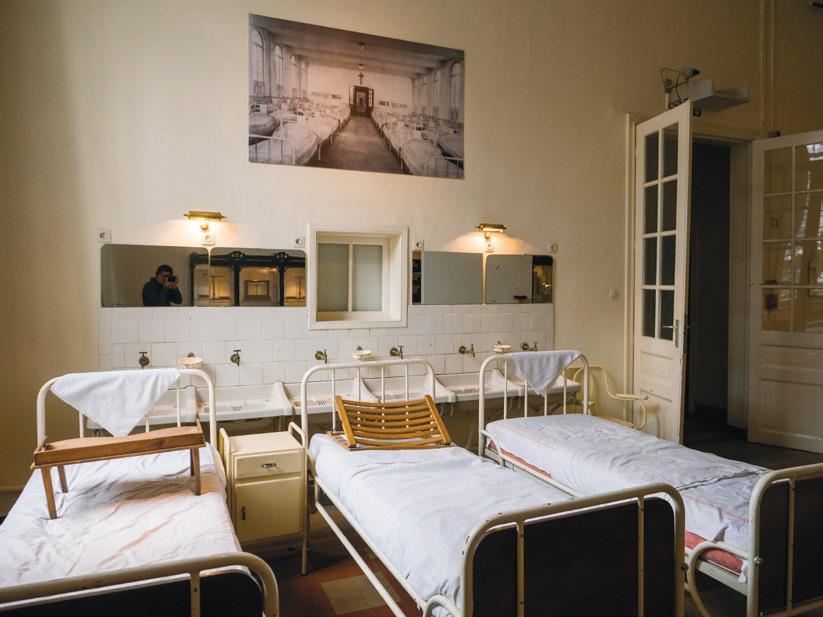
The strange and haunting Dr. Guislain Museum occupies one wing of a model psychiatric institution founded in the 19th century by Dr. Jozef Guislain. Visitors can wander through chilling deserted wards still furnished with iron beds and old medical equipment. One room contains a terrifying mechanical saw used in operations to remove the top of the skull. The temporary exhibitions are always fascinating, as is the extensive collection of outsider art. Almost no one leaves this museum untouched.
119 MUSEUM DR. GUISLAIN
Engineering WONDERS
152 SHIP LIFTS ON THE CANAL DU CENTRE
Rue Tout-Y-Faut 90
Houdeng-Goegnies
Hainaut voiesdeau.hainaut.be
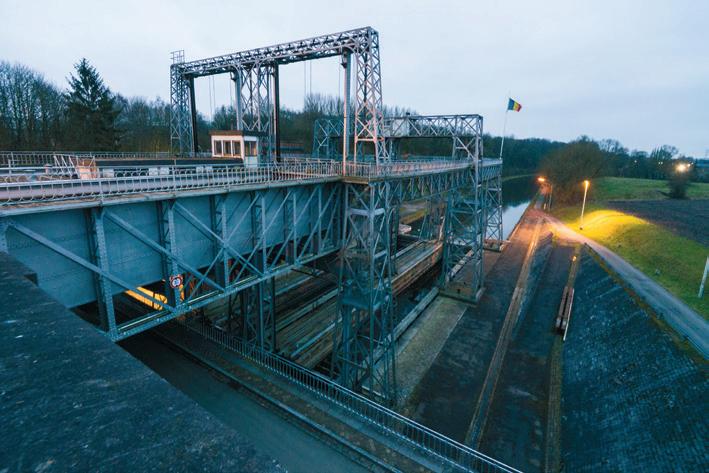
One of the great engineering projects of the 19th century is hidden away in the rust belt of Wallonia. The four ship lifts on the Canal du Centre were built in the 1880s to connect the Meuse and Scheldt rivers. Napoleon had already tried to build a canal to link northern France with the Ruhr region, but his engineers were defeated by a 70-metre ridge calling for 33 separate locks. The problem was finally solved by building four hydraulic canal lifts. These astonishing wrought iron structures employ the laws of fluid mechanics to lift barges floating in huge watertight troughs.
152 SHIP LIFTS ON THE CANAL DU CENTRE
As the upper trough descends with a barge floating inside, the lower one is pushed up by water pressure.
Designed by a British engineer, the lifts were opened by King Léopold II in 1888. They could raise a 300-tonne barge 17 metres in just a few minutes, using nothing more than water pressure. For more than a century, these lifts were a vital part of Europe’s inland waterways, carrying barges laden with coal and gravel. They are now too small for huge modern barges, but have been preserved in working order by local enthusiasts, who run boat tours in the summer.
One of the old engine houses on the canal waterfront has been turned into a museum filled with scale models, plans and photographs. You can also look inside simple wooden huts where Italian mineworkers lived and visit a restored wooden barge. There is a cafe, but it is basic. Boat trips are organised by Voies d’Eau du Hainaut.
153 PETIT LANAYE LOCKS
Petit Lanaye Liège
The huge complex of three locks at Petit Lanaye was built in 1962 on the River Meuse to take barges sailing between Liège and Maastricht. An enormous fourth lock was added in 2016 to carry much larger modern barges. The locks stand next to the wide Albert Canal which passes through a canyon blasted out of the rock in the 1930s. The entire site has been landscaped as a visitor attraction with an observation deck overlooking the locks.
Unusual BOAT TRIPS
202 LIÈGE RIVER BOATS
Liège
+32 (0)4 221 92 91 navettefluviale.be
203 NIEUWPOORT FERRY
Paul
Orbanpromenade Nieuwpoort
West Flanders
204 ROGER RAVEEL FERRY
Visserskaai
Ostend
West Flanders
It’s now possible to see Liège from the river by taking a new river shuttle called La Navette Fluviale. It runs every hour, with six stops along the river including La Boverie, the Grand Curtius museum and the historic centre. Sit on the upper deck for a surprising view of this ancient and overlooked city or shelter down below when it rains. Tickets cost one euro for each stop. River boats run every day from April to October.
It’s fun to hop on the free ferry introduced in 2011 to take people across the IJzer estuary in Nieuwpoort. It leaves from the Westerstaketsel jetty and drops you off a few minutes later on the edge of a windswept nature reserve. You can then hike along the beach to Westende and take the tram back to Nieuwpoort.
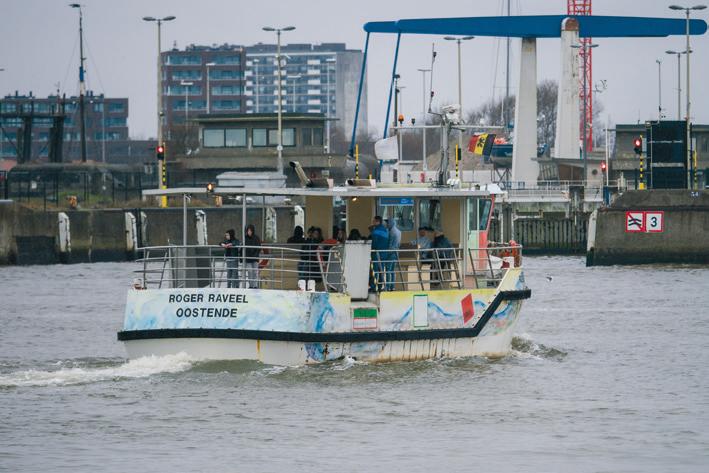
Look out for the free ferry departing from the Aquarium in Ostend to the old docks on the other side of the harbour. The little ferry carries foot passengers and cyclists to a relatively quiet area on the east side of the harbour, where trails lead to an old Napoleonic fort and a quiet beach just behind the dunes. The ferry is named after the Belgian artist Roger Raveel, who decorated the side of the boat.
205 BERLARE
Berlare East Flanders
A little yellow ferry takes cyclists and hikers across the River Dender every half hour. It forms a useful link in a network of quiet cycle routes along towpaths on either side of the river. Overlooking the landing stage on the north bank, the local bar ’t Veerhuis is popular with local cycle teams stopping off for a Belgian beer. Located between cycle points 76 and 77.
204 ROGER RAVEEL FERRY
Unique SHOP INTERIORS
248
HAIRDRESSERS OF THE MATONGE
Chaussée de Wavre and nearby
streets
Matonge district
Brussels
249 PUYDTJES
Neermarkt 2 Ypres West Flanders
+32 (0)57 20 05 33 puydtjes.com
The Matonge district in Brussels has a strong African spirit that dates back to the early 1960s. The neighbourhood is dotted with African hairdressers serving as informal community centres. They remain open until late at night as women sit getting their hair done, business deals are discussed, children do their homework and parcels are collected.
The Depuydt family’s butcher shop in Ypres was destroyed during the First World War, but rebuilt in 1922 using the old plans. So the interior looks much as it did in 1908 when the shop first opened. This is the only place in Ypres where you can buy pâté made with Sint-Bernardus Abt 12 beer. This shop also sells a delicious Ypres pâté made with Calvados as well as an old-style boerenpâté based on a 1907 recipe.
250 ROMBAUX
Mallebergplaats 13
Bruges
West Flanders
+32 (0)50 33 25 75 rombaux.be
This beautiful family business located in an old Bruges town house is a reminder of the days before the internet killed off the music store. It is worth going inside just to wander through the labyrinth of small rooms with their original mosaic floors, stained glass and wood panelling. Run by the same family for three generations, Rombaux is crammed with every imaginable genre from rare classical composers to new Flemish folk. Shopping here is so much richer than clicking on the internet.
251 FREDERIEK
VAN PAMEL
Ezelstraat 33
Bruges
West Flanders
+32 (0)50 34 44 80 frederiekvanpamel.
be
252 ANIMAUX
SPÉCIAUX
Mechelsestraat 73
Leuven
Flemish Brabant
+32 (0)497 66 17 64 animauxspeciaux.be
The Bruges florist Frederiek van Pamel has built up a reputation for creating stunning floral arrangements for special events. He moved in late 2017 to a large town house in the cobbled Ezelstraat where he sells stylish house plants, gardening tools and exotic floral bouquets.
Taxidermist Jeroen Lemaitre sits in a cluttered room at the back of his shop in Leuven working on extraordinary animal creations. His wondrous little shop is filled with exotic butterflies in bell jars, extraordinary framed insects, animal skulls and vintage posters printed with insects.
Uncommon EATING
278 LA BUVETTE
Chaussée
d’Alsemberg 108
Brussels
+32 (0)2 534 13 03 la-buvette.be
This little Brussels restaurant is one of the most exciting spots to eat in town. It occupies a former butcher’s shop with a striking art deco interior. The ground floor still has the original polished wood, tiled walls and menacing steel meat hooks hanging from the ceiling. The two upstairs rooms are less interesting. The menu is limited to two choices – six courses or eight. The young French chef Nicolas Scheidt has two signature dishes he always makes, including a delicious chocolate tart. The rest is up to his imagination.
279 GAARKEUKEN 110
Vosseschijnstraat
21
Antwerp
+32 (0)3 541 00 30 gaarkeuken110.be
There’s nothing fancy about Gaarkeuken 110. It’s an old harbour workers’ restaurant located in a desolate area of the docks next to stacks of shipping containers. It has been serving basic Flemish food and decent beer for more than a century. You sit at a simple wooden table with your bowl of soup and listen to the babble of voices all around. Open from 5 am until 8 pm.
280 FONG MEI
Van Arteveldestraat
65-67
Antwerp
+32 (0)3 225 06 54 fongmei.be
This little restaurant in the heart of Antwerp’s Chinatown doesn’t look too promising. It has old furniture, paper tablecloths, stacks of wine boxes left lying around and a poster of Hong Kong at night. But don’t be put off. This is the real thing, full of noisy Chinese people who work in the neighbourhood. You are handed a menu with a long list of specialities, including 34 dim sum dishes made by a dedicated dim sum chef who learned his craft in Hong Kong. Some wonderful sensations are produced, like steamed shrimp balls with crab, and steamed pork and shrimp dumpling. You won’t be disappointed.
281 IL CARDINALE
Sint-Rombouts
Kerkhof 1
Mechelen
Antwerp
+32 (0)468 21 00 91 ilcardinale.be
Two young graphic designers have created a hip hamburger restaurant across the road from Mechelen Cathedral. The bright interior is decorated with raw concrete walls, wood floors and bare lamps. The cheeky pair have added a touch of heresy by decorating one wall with statues of the Virgin and giving their burgers names like Holy Guacamole, Mary Had a Little Lamb and Noah and the Fish. Their final wicked touch is to play loud Gregorian chants in the basement toilets. Heaven help us.
Authentic BELGIAN CAFES
316 IN DE VERZEKERING TEGEN DE GROTE DORST
Frans
Baetensstraat 45
Eizeringen, near Lennik
Flemish Brabant
+32 (0)2 532 58 58
dorst.be
317 DE KAT
Wolstraat 22
Antwerp
+32 (0)3 233 08 92
No one could really believe it in 2016 when In de Verzekering Tegen de Grote Dorst (Insurance against a Huge Thirst) was voted the best bar in the world. It is after all just a rustic local cafe next to the church in a Flemish village near Brussels. And it is only open for ten hours every week – on Sundays, holidays and after local funerals. But the website RateBeer has put it at the top of their ranking. Run by two brothers and their mother, the cafe stocks hundreds of Lambic beers produced in the local area, including some very rare bottles. The owners believe their bar became famous after a group of beer tourists ended up there after their bus got lost in the rolling hills. It has a rather austere 1950s interior, no food and no credit card machine, but it is truly authentic, with a mix of locals and beer enthusiasts creating a relaxed mood.
De Kat is one of those old Antwerp bars where nothing much has changed in a hundred years. It still has the original wood panelling, mirrors and tiled floor. This is the perfect place to taste the local De Koninck beer served in a round glass known as a bolleke.
318 LEUVEN CENTRAL
Margarethaplein 3
Leuven
Flemish Brabant
+32 (0)16 20 81 27
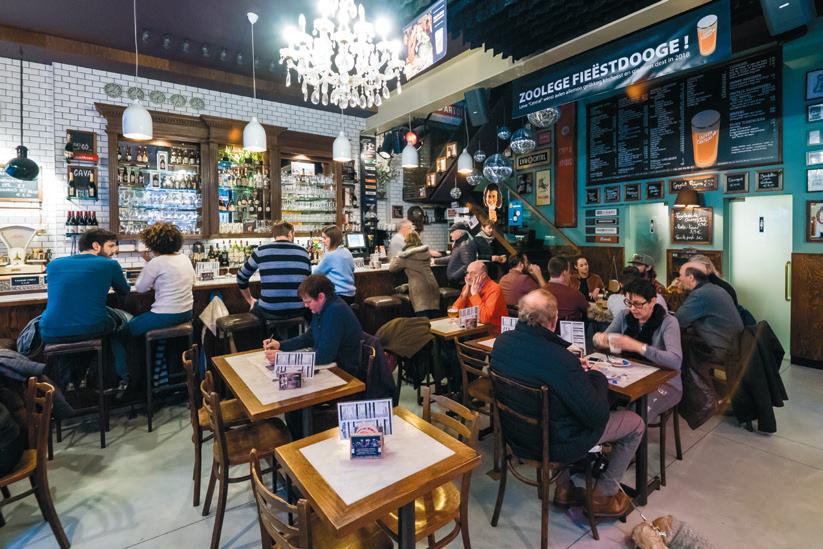
This genuine Leuven volkscafé opened in 2015 in an abandoned corner cafe, near a plaque to mark the official centre of Leuven. The new owners have carefully preserved the original interior with its wooden furniture, Stella Artois signs and rows of aspidistras on the window sills. They offer authentic Flemish bar food, like pistolets met hesp (ham rolls), homemade meat balls and even a basket of hard boiled eggs on the counter.
318 LEUVEN CENTRAL
Hotels in HISTORIC HOUSES
346 GRAND HOTEL
CASSELBERGH
Hoogstraat 6
Bruges
West Flanders
+32 (0)50 44 65 00 grandhotel
casselbergh.be
347 LES
COMTES DE MÉAN
Rue du Mont
Saint-Martin 9-11
Liège
+32 (0)4 222 94 94 lescomtesdemean.be
This impressive new hotel in the heart of Bruges is located in two restored buildings just a few steps from the Burg square. Named after a mediaeval palace that stood here, the hotel has spectacular 18th-century halls, old stone columns from the 15th century and a comfortable bar with a blazing fire. Some bedrooms occupy the old mansion, while others are located in a modern extension.
Located in two restored town houses, this is a gorgeous urban hotel looking down on the old town of Liège. You enter through a baroque courtyard dating from 1620, but there is an older 15th-century structure deep inside the complex. The interior design is cool, spacious and contemporary, with some striking spaces including a neoclassical ballroom, a lounge with views of the city, and a bar down in a vaulted mediaeval cellar. Somewhat confusingly, the entrance lobby is on the seventh floor, while bedrooms are on lower levels, but that’s part of the charm of this ancient building.
348 THE FOURTH Grote Markt 5
Leuven
Flemish Brabant
+32 (0)16 22 75 54
th4th.com
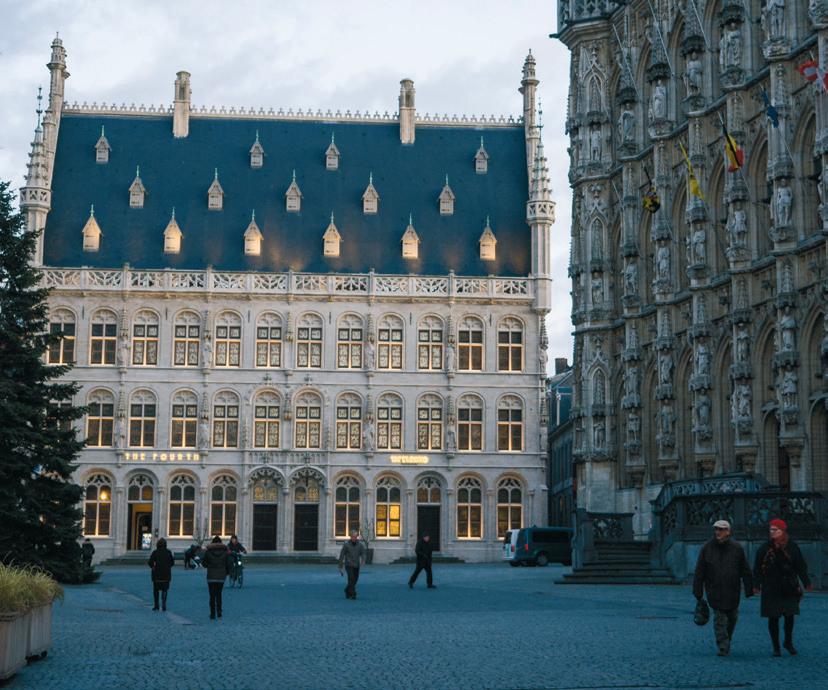
This stunning hotel opened in 2017 in a renovated Gothic building in the heart of Leuven. The curious name was chosen because the hotel is the fourth occupant of the building. Built in 1479 for the local guilds, it became a theatre in 1817 and a branch of the National Bank in 1930. The building has now been transformed to create a fabulous hotel where bedrooms have smart light switches and a personal supply of artisanal coffee beans from Bolivia.
348
THE FOURTH
COLOPHON
EDITING and COMPOSING — Derek Blyth
GRAPHIC DESIGN — Joke Gossé
PHOTOGRAPHY — Roel Hendrickx — www.roelh.zenfolio.com
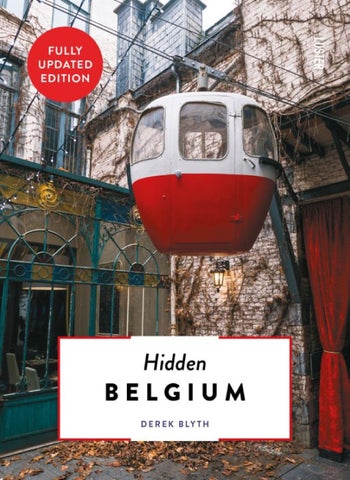
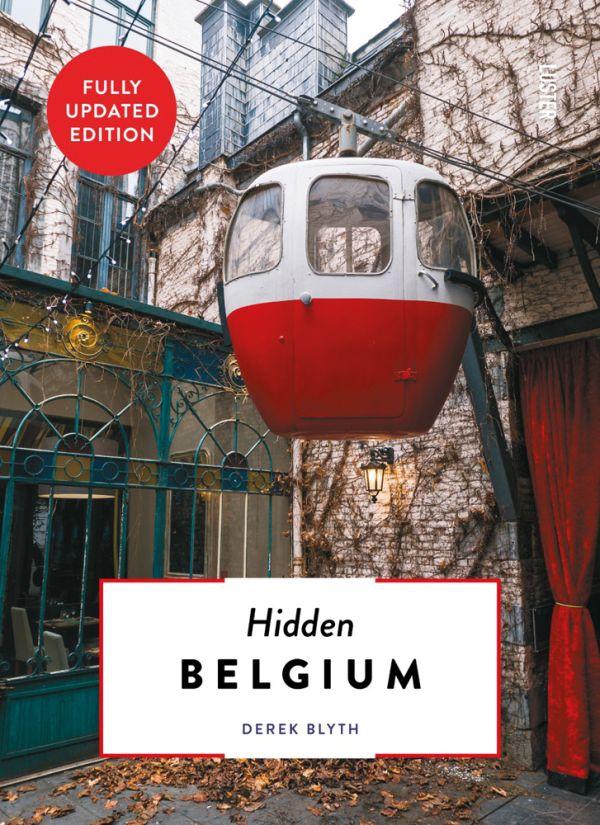
COVER IMAGE Cable Car Cabin, Namur
The addresses in this book have been selected after thorough independent research by the author, in collaboration with Luster Publishers. The selection is solely based on personal evaluation of the business by the author. Nothing in this book was published in exchange for payment or benefits of any kind.
D/2018/12.005/5
ISBN 978 94 6058 2141
NUR 511, 510
© 2018, Luster, Antwerp www.lusterweb.com info@lusterweb.com
Printed in Italy by Printer Trento.
All rights reserved. No part of this publication may be reproduced, stored in a retrieval system, or transmitted, in any form or by any means, without the prior written consent of the publisher. An exception is made for short excerpts which may be cited for the sole purpose of reviews.