Piazzale Luigi Cadorna, 6 20123 Milan, Italy www.whitestar.it
New expanded and updated edition
Translations
Neil Frazer Davenport - Hugh Swainston - John Venerella
All rights reserved. No part of this publication may be reproduced, stored in a retrieval system or transmitted in any form or by any means, electronic, mechanical, photocopying, recording or otherwise, without written permission from the publisher.
ISBN 978-88-544-2225-4
1 2 3 4
1 top The NASA Space Shuttle “Challenger” in orbit with its loading bay open, seen during its STS-7 mission.
1 bottom A reinforced wing designed by Leonardo da Vinci (1452-1519), who proposed the first technical approach to the problem of human flight.
2-3 One of the RAF’s heavily armed Panavia Tornado F.3 fighters in high-speed flight. The Tornado was the first example of largescale multinational cooperation in European aircraft design and manufacturing.
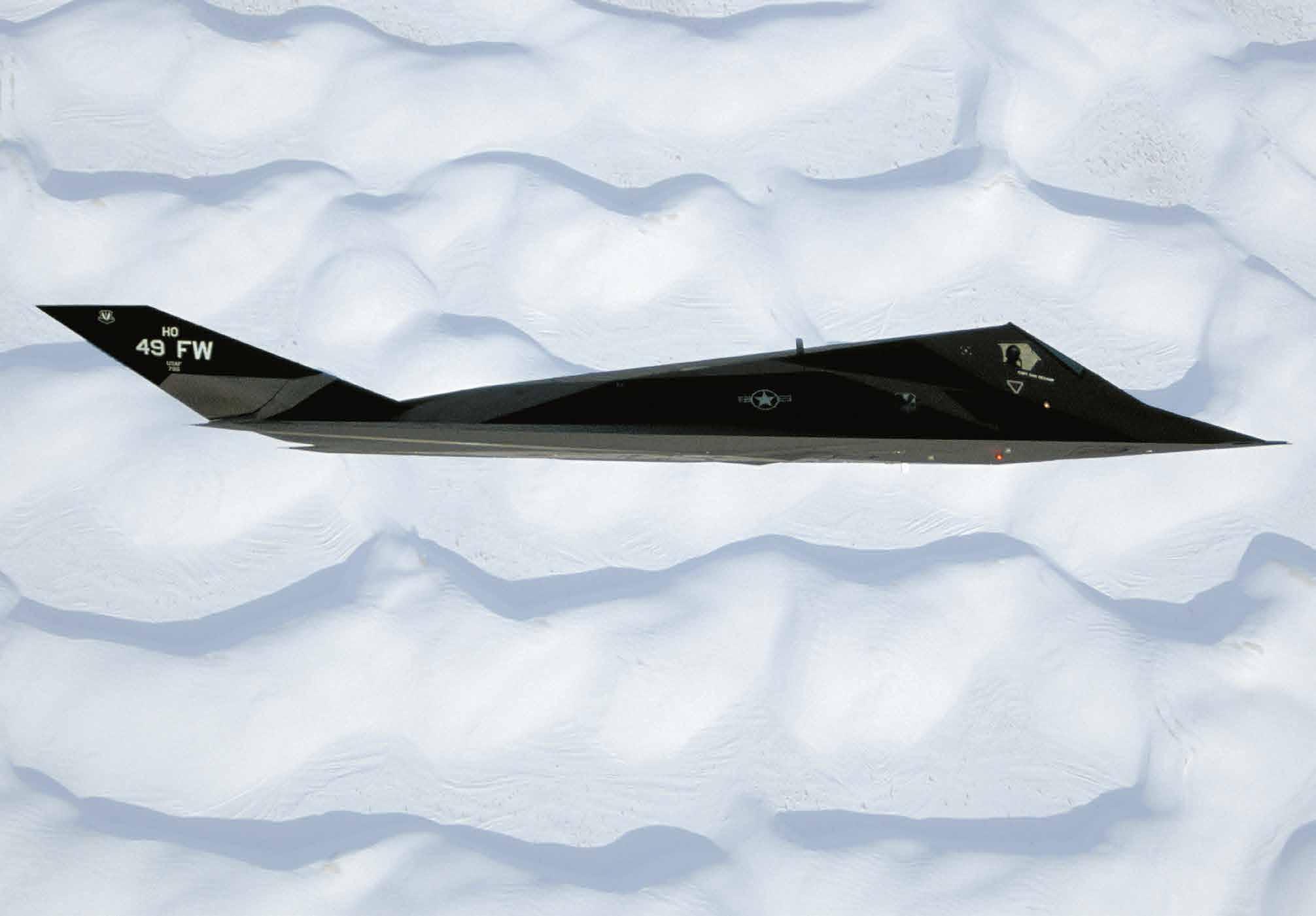
4-5 The Stealth F-117A fighter-bomber’s futuristic form highlighted during a low-altitude turn over the White Sands desert region of New Mexico.
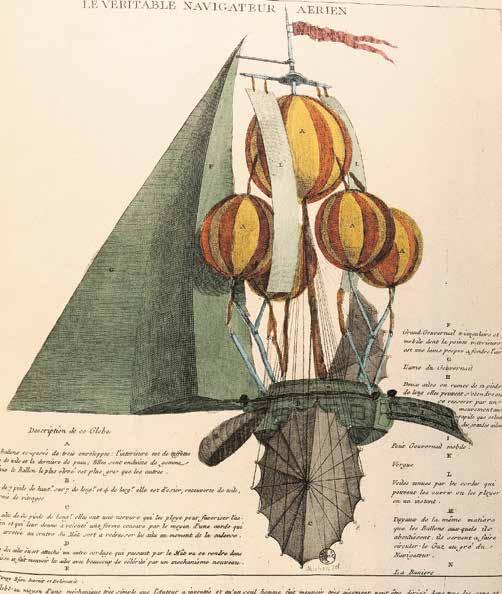
5 bottom An impracticable airship design as imagined in the nineteenth century.
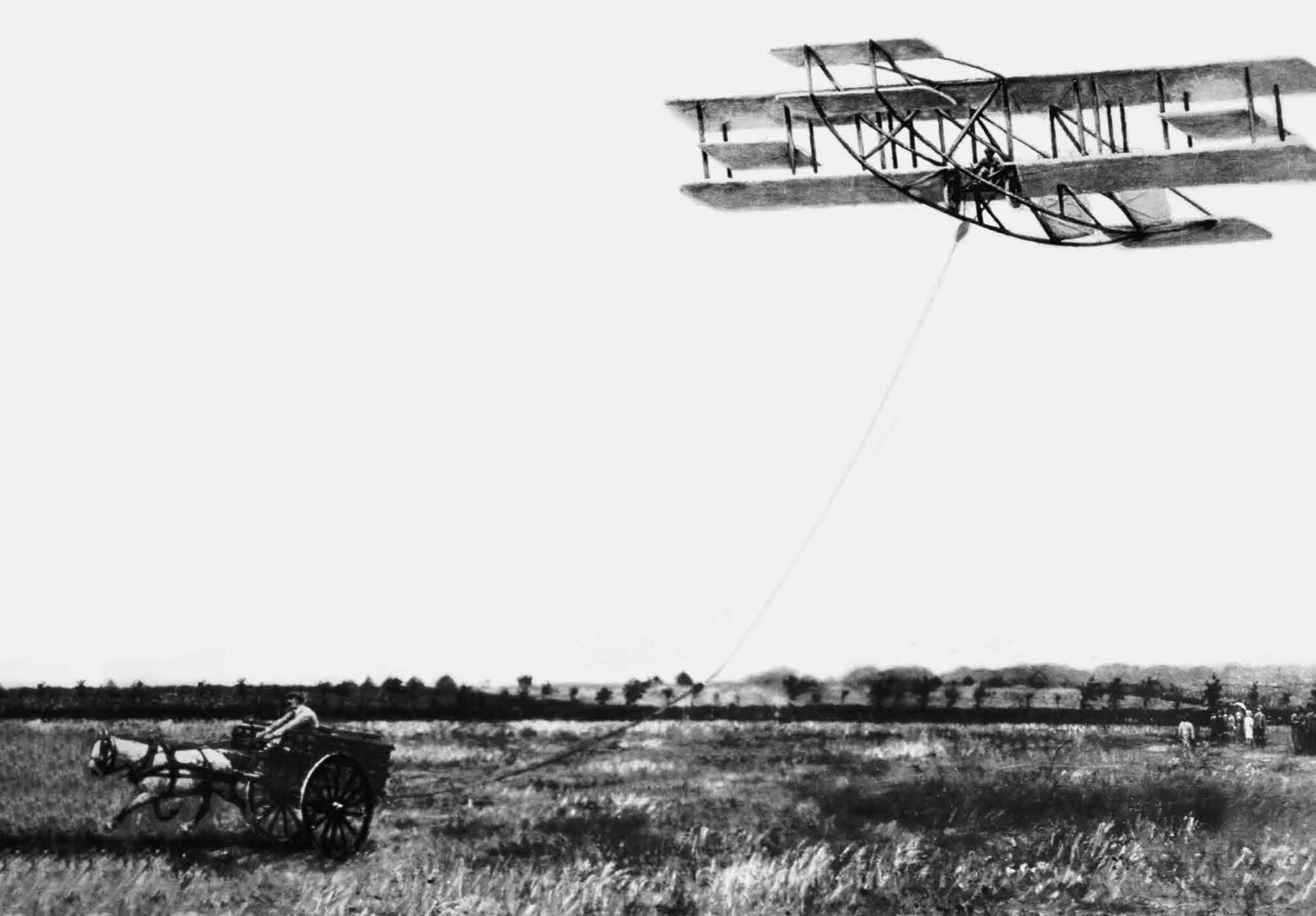
6-7 In the early days of flight, getting airborne called for desperate measures. Here a horse and cart help launch a Caudron biplane glider into the air.
Preface
Pine hundred years. So much has happened since that cold winter day of 17 December 1903 when a heavier-than-air engine-powered aircraft first demonstrated that controllable human flight was possible. Rather than a wavering flight, it was more a series of long hops, the first, 39 yards in length, and the longest about 282 yards, but in substance, mankind, human progress had actually taken a much greater leap. Probably few of those watching Orville and Wilbur Wright on the sand dunes at Kitty Hawk in North Carolina could have imagined that, within just a few years, man would begin his mastery of the air, building smoother, faster, more powerful, and increasingly manageable airplanes.
In comparison with the rate of invention in previous epochs, technological progress in the 20th century and at the beginning of the 21st century went lightning fast, and much of this was due to the efforts invested in research and development in aeronautics and space.
A little more than a decade after the Wright brothers’ flight, planes were able to exceed 125 mph and perform breathtaking acrobatics. In the 1920s, just two decades later, the first commercial transport planes appeared, able to convey passengers over long distances in times absurdly shorter than those for ships or trains. The advent of World War II accelerated development dramatically, producing conventional,
propeller-driven planes capable of doubling their predecessors’ power, speed, range, and load capabilities, but more importantly, it brought about the invention of the jet engine and the first usable helicopters.
Only 44 years after the Wright brother’s flight of 12 mph, a jet engine broke the sound barrier. A mere 60 years later, man flew in space. We could go on with the list of achievements, but this would be pointless: the results of over 100 years of flight are before our eyes every day.
Thanks to air travel, we can now reach every corner of the globe in just a few hours at costs affordable for almost everyone. Goods and materials can be transported with the same ease. Lives can be saved as a result of rapid search and rescue facilities. The sick and injured can be carried to distant hospitals where the finest care facilities or organ transplant capabilities are available. Populations struck by natural disasters or war can be reached and aided, and life-threatening fires can be accessed and extinguished.
Aircraft are vital in making land and sea surveys and in monitoring the environment and pollution. They are important in geography, topography, geology, archaeology, and zoology. For our safety, aircraft can scan, detect, and effectively monitor illicit actions and trafficking of a criminal or terrorist nature, often succeeding in preventing crimes.
In the military, aviation has revolutionized the rules of engagement and become the decisive instrument for victory not only for land battles, but even for the conflicts themselves. The recent wars in the Persian Gulf, Kosovo, Afghanistan, and Libya have shown how air power can decide alone the outcome of an entire regional crisis. As a result of specialized optical and electronic recognition capabilities, aircraft and satellites have made the world a safer and more peaceful place, rendering the great powers more knowledgeable about one another. Space travel has opened new horizons for the scientific world and brought benefits even to the man in the street. Shuttle flights and space station programs have increased human scientific knowledge in many fields, while orbiting satellites have spurred enormous advances in telecommunications and precision navigation.
This book pays tribute to the History of Flight. Through 27 chapters dedicated to its most renowned protagonists, events, and epochs, the principal engine-powered aircraft (planes and helicopters) marking the history of flight since 1903 are briefly examined. In spite of their technological interest, however, experimental aircraft have unfortunately had to be excluded from our inquiry: the purpose of the book is to draw attention to those craft that have really and effectively operated on a broad basis, whether for the civilian or
military sectors. The history of flight is immensely wide and deep in scope, and regrettably the limitations of a single volume have meant that dozens and dozens of aircraft deserving inclusion in both the text and photographs have been omitted.
Nor should we forget, beyond the many words, the impulse that has always urged man in his attempt to fly. By design, this book is also a celebration of the realization of one of man’s most ancient and yearned-for dreams: that of overcoming his physical limitations and the constraints of earthbound living, so that he might dare to hover within a more spiritual, a more divine dimension, that of flight.
Chapter 1
Man has felt the urge to fly from the earliest of times. As ancient legends recount, even the most powerful of men yearned for the sensation of potency and freedom that they imagined that the ability to launch themselves into the sky would provide. One of these legends, originating in Persia, refers to King Kai Kawus’ flight in a chariot drawn by eagles in around 1500 BC. Another, this time from Greece, recounts that Alexander the Great saw the skies from a wickerwork chest lifted by griffins. Moreover,
eagles and hawks, birds of prey that dominate the skies, have always been seen as symbols of power. During antiquity, flight was considered to be the prerogative of the gods. In fact, in the legend of Daedalus and Icarus and their feathers-and-wax wings, Daedalus escaped death only by flying low. Icarus, intoxicated by the thrill of flight, flew ever higher toward the sun, the symbol of divine power, until its heat melted the wax, with his sacrilegious act receiving appropriate punishment. Alongside these imaginative accounts are others, some thousands of years old, that testify to man’s practical efforts to conquer the third
The Earliest Endeavors
dimension. It appears that as early as two thousand years before Christ, the Chinese were capable of using kites to lift lookouts into the sky for military purposes. In 852 AD at Cordoba, an Arab savant was killed during an attempt at free flight, while in 1020 an English Benedictine monk named Oliver of Malmesbury threw himself from the top of a tower, wearing a pair of feathered wings; unfortunately he crashed to the ground breaking both legs. The years that followed were punctuated by a series of similar failures. In 1496 it was the turn of Senecio of Nuremberg, in 1503 the mathematician Giovan Battista Danti of Perugia, and in 1628 Paolo Guidotto, also from Perugia. For these and for others like them, the same irresistible temptation led to the same disastrous fate. In the meantime, studies into the phenomenon of flight were increasingly elaborate. The chronicles of 1630 report that a certain Hezarfen Ahmet Celebi succeeded in gliding from the top of the Galata Tower in Istanbul to the far side of the Bosporus, thanks to a pair of rudimentary wings. In 1670, Francesco Lana Terzi, a Jesuit, described a flying machine composed of four copper spheres in which a vacuum was to be created and a sail provided for the directional control of the flight. Early in the eighteenth century, another Jesuit, Laurenào de Gusmão of Brazil, designed a bird-like glider that he used
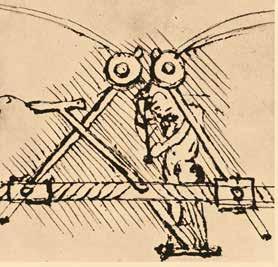
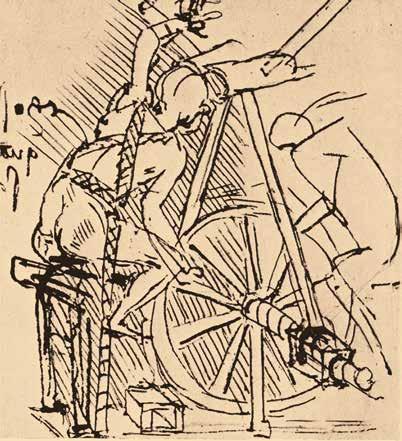
8 Leonardo da Vinci was the first scientist to consider flight from a rational viewpoint. He transferred the workings of his imagination to sketches and drawings that inspired many other thinkers in later centuries. The two small sketches provide examples.
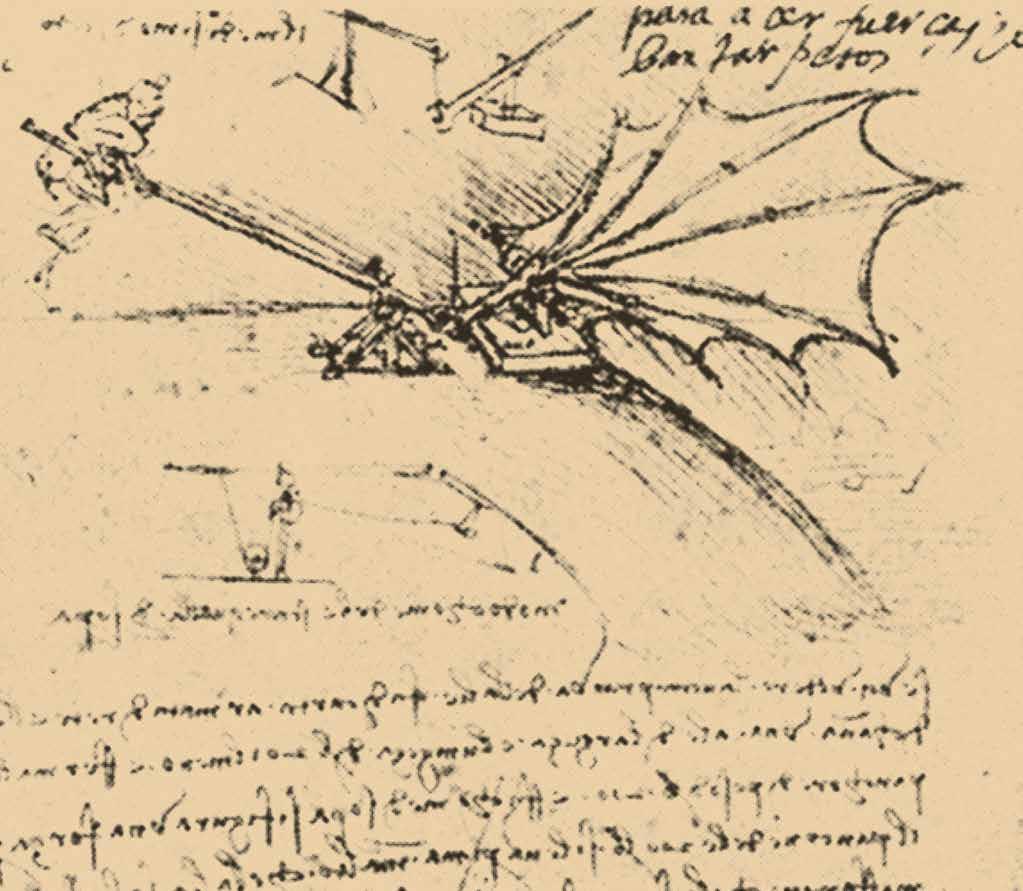
8-9 Surrounded by Leonardo’s characteristic mirror-writing is a sketch showing an experiment to prove the lift of a wing. Published for the first time in 1797, Leonardo’s famous notebooks were a great revelation.
for experiments: he also built what may be considered a primitive balloon, which he successfully demonstrated to the King of Portugal in 1709. In 1764 and 1781, the German Bauer and the Frenchman Blanchard designed and tested flying machines. In earlier times it appears that balloons and other lighter-than-air vehicles were also flown in China and Cambodia. It was not, however, until 1797 that Leonardo da Vinci’s codices were published for the first time, opening an incredible new window onto the science of aeronautics.
9 right Leonardo da Vinci: a self-portrait. The brilliant master, who excelled in the figurative arts, architecture and engineering, was born at Anchiano, outside Vinci in Tuscany in 1452. He died at Amboise in France in 1519.
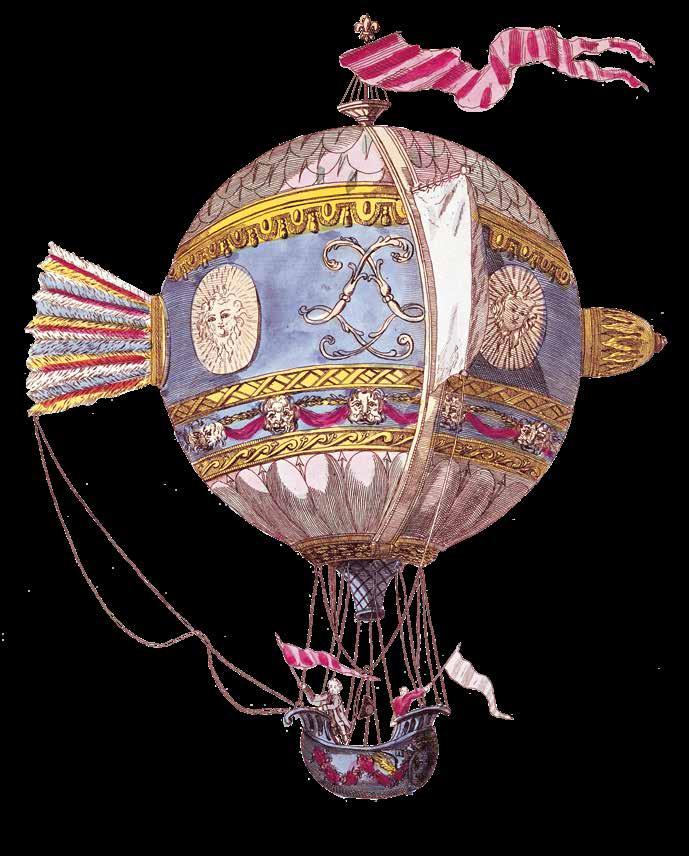
14 top This colorful and imaginative drawing shows an anonymous project for an aerostatic balloon measuring 120 feet in diameter (Carnavalet Museum, Paris).
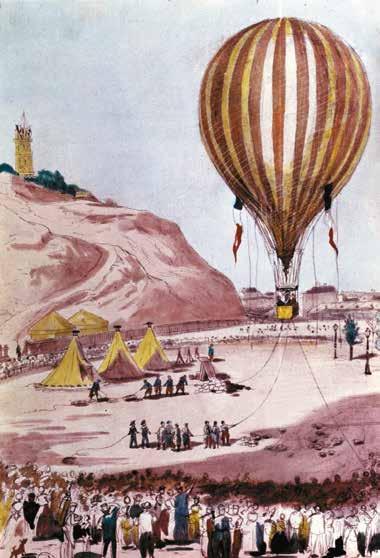
14 bottom The military potential of balloons was appreciated by many armies. Here we see a military balloon ascending during the siege of Paris, in the Franco-Prussian War of 1870.
The course had now been set and experimentation flourished.
The hot air balloon (known as the montgolfière in honor of its inventor) was joined on 1 December 1783 by the hydrogen balloon invented by the Frenchman, Jacques César Charles (and consequently named the charlière). He lifted off from the Tuileries in Paris and completed a flight of no less than 26.5 miles. Immense curiosity and desire flared up, and flights were made in many countries. In Italy there were those of Andreani and the Gerlis at Milan on 25 February 1784. In London that of Vincenzo Lunardi with a charlière hydrogen balloon on 15 September 1784 and at Philadelphia on 9 January 1793, that of the Frenchman Blanchard. On 5 January 1785, a passenger-carrying balloon crossed the English Channel for the first time.
In 1794 the maturity of ballooning technology was demonstrated by its adoption by the French army for artillery range-finding purposes. Its first use occurred during the battle of Fleurus in Belgium on 26 June 1794, when the French defeated the Austrian forces. Five years later, however, Napoleon Bonaparte disbanded the world’s first air force, and military use of the balloon was not revived until the second half of the nineteenth century.
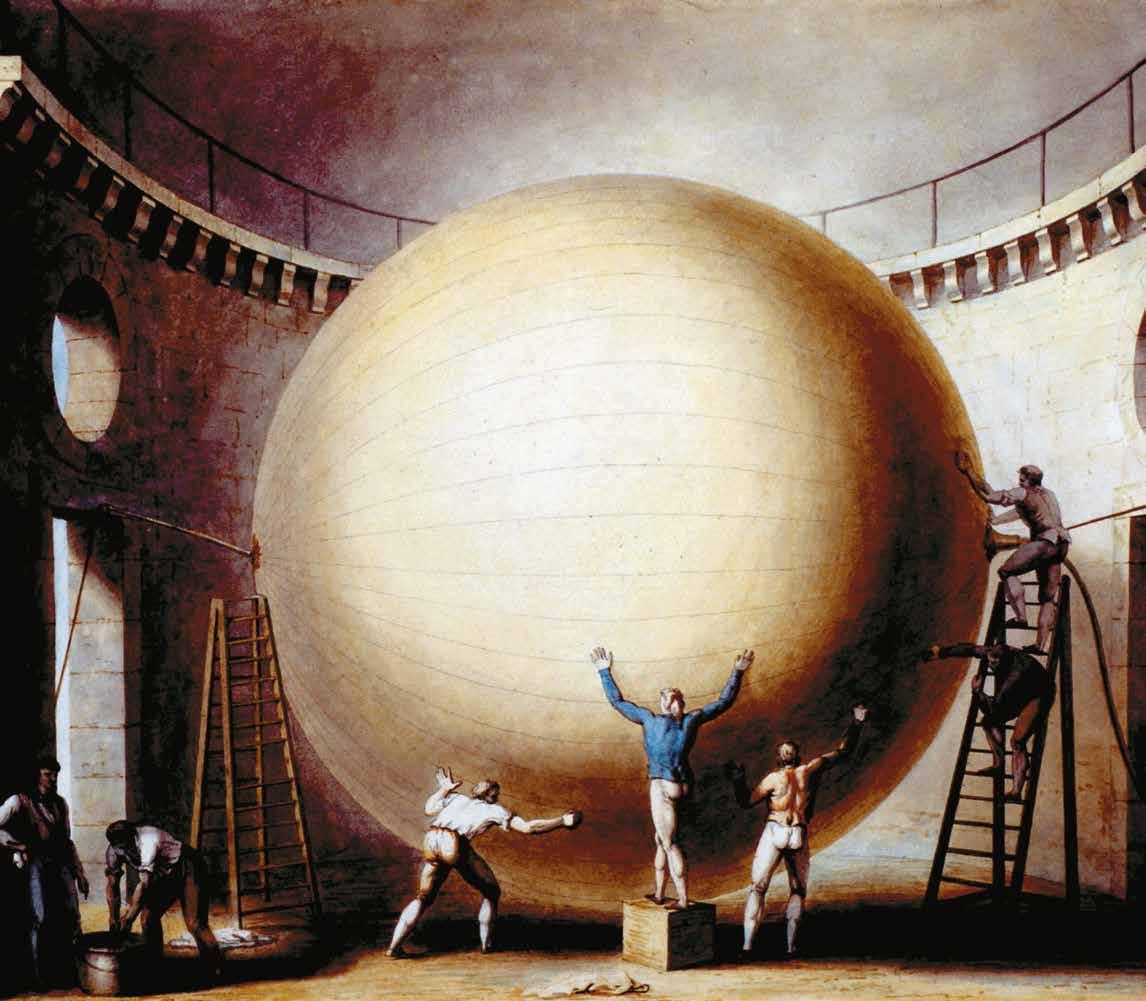
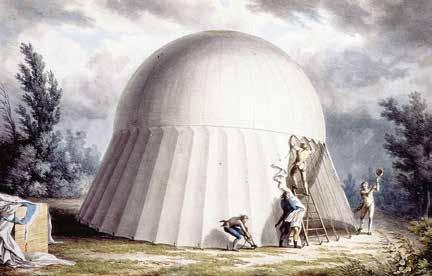
14-15 and 17 bottom
Manufacturing a gas-tight balloon was a delicate and arduous task. The lower picture, from 1794,
(1755-1805) in making a military balloon. The cutting was done outdoors, using primitive methods.
Above: Cont painting the balloon, an indoor process.
shows Nicolas Jacques Cont’s cutting technique
Chapter 5
Up until the First World War, popular imagination had above all seen the airplane as the instrument of sporting bravado and a weapon for intrepid warriors; in both cases a vehicle of the élite, reserved for a few fearless souls.
The Great War radically changed this situation, in terms of numbers at least, if not the underlying concepts: by 1918 there were thousands of trained and experienced pilots, along with thousands of aircraft about to be sold off as military surplus. Flying had begun to spread and its commercial potential had begun to be appreciated.
The birth of civil aviation took place in post-war Europe and was the fruit of necessity rather than chance. The war had,
The Birth of Commercial Aviation
in fact, destroyed many rail links, and routes which involved a sea crossing, such as the popular London-Paris route, were slow and complicated for any land-based means of transport. In contrast, America still benefited from an excellent and undamaged rail network, and the characteristics of contemporary aircraft meant that the railways still enjoyed a measure of superiority.
France, Great Britain and Germany all saw the birth of the first airline companies within a few months, early in 1919. The first scheduled service was actually established in Germany, with Zeppelin dirigibles linking Berlin and Weimar. The Paris-Brussels and Paris-London routes inaugurated by French and English companies operating airplanes soon followed.
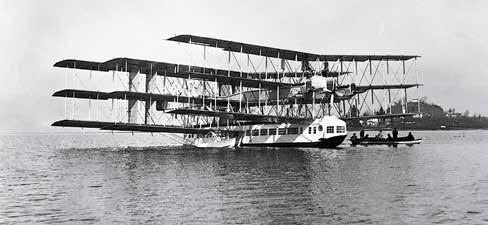
62 top left The postwar period marked the beginning of many commercial aviation projects, like the then very sophisticated Caproni Ca.60 Transaereo hydroplane. Despite its eight 400-hp engines, this gigantic flying craft was too heavy to fly and was destroyed during trials.
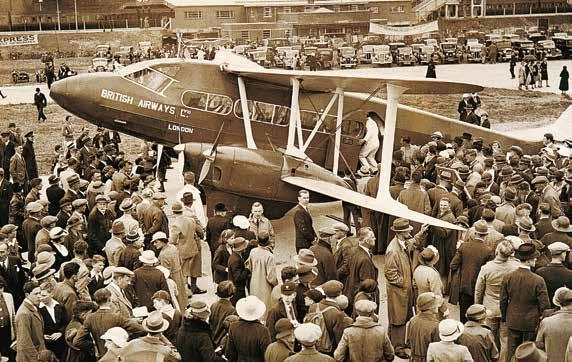
62 bottom left A crowd gathers round a de Havilland DH.86 biplane during the opening of Gatwick Airport by Britain’s Minister of Aviation.
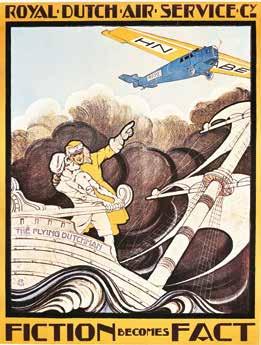
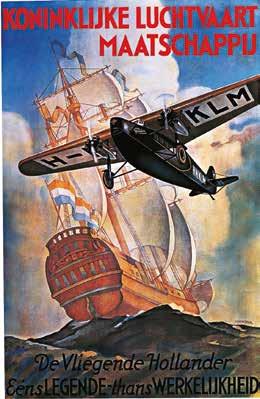
62 right Two posters advertising KLM (Royal Dutch Air Services), the Dutch national airline.
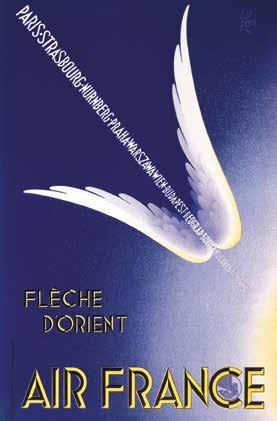
63 left A splendid poster advertising Air France’s “Arrow of the East” service, begun in 1933.
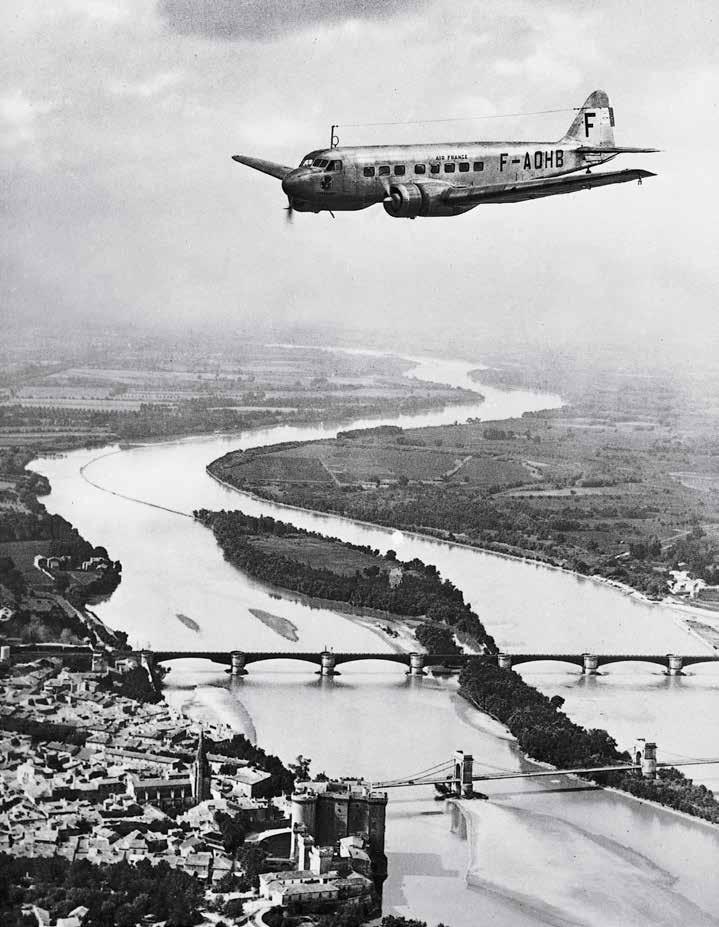
63 top right A twinengined Air France Bloch 220 over France. The airline was formed in 1933 by the merger of Aéropostale, Farman and Air Orient.
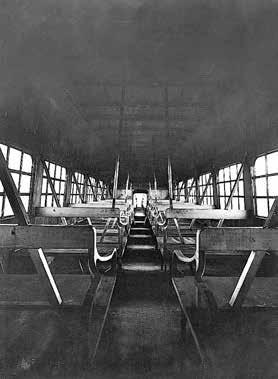
63 bottom right The bare interior of the cabin of the Caproni Ca.60 Transaereo, which was designed to carry 100 passengers.
Chapter 7
It can hardly be said that the outbreak of the Second World War came as a surprise; in fact, the military planners had already been at work for some time. For years the winds of war had been blowing across Europe, Africa and Asia, and the 1930s had seen a series of conflicts. All shared a common cause: the extreme nationalism of a number of totalitarian regimes whose expansionism, power politics and, at times, pure greed, had ignited and fed conflicts of various types. The Sino-Japanese War, the Spanish Civil War and the war in Ethiopia had clearly demonstrated to the rest of the world that the regimes in Italy, Germany and Japan were determined to affirm their presumed superiority with the use of force. In the late 1930s there was a true arms race in Europe, a process leading to the introduction of aircraft that were a great advance on their predecessors, even those designed just a few years earlier. In the United States this process occurred only after 1938, when Congress, alarmed by the military conquests of Japan and the ominous policies of Hitler in Europe, allotted funding for the
The Second World War: the Allies
modernization of the armed forces. In 1939, modernization efforts focused on the US Army Air Corps (USAAC) in particular; until then it had survived on a bare-bones budget, with a minimal number of pilots and only 1,100 obsolete combat aircraft.
In any case, the Great Powers most concerned involved in the military build-up were France and Great Britain. In September 1939, immediately after Hitler’s invasion of Poland, they formally declared war on Germany. In the winter of 1939-40, the French air force and the British Expeditionary Force’s aerial units were relatively inactive. Then on 10 May 1940, the Germans launched their great western offensive, and the true military and technological confrontation between the Axis and the Allies really began.
The French Armée de l’Air was able to respond to the German attacks with a number of fighters that were technically valid, but inferior to the enemy’s planes, especially with regard to their tactical deployment. The French flew the Block MB.151 and
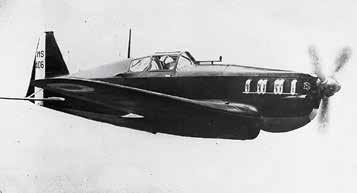
152 and the Curtiss H75 Hawk, the export version of the USAAC’s P-36. Their front-line fighters were, however, the Morane-Saulnier MS-406 and the Dewoitine D-520. The former was the most numerous and in 1940 was in service with eleven fighter squadrons. Its origins lay in the MS-405, a modern, low-wing, all-metal fighter with a closed cockpit and retractable undercarriage, designed in response to a specific ministry brief issued in 1934. A total of 15 MS-405s were ordered in 1937, but production subsequently concentrated on the MS-406, which had a lighter wing and a more powerful Hispano-Suiza engine. The threat of war led to an order for 1,000 MS-406s, but the plane was never a match for the German fighters, in particular the more agile and more powerful Messerschmitt Bf-109E. The MS-406
was nonetheless employed in the defense of France, and purchased by other countries such as Switzerland and Finland, where it was used successfully in the war against the Soviet Union.
The French air force’s best fighter was unquestionably the D-520, introduced in 1936 as a rival to the MS-406. This Dewoitine aircraft had modern lines and boasted avant-garde performance. In 1939 the French government decided to order serial production of 700 D-520s. However, the decision had been taken too late On the outbreak of war on the western front, even though 400 aircraft had been delivered, only one fighter group was equipped with the new plane, and this group was still working up to combat status. While the D-520 was a worthy rival for the Bf-109, it was unable to influence the outcome of the conflict. Following the armistice, the German and Italian air forces took over numerous D-520s and used them as advanced trainers and reserve fighters.
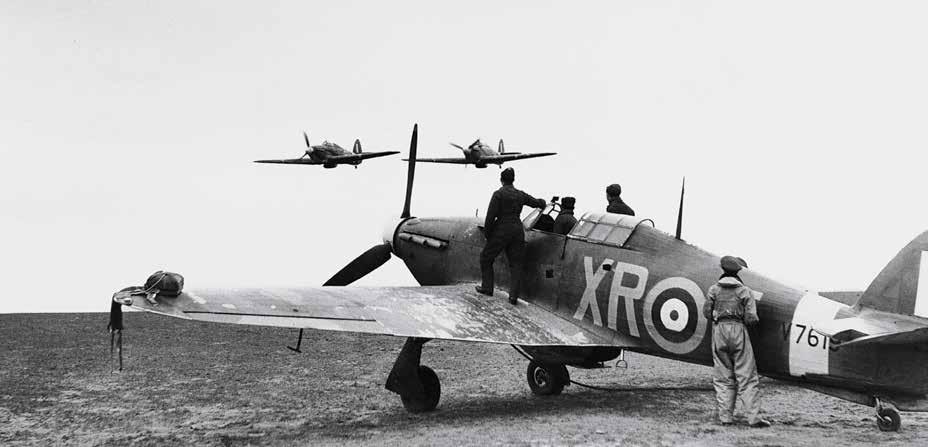
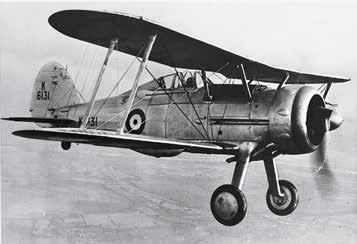
In the mid-1930s, Great Britain found that the Royal Air Force had fallen behind the times. In 1940, the RAF was still operating obsolete planes such as the Gloster Gladiator and the Fairey Battle light bomber. Thanks, however, to the process of rearmament that had been underway for some years, the RAF also had a reasonable number of modern aircraft such as the Hawker Hurricane fighter and the Bristol Blenheim bomber. The Hurricane, unquestionably one of the most famous and glorious of all Britain’s fighters, was first mooted as early as 1933 when the Hawker designer, Sydney Camm, began work on the successor to the Fury biplane. The new aircraft was extremely advanced for its day,
equipped as it was with a low-set cantilever wing, a closed cockpit and retractable undercarriage. Moreover, the Hurricane was fitted with no less than eight 7.7 caliber machine guns and was powered by a 1,039-hp Rolls-Royce engine. The Hurricane completed its maiden flight on 6 November 1935, and flight-testing proved it to be a truly excellent, fast and maneuverable fighter. In 1936, the Air Ministry ordered 600 Hurricanes, which began to enter service in December 1937 and were eventually to constitute the RAF Fighter Command’s backbone.
Following the unsuccessful French campaign, the Hurricanes assigned to 32 RAF squadrons were responsible for bearing the brunt of the German attacks during the Battle of Britain in 1940, managing to repel waves after wave of Luftwaffe bombers and their fighter escorts. In 1941, the Hurricane began to show its limitations when compared to the best of the British and German fighters, but it continued to operate in the skies above Great Britain and in the Mediterranean theater. Thanks to the introduction of a new, stronger wing, the hurricane also continued to enjoy success as a fighter-bomber. The Mk.IIC was armed with four 20-mm cannons, while the Mk.IV had 40-mm cannons and was able to launch bombs and rockets.
The Hurricane was built in about 20 different versions for a total of over 14,200 planes, and offered a naval version (the Sea Hurricane) that operated from aircraft carriers. The Hurricane and served in the Royal Air Force for the duration of the war and through to 1947; it was also used by 14 other air forces, including that of the Soviet Union, which received 3,300 planes.
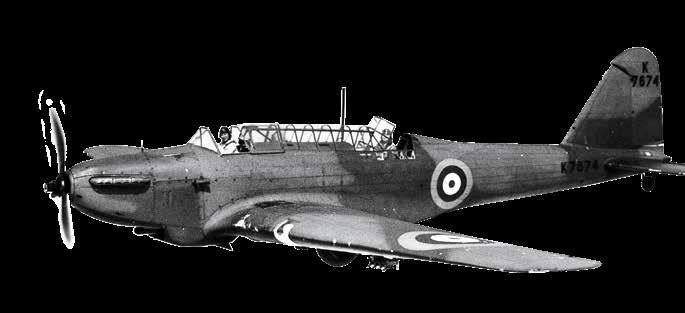
98 top The British Fairey Battle bomber made its maiden flight in 1936. The RAF flew more than 1000 of them early in World War II, but the plane was dramatically and immediately superseded technically.
98 bottom The Hawker Hurricane was the mainstay of the British defense in 1939-1940. It entered service in 1936 and was still a valid fighter during the Battle of Britain. Shown here is the RAF’s 71st ‘Eagle’ Squadron, formed by American volunteers.
99 first picture The Morane-Saulnier MS-406 fighter was the French air force’s most numerous plane in 1940, but it was no match for the German Messerschmitt Bf.109.
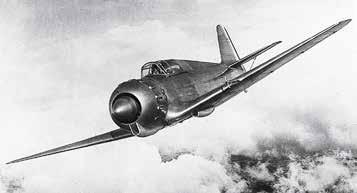
99 second picture The Bloch MB.151 fighter and its MB.152 version were also used by L’Armée de l’Air, but neither was up to the tasks it was required to perform.
99 third picture The Gloster Gladiator biplane, another RAF fighter at the start of the war, was used in minor theaters, like the Mediterranean.
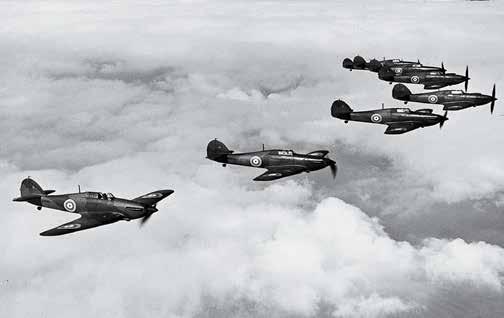
99 fourth picture Mk. I Hawker Hurricanes of the 111th Squadron in formation over Northolt, Middlesex. These fighters defended London in the first phases of the Battle of Britain.
Chapter 9
By the early 1940s, traditional aircraft characterized by piston engines driving one or more propellers had reached the limits of their potential. During the Second World War, the fastest fighters came up against the 500-mph barrier beyond which propellers begin to lose efficiency. In order to go faster, far more powerful engines would be required, but they would be so large and heavy as to be unacceptable. In addition, their weight would eventually offset any theoretical increase in their performance, bringing the practical speed and efficiency values back down to the levels already achieved.
For some time, however, two men, Frank Whittle in Great Britain and Hans von Ohain in Germany, had been working independently on the development of an engine that to most observers appeared as revolutionary as it would be impossible to construct: the gas turbine engine.
The concept underlying gas turbines was very simple; in fact, these turbines were already being used in industrial applications. Air entered from the front and was compressed and forced into a combustion chamber where it mixed with the fuel; the mixture was then ignited, and the gases exited at high speed from the rear jet, driving as they did so a turbine which actuated the front compressor. The difficulties lay in creating a turbine
The First Jets and the Korean
sufficiently compact, powerful and light to be mounted successfully in an airframe.
Von Ohain, a Heinkel aeronautical company an engineer conducted an initial demonstration of his turbine engine in February 1939. The test was successful, and Ernst Heinkel became a supporter of the new power unit, with his firm building the world’s first jet aircraft, the He-178. This small, simple all-metal monoplane had a feature that in a few years became very common: an air intake in the nose where a propeller would normally be found. The He178 flew for the first time on 27 August 1939, inaugurating aviation’s modern era.
In Great Britain, Whittle, a RAF engineer, first had the idea of a gas turbine engine in 1929, but he could only begin to work
seriously on the project from April 1937. In June 1939, he was ready to stage a demonstration of his WU engine for the Air Ministry, whose representative received the new invention enthusiastically. The Gloster Company was immediately commissioned to build an experimental plane using the W.1 engine. The result was the Gloster E.28/39, a low-wing, experimental model featuring a tricycle undercarriage and a nose air intake. It flew for the first time on 15 May 1941.
In Great Britain, this line of research led to
the construction of the Gloster Meteor fighter powered by Rolls-Royce engines (see Chapter 7), while in Germany, the development of airframes and engines took the form of a race between two industry groups; Heinkel and Messerschmitt, and BMW, Bramo and Junkers. The German Air Ministry ordered Heinkel and Messerschmitt to produce a jet fighter design to be powered by one of the three other firms involved in the project. Heinkel was the first to complete its design (in September 1940), but as no jets were yet available, its twin-engined He280 first flew in March 1941 with engines built by Heinkel itself. The He-280 was an attractive aircraft that featured a number of interesting innovations such an ejector seat and a tricycle undercarriage. Even with its provisional engines, the He-280 was capable of 485 mph. However, for technical and political motives, the German authorities preferred the Messerschmitt Me.262, despite the fact that it was not ready until later and did not fly until July1942. Its finalized Jumo 004 engines produced 1,984 lb of thrust. However, the Me.262It had a longer range and greater firepower than the He-280 (see Chapter 8).
In Great Britain, Gloster continued to improve and build the Meteor (before its withdrawal in 1954, about 3,900 had been built, with many exported). The second British jet was the de Havilland Vampire (initially named the Spider Crab). The plane was commissioned in 1941, and made its maiden flight on 26 September 1943. The vampire was small, equipped with mid-mounted metal wings with air intakes at the roots, and a short wooden fuselage; the undercarriage had a tricycle layout with a nose wheel. The tailplanes, similar to those of the Lockheed P-38, were carried on twin booms extending backwards from the wings. A single de Havilland Goblin engine producing 2,700 lb of thrust powered the new aircraft, and gave it a top speed of around 500 mph. Though the Vampire proved to be an excellent fighter,
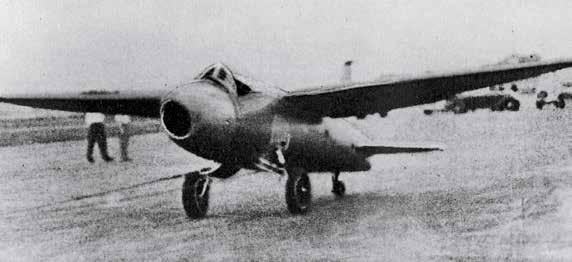
134 top The Heinkel He-178, which flew in August 1939, was the first jet plane. Its development was made possible by perfection of the jet engine by the German engineer, von Ohain.
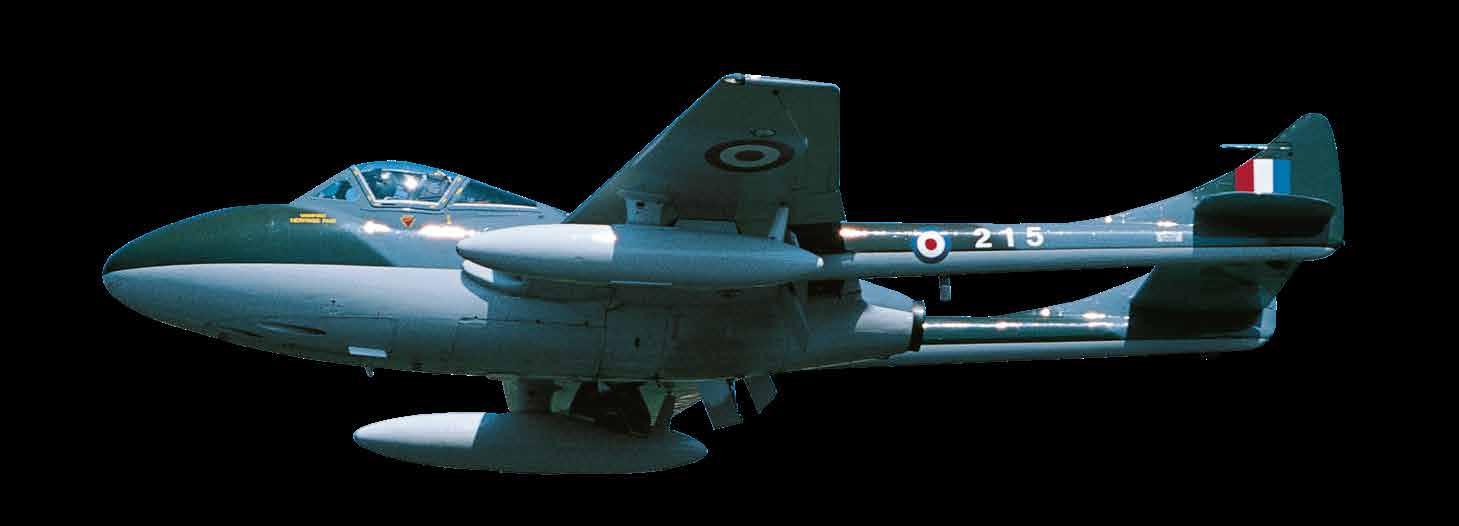
134 bottom The de Havilland Vampire was the first successful jet aircraft. A total of 19 versions and more than 3700 planes were built. In addition to Britain, 25 countries used the Vampire. Shown here is a two-seat training model.
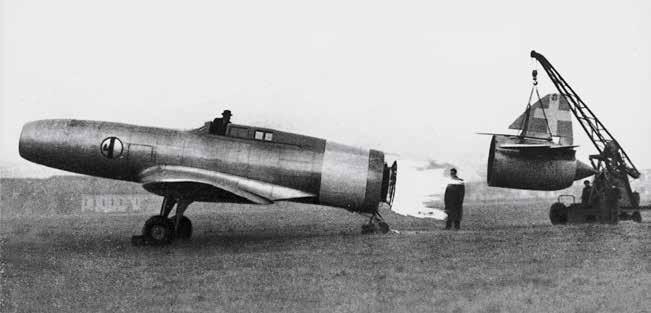
135 top The Italian Caproni Campini N.1 was, together with the German and British attempts, another early jet-engined plane. It made its first flight on 28 August 1940 but its top speed was just 220 mph, and only two prototypes were built.
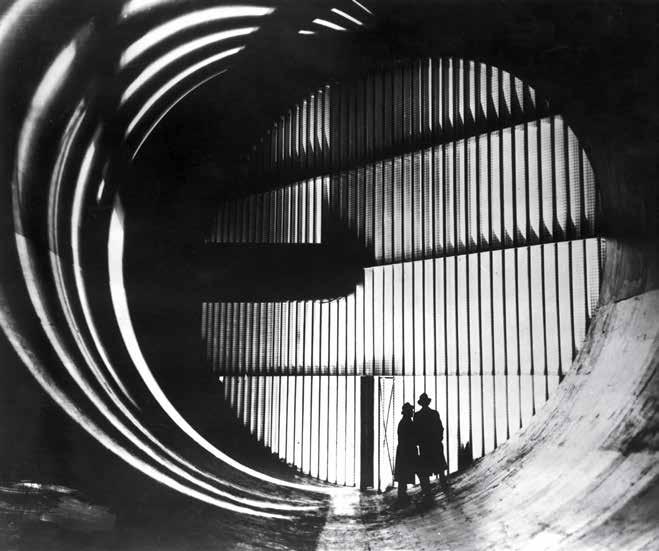
135 bottom With the advent of jet engines, aerodynamic tests became increasingly important. In this 1945 photograph, two men stand inside a wind tunnel.
it was not ready in time to play an active part in the war; in fact, the first production model, the Vampire F Mk.I, reached the RAF squadrons in April 1946. The F Mk.1, which was armed with four 20-mm cannons, had a Goblin 2 engine, producing around 3,100 lb of thrust and guaranteeing a top speed of 540 mph. The Vampire was continuously upgraded, and specialized versions were introduced. These included the new fighter (F), fighter-bomber (FB), night-fighter (NF), trainer (T), and naval (Sea Vampire) versions. A new wing and new tailplanes gave rise to the Venom and the Sea Venom. More than 3,700 planes were built, with purchases made by 26 different countries around the world. The last Vampires, those used by the Swiss air force, were only withdrawn in the 1980s.
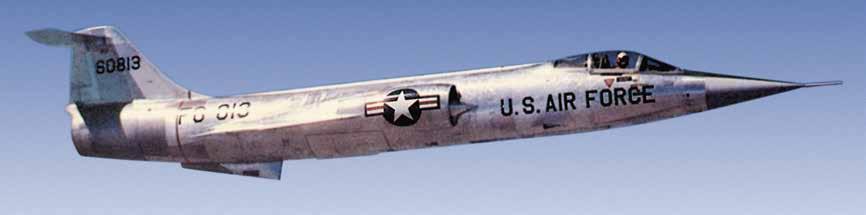
The third of the Century Series jets in chronological order of introduction was the Lockheed F-104 Starfighter. It completed its first flight as the XF-104 on 7 February 1954. The Starfighter, whose design drew upon the experience and suggestions of pilots fighting in the Korean War, was the first operational fighter capable of reaching Mach 2, and breaking the sound barrier while climbing. In effect, what the USAF demanded of this plane was acceleration and outright speed, and in order to achieve these objectives Lockheed’s chief designer, Clarence “Kelly” Johnson (the “father” of the P-38 and F-80), was uncompromising. The F-104 had a stubby laminar-profile wing and a long, aerodynamic fuselage little bigger than the engine it housed. The pilot and the armament, radar and avionics systems were all crammed into the restricted space of the nose.
The F-104A entered service with the USAF on 26 January 1958; it was 54 feet 5 inches long, with a wingspan of 21 feet 7 inches, and a maximum take-off weight of 22,000 lb. A single General Electric J79-GE-3B producing 14,800 lb of thrust powered the aircraft to a maximum speed of 1367 mph, or Mach 2.2. The F-104A was typically armed with two AIM-9B Sidewinder air-to-air missiles and an M61 Vulcan 20-mm cannon. While its performance was exceptional, the plane as a whole did not satisfy the armed forces because it was too difficult to fly, had a restricted range, and was only lightly armed: it was soon passed on to the reserve squadrons. The successor F-104C, fitted with a more powerful engine and optimized as a fighter-bomber, was no more successful; both versions saw limited action in Vietnam but were in practice rejected, although the Starfighter continued to fly with the National Guard up until the 1970s.
The export version of the aircraft, the
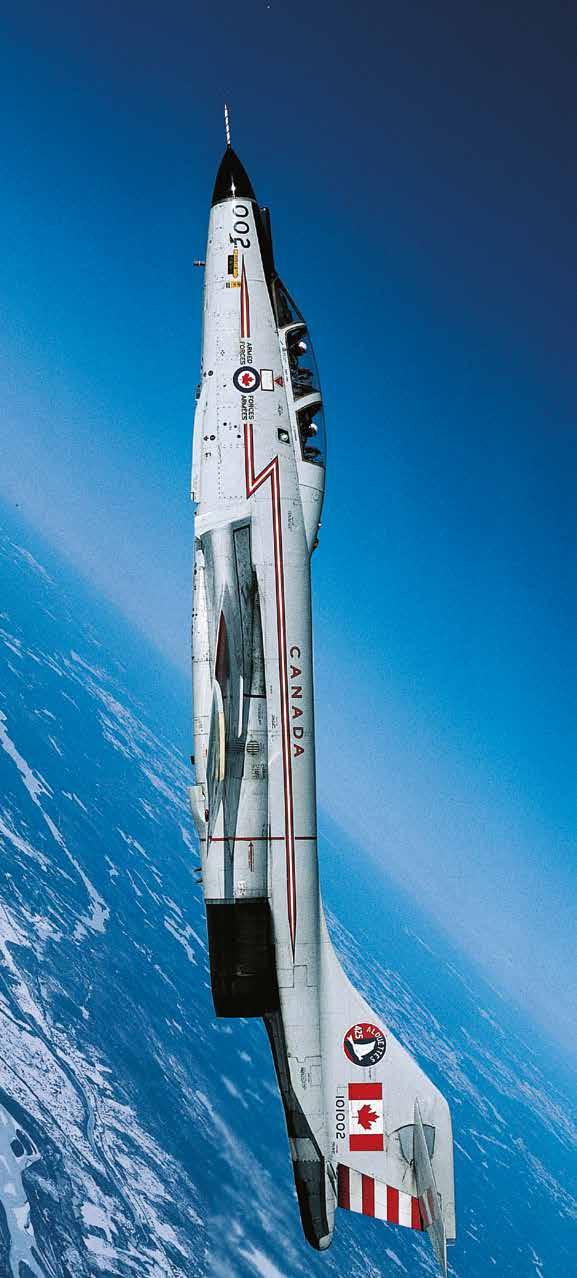
150 left The McDonnell F-101A Voodoo fighter’s development was long and difficult, and when the plane entered service, it was assigned the role of interceptor. Canada purchased this aircraft, calling it the CF-101, and kept it in service until the start of the 1980s.
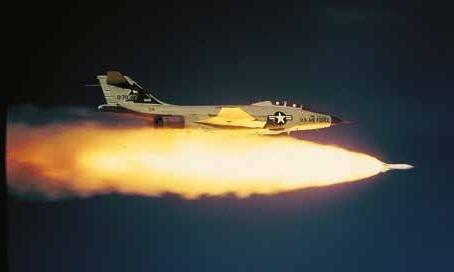
150 top right As an interceptor, the F-101A was able to fire Genie nuclear air-to-air missiles, as seen in the photograph of the National Guard launching the aircraft’s weapons in Maine.
F-104G Super Starfighter (and the two-seater TF-104G) enjoyed better fortunes, thanks above all to the fact that America’s allies were offered the opportunity to construct it themselves under license, an offer taken up by Germany, Holland, Belgium, Italy, Canada and Japan. The F-104G completed its maiden flight on 7 June1960. The plane featured a strengthened airframe (the maximum weight had risen to around 28,750 lb), improved avionics and a new engine, the J79-GE-11A producing 15,800 lb of thrust on afterburn and providing a top speed in excess of 1,350 mph at 36,000 feet. The armament remained the same as that of the F-104C with the Vulcan cannon and the external load of up to 4,000 lb, which could include supplementary fuel tanks, bombs and rockets or a nuclear bomb. Sixteen countries adopted the Starfighter, and a total of 2,576 (including all variants) were built.
In 1966, Italy decided to develop an advanced version of the Starfighter designated the F-104S. This variant entered service in 1969; it had improved avionics, an even more robust airframe (which featured two new underwing pylons) allowing a maximum take-off weight of 30,850 lb, and a heavier weapons load. The plane’s maximum speed was about 1,500 mph and the principal armament consisted of the semi-active radar-guided AIM-7 Sparrow air-to-air missile. Modernized on a number of occasions, with models ASA and ASA-M, in
twin engines and a T-tail. However, it proved ill suited to the bomber escort role owing to its insufficient range. It plane was therefore adapted as a two-seater all-weather interceptor for the tactical command. It entered service early in 1957 as the F-101B. The B model was 67 feet 3 inches long, had a wingspan of 39 feet 4 inches, and a maximum take-off weight of 52,400 lb. It was powered by two Pratt & Whitney J57P-55 engines producing 14,880 lb of thrust on afterburn, which gave it a maximum speed of 1,222 mph, or Mach 1.85. The armament consisted of two GAR-2 Genie rockets with nuclear warheads or up to six AIM-4 air-to-air missiles. More effective planes soon replaced the Voodoo for interceptor duties, while the reconnaissance versions (RF-101A and C) remained in service longer. Just over 800 Voodoos were produced, of which 132 were sold to Canada, where they were kept in service as CF-101 interceptors until 1984.
The Republic company built the fifth aircraft in the Century Series on its own initiative, in the hope that it would be selected to replace its own F-84s, which were already in service. Getting underway in 1951, the project involved the creation of a large, single-seat fighterbomber capable of supersonic performance while carrying a large, potentially nuclear, weapons load. The USAF approved the project in 1954, and the first YF-105A prototype flew on 22 October 1955. As was traditional with
Republic, the plane had a large fuselage housing a single Pratt & Whitney J57 turbojet, a midmounted wing with air intakes at the roots, and swept tailplanes. The new and more powerful J75 engine was soon available, however, and the plane was re-engined and designated as the YF-105B, making its maiden flight on 22 May 1956; the production version, the F-105B Thunderchief, began to enter service in May 1958.
After 75 F-105Bs had been built, production shifted to the F-105D, which had a length of 64 feet 4 inches, and a wingspan of 34 feet 5 inches, an uprated engine and new avionics that gave the plane all-weather capability. The engine was the J75-P-19W, producing 24,500 lb of thrust and offering reach 1,250 mph at the plane’s operating ceiling. Maximum take-off weight was 52,850 lb, of which external loads – auxiliary tanks, bombs, rockets and missiles – accounted for 14,000 lb. A 20-mm Vulcan cannon completed the armament. The model D was followed by the two-seater F-105F, which featured a stretched fuselage. This model proved to be of great use in combating enemy antiaircraft defenses and led to the development of the EF-1O5F and F-105G versions, both used in the “Wild Weasel” role with special electronic equipment and Shrike and Standard antiradiation missiles. All these models were widely used in Vietnam and were withdrawn from service only in the early 1980s.
2005 the F-104S was the last Starfighter to be retired from service by the Italian Air Force.
The fourth of the Century Series was the McDonnell F-101 Voodoo, which made its first flight in definitive form on 29t September 1954. In reality, the original design for the aircraft dated back to 1946, when the USAAF issued a requirement for a jet-powered escort fighter for long-range operations. MacDonnell built the XF-88 prototype in 1947, but owing to a change of policy by the armed forces and the strategic command (as well as problems associated with the engines and the financing) the program was suspended and only revived in the face of the developing war in Korea. The new project was designated the F-101 and was to be a large, swept-wing aircraft with
151 top The Lockheed F-104 Starfighter was the first standard fighter to fly at speeds in excess of Mach 2. Everything in this no-compromise project was designed to boost acceleration and speed. However, the USAF never liked the plane.
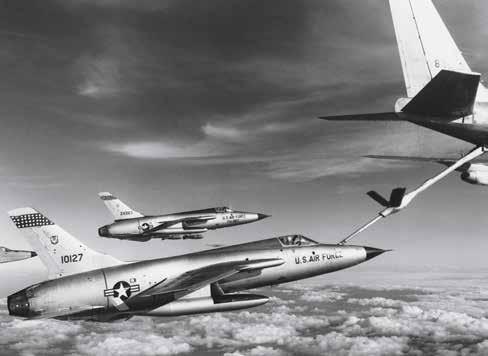
151 bottom The Republic F-105 Thunderchief was designed as a supersonic fighter-bomber able to carry 14,000 lb of bombs and rockets. Shown here are two refueling over Vietnam.
Chapter 15
The term “general aviation” is relatively recent, being coined as the result of the ever-increasing differences and specialized categories that were becoming established in the world of powered flight. Prior to the Second World War, in many cases there was no clear distinction between aircraft for civil use and those designed for military purposes. At that time sectors such as training, passenger services and transport and even bombing saw the use of aircraft that had never been designed with an exclusive role in mind; civilian aircraft were frequently converted with only minor modifications for military purposes and vice versa. In the post-war era, with the advent of jet engines and increasingly sophisticated technology in aerodynamics and avionics, aircraft could be designed to respond more closely to end-users’ specific demands, and the differences between them became increasingly well defined. In the 1920s
in America, the Curtiss JN was used by both military flying schools for training and by civilian pilots for recreational purposes; nowadays the differences between the military T-37 or T-45 jets and the Cessna 172s flown by numerous American aero clubs are self-evident.
General aviation thus comprises all those aircraft for private use that do not fall into the military, commercial and airliner categories. In practice they are light training, tourism, or business planes, the highest expression of which are the business or executive jets which the largest corporations and most rushed VIPs use to carry their staff around the world.
Among the companies representing the pillars of this sector are the American firms Piper and Cessna, responsible for introducing millions of people around the globe to the world of aviation.
In this context, the Piper J-3 Cub, which first flew in September 1930 as the Taylor Cub, may
General Aviation
be seen as the progenitor of modern general aviation planes. This was a lightweight aircraft covered in canvas with a high, braced wing, a closed, two-seat, tandem cabin, a tricycle undercarriage with a tail-wheel and a 41-hp Continental engine. In 1937, the newly founded Piper company took over development and production. It increased the Cub’s engine power output to 66 hp, a modification that increased the plane’s popularity. In 1949, Piper decided to introduce an improved, more robust version, the PA-18 Super Cub, the relative weight and performance figures of which were increased. The Super Cub was initially equipped with a 91-hp engine, but a number of variations of the Cub theme were produced; some models equipped with skis and floats and powered by engines of up to 152 hp. The PA-18-150, equipped with a 150-hp Lycoming unit, had a maximum take-off weight of 1,750 kg and a top speed of 130 mph, but
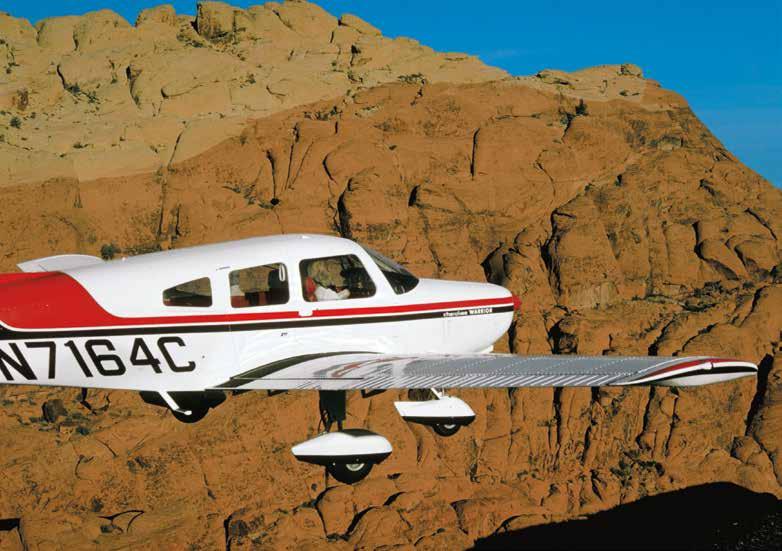
208 The Piper Pa-28 Cherokee is one of the commonest tourist flight planes. Since January 1960, more than 30 versions have been built and the plane is still widely used today.
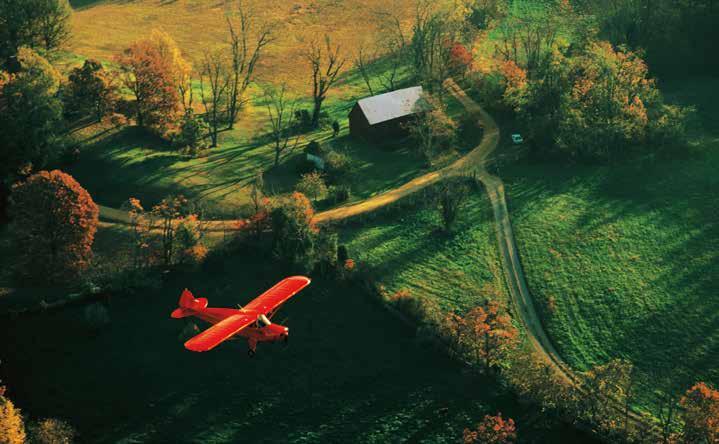
209 top A Piper Pa-18 Super Cub at low altitude over Maryland. The Pa-18 was the natural evolution of the J-3 and was developed from 1949 on.
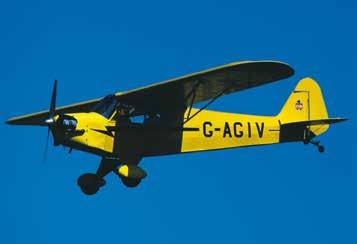
209 center left A Piper J-3 Cub, the progenitor of a long line of modern touring aircraft. Designed in 1929, the Cub originally had just a 41-hp engine and weighed less than 1,100 lb on take-off.
compact dimensions: a wingspan of 32 feet 10 inches and a length of 19 feet 7 inches.
Military versions of both the Cub and the Super Cub were constructed for personnel transport and observation purposes (the L-4, L-18 and L-21 models) and were used by the armed forces of numerous countries. Albeit with a number of interruptions, the Super Cub remained in production through to the mid1990s and together with the Cub, production exceeded 26,000 planes. A heavier tourist airplane, powered by a 150-hp Lycoming engine, completed its maiden flight on 14 January 1960: this was the PA-28 Cherokee, an attractive low-wing monoplane with a fixed undercarriage and a four-seat cabin.
The PA-28 went into production in 1961 and is still available today, having enjoyed an enormous commercial success that led to the construction of over 19,000 planes to differing specifications.
Among the more than 30 thirty models that have been produced are the Archer, Arrow, Dakota and Warrior series, variously equipped with carburettor, fuel-injected and turbocharged engines, retractable undercarriage systems, and power outputs of up to 235 hp.
In October 1977, Piper introduced the PA-38 Tomahawk, a new single-engined, two-seat light trainer characterized by a T-tail and a fuel-efficient 114-hp engine. Although carefully designed with advice from some 10,000 flightinstructors, the Tomahawk never enjoyed commercial success; up until 1982, fewer than 2,500 had been built.
strengths is twin-engined aircraft, the first being the PA-23 Apache, a low-wing monoplane with a retractable undercarriage, a four-seat cabin, and engines faired into the wings. The Apache made its first flight on 2 March 1952 and remained in production until 1965, when the Aztec replaced it. The new model featured a larger cabin, a greater carrying capacity, and two 250-hp engines. Next came the Turbo Aztec, which was powered by two 253-hp turbocharged Lycoming units, had a top speed of 253 mph, and a maximum take-off weight of 5,600 lb. It had a wingspan of 37 feet 5 inches, a length of 31 feet 1 inches, and could carry five passengers and a pilot. Over 2,800 PA-23’s were built.
with a new light, single-engined plane, but it did not meet with the hoped-for success.
Another of the Piper company’s major
209 bottom right The four-seater Pa-23 Apache was the first twin-engined plane designed and built by Piper. It made its maiden flight in 1952 and remained in production until 1965.
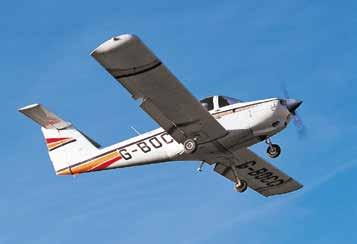
209 bottom left The Pa-38 Tomahawk was produced by Piper in 1977 to equip flying schools
At much the same time, however, another major center of tension and subsequently war was developing in the Balkans as Slovenia and Croatia decided to abandon the Yugoslav federation and proclaim their status as independent nations. The war between Yugoslavia (Serbia) and Croatia expanded into Bosnia, provoking reaction from the United Nations and NATO. These organizations decided upon the formation of a military and aerial force that would re-establish and maintain peace. Airborne operation began in summer 1992, with the airlift that brought relief to Sarajevo and in spring 1993, with Operation Deny Flight that was intended to impose control over the region’s airspace and prevent military actions. These activities gradually intensified until winter 1998-99 when Serbian troops began a series of criminal “ethnic cleansing” operations against people of Albanian origin in the province of Kosovo. This led to a new UN and NATO initiative that, given the failure of negotiations, took the form of military intervention begun during the night of 24 March 1999.
with the remaining 25 percent supplied by eleven NATO countries including Italy, which provided abut 50 aircraft and offered the use of some 20 airfields. The Yugoslav air force was able to sustain opposition only in the conflict’s very earliest phases, when five of its MiG-29s were shot down. Thereafter, Serbia’s coordinated and constantly mobile and antiaircraft defenses posed the main threat to NATO – one that was greater than that faced in the Gulf War.
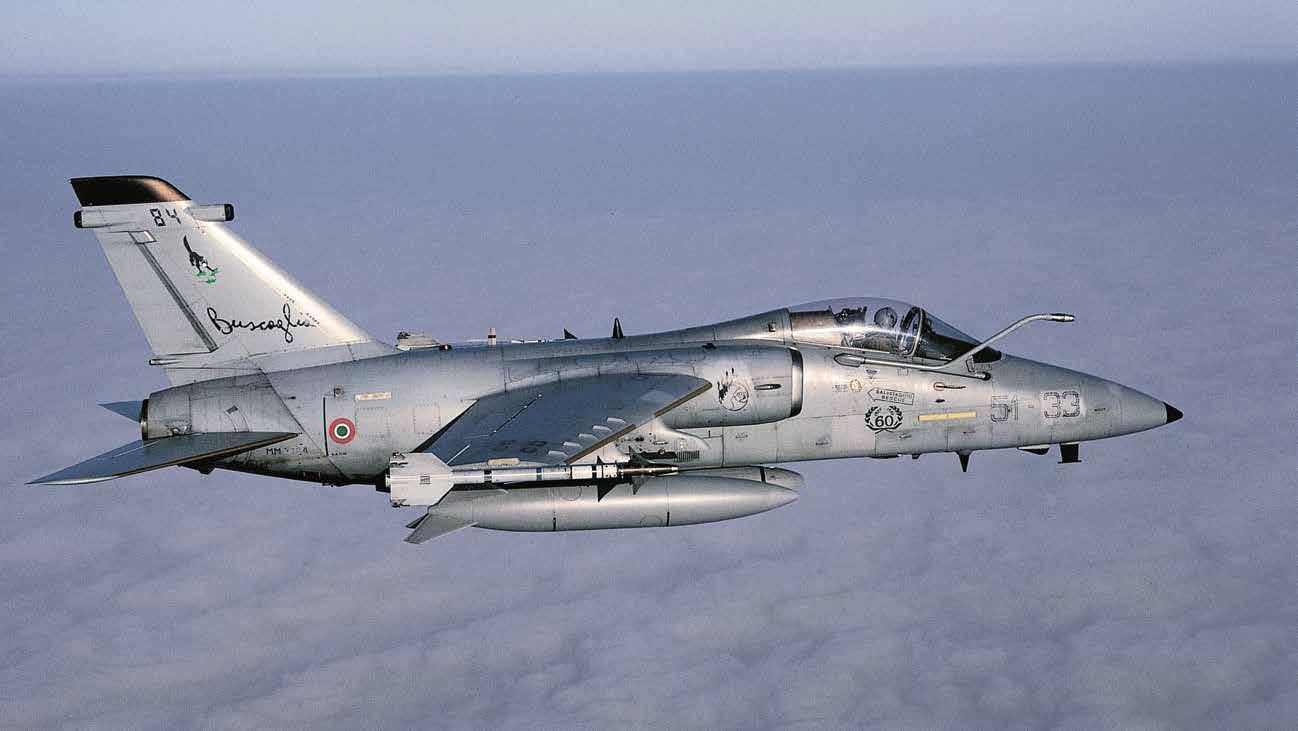
The Balkan conflict saw three very different types of aircraft in action for the first time. One was the AMX fighter-bomber, an aircraft developed in Italy in the early 1980s by a consortium formed by Aeritalia, Aermacchi and the Brazilian company Embraer. The AMX designed to replace the Italian air force’s G.91s and F-104Gs. The first prototype flew on 15 May 1984, and the first production planes went into service in 1989. The AMX is a single-seat, single-engined plane with traditional lines but a moderately swept high wing, developed from the profile
Operation Allied Force saw the onset of aerial attacks on Serbian military and strategic targets. The aerial offensive against Yugoslavia (the first war NATO had fought in its fiftyyear existence), was initially conducted with a limited number of aircraft (about 500 combat and support planes). However, given the opposition’s strength and tenacity, the Coalition intensified its effort both in terms of numbers (over 1,000 aircraft, including those embarked on five aircraft carriers) and the frequency of the missions that were carried out night and day. About 75 percent of the aircraft were supplied by the United States (operating from bases in Italy, France, Germany, Spain and Great Britain),
of the Tornado’s wing. It has a wingspan of 26 feet 3 inches and a length of 32 feet 7.5 inches. Powered by a Rolls-Royce (FIAT Avio) Spey RB-168-807 engine delivering 11,000 lb of thrust with no afterburner, it has a top speed of Mach 0.86. (The RB-168-107 is an old engine with an unexceptional power output but moderate fuel consumption; it was to cause considerable problems in terms of reliability.) The AMX has a maximum take-off weight of 28,660 lb, and can carry an external weapons load of up to 8,377 lb, together with a 20-mm Vulcan cannon. The two-seater AMX-T version appeared in 1990. Over the years the plane matured into an effective fighter-bomber and tactical
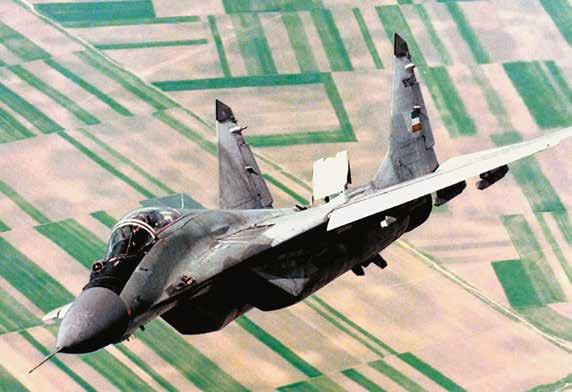
294 The Russian MiG29, shown here in 1998, before the Kosovo conflict began, is the Yugoslav air force’s most important fighter.
294-295 The AMX resulted from a 1980 Italian-Brazilian project to build a light tactical fighter-bomber; 192 were built. The Italian air force used the AMX with success during the 1999 war in Kosovo.
reconnaissance plane of consistent reliability (diurnal capabilities), equipped with generally advanced avionics and precision weaponry such as laser and infra-red guided bombs. From 2007 to 2010, 52 units were upgraded to the new ACOL standard, which introduced improvements in avionics and weaponry, with the integration of JDAM bombs, RecceLite reconnaissance pods, and Litening targeting pods. In Kosovo, the Italian AMXs were utilized with a certain continuity in support missions, giving an excellent show of their capabilities as was the case in later operations in Afghanistan, Libya, and Kuwait. The AMX was retired from service with the Italian Air Force in 2024.
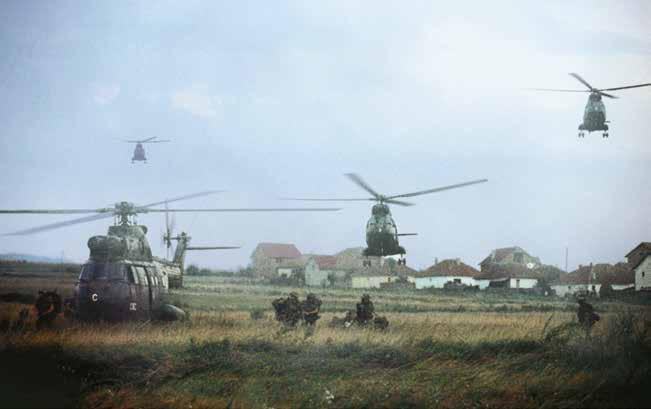
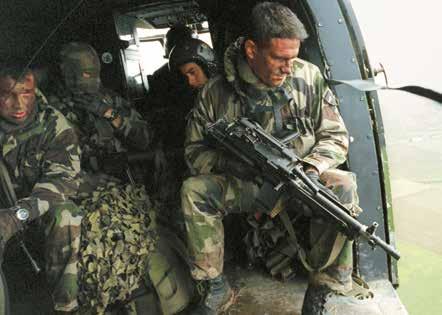
295 bottom right A Puma helicopter transports French commando paratroopers over Macedonia during Kosovo war operations in April 1999.
295 bottom left Puma helicopters take French paratroopers to Kosovka Mitrovica during NATO peace force operations in Kosovo, September 1999.
Page 236 top left Richard Cooper
Page 236 top right Lassi Tolvanen/Fly
High
Page 236 center Archivio R. Niccoli
Page 236 bottom K. Tokunaga/Dact Inc.
Pages 236-237 Archivio R. Niccoli
CHAPTER 18
Pages 238-239 Horst Faas/AP Photo
Page 238 center left Henri Huet/ AP Photo
Page 238 bottom Corbis/Grazia Neri
Page 239 bottom Corbis/Grazia Neri
Pages 240-241 Hulton Archive/Laura Ronchi
Page 240 bottom Corbis/Grazia Neri
Page 241 top Boeing Co. Archives
Page 241 center Archivio R. Niccoli
Page 241 bottom left Archivio R. Niccoli
Page 242 top Archivio R. Niccoli
Pages 242-243 Corbis/Grazia Neri
Page 243 top Aviation Picture Library
Page 243 center top Aviation Picture
Library
Page 243 center bottom The Flight Collection/Quadrant Picture Library
Page 243 bottom Archivio R. Niccoli
Page 244 top Corbis/Grazia Neri
Page 244 bottom AP Photo
Pages 244-245 Archivio R. Niccoli
Pages 244 center top Archivio R. Niccoli
Page 245 center bottom Rick Llinares/ Dash2 Aviation Photography
Page 245 bottom left Aviation Picture Library
Pages 246-247 AP Photo
Page 246 center right AP Photo
Page 246 bottom Corbis/Grazia Neri
Page 247 bottom Photos12
CHAPTER 19
Page 248 top Israeli Air Force
Page 248 center Israeli Air Force
Page 248 bottom Archivio R. Niccoli
Page 249 center right Israeli Air Force
Page 249 bottom Israeli Air Force
Page 250 top Archivio R. Niccoli
Page 250 bottom Archivio R. Niccoli
Pages 250-251 Archivio R. Niccoli
Page 251 center left Archivio R. Niccoli
Page 251 center right AP Photo
Page 252 top Archivio R. Niccoli
Page 252 bottom Archivio R. Niccoli
Page 253 top Archivio R. Niccoli
Page 253 bottom Archivio R. Niccoli
CHAPTER 20
Page 254 top Stefano Pagiola
Page 254 bottom John M. Dibbs/ The Plane Picture Company
Page 255 center Corbis/Grazia Neri
Page 255 bottom Mark Wagner
Pages 256-257 Grover Paul/FSP/ Gamma/ Contrasto
Page 256 center Daher/Gamma/ Contrasto
Page 257 bottom Keystone/Grazia Neri
Pages 258-259 De Malglaive Etienne/ Gamma/Contrasto
Page 259 top John M. Dibbs/The Plane Picture Company
Page 259 center John M. Dibbs/The Plane Picture Company
Pages 260-261 Stefano Pagiola
Page 261 center Peter March/R. Cooper
Page 261 bottom Aviation Picture Library
CHAPTER 21
Page 262 Rick Llinares/Dash2 Aviation
Photography
Page 263 top K. Tokunaga/Dact Inc.
Page 263 bottom Gamma/Contrasto
Page 264 top left John M. Dibbs/The Plane Picture Company
Page 265 Mark Wagner
Page 265 Jamie Hunter/R.Cooper
Page 266 center K. Tokunaga/Dact Inc.
Page 266 bottom G. Agostinelli
Pages 266-267 Gamma/Contrasto
Page 267 bottom Mark Wagner
Pages 268-269 John M. Dibbs/The Plane Picture Company
Page 269 center Rick Llinares/Dash2 Aviation Photography
Page 269 bottom Richard Cooper
Page 270 center Archivio R. Niccoli
Page 270 bottom Archivio R. Niccoli
Pages 270-271 P. Steinemann/Skyline APA
Page 271 center K. Tokunaga/Dact Inc.
Page 272 top K. Tokunaga/Dact Inc.
Page 272 bottom Archivio R. Niccoli
Page 273 top Mark Wagner
Page 273 bottom right K. Tokunaga/ Dact Inc.
Pages 274-275 John M. Dibbs/The Plane
Picture Company
Page 274 bottom Archivio R. Niccoli
Page 275 top Aeronautica Militare Italiana
Page 275 center Richard Cooper
Page 275 bottom Richard Cooper
Page 276 top Archivio R. Niccoli
Page 276 bottom Archivio R. Niccoli
Page 277 Luigino Caliaro/Aerophoto
Page 277 bottom Archivio R. Niccoli
CHAPTER 22
Page 278 top Aviation Picture Library
Page 278 bottom P. Steinemann/Skyline APA
Page 279 top Aviation Picture Library
Page 279 center left Aviation Picture
Library
Page 279 center right Peter March/ R. Cooper
Page 279 bottom Aviation Picture Library
Page 280 top Peter March/R. Cooper
Page 280 center Aviation Picture Library
Page 280 bottom Aviation Picture Library
Page 280-281 Aviation Picture Library
Page 281 center Jamie Hunter/R. Cooper
Page 281 bottom Aviation Picture Library
Page 282 top Aviation Picture Library
Page 282 center left Peter March/ R. Cooper
Page 282 center right Peter March/ R. Cooper
Page 283 top Jamie Hunter/R. Cooper
Page 283 center Aviation Picture Library
Page 283 bottom Aviation Picture Library
Page 284 Archivio R. Niccoli
Page 285 top Archivio R. Niccoli
Page 285 center Aviation Picture Library
Page 285 center Aviation Picture Library
CHAPTER 23
Page 286 Magnum/Contrasto
Pages 286-287 Hulton Archive/Laura Ronchi
Page 287 top Archivio R. Niccoli
Page 287 center Gamma/Contrasto
Page 288 top Archivio R. Niccoli
Page 288 bottom Archivio R. Niccoli
Page 289 top K. Tokunaga/Dact Inc.
Page 289 bottom Archivio R. Niccoli
Page 290 top Gamma/Contrasto
Pages 290-291 Gamma/Contrasto
Page 291 top AP Photo
Pages 292-293 Corbis/Grazia Neri
Page 292 bottom Archivio R. Niccoli
Page 293 top Gamma/Contrasto
Page 293 center John M. Dibbs/The Plane Picture Company
Page 293 bottom K. Tokunaga/Dact Inc.
Pages 294-295 Luigino Caliaro/Aerophoto
Page 294 bottom AP Photo
Page 295 bottom left Georges Merillon/ Gamma/Contrasto
Page 295 bottom right Jean Luc Moreau/Gamma/Contrasto
Pages 296 top Richard Cooper
Pages 296-297 Angelo Toresani/ Photoskynet
Page 297 top John M. Dibbs/The Plane Picture Company
Page 297 bottom Mark Wagner
Page 298 Johnny Bivera/US Navy/Getty Images/La Presse
Page 299 top Archivio R. Niccoli
Page 299 center Archivio R. Niccoli
Page 299 bottom Archivio R. Niccoli
Page 300 top Archivio R. Niccoli
Page 300 center Archivio R. Niccoli
Page 300 bottom Archivio R. Niccoli
Page 301 top Archivio R. Niccoli
Page 300-301 Archivio R. Niccoli
CHAPTER 24
Page 302 top Peter March/R. Cooper
Page 302 bottom De Malglaive Etienne/ Gamma/Contrasto
Pages 302-303 Peter March/R. Cooper
Page 303 center Peter March/ R. Cooper
Page 304 top Corbis/Grazia Neri
Pages 304-305 Boeing Co. Archives
Page 305 center right John M. Dibbs/ The Plane Picture Company
Page 305 bottom Archivio R. Niccoli
Page 306 top Archivio R. Niccoli
Page 307 top Archivio R. Niccoli
Page 307 bottom Archivio R. Niccoli
CHAPTER 25
Page 308 Archivio R. Niccoli
Page 309 top Archivio R. Niccoli
Page 309 bottom Archivio R. Niccoli
Page 310 top Archivio R. Niccoli
Page 310 bottom Archivio R. Niccoli
Page 311 top Archivio R. Niccoli
Page 311 bottom Archivio R. Niccoli
Page 312 top Archivio R. Niccoli
Pages 312-313 Archivio R. Niccoli
Page 313 top Archivio R. Niccoli
Page 314 top Archivio R. Niccoli
Page 314 bottom Airbus
Page 315 top Archivio R. Niccoli
Page 315 bottom Archivio R. Niccoli
Page 316 USAF
Page 317 top Archivio R. Niccoli
Page 317 bottom Archivio R. Niccoli
CHAPTER 26
Page 318 top Archivio R. Niccoli
Page 318 bottom Archivio R. Niccoli
Page 319 Archivio R. Niccoli
Page 320 top Archivio R. Niccoli
Page 320 bottom Archivio R. Niccoli
Page 321 top Archivio R. Niccoli
Page 321 bottom Archivio R. Niccoli
Page 322 top Archivio R. Niccoli
Pages 322-323 Archivio R. Niccoli
Pages 323 top left N509FZ CC BY-SA 4.0
Pages 323 top right KAI
Page 323 bottom Archivio R. Niccoli
Page 324 top Archivio R. Niccoli
Page 324 center top Archivio R. Niccoli
Page 324 center bottom Archivio R. Niccoli
Page 324 bottom Archivio R. Niccoli
Page 325 top Archivio R. Niccoli
Page 325 center Archivio R. Niccoli
Page 325 bottom Archivio R. Niccoli
Page 326 top Archivio R. Niccoli
Page 326 center Archivio R. Niccoli
Page 326 bottom Archivio R. Niccoli
Page 328 Boeing
Page 329 Northrop-Grumman
CHAPTER 27
Page 330 top NASA Archives
Page 330 bottom NASA Archives
Page 331 top Archivio R. Niccoli
Page 331 center Corbis/Grazia Neri
Page 331 bottom Gamma/Contrasto
Page 332 top NASA Archives
Page 332 bottom NASA Archives
Page 333 Space X - Virgin Galactic
The Publisher would like to thank:
Italian Airforce
Agusta spa
Arthur Block, Joan Schleicher (Anodos Foundation)
Barbara Waibel (Zeppelin Museum)
Bernd Lukasch (Otto Lilienthal Museum)
Carol Henderson, Jim Lyons, Dave Black (Moffet Field Historical Society)
Cauntess Maria Fede Caproni
Igor Sikorsky Historical Archives
Israeli Air Force Magazine
NASA Johnson Space Center - Media Resource Center
Paolo Franzini
RICCARDO NICCOLI, a journalist, writer, photographer, and one of Italy’s best-known aeronautical historians, has written on the subject in specialized magazines since 1982. A graduate in political science, he writes for many publishers in Europe and the United States, and is the author of various books on aeronautical subjects.