
Fire and water By hand
of a feather
Foreword by Hank Richardson
Introduction by Craig Frazier
Drawing lessons.
San Francisco design.
The common thread.
A kid could do that.
The poster that changed it all.
Field test.
Early Work 1994 – 2000
From here to there.
Drawn to the light.
Ink and paper.
The wit’s end.
A guy walks into a bar.
Colleague remarks.
Buried treasures.
Dollars and sense.
Laws of attraction.
By Hand
Turning over stones.
Inexact science.
My back pages.
Love notes.
Selected Work 2000 – 2022 (II)
Interview by Kirk Citron
The Mac.
Rocket man.
Posters and postage.
Night night.
Acknowledgments
Foreword by Hank Richardson
Miami Ad School Atlanta, Director of Design
I met Craig Frazier twenty-five years ago, when I invited him to speak at my school. He has visited many times since. If you know Craig, it won’t surprise you to hear how excited he is to interact with students—and how wide he opens their eyes. Fascinating, imaginative, and so very human, he always circles back to one simple theme: Before you can design, you have to draw out your ideas.
Drawn is testament to a career practicing exactly that.
There is both a timeliness and a timelessness in Craig’s illustrations. He meets a client’s challenge of the moment, but does it in such a way that you want to frame it for your wall, to keep forever. He has a way of stretching ideas, breaking them, and then reassembling them into inexplicably new ideas. Yet he never dilutes the gravity of the message.
In his essays, Craig demonstrates a deep devotion to his craft, as well as the giants who influenced him. He speaks with kindness, humility, honesty, and, always on cue, that well-calibrated wit. It’s as if he has written the “true confessions” of a true artist, opening up about his life, learnings, and methods. How interesting it is to learn how he processes our world through his imagination, letting his ideas ooze out in illustration.
In a sense, illustration has been Craig’s therapist. It created the peace he needed to look inward, to draw stories built upon human truths. It freed him to filter ideas through his personal values and charmingly odd creative sensibilities. It gave him the confidence to play unrestrained —and to invite us to play along.
You can enjoy these pages as a tourist, simply enjoying the sights, and it would be time well spent. Or you can absorb Craig’s observations and inspirations to re-calibrate the way you think and create. To see the world through different eyes. Do not be daunted that Craig’s work ethic is simultaneously simple and impossible: Never have just one idea, and never stop looking. It’s an inspiring way to get where you’re going.
My unfair advantage in life is that I have had the privilege of picking Craig’s brain. I learned what motivates him, and how he sketches his way to such consistently amazing work. Drawn will give you the same advantage I got from twenty-five years of friendship—happily, in considerably less time.
Born to draw.
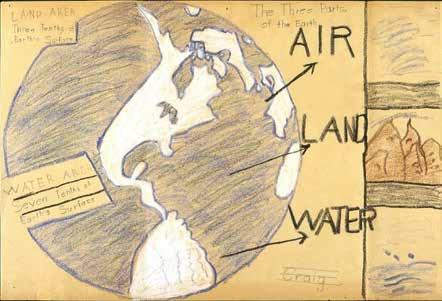
“Look at what I did!” I said that frequently as a kid seeking an audience for my drawings. I still do.
The drawing we do in our early years may be the most honest and unfettered drawing we’ll ever do, because we draw without judgment. Only later in life do we get judged for the first time by someone else, or worse—by ourselves. It’s when we realize we can’t quite make things look how they appear that many of us quit drawing. I remember that feeling, but I didn’t quit. I was having too much fun.
And the fun would continue. It was Mad magazine that opened my eyes to commercial drawing. The magazine was chock-full of cartoons and caricatures by famous illustrators, each of whom drew in a distinct style. Wit, humor, and general irreverence were the mainstay of Mad illustrations. For me, that magazine became a source of drawing lessons, and exposure to styles of illustration that were impossible to get in school.
Only rock ’n’ roll.
By high school, the rock posters of the ’60s and ’70s replaced Mad’s snarky influence in my life. There were the posters of Peter Max, so wondrous in their expression—colorful, whimsical, and drawn with his signature calligraphic line. Ironically, there was Seymour Chwast’s anti-Vietnam “End Bad Breath” poster, which I hung in my bedroom in my military home. Next came the influence of rock album cover art, which was a treasure trove of some of the best illustration of the time. I recall Rod Stewart’s Atlantic Crossing painted in airbrush by Peter Lloyd. And Tom Wilkes’s sublime lettering on Neil Young’s Harvest—an epic signature to the songwriting within. There was Emerson, Lake & Palmer’s Brain Salad Surgery, drawn by H. R. Giger, and the surreal Yes covers by Roger Dean, to name but a few. By high school’s end, I began to make the connection between drawing and popular culture. I would spend the next four years in college learning the requisite skills to make my entry into that world—better known as graphic design.
A designed career.
I have been fortunate to make my livelihood employing my love for drawing. My career has taken many turns, demanding that I learn new skills and practices in order to stay in the game. But drawing has been the constant.
This book is about the ride.
My career, which began in my early twenties, continues to this day. So far, it can be divided into two parts. First, I was a graphic designer who liked to draw. Then I became an illustrator who knows how to design. This book is primarily devoted to the latter—the body of my work as an illustrator and the discipline required to create it.
It’s important to note that, while my career has a dividing line, the experiences on either side define the same career. As it would turn out, being a designer was the ideal preparatory course for my career as an illustrator. My orientation toward problem-solving and the skills I learned over my twenty years as a designer would become the foundation of my practice as an illustrator. They formed the particular lens through which I approach every drawing today.
My path to becoming an illustrator was not exactly typical, and I suppose this is reflected in the work itself. According to several of my peers, it’s evident that my inner designer still breathes. While I’m flattered by this observation, I consider illustration to be the deeper development of my creative life. My work as an illustrator has exposed me to far more clients, businesses, and subjects—all around the world—than my younger self ever imagined possible. This book satisfies my urge to look for the connective tissue in the work I’ve done over the decades. The designer in me says I would be foolish not to organize such an inquiry into the pages of a book.
Dissecting the muse.
In these pages, I group drawings by their content. As an example, I might pair a drawing made in the year 2000 with a re-visitation of a similar theme or metaphor fifteen years later. The first section is devoted to the earliest days of my work as an official illustrator and the last features my most current work at the time of this book’s publishing. I now see the naivete in many of those early drawings, yet their principles remain present in the work decades later.
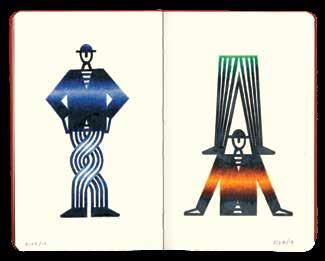
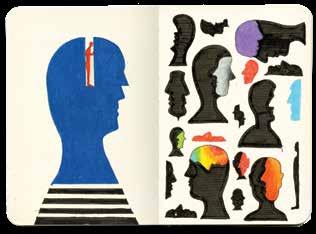
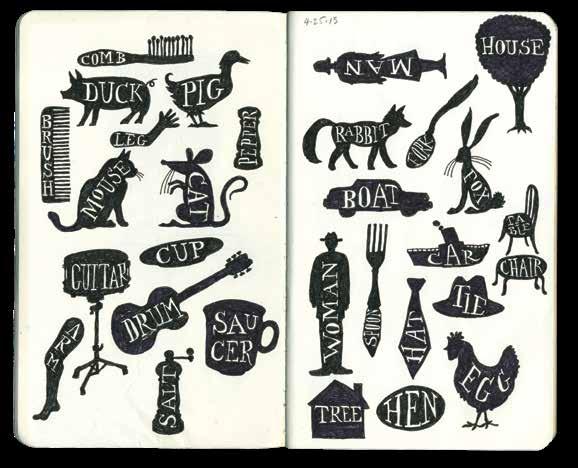
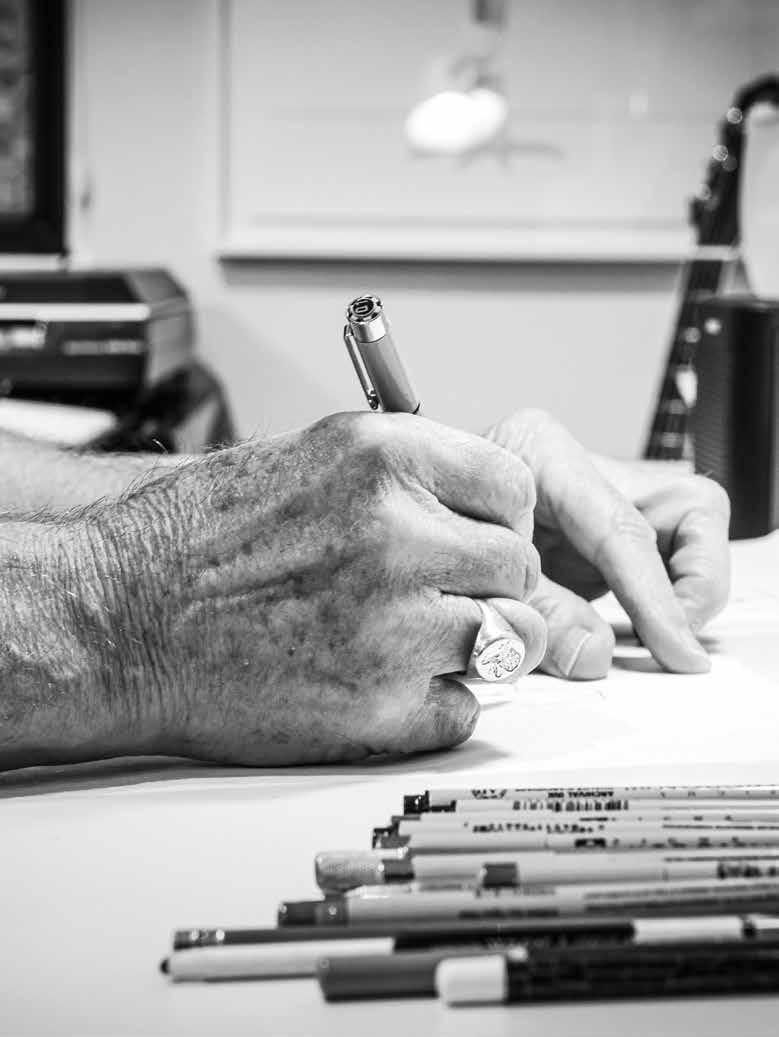
I have devoted a section titled “By hand” to my process. It’s my own fascination with others’ processes that inspires me to share mine. In my experience, a glimpse at the otherwise unseen underpinnings of one’s practice tends to reveal new meaning in a person’s finished product and, more important, an understanding of the work required to get there. The irony of illustration is that behind every illustrator’s body of finished work lies a mountain of sketches, false starts, and rejected ideas—often as good as or even better than our publicly seen work. Along with sketches and sketchbooks, I’m including a sampling of my cut Amberliths, which I make for every illustration. Though I complete my work digitally, I remain of the mind that the longer I can keep my hand in the process, the more humanity I can instill in the drawing.
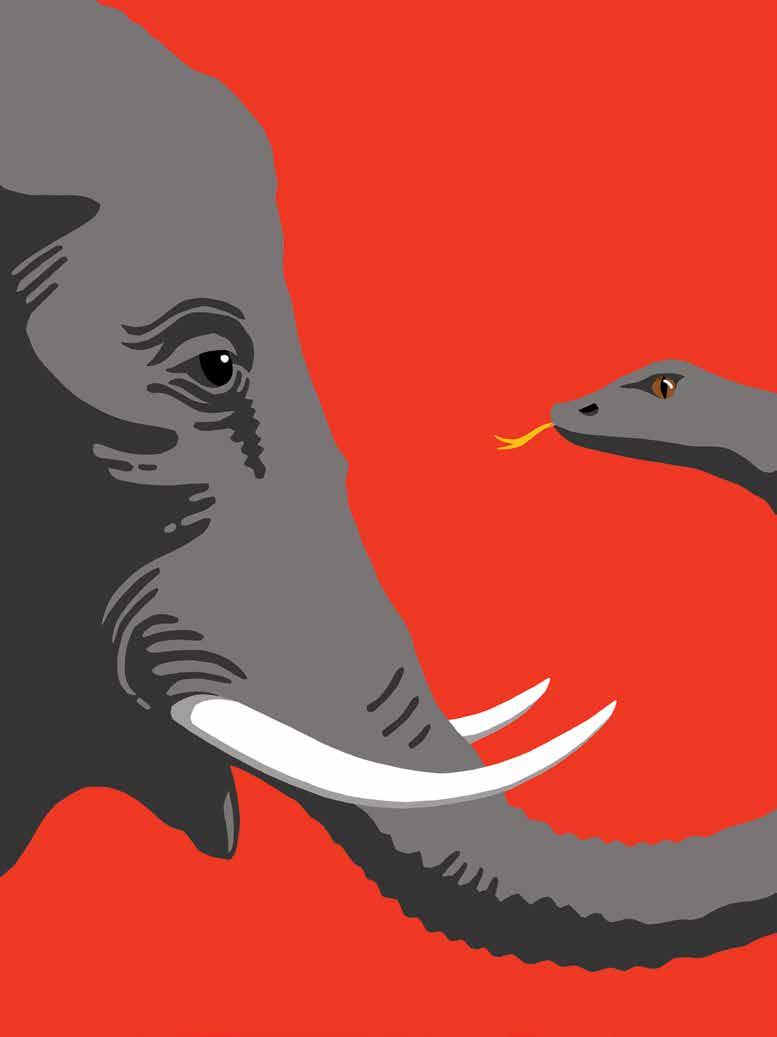
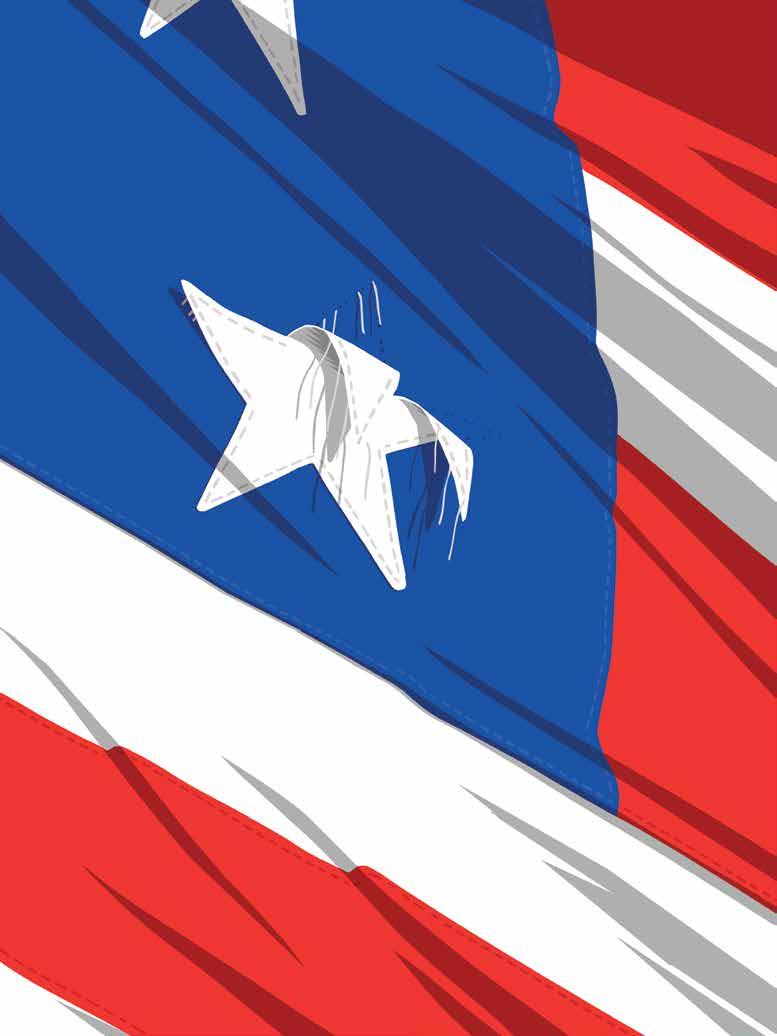
Most of the drawings within this book are for clients—individuals, companies, and publications all over the world. My common objective has been to help those clients speak visually with distinction, optimism, and illumination to their varied audiences. Though perhaps artistic, this work is not art; it is creating drawings designed to do a job. It is creativity in the service of business—a mutually beneficial relationship.
Drawing for meaning.
For me, it is essential that my illustrations be injected with humor, wit, and surprise. Yet that’s the tricky part, because it requires clients to believe that information and entertainment aren’t mutually exclusive. While I am hired to build clients’ brands, doing so depends on how well they believe in my brand of thinking—and drawing. My best work has been made for those believers. Thank you all.
To curate the drawings contained in this book, I had to measure the work against personal criteria. A work’s commercial success—or lack thereof—has no bearing on its inclusion. I have presented what I consider is my best, or at least my most interesting, work. Each piece had to satisfy three other requirements: be provocative in and of itself, without any explanatory text; be beautiful; and lastly, bring a smile to your mind.
Building character.
Design and illustration can be all-consuming careers, especially if you want to survive for very long. I’ll admit, taking on both can be doubly consuming. However, without immersion it’s unlikely that certain roads would be taken nor lessons be learned. Ultimately, the conditions under which we work shape the character of that work—a sort of call and response. I’ve tried to recount some of the more interesting stories.
This is for you.
I’ve designed this book to speak to as many people as possible. First, I feel a certain responsibility to present my experience to the designers, illustrators, photographers, artists, and writers who have shared the road with me. You have inspired and challenged me, and I hope you will see a bit of yourselves within these pages. Second, I want to share my understanding of making work in a tough business to the students and young practitioners making their way. The profession is ever-changing, and I’m counting on you to discover unique points of view—to make wonderfully creative contributions despite the forces that promote “sameness” as good enough. Your voice counts and will ultimately propel you into the conversation. Third, I want to speak to the clients and consumers of creativity in business. I hope to lift the hood on the instincts that work within all creative beings, and show that—if left unbridled, supported, and rewarded fairly—those instincts will pay back in immeasurable imagination, content, and good will.
Last, I want to speak to anyone, at any stage in life, who desires to give agency to their life’s experience and views. I have learned that purpose must be the central pursuit of our work, and everything else follows. I want to speak to those facing hard choices involving work, money, family, and the itch to find a rewarding connection between who we are and what we do. The return on taking risks and feeding curiosity comes in the form of friendships, invention, and the deep satisfaction of being in the arena.
At least, that’s been my experience.