by Olivier Lacombe . master planner
It was my last day in Asia, late that night I would have had to fly back to Paris. Francesco suggested we take a final ride aboard of his red Japanese bike, as we had done a few times during my weeklong sejour in Hong Kong. I had been there to collaborate with him on a music video and we had been around town shooting at various locations: the city, the hills, the busy streets, cafes, random rooftops, etc.
This time the destination would be Shek O, a fishing village located on the farthest corner of the Hong Kong Island. It is a truly beautiful ride, especially at sunset. The ride to Shek O is a quintessential Hong Kong experience: starting through the dense city, then through the lush jungle in the hills, and, finally, seeing the sea on both sides of a thin peninsula as we descend to Shek O.
When we arrived we wanted to relax, to take in the sleepy village atmosphere, the breeze, and the views towards the outlying islands. After a couple of chilled San Miguels we started talking about a new project: a book. We got very excited and animated discussing it. Our idea was to give an inside look at what is behind a painting and what goes through the painter’s mind before creating a work.
It seems unreal now, three years and a couple of coordinated trips to Hong Kong later, that this book is now completed.
005 foreword
006 veriveri
010 east meets west
013 a chat with the artist
014 rock and road
018 london days
022 a london tale
032 colors of hong kong
034 a short art history of hong kong
035 a hong kong local italian artist
036 my hong kong story
045 my hong kong
050 resin and fire guns
056 blue green
061 spices and colors
069 color of life
076 colors of asia
078 savoring the best places
081 color my day
082 chocolate hills
088 in vang vien
092 train ride to nuwara eliya
096 da lat sunset
100 lost around sidan
104 from the pichola lake
110 blue houses
114 the golden city of jaisalmer
118 annapurna
124 love lane
126 from my room in little india
128 the hill of the golden temples
132 on the way to mindoro
136 the magic of southeast asia
140 around yangshuo
144 shanghai chill out
146 on the fly
148 long lasting freshness
152 hoi kung court rooftop sunset
156 old hong kong buildings
159 the tong lau and life in the street
164 an abstract spin
166 a step towards abstraction?
180 collaborative paintings
182 four handed
186 colors: ideas to inspire
187 collaborative future
191 artist in residence
198 residences and collaborations
200 exhibitions
202 biography
205 acknowledgements
206 credits
by Stephanie Fan . event organizer
How did you start painting and become a commercial artist?
I always liked painting when I was a kid and did a lot of experimenting with different types of paint, but it was nothing serious. In 1998, I had an accident when playing football and tore my ligaments. Since I couldn’t run around for a prolonged period of time I started painting more consistently until it become a habit. When I moved to London, the place where I stayed was not very nice, so I decided to make some paintings and fix them on the wall. Then I hosted a house party and got many compliments on my works, so I did more of them. I told myself that I needed to start painting every weekend and gradually started exhibiting at the gastro pubs in the area and then collaborating with art galleries and pop-up exhibitions around the city.
Tell us more about your paintings, the style and subjects.
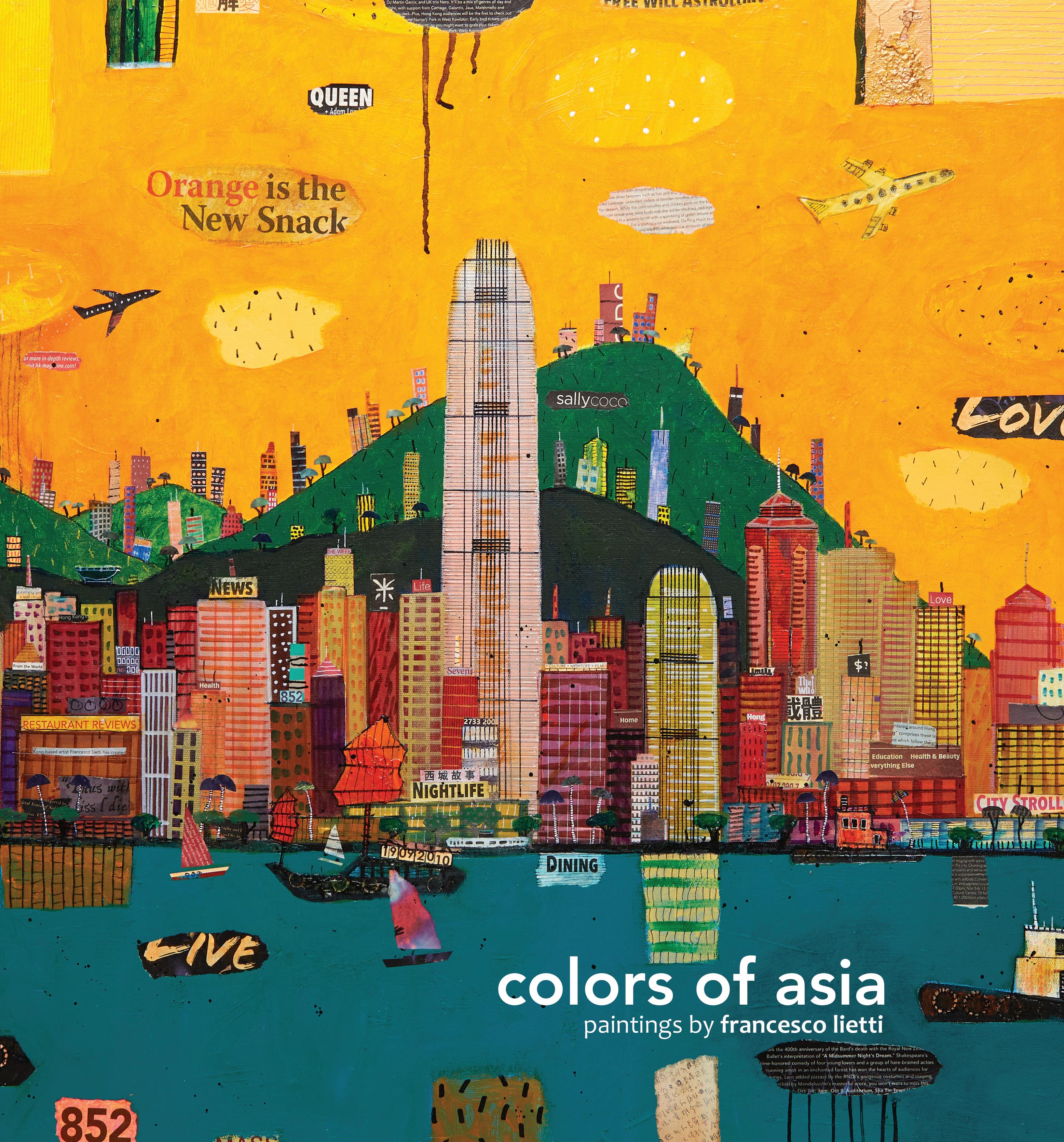
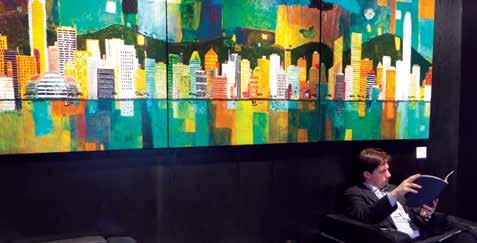
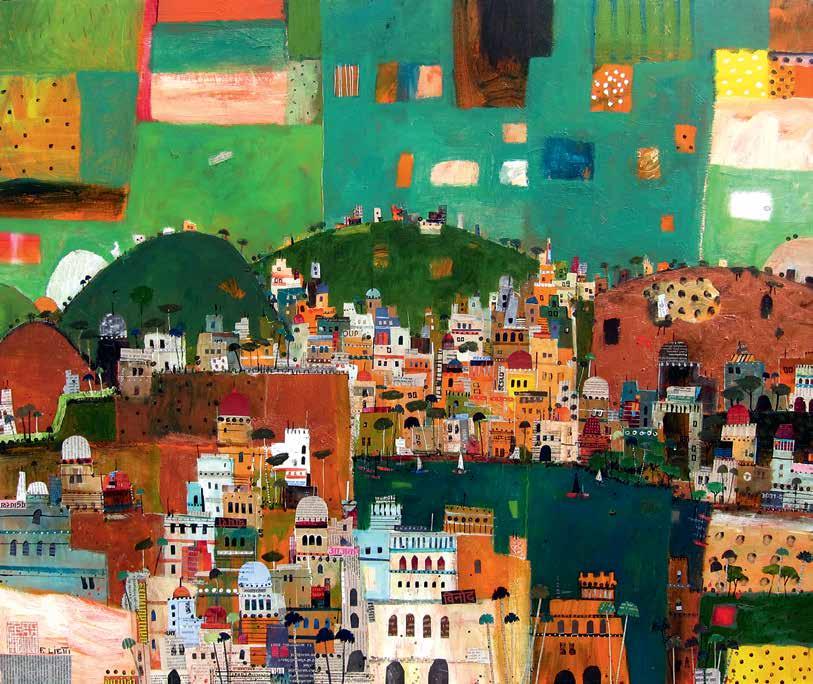
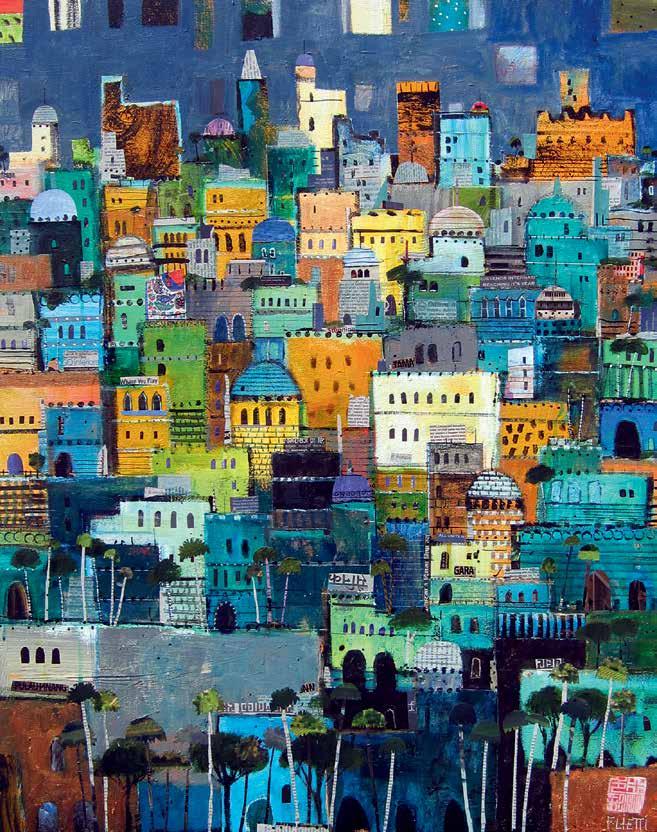
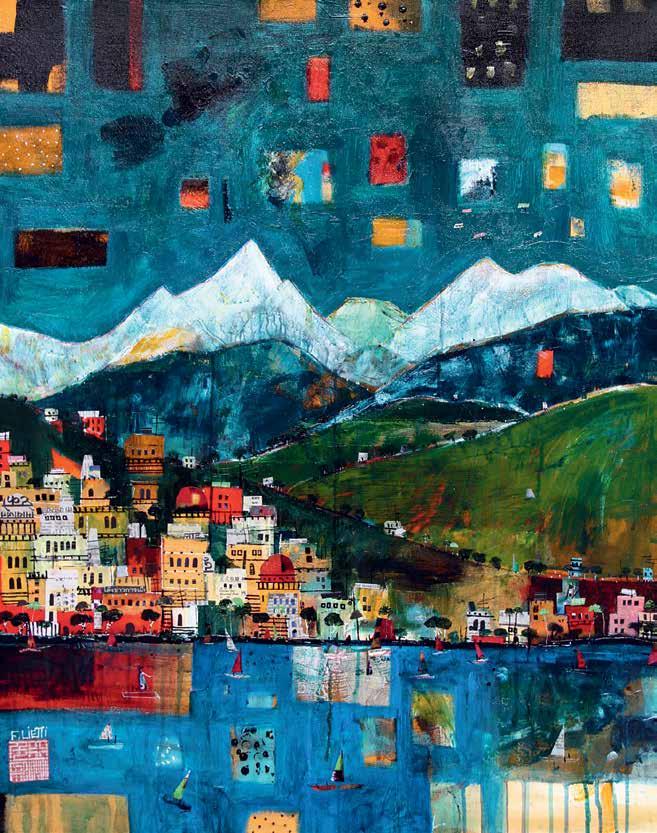
It is a combination of my memory and fantasy of places that I have travelled to. I try to recreate the key elements of the cities and places and their unique landscapes. The paintings are usually composed of two contrasting elements. Take Hong Kong as an example: the city contrasts with nature, a cluster of tall, slim buildings reflected in the sea against a backdrop of green, rolling hills.
What is your usual process when you work on a painting?
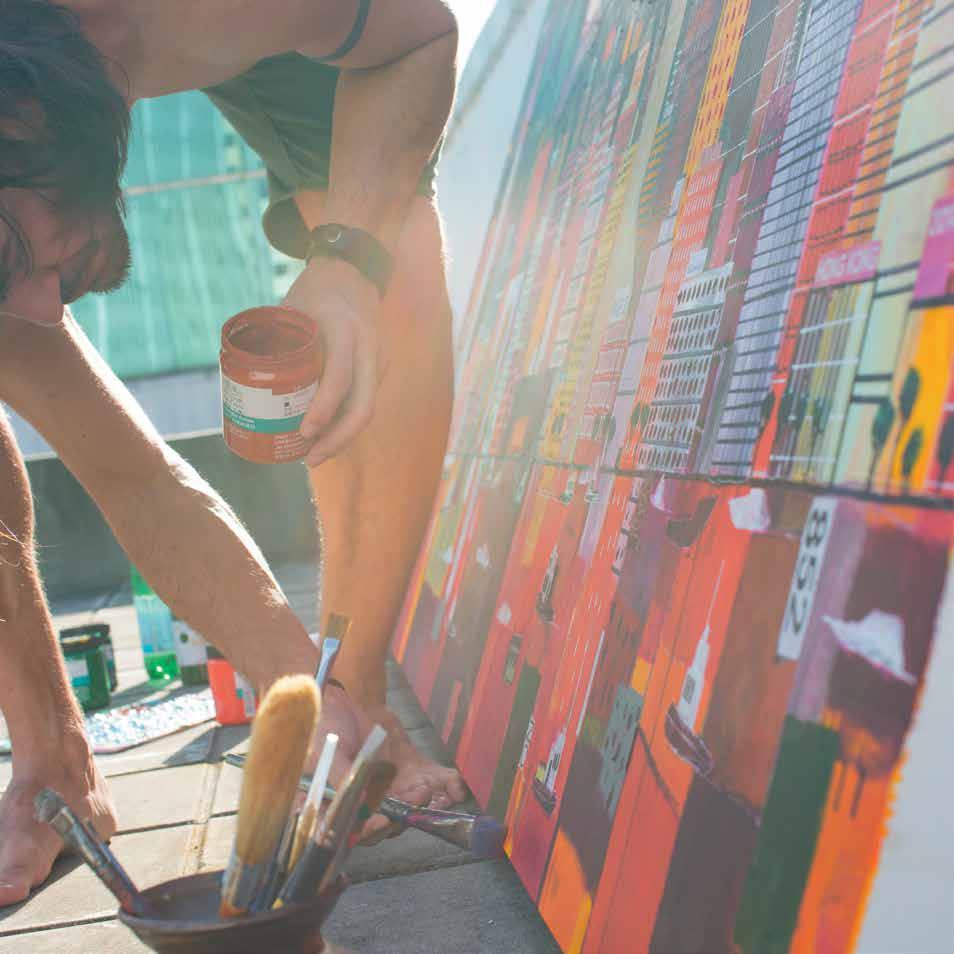
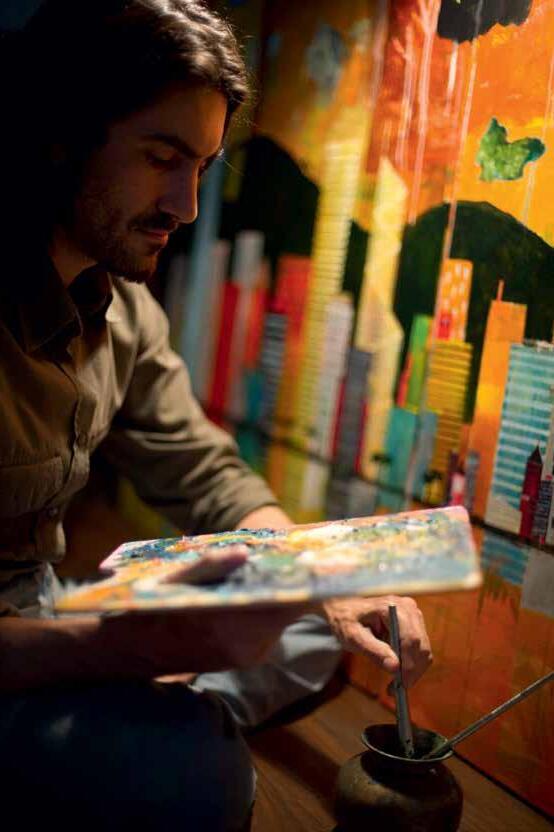
I go to a place, see the buildings, see the landscapes, smell the aromas, taste the food, live the adventures and feel the emotions, then I go away and absorb all of that. When I paint, I put everything down on the canvas and allow my feelings to take over. As I was trained to be an architect, it is my instinct to pay attention to building typologies and I incorporate them in layers with the landscape. I take out the perspective as it is more of how I remember or feel the place and less of a conscious decision or precision exercise.
What are the key techniques that you use?
I like to mix different techniques. The base is acrylic, to which I add collaged pieces, paper cuts, glue, etc., to give texture. I also like to mix the paint with sand or soil collected during my travels, so as to create a stronger connection between the artwork and the place the painting is portraying. I also add pieces of magazines and newspapers from those locations to help reinforce these connections. The text bits add some fun elements when I compose and give me the opportunity to embed messages or thoughts I have in my mind or that may be related to the specific painting. I also use ink, markers, crayons, and wax pastels to enrich my work. Then I finish my paintings with a thick, glossy resin.
What is the most important message that you hope your work communicates?
My work celebrates the beauty and the dynamics of Hong Kong and places that I travel to. I would like to somehow take the viewer to those places and make them feel the same emotions that I experienced.
What do you think your viewers like about your paintings?
I think they like the many colors in my paintings. Many viewers have told me that my paintings make them feel happy. There are also many details and elements in each so they discover something new each time they look.
Do you ever get a “painter’s block”? How do you resolve it?
I don’t have it. I get inspirations as I keep working on a task and I travel sometimes. Of course, there are days that I feel more and some days less, then I focus on less “artistic” tasks like preparing the canvas, etc.
Which painting is your favorite one? You can only pick one. The one hanging in my home. It’s my painting about Laos, called “In Vang Vieng.”
What is your travel bucket list? Top three places at the moment. Uzbekistan, Bhutan, and Samoa.
by Angelo Paratico . writer
There is one art form that has fascinated me since I set foot in Hong Kong in 1983. It is a genre known as Chine de Commande or China Trade art, which was then visible in a few private collections. In particular, I still remember the London art dealer Martin Gregory, who regularly organized tradeshows in the city, renting a suite at the Mandarin hotel. I bought a small oil painting on wood from him of the British battleship HMS Imperieuse anchored in front of Victoria (now Central) back in 1885. It is still hanging in my sitting room after so many years. Masterpieces of the China Trade constituted a natural form of art: practical, free from academic bonds, created in the coastal cities of south China, and blossoming on the ground of a myriad of complex interactions between Western merchants and Chinese artists. After porcelain, other forms of art captured Western fancy and imagination: silver, reverse painting on glass, ivory carving, and oil paintings, which were created locally by westerners or by Chinese with westerners in mind.
China Trade began at the end of the Ming Dynasty (1368–1644) when the first Europeans opened their depots and factories in Macau and Canton. Traditional Chinese art was basically incomprehensible to those rough tradesmen and their buyers in Europe. This may explain why they inspired local craftspeople to produce something that was sellable in Europe and that, at the same time, could embellish their Eastern homes. Because of racial bias Europeans did not adapt to the local mores but insisted on wearing European clothing, drinking water that had not been boiled, eating uncooked vegetables, and embellishing their dwellings with a touch of art that they could later, upon returning to Europe, hang in their homes to remind them of their Eastern adventures. The Chinese craftspeople set to work with great alacrity and ingenuity, applying their own sensitivity in crafting what the “Western devils” were demanding them to produce. The passion and vanity of a few merchants became a craze back in Europe, with a growing demand for affordable works of art. In some cases, the appetite for some of those items became insatiable and were quickly imitated in Europe, thus cross-influencing European artistic feelings. These export paintings were made-to-order, in oil or gouache and in a Western style, and their subject matters focused on the world of trade.
The most representative artist of this genre of paintings, towering over all the others artists, was George Chinnery (January 5, 1774–May 30, 1852), an English painter who spent most of his life in Asia, first in India and then in Macau, where he is buried and absorbed the spirits of the time and place, which are still clearly visible in all his works. The Chinese spirit in his landscapes and portraits is unmistakable and it is certain that he influenced Lamqua (one of the four main schools of China trade art: Spoilum, Lamqua, Namcheong, and Chow Kwa). It has been suggested that the paintings of the China Trade have historical significance more than artistic merits but, casting aside any other consideration, these paintings were meant to serve as a record and as a memento of place: south China. This is why they continue to fascinate us: they need decoding and the amount of details they can reveal can be surprising. The ability of these artists was proverbial but it remains something of a mystery where and how they learned their craft. In the early 17th century Giuseppe Castiglione, a Jesuit, had introduced paintings and published prints showing the Western concepts of chiaroscuro and perspective. Furthermore, the churches of Macau were filled with paintings and frescoes and their Chinese novices would have been apprentices in the Western manner very early on. But the relation between those religious circles and the painters of the China Trade has never been studied and clarified. We possess the record of a famous case about the celebrated portrait of George Washington made by Gilbert Stuart, which was reproduced numerous times in the Chinese workshops. Stuart took legal action against Captain John Sword to prevent him from selling the batch of copies made in China that he was carrying on his ship. Stuart won the case, but he could not stop the spreading of those decent, Chinese-produced copies.
The breadth of the themes and views in these works is wide. Most of the paintings are landscapes and seascapes: in particular, port scenes with Western factories and their flags fluttering at the Canton waterfront; the Whampoa anchorage; the Bocca Tigris straits; and the Shamian embankment. They also include depictions of historic incidents such as the trial of unruly Western sailors at Canton and the reception of Lord McCartney by the Viceroy of Canton. A few decades later, Hong Kong and Macau became the commonest subjects with the new ports along the coast and farther inland on the Yangtze, showing a wide array of vessels, Chinese junks, sampans, and the first steamships. Oil paintings of the China Trade have become hot collector items in the last fifty years, some reaching multi-million-dollar valuations.
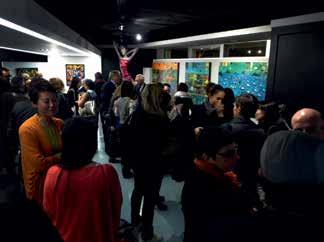
1. “hong kong hong kong” exhibition, yan gallery 2015 2. “colors of asia” exhibition, yan gallery 2011
by Fong Yuk Yan . gallery owner
More than 200 years ago, the British painter George Chinnery travelled to Asia. He lived in India, Guangzhou, and Hong Kong, and spent his latest years in Macau. He produced innumerable landscape paintings during his travels and developed his own unique style. He is now renowned as one of the most influential Western artists in East Asia. In the following 200 years, Hong Kong rose from an unnoticed fishing town to a wealthy metropolis. The Lingnan School of ink painting finds its root here; from the “Perfumed Harbor” city, oil paintings are shipped everywhere in the world (although Shenzhen has become a new hub in recent years). Art and antiques from the Chinese mainland also gather here, transforming it into a much-coveted place that attracts the most famous international auction houses to open their branches. Hong Kong has indeed become an international art center.
Historically, Hong Kong has hosted the most successful businesspersons, among whom the topmost collectors can be found. Moreover, this place is home to generations of art masters, like Yang Shanshen, Chao Shao-An, and Lui Shou-kwan. Artists and collectors here make concerted effort to nurture art. The famous banker Low Chuck-Tiew, well-known artist Wu Guanzhong, and Swiss collector Uli Sigg all have donated their beloved collections of splendid traditional, modern, and contemporary artworks to the Hong Kong public. In recent years, many young, new artists have graduated from the local art schools: Chow Chun Fai, Tsui Pui Chi, and Cheng Tan Shan, amongst others. The heritage of art in Hong Kong never runs out. It has been sustained and strengthened by the energetic younger generations.
Young Italian artist Francesco Lietti was educated in Europe and embarked on his career in Hong Kong. He paints the beautiful Victoria Harbor in colorful and lively brushstrokes, depicting scenes where the lovely steamers and yachts stud the shimmering water, where the dazzling skyscrapers tower into the azure sky. His paintings of the colorful architecture brings out a unique kind of crowdedness that is entirely cheerful and pleasing to the eyes, a crowdedness that is a part of Hong Kong’s signature. In his latest series, Francesco integrates the traditional Chinese technique of lacquer painting into his works: he specially executes several layers of resin on top of the painting making his work shine vibrantly.
Only someone who knows Hong Kong like the back of their hand can tell its true beauty. Apart from knowing the city well, Francesco is concerned with its weal and woe – he has a link to the city’s destiny. He dedicated a painting to the Diaoyu Island dispute between China and Japan; in that work, Hong Kong boats and Chinese warships face Japan on the sea solemnly in a standoff. During a student movement, the artist invited the student protestors to join him in a live painting jam that turned the street into their art studio, where they documented history. We do our best to support local Hong Kong artists and we are very delighted to have Francesco as part of this community. His works are very much adored and collected by both the local and the expatriate communities. Recently, he has been invited to exhibit works in Macau and Guangzhou where his fascinating landscape paintings are presented in several museums. It is a blessing for the Hong Kong art scenes to have Francesco, who has devoted all his talents and hard work to his magnificent creation.
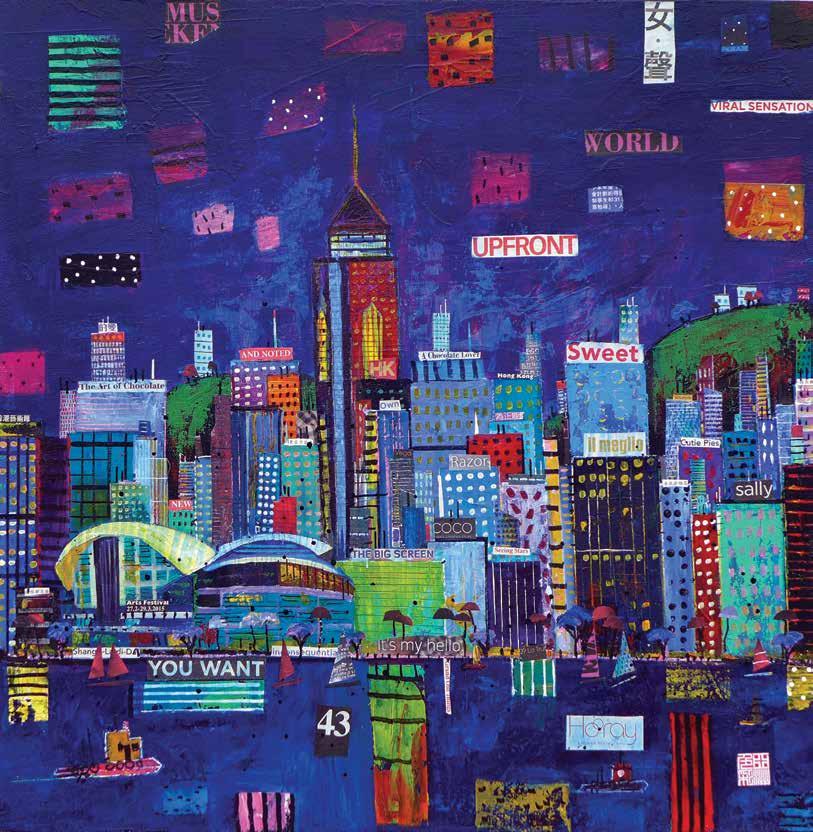
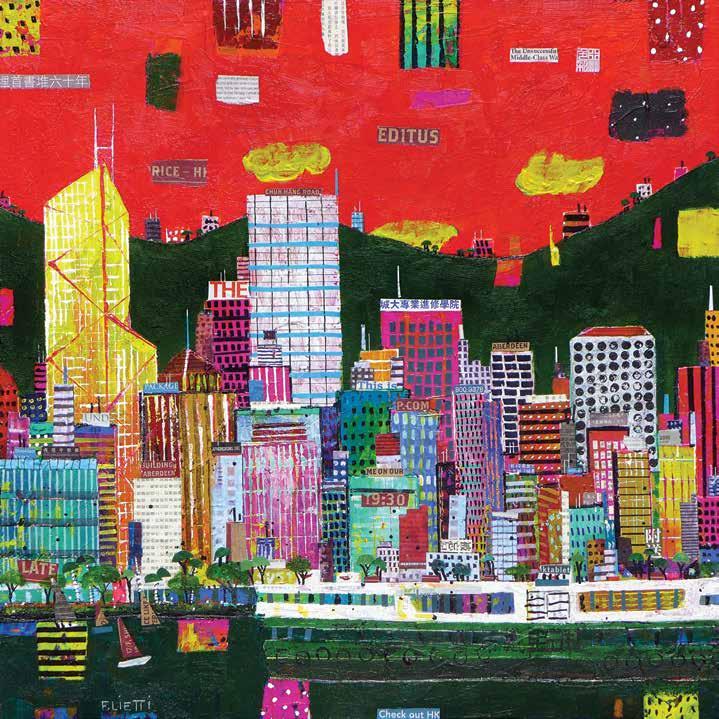
by Francesco Lietti
I always think Hong Kong has a blue-green tone. It must be something in the sea, or in the atmosphere perhaps. It’s very obvious as you come in by plane, everything has this blue-green tinge: the sea, the sky, and the islands. The Aegean and the Mediterranean have a deeper blue color, for instance.
During an art fair I kept looking at this piece, thinking I really liked it. Maybe it was the composition to attract me, maybe the fact that I had taken a risk when the painting was nearly completed, letting watery paint dripping down freely from the clouds, as if it was rain. I thought “if this work doesn’t sell, I’ll keep it for my home.” So, during the last day of the fair, I found myself in a controversial mode: being at a show and hoping to not sell. Quite counterintuitive, you mght say.
The exhibition went well and we scored a few sales, but this specific piece didn’t sell and I took it home as I had decided. It now hangs in my bedroom. Every time I look at it I pat my shoulder and tell myself I got that blue-green tinge just right.
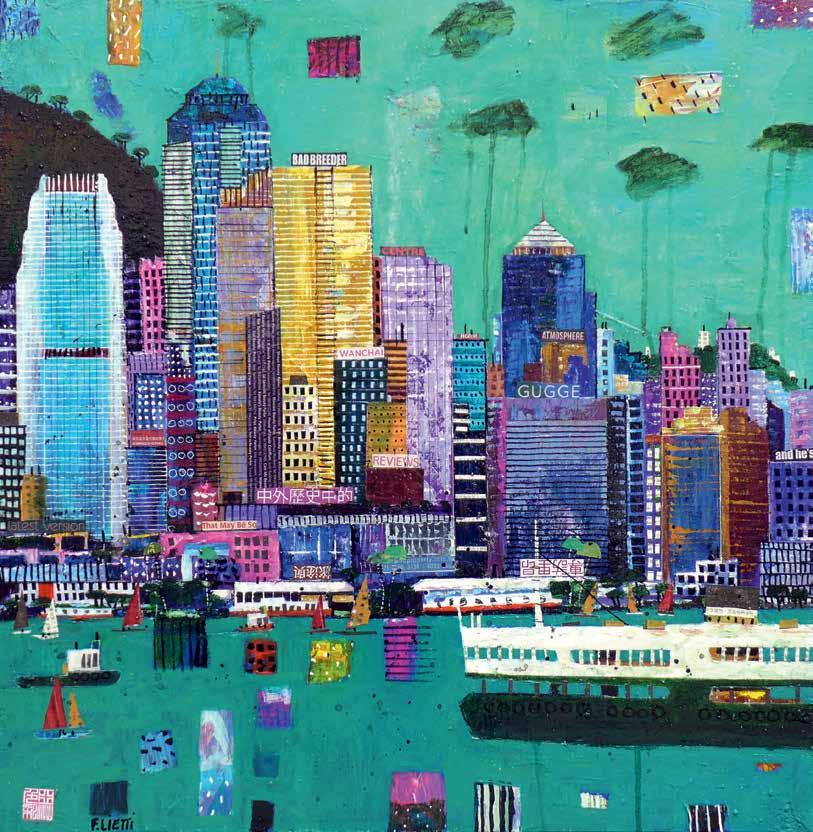
it may be so (next page)
60x60 cm mixed media on canvas 2014
south island sunset (left)
60x60 cm mixed media on canvas 2017
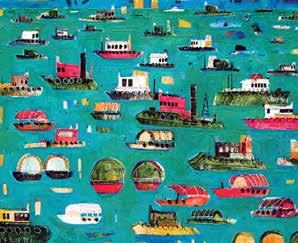
tugboats (middle)
60x90 cm mixed media on canvas 2012
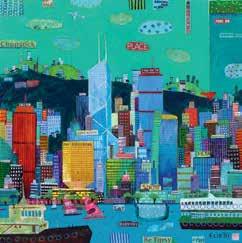
find hong kong (right)
80x80 cm mixed media on canvas 2017
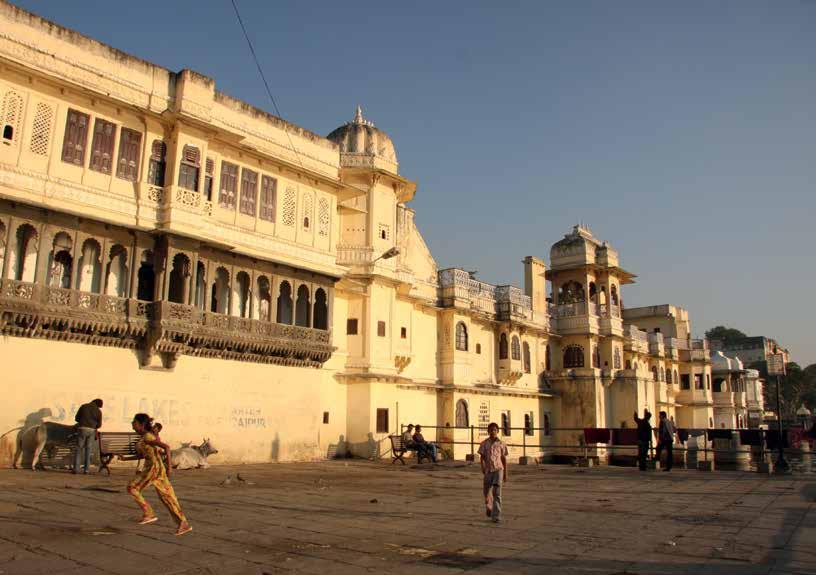
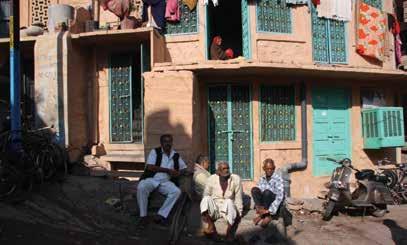
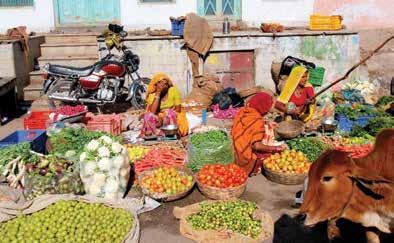
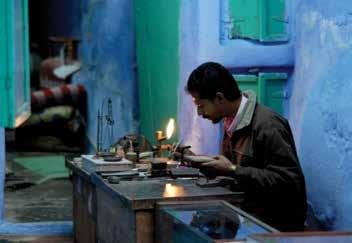
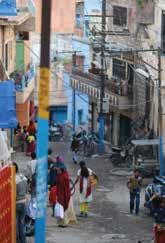
The walls of the houses of Jodhpur are painted pastel blue. They say it’s to protect them from ants and insects. The hike to the fort takes about a half hour. It’s a walk through narrow stepped lanes with blue walls on either side. From the top, the view of the bustling city is magnificent. You can see the blues and whites of the city and in the distance the desert colors of Rajasthan.
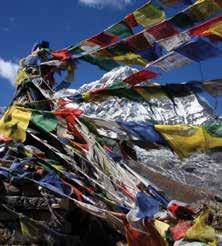
I have always loved mountain stories. My granddad was an avid mountaineer, and, as a kid, I was captivated by his stories and adventures and epic tales of the famous alpinists. As I grew up, I read many books about great ascensions, dreaming of those exotic locations. In 2009 I finally had the chance to travel to Nepal, where, with a guide, I made a week-long expedition to the Annapurna base camp. Annapurna was the first 8,000-meter mountain conquered by a French team back in 1951, two years before a British and New Zealand expedition reached the summit of Mount Everest and three years before Italians summited K2.
The base camp of Annapurna is located at 4,200 meters above sea level, a hundred meters above that is the snow line. There is a rustic guesthouse on the small plateau where you can eat and sleep if your headache allows it. Their strong ginger tea helps. From that point, there would be roughly another 4,000 meters to climb to reach the summit. But this is for real alpinists. I walked back down to Pokhara instead, my starting point at 900 meters above sea. When I arrived, three days later, women were washing clothes in the peaceful waters of that beautiful lake. Those majestic, snow-capped mountains stood quiet in the distance.
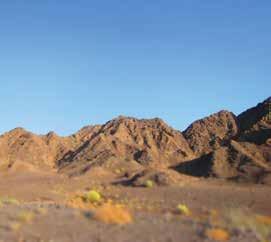
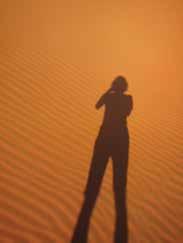
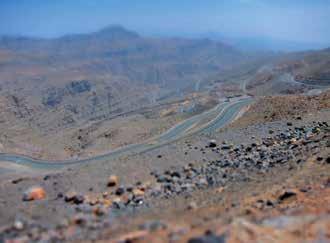
I had been driving through the Qsar Al-Sarab desert since the early morning. It flanks the Persian Gulf on one side first, and then the mountain chain separates the Emirates from Oman on the other. As I pushed south and the hours went by the light turned softer and the yellow, pink, and orange tones of that dry land became more and more vivid. Eventually the mountains disappeared to the east and I found myself immersed in a landscape of soft, brick-orange, tinted dunes. It all felt very quiet and peaceful. As I drove, my eyes kept searching for the perfect spot to take a nice photo. Eventually I found a place on top of a dune where I would have stunning views of the sandy desert. The road had a strip of gravel along the side for pulling off in emergencies and beyond that was a small, flat patch that seemed dusted with golden sand. I slowed down and parked. I got out of the car and listened to the wind for a few minutes before taking my perfect Instagram shot.
When I decided to leave the wheels started spinning without any friction. I jumped out of the car and realized they were sunk into the sand and I panicked. My car was stuck somewhere in the middle of the largest uninterrupted stretch of desert in the world, as I had learned earlier on. I was a good three hours away from Dubai and calling someone to come and pick me up would have cost a fortune. I started digging out sand from underneath the wheels and tried to drive out by pushing down the gas pedal to the floor, but every time I sunk deeper. I don’t know how much time went by, but I was still digging when a truck pulled over. A big guy wearing a long white vest was at the wheel, his mom, I presumed, in a traditional, black abaya next to him. He promptly took out a thick rope, as if he was used to similar situations, and after attaching it to the both vehicles he pulled me out. He parked my car to the side of the road, on the gravel strip, maybe to make sure I didn’t do something silly again. “Where you from?” he asked. “I Pakistan,” he exclaimed proudly beating hard on his chest and then he drove off.
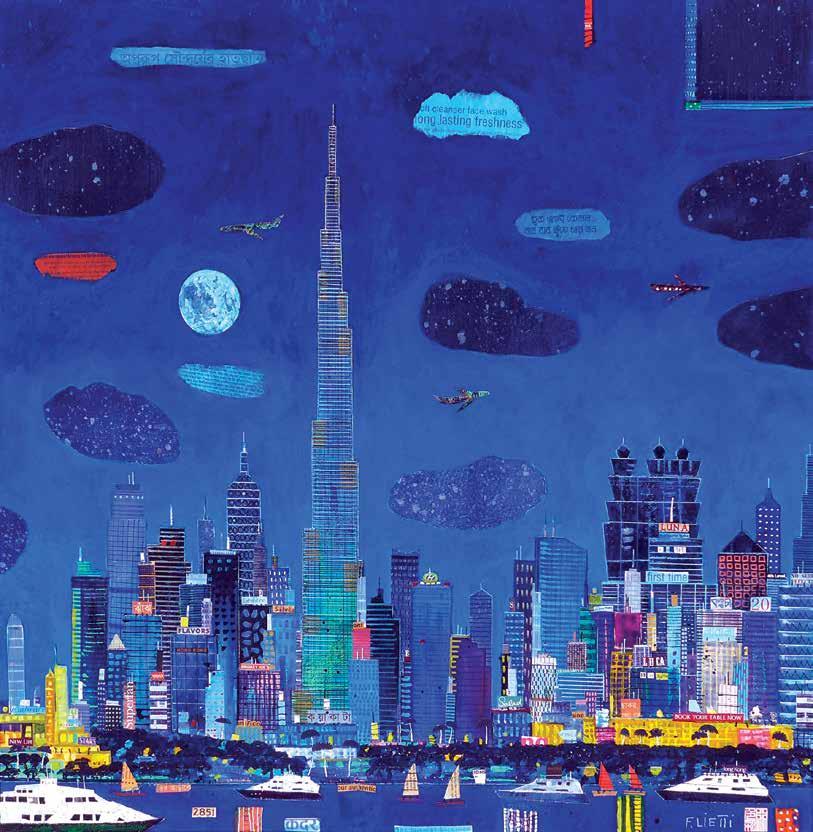
A couple of hours later the silhouettes of the Burj Kalifa and the other skyscrapers came into view. Night had already fallen. I touched the bottle containing the orange sand I took for my collection. Dubai had never seemed so beautiful.
long lasting freshness
80x80 cm mixed media on canvas 2017