Located on the Rue de Lille in Paris’ Saint-Germaindes-Prés district, the Galerie Mougin plays a vital role in the life of a quarter devoted to period furniture and contemporary antiques. A pastel-coloured showcase, with its distinctive black and white floor tiles, the gallery is an ideal setting for the curved lines and crisp angles of the works of the furniture-makers it represents. A fashion designer in the Eighties, Gladys Mougin met André Dubreuil and Tom Dixon and others in London around the time they were beginning to work with metal. She instantly fell in love with their creations and subsequently became their agent in France. She and her husband Robert opened the gallery in 1990 and, ever since, have been showing the work of furniture-artists who create unique pieces, occasionally on commission. Besides André Dubreuil, they have exhibited Christian Astuguevieille, Patrice Butler, Alasdair Cooke, Caroline Corbeau, Annabelle d’Huard, Amélie Dillemann, Laurence Montano, Michael Pohu and others.
Déjà parus aux Éditions Norma Yvonne Brunhammer, André Arbus, 1996. Bruno Foucart, Jean-Louis Gaillemin, Les Décorateurs des années 40, 1998. Yves Badetz, Maxime Old, 2000. Valérie Da Costa, Robert Couturier, 2000. Pierre Staudenmeyer, La Céramique des années 50, 2001. Pierre-Emmanuel Martin-Vivier, Jean Royère, 2002. Patrick Favardin, Les Décorateurs des années 50, 2002. Susan Day, Jean-Charles Moreux, 2002. Pierre Staudenmeyer, Roger Capron. Céramiste, 2003. Chloé Braunstein, Françoise Jollant, Atelier A, 2003. Antoine Gournay, Pierre Staudenmeyer, Francine Del Pierre, Fance Franck. Dialogue des céramistes, 2004. Yves Badetz, Janette Laverrière, 2004. Jacques Barsac, Charlotte Perriand. Un art d’habiter, 2005. Laurence Mouillefarine, Véronique Ristelhueber, Raymond Templier. Le bijou moderne, 2005. Dominique Forest, Luc et Marjolaine Lanel, 2005.
É
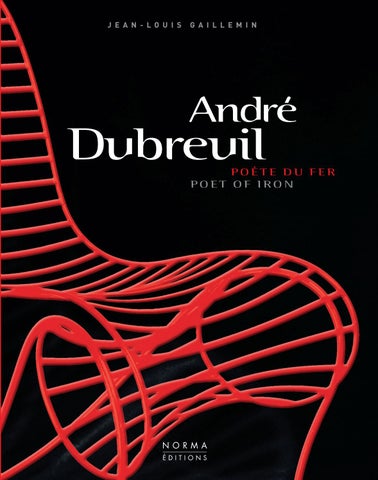
lancée, légère, séduisante au premier coup d’œil, la chaise Spine, qui orne la couverture de ce livre, est un des objets les plus connus, les plus répertoriés de la création contemporaine. On la trouve dans les musées et dans toutes les encyclopédies du design. Elle est chez elle dans les intérieurs fantaisistes et ajoute aux architectures plus sérieuses une note d’humour rafraîchissante. Son auteur, André Dubreuil, après une carrière d’antiquaire et de peintre décorateur, a été l’un des animateurs de la nouvelle création anglaise au milieu des années quatre-vingt avec Mark Brazier Jones et Tom Dixon. Revenu depuis en France, où il s’est installé dans le Périgord, il est exposé à la galerie Gladys Mougin à Paris. À la suite de ses premières improvisations où il maniait le fer à béton en prestidigitateur, Dubreuil s’est confronté aux formes de la tradition pour leur donner une nouvelle vie. Le retour à la citation, au style, à l’ornement, au « métier » s’est effectué sans état d’âme : pour lui c’est l’invention qui compte avant tout. S’il a commencé en ferrailleur, l’histoire des styles ne l’a jamais rattrapé, car il ne sait jamais vers quoi, demain, son métier le mènera. C’est de cela qu’il s’agit : un métier qui fait surgir des formes au hasard des découvertes et des expérimentations. Ce livre raconte la trajectoire d’André Dubreuil et révèle la totalité de son œuvre, de 1985 à aujourd’hui : près de 400 meubles-objets énigmatiques, chaises, commodes, miroirs, cabinets, pendules, lanternes…, dans lesquels le rêve, l’invention, le mystère l’emportent, et de loin, sur la fonction.
S
lender, light and immediately appealing, the Spine Chair adorning the cover is one of the most well-known and widely referenced pieces of modern furniture. It features in leading museums and dictionaries of contemporary design and looks equally at home in ornate interiors and austere architectural spaces, to which it brings a touch of humour. Following a brief career as an antique dealer and decorative painter, its creator, André Dubreuil, became a driving force of the new British furniture scene of the Eighties, alongside Mark Brazier Jones and Tom Dixon. After returning to France and settling in the Dordogne, Dubreuil has exhibited regularly at the Galerie Gladys Mougin in Paris. Subsequent to his first magical improvisations with steel reinforcing bars, he began to measure his talent against traditional furniture types and breathed a new life into them. He has not hesitated to return to allusion, style, ornament and “craft.” What matters chiefly to him is invention. His work has never bowed to a particular historical style and he has never known where his art would lead tomorrow. His mastery of materials enables him to create forms serendipitously, while working on a piece – this is the essence of his art. André Dubreuil, Poet of Iron tells the story of the artist’s career and introduces the reader to the totality of his work from 1985 to 2006: almost 400 pieces of furniture and objets d’art, chairs, commodes, mirrors, cabinets, clocks and lanterns, whose poetry, invention and mystery always outweigh their function.
André Dubreuil
À Saint-Germain-des-Près, rue de Lille, la galerie Mougin joue un rôle essentiel dans ce quartier voué aux antiquités d’hier et d’aujourd’hui. Écrin de couleurs pastel au carrelage piqué de trèfles noirs, elle accueille les formes courbes, galbées, les angles nets, les lignes aiguës des œuvres de ses créateurs. Styliste de mode dans les années quatre-vingt, Gladys Mougin rencontre à Londres André Dubreuil, Tom Dixon…, qui commencent alors leur travail sur le métal. C’est un véritable coup de foudre. Gladys devient leur agent en France. Avec son mari, Robert, elle ouvre sa galerie en 1990, où elle privilégie les artistes qui réalisent des pièces uniques, parfois sur commande : outre André Dubreuil, Christian Astuguevieille, Patrice Butler, Alasdair Cooke, Caroline Corbeau, Annabelle d’Huard, Amélie Dillemann, Laurence Montano, Michael Pohu…
JEAN-LOUIS GAILLEMIN
LA GALERIE GLADYS MOUGIN
J E A N - L O U I S
G A I L L E M I N JEAN-LOUIS GAILLEMIN Disciple de Philippe Jullian, l’auteur d’Esthètes et Magiciens, Jean-Louis Gaillemin a cherché comme ce dernier à mener de front la recherche plastique et l’écriture. Décorateur au Club 7 et au Palace avec
André
Dubreuil
POÈTE DU FER POET OF IRON
Fabrice Eamer, puis collagiste, il s’est lancé dans le journalisme en créant Beaux-Arts magazine et L’Objet d’art. Il enseigne aujourd’hui l’histoire de l’art contemporain et du design à Paris IV-Sorbonne. Son ouvrage Les Décorateurs des années 40 avec Bruno Foucart (Éditions Norma), son livre Salvador Dalí du purisme au surréalisme (Éditions Le Passage), ou sa dernière biographie d’artiste, Egon Schiele (Découvertes-Gallimard), témoignent d’une curiosité qui le rend particulièrement sensible au parcours paradoxal d’André Dubreuil.
A disciple of the writer Philippe Jullian, Jean-Louis Gaillemin combines writing with research in the field of the arts. With Fabrice Eamer he decorated the Club 7 and the Palace in Paris. A collage artist, he then launched into journalism, founding Beaux-Arts Magazine and L’Objet d’Art. He now teaches contemporary art history and design at the Sorbonne University in Paris. His books, Les Décorateurs des années quarante, co-authored with Bruno Foucart (Editions Norma), Salvador Dali: du purisme au surréalisme (Editions Le Passage) and Egon Schiele (Découvertes-Gallimard), testify to a wide-ranging intellectual curiosity. This has given him a special appreciation of André Dubreuil’s offbeat career.
x
AESTHETE
IN
SPITE
OF
HIMSELF
22
André Dubreuil, trompe-l’œil, 1976-1985.
ESTHÈTE
MALGRÈ
LUI
x
23
x
AESTHETE
IN
SPITE
OF
HIMSELF
36
structure, the ornament becomes the structure. Dubreuil had
with curves that engendered further curves, as if I were making
a knack for turning his handicaps – his asymmetrical designs,
a bridge. By the time I had completed the design, the piece was
his reversion to ornament, his beginner’s distinctly non-
done.’ Wary of drawing on paper, as we have seen, Dubreuil
professional look – into strengths.
shaped his designs mentally in the course of his physical struggle with the “wretched” iron bars. “Drawing puts me on
Assemblage or Design?
my guard. Everything works on paper, but making a piece is altogether a different matter. Of course, I have on occasion done
The raw, “salvage” look only fascinated Dubreuil in his first
sketches, rough little outlines, to jot down an idea.” One of
heady days as a furniture-maker. He preferred rigorous designs
Dubreuil’s most stunning achievements from this period – a
to playing with assemblages. The question is, What designs?
screen [cat. n° 10] – speaks volumes about the profusion of
The attraction of rough reinforcing bars quickly palled: “They
formal ideas burgeoning in his mind. After establishing a basic
seemed a bit rustic to me. I often curved them to give them a
rectangular structure, the artist began to shape arabesques.
more pleasing and gentler appearance. It was quite an
From this teeming, contradictory welter, some lines evolved
apprenticeship, 6, 10 and even 20 (millimetre) bars which had
into feet, others soared into thin air. The whole process was
to be bent in a vice.” Shapes came to the artist as he worked
one of choosing, fashioning and experimenting.
the metal, the designs becoming gradually more refined in the process. “I worked directly on the iron, beginning with thick structural bars to give the piece stability, then I would fill in
ESTHÈTE
MALGRÈ
Paravent, 1986 (cat. n° 10).
s’impose avec l’insolence d’un criminel impuni. Asymétrie,
le meuble se faisait. » On le sait, Dubreuil se garde du dessin
inversion ornementale, bricolage de débutant, Dubreuil multiplie
sur papier, son dessin est un dessin mental qui se réalise dans
les handicaps qui tournent à son avantage.
le corps à corps avec ce fichu fer, un « dessein » dirait-on : « Je me méfie du dessin, sur le papier tout fonctionne toujours,
Collage ou dessin ?
la réalisation, c’est autre chose, certes il m’est arrivé de faire des petits croquis, des petits crobards, de jeter une idée… »
Le côté brut et récup’ ne l’amuse que dans l’ivresse des pre-
Une des plus étonnantes réalisations de cette période en dit
miers moments. Au collage amusant, Dubreuil préfère la
beaucoup sur le foisonnement formel qui l’habite. Il s’agit d’un
rigueur du dessin, mais quel dessin ? Très vite, la rudesse du
paravent [cat. n° 10] : Dubreuil installe une structure minimum,
fer à béton le lasse : « Je le trouvais un peu rustique, je l’ai
orthogonale, puis, en guise de jointure, lance quelques
beaucoup courbé pour le rendre plus aimable, plus plaisant,
arabesques. Foisonnantes, contradictoires, certaines devien-
c’était un vrai apprentissage, des barres de 6, de 10 et même
nent des pieds, d’autres s’élancent dans le vide, encore faut-
de 20 (millimètres) qu’il fallait tordre sur l’étau. » C’est en le
il choisir, travailler, expérimenter.
travaillant que les formes se trouvent et que le dessin s’affine. « Je travaillais directement avec le fer, je commençais avec les grosses barres principales pour que ça ne bouge pas, puis je remplissais, un peu comme un pont, des courbes qui s’engendrent les unes les autres, le temps de faire le dessin,
LUI
x
37
x
AESTHETE
IN
SPITE
OF
HIMSELF
50
becomes rigid when it is bent, a principle long known to origami
which contrast sharply with the matt black iron. The handsome
fans. With the help of good welding equipment, volumes are
Pascal Gregory posed fearlessly on top of this furniture freak in
easily created from steel. To allow him to carry out this subtler
a picture for Maison Française, in a setting the magazine
level of work, Dubreuil bought a more sophisticated Tig welder.
described as “bohemian chic and baroque shock.”
He disguised the irregularities produced by welding, finishing
In spite of being tamed by the artist’s formal bent, such
the sheet with small heat marks that oxidised and coloured it.
monsters seem to take advantage of every weakness in the
He has carried on using this leopard-spot effect right up to today
material to reassert their presence and provide a minor diversion.
in a series dubbed Paris (the chair [cat. n° 38] on which he first
Dubreuil’s laboriously produced “black sheep” have been fought
used it was designed for his Paris show).
over by a handful of collectors. One example is a primitivistic, vaguely Art Nègre mirror of 1989 [cat. n° 53] bristling with
Fabled Monsters
wrought-iron spikes sharpened with an angle-grinder. In lieu of twin frames, the mirror’s sides sport large oval copper
The Paris family also includes a two-metre wide commode (the
medallions worked with an awl to accentuate their primitive
“big sister” of Dubreuil’s corner cupboard) and a large mirror to
appearance. Even more curious are two console tables with
hang above it [cat. n 45, 47]. “I tormented the metal like a piece
wrought-iron bases, made in 1990 [cat. n° 69]. They look as if
of pig hide, brazing and pounding it without any particular design
they are writhing in a debauchery of shapes, as though they had
in mind. I began by making the inner frame, then I did a more
just torn themselves away from their creator’s hands. Iron bars
ornamental outer frame. It had an undeniably barbaric side to it.”
that swayed previously like seaweed to the ebb and flow of waves
Other items of Dubreuil furniture owe their vaguely animal
now look as if they had ripped loose from their moorings to throw
look to the formal strangeness caused by the sheer difficulty of
themselves into a frenetic dance. After the hysterical table, we
working in a new medium – wrought iron. “I had a fairly
now have killer consoles. “I made them for customers who no
rudimentary gas forge in London in those days,” explains the
longer wanted any Louis XVI stuff,” says Dubreuil. However, they
artist, who produced one of his strangest tables with it. The table
got more than they had bargained for and were baffled by the
looks as if it were being shaken by a convulsive tremor, as though
formal anarchy of these somewhat “over-the-top baroque pieces.
it were simultaneously contracting and expanding in a two-fold
The sharp points worried them. With children around the place,
os
spiral motion that strains and twists it, exhibiting curious folded
you never knew what might happen.” The consoles subsequently
integuments resembling pods, plates of hammered copper
found a home with a less nervous collector. The most remarkable of these “monsters” is a hefty,
André Dubreuil, dessin. Console, détail, 2002 (cat. n° 236).
totally asymmetrical console table from 1995 [cat. n° 126]. Made from copper sheeting, it stands rather awkwardly on spindly legs. “Making it was hell. The legs gave me a lot of trouble. The welded copper block was very thick, but I couldn’t get the shape right. I made a model in paper to try and get a better grasp of it. I started out with the volume as a kind of carapace. Perhaps it really needs to be hung on a wall. We called it La Mongole.” Dubreuil devised a geometrical-looking “belt,” a sort of corset, to contain its massive bulk. “I had to find a way of keeping its
ESTHÈTE
MALGRÈ
Tératologie Dans la même famille, une commode de 2 mètres d’envergure, la grande sœur de l’encoignure, ainsi qu’un grand miroir conçu pour la surmonter [cat. nos 45, 47] : « Comme une peau de cochon écorché, je brasais et je retapais sans schéma préalable, j’ai d’abord fait le cadre intérieur et ensuite un second cadre plus ornemental, il y avait là un côté barbare indéniable. » D’autres meubles doivent ces rapprochements animaliers à leur étrangeté formelle. Étrangeté née des difficultés d’une nouvelle technique : le fer forgé, « à Londres, j’avais une forge à gaz assez rudimentaire ». Ainsi cette table saisie par un tremblement convulsif, se rétractant et se dilatant à la fois dans un double mouvement spiralé qui la tord et la crispe, montrant d’étranges téguments plissés comme des cosses, plaques de cuivre bossuées qui contrastent avec la noire matité du fer. Freak du meuble sur lequel n’a pas craint de poser pour La Maison française le beau Pascal Gregory, dans une ambiance que le magazine décrit « bohème chic et choc baroque ». Savamment contenus par la volonté formelle de l’artiste, les monstres profitent de chaque faiblesse pour réapparaître et proposer une petite récréation. Accouchements laborieux de moutons noirs qu’un certain nombre d’amateurs de Dubreuil se disputent. Ainsi ce miroir primitiviste de 1989 [cat. n° 53], un rien art nègre, hérissé de pointes forgées et meulées présentant en guise de cadres de grands médaillons ovales en cuivre travaillés au pointeau pour accentuer leur aspect primitif. Plus singulières encore ces deux consoles de 1990 [cat. n° 69] aux piètements de fer forgé, saisies par la débauche formelle. On a l’impression qu’elles viennent de s’arracher des mains de leur créateur. Les barres effilées, qui se mouvaient comme des algues au rythme du flux et du reflux, ont rompu les amarres et amorcent une danse frénétique et furieuse. Après la table hystérique, les consoles tueuses. « Elles avaient été réalisées pour des clients qui ne voulaient plus de Louis XVI », ils ont été servis, mais décontenancés par cette anarchie formelle : « Un peu trop baroque, les pointes faisaient peur, et puis avec les enfants, on ne sait jamais. » Elles ont trouvé par la suite un amateur à l’épiderme moins chatouilleux. Remarquable surtout une commode en tôle de cuivre de 1994 [cat. n° 126], complètement asymétrique, forte en chair, se mouvant gauchement sur ses pieds malingres : « Son accouchement a été très douloureux, j’ai eu beaucoup de mal pour les pieds, le bloc de cuivre soudé était certes très épais, mais formellement je n’arrivais pas à trouver, j’ai fait un gabarit en papier pour essayer de mieux comprendre. Je suis parti du volume comme d’une sorte de carapace. Peut-être faudrait-il l’accrocher au mur finalement ? Nous l’avons appelée la Mongole. » Pour mieux contenir ce corps énorme qui risquait de se dérober, Dubreuil conçoit une ceinture plus géométrique qui la tient comme une gaine. « Il fallait tenir cette forme
Le miroir primitiviste et la commode chez Karl lagerfeld, 1987 (cat. n° 28), Elle décoration, 1989. André Dubreuil avec le miroir et la commode, 1988 (cat. nos 47, 45). Pascal Gregory pose sur une table de Dubreuil (cat. n° 35), La Maison française, 1988.
LUI
x
51
x
AESTHETE
IN
SPITE
OF
HIMSELF
104
La fontaine de l’atelier. Les gars de l’atelier : Richard, André, Joseph, David (accroupi), Ami (le chien), Antoine et Didier.
ESTHÈTE
MALGRÈ
LUI
x
105
x
x
1986/1987
17
18 16
16. Guéridon plateau d’une paire. Barre à béton et plateau en métal peint. Coll. de l’artiste, Dordogne. 17. Lustre Spoutnik. Acier et verre. Coll. privée. 18. Cheminée Araignée. Métal et lentille de verre. Coll. Liliane Fawcett, Londres. 19. Bureau. Métal et cuir. Coll. privée, Angleterre. 20. Tabouret Ram ou Corne. Barre à béton et assise en tissu. Coll. privée. 21. Applique bougies. Acier, cuivre, lentilles de verre, miroir sorcière. Coll. privée.
19
x
x
1986/1987
20
21
23
25 22. Applique Soleil. Barre d’acier et lentille de verre. Coll. privée. 22 23. Chaise Ram ou Corne. Barre à béton et assise en tissu. Coll. privée. 24. Lampadaire Pavot. Acier, cuivre, lentille de verre. Coll. privée. 25. Pendule Soleil. Barre d’acier, lentille 24
de verre, cuivre. Coll. privée, Londres.
x
x
1990
63
64
61
64. Commode Paris. Acier brûlé, perles de verre, cuivre, panneau de laque, dessus en granit. Coll. Edward Elson, New York. 61. Pendule Lion. Acier, cuivre, émail.
65. Console. Acier et dessus de cuivre clouté.
Coll. Danièle Mourgues d’Algues, Londres.
Coll. privée, Paris.
62. Console Feuilles de chêne. Acier, cuivre
66. Miroir. Acier, cuivre, émail.
émaillé, plaque de verre. Coll. privée.
Coll. privée, Toulouse.
63. Bureau Paris caducée. Acier brûlé. Coll. Catherine de Seguin des Hons, France.
67. Console pieds fouet. Acier, cuivre, émail. 62
Six exemplaires. Coll. privées.
x
66 / 67
x
65
1990
x
x
1993/1994
109
110
111
108
x
x
1993/1994
112
114
108. Commode. Acier, cuivre, dessus en marbre. Coll. Nelson Woo, Londres. 109. Lustre. Acier et cuivre. Coll. privée, Paris. 110. Lampadaire. Acier, cuivre, perles de verre. Coll. privée, Paris. 111. Petit meuble d’une paire. Acier, cuivre, émail, perles de verre. Coll. privée, Paris. 112. Cabinet Tournesols. Acier, cuivre, émail. Coll. privée, Allemagne. 113. Meuble à argenterie Wagon. Acier, cuivre, poignées d’émail. Coll. Mme Davis, Angleterre. 114. Grande armoire Tournesols. Acier, cuivre, lapis-lazuli. Coll. Mme Davis, Angleterre. 115. Console Cuisinière. Acier, cuivre, dessus en marbre. Coll. Mme Davis, Angleterre. 113
115
Robert Lavrero, Gladys Mougin et André Dubreuil, 2005.
Crédits photographiques. Picture Credits Emily Andersen, Roland Baufre, Blanc et Demilly, Agnès Bounot, Jacques Diran, André Dubreuil, The Estate of David Hicks, Max Forsythe, Erik Hesmerg, galerie Yves Gastou, Robert Lavrero, Dan Lepard, Fatimah Namdar, NTPL/Joe Cornish, Cindy Palmano, RMN (Jean-Gilles Berizzi, René-Gabriel Ojéda, Daniel Arnaudet, Hervé Lewandowski, Thierry Ollivier), Vincent Simiant, Studio Raphael, Mario Testino, Edina Van der Wyck.
Achevé d’imprimer en mars 2006 sur les presses de Musumeci, SpA, Quart, Val d’Aoste, Italie.
Located on the Rue de Lille in Paris’ Saint-Germaindes-Prés district, the Galerie Mougin plays a vital role in the life of a quarter devoted to period furniture and contemporary antiques. A pastel-coloured showcase, with its distinctive black and white floor tiles, the gallery is an ideal setting for the curved lines and crisp angles of the works of the furniture-makers it represents. A fashion designer in the Eighties, Gladys Mougin met André Dubreuil and Tom Dixon and others in London around the time they were beginning to work with metal. She instantly fell in love with their creations and subsequently became their agent in France. She and her husband Robert opened the gallery in 1990 and, ever since, have been showing the work of furniture-artists who create unique pieces, occasionally on commission. Besides André Dubreuil, they have exhibited Christian Astuguevieille, Patrice Butler, Alasdair Cooke, Caroline Corbeau, Annabelle d’Huard, Amélie Dillemann, Laurence Montano, Michael Pohu and others.
Déjà parus aux Éditions Norma Yvonne Brunhammer, André Arbus, 1996. Bruno Foucart, Jean-Louis Gaillemin, Les Décorateurs des années 40, 1998. Yves Badetz, Maxime Old, 2000. Valérie Da Costa, Robert Couturier, 2000. Pierre Staudenmeyer, La Céramique des années 50, 2001. Pierre-Emmanuel Martin-Vivier, Jean Royère, 2002. Patrick Favardin, Les Décorateurs des années 50, 2002. Susan Day, Jean-Charles Moreux, 2002. Pierre Staudenmeyer, Roger Capron. Céramiste, 2003. Chloé Braunstein, Françoise Jollant, Atelier A, 2003. Antoine Gournay, Pierre Staudenmeyer, Francine Del Pierre, Fance Franck. Dialogue des céramistes, 2004. Yves Badetz, Janette Laverrière, 2004. Jacques Barsac, Charlotte Perriand. Un art d’habiter, 2005. Laurence Mouillefarine, Véronique Ristelhueber, Raymond Templier. Le bijou moderne, 2005. Dominique Forest, Luc et Marjolaine Lanel, 2005.
É
lancée, légère, séduisante au premier coup d’œil, la chaise Spine, qui orne la couverture de ce livre, est un des objets les plus connus, les plus répertoriés de la création contemporaine. On la trouve dans les musées et dans toutes les encyclopédies du design. Elle est chez elle dans les intérieurs fantaisistes et ajoute aux architectures plus sérieuses une note d’humour rafraîchissante. Son auteur, André Dubreuil, après une carrière d’antiquaire et de peintre décorateur, a été l’un des animateurs de la nouvelle création anglaise au milieu des années quatre-vingt avec Mark Brazier Jones et Tom Dixon. Revenu depuis en France, où il s’est installé dans le Périgord, il est exposé à la galerie Gladys Mougin à Paris. À la suite de ses premières improvisations où il maniait le fer à béton en prestidigitateur, Dubreuil s’est confronté aux formes de la tradition pour leur donner une nouvelle vie. Le retour à la citation, au style, à l’ornement, au « métier » s’est effectué sans état d’âme : pour lui c’est l’invention qui compte avant tout. S’il a commencé en ferrailleur, l’histoire des styles ne l’a jamais rattrapé, car il ne sait jamais vers quoi, demain, son métier le mènera. C’est de cela qu’il s’agit : un métier qui fait surgir des formes au hasard des découvertes et des expérimentations. Ce livre raconte la trajectoire d’André Dubreuil et révèle la totalité de son œuvre, de 1985 à aujourd’hui : près de 400 meubles-objets énigmatiques, chaises, commodes, miroirs, cabinets, pendules, lanternes…, dans lesquels le rêve, l’invention, le mystère l’emportent, et de loin, sur la fonction.
S
lender, light and immediately appealing, the Spine Chair adorning the cover is one of the most well-known and widely referenced pieces of modern furniture. It features in leading museums and dictionaries of contemporary design and looks equally at home in ornate interiors and austere architectural spaces, to which it brings a touch of humour. Following a brief career as an antique dealer and decorative painter, its creator, André Dubreuil, became a driving force of the new British furniture scene of the Eighties, alongside Mark Brazier Jones and Tom Dixon. After returning to France and settling in the Dordogne, Dubreuil has exhibited regularly at the Galerie Gladys Mougin in Paris. Subsequent to his first magical improvisations with steel reinforcing bars, he began to measure his talent against traditional furniture types and breathed a new life into them. He has not hesitated to return to allusion, style, ornament and “craft.” What matters chiefly to him is invention. His work has never bowed to a particular historical style and he has never known where his art would lead tomorrow. His mastery of materials enables him to create forms serendipitously, while working on a piece – this is the essence of his art. André Dubreuil, Poet of Iron tells the story of the artist’s career and introduces the reader to the totality of his work from 1985 to 2006: almost 400 pieces of furniture and objets d’art, chairs, commodes, mirrors, cabinets, clocks and lanterns, whose poetry, invention and mystery always outweigh their function.
André Dubreuil
À Saint-Germain-des-Près, rue de Lille, la galerie Mougin joue un rôle essentiel dans ce quartier voué aux antiquités d’hier et d’aujourd’hui. Écrin de couleurs pastel au carrelage piqué de trèfles noirs, elle accueille les formes courbes, galbées, les angles nets, les lignes aiguës des œuvres de ses créateurs. Styliste de mode dans les années quatre-vingt, Gladys Mougin rencontre à Londres André Dubreuil, Tom Dixon…, qui commencent alors leur travail sur le métal. C’est un véritable coup de foudre. Gladys devient leur agent en France. Avec son mari, Robert, elle ouvre sa galerie en 1990, où elle privilégie les artistes qui réalisent des pièces uniques, parfois sur commande : outre André Dubreuil, Christian Astuguevieille, Patrice Butler, Alasdair Cooke, Caroline Corbeau, Annabelle d’Huard, Amélie Dillemann, Laurence Montano, Michael Pohu…
JEAN-LOUIS GAILLEMIN
LA GALERIE GLADYS MOUGIN
J E A N - L O U I S
G A I L L E M I N JEAN-LOUIS GAILLEMIN Disciple de Philippe Jullian, l’auteur d’Esthètes et Magiciens, Jean-Louis Gaillemin a cherché comme ce dernier à mener de front la recherche plastique et l’écriture. Décorateur au Club 7 et au Palace avec
André
Dubreuil
POÈTE DU FER POET OF IRON
Fabrice Eamer, puis collagiste, il s’est lancé dans le journalisme en créant Beaux-Arts magazine et L’Objet d’art. Il enseigne aujourd’hui l’histoire de l’art contemporain et du design à Paris IV-Sorbonne. Son ouvrage Les Décorateurs des années 40 avec Bruno Foucart (Éditions Norma), son livre Salvador Dalí du purisme au surréalisme (Éditions Le Passage), ou sa dernière biographie d’artiste, Egon Schiele (Découvertes-Gallimard), témoignent d’une curiosité qui le rend particulièrement sensible au parcours paradoxal d’André Dubreuil.
A disciple of the writer Philippe Jullian, Jean-Louis Gaillemin combines writing with research in the field of the arts. With Fabrice Eamer he decorated the Club 7 and the Palace in Paris. A collage artist, he then launched into journalism, founding Beaux-Arts Magazine and L’Objet d’Art. He now teaches contemporary art history and design at the Sorbonne University in Paris. His books, Les Décorateurs des années quarante, co-authored with Bruno Foucart (Editions Norma), Salvador Dali: du purisme au surréalisme (Editions Le Passage) and Egon Schiele (Découvertes-Gallimard), testify to a wide-ranging intellectual curiosity. This has given him a special appreciation of André Dubreuil’s offbeat career.