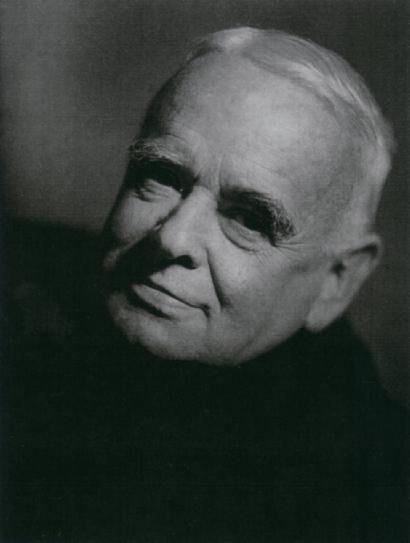
John Howard Whitehouse
A J O H N R U S K I N
C O L L E C T I O N
J A M E S S . D E A R D E N
C O M PA N I O N O F T H E G U I L D O F S T G E O R G E W I T H A P R E F A C E B Y T I M H I LT O N
A J O H N R U S K I N
C O L L E C T I O N
J A M E S S . D E A R D E N
C O M PA N I O N O F T H E G U I L D O F S T G E O R G E W I T H A P R E F A C E B Y T I M H I LT O N
1. the ruskin galleries at bembridge school
of the John Rylands Library, vol. 51, no. 2, 1969...................
2. the haddon c. adams ruskin collection
of the John Rylands University Library of Manchester, vol. 55, no. 2, 1973.........................................................................
3. cataloguing ruskin ’ s library
5. two misses harrison
6. domecq at brantwood
7.
. the ruskin society of newport, isle of wight
11. the case of the grocer of walkley
12. lost brantwood
13. margaret ’ s well
The Companion, vol. 1, no. 4, 2008..............................................156
14. a late ruskin letter
Ruskin Review and Bulletin, vol. 4, no. 1, 2007.............................165
15. a tale of two churches
Ruskin Review and Bulletin, vol. 10, no. 2, 2014...........................175
16. ‘ they caught the cap off of his head ’
Ruskin Review and Bulletin, vol. 7, no. 2, 2011.............................183
17. john ruskin ’ s pottery
Ruskin Review and Bulletin, vol. 4, no. 3, 2008.............................189
18. the brantwood books
The Friends of Ruskin’s Brantwood Newsletter, Autumn 2006.......193
19. old maisie
The Friends of Ruskin’s Brantwood Newsletter, Spring 2014..........200
20. a book with a background
The Friends of Ruskin’s Brantwood Newsletter, Spring 2012 202
21. young arthur
The Friends of Ruskin’s Brantwood Newsletter, Autumn 2009.......206
22. ruskin and st ursula ’ s disappearing dog
Ruskin Review and Bulletin, vol. 1, no. 3, 2005.............................212
23. some green photographs
Ruskin Review and Bulletin, vol 5, no 2, 2009 221
24. ruskin in canada
The Friends of Ruskin’s Brantwood Newsletter, Autumn 2004.......227
25. john ruskin ’ s venetian ghost
The Book Collector, vol. 60, no. 1, 2011........................................230
In thinking about an old, wise and trusted friend I find it hard to distinguish between the qualities of his writing and the virtues of his personality. Do we praise Jim (as we all call him, whether we be Ruskinians, booksellers, printers or Isle of Wight neighbours) for his erudition and long devotion to the causes of specialist publishing; or for his pages-long correspondence and personal generosity, which for decades past has been his gift to all new Ruskin scholarship?
Such qualities are apparent in his articles that are sent to us in this book, as indeed they have been in many other volumes that constit u t
knowledge but also his memory; for in the present book, as in so many others by James S. Dearden (as he is known in official places and in the acknowledgements of dozens of academic histories), his capacity for recollection makes us pause in respectful wonder. His thoughts of years long gone and the analysis of evidence of the past are not only touching. They have an historical depth that helps us to feel the nature of nineteenth-century life – whether that life is in the clouds of philosophy or, often enough, in the routines of domesticity.
Allow me to distinguish, crudely, between two sorts of memory. The first is that of personal reminiscence. The second is the ability to retain, and then summon, precise information about people and their doings, places, dates, pictures and books. Look now at the moving descriptions of Jim Dearden’s visits to Brantwood when he was young and could speak to aged Coniston people who had known the house as it still existed in the years after Ruskin’s death. Then consider the account of how Dearden began his bibliography of all the books that Ruskin had ever owned. The Librar y of John Ruskin (2012) is a masterpiece. It has no parallel in the study of nineteenth-century intell e
introduction. We are not told how the work was begun, nor how its ambition was pursued.
Now, in the essay ‘Cataloguing Ruskin’s Library’, we may discover how years of learning reached a final order. Dearden’s research both complemented and extended E. T. Cook’s and Alexander Wedderburn’s footnotes in the 39 volumes of their classic Library Edition (1903-12). We can follow the expansion of Dearden’s first, tentative card index in his own study to the final, printed result. And in this bibliography nearly 3,000 books are impeccably noted.
Jim Dearden’s visual memory is one more distinction of his intellectual character. I suggest that his eye is most acute when looking at,
vividly he can summon, for himself and then for us, book plates, printed illustrations of novels and poetry, typefaces and illuminated
hung or stored at Bembridge, as well as of the collection that belongs to the Guild of St George, now housed in the museum in Sheffield.
Dearden is a precise writer who can turn his attention to unhappy emotions. In one disturbing essay we are led beyond the safe confines of Brantwood, Bembridge and Sheffield toward the tragic crisis of Ruskin’s emotional life. With firmness and delicacy Dearden lists and illustrates the known portraits of Rose La Touche. Now they call us from their occlusion. Who will not feel some sympathetic terror when looking at the drawing of Rose’s insane countenance as she struggled in her deathbed? This intimate portrait, so seldom reproduced, must have troubled Dearden for many years.
So let us now follow our perceptive Ruskin scholar to the hostelry at Bibury in Gloucestershire. There, he tells us, he noticed two small o i l p a i n t i n g s o f f i s h , s i g n e d b y A
Arthur who was married to Joan Agnew, the director of Ruskin’s life in the last three decades of his earthly existence. He was the son of their union. No intellectual, Arthur junior owned a fish farm ( p e r h a p s b o u g h t w i t h f u n d s f r o m R u s k i n ’ s p o s t h u m o u s p u r s e ? ) . And here is Dearden’s photograph of that un-Ruskinian modern
viii
enterprise, an artificial marriage between nature and commerce. It is quite proper, and in character, that Dearden has collected and presented this information. His essay on Carshalton and the river Wandle also asks us to value curiosity. Small matters are not necessarily trivial. Historians must be grateful that Dearden knows so much about suburban as well as country places, and introduces us to people who have no grand claims to posthumous fame. We are also in his debt for the careful mentions of unpretentious Ruskin admirers: his schoolgirl friends, for instance, and his secretaries, or the Brantwood servants and their children.
No Ruskin servant was ever cast off, especially since they did not wish to leave his service. So there were often many dependent generations beneath the same roof, or who had retired to neighbouring cottages. Let us think of A Ruskin Collection as an elaborate family h
inheritances, and so on: yet also incomplete, as family histories must always be. And Ruskinians, whether we be writers, dons, local historians, guides to cathedrals or footpaths, Companions of the Guild of St George or book collectors, still form a sort of family. We are not especially numerous, often we know each other and speak of Ruskinia
Wedderburn about a century ago, and we grieve for those fellow devotees who have now left us. As A Ruskin Collection reveals, the guiding archivist of this family – for half a century – has been James S. Dearden. Thank you, Jim!
Tim Hilton
Most of my working life and much of my retirement has been devoted to studying and writing about matter relating to the great Victorian figure, John Ruskin. I have written a number of books and articles on my subject. As it happens, my first three publications – in 1947, 1948 and 1950 – were not Ruskin-related. The first two, on Christmas Carols and Christmas Customs, were published in the Bembridge
S c h o o l N
published privately.
However in 1959 I wrote a short article on Brantwood, Ruskin’s h o m e a t C o n i s t o n , w
Cumbria. To my amazement and delight they not only published it but sent me a cheque too! After that there was no stopping me. I wrote a number of local history articles for the local North West Evening Mail, but the greater part of my writing has been Ruskin-related.
A friend once referred to me as ‘Ruskin’s representative on earth’. I suppose I do now have, in various ways, a slightly more direct connection with Ruskin than most of my contemporaries!
I have written in my Rambling Reminiscences of those in the first generation of Ruskinians with whom I either didn’t quite overlap, or a
[Collingwood], Kathleen Olander and the Cork Girls High School’s ‘Rose Queen’ of 1888
Of course – to me – the principle among these was J. Howard Whitehouse who had visited Brantwood in 1899 to present to Ruskin the National Address of Congratulation on his eightieth birthday. Whitehouse was to build up the world’s leading Ruskin collection, o f w h i c h I w r i t
from 1945 when I entered Bembridge School, until his death in 1955. As a boy at Bembridge I had the relatively free run of his
library. I transcribed Ruskin manuscripts for him when he was writing his Vindication of Ruskin, 1950, his reply to Admiral James’s book on Ruskin’s marriage. I heard him speak of his visit to Brantwood in 1899, and again of his staying at Brantwood with Arthur Severn in 1925 when he was trying to buy the house to establish it as an international memorial to Ruskin. He failed in that attempt but finally succeeded in his aim in 1932. I only wish I had asked Whitehouse more about Ruskin the man.
Another important Ruskin collector whom I met on several occas i o n s , w a s H a d d o n C . A d a m s , a b o u t w h o s e c o l l e c t i o n I w r i t e i n chapter 2. In this chapter I quote from a long letter from Adams to his father about his visit to Coniston and Brantwood in 1928. This letter reveals that Adams knew what he was seeing and what he was looking for. It also reveals how little those in charge of Brantwood at that time knew of its contents – and how ready they were to dispose of them!
Fred Sharp was a carpenter, a teacher and a modest man of modest means. But he too was a Ruskin admirer with an intimate knowledge of Ruskin’s books, manuscripts and letters which remained at Brantwood. Buying directly from Brantwood before the 1931 dispersal sale (he told me of his regret at not actually being able to attend the same itself) or from T. H. Telford, the Grasmere antiques dealer in the 1930s and ’ 40s, Sharp built up a very important Ruskin collection. I met him on several occasions. Again, missed opportunities. I should have taken more notice of what he told me, and showed me on my early visits to him, and I should have asked him more. But originally I was only in my mid-teens, and not terribly interested in Ruskin! Following his death in 1957, only weeks after I returned to Bembridge to care for the Whitehouse Collection, the bulk of the Sharp Collection went to America – either to Helen Viljoen (with whom Sharp had been collaborating) or to Yale. However, I was able to secure bookcases, books and pictures for the collection at Brantwood, and a number of books from his collection came to me. I have w r i t t e n o f S h a r p i n m y R a m b l i n g R e m i n i s c e n c e s a n d V a n B u r d contributed a biographical article on him to The Book Collector in the Winter 1995 issue.
I have been a book collector from my earliest youth. For many years I collected books relating to Cumbria – with just a smattering of books by or about Ruskin. When I retired and was free to collect Ruskin on my own behalf (as opposed to professionally) that became my speciality. But of course I had already begun to write articles and books about Ruskin. I think my first serious article was on Ruskin’s bookplates which appeared in The Book Collector in 1964.
In 2009 I ‘collected’ my Ruskin and book articles into my Further Facets of Ruskin. The present volume only includes one bibliographical chapter – on an interesting set of Ruskin’s Stones of Venice in my collection. All of the other pieces assembled here are not specifically ‘bibliographical’ although inevitably there are references to Ruskin’s books, articles and manuscripts.
The first chapter, on The Whitehouse Collection, as it was then constituted, appeared in The Bulletin of the John Rylands Library as it was then titled. Frank Taylor, the Librarian and Editor, used to take his annual holiday on the Isle of Wight, and we met in that way. This article was written at his request. When the Adams Bequest arrived at Bembridge it seemed appropriate that my account of it should appear in the (by now re-named) same publication.
I first wrote about Ruskin portraits in Apollo in 1960 and 1961. T
Pictures in 1999. Meanwhile my interest in portraits – Mary Lutyens had written on the portraits of Effie Ruskin in Apollo in 1968 –spurred me into writing on the portraits of Rose La Touche in the Burlington in 1978, a piece which is included here.
My article in Turner Society News on ‘Ruskin and the Splügen’ was written soon after the Whitehouse Collection had acquired a number of papers relating to the purchase of this watercolour for presentation to Ruskin. The same journal also printed my piece explaining why Ruskin sold Turner’s ‘The Slave Ship’ wherein I speculated on the price received for it – a speculation which, a number of years later, was to be proved amazingly accurate!
I contributed the essays on ‘Margaret’s Well’ to the 2004 issue of The Guild of St George’s Companion, soon after a visit to the ‘well’ at Carshalton.
I have been frequently and generously indulged by the editors of The Friends of Ruskin’s Brantwood Newsletter and The Ruskin Review and Bulletin and I am very grateful to them, and to the editors of the other journals, for allowing me to re-print the articles in this collection. I am also deeply indebted to all of my friends at the Ruskin Library in Lancaster University for their constant and unstinting help.
I am grateful to the various friends and organisations who have made photographs available to me. Particularly I appreciate the help of friends at the Ruskin Library in this connection. Strictly speaking photographs from here should be acknowledged to ‘Ruskin Foundation (Ruskin Library, University of Lancaster)’. In the book, for brevity, I acknowledge them to ‘Ruskin Foundation’.
I am also deeply indebted to both Patrick Davies and Isi Bogod at Pallas Athene for their enormous help in putting this collection together.
i. introduction
T h e R u s
School which house it, owe their existence to the enthusiasm of the founder of the School, J. Howard Whitehouse.
Whitehouse was born in Birmingham in 1873. In the 1890s he became interested in the life and teaching of John Ruskin and he began to buy and read books by and about Ruskin. In 1896 he founded the Ruskin Society of Birmingham which was just one of several Ruskin Societies which existed in the country at that time. Two years later he established a magazine, St George, which was subsequently adopted as the society’s official organ. He persuaded many well-known lecturers to visit Birmingham and their lectures are printed in St George, or are otherwise preserved.
For example, on 27 October 1898 Dean Farrar, the president, addressed the society on ‘Ruskin as a Religious Teacher’. The lecture was originally printed by Whitehouse in 1904. A second edition was published by Arnold Fairbairns in 1907. Farrar’s holograph manuscript is now at Bembridge (MS 83), as are the extensively annotated proofs of Professor F. York Powell’s ‘Appreciation of John Ruskin’ from St George, 1900 (MS 67).
In 1900 Dr F. J. Furnivall, who had known Ruskin from the 1850s, lectured to the society. The lecture was not printed but Whiteh o u s e k
transcript of them (MS 73).
The correspondence files and guard books relating to both the
Birmingham Ruskin Society and St George are at Bembridge, though as yet they are uncatalogued.
On the occasion of Ruskin’s eightieth birthday in 1899, the Ruskin Societies sponsored a national address of congratulation. This is a volume of some 20 pages, beautifully illuminated by Albert Pilley of Sheffield and bound at the Doves Bindery (MS 81). Whitehouse was undoubtedly a prime mover behind the preparation of the address. He and William Wardle, the secretary of the Liverpool Ruskin Society, went to Brantwood to present the manuscript to Ruskin and Whitehouse recorded the details of their visit in his diary.
Feby 7, 1899 To Coniston to bear to Mr Ruskin the National Address of Congratulation promoted by the Ruskin societies. I left Birmingham at 9 o ’clock and reached Coniston at 4. I put up at the Dove Hotel and after tea, I drove to Brantwood to arrange time o f p
stated her mother was unwell and in bed and that it was feared that Mr Ruskin could not see us tomorrow, but that Mr and Mrs Severn hoped to receive us on his behalf. I replied that the address I bore was a national one, bearing among others the signature of the Prince of Wales and that I hoped that it would at least be possib l e f o r m e t o h a n d i t t o M r R u s k i n
thought it might be managed and I arranged to call at 11.30 the next morning.
On my drive to Brantwood I met W. G. Collingwood who seemed rather odd and snappish. Drove back to the hotel through a heavy rain and then to the station to meet Wardle, the secretary of the Liverpool society. The Address also arrived at the station but minus the signatures which should have been sent with it from Sheffield by White. We had therefore to compile another list of signatories, as best we could from memory.
Collingwood came round in the evening and from his manner I gathered that a revulsion of feeling had taken place at Brantwood with regard to the Address and that we should be received by Mr Ruskin. Collingwood said that it had been feared White from the Sheffield Museum was coming with the Address, and Mr Ruskin
did not want to see him. I could not gather what was the precise o b j e c t i o n t o
,
g against him at Brantwood. Collingwood further advised us in readi n g t h
painting of his portrait by Holman Hunt. Ruskin liked his works, but not his portraits and would not care to have his portrait painted by him. Collingwood added that if anyone painted it, it should be G. F. Watts. Under these circumstances we decided to omit the request.
The landlord of the Hotel came in to have a chat about Ruskin. He knows him well, and knew his parents before him. On returning from Italy on one occasion Ruskin gave him some pictures he had brought back, and these now hang in the coffee room.
Feby 8 The morning was fairly bright and clear and at 11 o ’clock we started for Brantwood. It is a glorious road, going for some distance by the margin of the lake and commanding exquisite views. At Brantwood we were very politely received by Mr and Mrs Arthur Severn. They explained that The Master felt equal to seeing us and had expressed a wish to do so. Mrs Severn said that he was really wonderfully well and that although we should find him in his bedroom, we were not to conclude from that, that he was ill. They did not want him to come downstairs as the staircase was rather narrow, &c, &c.
We were then conducted to Mr Ruskin’s presence. He was dressed and sitting in an arm chair before a little table. As we entered he attempted to rise, but was evidently too feeble to do so. We shook hands and I told him that I was glad to hear he was so well. I then explained that we brought him a National Address, and I read it to him. As I was doing so, I occasionally heard him give a low exclamation half sob it seemed to be. When I had f i n i s
words. He was evidently deeply moved and quite overcome with emotion.
After he had looked at the Address we withdrew and when he had become more composed he dictated to Mrs Severn a reply.
What most impressed me when I saw The Master were his wonderful eyes. They are blue and very clear and bright. When, during the reading of the Address, I looked up at him, I found them fixed upon me as though he were searching me through and through. No one who meets his eyes can doubt that his mind is perfectly clear.
Less than a year later Whitehouse was recording another visit to Coniston in his diary:
1900 Jan 20 The Master is dead. Know ye not that there is a Prince and a Great Man fallen this day in Israel.
23 Jan I left tonight for Coniston to attend the Funeral. I travelled all night reaching Coniston soon after 9 on Wednesday morning.
24 Jan Put up at the Waterhead Hotel. The coffin was brought from Brantwood at 11 o ’clock and I joined the procession as it passed the hotel, travelling in one of the carriages to the Church, bearing with me the Society’s wreath which I placed upon the coffin in the Church. Here the coffin will lay in state until tomorrow morning.
In the evening George Allen, the Master’s publisher, arrived, with his son. Allen evidently feels the loss most keenly and has greatly aged within the last few days. In the evening I had a long and most interesting conversation with him. He commenced telling me many of his reminiscences of Ruskin and in talking seemed to lose himself in his subject. I was indeed surprised that he told me many of the things which he did.
He dealt with the divorce between Ruskin and his wife who afterwards became Lady Millais. He stated that the allegations made by the latter were untrue entirely. (The allegations referred to Ruskin’s physical inability to consummate the marriage). Had Ruskin liked he could have prevented the divorce being obtained, but he said to Allen, ‘Had I done so I should have had the woman on my hands for life’. The truth was, said Allen, that from shortly
after the marriage Mrs Ruskin appears to have been maturing plans for getting away from her husband. Millais was a frequent visitor to Ruskin and he took advantage of these visits to get more and more intimate with Mrs Ruskin until the climax came. When the case came before the Ecclesiastical Court Ruskin would have nothing to do with it and went abroad.
Whitehouse resigned the secretaryship of the Birmingham Ruskin Society at the end of 1903 when he went to live in Scotland but his interest in Ruskin was maintained and his collection continued to grow.
He was secretary to, and prime mover behind, the Ruskin Centenary Council, set up in 1919 to organize suitable activities to celebrate the 100th anniversary of Ruskin’s birth. The committee arranged a public meeting in London on 8 February and a Ruskin exhibition at the Royal Academy in the autumn. The committee’s correspondence files and minute book are in the collection. Among the addresses delivered on 8 February 1919 was one by Professor J. W. Mackail. The holograph manuscript is MS 67. It was printed in Ruskin Centenary Addresses. Other addresses were delivered at the exhibition in the autumn. Two, printed in Ruskin the Prophet, were by W. R. Inge, Dean of St Paul’s, (MS 79) and H. W. Nevinson (MS 67). John Masefield’s address is in typescript with holograph corrections (MS 79). This was first printed as a pamphlet at the School’s press in 1920 and later in Ruskin the Prophet. Bernard Shaw’s lecture on Ruskin was delivered in November 1919. The manuscript again is typed with a few holograph corrections (MS 78). This was published in 1921 as a separate booklet, in two editions. The bibliographical ramifications of these will prove confusing to Shavians who do not consult the file on the books (MS 82).
The catalogue of the 1919 exhibition shows that by then Whitehouse owned some two dozen drawings by Ruskin, including the 1874 s
Among the manuscripts and letters which he lent were 100 letters from Ruskin to George Allen (B 11-iv), proof sheets of The Pleasures of Deed and The Pleasures of Learning (MS 63-4), and a copy of Ethics of the
Dust inscribed by Ruskin, ‘A. C. Swinburne, With the old lecturer’s earnest regard. Christmas 1865’ .
I n M a y 1 9 1 9 W h i t
,
public school for boys in the Isle of Wight. By 1929 his collection had outgrown the confines of his study and in that year he built the Ruskin Galleries as an extension to one of the recently erected houses at Bembridge. The galleries are two large rooms, the upper designed as an art gallery, the lower as a library. Both were intended for the use of the School and the upper gallery has always been used for various
S c h o o l f u n c t i o n
. B
Whitehouse as his own library. When I returned to Bembridge in 1957, t
’
capacity with books and papers of every description. Eventually it was sorted and re-furnished as a library and opened for the use of visitors and members of the sixth forms. This library now houses the printed books of the Ruskin Collection, together with a small art library and a collection of Whitehouse’s own publications.
1930-1 a series of five sales at Sotheby’s and two at Brantwood and Warwick Square dispersed the Ruskin collection. Whitehouse was an avid buyer and very many important books, manuscripts and pictures were added to the Bembridge Collection as a result of these sales.
The title of the first sale in the series, ‘Manuscripts and Remaining Library’, reminds one that many of the more important and valuable items from the Ruskin collection, for example most of the Turner watercolours and the illuminated manuscripts, had already been sold privately by the Severns between 1900 and 1930.
Three important lots were bought by Whitehouse at this first sale. They were lot 111, Ruskin’s Diaries, lot 115, the bulk of the Stones of Venice working notes, and lot 119, which contained parts of the manuscripts or proofs of ten books, among them the 1878 Turner Catalogue, Art of England, Mornings in Florence, part of Love’s Meinie, The Eagle’s Nest, and several other fragments. Lot 120, most of the manuscript of The Bible of Amiens, was not bought by Whitehouse, but was later acquired by him from Maggs. In addition to these lots, some twenty volumes of printed books from Ruskin’s library were acquired.
Final Portion of the Manuscripts and Library’ at Sotheby’s on 18 May
1 9 3 1 . T
Ruskin family correspondence which it contains. The bulk of these letters came in three lots in this sale, a parcel of letters from Ruskin’s father, J. J. Ruskin, to his son, 130 letters from Ruskin’s mother to his father, and three parcels – some 3,000 letters – from Ruskin to Joan Severn. At this sale, too, Whitehouse bought back the Illuminated Address which he had handed to Ruskin in 1899; by now it lacked several leaves which had been given to the Coniston Museum.
Two days later, again at Sotheby’s, Whitehouse bought fifty drawings and ‘ a parcel’ by Ruskin, and forty-four drawings by other artists from the Ruskin collection.
On 15 and 16 July 1931 the remaining contents of the Severns’ London house in Warwick Square were sold. Again Whitehouse was lucky in getting a considerable number of pictures by Ruskin and Joseph and Arthur Severn. He also bought fifty-seven volumes and ‘ a bundle’ of books of Ruskin and Severn association and a volume of pressed flowers collected by Ruskin at Chamouni in 1844 (MS 65). He did not succeed on this occasion in buying the 398 letters from Ruskin to his mother (1866-71), catalogued as seven lots but sold together for £90.
In the words of The Times report of 4 August 1931, ‘The glory that was Brantwood fizzled out last week in circumstances that could not very well have been more depressing or pathetic… It would not be technically correct to state that the sale was, as is usual in such cases, held “ on the premises” for the things were sold in the garden, and for the most part in the rain….’ Whitehouse was unable to attend the sale personally but he was represented there by Mr Ralph Brown of B. F. Stevens & Brown Ltd., who acted as his agent for thirty-four years. By now all of the important books, manuscripts and pictures had been dispersed, but Whitehouse obtained, amongst other things, forty-six more printed books (a year later he got a further forty-six from a Scott i s h b
, twenty-eight drawings by Ruskin and ten by other artists, the Benjamin Creswick bust of Ruskin, and Ruskin’s silver christening cup. From
Coniston Brown wrote to Whitehouse on 29 July, ‘I must explain that the posts here are awful, the telephone ditto and the weather also’. On the following day he telegraphed, ‘ … Bought all you want but prices much higher to-day’.
In 1932 Whitehouse added the largest piece of Ruskiniana to his collection when he bought Brantwood and some 200 acres of the surrounding estate. The house had been neglected since Joan Severn’s death in 1924. Arthur Severn had, thereafter, spent most of his time away from Coniston and the house and its contents had begun to suffer from the damp. Whitehouse had bought a number of pictures and illuminated manuscripts from Severn in the mid-1920s. In 1927 he had tried, on behalf of the Guild of St George, to buy the estate from Severn in order to establish it as a national memorial to Ruskin. But after much correspondence (L 68) the negotiations fell through. In 1932 at the sale of the estate, the house attracted no bidders and Whitehouse subsequently bought it privately with 200 acres of the estate.
Many of the interesting items from his collection were placed in the house which was opened to the public in 1934. With a few short breaks it has remained open ever since. The principal rooms today are furnished with many examples of Ruskin’s furniture – his dining table and chairs, his armchair, four of his bookcases (two recently bought from the F. J. Sharp collection), his shell cabinet and collection of shells (bought together with a large collection of other Ruskin relics from Stevens and Brown in October 1933), the desk from Ruskin’s rooms a
National Trust), a large cabinet made by Snell to house part of the collection of framed Turner drawings, a collection of some 250 drawings by Ruskin and a hundred by associated artists (including the Northcote portrait of Margaret Ruskin and George Watson’s John James Ruskin), a number of volumes of Ruskin’s letters which are included in the Bembridge catalogue and are referred to elsewhere, and some eighty books formerly in Ruskin’s library, and many other a
. T
centre for adult education courses.
During the years following the Brantwood dispersal sales, many items were offered to Whitehouse which he had missed in 1930-1. In
August 1933 he bought the collection of letters from Ruskin to his mother (B vi) which he had missed at the Warwick Square sale. By now they had been bound by Rivière and Whitehouse had to pay nearly four times the price they had brought on the previous occasion.
A large collection of books by and about Ruskin came to Bembridge from the library of James P. Smart in 1933. Smart had collaborated with Wise in producing the Ruskin Bibliography and the part of his library which Whitehouse obtained contained a number of scarce books. Smart, too, had been the secretary of the Ruskin Society of London and included in the purchase were the guard books and minute books of the society and the Ruskin Union, together with several volumes of newspaper cuttings of Ruskin interest.
1 9 3 4 s a w t h e a c q u i s i t i o n o f a c
from Ruskin to Louise Blandy. In the following year Whitehouse bought another part of the manuscript of the 1878 Turner Catalogue and twenty-six letters to Marcus B. Huish, from the collection of Henry Beaumont. Later in the same year he bought eleven letters to the Rev. Edward Clayton and twentyeight to Miss Corlass.
An important purchase at the end of 1936 brought the manuscripts of Morality in Art, The Valley of the Somme, part of Love’s Meinie, page proofs of The Stones of Venice and part of the Stones manuscript to Bembridge.
From the Yates Thompson sale in 1941 Whitehouse obtained sixteen letters to George Smith and in 1943 came thirty-two miscellaneous sheets, parts of the manuscripts of The Story of Ida, Deucalion, Love’s Meinie, Proserpina, Comments on Mallock, Bible of Amiens and Val d’Arno.
I n 1 9 4 4 W h i t e h o u s e b o u g h t t h e t w o d e s i g n s b y B u r n e - J o n e s , exhibited at the Manchester Ruskin exhibition in 1904 (item 188) for the title page of Sesame and Lilies and (?) cover of Munera Pulveris. These designs were never used, as were the three designs that BurneJones made for Bibliotheca Pastorum, which are also at Bembridge.
The sale of W. B. Slater’s library at Hodgson’s in February 1945 was, of course, rich in Wiseiana. Whitehouse bought a Ruskin sketchbook, proof sheets and manuscript relating to Gold and John Ruskin and Frederick Denison Maurice on ‘Notes on the Construction of Sheep-
folds’, thirty letters from Ruskin to Furnivall, many of them printed by Wise, and thirty-two other Ruskin letters.
At the end of 1946 the manuscript Index to volumes 1 and 2 of Fors Clavigera and twenty-five letters to Coventry Patmore and others came to Bembridge.
The Morse collection, bought in 1952, brought much interesting ephemeral matter relating to the Guild of St George to the Bembridge collection, together with a small sketch of Ruskin in 1888 by E. R. Hughes.
It might be assumed from this account that Whitehouse’s main Ruskin interest lay in the manuscripts and letters which he bought; this would be a quite wrong impression. He did use and publish a small part of his manuscript collection, but it held little interest for him compared with the magnificent collection of Ruskin’s drawings which he built up. As an example of this lack of interest I might mention the 3,000 letters from Ruskin to Joan Severn which Whitehouse bought in 1931. Biographically, these are infinitely more interesting than Ruskin’s Diaries, yet when I began to care for the collection in 1957 these letters were still as they had been wrapped by Joan Severn and Sara Anderson at Brantwood at the end of the last century and most of the packets had clearly only been opened once – by Wedderburn when he was preparing the Library Edition of Ruskin’s Works
concerned with the books and manuscripts, it would be wrong to omit all mention of the 600-odd drawings by Ruskin or the 200 by associated artists at Bembridge. Brief mention has already been made of the 350 drawings now at Brantwood.
Portraits of Ruskin in the collections include the 1841 cameo cut in Rome (acquired from the Sharp collection in 1959), the 1853 drawing by Millais (bought with Millais’s sketch of Sir Henry Acland from the Trevelyan collection in May 1951), the 1864 crayon portrait by Samuel Laurence (from the Lane collection), the c. 1866 and the 1874 self-portraits, the 1877 bust by Benjamin Creswick and the 1897 portraits by Severn and Collingwood.
Here, too, is the portrait of Ruskin’s father done as a wedding present for John in 1848 by George Richmond.
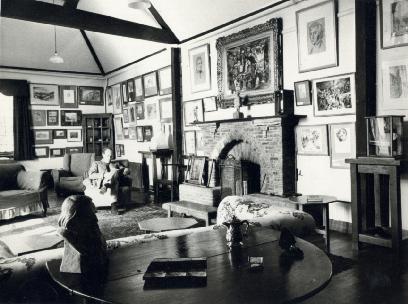
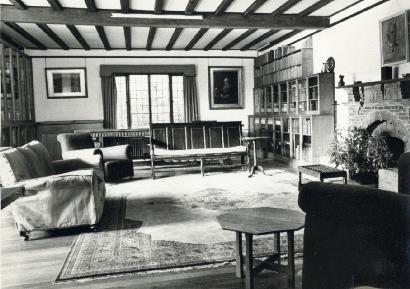
Top, the Ruskin Galleries Upper Gallery, showing part of the collection of Ruskin drawings. Bottom, the Ruskin Galleries Warden’s Library; the cases on the right house some of the books from Ruskin’s own collection (Ruskin Foundation)
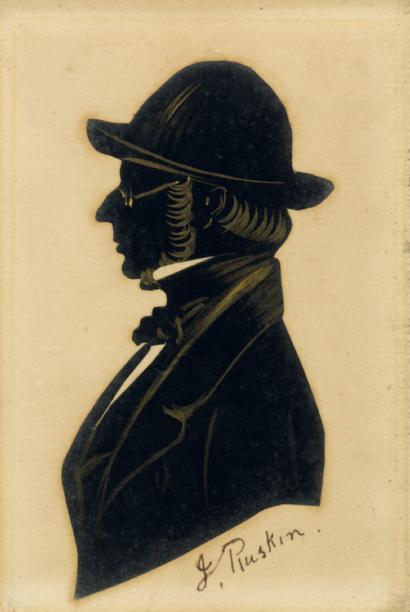
I have already referred to Whitehouse’s mass purchases of Ruskin drawings at the dispersal sales. The Stevens and Brown files (L. 72-5) show that Whitehouse bought most drawings that were offered to him, right up to the time of his death, sometimes as collections, sometimes singly.
In addition to buying for Whitehouse at Brantwood, Stevens & Brown also bought for Charles Goodspeed, the Boston bookseller. Apart from being a dealer, Goodspeed was a Ruskin collector in his own right and at one time owned many important pieces. In 1935 Whitehouse bought from him his remaining stock of Ruskin drawings. The collection contained 171 items. Some of the drawings were slight or diagrammatic, but there were at least twenty-five important drawings in the collection, as well as three sketch books. One of these was Ruskin’s last sketch book containing one of his last recorded sketches, made on 3 June 1889 of the Langdale Pikes. This piece formed a fitting companion to Ruskin’s ‘first’ sketch book of c. 1830 which Whitehouse already owned. And by chance the Goodspeed collection also brought back to Bembridge two detached leaves with sketches of Battle Abbey and Rocks at Tunbridge Wells which Ruskin had removed from his first sketch book before giving it to Mrs Talbot in 1885. Whitehouse was later to obtain the two leaves with sketches of Canterbury Cathedral which Ruskin had also removed and given to Miss Gale in 1880
important ones, including some from the 1830s which Ruskin had given to Sara Anderson. These were bought in March 1951.
Appropriately enough, two of Whitehouses’s last purchases for his collection were drawings. In March 1954 he bought a small portrait sketch of Ruskin made by T. Henderson, probably in Manchester, in December 1864. His last purchase, made in November 1954 just ten months before his death, was the important 1837 drawing by Ruskin of ‘Cloisters and Pinnacles at the west end of Peterborough Cathedral’. This drawing was one of Ruskin’s own favourites and used to hang in his drawing room at Brantwood, among his Prouts.
ii. letters
The Ruskin family correspondence is the most important part of the letter collection. Earliest in the series is a twelve-page letter (L 11) dated ‘London 5 October 1812’ from John James Ruskin to his mother at Bowerswell, which reads ‘I cannot conceive what has given you the Idea of my not wishing to come to my Father’s house…. Had you seen the Lodgings I have at various times lived in you would have a very different opinion on this head…. Do not you think a person immured for 8 years in a London Counting House would be delighted with a Journey to the Country….’ The letter is endorsed by JJR ‘I know nothing in this letter that need be kept from Margaret’. J. J. Ruskin and Margaret Cock were first cousins. They had become engaged in 1809 but did not marry until 1818, the year after John Thomas Ruskin, heavily in debt, committed suicide. In the same file is a letter to JJR from one of his father’s creditors, with a bill for £30 which had been outstanding for twenty-nine years; to the principal they had added £43 10s. interest! Margaret Cock’s mother died on 29 September 1817; nine days earlier she wrote to her daughter (L 30): ‘My dear Girl, I think the time Long since you Last rote to me … and itt Please God to take me there will Be 40 Pounds a year for you the same for Your sister wich Gives Me Some Comfort as I think itt will keep you above want… I cannot walk no where, I ride out in a donkey Chaise….’
The letters from Margaret Ruskin to her husband (L 1) begin with one letter of 1814 prior to their marriage. The second is dated 27 March 1819 and contains the earliest reference at Bembridge to John Ruskin, by then about seven weeks old. ‘John grows finely he is just now on my knees sleeping and looking so sweetly I hope I shall not get proud of him but I fear I felt something like pride today….’ John’s ‘first’ letter, written by Margaret at his dictation, and signed by him, is contained in Margaret’s letter to her husband of 15 March 1823. There are 154 letters in this file, mostly confined t
J R was travelling on business, though they are more numerous when Margaret moved to Oxford to be near John. At this period many contain hasty marginal postscripts from John.
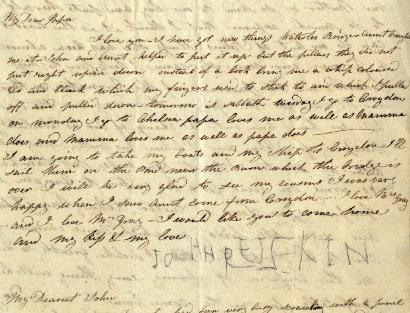
John Ruskin’s ‘First letter’, written by his mother at his dictation and signed by himself, 15 March 1823 (Ruskin Foundation)
The series of eighty letters from John James Ruskin to his wife (L 2) runs from 1812 to 1859. Again, they are most numerous during the Oxford period. One interesting letter is dated 20 June 1838 and announces that there is a ticket to the Abbey for the coronation for John. Two days later JJR reported that he had been to the Abbey to examine the scaffolding on which John’s seat was located and had found it quite safe. He had then been to Owen’s to order John’s court dress and he instructed his wife to buy white gloves in Oxford. On 23 June JJR was still worrying about the position of John’s seat in the Abbey, though he copied a letter from Blue Mantle Herald, ‘ … Lord Brownlow had two for his sons for the same place today … still I would give my ticket and some cash to have a place in the Body of the Abbey’.
From John James to John there are 264 letters (L 3-4), 1829-62. They discuss a multitude of subjects – criticism of John’s writings, the purchase of pictures, Turner’s estate, reviews of John’s books, financial
arrangements, family matters, and many other topics. Most of the other half of the correspondence, John to his father, is at Yale, but there are eight leaves from 1858 at Bembridge (MS 38) in which John writes about the pictures in the gallery at Turin.
Most of the 399 letters from John to his mother, 1853-71 (B vi and L 26) were bought after the Warwick Square sale, as mentioned above. Whitehouse always hoped to publish this series of letters, but time was never on his side. The greater part of the correspondence is dated after 1864 when JJR died; before this John’s letters home had usually been addressed to his father. There are also ten letters (L 26), 1842-67, from Margaret to her son.
There are no letters at Bembridge which passed between John and his wife, but there is one from JJR to Effie (L 11) and one from Effie’s mother to Margaret (L 11) written on the day following the wedding.
John James’s last two letters (L 30), referred to in Praeterita, are enclosed in an envelope endorsed by John, ‘The two last letters my Father wrote. He sate up till past 12 waiting for me to come in, from London – (Working Men’s College I think) – and read these to me. He was struck with his death-illness the following morning – 28th February [1864].’
The largest single series of letters is that from Ruskin to Joan Agnew, later Joan Severn (L 33-54). The letters range from 1864, when J o a n f
widowed Margaret, to 1895, just five years before Ruskin himself died. There are 2,734 dated letters and two files of undated ones. In reply are eight files (L 55-62) of letters from Joan to John, from 1867 to 1899. Clearly there is not space here to go into the details of this correspondence. Suffice it to say that it is of the greatest biographical importance. From 1864 scarcely a day passed when Ruskin and Joan were apart that he did not write to her, on many occasions more than once each day. On a number of occasions when he was abroad, his letters are long and detailed, and written to Joan instead of in his Diary. He specifically tells her to keep them because they are intended as his Diary and will be needed for reference.
George Allen was one of Ruskin’s chief assistants, engraving for him, helping him with the Turner sketches in the National Gallery, and
finally in the 1870s becoming his publisher. The Bembridge collection contains one hundred letters to Allen, 1857-72 (B ii-iv and B ivA). One of the letters is in a special folder and is accompanied by a letter from the Encyclopædia Britannica Company presenting it to a purchaser of a set of the Library Edition in 1914. The other letters are bound in three volumes by Sangorski and Sutcliffe and include an introduction by William S. Allen.
Charles Augustus Howell was another assistant to Ruskin, with a somewhat roving commission. The collection of sixty-five letters, 1856-67, from Ruskin to him (B i), formerly in M. H. Spielmann’s c o l l e c t i o n a n d b o u g h t f o r B e m b r i d g e i n 1 9 4 9 , c o n t a i n R u s k i n ’ s instructions on a multitude of subjects.
Most of Ruskin’s twenty-two letters to Frederick Crawley (L 22), his valet and later in charge of his rooms at Oxford, contain demands for the despatch of books, manuscripts, minerals, pictures – from Brantwood to Venice, Oxford to Brantwood, or wherever Ruskin happened to be. The letters of a later valet – Baxter – written from Folkestone to Mrs Severn (L 63) give a quite different picture of Ruskin in their daily reports on his health and activities.
A few of Ruskin’s letters in the Bembridge catalogue are kept at Brantwood. Most important among these are the two volumes (B xvi-xvii) containing his 168 letters to Bernard Quaritch, 1867-88. They give a fascinating picture of Ruskin’s book-buying habits. The correspondence ends soon after the dispute over the Toggenburg Codex. Another volume at Brantwood (B xix) contains a number of letters from Ruskin to the Webling sisters.
Letters to friends of long standing, include ninety-two to the Scott f a m i l y ( B v ) 1 8 5 5 - 8 0 , p u b l i s h e d b y W h i t e h o u s e i n T h e S o l i t a r y Warrior, twenty-eight to Coventry Patmore and his family (L 14), thirty to F. J. Furnivall about Ruskin’s marriage, a proposed bust of Ruskin by Munro, Working Men’s College business, and other matters (L 17), and twenty-nine to Miss Corlass of Hull, 1843-68 (L 18). These last contain many references to Rose La Touche and in one is an interesting passage on drawing, ‘ … I think you were the first person who showed me how flowers were painted…. The whole difficulty of the art as commonly taught proceeds from the Forbidding the pupil to
look at what is to be done….’ To Rose La Touche’s mother there are ten letters, 1881-9 (B x).
There is only one letter in the collection from Ruskin to his ‘old and tried friend’ Jean Ingelow (L 13), but there are fifteen from Miss Ingelow to Eliza Fall, the sister of Ruskin’s ‘first play-fellow and unfailing friend’. Here, too, are two letters from Ruskin to Richard Fall himself (B xiii), and thirty-two to Eliza, as well as six from John James to Eliza (L 13 and B xiii). One of the twenty-three letters from Ruskin to the Rev. F. W. Farrar (B xiii) deals with the subject of a pension for Miss Ingelow.
Of importance to the study of Ruskin’s writing, both in prose and verse, are two long series of letters to W. H. Harrison. One group of 180, 1836-80 (B xii), is from John, the other group, 148 (L 5), from John James. Mainly these letters discuss alterations to John’s books and poems which Harrison had proposed, or deal with the correction o f p r o o f s . O n e s e c t i o n o f t h e J J R - W . H . H .
production of Poems, 1850.
Letters to Ruskin’s publishers about the printing of his books are represented by sixteen to George Smith, 1869-74 (L 21), and two to Robert Chester (B xv) of Smith Elder & Co. In the 1870s Ruskin’s printing was gradually transferred to the firm of Watson & Hazell. The series of 111 letters to Henry Jowett, their printing manager, runs from 1873 to 1889 (L 15). It gives a fascinating insight into the care Ruskin took over the production of his books and the seemingly haphazard way in which some of the serials, such as Fors Clavigera and Praeterita, were put together. It is interesting to see Ruskin’s first draft of the title page for Praeterita in one of these letters.
The twenty letters (L 21) in the 1870s to Sir James Knowles, editor of the Contemporary Review and founder and editor of the Nineteenth Century, deal, among other things, with work that Ruskin was doing – or refusing to do – for his magazines. These letters were bought by Whitehouse in November 1937. For the Arundel Society i n 1 8 7 4 R
some of the Giotto frescoes. Ruskin’s ten letters (B xiv) to F. W. Maynard of the Society report on the progress of the work. Ruskin’s friendship with T. C. Horsfall, founder of the Ancoats Art Museum,
seems to have begun in 1877. The fifty-four letters to him (L 32) run from 1877 to 1884, and include the eight-page manuscript of Ruskin’s introduction to Horsfall’s The Study of Beauty and Art in Large Towns. Twenty-six letters from Ruskin to Marcus B. Huish, secretary of The Fine Art Society, date from 1875-86 (L 20). They are concerned with Ruskin’s Turner exhibition and include part of the manuscript of A Museum or Picture Gallery, published in the Art Journal in 1880.
Ruskin’s letters to members of the clergy include a correspondence with the vicar of Coniston, the Rev. Charles Chapman (L 23), bought i n 1 9 4 4 . S e v e r a l o f t h e d o z e n l e t t e r s d e a l w i t h p
matters; Ruskin was one of the managers of the Coniston School. The Rev. Edward Clayton was Ruskin’s tutor. In the eleven long letters of the early 1840s (B xiii) he is addressed as ‘Respected Sir’, ‘Dear Pugnacious Clayton’, ‘My dear Irascible’, ‘My dear Good Clayton’. Most of the series deals with religious topics.
We find Ruskin himself in the role of tutor, or rather drawing master, in the thirty letters, 1886-7, to Miss Fortunée de Lisle (L 19).
Another pupil – Louise Blandy – pasted thirty-two of Ruskin’s letters and many of her sketches and photographs and pressed flowers into a typically Victorian scrap album (B ix). Elsewhere there are fourteen other letters to Louise about drawing (L 23) and several of her sketchbooks and drawings bearing Ruskin’s comments.
O t h
Brighton (B xiii), nine to Thomas Carlyle and five from Carlyle to Ruskin (B xiv), and seventy-four to Annie Sumerscales, a school teacher of Hull and Companion of St George’s Guild (L 16). There is no room here to mention many other letters in the collection to and from Ruskin and the Severns, or other allied correspondence.
Reference has already been made to Ruskin’s ‘first letter’ which is at Bembridge. It is only right, therefore, to add that we also have what is probably his last letter. Cook and Wedderburn reproduce a letter of October 1893 to Susan Beever (probably now in the Huntington Library) and describe it as the ‘last’ (they probably meant that it was
Dr H. G. Viljoen), June 1894 and May 1895 to Joan Severn (L 53)
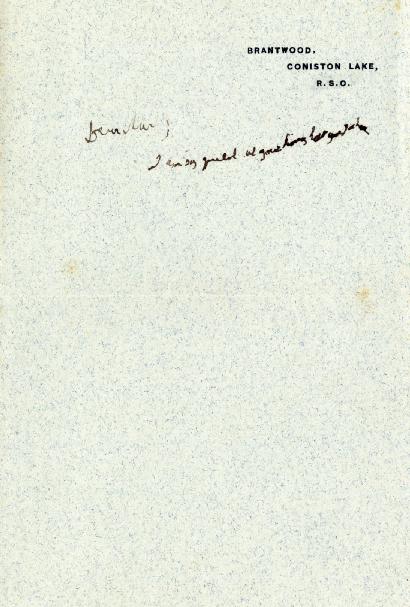
‘Last letter’ – an attempt to write to Mary Drew on the death of her father, W. E. Gladstone. Probably 21 May 1898 (Ruskin Foundation)
and October 1895 to Sir John Simon (Dr Viljoen). In 1898 Ruskin wrote to Mary Drew on the death of her father, Gladstone. Two drafts for the letter are at Bembridge (L 29). Their faltering words are almost indecipherable. One reads, ‘Dear Mary, I am so grieved at your having lost your father’. This is probably Ruskin’s last letter. In addition to this the Bembridge collection contains twenty-four autographs, many of them dated, done for Mrs Severn between 1895 and 1898 (L 29).
iii. manuscripts
U n d o u b t e d l y t h e m o s t i
Bembridge is that of his Diary (MS 1-26). It is contained in twentynine volumes of assorted shapes and sizes and runs from 1835 to 1889. The chronological part of the ‘Diary’, which has been published, represents less than half of the contents of the volumes. The miscellaneous unpublished notes include records of his reading, notes on chess games, analyses of his illuminated manuscripts, notes and plans for Praeterita , n o t e s
Other miscellaneous manuscripts in this part of the collection are the catalogue of his coin collection (MS 27), the large ledger (MS 45) listed by Cook and Wedderburn containing mythological notes and the first plan of the 1883 Oxford lectures, and Ruskin’s holograph ‘Statement’ t o h i s P r o c
(MS 66 and L 67).
Among the earliest literary manuscripts at Bembridge are the early drafts of some of Ruskin’s childhood poems, for example, ‘The Shipwreck’, 1829, which are contained in letters to his father. Probably the earliest independent manuscript is the holograph copy of ‘Remembrance’ sent to the editor of Friendship’s Offering for inclusion in the 1838 issue (MS 51/C iii). A fair copy of ‘The Exile of St Helena’, writt e n f o r t h
longer notebook and bound separately (MS 37).
The bulk of the Modern Painters manuscript was in America by 25
the time Cook and Wedderburn edited the Library Edition, but they recorded fragments remaining at Coniston which they listed as ‘The Brantwood Manuscript’. Several items, most of them unused in Modern Painters, from this part of the manuscript, include ‘Of size and its effects on the sublime’ (MS 50/A), ‘Notes on a painter’s profession as ending irreligiously’ (MS 50/B), a discarded part of the preface to volume 3 (MS 50/C), ‘Ideas of Relation’ (MS 50/D), notes on tree branches (MS 50/F) and ‘Supplementary Notes on Terror arising from weakness of health’ (MS 48).
Cook and Wedderburn also noted that part of the Stones of Venice manuscript was in America, but they listed a large quantity of working sketches and notes (1636-44), forty-six pages of manuscript and sketches including two drafts of the 1881 Epilogue (MS 76) and the page proofs of volumes 2 and 3 (MS 77) corrected by Ruskin and Harrison. Other proofs corrected by Ruskin and Harrison are those for The Elements of Drawing (MS 57/B).
(MS 51/F). Munera Pulveris was first published as a series of essays on political economy in Fraser’s Magazine in 1863. It was revised for separate publication in 1872. MS 51/F is the revised manuscript of ‘Government’ though it differs in a number of respects from the version a
Munera Pulveris, was published in 1891 by T. J. Wise. The printer’s copy (MS 52/B) contains notes by the editor, Buxton Forman. The essays which appeared in The Art Journal in 1865 under the title, ‘Cestus of Aglaia’ were reprinted in Queen of the Air and On The Old Road. Chapter iii was read by Ruskin as part of his 1884 series of Oxford lectures and the corrected proofs (MS 56/C) show that it was set with the intention of re-printing it, probably as chapter 5 of The Pleasures of England – but the idea seems to have been abandoned. No doubt a study of the Ruskin/Jowett letters would throw additional light on the subject.
Ruskin’s poem ‘Ah sweet lady’ (MS 51/C ii) was addressed to Rose La Touche on her eighteenth birthday in 1866. T h e f i r s t e x h i b i t i o n o f R u s k i n ’
prepared himself, one hundred years ago, to illustrate his lecture of 29 January 1869 on The Flamboyant Architecture of the Valley of the Somme. The exhibition catalogue was printed in 1869 but the manuscript of the lecture (MS 42) was printed for the first time in the Library Edition. In the following year another exhibition was arranged to illustrate ‘Verona and its rivers’. The lecture was included in the volume Verona and other lectures, edited in 1894 by W. G. Collingwood, whose page proofs are MS 71.
What little remains of the Fors Clavigera manuscript is widely scattered. At Bembridge we have the manuscript and partial page proof of Letter 91, ‘Dust of Gold’ (MS 49), corrected proofs of part of the Second Series, Letter 5 (MS 58/A) and the manuscript of the Index to volumes 1 and 2 (MS 50/G).
Probably all that remains of the manuscript of The Eagle’s Nest, 1872, are the revised proofs of Lecture 1 and part of Lecture 2 and the manuscript of Lecture 4 and part of Lecture 5 (MS 56/A).
The three parts of Love’s Meinie were issued between 1873 and 1881. The manuscript of the first lecture, ‘The Robin’ (MS 43) was formerly in Wedderburn’s collection. MS 50/H contain a large part of the manuscript of lecture 3, ‘The Dabchicks’ and three leaves of the ‘Appendix’. There is also a copy in Crawley’s hand of part of ‘The Chough’. Another Oxford lecture series was Val d’Arno, of which one leaf of manuscript, the end of chapter 10, is MS 51/L. MS 57/A contains proof copies of Lectures ii, v, vi and viii, all with extensive manuscript revisions.
Ruskin’s Academy Notes were first published in 1855. In the manuscript preface (MS 56/B) to the 1875 issue he wrote, ‘It is now just twenty years since I wrote the first number of these notes and fifteen since they were discontinued’. The 1875 issue was the sixth and last in the series. MS 56/B are galley proofs of the whole pamphlet, heavily annotated, together with a number of manuscript additions. Parts 1-4 of Mornings in Florence were also published in 1875, parts 5 and 6 following in 1876 and 1877. The thirty-nine leaves of manuscript (MS 46) comprise most of part 1 and sections of parts 4 and 5.
‘Bibliotheca Pastorum’ was to be a series of ‘classic books which I hope to make the chief domestic treasures of British peasants ’ . So
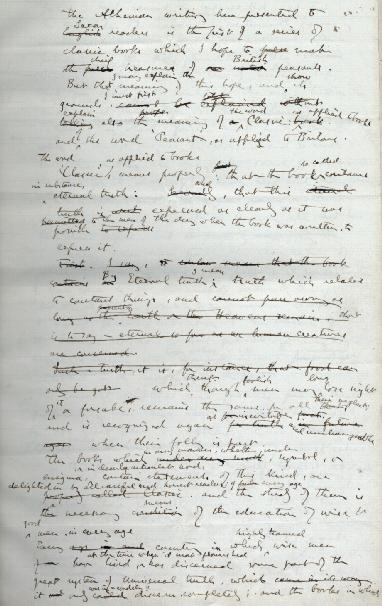
Manuscript of the first draft of the Editor’s Preface to The Economist of Xenophon (Ruskin Foundation)
wrote Ruskin in the preface to The Economist of Xenophon, the first volume in the series. The manuscript of the preface (MS 41) is an interesting example of the chaos which Ruskin’s secretaries, editors and printers had to cope with. The volume contains the first draft of the preface which Ruskin sent to Wedderburn to copy for the printer, Ruskin’s fair copy of the first four leaves of the preface (no more of this was done), and the first and second proofs corrected by Ruskin. His corrections bill today would be enormous!
‘The Three Colours of Pre-Raphaelitism’ first appeared in the November and December 1878 issues of the Nineteenth Century. It was subsequently re-printed in On the Old Road. Of the existing manuscript of the second paper (MS 51/K) one leaf was facsimiled in the Library Edition, vol. xxxiv, page 166. The manuscript and revised proofs of Notes by Mr Ruskin on his drawings by the late J. M. W. Turner Esq., 1878, have been re-united at Bembridge. The bulk of the manuscript is contained in one volume (MS 39), given by Marcus Huish to Henry Beaumont. The remainder of the manuscript, thirty-nine leaves in all (MS 50/I), containing the Introduction and the Epilogue, came to Bembridge as a result of the Brantwood sales.
Arrows of the Chase is a collection of Ruskin’s letters to the Press. Naturally much of the original manuscript is lost. The book seems to have been printed from manuscript copies of the printed letters, and a bundle of these, in various hands, is now MS 55. Cook and Wedderburn record ‘ no manuscript’ for The Elements of English Prosody but MS 51/O contains five leaves of manuscript for the work and MS 62 comprises page- and galley-proofs of pages 1-51.
The bibliography of Letters to the Clergy on the Lord’s Prayer, both printed and in manuscript, is one of the most complicated in the whole Ruskin field. In 1880 Ruskin wrote a final letter as Epilogue for the first edition of the complete book. Wedderburn was evidently unable to find the whole manuscript of this Epilogue at Brantwood in 1908 when editing volume xxiv of the Library Edition. Subsequently the missing leaves must have come to light, for all eighteen are now MS 51/M. The detailed history of Our Fathers have told us is almost equally complicated. Suffice it to say that the bulk of the manuscript –124 leaves – almost all of part 1, The Bible of Amiens, together with