Volume 37, Number 5
Voices of resistance and hope resonate at the 2026 Minnesota Disability Advocacy Day 2026 By Joey Carlson Chants of “No more cuts,” “Our homes, not nursing homes!” and “Disability rights are human rights” echoed through the halls of the Minnesota State Capitol on April 29 for the 2026 Minnesota Disability Advocacy Day. These cries set a powerful tone for a day focused on speaking up and knowing your rights. Meredith Kujala, accompanied by her service dog, Ajax, kicked off the event with an impassioned speech on the importance of inclusion and what it means to be a selfadvocate. The crowd of hundreds of advocates and people with disabilities applauded, excited for the packed rally agenda.
Raising the energy Longtime advocate for people with disabilities, Senator Jim Abeler, took the stage next and spoke frankly about how needed our voices are in policy making. He stirred the entire group up by leading the crowd in an energetic chant of “We matter!” As the voices bounced off the Capitol walls, Sen. Abeler encouraged the advocates to let the reverberating sound serve as a reminder of their power. He urged everyone to ensure their voices continue to echo beyond the rally by contacting their legislators and holding them accountable. The fight for accessible transportation Disability advocate and wheelchair user Rob Wudlick introduced himself simply as “just a guy in a wheelchair who is trying to get around.” Wudlick is leading efforts to improve accessible transportation in Minnesota on several fronts. He shared a worrying story of being stuck at work overnight during a blizzard, completely unable to find a ride home. It was a scenario that resonated with far too many in the audience.
MAY 2026
WWW.ACCESSPRESS.ORG IN THIS ISSUE
May Mobility Month Page 4-6 Elections matter Page 7 Waiver Reimagine puts Minnesota on shaky legal ground Page 8
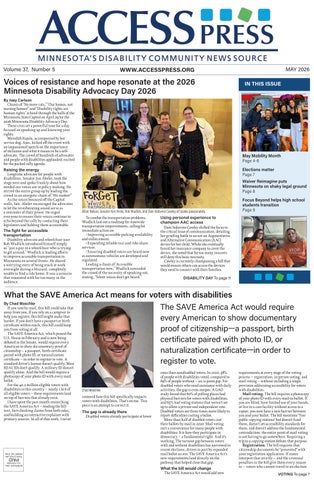
Jillian Nelson, Senator Kim Hicks, Rob Wudlick, and Dani Indovino Cawley all spoke passionately. To combat the transportation problems, Wudlick laid out a roadmap for statewide transportation improvements, calling for immediate action on: • Improving accessible parking availability and enforcement. • Expanding reliable taxi and ride-share services. • Ensuring disabled voices are heard now as autonomous vehicles are developed and regulated. Leading a chant of “Accessible transportation now,” Wudlick reminded the crowd of the necessity of speaking out, stating, “Silent voices don’t get heard.”
Focus Beyond helps high school students transition Page 9
Using personal experience to champion AAC access Dani Indovino Cawley shifted the focus to the critical issue of communication, detailing her grueling battle to secure an Augmentative and Alternative Communication (AAC) device for her child. While she eventually forced her insurance company to cover the device, she noted that far too many insurers still deny this basic necessity. Cawley is currently championing a bill that would ensure others can access the devices they need to connect with their families. DISABILITY DAY To page 11
What the SAVE America Act means for voters with disabilities By Chad Maschke If you vote by mail, this bill could take that The SAVE America Act would require away from you. If you rely on a caregiver to help you register, this bill might make that every American to show documentary harder. If you don't have a passport or birth certificate within reach, this bill could keep you from voting at all. proof of citizenship—a passport, birth The SAVE America Act, which passed the U.S. House in February and is now being certificate paired with photo ID, or debated in the Senate, would require every American to show documentary proof of citizenship — a passport, birth certificate naturalization certificate—in order to paired with photo ID, or naturalization certificate — in order to register to vote. A register to vote. standard driver's license doesn't qualify. Most REAL IDs don't qualify. A military ID doesn't qualify alone. And the bill would require a photocopy of your photo ID with every mail ballot. For the 40.2 million eligible voters with disabilities in this country — nearly 1 in 6 of all eligible voters — these requirements land on top of barriers that already exist. I have spent the past month researching the SAVE America Act — reading the bill text, fact-checking claims from both sides, and building an interactive explainer with primary sources. In all of that work, I never
Chad Maschke centered how this bill specifically impacts voters with disabilities. That's on me. This piece is an attempt to correct it.
The gap is already there Disabled voters already participate at lower
rates than nondisabled voters. In 2020, 58% of people with disabilities voted, compared to 69% of people without — an 11-point gap. For disabled voters who need assistance with daily activities, the gap is even steeper. A GAO study found that 60% of polling places had physical barriers for voters with disabilities, and 65% had voting stations that weren't set up to allow a private and independent vote. Disabled voters are three times more likely to report difficulties casting a ballot. More than half of disabled voters cast their ballots by mail in 2020. Mail voting isn't a convenience for many people with disabilities. It is how they participate in democracy — a fundamental right. And it's working. The turnout gap between voters with and without disabilities has narrowed in recent elections, driven in part by expanded mail ballot access. The SAVE America Act's new requirements land directly on the pathway that helped close that gap.
What the bill would change The SAVE America Act would add new
requirements at every stage of the voting process — registration, in-person voting, and mail voting — without including a single provision addressing accessibility for voters with disabilities. Mail voting. The bill requires a photocopy of your photo ID with every mail-in ballot. If you are blind, have limited use of your hands, or live in a care facility without access to a copier, you now have a new barrier between you and your ballot. The bill mentions "free public copying stations" but doesn't fund them, doesn't set accessibility standards for them, and doesn't address the fundamental contradiction: the entire point of mail voting is not having to go somewhere. Requiring a trip to a copying station defeats that purpose. Registration. The bill requires that citizenship documents be "presented" with your registration application. If states interpret that strictly — and the criminal penalties in the bill give them every reason to — voters who cannot travel to an election VOTING To page 7
TWIN CITIES, MN PERMIT NO. 4766
PAID
NONPROFIT ORG. U.S. POSTAGE