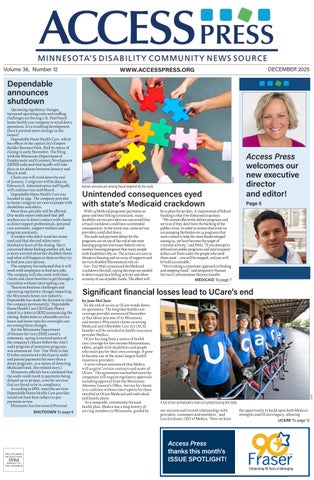

Dependable announces shutdown
Upcoming regulatory changes, increased operating costs and staffing challenges are forcing a St. Paul-based home health care company to wind down operations. It’s a troubling development. Does it portend more closings in the future?
Dependable Home Health Care, which has offices in the capital city’s Empire Builder Business Park, filed its notice of closing in early November. The filing with the Minnesota Department of Employment and Economic Development (DEED) indicated that layoffs will take place in six phases between January and March 2026.
Client care will wind down by end of January. Caregivers will be done on February 6. Administrative staff layoffs will continue into mid-March.
Dependable Home Health Care was founded in 1991. The company provides in-home caregiver services to people with disabilities and elders.
More than 400 jobs will be affected. One media report indicated that 368 workers are in direct contact with clients as direct support professionals, personal care assistants, support workers and program assistants.
A worker who didn’t want her name used said that she and others were shocked to learn of the closing. She is concerned about finding another job, but is more worried about her disabled clients and what will happen to them as they try to find new care options.
The company has indicated that it will work with employees to find new jobs. The company will also work with their clients and client families to get through a transition without interrupting care.
“Based on business challenges and upcoming regulatory changes impacting the Minnesota home care industry, Dependable has made the decision to close the company permanently,” Dependable Home Health Care CEO Katie Fleury stated in a letter to DEED announcing the closing. Reductions in allowable service hours and lower rates for overnight care are among those changes.
But the Minnesota Department of Human Services (DHS) issued a statement, saying it received notice of the company’s closure before the state’s audit program of numerous programs was announced. Gov. Tim Walz in late October announced a third-party audit and paused payments for more than a dozen programs, as a means of detecting Medicaid fraud. (See related story.)
Minnesota officials have cautioned that the audit could result in payments being delayed up to 90 days, even for services that are found to be in compliance.
According to DHS, most the services Dependable Home Health Care provides would not have been subject to prepayment review. Minnesota has lost several Personal

Unintended consequences eyed with state’s Medicaid crackdown
With 14 Medicaid programs’ payments on pause and their billing scrutinized, many disability service providers are concerned that a fraud crackdown could have unintended consequences. In the worst case, some service providers could shut down.
The audit and payment delays for the programs are on top of the end of one state housing program and major federal cuts to another housing program that many people with disabilities rely on. The actions are seen as threats to housing and an array of supports and services disabled Minnesotans rely on.
Gov. Tim Walz announced the Medicaid crackdown this fall, saying the steps are needed to detect suspicious billing activity and allow scrutiny of use of public funds. The effort will
be in place for 90 days. A requirement of federal funding is that it be disbursed in 90 days.
“We cannot effectively deliver programs and services if they don’t have the backing of the public’s trust. In order to restore that trust we are pumping the brakes on 14 programs that were created to help the most disadvantaged among us, yet have become the target of criminal activity,” said Walz. “If you attempt to defraud our public programs and steal taxpayer dollars out from under the people who need them most – you will be stopped, and you will be held accountable.”
“We’re taking a systematic approach to finding and stopping fraud,” said temporary Human Services Commissioner Shireen Gandhi.


Significant financial losses lead to UCare's end
by Jane McClure
It’s the end of an era as UCare winds down its operations. The longtime health care coverage provider announced November 17 that about 300,000 of its Minnesota and western Wisconsin clients receiving Medicaid and Affordable Care Act (ACA) benefits will be switched to health insurance provider Medica.
UCare has long been a source of health care coverage for low-income Minnesotans, elders, people with disabilities and people who must pay for their own coverage. It grew to become one of the state’s largest health insurance providers.
A news release announced that Medica will acquire “certain contracts and assets of UCare.” The agreement reached between the companies will require regulatory approvals including approval from the Minnesota Attorney General’s Office. Service for clients is to continue without interruption for those enrolled in UCare Medicaid and individual and family plans.
“As a nonprofit, community-focused health plan, Medica has a long history of serving members in Minnesota, guided by


A fun UCare ad featured a team of cyclists touring the state.
Autism services are among those targeted by the audit.


Editor looks back, is glad for role in changing
by Jane McClure
This is my last issue as Access Press editor. I’ve had various editing roles here since 2008, so it is quite a transition. I’ll assist our new editor, Joey Carlson, with the January issue.
I cannot begin to count and thank everyone I have worked with in Minnesota’s disability community. I’ll miss you all. My ask is that you continue to work with Joey and Heidi Holste, our new executive director, and our other staff and contractors and our board.
Newspapers and online news organizations need your support, now more than ever. Our board president, Lynda Milne, wrote about that in November. I won’t repeat what she said but frankly, it’s daunting. We have lost too many news outlets. We cannot lose any more.
My ties to Access Press go back beyond working here. Years ago, I was part of the Neighborhood and Community Press Association (NCPA). NCPA volunteers worked with our founding editor, Charlie Smith, to transition Access Press from forprofit to nonprofit status.
I was pleased to join Access Press years later.
Looking back, I’m glad to have played a small role in changing attitudes toward and coverage of people with disabilities and our issues. Years ago Access Press was an outlier in terms of coverage. We focused on policy issues while my journalistic peers cranked out pity stories and inspiration porn.
Our community members are not show animals. We’re not your “there but for the grace of God go I” stereotypes. And please cut out the pity.
Remember, one fall on the ice, one accident, one illness and you are welcomed to our club!
Stereotypes persist. On an ADA anniversary during the pandemic, I was
HISTORY
Young
disability news coverage
Looking back, I'm glad to have played a small role in changing attitudes toward and coverage of people with disabilities and our issues. Years ago Access Press was an outlier in terms of coverage. We focused on policy issues while my journalistic peers cranked out pity stories and inspiration porn.
contacted by a Twin Cities television reporter. He wanted to include Access Press in an ADA story.
Footage of me could safely be shot in a park. Perhaps I could be pictured in my wheelchair?
“I don’t use a wheelchair,” was my response. “I live with several disabilities but my mobility is pretty good at this time of year.”
That quickly changed the conversation to don’t call us, we’ll call you, television is visual blah blah. I was not interviewed for the story.
There’s a lot of ambivalence in stepping back as editor, in unrealized aspirations that many of us disabled folks have. I live with six disabilities, including clinical depression, visual issues and being an adult on the autism spectrum. I didn’t know about the latter diagnosis until adulthood. Years ago, you were just considered to be weird.
Early in my career, I hoped to work for larger newspapers. I’ve never made my
disabilities a secret. Instead of being viewed as brave and inspiring and held up as a role model, I as a potential employee with disabilities was viewed as a liability.
I’m glad younger disabled people are able to find meaningful employment that in many cases pays well. But for many of my generation that wasn’t the case.
People have said, why didn’t you sue? I’m 67 years old. In my early career I didn’t have the ADA protections workers have now. And finding an attorney on a $250 per week newspaper reporter salary was impossible. My work is solid in decades as a journalist. But my story is like many of my disability community peers, of never getting a chance to move beyond a certain level. It’s beyond frustrating. It’s the constant feeling of being left out, of not being part of some elite club.
I’m not the press my nose against the glass and look longingly inside type. I’d be more inclined to throw a rock through the glass. It’s been hard to be left out.
That’s the past and at my age, apologies
married couple drew attention to need for specialized
Community living options for young people with disabilities were limited in the 1960s and 1970s, especially in Greater Minnesota. That was the plight of Staples residents Orvin and Jean Heikkila Fingarson. They used their situation to advocate for change for others.
The December 28, 1970 Minneapolis Star told their story, under the headline “Couple want nursing home for young. They live with old now.”
Orvin Fingarson was 33 in 1970. He lived with multiple sclerosis and had recently given up his career of teaching high school music. Jean Heikkila Fingarson, 40, had muscular dystrophy most of her life. She did office work before her disabilities made that impossible.
The two met through a shared love of ham radio. The article stated: “It was love at first sight for the couple who met at a Handi Ham System conference last May at Camp Courage.”
The two married in fall 1970, in a wedding “witnessed” over the airwaves by hundreds of their ham radio operator friends. They were wed by a Catholic priest and a Lutheran minister, to overcome objections to a mixed marriage.
Marriage allowed the couple to share living quarters and socialize to their heart’s content. Their large room at the Mary Rondorf Home in Staples was equipped with a radio transmitter and receiver. The two radio “hams” had hundreds of friends around the world thanks to their shared hobby. Congratulations poured in weeks after the wedding.
Their experience made them advocates for a new type of nursing home. Jean said, “Every nursing home in the state has at least one person whose mind is not growing . . . A young person’s mind cannot possibly develop in such an environment.”
Young people who lack families and friends to make frequent visits struggle
just sound like excuses. My first newspaper bylines appeared at age 12. This has been and will be my life as I will continue contributing here and to several other publications.
So here’s some advice for our readers as I step back:
• Stay informed. News, including disability-focused news, is more fragmented than ever. It’s difficult and yes, depressing, to keep up. But in the face of sweeping and often harmful changes, lives in our community depend on staying informed.
• Support the news organizations that keep you informed, including Access Press.
• Stay active. Squeaky wheels do get greased.
• Advocate for yourself, your peers and your family members. Don’t let others control your stories and your lives.
• Take care of each other. Keep fighting. And thanks and goodbye.
housing
with life in a nursing home, Jean said. In her arguments for such an age-friendly facility, she drew parallels to Camp Courage. “We go to Camp Courage every summer and we all have a wonderful time. There’s really joy for two weeks.”
Orvin said such a nursing home would be a place where he could teach music and help his peers gain a love of singing.
“Yong people like myself would still like to do something with their lives but we can’t in a place where there are only old people,” he said.
Jean said her doctor urged her to get married, saying she and Orvin should enjoy the time they had left together. Her doctor noted that given their disabilities, it wasn’t known how much time the two would have left.
Alas, the doctor’s words were prophetic. Their stay in Staples was a short one, as they soon moved to a nursing home in Little Falls. Orvin Fingarson died in November 1971, at

the age of 34. Jean Heikkela Fingarson died in May 1976 at age 46. Her obituaries note her ham radio letters, WOIRJ. They are buried at Eagle Lake Cemetery, Cromwell, Jean’s hometown.
Their thoughts about community living resonate with us today.
The nursing home in Staples merged with the local hospital in 1977. The group they met through is going strong. It is now called Courage Kenny Handiham. It continues to provide support for disabled ham radio operators.
The History Note is a monthly column produced in cooperation with the Minnesota Governor’s Council on Developmental Disabilities.
Past History Notes and other disability history may be found at https://mn.gov/mnddc
EDITORIAL: Editorial submissions and news releases on topics of interest to persons with disabilities, or persons serving those with disabilities, are welcomed. We reserve the right to edit all submissions. Editorial material and advertising do not necessarily reflect the view of the editor/ publisher of Access Press.
DEADLINE: 15th of each month.
CIRCULATION/DISTRIBUTION: Distributed the 1st of each month through more than 200 locations statewide. Approximately 750 copies are mailed to individuals, including political, business, institutional and civic leaders.
SUBSCRIPTION: Free and accessible to anyone in MInnesota, visit www.accesspress.org to subscribe. ABOUT ACCESS PRESS: A monthly newspaper published for persons with disabilities by Access Press, Ltd. POSTMASTER: Send address changes to Access Press, PO Box 40006, Industrial Station, St. Paul, MN 551048006
INQUIRIES AND ADDRESS CHANGES should be directed to: Access Press, PO Box 40006, Industrial Station, St. Paul, MN 55104-8006; 651-644-2133; email: access@accesspress.org
CHARLIE SMITH AWARD DETAILS FORTHCOMING
ISSUE SPOTLIGHT | FRASER
Fraser Preschool and Childcare Center: Building Inclusion, One Generation at a Time
At Fraser Preschool and Childcare Center, childhood is embraced as a time of exploration, imagination, and connection — a stage every child deserves to thrive. For families across Richfield, Edina, Bloomington, South Minneapolis, and beyond, Fraser Preschool and Childcare Center is a place where high-quality early education and true inclusion come together. Parents consistently describe it as warm, welcoming, and transformative — a place their children are excited to come to each day.
Fraser Preschool and Childcare Center is licensed by the Minnesota Department of Human Services and accredited by the National Early Childhood Program Accreditation (NECPA), a distinction reserved for programs demonstrating exceptional standards in curriculum, environment, and staff training. With a 5-Star Parent Aware rating, the highest possible, the school meets rigorous expectations for safety, kindergarten readiness, teacher qualifications, and family partnerships. But what families talk about most is not the credentials — it’s the community.


Parents repeatedly highlight Fraser’s inclusive philosophy as a defining strength. One parent, Heidi G., shared: “The teachers and staff are warm, welcoming, and professional. They genuinely care for my child. I love that it’s an inclusive environment where she is exposed to children who have different physical and intellectual abilities than her. We love Fraser!”
Her words reflect what research has long shown: children thrive when they learn alongside peers with a wide range of abilities. Inclusion helps children build empathy, communication, and understanding — skills that shape them for life. Fraser Preschool and Childcare Center brings this research to life every day, creating classrooms where differences are celebrated, not separated.
In the Infant Program (6 weeks–16 months), teachers create individualized routines and nurturing spaces where babies can safely explore, communicate, and bond. Parents appreciate the warm, responsive environment, often noting that teachers go above and beyond to learn each child’s cues and needs.
As children move into the Toddler Program (16–33 months), they enter a world of hands-on discovery. Teachers guide toddlers through language development, early social-emotional

learning, and cooperative play. Many parents mention how quickly they see growth. One mom, Mollie O., who spent four years with Fraser, shared:
“The environment is warm, inclusive, and nurturing. Each teacher provides a customized approach that makes all the difference. … We are so grateful for the incredible educators and the supportive community they’ve created.”
The Preschool Program (33 months–Pre-K) prepares children for kindergarten through a play-based curriculum that blends early literacy, math, self-help, and problem-solving skills. Teachers introduce structure, while honoring each child’s natural curiosity — something many families praise when describing their child’s growth. Parents often note increased confidence, communication and interest in learning.
A hallmark of Fraser Preschool and Childcare Center is its seamless
integration with Fraser’s clinical services. Families can opt into speech therapy, occupational therapy, physical therapy, or autism supports, all delivered onsite and coordinated with classroom teachers. This collaboration creates a unified support system that strengthens learning and skill-building across environments.
One parent, Jackie S., emphasized how valuable this was for her family:
“One of our kids ended up needing PT, and it was so helpful to be able to use onsite PTs! The teachers were amazing — our kids loved the creative lesson plans and we loved the convenience and support.”
This wraparound model relieves pressure on families while giving children consistent, high-quality support embedded into their school day.
Environment plays a key role in Fraser’s inclusive approach. Classrooms
are designed with sensory-friendly features, including visual supports, adaptive materials, and flexible seating. Outdoor spaces are accessible and encourage collaborative play across all abilities. Staff receive ongoing training in developmental differences, sensory regulation and individualized instruction — something parents consistently appreciate.
A parent shared that the stability and dedication of Fraser’s staff is one of the school’s greatest strengths, noting how little turnover she observed over multiple years. This consistency helps children feel safe and supported, and it creates a strong sense of family among staff and caregivers.
Conveniently located at 2400 West 64th St., Richfield, Fraser Preschool and Childcare Center offers both full-time and part-time options to meet families’ needs. Parents often mention how the flexibility, combined with the school’s high standards, made it the right choice for their family.
What makes Fraser truly exceptional is the way it prepares children not only for kindergarten, but for life. Children leave the program with strong academic foundations, but they also leave with something equally important: empathy, cooperation, and the ability to understand and respect differences. These qualities grow naturally in Fraser’s inclusive environment, through everyday interactions like sharing materials, helping friends, and learning side-byside.
As Mollie O. shared, “Our toddler thrived during her four years at Fraser. We’re so grateful for the incredible educators and community.”
And as many families echo, Fraser Preschool and Childcare Center is more than a preschool — it’s a place where children are seen, supported, and celebrated for exactly who they are.

Donate to Access Press
Help us help others navigate their disability journeys as I was helped
by John Tschida
The air was cool and the sky overcast on September 9, 1993, when I ran out my back door for the last time and began the sevenmile bicycle ride to work at the state capitol. I (literally) fell about a half mile short. It was on Summit Avenue, just opposite the Cathedral of St. Paul, that I hit a bad patch of gravel and pitched forward over the handlebars. My head hit a lamppost, and my arms and legs immediately went limp.
The spinal cord damage was quick and permanent. Despite the best efforts of the crack neurology team at then-Ramsey Hospital, I would soon come to learn my life would from then on be lived in a wheelchair.
About three months later, I returned to work part-time to my role as an editor for the Minnesota House of Representatives. It was there in the foyer of the State Office Building where I first saw a copy of Access Press.
As a brand-new member of the disability community, I was overwhelmed. I was adjusting to a new body that was 70 percent

paralyzed. I was grieving a life that could have been. My wife and I were living with my parents and trying to figure out how to make our home more accessible. I felt very alone. The Internet was in its infancy (and at dial-up
speed), light years from today’s AI and the instant answers I needed to give me hope. I picked up that copy of Access Press and returned to my office. There on the front page were stories about health care challenges and the failures of the Metro Mobility system. Inside were a multitude of disabled voices, an advice column, and articles on religion and disability, and aging with a disability. One of the final pages was a list of over 100 disability organizations.
Here, in just 12 pages, I had found an entire ecosystem I was not yet connected to but needed to be, disabled people like me leading active and meaningful lives and allies providing updates on social security and other topics I needed to learn. It was –and remains – a link to a vibrant community asking questions, solving problems and not just muddling through life, but thriving. I knew I was going to be just fine.
Twenty-two years later, I still read and donate to Access Press. Many of those contributors from the 1990s became friends
and colleagues as my career path changed and brought me to Courage Center and eventually Washington. Today, I’m proud to serve on the board of directors and excited about our future, with Heidi Holste as executive director and Joey Carlson as managing editor. In the months ahead, you’ll see more dynamic online content and hear from new community voices as we renew our commitment to being Minnesota’s premier local source of disability news and information.
This vision requires your help. Please consider donating, especially now when your gift will be matched by multiple sources. It can be a recurring or one-time contribution. No gift is too small. Join us. You won’t be disappointed.
John Tschida is a member of the Access Press Board of Directors.
The cost of being the airline's afterthought, or travel while disabled
byScott Stadum
A trip from San Francisco to Washington, D.C. was one of a few thousand miles and an entire economy of indignities. I’d lived in D.C. for a decade in my twenties, back when flying didn’t feel like combat. This time, I was just heading east to visit family and friends. The ordeal started before arriving at the airport. No ride, so I Ubered to BART, paid for a new transit card, took the train partway, then caught another Uber because it didn’t actually reach the airport. The cost of this logistical relay, I realized, exceeded the cost of a single Uber to the airport. Efficiency in American transit is a cruel joke, every leg another tax on time and mobility.
I had paid for Economy Plus, a few inches of space marketed as mercy. For someone tall, it was nearly a medical necessity. At checkin, my one small suitcase cost $40. I paid it, knowing each stretch of hallway would turn my luggage into an anchor.
Then came the theater of delay. One gate, then another, then a third in a completely different terminal. “Mechanical issues,” they said, a phrase that conveniently coincided with a government shutdown and an airtraffic controller shortage. By the time we made our way down escalators, stairs, and corridors, my body was already registering its protest.
There weren’t enough seats at the new gate.

Dozens stood, shifting weight, clutching their carry-ons. Accessibility in American infrastructure is an abstract concept: no seats, no rest, long waits.
When boarding began, relief rippled through the crowd. Then another wait: two hours on the tarmac while the cabin turned into a sauna. The captain suggested opening the overhead vents. Predictably, stale air didn’t solve the problem.
A text pinged: United offered a refund link. It didn’t work. Support said it wasn’t valid once we’d boarded. Another text followed, $15 meal vouchers. But no meals were ever
offered. A gesture without substance, the airline version of “thoughts and prayers.”
Mid-flight, a doctor was called to help an elderly woman in medical distress. Two hours in the air, and the plan had been hope.
The “extra legroom” seat barely allowed movement. My knees pressed into the seatback. Across the cabin, passengers contorted themselves into uneasy shapes, searching for rest. Human need remains the least-considered variable in air travel.
We landed at 1:30 a.m., five hours late. The baggage claim resembled an archaeological dig, with suitcases scattered across the carousels and strewn randomly on the floor. The night staff moved with the resignation of people who know the system is unfixable. Outside, the taxi line dwindled. The attendant warned there might not be any more cabs. Lyft found a driver after five minutes, asked me to wait 11, then canceled with one minute left. Uber searched endlessly. I messaged United, asking what to do if there was no transportation at 2 a.m. The representative was polite, useless. “You’ll have to figure it out,” he said. I told him I have a disability, that “figuring it out” isn’t always possible. United had no plan.
Eventually, a lone taxi appeared, a small miracle in the cold November air of the Potomac. A few others waited by the curb,
their faces lit by phone screens, hoping for rides that may have never come.
From start to finish, the trip was a study in manufactured hardship. Every obstacle was predictable, engineered into the architecture of travel itself: the pricing tiers, the acceptance of grueling discomfort, the assumption that being treated as human is a luxury.
For travelers with disabilities, these aren’t inconveniences; they’re exclusions. The system was built to move bodies, not to care for them.
The usual advice of buying early, planning ahead, and packing food is practical but feels hollow. None of it confronts the truth that airlines and airports have traded humanity for margin. The market decides who gets ease, who suffers, and who pays extra to be treated with decency.
Accessibility shouldn’t be an afterthought scribbled at the end of a business model. It should be built into the model. Until then, disabled travelers will keep paying for space they never truly receive; in dollars, in dignity, and in the quiet exhaustion of being told, again and again, you'll have to figure it out yourself.
Scott Stadum works in digital production for Access Press.
Living with disabling Lyme disease and effects? She is offering her support
by Kristen Ellingson
I want to put some feelers out to see if there’s a need or interest in starting a Lyme Disease Support Group in our central Minnesota area. I’m part of the Global Lyme Alliance and involved with their national peer mentorship program, where I connect with others navigating Lyme and the challenges that come with it.
I’m reaching out because I’d love to share a message of encouragement and awareness for others in our community who are living with disabilities or chronic illnesses.
I’m a proud Lyme Warrior. I live with Lyme disease, which has been very debilitating on top of other disabilities. I battled Lyme disease for about three years, but it took nearly two years of being sick before anyone could figure out what was wrong. I was finally diagnosed three years ago after seeing a functional medicine doctor, and that’s when things started to make sense.
I’ve gone from being an active person to being fully disabled and unable to work again. I’ve undergone two neck fusion surgeries and have disc and degenerative diseases, along with chronic pain that Lyme only worsens. The combination can be overwhelming at times, both physically and emotionally.
Thanks to help from Courage Kenny, I can walk again, albeit slowly.
Since I can no longer work, I’ve turned my focus toward giving back—finding and sharing resources, and helping others who are navigating similar struggles. I was featured in the Star Tribune in February 2025 in an article about hair loss, wearing wigs,
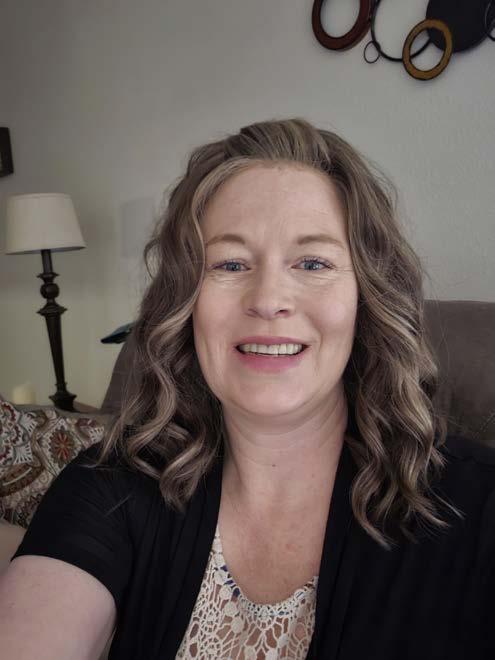
and living with Lyme while navigating the challenges of disability.
I live in Hutchinson, about an hour outside the Twin Cities, and I know firsthand how difficult it can be to navigate the system when you’re disabled—it often feels like there are endless hoops to jump through.
Through all of this, my heart is to remind others that they’re not alone. There are communities and resources out there to help, and I hope by sharing my story, others will feel encouraged and supported.
I’m also a board member with Parents Inspired, and that’s where the support groups would be held if we move forward with this idea. Parents Inspired is a Hutchinson-
based, non-profit, community-based family support system centered on children, parents and anyone with primary caregiving responsibility. As a family resource center, Parents Inspired will serve as a community hub for families. The nonprofit is also starting a business employing disabled youth and adults.
As I meet more and more people, I’m realizing how many are affected by Lyme disease and how truly debilitating it can be. It can mimic conditions like multiple sclerosis or malaria, and while many of us may look fine on the outside, we’re often fighting invisible battles daily. Support groups would help to bring more
awareness, encouragement, and community to others walking this path. Having a local group could bring encouragement, understanding and a safe space to share experiences, resources, and hope. If this is something you’d be interested in, please contact me. If you are elsewhere in the state, I’d be happy help you find Lyme disease resources to better understand and live with this disabling disease.
I am a compassionate person and I find it meaningful helping others! Contact me at 320-444-3838 or Iwilltrusthim2@gmail.com Kristen Ellingson is a Hutchinson area resident.



John Tschida
Scott Stadum
Kristen Ellingson
New Executive Director, Editor
Meet Heidi Holste: An advocate for inclusion, accessibility
by Heidi Holste
For nearly three decades, I have devoted my career to advocating for inclusion, accessibility, and community voice in Minnesota’s nonprofit and public policy arenas. Much of my work has centered on improving systems that support older adults, people with disabilities, and the organizations and professionals who serve them.
My foundation in advocacy began as a certified nursing assistant at a nursing home, on to college and a political science degree which led me to working at the Minnesota capitol, where I spent nearly 20 years in a variety of leadership and policy roles. I worked in both the Minnesota Senate and House of Representatives, and later as a policy advisor to a Minnesota governor. These experiences have given me a deep appreciation for how public policy and how advocacy directly shapes peoples’ daily lives, especially those who rely on services.
After my time in state government,

I became a lobbyist for AARP and Care Providers of Minnesota, representing older adults, families and the caregiving community. Through that work, I helped advance policies around long-term care, assisted living and consumer protections. I built strong partnerships with disability and aging advocates and gained a deep understanding of the challenges faced by caregivers, direct support professionals and the individuals they serve.
My connection to the disability community strengthened even further when I became the executive director of a nonprofit organization serving individuals with developmental disabilities. For nearly seven years, I worked alongside dedicated staff, families and self-advocates to expand opportunities for independence, inclusion, and meaningful community participation. That experience continues to shape how I lead and what I value most—empowering others and ensuring that every voice is heard.
Meet Joey Carlson: From speedskates to the editor’s desk
by Joey Carlson
Growing up, Access Press was always in my house. My dad, who managed a vocational program for people with intellectual disabilities, subscribed. He loved how it kept him informed and connected to the disability community.
Little did I know this publication would have a profound impact throughout my life. When I was 17 years old, I focused on one thing: speedskating. I was the reigning national champion in my age group and focused on making the 2002 Winter Olympics. I spent countless hours training, obsessed with cutting time off my races.
On August 3, 2000, everything changed. While driving home from practice, a semitruck forced my car off the road and I flipped. The accident left me with a broken neck and a severe spinal cord injury at the C5-C6 level.
In an instant, my goals shifted. Instead of striving for Olympic gold, I was fighting to relearn life’s most basic tasks. I had to learn how to eat, scratch my head, and operate my power wheelchair as a quadriplegic. I spent four months at North Memorial Hospital and another year of inpatient rehabilitation at Courage Center.
While in rehab, I finished high school and started college at Augsburg. I used my love of sports and served as the sports editor for the school paper. I also landed communications internships at Target Corporation and with the Minnesota Timberwolves and Lynx. After graduating from college, I was happy to land a

full-time job with Medtronic. My career took flight and my passion for the disability community strengthened. I joined the board of directors for the Minnesota Spinal Cord Injury Association, which involved lobbying in both Washington, DC and St. Paul. One of my proudest accomplishments was helping to pass a bill that grants $3 million in annual funding for spinal cord and brain injury research.
A critical step in getting this bill passed was generating public and political excitement through the media. We worked directly with
Today, I serve as the executive director for nonprofit organizations, helping each one grow and thrive. My work combines my love of public policy with my passion for supporting mission-driven organizations. I focus on strengthening day-to-day operations—finance, events, communications, and technology— while also guiding strategic planning and organizational growth. I believe deeply in the collective power and the important role we all play in making change happen.
I’m a proud graduate of the University of Wisconsin–River Falls, and I live in the twin Cities south metro area with my husband, our three active daughters, and two lively dogs—a German Shorthair and a Chocolate Lab. When I’m not working, you’ll find me cheering from the sidelines of a softball field or relaxing on a warm beach with my family. I am proud to serve as the next executive director of Access Press and I hope that you reach out to let me know what this publication has meant to you and to give me ideas on our future path.
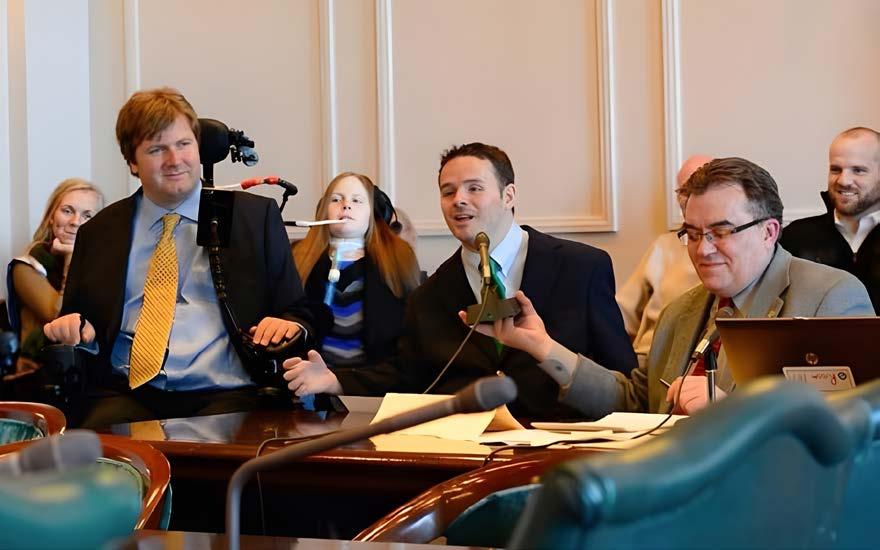
the former executive director/editor of Access Press, Tim Benjamin and Jane McClure, editor. I was part of the team that created the articles published in Access Press that debated the necessity and impact of the bill. These articles were crucial; they informed the community, built public support, and put necessary pressure on lawmakers. Thanks in large part to the spotlight and momentum created by publishing these articles in Access Press, we passed the bill. This funding continues to fuel vital research every year.
My career continued, leading communications efforts at Medtronic,
Your letters and commentary are welcomed but follow guidelines
Access Press welcomes letters to the editor and commentary pieces from readers, on topics of interest to Minnesota’s disability community. Letters should be no more than 500 words, with 750 words per commentary. Ask the editors if more space is needed. Letters and guest commentaries must be signed by the authors or authors. Unsigned letters won’t be published. With letters, a writer’s hometown is published but not a street address. Please send contact information, in the form of a phone number or email, in case the editors have questions about a letter or commentary.
Accessible
To the editor:
Contact information isn’t published unless the writer specifically requests that the newspaper do so.
Pictures of the author can be published with a guest commentary but aren’t required.
Access Press asks that letters and guest commentaries be specifically written for the newspaper. Letters must have a focus on disability issues and ideally, a focus on those issues as they affect Minnesotans. Form letters will not be published.
With the legislative session coming up, we very much welcome letters and commentaries about legislative agendas or
restroom runaround a frustration
I use my manual wheelchair on Sundays so I can use a cab that will pick me up at the door of my church. I don't have to sit in a cold parking lot for up to an hour waiting for Metro Mobility. I planned to use the church's partially accessible restroom by the door before catching my ride as I was leaving because I was going to a celebration of life for a friend and would not be going home. The handicapped stall was out of order and I didn't have time to go downstairs. I went to the Como Park Pavilion, a publicly owned (City of St. Paul) facility. I was early. I used the automatic door opener on the building and went in search of a rest room. There was no electric door opener on the rest room and the "handicapped" stall was just a regular one with handrails added. I would have to leave my chair in the open doorway and walk a few steps in to use it.
The restroom was filthy so I didn't. I asked for an alternative and was told I would have to go outside and use the restrooms in the basement. There was no door opener. It was a regular stall with rails added and I had to leave the door open. When done, I couldn't get out of the room because the door would not open all the way and I couldn't push it out of the way and wheel myself at the same time. It took two people helping pull me to get me out. It was time to head to the celebration of life. Then I faced a giant hill that I would have had to push myself up. A man helped and pushed me up that hill or I would have had to go up backwards and use one leg to help push. That would have been hard and might have injured me.
I just want to participate in life, at least in the big public spaces. Is that really asking too much? Barb Metzger, St. Paul
individual bills. This can be a great way for an individual or advocacy group to draw attention to a bill or an issue.
Because Access Press is a non-profit publication and must follow regulations on political partisanship, political endorsement letters are not published. That is true for candidates’ endorsements as well as for ballot questions.
Before making a submission, writers are always encouraged to contact the editor to discuss ideas or to ask questions about From Our Community submissions, at 651-6442133 ext. 1 or joey@accesspress.org.
UCare and UnitedHealth Group. Now, I am bringing those professional abilities, infused with the passion forged on my personal journey, to Access Press. The drive I once poured into speedskating is now dedicated to achieving something even greater: helping to inform, unite, and empower every Minnesotan with a disability.
I am profoundly honored to step into the role of managing editor and use every piece of my experience—as an athlete, a survivor, an advocate, and a professional—to continue the vital work this newspaper does every day.
Let the newspaper staff know if accommodations are needed to submit a letter or commentary, and we will help you. More and more people are using AI to write letters. Let us know if that is the case Letters and commentaries reflect the view of the authors and not the views of the staff and board of directors of Access Press. Deadline for the print edition of the newspaper is the 15th of each month, with publication the following month.
• Keep your Medical Assistance or


mn.gov/dhs/renewmycoverage
Heidi Holste
SUBMITTED
PHOTOI
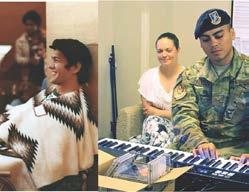
Joey Carlson in his speedskating days
Joey Carlson, center, testified before Congress with Sen John Hoffman at right.
Long COVID and its impacts on chronic conditions are focus of study
Studies of Long COVID and ties to disabilities and chronic conditions continue to draw attention from the medical research community. The University of Minnesota’s Center for Infectious Disease Research and Policy (CIDRAP) is a constantly updated source of research information about Long COVID and many other diseases.
Visit https://www.cidrap.umn.edu/
Studies that center on Long COVID in the context of chronic conditions and disability can be of value to care providers of people with disabilities who develop Long COVID. The studies can also provide insights for patients themselves.
A study recently shared on CIDRAP outlines how the sequence of chronic conditions before COVID-19 infection—rather than any single condition—may best predict the development of persistent symptoms.
The research centered on a group of Catalonians in northeastern Spain. It appeared in the online publication BMC Medicine.
Investigators at the Germans Trias i Pujol Research Institute (IGTP) in Barcelona analyzed data from 8,322 participants aged 40 to 65 years at enrollment from a specific cohort or demographic group and followed them from 2020 to 2023.
The team reconstructed disease trajectories using electronic health records from 2010 to 2019, focusing on sequences of two chronic conditions (found in at least 1 percent of the cohort). It also assessed shared genetic makeup and risk for predictive capacity or the ability to forecast future trends.

What is a disease trajectory? It is the typical path a chronic illness takes over time, showing how a patient's health status, function and prognosis are expected to change. It can be a roadmap of sorts to follow a disease and plan care. Such a trajectory can also show how a disease’s progression can lead to disability.
Of the 162 trajectories analyzed, 38 were linked to a significantly higher risk of long COVID, regardless of the severity of COVID-19 infection.
The most common sequences involved mental illnesses and neurologic, respiratory (such as asthma), and metabolic or digestive diseases (such as high blood pressure and obesity). For example, COVID-19 patients who had anxiety before depression had a different risk profile from those who had depression before anxiety.
“It is not enough to know which diseases a person has,” lead author Natalia Blay said. “The order in which they appear can significantly influence risk, especially
among women.”
The study found no strong genetic link to Long COVID, although weak relationships were identified in genetic factors tied to neurologic or musculoskeletal disorders.
The researchers say that artificialintelligence tools could help detect complex patterns in disease-trajectory sequences in large longitudinal health datasets, improving the ability to predict risks and more precisely identify vulnerable populations that may benefit from targeted prevention and care.
The findings show that studying trajectories in longitudinal data “has value beyond COVID, as it allows us to identify population health patterns that may help predict other diseases and support a more preventive and personalized public health approach,” principal investigator Rafael de Cid, PhD, said.
Symptom analysis showed distinct patterns linked to prior conditions, according to an article on the study that appeared in BMC Medicine. Mental health conditions such as depression were inversely associated with loss of taste and smell. Anxiety and severe stress correlated with psychological symptoms and fatigue; notably, severe stress was also associated with respiratory problems. These are just some of the patterns cited.
The BMC Medicine article contains much data that came from the study. Learn more at https://bmcmedicine.biomedcentral.com/ articles/10.1186/s12916-025-04427-x
Australian study tracks ties between Long COVID, disabling conditions
When most people think of COVID now, they picture a short illness like a cold – a few days of fever, sore throat or cough before getting better.
But for many, the story doesn’t end there. Long COVID – defined by the World Health Organization (WHO) as symptoms lasting at least three months after infection – has become a lasting part of the pandemic.
Most research has focused on describing symptoms – such as fatigue, brain fog and breathlessness. But less is known about the effect on daily life, and this hasn’t been well studied in Australia until now. A recent study there suggests that Long COVID not only has a significant impact on the lives of patients, it can also mimic some disabilities or disabling conditions.
An Australian study, which was reported in the Conversation online news site, provides insights
Long COVID affects about 6 percent of people with COVID, with more than 200 symptoms recorded. For some, it lasts a few months. For “long haulers” it stretches into years.
The size of the problem is hard to measure because symptoms vary from person to person. This has led to debate about what Long COVID really is, what causes it, and even whether it’s real.
But mounting evidence shows Long
COVID is very real and serious. Studies confirm it reduces quality of life to levels seen in illnesses such as chronic fatigue syndrome, stroke, rheumatoid arthritis and Parkinson’s disease.
Here’s what people with Long COVID told the researchers, who surveyed 121 adults across Australia living with Long COVID. They had caught COVID between February 2020 and June 2022, with most aged 36–50. Most were never hospitalized, and managed their illness at home.
But months or years later, they were still struggling with daily activities they once took for granted.
To understand the impact, those surveyed were asked to complete two surveys widely used in health research to measure disability and quality of life – the WHO Disability Assessment Schedule (WHODAS 2.0) and the Short Form Health Survey (SF-36).
These surveys capture people’s own voices and lived experience. Unlike scans or blood tests, they show what symptoms mean for everyday life.
The results were striking.
People with Long COVID reported worse disability than 98 percent of the general Australian population. A total of 86 percent of those with Long COVID met the threshold for serious disability compared with 9 percent of Australians overall.
On average, people had trouble with daily activities on about 27 days a month and were unable to function on about 18 days.
Tasks such as eating or dressing were less affected, but more complex areas –housework and socializing – were badly impacted. People could often meet basic needs, but their ability to contribute to their homes, workplaces and communities was limited.
Quality of life was also badly affected. Energy levels and social life were the most impacted, reflecting how fatigue and brain fog affect activities, relationships and community connections. On average, overall quality of life scores were 23 percent lower than the general population.
International research shows similar patterns. One study across 13 countries found similar levels of disability. It also found women had higher disability scores than men. As Long COVID disability has many facets and can change a lot over time, it doesn’t fit into traditional ways of providing health care for chronic conditions.
Another key insight from the study is the importance of self-reported outcomes. Long COVID has no diagnostic test, and people often report that health professionals are skeptical about their symptoms and their impact. Yet the study showed people’s own ratings of their recovery strongly predicted
their disability and quality of life.
This shows self-reports are not just “stories.” They are valid and reliable indicators of health. They also capture what medical tests cannot.
For example, fatigue is not just being tired. It can mean losing concentration while driving, giving up hobbies, or pulling away from cherished friendships.
The study shows Long COVID disrupts futures, breaks connections, and creates daily struggles that ripple out to families, workplaces and communities.
The study also notes that disadvantaged communities are even more likely to be impacted by the cascading effects of Long COVID. So ignoring the scale and severity of long COVID risks deepening inequality and worsening its impact even further.
The Conversation is a network of notfor-profit media outlets publishing news stories and research reports online, with accompanying expert opinion and analysis. Learn more at https://theconversation.com/us Access Press provides coverage of COVID issues with support from the Metropolitan Center for Independent Living (MCIL). Learn more about MCIL at https://mcil-mn.org/ This activity is made possible by a grant from the Long COVID Program of the Minnesota Department of Health.
Chronic mental health issues are cited with COVID-19, Long COVID
The COVID-19 pandemic and its lingering effects have had a profound impact on public health. Mental health for those who live with COVID-19 and Long COVID must also be considered. The University of Minnesota’s Center for Infections Disease Research and Policy (CIDRAP) recently reported on a study that shows that people with mental health disabilities may be susceptible to Long COVID.
According to CIDRAP, adults with schizophrenia, bipolar disorder, or recurrent major depressive disorder—especially those who are older, Black or Hispanic, have chronic conditions, have public health insurance, or were hospitalized during
infection—are at elevated risk for long COVID. This is according to an analysis published in the online medical journal, JAMA Network Open. It is overseen by the American Medical Association.
To determine whether adults with serious mental illness (SMI) are more vulnerable to long COVID (also called postacute sequelae of SARS-CoV-2 [PASC]) than those without SMI, a team led by a Weill Cornell Medicine researcher conducted a longitudinal cohort study from March 2020 to April 2023.
The study was based on the electronic health records of more than 1.6 million COVID-19 patients aged 21 years and older from 30 days to six months after infection.
The average patient age was 52 years. The numbers break down to 61/4 percent women, 12.6 percent Black, 13.5 percent Hispanic, and 51.3 percent white.
SMI is defined by the American Psychological Association as a diagnostic group of psychiatric disorders including schizophrenia, bipolar disorder and recurrent major depressive disorder. These conditions impact 5 percent of US adults.
A total of 15.9 percent of participants had an severe mental illness, and 24.8 percent developed PASC of Long COVID. Those with an SMI were at a 10 percent higher risk for longer-term health issues.
The increased COVID-19 infection and
mortality risks of adults with SMI are due in part to limited general medical care access, treatment adherence challenges, and the presence of comorbidities such as cardiovascular disease and diabetes.
“These results suggest the need for coordinated approaches that simultaneously treat and seek to prevent PASC among adults with serious mental illnesses,” the authors concluded.
Read more at https://jamanetwork. com/journals/jamanetworkopen/ fullarticle/2840681?resultClick=3


“Adding outside review before payments go out and increasing safeguards for these high-risk services will preserve resources necessary to serve Minnesota’s children, people with disabilities and older adults.”
The Association of Residential Resources in Minnesota (ARRM), which represents more than 200 organizations providing disability services across the state, sounded the alarm about the audit. One red flag for the association is the lack of communication and service provider community engagement by DHS and Walz’s office before the audit was announced. ARRM would like to have seen the expertise and consideration of service providers being taken into account.
While ARRM supports efforts to root out fraud and protect taxpayer dollars, the association warned that halting payments for critical disability services, including individualized home supports, night supervision and integrated community supports, could destabilize an already fragile care network serving thousands of Minnesotans with disabilities.
“ARRM shares the governor’s commitment to accountability and transparency,” said ARRM CEO Sue Schettle. “But pausing payments to legitimate providers for up to 90 days is not an accountability measure, it’s an existential threat to the care infrastructure that keeps Minnesotans with disabilities safe, housed, and supported in their community.”
Schettle pointed out that Minnesota’s disability services providers, many of which operate on razor-thin margins, depend on timely Medicaid payments to meet payroll, maintain housing and deliver essential daily supports. Extended payment delays could mean direct support workers go unpaid, people with disabilities lose access to stable housing and care and providers close their doors.
“We understand the need for audits, accountability and financial oversight,” Schettle said, “but the timing and scope of this action could unintentionally harm the very people these programs were designed to protect. The state must find a way to identify and stop fraud without stopping support.”
Fraud in state-run support programs and federally funded food programs has become a political flash point in upcoming political races.
Audit funds were provided by the 2025 Minnesota Legislature. The Minnesota Department of Human Services (DHS) has contracted with the technology and health services firm Optum, at a cost of $2.3 million.
Auditors will analyze Medicaid fee-for-service claims data and flag potential issues for DHS review. Problems to be looked at include missing documentation, unusually high billing patterns, or inconsistencies suggesting that a claim may not meet program requirements.
Claims flagged will then be verified by DHS to confirm whether services were provided as billed. Suspect claims will be referred to the agency’s Office of Inspector General for review
services are also subject to stricter oversight requirements, including mandated enhanced fingerprint background studies for owners of provider agencies, initial screening visits and unannounced site visits.
Part of ARRM’s response was to call on DHS to establish a rapid review and payment continuity process for providers with clean billing histories. Another ask is for state officials to communicate clearly with providers and counties about how claims will be prioritized and released.
ARRM also asked Walz’s office to establish an emergency stabilization fund to provide shortterm financial assistance to providers at risk of insolvency due to paused Medicaid payments.
“Without this support, organizations may be unable to make payroll or sustain essential operations, putting individuals with disabilities at immediate risk of losing housing, care, and critical daily supports” the association said in a statement. Minnesota’s disability services system is already under significant strain due to workforce shortages, inflation pressures, and reimbursement challenges.
“Providers are barely holding on after years of instability,” said Schettle. “An up to 90day payment freeze could push some to the breaking point. We need solutions that protect both fiscal integrity and human dignity.”
Editor Jane McClure provides state and federal government coverage for Access Press.
and possible investigation.
Outside review of payments may result in longer wait times before providers are paid, while their claims undergo review. The state will still meet federal rules requiring payment within 90 days. But service providers argue that still creates hardship.
The services targeted in the audit are Early Intensive Developmental and Behavioral Intervention Services for Autism, Integrated Community Supports, Nonemergency Medical Transportation, Peer Recovery Services, Adult Rehabilitative Mental Health Services, Adult Day Services, Personal Care Assistance/ Community First Services and Supports, Recuperative Care, Individualized Home Supports, Adult Companion Services, Night Supervision, Assertive Community Treatment, Intensive Residential Treatment Services and Housing Stabilization Services.
The latter program was already targeted for closure due to widespread fraud, drawing objections to providers who fear its end will force vulnerable people into homelessness.
State officials have responded that they are at work on a replacement program.
State officials also indicated that high-risk

Affordable Senior Apartments
For qualifying senior households age 62 or better. Metro & Greater MN locations available. Accessible apts,
Immediate openings in Worthington and Albert Lea, Minnesota
For
Affordable Senior Apartments
Housing with Care*
* 24-hour
Housing with Care*




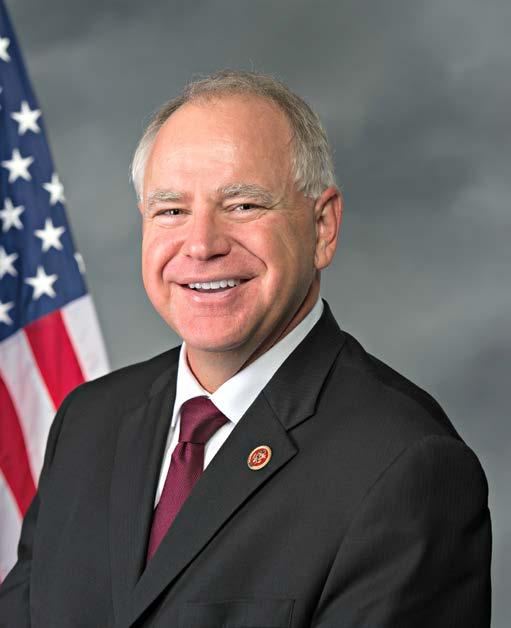
Gov. Tim Walz
PEOPLE AND PLACES
NAMI Minnesota bestows many honors on its mental health heroes
The National Alliance on Mental Illness (NAMI) Minnesota celebrated outstanding advocates and organizations advancing mental health at its 2025 Awards Luncheon, held during the organization’s annual conference this fall. Awards were presented to individuals and organizations that have made significant contributions to improving the lives of people living with mental illnesses and their families.
NAMI Board members presented the awards with assistance from Marcus Schmit, new executive director of NAMI Minnesota. His predecessor, Sue Abderholden, was also honored.
“Every day, NAMI Minnesota is inspired by the people who champion justice, dignity and respect for children and adults affected by mental illnesses,” said Schmit. “These awardees represent the best of what’s possible when individuals and organizations come together to promote understanding, equity and hope in mental health. We’re deeply grateful for their leadership and commitment to improving our communities.”
Awards are presented in various categories.
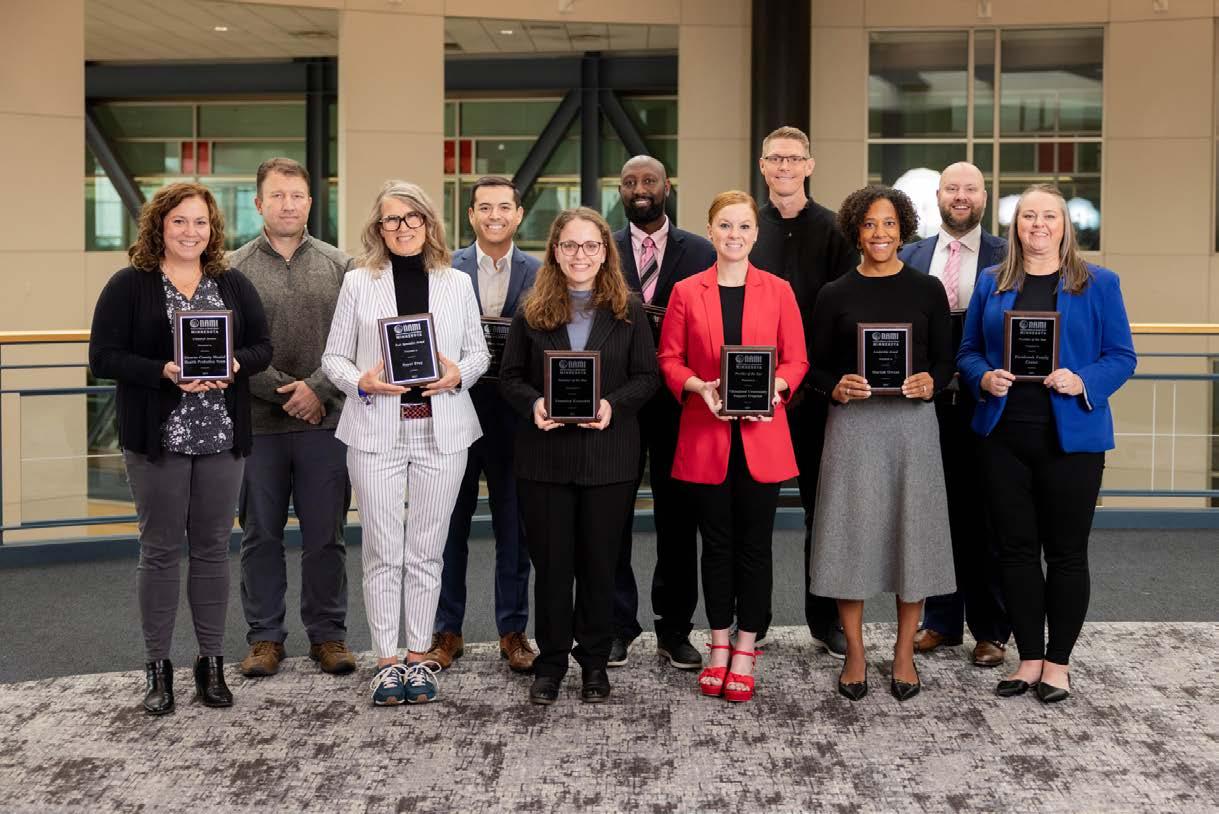
Legislators of the Year: Rep. Mohamud Noor (DFL-Minneapolis) and Rep. Joe Schomacker (R-Luverne). NAMI Minnesota recognized the two lawmakers for their bipartisan leadership as co-chairs of the Human Services Finance and Policy Committee. Together, they navigated complex budget negotiations and advanced crucial mental health policies and funding, demonstrating that collaboration across party lines can create meaningful progress.
Volunteer of the Year: Veronica Kruschel. Kruschel, a dedicated safety/support volunteer, was honored for her service assisting staff during suicide prevention trainings where she offered compassionate
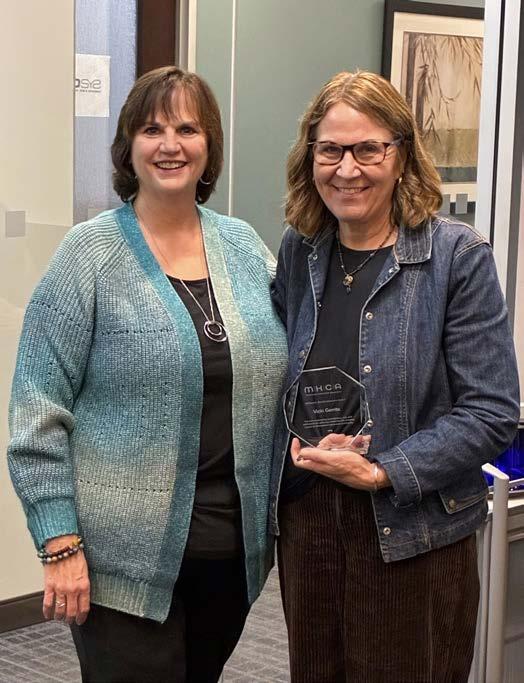
Gerrits wins award
Longtime disability community leader
Vicki Gerrits was honored this fall with the Minnesota Home Care Association (MHCA) William A. Dombi Advocate Award. Gerrits, of TEAM Public Choices, has been active in disability services for more than three decades. Gerrits is honored not only for her powerful advocacy but also as a trusted and collaborative partner for the entire home care community.
The William A. Dombi Advocate Award was established by the MHCA Board of Directors in 2024, following the retirement of the National Association of Home Care & Hospice’s CEO, Bill Dombi. The honor was established to recognize outstanding individuals who have made significant advocacy contributions to the home care community.
This award is also meant to recognize an individual who demonstrates the leadership
college schedule, Kruschel has consistently prioritized helping others.
Professional of the Year: Veronika Mix. Mix, who is from People Incorporated, was honored for her leadership and innovation in creating community-based mental health programs. She revitalized the Artability program, promoted neighborhood engagement and led efforts resulting in the opening of a crisis center at George Floyd Square. Accepting the award on her behalf was Kellen Tittle, Chief Financial Officer at People Incorporated.
Providers of the Year: Vikingland Community Support Program and Fernbrook Family Center. NAMI Minnesota recognized the Vikingland Community Support Program of Alexandria for more than 30 years of providing compassionate,
in grassroots advocacy and dedication to advancing home care that Dombi exemplified through his many years in the home care industry.
The Inaugural William A. Dombi Advocate Award was presented at the 2025 MHCA Annual Meeting, serving as a lasting tribute to his legacy and honoring those who have shown unwavering commitment to advocating for patients, caregivers, and the home care community at large.
Gerrits has served in leadership roles at the Minnesota First Provider Alliance, Minnesota First Community Solutions, Accra Homecare and Lifeworks. She’s been part of disability umbrella organizations including the Minnesota Consortium for Citizens With Disabilities.
Several appointees are named Gov. Tim Walz and Lt. Gov. Peggy Flanagan have announced the following appointments several disability and agingfocused boards, groups and committees. Learn about the commissions and openings at https://www.sos.mn.gov/boardscommissions/
Tricia Brisbine, Brooklyn Park, and Saudade Sammuelson, no city provided, were appointed to the Advisory Task Force on Waiver Reimagine. Brisbine will represent family members of individuals who are receiving disability waiver services. Sammuelson will represent individuals under age 65 individuals who are receiving disability waiver services.
The Advisory Task Force on Waiver Reimagine will conduct public meetings, gather input and make recommendations on various aspects of the Waiver Reimagine program, such as waiver consolidation, budget methodologies, service criteria and potential consequences of the program changes.
Kimberly Baker, Lakeville, and Scott Brown, St. Paul, were named to the Blue

that help individuals build connection, resilience and recovery.
Owatonna-based Fernbrook Family Center was honored for its broad network of services across southern Minnesota and its advocacy for stronger statewide mental health systems. CEO Shannon Brown accepted the award.
Peer Specialist of the Year: Sayer Frey. Frey, the first peer support specialist on Hennepin HealthCare’s inpatient psychiatric unit, was honored for her pioneering leadership. Frey developed the peer support program from the ground up, empowering patients and fostering dignity and respect in their care.
Criminal Justice Award: Stearns County Probation Team. The Stearns County Probation Team of Aaron Gosling, Brittany
Ribbon Commission on Special Education. Baker will serve as a member with expertise in special education program administration. Brown will serve as a member with demonstrated expertise in compliance with legal federal special education requirements and special education finance. The Blue Ribbon Commission on Special Education advises and assists the legislature and governor in transforming special education services.
Amanda Duerr, Mendota Heights, and Dillon Fried, Minneapolis, will serve on the Governor’s Council on Connected and Automated Vehicles. The Governor’s Council on Connected and Automated Vehicles studies and prepares for the opportunities and challenges associated with the widespread adoption of connected and automated vehicles and other transportation technologies. The council reviews connected and automated vehicle developments and trends, explores partnership opportunities, proposes policies to safely test and deploy connected and automated vehicles, and consults with communities experiencing transportation barriers not represented on the council.
Garret Zayic, Chaska, was named as a parent member to the Minnesota Governor's Council on Developmental Disabilities. The council carries out responsibilities to ensure that people with developmental disabilities and their families receive the necessary supports and services to achieve increased independence, productivity, selfdetermination, integration and inclusion in the community.
Debbi Lindgren-Clendenen, Minneapolis, will serve on the Minnesota Board on Aging. The Minnesota Board on Aging works to ensure that older Minnesotans and their families are effectively served by state and local policies and programs, so they can age well and live well. It is Minnesota's federally designated State Unit on Aging for multi-
• The state of Minnesota has funding available to pay for this treatment—at no cost to the client! Rule 82 Gambling Assessments conducted
• Vinland employs a holistic approach to problem gambling, valuing the 12-step approach and understanding
recognition for their work in supporting individuals with mental illnesses who are involved in the criminal justice system. Their compassionate approach helps connect people to vital community services and resources.
Media Award: FOX 9 Investigative Team. The FOX 9 Investigative Team received the Media Award for exposing a county’s practice of billing individuals for crisis services despite existing grant funding. Their reporting prompted the county to rescind the policy and inspired NAMI Minnesota to draft and successfully advocate for legislation preventing future abuses. Reporter Nathan O’Neil accepted the award.
year planning and administers federal funding from the Centers from Medicare and Medicaid, the Administration for Community Living, the Older Americans Act, as well as state-funded aging programs. Jeannine Conway, Minneapolis, was appointed to the Minnesota Rare Disease Advisory Council. Conway will serve as a pharmacy representative. The purpose of the council is to provide advice on policies, access, equity, research, diagnosis, treatment and education related to rare diseases to the following entities: health providers, state agencies and entities such as Department of Human Services, the Drug Utilization Review Board, the Drug Formulary Committee, the Advisory Committee on Heritable and Congenital Disorders, and legislative bodies at the state and federal level. The council's duties include providing resources, identifying and recommending best practices, identifying and addressing barriers faced by rare disease patients, and advising agencies of state government on policies related to rare diseases.
Anna Christensen, Savage, was appointed to the Prescription Drug Affordability Advisory Council. Christensen will serve as a pharmacologist member. The governor shall appoint an 18-member stakeholder advisory council to provide advice to the board on drug cost issues and to represent stakeholders' views. The governor shall appoint the members of the advisory council based on the members' knowledge and demonstrated expertise in one or more of the following areas: the pharmaceutical business; practice of medicine; patient perspectives; health care cost trends and drivers; clinical and health services research; and the health care marketplace.
NAMI Minnesota honorees show off their awards.
Sue Abderholden
Kathy Messerli, executive director of MHCA, and Vicki Gerrits
PEOPLE AND PLACES
Pirates, Hawks kick their way to state adapted soccer titles

Minnesota’s prep adapted soccer champions were crowned November 15 at White Bear Lake Area High School. The Park Center Pirates capped a perfect 9-0 season by winning the Minnesota State High School League’s Adapted Soccer State Tournament PI Division.
In the CI Division, Dakota United surprised its foes by taking the crown. The perennially powerful Hawks were thought to be in a rebuilding year. But a young team was able to defend the 2024 title.
PI Division
The Pirates topped the defending champion Minneapolis Tigers for a hardfought 2-1 win. Pirate Lincoln Scearcy’s goals made the difference after much of the game was scoreless.
It was the swashbuckling team’s first state title since 1998. Park Center’s co-op program also includes Maple Grove and Osseo. The program has made a remarkable comeback over the past few years.
Minneapolis’ goal was scored by senior Abubakarr Heda. Minneapolis’ co-op program is hosted by Minneapolis Edison
SHUTDOWN
From page 1
Care Assistant (PCA) agencies over the past decade. Another high-profile closure was in May 2023 when St. Louis Park-based Ability Care Partners shut down. The agency cited the many challenges it faced in recent years, especially with the transition from PCA to Community First Supports and Services.
The ongoing staffing crisis and challenges in hiring, have hampered many personal care agencies over the years. Some have shut down while others have had to limit the services provided.
Many agencies that haven’t billed for services for a time also face shutdowns. Medicaid providers who have not billed for services in more than a year are being disenrolled from the state’s program, as DHS tightens its oversight.
The first round of disenrollment began in mid-October, when roughly 800 providers
and includes Camden, Roosevelt, South, Southwest and Washburn.
The Pirates topped Rochester and St. Paul Humboldt to get to the finals.
Jaisir Morgan, Rayan Gangani and Elijah Higgins scored two goals apiece for the South Suburban Flyers in a 7-4 victory over Rochester. That gave the Flyers the third place crown.
In the consolation final, Stephnora Sarpong scored four goals to lead Dakota United past Anoka-Hennepin, 5-3.
Robbinsdale/Hopkins/Westonka was the other team in the tournament. The PI Division is for prep athletes with physical disabilities.
PI All-Tournament team members are Corde Bauer, Anoka-Hennepin; Chloe Shibata; Dakota United; Mikael Brown and Cooper Morrissey, Rochester; Gangani and Higgins, South Suburban; Heda, Christopher Trejo and Maria Artis, Minneapolis; and Scearcy, Ben Pfeifer and Evan Bartlett, Park Center.
CI Division
The Dakota United Hawks topped the
were disenrolled. Impacted providers were certified prior to April 1, 2024, and have not billed since that date. This round of disenrollments does not include 621 inactive housing stabilization services providers because that program was slated to end October 31.
“We must reduce risk and increase efficiencies wherever we can,” said Temporary Human Services Commissioner Shireen Gandhi. “Taking this first step to streamline the pool of inactive providers will strengthen the integrity of Minnesota’s Medicaid programs and services.”
The action strengthens program integrity by reducing the administrative burden and compliance challenges of overseeing providers who aren’t providing services. The change ensures that Medicaid resources focus on providers who are actively serving members of Minnesota’s public health care programs.
Walz ordered DHS to “immediately

South Washington County Thunderbolts, 5-1, to win the title.
Sophomore Nolan St. Sauver led scoring for the Hawks during the tournament with 10 total goals. Strong defense was also a factor as junior goalkeeper Jacob Staats allowed only one goal in the semi-finals and finals.
This was Dakota United’s fifth consecutive appearance in the title game. The co-op program is hosted by Eastview and includes Apple Valley, Eagan, FIT Academy, Hastings, Rosemount and Two Rivers. The Hawks were thought to be in a rebuilding season but the team came through to win big.
Dakota United defeated Buffalo/ Monticello/St. Michael Albertville (STMA) and Chaska/Chanhassen/Prior Lake/ Shakopee to reach the finals.
South Washington County reached the final for the first time since winning the 2019 title. South Washington County is a co-op program hosted by East Ridge and includes Park and Woodbury.
In the third place game, four players scored for Burnsville/Farmington/Lakeville in a 4-1 victory over Chaska/Chanhassen/
disenroll all Minnesota Health Care Program enrolled providers who have not billed Medicaid in the last 12 months,” within the bounds of the law.
Additional rounds of disenrollments will continue. Providers will be offered an appeals process if it is believed that a disenrollment was made erroneously.


Prior Lake/Shakopee.
The South Suburban Jets recorded a 5-1 victory over Buffalo/Monticello/STMA for fifth place and the consolation crown. Other teams in the tournament were Stillwater/Mahtomedi and North/Tartan. The CI division is for prep athletes with cognitive disabilities.
CI All-Tournament team members are Isaiah Kuschel, Buffalo/Monticello/STMA; Jordan Cavness, South Suburban; Dylan Noaman and Ayub Hussein, Chaska/ Chanhassen/Prior Lake/Shakopee; Zahven Kotzian and Cayleigh Sorenson, Burnsville/ Farmington/Lakeville; Jordan Nde, Kalabe Tobe and Logan Curtis, South Washington County; and Myles Johnson; St. Sauver and Oran Hill, Dakota United
Read more about the tournaments at https://www.mshsl.org/tournaments and click on fall. The next prep tournament is adapted hockey hosted at Bloomington Jefferson High School.





The Dakota United Hawks, in blue, and Southern Stars of Chanhassen/Prior Lake/, Shakopee/Chaska, in red, battle for the ball. SMUG
A Park Center Pirate celebrates the team's PI championship.
REGIONAL NEWS
Olmstead office adds new staff, readies for state plan update
Minnesota’s Olmstead Implementation Office has announced staff changes as efforts are underway to update Minnesota’s Olmstead Plan.
The plan is meant to ensure that disabled Minnesotans live full, integrated lives in their chosen communities. The plan helps state agencies set and meet goals that will improve the quality of life for Minnesotans with disabilities. The plan covers a variety of topics including individual choice, personcentered planning, housing, education, employment and transportation.
Integration as defined in the plan means that people with disabilities have the chance to live, work, learn and receive services in the community alongside non-disabled people. People with disabilities should also be able to choose how they want to live, work,

Disabled residents among those affected by Skyline fire
Skyline Tower, St. Paul’s largest lowincome housing structure, is recovering from an October fire. The building is home to many people with disabilities
All residents had to be evacuated October 26, with many elders and disabled residents carried out by CommonBond Communities staff, first responders, city staff and their neighbors. The entire building was condemn right after fire because utilities had to be shut off.
Many residents including members of 141 households in the high-rise’s east tower were able to return home, with the help of CommonBond Communities and the City of St. Paul. They returned after the city’s Fire Safety Division of the Department of Safety and Inspections gave them the go-ahead.
But the plus-140 units in the west tower needed more work. Some apartments damaged by a small fire. That somehow triggered the building’s electrical system and then set off fire sprinklers after the fire was out. Apartments that sustained more damage need additional renovations.
Skyline Tower is at 1247 St. Anthony Ave. At 24 stories and 504 apartments, it is the largest affordable housing property in the city. About 490 apartments were occupied as of October 26.
Between 750-800 residents had to be evacuated after a series of events October 26.
Deidre Schmidt, CommonBond’s president and CEO, described what happened as “kind of a chain reaction.”
The heat, water system, fire alarms and elevators were knocked out of commission. City staff then decided that the building was uninhabitable.
Residents had to be evacuated. That included about 100 elderly and disabled residents.
But more than 100 apartments sustained some level of water damage. Those have been assessed one by one to see what work is needed to make them habitable, Schmidt said.
Mayor Melvin Carter said that about 150 city staff members helped with the evacuation overnight. “It was a major undertaking . . . a crisis in this building created a crisis for the whole community,” he said.
One of many people the mayor singled out for praise is Rep. Samakab Hussein, for his help in translating and in working with disabled residents. For him, helping out was
who has been working in the disability rights field for more than 13 years. Most recently she was the deputy director of the Minnesota Disability Law Center at MidMinnesota Legal Aid. Prior to that she was an attorney at the Minnesota Elder Justice Center and Disability Law Colorado.
Purrington is a graduate of Winona State University and Denver Sturm College of Law. She is also a former Americorps member, with a background in education, gerontology and healthcare.
Natasha Merz is joining the office as a new co-director, on a temporary basis. She will be working alongside Director Aisha Elmquist as the office launches an updated Olmstead Plan.
Merz has served as the assistant commissioner at the Minnesota Department of Human Services, where she directed statewide long-term services and support strategy for more than 200,000 Minnesotans. She oversaw $7.7 billion in Medicaid expenditures, Merz has more than 18 years’ experience advancing equitable systems for older adults and individuals with
personal as Hussein lived in Skyline Tower as a young man about 30 years ago.
Many have stepped in to help, with the latest focus on people who have been unable to return home or who sustained losses as a result of the fire. A neighborhood group, Lexington-Hamline Community Council, voted in November to provide $10,000 to help.
(Access Press staff)
Heating assistance a worry
Applicants for the Low Income Home Energy Assistance Program have met delays due to the recent federal shutdown. Letters have indicated that if aid is available, it will be very late as compared to past years.
About 80,000 Minnesotans have applied for energy assistance in Minnesota, and now wait to find out when it might arrive.
The Minnesota Department of Commerce administers the state’s energy assistance program. Lissa Pawlisch is assistant commissioner for federal and state initiatives at the Minnesota Department of Commerce. Pawlisch said Minnesota is fortunate to have a cold weather rule. It means that residents' utilities, like electricity or gas, cannot be shut off over the winter if they sign up and maintain a payment plan.
Pawlisch said one effect of the ongoing shutdown is clear.
“Often, those households use energy assistance dollars to help fulfill the payment plan,” said Pawlisch. “So, the longer we go without those dollars, the less likely those households are to be able to make that payment plan.”
About 70 percent of those who qualify for heating assistance live in greater Minnesota. Three quarters of qualified households are home to either a person with a disability, a child under age six, or a senior on a fixed income.
Pawlisch said that people who use what’s called “delivered fuel,” propane or heating oil, do not have the same protection. State law does require propane distributors who offer customers a budget plan to offer that same plan to all customers, including those on energy assistance.
When the shutdown ends, Pawlisch says it could take up to a month before people in Minnesota receive heating assistance.
“It typically takes about a month for the dollars to get to Minnesota. We would expect the same. It’s going to be about 30 days from whenever that budget passes to get those dollars to Minnesota,” Pawlisch said.
After the state receives funding, Pawlisch said it will take just a couple of days for the state to distribute that money to people.
(Source: Minnesota Public Radio) Accessible housing in project
The Minnesota Indian Women’s Resource Center (MIWRC) this fall opened Oshki-Gakeyaa (Oh-sh- key-Gah-keyyah), meaning “New Way.” It is a 24-unit permanent supportive housing community in south Minneapolis.
The new housing development provides stability for unhoused families and individuals by combining safe, newly renovated apartments with holistic case management. Twenty units are dedicated to high-priority unsheltered single relatives,

filled through coordinated entry referrals. Four units are reserved for people with disabilities referred directly through MIWRC.
As cited in reports by the National League of Cities, Native Americans face disproportionate rates of homelessness and based on data from the Minneapolis Federal Reserve Bank, Black and Native American people are more likely to experience homelessness at higher rates than any other racial or ethnic groups in America.
“Every individual and family deserves the dignity of a safe home,” said MIWRC’s CEO Ruth Buffalo. “Safe, stable housing gives people the foundation to live with hope and responsibility, while also strengthening family bonds and community connections. When individuals and families are secure, they can work, contribute, and help build a stronger local economy. As more of our neighbors find stability, the entire Twin Cities is blessed with greater safety, strength, and opportunity.”
MIWRC is partnering with a third-party management group, Shelter Corporation, for onsite tenant needs and Hennepin County's Streets to Housing Outreach team, to provide coordinated entry assessments.
Julia Welle Ayres, director of affordable housing development at Hennepin County said, “Housing ends homelessness, and that's why Hennepin County is supporting this project with $400,000 in capital funding plus $35,000 per year in ongoing service funding from our supportive housing strategy. We are also providing lease-up support through our coordinated entry system. We are grateful for MIWRC's partnership with our personcentered and proven coordinated entry team.”
Guilty pleas entered
(Source: MWIRC)
Two leaders of Evergreen Recovery, an addiction treatment center, pleaded guilty to wire fraud after billing Medicaid for services that were never provided.
Evergreen Recovery leaders Shantel Magadanz and Heather Heim admitted to their roles in a Medicaid fraud scheme, pleading guilty this fall to conspiracy to commit wire fraud, according to the Minnesota Attorney General's Office.
Prosecutors say they also engaged in illegal
kickbacks with a sober housing provider. Clients were offered housing in exchange for attending “a certain amount of programming at Evergreen Recovery, but which, in many cases, Evergreen did not actually provide,” according to the AG's Office.
Another Evergreen leader, Shawn Grygo, is accused of fraud but has not pleaded guilty. The U.S. Attorney’s Office indicted the trio in December 2024.
All are accused of being involved in a scheme to commit fraud.
Minnesota Attorney General Keith Ellison released the following statement on the convictions:
“While I am pleased to see these fraudsters face justice for their crimes, the fact that anyone would steal money meant for poor people’s health care makes my blood boil. My team and I will continue working with federal and state partners to investigate Medicaid fraud, hold wrongdoers accountable, and recover Minnesotans’ tax dollars.”
The Minnesota Housing Stabilization Service program was formed in 2020 to help seniors and people with disabilities, including those with mental illnesses and chemical dependency issues. The Medicaid program was estimated to cost about $2.6 million annually, but it quickly grew, and the program paid out a total of $302 million in claims over 4.5 years. The program was found to be rife with fraud and was shut down.
(Source: KMSP-TV) Sen. Hoffman on the mend Sen. John Hoffman (DFL-Champlin) is out of the hospital after undergoing a ninehour surgery for injuries he sustained in an assassination attempt in June. The surgery was last month.
Hoffman and his wife Yvette were shot and injured in the tragedy. Former House Speaker Melissa Hortman and her husband Mark were shot and killed at their Brooklyn Park home.
John Hoffman was shot nine times, and Yvette Hoffman was shot eight times. John Hoffman underwent surgery to repair bullet impact injuries to his kidney, bladder and

disabilities in Minnesota.
Rilyn Eischens was promoted to the new position of disability policy and compliance
specialist. Rilyn joined the office in spring 2022 as the data engagement specialist.
(Source: Olmstead Implementation Office)
PEOPLE AND PLACES
90 years ago, a little girl's needs and her mother's courage launched Fraser
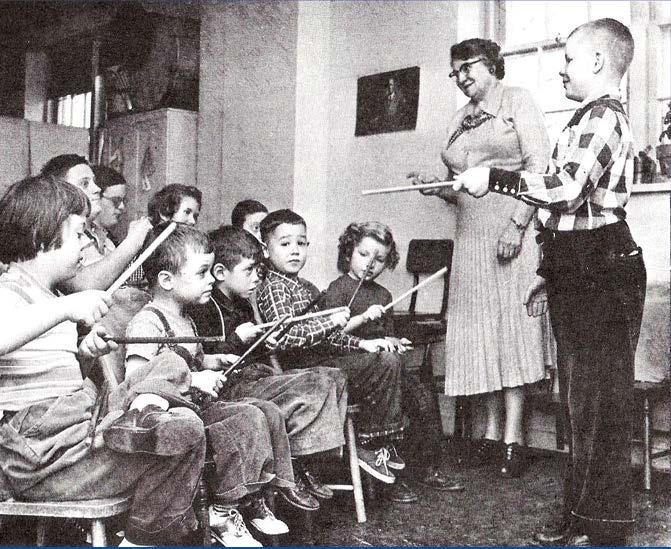
disabilities who would have otherwise been institutionalized. Fraser is going strong 90 years later. Here is a look at the longtime disability services provider’s history, excerpted from an organization history.
Louise Whitbeck Fraser led a difficult life. She was orphaned at age three and raised by her aunt. As an adult, she moved to Grand Forks and attended Valley City Normal School to earn a teaching certificate. She’d soon marry and have four children with husband Wesley.
The family’s early life was tragic. Son Robert died at age three after falling from a car. Not long after the accident, Louise’s husband Wesley was murdered. He was a Special Agent for the Department of the Treasury-Internal Revenue Service, in the Division of the Bureau of Prohibition. He was shot and killed in 1934 while investigating a “moonshine” operation in South St. Paul.
The family’s youngest daughter, Jean, would inspire her mother’s life’s work. At six weeks, Jean contracted spinal meningitis. She ran a high fever for 23 days.
Jean’s behavior grew erratic. An evaluation at the University of Minnesota revealed that Jean’s spinal meningitis had
Kay Willshire’s long, committed service to Access Press is recognized as she steps down from the news organization’s board. She has served as a board member intermittently since 2003.
She and outgoing Editor Jane McClure were honored at a reception where new staff members were welcomed. (See page 5 to meet the new Access Press staff.)
She is a Minnesota native, raised in rural Redwood County, graduating from Redwood Falls High School and attending the University of Minnesota, Morris. She finished her undergraduate years at St. Catherine University with a B.S. in communications.
Her first job was selling classified ads at the Star Tribune. Then Willshire became
colon, according to a news release. He was discharged from the hospital after a week, and is expected to make a full recovery.
The surgery is the latest for the senator, who had hours of surgery immediately after the attack.
John Hoffman made a speech at the Democratic National Committee's summer meeting in Minneapolis in August. He told his fellow Democrats to choose “governance over grievance” and implored all Americans to reject political violence.
The man accused of the politically motivated attacks, 58-year-old Vance Boelter, faces six federal charges. He pleaded not guilty.
A trial date for Boelter has not been set as the defense reviews thousands of documents and recordings related to the attacks that
It was a time when individuals with disabilities were institutionalized. But Louise Fraser wanted more for her daughter. While waiting for Jean to be admitted to a school for the deaf, Louise Fraser used music therapy to teach her daughter at home.
Word spread and soon other parents of children with “labels” reached out to Louise Fraser to teach their children. In 1935, she opened her Home Study School with seven students.
Tragedy struck the family again in 1936 when daughter Mary Louise died due to a staph infection. Jean was devastated by her sister’s death, left her school and went home to be with their mother. Soon mother and daughter were teaching together.
In just four years, Home Study School enrollment doubled. More room was needed but neighbors opposed the school and forced a move elsewhere. Harassment continued, with regular police visits due to noise complaints. City became involved and in 1941 the school moved to commercial properties.
Enrollment grew and so did a waiting list. A former Richfield machine shop was purchased with help from families, and a new school opened in fall 1949. It was
prosecutors turned over.
Investigators said Boelter was impersonating a police officer and had a hit list that included the names of other Democratic officials the night of the incident.
(Source: WCCO-TV)
Social Security increase set
The Social Security Administration (SSA) has announced that Social Security benefits, including Old-Age, Survivors, and Disability Insurance (OASDI), and Supplemental Security Income (SSI) payments for 75 million Americans will increase 2.8 percent in 2026. On average, Social Security retirement benefits will increase by about $56 per month starting in January.
Over the last decade the cost-of-living adjustment (COLA) increase has averaged about 3.1 percent. The COLA was 2.5 percent

renovated and expanded in 1960.
In 1954, the Home Study School was named the Louise Whitbeck Fraser School, honoring its founder. In 1967, a new facility was built at 2400 W. 64th St. in Richfield, where Fraser still operates today.
Louise Whitbeck Fraser died in 1976 at 81. Jean Fraser would outlive her mother by many years, passing away in 2000.
The school and other programs continued.
But when Diane S. Cross took the helm as president and CEO in 1989, change was needed
On Cross’s first day, she saw a leaking roof and carpet repaired with duct tape. She learned the school would not make payroll that month. State officials soon called to say that Fraser’s group home program would be closed. Hennepin County was cutting school funding because public schools were providing special education.
Cross and her staff went to work to cut costs and save Fraser. In the years that followed, the organization went through rapid change. A nursery school and kindergarten were added. Fraser Academy was founded as a public charter school for elementary students.
Fraser received certification as an occupational therapy/speech therapy provider. More homes and apartments
a news assistant in the newsroom and for the editorial page. This experience led her to spend the next decades of her career in corporate communications at Northern States Power Company (now Xcel Energy). She was part of an in-house agency supporting every department from human resources to consumer safety; coal and nuclear plant operations; finance, executive communications and gas/electric marketing. She wrote, edited and managed marketing communication materials for more than half of her 30-plus years in that role. Willshire has a lifelong interest in disability advocacy. One of her four younger sisters was diagnosed with MS as a senior in high school. Redirected from her original intended career, but not deterred, her


opened. An in-home waiver program began. Autism services transitioned to Fraser.
Feeding therapy was added as a service. Day treatment expanded. New clinics opened in Anoka, Eden Prairie and Eagan. Applied behavior analysis programming was launched.
In-school mental health partnerships began with Minneapolis, St. Paul and Edina public schools. HeadStart programs in Washington and Anoka Counties were launched.
Under Cross, Fraser grew from a $1 million nonprofit, to a nationally renowned, multi-service organization with a budget of $170 million. A staff of more than 1,700 serves clients from 64 locations. New satellite locations opened in St. Cloud and Mankato, with more planned.
In March 2024, Fraser Specialty Healthcare was named a certified community behavioral health clinic — a nationally recognized, cutting-edge model of behavioral health care.
Today, Fraser is the largest and mostexperienced provider of autism, mental/ behavioral health, and disability services in Minnesota, providing healthcare, housing, education and community support services to children, teens, adults and their families. Learn more at www.fraser.org
sister Joan Willshire became a marketing manager at Courage Center and later, the executive director of the Minnesota Council on Disability.
She served on the MS Society’s board of directors for 15 years, and when an opening came up on the Access Press board of directors, Willshire enthusiastically joined. She has been an active leader at Access Press since 2003, supporting journalism and the disability community.
She lives in St. Paul with her husband, a retired newspaper graphic designer.

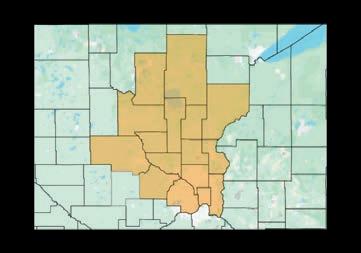
Louise Whitbeck Fraser, standing at right, works with a young conductor and a music class.
Today's Fraser classrooms are full of educational and fun activities.
Willshire
Kay Willshire
Class action filed against UCare over call readiness work
Just after UCare announced it was winding down operations, a civil lawsuit was filed against the company. The class and collective action was filed by Ivelisse Santiago against UCare Minnesota, on November 18 in U.S. District Court.
Court documents outline the case.
Santiago worked as a UCare customer service representative from August 2022 to June 2023. Her job duties involved answering calls from providers and medical management about patients' eligibility.
In June 2023, she became a subject matter expert, a title she still holds, which requires her to answer calls from customer service
Minnesotans to continue to have a health care experience that ensures they feel cared for.” Medica has more than 1.4 million members in nine states.
Earlier this year UCare terminated its Medicare Advantage contracts. Company leadership said they began exploring ways to transition members to a community-focused, nonprofit organization with aligned missions. “Combined, UCare and Medica have nearly a century of industry expertise and a shared commitment to community-driven coverage for those who need it most,” said Hilary Marden-Resnik, President and CEO of UCare. “This is a significant agreement that will enable us to preserve access to coverage for Minnesota’s most vulnerable members.” Erickson will continue as Medica’s President and CEO. She said that continuity of care will be the greatest focus going forward.
The transaction is anticipated to close in the first quarter of 2026. Individuals enrolled in a UCare plan for calendar year 2025 will continue to receive coverage without interruption. For the 2026 plan year, eligible individuals may continue to enroll in health coverage offered by either Medica or UCare. MNsure, Minnesota’s official health insurance marketplace, assured UCare members that their health plans through MNsure will not change in coverage or cost for plan year 2026. UCare is the largest seller of the plans, which are subsidized under the federal Affordable Care Act.
For consumers who are currently enrolled in a 2025 UCare private plan, there are no changes to coverage. They can continue to access care as usual. As long as they have paid their premiums, current coverage goes through December 31, 2025.
For consumers who have selected a 2026
REGIONAL NEWS
From page 11
in 2025.
Nearly 71 million Social Security beneficiaries will see a 2.8 percent COLA beginning in January 2026. Increased payments to nearly 7.5 million people receiving SSI will begin on December 31, 2025. (Note: Some people receive both Social Security benefits and SSI).
"Social Security is a promise kept, and the annual cost-of-living adjustment is one way we are working to make sure benefits reflect today’s economic realities and continue to provide a foundation of security," said Social Security Administration Commissioner Frank J. Bisignano. “The cost-of-living adjustment is a vital part of how Social
representatives who have questions about benefits or claims.
Santiago seeks to represent a collective and a class of all current and former customer service representatives, member service representatives and subject matter experts who worked for UCare Minnesota in the past three years.
Court documents filed by the plaintiff explain the importance of call center work and the time it takes to turn on the computers, enter credentials and then log into a number of computer programs.
Court documents stated that the bootup and call ready work is “integral and
indispensable to the performance of plaintiff's principal job duties and integral and indispensable to defendant's business.” That process can take up to 10 minutes per shift, and is time the employees aren’t compensated for.
But customer service representatives must take their first call of the work day at the start of every shift.
UCare Minnesota acted “in reckless disregard of the FLSA,” and its “illegal policy, plan or practice caused incorrect payments for all straight time and overtime performed by plaintiff,” court documents claimed. Another claim is that UCare failed

UCare private plan through MNsure, Coverage will continue as planned. There is no need to switch plans. Plans will still have UCare in the name. Benefits will stay the same. Provider networks will not change. There are no changes to 2026 premiums. There is no action required from consumers at this time.
MNsure is working closely with both UCare and Medica to ensure a smooth transition and uninterrupted coverage for Minnesotans. “MNsure’s top priority is making sure Minnesotans have access to reliable, affordable health insurance,” said MNsure CEO Libby Caulum. “We want to assure UCare members that their coverage is secure, and they will continue to receive the same benefits and care they signed up for.”
Current and former UCare employees who spoke on background said that they
Security delivers on its mission.”
Other adjustments that take effect in January of each year are based on the increase in average wages. Based on that increase, the maximum amount of earnings subject to the Social Security tax (taxable maximum) is slated to increase to $184,500 from $176,100.
Social Security begins notifying people about their new benefit amount by mail starting in early December 2025.
Similar to last year, Social Security beneficiaries will receive a simplified, onepage COLA notice, which uses plain and
were saddened but not surprised by the turn of events. They noted the volatility in the health care market and the difficult Medicaid market.
UCare currently has about 1,450 employees. It’s not known how many will transition to Medica.
A long history
UCare got its start in 1984. It was launched as a demonstration project by family medicine doctors at the University of Minnesota to manage the medical care of low-income Hennepin County residents. Another goal was to ensure that patients could continue seeing the university's doctors.
In 1989, UCare became a licensed health maintenance organization. Coverage for clients on MinnesotaCare and low-income elders was rolled out in 1996-1997.
online, which is secure, easy, and faster than receiving a letter in the mail. Account holders can set up text or email alerts when they receive a new message, such as their COLA notice.
Information about Medicare changes for 2026 will be available at www.medicare.gov.
For Medicare enrollees, the 2026 premium amount will be available via my Social Security Message Center starting in late November. Individuals who have not opted to receive messages online will receive their
to maintain accurate records.
Santiago is represented by Zackary S. Kaylor and Jacob R. Rusch of Johnson Becker PLLC of St. Paul and Alyson Steele Beridon of Nashville-based Herzfeld Suetholz Gastel Leniski & Wall PLLC.
UCare provided a response to Fox 9, stating “UCare has been a top employer for several years and stand by our best class workplace culture. UCare follows all applicable employment laws and rejects the press release assertions from the Ohiobased law firm,” the spokesperson said in a statement to FOX 9.
(Source: Fox 9 News and Law 360)
UCare for Seniors, a Medicare Advantage plan, was launched in 1998. UCare became independent from the university in 1999, although some ties were maintained. By 2002, membership had hit 100,000. Revenue topped $1 billion in 2007. Growth continued, with expansion of UCare’s Medicare Advantage program to Wisconsin in 2008. By 2012 UCare had won competitive bids from the state to provide coverage. Enrollment at that time was approaching 300,000 members.
A big change came in 2013 when UCare entered the commercial market to sell on the MNsure exchange.
UCare continued to grow and prosper. About 587,000 people had coverage from UCare at the end of 2024. The trend of financial losses was only seen recently. UCare became well known for its civic programs and it generosity to the communities it serves, including elders and the disability community. A popular event was a UCare Day at the Minnesota State fair, which featured Silver Sneakers senior exercise programs.
UCare also supported efforts including The Real Story, a documentary on disability news coverage that involved Access Press and the University of Minnesota Institute on Community Integration.
But UCare has faced challenges in recent years. Earlier this year it announced the end of state-funded coverage in 11 counties. That affected about 80,000 Minnesotans. Dropping of its Medicare Advantage plans affected another 158,000 clients.
In April UCare reported 2024 financial losses that were its worst ever with an operations loss of $504 million. During the first half of 2025, UCare posted a loss of $115 million. Look for more information on www.ucare. org or www.medica.org
COLA notice by mail in December.
The Social Security Act provides for how the COLA is calculated. The Social Security Act ties the annual COLA to the increase in the Consumer Price Index for Urban Wage Earners and Clerical Workers (CPI-W) as determined by the Department of Labor's Bureau of Labor Statistics.
For additional information, visit www.ssa. gov/cola.
(Source: Social Security Administration)


Fax: 952-472-1458
6371 Bartlett Blvd Mound, MN 55364
6371 Bartlett Blvd Mound, MN 55364
Certified ProAdvisor 2022
ProAdvisor 2022




PEOPLE AND PLACES
MOHR members make nominations, give many kudos to employers
Employers who go the extra mile for workers with disabilities were honored this fall with the 2025 Outstanding Disability Employer Awards. The awards were presented this fall by the Minnesota Organization for Habilitation and Rehabilitation (MOHR).
Winning employers are places where disabled employees can thrive. Award recipients range from small, local businesses to large corporations. The award presentations coincided with National Disability Employment Awareness Month in October.
“The employers we partner with through MOHR are champions of the value and talent people with disabilities bring to the workplace,” said Robin Harkonen, president of MOHR. “This National Disability Employment Awareness Month, we celebrate their leadership and invite more businesses to discover how inclusive hiring strengthens teams, sparks innovation, and drives success.”
The winners are:
Kowalski’s Excelsior Market was honored for its ongoing commitment to creating meaningful employment opportunities. Nominated by Opportunity Partners, the Excelsior Market is an inclusive workplace where employees of all abilities can grow, learn and thrive. Staff are encouraged to explore new opportunities within the store. Leadership demonstrates flexibility and commitment to long-term success. Through thoughtful training, personalized support and a genuine dedication to inclusion, Kowalski’s Excelsior Market exemplifies how local employers can create workplaces where everyone has the chance to shine.
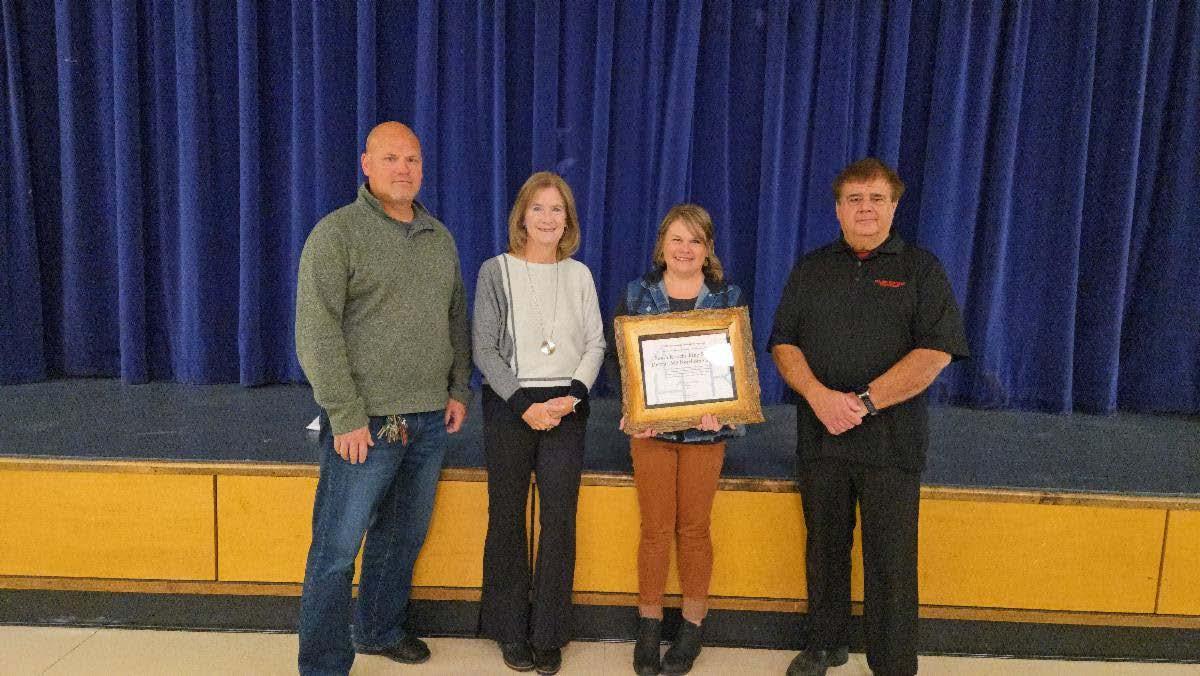
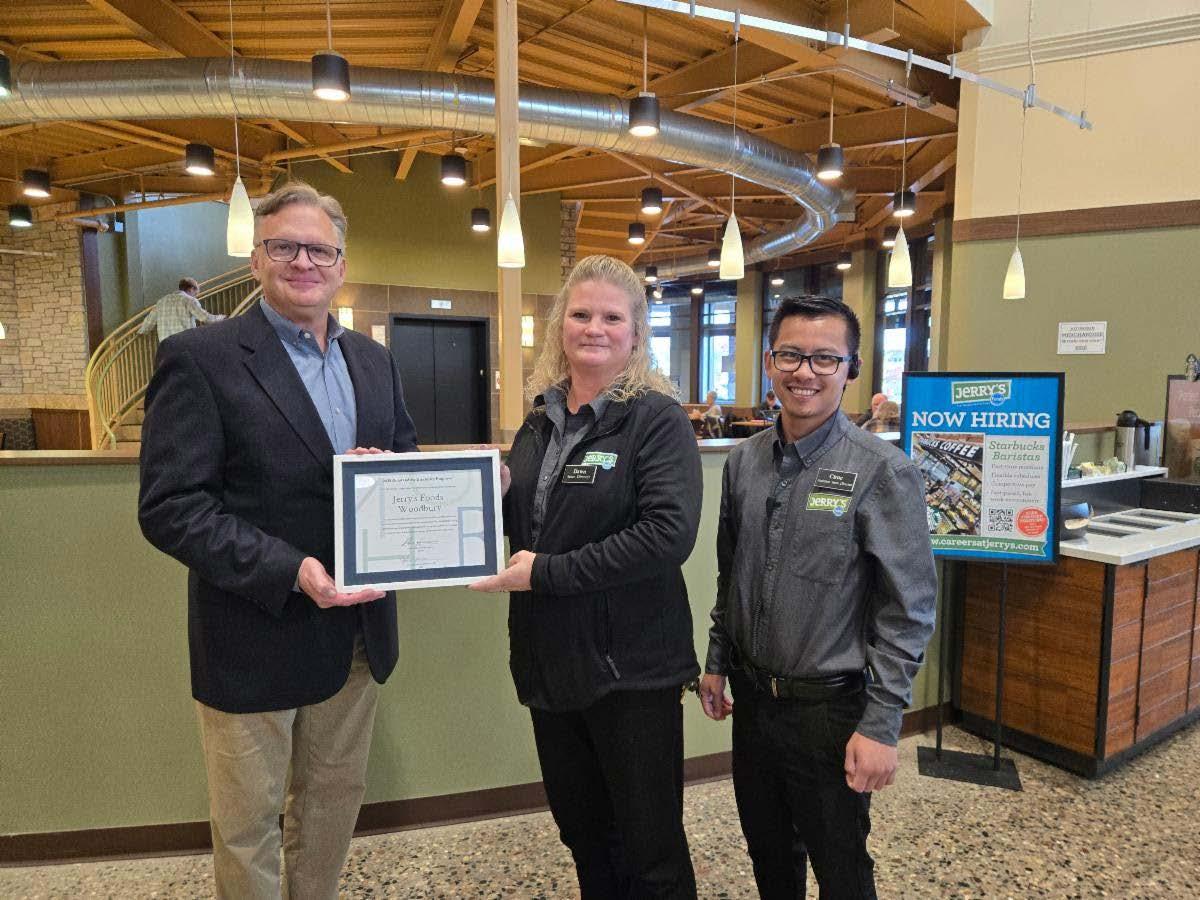
South Koochiching School District 363 Northome School was recognized for exceptional efforts in supporting disabled employees. Nominated by ITA BEL KOO Day Activity Center (DAC), the district helps employees gain valuable skills and teamwork experience by working in food service. The experiences enrich workers’ lives as they connect with students and become an integral part of the school community. Lunch and transportation are provided for employees.
MOHR To page 15
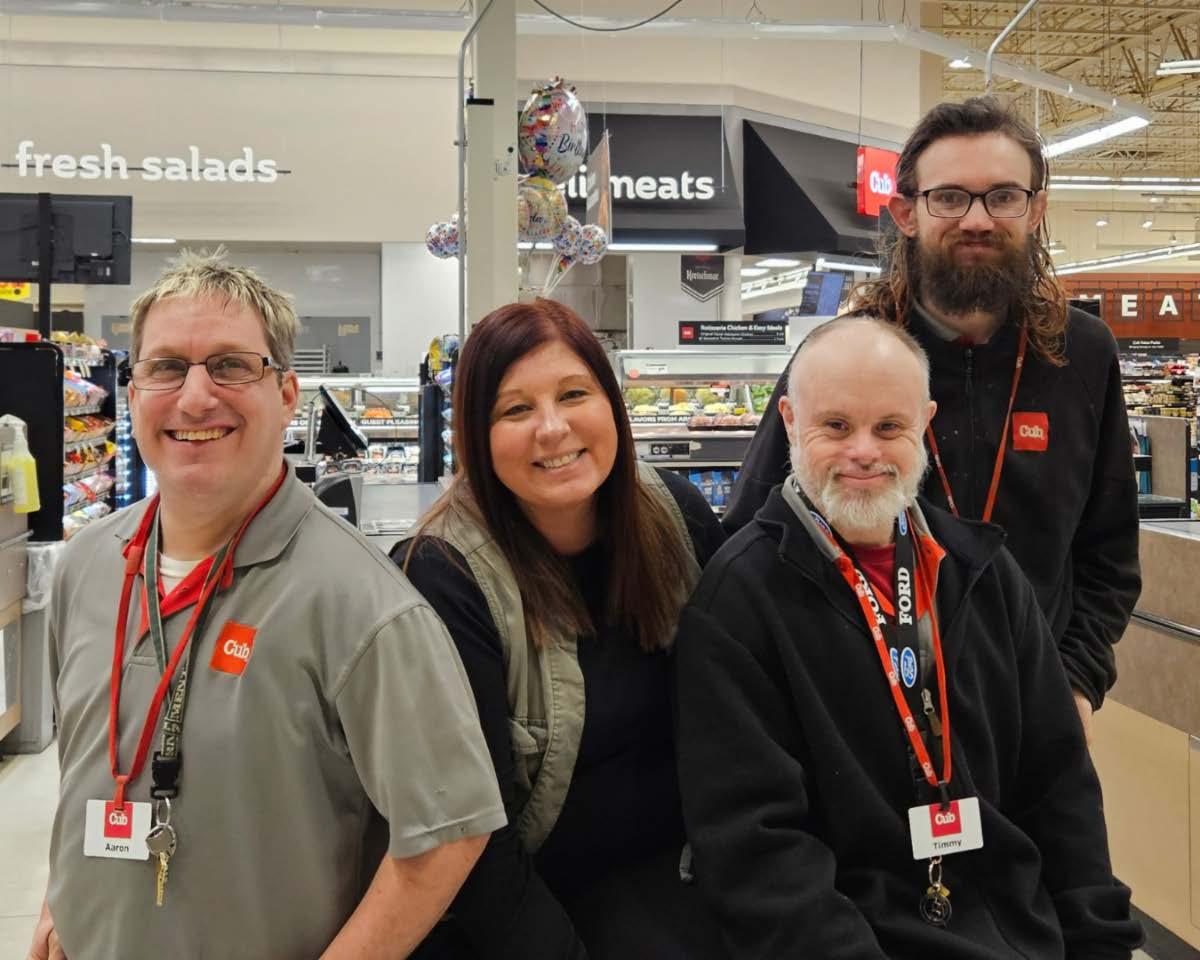
Advocating Change Together honors those who make a difference
Advocating Change Together (ACT): The Center for Disability Leadership hosted it annual Disability Justice Jamboree November 17-18, gathering disability community members together to share information and resources. An event highlight was the presentation of awards.
The Irving Martin Self-Advocacy Award is presented to an individual self-advocate or a self-advocacy group demonstrating an outstanding commitment to advancing self-advocacy. Irving Martin was often called “the Godfather of Self-Advocacy. He was a powerful voice for disability rights, racial justice and community belonging in Minnesota and beyond.
Martin believed that people with disabilities are people first, with the right to lead, decide, and live fully in their communities. He trained and inspired self-advocates nationwide with a clear and powerful message: all people belong.
The winners are DreamLife Destiny and Disability Motivational Network.
DreamLife Destiny, based in Maple Grove, provides an array of services. Its owners and staff are very compassionate and help their clients be their best selves. A key focus is helping clients work toward independence and self-sufficiency. DreamLife Destiny is just two years old.
The Disability Motivational Network works with disability organizations in Minnesota and around the world. For the past eight years its leaders have trained countless community advocates and self-advocates on how to speak out, claim their rights, and make a meaningful difference in their schools and community. Four years ago, they founded the Disability Support Group, a safe space where individuals with disabilities gather monthly to share their leadership and commitment.
Leaders Prince and Agnes have helped more than 5,000 people with disabilities across West Africa, including Liberia – empowering individuals to rise above barriers, advocate
for themselves, and inspire change there. The organization has also led a Book Club for ACT, and worked with other organizations
Other nominees are Amber Perkins, Amy Jo Piedade, Ardella Hudson, Brooke Quarim, Life Mower County People First, Mary Sue Hagerty, Michael Sack, Than Boutelle and Tara Wilson
The Rick Cardenas Justice Award is presented to an individual self-advocate who works fearlessly to advance disability rights and challenge injustice. Cardenas was a pioneering organizer, policy advocate, and changemaker whose legacy lives on in the public spaces, laws, and communities he helped shape.
The award honors those who, like Cardenas, turn advocacy into action — pushing for accessibility, equity, and inclusion across systems. He often said that justice isn’t something given — it’s something people build together.
The winner is Nate Clark. Clark is an outgoing person, who never gives up. When he has the opportunity to do something right he gets it done. He tries to make things happen, and also he cares for his community, including all people with or without disabilities.
Clark strives for People First Movement for all people. He is a Kiwanis club member, Peer to Peer Mentor for Arc Minnesota, and SAM Rep for SAM SW. He also works at the Hy-Vee meat department.
Other nominees are Nikki Villavicencio and Carol Benedict
The Gloria Steinbring Leadership Award honors a self-advocate or ally who leads with compassion, strength and a commitment to building others up. Steinbring is a beloved and respected mentor in Minnesota’s selfadvocacy movement, known for her decades of peer support, organizing and leadership development.
This award celebrates individuals who, like
ACT To page 15

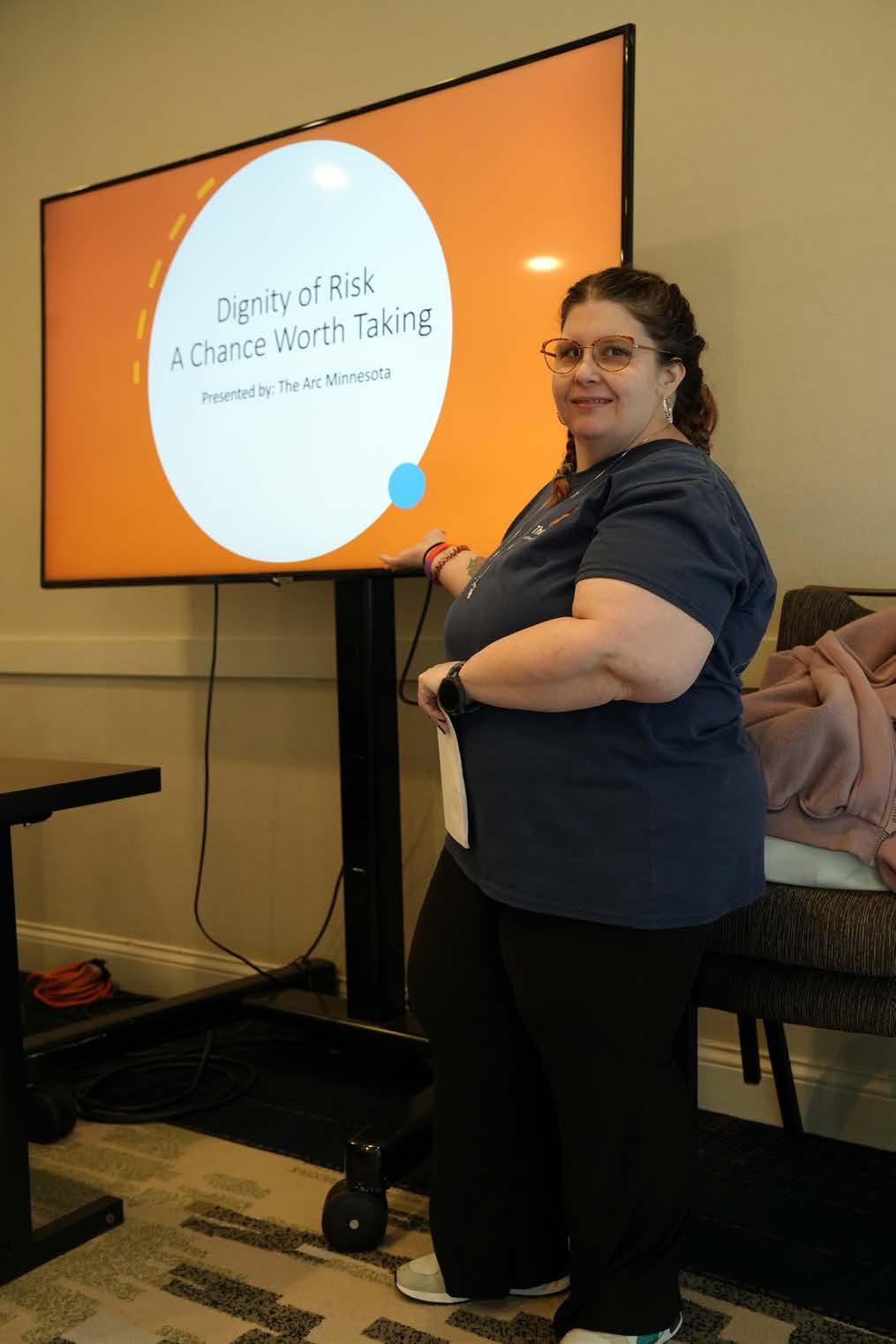

In December, NewsMatch will match your monthly donations 12 times or double your onetime gift, all up to $1,000.
DONATE NOW through Dec 31
South Koochiching School District 363 Northome School was nominated by ITA BEL KOO Day Activity Center (DAC),
Cub Silver lake was nominated by PRI.
Jerry's Foods was nominated by MSS.
Katie McDermott was one of the presenters.
JERRY SMITH, ICI
RADIO TALKING BOOK
Season’s Greetings from Radio Talking Book
As the days grow short and winter and the new calendar year are embraced, many people celebrate relationships with our families, friends, communities, cultures, and nature. May everyone be filled with joy, love, and harmony this holiday season.
Radio Talking Book invites everyone to enjoy traditional holiday programming broadcasts, beginning at 7 p.m. Wed, Dec. 24, with regular programming resuming at 6 a.m. Fri, Dec. 26.
Enjoy Radio Talking Book
For Dec, 25 new books are premiering.
Radio Talking Book is not just for listeners with visual disabilities. Anyone with difficulty reading or turning pages can enjoy the service.
Radio Talking Book schedules can be emailed. Sign up at tinyurl.com/RTBemail If email is preferred, contact Ronnie Washington at 651-539-1424 or SSB. Equipment@state.mn.us to indicate what version is desired.
The sampling published monthly in Access Press doesn’t represent the full array of programming. Listen to RTB’s live or archived programs online at www.mnssb. org/rtb, and learn more about programs. Hear programming on a hand-held mobile device, for either iOS or Android. Visit the Apple App Store for iOS, or Google Play for Android, and download the Minnesota Radio Talking Book app.
Missed a book broadcast? Access it for one week following its original broadcast in the online weekly program archive.
For help accessing the archive, contact Ronnie Washington at 651-539-1424 or SSB.Equipment@state.mn.us.
If the book’s broadcast is no longer available in the archive, contact staff librarian Molly McGilp at 651-539-1422 or Molly.McGilp@state.mn.us
Books broadcast on the Minnesota Radio Talking Book Network are available for loan through the Minnesota Braille and Talking Book Library in Faribault. The catalog is at www.mnbtbl.org. Call 800-722-0550, MonFri, 9 a.m. - 4 p.m. CST.
Updates are also on the Facebook site Minnesota Radio Talking Book.
Audio information about the daily book listings is on the National Federation for the Blind (NFB) Newsline. Register for NFB Newsline by calling 651-539-1424. The NFBNEWSLINE service provides access to more than 500 magazines and newspapers. To learn more, visit www.nfb org/programsservices/nfb-newsline; 612-562-7803
Staff welcomes any feedback or suggestions. Contact Joseph Papke at 651-
539-2316 or joseph.papke@state.mn.us.
Contact Tom Conry at 651-642-0880 or thomas.conry@state.mn.us with comments about periodicals and newspapers programming.
Chautauqua*
Monday – Friday 6 a.m.
Abundance, nonfiction by Ezra Klein and Derek Thompson, 2025. A paradigm-shifting call to renew a politics of plenty, face up to the failures of liberal governance, and abandon the chosen scarcities that have deformed American life. Read by Yelva Lynfield. 12 broadcasts; begins Mon, Dec. 1.
The Certainty Trap, nonfiction by Ilana Redstone, 2024. A tour de force that makes a case for intellectual humility, pluralism and holding ideas provisionally about complex issues. Read by Peter Danbury. 10 broadcasts; begins Wed, Dec. 17.
Past is Prologue*
Monday – Friday 11 a.m.
Embers of the Hands, nonfiction by Eleanor Barraclough, 2025. A history of the Viking Age, from mighty leaders to rebellious teenagers, told through their runes and ruins, games and combs, trash and treasure. Read by Carol McPherson. 13 broadcasts; begins Mon, Dec. 22.
Bookworm*
Monday – Friday 12 p.m.
Time of the Child, fiction by Niall Williams, 2024. A compassionate, life-affirming novel about the Christmas season that transforms the small Irish town of Faha. Read by Jack Rossmann. 14 broadcasts; begins Mon, Dec. 8.
Sing To Me, fiction by Jesse Browner, 2025. After the fall of Troy, an 11-year-old boy sets off for the razed city when his father and sister vanish into the war zone. Read by Paul Ranelli. Seven broadcasts; begins Mon, Dec. 29.
The Writer’s Voice*
Monday – Friday 1 p.m.
Penman of the Founding, nonfiction by Jane E. Calvert, 2024. The biography of a lesserknown Founding Father, a contrarian patriot who supported abolitionism and women’s rights. Read by Stevie Ray. 26 broadcasts; begins Tue, Dec. 2.
Choice Reading*
Monday – Friday 2 p.m.
Mona Acts Out, fiction by Mischa Berlinski, 2025. A novel about acting and telling the truth, about how people play roles to get through their days, and how the great roles teach people how to live. Read by Cintra Godfrey. 11 broadcasts; begins Mon, Dec. 1. – L
A Christmas Duet, fiction by Debbie Macomber, 2024. A solo holiday trip inspires one woman to rediscover her passion—and
BENEFACTOR
($1000 & up)
Janice Chevrette
Just Comfort, Inc.
Jane Larson
Ronna Linroth
Brandon Miller
Lynda Milne
Kay Willshire
GOLD ($500-$999)
Jeff Bangsberg and Anita Boucher
John and Marilyn Clark
Catherine Hunter and Christopher Ockwig
Morgan Stanley GIFT (anonymous)
Tamarack Habilitation Tech on behalf of Mark Payette
American Online Giving Foundation, Inc.
Anonymous Donor from Burnsville
Gretchen Bratvold Choice, Inc.
Tom Clark
Yoshiko S. Dart
Neil Doughty
John Albanese
Nancy E Casey
Stephan Cox
Dawn R. Doering
Craig J Dunn & Candy Hart
remember that, sometimes, duets are more fun—in this romantic Christmas novel. Read by Holly Sylvester. Seven broadcasts; begins Tue, Dec. 16.
A Forty Year Kiss, fiction by Nickolas Butler, 2025. A small-town story about one couple and a second chance at love, 40 years after their divorce. Read by Tom Speich. Nine broadcasts; begins Mon, Dec. 29. – L
Afternoon Report*
Monday – Friday 4 p.m.
The End of Race Politics, nonfiction by Coleman Hughes, 2024. A case for a colorblind approach to politics and culture, warning that the so-called “anti-racist” movement is driving society – ironically -toward a new kind of racism. Read by Stevie Ray. Seven broadcasts; begins Thu, Dec. 11.
Bone of the Bone, nonfiction by Sarah Smarsh, 2024. A collection of brilliant and provocative essays by one of the most important commentators on America’s class problem. Read by Judy Woodward. 12 broadcasts; begins Mon, Dec. 22. – L Night Journey*
Monday –Friday 7 p.m.
Where They Last Saw Her, fiction by Marcie R. Rendon, 2024. A compelling mystery of a Native American woman who learns of the disappearance of one of her own and decides enough is enough. Read by Karen Ray. 10 broadcasts; begins Mon, Dec. 8. – L
The Turtle-Jack Killings, fiction by Glenn Ickler, 2025. Journalists are targeted by a killer in this Minnesota-set thriller. Read by Pat Ocken. Nine broadcasts; begins Mon, Dec. 22. – L
Off the Shelf*
Monday – Friday 8 p.m.
Lazarus Man, fiction by Richard Price, 2024.
A group portrait of Harlem residents in the aftermath of a five-story tenement collapse in 2008 that mysteriously changes the life of a survivor. Read by Stuart Holland. 14 broadcasts; begins Tue, Dec. 2. – L Intermezzo, fiction by Sally Rooney, 2024. Two brothers—one a lawyer, one a chess prodigy—work through the death of their father, their romantic lives, and their even more tangled relationship with each other. Read by Carl Voss. 15 broadcasts; begins Mon, Dec. 22. – L, S Potpourri
Monday – Friday 9 p.m.
Heartbreak is the National Anthem, nonfiction by Rob Sheffield, 2024. An intimate look at the life and music of modern pop’s most legendary figure, Taylor Swift. Read by Laura Young. Seven broadcasts; begins Tue, Dec. 9. – L
SILVER ($150-$499)
Rosebud Elijah Vicki Gerrits
Robert P Gregory
Anne Henry and Jarod Peterson
Kim Keprios
Jim Muckenhirn
Scott Neamy
Manley & Ann Olson
BRONZE ($75-$149)
Kent Fordyce
Claudia Fuglie
Maggie Hanrahan
Dale H Janiszeski
Owen McBride
Shelley Madore
Anonymous Donor from Oakdale Katrin Bachmeier
Nora Aileen Beall
Paula Brunetti
Gayle Cooper
Stephanie Cunningham
Julee Quarve Peterson
Ken Rodgers
Rick & Susie McPherson Fund
Barbara Smith
Amanda and Mark Tempel
Daphne Thompson
Dan and Emily Ward
Dr. Michael Wirth-Davis
Gene Martinez
John D Marty
Michael Miner
William & Joen
Overby
Mark & Mary Payette
Reach for Resources
FRIEND ($50-$74)
Darrell, Nikki and
Alley Paulsen and Company Inc:
Voices for the Disabled
Nancy N. Eustis
Mary Graba
Wendy Harbour
Annamary Jeffery Herther
Greg, Cindy and Jenna Johnson
Mark Knutson and Margaret Knutson
Marilee McGraw
All times listed are Central Standard Time.
Abbreviations
V
– violent content
R – racial epithets
L – strong language
S – sexual situation
G – gory descriptions
Sick Houses, nonfiction by Leila Taylor, 2025.
An exploration of the architecture of haunted houses, uncanny domestic spaces, and how the horror genre subverts and corrupts the sanctity of home. Read by Holland Richner. Seven broadcasts; begins Thu, Dec. 18. – G The Long Run, nonfiction by Stacey D’Erasmo, 2024. A rich meditation on the artist’s life and work over time. Read by Pat Ocken. Seven broadcasts; begins Wed, Dec. 31. – L, S
Good Night Owl
Monday – Friday 10 p.m.
Witchcraft for Wayward Girls, fiction by Grady Hendrix, 2025. Hung out to dry by the elders who betrayed them, a squad of pregnant teens fights back with old magic. Read by Pat Muir. 16 broadcasts; begins Thu, Dec. 11. – G
RTB After Hours*
Monday – Friday 11 p.m.
Love You a Latke, fiction by Amanda Elliot, 2024. A struggling coffee shop owner and her most cheerful customer fake a relationship for Hanukkah in this cozy contemporary romance. Read by Yelva Lynfield. 13 broadcasts; begins Mon, Dec. 8. Rekt, fiction by Alex Gonzalez, 2025. A disturbing examination of toxic masculinity depravity and the darkest pits of the Internet, about a young man’s algorithmic descent into in a future that’s nearly here. Read by Paul Ranelli. 11 broadcasts; begins Mon, Dec. 29. – L, S, V, G, R
Weekend Program Books
Your Personal World, 1 p.m. Sat, The Joy of Connections by Dr. Ruth Westheimer, read by Yelva Lynfield; followed by How Sondheim Can Change Your Life by Richard Schoch, read by Stuart Holland. For the Younger Set, 11 a.m. Sun, presents Humphrey and Me by Stuart H. Brady, read by Jack Rossman.
Poetic Reflections, noon Sun, presents You Can Be The Last Leaf by Maya Abu AlHayyat, read by Pat Muir; followed by Short Film Starring My Beloved’s Red Bronco by K. Iver, read by Laura Young – L. The Great North, 4 p.m. Sun, presents Hidden History of Twin Cities Sports by Joel Rippel, read by John Gunter; followed by Perpich: A Minnesota Original by Ben
Carrie Salberg
Stephanie Schwartz
Walt Seibert
Lee Shervheim
Joan Willshire
Christopher J. Meyer
Alina Schroeder
Sue Singer
David Trouten
Jenna Udenberg
Rachel Wobschall
We appreciate your tax-deductible donations to Access Press.

Fetching Ball date change

Can Do Canines reminds everyone that its annual Fetching Ball gala and fundraiser has been moved to spring 2026. This year's big event will be held on Sat, April 11. Watch for more information in the coming months. FFI: www.candocanines.org
Take Note! and consider sponsorship
Access Press is listing fewer calendar items in print and encouraging more to be posted online. The change allows more immediate information about upcoming events. Online options include our free events calendar. Ways to post an event can be found at www.accesspress.org, under the listings tab. The event must be disabledfocused, offer accommodations or led by a disability service organization. Please list accommodations and complete information, such as time, date and place. That information is especially needed for users of paratransit who must often schedule rides in advance. Anyone with questions can contact Editor Joey Carlson at joey@accesspress.org or 651-644-2133 ext. 1.
Another option is to consider an online or print ad to get the word out. If your organization or group isn’t in our Access Press Directory, a listing is an economical way to get the word out. This can include disability-focused arts, cultural and service groups. Email us at ads@ accesspress.org
A fourth, ongoing option for an interested business or disability service organization is to sponsor our online calendar. Being a sponsor is a great way to support Minnesota’s disability community and its events. Information can be obtained by emailing ads@accesspress.org
Access Press seeks board candidates
Want to be involved with Minnesota’s disability community and its premier news source? Access Press has an opening on our Board of Directors. We are seeking applicants who have experience in development, giving and community building.
The Access Press Board is responsible for setting the strategic direction of the paper as well as overseeing the work of the executive director.
Access Press began publishing in 1990 and is one of the nation’s oldest multi-disability publications, with a print newspaper, website and social media presence.
If you are looking for an opportunity to help develop and implement the future
direction and initiatives of Access Press, consider joining the board.
Our small but dedicated board currently numbers seven, with one member’s term ending in December. Learn more about the board at https://accesspress.org/about/
While uncompensated, board service is rewarding and can make a huge difference in the future success of Access Press.
Please consider sharing your expertise in development, fundraising or community building with Access Press and our community. It feels good to give back!
Apply at https://accesspress.org/about/joinour-board/
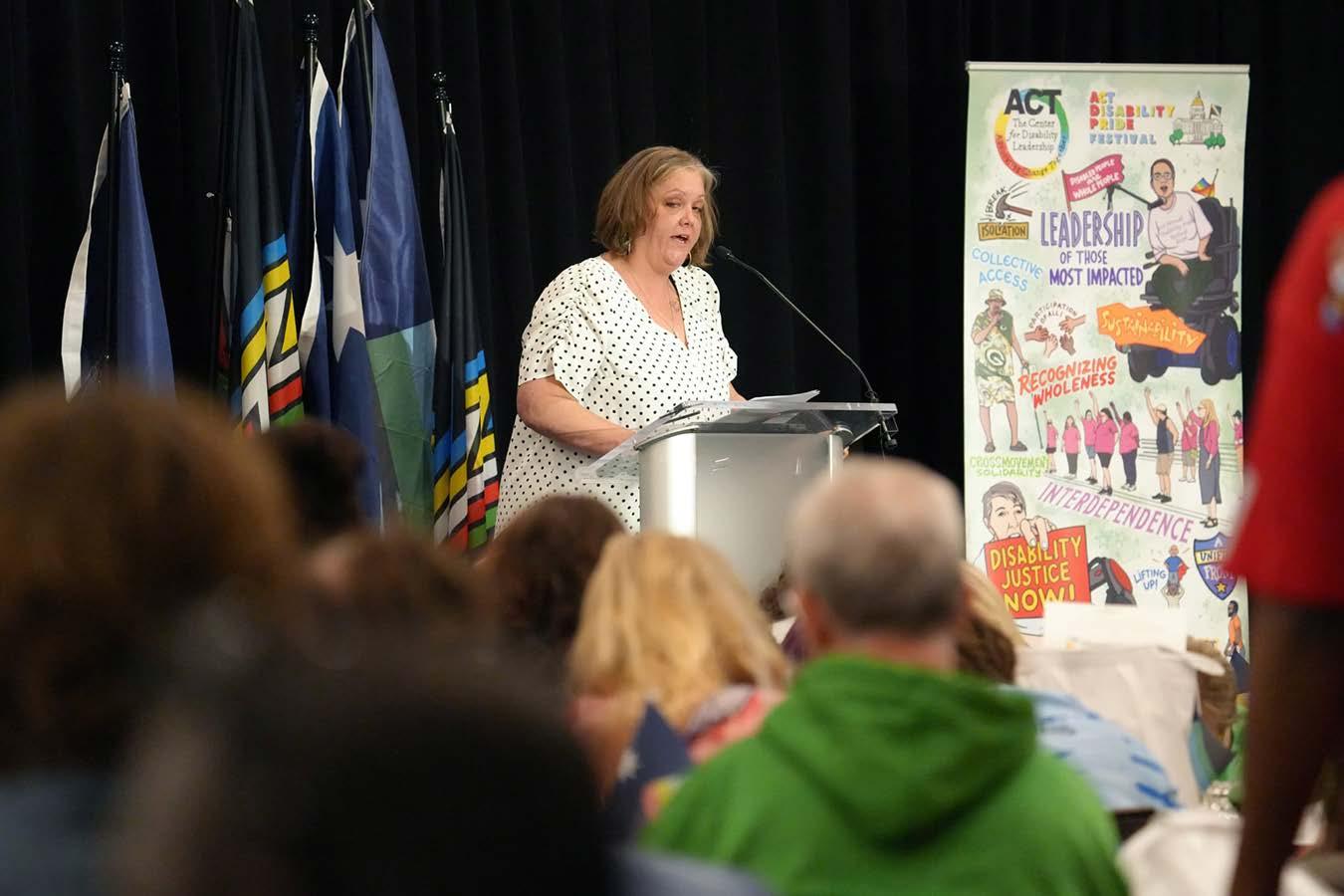
ACT
From page 13
her, create space for others to lead — lifting voices, building confidence, and offering guidance from lived experience.
Steinbring’s leadership has always been about people — believing in them, supporting them, and helping them rise.
The winner is Joan Decker, because she is cited as “living, breathing and eating” the values of the award. When Decker isn’t
MOHR
From page 13
“Our kids look forward to seeing them every day,” said Principal MacKenzie Lehn. “They have really joined our Mustang family.”
Nominated by Rise, Minneapolis-based dog treat manufacturer Finley’s creates opportunities with dignity. What began as helping students build real-world skills has resulted in more than 200 jobs for disabled people nationwide. Most are in the ambassador program, working as teams in stores to help promote and educate shoppers about Finley’s products.
Ambassadors have access to the tools they need to be successful. “It's super fun to watch their confidence come alive,” said Finley’s co-founder Angie Gallus. “They work so hard and they love their jobs so much.”
An MSS partner, Jerry’s Foods in Woodbury is recognized for its commitment to equal opportunity employment and for creating a positive working environment for employees with disabilities. From bagging groceries to maintenance to checking positions, Jerry’s Foods provides a positive learning environment and custom training for each of the 10 MSS-supported employees at the Woodbury location.
“We try to understand the person we are working with and what we can do to help them succeed,” said Chue Vue, assistant store
CLASSIFIEDS
working with people with disabilities, she is volunteering her time supporting people with disabilities. She donates all her free time supporting people with disabilities, whether she’s giving rides to meetings or rallies or helping with whatever else community members need.
Other nominees are Bev Kaler, Cheryl Garder-Ghionzoli, Jenny Svihel, Karli Harguth, Katie McDermott, Melissa Steele, Meredith Kujala, Ocean C. Poet, Wilbur Neushwander-Frink and Cheryl Hutchens.
director.
Cub Foods Silver Lake, St. Anthony Village, won for its long-standing commitment to inclusive employment and community connection. Nominated by Partnership Resources, Cub Foods Silver Lake has employed disabled workers as part of its “clean team” for the past 28 years. This has created meaningful, lasting careers. When the longest-serving employee reached his 25th anniversary, Cub and Partnership Resources celebrated the milestone with a special party. Current and former managers, employees and community members joined in the celebration. Exceptional compassion and flexibility in supporting employees’ evolving needs is also cited.
Kids Abilities, a Hugo outpatient pediatric therapy clinic, was recognized for exemplary care and commitment. The clinic has consistently gone above and beyond to create a safe and productive work environment for its TSE, Inc.-supported employee with disabilities.
“At Kids Abilities, the support is so natural for them,” said Jim Freeman, chief business development officer at TSE, Inc. They established routines, refined skills, and created growth opportunities tailored to the employee’s needs. The employee has gained self-confidence, learned new skills, improved his speech and vocabulary, and applied new abilities at home.

ACT leader Jennifer Walton addressed the jamboree attendees.

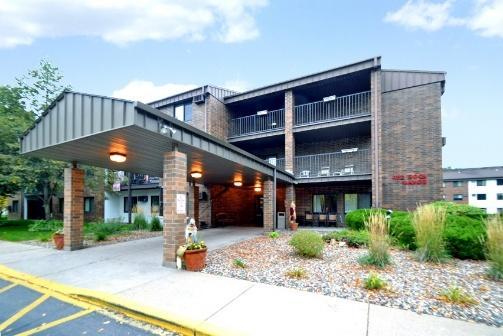
Community Amenities
• Laundry Facilities
• Off- Street Parking
• Community Patio
• Elevator
Community Information
• Maximum Income is based on the number of persons in the household and total gross household income. Contact us for details.
Applying
• You may obtain an application at our management office located at 1421 10th Ave,. Newport, MN 55055 between 9am and 4pm Tuesday-Thursday or by giving us a call at 651-459-2786 or emailing us at redrockmanor@commonbond.org.
• All applications should be returned to our management office at 1421 10th Ave., Newport, MN 55055 or emailed to us at redrockmanor@commonbond.org