The first of two articles that examines the risks that arise when projects proceed with only a quote, emails or a purchase order alone.
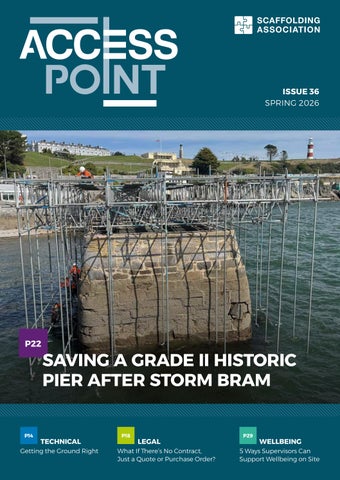
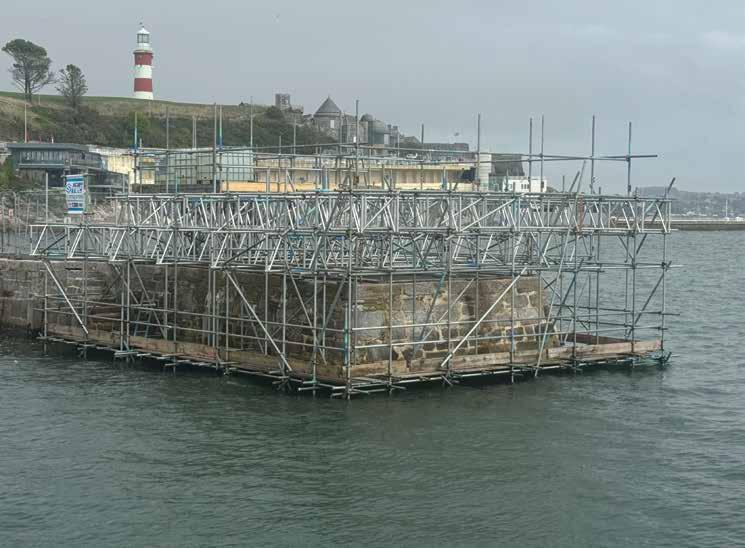
Saving a Grade II historic pier after storm Bram.
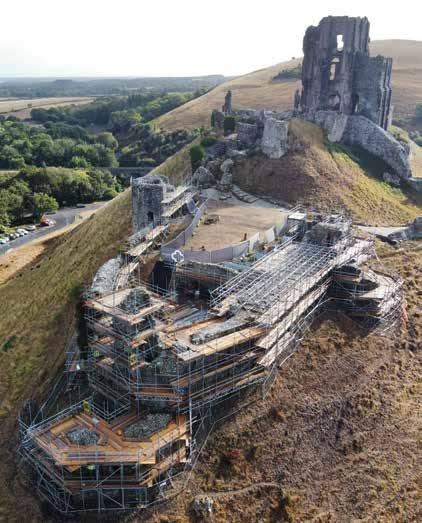
Preserving a Civil War icon. complex untied access at Corfe Castle.
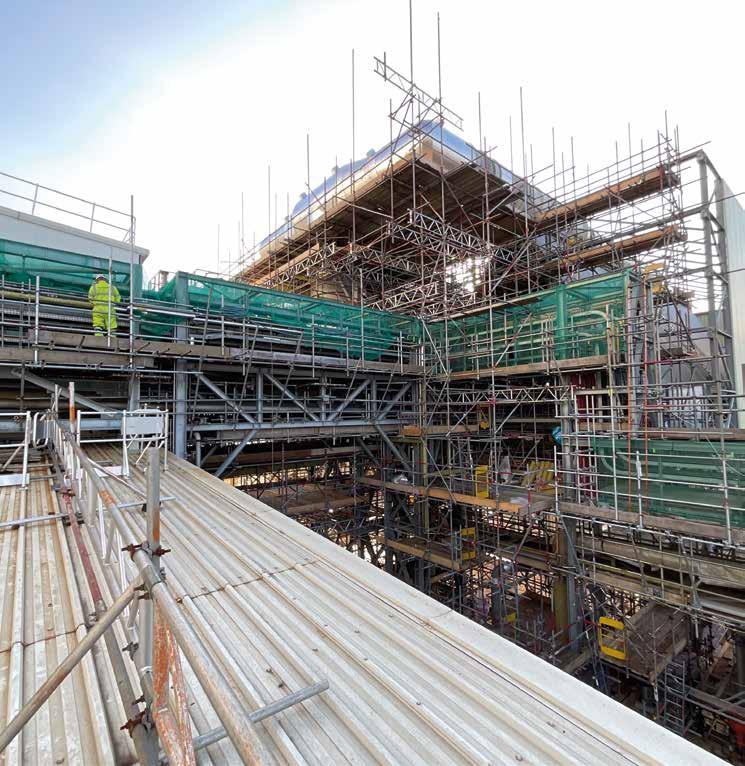
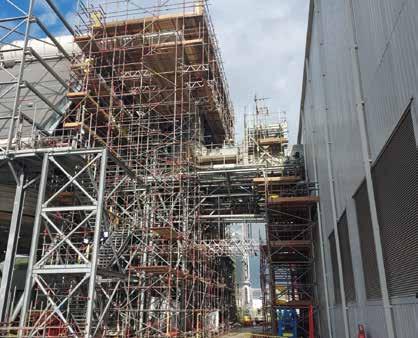
From standstill to success. Powertherm restores momentum at Earls Gate Energy Centre.
Five practical ways in keeping teams
Welcome to new Scaffolding Association members
CONGRATULATIONS ON UPGRADING!
SCAFFOLD CONTRACTOR
Empire Scaffolding Solutions Limited
www.empiregroup.ltd 01628 330028
ASC (Leeds) Limited www.ascleeds.com 07979 013432
Contract Scaffolding Midlands Limited
www.contractscaffoldingltd.co.uk 024 7634 2444
SCAFFOLD CONTRACTOR
Marsh Scaffold Ltd
www.marshscaffold.co.uk 07780 462648
AGA Scaffolding Ltd
www.aga-scaffolding.co.uk 020 8746 9448
CJ Scaffolding Ltd
www.cjscaffoldingltd.com 07908 228066
C.G.K Scaffolding Limited
www.cgkscaffolding.co.uk 07733 737621
Easy Fix Access Ltd
www.easyfixaccess.com 07976 091783
MLG Scaffolding Services Ltd 07740 820082
Scaffolding Access Limited
www.scaffoldingaccess.co.uk 01708 555540
L.M. Scaffolding (NW) Ltd
www.lmscaffolding.uk 07772 996668
All Scaffold Limited
www.allscaffoldlimited.com
07956 402266
Interested in becoming a member? Scan here for more information
HT Scaffolding Ltd
www.htscaffoldingltd.co.uk 07840 241385
City Access Limited
www.city-access.co.uk 0116 253 0197
HWA Scaffolding Limited
www.hwascaffolding.co.uk 07462 836607
Barke Scaffolding Ltd
www.barkescaffolding.com 01473 922505
ARTICO Enabling Services Limited
www.articoes.com 01656 837121
Cadarn Access Limited 07780 578955
Leigh Db (Jmd) Ltd
www.leighdb.co.uk 07547 674916
SCK Scaffolding Limited
www.sckgroup.co.uk 020 8706 0997
JMS Scaffolding Ltd
www.jmsscaffolding.com 07346 935420
SAC Scaffolding (Eastern) Ltd
www.sacscaffolding.co.uk 01206 874619
Pro Scaffolding (Carmarthen) Limited 01267 888021
National Scaffolding Limited
www.nationalscaffoldingltd.co.uk 07507 041175
The Scaffolding Company Ltd
www.thescaffoldingcompanyltd.co.uk 020 8438 8880
Billa Scaffolding Ltd
www.billascaffolding.co.uk 07828 294772
Ias (Dundee) Ltd.
www.iaslimited.co.uk 01382 770050
Sapphire Scaffolding Limited
www.sapphirescaffolding.co.uk 07860 909069
Upsafe Scaffolding Limited
www.upsafescaffolding.co.uk 07496 055556
MCQ Scaffolding Limited
www.mcqscaffolding.co.uk 020 3633 0202
Reliable British Scaffolders Limited
www.rbs-scaffolding-devon.co.uk 01297 22911
Access Contractors UK Ltd
www.access-contractors.co.uk 07856 957471
KSL Scaffolding Limited 07966 806832
London Safe Scaffolding Ltd
www.londonsafescaffolding.co.uk 07552 219179
Safescaff Inspect Ltd
www.safescaffinspect.co.uk 07508 888291
Infinite Solutions LG Ltd
www.infinitesolutionslg.co.uk 07985 533249
Comment
This issue reflects the breadth of activity currently shaping our industry – from recognition and representation at national level, to the practical realities facing scaffolding businesses on the ground.
We begin by reflecting on the recent UK Trade Association Awards. Being shortlisted across three categories was a significant achievement and a testament to the progress we continue to make. It was also a timely reminder of the vital role trade associations play in championing standards, supporting members and giving our sector a strong, collective voice.
Training and skills remain central to that mission. The changes to CITB funding announced last year, which came into effect at the beginning of 2026, have understandably prompted questions across the industry. Whilst we were previously reassured that scaffolding training linked to CISRS pathways would remain protected, there is now some uncertainty relating to other areas of funding provided by CITB, which we are working to better understand and will provide further clarity on as it emerges. Maintaining structured, accredited training routes remains essential in supporting competence and safeguarding this safety-critical profession.
Safety more broadly continues to demand our full attention. The Government’s Road Safety Strategy signals a greater focus on work-related road risk and leadership responsibility - something that resonates strongly with a sector so reliant on vehicles and roadside activity. We will continue
engaging constructively to ensure scaffolding businesses are recognised not just as stakeholders, but as leaders in delivering practical improvements.
This issue also highlights our commitment to the Armed Forces Covenant. The skills, discipline and work ethic of veterans and service leavers are an enormous asset to our industry. Understanding how we can create clearer pathways into scaffolding roles is an important step in turning that commitment into tangible opportunity.
Alongside these policy and strategic developments, we are proud to feature the personal journey of one of our members - a reminder that at the heart of this industry are individuals who have built businesses from the ground up, navigated change, embraced innovation and continue to invest in the next generation.
As ever, our focus remains simple: raising standards, strengthening representation and ensuring that scaffolding businesses of all sizes can operate professionally, safely and successfully in an increasingly difficult environment.
Thank you for your continued support.
Maintaining structured, accredited training routes remains essential in supporting competence and safeguarding this safety-critical profession.
ROBERT CANDY CHIEF EXECUTIVE, SCAFFOLDING ASSOCIATION
Lighthouse Charity Celebrates 70 Years of Support
The Lighthouse Charity is marking its 70th anniversary, celebrating seven decades of providing vital support to construction workers and their families.
Founded in 1956, the charity has grown from humble beginnings into a vital support network for the industry, offering a wide range of services including emotional, physical and financial wellbeing support, as well as a 24/7 confidential helpline.
As the charity reflects on its history, it continues to evolve its services to meet the changing needs of today’s workforce.
For those working in the scaffold industry, the milestone is a reminder of the importance of accessible support and the role wellbeing plays in maintaining a safe and resilient workforce.
Right to Work Checks: Reminder for Scaffolding Contractors
The Government is continuing to increase immigration enforcement across the UK, with construction identified as a priority industry. With arrests for illegal working at a record high according to the Home Office, scaffolding contractors –who frequently employ site-based and subcontract labour – are reminded of the steps they can take to ensure individuals have the right to work in the UK.
Employers can use a Digital Verification Service provider to carry out digital checks on individuals who hold a valid British or Irish passport (or Irish passport card). Employers must still confirm that the person presenting for work is the same individual whose identity has been verified, which can be done via video call.
Alternatively, employers can complete an online check using the Home Office service where an individual has been issued with an eVisa or is providing certain other documentation. The Employer Checking Service can also be used in specific circumstances, such as when an individual has an outstanding application or appeal with the Home Office.
Employers may also conduct in-person manual document checks, which require them to physically obtain, check, and copy acceptable documents from the prospective employee. However, a Home Office report last year found that 70% of employers in construction accept a driving licence, despite this not being an acceptable document for right to work checks.
Employers who carry out right to work checks in line with Home Office guidance will obtain a ‘statutory excuse’, which protects them from liability if a worker is later found to be working illegally. Without this protection, employers could face civil penalties of up to £60,000 per worker.
Keep Your Operator Licence Details Up to Date
The Office of the Traffic Commissioner has recently reminded operators that if your email address, phone number or postal details are out of date, you could miss important communications - including information that may directly affect your licence.
If your details aren’t correct, there’s a real risk that time-sensitive communications won’t reach you when you need them most. In some cases, that could mean missing deadlines, failing to respond to enforcement action, or simply being unaware of an issue until it has already escalated.
Taking a few minutes to check and update your details is therefore a simple but important step.
You can check and update your details here
Member Shortlisted for Safety Award
Josh DeGroot, Company Director of 360 Degrees Consultancy, has been shortlisted for the Rising Safety Professional Award at the North West Construction Health & Safety Group Awards.
The awards, taking place on 27 March in Liverpool, recognise individuals demonstrating strong leadership, innovation, and commitment to improving safety standards across construction.
Josh’s nomination reflects his continued focus on raising standards through both technical expertise and practical site experience, supported by a range of industry qualifications and ongoing professional development.
Winners will be announced at the ceremony later this month.
CITB Confirms HS&E Test Price Increase from April 2026
CITB has confirmed that the cost of the Health, Safety & Environment (HS&E) Test will increase to £23.50 from 1 April 2026.
The HS&E Test is required for individuals applying for a CSCS card, with three versions available covering Operatives, Specialists, and Managers & Professionals. The test forms part of the industry’s approach to ensuring a consistent baseline of health, safety and environmental awareness across the workforce.
For scaffolding contractors, the change highlights the importance of factoring training and card-related costs into workforce planning, particularly where large numbers of operatives require certification or renewal. Further
Supporting the Armed Forces Community
Last year, the Scaffolding Association proudly signed the Armed Forces Covenant, reaffirming our commitment to supporting those who serve or have served, along with their families.
As part of that commitment, we launched a short survey to understand how many of our members currently employ veterans, service leavers, reservists or Armed Forces family members - and how many would consider doing so in the future.
Our sector benefits enormously from the skills, discipline, leadership and teamwork that Armed Forces personnel bring. Many are already building successful careers across scaffolding and access roles, yet we believe there is far greater potential to create clearer, more visible pathways into the industry.
To ensure we focus our efforts in the right areas, we need a clearer picture of what is already happening across our membership - where businesses are employing from the Armed Forces Community, where there is interest in doing so, and where additional guidance or support could make a difference.
Whether you already employ members of the Armed Forces Community, have done so previously, or would be open to doing so in the future, we would greatly value your insight.
The survey takes just one minute to complete. If you have not yet responded, please scan the QR code and share your perspective.
Your input will directly shape how we deliver on our Covenant commitments - ensuring they translate into practical support, meaningful opportunity and real benefit for both employers and the Armed Forces Community.
CITB Funding Changes
Towards the end of last year, CITB announced a series of changes to its funding and grants system, which came into effect at the beginning of 2026. Unsurprisingly, this prompted questions across the industry, particularly around what the changes mean for scaffolding training and the future of grant support.
Following discussions with Tim Balcon, Chief Executive of CITB, the Scaffolding Association understands that scaffolding training linked to the CISRS card scheme will continue to be recognised within the CITB Grants Scheme. CITB has previously indicated that this training remains an important part of developing full occupational competence, reflecting the safety-critical nature of the scaffolding sector and the need to maintain consistent standards across the industry.
Where shorter courses form part of recognised pathways to CISRS cards, these are also expected to continue to be supported through the short course grant route. This would ensure that established progression routes - from entry through to advanced levels - remain accessible to employers and individuals.
Training linked to these pathways includes COTS, Base Card, Scaffold Tube and Fitting, Scaffolder Systems, Scaffold Inspections, Scaffold Supervision and Management, Advanced Scaffolder and associated refresher courses. In other words, the core structure of scaffolding competence continues to be recognised within the framework.
However, there is now some uncertainty around other areas of funding provided by CITB and whether this may have a wider impact on the above. The Scaffolding Association is continuing to engage with CITB and other stakeholders to better understand how these changes may affect the wider training landscape, and we will provide further updates as greater clarity emerges.
HGV Inspection MOT Manual Updates 2026
The Driver and Vehicle Standards Agency (DVSA) has introduced several updates to the HGV and PSV MOT inspection manuals, which came into effect from 19 February 2026.
The revised manuals are now available alongside the previous versions, and it’s worth taking a bit of time to go through them and understand what’s changed. While some of the updates may seem minor at first glance, they can still have an impact on how vehicles are assessed during testing.
To make things easier to navigate, DVSA has included a short summary of revisions at the beginning of each manual, which gives a helpful overview of the changes. You’ll also notice a black line in the margin next to any sections that have been updated, so you can quickly spot what’s new without having to read the entire document cover to cover.
As always, staying on top of these updates is important. Even small changes can catch people out if they’re not aware of them, particularly where testing standards or interpretations have been refined.
If you’re responsible for vehicle compliance, testing, or preparation, it’s a good idea to make sure the relevant people in your team are aware of the updates and have had a chance to review them.
You can view the updated manuals here
Seven New Towns Signal Major Housebuilding Push
The Government has announced plans for seven new towns across England, each expected to deliver at least 10,000 homes, with some developments projected to reach up to 40,000.
The proposed locations are Tempsford (Bedfordshire); Crews Hill and Chase Park (Enfield, North London); Leeds South Bank (West Yorkshire); Manchester Victoria North (Greater Manchester); Thamesmead (Greenwich); Brabazon and the West Innovation Arc (South Gloucestershire, Bristol); and Milton Keynes (Buckinghamshire).
The programme combines new settlements with major urban regeneration, with plans for fully integrated communitiesbringing together housing, infrastructure, transport and essential services.
For the scaffolding sector, this represents a potentially significant and sustained pipeline of work, if these plans come to fruition. These are long-term, multi-phase developments that could drive demand not only in housebuilding, but across wider commercial and infrastructure projects.
However, the scale of ambition also brings into focus ongoing challenges around skills and capacity. Meeting this level of demand will require continued investment in training and recruitment - particularly at a time when the industry is already facing well-known shortages and struggling to attract and retain the skilled workforce it needs.
Why Visibility Matters More Than Ever for Scaffolding Contractors
As procurement increasingly begins online, visibility to potential clients is becoming a critical advantage for scaffolding businesses across the UK.
The importance of being easy to find
In today’s construction environment, visibility is playing an increasingly important role in how specialist contractors secure new opportunities. For scaffolding businesses, being easy for clients to find at the moment of need can make a significant difference.
Principal contractors, developers and procurement teams are relying more heavily on online searches and trusted industry sources when identifying scaffolding and access providers. In many cases, the first step in that process is simply being able to find a company quickly and confidently.
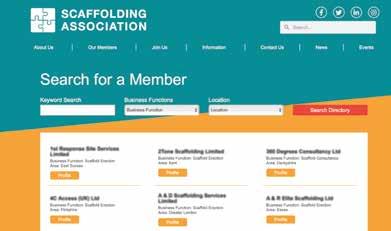
For members of The Scaffolding Association, one of the practical advantages is inclusion in the Association’s publicly accessible Member Directory. The directory allows clients and contractors to identify scaffolding businesses across the UK, with company details, service areas and contact information readily available.
The directory has become one of the most visited areas of the Association’s website, reflecting how frequently it is used by organisations looking for scaffolding and access specialists.
An open approach
Maintaining open access to this information is key. The Scaffolding Association believes trade bodies should actively promote their members and make it straightforward for potential clients to identify reputable contractors.
Visibility benefits not only member businesses, but also the clients and contractors who need to identify trusted scaffolding providers quickly and efficiently.
At a time when access to some industry membership listings has become more restricted, this open approach ensures scaffolding businesses remain visible and accessible when potential clients are actively searching for their services. For contractors looking to raise their profile, this visibility can make a meaningful difference.
Strengthening
Your Online Presence
While inclusion in the Member Directory is a valuable first step, having a professional, up-to-date website is equally important. Once potential clients find your business, they will often look to your website to understand your services, experience, and credibility. A clear, well-presented online presence can help convert initial interest into real enquiries. For members or companies who do not yet have a website, or are looking to improve their current one, The Scaffolding Association can provide guidance and support, helping ensure your business is presented effectively and professionally online.
Supporting contractors across the industry
Alongside this visibility, membership also provides wider support to scaffolding contractors through industry representation and engagement with organisations such as the Health and Safety Executive (HSE), Build UK and the British Standards Institution (BSI).
Members also benefit from guidance, business support services and access to a range of industry resources.
For many companies, this combination of representation, practical support and commercial visibility helps strengthen credibility and position businesses for future growth. As the industry continues to evolve, ensuring clients can easily identify professional scaffolding contractors remains an important priority.
Further information about membership and the Association’s Member Directory can be found at: www.scaffolding-association.org Be Seen. Be Found. Be Chosen.
Construction Output Slips in Q4 2025 Amid Weak Private Housing and Orders
UK construction output fell by an estimated 2.1% in the fourth quarter of 2025 compared with the previous quarter, according to the latest figures from Office for National Statistics (ONS). Both new work and repair and maintenance contributed to the decline, dropping by 2.6% and 1.5% respectively.
At the sector level, seven of the nine construction sectors saw output fall. The main drag on performance was private new housing, which slipped by
3.6
Despite the quarterly slowdown, annual construction output grew by
1.8
%
compared with 2024, marking the fifth consecutive year of annual growth. in Q4.
Monthly output data showed a 0.5% decline in December, following revised decreases of 0.8% in November and 1.6% in October.
The December drop was driven entirely by repair and maintenance, down 2.5%, while new work recorded a modest 1.0% increase.
Prices in the sector continued to rise, with construction output prices up
2.7
over the year to December.
Compliance made simple
Running
legislation all add up.
Meanwhile, total construction new orders fell by
3.8
%
(£469 million)
in Q4 compared with Q3, led by declines in private commercial and private industrial work.
Office for National Statistics (ONS), published 12 February 2026, statistical bulletin, Construction output in Great Britain: December 2025, new orders and Construction Output Price Indices, October to December 2025.
Q&A
An Interview with Micky Collier of Optimus Access Limited
Background & Career Journey
How and why did you get involved in the scaffolding industry?
After leaving law college, I needed to earn more money to continue my studies because, back then, law tuition wasn’t financed the way it is today. By chance, I met Ron Darvill from Deborah Scaffolding. We got on really well, and he persuaded me to give scaffolding a go.
From there, things just grew. I worked my way up through the company and eventually became Contracts Manager. Later, I was approached by M.R. Scaffolding - what you’d probably call being headhunted today. I joined them, worked my way up to Director, helped grow the business, and eventually became a co-owner.
When my business partner began looking towards retirement, I decided it was the right time for a fresh start. So, in 2014, I founded Optimus Access Limited. Starting from scratch was a big step, but I’m proud to say we’re still here, still growing, and we’ve built a strong reputation that means a lot to me personally.
What was your original role when you first started?
Yard labourer - learning the job properly from the ground up.
What projects have been the most complex or rewarding?
There have been a few standout ones over the years - HMS Belfast, Shell Tower at Waterloo, and Citi Bank in Canary Wharf. Projects like those really test your planning, teamwork and experience, and seeing them completed safely and successfully is hugely rewarding.
What is something you got wrong in your career but learned the most from?
Touch wood, nothing major comes to mind. One thing I learned early on though is the importance of surrounding yourself with good people. I’ve built a strong senior management team where everyone understands their role, and that means if issues arise, we’re set up to deal with them properly.
Who or what has had the biggest influence on your career?
Brian Robery, who was a supervisor at Deborah Scaffolding. He taught me a huge amount in my early days and helped shape the way I approach the industry even now.
Industry Change & Future Outlook
What major changes have you seen during your time in the industry?
Without doubt, the biggest change I’ve seen has been the improvement in health and safety. The industry has moved forward massively, and rightly so.
That said, falls from height are still the biggest killer in the workplace. So, while we’ve come a long way, there’s absolutely no room for complacency. There’s still more to do, and we all have a responsibility to keep pushing standards higher.
What do you think the industry will look like in 10 years’ time?
I think we’ll see more regulation and more formal tender and procurement processes from clients when appointing subcontractors. That’s not necessarily a bad thing - as long as those processes are fair and transparent.
From our side, we always make sure we’re operating properly and putting ourselves forward on merit, but it’s important the system works for everyone and isn’t just a tick-box exercise.
What innovations have you adopted in your business?
Carbon efficiency has become important to us. We use HVO fuel in our lorries, along with electric and hybrid vehicles. We prefer taking real steps to reduce our carbon footprint rather than simply offsettingfor us, actually making changes is what matters.
How have client expectations changed?
Efficiency demands have definitely increased, but aesthetics now play a much bigger role too. Clients want scaffolding that not only performs safely and efficiently but also looks professional once it’s up.
Skills, Training & Workforce
How real is the skills shortage?
It’s very real. High-quality operatives are becoming harder to replace. The experience the older generation brings simply can’t be taught overnight. At Optimus, we try to balance our teams with both experienced operatives and younger workers so knowledge gets passed down properly. A lot of recruitment still comes through word of mouth and recommendations.
What challenges exist around training?
The biggest issue is waiting times for courses. If we want to progress or upgrade an operative, we need access to training quickly - not four months down the line.
What could be done to attract young people into scaffolding?
Health and safety requirements mean qualifications have to remain structured, which is necessary. We’ve developed our own in-house apprenticeship pathway, which works well for us. I think government could benefit from listening more directly to experienced company owners who understand the realities on the ground.
Business
Challenges & Sector Pressures
What are the biggest challenges facing your business?
Maintaining the quality our clients expect while they themselves are under financial pressure is always a balancing act. Safety can never be compromised, so working together within tighter budgets is a constant challenge.
Retaining good operatives is another major issue, alongside the ever-increasing cost of running a business while margins continue to tighten.
What is currently damaging the sector most?
In my view, it’s become too easy to obtain certain qualifications, such as the Gold Card. Experience should play a bigger role, and companies should be putting operatives forward when they are truly ready - not simply when a period of time has passed. I see similar issues in other industries, including HGV driving.
How do you balance commercial pressures with safety and compliance?
These are probably the most regulated times I’ve seen in the industry. We adapt where needed - we’re currently working through ISO Quality, Environmental and Health & Safety accreditations - but there’s always a risk of becoming overregulated. The key is maintaining standards without losing practicality.
Trade Association & Membership
Why did you join the Scaffolding Association?
We joined because we wanted to be aligned with the very best in the industry. The Scaffolding Association stands for professionalism, higher standards, and doing things the right way. From the outset, it was clear they genuinely support their members - offering guidance and expertise while still respecting that we all run our own businesses. That balance is important. You feel supported, not controlled.
What benefits do you get from membership?
The benefits are real and tangible. The advice is practical and grounded in industry knowledge, the data and updates keep us informed and ahead of the curve, and the communication is proactive rather than reactive. It’s reassuring to know there’s a body representing our interests and providing clarity when regulations or industry expectations shift. It gives you confidence that you’re not operating in isolation.
What role should the Association play in the future?
I’d like to see the Association continue building on the strong foundations it already has and become an even more powerful voice for scaffolding businesses across the UK. The industry needs clear representation at the highest levels - whether that’s government, regulators, or major clients. The Association is perfectly placed to champion high standards, protect reputable contractors, and make sure our sector is properly understood and respected. If we want scaffolding to be seen as the professional, skilled industry it truly is, the Association will play a huge part in driving that forward.
Family Business & Culture
What are the dynamics of running a family-style business?
All businesses have challenges, but we’re fortunate. Many of our employees have been with me for years - some since school days - so there’s a genuine family feel. They’ve watched my children grow up, and that creates loyalty and trust you can’t manufacture.
Life Beyond Scaffolding
What do you do outside scaffolding?
Boxing has always been a big part of my life. I’m Chairman of the British Boxing Board of Control Southern Area, a Director within Commonwealth Boxing, and a Senior Administrative Steward with the BBBofC. oversee and supervise boxing events around the world, which gives me the opportunity to travel and stay involved in a sport I’m incredibly passionate about.
Getting the Ground Right
For many in the scaffolding sector, the challenge is not a lack of awareness of regulations. It is knowing how to apply them in practice. Codes and standards are often detailed and complex. Extracting clear, site-ready guidance can be difficult. This is where misunderstandings begin, assumptions take hold, and over time these become accepted practice.
This article cuts through that complexity. It brings the technical requirements back to what matters on site. Clear decisions and safe outcomes.
At its core, every scaffold relies on one fundamental principle. Loads must be safely transferred into the supporting surface. If that transfer is not properly understood, the risks are significant. Shear failure, excessive settlement, and instability can all follow.
Whether it is a simple independent tied scaffold or a complex temporary works structure carrying heavy loads, everything starts with the ground.
Who Is Responsible For The Ground?
Responsibility for ground conditions remains one of the most misunderstood areas in scaffolding.
The scaffold contractor does not control the ground. That responsibility sits with the principal contractor or client. However, the scaffold contractor plays a critical role. They provide the imposed leg loads and contribute to the design.
From there, the design typically defines the required sole pad arrangement based on calculated bearing pressures.
This distinction matters. If it is not clearly understood, gaps appear. Those gaps are where problems begin.
Responsibility Split
• Scaffold Contractor. Provides loads and design input
• Principal Contractor Ensures the ground is suitable
• Temporary Works Coordinator Oversees process and compliance
• Temporary Works Designer. Verifies and justifies the design
Ground Assessment. The Often Missed Step
Before selecting any sole pad arrangement, the ground must be properly assessed. This step is often rushed or overlooked, yet it is critical to scaffold stability.
Foundations First. Why Base Plates Matter
In scaffolding, everything starts at ground level. Before the first ledger is fixed or the first lift is tied, the integrity of the structure depends on how loads are transferred into the supporting surface. One of the most critical components in that process is also one of the most overlooked. The base plate.
Very soft wet ground double boards or steel pads
Under BS EN 12811-1:2003, several factors must be considered:
• Soil type and level of compaction
• Groundwater conditions
• Recent excavation or backfill
• Risk of frost heave
• Expected bearing pressures
Where there is uncertainty, or where loads are high, further input is essential. This may involve a Temporary Works Designer or geotechnical advice.
Without this assessment, any decision on sole boards is based on guesswork.
Across the UK, performance requirements for scaffold fittings are set out in BS EN 74-1 to 3. Section 1 covers tube couplers, section 2 covers special couplers and spigots, and section 3 covers base plates and spigot pins. Alongside this, BS EN 12811-1:2003 provides the wider performance framework for temporary works scaffolds.
Together, these standards establish a clear expectation. Loads imposed by a scaffold must be transferred safely, predictably, and without causing ground failure.
What the Standard Actually Says
A base plate is defined in BS EN 74-3:2007 as:
A stiff base, flat or deformed, with a centring device for locating a tube, for spreading the force.
Quick reference guide
Firm ground base plate or small sole board
Soft ground larger sole board
This definition highlights two essential elements. A plate with adequate bearing capacity and stiffness, and a centring device that locates the scaffold tube and controls movement.
The centring device must be at least 50 mm in length and limit radial movement to no more than 11 mm. For a 48.3 mm scaffold tube, this typically means a spigot of around 30 mm diameter. This detail has real implications.
Material requirements are also clear. Steel base plates are typically manufactured from grade S235 steel, with a nominal thickness of 5 mm and a proof stress of 195 N per mm squared. Thinner plates are not automatically excluded, provided they are tested, certified, and demonstrably compliant.
In practice, many traditional base plates measure around 150 by 150 mm, with variations. These dimensions reflect a balance between load distribution, stiffness, material efficiency, and practicality.
Sole Boards.
Engineering the Interface
Sole boards form the critical link between the scaffold and the ground. They are not simply timber placed beneath a base plate. They are a designed element of the temporary works system.
BS EN 12811-1:2003 does not prescribe fixed sizes. Instead, it requires that the supporting surface provides adequate bearing resistance for the applied loads.
This changes the approach. It is no longer about standard sizes or rules of thumb. It is about calculation and verification.
A correctly selected sole board performs three key functions:
• Spreads the load over a larger area
• Reduces the risk of local ground failure
• Provides a stable and level base
This becomes particularly important where ground conditions are variable, recently disturbed, or moisture sensitive.
From Habit to Control
Too often, sole boards are selected based on habit. This is where risk develops.
A 225 mm wide board may perform well on firm, compacted ground. Place that same board on soft clay or waterlogged fill, and performance will change significantly.
Understanding Load Spread
Base Plate and Sole Board Partnership
Base plates and sole boards work together as a load spreading system to create a sole pad.
A scaffold standard applies a concentrated axial load to the base plate. The base plate increases the contact area and prevents local crushing of the timber.
The sole board then spreads the load further into the ground, reducing bearing pressure.
Neither component performs effectively in isolation.
While BS EN 12811-1:2003 does not prescribe sizes, typical UK practice includes:
• Good, firm ground. Base plate only or with a 450 × 225 × 38mm sole board
• Soft ground. Approximately 1m × 225mm × 38mm sole board
• Very soft ground. Double boards, steel pads, or engineered solutions with Temporary Works involvement These are indicative only.
All arrangements should be verified against calculated leg loads and ground bearing capacity.
Load does not travel vertically through timber in a straight line. It disperses laterally as it moves downward.
For temporary works design, a spread ratio between 1:1 and 2:1 is often assumed in line with BS 5975:2024. This equates to approximately 45 degrees across the grain and 27 degrees along the grain.
This principle explains why sole boards are often around 450 mm long. As the bearing area increases, the stress applied to the ground reduces.
This is not guesswork. It is fundamental load distribution applied to temporary works.
The Engineered Balance
The commonly seen 150mm square base plate reflects a practical balance between:
• Initial bearing area
• Structural stiffness
• Material efficiency
Ground Pressure Calculations
• Compatibility with timber sole boards
Sole boards then provide secondary load distribution based on site conditions.
In simple terms:
• Base plates provide primary load spread and tube location
• Sole boards provide secondary load spread
• The ground must provide adequate bearing resistance
When these elements align, the risk of settlement is significantly reduced.
Basic ground pressure calculations and typical examples based on standard sole board arrangements should always be included as part of the design process. These verify that imposed loads remain within acceptable bearing limits for the ground conditions.
Here is the basic ground pressure calculation along with some typical calculation examples based on standard sole pad details;
Ground pressure kN / m2 =
Leg load (kN)
Effective area of sole pad (m2)
Typical leg loading bearing pressure under just base plate:
Typical ground pressure under one sole pad (0.068m2):
80.88 kN / m2 = 5.5 kN
Medium ground pressure under three sole pads (0.143m2):
38.46 kN / m2 =
Heavy ground pressure under five sole pads (O.203m2) :
27.09 kN / m2 =
Final Thoughts
Scaffold foundations rarely attract attention when they perform well. Failures, however, are often severe.
By applying the principles of BS EN 12811-1:2003, supported by the procedural control of BS 5975:2024 and compliant components to BS EN 74-3:2007, the industry can move from habit to engineered certainty.
Where uncertainty exists around base plates, sole boards, or ground conditions, early engagement with Temporary Works designers is essential.
In scaffolding, stability is always built from the bottom up.
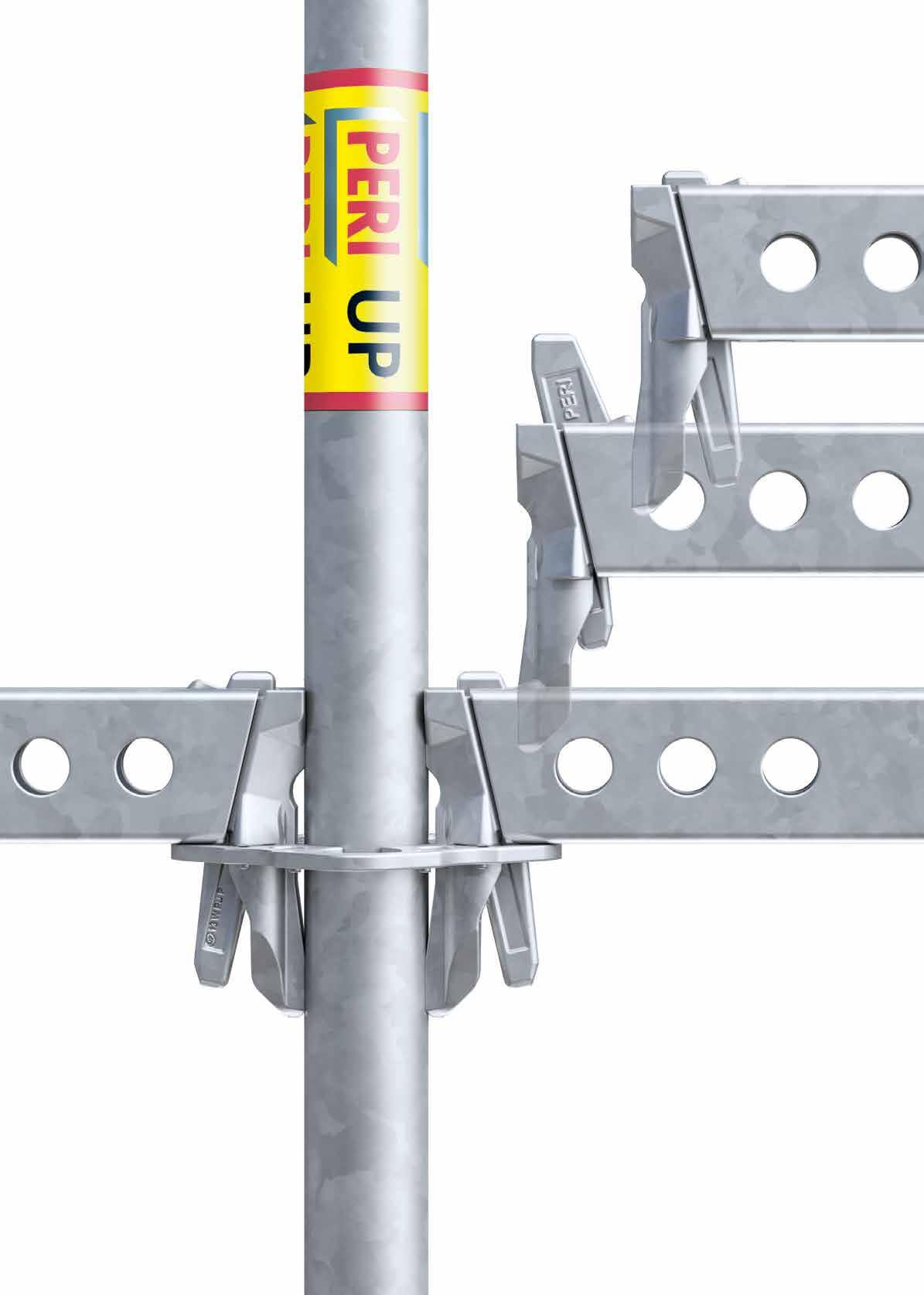
EASIER. SAFER. SMARTER.
As an industry-leading provider for scaffolding and construction safety products, TRAD UK has always championed innovation. Our comprehensive range sets new standards for access equipment and safety systems.
Our efficiency and safety are matched by the highest levels of service delivered by our experienced team and nationwide support network of depots. So, it’s easier than ever to find the right solution for your project.
What If There’s No Contract, Just a Quote or Purchase Order?
In construction, work rarely waits for paperwork. Scaffolding is often erected on the strength of a quotation and a purchase order, with the expectation that a formal contract will follow later. In many cases, it never does.
When problems arise, the issue is not always whether the work was carried out properly, but what contractual terms actually govern the agreement. This first article of two examines the risks that arise when projects proceed on the basis of quotations, emails and purchase orders alone. Understanding whose terms apply can make a significant difference when disputes occur.
Understanding Terms, Quotations and Risk
Construction projects often move quickly. A price is agreed, a purchase order arrives, and the scaffolding goes up. Formal contracts are frequently left for later and may never appear. When disputes arise months down the line, the first question is rarely about the work itself. Instead, the issue becomes more fundamental. What were the contractual terms?
A common assumption is that if nothing was formally signed, no contract exists. In reality, the law takes a different view. A binding contract can arise even where the parties have only exchanged quotations, emails or a purchase order before proceeding with the works.
The challenge is determining whose terms apply.
A Typical Scenario
PO#
The “Battle of the Forms”
Where both parties issue documents containing their own terms and conditions, lawyers often refer to the situation as the “battle of the forms”.
In practice, courts frequently look at which document was issued last and whether the other party proceeded without objection.
For example, a scaffolding contractor may submit a quotation referring to its own standard terms and conditions, including payment within 30 days. The contractor may then issue a purchase order containing different terms, such as longer payment periods or additional obligations.
If work begins without those differences being raised, the contractor may later argue that the purchase order terms form part of the contract.
This can come as an unwelcome surprise if those terms were never reviewed or discussed.
Across the scaffolding industry, the sequence is familiar.
A contractor asks for a price for access works. The scaffolding company submits a quotation describing the works and the price. Shortly afterwards, a purchase order arrives from the contractor. Work then begins, often without the purchase order being reviewed in detail.
At the time, it appears to be a straightforward commercial arrangement. However, if payment issues arise later, the contractual position suddenly becomes important. Was the agreement based on the scaffolding contractor’s quotation, or did the purchase order introduce different terms?
The answer can affect payment timing, variations and responsibility for delays.
The Importance of a Proper Quotation
For scaffolding companies, the quotation stage is often the first and best opportunity to establish the commercial and contractual framework for the project.
A well-prepared quotation should do more than simply state the price. It should clearly describe the scope of the works, any assumptions behind the price and the expected payment arrangements.
Many businesses also refer to their standard terms and conditions within the quotation. Even a short statement confirming that the quotation is submitted subject to those terms can help clarify the contractual position.
Consistency is important. If a business intends to trade on its own terms, those terms should be referenced whenever a quotation is issued.
Purchase Orders and Risk
Purchase orders are sometimes treated as administrative paperwork issued after the commercial deal has already been agreed. However, they can carry significant legal weight.
A purchase order may include contractual terms that differ from those in the quotation. These might relate to payment periods, allocation of risk, variation procedures or dispute resolution.
If work proceeds without those differences being addressed, the contractor issuing the purchase order may later argue that those terms govern the agreement.
For that reason, purchase orders should always be reviewed carefully before work begins.
Why This Matters
Many construction disputes arise not because work was incomplete, but because the parties have different assumptions about what was agreed.
Payment timing, notice requirements, variations and responsibility for delays can all depend on the contractual terms in place. Where those terms were never clearly established, disputes become much harder to resolve.
Taking time at the quotation and purchase order stage to clarify the contractual position can prevent significant problems later.
In Part Two
In the next issue we will examine how and when a binding contract is actually formed on construction projects, including the role of emails, conduct and starting work before terms are finalised.
Understanding when an agreement is legally created can help scaffolding contractors protect their position before work even begins.
Cyber security without the stress
When you’re busy keeping sites safe and projects moving, the last thing you need is a cyberattack slowing you down.
Strengthen your security, protect your data and keep trading – with expert support and government-backed certification.
WHY SHOP WITH US?
Saving a Grade II Historic Pier After Storm Bram
Few marine structures in the South West are as instantly recognisable as West Hoe Pier. Exposed to the full force of Atlantic weather systems rolling into Plymouth Sound, the landmark has endured repeated storm impact in recent years, accelerating deterioration to its outer masonry walls and prompting urgent conservation works.
Constructed in 1880 by the Plymouth Pier Company Ltd, the pier was built using locally quarried Plymouth limestone, most likely sourced from West Hoe Quarry. Originally designed to provide landing points for steam boats serving Plymouth Hoe, the structure remains a prominent feature of the city’s waterfront and holds Grade II listed status.
Engineering in a Marine Environment
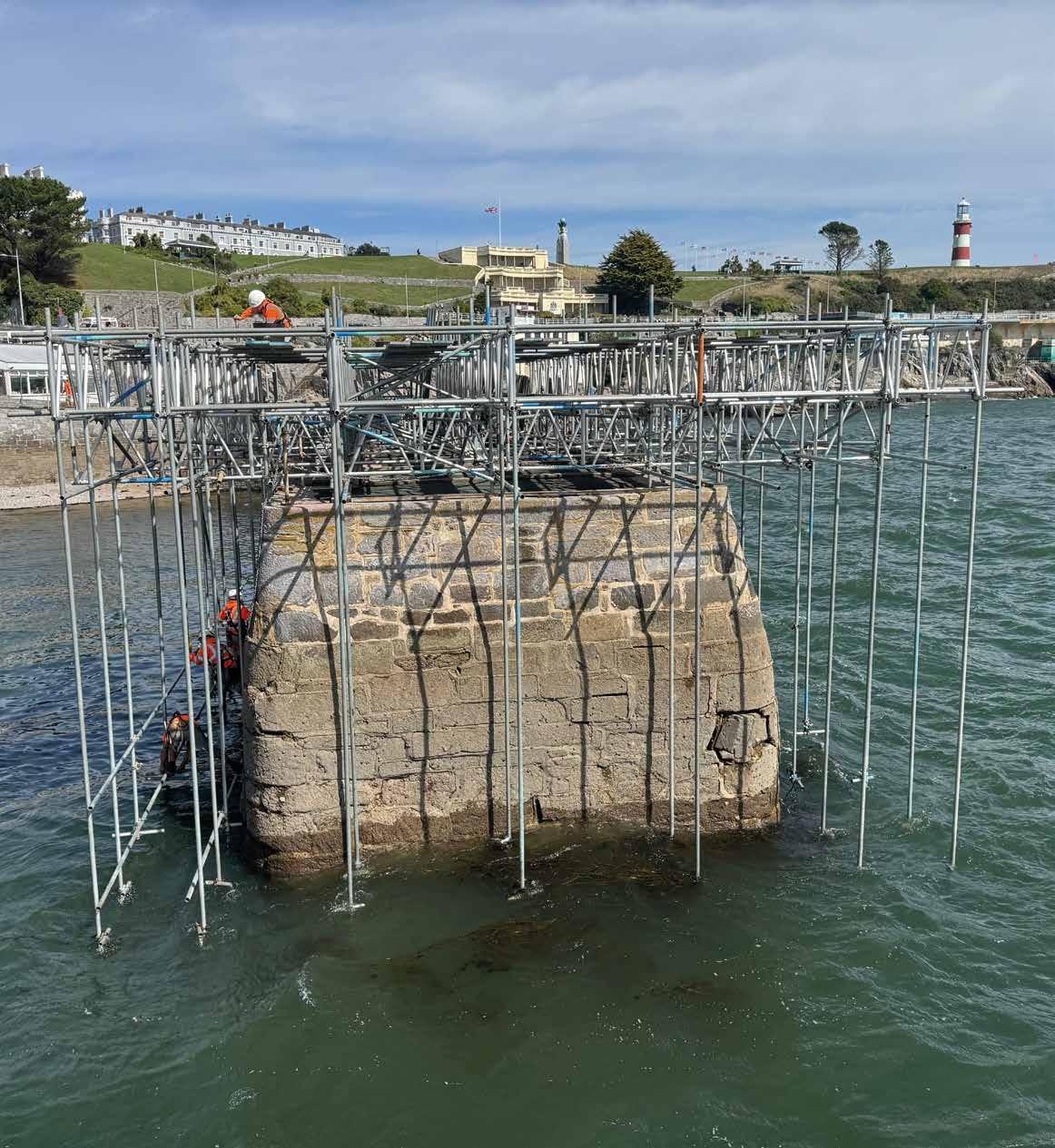
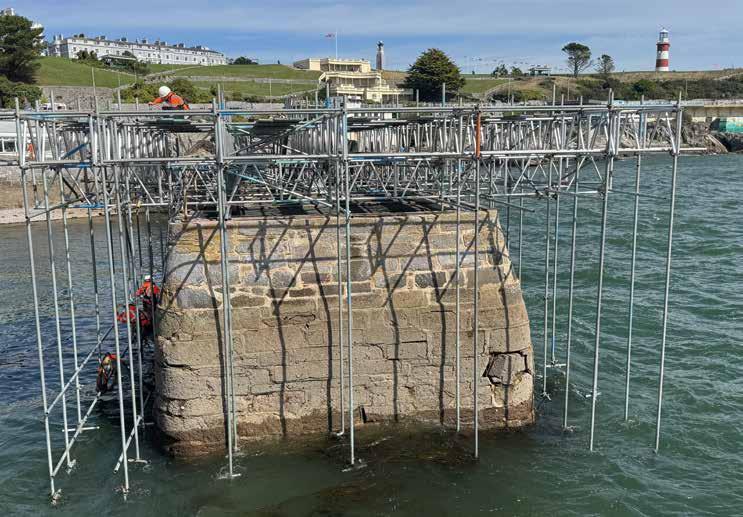
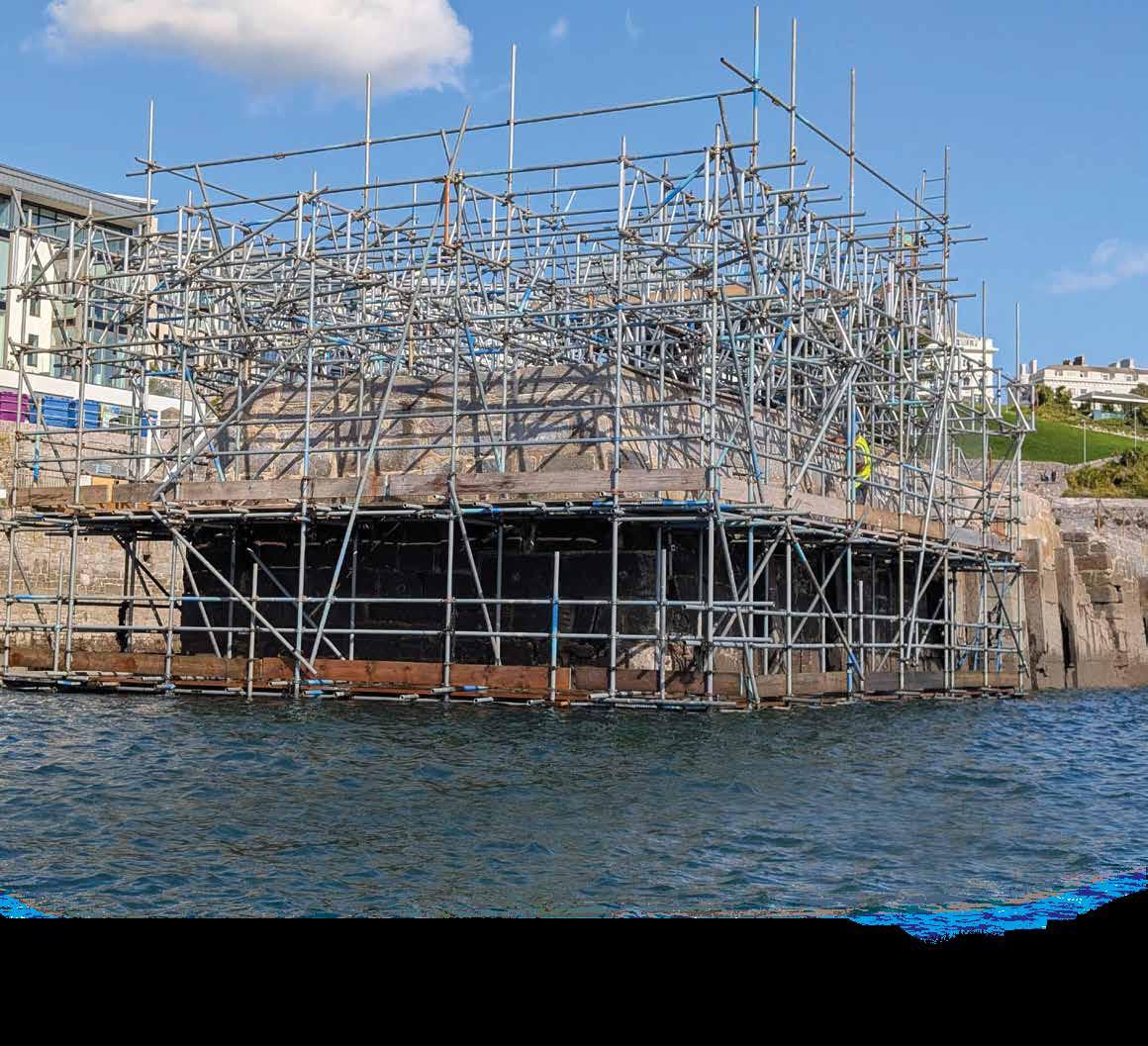
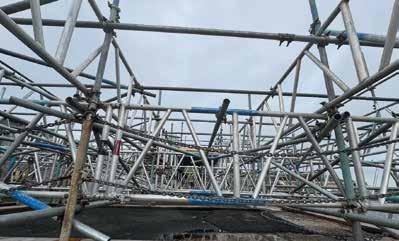
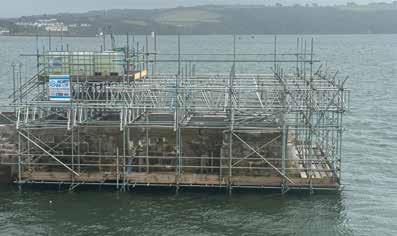
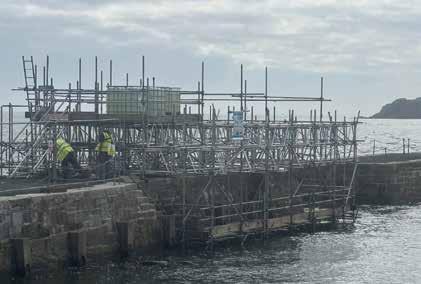
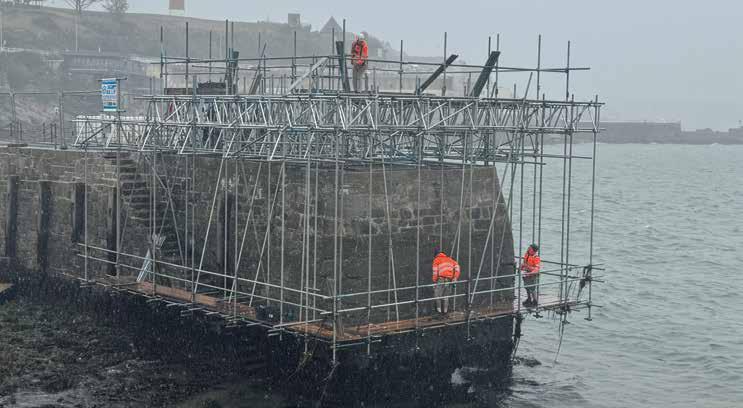
Working closely with Plymouth City Council and established heritage contractor JNE Construction, Scafftec Ltd, a Scaffolding Association Audited member, was commissioned to deliver a technically demanding three sided hanging scaffold projecting directly over the sea.
Following years of storm exposure, sections of the structural walls required specialist stone masonry repointing. Access was needed to three elevations that descend below the high water line, removing any possibility of conventional ground-founded support and necessitating a fully engineered solution. With saltwater corrosion risk, wind loading and the absence of bearing ground all influencing the design, a bespoke approach was essential. Raptor Scaffold Designs developed a scheme incorporating multiple beam sections to enable the scaffold to cantilever safely over each face of the pier. Load paths were carefully calculated to ensure forces were transferred back into approved structural zones without compromising the historic fabric.
Building to the Rhythm of the Tide
Erection by Scafftec Ltd, took place within an active tidal zone, introducing a logistical challenge that required precise coordination. Works were phased around tide windows, with installation teams operating to tightly controlled programmes aligned with daily sea conditions.
Comprehensive RAMS addressed the inherent risks associated with working over water. Enhanced fall prevention systems, rescue planning and strict supervision protocols formed part of a controlled methodology tailored to the environment. The approach demonstrated not only regulatory compliance but disciplined operational planning by Scafftec Ltd in a high consequence setting.
To achieve the required setup, Scafftec Ltd began constructing the scaffold on top of the pier. The initial stage involved installing 780 mm beams across the pier deck to form the primary support structure. A further set of 780 mm beams was then erected on top of the first set.
This arrangement allowed the three faces of the pier to have beams positioned above the areas where the scaffold would be cantilevered.
The central scaffold structure was then fully braced, weighted down, and securely tied to the pier floor. This ensured the scaffold remained stable and secure, even during periods of adverse weather conditions.
Droppers were installed from the beams, allowing the scaffolding team to safely access the lower levels of the structure. From these droppers, the scaffold was progressively erected upwards to the required working heights to facilitate the refurbishment works.
Once the structural work had been completed, the scaffold was fully boarded and fitted with guardrails and toe boards, creating a safe and secure working platform for the contractors. This arrangement enabled the masonry and repair works to be carried out safely during periods of low tide.
Protecting Historic Fabric
As a Grade II listed structure, West Hoe Pier demanded a conservation led approach. Mechanical ties and intrusive drilling into the existing masonry were strictly limited to preserve the integrity of the original limestone construction.
This restriction increased reliance on the cantilevered beam arrangement and reinforced the importance of early collaboration between Scafftec Ltd and the scaffold designer. Every fixing location and load transfer point was scrutinised to minimise intervention while maintaining structural stability.
Enabling Long Term Conservation
The scaffold was delivered in full accordance with its engineered design, providing safe and comprehensive access for conservation specialists to undertake the required stonework repairs.
Schemes such as this underline the growing technical role of scaffolding within heritage and marine environments. Access is no longer a secondary consideration. It is central to project viability where environmental exposure, structural sensitivity and conservation objectives intersect.
For Scafftec Ltd, the West Hoe Pier project further strengthens its portfolio in complex and heritage access across the South West. For the wider sector, it offers a clear example of how engineered scaffolding solutions quietly underpin the protection of the built historic environment.
Preserving a Civil War Icon. Complex Untied Access at Corfe Castle
Few heritage sites in Britain carry the visual drama of Corfe Castle. Rising abruptly from steep ground in the Purbeck landscape, the ruined fortress remains one of the most evocative survivors of the English Civil War. Its fractured towers and shattered curtain walls are both its defining character and its greatest conservation challenge.
Against this backdrop, Wilcoe Scaffolding Ltd, a Scaffolding Association Audited member, has been delivering a highly complex access scheme that moves well beyond routine scaffolding provision. The project combines engineering discipline, logistical precision and sensitive interface management within one of the country’s most constrained heritage environments.
Engineering Without Ties
Corfe Castle presents inherent physical constraints. The structure stands on sharply sloping terrain, with irregular masonry, inconsistent wall thicknesses and no predictable geometry. Ground disturbance is tightly restricted due to archaeological sensitivity. Laydown areas are minimal and the site remained open to visitors throughout the programme.
From the outset, these factors demanded a bespoke engineer led approach.
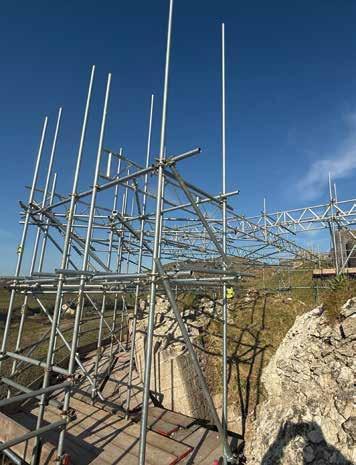
The scaffolds, reaching heights of approximately 25 metres, serve multiple elevations including towers and curtain walls. Crucially, the entire scheme is untied. No mechanical fixings have been introduced into the historic fabric at any stage.
Overall stability has therefore been achieved through independent scaffold configurations incorporating raking elements and cantilevered sections. Loads are carefully resolved back to ground level. For cantilevered areas, counterbalance has been provided using ICB containers as kentledge. This strategy allows access to otherwise inaccessible faces while maintaining reversibility and safeguarding the structure.
Wilcoe Scaffolding has managed the temporary works process throughout, coordinating closely with appointed engineers to develop and refine designs as conservation requirements evolved.
Building on Sensitive Ground
Ground conditions added a further layer of complexity. Excavation was not permissible across much of the site. The scaffold is founded on uneven, archaeologically sensitive terrain where bearing capacity and settlement risk required constant assessment.
Timber matting systems were deployed to distribute imposed loads and protect the underlying ground. Base arrangements were reviewed and adjusted progressively as the scaffold increased in height and footprint. Stability was maintained through continuous monitoring rather than static assumption.
Logistics were equally demanding. With no viable craneage and restricted vehicle access, all materials were manually handled and lifted in stages. Erection proceeded progressively from completed lifts with operatives adapting bay sizes, lift heights and cantilever positions as the interface with the masonry became clearer. This required high levels of competence, communication and site judgement.
Working Within a Live Visitor Environment
The programme extends over 15 months, with completion anticipated in May 2026. A core team of eight experienced operatives has typically been deployed selected specifically for their background in complex and heritage environments.
To reduce disruption and manage risk at the public interface, the majority of erection and alteration works have been undertaken between 4.30am and 10.00am, prior to opening. Where activity has continued during visitor hours, agreed segregation measures and controlled working zones have ensured safe coexistence between conservation, tourism and scaffolding operations.
A formal weekly inspection regime has been maintained throughout the duration of the works. Any alterations required to meet evolving access needs have been treated as engineered changes, reviewed and implemented under strict temporary works control procedures.
A Benchmark in Heritage Access
Reflecting on the project, William Hammond, Director of Wilcoe Scaffolding Ltd, describes Corfe Castle as a benchmark commission that has tested the company’s design capability, management systems and workforce competence.
The scheme illustrates how scaffolding, when supported by rigorous engineering and disciplined methodology, becomes a critical enabling system within heritage conservation rather than a peripheral trade activity.
At Corfe Castle, access has not simply followed the conservation strategy. It has underpinned it. Delivering a fully untied, 25 metre high scaffold on archaeologically sensitive ground, within a live public environment and without compromise to historic fabric, represents a significant technical achievement.
For the wider scaffolding sector, the project reinforces a clear message. In heritage environments defined by constraint and consequence, engineered access is not optional. It is fundamental to preserving the structures that define Britain’s built history.
Achieve ISO certification in as little as 45 days
When you’re working at height, managing multiple sites, and tendering for major projects, your standards have to speak for themselves.
and bigger contracts
Build
Reduce
ISO certification proves they do. Scan
From Standstill to Success. Powertherm Restores Momentum at Earls Gate Energy Centre
Powertherm Contract Services Ltd (Powertherm), a Scaffolding Association Assessed member, was called upon to support Earls Gate Energy Centre, a major construction project in the power generation sector, following the loss of the existing contractor. Rapid mobilisation restored safe access arrangements and enabled construction to continue on schedule.
Located in Grangemouth, Scotland, Earls Gate Energy Centre is an Energyfrom-Waste (EfW) facility that produces heat and electrical power. The project involves the replacement of a gas fired plant with an EfW facility, offering a range of environmental benefits and contributing towards the United Nations Sustainable Development Goals targeted for 2050.
During construction, the previous industrial services contractor entered administration, leaving the client in
a challenging position and requiring urgent support to complete the facility and bring it into operation. Powertherm was appointed to deliver the remaining energy infrastructure works. Drawing on its multi discipline capabilities and experience across EfW construction projects, the company mobilised quickly and at scale to help return the project to programme.
Powertherm’s teams delivered comprehensive scaffolding access alongside industrial insulation, electrical
trace heating services and refractory lining solutions across the plant. From initial enquiry to mobilisation, it took just six days to place 12 scaffolders on site. This workforce later expanded to more than 50 scaffolders, with a peak of over 90 personnel across scaffolding, insulation, trace heating and refractory disciplines at the height of the project, supported by a robust project management team including HSE, planning and quality representatives.
Before work could progress at full pace, Powertherm’s technical scaffold team inspected and dismantled existing scaffolds erected by the previous contractor.
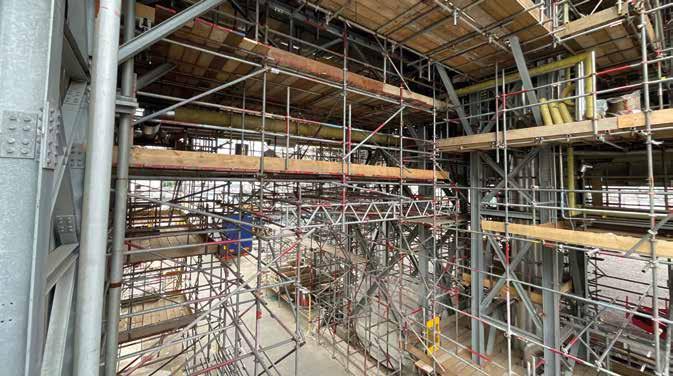
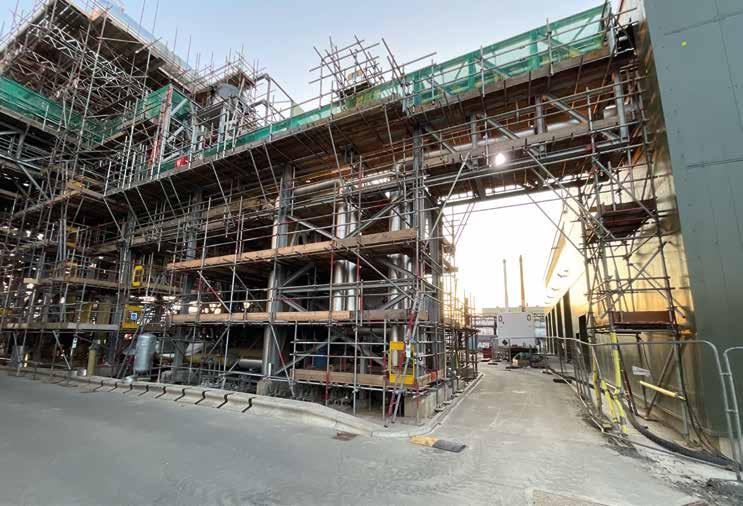
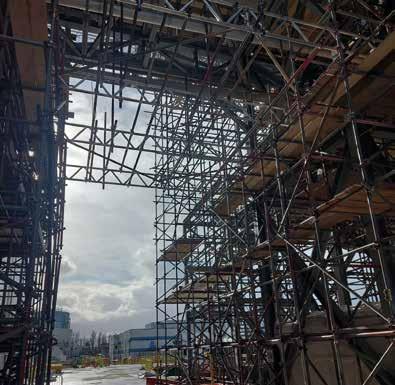
The scope of the scaffolding operation was extensive. More than 700 tonnes of scaffold material were managed on site, with over 3,000 scaffolds constructed and dismantled safely throughout the project. The scaffolds provided safe access not only for Powertherm’s scope of works but also for other contractors on site, including mechanical and electrical engineers and commissioning teams.
Examples of scaffold structures constructed included:
• Independent scaffolds to the side of the turbines to facilitate insulation works.
• Birdcage scaffolds.
• Suspended scaffolds providing safe access to the economiser.
• Independent scaffolds for access and inspection of the boiler system buckstays.
• A complex design scaffold for the ACC fans and exhaust, required due to non load bearing steelwork.
All scaffolds were erected in strict compliance with current safety standards and guidelines. Where bespoke solutions were required, the Temporary Works Coordinator utilised Powertherm’s technical design manual and in house design capabilities.
Powertherm also managed scaffold inspection and tagging arrangements, ensuring all structures were fit for purpose and certified safe for use by all site operatives.
A number of practical innovations were introduced to improve efficiency, safety and overall delivery. Activities suitable
for completion from Mobile Elevating Work Platforms were identified, reducing programme duration and overall cost. Electric hoists were used to transport materials from ground level to working heights, minimising manual handling and improving productivity. Hoisting bags were introduced for the movement of scaffold materials, further enhancing safety and streamlining operations.
The completed works enabled Earls Gate Energy Centre to deliver its intended low carbon energy output. The plant is capable of recovering up to 54,000 tonnes of recyclable materials, including aggregates, ferrous metals and non ferrous metals, which would otherwise have been sent to landfill. The facility also retains capacity to produce additional electricity, steam and hot water in line with future demand. This contributes to reductions in pollution, odour emissions and the risk of soil and water contamination associated with traditional disposal methods.
Powertherm’s rapid mobilisation, multi discipline expertise and commitment to safe and efficient delivery played a key role in bringing the Earls Gate project to completion. This case study demonstrates the importance of experienced industrial services providers in delivering complex EfW infrastructure and highlights how coordinated access and insulation solutions can support environmental progress and long term energy resilience.
Reflecting on the project, Stuart Webster, Powertherm’s Scaffold Manager and Temporary Works Coordinator commented:
Taking over partway through a project brings unique challenges. We needed to quickly assess the condition of the existing scaffolds, understand the plant layout and align with the client’s priorities.
Once access requirements were clearly defined, the team implemented a structured plan that allowed work fronts to open safely and remain productive, enabling the project to be completed.
I established a collaborative working relationship with the client and other contractors on site to help restore momentum and deliver the required access services. The team overcame challenges during critical path phases to achieve key milestones, enabling the client to hand over the fully operational plant on time.
I would like to thank everyone who contributed to the success of this project through their professionalism, hard work and can-do attitude.
Powertherm
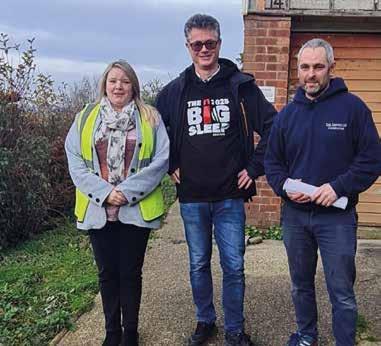
Building Futures Together. How Scaffolding Association Members and CRASH Are Driving Community Impact
The Scaffolding Association and its members continue to play an active role in supporting community-focused construction projects through its partnership with the CRASH Charity. By connecting members with meaningful projects, the partnership helps deliver safe, practical environments for charities supporting people in need.
CRASH is currently supporting The Seaview Project in St Leonards-on-Sea, near Hastings, where a full property renovation is underway to create a muchneeded move-on house. In Hastings, where supported housing is in short supply, the project will provide a stable environment for individuals facing homelessness, addiction and mental health challenges.
Scaffolding Support Enabling Roof and Structural Works
To support the refurbishment, High & Mighty Scaffold Ltd, an Associate member of the Scaffolding Association, helped deliver the scaffolding for the project.
The scaffold installation was designed to provide safe, consistent access for roofing works and loft reconfiguration. As part of the build, the existing roof structure is being adapted to accommodate dormer windows, enabling the creation of two additional bedrooms within the property.
Dawn Treacy
High & Mighty Scaffold Ltd
Dave Perry
Chief Officer at The Seaview Project
Dale Saunders
(Business Owner of Dale Saunders) – the main contractor on the project
Working at roof level, the scaffold provided secure platforms for multiple trades, ensuring the works could progress safely and efficiently.
Adapting to Site Constraints
With the project being set within a residential setting and its site layout, the project presented several technical challenges.
One elevation of the property sat against a steep bank, requiring careful adjustment of the scaffold base to maintain stability and ensure a level working platform. This type of ground condition demands practical judgement on site to achieve a safe and compliant structure.
The team also had to work within close proximity to neighbouring properties. Scaffold positioning was carefully managed to maintain clear boundaries, minimise disruption and ensure safe access throughout the duration of the works.
Delivering Value Through Collaboration
This project highlights how collaboration across the construction sector can deliver both technical and social value.
Through the Scaffolding Association’s partnership with CRASH, contractors like High and Mighty Scaffold are able to contribute their expertise to projects that have a lasting impact on communities.
The successful delivery of the Seaview project has not only supported an important local initiative but has also strengthened industry relationships, leading to further work opportunities and reinforcing the role of professional scaffolding within the wider construction sector.
High & Mighty Scaffold Ltd www.highandmightyscaffold.com
Ways Supervisors Can Support Wellbeing on Site
In the scaffold industry, supervisors play a vital role in keeping teams safe, productive, and supported. With physically demanding work and high-risk environments, wellbeing on site is closely linked to both performance and safety
Here are five practical ways supervisors can make a difference:
1 5
2
3
4
5
Stronger Teams, Safer Sites
Spot the Signs Early
Supervisors are often the first to notice when something is not right. Look out for fatigue, reduced concentration, changes in behaviour or repeated mistakes. These can all be early indicators of stress or tiredness, which increase the risk of incidents if left unaddressed.
Encourage Breaks and Recovery
Regular breaks are essential for maintaining focus and reducing fatigue, particularly when working at height or carrying out manual handling tasks. Encouraging workers to take appropriate breaks helps maintain concentration and supports physical recovery throughout the day.
Lead by Example
Supervisors set the standard on site. Demonstrating good practices, such as following safety procedures, taking breaks and maintaining a professional approach to wellbeing, encourages the rest of the team to do the same and helps create a positive site culture.
Create an Open Environment
Workers should feel comfortable speaking up if they are struggling, whether physically or mentally. Encouraging open and respectful communication helps build trust within the team and ensures that potential issues can be addressed before they impact safety or performance.
Make Small Changes That Matter
Simple actions can have a significant impact. Rotating physically demanding tasks, ensuring access to water and welfare facilities, and maintaining clear and consistent communication all contribute to a safer and more supportive working environment.
Supporting wellbeing is not an optional extra. It is an essential part of maintaining a safe, efficient and resilient scaffolding operation.
Checking the past to safeguard the future
You might not expect background checks to play much of a role within the trade and construction sectors. But there are certain levels of checks and legal requirements that all employers must complete, regardless of your industry.
To help maintain compliance and confidence, our Associate Member, uCheck, is here to explain your legal obligations and best practice recommendations.
What are the different types of checks?
There are many types of background screening checks, some of which are a legal requirement:
• Right to Work: Legal obligation – checks candidates are eligible to work in the UK
• Basic DBS: Details any unspent convictions - anyone can request a Basic check
• Standard DBS: Details spent and unspent convictions – only an employer can request this check or checks at a higher level
• Enhanced DBS: Also details spent and unspent convictions, plus additional information from police forces that may be relevant
• Enhanced with Barred Lists:
An Enhanced check with an additional check of the Children or Adults’ Barred Lists – applicable for work in regulated activity around children or vulnerable adults
• Social media: A check of someone’s social media history and presence
No one can “fail” a DBS check – but they help employees make more informed hiring decisions, adding that badge of trust that helps fellow employees and clients feel more confident.
Why does this matter?
Within the scaffolding industry, you want to make sure the people you’re working alongside are safe, competent, and trustworthy. For site managers who handle financial or personal information, a higher level of DBS check may be required to make sure they’ve never been convicted or fraud or similar offences.
Additionally, if you’re taking on a long-term project in a care home or school, your workers may be eligible for Enhanced DBS checks to validate their safety around vulnerable groups. Strong background checks give the people you work with the knowledge and security that you take their safety and security seriously.
For background checks and legal compliance, trust uCheck
As a Scaffolding Association member, you can sign up to uCheck today to get free registration and lifetime access to the uCheck portal. Simply give them a call on 03301 626095 and quote ‘The Scaffolding Association’ to save over £50 in registration fees.
Or scan the QR code and use code SAUCHECK at checkout for free access to uCheck’s screening platform, plus 24% discount on all DBS checks.
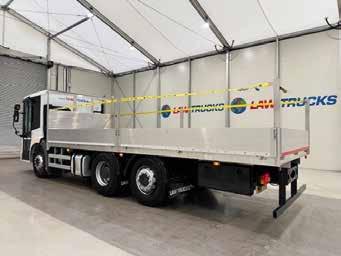
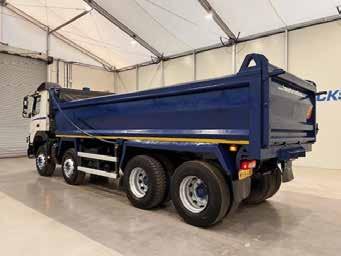
WITH OVER 30 YEARS EXPERIENCE IN THE INDUSTRY AND OVER SIX HUNDRED TRUCKS IN STOCK WE ARE NOW SPECIALISING IN BUILDING BRAND NEW BODIES FOR THE SCAFFOLDING INDUSTRY
OUR TEAM ARE CONSTANTLY SOURCING LOW MILEAGE GOOD QUALITY TRUCKS THAT CAN BE RE-PURPOSED TO MEET THE NEEDS IN THE SCAFFOLDING AND CONSTRUCTION SECTOR
WE CAN BUILD ANY BESPOKE ALUMINIUM BODY TO MEET CUSTOMERS EVER CHANGING REQUIREMENTS WE ARE CURRENTLY BUILDING BODIES FROM 16 FEET TO 31 FEET FROM 7.5 TONNES TRUCKS TO 26 TONNES
PLEASE CONTACT OUR TEAM TO DISCUSS YOUR REQUIREMENTS VISIT OUR PREMISES LAW TRUCKS LIMITED, WHIELDON ROAD, STOKE-ON-TRENT, ST4 4HP
Road Safety Strategy
The Scaffolding Association has welcomed the publication of the Government’s Road Safety Strategy, which places renewed emphasis on work-related road risk and the responsibility of employers, fleets and organisational leadership in improving safety outcomes.
For a sector that relies heavily on vans, HGVs and specialist vehicles - and where many operatives drive for work or operate at the roadside - road safety is not a peripheral issue. It is a core operational risk and a fundamental business responsibility.
The Strategy recognises that around one in three road fatalities involves someone driving or riding for work. Importantly, it signals a shift away from focusing solely on individual blame, instead highlighting the importance of systems, training, leadership culture and the effective use of technology in preventing incidents before they occur.
Of particular relevance to our sector is the proposed National Work-Related Road Safety Charter, which the Government intends to pilot and codesign with industry. This signals a clear expectation that sectors with operational and vehicle-specific risks will play an active role in shaping future frameworks and standards.
Since publication of the Strategy, the Association has engaged directly with the Minister responsible for its delivery, Lilian Greenwood MP, and we hope to meet in the coming weeks to discuss how industry can play a leading role in supporting safer roads, strengthening professional standards and ensuring
that practical realities on the ground are reflected in policy development.
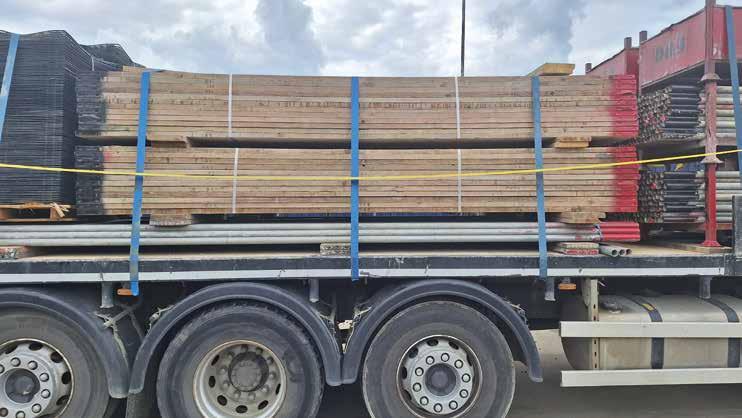
In collaboration with the Road Haulage Association (RHA), the Scaffolding Association last year launched a Driver CPC-approved training course focused specifically on safe loading and vehicle checks for scaffolders. The course addresses real-world risks associated with scaffolding transport, including load security, vehicle condition and daily safety checks - helping businesses embed safer working practices across their fleets.
Further information about the course can be found at www.rha.uk.net
The Scaffolding Association will continue to work constructively with Ministers, officials and industry partners as the Strategy is taken forward, ensuring that scaffolding businesses are not only represented in the conversation but recognised as leaders in delivering practical road safety improvements.
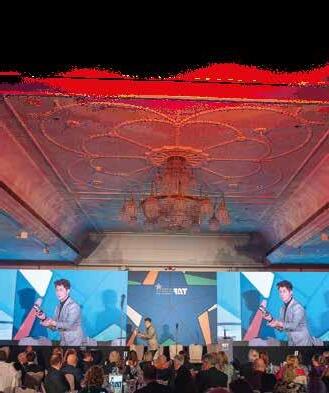
Celebrating Excellence at the UK Trade Association Awards
The UK Trade Association Awards, held in February, brought together trade bodies from across the country to celebrate excellence in leadership, innovation, governance and member engagement. It was a fantastic evening and a powerful reminder of the impact trade associations have in championing their sectors day in, day out.
While the Scaffolding Association did not take home an award on this occasion, we are incredibly proud to have been shortlisted.
To be recognised in this way reflects a significant amount of work behind the scenes. AccessPoint continues to land on the desks of 4,500 named individuals - around 80 per cent of whom are scaffolding contractors - and remains central to how we educate, inform and support the industry. Its reach and influence are a testament to the
commitment to delivering relevant, high-quality content for our members.
Our partnership with Tewkesbury Printing Company was also recognised. That collaboration has strengthened engagement, enhanced production quality and helped broaden our reach across the sector.
It was a pleasure to celebrate alongside fellow trade associations and to see first-hand the strength of the wider association community.
With Robert Candy, CEO of the Scaffolding Association serving on the Trade Association Forum (TAF) Board, which organises the awards, the evening carried additional significance.
Congratulations to all the winners. We are proud to have been part of such a positive and inspiring event - and even more determined to continue building on the progress we have made.
Image: IPV Visuals
Quiz time...
Wordsearch
Just for a bit of fun, find and circle each of the 12 words below. Words may appear forwards or backwards, horizontally or vertically in the grid.
ACCESS
BASEPLATE
The AccessPoint Easter Challenge
Built on attention to detail, be rewarded with chocolate.
We’ve hidden 6 Easter eggs throughout the magazine. Some are easy to spot. Others will take a sharper eye.
What to do:
• Find all 6 hidden Easter eggs
• Note the pages and locations where each one appears or take a picture
• Send your answers in for a chance to win
What you could win?
A bundle of Easter eggs, hand-picked and ready to enjoy.
How to enter:
Email your answers, along with your name and company name and address, to: info@accesspoint.org.uk
Closing date: 12 April 2026
All correct entries will be entered into a prize draw with one lucky winner.
Good luck, and happy hunting!
Find all 6 hidden Easter eggs in this issue and you could be winning this lot.
Without Question
Being a member of the Scaffolding Association is a mark of competence, professionalism, and quality that is recognised across the construction industry. It demonstrates a company’s ability to perform scaffolding projects to the highest standards.
Members undergo an industry recognised audit process, ensuring they meet industry Standards. This gives clients confidence, ensuring recognition & compliance to regulations.
Scaffolding Association members employ CISRS-trained and qualified scaffolders, ensuring all work is carried out by skilled professionals.
Member companies vary in size, with a range of specialisms and capabilities –there is a Scaffolding Association member for every project. 0300 124 0470 info@scaffolding-association.org scaffolding-association.org