MISSISSIPPI
Published by Accelerate Learning Inc., 5177 Richmond Ave, Suite 800, Houston, TX 77056. Copyright © 2025, by Accelerate Learning Inc. All rights reserved. No part of this publication may be reproduced or distributed in any form or by any means, or stored in a database or retrieval system, without prior written consent of Accelerate Learning Inc., including, but not limited to, in any network or other electronic storage or transmission, or broadcast for distance learning.
To learn more, visit us at www.stemscopes.com.
Student Expectations
The student is expected to demonstrate an understanding of internal and external structures in plants and animals that support their growth, survival, behavior, and reproduction in particular environments.
How do different parts of plants and animals help them live and grow in their homes?
Key Concepts
• Different structures help plants function and meet their basic needs. Roots secure and support the plant and absorb water and nutrients from the soil, stems carry water to other parts of the plant, leaves absorb and use sunlight for energy, and flowers assist in reproduction.
• Different structures, including heart, stomach, bones, lungs, brain, ears, and appendages, help animals function and meet their basic needs.
• Animal structures help animals survive in certain environments, such as growing thicker fur and increasing body fat to help them survive changing temperatures.
• Animals adapt their behaviors to seasonal changes through migration, hibernation, and food storage to help them survive.
Scope Overview
This unit develops students’ understanding of how internal and external structures in plants and animals support growth, survival, behavior, and reproduction in specific environments. Through observation, classification, research, data analysis, and collaborative discussion, students examine structures across species, connect form to function, and recognize that many parts serve multiple purposes. Learners compare plant parts and their functions, investigate body systems using real examples, and analyze seasonal responses to temperature, building evidence-based explanations.
Scope Vocabulary
The terms below and their definitions can be found in Picture Vocabulary and are embedded in context throughout the scope.
Environment
The space, conditions, and all the living and nonliving things around an organism
External Parts
Parts that can be seen or touched from outside something Grow
To increase in size
Reproduction
When one or more organisms bring new organisms of the same type into existence
Structure
An arrangement of parts
Survive
To continue living and remain in existence
Vertebrate
An organism with a backbone
Notes
Students explore how structures of plants and animals relate to growth, survival, behavior, and reproduction.
• Students rotate among posted plant and animal part cards, examining each structure.
• They use sticky notes to classify each part’s primary function (growth, survival, behavior, or reproduction) and note whether it’s plant or animal.
• The class debriefs to compare reasoning and clarify parts that may fit multiple categories.
Students investigate how specific internal and external structures of the white-tailed deer contribute to survival, growth, and behavior.
• Work in groups to research an assigned body part (e.g., heart, stomach, bones, lungs, brain, skin, ears, appendages) and determine its function.
• Create and deliver a student-selected presentation to share findings with the class.
• Record information from peer presentations on an Animal Structures handout.
• Participate in a teacher-facilitated discussion synthesizing how multiple structures can serve more than one function across animals.
Students explore plant structures and their functions through observation and representation.
• Observe and compare two different plant specimens, noting similarities and differences.
• Draw and label plant parts on the provided sheet for each specimen.
• Participate in a class discussion connecting structures (roots, stems, leaves, thorns, petals) to their functions (support, transport, photosynthesis, defense, pollination).
Students investigate how animals respond to seasonal temperature changes through guided data analysis, discussion, and brief research.
• Work in small groups to sequence animal data cards by month, analyze locations and temperature ranges for monarchs and hummingbirds, and record observations.
• Examine bullfrogs and box turtles to relate activity levels to temperature, discuss hibernation, and briefly simulate reduced activity in class.
• View a short estivation video and discuss other organisms that estivate.
• Research, with a partner, how and why white-tailed deer use estivation; share findings and complete the student sheet.
Notes
Estimated 15 min - 30 min
In this activity, students will be introduced to plant and animal parts and discuss what each one is responsible for (growth, survival, behavior, or reproduction).
Materials
Printed
● 1 Plant Part Signs (per class)
● 1 Animal Part Signs (per class)
Consumable
● 13 Sticky notes (per student)
SEP Connection
Print a copy of the Plant Part Signs and Animal Part Signs, and cut them up before class. They can be laminated for future use if desired.
Place the signs around the room so that students can easily see them.
Obtaining, Evaluating, and Communicating Information
Constructing Explanations and Designing Solutions
During this activity, students will obtain, evaluate, and communicate information by examining plant and animal parts to determine their functions related to growth, survival, behavior, or reproduction. They will read and comprehend information from visual cues and class discussions to summarize and obtain scientific ideas, supported by evidence from their observations. Students will construct explanations based on their observations and use evidence to support their conclusions about how different parts of plants and animals help them live and grow in their environments. Through class discussions, they will communicate their scientific findings orally and compare their ideas to enhance their understanding of the phenomenon.
Notes
CCC Connection
Structure and Function Systems and System Models
During this activity, students will explore the structure and function of different plant and animal parts to understand how these components contribute to the growth, survival, behavior, and reproduction of organisms in their environments. By examining and discussing these parts, students will learn how substructures have specific shapes and functions, and how these parts interact within a system to perform functions that individual components cannot achieve alone.
1. Explain to the students that they will be looking at a picture of a plant or animal part and will be deciding what each part is for: growth, survival, behavior, or reproduction.
2. Allow students time to walk around the classroom and look at the different names of the parts.
3. Students should write on a sticky note what they think each part is for and label whether it is a plant or an animal part.
4. Allow students 1–2 minutes at each card, decide the purpose of the part, and write it down.
5. After students have gone through each picture, have a class discussion on what they thought and why.
6. Discuss: Answers will vary because many of these structures fall into multiple categories. Class discussion will help with making sure students understand.
○ What are the plant parts? Thorns, leaves, stems, roots, colored petals
○ What are the animal parts? Heart, stomach, bone, lung, brain, skin, ears, appendages
○ Give an example of an appendage. An animal's leg or a dog's tail
How do the different parts of plants and animals contribute to their ability to live and grow in their environments?
1. How do the structures of plant parts like thorns, leaves, and roots help them survive and thrive in their specific habitats?
2. In what ways do animal parts such as the heart, lungs, and skin support the survival and growth of animals in their natural environments?
3. How might the function of an animal’s appendage, like a leg or tail, vary depending on the environment it lives in?
Notes
FACILITATION TIP
Anchor Chart Creation: As the class shares answers, make a chart with four columns (Growth, Survival, Behavior, Reproduction) and record examples. Leave it posted for future lessons.
FACILITATION TIP
Provide Sentence Frames: On the board, write: “I think the...helps the...with....” “The ...is important because ...”
Estimated 30 min - 45 min
In this activity, students work in groups and research the different structures of the white-tailed deer and explain how they support its survival, growth, and behavior.
Materials
Printed
● 1 Animal Structures (per student)
Reusable
● 1 Computer with Internet access (per group)
SEP Connection
● Print out Animal Structures for each student.
Obtaining, Evaluating, and Communicating Information Constructing Explanations and Designing Solutions
During this activity, students will obtain, evaluate, and communicate information by researching and presenting on the structures of the white-tailed deer, thereby explaining how these structures support its survival, growth, and behavior. They will read and comprehend reliable media to summarize scientific ideas, and communicate their findings through presentations. Additionally, students will construct explanations using evidence to describe how specific structures of the deer contribute to its ability to live and grow in its environment, thereby addressing the phenomenon of how different parts of plants and animals help them live and grow in their homes.
Notes
CCC Connection
Structure and Function Systems and System Models
During this activity, students will explore the structure and function of different parts of the white-tailed deer, enhancing their understanding of how these structures support the animal’s survival, growth, and behavior. By researching and presenting on specific internal and external features, students will learn how each part serves a function and contributes to the overall system of the deer, illustrating the concept that a system is a group of related parts that make up a whole and can carry out functions its individual parts cannot.
1. Students research a specific internal or external feature (heart, stomach, bone, lung, brain, skin, ears, appendages) of the white-tailed deer, which is the state mammal of Mississippi.
2. Assign each group a body part that they are responsible for researching, and tell them they should decide whether its function supports the survival, growth, or behavior of the deer.
3. Students are responsible for making a presentation to inform the class on what they learned about their assigned body part. Students can decide what format they would like their presentation to be (poster, etc.).
4. While the students present, the rest of the class fills out the Animal Structures with the information they are learning.
5. When all student groups are finished presenting, the teacher facilitates a class discussion over what was presented and how the internal and external structures are in all animals and help them survive.
6. Discuss:
○ Can a structure be responsible for more than one thing? Yes; for example, the stomach is responsible for survival and growth.
○ Explain how the heart supports an animal. Is the heart an internal or external structure? The heart helps pump blood through the body; the animal needs this to survive. The heart is an internal structure because it is inside the animal’s body.
○ Explain how the stomach helps support an animal. Is it an internal or external structure? The stomach allows an animal to get energy from eating, which helps it survive and grow. The stomach is an internal structure because it is inside the animal’s body.
Some students may have difficulty conducting research during this activity. Assist students by providing a list of appropriate search words or phrases, or brainstorm a list with them. Find more ways to help students who have difficulty conducting research in the Interventions Toolbox.
How do the different structures of the white-tailed deer support its survival, growth, and behavior, and how can these insights help us understand the role of various plant and animal structures in their environments?
1. How do the internal and external structures of the white-tailed deer compare to those of other animals in terms of supporting survival and growth?
2. Can you think of a plant structure that serves a similar function to one of the deer’s structures? How does it help the plant survive in its environment?
3. How might changes in the environment affect the effectiveness of these structures in helping the deer survive and grow?
FACILITATION TIP
Begin with a picture or short video clip of a white-tailed deer in its natural Mississippi habitat. This helps students visualize the animal they are studying and makes the research feel more authentic.
FACILITATION TIP
Provide Resource Scaffolds: Give students a short list of child-friendly sources or pre-selected fact sheets so time isn’t lost searching broadly.
FACILITATION TIP
Active Listening Tool: Encourage students to listen for similarities between parts. For example, say “Circle any structures that help with survival” as their classmates present.
FACILITATION TIP
Anchor chart option: Utilize the anchor chart with “Survival, Growth, Behavior” columns, and place sticky notes for each structure. This provides a visual reference for the class.
FACILITATION TIP
Reinforce Internal vs. External: Use hand gestures or visuals. For example, say “Point to your chest for internal and your arm/skin for external” to anchor the concept.
Estimated 30 min - 45 min
Students observe the different parts and structures of a plant.
Materials
Printed
● 1 Plant Parts (per student)
Reusable
● 1 Computer with Internet access (per group)
Consumable
● 1 Plant in dirt with roots, leaves, and colored petals (can be any type) (per group)
● 1 Plant in dirt with thorns (can be any type) (per group)
SEP Connection
1. If desired, the teacher can buy two of each type of plant and make stations instead of having two plants per group.
Obtaining, Evaluating, and Communicating Information
Constructing Explanations and Designing Solutions
During this activity, students will obtain, evaluate, and communicate information by observing and comparing the different parts and structures of plants to understand how these parts help them live and grow in their environments. They will read and comprehend information about plant structures, summarize their functions, and describe how these functions are supported by evidence. Students will construct explanations based on their observations, using evidence to explain the roles of roots, stems, leaves, thorns, and colored petals. They will communicate their findings through drawings and labels, and apply scientific ideas to explain how these structures support plant survival and growth.
Notes
CCC Connection
Structure and Function Systems and System Models
During this activity, students will explore the structure and function of different plant parts to understand how these structures help plants live and grow in their environments. By comparing and contrasting two types of plants, students will observe how different materials have different substructures with shapes and parts that serve specific functions. This will help them understand the concept of systems and system models, recognizing that a plant is a system made up of related parts that work together to perform functions that individual parts cannot achieve alone.
1. Compare and contrast the two types of plants.
2. Students look at two different plants and notice the differences.
3. Students draw a picture in Plant Parts and label the parts of the two types of plants.
4. The teacher discusses the structures of the plant and their functions. Important structures to go over are as follows:
○ Roots: What do you think the purpose of the roots might be? To help the plant gather water and nutrients and to anchor the plant in the ground
○ Stem: What do you think the purpose of the stems might be? To give the plant support and to transport water and nutrients to the other parts of the plant
○ Leaves: What do you think the purpose of the leaves might be? To allow sunlight, water, and carbon dioxide to enter plant for photosynthesis
○ Thorns: What do you think the purpose of the leaves might be? Not all plants have them. Plants that have thorns use them as a defense from being eaten.
○ Colored petals: What is the purpose of the colored petals? To attract pollinators (insects and birds) to the plant to aid in pollination
Safety Guide
Safety gloves: Gloves should be worn when handling plants with thorns.
Layering Vocabulary
In addition to naming the function of the different plant parts, have students name the part being represented to reinforce the vocabulary of plant structures. Once all building of models is complete, this vocabulary can be reviewed by creating a class chart. All students use the same materials, so list the types of materials across the top of the board (for instance, as column headings). Ask groups to report what functions they used each type of material for in their model.
Phenomenon Connection
How do the different structures of plants, such as roots, stems, leaves, thorns, and colored petals, help them survive and thrive in their environments?
1. Based on your observations, how do the roots of a plant contribute to its ability to live and grow in its specific environment?
2. How might the presence of thorns on a plant affect its interactions with animals in its habitat?
3. In what ways do the colored petals of a plant play a role in its reproductive success and survival?
FACILITATION TIP
Use Movement: Have students use their bodies to model what the part does. For example, say “Everyone, pretend you are roots—stretch your arms into the ground and drink up water.” This kinesthetic element helps student comprehension.
FACILITATION TIP
Relate to Survival Needs: Connect plant parts to basic life needs—water, air, food, space, protection—so students see plants as living things like animals.
FACILITATION TIP
Clarify Thorns: Emphasize that thorns aren’t for “attacking,” but for defense against being eaten.
Estimated 1 hr - 2 hrs
In this activity, students explore hibernation, migration, and estivation at various stations.
Materials
Printed
● 1 Hibernation and Migration (per student)
● 1 Set of Data Cards (per group)
1. Print out Hibernation and Migration and Data Cards. Data Cards can be laminated in order to be reused.
2. A computer lab is ideal for Part II, if possible.
During this activity, students will obtain, evaluate, and communicate information by reading and comprehending complex texts and reliable media to summarize scientific ideas about how different parts of plants and animals help them live and grow in their homes. They will compare and combine information from various sources to support their engagement in scientific practices. Students will also construct explanations and design solutions by using evidence from their observations and research to explain the relationships between animal behaviors like hibernation and estivation and their environmental conditions. They will communicate their findings through discussions and written formats, applying scientific ideas to solve design problems related to animal survival strategies.
Notes
During this activity, students will explore the structure and function of different animal behaviors such as hibernation, migration, and estivation. They will learn how these behaviors serve specific functions that help animals survive in their environments. By examining the systems of animal behavior and their interactions with environmental factors like temperature, students will understand how different parts of these systems work together to enable animals to live and grow in their homes.
1. Place students into groups of three or four.
2. Students place the Data Cards in order by month of the year for each animal group.
3. Student groups first look at the locations where monarch butterflies and hummingbirds are found throughout the year.
4. Students take note of the temperature range where the butterflies and hummingbirds are spotted and record all observations on Hibernation and Migration.
5. Discuss:
○ What is the relationship between the location of the hummingbirds and butterflies and the temperature changes throughout the year? Both hummingbirds and butterflies seem to be spotted the most in moderate temperatures. They move to stay within the same temperature range throughout the year.
6. Students then look at the locations of the bullfrogs and box turtles.
7. Students take note of the temperature range in which the animals are active or inactive as well as their location throughout the year and record all observations in Hibernation and Migration.
8. Discuss:
○ What is the relationship between the activity level of the animals and the temperature? The animals became inactive when the temperature got colder. They became active when the temperature rose above 50°F.
9. Some animals just become slightly inactive while others hibernate. Hibernating means the animal is asleep more than it is awake.
10. Have students curl up in a ball in their chairs by bringing their knees up to their chests. Students should lay their heads on their knees and take slow, deep breaths for a minute or two. Turn off the lights in the classroom and tell students to close their eyes and not to move or talk.
11. Discuss:
○ How do you feel? I feel sleepy and relaxed.
○ Did it take much energy to sit there for a minute? Not at all.
○ These animals go inactive (or hibernate) during the winter when it is cold so they can survive. There isn’t much food available, so the animals need to save their energy. What do you think the animals want to do as soon as the weather gets warmer? They are probably hungry and want to eat.
Part II: Estivation
1. Using your favorite search engine, type in the words "Estivation: How Mucus Saved My Life." The first video should be 4:31 seconds long. This is the video you should watch with the class.
2. After the class has watched the video, have a class discussion about other animals that they think might go through estivation.
3. After the class discussion, inform students that the white-tailed deer that they previously learned about also uses estivation to survive.
Classroom Map Activity: Use a U.S. or world map on the board. As groups share, add arrows (migration) or symbols (sleeping animals) to show movements or inactive states.
Temperature Connection: Emphasize that animals respond to environmental changes like food availability and temperature. Ask: “What happens to us when it gets too hot or too cold?” to make connections.
FACILITATION TIP
Chunked Research: For Part II, give students a short list of pre-vetted websites or printed fact cards about estivation in deer, so younger readers aren’t overwhelmed by open-ended searching.
FACILITATION
Compare & Contrast: Make a Venn diagram with Hibernation vs. Estivation (both are periods of inactivity and/or survival strategies; hibernation = cold; estivation = heat/dry).
4. Tell students they will now be researching, with a partner, how and why the white-tailed deer uses estivation.
5. Allow students ample time to research estivation and the white-tailed deer, and then have the class come back together and discuss what students learned from their research.
6. Students should answer the questions on Part II of Hibernation and Migration.
7. Discuss:
○ What is the difference between hibernation and estivation? Hibernation occurs during the wintertime, and estivation occurs during hot, dry times.
○ Can you think of any other organisms besides the deer that go through estivation? Answers will vary based on student knowledge but may include hedgehog, lungfish, and African bullfrog.
Graffiti Wall
A Graffiti Wall allows a teacher to check for understanding after instruction while giving students the opportunity for movement.
● Give each student a large sticky note. Make sure they have pencils and crayons or colored pencils.
● Write the following discussion question on a large sheet of butcher paper:
○ What are some physical features and behaviors of animals? Describe how these characteristics help them survive in particular environments.
● Students respond by writing a phrase or drawing a picture on the sticky note that answers the question above.
● They post their responses on the Graffiti Wall. This activity can be done individually, with partners, or in a small group.
Facilitate a class discussion of the responses given.
How do different survival strategies like hibernation, migration, and estivation help animals adapt to their environments, and what can we learn from these strategies about the ways plants and animals thrive in their habitats?
1. How do the behaviors of hibernation, migration, and estivation help animals manage energy and resources in different environmental conditions?
2. In what ways do the temperature changes throughout the year influence the movement and activity levels of animals like monarch butterflies, hummingbirds, bullfrogs, and box turtles?
3. How might understanding these animal behaviors inform our understanding of plant adaptations in similar environments?
STEMscopedia
Reference materials that includes parent connections, career connections, technology, and science news.
Linking Literacy
Strategies to help students comprehend difficult informational text.
Picture Vocabulary
A slide presentation of important vocabulary terms along with a picture and definition.
Content Connections Video
A video-based activity where students watch a video clip that relates to the scope’s content and answer questions.
Career Connections - Eye Doctor
STEM careers come to life with these leveled career exploration videos and student guides designed to take the learning further.
Math Connections
A practice that uses grade-level appropriate math activities to address the concept.
Reading Science - Leti’s Garden
A reading passage about the concept, which includes five to eight comprehension questions.
Notes
Multiple Choice Assessment
A standards-based assessment designed to gauge students’ understanding of the science concept using their selections of the best possible answers from a list of choices
Open-Ended Response Assessment
A short-answer and essay assessment to evaluate student mastery of the concept.
Claim-Evidence-Reasoning
An assessment in which students write a scientific explanation to show their understanding of the concept in a way that uses evidence.
Guided Practice
A guide that shows the teacher how to administer a smallgroup lesson to students who need intervention on the topic.
Independent Practice
A fill in the blank sheet that helps students master the vocabulary of this scope.
Extensions
A set of ideas and activities that can help further elaborate on the concept.
Use this template to decide how to assess your students for concept mastery. Depending on the format of the assessment, you can identify prompts and intended responses that would measure student mastery of the expectation. See the beginning of this scope to identify standards and grade-level expectations.
Different structures help plants function and meet their basic needs. Roots secure and support the plant and absorb water and nutrients from the soil, stems carry water to other parts of the plant, leaves absorb and use sunlight for energy, and flowers assist in reproduction.
Different structures, including heart, stomach, bones, lungs, brain, ears, and appendages, help animals function and meet their basic needs.
Animal structures help animals survive in certain environments, such as growing thicker fur and increasing body fat to help them survive changing temperatures.
Animals adapt their behaviors to seasonal changes through migration, hibernation, and food storage to help them survive

Student Expectations
The student is expected to demonstrate an understanding that traits of plants and animals are passed from parent to offspring through reproduction by describing the offspring of a single parent, the variation of traits inherited from two parents, and that traits can be influenced by the environment.
Student Wondering of Phenomenon
Why do baby animals sometimes look like their parents but also have differences, and how can where they live change how they look or act?
Key Concepts
• Inherited traits are characteristics that are passed from parent to offspring during reproduction.
• Some characteristics are inherited from parent to offspring, while other characteristics are acquired.
• Offspring with a single parent will inherit the exact same traits as the parent.
• Offspring with two parents inherit a combination of traits from both parents, resulting in variation within a group.
• Some traits are inherited from parent to offspring. Other traits are learned or are a response to the environment.
Scope Overview
This unit builds conceptual understanding of how traits are passed from parents to offspring and how environments shape observable characteristics. Students differentiate inherited traits from environmentally influenced traits, model inheritance patterns and trade-offs, and compare outcomes of single-parent and two-parent reproduction to see identical offspring versus variation. They analyze seasonal and other environmental factors that affect physical traits and distinguish these from behaviors. Through observation, data collection, modeling, and discussion, students justify claims about inheritance and environmental influence.
Scope Vocabulary
The terms below and their definitions can be found in Picture Vocabulary and are embedded in context throughout the scope.
Combination
Two or more things put together
Environment
The space, conditions, and all the living and nonliving things around an organism
Reproduction
When one or more organisms bring new organisms of the same type into existence
Survive
To continue living and remain in existence
Trait
A single characteristic of a living thing
Variations
Differences among objects or organisms
Notes
Students investigate the difference between inherited traits and those influenced by the environment through peer observations and categorization.
• Students circulate to find classmates who match various trait descriptions and record their names.
• Students identify which listed traits are influenced by the environment and color-code those boxes.
• As a class, students discuss examples to distinguish inherited traits from environmental ones and address common misconceptions (e.g., spoken language).
Activity - Puppy Type
Students model how physical traits are inherited by designing a mixed-breed puppy and evaluating trait trade-offs.
• Select two dog breeds, record parent traits, and decide which traits the offspring inherits from each.
• Illustrate the puppy using the provided breed colors/patterns and document inherited physical traits.
• Analyze and explain the pros and cons of the offspring’s traits using the reference sheet (excluding behavior).
• Present and justify their design to peers and respond to questions; teacher evaluates with a rubric.
Activity - Single Parent Organisms/Random Variation
Students explore how traits are inherited through single-parent and two-parent reproduction.
• Observe a sprouting potato and other examples to identify single-parent reproduction and describe offspring traits that are identical to the parent.
• Record observations and answer guided questions comparing single-parent and two-parent reproduction.
• In pairs, simulate two-parent reproduction by flipping a coin to determine amaryllis offspring traits (flower size, petal color, leaf width, stem length), then construct and display the resulting flower.
• Compile class results into a table/graph to compare combinations of traits and discuss variation in offspring; conclude with a brief CER.
Research - Traits and the Environment
Students investigate how environmental changes influence organisms’ physical traits.
• Observe a horse’s winter coat and discuss temperature and sunlight as seasonal triggers for trait changes.
• Work in groups to research assigned trait effects and their environmental causes using provided resources, recording explanations.
• Share findings with peers (presentations or jigsaw), then answer analysis questions and participate in a class discussion comparing animal vs. plant trait changes, beneficial vs. non-beneficial changes, and physical trait changes vs. behavioral responses.

Estimated 15 min - 30 min
Students observe different traits of their classmates on a Trait Hunt.
Materials
Printed
● 1 Trail Hunt (per student)
Consumable
● 1 Colored pencil (per student)
● 1 Pencil (per student)
SEP Connection
Analyzing and Interpreting Data
Constructing Explanations
● Print out a Trail Hunt document for each student.
Obtaining, Evaluating, and Communicating Information
During this activity, students will analyze and interpret data by observing and organizing traits of their classmates to reveal patterns that suggest relationships between inherited traits and those influenced by the environment. They will use this data to construct explanations about why baby animals sometimes look like their parents but also have differences, and how their environment can affect their appearance or behavior. Through this process, students will obtain, evaluate, and communicate information to support their understanding of the phenomenon.
Notes
CCC Connection
Patterns
Cause and Effect
During this activity, students will identify patterns in traits to sort and classify them, recognizing similarities and differences between inherited and environmentally influenced traits. They will explore causal relationships to explain why baby animals sometimes resemble their parents but also exhibit differences, and how environmental factors can influence their appearance and behavior.
1. Students need a pencil and a Trail Hunt document.
2. Students walk around and find another student who fits each description in the boxes.
3. Students write the name of the student who fits the description in each the box.
4. Explain to the students that not all our traits come from our parents and that some come from the environment in which we grow up—for example, learning to drive, changing our hair color, riding a bike.
5. Have students find the boxes with traits that are influenced by the environment and color them.
6. Discuss:
○ Which traits are influenced by the environment? Has a scar, broken bone, pierced ears, can do a cartwheel, speaks another language, can skip, can juggle, can eat with chopsticks, whistling
Students usually struggle with the idea that the language you speak is not inherited. Give the example of a baby learning to talk by mimicking his or her parents, or the languages that students can study in school.
○ Which traits come from parents (are inherited)? Widow's peak, green eyes, left-handed, freckles, curly hair, hitchhiker's thumb, rolling your tongue
Students may not feel comfortable walking around to find students' different traits due to anxiety or fear of classmates looking at them. Allow this activity to be done as a small group to reduce the amount of attention drawn to them. Share out the data from each group on the chart paper to discuss as a class. Find more strategies for students who are hesitant to participate in the Intervention Toolbox.
Phenomenon Connection
How do the traits we observe in ourselves and others help us understand why baby animals sometimes look like their parents but also have differences, and how can their environment influence these traits?
1. Based on your observations during the Trait Hunt, how do inherited traits and environmental influences compare in shaping how we look or act?
2. How might the environment where an animal lives affect its physical traits or behaviors, similar to how our environment influences traits like language or skills?
3. Can you think of examples where an animal’s environment might lead to changes in traits over generations, similar to how humans develop skills or habits based on their surroundings?
FACILITATION TIP
Visual Cues: Show images of traits (e.g., green eyes vs. juggling) to help struggling readers.
FACILITATION TIP
Think Aloud Before the Hunt: Model how to decide whether a trait is inherited or learned. For example, say “Freckles—hmm, I didn’t learn to get freckles. That must come from my parents.”
FACILITATION TIP
Address Misconceptions: Emphasize that just because a parent does something like ride a bike, speak Spanish, or whistle, it doesn’t mean the child automatically inherits the ability—they learn it.
Estimated 30 min - 45 min
Students describe how traits are passed from parent to offspring by creating the offspring of two distinct dog breeds.
Materials
Printed
● 1 Puppy Type (per student)
● 1 Dog Pictures (per pair or group)
● 1 Trait Pros and Cons (per pair or group)
Reusable
● 1 Projector (optional) (per class)
SEP Connection
Analyzing and Interpreting Data
Constructing Explanations
● Print color pictures of the Dog Pictures and Trait Pros and Cons, or have a projector set up to view them.
● Print a Puppy Type and a Student Rubric for each student.
● Prepare to group students in pairs or groups.
Obtaining, Evaluating, and Communicating Information
During this activity, students will analyze and interpret data by organizing simple data sets to reveal patterns in the traits inherited by offspring from parent dog breeds, using graphical displays to indicate relationships. They will construct explanations based on evidence to describe how traits are passed from parent to offspring, and evaluate the pros and cons of these traits. Additionally, students will obtain, evaluate, and communicate information by comparing and discussing their findings, thereby gaining insights into why baby animals sometimes look like their parents but also have differences, and how their environment can influence their appearance and behavior.
Notes
Patterns
Cause and Effect
During this activity, students will identify patterns in the inheritance of traits from parent dogs to their offspring, allowing them to sort and classify the traits based on similarities and differences. They will also explore cause and effect by examining how the combination of traits from two different dog breeds can result in variations in the appearance of the offspring, and how these traits may be influenced by environmental factors, addressing the phenomenon of why baby animals sometimes look like their parents but also have differences.
1. Take a quick survey of hands of students who have dogs as pets.
2. Ask students to describe the physical characteristics of their pets. Students may identify their pets by breed. Have students describe their physical characteristics—i.e., large or small body; curly, shaggy, or smooth hair; long legs; big ears, etc.
3. Present the problem to the students.
The Problem
The Harrison family wants a new puppy. The Harrisons can choose between several dogs to breed. The breeders have identified five traits that offspring would inherit from their parents: fur type, fur color, body size, leg length, and ear length. Every dog has different traits, and each trait has pros and cons. The Harrisons need help predicting the appearance of the offspring and the pros and cons of their traits.
4. Explain to the students that they will select two dog breeds and draw what the puppy might look like. Review the challenge with the students.
The Challenge
Working in pairs or groups, help the Harrison family decide which dogs to have bred by describing and illustrating one possible offspring from two of the dog breeds.
5. Distribute the Dog Pictures, Trait Pros and Cons, and Puppy Type to the students. Review the traits on the Dog Pictures and point out the pluses and minuses for each trait on the Trait Pros and Cons sheet.
6. Explain that students will select two dogs from the dog pictures to breed. Males and females of each breed are available. Students record the traits of the parent dogs in Puppy Type. Students should use the fur color and fur pattern pictured for each breed. Model how students will select a trait from either mother or father for the puppy to inherit.
7. Review the criteria and constraints that students must follow during the challenge.
8. Ask students to focus on inherited physical traits, not behaviors. You may need to clarify between inherited traits and inherited behaviors. For example, beagles are known to have a good sense of scent (inherited trait), so they have a reputation for following a scent (inherited behavior).
Criteria and Constraints
○ Only two breeds may be combined.
○ The puppy must have traits from both parents.
○ Students must present their illustrated puppy and the pros and cons of the traits of their puppy. Color does not have pros and cons, as it is based on preference. Ask students to focus on physical inherited traits, not behaviors.
9. As students complete their Puppy Type pages, encourage them to think about the pros and cons of each trait.
10. When students are ready, have them present their puppies in pairs or groups. Remind students to describe the physical traits of the offspring and the pros and cons of their traits. Use the Student Rubric to evaluate the presentations.
FACILITATION TIP
Model Trait Selection: Walk through one sample pairing (e.g., Poodle + Beagle) and demonstrate choosing a trait from each parent, thinking aloud: “Mom has curly fur, Dad has smooth fur… if the puppy gets curly fur, what are the pros and cons?”
Visual Support: Have laminated images of different traits (e.g., curly fur, floppy ears, long legs) that students can place next to their puppy drawing to reinforce their choices.
Clarify Traits vs. Behaviors: Give more student-friendly examples such as pointy ears vs. barking a lot and long legs vs. digging holes. Encourage students to stop and ask themselves, “Is this something the puppy is born with or something it learns/ does?”
Gallery Walk: Instead of only group presentations, let students post their illustrated puppies around the room. The class can walk through, leave sticky notes with compliments/questions, and then gather for discussion.
Share and Critique
Allow students to present their solution, and answer questions from others. Possible student questions for discussion:
○ Why did you select the two breeds? Size, long coat, etc. Answers will vary depending on the breeds selected.
○ What traits did the puppy inherit from the mother? Size, long coat, etc. Answers will vary depending on the breeds selected.
○ What traits did the puppy inherit from the father? Size, long coat, etc. Answers will vary depending on the breeds selected.
Sentence Stems
For emerging Language Acquisition Strategies, have the materials translated into the student's native language as a reference during the activity.
After the group activity, let the students play Rock, Paper, Scissors with each other. Then, have the students complete the sentence stems in their journal or as an exit ticket at the end of class.
Emerging
● The game paper/rock/scissors can be random, just like ________ .
● The students may answer with anything that happens randomly that they know of.
● ________ (rock/paper/scissors) gets picked more.
Expanding/Bridging
● The game paper/rock/scissors can be random, just like ________ .
● The students may answer with anything that happens randomly that they know of.
● Randomness happens when ________ .
● ________ (rock/paper/scissors) gets picked more.
How do the traits of baby animals, such as puppies, reflect both their parents’ characteristics and the influence of their environment?
1. How might the environment where a dog lives influence the traits that are more advantageous for its survival and behavior?
2. In what ways can the physical traits of a puppy differ from its parents, and what might cause these differences?
3. How do inherited traits and environmental factors together shape the appearance and behavior of animals?
Estimated 1 hr - 2 hrs
Students describe the offspring of single-parent reproduction and create the offspring of two-parent reproduction by randomly choosing traits from parent plants.
Materials
Printed
● 1 Single Parent Organisms (per student)
● 1 Sweet Potato Picture (per class)
● 1 Possible Combinations Posters (per class)
● 1 Amaryllis Cards (per class)
● 1 Flower Part Templates (per pair)
Reusable
● 1 Set of map pencils or crayons (per pair of students)
● 1 Coin (per pair of students)
● 1 Glue stick (per pair of students)
● 1 Scissors (per pair of students)
● 1 Computer with Internet access (optional) (per teacher)
● 1 Projector (optional) (per class)
Consumable
● 1 Potato, preferably sprouting (optional) (per class)
● 3 Sheets of green construction paper (optional) (per class)
● 3 Sheets of brown construction paper (optional) (per class)
Analyzing and Interpreting Data
Constructing Explanations
Obtaining, Evaluating, and Communicating Information
During this activity, students will analyze and interpret data by organizing simple data sets and using graphical displays to reveal patterns that suggest relationships between parent and offspring traits. They will construct explanations for the observed phenomenon of why baby animals sometimes look like their parents but also have differences, using evidence from their observations and data analysis. Students will also obtain, evaluate, and communicate information by comparing and contrasting data collected by different groups to discuss similarities and differences in their findings, thereby deepening their understanding of how environmental factors can influence the appearance and behavior of organisms.
Preparation
● Prepare to bring a sprouting potato as a reference for single-parent organisms. Alternately, you may print or project the Sweet Potato Picture for the class.
● Print Single-Parent Reproduction for each student.
Connections
Patterns
Cause and Effect
During this activity, students will identify patterns and causal relationships by observing the similarities and differences in offspring traits resulting from single-parent and two-parent reproduction. They will use these patterns to make predictions about how traits are inherited and how environmental factors might influence the appearance and behavior of organisms, thereby explaining the phenomenon of why baby animals sometimes look like their parents but also have differences, and how their environment can affect their traits.
1. Show the students the sprouting potato, or display the Sweet Potato Picture. Ask the students to discuss what they observe about the potato. The potato is spouting. It has stems growing from the potato, and they appear purple, pink, or green. Some leaves might be seen on the sprouts, depending on the age of the sprouts.
2. Ask the students why they think this is happening. The potato may be growing new potato plants.
3. What do you think the potato may need to keep the sprouts growing? A potato plant would need sunlight, water, and soil. Some students might know about hydroponics, in which soil is not required. In that case, growth is done in water.
4. Tell the students that the potato plant produces new potato plants from itself. This is single-parent reproduction. The offspring is an exact replica with the same traits as the parent organism.
5. Tell students that they will be learning about different organisms that reproduce from a single parent. Present the Single-Parent Reproduction.
6. Explain that the students will observe the photo of the organism and how it reproduces. Tell students to record their description of what the offspring would look like in Single Parent Organisms.
7. Note to students that a sea star's usual form of reproduction is two-parent reproduction (sexual reproduction). The single-parent reproduction referred to here is the regeneration from a single limb. In regeneration, an exact copy of the parent organism is produced.
8. Have students answer the questions on Single Parent Organisms.
9. As a class, discuss:
○ What is single-parent reproduction? It is a process in which offspring is produced from one parent and has identical traits as the parent.
○ What are some different organisms that reproduce from a single parent? Examples include ferns, bamboo, potatoes, and starfish. Some students may know other examples such as strawberries, aphids, tulips, paramecium, yeast, and lichens.
○ How did you know what physical traits would be present in the offspring? Because the offspring is identical to the parent, the offspring would have the exact same traits as the parent.
○ What are some traits that are identical to parent and offspring? Sea star offspring would have multiple arms like the parent. A potato plant would be a starchy tube with a thick skin like the parent. A fern would have broad leaves like the parent fern.
○ How is single-parent reproduction different from two-parent reproduction? Single-parent organisms are exact copies of their parents. Only one parent is required. Two-parent reproduction results in a mixture of traits from each parent.
FACILITATION TIP
When showing the sprouting potato (or picture), ask students guiding questions like: “What colors do you see on the sprouts?” “Where do you think the sprouts are getting their energy from right now?”
FACILITATION TIP
Use think-pair-share: For the question “Why do you think this is happening?”, have students think silently, share with a partner, then discuss as a class. This increases participation and gives quieter students a chance to contribute.
FACILITATION TIP
Bridge to Real Life: Ask students if they’ve ever noticed that siblings look similar but not identical. Relate this to variation in two-parent reproduction.
Preparation
● Print colored copies for each pair of students, or plan to project Amaryllis Cards if possible.
● Cut apart the Possible Combinations Posters. Post the 16 combinations around the room. You can laminate them before posting them in order to make them reusable.
● Plan to distribute Flower Part Templates to each pair of students. Alternately, distribute only the flower top template page to each pair of students. You can save class time by precutting “wide and thin” leaves from green construction paper and “long and short” stems from brown construction paper. Use the templates provided, or cut them free-form. Place the prepared traits in a location that is easily accessible so that students can retrieve the plant parts as determined by the coin toss.
● Consider modeling the activity to facilitate student understanding of the requirements. Notes Activity Preparation
Procedure and Facilitation Points
1. Project and discuss the similarities and differences between the two of the pictures of amaryllis flowers.
2. Explain that students will be creating the offspring of amaryllis parents. The flower takes traits from both parents. These traits are flower size, petal color, leaf width, and stem length.
3. Group students in pairs.
4. Distribute a coin, colored pencils (or crayons), scissors, glue, and Flower Part Templates to each pair.
5. To determine a trait for the plant’s offspring, explain that students will flip the coin. Only one student will flip a coin for each trait. They should take turns going from trait to trait.
6. Explain that students will color the flower tops, leaves, and stems; or only the flower tops if the leaves and stems have been previously prepared from construction paper.
7. If the student flips heads, their offspring will inherit the trait from Plant A. If he or she flips tails, the offspring will inherit the trait from Plant B.
8. Repeat this process for each of the four traits (flower size, petal color, leaf width, and stem length).
9. Show students where they should circle their resulting four traits on the Variation of Traits Guide found on Single Parent Organisms.
10. Students cut out the flower top, either large or small, as a result of the coin flip, and then color it pink or red.
11. Have students finish construction of their offspring based on their trait results and glue it in the space provided. It is okay if the constructed flower is larger than the space provided on the page.
12. Allow students to post their constructed flowers under the posters that match the possible combination for their offspring.
13. Create a class table of how many plants inherited the same combination of traits.
14. Use the table to create a class bar graph on chart paper, or on the board.
15. Discuss as a class:
○ What do you notice about all the offspring? Some are alike, and some are different. They all have traits from their parents.
○ Which combination of traits was the most common? Student responses will vary based on class results.
○ Why are the offspring different from each other? Each offspring has inherited traits from the two parent plants, but the offspring have different combinations of those traits. This is called variation.
16. Students now complete the Student CER based upon the posted plant offspring.
Think Aloud for Coin Toss: Before pairs begin, flip a coin in front of the class and demonstrate choosing traits. Say: “Heads = Plant A’s pink petals. Now, if I get tails, I’ll use Plant B’s long stem. See how I’m combining traits?”
Peer Share: After construction, let pairs trade flowers and explain to each other which traits came from each parent.
Animal Families
For Emerging Language Acquisition Strategies, have the materials translated into the student's native language as a reference to use during the activity.
After the group activity, students can complete the sentence stems in their journals or as an exit ticket at the end of class. The students need to complete these after they have completed the game of matching the baby animal to the adult animal.
Emerging
● The _______ (baby animal) belongs to _______ (adult animal).
Students may draw the animals as a baby and as an adult. Students need to complete a sentence per pair of animals that are matched.
Expanding/Bridging
● The _______ (baby animal) belongs to _______ (adult animal), and they live _______________________.
Students may draw the animals as babies and as adults. Students need to complete a sentence per animal pair that is matched.
● An animal that is like _______ (animal from card) is a _______________ that you can see in the zoo.
How do the processes of single-parent and two-parent reproduction contribute to the similarities and differences observed in offspring?
1. How does the environment influence the traits of offspring in both singleparent and two-parent reproduction?
2. In what ways do inherited traits from two parents lead to variation among offspring, and how might this relate to differences observed in baby animals?
3. How might the traits inherited through single-parent reproduction limit or enhance an organism’s ability to adapt to changes in its environment?
Estimated 1 hr - 2 hrs
Students research the environmental changes that affect the physical traits of different organisms.
Printed
● 1 Traits and the Environment (per student)
● 1 Horse Photo (per class)
Reusable
● Projector (optional) (per class)
● 1 Computer with Internet access (optional) (per group)
● Books, database articles, or links on the environment and traits (per class)
SEP Connection
Analyzing and Interpreting Data
Constructing Explanations
● Collect books, database articles, or links that give information on the six trait effects and their environmental causes.
● Locate at least one computer per group if students will use the Internet for research (optional).
● Print Traits and the Environment for each student. Alternately, you may choose to project the page.
● Print the Horse Photo, or plan to project the photo.
Obtaining, Evaluating, and Communicating Information
During this activity, students will analyze and interpret data to understand the phenomenon of why baby animals sometimes look like their parents but also have differences, and how environmental factors can influence these traits. By organizing data and using graphical displays, students will reveal patterns that suggest relationships between environmental changes and physical traits. They will construct explanations using evidence from their research to describe and predict how environmental factors affect organisms, and communicate their findings to evaluate and refine their understanding of the phenomenon.
Notes
CCC Connection
Patterns
Cause and Effect
During this activity, students will identify and test causal relationships to explain how environmental changes can affect the physical traits of organisms, exploring patterns of similarity and difference in traits among baby animals and their parents, and how these traits can be influenced by their environment.
1. Divide students into six groups.
2. Show students the Horse Photo. Ask students to observe the thickness of the coat on the horse. This is the “winter coat.” Explain that many animals, such as dogs, horses, and deer, grow winter coats.
3. Ask students to discuss what causes the animal to grow the thicker coat. During the fall, the temperature decreases, and sunlight is reduced. This signals to the animal’s body that winter is coming. The body grows thicker hair to protect the animal from the cold.
4. Explain to students that the winter coat is one example of how changes in the environment can cause changes in the physical traits of an organism.
5. Tell students that they will be researching other examples of how environmental changes can affect physical traits.
6. Distribute the Traits and the Environment page to students. Explain that each group will be assigned one of the physical trait effects from Traits and the Environment and will research the environmental cause of the effect.
7. Present the resources you have collected for the students. Show students where to write their explanation of the environmental cause in Traits and the Environment .
8. After students have completed the activity, have groups present their findings to the class, or distribute one student from each group to a jigsaw group for sharing.
9. Once students have all of the physical trait effects information, have them complete the questions on Traits and the Environment.
10. As a class, discuss:
○ Which environmental changes most often cause change in physical traits? Changes in temperature and sunlight often signal a change in season. These changes often cause a physical trait change.
○ What are some trait changes that animals have in common? What are some trait changes that plants have in common? Animals often change fur, feather, or skin color. Plants respond to rain and the Sun in ways animals do not. They may grow toward the sunlight or water source. Plants may wilt and become spotted or look diseased.
○ Which physical trait changes benefit an organism? Why? A change in outer color for an animal can help it camouflage from predators or prey. It can help the animal get food and survive. For plants, growing toward the Sun or water source can help it survive by allowing it to carry on photosynthesis.
FACILITATION TIP
FACILITATION TIP
When showing the horse, prompt close observation. Say: “What do you notice about the horse’s coat—its color, texture, or thickness?”
FACILITATION TIP
Before showing the Horse Photo, ask: “What kinds of changes do you notice in animals and plants around you as the seasons change?” (Examples: dogs shed more, squirrels get bushy tails, leaves change color). Notes
Assign one trait/environment pair per group, but give them guiding questions to focus their research: What trait changes in the organism? What environmental change causes this? How does this trait help (or not help) the organism survive?
FACILITATION TIP
Making the Concept Concrete: For plants, bring in (or show pictures of) wilted vs. healthy plants or leaves changing color to connect with students’ experiences.
○ Which physical trait changes do not benefit an organism? Why? The color change in a leaf does not benefit the plant. It is a side effect of the chlorophyll breaking down for the winter. The stunted growth of a plant is not beneficial since it may mean that the plant cannot reach the sunlight as well as taller plants can. Spots on a plant from disease would not help plants photosynthesize.
○ How is a change in physical traits different from a change in behavior, such as migration or hibernation? The effect on physical traits can be a part of the animal’s body, such as a bear adding weight to prepare for winter. The behavior is something an animal does in response to environmental changes, such as hibernation. However, both changes in physical traits and behavior help the animal survive and reproduce.
Tell Someone
Before giving Language Acquisition Strategies students time to explore, have them play “Tell Someone."
Provide students with materials as stated in the teacher directions and inform them of their research task. Students also need a sheet of paper with the following sentence stems:
● We could use ________ and ________ to help explain ___________.
● ________ is a good material because ________ .
● I agree because ________ .
● I think we should try ________ instead.
● Our idea worked because ________ . When they are finished, allow them to begin the research project with their group.
How do environmental changes influence the physical traits of organisms, and why might these changes result in baby animals looking different from their parents?
1. What are some examples of environmental factors that can lead to changes in the physical traits of animals, and how might these changes affect their survival and reproduction?
2. How do the physical trait changes observed in animals compare to those in plants when responding to environmental changes, and what might this tell us about adaptation?
3. In what ways might the environment influence the behavior of animals, and how do these behavioral changes complement physical trait changes to enhance survival? Notes
STEMscopedia
Reference materials that includes parent connections, career connections, technology, and science news.
Linking Literacy
Strategies to help students comprehend difficult informational text.
Picture Vocabulary
A slide presentation of important vocabulary terms along with a picture and definition.
Content Connections Video
A video-based activity where students watch a video clip that relates to the scope’s content and answer questions.
Math Connections
A practice that uses grade-level appropriate math activities to address the concept.
Reading Science - Inherited Traits and Learned Behaviors
A reading passage about the concept, which includes five to eight comprehension questions.
Notes
Multiple Choice Assessment
A standards-based assessment designed to gauge students’ understanding of the science concept using their selections of the best possible answers from a list of choices
Open-Ended Response Assessment
A short-answer and essay assessment to evaluate student mastery of the concept.
Claim-Evidence-Reasoning
An assessment in which students write a scientific explanation to show their understanding of the concept in a way that uses evidence.
Guided Practice
A guide that shows the teacher how to administer a smallgroup lesson to students who need intervention on the topic.
Independent Practice
A fill in the blank sheet that helps students master the vocabulary of this scope.
Extensions
A set of ideas and activities that can help further elaborate on the concept.
Use this template to decide how to assess your students for concept mastery. Depending on the format of the assessment, you can identify prompts and intended responses that would measure student mastery of the expectation. See the beginning of this scope to identify standards and grade-level expectations.
Inherited traits are characteristics that are passed from parent to offspring during reproduction.
Some characteristics are inherited from parent to offspring, while other characteristics are acquired.
Offspring with a single parent will inherit the exact same traits as the parent.
Offspring with two parents inherit a combination of traits from both parents, resulting in variation within a group.
Some traits are inherited from parent to offspring. Other traits are learned or are a response to the environment.
Prompts Will Be Used?
Does Student Mastery Look Like?
Student Expectations
The student is expected to demonstrate an understanding of how physical and behavioral adaptations allow plants and animals to survive in their environment, including changes to that environment.
do different animals and plants change or behave in special ways to live in places that are very
Key Concepts
• Plants and animals have differences that allow some to survive and reproduce in a changing environment or move to a new location.
• Some animals and plants are not able to survive a changing environment and will perish.
• Variations in characteristics within a species provide some individuals with advantages in meeting their needs.
• Fossils can provide evidence of what the environment was like when the organisms lived.
This unit develops students’ understanding of how physical and behavioral adaptations support survival amid changing environments. Learners analyze claims with evidence, model predator–prey dynamics and habitat fragmentation, and simulate how trait variations influence survival and reproduction over time. They examine human and natural environmental changes, connect cause-and-effect relationships to population outcomes, and apply engineering to mitigate impacts on wildlife. Using fossils and rock layers, students infer past environments and environmental change, reinforcing concepts of adaptation, natural selection, and the interplay between organisms and their habitats.
Scope Vocabulary
The terms below and their definitions can be found in Picture Vocabulary and are embedded in context throughout the scope.
Behavior
What a plant or animal does
Environment
The space, conditions, and all the living and nonliving things around an organism
Species
A group of organisms that are similar to one another and can combine to produce more of their kind
Survive
To continue living and remain in existence Scope Overview
Notes
Students analyze claims about plant and animal adaptations to evaluate how organisms survive in specific environments.
• Read statements presenting different perspectives on adaptations
• Discuss each statement with a partner and choose the claim they agree with
• Write evidence-based explanations on the provided sheet
• Share and defend their reasoning in a whole-class discussion
Activity - Fish in Danger!/Trouble in Paradise
Students investigate how environmental changes impact animals through text analysis and a kinesthetic simulation.
• Read about drought and heat affecting salmon and trout; identify natural and human-caused changes and their harms/benefits to animals and people.
• Respond to prompts and discuss cause-and-effect relationships between habitat changes, survival, and human actions.
• Role-play as mice and owls in multiple rounds (baseline, forest fire, flood, highway), follow changing constraints, and record surviving populations each round.
• Make predictions through brief reporter–naturalist interviews, then compile data and debrief on patterns in predator-prey dynamics and habitat fragmentation.
Activity - Save the Wallops!
Students investigate how variations in a feeding structure impact survival and reproduction over time.
• Role-play organisms with different “mouth” tools (spoons, tweezers, chopsticks, straws, clothespins) to collect beans as food.
• Compete in timed rounds, following rules for survival thresholds and offspring based on which types meet the food requirement.
• Record population changes each round on a class chart and in student journals.
• Analyze which variations increase or decrease and discuss how differential success drives natural selection.
Engineering Solution - Highway Help
Students apply engineering to solve a real-world habitat fragmentation problem by creating a safe wildlife crossing.
• Analyze how a highway affects forest animal populations and define criteria/constraints for a crossing solution.
• In teams, design and build a model bridge or tunnel using provided materials that supports a 1-inch clay ball and meets size/pillar requirements.
• Test and refine designs based on performance against criteria, then document and present solutions with visuals.
• Provide and receive peer feedback to improve designs and explain how solutions support animal survival and population stability.
Activity - Fossil Dig
Students investigate how fossils in rock layers reveal past environments and changes over time.
• Role-play paleontologists, examining a rock column of fossil cards arranged by depth (oldest at 100 m to youngest at the top).
• Use a fossil key to identify organisms and infer depositional environments for each layer, recording evidence and conclusions.
• Compare fossils across depths to observe shifts from aquatic to terrestrial environments and discuss superposition (older below, younger above).
Estimated 15 min - 30 min
Students read statements about adaptations of plants and animals. They explain which one they agree with most.
Materials
Printed
● 1 Adaptations (per student)
Reusable
● 1 Projector (per class) (optional)
SEP Connection
Analyzing and Interpreting Data
Print out the Adaptations document for each student. You may optionally project the page for the class.
Obtaining and Communicating Information Constructing Explanations and Designing Solutions
During this activity, students will analyze and interpret data by discussing and evaluating statements about plant and animal adaptations to extreme environments. They will construct explanations based on evidence from the statements, identifying patterns and relationships that indicate how these adaptations help organisms survive in very hot, very cold, or arid conditions. Students will communicate their findings and reasoning through written and oral presentations, using logical reasoning to support their conclusions about the phenomenon.
Notes
Cause and Effect and Structure and Function
During this activity, students will explore the phenomenon of how different animals and plants change or behave in special ways to live in extreme environments by identifying and testing causal relationships, thereby understanding how these adaptations signify cause and effect. Additionally, they will examine how the structure and function of these adaptations enable survival in specific habitats.
1. Ask students to read the statements on the Adaptations document. Tell students to discuss each statement with a partner.
2. Instruct students to write down their responses on the Adaptations document.
3. When students have completed their responses, have students share their explanations with the class.
○ I agree with Student A the most because certain plants need more water and more sunlight than others. If a plant were moved to a different environment, it probably would not survive.
○ I agree with Student B the most because some animals blend in with their environment, making it harder for predators to see them.
○ I agree with Student C the most because some animals and plants have adapted to live in certain environments. These adaptations allow them to thrive in their specific habitats.
How do adaptations in plants and animals enable them to survive in extreme environments, such as those that are very hot, very cold, or have little water?
1. Based on your understanding of adaptations, how might a plant or animal change its behavior or physical characteristics to survive in a desert environment?
2. If an animal adapted to cold climates were moved to a hot environment, what challenges might it face, and how could it potentially adapt over time?
3. How do adaptations in plants and animals compare to the way humans use technology to survive in extreme environments?
Notes
While students are reading and discussing the statements, circulate and monitor to note any possible misconceptions that may need to be addressed.
Estimated 2 hrs - 3hrs
Students gather data from a text to describe how changes in the habitat may harm or benefit its animals. Students engage in a role-playing game to discover how environmental changes affect the animals that live in a certain habitat.
Materials
Printed
● 1 Fish in Danger!/Trouble in Paradise (per student)
● 1 Fish in Danger! (per student)
● 1 Game Boundaries Diagram (per class)
Reusable
● 4 60 cm Pieces red yarn (per class)
● 20 60 cm Pieces yellow yarn (per class)
● 1 Roll of painter’s tape (per class)
● 4 Safety cones (per class)
Consumable
● Marking materials (masking tape or chalk) (per class)
● 1 Large piece of chart paper (per class)
● 10 Pieces of paper (per class)
Preparation
Make a copy of Fish in Danger! and Fish in Danger! for each student.
Analyzing and Interpreting Data
Obtaining and Communicating Information
Constructing Explanations and Designing Solutions
During this activity, students will analyze and interpret data to understand how environmental changes affect animal behavior and survival in different habitats. By organizing data from the role-playing game and graphical displays, students will reveal patterns and relationships between habitat changes and animal adaptations. They will construct explanations using evidence from their observations and the text to describe how animals like fish, mice, and owls adapt to phenomena such as drought, forest fires, floods, and human-made changes. Additionally, students will communicate their findings and evaluate the impact of these changes on both animals and humans, refining their understanding of the phenomenon.
Cause and Effect and Structure and Function
During this activity, students will identify and test causal relationships to explain how changes in the environment, such as drought, heat, forest fires, floods, and highways, affect the behavior and survival of animals like fish, mice, and owls. They will explore how these environmental changes can harm or benefit animals, demonstrating an understanding of cause and effect relationships in ecological systems. Additionally, students will learn how the structure and function of animal behaviors and adaptations are influenced by these changes, allowing them to survive in various habitats.
1. Tell students that they will read about how drought and heat have affected fish in the western United States. You may need to explain the concept of a fish hatchery.
2. Allow students to read the article independently, as a group, or as a class.
3. Have students complete Fish in Danger! l independently or with a partner.
4. Discuss:
○ How did the drought and heat change the environment? There wasn’t as much snow to melt and flow into the river. The river was too warm.
○ How were salmon and trout harmed by the change? The fish were getting a disease that is caused by water that is too warm. They were dying. They were weakened and caught by fishermen.
○ What were some man-made changes that harmed the salmon? People made dams on the river that stopped the salmon from laying eggs.
○ What were some man-made changes that benefited the salmon? The fish hatcheries released young fish. Officials closed rivers to protect the fish. Biologists cleared out man-made dams.
○ How did people benefit from the change in the environment? People were catching salmon that were weakened by the heat.
○ How were people harmed by the change? People could not fish on the closed rivers. The cooling-off pools created by their man-made dams were destroyed.
Preparation
● Make a copy of Trouble in Paradise for each student.
● Prepare four red yarn necklaces and enough yellow yarn necklaces for the remaining number of students.
● To make the necklaces more visible during the game, you may want to make each necklace with multiple pieces of yarn braided or twisted together.
● Using the Game Boundaries Diagram, use safety cones to mark the outside boundary in a large space. Make sure the playing area is approximately 30 m x 30 m. With the painter’s tape, mark an area with an X, and divide the playing area in half with a line.
● Wad up the 10 pieces of paper, and place them in a container for the highway round.
● Use the large chart paper to prepare a table such as the one in Trouble in Paradise. After each round, record the number of remaining mice on the chart paper.
Procedure and Facilitation Points
1. Inform students that they will either be playing the role of a mouse or an owl during the activity. Owls wear red necklaces, and mice wear yellow necklaces.
2. Each round has special guidelines for students to follow, so encourage students to listen carefully before each round.
Round 1 (No Changes)
1. Choose four students to be the owls; the rest of the students will be mice.
2. Students must stay within the coned outer boundary but can ignore the other boundaries for this round.
3. When the game begins, the owls chase the mice and try to tag them. When a mouse is tagged by an owl, the mouse has been eaten and is out of the game.
4. A mouse who sees an owl coming can crouch down to hide. When a mouse hides, it cannot be eaten.
5. The round is over after two minutes. Record the number of mice left after two minutes on the chart paper in the round 1 column.
6. Record the results on the large chart paper. Students can record the data into Trouble in Paradise later.
7. Choose four new owls, and repeat the round. Record the results on the chart in the round 2 column.
Round 2 (Forest Fire)
1. Explain to the students that, in this round, a forest fire has destroyed the entire habitat, and there is no longer a place for the mice to hide.
2. Explain that now the mice cannot crouch to escape an owl. The mice must simply run to avoid being eaten.
3. Choose four new owls, and begin the game.
4. The round is over after two minutes. Record the number of mice left after two minutes.
5. Choose four new owls and repeat the round. Record the results.
Round 3 (Flood)
1. Explain that the X represents an area of the forest flooded by heavy rains.
2. Explain that the mice will drown if they go in the water, so mice must avoid the area.
3. Mice may crouch to hide to avoid the owls. Students are out of the game if they are eaten or if they go in the water.
4. Inform the students that before this round, they will predict the effect of the flood on the mice by role playing with a partner. One student will play the role of a television reporter interviewing a naturalist, played by the other student.
5. The television reporter will ask questions about how the flood will affect the mice and owls in the habitat. Instruct both students to record the questions in their student journals.
At the start of each new round (fire, flood, highway), have students quickly write or sketch predictions in their journals.
Stop briefly after the first play of each round to ask: “What felt different this round?” “How did the change affect your strategy?”
6. After students have recorded their questions, choose four new owls, and begin the game.
7. The round is over after two minutes. Record the number of mice left after two minutes.
8. Choose four new owls, and repeat the round, recording the results.
Round 4 (Highway)
1. Explain that the dividing line represents a highway that was built through the forest. The highway has bright lights.
2. Inform the students that mice and owls are nocturnal, or more active at night. The bright lights don’t affect the owls, but the lights confuse the mice.
3. Choose two students to represent the bright lights. Place these students on opposite ends of the dividing line. Give each of these students five wadded balls of paper.
4. Tell students that these “light” students will throw wadded paper at the mice. A mouse who is hit must spin twice before continuing the game. Instruct the "light" students to throw softly at the body, not the head.
5. Point out the dividing line. Tell students that mice cannot pass to the other side of the highway, so they must stay on one side. The owls can fly over the highway, so they can catch mice from either side.
6. Instruct the students that they will now switch the roles of the reporter and the naturalist. The reporter will ask the naturalist questions about how the highway will affect the mice and owls in the forest. Instruct both students to record the questions in their student journals.
7. After students have recorded their questions, choose four new owls and begin the game. Start the game with the mouse population split in half on either side of the highway.
8. Mice can still crouch to hide, but if they are tagged, they have been eaten and are out of the game.
9. The round is over after two minutes. Record the number of mice left after two minutes.
10. Choose four new owls, and repeat the round, recording the results.
Wrap-Up
After the wrap-up, challenge students to brainstorm real-world parallels (e.g., wildfires in California, flooding from hurricanes, habitat fragmentation from highways).
1. Allow students to copy the data into Trouble in Paradise.
2. Discuss:
○ How did life change when the fire destroyed the habitat? The mice could not hide anywhere. If they weren’t fast, they got eaten quickly. It was easier for the owls to catch the mice.
○ How were the mice and owls affected by the flood? The mice didn’t have as much space to run around. They could still hide, but the owls were close by.
○ How were the mice and owls affected by the highway? The highway cut the habitat in half. The mice didn’t have as much space to run away from the owls. If the light hit a mouse, the confused mouse would spin, and the owls could catch them easily.
○ What would happen to the owls if they weren’t able to catch any mice? The owls would not be able to survive and reproduce. Their population would decrease.
Think, Pair, Share
● After the students explore the investigation, allow them to regroup with their 3 o'clock partner.
● Assign questions to each group.
● Give them time to think about their questions, answer them in the journals, and then discuss their answers.
● Possible questions include the following:
○ Level 1 Knowledge Question: What are adaptations?
○ Level 2 Comprehension Question: How do environmental changes affect animals?
○ Level 3 Application Question: What would happen if a population produced more offspring than could survive?
○ Level 4 Analysis Question: What is the relationship between resources and the size of a population?
○ Level 5 Synthesis Question: How could a species be affected if there are changes in the habitat?
○ Level 6 Evaluation Question: What judgment would you make about the effect on a species if its population is divided and then isolated for a long period of time?
Some students may have difficulty with the change routine during the roleplaying part of this activity. Provide notice in advance that the activity will take place in a different space so they may be prepared. Discuss expectations for the activity with students, and plan for transitions. Find more strategies to assist students with changes in routine in the Interventions Toolbox.
Phenomenon Connection
How do different animals and plants change or behave in special ways to live in places that are very hot, very cold, or have little water?
1. How do the adaptations of animals like the mice and owls in the activity help them survive in changing environments, and what might happen if they couldn’t adapt?
2. In what ways do human activities, such as building highways or creating fish hatcheries, alter habitats, and how do these changes affect the organisms living there?
3. Considering the phenomenon, what are some examples of adaptations in plants and animals that allow them to thrive in extreme environments like deserts or polar regions?
Estimated 1 hr - 2 hrs
In this activity, students explore how the variations in the shape of the Wallop’s mouth affects survival.
Materials
Printed
● 1 Save the Wallops! (per student)
Reusable
● 500 Pinto beans (per class)
● 1 Timer (per class)
● 5 Paper plates (per group)
● 6 Clothespins (per class)
● 20 Plastic spoons (per class)
● 12 Tweezers (per class)
● 6 Chopsticks (per class)
● 6 Straws (per class)
Consumable
● 1 Large piece of chart paper (per class)
SEP Connection
Analyzing and Interpreting Data
● Gather materials for the class. The materials should be enough to cover the reproduction phase of the game as students will be changing mouth types.
● For Round 1, you may wish to redistribute the numbers of each “mouth” of the Wallop based on the number of students in the class. Try to keep the proportions about the same.
● Distribute about 100 beans on each of the paper plates.
● On the chart paper, prepare a table such as the one found in the student journal.
● Print Save the Wallops! for each student.
Obtaining and Communicating Information
Constructing Explanations and Designing Solutions
During this activity, students will analyze and interpret data to understand how different mouth variations in Wallops affect their survival and reproduction, thereby revealing patterns that suggest relationships between physical adaptations and environmental challenges. They will construct explanations based on evidence collected during the activity to describe how certain adaptations provide advantages in specific environments, similar to how different animals and plants change or behave in special ways to live in places that are very hot, very cold, or have little water. Additionally, students will obtain, evaluate, and communicate information by comparing their findings with those of their peers to discuss similarities and differences in survival rates among Wallop variations.
CCC Connection
Cause and Effect and Structure and Function
During this activity, students will identify and test causal relationships by exploring how variations in the shape of the Wallop’s mouth affect survival, demonstrating the cause and effect relationship between mouth structure and the ability to gather food. This will help them understand how different structures serve specific functions, allowing animals to adapt to their environments, such as very hot, very cold, or arid conditions.
1. Discuss:
○ What happens to animals that cannot compete as well with other animals in the wild? The animals that cannot compete will not be able to reproduce, and they will die out.
○ Sometimes animals that are introduced into an area where they have never lived before compete for food, water, and space with the species that already live there, endangering them. Why do you think this happens? The new animals have no natural predators in these areas, so they can survive longer and reproduce without any issues.
○ If only one species is considered the “fittest,” why do we still have so many variations among species? Why do some birds have very long, pointed beaks, while other birds have short flat beaks? The bird’s beak shape depends on what it eats. If they didn’t have different-shaped beaks, they would all try to eat the same thing, and some would die because of starvation.
○ How do you think diseases can affect natural selection? Some individuals in a species are not as likely to be affected by a disease. They would more than likely survive, while the disease could wipe out other individuals.
2. Tell the students that they will role play an imaginary creature called a Wallop, which lives on the fictional planet of Klops. Explain that there exist five variations of the Wallop. All Wallops eat beans, and each Wallop is similar except for the variations of their mouths. Demonstrate how some Wallops pick up beans with a clothespin mouth (five or six students), a tweezer mouth (five or six students), a chopstick mouth (five or six students), and a straw mouth (five or six students). This year a new species of Wallop was discovered and is called the Spoon Wallop (demonstrate). Explain that each student will play the part of a Wallop eating beans. The Spoon Wallop is rare, so only two students will be this type of Wallop.
3. Distribute Save the Wallops! Display the class chart paper with the Wallop table.
4. Arrange students into four or five groups, and place a paper plate with the beans in the middle of each group. Assign two students in the class to be Spoon Wallops. The remaining students in the class should be divided evenly to represent Clothespin Wallops, Tweezer Wallops, Chopstick Wallops, and Straw Wallops. Try to have each type of Wallop represented in each group.
5. On the chart paper, record the number of each type of Wallop in the class. This represents the Round 1 population of the Wallops. Have students record this data in Save the Wallops!.
6. Students must use their utensils as demonstrated and may pick up as many beans as their “mouth” allows. Students may not pick up beans with their hands. Students place the beans that they pick up during the round in an individual pile.
7. Set a timer for one minute, and have students collect beans until the minute is up.
Assign jobs like data recorder, timer keeper, and bean distributor within each group. This helps the activity run smoothly and keeps students who are less active in the game still engaged.
Before moving to the next round, ask a quick question like: “Which mouth type seemed frustrated?” or “Which strategy worked best?” This keeps students focused on the why instead of just racing for beans.
8. If 20 beans are not acquired during each round by any Wallop, that Wallop dies and is removed from remaining rounds. If at least two Wallops with the same type of mouth survive, then a student who “died” during a previous round can rejoin the activity as an offspring in the next round. For example: If a Tweezer Wallop dies in round 1 and two Spoon Wallops survive, then the student who “died” as a Tweezer Wallop can rejoin Round 2 as an offspring Spoon Wallop. Distribute a spoon to the new Spoon Wallop.
FACILITATION TIP
Have students graph the population of each Wallop type across rounds. This creates a visual model of natural selection that reinforces patterns in survival and reproduction.
FACILITATION TIP
Relate Wallop “mouths” to actual animal adaptations (finches’ beaks, anteaters’ tongues, whales’ baleen, etc.). Ask: “Which animal does the Spoon Wallop remind you of?”
9. If class data shows that there are not at least two Wallops to act as parents after a round, then the sole surviving Wallop dies in that round. That type of Wallop goes extinct and can no longer pick up any more beans.
10. Add up the surviving Wallops and offspring and record the data in the Round 2 column of the chart. Have students record the data in Save the Wallops!.
11. Students replace the beans on the plate to begin the next round. Repeat steps 4–8 for subsequent rounds. Set the timer for one minute, and monitor play.
12. At the end of all rounds, the most surviving Wallops will most likely be the Spoon Wallops and the Tweezer Wallops.
13. As a class, discuss:
○ Which Wallops survived the most over time? Which survived the least? Answers will vary. Most likely the Spoon Wallops will increase over time. Tweezer Wallops may increase or remain the same over time. The Chopstick, Straw, and Clothespin Wallops will most likely decrease over time.
○ Why did a variation in mouth type give an advantage to some Wallops but not others? Some mouths allowed the Wallops to easily pick up the beans. Other mouths allowed the Wallops to pick up more than one bean at a time. Some mouths made picking up the beans difficult.
○ What effect did the variation in mouth type have on reproduction? Those Wallops that had a better mouth for collecting food were able to survive. They went on to reproduce. Their populations increased, while others decreased.
Sharp Objects:
Be sure to instruct students on how to properly use tweezers to prevent injury.
Notes
Graffiti Wall
A Graffiti Wall allows a teacher to check for understanding after instruction while giving students the opportunity for movement.
● Give each student a large sticky note. Make sure they have pencils and some crayons or colored pencils.
● Pose the following question: What are some animal adaptations?
● Students respond by writing a phrase or drawing a picture on the sticky note. Then they post their responses on the Graffiti Wall.
● This activity can be done individually, with partners, or in a small group.
● Facilitate a class discussion of the responses given.
How do variations in physical traits, such as the shape of a Wallop’s mouth, affect an organism’s ability to survive and reproduce in different environments?
1. How do the different mouth types of the Wallops relate to the adaptations animals and plants might have to survive in extreme environments like very hot, very cold, or arid places?
2. In what ways do the Wallops’ mouth variations demonstrate the concept of natural selection and survival of the fittest in nature?
3. How might the introduction of a new Wallop species, like the Spoon Wallop, affect the existing Wallop populations and their ability to compete for resources?
Estimated 2 hrs - 3 hrs
Students design and build a solution to habitat fragmentation by designing and constructing a wildlife corridor to allow animals to pass from one side of the forest to the other side.
Printed
● 1 Highway Help (per student)
● 1 Highway in a Forest (per class)
Reusable
● 1 Small canister of modeling clay (per class)
● 1 Stapler (per class)
● Computers (per class)
● 1 Camera or electronic device with camera (per class)
● 1 Projector (optional)(per class)
Consumable
● Suggested Materials:
● Cardboard pieces
● Construction paper
● Plastic laminate
● Paper towel rolls
● Pipe cleaners
● Rubber bands
● Paper clips
● Craft sticks
● Toothpicks
● Straws
● Craft glue
● Modeling clay
● Poster board
● Markers
● Coloring pencils
● Masking tape
● Transparent tape
● Print a Highway Help for each student.
● Print Highway in a Forest for the class, or prepare to display it on a projector.
● Collect craft materials for use as building materials.
● Roll several balls of modeling clay about 1 inch in diameter to act as weights for the structures.
Analyzing and Interpreting Data
Obtaining and Communicating Information
Constructing Explanations and Designing Solutions
During this activity, students will analyze and interpret data to make sense of the phenomenon of how different animals and plants change or behave in special ways to survive in extreme environments. They will construct explanations and design solutions by building a wildlife corridor to address habitat fragmentation, using evidence from their designs to support their explanations. Students will also obtain, evaluate, and communicate information by presenting their solutions and discussing how their designs help animals adapt to changes in their environment, thereby ensuring their survival and maintaining ecological balance.
Cause and Effect and Structure and Function
During this activity, students will identify and test causal relationships by designing and constructing a wildlife corridor to address the phenomenon of how different animals adapt to environmental changes, such as habitat fragmentation caused by highways. By understanding the cause and effect of human-made structures on animal populations, students will explore how engineered solutions can mitigate negative impacts and support the survival and reproduction of wildlife. Additionally, students will examine the structure and function of their designs, ensuring that the materials and substructures serve the intended function of safely allowing animals to cross the highway.
Procedure and Facilitation
1. Distribute the Highway Help. Tell the students that they will design an engineering solution. Tell them that the environment can be changed by humans in a way that harms or benefits wildlife. When wildlife is harmed, people can engineer structures to solve the problem.
2. Elaborate on the problem. Show the class the Highway in a Forest.
3. Ask the students how this would affect the populations of animals living in the forest? Animal populations would decrease and therefore would be unable to reproduce, causing the populations to further decrease.
A highway has been constructed in a forested area. Animals are being struck by cars as they cross the highway in search of food, water, or shelter. Wildlife biologists have observed many dead animals along the highway. They have concluded that animal populations are decreasing in the habitat.
The Challenge
Design and construct a model of a structure to help the animals cross the highway from one side of the habitat to the other without harm.
1. Explain to students that they will be completing this engineering solution in groups.
2. You may wish to review the Engineering Design Process with students.
3. Review the student rubric found in the Highway Help with students. Explain that this will be used to evaluate the design process, final product, and presentation.
Project images or short clips of actual wildlife corridors (bridges in Banff, underpasses in Florida, rope bridges for monkeys). This helps students anchor the design challenge in authentic solutions.
Criteria and Constraints
● Build a way for animals to safely cross the highway.
Require students to sketch at least two possible designs before choosing one. This prevents groups from rushing into construction and encourages creative thinking.
FACILITATION TIP
While groups build, ask: “What part of your design do you think is weakest?” or “If an animal twice as heavy crossed, would it still work?” This helps students anticipate flaws.
FACILITATION TIP
Assign “costs” to different materials (e.g., straws = $10, cardboard = $20). Give groups a budget. This simulates real-world limitations and sparks strategic problemsolving.
FACILITATION TIP
Beyond the clay ball, challenge groups to see how much additional weight their structure can hold. This shows variation in design strength and motivates improvement.
● It must support the weight of a modeling clay ball of 1 inch diameter.
● Structures must have a minimum of four pillars, a maximum of six, that are at least two inches tall and a base at least four inches wide.
● You will have one hour to draw, build, test, and refine your structure.
● Use a variety of materials provided by or approved by your teacher.
● Create a poster or slideshow with pictures to share your solution.
Build, Test, Refine
1. Students follow their plan and design their products. Distribute building materials as needed.
2. Students test their products to make sure they meet the listed criteria and constraints. Provide students with a small modeling clay ball to represent the weight of an animal or the highway (if they choose to build a tunnel).
3. If criteria and constraints are not met, students refine their products by altering their designs and testing again.
4. Use the following guiding questions to assist students:
○ Which criteria does your structure satisfy? Answers may vary. For example: My structure is a bridge with supports on either side to support the weight. I used materials provided by my teacher. The animals were able to cross from one side to the other side of the habitat.
○ How does your structure support weight? Answers may vary. For example: I taped three straws together to support weight. I put two supports on the one side and two on the other side of the bridge.
○ How does it provide a solution for a variety of animals? Answers may vary. For example: My bridge/tunnel was large to allow animals of all sizes to cross the highway. My bridge/tunnel allows animals to go over/ under the highway without being hit by cars.
○ What are some problems that have appeared through testing? Answers may vary. For example: My bridge/tunnel did not support the weight. My bridge/tunnel did not stay together. It was not big enough for a variety of animals.
○ How can you improve the design? Answers may vary. For example: I can add stronger supports and more tape or glue to keep it together. I can widen the structure to distribute the weight. I can add a stronger base so the bottom does not fall out, etc.
Notes
1. Have students present their solutions to the class. Encourage students to work collaboratively and respectfully to provide constructive feedback and questions for other groups so the design process can continue.
2. As students are presenting, use the Student Rubric to evaluate their presentations. Students may use the rubrics in Highway Help to perform a self or group evaluation.
3. Possible student questions may include:
○ How did man-made changes to the environment create a problem? Animals moving in the habitat were hit by cars if they crossed the highway.
○ How did your solution improve the environment? My bridge/tunnel created a way for the animals to cross from one side of the habitat to the other without getting hit by a car.
○ How did your solution follow the criteria? My solution was a bridge/ tunnel strong enough to support the weight of the ball and wide enough to allow animals to cross. I had four supports if the form of ________________, and I supported the weight with _________________.
○ How did your solution help the animals living in the forest? When the animals survive, they can go on to reproduce and increase their population. This keeps the habitat in balance.
Small Group Discussion
● After students are finished, have them come together in small groups.
● A possible discussion prompt is as follows: Discuss the different wildlife corridor designs and how they are a solution to habitat fragmentation.
● Students could also discuss why some animals may need to adapt by moving from one side of the forest to the other side.
How do animals adapt to human-made changes in their environment, and what engineering solutions can we design to support their survival?
1. How do animals and plants adapt to extreme environments, such as very hot, very cold, or dry areas, and how can these adaptations inspire engineering solutions for habitat fragmentation?
2. In what ways can building wildlife corridors help maintain biodiversity and support animal populations in fragmented habitats?
3. How can we apply the principles of animal and plant adaptation to design more effective structures that allow safe passage across human-made barriers like highways?
You can use a gallery walk to review set ups. Have groups rotate, observe, and leave sticky-note feedback/questions.
Estimated 1 hr - 2 hrs
Students use the fossils in rock layers to infer the type of environment an organism lived in.
Materials
Printed
● 1 Fossil Dig (per student)
● 1 Set of Fossil Cards (per group)
● 1 Fossil Key (per group)
Reusable
● Reference books about different types of sedimentary rocks (optional) (per class)
Consumable
● 1 Roll of tape (per class)
SEP Connection
Analyzing and Interpreting Data
● Prepare one set of Fossil Cards and a Fossil Key per group. Arrange the layers of the Fossils Cards so that the 100 meter fossils are on the bottom, the next layer up is 90 meters, etc. Tape the layers together so that one long piece of paper forms the rock column.
● Print a Fossil Dig for each student.
● You can choose to have various reference books available for the students to use in order to aid them in identifying the types of environment where the sedimentary rocks are created.
● Plan to separate students into groups that represent the paleontological teams.
Cause and Effect and Structure and Function
Obtaining and Communicating Information
Constructing Explanations and Designing Solutions
During this activity, students will analyze and interpret data from fossil layers to make sense of the phenomenon of how different animals and plants change or behave in special ways to live in extreme environments. They will organize and compare data from different rock layers to reveal patterns and relationships, using logical reasoning to construct explanations about past environments. Students will also obtain and communicate information by roleplaying as paleontologists, using evidence from fossils to infer environmental conditions and discussing their findings with peers.
Notes
During this activity, students will identify and test causal relationships by examining fossil evidence to explain how different animals and plants adapted to their environments over time. They will use the structure and function of fossils to infer how organisms changed or behaved in special ways to survive in environments that were very hot, very cold, or had little water.
1. Ask students to explain what a paleontologist does. A paleontologist studies evidence from millions of years ago to explain how Earth has changed over time.
2. Have students think about what types of evidence a paleontologist might be looking for. Scientists might look at imprints of plants and animals in rock layers and bones, trees, or even poop that have become fossils over time. You may need to explain that an imprint is an impression left in a rock long ago by a plant or animal. Fossilized tracks are an example of an imprint.
3. Explain to students that they will role play a paleontologist digging up fossils and imprints of plants and animals. Based on this evidence, students will infer the type of environment the organisms lived in long ago.
4. Explain to students that they will play a part of a paleontological team that has excavated fossils that were buried 100 meters under Earth's surface. The team also collected and recorded the fossils they found at shallower levels as they were digging.
5. Elaborate that the team is beginning to notice that the fossils from different depths look distinct from each other. Your team is trying to figure out why the fossils found at 70 meters are completely different from the ones they found at 100 meters.
6. Assign students to their groups, distribute the Fossil Cards rock column, Fossil Key to each group and a Fossil Dig to each student.
7. Point out the layers on the Fossil Cards. Instruct the students to use the Fossil Key to look for evidence within each rock layer to infer the type of environment present at the time the layer was laid down.
8. Instruct students to record the evidence and inferences in Fossil Dig. Ask students to start at the oldest layer (100 m, the bottom) and work their way up.
9. Discuss:
○ What types of evidence did you use to infer the characteristics of the environments? For animals, I looked at bones such as fins, legs, tooth shape, and size of the animal. For plants, I looked at the imprints and compared them to plants living in environments today.
○ Why are the oldest fossils located on the bottom and the youngest fossils located near the top? The bottom layers were laid first and the layer above it was laid on top. This happened with the other layers. This means the youngest layers are on the top.
○ Are the fossils found at 100 meters more similar to the fossils found at 90 meters or 80 meters? Explain. The fossils at 100 meters are more like the fossils at 90 meters because they are fossils of organisms that live in shallow water such as a swamp. The fossils found at 80 meters are organisms that would live on land. Notes
Do a quick teacher-led example with one fossil layer, walking students through how to match evidence from the Fossil Key to possible environments
After groups make initial inferences, have them do a “peer check” with another team to compare interpretations of the same fossil layer. This promotes scientific argumentation skills.
Ask: “Which present-day ecosystem looks most like the one you inferred from the fossils at 90 meters?” This helps students ground ancient environments in things they know.
Placemat and Round Robin
After the students explore the investigation, allow them to express their understanding of how studying fossils can help us learn about the type of environment an organism lived in.
● Begin by separating students into groups of four.
● Inside the center circle of the given place mat, write the sentence stem for students to use. (Example: Fossils help us learn about ___.)
● Each student picks one of the four areas, completes the sentence stem, and draws a picture that relates to their sentence.
● After all four students have written their sentence stem and drawn their picture, allow them to share their place mat with the whole classroom.
To make it more fun for the students, you can have them draw the place mat on butcher paper.
Alternative Sentence Stem: Fossils give us clues about how an organism's environment changed by ______________.
How do the adaptations of animals and plants in extreme environments compare to the changes observed in fossil records over time?
1. Based on the fossil evidence you examined, how might animals and plants have adapted to survive in the environments they lived in?
2. How do the changes in fossil types across different layers help us understand the environmental conditions of the past?
3. What similarities can you find between the adaptations of organisms in extreme environments today and those inferred from the fossil record?
Notes
STEMscopedia
Reference materials that includes parent connections, career connections, technology, and science news.
Linking Literacy
Strategies to help students comprehend difficult informational text.
Picture Vocabulary
A slide presentation of important vocabulary terms along with a picture and definition.
Content Connections Video
A video-based activity where students watch a video clip that relates to the scope’s content and answer questions.
Career Connections - Zoologist
STEM careers come to life with these leveled career exploration videos and student guides designed to take the learning further.
Math Connections
A practice that uses grade-level appropriate math activities to address the concept.
Reading Science - Lone Star Dinosaur
A reading passage about the concept, which includes five to eight comprehension questions.
Notes
Claim-Evidence-Reasoning
An assessment in which students write a scientific explanation to show their understanding of the concept in a way that uses evidence.
Multiple Choice Assessment
A standards-based assessment designed to gauge students’ understanding of the science concept using their selections of the best possible answers from a list of choices
Open-Ended Response Assessment
A short-answer and essay assessment to evaluate student mastery of the concept.
Guided Practice
A guide that shows the teacher how to administer a smallgroup lesson to students who need intervention on the topic.
Independent Practice
A fill in the blank sheet that helps students master the vocabulary of this scope.
Extensions
A set of ideas and activities that can help further elaborate on the concept.
Use this template to decide how to assess your students for concept mastery. Depending on the format of the assessment, you can identify prompts and intended responses that would measure student mastery of the expectation. See the beginning of this scope to identify standards and grade-level expectations.
Learning
Plants and animals have differences that allow some to survive and reproduce in a changing environment or move to a new location.
Some animals and plants are not able to survive a changing environment and will perish.
Variations in characteristics within a species provide some individuals with advantages in meeting their needs.
What Prompts Will Be Used?
Does Student Mastery Look Like?
Fossils can provide evidence of what the environment was like when the organisms lived.
Scope Overview
This unit develops students’ understanding of how adding or removing heat changes particle motion and spacing, resulting in state changes among solids, liquids, and gases. Through observation, prediction, and hands-on heating and cooling, students gather evidence of changes in physical properties. They model particle arrangements to represent solids, liquids, and gases and use structured discussion to justify their thinking. Real-world scenarios and reflective questioning deepen connections between microscopic particle behavior and macroscopic changes, aligning with the expectation to explain state changes using heat.
The student is expected to demonstrate an understanding of the physical properties of matter to explain why matter can change states between a solid, liquid, or gas depending upon the addition or removal of heat.
What happens to an ice cube when you leave it out in the sun, and why does it change?
Key Concepts
• Matter is made up of moving particles that are too small to be seen.
• The spacing and movement of the particles in matter determine its state. Particles in a solid have little space and are vibrating, particles in a liquid are free to move past one another, and particles in a gas are moving quickly and are spread apart.
• Matter changes state with an addition or loss of heat.
Scope Vocabulary
The terms below and their definitions can be found in Picture Vocabulary and are embedded in context throughout the scope.
Condensation
Change in state of matter from a gas to a liquid
Freeze
Change in state of matter from a liquid to a solid
Gas
Matter with no set volume and no set shape
Heat
Energy that makes things warm
Solid
Matter with a set volume and shape
States of Matter
Distinct forms of matter known in everyday experience: solid, liquid, and gas; also referred to as phases
Notes
Students explore how heat affects changes in state through a partner card routine and whole-class discussion.
• Receive scenario cards, move to pair with classmates, read scenarios aloud, and have partners attempt to match the provided answers; switch cards and repeat for 15–20 minutes.
• Use scenarios to articulate how adding or removing heat changes particle motion and spacing, leading to state changes among solids, liquids, and gases.
• Share challenging scenarios and discuss real-world examples of heating and cooling that cause matter to change state.
Scientific Investigation - Changing States
Students investigate how adding and removing heat affects materials and particle motion.
• Observe assorted items, record initial properties, and predict outcomes for heating and cooling.
• Heat items under a lamp, then document changes with observations and drawings.
• Cool items in a freezer/ice chest, record resulting changes, and compare states before and after.
• Reflect through questions and discussion to connect observations to particle motion in melting and freezing.
Making a Model - Explaining Something That Cannot Be Seen
Students explore how particles, though too small to see, differ in arrangement and behavior across solids, liquids, and gases.
• Make qualitative observations by tasting water, sugar, and a sugar–water solution to infer the presence of particles in solutions.
• Model particle arrangements for solids, liquids, and gases using craft materials, emphasizing spacing and movement.
• Explain how heat affects particle motion and state changes during planning and construction of models.
• Communicate and justify model choices in a structured peer discussion to demonstrate understanding of particle behavior.
Notes
Estimated 15 min - 30 min
Students practice explaining their understanding about the physical properties of matter and why matter can change states between a solid, liquid, or gas depending upon the addition or removal of heat.
Materials
Printed
● 1 Pair Up Cards (per class)
● Copy Pair Up Cards on colored card stock, laminate, and cut apart.
Planning and Carrying Out Investigations Developing and Using Models
During this activity, students will plan and conduct investigations to understand the phenomenon of what happens to an ice cube when left in the sun and why it changes. They will collaboratively develop models to describe the process of state change due to heat addition or removal, evaluate methods for collecting data, and make predictions about the effects of variable changes. By engaging in this process, students will use evidence to explain the cause and effect relationships in the melting of ice, enhancing their understanding of the physical properties of matter and the role of heat in changing states.
Notes
Energy and Matter
Scale, Proportion, and Quantity
During this activity, students will explore the phenomenon of what happens to an ice cube when left out in the sun by examining the transfer of energy and the changes in matter. They will observe how the addition of heat causes the ice cube to melt, transitioning from a solid to a liquid, and how this process illustrates the conservation of matter. Through hands-on interaction and discussion, students will connect these observations to the CCC statements by recognizing the role of energy transfer in changing states of matter and using standard units to describe the physical quantities involved.
1. Before you begin the Engage activity, discuss with the students what causes changes of state.
2. Discuss how the addition and removal of heat to solids, liquids, and gases cause a change of state.
3. Distribute one card per student.
4. Tell students that each card contains a scenario at the top and the answer in italics at the bottom.
5. Tell the class that they will hold their hands in the air and walk five steps in a random direction.
6. Instruct the students that after five steps, they will pair up with a classmate, high-five, and put their hands down.
7. Direct the students to read the scenario to their partner. The partner has three tries to answer as closely as possible to the correct answer located on the bottom of each card.
8. After both partners have read their scenarios and answered, have them switch cards and start again with a different partner.
9. Have students play this for 15–20 minutes.
10. Discuss with students some scenarios they found the most challenging and how they answered them.
11. Discuss the following:
○ What role does heat play in the changing of state? When heat is added, particles speed up and create more space between them; this changes liquid to gas and solid to liquid. When heat is removed, particles slow down and move closer together; this causes liquid to change to solid and gas to change to liquid.
○ Give an example of when you have added heat to a liquid and caused a change in state. Answers will vary but may include boiling water and making it vaporize, a clothes dryer drying clothes, blow-drying hair, etc.
○ Give an example when you’ve removed heat from a liquid and caused a change in state. Answers will vary but may include freezing water to make ice cubes, making ice cream, etc.
When an ice cube is left out in the sun, it melts and eventually evaporates. How does the addition of heat cause these changes in the state of matter?
1. Based on your comparison with other classmates, how could you make the ice cube in the video melt faster?
2. If you took all of the liquid from the melted ice cube and froze it, would it make the same-size ice cube?
3. How could you make all of the matter from the melted ice cube become a gas?
FACILITATION TIP
Before distributing the cards, ask students: “Can you think of a time today when you added or removed heat from something?” (Examples: melting butter on toast, ice in a drink, heating soup).
FACILITATION TIP
Between pairings, ask students to act out the particle movement for their current state (e.g., vibrating closely for solids, flowing for liquids, spreading out for gases). This kinesthetic layer reinforces concepts.
FACILITATION TIP
If students mix up boiling vs. evaporation and/or freezing vs. condensation, don’t just correct them — ask peers to reason it out: “Does that match what particles would be doing?”
Estimated 1 hr - 2 hrs
In this investigation students determine how adding and removing heat will change matter.
Materials
Printed
● 1 Changing States (per student)
Reusable
● 1 Heat lamp (per group)
● 1 Timer (per group)
● 1 Freezer/ice chest with ice (per group)
Consumable
● 1 Disposable six-compartment aluminum muffin pan (per group)
● 3 Chocolate chips (per group)
● 3 Gummy candy (per group)
● 3 Marshmallows (per group)
● 1 1 Inch piece of glue stick (per group)
● 1 Ice cube (per group)
● Make a copy of Changing States for each student.
● Gather the items you need ahead of time, and place them in the muffin tin.
● Place heat lamps in areas that are easily accessible for a group of students. This activity can be done outside on a sunny day if heat lamps are not available.
Planning and Carrying Out Investigations
Developing and Using Models
During this activity, students will plan and conduct investigations to understand the phenomenon of what happens to an ice cube when left out in the sun. By collaboratively planning and carrying out investigations, students will control variables and make observations to produce data that serves as evidence for their explanations. They will use models to describe and predict the changes in matter when heat is added or removed, thus exploring the cause and effect relationships in the melting and freezing processes.
Notes
Energy and Matter
Scale, Proportion, and Quantity
During this activity, students will explore the phenomenon of what happens to an ice cube when left out in the sun by observing how adding and removing heat affects matter. They will engage with the CCC statement on Energy and Matter by tracking the changes in state and understanding that energy transfer causes these changes, while recognizing that the total weight of substances remains constant. Additionally, they will apply the concept of Scale, Proportion, and Quantity by measuring and describing the physical changes in the items, such as changes in temperature and state, using standard units.
1. Divide the students into groups of three or four, and distribute Changing States, timer, and muffin tin of items.
2. In their groups, ask students to observe the items in their muffin tin and write down their observations in the first column of the data table on Changing States. At this time, students should add drawings of three items in the boxes below the data table.
3. Direct students to predict what will happen to each item when heat is added and record their predictions in the second column of the data table on Changing States.
4. Instruct students to place their muffin tins under a heat lamp for five minutes. Students add their observations to the third column of the data table on their Changing States. Have students add drawings of the same three items in the last row of boxes.
5. Tell students they will be removing heat from the items by placing their tins into the freezer/ice chest for five minutes.
6. Have students predict the changes that will occur when heat is removed in the freezer/ice chest. They should add their predictions to the second column of the data table on Changing States.
7. Instruct students to place their muffin tins in the freezer/ice chest for five minutes.
8. Have students remove their muffin tin and record their observations in the last column of the data table on Changing States. At this time students should add drawings of the same three items below the data table.
9. Ask students to reflect and compare the original state to the state when heat is added/removed by answering the questions on Changing States.
10. Have the following discussion with the class.
○ What caused your items to melt? The items melted because heat was added to them, which sped up the particles and changed their state from solid to liquid.
○ What happens to particles when the material changes state from liquid back to solid? When heat is removed, the particles in the material slow down, causing the state change from liquid to solid.
○ How is the process of melting similar to the process of freezing? How is it different? Melting causes the particles to speed up as heat is added, which causes the object to change from a solid to a liquid. Freezing causes particles to slow down as heat is removed, which causes the object to change from liquid to solid. Both processes happen because heat is either added/removed, and both change the state of matter of an object.
○ If you bought a bag of gummy candy and the candies were stuck together and the colors were mixed, what can you infer happened? Answers will vary but can include the following: I can infer that as it made its way to the store, it was left out in the Sun or that it was very hot in the delivery truck.
FACILITATION TIP
Before groups begin, do a quick thinkaloud with one object (e.g., chocolate chip). Say: “When heat is added, I predict it will…because…”
FACILITATION TIP
Challenge groups: “Which of your items will change the most when heat is added?” “Which will change the least?” Students can debate and compare findings.
FACILITATION TIP
Wrap up with: “Even though the state changed, did the matter disappear? Where did it go?” This reinforces the principle that matter is conserved when state changes occur.
FACILITATION TIP
Ask: “Where have you seen chocolate, marshmallows, or candy change like this in everyday life?” (e.g., s’mores, hot cars, hot cocoa, etc.).
Adding and Removing
For beginner and intermediate ELPs, have the materials translated into their native language as a reference. Prior to the students completing the activity on changes from heat, say the words and have the students repeat them.
Students can answer these sentence stems in their journals prior to completing the Engage activity and can then check their predictions after the activity.
Beginner: (before)
I predict that the ice will melt faster/slower if we add __________ (heat object). (after)
My prediction was __________ , and I was __________ .
Advanced/Advanced High: (before)
I predict that the ice will melt faster/slower if we add __________ (heat object), because __________. (after)
My prediction was __________ , and it was __________ . You can also add heat by __________ , which is another way to make my prediction true.
When an ice cube is left out in the sun, it melts due to the addition of heat, which causes a change in its state from solid to liquid. How does the addition and removal of heat affect the state of different materials?
1. How does the process of melting an ice cube under a heat lamp compare to leaving it out in the sun?
2. What observations did you make about the different materials in the muffin tin when heat was added and removed, and how do these observations relate to the melting of an ice cube?
3. In what ways can we manipulate the conditions to change the state of matter more quickly or slowly, and how does this relate to the natural process of an ice cube melting in the sun?
Notes
Estimated 2 hrs - 3 hrs
Students develop and use a model to communicate how particles differ in each state of matter, although the particles are too small to see.
Materials
Printed
● 1 Explaining Something That Cannot Be Seen (per student)
Reusable
Part I
● 250 mL Beaker (per group)
● 1 Medicine cup (per group)
● 1 Pair of tweezers (per group)
Part II
● Scissors
● Crayons/markers/colored pencils
Consumable
Part I
● 250 mL Water (per group)
● 5 mL Sugar (per group)
● 1 Cup of water for tasting (per group)
● ¼ Cup sugar for tasting (per group)
● ¼ of a Plastic straw (2 per student)
● 1 Clear plastic cup (per group)
● 1 Plastic spoon (per group)
Part II
● Cardboard
● Beads
● Colored rice
● Circle cereal
● Glitter
● Beans
● Seeds
● Balloons
● Glue
● Tape
● Card stock
● Colored construction paper
Part I
● Put students into groups of four.
● Make sure to gather materials and equipment for each group.
● Cut straws into fourths ahead of time.
Part II
● Print a copy of Explaining Something That Cannot Be Seen.
● Divide class into partner groups.
During this activity, students will plan and conduct investigations collaboratively to produce data that serves as evidence for explaining the phenomenon of what happens to an ice cube when left in the sun and why it changes. They will develop and use models to describe how particles differ in each state of matter, which will help them understand the melting process of the ice cube as it transitions from solid to liquid. By making observations and measurements, students will gather data to support their explanations of the phenomenon, evaluate methods for collecting data, and make predictions about changes in states of matter when variables such as temperature are altered.
During this activity, students will develop and use models to understand the phenomenon of what happens to an ice cube when left in the sun, by exploring how energy transfer causes changes in matter. They will observe the conservation of matter by tracking the flow and behavior of particles in different states, recognizing that despite changes in form, the total weight of substances remains constant. Through hands-on modeling, students will also measure and describe physical quantities such as temperature and volume, gaining insight into the scale and proportion of particle behavior in various states of matter.
Procedure and Facilitation
1. Review the fact that matter takes up volume and mass. Revisit the three states of matter (solids, liquids, and gases), stressing the fact that gases and solutions are made out of particles that are so small they are not visible to the human eye.
2. Discuss that it is not safe to taste anything in a lab without permission from the teacher. Tasting an unknown substance could be very dangerous.
3. Today, students will be using their sense of taste to make observations.
4. Remind them that they may do this only under special circumstances and with teacher permission and supervision after carefully cleaning the equipment to ensure no contamination from previous experiments.
5. Show them how to use the straw as a pipette by placing it in the cup, putting a finger over the hole. Without removing the finger, lift the straw with a small amount of water inside. Release the water into mouth by releasing finger from the hole in the straw.
6. Have students taste the water in their cups with their first piece of straw.
7. Ask students to record the initial taste of the water and make observations about it in Explaining Something That Cannot Be Seen.
8. Using tweezers, direct the students to put a small amount of sugar on their finger and taste it. Ask them to record what it tastes like and make observations about the sugar in Explaining Something That Cannot Be Seen.
9. Have students measure 5 mL of sugar into the medicine cup.
10. Have one student hold the cup while another carefully pours sugar in from the medicine cup.
11. Direct students to measure 250 mL of water and pour it into the cup with the sugar.
FACILITATION TIP
Have students sketch what water looks like before sugar is added and after it dissolves. This helps them translate observations into the unseen world of particles.
FACILITATION TIP
As students are building their model, ask: “How does your model show movement?” “What did you use to represent heat or energy?”.
12. Ask that one student stir the water and sugar together with a spoon until sugar dissolves.
13. Have students taste the solution with their second piece of straw and record their observations in Explaining Something That Cannot Be Seen.
Part II
1. Before beginning the models discuss with students the different states of matter. Talk about the behavior of particles at each state. Discuss the effect of heat on the particles and how that causes changes in matter.
2. Tell students they will be making models of objects in the three states of matter.
3. Let students know that after making a model, they must cover their model with the small items (e.g., beads, rice, etc.) to represent how particles look and behave at each state.
4. Have students design and explain their models in Explaining Something That Cannot Be Seen before constructing.
5. Instruct them to build the model after they are finished with their design and complete Explaining Something That Cannot Be Seen.
6. After students have finished their models, allow them to dry overnight.
7. The next day, divide student pairs into two equal groups. (Example: If there are 10 pairs in your class, make two groups of five pairs in each group.)
8. Line groups up with their models in two lines so that two pairs of students are facing each other.
9. Have students communicate how their models represent the behavior of particles at each state.
10. Allow three minutes per pair to discuss their models and have them rotate.
11. Discuss:
○ How did you know how to arrange your particles on your models? I know that particles in a solid are close together, which gives it firmness, so I placed the particles very close together. The particles in liquids are close together, but do have space in between, allowing it to be fluid. The particles in gases are farther apart, allowing it move freely.
○ How do we know that objects are made up of particles, which are too small to see? We can taste differences in foods and drinks; this tells us that smaller particles make up larger items.
Sharp Objects:
Be sure to instruct students how to properly use tweezers to prevent injury.
Sentence STEM Sharing
● Students should number off to form groups of four.
● Write the following sentence stem on the board for students to discuss within their groups:
○ I decided to create a model of ____________ because _____________.
● After answers are prepared, call out a number. The student with that number within the group should report on what was discussed.
Solubility is an abstract concept that students may need extra help to understand. Take this activity one step further, and boil the water so that students are able to see that the sugar remains after the water evaporates. During this time, ask well-planned leading questions to double-check for comprehension, and fix any misunderstandings that may have come up. For more strategies to help students understand abstract concepts, check out the Intervention Toolbox.
Phenomenon Connection
When an ice cube is left out in the sun, it melts and eventually evaporates. How do the changes in particle arrangement and movement explain this transformation?
1. How does the arrangement and movement of particles differ in solids, liquids, and gases, and how does this relate to the melting and evaporation of an ice cube?
2. In what ways does adding heat affect the particles in an ice cube, and how does this lead to a change in state?
3. How can we use models to represent the invisible changes in particle behavior during the melting and evaporation of an ice cube?
STEMscopedia
Reference materials that includes parent connections, career connections, technology, and science news.
Linking Literacy
Strategies to help students comprehend difficult informational text.
Picture Vocabulary
A slide presentation of important vocabulary terms along with a picture and definition.
Content Connections Video
A video-based activity where students watch a video clip that relates to the scope’s content and answer questions.
Career Connections - Welder
STEM careers come to life with these leveled career exploration videos and student guides designed to take the learning further.
Math Connections
A practice that uses grade-level appropriate math activities to address the concept.
Reading Science - The Great Ice Challenge
A reading passage about the concept, which includes five to eight comprehension questions.
Notes
Claim-Evidence-Reasoning
An assessment in which students write a scientific explanation to show their understanding of the concept in a way that uses evidence.
Multiple Choice Assessment
A standards-based assessment designed to gauge students’ understanding of the science concept using their selections of the best possible answers from a list of choices
Open-Ended Response Assessment
A short-answer and essay assessment to evaluate student mastery of the concept.
Guided Practice
A guide that shows the teacher how to administer a smallgroup lesson to students who need intervention on the topic.
Independent Practice
A fill in the blank sheet that helps students master the vocabulary of this scope.
Extensions
A set of ideas and activities that can help further elaborate on the concept.
Use this template to decide how to assess your students for concept mastery. Depending on the format of the assessment, you can identify prompts and intended responses that would measure student mastery of the expectation. See the beginning of this scope to identify standards and grade-level expectations.
Student Learning Objectives What Prompts Will Be Used? What Does Student Mastery Look Like?
Matter is made up of moving particles that are too small to be seen.
The spacing and movement of the particles in matter determine its state. Particles in a solid have little space and are vibrating, particles in a liquid are free to move past one another, and particles in a gas are moving quickly and are spread apart.
Matter changes state with an addition or loss of heat.

Scope Overview
This unit develops students’ understanding of magnets and how pushes, pulls, gravity, and friction influence motion. Learners plan and conduct comparative investigations, collect and analyze observations, and explore magnetic fields, attraction, and repulsion. They connect concepts to real-world contexts through research and communication, then apply the engineering design process to solve a practical problem using magnets within defined criteria and constraints. Emphasis is on planning experiments about forces, testing variables, refining ideas with evidence, and explaining outcomes.
The student is expected to demonstrate an understanding of magnets and the effects of pushes, pulls, and friction on the motion of objects by planning an experiment about forces and solving a problem using a magnet.
What do you think happens when you use a magnet to move a toy car without touching it, and why does it sometimes slow down or stop?
• Forces, including gravity, friction, and magnetism, can have observable effects on objects.
• Forces can change the movement or position of objects.
• Magnets are used in common everyday objects, such as doorbells, phones, speakers, compasses, and devices with electric motors.
Scope Vocabulary
The terms below and their definitions can be found in Picture Vocabulary and are embedded in context throughout the scope.
Compare
To consider the similarities and differences among things
Contrast
To consider differences between or among things
Direction
The path of an object
Force
A push or pull that causes an object to move, stop, or change direction
Friction
A force that resists the motion of two surfaces sliding across one another
Gravity
The force that causes objects with mass to attract each other
Repulsion
The action of pushing away; repelling
Research
To carefully study to discover facts
Strength
How strong something is
Notes
Students investigate how gravity and magnetism act on different objects through hands-on observation and comparison.
• In small groups, attach a paper clip, pipe cleaner piece, and binder clip to strings taped along a ruler and observe how they hang due to gravity.
• Change the ruler’s angle to compare how tilt affects the hanging position of each object, recording drawings and notes after each change.
• Place the setup flat and use a magnet wand at varying heights to test magnetic attraction on each object, then document observations and answer reflection questions.
Scientific Investigation - Magnets and Gravity
Students investigate how force strength, magnetism, and friction affect motion through three hands-on stations.
• Launch marshmallows with spoon catapults to compare pull strength and resulting trajectories, then sketch and record paths.
• Explore magnetic fields and polarity by observing iron filings, testing attraction/repulsion, and probing magnetic force through various materials.
• Build and test ramps of different heights and surfaces, predict outcomes, time car runs, and analyze how friction and gravity change speed.
Research - Magnets
Students investigate real-world uses of magnets through research and a simulated interview project.
• In groups, choose a profession and research how magnets are used in that job, recording findings on the provided handout.
• Write 5–10 interview questions, assign a student to role-play the professional, create simple props/costumes, and record a video interview.
• Share videos with the class, then complete a reflection and discuss everyday applications of magnets.
Engineering Solution - Keep My Cabinet Closed!
Students apply the engineering design process to create a magnetic solution that keeps cabinets closed while remaining easy for humans to open.
• Brainstorm and plan a prototype using provided household materials and at least one magnet within specific size and time constraints.
• Build, test, and iteratively refine their design to meet criteria (secure against pets, user-friendly for humans).
• Present prototypes, explain how magnetic forces were used, and engage in peer feedback to improve designs.
Estimated 15 min - 30 min
In this demonstration, students experiment with how the forces of gravity and magnetism work to affect different objects.
Materials
Printed
● 1 Forces (per student)
Reusable
● 1 Ruler (per group)
● 1 Magnet wand (per group)
● 1 Small binder clip (per group)
Consumable
● 3 8 inch Pieces of string (per group)
● 1 Paper clip (per group)
● 1 2 inch Piece of pipe cleaner (per group)
● 1 Roll of tape (per class)
SEP Connection
Planning and Carrying Out Investigations
● Cut three 8 inch pieces of string per group.
● Make one copy of Forces per student.
Obtaining, Evaluating, and Communicating Information
Constructing Explanations and Designing Solutions
During this activity, students will plan and conduct an investigation collaboratively to produce data as evidence for understanding the phenomenon of how a magnet can move a toy car without touching it, and why it sometimes slows down or stops. They will control variables, such as the distance between the magnet and the car, and make observations to construct explanations about the forces of gravity and magnetism. By evaluating their methods and tools for collecting data, students will make predictions about changes in variables and test different models to determine which better meets the criteria for success. They will communicate their findings and explanations through written and oral formats, using evidence to support their conclusions.
Notes
CCC Connection
Cause and Effect
Systems and System Models
During this activity, students will identify and test causal relationships by observing how the forces of gravity and magnetism affect different objects, helping them understand the cause and effect relationships involved in the phenomenon of moving a toy car with a magnet. They will also explore systems and system models by examining how the components (magnet, objects, and ruler) interact within the system to produce effects that the individual parts cannot achieve alone.
1. Explain that forces, such as gravity, friction, and magnetism, are all around us. Tell students that today they will be seeing how the forces of gravity and magnetism work on objects depending on the properties of those objects.
2. Divide the students into groups of three or four.
3. Instruct students to tie the paper clip, the pipe cleaner piece, and the binder clip each to the end of a piece of string.
4. Direct students to tape the loose ends of the strings to the ruler. Have them leave an even amount of space between each string.
5. Have students pick up the ruler parallel to the floor. Discuss how the objects hang. Have them draw and write their observations on their Student Handout.
6. Ask students to tilt the ruler in three different angles and observe any changes in the way the objects now hang.
7. Students add observations on their Student Handout after each change in angle.
8. After students have recorded their observations, instruct them to place the ruler on a flat surface (floor or desk) with the strings and objects lying on top of ruler.
9. Students slowly wave their magnets above the objects at different heights.
10. Have students record their observations and answer reflection questions on their Forces page.
11. Discuss:
○ Did the tilt of the ruler affect how the objects hung from the ruler? Explain. Yes; depending on the angle, some of the objects hung higher or lower than the others.
○ Why aren’t humans affected by magnets in the same way as the objects on the ruler? Humans do not have a high iron content, and we are much larger than magnets, so magnets do not have the same effect on us as they do on smaller iron objects.
○ Give three examples of evidence of gravity and magnetism in your everyday life. Answers will vary but can include leaves falling to the ground because of gravity, magnets sticking to a refrigerator because of magnetism, and rain falling to the ground because of gravity.
Phenomenon Connection
How do forces like magnetism and gravity interact with objects to cause movement, and why do these forces sometimes cause objects to slow down or stop?
1. How does the angle of the ruler affect the movement of the objects when using the magnet, and what does this tell us about the interaction between gravity and magnetism?
2. In what ways do the properties of the objects (like material and size) influence their response to the magnet, and how might this relate to the toy car slowing down or stopping?
3. How can we apply our understanding of forces like magnetism and gravity to explain why a magnet can move a toy car without touching it, and what factors might cause the car to eventually slow down or stop?
FACILITATION TIP
Consider asking students the following guiding question: “Did all objects react the same way when tilted?”
FACILITATION TIP
Have students test how far away the magnet can be and still attract each object. This reinforces the idea that magnetic force weakens with distance.
Estimated 1 hr - 2 hrs
Students investigate the effects of different strengths of forces, magnetic forces, and friction.
Materials
Printed
• 1 Magnets and Gravity (per student)
Reusable
Station I:
• 2 Plastic spoons (per station)
• 2 Desks (per station)
• 1 Ruler (per station)
Station II
• 2–5 Magnet wands or bar magnets (per class)
• 2–5 Circle magnets (per class)
• Iron filings (per station)
Station III
• 3 Small toy cars (per station)
• Books/blocks (enough to create ramps of different heights)
• Whiteboards (per station)
• Kitchen towel (per station)
• Timer (per station)
• Ruler (per station)
Consumable
Station I
• Masking tape (per station)
• 4 Marshmallows (per group)
Station II
• 3 Resealable bags (per station)
Station III
• Sandpaper (per station)
• Corrugated cardboard (per station)
• Wax paper (per station)
• Duct tape (per station)
• Print one Magnets and Gravity per student.
• Divide the class into small groups that will rotate three stations. You can make a total of six groups to keep groups small and have two groups at a station at a time.
Station I
1. Using masking tape, create a line near the station that marks where the students will stand in order to launch their marshmallow.
2. Place the tape on one side of the desk to where there is still ample room behind the desks. Students will need to launch their second marshmallow over the desk onto the floor.
Station II
1. Gather enough materials so that each child has two magnets for exploration. Have a number of different types of magnets so students can choose which to use for their explorations.
2. Place iron filings into each resealable bag.
Station III
1. Create one race track per station, making three lanes with duct tape. Each lane should have a ramp at a different height and a different surface covering.
2. Teachers may choose to allow the students to create their own ramp for the track.
3. Procedure and Facilitation Points
Planning and Carrying Out Investigations
Obtaining, Evaluating, and Communicating Information
Constructing Explanations and Designing Solutions
During this activity, students will plan and conduct investigations to explore the effects of magnetic forces and friction on the movement of toy cars, using fair tests to control variables and produce data. They will make observations and measurements to serve as evidence for explanations of the phenomenon, such as why a magnet can move a toy car without touching it and why the car sometimes slows down or stops. Students will also construct explanations for their observations, apply scientific ideas to solve design problems, and communicate their findings through various formats.
Cause and Effect
Systems and System Models
During this activity, students will identify and test causal relationships by exploring how different strengths of magnetic forces and friction affect the movement of a toy car, thereby explaining changes in speed and direction. They will understand that the system of the toy car, magnet, and ramp involves interactions between components that result in observable effects, allowing them to describe the system in terms of its parts and their interactions.
Station I—Marshmallow Gravity Catapult
1. Explain to students that they will have to stand at the line marked by the masking tape in order to launch their marshmallows.
2. Have students launch a marshmallow onto a nearby desk.
3. As they catapult, have students compare/contrast the strength with which they pull the spoon back with the path that the marshmallow takes.
4. Instruct students to draw the path of the marshmallow and complete the first part of Station I in Magnets and Gravity.
5. Next, have students stand at the line and catapult their marshmallow onto the floor behind the desks.
6. Ask students to complete the remainder of Station I on Magnets and Gravity.
Station II—Exploring Magnets
1. For this station students will compare/contrast how the poles of a magnet affect the force (repel/attract) that is created. Encourage them to use Magnets and Gravity as a guide in exploring a magnet’s force.
2. First, have students place their magnets on top of the bags with the iron filings and notice the magnetic field that is created.
3. Ask students to explore the interactions between the magnets, specifically what happens when like poles interact/opposite poles interact.
4. Encourage students to test the magnet’s force throughout the classroom and across different objects (e.g., desks, cardboard, their hands, etc.).
5. Have students record their observations in Part II of Magnets and Gravity.
FACILITATION TIP
Help students identify what changes (force applied) and what stays the same (marshmallow mass, spoon) so they recognize fair testing principles.
FACILITATION TIP
Ask: “If you pull the spoon back farther, what do you predict will happen to the marshmallow’s path?” Have students sketch their predictions before testing.
FACILITATION TIP
Some students think magnets only attract. Make sure they observe both attraction and repulsion, and discuss how opposite poles attract and like poles repel.
FACILITATION TIP
Challenge students by asking: “How far away can your magnet move a paper clip through the table or desk?” This shows invisible magnetic force fields extending through matter.
1. Challenge students to brainstorm how to build different ramps using whiteboards and books/blocks.
2. Ask students to brainstorm how they can use friction and gravity as tools to help the cars cross the finish line first/last.
Ask groups to rank ramp surfaces (sandpaper, cardboard, wax paper) from most friction to least friction before testing. After trials, compare to see if results matched their predictions.
3. Ask students to take turns testing the different surfaces for the effects of friction and gravity on the car and its speed.
4. Students predict the outcome of the race by inferring which surface and ramp at which height will make the car finish the fastest/slowest. Have students add drawings and their predictions to Station III of Magnets and Gravity.
5. Have a student time how long it takes each car to reach the bottom.
6. Reinforce the idea that the car will move at different speeds based on the friction that pushes against the wheels as well as the pull of gravity based on the ramp height.
7. Repeat the race with all available surfaces.
8. Have students record their results and observation for Station III and complete the reflection component of Magnets and Gravity.
After the students have had the opportunity to investigate with different strengths of forces, magnetic forces, and friction, give students the opportunity to play a game.
● Divide the class in half, and have each half stand in a circle. Form an inner circle and an outer circle.
● Each student should face a student in the other circle.
● Ask a question out loud, provide wait time, and then allow the students in the inner circle to answer the question by telling their outer-circle partner the answer.
● Have either the inner circles or outer circle move to the right or left three times to partner up with a new student.
● Ask another question, allow wait time, and have the outer-circle students provide an answer to the inner-circle students.
Notes
In this activity, students may be tempted to play with materials or have trouble remembering the directions for each station. To reinforce the verbal directions, demonstrate how the student should act at each station. Ask the student to the repeat or summarize how they should act at the stations. When they begin, monitor that they comprehended the directions. Read more strategies for students who do not follow verbal directions in the Interventions Toolbox.
How do different forces, such as magnetism and friction, affect the motion of objects, and why do some objects slow down or stop when influenced by these forces?
1. How does the strength of a magnet’s force compare to the force of friction when moving a toy car, and what factors influence these forces?
2. In what ways do the surface materials of the ramps affect the speed and stopping distance of the toy cars, and how can this be related to the concept of friction?
3. How can we use our understanding of magnetic forces and friction to predict and control the movement of objects in everyday situations?
Estimated days 3 - 5
In this task, students research and communicate how magnets are used in everyday life.
Materials
Printed
● 1 Magnets (per student)
Reusable
● 1 Electronic device with video capability (per group)
● 1 TV or projector screen (per class)
Consumable
● Colored construction paper (per group)
● Make a copy of Magnets for each student.
● Make a list of professions for students. Examples include doctor, pilot, clothes retailer, geologist, teacher, farmer, singer, banker, scrapyard owner, and astronaut.
SEP Connection
Planning and Carrying Out Investigations
Obtaining, Evaluating, and Communicating Information
Constructing Explanations and Designing Solutions
During this activity, students will plan and conduct an investigation collaboratively to produce data on how magnets are used in everyday life, using fair tests and controlling variables to support explanations of the phenomenon of how a magnet can move a toy car without touching it. They will make observations and measurements to serve as evidence for their explanations, construct explanations of observed relationships, and communicate their findings through recorded interviews, thereby applying scientific ideas to solve design problems and generate multiple solutions based on criteria and constraints.
● Crayons/markers (per group) Notes
CCC Connection
Cause and Effect Systems and System Models
During this activity, students will explore the phenomenon of using a magnet to move a toy car without touching it, examining why it sometimes slows down or stops. They will identify and test causal relationships to explain these changes, understanding that events occurring together with regularity might or might not signify a cause and effect relationship. Additionally, students will view the magnet and toy car as a system, recognizing how the interactions between the magnet and the car’s components create a function that the individual parts cannot achieve alone.
1. Place students into groups of three.
2. Before beginning the research project discuss with students how magnets are a part of everyday life. Share list of different professions, and have student groups pick one profession to research. Encourage students to use more than a search engine to research how their chosen profession uses magnets daily. They may even ask for help to email and get a first-hand account.
3. Let students know they will have three days to research how their chosen profession uses magnets daily.
4. Have students record the gathered information on Magnets.
5. Students create and record five to ten interview questions and answers relating to magnets being used in the job on Magnets.
6. Instruct students to pick one student from the group to assume the role of a professional in the job that was chosen. The students can make costumes, props, and pictures to use for the interview.
7. Direct the students to record an interview on their device asking the interview questions they prepared.
8. Ask students to email you the video or upload it to a computer to share with the class.
9. After watching all student interviews, have students complete the reflection questions on Magnets.
10. Discuss:
○ How are magnets used in everyday life? Answers will vary but can include the following: Magnets are used to hold things on the refrigerator. Magnets are used with electromagnets that are used in various jobs. Magnets are used when sorting metal from other trash.
Notes
Some professions will be harder to find magnetic connections for. Offer differentiated supports (articles, short videos, diagrams) so all groups can access reliable information.
FACILITATION TIP
Give examples of strong vs. weak questions. Weak: “Do you use magnets at work?” Strong: “How do magnets help solve problems in your profession?”
If possible, have students create a diagram, sketch, or model of how magnets are used in their chosen profession to display alongside the video.
Sentence STEMs
For beginner and intermediate ELPs, have the materials translated into their native language as a reference. Prior to the students completing the activity on how are magnets used in everyday life, say the words and have the students repeat them.
As a writing activity after they have completed the Explore activity, have students think about magnets that are used in everyday life. Students can think of magnetic and nonmagnetic objects and use these sentence stems as an exit ticket or as a reference in their journals.
Beginner/Intermediate
● The _______ (object) is magnetic.
● Other types of magnetic objects are _______.
● __________ are not magnetic. It would be __________ (easier/harder) to move these objects.
Advanced/Advanced High
● __________ (object) is magnetic, and an example of a similar object would be a __________, because __________.
● __________ (object) is NOT magnetic, and an example of a similar object would be a __________, because __________.
● The ___________ (magnetic/nonmagnetic) are __________ (easier/harder), because __________.
As a writing activity after they have completed the Explore activity, students can use these sentence stems as an exit ticket or as a reference in their journals.
How do magnets influence the movement of objects without direct contact, and what factors cause the movement to change or stop?
1. Based on your research, how do different professions utilize magnets to move or control objects without direct contact?
2. What are some reasons a magnet might fail to move an object or cause it to stop, and how can this be related to the forces involved?
3. How can understanding the use of magnets in various professions help us innovate new ways to control or manipulate objects in everyday life?
Notes
Estimated 2 hrs - 3 hrs
Students design and construct a tool with magnets to help solve a problem in their everyday lives.
Materials
Printed
● 1 Keep My Cabinet Closed! (per student)
Reusable (suggested)
● 2–5 Magnets (different types— circle, bar, etc.) (per group)
● Blocks (per group)
● Washers (per group)
● Yarn (per group)
Consumable (suggested)
● Masking tape (per group)
● Duct tape (per group)
● Cardboard (per group)
● Paper plates (per group)
● Pencils (per group)
● Crayons (per group)
● Glue (per group)
● Shoebox (per group)
● Make one copy of Keep My Cabinet Closed! per student.
● Place students in groups of three or four students.
● Distribute materials to group.
Planning and Carrying Out Investigations
Obtaining, Evaluating, and Communicating Information
Constructing Explanations and Designing Solutions
During this activity, students will plan and conduct investigations to design and construct a tool using magnets to solve the problem of keeping kitchen cabinets closed, addressing the phenomenon of how magnets can move objects without direct contact and why they sometimes slow down or stop. They will evaluate methods for collecting data, make observations and measurements to produce evidence, and apply scientific ideas to generate and compare multiple solutions. Students will communicate their findings and explanations, using evidence to support their design solutions and refine their prototypes based on feedback and testing outcomes.
CCC Connection
Cause and Effect Systems and System Models
During this activity, students will identify and test causal relationships by designing and constructing a tool with magnets to solve the problem of keeping kitchen cabinets closed. They will explore the cause and effect relationship between magnetic forces and the movement of the cabinet doors, understanding how the interaction of system components (magnets, cabinet doors, and other materials) can achieve a function that individual parts cannot. This will help them explain why the cabinet sometimes remains closed or opens, illustrating the phenomenon of using a magnet to move a toy car without touching it and why it sometimes slows down or stops.
The Problem
People are having trouble keeping their kitchen cabinets closed at all times. As a result, their pets are getting into the cabinets and eating the food. The people have tried several ways to keep the cabinets closed, but their pets continue to open the cabinets and eat the food.
The Challenge
Design and construct a prototype using common household items, including magnets, to keep the cabinets closed.
Criteria and Constraints
1. Must use items provided by the teacher.
2. Must design, construct, and revise within one hour.
3. Must not be longer than 6 inches nor wider than 3 inches.
4. Must be able to allow humans to open the cabinets with ease but not allow pets to open the cabinets.
5. Must include at least one magnet.
Build, Test, Refine
Students should follow the plan they have laid out in Keep My Cabinet Closed! and design their product. They must use materials provided. Students test their product to make sure it meets the listed criteria and constraints. If not, students should refine their product by altering their design and testing again. If students are stuck, use the following guiding questions:
● What needs to move in order for your problem to be solved? Answers may vary depending on the problem/challenge they have identified.
● Will your task be made easier by making the magnets repel or attract? Answers may vary depending on the task they want to achieve.
● How should the poles of the magnets face each other? If the magnets are meant to attract, the poles must be opposite (N to S or S to N). If magnets are meant to repel, poles must be the same (S to S or N to N)
● Do other forces need to be employed? Answers may vary depending on the task they want to achieve but may include forces such as gravity or friction.
Notes
Share a short story or picture of a pet getting into a cabinet to make the problem feel real and relatable.
Give students 5 minutes of “tinkering time” with the magnets and other supplies before starting their official design. This lowers frustration and sparks creativity.
FACILITATION
Halfway through their design, pause to have groups share one challenge and one success with a neighbor group to spark cross-team problem solving.
Use a “Glow and Grow” system: Glow = something that worked well in their design. Grow = one idea to make it even better.
Groups present their prototype to the class. Invite students to answer questions about the design. Students need to explain how their solution will solve the problem. Encourage students to work collaboratively, using respect, to provide constructive feedback and questions for other groups so the design process can continue with more ideas.
Possible questions include:
● How was the force of magnetism used to solve a problem? Answers will vary based upon design but could include that the magnets offered a force that was able to keep the cabinet closed.
● Did you use a magnet’s attraction or repelling force to make your design work? We used attraction to keep the cabinet closed, because the door and the frame needed to be close.
● What were some of the challenges you and your team came across? Answers will vary but could include that some of the materials we chose were not sturdy enough.
● Did you use any other forces (e.g., friction or gravity) to solve your problem? Answers will vary based upon design but could include that no, we simply needed to keep the cabinet closed, which does not involve friction or gravity.
This activity is a closure technique that encourages students to reflect upon the content of the just-completed lesson. This can be completed as a class, with a peer, or individually via a journal entry.
Write the following acronym on the board, or display it using a document camera:
C—Communicate what you have learned.
R—React to what you have learned.
O—Offer one sentence that sums up the lesson/activity.
W—Way you can use what you have learned.
N—Note how well you did today.
Have students complete a short writing about the lesson using the CROWN technique.
Notes
How can the force of magnetism be used to solve everyday problems, and why might the effectiveness of a magnetic solution vary under different conditions?
1. How does the force of magnetism help in keeping the cabinet closed, and what factors could affect its strength or effectiveness?
2. In what ways did your design utilize magnetic attraction or repulsion, and how did this choice impact the functionality of your solution?
3. What other forces, such as friction or gravity, could be combined with magnetism to enhance the effectiveness of your design, and how might these forces interact?
STEMscopedia
Reference materials that includes parent connections, career connections, technology, and science news.
Linking Literacy
Strategies to help students comprehend difficult informational text.
Picture Vocabulary
A slide presentation of important vocabulary terms along with a picture and definition.
Content Connections Video
A video-based activity where students watch a video clip that relates to the scope’s content and answer questions.
Career Connections - NASA Engineer
STEM careers come to life with these leveled career exploration videos and student guides designed to take the learning further.
Math Connections
A practice that uses grade-level appropriate math activities to address the concept.
Reading Science - Where Are Magnets?
A reading passage about the concept, which includes five to eight comprehension questions.
Notes
Multiple Choice Assessment
A standards-based assessment designed to gauge students’ understanding of the science concept using their selections of the best possible answers from a list of choices
Claim-Evidence-Reasoning
An assessment in which students write a scientific explanation to show their understanding of the concept in a way that uses evidence.
Open-Ended Response Assessment
A short-answer and essay assessment to evaluate student mastery of the concept.
Guided Practice
A guide that shows the teacher how to administer a smallgroup lesson to students who need intervention on the topic.
Independent Practice
A fill in the blank sheet that helps students master the vocabulary of this scope.
Extensions
A set of ideas and activities that can help further elaborate on the concept.
Use this template to decide how to assess your students for concept mastery. Depending on the format of the assessment, you can identify prompts and intended responses that would measure student mastery of the expectation. See the beginning of this scope to identify standards and grade-level expectations.
Forces, including gravity, friction, and magnetism, can have observable effects on objects.
Forces can change the movement or position of objects.
Magnets are used in common everyday objects, such as doorbells, phones, speakers, compasses, and devices with electric motors.
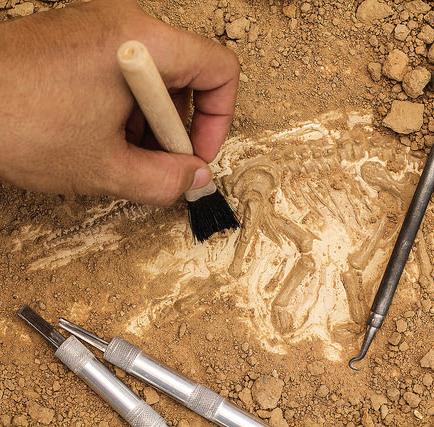
The student is expected to demonstrate an understanding of the various processes involved in the rock cycle, superposition of rock layers, and fossil formation. Student Expectations
• Investigation of Earth’s layers and the rock cycle reveals Earth’s history.
• As rocks move through the rock cycle, their mineral compositions and physical structures change to reflect the processes under which they are formed.
• Over time, through the various Earth processes of weathering, erosion, deposition (sedimentary rock), melting, crystallization (igneous rock), and heat pressure (metamorphic rock), Earth’s rocks change from one type into another as described in the rock cycle.
• Fossils are preserved parts or traces of animals or plants that lived in the past. Fossils are found preserved in sedimentary rock layers and represent a snapshot of environments that existed long ago.
Scope Overview
This unit develops students’ ability to classify rocks, model rock-cycle processes, and interpret Earth’s history from rock layers and fossils. Learners observe and sort rocks by properties, connect patterns to igneous, sedimentary, and metamorphic origins, and use hands-on models to link weathering, compaction, heat, and cooling to formation. They sequence layered deposits to apply superposition, explore deformation, and use embedded evidence to infer past environments. Students also test how sediment types influence trace fossil preservation, strengthening evidencebased reasoning.
Scope Vocabulary
The terms below and their definitions can be found in Picture Vocabulary and are embedded in context throughout the scope.
A preserved part or trace of an animal or plant that lived in the past
Rock
A solid piece of Earth’s surface
Rock Cycle
Changes in the mineral compositions and physical structures of rocks over time caused by various natural processes
Rock Formations
Rock arrangements created by weathering, erosion, and other natural processes
Sedimentary Rock
Rock formed when particles of other rocks are deposited in layers and are compacted (crushed together) and cemented (binding of the sediments)
Notes
Students investigate rock properties and practice developing and comparing classification systems.
• Observe a set of diverse rock samples and identify visible/measurable characteristics (e.g., color, texture, crystals, layers, mass).
• Sort rocks into groups using a self-created classification system and label each group with defining traits.
• Conduct a brief gallery walk to compare and contrast grouping rationales across teams and discuss overlaps or differences.
• Connect student-created systems to the scientific framework of igneous, sedimentary, and metamorphic rock classification.
Scientific Investigation - It’s All About the Rocks
Students explore how the three rock types form and how to identify them using simple models and photo analysis.
• Model formation of sedimentary, metamorphic, and igneous rocks using fruit-chew candies to simulate weathering, compaction, heat, and melting/cooling.
• Record observations at each stage to connect physical changes to rock-forming processes.
• Analyze rock images and use distinguishing characteristics to hypothesize and classify each as igneous, sedimentary, or metamorphic.
• Collaborate to reach group consensus, justify classifications with evidence, and share reasoning in a whole-class discussion.
Students investigate how rock layers form and change over time to interpret Earth’s history.
• Build a multi-layer rock model with clay and embedded “fossils” to represent different environments and deposition.
• Record and sketch each layer in sequence, explaining the events that formed them and identifying relative ages.
• Manipulate the model to simulate folding and faulting, then draw the resulting formations and describe the forces involved.
• Use evidence from rock types and fossils in the layers to infer past environments and geologic events.
Scientific Investigation - Fossil Imprints
Students investigate how different sediments affect the preservation of trace fossils by modeling imprint formation and analyzing results.
• Formulate a testable question and hypothesis about whether sand or gravel better preserves clay imprints.
• Create identical clay imprints with objects, bury them in layered cups of sand and gravel, and document observations with photos and sketches.
• Compare post-burial imprint detail to determine which sediment preserved features best, then discuss how particle size and sediment type relate to trace fossil formation in sedimentary rock.
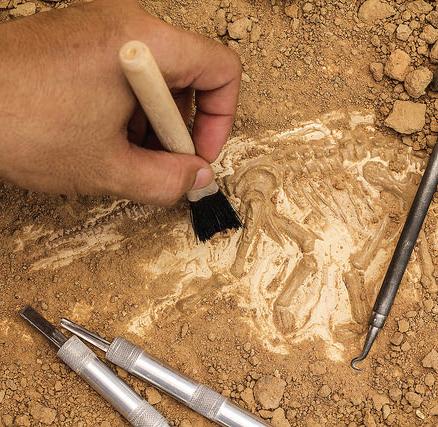
Estimated 15 min - 30 min
In this activity, students sort rocks based on a self-determined classification system.
Materials
Reusable
● 1 Granite, sample, rock (per group)
● 1 Basalt, sample, rock (per group)
● 1 Obsidian, sample, rock (per group)
● 1 Sandstone, sample, rock (per group)
● 1 Limestone, sample, rock (per group)
● 1 Shale, sample, rock (per group)
● 1 Gneiss, sample, rock (per group)
● 1 Marble, sample, rock (per group)
● 1 Slate, sample, rock (per group)
Consumable
● 1 Small sticky notepad (per group)
● 1 Resealable bag (per group)
SEP Connection
Planning and Carrying Out Investigations
Developing and Using Models
Asking Questions and Defining Problems
● Place one of each type of rock in a bag for each group in your class.
During this activity, students will ask questions and define problems by exploring how different rocks can be classified based on observable characteristics, which helps them understand how rocks, layers, and fossils tell the story of Earth’s history. They will develop and use models by creating their own classification systems to represent the relationships among rock characteristics and their formation processes. This hands-on investigation allows students to plan and carry out investigations, making observations and predictions about rock properties and their implications for understanding geological phenomena.
Notes
CCC Connection
Cause and Effect
Stability and Change
During this activity, students will identify and test causal relationships by classifying rocks based on observable characteristics, which helps them understand how these characteristics can indicate the processes and conditions under which the rocks were formed. This connects to the phenomenon of how rocks, layers, and fossils tell the story of Earth’s history by illustrating the cause and effect relationships in geological processes. Additionally, students will measure stability and change by observing differences in rock characteristics over time, recognizing that some systems appear stable but change over long periods, much like Earth’s geological history.
1. Place students into groups of three or four.
2. Distribute a bag of rocks and a sticky notepad to each group of students.
3. Ask students to observe the rocks and share the types of characteristics they notice. Students might notice different colors, patterns, crystals, sizes, textures, or masses (light vs. heavy).
4. Tell students to sort the rocks into groups based on characteristics they can observe. Have students write the characteristic for each rock group on a sticky note and place it near the rock group to identify it.
5. Give students five minutes to complete the sort. Allow students to do a gallery walk to compare and contrast their rock characteristics with other groups.
6. Have students share their classification systems. Ask students:
○ How are your classifications similar to or different than other groups? Answers may vary. Many students may list common characteristics such as color, texture, or weight. Other students may mention more complex characteristics such as crystals present, layers, or reflectivity (shininess).
○ Which rocks could go into several groups based on characteristics? Rocks such as gneiss, marble, or granite had many characteristics. Their color patterns, crystals, or weight could put them into different categories. Some rocks, such as obsidian, limestone, or basalt, might be considered easier because they were solid in color or had fewer defining characteristics.
○ Which rocks could be placed in a category of their own? Limestone would be in a category of its own. It may show fossils that other rocks don’t contain. It is unique in that it is formed from the remains of onceliving organisms. The remains of those organisms may rub off, leaving a chalky trail. This may not happen with other rocks.
7. Tell students that scientists classify rocks based on how the rocks were formed. All rocks can be sorted into three categories: igneous, sedimentary, and metamorphic.
8. Write the three terms on the board. Ask students to describe what they know about how rocks are formed. Write any appropriate comments or descriptions under the correct terms.
Notes
FACILITATION TIP
Remind students that there’s no single “right” way to classify at this stage. Scientists also make observations and refine categories over time.
FACILITATION TIP
Suggest that students not only look at the rocks but also feel the texture (smooth, rough, layered, grainy) and compare their weights.
Give students a task during the walk, such as: “Find one group that sorted rocks differently than your group.” “Identify one characteristic another group noticed that your group missed.”
FACILITATION TIP
After groups share, make the connection by saying: “Just like you made your own systems, scientists also classify rocks— but instead of color or weight, they use formation.”
Student may find the materials in this investigation tempting to use inappropriately. Create a nonverbal signal with students to let them know when they are not behaving appropriately. Strategically create groups that will limit distraction and that include a positive peer model. Provide positive reinforcement when students are working correctly. Find more strategies for impulsive behavior in the Interventions Toolbox.
Connection Statement with Posing Question: How do the characteristics and classifications of rocks help us understand the history of Earth and the processes that have shaped it over time?
Class Discussion Questions:
1. How can the presence of fossils in certain rocks, like limestone, provide clues about the environment and life forms that existed when the rock was formed?
2. In what ways do the layers and characteristics of sedimentary rocks tell us about the sequence of events in Earth’s geological history?
3. How can the transformation of rocks from one type to another (e.g., sedimentary to metamorphic) illustrate the dynamic processes occurring within the Earth’s crust?
Estimated 2 hrs - 3 hrs
Students model the processes in the formation of sedimentary, metamorphic, and igneous rock. Students use characteristics of the three types of rock to identify them in photos.
Materials
Printed
● 1 It’s All About the Rocks (per student)|
● 1 Rock Types (per class)
Reusable
● 1 Hot plate (per group or per class)
● 1 Resealable bag (per group)
● 1 15cm x 15cm Piece of heavy-duty aluminum foil (per group)
● 1 Heavy book (per group)
● 1 Pair of scissors (per group)
● 1 Pair metal tongs or oven mitts (per class)
● Colored pencils, various (per group)
● 1 Roll of masking tape (per teacher)
● Reference books about types of rocks (optional) (per class)
Consumable
● Four different colors of fruit-chew candies (per group)
Planning and Carrying Out Investigations
Developing and Using Models
Asking Questions and Defining Problems
● Print one It’s All About the Rocks for each student.
● Print one colored copy of the Rock Types. These pictures are displayed/hung around the room for Part II.
● Proper safety precaution should be followed when students are using hot plates. This part can also be done as a demo.
● Heavy-duty aluminum foil will work best because it is sturdier and should not rip as easily as thinner aluminum foil.
During this activity, students will engage in asking questions and defining problems by exploring how changes in variables, such as heat and pressure, affect the formation of different rock types. They will collaboratively develop and use models to represent the processes of sedimentary, metamorphic, and igneous rock formation, identifying limitations and revising their models based on evidence. By planning and carrying out investigations, students will collect data to support explanations of how rocks, layers, and fossils tell the story of Earth’s history, using their observations to make predictions about cause and effect relationships in rock formation.
Cause and Effect
Stability and Change
During this activity, students will identify and test causal relationships by modeling the processes of rock formation, using these relationships to explain changes in rock types over time. They will observe how rocks, layers, and fossils tell the story of Earth’s history by measuring changes in rock characteristics, understanding that while some systems appear stable, they undergo transformations through processes like weathering, compaction, and cooling, which occur at different rates.
Part I
1. Place students into groups of three or four, and distribute needed materials.
2. Tell students they will be exploring the different types of rocks and how they are formed.
3. Explain that they will be using a hot plate for one part. Therefore, they must use all science safety rules and be very cautious. This part can also be done as a demo, if you prefer.
4. Students use scissors to cut up the fruit chew candies into strips and then small pieces. Students write their observations in theirIt’s All About the Rocks. This models the sediments that are created and then become part of sedimentary rocks.
5. Students now take the pieces and mix them together, squeezing them with their hands. This shows students that the sediments are compacted together.
6. Have students write their observations in It’s All About the Rocks.
7. After students have compacted the sediments, they place the sedimentary rock in a plastic bag and apply heat and pressure with their hands.
8. Once the candy has become soft and pliable, students place a heavy book on top of the candy and apply pressure.
9. After students determine that enough pressure has been applied, have them take the metamorphic rock out of the bag and fold it in half. Have them pace the rock back into the bag and apply more pressure using the books.
10. Students record their observations in It’s All About the Rocks.
11. This next step can either be done by students or as a demo.
12. Using heavy-duty aluminum foil, model how to make a small boat for the metamorphic rock. Place the metamorphic rock in the aluminum foil boat, and place it on the hot plate. Have the metal tongs or oven mitts ready to use if necessary.
13. Have students watch the rock to see what happens. Remind students about science safety when using a hot plate.
14. When the rock has melted and is bubbling, turn off the hot plate, and allow everything to cool. When the rock has cooled, take it out of the boat; students can feel that it is now hard.
15. Have students finish filling out It’s All About the Rocks.
Before students begin cutting candies, explain: “Each step we’re doing represents a natural process that usually takes millions of years. We’re modeling those processes in minutes.”
As students cut candy, ask: “What does this cutting represent in the rock cycle?” (weathering) As they press with the book, ask: “What do you notice happening to the sediments? How is this like compaction?” During heat/pressure modeling, ask: “Why do you think pressure changes the rock rather than breaking it apart?” At the hot plate stage, ask: “What do you think will happen when we add more heat?”
16. Discuss:
○ What did your group do to model weathering rocks? We cut the candies to show them being broken down.
○ What are sedimentary rocks made of? Sedimentary rock is made of broken pieces of other rocks and fossilized organisms.
○ What did your group do to make the sedimentary rocks stick together? We added heat and pressure by pressing the book on the rock.
○ What did your group do to make the metamorphic rocks stick together? We added heat and pressure by pressing down on the book/rock.
○ How are metamorphic rocks formed? Metamorphic rocks are formed by extreme heat and pressure within Earth.
○ What did your group do to make the igneous rocks? We heated the rock on the hot plate.
○ How are igneous rocks formed? Igneous rock is formed when molten rock is cooled.
1. Students can be grouped into new groups of three or four or remain in the same groups as Part I.
2. Tell the students that they will be identifying different types of rocks based on their characteristics.
3. Discuss:
○ One misconception is that all igneous rocks are black and heavy. Igneous rocks can look mottled, or pocked, depending on the cooling of the lava.
○ What are the three basic types of rocks? Igneous, sedimentary, and metamorphic
○ What characteristic is used to determine the three types? Igneous rocks: Depending on how the magma or lava cools, crystals may be present. The rock may be smooth and dark or may have air pockets. Sedimentary rocks: There may be particles cemented together. In the case of limestone, shells or fossils may be seen. Metamorphic rocks: Metamorphic rocks are often characterized by smooth, wavy layers of mineral crystals or by the presence of unusual minerals.
○ List each category of rock and describe how it forms. Igneous formed from volcanic activity or cooling magma or lava. Sedimentary formed when deposited sediments are pressed together, compacted, and cemented. Metamorphic formed when existing rocks undergo extreme heat and pressure.
FACILITATIONT IIP
Remind students to use characteristics, not guesses. For example, model by saying: “Don’t just say ‘It looks like sandstone.’ Instead, say ‘I see layers of particles, which tells me it’s sedimentary rock.’”
4. Explain that students will be making a hypothesis about each mystery rock displayed in the pictures as a group. Each student completes the data tables on It’s All About the Rocks. Explain that students must support their hypotheses with characteristics found in each type of rock. Students may use reference books, if available, to help them find evidence to support their hypothesis.
5. Have students discuss and work as a team to categorize each rock as either igneous rock, sedimentary rock, or metamorphic rock. Students fill in the Group Hypothesis only when they reach consensus.
6. As a whole class, have students share their group’s hypothesis and reasoning for each mystery rock. After students share their explanations, explain why each rock picture fits into each rock category. After discussing the rock pictures, have students complete the rest of It’s All About the Rocks independently.
Place Mat and Round-Robin
After the students have the opportunity to complete the activities, give them an opportunity to express their understanding of the rock cycle.
● Form groups of four students.
● Inside the center circle of the place mat given below, write the sentence stem the students will use. (Please see below for examples of sentence stems you could use.)
● Then, each student picks one of the four areas, completes the sentence stem, and draws a picture relating to the sentence he or she just completed.
● After all four students have written their sentence stems and drawn their pictures, allow them to share their place mat with the whole classroom.
● Possible sentence stems could be the following:
○ Level 1 Knowledge Stem: The three basic types of rocks are _____.
○ Level 2 Comprehension Stem: The differences between metamorphic and sedimentary rocks are ______.
○ Level 3 Application Stem: Examples of sedimentary rock are ______.
○ Level 4 Analysis Stem: I would categorize these rocks as igneous, because _____.
○ Level 5 Synthesis Stem: I would test this rock to see if it is a metamorphic rock by ______.
○ Level 6 Evaluation Stem: I would explain the process of sedimentary rocks becoming metamorphic rocks by ______ .
You can have the place mat drawn on butcher paper to make the activity fun for the students.
How do the processes that form sedimentary, metamorphic, and igneous rocks help us understand Earth’s history?
1. How do the characteristics of each rock type provide clues about the environment in which they formed?
2. In what ways can fossils found in sedimentary rocks help us reconstruct past ecosystems and climate conditions?
3. How can the presence of metamorphic rocks indicate past tectonic activity or changes in Earth’s crust?
When reviewing each group’s hypotheses, ask: “What evidence led you to classify this as metamorphic instead of sedimentary?”
“Does anyone have a different claim? What’s your evidence?” Use discrepancies as teaching moments to refine observation skills.
Estimated 1 hr - 2 hrs
Students build a rock layer model and create rock formations by modeling the movement of Earth.
Materials
● 1 Modeling Rock Formations (per student)
● 1 Layer Cards (per group)
Reusable
● 1 Set of colored pencils (per group)
● 1 3 Inch putty knife (per teacher)
● 1 Small mallet (per teacher)
Consumable
● 1 1 inch Ball red modeling clay (per group)
● 1 1 inch Ball blue modeling clay (per group)
● 1 1 inch Ball yellow modeling clay (per group)
● 1 1 inch Ball green modeling clay (per group)
● 1 1 inch Ball brown modeling clay (per group)
● 1 Paper plate (per group)
● 3 Fish-shaped crackers (per group)
● 3 Uncooked pasta shells (per group)
● 3 Small cilantro leaves (per group)
● 3 Pretzel sticks (per group)
● 3 Spaghetti pieces, uncooked
● 1 Spaghetti piece, cooked (per group)
● 1 Zipper sandwich bag (per group)
● 1 Piece of wax paper (per group)
● Print one copy of Modeling Rock Formations for each group.
● Print or project one colored copy of the Grand Canyon picture located in the Layer Cards.
● Print one set of Layer Cards (pages 2) for each group.
● Divide the modeling clay so that each group gets a ball of each color.
● Separate the building materials for easy distribution to the groups.
● Do not overcook the spaghetti. It should be soft but not squishy. Cut the cooked spaghetti into smaller pieces. Dry the spaghetti, and put it in a resealable bag to keep it from hardening.
● Break the uncooked spaghetti into smaller pieces.
● You may wish to create a layer model to use as a modeling tool for Part II and III.
Planning and Carrying Out Investigations
Developing and Using Models
Asking Questions and Defining Problems
During this activity, students will ask questions and define problems by exploring how changes in variables, such as the order and composition of rock layers, affect the story told by rocks, layers, and fossils about Earth’s history. They will collaboratively develop and revise models to represent the formation and alteration of rock layers, using these models to describe and predict the phenomena of Earth’s geological changes. Through planning and carrying out investigations, students will make observations and measurements to produce data that serves as evidence for explaining how rock formations and fossils provide clues to Earth’s past.
Procedure and Facilitation
1. Place students into groups of three or four.
Cause and Effect
Stability and Change
During this activity, students will explore the phenomenon of how rocks, layers, and fossils tell the story of Earth’s history by building a rock layer model. Through this process, they will identify and test causal relationships, understanding how events such as volcanic activity or water environments lead to the formation of different rock types and fossil deposits. By observing the stability and change within their models, students will measure differences over time and recognize that while some systems appear stable, they can change significantly due to forces like earthquakes, which can fold, break, or move rock layers.
2. Introduce the photo of the Grand Canyon. Ask students what they notice. There are visible striped patterns in the rock. Layers seem to go together on both sides of the canyon.
3. Tell students that the Grand Canyon is a famous example of how rock layers can tell us the age of the rock in relation to the other layers.
4. Distribute a set of Layer Cards and building materials to each group and Modeling Rock Formations to each student. Students should complete Part I by building on the wax paper in order to make for easier cleanup.
5. Inform students that they will create a model of rock layers by constructing the four layers described on the Layer Cards. Students may build the layers in the order they choose. Each layer should be built only once.
6. Students use a different color of modeling clay to represent each layer. Students can decide how to use the building materials to represent the rock and/or fossils in each layer. The final product should be one model consisting of all four layers.
7. Instruct students to pay close attention to the types of organisms and sediments that would be in the environment that each layer represents. Students should use appropriate materials to represent the organisms. For example, water organisms can be represented by fish-shaped crackers and shell pasta. Forest organisms can be represented by pretzel sticks and cilantro leaves. Uncooked spaghetti can represent spines of a cactus, while cooked spaghetti pieces can represent snakes. These pieces should be incorporated into the clay of the appropriate layer.
8. As students build their rock layer models, they should describe the events that created the layer. Instruct students to connect one layer to the next by creating a story describing the events. Students draw the layers in Modeling Rock Formations. They should begin with the bottom layer, which is labeled in Modeling Rock Formations.
As groups build, circulate and ask: “Which of your layers will be the oldest? How do you know?” This reinforces the Law of Superposition while they are modeling.
Ask groups to compare the fossils in different layers (fish, plants, etc.) and infer how the environment changed over time. Push them to explain what disappeared and what appeared across layers.
9. Discuss:
○ Which layers were formed first, and which were formed later? The youngest layer is on top because it was the last one to form. The oldest layer is on bottom because it was the first one to form. The type of rock and the fossils give a clue as to how and when the layer was formed.
○ How is the model similar to or different than what happens in nature? When environments change, deposited materials can change, too. Organisms in the environment may be trapped in the layer and be fossilized in the rock.
○ What evidence in the rock layers gives clues to Earth’s past? The type of rock and fossils in the layers are big clues. Igneous rock indicates volcanic activity, and sedimentary rock can be evidence of a water environment. The fossils can be evidence of the type of environment present when the layer was formed.
10. For Part II, tell students to select one student in the group to pick up the layer model from the bottom. Instruct the students to fold the layers inward and upward by gently pushing up from the bottom.
11. Tell students to draw the new formation and describe the forces that created this in Modeling Rock Formations.
12. For Part III, place the putty knife over one group’s layer model. Tap the knife with the mallet to cut the layer model in half. Repeat this process with the other groups’ models. Tell students that this cut represents a crack in Earth called a fault.
13. Tell students to flatten the fifth modeling clay ball. Have students select another student in the group to move one half of the layer model upwards. Instruct students to place the flattened piece of clay under the raised layers to support them.
14. Instruct students to draw the new formation and describe the forces that created this in Modeling Rock Formations.
15. Have students complete the questions in Modeling Rock Formations.
16. Discuss as a class:
FACILITATION TIP
Bring in a recent example of an earthquake or volcanic eruption and compare the rock formation changes in the news with the classroom model.
○ What events on Earth could create the formations in your model? If Earth’s crust were moved, the layers would move also. An earthquake could cause the rock layers to fold, break, or move. This could cause the layers to look wavy or cracked.
○ After the layers were moved, how did you know which layers were laid together? The type of rock shown by the modeling clay could still be seen. Fossils deposited at each layer gave clues to which layers were deposited together.
Do Not Eat or Drink Materials: Students should be reminded not to eat or drink any materials unless directed to do so.
Sentence Stems
For emerging Language Acquisition Strategies, have the materials translated into their native language as a reference.
After the group activity, students can complete the following sentence stems in their journals to check their understanding and for future reference. Students may also read the sentences with a partner in their groups.
Emerging
● I know the _______ layer formed first because _________.
● I know the _______ layer formed last because _________.
Expanding/Bridging
● An event that could happen with the bottom layer is _______ because _______.
● An event that could happen with the top layer is ______ because _______.
● An event that could happen with the middle layer is _______ because _______.
Phenomenon Connection
Connection Statement with Posing Question: How do the layers and fossils in rocks help us understand the sequence of events in Earth’s history?
Class Discussion Questions:
1. Based on your rock layer model, how can we determine which rock layers are older or younger?
2. How do the types of fossils found in different layers help us infer the environmental conditions of Earth’s past?
3. What natural events could cause the rock layers to fold, break, or shift, and how would these changes affect our interpretation of Earth’s history?
Estimated 1 hr - 2 hrs
Students propose a testable hypothesis about how imprints are made in sedimentary rock.
Materials
Printed
● 1 Fossil Imprints (per student)
Reusable
● Objects to make imprints (per group)
● Examples: plastic animals, artificial leaves, cleaned chicken bones, etc.
● 2 Clear plastic cups (per group)
● 1 Spoon (per group)
● Digital camera or device with picture taking ability (per class)
Consumable
● 2 1 inch balls of modeling clay (per group)
● 1 Small cup of aquarium gravel (per group)
● 1 Small cup of sand (per group)
● 1 Small cup of flour (per group)
● 1 Paper plate (per group)
● 3–4 Paper towels (per group)
● Print a Fossil Imprints for each student.
● Prepare a cup of aquarium gravel, a cup of sand, and a cup of flour for each group. Place a spoon in the cup of sand for scooping.
● Prepare a variety of imprint-making objects for each group.
● Roll two pieces of the modeling clay into 1 inch balls for each group.
Planning and Carrying Out Investigations
Developing and Using Models
Asking Questions and Defining Problems
During this activity, students will ask questions and define problems by proposing testable hypotheses about how imprints are made in sedimentary rock, using their observations to predict outcomes based on cause and effect relationships. They will develop and use models by creating imprints in clay to represent fossil formation, identifying limitations of these models, and using them to test the effects of different soil types on fossil preservation. Through planning and carrying out investigations, students will collaboratively conduct experiments to gather data, evaluate methods for data collection, and make observations to support explanations of how rocks, layers, and fossils tell the story of Earth’s history.
Cause and Effect
Stability and Change
During this activity, students will identify and test causal relationships between different soil types and their effects on fossil preservation, using these relationships to explain changes observed in the imprints. They will measure changes in the imprints over time, observing that while some systems appear stable, the type of sediment can significantly impact the preservation of details, illustrating how rocks, layers, and fossils tell the story of Earth’s history.
1. Place students into groups of three or four.
2. Explain to students that fossils can be traces of organisms’ actions such as footprints or tunnels. They can look like a partial or complete skeleton when minerals replace the original organism during the fossilization process.
3. Explain to students that they will model how trace fossils are formed by the burying action of two different soil types: sand and gravel.
4. Distribute the Fossil Imprints to each student. Read the background information as a class, or have students read it in their groups.
5. Distribute imprint-making objects, clay, two clear cups, and cups of gravel, sand, and flour.
6. Tell students to flatten the two balls of clay to make two clay disks that are sized to fit in the bottom of the clear cup.
7. Tell students to choose an imprint-making object and press it into one of the clay disks to make an imprint.
8. Ask students to repeat this process with the same object and the other disk of clay so that they have two imprints of the same object.
9. Instruct students to make observations about the imprints, the sand, and the gravel and record them in Fossil Imprints. Encourage students to think about soil particle size and texture.
10. Inform the students that they will model fossil formation by burying one imprint under the sand and the other imprint under the gravel.
11. Help students formulate a testable question that can be answered by testing the effect of the sand and gravel on the imprints. Students record their testable question on Fossil Imprints.
○ The most logical question would be about which soil type will best preserve or fossilize the imprint. However, do not tell students this; the objective of the lesson is for students to ask a testable question about the formation of fossils. Instead, help students understand that the sediments will cover and preserve the trace fossil. Lead students to think about what would happen as each soil covers the imprint.
12. Next, encourage students to hypothesize about the effectiveness of sand or gravel in the formation of the fossil. Students record their hypothesis on Fossil Imprints.
13. Take a photo of the imprints with the digital camera before having students layer them.
14. Instruct students to sprinkle a small amount of flour on the bottom of the cup to prevent sticking.
15. Place one imprint in the bottom of the plastic cup, with the imprint facing up. Layer about 2 cm of the fine sand on top, completely covering the fossil.
Notes
As groups write their own questions, circulate and prompt with questions: “What effect will...have on the imprint?” “Which material will preserve details better?”
Provide hand lenses so students can compare sand vs. gravel particles closely. Encourage them to connect particle size to how well details are preserved.
If possible, project the “before” and “after” photos to show the whole class. Students can notice fine details more easily when the photos are enlarged.
16. Place the second imprint on top of the sand, with the imprint facing up. Layer about 2 cm of the gravel on top, completely covering the fossil.
17. Use the bottom of the other clear cup to press down firmly on the gravel. Have students draw the layers and answer the questions about the layers in Fossil Imprints.
18. Gently turn the cup over with the layers upside down on the paper plate (as when building a sandcastle). Slowly lift the cup off.
19. Carefully collect and separate the fossils, brushing off the soils.
20. Instruct the students to examine each fossil and draw the two imprints in Fossil Imprints. Have students compare the fossils to the group’s “before” picture to determine which soil type best preserved the detail of the fossil.
21. Have students answer the conclusion questions in Fossil Imprints
22. Discuss as a class:
○ What can you conclude about the effect of sand and gravel in fossil formation? The sand preserved the detail of the imprint better than the gravel. The rough particles of the gravel pressed into the clay and made their own imprints. The sand had small particles that covered the imprint and pressed the clay gently.
○ Why is the type of sediment covering the imprint important to its formation? The smaller the particle of the sediment, the better the imprint will be preserved. The details of the trace fossil will be preserved over a long period of time.
○ Why are trace fossils most often found in sedimentary rock? It is easy to make imprints in soft sedimentary rock or mud. Organisms that lived long ago made traces in soft rock, and the traces were best protected if soft sedimentary rock filled in the imprints. Over time, they became fossilized.
Show photos of actual trace fossils (footprints, burrows, leaf imprints) and ask: “Which type of sediment do you think preserved this fossil?”
○ Why are trace fossils not found everywhere? The imprints are delicate. They might be destroyed, as the imprints were under the gravel. They could be buried by lava or bent under pressure in the earth. They must be preserved under the right soil.
GGM (Give, Get, Move)
● Pass out sticky notes.
● Ask participants to write down three to five key learnings or important ideas from the lesson.
● Invite the group to get up and walk around while music plays.
● After about 30 seconds, call out “Give!"
● Participants form pairs; each student gives one sticky note to the other and explains the key learnings or important ideas about the topic. Each person “gives” and “gets.” Time may range from one to three minutes.
● Call out “Move!” to signal that participants mingle again.
● Repeat the sharing for as many ideas as people have to share.
Phenomenon Connection
How do the processes that create fossil imprints in sedimentary rock help us understand Earth’s history through rocks, layers, and fossils?
1. How do different types of sediment affect the preservation of fossil imprints, and what does this tell us about the conditions needed for fossilization in Earth’s history?
2. In what ways can the layers of sedimentary rock provide clues about the environment and climate of Earth’s past?
3. How can the presence and type of fossils found in sedimentary rock layers help us reconstruct the timeline of life on Earth?
STEMscopedia
Reference materials that includes parent connections, career connections, technology, and science news.
Linking Literacy
Strategies to help students comprehend difficult informational text.
Picture Vocabulary
A slide presentation of important vocabulary terms along with a picture and definition.
Content Connections Video
A video-based activity where students watch a video clip that relates to the scope’s content and answer questions.
Career Connections - Geologist
STEM careers come to life with these leveled career exploration videos and student guides designed to take the learning further.
Math Connections
A practice that uses grade-level appropriate math activities to address the concept.
Reading Science - Classifying Rocks
A reading passage about the concept, which includes five to eight comprehension questions.
Notes
Multiple Choice Assessment
A standards-based assessment designed to gauge students’ understanding of the science concept using their selections of the best possible answers from a list of choices
Open-Ended Response Assessment
A short-answer and essay assessment to evaluate student mastery of the concept.
Claim-Evidence-Reasoning
An assessment in which students write a scientific explanation to show their understanding of the concept in a way that uses evidence.
Guided Practice
A guide that shows the teacher how to administer a smallgroup lesson to students who need intervention on the topic.
Independent Practice
A fill in the blank sheet that helps students master the vocabulary of this scope.
Extensions
A set of ideas and activities that can help further elaborate on the concept.
Use this template to decide how to assess your students for concept mastery. Depending on the format of the assessment, you can identify prompts and intended responses that would measure student mastery of the expectation. See the beginning of this scope to identify standards and grade-level expectations.
Investigation of Earth’s layers and the rock cycle reveals Earth’s history.
As rocks move through the rock cycle, their mineral compositions and physical structures change to reflect the processes under which they are formed.
Over time, through the various Earth processes of weathering, erosion, deposition (sedimentary rock), melting, crystallization (igneous rock), and heat pressure (metamorphic rock), Earth’s rocks change from one type into another as described in the rock cycle.
Fossils are preserved parts or traces of animals or plants that lived in the past. Fossils are found preserved in sedimentary rock layers and represent a snapshot of environments that existed long ago.
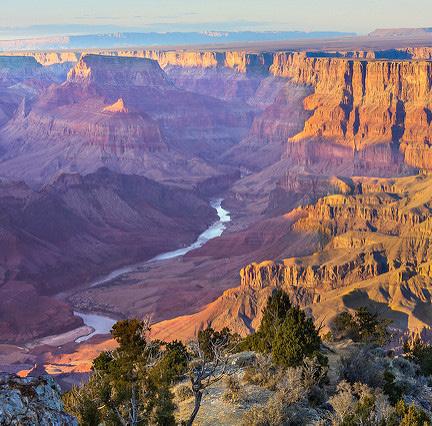
Student Expectations
The student is expected to demonstrate an understanding of the composition of Earth and the constructive and destructive processes that change Earth’s landforms.
• Earth contains distinct layers, including the inner core, outer core, mantle, and crust.
• Landforms are the physical and natural features of the surface of Earth. Some examples are volcanoes, mountains, valleys, canyons, coastlines, dunes, and plains.
• Weathering is the gradual changes made to rocks due to agents such as water, temperature changes, and the actions of plant roots that pry rocks apart. Erosion occurs when rock or soil is moved to another location by the flow of water, ice, or wind. Deposition occurs as sediment settles (or is deposited) in a different location.
• Landforms are the result of the combination of constructive and destructive forces. Constructive processes build surface features. Destructive forces break down surface features of Earth.
This unit develops students’ understanding of Earth’s structure and the processes that shape landforms. Learners investigate the crust, mantle, outer core, and inner core, then use hands-on models to observe weathering, erosion, and deposition and to distinguish constructive from destructive forces. Through modeling, observation, data recording, and discussion, students compare rates of material breakdown, examine how water and waves reshape terrain, and analyze characteristic features of common landforms. Emphasis is on evidence-based reasoning and accurate use of Earth science vocabulary.
Scope Vocabulary
The terms below and their definitions can be found in Picture Vocabulary and are embedded in context throughout the scope.
Canyon
A deep ravine between cliffs that is most often carved from the landscape by a river
Constructive Processes
Natural phenomena such as volcanoes, rivers, and weather patterns that build up landmasses on Earth’s surface
Deposition
The buildup of land by the settlement of sediment and soil in a new location
Destructive Processes
Natural phenomena such as erosion and earthquakes that wear down landmasses on Earth’s surface
Earth
The third planet from the Sun and the only planet in the solar system where life exists
Earthquake
A sudden release of energy under Earth’s surface that makes the ground shake or crack
Erosion
The removal and movement of sediment from one place to another by gravity, water, wind, or ice
Feature
Distinctive part, quality, or characteristic
Valley
A low area between higher areas of elevation
Weathering
The breakdown of rocks into very small particles by gravity, water, wind, and ice Scope
Notes
Students explore how materials break down under different conditions using a simple model.
• In small groups, students shake sugar cubes in two jars—one with water and one with rocks—to compare rates of breakdown.
• They observe and record changes to the sugar cubes and the formation of small particles (sediments).
• Students analyze which environment caused more breakdown and relate their findings to weathering, erosion, and deposition.
Research - Earth’s
Students explore Earth’s internal structure through a brief multimedia investigation and hands-on modeling.
• View a short video to identify the crust, mantle, outer core, and inner core, pausing to complete a guided notes sheet.
• Engage in whole-class discussion to compare layer composition and states of matter (rock, magma, iron/nickel; solid vs. liquid).
• In partners, design and build a four-layer clay model, then observe a cross-section when the model is cut to reveal internal layers and record findings.
Students collaborate to research, design, build, and compare models of landforms using common materials.
• In pairs, draw a landform card, research the landform with a graphic organizer, and plan a labeled sketch using 5–8 materials.
• Construct the landform model in an aluminum pan with the selected materials.
• Conduct a walkabout to observe peers’ models, sketch, and record one example per landform type.
• Conclude with a class discussion comparing characteristics and differences among landforms.
Making a Model - Changing the Land
Students model how water shapes land and classify constructive versus destructive processes.
• Watch a brief video and discuss weathering, erosion, deposition, and landform change.
• Use a tilted frozen sand block with a slow water flow to observe canyon formation and sediment buildup over timed intervals, recording observations.
• Create gentle waves in a pan to investigate shoreline erosion and bluff formation, noting changes over time.
• Connect observations to real-world landforms and complete a class T-chart sorting constructive and destructive processes.
Notes
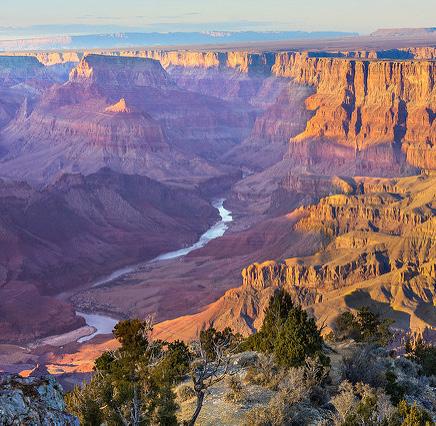
Estimated 15 min - 30 min
Students compare the breakdown of sugar cubes using different methods.
Materials
Printed
● 1 Shake It (per student)
Reusable
● 2 Baby food jars (per group)
● 10 Aquarium rocks (per group)
● 1 Pair of safety goggles (per student)
Consumable
● 2 Sugar cubes (per group)
● 20 mL Water (per group)
SEP Connection
Obtaining and Evaluating Information Developing and Using Models
Gather materials ahead of time and have them ready for when students get to class.
During this activity, students will develop and use models to describe and predict the phenomenon of why mountains grow and rivers change their paths over time. By shaking sugar cubes in jars with water and pebbles, students will collaboratively develop a model that represents the processes of weathering, erosion, and deposition. This hands-on experiment allows students to identify limitations of models while using analogies to understand the scientific principles behind natural changes in landscapes. Through observation and discussion, students will obtain and communicate information about how these processes contribute to the dynamic nature of Earth’s surface.
Notes
CCC Connection
Systems and System Models Cause and Effect
During this activity, students will explore the concept of systems and system models by observing how different components (water and rocks) interact to break down sugar cubes, simulating the processes of weathering, erosion, and deposition. This helps them understand the phenomenon of how mountains grow and rivers change their paths over time. By identifying and testing causal relationships, students will gain insights into how these processes contribute to changes in Earth’s surface, illustrating the interconnectedness of systems and the cause and effect relationships within them.
1. Place students into groups of three or four, and distribute materials and the Shake It document.
2. Have the students fill the first jar halfway with water.
3. Students now fill the second jar halfway with pebbles (aquarium rocks).
4. Students then place a sugar cube in each container and secure the lids on both jars. The teacher might want to check the lids to prevent the water from leaking out.
5. Students put on their safety goggles.
6. Have students shake each container for one minute and then allow the jars to settle. Students open the jars and observe.
7. Have students record their observations on their Shake It document.
8. Discuss:
○ What do you notice about the sugar cubes in each jar? They are smaller than they were before.
○ What do you notice at the bottom of the jar? There are small pieces of sugar on the bottom.
○ Did the rocks or the water break down the sugar cube the most? The cube in the water broke down the most.
○ What is sediment? Broken-down pieces of rock into smaller pieces
○ Which jar produced sediments? Both
○ What does this model? Weathering, erosion, and deposition
Safety Guide
Safety Goggles:
When using any form of very small particles or objects, it is safest for students to protect their eyes by wearing googles.
Phenomenon Connection
How do the processes that break down sugar cubes in our activity relate to the natural processes that cause mountains to grow and rivers to change their paths over time?
1. Based on your observations, which method of shaking the sugar cubes (with water or with rocks) is more similar to the way rivers erode and change their paths? Why?
2. In what ways do you think the breakdown of sugar cubes in our jars is similar to the weathering and erosion that happens to mountains over time?
3. If we wanted to model how mountains grow, what additional materials or steps could we include in our activity to represent the forces that cause mountains to rise?
FACILITATION TIP
Before shaking, ask groups to predict which sugar cube will break down more and why. Record predictions on the board for comparison later.
FACILITATION TIP
Encourage students to note not only the sugar cube’s size but also: Water becoming cloudy (evidence of dissolved sugar).
Sediment particles collecting at the bottom.
Whether the sugar in the pebble jar broke differently (larger chunks vs. tiny dissolved pieces).
FACILITATION TIP
End with a big-picture question: “How can these tiny processes over time change the shape of entire landscapes?”
Estimated 1 hr - 2 hrs
In this activity, students learn about the structure of Earth’s layers by building a model to illustrate the crust, mantle, outer core, and inner core.
Materials
Printed
● 1 Earth's Layers (per student)
Reusable
● 1 Crayon of each of the following colors
● (per pair of students): Blue,Yellow, Red, and White
● 1 Plastic knife (per teacher)
● 1 Computer with Internet access (per teacher)
● 1 Projector (per teacher)
Consumable
● Clay, blue, air-dry, 10 cm3 (per pair of students)
● Clay, yellow, air-dry, 15 cm3 (per pair of students)
● Clay, red, air-dry, 30 cm3 (per pair of students)
● Clay, white, air-dry, 8 cm3 (per pair of students)
● Paper towels (per pair of students)
SEP Connection
Obtaining and Evaluating Information
Developing and Using Models
Preparation
Gather and place supplies out for student groups beforehand so they are easily accessible.
During this activity, students will develop and use models to describe and predict the phenomenon of why mountains grow and rivers change their paths over time. By building a model of Earth’s layers, students will collaboratively develop and revise their models based on evidence, showing the relationships among variables such as the movement of tectonic plates and the flow of magma. This hands-on experience will help them understand the cause and effect relationships within Earth’s structure and how these interactions lead to geological changes over time. Additionally, students will obtain and communicate scientific information through class discussions and written formats, enhancing their comprehension of the dynamic processes shaping our planet.
Systems and System Models
Cause and Effect
During this activity, students will develop and use models to understand the Earth’s layers, which are part of a larger system that influences geological phenomena such as mountain formation and river path changes. By constructing and analyzing these models, students will explore the interactions between Earth’s components and identify causal relationships, enhancing their understanding of how these systems and their interactions lead to observable changes over time.
Part I
1. Using a search engine, search for the term "Build Earth from the Inside Out." Choose the video that is 5:44.
2. Watch the video as a class, and have students fill out Part I on Earth's Layers. The teacher may want to stop the video throughout watching it to allow students enough time to fill in Earth's Layers.
3. The last four questions should be answered by students while the teacher is leading a class discussion.
4. Discuss:
○ What is the crust made of? Rock
○ What is the mantle made of? Molten rock/magma
○ What are the outer core and inner core made of? Iron and nickel
○ What is the difference between the outer core and inner core? The inner core is solid, and the outer core is a liquid.
Part II
1. Group students into partners.
2. Explain to students that they will be making their own model of Earth’s four layers.
3. Allow students to pick the colors of each layer that they would like; explain that they can make their model any way they would like, provided it shows the four layers of Earth and is agreed upon by their partner.
4. Allow students ample time to design and make their model of Earth’s layers using the four different colors of clay.
5. When students have completed their model, the teacher cuts the model in half so students are able to see inside it.
6. Students then complete Earth's Layers.
7. Discuss:
○ What are the four layers of Earth? Crust, mantle, outer core, and inner core
○ What layer do we live on? Crust
FACILITATION TIP
Stop the video after each major layer is introduced. Have students draw or label that layer before moving on.
FACILITATION TIP
Have students stand up and use their bodies to model the layers—small ball for the inner core, crouching circle around for mantle, spreading arms for crust.
FACILITATION TIP
Once models are cut, do a gallery walk. Students can compare how each pair represented layer thickness and color.
FACILITATION TIP
Connect to real-world phenomena: Earthquakes/volcanoes = crust + mantle interaction.
Earth’s magnetic field = outer core movement.
Q3SA: Question, Signal, Stem, Share, Assess
After the students have had time to explore the investigation, work through a Q3SA. Write the question and sentence stem on the board so that students can read them to themselves. Then read the question out loud. Students may answer the question only after you have given them the signal to respond.
● Question: *Please see below.
● Signal: Place your right hand on top of your head.
● Stem: *Please see below.
● Share: The person born in March will report his or her answer first.
● Assess: Students can draw a question mark each time they hear someone share the same answer they have written down.
Possible questions and sentence stems could be the following:
● Level 1 Knowledge Question: How would you show what Earth’s layers look like in relationship to one another?
○ Stem: I would show what Earth’s layers look like in relationship to one another by drawing _______.
● Level 2 Comprehension Question: What can you say about the lithosphere?
○ Stem: I can say _______ about the lithosphere.
● Level 3 Application Question: What facts would you select to show that the inner core is denser than its surrounding layers?
○ Stem: The facts I would select to show that the inner core is denser than its surrounding layers are _______.
● Level 4 Analysis Question: What are the parts of Earth?
○ Stem: The parts of Earth are _______.
● Level 5 Synthesis Question: Can you think of an original way for the mantle to be depicted in a model?
○ Stem: An original way for the mantle to be depicted in a model is _______ .
● Level 6 Evaluation Question: Based on what you know, how would you explain the differences in state of matter between the inner core, outer core, mantle, and crust?
○ Stem: I would explain the differences in state of matter between the inner core, outer core, mantle, and crust by _______.
How do the processes occurring within Earth’s layers contribute to the growth of mountains and the changing paths of rivers over time?
1. How might the movement of tectonic plates, which make up Earth’s crust, lead to the formation of mountains?
2. In what ways could the flow of magma in the mantle influence the surface features of Earth, such as rivers and mountains?
3. How do the interactions between Earth’s layers affect the long-term changes in the landscape we observe, like the shifting paths of rivers?
Estimated 1 hr - 2 hrs
In this activity, students work with a partner to select a landform to construct using a variety of provided materials.
Materials
Printed
● 1 Constructing Landforms (per student)
● 1 Landform Cards (per teacher)
Reusable
● 1 Computer or device with Internet access (per pair of students)
● 1 Pan, aluminum (per pair of students)
● 1 Beaker, 50 mL (per pair of students for sand)
● 1 Cylinder, graduated 100 mL (per pair of students for water)
● 1 Scissors (per teacher)
● 1 Block, wooden (per pair of students)
● 1 Crayons/colored pencils, set (per pair of students)
Consumable
● 2 Straws (per pair of students)
● 1 Ice cube (per pair of students)
● 1 Clay, modeling, 1" cube (per pair of students)
● String or yard, 100 cm (per pair of students)
● Sand, 50 mL (per pair of students)
● Water, 100 mL (per pair of students)
● 2 Paper, construction (per pair of students)
● 1 Cup, paper, 3 oz (per pair of students)
● 1 Plate, paper (per pair of students)
● 1 Aluminum foil (per pair of students)
● 1 Wax paper or plastic wrap (per pair of students)
● Print four or five sets of the Landform Cards, laminate them, and cut them out.
● Print one Constructing Landforms for each student in your class.
● Cut aluminum foil into 3" squares.
● Tear wax paper or plastic wrap into 6" strips.
● Measure out 50 mL of sand per group into 50 mL beaker.
● Place enough materials, in a specified location in your classroom, for each group to have one of each reusable and consumable material.
During this activity, students will develop and use models to describe and predict the phenomenon of why mountains grow and rivers change their paths over time. By constructing landform models, students will collaboratively develop and revise models based on evidence, identify limitations, and use analogies to represent scientific principles. They will also obtain and communicate information by observing and comparing different landform models, enhancing their understanding of the dynamic processes shaping Earth’s surface.
During this activity, students will engage in constructing landform models to understand systems and system models by exploring how individual components interact to form a whole. They will identify and test causal relationships to explain changes in landforms, such as why mountains grow and rivers change their paths over time, thereby gaining insights into the cause and effect relationships within Earth’s systems.
Part I: Constructing a Landform
1. Determine partner groups, and distribute Constructing Landforms.
2. Explain to the students that they will be designing and constructing a landform with their partner’s help.
3. Have one student per partner group draw a card from the Landform Cards.
4. Show the students the supplies that they are allowed to use in order to construct their landform. Let the students know that they must use five to eight supplies and an aluminum pan to contain their landform model.
5. Explain to the students that before construction begins, they must research their landforms using the graphic organizer in Constructing Landforms as their guide.
6. Show students where all the materials are located in the room. Remind them they are not to take materials back to their tables until they have completed the brainstorming and sketching portion of Constructing Landforms.
7. Once students have shown you their sketches, making sure that they have labeled five to eight supplies, they can gather their supplies from the supply location.
8. Students will return Landform Cards to you when they are done constructing their landform models.
Notes
FACILITATION TIP
Provide a short list of guiding research questions (e.g., “How is this landform created? What forces shape it?” “What materials might represent it in your model?”).
Ask student: “What supply will you use to represent water, sand, or rock?” “What shape or process is most important to show for this landform?”
Part II: Landform Walkabout
1. Explain to the students that they will be touring the landform models with their partner.
2. Remind them that they are not to touch or make any negative comments about any of the models.
FACILITATION TIP
Model how to quickly sketch a landform without worrying about artistic perfection by focusing on shape and key features.
FACILITATION TIP
Point out how even the same landform like a mountain can look different in each group’s model—just like real mountains on Earth.
3. As students are completing the walkabout, they are to look at every landform model but will need to sketch and record information only once for each type of landform in Constructing Landforms.
4. Once students have observed all models and completed the chart in Constructing Landforms, have them return to their seats for a class discussion.
5. Discuss:
○ What did you see when you walked around and looked at the different landforms? Even though there were some of the same types of landform, they all looked different.
○ Give examples of characteristics of each landform. How are they alike? How are they different? Mountains and volcanoes are both very tall and look very similar. Valleys and plains are both low and flat. An island is a piece of land in the middle of water.
Building Understanding
For beginner ELP students, provide a translated copy of the Student Journal page for reference, or have students work in partners to answer the questions.
For intermediate or advanced ELP students who seem to have trouble decoding the instructions, allow students to talk with partners for a few minutes and then circulate the room to see how other students are starting the activity so that the instructions are being modeled for them.
Some students may struggle with working with partners during this activity. They may not let the other student research, draw, or build the landform model. Assign student jobs within the group to avoid conflict. For example, each group member could be in charge of handling one material. Short turns will increase sharing. Find more strategies for students who do not share in the Interventions Toolbox.
Notes
Phenomenon Connection
How do natural forces shape and change landforms over time, and what can we learn from modeling these processes in the classroom?
1. Based on your observations of the landform models, what factors do you think contribute to the growth of mountains and the changing paths of rivers over time?
2. How did your choice of materials and construction techniques affect the stability and appearance of your landform model, and how does this relate to real-world geological processes?
3. In what ways do you think human activities might influence the natural changes in landforms, such as mountains growing or rivers changing their paths?
Estimated 30 min - 45 min
Students explore how weathering, erosion, and deposition by water can create and change landforms.
Materials
Printed
● 1 Changing the Land (per student)
Reusable
● 2 Clear deli-sized plastic containers (per group)
● 2 Large aluminum roasting pans (per group)
● 1 Hand lens (per group)
● 1 Large book (per group)
● 1 Beaker (per group)
● 1 Wooden spoon (per group)
● 1 Timer (per group)
● 1 Ring stand (per group)
● 1 Large freezer (per teacher)
● 1 Computer with Internet access (per teacher)
● 1 Projector (per teacher)
Consumable
● Water (enough to fill deli container) (per group)
● 6 Cups sand (per group)
● 1 Roll non-slip shelf liner (per class)
● 1 2 L Bottle (per group)
● 1 Science notebook (per student)
Obtaining and Evaluating Information Developing and Using Models
During this activity, students will develop and use models to describe and predict the phenomenon of why mountains grow and rivers change their paths over time. By simulating weathering, erosion, and deposition, students will collaboratively develop and revise models based on evidence that shows the relationships among these processes and their effects on landforms. They will identify limitations of their models and use them to test cause and effect relationships concerning the functioning of natural systems. Additionally, students will obtain and combine information from reliable media to explain these phenomena and communicate their findings through various formats, including diagrams and charts.
● For each group, create and place two containers of water and sand in the deli containers and freeze overnight. The proportion of water and sand should result in having mostly sand in the container and enough water to make it all freeze together.
● The frozen block of ice and sand will need to be popped out of the deli container in order for students to complete the activity. The deli containers will not be needed beyond freezing the water and sand.
● The shelf liner should be cut into squares that are about the same size as the deli container. The shelf liner is used to keep the ice and sand from slipping down to the end of the roasting pan when tilted.
● Poke a tiny hole in the bottom of the 2 L bottle to allow a small amount of water to continuously flow out. When the bottle is filled with water and the cap is twisted closed, the water should not easily flow from the tiny hole. Loosening the cap will allow air into the bottle so that the water will begin flowing.
● For each group, one sand block should be placed in a roasting pan and placed to the side until after Part I.
● Set up computer and projector so that it can be viewed by all students.
Systems and System Models Cause and Effect
During this activity, students will explore how weathering, erosion, and deposition by water can create and change landforms, helping them understand the phenomenon of why mountains grow and rivers change their paths over time. By using models to simulate these processes, students will identify and test causal relationships, describing the system of landform changes in terms of its components and their interactions. This hands-on exploration will deepen their understanding of systems and system models, as well as cause and effect, by observing how individual parts of the system interact to create changes that the parts alone cannot achieve.
1. Using a search engine, type in the words "Weathering and Erosion Crash Course Kids." Choose the video that is 4:06. Watch the video as a class.
2. After the video discuss what weathering, erosion, and deposition are. Also discuss constructive (building up land) and destructive (breaking down the land).
3. Place students into groups of three or four. Distribute Changing the Land and needed materials to each group.
4. Explain to the students that they will be using models to show weathering, erosion, and deposition.
5. Have students place the piece of shelf liner at one end of the roasting pan, and place the block of ice and sand on top of it. The inside edge of the ice and sand block should be slightly hanging over the shelf liner so that it doesn't interfere with the flow of the water and sand off the block.
6. Have students use a large book or some other object at their desk to prop the end of the pan that has the ice and sand block about two inches off the table.
7. Students draw an observation of their block in the data table on Changing the Land.
8. Students place the 2 L bottle of water in the ring stand and loosen the cap so that a small stream of water begins flowing over the middle of the block.
9. Students start the timer and allow water to flow over the block (in the same place) for three minutes.
10. After three minutes, students close the lid of the water bottle and record their observations on Changing the Land.
11. Ask students what they notice about the block. We noticed there is a small groove in the ice.
12. Students repeat steps 7 and 8 until they have allowed water to flow on the block for a total of 12 minutes.
13. Before beginning a class discussion over Part I, the teacher needs to explain constructive forces (land being built up) and destructive forces (land being broken down) and what causes them (weathering, erosion, and deposition).
Notes
FACILITATION TIP
Ask students to give quick, one-sentence definitions of weathering, erosion, and deposition on sticky notes or in notebooks.
FACILITATION TIP
As water flows, ask: “What do you predict will happen to the groove if we ran water over it for days instead of minutes?” “How might the size of the stream change the landform?”
FACILITATION TIP
Encourage students to use the terms weathering, erosion, deposition, constructive, and destructive in their verbal and written observations.
14. Discuss:
○ What did the water do to the block? The water wore down the ice and sand to create a large groove in the block. It carried the sand from the block to the bottom of the pan.
○ Where did you see land being broken apart and carried away? The sand broke off the block and was carried away as the water was poured over it.
○ Where did the sand end up? At the bottom of the pan with the water
○ What landform did the water create in the block? A canyon was formed where the water ran over the block.
○ Was this landform caused by constructive or destructive forces? How do you know? The canyon was caused by destructive forces; the land was broken apart and worn down to become a canyon.
○ What did you notice in the bottom of the pan? There was sand with the water at the bottom of the pan. New land was built up there.
○ Over time, more and more land could build up at the bottom, and the water will evaporate. Is the new land at the bottom formed by constructive or destructive forces? How do you know? The new land at the bottom is built by constructive forces because it is land that is being built up over time.
15. Have students complete the remaining portion of Part I on Changing the Land.
Part II
1. Have students bring the other roasting pan to their table.
2. Using the beaker, students place 200 mL in water in the bottom of the roasting pan.
Have students sketch the shoreline at intervals so they can track changes over time.
As waves begin to form bluffs in the model, display a coastal image (cliffs, beaches, or Mississippi’s Plymouth Bluff) and ask students to compare.
3. Students will create gentle waves by moving a wooden spoon in the water for three minutes.
4. Have students write in Changing the Land if they saw any changes.
5. Students should then continually move the wooden spoon to create gentle waves in three-minute increments for a total of 12 minutes.
6. Discuss:
○ What was created by the waves? A bluff
○ Was the bluff created by a constructive or destructive force? Why? Destructive; the water weathered and eroded the land away.
○ What landform in Mississippi was created this way? Plymouth Bluff
○ Show some images from the internet of Arches National Park. Ask students to make a connection between what they have learned in Parts I–III and how they think the landforms were created. They were created by weathering from water and wind.
○ How was the Grand Canyon formed? By water
○ What landform in Mississippi was created like the Grand Canyon? Red Bluff, which is called the grand canyon of Mississippi
7. Have students complete the remaining portion of Changing the Land
Part III
1. Have students draw a T-chart in their science notebook or at the bottom of Changing the Land. One side will be labeled "Constructive Processes," and the other side will be labeled "Destructive Processes."
2. As a class, fill in the T-chart using the words deposition, volcano, weathering, erosion, and earthquake.
3. For the volcano and earthquake sections, have students think about the processes of an earthquake and a volcano and whether they build up land or break it down.
4. Answers:
○ Constructive: deposition, volcano
○ Destructive: weathering, erosion, earthquake
After students have had the opportunity to explore through the investigation, have them form groups by counting off from one to four. On chart tablet paper, label four sheets from one to four and place each in its own corner of the classroom. Students will need to go to the chart paper with their corresponding number.
Each of these corners will be associated with one of the following questions:
● Question 1: What are examples of constructive and destructive processes of Earth?
● Question 2: How would you describe weathering?
● Question 3: What are some examples of erosion?
● Question 4: What is the difference between deposition and erosion?
After the students walk over to the number they counted out, provide the group with markers to write down their ideas. Each group is responsible for presenting to the other groups.
Connection Statement: How do natural forces like weathering, erosion, and deposition shape the Earth’s surface over time, and what evidence do we have that these processes are constantly at work?
Posing Question: How do weathering, erosion, and deposition contribute to the growth of mountains and the changing paths of rivers?
Class Discussion Questions:
1. How do the processes of weathering and erosion observed in the activity relate to the way mountains grow and rivers change their paths over time?
2. In what ways can the deposition of materials lead to the formation of new landforms, and how might this affect the surrounding environment?
3. How do constructive and destructive forces work together to continuously reshape the Earth’s surface, and what are some examples of these processes in action?
Before filling in the chart as a class, have students work with a partner to sort the terms first. This makes the discussion more interactive.
STEMscopedia
Reference materials that includes parent connections, career connections, technology, and science news.
Linking Literacy
Strategies to help students comprehend difficult informational text.
Picture Vocabulary
A slide presentation of important vocabulary terms along with a picture and definition.
Content Connections Video
A video-based activity where students watch a video clip that relates to the scope’s content and answer questions.
Math Connections
A practice that uses grade-level appropriate math activities to address the concept.
Reading Science - The Layers of Earth
A reading passage about the concept, which includes five to eight comprehension questions.
Notes
Multiple Choice Assessment
A standards-based assessment designed to gauge students’ understanding of the science concept using their selections of the best possible answers from a list of choices
Open-Ended Response Assessment
A short-answer and essay assessment to evaluate student mastery of the concept.
Claim-Evidence-Reasoning
An assessment in which students write a scientific explanation to show their understanding of the concept in a way that uses evidence.
Guided Practice
A guide that shows the teacher how to administer a smallgroup lesson to students who need intervention on the topic.
Independent Practice
A fill in the blank sheet that helps students master the vocabulary of this scope.
Extensions
A set of ideas and activities that can help further elaborate on the concept.
Use this template to decide how to assess your students for concept mastery. Depending on the format of the assessment, you can identify prompts and intended responses that would measure student mastery of the expectation. See the beginning of this scope to identify standards and grade-level expectations.
Earth contains distinct layers, including the inner core, outer core, mantle, and crust.
Landforms are the physical and natural features of the surface of Earth. Some examples are volcanoes, mountains, valleys, canyons, coastlines, dunes, and plains.
Weathering is the gradual changes made to rocks due to agents such as water, temperature changes, and the actions of plant roots that pry rocks apart. Erosion occurs when rock or soil is moved to another location by the flow of water, ice, or wind. Deposition occurs as sediment settles (or is deposited) in a different location.
Landforms are the result of the combination of constructive and destructive forces. Constructive processes build surface features. Destructive forces break down surface features of Earth.

Student Expectations
The student is expected to demonstrate an understanding of how Earth’s systems (geosphere, hydrosphere, atmosphere, and biosphere) interact, how water on Earth is distributed, and how the movement of water shapes surface features.
How does rain change the shape of mountains and rivers over time?
Key Concepts
• All of Earth’s processes are the result of the interactions among the land (geosphere), air (atmosphere), water (hydrosphere), and life (biosphere) systems.
• The hydrosphere greatly impacts climate, landforms, and life on Earth.
• The downhill movement of water toward the ocean shapes Earth’s surface.
• Seventy-one percent of Earth’s surface is covered in water. Of that, 97% is salt water; only 3% is fresh water. Sources of fresh water include rain, streams, rivers, underground water, glaciers, and most lakes. Salt water comes from sources such as oceans, saltwater marshes, and some lakes.
Scope Overview
Students develop a coherent understanding of the geosphere, hydrosphere, atmosphere, and biosphere and their interactions. Through hands-on modeling, sorting, and collaborative construction, they represent each sphere and their connections. Investigations simulate water movement to observe erosion and deposition shaping landforms. Students analyze global water distribution with proportional measurements and scaled representations, interpret class data, and communicate implications for freshwater availability and conservation. Emphasis is on evidence-based discussion, accurate labeling, and linking models to real-world examples.
Scope Vocabulary
The terms below and their definitions can be found in Picture Vocabulary and are embedded in context throughout the scope.
Delta
A triangular landform where a river empties into another body of water
Earth
The third planet from the Sun and the only planet in the solar system where life exists
Earth’s Surface
The part of Earth we can see
Fresh Water
Water found in rivers, lakes, glaciers, and ice sheets and underground that contains low concentrations of salt
Geosphere
The portion of the system of Earth that includes Earth’s interior, rocks and minerals, landforms, and the processes that shape Earth’s surface
Glacier
A large, slow-moving, long-lasting accumulation of snow and ice that develops on land
Hydrosphere
All the water on Earth’s surface; includes all water sources above and below the surface
River
A large body of fresh water that flows continuously toward the ocean or another body of water
Salt Water
Water found in oceans (and a few lakes) that contains 3–4% salt
Notes
Students explore Earth’s systems by sorting real-world examples and connecting them to formal system names.
• Work in groups to sort cards by shared attributes and create labels for their groupings.
• Discuss and justify patterns noticed among gases, water forms, living things, and land materials.
• Learn the terms hydrosphere, geosphere, atmosphere, and biosphere and align their sorts to these systems.
• Record notes and illustrate each system with examples from the sort in their science notebooks.
Making a Model - The Four Spheres of Earth
Students collaboratively model and identify Earth’s spheres through a hands-on diorama project.
• Work in small groups to review sphere information and plan a shoebox diorama that includes labeled examples of the biosphere, geosphere, hydrosphere, and atmosphere.
• Construct the diorama using shared materials, emphasizing unique components and accurate labeling of each sphere’s features.
• Record the design by illustrating it on the provided student sheet.
• Conduct a gallery walk to observe peers’ models and discuss included components, new learnings, and possible improvements.
Activity - Water, Water Everywhere
Students investigate how running water shapes landforms through hands-on modeling.
• Set up a sloped stream table with sand and a drip bottle to simulate a river.
• Observe erosion and deposition as water moves sand, forming features like deltas.
• Record before-and-after diagrams and respond to guiding questions.
• Discuss how the model represents real-world landforms, including local examples.
Activity - Where is the Water?
Students investigate how Earth’s water is distributed and why accessible freshwater is limited.
• Measure and partition water to model global saltwater vs. freshwater and its distribution among glaciers, groundwater, and surface sources.
• Record amounts, label categories, and collaborate on a class bar graph; respond to analysis questions.
• In pairs, design a labeled poster/model with scale to represent water distribution.
• Create and present a brief infomercial and poster, highlighting implications for freshwater availability and conservation.

Estimated 15 min - 30 min
Activity Preparation
Students learn the names of Earth’s different systems through sorting cards with similar attributes.
Materials
Printed ● 1 Sorting Cards (per group)
Print and cut out the Sorting Cards for each group. You can laminate the cards to make them reusable, if desired.
Connections
Obtaining,
During this activity, students will obtain, evaluate, and communicate information by reading and comprehending complex texts and reliable media to summarize and obtain scientific ideas about Earth’s systems. They will develop and use models to describe how rain changes the shape of mountains and rivers over time by identifying limitations of models and collaboratively developing models based on evidence. Students will communicate their understanding of the hydrosphere, geosphere, atmosphere, and biosphere through oral and written formats, including diagrams and charts, to explain the phenomenon of how rain alters landscapes.
Notes
During this activity, students will explore how Earth’s systems interact and change over time, helping them understand the phenomenon of how rain alters the shape of mountains and rivers. By sorting and categorizing Earth’s systems, students will recognize the components and interactions within the geosphere and hydrosphere, illustrating the concept of systems and system models. Additionally, they will observe how energy and matter flow through these systems, reinforcing the idea that matter is conserved even as landscapes evolve.
1. Place students into groups of four, and pass out a set of sorting cards to each group.
2. Each group has five minutes to place the cards into similar groups and create labels for each grouping.
3. Discuss:
○ What are some objects that your group decided to group together? We put the sand with the lava, rocks, and the soil because they are all part of land. We put the fish with the human, the tree, and the grass because they are all alive, etc.
○ What do you notice about air, oxygen, and carbon dioxide? They are all gases. Carbon dioxide and oxygen are part of the air around us.
○ What connection do clouds, ice, the river, and the ocean share? They are all made of water.
4. After all the groups have explained how they sorted the cards, give students the names of Earth’s different systems (hydrosphere, geosphere, atmosphere, biosphere) and what each group is composed of:
○ Hydrosphere = water, ice
○ Geosphere = lava, rock, soil, sediment
○ Biosphere = living things, including humans
○ Atmosphere = air (carbon dioxide, oxygen, nitrogen)
5. Have students record the information in their science notebook.
6. Students should label each of Earth’s systems, including pictures and examples from the activity.
Students may not feel comfortable participating in this group due to anxiety of working with classmates. Allow this activity to be done individually to reduce the amount of attention drawn to them. Find more strategies for students who do not participate in the Interventions Toolbox.
Phenomenon Connection
Connection Statement with Posing Question: When rain interacts with Earth’s systems, how does it contribute to the reshaping of mountains and rivers over time?
Class Discussion Questions:
1. How might the interaction between the hydrosphere and geosphere lead to changes in the landscape, such as mountains and rivers?
2. In what ways do the atmosphere and biosphere play a role in the process of erosion and sediment deposition caused by rain?
3. How can understanding the interactions between Earth’s systems help us predict and mitigate the effects of rain on mountainous and riverine environments?
FACILITATION TIP
Ask students to verbalize why they grouped certain cards together: “Why did you put this card with that one?” “Could this card belong to more than one group?”
FACILITATION TIP
After groups present, ask: “What patterns do you notice among the cards?” “Which cards were hard to classify and why?” “Do you think humans affect more than one Earth system? How?”
Estimated 2 hrs - 3 hrs
Students work in groups to build a diorama highlighting the different spheres of Earth.
Materials
Printed
● 1 The Four Spheres of Earth (per student)
● 1 Sphere Information Card (per group)
Consumable
● 1 Shoebox (per group)
● 1 Set of building materials, teacher's choice (per group)
● Optional materials:
● Aquarium rocks
● Play dough or modeling clay
● Construction paper
● Cotton balls
● Glue
● Tape
Gather building materials and place them in a location that is accessible to all the groups.
Print The Four Spheres of Earth and Sphere Information Cards. The teacher may choose to laminate the Sphere Information Cards to make them reusable.
Developing and Using Models
Obtaining, Evaluating, and Communicating Information
During this activity, students will obtain and combine information from Sphere Information Cards and other reliable media to explain how rain changes the shape of mountains and rivers over time, thereby engaging in scientific practices. They will collaboratively develop and revise dioramas as models to represent the interactions between Earth’s spheres, using these models to describe and predict the phenomenon of erosion and its effects on the geosphere and hydrosphere. Students will communicate their findings and model limitations through oral presentations and written formats, including diagrams and charts.
Notes
Systems and System Models
Energy and Matter
During this activity, students will create dioramas to model the interactions between Earth’s spheres, allowing them to understand how systems are composed of related parts that interact to shape natural phenomena, such as how rain changes the shape of mountains and rivers over time. Through this process, they will observe how matter and energy are transferred and conserved within these systems, reinforcing the concept that the total weight of substances does not change despite transformations.
1. Students should be placed into groups of four or five.
2. Discuss:
○ Can you name the spheres of Earth? Biosphere, geosphere, atmosphere, and hydrosphere
○ Can you describe what each one includes? The biosphere includes all living things. The geosphere includes all the land and rocks and magma/ lava. The atmosphere includes the air around Earth. The hydrosphere includes all the water on Earth.
3. Have students read over the Sphere Information Card with their group.
4. Students plan how to include examples from each sphere in a diorama.
5. Students use the shoebox to create a diorama, once their group has agreed upon a design.
6. Encourage students to include unique components and not just the same parts that other groups are building. Some will be the same, but no two dioramas should be exactly alike.
7. Students should label the parts of the diorama and their corresponding sphere.
8. When students have finished and are waiting for other groups to finish, they should illustrate their diorama in The Four Spheres of Earth.
9. Once all groups are finished, students rotate from one project to the next to see other students’ work. After the student walk around is finished, they should finish their illustration, if needed.
10. Discuss with your group:
○ What parts did you include in your diorama for each sphere?
Biosphere—grass, tree, animals
Geosphere—rocks, soil, mountain
Hydrosphere—river, lake, cloud
Atmosphere—the atmosphere is the air around everything. The cloud is in the atmosphere.
○ What is one thing you learned from the other groups’ dioramas? I learned that the ocean floor is also a part of the geosphere. I learned that people are a part of the biosphere.
○ What could you do to make your diorama better? We could have shown magma under Earth’s surface as part of the geosphere.
Notes
FACILITATION TIP
Encourage students to assign roles such as designer, builder, labeler, and recorder to ensure everyone participates.
FACILITATION TIP
Have groups sketch a design in The Four Spheres of Earth before building. This reduces confusion and wasted materials.
FACILITATION TIP
As students are working, ask: “How can you show air in your diorama?” “Where would the magma or rocks go?” “How can you show the connection between the biosphere and hydrosphere?”
FACILITATION TIP
Highlight connections between spheres, e.g., water affecting landforms (hydrosphere and geosphere) or plants relying on soil and water (biosphere, geosphere, hydrosphere).
English Language Proficiency
Exit Ticket
Considering one of the presentations today, respond to the following:
A. Explain three things that you learned today that you did not already know.
B. Being specific, list two things you would like to research to learn more about.
C. Write a question you have about something in the presentation.
Connection Statement and Posing Question:
How do the interactions between Earth’s spheres contribute to the shaping of mountains and rivers over time?
Class Discussion Questions:
1. How might the interaction between the hydrosphere and geosphere lead to changes in the landscape, such as the erosion of mountains and the formation of river valleys?
2. In what ways do the biosphere and atmosphere influence the process of weathering and erosion on Earth’s surface?
3. How can understanding the connections between Earth’s spheres help us predict and explain changes in the environment, such as the impact of rainfall on mountain and river shapes?
Notes
Estimated 1 hr - 2 hrs
Students model and explain how different landforms and surface features result from water.
Materials
Printed
● 1 Water, Water Everywhere (per student)
Reusable
● 1 Stream table (per group)
● Sand (per group)
● 1 Ring stand with a ring (per group)
Consumable
● 1 2 L bottle (per group)
● Water (per class)
● 1 Needle (per teacher)
● 1 or 2 Books (per group)
● Paper towels (per group)
● Poke a hole in the cap of the 2 L bottle and two other holes near the top of the bottle for each group.
● Fill up the 2 L bottle about one-third full with water.
● Have the bottles ready for each group to use when ready.
Developing and Using Models
Obtaining, Evaluating, and Communicating Information
During this activity, students will obtain, evaluate, and communicate information by reading and comprehending complex texts and using reliable media to summarize and obtain scientific ideas about how rain changes the shape of mountains and rivers over time. They will develop and use models to describe and predict the phenomenon by collaboratively creating a stream table model to simulate river and delta formation, identifying limitations of their models, and using these models to test cause and effect relationships concerning the functioning of natural systems.
Notes
Systems and System Models Energy and Matter
During this activity, students will explore the phenomenon of how rain changes the shape of mountains and rivers over time by modeling and explaining the interactions within a system of landforms and water. They will understand that the system is composed of related parts, such as water and sediment, which interact to create features like deltas. Through this process, students will observe energy and matter interactions, noting how water (energy) moves sediment (matter) to form new landforms, demonstrating the conservation of matter as the total weight of substances remains constant despite changes in form and location.
Pre-Activity Discussion:
● What types of landforms do we have in Mississippi? We have hills, a coastline, plains, prairies, bluffs, and deltas.
● Does anyone know what a delta is and how it is formed? A delta is made when a river slows down and the sediment is deposited and builds up.
● Does anyone know how the water gets into the river that then creates a delta? When it rains, the water runs down a watershed, or an elevated piece of land, into the river. The watershed also feeds a drainage basin, or floodplain, that can then flow into the river.
1. Students create their own river and delta to see how water can change the land.
2. Have students place sand in the stream table at the top, away from the drain. They can place the sand any way they would like.
3. Place the top of the stream table on a book(s) high enough to give them an incline to allow the water to simulate how a river moves.
4. Students should place the ring stand under the book(s), with the ring placed above the sand.
5. Have students draw what their model looks like on Water, Water Everywhere.
6. Place the 2 L bottle, upside down, into the ring. Students need to make sure the bottle is in the ring stand straight up and down so that the ring stand is stable and will not fall over.
7. The water should begin to drip out and cause the sand to move. If the water does not come out automatically, the students may need to lightly squeeze the bottle to help it.
8. After enough water has come out of the bottle, students draw what their model now looks like in Water, Water Everywhere. Have students complete the short answer questions on their Water, Water Everywhere.
Post Activity Discussion:
● What does the water in the bottle model? Running water/a river
● What does the sand represent? Sediment that is being created from the moving river
● What happened at the bottom of the stream table? What was created? The sand that was moved from the running water went to the bottom of the stream table. It created a delta.
● What landforms are located in Mississippi that we learned about today? Mississippi River and Mississippi Delta
● Explain how the Mississippi Delta is formed. It formed from sediment being moved because of the Mississippi River.
FACILITATION TIP
Show a short map or satellite image of the Mississippi River and Delta. Ask students to predict where sediment might be deposited and why.
FACILITATION TIP
Discuss water as an agent of change for landforms. Key points: Water moves sediment, shaping landforms over time.
FACILITATION TIP
Ask students: “What do you think will happen if the water flows faster or slower? Will the delta look different?” Have students record predictions before running the water.
FACILITATION TIP
Ask students: “If a river deposits sediment to form a delta, what happens to the river’s flow over time?” Students can sketch potential future changes, introducing the idea of dynamic systems.
Compare and Contrast
● After the students have had time to explore through the investigation, provide them with compare and contrast frames to organize the new knowledge they have received from the lesson.
● Remind students to compare how different landforms and surface features result from the location and movement of water on the Earth’s surface.
Compare Sentence Stem: _____________ is similar to ____________ in that both ____________.
Contrast Sentence Stem: _____________ is different from _________ in that ____________.
● After they write the sentence stems, have them walk to their A and B partners so they can read their sentence stems to each other.
● After they have had time to share with their partners, bring the class back into the whole group.
● Pick the student with the shortest hair or the student born in February to read their “compare” sentence stem out loud to the whole class.
● Then move on to the “contrast” sentence stem by picking another student.
When rain falls on mountains and rivers, how does it contribute to the reshaping of these landforms over time?
1. How does the movement of water in your stream table model compare to the natural processes that shape mountains and rivers over time?
2. In what ways might the speed and volume of water affect the rate at which landforms like deltas are created or eroded?
3. How might different types of sediment or rock in a natural environment influence the way rainwater shapes the landscape?
Notes
Estimated 1 hr - 2 hrs
Students will understand how Earth’s water is distributed.
Materials
Printed
● 1 Where Is the Water? (per student)
Reusable
● 1 1000 mL Beaker (per group)
● 1 100 mL Graduated cylinder (per group)
● 3 8 oz Clear plastic cups (per group)
● Markers/crayons/colored pencils (per pair of students)
Consumable
● 4 3x5 Index cards (per group)
● Blue food coloring (per class)
● 1 Chart paper (per class)
● 1 Poster paper (per pair of students)
SEP Connection
Developing and Using Models
● Fill a 1000 mL beaker with water for each group.
● Put 2–3 drops of blue food coloring in each beaker.
● Label the three plastic cups A, B, and C for each group.
Obtaining, Evaluating, and Communicating Information
During this activity, students will obtain, evaluate, and communicate information about Earth’s water distribution by reading and summarizing scientific ideas supported by evidence. They will develop and use models to describe the phenomenon of how rain changes the shape of mountains and rivers over time, using diagrams and physical prototypes to represent the distribution of water and its impact on geological formations. Students will also communicate their findings through posters and infomercials, enhancing their understanding of the limited availability of fresh water and the importance of conservation.
Notes
Systems and System Models
Energy and Matter
During this activity, students will explore the distribution of Earth’s water to understand how systems and system models can represent the interactions and components of Earth’s water system. They will also observe the conservation of matter by tracking the flow and distribution of water, recognizing that the total amount of water remains constant even as it changes form and location. This understanding will help them connect how rain and water flow can gradually change the shape of mountains and rivers over time, illustrating the dynamic interactions within Earth’s systems.
1. Students should be placed in multi-leveled groups of three or four. Distribute all needed materials and Where Is the Water?.
2. Students should measure and pour 30 mL of water from the 1000 mL beaker into the graduated cylinder. This represents all of Earth’s freshwater.
3. Have students use an index card to label the amount left in the beaker (970 mL). This represents Earth’s salt water.
4. Students now divide the 30 mL of water in the graduated cylinder among the three plastic cups using the following guidelines:
○ Pour 19 mL of water into cup A. Use an index card to label the amount (19 mL) and that it represents glaciers and polar caps.
○ Pour 9 mL of water into cup B. Use an index card to label the amount (9 mL) and that it represents groundwater.
○ Pour 2 mL of water into cup C. Use an index card to label the amount (2 mL) and that it represents lakes, rivers, swamps, the atmosphere, soil, and ground ice.
5. Discuss:
○ Where is the largest supply of fresh water? Glaciers are the largest supply of fresh water.
○ Are we able to use the fresh water that is frozen in the glaciers? We probably could, but it would be difficult.
○ Which source of fresh water is easiest for us to access? It is easiest for us to get our water from the lakes, rivers, swamps, and groundwater.
6. Discuss that fresh water is a limited resource.
○ Nearly all of Earth’s available water is in the ocean (97%). The ocean is salt water that we cannot drink. Desalination, the process for taking the salt out of the water, is very expensive, so it is not used. Our only source of usable water is fresh water. All life depends on fresh water. Most fresh water is in glaciers or underground; only a tiny fraction is in streams, lakes, wetlands, and the atmosphere. Because of this, we have a limited water supply and need to use it wisely.
7. The class creates a bar graph on the chart paper, using the amounts written on the index cards that represents Earth’s water supply.
8. Students now answer the questions on Where Is the Water?.
Notes
Before pouring the water, ask students to predict which source of fresh water is largest and which is most accessibe. Compare their predictions to actual measurements to reinforce the value of data in science.
Provide examples of proper scales for the bar graph. Discuss why visual representations make it easier to understand proportions.
FACILITATION
Guide students to include scale: Remind them that the poster should represent proportions accurately (e.g., if glaciers are 19 mL in Part I, that should be about 19 units on their graph/model).
FACILITATION TIP
Provide an infomercial format: For example:
Introduction – “Hi, we’re your water scientists!”
Show the poster/model.
Explain the distribution of water on Earth. Give one interesting fact about freshwater scarcity.
Conclude with one conservation tip.
FACILITATION TIP
After each presentation, ask students: “What surprised you about the distribution of water?” “Which source of water do you think is most important for daily life?” “Did the infomercial make you think differently about water conservation?”
Part II
1. Pair students with partners.
2. Partners create a poster that models the distribution of water on Earth.
3. Make sure students include labels and an appropriate scale for their graph or model.
4. Allow students time to plan and sketch out their poster’s design on Where Is the Water? before beginning the final product.
5. Have students develop an infomercial, a maximum of three minutes, about the amount of water on Earth that is available to drink.
6. Students present their poster to the class.
7. Discuss:
○ Why is it important for people to know the distribution of water on Earth? People may not realize how very little of Earth’s water is actually available to support life. People may think there is plenty of water and not bother conserving it.
○ What steps can your community take to help conserve water? We can take shorter showers and not let the faucet run for no reason.
○ What is something we could do in the future if we have a shortage of fresh water? We would need to find an efficient way to get water from the oceans or the glaciers.
QSSS: Question, Signal, Stem, Share
● Question: Why is it important to know the distribution of Earth’s water?
● Signal: When you are finished answering the question, stand behind your desk with your finger on your nose.
● Sentence Stem: ___________________ can cause a landform to be shaped.
● Share: The oldest student will begin the sharing activity. Continue with the same sequence using the following questions:
● What steps can you take in your community to conserve water?
● What is something we could do in the future if we have a shortage of fresh water?
Connection Statement with Posing Question: How does the distribution and movement of Earth’s water contribute to the reshaping of landscapes, such as mountains and rivers, over time?
Class Discussion Questions:
1. How might the distribution of water on Earth, as demonstrated in our activity, influence the erosion and weathering of mountains?
2. In what ways could the limited availability of fresh water impact the formation and flow of rivers over time?
3. Considering the challenges of accessing fresh water, how might human activities accelerate or mitigate the natural processes that change the shape of landscapes?
STEMscopedia
Reference materials that includes parent connections, career connections, technology, and science news.
Linking Literacy
Strategies to help students comprehend difficult informational text.
Picture Vocabulary
A slide presentation of important vocabulary terms along with a picture and definition.
Content Connections Video
A video-based activity where students watch a video clip that relates to the scope’s content and answer questions.
Career Connections - Oceanographer
STEM careers come to life with these leveled career exploration videos and student guides designed to take the learning further.
Math Connections
A practice that uses grade-level appropriate math activities to address the concept.
Reading Science - Earth’s Systems
A reading passage about the concept, which includes five to eight comprehension questions.
Notes
Claim-Evidence-Reasoning
An assessment in which students write a scientific explanation to show their understanding of the concept in a way that uses evidence.
Multiple Choice Assessment
A standards-based assessment designed to gauge students’ understanding of the science concept using their selections of the best possible answers from a list of choices
Open-Ended Response Assessment
A short-answer and essay assessment to evaluate student mastery of the concept.
Guided Practice
A guide that shows the teacher how to administer a smallgroup lesson to students who need intervention on the topic.
Independent Practice
A fill in the blank sheet that helps students master the vocabulary of this scope.
Extensions
A set of ideas and activities that can help further elaborate on the concept.
Use this template to decide how to assess your students for concept mastery. Depending on the format of the assessment, you can identify prompts and intended responses that would measure student mastery of the expectation. See the beginning of this scope to identify standards and grade-level expectations.
All of Earth’s processes are the result of the interactions among the land (geosphere), air (atmosphere), water (hydrosphere), and life (biosphere) systems.
The hydrosphere greatly impacts climate, landforms, and life on Earth.
The downhill movement of water toward the ocean shapes Earth’s surface.
Seventy-one percent of Earth’s surface is covered in water. Of that, 97% is salt water; only 3% is fresh water. Sources of fresh water include rain, streams, rivers, underground water, glaciers, and most lakes. Salt water comes from sources such as oceans, saltwater marshes, and some lakes.

Scope Overview
This unit builds conceptual understanding that all materials, energy, and fuel originate from natural resources. Students compare renewable and nonrenewable sources, model how energy is generated, and classify real-world examples. They analyze a major river to examine human use, environmental impacts, and resource conservation. Applying the engineering design process, students propose, justify, and iterate a solution for removing trash from waterways. Throughout, discussion, research, and representation strengthen vocabulary and reasoning while connecting resource use to responsible environmental problem solving.
The student is expected to demonstrate an understanding that all materials, energy, and fuel that humans use are derived from natural renewable and nonrenewable sources and to design a process for cleaning a polluted environment.
Where does the energy in your favorite snack come from, and how can we help keep our planet clean while using it?
Key Concepts
• Renewable resources include wind, solar energy, geothermal energy, biofuel, and hydroelectric energy, which are generally replaceable within a lifetime.
• Nonrenewable resources include coal, oil, and natural gas, which cannot be replaced within a lifetime.
• We should make responsible decisions from environmental impact studies to conserve both renewable and nonrenewable resources.
Scope Vocabulary
The terms below and their definitions can be found in Picture Vocabulary and are embedded in context throughout the scope.
Earth
The third planet from the Sun and the only planet in the solar system where life exists
Energy
What is needed to do work or cause change
Environment
The space, conditions, and all the living and nonliving things around an organism
Fuel
A source of energy
Renewable Resources
Materials from Earth that can be replaced by nature within a relatively short period of time; for example, trees
Resource
Something valuable that we can use
Water
A colorless, odorless, and tasteless liquid living things need to survive
Wind
Moving air
Notes
Students investigate common energy resources and use kinesthetic modeling to deepen understanding of renewable and nonrenewable sources.
• In groups, examine assigned energy resource cards (fossil fuels, solar, wind, hydroelectric) and discuss what the images/words suggest.
• Create and perform a short movement that symbolizes how the resource generates energy, explaining the reasoning.
• Engage in class debrief to solidify definitions and distinguish renewable vs. nonrenewable resources using examples from group representations.
Activity - Earth’s Natural Resources
Students explore types of natural resources and how humans obtain, use, and conserve them.
• Cut, discuss, and sort resource cards into renewable vs. nonrenewable categories in groups.
• Glue final placements after teacher check and complete worksheet questions.
• Participate in class discussions on examples of resource use, methods of acquisition, and conservation strategies.
Activity - How We Use the Mississippi River
Students explore the Mississippi River as a natural resource and investigate how humans use and impact it.
• Analyze a map to identify the Mississippi River and recognize it as a key natural resource.
• Use a safe search engine to research human uses of the river (e.g., freshwater, transportation, irrigation).
• Record findings and create an illustrative representation in a student journal.
• Share research with peers and discuss environmental impacts and human–environment interactions.
Engineering Solution - Clean Up Our Water!
Students apply the engineering design process to create a solution for removing trash from waterways.
• Develop a labeled blueprint for a trash-collecting device within time and design constraints, selecting materials suited for aquatic conditions.
• Refine the design for efficiency and intended trash targets, then prepare and present the blueprint explaining how the device operates.
• Engage in peer critique to justify design choices and iterate based on feedback, concluding with discussion of environmental impacts.

Estimated 15 min - 30 min
In this activity, students discuss different types of energy resources and develop a movement to illustrate one of them.
Materials
Printed
● 1 Energy Resource Cards (per class)
Reusable
● 1 Roll of masking tape (per class)
● Print in color, laminate, and cut out the Energy Resource Cards.
● Tape the cards around the room.
SEP Connection
Obtaining, Evaluating, and Communicating Information Constructing Explanations and Designing Solutions
During this activity, students will construct explanations and design solutions by using evidence from their discussions and kinesthetic representations of energy resources to explain where the energy in their favorite snack comes from. They will also explore how renewable energy sources can help keep our planet clean. By obtaining, evaluating, and communicating information about different types of energy, students will apply scientific ideas to solve design problems related to sustainable energy use and generate multiple solutions to address environmental concerns.
Notes
CCC Connection
Cause and Effect
Systems and System Models
During this activity, students will identify and test causal relationships between different energy resources and their environmental impacts, helping them understand how using renewable resources can lead to a cleaner planet. They will also explore systems and system models by examining how different energy sources, as components of a larger energy system, interact to provide power and affect the environment.
1. Divide the class evenly among the four cards.
2. Students discuss the type of energy resource on their card with the other members of their group.
3. Students create a bodily (kinesthetic) action that represents the energy source.
4. Allow two minutes for groups to develop their action.
5. Allow each group to demonstrate their action and justify why they chose that action. If they are unsure of the meaning, encourage students to discuss any ideas based on any portion of the word and draw conclusions from the pictures.
6. Discuss:
○ How does your action for fossil fuels represent those resources? We acted as though we were drilling or digging because coal and oil are buried in the Earth. We acted as though we were burning like the natural gas on the stove.
Fossil fuels are buried under the surface of Earth. They are burned for heat and energy. They take millions of years to form, so we call them nonrenewable resources. If we use them up, we will not have any more for a very long time.
○ What do you know about solar energy? Solar energy is energy collected from the Sun. The dark panels on the roof are collecting the Sun’s energy.
○ What do you know about hydroelectric power? I drink water to stay hydrated, so I think hydroelectric power has something to do with water since those words sound alike. The word also includes electric, so it also has something to do with electricity. The picture shows a dam that looks like it is holding back water in a river. Hydroelectric power is energy collected from flowing water. A dam is built in a river so that the moving water will turn turbines inside the dam to produce electricity.
○ What do you know about wind energy? The wind blows the windmill or turbine, and the motion allows us to collect energy.
Wind energy, hydroelectric power, and solar energy are all considered renewable resources, because they can be used over and over again without running out. All resources come from nature.
Notes
FACILITATION TIP
Prompt students to think about motion, shape, or process when creating their action:
Fossil fuels -- digging, burning, drilling
Solar-- raising arms like rays, turning hands to ‘collect’ sunlight
Wind -- spinning arms like a turbine
Hydroelectric -- moving hands like flowing water turning a turbine
FACILITATION TIP
Set a time limit per demonstration (30–60 seconds) to keep the activity moving.
FACILITATION TIP
Ask students guiding questions, like: “Where might this resource be found naturally?” “How do people use this resource every day?”
Meet with students in the class who need more processing time to pre-teach energy sources used in this activity. Provide familiar, real-world examples. This will ensure that students have previous knowledge of the content and can brainstorm actions to represent these energy sources. Learn more strategies to help students with slow information processing in the Intervention Toolbox.
How do different energy resources contribute to the energy in our favorite snacks, and what role do they play in maintaining a clean planet?
1. How does the energy source you represented in your group contribute to the production or transportation of food?
2. In what ways can using renewable energy resources help reduce the environmental impact of producing and consuming snacks?
3. Considering the energy resources discussed, which do you think is the most sustainable for future generations and why?
Estimated 30 min - 45 min
Students identify and sort Earth’s resources as renewable or nonrenewable and discuss how humans attain, use, and protect them.
Materials
Printed
● 1 Earth’s Natural Resources (per student)
Reusable
● 1 Pair of scissors (per student)
● 1 Gluestick (per student)
Print a Earth’s Natural Resources for each student.
SEP Connection
Obtaining, Evaluating, and Communicating Information Constructing Explanations and Designing Solutions
During this activity, students will construct explanations and design solutions by using evidence to identify and sort Earth’s resources as renewable or nonrenewable. They will apply scientific ideas to solve design problems related to resource use and sustainability, and generate multiple solutions for protecting these resources. By obtaining, evaluating, and communicating information, students will explore where the energy in their favorite snacks comes from and discuss strategies to keep our planet clean while using these resources.
Notes
Cause and Effect
Systems and System Models
During this activity, students will identify and test causal relationships between the use of renewable and nonrenewable resources and their impact on the environment, helping them understand the cause and effect of resource consumption on planetary health. They will also explore systems and system models by examining how different energy resources interact within the Earth’s ecosystem, allowing them to describe these systems in terms of their components and interactions.
1. Discuss:
○ Where does our energy resources come from? Energy resources come from nature.
○ What are some of the energy resources we use? We use wind energy, solar energy, fossil fuels, and hydroelectric energy.
○ What resources are used to create something new? Resources include forests for paper, minerals for jewelry, oil for plastic, etc.
○ What resource is used to help humans do things? Natural gas is used for gas to help fuel our cars, and soil is used to support plants.
○ Will Earth’s resources be available forever? No, some resources, such as oil, will eventually run out.
○ Explain that a nonrenewable resource is a resource that comes from Earth that cannot be replaced at the rate at which we are using it. Renewable resources are resources that can be replaced.
2. Pass out the Earth’s Natural Resources to each student.
3. Have students cut out the cards and discuss with their group whether the resources on the cards are renewable or nonrenewable.
4. Students sort the cards on Earth’s Natural Resources page.
5. Check each group’s work before having students glue the cards down on Earth’s Natural Resources.
6. Have the groups work together to complete the remaining questions on Earth’s Natural Resources.
7. Discuss:
○ What is the difference between renewable and nonrenewable resources? Renewable resources are those that can be brought back over time or that will never run out. Nonrenewable resources are those that will be gone forever once used up.
○ In what ways do humans use natural resources? Answers will vary but can include the following: Humans must have water in order to survive. We use solar power, fossil fuels, and natural gas to heat our homes.
○ What ways do humans get natural resources? Solar energy panels collect the energy from the Sun, wind turbines collect wind energy, dams collect water energy, and we mine for minerals.
○ How can we protect natural resources? We can reuse, reduce, and recycle nonrenewable resources.
Notes
Encourage discussion within groups about why each resource belongs in a category. Ask: “Can this resource be replaced in a human lifetime?” “If we used all of this resource, how long would it take to get more?”
After gluing the cards, have students create a visual representation: two columns, a Venn diagram, or even a bar graph comparing the number of renewable vs. nonrenewable resources.
FACILITATION TIP
For students who need extra support: provide picture cues or icons for each resource card. For advanced students: ask them to classify resources based on multiple criteria (e.g., renewable energy vs. renewable materials).
Connect to social studies by discussing how access to natural resources affects different communities or countries.
Nonrenewable Resources Advertisement
After the students have had the opportunity to explore the sorting game, allow them to reflect on it.
Pair up the students so they can design a picture advertisement of an object that could not be made using a nonrenewable resource. After the students finish their advertisement, have them present it and tell the class about what nonrenewable resource they are conserving with their product.
Connection Statement with Posing Question: How can understanding the difference between renewable and nonrenewable resources help us make better choices about the energy we use in our daily lives, such as the energy in our favorite snacks?
Class Discussion Questions:
1. How does the use of renewable energy resources, like solar and wind, impact the environment compared to nonrenewable resources like fossil fuels?
2. In what ways can we reduce our reliance on nonrenewable resources to help keep our planet clean?
3. How can the choices we make about the snacks we consume and their packaging contribute to the conservation of Earth’s resources?
Estimated 1 hr - 2 hrs
In this activity, students use a map to identify the Mississippi River as a natural resource and research how it is used for human needs.
Materials
Printed
● 1 How We Use the Mississippi River (per student)
● 1 Mississippi Map (per group)
Reusable
● 1 Computer with Internet access (optional) (per group)
SEP Connection
● Print a copy of How We Use the Mississippi River for each student.
● Print the Mississippi Map, or you may project the image on the board.
Obtaining, Evaluating, and Communicating Information
Constructing Explanations and Designing Solutions
During this activity, students will construct explanations and design solutions by using evidence gathered from their research on the Mississippi River to understand its role as a natural resource. They will identify how the river provides energy and resources for human use, while also considering the environmental impact and exploring solutions to minimize pollution. This will help them address the phenomenon of understanding where the energy in their favorite snack comes from and how to keep the planet clean while using it.
Notes
CCC Connection
Cause and Effect
Systems and System Models
During this activity, students will explore the causal relationships between human use of the Mississippi River and its environmental impact, helping them understand how systems and their components interact to affect the environment. They will identify and test these relationships to explain changes, such as how pollution from human activities can affect the river’s ecosystem, and how maintaining clean practices can help preserve this natural resource.
1. Place students into groups of two or three.
2. Distribute or project the Mississippi Map so the students can see the image.
3. Ask students to look at the map, and ask them what natural resource they see in Mississippi. The Mississippi River runs through the entire state of Mississippi.
4. Explain to the students that they will be using a safe search engine with technology to research the ways we use the Mississippi River as a resource.
5. Students fill in their Student Journal with information they learned about the uses for the Mississippi River along with a picture representing how humans use the Mississippi River.
6. After each group has finished filling in How We Use the Mississippi River, have the groups share their information with the class.
7. Discuss:
○ How does the Mississippi River impact the environment around it? It provides a habitat for animals and plants that live in it.
○ How do people use the Mississippi River? It provides fresh water for humans to drink, to bathe in, and to water their plants. The river also provides a way for humans to ship items to other places.
○ How do people using the Mississippi River impact the environment? The animals that live in or near the river might have to find another place to live. If humans pollute the water, the animals and plants might not survive.
After students have had the opportunity to investigate with energy sources, allow them to play a game.
● Create an inner circle and an outer circle.
● Make sure every student has another student in front of him or her.
● Ask a question out loud, provide wait time, and then allow the inner circle to answer the question by letting the outer circle know the answer.
● Have either the inner circles or outer circle move to the right or left three times to partner up with a new student.
● Ask another question, allow wait time, and then have the outer circle provide an answer to the inner circle students. Notes
FACILITATION TIP
Before showing the map, ask students: “Have you ever been to a river? What did you notice about it?” “Why do you think rivers are important to people and animals?”
FACILITATION TIP
Provide prompting questions for students’ research: How do people use the river for transportation or trade? What recreational activities happen on the river? What plants and animals depend on the river?”
FACILITATION TIP
Encourage students to find one image and one fun fact about the river’s uses to include in their Student Journal.
FACILITATION TIP
Prompt the discussion by asking: “How can humans use the river responsibly to protect plants and animals?”
Possible questions and sentence stems could be the following:
● Level 1 Knowledge Question: Can you list three different types of natural resources?
○ Sentence Stem: Three different types of natural resources are ________
● Level 2 Comprehension Question: How would you protect renewable and nonrenewable Earth resources?
○ Sentence Stem: I would protect renewable and nonrenewable Earth resources by _________.
● Level 3 Application Question: What examples can you find to demonstrate the advantages of using water (hydropower) over burning coal to create electricity?
○ Sentence Stem: Examples that demonstrate the advantages of using water (hydropower) over coal burning to create electricity are __________.
● Level 4 Analysis Question: What motive is there to keep appliances unplugged when they are not being used?
○ Sentence Stem: The motive behind keeping appliances unplugged when they are not being used is ________.
● Level 5 Synthesis Question: How would you improve the energy conservation of a community?
○ Sentence Stem: I would improve the energy conservation of a community by __________.
● Level 6 Evaluation Question: Why was it better that a community began to use alternative forms of energy in addition to using traditional forms such as coal, oil, and natural gas?
○ Sentence Stem: It was better for a community to begin using alternative forms of energy because __________.
Phenomenon Connection
Connection Statement with Posing Question: How does the use of natural resources like the Mississippi River relate to the energy we get from our favorite snacks, and what can we do to ensure both are used sustainably to keep our planet clean?
Class Discussion Questions:
1. How does the Mississippi River serve as a source of energy or resources for human activities, and what parallels can we draw to the energy found in our favorite snacks?
2. In what ways can the use of the Mississippi River impact the environment, and how does this relate to the environmental impact of producing and consuming our favorite snacks?
3. What strategies can we implement to reduce pollution and ensure the sustainable use of the Mississippi River, and how can these strategies be applied to the production and consumption of food to keep our planet clean?
Notes
Estimated 2 hrs - 3 hrs
Students design a trash collector to clean up the Earth’s rivers and oceans.
Materials
Printed
● 1 Clean Up Our Water! (per student)
Consumable
● 1 Chart paper (per group)
● Blank computer paper (per group)
Make a copy of Clean Up Our Water! for each student.
SEP Connection
Obtaining, Evaluating, and Communicating Information Constructing Explanations and Designing Solutions
During this activity, students will construct explanations and design solutions to address the phenomenon of where the energy in their favorite snack comes from and how to keep our planet clean while using it. By designing a trash collector to clean up Earth’s rivers and oceans, students will use evidence to construct explanations of observed relationships and apply scientific ideas to solve design problems. They will generate and compare multiple solutions to the problem, evaluate the merit and accuracy of their ideas, and communicate their scientific and technical information through presentations, thereby addressing the criteria and constraints of the design solution.
Notes
CCC Connection
Cause and Effect Systems and System Models
During this activity, students will identify and test causal relationships by designing a trash collector to understand how specific materials and designs can affect the efficiency of cleaning water resources. They will also explore systems and system models by analyzing how their device, as a system of related parts, can function to address the problem of water pollution, considering the interactions of its components to achieve the goal of reducing trash in rivers and oceans.
The Problem
Earth’s rivers and oceans have become a dumping ground for our trash. All the trash collecting in the rivers and oceans is causing water contamination, habitat destruction, and organism death.
The Challenge
Create a blueprint designing a device that will help to clean the ever-growing trash piles in our water resources.
Criteria and Constraints
1. Students must create a blueprint of the device.
2. The blueprint must be completed within one hour.
3. The blueprint must include label of materials.
Build, Test, Refine
Students should follow their plan and design their product. If students are stuck, use the following guiding questions:
● Are the materials that are labeled waterproof? Would they be able to withstand the force of the current/waves? Answers will vary based upon materials shown on blueprint.
● Are there other shapes and sizes that you can make your device to make it more efficient? Answers will vary based upon blueprint created.
Once students have settled on materials and a design, have them transfer their blueprint to a piece of chart paper for their classroom presentation. The presentation should include how the device will work and what specific type of trash, if any, it will focus on removing.
Share and Critique
Students present their design to the classroom. Students need to explain how their solution will solve the problem. Encourage students to work collaboratively, using respect, to provide constructive feedback and questions for other groups so the design process can continue with more ideas. Possible questions include:
● Why did you choose those materials to make your device? Answers will vary based upon materials shown on the blueprint.
● Why did you choose a device to clean up the rivers instead of the oceans? Answers will vary but can include the following: We chose to clean up the rivers because they are a source of fresh water, which humans must have in order to live.
● Why did you choose a device to clean up the oceans instead of the rivers? Answers will vary but can include the following: We chose to clean up the oceans because they hold a larger variety of life that needs to be preserved.
● Would your device come in different sizes for different size areas? Why or why not? Answers will vary based upon student design.
● Discuss:
● How will these devices impact the environment? These devices will help to conserve our water resources, reduce the amount of habitat loss, and the amount of organisms dying off.
Begin with a brief discussion: “What types of trash do you see in rivers or oceans?”
Use guiding questions to deepen thinking: “How will your device move through water?” “How will it separate trash from water without harming animals?” “Could your design scale up to larger bodies of water?”
Ask students to justify material choices: waterproof, durable, lightweight, or environmentally safe.
Students should explain how their device works step by step, including what trash it collects and why it is effective. Encourage them to predict environmental impacts and include both benefits and potential challenges.
Additional extensions: “If your device were built tomorrow, what immediate impact would it have on our rivers and oceans?” “What other changes do humans need to make to protect water resources?”
Sentence Stems
Allow the students to use the following sentence stems to help them design a trash collector to clean up the Earth’s rivers and oceans.
● The situation is ______________________________.
● The problem we are dealing with is natural because ______________________________.
● The problem we are dealing with is human-made because ______________________________.
● The harmful effect this has on the environment is ______________________________.
● The helpful effect this has on the environment is ______________________________.
● The solution to the problem is ______________________________.
How can the design of a trash collector for cleaning water bodies help us understand the energy sources in our favorite snacks and promote environmental sustainability?
1. What are the similarities between the energy required to power your trash collector device and the energy derived from your favorite snack?
2. How can the materials and design choices for your trash collector device reflect sustainable practices that could also apply to food production and consumption?
3. In what ways can reducing trash in our water bodies contribute to a cleaner planet and influence the energy resources we rely on for food production?
STEMscopedia
Reference materials that includes parent connections, career connections, technology, and science news.
Linking Literacy
Strategies to help students comprehend difficult informational text.
Picture Vocabulary
A slide presentation of important vocabulary terms along with a picture and definition.
Content Connections Video
A video-based activity where students watch a video clip that relates to the scope’s content and answer questions.
Career Connections - Civil Engineer
STEM careers come to life with these leveled career exploration videos and student guides designed to take the learning further.
Math Connections
A practice that uses grade-level appropriate math activities to address the concept.
Reading Science - The Poster Contest
A reading passage about the concept, which includes five to eight comprehension questions.
Notes
Claim-Evidence-Reasoning
An assessment in which students write a scientific explanation to show their understanding of the concept in a way that uses evidence.
Multiple Choice Assessment
A standards-based assessment designed to gauge students’ understanding of the science concept using their selections of the best possible answers from a list of choices
Open-Ended Response Assessment
A short-answer and essay assessment to evaluate student mastery of the concept.
Guided Practice
A guide that shows the teacher how to administer a smallgroup lesson to students who need intervention on the topic.
Independent Practice
A fill in the blank sheet that helps students master the vocabulary of this scope.
Extensions
A set of ideas and activities that can help further elaborate on the concept.
Use this template to decide how to assess your students for concept mastery. Depending on the format of the assessment, you can identify prompts and intended responses that would measure student mastery of the expectation. See the beginning of this scope to identify standards and grade-level expectations.
Renewable resources include wind, solar energy, geothermal energy, biofuel, and hydroelectric energy, which are generally replaceable within a lifetime.
Nonrenewable resources include coal, oil, and natural gas, which cannot be replaced within a lifetime.
We should make responsible decisions from environmental impact studies to conserve both renewable and nonrenewable resources.
Prompts Will Be Used?
Does Student Mastery Look Like?

ISBN: 979-8-3308-1917-1