

MISSISSIPPI

Published by Accelerate Learning Inc., 5177 Richmond Ave, Suite 800, Houston, TX 77056. Copyright © 2025, by Accelerate Learning Inc. All rights reserved. No part of this publication may be reproduced or distributed in any form or by any means, or stored in a database or retrieval system, without prior written consent of Accelerate Learning Inc., including, but not limited to, in any network or other electronic storage or transmission, or broadcast for distance learning.
To learn more, visit us at www.stemscopes.com.
Student Expectations
The student is expected to demonstrate an understanding of photosynthesis and the transfer of energy from the Sun into the chemical energy necessary for plant growth and survival, either naturally or artificially.
How do plants turn sunlight into the food and energy they need to grow and survive?
Key Concepts
• Plants make their own food through photosynthesis, which combines sunlight, carbon dioxide from the air, and water to make plant food called glucose.
• Radiant energy from the Sun is converted to chemical energy and stored in sugar bonds during the chemical reaction of photosynthesis.
• Environments receive different amounts of direct sunlight, which can impact photosynthesis and plant growth. For example, the tundra does not receive direct sunlight for some parts of the year.
Scope Overview
This unit develops students’ understanding of how sunlight drives photosynthesis and becomes chemical energy for plant growth and survival. Students model light-driven energy transformations, identify roles of roots, stems, and leaves, and track inputs and outputs (water, carbon dioxide, sunlight, sugar, oxygen). They collaboratively construct explanations and visual models, then apply concepts to explain why different plants thrive in different ecosystems based on available light and structural adaptations. Emphasis is on demonstrating energy transfer in natural and artificial contexts.
Scope Vocabulary
The terms below and their definitions can be found in Picture Vocabulary and are embedded in context throughout the scope.
Carbon Dioxide
A gas produced by cells during respiration; used in photosynthesis to produce sugars
Leaf
Part of the plant that is attached to the stem and captures sunlight to make food for the plant
Nutrient Transport
Delivery of nutrients throughout the soil to the plant
Oxygen
A gas produced by plants during photosynthesis that animals use for respiration
Photosynthesis
The process where plants use sunlight, water, and carbon dioxide to produce sugar and release oxygen
Radiant Energy
Energy from the Sun that reaches Earth as visible light as well as ultraviolet and infrared (heat) radiation
Root
Part of a plant that grows into the ground, absorbs water, and holds the plant in place
Stem
Part of the plant that connects the roots with the leaves and branches; transports water and nutrients
Notes
Students explore how sunlight drives photosynthesis by modeling photosensitivity with light-sensitive paper.
• Elicit prior knowledge about plant energy needs and sunlight.
• Construct two identical masked samples on light-sensitive paper and expose one to direct light, the other to indirect light.
• Observe and record differences in image development to compare effects of light exposure.
• Discuss the energy transformation evidenced by the paper’s change and relate it to photosynthesis in plants.
Students investigate how plant structures support photosynthesis and communicate their understanding collaboratively.
• Read informational text to identify roles of roots, stem, and leaves in photosynthesis, including inputs and outputs (water, carbon dioxide, sunlight, sugar, oxygen).
• Work in groups to create a visual diagram/anchor chart of the process, labeling key terms and explaining each part’s function.
• Share products, conduct a gallery walk to compare representations, and discuss observations as a class.
• Co-create a class anchor chart synthesizing learning and record it in student journals.
Activity - Photosynthesis in Different Environments
Students investigate how plant structures, climate, and photosynthesis determine which plants thrive in different ecosystems.
• Work in pairs or small groups to research the rain forest and tundra, including direct vs. indirect sunlight.
• Use prior knowledge, research sources, and provided plant images to record findings.
• Sort plant images by the ecosystem where they would survive and justify placements with evidence about structures, climate, and photosynthesis.
• Discuss and compare reasoning with peers to refine understanding.
Estimated 30 min - 45 min
In this activity, students are introduced to photosynthesis by using light-sensitive paper to mimic the photosensitivity of chlorophyll in plants.
Materials
Printed
● 1 Introduction to Photosynthesis (per class)
Reusable
● 1 pair of scissors (per group)
Consumable
● 1 piece of 5" x 7" paper, lightsensitive (per group)
● ¼ piece of 8.5" x 11" black construction paper (per group)
● 1 piece of masking tape, 30 cm (per group)
● 1 lab journal (per student)
SEP Connection
● Light-sensitive paper can be ordered from teacher supply and science supply companies. Light-sensitive paper can typically be ordered in 5” x 7” sheets.
● Read the instructions that accompany your light-sensitive paper. Some brands of light-sensitive paper require that the exposed paper is rinsed and allowed to dry for full development. If needed, plan for students to rinse the exposed, light-sensitive paper under water, and provide a place for the papers to dry so that the images can develop prior to making observations.
● Cut the 8.5” x 11” sheets of black construction paper into quarters so that each group receives a 4.25” x 5.5” piece.
Obtaining, Evaluating, and Communicating Information
During this activity, students will obtain and combine information from their observations of light-sensitive paper to explain the phenomenon of how plants turn sunlight into food and energy. They will evaluate the merit and accuracy of their observations by comparing the effects of direct and indirect sunlight on the paper, and communicate their findings through written formats in their lab journals, thereby engaging in scientific practices.
CCC Connection
Energy and Matter
Systems and System
During this activity, students will explore the phenomenon of how plants turn sunlight into food and energy by using light-sensitive paper to mimic the photosensitivity of chlorophyll in plants. This will help them understand the concept of energy and matter by observing how radiant energy from the Sun is transformed into chemical energy, similar to the process of photosynthesis. Additionally, students will learn about systems and system models by examining how different components (light, paper, and designs) interact to produce observable changes, reflecting how plants function as systems to utilize sunlight for growth and survival.
Notes
1. Begin the activity by having a discussion with students. If students are unsure of the answers, consider projecting the Introduction to Photosynthesis document and discussing in partners, small groups, or as a class. Ask the following questions:
● What is the source of energy plants need to grow? The Sun
● What else do you think plants need in order to utilize the Sun’s light? Accept all answers. Possible answers include water, carbon dioxide, and soil.
● Does the amount of sunlight change how a plant grows? Accept all answers. Yes, more sunlight will make a plant grow more.
● Do all plants look similar regardless of their environment? No, the environment/amount of sunlight dictates the specific adaptations of a plant (size of leaves, height, etc.).
2. Pass out the light-sensitive paper and black construction paper pieces to student groups.
3. Have students cut the light-sensitive paper in half.
4. Have students cut two similar designs out of their ¼ piece of black construction paper.
5. Pass out tape to students and have them tape one created black design onto each of the two halves of light-sensitive paper. Demonstrate that the tape must be rolled and placed on the back of the design and then pressed firmly onto the light-sensitive paper.
6. Place one of the pieces of light-sensitive paper in direct sunlight or under a sunlamp for 15 minutes. Place the other light-sensitive paper in an area that does not receive direct sunlight or direct lamplight, such as under a tree or under a table.
7. After 15 minutes, ask students to remove the taped-on black paper designs from the light-sensitive paper.
8. Ask students to record their observations in their lab journals.
Notes
FACILITATION TIP
Show students how to cut, tape, and place the paper before handing out supplies. A quick demo prevents wasted materials.
FACILITATION TIP
Encourage students to describe not only what they see, but also how the two pieces of paper differ (contrast words like darker/ lighter, sharper/fuzzier, stronger/weaker).
9. Review the activity as a class using the following discussion questions:
● What energy transformation took place in this activity? Radiant energy from the Sun was transformed to chemical energy in the paper.
● How do you know this transformation occurred? The paper changed color only where the sunlight touched the paper.
● Did the transformation still occur in indirect light? How was it different? Yes, the transformation still occurred, but the image was not as dark, clear, or defined.
● How do you think this activity relates to the use of sunlight by plants? Accept all answers. Lead students to the conclusion that sunlight drives photosynthesis, so plants that are in areas with lower amounts of direct sunlight make less food and appear different from plants that are in direct sunlight.
Some students may have difficulty cutting out various shapes from the paper. Provide precut shapes for students to select from for this activity. Find more strategies to assist students who have difficulty with fine motor control in the Interventions Toolbox.
How do plants use sunlight to transform energy into food, and what factors affect this process?
1. Based on your observations, how does the amount of sunlight exposure affect the energy transformation in plants?
2. If plants were placed in an environment with limited sunlight, how might their growth and energy production be impacted?
3. In what ways can plants adapt to varying levels of sunlight to ensure they continue to produce the energy they need?
Notes
Estimated 1 hr - 2 hrs
Students research how plant parts contribute to the process of photosynthesis. Students communicate what they learn by creating a group diagram displaying the process of photosynthesis and the function of each plant part.
Materials
Printed Materials
● 1 What Is Your Job? (per student or per group)
Reusable Materials
● Scissors (as needed)
● Colored pencils (per group)
● Crayons (per group)
● Glue (as needed)
● Student Journals
Consumable Materials
● 1 piece of chart paper (per group)
● Colored construction paper (as needed)
SEP Connection
● Make sure student reference guides and supplies are accessible to all students.
● Consider doing a virtual photosynthesis lab before or after this activity. Several are available by typing “fifth grade virtual photosynthesis lab” into an online search.
Obtaining, Evaluating, and Communicating Information
During this activity, students will obtain, evaluate, and communicate information by researching how plant parts contribute to the process of photosynthesis. They will read and comprehend complex texts to summarize and obtain scientific ideas, using evidence to support their understanding of how plants turn sunlight into the food and energy they need to grow and survive. Students will create a group diagram to visually communicate the process of photosynthesis, comparing and combining information from reliable sources, and presenting their findings through various media formats such as charts and diagrams.
Notes
CCC Connection
Energy and Matter Systems and System
During this activity, students will explore how plants convert sunlight into food and energy, enhancing their understanding of the conservation of matter and energy transfer. By creating diagrams of photosynthesis, students will observe how matter flows and cycles within the system of a plant, recognizing that the total weight of substances remains constant. They will also describe the plant as a system, identifying how its components—roots, stem, and leaves—interact to perform functions that individual parts cannot achieve alone.
1. Distribute What Is Your Job? to each student/group.
2. Explain to students that they are to read the information and create a diagram in groups that uses the information. Groups should use the large chart paper to create an anchor chart. Words that are in bold print in the text of the What Is Your Job? page must be labeled on the diagram groups make and should have a brief explanation written for its role in photosynthesis.
3. Explain that students may use construction paper, colored pencils, and crayons to make their charts.
4. Have groups share their finished products and hang their chart papers around the classroom. Allow students to do a gallery walk to look at how other groups have displayed the information.
5. Come together as a class to discuss what students saw during their gallery walk. Use the discussion to create a classroom anchor chart that students should then copy into their journals.
6. Discuss the following:
○ What did you discover is the role of the roots? They take in water and anchor the plant.
○ What is the role of the stem? The stem provides structure to the plant and transports water and nutrients between the roots and the leaves.
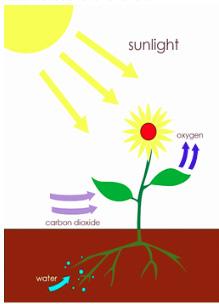
○ What is the role of the leaves? The leaves absorb sunlight and carbon dioxide and combine them with water from the roots to create a chemical reaction that produces sugar and oxygen.
○ What does the plant do with the sugar it produces? The plant uses the sugar for energy.
○ What happens to the oxygen created during photosynthesis? The plant releases the oxygen as waste.
○ Do you think the size of the leaf determines the amount of food the plant can make? Yes, larger leaves can absorb more sunlight and will therefore produce more food. Plants in the shade often have larger leaves to absorb whatever sunlight is available, whereas plants in the desert often have needlelike leaves so they do not absorb too much sunlight.
Possible teacher anchor chart:
To help check for misconceptions, ask students, “Where do plants get their food?” Many students will say soil. Address this upfront by explaining that plants get minerals from soil, but their actual food (sugar) comes from photosynthesis.
Provide a short checklist for groups to review before presenting:
Did we include all bold words?
Did we explain the role of each part?
Did we show how water, carbon dioxide, and sunlight move?
Research Presentation Strategies
After the research activity, students can create a presentation to share what their research found.
● Give students time to practice their presentations in front of smaller groups before presenting to the whole class.
● Give students specific ideas on what to speak about ahead of time. Have students use note cards to outline the major talking points of the research and refer to them during their presentations.
How do the different parts of a plant work together to convert sunlight into energy?
1. Based on your observations, how does the structure of a leaf contribute to its ability to absorb sunlight and facilitate photosynthesis?
2. If a plant’s roots were unable to absorb water efficiently, how might that impact the plant’s ability to perform photosynthesis?
3. How does the process of photosynthesis in plants compare to the way animals obtain energy?
Estimated 1 hr - 2 hrs
Students work in partners or groups to research why differences in plant types exist between two environments. They then sort plant pictures and come up with an explanation for which environment the plant would belong in. Explanations should relate to plant structures, climate, and photosynthesis.
Materials
Printed
● 1 Student Journal (per partner or group)
● 1 Student Handout (per partner or group)
Reusable
● Scissors (per teacher)
● Plastic bag (per group)
● Research materials such as trade books, textbooks, etc. (optional)
● Access to an Internet-capable device such as a computer, tablet, or phone (optional)
● Print plant pictures, in color if possible, for each group or set of partners. Precut the plant pictures and place them in a bag, or allow students to cut the pictures apart within their groups.
● Gather research materials or Internet-ready devices.
● Consider previewing and bookmarking sites for your students based on the column headers. Students will need to visit multiple websites to collect all information on the chart. You may need to explain the difference between direct and indirect sunlight (as it falls on Earth's surface in equatorial latitudes vs far northern and southern latitudes).
Obtaining, Evaluating, and Communicating Information
During this activity, students will obtain, evaluate, and communicate information to explain the phenomenon of how plants turn sunlight into the food and energy they need to grow and survive. By researching plant types in different environments, students will read and comprehend complex texts and reliable media to summarize scientific ideas, compare information across sources, and communicate their findings through explanations that relate to plant structures, climate, and photosynthesis.
Notes
Energy and Matter Systems and System
During this activity, students will explore how plants turn sunlight into food and energy by examining the differences in plant types between two environments. They will use their understanding of energy and matter to track how energy from sunlight is captured and transformed through photosynthesis, and they will apply systems and system models to describe how plant structures and environmental factors interact to support plant survival in different ecosystems.
1. Place students in pairs or small groups.
2. Tell students that they are to research the types of plants that are found in the rain forest and the tundra and the amount of direct sunlight each ecosystem receives.
3. Tell students they are to use their prior knowledge, the provided pictures, and their research to complete the Student Journal page.
4. After student groups have completed their Student Journal pages, direct them to use their knowledge to sort the plant pictures from the Student Handout page into those that could live in the tundra and those that could live in the rain forest. Answers: Tundra: 1, 4, 6, 8; Rain forest: 2, 3, 5, 7
5. Have students discuss why a plant was placed in a specific environment. Amount of direct sunlight used, photosynthesis determining size, rainfall amounts, growing season, environmental conditions, etc.
6. After the sort, you may need to lead a class discussion that allows students to share their thinking about why a picture was placed in a specific environment. Clear up any misconceptions, and use the discussion to reiterate the connections between photosynthesis, plant structure, and climate.
This activity is a closure technique that encourages students to reflect upon the content of the recently completed lesson. It can be completed as a class, with a peer, or individually via a journal entry.
Write the following acronym on the board, or display it using a document camera:
C: Communicate what you have learned.
R: React to what you have learned.
O: Offer one sentence that sums up the lesson or activity.
W: Way you can use what you have learned.
N: Note how well you did today.
Have students complete a short writing exercise about the lesson using the CROWN technique.
How do the differences in environmental conditions, such as sunlight and climate, influence the way plants perform photosynthesis and adapt to their surroundings?
1. How does the amount of sunlight in the rain forest compared to the tundra affect the photosynthesis process in plants found in these environments?
2. In what ways do plant structures differ between those adapted to the rain forest and those adapted to the tundra, and how do these differences support their survival and growth?
3. How might changes in climate impact the ability of plants in both the rain forest and tundra to convert sunlight into food and energy?
FACILITATION TIP
Have students pause mid-sort to check their reasoning with another group before finalizing. This reduces random guesses and promotes justification.
FACILITATION TIP
Turn the final sort into a class chart on the board or projector. Groups can place their plant pictures in two columns, and the class can vote/discuss placements.
STEMscopedia
Reference materials that includes parent connections, career connections, technology, and science news.
Linking Literacy
Strategies to help students comprehend difficult informational text.
Picture Vocabulary
A slide presentation of important vocabulary terms along with a picture and definition.
Content Connections Video
A video-based activity where students watch a video clip that relates to the scope’s content and answer questions.
Career Connections - Arborist
STEM careers come to life with these leveled career exploration videos and student guides designed to take the learning further.
Math Connections
A practice that uses grade-level appropriate math activities to address the concept.
Reading Science - Thanks, Leaves!
A reading passage about the concept, which includes five to eight comprehension questions.
Notes
Multiple Choice Assessment
A standards-based assessment designed to gauge students’ understanding of the science concept using their selections of the best possible answers from a list of choices
Open-Ended Response Assessment
A short-answer and essay assessment to evaluate student mastery of the concept.
Claim-Evidence-Reasoning
An assessment in which students write a scientific explanation to show their understanding of the concept in a way that uses evidence.
Guided Practice
A guide that shows the teacher how to administer a smallgroup lesson to students who need intervention on the topic.
Independent Practice
A fill in the blank sheet that helps students master the vocabulary of this scope.
Extensions
A set of ideas and activities that can help further elaborate on the concept.
Use this template to decide how to assess your students for concept mastery. Depending on the format of the assessment, you can identify prompts and intended responses that would measure student mastery of the expectation. See the beginning of this scope to identify standards and grade-level expectations.
Student Learning Objectives What Prompts Will Be Used?
Plants make their own food through photosynthesis, which combines sunlight, carbon dioxide from the air, and water to make plant food called glucose.
Radiant energy from the Sun is converted to chemical energy and stored in sugar bonds during the chemical reaction of photosynthesis.
Environments receive different amounts of direct sunlight, which can impact photosynthesis and plant growth. For example, the tundra does not receive direct sunlight for some parts of the year.
Does Student Mastery Look Like?
Student Expectations
The student is expected to demonstrate an understanding of a healthy ecosystem with a stable web of life and the roles of living things within a food chain and/or food web using models that include producers, primary and secondary consumers, and decomposers.
Student Wondering of Phenomenon
What would happen to a forest if all the insects suddenly disappeared?
Key Concepts
• Earth’s environments can be classified into a variety of ecosystems, including freshwater, marine, desert, forest, grassland, and tundra. These unique ecosystems support different varieties of organisms.
• Food chains diagram the transfer of energy as it flows from the Sun to producers (plants), to primary consumers (herbivores), to secondary consumers (carnivores that eat herbivores), and on to tertiary consumers (carnivores that eat carnivores).
• Food webs diagram the complex relationships of energy flow in an ecosystem containing a variety of producers, consumers, and decomposers.
• The removal or addition of an organism in a food chain can affect other organisms.
• Environmental changes, such as deforestation, disease, human activities, and invasive species, bring changes in resources that will cause some organisms or populations to perish or move while permitting other organisms or populations to thrive.
Scope Overview
This unit develops students’ understanding of how energy from the Sun drives interactions among producers, consumers, and decomposers within stable ecosystems. Through observation, research, and modeling, students identify abiotic and biotic components, build and compare food chains across ecosystems, and extend them into food webs to show multiple energy pathways. Simulations make energy transfer and trophic dynamics visible, including the effects of disturbances and human-driven changes. Students use evidence from their models to explain organism roles, predict cascading impacts, and describe characteristics of a healthy, stable web of life.
Scope Vocabulary
The terms below and their definitions can be found in Picture Vocabulary and are embedded in context throughout the scope.
Consumer
An organism that gets energy from eating plants or animals
Decomposer
An organism that breaks down the remains of dead plants or animals without need for internal digestion
Ecosystem
All living and nonliving things and all their interactions in an area
Energy Transfer
The movement of energy from one object or material to another or from one form to another
Environment
The space, conditions, and all the living and nonliving things around an organism
Food
What plants and animals use for energy; plants create their own using energy from the Sun, while animals must eat
Food Chain
The path of food energy from one organism to another in an ecosystem
Food Web
An interconnected set of food chains
Fungus
A type of organism that can break down just about any type of organic matter and can be large, such as a mushroom, or small, such as tiny pieces of mold
Niche
The role an organism plays in its ecosystem
Population
All the interacting members of a species in a single area
Producer
An organism that uses sunlight to make its own food for energy
Thrive
To grow well or strong
Students investigate ecosystem components and energy flow through observation and discussion.
• Observe an ecosystem (outdoors or projected) and catalog living and nonliving components.
• Discuss the role of abiotic factors (Sun, water, soil) and how living things interact.
• Construct simple food chains, emphasizing producers, consumers, decomposers, and energy flow from the Sun.
• Extend a class-created chain into a basic food web to show multiple energy pathways within the ecosystem.
Students investigate ecosystems and demonstrate energy transfer by building and comparing simple food chains.
• Students form groups by matching organism cards from the same ecosystem and research key ecosystem facts to complete their journals.
• Groups sequence organisms to model energy flow, starting with the Sun, and use arrows to show transfer from producers to consumers.
• Students create complete food chains for multiple ecosystems (e.g., pond, ocean, tundra, desert) and display their models.
• Class conducts a gallery walk and debrief to compare patterns across ecosystems and reinforce the role of the Sun, producers, and consumers.
Making a Model - Food Web
Students simulate energy flow in a food web to understand how energy moves from the Sun through producers to various consumers and how disruptions affect ecosystems.
• Assume roles (Sun, producers, consumers, decomposers) and model energy transfer using colored squares while “feeding” according to realistic food web interactions.
• Track gains/losses of energy; students who lose all energy become observers, while decomposers address organisms that have “died.”
• Play multiple rounds, including scenario-based disturbances (e.g., fire), to see how changes ripple through trophic levels.
• Discuss outcomes and record observations to connect the simulation to real-world processes like photosynthesis, consumer levels, and the water cycle’s role.
Students model energy flow in a rainforest ecosystem and use it to predict how human-driven changes alter organism interactions and populations.
• Construct and annotate a rainforest food web from organism images, identifying producers, consumers, and decomposers and tracing energy with arrows.
• Extract sample food chains from their webs and record them, reinforcing trophic relationships and energy transfer.
• Participate in a space-based simulation of habitat fragmentation (ranches/roads) and analyze environmental change scenarios— including an invasive species—to predict cascading effects on organisms using evidence from their food webs.
30 min - 45 min
Students observe an ecosystem and determine its living and nonliving components. They make connections between the various parts and are guided toward identifying food chains and food webs, with an emphasis on producers, primary and secondary consumers, and decomposers.
Materials
Printed
● 1 Parts of an Ecosystem (per student)
● 1 Forest Ecosystem (per class)
If you are unable to take the class outside or observe from a window, project the Forest Ecosystem for students to see.
Obtaining, Evaluating, and Communicating Information Developing and Using Models
During this activity, students will obtain, evaluate, and communicate information by observing an ecosystem to identify its living and nonliving components, and they will develop and use models to describe and predict the impact on the ecosystem if all insects were to disappear. By building and revising simple models of food chains and food webs, students will explore the relationships among producers, consumers, and decomposers, and communicate their findings through diagrams and discussions, thereby explaining the phenomenon of the potential consequences on a forest ecosystem in the absence of insects.
Notes
Energy and Matter
Stability and Change
During this activity, students will explore the phenomenon of what would happen to a forest if all the insects suddenly disappeared by observing an ecosystem and identifying its living and nonliving components. They will make connections between these components, focusing on food chains and food webs, to understand the flow of energy and matter. This will help them grasp the concept of energy transfer and the conservation of matter, as well as observe stability and change within the ecosystem over time.
1. View an ecosystem with your students by either going outside or projecting the Forest Ecosystem.
2. After viewing the ecosystem, have students list the things that they see on their Parts of an Ecosystem documents, deciding what is living and nonliving. Discuss the observations as a class.
3. Discuss how the Sun, water, soil, and other nonliving items are important to the health of the ecosystem.
4. Have students discuss how living things interact.
5. Guide students toward starting to build simple food chains. Discuss that energy flow for food is called a food chain, and all energy originally comes from the Sun. Write the words for each food chain on the board, and discuss that the direction the arrow is pointing is the direction the energy is flowing. Have students copy two examples in their Parts of an Ecosystem documents.
○ Examples:
○ Sun - Grass - Rabbit
○ Sun - Shrub - Deer - Bear
6. Aid students in identifying and understanding key vocabulary on the back of their Parts of an Ecosystem documents.
7. Using one of the food chains you have created with students, discuss whether more than one animal in that ecosystem might eat that same plant (for example, the deer and rabbit may both eat the grass in the forest picture). Writing the words and arrows on the board, show how energy would be transferred from the grass to both the deer and the rabbit. Explain that this is how a food web would be created for an ecosystem, and continue to develop the web by having students provide more examples of ways in which energy is transferred to more than just one organism throughout that ecosystem. Students do not need to copy this information down in their Parts of an Ecosystem documents; this is simply a basic introduction to the concept of food webs, which will be developed further in an Explore activity.
Phenomenon Connection
If insects were to suddenly disappear from a forest, how would this impact the food chains and food webs within that ecosystem?
1. How would the absence of insects affect the roles of producers, primary consumers, and secondary consumers in the forest ecosystem?
2. In what ways might the disappearance of insects influence the nonliving components of the ecosystem, such as soil and plant growth?
3. How could the loss of insects alter the interactions between different species within the food web, and what might be the long-term consequences for the forest ecosystem?
FACILITATION TIP
Activate prior knowledge by asking students, “What do you need to stay alive every day?” (food, water, shelter, energy). Then connect to what plants and animals in an ecosystem need.
FACILITATION TIP
Remind students that the arrow does not mean “eats” but “energy flows to.” This helps prevent the common misconception of “grass eats the Sun.”
Estimated 1 hr - 2 hrs
In this activity, students research various ecosystems and the organisms that can inhabit them, and then they identify the flow of energy within those environments by creating basic food chains with sample organisms.
Materials
Printed
• 1 Student Journal (per student)
• 1 Food Chain Cards (per class)
• 1 Food Chain Arrows (per class)
Reusable
• Small yellow paper plates (per group)
• Device with Internet access (per group)
• Print and cut out (laminate if you want to keep) enough Food Chain Cards and Food Chain Arrows so that each student may have one. Students are tasked with locating the other organisms that belong in their ecosystems. To help students locate other organisms in their ecosystems, you might want to color-code the cards or place different-colored dots on the back of each card set (e.g., a blue dot on the back of the tundra cards, a red dot on the back of the rain forest cards).
• Cut out Food Chain Arrows (four arrows per food chain and one per student).
SEP Connection
Obtaining, Evaluating, and Communicating Information Developing and Using Models
During this activity, students will obtain, evaluate, and communicate information by researching various ecosystems and the organisms within them to create basic food chains. They will read and comprehend complex texts and reliable media to summarize scientific ideas supported by evidence. Students will also develop and use models by creating food chains to represent the flow of energy in ecosystems, using models to describe and predict the impact of phenomena such as the disappearance of insects on a forest ecosystem. Through this process, they will communicate their findings orally and in written formats, using diagrams and charts to convey their understanding of energy transfer and ecosystem dynamics.
• Scissors (per teacher) Notes
Connection
During this activity, students will explore the flow of energy and matter within ecosystems by creating food chains, which will help them understand the conservation of matter and energy transfer. This will allow them to observe how the disappearance of insects could disrupt these cycles and lead to changes over time, illustrating the concepts of stability and change within ecosystems.
1. Randomly pass out one Food Chain Card to each student. Make sure to use at least the first three cards from each ecosystem.
2. Give students time to find the other two to three members of their ecosystems. This will be their group.
3. Have students work within their groups to research basic facts about their ecosystem using the Internet. Direct them to fill out the Student Journal page as they research. Use the Student Journal Key as a guide to possible answers.
4. When students have completed their research and the questions in their Student Journals, have groups use their organism cards to put the organisms in an order that could illustrate the transfer of energy in their ecosystem.
5. Distribute a yellow paper plate to each group. Identify the plate as a representation of the Sun. Make sure all students start their chains with the yellow paper plate.
6. Instruct students to determine the flow of the Sun’s energy based on what the organisms consume to gain energy.
7. Pass out paper arrows to each group. Have students use the arrows to connect the organism pictures together. Students should understand that when an organism is eaten, it is passing energy on to the predator. All arrows in a food chain should point away from the Sun and toward the organism that is doing the eating.
○ Key for food chains in each ecosystem:
○ Pond: Algae - Tadpole - Fish - Kingfisher
○ Ocean: Algae - Shrimp - Squid - Whale
○ Tundra: Arctic moss - Arctic hare - Arctic fox - Polar bear
○ Desert: Cactus - Mouse - Snake - Hawk
○ Prairie: Flower - Butterfly - Lizard - Cougar
○ Rain forest: Ferns - Grasshopper - Tree frog - Jaguar
○ Saltwater marsh: Trees (roots) - Fish - Crab - Pelican
8. Explain to students that they have just created a complete food chain that shows the transfer of the Sun’s energy to plants and then on to animals within their ecosystem. Once all of the food chains are created, have groups lay their cards down on their tables.
9. Have students go on a gallery walk to see the other food chains, meeting back with their groups at the end of the walk to discuss the similarities and differences they noticed.
10. Lead students to understanding by discussing the following questions after the gallery walk:
○ What is the source of energy for all life on Earth? How do you know? The Sun. It is the beginning of all the food chains.
○ What type of organism is always found next to the Sun in a food chain? Why? Plants. All plants must receive energy from the Sun to make food.
○ Why did we include arrows in our food chains? The arrows show how energy is transferred from one thing to another, from the Sun to plants to animals in our ecosystem.
Provide a short list of teacher-approved student-friendly websites or a fact sheet with key organisms from each ecosystem. This prevents wasted time on aimless searching and helps ensure accuracy in the Student Journal.
If needed, use a whole class model.
Turn the food chain into a physical model: assign each student a role (Sun, producer, consumer, predator) and have them stand in order holding arrows between them. This kinesthetic approach reinforces the direction of energy transfer.
○ What are some similarities you noticed between the food chains in the different ecosystems? The food chain in each ecosystem always began with the Sun’s energy followed by a plant. Animals that eat plants came next (primary consumers), followed by an animal that could eat another animal (secondary consumer).
○ Would you be able to find the same food chain from one ecosystem within a different ecosystem? Each ecosystem’s food chain has animals that are adapted to live within that specific ecosystem. You would not be able to create a food chain consisting of tree roots > fish > crab > pelican within a prairie ecosystem, for example, because not all of those animals would be able to survive there. There might be tree roots and fish within a prairie pond, but these would be followed in a food chain by a different secondary consumer because crabs and pelicans would not be found living in a prairie ecosystem.
Card
Through this card sort, students demonstrate an understanding of the relationships in a food web.
Create a set of cards that have different vocabulary terms from this scope. Examples include food chain, food web, decomposers, producers, consumers, saltwater and freshwater ecosystems, desert ecosystems, grassland ecosystems, forest ecosystems, rain forest ecosystems, polar tundra ecosystems, or any other related vocabulary terms. Make a matching set of cards with nonlinguistic representations of these terms, such as images. Make enough matching sets for students to work in groups of two.
Have students work with a partner to match the vocabulary terms with their representations. Allow time for students to discuss their choices with other pairs.
When considering the role of insects in a forest ecosystem, how does their disappearance impact the flow of energy and the overall food chain?
1. How do insects contribute to the energy flow within a forest ecosystem, and what might happen to the food chain if they were removed?
2. In what ways do insects support the survival of other organisms in a forest, and how might their absence affect these organisms?
3. How can understanding the role of insects in a forest ecosystem help us predict changes in biodiversity and ecosystem stability if they were to disappear?
Notes
Estimated 1 hr - 2 hrs
In this activity, students play a role in the food web as either a producer or consumer.
Materials
Printed
● 1 Student Guide (per group)
● 1 Student Journal (per student)
● 1 set of Character Role Cards (per class)
● 1 set of Situation Cards (per class)
Reusable
● 3" x 3" colored paper squares: green, orange, yellow, red, brown (one set per class)
● Drawing paper (per student)
● Crayons or markers (per student)
● Scissors (per student)
● Sandwich-sized plastic bag (per student)
● Decide on an area large enough for free movement, such as a gymnasium or a playground.
● Print and copy the Character Role Cards on card stock. To model the energy pyramid, you should have more producers than herbivores, omnivores, and carnivores. You should have fewer herbivores and omnivores and the least amount of carnivores. For example, 24 students would yield 12 producers, 4 herbivores, 4 omnivores, 3 carnivores, and one Sun. All other students should be made decomposers.
● Cut colored squares: 24 yellow squares (so the Sun can give to producers; the Sun should give more after producers are partially eaten), 4 orange (each herbivore gives one to its consumer), 4 brown (each omnivore gives one to its consumer), 3 red (each carnivore gives one to its consumer), and 24–36 green (producers each have 2–3).
● Note that producers get a greater number of green squares because they can give many squares out without dying. They get additional yellow energy squares because unless they are completely destroyed, they continue to produce food. Consumers have one square each because if they are eaten, they die. Decomposers can be given an area and can go get the students that are producers or consumers that have died.
● Cut out situation cards. Sample student answers can be printed if needed.
Obtaining, Evaluating, and Communicating Information Developing and Using Models
During this activity, students will engage in obtaining, evaluating, and communicating information by reading and comprehending complex texts and other reliable media to summarize and obtain scientific ideas about the phenomenon of what would happen to a forest if all the insects suddenly disappeared. They will compare and combine information to support their engagement in scientific practices, obtaining and combining information to explain the phenomenon. Additionally, students will develop and use models to describe and predict the effects on the food web, identifying limitations of models and using them to test cause and effect relationships concerning the functioning of the forest ecosystem.
During this activity, students will explore the concept of energy and matter by observing how the disappearance of insects affects the flow of energy and matter within a forest ecosystem. They will track the transfer of energy from the Sun to producers and through various levels of consumers, recognizing the conservation of matter and the impact on stability and change within the ecosystem. By simulating the roles of producers, consumers, and decomposers, students will measure changes over time and understand how the absence of insects can disrupt the balance and stability of the forest system.
1. Give a Character Role Card and plastic bag to each student. The plastic bag will be students' animals’ “stomachs.” Allow time for students to draw a picture of the animal/plant they received in their Student Journals.
2. Have one student read the procedures. Explain that yellow squares represent the Sun’s energy, so they are passed along from producers to consumers and to other consumers as they eat. Plants are producers and can give out many green squares without dying because they are renewable. Animals are consumers and have only one square because when they are eaten they are no longer living.
3. Ask students to predict what will happen to the food energy squares as the game progresses.
4. Remind students to be as realistic as possible in regard to what consumers would want to eat. For example, a human omnivore would not eat a carnivorous spider.
5. Begin by giving the Sun time to give yellow energy squares to each producer. Producers must stand in place. They cannot change locations to avoid being eaten.
6. Explain the following:
○ Producers give one yellow square (Sun) and one green square to each herbivore or omnivore that eats them.
○ Herbivores get yellow and green squares from producers and give their orange and yellow squares to the omnivores or carnivores that eat them.
○ Omnivores get yellow, green, brown, and red squares from plants and animals that they eat and give their brown and yellow squares to the omnivores or carnivores that eat them.
○ Carnivores get yellow, brown, and red squares from animals that they eat and give their red and yellow squares to the omnivores or carnivores that eat them.
7. Explain that when a student’s energy squares are gone, he or she becomes an observer and must sit out.
8. Continue the game as each member of the forest ecosystem finds food. As the game progresses, the Sun continues to give yellow energy squares to producers who lose theirs to consumers. At some point, the food web will no longer be viable, and no more squares can be given to eligible receivers.
Use cones, chalk, or tape to section off the play area into “zones” (e.g., Sun zone, producers’ zone, decomposers’ corner). This keeps the game more structured.
9. After the first round of play, facilitate a student discussion with guided questions to make connections to the natural world. Focus on the transfer of the Sun’s energy.
Check for Understanding with Quick Stops. Pause mid-game for a 1–2 minute “energy status check” where students look into their baggies and explain who they got energy from. This helps reinforce the flow of energy in real time.
○ Where are the yellow energy squares at the end of the game? What is the significance of this? All of the Sun’s energy has been transferred from the Sun to the producers and then to herbivores/omnivores, and it ends up with carnivores/omnivores. This is how the Sun’s energy moves through organisms within a food chain.
○ What do producers need to make their own food? They need energy from the Sun, water, and carbon dioxide.
○ How does the water cycle affect the flow of energy? Plants rely on the evaporation, condensation, and precipitation of water to make food through photosynthesis.
○ What was the role of the decomposers? The decomposers break down plants and animals that have died within the food web.
○ Who were the primary consumers? Were there secondary consumers? The primary consumers were the herbivores and any of the omnivores that ate plants. The secondary consumers were all of the carnivores and any omnivores that ate animals.
10. Before the second round, be sure that each student has identified himself or herself as a consumer, producer, or decomposer and have explained what that means.
11. Use a Situation Card, or allow students to agree on a new situation that introduces a negative change to the ecosystem. For example, a forest fire destroys half of the producers. Those affected should sit out and observe. After the second round, guide students to identify the effects caused by the change.
12. Play more rounds using the Situation Cards. Discuss the effects.
13. Have students record their observations in their Student Journals.
This activity can cause some students to become overly excited due to the new environment or the movement involved. Encourage students to think before they act and consider the results of their actions. Provide a location for students to remove themselves and pause if they become overexcited during the activity. Read more strategies for overstimulation in the Intervention Toolbox.
Notes
QSSS: Question, Signal, Stem, Share Question: *Please see below.
Signal: When you are finished answering the question, stand behind your seat. Stem: *Please see below.
Share: The tallest student will begin. Possible questions and sentence stems include the following:
● How would you explain a food chain?
○ Stem: I would explain a food chain by _______ .
● What are the differences between producers, consumers, and decomposers?
○ Stem: The differences between producers, consumers, and decomposers are _______ .
● Can you make a distinction between primary and secondary consumers?
○ Stem: A distinction between primary and secondary consumers is ________ .
● How would you improve a 2-D drawing of a food web?
○ Stem: I would improve a 2-D drawing of a food web by ________ .
In the activity, students explore the roles of producers, consumers, and decomposers in a food web. Considering this, what would happen to a forest ecosystem if all the insects, which are key consumers and decomposers, suddenly disappeared?
1. How would the disappearance of insects affect the energy flow from producers to higher-level consumers in the forest ecosystem?
2. What impact would the loss of insects have on the decomposition process and nutrient cycling within the forest?
3. How might the absence of insects influence the survival and reproduction of plant species that rely on insects for pollination?
Notes
Estimated 2 hrs - 3 hrs
Students design and interpret a food web within an ecosystem and then use the food web to predict the changes that will occur to organisms in the ecosystem due to human impact.
Materials
Printed
● 1 Student Journal (per student)
● 1 Environmental Changes (per class)
● 1 Food Web Pictures (per group)
● 1 Teacher Slide (per class)
● 1 Teacher Guide Key (for teacher)
Reusable
● Glue stick (per group)
● Scissors (per group)
Consumable
● Blue painter’s tape (per class)
● 1 sheet of large chart paper (per group)
Preparation
● For Part I, print a set of Food Web Pictures for each group.
● For Part II, tape off an area large enough for students to stand in comfortably without touching.
Obtaining, Evaluating, and Communicating Information Developing and Using Models
During this activity, students will obtain, evaluate, and communicate information by designing and interpreting a food web within an ecosystem to predict changes that will occur to organisms if all insects suddenly disappeared. They will read and comprehend complex texts and reliable media to summarize scientific ideas, compare and combine information to support scientific practices, and communicate their findings through various formats. Additionally, students will develop and use models to represent the relationships within the food web, identify limitations of these models, and use them to describe and predict the effects of the disappearance of insects on the forest ecosystem.
Notes
Energy and Matter Stability and Change
During this activity, students will design and interpret a food web within an ecosystem to predict the changes that will occur to organisms due to human impact, thereby exploring the phenomenon of what would happen to a forest if all the insects suddenly disappeared. This exploration will help students understand the concepts of energy and matter by observing how energy is transferred between organisms and how matter cycles within the ecosystem. Additionally, students will measure stability and change by observing how the disappearance of insects can lead to changes in the ecosystem over time, affecting the balance and stability of the food web.
1. Distribute one Food Web Pictures handout to each group, along with chart paper, a glue stick, and scissors. Have students cut out the pictures. Refer to the previous Engage and Explore activities to review what a food web is, and explain that each group is going to use these pictures to create a possible food web for a rain forest ecosystem.
2. Remind students that the Sun is the beginning source of energy for all other organisms in the food web.
3. Guide students to select the plant pictures as those that would come after the Sun in the food web, and remind them of the definition of producers. Have students in each group begin to glue all of the plants on their chart paper, organized in one line (see the Teacher Guide Key for an example of where each organism might be placed throughout this activity).
4. Have students go through the animal pictures one by one in their groups, deciding where each animal might be placed in the food web based on how they would likely get energy. You may wish to have students identify herbivores/omnivores first and start by placing them near the plants in the food web and then placing carnivores and decomposers together. Review the definitions of consumers (primary and secondary) and decomposers. Tell students to glue pictures of animals onto the chart paper as they go, deciding on the best placement for each one.
5. Have students draw arrows to connect all of the organisms within the food web based on how each one is transferring its energy (see the Teacher Guide Key for examples).
6. Have all groups come together and compare the food webs they have created, holding up a few as examples. Walk the students through a few of the individual food chains within one of the entire food webs. For example, the orchid gives energy to the spider monkey, which gives its energy to the ocelot. The ocelot gives its energy to the velvet worm. At this point, you can pass out the Student Journal page and have students copy down three examples of food chains found within their own food webs in the designated space.
Notes
FACILITATION TIP
Review a few food chains from previous Explores. This gives students a concrete model to build from.
FACILITATION TIP
Check for Diversity in Webs by encouraging groups to include more than one path for energy transfer (e.g., jaguars can eat monkeys or tapirs). This helps move students beyond simple food chains.
Part II
1. Read the following scenario to students:
After each new “change” is introduced (ranch, road, invasive species), stop and have students predict the ripple effects before discussing them as a class.
● The taped-off area of the room represents the Amazon rain forest. Each one of you is one of the animals from our food web that lives in this rain forest and depends on it for food, water, and shelter. The rain forest has been experiencing rapid changes caused by ranchers expanding their grazing lands to raise more cattle. As we go through this activity, think about how these changes will affect you and the food web as a whole.
● Project the Teacher Slide to use as a visual for this scenario. If projection is not available, you may prefer to print a copy for each group.
2. Have all students stand in the large, taped-off square.
3. To represent a ranch, place a strip of tape on one end to make a smaller rectangle within the larger one. Place another strip of tape on the other end to represent another ranch within the taped-off rain forest area. Animals need to move out of the “ranch areas.”
4. Continue the scenario:
● The local government has built a road through this area for the ranchers to use when shipping their cattle to market. This road cuts right through the center of your new home.
5. Place a strip of tape through the center of the rain forest to represent the road. Make sure no one is standing on the road. All students must be on either side of middle piece of tape.
6. Continue the scenario:
● Now that the main road has been built, more ranches are popping up, and smaller roads are built to connect each ranch. More and more traffic is moving through your environment and changing it even more.
7. Discuss how these changes might affect the specific organisms living in this environment. Make sure students understand that the changes make space limited for the animals living in this part of the rain forest, and they are beginning to run out of space as well as resources to use for food and shelter.
8. As a class, discuss some positive and negative effects of this scenario. Examples could include the following:
Notes
Negative Effects
● Trees and plants are dying.
● Some animals will be forced to relocate.
● Some animals may perish because they will not have access to food, water, or shelter.
● Soil erosion increases due to loss of plants.
● Forest flooding increases due to soil erosion.
● Airways and waterways become polluted due to traffic and runoff from pesticides and fertilizers.
● Migration of sensitive wildlife who prefer dark forest interiors decreases.
● Fast-moving vehicles cause animal mortality.
● The human population grows, which causes more forest clearing, pollution, hunting, fires, etc.
Positive Effects
● Increase in economic growth for the area.
● Ranchers make a better living in order to support their families.
● More cattle are raised to feed hungry people.
9. Lead students to realize the specific repercussions related to the individual organisms in the food web the class created. For example, if there are fewer banana trees because they have been cut down to make room for ranches and roads, then there will be less food for howler monkeys. These monkeys will be forced to relocate, or they may die, creating a food shortage for ocelots and jaguars, who in turn will be forced to relocate or possibly die. With fewer of these predators in the ecosystem, populations of other species may increase.
10. Following the discussion, place students into groups of three to four. Distribute one of the Environmental Changes pictures to each group.
11. Have students fill out their Student Journals within their groups. You may want to offer support to the group that receives the card with the introduction of the wild boar. Provide students with background information, explaining that wild boars are native to Europe and Asia and were brought to the rain forest originally to be raised as a source of food for people who moved there. It is thought that a number of boars escaped their habitats over time and have now grown into a sizable wild population. They are harmful to the native animal species living in the rain forest because they bring diseases that the native animals are not able to fight against, and they also eat and destroy certain types of plants.
Notes
Show short visuals (photos of deforestation, roads through forests, or invasive species like wild boars) before the activity so students have background context.
Wild boars are a real-world parallel to invasive species students may know (like zebra mussels in U.S. lakes). Making this connection can strengthen understanding.
12. Discuss some of the environmental changes as a class, making sure to devote special attention to the discussion of the example involving the invasive species of the wild boar so the other groups of students can understand this concept. Lead students to understanding by asking the following questions:
● What created the change in this environment? For example, humans brought boars to raise on their home sites so that they could have a source of meat to eat. Over time, a number of boars escaped their manmade habitats and built up a wild population in the rain forest.
● How is this change helpful? How is this change harmful? Boars living in the wild could provide an additional food source for predators. Instead of certain other animal species that may be endangered, predators may choose to eat boars instead. This could potentially protect endangered species. Boars have been harmful in the rain forest because they have brought diseases that threaten the lives of the native animals who have never been exposed to them before. Also, boars eat and destroy native plants.
● What might happen to the organisms living in this environment? Some species may become endangered if they are threatened by a high rate of disease. If too many plants are eaten or destroyed by boars, it could negatively affect the populations of other animals that rely on those same plants for food.
Students toss a ball to each other and create a class summary of the activity or concept being discussed. Demonstrate how the ball should be thrown to minimize off-task behaviors.
Choose a student to go first. That student should start by giving a one-sentence response to summarize the investigation. Students who wish to go next can raise their hands. The first student should toss the ball to a student with his or her hand raised. Continue until a well-thought-out and thorough summary has been discussed, and then have students return to their seats and write the summary in their science notebooks.
When insects disappear from a forest ecosystem, how does this impact the food web and the survival of other organisms within it?
1. How would the disappearance of insects affect the producers and primary consumers in the food web you created?
2. What changes might occur in the population of secondary consumers and decomposers if insects were no longer part of the ecosystem?
3. How could the absence of insects lead to broader environmental changes, such as soil health and plant pollination, within the forest ecosystem?
STEMscopedia
Reference materials that includes parent connections, career connections, technology, and science news.
Linking Literacy
Strategies to help students comprehend difficult informational text.
Picture Vocabulary
A slide presentation of important vocabulary terms along with a picture and definition.
Content Connections Video
A video-based activity where students watch a video clip that relates to the scope’s content and answer questions.
Career Connections - Zoologist
STEM careers come to life with these leveled career exploration videos and student guides designed to take the learning further.
Math Connections
A practice that uses grade-level appropriate math activities to address the concept.
Reading Science - Let’s Farm Some Shrimp!
A reading passage about the concept, which includes five to eight comprehension questions.
Notes
Multiple Choice Assessment
A standards-based assessment designed to gauge students’ understanding of the science concept using their selections of the best possible answers from a list of choices
Open-Ended Response Assessment
A short-answer and essay assessment to evaluate student mastery of the concept.
Claim-Evidence-Reasoning
An assessment in which students write a scientific explanation to show their understanding of the concept in a way that uses evidence.
Guided Practice
A guide that shows the teacher how to administer a smallgroup lesson to students who need intervention on the topic.
Independent Practice
A fill in the blank sheet that helps students master the vocabulary of this scope.
Extensions
A set of ideas and activities that can help further elaborate on the concept.
Use this template to decide how to assess your students for concept mastery. Depending on the format of the assessment, you can identify prompts and intended responses that would measure student mastery of the expectation. See the beginning of this scope to identify standards and grade-level expectations.
Student Learning Objectives
Earth’s environments can be classified into a variety of ecosystems, including freshwater, marine, desert, forest, grassland, and tundra. These unique ecosystems support different varieties of organisms.
Food chains diagram the transfer of energy as it flows from the Sun to producers (plants), to primary consumers (herbivores), to secondary consumers (carnivores that eat herbivores), and on to tertiary consumers (carnivores that eat carnivores).
Food webs diagram the complex relationships of energy flow in an ecosystem containing a variety of producers, consumers, and decomposers.
The removal or addition of an organism in a food chain can affect other organisms.
Environmental changes, such as deforestation, disease, human activities, and invasive species, bring changes in resources that will cause some organisms or populations to perish or move while permitting other organisms or populations to thrive.
The student is expected to demonstrate an understanding of the physical properties of matter, including hardness, reflectivity, conductivity, solubility, and density. Student Expectations
Why do some objects float in water while others sink, and what makes certain materials shiny, hard, or able to conduct electricity?
Key Concepts
• Matter has physical properties that can be observed to determine how matter is classified, changed, and used.
• Physical properties describe the appearance of an object, including mass (amount of matter), color, strength, hardness, flexibility, reflectivity, magnetism (attraction to a magnet), physical state (solid, liquid, or gas), relative density (sink or float), solubility (ability to dissolve in water), response to heat (melt or evaporate), and ability to insulate or conduct thermal or electrical energy.
• The density of an object affects whether the object sinks or floats when placed in a liquid.
This unit develops students’ understanding of physical properties of matter through observation, measurement, classification, and design. Learners examine matter from the macroscopic to the atomic, model atoms combining into molecules, and investigate hardness, reflectivity, conductivity, solubility, and density using empirical tests. Students compare states of matter, collect and analyze data, and use evidence to identify materials. They apply concepts of relative density and buoyancy to engineer, test, and iterate floating solutions, strengthening scientific reasoning and meeting the expectation.
The terms below and their definitions can be found in Picture Vocabulary and are embedded in context throughout the scope.
Conductivity
A physical property that describes the ability to transfer heat or electrical energy
Hardness
A measure of how easily the smooth surface of a mineral can be scratched
Physical Change
A change to a substance without forming a new substance, such as changing size or state of matter
Physical Properties
Characteristics that can be observed or measured; for example, color, melting point, and conductivity
Reflection
The bouncing of energy waves off the surface of an object
Relative Density
How dense something is compared with a reference material
Solubility
Measurement of the ability of a solid to dissolve in a liquid
Notes
Students explore and discuss physical properties of matter through a structured guessing game and classification task.
• Play a 21-questions–style game with Matter Cards, asking only yes/no questions about physical properties (e.g., size, hardness, conductivity, magnetism, solubility) to identify the card.
• Rotate turns selecting cards; if the card isn’t identified within 21 questions, reveal it and start a new round.
• After gameplay, choose five cards and group them by a shared physical property.
• Conduct a peer review by examining other groups’ sets and inferring the property used for classification.
Activity - Atomic Theory
Students investigate how matter is composed of atoms and molecules through observation, modeling, and reflection.
• Observe sand, iron filings, and aloe vera with the naked eye and under a microscope; record and compare drawings.
• Examine a series of leaf images at increasing magnifications to connect visible structures to atoms as fundamental building blocks.
• Reflect in journals on how magnification reveals finer details and supports the concept that all matter is made of atoms.
• Use colored snap cubes to model molecules from atoms (same and different elements) and answer questions to solidify understanding.
Scientific Investigation - Classifying Matter
Students investigate physical properties of matter through hands-on measurement and testing across states and materials.
• Measure temperature and volume of water as a solid, liquid, and gas; observe how shape depends on state and container.
• Test objects for electrical and thermal conductivity, magnetism, and reflectivity using simple circuits, a heat source, a magnet, and a light source; record observations.
• Explore solubility by mixing different powders with water and use evidence to identify each substance.
Engineering Solution - Float Your Boat
Students investigate density and apply engineering design to understand why objects sink or float and how to create a floating vessel.
• Predict and test whether various objects sink or float, using observations to relate outcomes to relative density; record and discuss results.
• Use insights from Part I to design, build, and test clay boats that can carry pennies while meeting criteria for buoyancy, stability, distance traveled, and simulated waves.
• Iterate on designs based on test data, then present results and reflect on performance against the criteria.
Estimated 15 min - 30 min
Students discuss and discover matter through a game of 21 questions.
Materials
Printed ● 1 set of Matter Cards (per group)
● Print and cut out a set of Matter Cards for each group. You may choose to laminate the cards to make them more durable.
SEP Connection
Obtaining, Evaluating, and Communicating Information Planning and Carrying Out Investigations Constructing Explanations and Designing Solutions
During this activity, students will obtain, evaluate, and communicate information by engaging in a game of 21 questions to explore the physical properties of matter, such as size, shape, hardness, color, reflectivity, and conductivity. They will plan and carry out investigations by collaboratively asking questions to identify the matter on the card, using fair tests and controlled variables. Students will construct explanations and design solutions by using evidence from their observations to classify and group materials based on shared physical properties, thereby explaining the phenomenon of why some objects float or sink and what makes certain materials shiny, hard, or conductive.
Notes
Structure and Function Scale, Proportion, and Quantity
During this activity, students will explore the phenomenon of why some objects float in water while others sink, and what makes certain materials shiny, hard, or able to conduct electricity by engaging in a game of 21 questions. This will help them understand the concept of Structure and Function by recognizing that different materials have different substructures, which can sometimes be observed, and these substructures have shapes and parts that serve functions. Additionally, they will apply the concept of Scale, Proportion, and Quantity by using standard units to measure and describe physical quantities such as size, shape, hardness, and conductivity.
1. Tell students the rules of the game:
○ Select a Matter Card, and do not share the card with the others in your group.
○ Group members may ask up to 21 "yes" or "no" questions to try to figure out what is on the card. (Each guess of the card takes away from the 21 questions.)
○ The questions can be about only the physical properties (size, shape, hardness, color, reflectivity, electrical conductivity, thermal conductivity, response to magnetic forces, solubility, etc.) of the type of matter.
○ If the object is guessed, another student may choose a different card and start over. If the card is not guessed after 21 questions, share what was on the card, and another student may choose a different card to continue the game.
2. After the game is over, have students select five cards that can be grouped together based on a physical property they all share.
3. When the other groups are ready, have students take turns looking at each other’s groupings and guessing what property was used to classify the materials.
How do the physical properties of matter, such as size, shape, and conductivity, determine whether an object will float or sink in water, and what makes certain materials shiny or hard?
1. How do the physical properties of an object, like density and buoyancy, affect whether it will float or sink in water?
2. What role do properties like reflectivity and hardness play in determining the appearance and durability of materials?
3. How can understanding the electrical conductivity of materials help us predict their behavior in different environments or applications?
Notes
FACILITATION TIP
Review physical properties with students.
Size & Shape: measurable dimensions.
Hardness: resistance to scratching/ breaking.
Reflectivity: how much light bounces off.
Conductivity: ability to carry heat/ electricity.
Magnetism: attraction to magnets.
Solubility: ability to dissolve in water.
Estimated 30 min - 45 min
In this activity, students explore the properties of atoms and molecules by looking at items with their eyes and using a microscope to compare what they see.
Materials
Printed
● 1 Student Guide (per group)
● 1 Student Journal (per student)
● 1 Leaf Images (per class)
Reusable
● 1 microscope (per group)
● 2 red snap cubes (per group)
● 2 blue snap cubes (per group)
● 1 green snap cube (per group)
Consumable
● 1 spoonful of sand (per group)
● Iron filings (per group)
● 1 piece of aloe vera plant (per group)
● Place the sand, iron filings, and aloe vera plant piece at each group.
● If you do not have enough microscopes for each group, you can project what is seen under the microscope for the whole class.
Obtaining, Evaluating, and Communicating Information
Planning and Carrying Out Investigations
Constructing Explanations and Designing Solutions
During this activity, students will obtain, evaluate, and communicate information by observing objects with their eyes and under a microscope to understand the properties of atoms and molecules. This will help them explain the phenomenon of why some objects float in water while others sink, and what makes certain materials shiny, hard, or able to conduct electricity. They will plan and carry out investigations by using fair tests to produce data that serves as evidence for their explanations. By constructing explanations and designing solutions, students will use evidence from their observations to describe and predict phenomena, such as the behavior of materials in water and their physical properties.
Structure and Function
Scale, Proportion, and Quantity
During this activity, students will explore the properties of atoms and molecules to understand the phenomenon of why some objects float in water while others sink, and what makes certain materials shiny, hard, or able to conduct electricity. By observing objects with their eyes and under a microscope, students will connect the CCC statement of Structure and Function by recognizing that different materials have different substructures, which can sometimes be observed, and these substructures have shapes and parts that serve functions. Additionally, through the use of microscopes and snap cubes to model molecules, students will engage with the CCC statement of Scale, Proportion, and Quantity by recognizing that natural objects and observable phenomena exist from the very small to the immensely large, and using standard units to measure and describe physical quantities such as weight, time, temperature, and volume.
Part I
1. Ask students to observe one object with their eyes and draw what they see.
2. Have students observe the same object under the microscope and draw what they see.
3. Tell students to repeat the same process for the next two objects.
4. Project the Leaf Images for the class to observe. Explain to students that the images are of the same leaf at various magnifications. The number beside each tells you how many times larger it is than its actual size. The final image is what can be seen with an electron microscope. Only then can we see the atoms. Explain that all matter is made up of atoms and that atoms are the smallest building blocks of an object.
5. After students have had a chance to look at all three objects, have them answer the questions in their Student Journals. Be sure students understand that with more advanced microscopes, objects can be seen even more clearly and with better detail.
Part II
1. Now that students have been introduced to the concept of the atom as the smallest unit of matter, introduce the concept of molecules to them.
2. Explain that molecules are particles of matter and are two or more atoms that join together. These atoms may be of the same element, such as the oxygen in the air that we breathe, or they may be different elements, such as carbon dioxide, which is carbon and oxygen that we breathe out.
3. Explain that atoms can be joined together to form molecules and that molecules can be broken down again into their original atom building blocks.
4. Have students follow Part II on the Student Guide to create the molecules using the snap cubes, and then answer the questions in Part II of the Student Journal. Discuss answers as a class to check for understanding. Make sure that students understand that they are creating an example of just one molecule for each type. Provide some perspective on the relative size of molecules in reality by saying that, for example, in one glass of water there are trillions upon trillions of water molecules.
Safety Guide
Safety Goggles
When students are using any form of very small particles or powder, it is safest for them to protect their eyes by wearing goggles. Notes
FACILITATION TIP
Before microscopes come out, ask students: “What do you think this object would look like if we could zoom in 1,000 times?” This primes students to notice changes across magnification.
FACILITATION TIP
Use everyday analogies such as: Atoms = blocks
Molecules = structures built from those blocks
This helps students visualize part-to-whole relationships.
FACILITATION TIP
Let students act out being atoms: red = oxygen, blue = hydrogen, green = carbon. They can “bond” by linking arms to form molecules. This turns bonding into a physical, memorable experience.
Sentence Stems
For emerging Language Acquisition Strategies, have the materials translated into the student's native language as a reference for him or her to use during the activity.
After the group activity, students may complete the following sentence stems in their journals for future reference or as an exit ticket.
Emerging
● Under the microscope I saw ___________________________________________________
● Microscopes are helpful in order to view ____________________ because
● Molecules and atoms are ___________________ (the same/different). Atoms are _____________________________ and molecules are _______________________________.
Expanding/Bridging
● Have students record their observations and learning from the activity. Then have students try to come up with another investigation they could try to explore the properties of atoms and molecules.
How do the properties of atoms and molecules determine whether an object will float or sink in water, and how do these properties relate to the object’s ability to conduct electricity or appear shiny?
1. How do the arrangements and types of atoms in a material influence its density and buoyancy in water?
2. In what ways do the atomic and molecular structures of materials affect their ability to conduct electricity?
3. How do the properties of atoms and molecules contribute to the appearance of shininess in certain materials?
Estimated 1 hr - 2 hrs
In Part I of this activity, students measure the temperature and volume of water in different states to record observations of physical properties of solids, liquids, and gases. In Part II, students test objects to see if they can conduct electricity or heat, can reflect light, or are attracted to a magnet. In Part III, students test the property of solubility to identify materials.
Materials
Printed
● 1 Student Guide (per group)
● 1 Student Journal (per student)
● 1 Solubility Clue Card (per group)
Reusable
Part I
● 1 graduated cylinder, 250 mL (per group)
● 1 thermometer (per group)
● 1 hot plate (per class)
Part II
● 1 metal spoon (per group)
● 1 iron nail (per group)
● 1 wooden spoon (per group)
● 1 plastic spoon (per group)
● 1 eraser (per group)
● 1 cotton ball (per group)
● 1 mirror (per group)
● 2 metal wires (per group)
● 1 battery (per group)
● 1 battery holder (per group)
● 1 small light bulb (per group)
● 1 magnet (per group)
● 1 laser pointer (per group)
● 1 heat lamp (per group)
● 1 clock with second hand (per class)
Part III
● 1 pair of safety goggles (per student)
● 5 stir sticks (per group)
● 1 marker (per group)
Consumable
Part I
● 250 mL ice (per group)
● 250 mL water (per group)
Part II
● 1 sheet of aluminum foil (per group)
Part III
● 5 plastic snack-sized bags (per group)
● 1 tsp. instant coffee (per group)
● 1 tsp. cinnamon (per group)
● 1 tsp. white sand (per group)
● 1 tsp. corn starch (per group)
● 1 tsp. table salt (per group)
● 5 8 oz. clear plastic cups (per group)
Part I
● Be sure to have enough ice for each group.
● Be the one to complete the water vapor station with the hot plate.
Part II
● Place materials for each group in a container for easy distribution and storage.
● Pre-construct the electrical conductivity testers by attaching two wires to each end of the battery holder and one end of one of the attached wires to a small light bulb. If a plastic-coated wire is being used, the ends need to be stripped before attaching them to the battery holders and bulbs. Loose ends (used to test objects for electrical conductivity) will also need about 1 cm stripped to bare wire. Verify that the light bulbs are working.
● Be sure to use new batteries to ensure they work, and replace them as needed if using them for more than one class, as the power begins to drain.
Part III
● Place 1 tsp. of each substance into a separate plastic bag. Prepare one set of bags for each group. Label the bags as follows:
○ Label the bag of instant coffee Substance 1.
○ Label the bag of cinnamon Substance 2.
○ Label the bag of white sand Substance 3.
○ Label the bag of corn starch Substance 4.
○ Label the bag of table salt Substance 5.
● Print a Solubility Clue Card for each group.
Obtaining, Evaluating, and Communicating Information
Planning and Carrying Out Investigations
Constructing Explanations and Designing Solutions
During this activity, students will obtain, evaluate, and communicate information by reading and comprehending complex texts to summarize scientific ideas about why some objects float while others sink, and what makes certain materials shiny, hard, or able to conduct electricity. They will plan and carry out investigations to test these properties, controlling variables and making observations to produce data that serves as evidence. Students will construct explanations and design solutions by using evidence from their investigations to describe and predict the phenomena observed, applying scientific ideas to solve design problems, and generating multiple solutions to determine which best meets the criteria for success.
CCC Connection
Structure and Function Scale, Proportion, and Quantity
During this activity, students will explore the phenomenon of why some objects float in water while others sink, and what makes certain materials shiny, hard, or able to conduct electricity. Through hands-on experiments, students will investigate the structure and function of different materials, observing how their substructures contribute to their properties. They will also use standard units to measure and describe physical quantities, recognizing the scale, proportion, and quantity of natural objects and phenomena from the very small to the immensely large.
Show students how to hold the thermometer correctly (not pressing against the container) so they measure the water or ice accurately.
Make a real-world connection by asking: “Where do you see water changing state in your daily life?” (ice in drinks, fog, condensation on a window).
Part I
1. In Part I of the Student Journal, have students use water to explore solids, liquids, and gases.
2. Direct students to complete the first two columns of the chart in their groups.
3. Be sure students are measuring the temperature of the ice and water, not the container. The tip of the thermometer should be on the ice and in the water.
4. Model the water vapor station as a class. Use the water from the water station.
5. At this station, measure 250 mL of water, pour it in a pot, and place the pot on a hot plate.
6. As the water in the pot begins to boil, measure the temperature of the water vapor. You want to measure right above the water. Be very careful not to burn yourself. Have students record in their charts.
7. Facilitate discussion about the rest of the items in the chart as well as the questions beneath. Lead students to an understanding of the concept that solids have a constant shape, but the shapes of liquids and gases change based on the containers they are in. Review the concept of atoms and molecules from the previous Explore activity, and explain that these particles are closest together in solids and farthest apart in gases. This allows the particles within gases to move around the most, with the least movement being within solids.
1. Write the following words on the board: Reflective, Electrical Conductor, Thermal Energy Conductor, Attracted to Magnets.
2. Ask students how the class could test those concepts: shining a laser pointer at an object, holding a magnet close to an object, etc. Students may or may not know that a closed path (or circuit) of materials that conduct electricity and a power source, such as a battery, are needed to test whether an object will conduct electricity. Remind students that thermal energy deals with increasing/decreasing heat.
3. Have students work in small groups.
4. Ask each group to choose one student to be the materials manager.
5. Have the materials manager get a metal spoon, iron nail, aluminum foil, wooden spoon, plastic spoon, eraser, cotton ball, and mirror for his or her group.
6. Instruct each group to test eight objects to see if they can conduct electricity or heat, can reflect light, or are attracted to a magnet. Have students take five minutes to discuss what materials their group needs to perform this investigation. Electricity: need a circuit; Heat: need a heat source; Magnetism: need a magnet; Reflectivity: need a light source
7. Have the materials manager bring the list of materials the group determined they need to you. Supply the group with what is on its list (electrical conductivity tester, heat lamp, magnet, laser). You may wish to demonstrate how students are to use the circuits to test electrical conductivity.
8. After all groups have their materials, give them 15 minutes to test their objects. Have students record all observations in their data tables and answer the questions underneath in Part II of their Student Journals.
1. Review with students the concept that different types of matter have unique properties that can be used to group or classify them. Properties such as reflectivity, magnetism, and the ability to conduct heat or electricity help us to identify materials. Now students can explore one more property of matter called solubility. Ask if any students have made lemonade or hot chocolate before. When the powder is stirred into the liquid, the powder dissolves. A substance’s ability to dissolve in another substance is called its solubility.
2. Have the materials managers obtain the materials listed in the Student Guide and complete the steps of the investigation to test the solubility of each substance with their groups. Make sure students are wearing their safety goggles, as they will be handling powdery substances.
3. After students record their observations in the table under Part III of their Student Journals, direct them to use the Solubility Clue Card and their observations to identify each mystery substance.
4. Lead a discussion about the results and answers to the questions after students have been given a chance to discuss them as a group.
Hot Plate
This is an electrical device. Ensure that it is working properly and that the cord is in good condition. Never reach over a hot plate that is on or leave it unattended. Use caution when heating materials, and wear protective gear, such as safety goggles and heat-resistant gloves.
Electric Circuit
When testing conductivity, tell students not to touch wires to objects unless directed to do so, especially body parts or wet materials.
Laser
Remind students not to shine the laser in anyone's eyes.
Heat Lamp
Ensure that students never touch or reach over a heat lamp when it is on. Keep the workspace clear of other materials.
Safety Goggles
When using any form of very small particles or powder, it is safest for students to protect their eyes by wearing goggles.
Remind students to stir gently but consistently for the full 15 seconds. Some students may stir too fast and spill, or stir too slowly and think it “doesn’t dissolve.”
Some students may struggle working in groups during this activity. They may not let other students pour substances, stir, or handle materials. Assign students jobs within the group to avoid conflict. For example, each group member could be in charge of handling one substance, or one group member could pour while the other stirs. Jobs should be determined by group size. Short turns will increase sharing. Find more strategies for students who do not share in the Intervention Toolbox.
After students have explored the activity, have them collect their thoughts to take part in the following activity. Students should work collaboratively in groups of four to dramatize the highlighted vocabulary.
● Place the following words on small folded pieces of paper in a container: temperature, volume, solid, liquid, gas, etc.
● Divide students into groups of four.
● Have each group select a word to be acted out.
● Give the groups 5–10 minutes to prepare their skits. (Groups should not use “sounds like” as in charades.) As a hint, you can tell students to think of the movement and spacing of particles when thinking about how to act out the states of matter (solid, liquid, or gas).
● As groups prepare their skits, write numbers on small folded pieces of paper.
● Have each group pick a paper out of the container to randomly assign the order of the skit presentations.
● Warn each group to allow one minute of think time after each skit presentation concludes. (Do not call out answers as in charades.)
● After the think time, have each group guess the definition of the acted-out word.
● Have each skit group record each guess in a T-chart, indicating whether the guess is related to the word or not. Tell the groups to keep guessing until they correctly define the word.
How do the physical properties of materials, such as density, reflectivity, conductivity, and solubility, determine whether an object will float or sink in water, and what makes certain materials shiny, hard, or able to conduct electricity?
1. Based on your observations, what physical properties of an object might influence whether it floats or sinks in water?
2. How do the properties of conductivity and reflectivity relate to the materials you tested, and what implications do these properties have for real-world applications?
3. In what ways do the solubility and other physical properties of materials help us classify and identify different types of matter?
Estimated 2 hrs - 3 hrs
In Part I, students explore the concept of density to predict which objects will sink or float. In Part II, students use an engineering design process to design a vessel that can transport dense substances a determined distance under variable conditions.
Materials
Printed
• 1 Student Journal (per student)
Reusable
• 1 aquarium, large enough for the class to see—approximately 10 gal. (per class)
• 400 pennies (per teacher)
• 1 Ping-Pong ball (per group)
• 1 golf ball (per group)
• 1 iron nail (per group)
• 1 metal paper clip (per group)
• 1 beaker, 500 mL (per group)
• 1 clay, nonhardening, half a stick (per group)
• 1 plastic shoebox (per group)*
• 1 roll of paper towels (per group)
• 1 ruler (per group)
• 1 clock with second hand (per teacher)
Consumable
• 5–10 gal. water (per group)
• 1 L water (per group)**
• 1 strip of aluminum foil (per group)
• 1 small marshmallow (per group)
• *Any plastic tub will work as long as it allows enough room to see whether the boat sinks below the surface.
**Water amounts will vary. Students need enough water to fill the plastic tubs but not so much that it overflows onto the tables while being displaced during the activity.
Part I
● Place all of the materials students will be testing in a container, and give each group its own container of materials to be able to test and evaluate.
● Discard strips of foil and marshmallows after each group’s use, and place new ones in the containers for the next group to use.
● Gather the necessary materials.
● Write the design challenge and criteria on the board or a piece of chart paper.
● Cut the sticks of clay so that each group has the same amount of clay. Keep a stick for yourself. Roll half a stick into a ball.
● Divide the pennies between the groups. You can ask the students to bring the pennies in themselves the day before the activity.
● Fill the aquarium at least half full so that students can see whether an object floats or sinks.
Obtaining, Evaluating, and Communicating Information
Planning and Carrying Out Investigations
Constructing Explanations and Designing Solutions
During this activity, students will obtain, evaluate, and communicate information to understand why some objects float in water while others sink, and what makes certain materials shiny, hard, or able to conduct electricity. They will read and comprehend complex texts to summarize scientific ideas supported by evidence, compare information across reliable media, and communicate findings through various formats. Additionally, students will plan and carry out investigations to test solutions, control variables, and produce evidence to support explanations. They will construct explanations and design solutions using evidence to describe and predict phenomena, applying scientific ideas to solve design problems and generating multiple solutions based on criteria and constraints.
Structure and Function
Scale, Proportion, and Quantity
During this activity, students will explore the concept of density and use the engineering design process to understand the phenomenon of why some objects float in water while others sink. They will investigate how the structure and function of materials, such as their density and shape, affect their ability to float or sink. By designing a vessel to transport dense substances, students will apply the CCC statement of Structure and Function, recognizing that different materials have different substructures that serve specific functions. Additionally, they will engage with the concept of Scale, Proportion, and Quantity by measuring and describing physical quantities like weight and volume, understanding how these factors influence buoyancy and material properties.
Procedure and Facilitation
1. Ask students what determines whether an object will sink or float in water. Accept all answers. Students might suggest how heavy something is/how much mass an object has.
2. Distribute Student Journals. Tell students that whether an object sinks or floats depends on how dense the object is. Do a general Internet search for video(s) showing a heavier object, such as a pumpkin, floating and a lighter object, such as a marble, sinking. Refer to the particles inside of matter that were discussed in previous Explore activities. Explain that rather than having to do with weight, density deals with how closely particles are packed together. The more closely packed the particles are, the denser an object is. If an object is denser than the water it is placed into (particles are closer together), the object will sink. If the object is less dense, it will float.
3. Have students fill out the first two questions under Part I in the Student Journal.
4. Have each group gather its cup of water and the container of materials it will use to make predictions and test density.
5. Tell students to record in the chart the name of the object, whether they think it is more or less dense than water, and their prediction of whether it will sink or float. Then have them place each object into the cup of water one at a time and record whether it sinks or floats.
6. Have students complete the last two questions in their groups, and discuss as a class.
Have students hold and feel each object before testing. Encourage them to justify their predictions using everyday experiences (“This feels heavy for its size, so I think…”).
Part II: Engineering Design Process
Introduce the challenge and define the problem.
FACILITATION TIP
Remind students that reshaping the clay ball redistributes the mass over more volume. This lowers density.
1. Show students the tank of water. Show them the ball of clay. Ask students to predict whether the ball of clay will sink or float.
2. Drop the ball of clay into the tank to show that it sinks.
3. Ask students to consider whether any physical properties of the clay could be changed to allow it to float. Lead them to the conclusion that changing it from a ball shape into a flatter boat shape allows it to float.
4. Introduce and discuss the design challenge: design and construct a clay boat that can hold the greatest number of pennies.
5. Discuss the following criteria:
Criteria
● The boat must be constructed out of a given set of materials.
● The boat must be able hold at least 30 pennies without sinking.
● The boat must stay afloat for at least 10 seconds.
● The boat must be able to travel the length of a plastic shoebox (about 13 inches).
● The boat must be able to stay afloat under variable conditions (simulated waves).
Research and explore the problem.
1. Divide the class into groups. These may or may not be the same groups they were in to complete Part I.
2. Show students the materials they can use in designing and constructing their models: pennies and clay.
3. Remind them that in Part I, they discovered that pennies were denser than water and would sink. Discuss how if a vessel is designed well, it can prevent dense objects or substances from sinking.
Brainstorm and design a solution to the problem.
1. Review the design challenge. Ask students to discuss how their exploration in Part I ties in with the design challenge. Answer the first two questions in Part II in groups.
2. Give groups time to come up with one or more solutions to the challenge.
3. Make sure they sketch or describe their solutions in the Design Portfolio.
Notes
Build, test, and analyze your solution.
1. Distribute the materials.
2. Review safety precautions, including cleaning up spilled water on the floor to prevent slipping, with students to prevent injury. This will become especially important as students test the boat in windy conditions by gently rocking the container to simulate waves.
3. Monitor as students complete the building and testing process.
4. Remind students to dry off the boat and the pennies in between trials.
5. Ask questions and redirect thinking as necessary.
Improve or redesign and retest the solution.
1. Give groups time to analyze their solutions according to the criteria in the Design Portfolio.
2. Assist students in redesigning and retesting as needed.
Present and share the results.
1. Allow time for each group to present its results.
Evaluate your solution and answer the following questions.
1. Let other groups ask questions. Discuss as desired.
2. Complete the remaining questions in the Design Portfolio.
Notes
Set up a clear testing station with towels underneath to contain spills. Rotate groups to test while others revise their sketches.
P.5.5A
If a spill occurs, be sure that students tell you and clean up the area to prevent slips or falls.
After students have completed all of the introductory activities, give them the opportunity to show their understanding by playing Magnificent Quad. In this game, students review all of the major concepts.
The Magnificent Quad Technique:
● Place students in groups of four.
● Give each group four index cards.
● Assign each group one of the following terms: density, matter, sink, float.
● Direct each member of the group to complete one index card (A, B, C, or D) as follows:
○ Student A decorates the word to be defined on the first index card.
○ Student B illustrates the word to be defined on the second index card.
○ Student C writes the definition in bold type on the third index card.
○ Student D writes an antonym of the word on the fourth index card.
● Ask the group to choose a small symbol to place on the back upper-right corner of all four index cards.
● Pick up the cards, mix them up, and redistribute them to all students.
● Have students find the other students who hold matches for their cards.
● Explain that students may use the symbols on the backs of the cards if necessary to find their matches.
● Have the new student groups of four then discuss the new word, the illustration, the definition, and the antonym and prepare to present their word to the class.
● You can facilitate this process by asking each group to report the strategies they used to find their matches.
Notes
How does the density of an object determine whether it will float or sink in water, and how can we apply this understanding to design a vessel that can transport dense materials?
1. How does changing the shape of an object, like the clay, affect its ability to float, and what does this tell us about the relationship between shape and density?
2. In what ways did your group’s design for the clay boat demonstrate the principles of density and buoyancy, and what modifications improved its performance?
3. How can understanding the properties of materials, such as density and buoyancy, help engineers design better ships or floating structures in realworld applications?
STEMscopedia
Reference materials that includes parent connections, career connections, technology, and science news.
Linking Literacy
Strategies to help students comprehend difficult informational text.
Picture Vocabulary
A slide presentation of important vocabulary terms along with a picture and definition.
Content Connections Video
A video-based activity where students watch a video clip that relates to the scope’s content and answer questions.
Math Connections
A practice that uses grade-level appropriate math activities to address the concept.
Reading Science - A Snowy Day
A reading passage about the concept, which includes five to eight comprehension questions.
Notes
Multiple Choice Assessment
A standards-based assessment designed to gauge students’ understanding of the science concept using their selections of the best possible answers from a list of choices
Open-Ended Response Assessment
A short-answer and essay assessment to evaluate student mastery of the concept.
Claim-Evidence-Reasoning
An assessment in which students write a scientific explanation to show their understanding of the concept in a way that uses evidence.
Guided Practice
A guide that shows the teacher how to administer a smallgroup lesson to students who need intervention on the topic.
Independent Practice
A fill in the blank sheet that helps students master the vocabulary of this scope.
Extensions
A set of ideas and activities that can help further elaborate on the concept.
Use this template to decide how to assess your students for concept mastery. Depending on the format of the assessment, you can identify prompts and intended responses that would measure student mastery of the expectation. See the beginning of this scope to identify standards and grade-level expectations.
Student Learning Objectives
Matter has physical properties that can be observed to determine how matter is classified, changed, and used.
Physical properties describe the appearance of an object, including mass (amount of matter), color, strength, hardness, flexibility, reflectivity, magnetism (attraction to a magnet), physical state (solid, liquid, or gas), relative density (sink or float), solubility (ability to dissolve in water), response to heat (melt or evaporate), and ability to insulate or conduct thermal or electrical energy.
The density of an object affects whether the object sinks or floats when placed in a liquid.
Student Expectations
The student is expected to demonstrate an understanding of mixtures and solutions by analyzing various concentrations, investigating variables that affect the rate of dissolving, and designing a system to separate mixtures.
Student Wondering of Phenomenon
Why does sugar dissolve faster in hot water than in cold water, and how can we separate sugar from water once it’s dissolved?
Key Concepts
• A mixture is a combination of two or more different substances that keep their own properties.
• Solutions are a type of mixture in which one substance is evenly distributed into another.
• The materials in mixtures (or solutions) can be separated using purely physical means, including settling, straining, filtering, evaporation, or using magnets.
Scope Overview
This unit develops conceptual and practical understanding of mixtures and solutions. Students observe and define mixtures versus solutions, identify component properties, and use common tools to separate heterogeneous mixtures. They investigate dissolving by testing variables such as temperature, particle size, and agitation, and compare concentrations, including recognizing saturation. Students apply findings to recover solutes and design, build, and evaluate a filtration system within constraints. Throughout, they collect and analyze evidence to connect observable properties to concentration, solubility, and separation efficiency.
Scope Vocabulary
The terms below and their definitions can be found in Picture Vocabulary and are embedded in context throughout the scope.
Dissolve
To spread out evenly in a liquid
Evaporation
Change in state of matter from a liquid to a vapor or gas
Filter
Material with very tiny holes that blocks solid or larger particles but allows gas, liquid, or small grains to pass through
Magnetic
Able to be attracted by a magnet
Mixture
A combination of two or more substances in which each keeps its own properties and both can be easily separated
Properties
Physical or chemical characteristics of matter used to describe or identify a substance
Solution
A liquid mixture in which one substance is mixed evenly throughout another substance
Substance
A form of matter that is the same throughout and has specific properties
Notes
Engage Activity Summaries
Students explore the difference between mixtures and solutions through observation, experimentation, and evidence-based discussion.
• Compare an easily separated mixture (paper clips and toothpicks) with a salt-water solution to anchor concepts.
• Investigate water, oil, and food coloring in a jar: observe layering, droplet behavior, effects of shaking, and separation over time.
• Record physical properties and observations at each step, using them to answer targeted questions about mixing and dissolving.
• Synthesize findings to formulate and agree on class definitions of mixture and solution.
Activity Summaries
Activity - Property Changes
Students investigate how mixtures and solutions affect the physical properties of their components.
• Use magnets and hand lenses to identify components in a sealed sand–iron filings mixture.
• Separate a mixed sample (sand, salt/pepper, magnetic and plastic objects, gravel) using tools like magnets, strainers, filters, and tweezers, recording observable properties.
• Test pairs of substances (water with salt, sand, pepper, lemon juice, powdered drink mix) to determine which form solutions by dissolving.
• Observe separation of dissolved salt from water via evaporation to connect dissolving and recovery of solute.
Scientific Investigation - Mixing It Up
Students investigate how different variables affect dissolving and compare solution concentrations to build conceptual understanding of mixtures and solutions.
• Explore how temperature, particle size, and stirring influence the rate at which a solute dissolves in a solvent, recording observations and timing results.
• Prepare multiple saltwater solutions with the same solvent volume but varying amounts of solute to compare concentrations, including tasting for relative strength.
• Observe and discuss formation of a saturated solution when excess solute remains undissolved, and consider how changing solvent amount affects solubility.
Engineering Solution - Muddy Waters Challenge
Students investigate methods to filter contaminated water and apply engineering design to build and test a filtration system.
• Test individual materials (cotton, coffee filters, sand, felt, gravel, rock salt) to compare their effectiveness at removing visible solids and dissolved color.
• Design and construct a one-pass filter using selected materials within given constraints, then test with red-tinted dirty water.
• Evaluate results by comparing filtered samples to a provided contamination scale and present findings, including reflections on material properties and potential improvements.
Estimated 15 min - 30 min
Students investigate how mixing ingredients together could form a mixture or a special mixture called a solution.
Materials
Reusable
● 1 small jar with a tight-fitting lid (per group)
● 1 stopwatch (per group)
● 1 beaker, 200–250 mL (per group)
● 1 science notebook (per student)
● 1 clear cup or beaker
● Paper clips (per class)
● Toothpicks (per class)
● 1 spoon (per class)
● 1 clear container (per class)
Consumable
● 100 mL water (per group)
● 100 mL cooking oil (per group)
● 1 bottle of liquid food coloring (per group)
● 4–6 paper towels (per group)
● Salt (per class)
● Water (per class)
● Lab journal (per student)
● Place each group’s materials in a container for easy distribution and collection.
● Mix the paper clips and toothpicks together to form an easily separated mixture.
● Have salt and water ready to mix together in a clear cup or beaker.
Planning and Carrying Out Investigations
Constructing Explanations and Designing Solutions
During this activity, students will plan and conduct investigations to explore the phenomenon of why sugar dissolves faster in hot water than in cold water and how to separate sugar from water once it’s dissolved. They will collaboratively produce data by controlling variables such as temperature and stirring, using fair tests and multiple trials. Students will evaluate methods for data collection, make observations and measurements, and use this evidence to construct explanations for the observed phenomena. They will also make predictions about the effects of changing variables, such as temperature, on the rate of dissolution and test different methods for separating sugar from water to determine which best meets the criteria for success.
Cause and Effect
Energy and Matter
During this activity, students will identify and test causal relationships by observing how sugar dissolves faster in hot water than in cold water, linking this to the concept of energy transfer. They will also explore the conservation of matter by tracking how sugar, once dissolved, can be separated from water, reinforcing their understanding of mixtures and solutions.
1. Write the words Mixture and Solution on the board or on a piece of paper placed under a document camera and projected to the class.
2. Have students brainstorm what they know about mixtures and solutions. Record their responses on the board or on the projected paper. Have students give examples of mixtures with which they are familiar. Hold up or place under a document camera the mixture of paper clips and toothpicks. Ask students how this relates to the words mixture and solution. Then hold up or display the salt and water. Combine the salt and water and stir them, and then ask students how this relates to the words mixture and solution.
3. Make sure students are in groups and each group has the necessary materials.
4. Give the groups the following directions:
○ Measure and pour 100 mL of water into the small jar or bottle. Record the physical properties of the water in your science notebook.
○ Measure 100 mL of cooking oil. Carefully pour the oil slowly down the inside of the jar or bottle of water. (Demonstrate how to do this if needed.)
○ Record your observations of the water and the oil in your science notebook.
○ Carefully drip five drops of food coloring into the jar on top of the oil. Observe the water, the oil, and the food coloring for four minutes.
○ Record your observations in your science notebook.
○ Put the lid on the jar, and shake it 15 times. Set the jar on the table or desk and observe it for four minutes.
○ Record your observations in your science notebook.
Remind students that “observe” means more than “watch”—they should use all their senses (except taste/smell) and be specific (color, clarity, separation, bubbles, speed).
Use a projected timer for the 4-minute observation windows so all groups stay on pace.
Point out that the food coloring only dissolves in the water, not the oil. This reinforces that not all liquids mix the same way.
After students formulate their own definitions, allow pairs to compare ideas before building the class definition.
5. Facilitate a discussion by asking the following questions:
○ Do the oil and the water form a mixture? What is your evidence for your answer? The oil and water form a mixture. The oil floats on top of the water, but the two will not be able to completely join together. They will always separate easily.
○ What happened at first when you dropped the food coloring on top of the oil? The food coloring made small balls that rested on top of the oil at first.
○ After a time, what happened to the balls of food coloring? The food coloring sank down through the oil and into the water.
○ What happened when the food coloring fell into the water? Are the food coloring and water a mixture? The food coloring and the water mixed together. Yes, the water and food coloring are a mixture—specifically a solution. The items are a solution because they are not easily separated.
○ After you shook up the food coloring, the oil, and the water, they seemed to mix together. How did that change over time? The contents in the jar separated with the oil on top and the water and food coloring mixed together under the oil.
6. Have students formulate their own definitions of a mixture and a solution based on their observations. Have students share their definitions and come up with a classroom definition. Mixture: a combination of two or more substances where each keeps its own properties and can be easily separated. Solution: a type of mixture where a substance dissolves in another; the molecules spread evenly through the other substance, such as drink mix in water.
When sugar dissolves in water, how can we determine if it forms a mixture or a solution, and what methods can we use to separate the sugar from the water once it’s dissolved?
1. Based on your observations, how does the temperature of water affect the rate at which sugar dissolves, and why might this be the case?
2. If you wanted to separate sugar from water after it has dissolved, what methods could you use, and how would each method work?
3. How does the process of dissolving sugar in water compare to the mixing of oil and water in terms of forming mixtures or solutions?
Notes
Estimated 1 hr - 2 hrs
In this activity, students observe that some mixtures maintain the physical properties of their ingredients and that changes occur to the physical properties of some ingredients in mixtures that are solutions.
Materials
Printed
● 1 Student Guide (per group)
● 1 Student Journal (per student)
Reusable
● 1 hand lens (per group)
● 2–3 magnets (per group)
● 1 pair of safety goggles (per student)
● 5 plastic cups (per group)
● 4 clear plastic cups (per group)
● 2 plastic bags, snack-sized (per group)
● 1 plate, paper or plastic
● 5 plastic spoons (per group)
● 1 plastic beaker 200 mL (per group)
● 1 graduated cylinder, 100 mL (per group)
● 1 black sheet of construction paper, cut into 4 squares (per group)
● 1 strainer (per group)
● 1 funnel (per group)
● 1 pair of tweezers (per group)
● 1 pipette (per group)
● Tape, clear, 1 in. (3 cm) (per student)
● 1 hot plate (per class) (optional)
● 1 beaker, glass, 200 mL (per class) (optional)
Consumable
● Iron filings, 1 tsp. (per group)
● Sand, 1 cup (per group)
● 1 plastic bag, sandwich-sized (per group)
● Duct tape, any color, 3 in. (9 cm) (per group)
● Magnetic BBs (small magnetic balls) or any other small magnetic objects, 1 tsp. (5 mL) (per group)
● Plastic beads or any other small plastic objects, 1 tsp. (5 mL) (per group)
● Gravel, 1 tbsp. (per group)
● 1 toothpick (per student)
● 1 coffee filter (per group)
● Lemon juice, 1 tbsp. (15 mL) (per group)
● Pepper, 1 tsp. (5 mL) (per group)
● Powdered drink mix, 1 tbsp. (15 mL) (per group)
● Salt, 1 tbsp. (15 mL) (per group)
● Water, 1 qt. (1 L) (per group)
Notes
Part I: Mystery Substance
● Prepare the sand and iron filing bags by adding the sand and iron filings to the sandwich bags. Fill the bag about half full of sand. Make sure the top of the bags are sealed with tape so that the sand and iron filings do not leak.
● If you have enough materials, prepare enough bags so each student can have one. If not, prepare one bag per group. A hand lens and magnets will need to be included in addition to the sand and iron filings bag on their trays. If you use one bag per group, make sure students know to pass the bag around so each group member is able to observe the mixture.
● Prepare the snack-sized bags by adding sand (about half full), salt and pepper, small magnetic objects, small plastic objects, and gravel for each group. Add the following tools to their trays (enough for everyone in the group to have if possible): coffee filters, strainers, funnels, tweezers, plastic beakers, black construction paper squares, cups of water, spoons, paper plates, hand lenses, magnets, and pipettes.
Part III: Solution or Not?
● This would be a good teacher-guided station to complete with students. Many of the items from the kits are marked “Not for Human Consumption,” so the materials also need to be recently purchased from a grocery store. Follow the safety precautions if students are tasting the materials.
● Organize the materials for each group, and separate containers for water (over 200 mL), lemon juice (over 20 mL), salt (over 20 mL), powdered drink mix (over 20 mL), pepper (over 20 mL), and sand (over 20 mL) as well as hand lenses, graduated cylinders, beakers, toothpicks, clear plastic cups, and a discard cup for the used toothpicks.
● If completing the station as a teacher-guided station, set up the hot plate with a glass beaker to quickly show students how to remove the water by evaporation to see the salt crystals when the water evaporates. This is an alternative to using the black construction paper.
● You may choose to use multiple class periods to complete this activity. Students need to have enough time to fully understand each physical property and whether it stays the same or changes.
Safety Precautions
● Ensure that no one in class is sensitive to any of the materials used (some might be sensitive to the red dye in powdered drink mixes). Extra precautions may be necessary for students who have breathing issues due to the use of pepper. Students must wear goggles, especially during Parts II and III.
Planning and Carrying Out Investigations
Constructing Explanations and Designing Solutions
During this activity, students will plan and conduct investigations to explore why sugar dissolves faster in hot water than in cold water and how to separate sugar from water once it’s dissolved. They will collaboratively produce data by controlling variables such as temperature and using fair tests to provide evidence for their explanations. Students will evaluate methods for data collection, make observations and measurements, and construct explanations based on evidence. They will also make predictions about changes in variables and test different methods to determine the most effective solution for separating sugar from water.
Cause and Effect
Energy and Matter
During this activity, students will identify and test causal relationships to explain why sugar dissolves faster in hot water than in cold water, and how it can be separated once dissolved. They will explore the concept of energy transfer and matter conservation by observing how heat affects the dissolution rate and how evaporation can be used to recover dissolved substances, reinforcing their understanding of cause and effect as well as energy and matter interactions.
FACILITATION TIP
Encourage students to note multiple physical properties (color, texture, size, magnetic attraction). Prompt them to use complete sentences in the Student Journal, e.g., “The substance is gray, fine, and attracted to a magnet.”
FACILITATION TIP
Encourage students to separate one property at a time: e.g., use a magnet first, then separate by size or shape, then by texture. This makes complex mixtures manageable.
1. Give students the sandwich bags containing the sand and iron filings.
2. Tell students that there are two mystery substances in the sandwich bags that need to be identified.
3. Ask students how they think they can identify the two substances without opening the sandwich bags.
4. Instruct students to use hand lenses and magnets to investigate the mystery substances.
5. Direct students to record their results in Part I of their Student Journals.
1. Ask students to observe the sand, salt and pepper, magnetic objects, and mixture of plastic objects.
2. Once students have finished observing the mixture, have them separate the mixture using the tools on the tray and record their observations about each substance as they are separating it.
3. Direct students to record their information in Part II of their Student Journals.
1. This would be a good teacher group to facilitate. Students are able to observe the changes quickly, and you can monitor their tasting of the substances.
2. Ask students to observe six substances before they measure and mix them to see whether they make solutions when mixed.
3. Instruct students to test only two things at a time (water and one of the others). Note that solutions are made when one thing completely dissolves into another.
4. Explain that there are two options when separating the salt from the water. (This should be the last substance that needs to be separated.) One option involves using the black construction paper to catch the salt crystals as the water evaporates. Students can use the pipette to add several drops of salt water to the black construction paper. The students can then put tape across the salt crystals once all of the water evaporates and add the crystals to their science journals. If you are concerned with time, you can use the hot plate and a glass beaker to quickly evaporate the water.
5. Direct students to complete the charts in Part III of their Student Journals.
1. Direct students to complete the questions in Part IV of their Student Journals.
Notes
Safety Goggles
When students are using any form of very small particles or powder, it is safest for them to protect their eyes by wearing goggles.
Do Not Eat or Drink Materials
Students should be reminded not to eat or drink any materials unless directed to do so.
Tasting Materials
When permitted, use sterile beakers/graduated cylinders for measuring, sterile stir sticks for stirring, clean and sterile clear plastic cups for tasting, and plenty of toothpicks for individual tasting. Ensure that no one in class is sensitive or allergic to any of the materials used.
Wafting
Students should waft in order to smell substances rather than directly inhaling.
Students may struggle completing the journal section of this investigation if they have difficulty writing. Allow students to give their answers verbally by dictating to their partners. Students can also draw the properties of the objects if they prefer. Read more strategies to help students who have difficulty writing in the Interventions Toolbox.
English Language Proficiency
Sentence Stems
When explaining the stations to students, have them repeat the names of the tools and materials they will be using. This will build their English vocabulary. For beginner and intermediate ELLs, have the materials translated into their native languages as a reference for them to use during the activity.
Students can answer these sentence stems in their graphic organizers or journals, or they can turn and share their answers with their neighbor.
Sand/Iron/Powdered Drink Mix/Water Activity
Beginner
Write the words on the board to be sure the students are spelling them correctly.
● Three physical properties of __________ (sand/iron/powdered drink mix/water) are __________ (the answer from the observation).
Intermediate
● The most important observation about __________ (sand/iron/powdered drink mix/water) is __________ (the answer from the observation).
Advanced/Advanced High
● __________ (object) has the following physical properties because __________.
Mixtures Activity
Students can answer these sentence stems in their graphic organizers or journals, or they can turn and share their answers with their neighbor.
Beginner
Write the words on the board to be sure the students are spelling them correctly.
● The mixture __________ (type of mixture) is a mixture because you can __________ (answer from class discussion).
Intermediate
● I can separate the sand and iron filings mixture by __________ (the answer from the observation).
● The powdered drink mix and water solution is not easily separated because __________ (the answer from the observation).
Advanced/Advanced High
● Another example of a mixture is __________ because __________.
● Another example of a solution is __________ because __________.
How does the process of dissolving and separating substances in mixtures help us understand why sugar dissolves faster in hot water than in cold water, and how can we separate sugar from water once it’s dissolved?
1. Based on your observations, what factors might affect the rate at which sugar dissolves in water, and how does this relate to the temperature of the water?
2. How can the methods used to separate mixtures in the activity be applied to separate sugar from water after it has dissolved?
3. What changes occur at the molecular level when sugar dissolves in water, and how might these changes differ between hot and cold water?
Estimated 1 hr - 2 hrs
In Part I of this activity, students explore how temperature, particle size, and stirring affect the dissolving rate of a solute in a solvent. In Part II, students explore various concentrations of salt water.
Printed
● 1 Student Journal (per student)
Reusable
● 1 beaker, 100 mL (per group)
● 1 stopwatch (per group)
● 1 mortar and pestle (per group)
● 1 pair of tweezers or forceps (per group)
● 1 electric kettle or microwave oven to heat water (per class)
● 1 pair of goggles (per student)
● 1 document camera (per class)
● 1 projector (per class)
● 1 beaker, 1,000 mL (1 L) (per group)
● 1 graduated cylinder, 250 mL (per group)
● 1 set of measuring spoons (per group)
● 1 measuring cup, ⅛ cup (per group)
Consumable
● 1 clear, plastic glass (per group)
● 4 sugar cubes (per group)
● 400 mL water (per group, for Part I)
● 750 mL water (per group, for Part II)
● 1 craft stick or stirring stick (per group)
● 1 roll of paper towels (per group)
● 1 paper cup, 3 oz. (per student)
● Salt, ¼ cup (per group)
● 1 plastic bag, snack-sized (per group)
● Print a Student Journal for each student.
● Place each group’s materials in a container for easy distribution and collection.
● Measure the ¼ cup of salt for each group, and pour it into the plastic bag.
● Prepare to heat water in a kettle or a microwave for part of the investigation. (The water should be fairly warm but not too hot.)
Planning and Carrying Out Investigations
Constructing Explanations and Designing Solutions
During this activity, students will plan and conduct investigations to explore how temperature, particle size, and stirring affect the dissolving rate of a solute in a solvent, and how varying concentrations of solute in a solvent can be separated through evaporation. They will make observations and measurements to produce data that serves as evidence for explaining why sugar dissolves faster in hot water than in cold water and how to separate sugar from water once it’s dissolved. Students will evaluate methods for collecting data, make predictions about changes in variables, and construct explanations based on their observations to understand the phenomenon.
Cause and Effect
Energy and Matter
During this activity, students will identify and test causal relationships by exploring how temperature, particle size, and stirring affect the dissolving rate of sugar in water, thereby explaining the phenomenon of why sugar dissolves faster in hot water than in cold water. They will also observe the conservation of matter by separating sugar from water through evaporation, recognizing that the total weight of substances does not change, thus connecting to the CCC statements of Cause and Effect and Energy and Matter.
Procedure and Facilitation
1. Discuss proper lab safety prior to beginning the investigation. Emphasize the importance of wearing goggles throughout the investigation and refraining from eating the materials while working.
2. Review what students know about mixtures and solutions. Facilitate the discussion by asking the following questions:
● What is a mixture? A mixture is a combination of two or more substances that do not form a new substance.
● What is a solution? A solution is a special kind of mixture in which one substance spreads out evenly in another substance. The substances do not keep all of the same physical properties and are not easily separated.
● What is an example of a mixture? Answers will vary.
● What is an example of a solution? Answers will vary.
3. Divide the class into groups. Make sure that each group has the materials needed to complete the investigation.
4. Remind students that one substance always dissolves in another when a solution is formed. The solute is the substance that dissolves, and the solvent is the substance into which the solute dissolves. Have them record these definitions in their Student Journals.
5. Tell students that they are going to be exploring three things that affect the rate at which a solute dissolves in a solvent: the temperature of the solvent, the shape of the solute, and whether or not the mixture is stirred.
6. Emphasize that students need to work together and make careful observations to complete the investigation successfully.
Encourage students to note both qualitative and quantitative observations:
Qualitative: appearance, size, color, transparency
Quantitative: time it takes to fully dissolve or partially dissolve
7. Allow groups to work independently. Circulate among the groups as they work, asking questions and redirecting thinking as needed.
Demonstrate the difference between tsp., tbsp., and ⅛ cup for accurate measurements.
Stress uniform mixing and pouring into individual cups to avoid crosscontamination.
8. After all of the groups have completed the task, display a blank copy of the Student Journal using a document camera and a projector. Call on volunteers to share their observations and answers to the questions. Fill in the blank Student Journal as students share.
1. Explain that now you will be comparing differences between solutions with the same amount of solvent but varying amounts of solute.
2. Review that salt and water form a solution where the solute (salt) dissolves in the solvent (water). They can be separated by evaporating the water and leaving the salt behind.
3. Ask if any students have ever made lemonade by stirring powdered mix into water. Ask what they would do if they tasted it and it was too watery. Add more powdered mix until it has a strong enough lemon flavor/sweetness. Explain that adding more of a solute to a solution creates a solution that is more concentrated. Assist students in filling out the first question under Part II of their Student Journals.
4. Have students work in the same groups as they did in Part I. They should fill a 1,000 mL beaker with 750 mL of water, but all other materials should already be at their tables.
5. Monitor as students complete the procedures with their groups and fill out Part II of their Student Journals. Make sure they note the difference between the 1 tsp. and 1 tbsp. measuring spoons. Explain that when they create each of the three solutions with different concentrations of salt, they need to pour some from the glass into their individual paper cups to taste. Each student needs to make sure to use his or her own individual tasting cup each time.
Ask: students “How can we dissolve more solute in saturated water?” (Answer: add more solvent or increase temperature.)
6. When students create the third solution, be sure to lead a discussion about what they are noticing. The ⅛ cup of salt should not completely dissolve in the water. Explain that this means the water is saturated, or that a saturated solution has been formed. There is too much solute (salt) to be able to completely dissolve in that amount of solvent. Ask students what they would do if they wanted to dissolve the rest of the salt they see floating around in the glass. Add more water until there is enough water to dissolve the extra salt.
When students are using any form of very small particles or powder, it is safest for them to protect their eyes by wearing goggles.
Students should be reminded not to eat or drink any materials unless directed to do so.
When permitted, use sterile beakers/graduated cylinders for measuring, sterile stir sticks for stirring, clean and sterile clear plastic cups for tasting, and plenty of toothpicks for individual tasting. Ensure that no one in class is sensitive or allergic to any of the materials used.
Graphic Organizer
You can have students discuss what example of a mixture and solution they found more challenging or interesting.
After students discuss for about 5–10 minutes, have them create a graphic organizer for the mixture and solution they discussed. Partners can complete the graphic organizer.
Have them get a piece of construction paper and fold it “hamburger” style. Have them open the construction paper, take the right corner, and fold it to the middle fold. They should then take the left corner and fold it to the middle fold. You should have two shutters. Cut those shutters in the middle. On the outside, have students write the names of the objects in the mixture on top, write the name of the solution on the bottom, and list the physical properties of each object. On the inside, they should draw how the mixture and solution look when mixed. Under each picture, have them complete the following stem sentences:
● A mixture is created when _____________________ .
● A solution is created when _____________________ .
How do temperature, particle size, and stirring affect the rate at which sugar dissolves in water, and how can we separate sugar from water once it’s dissolved?
1. Based on your observations, how does increasing the temperature of water affect the dissolving rate of sugar?
2. If you wanted to recover the sugar after it has dissolved in water, what method could you use to separate it?
3. How does stirring influence the dissolving process, and why might this be important in practical applications?
Estimated 2 hrs - 3 hrs
Design, construct, and test a filter system to remove impurities from dirty water.
Materials
Printed
● 1 Student Journal: Muddy Waters Design Portfolio and Group Rubric
● 1 Group Task Cards
Reusable
● Dirty water (per group)
● 1 colander (per class)
● 1 sieve (per class)
● Plastic bowls (per group)
● 1 large funnel (per group)
● Clear plastic jars or glasses (per group)
● 200 mL fine sand, uncolored if using art sand (for 1 group)
● 1 roll of paper towels (per group)
● 200 mL rock salt (for 1 group)
● 200 mL gravel (for 1 group)
● 18 clear, plastic water bottles (per class)
● 1 permanent marker (per class)
● 1 pitcher, opaque (per class)
● Card stock (per class)
● Scissors (per class)
● 5 plastic bags, gallon size (per class)
● Beakers (per class)
● Blue food coloring (per class)
● Red food coloring (per class)
NOTE: Large tea strainers such as sieves can be purchased at many dollar stores.
Consumable
● 1 package coffee filters (for 1 group)
● Cotton balls (for 1 group)
● Felt squares (for 1 group)
● Gather the necessary materials.
● Collect samples of pond water if available. If you do not have access to pond water, make your own dirty water by adding soil, twigs, leaves, small rocks, etc., to tap water. Make enough dirty water to use as a demonstration in the introduction, in initial testing by groups, and for testing the final filter systems.
● Create a set of comparison samples. Using a permanent marker, label each water bottle as Sample 1 through Sample 6. Fill each water bottle nearly full of tap water. Leave Sample 1 as clear water. Add increasing amounts of soil, pebbles, twigs, etc., to each sample bottle, with Sample 6 having the greatest amount of contamination.
● Pour some of the dirty water in an opaque pitcher to use in the introduction of this lesson. Put a few drops of red food coloring in the pitcher of water.
● Fill each of the 12 remaining water bottles with about 100 mL of dirty water for initial and final group testing. Be sure each bottle contains some of the contaminants. Put a drop of blue food coloring in six of the bottles for the initial test and a drop of red food coloring in the other six bottles for the final test.
● Write the design challenge with the criteria on a piece of chart paper, or prepare it to display using a document camera and a projector.
● Duplicate a copy of the Design Portfolio and rubric for each student.
● Duplicate one set of task cards on card stock for each class. Cut apart.
● Fill a bag with 200 mL of cotton balls for each class you teach. (Use a beaker to measure the exact amount.) Do the same with the gravel, rock salt, and fine sand.
● Have all the materials in a central location so that students can gather the needed materials during the exploration and building activities.
During this activity, students will plan and conduct investigations to produce data as evidence for explaining the phenomenon of why sugar dissolves faster in hot water than in cold water and how to separate sugar from water once dissolved. They will evaluate methods for collecting data, make observations and measurements, and use evidence to construct explanations or design solutions. By designing, constructing, and testing a filter system to remove impurities from dirty water, students will apply scientific ideas to solve design problems and generate multiple solutions, assessing their effectiveness based on criteria and constraints.
During this activity, students will identify and test causal relationships by designing, constructing, and testing a filter system to remove impurities from dirty water. They will explore the cause and effect relationship between the materials used in their filter and the effectiveness of impurity removal, understanding that events occurring together with regularity might or might not signify a cause and effect relationship. Additionally, students will learn about energy and matter by observing how matter is made of particles and how energy is transferred during the filtration process, recognizing the conservation of matter as they track the flow of contaminants before and after filtration. This will help them understand why sugar dissolves faster in hot water than in cold water and how to separate sugar from water once it’s dissolved.
Introduce the challenge and define the problem.
1. Remind students of science safety rules, such as no eating or drinking without the teacher's permission.
2. Ask the class if anyone is thirsty and would like a drink of water. Pour a glass of the dirty water. Hold it up, and ask if anyone would like to come and drink it.
3. Call on volunteers to say why they would not and should not drink the glass of water.
4. Remind students that the water and the stuff in it form a mixture. Brainstorm the characteristics of a mixture, recording student responses on the board.
5. Call on volunteers to list some mixtures with which they are familiar.
6. Tell the students that—of course—they are not going to drink this dirty water. However, in many parts of the world, there is a lack of clean drinking water, and some people would gladly drink the dirty water.
7. Environmental engineers around the world are trying to solve this problem. An environmental engineer is a person who uses his or her creativity and knowledge of science to solve problems. When designing a way to clean water so that people can drink it, the environmental engineer must consider the physical properties of the ingredients that make up the dirty water mixture. This helps him or her decide what methods can be used to remove the contaminants from the water.
8. Ask students to think about how they might separate the ingredients in the dirty water mixture. Display a colander with large openings and a sieve with smaller openings. Do a thumbs-up, thumbs-down survey to predict which will separate the mixture better. Have students hold their thumbs up if they think the colander will work better to separate the mixture, and have them hold their thumbs down if they think the sieve will get cleaner water.
9. Pour some dirty water through each into clear plastic glasses. Compare which worked better. Discuss why. (Perhaps the smaller holes through which the water passes make a difference.) Tell students that they are going to be environmental engineers for a day. They have to design a device to get the dirty water as clean as possible.
10. Display the design challenge. Call on a student to read the challenge. Discuss the criteria.
Criteria
● The filter can be constructed only from a given set of materials.
● The water can be poured through the filter system only once.
● The filter system is evaluated by comparing each team's filtered water sample to a given set of water samples.
Research and explore the problem.
FACILITATION TIP
Create a “testing schedule” so groups aren’t all trying to access materials simultaneously.
FACILITATION TIP
Emphasize the importance of pouring SLOWLY - this is crucial for effective filtration and prevents spills.
1. Divide the class into six groups. Tell students they are going to test different materials to find out which one filters the water the best. Each group will test a different material and then present its results to the class.
2. Assign each group one material to test using the sieve: Group 1: Cotton balls, Group 2: Double coffee filter, Group 3: Fine sand, Group 4: Felt squares, Group 5: Gravel, and Group 6: Rock salt.
3. Let each group gather the materials listed on their task cards.
4. Monitor each group as it tests different filtering materials.
Notes
5. Once all of the groups have completed the task, call the class together. Tell students that the soil and other solids in the mixture represented a variety of contaminants in the environment. Tell them that not all contaminants can be seen, which is why the water was blue. The blue food coloring represented contaminants that can form a solution with the water in nature. The best filters need to clean the solids AND the blue color out of the water, if possible.
6. Have Group 1 bring their filtered water forward and show the entire class. Use a permanent marker to label the bottle as 1. Let the group members share the material that they used to filter their water.
7. Call on Group 2 to bring their filtered water forward and share the testing material they used. Label their bottle as 2.
8. Continue with the other four groups. As each bottle is labeled, place it with the other bottles so that you are creating a sequence of the cleanest to the dirtiest water.
9. Ask the following questions:
○ Which material(s) seemed to work the best for filtering the dirty water?
○ Which material(s) seemed to work the worst for filtering the dirty water?
○ How did each filter material change after you used it?
○ Could you reuse the material to clean more water? Why or why not?
Brainstorm and design a solution to the problem.
1. Review the design challenge with students.
2. Have them work in their groups to choose the materials they will use in their filters and create a design (Portfolio 3).
Provide sentence frames for students to use when presenting results: “Our filter removed _________ because...”
FACILITATION TIP
Ask groups to measure and compare the volume of water recovered after filtration.
Have students create a class data table to record all groups’ results systematically. P.5.5B
Build, test, and analyze the solution.
1. Once the groups have created their filtering systems, give them the bottles of red-tinted water.
2. Monitor as the students complete the building and testing process.
3. Ask questions and redirect thinking as necessary.
Improve or redesign and retest the solution.
1. In this activity, students do not have the opportunity to actually improve or redesign their filter systems.
2. Have students discuss how they might change their filtration system to improve it.
Present and share the results.
1. Allow time for each group to present its results. Have the group compare its filtered water to the samples you prepared.
2. Let other groups ask questions as desired.
3. If necessary, ask these questions:
○ What materials did you use in your filtration system?
○ How well do you think it worked?
○ Which sample is your water most like?
○ What physical properties of the water mixture made it possible to clean the water?
○ What would happen if you poured more contaminated water through your filter? Would it continue to work?
4. Complete the Group Rubric for each group. Discuss with students.
When students are using any form of very small particles or powder, it is safest for them to protect their eyes by wearing goggles.
Do Not Eat or Drink Materials
Students should be reminded not to eat or drink any materials unless directed to do so.
Notes
After students have completed the engineering solution, allow them to show you what they have learned by taking part in Ticket Out.
Ticket Out is a short written reflection about the lesson. Hand students index cards. Tell them to complete the following sentences to reflect on what they learned from the engineering solution using the following sentence stems:
● I learned about _______ .
● I discovered _______ .
● I explored _______ .
After students complete the sentence stems, allow them to switch index cards with another student. They can read their sentence stems and talk about what they saw, heard, or felt.
When we dissolve sugar in water, how can we separate it back out, and what methods can we use to ensure the water is clean and safe to drink?
1. How does the temperature of water affect the rate at which sugar dissolves, and what implications does this have for designing a filtration system for dirty water?
2. What methods can we use to separate dissolved substances, like sugar, from water, and how do these methods compare to the filtration techniques used in the activity?
3. In what ways can the filtration process be improved to remove both visible impurities and dissolved substances, and how can we test the effectiveness of these improvements?
STEMscopedia
Reference materials that includes parent connections, career connections, technology, and science news.
Linking Literacy
Strategies to help students comprehend difficult informational text.
Picture Vocabulary
A slide presentation of important vocabulary terms along with a picture and definition.
Content Connections Video
A video-based activity where students watch a video clip that relates to the scope’s content and answer questions.
Career Connections - Oceanographer
STEM careers come to life with these leveled career exploration videos and student guides designed to take the learning further.
Math Connections
A practice that uses grade-level appropriate math activities to address the concept.
Reading Science - Scott’s Science Project
A reading passage about the concept, which includes five to eight comprehension questions.
Notes
Multiple Choice Assessment
A standards-based assessment designed to gauge students’ understanding of the science concept using their selections of the best possible answers from a list of choices
Open-Ended Response Assessment
A short-answer and essay assessment to evaluate student mastery of the concept.
Claim-Evidence-Reasoning
An assessment in which students write a scientific explanation to show their understanding of the concept in a way that uses evidence.
Guided Practice
A guide that shows the teacher how to administer a smallgroup lesson to students who need intervention on the topic.
Independent Practice
A fill in the blank sheet that helps students master the vocabulary of this scope.
Extensions
A set of ideas and activities that can help further elaborate on the concept.
Use this template to decide how to assess your students for concept mastery. Depending on the format of the assessment, you can identify prompts and intended responses that would measure student mastery of the expectation. See the beginning of this scope to identify standards and grade-level expectations.
Student Learning Objectives What Prompts Will Be Used?
A mixture is a combination of two or more different substances that keep their own properties.
Solutions are a type of mixture in which one substance is evenly distributed into another.
The materials in mixtures (or solutions) can be separated using purely physical means, including settling, straining, filtering, evaporation, or using magnets.
Does Student Mastery Look Like?
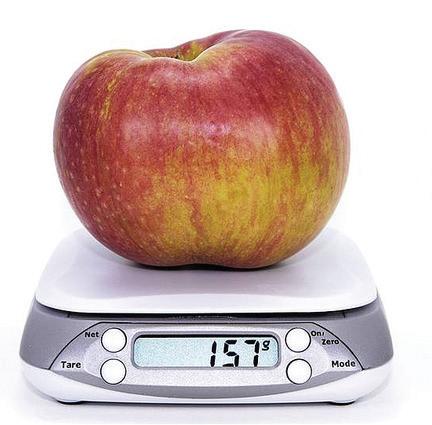
The student is expected to demonstrate an understanding of the difference between physical and chemical changes by analyzing the data and supporting his or her claims.
What happens to a piece of paper when you crumple it versus when you burn it, and why do these changes look and feel so different?
Key Concepts
• New substances form during a chemical change. The physical and chemical properties of the new substance are different from the properties of the original substance.
• A physical change can affect the physical properties of a substance, such as the state of matter, size, or shape, but does not affect its composition.
• When two substances are mixed together, the total weight is always equal to the weight of the original substances.
Scope Overview
This unit develops students’ ability to distinguish physical from chemical changes through observation, hands-on investigation, and data analysis. Learners collect evidence of property changes, identify indicators of new substances and energy change, and contrast reversible physical changes with irreversible chemical reactions. They examine mixture separation and conservation of mass across rearrangement, dissolving, and phase change to strengthen understanding of physical processes. Students synthesize findings using claims, evidence, and reasoning to analyze data and justify conclusions about the type of change occurring.
Scope Vocabulary
The terms below and their definitions can be found in Picture Vocabulary and are embedded in context throughout the scope.
Chemical Change
A change that alters the identity of a substance, which results in a new substance or substances with different properties
Color Change
Visible change in a substance’s color; is evidence of a chemical change
Physical Change
A change to a substance without forming a new substance, such as changing size or state of matter
Physical Properties
Characteristics that can be observed or measured; for example, color, melting point, and conductivity
Production of a Precipitate
Sign that a new substance formed from a chemical change; creation of a solid in a liquid or inside another solid during a chemical reaction
Production of Gas
Sign that a new substance formed from a chemical change; includes bubbles, fizzing, or odor change
Production of Heat or Light
Sign that a release of energy occurred during a chemical change
Temperature Change increase or decrease of heat energy in a substance; may be evidence of a new substance being formed during a chemical change
Students distinguish physical versus chemical changes through teacher demonstrations and structured observation.
• Watch physical change demonstrations (e.g., apple sliced/smashed, ice melting) and note observable property changes without new substances forming.
• Observe chemical change demonstrations (e.g., paper burning, glow stick reaction, apple browning, milk curdling with vinegar) indicating new substances or energy changes.
• Record evidence in a comparison chart and participate in a debrief to generate additional real-world examples.
Students investigate examples of chemical changes and contrast them with physical changes through observations and discussion.
• View a decomposition video and discuss how decay changes matter.
• Observe pancake mix as water and heat are applied, recording evidence of new substances forming.
• Watch paper burn to ash and document observations of irreversible change.
• Compare regular and rusted steel wool, using observations to identify indicators of chemical reactions and record findings in journals.
Students investigate physical changes and mixture separation through hands-on stations and a culminating paper-cutting challenge.
• Manipulate everyday materials to observe and record physical changes.
• Design, test, and evaluate methods for separating different mixtures using selected tools (e.g., magnets, filters, sieves).
• Follow guided paper-cutting steps to transform a sheet into a large loop, reinforcing properties of materials and precision in procedures.
Students investigate how physical changes affect measurable properties, focusing on whether mass is conserved across different scenarios.
• Count and weigh LEGO bricks, build a structure with all pieces, then reweigh to compare mass before and after rearrangement.
• Measure and weigh water and salt separately (accounting for container and spoon), combine them, and reweigh to examine mass after dissolving.
• Weigh an ice cube in a sealed bag before and after melting to compare mass across phase change.
• Complete a CER to communicate findings and evaluate understanding.
Notes
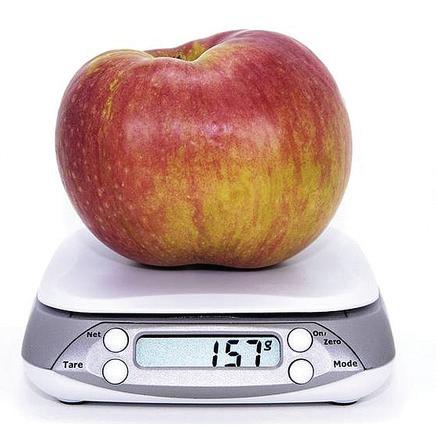
Estimated 30 min - 45 min
Students watch a teacher demonstration and compare the differences between chemical and physical changes.
Materials
Printed
● 1 Chemical and Physical Changes (per student)
Reusable
● 1 pie pan (per teacher)
● 1 knife (per teacher)
● 1 pair of safety goggles (per teacher)
● 1 fire blanket or fire extinguisher (per teacher)
● 2 50 mL beakers (per class)
● 1 ice cube tray (per teacher)
Consumable
● 2 bags, plastic, zip-top, sandwich (per class)
● 1 glow stick (per class)
● 1 apple (per class)
● 1 sheet of lined paper (per class)
● 1 match (per class)
● Whole milk, 50 mL (per class)
● White vinegar, 40 mL (per class)
● 1 ice cube (per class)
SEP Connection
Planning and Carrying Out Investigations
● Copy one Chemical and Physical Changes per student.
● Make sure to collect all needed materials.
Obtaining, Evaluating, and Communicating Information
During this activity, students will plan and conduct investigations to explore the differences between chemical and physical changes, using controlled variables and multiple trials to gather data. They will make observations and measurements to produce evidence for explaining the phenomenon of why crumpling and burning paper result in such distinct changes. Students will also obtain, evaluate, and communicate information by comparing their findings with reliable sources to support their understanding of the observed phenomena.
CCC Connection
Energy and Matter Cause and Effect
During this activity, students will explore the phenomenon of what happens to a piece of paper when crumpled versus when burned, and why these changes look and feel different. Through a series of demonstrations, students will identify and test causal relationships to explain changes, understanding that events occurring together with regularity might or might not signify a cause and effect relationship. They will also observe how matter is made of particles and how energy can be transferred in various ways, recognizing the conservation of matter by tracking matter flows and cycles before and after processes, noting that the total weight of substances does not change.
1. Begin with a discussion about physical properties and the apple:
● How do we determine the physical properties of an item? We can use our five senses and take measurements.
● Describe the apple. Red, round, smooth, has a smell, etc.
● Can I change the apple’s shape? How? Yes, by cutting it or taking a bite out of it
2. Explain that not only does matter have physical properties, but matter may also have chemical properties that are usually observable only when a chemical change occurs. You can define a chemical change in terms of a new substance being formed as a result.
3. Demonstrate chemical and physical changes. Have students fill out the chart titled Physical and Chemical Changes on the Chemical and Physical Changes sheet as you complete each demonstration.
○ Demonstration 1: Apple sliced
■ Cut the apple in half and show students the white flesh. Ask them if anything was permanently changed. No. Have students fill in the table on the Chemical and Physical Changes sheet. Discuss how only the shape of the apple changed.
○ Demonstration 2: Apple smashed
■ Take a slice of the apple and put it in a plastic bag. Pass it around the room, and allow students to squeeze the apple slice. By the end, the baggie should contain a very smashed apple. Ask them if anything was permanently changed. No, it will still taste and smell like apple; it has just changed its state of matter and shape. Have students fill in the table on the Chemical and Physical Changes sheet.
○ Demonstration 3: Paper burned
■ Place the metal pie pan on the desk to catch the burning paper before starting. Use the match or fireplace lighter to light about one-quarter of the paper. Ask students what they observe. Place the burning paper in the metal pie pan and blow it out. Make sure to point out safety tools to students by wearing goggles and having a fire blanket or fire extinguisher. Have students fill in the table on the Chemical and Physical Changes sheet.
○ Demonstration 4: Glow stick snapped
■ Show students the glow stick. Turn off the lights, and make the room as dark as possible. Break the glow stick and ask students what they observe. The light produced shows a chemical reaction. Have students fill in the table on the Chemical and Physical Changes sheet.
○ Demonstration 5: Apple flesh browned
■ Show students the inside of the apple. After about 30 minutes, it should begin to turn brown. This is an oxidation reaction, and the color change shows that a chemical change has taken place. Discuss that the apple is reacting to the air around it. Have students fill in the table on the Chemical and Physical Changes sheet.
Start the apple browning demonstration at the very beginning of class so it has time to oxidize visibly.
Consider cutting the apple 10-15 minutes before the lesson begins for more dramatic browning effect.
Have backup glow sticks in case one doesn’t activate properly.
○ Demonstration 6: Milk and vinegar combined
Prepare the milk and vinegar measurements in advance to avoid delays during the lesson.
■ Mix the milk and vinegar in a plastic bag. There is no need to be exact on the measurements of the milk and vinegar. Students should observe that the vinegar causes the milk to curdle, creating the curds (solids) and whey (liquid) of Miss Muffet fame.
○ Demonstration 7: Melted ice cube
■ Hold the ice cube in your hand over the ice cube tray. Squeeze the ice cube in your hand. As the ice cube melts, let it drip over the ice cube tray. Students should observe that the ice is dripping water and that the water in the tray can be put back into the freezer to make an ice cube again.
4. Conclude the activity with a discussion of what students observed:
5. What are some other examples of physical changes? Answers will vary. Sample student answers: cutting or tearing paper, breaking a crayon, making shapes with clay, boiling water, dissolving sugar in water, etc.
6. What are some other examples of chemical changes? Answers will vary. Sample student answers: burning wood, rusting metal, setting off fireworks, using a battery, etc.
Safety Goggles
When students are using any form of chemicals, it is safest for them to protect their eyes by wearing goggles.
Fire Extinguisher or Blanket
Have access to a fire extinguisher or blanket when burning materials.
Students who struggle with their vision may not be able to see the changes demonstrated in this activity. Repeat the procedure on a surface close to the student, such as his or her desk. Learn more strategies to help students with difficulties processing visual information in the Interventions Toolbox.
When we crumple a piece of paper, it changes shape but remains paper, whereas burning it transforms it into ash and gases. How do these processes illustrate the difference between physical and chemical changes?
1. What observations can you make about the physical properties of a piece of paper before and after crumpling it?
2. How does burning paper demonstrate a chemical change, and what evidence do we have that a new substance is formed?
3. In what ways do the changes observed in the apple demonstrations relate to the changes seen in the paper when it is crumpled or burned?
Estimated 1 hr - 2 hrs
In this activity, students identify objects as they go through chemical changes.
Materials
Printed
Part I
● 1 Student Journal (per student)
Reusable
Part I
● Computer (per class)
● Projector (per class)
Part II
● Hot plate (per class)
● Mixing spoon (per class)
● Mixing bowl (per class)
Consumable
Part II
● “Just add water” pancake mix (per class)
● Water
Part III
● Matches (per class)
● Paper (per class)
Part IV
● Steel wool (2 per group: 1 regular and 1 rusted)
● Print the appropriate number of Student Journal pages.
● Do an Internet search for “Decomposition! Without it we’d be buried under piles of biomass,” and have it ready to project for students to watch.
● This lesson calls for using matches to show students how paper changes when it is burned. Check your school's procedures to make sure of the safety rules. If burning is not allowed in your school, do a video search that shows an object burning and the change that happens.
● Prepare the rusted steel wool overnight. Place the steel wool in enough white vinegar to cover it overnight. It will be rusted in the morning.
● Vinegar (per class) Notes
Obtaining, Evaluating, and Communicating
During this activity, students will plan and conduct investigations to explore the phenomenon of what happens to a piece of paper when it is crumpled versus when it is burned. They will make observations and measurements to produce data that serves as evidence for explaining the differences between physical and chemical changes. By evaluating appropriate methods and tools for collecting data, students will gain insights into the variables affecting these changes and communicate their findings through various formats, including written observations and class discussions.
Procedure and Facilitation
During this activity, students will explore the phenomenon of what happens to a piece of paper when it is crumpled versus when it is burned. They will identify and test causal relationships to explain these changes, understanding that events occurring together might not always signify a cause and effect relationship. Through observing the burning of paper, students will learn about the transfer of energy and the conservation of matter, recognizing that matter is made of particles and that the total weight of substances does not change even as they undergo chemical transformations.
1. Explain to students that they will be learning about changes in materials. One example of this is when plant and animal matter decays.
2. Show the video “Decomposition! Without it we’d be buried under piles of biomass.”
3. After students have watched the video, have a class discussion about how there was a change in matter in the video and how decaying matter results in a change.
1. This will be a class demo. This can be done either as a whole class demo or a small group demo while students are working at their desks.
2. In front of the class, read the directions for making pancakes. Show students what the powdered mix looks like. Allow time for them to write their observations in their Student Journals.
3. Add the correct amount of water.
4. Show students what happens when water is added to the powder. Allow time for them to write their observations in their Student Journals.
5. Place the mix on the hot plate and make a pancake. Make sure to place the hot plate where students can see what you are doing.
6. Have students record their observations on what happens when heat is added to the pancake mix. Have students record their observations in their Student Journals.
1. Make sure to follow your school's safety rules since matches and fire will be used.
2. Show students a piece of paper. Have them record their observations in their Student Journals.
3. Light a match and burn the paper in front of the class. Allow students to see the ashes that are created and record their observations in their Student Journals.
Before each demonstration, have students write predictions in their Student Journals: “What do you think will happen when...?”
FACILITATION TIP
Use a timer to keep demonstrations moving at appropriate pace.
FACILITATION TIP
Create a class chart categorizing all observed changes as either physical or chemical with evidence.
Part IV: Rusting
1. Make sure to rust the steel wool overnight. You should have enough so groups are able to see rust and the change that happened and record their observations in their Student Journals.
2. Discuss the following:
Discuss rusting in everyday life: cars, playground equipment, tools left outside.
⸰ Rust is a new substance that is formed when the steel wool, water, and air mix together. Sometimes when materials are combined, they can form a new substance with different properties, like the rust.
⸰ This change is called a chemical change, or a chemical reaction. A chemical change is different from a physical change because the matter in a physical change is still the same matter.
⸰ A physical change may include a change in size, shape, or color, but a chemical change happens when a new substance is formed, such as a bubbly gas or another object with different properties.
⸰ Sometimes, the new substance may be easy to identify, such as the formation of a gas or a precipitate, but sometimes it might not be as obvious. We can use indicators, such as a temperature change or a change in color, to help us.
Hot Plate
This is an electrical device. Ensure that it is working properly and that the cord is in good condition. Never reach over a hot plate that is on or leave it unattended. Use caution when heating materials, and wear protective gear, such as safety goggles and heat-resistant gloves.
Safety Goggles
When students are using any form of chemicals, it is safest for them to protect their eyes by wearing goggles.
Fire Extinguisher or Blanket
Have access to a fire extinguisher or blanket when burning materials.
Magnificent Quad Game
After students have completed all of the introductory activities, give them an opportunity to show their understanding by playing the Magnificent Quad Game. In this game, you will review all of the major concepts.
The Magnificent Quad Game technique:
● Place students in groups of four.
● Give each group four index cards.
● Assign each group one of the following terms: property, chemical change, physical change, phase of matter, production of heat or light, formation of a precipitate, production of a gas, rust, corrode, combust, and density.
● Each member of the group should complete one index card (A, B, C, or D) as follows:
○ Student A decorates the word to be defined on the first index card.
○ Student B illustrates the word to be defined on the second index card.
○ Student C writes the definition in bold type on the third index card.
○ Student D writes an antonym of the word on the fourth index card.
● Have the group choose a small symbol to place on the back upper-right corner of all four index cards.
● Pick up the cards, mix them up, and redistribute them to all students.
● Ask students to find their matches for each group of cards.
● Allow students to use the symbols on the backs of the cards if necessary to find their matches.
● Have the new student groups of four then discuss the new word, illustration, definition, and antonym and prepare to present their word to the class.
● Facilitate this process by asking the groups to report the strategies they used in finding their matches.
When matter undergoes a physical change, like crumpling paper, versus a chemical change, like burning paper, how do these processes differ in terms of the matter’s properties and composition?
1. How does the process of burning paper demonstrate a chemical change, and what evidence do we have that a new substance is formed?
2. In what ways does crumpling paper illustrate a physical change, and why does the paper remain the same substance despite the change in shape?
3. How can the changes observed in the rusting of steel wool and the cooking of pancake mix help us understand the differences between physical and chemical changes?
Notes
P.5.5C
Estimated 1 hr - 2 hrs
In Part I, students observe and manipulate different objects to determine the physical changes that can be made to them. In Part II students explore components of mixtures and how to separate them. In Part III students cut paper in order to step through it.
Materials
Printed
● 1 Student Journal (per student)
Reusable
● Containers for mixtures
● Steel nails
● Copper nails
● Scissors
● Various separating tools, such as:
● Tweezers or tongs
● Colanders, strainers, sieves, or screens
● Coffee filters
● Magnets Consumable
● Paper
● Pencils
● Popcorn kernels (not popped)
● Chocolate
● Rice
● Mung beans (or similar)
● Gravel
● Water
● Construction paper
● You may either set up stations for the five objects for student groups to rotate through, or you may have all five objects at the grouped tables. Gather the paper, pencils, popcorn, chocolate, and rice (you may substitute other objects if these are unavailable) and place them in numbered locations.
● Create the following mixtures:
○ Station 1: Steel nails and copper nails (it would be best if these were close in size)
○ Station 2: Rice and mung beans
○ Station 3: Gravel and water (if you have a sink in your classroom, this station would best be set up there)
● Gather the separation tools (tweezers, colanders, etc.) and place them in a central location in the room from which students can choose.
● Gather construction paper and scissors. Be sure to have practiced the cuts before class.
Obtaining, Evaluating, and Communicating
During this activity, students will plan and conduct investigations to understand the physical changes that occur when manipulating objects, such as crumpling versus burning paper, and how these changes differ in appearance and texture. They will collaboratively produce data to serve as evidence for explaining the phenomenon, using fair tests with controlled variables. Students will evaluate methods for data collection, make observations and measurements, and communicate their findings through various media formats, thereby enhancing their understanding of the scientific and engineering practices.
Energy and
During this activity, students will explore the phenomenon of what happens to a piece of paper when crumpled versus when burned by identifying and testing causal relationships to explain these changes. They will understand that while crumpling paper involves a physical change, burning it involves a chemical change, illustrating the concept of cause and effect. Additionally, students will learn that matter is made of particles and observe the conservation of matter by tracking matter flows and cycles before and after these processes, recognizing that the total weight of substances does not change even though their form and energy state might.
Procedure and Facilitation
Procedure and Facilitation Points
1. Allow students to rotate around the five objects and determine the physical changes that can be made.
2. Allow students to manipulate the objects to aid in their research.
3. Have students fill out Part I in their Student Journals.
1. Ask students to brainstorm what the best, most efficient, fastest method would be to separate the mixtures at each station using only the provided separation tools.
2. You can spot-check them before students are allowed to test their methods.
3. Note: To extend this activity, give students timers before they test their methods so that they can time how long it takes to separate their mixtures. Then, as a class, you can have a discussion about which methods were best for each mixture.
1. Pass out construction paper and scissors.
2. Demonstrate and guide students through the paper-cutting steps:
○ Fold the paper in half hamburger style (wider, not longer).
○ Cut out a thin rectangle on the folded side.
○ Make alternating cuts from the cut side to the end and from the end to the cut side. Do not cut all the way through the paper, and do not let the cuts touch each other.
○ Unfold the paper and pass your body through it.
Create a class chart categorizing the types of physical changes observed (shape, size, state, etc.)
Have students predict which objects will be easiest/hardest to change before manipulating them.
Have pre-made examples at different stages (folded, partially cut, fully cut) for students who get lost.
Guess Your Corner
After students have had time to explore the investigation, it is time to play a game called Guess Your Corner.
● Place one sign with one of the following terms in each corner of the classroom: physical change, chemical change, mixture, substance.
● Choose one student to be blindfolded.
● Using a timer, give students five seconds to go stand in one of the corners.
● Have the student who is blindfolded describe one of the vocabulary words out loud. For example, he or she can say, “This term is a change to a substance without forming a new substance.”
● Explain that any students standing in the corner with the vocabulary word described must sit down.
● Give students another five seconds with the option to move to another corner.
● Continue playing until everyone is seated.
How do physical and chemical changes differ in terms of their impact on the properties and composition of materials?
1. What are the observable differences between physical changes, like crumpling paper, and chemical changes, like burning paper?
2. How can we use separation techniques from the activity to understand the concept of conserving matter during physical changes?
3. In what ways do the changes we observed in the activity help us understand the transformation of matter from one state to another, such as solid to gas?
Estimated 1 hr - 2 hrs
In this activity, students observe the physical properties of various items put together and taken apart. They determine what happens to the weight of each of the items in their various stages.
Materials
Printed
● 1 Student Guide (per group)
● 1 Student Journal (per student)
● 1 CER (per student)
Reusable
● 10–15 Lego bricks (per group)
● 1 beaker (per group)
● 1 scale (per group)
Consumable
● 1 tbsp. salt (15 mL) (per group)
● 1 qt. water (30 mL) (per group)
● 1 zip-top bag (per group)
● 1 ice cube (per group)
SEP Connection
Planning and Carrying Out Investigations
Part I
● Ahead of time, fill a baggie with 15–20 Lego bricks.
● Have all materials for each group ready.
● Record the weight of the tablespoon and the beaker ahead of time. Students must subtract these items from the final weight to show that the mass is the same before and after the salt is added.
● Be sure to have a supply of ice available for this activity.
Obtaining, Evaluating, and Communicating Information
During this activity, students will plan and conduct investigations to explore the phenomenon of what happens to a piece of paper when crumpled versus burned. They will observe and measure the physical properties and mass of various items in different stages, using controlled variables and fair tests to produce data that serves as evidence for explanations. By comparing the changes in mass and form, students will develop an understanding of physical versus chemical changes, and communicate their findings through written and oral formats, supporting their conclusions with evidence gathered from their investigations.
Energy and Matter
Cause and Effect
During this activity, students will explore the phenomenon of what happens to a piece of paper when crumpled versus when burned by identifying and testing causal relationships to explain changes in physical properties. They will observe how matter is made of particles and how energy can be transferred in various ways, recognizing that the total weight of substances remains constant before and after processes, thus demonstrating the conservation of matter.
Part I
1. Have students count and weigh the bricks before building with them.
2. Ask students to build a structure using all the bricks.
3. Have students weigh the structure once it is complete.
4. Direct students to discuss how the number of bricks did not change and how the weight was the same whether the bricks were arranged in a structure or taken apart.
Part II
1. Ahead of time, weigh the spoon used to measure the salt. Have this amount posted so that students can subtract the weight of the spoon when necessary.
2. Have students place 30 mL of water in a beaker.
3. Ask students to weigh and record the beaker of water.
4. Instruct students to measure one tablespoon of salt. Weigh the spoon of salt, and subtract the mass of the spoon used for measuring.
5. Add the salt to the water.
6. Weigh the beaker again, and discuss the mass of the beaker after the salt is added.
Part III
1. Give each group a baggie with an ice cube in it.
2. Ask students to weigh and record the mass of the baggie.
3. Wait for the ice to melt and turn into water.
4. Ask students to weigh and record the mass of the baggie after the ice has melted.
Post-Activity
1. Have students complete the CER to determine their level of understanding of the performance expectations.
2. Based on the student answers, reteach or extend their learning as needed.
FACILITATION TIP
-Create partnership roles: “Scale Reader,” “Data Recorder,” “Materials Manager”.
FACILITATION TIP
Students can use small containers to mass the salt if needed.
FACILITATION TIP
Use of a zipper freezer bag can help minimize leaking.
At the end of the Explore, have students write a short description of the activity. Make sure to remind students to use vocabulary from the lesson. Once each student has completed his or her description, hold a class discussion on what students wrote.
When we change the form of an object, such as crumpling a piece of paper or burning it, how do we know if the matter is still present in a different form, and why do these changes appear and feel so different?
1. How does the weight of the Lego structure compare before and after it is built, and what does this tell us about the conservation of matter when objects are rearranged?
2. When salt is dissolved in water, how does the weight of the solution compare to the individual weights of the salt and water, and what does this indicate about the matter’s presence in a different form?
3. After the ice cube melts, how does the weight of the water compare to the original ice cube, and what does this reveal about the matter’s state change from solid to liquid? P.5.5C
Notes
STEMscopedia
Reference materials that includes parent connections, career connections, technology, and science news.
Linking Literacy
Strategies to help students comprehend difficult informational text.
Picture Vocabulary
A slide presentation of important vocabulary terms along with a picture and definition.
Content Connections Video
A video-based activity where students watch a video clip that relates to the scope’s content and answer questions.
Career Connections - Welder
STEM careers come to life with these leveled career exploration videos and student guides designed to take the learning further.
Math Connections
A practice that uses grade-level appropriate math activities to address the concept.
Reading Science - Signs of Chemical Changes
A reading passage about the concept, which includes five to eight comprehension questions.
Notes
Claim-Evidence-Reasoning
An assessment in which students write a scientific explanation to show their understanding of the concept in a way that uses evidence.
Multiple Choice Assessment
A standards-based assessment designed to gauge students’ understanding of the science concept using their selections of the best possible answers from a list of choices
Open-Ended Response Assessment
A short-answer and essay assessment to evaluate student mastery of the concept.
Guided Practice
A guide that shows the teacher how to administer a smallgroup lesson to students who need intervention on the topic.
Independent Practice
A fill in the blank sheet that helps students master the vocabulary of this scope.
Extensions
A set of ideas and activities that can help further elaborate on the concept.
Use this template to decide how to assess your students for concept mastery. Depending on the format of the assessment, you can identify prompts and intended responses that would measure student mastery of the expectation. See the beginning of this scope to identify standards and grade-level expectations.
Student Learning Objectives
New substances form during a chemical change. The physical and chemical properties of the new substance are different from the properties of the original substance.
A physical change can affect the physical properties of a substance, such as the state of matter, size, or shape, but does not affect its composition.
When two substances are mixed together, the total weight is always equal to the weight of the original substances.
Does Student Mastery Look Like?
Student Expectations
The student is expected to demonstrate an understanding of the factors that affect the motion of an object by studying Newton’s laws of motion and by designing a system to increase the effects of friction.
Why do some objects move faster or slower than others, and how can we change their speed using things like pushing, pulling, or making surfaces rougher?
Key Concepts
• Gravity is a force of attraction between two or more masses.
• A force is a push or pull that can change the motion of an object. Motion is a change in the position, direction, or speed of an object.
• A balanced force does not change the motion of an object. The object will stay at rest or will move at a constant speed in the same direction (Newton’s first law).
• An unbalanced force causes a change in the motion or direction of an object. The object will move in the direction of the stronger force.
Scope Overview
This unit builds understanding of what affects an object’s motion through handson inquiry into Newton’s laws, balanced vs. unbalanced forces, energy transfer, and friction. Students analyze real-world scenarios, classify phenomena, and design and test simple systems to generate and interpret data. Through prediction, measurement, comparison, and iterative redesign, they connect cause-and-effect relationships to changes in speed and direction and engineer a solution that increases friction.
Scope Vocabulary
The terms below and their definitions can be found in Picture Vocabulary and are embedded in context throughout the scope.
Balanced Forces
Forces on an object that do not change the motion of the object
Direction
A line or course along which something is moving
Force
A push or pull that causes an object to move, stop, or change direction
Friction
A force that resists the motion of two surfaces sliding across one another
Motion
How an object moves from one place to another
Movement
A change in position or location
Position
Where an object is located
Pull
A force that causes something to move closer
Push
A force that causes something to move away
Speed
Rate of motion
Unbalanced Forces
Forces on an object that cause change in the motion of the object
Notes
Students investigate Newton’s three laws of motion and connect them to everyday situations through discussion, sorting, and synthesis.
• Observe and discuss posted descriptions and images of the three laws; brainstorm real-life examples as a class.
• In groups, sort scenario cards to match each law, then compare and discuss classifications as a class.
• Collaboratively complete a graphic organizer to summarize each law and provide examples; teacher checks for understanding.
Students investigate how balanced and unbalanced forces affect an object’s motion through discussion, experimentation, and model testing.
• Analyze everyday scenarios to identify balanced vs. unbalanced forces and predict resulting motion.
• Observe how varying balloon shapes and inflation levels create unbalanced forces that change speed and direction.
• Design and build a balloon-powered car from provided materials, then measure the distance traveled in five seconds.
• Share and compare results to explain why some designs traveled farther, linking outcomes to force and motion principles.
Students explore how different forces and types of balls transfer energy to nearby objects and affect their motion.
• Read a short text and discuss gravity, potential energy, and kinetic energy using a bouncing ball.
• Predict, test, and record how a golf ball, baseball, and basketball dropped from 30 cm affect nearby lightweight and heavier items.
• Measure and compare movement of objects across multiple trials to observe energy transfer and vibrations.
• Investigate contact vs. noncontact forces by contrasting letting go of a ball with pushing it from the same height, then share findings.
Students investigate how friction affects motion by engineering a ramp that makes a toy car travel as slowly as possible.
• Plan and build prototype ramps using specified materials and a fixed height, focusing on increasing friction.
• Collect baseline and experimental run times with the same car, compare results, and iteratively redesign to slow the car.
• Analyze how surface materials and slope influence speed, then share findings and reflect on group performance.
Estimated 30 min - 45 min
Students explore Newton’s laws of motion as they apply them to real-life situations through a matching activity. Then they complete a graphic organizer to summarize the laws and give examples.
Materials
Printed
● 1 Newton (per student)
● 1 set of Newton’s Law Cards (per class)
● 1 set of Scenario Cards (per group)
● Print one set of Newton’s Law Cards and one set of Scenario Cards per group in color. These can be laminated and reused for each class.
● Display the Newton's Law Cards, which describe Newton’s three laws of motion, somewhere in the room where they are visible to all students. Have them grouped together by law.
Planning and Carrying Out Investigations
Analyzing and Interpreting Data
Constructing Explanations and Designing Solutions
During this activity, students will plan and conduct investigations collaboratively to explore Newton’s laws of motion, using fair tests to control variables and produce data that serves as evidence for explaining why some objects move faster or slower than others. They will make observations and measurements to support their explanations and use graphical displays to reveal patterns and relationships. By analyzing and interpreting data, students will refine their understanding of the phenomenon and construct explanations using evidence to predict how changes in variables, such as force and surface texture, can affect an object’s speed.
Cause and Effect Systems and System Models
During this activity, students will identify and test causal relationships by exploring Newton’s laws of motion, helping them understand why some objects move faster or slower than others. They will use these relationships to explain changes in speed through actions like pushing, pulling, or altering surface textures. Additionally, students will view Newton’s laws as a system of related parts that work together to explain motion, allowing them to describe how components and their interactions within this system can affect the speed of objects.
1. Before you begin the Engage activity, give students some background on Sir Isaac Newton. He lived from 1643 to 1727 and was an incredibly influential scientist. One of the things for which he is most famous is his creation of a set of laws describing motion and force. We know these as Newton’s laws of motion, and they summarize some realities we observe in our everyday lives.
2. Have students observe the three laws that you have posted in the room. Read each one as a class, and then discuss the pictures that serve as a further description of each law. There is no need to go into great detail about balanced/unbalanced forces at this time, as these will be covered in greater detail in one of the upcoming Explore activities.
3. Brainstorm examples of when students may have observed these laws applying to situations in their own lives.
4. Have students break into groups. Distribute one set of Scenario Cards to each group, and have students sort them based on which of the three laws of motion they believe is being demonstrated in each scenario. They may refer to the descriptions of the laws that are posted on the wall as needed.
5. Discuss as a class how students grouped the cards.
○ Answer Key: Law of inertia: 1, 2, 4, 7, 10
○ Law of force and acceleration: 3, 5, 8, 9
○ Law of action-reaction: 6, 11, 12, 13
6. Distribute the Newton page. Have students work in groups to complete the graphic organizer. Check for understanding.
How do Newton’s laws of motion help us understand why some objects move faster or slower than others, and how can we use these laws to change their speed through actions like pushing, pulling, or altering surface textures?
1. How do Newton’s laws explain the differences in speed when we push or pull objects of varying masses?
2. In what ways can changing the surface texture affect the motion of an object according to Newton’s laws?
3. How can we apply Newton’s third law to understand the interaction between two objects when one moves faster or slower than the other?
A possible background could be the Three Laws of Motion. These laws explain how and why objects move the way they do. For example, they can explain why a ball keeps rolling until something stops it, why it’s harder to push a heavy box than a light one, and why a balloon flies around when you let go of it.
Assign each group a “law detective” role where one student’s job is to explain why their group matched a scenario to a specific law. This encourages accountability, reinforces reasoning skills, and ensures that students aren’t just guessing but can justify their answers using evidence from the law descriptions.
Estimated 2 hrs - 3 hrs
In Part I of this activity, students consider information about balanced and unbalanced forces. In Part II, students plan and conduct a scientific investigation to test the effects of a balanced force on the speed and direction of an object.
Materials
Printed
● 1 Student Journal (per student)
● 1 Balanced and Unbalanced Forces (per student)
Reusable
● 1 pair of scissors (per group)
● 1 glue gun (per group)
● 1 timing device (per group)
● 1 meterstick (per group)
Consumable
● 2 dowels, ⅜ in. diameter, 8 in. length (per group)
● 1 square of cardboard, 30 cm (per group)
● 4 water bottle lids (per group)
● 4 paper cups, 3 oz. (per group)
● 4 plastic straws (per group)
● 10 craft sticks (per group)
● 1 meter of duct tape (per group)
● 4 hot glue sticks (per group)
● 1 balloon, round, 12 in. (per group)
● 1 balloon, tube shaped (per group)
Planning and Carrying Out Investigations
Analyzing and Interpreting Data
● Place all necessary materials in containers for students to easily gather what they need for Part II. Students do not need to use all of the supplies.
Constructing Explanations and Designing Solutions
During this activity, students will plan and conduct investigations to explore the phenomenon of why some objects move faster or slower than others. They will collaboratively design and test balloon-powered cars, controlling variables such as the type and inflation level of balloons, to gather data on how unbalanced forces affect speed and direction. By analyzing and interpreting their findings, students will use evidence to construct explanations and refine their designs, ultimately understanding how pushing, pulling, and surface conditions can change an object’s speed.
CCC Connection
Cause and Effect
Systems and System Models
During this activity, students will identify and test causal relationships by exploring how unbalanced forces affect the speed and direction of objects, thereby explaining changes in motion. They will also understand the system of forces acting on their balloon-powered cars, describing how the interaction of components such as the balloon, car structure, and surface affects the overall function and performance of the system.
1. Distribute a copy of Balanced and Unbalanced Forces to each student. Read the information on the handout aloud.
2. Discuss the following:
○ In the picture of the person kicking the soccer ball, which force is greater: the force of the kick or the force of the ball pushing on the foot? The force of the person’s foot is stronger.
○ In which direction will the ball move? It will move in the direction of the stronger force, which in this case is the direction in which the person’s foot is kicking it.
○ When a baseball is hit by a batter, are the forces balanced or unbalanced? How do you know? The forces are unbalanced. That is why we see a change in direction and speed of the baseball after it is hit.
○ When a rocket lifts off, what type of forces are involved? What are some clues? This demonstrates unbalanced forces. We know this because the rocket begins to move upward at great speed.
○ When an apple is sitting on a stack of books, describe what type of forces are at play and why. These are balanced forces. The force applied by the apple and the force applied by the books are equal. That is why no movement occurs.
○ Imagine that two people are pushing on a box in opposite directions. Will the box move at all? Explain. It depends. If both people are exerting exactly the same amount of force, the box may not move because the forces are balanced. However, if one person’s pushing force is stronger than the other’s, the box will move the direction in which the stronger force is pushing it because the forces are unbalanced.
1. Review how unbalanced forces can affect an object’s position, direction, and speed.
2. Divide students into groups and distribute the Student Journals. Explain that each group must create a car of their choosing out of a given set of materials. The car may be powered only by one balloon. It must stay on the ground at all times and must travel in a straight line. The goal is to create a car that can travel the farthest distance in five seconds from the unbalanced force of the balloon acting upon it. Make sure students understand that cars that are able to travel at faster speeds are able to cover more distance in a given amount of time (five seconds), so they are actually testing the effect of an unbalanced force (an inflated balloon) on the speed of the car.
3. Distribute one round balloon and one tube-shaped balloon to each group.
4. Instruct students to blow up each balloon, trying to use an equal amount of air (equal amount of breaths) for each one until it is about half full.
5. Have students hold the balloons closed, not allowing any air to escape.
6. Ask students to describe the forces acting on the balloon. Have them decide whether the forces are balanced or unbalanced.
7. Tell students to release the balloons one at a time and observe the motion of each. Have students record their observations.
Balanced forces happen when two or more forces acting on an object are equal in strength and opposite in direction. Since the forces cancel each other out, the object does not move. Example: A book resting on a table. The force of gravity pulls down, but the table pushes up with the same amount of force.
FACILITATION
You can assign rotating roles such as builder, timer, measurer, and recorder.
Do a quick demonstration showing how to time five seconds accurately and measure distance with a meterstick. This avoids confusion during testing and helps ensure more reliable results.
During group sharing, ask each team not just what happened but why they think it happened. Encourage them to use terms like force, balanced, unbalanced, speed, and direction in their explanations.
8. Follow the same procedure, but this time have the same students fully inflate the balloons before releasing and observing their motion (warn students not to overinflate the balloons, causing them to pop). Have students record their observations.
9. Show students the materials they can use in designing and constructing their models: dowels, cardboard, lids, paper cups, straws, craft sticks, duct tape, hot glue, round or tube balloons, and scissors.
10. Give groups 30 minutes to gather materials, brainstorm, and construct their cars.
11. Explain that when students are ready to test the distance their cars can travel, they may choose either the tube-shaped or the round balloon to power their cars.
12. Monitor as students conduct trials. Make sure they are correctly timing 5 seconds and using metersticks to measure distances accurately for each trial.
13. Have groups share their results with the class, and lead a discussion in which students explore the reasons one group’s car might have traveled a farther distance than the other groups’ cars.
Inner and Outer Circles
After students have had the opportunity to investigate with unbalanced forces, allow students to play a game.
Create an inner circle and an outer circle. Make sure every student has another student in front of him or her. Ask a question out loud, provide a wait time, and then allow the inner circle to answer the question by letting the outer circle know the answer. Have either the inner circle or the outer circle students move to the right or left three times to partner with a new student. Ask another question, allow a wait time, then have the outer-circle students provide an answer to the inner-circle students.
Notes
Possible questions and sentence stems could be the following:
● Level 1 Knowledge Question: How would you describe a balanced force?
○ Stem: I would describe a balanced force as _____ .
● Level 2 Comprehension Question: What can you say about speed?
○ Stem: Speed is _____ .
● Level 3 Application Question: How would you show your understanding of an unbalanced force?
○ Stem: I would show my understanding of an unbalanced force by _____ .
● Level 4 Analysis Question: What is the relationship between the distance an object moves and the time it takes for that object to move that distance?
○ Stem: The relationship between the distance an object moves and the time it takes for that object to move that distance is _____ .
● Level 5 Synthesis Question: How would you test the force of friction?
○ Stem: I would test the force of friction by _____ .
● Level 6 Evaluation Question: How could you determine whether a force is balanced or unbalanced?
○ Stem: I could determine whether a force is balanced or unbalanced by _____
Phenomenon Connection
How do balanced and unbalanced forces affect the speed and direction of an object, and how can we manipulate these forces to change an object’s movement?
1. Based on your observations, how did the shape and inflation level of the balloon affect the speed and distance traveled by your car?
2. What strategies did your group use to ensure the car traveled in a straight line, and how did the design choices impact the car’s movement?
3. How could you modify the surface or the car’s design to increase or decrease the speed, and what role do friction and force play in these modifications?
Notes
Estimated 1 hr - 2 hrs
Students bounce different types of balls near differently weighted objects and predict and observe what happens.
Materials
Printed
● 1 Student Journal (per student)
● 1 Basketball Story: Why Do Basketballs Bounce? (per student)
Reusable
● 1 basketball (per group)
● 1 rock, 1–2 in. diameter (per group)
● 1 golf ball (per group)
● 1 baseball (per group)
● 1 metric ruler (per group)
● 10 pinto beans (per group)
● 1 pencil (per group)
● 1 rubber eraser (per group)
● Gather all materials in advance.
● Print a copy of Basketball Story: Why Do Basketballs Bounce? for each student to follow along.
● Plan for each group to have a tabletop of some sort to complete the investigation.
● Note: The items on the table are interchangeable with what you may have in your classroom. The idea is to have some lighter objects and some a little heavier to see how the bounce from the balls affects the objects on the table.
Planning and Carrying Out Investigations
Analyzing and Interpreting Data
Constructing Explanations and Designing Solutions
During this activity, students will plan and conduct investigations to produce data that serves as evidence for understanding the phenomenon of why some objects move faster or slower than others. By collaboratively testing how different balls affect various objects on a table, students will control variables and consider multiple trials to evaluate the effects of pushing, pulling, and surface interactions on speed. They will analyze and interpret data to reveal patterns and relationships, using logical reasoning to construct explanations and design solutions that predict and describe the observed phenomena.
Notes
Cause and Effect
Systems and System Models
During this activity, students will identify and test causal relationships by observing how different types of balls affect the movement of various objects, thereby explaining changes in speed and motion. They will understand the system of interactions between the balls, the table, and the objects, recognizing how the components of this system work together to produce effects that individual parts cannot achieve alone.
1. Read the provided story about basketballs. You may wish to lead a more involved discussion about potential and kinetic energy, as these will be new terms and concepts for students. Provide more examples from life as necessary (for example, a roller coaster at the top of a hill storing energy and converting potential energy to kinetic energy as it descends down a hill).
2. Discuss the following:
○ What force pulled the basketball to the floor? Gravity
○ Without that force, would it be possible for objects to bounce? No. Gravity pulls objects down and enables them to come into contact with other objects or surfaces off of which they can bounce.
○ Why did the basketball bounce? It is flexible, so it bends in and stores potential energy when it hits the floor and then bounces back up, converting the potential energy back into kinetic energy.
○ What if something less flexible were to hit the floor? It would not bend and store potential energy. The kinetic energy would instead move through the object and the floor, possibly causing them to break. The collision would also make a loud noise.
○ What does a bouncing object do to the floor? The gym floor bends just a little when it is hit, storing potential energy. Some of the stored potential energy is transferred back to the ball as kinetic energy, helping the ball to bounce back up.
3. Distribute the Student Journals, and have students complete the questions in Part I.
4. Explain to students that they are now going to see how bouncing different types of balls can affect the objects around them differently.
1. Have students form groups and gather materials. Have them place pinto beans, a pencil, a rubber eraser, and a rock on top of their tables.
2. Explain the procedure. Have students record predictions before they begin testing. Students should then use their rulers to measure 30 cm above the tabletop and hold the golf ball at that height. They should drop the golf ball so that it lands close to (but not on top of) the items on the table.
3. Tell students to record what happened to the items on the table in their Student Journals.
4. Repeat with the baseball and the basketball.
5. Direct students to complete three trials with each ball.
Notes
Before testing, ask students to think about times they’ve seen bouncing in real life (e.g., dropping a phone, bouncing on a trampoline, playing basketball). This primes them to connect classroom results to everyday experiences.
Possible scaffolds could be:
If there were no force pulling the ball down, would the ball even touch the floor?
What needs to happen before something can bounce?
Can something bounce without first hitting a surface?
Do hard objects like rocks squish or bend when they hit the floor? What about a basketball?
Provide students with sentence starters such as:
“I think the _________ will move the most because…”
“I don’t think the _________ will move because…”
FACILITATION TIP
Iif needed, provide concrete examples such as:
Contact: “When you push open a door, are you touching it?”
Noncontact: “What happens to your pencil if you drop it—does the Earth need to touch it to pull it down?”
FACILITATION TIP
Ask students the following guiding questions:
“When we dropped the ball, what force made it fall?” (Gravity)
“When we pushed the ball, what force did we add?” (Contact/push)
“So why did the objects move more when we pushed harder?”
6. Allow students to share and discuss their results with the rest of the class.
○ How did the golf ball affect the objects on the table? The beans moved a little, but most of the objects did not really move.
○ How did the baseball/softball affect the objects on the table? It made the beans jump and the other objects shift and vibrate a little.
○ How did the basketball affect the objects on the table? The basketball made everything jump and move a lot.
○ How do you think the falling ball made the objects move? The ball hit the table and transferred some energy to the table. I know this because the table vibrated when the ball hit it. Some of the energy transferred to the table was then transferred to the objects, making them move.
1. Explain that now you are going to look at how bouncing the same ball using different types of force will affect the motion of the surrounding objects differently.
2. Describe the difference between contact and noncontact forces. A noncontact force acts on an object without actually making physical contact with the object, such as gravity pulling down on something. A contact force involves two objects or substances coming into contact with each other, such as a person pushing or pulling something. Have students record definitions and examples under Part III of their Student Journals.
3. Explain the procedure and monitor as students test how letting go of the basketball from a 30 cm height affects the objects on the table differently than pushing the basketball down onto the table from the same height.
4. Discuss the results as a class.
Graphic Organizer
Have students discuss the information they have learned about changes in force and motion. After they discuss for about 5–10 minutes, have students create a graphic organizer for the topics they discussed. Partners can complete the graphic organizer.
● Have students get a piece of construction paper and fold it hot dog style.
● Have students open the construction paper and fold it hamburger style.
● Instruct students to take the right corner and fold it to the middle fold then to take the left corner and fold it to the middle fold.
● Tell students they should have two shutters with a crease in the middle of each shutter. They should cut along the creases.
● On the outside, have students include the name and a pictorial representation of each of the following terms: potential energy, kinetic energy, speed, and direction.
● On the inside flap, have students explain their pictorial representations.
● Opposite the inside flap, on the main body of the graphic organizer, instruct students to provide a definition of each term.
How does the type of force applied to an object affect its speed and movement, and what role do factors like weight and surface texture play in this process?
1. Based on your observations, how did the different weights of the balls affect the movement of the objects on the table?
2. How did the way you released or pushed the basketball change the movement of the objects, and why do you think that happened?
3. In what ways do you think the surface of the table or the texture of the objects might have influenced their movement when the balls were dropped or pushed?
Notes
Estimated 2 hrs - 3 hrs
Students are challenged to design and create a ramp that causes a car to go the slowest.
Printed
● 1 Student Journal (per group)
● 1 Group Rubric (per group)
● Pictures of many different kinds of ramps (per class)
Reusable
● 1 toy car (per group)*
● Books and/or boxes to build ramp on (per group)**
● 1 stopwatch or other timer (per group)
● 1 pair of scissors (per group)
● Glue (per group)
● Tape (per group)
*Be sure to use the same type of car for every group to allow for a fair challenge.
**Materials used for the ramp must be the same for each group. Make sure that each group has a way to build its ramp the same height as the other ramps.
Consumable
● Variety of materials—aluminum foil, sandpaper, newspaper, magazine pages, cardboard, cloth, small carpet squares, etc. Materials may vary from group to group.
● Duplicate a copy of the Student Journal and the Group Rubric for each group.
● Write the design challenge and criteria on a piece of chart paper or on the board.
● Gather materials; you will need enough materials for each group to test its ideas. You may choose to have students gather and bring in materials from home.
Planning and Carrying Out Investigations
Analyzing and Interpreting Data
Constructing Explanations and Designing Solutions
During this activity, students will plan and conduct investigations to explore the phenomenon of why some objects move faster or slower than others. They will collaboratively design and test ramps to control variables such as surface material and slope, using fair tests to gather data. By analyzing and interpreting this data, students will construct explanations about the effects of friction and other forces on the speed of their toy cars. They will use evidence from their investigations to refine their ramp designs, make predictions about changes in variables, and evaluate which designs best meet the criteria for slowing down the cars.
Cause and Effect
Systems and System Models
During this activity, students will identify and test causal relationships by designing ramps with different materials to understand how friction affects the speed of a toy car, thereby explaining the phenomenon of why some objects move faster or slower than others. They will explore the concept of systems and system models by analyzing how the components of their ramp system interact to achieve the desired effect of slowing down the car.
Procedure and Facilitation
Introduce the challenge and define the problem.
1. Question students about the other forces they have learned about.
2. Review the concept of friction.
3. Ask students what role friction plays in our everyday lives. Ask if they can think of any scenarios in which increasing the effects of friction would be useful to us. More effective braking systems in cars and other vehicles, flaps on aircraft wings, putting salt on icy roads, wearing cleats to play soccer, etc
4. Tell students they are going to be design engineers for the day. Design engineers often create scale models or prototypes of their plans. They actually fabricate machinery, equipment, products, or models. They then test their models to determine their accuracy and practicality.
5. Explain that students will be designing a ramp that will increase the effects of friction on their toy cars, allowing the car to travel at the slowest possible speed. Define the criteria:
○ The ramp must be a certain height (determined by the teacher).
○ A car must be able to travel down the ramp.
○ The ramp must be made of approved materials.
○ Each team will have 60 minutes to build and test its ramp
Research and explore the problem.
1. Show students different images of ramps, and let them discuss what the ramps might be used for. Would the uses call for more friction or less friction?
2. Distribute ramp materials, cars, and timers to each group.
3. Let groups examine the available materials to add to their ramps and choose what they might want to use. They may use more than one material.
4. Remind groups that they will be “racing” cars down their ramps, but this time, the slowest car wins.
Ask students prompting questions such as:
“What materials will make the ramp smooth or slippery?”
“What materials might grip the car’s wheels more?”
“Why is it important that every group builds the ramp the same height?” (Fair test)
FACILITATION TIP
Encourage Testing & Iteration such as:
“Try one surface first before building the whole ramp—what happens?”
“If the car is still going too fast, what surface might add more grip?”
FACILITATION
Possible observation prompts to ask students are:
“Did the car move smoothly or did it jerk along the way?”
“Which surfaces made the car’s wheels spin less?”
Brainstorm and design a solution to the problem.
1. Monitor as students complete the building and testing process.
2. Ensure that each group is first testing how quickly its car travels down the ramp without any added materials so that students have a basis for comparison after they have added various materials to slow it down.
3. Ask questions and redirect thinking as necessary.
Build, test, and analyze the solution.
1. Make sure that students are making changes and redesigns as they test their ramps, but do not let groups compare results as they work.
Improve or redesign and retest the solution.
1. Give groups time to choose new materials and redesign their ramps if they wish.
Present and share the results.
1. Direct groups to "race" their cars. Time them to determine who has the slowest time. Discuss the friction involved as well as any other factors that may have made the cars go faster or slower (for example, slope).
2. Let other students ask questions as desired.
3. Complete the Group Rubric for each group. Take time with each group to discuss its Group Rubric results.
Some students may not agree about how to construct the ramp for the investigation. Create groups of students that are known to work well with that student. If frustration still occurs, allow the student to complete the activity on his or her own. Find more strategies for argumentative students in the Interventions Toolbox.
Exit Slip
At the end of the Explore activity, have students write a short description of their engineering solution. Make sure to remind students to use vocabulary from the lesson. Once each student has completed his or her description, hold a class discussion on what students learned.
How does the surface material of a ramp affect the speed of a toy car, and what role does friction play in this process?
1. Based on your observations, which materials increased friction the most and slowed down the car effectively?
2. How did the height and slope of the ramp influence the car’s speed, and what adjustments could be made to optimize for slower speeds?
3. In what real-world scenarios might engineers need to consider the effects of friction to control the speed of moving objects?
STEMscopedia
Reference materials that includes parent connections, career connections, technology, and science news.
Linking Literacy
Strategies to help students comprehend difficult informational text.
Picture Vocabulary
A slide presentation of important vocabulary terms along with a picture and definition.
Content Connections Video
A video-based activity where students watch a video clip that relates to the scope’s content and answer questions.
Career Connections - Civil Engineer
STEM careers come to life with these leveled career exploration videos and student guides designed to take the learning further.
Math Connections
A practice that uses grade-level appropriate math activities to address the concept.
Reading Science - Gravity
A reading passage about the concept, which includes five to eight comprehension questions.
Data Literacy
Student analyze data sets and interpret information related to the scope’s content.
PhET: Simulation Practice
Student activities using the PhET Interactive Simulations from the University of Colorado Boulder.
Claim-Evidence-Reasoning
An assessment in which students write a scientific explanation to show their understanding of the concept in a way that uses evidence.
Multiple Choice Assessment
A standards-based assessment designed to gauge students’ understanding of the science concept using their selections of the best possible answers from a list of choices
Open-Ended Response Assessment
A short-answer and essay assessment to evaluate student mastery of the concept.
Guided Practice
A guide that shows the teacher how to administer a smallgroup lesson to students who need intervention on the topic.
Independent Practice
A fill in the blank sheet that helps students master the vocabulary of this scope.
Extensions
A set of ideas and activities that can help further elaborate on the concept.
Use this template to decide how to assess your students for concept mastery. Depending on the format of the assessment, you can identify prompts and intended responses that would measure student mastery of the expectation. See the beginning of this scope to identify standards and grade-level expectations.
Student Learning Objectives
Gravity is a force of attraction between two or more masses.
A force is a push or pull that can change the motion of an object. Motion is a change in the position, direction, or speed of an object.
A balanced force does not change the motion of an object. The object will stay at rest or will move at a constant speed in the same direction (Newton’s first law).
An unbalanced force causes a change in the motion or direction of an object. The object will move in the direction of the stronger force.
Does Student Mastery Look Like?
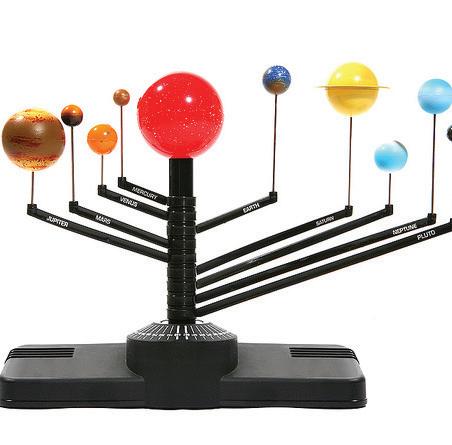
This unit builds students’ understanding of where objects are in space and how we know. Students model a Sun-centered solar system, comparing planet order, types, relative sizes, and distances. They investigate how distance affects apparent brightness and how Earth’s rotation and revolution change visible constellations across the year. Students also examine tools used to observe and navigate in astronomy and communicate evidence-based explanations about the locations of the Sun, planets, and constellations.
Student Expectations
The student is expected to demonstrate an understanding of the locations of objects in the universe, including the planets in Earth’s solar system, the Sun, and constellations.
How do the stars and planets we see in the night sky help us understand our place in the universe?
Key Concepts
• Our solar system contains the Sun, planets, moons, asteroids, and comets.
• Planets in the solar system revolve around the Sun in an orbital path and can be either rocky, terrestrial objects or large and gaseous. Each planet rotates (spins) on an axis. The inner planets of Mercury, Venus, Earth, and Mars are mostly solid with minerals similar to those on Earth. The outer planets of Jupiter, Saturn, Uranus, and Neptune are gaseous masses with rocky cores surrounded by liquids.
• We see our daytime star, the Sun, as our closest and brightest star. One factor that affects the apparent brightness of a star is its relative distance from Earth: generally, closer stars are brighter, while more distant stars are dimmer.
• Earth’s revolution around the Sun causes changes in the appearance of seasonal constellations.
Scope Vocabulary
The terms below and their definitions can be found in Picture Vocabulary and are embedded in context throughout the scope.
Apparent Brightness
The brightness of a star perceived by an observer on Earth
Asteroid Belt
The region between the inner and outer planets where most asteroids orbit the Sun
Constellation
A group of stars that form a recognizable pattern in the sky
Moon
A natural satellite that orbits a planet; some planets have no moons, and others have over 60 moons
Planet
Any of the large celestial bodies that revolve around the Sun in the solar system
Revolution
Making a complete turn around another object
Solar System
The Sun together with the group of planets and other celestial bodies that revolve around it that are held by its gravitational attraction
Sun
The star at the center of the solar system that supplies heat and light to Earth; its enormous gravity keeps the solar system in orbit
System
A group of interacting parts forming a complex whole
Notes
Students explore spatial relationships and classification of celestial objects to build understanding of the solar system.
• Arrange picture cards by placing Earth at the center and positioning other celestial objects relative to it, explaining and justifying choices.
• Compare group arrangements in a class discussion to surface reasoning about distances, sizes, and relationships among objects.
• Sort the same cards by shared characteristics (e.g., inner/outer planets, size, composition, rings) and discuss observations to reinforce that planets orbit the Sun and differ in key features.
Making a Model - Earth and Space: Planets, Earth, Moon and Sun
Students construct and analyze a scale model of the solar system to understand relative sizes, types, order, and distances.
• Gather and record planet data, then sort planets by size and type (rocky vs. gaseous) and arrange them from smallest to largest.
• Build a scaled distance model using a meterstick and a balloon Sun, marking planet positions with color coding and attaching planet images.
• Compare inner and outer planets, then discuss orbits and limitations of the model versus the real solar system.
• Complete journal charts, answer reflection questions, learn a mnemonic for planet order, and create a final drawing.
Activity - Up in the Wonderful Sky
Students explore how distance affects perceived brightness and how Earth’s movements change what stars we see across the year.
• Compare two identical flashlights at different distances to investigate how proximity changes apparent brightness.
• Use a globe and a central “Sun” to model Earth’s rotation and revolution, connecting day/night and seasonal positions.
• Act out Earth’s orbit while rotating to observe how visible constellations change with the time of year, and document observations in journals and a simple model.
Research - Astronomy
Students investigate tools and methods used for navigation in astronomy and communicate their findings to peers.
• Work in groups to research an assigned topic (telescopes, space probes, star charts, satellites, or compasses) using provided guides and online resources.
• Create and deliver a presentation (e.g., slideshow, poster, pamphlet) that explains how their tool supports astronomical navigation.
• Take notes during peer presentations and synthesize understanding by writing a CER response, then discuss with a partner.
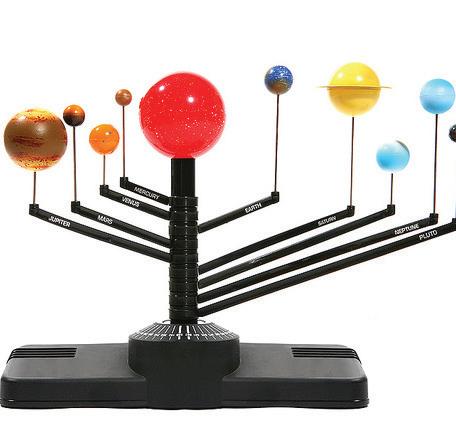
Estimated 15 min - 30 min
In this activity, students model the position of Earth and its placement in relation to other celestial objects in the solar system and sort celestial objects based on characteristics using picture cards.
Materials
Printed
● 1 set of Picture Cards (per group)
Reusable
● 1 pair of scissors (per teacher)
● 1 plastic bag (per group
● Print and cut out the Picture Cards for each group, preferably in color.
● Place each set in a plastic bag.
Developing and Using Models, and Analyzing and Interpreting Data, and Obtaining, Evaluating, and Communicating Information
During this activity, students will develop and use models to describe and predict the phenomenon of how the stars and planets we see in the night sky help us understand our place in the universe. By arranging and sorting celestial objects using picture cards, students collaboratively develop models to show relationships among celestial bodies, identify limitations of these models, and use them to test cause and effect relationships in the solar system. Through analyzing and interpreting data from their arrangements, students will organize data to reveal patterns and relationships, using logical reasoning to make sense of the celestial phenomena. Additionally, students will obtain, evaluate, and communicate information by discussing their findings and reasoning, thereby enhancing their understanding of the universe and our place within it.
Patterns
Scale, proportion, and quantity
During this activity, students will identify patterns and similarities among celestial objects to understand their placement and characteristics, helping them recognize how these patterns relate to our understanding of Earth’s position in the universe. They will also explore the concept of scale, proportion, and quantity by comparing the sizes and distances of these objects, enhancing their comprehension of the vastness of the universe and our place within it.
1. Distribute one set of Picture Cards to each group, and have students separate all the pictures.
2. In the first part of this activity, ask students to place the picture of Earth at the center of the table. Next, challenge students to determine the placement of the other Picture Cards in relation to Earth.
3. As the students are working, observe student reasoning and justification.
4. When all groups are finished, discuss and compare how students arranged the Picture Cards.
5. In the second activity, ask students to sort the Picture Cards based on similar characteristics.
6. When students are finished, hold a class discussion using the following questions:
○ What are some objects you can identify? Answers will vary. Pictures include the Moon, the Sun, Earth, Venus, Mars, Jupiter, Saturn, Uranus, Neptune, the Milky Way galaxy, a comet, and asteroids.
○ How are these objects all similar? They are all celestial objects; they are all in the Milky Way.
○ How did you sort these objects? Answers will vary but can include the following: by inner planets and outer planets, by size, by solid or gas, by rings or no rings, etc.
○ What other pictures could have been used? Answers will vary but can include other moons, Mercury, Pluto, etc.
○ Which object emits energy in the form of visible light? The Sun
○ Which object is the largest? The Milky Way galaxy
7. While students may not yet understand everything about the solar system, they should know that different celestial bodies in our solar system have different characteristics, such as the planets being variable in size, distance from the Sun, and so on. They should also know that the planets revolve around the Sun. Notes
Remind students that it’s okay if their first placement or sorting isn’t correct; they’ll refine ideas during discussion.
Possible prompts to guide students could be:
“Do you think the Sun should go closer to Earth or farther away? Why?”
“What’s near Earth that we see almost every night?” (The Moon)
“What are the names of planets you know that are neighbors of Earth?” (Venus, Mars)
In this activity, students may not agree on how to create the model or sort cards, which could cause them to argue or not share responsibilities. Reduce the feeling of competition in the classroom and assist students in delegating work in their groups. This could include being in charge of different cards or parts of the model. Learn more strategies for assisting students who are argumentative in the Interventions Toolbox.
When observing the arrangement and characteristics of celestial objects, how does understanding their positions and features help us comprehend our place in the universe?
1. How does the position of Earth in relation to other celestial objects influence our understanding of the solar system and our place within it?
2. In what ways do the characteristics of celestial objects, such as size and composition, help us differentiate between them and understand their roles in the universe?
3. How can the arrangement and movement of celestial bodies, like planets revolving around the Sun, provide insight into the larger structure and dynamics of the universe?
Notes
Estimated 2 hrs - 3 hrs
In this activity, students create a scale model of the planets in the solar system.
Materials
Printed
● 1 Student Guide (per student)
● 1 Student Journal (per student)
● 1 Planet Cards (per group)
Reusable
● 1 pair of scissors (per group)
● 1 meterstick (per group)
● 1 red permanent or dry-erase marker (per group)
● 1 green permanent or dry-erase marker (per group)
● 1 yellow balloon (per group)
Consumable
● 1 roll of clear packaging tape (per group)
● 1 roll of string or yarn (per group)
SEP Connection
● This activity may require two to three days to complete. Make color copies of the Planet Cards. The Planet Cards can also be laminated for future use.
Developing and Using Models, and Analyzing and Interpreting Data, and Obtaining, Evaluating, and Communicating Information
During this activity, students will develop and use models to describe and predict the phenomenon of how the stars and planets we see in the night sky help us understand our place in the universe. By creating a scale model of the solar system, students will collaboratively develop and revise models based on evidence, identify limitations of these models, and use them to test cause and effect relationships concerning the functioning of the solar system. They will analyze and interpret data to make sense of the spatial relationships and distances between celestial bodies, using logical reasoning and graphical displays to reveal patterns. Additionally, students will obtain, evaluate, and communicate information by summarizing scientific ideas and explaining how their models represent the solar system, while also discussing the differences between their models and the actual solar system.
Patterns
Scale, proportion, and quantity
During this activity, students will identify and classify patterns in the solar system by creating a scale model of the planets, which helps them understand the similarities and differences in size and distance. This hands-on experience allows students to recognize the scale, proportion, and quantity of celestial objects, enhancing their understanding of how the stars and planets we see in the night sky help us understand our place in the universe.
1. Explain that students are to complete a scale model of the planets moving away from the Sun.
2. Using the Planet Information Chart found in the Student Guide, have students fill in the first and second columns on the Planet Description Chart in their Student Journals.
3. Have students cut out the pictures of the planets, making sure to keep the name of the planet attached as part of the picture.
4. Instruct students to use the planet pictures to arrange the planets by size from smallest to largest.
5. Have students divide the planets into two groups: small and large planets. They should use this to fill in the third column on the Planet Description Chart in their Student Journals.
6. Distribute metersticks, and have students put a piece of clear tape along the centimeter side. Have them now blow up a yellow balloon to represent the Sun and tape this at the 0 cm mark on the meterstick.
7. Ask students to use the Planet Information Chart from the Student Guide to mark the scaled distances of the planets from the Sun. Using a red marker for the rocky planets and a green marker for the gaseous planets, direct them to place a dot on the meterstick at the correct distance from the Sun for each planet. Make sure they are marking on the tape, not on the meterstick itself.
8. Advise students to use a piece of clear tape to attach a string from the dot on the meterstick to the photo of the planet it represents. Facilitate this as needed.
9. Have students observe their scale models, and divide the planets evenly into two groups: one of the planets that are close to the Sun and the other of the planets that are far from the Sun. Tell students to now complete the fourth column of the Planet Description Chart in their Student Journals.
10. Have students complete questions 1–4 in the Student Journal with their groups. Then lead a class discussion using the following questions:
○ How many planets are in our solar system? Eight
○ What is the center of our solar system? The Sun Use a group’s model of the solar system to show how this is true. The model students created makes it appear as if the Sun is on one side of the solar system with all the planets in a straight line leading away from it. Demonstrate how each planet would actually be on a separate elliptical (oval-shaped) pathway that goes around the Sun. Draw an example of this on the board if necessary to ensure understanding.
Begin with a quick brainstorm. Ask students what they already know about the planets, the Sun, and the Moon. Write their responses on the board to revisit later.
After sorting planets by size and distance, have students briefly explain their reasoning to a partner before sharing with the class.
If opportunity allows, take the activity outside. Assign students as planets spaced by scale distances and walk orbits around a “Sun.”
○ What do we call this pathway on which planets revolve around the Sun? Is this pathway a perfect circle? An orbit. No, it is shaped more like an oval. Students should answer question 5 in their Student Journals.
○ How are our models like the solar system? How are they unlike the solar system? Answers will vary. Possible answers: Our models show that there are eight planets, and it shows the relative sizes of the planets. They show that the Sun is larger than the planets. The distances between the Sun and each planet are scaled based on the actual distance between the Sun and each planet in real life. Differences include that the planets are not really flat (two-dimensional on a sheet of paper) and that the models do not show anything about the planets revolving around the Sun on an orbit.
○ Is there a way that we can easily remember the order of the planets from closest to the Sun to farthest away? Introduce the mnemonic device "My Very Educated Mother Just Served Us Nachos (Mercury, Venus, Earth, Mars, Jupiter, Saturn, Uranus, Neptune)." Have students write this in their Student Journals in the appropriate place, and encourage them to come up with another saying that could work if it would be more helpful to them.
11. When they are finished, instruct students to complete the drawing and remaining question in their Student Journals.
12. Discuss all questions on the Student Journal pages as a class.
Notes
Q3SA: Question, Signal, Stem, Share, Assess
After the students have had time to explore the investigation, work through a Q3SA. Write the question and the sentence stem on the board so that students can read them to themselves. Then read the question out loud.
Question: *Please see below.
Signal: Place your right hand on top of your head. Stem: *Please see below.
Share: The person born in March will report his or her answer first.
Assess: Students can draw a question mark each time they hear someone share the same answer as they have written down.
Possible questions and sentence stems include the following:
● Question: How would you describe a planet?
○ Stem: I would describe a planet as _________ .
● Question: What can you say about planets and their distance from the Sun?
○ Stem: Planets are _______ .
● Question: What is an important fact about the solar system?
○ Stem: One important fact about the solar system is ________ .
How do the scale models of the solar system we create help us understand our place in the universe?
1. How does the scale model of the solar system help us visualize the relative distances and sizes of planets compared to the Sun?
2. In what ways does understanding the arrangement and movement of planets in our solar system provide insight into our position in the universe?
3. How might our perception of the universe change if we were to observe it from a different planet within our solar system?
Estimated 1 hr - 2 hrs
Students observe flashlights from different distances to draw conclusions about how distance affects the appearance of light. Then students become “Earth” as they revolve around the “Sun.” As they revolve, students take notice of the constellations they can see from certain locations during the year.
Materials
Printed
● 1 Student Journal (per student)
● 1 Constellation Cards (per class)
Reusable
● 2 similar flashlights (per class)
● 1 globe (per class)
Consumable
● 1 sheet of chart paper (per class)
SEP Connection
● The activities require the room to be quite dark, especially in Part I, in order for the brightness of the flashlights to be observed. If your room has large windows, plan for them to be temporarily covered during the activity.
● For Part II, place the 12 zodiac Constellation Cards in a circle around the room in their month order. Place one of the flashlights from Part I in the center to represent the Sun. Try to space them out as evenly as possible. Place the globe somewhere between the flashlight and the Constellation Cards.
Developing and Using Models, Analyzing and Interpreting Data, and Obtaining, Evaluating, and Communicating Information
During this activity, students will develop and use models to understand how the movement of Earth around the Sun affects the visibility of stars and constellations, helping them grasp our place in the universe. They will collaboratively develop and revise models based on evidence to show the relationships among variables such as Earth’s rotation and revolution. By using analogies and abstract representations, students will describe scientific principles related to the apparent movement of stars and planets. They will analyze and interpret data to make sense of the phenomenon, using logical reasoning to understand why certain constellations are visible only at specific times of the year. Additionally, students will obtain and communicate information through various media, enhancing their understanding of how celestial observations inform our understanding of the universe.
CCC Connection
Patterns
Scale, proportion, and quantity
During this activity, students will identify patterns related to the appearance and visibility of stars and constellations as Earth revolves around the Sun. By observing these patterns, students will understand how the positions of stars and constellations change over time, helping them to make predictions about which constellations are visible during different seasons. Additionally, students will recognize the scale and proportion of celestial objects, understanding that stars and planets exist from the very small to the immensely large, and use this knowledge to comprehend our place in the universe.
1. Have students sit on one side of the room opposite you.
2. Make the classroom dark and turn on the flashlights, holding them the same distance from the students.
○ What do the flashlights have in common? They are both the same size and shape. They are both bright.
3. Move one of the flashlights closer and the other one back by placing one on a desk and holding the other.
4. Distribute the Student Journal pages, and have students begin to complete the questions in Part I as you facilitate the following discussion:
○ What has changed about the way the flashlights look? One looks brighter than the other. I can see the closer one better than the farther one.
○ Why did one light get brighter and the other light get dimmer? The flashlights were moved.
○ Is one flashlight really brighter than the other? No. The flashlights are the same brightness; one of them looks brighter only because it is now closer than the other.
5. Continue to lead a discussion about the remaining questions in Part I as students complete the rest of the questions in that section. Check for understanding along the way. If students reply that the Moon is also a bright object in space, make sure they understand that the Moon does not produce its own light but instead reflects light from a star, the Sun. As students get ready to complete the last two questions, inform them that the largest known star in our galaxy is 1,700 times larger than the Sun, but it is much farther away from us.
1. Explain that you are now going to look at some of the movements of Earth and how they relate to other stars besides the Sun that are visible to us from Earth. Using the globe positioned near the flashlight in the center of the room, demonstrate how Earth rotates on its axis by spinning the globe. Show that as Earth rotates on its axis once every 24 hours, each side of Earth experiences day and night by facing either toward the Sun or away from it.
2. Review how this is different from Earth revolving around the Sun. Carry the globe in an oval-shaped path all the way around the flashlight in the center, and explain that it takes Earth one year, or 12 months, to complete one full orbit. Remember to continue to slowly spin the globe as you revolve, showing students that Earth continues to rotate (experiencing day and night) at the same time that it is revolving.
Notes
After the “closer vs. farther” test, ask: “If I moved the farther flashlight even farther, what would happen? Would the flashlight itself change?”
FACILITATION
You can utilize the Picture Vocabulary to create a word wall that can help students connect terms to experiences.
3. Introduce the concept of seasons as they relate to Earth’s various positions along its orbit. You do not have to go into too much detail here, as students will be doing a more in-depth discussion of seasons as part of E.5.8B. Carry the globe to a position in which it is between the Sun and the constellation picture for December. Explain that we in the Northern Hemisphere would be experiencing the first day of winter at this position. Carry the globe one-quarter of the way farther along the orbit, going counterclockwise, explaining as you go that this would represent the entire season of winter. Stop when the globe is in between the Sun and the picture on the wall for March. This shows Earth’s position on the first day of spring. Continue one-quarter of the way farther along the path during the season of spring, and stop when you are in between the Sun and the picture on the wall for June. This is the Northern Hemisphere’s first day of summer. Complete the remaining part of the orbit, pausing where Earth would be when we are experiencing fall (the globe should be in between the Sun and the picture on the wall for September). Explain that this pattern repeats every year as Earth orbits the Sun.
4. Using chart paper to demonstrate, help students draw a possible model that they can copy into the appropriate box under Part II on their Student Journal page. Make sure that it shows Earth tilting on its axis and spinning (rotating) and being placed at four different positions along its orbit (representing Earth’s position on the first day of each of the four seasons). Place arrows along the orbit to show the path Earth is taking. Include stars that are placed outside Earth’s orbit.
5. Discuss the following:
○ Earth is constantly moving, but is the Sun moving? No, the Sun remains in the same place.
○ Do you think other stars in our solar system are moving? No, they stay in the same location just like the Sun.
○ What do we call some groups of stars that are seen as being close together in the night sky and can form some kind of recognizable image or pattern? Constellations (Students may be unfamiliar with this term. Have them fill in the appropriate answer on their Student Journal pages.)
○ Look around the room. There are several pictures of different constellations we can see from Earth. Are the locations of these constellations ever going to change? No, because constellations are groups of stars. We have already determined that stars do not move.
6. Stand in the center of the room holding the “Sun” (flashlight). Explain that instead of using the globe to represent Earth, now students are going to represent Earth. Each student will stand and revolve around the Sun, while also rotating slowly on his or her axis (spinning). The rotation simulates day and night, while the orbit around the Sun simulates a year.
○ What do you observe as you rotate? At night, when you are facing away from the Sun, you see the stars and constellations on the opposite side of the Sun from you.
○ What do you observe as you revolve (orbit) around the Sun? You see different constellations at different times of the year. For example, when we are on a part of the orbit where the Northern Hemisphere would be experiencing winter (January through March), we are able to see Taurus, Gemini, and Cancer. When we continue along the orbit, these constellations are no longer readily visible to us when we face away from the Sun during the “night.” Instead, we start to face other constellations.
7. Have students complete the remaining questions on their Student Journal pages.
8. Discuss how the revolution of Earth around the Sun allows for constellations to be seen only at certain times of the year. Emphasize that we do not see the constellations behind the Sun from our perspective. This means that even though students might have been able to see the picture of the Gemini constellation on the wall, for example, while they were facing the Sun, it was during the day. We are not able to view constellations in the sky during daylight because even though our part of Earth might be facing toward that constellation, the brightness of the Sun overpowers the brightness of the other stars in the sky because the Sun is much closer to us.
Think, Pair, Share
After the students explore the investigation, partner them for a Think, Pair, Share event.
● Write the following question on the board:
○ Why does the Sun appear so bright?
● They can then think and answer by using the following sentence stem:
○ The Sun is brighter than other stars because ______________________ .
Pair the students by using craft sticks with their names on them. The craft stick they pull out of the container will have the name of their partner.
Have partners share their answers with each other using the sentence stem.
As Earth orbits the Sun, how does our perspective of the stars and constellations change throughout the year?
1. How does the distance of stars from Earth affect their visibility and brightness in the night sky?
2. Why do we see different constellations during different seasons, and what does this tell us about Earth’s movement in space?
3. How can understanding the positions and movements of stars and planets help us comprehend our location and role in the universe?
Notes
For discussion and journaling, provide sentence structures:
“When Earth rotates, it causes...”
“Earth revolves around the ____, which takes ____.”
“Constellations seem to change because...”
“During summer in the Northern Hemisphere, Earth is tilted ____ the Sun.”
Estimated Days 3 - 5
In this activity, students work in groups to design a presentation on the importance of navigation in astronomy. They present their research to the class.
Materials
Printed
● 1 Student Guide (per group)
● 1 Student Journal (per student)
Reusable
● 1 computer with Internet access (per group)
● 1 projector (per teacher)
SEP Connection
This lesson might need to take place over the course of two to three days to give students enough time.
Developing and Using Models, Analyzing and Interpreting Data, and Obtaining, Evaluating, and Communicating Information
During this activity, students will collaboratively develop and revise models based on evidence gathered from their research on navigation in astronomy. By creating presentations on topics such as telescopes, space probes, star charts, satellites, and compasses, students will use models to describe and predict phenomena related to understanding our place in the universe. They will analyze and interpret data to reveal patterns and relationships, and communicate their findings through various media formats, enhancing their comprehension of how stars and planets inform our cosmic perspective.
Notes
Patterns
Scale, proportion, and quantity
During this activity, students will identify and analyze patterns related to navigation in astronomy, such as the use of telescopes, space probes, star charts, satellites, and compasses, to understand how these tools help us recognize our place in the universe. They will classify and compare these tools, recognizing the scale and proportion of celestial objects and phenomena, from the very small to the immensely large, and use this understanding to make predictions about celestial navigation and our position in the cosmos. Activity Preparation Connections
1. Divide the class into five different groups. Assign one of the topics to each group or let the groups choose. The topics are as follows:
○ Telescopes
○ Space probes
○ Star charts
○ Satellites
○ Compasses
2. Give each group the corresponding Student Guide page for its topic. The groups can write down notes during their research on this page.
3. Explain that students will create presentations to share their research with their classmates. Their presentations should include all of the information from their Student Reference Sheets. Possible presentations include a Google slideshow, a PowerPoint slideshow, a poster board, a pamphlet, etc.
4. Have groups take turns presenting their information to the class. Project digital presentations onto the board.
5. Ask students to take notes in their Student Journals as each group presents.
6. When the presentations are complete, read the CER prompt to the students. Provide enough time for students to complete their responses.
7. Allow students to share their responses with a partner and discuss.
Journal Reflections
After all of the groups have made their presentations, have students reflect on the information and record their answers to the following prompt:
● In your own words, describe what you learned about technology in space exploration from these presentations. If desired, let students partner up and read their reflections to each other.
How does our ability to navigate using stars and planets enhance our understanding of our place in the universe?
1. How do the tools and methods used in navigation, such as telescopes and star charts, help us locate our position relative to other celestial bodies?
2. In what ways do satellites and space probes contribute to our understanding of the universe and our place within it?
3. How might the historical use of compasses and star navigation inform our current understanding of Earth’s position in the cosmos?
You can assign roles for the research so all students are engaged in the research. Examples include note taker, graphics creation, digital presentation designer, etc.
Additionally, you can provide a graphic organizer template for note-taking with boxes for:
What is it?
How does it work?
Why is it important for navigation?
Picture or diagram.
STEMscopedia
Reference materials that includes parent connections, career connections, technology, and science news.
Linking Literacy
Strategies to help students comprehend difficult informational text.
Picture Vocabulary
A slide presentation of important vocabulary terms along with a picture and definition.
Content Connections Video
A video-based activity where students watch a video clip that relates to the scope’s content and answer questions.
Career Connections - Astronomer
STEM careers come to life with these leveled career exploration videos and student guides designed to take the learning further.
Math Connections
A practice that uses grade-level appropriate math activities to address the concept.
Reading Science - Our Solar System
A reading passage about the concept, which includes five to eight comprehension questions.
Notes
Multiple Choice Assessment
A standards-based assessment designed to gauge students’ understanding of the science concept using their selections of the best possible answers from a list of choices
Open-Ended Response Assessment
A short-answer and essay assessment to evaluate student mastery of the concept.
Claim-Evidence-Reasoning
An assessment in which students write a scientific explanation to show their understanding of the concept in a way that uses evidence.
Guided Practice
A guide that shows the teacher how to administer a smallgroup lesson to students who need intervention on the topic.
Independent Practice
A fill in the blank sheet that helps students master the vocabulary of this scope.
Extensions
A set of ideas and activities that can help further elaborate on the concept.
Use this template to decide how to assess your students for concept mastery. Depending on the format of the assessment, you can identify prompts and intended responses that would measure student mastery of the expectation. See the beginning of this scope to identify standards and grade-level expectations.
Student Learning Objectives
Our solar system contains the Sun, planets, moons, asteroids, and comets.
Planets in the solar system revolve around the Sun in an orbital path and can be either rocky, terrestrial objects or large and gaseous. Each planet rotates (spins) on an axis. The inner planets of Mercury, Venus, Earth, and Mars are mostly solid with minerals similar to those on Earth. The outer planets of Jupiter, Saturn, Uranus, and Neptune are gaseous masses with rocky cores surrounded by liquids.
We see our daytime star, the Sun, as our closest and brightest star. One factor that affects the apparent brightness of a star is its relative distance from Earth: generally, closer stars are brighter, while more distant stars are dimmer.
Earth’s revolution around the Sun causes changes in the appearance of seasonal constellations.
Does Student Mastery Look Like?
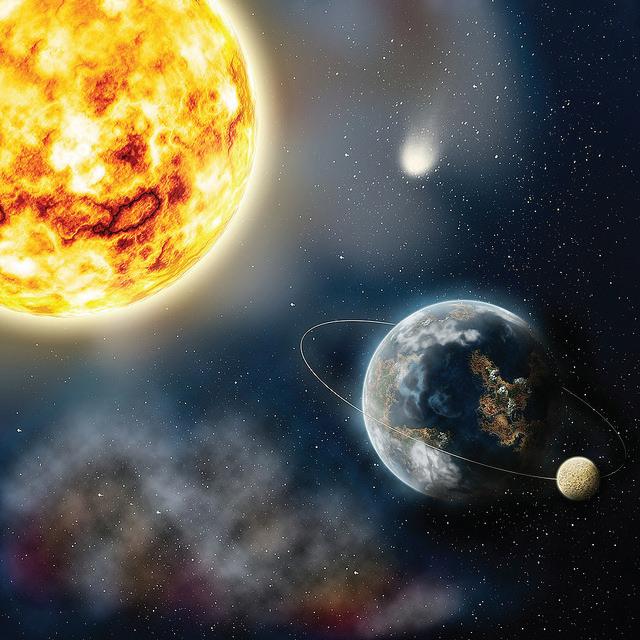
Student Expectations
The student is expected to demonstrate an understanding of the principles that govern Moon phases, day and night, the appearance of objects in the sky, and seasonal changes through data analysis and models.
Why does the Moon change shape, the Sun rise and set, stars move across the sky, and the weather change with the seasons?
Key Concepts
• Our understanding of the solar system has evolved over time from an Earth-centered model to a Suncentered model.
• The Moon takes roughly 29 days to revolve around Earth. This changes the amount of sunlight falling on the Moon from our viewpoint, creating the Moon phases we see during the month.
• Earth’s tilt and its yearly revolution around the Sun cause seasonal changes in the height of the apparent path of the Sun, in seasonal weather, and in the appearance of seasonal constellations.
• A lunar eclipse occurs when Earth’s shadow falls on the Moon. A solar eclipse occurs when the Moon’s shadow falls on a small part of Earth.
This unit builds understanding of how Earth’s rotation and revolution produce day/night, changing shadows, Moon phases, and seasons. Students use hands-on models (light sources, globes, and Moon spheres) and real data to analyze causeand-effect and cyclical patterns, connecting shadow length/orientation to the Sun’s apparent motion, linking illuminated lunar portions to a ~29-day cycle, and relating axial tilt to solstices and equinoxes. Learners also compare geocentric and heliocentric models to ground explanations of the appearance of objects in the sky with evidence-based reasoning.
The terms below and their definitions can be found in Picture Vocabulary and are embedded in context throughout the scope.
Axis
An imaginary line that Earth rotates around
Constellation
A group of stars that form a recognizable pattern in the sky
Data
Information that has been collected
Earth
The third planet from the Sun and the only planet in the solar system where life exists
Eclipse
An obscuring of the light from a celestial body by the passage of an object between the celestial body and the observer or between the celestial body and its source of illumination
Lunar Cycle
The Moon’s repeated pattern of movement and changes in appearance due to its revolution around Earth
Lunar Eclipse
When the full moon passes into Earth’s shadow, causing the Moon to appear reddish in color; occurs when the Sun, Earth, and the Moon directly line up
Model
A limited representation of something that can help us understand its structure or how it works
Moon
A natural satellite that orbits a planet; some planets have no moons, and others have over 60 moons
Revolution
Making a complete turn around another object
Rotation
Making a complete spin on an axis
Seasons
The four natural divisions of the year based on changes in temperature due to the varied amounts of sunlight (both intensity and number of daylight hours received); caused by the tilt of Earth during revolution
Solar Eclipse
An event that happens when the Moon passes between Earth and the Sun, covering all or part of the Sun; occurs when the Sun, Earth, and the Moon directly line up; lasts less than 12 minutes
Solstice
Points of farthest and closest distance of the Sun from Earth that correspond to the beginning of winter and summer
Sun
The star at the center of the solar system that supplies heat and light to Earth; its enormous gravity keeps the solar system in orbit
Tilt
The slant of Earth’s axis Scope
Students explore how light direction affects shadow length and orientation to model the apparent motion of the Sun and its effects on shadows.
• Work in pairs to create and measure shadows of an object with a flashlight, comparing longest and shortest shadows.
• Connect shadow length to time of day (morning/evening vs. noon) and use a compass to orient shadows north, south, east, and west.
• Discuss class findings to relate changing shadows to Earth’s rotation and the Sun’s apparent movement.
• Identify limitations of the model compared to real-world observations.
Making a Model - Moon Phases
Students explore lunar phases by modeling and analyzing real data to understand cyclical patterns and cause-and-effect in the EarthSun-Moon system.
• Model the Moon’s phases in a darkened room using a central light source and “Moon-on-a-stick” to observe waxing/waning patterns through incremental rotations.
• Record and identify each phase (new, crescent, gibbous, full), linking illuminated portions to observed positions and direction of change.
• Analyze NASA LRO time-lapse imagery to track dates, phases, and the Moon’s position, confirming the ~29-day cycle and repeating patterns.
• Synthesize observations in journals to explain why phases occur and how the cycle progresses over time.
Making a Model - Patterns in Space: Seasons and Eclipses
Students investigate seasonal changes and eclipse phenomena through hands-on Earth-Sun-Moon modeling.
• Rotate through marked “orbit” positions around a lamp-Sun with globes tilted toward a fixed North Star, observing daylight angles, hemisphere tilt, and sequencing of solstices and equinoxes.
• Record observations at eight positions to connect Earth’s axial tilt and revolution to seasonal patterns, then debrief and respond in Student Journals.
• Use Moon-on-a-stick models around students’ heads to simulate solar and lunar eclipses, observe shadow size and placement, and diagram body alignments.
• Conclude by completing journal questions to synthesize findings on seasons and eclipses.
Research - Geocentric Model of the Solar System, Circa 1400
Students analyze and compare historical and modern models of the solar system to understand the shift from geocentric to heliocentric perspectives.
• Discuss the image title and break down geocentric/heliocentric terminology through partner talk and class discussion.
• Examine a geocentric model, identify inaccuracies based on current understanding, and refine ideas collaboratively.
• Draw a heliocentric model showing the Sun centered with planets in correct order, sizes, and relative spacing.
• View a short video to reinforce the historical transition and evidence behind the model change.
Estimated 15 min - 30 min
Students discover light and shadows by using a flashlight and relating it to the movement of the Sun in the sky.
Materials
Reusable Materials
● 1 flashlight (per pair)
● 1 object (per pair—objects should be exactly the same for each pair)
● 1 ruler (per pair)
● 1 compass (per pair)
● 1 globe (optional)
● 1 lamp (optional)
SEP Connection
Developing and Using Models
● Gather the materials for each group.
● Familiarize yourself with the questions to help facilitate the Engage activity.
Obtaining, Evaluating, and Communicating Information
During this activity, students will develop and use models to describe and predict the phenomenon of why the Sun appears to rise and set, by using a flashlight to represent the Sun and observing the resulting shadows. They will collaboratively develop and revise their models based on evidence, identifying limitations such as the stationary nature of the Sun and the Earth’s rotation. This handson exploration allows students to test cause and effect relationships concerning the functioning of natural systems, such as the apparent movement of the Sun and the changing length and direction of shadows. Additionally, students will obtain and communicate scientific information by discussing their observations and conclusions, thereby enhancing their understanding of the phenomenon.
Notes
Patterns
Cause and Effect
During this activity, students will identify patterns related to the movement of the Sun and the resulting changes in shadows, which helps them understand the cyclical nature of day and night. By observing and discussing these patterns, students can make predictions about the Sun’s position at different times of the day. Additionally, they will explore cause and effect by testing how the position of the flashlight (representing the Sun) affects shadow length and direction, thereby explaining the apparent movement of the Sun and its effect on shadows due to Earth’s rotation.
1. Have students find a partner. Give each pair a flashlight, a ruler, a compass, and an object.
2. Ask students to use the flashlight and object to make various shadows. Have them discuss the following questions with their partners:
○ What is the length of the longest shadow you can make? Answers will vary.
○ If the flashlight represents the Sun, what time of day would this be? Morning or evening
○ What is the length of the shortest shadow you can make? Answers will vary.
○ If the flashlight represents the Sun, what time of day would this be? Noon, or near the middle of the day
○ Can you make your shadow point north, south, east, and west? How? Yes. You have to hold the flashlight on the opposite side of where you want the shadow to point.
3. Discuss the results as a class.
○ How does this relate to the Sun’s movement across the sky? As the Sun moves across the sky, it causes shadows to change throughout the day.
○ Is the Sun really moving? No. Earth is rotating, which makes the Sun look like it is moving. That means the shadows are really caused by the Sun’s light and the rotation of Earth.
○ What are the limitations of this model? The Sun does not actually move. Earth is rotating. The shadows do not change as quickly as they did in our activity.
Phenomenon Connection
How does the movement of the Sun across the sky affect the length and direction of shadows on Earth?
1. How does the rotation of the Earth explain the apparent movement of the Sun across the sky and the changing length of shadows throughout the day?
2. In what ways do the changing positions of the Sun and Earth throughout the year contribute to the different seasons and weather patterns we experience?
3. How can the model of using a flashlight and an object help us understand the apparent movement of celestial bodies like the Moon and stars in the night sky?
FACILITATION TIP
Provide a picture strip of the Sun at sunrise, noon, and sunset. Have students match their shadow results to the pictures.
FACILITATION TIP
Prompt students with guiding questions such as:
“Did we move Earth in our model?”
“Did our shadows change in seconds or hours?”
Estimated 2 hrs - 3 hrs
In Part I, students model cyclic patterns of lunar phases to identify cause-and-effect relationships in the Earth-Sun-Moon system. Students use the model to predict and describe cyclical lunar patterns that are observable from Earth. In Part II, students analyze and interpret data gathered by the NASA Lunar Reconnaissance Orbiter (LRO) to explain the movement and location of the Moon while its different phases are visible from Earth.
Materials
Printed
● 1 Student Journal (per student)
Reusable
● 1 lamp, shadeless (per class)
● 1 light bulb, 100-watt incandescent or equivalent brightness fluorescent (per class)
● 1 extension cord (per class)
● 1 table tennis ball (per student)
● 1 golf tee (per student)
● 1 hot glue gun (per teacher)
● 1 device with Internet capability that can be projected for the class to see
Consumable
● Paper, black sheets as needed to cover windows (per class)
● 5 hot glue sticks (per class)
● 1 roll of masking tape (per class)
● 1 lab journal (per student)
● Prepare a Moon-on-a-stick for each student by hot-gluing a table tennis ball to the flat end of a golf tee. (These can be reused for each class period.)
● Set up the lamp with the light bulb in a large space. (The light bulb’s height should be at the head level of standing students.) Use either an incandescent or fluorescent bulb to provide light shining in all directions. Have students stand in a circle around the lamp.
● Darken the room as much as possible by covering all the windows and doors with black paper (suggestions for window covering: black butcher paper or large, black, heavy plastic garbage bags). Prepare to turn off the main lighting once students are in place around the lamp.
● Use an Internet search to find the “NASA Moon Phases Video.”
Developing and Using Models and Obtaining, Evaluating, and Communicating Information
During this activity, students will develop and use models to describe and predict the cyclical lunar patterns observable from Earth, thereby explaining the phenomenon of why the Moon changes shape. They will collaboratively develop and revise models based on evidence to show the relationships among variables in the Earth-Sun-Moon system. By using these models, students will identify limitations and test cause-and-effect relationships, enhancing their understanding of natural systems and their ability to communicate scientific information effectively.
Patterns
Cause and Effect
During this activity, students will identify and analyze patterns related to the cyclic nature of lunar phases, using models and data to predict and describe these patterns. They will explore cause-and-effect relationships within the Earth-Sun-Moon system to explain observable changes, such as the Moon’s phases, and use these patterns to make predictions about future occurrences.
1. Explain to students that they are to model the cyclic pattern of lunar, or Moon, phases. This activity works best in a completely darkened room with the lamp as the only light source. Turn on the lamp at this time, and have students stand around it in a large circle with their Student Journals and a pencil. Turn off any other lights in the room once the students are in position around the lamp.
2. Distribute a Moon-on-a-stick to each student. As students begin performing the model, ask them to observe and report verbally to the group how much light they see on their Moons. Have them hold their Moons right in front of their faces, between their eyes and the light bulb. They should not see any light on their Moons at this point. Ask students what Moon phase this would be, and have them record the Moon phase in their lab journals. This phase is a new Moon. Have students copy this onto the first Moon in their Student Journals by shading in the entire circle black to show that no part of the Moon appears lit up to us from Earth during a new Moon phase.
3. Model to show students how to make one-eighth turns to their left (in a counterclockwise direction). Ensure that students face the correct direction throughout the activity. Again ask students to observe and report how much light they see on their Moons. Ask students what Moon phase this would be, and have them record the Moon phase in their lab journals. This phase is a waxing crescent. Ask students how they know it is waxing and not waning. You may want to use the reminders "wax on, wane off," or "light on the right = waxing."
4. Continue asking the students about the light they see on their Moon models during each of the phases. Ask students what Moon phase each rotation would be, and have them record the Moon phases in their lab journals.
5. When students rotate into the full Moon position, remind them to hold their Moon models so that the shadows of their heads do not block the light from the lamp.
6. When students rotate into the waning gibbous position, discuss with students how you know it is waning. Stress that they should be seeing the shadow on the right side of the Moon now, so the lit part of the Moon is now on the left.
7. When students rotate into the waning crescent position, have them explain whether the lit section is getting larger or smaller. They should note that during waxing phases, it is getting larger, and during waning phases, it is getting smaller.
8. When students rotate into the new Moon phase once again, discuss the following:
○ How long would this entire process normally take? About 29 days
○ What is the first phase of the Moon called? A new Moon
○ What is the shape of a crescent Moon? A fingernail
○ Which phase is larger: the crescent or the gibbous? Gibbous
○ Why can we not see a new Moon? We cannot see a new Moon because the lit side is facing toward the Sun.
9. Have students complete the remaining questions in their Student Journals, checking for understanding.
FACILITATION TIP
Assign a few students as “phase checkers.” After each 1/8 turn, let them describe what they see aloud before the rest of the class records. This reinforces correct observations and helps struggling students.
FACILITATION TIP
Teach students to chant or use hand motions:
“Wax on, light on the right” (hand on right side).
“Wane off, light on the left” (hand on left side).
FACILITATION TIP
Before shading their Student Journals, have students do a “think-pair-shade.” Describe the phase to a partner first, then shade the Moon diagram. This ensures accuracy and discussion.
FACILITATION TIP
Provide a video viewing guide with key questions such as:
“What date do we see a full Moon?”
“What pattern do you notice between crescent and gibbous phases?”
Part II
1. Using an Internet search engine, find “NASA Moon Phases Video 2017.” Explain that this site shows actual photographs of the Moon and data gathered by an orbiter sent to space by NASA.
2. The video does not begin quite at the new Moon phase, so explain to students that you will be advancing the video until the date when the first new Moon phase is visible. Press play, and then pause the video when the date reads January 27, 2017. Have students begin to fill out the chart under Part II of their Student Journals.
3. Repeat the previous step, pressing play and then pausing the video at the following dates: January 31 and then February 3, 7, 10, 14, 18, 22, and 26. Students should finish completing the chart.
4. Continue to play the time-lapse video. Have students notice that the dates keep progressing through the remainder of the year, and as they do so, the patterns of the Moon phases continue repeating themselves. Draw their attention to the image of the Moon revolving around Earth in the upper left-hand corner of the video. Have them notice the position of the Moon and the date. Then play the video until the Moon returns to the exact same position again, and show that about a month has passed.
FACILITATION TIP
Ask students: “How was our lamp and ball activity similar to what you see in NASA’s images? How was it different?”
5. Continue to play the video so that the entire year elapses.
6. Have students answer the remaining questions in their Student Journals, checking for understanding.
Notes
Guess the Word
Provide students with a set of cards that have the below terms on one side and their descriptions on the other.
● The Sun: a luminous celestial body around which Earth revolves
● Planet: any of the large celestial bodies that revolve around the Sun
● Galilean Moons: the four largest and brightest moons of Jupiter
● Meteor: a small piece of rock that burns upon entry into Earth’s atmosphere
● Asteroid: large rocks, small rocks, or metallic masses orbiting the Sun
● Comet: a celestial body of ice, dust, and rock with an elongated and elliptical orbit
Place students into pairs. (This could also be done in small groups or as a class activity.) Students take turns getting their partners to guess a term. They can draw a picture or write clues as long as they avoid writing the actual term or sharing the definition. Once a partner guesses the correct word, the two students switch roles.
How do the cyclic patterns of the Moon’s phases help us understand the changes we observe in the sky, such as the Moon changing shape, the Sun rising and setting, and stars moving across the sky?
1. How does the model of the Earth-Sun-Moon system help explain why the Moon appears to change shape over the course of a month?
2. In what ways do the cyclic patterns of the Moon’s phases relate to the daily rising and setting of the Sun?
3. How might the movement and phases of the Moon be connected to the seasonal changes we experience on Earth?
Estimated 2 hrs - 3 hrs
In Part I, students discover seasons as a result of changes in the number of daylight hours and the angle of the Sun’s light rays on Earth’s surface due to the tilt of Earth on its axis and Earth’s revolution around the Sun. In Part II, students develop and use a kinesthetic model to predict and describe phenomena such as solar and lunar eclipses within the Earth-Sun-Moon system.
Materials
Printed
● 1 Student Journal (per student)
Reusable
● Paper, black sheets as needed to cover windows (per class)
● 1 lamp, shadeless (per class)
● 1 light bulb, 100-watt incandescent or equivalent brightness fluorescent (per class)
● 1 extension cord (per class)
● 1 clipboard (per student)
● 8 inflatable globes (per class)
● 1 globe with stand (per class)
● 1 star, cut out, to represent the North Star (per class)
● 8 rolls of masking tape (per class)
● 1 pair of scissors (per teacher)
Consumable
● 1 roll of duct tape (per class)
● For Part I, inflate eight inflatable globes.
● Draw or print out an illustration of a star to represent the North Star. Use a tilted globe to determine where the star should be positioned on the wall to create the 23.5° tilt. Place the tilted globe on the floor, and estimate the ray from the axis to the wall, as this will be a floor activity. Place the North Star at that point on the wall.
● Make large Xs on the floor with masking tape to mark the points of the spring and fall equinoxes and the summer and winter solstices. (Note that these equinoxes and solstices are named as they occur in the Northern Hemisphere.)
● Mark four small xs halfway between each of the large Xs. All marks are directly on the path that represents Earth’s revolution around the Sun. Use the diagram below to label the positions A–H.
● Plan to darken the room, and keep the main lights on until performing the activity. Plan to place one of the eight rolls of masking tape at each position to hold the inflatable globes in place. The bulb in the lamp must be at the same level as the inflatable globes for the shadows to be correct.
● For Part II, reuse the Moon-on-a-stick models you created for Explore 1 (table tennis ball hot-glued onto the top of a golf tee).
● Set up the lamp with a 60-watt light bulb in a space large enough for students to stand in a circle around the lamp. (The light bulb’s height should be at the head level of standing students.) Use the extension cord, if necessary, and tape the cord onto the floor to reduce the tripping hazard. Darken the room so that the lamp is the only light source in the room (suggestions for window covering: black butcher paper or large black heavy plastic garbage bags).
During this activity, students will develop and use models to describe and predict phenomena such as the changing shapes of the Moon, the rising and setting of the Sun, the movement of stars across the sky, and seasonal weather changes. By collaboratively developing and revising kinesthetic models based on evidence, students will explore the relationships among variables in the Earth-Sun-Moon system. They will identify limitations of these models and use them to test cause and effect relationships, thereby enhancing their understanding of natural systems. Additionally, students will obtain and communicate scientific information through observations and diagrams, supporting their engagement in scientific practices.
During this activity, students will identify patterns related to time, such as the cycles of the seasons and the phases of the Moon, to make predictions about natural phenomena. They will also explore cause and effect relationships by modeling the Earth’s tilt and revolution around the Sun to explain changes in daylight and seasonal weather patterns, as well as the occurrence of solar and lunar eclipses.
1. Review the way Earth revolves around the Sun as seen in the Up in the Wonderful Sky (Constellations) activity from E.5.8A. This movement of Earth is what is partly responsible for our experience of the seasons. Explain that today you will look at this in more depth as you also explore what other factors are responsible for the seasons.
2. Gather students in a circle around the lamp. Make sure one group sits by each of the marked positions. Explain that this is a floor activity, and students are to bring their clipboards to different positions, sit on the floor, and make observations. Show students the classroom globe, and point out the North Star that you taped to the wall. Hold the globe so that the North Pole is pointed toward the North Star. Discuss the 23.5° tilt of Earth toward the North Star.
3. Ask each group to place its inflated globe on the roll of masking tape on the position marked in the circular path. Then position each globe so that the North Pole points at the North Star; check the positions. Explain that the model represents Earth’s position in space relative to the Sun and the tilt of its axis during a one-year period.
4. Distribute the Student Journal pages, and then discuss the following:
○ What do you think the four large Xs represent? Accept all ideas. They represent Earth’s position on the first day of each of the four seasons.
○ Even though the shape of Earth’s orbit around the Sun appears to be perfectly circular in this activity, what shape is Earth’s orbit in reality? The orbit is slightly more like an oval, or an elliptical shape.
5. Explain that students have four minutes at each position to make and record observations in the provided boxes in their Student Journals. When you give the signal, students should move counterclockwise (left) around the lamp, stopping at each of the eight locations on the path of Earth’s revolution and recording their observations about the Sun’s light on Earth.
Start by asking students: “How many hours of daylight do we get in winter? How about summer?”
Show a quick local sunrise/sunset chart (or even look up today’s times) so students connect the model to their own lives.
FACILITATION TIP
Remind students: “Our model shows a perfect circle orbit, but Earth’s real orbit is slightly elliptical.”
Show a quick diagram of elliptical orbit so students don’t overgeneralize from the floor model.
6. Walk around as students complete the activity, making sure that they realize that whenever the Northern or Southern Hemisphere is tilted directly toward the Sun, that hemisphere is experiencing summer. Whichever hemisphere is tilted directly away from the Sun is experiencing winter. When neither hemisphere is tilted toward/away from the Sun, fall and spring are occurring. Seasons should occur in order for each hemisphere as you move counterclockwise around the orbit.
7. Have students return to their seats after completing the activity, and discuss questions with them as they complete the remaining questions in Part I of their Student Journals.
1. Explain that this activity shows how the phenomena of eclipses occur. An eclipse is when one body of the Earth-Sun-Moon system blocks the light by coming in between the other two bodies. Each student performs the model individually but needs a partner to view some aspects of the model. Students may be allowed to discuss the concepts with their groups as needed, and they need their Student Journals with them to complete answers throughout the activity.
FACILITATION TIP
You can also project shadows on the wall with the lamp and a ball. This makes it easier for visual learners to see how shadows create eclipses.
FACILITATION TIP
For students who don’t connect with the Susie sentences, teach simpler mnemonics:
Solar = Sun blocked
Lunar = Light on the Moon blocked
2. Have students stand in a circle around the lamp. Turn off the overhead lights in the room. Tell them to hold their Moon-on-a-stick at arm's length. The lamp represents the Sun, their heads represent Earth, and the ball on a stick represents the Moon. Stand facing the Sun (lamp).
3. Direct students to move the Moon around their heads to model the revolution of the Moon around Earth. Have them move the Moon in orbit until it completely blocks their view of the Sun (lamp).
4. Ask students what type of eclipse they think it is when the light from the Sun is completely blocked from Earth’s view by the Moon’s position. Explain that when the Moon prevents the view of the Sun, a solar eclipse occurs. One way to remember the alignment of the planetary bodies for a solar eclipse is the sentence “Smart Susie Makes Eggs.” (Smart = solar, Susie = Sun, Makes = Moon, and Eggs = Earth)
5. Have students take turns looking at a partner’s face during the solar eclipse. Tell them to notice how much of his or her face is in shadow. During a solar eclipse, the Moon makes a small shadow on Earth. This small size explains why a solar eclipse cannot be seen from all locations on Earth.
6. Have students draw a diagram of the positions of Earth, the Moon, and the Sun during a solar eclipse, and write a sentence describing what is occurring. Check for understanding.
7. Explain that now students will demonstrate the second type of eclipse. Have them stand so that the Sun (lamp) shines directly on the back of their heads.
8. Have them move the Moon (ball) in orbit until Earth (your head) casts a complete shadow on the Moon. Explain that when the Moon passes into Earth’s shadow, a lunar eclipse occurs. One way to remember the alignment of the planetary bodies for a lunar eclipse is the sentence “Lazy Susie Eats McDonalds.” (Lazy = lunar, Susie = Sun, Eats = Earth, and McDonalds = Moon)
9. Instruct students to complete the information for the second type of eclipse in their Student Journals.
10. Have students return to their seats to complete the rest of the questions in the Student Journal as you facilitate a discussion of the main points, making sure to demonstrate the different plane the Moon orbits on (found in the diagram in the Student Journals) by using a Moon-on-a-stick, the globe, and the lamp.
Learning about seasons in relation to the tilt of Earth’s axis is a crucial concept for students. There are many misconceptions that slower-processing students may need to have addressed. Consider as an exit ticket, in a one-on-one setting, having students orally explain how and why seasons exist to determine whether they have fully mastered and understood the expectations in this activity. Read more strategies to assist students who have slow information processing in the Intervention Toolbox.
Magnificent Quad Game
After students have completed all of the introductory activities, give them an opportunity to show their understanding by playing the Magnificent Quad game. In this game, you will review all of the major concepts.
The Magnificent Quad Technique:
● Place students in groups of four.
● Give each group four index cards.
● Assign each group one of the following terms: seasons, patterns, shift, rotation, and revolves.
● Each member of the group should complete one index card (A, B, C, or D) as follows:
○ Student A decorates the word to be defined on the first index card.
○ Student B illustrates the word to be defined on the second index card.
○ Student C writes the definition in bold type on the third index card.
○ Student D writes an antonym of the word on the fourth index card.
● Have the group choose a small symbol to place on the back, upper-right corner of all four index cards.
● Pick up the cards, mix them up, and redistribute the cards to all students.
● Tell students to find their matches for each group of cards. Students may use the symbols on the backs of the cards to find their matches if necessary.
● Allow the new student groups of four to then discuss the new word, the illustration, the definition, and the antonym, and have them prepare to present their word to the class.
● Facilitate this process by asking group members to report the strategies they used to find their matches.
How do the movements and positions of Earth, the Moon, and the Sun explain the changing shapes of the Moon, the rising and setting of the Sun, the movement of stars across the sky, and the seasonal changes in weather?
1. How does the tilt of Earth’s axis and its orbit around the Sun contribute to the changing seasons we experience?
2. In what ways do the positions of the Earth, Moon, and Sun cause the different phases of the Moon and eclipses?
3. How can the model of Earth’s revolution around the Sun help us understand the apparent movement of stars across the sky?
Estimated 30 min - 45 min
In this activity, students examine a geocentric model of the solar system and compare it to a heliocentric model of the solar system.
Materials
Printed
● 1 Student Journal (per student)
Reusable
● Models of the solar system (optional)
● Projector
Preparation
● Print one Student Journal for each student in your class.
● Locate a video on the topic. Consider a YouTube search for a "geocentric to heliocentric" video. Make sure the video includes information about an Aristotle/Ptolemy model of the solar system and how that changed to a Copernicus/Galileo model of the solar system.
SEP Connection
Developing and Using Models
Obtaining, Evaluating, and Communicating Information
During this activity, students will develop and use models to describe and predict the phenomenon of why the Moon changes shape, the Sun rises and sets, stars move across the sky, and the weather changes with the seasons. By examining and comparing geocentric and heliocentric models of the solar system, students will collaboratively develop and revise models based on evidence, identify limitations of these models, and use them to test cause and effect relationships concerning the functioning of the solar system. They will obtain, evaluate, and communicate information from reliable media to support their understanding and convey their findings through diagrams and written formats.
Notes
CCC Connection
Patterns
Cause and Effect
During this activity, students will identify patterns related to time, such as the changing shape of the Moon, the rising and setting of the Sun, the movement of stars across the sky, and seasonal weather changes. By comparing geocentric and heliocentric models, students will classify natural objects and recognize cycles, using these patterns to make predictions. Additionally, they will explore cause and effect relationships by examining how the heliocentric model explains these phenomena, understanding that events occurring with regularity might or might not signify a direct causal relationship.
1. Give a Student Journal to each student. Read the title of the image to students: “Geocentric Model of the Solar System circa 1400.” Ask students to think about what this title means. Ask students to turn to a partner and talk about their ideas. Allow students to share what they think the title means.
2. Facilitate a discussion, leading students to understand that the title means the image is a model of the solar system from around the year 1400. Also lead them to understand that the term geocentric can be broken down into geo, which means "Earth," and centric, which means "center." Discuss that this was the theory of philosophers/astronomers Ptolemy and Aristotle. Explain that this was the accepted theory of how the solar system worked for 1,000–1,500 years.
3. Ask students to examine the image and identify as many inaccuracies as possible based on their understanding of the structure and components of the solar system. Some inaccuracies students may identify include these: the Sun, not Earth, should be in the center of the model; the Moon should be orbiting Earth; Earth should be the third planet out from the Sun; the planets should not be in a straight line; from the Sun, the order of the planets should be Mercury, Venus, Earth, Mars, Jupiter, and Saturn; the model has only six planets instead of eight (because the others had not been discovered); the stars are too close to the last planet; the model does not show the size differences between the planets; the model does not show that the Sun is much larger than the planets; there should not be equal space between the planets.
4. After several minutes, ask students to share their list with a partner and modify their list as new information is learned.
5. Ask students to draw the improved heliocentric model of the solar system in the box in their Student Journals. Answers will vary, but this is an opportunity to identify students’ prior knowledge and misconceptions about the concept. Discuss how the term heliocentric can be broken down into helio, which means "Sun," and centric, which means "center." Add that the change in the theory is the result of Nicolaus Copernicus’s work, and the evidence was provided by Galileo Galilei. Students should be able to draw a model with the Sun in the center and the planets in order. Students have learned in previous years that the planets vary in size and distance from the Sun. This should be demonstrated in the student models.
6. Show the video to help students who might still be struggling with conceptualizing the differences in the models.
Notes
FACILITATION TIP
You can provide sentence structures to help students find inaccuracies such as:
I notice that in this model, ____ is in the center, but I know ____ should be in the center.
This model shows ____ planets, but today we know there are ____ planets.
FACILITATION TIP
Compare & contrast chart: Provide a Venn diagram or two-column chart (“Geocentric” vs. “Heliocentric”) for students to fill in as they watch.
CROWN
This activity is a closure technique that encourages students to reflect upon the content of the just-completed lesson. This can be completed as a class, with a peer, or individually via a journal entry.
Write the following acronym on the board, or display it using a document camera:
C: Communicate what you have learned.
R: React to what you have learned.
O: Offer one sentence that sums up the lesson or activity.
W: Way you can use what you have learned.
N: Note how well you did today.
Have students complete a short writing about the lesson using the CROWN technique.
How do our models of the solar system help us understand the changing shapes of the Moon, the rising and setting of the Sun, the movement of stars, and seasonal weather changes?
1. How does the shift from a geocentric to a heliocentric model explain the apparent movement of stars across the sky?
2. In what ways does understanding the heliocentric model help us predict and explain the changing phases of the Moon?
3. How does the heliocentric model account for the changes in weather and seasons on Earth?
STEMscopedia
Reference materials that includes parent connections, career connections, technology, and science news.
Linking Literacy
Strategies to help students comprehend difficult informational text.
Picture Vocabulary
A slide presentation of important vocabulary terms along with a picture and definition.
Content Connections Video
A video-based activity where students watch a video clip that relates to the scope’s content and answer questions.
Career Connections - NASA Engineer
STEM careers come to life with these leveled career exploration videos and student guides designed to take the learning further.
Math Connections
A practice that uses grade-level appropriate math activities to address the concept.
Reading Science - Rotation and Revolution
A reading passage about the concept, which includes five to eight comprehension questions.
Notes
Claim-Evidence-Reasoning
An assessment in which students write a scientific explanation to show their understanding of the concept in a way that uses evidence.
Multiple Choice Assessment
A standards-based assessment designed to gauge students’ understanding of the science concept using their selections of the best possible answers from a list of choices
Open-Ended Response Assessment
A short-answer and essay assessment to evaluate student mastery of the concept.
Guided Practice
A guide that shows the teacher how to administer a smallgroup lesson to students who need intervention on the topic.
Independent Practice
A fill in the blank sheet that helps students master the vocabulary of this scope.
Extensions
A set of ideas and activities that can help further elaborate on the concept.
Use this template to decide how to assess your students for concept mastery. Depending on the format of the assessment, you can identify prompts and intended responses that would measure student mastery of the expectation. See the beginning of this scope to identify standards and grade-level expectations.
Student Learning Objectives
Our understanding of the solar system has evolved over time from an Earth-centered model to a Suncentered model.
The Moon takes roughly 29 days to revolve around Earth. This changes the amount of sunlight falling on the Moon from our viewpoint, creating the Moon phases we see during the month.
Earth’s tilt and its yearly revolution around the Sun cause seasonal changes in the height of the apparent path of the Sun, in seasonal weather, and in the appearance of seasonal constellations.
A lunar eclipse occurs when Earth’s shadow falls on the Moon. A solar eclipse occurs when the Moon’s shadow falls on a small part of Earth.
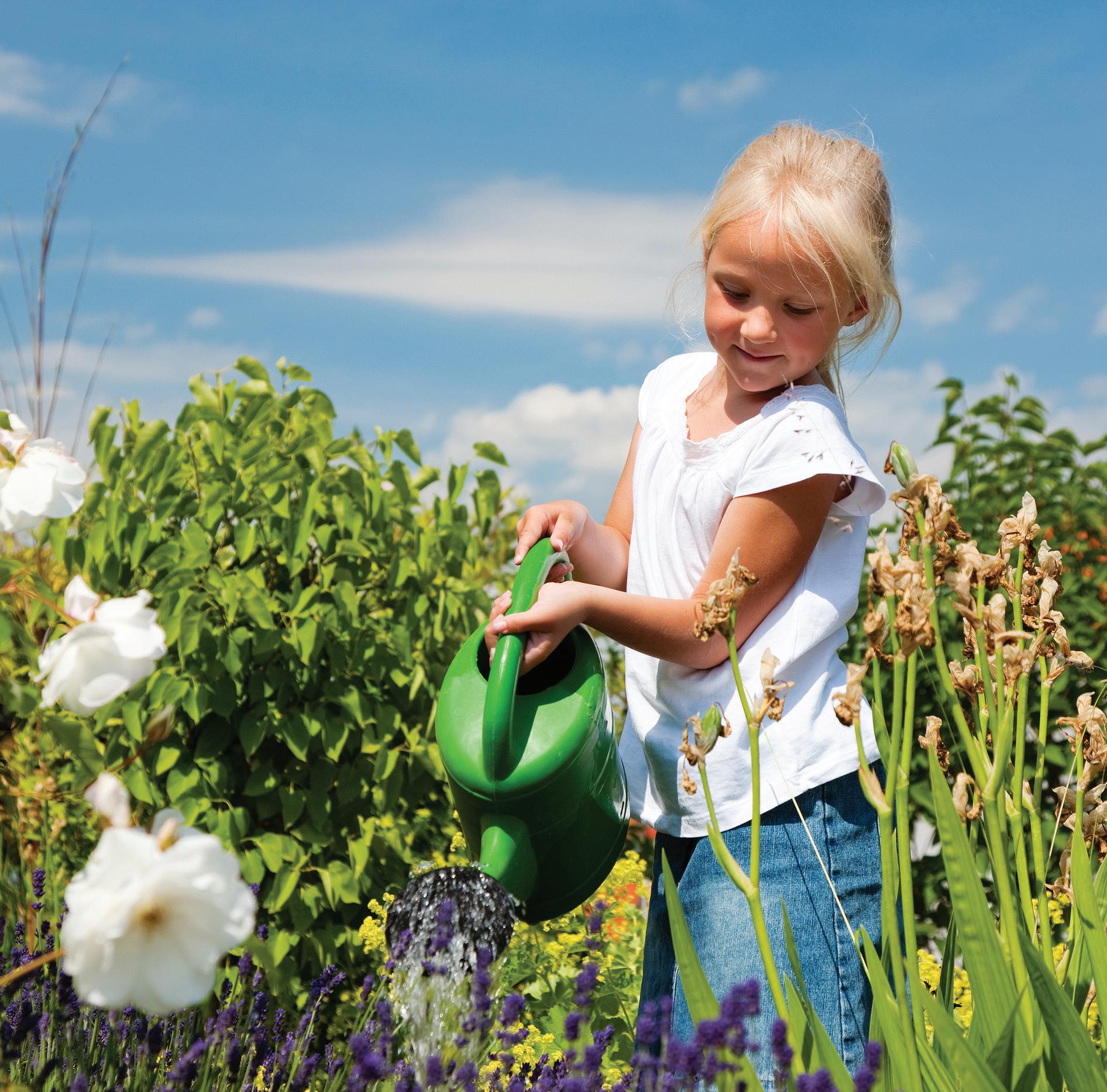
The student is expected to demonstrate an understanding of the effects of human interaction with Earth and how Earth’s natural resources can be protected and conserved, including creating a design for communities to prepare for disasters.
How can we design a community that protects nature and keeps people safe from natural disasters?
Key Concepts
• Humans are dramatically changing environments; whether the changes are on land or in the sea, the surface of our planet is changed forever.
• Changes that result from feeding growing populations can be reduced through sustainable farming and fishing.
• Infrastructure changes can be reduced with environmental impact studies, stricter construction and emission laws, and reeducation.
Scope Overview
In this unit, students investigate how human activities influence soil and groundwater quality, evaluate and communicate strategies to conserve natural resources, and apply engineering practices to mitigate natural hazards. Through modeling, research, and design, they analyze pollutant movement, synthesize conservation actions for water, soil, air, and materials, and iteratively construct and test wind-resistant structures. The unit emphasizes evidence-based reasoning, community-focused communication, and resilient design, aligning student understanding with protecting resources and preparing communities for environmental challenges and disasters.
Scope Vocabulary
The terms below and their definitions can be found in Picture Vocabulary and are embedded in context throughout the scope.
Carrying Capacity
The maximum population size that can be sustained by a given environment
Conserve
To prevent the loss of something
Environment
The space, conditions, and all the living and nonliving things around an organism
Natural Disaster
An event or force of nature that causes great damage, such as a tornado, hurricane, or flood
Recycle
To properly dispose of used resources so they can be reprocessed into new products
Resource
Something valuable that we can use
Notes
Students model how agricultural practices and transportation can affect soil and groundwater quality and analyze their observations.
• Use a paper towel “soil” over a cup of “groundwater” to model a farm environment, recording initial observations.
• Add dish soap (fertilizers/pesticides), oil (machinery leaks), and pepper (air pollution), then pour water to simulate rainfall and observe what passes into the “groundwater.”
• Document changes and discuss how these pollutants move through soil into water, connecting to real-world food production impacts.
Activity - Saving the Earth
Students research and communicate strategies for conserving natural resources and reducing human impact.
• Read a shared text, then work in pairs to choose a conservation focus (water, soil, air, or recycling) and conduct targeted research.
• Create a community-facing pamphlet that explains current efforts, how individuals can help, and proposes at least two new actions.
• Share pamphlets via presentations or a gallery walk and reflect on community and personal steps to shrink the environmental footprint.
Engineering Solution - Blowing in the Wind
Students engage in an engineering design challenge to construct wind-resistant structures using constrained materials and iterative testing.
• Activate prior knowledge through discussion and a hurricane video; record observations in notebooks.
• Research hurricane-resilient features and plan designs that meet criteria (≥25 cm tall, attached to cardboard, covered outer walls).
• Build a quick prototype with limited materials and test with a fan; then create an improved model with the full material set, clamp the base, and test at increasing fan speeds, analyzing performance and redesigning as needed.
• Present results, complete design portfolios, and finalize group rubrics.
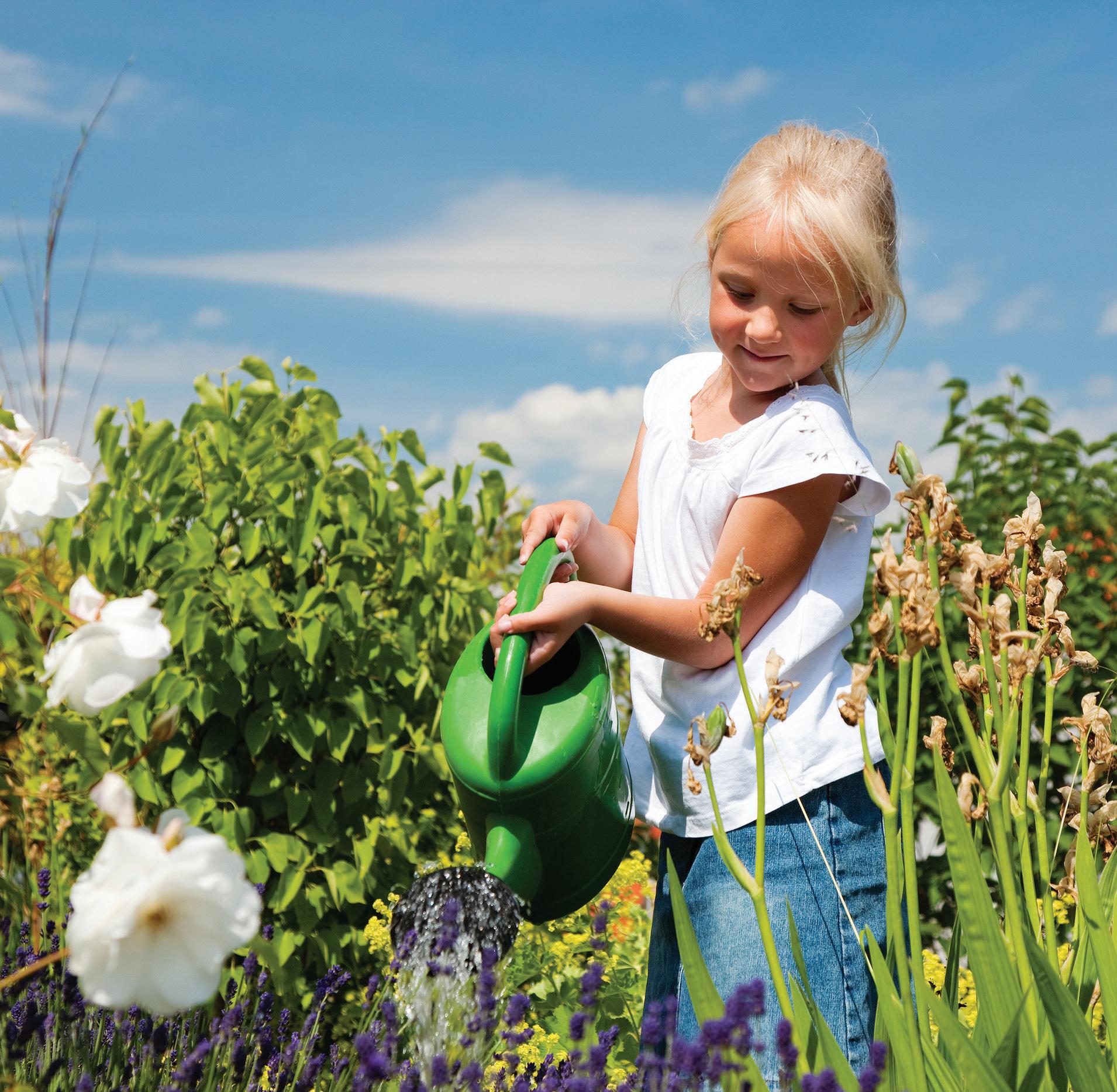
Estimated 30 min - 45 min
Students use a model to observe what happens to the soil that grows the food we eat along with the water we drink.
Materials
Printed
● 1 The Fertilizer We Use (per student)
Reusable
● 1 graduated cylinder (per group)
Consumable
● 12 oz. plastic cup (per group)
● 1 white paper towel (per group)
● 1 rubber band (per group)
● 5 mL dishwashing liquid (per group)
● 5 mL vegetable oil (per group)
● 1 tsp. pepper (per group)
● 175 mL water in a graduated cylinder (per group)
● Gather all the materials.
● Print out The Fertilizer We Use document.
Constructing Explanations and Designing Solutions
Obtaining, Evaluating, and Communicating Information
During this activity, students will construct explanations and design solutions by using evidence from their observations of the model to understand the impact of agricultural practices on soil and water. They will apply scientific ideas to solve design problems related to creating a community that protects nature and keeps people safe from natural disasters. By generating and comparing multiple solutions, students will evaluate how well these solutions meet the criteria and constraints of sustainable community design. Additionally, students will obtain, evaluate, and communicate information about the environmental impact of fertilizers, pesticides, and pollution, using this information to support their explanations and proposed solutions.
Cause and Effect
Stability and Change
During this activity, students will identify and test causal relationships by observing how different pollutants affect soil and water, helping them understand the cause and effect relationships between human activities and environmental changes. They will also measure changes in the model to observe how pollutants impact the stability of natural systems over time, reflecting on how systems that appear stable can change due to human influence.
1. Distribute all consumable materials to students. Explain that the dishwashing liquid represents chemicals used on plants, such as fertilizers and pesticides. The vegetable oil represents oil from factories and machinery, and the pepper represents air pollution.
2. Discuss the steps it takes to get the food we eat each day to our homes, starting with where it comes from.
○ Where is food grown? Food, such as fruits and vegetables, is grown on farms.
○ What do some farmers do to help their plants grow quickly and stay bug-free? Farmers can use fertilizers or pesticides to help their plants grow or to keep bugs away.
○ How does the food get to the grocery store? It has to be shipped by truck or boat.
○ What does the truck use as energy to travel, and what does it release into the air? The truck uses gas to drive to the grocery store. It releases exhaust into the air and pollutes it.
○ We are going to create a model of how these things can affect our water supply.
3. Have students fill their cups with 100 mL of their water.
4. Instruct students to loosely cover the cup with the paper towel and secure it with the rubber band. The paper towel should be sagging a little in the middle, not pulled tightly.
5. Have students draw and record their observations of the paper towel and the water on their The Fertilizer We Use document pages. Remind them to include labels: the paper towel represents the soil on a farm, and the water in the cup represents groundwater that will be used as drinking water.
6. Have students pour the dishwashing liquid onto the paper towel. Explain that this represents the fertilizer we use to grow our food. Remind them that the paper towel represents the soil in which the crops grow, and the water beneath represents where we get our drinking water.
7. Now have students pour their oil onto the paper towel. Explain that this represents the oil that may leak from the tractors and trucks used to harvest and transport the food.
Notes
FACILITATION
Assign colors to each material (blue = water, green = fertilizer, black = oil, gray = pollution/pepper) so students can connect the abstract idea to the model.
Provide students with sentence stems for discussion as needed:
The fertilizer represents…
The oil shows how…
The pepper is like…
I think pollution affects water because…
8. Have students sprinkle the pepper on the paper towel. Explain that this represents the air pollution caused by the trucks’ and tractors’ exhausts.
9. Have students pour the remaining 75 mL of water through the paper towel and into the cup. This represents rainfall.
10. Guide students in drawing and recording their observations of the paper towel and the cup on their The Fertilizer We Use document pages. Have them include labels to show what has changed.
11. Discuss the questions on the back of the Fertilizer We Use document as students fill them out. Students may need help generating ideas for the third question. Use the Key to guide their thinking, leading them to some possible answers.
12. Wrap up the discussion by explaining that all of this happens to Earth every day in order for us to get food. To get plants to grow, farmers use pesticides and fertilizers. To harvest the food, they use tractors and trucks that use fuel and release pollution. When humans do things that negatively affect the environment, we sometimes refer to it as leaving a footprint. Farmers can look at their growing practices to reduce their footprint on the environment, and we as consumers can also investigate the types of food we are buying and possibly purchase only food that is grown in a way that does not leave as much of a negative footprint on Earth.
How can the way we grow and transport food impact our environment, and what steps can we take to minimize these effects while ensuring community safety from natural disasters?
1. Based on your observations, how do the chemicals and pollutants used in agriculture affect our water supply, and what are the potential consequences for a community during a natural disaster?
2. How can we redesign agricultural practices to reduce pollution and protect natural resources while still meeting the food demands of a growing population?
3. What strategies can communities implement to balance agricultural needs with environmental protection to enhance resilience against natural disasters?
Notes
Estimated 2 hrs - 3 hrs
Students gather research to create a pamphlet that informs the community about ways to conserve natural resources.
Materials
Printed
● 1 Student Journal (per student)
● 1 Student Rubric (per student)
● 1 Affecting the Human Footprint (per pair)
Reusable
● 1 set of research materials (per class)
● Suggested materials: books, computer with Internet, printed articles, videos
Consumable
● 1 sheet of white paper (per pair)
● 1 set colored pencils (per pair)
SEP Connection
● Gather the research materials. If possible, coordinate a visit to the library or computer lab.
● Technology suggestion: Review the process for using different search engine tools and the procedure for verifying sources of online information. You can also set up a web page with links for the assignment.
Constructing Explanations and Designing Solutions
Obtaining, Evaluating, and Communicating Information
During this activity, students will gather and evaluate information to construct explanations and design solutions for the phenomenon of designing a community that protects nature and keeps people safe from natural disasters. By researching ways to conserve natural resources and reduce human impact, students will apply scientific ideas to solve design problems and generate multiple solutions that meet the criteria and constraints of sustainable community design. Through creating and sharing pamphlets, students will communicate scientific and technical information effectively, supporting their explanations with evidence and identifying key points that contribute to the overall solution.
Notes
CCC Connection
Cause and Effect
Stability and Change
During this activity, students will identify and test causal relationships by researching and creating a pamphlet that informs the community about ways to conserve natural resources. This will help them understand how actions can lead to changes in the environment, contributing to the stability and change of their community’s ecological footprint. Through this process, they will explore how designing a community that protects nature can mitigate the effects of natural disasters, illustrating the cause and effect relationship between human actions and environmental outcomes.
1. Read Affecting the Human Footprint together as a class.
2. Assign pairs of students a general topic upon which to focus their research, or allow them to choose a topic from the following: ways to conserve clean water resources, ways to improve soil fertility, ways to reduce emissions to decrease air pollution, or ways to recycle to reduce landfill waste. You may approve other ideas students generate on their own.
3. Direct students to use the research materials to gather information pertaining to their particular topic. Have students use the information they gather from their research to create a pamphlet to be provided to the local community with ways to conserve natural resources and reduce humans’ negative footprint to help save our Earth.
4. Pamphlets should include what the community is currently doing, how people can help in this process, and at least two new things the community could implement to further its success in shrinking its current footprint.
5. Facilitate students sharing their pamphlets with the rest of the class, or set up a gallery walk so that each group can view other groups’ work.
6. Discuss the following:
○ What are some things your community is already doing? There is a recycling center in town that collects certain items; there is an adopt-ahighway program, etc.
○ What can the community do to further shrink its footprint? Organize groups to gather recyclable materials and deliver them to the recycling center; be careful not to pollute the parks and lakes around the city.
○ What can you start doing at home, today, that could help your community? Not waste electricity and water; start separating items that can be recycled; ride my bike rather than ride a bus or car to school, etc.
Students may have trouble conducting research in this activity. Assist students by providing a list of search terms or phrases, or brainstorm a list with them. If students are still struggling, partner them with a peer to provide extra help and support finding information. Read more strategies for students who have difficulty conducting research in the Intervention Toolbox.
Notes
FACILITATION TIP
Provide students with pictures of clean water, compost, recycling bins, factories with smoke, etc.
FACILITATION TIP
Assign roles in pairs so work is balanced:
Researcher: Reads/watches sources, shares notes.
Designer: Sketches and organizes the pamphlet.
Recorder: Writes the text in the pamphlet.
Presenter: Prepares to explain the pamphlet to class.
After students have had a chance to explore the investigation, place them in a circle in an open area. Explain to them that you will say some sentences about the investigation out loud. If they agree with a statement, they should walk into the inside of the circle and stand facing someone who does not agree with the statement. They can then discuss why they agree or disagree with the statement. Be sure to model the game before beginning.
Examples:
● Reducing emissions helps prevent air pollution problems.
● If you recycle, you are reducing landfill waste.
How can our community design strategies to conserve natural resources while ensuring safety from natural disasters?
1. How can the strategies for conserving natural resources, like reducing emissions or improving soil fertility, also contribute to protecting our community from natural disasters?
2. In what ways can our community’s current efforts in recycling and reducing landfill waste be enhanced to better prepare for and mitigate the effects of natural disasters?
3. How can individual actions at home, such as conserving water or reducing energy consumption, collectively impact the community’s resilience to natural disasters?
Estimated 2 hrs - 3 hrs
Students design and build a structure that can sustain high winds. The structure must be made out of a given set of materials, be at last 25 cm tall, be attached to cardboard, have outer walls that are covered, and be able to sustain hurricane force winds modeled by a box fan.
Materials
Printed
● 1 Student Journal (per student)
● 1 Group Rubric (per group)
● 1 science notebook (per student)
Reusable
● 1 research device with Internet capability (per group)
● 1 pair of scissors (per group)
● 1 meterstick (per group)
● 1 glue gun (per class, used by teacher)
● 2 clamps (per group)
● 1 box fan (per class)
Consumable
● 50 cm clear tape (per group)
● 10 cm duct tape (per group)
● 10 wooden craft sticks (per group)
● 100 cm string (per group)
● 10 sheets of newspaper (per group)
● 100 mini marshmallows (per group)
● 50 spaghetti noodles (per group)
● 1 30 x 30 cm square of cardboard (per group)
● 20 index cards (per group)
● 1 hot glue stick (per group, to be used by teacher)
● 5 pipe cleaners (per group)
● Gather the necessary materials.
● Write the design challenge and criteria on the board or a piece of chart paper.
● Duplicate a copy of the design portfolio for each student and a Group Rubric for each group.
Constructing Explanations and Designing
Obtaining, Evaluating, and Communicating Information
During this activity, students will construct explanations and design solutions to the phenomenon of designing a community that protects nature and keeps people safe from natural disasters. They will use evidence from their observations and measurements to construct explanations about the effectiveness of their structures in withstanding high winds. Students will apply scientific ideas to solve the design problem by generating and comparing multiple solutions based on how well they meet the criteria and constraints of the design solution. Additionally, they will obtain, evaluate, and communicate information by researching and summarizing scientific and technical ideas, and presenting their findings and solutions in various formats.
Cause
Stability and Change
During this activity, students will identify and test causal relationships by designing and building a structure that can withstand high winds, thereby exploring how specific design choices can lead to different outcomes in terms of stability and change. This process helps them understand the cause and effect relationship between structural design and the ability to withstand natural disasters, as well as how systems that appear stable may change under different conditions.
1. Facilitate a class discussion in which students use prior knowledge to discuss the impact of natural or man-made disasters on human and/or animal life in Mississippi or elsewhere. Instruct students to make a chart like the one below in their science notebooks and fill in information as the class discussion takes place:
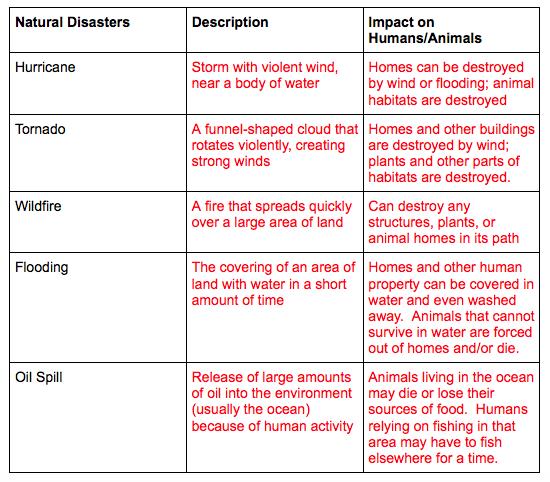
2. Show students a video of a Hurricane Katrina storm surge in Gulfport, Mississippi, by using a search engine to find “Hurricane Katrina Historic Storm Surge Video.”
3. Discuss the following:
○ What natural disaster was shown in the video? A Category 4 (strong) hurricane
○ Was the structure shown in the video (a hotel) able to withstand the strong winds and rising waters that came with the hurricane? No. Several floors of the hotel were completely flooded and destroyed. Windows were blown in, brick walls collapsed, and roofs were destroyed.
Use additional real-world visuals showing before and after hurricane photos to anchor abstract engineering concepts in reality.
○ If the hurricane had this strong of an effect on a large structure such as a hotel, what do you think the impact was on smaller, individual homes? Many homes would have been completely destroyed by water or wind, with no hope of salvaging any part of the structure to rebuild in the future.
○ Do you think there could be a way to build structures that would better withstand hurricane force winds and storm surges? Answers will vary. Guide students toward realizing that houses and other buildings that are built where hurricanes are likely to occur are often built in special ways (raised up higher to allow water to pass underneath them, for example). Have students begin to brainstorm modifications to houses and other structures that could make them better able to stand up to a major storm.
FACILITATION TIP
Provide starter resources (short curated articles, diagrams of hurricane-proof homes, FEMA infographics).
4. Divide students into groups. Pass out the Student Journal. Have groups conduct research using an Internet device and record their findings in the appropriate spaces in their Student Journals. Students should gather information on how houses and other structures can be built to withstand heavy wind, rains, and flooding associated with hurricanes and begin to generate ideas about how they could build a model of their own such structure.
5. Refer to the Design Challenge written on the board or chart paper. Explain that each group of students is challenged to build a tower as tall as possible (at least 25 cm) that can resist falling over when placed in front of a fan set on a low speed. Tell groups that at first they will be limited in the materials they are able to use.
○ Distribute two sheets of newspaper, 50 cm of tape, and a meterstick to each group. Allow students five minutes to construct a 25 cm tower.
○ Have groups take turns placing their towers about 2 m away from the fan.
○ Turn the fan on low to test the towers.
○ Instruct students to complete the table by describing their group’s tower and recording observations of how it was affected by wind.
6. Brainstorm and design a solution to the problem.
○ Review the design challenge. Ask students to discuss how their exploration ties in with the design challenge. Our first tower represented a structure not built to withstand the wind from a hurricane or other major storm. Now we are looking at possible ways we can improve the design to make a sturdier structure that will better withstand even higher wind speeds.
○ Show students the materials they can use to design and build their models: duct tape, craft sticks, string, newspaper, marshmallows, spaghetti noodles, cardboard, index cards, hot glue, and pipe cleaners. Students may also use other materials at your discretion. Assist any group desiring to use hot glue to adhere any part of their tower. Students should not operate the hot glue gun themselves.
○ Give groups time to come up with one or more solutions to the challenge.
○ Make sure students sketch or describe their solutions in the design portfolio. They must also list the materials and tools they wish to use in their construction.
7. Build, test, and analyze your solution.
○ Monitor students as they complete the building and testing process.
○ Ask questions and redirect thinking as necessary.
○ To test each structure, do the following: (1) Use the clamps to secure the cardboard foundation of the structure to a table or countertop. (2) Place a box fan about 2 m in front of the structure. Turn the fan on low speed for 20 seconds. If the structure withstands the winds, turn the speed to medium for 20 seconds. (3) If the structure is still intact, turn the fan on high for 1 minute.
8. Improve or redesign and retest the solution.
○ Give groups time to analyze the criteria in the Design Portfolio.
○ Assist students in redesigning and retesting as needed.
9. Present and share the results, and then finish completing the Design Portfolio and discuss the culminating questions as a class.
○ Allow time for each group to present its results.
○ Let other groups ask questions. Discuss as desired.
○ Complete the Group Rubric for each group. Discuss with students.
Allow students to use the following sentence stems to help them make and present their engineering solutions:
● The situation is ______________________________.
● The problem we are dealing with is natural because
● The problem we are dealing with is man-made because
● The harmful effect this has on the environment is ______________________________.
● The helpful effect this has on the environment is ______________________________.
● The solution to the problem is ______________________________.
How can we design structures that are both resilient to natural disasters and environmentally friendly, ensuring the safety of communities while preserving nature?
1. What design features did your group incorporate to ensure the structure could withstand high winds, and how do these features relate to real-world architectural strategies used in hurricane-prone areas?
2. In what ways can the materials and methods used in your structure be adapted to minimize environmental impact while maintaining safety during natural disasters?
3. How can communities balance the need for disaster-resistant infrastructure with the preservation of natural habitats and ecosystems?
Pause after the first weak tower test to highlight learning: “This shows what happens when structures aren’t designed for storms. What changes could we make?”
Model how an engineer might decide between using tape for the base vs. the walls.
STEMscopedia
Reference materials that includes parent connections, career connections, technology, and science news.
Linking Literacy
Strategies to help students comprehend difficult informational text.
Picture Vocabulary
A slide presentation of important vocabulary terms along with a picture and definition.
Content Connections Video
A video-based activity where students watch a video clip that relates to the scope’s content and answer questions.
Career Connections
STEM careers come to life with these leveled career exploration videos and student guides designed to take the learning further.
Math Connections
A practice that uses grade-level appropriate math activities to address the concept.
Reading Science - Reduce, Reuse, Recycle
A reading passage about the concept, which includes five to eight comprehension questions.
Notes
Claim-Evidence-Reasoning
An assessment in which students write a scientific explanation to show their understanding of the concept in a way that uses evidence.
Multiple Choice Assessment
A standards-based assessment designed to gauge students’ understanding of the science concept using their selections of the best possible answers from a list of choices
Open-Ended Response Assessment
A short-answer and essay assessment to evaluate student mastery of the concept.
Guided Practice
A guide that shows the teacher how to administer a smallgroup lesson to students who need intervention on the topic.
Independent Practice
A fill in the blank sheet that helps students master the vocabulary of this scope.
Extensions
A set of ideas and activities that can help further elaborate on the concept.
Use this template to decide how to assess your students for concept mastery. Depending on the format of the assessment, you can identify prompts and intended responses that would measure student mastery of the expectation. See the beginning of this scope to identify standards and grade-level expectations.
Student Learning Objectives What Prompts Will Be Used?
Humans are dramatically changing environments; whether the changes are on land or in the sea, the surface of our planet is changed forever.
Changes that result from feeding growing populations can be reduced through sustainable farming and fishing.
Infrastructure changes can be reduced with environmental impact studies, stricter construction and emission laws, and reeducation.
Does Student Mastery Look Like?

ISBN: 979-8-3308-1919-5