STUDENT
WORKBOOK
WORKBOOK

Published by Accelerate Learning Inc., 5177 Richmond Ave, Suite 800, Houston, TX 77056. Copyright © 2025, by Accelerate Learning Inc. All rights reserved. No part of this publication may be reproduced or distributed in any form or by any means, or stored in a database or retrieval system, without prior written consent of Accelerate Learning Inc., including, but not limited to, in any network or other electronic storage or transmission, or broadcast for distance learning.
To learn more, visit us at www.stemscopes.com.
This Student Notebook is designed to be used as a companion piece to our online curriculum.
The pages of this book are organized and follow the 5E model.
EXPLORE
A formative assessment in which students write a scientific explanation to show their understanding ENGAGE
EXPLAIN
A short activity to grab students’ interest
ELABORATE
Hands-on tasks, including scientific investigations, engineering solutions, and problem-based learning (PBL)
Claim-Evidence-Reasoning (CER)
A reference material that includes parent connections, technology, and science news
EVALUATE
Reading Science
A reading passage about the concept that includes comprehension questions
Claim-Evidence-Reasoning (CER)
A summative assessment in which students write a scientific explanation to show their understanding
Open-Ended Response (OER)
A short answer and essay assessment to evaluate mastery of the concept
Only student pages are included in this book and directions on how to use these pages are found in our online curriculum. Use the URL address and password provided to you by your district to access our full curriculum.
E.5.8A

Each of the parts of a plant has a special characteristic and performs a task to insure the welfare of the plant. Roots, stems, leaves, and flowers are essential for the survival of a plant. Each plant part has a different job to perform that allows the plant to live, grow, and reproduce seeds to make new plants.
The stem is the part of the plant that moves the water to the rest of the plant. The stem also brings food made in the leaves to other parts of the plant, like the flower. The stem’s job is like an elevator that brings things up and down. Some plants have edible stems, such as celery, asparagus, and sugarcane. Some stems are woody, while others are soft. Stems also provide support for the plant allowing the leaves to reach sunlight.
The root is the part of the plant that is in the soil and pulls water (absorbs) and nutrients into the plant. Roots are like tiny sponges that soak up water and other nutrients from the soil. Like an anchor, roots also hold the plant down in the soil. The main root branches out into tiny roots that extend down into the soil. Some roots swell to store food and water and are edible, like carrots, beets, radishes, and sweet potatoes.
Leaves are the parts of the plant attached to stems or the parts of trees attached to branches. Many plants have edible leaves (can be eaten), such as lettuce, spinach, and cabbage. Others can be dried and used as a spice, such as basil, oregano, and cilantro. Leaves are the foodproducing factories. Through the process of photosynthesis, carbon dioxide in the air along with water in the leaves and sunlight (light energy) are changed to sugar (glucose), or energy for the plant.
Plants, algae, and photosynthetic bacteria use radiant energy (light energy) from the Sun, along with water and carbon dioxide gas from the air, to produce sugar (glucose) and oxygen. The glucose can be used immediately or stored for growth or later use. The oxygen is released as waste. Radiant energy (light energy) is converted to chemical energy in the process.
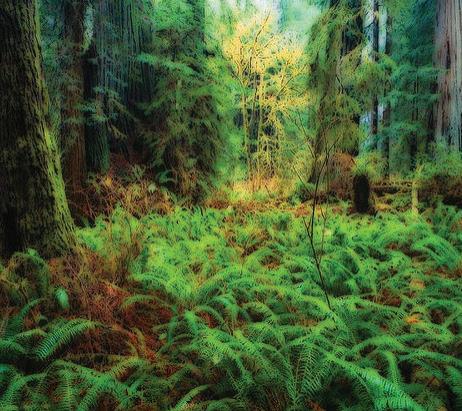
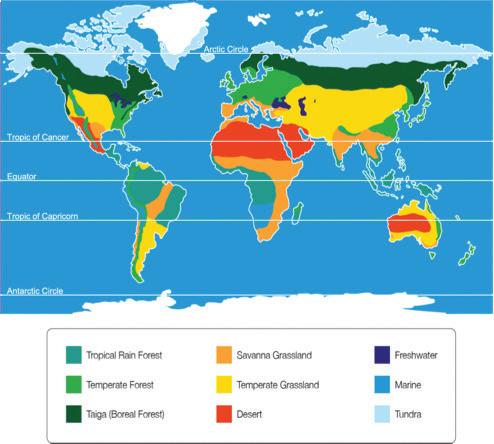
Look at the pictures below, including where on the map each type of environment is located. Research to complete the table, and then answer the questions on the next page.
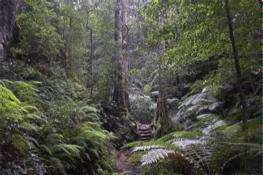
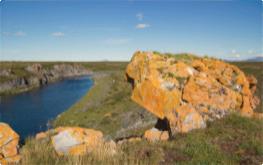
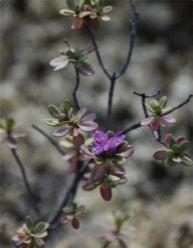
1. Describe any differences you notice between how plants in the tundra look compared to plants growing in a rain forest.
2. Do plants in the tundra receive as many hours of sunlight each day as plants in the rain forest? What about the amount of rainfall in each location? How does this change during different seasons?
3. Using the map on the previous page and what you know about Earth’s tilt and orbit around the Sun, describe how the strength of the Sun’s rays may be different in the tundra than in the rain forest.
4. How does the amount of direct sunlight a plant receives affect its ability to go through photosynthesis and make food to grow?
5. Can plants in the tundra produce as much food through photosynthesis as plants in the rain forest? Will they ever be able to grow as tall as the plants in the rain forest, or can they have the same size of leaves?
6. Explain in your own words what makes plants in the tundra look the way they do. Does photosynthesis still occur in these plants, and if so, how does it take place?

Suppose you place a plant on a sunny windowsill and water it regularly. At the same time, you place a similar plant in a dark closet and keep it watered too. The only difference between the two plants is the amount of light they receive. What do you think will happen to each plant after a few weeks? You probably predicted that the plant on the windowsill will remain healthy, while the plant placed in the closet will wilt. Light is a basic need for many plants. Why is this?
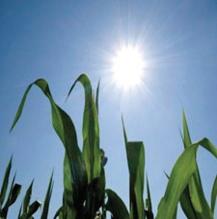
Plants, algae (including phytoplankton), and many microorganisms require light to live. There are a few types of plants that can live without light, but most plants will die if they do not receive adequate light. Light is a form of energy that most plants take in and use to carry out photosynthesis.
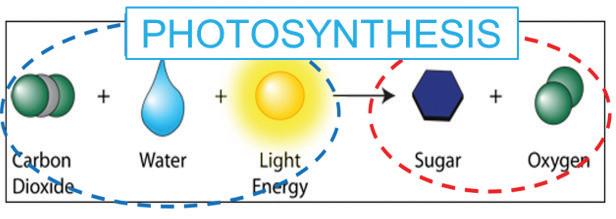
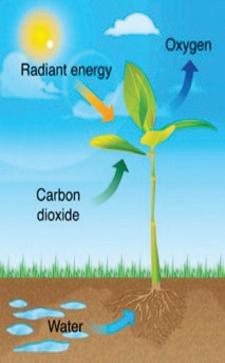
Photosynthesis is a series of chemical reactions that produces glucose, a compound plants use as food. In this way, plants use light from the Sun to make their own food. Radiant energy from the Sun is changed to chemical energy in glucose molecules. The diagram to the right summarizes this process:
Plants differ from animals by using radiant energy this way. Animals cannot use radiant energy from the Sun to make glucose. They must obtain energy from the environment in the form of food, which contains chemical energy. Animals have to eat in order to survive.
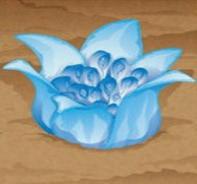
A plant called the underground orchid is native to Western Australia. The roots and stem of this plant grow completely underground. Only the flower emerges above the surface. Is it likely that these plants use radiant energy from the Sun? If not, what form of energy do they use? This orchid is a parasite and gets its nutrients and minerals from a fungus that grows on the roots of a nearby broom bush!
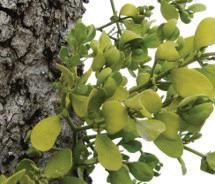
Mistletoe is a semiparasitic plant and needs the help of a host plant to grow on to provide extra nutrients.
We Can Observe Photosynthesis by Using a Simple Experiment
Photosynthesis is a chemical process. Because this process takes place at the level of molecules and atoms, we cannot observe it directly. However, we can observe the results of photosynthesis.
Joseph Priestley was one of the first scientists to observe a product of photosynthesis. He conducted an experiment in which he placed a burning candle and a mouse under a glass dome. After a few minutes, the flame went out and the mouse died. Priestley showed that the gases in this dome could not keep the mouse alive.
However, if the experiment was repeated with a plant present under the dome, the mouse remained alive. What change had the plant made to the dome?
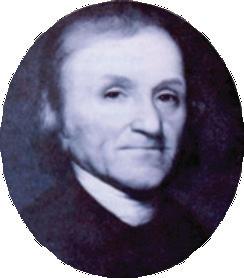
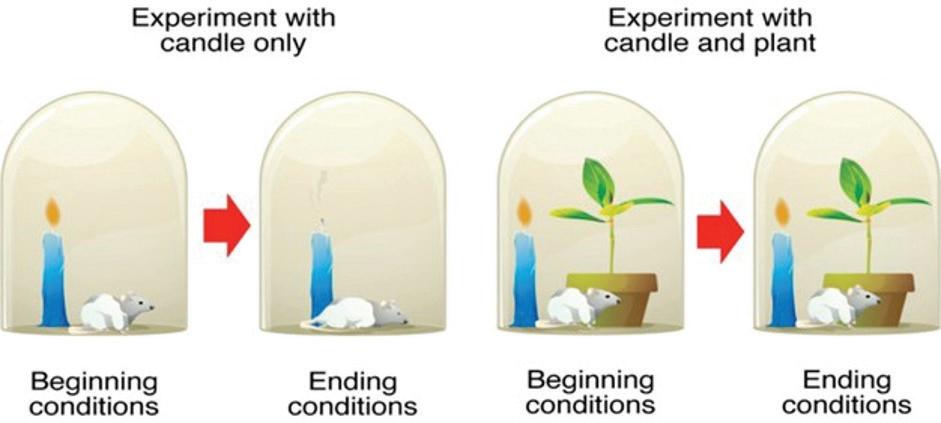
When he put a mint plant in the closed container with a burning candle, the flame used up the oxygen and went out. After about a month, Priestley was able to rekindle the candle.
This showed that the mint plant produced oxygen that allowed the candle to burn. The plant replaced the oxygen that had been used up by the burning candle. The mouse needed the oxygen to live. Priestley showed that the plant could produce oxygen. Oxygen is one of the byproducts of photosynthesis.
Photosynthesis Involves Three Elements: Carbon, Hydrogen, and Oxygen
You have seen that the products of photosynthesis are oxygen and glucose. Their chemical formulas are shown below. What elements make up these molecules?
Name: Oxygen Glucose
Chemical Formula: O2 C6H12O6
Only three elements are present in the products of photosynthesis: carbon, hydrogen, and oxygen. These same elements are present in the reactants of photosynthesis.
Name: Water Carbon Dioxide
Chemical
Formula: H2O CO2
Photosynthesis occurs when water and carbon dioxide react to form oxygen and glucose. Below is the chemical equation showing this process:
energy
6H2O + 6CO2 6O2+ C6H12O6
Notice that it takes six molecules of water and six molecules of carbon dioxide to make one molecule of glucose. The diagram below shows the inputs and outputs of photosynthesis. Carbon dioxide in the air enters a plant through its leaves. Water in the soil enters through a plant’s roots. Oxygen exits from the leaves. Glucose can be used immediately as food or can stay behind to make other structural molecules for growth.
The process of photosynthesis is actually a complex series of many different chemical reactions. The equation shown above represents the overall reaction. This equation shows only the beginning and ending chemical compounds. There are many more steps in between.
Humans require oxygen to survive. Many other animals also require oxygen. However, Earth’s atmosphere has not always contained oxygen gas. During its first 2.3 billion years of existence, Earth had an atmosphere that contained water vapor, nitrogen, carbon dioxide, sulfur dioxide, and hydrogen sulfide. What changed that led to oxygen gas becoming part of the atmosphere?
The answer is that microorganisms capable of photosynthesis arose on the planet. These microorganisms are called cyanobacteria. Cyanobacteria live in both freshwater and saltwater environments. Millions and millions of these tiny creatures produced enough oxygen to change the composition of Earth’s atmosphere.
Oxygen became established in the atmosphere as a result of photosynthesis. Since this shift, many organisms have evolved to depend on oxygen. Photosynthesis is necessary to continue supplying oxygen to these organisms.
In addition, all life-forms depend on photosynthesis as the mechanism for capturing and using radiant energy. Plants benefit from this directly because they use photosynthesis to make the glucose molecules that are their food sources. Animals benefit indirectly because they, too, must have sources of food.
Animals either eat plants to obtain chemical energy in the form of glucose or eat other animals that eat plants. Energy moves from the Sun to plants to animals. Photosynthesis is necessary for that energy flow.
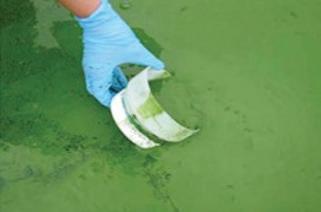
A scientist takes a sample of cyanobacteria from the surface of a lake. When cyanobacteria populations grow too quickly in a body of water, they can harm other organisms in the ecosystem. This situation is called an algal bloom.
The same microorganisms that created our oxygenated atmosphere could be used to develop new fuels. Think about it. Food is a kind of fuel that we need to run our bodies. If photosynthesis can produce the kind of fuel that our bodies use, it could also produce the kinds of fuels that cars or airplanes use.
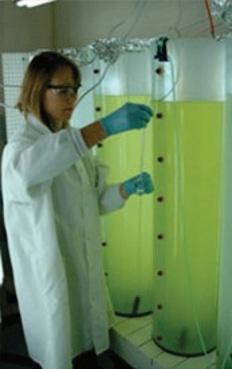
This scientist is studying the production of organic compounds by cyanobacteria. If successful, she will be able to use photosynthesis to produce fuels for cars, planes, and trains.
These fuels would not contain glucose, but they would have other carbon-containing compounds. Such biofuels have been produced from corn, sugarcane, soybeans, and sunflowers.
Making biofuel from cyanobacteria is not hard to do. However, the process is expensive. Right now it costs too much to develop biofuel from the strains of cyanobacteria available. Each cell produces a very small amount of the compounds that serve as the raw material for biofuel production. It is also costly to provide the large quantities of water needed to grow the microorganisms. In all, the cost of making the biofuel is greater than the price at which the fuel can be sold. Scientists are doing a lot of research to find ways to bring costs down so that the process becomes economical.
Try Now
Read the statements below. Fill in each blank with the correct word from the following list: photosynthesis, radiant, food, chemical energy, water, glucose, carbon dioxide, oxygen. Some terms may be used more than once.
1. All organisms need glucose or a source of ____________________ to carry out life functions.
2. Many plants obtain glucose through the process of ________________________________ _.
3. Animals obtain glucose by eating ______________________________________________ _.
4. Photosynthesizing organisms need _______________ energy from the Sun to produce glucose.
5. The reactants of photosynthesis are ___________________ and ____________________.
6. The products of photosynthesis are _________________ and _________________.
7. Plants and animals depend on each other for important gases. Plants need the _______________________ that animals exhale, while animals need the ____________________ that plants produce.
To help your child learn more about the inputs and outputs of photosynthesis, you can physically manipulate models of reactants to form products. You will need a box of toothpicks, 18 red gumdrops to represent oxygen atoms, six black gumdrops to represent carbon atoms, and 12 blue gumdrops to represent hydrogen atoms. Make models of six water molecules and six carbon dioxide molecules using the gumdrops and toothpicks. Follow the patterns of atom arrangements shown in the diagrams below. Then have your child take the models apart and rearrange the atoms to form the products of photosynthesis.
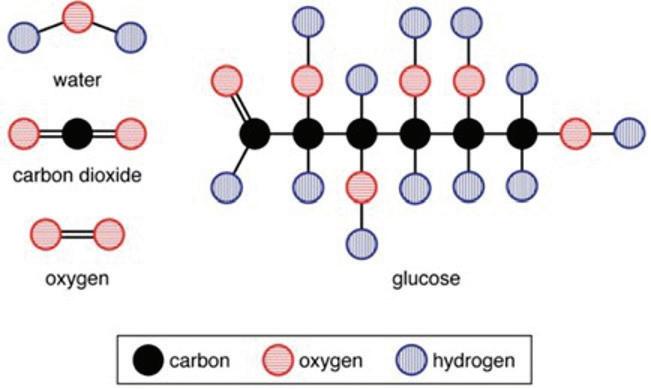
Emphasize that the same number of atoms are present in both reactants and products. In other words, the number of gumdrops (atoms) does not change throughout the activity; however, you will need more toothpicks for the reactants (36) than you did for the products (32). This is because fewer chemical bonds are necessary to hold together the atoms in the products.
Here are some questions to discuss with your child:
• How many carbon atoms did you start with? What chemical compound contained these carbon atoms?
• How many carbon atoms did you end with? What chemical compound contained these carbon atoms?
• What happened to the hydrogen atoms that started out in the water molecules? Did they all end up in the same product?
• Did you have the same number of oxygen atoms at the end that you had at the beginning?
• Why is the input of radiant energy needed for the reaction that you modeled? Where is the energy stored in the products?

1 Have you ever taken the time to thank a leaf? It may seem silly to thank leaves, but we need them to survive. In fact, we could not survive without the energy made by leaves through the process called photosynthesis. Life on Earth relies on light energy captured from the Sun. Photosynthesis changes the Sun’s energy to a form that plants, animals, and humans can use to survive.
2 Photosynthesis is the process that allows plants to make their own food. During photosynthesis, the green material in leaves captures energy from the Sun and, along with air and water, makes food for the plants. Plants need the food to live and grow. Extra food is stored in the plant. When animals eat plants, they get energy from the stored food in the plant. Therefore, all energy that animals get from food comes first from photosynthesis. This is true even for animals that are meat eaters. The energy is passed to them through the food chain. Without photosynthesis, there would be no food. Animals, including humans, would not survive.
3 Think about the plants you might have eaten recently. Did you have some fruit with breakfast or lunch? That apple, banana, or strawberry contained stored energy that the plant did not use. Now that energy has been passed on to your body to use. Did you have eggs for breakfast or lunch? The energy the chicken received from eating seeds and grain was passed on to the eggs. You received energy for your body from the eggs. How about potato chips or French fries with a sandwich or hamburger? The potato plant stored in its roots energy that was passed on to you. Everything that you eat can be traced back to plants and the process of photosynthesis using the energy of the Sun.
4 In addition to making the food and energy that supplies all plants and animals on Earth, photosynthesis also produces the oxygen we breathe. During photosynthesis, carbon dioxide is removed from the air and combined with water. Plants make oxygen as a waste product of photosynthesis. Humans and many other organisms can only survive in environments with oxygen. We breathe in air, and our bodies remove the oxygen. When we breathe out, we release carbon dioxide as a waste product into the air. Humans need the oxygen made by plants to live. The plants need the carbon dioxide for photosynthesis. For humans, it is essential that photosynthesis changes energy from the Sun into energy in plants. Our lives rely on the results of photosynthesis. That is why the next time you see a leafy, green tree or a leafy plant you might want to say, “Thank you!”
1 In Paragraph 4 of this passage, what is the meaning of the word essential?
A Easy to do
B Not needed
C Necessary
D Wrong
2 Which is the best summary of the selection?
A Leaves should be talked to when we see them.
B Photosynthesis in plants uses energy from the Sun to make energy that is useful and important to humans.
C Breakfast should include fruit and eggs; lunch should have potato chips and hamburgers.
D Plants need carbon dioxide; animals need oxygen.
3 What might be another title for the article?
A “Talk to the Leaves”
B “The Importance of Photosynthesis”
C “Plants and Animals Need Air”
D “You Must Eat Breakfast”
4 What must plants have to complete photosynthesis?
A Air, sunlight, soil
B Water, soil, sunlight
C Sunlight, water, oxygen
D Air, water, sunlight
5 What is the main point of Paragraph 2?
A How the process of photosynthesis works
B How plants make oxygen
C How humans and other animals use energy from the Sun
D How animals hunt and get energy from their prey

1. Draw and label the process of photosynthesis.
2. During photosynthesis, plants convert what type of energy into what other type of energy?
3. An experiment was done in a classroom with no windows. Three Elodea plants were placed inside inverted test tubes filled with water. Then the plants were placed under electric lamps using light bulbs with varying wattage. One test tube was exposed to low levels of light, another to medium levels of light, while another was exposed to high levels of light. The table provided shows the results of this experiment. Look at the table and answer the questions below.
What do the oxygen bubbles show?
Which plant produced the most mL of oxygen? What does that mean?
How are the plants able to perform photosynthesis without the Sun?

Below is the equation for photosynthesis. Photosynthesis is a process that takes place in plants. Notice that carbon dioxide and water are converted into sugar and oxygen.
When you go home tonight, your mother asks you to explain to her what happens during the process of photosynthesis. Your mother is a science teacher, so make sure you use scientific terms to give her a scientific explanation of how energy is stored as sugar in plants through photosynthesis.

Answer the following questions.
1. Observe your ecosystem, and fill in the following table: Living Things Nonliving Things
2. The transfer of energy through an ecosystem can be shown by creating a food chain. The energy to begin every food chain must come from the ____________.
3. Write the flow of energy within two possible food chains found in this ecosystem.

4. All ______________ are ______________. They use the Sun’s energy to make their own food.
5. Animals cannot create their own food and must find other organisms to eat to gain energy, so they are ______________.
6. Animals that eat plants are called ______________ ______________. Animals that eat other animals are considered ______________ ______________.
7. Some organisms, called _______________, break down dead plant and animal materials. Examples are ___________ and ___________. Show an example of where one of these may be found in a food chain:
1. What is the definition of your ecosystem?
2. What are some characteristics of your ecosystem?
3. What are some nonliving things in your ecosystem?
4. What are some living things that could be present in your ecosystem?
5. Choose three of the living things you listed and describe adaptations they have that allow them to survive in your ecosystem.
6. How do some of the living things in your ecosystem get energy to survive?
7. Now look at the organisms on the cards given to each member of your group. How do you think these organisms interact with each other?
1. What was your role in the food web? Draw a picture of your character.
2. If you are the Sun, what do you provide? If not, what does the Sun provide for you?
3. If you are a carnivore, what do you eat? Who might consider you prey?
4. If you are an herbivore, what do you eat? Who might consider you prey?
5. If you are an omnivore, what do you eat? Who might consider you prey?
6. If you are a producer, what do you need to make your own food? Who might eat you?
7. What is a food web? How is it different from a food chain?
8. If a carnivore eats only meat, how does it depend on plants? How does it depend on the Sun?
9. If there were a fire in the forest you lived in, how might that affect your life and what you eat/what eats you?
10. How does the amount of water in an environment affect its food web?
11. What happens in a food web if part of the web is removed?
12. Draw and label one of the food chains you were part of in the activity.
Use the rain forest food web you created with your group to form three possible food chains that could be found within that ecosystem. Write them below.
What environmental change was on your picture?
What created this change in the environment?
How might this change have a negative effect on this environment?
How might this change have a positive effect on this environment?
What might happen to the organisms in this environment as a result of this change?
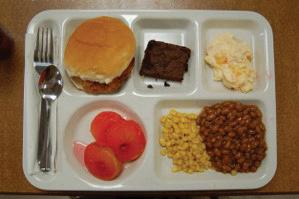
Maybe you enjoyed sizzling bacon and eggs for breakfast and a juicy hamburger for lunch. Possibly, you will eat a spicy, homemade jambalaya for dinner tonight.
Food can be tasty, but why do you really need to eat? What does food do for you? Food provides you with the energy your body needs to grow, repair itself, maintain your body temperature, and allow you to move.
But how does the energy get in the food? How does the energy get to your plate when you sit down for a meal?
How does energy move from one organism to the next?
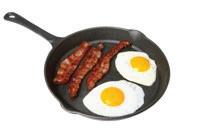
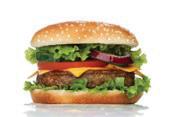
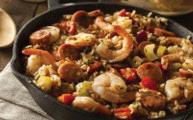
All the food energy that passes between organisms comes from the Sun. Plants and other organisms use sunlight to make their own food. That energy passes to other organisms when they eat the plants.
For example, grass uses sunlight to make food. A grasshopper gets energy by eating the grass. After that, a mouse gets energy by eating the grasshopper. A snake eats the mouse to get energy, and a hawk eats the snake for energy. Any dead materials left behind are broken down by the mushrooms.
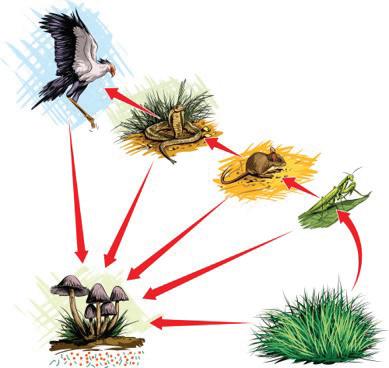
The movement of food energy from one organism to another is called a food chain. Take a look at the food chain above. The arrows show how energy is passed from one organism to the other.
Just like you enjoy a choice in the foods you eat, organisms eat more than one thing too! They are a part of many food chains. When many different food chains occur in an environment, they cross each other in several places. This intersection of food chains creates a food web.
What are the different parts of a food web?
A group of overlapping or connected food chains is called a food web. A food web can be big or small. It can contain many different types of plants and animals or just a few. Whether a food web is big or small, the organisms fall into one of two categories: producers or consumers.
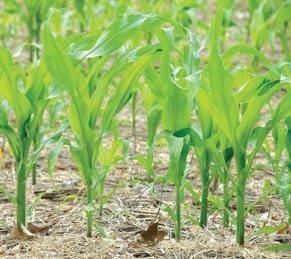
Producers: Producers are organisms that get their energy directly from the Sun. They are able to turn sunlight into food through a chemical process. Producers combine carbon dioxide from the air with water and sunlight to produce oxygen and sugar. Other organisms get energy by eating producers. Have you ever eaten lettuce or any other vegetable? If so, you have eaten a producer! The lettuce plant changes sunlight into food your body uses as fuel. Producers are very important to life on Earth. Without them, other organisms would not survive.
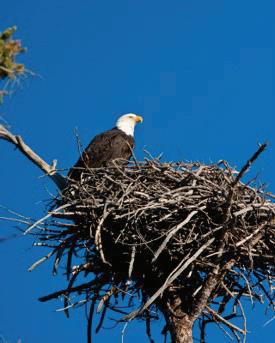
Consumers: A bald eagle is an example of a consumer. It cannot directly use the Sun’s energy to make food. As a consumer, it has to consume, or eat, other organisms for energy. Consumers that eat only plants are called herbivores. Consumers that eat only animals are called carnivores. If a consumer eats both plants and animals, it is called an omnivore. Primary consumers are herbivores that eat plants. Secondary consumers are carnivores that eat herbivores, and tertiary consumers are carnivores that eat carnivores. How would you classify yourself?
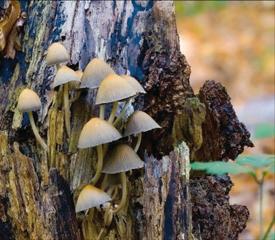
Decomposers: Decomposers are a special group of consumers. Mushrooms, other fungi, and bacteria are decomposers. This group of consumers eats only dead organisms. They break down the nutrients in the dead organisms and return them to the food web. They may eat dead producers or consumers. Suppose a tree dies in a forest. Bacteria and fungi consume the tree and return the nutrients in the tree to the soil. The grass in the forest absorbs those nutrients and uses them to grow.
How does the energy flow in a food web?
The movement of energy in a food web is similar to a one-way street. The energy flows in one direction from one organism to another. It does not flow backward. For example, in the food web on the right, the zebra gets energy directly from the grass it eats. The grass does not get energy from the zebra. When the zebra dies, a decomposer, such as a dung beetle, will break its body down into nutrients that the grass can use. Remember, the initial source of all this energy is the Sun.
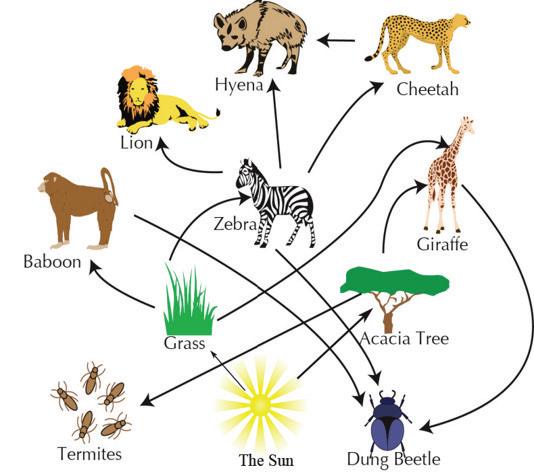
A food web can include many connections. In the food web here, you can see that several animals rely on the zebra as a source of food. The lion, hyena, and cheetah all hunt the zebra. No matter how many connections a food web has, energy flows from the Sun to producers and from producers to consumers. Decomposers help return energy from producers and consumers to the food web.
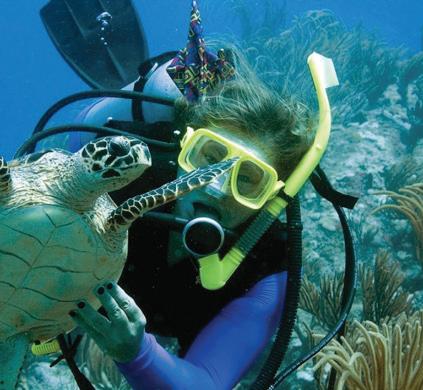
ecosystem: all the interacting living and nonliving parts of an environment
How do humans affect food webs?
Wildlife biologists research the natural world. For example, a wildlife biologist may study a tropical reef ecosystem, keeping track of the different organisms living on the reef and the number of each type that live there. It is very important for a wildlife biologist to understand the food webs in the ecosystems. Research has shown that human activity has had negative impacts on food webs due to deforestation, overfishing, hunting large game, or introducing invasive species into a habitat. Each of these events changes available food sources within food chains and food webs. For example, kelp (a producer) is a source of fish food. If something were to reduce the available kelp, many fish that depend on the producers (kelp) for food would be affected, too. Wildlife biologists try to find ways to keep food webs and ecosystems healthy and stable.
Have you ever wondered why the plants and animals in one area of the country are so different from those in another area? For example, cacti, lizards, and snakes are part of the desert, while pine trees, mountain lions, and bears are part of the forest. Although these habitats are different locations with different plants and animals, they have in common the way that energy is transferred throughout the ecosystem from the Sun to plants and animals in connected chains and webs of interactions. Energy within ecosystems flows through food chains and food webs.
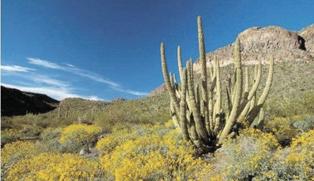
The warm grassland, the hot desert, and the cold forest are examples of different systems of living and nonliving things that interact with each other in an area called an ecosystem. The living parts of an ecosystem are called the biotic factors, while the nonliving parts are called abiotic factors.
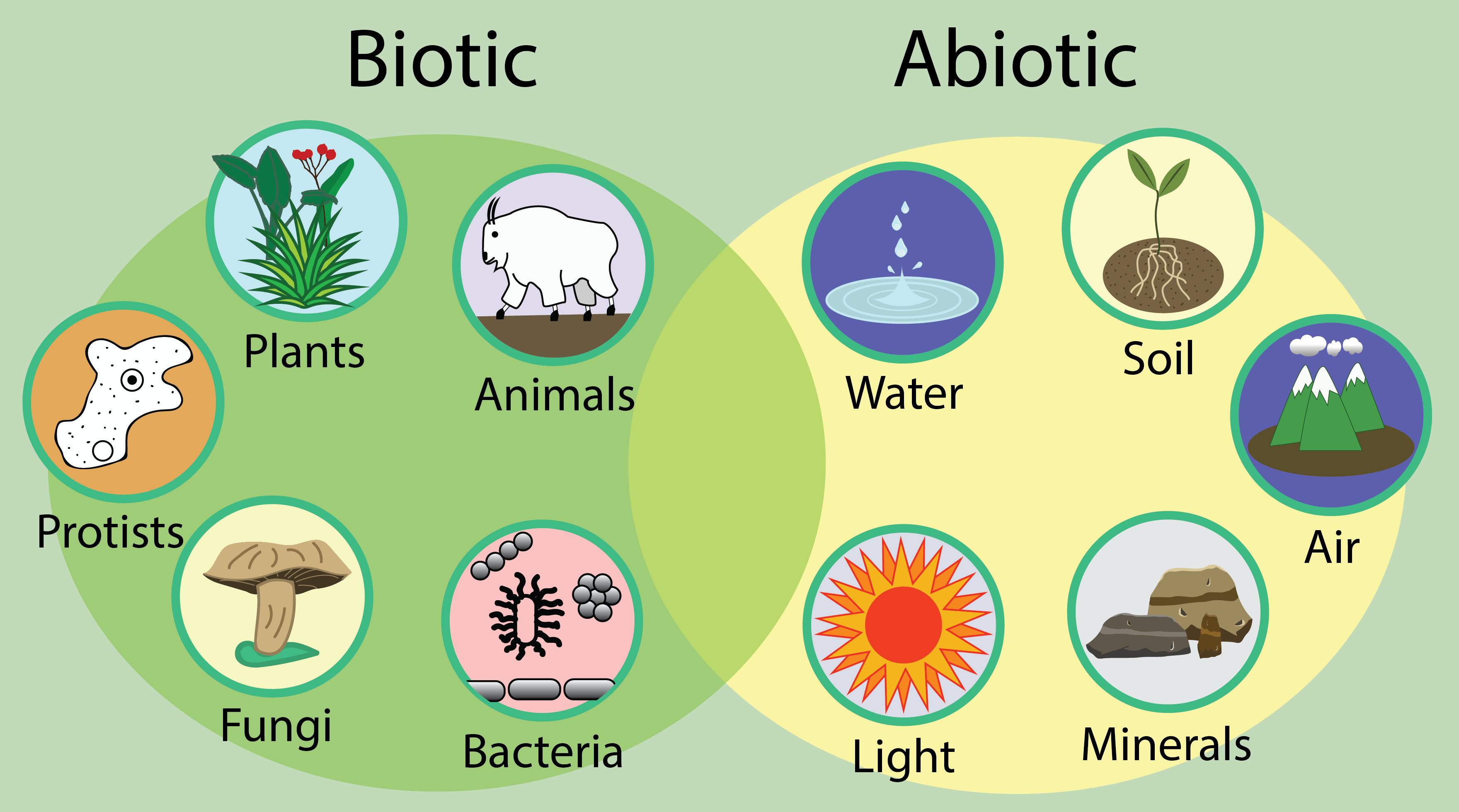
An area with a similar climate and ecosystem is called a biome. Biomes can have different abiotic (nonliving) factors, such as type of soil, amount of water, climate, and geology. Each biome has organisms that are adapted to life there and depend on the abiotic factors in that biome.
Ecosystems in the world’s biomes can be divided into two types according to their characteristics: terrestrial or aquatic. Terrestrial ecosystems are land-based ecosystems that include forests, rain forests, grasslands, deserts, and the polar tundra.
Forests have many trees (with needles or with leaves), shrubs, grasses, and ferns and a variety of animals. They usually get more rain than grasslands. Diverse types of animals can be found in forests, depending on the type of forest. Deciduous trees lose their leaves each fall and grow new foliage each spring. Examples of animals found in deciduous forests are black bears, deer, red foxes, voles, rabbits, and cardinals.
Evergreen forests have trees that stay green all year and are located at higher altitudes in the mountains or in the plains area along central latitudes. These are called coniferous forests because these pine trees bear cones. Many types of organisms make their home in forest ecosystems. Temperatures in forests may vary depending on where the forests are located.
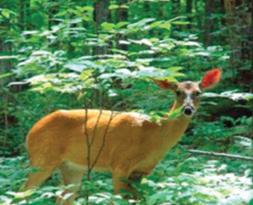
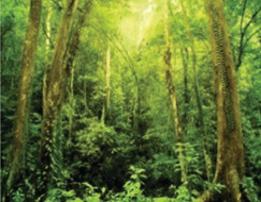
Rain forests are located in tropical areas and have a tall canopy of broadleaf trees. Tree frogs, toucans, monkeys, and vines typically live in rain forests.
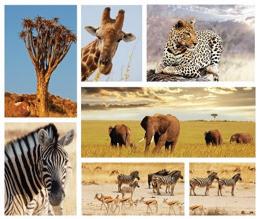
Grasslands have fertile soil and are covered with tall grasses. They usually get a medium amount of rain but less than forests. Temperatures may also vary depending on where the grasslands are located. Some examples of animals that live in the prairie grasslands along the plains area of the United States are elk, prairie dogs, bison, and grasshoppers. The savanna of Africa is home to many organisms that include elephants, cheetahs, lions, zebras, giraffes, scrub trees, grasses, and so on. Other names for grasslands are steppe (Russia) and pampas (South America). The African savanna covers almost half of the continent.
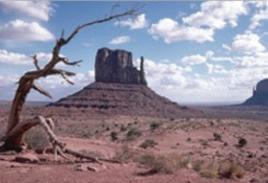
Deserts are ecosystems with very little precipitation and extreme temperatures. Some deserts are hot most of the time, such as the Chihuahuan Desert in Texas. Other deserts are cold most of the time. Did you know that Antarctica is a desert? It gets very little precipitation and has extremely cold temperatures all year. Organisms that live in warm deserts, such as lizards, small rodents, cacti, and sagebrush, are very good at conserving water and surviving in extreme temperatures.
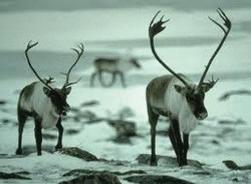
The polar tundra is a treeless ecosystem in the cold Arctic region. The soil is frozen most of the year with a short summer and long winter. Many animals spend only the summer there and migrate to warmer areas upon snowfall. Other animals live in the polar tundra year-round, such as caribou, reindeer, arctic foxes, arctic hares, and polar bears. Plants have short leaves and short roots.
Aquatic ecosystems fall into two categories: marine or saltwater ecosystems and freshwater ecosystems.
Marine ecosystems: About 97% of Earth’s water is salty. Ecosystems that encompass a large area of salt water are called marine biomes, which include oceans, coral reefs, and estuaries. Some marine biomes are warm, such as tropical reefs. Some marine biomes are cold, such as the Arctic and Southern Oceans. Marine biomes are home to many different kinds of organisms. Sharks, whales, fish, sponges, and plankton all make their home in marine biomes. All of these organisms live in salt water.
The open ocean is a vast ecosystem, represented by Earth’s five oceans. Zooplankton and larger animals feed on the phytoplankton and on each other. Larger animals such as whales and giant groupers may live their entire lives in the open water.
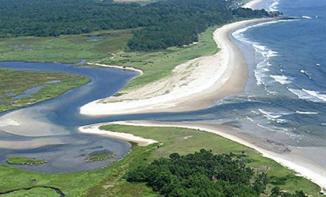
Estuaries are found where salt water from oceans mixes with fresh water from rivers along the coast. Estuaries are home to shorebirds and seabirds, fish, crabs, lobsters, clams and other shellfish, marine worms, raccoons, and many reptiles.
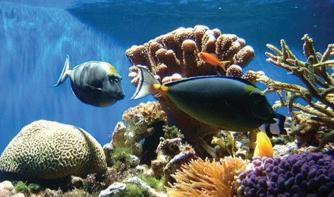
Coral reefs are a delicate ecosystem built up from the secretions of tiny marine organisms. The rich diversity of marine life depends on the reef for food and shelter. Unfortunately, many fragile reefs are being destroyed from pollution and misuse.
Freshwater ecosystems: About 3% of water on Earth is fresh water with very little or no salt. Organisms that live in fresh water cannot survive in salt water.
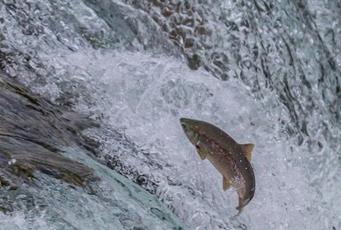
Freshwater ecosystems include rivers, lakes, ponds, streams, and some wetlands. Algae are tiny plants that live in freshwater biomes. They use energy from the Sun to make their own food. Other examples of organisms that live in freshwater ecosystems are salmon, frogs, salamanders, ducks, smaller fish, and insects.
Try Now
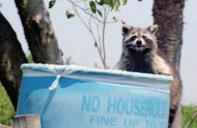
Study the images in the table below. Decide if the organism in each image is a producer or consumer. Write your answer in the first column of the table. If the organism is a consumer, decide if it is a carnivore, herbivore, or omnivore. Write your answer in the second column of the table. Finally, think about how each organism gets its food energy. Write your answer in the last column of the table.
Organism
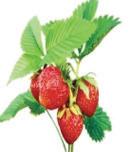
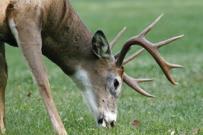
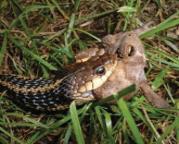
eating plants and animals from a
Producer or Consumer?
Carnivore, Herbivore, or Omnivore (if a consumer)?
To help your child learn more about relationships in food webs, go on a nature walk around your neighborhood or school. First, ask your child to list the different trophic levels found in food webs. Then have your child identify and record the trophic level(s) of each organism you observe on the walk.
Some common examples include trees and grasses (producers), insects and rabbits (primary consumers), smaller birds (secondary consumers), and snakes (tertiary consumers). You might also ask your child to look for decomposers by searching for mushrooms and even lifting up rocks and logs.
Many insects that live under rocks and logs break down dead leaves and tree limbs and return some of the nutrients from these plant parts to the soil. Remind your child that the unaided eye cannot see many decomposers, such as bacteria.
If your child is not sure about each organism’s role, such as producer, primary consumer, secondary consumer, or decomposer, suggest recording the names and drawing sketches or taking photographs of the organisms.
During the trip, encourage your child to gather information about each role that the organisms play in that food web. After returning home, your child can conduct additional research on the energy transfer in an ecosystem.
Once all of the information has been gathered and recorded, have your child draw a food web for the organisms you observed. If possible, take your child on a trip to a zoo or nature park and repeat the activity.
1 All living things must eat, and most living things are eaten by bigger things. The way organisms get food is linked in a sort of chain (and sometimes a web). This chain of life is called the food chain.
2 Food chains, food webs, and energy pyramids all explain these eat-orbe-eaten relationships. Meet farmer Jacob Adamson. He is an aquaculture technician. That just means he grows shrimp in large outdoor earthen tanks. Aqua means “water,” and culture means “cultivate or grow.” Mr. Adamson must know all about food chains, food webs, and energy pyramids to make his shrimp farm successful.
3 Wild shrimp are close to the bottom of the food chain. Many animals like to eat shrimp, so it is a prey to many animals. The shrimp must also eat, so it is also a predator. When they are young, shrimp eat plankton, which are plants. A plant is a producer, because it uses energy from the Sun to make its own food. As they grow bigger, shrimp eat small worms, mollusks, and fish. Mr. Adamson must feed his shrimp the right things to eat so they can grow. He must keep plankton, worms, small mollusks, and small fish for them.
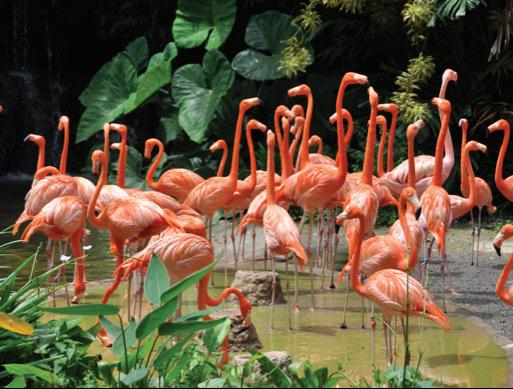
4 Mr. Adamson also must keep predators out of his tanks. In the water, bigger shrimp, fish, and crabs are predators of shrimp. Ocean mammals, land mammals, and many birds also catch and eat shrimp. The pink flamingo gets its pink color from eating shrimp. The flamingo has a beak that can scoop shrimp out of the water. Roseate spoonbills also like to eat shrimp. Small birds wade into the shallows for small young shrimp. Large herons wade into deeper water to catch them. Pelicans scoop shrimp up when shrimp are close to the surface. All of these organisms can get to the outdoor tanks on the farm. Mr. Adamson must know how to protect his shrimp farm. If he does not, these predators will eat all his profits.
5 While all of these animals like shrimp, most aquaculture shrimp are eaten by people. Mr. Adamson will sometimes take shrimp home to his family. Everybody likes shrimp from the wild or from a farm. That appetite is what makes a food chain.
1 Where are people in the shrimp food chain?
A Close to the very bottom
B About the middle
C Close to the top
D At the very bottom
2 What is the main point of the reading passage “Let’s Farm Some Shrimp”?
A Shrimp are part of nature’s food chain.
B Shrimp have very specialized diets and will not eat a variety of foods.
C Aquaculture is not a profitable business.
D Few birds or other animals eat shrimp.
3 Which of the following statements is true about aquaculture?
A An aquaculturist can throw some young shrimp in a pond, and they will take care of themselves.
B It means “cultivating small acreages of land.”
C An aquaculturist must tend to the tanks carefully to make sure predators do not eat the shrimp.
D The tanks are large aquariums built in warehouses.
4 The main point of Paragraph 4 is that–
A wild shrimp are close to the bottom of the food chain.
B Mr. Adamson needs to keep predators out of his tanks.
C Mr. Adamson is an aquaculture technician.
D most aquaculture shrimp are eaten by people.
5 What are plankton?
A Producers
B Consumers
C Decomposers
D Humans
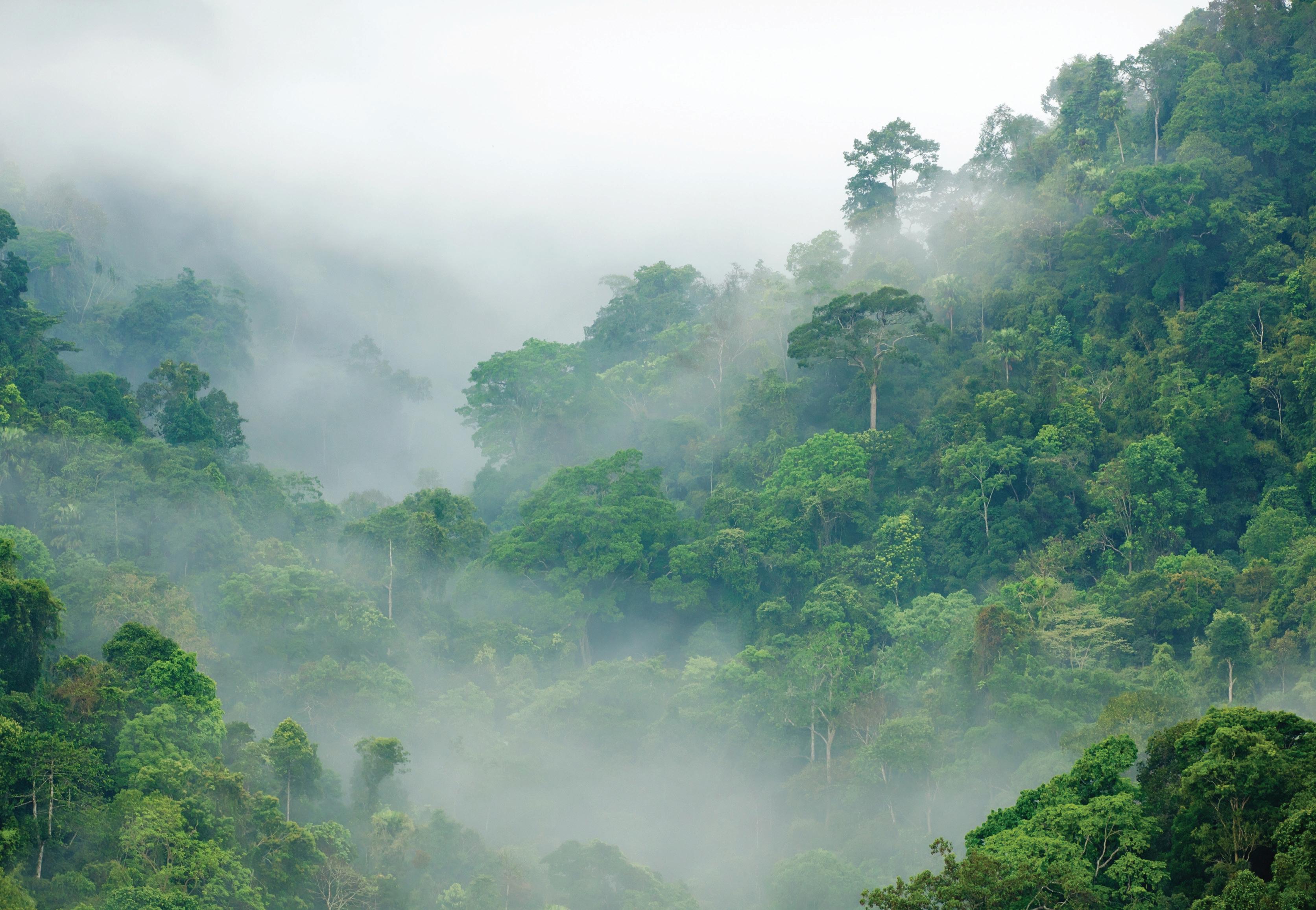
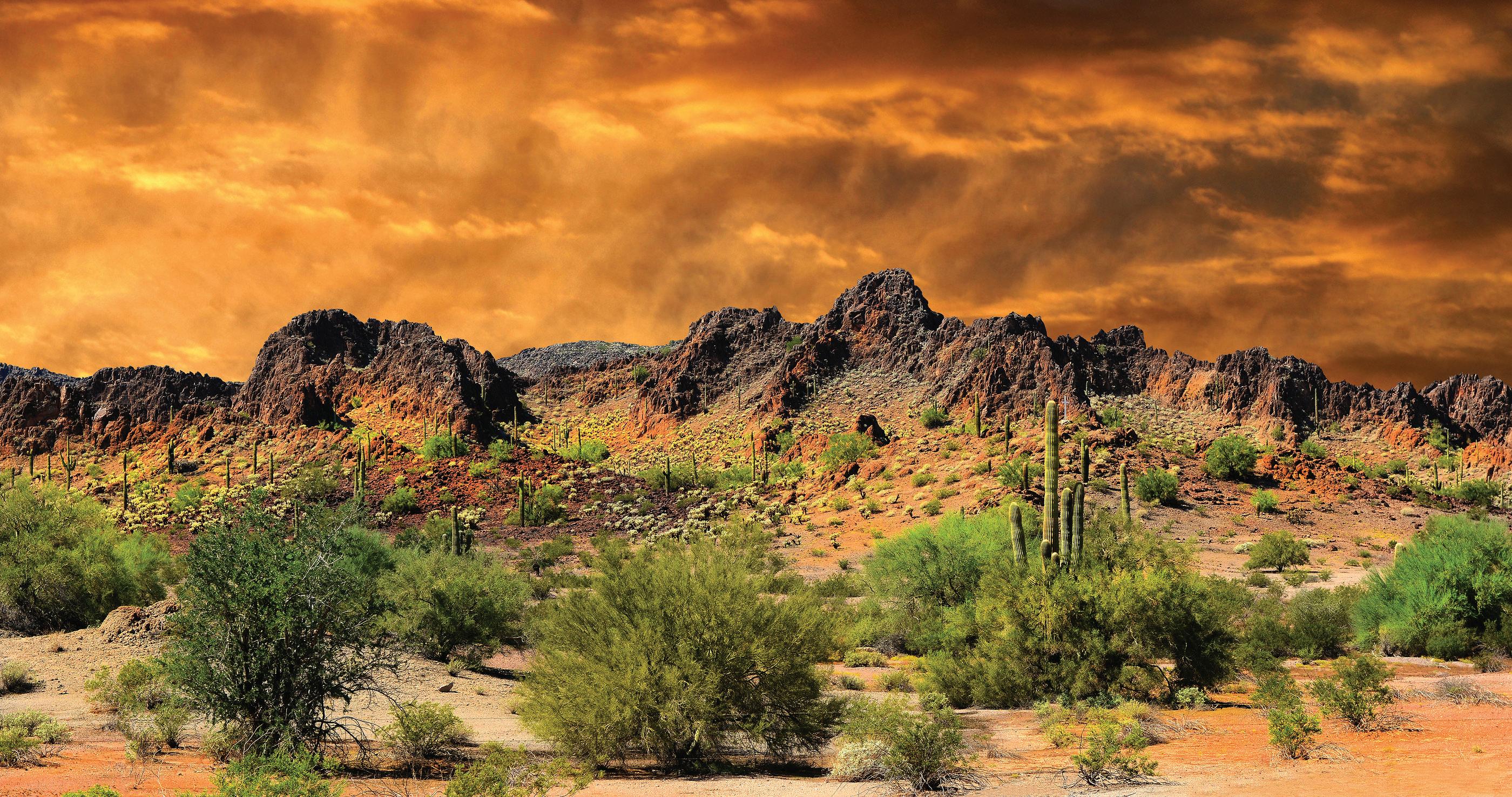
1. Compare and contrast a rain forest ecosystem and a desert ecosystem. Be sure to include characteristics of the ecosystems and the types of organisms they support.
2. Create and draw a food chain. Make sure to include and label producers, consumers, and decomposers. Use arrows to show how the energy flows and explain how each organism in the food chain gets energy.
3. Zebra mussels that live in Lake Michigan are considered to be an invasive species. Zebra mussels compete with the native mussels for food, space, and oxygen and are reproducing twice as fast as the native mussels, which can be a huge problem. What do you think will happen to the ecosystem in Lake Michigan as a result?
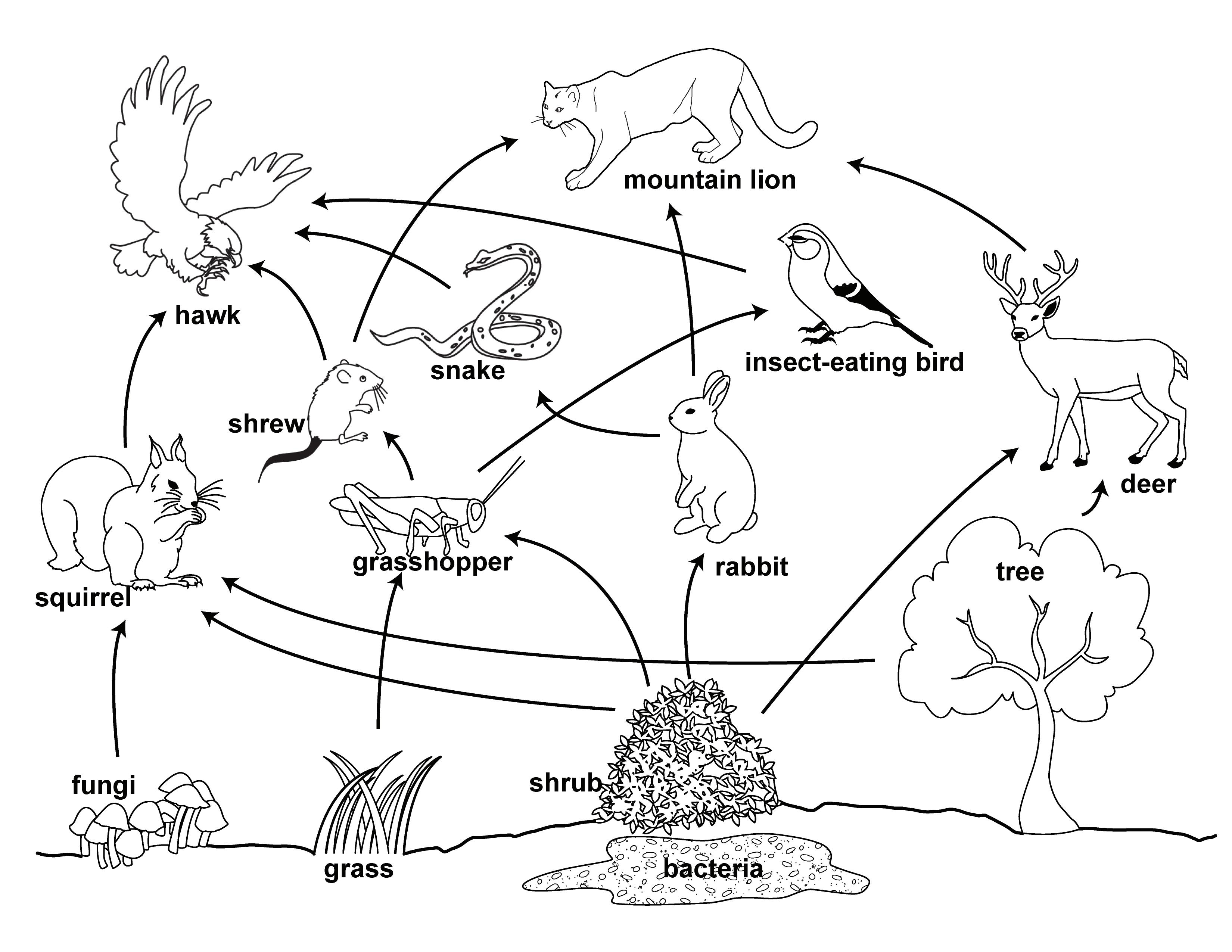
4. Look at the food web. Where would humans belong on this food web? How would humans impact the ecosystem?
Energy is one basic need of plants and animals. Plants get this energy from the Sun. Animals get this energy through the food they eat. The food web below shows how energy is transferred between organisms in an ecosystem from the Sun to the food they eat.
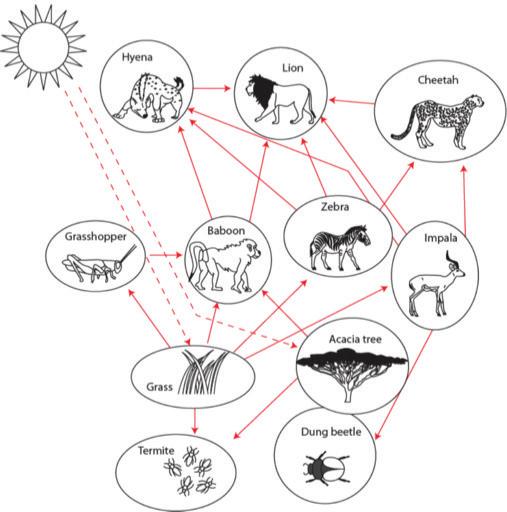
Write a scientific explanation describing how energy is transferred among consumers, producers, and decomposers.
Claim:
Evidence:
Reasoning:


Part I
Item
Aloe Vera Sand Iron Filings
Drawing with Eye
Drawing with Microscope
1. Describe how the objects looked when you viewed them with your eye.
2. Describe how the objects looked when you viewed them under the microscope.
3. What can you conclude about viewing items with your eye in comparison to through a microscope?
4. Would you have been able to see everything you saw under the microscope with just your eyes?
5. Only an extremely strong microscope can allow us to view atoms. Explain what an atom is.
6. Do you think the atoms within a leaf would look the same under a microscope as the atoms that make up a liquid such as water?
1. Draw and label your oxygen molecule (O₂) in the space below.
2. How many types of atoms are in this molecule?
3. How many oxygen atoms are in the molecule?
4. Draw and label your water molecule (H₂O) in the space below.
5. How many types of atoms are in this molecule? How many of each type of atom?
6. Could a water molecule be broken down again into an oxygen atom and two hydrogen atoms?
7. Draw and label your carbon dioxide (CO₂) molecule in the space below.
8. How many types of atoms are in this molecule? How many of each type of atom?
Part I
1. Complete the following chart:
2. After the ice melted, did the volume change? Why do you think this occurred?
3. After the water evaporated, did the volume change?
4. Describe what happens to the spacing and movement of particles within solids, liquids, and gases as the temperature increases.
1. Complete the following table as you test your objects. What materials will you need to test these properties?
2. What types of materials were reflective?
3. What type of material were all of the electrical conductors made out of?
4. Are all metals magnetic?
5. Which materials made the best thermal conductors?
1. Complete the following table as you follow the steps in the Student Guide to test solubility:
Particle Size
Soluble in Water?
2. Using your Clue Card and the results from the table above, determine the identity of each substance:
3. Review the data from the table. What are some patterns you notice about solubility?
4. Describe solubility in your own words:
Part I: Background
1. What is density?
2. What makes something sink in water? What must be true for something to float in water?
3. Did the results of any of the objects surprise you? If so, why?
4. Is density the same as weight? Explain.
1. What is the problem? State the problem in your own words.
2. How can you use the results from the Part I activity to help you design and construct a clay boat that will float while carrying pennies, which are denser than water?
3. Brainstorm and design a solution to the problem. Sketch or describe some possible solutions in the space below.
4. Build, test, and analyze your solution. Describe your plan before you begin construction.
Attempt 1
Normal Conditions
Attempt 2
Number of Pennies Number of Seconds Stayed Afloat Distance Traveled
Windy Conditions Attempt 3
Attempt 4
5. Improve or redesign and retest the solution, and answer the following questions:
Is your boat constructed out of the given materials?
Does the boat hold at least 30 pennies?
Does the boat stay afloat for at least 10 seconds?
Does the boat travel the entire length of the container?
Does the boat stay afloat under windy conditions?
If you answered “no” to any of these questions, what will you do to improve the model?
6. Present and share your solution. Decide how you will share your solution with the class. Discuss who will demonstrate the system and who will talk about what you discovered.
7. Evaluate your solution and answer the following questions:
Was this the best solution to the problem? Explain.
What could you have done differently?
Can you add to your solution to make it better? Explain your ideas.
Summarize how the density of a boat compares to the density of water.
Reflect
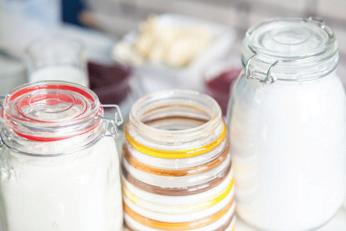
Most cake recipes include flour and sugar to make the cake fluffy and sweet. You notice there are two jars on the counter that have a fluffy, white powder. One is flour, and one is powdered sugar. How can you know which one is which? All types of matter have physical properties. In the example above, the flour and the powdered sugar have some physical properties in common. They are both white and have particles about the same size. Flour is very bland and does not have much taste. Powdered sugar is very sweet! What can you do to figure out which one is the flour? You can taste them!
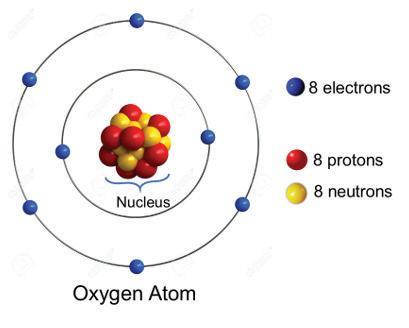
What is matter?
Simply put, matter is the stuff that every physical thing is made of. Anything that has mass and takes up space is matter. The particles that make up matter are called atoms. Atoms are too small to see, but they are still there. Atoms are made of protons and neutrons in a center nucleus surrounded by electrons. The individual atoms are the building blocks of matter. Atoms combine to make molecules, which are the smallest part of a substance.
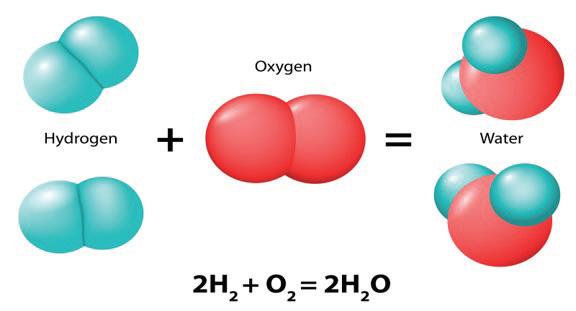
You can see that atoms of hydrogen and atoms of oxygen combine to form water. In one molecule of water, you can see two hydrogen atoms combined with one oxygen atom.
Matter can be described and classified by its properties. A property is a characteristic or feature of a substance or an object. How does matter behave when placed in water? What if it is stirred into water? How does matter react to a magnet? Some properties of matter describe how substances behave in the presence of other substances. For example, what happens when objects are exposed to water or magnets? What happens when objects are exposed to energy?
What Do You Think?
How is matter classified?
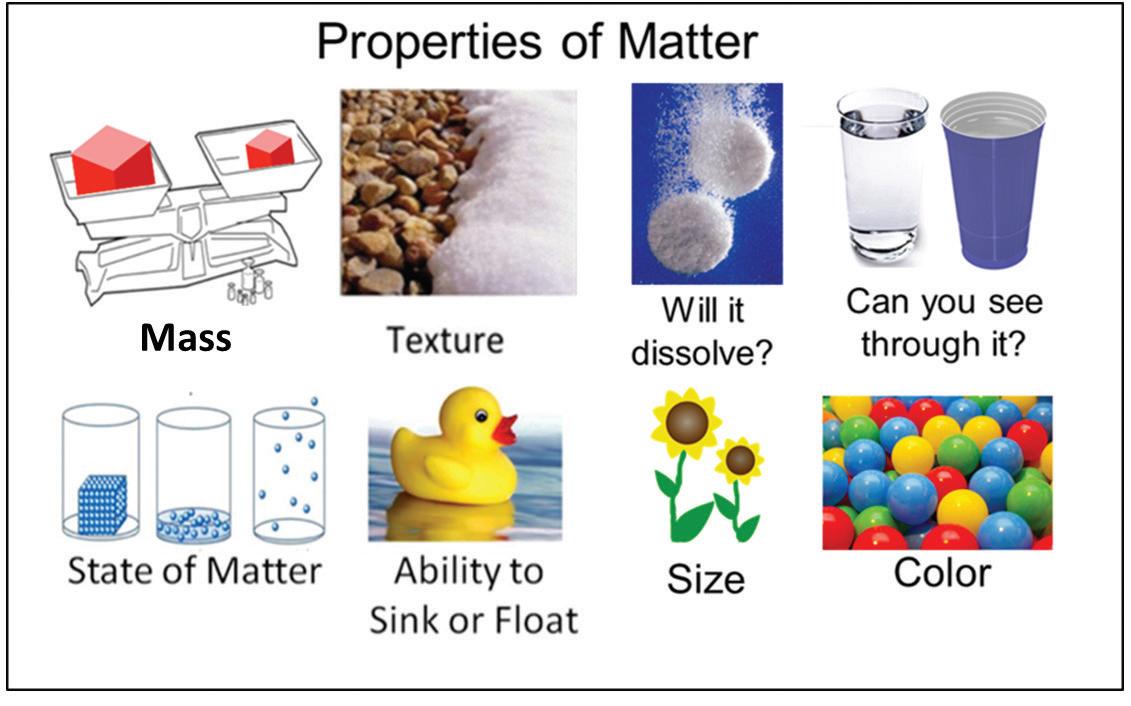
Physical properties can be observed and measured. Some physical properties of matter—such as size, color, and shape—can be observed by using your senses. Measurements made using science tools can be used to describe other physical properties of matter.
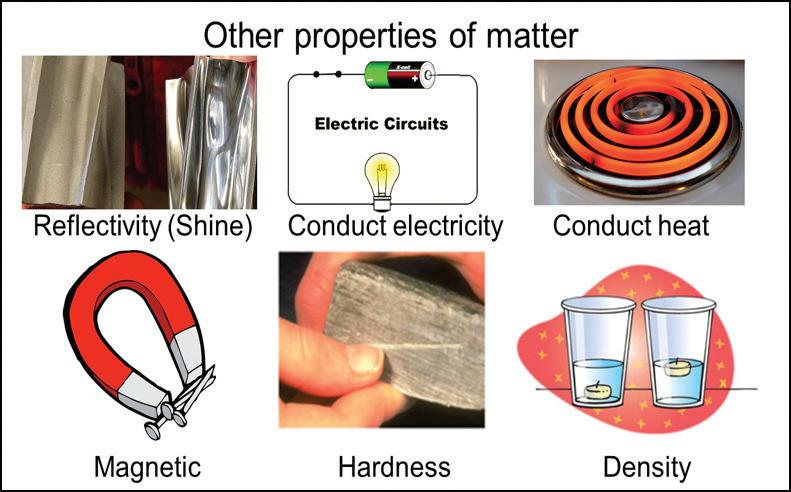
Other properties of matter can also be observed and measured: hardness (is it resistant to scratching?), reflectivity (does it shine?), electrical conductivity (will it conduct electricity?), thermal conductivity (will it conduct heat?), magnetism (is it magnetic?), and density (is it heavier than water?).
In previous grades you learned that the properties of matter described mass, texture (how did it feel?), solubility (will it dissolve in water?), transparency (can you see through it?), state of matter (is it a solid, liquid, or gas?), size, and color.
The state of matter is a property that describes whether the material is a solid, liquid, or gas. This covers characteristics of its particles such as volume (how much space do they take up?), spacing (are they packed, loose, or spread apart?), shape (do they have a definite form?), and movement (are the particles just vibrating, flowing, or moving apart?).
A solid has its own shape and takes up a specific amount of space. A book, a table, and a pencil are all examples of solids.
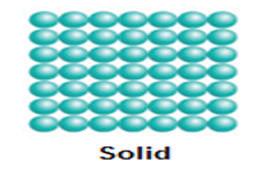
Molecules in a solid
• have the least energy.
• move the slowest; they just vibrate in place.
• are packed the closest.
• have definite shape.
• have definite volume.
• are the least compressible.
A liquid also takes up a set amount of space, but it does not have its own shape. It will take the shape of whatever container it is in. At room temperature, milk, orange juice, and water are all liquids.
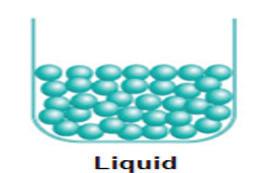
Molecules in a liquid
• have more energy than in solids.
• move faster than in solids.
• slide past each other, so they take the shape of the container.
• have indefinite shape.
• have definite volume.
• are not easily compressible.
A gas has no definite shape. It will fill up any available space. It takes the shape and fills the entire space of whatever container it is in. When you blow up a balloon with air, the shape the balloon takes is due to the air that is in it. The more air, the bigger the balloon.
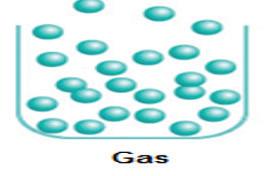
Molecules in a gas
• have more energy than in liquids.
• move faster than in liquids.
• expand to fill a container.
• have indefinite shape.
• have indefinite volume.
• are easily compressible.
How can we measure, test, and record different properties of matter?
Hardness: How soft or hard an object is can be used to describe it. Scientists use hardness in order to identify the types of minerals in rocks. Yes, some rocks are harder than others! Talc is a type of mineral that is used to make soft powders. Quartz is a type of mineral used to make hard glass, such as the cover of a watch. Quartz is much harder than talc.
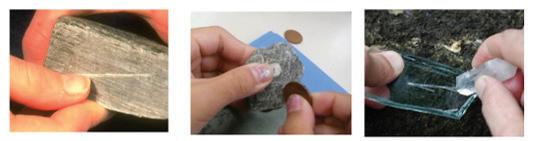
Fingernails scratch the softest minerals like talc or gypsum (hardness of 2.5 or softer).

Pennies can scratch minerals with a hardness of 3.5 or softer. Quartz has a hardness of 7 and can scratch a piece of glass
Reflectivity: Why can you see yourself when you look into a mirror? The mirror is reflective! It bounces light back to your eyes so you can see yourself.
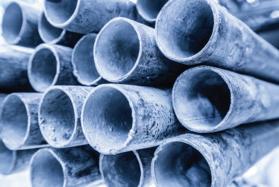
Look at the two sets of metal pipes. One set is made of steel, and one set is made of iron. Do you know which one is which? Steel is a reflective metal, and iron is not. How can this property help you identify the two sets of pipes? Some objects have a glassy shine or luster like diamonds or quartz. Other objects have a metallic luster like silver or copper.
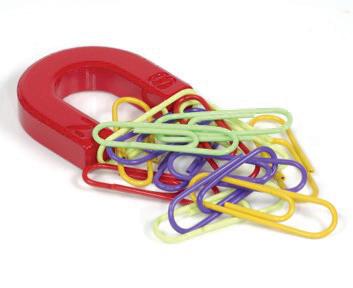
Magnetism: Magnetism is a physical property of some metals, such as iron. A magnet may attract (or pull) objects made of iron toward it and can pick up some of them. Not all metals are magnetic. Aluminum, copper, tin, and gold are not attracted to magnets. Nonmetals—such as plastic, wood, and paper—are also not attracted to magnets.
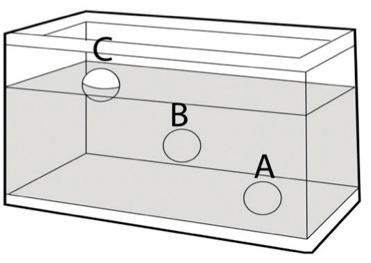
Density: Density is the amount of matter packed into a specific volume. That is why metals are dense; they have a great deal of matter packed into a small volume. Objects less dense than water will float, such as plastic toys. Objects more dense than water will sink, such as rocks or marbles. However, if you can spread out dense material over a big space, you can make it float. Boats and ships are built on that idea. The metal floats because it is spread out over a large area of the water.
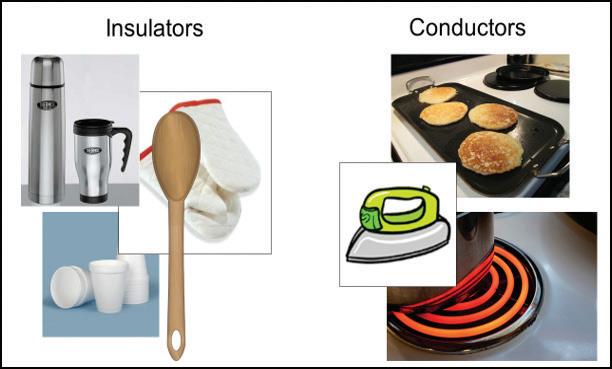
Electrical conductivity: Materials that allow energy to pass through them easily are called conductors. Many metals— including copper and iron—are good conductors of electrical energy. Wires used in circuits are generally made of copper because it is a good conductor of electrical energy. Insulators are materials that slow or stop the flow of energy. The light bulb in the image turned on in the first circuit because the copper wire and the piece of aluminum are electrical conductors. The light bulb did not turn on in the second circuit because rubber and wood are insulators and do not conduct electricity.

Conductivity

Conductivity
Solubility in water: Solubility is the ability of a solid to dissolve in a liquid. To dissolve means to interact with and spread out evenly in the liquid. Because sugar and salt both dissolve in water, they are classified as water soluble. Many solids, such as sand and iron filings, are not water soluble.





















Thermal conductivity: Pots and pans are usually made of metal because metal conducts thermal energy well. The molecules in metals are very close and can transfer heat quickly to surrounding molecules. Heat insulators, such as rubber, wood, or plastic, do not transfer heat easily. Materials with pockets of air, such as a quilt or Styrofoam, are good insulators.

Try Now
Part 1: A teacher is doing an experiment in class to show the importance of physical properties to classify matter. He has six samples of different materials of the same mass of 12 grams (g). Some samples are bigger than others, but they all have the same mass. The teacher classifies the samples into two groups using just one physical property. Then he asks the students, “Which physical property did I most likely use to sort the samples into these two groups?”
Group 1
Sample of aluminum
Sample of steel
Sample of copper
Group 2
Sample of glass
Sample of plastic
Sample of wood
Properties these have in common:
Properties these have in common:
Part 2: Think about how to classify the following different materials. Which physical property are you going to use to classify them? Put them into three different groups with the same properties.
Materials
Glass Iron Silver Plastic Salt Steel Wood Styrofoam Sugar Cloth
Group 1
Physical Property:
Materials: Why?
Group 2
Physical Property:
Materials: Why?
Group 3
Physical Property:
Materials: Why?
Your child will have learned about many physical properties of matter, including size, mass, shape, color, texture, flexibility, physical state, magnetism, relative density, volume, temperature, solubility, and conductivity. Your child should be able to define and give examples of each of these terms and should also be able to explain how to observe and measure each property.
Take your child on a tour of a specific location, such as a park or a playground. You may also explore a room of your home. As you explore, ask your child to identify each object seen and describe that object, using as many physical properties as possible. If possible, bring a magnet, a balance, and other tools so that specific measurements can be included as part of these descriptions.
Monitor your child closely to make sure she or he explores safely and does not touch anything that might cause injury. If a property cannot be measured, ask your child to predict the value of that measurement. Try to confirm each prediction later.
Encourage your child to create flash cards of each object and property measured. The flash cards can be used as study aids.
Here are some questions to discuss with your child:
• Which of these objects has more mass? Which of these objects has less mass?
• Which properties of matter can you observe using only your senses? Which properties do you need tools to measure?
• Do you think that this object is a conductor or an insulator? How could you test this?
• What is this object’s relative density compared to water? Why do you think this?

1 Genesis woke up with a shiver; she could tell that this day was going to be different. It was a cold day for January in Mississippi. Even In the middle of winter, it did not often get too cold in Mississippi.
2 Genesis headed into the kitchen after quickly changing into her school uniform. While she was eating breakfast with her family, Genesis looked out the window and gasped in amazement. A soft, white substance was falling from the sky!
3 “Look! Snow!” she exclaimed.
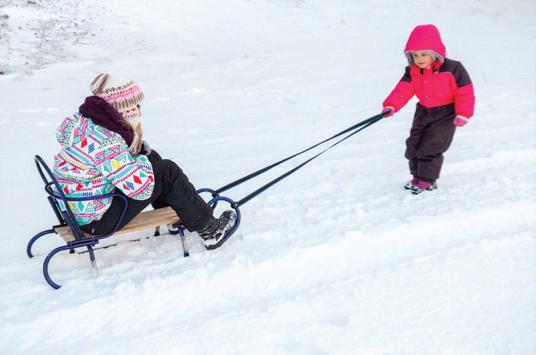
4 As Genesis walked to school with her brother and her sister, the snow continued to fall. They stuck out their tongues to catch the cold flakes in their mouths. The snow was falling heavily enough that by the time they arrived at school, their coats and jackets were dusted with the white, powdery flakes. Genesis kept holding her scarf in front of her face, trying to peer at the tiny, six-sided flakes.
5 However, when she arrived inside her classroom, her scarf was a wet mess.
6 “Mrs. Taylor, I’m all wet!” she cried to her teacher.
7 Mrs. Taylor smiled and asked, “Do you know what snow is?”
8 Genesis had never seen real snow before, so she had never really thought about it. “Well, I guess it’s just like rain, only frozen.”
9 “That is correct,” said Mrs. Taylor. “Snow is simply water in a solid form. Remember, we learned that solids keep their shapes.”
10 Genesis thought for a moment. “When I was outside, I was covered with white flakes. I kept looking at them, and they did keep their shapes. They were shaped like little stars.”
11 “But,” said Mrs. Taylor, “when you came inside, the heat melted the flakes. So now you are all wet. The flakes became liquid and liquid does not hold its shape. That is why your scarf is now dripping wet!”
12 Genesis thought for a moment and looked at her scarf. Sure enough, she could squeeze drops of water from the wool scarf.
13 Genesis and her friends put their wet clothes out to dry near the classroom heater.
14 After an hour or so passed, the air felt steamy and smelled like damp wool. Mrs. Taylor commented, “Now, the water has become a gas called water vapor. A gas spreads out into the space available. That is why the air seems so damp now.”
15 “Yuck,” exclaimed Genesis. “I don’t like it.”
16 “Well,” said Mrs. Taylor, “you will be glad when you have a dry scarf to wear home.”
17 Genesis had to agree with Mrs. Taylor. At the end of the day, the snow had stopped falling, but it was still very cold, so she wrapped her dry scarf around her neck. The water had fallen from the sky in the form of a solid, turned into a liquid when she got inside the classroom, and then become a gas as it heated up. Genesis was glad that matter could change states if it meant she got to go home with a dry scarf.
1 In the first paragraph, it says, She could tell that this day was going to be different. What was different about this day?
A It was Genesis’s birthday.
B Genesis had a new scarf.
C It was especially cold.
D Genesis did not have to go to school.
2 What caused Genesis’s scarf to become wet?
A A friend threw water on her.
B It was raining.
C The snowflakes melted.
D Snow is always wet.
3 What goes in the empty box?
A The snowflakes fell onto the ground.
B The snowflakes melted and became liquid.
C Genesis borrowed a friend’s scarf.
D School was canceled due to snow.
Genesis walks to school, and her scarf is covered with snowflakes.
Genesis has a dry scarf when she walks home after school.
4 Which of the following is true about solids?
A They keep their shape.
B They spread out to fill the space available.
C They take the shape of their containers.
D Snowflakes are the only solids.
5 Which of these is a solid?
A A raindrop
B A snowflake
C A rainbow
D A breeze

1. Compare and contrast solids, liquids, and gases. Be sure to include volume,shape , movementofparticles , and spacingofparticles SOLID
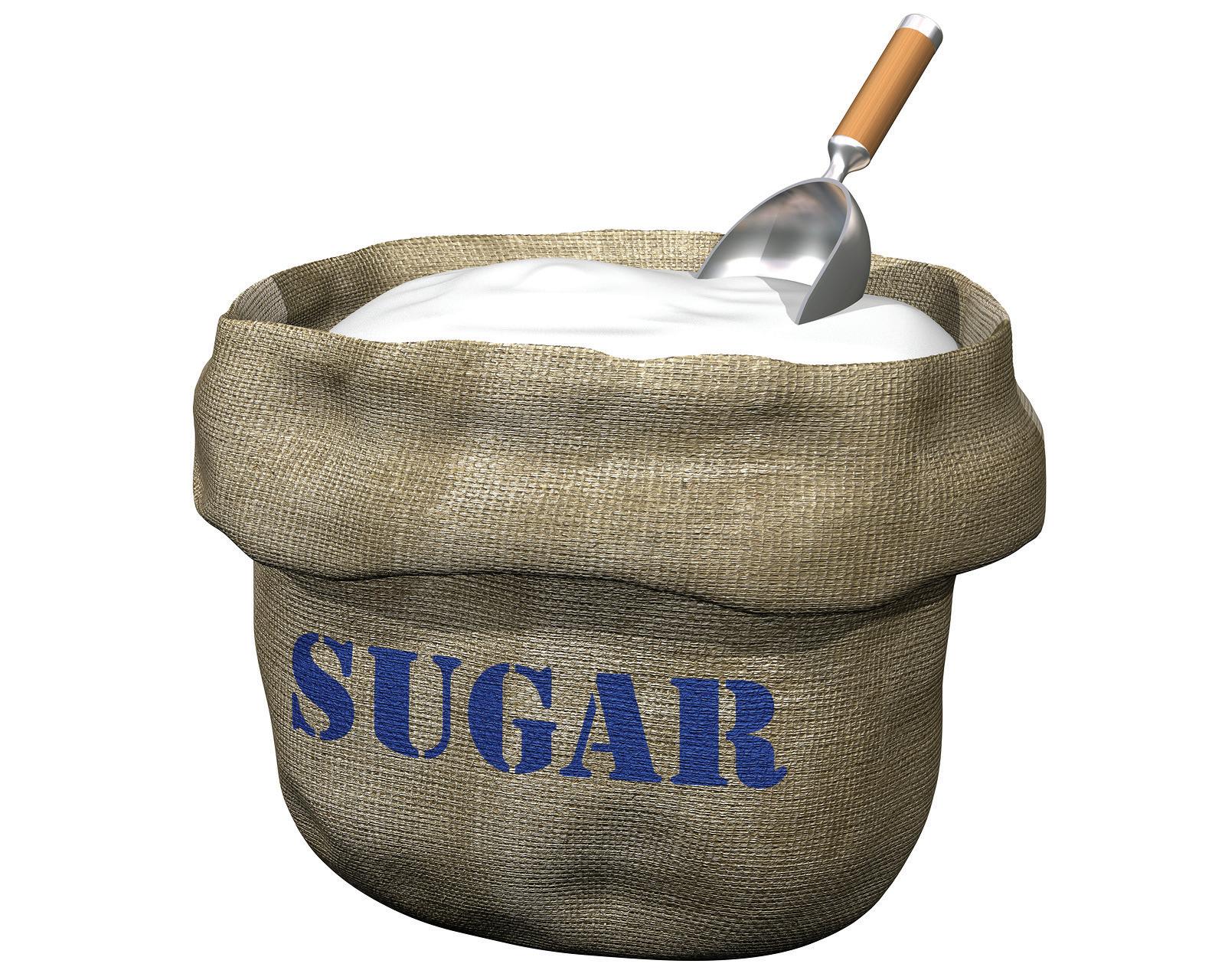

2. You want to see which substances dissolve in water. You test sugar, salt, and pepper. Explain which of these substances will dissolve in water and which will not.
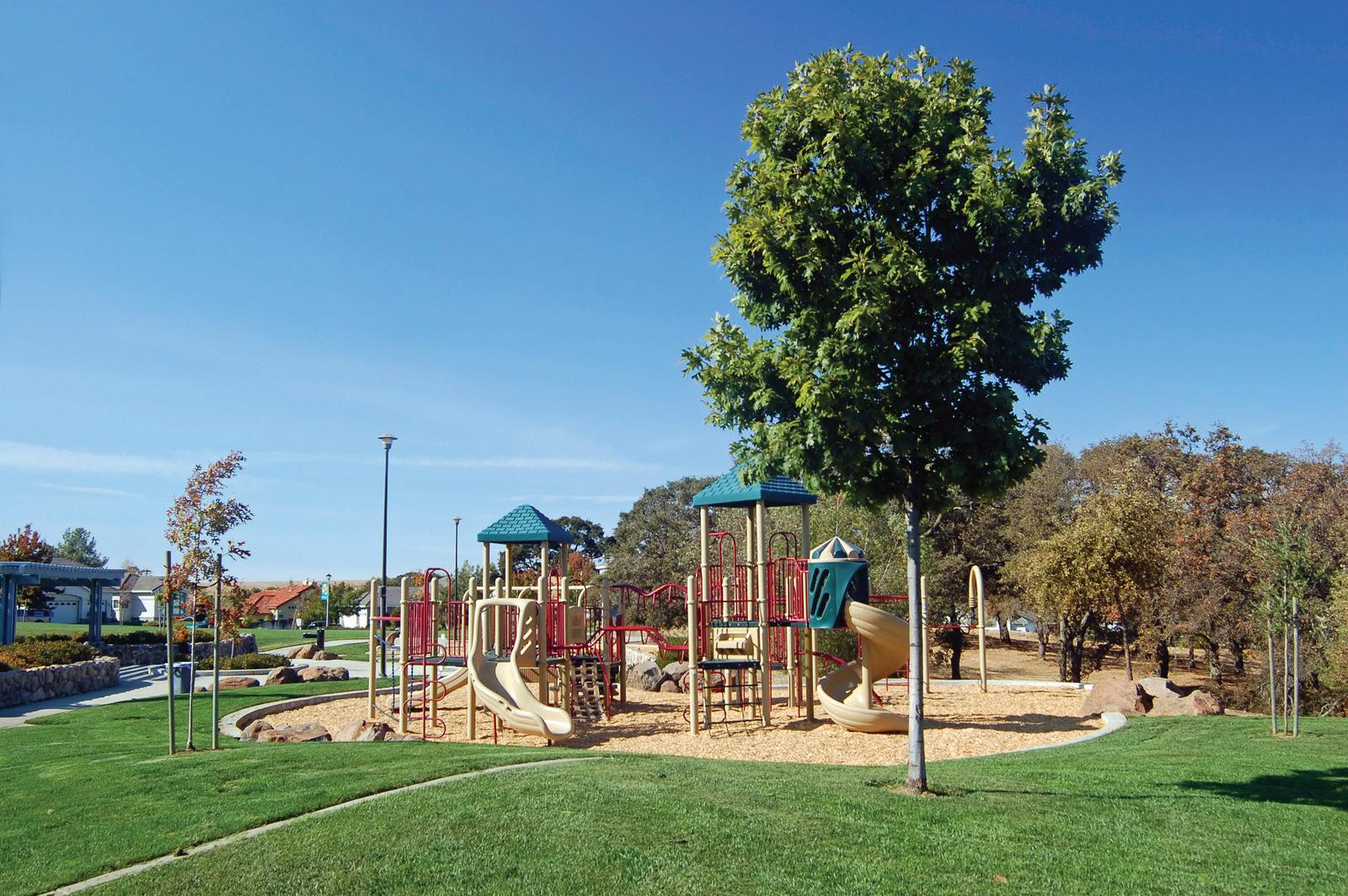
3. You and your friends are at the park on a sunny day. You are playing on the slide. As you slide down, the hot slide burns your legs. Explain why this happened and why you did not burn your hands when you climbed up the rope ladder.
4. Predict three things that will sink in water and three things that will float in water. How is density related to what sinks and what floats?
Item
Prediction: Sink or Float?
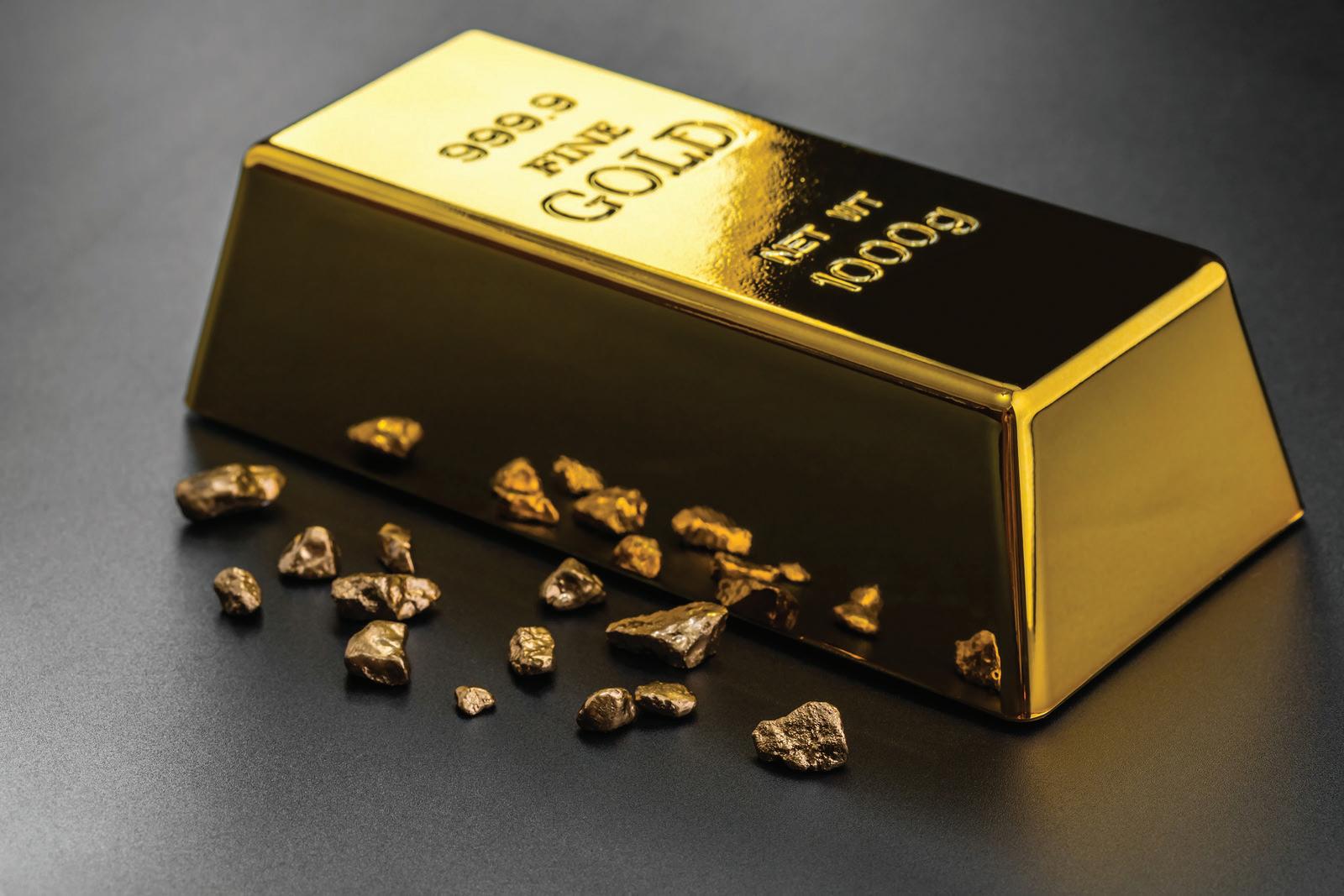
5. Imagine you are given an engineering assignment. Your task is to design a vessel that can transport gold (a high-density material) through the water. What materials would you use? Explain why you chose the materials you did.

Katie and Bryan found a piece of metal on the ground while walking home from school. They were discussing the possible metals it could be. They narrowed it down to three kinds: iron, copper, and aluminum. Use your knowledge of physical properties to help them figure out what kind of metal they found.
Use the data chart to construct a scientific explanation for the following question: Can you identify the metal in the pictures based on its properties?
Claim:
Evidence:
Reasoning:
Part I: Mystery Substance
Draw your mixture. List the physical properties you observe.
1. What is the “mystery” substance made of?
2. How do you know?
Part II: What’s in There?
Using your tools, separate the mixture. Record your results.
Part III: Solution or Not?
1. Record the physical properties of each substance. Be sure to include odor and taste.
Substance
Water
Lemon Juice Salt
Powdered Drink Mix
Pepper Sand
Physical Properties
2. Record your observations after the substances are mixed together.
Mixture
Water and Lemon Juice
Water and Salt
Water and Powdered Drink Mix
Water and Pepper
Water and Sand Sand
Is It a Solution or Not? Explain Why.
Part IV: What Did You Learn?
1. In Part II, did you observe any changes in the physical properties of the substances? Explain.
2. In Part III, did you observe any changes in the physical properties of the substances? Explain.
3. Compare the changes that you observed in Part II with the changes observed in Part III. Explain the differences if any were observed.
4. A solution is a type of mixture. How are solutions different from other mixtures?
5. When you created the saltwater solution in Part III, if you evaporated the water, how many mL of salt would be left behind? Explain.
Part I
In a solution, the solvent is:
The solute is:
Procedures
1. Measure 100 mL of water and pour it into a clear plastic glass.
2. Carefully use the forceps to place one sugar cube into the glass of water. Start the stopwatch as soon as the cube is placed in the water. Observe the cube for two minutes.
3. Record your observations below during the two minutes.
4. What properties of the water changed as the sugar cube dissolved in it? What properties of the water stayed the same?
5. What properties of the sugar cube changed as it dissolved in the water? What properties of the sugar cube stayed the same?
6. Pour out the water and discard any of the sugar cube that is left in the glass. Rinse out the glass so that no sugar remains in it. Dry it off with a paper towel.
7. Measure 100 mL of water and pour it into the glass.
8. Carefully use the forceps to place one sugar cube into the water. Start the stopwatch as soon as the cube is placed in the water.
9. Use a craft stick to stir the water continuously for two minutes. Observe the cube for two minutes.
10. Record your observations below during the two minutes.
11. Compare your observations of how the sugar cube dissolved in both of these trials. Was there a difference in how much of the sugar cube dissolved? Why do you think this is true?
12. Pour out the water and discard any of the sugar cube that is left in the glass. Rinse out the glass so that no sugar remains in it. Dry it off with a paper towel.
13. Put one sugar cube in the mortar bowl. Use the pestle to grind the cube into a powder.
14. Measure and pour 100 mL of water into the glass. Add the crushed cube to the water and start the stopwatch.
15. Observe the crushed cube in the water for two minutes. Record your observations below.
16. Compare your observations of how the sugar cube dissolved when it was whole and when it was crushed. Was there a difference in how much of the sugar cube dissolved? Why do you think this is true?
17. Pour out the water and discard any of the sugar cube that is left in the glass. Rinse out the glass so that no sugar remains in it. Dry it off with a paper towel.
18. Ask your teacher to measure and pour 100 mL of warm water into the glass. Carefully use the forceps to place one sugar cube into the water. Start the stopwatch as soon as the cube is placed in the water.
19. Observe the sugar cube in the warm water for two minutes. Record your observations below.
20. Compare your observations of how the whole sugar cube dissolved in room-temperature water and warm water. Was there a difference?
21. What conclusions can you draw about how shape, temperature, and stirring affect the dissolving rate of a sugar cube?
Describe what determines the concentration of a solution.
1. Make sure your glass from Part I is rinsed and dried out with a paper towel.
2. Use the graduated cylinder to measure 250 mL of water to pour into the glass.
3. Use the measuring spoons to measure ½ tsp. of salt and pour it into the glass of water.
4. Use the craft stick to stir until the salt dissolves.
5. What does the solution look like?
6. Pour a little of the solution into each of your individual paper cups. Take a sip from your own cup and describe the taste.
7. Pour out the water from the glass and your individual cups. Rinse out the glass so that no salt remains in it. Dry it off with a paper towel.
8. Measure another 250 mL of water and pour it into the glass.
9. Measure 1 tbsp. of salt and pour it into the glass of water. Stir.
10. Did this solution look any different from the first one? Explain.
11. Pour a little of the solution into each of your individual paper cups. Take a sip from your own cup, and describe any differences in the taste.
12. Pour out the water from the glass and your individual cups. Rinse out the glass so that no salt remains in it. Dry it off with a paper towel.
13. Measure another 250 mL of water and pour it into the glass.
14. Use the measuring cups to measure ⅛ cup of salt, and pour it into the glass of water. Stir.
15. What do you notice?
16. Is there a scientific term you can use to describe what you are observing?
17. Pour a little of the solution into each of your individual paper cups. Take a sip from your own cup, and describe any differences in the taste.
18. Did we change the amount of solvent in any of the three solutions? Explain.
19. Which solution was the most concentrated? Provide evidence.
Group Members:
1. What is the problem? (State the problem in your own words.)
2. Explore and research the problem. Sketch a picture of your filter system below. Be sure to label the sketch.
Answer these questions as a group:
A. What material did you test in your funnel? _________________________________
B. How many of the visible particles did the filter remove? (Circle one.) ALL SOME NONE
C. Did the filter remove most of the color from the water? (Circle one.) YES NO
D. On a scale of 1 to 5, with 1 being poor and 5 being excellent, how would you rate the efficiency of your filter? ___________
3. Brainstorm and design a solution to the problem. You will get to use TWO of the filtering materials and ONE tool to create your filtering system.
Filtering materials: (Choose two)
Cotton balls Coffee filters Fine sand
Felt squares Gravel Rock salt
Tools: (Choose one) Funnel Sieve
Sketch or describe some possible solutions in the boxes below.
4. Build, test, and analyze your solution.
A. Describe your plan BEFORE YOU BEGIN CONSTRUCTION.
B. What materials did you test in your system? What tool did you use?
C. How many of the visible particles did the filter remove? (Circle one.)
ALL SOME NONE
D. Did the filter remove most of the color from the water? (Circle one.)
YES NO
E. On a scale of 1 to 5, with 1 being poor and 5 being excellent, how would you rate the efficiency of your filter? _____________________________
5. Improve or redesign and retest the solution. You will not actually be improving your filtration system, but think about what you might do to get cleaner water.
Does your filter remove most of the solid contaminators?
Does your filter remove most of the dissolved contaminators?
Does your filter clean the water so that people can drink it?
6. Present and share your solution. Decide how you will share your solution with the class. Discuss who will demonstrate the system and who will talk about what you discovered.
Evaluate your solution:
A. Did your filtering system work as expected? Explain.
B. Was this the best solution to the problem? Explain why or why not.
C. What could you have done differently?
D. Can you add to your solution to make it better? Explain.
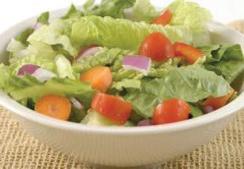
Every day, we interact with many different kinds of matter. Some are mixtures. We look at matter, feel it, taste it, and even breathe it. Sometimes different types of matter are combined. For example, a salad might have several types of matter, or ingredients, such as lettuce, tomatoes, and onions. Or, a sample of soil might include sand, leaves, and pebbles. In these examples, you can see each ingredient individually. It is pretty easy to pick out each part of a salad mixture. With a little more effort, you could separate the parts of a soil mixture. But think about lemonade—a drink that contains water, lemon juice, and sugar. You cannot see each ingredient, so is lemonade really a mixture?
mixture: a combination of two or more substances in which no new matter is formed
ingredients: the separate parts of a mixture
To scientists, a mixture is a combination of two or more substances in which no new kinds of matter are formed. Making a mixture results in physical changes only. In the example of a salad, all of the ingredients are combined, but they do not form any new substances. Similarly, sand, leaves, and pebbles are combined to make a soil mixture, but the combination does not result in any new substances. The same is even true about lemonade. Even though you are not able to see each ingredient, once the mixture has been made, new substances are not formed. In contrast, if you combined eggs, flour, a little oil, baking soda, and some spices and baked them, the ingredients would become a new substance—a cake! A cake is not a mixture because it is a new substance. You cannot go in reverse and separate those ingredients anymore.
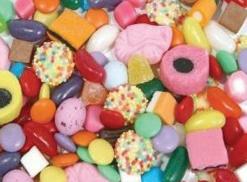
What properties could you use to separate the ingredients in these mixtures?
physical change: a change to matter in which no new kinds of matter are formed
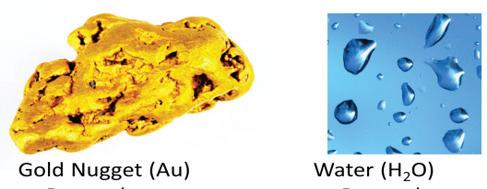
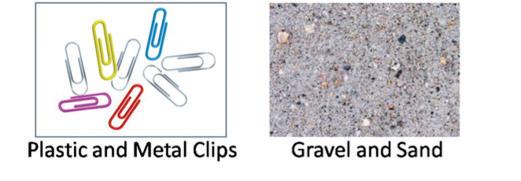
Matter can be composed of either a pure substance or a mixture. When matter is made of the same molecules, such as gold (Au) or water (H2O), that material is called a pure substance. When elements and/or compounds are physically combined and no new substances are formed (no chemical change occurs), this matter is called a mixture. The different paper clips and the gravel with the sand are examples of mixtures because all the substances keep their physical properties in the mixture.
Look Out!
Not all mixtures are unevenly mixed like a salad or trail mix. When a mixture has an even distribution of one ingredient dissolved in another, that mixture is called a solution. Sugar dissolved in coffee is an example of a solution.
Not all solution mixtures are liquid! Solution mixtures can be combinations of solids, liquids, or gases:
• Solid dissolved in liquid—salt water
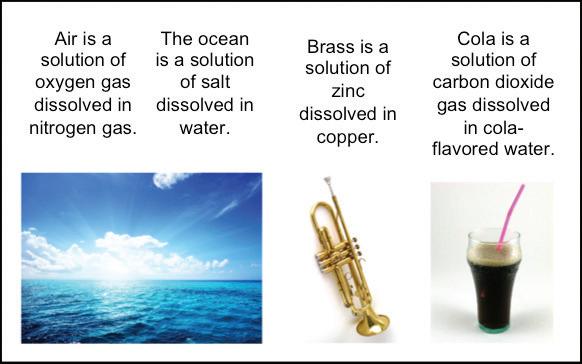
• Gas dissolved in liquid—carbonated soft drink
• Solid dissolved in solid—zinc and copper evenly blended in brass
• Gas dissolved in gas—oxygen and nitrogen evenly blended in air
A heterogeneous mixture (unevenly mixed) is called just a mixture. However, a homogeneous mixture (evenly mixed) is called a solution. Heterogeneous mixtures have an uneven distribution of parts and are physically separate. The parts are easily seen and easily separated. Think about eating trail mix. Each handful you grab will not have an identical amount of peanuts, raisins, and chocolate. Each bite will not be uniform. This makes trail mix a heterogeneous mixture. Some other examples of heterogeneous mixtures include cereal, pizza, salad, Italian salad dressing, and vegetable soup. You can just pick out the pieces. In the case of the salad dressing, the oil sits on top of the water, and you can pour it off.
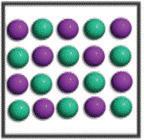
A homogeneous mixture (solution) has an even distribution of its parts. A solution is always homogeneous. This type of mixture is usually more difficult to separate because you cannot always see the separate parts. Consider drinking a glass of lemonade. Each sip you take is the same. It is not extremely sour one sip and only sweet the next. Lemonade is homogeneous. Some other examples of homogeneous mixtures include milk, air, vanilla ice cream, Jell-O, mouthwash, and tomato soup.
Reflect
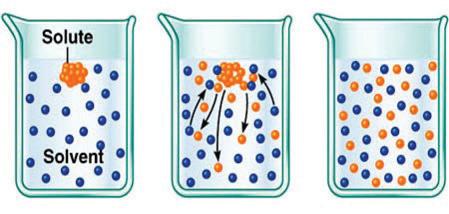
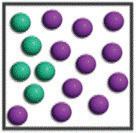
Solutions have special vocabulary. The substance that becomes dissolved and spreads out is called the solute (shown in orange). The substance that does the dissolving is called the solvent (shown in blue). Water is a universal solvent because it dissolves so many substances. The amount of the solute compared to the solvent is called the concentration. In this image, half of the molecules are the solvent, and the other half are the solute. So the concentration is about a 50% solution. Some medical solutions, such as hydrogen peroxide and water, are smaller concentrations at 3% concentration.
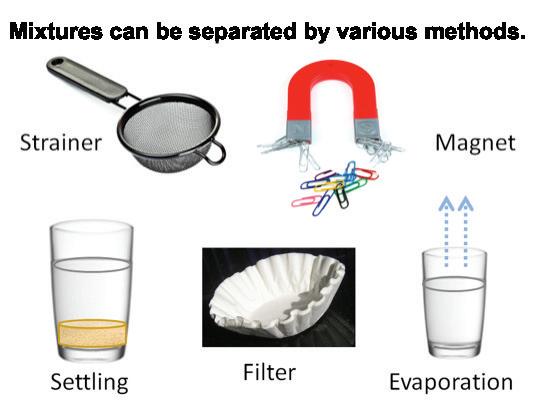
Because you can see the pieces in a mixture, those ingredients can be separated by hand, strainer, magnet, filter, flotation, or settling. Solutions are usually separated by evaporation. Warming the liquid speeds the evaporation process. If a solution of salt water were allowed to completely evaporate, the salt would be visible at the bottom of the container. The salt particles would look much as they did before they were dissolved.
Several variables affect the rate of dissolving. An increase in the rate of dissolving will occur with any of the following:
• Increase in temperature for solids and liquids
• Decrease in temperature for gases
• Increase in stirring
• Decrease in particle size (which increases surface area)

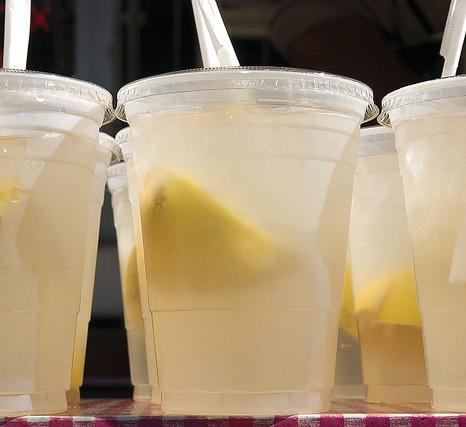
Take a look at the photographs below. Can you identify which mixtures are unevenly mixed and called just mixtures? Which are mixtures that are evenly mixed and called solutions? Can you think of any other examples of solutions? Write your answer below each image. Give your reason. (How can you tell?)
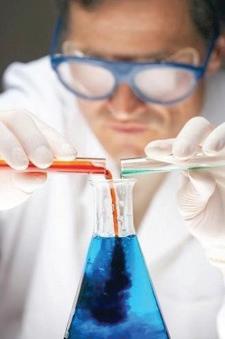
Mixture (unevenly mixed) or Solution (evenly mixed):
Reason:
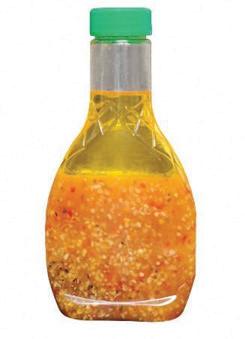
Mixture (unevenly mixed) or Solution (evenly mixed):
Reason:
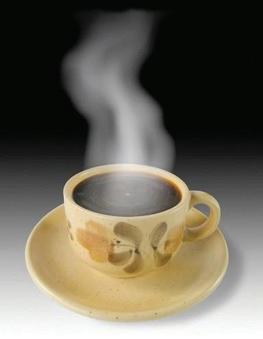
Mixture (unevenly mixed) or Solution (evenly mixed):
Reason:
For this activity, you will need the following supplies:
4 plastic cups
Water
Sand
Sugar
Salt
Food coloring (any color)
A spoon
1. Fill one of the cups about halfway with water. Add a few spoonfuls of sand and stir for at least one minute. Describe any changes in the sand and water.
2. Repeat step 1 with water and sugar, then with water and salt, and finally with water and food coloring. Be careful when you use the food coloring, as it can stain your clothing. You need to use only a few drops.
3. Which mixtures formed solutions? How do you know?
Ingredients in Mixture Observations after Combining Ingredients
Water, gravel Water is clear; gravel is the same shape and color.
Water, red powdered drink mix
Water is red; powdered drink mix is not clearly seen.
Is This a Mixture (unevenly mixed) or a Solution (evenly mixed)?
Explain Your Answer.
Water, cooking oil
Water is clear but settles on the bottom of the container; oil is the same color but forms a layer on top of the water.
Water, rice Water is clear; rice is the same color and shape but settles on the bottom of the container.
To help students learn more about mixtures and solutions, spend some time at home finding examples of different mixtures that are used regularly. Discuss whether or not the mixtures are solutions. A few common examples of mixtures used at home include milk (a mixture of cream, buttermilk, and skim milk), carbonated water (a mixture of carbon dioxide gas and water), and soap (a mixture of salts and air bubbles). Even brass is a mixture—it is composed of one metal (zinc) dissolved into another metal (copper). After they are combined, the metals harden.
If time allows, have your child explore the separation of a solution by making and then evaporating salt water. Fill a cup with water and dissolve as much salt as possible in the water. Continue stirring and adding salt until no more salt will dissolve. (Heating the water in a pot on the stove will help speed the process of dissolving the salt.) Hang one end of a string in the salt water and tie the other end to a pencil. Set the pencil across the top of the cup. Place the cup on a warm, sunny windowsill and observe it for several days. Use a magnifying lens to observe salt crystals as they form on the string and along the sides of the cup.
Here
• Why is salt water an example of a solution?
• What happened to the physical properties of the ingredients in salt water when you mixed them together?
• What are the properties of the saltwater solution?
• Why did salt form on the string and on the sides of the cup?
1 It was a warm spring day. Scott was walking home from school. His science teacher had just given the class a big homework assignment. They had to enter a project into the school’s science fair. Scott had no idea what he was going to do. They could choose anything they had studied that year. There were so many choices. Scott could not decide.
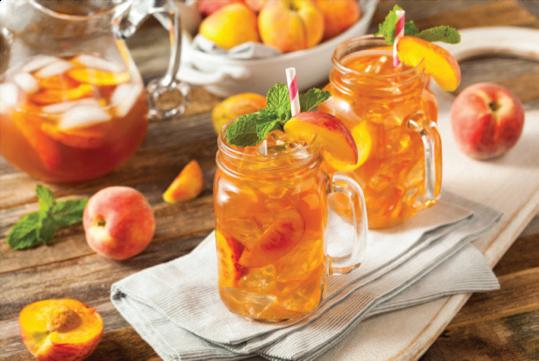
2 When Scott arrived home, he was hot and sweaty. He decided to make a glass of his favorite drink, peach sweet iced tea. After pouring the tea into his glass, he grabbed a spoon and began to stir in sugar to make it nice and sweet, along with some slices of peaches. As he stirred, he watched the sugar spin around inside the cold glass and slowly noticed he could no longer see the sugar but could still see the peach slices. Scott had never really thought about why this happened. Suddenly it hit him. There was a science experiment right inside his glass of iced tea! He remembered they had studied mixtures and solutions in science class, and he knew his sweet tea was one of them. This would be his topic. He would study mixtures and solutions in his own kitchen.
3 First he needed to know which type of mixture he was creating. He could not quite remember the different types they had studied. He hurried to his backpack and pulled out his science book. First, he found the definition of a mixture.
4 It said, “Mixture: When two or more substances are blended together but do not combine chemically. This means that they can be separated and still have their original properties. One can often see the components of a mixture.”
5 He remembered that the term components meant “parts.” Scott looked into the glass, but he could not see the parts of this mixture, so he was puzzled. He could no longer see the sugar crystals in the tea. He then realized that he could not separate the sugar from the tea, so he looked through his science book again. He found the section on solutions.
6 It said, “Solution: A homogeneous mixture of two or more substances. Solutions are most often liquids, but may also be gases and, in some cases, solids. Homogeneous means that the solute (what is dissolved) is spread evenly throughout the solvent (the liquid medium).”
7 Scott realized that the sugar in his glass had dissolved. He knew it dissolved because it looked like the sugar had disappeared, so this must mean the sugar had spread evenly throughout the tea. His sweet iced tea was, in fact, a specific type of mixture known as a solution!
8 Scott now understood solutions but needed to find an example of a mixture that was not a solution. He wanted to make it easy to see the differences between the types of mixtures by using a colored liquid as one of the substances in the mixture. He looked in the pantry and found some red wine vinegar. The red color of the vinegar would make it easy to see the parts of the liquid mixture. He put some in a cup with a lid.
9 First he tried adding salt, but after stirring in the salt, he realized that the salt dissolved into the vinegar just as the sugar had. This made another solution, but he did not want a homogeneous mixture. “Think, Scott, think,” he said to himself. He tried to think about a substance that was very different from vinegar. He needed something that could still be seen in the vinegar after he mixed it.
10 “Aha!” he said out loud. “Oil!” He poured some olive oil into the glass. He saw that the oil and vinegar did not mix. They remained separated in the container. He could see the parts easily. He wondered, “Is this really a mixture? They are just sitting on top of each other.” He felt they must be, but this was not quite the example he wanted.
11 This reminded Scott of salad dressing. He added some spices. He shook the mixture of vinegar, oil, and spices for a minute, and suddenly, all of the components were mixed. He had an example of a liquid mixture that was not a solution. How did he know this? He understood that his iced tea was a type of mixture known as a solution, as it was homogeneous. This meant that he could not see the parts of the solution. He understood that his salad dressing was not a solution, but a liquid mixture, because he could see all the different parts of the mixture.
12 Scott had his project all figured out. He ran to his room and began making a big poster about what he had just learned. He knew that his project was simple. He also knew that it was educational. Who knew? Maybe he could even win the science fair!
1 Which sentence is the best summary of Paragraph 2?
A Scott got started on his science project.
B Scott got an idea for an experiment while watching sugar dissolve in tea.
C Scott was hot and sweaty, so he made sweet iced tea.
D Scott was stumped on what his project might be.
2 What does the word homogeneous (Paragraph 6) mean?
A Evenly throughout
B Solution
C Dissolve
D Slowly
3 What do you think Scott might write at the top of his poster?
A Sweet Tea for Sale
B Mixtures in the Kitchen
C Sugar and Water
D Solutions Are Everywhere
4 Which of the following is a solution?
A Salad dressing
B Chocolate chips in cookie dough
C Cereal and milk
D Salt and water
5 The author arranged the facts in this story by–
A telling a story that used mathematical facts.
B comparing and contrasting two types of mixtures.
C sequencing the steps needed to make a mixture of iced tea.
D explaining what makes a solution sweet.

1. Sugar seems to disappear when it is poured into water. Explain what happens to the properties of both the water and the sugar when they are mixed.
2. You are given a sample of salt water. What are two ways you could increase the concentration of salt in the salt water?
3. Look at the two types of salt—rock salt and table salt. If you measure out the same mass of salt and pour it into water, which type would dissolve faster in water? Why?
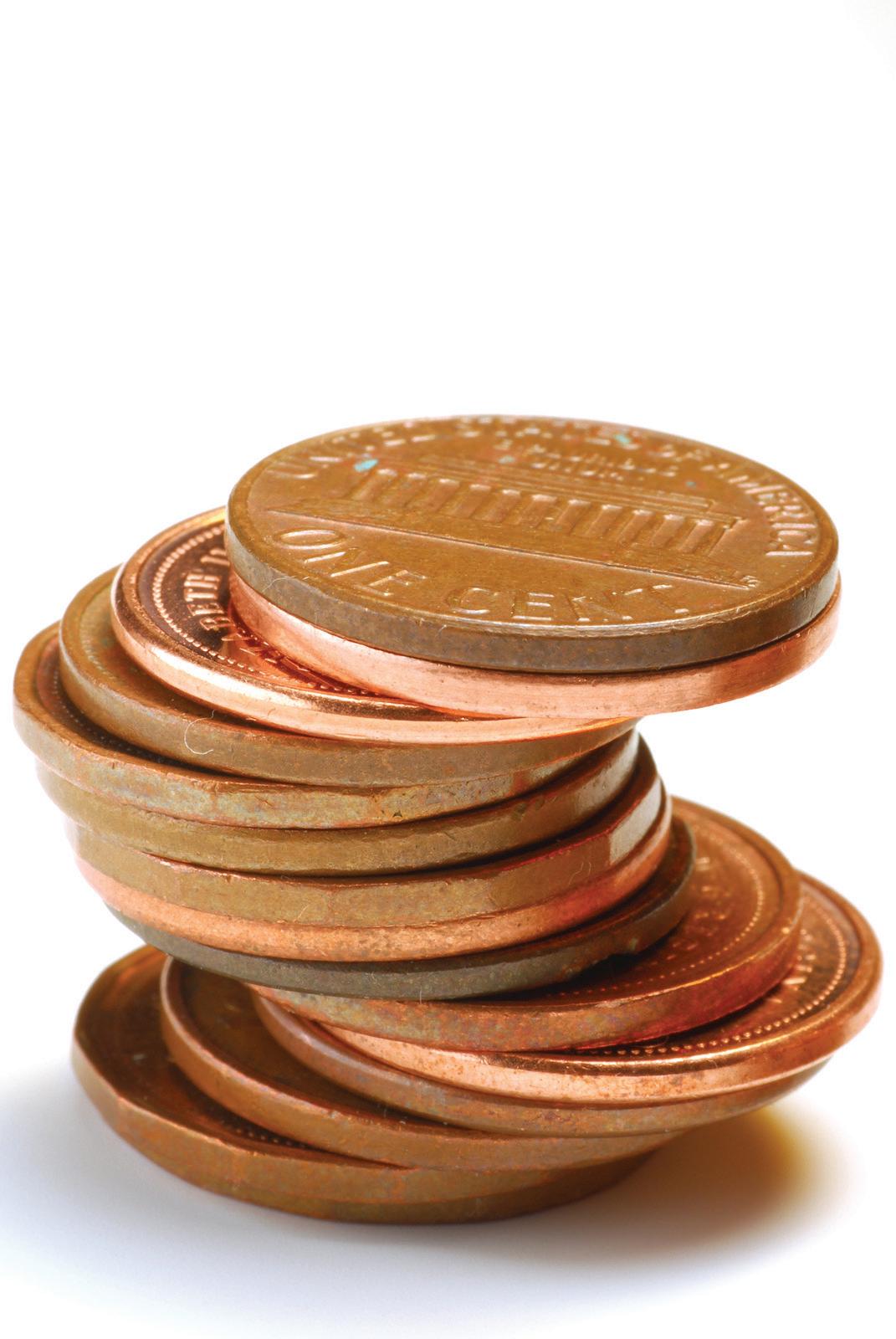
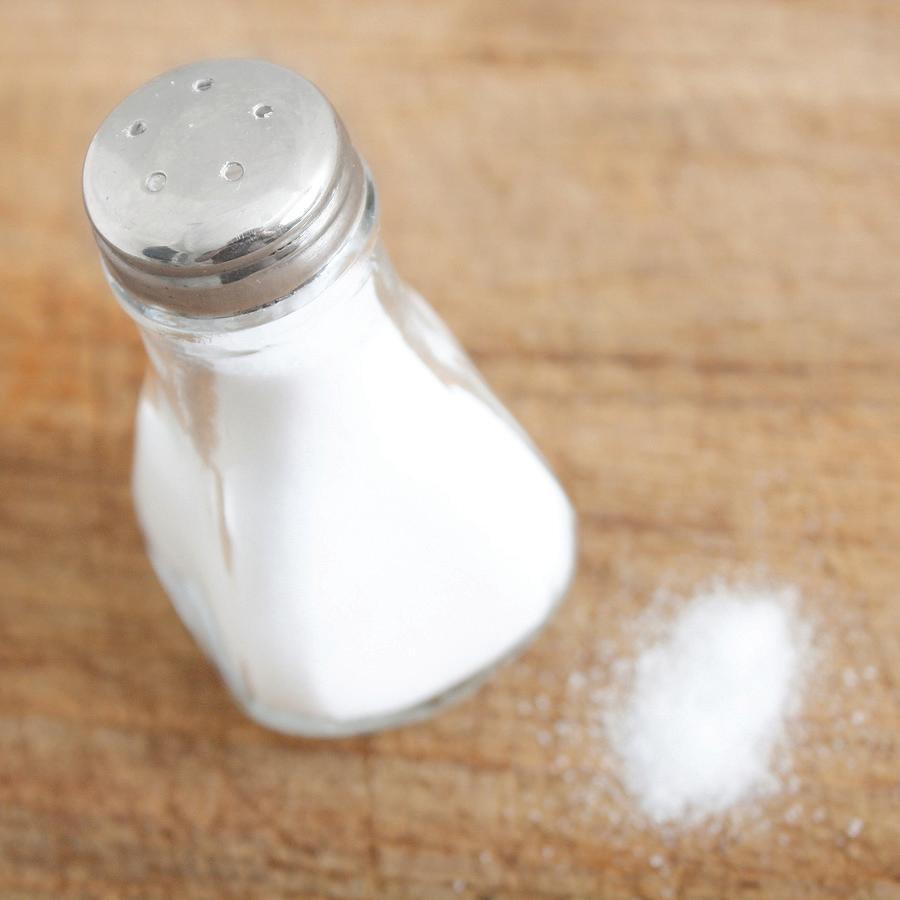
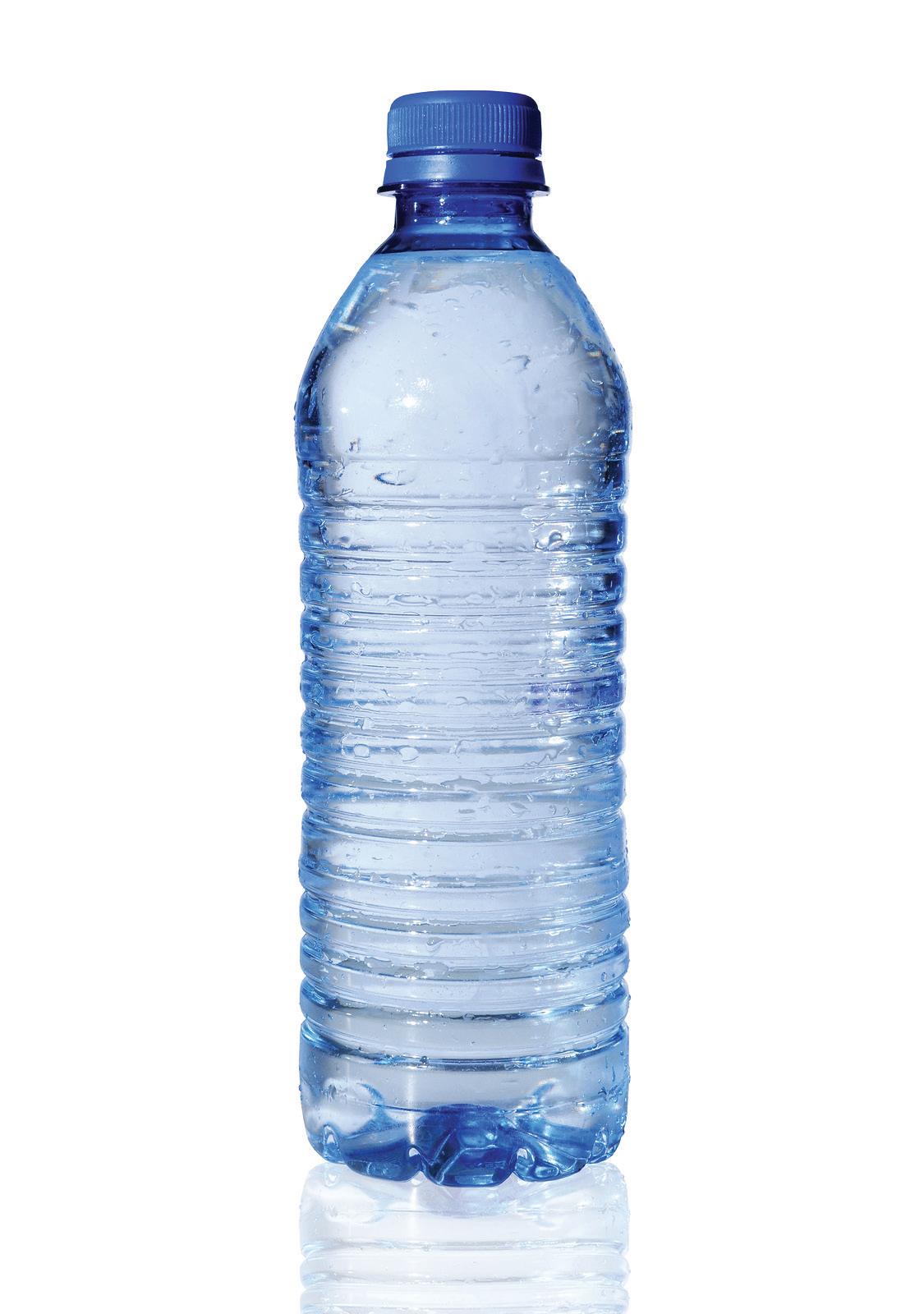
4. You have a mixture of sand, pennies, salt, and water. Design a system to separate the components of the mixture. Make sure to detail each step of the process.
Sara shared with her parents what she learned in science class about mixtures and solutions.
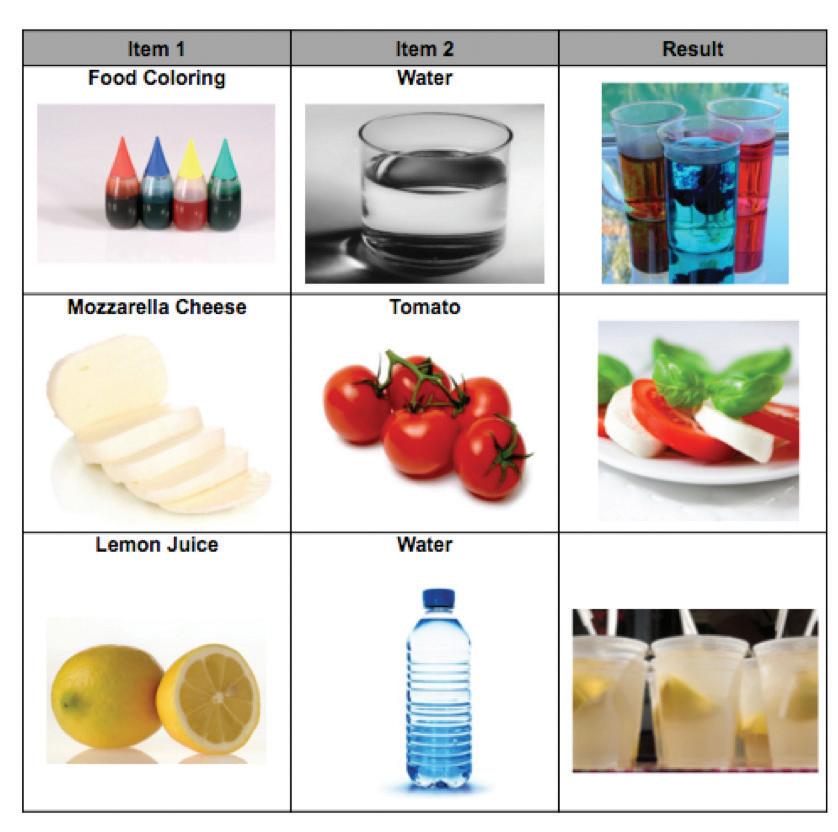
Prompt 3
Identify the picture that shows a mixture that can be easily separated. Give a scientific explanation that supports your choice.
Claim:
Evidence:
Reasoning:
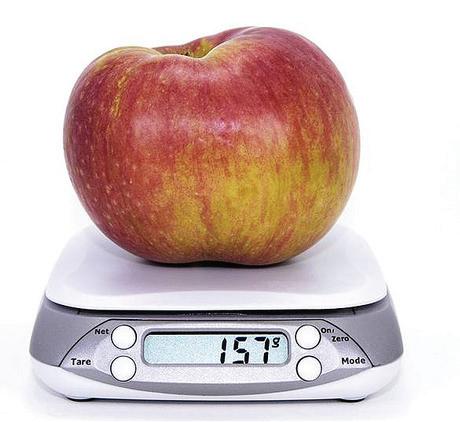

1. Fill in the following chart with your observations from the demonstration.
Part I: Plant and Animal Decay
Make observations during the video of how matter has changed.
Part II: Cooking
Observations of Pancake Mix Powder
Observations of Pancake Mix When Water Is Added
What happened when heat was added to the pancake mix? Explain how the material changed, and describe its new characteristics.
Part III: Burning
Draw a picture below:
Observations of the Paper
Observations on What Happens after Fire Is Added to the Paper
Draw both the rusted steel wool and the non-rusted steel wool.
Non-Rusted (Before)
Rusted (After)
Write your observations of the steel wool before and after the change occurred.
Part I: Physical Changes
Observe each of the objects at this station. Determine what physical changes can be made to each object.
Write out a procedure to separate the different mixtures at this station. Then do your proposed procedures.
Mixture A:
What is in this mixture?
Procedure:
Did your procedure work well? ________________
Mixture B:
What is in this mixture?
Procedure:
Did your procedure work well? ________________
Mixture C:
What is in this mixture?
Procedure:
Did your procedure work well? ________________
1. How were you able to manipulate the construction paper to be able to pass your body through it?
2. What part of this procedure was demonstrating a physical property about paper?
Part I: Brick Building
How Many Bricks Were Used? What Was the Weight of the Bricks?
Draw the Bricks
Separate Pieces
Structure
Part II: Salt and Water
1. What is the weight of the beaker of water?
2. What is the weight of the tablespoon of salt?
3. What was the weight of the salt and water after they were combined?
Part III: Ice vs. Water
1. What is the weight of the baggie and ice cube?
2. What is the weight of the baggie and melted ice cube?
Reflection
What did you notice when measuring the different weights in each experiment?
Scenario
Jennifer decided to bake an apple pie for dessert. In her science class, students discussed what happens to matter when it goes through a physical or chemical change. They found the masses of substances and then combined them and checked their masses again. Jennifer wanted to know if she would get the same results with her apples and the filling ingredients in the pie. She cut four apples up into wedges. Each apple had a mass of 70 g. She mixed 100 g sugar, 15 g cornstarch, 2 g cinnamon, 1 g salt, 2 g nutmeg, and 25 g butter. When the pie was finished, she weighed it and got a mass of 425 g after she subtracted the mass of the pie pan.
Prompt
Write a scientific explanation describing what happens to the weights of apples and pie filling ingredients when they are put into a pie.
Claim: Evidence:
Reasoning:
Reflect
Imagine that you took a full sheet of notebook paper and made a paper airplane. What would happen if you cut the notebook paper in half before making the airplane? You would have a smaller piece of paper, but you would still have paper. Now, suppose you threw the paper airplane into a fire. What would happen to the paper? How are changes caused by burning different from changes caused by cutting or folding?
element: matter made of a single type of atom compound: matter made of two or more types of atoms
Physical and chemical properties can identify a substance. Different types of matter, including elements and compounds, have different properties. We can use these properties to identify specific types of matter. For example, when you hear the word lemon, what thoughts come to mind? You might think of the color yellow or a sour taste. These are all properties that describe lemons.
Properties of matter are either physical or chemical. A physical property is one that you can observe without changing the matter itself. Some examples of physical properties of matter include color, density, and melting and boiling points. Other physical properties include whether a substance is magnetic and whether a substance conducts electricity.
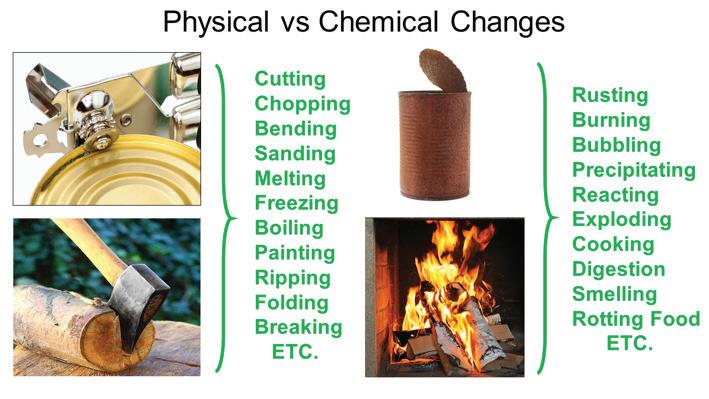
A substance can be identified from both its physical and chemical properties. What properties help you identify a lemon?
A chemical property is one that you can observe only when the matter changes as a result of a chemical reaction. An example of a chemical property you can observe is a chemical change such as decaying, burning (flammability: how easily a substance catches fire), rusting, or cooking. Another chemical property is how a substance reacts when exposed to different chemicals. For example, if you add lemon juice to a glass of milk, the milk curdles, or forms large chunks. Curdling results from a chemical reaction between lemon juice and milk that changes each substance.
The picture on the left shows flowers. The picture on the right shows a fireworks display. What physical and chemical properties can you observe in each picture?
Matter can undergo two types of changes: physical and chemical changes. Physical changes involve changes to a substance’s physical properties only. Some common physical changes are freezing, melting, evaporating, and dissolving.
Making a paper airplane by folding the paper is a physical change. The paper does not undergo a chemical reaction—its chemical properties do not change. Like with the paper airplane, you can undo a physical change fairly easily. To turn the paper airplane back into a sheet of paper, simply unfold the paper. To turn an ice cube back into liquid water, simply melt the ice cube.
Chemical changes involve changes to the physical and chemical properties of a substance. During a chemical change, a new substance forms. Burning a piece of notebook paper changes the paper’s physical and chemical properties. Initially, notebook paper is white; you can crumple and rip it, but it maintains its original color and composition. When the paper burns, however, it changes to black, flaky ashes. The ashes are a new type of substance that does not resemble the notebook paper. Unlike physical changes, a chemical change cannot be reversed. You cannot “unburn” the ashes to get back the original paper.
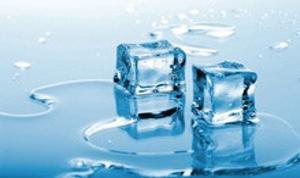
Liquid water freezing to form ice cubes is a physical change. Ice cubes melting to form liquid water is also a physical change.
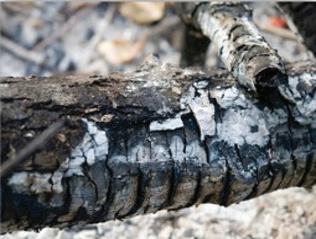
Burning wood is a chemical change. Like burned paper, the wood changes to ash.
When a piece of iron or steel is exposed to water and oxygen over a long period of time, a chemical change occurs. You may be familiar with the product in this chemical change: rust. Objects made of iron— such as chains, automobiles, and bicycles—have certain physical properties in common. When a shiny iron object rusts, the object’s properties change. Rust is a flaky, red substance that crumbles easily. You cannot change rust back to iron.
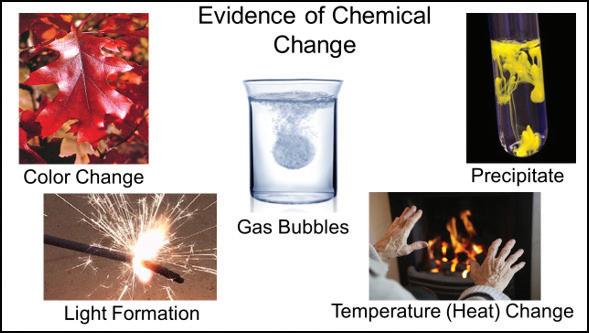
There are ways to prevent rust. In many places when it snows, people put salt on the roads to keep ice from forming. Cars driving on saltcovered roads are more likely to rust. Washing salt off cars helps to slow this chemical change. In addition, people use special chemicals to coat boats and other metals that are exposed to salt water. Painting an object made of iron or steel can also provide a barrier to water and oxygen in the air. (The most common place for rust to form on an automobile is where the paint has chipped off the surface.)
There are several indicators that provide evidence of a chemical change. The only way to know for sure that a chemical change has occurred is to determine if a new substance with new properties has formed.
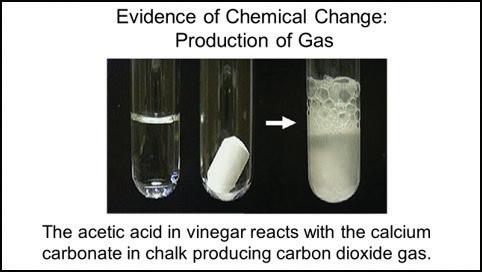
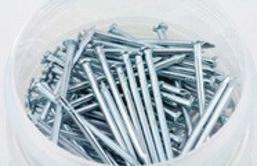
The nails below have rusted. The nails above have not. How does rusting change the properties of nails?
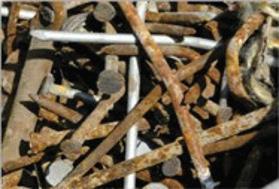
Production of a gas: When a gas is produced in a reaction involving a liquid, bubbles form. If you mix two common household items, baking soda and vinegar, a chemical change occurs. During the process, the bubbles that you see are molecules of carbon dioxide gas being produced. Carbon dioxide is not present initially—it forms due to chemical changes in baking soda and vinegar.
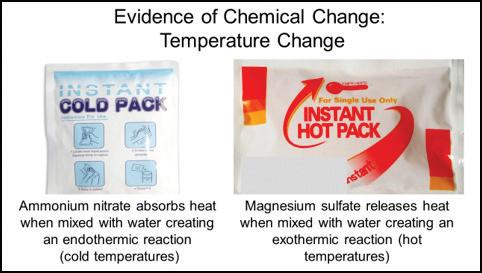
Change in temperature: Chemical changes can either give off heat or absorb heat. When a log burns, a large amount of heat is given off. You feel this as warmth if you are near the flames. This temperature change is evidence of a chemical change. Other chemical changes absorb heat. For example, some “ice” packs contain chemicals that become colder when they react. When you bend the pack, you cause the chemicals to contact each other and react. As a result, the pack becomes cold like ice.
Formation of a precipitate: A precipitate is a solid substance that forms and separates from a solution. A precipitate often settles to the bottom of a liquid reaction. When milk and lemon juice combine, a chemical change called curdling occurs, and a precipitate forms. This is a chunky, solid substance. This precipitate is evidence of a chemical change.
Change in color: A sliced apple that is left out on the table turns brown over time. This is because of a chemical reaction that occurs between the apple and oxygen in the air. The change in color, from white to brown, provides evidence that a chemical reaction has happened.
Production of light: When a substance rapidly combines with oxygen, combustion occurs, producing a flame that gives off thermal energy and light. Burning paper or wood produces light. In some chemical reactions, such as agitating the chemicals in a glow stick, a fluorescent light can be produced.
Look Out!
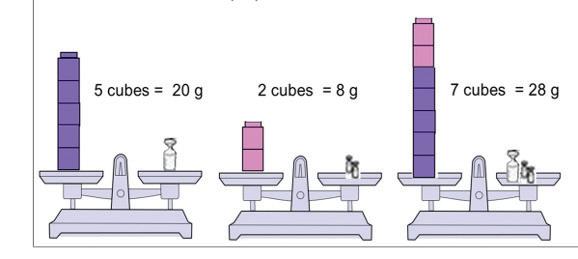
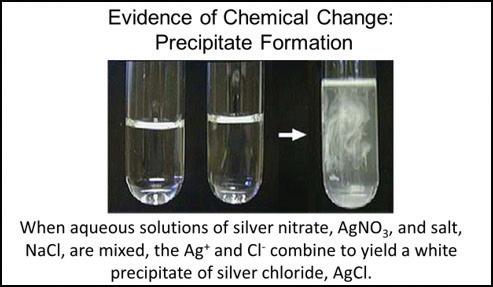
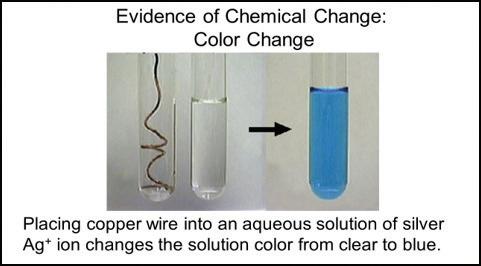
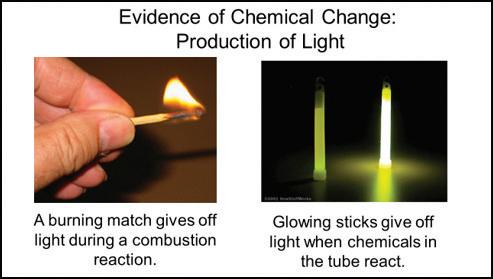
When two substances are mixed together, the total weight is always equal to the weight of the original substances.
Try Now
Matter can change, and these changes can be physical or chemical. Study the list of changes in the box below. Decide if each change is a physical change or a chemical change. Write your answers in the table below. If the change is chemical, provide possible evidence that you could observe; write this evidence in the column to the right.
• Boiling water
• Exploding fireworks
• Dissolving sugar in water
• Cutting a circle out of a piece of paper
• Baking a cake
• Green leaves turning red and yellow during autumn
• Mixing oil and vinegar
• Dew forming on grass in the morning
• A banana ripening
• Mixing lemon juice with milk
Chemical Change
Type of Change Type of Change Evidence of a Chemical Change
To help your child learn more about physical and chemical changes, work in the kitchen to prepare a meal or food item together. Try to prepare a dish that will allow you to demonstrate both physical changes (cutting, mixing, dissolving, boiling, melting) and chemical changes (baking, frying, burning).
For example, to demonstrate physical changes, you and your child can work together to prepare a salad. You must cut each ingredient in the salad into many small pieces; after you have put all the pieces into a bowl, you must mix them together by tossing the salad. Additionally, you could prepare a salad dressing, which includes mixing oil and vinegar. The processes of cutting and mixing are examples of physical changes.
Baking and frying are common ways to illustrate chemical changes. Baking a cake or cookies produces several examples of evidence of chemical changes: the dough changes color and increases in temperature as it cooks, and gases are produced in the form of air bubbles. Frying an egg produces similar evidence of chemical changes. If you happen to overcook an item and it burns, point out that burning is also a chemical change.
Here are some questions to discuss with your child:
• Which of the actions that you performed resulted in physical changes? Explain in terms of physical and chemical properties.
• Which of the actions that you performed resulted in chemical changes? Explain in terms of physical and chemical properties.
• What other physical and chemical changes happen during cooking?
1 Hundreds of years ago, early scientists began to study the ways that different compounds act when mixed together. They mixed many, many substances to see what would happen. They made observations of the properties of the starting compounds. They recorded what happened when the substances first touched one another. They ran tests on the mixtures to see if the chemical properties had changed. Their careful notes were shared with other scientists.
2 When many observations were put together, scientists noticed patterns. This led to a set of rules on how to tell when a chemical change had happened. Here are the five rules early scientists developed:
a. There is a production of light.
b. There is a production of a precipitate.
c. There is a production of a gas.
d. There is a color change.
e. There is a change in temperature.
3 Even though these rules are old, they are still used today to determine when a chemical change happens. Each of these is based on a property that can be directly seen or measured in an experiment. This is called empirical evidence.
4 Maria had several compounds in the lab. She wanted to study what happens when they are mixed. She designed an experiment to find out if a new substance is formed. Maria used the five rules to determine if there had been a chemical change.
5 Maria came up with a procedure that she used for each mixture. First, she measured equal amounts of each of the two compounds to be mixed. She put one of them into a test tube. Maria examined them carefully and wrote what she observed in her notebook. Watching closely, she put the second compound into the test tube, swirling to mix the two substances together. She put the test tube into the rack, let it sit for one minute, and then recorded her observations.
6 Here are Maria’s mixtures and observations:
a. Two clear liquids were mixed. They began to glow with a yellow light.
b. Two clear liquids were mixed. They did not look any different afterward.
c. A piece of metal was dropped into a clear liquid. Before long, small bubbles began to float to the surface.
d. A clear liquid was added to a dark blue liquid. The resulting mixture was light blue.
e. A clear liquid was added to a pale yellow liquid, forming a white powder that settled on the bottom.
f. A clear liquid was poured over a white powder. Immediately, it fizzed and foamed. After one minute, the bubbles were gone and only a clear liquid remained.
7 After the tests were complete, Maria reviewed her observations and analyzed her results to see if a chemical change had occurred. Soon Maria knew which combinations had produced a new substance. Do you?
1 Identify the flaw in the way that Maria set up her experiment.
A She did not take pictures.
B She did not wait long enough.
C She did not measure the temperature.
D She did not mix the substances well enough.
2 Which of these describes Maria making an observation?
A Maria measured the compounds.
B Maria let the test tube sit for one minute.
C Maria wrote her results in her lab notebook.
D Maria saw that bubbles formed on the metal in mixture C.
3 What is the best summary of the passage?
A Early scientists studied the way substances behaved when they were combined. They developed rules to identify when a chemical change occurred. Maria used those rules to create an experimental procedure to test six mixtures.
B Maria was curious about how several compounds acted when mixed. She put them into test tubes and swirled them together. She could tell if a chemical change had occurred by watching for signs like bubbles or light.
C Maria mixed compounds together to test for chemical changes. One mixture produced light, two mixtures had bubbles, two mixtures had changes of color, and one mixture did not change.
D You can tell if a chemical change has occurred because there will be a production of light, gas, or a precipitate, or there will be a change in color or temperature.
4 Using Maria’s results, how many mixtures produced a new substance? A 3
B 4
C 5
D 6
5 Which is the best definition of empirical in Paragraph 3?
A Can be seen or measured
B From a currently used procedure
C Collected in an old, reliable method
D Related to whether a chemical change has occurred
1. Give an example of a chemical change. Include what evidence can be observed to indicate that a chemical change has really occurred.
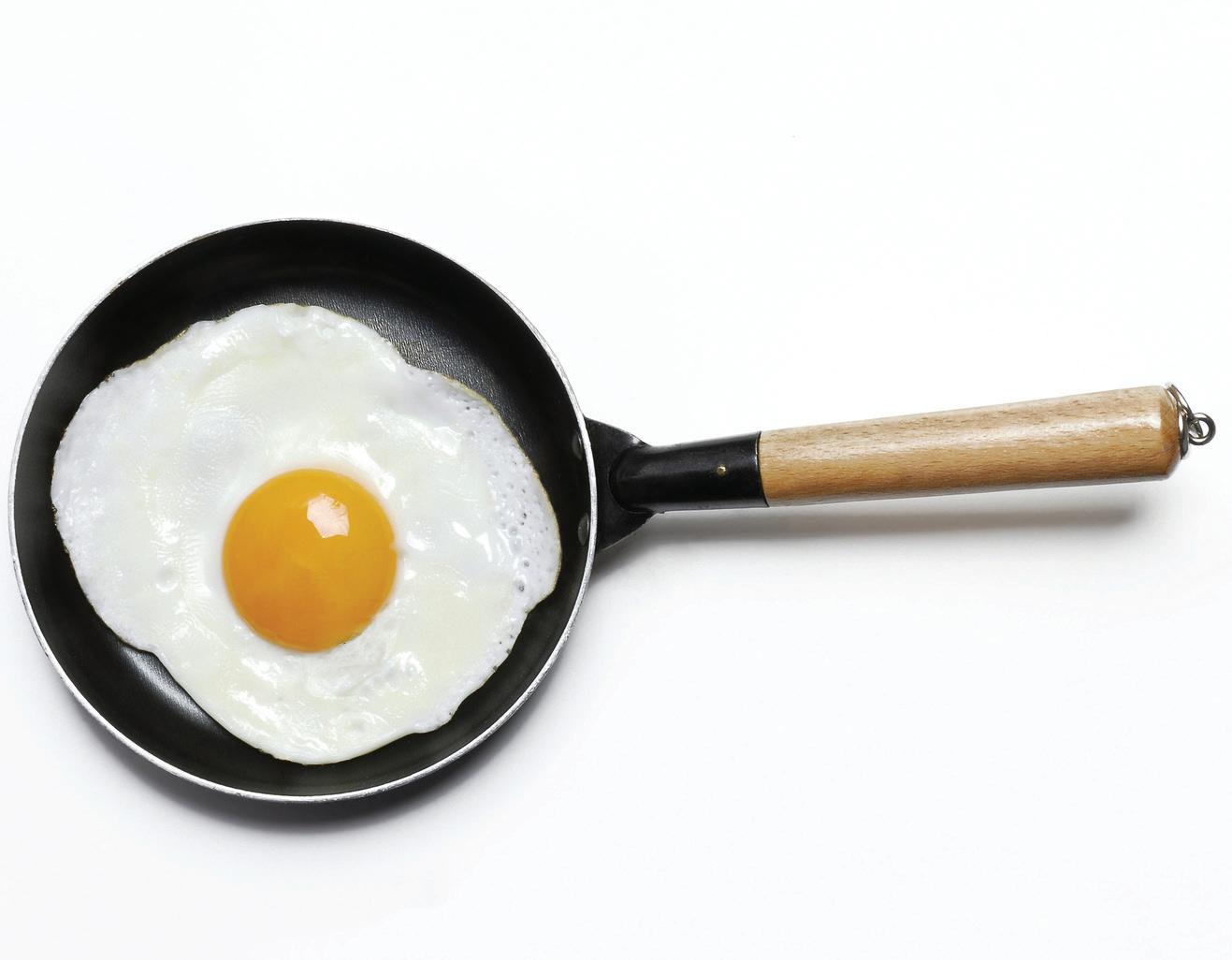
2. Observe the two changes below. Which one is a physical change? How can you tell? Heating and
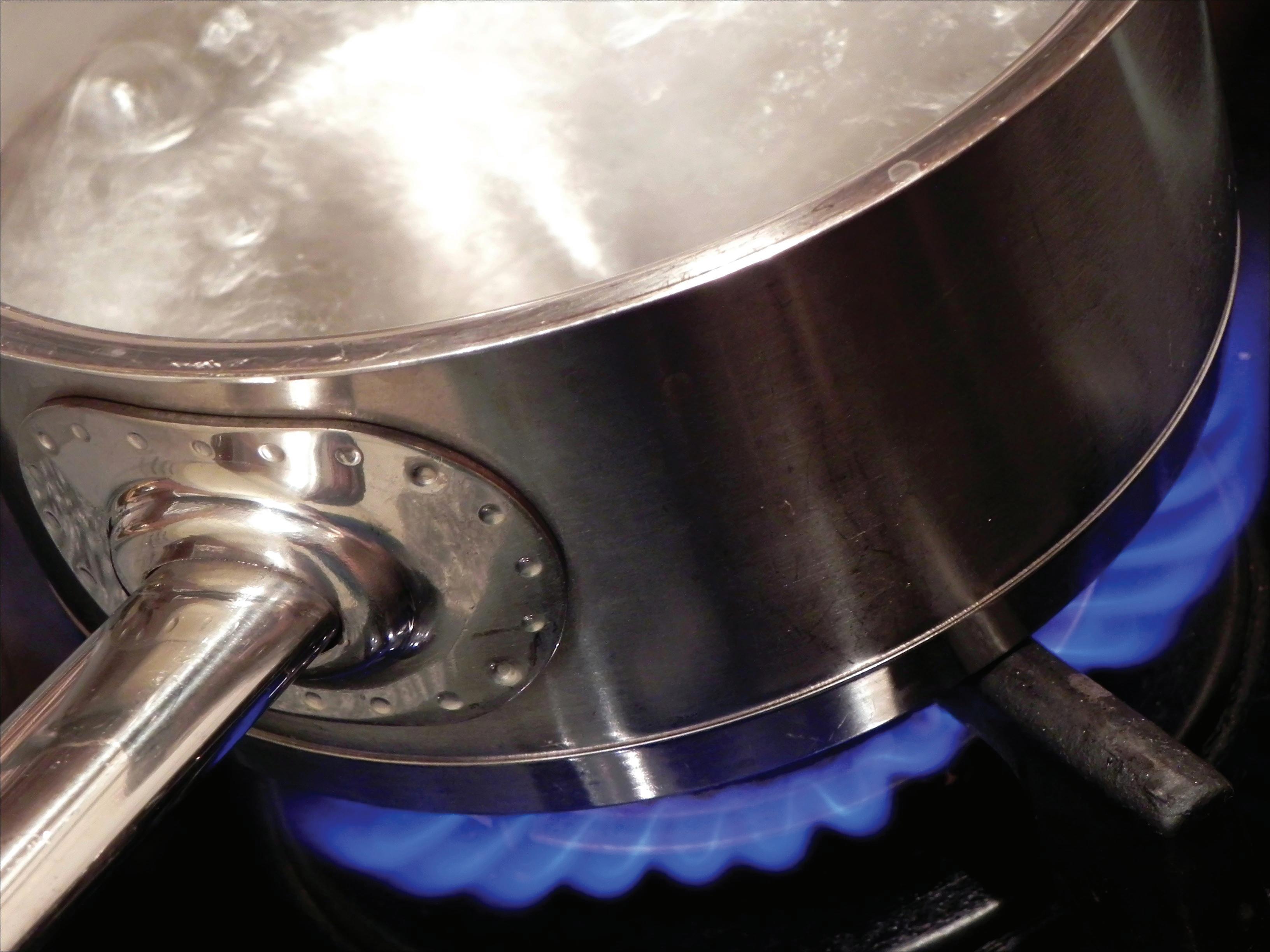
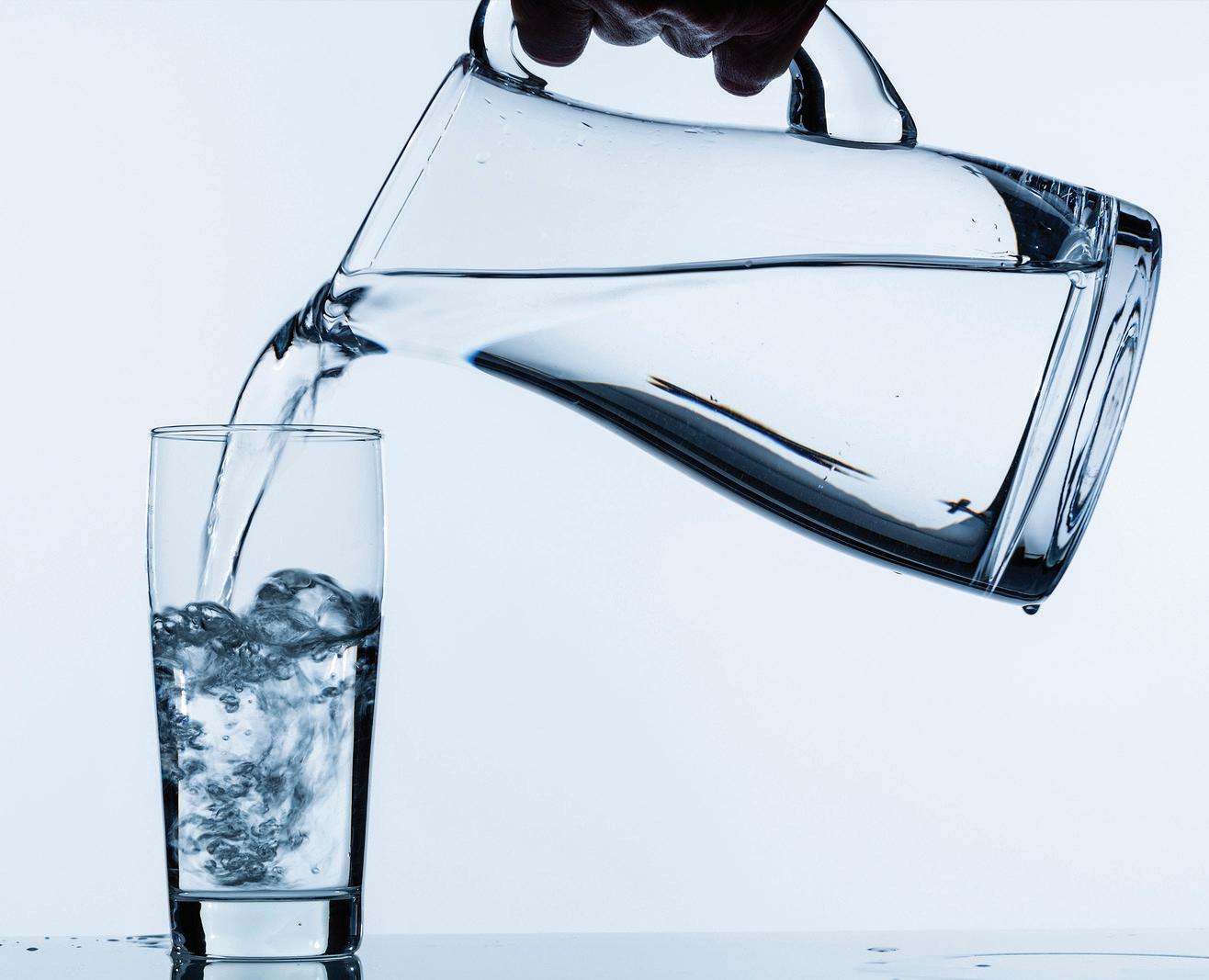
3. When you add salt to water, the volume of the water does not change. How can you tell that the weight of the salt and the water are conserved?
Jess, Lara, and Sue are students working on a lab assignment. Their task is to identify which of five substances is baking soda. They know that baking soda has an immediate reaction with some liquids. Based on the data table, which of the substances is baking soda?
Observations Before Substances Interact
Texture Granular Granular Fine powder Fine powder Fine powder
Color White White White/yellow White White
Observations After Substances Interact
Interaction with H2O Dissolves Dissolves Does not dissolve Does not dissolve Dissolves
Interaction with Vinegar Dissolves Dissolves Forms CO2 bubbles Forms CO2 bubbles Forms CO2 bubbles
Claim: Write a scientific explanation that justifies your selection.
Evidence:
Reasoning:
Directions: Complete the organizer to review Newton’s laws of motion.
Newton’s Laws of Motion
1st Law of Motion 3rd Law of Motion
2nd Law of Motion
What will you be testing in this investigation?
One thing you will be exploring is how the shape of a balloon affects the amount of force it can provide. Which balloon shape do you think might provide a stronger force, and why?
Based on your exploration, draw and describe the motion of the round balloon and of the tube balloon when you inflated each halfway.
Based on your exploration, draw and describe the motion of the round balloon and of the tube balloon when you fully inflated each balloon.
How can you use this information to help you design and construct a balloon-powered car?
Sketch your group’s design for your car below. List the materials you are choosing to use in your design.
Describe the procedure you will use in testing how far your group’s car can travel in five seconds.
Conduct your trials and record your results in the table below. Distance Car Traveled in 5 Seconds Trial 1 Trial 2 Trial 3
Which shape of balloon did you choose to use to power your car? Why did you choose that shape, and do you think you made the right decision?
Share your results with the class.
Upon hearing the results of other groups, do you think the shape of the balloon used greatly affected the speed of the cars? Why or why not?
What other factors determined how fast a car was able to travel?
What would you do differently if you were to design an improved car to retest? Why would you make those changes?
Summarize how unbalanced forces were involved in allowing your car to move forward at a faster or slower speed.
Part I
1. What is potential energy?
2. What is kinetic energy?
3. Describe a situation in which potential energy is converted to kinetic energy.
Directions
1. Place pinto beans, a pencil, a rubber eraser, and a rock on top of your table.
2. Predict what will happen to the objects on the table when you drop the golf ball, baseball, and basketball near them. Record your predictions in the table.
3. Using your ruler to measure, hold the golf ball 30 cm above the tabletop and drop it so it lands close to (not on top of) the items on the table.
4. Record what happened to the items on the table in your data table.
5. Repeat these actions with the baseball and the basketball.
6. Complete three trials for each ball.
Which falling ball transferred the most kinetic energy into the objects around it? Why do you think that is? Were your predictions correct?
Part III
1. What is a noncontact force? Give an example.
2. What is a contact force? Give an example.
Directions
1. Arrange the same objects from Part II on the tabletop.
2. In this activity, you will be dropping the basketball from 30 cm high. In the first set of trials, you will simply drop the ball and allow gravity to pull it to the table. In the second set of trials, you will apply a force to push the ball down to the tabletop. Predict how these two forces will affect the surrounding objects, and record your predictions in the table.
3. Using your ruler to measure, hold the basketball 30 cm above the table. Let go of the ball, and let it fall near the objects on the tabletop. Record the effect on the objects, and then repeat for two more trials.
4. Repeat step 3, but this time push the ball down from 30 cm above the table. Record your results.
Noncontact Force (gravity)
Contact Force (push)
Which type of force affected the objects the most? How do you know?
1. What is the problem? (State the problem in your own words.)
2. Explore and research the problem. Answer these questions as a group:
A. What is friction?
B. Describe some situations in which it is helpful to decrease the effects of friction.
C. Describe some situations in which we would want to increase the effects of friction.
D. How does friction work with other forces on Earth?
3. Brainstorm and design a solution to the problem. Sketch or describe some possible solutions in the space below.
4. Build, test, and analyze your solution.
A. Describe your plan BEFORE YOU BEGIN CONSTRUCTION.
B. Did you test your solution multiple times? Did you get similar results each time?
C. Record your results in the table below.
Number of Seconds
5. Improve or redesign and retest the solution. Describe and sketch any changes made, and then add new test results to the table.
6. Present and share your solution. Decide how you will share your solution with the class. Discuss who will demonstrate the system and who will talk about what you discovered. Evaluate your solution.
A. Was this the best solution to the problem? Explain.
B. What could you have done differently?
C. Can you change your solution to make it better? Explain.
Have you heard the story about Isaac Newton and the apple? Newton was a scientist who lived about 300 years ago. He made many important discoveries about how and why things move. Newton was walking through an apple orchard one day and thought about how things fall. He wondered why apples always fall straight down and why they speed up as they fall. After some time, this led to his discovery of the scientific laws that explain the force of gravity. Gravity is just one of many forces we experience every day. Newton went on to explain important principles about how forces change motion. These principles are called Newton’s laws of motion.
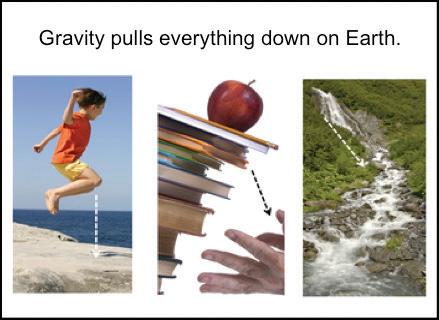
Look Out!
What keeps you sitting in a chair? Why do you not float away into space? The answer is the force of gravity Gravity is a force that pulls every object toward the center of Earth. You can feel Earth’s gravity pull you back down to the ground. This pull is called your weight. Gravity is always a pull and never a push. Forces change motion.
Gravity is a force of attraction between two or more objects that pulls one object toward another. An object must be very massive to pull hard enough on objects to cause a change. The force of gravity increases with the mass of the objects and decreases with the distance.
What other forces change an object’s motion?
Certain forces only push or only pull. Other forces can do both. For example, the force of gravity is always a pull, never a push. Here are some other examples of everyday forces: Reflect

• Magnetic force: This is the force between two magnets or between a magnet and certain metals such as iron that can push or pull.
• Electrostatic force: This force has to do with the charge an object carries. Opposite charges attract (pull) and the same charges repel (push).
• Mechanical force: This is a push or pull that one thing exerts on a system’s state of rest or uniform motion. Machines like cars can supply mechanical forces. Animals and people can also supply mechanical forces. Mechanical forces can help you move!
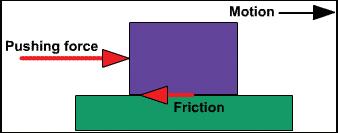
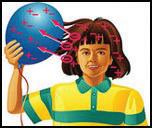
• Friction: This is a force that slows things down. Have you noticed that things that are rolling or sliding or otherwise in motion eventually slow down and stop? If no other forces are involved, moving objects on Earth slow down because of friction. The cause of friction is the rubbing together of two surfaces. The rougher the surfaces, the greater the force of friction.
• Spring force: Some things change shape when force is applied to them. A lump of modeling clay and a balloon both change shape when you squeeze them. However, the modeling clay keeps the new shape it was squeezed into. The balloon returns to its original shape when the force is removed. The force that returns the balloon to its original shape is called spring force. Other things that can exert spring force are rubber bands and springs.
Which forces require contact, and which forces act at a distance?
Gravitational, magnetic, and electrostatic forces can act at a distance without contact. For example, the gravitational attraction between the Sun and solar system objects acts at a distance. However, mechanical, frictional, and spring forces require contact with the object to push or pull it.
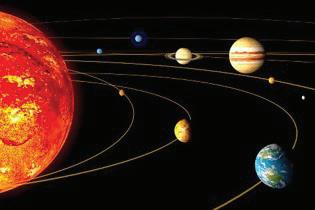

Gravity acts at a distance. Mechanical force requires contact.
How can forces change an object’s movement, shape, or position?
Isaac Newton discovered more than just the laws of gravity. He also explained how force is related to motion, or the movements of objects. Newton explained force and motion in three simple laws. The first two laws describe forces that act on individual objects, while the third law is about pairs of objects that collide.
Newton’s first law: Things do not change their motion unless a force acts on them. This means that things that are not moving will stay put, and things that are in motion keep moving at the same speed in a straight line. An object’s motion does not change unless an unbalanced force acts on the object. Objects that are not moving will stay put, and objects that are moving will keep moving at the same speed in a straight line unless acted upon by a force.
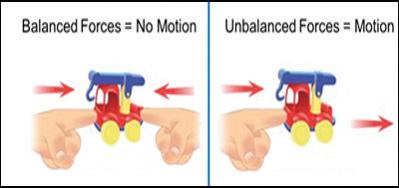
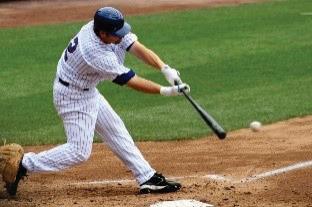
A baseball will keep moving in a straight line until the forces of gravity and friction slow it down.
We can predict what will happen to objects on Earth that are affected by gravity. When we throw a ball in the air, gravity makes the ball fall back to the ground instead of letting it remain in motion forever. Gravity makes smaller objects in space orbit larger objects, like planets orbit the Sun. We can predict that landslides, rivers flowing downhill, and precipitation will fall toward the center of Earth due to gravity.
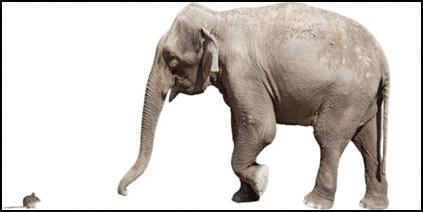
Newton’s second law: If a force continues to act on an object, it will move faster and faster. This increasing speed is called acceleration. The greater the force, the greater the acceleration. However, if the force applied is the same when you compare two different-sized masses, the object with more mass has less acceleration. A force can also cause a moving object to slow down. This is called negative acceleration Sound familiar? Friction causes moving objects to have negative acceleration. In other words, it is common sense that you have to use greater force to speed up or slow down an elephant than to change the motion of a mouse. Reflect
Newton’s third law: The third law deals with pairs of objects. For every action there is an equal and opposite reaction. This means that forces always occur in pairs. When a force acts on an object, the object pushes back in the opposite direction with the same amount of force. Think of a book sitting on a table. The force of Earth’s gravity is pulling downward on the book. If the table did not exert an opposite and equal force upward on the book, the book would go through the table.
What affects how stored energy is transferred to energy of motion?
Picture a batter getting ready to hit a ball. He swings his bat backward and waits for the right pitch. The stored energy in his arm and the poised bat is called potential energy.
When he releases the bat to connect with the ball, that energy of motion is called kinetic energy. There are several factors that affect how potential energy is converted to kinetic energy.
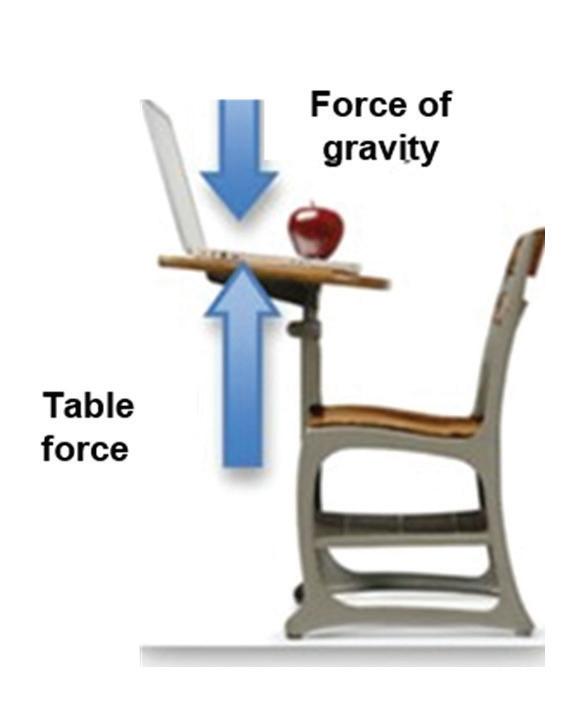
You already know about Newton’s first law of motion where an object at rest or in motion will stay at rest or in motion unless acted upon by a force. The baseball and bat are not going anywhere unless the batter pulls the bat back and gets into position to swing.
The more energy that is stored in the batting swing position, the more energy that is transferred to kinetic energy. Then the batter applies the force of the swinging bat to send the ball out of the park for a home run!
Applying Newton’s second law, you know that more force equals more acceleration. That is why successful professional batters have developed the strength and coordination to hit the ball very hard.
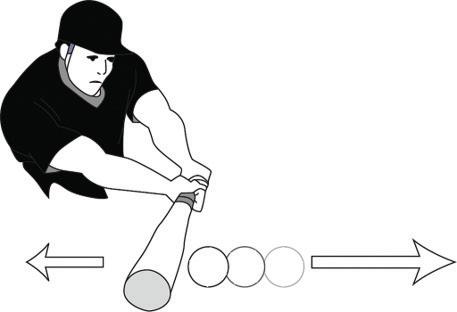
Force times mass equals acceleration. So the harder the batter hits the ball, the more it will accelerate.
Lastly, using Newton’s third law, for every action there is an opposite and equal reaction. As much as the bat strikes the ball, the ball pushes back on the bat. Because the bat has more mass than the ball, the ball will be accelerated by the bat and, hopefully, will go very far.
Try Now
How could you create an investigation to test the effect of the force of friction on matter? All you need for this experiment is a board about two meters long, a chair, a large can of food, and something to measure how far the can rolled before it stopped.
1. Begin in a room with a carpeted floor. Prop one end of the board up on the chair and rest the other end on the carpet. Make the slope steep enough so the can will roll down easily. Release the can from the top of the slope and measure how far it rolls across the floor.
2. Repeat the experiment in a room with a smooth floor (wood, linoleum, or tile). Keep the slope the same and release the can from the same height. Measure how far the can rolls across the floor.
3. Repeat the experiment outside on the cement or inside on a cement floor. Keep the slope the same and release the can from the same height. Measure how far the can rolls across the cement.
The only thing that changed in the three trials was the force of friction. In each case, the friction acted in the direction opposite to the motion and caused negative acceleration.
Which type of floor caused the greatest force of friction? By comparing friction and distance, you should be able to conclude what would happen if there were no forces acting on a sliding or rolling object.
How does this experiment agree with Newton’s first and second laws?
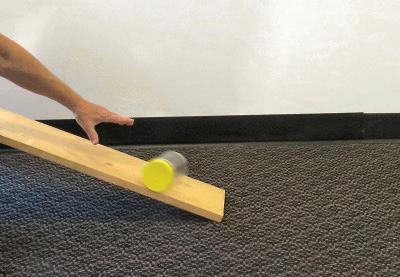
To help your child better understand Newton’s laws of motion, try to perform this experiment together. This experiment will demonstrate one aspect of Newton’s second law of motion: how falling objects accelerate.
For this investigation you will need the following:
• A stopwatch
• A ladder or a structure that allows you to drop an object from a variety of heights
• A small, dense object that is easy to see, like a ball bearing or golf ball
The procedure involves dropping the object from various heights and measuring the time the object takes to fall. One person will drop the object, and the other person will measure the fall time with the stopwatch. Be careful to choose a place where no one can be injured by the falling object.
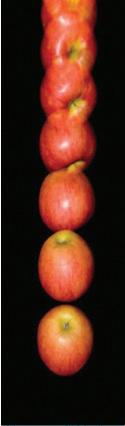
Careful comparison of the times will illustrate that the constant force of gravity exerted on the object causes it to accelerate. If the falling speed were constant, doubling the height would double the falling time; however, because the object is accelerating, the falling time increases only by about 50%.
Some questions you may wish to discuss include these:
• What if you had used a feather for the object you dropped? How would the results be different? Why?
• One person jumps from an airplane and falls 30 meters before opening the parachute. Another person travels downward 30 meters in an elevator. How is the motion of the two people different as they travel 30 meters? How are the forces acting on the two people different? How is what they feel different?
• Compare the motion of a ball thrown 10 meters into the air to the motion of a ball dropped from 10 meters. How is the motion of the two balls different as they travel 10 meters? How are the forces acting on the two balls different?
1 Jessica had compiled a list of the top 20 activities she hoped to accomplish this year. Jessica double-checked her list, and there it was: #14. Ride a roller coaster. It was already November, so she needed to get serious if she wanted to complete her list on time. She had talked her family into heading to the amusement park for their weekend destination.
2 “I’m the oldest, so I say we sit in the first cart,” Jessica declared. She was only 11, but she was still older than her two brothers, Mike, who was 9, and Johnny, who was 7. “Besides, it’s my list!” The family was impatiently waiting in line for their turn to ride the roller coaster. The roller coaster was famous for its high elevation and drop, and all the kids were excited to experience it. However, the problem was they all thought that different carts would be the best spot to sit. Jessica wanted the first cart, Mike wanted the last cart, and Johnny wanted the middle cart.
3 “No!” Johnny argued. “I’m telling you, the middle cart would be great!”
4 “No way! I want the first cart, so we can see what’s coming up!” Jessica insisted. “I don’t want my vision blocked by people in front of me.”
5 “Guys, we all know the last one would be the most fun! Right, Dad?” Mike asked. “It would be the best for the big drop, right?” Their dad turned and faced all the kids.
6 “Actually, if you want to get the most out of the drop, then Mike is right. The rear car is the best spot on a roller coaster because the twists and turns are more noticeable,” their dad said. Jessica and Johnny scowled as they looked down toward the ground. Mike grinned and said, “I told you so!”
7 “It all depends on the force of gravity, so the last cart would be the best,” their dad explained. “When the carts start going up the hill, it slows down because gravity is pulling on it from behind, but when the first car makes it over the apex, gravity pulls the car down the other side of the hill. So, because of the pull of gravity, the first car starts to accelerate, which accelerates the second car, then the third car, and so on.”
8 “So by the time the last cart finally arrives at the top, it will be speeding like a rocket!” Mike proudly exclaimed.
9 Jessica and Johnny were both angry that Mike was right, but they still agreed to the last cart. After all, Jessica did want to cross #14 off her list! The family waited anxiously as the line got shorter and shorter.
10 “Which cart?” the man that was in charge of the roller coaster asked. Mike smiled and proudly replied.
11 “We want the last one. Since the force of gravity will start to pull on the first cart at the beginning of the drop, the last cart will receive the most acceleration!”
12 “Well, kid, it looks like you know your stuff. The last one it is!” The man stepped aside as they piled into the last cart. The kids had butterflies in their stomachs as the roller coaster jerked forward and they slowly ascended. They gripped the handlebars as the top got nearer and nearer. The first cart lurched over the top, and everyone screamed. Jessica and her family raised their arms in the air as, one by one, the carts were hauled over by the carts in front of them, and soon, the last cart went racing over the top!
13 All too soon, the ride slowly came to a stop. Jessica hated to admit it, but Mike had made her #14 activity awesome!
1 The author uses figurative language in Paragraph 8 to emphasize–
A how the roller coaster looks.
B that the roller coaster is very loud.
C the roller coaster’s speed.
D the roller coaster’s up-and-down movement.
2 Which of the following details supports the conclusion that Jessica likes to be right?
A “Besides, it’s my list!”
B Jessica hated to admit it, but Mike had made her #14 activity awesome!
C “I’m telling you, the middle cart would be great!”
D Jessica wanted the first cart, Mike wanted the last cart, and Johnny wanted the middle cart.
3 Paragraphs 2 through 5 are important because they show–
A the setting of the story.
B the ages of the kids.
C how tall and fast the roller coaster is.
D the problem in the story.
4 Which words help the reader to know the meaning of the word apex?
A Arrives at the top
B Starts to accelerate
C Pulling the car down
D Like a chain reaction
5 Which sentence best supports the idea that gravity plays a part in the speed of the roller coaster carts?
A “Well kid, it looks like you know your stuff. The last one it is!”
B “The rear car is the best spot on a roller coaster because the twists and turns are more noticeable.”
C “Because of the pull of gravity, the first car starts to accelerate, which accelerates the second car, then the third car, and so on.”
D Jessica and her family raised their arms in the air as, one by one, the carts were hauled over by the carts in front of them, and soon, the last cart went racing over the top!
1. Describe a day in your classroom without gravity. What would the objects around the room do without gravity? How would things be different?
2. Observe the billiard balls. How will the force of contact with the cue ball affect the motion of the blue number two ball?
3. Unbalanced forces act on an object in motion. Describe three ways in which the motion of an object might change as a result.
4. Look at the picture of the bowling ball rolling down the lane toward the pins. How would an increase in only force, mass, or friction affect the motion of the ball and the converting of potential energy into kinetic energy? Fill in the chart to explain the effects.
5. Airplanes land at high speeds and need to slow down quickly. Besides just applying brakes to the wheels, design ways to make airplanes slow down quickly and safely. Draw and explain your design.
Stephen waited anxiously as the line to the new ride VomitZilla moved closer and closer to the front. He had been excitedly waiting for the opening of the brand-new ride for months! Nothing was going to stop him from riding this coaster! Stephen was so mesmerized by the coaster that he hardly noticed the beads of sweat running down his forehead. It was finally his turn! He strapped in tightly and squealed in anticipation, clutching his park map in his right hand. He heard the ride manager start to count down. BOOM! The ride took off, working hard to pull Stephen up as high as the track would pull him before letting the coaster go. Each time the coaster reached a peak, Stephen’s stomach dropped as he was rapidly pulled back toward Earth. What a rush! Suddenly, his map slipped from his hands. Stephen watched as it quickly fell to the ground, but his worry did not last long. He was soon screaming with joy as the ride took him on another terrifying drop! Stephen knew the ride had been well worth the wait.
Write a scientific explanation about the direction of Earth’s gravitational force using the evidence in the scenario. Prompt 3
Claim:
Evidence:
Reasoning:
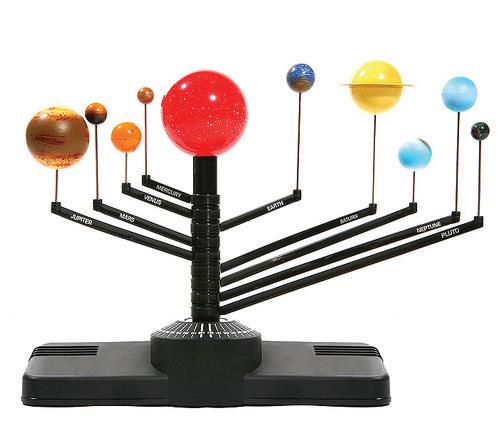

1. Which planet is the smallest? Which is the largest?
2. Which planet is the closest to the Sun? Which is the farthest away?
3. What can you say about the smaller planets and their distances from the Sun?
4. What can you say about the larger planets and their distances from the Sun?
5. The Sun is the center of our solar system, and all of the planets travel, or revolve, around the Sun. What do we call the path that a planet travels on? What shape is that path?
6. What is a good way to remember the order of the planets from closest to the Sun to farthest away from the Sun?
7. Draw and label your model of the orbital path of each planet.
8. Write a question about your model here.
Part I
1. Why does the light from one of the flashlights now look larger and brighter than the other?
2. What objects in space are we able to see as brightly lit objects?
3. Which star appears to be the largest and brightest to us from Earth? Provide evidence to support your answer.
4. Are there stars in our galaxy that are larger and brighter than the Sun? Explain.
5. Using what you learned in the flashlight demonstration, explain why the Sun appears to be the largest and brightest star from our perspective on Earth.
1. Draw a diagram showing the movement of Earth during one year, including the position of the Sun. Include some other stars in your diagram.
2. What do we experience as a result of Earth moving in this way?
3. What is a constellation?
4. Do the Sun and other stars (constellations) stay in one spot, or do they move? Explain your answer.
5. Why are certain constellations only visible during specific times of the year?
Directions: Your classmates have researched how important navigation and exploration is to astronomy. Listen carefully to each presentation, and write down at least five interesting facts from each slideshow in the spaces provided below.
Scenario
Mike and Carol were learning about how ancient people used astronomy in science class. Carol learned that ancient people used the night sky, star charts, compasses, and other instruments to navigate on land and at sea. Mike said that today’s navigation systems and space exploration were made possible because of the instruments and knowledge of astronomy that has been passed down.
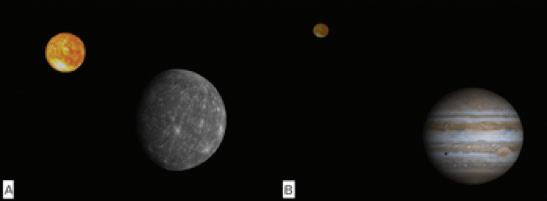
Prompt
Write a scientific explanation to explain if you agree or disagree with Mike’s claim.
Claim: Evidence:
Reasoning:

Have you ever had the chance to look through a telescope? The night sky is full of celestial wonders. You can see planets, moons, gas clouds called nebulae, and distant galaxies beyond our Milky Way. With your own eyes, you can often see several of the closest planets such as Mercury, Venus, Mars, Jupiter, and Saturn. Uranus and Neptune require a telescope to bring them into view.
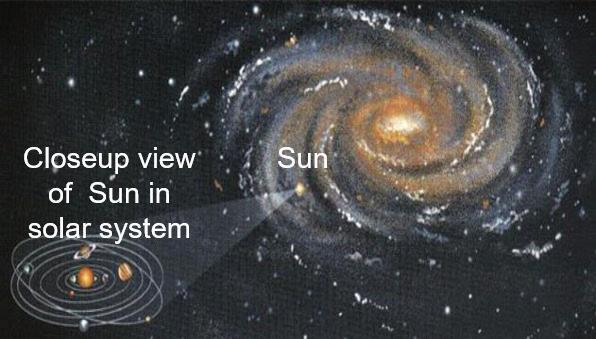
Our solar system includes our Sun and the planets, moons, asteroids, comets, and other frozen worlds that orbit the Sun. The solar system is located in one of the arms of the giant spiral Milky Way Galaxy. The Sun, our daytime star, is one of billions of stars that inhabit this spiral galaxy. There are also billions of other galaxies that populate our universe.
From our vantage point on Earth, the Sun appears quite big and bright because it is our closest star. Other stars are vast distances from Earth and appear only as pinpoints of light. You would need a telescope to see into the Milky Way and beyond to other galaxies. Compared to other stars, the Sun is actually a medium-sized star with an average temperature. There are other stars quite larger than the Sun. Compared to the planets in our solar system, however, the Sun is enormous!
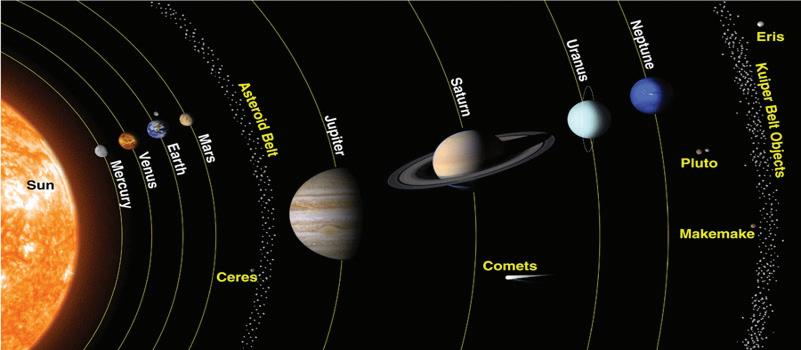
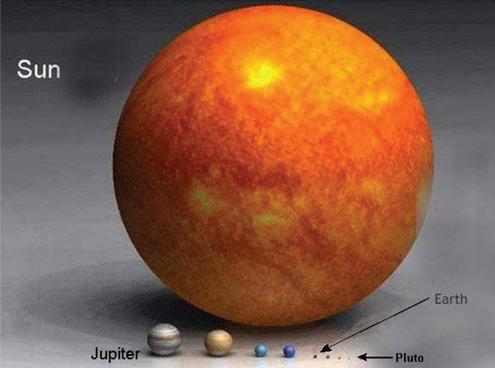
The order of the major planets from the Sun is Mercury, Venus, Earth, Mars, Jupiter, Saturn, Uranus, and Neptune. Pluto was reclassified as a dwarf planet along with Ceres, Eris, and Makemake.
The solar system is made of special categories of celestial objects, or objects in space.
Sun versus stars: Although you see stars in the night sky, they are not part of our solar system. Our only star is the Sun. The stars you see as familiar constellations are far beyond the edge of our solar system and are part of our Milky Way Galaxy. To see other galaxies in the universe, you will need a telescope, though in November you can see the Andromeda Galaxy without any tools!
Satellites: Moons are called satellites because they are objects that orbit another object, such as a planet. Scientists have found 173 moons in our solar system, most of which orbit the huge gas giant planets.
Rocky planets versus gas giants: Mercury, Venus, Earth, and Mars are spheres made primarily of rock, but not all objects in space are made of the same material. The outer planets—Jupiter, Saturn, Uranus, and Neptune—are gas giants. The gas giants also have rings. Although Saturn has the biggest ring system, the other gas giants also have ring systems.
Dwarf planets: Dwarf planets like Pluto and Eris are made of rock and/or ice and orbit a star, like our Sun. Beyond Neptune lies the Kuiper Belt with thousands of frozen planetoids similar to Pluto. The largest body in the asteroid belt, Ceres, is also considered to be a dwarf planet due to its size and round shape.
Asteroids: Not all bodies in space are round. Asteroids are rocky and irregularly shaped bodies that orbit the Sun and are too small to be planets. Most asteroids can be found in an area called the asteroid belt, which lies between Mars and Jupiter. Other asteroids can be found orbiting the Sun near Jupiter, while others orbit the Sun closer to Earth.
Meteoroids: These smaller rocky bodies often crash into planets and moons as meteorites. Other smaller pieces burn up in the atmosphere as meteor flashes.
Comets: Leftover debris from the formation of the solar system orbits beyond the edge of our solar system in the deep freeze of space. Many comets orbit the Sun in orbits shaped like large, stretched-out circles. As they approach the Sun, their frozen gases warm up and become long tails of gas and dust that drag behind them.

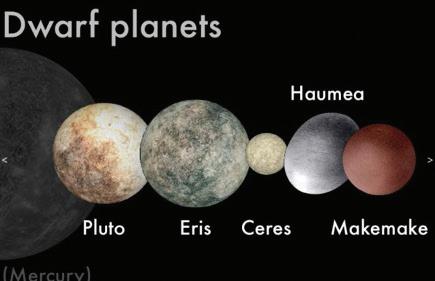
In our solar system, we have two basic groups of planets. The inner planets (Mercury, Venus, Mars, and Earth) are small, are rocky, and have few or no moons. The outer planets (Jupiter, Saturn, Uranus, and Neptune) are gas giants with many moons and ring systems, although not all the rings are visible from Earth.
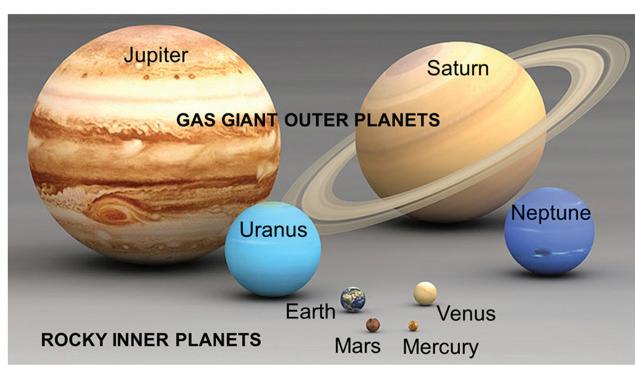
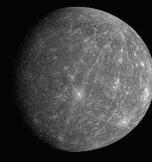
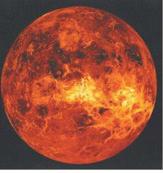


Mercury is the closest planet to the Sun and the smallest planet. The cratered surface of Mercury looks like the Moon.
Venus is the second planet from the Sun. Close to Earth’s size, it is the hottest planet and has a thick carbon dioxide atmosphere.
Earth is the third planet from the Sun and the only planet with life and water in three phases. It is three-fourths covered in water and has one Moon.
Mars is the fourth planet from the Sun. The Red Planet had ancient water. It has the largest volcano in our solar system and two moons.
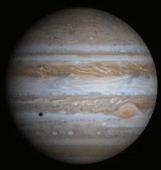
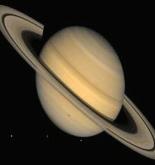
Jupiter is the fifth planet from the Sun. This gas giant is the biggest planet and also has the most moons—67 and counting.
Saturn is the sixth planet from the Sun. This gas giant has the largest ring system and 62 moons.
Uranus is the seventh planet from the Sun. This gas giant goes around the Sun on its side. It has a vertical ring system and 27 moons.
Neptune is the eighth planet from the Sun. This gas giant has the fastest winds. Its blue color reminds you of the sea. It has 14 moons.
Look at this image of the crescent Moon hanging over the eastern morning sky. Can you see the bright light to the upper left side of the Moon? It is brighter than any other object in the sky besides the Moon. Do you think it is a star? Ancient Greeks did; they called it the “morning star.” What they were looking at is not a star but the planet Venus!
Stars are enormous balls of hot, dense gas that give off their own light. Stars are very far away, so even though they are huge, they appear as tiny points of twinkling light. Stars twinkle because tiny movements in the atmosphere refract (bend) the points of light every millisecond. Stars do not appear evenly spread throughout the sky but are scattered like connect-the-dots pictures. Ancient people looked at the stars and named these patterns for gods, animals, and objects. In the winter sky, the hourglass figure with three stars in his belt and one arm up was named by the Greeks in honor of Orion the Hunter. These fixed patterns are called constellations and appear to move across the sky as Earth rotates.
Planets do not give off their own light; they reflect light from the Sun. Planets do not twinkle as much as stars because they are closer than the stars. Planets look like small disks of colored light. However, planets did look like stars to ancient people. Sky watchers from long ago noticed that some lights seemed to wander among the background of constellation patterns; they did not know they were the planets of our solar system. The ancient Greek name for planet means “wandering star,” and the Greeks worshipped the planets as gods.
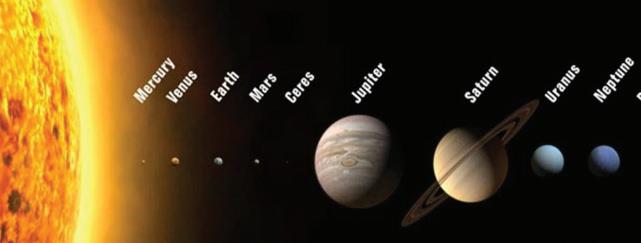
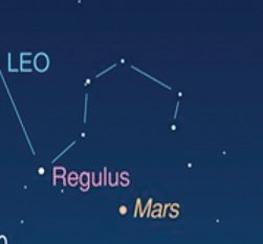
Mars, like all planets, moves around the Sun. When Mars is on the same side of the Sun as Earth, it appears to move slowly against the background of the constellations. The image on the right shows Mars below the bright star Regulus in the constellation Leo the Lion. Mars will take five days to move at an angle up to the left and beyond Regulus.
Stars look like they are all the same distance away from us. Our brains can detect changes in distance only if we have comparison points. For example, if people walk away from us, they get smaller as they move against the surrounding buildings. With the blackness of space, however, it is hard to see what is close or what is far.
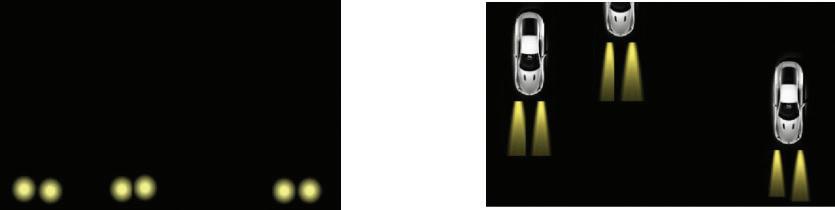
Imagine you see three cars with their lights on in a parking lot at night, without any streetlights around for comparison. The cars appear to be in a straight line when they are in fact parked at different distances from you.
You will construct a 3-D model of the Big Dipper when viewed from one direction—our viewpoint on Earth. Viewed from other locations, these stars look completely different. You will need a sharp pencil; black construction paper; one 8.5” x 11” piece of rigid cardboard, foam core board, or the top of a shoebox; black thread; seven 6-inch squares of aluminum foil squeezed into balls; and tape.
Draw an image of the Big Dipper, shown below, on paper. Place it on top of the black paper glued to the foam board. Using the pencil tip, poke holes through each layer for the seven stars in the Big Dipper. Cut seven pieces of thread to the lengths specified in the table below. Put the end of each thread through the hole and tape it down. Attach a foil ball to each. Hang from above and look upward to see the dipper shape. Look sideways to see the actual distance.

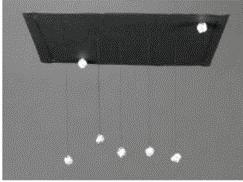
Reflect
When Earth rotates, it gives the illusion that the stars move across the night sky. From Earth, stars appear in patterns called constellations, which move across the sky from east to west. The Big Dipper constellation appears to stand on its handle early in the evening. As Earth continues to rotate, the Big Dipper appears to shift its position from east to west in a big arc.
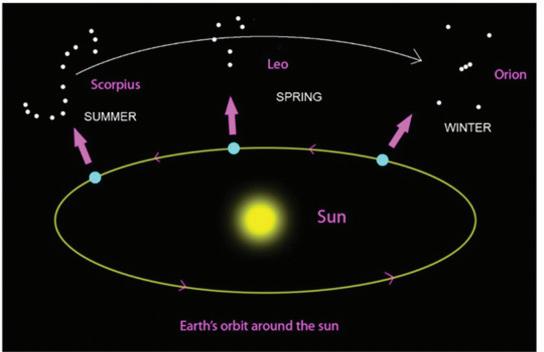
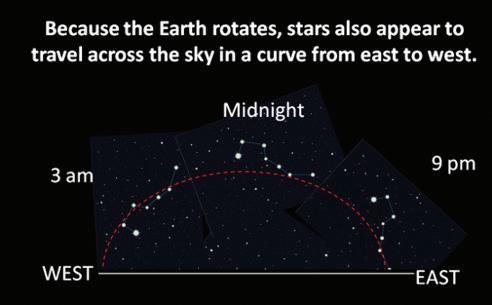
As Earth moves in orbit around the Sun, it is pointed at night toward a different direction in space with each season. Imagine you are Earth walking around the edge of your living room. Each wall is a different season. As you pass each wall, you notice different things hanging on that wall just like you see different constellations each season.
Prior to the 17th century, all observations were made with the naked eye. Humans could see only the Sun, Moon, stars, and five planets (Mercury, Venus, Mars, Saturn, and Jupiter) in the sky. The universe was very small to ancient observers. In 1609, a Dutch lens maker, Hans Lippershey, invented a telescope to observe ships, among other things. Telescopes gather light from distant objects and magnify them. In 1610, Italian astronomer Galileo Galilei improved the telescope and turned it toward the sky. What he discovered forever changed our view of the universe.
We have used telescopes, compasses, and star charts to find other planets and moons in our solar system and galaxies beyond our own, among many other things. Modern society benefits from the “spin-offs” of astronomy technology: telescopes led to better navigation, infrared telescopes led to remote controls and precise weather satellites, X-ray telescopes led to airport scanning devices, astronomical satellites led to GPS satellites, and so on. Due to astronomy, our world will never be the same.
To help your child understand why the planets appear to move against the backdrop of the seasonal constellations, use the star maps on the next page to find planets in the night sky.
Because light pollution from bright streetlights and commercial lights can drown out the view of the stars, you will need to find a dark sky location where you can observe the night sky. Local and state parks, rural parking lots, or the backyards of friends or relatives might be options for sky watching.
When using a star map, face south and look for the line of zodiac constellations on the map marked by the red dotted line of the ecliptic. If any planets are in our part of the solar system, you will find them along this line, along with the Moon.
Planets travel at different speeds in their orbit around the Sun. Of the planets visible to the naked eye, Mercury, Venus, and Mars are closer to the Sun so they travel faster. Jupiter and Saturn are farther out so they travel much slower. You will have to look up on the Internet which planets are visible on the particular night you are observing.
If you do not have access to a dark sky location, consider visiting a planetarium. A planetarium is a facility that simulates the night sky on a round dome and offers star and planet information and multimedia shows on astronomical topics. You can often find planetariums that are associated with local museums, school districts, or universities and are open to the public. For those living or traveling near observatories that offer public viewing of the night sky, your family can actually look at planets through their telescopes. Another source for telescope observations is a local astronomy club that may offer public viewings.
Popular astronomy magazines also have large monthly star maps with planets visible that month.
Computer software that simulates the night sky like a planetarium is another resource for finding constellations, planets, and a host of other nighttime objects likes nebulae and distant galaxies.
Here are some questions to discuss with your child:
1. How does the path planets are on differ from the location of stars?
2. Compare the movement of planets to stars.
Spring Constellations
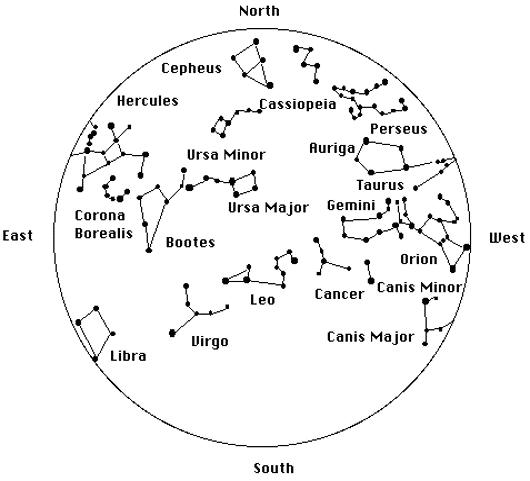
Summer Constellations
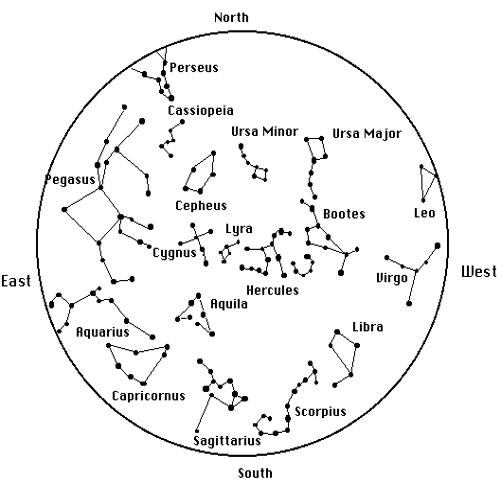
Ecliptic (path of planets, Sun, and Moon)
Fall Constellations
Winter Constellations
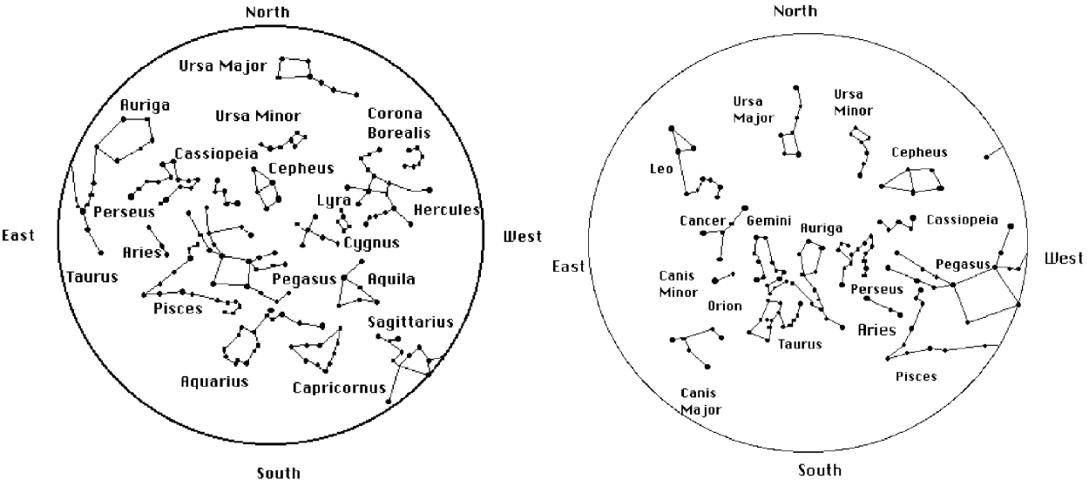

1
We live on planet Earth. Earth is not alone in space, but rather, it is part of the solar system. The solar system is made up of the Sun and all the planets that orbit, or travel, around it. In addition, the solar system is made up of the moons, asteroids, and comets that orbit the Sun. These objects orbit the Sun because the Sun is larger than the rest of them. Basically, this means that the Sun has enough gravity to hold them in orbit.
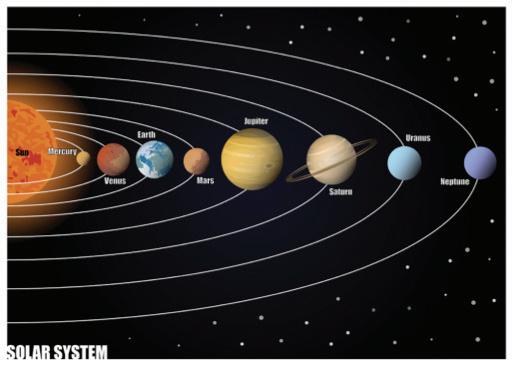
2 Mercury
Mercury is the planet closest to the Sun. It has the shortest orbit around the Sun. It only takes about three months for Mercury to move all the way around the Sun. Mercury is also the smallest of all the planets.
3 Venus
Venus is the second planet from the Sun and the hottest planet in our solar system. It is the closest planet to Earth. Venus is covered with clouds that reflect the Sun’s light. Many people think it is a star, because it reflects so much light and appears very bright from Earth.
4 Earth
The third planet from the Sun is Earth. It is believed to be the only planet with life on it. Earth has one moon, which is held in orbit by Earth’s gravity. Although the Moon appears to shine at night, what we actually see is the Sun’s light reflecting off the Moon’s surface. Since the Moon is so close to Earth, humans have been able to travel there and explore it.
5 Mars
Mars is a very cold planet. It has ice caps that can be seen on its north and south poles. Scientists have found that the soil on Mars is rich in iron. The iron gives the soil a red color, which is why Mars is sometimes known as the Red Planet.
6
Asteroids are large pieces of rock that orbit the Sun. Most of these asteroids are found in the space between Mars and Jupiter. Scientists believe that they are leftover chunks of rock from when the solar system was formed. Some are large enough to have their own names, while others are just tiny pieces of rock.
9
Jupiter is our solar system’s largest planet. It is made up of the same gases as the Sun. Jupiter’s atmosphere is very stormy. One storm is called the Great Red Spot because the clouds appear red. Humans have watched this storm for over 400 years, and it is still going strong!
Typically, when we think of Saturn, we think of the rings that circle it. It has over 1,000 rings, made of dust and ice. Saturn spins so fast that it flattens out at the top and bottom. Scientists believe it only takes Saturn about 10 hours to rotate, or spin, one time!
Uranus is different from all the other planets. It is unique because it rotates on its side and its poles face the Sun. It has about 11 rings made up of dark, boulder-sized objects.
Neptune is the planet farthest from the Sun. It appears blue, like water. As a result, it was named after the Roman god of the sea. Neptune has 13 moons.
11 Pluto
At one time, Pluto was considered the ninth planet. However, as scientists learned more about its true size, they decided that it was not really a planet. It is now known as a dwarf planet.
12 Just as scientists discovered these new facts about Pluto, they are constantly learning more about our solar system and what lies beyond it. Someday, humans might even visit some of the other objects in our solar system. At that point, we can learn even more!
1 Which of these is NOT part of the solar system?
A The Sun
B Other stars
C Earth
D Asteroids
2 What is NOT something that orbits the Sun?
A Earth
B Mars
C Asteroids
D Other stars
3 Why did the author write this passage?
A To inform the reader about the solar system
B To persuade the reader that Earth is the best planet
C To explain the difference between the Sun and other stars
D To explain the location of the solar system in the universe
4 Another name for Mars is–
A the Great Red Spot.
B the Dwarf Planet.
C the Red Planet.
D Vulcan.
5 What is the only object in the solar system besides Earth that humans have visited?
A Venus
B The Moon
C Asteroids
D Mars

1. How is the composition of the inner planets different from the composition of the outer planets?
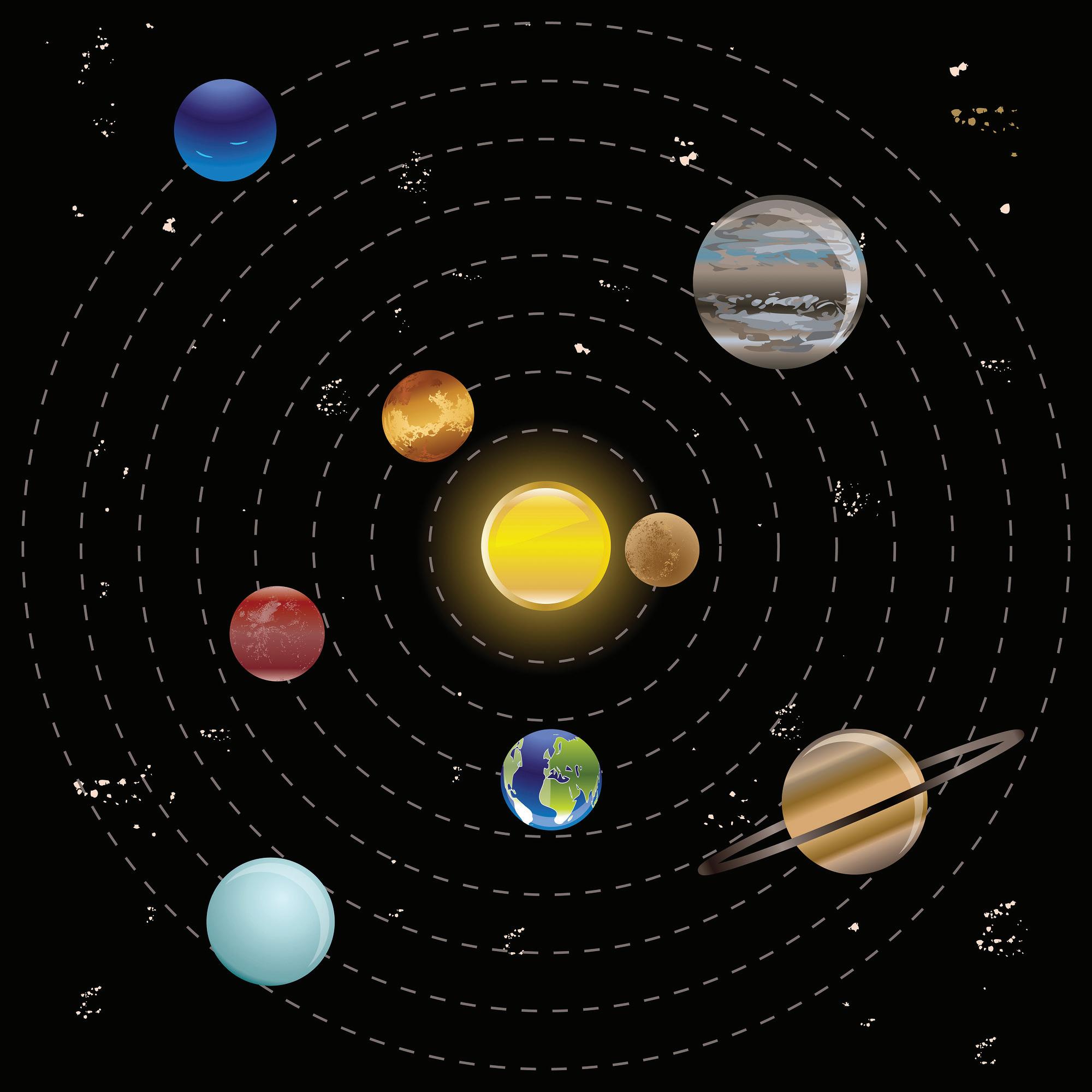
2. List the planets in our solar system in order from the Sun. Then list them in order from smallest to largest. What do you notice?
3. We know that the Sun is a star. Why do we see other stars as only tiny specks in the sky when the Sun is so large in Earth’s sky?
4. Why do constellations seem to move throughout the year as we look up at them from Earth’s surface?
5. Describe how technology in the form of telescopes has helped in exploration throughout history.

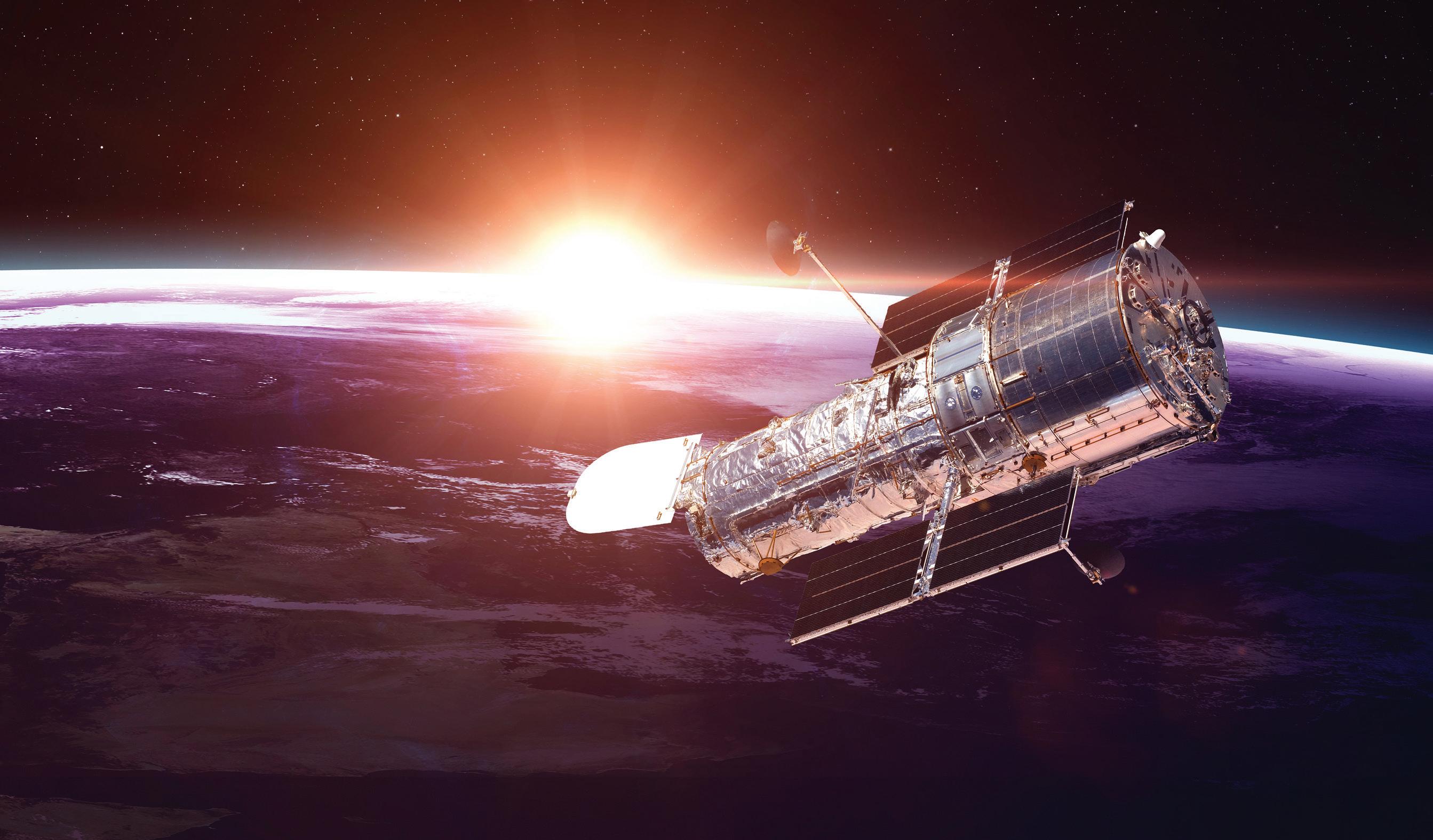

There are eight planets located in the Milky Way Galaxy. We call the first four the inner planets and the last four the outer planets.
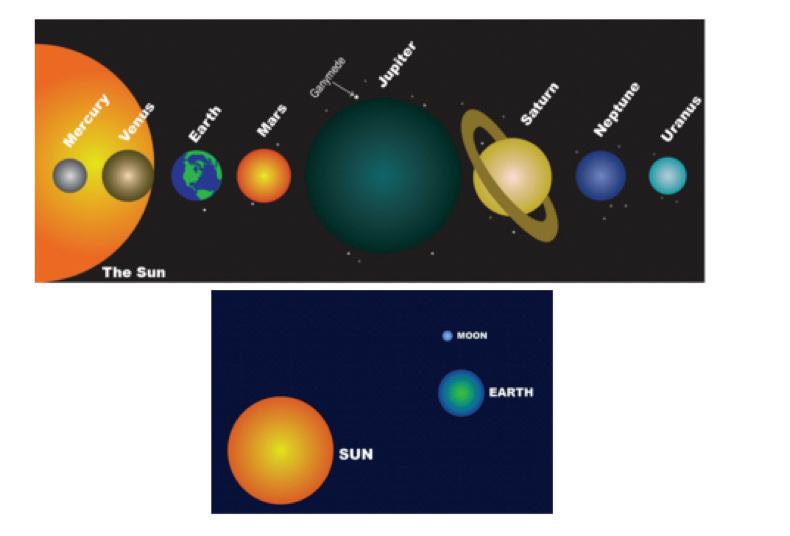
During the course of a month, we see many different phases of the Moon. Why do you think this happens?
These changing phases happen because the Sun illuminates the Moon’s surface as the Moon revolves around Earth. This change in the illuminated surface of the Moon is called the lunar cycle.
The lunar cycle has eight different phases. The cycle takes 29 days, beginning with a new moon, going through a full moon, and then going back to a new moon. The cyclical pattern of the lunar phases gives us evidence that motion is occurring.
Procedure
1. Take your Moon-on-a-Stick, this paper, and your pencil, and stand in a large circle around the lamp so that no one is between you and the lamp. Follow your teacher’s directions closely, and fill out this chart as you complete the activity.
Once you have returned to facing the lamp, you have completed one lunar cycle. Answer the following questions:
1. How can you use the revolution motions within the Earth-Sun-Moon system to explain the predictable pattern of the lunar cycle?
2. How is a full moon different from a new moon?
3. Why does the illumination of the Moon’s surface appear to change when viewed from Earth even though the Sun continuously illuminates half of the Moon?
4. How are waxing and waning different?
5. Contrast the relative positions of the Sun, Earth, and the Moon during the full moon phase and the new moon phase.
6. If a new moon is seen today, in approximately how many days will a full moon be seen?
1. How long did it take the Moon to go from one Moon phase to the next?
2. How long does it take the Moon to make one complete revolution around Earth?
3. What do you notice about the Moon throughout the course of an entire year?
Part I: Seasons
The axis is the center of rotation of Earth. Earth has a measurable tilt of 23.5ᵒ on its axis, orienting it in space so the North Pole always points toward the North Star as it moves along its orbital path around the Sun. As a result of the fixed tilt of Earth’s axis, the areas of Earth’s surface exposed to the Sun’s rays change seasonally as Earth moves through its orbital path. The tilt of Earth on its axis directly results in the changing number of daylight hours received.
Procedure
Use the table to record your data.
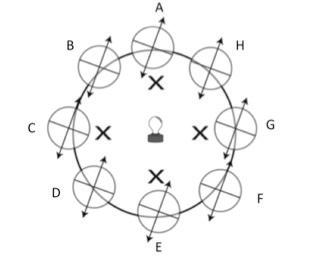
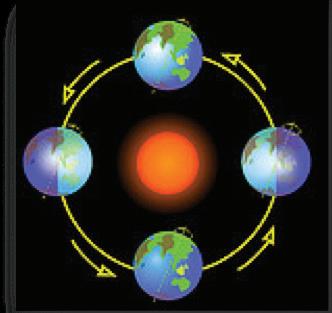
Complete the following questions after observing Earth in all eight positions:
1. At position G, how was the amount of light different in the two hemispheres?
2. Position G shows Earth in the month of December. What season would it be in December in the Southern Hemisphere?
3. At Position C, how was the amount of light different in the two hemispheres?
4. What month is Earth in at Position C? How do you know?
5. Position A and Position E have Earth receiving equal amounts of sunlight in the Northern and Southern Hemispheres. What seasons occur at these points? Why?
6. What two things cause seasons on Earth?
1. Draw a diagram to show the alignment of the Earth-Sun-Moon system and the effect on Earth of a solar eclipse. Label your diagram “Solar Eclipse.”
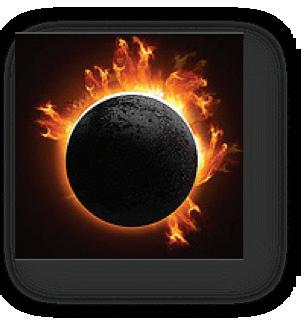
Describe what is occurring during a solar eclipse.
What is a way we can remember the position of Earth, the Moon, and the Sun during a solar eclipse?
2. Draw a diagram to show the alignment of the Earth-Sun-Moon system and the effect on Earth of a lunar eclipse. Label your diagram “Lunar Eclipse.”
Describe what is occurring during a lunar eclipse.
What is a way we can remember the position of Earth, the Moon, and the Sun during a lunar eclipse?
Look at the Moon Movement diagram below. Do Earth and the Moon orbit in the same plane? If the Moon revolved around Earth on the same plane that Earth revolves around the Sun, lunar and solar eclipses during each lunar cycle would be possible. However, the plane of the Moon’s orbit (around Earth) and the plane of Earth’s orbit (around the Sun) are slightly different and angled compared to each other. This angle difference is 5°, and it is exaggerated in the diagram to clearly show where the two planes intersect.
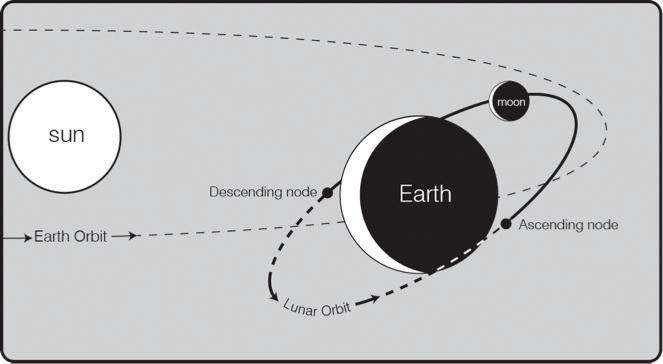
Answer the following questions:
3. Do more people see a solar eclipse or a lunar eclipse?
4. What is the phase of the Moon during a solar eclipse? A lunar eclipse?
5. Which is more common: a lunar eclipse or a solar eclipse?
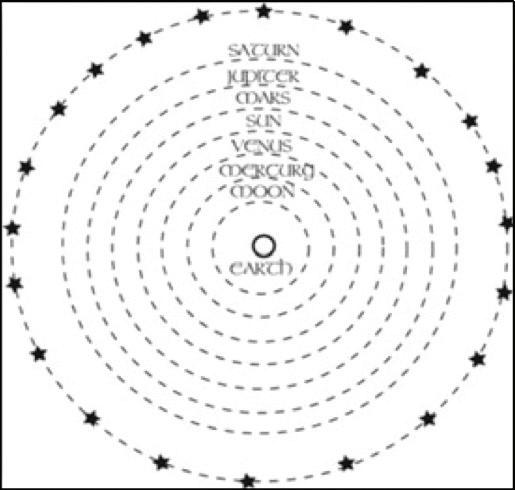
1. Examine the solar system in the image. Think back to what you have already learned about the structure and components of our solar system. List the inaccuracies demonstrated in the model.
2. In the space below, draw the improved heliocentric model of the solar system.
Reflect
When you look up at the stars at night, do you think people have always understood our place in space? Did they understand the relationship between Earth, the Sun, and the Moon? Sometimes we take for granted what we have learned from modern technology. To ancient sky watchers, celestial objects seemed to move across the sky as though they were orbiting Earth. Telescopes had not yet been invented, so only six planets were known to them: Mercury, Venus, Earth, Mars, Jupiter, and Saturn. Stars seemed to be just beyond the clouds.
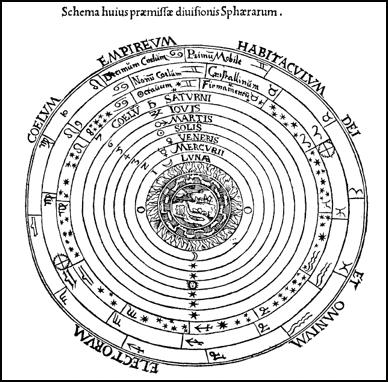
Ptolemy’s Geocentric Model (circa AD 100–200)
The geocentric (Earth-centered) model of the universe persisted for centuries based on the false assumption by the early Greek philosopher Aristotle that Earth stood still and was the center of the universe. The geocentric model was further promoted by Ptolemy (about AD 100–200), a Greek philosopher who studied in Egypt.
He believed that Earth did not move and was at the center of the universe. He also thought other celestial bodies moved in perfect circles. To him, stars were set in a rotating sphere that turned east to west once a day, and the planets, Moon, and Sun were set in separate spheres that moved slower. He thought planets moved in circles (called epicycles) around Earth.
Promoted by Nicolaus Copernicus, the heliocentric model revolutionized scientific thinking in the 16th century and replaced the geocentric model. Heliocentric comes from the Greek word helios, meaning “Sun.” In this model, Earth plus the other five known planets (Mercury, Venus, Mars, Jupiter, and Saturn) orbited the Sun. Only the five naked-eye planets were part of this model.
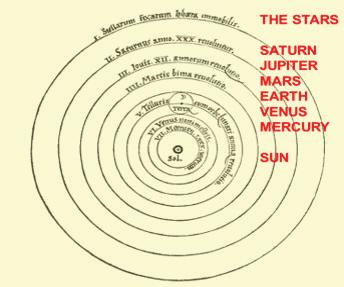
Copernicus’s Heliocentric Model (1543)
In 1615, further observations by Galileo Galilei, the Italian astronomer who first used the telescope to study the heavens, proved the Sun was the center of the solar system. He saw moons orbiting Jupiter, not the Sun. He also observed that Venus had phases that could happen only if the Sun was the center of the solar system and planets, along with Earth, revolved around the Sun.
What causes day and night? On Earth, each day begins at sunrise and ends at sunset. You see the Sun “come up” (rise) in the morning and “go down” (set) at night. When we use these terms, what do you think they imply about the way our solar system works? Does the Sun really rise and set in the sky throughout the day? The rising and setting of the Sun is an illusion created by a rotating Earth.
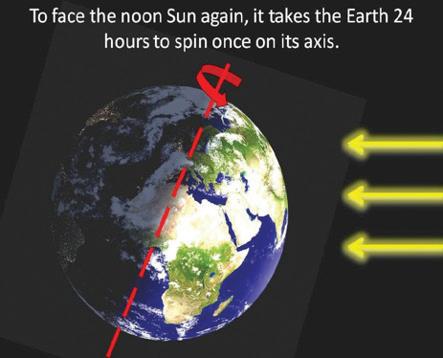
Rotation is a term that describes the motion of a spinning object. The Sun and each of the planets and moons in our solar system rotate about an axis. An axis is an imaginary line about which each planet or moon spins. This imaginary line marks the center of a planet or moon’s rotation.
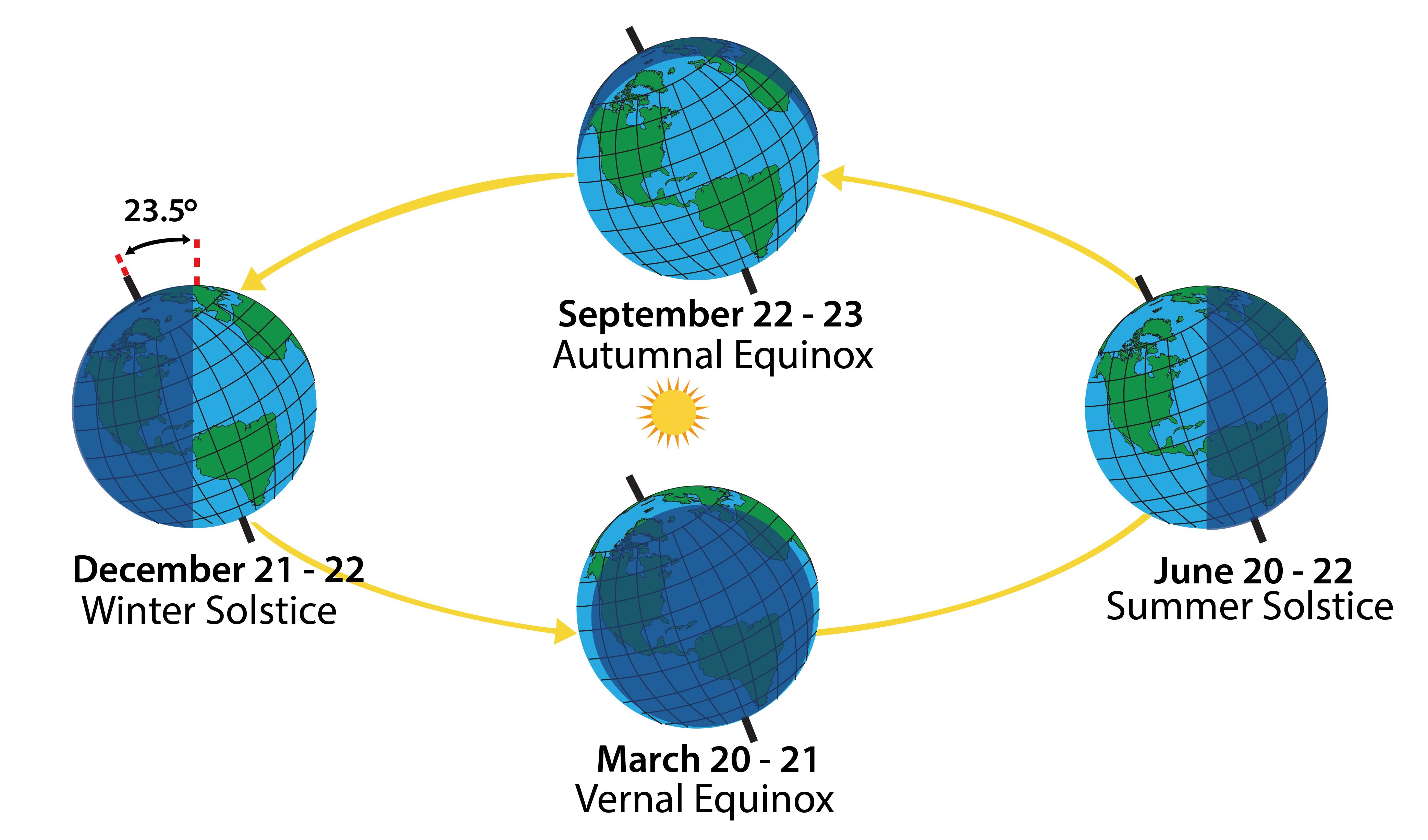
Like the other planets, Earth rotates about an axis. Earth’s axis is not a perfectly vertical or perpendicular line. Instead, our planet tilts at an angle of 23.5° relative to its path around the Sun. The geographic North Pole always points to the North Star, Polaris.
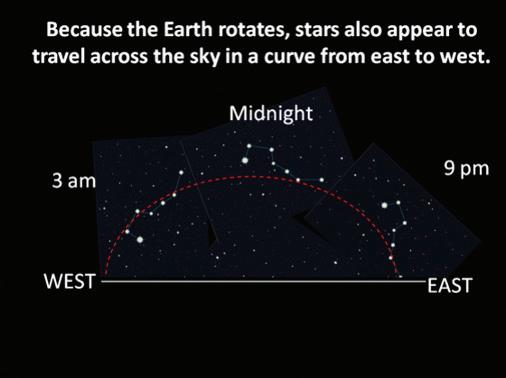
Earth takes 24 hours to complete one full rotation, so one day on Earth is 24 hours. Because Earth rotates, different parts of the planet face the Sun at different times. The number of daylight hours and nighttime hours changes with the seasons. Also due to Earth’s rotation, the constellation patterns appear to move across the sky in the same illusion that the Sun appears to move across the sky. Neither the Sun nor the stars are moving. It is Earth that is moving!
The constellations we see each season change because Earth revolves around the Sun. We are pointed in a different direction in space with each season. This journey around the Sun also causes the constellations to change in a regular pattern with the season. The observer’s latitude also affects which constellations are visible. Star charts are available on the Internet that specify for which latitudes each chart is applicable.
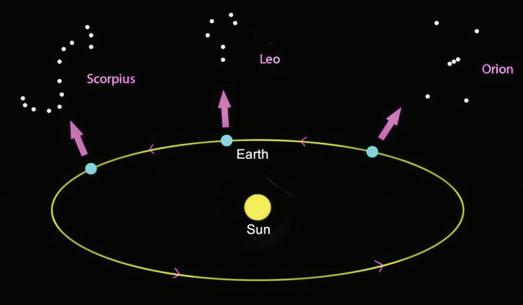
Earth’s rotation causes the illusion that the Sun rises in the east, moves in an arc across the sky, and sets in the west. The angle of the Sun’s apparent path as it rises and sets depends on the observer’s latitude. Its height in the sky at any time of the day depends on the season.
Those living at midlatitudes see the Sun following different paths across the sky as shown in the top-left diagram below. The violet path shows the Sun’s motion during the summer, the blue path shows the Sun’s motion during the fall and spring, and the red path shows its motion during the winter. At the equator, the Sun rises straight up, goes highest in the sky, and sets straight down. This is shown in the top-right figure below. The colors signify the same as for the 50-degree diagram. At polar regions, the Sun appears to move in a horizontal circle during summer since it stays up for months at a time. This is called the land of the “midnight Sun.” During fall and spring, the Sun circles near the horizon. During the winter, the Sun circles below the horizon, resulting in months of darkness. This is summarized in the bottom figure below.
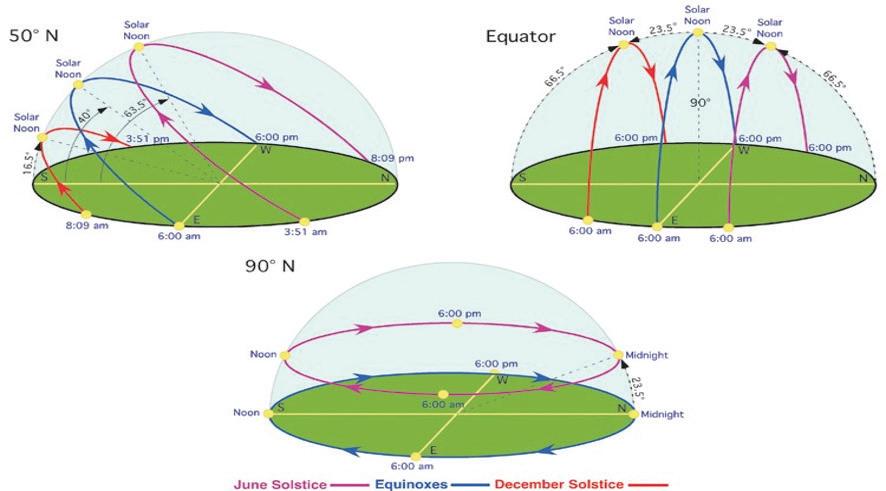
Because the Sun is so massive, its gravity is very strong. The force of the Sun’s gravitational pull holds all of the objects in the solar system—including the planets—in their orbits. An orbit is the path an object takes as it revolves around another object. Each planet in our solar system revolves around the Sun in a predictable orbit. These orbits are not perfect circles—they are elliptical or oval shaped. This means that each planet is sometimes closer to and sometimes farther from the Sun.
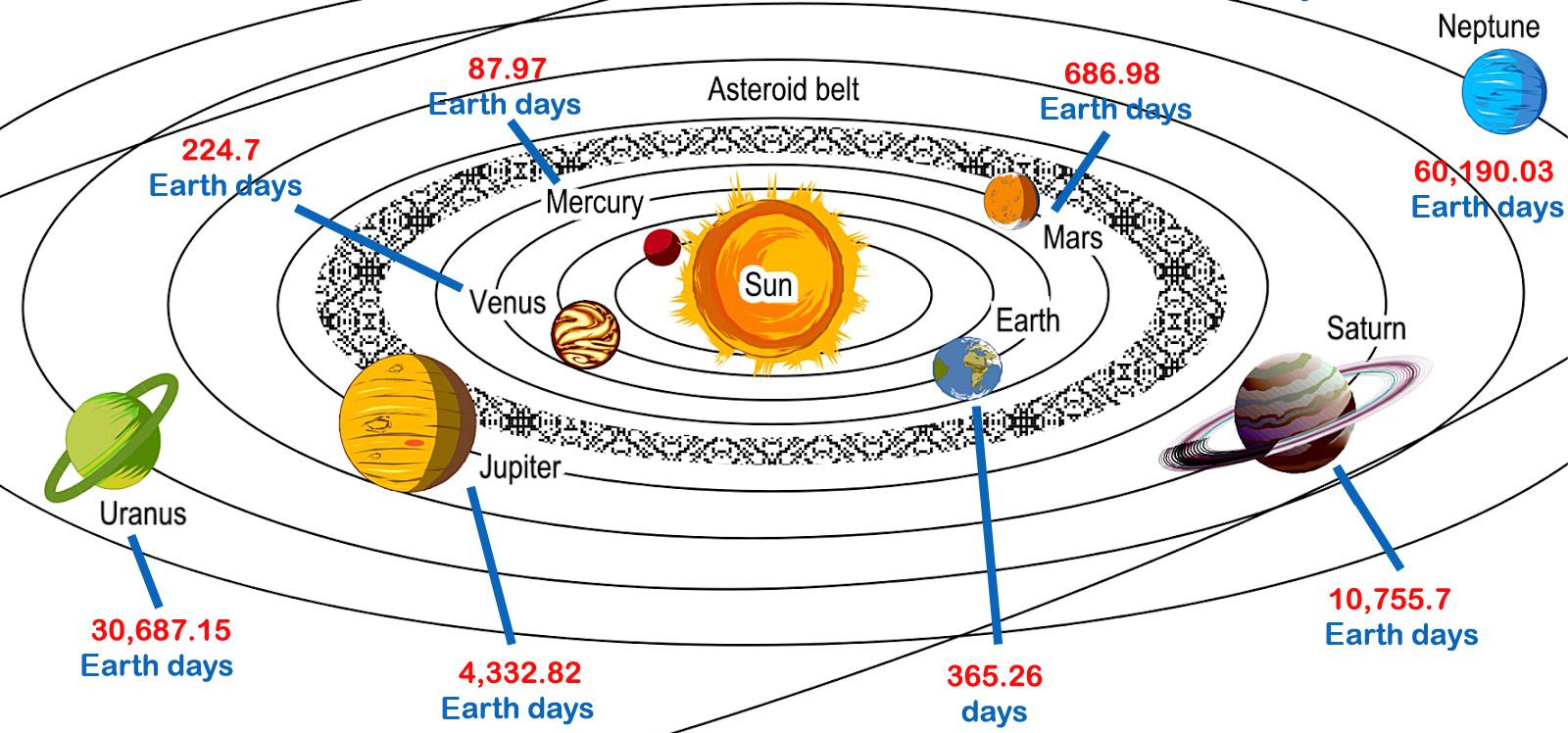
Look Out!
The fact that Earth’s distance from the Sun changes throughout the year might seem like a good explanation for the seasons. You might think that Earth is colder when it is farther from the Sun and warmer when it is closer to the Sun; however, this explanation is incorrect. Not every part of Earth experiences the same seasons at the same time. When it is summer in the Northern Hemisphere, it is winter in the Southern Hemisphere. What, then, causes the seasons?
Seasons are caused by Earth’s tilt and revolution around the Sun. Earth’s axis is tilted at a 23.5° angle. If Earth’s axis were not tilted, we would not experience different seasons. As Earth revolves around the Sun, sometimes the Northern Hemisphere is tilted toward the Sun. When the Northern Hemisphere is tilted toward the Sun, it receives more direct rays of sunlight. It is summer. In summer, days are longer and weather is warmer in the Northern Hemisphere. Plants there have plenty of sunlight for photosynthesis, and animals have plenty to eat.
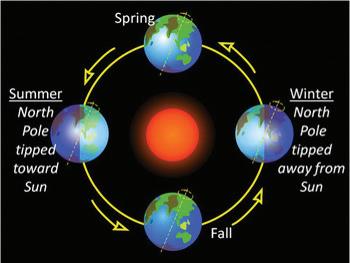
Earth’s tilt causes different amounts of sunlight to fall on the surface depending on whether you live in the Northern or Southern Hemisphere.
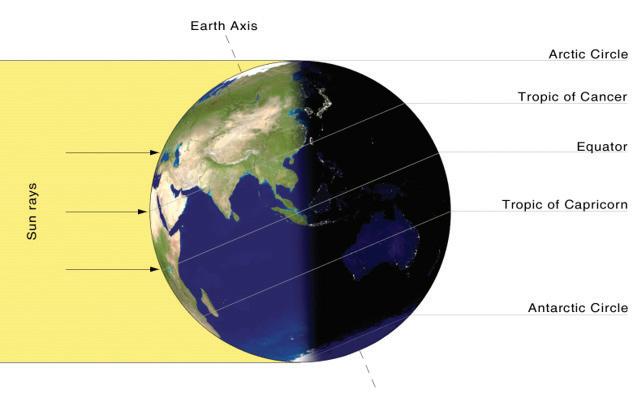
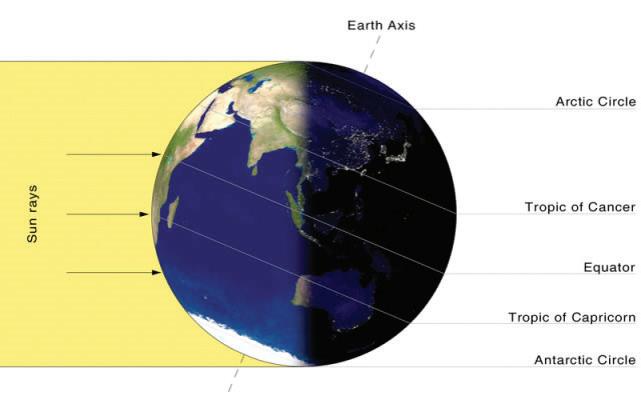
When the Northern Hemisphere is tilted toward the Sun, it receives more direct rays of sunlight than the Southern Hemisphere. During this time, the Northern Hemisphere experiences summer, and the Southern Hemisphere experiences winter.
When the Southern Hemisphere is tilted toward the Sun, it receives more direct rays of sunlight than the Northern Hemisphere. During this time, the Southern Hemisphere experiences summer, and the Northern Hemisphere experiences winter.
When Earth reaches the opposite side of its orbit—a process that takes about six months— the Southern Hemisphere is tilted toward the Sun. It will receive more direct rays of sunlight, and the Northern Hemisphere will receive fewer. As a result, the Southern Hemisphere will experience summer, and the Northern Hemisphere will experience winter.
Earth’s tilted axis and its revolution around the Sun—not Earth’s distance from the Sun— cause the seasons. Seasons are more noticeable in places that are a greater distance from the equator, the imaginary line around the horizontal center of the planet. No matter where Earth is along its orbit, the equator is never tilted away from the Sun. It receives direct rays of sunlight year-round. This is why climates are generally warmer near the equator. While there is some variation, temperatures near the equator stay relatively constant from month to month.
A model of the solar system can also explain eclipses of the Sun and the Moon. Eclipses occur when the Sun, Earth, and the Moon are all aligned, and one body casts a shadow on another body.
A solar eclipse (position 1) happens when the new Moon passes directly between Earth and the Sun. In a solar eclipse, the shadow of the Moon falls on a narrow path on Earth. Along this shadow path, the Moon blocks the Sun to observers living along that area.
A lunar eclipse (position 2) happens when Earth passes between the Sun and a full Moon. This causes the shadow of Earth to fall on the Moon when it is in the full Moon phase. We do not see solar and lunar eclipses every month because the Moon’s orbital path around Earth is not in the same plane as Earth’s orbital path around the Sun. Eclipses occur only when all three celestial bodies line up in the same plane, at positions of the red dots 1 and 2 in the image below. These positions where eclipses occur are called nodes.
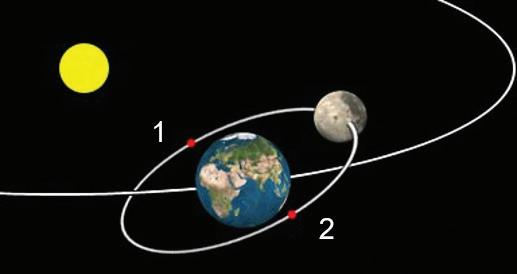
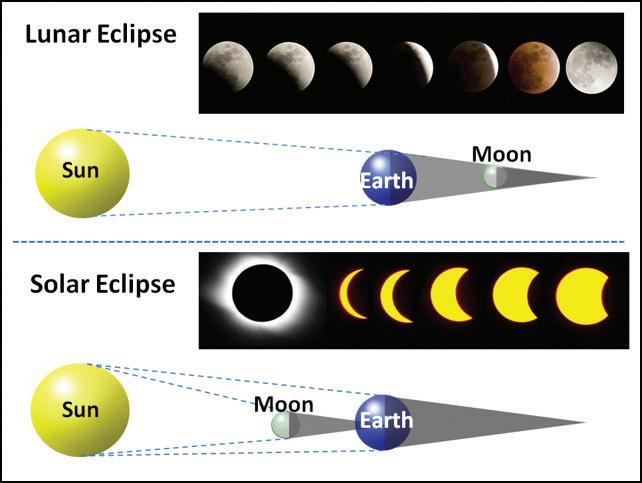
This picture shows the positions of the Sun, Earth, and the Moon in a solar and lunar eclipse.
Look Out!
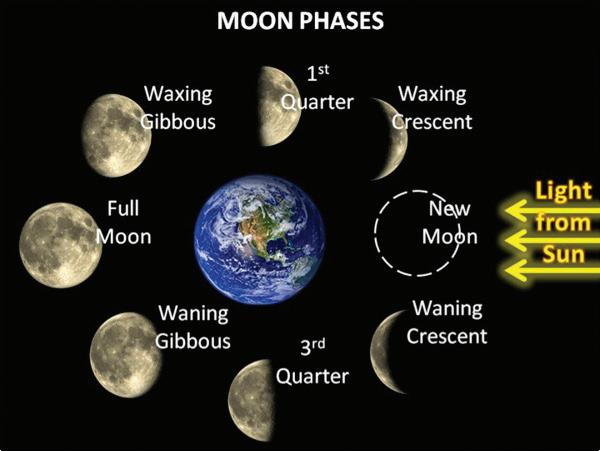
The Moon changes appearance. It appears to rise in the east and set in the west during different times of the day or night. Due to the changing angle between the Sun, the Moon, and Earth, a different amount of the Moon’s sunlit side is facing Earth in a cycle called the lunar phases. You do not see the Moon during the new moon phase because it rises and sets during the day. The term waxing refers to the increasing amount of the sunlit portion of the Moon’s surface, while waning refers to the decreasing amount of sunlit surface. Gibbous refers to a Moon that is almost fully illuminated by the Sun. To complete one lunar cycle from one new moon to the next new moon takes 29.5 days, or approximately one month.
Data from observations and research from NASA explain patterns in the location, movement, and appearance of the Moon throughout a month and over the course of a year. Images from several Moon observation missions, including the Lunar Reconnaissance Orbiter, revealed that the Moon wobbles during its phases. Although the same side of the Moon always faces Earth, there is a slight wobble north to south (like nodding your head “yes”) and slight rocking east to west (like gesturing “no” with your head) as the Moon goes through its phases. This results in our being able to see 59% of the Moon. The wobbling is called libration.
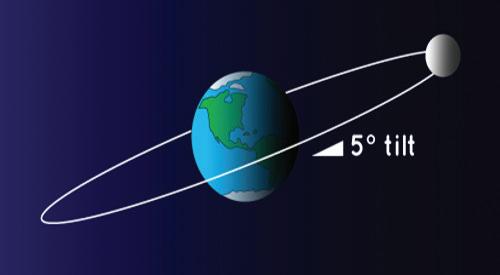
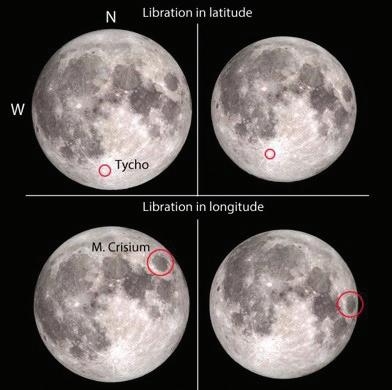
In the images from NASA above, you can see the large crater Tycho shift positions northward during a “nod” and Mare Crisium shift westward during a rocking motion. All of these are “apparent” motions, meaning the Moon is not really wobbling, but it gives that impression due to its changing position as it revolves around Earth in a tilted orbit.
Try Now
Earth’s rotation and revolution affect day/night cycles as well as the seasons. The following diagram shows Earth at two positions in its orbit around the Sun. (This diagram is not drawn to scale.)
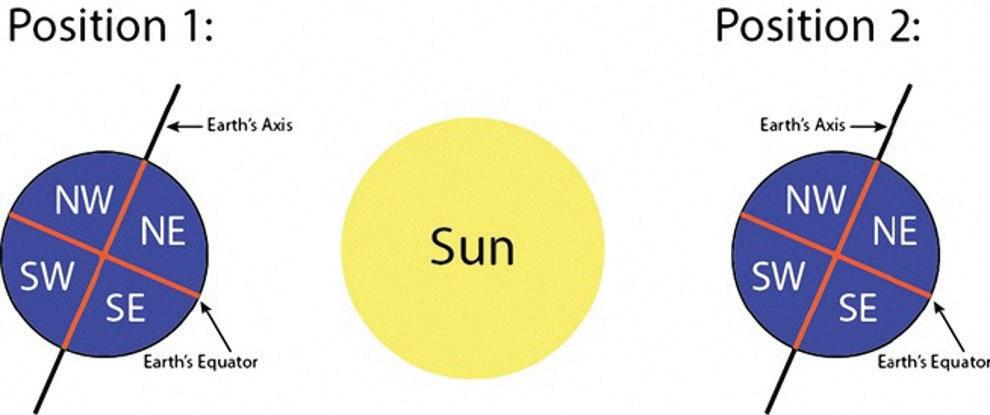
For each position, decide whether each hemisphere is experiencing day or night and winter or summer. Write your answers in the charts below.
Day or Night?
or Summer?
or Night?
or Summer?
or Night?
or Summer?
or Night? Winter or Summer? Position 1
Day or Night?
or Summer?
or Night?
or Summer?
or Night? Winter or Summer? Day or Night? Winter or Summer?
To help your child learn more about rotation and revolution, try a few simple experiments.
1. First, gather a flashlight and a round object such as a globe or ball (preferably about the size of a basketball or beach ball).
2. Create an axis for the ball by taping two drinking straws, pencils, or similar objects to opposite ends of the ball.
3. In a darkened room, hold the ball a few feet away from your child, and have your child shine the flashlight on the ball. Hold the ball so that the axis is pointing up and down at a slight tilt toward the flashlight.
4. Holding the ball steady at this tilt, walk in a circle around your child, who should keep the flashlight aimed at the ball. As you revolve around your child, discuss how the ball represents Earth on its tilted axis and the flashlight represents the Sun.
5. Stop periodically at different points in the “orbit,” and ask your child to explain which season each hemisphere is experiencing and where it is day and where it is night.
6. Try the exercise again, this time holding the ball so that the axis is perfectly straight up and down, rather than at a tilt.
7. Ask your child how this changes the effect of Earth’s orbit on each hemisphere.
Earth will still experience day and night as it rotates, but without a tilted axis, different hemispheres will not experience different seasons.
Here
• How does Earth’s tilted axis affect each hemisphere as the planet revolves?
• Point to different spots on the ball. What would people living here experience when Earth is at this point in its orbit?
• If Earth’s axis were not tilted, what would change?
1 As you are getting ready for bed, do you ever wonder what time it is on the other side of the world? Perhaps you think about what season it is in Australia as you sweat on a hot summer day. The constant spinning of Earth on its axis answers the first question. The tilt of Earth on its axis and Earth’s position during its revolution around the Sun answer the second question.
2 First of all, let’s discuss what an axis is. Picture an imaginary pole running from the North Pole through Earth’s center all the way to the South Pole. This imaginary pole is called an axis. Earth rotates on its axis, turning different parts of Earth into the Sun’s light. It takes about 24 hours to complete one entire spin. Thus, one complete rotation cycle results in 12 hours of daylight and 12 hours of night. Have you ever stood outside to watch the Sun sink below the horizon? You have actually been witnessing Earth’s rotation. The Sun is not moving, although it appears to be. Earth is moving! The rotating Earth also makes the stars at night glide across the sky. In fact, it is the rotation of Earth on its axis that makes them seem to move. At any given time during the 24-hour rotation, half of Earth is in sunlight, and half of Earth is in darkness. This means as you get ready for bed, someone on the other side of Earth is waking up.
3 Think of Earth as a ball with a rod through it, representing the axis. This makes it easier to picture Earth’s orientation in space relative to the Sun. Now think of the Sun as another ball. Imagine the Sun located in the center of a disc, somewhat like a Frisbee. The planets in the solar system would all be positioned on the Frisbee. They are positioned at different distances from the Sun, however. The area we picture as a Frisbee is actually called the plane of the ecliptic. It is the plane of Earth’s orbit around the Sun. Earth’s axis is not oriented perpendicular to the plane of its orbit. Instead, it is tilted at 23.5 degrees from the perpendicular. Why is this important? This orientation in space, relative to the Sun, is the cause of Earth’s seasonal changes.
4 Now to address our second question. What would cause it to be summer in North America and winter in Australia? We have just learned that rotation is the spinning of Earth on its axis. Rotation causes day and night. We also learned that Earth’s axis is tilted 23.5 degrees from the perpendicular of the plane of the ecliptic. There is one more thing to think about. While Earth is rotating, it is also revolving around the Sun. It travels in a nearly circular path called an orbit. This revolution takes one year, or 365 days, to complete. During this one year, Earth goes through four different seasons. The seasons are summer, fall, winter, and spring. However, they do not happen at the same time in the Northern and Southern Hemispheres. In June, July, and August, Earth’s tilt positions the Northern Hemisphere so that sunlight hits it more directly. The Northern Hemisphere has more daylight hours. This is the cause of the summer season. During that period of time, the Southern Hemisphere is tilted so that the sunlight is less direct. Fewer daylight hours cause the opposite winter season. This explains why the Northern and Southern Hemispheres have different seasons.
5 The next time you watch a sunset or sunrise, think about the rotation of Earth. Remember that you are witnessing the same thing that is causing day and night. On the next hot summer day or cold winter night, think about the tilt of Earth on its axis. Remember how its position in Earth’s revolution around the Sun causes the seasons.
1 In Paragraph 3, what word or phrase gives you a clue to what the word perpendicular means?
A Somewhat like a Frisbee
B Relative to the Sun
C Instead, it is tilted
D Orientation in space
2 Which of the following effectively summarizes Paragraph 2?
A The orientation in space, relative to the Sun, is the cause of Earth’s seasonal changes.
B There is an imaginary pole running through the center of Earth from the North Pole to the South Pole, which is called an axis.
C We also learned that Earth’s axis is tilted 23.5 degrees from the perpendicular of the plane of the ecliptic.
D The Northern Hemisphere has more daylight hours.
3 According to this passage, what is rotation?
A The constant spinning of Earth on its axis
B The movement of Earth through space around the Sun
C An orbital path shaped more like a circle than an oval
D The four seasons: summer, fall, winter, and spring
4 Which of the following statements best shows why it would be winter in the Southern Hemisphere when it is summer in the Northern Hemisphere?
A Earth’s tilt positions the Northern Hemisphere to receive more of the Sun’s direct rays.
B Earth’s tilt positions the Southern Hemisphere to receive more of the Sun’s direct rays.
C Earth’s tilt exposes the Northern Hemisphere to longer periods of daylight.
D Both A and C are correct.
5 The rotation of Earth takes approximately _____ to complete, and the revolution of Earth takes approximately _____ to complete.
A 1 day, 30 days
B 12 hours, 24 hours
C 365 days, 24 hours
D 24 hours, 365 days
1. Look at the picture showing some phases of the Moon. Why does the Moon look different at different times of the month?
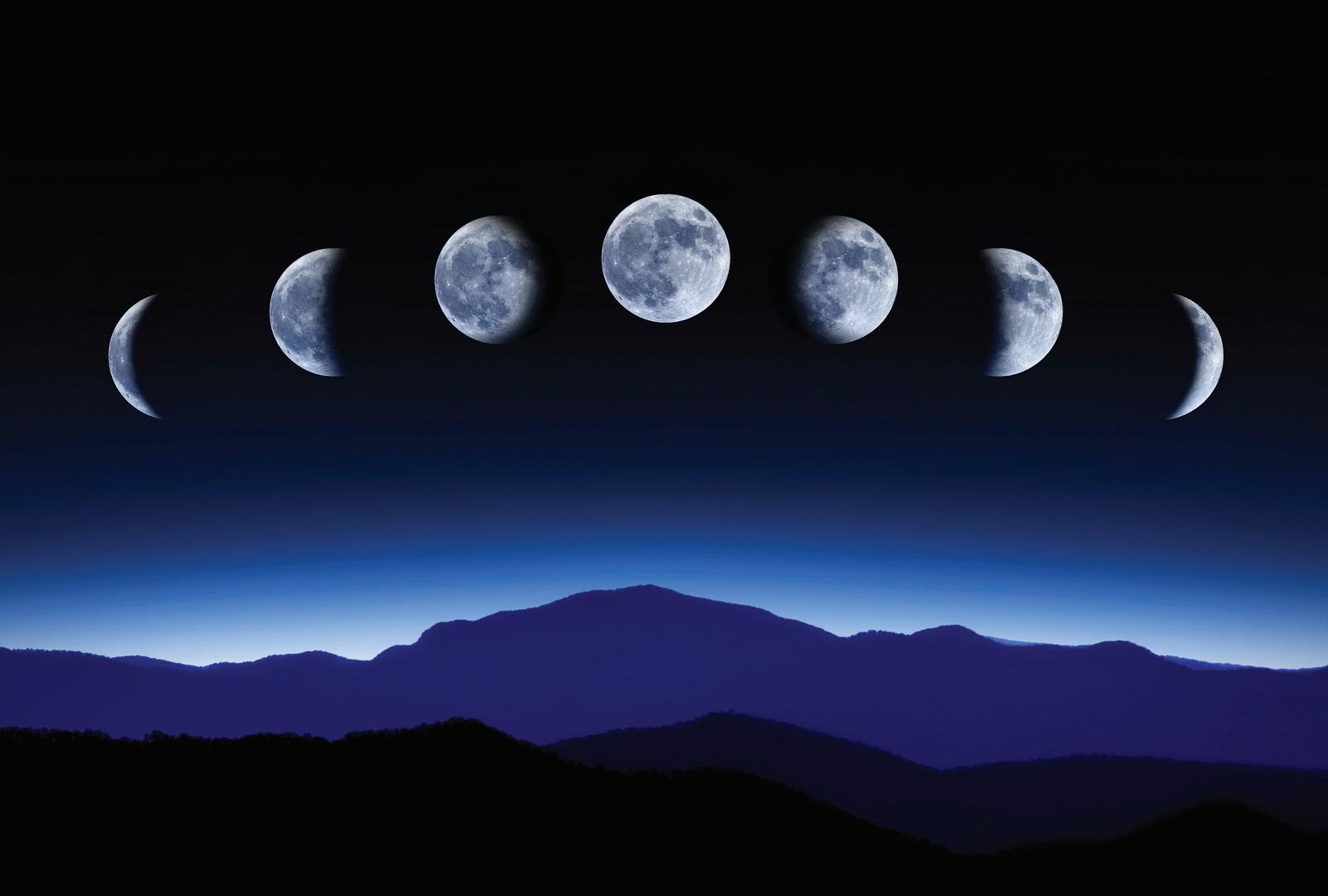
2. Students use the materials pictured below to create a model of the lunar cycle. What action must the students perform to demonstrate what causes the changing appearance of the Moon from Earth?
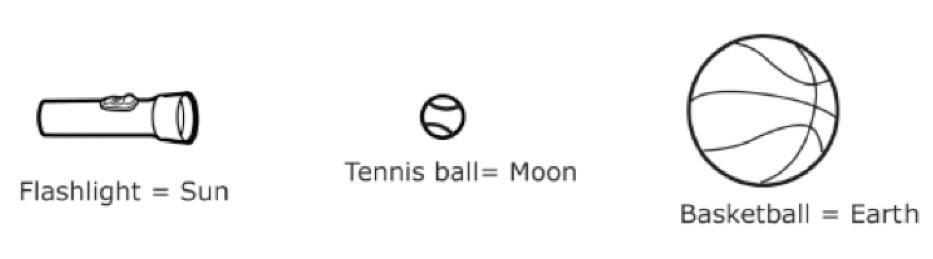
3. An illustration is provided showing the relative motions of Earth and the Sun. What effect would changing the angle of tilt of Earth’s axis have?
Rotation of the Sun
Orbit of Earth around the Sun
Rotation of Earth
Tilt of the axis of Earth
4. What are the differences between the geocentric and heliocentric models of the universe?
Name: ____________________________ Date: ___________
Justin lives in Evanston, Illinois, USA. The following table shows the times of sunrise and sunset at his hometown for the past five days. He has a friend named Mateo on social media in Buenos Aires, Argentina. Scenario 1
Day 1 5:45 8:59 Day 2 5:46 8:58 Day 3 5:47 8:56 Day 4 5:48 8:55 Day 5 5:49 8:54
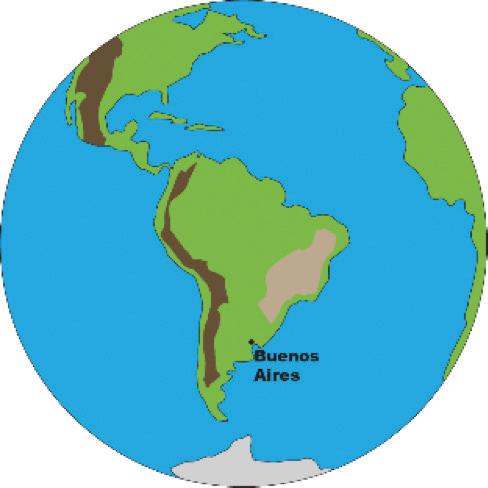
Prompt 3
Write a scientific explanation that justifies what season Mateo has experienced in Argentina during the past five days.
Claim:
Evidence:
Reasoning:

Before: Draw and record your observations of the paper towel and water. Make sure to include labels.
After: Draw and record your observations of the paper towel and the cup after the scenario is complete. Include labels to show what has changed.
1. What happened to the water, which represented groundwater?
2. What happened to the paper towel, which represented soil?
3. List and describe four things that farmers could do in this scenario in order to reduce the amount of chemicals, oil, and pollution that harm our drinking water, soil, and the air we breathe.
Use the space below to record your research for your pamphlet.
Sketch out your plans!
Check your work!
❒ Neat pamphlet?
❒ Facts on what is being done?
❒ At least two suggestions on what can be done?
❒ Ready to present?
Group members:
1. What is the problem? State the problem in your own words.
2. Research and explore the problem. In this activity, you will observe how the shape and configuration of a structure affects its ability to resist being knocked down by wind. What are some ways that houses and other structures can be built to make them less likely to be impacted by heavy winds and rains from a hurricane or other strong storm?
3. How can you use this information to help you design and build a structure that can withstand high winds?
4. Construct a basic tower using only two sheets of newspaper and 50 cm of tape. The tower must be at least 25 cm tall. This will represent a structure that is not built with any special considerations to withstand heavy wind. Place the tower 2 m from a fan at low speed, and record your observations.
Observations
Was this tower greatly affected by the wind from the fan? ______________
Do you think there would be a way to build a sturdier tower that could withstand even higher wind speeds using more materials and an improved design?
5. Taking into account the new materials at your disposal, brainstorm and design a solution to the problem. Sketch or describe some possible solutions in the space below.
6. Build, test, and analyze your solution. Describe your plan before you begin construction. What materials will you use?
7. Improve or redesign and retest the solution and answer the following questions: Is the structure made out of a given set of materials?
Is the structure at least 25 cm tall?
Is the structure attached to cardboard, and are the outer walls covered?
Can the structure withstand hurricane winds modeled by a box fan?
If you answered “no” to any of these questions, what will you do to improve the models?
8. Present and share your solution. Decide how you will share your solution with the class. Discuss who will demonstrate the system and who will talk about what you discovered.
Plan for presenting your solution:
9. Evaluate your solution compared to those of the other groups and answer the following questions:
Was yours the best solution to the problem? Explain.
What could you have done differently?
Can you add to your solution to make it better? Explain your ideas.
Using what you have discovered within your own group and by observing the presentations of the other groups, how might homes and other structures built near the coast in places such as Mississippi be built differently to better stand up to wind and rain from major storms?
Reflect
A long time ago, the human population was very small compared to what it is today. Eventually, humans figured out how to grow crops, which allowed more people to live in a smaller area. People discovered medicine and ways to keep their living spaces clean. All these factors helped humans live longer. About 2,000 years ago, the human population began to grow very quickly. The increase in our population has had an effect on the environment.
Although the human population has grown extremely quickly in the past 2,000 years, Earth has remained the same size, with the same amount of resources.
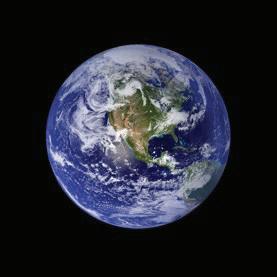
population: all the living things that belong to the same species and live in the same area
environment: the living and nonliving things that are around an organism
• How do humans change the environment?
• Are all the changes bad?
• Is Earth able to adapt to the changes caused by people?
How do organisms such as humans change their environment? Humans use Earth’s resources. People take up space, grow and eat food, breathe air, use energy, and produce waste. Humans have a greater effect on their environment than ever before. What are some ways in which humans change the environment?
Changes to land: Humans sometimes drain wetlands or cut down forests to build houses and other structures. They sometimes turn fields into landfills for trash. These changes may help humans find shelter and get rid of waste, but they can harm other living things in the environment.
Deforestation removes valuable resources that may never be recovered.
Humans take over other habitats. What do you think this land looked like 300 years ago?
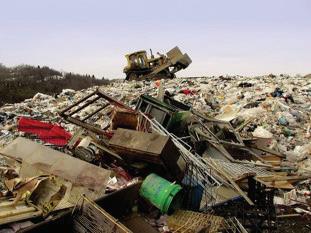
Landfills help humans by getting rid of waste, but they have negative consequences on the environment.
Changes to water: Sometimes humans take and use too much fresh water from their environment. As a result, a river or stream might dry up. This kills the organisms that once lived there as well as those that may have depended on that water. Humans also litter and dump trash into freshwater and saltwater environments (such as streams, ponds, rivers, lakes, and oceans). This makes them unsafe for the organisms that live there. In addition, pollution from factories is sometimes dumped into various freshwater and saltwater ecosystems, often making the environment a difficult place for organisms to survive in.
Changes to air: Cars, buses, trains, and other types of transportation use fuels that pollute the air. Factories also pollute the air when they burn chemicals and release gases into the air. Poor air quality leads to breathing trouble and other health problems. It also leads to acid rain, which occurs when pollution in the atmosphere mixes with water vapor in the air. Acid rain damages land and water where it falls.
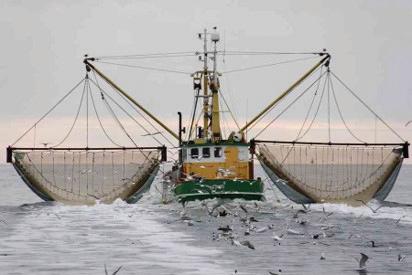
Overfishing in the North Atlantic almost depleted some species of fish in what used to be one of the world’s richest fishing grounds.
Littering and industrial pollution are just two of the many ways that humans hurt water ecosystems.
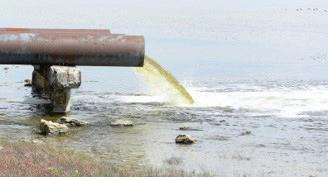
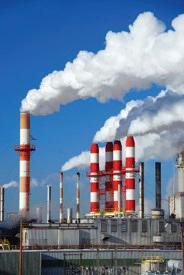
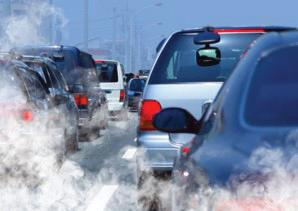
Air pollution is harmful to organisms (including humans) that live near it.
Changes to animals: Overhunting and overfishing can harm or destroy populations of organisms. On the East Coast, fish called cod used to be very common. Overfishing caused these populations to decline so much that they are now very rare in these areas. Because all species are interdependent, the larger fish that depended upon the cod for food had to move or find other sources of food. Similar patterns have been repeated in many ecosystems around the world.
Changes to vegetation: Humans have torn down and used much of the natural vegetation from around the world. Europe was once covered with forests, but by 1850 almost all the natural forests had been cut down by people for farming, lumber, and firewood. Right now, tropical rain forests are being cut down at an alarming rate. An area the size of North Carolina is being cleared every year. People clear land for the same reasons: farming and planting crops, lumber, and firewood. In the middle of the Great Plains area of the United States, farmers plowed up much of the natural vegetation to plant crops. Without the natural grasses to hold the soil in place, soil eroded during a time of drought. This time period is called the Dust Bowl
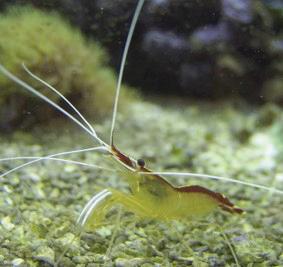
These small shrimp have a hard time competing with the Asian tiger shrimp, an invasive species.
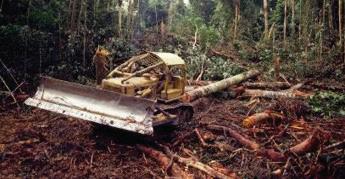
When the thin topsoil in the tropical rain forest is no longer protected by tree cover, it is washed away permanently.
Farmers helped cause the Dust Bowl of the 1930s by plowing up native vegetation.
Other changes to living things: Humans can also accidentally or purposely introduce new, non-native organisms into ecosystems. These organisms can use up food, space, and water that other organisms need. These animals or plants are called invasive species. They often outcompete native species for resources (sunlight, food, water, space, and shelter). For example, the Asian tiger shrimp was introduced to waters here in the United States. It has caused native shrimp populations to decline. The tiger shrimp grows larger, eats more, and grows faster than the populations that grow naturally in those waters. How do you think this will affect the ecosystem over time?
Changes in outer space: Humans have even managed to change the environment in outer space. Space debris is littered where humans have visited. What is space debris? It is a collection of out-of-date, man-made objects left in outer space—old satellite and rocket parts, equipment, and tools. More than 500,000 pieces of space debris orbit Earth.

Although humans often change the environment in ways that harm organisms that live there, people have the ability to prevent destructive change and help ecosystems recover. All people have the responsibility of caring for Earth. It is home to many organisms that people depend on. Read the account of the scientist below who helped fix a problem that people had caused in the environment.
When birds ate insects poisoned by DDT, the DDT also poisoned them and damaged their eggs.
In the 1950s, people used a chemical called DDT to try to get rid of harmful insects, such as mosquitoes. DDT was good at killing insects, but people did not know how dangerous it could be to other animals. When animals ate the dead insects, they also ate the DDT. The dangerous chemical traveled up the food chain. Rachel Carson was a scientist who noticed that songbirds were dying because they were eating earthworms and other organisms that were full of DDT. The chemical also caused the eggshells of birds to not harden, preventing the baby birds from forming properly in the eggs and surviving. This reduced bird populations. Carson wrote a book about the danger of DDT called Silent Spring. Reading the book helped people understand how harmful DDT was to the environment. New laws were made that forced people to stop using DDT. Bird populations increased soon after DDT was banned.
Many times people think that developments and advancements in technology result in even more ways for humans to hurt the environment. However, people can and should use technology to conserve the environment and protect areas from air, water, and land pollution and destruction. In addition, technology can be applied appropriately not only to prevent damage to the environment but also to restore ecosystems that have been damaged by people’s actions.
How clean is the air around you?
Complete this short activity to find out what is in the air you breathe.
1. You will need five index cards, a pen or pencil, a hole punch, five pieces of string (each about one foot long), petroleum jelly, and paper towels.
2. Write the name of a different location around your school or home on each index card. Punch a hole at the top of each card. Tie a piece of string to each hole.
3. Use your finger to cover the cards with petroleum jelly on both sides. Wipe your hands with a paper towel when you are finished.
4. Hang the index cards in the five locations you listed. Leave them in place for two days. After two days, collect the cards. Do not let the cards touch each other.
5. Write down your observations of each card. Then answer the following questions:
• What kinds of materials did you see on the cards? Did you find both natural and man-made substances?
• Which card had the most material on it? Why do you think that location had the most material in the air?
• What are some ways in which you could improve the air quality around your school or home?
What do you think of when you see the symbol on the right? What three words do you associate with this symbol?
What are you doing to reduce your human footprint? Does your family recycle glass, plastic, paper products, and cans? Have you found ways to reuse items to keep them out of our rapidly filling dumps?
There are many different ways you can help improve our environment. Read on to find out how other people are using technology, education, and effort to improve environmental conditions where they live and around the world.
There is a new campaign to reduce litter called “Ten on Tuesday.” It is sponsored by reverselitter.com. People can go to the website and take a pledge to pick up 10 items of trash every Tuesday, disposing of them properly. That is much easier than picking up trash along a highway.
Picking up litter does not just improve how Earth looks; it also helps decrease pollution.
In Boston, Massachusetts, these plaques remind pedestrians and motorists that the water on the street drains into Boston Harbor.
The Clean Water Act of 1972 regulates the dumping of pollutants into the nation’s water supply. Many communities have started labeling storm drains to remind citizens where the water goes. Boston, Massachusetts, displays brass plaques on buildings to make people aware of the danger. They hope the simple message will cut down on foreign objects and materials being introduced into the water supply. Some communities stencil storm drains with warning messages such as “Don’t dump,” along with a picture of a brightly colored fish, as an eyecatching reminder to take care of the water supply.
The United States passed the Clean Air Act to try to prevent and control air pollution throughout the United States. It provides money for researching air pollution and pollution solutions. It also regulates industrial and automobile pollution.
A worldwide movement toward community gardens is a simple way to reduce the human footprint. Community gardens can supply fresh food, offer employment, beautify neighborhoods, and build community spirit while replacing oxygen to the atmosphere.
The Rainwater Environmental Alliance for Learning (REAL) School Gardens organization supports outdoor learning centers (gardens) in elementary schools for hands-on learning and a connection with nature. Education and participation are key to keeping Earth healthy.
Many things happen as a result of environmental changes. Use what you have learned to consider how humans can change the environment. Read each change described in the chart below and study the images. Predict how the change will affect the organisms in that environment. Record your answers in the Effect column. Be creative—there are many correct responses!

A company clears a large area of wetlands to build a new neighborhood.
A dam is built across a river to generate electricity and control flooding.
A highway is built in the middle of a forest.
A logging company promises to plant five trees for every one it cuts down.
• Do most changes seem to create positive or negative effects?
• Do the changes seem necessary? Why or why not?
Your child has been hearing about “reduce, reuse, recycle” for many years, but by fifth grade he or she can become a driving force in reducing the human footprint in the home. Have your child research effective methods of reducing your family’s footprint on the environment. You can take your child to the library to check out books on the subject or help supervise an Internet search on the subject. Help him or her figure out what actions fit in the reduce category, the reuse category, or the recycle category. For example, you can reduce use of electricity by turning off lights when you leave a room; you can reuse cloth bags for grocery shopping; you can recycle many items you used to throw away, such as plastic bottles.
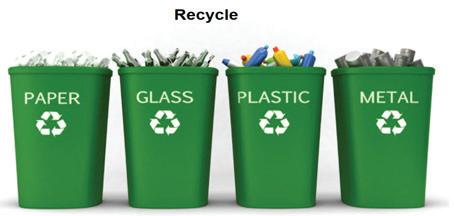
Rethink the ideas of reduce, reuse, and recycle. So many actions fit into one or more of these categories, and all of them help reduce your human footprint, keeping Earth a healthier place.
After your child is done researching, help him or her design a program for your family to reduce your human footprint on the environment.
• With your child, assess what is already being done in the home in this effort.
• Then pose these guiding questions to your child to start a discussion:
º How could we reduce the amount of pollution in our house?
º Can we walk or ride a bike somewhere instead of driving?
º Can we combine errands to reduce driving trips?
º Can we reduce the amount of household trash we produce?
º What is the most efficient way for us to recycle?
º Is composting an option for us instead of throwing away organic material?
º Can we save electricity by turning off lights or technology?
º Can we save natural gas by setting our thermostat differently?
• Based on your child’s research and knowledge of your family, help your child brainstorm a list of ideas that your family could perform to become better stewards of Earth. Then choose three tasks and commit to carrying them out for one month.
Answer the following questions:
1. Do these tasks seem daunting or manageable? What practices can you put into place to make sure the tasks get done and become a part of your daily routine?
2. Why do you think you have not attempted these environmentally friendly ideas in the past?
3. What do you think could happen if everyone in the world committed to performing three new habits to reduce the human footprint on the environment?
We all need to know about protecting ourselves and our property from the natural disasters that can occur. How can you and your family protect yourselves or reduce the threat from hazardous weather? The best way to stay safe during a natural disaster is to be prepared. Following these important safety tips will help you and your family in an emergency. There is room on the chart to write your family’s plan of action.
Hurricane
• Make a family disaster plan.
• Create an emergency supply kit.
• Listen to the news.
º A watch is issued 48 hours before damaging winds are possible.
º A warning is issued 36 hours before damaging winds are expected.
Flood
Tornado
• Have supplies on hand to protect your home.
• Do not walk or drive down flooded roads.
• Move to an area where there are as many walls as possible between you and the outside to protect you from debris.
• Listen to the news.
º A watch means conditions are favorable for a tornado to form.
º A warning means to take cover because a tornado is expected.
1 The seven billion people living on our planet need Earth’s resources! Earth provides all the things that living plants and animals need. As the number of humans grows, so do the human footprints, or effects, on the environment.
2 Human footprints are not like those at the beach. These are footprints on the environment. Think about the energy we use. Energy does not just magically appear! It can come from sources such as fossil fuels that must be dug up and made ready for human use. In the case of coal, it must be mined, which affects the land it is taken from and releases gases into the atmosphere when burned.
3 Farming also damages the land because the soil and plants are often given chemicals that kill pests and make the soil better. In many places, deforestation also occurs. Areas that once had many trees are now empty. Although we probably needed the trees, humans have failed to plan for a way to reduce the effects on our environment.
4 One thing is for sure—before our human footprints become so bad that they cannot be undone, we need to think about how we treat our planet. One way to do this is to guard what we have and think about the future.
5 The three Rs are a great way to start! If humans can reduce, reuse, and recycle, we can have a good impact on our Earth. We can reduce the amount of resources we use by being less wasteful. One example would be to use less electricity. Also, instead of driving, we could walk or ride our bikes. We can also reuse items that we no longer use. We can give our older clothes, household items, and furniture to family or friends. We can even give them to charity. Recycling is another way that we can reduce our impact! When we recycle, we collect items, such as cans and other metal items. When paper is recycled, it can be made into newer items, such as newer boxes. When plastic bags are recycled, they can be made into many items, even a carpet! Yes! Plastic trash bags can be made into carpet!
6 These small changes can have a big effect on our Earth! Although things cannot go back to being perfect, we can definitely make our planet better. Our atmosphere, soil, and land will be in much better shape if we change the way we treat our planet!
1 Which choice best summarizes the passage?
A Recycling, reducing, and reusing are excellent for our environment. When you recycle, you can produce new items. These items include new boxes and even carpet!
B The number of humans on our planet is increasing rapidly. The more humans there are, the greater the use of Earth’s resources!
C Deforestation takes place when many trees are cut down. Products can be made from these trees. Forests can provide wood for houses. Reusing paper helps protect trees.
D Earth’s large population is using many resources. This has led to human footprints on our environment. When people reduce, reuse, and recycle, less damage occurs to our planet.
2 The word deforestation means (Paragraph 3)–
A to use products smartly.
B to clear forest.
C to plant forest.
D to reuse tree products.
3 Which of the following is the author’s purpose?
A To educate the reader on how to recycle
B To persuade the reader to recycle
C To inform the reader of human footprints on Earth
D To inform the reader about fossil fuels
4 Why do you think the author included the population count?
A The author wanted to present the substantial number of humans on our planet.
B The author wanted the reader to know how many products were made.
C The author wanted to introduce the opinion that humans have to recycle.
D The author wanted to show off the number.
5 Which statement is NOT true about human footprints?
A Once made, they can be reduced through careful planning and conservation.
B All humans depend on Earth’s resources.
C Deforestation damages the environment.
D Deforestation is good for plants and animals.
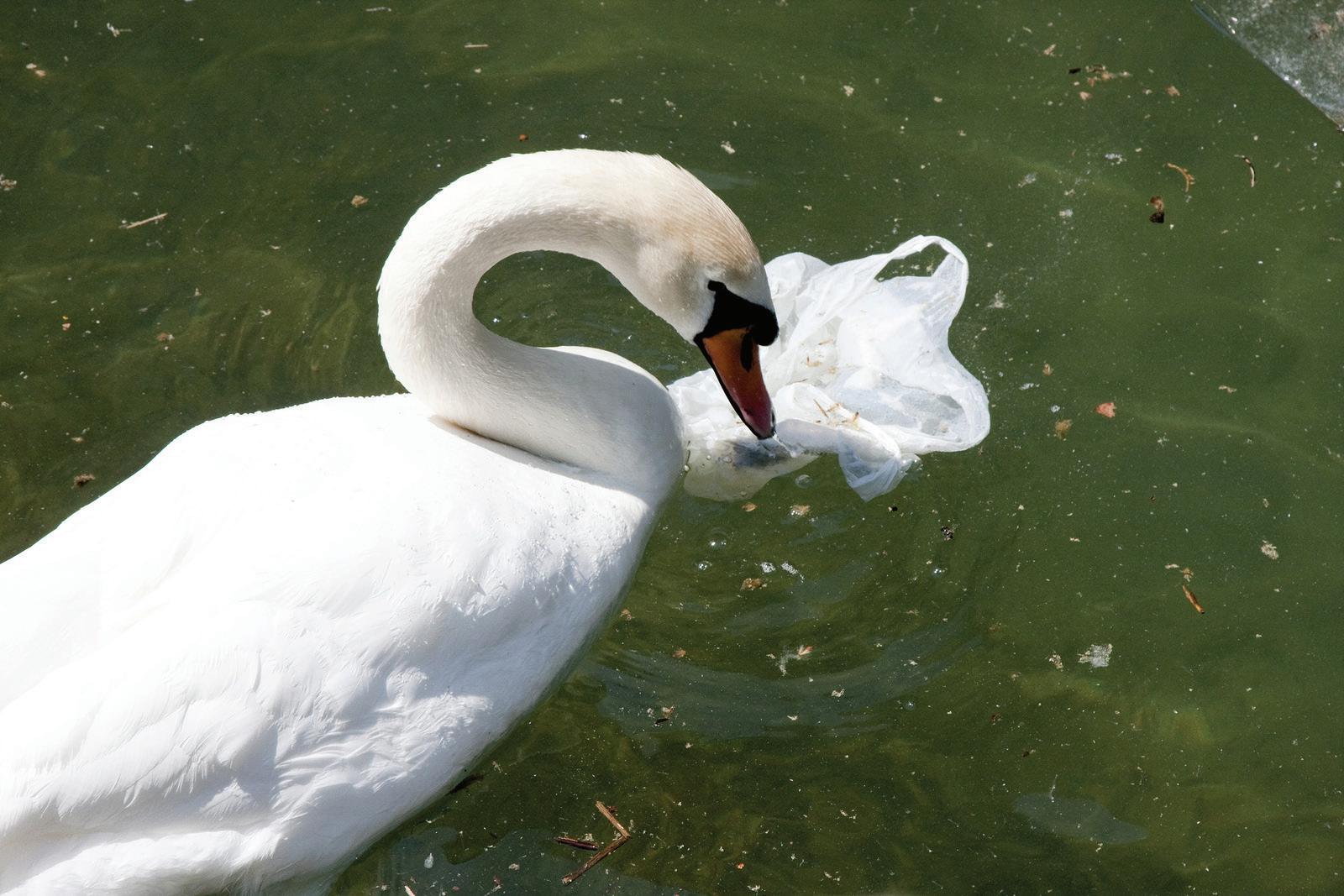
1. Each year, hundreds of thousands of people in Mississippi use plastic grocery bags. Plastic is not biodegradable. Many times the bags can be found in rivers and lakes, and eventually they end up in the ocean. This plastic debris greatly impacts our marine ecosystems. What could be a solution to this problem in Mississippi?
2. Mississippi is located on the Gulf of Mexico and experiences hurricanes. What are some kinds of damage a hurricane can cause as it strikes land? Describe two ways in which people can reduce the impact of hurricanes in Mississippi.
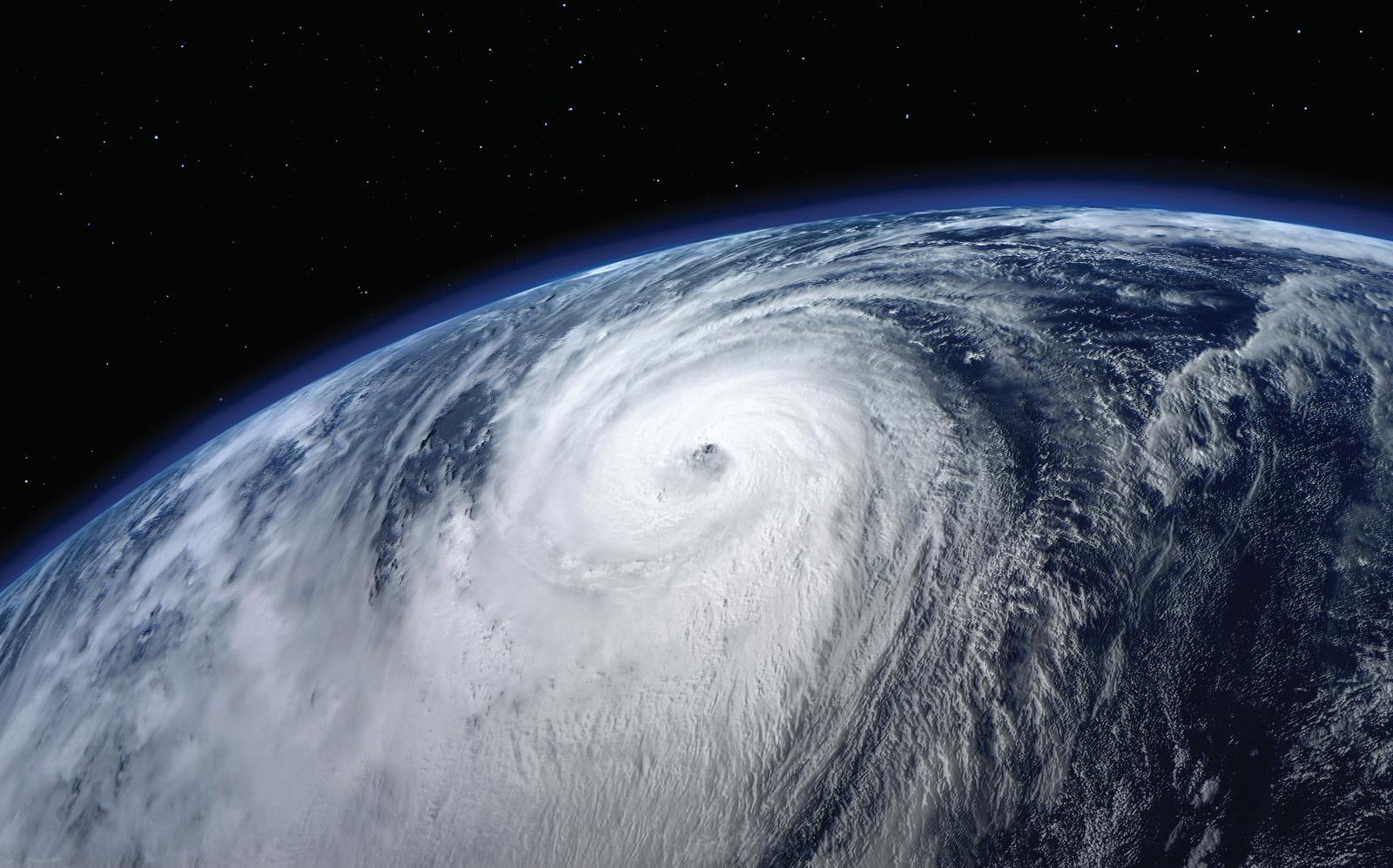
3. You are an engineer for a company that wants to build on a Mississippi coastline where hurricanes frequently occur. What are some factors you need to take into consideration before building for this company?
Emily was surprised to learn that burning coal is responsible for close to 80 percent of carbon dioxide emissions from electricity generation, while natural gas is responsible for only 19 percent. Burning natural gas for electricity generation is much cleaner than burning coal. Smokestacks of coal power plants release pollution such as sulfur dioxide and nitrogen oxides. When sulfur dioxide and nitrogen oxides are released from power plants and other sources, prevailing winds blow these compounds across state and national borders, sometimes over hundreds of miles. When it rains, the sulfuric acid in the atmosphere gets picked up by the rain and forms acid rain. This acid rain comes down in rivers, oceans, forests, cities, and neighborhoods.
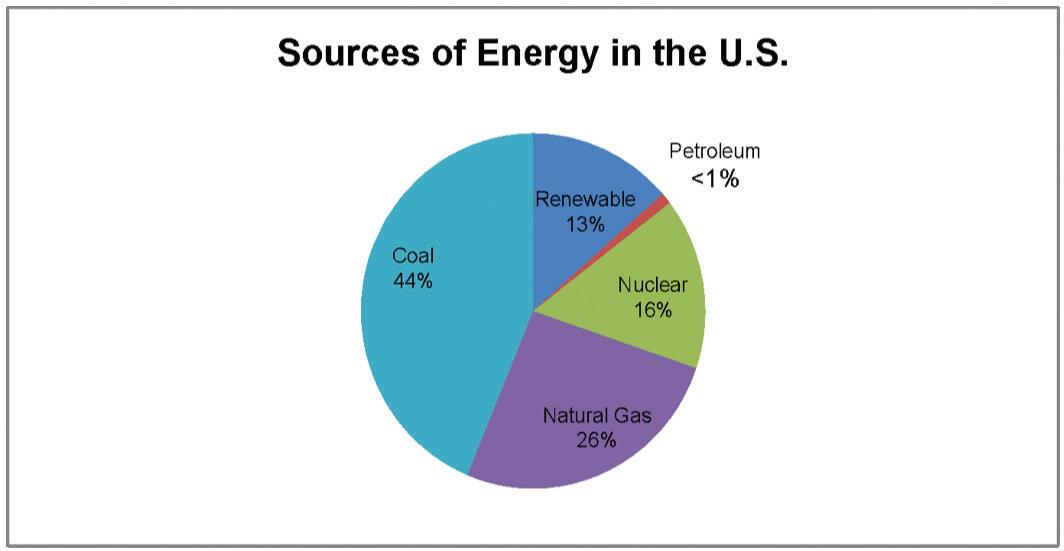
Claim: Prompt 3
Give a scientific explanation for the effect of burning coal on Earth’s resources and environment (land, streams, air, vegetation, and oceans).
Evidence:
Reasoning:
apparent brightness chemical change
apparent brightness: the brightness of a star perceived by an observer on Earth
asteroid belt: a group of many rock objects located roughly between the orbits of the planets Mars and Jupiter
axis: an imaginary line that a sphere rotates around
balanced forces: separate forces that combine to cancel each other out or make a net force of zero
carbon dioxide: a gas produced by cells during respiration; used in photosynthesis to produce sugars
carrying capacity: the maximum population size that can be sustained by a given environment
chemical change: a change that alters the identity of a substance, resulting in a new substance or substances with different properties
chemical process: a property or characteristic of a substance that is observed or measured during a reaction in which the chemical composition or identity of the substance is changed
color change: visible change in a substance’s color; is evidence of a new substance being formed from a chemical change
conductivity: a measure of a substance’s capability to transmit light, heat, electricity, or sound
conservation strategies: things humans can do to preserve ecosystems and environments
conservation: to protect resources and avoid wasteful and destructive use
constellation: a group of stars in the sky that has a certain shape and name
consumer: an organism that gets energy from eating another organism
data: information that has been collected
decomposer: an organism that consumes dead or nonliving biomass without need for internal digestion
direction: a straight path that something could move along
dissolve: to spread out evenly in a liquid
Earth: the planet that all known life exists on
eclipse: an obscuring of the light from a celestial body by the passage of an object between the celestial body and the observer or between the celestial body and its source of illumination
ecosystem: all of the living and nonliving things in an area and the interactions among them
energy transfer: the transfer of energy from one object or material to another or one form to another
environment: the space, conditions, and all the living and nonliving things around an organism
evaporation: the changing of water from liquid to a gas
filter: material with very tiny holes that blocks solid or larger particles but allows gas, liquid, or small grains to pass through
food chain: a path of energy transfer from one organism to another
food web: an interconnected set of food chains
food: what animals eat to get energy
force: a push or pull that causes an object to move, stop, or change direction
friction: a force that resists the motion of two surfaces sliding across one another
fungi: a type of organism that can break down just about any type of organic matter; they can be large or small such as a mushroom or tiny pieces of mold
hardness: how easily the smooth surface of a mineral can be scratched
leaves: parts of the plant that are attached to the stem that capture sunlight in order to make food
lunar cycle: the Moon’s repeated pattern of changes in appearance due to its changing position relative to Earth and the Sun as it circles Earth
lunar eclipse: the full moon passes into Earth’s shadow causing the Moon to appear reddish in color when the Sun, Earth, and the Moon directly line up; lasts from 1–3½ hours
magnetic: able to be attracted by a magnet
mixture: a combination of two or more substances
model: a limited representation of something that can help us understand its structure or how it works
moon planet
moon: a natural satellite that orbits a planet; some planets have no moons and others have more than 60 moons
motion: describes change in an object’s position with respect to time and in comparison to other objects
movement: a change in position or location
natural disaster: catastrophe caused by natural forces, not man-made forces
niche: the role an organism plays in its ecosystem
nutrient transport: delivery of nutrients throughout the soil to the plant
oxygen: a waste product produced by plants during photosynthesis that animals use for respiration
photosynthesis: the process in which plants use sunlight, water, and carbon dioxide to produce sugar and release oxygen
physical change: changing materials into different shapes or smaller pieces, heating and cooling, and melting and freezing
physical properties: properties that do not change the chemical composition of an object, including mass, weight, hardness, temperature, size, magnetism, physical state (solid, liquid, gas), relative density, solubility, and ability to insulate or conduct heat or electricity
planet: any of the large celestial bodies that revolve around the Sun in the solar system
population relative density
population: all of the interacting members of a species in a single area
position: where something is
producer: an organism that makes its own food for energy
production of a precipitate: creation of a solid in a liquid or inside another solid during a chemical reaction; when the reaction occurs in a liquid, the solid formed is called the precipitate; the chemical that causes the solid to form is called the precipitant
production of gas: sign that a new substance is being formed from a chemical change; usually seen as bubbles
production of heat or light: evidence of release of energy during a chemical change
properties: physical or chemical characteristics of matter used to describe or identify a substance
pull: to use force to cause something to move closer
push: to use force to move away
radiant energy: energy from the Sun that reaches Earth as visible light and ultraviolet and infrared (heat) radiation
recycle: to properly dispose of used resources so they can be reprocessed into new products
reflection: energy waves bouncing off the surface of an object (mirrors or echoes return energy back to the source)
relative density: how dense something is compared with a reference material
resource: something valuable that we can use
revolution: a complete turn or orbit around a center
root: a part of a plant that grows into the ground, absorbs water, and holds the plant in place
rotate/rotation: to spin on an axis
season: the four natural divisions of the year based on changes in temperature due to varied amounts of sunlight (both the intensity and the number of daylight hours received); caused by the tilt of Earth during revolution
solar eclipse: the Moon passes between Earth and the Sun, covering all or part of the Sun; occurs when the Sun, Earth, and the Moon directly line up; lasts less than 12 minutes
solar system: the Sun and all of the objects that move around it
solstice: points of farthest and closest distance from the Sun to Earth that correspond to the beginning of winter and summer
solubility: measurement of the ability of a solid to dissolve in a liquid
solution: a liquid mixture where one substance is mixed evenly throughout another substance
speed: how fast something is moving
stem: part of the plant that connects the roots with the leaves and branches; transports water and nutrients
substance: something made of all one material, such as water or copper
substances unbalanced force
substances: particular types of matter with specific properties
Sun: the star at the center of our solar system that supplies heat and light to Earth; its enormous gravity keeps the solar system in orbit
system: a group of interacting or interdependent parts forming a complex whole, as in all the factors or variables in an environment, or all the planetary bodies revolving around a star
temperature change: increase or decrease of heat energy in a substance; may be evidence of a new substance being formed during a chemical change
thrive: to grow well or strong
tilt: to not be straight up and down; Earth is slightly tilted on its axis.
unbalanced force: a force that is not cancelled out by another force