GRADE 6

Student Workbook
Grade 6
Published by Accelerate Learning Inc., 5177 Richmond Ave, Suite 800, Houston, TX 77056. Copyright © 2025, by Accelerate Learning Inc. All rights reserved. No part of this publication may be reproduced or distributed in any form or by any means, or stored in a database or retrieval system, without prior written consent of Accelerate Learning Inc., including, but not limited to, in any network or other electronic storage or transmission, or broadcast for distance learning.
To learn more, visit us at www.stemscopes.com.
This Student Notebook is designed to be used as a companion piece to our online curriculum.
The pages of this book are organized and follow the 5E model.
ENGAGE
A short activity to grab students’ interest
EXPLORE Student Journal
Hands-on tasks, including scientific investigations, engineering solutions, and problem-based learning (PBL)
Claim-Evidence-Reasoning (CER)
A formative assessment in which students write a scientific explanation to show their understanding
STEMscopedia
EXPLAIN
ELABORATE
A reference material that includes parent connections, technology, and science news
Reading Science
A reading passage about the concept that includes comprehension questions
EVALUATE
Claim-Evidence-Reasoning (CER)
A summative assessment in which students write a scientific explanation to show their understanding
Open-Ended Response (OER)
A short answer and essay assessment to evaluate mastery of the concept
Only student pages are included in this book and directions on how to use these pages are found in our online curriculum. Use the URL address and password provided to you by your district to access our full curriculum.

L.6.1.3 and 1.4
L.6.1.1, 1.2, 1.5, and 1.6 Parts of
L.6.3.1, 3.2, and 3.3
L.6.3.4 and 3.5
L.6.4.1 and 4.2
L.6.4.3, 4.4, and 4.5
P.6.6.1, 6.5, and 6.7
Newton’s
P.6.6.2, 6.3, 6.4, and 6.6
Forces
E.6.8.1, 8.2, and 8.3
E.6.8.4, 8.5, 8.6, and 8.7
L.6.1.1, 1.2, 1.5, and 1.6
Cell Theory
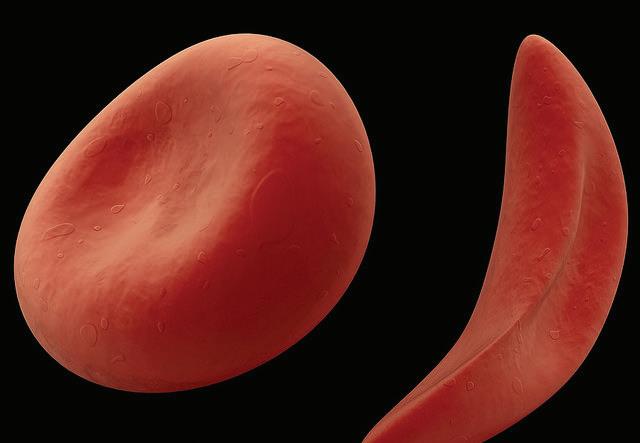

Units of Life
Activity
1. Obtain a set of picture cards from your teacher.
2. Arrange the cards into four rows: Organisms Structures Cells Organelles
3. Copy your final organization into your lab journal using words or drawings.
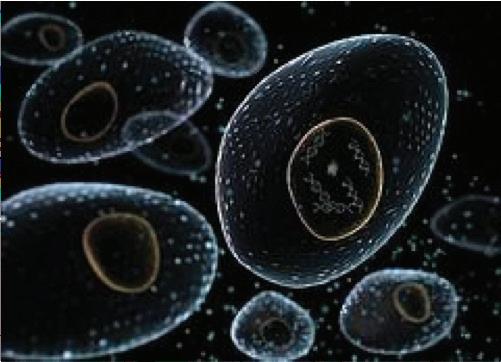
4. How did you decide where to place the picture of bacteria? Write the answer in your lab journal.
Name:

Explore 1
Part I: Cells Equal Living
Scientific Investigation
Multicellular vs. Unicellular
All living or once-living things contain cells. Living things, whether unicellular or multicellular, also display life functions. Some important life functions include the following:
• Obtaining food and water
• Disposing of waste
• The ability to grow and reproduce
L.6.1.1, 1.2, 1.5, and 1.6 Cell Theory
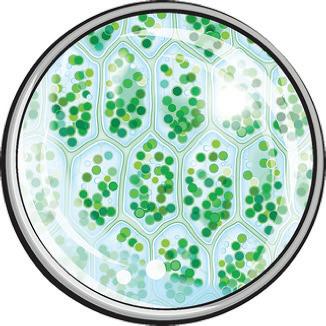
In addition to life functions, living things must have environments in which they can live. Never-living things do not contain cells and show none of the life functions.
Procedure
Plan an investigation to determine if living things are made of cells.
Step 1: Question
Step 2: Relevance
Step 3: Variables, if applicable
Independent variable (also known as the manipulated variable):
Dependent variable (also known as the responding variable):
Control variable(s) or group (also known as constants):
Explore 1
Step 4: Hypothesis
Is a hypothesis needed? If so, what is it?
How will the responding variable change when the manipulated variable changes?
Step 5: Materials
Step 6: Safety Considerations
Step 7: Procedure
1. Make a wet mount of different items your teacher gives you.
2. Observe each item under the microscope. Determine if the specimen has cells, if it is living or nonliving, and what life function the observed cells may perform.
3. Draw all observations.
4. Label all drawings.
Explore 1
Step 8: Data Collection
Use the chart to record your data.
Step 9: Data Analysis
Create a graph based upon the data, if needed. Make a general statement about the results shown. Specimen
Explore 1
Step 10: Conclusion and Scientific Explanation Write a scientific explanation on what all living things have in common.
Claim:
Evidence:
Reasoning:
Explore 1
Part II: Single or Multi?
Activity
A cell is a fundamental unit of structure, function, and organization in all living organisms. Every living organism is made up of one or more cells. Some organisms are unicellular, meaning they consist of only a single cell. Other organisms, such as plants and humans, are multicellular, consisting of many cells. Humans have about 100 trillion cells!
Procedure
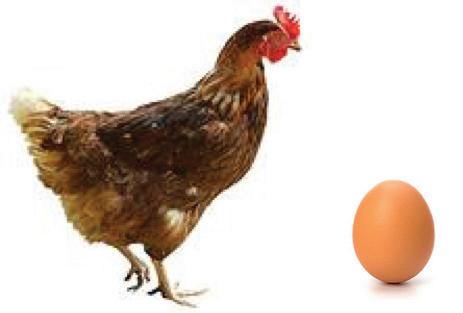
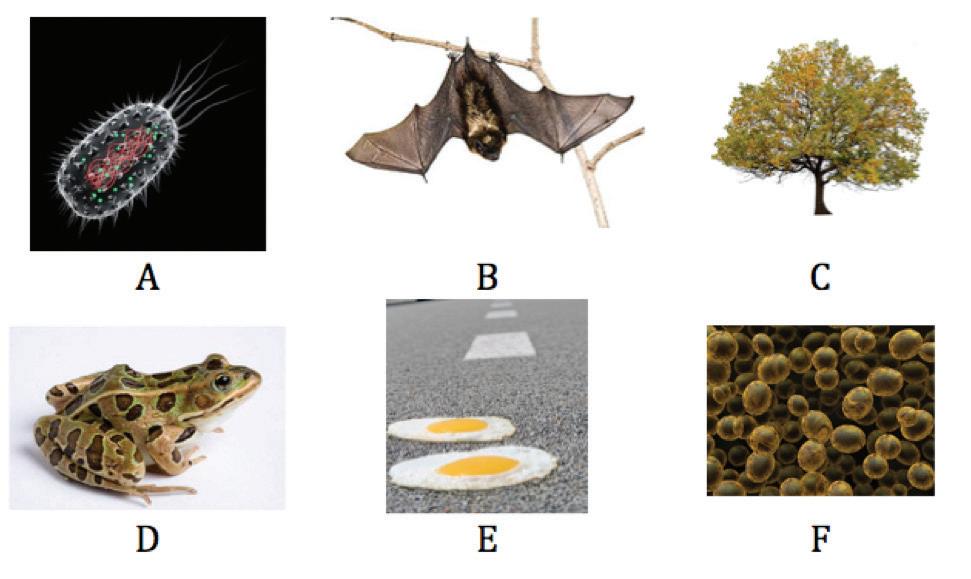
As you observe the images below, discuss the following questions with your group. Be prepared to defend your conclusions.
1. Which of the following organisms would you consider to be unicellular?
2. Which of the following organisms would you consider to be multicellular?
3. Write your ideas on the back of this sheet. 4. Share your ideas with your classmates.
Explore 2
Cell Theory
Activity
Cell theory is an explanation of the relationship between cells and living organisms. It states that all living organisms are composed of cells, cells are the basic unit of structure and function in living things, and that cells arise from preexisting cells. This theory holds true for all living things, unicellular or multicellular.
Procedure
Part I
1. Write down three things that are needed for life.
2. After two minutes, your teacher will call time, and you will need to share with the members of your group.
3. Write down all ideas.
4. When your teacher calls time, one member of your group will move to another group and share the list that your group came up with.
5. The new group will share what their group wrote, and the member of your group will write down any new information.
6. The traveling member of your group will continue to the next group until the teacher calls time.
7. The traveling member of your group will share any new information with your group.
8. Your teacher will place a list of the basic characteristics of life on the board or project it on the wall.
9. Check off all the characteristics your group came up with and add any that were missed.
Explore 2
Part II
1. Your group will be assigned a scientist to research.
2. Your group should find the answer to the question, “What did this scientist contribute to the idea of the cell theory?”
3. Your research must include three different sources.
4. After you have conducted the research, draw a poster about the scientist and his contribution.
5. The only words on the poster should be the scientist’s name and the year or range of years during which he contributed. Everything else should be a drawing representing the scientist’s contribution.
6. Your group will present your poster to the class. Your presentation must include a new question about cell theory based on your findings.
Explore 3
Activity
Levels of Organization
Multicellular organisms, such as plants and animals, have various levels of organization within them. The levels of organization from simplest to most complex are cells → tissues → organs → organ systems → organisms.
Cells are the first and simplest level, as they are the basic structural and functional units in living things. Tissues, the next level, are made up of cells that are similar in structure and function which work together to perform a specific activity. Organs are made up of tissues that work together to perform a specific activity. The fourth level is made up of the organ systems. These are groups of two or more organs that work together to perform a specific function for the organism.
Procedure
Part I

1. Your body is organized like an apartment building. The cells are like the bricks. A number of cells put together form tissues. A number of tissues put together form organs. The organs make up an organ system, and all the organ systems make up the organism.
2. To help yourself remember the order of a list of things, you can make up a silly sentence using words that start with the first letter of each word on the list. For the levels of organization you need a silly sentence such as Can Tigers Own Orange Spotted Orangutans? (C for cells, T for tissues, O for organs, OS for organ systems, and O for organism.)
3. Make up your own silly sentence to help you remember the correct order of the levels of organization.
Explore 3
Part II
1. Your teacher will give you a sheet of paper with pictures. Cut the pictures out and place them on your desk.
2. Find the pictures of the brick, rooms, and building. Place and then glue them in order from simplest to most complex.
3. Next, look at the rest of the pictures. Find the single cells and match up the tissue, organ, organ system, and organism that go together.
4. Place and then glue them in order from simplest to most complex.
5. Label them from cells to organism.
Part III
Now it is your turn to create your own levels of organization analogy. Using the apartment building analogy as an example, create a new levels of organization analogy. Some examples are a city, school, sports team, and the world.
My analogy is
• A cell is like:
• A tissue is like:
• An organ is like:
• An organ system is like:
• The whole body is like:
Organelle Tissue Organ System
Organism’s Need That Is Met
Explore 3
Part IV
1. Your teacher will give your group a new set of cards.
2. Use the information provided on the cards to complete the following chart.
Part V
1. Read the Student Reference Sheet: Body Systems to find evidence that these systems are made of cells.
2. Write a scientific explanation to support the statement, “The human body is a system of interacting subsystems composed of groups of cells.” Use evidence from Parts II, III, and IV of this activity to support your claim.
3. After completing your scientific explanation, exchange your paper with a classmate and evaluate the evidence and reasoning.
Name: ____________________________ Date: ___________

STEMscopedia
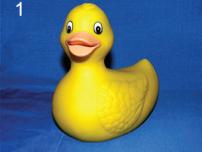
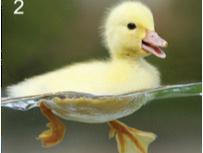
Which duck is alive?
You probably think Duck 1 is a nonliving thing and Duck 2 is a living thing. How can you tell? What evidence do you find to prove your conclusion? Perhaps you observe that Duck 1 is a plastic duck and Duck 2 is a live duck.
Living versus Nonliving
What signs of life do you find for evidence that Duck 1 is nonliving? Does it have fake features, no legs, and no feathers? A factory probably made the duck.
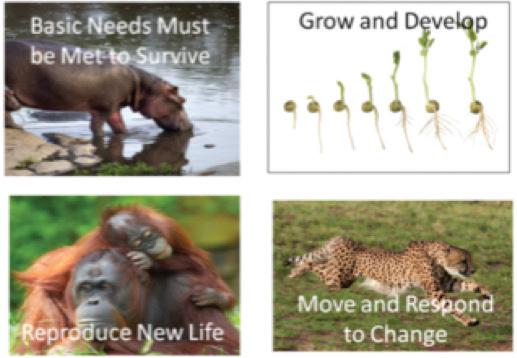
Scientists would say that Duck 1 is not living because it does not have needs that must be met. It will not grow or develop, and it cannot reproduce new life. Duck 1 might move as it bobbles in the water, but it is not moving on its own, nor can it respond to change.
On the other hand, Duck 2 is swimming in water with webbed feet and has feathers. This duck came from an egg that a parent duck laid, it hatched, and it began its life as a duckling. This duck has needs, grows, will eventually reproduce new ducklings, moves on its own, and responds to the environment.
Reflect Look Out!
All
living organisms are made of cells.
There is one more important piece of evidence that the duck is alive—it is made of cells! All living organisms are made of cells. Life is the quality that distinguishes living things (composed of living cells) from nonliving objects. The cell is the smallest unit of life.
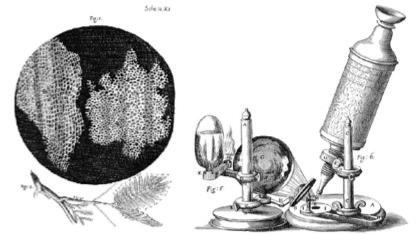
Hooke’s microscope and drawing of a cork cell
Discovery of Cells
Prior to the 1600s, scientists did not know about cells because the microscope had not yet been invented. In 1674, Anton van Leeuwenhoek used a single-lens microscope to see the first unicellular organisms, which he called “animalcules.” Later that century, experimental scientist Robert Hooke used the term cell for the boxlike structures he observed when viewing the tissue of a cork through a lens.
STEMscopedia
Reflect
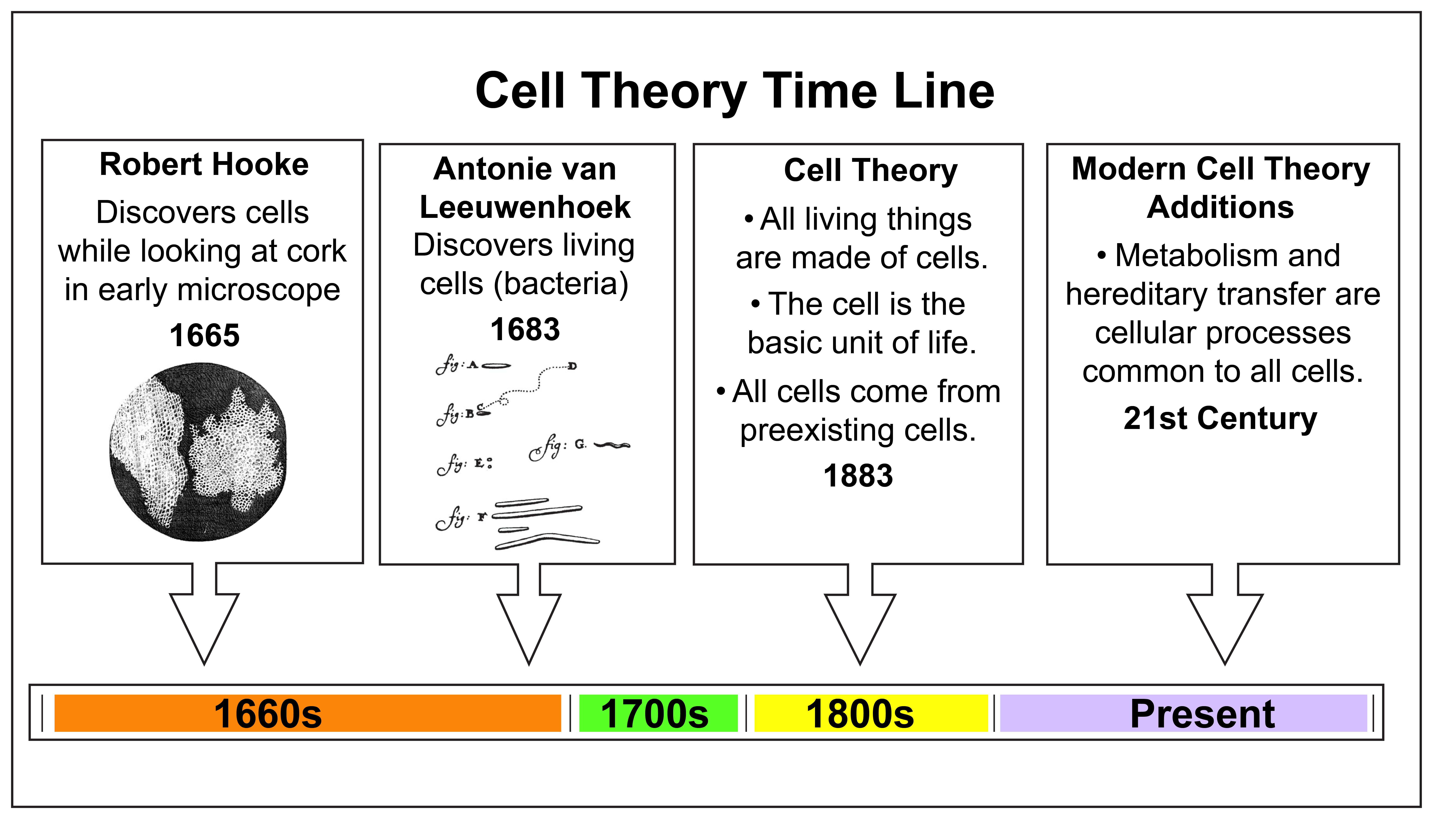
The cell theory summarizes the characteristics common to all cells and the fundamental role cells play as the basic building blocks of life. In the 1830s, almost two hundred years after van Leeuwenhoek saw his first “animalcules,” more discoveries about cells led to the development of the cell theory by two German scientists, botanist Matthias Schleiden and zoologist Theodor Schwann. They proposed a unified cell theory with two parts that were proven true with supporting evidence:
• All living things are composed of one or more cells. Evidence is based on observations by biologists using early microscopes to see structures of organisms: Robert Hooke’s observations of a piece of cork with small compartments he called “cells” (1663), Anton van Leeuwenhoek’s observations of bacteria and Protozoa through his microscope (1673), and observations by Schleiden and Schwann of plant and animal cells (1838–39).
• The cell is the basic unit of life. Evidence is based on experiments that have shown that the structures within the cell cannot exist independently. The entire cell is needed to support cell function.
In 1855, German biologist Rudolf Virchow added his important contribution to this theory:
• All cells come from preexisting cells. Evidence from early experiments by Francesco Redi showed that new maggots (fly larvae) did not appear spontaneously. Fly larvae did not appear on meat in a screened container but did on an unscreened jar where flies could lay their eggs. Louis Pasteur repeated similar experiments in curved neck containers to better control air access to the sample. He also found the air contained tiny particles that contaminated the meat. His work led to the pasteurization of milk to protect it from bacteria. Scientists have imaged actual cell division (mitosis and meiosis).
STEMscopedia
For the first 150 years, the cell theory was primarily about a cell’s structural components and cell reproduction. Since the 1950s, however, cell biology has focused on DNA and its informational features. Today we look at the cell as a unit of self-control, which is the description of how a cell’s genetic information is converted to structure. Three principles were added to the original cell theory:
• Cells contain hereditary information that is passed from cell to cell during cell division.
• All cells are basically the same in chemical composition.
• All energy flow (metabolism and biochemistry) of life occurs within cells.
What Do You Think?
Have you ever wondered how people are similar to bacteria? It may seem like a silly question. After all, humans and bacteria are very different in size and complexity. Yet scientists have learned that we also have much in common with our microscopic companions.
Scientists classify all organisms into groups based on their external characteristics. For example, some plants produce fruits with seeds, but other plants do not. Scientists also use internal characteristics to classify organisms. For example, some animals have backbones, while others do not. Can you think of some other external or internal characteristics that scientists can use to classify organisms?
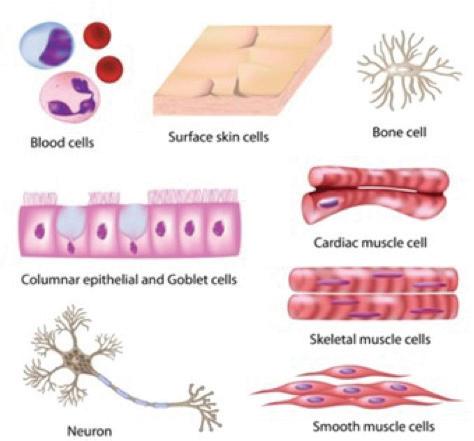
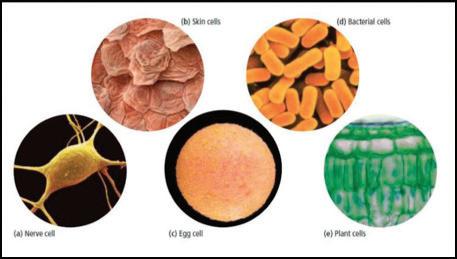
All of these different types of cells are found in the human body. Can you identify where you find these cells in the body?
The cell is the basic unit of life.
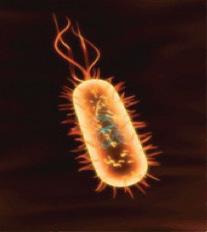
How is this bacterium similar to a human?
One of the most important internal characteristics that scientists use to classify organisms is the cell. All organisms are made up of one or more cells. A cell is the basic unit of life; it is surrounded by a cell membrane that keeps the cell intact. Inside all eukaryotic cells are specialized structures called organelles that carry out specific functions inside the cell. Organelles are suspended in a thick, gel-like fluid called cytoplasm
All cells also have genetic material called DNA, which contains instructions for making new organisms and for carrying out all functions that keep a cell alive. In some cells, DNA is packaged inside a membrane in an organelle called a nucleus. In other cells, it floats freely in the cytoplasm.
STEMscopedia
Reflect
All living organisms are composed of one or more cells. When you think about an organism, you might think of something very familiar, such as people, cats, or trees. These organisms are complex; they are made up of a great number of different kinds of cells. Scientists estimate that the average adult human has somewhere between 10 and 100 trillion cells in his or her body!
Cells come in many different sizes and types, and they are very different from each other in their shapes and functions. The diagram on the previous page shows examples of different types of cells in the human body.
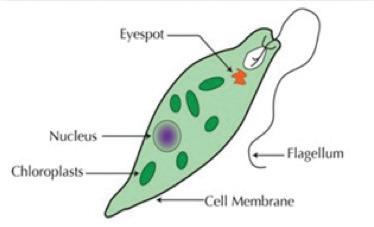
Euglena are single-cell organisms that live in fresh and salt water.
Not all organisms are complex. Some are very simple. In fact, some organisms are made up of only one cell. Take a look at this Euglena. A Euglena is an organism made up of a single cell. Unlike humans, it does not have specialized organs such as a brain or stomach. However, it can move through its environment using its whip-like flagellum. It even has a primitive eye called an eyespot for sensing light levels. All this in a single cell!
Look Out!
The two main types of cells are prokaryotic and eukaryotic.
All organisms are made up of cells. However, scientists separate cells into two categories: prokaryotic and eukaryotic. Examples of prokaryotic cells include bacteria. Eukaryotic cells include the cells of plants, animals, and fungi.
Prokaryotic cells were probably the first cells on Earth dating to around 3.8 to 4 billion years ago. Prokaryotic cells have the basic structures common to all cells: a plasma membrane surrounding cytoplasm. However, they do not have membrane-enclosed organelles, such as mitochondria or a nucleus.
Prokaryotic cells do contain ribosomes, but there is debate as to whether or not a ribosome counts as a type of organelle. Therefore, the question of whether or not prokaryotic cells contain any organelles is still up for debate.
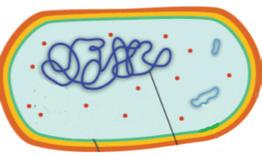
Prokaryotes have no nucleus and have a single circular DNA.
Eukaryotic cells are more complex. Similar to prokaryotic cells, eukaryotic cells have a cell membrane, cytoplasm, and DNA. However, they have something that prokaryotic cells do not. Eukaryotic cells have organelles surrounded by membranes. This includes mitochondria and a nucleus, where DNA is stored.
STEMscopedia
Reflect
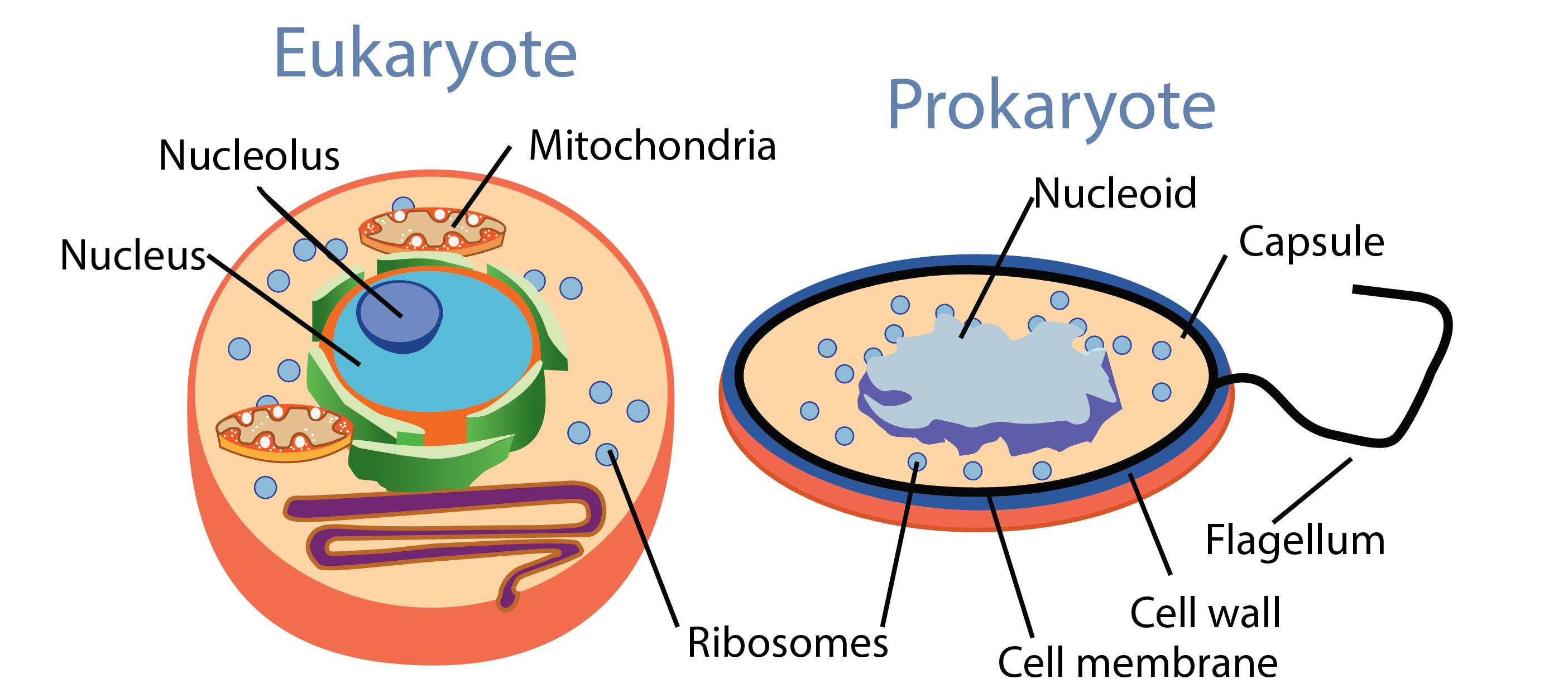
A prokaryotic cell (right) has a cell membrane, cytoplasm, and DNA. A eukaryotic cell (left) also has these features. Eukaryotic cells also have membrane-enclosed organelles such as mitochondria and a nucleus.
Look Out!
Prokaryotic cells were the first cells to evolve on Earth. However, this does not mean they disappeared when the eukaryotic cells evolved 1.5 billion years ago. Bacteria are prokaryotic cells that are very much still alive today. In fact, thousands of species may live in one spoonful of soil.
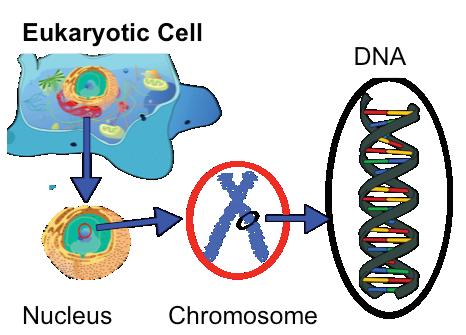
Prokaryotic and eukaryotic cells store DNA in different ways. Both eukaryotic and prokaryotic cells have DNA, the “blueprint” of an organism. In eukaryotic cells, the DNA is neatly organized inside a nuclear membrane. The combination of nuclear membrane and DNA is called the nucleus. Each eukaryotic cell has just one nucleus. The DNA inside the nucleus is organized into units called chromosomes, which are linear and can be seen under a microscope when the cell divides.
Prokaryotic cells are less organized than eukaryotic cells. They lack a nuclear membrane around their DNA. Instead, their DNA floats in the cytoplasm. The DNA of a prokaryotic cell is all contained within a single, circular chromosome.
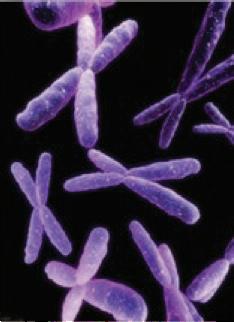
Eukaryotic cells organize their DNA into chromosomes.
STEMscopedia
What Do You Think?
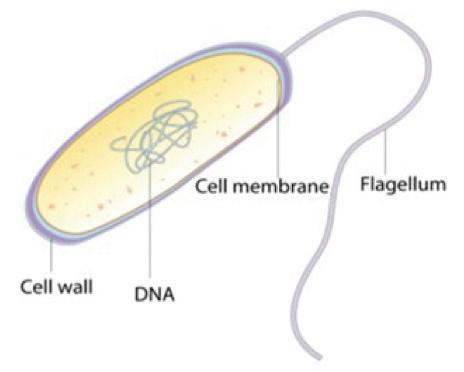
Does the picture to the left show a prokaryotic or eukaryotic cell? Why do you think this? What is the evidence for your conclusion?
Prokaryotic and eukaryotic cells have other important similarities and differences.
Both prokaryotic and eukaryotic cells have other things in common. Both have ribosomes in their cytoplasm. Ribosomes are responsible for making proteins in the cytoplasm. The ribosomes in eukaryotic cells are bigger and more complex than those in prokaryotic cells. However, they have the same function of making proteins.
Prokaryotic cells tend to be much smaller than eukaryotic cells. Bacteria are prokaryotes. On average, eukaryotic cells are about 10 times larger than prokaryotic cells. Eukaryotic cells have much greater diversity in shape and size than prokaryotic cells.
Organisms with prokaryotic cells are so small they can be seen only through a microscope. You also need a microscope to see eukaryotic cells. However, many organisms with eukaryotic cells are large enough to see without a microscope.
Discover Science: How did organelles become established in eukaryotes?
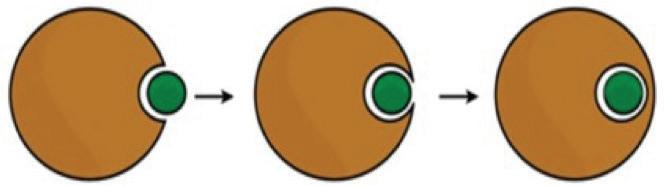
Scientists have an interesting theory to explain how organelles came to be present in eukaryotic cells. They theorize that prokaryotes were present on Earth long before eukaryotes. Lacking food, some prokaryotes lost their cell walls. Their flexible membranes began to fold and create several internal membranes and a nucleus.
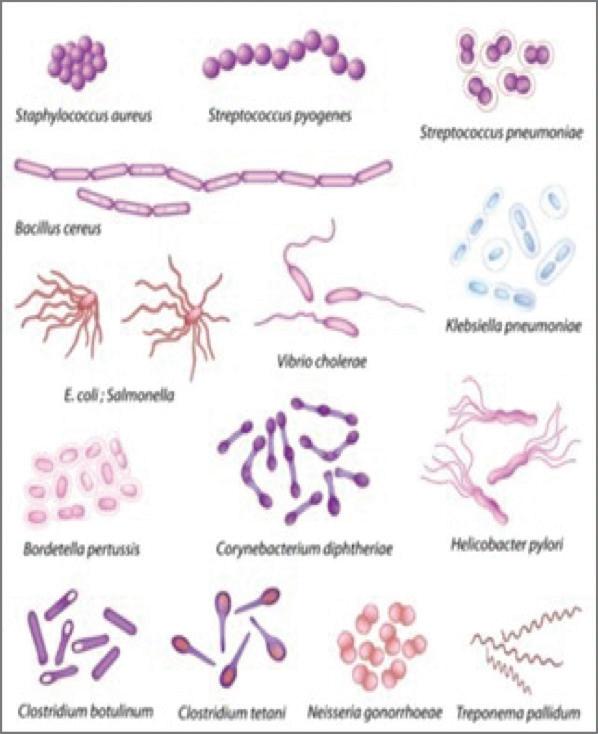
These bacteria commonly infect humans. Can you identify the cells that are spherical (round), rod-shaped, and spiral?
These primitive eukaryotic cells began engulfing or taking in smaller prokaryotes as shown in the diagram below.
STEMscopedia
However, scientists think some of these events did not result in the larger cell digesting the smaller cell. Instead, the smaller cell may have provided some advantage to the larger cell. For example, if the smaller cell could carry out photosynthesis, it could provide energy from this process for the larger cell. In return, the larger cell provided protection for the smaller cell. This mutually beneficial relationship is known as symbiosis. The theory about the origin of organelles is known as endosymbiotic theory. The word endosymbiotic is used because the root word endo- refers to the engulfing process, and symbiotic refers to the relationship that led to organelle development. According to the theory, over many years, the two symbiotic cells became a more complex eukaryotic cell.
Both prokaryotic and eukaryotic cells can be single-celled organisms. However, there are no multicellular prokaryotes. Only eukaryotes can be multicellular.
Eukaryotic cells come in all sorts of shapes and sizes. Prokaryotic cells have just three basic shapes: rod, spherical, and spiral. The cell shapes help scientists identify prokaryotes using a microscope.
Career Corner: Knowing the different types of cells can save lives.
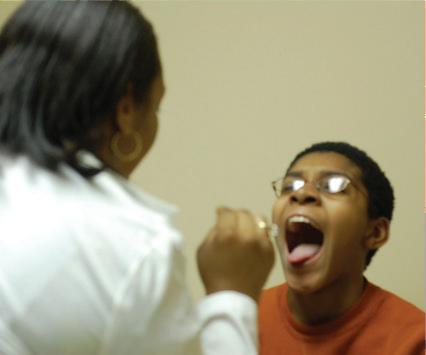
When a person is infected with a bacterium, it is important to know the identity of the infectious agent. Antibiotic drugs can be specific for particular organisms. If a doctor does not know which organism is causing an illness, the doctor may not be able to treat the patient.
For example, a patient with symptoms of strep throat may be given a throat swab. The swab is then cultured to grow any microorganisms present in the patient. When there are enough microorganisms growing in the culture, the doctor may be able to identify which species is causing the illness. Then an appropriate treatment can be prescribed.
STEMscopedia
What are the differences between unicellular and multicellular organisms?
Unicellular: Unicellular means the organism is made up of just one cell, like bacteria or an amoeba. Both prokaryotes and eukaryotes can be one-celled organisms. Recall that prokaryotes do not have a nucleus or membrane-covered small structures called organelles.
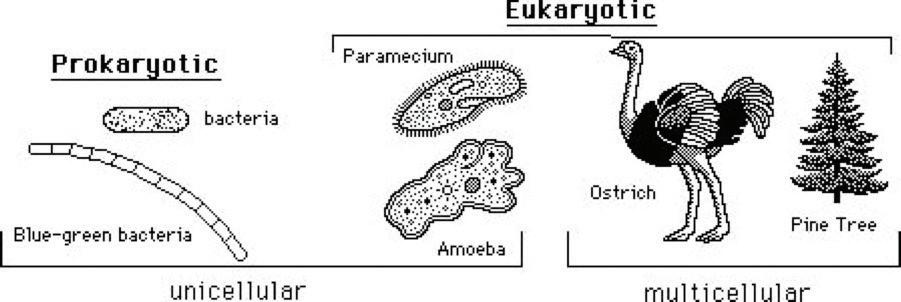
Unicellular organisms include prokaryotes (bacteria) and eukaryotes (amoeba). However, multicellular organisms include only eukaryotes.
Look Out!
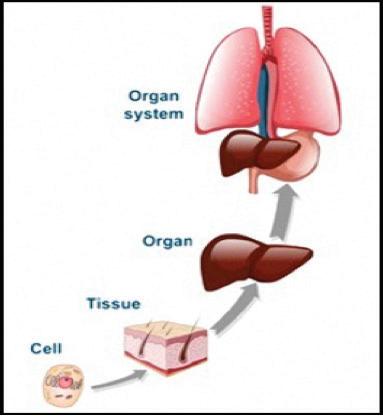
Multicellular: Multicellular refers to multiple cells organized into cells, tissue, organs, an organ system, and an organism. Multicellular organisms are made of more than one cell and do have a nucleus and membrane-covered organelles. All multicellular organisms are eukaryotic. As plants and animals evolved, a hierarchy of organization developed: Groups of similar cells grouped into specialized functions as tissues. Groups of tissue with similar function grouped together as an organ. Organs began functioning together as an organ system. Multiple organ systems began functioning together as a living organism.
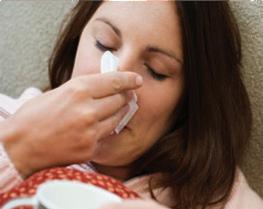
Viruses are not living things! Viruses are infectious agents that enter a host cell and use it to survive. Viruses do not have cell structure, which is the basis for life. Although they do have DNA, they cannot replicate without using the host cell. Viruses do respond to their environment, but they do not grow and cannot live on their own. Therefore, viruses are not alive. Examples of viruses are the common cold, smallpox, polio, rabies, chicken pox, and the AIDS virus.
STEMscopedia
Reflect
Scientists classify organisms in different ways. Scientists organize the living world using a process called taxonomy, which is the science of classifying organisms based on shared structures, functions, and relationships to other organisms.
For example, organisms can be classified based on their cellular structure. Organisms that have nuclei are eukaryotes. Eukaryotes also have organelles, or specialized structures bound in a membrane. Prokaryotes are organisms that do not have nuclei. Also, many unicellular organisms are in a different group than multicellular organisms. For example, bacteria are unicellular organisms. They are in a different group than animals, which are multicellular.
nuclei: plural for nucleus; part of a cell that holds structures that control cell activities
unicellular: made up of one cell
multicellular: made up of more than one cell
STEMscopedia
What Do You Think?
Take a look at the images below. Which organisms would you group together? Why? What additional information
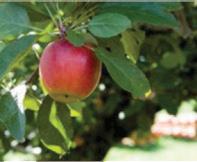
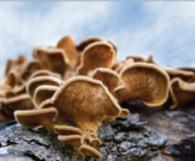
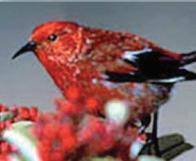
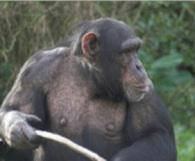
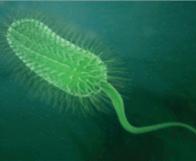
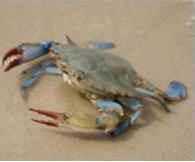
would you need to know about the organisms to improve how you classified them?
Scientists classify organisms into three domains. Scientists use a branching system of classification. The broadest group is the domain. Each domain is subdivided into kingdoms, followed by these subdivisions: phylum, class, order, family, genus, and species. We will focus on domains and kingdoms.
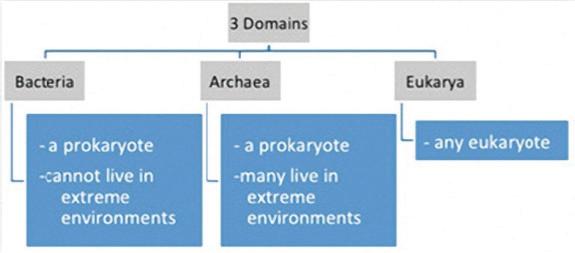
All living organisms are classified into one of three domains: Bacteria, Archaea, and Eukarya. Domain Bacteria includes organisms commonly referred to as bacteria, which are unicellular prokaryotes. They are tiny organisms that reproduce asexually. Some bacteria are autotrophs (make their own food), but most of them are heterotrophs (consume their food).
STEMscopedia
The organisms in domain Archaea are a specialized group of unicellular prokaryotes. Scientists discovered these unique organisms living in areas of extreme conditions. Some archaea are found in hot springs and are called thermophiles (“heat loving”). Other archaea are found in very salty conditions and are called halophiles (“salt loving”). Similar to bacteria, archaea reproduce asexually. Some archaea are autotrophs, and others are heterotrophs. You might wonder why archaea and bacteria are divided into separate domains. After all, they are both unicellular prokaryotes. In the 1970s, a study revealed that the cellular structures of archaea were so different from bacteria they deserved their own domain. For example, archaea have a unique plasmid membrane structure not found in any other organisms.
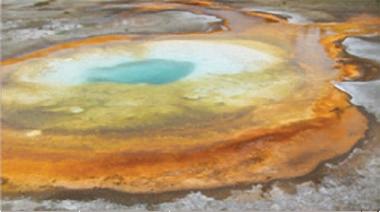
Some of the first archaea were discovered in hot springs like this one. Hot springs are natural pools of extremely hot water.
Domain Eukarya includes all eukaryotes. This is a diverse group of organisms. It includes plants, animals, fungi, and protists. These organisms are classified together because they are made up of eukaryotic cells. Characteristics like structure, function, and reproductive method further classify the organisms into smaller groups called kingdoms.
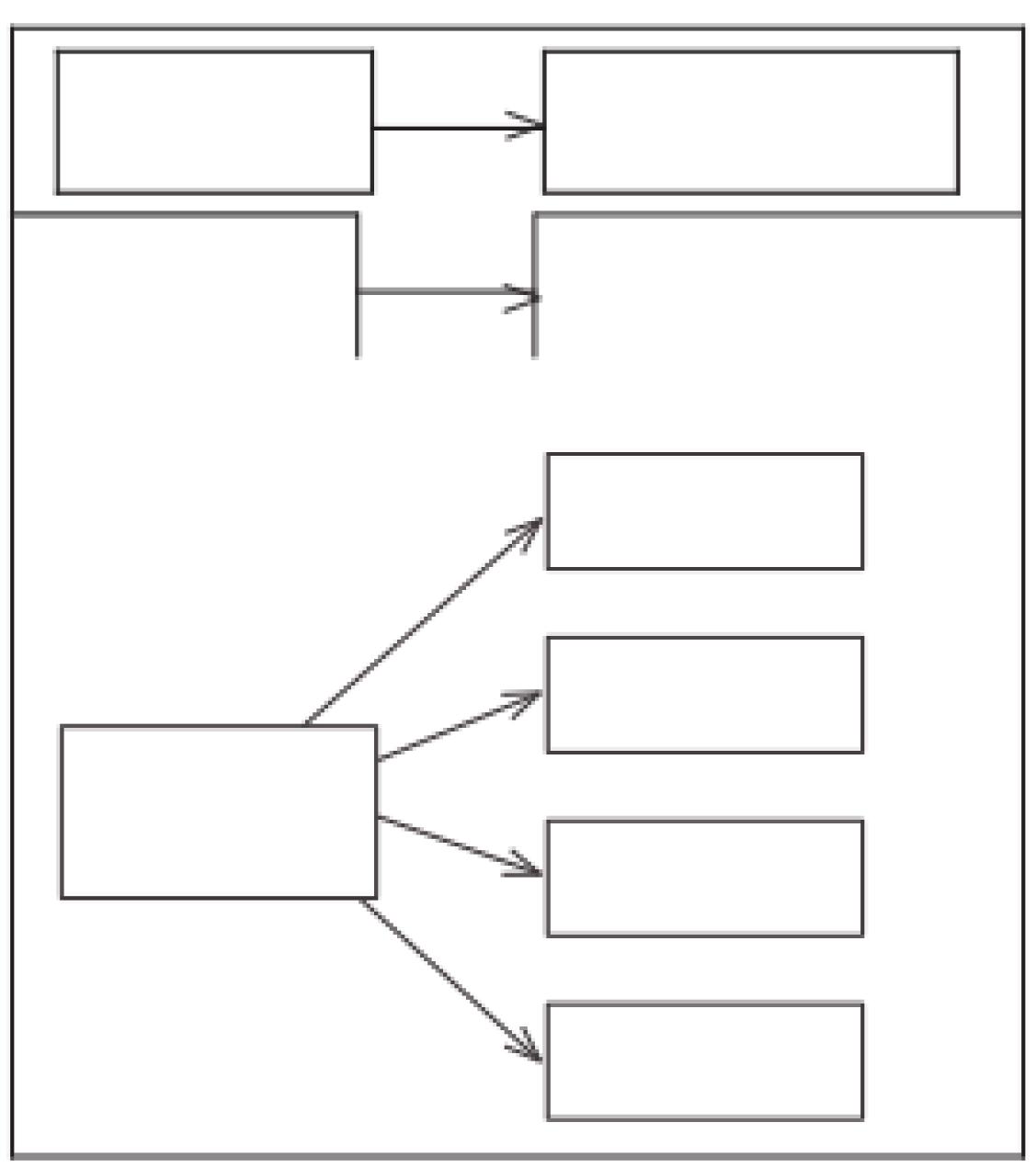
Scientists classify organisms into six kingdoms. The three domains are further divided into six kingdoms. The first two kingdoms are easy to remember. Domain Bacteria has just one kingdom: Eubacteria. Domain Archaea also has just one kingdom: Archaebacteria. Identifying the organisms in domain Eukarya is when classification gets more complicated.
Domain Eukarya has four kingdoms: Animalia, Plantae, Fungi, and Protista. They are classified based on the complexity of their cellular organization, their ability to obtain nutrients, and their mode of reproduction.
Organisms in kingdom Animalia are the most complex and are commonly referred to as animals. They are multicellular heterotrophs. Most reproduction in this kingdom is sexual, although a few animals can reproduce asexually. For example, if you divide a flatworm in half, each of the two halves will grow into a new flatworm.
Bacteria Eubacteria
Archaea Eukarya
Archaebacteria
Animalia
Protista Plantae
Fungi
The three domains are divided into six kingdoms.
STEMscopedia
In the kingdom Plantae, the organisms are referred to as plants and are also very complex. Plants are autotrophs, since they make their own food. They are multicellular and can reproduce sexually or asexually.
Kingdom Fungi includes organisms such as mushrooms and molds. Most fungi are multicellular and can reproduce sexually or asexually. All fungi are heterotrophs. However, the way in which they obtain food is unique. Fungi absorb nutrients from the environment. Think about a piece of moldy bread. The mold is a fungus that releases chemicals to break down the bread into smaller substances. The mold can then absorb these smaller substances, using them as nutrients. This characteristic makes fungi different from animals. The singular of fungi is fungus.
Kingdom Protista includes organisms with fairly simple structures compared to other eukaryotes. There is great diversity among the protists. Most of them are unicellular. However, some protists are multicellular. Some are autotrophs, in which case they resemble plants. Other protists are heterotrophs, more closely resembling animals. They swim through water and consume nutrients from their environment. Their simple organization keeps them in a separate kingdom from plants and animals.
Look Out!
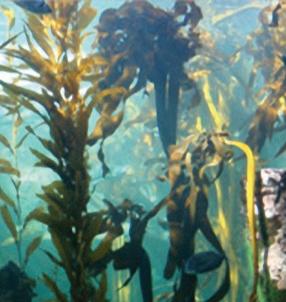
The simple organization of seaweed places them in kingdom Protista.
Protists have been the most difficult group of organisms for scientists to classify. Some protists, like green algae, have the photosynthetic pigment chlorophyll that gives them a green color similar to plants. Other protists behave more like animals, with whip-like structures that allow them to zoom around in the water. You can think of protists as the “other” category. They are single-celled organisms with a nucleus, but their structures are too simple to qualify them as plants or animals.
Try Now
People often say that dogs are “man’s best friend.” How closely related are dogs and humans? To complete this activity, you will need a computer with Internet connection, a piece of paper, a pen or pencil, and crayons or markers.
STEMscopedia
Try Now
1.Search the Internet to find the taxonomies of the domestic dog and humans, from domain through species. Check at least three different sources to make sure the information you find is correct. Try using websites that end in .gov or .edu; they are usually reliable.
2. Create a chart listing the taxonomy of each species side by side, similar to the chart shown below.
Domestic Dog
Human
Domain
Kingdom
Phylum
Class
Order
Family
Genus
Species
3. Circle classifications that are the same for dogs and humans using one color of crayon or marker. Circle the classifications that are different using another color of crayon or marker.
4. What does this information tell you about similarities and differences between dogs and people?
Discover Science: A Changing Classification System
The classification system we use today has changed many times over the years as new information has been discovered. Swedish scientist Carl Linnaeus is known for creating the first version of the modern taxonomy system in the 1700s. He classified organisms into two kingdoms: Animalia and Plantae. Years later, as scientists were able to use better microscopes and observe organisms more closely, they added three more kingdoms to the system: Monera (unicellular prokaryotes), Protista, and Fungi. In recent years, the classification shifted again and is now the three-domain system you just learned about. The new system is based on information from cell studies and the fairly recent discovery of archaea. Do you think the system will change again in the future? If you answered yes, you are probably right! Scientists are always making new discoveries. Some of these discoveries will likely encourage them to rethink the current three-domain system.
STEMscopedia
Try Now
What Do You Know?
Think about the characteristics of prokaryotic cells, eukaryotic cells, and viruses. The table below has a list of terms. For each term, circle the category with which it is best associated.
Cell Structure
Mitochondria Prokaryotic Eukaryotic
Unicellular Prokaryotic Eukaryotic
Ribosomes Prokaryotic Eukaryotic
Plant Prokaryotic Eukaryotic
Virus Prokaryotic Eukaryotic
Nucleus Prokaryotic Eukaryotic
DNA Prokaryotic Eukaryotic
Multicellular Prokaryotic Eukaryotic
Cell membrane Prokaryotic Eukaryotic
Bacteria Prokaryotic Eukaryotic
Dog Prokaryotic Eukaryotic
Classification Choice
Both prokaryotic and eukaryotic Virus
Both prokaryotic and eukaryotic Virus
Both prokaryotic and eukaryotic Virus
Both prokaryotic and eukaryotic Virus
Both prokaryotic and eukaryotic Virus
Both prokaryotic and eukaryotic Virus
Both prokaryotic and eukaryotic Virus
Both prokaryotic and eukaryotic Virus
Both prokaryotic and eukaryotic Virus
Both prokaryotic and eukaryotic Virus
Both prokaryotic and eukaryotic Virus
STEMscopedia
Connecting With Your Child
Prokaryotic and Eukaryotic Cells in Your Neighborhood
Children remember information best when they are able to associate new information with familiar topics. Take your child for a walk in your neighborhood. Take turns playing “I Spy” to identify organisms you find. These may include animals, plants, and fungi. As you play the game, identify each organism as prokaryotic or eukaryotic. (All of the organisms you “spy” will be eukaryotic, as prokaryotic cells can be seen only with a microscope.) Be careful not to touch or otherwise disturb any organisms you observe.
Here are some questions to discuss with your child:
• Why did you find only eukaryotic organisms on your walk?
• Where might you expect to find prokaryotic organisms?
• Have you ever been sick because of an infection by a prokaryotic organism?
Your child might be tempted to classify organisms based on whether he or she can see them with the unaided eye or with a microscope only. It is important to stress that eukaryotic and prokaryotic cells are not classified on the basis of whether a microscope is necessary to observe them. Instead, the classification of eukaryotic and prokaryotic cells is based primarily on whether the cell’s DNA is organized in a nucleus (eukaryotic) or whether it floats in the cytoplasm (prokaryotic).

Reading Science
Your Liver Is Your Friend
1 How do the levels of organization in biology create an entire biological system? When we study the biological world, we can see that every level is very complicated. Each part is organized, from the smallest atoms in an organism to the largest organism. In multicellular organisms (organisms with many cells, like us), atoms combine to make molecules, and molecules combine to make cells. Cells combine and work together to make tissues, like muscles. Tissues then work together in the form of organs, like your heart. Organs work together in organ systems, like your digestive system. In other words, all of the parts work together to create a whole.
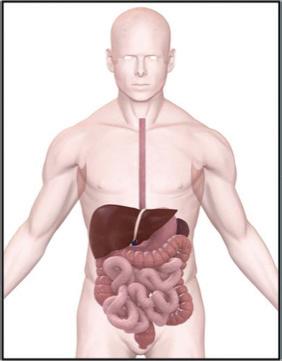
2 One of the most important levels of organization relates to the different organ systems in our bodies. Each organ system performs an important function, such as helping with digestion, moving materials through the body, or breathing. Healthy organ function depends on the health of each of the cells of that organ and on the health of each organ and its cells. If one organ fails, the entire organism could die. This makes the organ system a good point to start the study of the levels of biological organization.
3 One of the most important organs in animal systems is the liver. It helps to maintain the balance of the entire organism. Its functions are tied to almost every other organ of the animal body. The liver is found in all animals with skeletons (vertebrates). While each vertebrate’s liver is slightly different, it is always one of the largest internal organs.
4 There are many reasons why the liver is so important. Your liver will pick up signals from molecules and blood cells and will respond as needed. This makes your liver the largest chemical-processing center in your body. It turns the carbohydrates (sugars) you eat into molecules that your body can use, releasing sugars back into your body as needed. The liver makes the building blocks of proteins, called amino acids. The liver also affects the function of the circulatory system. It creates necessary blood proteins, such as clotting factors. It also produces cholesterol, which your cells need to makes hormones and parts of cell membranes.
5 It also plays an important role in the breakdown and disposal of toxins, such as ammonia, damaged red blood cells, and other cell waste. The liver produces a thing called bile that helps break down the fats in the foods you eat. If your liver stops functioning properly, it can no longer break down this waste product. Vomiting bile, as the body attempts to get rid of unprocessed waste products, is another sign. The liver performs so many important functions that an animal would die within 24 hours if the liver stopped functioning. The good news is that the liver has an amazing ability to heal and repair itself.
Reading Science
1 Paragraph 1 talks about how the parts of biological organisms work together. Which of the following is the correct order?
A Cells, organs, molecules, tissues, atoms
B Molecules, cells, tissues, atoms, organs
C Atoms, molecules, cells, tissues, organs
D None of the above
2 In the biological order of systems, cells will combine to form–
A organs.
B bodies.
C tissues.
D molecules.
3 The word vertebrates is found in Paragraph 3. This word means–
A animals with cells.
B animals with organs.
C animals with livers.
D animals with skeletons.
Reading Science
4 In vertebrates, which biological system carries out more chemical reactions than any other organ or system?
A The liver
B The heart
C The digestive system
D The blood system
5 What does bile do?
A Breaks down the sugars in your body
B Breaks down the fats in the foods you eat
C Creates the proteins in your body
D Removes the toxins from your body
6 The liver is essential to the health of the organism. One major function of the liver is–
A to break down toxins.
B to make cholesterol.
C to make amino acids.
D all of the above.

Open-Ended Response
1. How can scientists determine whether a newly discovered object should be classified as living or nonliving?
2. Scientists examine a newly discovered object and discover that it is, indeed, made up of smaller parts. What must the smaller parts do in order for the object to be classified as living?
Open-Ended Response
3. Compare and contrast bacteria and viruses. Why are bacteria considered living things, but viruses are not considered living things?
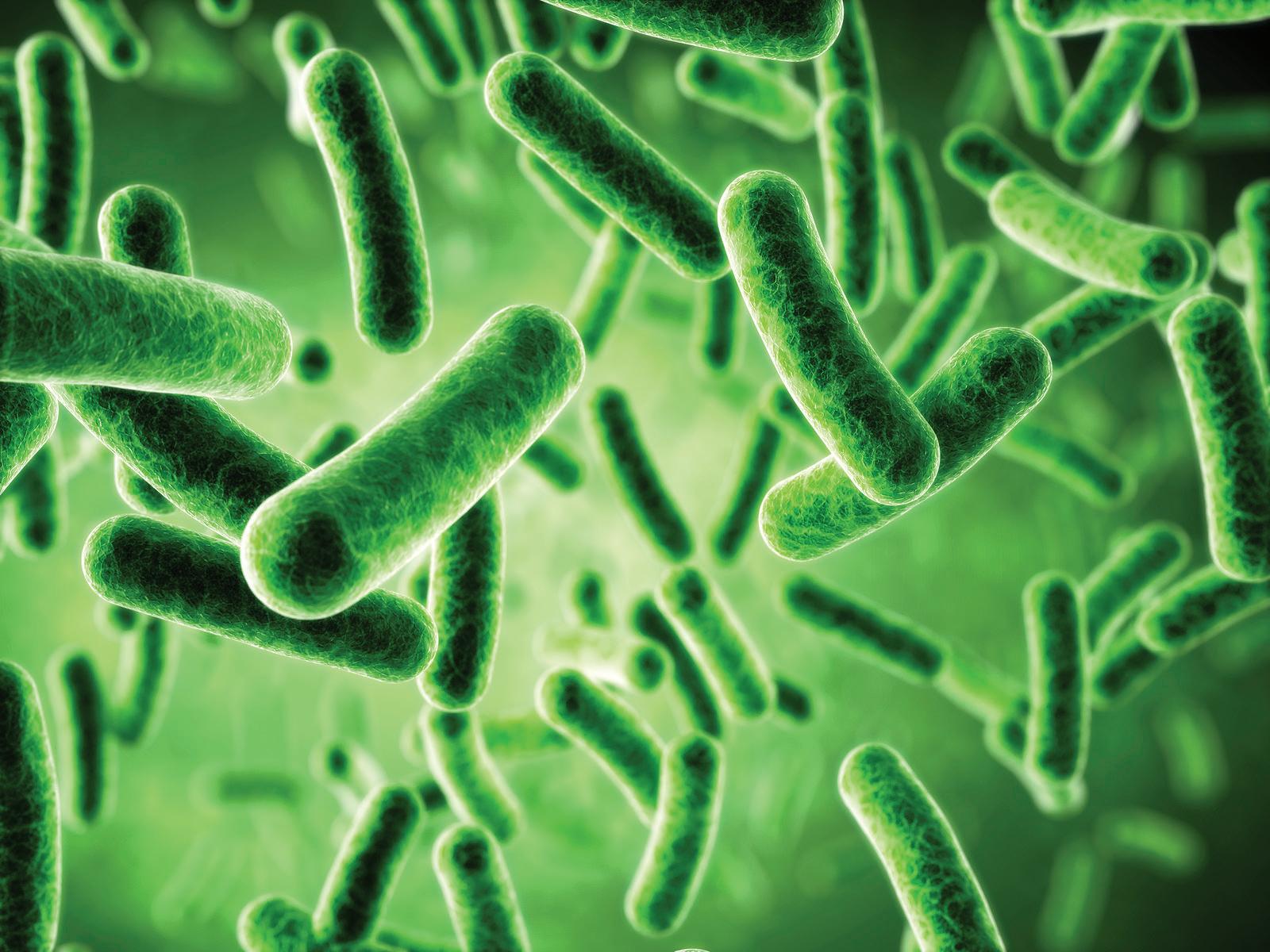
BACTERIA
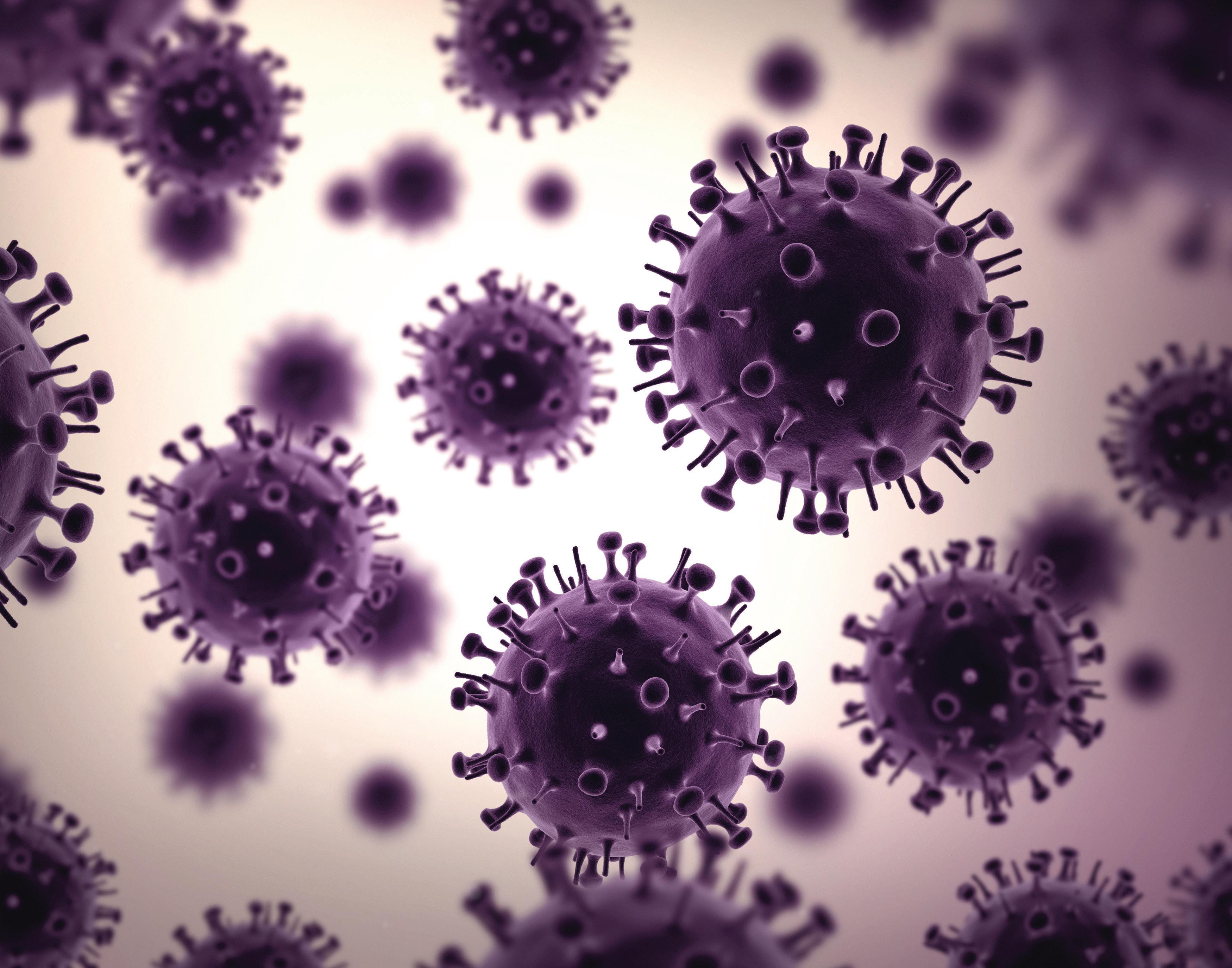
VIRUSES
Open-Ended Response
4. How are multicellular organisms organized?
5. Compare a car to a person. Choose a system in the car, compare it to a system in the human body, and explain how the two systems are similar.


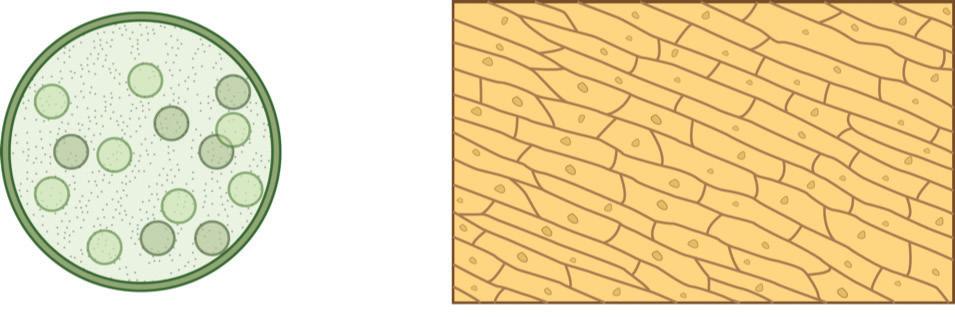
Write a scientific explanation that describes the difference in roles between cells in a unicellular organism and cells in a multicellular organism. Scenario
A unicellular organism is a living thing made of only one cell, while a multicellular organism is a living thing made of more than one cell.
Peer Name: Rebuttal:
Parts of Cells
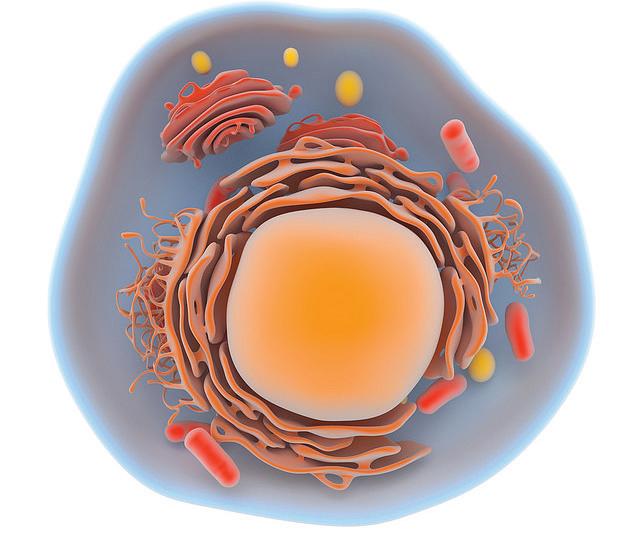
Think about a single cell and its parts—for example, a cell inside the human body. Now, select an everyday object that could be used as a model for a cell and its parts. In words and/or pictures, describe your model and how it is like the cell.
Explore 1
Designing a System
Activity
A sports team, business office, manufacturing plant, organism, and even individual plant and animal cells are all examples of different kinds of systems.
L.6.1.3
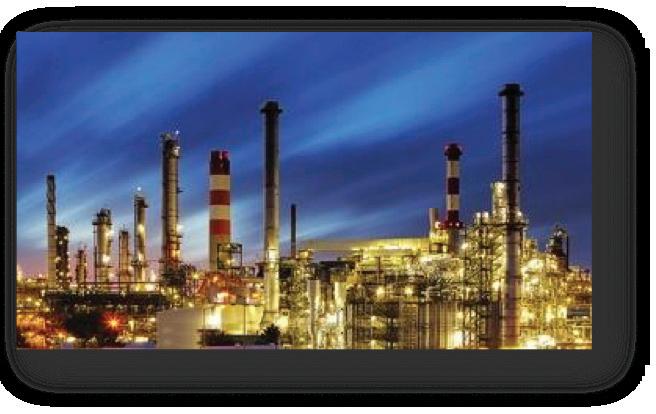
Although there are different kinds of systems that exist, they share certain characteristics. A system consists of one or more parts, or components, such as a “control center” that directs the system’s activities, basically coordinating all of the different parts to help make sure they work together smoothly. Each part of the system is assigned certain tasks, but together, the whole system has a generally shared purpose. For a sports team, it is to score the most points to win the game. For a business office, it is to fill customer needs. For a manufacturing plant, it is to keep the production line running smoothly and efficiently. For organisms and cells, it is to keep their systems functioning and healthy.
Procedure
1. Within your group, come up with one business idea for manufacturing a specific product.
2. Develop a flowchart that breaks down each component in a facility that is needed for the manufacturing process to occur. Make sure that each step includes a description of a) the inputs and outputs (e.g., raw materials or subproducts, energy source, waste, storage) and b) the processing needed. Processing points should include detailed descriptions of either the equipment or a person’s skills needed to complete that processing step.
Explore 1
3. On a large sheet of paper, transfer your manufacturing process to a floor plan format. The floor plan of your manufacturing plant should include an outer wall, one or more entry/exit points, a central administration office, and labeled areas with a short description about what is happening in that area—that is, the inputs/ outputs and processing.
4. Pair up with another group. Using your floor plan for reference, take about five minutes to explain your system to the other group.
5. Review the set of Organelle Labels, which name and describe the functions of different kinds of parts in animal and plant cells. Analyze the other group’s system diagram and stick each label on the system’s component that you think it best matches in terms of its function category. As needed, use the sticky notes to duplicate labels (with just the organelle name) and place in additional corresponding spots on the floor plan. When done, the group that placed the labels should explain to the other group why they put them in the spots they did.
L.6.1.3
Explore 2
Comparing Cells
Use the reference sheet to describe the various types of eukaryotic cells.
Animal Plant
1. Does this cell look simple or complex?
2. What organelles do you see present in this organism?
1. Does this cell look simple or complex?
2. What organelles do you see present in this organism?
3. What features make this cell type unique?
3. What features make this cell type unique?
Protist
1. Does this cell look simple or complex?
2. What organelles do you see present in this organism?
1. Does this cell look simple or complex?
2. What organelles do you see present in this organism?
3. What features make this cell type unique?
3. What features make this cell type unique?
Fungus
Explore 2
Use the microscopes to observe samples of cells. Draw and describe what you see to determine the type of cell on each slide.
Slide:
Observations
Slide:
Observations
Type
Explore 2
Slide: Slide:
Observations
Observations
Organelles
Organelles
Cell Type
Cell Type
Explore 2
Reflections and Conclusions
Complete two Venn diagrams to compare and contrast the characteristics of the cell types. Plant
Animal
Fungus
Protist
STEMscopedia
Reflect
Think for a moment about all the living things on Earth. There is great diversity among organisms, from microscopic bacteria to massive blue whales, the largest animals on the planet. Despite the tremendous variety of life, all organisms have something in common—they are all made of cells. Some organisms are unicellular, composed of just a single cell, while other organisms are multicellular, composed of more than one cell. The human body is made of about 100 trillion cells!
Although different cells can perform specific functions, all cells can be divided into two large categories. What do you think these categories might be? What are the characteristics of the cells in each category?
Structure and Function of Prokaryotic and Eukaryotic Cells
The two categories of cells are prokaryotic cells and eukaryotic cells. A prokaryotic cell is a simple cell that does not contain a nucleus or other membrane-bound organelles.
A prokaryotic cell is typically defined by its shape, which may be rod-like, spherical, or spiral. Prokaryotic cells are unicellular organisms, bacteria, and archaea. Although they lack membranebound organelles, prokaryotic cells have some or all of the structures referenced in the table below. Can you locate each structure in the diagram at the top right of the page?
Structure
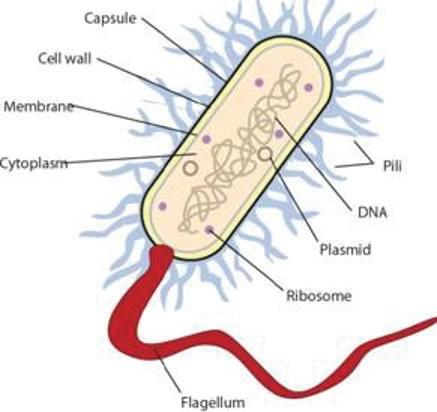
In addition to the structures shown, prokaryotic cells contain a central area around the DNA called the nucleoid.
archaea:
single-celled organisms that sometimes live in extremely harsh environments such as hot springs and salt lakes
Prokaryotic Cell Structures
Function
Capsule The capsule is the thin, outermost layer of the cell that provides protection.
Cell wall The cell wall surrounds the cell and maintains the cell’s shape.
Plasma membrane Individual membranes do not surround internal structures. However, a single plasma membrane surrounds the entire cell. The membrane helps move materials into and out of the cell.
Cytoplasm Prokaryotic cells contain a gel-like fluid called cytoplasm. Cytoplasm takes up most of the space inside the cell.
Accelerate Learning Inc. – All Rights
STEMscopedia
Reflect
DNA
Nucleoid
Plasmids
Ribosomes
Pili
Flagella
DNA within a prokaryotic cell is a single, circular molecule that is not enclosed in a membrane-bound compartment. DNA carries the instructions and genetic code for the cell.
Although DNA is not enclosed in a nucleus, it is generally confined to a central region called the nucleoid.
Plasmids are circular genetic structures found inside prokaryotic cells but are not part of the main DNA strand. They are involved in cell activities such as growth and metabolism.
Prokaryotic cells contain ribosomes that play roles in manufacturing proteins.
Hollow, hair-like structures called pili surround prokaryotic cells. Pili enable prokaryotic cells to attach to other cells.
Long, whip-like structures called flagella (singular: flagellum) help prokaryotic cells move. A cell may have one flagellum, or it may have several flagella.
In contrast to prokaryotic cells, eukaryotic cells are more complex. They contain a nucleus and other membrane-bound organelles that perform specific functions that contribute to the overall metabolism and growth of the cell. Eukaryotic cells are found in multicellular organisms including plants, animals, fungi, and protists. They can also be unicellular protists. Let us take a closer look at the main structures within a eukaryotic cell. Can you locate each structure in the diagram on the right?
metabolism: the process by which cells make, store, and transport chemicals
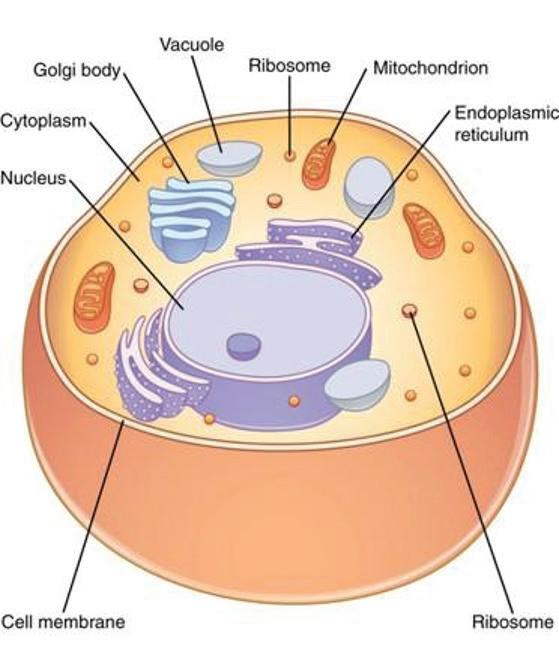
In addition to the structures shown in this animal cell, plant cells contain a cell wall, a central vacuole, and chloroplasts.
STEMscopedia
Reflect
Structure
Cell wall
Cell membrane
Cytoplasm
Nucleus
DNA
Mitochondria
Endoplasmic reticulum (ER)
Golgi body
Ribosomes
Lysosomes
Chloroplasts
Central vacuole
Vesicles
Eukaryotic Cell Structures
Function
The cell wall surrounds the cell and maintains its shape. Cell walls are found only in plant, fungal, and protist cells.
The cell membrane surrounds the entire cell. It helps move materials into and out of the cell.
As in prokaryotic cells, eukaryotic cells contain cytoplasm that takes up much of the space inside the cells.
The nucleus is the central organelle that holds DNA.
In eukaryotic cells, DNA is linear and organized into chromosomes. Like prokaryotic cells, DNA carries the instructions and genetic code for the cell.
The mitochondria play major roles in transforming the energy in food into a usable form of energy called ATP. The cell then uses ATP to carry out activities such as reproduction and growth.
The endoplasmic reticulum, called the ER, helps to transport proteins and to produce lipids
The Golgi body helps package and distribute proteins and lipids within the cell.
Like prokaryotic cells, eukaryotic cells contain ribosomes that play roles in manufacturing proteins. However, the ribosomes in eukaryotic cells are larger and more complex.
Lysosomes contain enzymes that help break down food or break down the cell when it dies.
Plant cells and some protists contain chloroplasts. These structures contain the green pigment chlorophyll, which captures the energy of sunlight for use in photosynthesis
Many plant cells contain a large central vacuole, which stores water, food, and waste. Animal cells contain vacuoles, but they are much smaller than the central vacuole found in plant cells.
These bubble-like structures encapsulate materials to transport them in and out of the cell.
STEMscopedia
What Do You Think?
Scientists classify organisms into three domains.
All living organisms are classified into one of three domains: Bacteria, Archaea, and Eukarya. Domain Bacteria includes bacteria, which are unicellular prokaryotes. They are tiny organisms that reproduce asexually. Some bacteria are autotrophs (make their own food), but most of them are heterotrophs (consume their food).
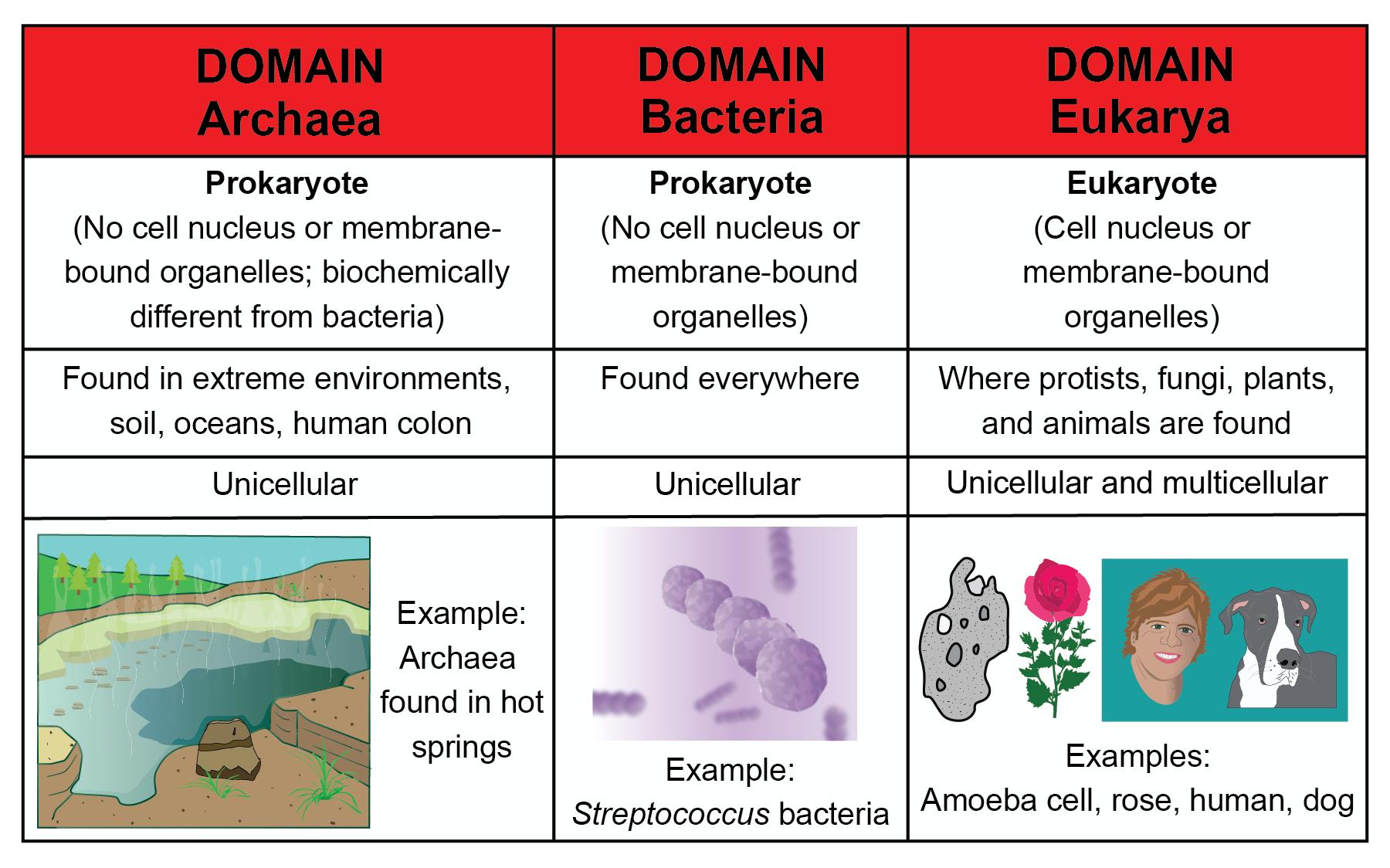
DOMAIN Archaea DOMAIN Bacteria
Kingdom
Archaebacteria
Archaebacteria
Prokaryotes
Unicellular
Live in extreme environmnents (hot springs, underwtaer thermal vents)
No nucleus
Kingdom Bacteria (or Eubacteria)
Circular DNA Bacteria
Prokaryotes
Unicellular
Live everywhere, but not in extreme environments
No nucleus
Circular DNA
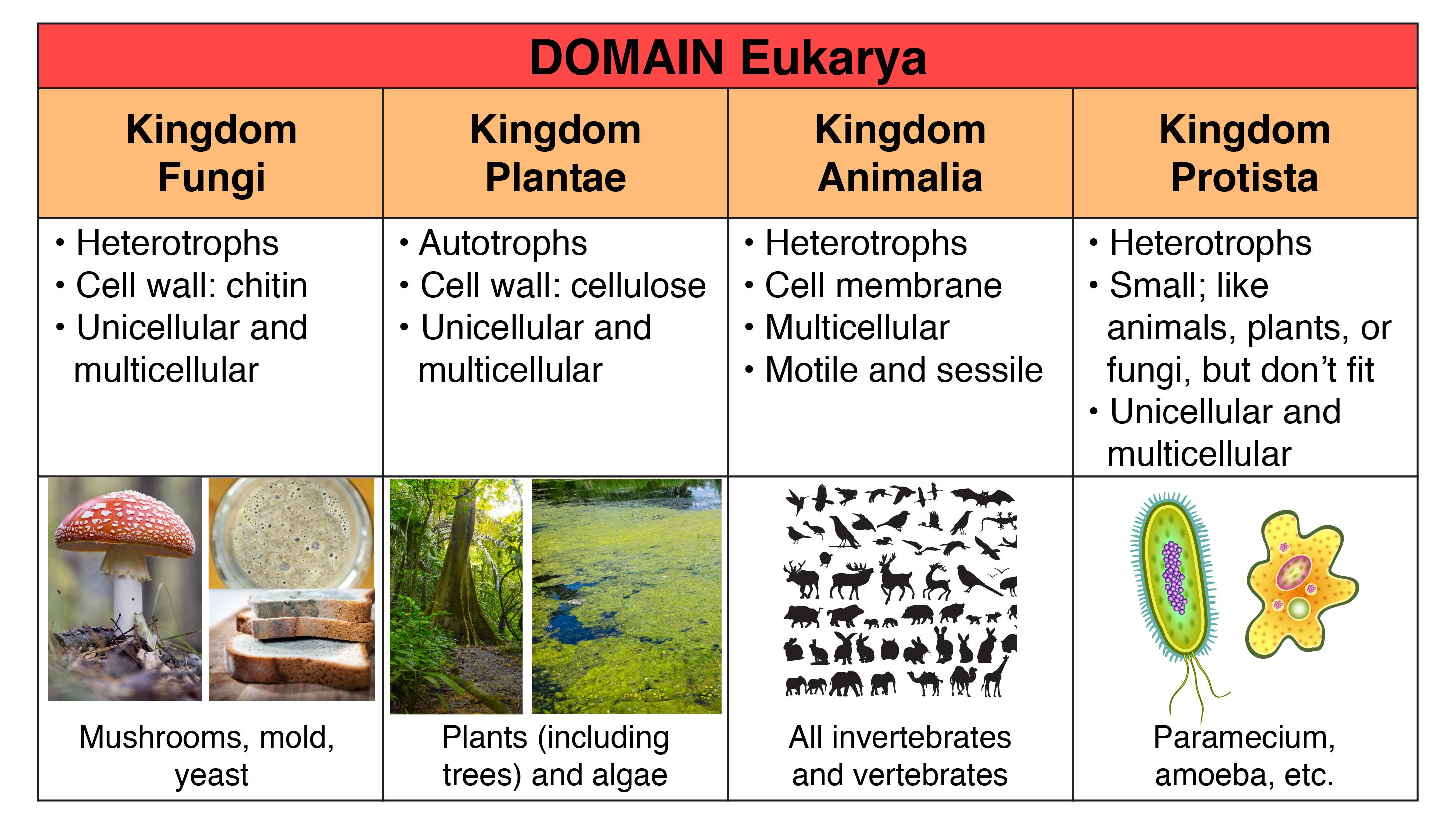
Animalia, Plantae, Fungi, and Protista
They are classified based on the complexity of their cellular organization, their ability to obtain nutrients, and their mode of reproduction.
Scientists further classify organisms into kingdoms
The three domains are further divided into six kingdoms. The first two kingdoms are easy to remember. Domain Bacteria has just one kingdom: Eubacteria. Domain Archaea also has just one kingdom: Archaebacteria Domain Eukarya has four kingdoms:
STEMscopedia
Try Now
What Do You Know?
Compare prokaryotic cells and eukaryotic cells. Read the list of cell characteristics in the box below. Write each characteristic in the correct place on the Venn diagram.
Characteristics of Cells
• Contain a nucleus
• Undergo metabolism
• Contain DNA
• Are usually smaller than 10 micrometers
• Are found in fungi
• May contain a cell wall
• Reproduce
• Are bacteria and archaea
• Contain membrane-bound organelles
• Are found in all multicellular organisms
• Contain chloroplasts
Prokaryotic Cells Eukaryotic Cells
STEMscopedia
Connecting With Your Child
To help your child learn more about prokaryotic and eukaryotic cells, have him or her draw or create a threedimensional model of each cell type. For eukaryotic cells, ask your child to choose either a plant cell or an animal cell.
If your child is drawing the cells, have your child use colored pencils to sketch the cells and their structures. He or she should include labels and list the functions of each structure.
If your child is creating three-dimensional models, help brainstorm ideas of materials that can be used, such as pipe cleaners, wax craft sticks, pom-poms, and string. Three-dimensional models should also include labels. Your child can use toothpicks, tape, and small pieces of paper to create numbered labels. Then he or she can create a written numbered key on a sheet of paper. For example, a toothpick taped with the number 1 can be placed on the nucleus. The written key would indicate that number 1 is a nucleus and is the centrally located organelle that contains DNA.
Here are some questions to discuss with your child:
• Which type of cell was easier to create a model for, prokaryotic or eukaryotic? Why?
• What are some types of prokaryotic cells that you could observe under a microscope? Do you think you would be able to see all of the structures? Explain.
• What are some types of eukaryotic cells that you could observe under a microscope? Do you think you would be able to see all of the structures? Explain.
Reading Science
Prokaryotic and Eukaryotic Cells
1 The cell, the basic unit of life, is found in every living organism on Earth. Some organisms are unicellular, or made of a single cell. Other organisms are multicellular, or made of many different types of cells. It is important to note that whatever cell type it is, all living biological cells have many things in common.
2 All living cells are bound by a plasma membrane. Within that membrane, all cells contain a fluid known as cytosol. Cytosol is where organelles are found. All living cells also contain ribosomes, one type of organelle, which make proteins. There are two major types of cells: prokaryotic cells and eukaryotic cells.
3 Most prokaryotic organisms are unicellular. They are very simple with no membrane-bound organelles. In prokaryotic cells, the DNA is loose and is found in an area called the nucleoid. Prokaryotic cells are surrounded by a cell wall. These cell types usually reproduce asexually.
4 Most eukaryotic organisms are multicellular. These cells usually have many membrane-bound organelles, each with its own structure and function. The DNA in eukaryotic cells can be found on chromosomes within a membrane-bound nucleus near the center of the cell. Some eukaryotic cells, such as those found in plants, fungi, and some protists, have cell walls outside their plasma membranes. These cell types usually reproduce sexually.
5 How are cell types identified and measured? One way is to look at the cell through a microscope lens on medium power of 100x. If any details of the cell can be observed at medium power, it is most likely a eukaryotic cell. Most prokaryotic cells cannot be seen without a higher-powered lens due to their very small size. On average, eukaryotic cells are 10 times larger than prokaryotic cells. Some eukaryotic cells can even be seen with the naked eye. For example, if an average prokaryotic cell was the size of a pea, then an average eukaryotic cell would be the size of a medium grapefruit.
6 Because of this great size difference, prokaryotic and eukaryotic cells have different ways of moving materials through the cell. Materials inside prokaryotic cells move mainly by diffusion. Diffusion is like using bicycles or cars to move people around a small town. Eukaryotic cells, on the other hand, move materials in a similar way as mass transit in a large city like New York City or Los Angeles. Why? Because diffusion alone cannot move materials around these larger cells fast enough. Their bigger volume needs much more organization. Many membrane-bound organelles do separate, specialized jobs to move materials where they need to go.
Reading Science
1 Why can’t eukaryotic cells only use diffusion to transport materials around the cell?
A Eukaryotic cells are too small.
B Eukaryotic cells have no membranes.
C The materials cannot move fast enough in these cells.
D The organelles all do the same job.
2 What cell type has no membrane-bound organelles, has DNA that is found in an area called the nucleoid, and is very small?
A Eukaryotic cell
B Prokaryotic cell
C Animal cell
D Plant cell
3 A student is looking through a light microscope and wants to know what type of cells she is seeing. She can only see separate cells with 100x magnification. What type of cell is it? How much detail would she see?
A Prokaryotic cell, no detail
B Prokaryotic cell, some detail
C Eukaryotic cell, no detail
D Eukaryotic cell, some detail
Reading Science
4 A student is looking through a microscope at stained cells. The cells have outer edges and many smaller parts inside. What type of cells would he expect these to be? Why?
A Prokaryotic, because only prokaryotic cells have cell walls.
B Prokaryotic, because prokaryotic cells have ribosomes inside.
C Eukaryotic, because only eukaryotic cells have cell walls.
D Eukaryotic, because only eukaryotic cells have a nucleus and organelles.
5 Which organelle would not be found in both prokaryotic and eukaryotic cells?
A Cytosol
B Nucleoid
C Ribosomes
D Plasma membrane
6 Prokaryotic and eukaryotic cells have several differences. Which statement below is NOT one of those differences?
A The DNA in prokaryotic cells is loose in the nucleoid.
B Eukaryotic cells have many separate organelles.
C Only prokaryotes have ribosomes.
D Eukaryotic cells may be 10 times larger than prokaryotic cells.
Open-Ended Response
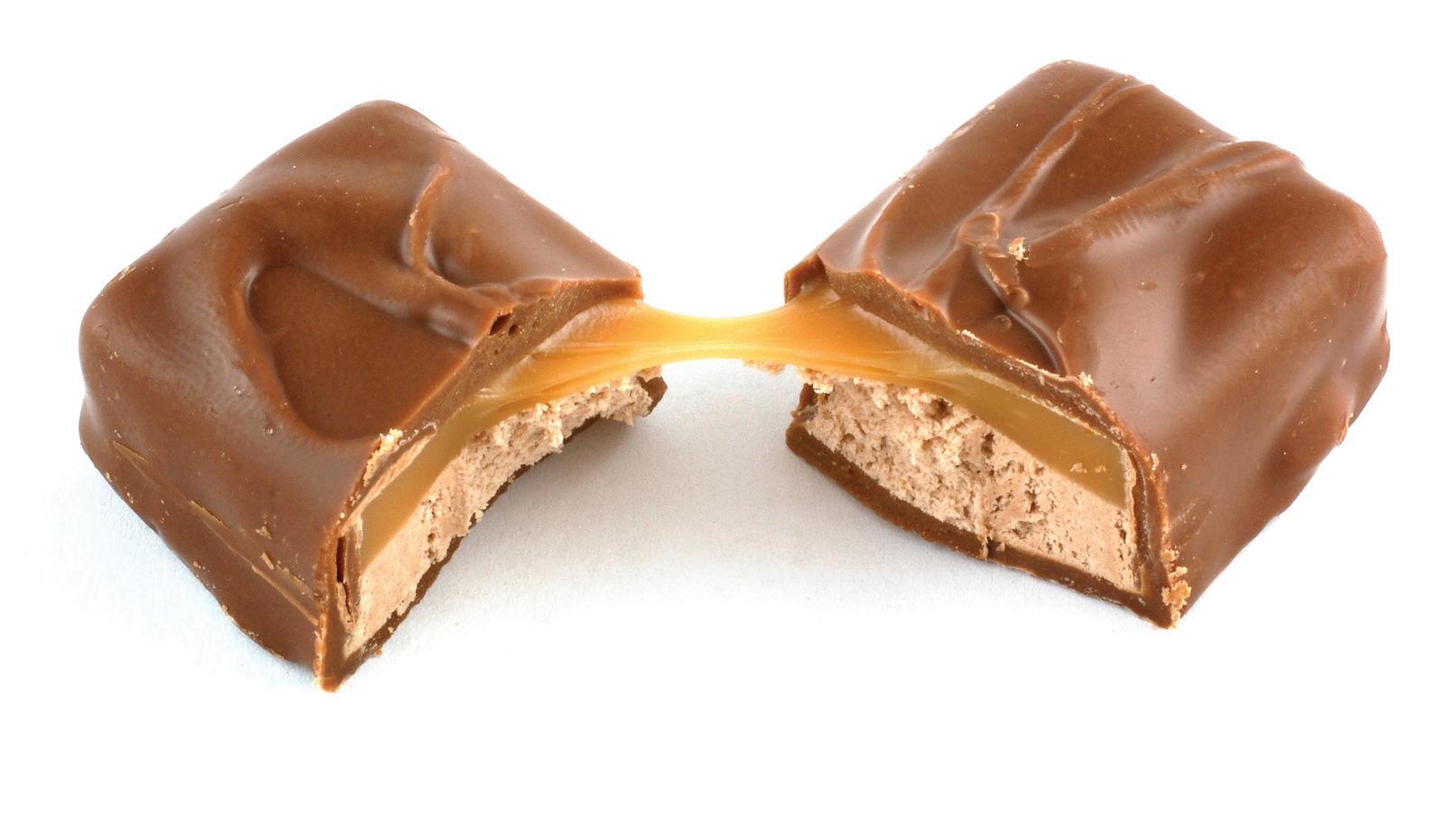
1. Imagine a cell is a candy factory. What would each cellular component be in the candy factory? Why?
• Cell membrane:
• Cell wall:
• Nucleus:
• Chloroplast:
• Vacuole:
• Mitochondria:
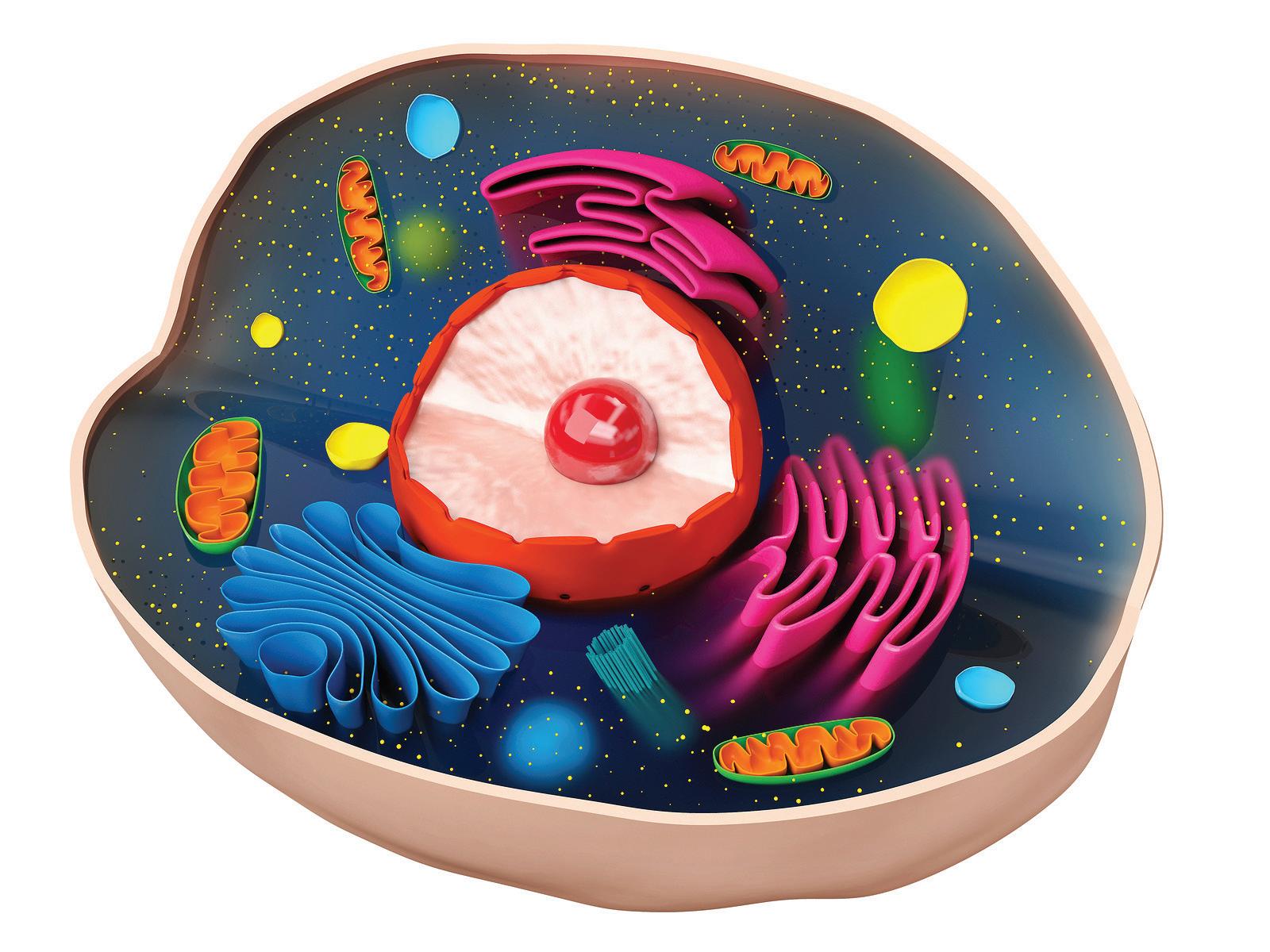
2. Summarize how the functions of a cell are similar to the functions of an organism.

Open-Ended Response
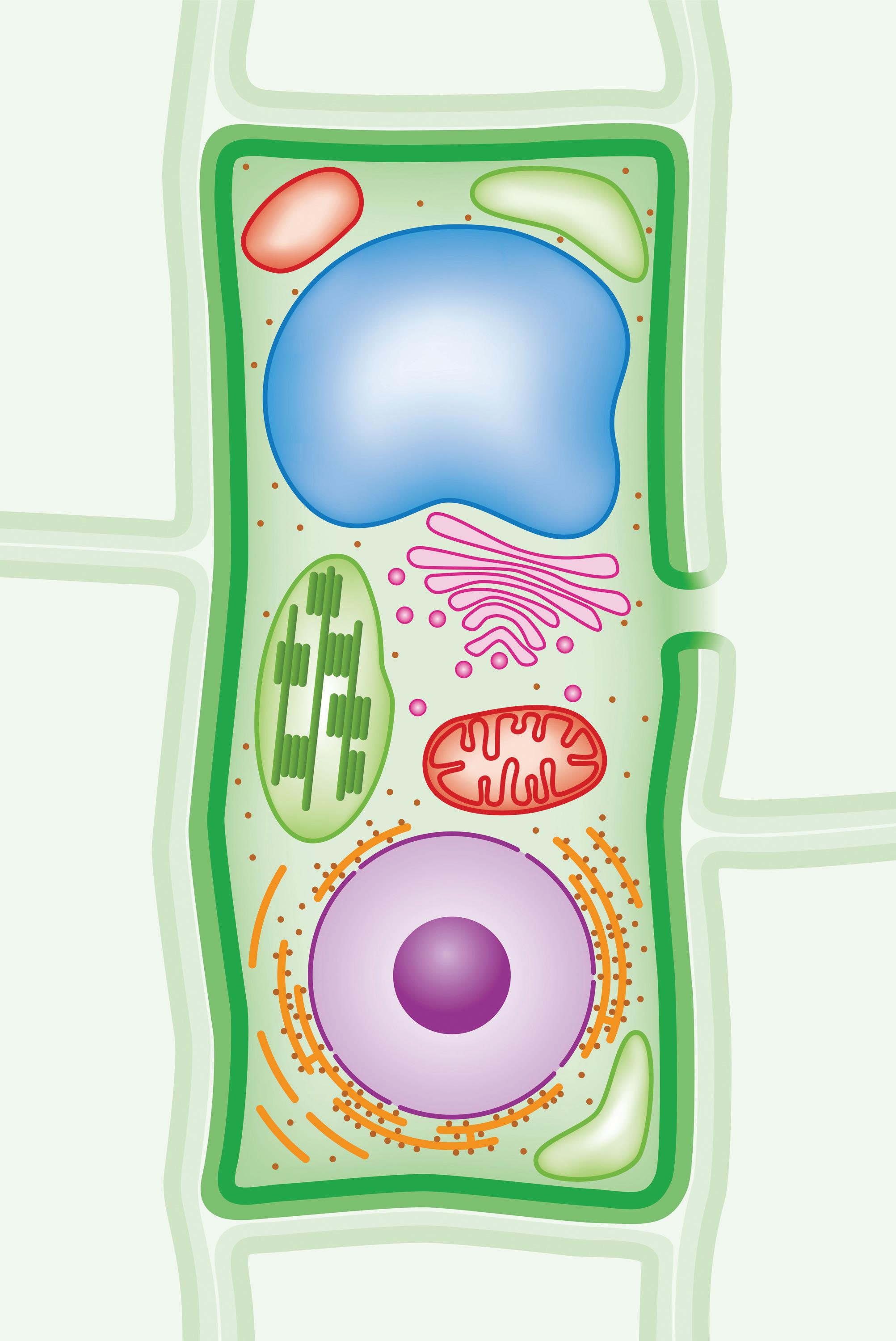
3. Describe the structure and function of an organelle found in the cell of a plant that is not found in the cell of a fungus.
4. Observe the cell in the picture. Would you classify it as the cell of a plant, animal, fungus, or bacteria? How can you tell?
Claim-Evidence-Reasoning
Claudia is a student in a middle school science classroom. She made a list of cellular structures and functions as a homework assignment for her science class. She decided to leave out the lysosome because she felt it was not important enough. The lysosome is the structure within the cell that breaks down unwanted material within the cell.
Cell memebrane Controls what enters and leaves the cell
Mitochondrion Breaks down nutrients into energy
Nucleus The control center of the cell
Vacuole Stores water, waste, and food
Cytoplasm Holds organelles in place within the cell
Ribosome Produces proteins
Golgi body Packages proteins
Write a scientific explanation agreeing or disagreeing with Claudia’s opinion that the lysosome is not important enough to include in her list.
PEER EVALUATION
Peer Name: Rebuttal:
3.2, and 3.3
Explore 1
Defining Biotic and Abiotic
Activity
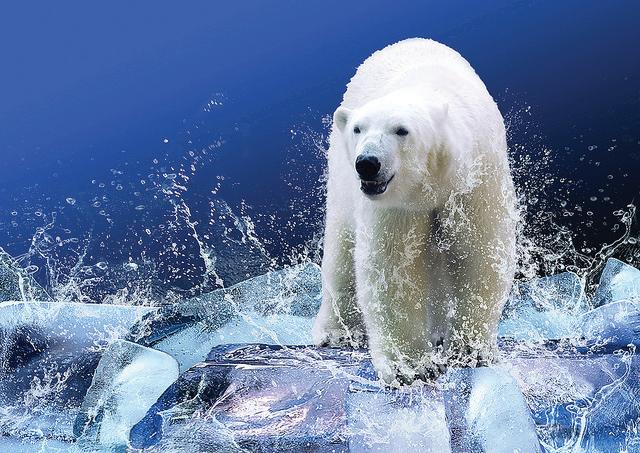
1. Record what you observe in the photograph of the pond.
2. What interactions do you see in this photograph? What organisms may be working together?
3. Fill in the chart below using the photograph.
4. Which do you think is more important to an ecosystem, the biotic or abiotic elements? Why?
Organization and Interactions in an Environment
Background
1. What is a species? Provide an example.
2. What is the purpose of utilizing the levels of organization within an ecosystem?
3. What level of organization includes the abiotic factors?
4. How can developing a model help facilitate the understanding of the levels of organization?
5. In the triangle below, identify all parts of the levels of organization from your biome. Include an example of items that would be found at each level of organization from species to biome.
Explore 2
Part I: Planning Model
1. My Question of Inquiry:
2. What do you need to do to answer the question?
3. What are the variables that you will observe?
4. What materials, equipment, and technology will you need for this investigation?
5. What limitations can you identify with this model?
Explore 2
Explore 2
Analyze Data
1. What is your biome? What abiotic factors impact your ecosystem?
2. What materials can be used to develop your model of your ecosystem? How can these materials help to improve the accuracy of your model?
3. Compare your ecosystem to that of another group. Identify the differences. Why would their ecosystem be different?
4. Using your model, explain how your ecosystem could look different six months from now. Explain, including information about the abiotic and biotic factors.
5. If one of the organisms in your ecosystem were removed, what impact would that have on the other organisms in the same ecosystem?
6. Describe any limitations to your model of the levels of organization.
Explore 2
Part III: Reflections and Conclusions
1. What are the levels of organization within an ecosystem?
2. Were there limitations to consider when developing a model for the levels of organization? Explain.
3. How can you use your model and other students’ models to help facilitate an understanding of the levels of organization?
4. What would you do differently if you were to conduct this investigation again?
Explore 2
5. Fill in the following levels of organization triangles utilizing other groups’ models.
Ecology and Interdependence, Part I: Invasive Species
An isolated island ecosystem has the following food chain: grass → grasshopper → frog → snake
Four students were asked to predict what would happen to an ecosystem if an invasive species were introduced. Their responses are recorded below.
Event Description
1 Humans introduce kudzu (an Asian vine that grows very quickly).
2 Kudzu bugs, which thrive on kudzu, inhabit the isolated island’s ecosystem.
3 The native grasses cannot compete with the kudzu vines for resources and begin to die off.
The frog population would adapt to eat the vine. The grass in the ecosystem would grow more rapidly. The grasshopper population would increase. The frog population would increase.
Explore 3
1. Out of the four students’ responses, which one do you agree with the most? Explain your thinking.
2. Based on the events listed in this ecosystem, how would you define an invasive species?
3. How has the introduction of kudzu impacted this ecosystem?
4. Besides the introduction of an invasive species, what is another way an ecosystem can change?
Explore 3
Ecology and Interdependence, Part II: Natural Disasters
Activity
Large areas and their ecosystems are commonly disrupted by a variety of events. Catastrophic events, such as hurricanes, can rip apart the homes of humans, plants, and animals. The effects of this shake-up are predictable to some degree, but sometimes unknown variables cause further disruption and become apparent later. The scenarios you will explore during this activity feature major catastrophic events that can cause disruption to ecosystems.
Procedure
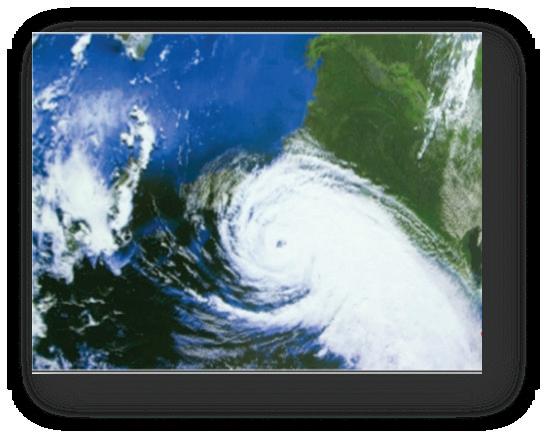
1. Review and analyze the Before and After in the Student Reference Sheet.
2. For each of the scenarios, answer the following questions.
• Based on what you know or have heard about this type of disruptive event, explain what generally happens as part of the nature of that event.
• What effects can the event have on abiotic factors of the ecosystem?
• What immediate effects did the event have on the plants that lived there?
• What immediate effects did the event have on the animals that lived there?
• What do you predict will happen over time in the affected area?
Explore 3
3. Pick one of the scenarios and draw a time line. Based on your answers, fill in the time line with some details. Use a combination of text and drawings to help illustrate the scenario and the area’s response over time.
STEMscopedia
Reflect
You wake up early on a Monday morning. You grab something to eat and drink and then go outside to catch the bus. When you arrive at school, you suddenly remember that you forgot to do part of your homework!
You find a classmate, and she helps you finish a few science questions. Then you both head into class, where your teacher is starting the school day.
organism: a living thing

From the time you woke up until the time you started class, you were interacting with your environment. Any behavior that causes something to affect something else is called an interaction. You ate food, drank liquids, breathed air, and relied on other people for help. In the same way, organisms interact with their environment every day.
These interactions help organisms survive. What are some things organisms might interact with? Are they living or nonliving? Can you think of some ways in which organisms interact with each other?
What Do You Think?
What is an ecosystem? What are the different parts of an ecosystem?
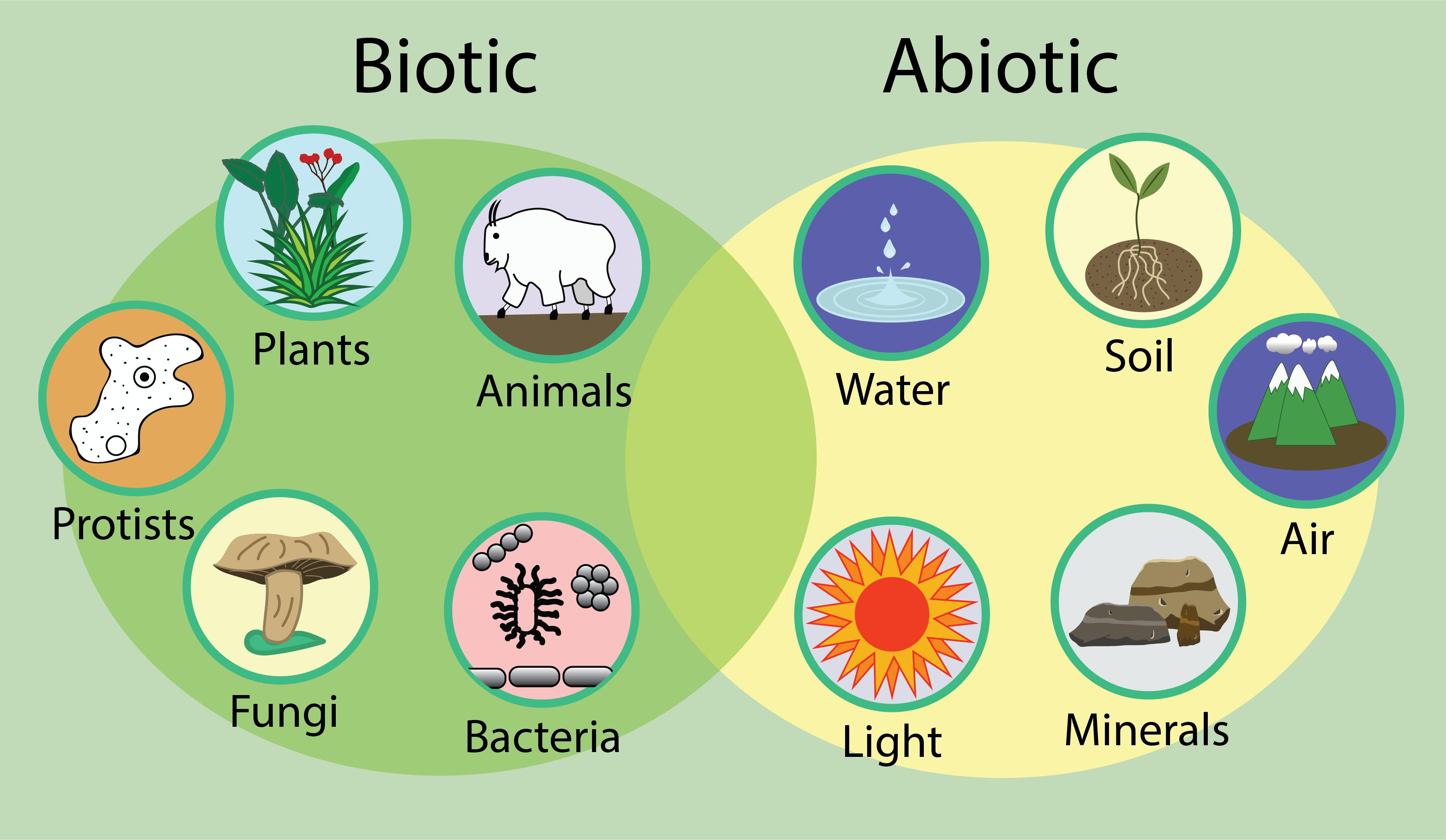
An ecosystem is a community made up of biotic (living) and abiotic (nonliving) things in an environment interacting with each other. Nonliving things do not grow, need food, or reproduce. Some examples of important nonliving things in an ecosystem are sunlight, water, air, minerals, and soil. Living things grow, change, produce waste, reproduce, and die. Some examples of living things are all organisms such as plants, animals, fungi, protists, and bacteria. Organisms interact with the living and nonliving things in their ecosystem to survive.
STEMscopedia
Levels of Biological Organization
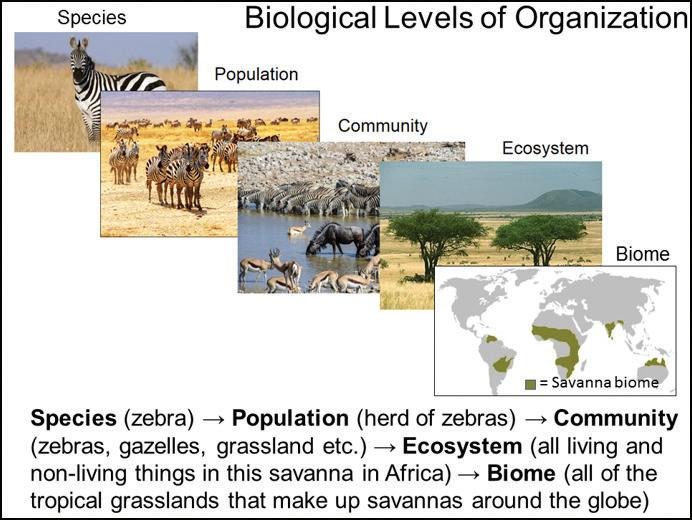
Biologists designate different levels of organization of the natural world into species, populations, communities, ecosystems, and biomes.
Species: Species are individual organisms that are self-replicating systems and maintain homeostasis (the balance of internal processes that make life possible) by responding to external stimuli. These individual organisms have common characteristics unique to their species. There are over eight million different species of living things. A zebra, giraffe, and fly are examples of different species.
Populations: Groups of interacting organisms of the same species are called populations. A population of organisms may be spread out within the ecosystem or exist together in the same area in an ecosystem, such as a herd of zebras or an area of grassland.
Communities: Groups of interacting populations are called communities. An example of a community is all the populations of zebras, elephants, giraffes, grasses, shrubs, insects, and other populations of organisms that live together on an African grassland or savanna.
Ecosystems: An ecosystem includes all the interacting biotic (living) and abiotic (nonliving) components in a given environment. Ecosystems are generally divided into two groups: aquatic (water) and terrestrial (land). Examples are the Amazon tropical rain forest, the African savanna, the Sahara Desert, etc.
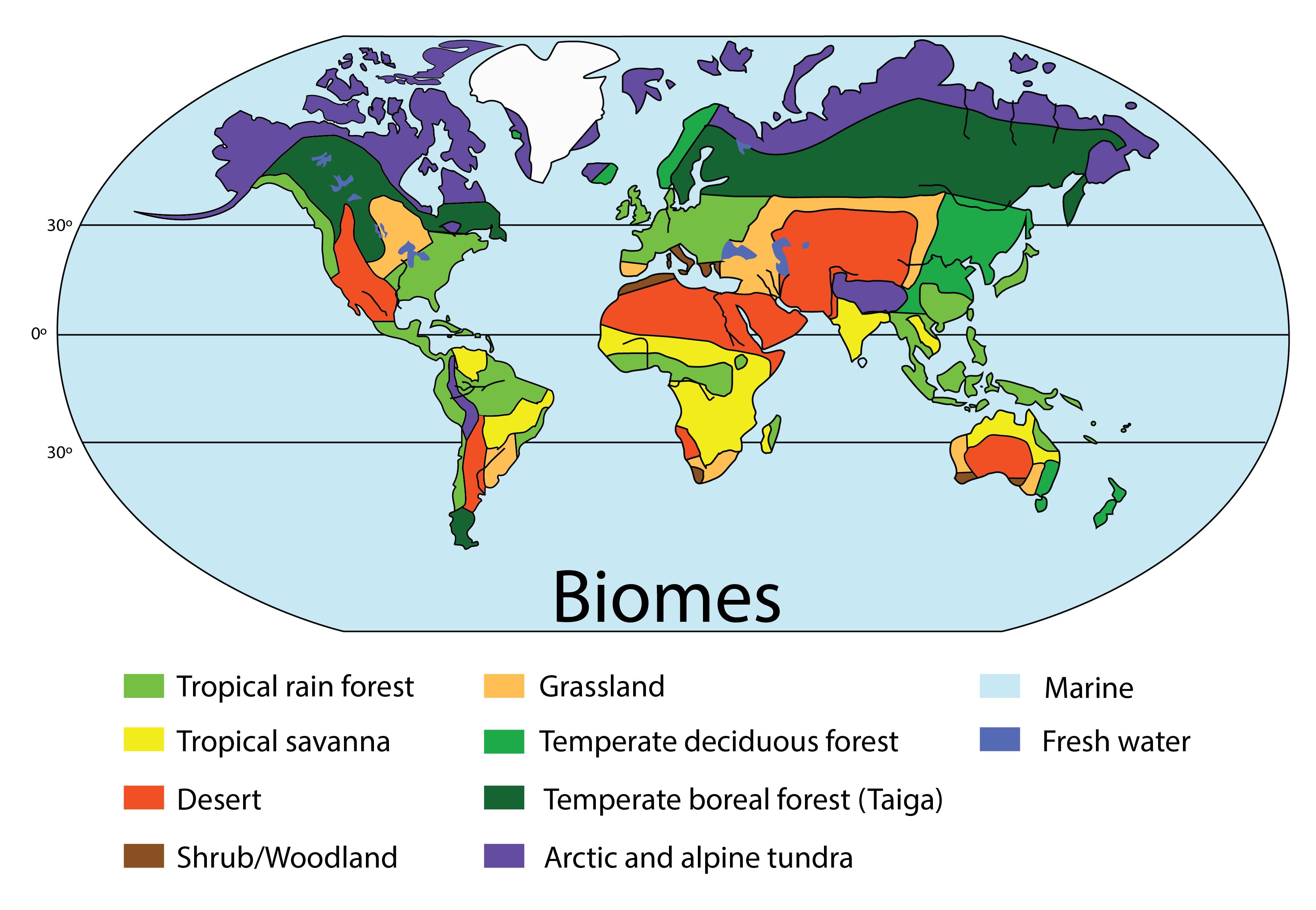
Biomes: Biomes refer to the larger biotic community across the planet. For example, the African savanna ecosystem is part of a large savanna biome of tropical grasslands found worldwide. Another example is the tropical rain forest biome that refers to an ecological community across the planet found in South America to Southeast Asia. However, the Amazon basin rain forest is a specific ecosystem within that biome. Look Out!
STEMscopedia
Below is a map of the major biomes of the world. Notice that many biomes are related to their location such as the northern arctic and alpine tundras or the midlatitude forests.
The living things in an ecosystem are interdependent. This means that living things depend on their interactions with each other and with nonliving things for survival. For example, a tree depends on sunlight for energy to make its own food. A snail depends on plants for food. A healthy ecosystem is one in which many different species are each able to meet their needs.
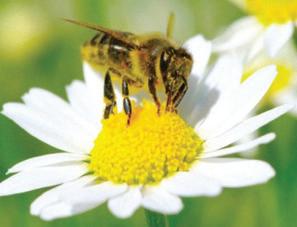
This bee is collecting pollen from a plant’s flower. It uses the pollen to make food for itself and other bees. The bee depends on the plant’s flower for food. What living and nonliving things do you think the plant depends on? Look Out!
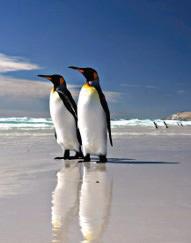
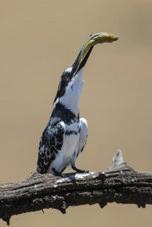
Living things are also dependent on the right environment. The environment must meet the particular needs of the organism. Penguins and kingfishers both eat fish, but the penguin would not survive in the kingfisher’s tropical or temperate environment. Neither could the kingfisher survive in the penguin’s Antarctic environment.
What Do You Think?
STEMscopedia
Reflect
How do the nonliving components in an ecosystem support the other components?
Nonliving components are important parts of any ecosystem.
• Sunlight is one of the most important nonliving components. Light from the Sun helps plants produce food and oxygen.
Sunlight also provides heat that makes life on Earth possible. Without the Sun’s heat, Earth would be too cold for most living things to survive.
Take a deep breath. Every time you breathe, you take in air. Air is a mixture of gases, including nitrogen, oxygen, and carbon dioxide. These gases are nonliving components needed by almost all organisms on Earth.
• Water is another important nonliving component. All organisms depend on water. A healthy ecosystem is one that has enough water to support the variety of organisms that live there. What would happen if there was not enough water?

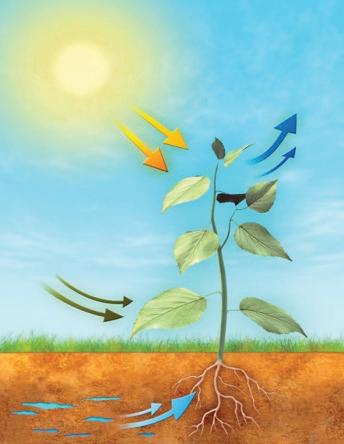
This plant uses nonliving components, such as sunlight, water, and carbon dioxide, to produce food (sugar) and oxygen.
• Temperature is a nonliving component that affects living things in an ecosystem. Think about what happens when the temperature drops in the winter.
Animals move to warmer areas or hibernate, trees lose their leaves and stop growing, and people begin to wear warmer clothing.
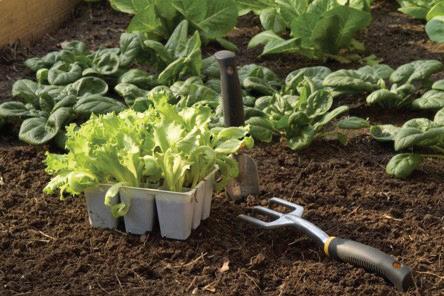
• Soil is another kind of nonliving component. In a desert, the soil is very sandy and has little moisture. It can support only certain plants that have adaptations to live with very little rainfall.
In a rain forest, the soil can be poor in nutrients but high in moisture. It supports large trees, long vines, and many other kinds of plants. These plants take up nutrients in the soil right away and often grow quickly.
STEMscopedia
Reflect
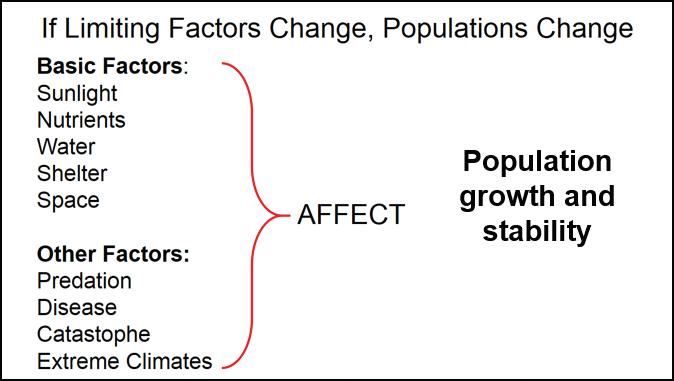
Changes in the physical environment can lead to population changes within an ecosystem. Environmental changes (natural or man-made) and limiting factors affect the health of an ecosystem. Examples of abiotic limiting factors include deforestation or seasonal changes. Examples of biotic limiting factors include disease or human activities.
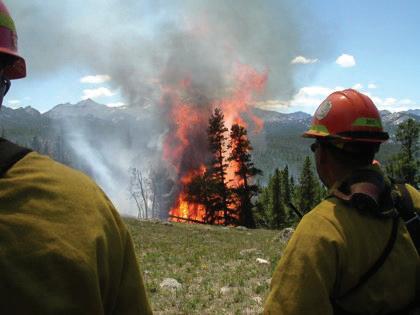
Natural disasters, like floods, droughts, and fires, bring changes in resources that will cause some organisms or populations to perish or move while permitting other organisms or populations to thrive. The basic factors (sunlight, nutrients, water, shelter, space) and other factors (predators, disease, catastrophe, extreme climates) affect the health and growth of populations in an ecosystem.
What Do You Think?
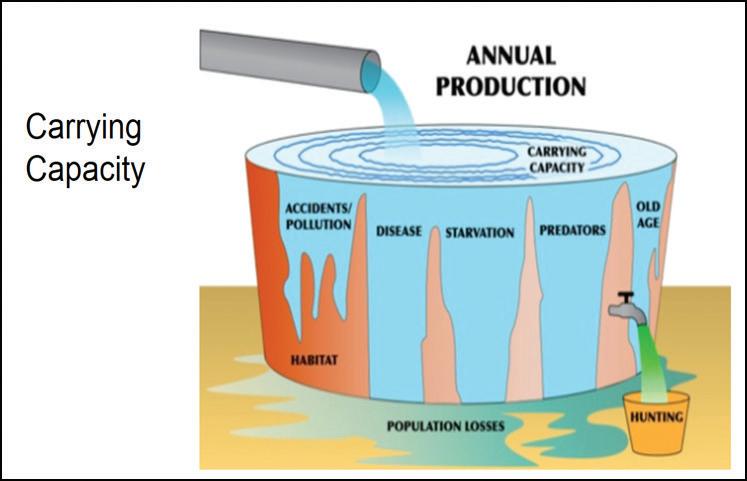
One measure of the impact of environmental changes from limiting factors or natural disasters is the carrying capacity of an ecosystem. The carrying capacity is the total number of living things that an ecosystem can support. An ecosystem can suffer a decrease in carrying capacity from major changes such as pollution, onset of disease, starvation, predators, hunting, or old age.
STEMscopedia
Reflect
Animals compete with each other for nonliving components, such as water. But animals are not the only organisms that compete for the resources around them! Plants also compete with each other and animals for nonliving parts of an ecosystem.
Suppose a fire destroys a forest. A short while later, new trees start to grow. At first, many young plants may grow in the forest. But some plants, such as trees, are able to absorb more water and nutrients, so they begin to grow taller.
As they grow, they block the sunlight to smaller plants growing below. The smaller plants cannot produce enough food to survive, and they die off. Forest ecosystems change because conditions in the forest are constantly changing.
How do the living components in an ecosystem support other components?
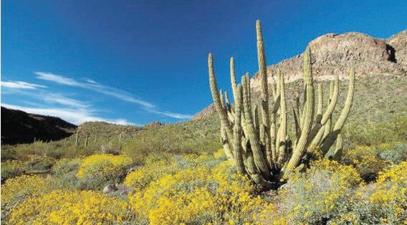
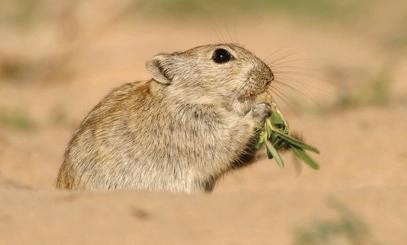
Think about some of the living components of a desert ecosystem. How do they interact with other things in the ecosystem? A desert has plants, such as grasses, bushes, and cacti. The grasses and bushes provide food to animals, such as deer and mice. Trees provide shade from the sunlight and shelter to other organisms. Birds help spread the seeds of a plant to new areas of the forest.
Burrowing creatures mix and move the soil, circulating nutrients back to the ecosystem. When organisms die, their bodies break down, become part of the soil, and provide nutrients to plants and other organisms. The living components of the desert depend on each other for survival.
A healthy ecosystem is one in which the population of each species is just the right size to support the other organisms that depend on it.
species: a group of organisms that are similar to one another and can combine to produce offspring
STEMscopedia
Look Out!
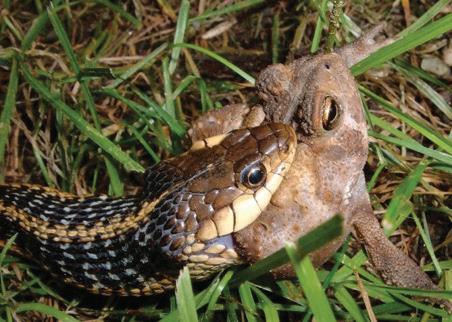
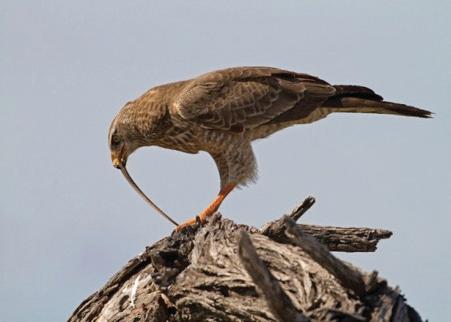
A single type of organism may play more than one part in an ecosystem. For example, you might think of a snake only as a predator. While a snake does eat other organisms, it may also be food for another predator. Certain birds, such as eagles or hawks, eat snakes for food. The snake is a predator and also a prey animal for other organisms.
Look Out!
What do you think would happen if a nonnative species were introduced into an ecosystem? The new species could actually damage the ecosystem!
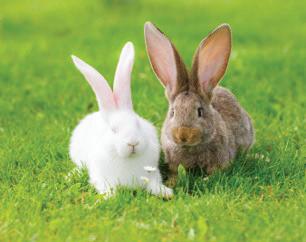
The balance of an ecosystem can be greatly harmed by the introduction of a new species. In the 1700s, European rabbits arrived by ship in Australia as a food source. Those that escaped started a population explosion.
Since there were no natural predators of rabbits in Australia, there was no control of the population. Rabbits are herbivores, meaning they eat plants for energy. Millions of dollars of crops were destroyed by the abundance of rabbits.
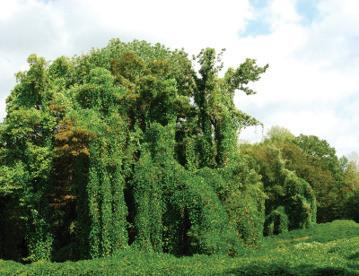
New species of plants can also destroy the balance in ecosystems. An invasive vine from Japan was introduced to the United States at the Centennial Exhibition in Philadelphia in 1876.
It was sold as a shade plant and as a plant to prevent soil erosion. The climate and soil of the Southeast proved perfect for the unchecked spread of kudzu.
STEMscopedia
Connecting With Your Child
Ecosystems
To apply what your child has learned about ecosystems, take your child to a natural area nearby. It could be your backyard, a local park, a riverside, a city street, or any area where you might observe organisms in their natural environment. Work with your child to select an organism to observe. It could be an animal, such as a deer, squirrel, or fish. Keep in mind that smaller animals, such as insects, can be found in grass and under rocks. Insects often make fascinating subjects for observation. You may also choose to observe a type of plant or a fungus, such as a mushroom. Whatever you observe, be safe and do not touch or otherwise disturb the organism.
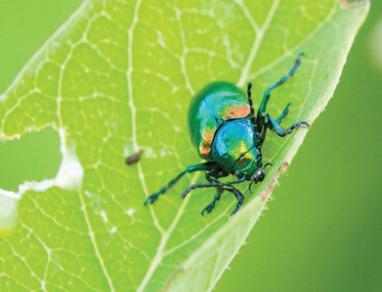
Write down the ways the organism is interacting with the living and nonliving components around it. For example, a beetle may be interacting with nonliving components by digging in the soil or drinking water. It may be interacting with living components by eating plants, or it may be prey for birds or other insects.
With your child, convert your list into a visual representation of these connections. Use a piece of poster board or butcher paper for your visual. Write the name of your organism at the center and draw a picture of it. Draw lines from the organism to all the living and nonliving components with which it interacts. Label each interaction on the line between the organism and the component. Feel free to draw lines between many different components.
For example, you may connect a beetle with a plant that it is eating, and then draw a line between the plant and the soil that the beetle is digging in. On the line between the plant and the soil, you can label that the plant obtains nutrients and water from the soil. The goal is to illustrate that the living and nonliving components in an ecosystem are highly interconnected.
Here are some questions to discuss with your child:
• How is your organism dependent on the living components in its environment?
• How is your organism dependent on the nonliving components in its environment?
• What components are needed by almost all organisms in the environment?
• Which interactions were difficult to observe? How do you know they were happening?
Reading Science
Otters and Urchins
1 The giant kelp forests along the coastlines of the northern Pacific Ocean are interesting ecosystems. The kelp in these ocean forests can rise over 250 feet from the ocean floor! The kelp forests provide a very important habitat for many sea creatures. Two creatures play a huge role in the health of this ecosystem—the sea otter and the sea urchin.
2 The sea otters help keep balance within this ecosystem. How do the sea otters do this? They stop the kelp forest from being overgrazed by the sea urchins. While sea otters eat many types of food, their favorite food is the sea urchin. In fact, they eat so many that it helps to keep the number of sea urchins in balance. In the 1990s, scientists noticed that sea otter populations were dropping in these ecosystems. After several studies, scientists found that orcas (killer whales) had shifted their diets. Orcas normally feed on sea lions, harbor seals, and, sometimes, larger whales. They were now eating sea otters at a level that had not been seen before the 1990s. What the scientists did not know is why the orcas suddenly turned to sea otters for food.
3 In the 1990s, commercial fishing practices shifted the food sources of sea lions and harbor seals. Some scientists thought this may be the answer. Other scientists thought it may have been due to shifts in temperatures of the oceans as a result of climate change. Shifting ocean currents may have changed the patterns of fish and other prey for the sea lions and harbor seals. Sea lions and harbor seals may have had to move to new hunting grounds, making it difficult for the orcas to find them.
4 As a result of the sea otter die-off, the kelp forests were starting to disappear. The sea urchin populations were no longer controlled by sea otters. As the sea otter population shrank, the sea urchin population exploded. In many places, the kelp forests became so overgrazed by sea urchins that they turned into areas called urchin barrens. The disappearance of the kelp forests affected the populations of many other organisms. In fact, the entire kelp forest community was altered as a result of the decline in sea otters.
5 What is clear in this study is that some external factors (factors outside of the giant kelp forest) affected the ecosystem. Those factors could be fishing, warming oceans, or a shift in food sources. Whatever the reason, the end result had a serious effect on all the populations of organisms within the entire kelp forest community. In other words, factors that were at first external to (outside of) the kelp forest had major effects on the sea otters, sea urchins, and kelp within that ecosystem.
Reading Science
1 Based on Paragraph 3, what might have caused orcas to shift their diets to sea otters?
A Shift in ocean temperatures
B Shift in ocean currents
C Shift in commercial fishing practices
D All of the above
2 What would be an example of a food chain in the giant kelp forest ecosystem?
A The sea urchins are eaten by the sea otters, which also eat the kelp.
B The orcas eat the sea otters, which eat sea lions and harbor seals.
C The sea otters are eaten by the orcas, which also eat sea lions and sea urchins.
D The giant kelp is eaten by the sea urchins, which are eaten by the sea otters.
Reading Science
3 What was the immediate cause of the decline in the sea otter population?
A The feeding habits of the orcas
B The feeding habits of the sea urchins
C The feeding habits of the other creatures within the kelp forest
D The feeding habits of harbor seals and sea lions
4 What would be a negative effect of the kelp forest ecosystem falling out of balance?
A Increased wave action
B A loss of different types of creatures within the ecosystem
C An increase in the sea urchin population
D All of the above
Reading Science
5 What does external factor mean?
A Ecosystem balance
B A factor outside of a system
C An urchin barren
D A scientific study
6 What is an urchin barren?
A A giant kelp forest that has been overgrazed by sea urchins
B An event in which the sea otters have eaten all the urchins
C An external factor that has affected the sea urchins
D None of the above
Open-Ended Response
1. Look at the picture of the desert. Name some biotic and abiotic factors from the desert ecosystem.
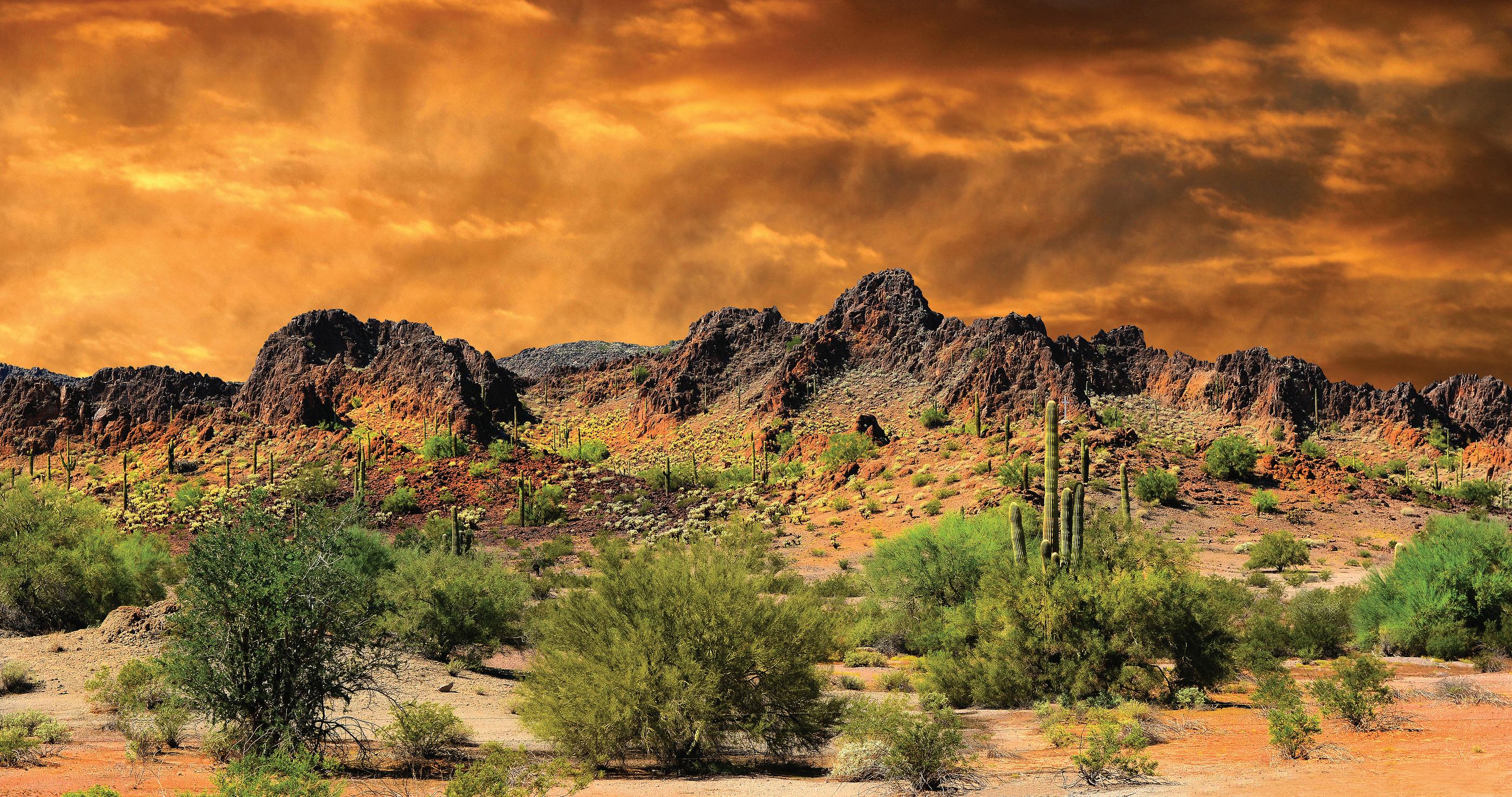
Abiotic Factors
Biotic Factors
2. What biotic factors do fish in a small pond depend on to meet their needs?
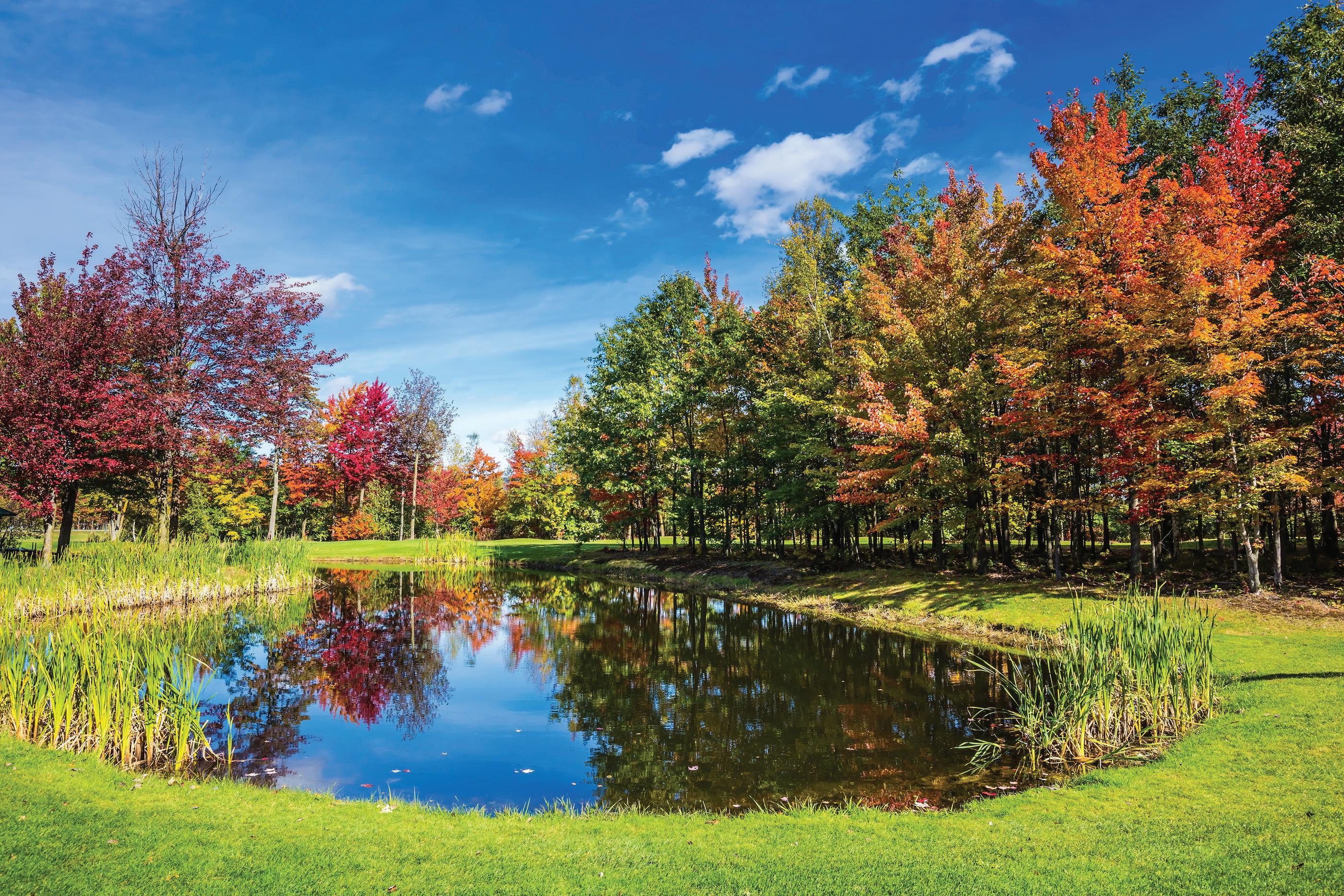
Open-Ended Response
3. The bull’s-eye is a model for the organization of living things. Fill in each of the levels with one of the following groupings: ecosystems, communities, organisms, biomes, and populations.
Open-Ended Response
4. Koalas live almost entirely on leaves from eucalyptus trees, and they are native exclusively to Australia. What would happen if the koalas’ food supply were destroyed by the invasive insect eucalyptus longhorned borer?
One of the fiercest predators on Earth’s surface is the polar bear. This large carnivore lives on the sea ice in the Arctic Circle. Marine mammals such as the ringed and bearded seals make up their diet. Polar bears can swim great distances to find their food. Only during mating season will they seek out other polar bears.
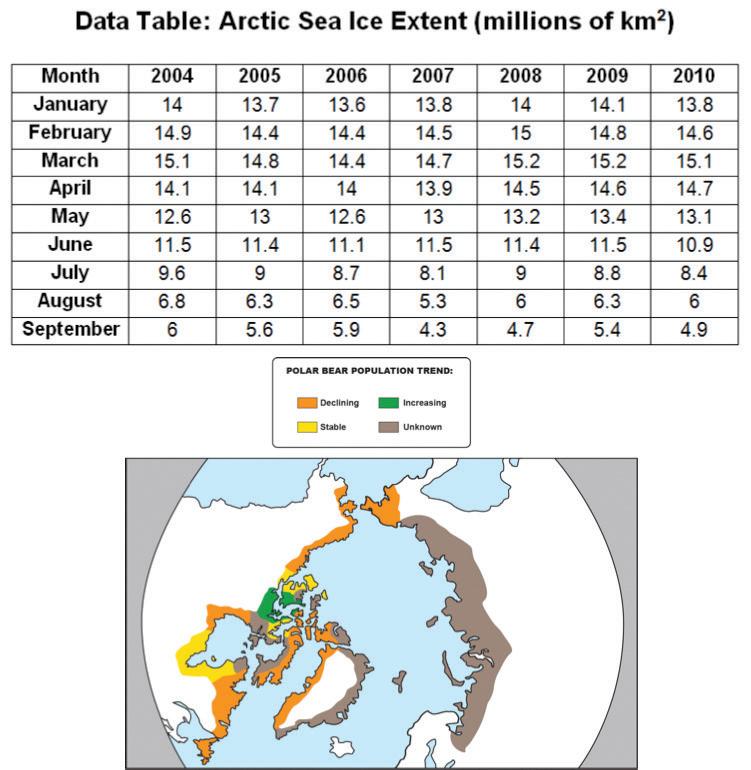
a scientific explanation for why there are more regions with decreasing polar bear populations than there are regions with increasing or stable polar bear populations.
Interactions between Organisms
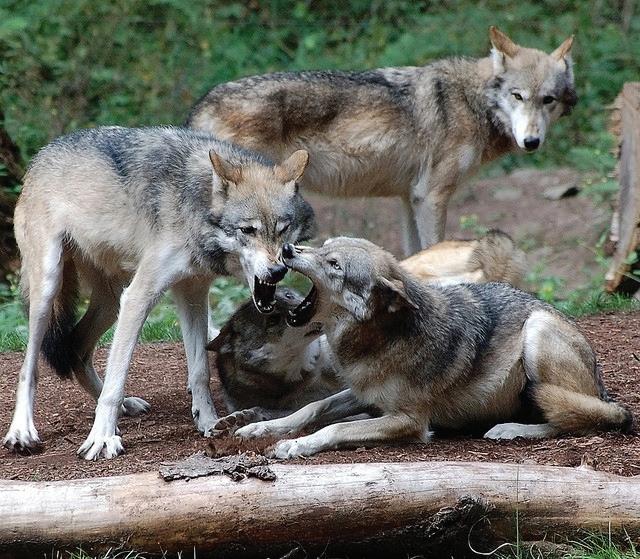
Matching Symbiotic Buddies
Activity
When organisms live together in communities, they interact all the time. Competition occurs when organisms seek the same resources, especially when the population density is high. Resources include anything necessary for life, such as water, nutrients, light, food, or space. Cooperation occurs when multiple species work together for common benefits to the ecosystem, such as lions or zebras traveling in packs or herds. Predation is a natural relationship between organisms. It occurs when one organism captures and feeds on another organism. Any relationship in which two species live closely together is called symbiosis. These symbiotic relationships are usually beneficial to one or both organisms.
Procedure
1. Look at your Invitation Card.
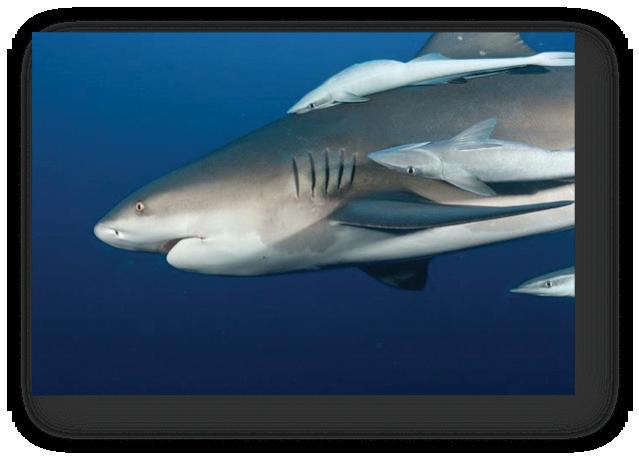
2. Travel around the room to find your “date,” or the match for your Invitation Card.
3. Determine which type of relationship you and your “date” have.
4. Share your relationship with the class, and record each relationship on the next page. Include the type of relationship and the organism involved in a data table.
5. Write a description of each of the types of relationships.
6. Participate in a class discussion regarding the types of relationships you encountered in this activity. Review the relationships from the Matching Symbiotic Buddies section of the chart, reading your interaction and explaining which type of relationship is exhibited.
Explore 1
Type of Relationship
Organisms Involved
Explore 1
Below, summarize each type of interaction within an ecosystem.
1. Predation:
2. Competition:
3. Cooperation:
4. Symbiotic:
Explore 2
Analyzing Food Webs
1. Draw and label your class food web. Use arrows to show the flow of energy from one organism to another.
2. Where does all energy originally come from? _____________________________________
3. Name the following:
Producers
Herbivores
Carnivores
Omnivores
Decomposers
Explore 2
Reflection and Conclusion Questions
1. What is the difference between autotrophs and heterotrophs? Provide examples of each.
2. Identify a food chain from this food web that contains at least one producer and three consumers. Label them in the graphic below, and analyze how energy is transferred through an ecosystem from producers (autotrophs) to consumers (heterotrophs, including humans) to decomposers.
Heterotrophs (Consumers)
Heterotrophs (Consumers)
Heterotrophs (Consumers)
Autotrophs (Producers)
Explore 2
3. Create a second food chain below that contains one of each of the following:
Producer → Herbivore→ Carnivore→ Omnivore→ Decomposer
4. What do the arrows show in any food web?
5. What is the role of decomposers in any ecosystem?
STEMscopedia
If you were hiking on a mountain, you might not notice these rocks covered with lichens as you pass by. But the tiny organisms that live on these rocks are an amazing model of interdependence.
A lichen is composed of two organisms: a fungus and a photosynthetic algae or bacteria. These two organisms cooperate with each other to survive. The fungus provides the algae or bacteria with a structure to live in as well as important materials from the surrounding environment. The algae or bacteria provide the fungus with food. These organisms cooperate to exploit (or obtain) the resources in their shared environment, allowing them to survive in harsh environments that have very few nutrients. Relationships between organisms within an ecosystem help maintain balance in the community. These relationships can take many forms.
What are some of the different types of relationships between organisms in an ecosystem? How do these relationships affect each organism?
Symbiotic Relationships
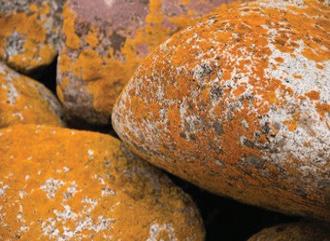
When two different species of organisms live in close contact, this relationship is called symbiosis. The term symbiosis comes from the Greek language and means “living together.” In lichens, a fungus and an alga or bacterium coexist in the same physical space and share materials. Some forms of symbiosis are beneficial to both organisms, as seen in lichens. Other forms of symbiosis benefit only one partner, and some forms actually harm one partner. Symbiotic relationships can be classified into three categories:
• Mutualism: both organisms benefit
• Parasitism: one organism benefits; the other is harmed
• Commensalism: one organism benefits; the other is unaffected
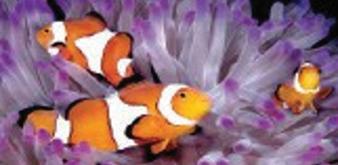
Clown fish have a symbiotic relationship with the sea anemone. The clown fish get protection from predators by staying inside the anemone. The anemone is unaffected. Which type of symbiosis is this relationship? Reflect
STEMscopedia
Symbiotic relationships may be obligate or facultative. In an obligate arrangement, one species must live with the other in order to survive; the species is obligated to the other species. In a facultative arrangement, one or both of the organisms can benefit from the symbiosis, but neither requires it to survive. For example, certain species of plants contain nitrogen-fixing bacteria in their roots. The bacteria convert atmospheric nitrogen into a form that the plants can use. The plants can also obtain nitrogen from freeliving soil bacteria, however, and the bacteria can live in the soil outside the roots of the plant.
Mutualism: A Win-Win Situation
Both organisms participating in a mutualistic relationship benefit from the partnership. An example is the relationship between hummingbirds and the flowers they feed on (pictured at right). The hummingbird benefits from consuming the flower’s nectar. The flower benefits when the hummingbird spreads the flower’s pollen to other members of its species. Many scientists believe that mutualistic relationships evolved from organisms that originally had parasitic relationships. Parasites harm, weaken, or sometimes kill their hosts, which does not help either the hosts or the parasites in the end. In a mutualistic relationship, both organisms benefit from each other.
Everyday Life: Symbiotic Relationships and Human Survival
The human body is a host to a wide variety of bacteria species. Colonies of bacteria live throughout the human body, including on the skin, in nasal passages, and along the digestive tract.
The human intestines are home to about 500 different species of bacteria. If not for mutualistic bacteria, humans would not be able to digest certain foods or keep their immune systems running efficiently. Bacteria help the human digestive tract break down food molecules by providing enzymes that humans do not produce. Humans are able to digest and absorb nutrients that would not otherwise be available to them. Bacteria also contribute vitamins and anti-inflammatory compounds that aid digestion and enhance human nutrition.
Researchers have identified approximately 10,000 species of bacteria that live inside the human body. Some species of bacteria can provide the same crucial functions as others in the digestive tract. If one species is killed off when a person takes antibiotics to fight a disease, another species takes over those functions. Microbes also help regulate human metabolism and contribute to weight control. Studies have also shown that bacteria affect how neutrophils or other immune cells respond in the body. The genus Lactobacillus has been shown to reduce inflammation and help prevent cancer or infection caused by other types of bacteria, such as Salmonella
Hummingbirds have a mutualistic relationship with flowers. The bird drinks the nectar and distributes pollen to other flowers as it flies.

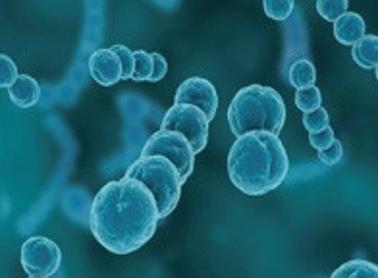
STEMscopedia
Parasitism: One Benefits, and One Suffers
Parasites are organisms that live on or within another organism called a host and feed on it. In this relationship, the parasite benefits, and the host is harmed. Tapeworms are examples of parasites; they live inside an animal’s digestive tract and consume nutrients that are meant for the host.
The heads of tapeworms have four large suckers and two rows of hooks to latch on to intestines. (Photo courtesy of the CDC Laboratory) Reflect
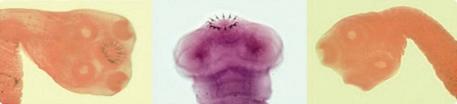
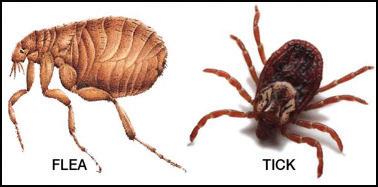
Some parasites, such as fleas, ticks, and lice, live and feed on the outer surface of a host. Other insects may lay eggs on a host, allowing larvae to feed on the host when they are born. Parasites typically harm their hosts without killing them. It is in the parasite’s best interest to keep its source of nutrients well enough to stay alive. When the host dies, the parasite is forced to find another victim.
Commensalism: One Benefits, and No One Suffers
Commensalism is a type of symbiosis in which one species benefits and the other species neither benefits nor suffers from the association. Starlings, for example, benefit from a commensal relationship with deer. The grazing deer flush out insects from the grass, and the starlings can then eat the insects. This relationship also exists between the cattle egret and cattle or sheep.
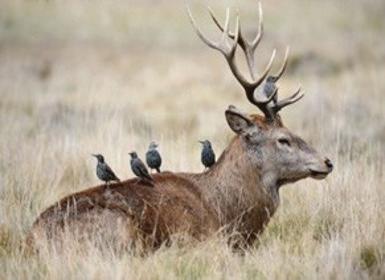
Another example of commensalism is the relationship between barnacles and whales or sea turtles. Barnacles are sedentary creatures that feed on plankton and waste products floating in the water. When they attach themselves to creatures such as whales or sea turtles, barnacles are able to filter food as the whales and turtles travel through the water. The whale or sea turtle is seemingly unaffected by this process.
Plants can also participate in commensal relationships. The creosote bush benefits from the shade provided by the desert holly shrub. The creosote bush appears to do nothing for the holly shrub in return.
STEMscopedia
Reflect
Competition occurs when more than one organism is trying to obtain the same resource. Organisms occupy a niche or role in their environment. For example, a snail might consume algae and live in small, cool ponds. This is its niche. If another species of snail also consumes algae and lives in small, cool ponds, then these two species of snail will compete for food and space. Competition can lead to the elimination of one species. This fight for resources becomes particularly fierce in dense populations. If a large number of organisms live in a small space, resources will become limited more quickly.
When different species compete for the same resources, they are engaged in interspecific competition (inter means “among”). Animals like hyenas and vultures in the top-right photo are competing for the same food. Interspecific competition also occurs in plants. In forests, for example, trees that grow tall quickly are able to outcompete others for sunlight. As they grow larger, they crowd out other plant species competing for the same nutrients, water, sunlight, and even space. The black walnut tree actually inhibits the growth of neighboring plants by secreting a chemical or poison called juglone.
Organisms may have to fight for resources within their own species. This is called intraspecific competition (intra means “within”). Grasshoppers competing with each other for grass and other vegetation are one example. Once the food source is depleted, the population declines. Animals also compete for mates and territory in the quest for survival.
Look Out!
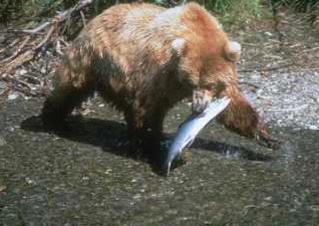
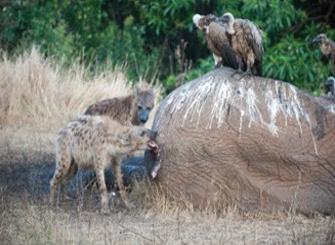
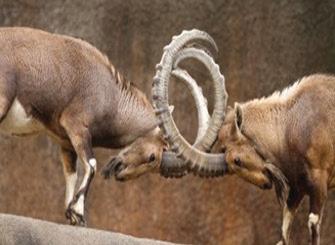
These rams are fighting for dominance, which will result in superior mates, territory, food, and water sources for the winner.
Predation and competition are not the same. When animals compete, they are fighting for a limited array of resources. When they exhibit predation, one animal becomes a resource for another. The bear is the predator, and the fish is the prey.
STEMscopedia
What Do You Think?
Organisms continue to interact in food chains and food webs. Energy is transferred from one organism to the next within ecosystems as it flows through food chains and food webs. Energy from the Sun travels through a number of different organisms in a food chain
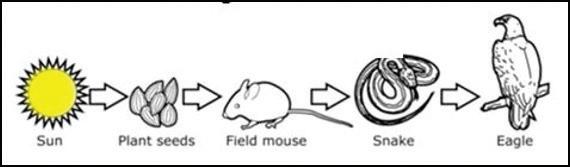
In a food chain, the energy seems to flow in a straight line from one organism to the next. In reality, though, energy in an ecosystem flows in many directions. This is because most consumers rely on more than one type of food. For this reason, a food web is a better way to show these relationships.
A food web is a connection of food chains with many food energy paths in an ecosystem. Just as in a food chain, the energy that starts a food web comes from the Sun. All food chains are connected within an ecosystem. The example is from an African grassland ecosystem. Notice that more than one predator can feed on the zebra and on the dung beetle.
Food energy pyramids show the relatively large number of autotrophs (producer plants that make their own food, shown on the bottom of the pyramid) that must support an ecosystem of herbivores, primary predators, and secondary predators. The number of organisms decreases as the energy flows from producers to larger consumers at the top of the food energy pyramid.
food chain: the path of food energy from the Sun to producers and then to consumers (The example is from a prairie ecosystem.)
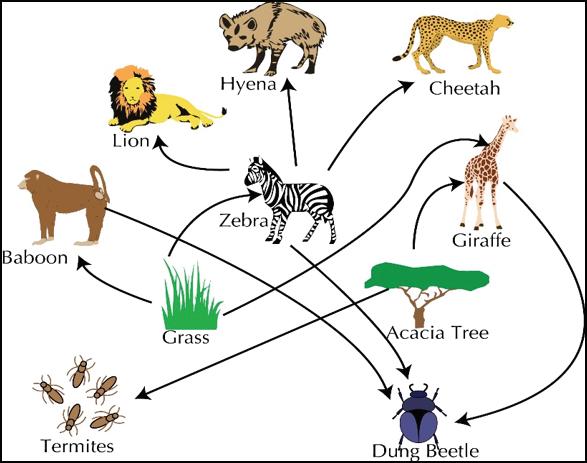
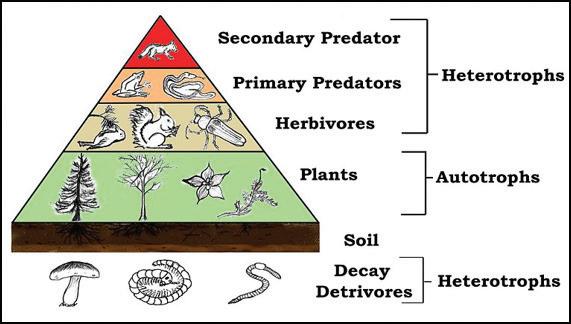
STEMscopedia
What Do You Know?
The table below lists examples of the different types of symbiosis. For each example, decide whether it demonstrates mutualism, commensalism, or parasitism. Write your answers in the middle row. Then explain your reasoning in the bottom row.
Examples of Symbiosis
A bluebird lives in a maple tree. It builds a nest in the tree where its eggs are protected from the harsh environment.
This is an example of
Stinging sea anemones live on the claws of a female boxing crab. The boxing crab uses the anemones like boxing gloves, protecting herself against predators.
As a colony of braconid wasps undergoes metamorphosis, they live on a hornworm and digest its insides, causing the hornworm to die.
This is an example of This is an example of
STEMscopedia
Connecting With Your Child
Hide-and-Seek for Middle Schoolers
To help your child learn more about the types of symbiosis, explore the three different symbiotic relationships through a game of hide-and-seek with a twist.
When playing the game, make sure you set boundaries so no one will wander too far from the house. Also, take a quick look around at the grounds to be sure there are no objects or hiding spots that could be dangerous or harmful. Note that this is a group activity that can be modified to be played as a game of charades between parent and child.
To incorporate the theme of this chapter, make cards with the following titles written on them: mutualist, commensalist, and parasite. Pair the children who will be hiding into teams of two. Give one member of the team one of the cards you have prepared and tell him or her not to reveal the card to his or her partner. Then explain to each child with a card that he or she has to act like the title on the card. In other words, follow these guidelines:
• If the child is a mutualist, he or she will do everything possible to help the other player.
• If the child is a parasite, he or she must try to get the partner to help with everything and then do something harmful, such as revealing his or her hiding place.
• If the child is a commensalist, he or she must try to get the partner to do everything to help him or her without doing anything in return but also without harming the partner.
When the child who is seeking finds each player, he or she needs to also guess what role the partners are playing. The seeker can wait to guess the roles until he or she has found each player. By then, the players’ actions should have created enough evidence to help the seeker make an informed decision.
Here are some questions to discuss with your child:
• To the guesser: How did you figure out which roles everyone played? Was it difficult or easy?
• How did your partner react when you tried to play the role of the mutualist?
• Which role was hardest to play? Why? Which was easiest? Why?
Reading Science
Kansas Prairie Food Chain
1 How do the levels of organization in biology create an entire biological system? When we study the biological world, we can see that every level is very complicated. Each part is organized from the smallest atoms in an organism to the largest organism. In multicellular organisms (organisms with many cells, like us), atoms combine to make molecules, and molecules combine to make cells. Cells combine and work together to make tissues, like muscles. Tissues then work together in the form of organs, like your heart. Organs work together in organ systems, like your digestive system. In other words, all of the parts work together to create a whole.
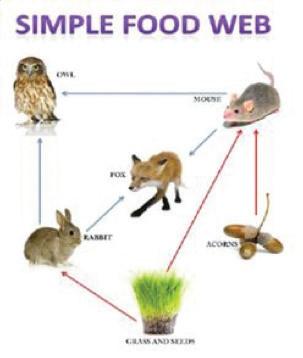
2 Each organism lives in a specific feeding level in the ecosystem. These levels are known as trophic levels. Energy must always be coming from the Sun to support all of the trophic levels. This energy is passed from producers to consumers all the time. Let us look at the flow of energy through the Kansas tallgrass prairie ecosystem.
3 Prairies used to be the most common ecosystem in the central part of North America. Today, farmland has replaced most of the prairies. Protected prairies may be found in the Flint Hills in Kansas and Oklahoma. In tallgrass prairies, grasses can be more than seven feet tall! Every ecosystem needs producers. Grasses are the main producers on the prairie, but you can also find lichens, flowering plants, and mosses. You may find it interesting that most of the plant material is actually underground. The grasses’ root systems are huge and are almost three-quarters of the material of the plant.
4 Let us use the food chain picture to see how energy flows through parts of the prairie system. Big bluestem grass and acorns (producers) are eaten by eastern cottontail rabbits and mice. The mice and rabbits are consumers that are herbivores. The mice and rabbits are then eaten by owls and foxes. The owls and foxes are consumers that are carnivores. The numbers of producers and consumers in most ecosystems also follows a pyramid. There are far more grasses and other plants (producers) than rabbits and mice, or first-level consumers known as primary consumers. There are even fewer owls and foxes, or second-level consumers known as secondary consumers.
5 One useful rule of thumb for ecosystems is the 10% rule. It states that, on average, 10% of the energy contained in one level is able to be used by the next-higher level. In fact, very little energy actually flows into the higher trophic levels. Therefore, most ecosystems contain only three or four trophic levels. For animals at higher trophic levels, like owls and foxes, there is simply not enough energy for the population to have a lot of babies. If you visit a tallgrass prairie, there will be a lot more grasses and rabbits than foxes and owls. This also means that animals from higher trophic levels are, in general, in more danger of extinction.
Reading Science
1 Which of the following organisms would the reader expect to find the most of in the tallgrass prairie ecosystem?
A Grasses and flowering plants
B Mice and rabbits
C Foxes and owls
D Humans
2 Organisms that use the Sun’s energy directly are called–
A consumers.
B carnivores.
C omnivores.
D producers.
3 Animals or organisms that eat only plants to get energy are called–
A producers.
B herbivores.
C carnivores.
D omnivores.
Reading Science
4 What is a trophic level?
A The energy from sunlight
B The height of the prairie grass
C A specific feeding level in the ecosystem
D All of the animals on the prairies
5 What is the 10% rule?
A 10% of the producers get energy from the Sun.
B 10% of primary consumers get energy from the Sun.
C Each trophic level is made of only 10% animals.
D 10% of the energy contained in one level is able to be used by the next-higher level.
6 Scientists count the number of organisms in the tallgrass prairie. Which trophic level would the reader expect to contain the smallest number of organisms?
A The grasses and other producers
B The primary consumers
C The secondary consumers
D None of the above
Open-Ended Response
1. Examine the diagram below. Which organisms compete for food resources?
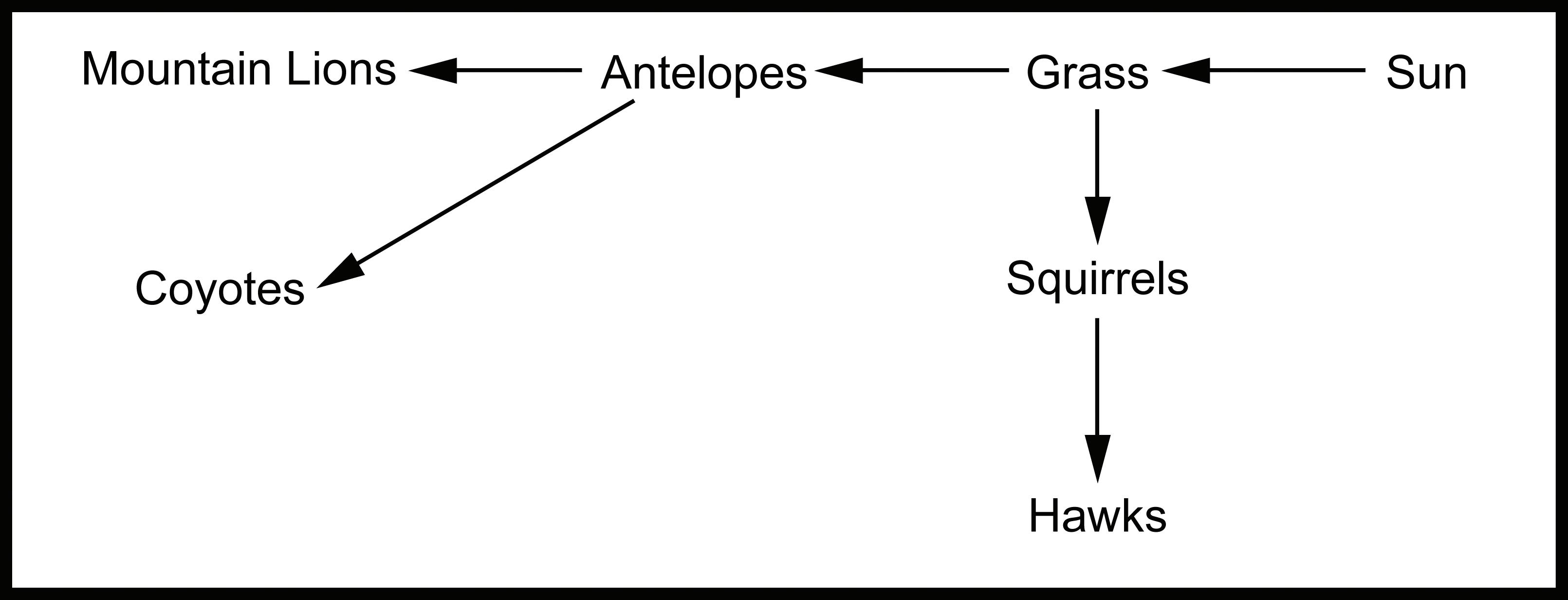
2. Sharks consume smaller fish they catch in the ocean. Frogs catch and eat flying insects in ponds. How are these types of relationships best described?
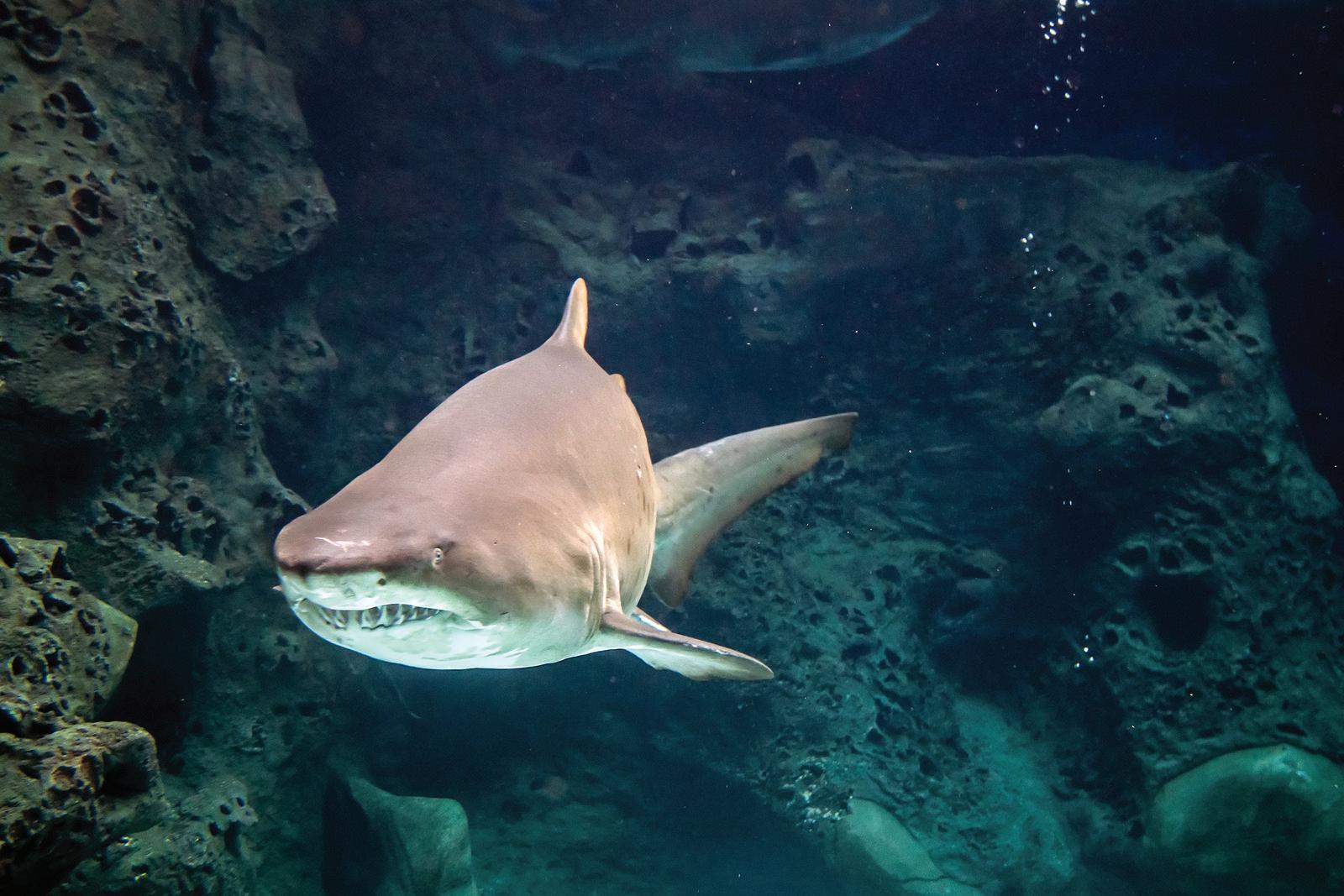
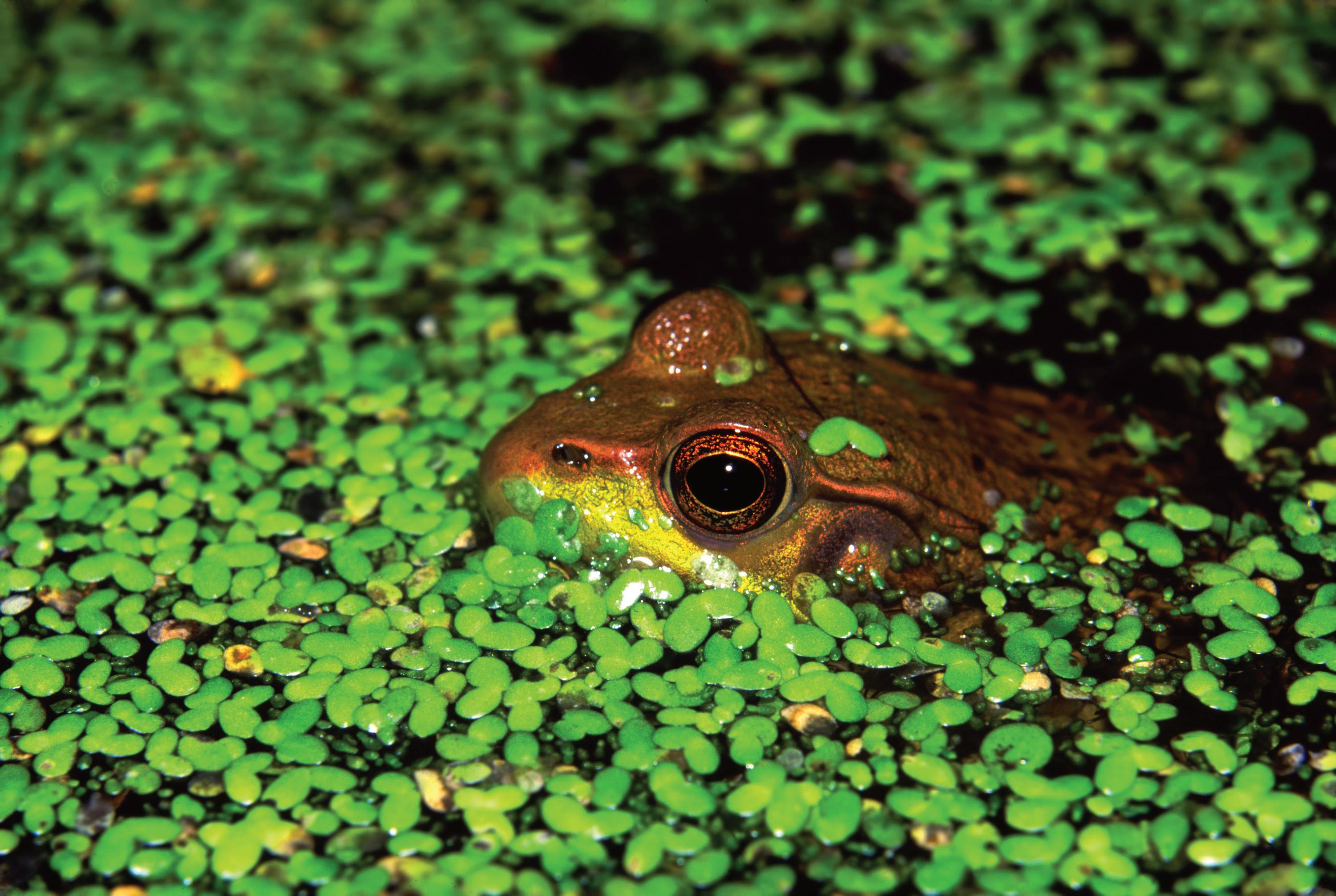
Open-Ended Response
3. A marine food web is provided below. Describe the relationship between the tuna and the squid.
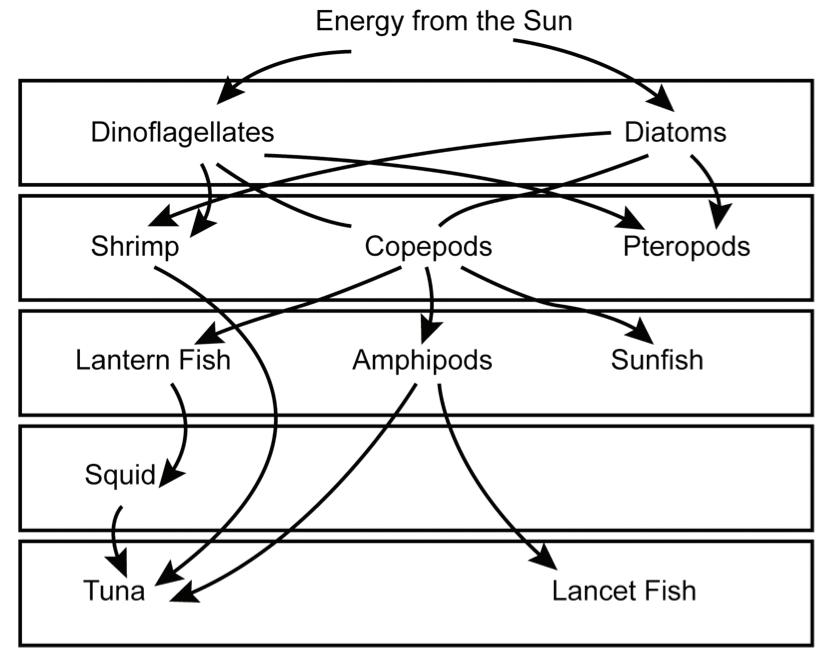
Open-Ended Response
4. Draw and describe a food web that includes the eagle pictured below in a forest habitat. Remember to include where the food web’s energy originates, and describe how energy moves through the food web you describe. Your food web should include producers, consumers, and decomposers.
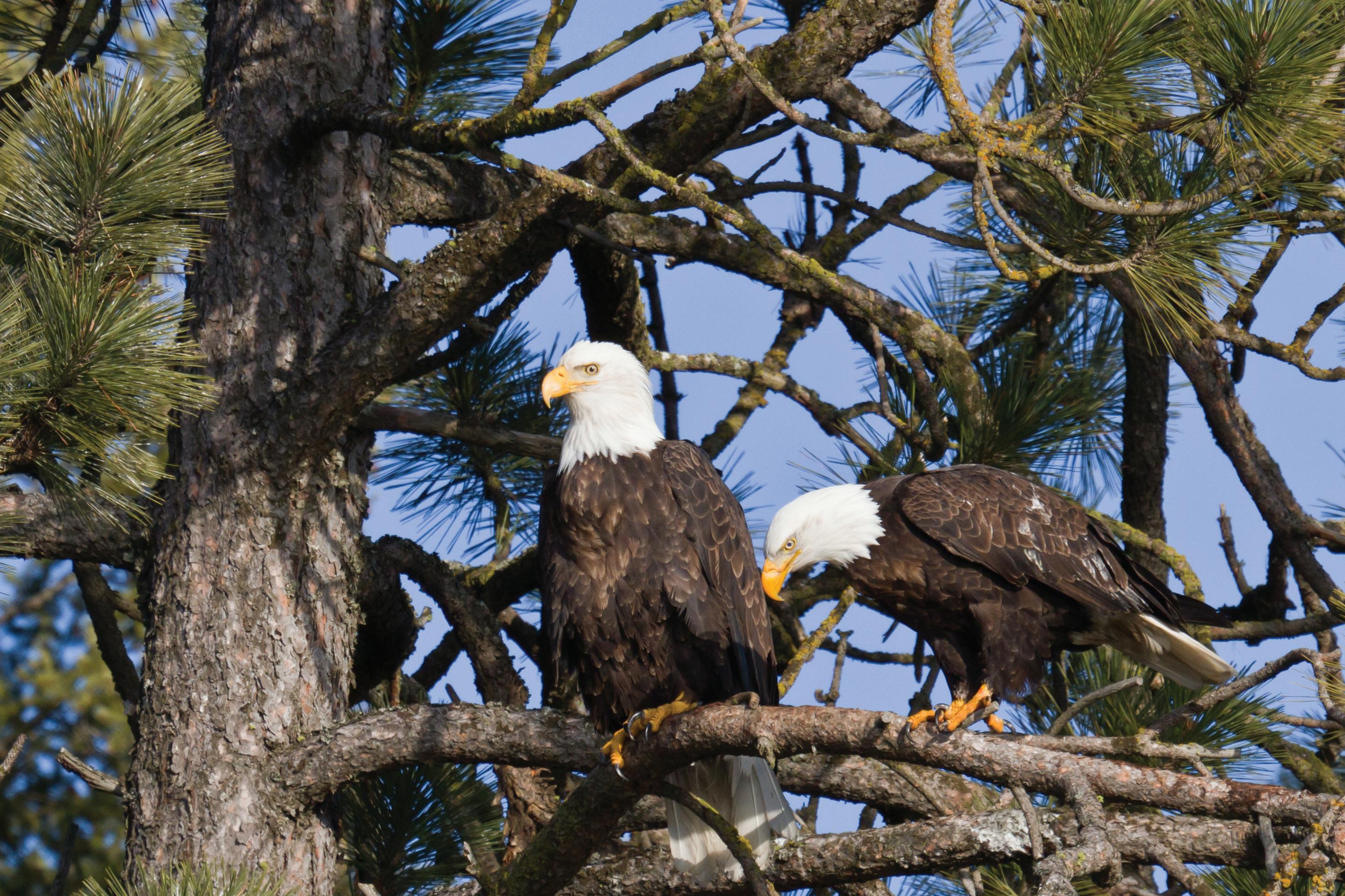
An energy pyramid depicts the flow of energy within an ecosystem. The energy pyramid provided represents an example terrestrial ecosystem. Write a
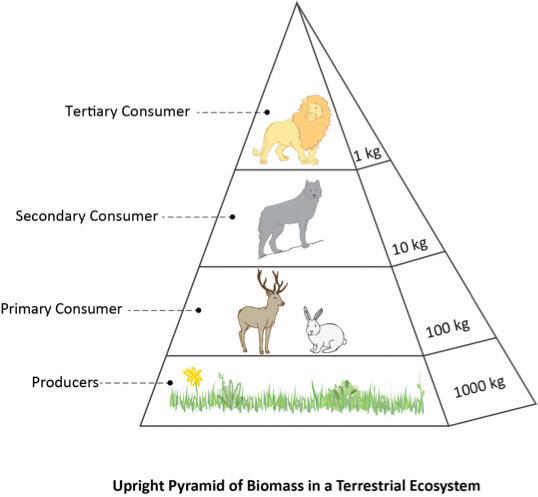
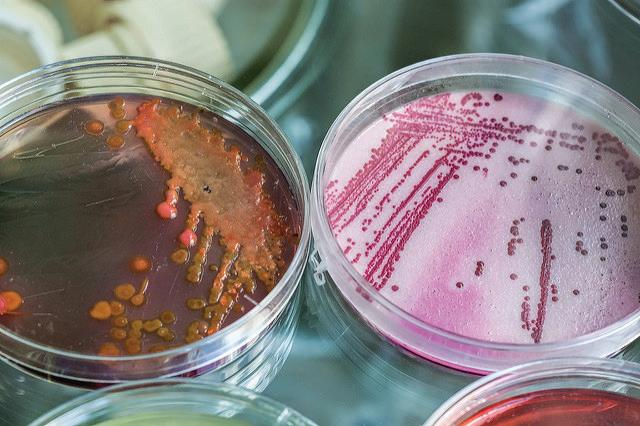
Classification of Organisms
Answer the questions while observing the slideshow.
1. How does a sunflower get nutrients?
2. How many cells does a sunflower have?
3. How does a sunflower reproduce?
4. What type of cells does a sunflower have?
5. How does a mushroom get nutrients?
6. How many cells does a mushroom have?
7. How does a mushroom reproduce?
8. What type of cells does a mushroom have?
Complete the following phrases to form a question that can be used to sort organisms.
Example: How do I get nutrients? Do I … make nutrients myself (autotrophic) OR do I rely on nutrients where I live (heterotrophic)?
1. How many cells do I have? Do I …
2. How do I reproduce? Do I …
3. What do my cells look like? Do I …
4. How do you think scientists use these differences in characteristics to organize organisms?
5. What other kinds of characteristics could be used to sort organisms into different groups?
Explore 1
Methods of Classification
Biologists have identified more than 1.5 million different species on Earth. This is only a fraction of what scientists believe the total number could be, which is anywhere from 5 million to 100 million. Because of this abundance and diversity, scientists organize species with similar characteristics into groups based on their structure, function, and relationships. This is known as taxonomy or taxonomic classification.
The current system of classification is based on the hierarchical system used by Swedish scientist Carolus Linnaeus. Linnaeus grouped organisms based on common physical characteristics. However, with the ability to sequence genes, scientists are now able to bring classification to a new level.
Research to determine the contributions various scientists have made to the classification of organisms.
Procedure
1. As a group, research your assigned scientist to answer the following questions:
A. Who is the scientist and when did he or she live?
B. What is the scientist’s method of classifying organisms?
C. How is this classification system different from the previous method or methods?
D. What (if any) technology allowed for the development of this new method of classification?
Explore 1
2. Create an informational page that includes your researched data.
3. Share information about your scientist through a gallery walk. Have one group member remain with the informational page as the rest collect information from the other groups.
4. Share the recorded information about all of the scientists with your group members.
Scientist:
Who is the scientist and when did he or she live?
What is the scientist’s method of classifying organisms?
How is this classification system different from the previous method or methods?
What (if any) technology allowed for the development of this new method of classification?
Scientist:
Who is the scientist and when did he or she live?
What is the scientist’s method of classifying organisms?
How is this classification system different from the previous method or methods?
What (if any) technology allowed for the development of this new method of classification?
Explore 1
Scientist:
Who is the scientist and when did he or she live?
What is the scientist’s method of classifying organisms?
How is this classification system different from the previous method or methods?
What (if any) technology allowed for the development of this new method of classification?
Scientist:
Who is the scientist and when did he or she live?
What is the scientist’s method of classifying organisms?
How is this classification system different from the previous method or methods?
What (if any) technology allowed for the development of this new method of classification?
Scientist:
Who is the scientist and when did he or she live?
What is the scientist’s method of classifying organisms?
How is this classification system different from the previous method or methods?
What (if any) technology allowed for the development of this new method of classification?
Explore 1
Scientist:
Who is the scientist and when did he or she live?
What is the scientist’s method of classifying organisms?
How is this classification system different from the previous method or methods?
What (if any) technology allowed for the development of this new method of classification?
Scientist:
Who is the scientist and when did he or she live?
What is the scientist’s method of classifying organisms?
How is this classification system different from the previous method or methods?
What (if any) technology allowed for the development of this new method of classification?
Explore 1
5. Use your collected data and notes to create a T-chart to compare and contrast the classification methods of Aristotle, Linnaeus, Woese, and one of the other scientists.
Aristotle Linnaeus Woese
Sorting by Kingdoms
Organisms can be classified into groups based on their cellular structure, whether or not they have defined nuclei (eukaryotes versus prokaryotes), or whether their entire body is made up of one cell (unicellular) or they have many cells (multicellular). Scientists can also look at how organisms function to help classify them. For example, organisms that make their own food are known as autotrophs, and organisms that need to consume other organisms in order to get the nutrients they need to survive are known as heterotrophs. How an organism reproduces is another way scientists separate organisms into smaller groups. Organisms can be asexual, where only one parent passes a copy of its genes on to its offspring, or sexual, where two parents combine their genes and the combination is passed on to their offspring.
Part I
Procedure
1. Cut out the In What Kingdom Do I Belong? Cards.
2. Read: Classifying by Kingdoms.
3. Use the information to choose the correct kingdom for each organism.
4. Paste each organism card in the appropriate kingdom.
Kingdom Archaebacteria
Unicellular prokaryotic organisms that can be heterotrophic or autotrophic and reproduce asexually
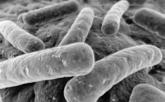
Kingdom Eubacteria (Bacteria)
Unicellular prokaryotic organisms that can be heterotrophic or autotrophic and reproduce asexually
Explore 2
Kingdom Protista (Protists)
Unicellular eukaryotic organisms that primarily reproduce asexually
Kingdom Fungi
Multicellular and heterotrophic eukaryotic organisms that reproduce both sexually and asexually
Kingdom Plantae (Plants)
Multicellular and autotrophic eukaryotic organisms that reproduce both sexually and asexually
Explore 2
Kingdom Animalia (Animals)
Multicellular and heterotrophic eukaryotic organisms that primarily reproduce sexually
Explore 2
Part II: Kingdom Slideshow
Procedure
1. Search around your home, school, neighborhood, and the Internet for examples of your assigned kingdom.
2. Use a digital camera to take pictures, or find images from the Internet for examples of your kingdom. Collect at least four examples to show the diversity of organisms within the kingdom.
3. Write a description of each kingdom that includes structures and behavioral characteristics organisms share within their kingdom.
4. Create a slideshow. The slideshow should include a title page and at least one page for each noted structural or behavioral characteristic associated with the kingdom. Use the checklist to ensure all of the requirements for the slideshow have been included.
5. Place your photographs and descriptions on the appropriate slides. Highlight or point out the shared structural and behavioral characteristics for each organism within the kingdoms.
Kingdom: Included in Slideshow ✓
Title Page
Description of Kingdom
Structural Characteristics
Behavioral Characteristics
Images of Four or More Organisms
Explore 2
6. Share your slideshow with your class.
7. Take notes during each presentation to gather data to support the claim that organisms have shared structural and behavioral characteristics.
Kingdom Archaebacteria Eubacteria (Bacteria) Protista (Protists)
Description of Kingdom
Structural Characteristics
Example Organisms with Structural Characteristics
Behavioral Characteristics
Example Organisms with Behavioral Characteristics
Kingdom
Description of Kingdom
Structural Characteristics
Example Organisms with Structural Characteristics
Behavioral Characteristics
Example Organisms with Behavioral Characteristics
Fungi
Plantae (Plants) Animalia (Animals)
Explore 2
8. Use your collected data to write a scientific explanation to support the claim that organisms have shared structural and behavioral characteristics.
Claim: Organisms have shared structural and behavioral characteristics.
Evidence:
Reasoning:
STEMscopedia
Classifying and naming organisms is a practice that dates back to ancient Greece. Aristotle (384–322 BC) was one of the first to group and categorize living things based on their characteristics. His system introduced the binomial (two-name) labels for living things. Aristotle used one name for a genus, which had shared structures, and the second name for a unique characteristic. Thus, humans were classified as a “rational animal.”
After Aristotle, scientists and academics continued his work by adding to classification systems and creating new ones as discoveries were made. By the 18th century, there were multiple classification systems in place, each with its own way of categorizing and naming species. In order for collaboration in the scientific community to advance, changes had to be made.
Aristotle (384–322 BC)
What changes to classification were necessary? What tools could scientists use to organize organisms consistently? What characteristics represent different groups of organisms?
A Standardized System of Classification and Naming
In the past, scientists were unable to properly communicate about living organisms. Newly discovered species were randomly named. In fact, some may have been discovered multiple times due to the lack of ability to distinguish the classification systems. A standardized system of grouping and naming life was necessary in order to allow scientists to communicate and maintain organization of the wide diversity of life on Earth.
Carolus Linnaeus was an 18th-century scientist who focused his studies on plants. However, he is known best as the father of taxonomy.
Taxonomy is a systematic process of classifying living organisms into different groups based on their physical traits and genetic relationships. Over the years, Linnaeus’s original system was modified as new discoveries were made, but the basic system is still intact.
The groupings of living things begin as broad classifications and become narrower and more specific as they continue. The highest and broadest level of classification is called the domain.
Carolus (Carl)
STEMscopedia
Domain is followed by kingdom, phylum, class, order, family, genus, and species. The table below shows the classification of the domestic dog, Canis familiaris, from domain to species.
Binomial Nomenclature
Organisms are commonly referred to according to the two most specific taxonomic levels: genus and species, which are often Latin. This is called binomial nomenclature. The taxonomic name of modern humans is Homo sapiens. The genus is always capitalized, the species is lowercase, and the whole name is written in italics. By using this same system, scientists around the globe can freely communicate with certainty that they are referring to the same organisms.
Imagine that, before the establishment of taxonomy, a scientist working in Africa writes a letter to a biologist in England claiming that he has discovered a new organism. It is unique, and he has never seen one before. He has named the animal a glotchbot. The British biologist spreads the word about the glotchbot through the scientific community, and everyone in the community becomes excited about this new discovery. The scientist returns from Africa with a picture of the glotchbot shown on the right. Suddenly, the scientific community loses all interest, and both the scientist and the biologist are disrespected. How would a standard system of taxonomy have changed the outcome of this scenario?
Career Corner: Taxonomist
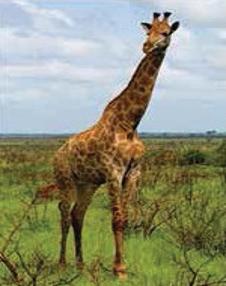
Scientists who study taxonomy and use the classification system to identify and name organisms are taxonomists. Taxonomists are first and foremost scientists. They have a fundamental knowledge of biology or other related fields. They often have advanced degrees in zoology, animal physiology, botany, or other life sciences. Museums, zoos, aquariums, and universities are common places of employment for taxonomists. Here they can study DNA, environments, and other influences that have contributed to characteristics of life. Taxonomists’ knowledge is often used to educate others through lectures and publications about conservation of endangered or threatened species.
Eukarya Animalia Chordata Mammalia Carnivora Canidae Canis familiaris
STEMscopedia
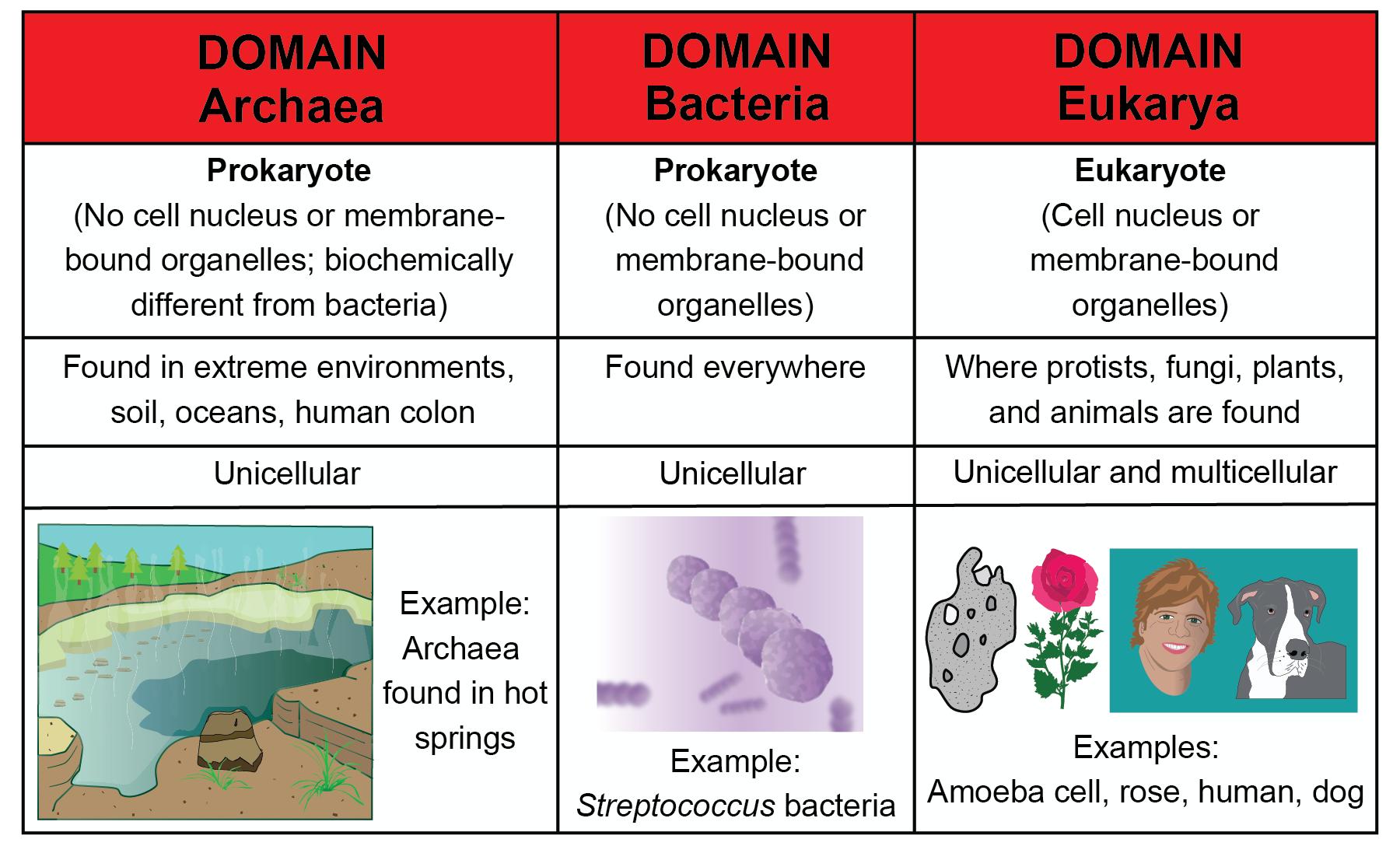
What Do You Think?
Bacteria Are Everywhere
Classification into Domains: Bacteria, Archaea, and Eukarya
The three domains differ fundamentally in their cellular structures and genetic makeup. The domains are so broad that all life can be separated into just three different categories. Let us examine the basic differences between these three categories of life.
Domain Bacteria: This domain consists of unicellular prokaryotes. They lack a cell nucleus and membrane-bound organelles, but they are surrounded by a thick cell wall. Bacteria are microscopic in size.
Bacteria can be found nearly everywhere on Earth, including living inside human beings’ mouths and stomachs. Bacteria are incredibly diverse. Some are free living, while others rely on a host to survive. Many use oxygen, while others are killed by the presence of oxygen. Like plants, some bacteria are photosynthetic. Many bacteria cause infections, such as strep throat (Streptococcal pharyngitis) and food poisoning (Escherichia coli and Salmonella enterica). However, most bacteria are beneficial and serve a necessary role in their environment. There are a wide variety of characteristics and functions among the members of domain Bacteria. Note: Like bacteria, viruses are microscopic, but viruses are not living things because they do not have cells and depend on a host for replication. They can be harmful, but some are helpful in the production of vaccines.
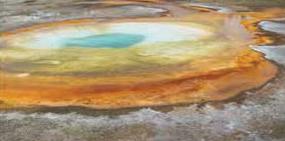
Archaea are thermophiles; they thrive in hot places like this geothermal pool.
Domain Archaea: Like domain Bacteria, the members of Archaea are unicellular prokaryotes. They also have a cell wall, but it differs in composition from that of bacteria. Archaean cell walls lack the substance peptidoglycan found in bacteria. Their cell membranes also differ, containing unusual lipids that are not found in any other organisms on Earth. (A lipid is a type of biomolecule; fats, oils, and waxes are examples of lipids.) One of the most distinct features of domain Archaea organisms is that they are able to survive in some of the most extreme environments on Earth. Archaea have been found in the hot springs of Yellowstone National Park in Wyoming and in deep oceanic hydrothermal vents measuring over 100°C (212°F). Others live in environments with extremely high salinity and acidity.
STEMscopedia
Domain Eukarya: Unlike cells in the Archaea and Bacteria domains, eukaryotic cells contain a nucleus and membrane-bound organelles. Most are multicellular, but some are unicellular. Eukaryotes are found all over the world in a variety of environments.
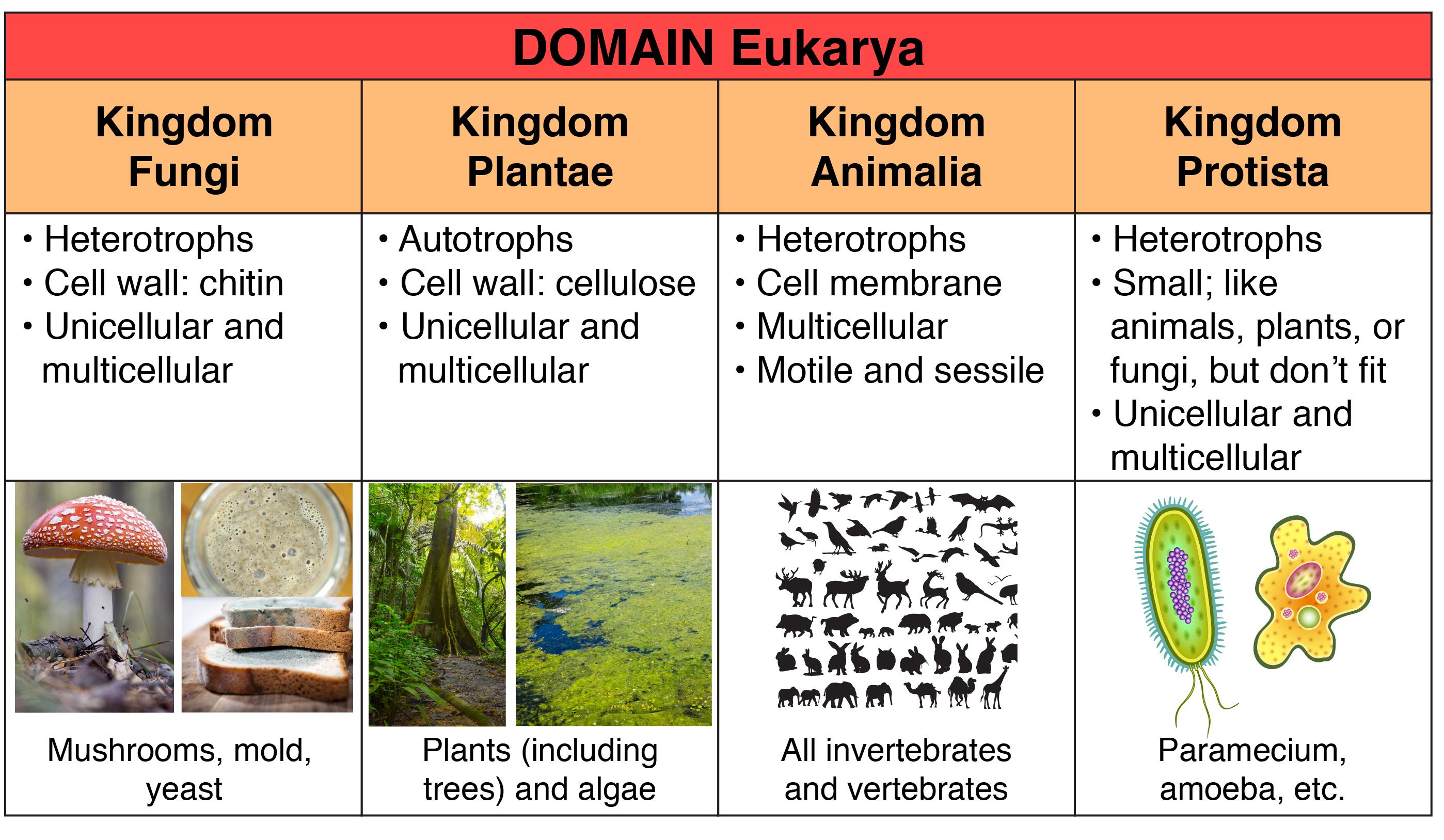
The Four Kingdoms of Eukaryotes
Domain Eukarya is incredibly diverse. It includes organisms from daffodils to dragonflies and orangutans to oak trees. It is divided into four kingdoms based on the most general characteristics. The kingdoms are Protista, Plantae, Fungi, and Animalia. Each kingdom is further divided into phyla, classes, orders, and so on. The members of each kingdom have distinct enough characteristics to allow us to begin identifying organisms.
STEMscopedia
Protista: These ancient eukaryotes have some characteristics not shared by many other members of the domain, including the fact that many are unicellular. Even within the kingdom, there is great diversity. In fact, many protists are classified in this kingdom just because they do not fit in any of the others. They vary greatly in their appearance, mobility, reproduction, and methods for obtaining food. Some protists are even photosynthetic. Examples of protists are a Euglena, Paramecium, and amoeba
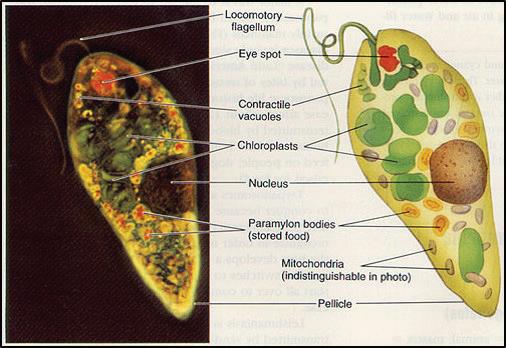
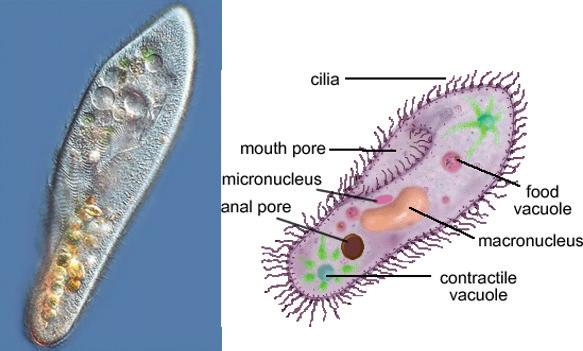
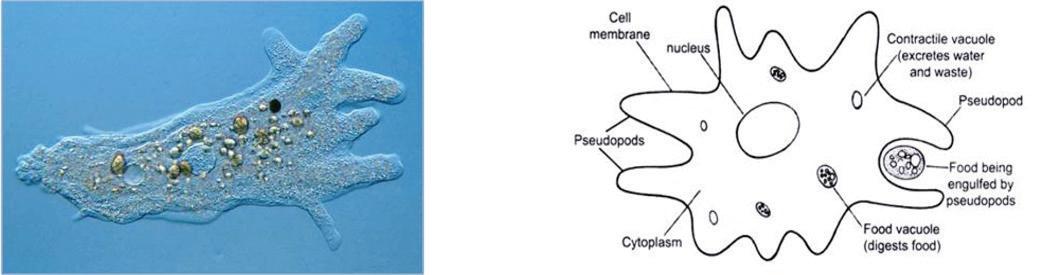
Reflect
Euglena
Paramecium
Amoeba
STEMscopedia
Reflect
Plantae: Plants are very common eukaryotes. They include a wide variety of organisms, such as flowers, shrubs, grasses, trees, mosses, and ferns, with unique characteristics and functions. But there are some properties of kingdom Plantae that they all share. Plants are multicellular organisms that are able to photosynthesize
Since plants can use energy from the Sun to produce food, they are considered autotrophs. Plants lack mobility and often must rely on the wind or animals to help them reproduce through crosspollination. All plants have the same basic parts, including roots, stems, and leaves.
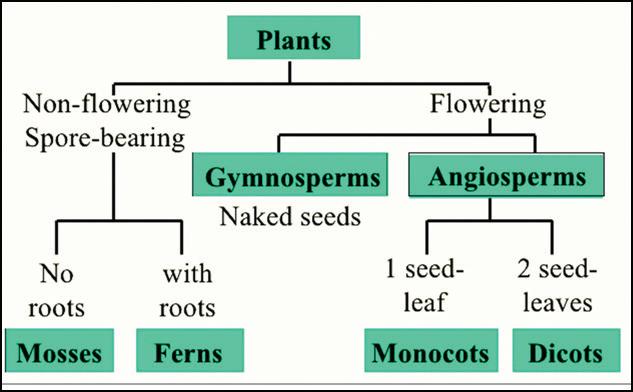
Their cells are unique from other eukaryotes because they are surrounded by a rigid cell wall made mostly of cellulose. The cell wall gives plants structure and support, allowing them to grow tall and expose their green leaves to the Sun for photosynthesis. Plants may be classified with different criteria. One way is to group them into vascular (leaves, stems, and roots) and nonvascular plants (leaves, stems, or roots), seed-bearing and sporebearing, and angiosperms (flowers) and gymnosperms (pine cones). Plants can also be classified as grasses, herbaceous plants, woody shrubs, and trees
What Do You Think?
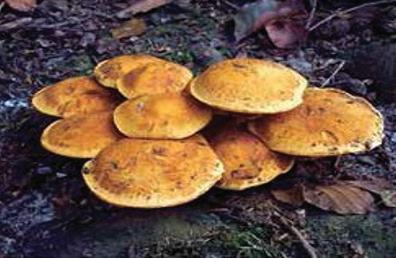
A mushroom is actually the reproductive organ of a fungus.
Fungi: Fungi, such as mushrooms, are often confused for plants. They do share some similarities. For example, most are multicellular, although yeasts, a type of fungi, are unicellular. Like plants, the cells of fungi have a cell wall, which is usually made of chitin instead of cellulose.
Fungi, however, cannot produce their own food through photosynthesis, so they are called heterotrophs. This kingdom has some characteristics that differ from any of the other eukaryotes. A primary difference is that fungi grow long filaments called hyphae
Many fungi feed by releasing enzymes outside their bodies. The enzymes break down and digest nearby leaves, fruits, and other substances. Once digested, the molecules of food are absorbed into the fungal body. These enzymes are also important to decomposition. Fungi break down dead, organic matter and return nutrients to the soil. They help maintain the balance with organisms like plants that take nutrients from the soil.
STEMscopedia
Reflect
Animalia: Like all the kingdoms, Animalia is quite diverse. In addition to humans, it includes birds, fish, insects, and a wealth of other animals. What they all have in common is that animals are multicellular, are heterotrophic, and have cells lacking a cell wall. Also, animals are motile at least at some point in their lives.
Beyond these characteristics, animals vary greatly in their body plans, reproduction, methods for obtaining food, and many other factors. Animals can be grouped based on the presence of a backbone into invertebrates, such as sponges, clams, insects, and worms, or into vertebrates, such as fish, reptiles, birds, amphibians, and mammals.
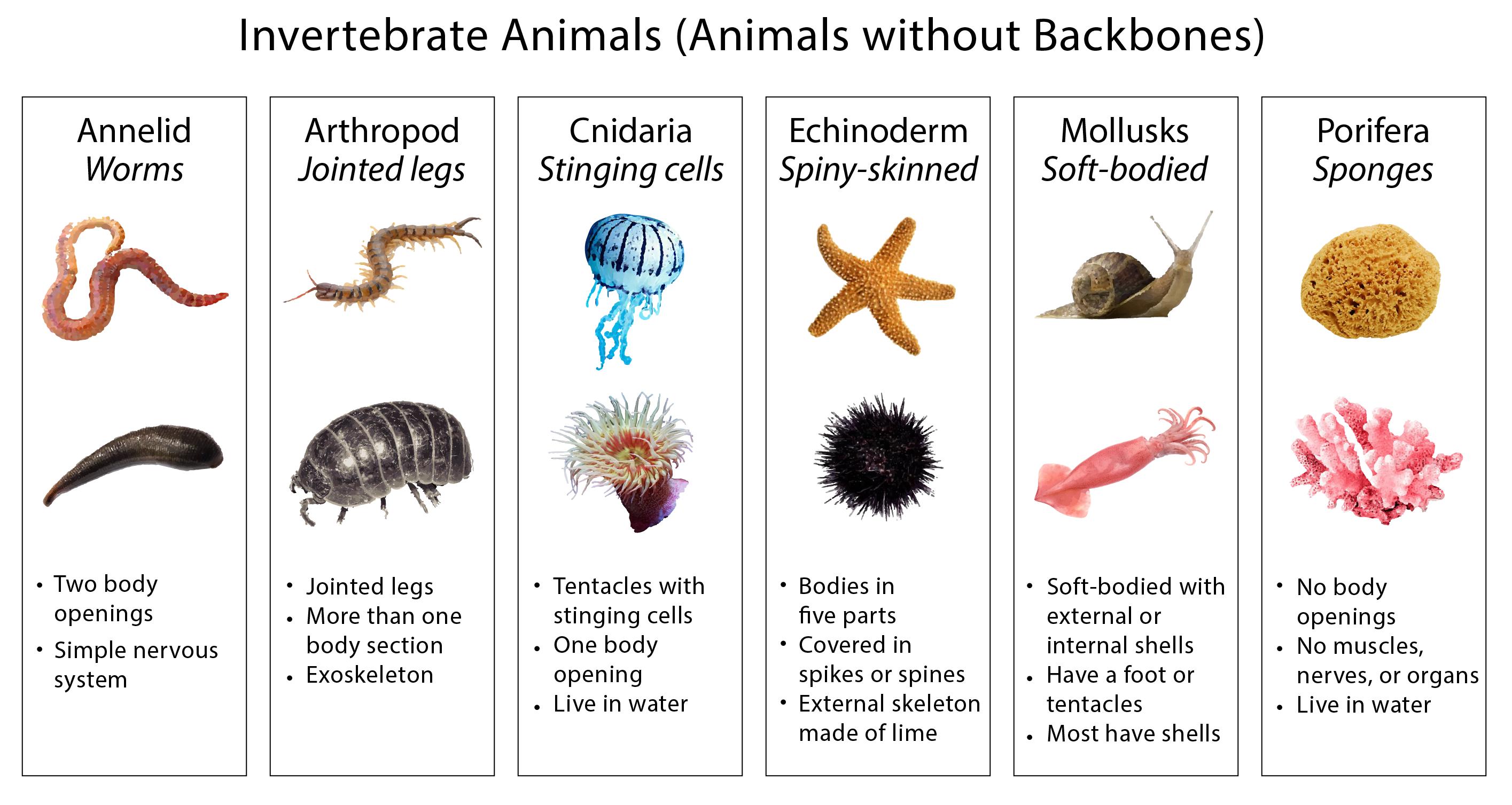
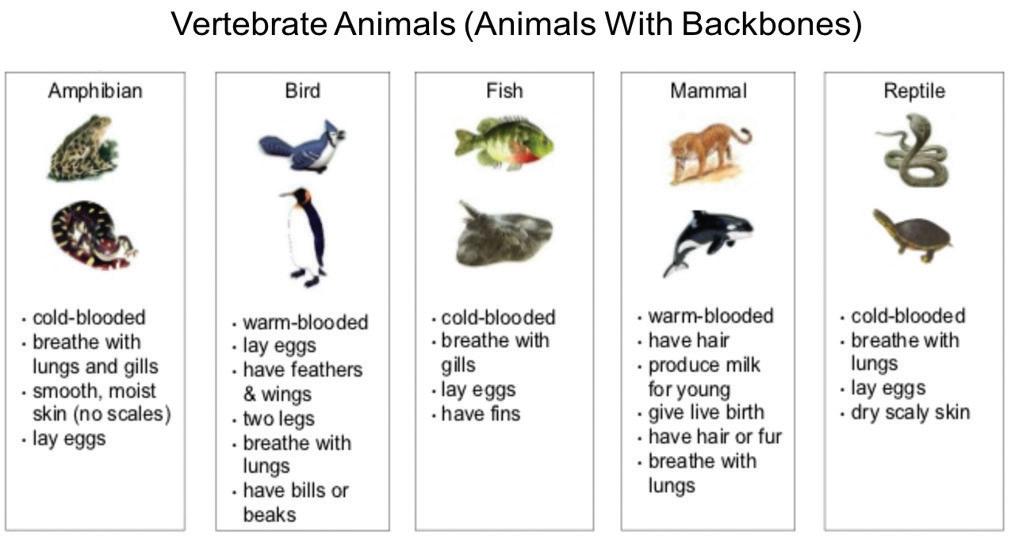
STEMscopedia
Try Now
Tools for Classifying Organisms
Two methods scientists rely on to identify and classify organisms are dichotomous keys and cladograms. These tools help scientists determine how organisms are related through common ancestry.
Part I: A dichotomous key is a type of flowchart made up of questions or paired statements about an organism. Following each of the steps of a dichotomous key helps scientists identify organisms based on their traits. Use the dichotomous key below to identify the fish shown on the left.
1. Is the fish’s body long and thin?
This animal is a ______________________________.
Yes Go to step 2.
No Go to step 3.
2. Does the fish have pointed or rounded fins? Pointed Trumpet fish Rounded Moray eel
3. Are the eyes on top of the fish’s head?
4. Does the fish have a long tail or a short tail?
5. Does the fish have spots?
6. Does the fish have whiskers?
Yes Go to step 4.
No Go to step 5.
Long tail Spotted eagle ray Short tail Witch flounder
Yes Go to step 6.
No Glassy sweeper
Yes Spotted goatfish
No Bandtail puffer
Part II: A cladogram is a branched diagram resembling a tree that shows the evolutionary relationship among organisms. It is often used to show how similarities are derived from common ancestry. Places where a lineage branches off in a cladogram are called nodes. They represent speciation events. The fewer the number of nodes between organisms, the more closely they are related. Cladograms provide scientists with a visual summary of how organisms in any taxonomic grouping are related. Look at the cladogram to the right. Which two organisms are more closely related, a hagfish and a lizard or a pigeon and a chimp? Circle the correct pair. How do you know? __________________________
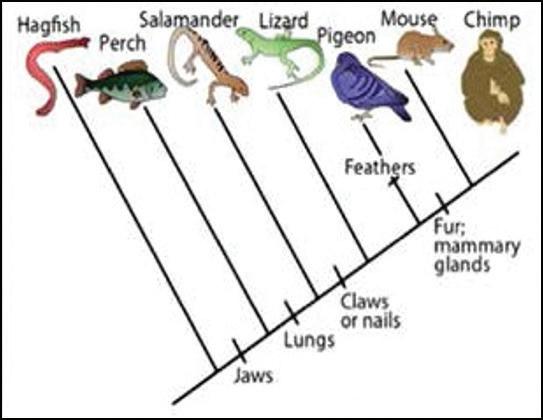
STEMscopedia
Connecting With Your Child
Taxonomy in the Real World
To help your child learn more about taxonomy, visit a zoo, botanical garden, plant nursery, or even a local pond or stream where he or she can observe the characteristics of many different organisms. Have your child collect the binomial nomenclature of the species he or she observes where possible. These are commonly posted at zoos, botanical gardens, and some nurseries.
Your child should gather as much information about the different species’ physical appearances he or she encounters as possible. Encourage your child to use a camera to take pictures of the different species or draw pictures of what he or she sees.
At home, have your child identify the domain for each of the organisms he or she observed. Most likely, every organism will belong to domain Eukarya. Then have your child classify the organisms into kingdoms, phyla, and so on, as far as he or she can go with the information gathered.
Next, have your child research the genus and species names for the organisms. Using this information and online resources, your child can check his or her own classifications against the true taxonomy.
Once complete, have your child build either a cladogram or a dichotomous key for organisms he or she observed. Encourage your child to analyze the cladogram to determine which characteristics evolved latest and which organisms are most closely related.
Here are some questions to discuss with your child:
• How does a standard system of classification help you do research?
• What characteristics can you use to classify organisms into domains? Into kingdoms?
• What role would a cladogram play for a scientist who discovers a fossil of an extinct organism?
Reading Science
To Group or Not to Group
1 Scientists think there are more than ten million different species on Earth. Almost two million species have already been studied and named. More are being discovered every day. Scientists have found many different kinds of animals, plants, and fungi. They have also found a quickly growing number of microorganisms.
2 In order to keep track of all these organisms, scientists need a system in place to organize all of the species on Earth. The organisms must be grouped into separate units, and each organism must have its own, unique name. This is not an easy job.
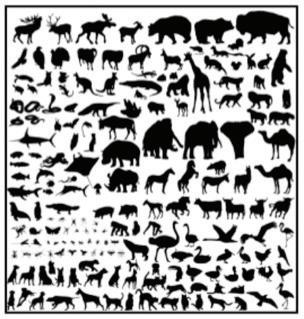
3 The system of biological classification formally began in the 1730s with a Swedish scientist named Carl Linnaeus. He was a botanist (plant scientist) and zoologist (animal scientist). Linnaeus realized that an easy system for grouping biological organisms did not exist, so he created a grouping system called the binomial nomenclature system.
4 The first part of each organism’s name is the genus, a group of closely related species. The second part of the name is the species. The genus name is always capitalized, and the species name is always lowercase. Both are italicized. As humans, we are classified as Homo (genus: “human”) sapiens (species: “thinking”).
5 The Linnaean system gave scientists one way to group organisms. It did not help scientists know how closely organisms were related, however. So scientists built another grouping system called phylogeny, which traces how related organisms are according to evolutionary history. Specific types of diagrams are used in order to help show these relationships, called either phylogenetic trees, evolutionary trees, or cladograms. They are the same by any name.
6 Each cladogram begins with the most ancient organism, called the origin. This is the first point on the diagram. From this point, the tree branches with each new organism. The farther away the branch point is from the organism, the more distantly related those organisms are. Organisms farthest from the origin are the most recent organisms. The organisms get older the closer they are to the origin.
7 Molecular clocks have also been useful in finding how closely related organisms may be. This method studies the rates of evolution of specific genes. Scientists try to calculate the average rate at which DNA will mutate over time by comparing DNA samples. Some of these DNA sequences change quickly. Others hardly change at all.
Reading Science
1 How many different types of species do scientists think are on Earth?
A Two million
B 150,000
C More than can be counted
D Ten million
2 What is the correct way to name human beings according to the Linnaean system?
A Homo Sapiens
B Homo sapiens
C Homo sapiens
D Homo sapiens
3 What is the system called that groups organisms by using a naming system that uses the genus and species?
A Dichotomous tree
B Phylogeny
C Cladistics
D Binomial nomenclature
Reading Science
4 What modern method of study can trace the evolutionary relatedness of organisms by comparing DNA sequences?
A Phylogeny
B Molecular clocks
C Cladograms
D Classification
5 Which of the following statements about taxonomy systems is false?
A Phylogeny and the Linnaean system give us the same results.
B Cladograms and the phylogenetic trees give us the same results.
C The phylogeny system traces organisms according to their evolutionary history.
D Cladograms begin with an organism called the origin.
6 In a cladogram–
A the most ancient organism, called the origin, is the first point on the diagram.
B the closer the organism is to the origin, the younger it is.
C the farther an organism is from another branch, the more closely related they are.
D None of the above
Open-Ended Response
1. Starting with Aristotle (around 330 BC), scientists began to formulate classification systems for organisms. What were some of the difficulties Carolus Linnaeus encountered before developing his taxonomy system? How did he solve that problem?
2. What characteristics do scientists consider when classifying newly discovered organisms into kingdoms?
3. Look at the organism in the picture and use taxonomy to show how it is classified. Use binomial nomenclature to give the scientific name of the organism.
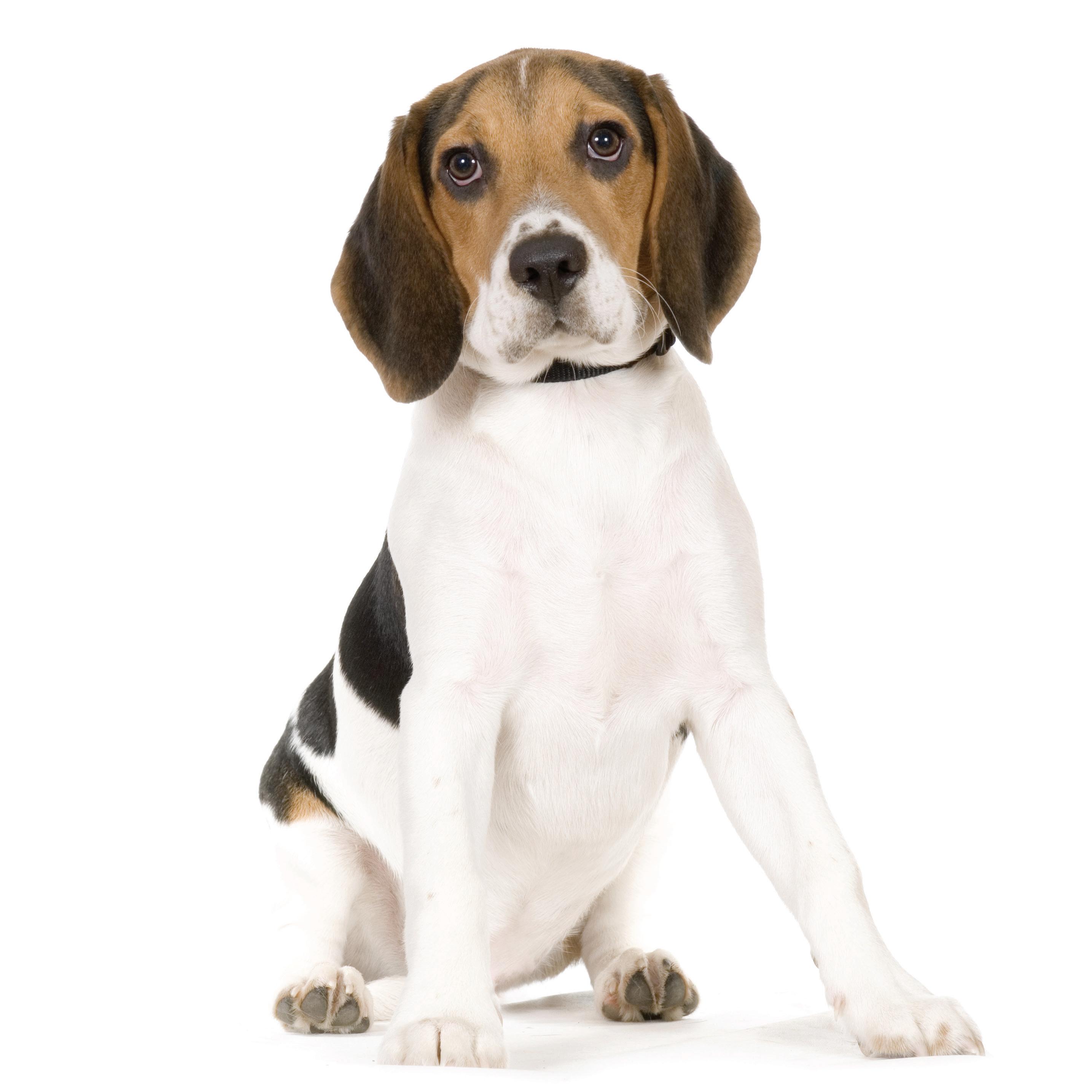
Open-Ended Response
4. Fill in the chart about kingdoms in the domain Eukarya. Which kingdom do you believe has the most diverse organisms and why?
Domain Eukarya
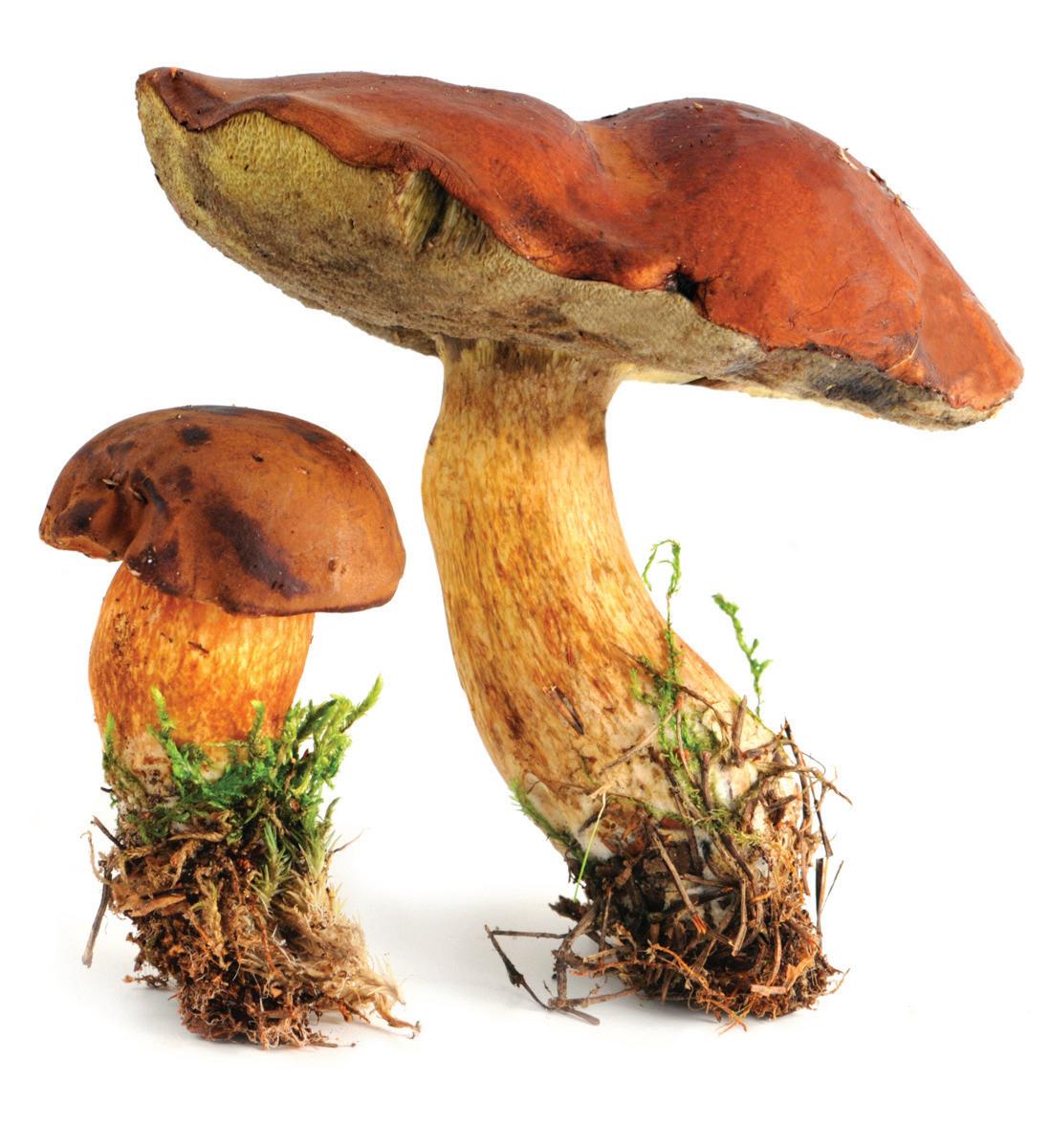
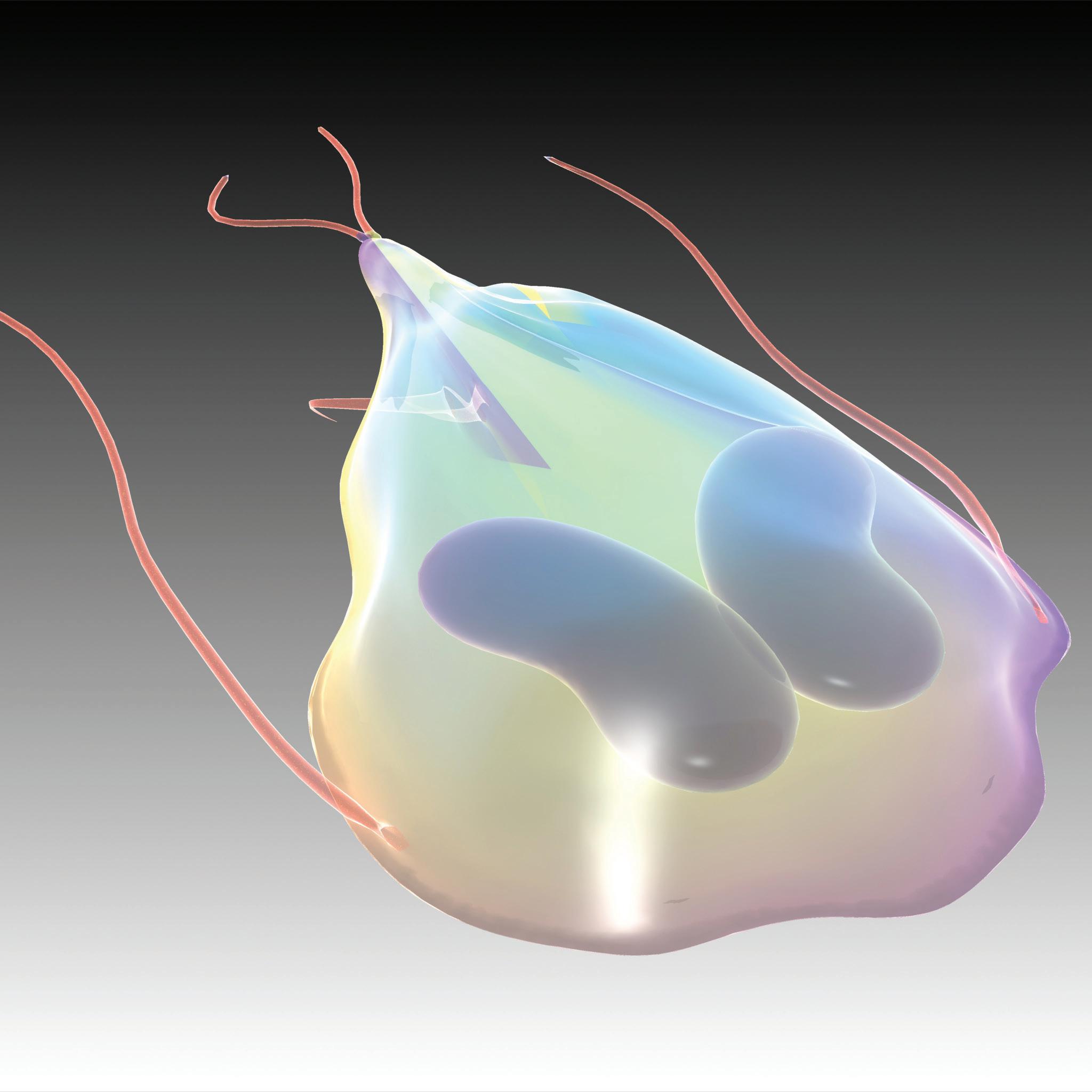
Open-Ended Response
5. Scientists use cladograms to show the evolutionary relationship between organisms. Study the cladogram below. What is the evolutionary difference between a salamander and a lizard?
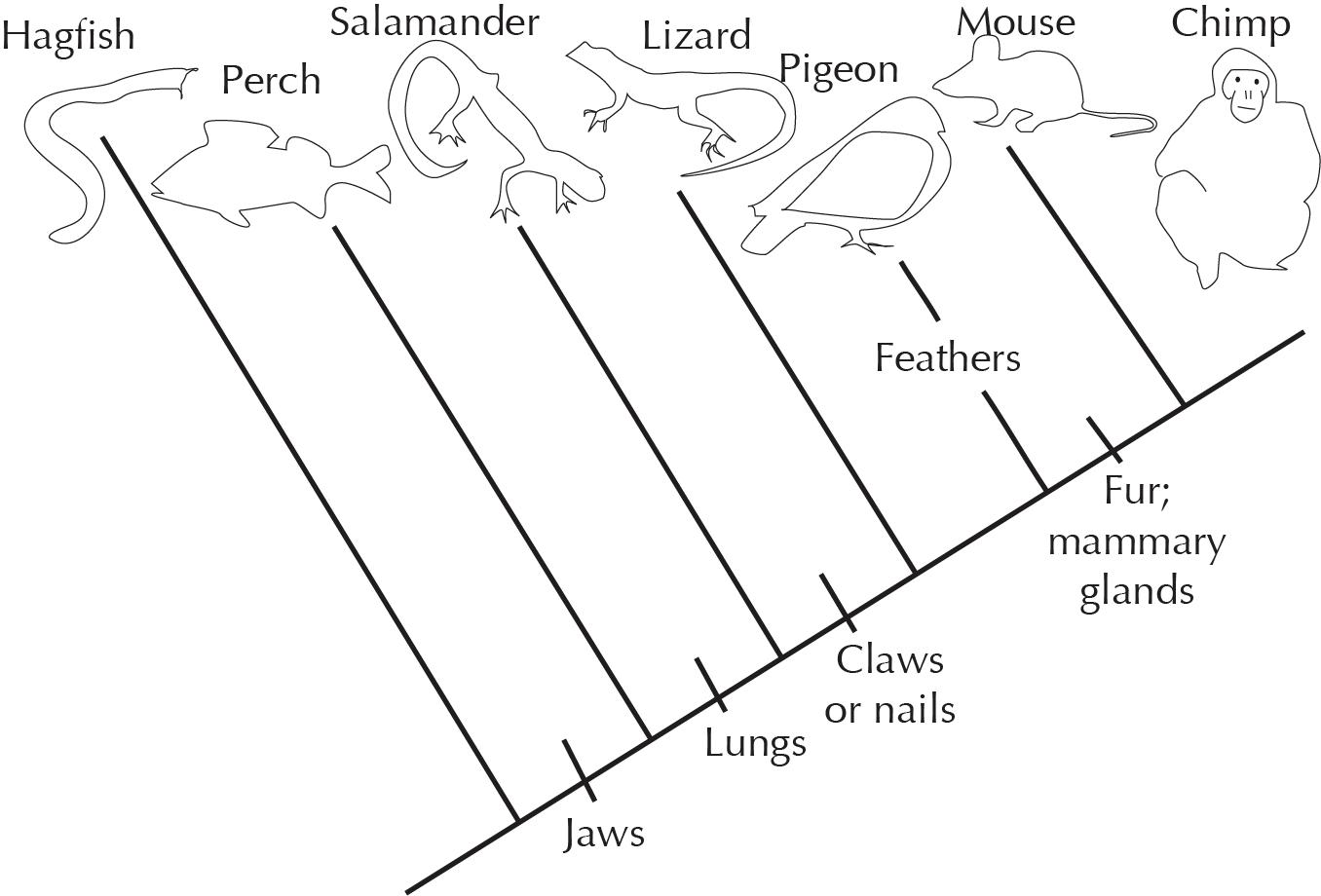
Scientists classify organisms according to different characteristics. These characteristics may relate to how they move, breathe, and reproduce. The following organisms are grouped differently.
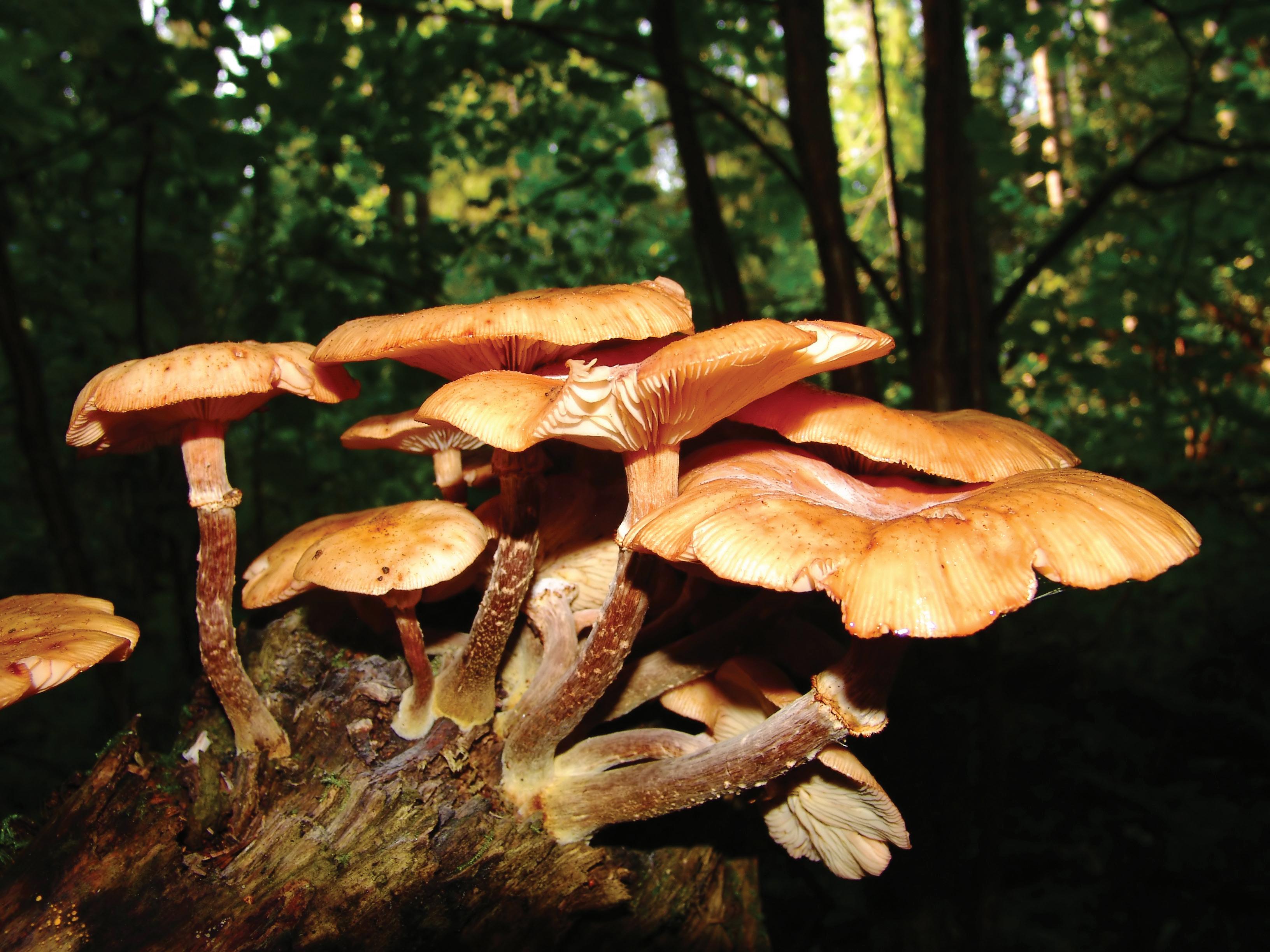
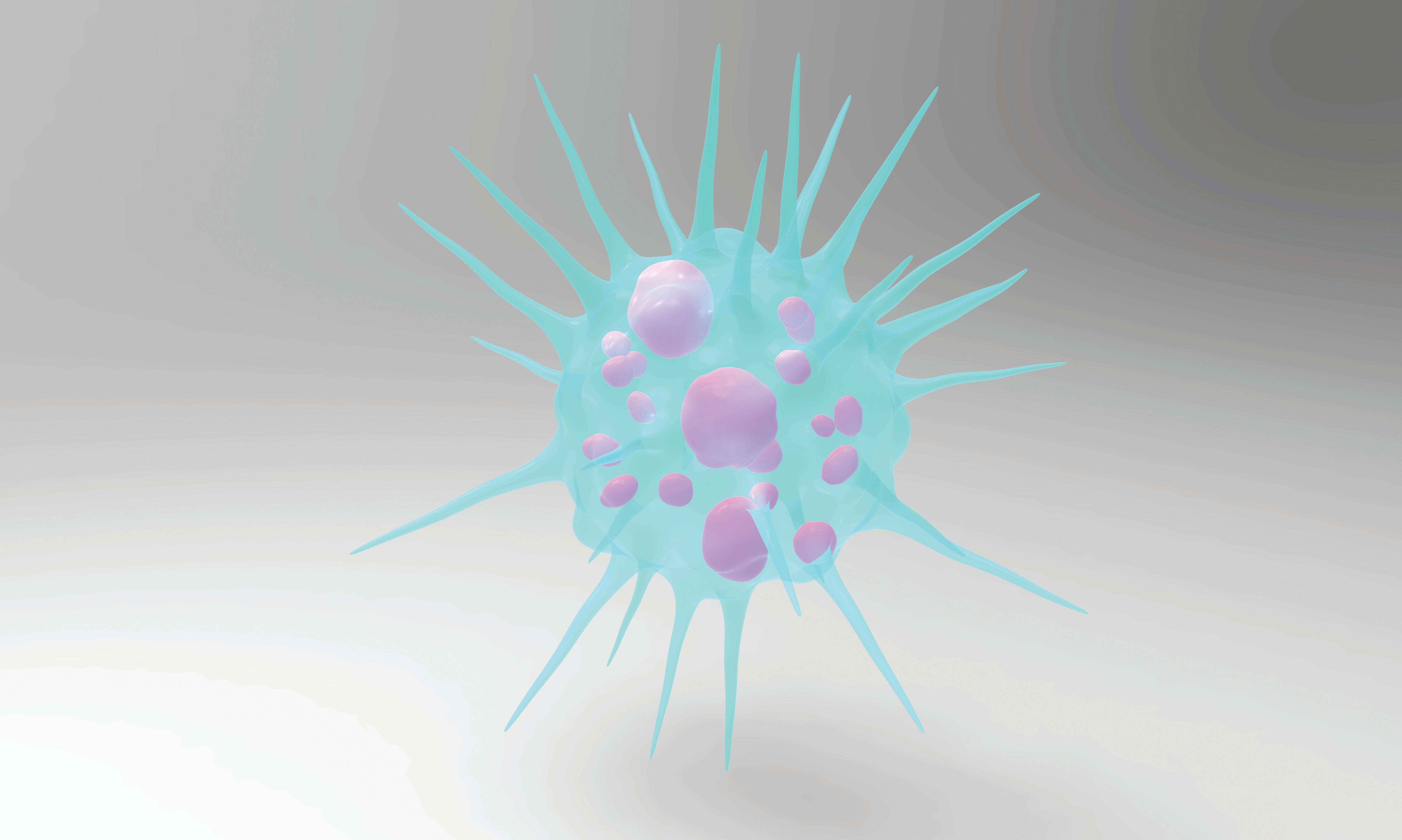
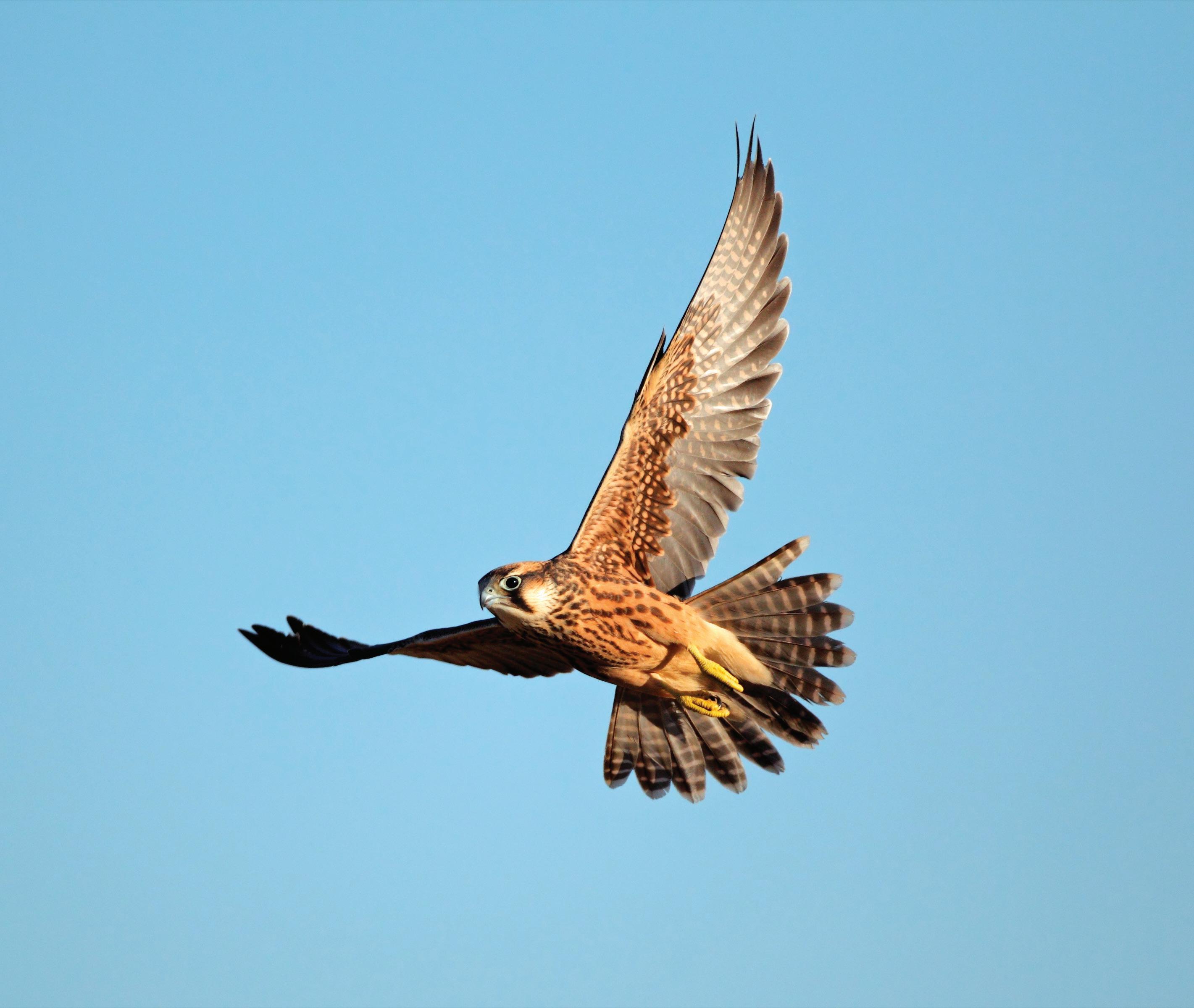
Prompt 3
Write a scientific explanation that describes how the above organisms are classified into different groups.
Evidence:
Claim: Reasoning:
Rebuttal:
L.6.4.3, 4.4, and 4.5
Fungi, Protists, and Bacteria
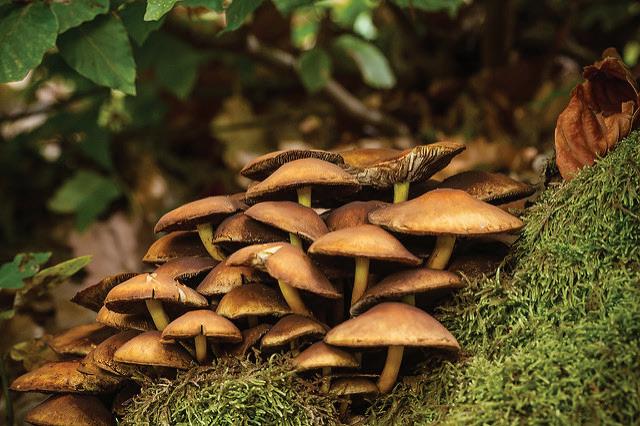
Introduction
It’s a Fungi Thing
Record your observations in the table below.
Sample Descriptive Observations
Introduction Reflection Questions
1. Based on your observations, how are these samples alike and different?
2. Based on your observations, how is the bread alike and different from the previous samples?
Fungi, Protists, and Bacteria
Explore 1
Activity
Record your observations for the activity in the table below. Respond to the Reflection Questions for each step.
Observation
Explore 1
Activity Reflection Questions
Shaking Reflection
What did you add to the bag by shaking it?
What might the yeast need in order to grow?
Sugar Reflection
Has anything happened as a result of adding the sugar to the yeast?
What else might need to be added to the bag in order for the yeast to grow?
Water Reflection
Has anything happened as a result of adding the water to the yeast and sugar?
Mystery Sample Reflection
What process did you use to determine the identity of your sample?
What is your mystery sample? How do you know?
Explore 1
Inquiry Activity
My Inquiry Question:
Materials:
Procedure:
Observation Table:
Conclusion Statement:
4.4, and 4.5
Fungi, Protists, and Bacteria
Protists
Part I: Single-Celled Organisms Booklet
1. Follow the instructions in Part I of your Student Guide to create your Single-Celled Organisms Booklet.
Sketch a Euglena
Sketch an Amoeba
Sketch a Paramecium
Explore 2
Part II: A Closer Look at Single-Celled Organisms
Reflections
and Conclusions
1. Which single-celled organism moves by cytoplasmic streaming?
2. How do the euglena gain energy?
3. How do the amoeba and paramecium differ?
4. How does the paramecium move?
5. Which single-celled organisms move by flagellum?
6. Which single-celled organisms can make their own food through photosynthesis?
7. What organelle does the amoeba use to engulf its food?
4.4, and 4.5
Fungi, Protists, and Bacteria
Microorganisms on Trial
Assigned Court Case (circle one): Bacteria Viruses
Using the case background, complete the chart of pluses and minuses related to the microorganism type’s role related to other organisms and to ecosystems.
Maintaining Health
(+)
Disrupting Health
ORGANISMS ORGANISMS
ECOSYSTEMS
ECOSYSTEMS
(-)
Explore 3
For each statement, circle the correct selection in [brackets] for your role assignment.
Identify Your Position
I am formulating my argument in favor of the [Plaintiff] [Defendant].
Explain Your Argument
I believe that the Defendant should [be removed from] [remain on] the planet for the following reasons (prioritize the reasons, starting with the one you think is the most important):
Explore 3
As you listen to the opposing arguments in your case, summarize and record them in the chart. In the Rebuttal Notes column, note your ideas for the next round.
Explore 3
Jury’s Verdict (circle): Evicted Allowed to Stay
After hearing all of the arguments and the jury’s verdict in this case, what do you believe is the role of microorganisms in both maintaining and disrupting the health of both organisms and ecosystems? Do you feel that one aspect is more important than the other? Explain what you think would happen to our ecosystems if we were able to successfully stop microorganisms from being disruptive.
Explore 3
Court Case as Juror (circle
one): Bacteria Viruses
As you listen to both sides of the case, make notes about key points. When arguments are over, discuss your notes with other jurors to decide on a verdict.
JUROR NOTES
Arguments for the Plaintiff (Global Community)
Arguments for the Defendant (Microorganism)
Our Verdict (circle): Evicted Allowed to Stay
Explore 3
Reflections and Conclusions
1. What are some of the beneficial roles that microorganisms play in maintaining the health of other organisms and ecosystems? Cite one specific example for each type of role.
2. In what ways can microorganisms disrupt the health of other organisms and ecosystems? Cite one specific example of each type of disruption.
3. Can ecosystems exist without microorganisms? Justify your answer.
4. How do microorganisms depend on other organisms and on ecosystems?
5. On a separate sheet of paper, use all of the following terms to develop a graphic organizer.
Terms: Microorganism, Bacteria, Fungi, Protozoa, Health, Disruption, Organism, Ecosystem, Soil, Food web, Nutrients, Decomposition, Nitrogen fixation, Symbiotic relationship
STEMscopedia
Fungi,
Have you ever had your throat swabbed to see if you had strep throat?
Your doctor needed to be sure you had a bacterial infection before he or she prescribed an antibiotic. Strep throat is caused by a bacteria called Streptococcus
Bacteria are microscopic members of planet Earth that are neither plant nor animal. Bacteria belong to their own kingdom, called Bacteria or Eubacteria, because they do not have a cell nucleus or membrane-bound organelles. Fungi (molds and mushrooms) and protists (amoebas, Euglena, Paramecia, etc.) are two more group of organisms that have such unique characteristics that they also have their own groups: kingdom Fungi and kingdom Protista.
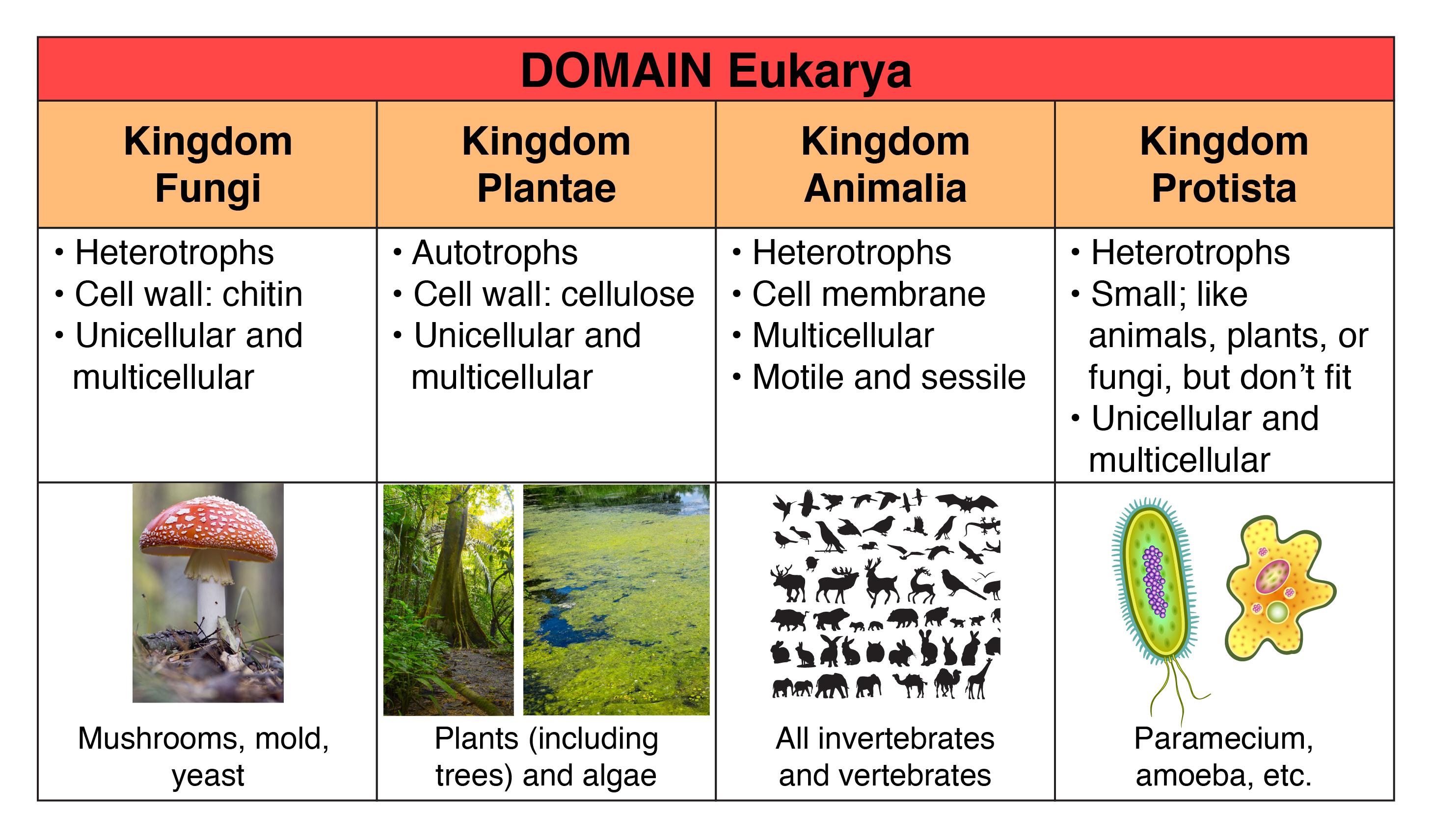
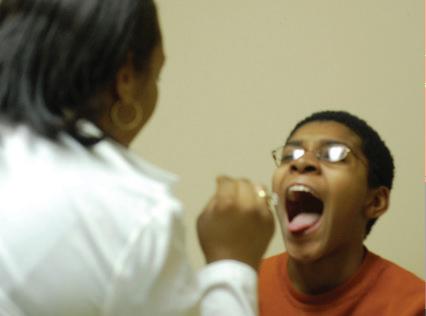

STEMscopedia
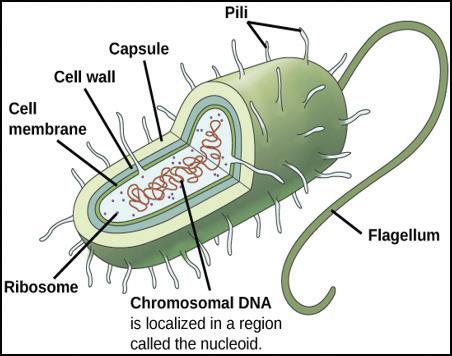
Bacteria
Bacteria are prokaryotes (unicellular organisms that have simple structures without a distinct nucleus and without membrane-covered organelles). Bacteria are smaller than eukaryotes (organisms with a nucleus and membrane-bound organelles). Bacteria can be harmful, such as those causing strep or staph infections, or can be helpful, such as those that aid in digestion. Bacteria cannot eat directly; they must first secrete enzymes that break down nearby food sources, and then the bacteria can absorb the nutrients. Bacteria move about using a whip-like tail called a flagellum, or they can propel themselves with many tiny, hairlike structures called pili. Bacteria can respond to their surroundings only by reacting to simple chemical changes.
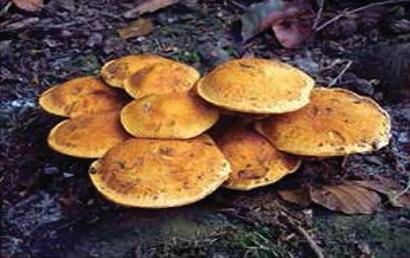
A mushroom is actually the reproductive organ of a fungus.
How do fungi “eat” to get energy?
Fungi
Fungi are multicellular organisms that exist in many different types and sizes. Fungi are organisms that depend on dead things for food. Examples are yeasts (used in making bread rise), molds (grow on old bread or help in cheese production), and mushrooms. Fungi, like plants, do not move.
Fungi are neither plants nor animals. Fungi are their own group of organisms that cannot make their own food and rely on dead things to absorb as food. Examples of fungi are yeasts that make bread rise, molds (like those that turn bread black or help make cheese or the antibiotic penicillin), and mushrooms
Many fungi cannot eat directly but feed by releasing enzymes outside their bodies. The enzymes break down nearby leaves, fruits, and other substances. Once digested, the molecules of food can then be absorbed into the fungi through many tiny filaments called hyphae, which branch into mycelium. The mycelium filaments respond to their environment by growing toward food or water.
Fungi are decomposers because they break down dead, organic matter and return nutrients to the soil. They help maintain the balance with organisms like plants that take nutrients from the soil. The mushroom cap and stem are actually the “fruit” of the fungi. Just as fruit has seeds that make new fruit, the spores of the mushroom produce new fungi. The tiny spores are located in the gills inside the cap and can be shaken out onto paper to make a spore “print”.
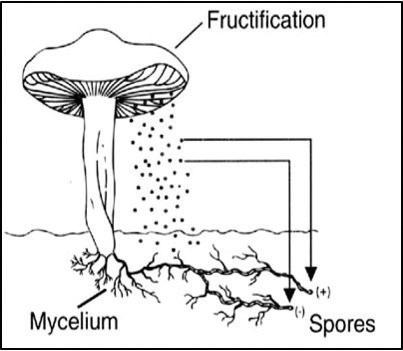
STEMscopedia

What Do You Think?
Fungi: Helpful or Harmful?
Yeast gets its energy from the sugar in this bread dough. The by-products are carbon dioxide gas and alcohol, which make the bread rise and smell good.
Most fungi are not dangerous, but there are some types of fungi that can be harmful to human health and wellbeing. Mild fungal skin diseases can look like a rash and are very common. Fungal diseases in the lungs are often similar to other illnesses such as the flu or tuberculosis. Some fungal diseases like fungal meningitis and bloodstream infections are less common than skin and lung infections but can be fatal. Fungal infections are estimated to occur in more than one billion people each year.
Some common examples of infections caused by fungi are athlete’s foot, ringworm, and yeast infections. These fungal infections feed off our bodies and are difficult to get rid of. As with bacteria, not all fungi are harmful.
Reflect
Mushrooms and yeast, both fungi, are commonly used in the food and drinks we consume. Protists
These ancient eukaryotes have some characteristics not shared by many other members of the domain, including the fact that many are unicellular. Even within the kingdom, there is great diversity. In fact, many protists are classified in this kingdom just because they do not fit in any of the others. They vary greatly in their appearance, mobility, reproduction, and methods for obtaining food. Some protists are even photosynthetic. Examples include a Euglena, Paramecium, and amoeba. Although all three of these protists have a nucleus and membranecovered organelles, they move and obtain food very differently. Euglena propel through the water with a small whip called a flagellum. Paramecia have many tiny hairs called cilia that vibrate rapidly to propel them through the water. However, amoebas are slow because they move by oozing along with pseudopods (false feet). They simply extend their cell membrane and flow into it in the direction they want to move.
How do protists get energy?
Protists also differ in obtaining energy. Euglena are autotrophs, which means they produce their own food for energy through photosynthesis in their green chloroplasts. Euglena are “plant-like” protists. Paramecia eat tiny algae, bacteria, or yeast by trapping food with their cilia and whisking it into their “mouth” opening where it is stored in a vacuole. The amoeba uses its pseudopods to wrap around small microscopic algae or bacteria and absorb the food to store in vacuoles. The paramecium and amoeba are “animal-like” protists.
STEMscopedia
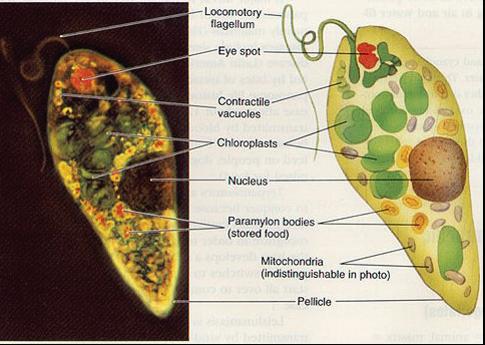
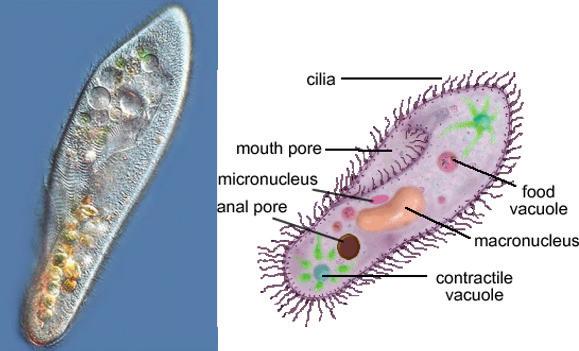
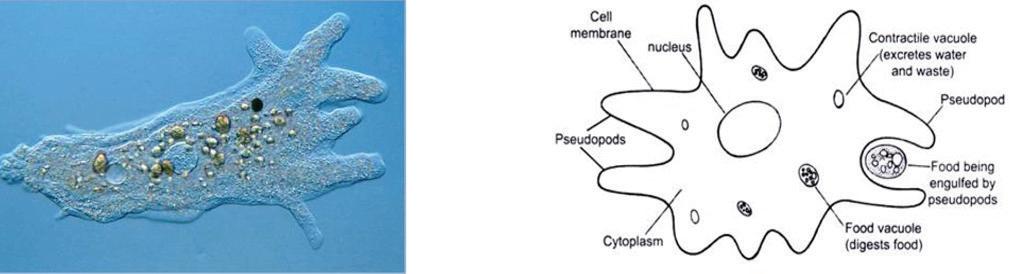
Amoeba
Euglena Paramecium
STEMscopedia
Try Now
Why does bread rise with yeast?
Fungi do not obtain their food directly; they secrete enzymes near their food source, which break down the food source so the fungi can absorb the sugar. Yeasts obtain energy in this way from breaking down sugars near them. The by-products of this chemical reaction are carbon dioxide gas and alcohol. The gas causes the bread to expand and “rise,” giving bread its signature texture with many little holes.
In this experiment, you will try to determine what factors affect the amount of gas produced when yeast metabolizes sugar. You will need the following:
• Dried active yeast granules
• Sugar
• Warm water
• A teaspoon
• A jug
• 2 clean 600 mL plastic bottles
• 2 balloons
With a helper, follow these steps:
1. Label one bottle A and the other B.
2. Make a sugar solution by half filling the jug with warm water and adding four teaspoons of sugar. Stir until all the sugar is dissolved.
3. Half fill bottle A with the sugar solution.
3. Half fill bottle B with warm water.
To be a fair test, the next two steps need to be carried out at the same time.
1. Place a heaped teaspoon of yeast in bottle A and shake. Fit a balloon over the neck of the bottle.
2. Have your friend place a heaped teaspoon of yeast in bottle B and shake. Have him or her also fit a balloon over the neck of his or her bottle.
3. Place the bottles in a warm place, observe every hour, and record your observations.
What happened in bottle A with yeast, sugar, and water compared to bottle B with only water and yeast?
What is the source of the gas that makes bread rise?
When yeast breaks down sugar (glucose), transforming it into carbon dioxide and alcohol, both by-products are formed in equal parts. So for every glucose molecule, two molecules of carbon dioxide and two molecules of ethanol are formed. While at room temperature, the alcohol is liquid, but when the bread hits the oven, the alcohol begins to evaporate, transforming into gas bubbles that contribute to the rise of your bread. Given the amount of alcohol formed during fermentation, of course alcohol helps bread rise. The combination of the carbon dioxide gas when the bread is rising and the added evaporation of the alcohol during the baking process creates little holes in the bread that make it airy and light.
STEMscopedia
Connecting With Your Child
Bread Mold
To help your child understand that mold spores are everywhere and are opportunistic, meaning they wait for the right conditions to grow and then rapidly multiply, experiment together with growing bread mold under different conditions. What is the best environment for mold spores? Is it cold or warm? Sunny or dark? This bread mold experiment will help your child find out the answer, while developing important hypothesis-making and experiment-designing skills. Molds are part of the Fungi kingdom. Molds do not get their energy from food directly. Molds excrete enzymes that break down the surrounding food source. Then the molds absorb the nutrients with their little thread-like filaments. Those filaments give mold its fuzzy appearance.
What You Need:
• 3 pieces of bread
• 3 resealable plastic bags
• Permanent marker
• Water
What You Do:
1. Put bread in all three plastic bags. Use the marker to label one bag Dark, the second bag Cold, and the third bag Sunny.
2. Put one bag in a dark location such as a closet or drawer where it will not be disturbed. Place the second bag in the refrigerator. Place the last bag in a sunny area. Make sure each bag is sealed tightly. While you wait for the results, work with your child to develop a hypothesis (a prediction) about what will happen to each bag of bread. Think about where mold grows naturally. What conditions does your child think are the best for mold growth in nature?
3. Check each bag daily to record any changes you see and compare the results with your child’s hypothesis.
4. Be sure to throw away the bags of bread since they are contaminated. Here are some questions to discuss with your child:
1. What were the differences in the condition of the bread in each bag?
2. Which condition grew the least mold? The most mold? No mold?
3. Which hypothesis was supported by what your child observed?
4. Was the hypothesis true or not? What evidence supported your child’s conclusion?
• Different types of mold grow in the dark versus the light and cold versus warm temperatures.
• All mold is dangerous to eat. If you ever see a slice of moldy bread, it is recommended that the whole loaf be thrown out. Mold spores are microscopic and are already all over the entire loaf even if colonies have not developed yet.
Reading Science
Protists—What the Heck Are They?
1 Scientists need a way to organize and classify all life-forms. As science discovers more about the millions of organisms on Earth, our classification system (the system that organizes all this information) has become better. In the simplest terms, our current classification system is ordered in the following way. A domain is the largest group in the classification system and contains the largest numbers of organisms. Every living being on the planet is a member of one of these three domains: Bacteria, Archaea, and Eukarya.
4.4, and 4.5
Fungi, Protists, and Bacteria
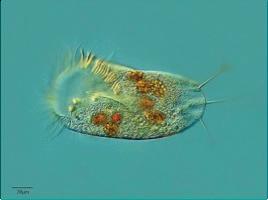
2 Bacteria is the domain of bacteria, which are single-celled organisms found in nearly every modern environment and even in the oldest fossils on Earth. Though some bacteria may cause diseases (such as streptococcal infection, known as “strep”), recent research shows that others may be able to cure illnesses such as stomach issues. Archaea is the domain composed of archaea, which often live in places with extreme conditions, like the boiling water of a hot spring or the deep ocean floor. Eukarya is the domain that contains eukaryotes. Eukaryotes are life-forms that have cells with a bound nucleus and other structures enclosed by membranes. All animals belong within this domain, as well as all plants, fungi, and protists.
3 Within these three domains, the most basic level of classification breaks into eukaryotes and prokaryotes. Prokaryotes are single-celled organisms (unicellular, made of only one cell) that do not have a true nucleus or other cellular parts enclosed in a membrane. Examples of unicellular life include all bacteria, all archaea, and some eukaryotes. Because they only have one cell, these organisms are usually microscopic. These organisms must carry out all life processes within that one cell.
4 Organisms that are made of more than one cell are called multicellular organisms. In multicellular organisms, individual cells serve specialized purposes and must depend on each other to ensure success as a whole. Eukaryotes can either be multicellular or unicellular organisms. We can often identify the multicellular eukaryotes by sight. These organisms include animals, flowers, mushrooms, and protists.
5 There can also be single-celled eukaryotes. Some eukaryotes are single-celled plants such as blue-green algae. Some eukaryotes are single-celled animals such as a protozoa (picture). Some eukaryotes are singlecelled fungi. The rest of the single-celled eukaryotes that are not plants, animals, or fungi are known as protists. Protists cannot be classified along with the other single-celled eukaryotes, so they are all lumped together in the same category. This may change as science is always discovering new ways to classify organisms.
Reading Science
1 A unicellular protist is part of which domain?
A Archaea
B Bacteria
C Eukarya
D Not enough information to determine
2 Based on the information in this passage, the reader can reasonably conclude that–
A scientists will never change the classification system again.
B scientists will never know everything there is to know about all organisms.
C scientists have never changed the classification system.
D new scientific discoveries could change the current classification system.
3 In which domain of life can a student find single-celled organisms?
A Bacteria only
B Bacteria and Archaea
C Bacteria, Archaea, and Eukarya
D There are no single-celled organisms.
Reading Science
4 Which types of life are life-forms that have cells with a nucleus and other structures enclosed by membranes?
A Bacteria
B Eukaryotes
C Archaea
D None of the above
5 What are known as single-celled organisms that cannot be grouped with plants, animals, or fungi?
A Protists
B Bacteria
C Eukaryotes
D Archaea
6 Which of the following statements is NOT true?
A Bacteria are single-celled organisms found in every environment and in the oldest fossils.
B Prokaryotes do not have a true nucleus or other cellular parts enclosed in a membrane.
C Organisms that are made of more than one cell are called multicellular organisms.
D Eukaryotes are only multicellular organisms.
Open-Ended Response
1. Fungi are heterotrophs, but they do not “eat” like animals do. Describe how fungi obtain energy.
L.6.4.3, 4.4, and 4.5
Fungi, Protists, and Bacteria
2. Look at the pictures of three types of protist. Describe how each moves through its environment.
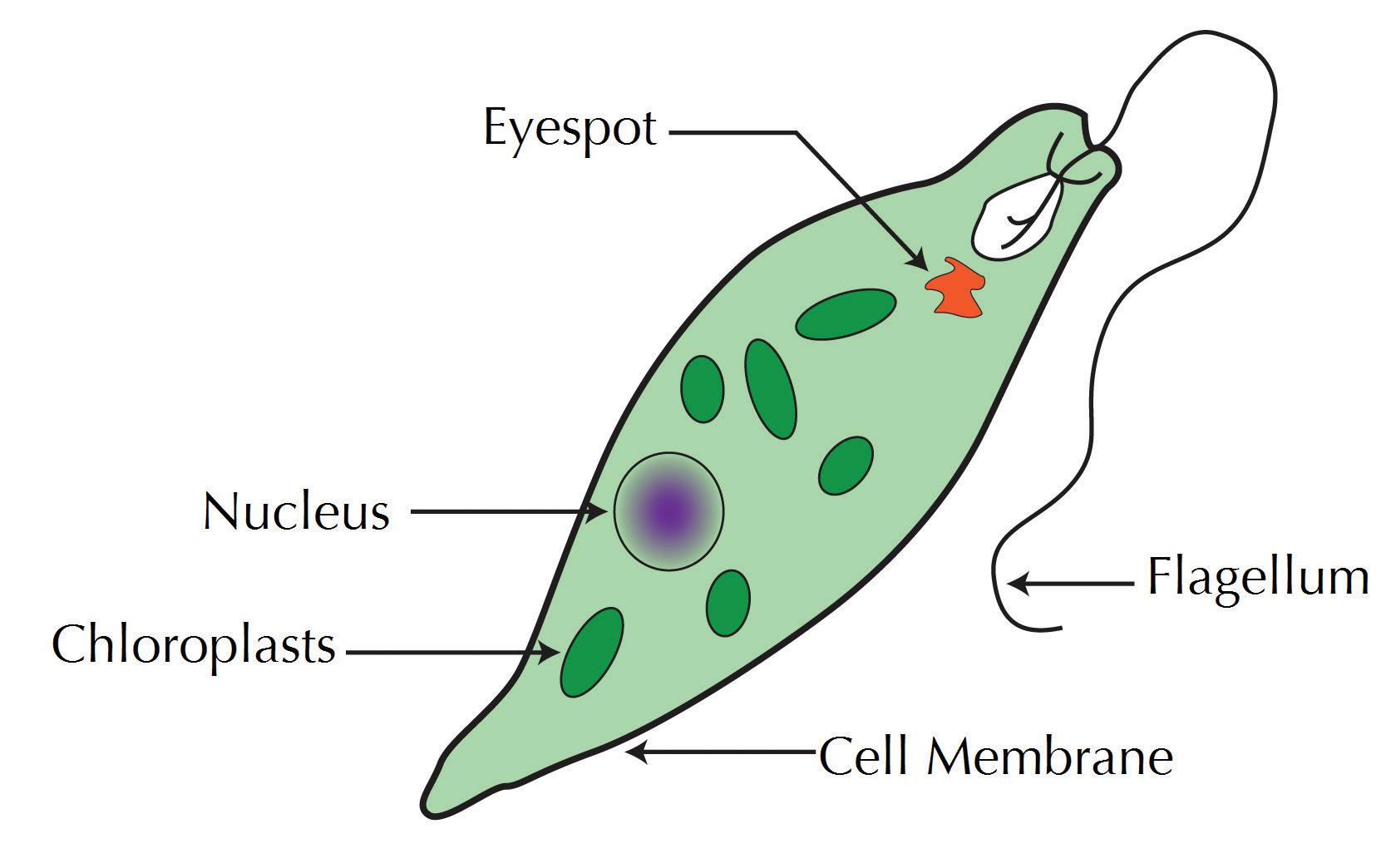
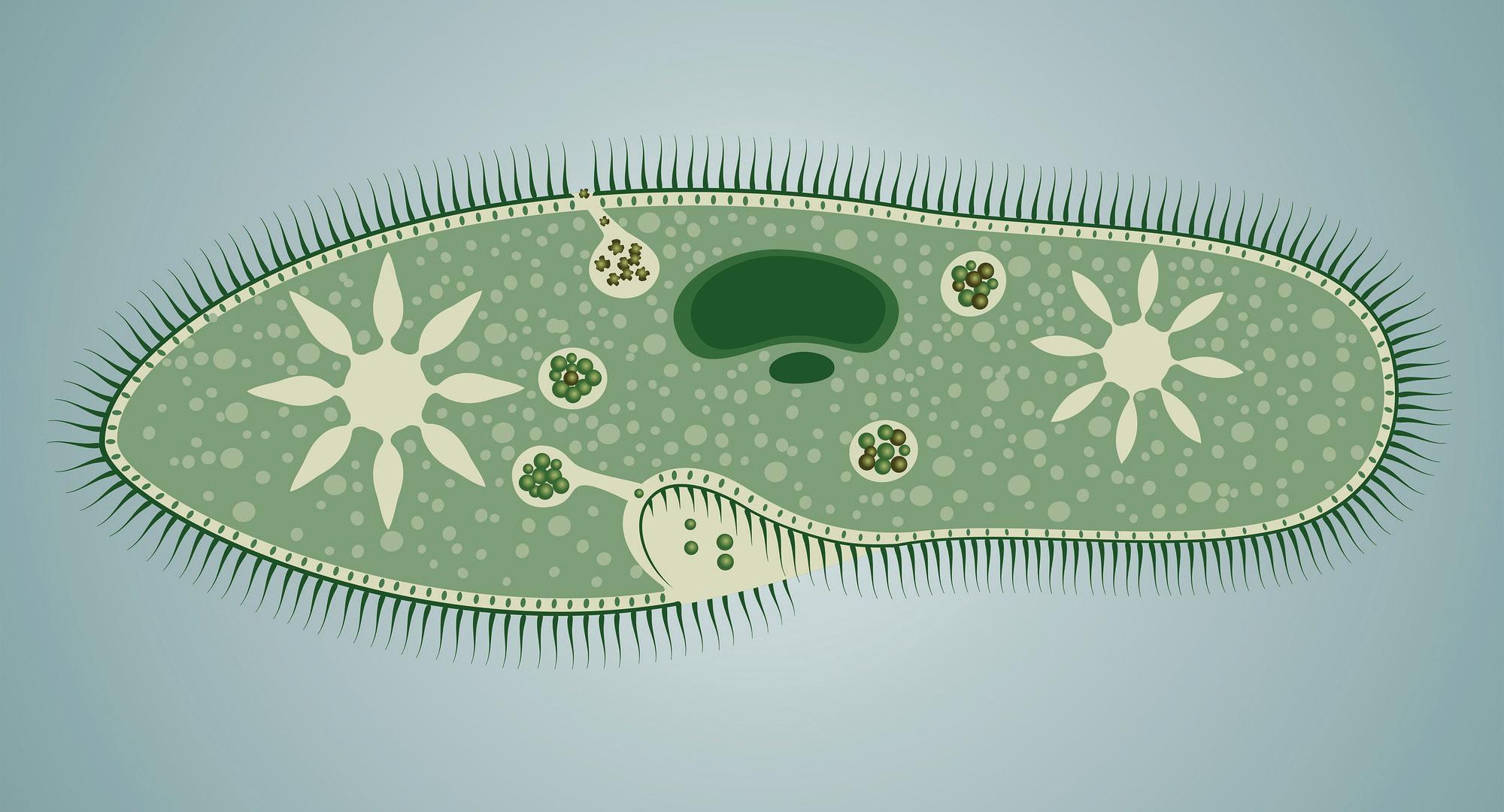
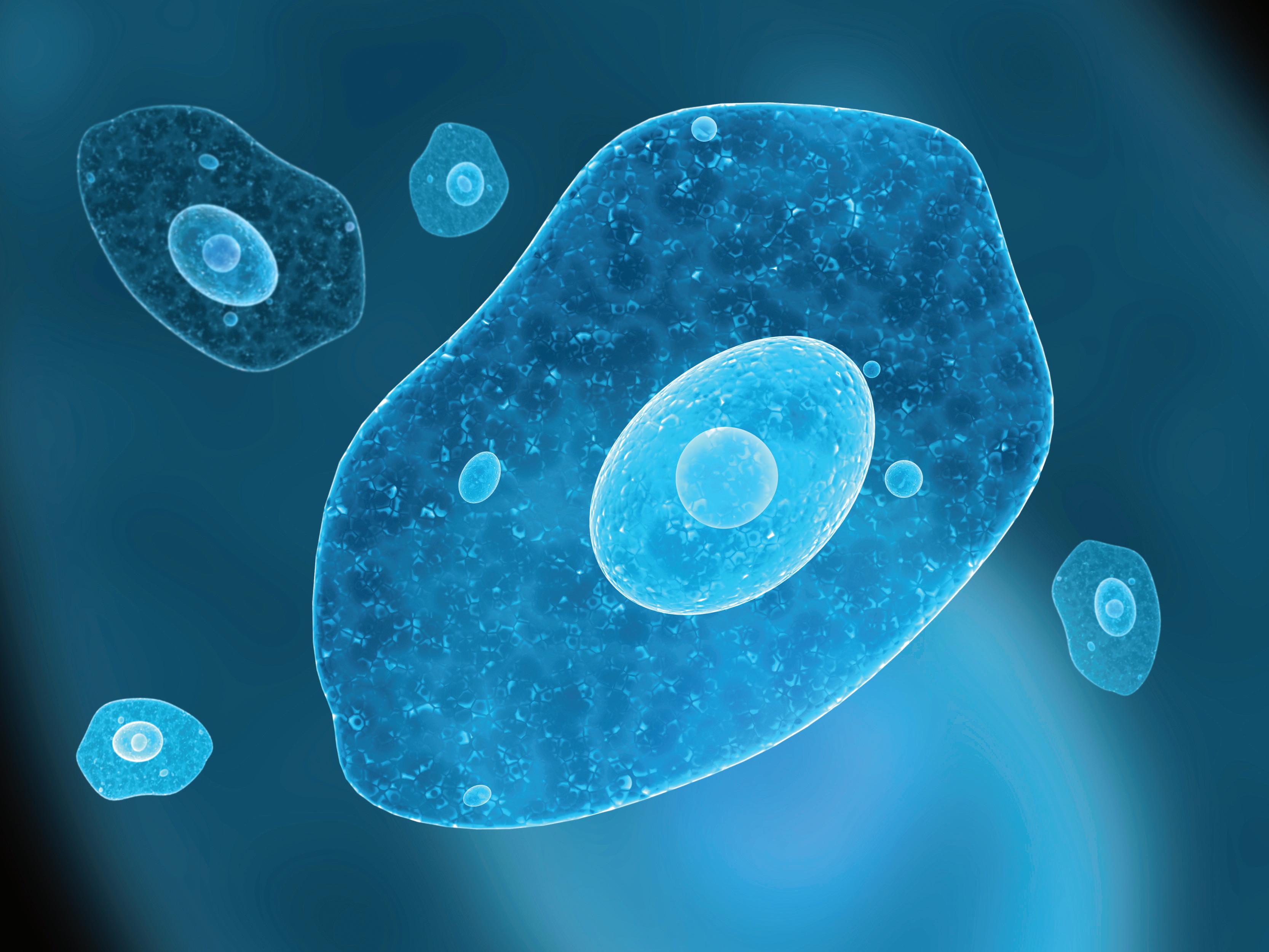
Euglena
Paramecium
Amoeba
Protist
Method of Movement
Euglena
Paramecium
Amoeba
Open-Ended Response
3. Bacteria can be harmful or beneficial to other organisms, including humans. Give three examples of how bacteria can harm people and three examples of how they can benefit people.
Harmful
Beneficial
Like bacteria, viruses can be both helpful and harmful to other organisms and the environment. A virus is essentially DNA or RNA surrounded by a coat of protein. It is not made of a cell and cannot maintain a stable internal environment (homeostasis). Recall that a cell is the basic unit of living organisms.
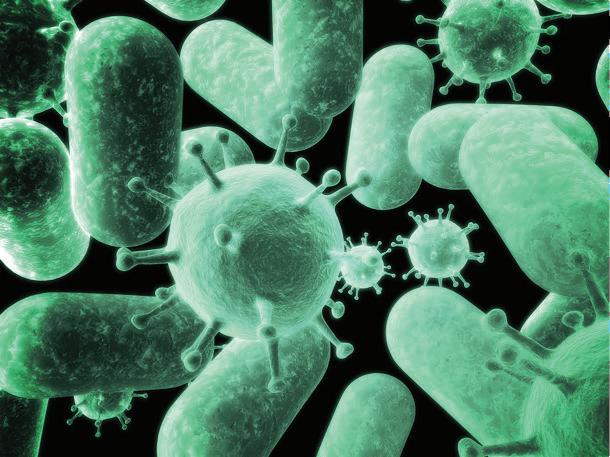
P.6.6.1, 6.5, and 6.7

Engineering Solution: Safety Device
The Problem
Fruit2U is looking for a new safety device for their fruit so that when the fruit is dropped during transport, the fruit does not get damaged. Using Newton’s laws of motion, a design can be created so that the bruising of the fruit is minimized or prevented altogether. Your task is to create a device that Fruit2U can send to mass production.
Engineers design products to meet specific criteria using the Engineering Design Process (EDP). The EDP includes identifying the problem to be solved, designing the product to meet specified design criteria and constraints, building and testing a prototype, and redesigning and retesting as needed until a working model has been created.
The Challenge
Use the Engineering Design Process (EDP) to design and build a safety device for a piece of fruit in order to prevent bruising of the fruit.
Criteria and Constraints
• This safety device should be easy to open and close so that the piece of fruit can be placed into and removed from the device. The device itself should be no smaller than 10 cm3 and no larger than 15 cm3
• The device should prevent as many bruises as possible when dropped from a height of two meters.
• The safety device must be built with the materials provided, including cardboard, straws, masking tape, duct tape, bubble wrap, string, paper towels, paper plates, and any other materials that are available for your use.
• You have only four days to design, build, modify, and collect data.
• On day five your group will present the findings to the class in the form of a visual presentation that outlines the following:
1. Prototype drawings (initial and revised) with the final on chart paper
2. Materials labeled in the prototype, including amounts
3. Results (number and depth of bruises)
Explore 1
Brainstorm and Research
Write down any ideas you have about how you could master the challenge. If you need more information, write down what you need to know and ask your teacher for permission to research the answer.
Explore 1
Design Plan
Use the ideas you wrote down while brainstorming to develop a final design plan. Draw your plan and label the parts. Be sure to list what each part is made of.
Build and Test
Build your design and test it. Does it meet all the criteria and constraints? Use the space below to list the problems with your design that you need to fix.
Refine and Redesign
How could you solve the problems you found during testing? Use the space below to draw a new design that should solve the problems.
Explore 1
Retest and Finalize
Build and test your new design. Does it meet all the criteria and constraints? If not, repeat the refine and redesign process. If so, move on to plan your presentation.
Presentation Plan
Use the space below to plan how you will present your final product. Be sure to include who will speak and what you want to say. Your presentation should include the scientific ideas used to solve this design challenge.
Raceway
Background
1. What is speed?
2. Show the formula and calculate the speed of a car that traveled 100 km in 2 hours.
3. What is velocity?
4. Show the formula and calculate the velocity of a runner that runs south 10 km in 1 hour.
5. What is acceleration?
Read the description of Juan’s motion during a race.
When the race started, Juan’s speed increased until he was running at a constant speed of 6 m/s. After 17 seconds, Juan’s velocity changed to 5 m/s to the northwest and remained constant for 20 seconds. Finally, Juan’s velocity changed to 7 m/s north, and he crossed the finish line. Juan then walked back to the starting line at a slow constant speed of 1 m/s.
6. What are examples of speed from the description of Juan’s race?
7. What are examples of velocity from the description of Juan’s race?
8. What are examples of acceleration from the description of Juan’s race?
Explore 2
Part I: Plan Your Investigation
1. My Question of Inquiry:
2. What is the setting and scale of this investigation?
3. What is the time frame of this investigation?
4. What will you observe in this investigation?
5. Tools, equipment, and technology: identify what you need to complete the investigation and why. Use additional paper as necessary.
6. List all safety precautions that must be taken.
7. Procedure: outline the steps of your procedure. Use additional paper as necessary.
Explore 2
Part II: Implement Your Investigation
Collect, Record, and Organize Data
Record distance data for each walk in the tables below. After you complete the four walks, you will calculate the speed and velocity for each interval of the walk and add to the data table.
Walk 1
Walk 2
Walk 3
Walk 4
Explore 2
Analyze Data
Walk 1 Distance vs. Time
Walk 1 Speed vs. Time
Time (s)
Legend
Walk 2 Distance vs. Time Distance (m)
Time (s)
Legend
Time (s)
Legend
Walk 2 Speed vs. Time Speed (m)
Time (s)
Legend
Explore 2
Walk 3 Distance vs. Time
Walk 3 Speed vs. Time
Time (s)
Legend
Walk 4 Distance vs. Time Distance (m)
Time (s)
Legend
Time (s)
Legend
Walk 4 Speed vs. Time Speed (m)
Time (s)
Legend
Explore 2
Use your data to create distance vs. time graphs and speed vs. time graphs.
1. Describe the speed, velocity, and acceleration of the walker in Walk 1.
2. Compare the distance vs. time graph and the speed vs. time graph for Walk 1.
3. Describe the speed, velocity, and acceleration of the walker in Walk 2.
4. Compare the distance vs. time graph and the speed vs. time graph for Walk 2.
5. Describe the speed, velocity, and acceleration of the walker in Walk 3.
6. Compare the distance vs. time graph and the speed vs. time graph for Walk 3.
Explore 2
7. Describe the speed, velocity, and acceleration of the walker in Walk 4.
8. Compare the distance vs. time graph and the speed vs. time graph for Walk 4.
9. Which graph(s) show(s) movement at the highest rate of speed? How is this shown in the graph(s)?
10. Which graph(s) show(s) a change in speed? Explain.
11. Which graph(s) show(s) the walker changing direction? How do you know?
12. Which graph(s) show(s) the walker stopping? How is this shown in the graph(s)?
Explore 2
Reflections and Conclusions
1. Define the following in your own words.
A. Speed
B. Velocity C. Acceleration
Use the graphs below to answer questions 2–5.
2. Which graph(s) demonstrate(s) an object that is traveling at a constant speed for the entire period of time?
3. Which graph(s) demonstrate(s) an object changing velocity (i.e., changing speed or direction)?
4. Which graph(s) demonstrate(s) an object stopping for a period of time?
5. Which graph(s) demonstrate(s) an object that is accelerating for the entire period of time?
Explore 2
6. In what ways can motion be represented using graphs?
7. Describe the motion at each section of the position vs. time graph below.
8. If the object at Point D would continue, how would the graph look?
9. If the object at Point D would stop, how would the graph look?
11. If the object at Point E would stop, how would the graph look? Section
10. If the object at Point E would start to walk slowly, how would the graph look?
Background
1. What is energy?
Energy Stations
2. What are the two main forms of energy? Describe them.
3. Match each form of energy to its correct description, and define.
4. What is the law of conservation of energy?
5. What is an energy transformation?
6. What happens to the amount of energy during an energy transformation? Use the terms energy source and energy receiver
Explore 3
Activity 1: Temperature and Thermal Energy Transfer
1. What is temperature?
2. What is thermal energy?
3. How does the temperature of the ice chip compare to the temperature of your hand?
4. In the example of holding ice, what evidence indicates that there is a transfer of thermal energy?
5. In the example of holding ice, where does the thermal energy come from?
6. In the example of holding ice, where does the thermal energy go?
7. Using the example of holding ice, explain when the thermal energy transfer stops.
8. Can you summarize how thermal energy moves from one object to another? Thermal energy always moves from substances with ____________________ temperatures to objects with ____________________ temperatures.
Explore 3
Activity 2: Conduction Bridge
1. Data Table: Melting Wax Chips by Conduction
2. Use the drawing below to illustrate what you observed. Use labels and arrows to identify the transfer of energy, and indicate the location of potential and kinetic energy.
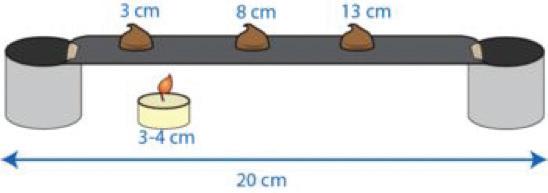
What type of
transfer occurred along the aluminum foil?
4. What pattern was evident in the movement of thermal energy?
5. What evidence did you observe that showed heat transfer?
6. In your own words, define conduction.
3.
heat
Explore 3
Activity 3: Convection in a Lava Lamp
1. Draw a lava lamp and show what happens to the blob you observe. Use arrows and labels to identify the parts of the lamp and the heat transfer, and indicate the location of potential and kinetic energy.
2. Draw the lava lamp and what you observed on the wall or board. Use arrows and labels to identify the setup and the heat transfer. Be sure to show where the heat went and indicate the location of potential and kinetic energy.
3. In which state of matter did the transfer of thermal energy occur in the lava lamp?
4. In your own words, define convection.
Explore 3
Activity 4: Radiation
1. Record your data in the boxes below.
Radiometer at 20 cm
Did the Vane Move?
Beginning Temperature Temp. after 3 Minutes
Radiometer at 15 cm
Did the Vane Move?
Beginning Temperature Temp. after 3 Minutes
2. Graph the ending temperatures for each location of the radiometer.
Radiometer at 10 cm
Did the Vane Move?
Beginning Temperature Temp. after 3 Minutes
3. Fill in the blanks using the data you recorded.
A. As the distance increased, the temperature ________________.
B. As the distance decreased, the temperature ________________.
4. In your own words, define radiation.
Explore 3
Activity 5: Paper Spiral
1. Draw and label how the paper spiral interacts with the thermal energy from the lamp. Use arrows and labels to identify the parts of the lamp and the heat transfer, and indicate the location of potential and kinetic energy.
2. What is the energy source in this system? What is the energy form of the source?
3. What is the energy receiver in this system?
What transformation(s) of energy can be observed?
What is your evidence that energy has been transformed?
4. In which state of matter did the transfer of thermal energy occur in the paper spiral?
5. Give two examples of how thermal energy is converted to kinetic energy through convection currents.
Explore 3
Collect, Record, and Organize Your Data
Data Table: Energy Transformation Observations
Activity or Station Energy Source Energy Form of Source Energy Receiver Energy Transformations Observed Evidence of Energy Transformations
Palm Ice
Conduction Bridge
Lava Lamp
Radiation
Paper Spiral
Explore 3
Analyze Your Data
1. Describe the energy transformations that occur with the piece of ice in your hand.
2. Describe the energy transformations that occur in the conduction bridge activity. Include the terms potential energy, kinetic energy, and thermal energy in your description.
3. Describe the energy transformations that occurred after you turned on the lamp and placed it next to the radiometer.
4. Describe the energy transformations that occur when turning on a lamp and holding a paper spiral over it.
5. Use your data from any activity of the investigation to support the law of conservation of energy.
6. Use your data from the investigation to support the following statement: In energy transformations, potential energy decreases in some parts of the system and increases in other parts, but the total amount of energy remains the same.
Explore 3
Reflections and Conclusions
1. Was there a relationship between the variables you observed?
2. Where could errors have been made while you were collecting or organizing data?
3. What do you conclude about this investigation?
4. What would you do differently if you were to conduct this experiment again?
5. What is the relationship between potential energy, kinetic energy, and thermal energy?

STEMscopedia
Does anything happen without a cause? Many people would say yes, because that often seems to be our experience. A cup near the edge of a table suddenly crashes to the floor. An apple falls from a tree on a clear, windless day. These events do not “just happen.” Any change in motion is the result of a force. The forces that cause change are not always obvious, but they are always present.
Motion: A Change in Position, Direction, or Speed
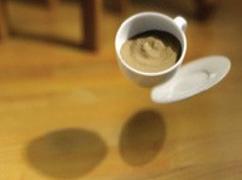
All changes in motion require the input of a force. The simplest way to think about motion is a change in position. Imagine you ride your bicycle from your house to school. You have changed position through motion. The force of pedaling the bicycle causes this change. Forces can change motion in other ways too. While riding your bike, you turn left at an intersection. You have changed direction. As you approach a stop sign, you slow to a stop and then speed up again. Speeding up and slowing down are also changes in motion caused by forces. Relationships between force and change in motion follow three precise laws. What are these laws? How do they help us understand force and motion?
Force and Motion
Forces are measured in units called newtons (N). This unit is named for Sir Isaac Newton, a British scientist who identified and described three laws of motion. Newton’s first law of motion describes two important effects of forces:
• An object in motion stays in motion until an unbalanced force acts upon it.
• An object at rest (not moving) stays at rest until an unbalanced force acts upon it.
What exactly is an unbalanced force? When two equal forces are acting on an object from opposite directions, the forces are balanced. Look at the diagram below on the left. The box will not move in either direction. It stays at rest because the forces are balanced. There are two types of forces: balanced and unbalanced. When all the forces acting on an object cancel each other out, they are balanced. In other words, the net force is zero. This is the case for the two categories of constant motion: motionless and moving at a constant speed in a straight line. If the forces acting on an object do not cancel, the net force is not zero. These are referred to as unbalanced forces. Unbalanced forces cause motion to change from one state to another. The forces on the box on the right are unbalanced and will result in movement to the right with a force of 100 N.
STEMscopedia
Speed and Direction
When an object moves, it travels over a distance in a certain period of time. This is the object’s speed. Speed is calculated by dividing the distance traveled by the time the object took to travel, or s = d/t. For example, suppose a dog runs 80 meters in 20 seconds to fetch a ball. To find the dog’s speed, divide 80 meters by 20 seconds, which equals 4 meters per second, or 4 m/s. Units of speed include a “/” symbol pronounced as “per” because they are a division of distance and time units.
Newton’s First Law
s = d/t
s = 80 m / 20 s
s = 4 m/s
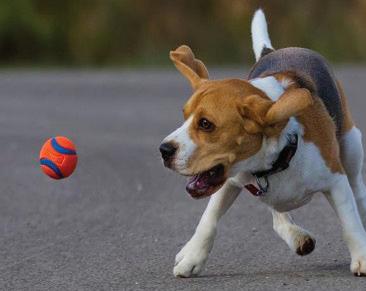
It was mentioned earlier in the lesson that three basic laws explain relationships between force and motion. Newton’s first law, called the law of inertia, refers to objects in a constant state: either motionless or moving at a constant speed in a straight line. The law states that an object at rest stays at rest and an object in motion stays in motion until unbalanced forces act upon it. Inertia refers to an object’s resistance to a change in motion. Inertia is directly related to mass. The more mass an object has, the more inertia it has, and the more it resists a change in motion. Think about trying to push vehicles that have different masses, such as the small economy car in the picture and a diesel truck. Obviously, the car is much easier to push.
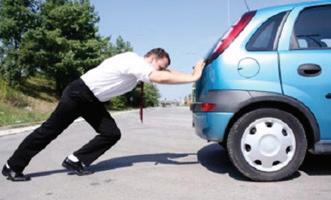
Can you see inertia at work?
It is not as obvious that an object will continue to move in a straight line at a constant speed if the forces on it are balanced. Everyday experiences seem to contradict the law of inertia. Every moving thing we see slows down if we do not make some effort to keep it moving.
Things slow down naturally because unbalanced forces of friction and air resistance always act on them. If you kick a soccer ball across a field, for example, the ball slows down because friction between the ball and the grass is an unbalanced force. If there were no friction, the ball would continue to roll without slowing down. For things that do travel at a constant speed, some force acting on the object exactly balances the forces of friction and air resistance.
The result is a net force of zero. However, think about what happens to passengers when a car stops suddenly. Their inertia keeps them going forward unless the force of a seat belt holds them back. Infant car seats are important for the same reason.
The need for seat belts is related to inertia and the first law of motion.
Look Out!
STEMscopedia
What Do You Think?
Newton’s Second Law
Newton’s second law of motion states that when an unbalanced force acts on an object, the object accelerates at a rate equal to the net force on the object, divided by the object’s mass. This means that a more massive object takes more force to move it. Conversely, objects with less mass take less force to move. It is easier to move a mouse than an elephant! This law is expressed by the following equation:
a = F/m
In this equation, the acceleration (a) is expressed in meters per second per second, which are meters per second squared (m/s2). The net force (F) is in newtons (N), and the mass (m) is in kilograms (kg). The equation is more often seen in this form:
F = ma
As long as a net force acts on an object, the object will continue to accelerate. In many everyday events, an unbalanced force will act only briefly, as in the case of hitting, kicking, or throwing a ball. One familiar exception is the force of gravity acting on a falling object. Falling objects continue to accelerate until the force of air resistance equals the force of gravity.
Acceleration: Suppose you wanted to design a car that could accelerate from 0 to 60 miles per hour (mph) in 10 seconds. How much force would the engine have to exert? The mass of a car is about 1,500 kg, and 60 mph ≈ 27 m/s. Recall that acceleration is the change in velocity divided by the change in time.
Acceleration = change in velocity/time
= (27 m/s – 0 m/s)/10 s
= (27 m/s)/10 s
= 2.7 m/s2
Since you know the acceleration, you can use the second law of motion to calculate the force required to cause this acceleration.
F = ma
= (1,500 kg)(2.7 m/s2 )
= 4,050 m · kg/s2
= 4,050 N
STEMscopedia
Look Out!
Remember, acceleration can be any change in speed or direction, including stopping, starting, going faster, or going slower (negative acceleration).
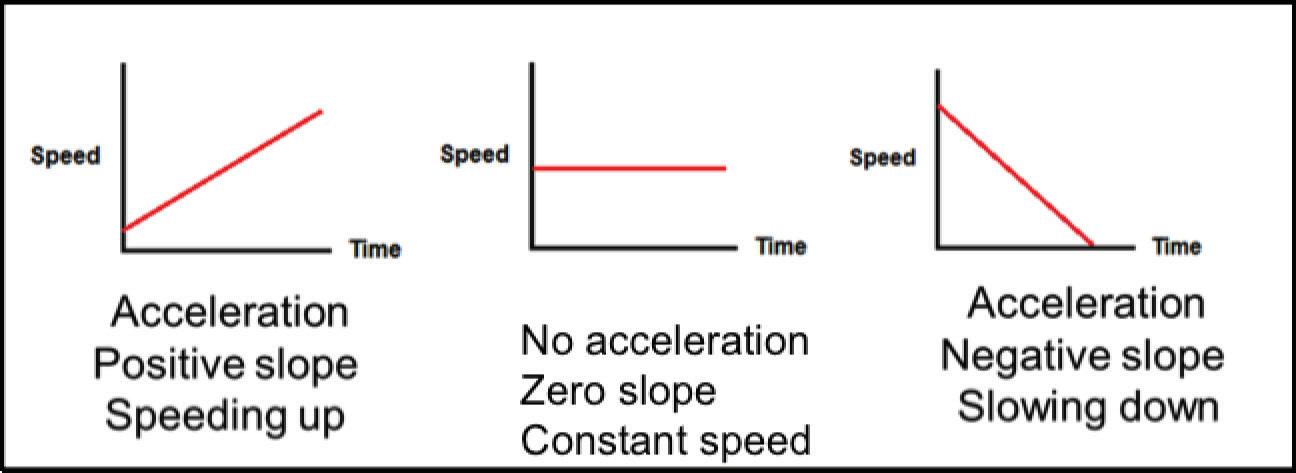
Reflect
Think about a game of billiards. A rapidly moving cue ball strikes another ball at rest. After the collision, the cue ball comes to rest, and the other ball travels away. Similarly, when two football players run toward one another and collide during a game, they may come to a stop, or they may travel as a unit in one direction.
Newton’s Third Law
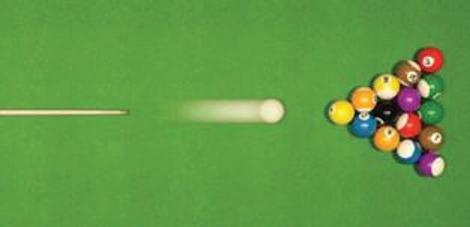
Newton’s third law of motion is often stated, “For every action force there is an equal and opposite reaction force.” You may think, “Wait, that does not make sense!” But it is true. All forces occur in pairs, and no force exists alone. You push on a door to open it, and the door pushes back with an equal force in the opposite direction. After all, you can feel the door, can you not? As you walk, you push on the pavement with the sole of your shoe. The pavement pushes in the opposite direction, sending you forward.
It may seem more logical if you think of force pairs as an interaction between objects. An object always interacts with another object. Think about two ice-skaters facing each other. If one skater pushes on the other’s hands, both skaters move backward. The first skater’s action force causes a reaction force from the other skater, even though the second skater does not try to push back.
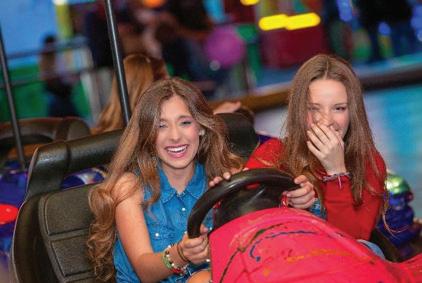
Bumper Cars, Anyone?
Many fairgrounds have one or more bumper car rides. Bumper cars demonstrate Newton’s third law well. If cars collide with little speed, both cars move very little. When cars collide with more speed, they bounce off each other with more speed. Bumper car operators limit the speed of cars to prevent injury in the collisions.
STEMscopedia
Look Out!
Collisions can involve one moving object and one object that does not move. When a hammer hits a nail, the hammer rebounds. While the hammer moves a lot, the nail moves very little. But remember, the forces are equal!
Reflect

Energy can be classified as potential or kinetic. There are two main forms of energy in a system: potential and kinetic. Potential energy (PE) is stored energy. Kinetic energy (KE) is energy in the form of motion. The total amount of potential energy and kinetic energy in a system is known as mechanical energy. Think of the girl swinging in the picture on the right. The diagram below shows how the swing moves back and forth as the girl rides it.
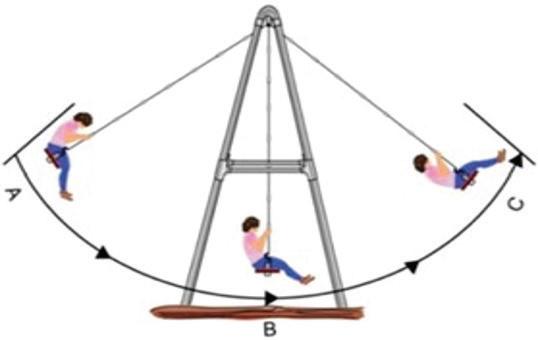
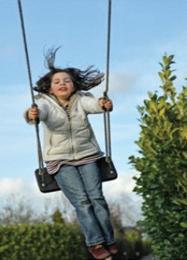
When she has swung all the way back (position A), the swing pauses a moment. At this moment, the swing has only potential energy. The swing then falls forward, gradually gaining speed. As it falls, its potential energy changes to kinetic energy. At position B, the swing has only kinetic energy. As the swing continues forward, it gradually slows down.
Its kinetic energy changes back to potential energy until it reaches the farthest point in its arc (position C). Here, the swing pauses again for a moment. At this moment, the swing has only potential energy. It then falls backward through its arc. Its potential energy changes to kinetic energy, and the cycle is repeated.
STEMscopedia
Look Out!
Kinetic energy can change into thermal energy. You may think that as a swing gains speed, its potential energy is destroyed, and kinetic energy is created. In fact, energy can only change forms. It cannot be created or destroyed. This is called the law of conservation of energy. Why can you not swing forever? Where does the energy go? As you swing, your body collides with particles of air. These particles are tiny, but there are lots of them. Each time you collide with air particles, a little of your kinetic energy is transferred to the particles. This force, called air resistance, gradually slows you down. Another force that slows you down is called friction. As the swing moves, its parts rub against each other. As this happens, some of the swing’s energy changes to heat and leaves the system. If there were no friction or air resistance, you could swing forever!
Try Now
What Do You Know?
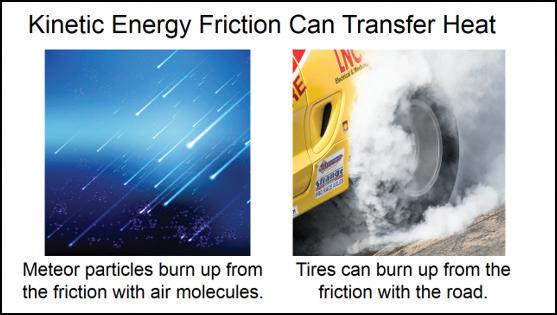
Everyday objects illustrate Newton’s three laws of motion in countless ways. The chart below lists some examples of the laws in action. For each example, write which law it best illustrates and explain your answer.
Examples of Laws of Motion
Maya hits a curb while riding her bike. The bike stops moving, but Maya is thrown into the air for a split second.
Which Law Is Best Illustrated? Why?
A bird flaps its wings, using them to push air downward. Air pushes upward on the bird, allowing the bird to fly.
Peter pushes on two boxes with equal force. The first box is filled with books, and the second box is filled with balloons. The second box accelerates at a greater rate than the first box.
STEMscopedia
Connecting With Your Child
Force and Motion in Olympic Events
• To help your child learn more about Newton’s three laws of motion, begin with a review of each law:
• The first law is the law of inertia. This law states that an object at rest tends to stay at rest, and an object in motion tends to stay in motion at constant speed in a straight line. That is, the state of motion of an object does not change unless it is acted upon by an unbalanced force. Therefore, if the net force is zero, nothing happens.
• The second law of motion states that the relationship between force (F), mass (m), and acceleration (a) is F = ma. This equation can also be written as a = F/m. More force makes things accelerate at a greater rate, and more mass slows the rate of acceleration.
• The third law of motion is the law of action-reaction. For every action force, there is an equal and opposite reaction force. Forces always occur in pairs, never alone. When you push on something, it pushes back with an equal amount of force in the opposite direction.
Now, you are ready to observe the laws in action! A good place to observe forces at work is at a track meet or gymnastics competition. If you cannot visit one of these, try to watch videos of the Olympics or find pictures of the equipment involved. Alternatively, you and your child could visit a school that competes in track or gymnastics.
• Study several events and observe how the three laws of motion describe the forces and motion involved. Here are some examples of events to consider:
• Shot put: What are the acting forces? What is the effect of the mass of the shot (the metal sphere used in shot put)?
• Discus: In which ways does the discus change its state of motion?
• Javelin: Why does it go farther than the shot? What are the forces involved?
• Footraces: When are the racers accelerating?
For all of the events, discuss the effects of force and mass on acceleration. Identify action and reaction forces, and try to find the causes of positive and negative acceleration.
Here are some questions to discuss with your child:
1. A girl throws a ball to a dog, and the dog catches it in his mouth. At what point does the force exerted by the girl’s hand stop affecting the motion of the ball?
2. One child is pushing two other children on a sled. One child gets off the sled and helps to push. Explain two ways this change affects the motion of the sled in terms of the second law of motion.
3. Identify the action force and the reaction force acting on a person sitting in a chair.

Reading Science
Types of Energy
1 All matter has energy, and there are many types of energy that matter may have. The law of conservation of energy says that when energy is moved from one object to another, it is neither created nor destroyed in an ordinary chemical or physical process. During the energy transfer, the starting energy must always equal the ending energy.

2 Simply put, it is the ability to do work. Matter may contain one or more types of energy. It may contain kinetic energy (KE), or the energy of motion. It may also contain potential energy (PE), or the energy of position. PE is also called stored energy. Think of a child swinging on a swing. When the child is at the top of his or her swing (in either direction), there is a moment when motion stops in the upward direction, and the child and swing are not moving at all. At the top of the swing, the child has no kinetic energy and all potential energy.
3 As the child begins to swing in the opposite direction, the kinetic energy of the child gets higher and the potential energy gets lower. When the child reaches the bottom of the swing, he or she has all kinetic energy and no potential energy. As the child begins to move upward, the kinetic energy gets lower as the potential energy gets higher until the child reaches the top of the swing in the other direction.
4 Both potential (PE) and kinetic energy (KE) may be seen in other types of energy transfers. Chemical energy is a form of PE, in that chemical energy is the energy stored in compounds. Chemical reactions will either take in (absorb) or let out (release) energy, usually in the form of heat and/or light. When energy is moved during chemical reactions, it will either create thermal energy or need thermal energy.
5 Thermal energy is another form of energy that matter may have. It is the total amount of kinetic energy (KE) of the particles in a system. It relates to both heat and temperature, but know that heat and temperature are not the same thing! Temperature is the “hotness” or “coldness” of something, NOT energy. Heat, on the other hand, is actually energy and is the movement of thermal energy from one substance to another. Heat always flows from warmer temperatures to colder temperatures.
6 Thermal energy is moved (transferred) in three main ways. Conduction is the transfer of heat through direct contact. Convection is a method of heat transfer that occurs in liquids and gases. Radiation is the transfer of thermal energy by electromagnetic waves through empty space.
Reading Science
1 A child is swinging on a swing. Which of the following is TRUE?
A At the bottom of the swing, the child has no kinetic energy and all potential energy.
B At the top of the swing, the child has all kinetic energy and all potential energy.
C At the top of the swing, the child has all kinetic energy and no potential energy.
D At the top of the swing, the child has no kinetic energy and all potential energy.
2 Chemical energy is another form of energy. Where is it stored?
A At the top of a swing
B In the temperature of an object
C In chemical compounds
D At the bottom of a swing
3 Which type of energy is the total amount of kinetic energy (KE) of the particles in a system?
A Kinetic energy
B Thermal energy
C Potential energy
D Chemical energy
Reading Science
4 Which type of energy is the energy of motion?
A Kinetic energy
B Thermal energy
C Potential energy
D Chemical energy
5 Which type of energy is the energy of position, also known as stored energy?
A Kinetic energy
B Thermal energy
C Potential energy
D Chemical energy
6 Which of the following is NOT a type of thermal energy transfer?
A Conduction B Radiation
C Temperature
D Convection

Open-Ended Response
1. A wagon is parked at the bottom of a hill. What would happen if the owner let it roll? The wagon is then moved from the bottom of the hill and parked at the top. How does the potential energy of the wagon when it is at the bottom of the hill compare to its potential energy when it is at the top of the hill? What would happen if the owner let the wagon roll at the top of the hill? Why?
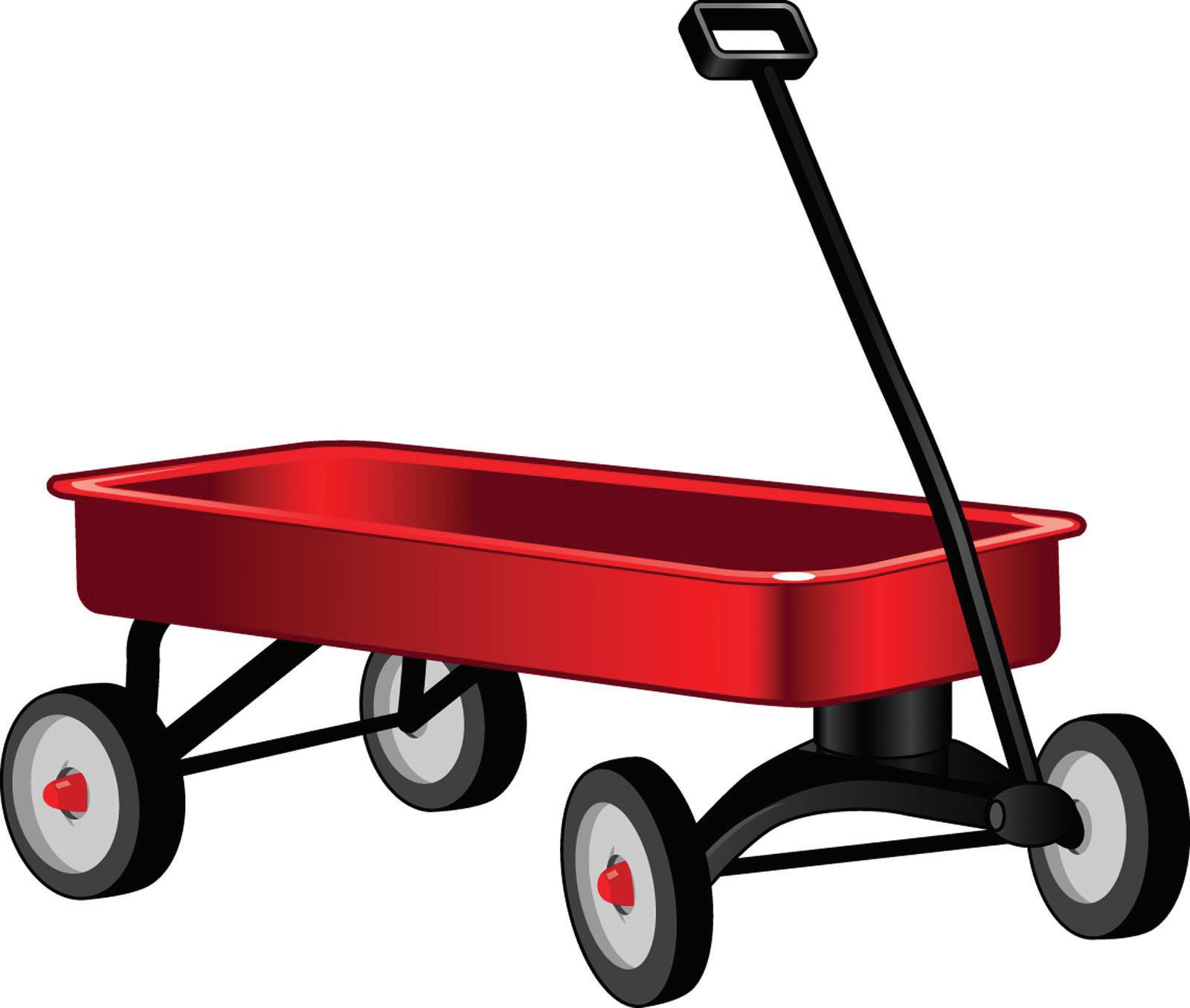
2. Study this graphic about a pendulum, potential energy (PE), kinetic energy (KE), and total mechanical energy (TME). Explain the relationship between potential energy and kinetic energy.
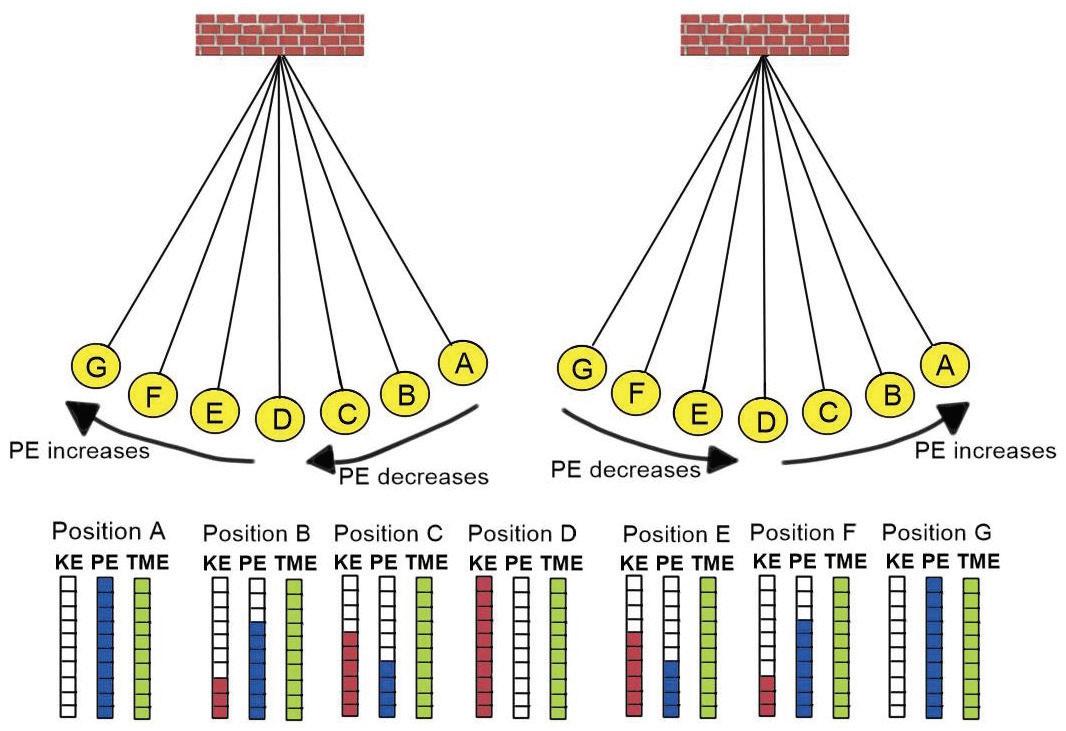
Open-Ended Response
3. Use what you have learned about Newton’s laws of motion to design and sketch a helmet that would protect a biker during an accident. Explain your design below your drawing.

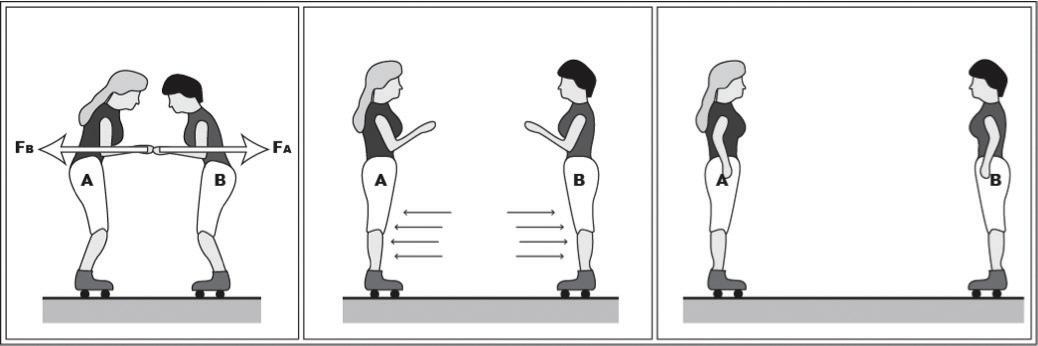
P.6.6.2, 6.3, 6.4, and 6.6 Forces

Racetrack Testing
Background
1. List ways that a bike’s motion can change.
2. For each of the following diagrams, calculate the net force on the object including the direction, and state whether the forces are balanced or unbalanced.
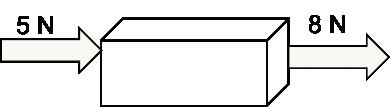
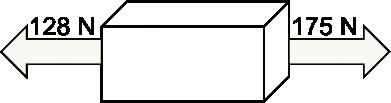
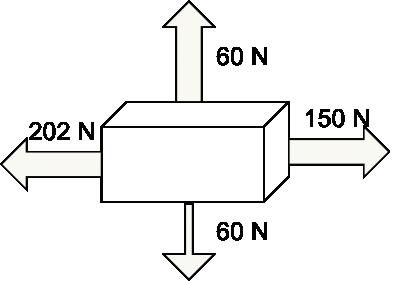
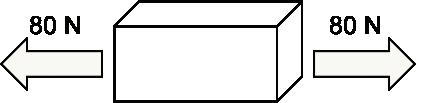
Net Force
Balanced or Unbalanced
Net Force
Balanced or Unbalanced
Net Force
Balanced or Unbalanced
Net Force
Balanced or Unbalanced
Explore 1
Experimenting with Forces
Prediction
On which surface will the car travel the fastest?_______________________________
On which surface will the car travel the slowest?_______________________________
Surface 1: ___________________
Trial 1 Time
Trial 2 Time
Total Time
Average (total ÷ 2)
Surface 2: ___________________
Trial 1 Time
Trial 2 Time
Total Time
Average (total ÷ 2)
Surface 3: ___________________ Distance
Trial 1 Time
Trial 2 Time
Total Time
Average (total ÷ 2)
Trial 1 Time
Trial 2 Time
Total Time
Average (total ÷ 2)
Surface 4: ___________________
Explore 1
Speed = Distance/Time
1. For each surface, calculate the speed of each car using the 5 m distance and the average time at the 5 m mark. Show your work!
Surface 1 speed: ___________
Surface 2 speed: ____________
Surface 3 speed: ___________
Surface 4 speed: ____________
2. Using the average time, calculate the speed from the 2 m mark to the 3 m mark for each surface. Show your work!
Surface 1 speed: ___________
Surface 2 speed: ____________
Surface 3 speed: ___________
Surface 4 speed: ____________
3. Using the average time, calculate the speed from the 4 m mark to the 5 m mark for each surface. Show your work!
Surface 1 speed: ___________
Surface 2 speed: ____________
Surface 3 speed: ___________
Surface 4 speed: ____________
Explore 1
1. Why did the position of the car change?
Conclusion
2. Describe how the cars changed position from the starting line to the end.
3. How did the speed of each car differ as it traveled across each of the surfaces? Why do you think this took place?
4. If there was a bump on the ramp, what would happen?
5. If a driver came to a large obstacle in the road, what would he or she have to do?
6. Using the force diagrams at the beginning of this Explore activity as a reference, draw a free-body diagram depicting how friction would affect the car as it traveled across two different surfaces of your choice.
Surface 1: ___________
Surface 2: ____________
7. Based on what you learned from the beginning of the activity, how could you modify the wheels on your car to make the car go faster on each of the surfaces?
Surface 1: _______________________________________________________
Surface 2: _______________________________________________________
Surface 3: _______________________________________________________
Surface 4: _______________________________________________________
Explore 2
Mapping Force Fields
A. Mapping Gravitational Force Fields Using a Test Object
Record your observations:
Draw a labeled diagram of the gravity well in the space provided. Be sure to title the diagram. Under the diagram, record what you observed using complete sentences.
Summary statement:
1. The test objects for the force that acts at a distance were:
2. Describe the interaction of the forces using a complete sentence.
3. Use complete sentences to explain how the plastic wrap allowed you to map the force field of gravity.
4. Describe how this demonstration illustrates the law of gravity. How did the gravitational force of the balls compare?
Explore 2
B. Magnetic North and a Compass
Copy the diagram created by the group below. Title the diagram, and write a summary statement that describes the interaction between the north end of the bar magnet and the compass pointer below the diagram.
Summary statement:
Explore 2
C. Magnetic South and a Compass
Copy the diagram created by the group below. Title the diagram, and write a summary statement that describes the interaction between the north end of the bar magnet and the compass pointer below the diagram.
Summary statement:
Explore 2
D. Bar Magnet and a Compass
Copy the diagram created by the group below. Title the diagram, and write a summary statement that describes the interaction between the north end of the bar magnet and the compass pointer below the diagram.
Summary statement:
Explore 2
E. Mapping Electric Forces Using a Test Object
Record your observations:
Draw a diagram or map below of the pattern formed by the pieces of hair.
Answer the question set about electric force fields using complete sentences.
1. What is the test object for the magnetic forces acting at a distance?
2. Describe the interaction of the forces.
3. How did this activity allow you to map a magnetic force field?
4. What is the test object for the electric forces acting at a distance?
5. Describe the interaction of the forces in this activity.
Explore 2
6. In the graphic organizer below, compare and contrast each of the types of forces, putting the similarities toward the center of the square and the differences about the forces toward the words in their respective corners.
Parachute Drop
PBL Entry Document
Top Flight has hired our engineering firm to design a parachute model that will gently deliver advertising materials to the ground. These materials will be dropped from an airplane into a football stadium. The parachute needs to create enough resistance that the materials will land softly, ensuring that the game spectators won’t be hurt when the promotional gifts in the plastic football eggs reach them. The weight of the plastic football eggs that contain the promotional gifts will vary slightly but will be about the same weight as a large chicken egg.
Since the shape and weight of both are very similar, the decision has been made to use real large hard-boiled chicken eggs to test the parachutes. The plane will release them at the lowest altitude allowed to prevent the parachutes from being blown away by the wind. The company is aiming to drop 5,000 parachutes on top of the football stadium in two runs before the game starts. Good weather and mild wind conditions are in the forecast.
As the first stage of these plans begin, your team’s mission will be to create a prototype of a parachute that will allow the eggs to drop from the height of the slide on the school’s playground, or the highest point on the playground, without cracking. When wrapping your parachute, keep in mind that 2,500 units will be dropped over the football stadium in each run. Each team will be allowed one egg per person and one parachute per team. The parachute and the egg cannot weigh more than 80 grams. The team’s goal is to create a parachute that will soften the effects of gravity without cracking the hard-boiled egg.
For your prototype to be considered for review, you must provide a detailed, scale drawing (blueprint) of the prototype. The drawing should include labels and dimensions. You must present your materials in a list or table that details the safety considerations of the materials you used in your prototype. Designs and presentations that do not meet these requirements will not be accepted for consideration.
Explore 3
Each team must draw and design two different prototypes prior to construction. You will be evaluated based on your final presentation, in which you will test the model and present the prototypes. You will have two days to complete your prototype and three minutes to present your prototype.
Divide your team into the following roles to complete the project: Design Engineer, Materials Engineer, Graphic Design Engineer, and Parachute Deployment Engineer. Develop a list of what you already know, and sketch several possible solutions. Create your prototype drawing using the Engineering Design Process. You should incorporate any redesign ideas in order to completely communicate your solution.
The number one rule during work time is that you must stay in your own work area at all times.
Explore 3
PBL Expert Roles
Design Engineer Role
The Design Engineer Manager is the design team leader. It is important for you to be mindful of the constraints and to keep your team on track so that they meet the criteria for the completed product. Rubrics will help you keep your team on target with the many tasks that will need to be accomplished in a short time. Keep in mind the 21st Century Skill of Innovation that will be evaluated specifically. You and all your team members will present your final design plan along with the reasoning for your decisions.
Materials Engineer Role
As the Materials Engineer, your role will be to ensure that your team is in compliance with the materials constraint. You will be responsible for checking on the materials that can be used. Materials will be available for your prototype. You and all your team members will present your final design plan along with the reasoning for your decisions.
Parachute Deployment Engineer Role
As the Parachute Deployment Engineer, your role will be to inspect the egg after deployment and check for cracks and breaks. During testing, you will need to use other materials that have the same weight and design as the boiled egg. You and your team members will present your final product along with the reasoning for your decisions.
Graphic Design Engineer Role
As the Graphic Design Engineer, you will be responsible for drawing the prototypes of your design. Your role is to ensure that it is drawn to its specifications and labeled correctly. You and your team members will incorporate this information into the demonstration of your final product along with the reasoning for your decisions. You and your team members will present your final product along with the reasoning for your decisions.
STEMscopedia
Reflect
It is said that Newton discovered the force of gravity while sitting under an apple tree. No one knows for sure whether the story is true or not. What is certain is that Newton’s ideas about gravity and other forces have explained some of the most significant scientific phenomena related to motion in the universe. Newton realized that motion depends on force and mass; acceleration of an object is directly proportional to net force and inversely proportional to mass. What is net force and how is it measured?
How is force measured?
In order to understand motion, we must begin by talking about forces. A force is a push or a pull exerted on an object. Every force has a magnitude and a direction. The magnitude is how strong the push or the pull is and is measured in newtons (N) Direction can be, for example, east, west, north, south, toward the left, or toward the right. The force the man is exerting on the cart below can be described as having a magnitude of 25 N and a direction to the right.
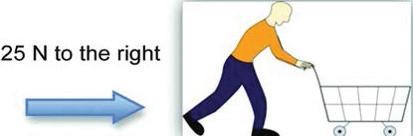
What kinds of forces are there?
There are generally two groups of forces: those that touch and those that act at a distance.
• Contact forces are those interactions in which there is physical contact.
• Friction: The force of friction occurs when two surfaces rub in the opposite direction, such as sliding a box across a floor. Friction can be useful. For example, without the friction of car tires rubbing on the surface of roads, the car would slip all over the road. Friction is also necessary for traction when walking or in sports. Friction allows your pen or pencil to leave marks on the paper.
• Applied force: An applied force is directly pushing or pulling an object such as hitting a baseball with a bat or pulling a wagon.
• Normal force: A supporting surface pushes back up on an object that is resting on that surface. That support force is called a normal force.
STEMscopedia
• At-a-distance forces are those interactions where the push or pull is from a force field acting at a distance.
• Magnetic field: Magnets can pull or push objects from a distance depending on the strength of their magnetic field. Refrigerator magnets are weak, while the force of a junkyard electromagnet can pull up a heavy car.
• Gravitational field: The Sun’s gravitational field is so enormous that the force is strong enough to keep all the solar system objects in orbit around the Sun.
• Electric field: When electric charges are similar (both positive or both negative), those charges push particles apart. Charges that are opposite, such as a positive and a negative charge, pull objects together. The charges holding atoms together is incredibly strong, while the electrostatic charge of a rubbed balloon is weak.
Balanced, Unbalanced, and Net Forces
An apple sitting on a desk has at least two forces acting upon it. Earth’s gravitational force (F gravity) pulls the apple down toward the center of the planet. Earth’s gravity is what keeps everything on Earth, including people, from drifting off into space. It literally keeps us grounded! The second force acting on the apple is the normal force (F normal). The normal force is the force of the desk pushing back up on the apple, keeping it from falling through the desk and to the ground. The forces are balanced so the apple just sits and does not move.
When someone sits on a chair or leans against a wall, the normal force pushes back against that person, preventing him or her from falling through the chair or wall. The normal force acts in the opposite direction of gravity. Together, gravity and the normal force combine to be the net force acting on the person.
What Do You Think?

Net force is the total of all forces acting on an object at once. When calculating net force, any forces acting in the same direction are added together. Those acting in opposite directions are subtracted. If the net force is zero, there is no movement.
So the net force is
STEMscopedia
What Do You Think?
Now imagine that your clone pulls on the other side of a box as hard as he or she can. How would the box move? Yes, the box would move in the direction of your push and your clone’s pull. Since the two forces are acting in the same direction, the two forces add to each other instead of canceling each other out. In this case the net force is not equal to zero and is unbalanced. The diagram below describes this scenario.
N
N 50 N + 50 N = 100 N So the net force is unbalanced.
Solving for Net Force
Consider the picture below of a boy moving a TV across the floor. Look at all the forces acting on that TV. What is the net force acting on the television, including both its magnitude in newtons (N) and direction?
To find net force, remember to add forces going in the same direction and subtract forces going in the opposite direction.
The force of gravity and the normal force are subtracted: (175 N – 175 N = 0 N)
The force of friction is subtracted from the applied force of the pushing:
(156 N – 32 N = 124 N)
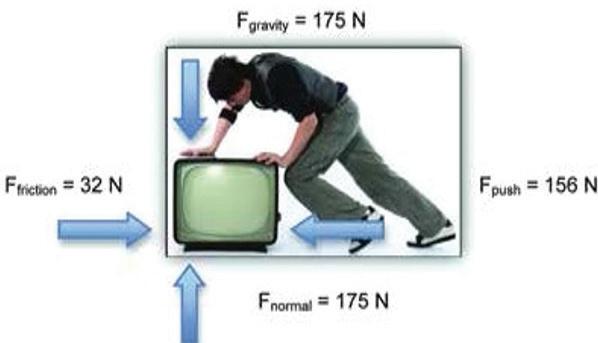
The net force is 124 N to the left in the direction of the stronger force.
Balanced and Unbalanced Forces
When the net force on an object adds up to zero, it is said that the forces are balanced. Balanced forces do not change an object’s motion. This means that an object in motion stays in constant motion at the same speed and direction.
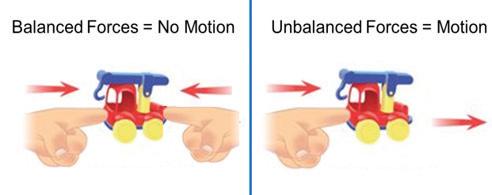
STEMscopedia
Flight Forces
The same principles of balanced and unbalanced forces apply to forces affecting flight. To begin, a wing generates lift because the air goes faster over the top, creating an area of low pressure that is an upward force. The weight of the plane is the force of gravity pulling down in the opposite direction of lift. The thrust comes from the plane’s engines sending out jet exhaust in one direction, which causes the plane to thrust forward in the opposite direction. Air friction rubbing against the body of the plane creates drag in the opposite direction of the thrust. If the plane goes fast enough to get lift and overcome gravity and drag, the net force will be forward airspeed.
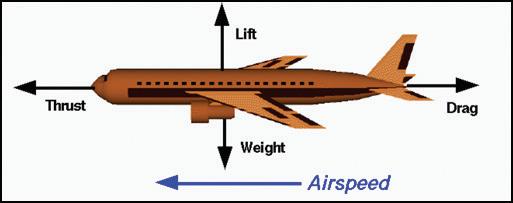
Now imagine that instead of a clone of you, a three-year-old child is standing on the other side of a box. If you and the three-year-old both push as hard as you can on opposite sides of the box, will the box move? Yes, the box will move toward the three-year-old because the magnitude of the force of your push is greater than the magnitude of the force of the three-year-old’s push. Even though the forces push in opposite directions, they are not of equal magnitude, so the net force does not equal zero and is unbalanced. The diagram below describes this example.
Three-Year-Old
50 N – 5 N = 45 N So the net force is unbalanced.
STEMscopedia
For each scenario described, determine whether the net force is balanced or unbalanced.
STEMscopedia
Connecting With Your Child
Forces in Action
To help your child learn more about forces and motion, set up a series of simple events in which you can demonstrate motion in your backyard or at a park. If you are unable to travel to an outside area, you can spend time looking through books or magazines together to find examples of unbalanced forces and motion.
Suggestions for events include these:
• Compete in a tug-of-war in which you and your child pull on opposite ends of a rope. Ask your child to determine when the forces are balanced, when they are unbalanced, and the direction of the net force.
• Conduct a footrace in which you time your child traveling various distances: 100 feet, 50 feet, and 25 feet. Have your child calculate his or her speed for each distance.
• Participate in a challenge to push an exercise ball across a line. Set up two lines of masking tape approximately 20 feet apart. Place a large exercise ball in the middle, between the lines. Stand on one side of the ball, and have your child stand on the opposite side of the ball. Each person has to try to push the ball over the line behind the opponent. Encourage your child to shout out when the forces are balanced.
• Follow an acceleration trail. Make a finish line at least 100 feet from the start. Yell out a variety of acceleration directions to your child. The directions should include these: “An unbalanced force acts in your direction,” “Accelerate speed,” “Frictional force increases,” “Accelerate accordingly (slow down),” “Accelerate left,” or “Accelerate right.” Your child should follow your directions, following a path from the start to the finish at various speeds.
Here are some questions to discuss with your child: 1. How do you know when forces are balanced on an object?
2. What are some ways to create an unbalanced net force on an object?
3. How can you make an object accelerate without speeding it up?
Reading Science
What Is the Force?
1 Everything in our world moves. Before an object can move, however, forces need to act upon it. The force can either speed up (accelerate), slow down (decelerate), or make the object stationary (stand still). Take the force of gravity, for example. Gravity keeps a textbook from floating off a desk. It keeps us from floating to the ceiling when we do jumping jacks during gym class.
2 Roller coasters use the laws of motion to thrilling ends. They are the best use of Newton’s laws of motion. Newton’s first law is the law of inertia. This states that an object at rest stays at rest until a force acts upon it. Likewise, an object in motion stays in motion until unbalanced forces act upon it. All objects have inertia. As an object’s mass increases, its inertia increases. A larger force is needed to overcome this larger inertia. Most roller coasters run by the law of inertia.
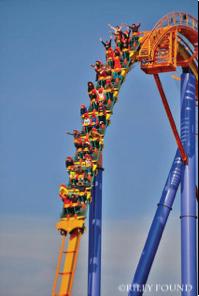
3 Here is another example. When you push a box, the box will move in the direction of the force. It will keep moving as long as you push it. The greater the force used, the greater the change in the box’s motion. The greater the mass of the box, the greater the force needed to cause a change in its motion.
4 Newton’s second law is the law of force and acceleration. That law states the relationship between force and acceleration. The acceleration of an object depends on the object’s mass and the amount of the force acting upon it (F = ma). You feel this second law when you start going down the hills on the roller coaster. The thrill of acceleration on a roller coaster comes from Newton’s second law.
5 Likewise, when a football player punts a ball, the force used to make a powerful kick causes the ball to fly high in the air. A force that pulls or pushes in a different direction is called an opposing force. This causes an object to decelerate (slow down) or stop.
6 Newton’s third law is the law of action-reaction. This states that for every action there is an equal and opposite reaction. This means that as you push down on the seat, the seat pushes back at you. This law is really shown with newer roller coasters that expose riders to high g-forces, which can be dangerous. What is a g-force? It is the force a body feels due to acceleration or gravity. On a roller coaster, you feel the force from both. Older roller coasters did not expose riders to very many g-forces. Newer roller coasters, however, can expose riders to very high g-forces. We will continue to use the laws of physics to create more exciting roller coasters. It will be important to keep in mind the limits of our human bodies.
Reading Science
1 What is the meaning of the word stationary as used in Paragraph 1?
A To shake
B To fall
C To stand still
D To pull down
2 Complete the sentence: The greater the mass of an object, the more __________ is needed to move it.
A help
B force
C energy
D time
3 In terms of this passage, what does Newton’s second law explain?
A Why roller coasters start with a big hill
B Why roller coasters have seat belts
C Why roller coasters do not have brakes
D Why the speed of the ride changes
Reading Science
4 Which of Newton’s laws states that for every action there is an equal and opposite reaction?
A Newton’s first law
B Newton’s second law
C Newton’s third law
D None of the above
5 In terms of roller coasters, what does Newton’s law of inertia explain?
A Why roller coasters start with a big hill
B Why roller coasters can cause damage to the human body
C Why roller coasters need constant pulling to stay moving
D Why roller coasters are fun
6 What conclusion can the reader make about g-forces based on the information in Paragraph 6?
A G-forces help one’s heart to beat properly.
B G-forces can be harmful to one’s health.
C G-forces make the blood in one’s body rush to one’s head.
D G-forces lift one out of the roller coaster seat.
Open-Ended Response
1. Look at the two stationary objects below and the forces acting on them. Which object will move and which object will remain in the same place? How can you tell?
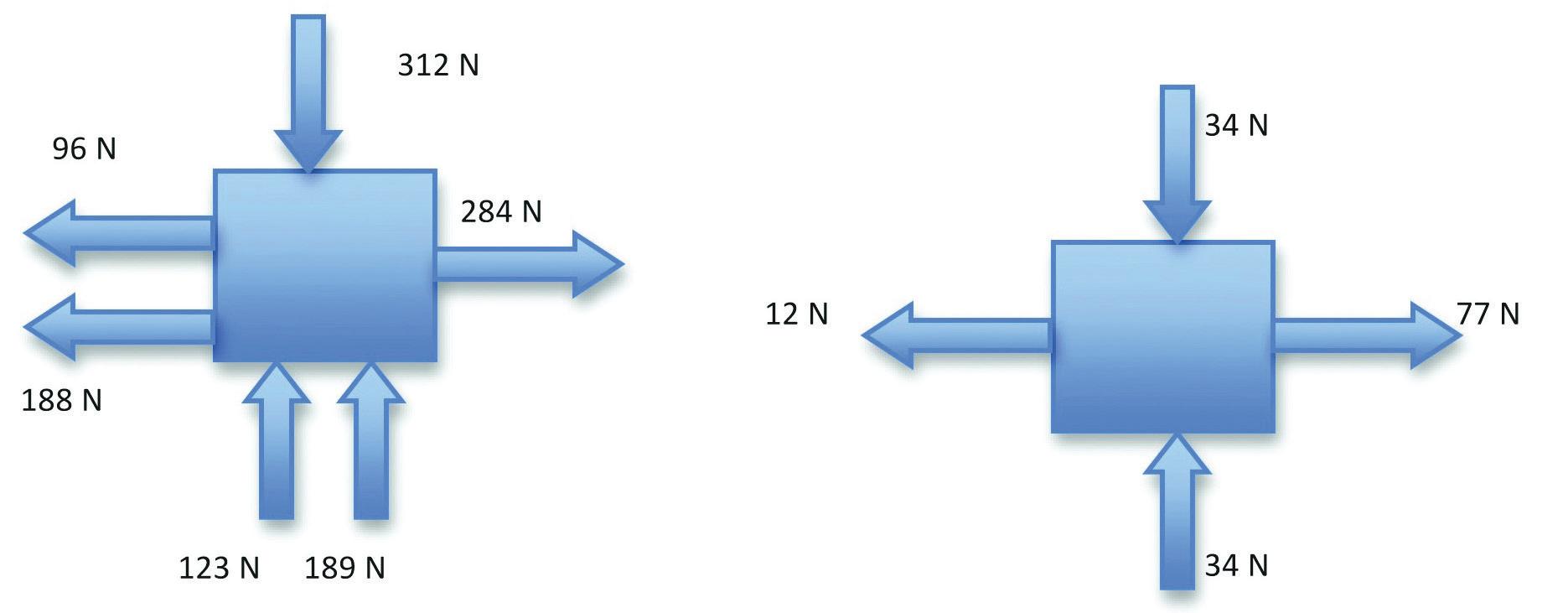
2. How could you make a design change to create a tennis shoe with more friction? How would this help a tennis player to perform better on the court?
Open-Ended Response
3. Compare and contrast gravity and friction.
GRAVITY
FRICTION
Open-Ended Response
4. Imagine you are a kicker in the NFL. If all other conditions, such as temperature and humidity, are equal, where would a kicked football experience less drag: at high altitude or at sea level? Where would a kicker rather play a game and why?
A group of students invented a device to measure the gravitational forces between masses. The device has two mass holders that are located 0.5 m apart. The masses of the objects placed on the holder are shown in the chart below.
If the device works properly, which set of objects should show the largest gravitational force?
Write a scientific explanation that justifies the answer to the problem above.
8.2, and 8.3
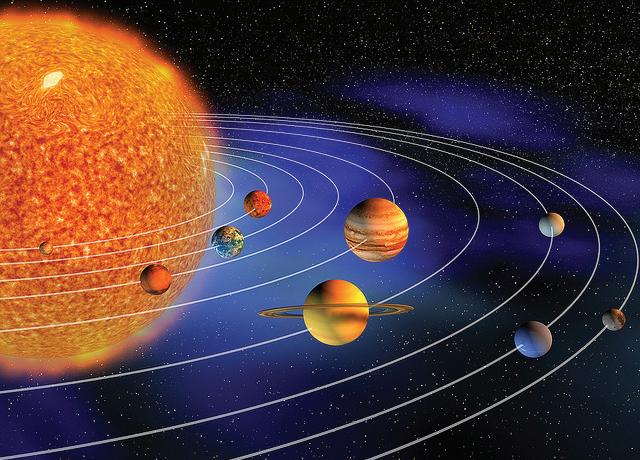

Modeling Formation
Activity
1. Discuss with your group how you think the universe was formed.
2. Create a human model to demonstrate your idea.
3. Share your model with the class.
4. Participate in a class discussion after viewing each model.
5. Write a description of the class theory of how the universe formed.

Formation and Composition of the Universe
All energy and matter that exist are found within the universe. Larger celestial components of the universe include galaxies, nebulae, black holes, stars, and planets. Scientists believe that the universe began ~14 billion years ago with the Big Bang. The big bang theory says that matter did not exist before the Big Bang occurred; the universe consisted of only energy, and all this energy was contained in an infinitely small area (smaller than an atom). Time as we know it began with the Big Bang. After the Big Bang occurred, the four basic forces (gravity, electromagnetic force, strong nuclear force, and weak nuclear force) began to function, and the universe started expanding rapidly.
Part I
1. Stage 1: Pre-Big Bang—You represent small particles of energy that make up the entire universe. Everyone group together as closely as possible to form a single point of dense energy.
2. Stage 2: The Big Bang—Move quickly away from the group and spread about the room. Cooling occurs and matter begins to form as you spread about the room with passing time. If you are not wearing a sash, look for and grab a length of twine hanging from a sash as you move from the center, and move with the student wearing the sash. There can be only one student per piece of twine. The twine represents the force of gravity that attracts smaller masses to collect with a larger mass.
3. Stage 3: Galaxies Form—Groups stop and stand together with the student wearing the sash.
4. Share the name of your galaxy (name on the placard), the number of students in your group, and the mass of your galaxy.
5. You have now completed the process of the formation of the Milky Way galaxy. What role did gravity play in the formation of galaxies? Record your ideas below.
Explore 1
6. Draw a series of diagrams with captions to summarize how the Big Bang caused galaxies to form and to show a representative composition of the universe.
7. Discuss:
• What do the students represent in the beginning of this model?
• What do the lengths of twine represent?
• What do the groupings of students represent?
• How is a galaxy a system? The stars and planetary systems are parts of the system.
• What happened to the energy contained in the universe according to this model?
• What happened to all matter contained in the universe according to this model?
Explore 1
Part II
1. Cut out each of the cards on the Formation Theories and Supporting Discoveries page.
2. Read and analyze each card to determine where the information should be placed on a time line, and glue each card in the appropriate location on the time line. Time line of Theories and Discoveries of the Formation of the Universe
Explore 1
3. Use the time line to write a summary of the history of the human search for understanding how the universe formed.
4. Discuss:
• What inventions and discoveries were instrumental in developing theories for the formation of the universe?
• Why is the big bang theory the most widely accepted idea about how the universe formed?
Explore 2
Structure of the Universe
Activity
Scientists have identified patterns of movement throughout natural science. One observable pattern is the motion of celestial bodies in the universe. Gravitational force causes large masses to attract and form systems of celestial bodies to orbit around the largest mass. We observe this pattern monthly as the Moon orbits the more massive Earth.
8.2, and 8.3
Our solar system also follows this pattern as the various bodies within our system orbit the Sun. The pattern continues as our Sun and other stars and star systems are attracted to the massive black hole at the center of the Milky Way galaxy. The attracted stars orbit the massive galactic center. This pattern continues as gravitational force pulls galaxies together in groups and groups orbit together in clusters.
Procedure
1. Gather the needed materials from your teacher.
2. The Sun is a star in the Milky Way galaxy. The black hole in the center of the galaxy attracts the Sun and the other stars in an orbit around the massive center. Using the colored pencils, you may decorate the Sun and the Milky Way black hole, and then cut out the two pieces.
3. Using one brad, attach the arm of the Sun to the back of the Milky Way so that the Sun will orbit the Milky Way.
4. Galaxies are also affected by gravitational force. The Milky Way galaxy is attracted with many other galaxies to form the Local Group. The galaxies within this group are not orbiting one large massive object. They orbit the common center, or the center of gravity for the entire group. Decorate the Local Group common center. Cut it out and use a brad to connect the arm of the Milky Way to the back of the Local Group.
5. The pattern continues as groups of galaxies are held together by the gravitational force from the common center of the cluster of groups. The Local Group is one of many groups orbiting the common center of the Virgo Cluster. Decorate one of the Common Center disks, and then cut it out. Use a brad to connect the arm of the Local Group to the back of the Common Center. Then, using the same brad, attach the Common Center in the middle of the small paper plate. Use a marker to write “Virgo Cluster” on the small plate.
Explore 2
6. Clusters are in turn attracted to the common center of superclusters. The gravitational pull holds the clusters in a pattern orbiting the center of gravity of the supercluster. The Virgo Cluster orbits the common center of the Local Supercluster. Decorate the Common Cluster disc and cut it out. Cut out the rectangular arm piece as well. Attach one end of the arm to the back of the Virgo Cluster (small plate). Use a new brad to attach the Common Center and the opposite end of the arm to the middle of the large paper plate. Use a marker to write “Local Supercluster” on the large plate.
7. Based on your model, what can you conclude about the structure of other stars, galaxies, and galactic clusters? Write a scientific explanation to describe the hierarchical structure of the universe.
Claim:
Evidence:
Reasoning:
Exploring the Universe
Activity
Astronomers use various forms of technology to gather data about the solar system and the universe. A wide variety of telescopes are used to do more than study the visible light spectrum. Telescopes gather data from every part of the electromagnetic spectrum that reaches Earth. Satellites orbiting Earth and other planets also provide astronomers with useful data. For deep space data, space probes are sent out into the solar system and beyond.
Your group will choose one of these information-gathering technologies and research its discoveries and uses. You will then create a poster and a presentation about your telescope, satellite, or space probe to present to the entire class.
Procedure
1. With your group, research one of the following information-gathering technologies: telescopes such as the Hubble Space Telescope, Chandra X-ray Observatory, Keck Observatory, Fermi Gamma-ray Space Telescope, Far Ultraviolet Spectroscopic Explorer, Spitzer Space Telescope, WMAP, Very Large Array, and the Green Bank Telescope; satellites such as the International Space Station, Mars Reconnaissance Orbiter, Juno, and MAVEN; or space probes such as Voyager 1, Voyager 12, Pioneer 10, Pioneer 11, Rosetta, Curiosity Rover, CassiniHuygens, and New Horizons.
2. Look for answers to the following questions:
A. If the technology has a telescope, what wavelength or wavelength band does your telescope study?
B. What recent discoveries have been made using this technology?
C. If the telescope, satellite, or space probe is still in use, what current investigations are underway using the technology?
D. If the telescope, satellite, or space probe is no longer used, what plans are there to replace it with a new project?
E. Where is the telescope, satellite, or space probe located, and why is it located there?
F. What sort of unique technology or properties does the telescope, satellite, or space probe have?
G. How can this technology be used to explore the solar system’s position in the universe?
Explore 3
Technology:
Telescope wavelength (if appropriate)
Recent discoveries using the technology
Current investigations underway using the technology
If no longer used, what plans are there to replace it with a new project?
Unique technology or properties of the telescope, satellite, or space probe
How can this technology be used to explore the solar system’s position in the universe?
3. Create a poster illustrating the technology you have chosen. Include knowledge gained through the use of the technology and new discoveries made by using the technology.
4. Present your poster and findings to your class in a five-minute presentation. As part of your presentation, evaluate any competing data, hypotheses, and/or conclusions that you found in your research.
5. Take notes during each presentation to gather information to evaluate the use of each of the technologies to explore our solar system’s position in the universe.
Explore 3
Notes from Presentations
Technology Description
Pros for Use to Explore the Solar System’s Position in the Universe
Cons for Use to Explore the Solar System’s Position in the Universe

STEMscopedia
Reflect
When you look up at the night sky, thousands of objects sparkle into view. If you gazed through a telescope, you would see many more of these objects. You are observing stars giving off energy in the form of visible light. However, the stars you can see are only a very small portion of the universe. What objects in space other than stars make up the universe? What kinds of energy other than visible light do these objects give off? How do scientists answer these and other questions about objects that are so far away?
The universe encompasses all of space, time, matter, and energy. The universe contains everything that exists, from particles of matter smaller than an atom to the largest stars. The universe also includes all forms of energy, from the light you see streaming from stars to invisible radio waves and X-rays. Even time is part of the universe. Scientists think of time as beginning when the universe began. All matter and energy in the universe are contained in a volume of space that scientists have discovered is constantly expanding. The expanding universe is similar to a balloon that is constantly inflating from a single point billions of years ago during an event called the Big Bang
How do we know where we are located in the universe?
Astronomers have gathered evidence that the universe started very small and has grown in all directions ever since. The most distant objects that have been detected are about 13.7 light-years away from Earth. A light-year is a unit of distance. It is equal to the distance traveled by light in one year, which is approximately 9.5 trillion kilometers.
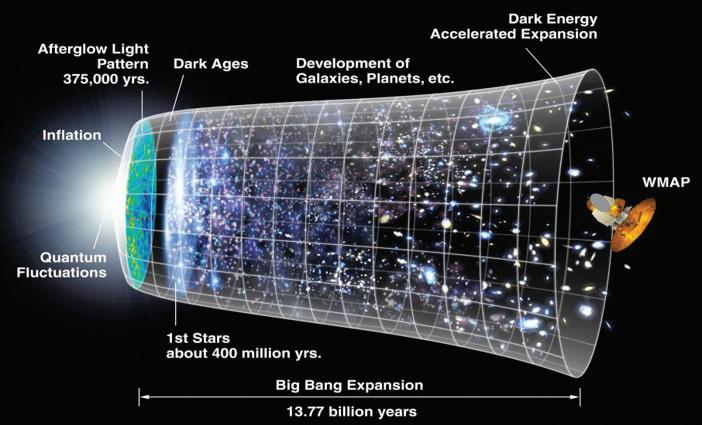
This photo—taken by the WMAP satellite in 2003—shows distant parts of the universe as observed from Earth. The colors represent the different densities that later became stars and galaxies.
Light from the most distant objects began its journey to Earth 13.7 billion years ago. If these objects are actually the most distant objects in space, they are also the farthest back in time. For these reasons, scientists estimate the universe is about 13.7 billion years old.
STEMscopedia
Look Out!
Sometimes we take for granted what we have learned from modern technology. To ancient Greek observers, celestial objects seem to move across the sky as though they were orbiting Earth. Telescopes had not yet been invented, so only five planets other than Earth were known to them: Mercury, Venus, Mars, Jupiter, and Saturn. Stars seemed to be just beyond the clouds.
Ptolemy’s geocentric model (circa AD 100–200)
Heliocentric Model of the Universe
Geocentric Model of the Universe
The geocentric (Earth-centered) model of the universe persisted for centuries based on the false assumption that Earth stood still and was the center of the universe. The geocentric model was promoted by Ptolemy (about AD 100–200), a Greek philosopher who studied in Egypt. He believed that Earth did not move and was at the center of the universe. He also thought other celestial bodies moved in perfect circles. To him, stars were set in a rotating sphere that turned east to west once a day, and the planets, Moon, and Sun were set in separate spheres that moved slower. He thought planets moved in circles (called epicycles) around Earth.
Promoted by Nicolaus Copernicus, the heliocentric model revolutionized scientific thinking in the 16th century and replaced the geocentric model. Heliocentric comes from the Greek word helios, meaning “Sun.” In this model, Earth plus the other five known planets (Mercury, Venus, Mars, Jupiter, and Saturn) orbited the Sun. Only the five naked-eye planets were part of this model.
heliocentric model (1543)
Copernicus’s
STEMscopedia
Reflect
To learn about the properties of objects in space, scientists study the energy coming from these objects. The energy may be in the form of visible light or other components of the electromagnetic spectrum, such as radio waves and X-rays. The electromagnetic spectrum is the range of forms of energy that travel through space in waves. Objects in space emit these forms of energy in different patterns. Scientists use special telescopes to detect these patterns and learn about the objects emitting them.
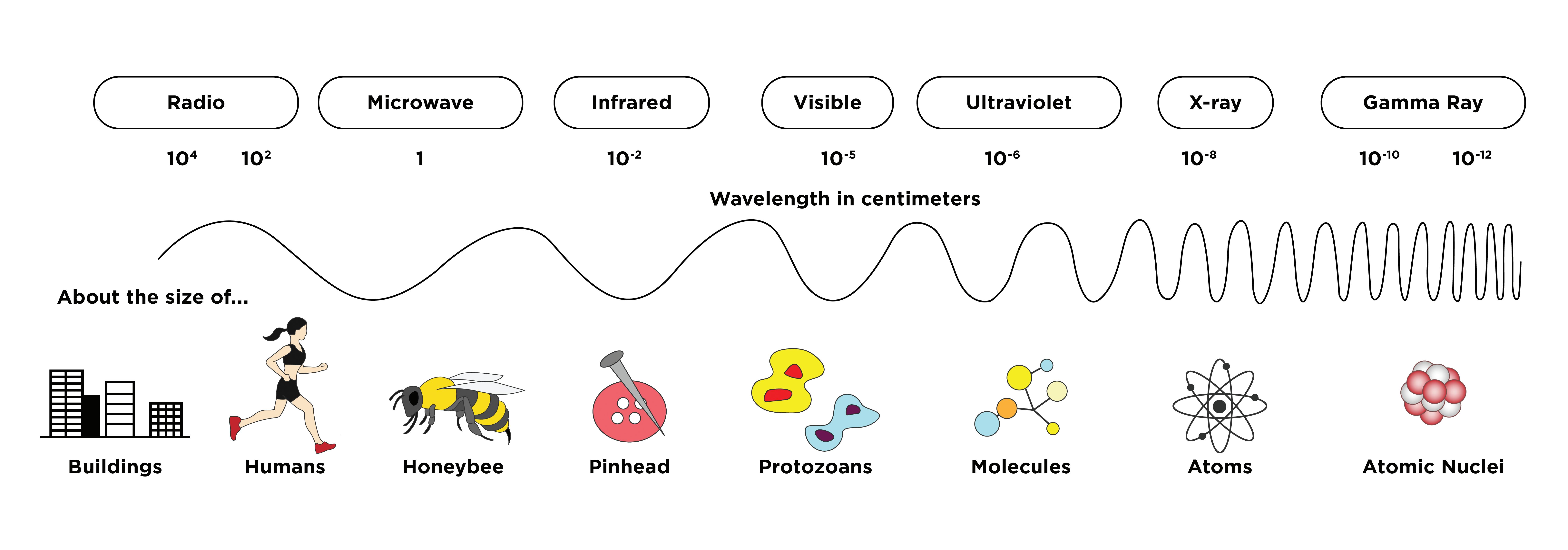
The electromagnetic spectrum organizes waves of energy by wavelength. The largest electromagnetic waves are radio waves, followed by microwaves and infrared waves (or heat). Visible light waves are in the middle of the spectrum. Waves with shorter wavelengths include ultraviolet (or UV) rays, X-rays, and gamma rays. The wavelength of a gamma ray can be smaller than the nucleus of an atom!
From its birth to the present, the universe has changed tremendously. Huge pockets of gas have been pulled together by gravity to form stars. In turn, these stars have been drawn together by gravity to form families of billions of stars, called galaxies. Stars born long ago developed, aged, and died. This process goes on today, and it will continue in the future.
STEMscopedia
Look Out!
You may have difficulty imagining how gravity can “pull together” gases to form stars. The gas particles are tiny but have mass, so they are affected by gravity. As the density of a gas increases, gas particles collide more frequently and with greater force, causing the gas’s temperature to increase as well. Eventually, gases can become so hot they ignite, thus becoming enormous, burning spheres or stars.
Stars are large objects in space that generate their own energy. Almost everything you see in the night sky with your unaided eyes is a star. (Exceptions include a few planets of our solar system, Earth’s Moon, and an occasional comet.)
A star is a huge ball of gas that produces its own energy, mostly through nuclear reactions in its core. Light is the most obvious form of energy produced by a star. However, stars produce many other forms of energy such as infrared radiation (or heat) and ultraviolet radiation. Gravity holds together the particles that make up the body of a star. In other words, a star is so massive that it is held together by its own gravity.
At an average distance of 149.6 million kilometers (93 million miles), the Sun is the closest star to Earth. The next closest star, Proxima Centauri, is about 4.22 light-years away. Recall that a light-year equals 9.5 trillion kilometers; therefore, Proxima Centauri is about 40 trillion kilometers from Earth. Light from this star takes 4.22 years to reach Earth. So, when we see Proxima Centauri through a telescope, we see the star as it existed 4.22 years ago.
Earth’s star, the Sun, gives off tremendous amounts of energy.
STEMscopedia
Look Out!
Scientists do not know for certain how stars form. The most commonly accepted hypothesis is that stars form from vast clouds of dust and gas called nebulae (singular: nebula). The force of gravity is strong between the countless particles of dust and gas.
Gravity causes the cloud to condense and eventually collapse in on itself. As the center of the cloud becomes denser, it starts to spin and heat up.
Gravity pulls more gas and dust particles into the hot, spinning mass, a process that continues for millions of years.
Finally, the matter becomes so hot it ignites. Nuclear reactions begin, and the nebula has become a star.
Inside this nebula, countless particles of gas and dust are pulled together by gravity. Eventually, the process gives birth to stars.
Stars have life cycles.
The stars in the universe are not all the same. Some are very large, and others are relatively small. Some are extremely hot, and others are cooler. Some emit great amounts of energy, and others emit less energy. Stars may be young, middle aged, old, or dying. They may be composed primarily of hydrogen, or they may contain mostly helium and heavier elements. Some are very bright, and others more dim. Their colors range from blue and white to yellow and red.
STEMscopedia
Look Out!
In the early 1900s, Danish astronomer Ejnar Hertzsprung and American astronomer Henry Norris Russell developed a way to classify stars according to their luminosity, temperature, and color. (Luminosity is the energy released by a star related to its brightness. Luminosity is also called absolute brightness.) This relationship is shown in a graph called the Hertzsprung-Russell (H-R) diagram, shown below.
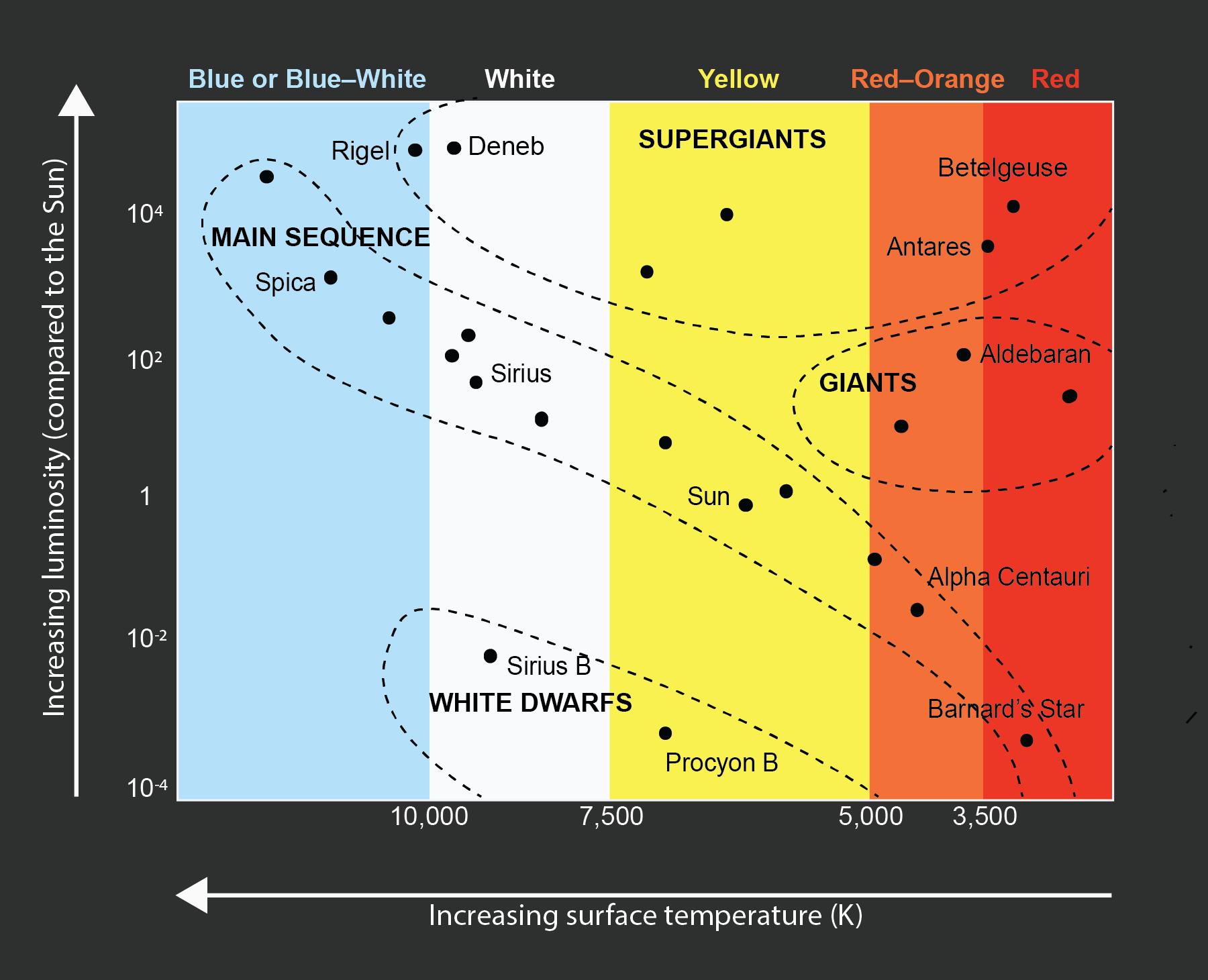
STEMscopedia
Look Out!
On the H-R diagram (on the previous page), stars are plotted along the bottom x-axis by increasing surface temperature, which is measured in units called kelvins (K). (To convert a measurement in kelvins to degrees Celsius, subtract 273 from the Kelvin measurement.) Hotter stars are plotted on the left of the diagram, and cooler stars are plotted on the right.
Stars are plotted along the y-axis by increasing luminosity. Brighter stars are plotted at the top of the diagram. Less bright stars are plotted at the bottom of the diagram. The diagram shows a star’s luminosity relative to Earth’s Sun. Stars by the 102 tick mark are 100 times brighter than the Sun, and stars by the 10-2 tick mark are 100 times dimmer than the Sun.
The top x-axis describes a star’s color or class, which is related to temperature. Blue and white stars are plotted to the left of the diagram. Yellow stars are plotted in the center of the diagram. Red and orange stars are plotted to the right of the diagram. Study the H-R diagram on the previous page. Can you locate Earth’s Sun? (Hint: It is close to the center.) How would you describe the Sun’s temperature, brightness, and color compared to other stars? Do you notice any patterns in the H-R diagram? For example, what color are most hotter stars? Which are brighter— giants, supergiants, or white dwarfs?
Most stars on the H-R diagram fall into one of four groups. Stars in the main sequence make up the vast majority of stars in the universe. In general, the hotter a star is on the main sequence, the brighter and bluer it is. As stars age, they fall outside the main sequence and become giants or supergiants, depending on their mass. As less massive stars die, they become relatively tiny white dwarfs. More massive stars die by exploding into a powerful supernova. (Even smaller stars live for billions of years. The Sun, an average-sized star in the main sequence, is about midway through its 10-billion-year-long life cycle.)
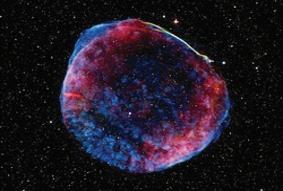
This photograph shows the remains of a supernova that happened more than 1,000 years ago.
STEMscopedia
What Do You Think?
Galaxies consist of families of stars, gases, and space dust. Galaxies are grouped together to form clusters in the universe. Clusters are groups of 10 to 10,000 galaxies formed due to the pull of gravity. Clusters join to form superclusters. Superclusters consist of more than one group of clusters in the universe that are separated by huge voids (holes between clusters). The Milky Way is a part of a vast cluster of 32 galaxies known as the local group.
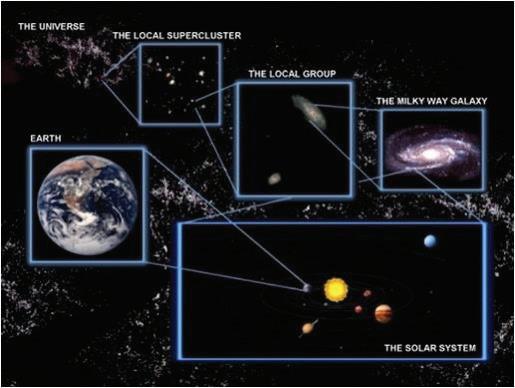
Every star you see in the night sky is part of a galaxy called the Milky Way. Our Sun is just one of billions of stars in the Milky Way. The Milky Way is only one of billions of galaxies in the universe, each of which contains hundreds of billions of stars, gases, and dust held together by the force of gravity.
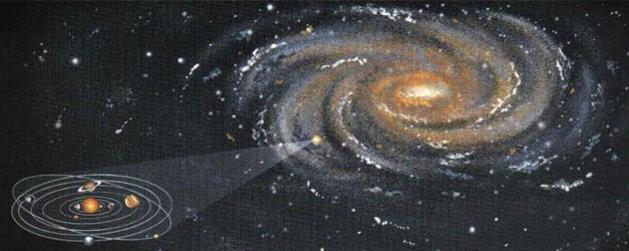
Spiral: These galaxies are shaped like discs with arms spiraling from a central bulge. Most of the galaxies known to scientists— including the Milky Way—are spiral galaxies. The stars and other objects in a spiral galaxy rotate in the same direction around the galaxy’s center like an incredibly fast spinning pinwheel.
STEMscopedia
What Do You Think?
Lenticular: These galaxies form a subgroup of spiral galaxies. Lenticular means “lens shaped.” Like spiral galaxies, lenticular galaxies have a central bulge but lack arms. They are sometimes referred to as “armless” spiral galaxies.
Elliptical: These galaxies look a bit like footballs. (An ellipse is an oval.) The stars and matter in an elliptical galaxy rotate around the galaxy’s center in a variety of directions. The largest galaxies in the universe are elliptical. They may be millions of light-years across and hold trillions of stars.
Irregular: These galaxies have shapes that are difficult to classify. Some are long and thin like needles. Others are shaped like rings or clouds. Astronomers think the gravity of nearby galaxies may be pulling irregular galaxies into their disorganized shapes.
Scientists in the Spotlight: Stephen Hawking and Black Holes
In addition to stars, planets, and nebulae, the universe contains mysterious objects whose gravity is so powerful that they cause nearby material to spiral toward them. Because not even light can escape the gravitational pull of these objects, they are called black holes.
STEMscopedia
What Do You Think?
Black holes were a focus of the work of one of the greatest scientific thinkers of the past century, Stephen Hawking. Although Hawking had a disease that confined him to a wheelchair and prevented him from speaking, he developed a number of theories about black holes. Hawking communicated his ideas through an electronic device that converted the movements of muscles in his cheeks into words. Hawking argued that black holes were created at the birth of the universe and have been with us ever since. In the beginning, they may have been no larger than single protons. Today, some are thought to be so large that they form the cores of galaxies.
Look Out!
Although the concept of black holes is still being investigated, scientists have several theories about how they form and affect nearby matter and energy. As extremely massive stars age, they begin to collapse. Scientists think the matter in these stars is drawn inward, creating an extremely small yet dense object. A black hole the size of a pea could have the mass of Earth!

Scientists once assumed the gravity of black holes pulled everything into them forever, like superpowerful whirlpools. However, Hawking has theorized that black holes give off some kinds of radiation. If so, black holes should be detectable. As it turns out, scientists have uncovered evidence of a black hole at the center of our very own galaxy!
Not even light can escape the gravity of a black hole.
STEMscopedia
Now
Part I: Galaxies
Is each galaxy below spiral, elliptical, or irregular? Write your answer below each image.
Part II: Stars
The following text describes four different stars. Using the Hertzsprung-Russell diagram from earlier in this article, determine what stage of its life cycle is represented: a giant, supergiant, white dwarf, or main sequence star.
Star 1 life cycle is as follows:
• Color: red-orange
• Surface temperature: 4000 K
• Luminosity: approximately 100 times dimmer than Earth’s Sun
Star 2 life cycle is as follows:
• Color: yellow
• Surface temperature: 5100 K
• Luminosity: approximately 75 times brighter than Earth’s Sun
Star 3 life cycle is as follows:
• Color: white
• Surface temperature: 9000 K
• Luminosity: more than 10,000 times brighter than Earth’s Sun
Star 4 life cycle is as follows:
• Color: yellow
• Surface temperature: 6500 K
• Luminosity: approximately 1,000 times dimmer than Earth’s Sun
STEMscopedia
Connecting With Your Child
Modeling the Milky Way Galaxy
Galaxies come in a variety of shapes. Moreover, a galaxy may be viewed from any angle. In each case, the galaxy will look different.
Help your child find images of the Milky Way galaxy as viewed from different angles. You can do an Internet search for these images or visit a planetarium if one is close by. Allow your child to choose the materials he or she would like to use to construct three-dimensional models of various views of the Milky Way.
After the models are completed, have your child do research to determine the approximate position of our solar system in the Milky Way. Have your child label that position in each model. For example, the label may consist of a toothpick stuck in the appropriate location in a clay model. A paper flag bearing the words solarsystemmight be taped to the top of the toothpick. Encourage your child to display the models in school.
Here are some questions to discuss with your child:
• Where is the central bulge in this view of the Milky Way? Where are the spiral arms?
• Where are Earth and our solar system located in this view of the Milky Way?
• Does the Milky Way appear to have different shapes depending on the angle from which it is viewed?

Reading Science
Oh My Stars!
1 What exactly is this thing that we call the universe? The universe holds everything that exists and is home to billions of galaxies. Each galaxy can contain a few million to hundreds of billions of stars that are held together by gravity. There are several types of galaxies. A spiral galaxy, like our own Milky Way, forms new stars in its spiral arms. Our solar system is located in one of the spiral arms of the Milky Way. There are also elliptical galaxies shaped like ovals. They contain old, red stars and do not have enough gas to create new stars. Other galaxies have odd shapes and are called irregular galaxies. These galaxies come in many shapes and sizes and are continuously forming new stars.
2 When scientists use powerful telescopes like the Hubble Space Telescope, they can see faraway galaxies. The farthest galaxies that we can see are over 13 billion light-years away. Astronomers use light-years as a way of describing distances that are too far to measure using miles or kilometers. The Sun, the closest star to Earth, is 149 million kilometers away. Scientists could also say that the Sun is eight light-minutes away, as its light takes eight minutes to reach Earth. If something were to suddenly happen to the Sun, we would not know about it for eight minutes because that is how long any change in the Sun’s light would take to reach Earth.
3 The next closest star to Earth, Proxima Centauri, is 4.2 light-years away. This means that it takes this star’s light over four years to reach Earth. Astronomers studying Proxima Centauri are seeing how it appeared 4.2 years ago. Light-years also help scientists observe conditions at an earlier point in the universe. As you look at the stars at night, the lights you see may not actually be there anymore. If a star was three million lightyears away, then its light has been traveling for three million years before it reaches your eyes. If that star appears as a red giant today, what we see now actually occurred within that star three million years ago. In essence, we are seeing the past.
4 You may ask yourself, “Where do all of these stars come from?” Dust and gas, which can help create new stars, form into clouds called nebulae. The word nebula comes from a Latin word that means “cloud.” Not all nebulae create stars. There are dark nebulae that appear to produce no light at all. There are planetary nebulae that are created after stars die, creating a colorful ring that sometimes looks like a planet. There are reflection nebulae that reflect the light of other stars in their dust cloud. They look blue because the nebula cloud scatters the blue light waves, letting the other colors of light pass through. This is also why our sky looks blue on Earth.
Reading Science
5 Stars, however, are often “born” in something known as “stellar nurseries.” These are also nebulae made of clouds and dust, but they are special. They have the factors needed to create stars. Stellar nursery nebulae are made of mostly hydrogen and helium, and these are important elements in star formation. Stellar nurseries have a lot of energy. The energy of motion (kinetic energy) makes the nebula expand. Gravity (potential energy) makes the nebula shrink. If those energies are balanced, a star cannot be formed, so the energy must shift. This shift has to do with gravity.
6 If the nebula cloud is large enough, its gravity can make it collapse on itself. As it collapses, the dust cloud gets more dense. This means that the cloud has more mass per volume. As the collapsing dust cloud gets denser, it heats up. If it gets hot enough, it will create something called a protostar. As with the larger nebulae, if the kinetic energy and potential energy of the protostar are balanced, and if it gets even hotter, a new star will be “born.” If there is enough matter around the new star, planets may be formed, and a new solar system may even be created. The universe is an amazing and ever-changing thing.
Reading Science
1 What is a light-year?
A The distance that light can travel in one year
B A unit of measure that shows how much light is in one year
C The amount of time it takes for light to reach the Sun
D The distance that a star travels in one year
2 Which of the following statements is NOT true?
A Dust and gas form nebulae.
B There are several types of galaxies.
C The light from stars shows us what the star will look like in the future.
D Distance in space is measured in light-years.
3 The sky on Earth is blue because blue light is scattered through the atmosphere as the other colors of light pass through undisturbed. Which nebulae have a similar effect?
A Emission nebulae
B Dark nebulae
C Reflection nebulae
D Planetary nebulae
Reading Science
4 What factors need to be in a “stellar nursery” for a star to be “born”?
A There must be helium and hydrogen.
B The nebula must be large enough so its gravity makes it collapse on itself.
C There must be more potential energy than kinetic energy in the nebula.
D All of the above
5 REFLECTION NEBULAE : PRODUCE BLUE LIGHT :: DARK NEBULAE : ________.
A PRODUCE BLUE LIGHT
B PRODUCE NO LIGHT
C PRODUCE COLORFUL RINGS
D PRODUCE RED LIGHT
6 What distance separates Earth and the Sun?
A 300,000 kilometers per second
B Eight light-minutes
C 149 million light-seconds
D One light-year

1. What is the big bang theory, and what does it propose?
2. Besides evidence that suggests the universe is expanding, what other evidence supports the big bang theory?
Open-Ended Response
3. Show the hierarchical structure of the universe by filling in the graphic below with terms from the word bank. Define each term.
Open-Ended Response
4. Modern technology helps us to explore the position of our solar system in the universe. How does the Hubble telescope tell us the universe is expanding and stars and galaxies are moving farther away from Earth?

The Milky Way galaxy is one of many galaxies in the universe. Another galaxy is the Andromeda galaxy. The Andromeda galaxy is a neighbor of the Milky Way galaxy. Alpha Andromedae and Beta Andromedae are two stars that orbit Andromeda galaxy’s nucleus. The solar mass is a unit of mass that is used to denote the masses of massive objects in the universe, such as other stars, clusters, nebulae, and galaxies. One solar mass is equal to the mass of the Sun.
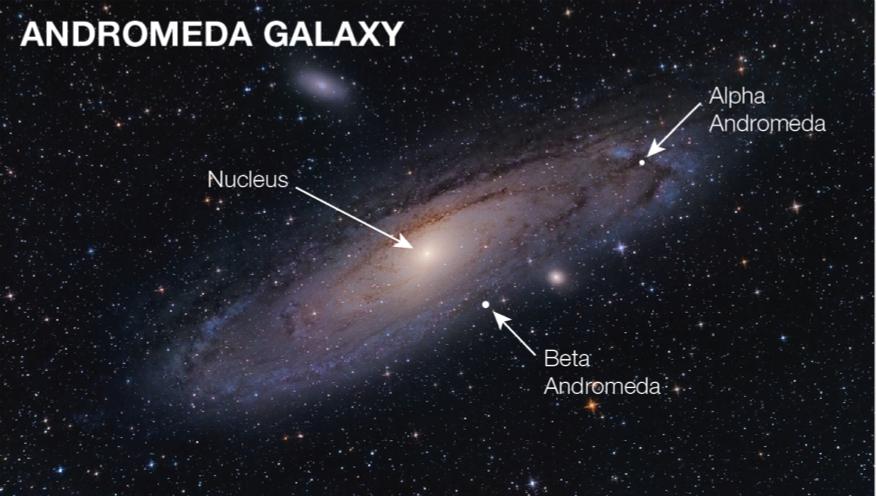
Claim-Evidence-Reasoning
Prompt 3
Write a scientific explanation that justifies why Alpha Andromedae and Beta Andromedae both orbit Andromeda galaxy’s nucleus. Use additional paper if necessary.
PEER EVALUATION
Peer Name:
Rebuttal:
E.6.8.4, 8.5, 8.6, and 8.7
The Solar System
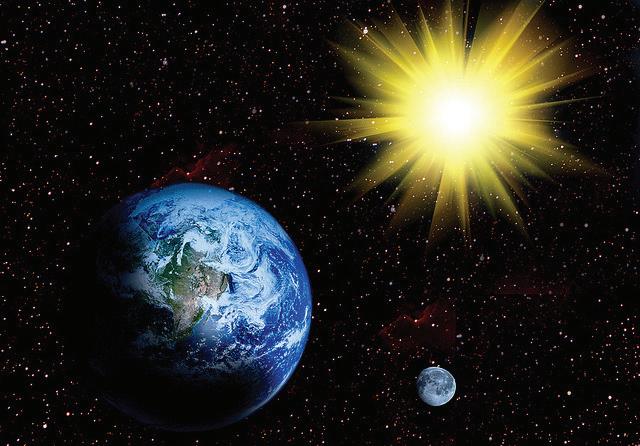
Acting Out Motions of the Sun, the Moon, and Earth
1. In the box below, draw a diagram of the position of the Sun, the Moon, and Earth from the play. Include arrows to show the movement of the celestial objects.
2. What did the rope between the Sun and Earth represent?
3. What is the difference between revolution and rotation, in terms of Earth’s movement?
4. Describe the movement of the Moon.
5. Today we believe this heliocentric (Sun-centered) idea about our solar system, but humans have not always believed it. Ancient civilizations believed in the geocentric (Earth-centered) theory. They thought that Earth was at the orbital center of the Sun, the Moon, the other planets, and all the stars. In the space below, write a text message from the Sun to the scientists of those ancient civilizations, explaining how the solar system is actually arranged and why Earth should not get all of the credit for keeping the solar system together.
Note: It makes sense that the ancient civilizations did not get the text message and still believed the geocentric theory. ☺
8.5, 8.6, and 8.7
Activity
Part I: The Attraction Tango
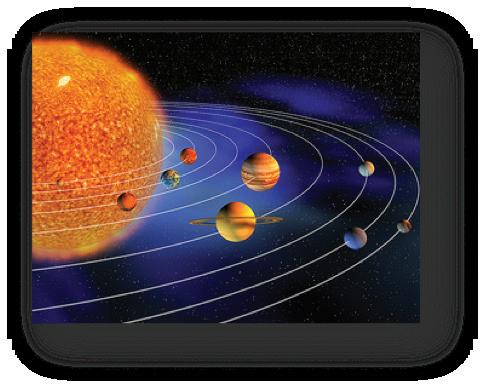
Gravity is a force of attraction between two or more masses. Our solar system resides in the Milky Way galaxy and is made up of the Sun, eight planets, many moons, asteroids, meteoroids, and comets, which are all affected by gravity. All of the celestial bodies in the solar system move in predictable patterns known as orbits, and this motion is controlled by gravity. Every celestial body (including Earth) is surrounded by its own gravitational field, which exerts an attractive force on all objects. The Sun’s massive gravitational field attracts the entire solar system to orbit around it. Earth’s gravitational field attracts the Moon in orbit. The Moon’s gravitational field has attracted numerous meteorites, which created the impact craters we can see on the Moon’s surface from Earth.
Procedure
1. Put on a pair of goggles.
2. Take a table tennis ball and roll the ball across the floor of the classroom.
3. Take the table tennis ball with the string attached and hold the end of the string.
4. While holding only the end of the string, swing the ball around in a circle over your head like a lasso.
5. Stop moving your arm or hand.
Answer the following questions.
1. What happened to the ball that you rolled across the classroom?
2. What forces were acting on the ball?
3. What caused the ball to stop?
4. What would happen to the ball if there were no friction or obstacles to run into?
Explore 1
5. What caused the ball attached to the string to move?
6. Why did the ball attached to the string not continue in a straight line?
7. What happened to the ball when you stopped moving your arm or hand?
8. What does this model represent?
9. What does holding the string represent?
10. How does this activity illustrate what happens when objects lose their energy?
11. How does this activity illustrate what happens to an object in space?
12. Make a prediction about what will happen when the teacher spins the ball overhead and then releases the string.
13. Your teacher will swing the ball overhead in a circle and release the string.
• What happened?
• What does letting go of the string represent?
• What does the model tell us about the effect of gravity on the orbit of a body in motion around the Sun?
Explore 1
Part II: A Tidal Model
Activity
The fundamental force of gravity acts on all matter, including water. The gravitational forces of the Earth-SunMoon system create tidal bulges within large bodies of water on Earth. When Earth turns on its axis, coastlines rotate in and out of tidal bulges, causing daily high and low tides. During spring tides, the high tides are higher than usual and the low tides are lower. During neap tides, the high tides are not as high as usual and the lower tides are not as low as usual.
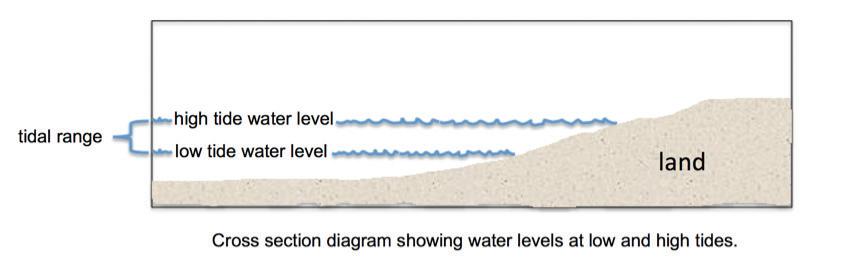
Procedure
Model Setup
1. Tape several layers of cardboard together so that a pushpin can be inserted without poking through the back.
2. Use four pushpins to pin the corners of Tidal Model page 1 to the cardboard pieces.
3. Color and cut out the pieces on Tidal Model page 2 as directed.
4. Tape a 20 cm piece of string to the BACK OF THE CONTINENT on the brown SOLID EARTH piece (tape on the white side, not the brown side).
5. Pin the model together as follows:
A. Insert the pin through the North Pole of the blue WATERS OF EARTH so that it becomes the top layer.
B. Push the pin through the North Pole of the brown SOLID EARTH.
C. Pin the (top) blue water layer and (middle) brown solid layer to (bottom) page 1 on the cardboard in the CENTER of the MOON’S ORBITAL PATH.
6. Finish adding the numbers to the orbital path of the Moon pinned to the cardboard. The Moon takes 27.32 days to complete one full revolution around Earth, but this model has been simplified so that only 27 days can be labeled.
7. The perspective of the model is that of someone high above Earth looking down on the North Pole. The one large continental mass is exaggerated so that the effect of high and low tides on its “coastlines” can be easily viewed and is not meant to be an exact replica of Earth’s landmasses.
Explore 1
Simulation of High Tide and Low Tide
8. Begin your simulation by positioning the paper Moon on DAY 1. Notice the position of the tidal bulges on the blue oval caused by gravity and inertia.
9. Use teamwork to hold the Moon in place on DAY 1 while another group member gently pulls on the string so that the solid brown Earth begins to rotate on its axis. Remember that the perspective is from high above Earth, looking down on the North Pole. Rotate Earth one full turn on its axis. Observe the water level on the continent.
10. Next, move the Moon to DAY 2 of its orbital path. Again, gently pull on the string so that Earth rotates one full daily turn on its axis.
11. Continue moving the Moon to additional sequential positions of its orbital path, and use the string to cause Earth to rotate on its axis for each corresponding day. Note how the continental mass experiences tides on a daily basis.
12. Use your observations of the working model to answer the following questions.
A. Which parts of the model represent Earth’s water pulled into a high tide?
B. What fundamental force acts on large bodies of Earth’s water, resulting in a tidal bulge?
C. How many times do the continental lands on Earth rotate into a “high tide” each day?
D. How many times do the continental lands on Earth rotate into a “low tide” each day?
Explore 1
Simulation of Spring Tide
13. Reposition the tidal model such that the Moon is in Day 1 position.
A. What is the resulting formation of the Earth-Sun-Moon system while in this position?
B. What effect could interactive gravitational forces have on Earth’s waters while the system is in this formation?
C. Diagram this formation of the Earth-Sun-Moon system and title it “Spring Tide Formation.”
14. Reposition the tidal model such that the Moon is in Day 14 position.
A. What is the resulting formation of the Earth-Sun-Moon system while in this position?
B. What effect could interactive gravitational forces have on Earth’s waters while the system is in this formation?
C. Diagram this formation of the Earth-Sun-Moon system and title it “Spring Tide Formation.”
Explore 1
Simulation of Neap Tide
15. Reposition the tidal model such that the Moon is in Day 7 position.
A. What is the resulting formation of the Earth-Sun-Moon system while in this position?
B. What effect could interactive gravitational forces have on Earth’s waters while the system is in this formation?
C. Diagram this formation of the Earth-Sun-Moon system and title it “Neap Tide Formation.”
16. Reposition the tidal model such that the Moon is in Day 21 position.
A. What is the resulting formation of the Earth-Sun-Moon system while in this position?
B. What effect could interactive gravitational forces have on Earth’s waters while the system is in this formation?
C. Diagram this formation of the Earth-Sun-Moon system and title it “Neap Tide Formation.”
Explore 1
17. Decide which diagram should be titled “Cross section showing spring tidal range” and which should be titled “Cross section showing neap tidal range.” Label each diagram.
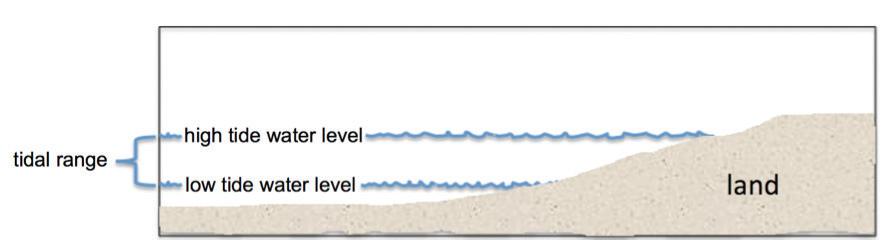
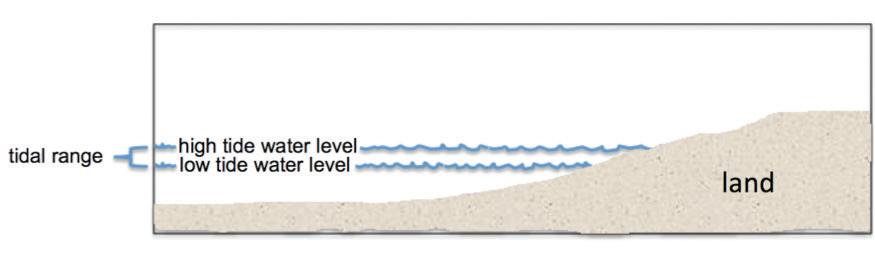
The Moon and the Sun Movements
Part I: Solar and Lunar Eclipses
1. Draw a diagram below to show the alignment of the Earth-Sun-Moon system and the effect of a solar eclipse on Earth. Label your diagram “Solar Eclipse.”
2. Draw a diagram below to show the alignment of the Earth-Sun-Moon system and the effect of a lunar eclipse on Earth. Label your diagram “Lunar Eclipse.”
3. Look at the Moon movement diagram below. Do Earth and the Moon orbit in the same plane?
4. How many places do the two planes of orbit intersect on the diagram? Answer the following questions.
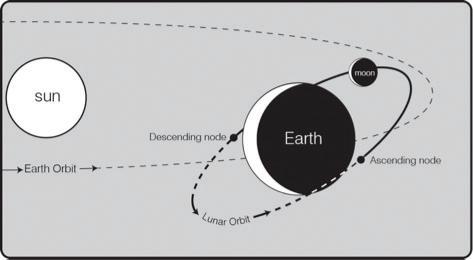
5. Do more people see a solar eclipse or a lunar eclipse?
6. What phase is the Moon in during a solar eclipse?
7. What phase is the Moon in during a lunar eclipse?
8. How often do we have a solar eclipse or a lunar eclipse?
Explore 2
Part II: Lunar Phases
1. How can you use the revolution motions within the Earth-Sun-Moon system to explain the predictable pattern of the lunar cycle?
2. How is a full moon different from a new moon?
3. Contrast the relative positions of the Sun, Earth, and Moon during the full moon phase and the new moon phase.
Explore 2
Part III: A Tidal Model
1. Which parts of the model represent a high tide?
2. How many times do the continental lands on Earth rotate into a high tide each day?
3. How many times do the continental lands on Earth rotate into a low tide each day?
4. Times for daily high tides and low tides change by a few minutes each day for all Florida Gulf Coast communities. What causes the time of daily tides to change, as shown by your models?
5. A limitation of this model is that it looks as if the Moon holds water in place while the solid Earth spins on its axis. What is really happening?
6. In the space below, draw a cross section of a high tide.
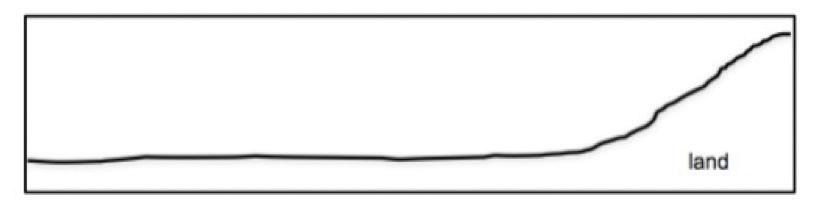
7. In the space below, draw a cross section of a low tide.
Explore 2
Part IV: Day and Night
Complete the data table below.
Position Observations
Where Is the Sun in Relation to Your X?
Is the X in the Light or in the Dark?
Is the Light Shining Directly on the X or Off to the Side?
6:00 a.m.
12:00 p.m.
6:00 p.m.
12:00 a.m.
Using your observations, write a paragraph explaining how the position of the Sun and Earth’s rotation determine day and night. Include an explanation of why another location on Earth has daytime while you are having nighttime.
Explore 2
Part V: Modeling Earth’s Rotation and Revolution
Model of Earth’s Rotation
1. Draw and label your rotation model.
2. How long does it take Earth to make one complete rotation on its axis?
3. Describe the movement of the Sun, Moon, and stars as Earth rotates.
4. In this model, when would someone in Florida be able to see the Moon and stars?
Explore 2
Model of Earth’s Revolution
5. Draw and label your model again, showing revolution.
6. How long does it take Earth to make one complete revolution around the Sun?
7. How does Earth’s revolution relate to the stars?
8.5, 8.6, and 8.7
Our Sun
Fill in the table below while observing the images in the slideshow.
2
3
Glue your model of the Sun below.
Explore 3
Answer the following reflection questions.
1. Which layer of the Sun is the one we see?
2. Which layer of the Sun is the hottest?
3. What are sunspots?
4. In which layer of the Sun do sunspots form?
Driving Question
How could large sunspots such as AR 12192 impact your daily life?
Informative Speech Goals
• The speech should be three to five minutes in length.
• The speech should consist of three parts: introduction of the topic, body (the topic to be discussed), and a conclusion to wrap it all up.
• Include information about
• sunspots,
• solar flares,
• magnetic fields, and
• the impacts of each on your topic.
Research
E.6.8.4, 8.5, 8.6, and 8.7
Solar
System Model
Activity
A scale model is a copy of something that is larger or smaller than the actual size of the object. It maintains precise relationships between the important parts of the system. Scale models are used in many fields including engineering, architecture, geology, and astronomy. Astronomers use scale models because what they are studying is usually too large to bring into the laboratory. To help us study our solar system, it is best to make a scale model.
Procedure 1
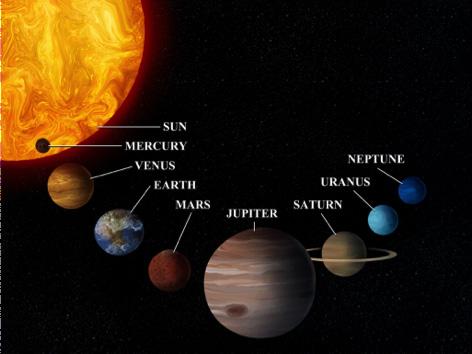
1. The teacher has begun the scale for a relative distance model of the solar system with a five-meter sheet of bulletin board paper with each meter marked off. This is the base of the class solar system model.
2. Receive a group assignment from your teacher.
3. Research to determine the distance of your assigned object(s) from the Sun.
4. Use the method described on the: Solar System Model Project to determine the appropriate distance of your object(s) from the marked location of the Sun on the class model of the solar system.
5. Place one or more sticky notes as needed to mark the location of your object(s) on the model.
6. Find and print a picture of your assigned object(s). Add the picture to the model at the marked location.
7. Research the properties and characteristics of the assigned object(s) including orbital path, physical properties such as mass and composition, and surface features. Be sure to cite where you found your information.
8. Identify how the data was actually collected, such as by an Earth-based telescope, a telescope in space, or by a spacecraft/probe.
9. Create a data table of the collected information and add to the model near the marked location.
10. Present the information about the assigned object(s) to the class.
11. What do you conclude about the solar system? Write a scientific explanation justifying why the planets orbit the Sun in the solar system.
Explore 4
Claim:
Evidence:
Reasoning:
STEMscopedia
Reflect
Have you ever had the chance to look at the night sky and wonder what holds our universe together? Gravity controls celestial motion in our solar system, in our Milky Way galaxy, and throughout the whole universe. The celestial object with the strongest gravitational field has the strongest influence on motion of other bodies near it. Orbits are simply a balance between forward momentum and gravity.
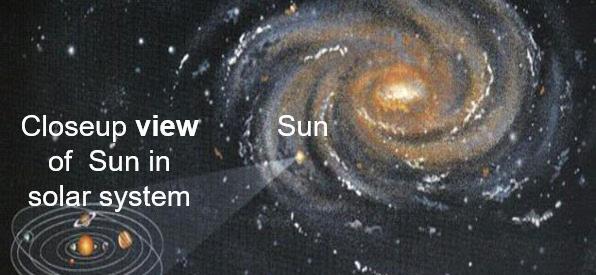
Our Solar System
E.6.8.4, 8.5, 8.6, and 8.7
The Solar System
Our solar system includes our Sun and the planets, moons, asteroids, comets, and other frozen worlds that orbit the Sun. The solar system is located in one of the arms of the giant spiral Milky Way galaxy. The Sun, our daytime star, is one of billions of stars that inhabit this spiral galaxy. There are also billions of other galaxies that populate our universe.
Our Sun
From our vantage point on Earth, the Sun appears quite big and bright because it is our closest star. Other stars are vast distances from Earth and appear only as pinpoints of light. You would need a telescope to see into the Milky Way and beyond to other galaxies. Compared to other stars, the Sun is actually a medium-sized star with an average temperature. There are other stars quite larger than the Sun. Compared to the planets in our solar system, however, the Sun is enormous!
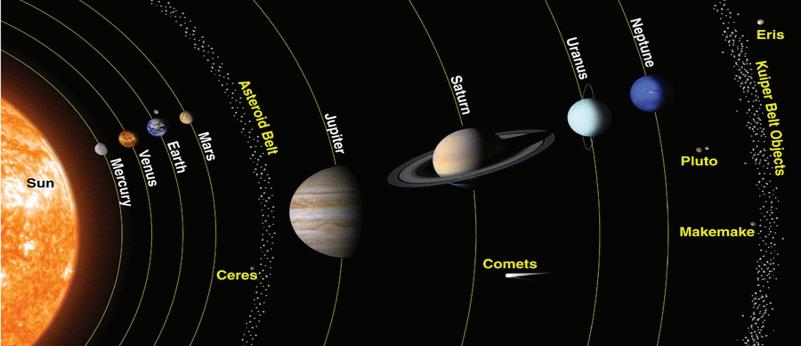
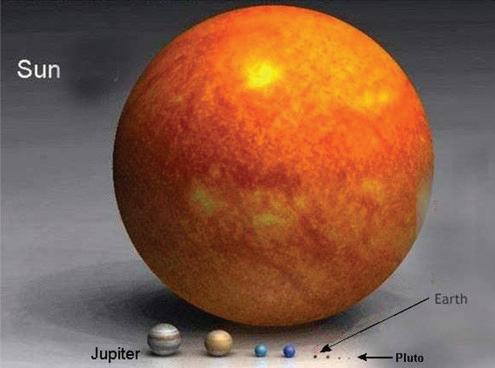
The order of the major planets from the Sun is Mercury, Venus, Earth, Mars, Jupiter, Saturn, Uranus, and Neptune. Pluto was reclassified as a dwarf planet along with Ceres, Eris, and Makemake.
STEMscopedia
Reflect
What are the physical characteristics of the Sun?
The Sun is a star at the center of our solar system. This means that the Sun is more similar to other stars than to Earth or the Moon. The Sun seems larger and brighter than other stars because it is so close to Earth. Here are some other physical characteristics of the Sun:
• Surface: The Sun, like all stars, is a glowing ball of gas. Even if a spaceship could withstand the heat, it could not land on the Sun because the Sun’s surface is not solid.
• Atmosphere: Because the Sun is made up of gas, it has a very thick atmosphere. An atmosphere is a layer of gases surrounding an object in space. The majority of the gas that makes up the Sun is hydrogen. The gases in the Sun are packed tightly together, making it incredibly dense. This contributes to the Sun’s very strong gravity.
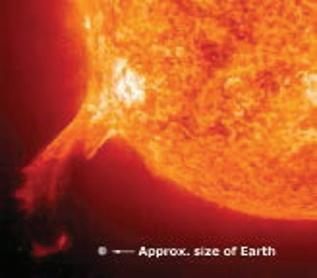
A solar flare erupts on the Sun. Earth is added to show the enormous size of the flare.
• Temperature: Different parts of the Sun have different temperatures. The surface is one of the coolest areas of the Sun at 5,500°C (10,000°F). But that is nothing compared to the core, or center. The average temperature at the center of the Sun is 15,000,000°C (27,000,000°F)!
• Surface features: Sunspots, prominences, and solar flares are features on the Sun’s surface. Sunspots are dark areas that are cooler than the rest of the Sun’s surface. The number of sunspots changes about every 11 years. Prominences are twisted loops of gas that extend from the surface. Solar flares are quick increases in brightness. They occur when energy builds up in the Sun and is suddenly released. Solar flares extend beyond the surface of the Sun and look like explosions.
• Size: The Sun has much more mass than any of the other objects in the solar system. One million Earths could fit inside the Sun! Its great mass gives the Sun very strong gravity. Earth and the other objects in the solar system orbit the Sun because its gravity is so great.
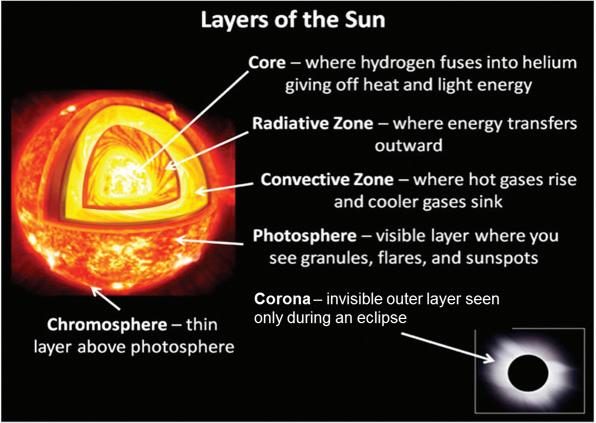
STEMscopedia
Reflect
Eclipses
A model of the solar system can also explain eclipses of the Sun and the Moon. Eclipses occur when the Sun, Earth, and the Moon are all aligned, and one body casts a shadow on another body. A solar eclipse (position 1) happens when the new moon passes directly between Earth and the Sun. In a solar eclipse, the shadow of the Moon falls on a narrow path on Earth. Along this shadow path, the Moon blocks the Sun to observers living along that area.
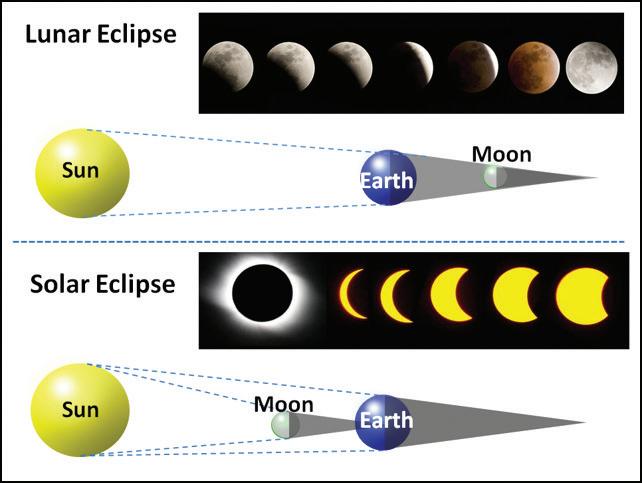
What Do You Think?
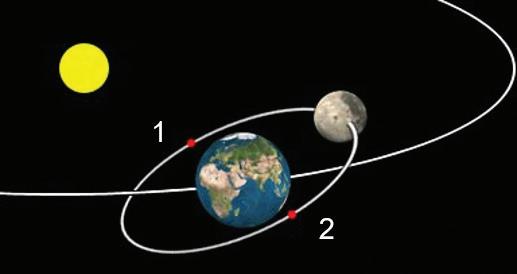
A lunar eclipse (position 2) happens when Earth passes between the Sun and a full moon. This causes the shadow of Earth to fall on the Moon when it is in the full moon phase. We do not see solar and lunar eclipses every month because the Moon’s orbital path around Earth is not in the same plane as Earth’s orbital path around the Sun. Eclipses occur only when all three celestial bodies line up in the same plane, at positions of the red dots 1 and 2 in the image above. These positions where eclipses occur are called nodes.
As Earth rotates on its axis, the Moon exerts a gravitational pull on Earth. Inertia acts as a counterbalance to the gravitational forces. Gravity and inertia are responsible for the creation of two ocean tidal bulges on opposite sides of Earth. This creates a predictable schedule of high tides and low tides that coincides with the lunar cycle.
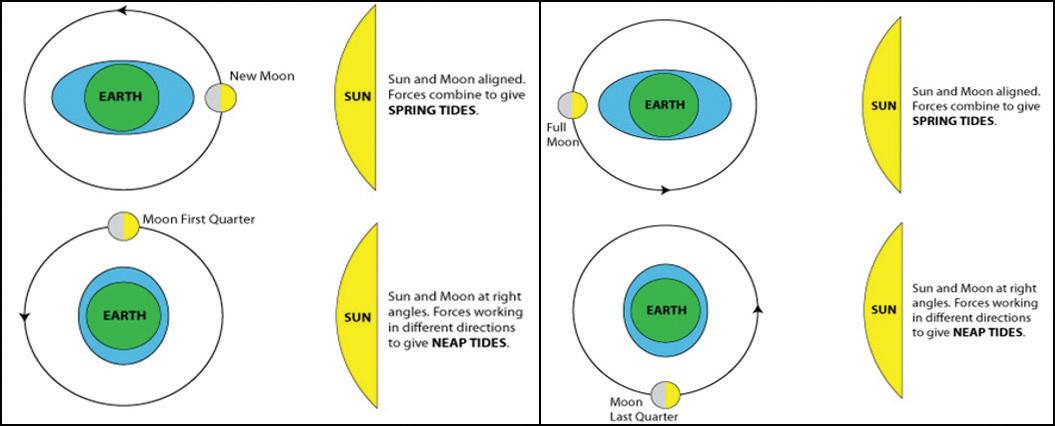
STEMscopedia
Reflect
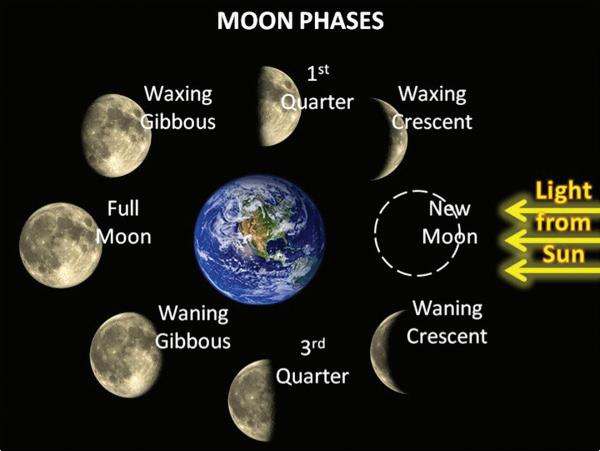
The Moon changes appearance. It appears to rise in the east and set in the west during different times of the day or night. Due to the changing angle between the Sun, Moon, and Earth, a different amount of the Moon’s sunlit side is facing Earth in a cycle called the lunar phases. You do not see the Moon during new moon phase because it rises and sets during the day. The term waxing refers to the increasing amount of the sunlit portion of the Moon’s surface, while waning refers to the decreasing amount of sunlit surface. Gibbous refers to a Moon that is almost fully illuminated by the Sun. To complete one lunar cycle from one new moon to the next new moon takes 29.5 days, or approximately one month.
The Moon Appears to Wobble!
Data from observations and research from NASA explain patterns in the location, movement, and appearance of the Moon throughout a month and over the course of a year. Images from several Moon observation missions, including the Lunar Reconnaissance Orbiter, revealed that the Moon wobbles during its phases. Although the same side of the Moon always faces Earth, there is a slight wobble north to south (like nodding your head “yes”) and slight rocking east to west (like gesturing “no” with your head) as the Moon goes through its phases. This results in our being able to see 59% of the Moon. The wobbling is called libration.
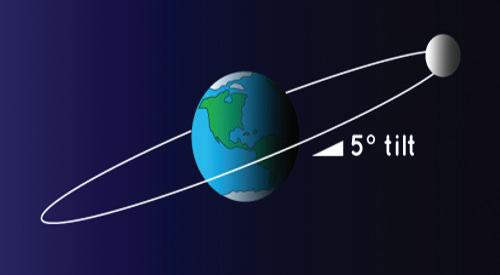
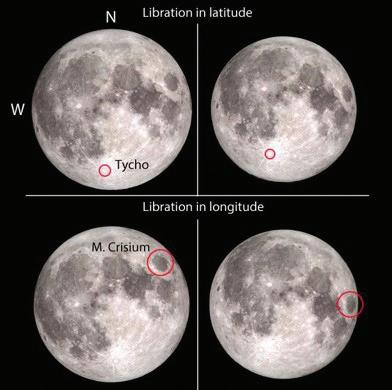
In the images from NASA above, you can see the large crater Tycho shift positions northward during a “nod” and Mare Crisium shift westward during a rocking motion. All of these are “apparent” motions, meaning the Moon is not really wobbling, but it gives that impression due to its changing position as it revolves around Earth in a tilted orbit.
STEMscopedia
The solar system is made of special categories of celestial objects, or objects in space.
Sun versus stars: Although you see stars in the night sky, they are not part of our solar system. Our only star is the Sun. The stars you see as familiar constellations are far beyond the edge of our solar system and are part of our Milky Way galaxy. To see other galaxies in the universe, you need a telescope, although in November you can see the Andromeda galaxy without any tools!
Satellites: Moons are called satellites because they are objects that orbit another object, such as a planet. Scientists have found 173 moons in our solar system, most of which orbit around the huge gas giant planets.
Rocky planets versus gas giants: Mercury, Venus, Earth, and Mars are spheres made primarily of rock, but not all objects in space are made of the same material. The outer planets—Jupiter, Saturn, Uranus, and Neptune—are gas giants. The gas giants also have rings. Although Saturn has the biggest ring system, the other gas giants also have ring systems.
Dwarf planets: Dwarf planets like Pluto and Eris are made of rock and/or ice and orbit a star, like our Sun. Beyond Neptune lies the Kuiper Belt with thousands of frozen planetoids similar to Pluto. The largest body in the asteroid belt, Ceres, is also considered to be a dwarf planet due to its size and round shape.
Asteroids: Not all bodies in space are round. Asteroids are rocky and irregularly shaped bodies that orbit the Sun and are too small to be a planet. Most asteroids can be found in an area called the asteroid belt, which lies between Mars and Jupiter. Other asteroids can be found orbiting the Sun near Jupiter, while others orbit the Sun closer to Earth.
Meteoroids: These smaller rocky bodies often crash into planets and moons as meteorites. Other smaller pieces burn up in the atmosphere as meteor flashes.
Comets: Leftover debris from the formation of the solar system orbits beyond the edge of our solar system in the deep freeze of space. Many comets orbit the Sun in orbits shaped like large, stretched-out circles. As they approach the Sun, their frozen gases warm up and become long tails of gas and dust that drag behind them.
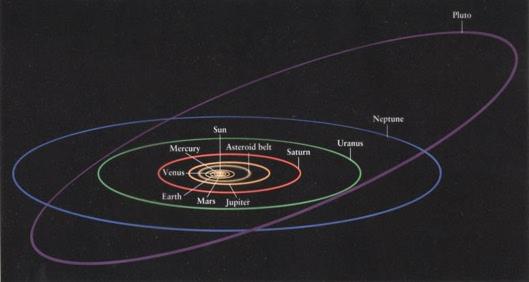

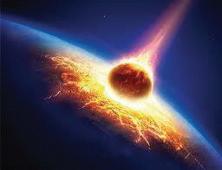
Sun—Our daytime star
Dwarf planets
Meteorite
Asteroid
Comet
STEMscopedia
What Do You Think?
Planets
In our solar system, we have two basic groups of planets. The inner planets (Mercury, Venus, Mars, and Earth) are small, are rocky, and have few or no moons. The outer planets (Jupiter, Saturn, Uranus, and Neptune) are gas giants with many moons and ring systems, although not all rings are visible from Earth.
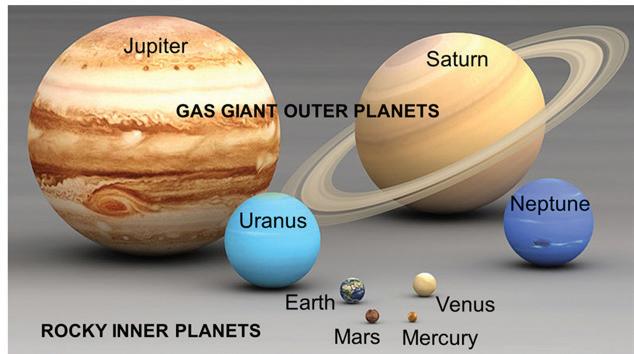
Mercury is the closest planet to the Sun and the smallest planet. The cratered surface of Mercury looks like the Moon.
Venus is the second planet from the Sun. Close to Earth’s size, it is the hottest planet and has a thick carbon dioxide atmosphere.
Earth is the third planet from the Sun and the only planet with life and water in three phases. It is covered three-fourths in water and has one Moon.
Mars is the fourth planet from the Sun. The Red Planet had ancient water. It has the largest volcano in our solar system and two moons.
Jupiter is the fifth planet from the Sun. This gas giant is the biggest planet and also has the most moons—67 and counting.
Saturn is the sixth planet from the Sun. This gas giant has the largest ring system and 62 moons.
Uranus is the seventh planet from the Sun. This gas giant goes around the Sun on its side. It has a vertical ring system and 27 moons.
Neptune is the eighth planet from the Sun. This gas giant has the fastest winds. Its blue color reminds you of the sea. It has 14 moons.
STEMscopedia
Try Now
Make a Model to Represent the System of Earth, Sun, and Moon
Understanding the size comparison of the Sun, Earth, and the Moon will help you understand their movements. Because of their greatly different sizes, it is very hard to compare the sizes of Earth, the Sun, and the Moon. Earth is much bigger than the Moon. About 50 Moons could fit inside Earth. The Sun is even larger. About one million Earths could fit inside the Sun.
To make a good model, you need to choose objects that show either size and location or movement. Even though your distances will not be exact, your model will still help show the patterns of how these objects move. The Moon revolves around Earth at a distance of about 30 Earth diameters. The Moon is about one-quarter the diameter of Earth. Knowing those two dimensions should help you create a scale model inside the classroom.
Try Making Your Own Model
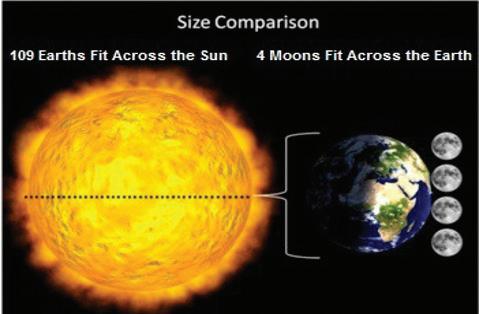
1. Gather materials that you can use to make a model of the Sun, Earth, and the Moon. Consider the following ideas or come up with your own. You can use foam balls, sports balls, clay, foods (marshmallows, candies, etc.), or balloons.
2. Select materials to represent the Sun, Earth, and the Moon.
3. Show how the objects move.
a. Show day and night by rotating the Earth ball to simulate day and night. Try turning on a lamp to act as sunlight and see if you can model the daytime side of Earth and the dark nighttime side of Earth.
b. Show the revolution of Earth around the Sun.
c. Show the positions for phases of the Moon.
d. Show the positions of lunar and solar eclipses.
Analyze This Model
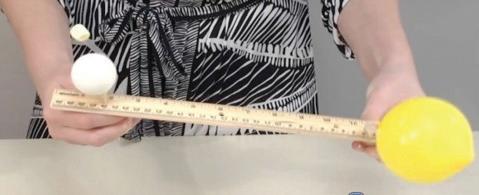
This picture shows a model a student made of the Sun (yellow balloon), Earth (white ball on a golf tee sticking through the hole in the ruler), and the Moon (white ball at the end of a straw attached to Earth).
1. What are some features of the model that make it useful?
2. What are some limitations of the model?
STEMscopedia
Connecting With Your Child
Bringing the Solar System Home
Make observations of the Sun, Earth, and the Moon to help your child understand the differences between each. Begin by studying Earth. Take your child outdoors to a natural area, such as a nearby beach, forest, or field. Have him or her examine the natural surroundings and describe what he or she sees.
For example, your child may say that he or she sees hills covered in green grass; a pond with ducks floating on its surface; and white, puffy clouds in the blue sky. Encourage your child to think about which features are unique to Earth, such as plants, animals, and water; also note the temperature and the look and feel of the atmosphere. Encourage your child to be as detailed as possible with his or her descriptions.
While there, have your child notice the characteristics of the Sun that we can experience on Earth, such as its glowing light that we can see and the heat it emits that we can feel. Do NOT let your child look directly at the Sun.
At night, have your child use a telescope or binoculars to examine the Moon, describing the features of the Moon he or she observes. See if he or she can find the maria, highlands, and craters. Encourage your child to make predictions about the temperature on the Moon as he or she looks at it.
Look on the Internet together for the latest images of the planets of our solar system. Try to find out more about the dwarf planets, which are solar system worlds that are too small to be considered planets.
Make arrangements to take your child to visit a local planetarium, which is a domed theatre that simulates the night sky and gives shows on astronomy and space travel.
Here are some questions to discuss with your child:
• What characteristics of the Sun do we experience on Earth? What characteristics can we see only in pictures?
• Why do the Moon and the Sun look like they are about the same size even when we know the Sun is many times larger than the Moon?
• What are the main differences between the inner planets and the outer planets?
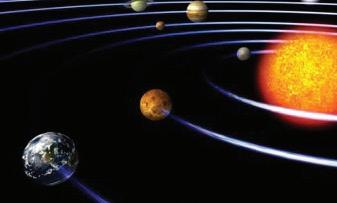
Reading Science
Ocean Tides
1 The sand oozes between your toes as you stroll along the beach. The sound of the waves lulls you into a peaceful state. But wait—is it your imagination, or is the water level rising? The ocean water seems to be further up onto the shore than it was earlier in the day. Well, you may feel better knowing that your mind is not playing tricks on you.
2 Throughout each day, the ocean levels rise and fall at different times. This movement of water is known as a tide. A tide is a change in water level at the shoreline. Tides are caused by the pull of gravity between Earth, the Moon, and the Sun. Each day, the beach can expect a high tide, a low tide, another high tide, and then another low tide. There are about six hours between each tidal rise and fall. The wet sand in the picture shows where the water level was at high tide. This is known as the tidal zone, or the area between high and low tide.

3 The tides are a direct effect of the Moon’s gravity tugging on the water on Earth. As Earth rotates each day, each quarter turn takes about six hours. As a result, Earth will make four quarter turns in a 24-hour period. With each turn, Earth and the Moon will be in different positions. These positions determine if there is a high or low tide.
4 The Moon’s gravity has a more powerful effect on Earth’s waters than the Sun because the Moon is closer to Earth. The Moon pulls the water that is on the side of Earth facing the Moon toward itself. This creates a big bulge of water in the ocean. This bulge creates high tides. The opposite places on Earth, which are not facing toward or away from the Moon, will experience low tides. As Earth keeps making quarter turns, the tides change from high to low and low to high.
5 The Sun does not have as much of an effect on the tides. However, gravity from the Sun can make a tide rise higher than normal. When this happens, it is known as a spring tide. During a spring tide, the Moon is either in its new moon phase or full moon phase. The Moon, Sun, and Earth line up perfectly with one another. This allows the gravity from all three to pull on the ocean together, making the high tide rise higher.
Reading Science
6 Opposite of a spring tide is a neap tide. A neap tide is a lower-than-normal high tide and a higher-thannormal low tide. This happens as the Moon enters a first and last quarter moon phase. At this time, the Sun and the Moon are lined up so that they form a right angle to one another. The gravity from the Sun pulls water away from the bulge formed by the Moon at high tide toward the places that are having low tides.
7 The next time you visit a beach, pay attention to the water level on the shoreline. You might just see a high or low tide yourself. As you do, remember that the pull of the Moon’s gravity is what is causing the ocean tides.
Reading Science
1 Which of these best describes what an ocean tide is?
A The Sun heating the ocean and making a high tide higher
B A change in water level at the shoreline that is being caused by the Moon’s gravity
C A change in water level at the shoreline that is being caused by the Sun’s gravity
D Nighttime cooling the ocean and making a low tide lower
2 What effect does the Sun have on the ocean tides?
A The Sun does not have an effect on the ocean tides because it is too far away.
B The Sun warms the water, causing it to rise.
C The Sun’s gravity can cause spring and neap tides.
D The Sun’s gravity is more powerful than the Moon’s.
3 During a spring tide, the Moon is either in its new moon or full moon phase. What effect does this have on an ocean tide?
A The Moon, Sun, and Earth line up perfectly with one another, so their gravity makes the high tide rise higher.
B The Moon and Sun are at a right angle to one another, causing a lower-than-normal high tide.
C The Sun warms the water, causing it to rise. In most places, the beach will experience two high tides and two low tides.
D A spring tide happens only during the springtime.
Reading Science
4 How does the gravity between the Moon and Earth cause the tides to rise and fall?
A The position of the Sun stops with the Moon’s gravity.
B Earth makes four quarter turns each day, causing high and low tides.
C Earth makes four quarter turns each day, causing spring and neap tides.
D The gravity of the Moon is stronger at night than during the day.
5 How do the Moon and the Moon’s gravity affect the oceans?
A The Moon has different phases as it orbits around Earth.
B The Moon’s gravity pulls the oceans, creating a bulge in the ocean waters.
C The Moon lines up with Earth, and sometimes the Sun, causing tides.
D All of the above are true.
6 What type of tide happens as the Moon enters a first and last quarter moon phase, and the Sun and the Moon are lined up so that they form a right angle to one another?
A High tide
B Spring tide
C Neap tide
D Low tide
Open-Ended Response
E.6.8.4, 8.5, 8.6, and 8.7 The Solar System
1. Which object in the solar system is represented by object B in the data table below? How can you tell?
Object
A Hot gases
Composition
Motion
Orbits the Sun in a nearly circular orbit
B Ice, frozen gases, and rock Orbits the Sun in a very elliptical orbit
C Solid rock Orbits the Sun in a nearly circular orbit
D Metallic, man-made, spacecraft Orbits Earth in a nearly circular orbit
Open-Ended Response
2. Planets, moons, asteroids, comets, and meteoroids are all celestial bodies in our solar system. What is something they all have in common? What is something unique to each object? Put your answers in the table below.
3. Students are modeling patterns of motion of the Sun and Earth. A basketball is used to represent the Sun, and a tennis ball is used to represent Earth. To accurately model the cause of day and night on Earth, what action should the students perform?
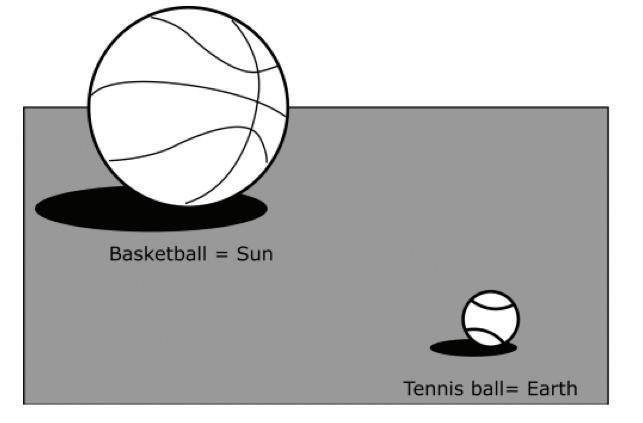
Open-Ended Response
4. The diagram below shows the phases of the Moon, which depend on its position relative to Earth. Spring tides are the strongest tides, and neap tides are the weakest. Given this information and the relative positions of Earth, the Moon, and the Sun in the diagram, during which moon phases do spring and neap tides occur? What role does gravity play in spring and neap tides?
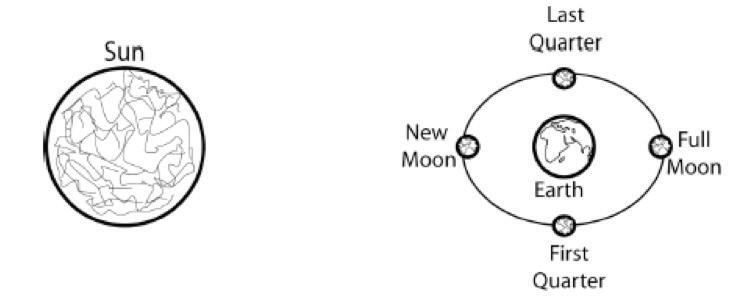
5. What are solar flares? How do they affect Earth?
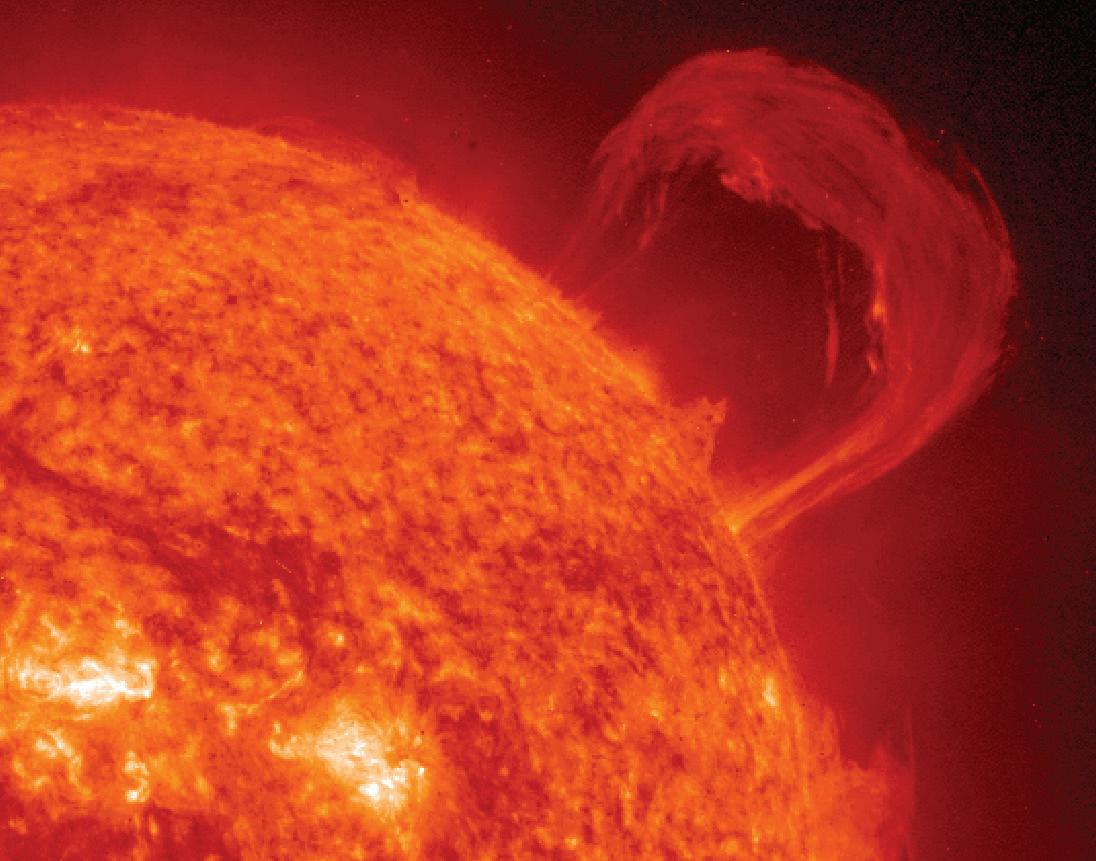
Claim-Evidence-Reasoning
The Solar System
Astronomers working with NASA’s Kepler Space Probe Mission have discovered a new planetary system with a similar-sized star as our Sun. The first data table below lists data for each of the planets found in the new planetary system. The second data table lists data for Earth. Scenario 1
2
External Data
New Planetary System Data
Earth’s Data
Claim-Evidence-Reasoning
Prompt 3
Write a scientific explanation that describes which planet would most likely be hospitable enough for humans from Earth to colonize.
PEER EVALUATION
Peer Name: Rebuttal:
GLOSSARY
abiotic celestial objects
abiotic – not living or produced by living things
archaebacteria – singlecell microorganisms that are different from all other organisms; considered to be an ancient form of life that evolved separately from bacteria and blue-green algae, and is sometimes classified as a kingdom
asteroid belt – the region between the inner and outer planets where most asteroids orbit around the Sun
asteroids – large and small rocks or metallic masses orbiting the Sun; made up of materials similar to those that formed the planets
autotroph – an organism that obtains its nutrition from simple, inorganic compounds
bacteria – a highly diverse group of single-celled, prokaryotic organisms
balance forces – adjust the strengths of forces on an object so that the forces combined do not change the movement of the object
biome – a type of biological community defined by its predominant plants, animals, and environmental conditions
biosphere – the sum of all living matter on Earth
biotic – living or produced by living things
celestial objects – objects such as planets, moons, and stars that are located in the sky or in space
GLOSSARY
cell membrane cytoplasm
cell membrane – the thin tissue that forms the outer surface of the cytoplasm of a cell and regulates the passage of materials in and out of the cell
cell theory – the cell is the basic unit of all living things
cell – the smallest unit of an organism; it is enclosed by a membrane and performs life functions
cell wall – a tough, protective barrier that surrounds the outer membrane of some types of cells
chloroplasts – membranebound organelles in plants that are the site of photosynthesis
cilia – hair-like structures on the outside of cells that produce movement
collide/collision – to strike or hit something with any amount of force
comet – a celestial body of ice, dust, and rock with an elongated and elliptical orbit
commensalism – an interaction between organisms or species that is helpful to one but neither helpful nor harmful to the other
community – all of the populations of different species in a particular area
competition – more than one individual or population in an ecosystem that rely upon the same limited resources
cytoplasm – the jellylike material inside the outer membrane of a cell that holds the nucleus, organelles, and other components of the cell
GLOSSARY
deforestation – removal of a forest or stand of trees where the land is thereafter converted to non-forest use
dichotomous key – tool used to sort organisms by paired similarities or differences based on a series of questions
disease – a disorder in an organism that produces adverse effects and is not a result of physical injury; can be identified by specific signs or symptoms and can affect one or more parts of the organism
distance – a measure of how far apart two objects are
diversity – the quality or state of having many different forms, types, ideas, etc.
domain Eukarya – one of the three taxonomic domains of organisms; cells contain a membrane-enclosed nucleus
ecosystem – the environment and all of the populations in an area and all of the interactions among them
energy pyramid – a diagram that shows the trophic levels of organisms in a food web
eubacteria – prokaryotic cell, lacking a nucleus, commonly referred to as “true bacteria”
euglena – a single-celled organism that moves by a flagellum and is known for its “eyespot” feature
eukaryotic – a cell with a nucleus and membranebound organelles
GLOSSARY
force kingdom Animalia
force – a push or pull that can change the motion of an object, measured with a spring scale in Newton (N) units
friction – force that opposes the motion of one surface across another
fungi – microorganisms important as decomposers; widely distributed and can break down just about any type of organic matter
galaxy – a large grouping of stars in space
gravitational force – a force of attraction between two masses
gravitational pull – the attraction between two objects due to the invisible force of gravity; the gravitational pull from the Moon is primarily responsible for the tides that form on Earth
gravity – the force that causes objects with mass to attract one another
heterotroph – an organism that must use other organisms, such as animals, for food
high tide – when the tide is at its greatest elevation
inertia – the tendency of a physical object to remain still or continue moving until force acts upon the object
inner planet – any of the rocky, terrestrial planets of Mercury, Venus, Earth, and Mars, whose orbits are inside the asteroid belt
investigate – to observe or inquire into in detail; to examine systematically
GLOSSARY
kingdom Animalia low tide
kingdom Animalia – major group of animals that does not contain prokaryotes; all the members of this kingdom are multicellular eukaryotes
kingdom Archaebacteria – kingdom of unicellular organisms that are prokaryotes like bacteria but also share characteristics with eukaryotes
kingdom Bacteria –kingdom of prokaryotic, single-celled organisms that lack a membraneenclosed nucleus and can be classified by shape
kingdom Fungi – kingdom of heterotrophic eukaryotes that reproduce through asexual spores and have chitin in their cell walls
kingdom Plantae – kingdom of autotrophic eukaryotes that includes all plants
kingdom Protista –kingdom of single-celled and simple multiple-celled eukaryotic organisms
kingdoms – the secondhighest level in the taxonomic hierarchy; contains six groups: Archaea, Bacteria, Protista, Fungi, Plantae, and Animalia
kingdom system – the second-highest level in the taxonomic hierarchy; contains six groups: Archaea, Bacteria, Protista, Fungi, Plantae, and Animalia
limiting factor – biotic or abiotic factor that restricts the growth of a population
long-term environmental change – environmental change that occurs slowly over time and affects organisms over generations
low tide – when the tide is at its lowest elevation
GLOSSARY
lunar cycle net force
lunar cycle – the Moon’s repeated pattern of movement and changes in appearance due to its position relative to Earth and the Sun
lunar eclipse – the full moon passes into Earth’s shadow, causing the Moon to appear reddish in color when the Sun, Earth, and Moon directly line up; lasts 1–3½ hours
magnetic attraction –magnetic force exerted by oppositely charged particles that tend to draw or hold the particles together
meteor – a small object that enters Earth’s atmosphere from space and burns due to friction, emitting light
mitochondria – an organelles in the cytoplasm of eukaryotic cells that functions in energy production; the power factory of the cell
moon – a celestial body that revolves around a planet
motion – the change in an object’s position
multicellular – an organism made up of more than one cell; it often has different cells
mutualism – a relationship between organisms or species that is helpful to both
mutually beneficial –a relationship between organisms or species that is helpful to both
neap tide – tides with the smallest daily tidal range that occur when the Sun, Earth, and Moon form a 90-degree angle
net force – the sum of all the forces acting on an object
Newton’s law of action-reaction
GLOSSARY
Newton’s law of actionreaction – Newton’s law that states that for every action there is an equal and opposite reaction; is often referred to as Newton’s third law of motion
Newton’s law of force and acceleration – acceleration of an object depends on the object’s mass and magnitude of the force acting upon it (F = ma); it is often referred to as Newton’s second law of motion
Newton’s law of inertia –an object at rest stays at rest or an object in motion stays in motion until unbalanced forces act upon it; this is often referred to as Newton’s first law of motion
nucleus – a membranebound structure in eukaryotic cells that contains the DNA
orbit – a curved path followed by a satellite as it revolves around an object
orbital path – the gravitationally curved path of an object around a point in space
organ – a large mass of similar tissue that makes up a part of an organism and performs a specific function
organelle – a membranebound structure inside a cell that performs a specialized function
organism – a single, selfcontained living thing
outer planet – any of the planets Jupiter, Saturn, Uranus, and Neptune, whose orbits lie beyond the asteroid belt
GLOSSARY
paramecium – a ciliated, single-celled eukaryote that is common in aquatic ecosystems
parasitism – when an organism survives on a host organism
planet – any of the large celestial bodies that revolve around the Sun in the solar system
population – a group of interacting organisms of the same species
predation – the interaction between two animals by which one animal eats the other
prokaryotic – a cell lacking a nucleus or any other membrane-enclosed organelle
protist – a large, diverse group of eukaryotic microorganisms
reaction – resistance or force of equal magnitude acting in the opposite direction to an action force
solar system – the Sun together with the group of planets and other celestial bodies that are held by its gravitational attraction and revolve around it paramecium
relative position – where an object is located in relation to another object
short-term environmental change – an environmental change that happens quickly but does not last a long time
solar eclipse – the Moon passes between Earth and the Sun, covering all or part of the Sun; occurs when the Sun, Earth, and Moon directly line up; lasts for less than 12 minutes
GLOSSARY
species – a group of organisms with similar characteristics that are able to interbreed or exchange genetic material
spring tide – tides with the largest daily tidal range that occur when the Sun, Earth, and Moon line up with each other
star – a ball of gas in space that produces its own light and heat
Sun – the luminous star around which Earth and other planets revolve; composed mainly of hydrogen and helium
taxonomy – the branch of science that formally names and classifies organisms by their structure, function, and relationships
tertiary consumer – an animal that eats secondary consumers
tides – the periodic variation in the surface level of the oceans and of bays, gulfs, inlets, and estuaries, caused by gravitational attraction of the Moon and Sun
tissue – a mass of similar cells that perform a specialized function
trophic level – the position an organism occupies on the food web
unbalanced forces – forces on an object that cause change in the motion of the object
unicellular – an organism made up of one cell
universe – all space and the matter space contains
vacuole – a large, waterfilled organelle present in all plant and fungal cells and some animal and bacterial cells
GLOSSARY
virus – a nonliving particle consisting of a piece of genetic material enclosed within a capsule made of protein and sometimes lipids or sugars; can only replicate inside host cells by using materials within a host cell