STUDENT WORKBOOK

STUDENT WORKBOOK
Published by Accelerate Learning Inc., 5177 Richmond Ave, Suite 800, Houston, TX 77056. Copyright © 2025, by Accelerate Learning Inc. All rights reserved. No part of this publication may be reproduced or distributed in any form or by any means, or stored in a database or retrieval system, without prior written consent of Accelerate Learning Inc., including, but not limited to, in any network or other electronic storage or transmission, or broadcast for distance learning.
To learn more, visit us at www.stemscopes.com.
This Student Notebook is designed to be used as a companion piece to our online curriculum.
The pages of this book are organized and follow the 5E model.
A short activity to grab students’ interest
EXPLORE Student Journal
Hands-on tasks, including scientific investigations, engineering solutions, and problem-based learning (PBL)
Claim-Evidence-Reasoning (CER)
A formative assessment in which students write a scientific explanation to show their understanding
ELABORATE
A reference material that includes parent connections, technology, and science news
Reading Science
A reading passage about the concept that includes comprehension questions
Claim-Evidence-Reasoning (CER)
A summative assessment in which students write a scientific explanation to show their understanding
Open-Ended Response (OER)
A short answer and essay assessment to evaluate mastery of the concept
Only student pages are included in this book and directions on how to use these pages are found in our online curriculum. Use the URL address and password provided to you by your district to access our full curriculum.


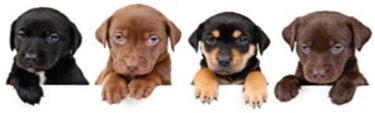
Reproduction involves either asexual replication of parental DNA or the sexual combination of parental DNA. DNA contains genes that determine characteristics such as appearance. Different versions of the genes, called alleles, can produce different outcomes and appearances.
In this activity you create offspring from mystery parents. Choose genetic instructions and create a picture of the offspring according to the selected instructions.
Procedure
Step 1: Create an offspring following a set of instructions and using pictures of physical traits. You may choose instructions from either Parent A1 or A2, but not from both.
A. Take one slip of paper from each of the four envelopes for the parent of your choice.
B. Create your offspring by putting the cards together like a puzzle. Copy or trace the picture of your offspring on a separate sheet of paper as accurately as possible. Use colored pencils to add the appropriate color. Label your picture “Offspring A.” Return your cards to the correct envelope.
Step 2: Create an offspring following a set of instructions and using pictures of physical traits provided by either parent group B1 or B2, but not from both.
A. Take one slip of paper from each of the four envelopes for the parent group of your choice.
B. Create your offspring by putting the cards together like a puzzle. Copy or trace the picture of your offspring on a separate sheet of paper as accurately as possible. Use colored pencils to add the appropriate color. Label your picture “Offspring B.” Return your cards to the correct envelope.
C. Your teacher will reveal the appearances of the parents and post them on the wall. Find the parent that provided the reproductive traits for “Offspring A” and tape your offspring underneath. Find the parents that provided the reproductive traits for “Offspring B” and tape your offspring underneath. Does your offspring look identical to, similar to, or different from the other offspring created by your classmates?
D. Find your offspring of the cat and pair up with someone who created a cat using instructions from the other parental group.
E. Create an offspring by choosing a mixture of traits. Draw this offspring on a separate paper and post as directed by your teacher.
F. Discussion Questions
Answer and discuss the following questions:
• Organisms are reproduced asexually when all of the genetic material is passed on by only one parent. Which of the organisms reproduce asexually?
• Did the offspring of this organism look identical to each other and the same as the parent, or did they show a variety of appearances? Explain your answer.
• Organisms are reproduced sexually when the genetic material of two parents is passed on to the offspring. Which of the organisms reproduce sexually?
• Were the offspring of this organism identical or different? Explain your answer.
• Offspring that are the result of asexual reproduction may differ from the offspring resulting from sexual reproduction in regard to whether they are identical or different. However, they also share some similarities. What similarities do these organisms share?
The process of transferring DNA and genes from parent to offspring is an organized process. This activity models how genes for traits pair up during reproduction. Asexual reproduction results in an offspring identical to the one parent. Sexual reproduction results in several possible offspring, as each trait is a combination from both parents.
1. Create two parent strands by placing the correct beads in order on the pipe cleaner. Bend the ends of the pipe cleaner into knobs so the beads will not slide off.
Parent 1: 1 dark blue, 1 light blue, 1 light green, 1 dark green
Parent 2: 2 dark blue, 1 light green, 1 dark green
2. Create one offspring to model asexual reproduction (decide which parent to use) using the same process.
3. Create as many possible variations of offspring that can occur in sexual reproduction. Very important— blues can only go with blues, and greens can only go with greens. Each strand offspring should have only four beads.
4. Draw and color the results of each in the table below. A line with colored dots will be an appropriate representation for each offspring.
Asexual (which parent)
5. Use information from the Student Reference Sheet: From DNA, Chromosomes, and Genes to Organisms to create a diagram or chart that compares and contrasts the advantages and disadvantages of asexual reproduction and sexual reproduction in the space below.
6. Discussion Questions
Answer and discuss the following questions:
• What are the advantages and disadvantages of asexual reproduction?
• What are the advantages and disadvantages of sexual reproduction?
• How did this activity represent the relationship between genes, DNA, chromosomes, and the transfer of traits to offspring?
• Why were the asexually reproduced offspring identical to the parent?
7. Use data and information from Part I and Part II to write a scientific explanation to compare the relationship of genes, chromosomes, and DNA to the inherited characteristics of an organism.
Claim:
Evidence:
Reasoning:
Mitosis is the process by which cells reproduce new cells. Organisms that reproduce asexually go through the process of mitosis to produce an identical offspring cell. Asexual reproduction involves only one parent. Mitosis can occur in single-celled organisms such as some fungi and bacteria; it can also occur in the cells of multicellular organisms.
This activity will require the assistance of a few small organisms called yeasts. Yeasts reproduce asexually through budding, and in some situations, fission. The increased temperature of the water and presence of extra food (sugar) will cause them to use the process of fission to replicate.
Procedure
1. Combine the premixed warm sugar water solution with the active dry yeast in the Petri dish.
2. Observe the mixture under the stereoscope and record your observations below.
3. Cover the Petri dish with the dark cloth or paper and set it aside for twenty minutes.
4. Observe the mixture under the stereoscope after twenty minutes. Try to find yeasts with small pieces coming off of their surfaces or one piece that appears to be splitting in half. (Both of these observations would show the yeast cell in the process of forming an identical copy of itself.)
5. Write down your observations in the space below.
6. The Mitosis Process Step by Step
Use the Mitosis and Asexual Reproduction Sheet to complete the diagram below.
Name of Phase Drawing What Is Occurring Here?
7. Write a scientific explanation to answer the question of whether or not the replication of sweet potatoes is a form of asexual reproduction. After completing your claim, write the evidence and reasoning points to back it up.
Claim:
Evidence:
Reasoning:
8. Discussion Questions
Use your activities and reference sheet to answer the following questions:
• How does the process of mitosis ensure that the offspring cell is identical to the parent cell?
• Why is metaphase so important in the production of two cells that are identical?
• What happens to the cytoplasm during telophase?
• How does the process of mitosis explain what occurred in the yeast activity at the beginning of the Explore?
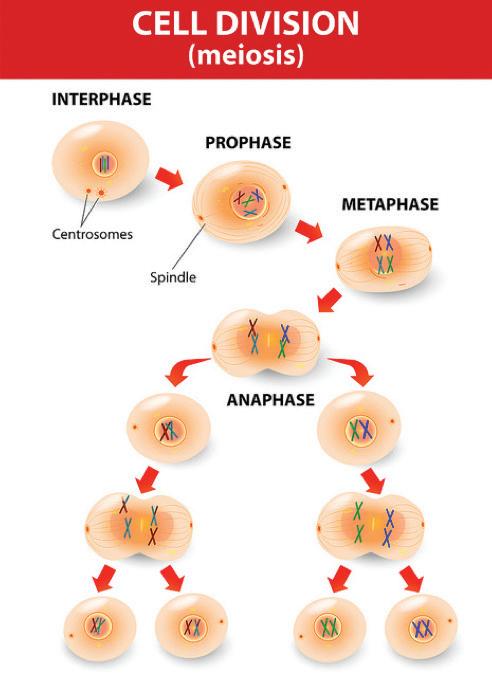
Meiosis is the part of the cell cycle that produces sex cells. Each sex cell has only half the chromosomes so that fertilization can occur to produce a complete cell. This process occurs in organisms that produce offspring through sexual reproduction.
Observation Questions
1. Does replication occur after anaphase? (Do you see any new chromosomes in the cells?)
2. How many chromosomes are in the ending daughter cells to the right? Is this the same as or less than the number of chromosomes present when the cell first started to divide?
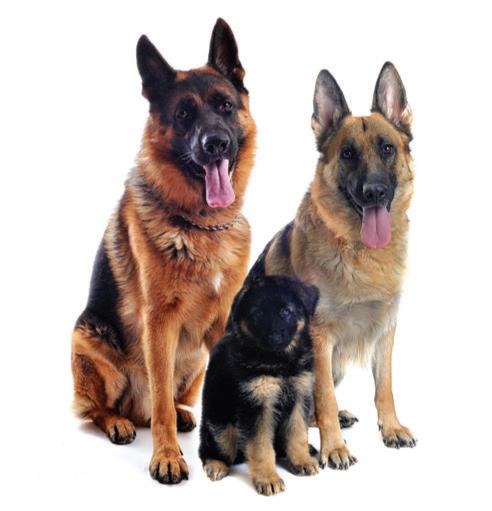
The two larger dogs are the parents, and the smaller dog is their offspring. Make some observations about the similarities and differences in the three dogs in the space below.
Observation Questions
3. Is the puppy identical to either parent?
4. What are some traits the puppy got from each of the parents?
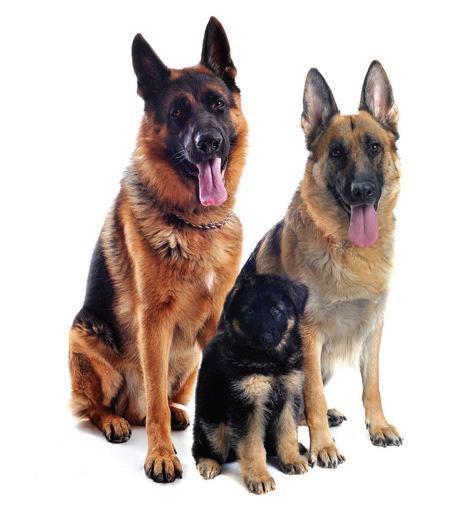
5. Use the Meiosis and Sexual Reproduction and your observations to complete the table below.
6. Move about the classroom as directed by your teacher to work with five different classmates to complete the paired responses.
Discussion Question
Why is meiosis called the reduction division process?
Why do cells going through meiosis have only half the number of chromosomes at the end?
What has to happen for the new cells to become complete cells, each with a full set of chromosomes?
Why is the puppy different from its parents?
How is the graphic of meiosis related to the picture of the dogs?
Individual Response
Paired Response: Same or Different? Why?
Think Respond Share Discuss Table
7. Create a flowchart that explains how genetic information is transferred to the offspring during meiosis using the two diagrams on the previous journal pages.

Imagine a gardener checking on his growing plants at the beginning of spring. He notices a few tiny insects eating some of his plants. The gardener is not worried, because a few insects are not a concern. But when he comes back several weeks later, his plants are covered in small insects. There are at least ten times as many insects as there were several weeks ago! Where did all of these insects come from? How do organisms multiply?
Reproduction is a process by which an organism produces offspring, or young. All organisms reproduce. If they did not, no species would survive past a single generation. Reproduction allows organisms to pass on their traits, or characteristics, to their offspring. Parents pass on their traits through their genetic material, or DNA.
Asexual reproduction is a type of reproduction in which one parent makes an exact copy of itself. The parent passes its genetic material to its offspring. Therefore, the offspring have the same traits as their parent and as each other. The offspring are uniform, or the same. Think of it as making a copy on a copy machine. The parent is like the piece of paper you put into the machine. The offspring are like the copies that come out. The offspring, like the copies, all look like their parent and like each other.
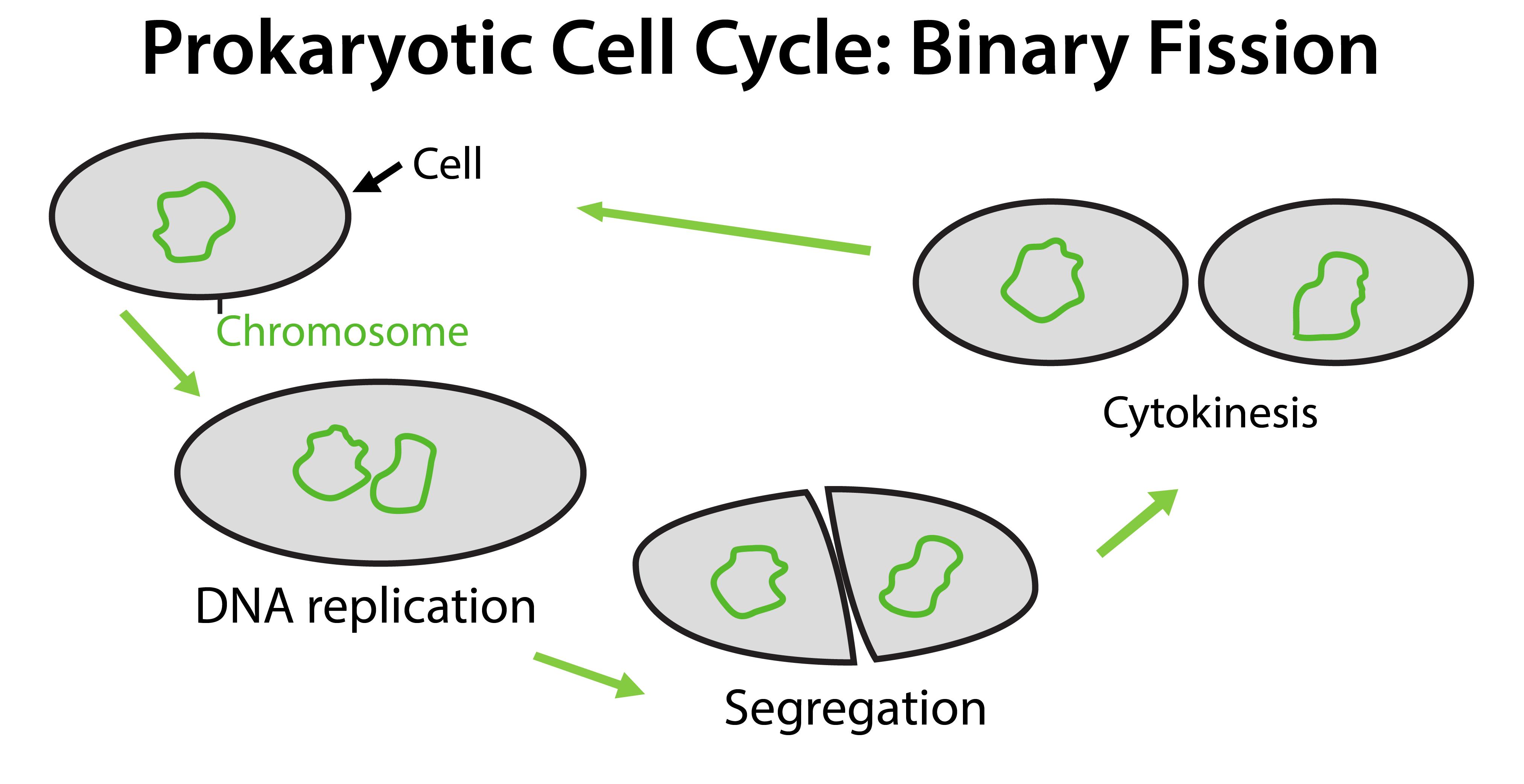
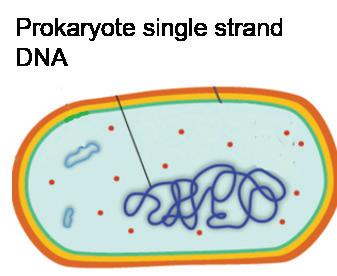
There are different forms of asexual reproduction. Prokaryotic organisms, such as bacteria, go through a process called binary fission. First, a single-celled bacterium makes a copy of the DNA it has in its cell. Then the bacterium splits in half, forming two cells. Each cell gets a copy of the original DNA.
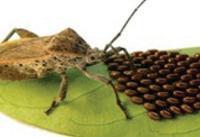
The tiny insects developing inside these eggs will grow into adult insects.
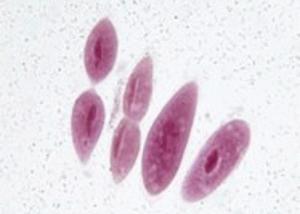
Prokaryotic organisms reproduce asexually through binary fission.
prokaryotic: describes a simple, one-celled organism that lacks a nucleus and other membranebound organelles
Eukaryotic organisms reproduce asexually in several ways. Fungi, such as mushrooms, form spores. Spores are tiny reproductive structures that contain a copy of the parent DNA. Some organisms reproduce by budding. In budding, a smaller version of the parent organism grows out of the parent. Eventually, it separates from the parent and begins to function on its own. This would be similar to another person growing out of your body!
Some organisms can regrow damaged or lost body parts through a process called regeneration. For example, if sea stars were cut into pieces, a whole new organism would grow from each individual piece.
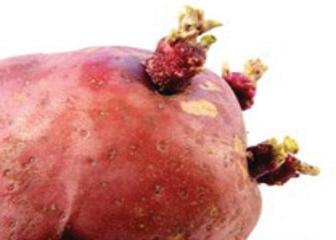
Plants can reproduce asexually through a process called vegetative propagation An entire new plant can grow out of a portion of the parent plant. For example, if you removed a part of the stem and leaf and put it in water, it would form roots and grow to be an adult plant. It would be an exact genetic copy of its parent. Have you ever noticed the “eyes” of potatoes? The eyes are actually buds that sprout new leafy branches. This is an example of asexual reproduction. If you planted the sprouting parts, they would eventually grow into adult potato plants.
Look Out!
The sprouting buds of this red potato are examples of vegetative propagation.
eukaryotic: describes an organism that has cells with a nucleus and other membrane-bound organelles
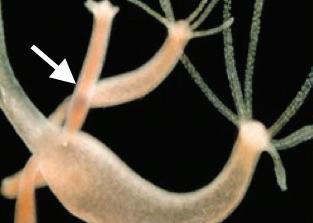
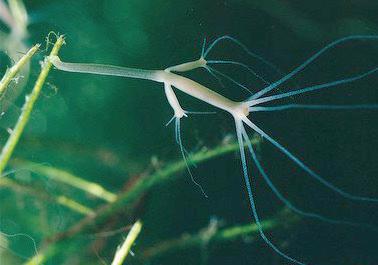
Hydra are tiny aquatic animals. The hydra shown above is reproducing by budding. The arrow is pointing to the offspring that is growing out of the parent hydra toward the front of the image.
Bacteria, fungi, and plants are not the only organisms that reproduce asexually. In some animals, like fish, reptiles, and amphibians, an unfertilized egg can develop into a full-grown adult. This offspring would have a copy only of the female’s DNA. For example, in some insects called aphids, asexual reproduction can occur when an unfertilized egg develops inside the female. Once the egg has fully developed, the female gives birth to a genetically identical offspring!
Unlike asexual reproduction, sexual reproduction requires a male and a female. Each parent contributes half of his or her genetic material, or DNA, to the offspring. The female contributes her DNA in an egg cell. The male contributes his DNA in a sperm cell. When the egg and sperm combine, they form the new offspring.
Offspring may look similar to their parents, but they are not exact copies. In sexual reproduction, each offspring has a mixture of its parents’ traits. Parents may pass on dominant traits or recessive traits to their offspring. Each offspring may be different from its siblings. For example, suppose the father does not have freckles, but his wife does. Among their children, one child might not have freckles, but the other children might have them. In sexual reproduction, the offspring have a unique combination of their parents’ traits. This is why organisms that reproduce sexually have diverse offspring.

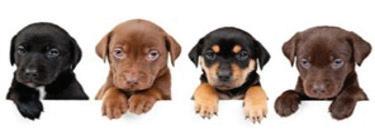
These puppies are a product of sexual reproduction. They each have a unique mixture of their parents’ traits.
dominant trait: appears in the offspring if inherited from either parent, regardless of what is inherited from the other parent
recessive trait: appears in the offspring only if inherited from both parents
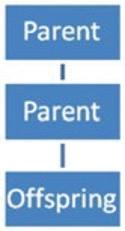
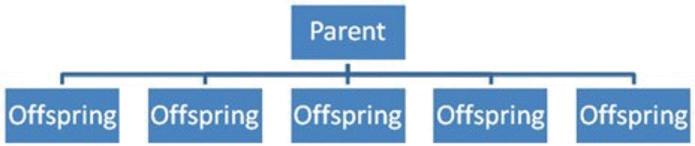
Take a look at the two graphic organizers below. Which graphic organizer best represents asexual reproduction? Which graphic organizer best represents sexual reproduction? Explain your answers.
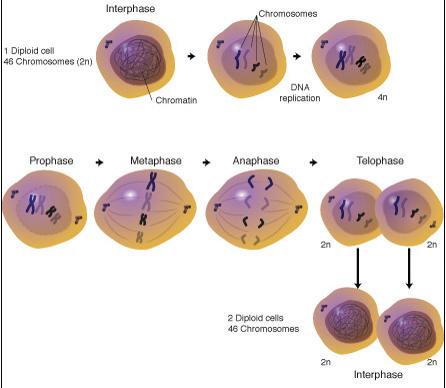
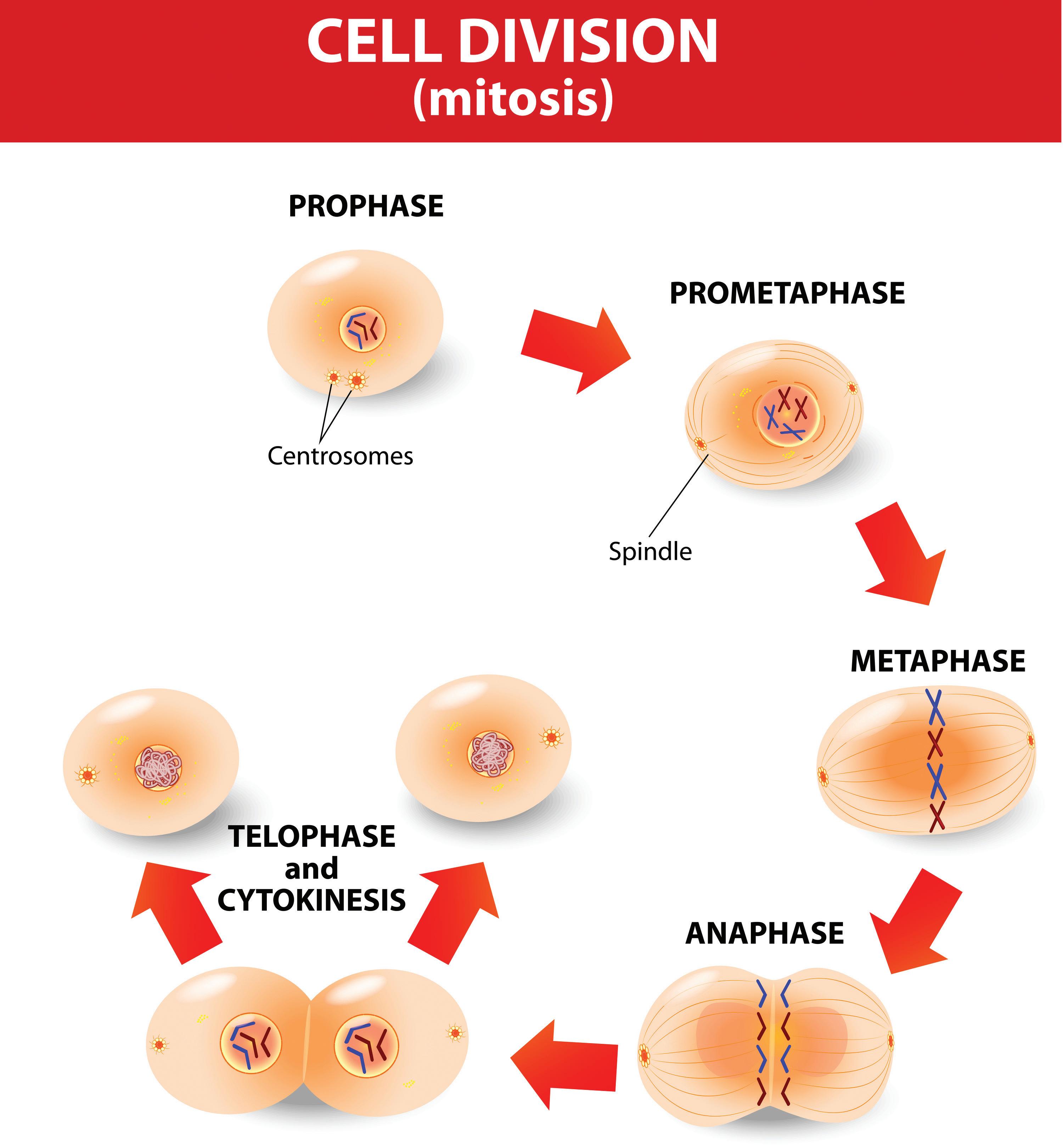
Mitosis: In the reproduction of somatic (body) cells, where identical copies are necessary, the cell division is called mitosis. Mitosis is a type of asexual reproduction. Mitosis begins when a cell doubles its DNA by making a copy of the chromosomes in the nucleus. The chromosomes line up in the center of the cell and then separate into chromatids. The chromatids move to opposite sides of the cell; then the cell splits in half. Because the two new daughter cells have exactly the same number of chromosomes and are made from the same DNA as the parent cell, they are identical to the parent cell.
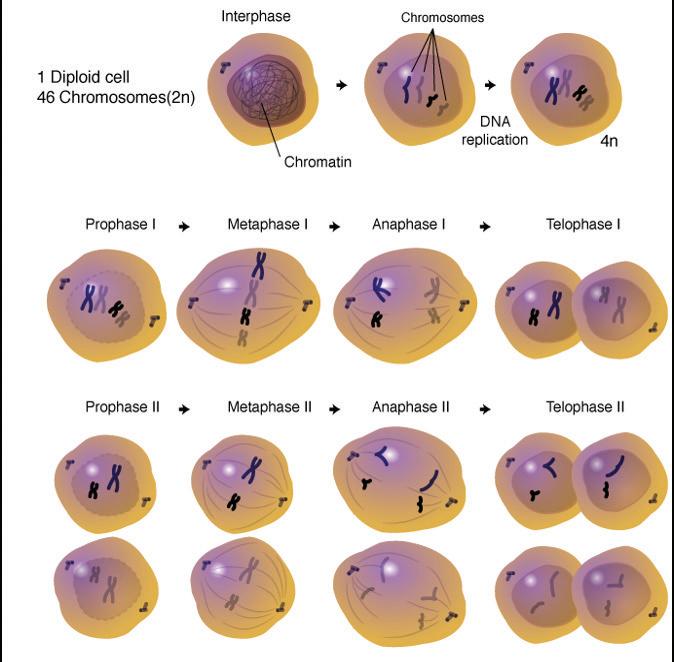
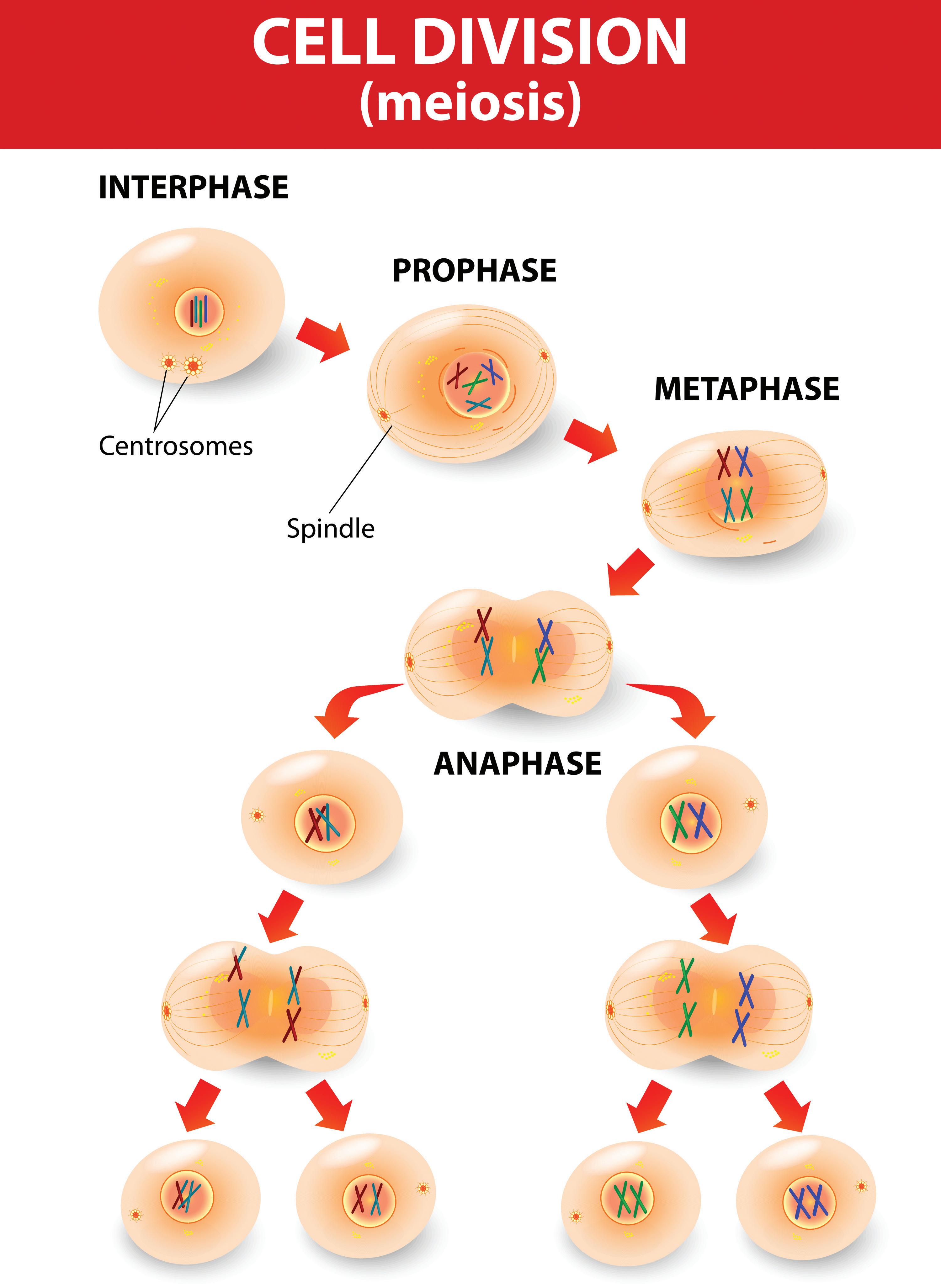
Meiosis: Meiosis is part of sexual reproduction. The gametes (egg or sperm) that are produced during meiosis can combine with gametes from another organism to create offspring. During meiosis, chromosome pairs come together and cross over, which results in mixing of the genetic information between the pairs. The new pairs line up in the center of the cell, separate, and then move to the ends of the cell. The cell divides to create two daughter cells. These daughter cells will then divide again, creating a total of four cells. Because the chromosomes were not copied again prior to the second division, the number of chromosomes in each of the four new cells is exactly half the original number.
Meiosis allows for genetic diversity, because the offspring are a mix of gametes from two different parents.
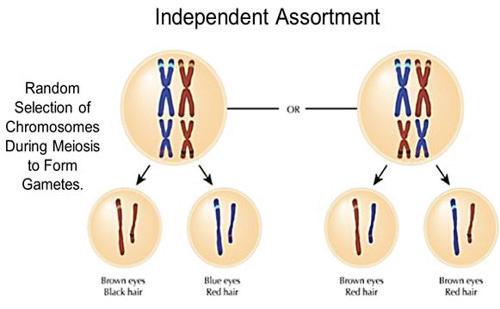
Random assortment: After meiosis, the daughter cells that are created are all genetically different from each other. One reason for this is that chromosomes randomly sort into the four different daughter cells. For example, if one daughter cell has the maternal chromosome that codes for blue eyes, it does not mean it has to also have the maternal chromosome that would code for the shortness trait. This is why siblings do not look identical even though they have the same parents.
Another factor that increases genetic variation within organisms is crossing over. During prophase I of meiosis, the replicated paternal and maternal homologous chromosomes come together and exchange different sections of their chromosomes. The sections that are exchanged contain genes that hold all of the instructions to code for different traits. The resulting chromosomes that are segregated into daughter cells will contain chromosomes that contain part maternal and paternal genes.
This crossing over of homologous chromosomes during meiosis generates many new combinations of alleles in the gametes
Compare this process to receiving a full deck of cards from each parent, shuffling the cards together, and then giving one full deck—composed of cards from both of the parental decks—to an offspring.
gametes: the reproductive sex cells; includes the sperm and the egg

crossing over: the exchange of genetic material during meiosis; contributes to genetic variation
The offspring will also receive a similarly shuffled and recombined deck from its other parent. If the process is repeated for every offspring, then each offspring will have a different combination of cards from the two parental decks. Independent assortment and genetic recombination result in a dramatic increase in the number of different allele combinations, leading to more genetic variation within the population.
Now you can compare mitosis and meiosis. Both are forms of cell division. Can you identify all of the ways in which these two processes are different?
One difference is that the gametes formed in meiosis are haploid, so when the egg is fertilized it creates a diploid zygote
haploid: the cell contains only one set of each chromosome
diploid: the cell contains two sets of each chromosome
Mitosis Meiosis
Asexual reproduction
No chromosomal replication before division
One cell division
Diploid
Genetically identical to the parent
Sexual reproduction
Chromosomal replication before division
Two cell divisions
Haploid
Genetically different from the parent 2 daughter cells are created 4 daughter cells are created
Advantages and Disadvantages
Sexual reproduction is beneficial to organisms because it increases genetic variation. With increased variation through sexual reproduction, species are more likely to survive, adapt, and evolve.
Asexual reproduction has advantages as well. In asexual reproduction, a single parent produces offspring that are genetically identical to the parent and to one another. This type of reproduction is mostly associated with prokaryotes. Other simple life-forms such as the hydra and sponge may reproduce sexually or asexually at various stages of their lives.
Although genetic variation is compromised in asexual reproduction, there are benefits to the parent organism. Animals that are immobile, such as sponges, would have great difficulty finding a mate. Asexual reproduction allows them to produce offspring without having to travel. Another advantage is that in asexual reproduction the parent expends much less energy compared to sexual reproduction.
This allows organisms to produce many offspring without greatly taxing their energy or time. Finally, in a stable environment, asexual reproduction produces offspring with the necessary genetic traits to survive and thrive in their environment.
Use what you know about asexual and sexual reproduction to sort the following terms into the correct columns. If the term is related to asexual reproduction, write it in the column on the left. If the term is related to sexual reproduction, write it in the column on the right. If the term is related to both types of reproduction, write it in both columns. Once you have sorted the terms, give a short explanation as to why you put each term in a particular column.
Terms: DNA, budding, male and female, one parent, unique, spores, uniform, traits, egg, and sperm
Asexual Reproduction in Plants
To help your child learn more about asexual reproduction, test the vegetative propagation capabilities of a household plant. Choose a common household plant, such as the spider plant (scientific name: Chlorophytum comosum). Try vegetative propagation using several different parts of the plant, such as a piece of stem, a piece of root, a leaf with no stem, a leaf with some stem, and the tip of a leaf.
Place a toothpick on either side of your plant part; in the case of the leaf, put the toothpick right through it. Then, place the plant part in a cup of water and position the toothpicks so a portion of the plant part is suspended in the water. Ensure the plant part is not totally submerged and that it has access to light and air. Change the water every few days to prevent it from getting stagnant. Observe how long it takes the plant to start growing and note if the plant part does not grow at all. You and your child could also try planting the plant parts in some potting soil to see if that changes your results. You can also try this with a potato that has sprouted or an avocado pit.
Here are some questions to discuss with your child:
• Which parts of the plant successfully formed new plants?
• How does the DNA in the new plants compare to the DNA of the parent plant?
• Why might this strategy be an advantage for plants in the wild?
• How might gardeners use this method to populate their gardens?

1 Reproduction is a process by which an organism or organisms produce young, or offspring. All organisms reproduce. If they didn’t, not a single species would survive past a single generation. Reproduction allows organisms to pass on their traits, or characteristics, to their offspring. Traits include such things as eye color, fur texture, or height. There are two ways that organisms may reproduce. They may reproduce asexually or sexually.
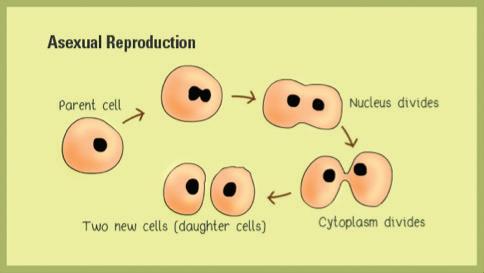
2 In asexual reproduction, the offspring result from a single organism. The offspring inherit their genes from that single parent. In sexual reproduction, offspring result from the combining of genes (genetic information) from two separate organisms of different sex: one male and one female. No matter the type of reproduction, the parent or parents pass on their traits through their genetic material, or DNA.
3 In asexual reproduction, one parent makes an exact copy of itself. There is no fusion of gametes (sperm and egg). The parent directly passes its genetic material to its offspring. Therefore, the offspring have the exact same traits as their parent. All of the offspring also have the exact same traits as each other. This means the offspring are all the same, or uniform. Think of it as making a copy on a copy machine. The parent is like the piece of paper you put into the machine. The offspring are like the copies that come out. The offspring, like the copies, all look like their parent and like each other.
4 There are different forms of asexual reproduction. Prokaryotic organisms (single-celled organisms), such as bacteria, go through a process called binary fission. First, a single-celled bacterium makes a copy of the DNA it has in its cell. Then, the bacterium splits in half, forming two cells. Each cell gets a copy of the original DNA. Eukaryotic organisms (multicellular organisms) reproduce asexually in several ways. Fungi, such as mushrooms, form spores. Spores are tiny reproductive structures that contain a copy of the parent DNA. Some organisms reproduce by budding. In budding, a smaller version of the parent organism grows out of the parent. Eventually, it separates from the parent and begins to function on its own. This would be similar to another person growing out of your body!
5 Plants can reproduce asexually through a process called vegetative propagation. This is a big term, but it basically means that an entire new plant can grow out of a part of the parent plant. For example, if you removed a part of the stem and leaf of certain plants and put it in water, it would form roots and grow to be an adult plant. It would be an exact genetic copy of its parent. Bacteria, fungi, and plants are not the only organisms that reproduce asexually. In some animals, like fish, reptiles, and amphibians, an unfertilized egg can develop into a full-grown adult. This offspring would have a copy only of the female’s DNA.
6 Unlike asexual reproduction, sexual reproduction requires a male and a female. Each parent contributes half of his or her genetic material, or DNA, to the offspring. The female contributes her DNA in an egg cell. The male contributes his DNA in a sperm cell. When the egg and sperm combine, they form the new offspring. The offspring may look similar to their parents, but they are not exact copies. Why does this happen? It happens because the offspring have a unique combination of their parents’ traits. This is why organisms that reproduce sexually have offspring that may have different traits.
7 Unless offspring are identical twins (a single fertilized gamete that divided in two), an offspring may be different from its siblings. Parents may pass on dominant traits or recessive traits to their offspring. If a parent contributes a dominant trait, then the offspring will most likely have that trait. If a parent contributes a recessive trait, that trait may not be seen if there is a dominant trait present. For example, suppose the father in a human family has brown eyes, but his wife has blue eyes. Among their children, it is most likely that the dominant brown-eyed trait will occur. The recessive blue-eyed trait may occur, but it is less likely.
1 Which of the following statements is NOT true?
A Only prokaryotes can reproduce asexually.
B Only eukaryotes can reproduce asexually.
C Plants can reproduce asexually.
D Asexual reproduction does not require two parents.
2 In which form of reproduction does the offspring result from a single organism?
A Sexual reproduction
B Asexual reproduction
C Both of these
D None of these
3 What is the main difference between sexual and asexual reproduction that does not include parents?
A Other than parents, there is no difference.
B The difference is the way that genetic information is transferred to the offspring.
C Creating offspring that may be identical twins is the difference.
D Only prokaryotes reproduce asexually.
4 Which of the following statements is FALSE about sexual reproduction?
A It requires a male and a female organism.
B The offspring have a combination of the male and female parents’ DNA.
C The offspring of the parents is not a genetic copy of either parent.
D All of the offspring will be exactly the same.
5 What is the main outcome of asexual reproduction with regard to offspring?
A The offspring are all males.
B The offspring are all females.
C The offspring have the exact same traits as the parent.
D None of the offspring survive.
6 Which of the following statements best represents the main point of this reading?
A Parents make offspring during sexual and asexual reproduction.
B Sexual reproduction creates genetic variation in offspring, and asexual reproduction creates genetically identical offspring.
C Only prokaryotes have the ability to reproduce asexually.
D Eukaryotes can reproduce only sexually and need male and female organisms for this.

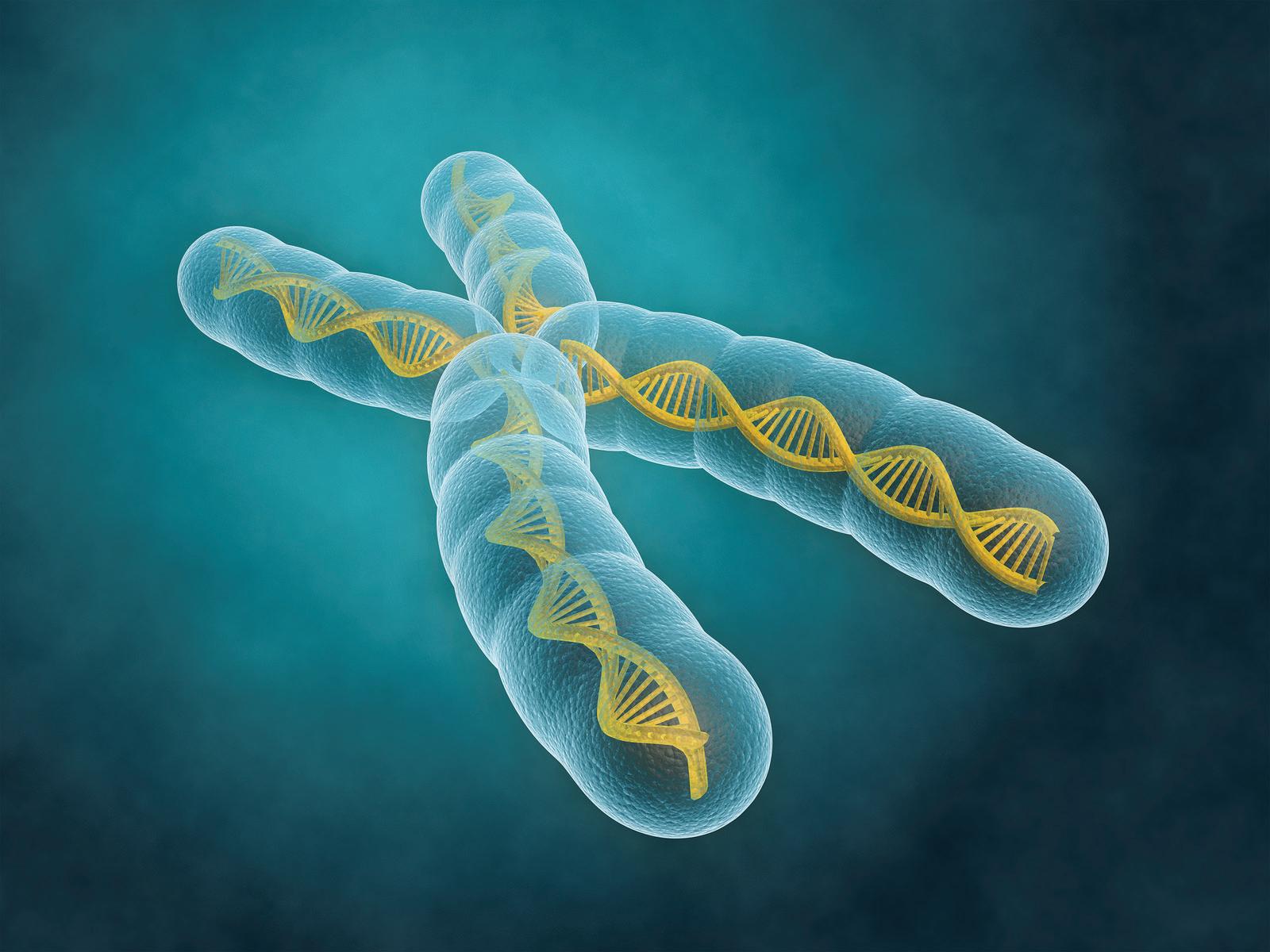
1. Describe the structures within cells that govern heredity, and say where they are located.
2. Examine the diagram of mitosis. Explain the role of mitosis in asexual reproduction and how it results in offspring with genetic information identical to that of the parent.
3. Examine the diagram of meiosis. Explain how genetic information is transferred during meiosis.
4. Look at the model below that students use to study the passage of genetic material from parents to offspring through sexual reproduction. For a given trait, the possible genes are represented by differentcolored marbles. Explain how this model can be used to demonstrate the variation that occurs with sexual reproduction.
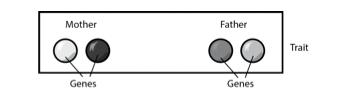
5. Some organisms are able to reproduce both sexually and asexually. There are advantages and disadvantages to both asexual and sexual reproduction. Give one advantage and one disadvantage for sexual and asexual reproduction in the table below.
Sexual reproduction
Asexual reproduction

Reproduction is a process by which an organism produces offspring, or young, and passes on its traits or characteristics. All organisms reproduce. If they did not, no species would survive past a single generation. Inherited traits depend on the parents’ genotypes and mode of reproduction; many traits are acquired and do not depend on parental genotypes. Traits of offspring are a direct result of two factors: the genetic material present in previous generations and the type of reproduction, sexual or asexual. Parents pass on their traits through their genetic material, or DNA. Reproduction can result in offspring that look either uniform or diverse.
Characteristic
Pros
Cons
• Do not need to find a mate
• Can produce more offspring
• Faster reproduction
• Lack of genetic diversity (greater chance of harmful traits being passed to offspring)
• Genetic diversity (ability to adapt to changing conditions)
• Decreased chance of passing on harmful traits
• Each organism is unique
• Takes energy and time to find a mate
• Requires two organisms
• Beneficial gene combinations can be broken up
Write a scientific explanation describing when asexual reproduction would be more advantageous to the survival of a species than sexual reproduction.
Claim:
Evidence:
Reasoning: Prompt 3
Rebuttal:


Throughout history, people have used the process of cross-pollination to develop new varieties of fruits and vegetables. The pluot, a cross between a plum and an apricot, is an example of this.
Which two fruits would you cross-pollinate to create a super fruit?
Instructions:
1. Choose two fruits, and in the space below, draw a picture of a super fruit that would result from crosspollinating these two fruits.
2. Below the drawing, describe the following characteristics of the fruit:
• Taste
• Smell
• Health benefits
• Other uses Draw and color the fruit here.
Taste: Smell:
Health Benefits:
Other Uses:
Answer and discuss the following questions:
1. What is natural selection?
2. What are some examples of artificial selection?
3. What are some of the positive impacts of artificial selection?
4. Was the super fruit you developed an example of selective breeding or genetic engineering?
5. How is genetic engineering different from selective breeding?
The job of planning a park involves many factors. The focus of this activity is plant life. All parks have a large variety of plant life that at times may look random, but there is extensive planning behind every plant placed in a park. The role you will play today is that of plant life planner for a park design of your choice. The area in which the park will be built will be the same for all the members of your group. Your group must choose one of the areas listed below. All of the members of the group must research and create a plan for what should be planted in the park to ensure not only its survival but its growth as well. You will have to argue your proposal to prove that your plant choices are the best for the area based on genetic and environmental factors. University websites and local and state environmental sites are good areas in which to begin your research. Research three trees, one grass type, and two other ground cover plants/shrubs/flowering plants that would survive even during environmental changes that might occur in that particular area.
Areas in Mississippi: Oxford, Vicksburg, Gulfport, Brooklyn
The Park Plan for
Possible Plant Choices (use these or research others for the area chosen):
Grass Shrubs/Flowers Trees
Big Bluestem Juneberry Ash Maple
Switchgrass Red Chokecherry Spruce Pine
Sideoats Grama Azaleas Oak, variety
Gamagrass Honeysuckle Sycamore
Indiangrass
1. Research to determine which plants to propose placing in the park. Record your findings in the table below.
Plant
Genetic Factors: Pollination; Seed Dispersal Method (Wind, Animals)
Original Environmental Conditions: Soil Type, Sunlight, Water/Rainfall Needed
Possible New Conditions Predicted Survival / Adaptations Needed
Submit the proposal below using CER format (Claim-Evidence-Reasoning). Remember that the proposal should be specific to the town or area assigned to the group.
Claim (plants chosen):
Evidence (the research that backs up the plants you have chosen):
Reasoning (Why does this area need these types of plants? Remember past, current, and future environmental conditions that could occur):
Rebuttal (questions challenging other group members’ proposals; only one per member):
Question 1:
Answer:
Question 2:
Answer:
Question 3:
Answer:
3. Consider the proposals of each group member to develop a final group proposal plant life plan for your park.
1. What are some important genetic factors that influence a plant’s ability to survive and grow in an area?
2. What environmental conditions are most likely going to occur in most places regardless of location?
3. How do plant adaptations impact plant growth when an environmental change occurs?
4. Which group member had the best proposal and why?
5. How will your park affect the animals native to the area?
6. How do genetic and environmental factors influence the growth of organisms?
Inheritance is the transfer of traits from a parent to its offspring. Every trait that an offspring receives from its parents is the result of a gene pair. It is called a gene pair because one of the genes comes from the female parent and the other gene comes from the male parent. General principles in nature guide the process of inheritance so that everything gets transferred correctly and no terrible mistakes occur. There is always a chance or probability that a trait will occur since there is a set of genes. These principles help clarify how we can predict which traits will be transferred from a parent or parents to their offspring with a good level of accuracy.
Gregor Mendel is known as the father of genetics. Mendel’s observations of plants helped to establish the basic principles of heredity. Conduct scientific research to discover what Gregor Mendel did to establish the basic principles of heredity. Search for evidence that supports Mendel’s ideas. Use at least two different sources for your research.
1. Research notes:
Cite resources here:
2. Use your research to construct a cartoon strip that explains one of the basic principles of heredity. Your explanation must include evidence that supports Mendel’s ideas. Sketch your ideas below, and then create your final cartoon strip on a separate sheet of paper.
Basic principle addressed:
Supporting evidence:
Sketch of cartoon:
3. Post your cartoon strip as directed by your teacher.
4. Participate in a gallery walk to view the cartoon strips created by your classmates.
5. Add any new information presented about the basic principles of heredity.
When two organisms have offspring, we can predict the possible genetic combinations that can occur by using a special chart called a Punnett square. It is named after an English geneticist named Reginald Punnett. It is a model that allows us to discover all the potential combinations of genotypes that can occur in offspring. Genotypes are the genetic combinations of an organism. Phenotypes are the physical characteristics of the organism.
Procedure
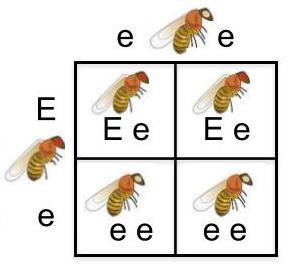
1. Look at the Punnett square in the picture above. The letters represent the genes, and the drawings of the bees show you the phenotypes.
• What are the phenotypes shown in the Punnett square?
• What are the genotypes shown in the Punnett square?
2. When using a Punnett square, we use capital letters to show the dominant trait and lowercase letters to show the recessive trait. A dominant trait, if present, is the trait that shows up in the organism. The recessive trait will show up only if the dominant trait is not present.
• Which letter in the Punnett square above represents the dominant trait?
• Which letter represents the recessive trait?
3. When there are two recessive traits in the box (ee), the recessive trait shows up. When there are two dominant traits (EE), the dominant trait shows up. When both are present (Ee), the dominant trait shows up.
• What trait will show up in the ee box?
• What trait will show up in the Ee box?
After completing a Punnett square, we can predict the genetic traits of the offspring from two specific parents. The prediction is based on calculating the probability of a trait showing up. There will always be 4 chances in Punnett squares such as these, so we count the number of traits that might show up and divide it by 4, and then multiply by 100 to get the percentage.
Use the Punnett square predicting the eye color of bees to answer the following questions.
4. How many offspring with the dominant trait might show up?
5. What is the percentage of offspring that might have that trait?
6. How many offspring with the recessive trait might show up?
7. What is the percentage of offspring that might have that trait?
8. Use the abbreviation R for round peas and r for wrinkled peas in the Punnett squares for each question.
Work out the following crosses and answer the questions.
A. RR X rr—Predict what percentage of offspring will be round.
B. RR X rr—Predict what percentage of offspring will be wrinkled.
C. RR X Rr—Predict what percentage of offspring will be round.
D. RR X Rr—Predict what percentage of offspring will be wrinkled.
E. Rr X Rr—Predict what percentage of offspring will be round.
F. Rr X Rr—Predict what percentage of offspring will be wrinkled.
G. rr X rr—Predict what percentage of offspring will be round.
H. rr X rr—Predict what percentage of offspring will be wrinkled.
I. RR X RR—Predict what percentage of offspring will be round.
J. RR X RR—Predict what percentage of offspring will be wrinkled.
1. What are the three main principles of heredity? Give an example of each principle.
2. What characteristics of the plants did Gregor Mendel use to explain the principles of heredity?
3. What information does a Punnett square provide?
4. Why is there a reduced possibility of seeing a recessive gene expressed when a dominant gene is present in the gene pair?
Complete the card sort and fill out a concept map of the results in the space below.
TYPE OF SELECTION
Selective Breeding
Genetic Engineering
Artificial and Natural Selection
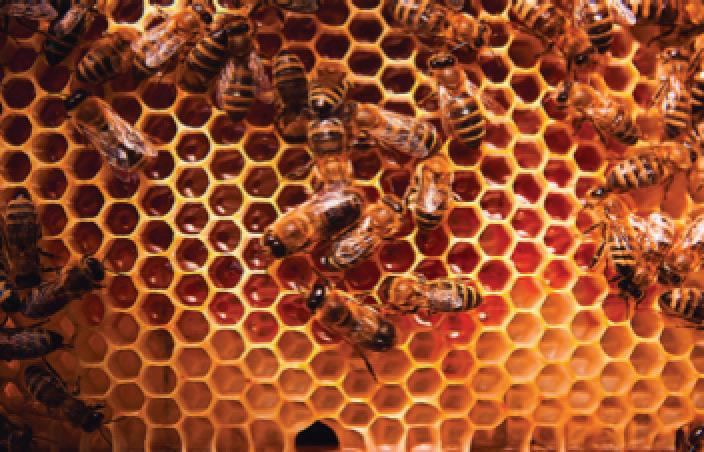
Corn plants need bees, and bees need corn, so what is the problem? Globally, bee populations have been on the decline for close to two decades. The impact from the loss of those populations on agriculture and on nature in general has been significant.
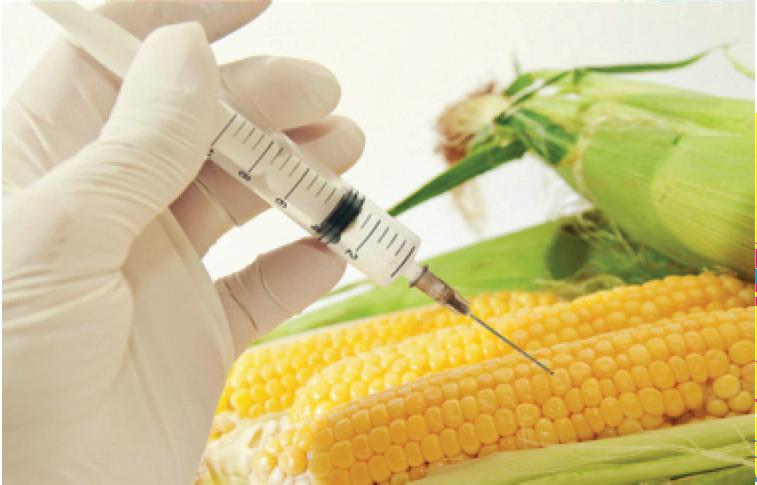
Early reports showed a link between the modification of corn to produce pesticides within its genetics and the growing phenomena of colony collapse disorder in bees. (The bees that collect the pollen for the hive die, and only the queen and young bees are left in the hive. The hive eventually starves and dies off.) Studies are currently being conducted in an attempt to genetically modify bees to survive eating genetically modified crops as well as other environmental factors in response to the problem.
These studies sparked a lot of arguments and further studies from groups that support the genetic engineering or selective breeding of other organisms and groups against the concept of geneticists tinkering with nature. Some have questioned the ethics of artificial selection methods that change the inheritance of traits from parents to offspring. Ethics refers to a general idea or guidelines for what is considered good or bad behavior. Questions that focus on ethics can be related to the impact on nature, human life, or both. The impact on society is connected to ethics and considers how an action will affect a population of people economically, physically, and/or emotionally.
In this assignment you will act as a team of lawyers either prosecuting or defending the use of genetically modified organisms.
1. Choose a scenario from the class envelope. Use the scenario to develop a case with two sides to debate in court. Each pair of students must take a side and work as a team.
2. Research the topic. The claim must address the ethics and societal impact of the issue and should include at least three valid points of evidence to back up the claim. The claim and evidence will be the opening statement.
3. Prepare a closing statement giving the reasoning for the decision to defend or prosecute. There will be a defendant and a prosecutor, so you will need to prepare a rebuttal of the other view’s opening statement.
4. Prepare for the debate by recording your claim, evidence, and reasoning. Should farmers be required to use only corn that has been genetically modified?
Claim:
Evidence:
Reasoning:
5. Prepare to defend your position by developing rebuttals of statements that may be presented by the opposing team.
Rebuttal:
Resources Used:
1. What is the difference between an organism that is the result of selective breeding and an organism that is the result of genetic engineering?
2. What are some positive results of selective breeding?
3. What are some ethical concerns about genetically modified organisms?
4. How can selective breeding or genetic engineering impact society?
5. Is cross-pollination always the result of selective breeding? Explain your answer.
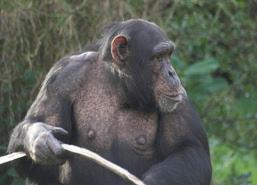
A chimpanzee spots an anthill about a meter away and moves toward it. Using its long arms, the chimpanzee grabs a thin branch from a tree overhead. First, the chimpanzee removes the leaves. Then it sticks the branch down the anthill. A few seconds later, the chimpanzee pulls the branch out covered with ants. The chimpanzee puts the branch in his mouth and quickly eats all the ants. The chimpanzee is able to eat the ants without getting bitten. The chimpanzee was born with long arms, good eyesight, and fingers. But it was not born knowing how to use a branch to get a snack. What are some characteristics that animals and other organisms are born with? How do they get those inherited traits? What are some acquired traits that develop after birth? Are all traits passed down naturally (natural selection), or can
inherited traits: characteristics passed down from parents
acquired traits: characteristics developed after birth from the environment or from learned behavior
some traits be chosen by humans (artificial selection)?
natural selection: over time, organisms with traits that are better adapted to their environment are more likely to survive.
What Is the Difference between an Inherited Trait and a Learned Behavior?
Take a look at the mother and daughter in the picture at the right. How do they look similar? The mother passed on some of her characteristics, or traits, to her daughter. The daughter has her mother’s hair color, nose shape, and eye color. These traits were inherited. When traits are inherited, it means they are passed on from parents to their offspring during reproduction.
artificial selection: breeding of plants and animals to produce desirable traits
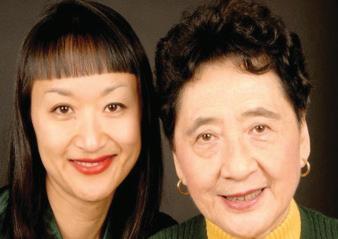
Some traits are not inherited. The mother has pierced ears and wrinkles. She did not inherit these traits from her parents. They developed sometime after she was born. Characteristics that appear during a person’s lifetime are called acquired traits. Certain acquired traits, like pierced ears, can be directly observed. These are physical traits
Another type of acquired trait is learned behavior. Reading is an example of learned behavior. You inherit eyes that can see and hands that can turn the pages of a book. However, you do not know how to read when you are born. You have to learn how to read. Learning is something that happens during your lifetime.
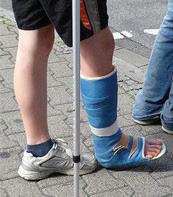
Many physical traits like eye color and skin color are inherited. But not all physical traits are inherited. For example, have you ever broken a bone? Do you have any scars? These are characteristics that appeared sometime after birth. You were not born with a broken bone or a scar. These types of traits are not passed from parents to children.
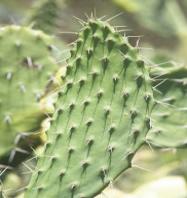
What are some examples of plant and animal inherited traits? Have you ever seen a beautiful garden of flowers? The color of the flowers is an inherited trait. The general height of the plants, the length of the roots, and the shapes of the leaves are all inherited characteristics. A cactus inherits spines. An evergreen tree inherits needles. These are traits that are passed on from a plant to its offspring.
Plants do not have brains and do not learn behaviors like animals do. But plants can respond to changes in their environment, such as added soil chemicals or facing the Sun. Some plants have special chemicals in their cells that help them turn toward sunlight. Getting enough sunlight helps plants to make their own food. When a fly lands on a unique plant called a Venus flytrap, the plant responds by closing its modified leaves that look like “jaws” to eat the fly. The ability to respond to these environmental changes, however, is inherited for the plant.
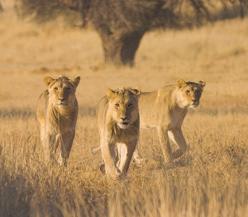
These young lions are learning how to hunt.
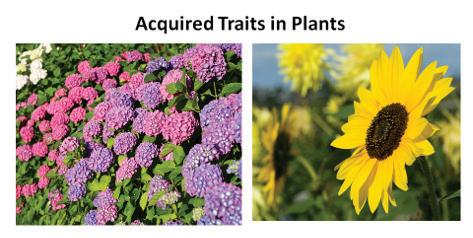
If chemicals are added to the soil, hydrangea plants respond by turning from blue to pink. Sunflowers respond to light by growing facing the Sun.
Lion cubs inherit the physical traits they need to be hunters. They have claws and sharp teeth to help them catch and bite their prey. Their tan fur helps them blend into their grassy environment. They have good vision and an excellent sense of smell. But when lion cubs are born, they do not know how to hunt. Hunting is an example of a learned behavior. Cubs have to learn how to hunt by watching their parents. They may even “hunt” each other as practice when they are cubs. It takes months for lion cubs to learn how to use their inherited traits to help them catch and kill food.
A songbird inherits a beak and lungs that help it sing, but it often has to learn the songs from another bird. Evidence of songbird learning includes slight differences across the country for a particular sparrow. Since the adult birds are learning from birds only in their area, the song is taught like a game of telephone from bird to bird across the country.
Have you ever thought about how many different breeds of dogs there are? How do dog breeds differ? You may have thought they look different for one, or they have different abilities or temperaments. All of these are true and exactly why selective breeding exists.
In selective breeding, humans influence certain characteristics of organisms by choosing desired parental traits to be passed on to future offspring. Using our dog example, some dogs have been bred to be a specific size—very large (e.g, mastiffs) or very small (e.g., Chihuahuas).
Other dogs have been bred for various abilities like speed (e.g, greyhounds) or intelligence (e.g., border collies).
Dogs are not the only organisms that have been bred by humans for a specific purpose. What other animals do you think have been selectively bred?
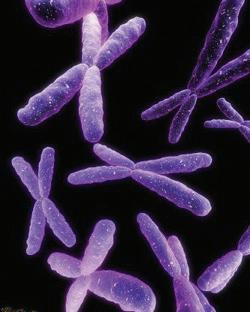
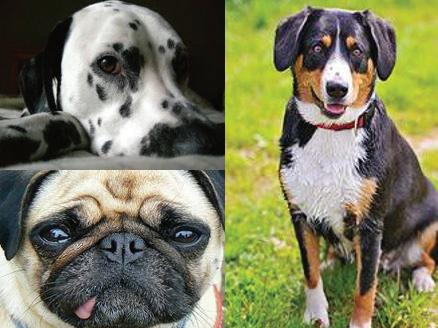
breeds differ physically and behaviorally. Each chromosome contains half of the genetic material from a SINGLE parent.
In sexual reproduction, half of each parent’s genes combine to form a unique offspring. In artificial selection, or selective breeding, humans select the trait they find most desirable and specifically mate only organisms that have that quality. Eventually, less desirable traits are eliminated from the species, and all future offspring will possess the desired trait.
To illustrate, ranchers have bred horses for a variety of jobs over many generations. Some horses are bred to gracefully jump while others are bred to walk smoothly for miles. Originally, some horses were just born graceful jumpers while others naturally had a smooth gait, or walk. Ranchers then mated only good male jumping horses with good female jumping horses to produce good jumping offspring and similarly mated only smooth-gaited males with smooth-gaited females to produce smooth-gaited offspring.
Plants are affected by genetic and environmental factors. Would there be any benefits to selectively breeding plants? If you cannot think of any, would there be any benefits to selectively breeding fruits or vegetables specifically?
Just like ranchers breed horses and cattle for specific roles, farmers selectively breed the fruits and vegetables they grow.
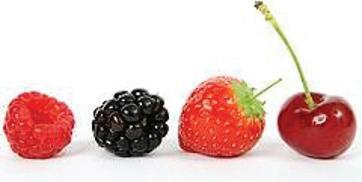
Plants are selectively bred too!
The genetic rules that govern this process go back to even the research of Gregor Mendel, the “father of genetics,” who first noted that when you crossbreed two tall pea plants, you have a better chance of producing a tall pea plant offspring.
Gregor Mendel (1822–1884) was a monk who performed experiments with garden peas. Mendel studied the ways that the characteristics, or traits, of different pea plants passed from one generation to the next. Mendel noticed that certain traits would always appear in a plant’s offspring, while others would appear only in a fraction, or none, of its offspring. Mendel figured out the rules of inheritance by documenting the characteristics of the pea plants and performing mating experiments with plants that had different sets of characteristics. Mendel’s work went unnoticed for years until it was rediscovered by biologists that were developing a fundamental new understanding of the diversity of life.
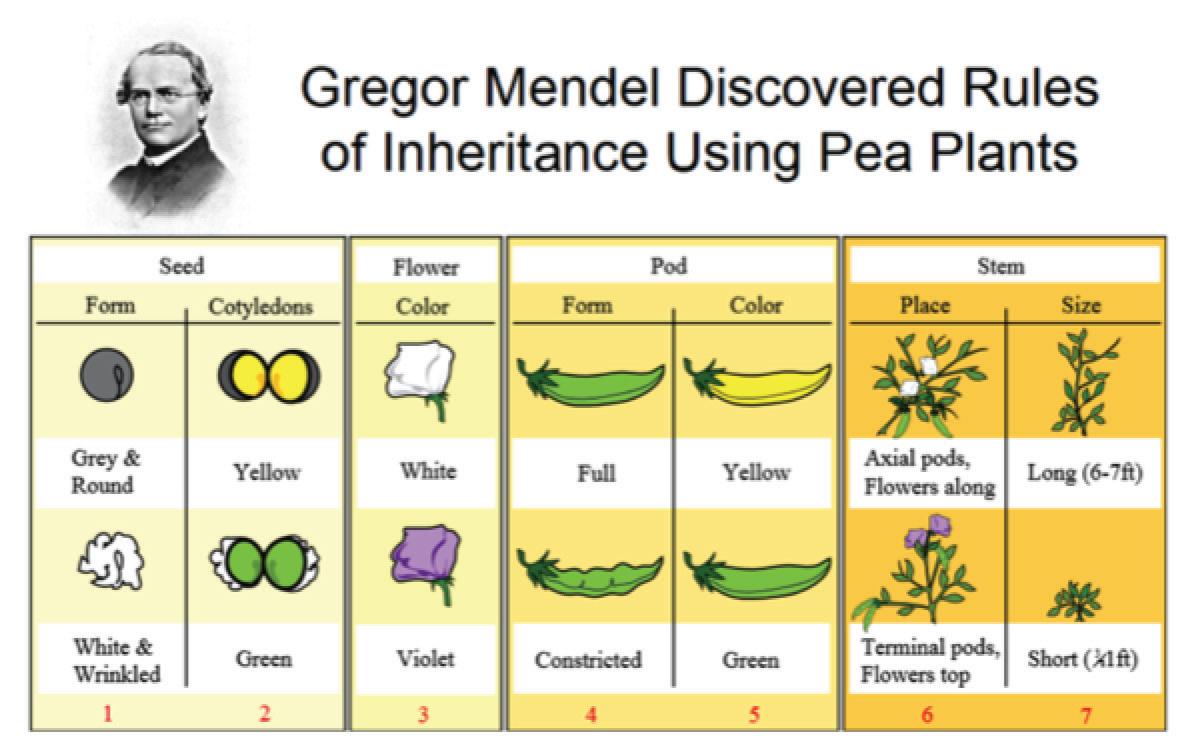
Mendel’s work with pea plants led him to formulate two principles of heredity. Heredity is the process by which characteristics are transmitted from parents to their offspring in sexual reproduction.
• The principle of segregation: One trait “factor” is inherited from each parent. Those units of heredity are separated into the male and female reproductive cells. Mendel did not know that genes were the units of heredity; that was discovered after Mendel. Today we know that alleles are specific locations for traits on genes in chromosomes that store the genetic codes. One allele comes from the father, and one allele comes from the mother.
• The principle of independent assortment: The inherited “factors” were distributed independently to the offspring. Today we know that chromosomes sort randomly to the gametes (sperm or egg cells).
Inherited traits are determined by information stored in an organism’s genes. Genes are sequences of DNA that are part of the structure of the organism’s chromosomes located in the nucleus of every cell in that organism. An organism has two copies of each chromosome. During sexual reproduction, one copy comes from the organism’s female parent. The other copy comes from the organism’s male parent.
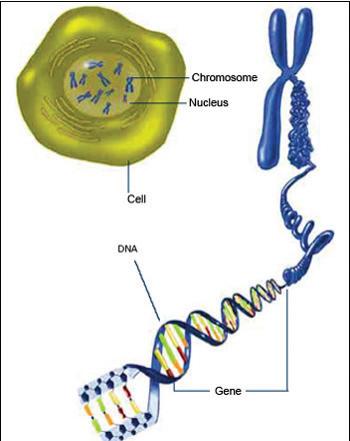
Because each chromosome is present in two copies, each gene is present in two copies. However, the DNA sequences of the two copies may not be the same. These variations of a gene are called alleles. In the example below, alleles for the same gene have been identified on two chromosomes. One allele codes for purple flower color and comes from one parent. The other allele codes for white flower color and comes from the other parent. The pair of alleles an organism inherits for each gene determines the genotype of that individual. In the example shown below, suppose the purple color allele is given the abbreviation P and the white color allele is given the abbreviation p. This plant’s genotype for flower color is Pp. Suppose a plant has two alleles for purple flowers. What is the plant’s genotype for flower color? What is the genotype for flower color if a plant has two alleles for white flowers?
genotype: a two-letter abbreviation that represents the pair of alleles inherited for a specific trait, one from the mother and one from the father. A capital letter is a dominant allele while a lowercase letter is a recessive allele.
An individual’s phenotype is determined by the traits that are expressed and observed. Suppose the plant with a genotype of Pp has purple flowers. We say the plant’s phenotype for flower color is purple. The chart below summarizes the possible genotypes and phenotypes resulting from the allele combinations for flower color (purple is dominant, and white is recessive). Remember, in sexual reproduction, an offspring inherits one allele from each parent.
Allele combinations for purple and white flowers
When an individual receives two identical alleles from each parent, then the individual is homozygous for that gene. When an individual receives a different allele from each parent, the individual is heterozygous for that gene. Homozygous and heterozygous refer to the genotype, not the phenotype. The phenotype depends on the genotype and how the different alleles interact.
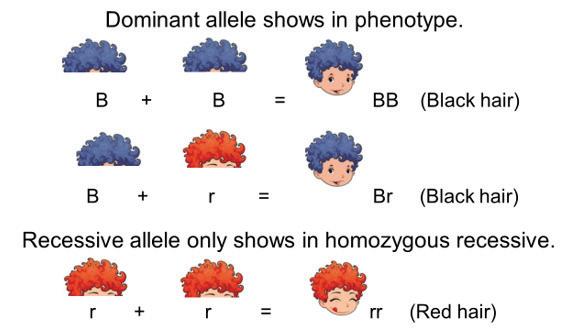
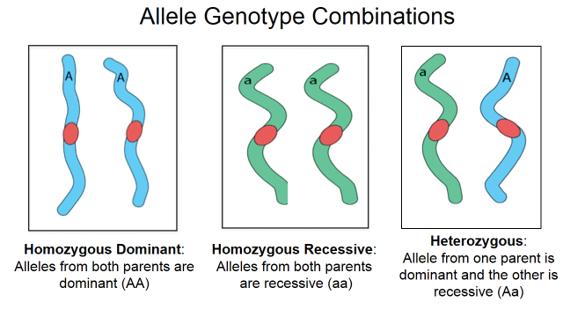
homozygous: genotype with a pair of identical genes; the pair can be recessive (aa) or dominant (AA)
heterozygous: genotype with two different genes (i.e., Aa)
A Punnett square is a diagram of Mendelian inheritance that can be used to calculate the probabilities of possible genotypes and phenotypes. Punnett squares are often used to predict the outcomes of mating, or crosses. A monohybrid cross is one in which a single phenotypic character, such as hair color, is predicted. On the Punnett square with two recessive (red hair) parents, 100% of the children will probably have a genotype of rr, which means the phenotype (observed appearance) will be red hair. However, with two heterozygous parents, where black hair is dominant, 75% of the children will probably have a phenotype of black hair with a genotype of either BB or Br. Only 25% will have the genotype of rr and a phenotype of red hair.
If both parents are homozygous recessive (red hair), then all offspring will show recessive phenotype (red hair).
Even if both parents are heterozygous (black hair dominant), red hair is possible.
Reflect
Since the 1800s, farming technology has increased, and the reasons for selectively breeding plants have increased as well. Now farmers selectively breed plants to make them hardier through cold weather, allow a longer or earlier growing season to maximize potential profits, and even crossbreed different types of fruits to create new, interesting flavors.
crossbreed: to combine two organisms of different types or species to create a unique offspring
Ranchers, farmers, and breeders of different kinds have been utilizing artificial selection techniques for many years. Recently, this process has moved into laboratory settings with the creation of genetically modified organisms, more commonly referred to as GMOs. Genetic engineers actually manipulate the genes of organisms to produce new living organisms that would not likely exist through other natural means. GMOs do not just create new organisms like you would see in a science-fiction movie. Instead, you can find most GMOs in your local supermarket’s produce section.
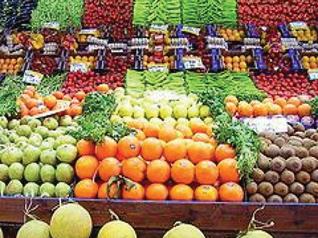
Most GMOs are found here.
Most fruit and vegetable GMOs have been genetically altered to withstand insects or pesticides better. Other than that, the apples and oranges are genetically identical to any other naturally produced ones.
GMOs have been in the news a lot because of debates regarding the ethics of scientifically engineering organisms. Where do you stand on the issue?
Artificial selection has produced animals and plants with traits desirable to humans, but in addition to increasing certain “good” traits, artificial selection can also decrease other “good” traits or increase the prevalence of “bad” traits. Here are three different examples.
Hip dysplasia is an inherited trait. The hip joint is made up of the ball on the leg bone and the socket in the hip bone. The joint does not develop properly in some dogs, leading to difficulty running and jumping as the dog gets older. Hip dysplasia is becoming more common in purebred dogs. The breed most affected is bulldogs. Breeders test their parent animals using X-rays. They can select parents without the disorder to produce the next generation. This is an example of the appearance of a “bad” trait.
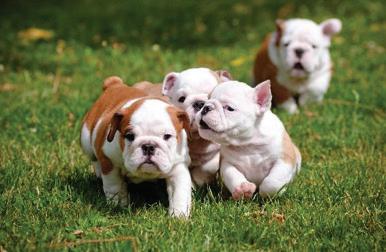
Up to 70% of bulldogs have hip dysplasia.
How is genetic material manipulated? How do biotechnologists accomplish these technological applications using biological processes?
DNA Structure Review:
• Nucleic acids are macromolecules made of nucleotides (sugar, phosphate, and nitrogen base).
• Phosphate groups have a net negative charge.
• All of the DNA in the nucleus of eukaryotic organisms is the genome.
• DNA has two strands: hydrogen bonds and paired bases.
Gel electrophoresis is a technique used to separate molecules on the basis of size and charge. This works because of the net negative charge of the phosphate-based DNA.
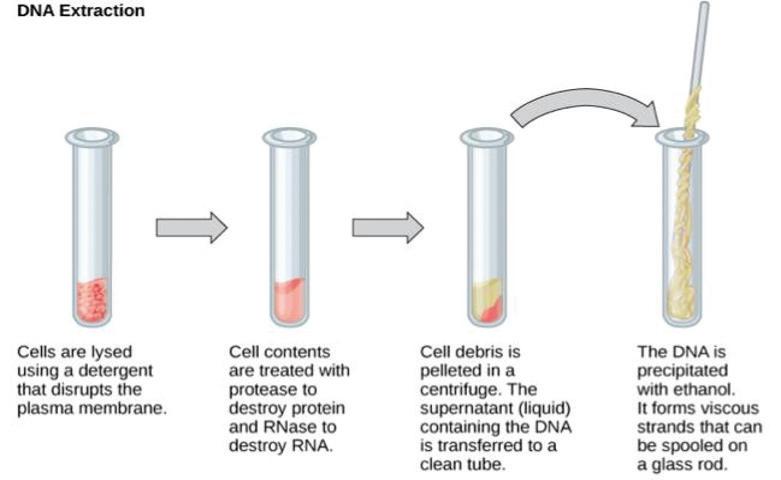
DNA must first be extracted before it can be studied or manipulated in biotechnology applications:
1. Cells are broken open using a detergent solution with a buffering compound.
2. DNA is brought out of this solution using alcohol.
3. Long, polymer-based DNA forms gelatinous mass.
Gene therapy is a genetic engineering technique that may one day be used to cure certain genetic diseases. Some applications of gene therapies are vaccines, antibodies, and hormone production. Traditional vaccination strategies use live microbes (for example, measles or chicken pox) or weakened (inactive) forms of microorganisms or viruses (for example, polio, flu, or rabies) to stimulate the immune system. Modern techniques use specific genes of microorganisms duplicated into vectors (the carrier virus or bacterium) and mass-produced in bacteria to make large quantities of specific substances to stimulate the immune system. The substance is then used as a vaccine.
In 1978, recombinant DNA technology was used to produce large-scale quantities of the human hormone insulin in E. coli Before, it was possible to treat diabetes only with pig insulin, which caused allergic reactions in many humans because of differences in the insulin molecule.
Cloning allows for the creation of multiple copies of genes, useful in gene therapy or in making vaccinations. To get the DNA fragment into a bacterial cell so that it can be copied or expressed, the fragment is first inserted into a plasmid, called a vector or carrier. The plasmid is a small, circular DNA molecule that replicates independently of the chromosomal DNA in bacteria. In cloning, the plasmid molecule is a “vehicle” in which to insert the needed DNA fragment. Modified plasmids are usually reintroduced into a bacterial host for replication. As the bacteria divide, they copy their DNA (including the plasmids). The inserted DNA fragment is copied along with the rest of the bacterial DNA.
Using recombinant DNA technology to change an organism’s genetic makeup to improve traits is called genetic engineering. The addition of foreign DNA in the form of recombinant DNA vectors (carriers) that are generated by molecular cloning is the most common type of genetic engineering.
An organism that receives the recombinant DNA is called a genetically modified organism (GMO). If the foreign DNA that is introduced comes from a different species, the host organism is called transgenic. Bacteria, plants, and animals have been genetically altered since the early 1970s for a variety of medical, agricultural, and industrial purposes.
Plants are the most important source of food for the human population. Manipulating the DNA of plants (creating GMOs) has helped to improve traits such as disease resistance, herbicide and pest resistance, better nutrition, and shelf life.
Transgenic plants receive DNA from other species. Because these plants have unique combinations of genes and are not restricted to the laboratory, these transgenic plants and other GMOs are closely monitored by government agencies to ensure that they are suitable for human consumption and do not endanger other plant and animal life.

There are many new useful applications of genomics, such as creating new biofuels, assisting in DNA forensics, increasing crop yields, and creating targeted pharmacological and gene therapies.
It is important that we critique the ethical issues and implications of genomics and biotechnology (stem cell research, gene therapy, and genetically modified organisms) to ensure that the tools and technology are not used improperly or carelessly. Scientific discourse and debate on all of these issues should be well informed and supported with scientific fact yet sensitive to societal concerns.
Try Now
Some forms of biotechnology are controversial, and the ethics of their use are debated. Based on your knowledge of biotechnical medical applications, evaluate the pros and cons of some of the most promising gene therapies, such as the following: severe combined immunodeficiency, cystic fibrosis, Alzheimer’s, diabetes, hemophilia, AIDS, and cancer.
Use your prior knowledge and any new knowledge gained to evaluate the ethical use of biotechnology in agriculture.
Have you ever actually seen DNA? In your own kitchen, you and your child can extract DNA just like a biotechnologist would!
Gather the following materials:
• Rubbing alcohol
• Small bowl
• 1/2 teaspoon Salt
• 1/3 cup Water
• 1 tablespoon Dishwashing detergent
• 3 Strawberries (cut off green leaves)
• Small plastic ziplock bag
• Funnel with cheesecloth (or a coffee filter)
• Tall drinking glass
• Test tube or small, clear glass jar
• Bamboo skewer (optional)
1. Cool the rubbing alcohol by placing it in the freezer before you continue with the experiment.
2. In a small bowl, combine the salt, water, and detergent to become your “extraction liquid.”
3. Place the strawberries in a plastic bag and squeeze out any air before sealing it.
4. Squish the strawberries with your hands for about two minutes until they are soft.
5. Open the bag and add three tablespoons of the extraction liquid to the strawberries in the bag. Squeeze out the air again and seal the bag.
6. Press the strawberry mixture with your hands for another minute.
7. Place a layer of cheesecloth inside the funnel and set the funnel on top of the tall drinking glass (so the mixture can drain into the glass).
8. Pour the strawberry mixture from the bag into the funnel. Let it pass through the cheesecloth until there is no liquid left.
9. Throw away the cheesecloth and the pulp left inside it.
10. Pour the remaining contents from the glass into the test tube or small jar until it is one-quarter full.
Take the rubbing alcohol out of the freezer. Tilt the test tube or jar and very slowly pour rubbing alcohol down the side. The alcohol forms a layer on top of the strawberry juice. Do not mix the alcohol and strawberry juice! Let the test tube sit for a few minutes. A stringy, whitish stuff collecting between the two layers of liquid will form. This is DNA! You can gently pull the DNA out with the bamboo skewer to observe it more closely.
Discuss the following questions with your child:
• What is biotechnology?
• How is it used?
• What is gene therapy?
• What are some of the pros and cons of biotechnology?
1 The Hawaiian Islands are the picture of a tropical paradise. There are beaches, mountains, rain forests, grasslands, and deserts to explore, often on a single island. This diversity of ecosystems has also led to a great diversity of habitats, especially with regard to plants. There are palm trees, shrubs, vines, flowering plants, and ground cover. There is even the rare Maui silver sword, found only on Maui’s volcano Haleakala. Each ecosystem looks as if it is filled with its own unique plant life. It actually turns out that many of the native plant species in Hawaii are related to each other. But, how?
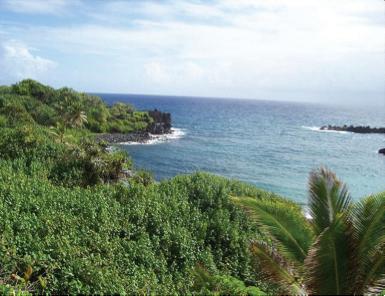
2 The Hawaiian Islands surfaced between 400,000 and 5 million years ago. These islands are isolated in the middle of the Pacific Ocean. They were created from a fixed magma “hot spot” in Earth. As the Pacific plate moved over this hot spot, underwater volcanoes formed. These volcanoes eventually surfaced, creating the Hawaiian Islands. The volcanic soils on these islands are rich in nutrients. As Hawaii is located near the equator, the climate is always warm, and there is frequent rainfall. These rich soils and rain provide all the requirements to support a huge variety of plant life.
3 Where did the plants on the Hawaiian Islands come from in the first place? These islands, born from undersea volcanoes, are thousands of miles from the nearest mainland. Perhaps just a few seeds found their way to Hawaii’s fertile grounds by way of a bird. These few seeds grew, reproduced, and spread all over the island. And as the plants spread, they were exposed to various ecosystems. An empty (unoccupied) landscape offers a wide variety of places for the plants to grow. This is the perfect recipe for plant diversification, or ways for plants to adapt to their new surroundings.
4 You are most likely aware that not every plant is adapted to survive in every ecosystem. Most plants are specialists, meaning that they have special requirements for survival. They thrive in the environments that they are best adapted to but could die in the wrong environment. A cactus would die in a wetland. A palm tree would freeze during a cold winter. Some plants, however, are known as generalists. This means they are able to survive in many different ecosystems. The single pioneer (first) plant species that survived to reproduce on the Hawaiian Islands must have been a generalist.
5 As it turns out, many of the native species found on Hawaii came from an ancestor of the Muir tarweed plant, from the West Coast of the United States. The descendants of that pioneer tarweed adapted to the many different ecosystems found on the Hawaiian Islands. Natural selection would favor traits that were best suited for each particular ecosystem. It is easy to imagine that a single generalist species could diversify into 28 distinct specialist species on the Hawaiian Islands.
6 It is possible that some mutations in the tarweed created new traits. If the mutations were not helpful, the plants did not survive. If they were helpful, the plants thrived. The helpful mutations allowed for new generations to have traits that were better suited for the new ecosystems they spread to. Those seedlings better able to survive dry conditions (adapt to dry conditions) could thrive further from the coast. Seedlings able to adapt to wet conditions survived better where a lot of rain occurred. The plants that survived were most likely to produce offspring with the same successful set of adaptations.
7 Since that first pioneer plant, the tarweed has diversified to vines, ground cover, palm trees, and flowering plants. How do we know all these plants share a common ancestor? The first clue came from local surveys of plant diversity. Scientists found that many of the 28 tarweed species had cross-pollinated (hybridized) in the wild. The hybrid offspring were generally fertile, which is found only in very closely related organisms. Genetic material from each of the 28 species was then analyzed and compared. The DNA for the entire group was found to match very closely, almost no more than can be expected within a single, typical species. It is important to note that this did not happen overnight. It took hundreds of thousands of years for the plants to diversify into the forms we see today. However, a single tarweed ancestor diversified into 28 new and distinct species on an isolated, nutrient-rich island chain.
1 What factor makes the Hawaiian Islands the perfect place for plant species to diversify?
A The isolation of the islands
B The variety of ecosystems found on the islands
C The nutrient-rich soils
D All of the above
2 How might mutations have allowed for the diversification of plant life on the Hawaiian Islands?
A The mutations were harmful, so the plants could not survive.
B The mutations were beneficial for each new environment.
C The mutations had no effect on species diversity.
D The mutations made the plants greener.
3 The hypothesis was that a species from the Pacific Rim may have been the ancestor of 28 distinct species on the Hawaiian Islands. Which of these supports this hypothesis AND could be the result of observational testing?
A Plant seeds have been observed washed up on a Hawaiian beach after a storm.
B A successful, fertile hybrid of a Hawaiian and mainland plant has been bred by botanists.
C Genetic material of the Hawaiian plants showed very close similarity to a mainland species.
D Tarweed seeds were kept in seawater for various lengths of time to represent their journey across the ocean and then planted to see if they could still germinate.
4 Research has identified a species from the West Coast of the United States that may have been the ancestor of 28 distinct species on the Hawaiian Islands. What is this species?
A The Muir tarweed
B Palm trees
C The silver sword
D A species of vine
5 What is the best explanation for species diversifying to fill each new niche?
A The plants chose the niche that they “liked” best.
B In each niche, the fittest plants were able to leave more offspring than other plants.
C Successive generations of plants adapted to each new niche.
D Only some plants could get nutrients from the soils.
6 Why would all of the new varieties of the pioneer plant not survive in each new niche?
A Only a finite amount of resources are available in each new ecosystem.
B Only the fittest plants are able to access the limited resources of each ecosystem.
C The offspring of the fitter plants would outcompete the offspring of the less fit plants.
D All of the above are true.
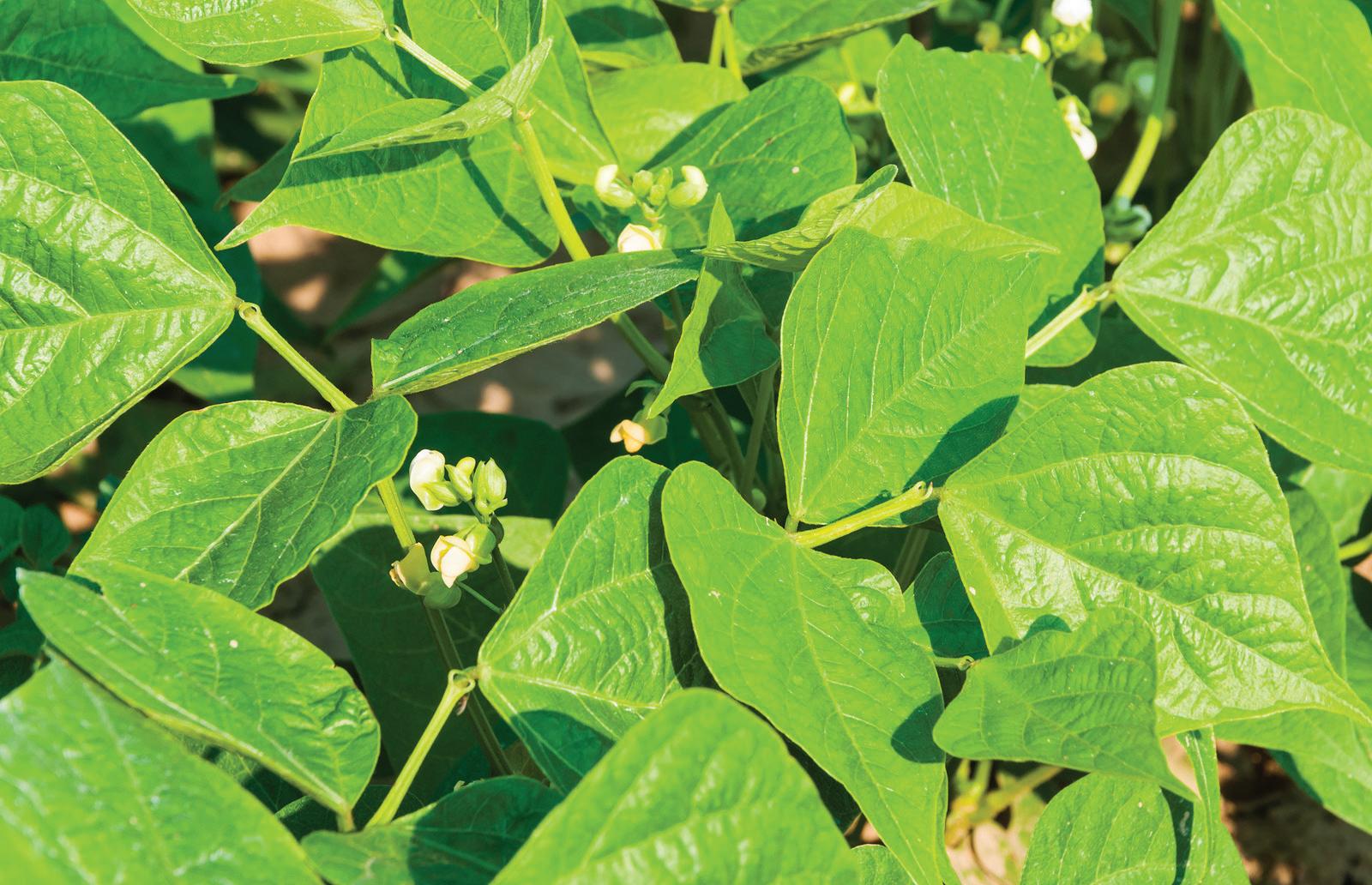
1. Students raised two groups of the same type of bean plant. They gave both groups the same amount of water and sunlight. They treated one group with fertilizer. They observed that the fertilized plants, on average, were taller than the bean plants that had not been treated with fertilizer. How does this show that environmental factors influence growth?
2. Students planted 100 seeds in each of two plots of land on the same day. Both plots of land measured 10 square meters. The students recorded data for one year. Examine the data in the table. Explain how genetic factors played a role in the growth of the plants.
3. Gregor Mendel is referred to as the “father of genetics.” What discovery did he make that has been supported by later research?
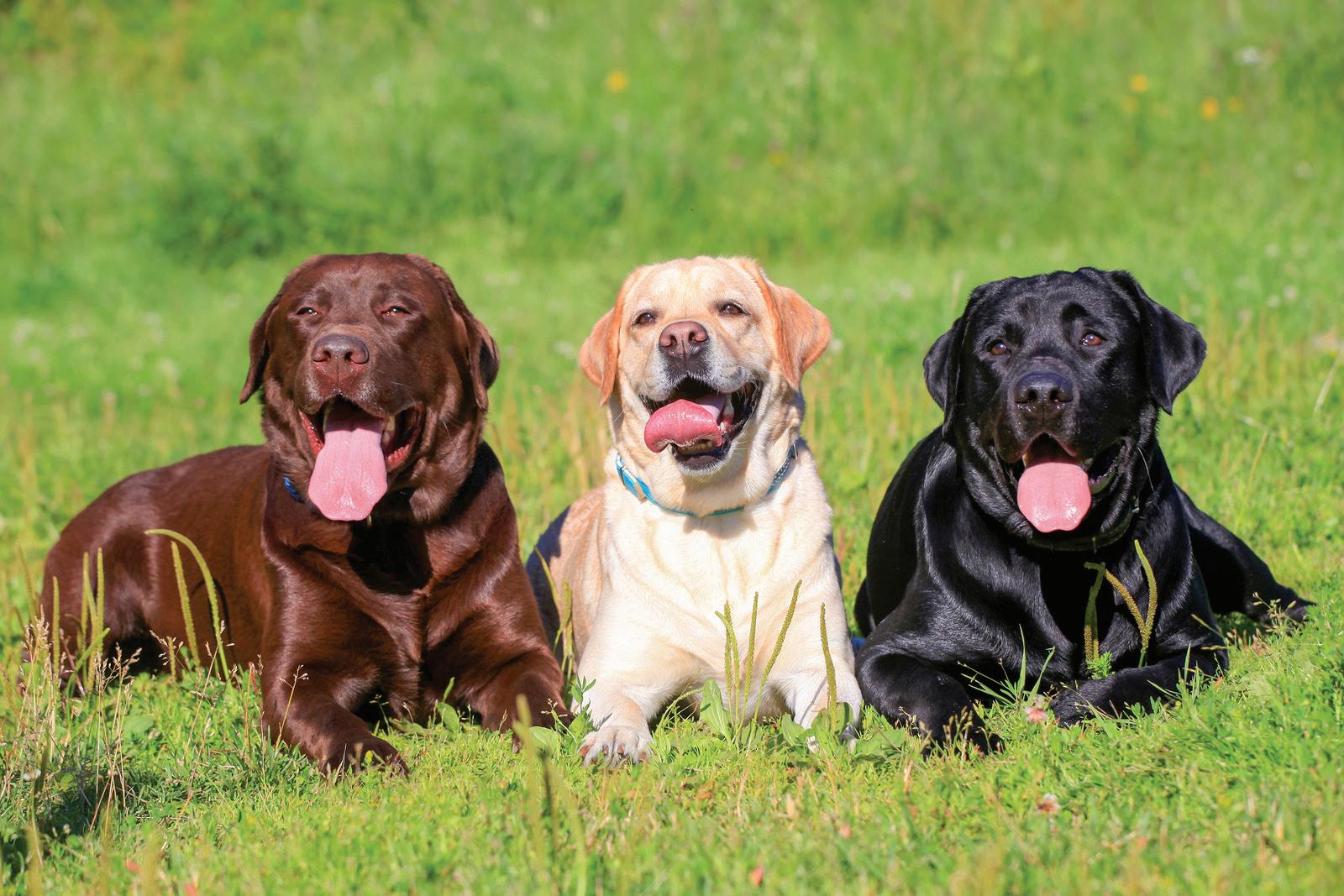
4. In a certain breed of dog, black fur (B) is dominant over brown fur (b). If a dog with black fur and the genotype Bb is crossed with a brown dog of this breed, what would be the chance (percentage) that an offspring would have brown fur? Draw a Punnett square as part of your answer.
5. Genetic engineering is a controversial practice. What is one benefit of genetic engineering? What is one disadvantage of genetic engineering?
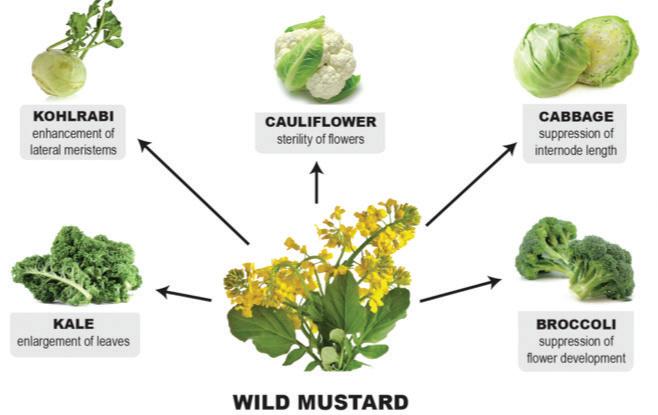
In artificial selection or selective breeding, the favorable traits to be passed on to the next generation are chosen by the breeder. Careful breeding of food crops like corn and wheat have resulted in plants that yield more food per acre. Selective breeding of domestic animals like dogs has led to incredible diversity from their wolf ancestors.
Prompt 3
Write a scientific explanation describing how the illustration shows artificial selection.
Claim:
Evidence:
Reasoning:
Rebuttal:
Peer Name:
Rebuttal:
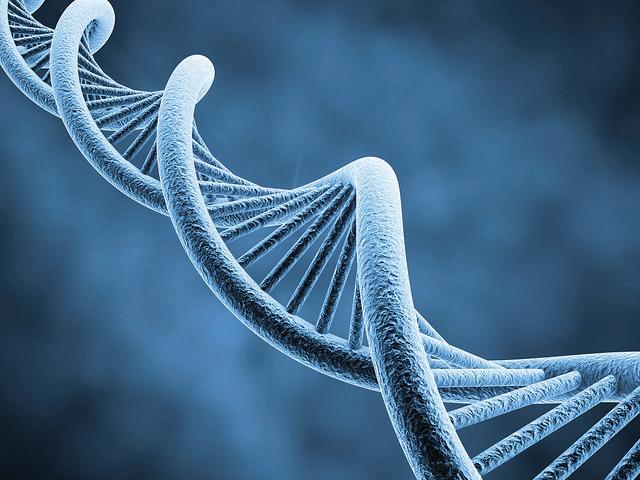
Genes are blueprints that encode information for the production of proteins in an organism. These proteins make up the cells and carry out the cellular functions of the various parts of the organism. Some genes encode the specific materials for building proteins; other genes encode many different enzymes, proteins that carry out hundreds of metabolic functions within and outside of the cell. Different types of proteins work together to form the various structural and functional aspects of an organism.
Chromosome Match.com: Find the other half that completes your ladder.
The structure of DNA looks like a ladder. The rungs on the ladder are where genes produce proteins that are intended for specific functions and/or traits. Each part of a rung on one side matches up with a specific part of the rung on the other side. Most diagrams illustrate this by using color matches to show that the four main structures, called bases, have specific partners.
1. Pick a card that has your description on it.

2. Read the guidelines for Chromosome Match.com and follow those guidelines to find your other half.
Chromosome Match.com Guidelines
• A match must have exactly the same number of rungs (except sex chromosomes; a three rung can match with a two rung for males).
• A match must have the correct corresponding colors on the correct rungs. Just because a possible match has five rungs and starts with yellow does not mean it is an automatic match for a half ladder with five rungs starting with blue.
• Color matches: yellow can only pair with blue, and red can only pair with green.
• Each end of a rung half has a shape that fits like a puzzle piece into another shape; this determines the trait or function type (brown hair, tall or short, etc.).
The way in which the rungs are organized on the ladder structure of DNA determines what traits or functions that chromosome is going to produce. Chromosomes contain more than one gene segment, which means that more than one function and/or trait is found on each chromosome.
3. What instructions does your portion of DNA provide for traits or functions?
4. Retrieve a karyotype building packet to construct your karyotype diagram and a description of the coded instructions. Post your karyotype as directed by your teacher and make a copy in the designated space above.
A realistic view of how chromosome pairs match up to create traits can be seen in the organization and size of what appear to be bands on each chromosome. They match up much like a pair of socks. Each sock has a specific design and it matches with a partner sock with the same design for that trait. The picture is called a karyotype.
Diagram of karyotype
Traits or functions affected by the coded instructions for proteins
5. After you have found your match, construct a diagram of your completed chromosome with color and labels. Include a description of the coded instructions for proteins from the completed chromosome.
Karyotype
Encoded Trait or Function
6. Perform a gallery walk to view the karyotypes created by your classmates. Collect data from the karyotypes and descriptions to complete the chart.
Discussion Questions
1. Why is it important for each part of a DNA structure and gene segments to match up with specific other sections?
2. What was different about the chromosome matches with only three rungs? What are some possible reasons for this difference?
3. Why were all the cards similar in certain aspects but different in others? How does the shape of the proteins coded by the genes impact the traits?
4. Do genes and proteins code only for physical traits? What are some other examples that are not considered physical traits?
5. Humans have only 23 pairs of chromosomes but have hundreds of traits. What does this tell us about chromosomes and genes?
Chromosomes are microscopic strands made of DNA (short for deoxyribonucleic acid) found in the nucleus of the cell. DNA contains genes, and these genes control the production of proteins within the cell. These proteins in turn form cells and control all processes inside cells. The sequence of DNA tells the body which proteins to make. Think of proteins as the building blocks of an organism. Proteins make up the skin, hair, and cells of the organism. If the sequence of proteins changes, this is called a mutation. Mutations are permanent changes in the sequence of the DNA inside the cells.
1. Using the Letters printout, cut out the boxes with letters.
2. Make the following sentence with the letters: THE BIG CAT ATE THE RAT.
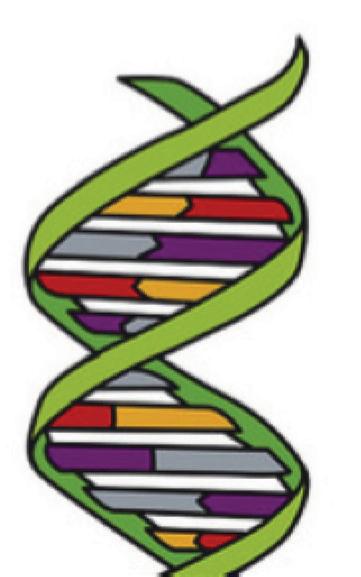
3. You have just made a code for a particular protein. If this code changes, there will be a mutation and the protein will be different.
4. Your teacher will give you the letter D. Replace the letter C in CAT with the letter D. This represents a mutation that occurs when a portion of the DNA is replaced with a different part. Does the sentence still make sense? Do you think this sentence would make the protein needed?
5. Place the letter C back in place to make the word CAT.
6. Remove the letter H from the first word THE. This represents a mutation that occurs when part of the DNA is deleted from the middle of the chain. Move every letter to the left so each word will still have only three letters. Does the sentence still make sense? Do you think this sentence would make the protein needed?
7. Replace the letter H and rearrange the sentence in the correct order. Insert the letter D between the B and the I, and rearrange the letters in groups of three. This represents a mutation that occurs when a new piece of DNA inserts itself into the chain of DNA already in the cells. Does the sentence make sense now? Do you think this sentence would make the protein needed?
8. Describe the three ways we altered the code of the protein.
9. Return the letter D to the teacher and place all the other letters in a plastic bag for the next class.
Mutations occur when the DNA that forms proteins is rearranged. Some mutations are harmful and can be lethal to the organism. Some mutations are beneficial and help the organism survive better than other organisms. Some mutations are considered neutral because they are neither helpful nor harmful to the organism.

Eye color has been a topic of genetic controversy because there are so many variations in color between brown and blue. The fact is that blue eye color, the complete absence of pigment, is a mutation, not just a recessive trait, a discovery made from studies of the founder mutation in populations in Denmark. Founder mutations are those found in populations of people that were isolated from other larger varied populations in smaller European areas. Those variations between light brown, hazel, and green are more of the recessive variations for eye color than blue.
Procedure
1. Roll the die to determine which type of mutation you have (see Types of Mutations images).
2. With the help of your group, tape your fingers as shown on the chart on the board.
3. Spread the beans out on the table.
4. Place 15 seconds on the timer.
5. Pick up one bean at a time. No scooping or sliding beans across the table. Stop when time ends.
6. Record the number in the individual mutation data table and return beans to the cup.
7. Repeat steps 3–6 for the remaining trials with the same mutation.
8. Total and average your trials.
9. Assist your group members in completing the three trials.
10. Group with other students that had the same mutation and compare bean (food) collection data.
11. Work with the group to determine what the overall food collection average was for the total population of the mutation. Pick a group member to share your information with your teacher.
12. After all the data has been compiled, fill out the class data table based on the results the teacher posts from all of the groups.
13. Discuss with your classmates which mutations were harmful, neutral, or beneficial.
14. Complete the discussion questions.
Class Data of Populations with the Same Mutations
Discussion Questions
1. What was the effect of having a beneficial mutation?
2. What was the effect of having a neutral mutation?
3. What was the effect of having a harmful mutation?
4. How do mutations occur?
Use the results from the class data table and discussion to construct a scientific argument about mutations. The argument should be written as an answer to the following question:
Should all mutations be considered dangerous and be genetically removed if possible?
Claim:
Evidence:
Reasoning:
Genes carry the genetic information that determines the traits inherited from parent to offspring, such as height, eye color, and hair color. Genes are composed of the DNA located on chromosomes. Each person has two copies of each gene, one copy from the mother and the other copy from the father. DNA in the nucleus of the cell contains the coded instructions to make the proteins that play critical roles in the body. Proteins provide structure and support for cells; they work as enzymes and regulate the body’s tissues and organs.
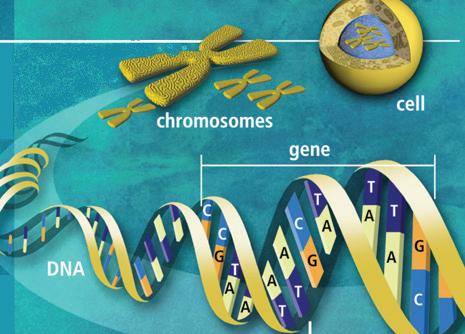
DNA is comprised of building blocks known as nucleotides, which are made up of a sugar, a phosphate, and a base group. The nucleotides are identified by the bases adenine (A), thymine (T), cytosine (C), and guanine (G). These bases pair together to form a double-stranded DNA molecule. Adenine pairs with thymine. Cytosine pairs with guanine.
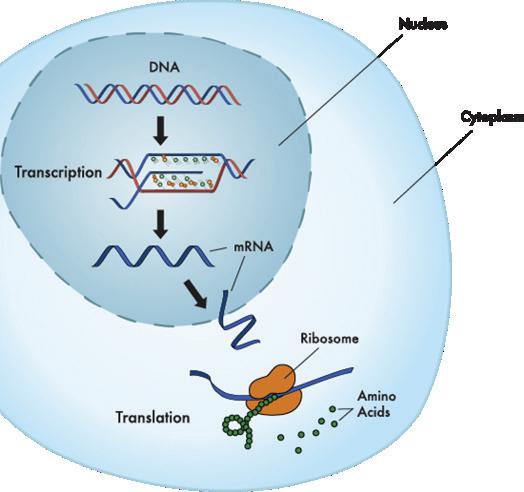
The DNA in the nucleus of a cell is used to make RNA. The order of the nucleotides in DNA is the code that carries information about which proteins the cells should build. During a process known as replication, cells make copies of DNA molecules before they divide to form new cells. During normal cellular functioning, the information in DNA is copied to a molecule called ribonucleic acid, or RNA. A type of RNA called messenger RNA carries the information copied from DNA in the nucleus to the ribosomes located in the cytoplasm of the cell. This process is known as transcription. At the ribosome, the RNA’s message is translated into a protein. The process of making proteins from RNA is called translation. When RNA is used to build a protein, the specific sequence of bases encodes a specific protein. If the sequence of bases is transcribed or translated incorrectly, the protein may not function properly. The types of proteins your body makes determine your traits.
gene: a piece of the genetic material that determines traits inherited from parent to offspring
replication: when a cell makes a copy of DNA
transcription: when a cell makes a copy of RNA from DNA
translation: when protein is made from RNA
Cells are able to control genes by turning genes on and off. This process is known as gene expression. Genes are turned on and off in different arrangements to make a stomach cell function differently from a muscle cell or a brain cell.
A gene mutation is a permanent change in a gene or chromosome of a cell. The mutation can be a change in the order of bases, number of bases, or types of bases. Mutations may be harmful, beneficial, or have no effect on an organism at all. Mistakes can happen when DNA is copied during replication, causing proteins to not work properly. When this happens, it can affect the structure, function, and traits of organisms. Mutations that cause proteins to fail can lead to serious medical conditions or diseases.
Mutations can be caused by harmful chemical agents, X-rays, high temperatures, and viruses. They can result in altered genes and even extra or missing whole chromosomes. A physical or chemical agent that can cause a change in DNA is a mutagen
Mutations that occur in genes can cause conditions known as genetic disorders. Some of the more common genetic disorders caused by gene mutations include cystic fibrosis, sickle cell anemia, and Tay-Sachs disease.
On the other hand, some mutations can be beneficial. Some mutations have a positive benefit for the organism. These mutations are new sequences of proteins that help an organism adapt to changes in its environment. Beneficial mutations are the key for evolution to occur. Because they increase an organism’s chances of surviving and reproducing, these changes are likely to become more common over time.
For example, mutations have been beneficial to antibiotic-resistant bacteria—at least, beneficial for the bacteria, but not for the human who is infected. There are individuals who have developed a mutation that makes them resistant to the HIV/ AIDS virus. There are Italians who have developed a resistance to plaque buildup in their arteries.
protein: provides structure and support for cells; works as enzymes and regulates the body’s tissues and organs
gene expression: the ability of cells to turn genes on and off
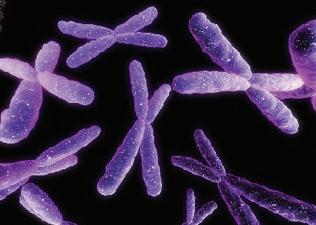
mutation: a permanent change in DNA
mutagen: a physical or chemical agent that can cause a change in DNA
genetic disorders: conditions caused by mutations that occur in genes
Look Out!
Not all mutations disrupt the DNA protein-making sequence of bases in the same way. Different types of mutations are point, substitution, inversion, insertion, and deletion.
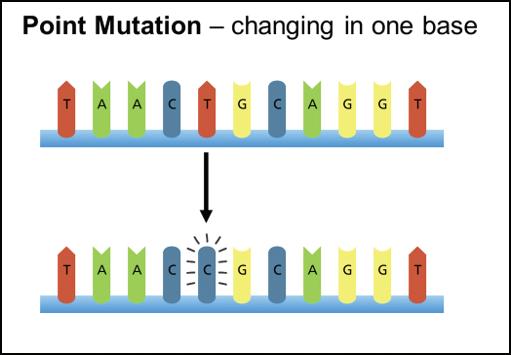
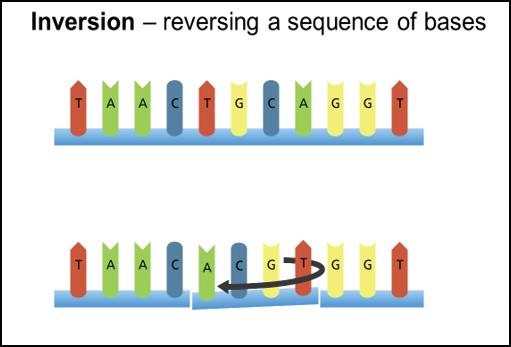
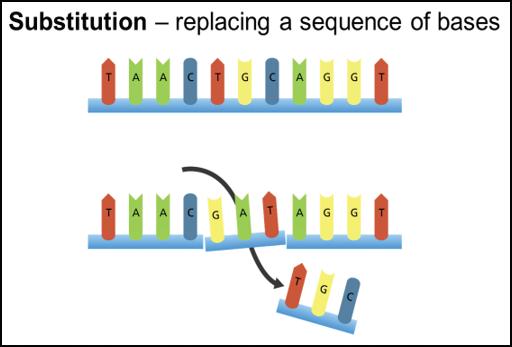
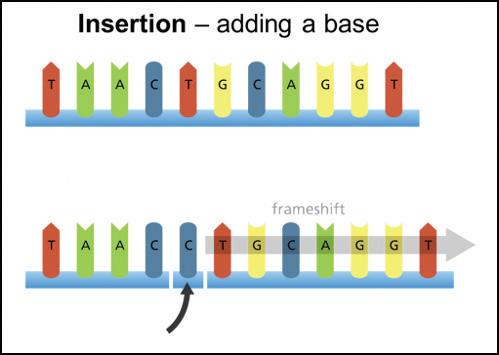
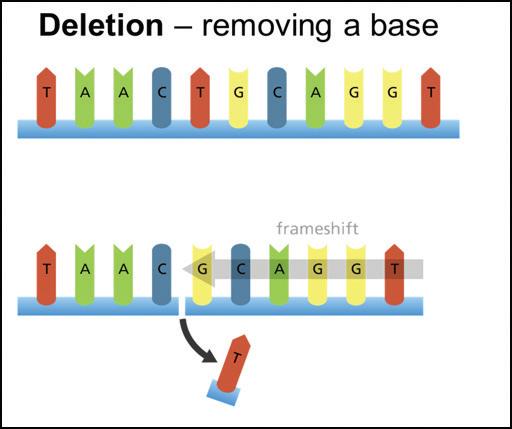
Look Out!
There are several different types of mutations. Recall that during translation, when RNA is used to build a protein, the specific sequence of bases encodes a specific protein. If the sequence of bases is incorrect, the protein may not function properly. A common type of mutation called a substitution is when one base replaces another. Another type of mutation called an insertion is when an extra base is added. When a base is left out, this type of mutation is called a deletion.
Below is a picture of an albino peacock and a picture of the red blood cells of a person with sickle cell anemia. Both are examples of inherited genetic disorders caused by a mutation.
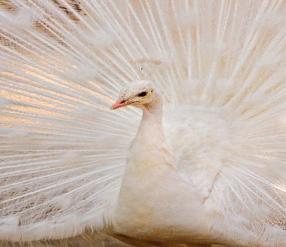
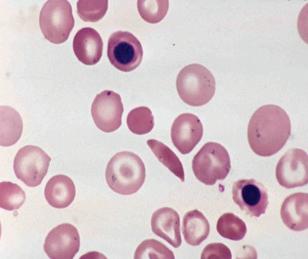
If you are interested in helping to find causes of diseases and looking for ways to treat and prevent diseases, you may be interested in becoming a research geneticist. Geneticists are biologists who study genes and heredity.
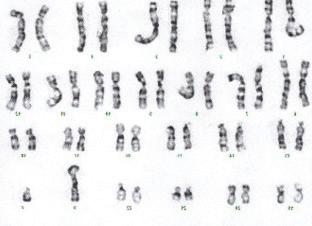

They determine the causes of diseases, genetic variations, and chromosomal abnormalities. As a geneticist, you can have a successful career working in a wide range of industries, including agriculture and wildlife, environmental science, forensics, and medicine.
Try Now
Match the conditions described below to the inherited genetic disorder. Write your answers on the right side of the chart.
Inherited Genetic Conditions
Sickle cell anemia Cystic fibrosis
Tay-Sachs disease Color blindness Albinism
• A condition where a person has partial or complete loss of pigmentation of the skin, eyes, and hair
• A condition where the lungs and digestive system become clogged with thick, sticky mucus
• A condition that causes progressive damage to the nervous system
• A condition that affects the perception of color
• A condition where red blood cells, which carry oxygen around the body, develop abnormally
To help your child understand genes and gene mutations, take some time to explore and answer the questions with him or her below. Use technology to conduct some research if necessary.
1. Name the bases found in a strand of DNA.
2. When are mutations most likely to occur?
3. Is the stored genetic information used to build proteins from DNA or RNA?
4. How can a mutation in the DNA affect what proteins are made by cells?
5. Is cancer another example of a mutation that can occur in genetic material?
6. What is the Human Genome Project (HGP)? What advancements has the project made to modern-day science?
1 You have most likely already learned about deoxyribonucleic acid (DNA), chromosomes, and genes. You know that all three of these components have something to do with heredity in organisms. You have also learned that all living organisms contain some type of genetic material. Have you made the link that these three components are actually one and the same? Let us start at the beginning.
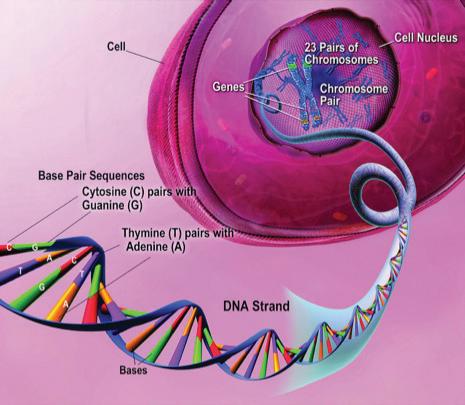
2 What exactly is DNA? All organisms carry the same basic genetic code on their DNA. However, each organism is slightly different from the next, both within species and between species. These differences are due to specific changes in the nucleotide sequences found on the DNA strand. The DNA molecule is made of two long chains of chemical building blocks. These chains form a double helix structure unique to the DNA molecule. Each link on the chain includes a nucleotide, a sugar, and a phosphate group. It is the sequence of nucleotides along the DNA strand that creates an organism’s genetic code. These links are ordered in a way that allows the code to be copied and read. Therefore, this information can be duplicated and transferred from one generation to the next. But how is the information on the DNA strand copied and transferred? This is where chromosomes and genes come into play.
3 What exactly is a chromosome? A DNA strand and a chromosome are the same thing, just in different forms. A chromosome is simply a highly coiled version of a DNA strand. In order for the genetic information carried on the DNA strand to be passed from one generation to the next, the cell must first copy (replicate) the genetic material. In reproduction, the duplicated genetic material is transferred from parent to offspring. During these processes, the genetic material from the DNA strand is condensed, organized, and packaged into individual chromosomes. The structure of chromosomes makes it easier to copy the genetic material, or to transfer it to the next generation during reproduction.
4 What exactly is a gene? The gene is the basic unit of heredity. The information to set each trait of an organism (such as hair or eye color) is carried on DNA strands condensed into chromosomes in sequences known as genes. Each gene is found at a specific location (locus) along a chromosome. Keep in mind that chromosomes are simply condensed forms of DNA. Each gene is found at a specific locus on the chromosome, and it carries genetic information. In other words, each coding segment of a chromosome is a gene.
5 The information within the genes is what gives organisms their specific traits. A slight difference in the nucleotide sequence of a gene can change the trait of the organism. Why is this? Genes are blueprints that encode information for the production of proteins in an organism. These proteins make up the cells and carry out the cellular functions of the various parts of the organism. Some genes encode the specific materials for building proteins; other genes encode many different enzymes, proteins that carry out hundreds of metabolic functions within and outside the cell. Different types of proteins work together to form the various structural and functional aspects of an organism.
6 All three components together (the DNA, the chromosomes, and the genes) make up the entire genome of the organism. The genetic information is carried in the nucleotide sequence of the DNA. Each DNA molecule is condensed into separate chromosomes during reproduction, when the genetic information is passed from parent to offspring. The specific nucleotide sequences on the genes will determine the organism’s unique traits.
1 Which part or factor of the DNA strand creates an organism’s genetic code?
A The individual nucleotides
B The double helix structure
C The phosphate group
D The sequence of nucleotides
2 What exactly is DNA?
A A DNA strand is a condensed version of a chromosome.
B It is a specific location on a chromosome.
C It is a double helix structure consisting of a nucleotide sequence.
D It is a gene that codes for specific traits.
3 What is the best definition of a chromosome?
A A specific locus that codes for traits
B A nucleotide sequence on the DNA strand
C A specific trait of an organism, such as blue eyes
D A highly coiled version of a DNA strand
4 A gene is the basic unit of heredity. What is the function of genes?
A Genes code for specific traits.
B Genes determine the DNA sequence.
C Genes create chromosomes.
D Genes help with replication.
5 Which of the following statements is true?
A DNA and chromosomes are found in different types of cells.
B The specific nucleotide sequences of the genes determine the characteristics of an organism.
C The coding segment of a chromosome is found only in animal cells.
D Some living organisms do not have genetic material.
6 Which of the following statements is FALSE?
A DNA, chromosomes, and genes work together to determine heredity in organisms.
B Genes are found in chromosomes but not DNA.
C Differences between organisms are due to specific changes in the nucleotide sequences.
D Chromosomes and genes allow the information found on the DNA strand to be copied and transferred.
1. On what structures are genes located, and what is their primary function?
2. Examine the diagram below. Some scientists claim that the gene that controls the production of hemoglobin, a protein responsible for binding oxygen to red blood cells, is located at the position shown in the diagram below. How could scientists support this claim?
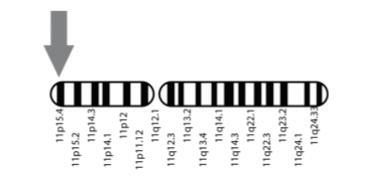
3. Describe how changes to genes can affect the traits of organisms.
4. Sickle cell anemia is a disease in which the shape of the red blood cells becomes irregular. The disease is caused by the presence of an incorrect amino acid in a certain protein. The disease most likely occurred because of an altered sequence of what?
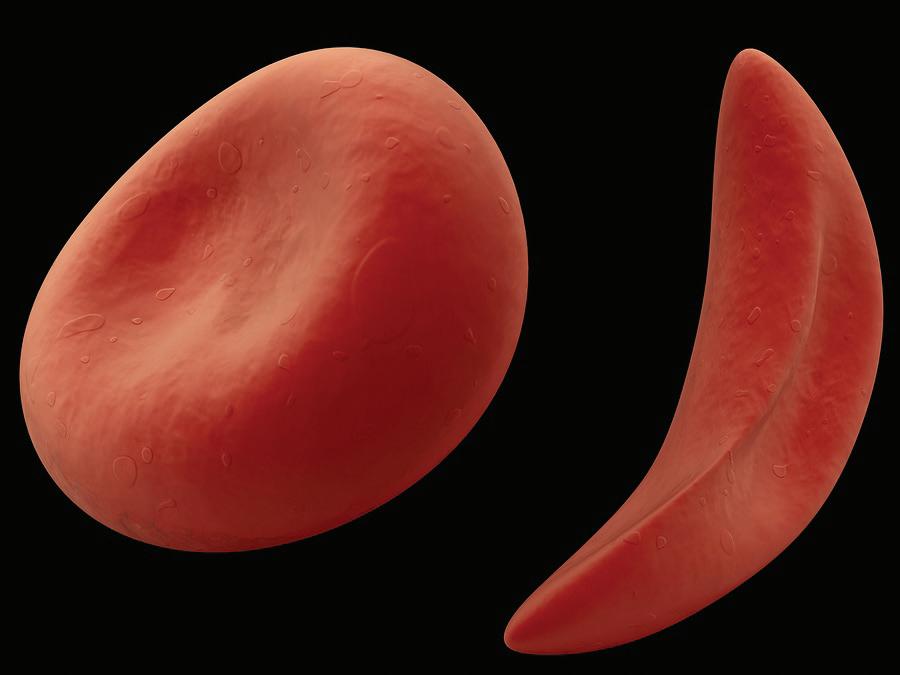
5. How can a mutation that causes a change in the structure or function of a protein be beneficial to an organism?
In a certain breed of cat, black-tipped ears are a trait that makes the breed desirable. A breeder rescued a black-tipped-ear cat and did not know its genetic background or environmental conditions from which it had come. When this cat was bred with another of the same breed, one of the kittens had blue-tipped ears. The breeder had a friend that worked in a genetics lab and had the kittens’ chromosomes analyzed. The analysis included the protein sequence that makes up the gene. Each letter represents a protein that codes for a certain gene. This is what the lab sent back.
Parent 1 ear-color gene sequence
B-L-A-C-K
B-L-A-C-K
Rescued cat ear-color gene sequence
B-L-A-C-K
B-R-O-W-N
Offspring ear-color gene sequence
Kitten 1
B-L-A-C-K
B-L-A-C-K
Kitten 2
B-L-A-C-K
B-L-A-C-K
Kitten 3
B-L-A-C-K
B-L-U-E
Kitten 4
B-L-A-C-K
B-L-A-C-K
Prompt 3
Write a scientific explanation indicating how Kitten 3 could have ended up with blue-tipped ears.
Claim:
Evidence:
Reasoning:
Rebuttal:
PEER EVALUATION
Peer Name:
Rebuttal:
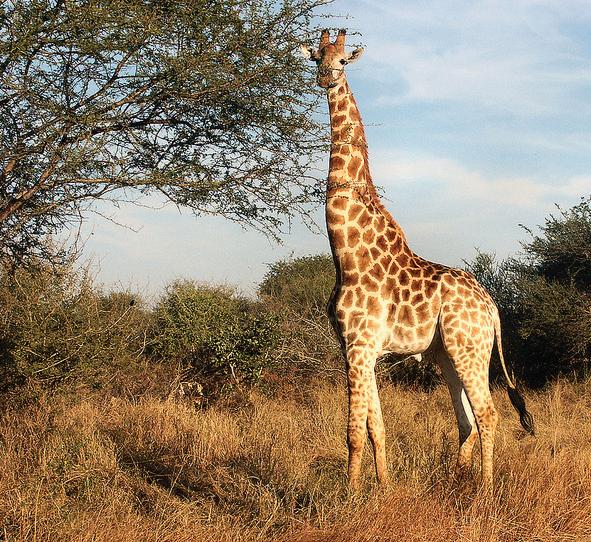
Walk through each station, and identify factors that increase or decrease possibility of individual survival and population growth.
STATION ONE: Olive Flounder vs. Peacock Flounder
Survival chances as prey:
Survival chances as predators:
STATION TWO: Stone Crabs vs. Ghost Shrimp
Survival chances as prey:
Survival chances as predators:
STATION THREE: Giant Forest Owl Butterfly vs. Blue Morpho Butterfly
Survival chances as prey:
Survival chances as predators:
STATION FOUR: Male Cardinals vs. Female Cardinals
Survival chances as prey:
Survival chances as predators:
STATION FIVE: Eastern Diamondback Rattlesnake vs. Eastern Coral Snake
Survival chances as prey:
Survival chances as predators:
STATION SIX: Jackrabbit vs. Snowshoe Hare
Survival chances as prey:
Survival chances as predators:
1. Which trait is most significant in all six stations? How does this trait connect to natural selection?
2. How does an organism’s ability to survive reinforce the concept of natural selection?
3. What are some major contributing factors to natural selection?
4. Does genetic variation increase natural selection? How?
The Journey of Charles Darwin: Each station represents a part of Darwin’s five-year journey on the Beagle and the discovery of the process of natural selection. Most of his research and discoveries were focused on the Galapagos Islands, but there were important discoveries in other areas off the coastlines of South America on both the Atlantic Ocean and Pacific Ocean sides as well.
Charles Darwin began his journey with little understanding of how plants and animals could adapt and survive changes in environments. Before his journey, Darwin did not have the opportunity to observe how organisms respond to changes in their environments. In the areas of England where Darwin lived, environmental conditions do not change as quickly as they might on smaller, isolated volcanic islands. Darwin’s attention to detail and his method of observing and taking extensive notes on all the living organisms he encountered provide researchers with a good amount of data that can be retraced and analyzed.
Two organisms that took most of Charles Darwin’s attention during his time on the Galapagos Islands were the variations of finches and tortoises. The Galapagos Islands is made up of fourteen islands. There are twelve variations of the finch on these islands that are only found on the Galapagos Islands. The Galapagos Islands were originally home to fourteen different species of the giant tortoise, but only eleven or twelve species make up the current population of the islands. Some of the islands do not have any tortoise population due to volcanic activity or past human exploitation of certain species for meat and oil. Each of the finch species and tortoise species have unique differences that will be analyzed at each journey station. The goal is to take the information on the species that Darwin studied and the environments where they were located and analyze how the two connect the process of natural selection that Darwin proposed in his research.
Natural selection is the process by which organisms within a population in an ecosystem have physical or behavioral traits that enable them to adapt, survive, and reproduce during changes to their environment. The process of natural selection was the basis of Darwin’s studies. Three basic principles from Charles Darwin’s research are prevalent in most of his studies. The first principle is that organisms reproduce offspring with inherited traits. The second principle is that some traits are more favorable than others in an environment. The third principle is that most organisms reproduce more offspring than can survive in an environment, and those with the favorable traits are most likely to survive and reproduce.
There will be five destination station stops in the journey. Each journey stop will require the explorer to research and analyze Darwin’s findings to complete the tasks. There will be a debriefing mission at the end of the journey, so be prepared to apply what you collect on this journey to a different organism on the islands.
Small beak observations:
Picking up small seeds:
Picking up larger seeds:
Cracking larger seeds:
The research about beak size and food:
The research about food type and type of area:
Analysis of connection between food availability and types of finches in given areas versus absence of other types of finches:
How is natural selection represented in Darwin’s findings at this stop in the journey?
Journey Stop 2: Location, Location, Location!
Warbler finch observations:
Cactus finch observations:
Medium tree finch observations:
Charles Darwin proposed that natural selection occurs when adaptations in a species allow certain organisms with those adaptations to survive and reproduce while other organisms decline and/or die off. These three finches live in all of the vegetation zones of the Galapagos Islands. Create three scenarios that would cause natural selection in favor of each of the types of finches. (Example: A fire wipes out one of the food sources.)
Remember that the beaks of the warbler finch and the cactus finch are similar, and determine which one could adapt to the other’s food source if it needed to.
Warbler finch:
Cactus finch:
Medium tree finch:
Journey Stop 3: Lonesome George and the Other Giant Tortoises of the Galapagos
Tortoise Shell Modeling Activity
What types of food could a tortoise with the first type of shell access?
What happened to the shell as the arm and hand stretched upward to reach the pencil the second time?
What is the advantage for tortoises with this shell shape?
The station research information explains that goats destroyed most of the vegetation on Pinta Island, which led to an area with most of the remaining vegetation higher off the ground. Which tortoise would be better adapted to surviving this event and continuing to reproduce? Does this validate Charles Darwin’s proposal of natural selection? Explain.
Analysis of Charles Darwin’s Plant Observations: Write down some notes about what Darwin observed and other facts about seeds and plants that were mentioned in the reading section of the station.
What are some adaptations the plants would have needed in order to survive and establish a population on the Galapagos Islands?
Seed Type
Float/Sink Observations
Seed Olympics: Can It Float? Can It Fly?
Podcast or Video Summary:
Source:
Journey Stop 5: The Galapagos Islands—Charles Darwin Online
Journey Debriefing and Final Analysis
Using Charles Darwin’s Findings to Explain Natural Selection
Use the research that you have collected from the video or podcast to write a poem or song about a creature completely different than a finch, tortoise, or any of the plants mentioned in the stations. The poem or song should explain how Charles Darwin’s historical findings support the process of natural selection. After the poem, list three basic principles of natural selection from Charles Darwin’s studies.
Three Basic Principles of Natural Selection:
1. What did Charles Darwin use as his supporting evidence for natural selection on the Galapagos Islands?
2. Which finch beaks were probably the beginning species of finches? Why?
3. Does natural selection involve immediate change in an organism’s physical structure? Explain.
4. What factors make the Galapagos Islands one of the best locations to observe natural selection in progress?
Natural selection is the process of selection whereby favorable traits become more common and less favorable traits become less common in following generations. Changes in an organism’s environment can cause natural selection to occur.
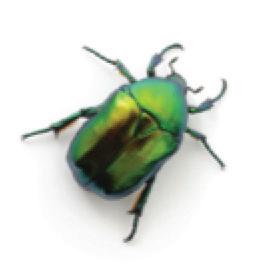
Predict which traits will have a greater chance of being expressed in offspring as adaptations resulting from environmental and genetic factors:
(Generation 2)
1. Cut one Beetle Offspring sheet apart to make 10 small sheets.
2. Write the number 2 in the Generation box of all 10 of the smaller offspring sheets.
3. For each of the six characteristics (body length, body width, mouthpart, spots, flight speed, and click range), fill in these lines on all 10 offspring by doing the following: If you are filling in a male, start with the male. If you are filling in a female, start with a female.
4. Roll one die. The number you roll is the number of the variation you will use on the offspring variation chart.
5. Take the number (measurement) from the Generation 1 parent and perform the operation under that dice roll on the Variation in Offspring sheet. Write the new number on the appropriate line of the Generation 2 beetle.
6. Your offspring are now ready to go out into the world.
7. Give your 10 beetle offspring to one of the other groups in the class. Your group will receive 10 beetle offspring from another group.
8. Read about the conditions on your island, and decide as a group how the fittest beetles will be selected (pick the best trait for survival).
9. Choose one male and one female from among the offspring sent to you by another group. These two beetles will be the Generation 2 parents on your island. Record their traits on the chart on the next journal page.
10. The remaining eight offspring are not fit enough to survive and reproduce on the island. The offspring die and can be discarded.
11. Repeat steps 1–10 for Generations 3–6, changing only step 2 to reflect the current generation, and step 5 would take away from the previous generation instead of going back to the first generation each time.
Body Length (mm)
Body Width (mm)
Mouthpart (mm)
Spots
Flight Speed (cm/s)
Click Range (m)
Create a graph based upon the data, if needed. Make a general statement about the results shown in the graph. Conclusion and Scientific Explanation
Write a scientific explanation on how growth, survival, and reproduction in successful natural selection are connected to genetic factors, environmental factors, food intake, and interactions with other organisms.
Claim:
Evidence:
Reasoning:
Questions
1. What were some of the physical characteristics of the parent beetles that were carried down through several generations?
2. How does such a trait show that genetic factors are involved in successful natural selection?
3. What were some of the island conditions that were beneficial to the offspring beetles?
4. How did the environmental factors contribute to the natural selection process of the beetles?
What do you know about evolution? Evolution is a population’s change in inheritable traits over time. One of the most common examples of evolution is an ape walking and evolving into an animal that stands in an upright position. One mechanism of evolution is natural selection. Natural selection is based on Darwin’s theory that organisms that are best suited for a particular environment are most likely to reproduce and therefore pass on their genetic material to the next generation.
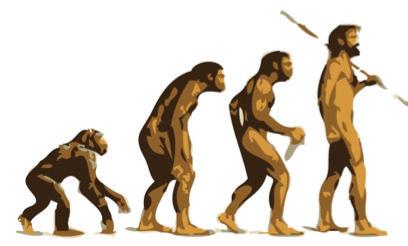
natural selection: theory that organisms with traits that are well suited to their environment survive and reproduce more successfully
Charles Darwin’s theory of evolution by natural selection changed the way we understood the diversity of life.
Genetic variation: There are differences among individuals within the same species. Traits that are more favorable to a species are more likely to be passed on from generation to generation, increasing the species’s chances of survival.
Overproduction: If a species produces more offspring than the environment can support, many of the offspring will not survive into adulthood. This is related to biological fitness, which is the ability to survive and reproduce.
Competition: Since resources such as food, water, and space are limited, offspring must compete for the resources for survival. Individuals with a trait that gives them a competitive advantage are more likely to reproduce.
If you have variation, successful reproduction, and heredity, you will have evolution by natural selection as an outcome. Consider the example of the red and brown insects on the right. The tree on which they lived could not support unlimited population growth, so not all of the insects reproduced successfully. The red insects tended to get eaten by birds and survived to reproduce less often than the brown insects did. Over time, natural selection favored the brown insects.
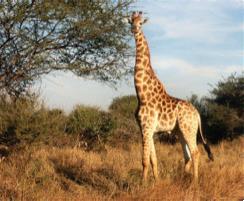
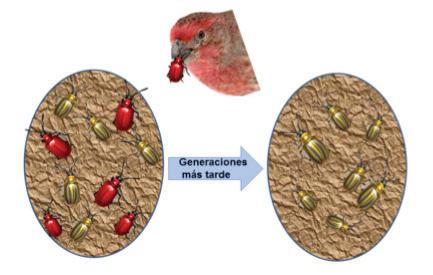
Adaptation: An adaptation is an inherited trait that improves the survival of a species.
For example, the giraffe underwent mutations that caused some offspring to have longer necks. The giraffes with longer necks ultimately had a better rate of survival because they could stretch their necks to reach leaves on tall trees. Over time, more and more giraffes inherited the longer necks, increasing the survival of the species.
An environment meets the needs of the organisms that live there. Environments are always changing. Adaptations can be behavioral traits that are inherited over generations as well as physical traits. Think about the seasons; it is warm in the summer and cold in the winter.
Organisms must find ways to deal with these changes. Some plants lose their leaves and stop growing when it is cold. Some animals grow thick fur coats. Animals like birds migrate to warmer areas to make it easier to find food during the winter season.
adaptation: an inherited trait that improves the survival of a species
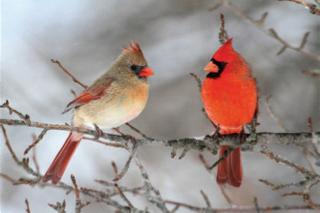
Many birds migrate in the winter.
Plants also have adaptations that help them survive. For example, water lilies have large, thin leaves. The structure of the leaves helps water lilies float so they can get enough sunlight for photosynthesis. Floating is beneficial because the leaves can produce more food. More food produces more seeds, and naturally the trait is passed to the next generation.
Changes in an organism’s habitat are sometimes beneficial to it and sometimes harmful. For any particular environment, some kinds of organisms survive well, some survive less well, and some cannot survive at all.

genetic variation: differences in physical traits as well as behavioral traits among individuals competition: contest between individuals or species for resources and space
Prime examples of adaptation are seen in the Galapagos medium ground finches. A study in the 1970s revealed that variation in beak size changed over time.
During times of drought, finches with large beaks had a higher survival rate because they were able to eat the seeds available during the drought that those with smaller beaks had a harder time eating.
Therefore, the generations of finches after the drought had more birds with larger beaks. After the drought, more seeds were available to the finches with smaller beaks. The larger beak was no longer a beneficial trait, so the number of birds with larger beaks stopped increasing.
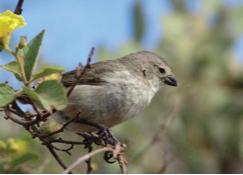
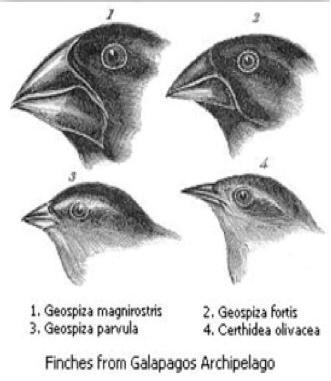
The process of natural selection connects growth, survival, and reproduction to genetic factors, environmental factors, food intake, and interactions with other organisms. Remember: natural selection does not occur within individuals; it occurs within and among populations.
Try Now
The chart below lists examples of adaptations of different organisms. For each example, state whether the adaptation is the result of natural selection or artificial selection. Describe at least one advantage of the adaptation.
Apples with large, sweet fruit
Artificial Selection
Find samples of fruits and vegetables in your refrigerator, or search for pictures on the Internet.
Selective breeding is common in food crops; these are often called genetically modified crops. Breeders can select for a variety of traits, such as root size, leaf size in lettuce, fruit size in tomatoes, vitamin content in carrots, and flower size in cauliflower. Choose at least six different fruits and/or vegetables to discuss.
Here are some questions to discuss with your child:
• Which traits do you think were artificially selected for in each fruit or vegetable? Why do you think these traits were selected?
• Would similar adaptations be beneficial or harmful in the wild?
• Which type of environmental conditions would be most favorable for these plants?
1 Most of the living organisms on the planet today look very different than they did hundreds of thousands of years ago. In fact, many organisms that existed that long ago do not exist today. Their populations have either changed form or gone extinct. Changes in climate, geography, and the spreading of organisms have affected how past organisms have adapted. You may have heard the phrase adapt or die. This phrase does hold true for all organisms over time. As conditions in an organism’s environment change, those organisms within that population must adapt, or those organisms will die. But what exactly does this mean?
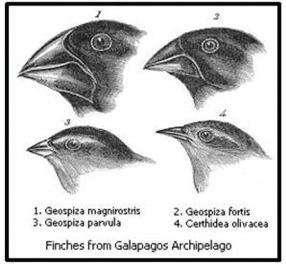
2 Organisms of all kinds, including plants and animals, live in constantly changing environments. As environments change, the organisms that live in those environments must change also. These changes are known as adaptations. Keep in mind that each environment has only a specific and limited amount of resources. These resources include access to food, water, shelter, and other organisms. Those organisms with the best trait adaptations will be more likely to survive to pass those traits on to future generations. Scientists call this process natural selection.
3 Natural selection is the process by which traits become more or less common in a population. This is based on the reproductive success of individuals carrying the traits over many generations. It is very important to note that natural selection occurs to populations of organisms, not to individuals. However, it is the adaptations of individuals that can lead to shifts in populations. If individuals are well adapted to current conditions, they will have greater fitness and reproductive success. If individuals are not well adapted to current conditions, they will have lower fitness and reproductive success. Traits that cause lower fitness and reproductive success will be passed less and less. Eventually, those genes can be lost from the population’s gene pool.
4 In order for natural selection to occur, four very important things must happen. First, there must be variation within the population. This variation is critical, as some organisms within a population will have traits that are more suitable to the environment in which they live than other organisms within the same environment. Second, these traits must be able to be inherited, or passed from one generation to another. Third, there must be a high enough rate of population growth so that more offspring are produced than can survive in a particular environment. This leads to a competition for the available resources within that environment. And fourth, there must be differential survival and reproduction. This means that those organisms that have the best traits for that environment will be the ones to survive and pass those traits on to the next generation.
5 In 1859, Charles Darwin published his book On the Origin of Species. In this book, he stated that modern organisms have evolved from common ancestors through the process of natural selection. He based this theory on the observations that he made regarding the organisms that he found on the Galapagos Islands. Darwin was very interested in the finches that he studied on the island. These birds became known as “Darwin’s finches.” The main feature that separated the different populations of finches were their beak types. Darwin hypothesized that different ecosystems around the islands caused the different beak types. It was not until much later that evidence was found to support Darwin’s hypothesis.
6 A husband-and-wife team of ecologists, Peter and Rosemary Grant, lived on a very small, 100-acre island called Daphne Major in the Galapagos Island chain. They captured all of the birds that lived on the island and made careful notes of their weight, their diet, and their traits. There was no migration into or out of the island. Since the finches on that island could not leave, their population was isolated. There were several types of food sources on this island, mainly different types of seeds.
7 When the Grant team first began studying the finches in 1973, there were mostly small, soft seeds. The majority of birds on the island had small, narrow beaks that were able to break the small, soft seeds. A smaller number of birds had large, powerful beaks. A major drought occurred on the island in 1977. As a result, the type of seeds on the island changed dramatically. The plants with the small and soft seeds were not able to survive, leaving plants that produced larger, harder seeds. The birds that had the small and narrow beaks were not able to eat this new food source, so those birds died. However, the finches that had larger, more powerful beaks survived. This shifted the finch population’s traits from small, narrow beaks to large, powerful beaks.
8 During the drought, the birds with the large beaks were able to survive and reproduce when only large seeds were available. Thus, that trait was favored over the smaller beaks in these environmental conditions. The study did not end then. The rains resumed in the mid-1980s. The small, soft seed plants again dominated. The finch population shifted once again back to small-beaked birds, as the smallerbeaked birds had the genetically favorable adaptation in that environment.
9 This became one of the most critical scientific studies about natural selection. It showed that a change in the environment led to a shift in the traits of the finch population. This happened because those finches that were fittest (with the best adaptation for the environment) passed those traits on. Over many generations, this led to a shift in the traits of the population as a whole through the process of natural selection.
1 The environments on Earth are constantly changing. What must occur in order for individual organisms within an environment to survive?
A They must be larger than other organisms.
B They must adapt or die.
C They must mate with others of their kind.
D They must know where the water is.
2 Which of the following statements is NOT true with respect to natural selection?
A Natural selection occurs to populations of organisms, not to individuals.
B It is the adaptations of individuals that can lead to shifts in populations.
C Natural selection occurs only to the individuals within a population.
D Natural selection can work only on existing variations within a population.
3 Four very important things must happen in order for natural selection to occur. Which of the following statements is NOT correct with regard to the requirements of natural selection?
A There must be fewer offspring produced than can survive.
B There must be variation within the population.
C The traits of individuals must be able to be inherited.
D There must be differential survival and reproduction.
4 In his 1859 book On the Origin of Species, Charles Darwin stated that modern organisms have evolved from common ancestors through the process of–
A adaptation.
B evolution.
C diversification.
D natural selection.
5 The husband-and-wife team of Grant and Grant studied the process of natural selection on a population of finches in the Galapagos Islands. What specific conditions allowed them to study the process of natural selection on that population of birds?
A The bird population was isolated.
B There was genetic variation within the population.
C The environmental conditions on the island changed.
D All of the above are true.
6 What evidence did Grant and Grant find to support the theory of natural selection on the population of Darwin’s finches that were observed?
A Some birds had small beaks, and other birds had large beaks.
B The individuals with the large beaks had an adaptation that allowed them to eat more food.
C A change in the environment led to heritable trait changes within the bird population.
D The birds with the smaller beaks preferred the smaller, softer seeds.
1. What is the theory of natural selection proposed by Charles Darwin?
2. What are some of the factors that contribute to natural selection?
3. Galapagos finches are birds that live on islands off the coast of South America. The finches on the various islands are very different from each other as a result of the food sources available to them. Give an example of a structure of the finches that experienced a change through natural selection.
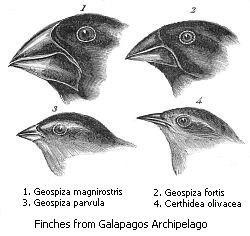
4. Light-colored peppered moths used to hide on white birch trees because their coloring was similar. Over time, the birch trees became covered in black ash from nearby factories.
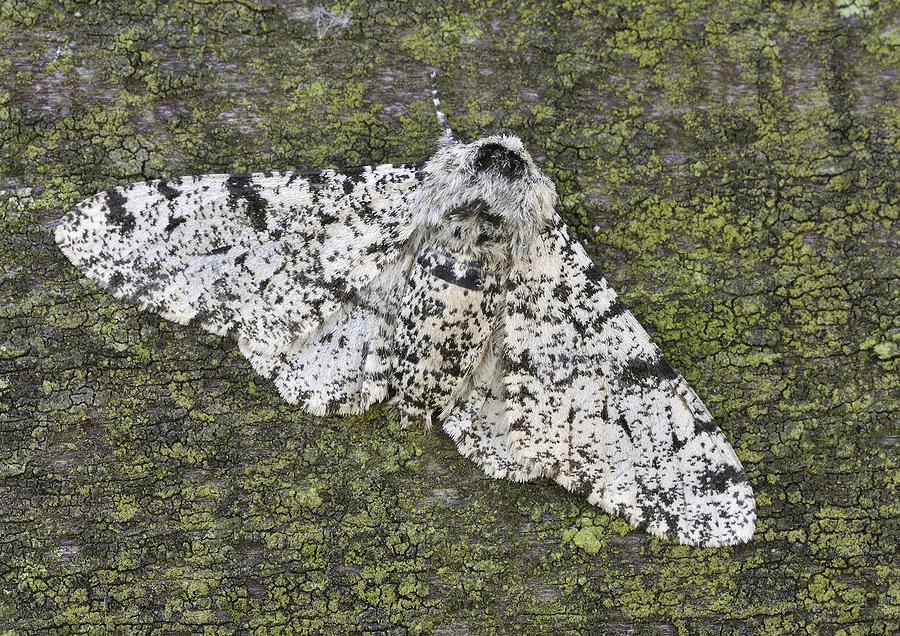
What population of moths would be naturally selected for over time if the trees remained covered in black ash?
What would happen to the moth population if the factories became environmentally conscious, stopped polluting, and caused the birch trees to revert to their natural state of white bark?
5. How can a mutation that causes a change in the structure or function of a protein be beneficial to an organism?
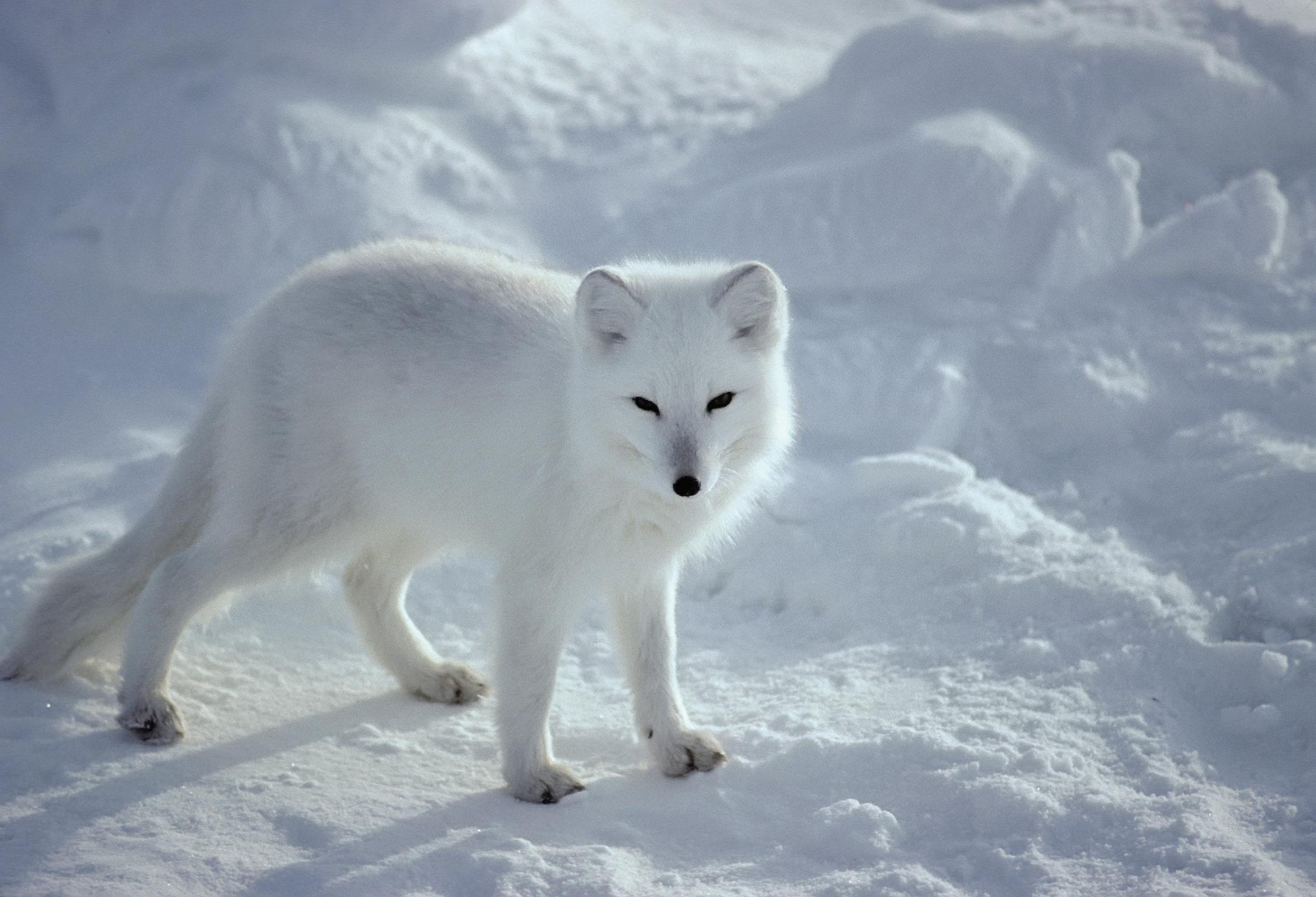
The following data indicates changes in a population over time. The black lines represent deceased individuals in this population.
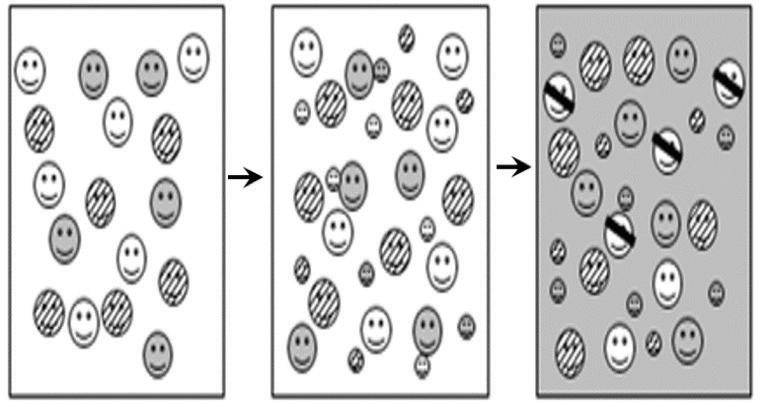
Write a scientific explanation describing what the images above are depicting over time. Include any percentage changes that have occurred (round to the nearest whole number) as well as a data table to help you organize the data from the images. You must include a rebuttal in your answer.
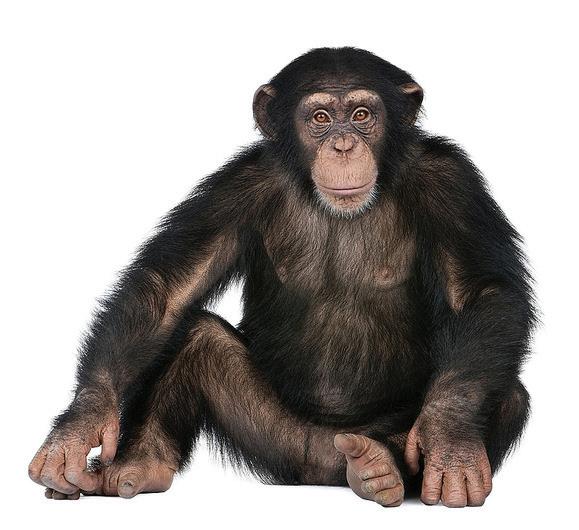
Procedure
1. Use the Animal Reference Sheet to select five animals that seem to have similarities in body structures and functions. Record your choices in the first column.
2. When the music starts, find a partner who has written down one of the same animals. You and your partner will have two to five minutes to collaborate and complete the row for one animal. You may use each partner to discuss only one animal.
3. When the music starts again, look for another partner who has noted another of your same animals. Complete the row for the second animal in the time allotted.
4. Repeat steps 2–3 until your table is completed.
Animal
Function of This Body Structure Adaptation Differences
Discussion Questions:
1. What reasons were used to select the five animals in the chart?
2. Did the other students have similar structure ideas for each of the animals during the collaboration periods?
3. Was there one structure that was commonly used? Why was this structure so common in all the animals?
4. What is one explanation for similarities in the structures?
5. How could the similarities in the animals in this activity be used to show connections to animals that once lived but are now extinct?
The desert can be a tough place to survive—ask any desert rodent. The types of organisms that survive in the desert over time is a very telling sign. This adventure involves three types of rodents—the pygmy desert mouse, the long-eared jerboa, and the short-eared jerboa—through five years of survival in the deserts of Africa. All three of the rodents are within the same order, and the two types of jerboa are within the same species. The desert mouse uses the burrows of other animals or shelters under vegetation, making it an easy target for both ground and flying predators. It cannot jump as high as the other rodents but can move fairly well on the ground. Both types of jerboa can jump up to six feet vertically and move rapidly in random motions, making it extremely hard for any ground predators to catch them. Flying predators have difficulty with both types of jerboa as well. The advantages of having the long ears in the desert are easier detection of approaching predators and having more surface area to distribute heat and cool off the head and body. Two top predators, the desert eagle owl and the rattlesnake, will play a part in the journey in addition to the high temperatures and vegetation of the desert.
The Rules of the Chase
1. Use tape to set up a square perimeter of 100 cm by 100 cm.
2. Collect one brown paper bag with climate cards, four plastic bags (predator, long-eared jerboa, short-eared jerboa, and desert mouse), and one die.
3. Randomly place 10 of each of the rodent squares spread out inside the perimeter. Do not overlap cards.
4. Begin round one by throwing in two of each predator card and two climate cards. A predator card completely covering a rodent card counts as a capture. A predator card only partially covering a rodent card is an encounter; if the rodent has the characteristics needed to avoid capture, it lives. Jerboas have to be completely covered by predator cards to be captured. If the rodent does not have characteristics needed to avoid capture, it dies. If the rodent does not have the characteristics needed to survive the climate card, then it dies. (It does not matter how much a climate card covers the rodent.) If the climate card lands on the same cards as a predator card, the card can remain or be tossed again.
5. Remove the dead cards and add one offspring for every two of each type of rodent that lived. (Round odd numbers up. Example: 9 surviving long-eared jerboas would result in 4.5 offspring, which would round up to 5 offspring.) Record the total populations for each rodent in round one.
6. Repeat steps 4–5 for rounds two through four. Remember to record the new population counts for each rodent before starting each new round.
Mouse
Pygmy Desert Mouse
Long-eared Jerboa
Short-eared Jerboa
Year 1
Climate Card and Predator
Year 2
Climate Card and Predator
Year 3
Climate Card and Predator
Year 4
Climate Card and Predator
Year 5
Climate Card and Predator
7. Construct a line graph of the results. Create a key to the right or below the graph to show which line color represents each type of rodent.
How do genetic variations of traits in a population increase some organisms’ probability of surviving and reproducing in a specific environment?
Claim:
Evidence:
Reasoning:
Sharing Results and Explanations
Take your results to another group and explain your information. Allow the other group to explain their results as well. The explanations should include how genetic variations of traits in a population increase some organisms’ probability of surviving and reproducing in a specific environment. Take notes on the similarities and differences in the explanations in the space below.
1. How did the population of desert mice do in comparison to the other two rodents?
2. Why did the long-eared jerboa have more of a chance of survival than the other two rodents?
3. What happened to the populations of the jerboas after round one?
4. How do the results support the fact that genetic variations can increase or decrease a population in a specific environment?
It is common to see many varieties of birds in an area. The behavior displayed by birds during mating season is interesting to say the least. While these rituals appear to be the same, closer observation might show otherwise. The average passerby might not notice any real differences, but the bird that ends up choosing a mate notices every little detail. Who knew birds could be so complicated?
Animals use these common rituals to simply identify members of their species for reasons such as protection and locating feeding areas and their habitat. It is your turn to take a spin in the world of the bird dance. Find another bird in your species. Do not panic; no fancy dance moves are required. Just follow the instructions.
Instructions
1. Move to the side of the room designated by the instructor.
2. Pick a card. Do not show it to anyone. Do not speak to anyone.
3. Dancers, collect the colored object indicated on your cards (feathers). Possible matching birds will wait for the dances to begin without talking.
4. The instructor will say, “Move,” and each dancer will go to a person not holding a colored object and begin the dance. If the dance fits, the other bird will show his or her card and they will go to the area with their designated color. The card cannot be revealed unless it matches the dance!
5. The dances will continue until all dancers have found a bird in their species. A bird can only choose a dancer that makes the exact correct movements with the correct color feather.
6. Write down a summary in the space below of the activity and how it might be an example of the word speciation. Write the definition for the term speciation before your summary as a guideline.
Speciation:
Speciation does not just occur when genetic variation is present within a population. Specific factors have to block the flow of other genetic information that leads to variation and results in a new species. The altered trait that keeps repeating in the offspring is considered a mutation due to the fact that the other variations are blocked from the possibility of being expressed.
Use the Dance Cards Sheet and the specific bird identification dance of your species to create a story. The story must explain how the bird that is represented by you and others of your species evolved into a new species. The specific factors that isolated the bird must be the first part of the story. The remaining paragraphs should explain what mutations occurred that led to the ritualistic dance specific to this species of bird. Write the story in the space below.
Swap stories with another student and evaluate the story to determine if the species fits the criteria of speciation. Evaluate if the scientific information in the story provides a good explanation of speciation.
Factor of Speciation
Isolation Event
Gene Mutation New Species Characteristics
Additional notes from evaluation of your story:
1. How does speciation occur?
2. Can a physical barrier alone, such as a mountain or river, cause speciation to occur? Why or why not?
3. How did the dance activity represent how speciation occurs?
4. What is one real-world example of speciation?
All living organisms have a starting point. In this early stage the organism is most commonly referred to as an embryo. Organisms in the embryological stage of life often look almost identical. Observations of homologous structures provide evidence of how organisms are connected to each other and to their ancestors.
Beans come in a variety of shapes, sizes, and colors. The activity you will perform involves the observation and data collection of four different types of beans. A bean is the carrying vessel of some plant embryos. Others are simply referred to as seeds, which encase the embryo.
Instructions
1. Collect four different types of beans.
2. Use a digital device or camera to photograph each of the beans for the data analysis table.
3. Write down your observations of physical characteristics of each bean in the data analysis table.
4. Collect four of the same beans from the soaking trays and one stereoscope per group of four.
5. Carefully split each bean in half and photograph the inside of the beans for the data analysis table.
6. Place each bean (both halves inside up) under the stereoscope and observe.
7. Write what you observe about the insides of each bean in the data analysis table.
8. Print out small versions of each of the pictures and place them in the correct spaces on the data analysis table.
9. Complete the Venn diagram below after the data table has been completed.
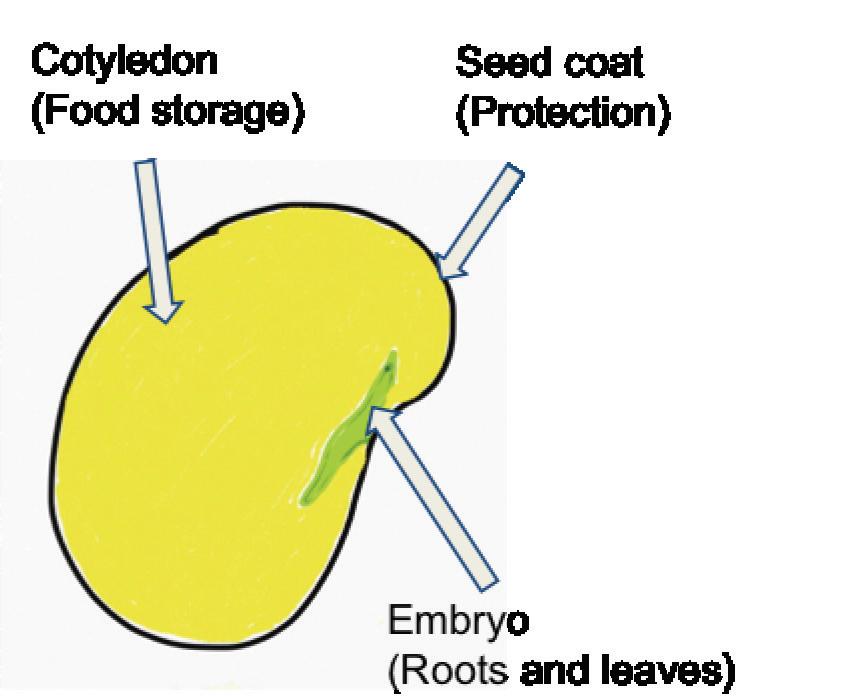
Without their skin and muscles, humans would all look the same—just a walking bag of bones. Imagine that a bag of bones was discovered and you had to determine whether or not all of the bones in the bag were from the same human, different humans, or even different animals. Could you do it just by looking at the bones? Try your skill level in the following activity.
Instructions:
1. Collect a set of random skeleton pictures.
2. Group them by whether they belong to a dog skeleton or a horse skeleton.
3. Check the results against the first key, which only has the groups.
4. Collaborate with your group and try to organize each horse skeleton and each dog skeleton by age and name.
5. Check the results against the second key, which has the completed charts, and reorganize your pieces if needed.
6. Explain the similarities between the earliest dog skeleton (oldest) and the earliest horse skeleton in the space below.
7. Below the explanation, create a map of how the two animals could have started as similar species and evolved to their current-day structures. Focus on parts of the skeleton, not the whole structure, when creating the map. You can sketch out the map with drawings or written boxed descriptions.
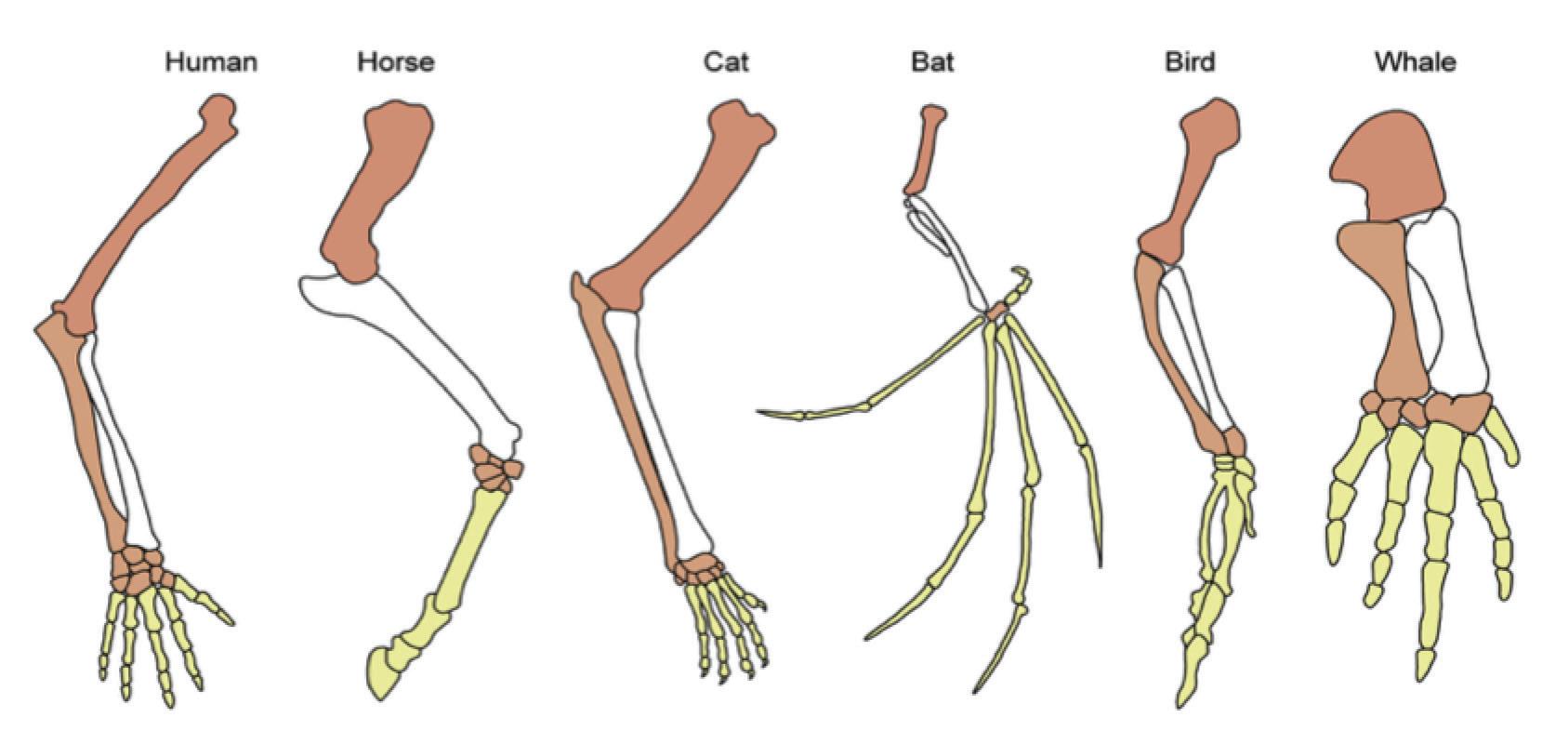
Compare and contrast the homologous structures shown in the diagram above. The information can be both physical and function based. Create a design in the space below to compare and contrast the homologous structures.
1. How were the embryos of the beans similar?
2. If the beans in the activity were planted and sprouted, would they still have similar features? Explain.
3. How does the term homologous structure apply to the bean embryos in Part I of the lesson and the skeletal structures in part two of the lesson?
4. How did the movement of those structures contrast or compare to each other?
Are birds related to dinosaurs? Years ago, this question spawned heated debates and controversy among many scientists. Today, the scientific community generally accepts the idea that birds and dinosaurs share a common ancestor. What changed? Did scientists find evidence to support this theory? If so, what sort of evidence did they find?
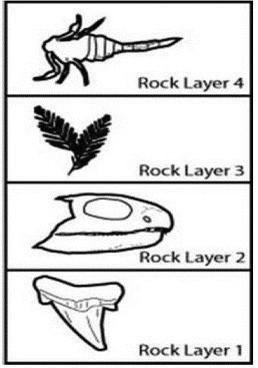
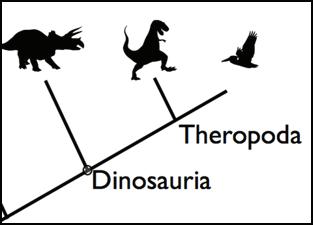
Many pieces of evidence support the theory that birds and dinosaurs are related. One such piece of evidence, the fossil record, is the accumulation of all fossilized remains that scientists have collected around the world. However, though the fossil record provides evidence to support the theory of common ancestors among different organisms, it does not give a complete picture of this shared ancestry.
From fossils, scientists can identify the habitats and ecosystems that extinct organisms once occupied. They can also group similar extinct organisms together and arrange them in the order in which they lived, from oldest to youngest. The relative age of a fossil can be determined by comparing its location to other fossils within the same rock layers. Older fossils appear at the bottom.
Radioactive materials have a fixed rate at which they decay. By measuring how much radioactive material is left in a fossil, scientists know how much has decayed and can then determine how long it took to decay. Working back this way, scientists can calculate the age of the fossil.
Fossils also give clues about how organisms evolved. Scientists study the similarities and differences in the bones, shell shapes, or other features of organisms over time. For example, scientists discovered melanosomes in an ancient bird feather. Melanosomes are structures that contain melanin, which helps determine a creature’s coloring. Scientists also found melanosomes in the feathery areas of a dinosaur fossil, which suggests an ancestral link between birds and dinosaurs.
Sometimes the fossil record reveals a shift from one entire species to another. After comparing the skeletons of birds to those of Coelurosaurian dinosaurs, paleontologists concluded that many birds are likely direct descendants of the group of dinosaurs called coelurosaurs (especially the Velociraptors). Paleontologists point to characteristics such as the S-shaped neck, hollow bones, large eye sockets, five or more vertebrae in the hip, and many other similarities between birds and dinosaurs.
paleontologist: a scientist who studies prehistoric life
Take a look at the photographs below. Do you think the elephant on the left is a direct descendant of the woolly mammoth on the right? Explain your reasoning.
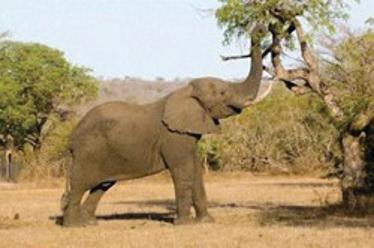
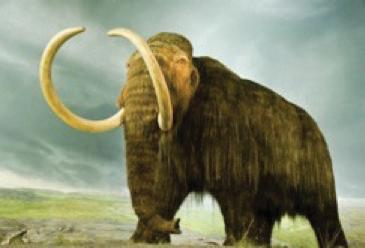
A 2005 study of mitochondrial DNA confirmed that woolly mammoths and African and Asian elephants share a common ancestor. Scientists compared the mitochondrial DNA sequences of both animals and found strong similarities. Mitochondrial DNA is particularly valuable in making these determinations because only the mother passes mitochondrial DNA down to her offspring. Scientists looked at the DNA sequences of each organism and compared their similarities and differences. Similarities in anatomical structure, gene sequences, developmental stages, or any other criteria that point to a common ancestor are called homologies.
common ancestor: an organism or creature that is the shared predecessor of two or more descendant groups of organisms or creatures
Developmental homologies can be observed by studying similarities in the formation of embryos. For this activity, you will analyze common features of early chordate development, and then evaluate these similarities as evidence of common ancestry.
Chordates, from the phylum Chordata, are animals that are mostly vertebrates and some related invertebrates. Humans, whales, fish, and squirrels are all chordates. All chordates share four anatomical structures that appear during specific embryonic developmental stages.
The fact that all chordate embryos share these features at some point is one of the major pieces of evidence that points to the common ancestry of all chordates.
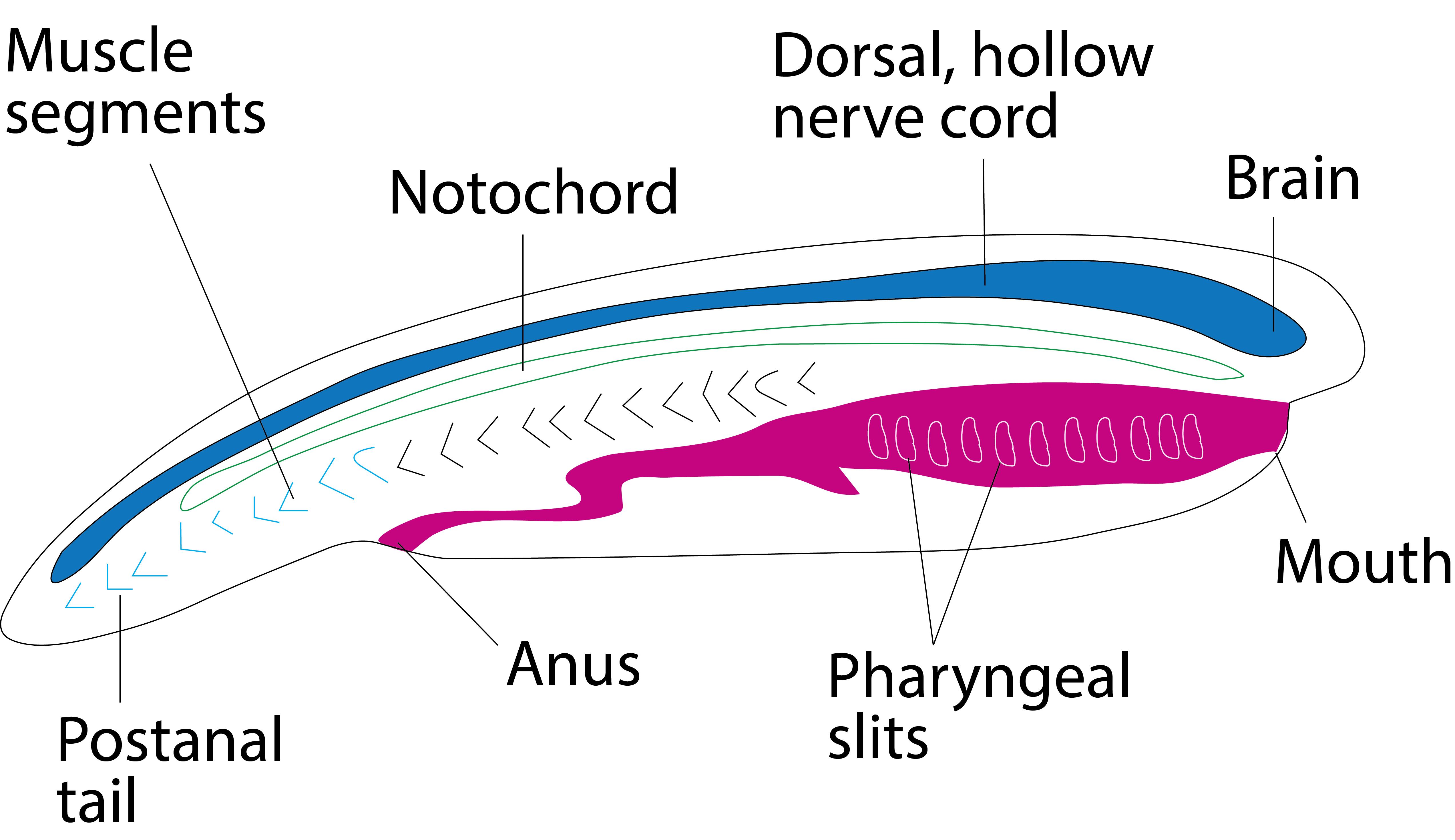
dorsal hollow nerve cord: This feature is unique to chordates. This dorsal (near the back) cord is what eventually develops into the central nervous system of chordates.
notochord: A stiff rod of cartilage provides support to the chordate. In vertebrates, this develops into the spine. In other organisms, the notochord remains as the sole means of muscle attachment.
postanal tail: In contrast to invertebrates such as worms, which have a digestive system that runs the entire length of their body, chordates have a muscular tail that extends past their anus.
Paleontologists compare bone structures in organisms to determine their common ancestry. A likeness between the bone structures of two creatures may indicate a common ancestor. Mammals, birds, and reptiles all show similar anatomical patterns.
This diagram shows similarities in the anatomical structure of forelimbs in mammals (bat and human), birds (penguin), and reptiles (alligator). Although they look similar, these forelimbs function differently in each of the organisms.

Look Out!
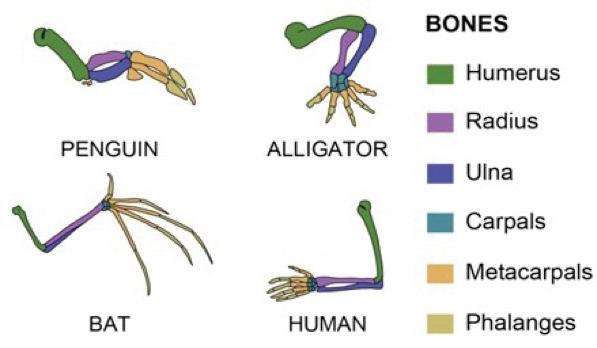
Species with similar origins also show similar embryonic development patterns. Paleontologists can learn a lot about a species by studying the embryo and patterns of its development. For example, certain snake embryos have small buds that look like limbs. The buds disappear in later developmental stages. This suggests that snakes evolved from an ancestor that had limbs.
Although evidence may support a certain hypothesis, that hypothesis may not be readily accepted. One hypothesis that has received mixed reactions is the idea that Tyrannosaurus rex is a predecessor of the chicken. Paleontologists found protein (collagen) in a 68-million-year-old T. rex bone. In 2007, they reported that five of the seven collagen fragments closely matched the collagen of chickens.
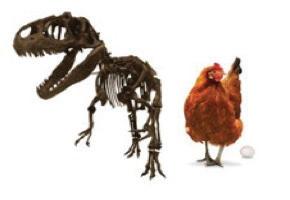
Look Out!
Other researchers questioned the conclusion relating the dinosaur and the chicken and the research process. Some scientists wondered if different results might have emerged with differently written instructions. Acceptance of this shared ancestry hypothesis will take more research and evidence.
Biogeography
Biogeography is another type of evidence that supports the theory of evolution by natural selection. Biogeography is the study of past and present geographical distribution of species.
The lemur is an example of an animal whose ancestors were geographically separated from their native population.
Organisms have characteristics that allow them to survive in their environment. If the environment changes, some species may evolve over time to cope with the differences. Sometimes, part of a population is geographically separated from the main group. The isolated population is forced to adapt to different conditions and evolve separately. The lemur is one example. Some scientists believe lemurs crossed from Africa to the island of Madagascar millions of years ago by floating on vegetation. By 20 million years ago, the continents had drifted so far apart that the lemurs became permanently isolated on Madagascar. The splitting up of one massive landform named Pangaea explains why many species evolved into new species. As the land masses of Pangaea drifted apart, newly isolated species developed characteristics that distinguish them from their common ancestor.
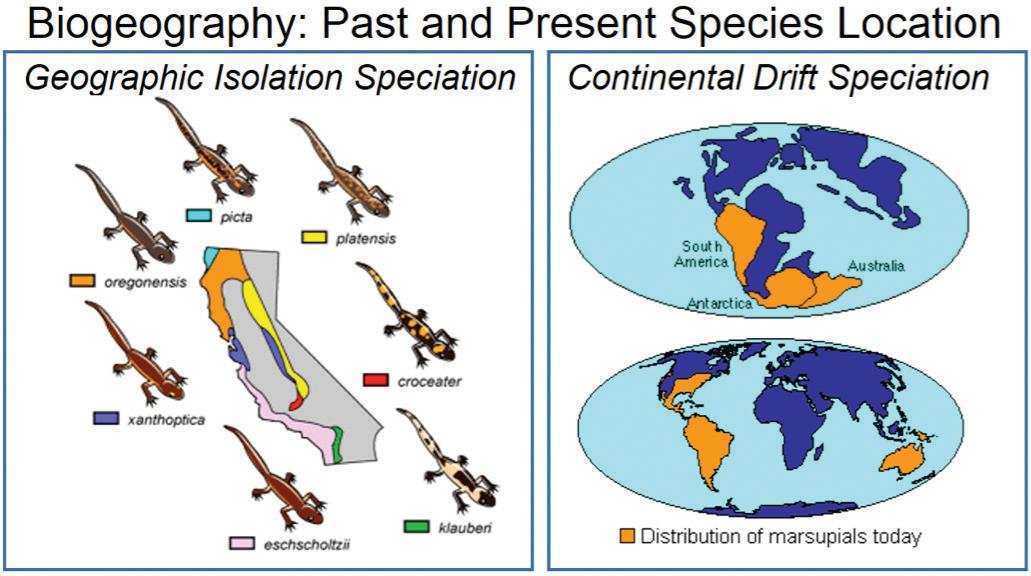
Read each example in the left column of the chart. Then, choose a term from the list below the chart that best matches each example. Each term may be used more than once.
Humans and chimpanzees share some DNA and protein sequences.
Whales, bats, and birds have the same bone that connects their limbs to the middle of their bodies.
Used to determine the age of fossils.
A predecessor that a creature shares with another creature.
A scientist studies the distribution of extinct and modern ferns in North America.
Chicken, pig, and fish embryos all have pharyngeal folds.
If the environment changes, some species may evolve over time to cope with the differences.
Alligators and humans show similar bone components. Two species that are said to arise from the same species.
• biogeography
• structural homology
• molecular homology
• developmental homology
• common ancestor
• radioactive dating
How does learning about animal structure, fossil records, and DNA sequencing from species that no longer exist help us care for the species that exist today? Write a paragraph answering this question. Include the following terms in your answer: homology, common ancestor, and embryonic development.
According to Darwin’s theory of evolution by natural selection, all species share a common ancestor. To help your child learn more about common ancestry, work together to create an evolutionary tree. Also called a phylogenetic tree or a tree of life, this diagram shows how species that share similar physical characteristics, genetics, or character traits may be related to each other.
First, have your child choose 12 organisms for the evolutionary tree, including three aquatic animals, three land mammals, three insects, and three reptiles. Search for photographs of these creatures on the Internet or in old magazines. Gather a large poster board, ruler, glue, and pencil. This evolutionary tree will focus on the physical characteristics of organisms. Brainstorm with your child different characteristics to put on the tree. Some ideas include the following:
• presence or absence of a backbone
• presence of hair, fur, or scales
• warm- or cold-bloodedness
• lungs or gills
• external structures such as fins, claws, or hooves
• food preference (omnivore, carnivore, or herbivore)
With the poster board in landscape orientation, write “Common Ancestor” at the bottom and draw a large Y above the term. Leave plenty of room above the Y to draw your tree’s branches. Now choose a characteristic for each side of the Y (e.g., presence or absence of a backbone). Separate the 12 organisms into two piles according to this characteristic.
Now, look at the organisms in each group and choose a characteristic to separate each of the two groups into smaller groups. You might find that one group, such as the organisms without backbones, cannot be further separated. If this is the case, glue these organisms onto the correct side of the Y at the top. For any group that can be further separated, draw a V on the correct side of the Y at the top. Place the organisms on either side of the V. For characteristics such as hair, fur, or scales, you will need to draw an extra line or two on the V, one line for each form of the characteristic.
Continue this process until only one organism is left. Glue the picture of that organism to the end of the branch. For ideas about how evolutionary trees are drawn and organized, you may want to do an Internet search prior to this activity using the keyword evolutionary tree.
Here are some questions to discuss with your child:
• What surprised you the most about the relationships of the organisms in the evolutionary tree?
• What surprised you the least?
• Do you think an evolutionary tree based on genetic information might look different from the tree based on physical characteristics? Explain your reasoning.
1 Scientists have long wondered where organisms came from and how they evolved. One of the main sources of evidence for the evolution of organisms comes from what we call the fossil record. The fossil record includes the total number of fossils that scientists know of, as well as their locations in rock formations and sedimentary layers. Their location in the rock layers is important, as it shows how long ago those organisms lived. This record provides a wealth of information about the organisms that existed in the past. The record suggests that many of these organisms have distant ancestors dating back hundreds of millions of years.
2 By studying the fossil record, scientists discovered that there was a sudden increase in the number of organisms found in the fossil layers around 530 million years ago. Scientists have named the time the Cambrian explosion. It was during this time that the diversity of life on planet Earth increased dramatically. Most of the major phyla (types of organisms) that we see today came into being after the Cambrian explosion. Therefore, scientists agree that the organisms that came after the Cambrian explosion must share common ancestors with the organisms that came before this time.
3 From fossils, scientists can identify the habitats and ecosystems that extinct organisms once occupied. They can also group similar extinct organisms together and arrange them in the order in which they lived, from oldest to youngest. The relative age of a fossil can be determined by comparing its location to other fossils within the same rock layers. Older fossils appear in rock layers below younger fossils. Scientists also use radioactive dating to determine the age of fossils. Radioactive materials have a fixed rate at which they decay. By measuring how much radioactive material is left in a fossil, scientists know how much has decayed and can then determine how long it took to decay. Working back this way, scientists can calculate the age of the fossil.
4 Fossils also give clues about how organisms change over time. Scientists study the similarities and differences in the bones, shell shapes, or other features of organisms over time. For example, scientists discovered a compound called melanosomes in an ancient bird feather. Melanosomes are structures that contain melanin. Melanin, in part, determines an organism’s coloring. Scientists also found melanosomes in the feathery areas of a dinosaur fossil, which suggests an ancestral link between birds and dinosaurs.
5 Other pieces of evidence support the theory that birds and dinosaurs are related. After comparing the skeletons of birds to those of Coelurosaurian dinosaurs, paleontologists concluded that many birds are likely direct descendants of the group of dinosaurs called coelurosaurs (especially the Velociraptors). Paleontologists point to similar body structures such as the S-shaped neck, hollow bones, large eye sockets, five or more vertebrae in the hip, and many other similarities between birds and dinosaurs.
6 However, while the fossil record provides evidence to support the theory of common ancestors among different organisms, it does not give a complete picture of this shared ancestry. Also, although evidence may support a certain hypothesis, that hypothesis may not be readily accepted. One hypothesis that has received mixed reactions is the idea that the Tyrannosaurus rex is an ancestor of the modern chicken. Paleontologists found a type of protein (collagen) in a 68-million-year-old T. rex bone. In 2007, they reported that five of the seven collagen fragments closely matched the collagen of chickens.
7 Other researchers questioned this conclusion and the research process. No other scientist had ever found protein that had survived even 1 million years, let alone 68 million. Could the proteins have come from contamination? Also, the match between the protein in the T. rex bone and chickens was determined by a computerized process. Some scientists wondered if different results might have emerged with differently written instructions. Acceptance of this shared-ancestry hypothesis will take more research and evidence.
8 The fossil record, however, is not the only evidence that supports the common ancestry of organisms. We also see this evidence in similarities in characteristics between organisms, known as homologies, that may have originated from a common ancestor. A homologous structure is something that is similar in position, structure, or evolutionary origin between organisms.
9 Developmental homologies can be observed by studying similarities in embryos’ formation. Chordates are animals that are mostly vertebrates, or animals with skeletons. Humans, whales, fish, and squirrels are all chordates. All chordates share anatomical structures that appear during specific embryonic developmental stages. The fact that all chordate embryos share these features at some point during their development is one of the major pieces of evidence that points to the common ancestry of all chordates.
10 Anatomical homologies are similar anatomical structures that exist between species that can be identified as a link to a common ancestor. Similar features suggest relatedness among the organisms. Anatomical homologies are sometimes easy to observe, as is the case with modern Asian and African elephants and the now extinct woolly mammoth. All three are distinct species, but they belong to the same family of organisms (Elephantidae) that have large skeletons, trunks, and tusks. While the fossil record provides evidence to support the theory of common ancestors among different organisms, it does not give a complete picture of this shared ancestry.
1 Which of the following things does NOT scientifically support evidence of common ancestry?
A The fossil record
B The relationship between T. rex and chickens
C Developmental homologies
D Anatomical homologies
2 What is described as the total number of fossils that scientists know of, as well as their locations in rock formations and sedimentary layers?
A Fossils
B Sedimentary rocks
C The fossil record
D Common ancestry
3 Which of the following is the best example of an anatomical homology?
A The link between modern elephants and woolly mammoths
B The link between Velociraptors and birds
C The link between T. rex and chickens
D The way that embryos form
4 Which of the following is NOT true about fossils?
A They give clues about how organisms change over time.
B They can be used to study the ecosystems of extinct organisms.
C Scientists can use radioactive dating to determine the age of fossils.
D Older fossils appear in rock layers above younger fossils.
5 Which of the following is the best example of a developmental homology?
A The link between modern elephants and woolly mammoths
B The link between Velociraptors and birds
C The link between T. rex and chickens
D The way that embryos form
6 Scientists discovered that there was a sudden increase in the number of organisms around 530 million years ago. What have scientists named this time?
A The fossil record
B The Cambrian explosion
C Evolution
D The time of homologies
1. Leopard seals are adapted to survive in the freezing conditions of Antarctica. These seals show some variability in traits, such as number of spots on the coat, thickness of the layer of blubber, and shape of the head. Which variation in one of those traits would give leopard seals a greater chance of surviving in the cold environment?
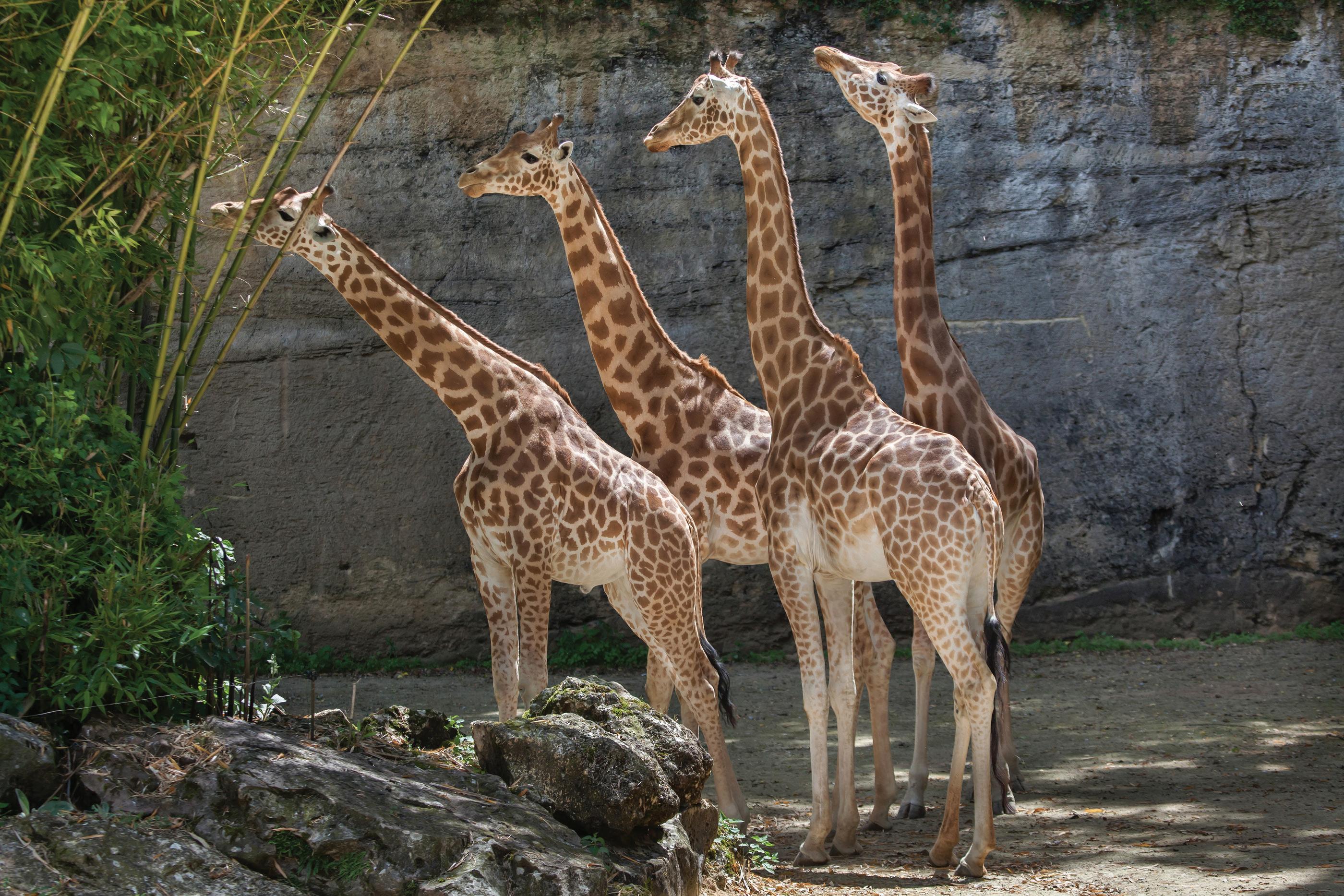
2. What are some of the factors that contribute to natural selection?
3. Define speciation and give an example.
4. The diagram below shows the embryonic development of four different organisms. What similarities in development do they all share?
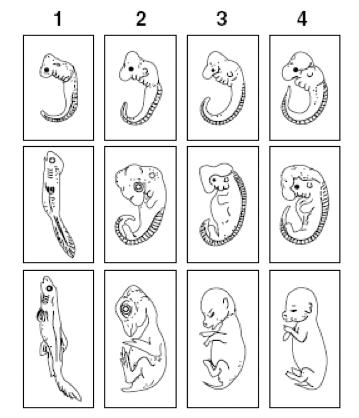
5. The brown bones in each animal help to connect the limb to a specific joint in the torso, or middle of the body. What type of structure do these bones represent, and what is their significance in evolutionary relationships?
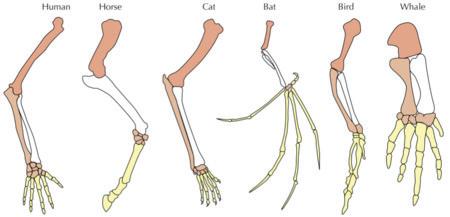
Homologies, or similarities in characteristics between two organisms because they originated from a common ancestor, support the idea of a common ancestry of organisms. A homologous structure is something that is similar in position, structure, or evolutionary origin. Write
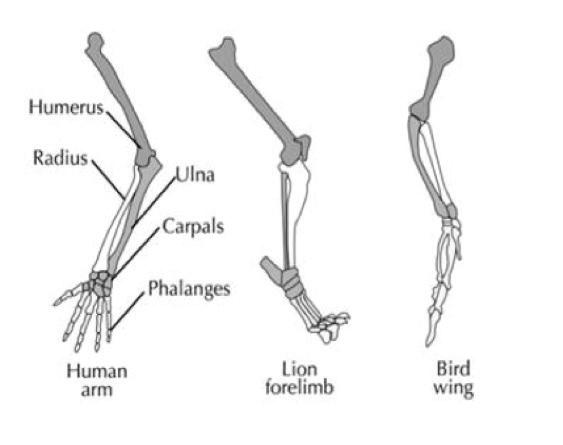
scientific explanation supporting the claim that structural evidence shows that the human, lion, and bird species are related.


1. Brainstorm with your group to make a list of waves. You have five minutes to complete this task.

2. Analyze your list of waves. Are there any types of waves? What technology uses these waves?
3. Share one item on your group list when asked by your teacher.
4. As other groups share items from their lists, check your list to see if you already recorded them. If you didn’t, write them in your journal.

(Push and Pull) Longitudinal Push and Pull Wave Sketch
(Side to Side) Transverse Side to Side Wave Sketch
1. When did you exert the most energy while you were making multiple waves?
2. When did you exert the least energy while you were making multiple waves?
3. Compare the waves you created when you exerted a lot of energy to those you created when you exerted very little energy. How were they similar, and how were they different?
4. Compare the longitudinal waves to the transverse waves. When exerted energy changed, did both types of waves change their behavior in the same fashion? How were they similar, and how were they different?
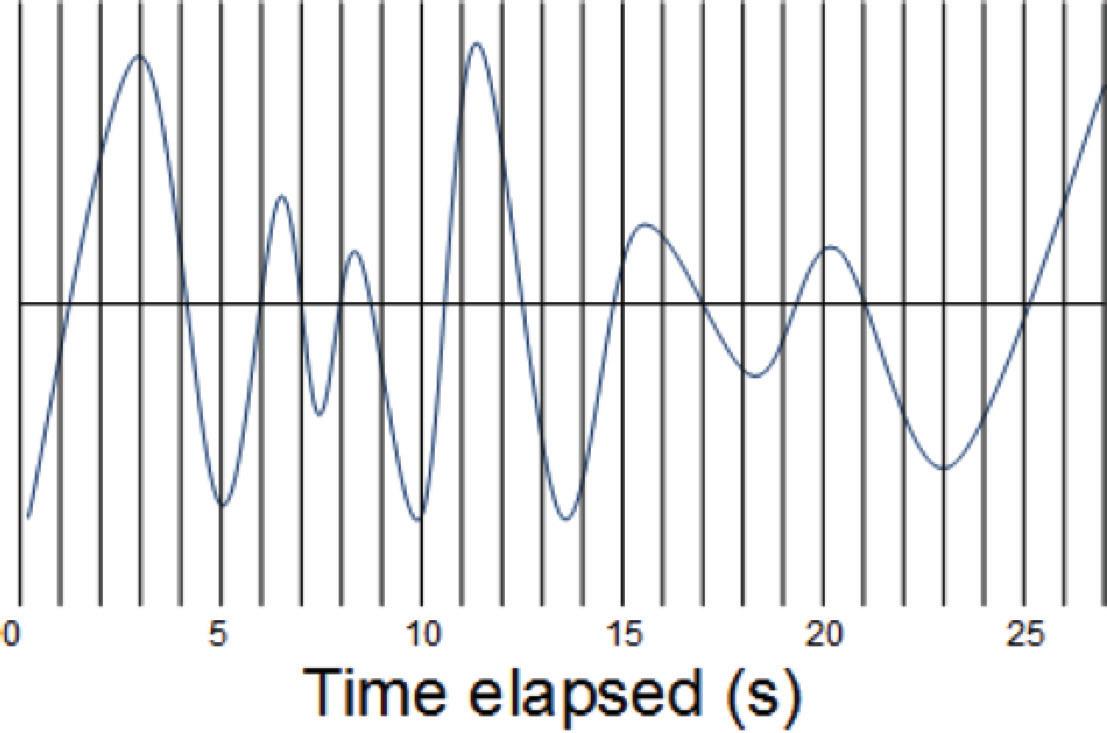
5. The graph above depicts waves on a lake. The height on the graph is the height of the wave. At what times do the waves have the highest energy?
1. The inside of the spacecraft in the video is full of air. Is this true of the space outside the spacecraft?
2. When the explosion occurred, the crew member was sucked into space. What happened to the sound of the crew member’s scream?
3. Based on your answers to the previous two questions, what can we conclude about sound waves and space?
4. Search for the video “2001 explosive bolts.” Watch the video, and then create an explanation for the behavior of sound in the clip based on your answers to the questions above.
5. In both the battle clip and the decompression clip, light is still visible even when sound is no longer present. What does this tell you about light waves, air, and space?
6. What similarities do all waves share?
7. How are longitudinal and transverse waves similar? How are they different?
8. Light is a type of transverse wave. Describe how you would draw a light wave.
9. Sound is a type of longitudinal wave. Describe how you would draw a sound wave.
10. Sound requires a medium to travel through, while light does not. What would be an example of a medium for sound to travel through?
1. Brainstorm with your partners to come up with as many characteristics or properties of light waves as you can and record them below:
2. Repeat step 1 above, this time with sound waves, recording the properties below:
3. Using the data you collected above, create a diagram or chart to compare and contrast the behavior of sound waves and light waves. Example diagrams include a Venn diagram or Word Map:
Scientific Investigation
Electromagnetic waves include everything from X-rays to visible light to ultraviolet radiation. Our eyes allow us to see only the visible light part of the spectrum. Other tools have been developed to see the other parts of the spectrum.
Procedure
Plan an investigation to determine how visible light, both white and colored, interacts with different materials.
Step 1: Question
Step 2: Relevance
Step 3: Variables, if applicable
Step 4: Hypothesis
Is a hypothesis needed? If so, what is it?

How will the responding variable change when the manipulated variable changes?
Step 5: Materials
Step 6: Safety Considerations
Step 7: Procedure
Sample procedure:
1. Darken the room.
2. Select a material such as foil. Have one person hold the sheet of foil while the person holding the flashlight stands one meter from the foil.
3. To test transmission, have a third person hold a sheet of white copy paper on the opposite side of the foil approximately 15 cm from the light source to see if any light shines on the paper.
4. To test for reflection, have a fourth person look for patches of light on the same side of the foil as the light source. To confirm that the light is from the tested material, move the material to observe if the patch of light also moves.
5. To test for absorption, shine the light on the black, red, green, and blue felt. Analyze the amount of reflected and transmitted light. As the amount of reflected light decreases, the material will absorb more light. Compare this to the way light behaves when shined on white paper.
6. Shine a ray of light on the plane mirror.
7. Observe how the light interacts with the mirror and record in your data table. Indicate the level of interaction using terms like none, a lot, a little, and all.
8. Repeat step 7 with the lens and prism until all have been tested, including different colors of light.
9. Once the teacher has turned on the lights, draw a diagram of the interaction between the ray of light and each material. Include arrows and terms to describe the interactions.
Step 8: Data Collection
Use the tables to record your data.
Reflects Transmits Absorbs
Step 9: Data Analysis
Create a graph based upon the data, if needed. Make a general statement about the results.
Step 10: Conclusion and Scientific Explanation
Write a scientific explanation on how light interacts to produce observed color using absorption, transmission, and reflection with different materials.
Claim:
Evidence:
Reasoning:
Part I: Frequency vs. Pitch
Procedure
Plan an investigation to determine what is the relationship between frequency and pitch for sound.
Step 1: Question
Step 2: Relevance
Step 3: Variables, if applicable
Independent variable (also known as the manipulated variable):
Dependent variable (also known as the responding variable):
Control variable(s) or group (also known as constants):
Step 4: Hypothesis Is a hypothesis needed? If so, what is it?
How will the responding variable change when the manipulated variable changes?
Step 5: Materials
Step 6: Safety Considerations
Step 7: Procedure
Step 8: Data Collection
Record your data and observations below.
Step 9: Data Analysis
Create a graph based upon the data, if needed. Make a general statement about the results.
Step 10: Conclusion and Scientific Explanation
Write a scientific explanation of the relationship between frequency and pitch.
Claim:
Evidence:
Reasoning:
Procedure
Plan an investigation to determine what is the relationship between amplitude, volume, and frequency of sound.
Step 1: Question
Step 2: Relevance
Step 3: Variables, if applicable
Independent variable (also known as the manipulated variable):
Dependent variable (also known as the responding variable):
Control variable(s) or group (also known as constants):
Step 4: Hypothesis
Step 5: Materials
Step 6: Safety Considerations
Step 7: Procedure
Step 8: Data Collection
Record your data and observations below.
Step 9: Data Analysis
Create a graph based upon the data, if needed. Make a general statement about the results.
Step 10: Conclusion and Scientific Explanation
Write a scientific explanation about what is the relationship between amplitude, volume, and frequency of sound.
Claim:
Evidence:
Reasoning:
Procedure
Plan an investigation to determine what is the relationship between resonance and the tone of a sound in air and on a string.
Step 1: Question
Step 2: Relevance
Step 3: Variables, if applicable
Step 4: Hypothesis
Step 5: Materials
Step 6: Safety Considerations
Step 7: Procedure
Step 8: Data Collection
Record your data and observations below.
Step 9: Data Analysis
Create a graph based upon the data, if needed. Make a general statement about the results.
Step 10: Conclusion and Scientific Explanation
Write a scientific explanation about what is the relationship between resonance and the tone of a sound in air and on a string.
Claim:
Evidence:
Reasoning:
1. What happened to the sound produced as the sound tube was twirled faster?
2. A specific frequency of vibration will produce a specific sound. What is producing the frequency for the sound tube?
3. If pitch is how high a note is, what is the connection between frequency and pitch?
4. If the frequency increases, what would happen to the pitch of the note produced?
5. What was the height of the wave with only one student making the tone?
6. What was the height of the wave with two students making the tone?
7. What was the height of the wave with three students making the tone?
8. Graph the three waves on the provided graph paper.
9. What happened to the sound when you switched from the 1 m pipe to the 0.5 m pipe?
10. What happened to the sound when you switched from the 1 m pipe to the 1.5 m pipe?
11. Summarize the effect of the length of the pipe on the sound produced.
12. Describe the sound produced by the different rubber bands on the tissue box.
13. Describe the sound produced by the different rubber bands on the shoebox.
14. How is the sound being produced by your instruments?
15. Explain why the sounds are different for each type of rubber band.
Topic or Application:
Questions you will answer in your poster display or presentation:
1. What application of waves am I studying?
2. What type of electromagnetic wave is used in this application (gamma, micro, UV, etc.)?
3. How are waves turned into electrical signals, or how are waves created from electrical signals in this technology?
4. When and how was this technology first created or invented?
5. What improvements have been made in this technology over time?
6. What was the latest technological advance in this application of waves? When was the advance developed?
7. What advantages does this application of waves have over the previous technology? Explain why.
8. Who will benefit most from this application of waves? Explain.
9. How scientifically accurate were the claims in promotional materials about this use of waves? How do I know?
10. How could this application of waves be used in other ways?
Research:
Poster Outline:
Sources:
Directions: As the different groups present their information, record their data in the chart below.
Application Type of EM Wave Used
How It Is Created from/Converted into Electrical Signals
Changes to Technology over Time

Have you seen a crowd of sports fans performing the “wave” at a stadium? Section after section of spectators stand and raise their hands, giving the appearance of an ocean wave traveling around the circle of seats. Although the wave appears to move horizontally, nothing is transferred from fan to fan—the only motion is vertical as each person rises and then sits. How does the kind of “wave” you see at a sporting event resemble waves in nature such as water waves, sound waves, and light waves? How are they different?
Waves are oscillations (disturbances) that transfer energy through matter or space. Those waves that travel through matter are called mechanical waves, and they need a medium in which to travel. Those waves that travel through space are called electromagnetic waves and do not need a medium in which to travel.
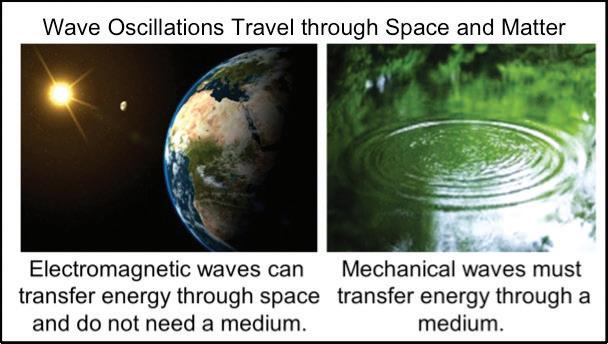
Examples of mechanical waves are sound waves that transfer energy through air or objects, ocean waves that transfer energy through water, seismic waves that transfer energy through the land during an earthquake, and slinky waves that transfer energy through a wire coil.

wave: oscillation (disturbance) that transfers energy through matter or space medium: the substance through which a mechanical wave travels
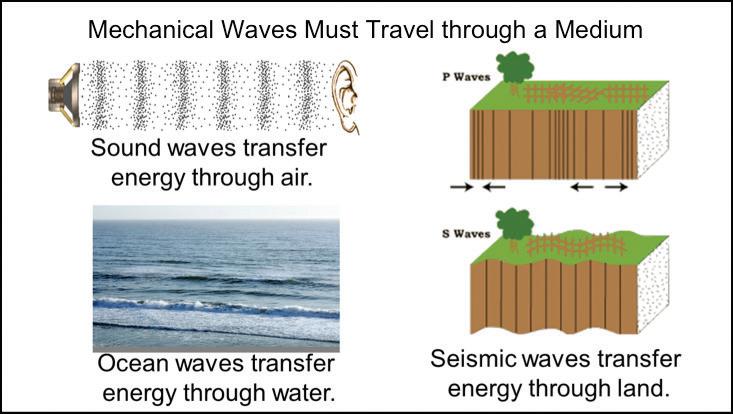
Reflect
Sound waves transfer energy through air in longitudinal or compression waves. There is no sound in a vacuum. Vibrations of objects produce sound waves. These vibrations can come from a voice, bird, musical instrument, radio, cars going down the road, etc. The areas of compression and rarefaction of sound waves in air can be graphed to show the amplitude of a sound (how loud or soft) and the frequency (the pitch of a sound or whether it is high or low).
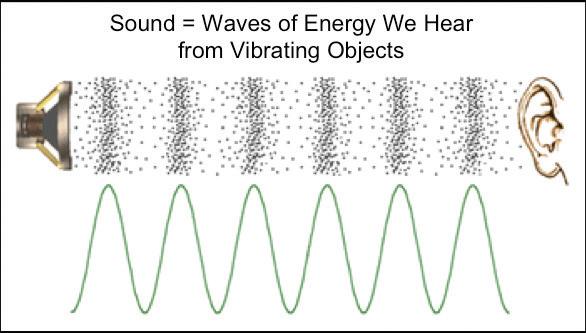
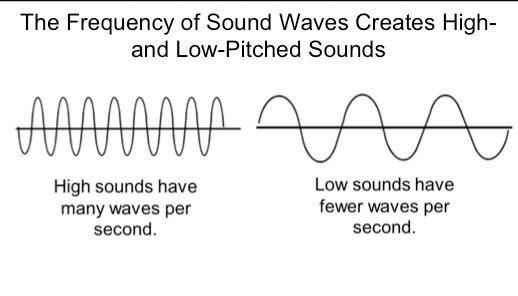
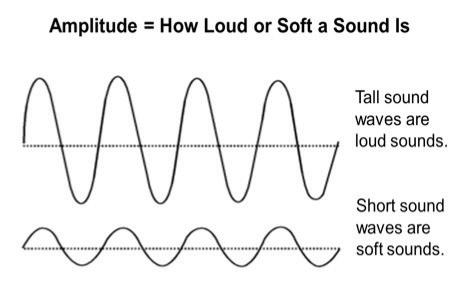
Sound waves travel through air at a much lower speed than light at 300 meters per second. If sound encounters a different medium, its speed changes. Notice that sound travels faster through solids because the molecules are closer together than those in air.
Examples of electromagnetic waves are found on the electromagnetic spectrum, which includes all the wavelengths of light: high-energy waves such as gamma, X-ray, and ultraviolet, through visible light, and down through low-energy waves such as infrared, microwaves, and radio.
Reflect Look Out!
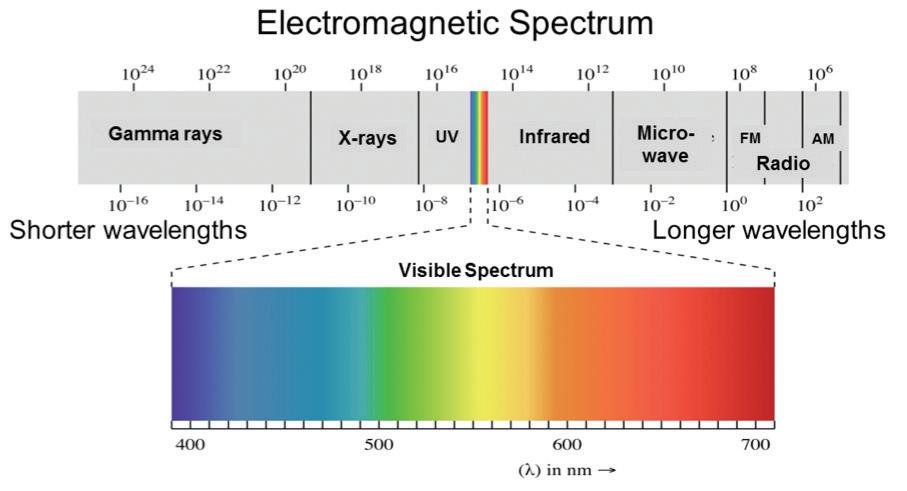
This is true even of ocean waves, which may appear to carry water toward the beach. This is an illusion, however. The motion of individual water molecules is circular over a small area with no net movement. If water were being transported continuously toward the beach, the beach would be under water!
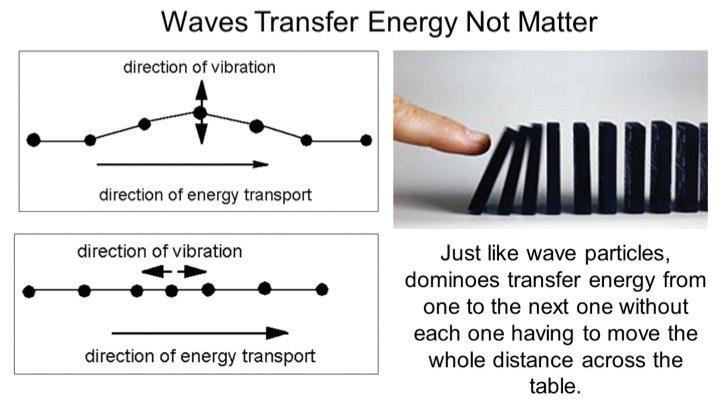
Reflect
Waves can also be grouped by the direction of particle movement. Those waves where the particles are disturbed perpendicular to the direction of the wave are called transverse waves. These waves have a typical up-and-down shape, such as in spring waves moving up and down, light waves, and surface seismic waves.
Waves where particles are disturbed back and forth parallel to (in the same direction as) the wave are called longitudinal waves (also called compression waves). Examples are sound waves, ocean waves, and spring waves moving back and forth.
Propagate perpendicular to wave displacement
Seismic S-waves, rope waves, spring waves (up and down)
Look Out!
Do not confuse frequency with the speed of light. Frequency is the number of wavelengths that pass each second and is a measure of energy. High-energy waves like X-rays and gamma rays travel at the same speed as radio or microwaves. All light waves, no matter which wavelength or frequency, travel at the same speed at 3 x 10⁸ m/s, the speed of light.
Propagate parallel to wave displacement
Seismic P-waves, sound waves, ocean waves, spring waves (back and forth)
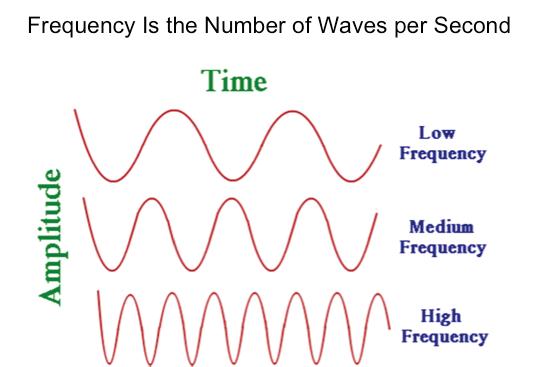
Reflect
The highest point a wave reaches above equilibrium is its crest, and the lowest point a wave reaches below equilibrium is its trough.
• A wave’s amplitude is the vertical distance from its equilibrium point to its crest. Therefore, amplitude equals half the vertical distance from crest to trough. In sound waves, amplitude corresponds to loudness: the greater a wave’s amplitude, the louder the sound.
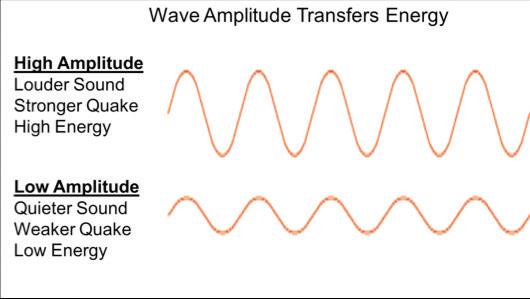
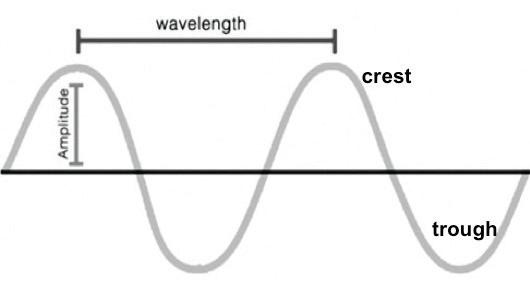
• A wave’s wavelength is the distance between consecutive crests (or consecutive troughs). Wavelength is represented by the Greek letter lambda (λ). Wavelength determines which waves we can sense. Humans can hear sound waves with wavelengths between about 0.02 m (high pitches) and 20 m (low pitches). Humans can see light waves with wavelengths between about 4 × 10⁻⁷ m (blue light) to 7 × 10⁻⁷ m (red light).
• Frequency (f) is a measure of the number of times a wave cycles per unit time (typically 1 second). Frequency is measured in units of Hertz (Hz); one Hertz equals one cycle per second (1/s, or s-1). A frequency of 100 Hz cycles 100 times in one second. A wave completes one cycle when its entire wavelength passes a certain point. So frequency is also defined as the number of waves that pass a certain point in one second. In a 100 Hz wave, in one second 100 of these waves (measured from crest to crest) would pass a certain point. Waves with higher frequencies have more energy.
• Period: The reciprocal of frequency (1/f) is called a wave’s period (T). Period is a measure of the time it takes a wave to complete one cycle or to move the distance of one wavelength.
• A wave’s speed (v) equals the product of its frequency and wavelength: v = fλ. A wave’s amplitude does not affect its speed or frequency.
The diagram on the right shows two waves with different frequencies. Based on this diagram, what is the relationship between a wave’s frequency and its wavelength? What is the relationship between a wave’s energy and its wavelength?
The material through which a wave travels affects its speed. For sound waves, the denser the material, the faster sound travels, as shown by the data in the table.
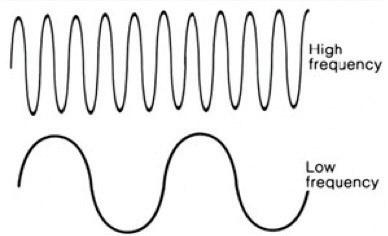
Unlike sound, light can travel through empty space. The speed of light in a vacuum is an important physical constant and is equal to 3.00 × 10⁸ m/s. This number is the constant (c) in Einstein’s famous equation E = mc 2 Einstein also concluded that nothing could travel faster than light speed. Like sound, light travels more slowly in denser mediums. In air, light speed is slightly slower than in a vacuum; in water, it is slower still; and in glass, it is even slower.
As you can see in the diagram above, the higher a wave’s frequency, the shorter its wavelength, and the lower a wave’s frequency, the longer its wavelength. Therefore, high-energy waves have shorter wavelengths than lowenergy waves.
In September 2011, scientists working with a group known as OPERA recorded some sensational data. Subatomic particles called neutrinos had apparently traveled faster than the speed of light.
The physicists did not claim their data was accurate; instead, they asked other laboratories to try to replicate the data. In March of the following year, another lab failed to reproduce the faster-than-light experiment. Finally, the OPERA physicists discovered two flaws in their apparatus that made their data incorrect: a fiber-optic cable had not been plugged in correctly, and their clock was fast. Light remains the fastest thing in the universe.
Consider the following situations and think about what they all have in common:
• As a police siren approaches, the siren has a high pitch. Then, as the siren passes, its pitch appears to decrease.
• After a rainstorm, people can see a rainbow in the sky as the Sun emerges from behind clouds.
• When a woman yells over a large canyon, she can hear an echo of her voice.
• On a sunny, hot day, a distant location along a road appears to be wet. However, when one approaches the location, the road is completely dry.
What do a rainbow and a heat mirage have in common?
Each of these situations is an example of wave behavior. Unlike particles, which move in straight lines, waves oscillate or vibrate as they travel through space and time. Wave motion produces some very interesting—and sometimes difficult to explain—phenomena in the world around us. This is partly due to the fact that our senses of sight and sound are dependent upon the behavior of two different types of waves: light waves and sound waves. Because waves can behave in unusual ways, we may sometimes be surprised or confused by what we are seeing or hearing.
What are some different ways that waves can behave? How does our understanding of wave behavior help explain various phenomena in the world?
The most commonly observed wave behavior is reflection. You observe this phenomenon whenever you see your image in a mirror, a glass window, or on the surface of a lake.
Reflection occurs whenever a wave strikes a boundary between two media, such as air and water, and then bounces back into the medium from which it originated. For example, when light travels through the air and strikes the surface of a lake, some of the light is reflected at this boundary.
Reflect medium: a substance through which a wave moves
Light reflecting off water’s surface can cause a bright glare on a lake or an ocean on a sunny day. It is also the reason we can observe the images of objects in water. Similarly, sound waves reflect off surfaces, creating a reverberation, or an echo, effect.
The reflection of waves from a boundary is similar to the way a billiard ball strikes and bounces away from a wall. If a ball strikes a wall “head-on” (meaning it is traveling perpendicular to the wall), the ball will bounce back in exactly the same direction from which it traveled. However, if a ball strikes a wall at an angle to the perpendicular (called the angle of incidence), it will bounce away from the wall at the same angle to the perpendicular (the angle of reflection). Waves behave in the same way, as shown below. In fact, this is called the law of reflection. While a wave’s direction changes during reflection, its speed does not.
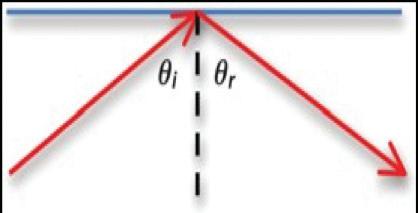
Not all light is completely reflected like a mirror. Light can be transmitted through transparent objects, can pass partially through translucent objects, and cannot pass at all through opaque objects.
A wave (red arrow) strikes a barrier (blue line) at an angle θi to the perpendicular line. This is the angle of incidence. The wave bounces away at an angle θr
The law of reflection states that the angle of incidence is equal to the angle of reflection.
The reflection of hot-air balloons is seen on the surface of a still lake. Some of the light that has reflected from the hot-air balloon travels through the air to the lake. When this light strikes this boundary, some of it reflects back into the air. This causes an image of the hot-air balloon to appear on the lake’s surface.
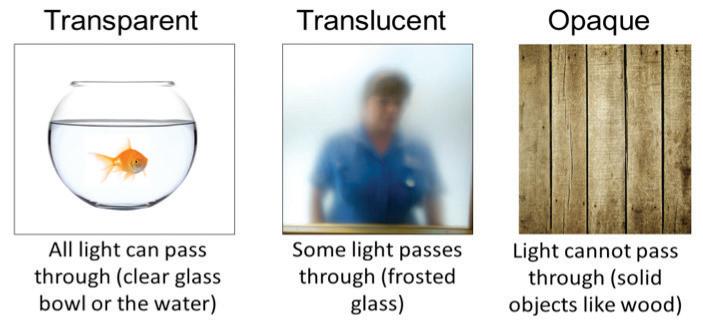
Look Out!
Some objects absorb certain frequencies (colors) of light and reflect other frequencies. The particular frequencies of light that an object reflects determine the color of the object. For example, red paper absorbs all frequencies of light except red. That is, the red paper reflects red light. This is why the paper appears red. White objects reflect most of the light striking them, while black objects absorb most of the light.
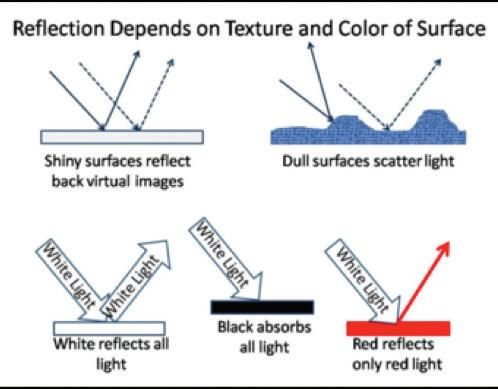
A wave can also be transmitted through a boundary, meaning that it passes through the boundary from one medium to another. In fact, at most boundaries, part of the wave is reflected and part is transmitted. Most waves move at different speeds through different media. For example, light moves quickly through air but more slowly through water. Thus, waves change speeds as they transmit from one medium to another. This change in speed usually causes a wave to refract, or bend, as it passes through the boundary.
To understand how refraction happens, think of a light wave as a group of students marching shoulder to shoulder from the bottom left corner of a room to the top right corner. Imagine that the left side of the room is one medium, such as air, and the right side of the room is another medium, such as water. As they march diagonally across the room, they step at the same pace. However, once they pass over the boundary into the right side of the room, they begin to walk more slowly through the new medium. Because the entire group approaches the boundary at an angle, one person will cross the boundary first and begin walking more slowly on the right side, but the rest of the group will continue walking at the faster pace on the left side. This will cause the line of students to swing into a new direction, pivoting around the first student to cross over the boundary. Then, as the remainder of the students pass into the slower medium, they will begin walking at the slower pace, and the students will march in a straight line again.
The black dots in this diagram represent a group of students marching across a room. The students represent a light wave. The left side of the room represents air (a relatively fast medium), and the right side represents water (a relatively slow medium). When the students pass from left to right, one student crosses the boundary first. This student begins moving slowly, but the rest of the group still travels quickly, causing the students to change direction, or bend, as they move into the new medium. This is known as refraction.
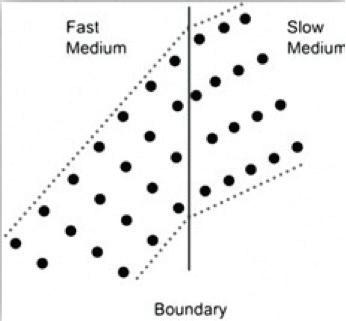
A wave behaves in the same way as the marching students. If it transmits from one medium to another at an angle to the medium, it will refract and change directions. (Note that if it strikes the new medium “head-on,” it will not change directions.) Refraction causes white light from the Sun to spread out into different colors as it passes from air into new media, such as water or glass. For example, the different wavelengths of sunlight all refract at different angles when they pass through a raindrop. This causes sunlight to spread out into a rainbow as it refracts through raindrops after a storm.
Have you ever watched water waves pass through a narrow slit in a barrier? When the waves pass through, they spread out radially. This is known as diffraction. For example, when a light bulb is turned on in a dark room, light waves spread out radially from the light bulb. However, once the waves have traveled a certain distance, they can be thought of as plane waves that move in parallel “sheets,” like in the image on the right. When a plane wave passes through a narrow slit or a barrier, the wave will act as though it is originating from a point source again. Thus, the wave spreads out, or diffracts.
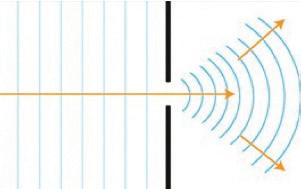
Plane waves (left) spread out radially (right) when they pass through a slit in a barrier.
This can also happen when a wave approaches a solid barrier. In these cases, when the wave passes along any edge of the barrier, it will spread out radially around the barrier. In this way, waves will appear to “bend” around barriers. This is the reason you can hear sounds that are emitted from behind a wall or large building.
An interesting aspect of wave behavior is that two waves can occupy the same space at the same time. This is called a superposition of waves. The same types of waves can superimpose whenever they cross paths through the same medium. For example, if two sound waves cross paths in the air, they will superimpose. When this happens, interference will occur. Interference is the net effect of two or more superimposed waves.
Recall that the amplitude, or displacement, of a wave changes depending on where the wave is in its cycle. When the displacement of two waves is in the same direction, their amplitudes add together, and constructive interference takes place. So if two identical sound waves interfere with one another, the amplitudes of the waves add together, and the sound becomes louder. Similarly, if two identical light waves interfere, the amplitudes add together, and the light appears brighter. Sometimes, however, two waves with very similar characteristics are out of phase with each other. (The phase of a wave simply refers to its position in the wave cycle.)
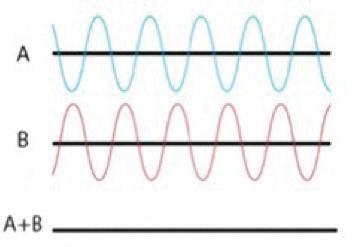
Waves A and B are similar to each other but out of phase. The displacement of Wave A is always opposite that of Wave B. When the waves cross paths, they interfere, but the amplitude of each wave cancels out the other. This is called destructive interference.
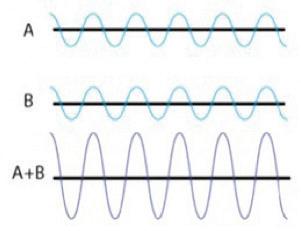
Waves A and B are identical to one another, meaning the parts of each wave are displaced in the same directions. When they cross paths, they interfere, and the amplitude of each wave adds together. This is called constructive interference.
If two waves begin their cycles at the same time, for example, they will be in phase with one another. However, if one wave begins its cycle first and then another wave begins slightly later, the waves will be out of phase. In this case, when the waves interfere, the displacement of each wave might cancel the other one out. When the displacement of waves is in opposite directions, destructive interference takes place. Most waves in the real world are out of phase with each other to some extent. In these cases, there will always be some amount of constructive interference and some destructive interference when the waves cross paths.
Acoustical engineers apply their understanding of the physics of sound (acoustics) to minimize or maximize the behavior of sound waves. They may apply this understanding to the construction of a recording studio or concert hall. For example, in a recording studio sound waves may reflect from the walls of the room, creating an unwanted reverberation. An acoustical engineer may cover the walls in a specialized foam padding to absorb some of the sound wave energy so that it does not reverberate as much in recordings.
Similarly, an acoustical engineer may want to enhance the behavior of sound waves in a large, outdoor music pavilion. For example, sound waves may refract in unwanted ways if they travel from a colder region to a warmer region in the pavilion, causing “dead zones” where no music can be heard. An acoustical engineer may want to position speakers and audience seats to account for this behavior so that no audience seats will be located in dead zones.
Furthermore, sound waves will diffract and decrease in quality as they travel around barriers between the sound source and audience members. As a result, an engineer may want to design a stadium seating venue so sound will not diffract through many audience members before reaching listeners in the back.
Earlier you reflected on what happens when a police car moves past you. As the car approaches, its siren has a high-pitched sound. As the car passes, the siren’s pitch seems to decrease. This phenomenon is called the Doppler effect. The Doppler effect is the apparent change in frequency of a wave moving relative to an observer. It happens when the source of a wave is moving and an observer is standing still. It also happens when the observer is moving and the wave source is still.
If the police car were at rest, the siren would release sound waves at a particular frequency, and each wave would travel a particular distance before the next wave was released. The waves would move away from the car at the speed of sound in air. However, when a police car approaches a stationary observer, the source of the sound wave is moving relative to the observer. As a result, the apparent distance between each sound wave decreases. As this happens, it will appear to the observer that the sound waves are arriving more frequently. In other words, it will appear that the frequency of the pitch is higher than it would be if the police car were stationary. Conversely, when the police car passes by and begins moving away from the observer, the distance between successive sound waves appears to increase. Thus, it will appear to the observer that the sound waves are arriving less frequently, so the sound’s pitch will appear to be lower.
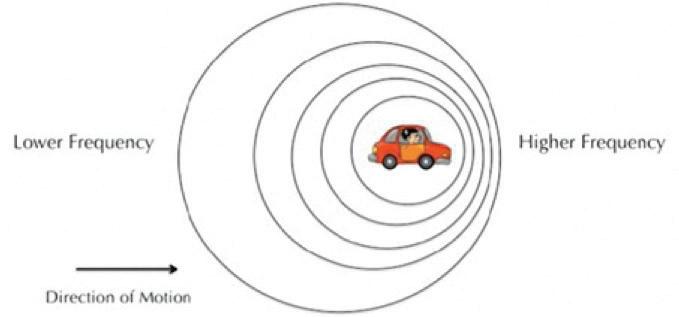
A police car with a siren moves to the right. Each circle represents a sound wave from the siren. As the siren moves toward an observer on the right, the distance between waves is shortened, so an observer will notice a higher-pitched frequency. An observer on the left will notice a lower-pitched frequency.
The Doppler effect is commonly observed with sound waves, though it is also observed in water waves when objects such as boats or animals move through water. Furthermore, it is observed with light waves that are emitted from moving sources.
How can we harness the mechanical energy in ocean waves to produce electrical energy? Cities located near coastlines are perfect candidates for power companies that will utilize the energy stored in ocean surface waves (not the tidal waves, but those created from the wind). Their wave movement can turn the gears in a turbine and create electric power. Other floating devices can trap and store the energy to transfer later.
Look Out!
Have you ever wondered why a tuned guitar string always produces a particular sound? No matter how quickly or forcefully you pluck the string, it produces the same pitch. The reason for this is called resonance. To understand resonance, you must know that sound waves with larger amplitudes produce louder sounds, while sound waves with smaller amplitudes produce softer sounds. Resonance occurs when an object or a system oscillates at a large amplitude only when it is oscillating at a certain frequency or frequencies. The frequencies that cause the system to oscillate at a large amplitude are called resonant frequencies. Consider the guitar string. When it is plucked, it will vibrate with a large amplitude at its resonant frequency. This means that it will produce a loud sound with one particular frequency, or pitch. The string may vibrate at other frequencies, but the amplitudes of those vibrations will be much smaller, so those frequencies of sound may be too soft to hear.
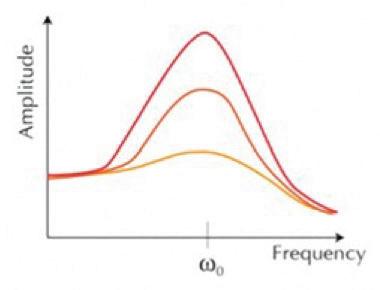
Resonance occurs when a wave oscillates at its resonant frequency, ω0. At this frequency, the wave will have a large amplitude.
Other musical instruments such as trumpets, flutes, and pianos work in the same way. For example, air will vibrate through chambers of a brass instrument at a particular set of resonant frequencies. The musician must vibrate his or her lips at one of these frequencies through the mouthpiece of the instrument in order to cause the air in the chambers to vibrate. If the musician does not vibrate his or her lips at one of these frequencies, the air will not vibrate very loudly, and no sound will be heard.
Resonance is also observed in buildings and bridges. Different structures have resonant frequencies at which they will vibrate. Engineers must understand resonance to ensure that the wind does not cause the structure to vibrate at a resonant frequency and collapse. In 1940, the Tacoma Narrows Bridge in Washington State collapsed due to vibrations at resonant frequency. You can search for videos of the collapsing bridge online.

All musical instruments create standing waves that give music a fuller sound. Often you can hear overtones come from standing waves created by the constructive interference between sound waves traveling in both directions along a string or a tube. For example, if a guitar string is plucked that has a frequency of 110 Hz, then the overtones at 220 Hz, 330 Hz, and 440 Hz will sound simultaneously.
Try Now
Study these four sound waves. Then do the following:
1. Select two waves. Label these characteristics for each wave: crest, trough, amplitude, wavelength.
2. Identify the wave (I, II, III, IV) that has the following:
• Greatest wavelength
• Greatest frequency
• Least energy
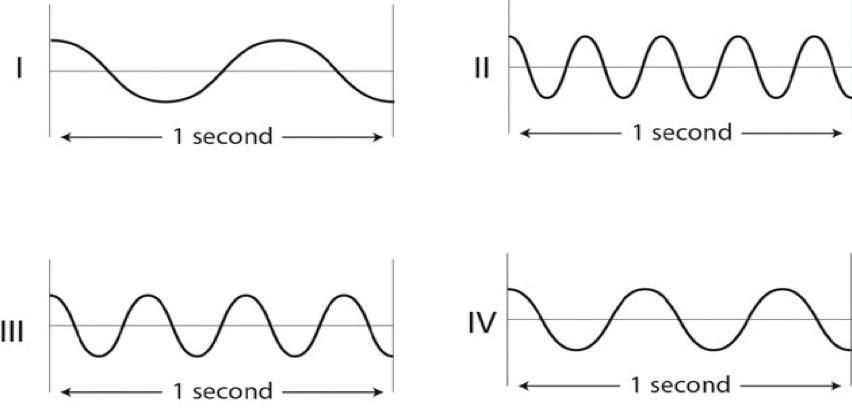
Two waves cross a path in a medium, as shown below.
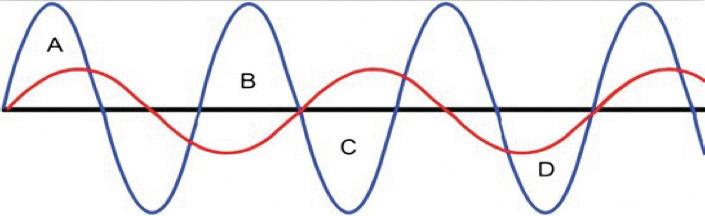
Determine whether the interference is constructive or destructive at each location indicated.
To help your child understand the evolution in the practical applications of sound waves and light waves in modern technology, plan an Internet search for the history of the devices below. Find out when these devices were invented and how they used wave technology to store and transmit data.

Here are some questions to discuss with your child:
• How did the invention of the transistor revolutionize communication devices?
• How did wireless technology advance communication?
• What products are being developed but are not yet released that may impact storing and transmitting data?

1 As the storm clouds roll out and the last of the rain slowly drips to a stop, something magical happens. The Sun peeks through the remaining storm clouds, and a beautiful rainbow appears. Its bright, vivid colors bend in an arch through the sky. The band of light that you see shows you the visible colors of the electromagnetic spectrum. Astronomers, scientists who study space, use the electromagnetic spectrum to learn about the different objects in the universe.
2 The electromagnetic spectrum can be defined as the electromagnetic waves that are emitted from the Sun and other objects in the universe. To better understand the spectrum, we break it into smaller categories depending upon wavelength. From the longest to the shortest, the categories are radio waves, microwaves, infrared light, visible light, ultraviolet rays, X-rays, and gamma rays.
3 Radio waves have the longest wavelength in the electromagnetic spectrum. A single wavelength can span the length of a football field or continue going until it is a mile long. These types of waves have low frequencies and energy. Radio waves bring music to your ears or a call to your cell phone. Scientists, however, use radio waves to learn about the composition of galaxies, stars, comets, and planets. Astronomers use radio telescopes arranged in an array to collect the waves that are emitted by these astronomical objects.
4 Microwaves are the next division on the electromagnetic spectrum. Their wavelengths can range from less than an inch in length to as long as a foot. You have probably used microwaves yourself, to pop some popcorn or heat up your food. Scientists use microwaves a little differently. These waves can easily pass through different kinds of weather. They are great for sending images back to Earth from space, even on a cloudy day. Astronomers also use microwaves to discover information about the structure of our galaxy and galaxies that are close to us.
5 Infrared light comes after microwaves on the electromagnetic spectrum. The shortest infrared wavelengths are almost microscopic, while the largest are the size of a pinhead. You experience infrared light every day. The warmth you feel from the Sun, a fire, or a hot metal slide are examples of heat emitted by infrared light. Some of the shorter infrared waves are used by remote-controlled objects like your television or stereo. Astronomers use infrared light to map the dust between stars. They can also take infrared images of Earth to study cloud structure or ocean temperatures.
6 In the middle of the spectrum is visible light. Think back to the rainbow that appeared after the storm. The seven colors of light that you see are known as visible light. Visible light is the only electromagnetic light on the spectrum that you can actually see. Red has the longest wavelength, and violet has the shortest. When all of the colors are combined, white light is produced.
7 Ultraviolet light, or UV light, has a shorter wavelength than visible light. Have you ever been in the Sun for too long? What happened to your skin? The ultraviolet light emitted from the Sun probably gave you a painful sunburn. This type of light cannot be seen by your eye alone. By placing ultraviolet telescopes on satellites, astronomers learn about the structure and evolution of galaxies.
8 The next electromagnetic wave on the spectrum is X-rays. If you have ever had a broken bone, then you have been exposed to X-rays. X-rays can pass through your skin but not your bones or teeth. The image produced on the X-ray film will tell the doctor if and where your bone is broken. Astronomers use X-ray telescopes with X-ray detectors placed on satellites to study objects in space. The X-ray telescopes cannot be placed on Earth. Earth’s atmosphere is so thick that it does not allow X-rays to pass through.
9 Gamma rays are the last electromagnetic wave on the spectrum. Having the shortest wavelength and the most energy, they have the potential to kill cancerous cells. Astronomers use gamma rays to try to understand how the universe began, how old it is, and how fast it is expanding.
10 Through the use of the electromagnetic spectrum, scientists find a vast amount of scientific information to study. From radio waves to visible light to gamma rays, each wavelength provides a different answer to the mystery of the universe.
1 The statements below compare the similarities of ultraviolet light and microwaves. Which choice does NOT belong in this list?
A Neither can be seen by the human eye.
B Scientists use both to study the structure of galaxies.
C They both have wavelengths that are longer than visible light.
D They are both types of radiation emitted by the Sun.
2 What is the best wavelength to use if an astronomer wants to study the composition of planets and stars?
A Gamma rays
B Radio waves
C Visible light
D Microwaves
3 According to the diagram of the electromagnetic spectrum shown, what would best represent the size of visible light?
A Humans
B Pinpoint
C Protozoa
D Molecules
4 Complete the following analogy: RADIO WAVES : LONGEST WAVELENGTH :: _________ : SHORTEST WAVELENGTH.
A INFRARED LIGHT
B ULTRAVIOLET LIGHT
C X-RAYS
D GAMMA RAYS
5 The term emitted is used in Paragraph 2. Based on the context, emit means to–
A absorb.
B send out.
C collapse.
D send in.
6 Examine the diagram of the electromagnetic spectrum shown. Which category of electromagnetic waves has a wavelength of 103 (1,000) m?
A Ultraviolet light
B Radio waves
C Microwaves
D X-rays

1. Despite what is portrayed in science fiction movies, you would not hear sound if you witnessed a battle in outer space. Why not?
2. How are electromagnetic waves different from sound or water waves?


3. Light behaves differently when it interacts with various materials. In the table below, give an example of when light is refracted, reflected, transmitted, and absorbed.
4. A laser beam is pointed toward a plane mirror as shown in the setup below. Describe how the beam of light would behave if it were aimed toward the mirror along line 1.
5. What are digital signals and how are they generated? What are the advantages of using digital signals for transferring information? What are some digital tools that transmit information?

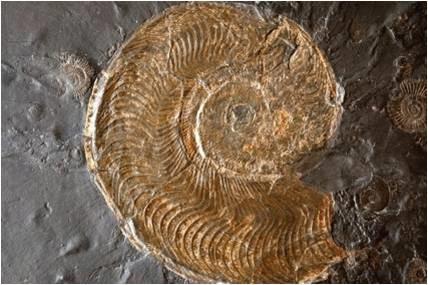

Throughout Earth’s history rocks have been deposited in layers to cover the surface. Younger rocks build on top of older ones to form layers. Meanwhile, organisms began emerging and spreading into different parts of the world, responding and adapting to the global climate and local environmental conditions. When an organism dies, it can be buried in dirt, later becoming part of the rock layer, creating a remnant called a fossil. Scientists can only catch a glimpse of what Earth was like before our time. They do this through analyzing evidence such as fossilized and preserved remains of organisms. Using information from rock layers and clues from the position and condition of fossils, scientists try to piece together the puzzle of life.
Color Millions of Years Ago (MYA) Rock Layer Animals Plants
1. Use this timeline in table form to record your data.
2. Red layers are from the Cenozoic era, black layers are from the Mesozoic era, green layers are from the Paleozoic era, and blue layers are from the Precambrian era. Using information from your table, create a timeline below:
3. Use the information you have gathered to explain the following:
A. Why you think that organism went extinct:
B. How that organism’s extinction may have affected surviving groups of organisms:
C. The similarities and differences in the causes of the many extinctions:
1. Use the information you have been provided to complete the following table.
Extinct Animal Evolved Animal Evidence
Answer the questions below.
2. What can scientists look at to help them prove that our modern-day animals evolved from extinct animals?
3. Do all of our modern-day animals have the same characteristics as their extinct ancestors? Why do you think that is?
4. Why do you think that multiple modern-day animals evolved from one extinct ancestor?
5. What patterns can be used to identify the ancestry line of an organism?
Write a scientific explanation to support how fossil evidence proves the historic diversity of life on Earth and proves that relationships exist between past and present organisms.
Claim:
Evidence:
Reasoning:
1. Break the rock in half and observe the edges. Draw a diagram of the “sedimentary rock.”
2. Where are your fossils located in your sedimentary rock?
3. Compare your “rock” with a sample of a sedimentary rock. Record your comparison.
4. Draw a diagram of your model metamorphic rock.
5. Compare your “rock” with a sample of a metamorphic rock. Record your comparison.
6. Draw a diagram of your “igneous” rock.
7. Compare your “rock” with a sample of an igneous rock. Record your comparison.
1. What processes were involved in the formation of your sedimentary rock model?
2. How is your model similar to the real sedimentary sample?
3. How is your model different from the real sedimentary sample?
4. What is the energy source in your model?
5. What is the energy source involved in the formation of sedimentary rocks?
6. In terms of stability and change, what change occurs in the system during the process of sedimentary rock formation? When is the system stable again?
1. What processes were involved in the formation of your model?
2. How is your model similar to the real metamorphic sample?
3. How is your model different from the real metamorphic sample?
4. What is the energy source in your model?
5. What is the energy source involved in the formation of metamorphic rocks, and what effect does it have on the process?
6. In terms of stability and change, what change occurs in the system during the process of metamorphic rock formation? When is the system stable again?
1. What processes were involved in the formation of your model?
2. How is your model similar to the real igneous sample?
3. How is your model different from the real igneous sample?
4. What is the energy source in your model?
5. What is the energy source involved in the formation of igneous rocks, and what effect does it have on the process?
6. In terms of stability and change, what change occurs in the system during the process of igneous rock formation? When is the system stable again?
You have taken a rock through one pathway of the rock cycle! Use this experience to diagram the pathway you modeled through the rock cycle. Draw and label your diagram.
Write a scientific explanation to answer the following question: How does the fossil record relate to the rock cycle?
Claim:
Evidence:
Reasoning:
Activity
Earth is covered with a variety of life. You have very simple and small organisms like bacteria, to very large and complex organisms like humans. Over time, life changed from single-celled creatures into the diversity of life we see today. This process was both gradual and sudden. Slow change and mass extinction both played a role in the history of life on Earth.
Procedure
1. Your teacher will assign each group one of the research topics below.
2. Research the topic and prepare a presentation using a slideshow software program. The slideshow must begin with a title slide and end with a bibliography slide that properly cites all resources used. Several informational slides must be included. Each informational slide must contain data from at least one properly referenced source.
3. Present the information to the class as a group.
4. As you watch the presentations, record information on each topic in your lab journal.
Research topics:
• What happened to the woolly mammoths and saber-toothed cats?
• How did volcanoes cause the largest extinction ever, at the end of the Permian era?
• What caused the dinosaurs to die?
• Are birds considered living dinosaurs?
• Do whales and dogs have a common ancestor?
• What happened on the Galapagos Islands to create the diversity found there?
• What does the fossil “Lucy” tell us about human ancestry?
Take notes during each presentation.
What happened to the woolly mammoths and saber-toothed cats?
How did volcanoes cause the largest extinction ever, at the end of the Permian era?
What caused the dinosaurs to die?
Are birds considered living dinosaurs?
Do whales and dogs have a common ancestor?
What happened on the Galapagos Islands to create the diversity found there?
What does the fossil “Lucy” tell us about human ancestry?
When the presentations are finished, answer the following questions.
1. What do all life-forms have in common?
2. Why does Earth contain such diverse life-forms?
3. How does evolution change life gradually?
4. Does evolution follow a pattern?
5. How does mass extinction affect the evolution of life?
6. Use your notes to write a one-to-two-page report supporting the idea that all evolution has been shaped by both gradual processes and mass extinctions.

Evolutionary theory is the basic idea that life has existed for billions of years and has changed over time. Does the fossil record document all these changes? Paleontologists are scientists who study the fossil record.
fossil: mineral replacement, preserved remains, or trace of organisms that lived in the past
Thousands of layers of sedimentary rock not only provide evidence of the history of Earth itself but also of changes in organisms whose fossil remains have been found in those layers. The collection of fossils and their placement in chronological order, such as through the location of the sedimentary layers in which they are found or through radioactive dating, is known as the fossil record. It documents the existence, diversity, extinction, and change of many life-forms throughout the history of life on Earth.
The fossil record provides anatomical similarities and differences between organisms living today and in the past. Thus, the fossil record enables scientists to infer the lines of evolutionary descent. When certain conditions exist, the process of decay of a dead organism is slowed down leading to fossilization. Examples of this include the following:
• Lack of oxygen (e.g., when an organism becomes trapped in amber)
• Frigid temperatures (e.g., when an organism becomes frozen in a glacier)
• Soil with high acidity (e.g., when an organism falls into a peat bog)
However, if these conditions are not present, the remains will not be fossilized. This makes the story of evolution for any one species difficult. Usually, there are big gaps in fossil records. This is similar to putting together a jigsaw puzzle with half the pieces missing.
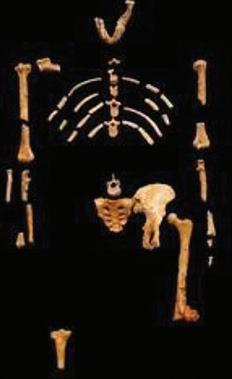
Preserved remains can help scientists understand human ancestry.
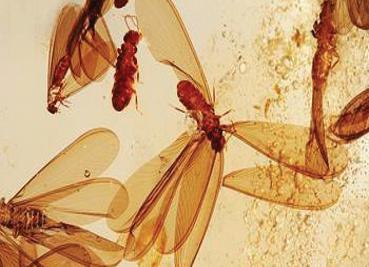
These mosquitoes have been preserved in amber.
Evidence of change is supported by two types of fossils. Trace fossils are the remains of ancient activity, such as the burrow left by a worm or a stone tool made by a prehistoric person. Body fossils are the preserved remains of the actual body parts of an animal or plant such as a skeleton or a pollen grain.
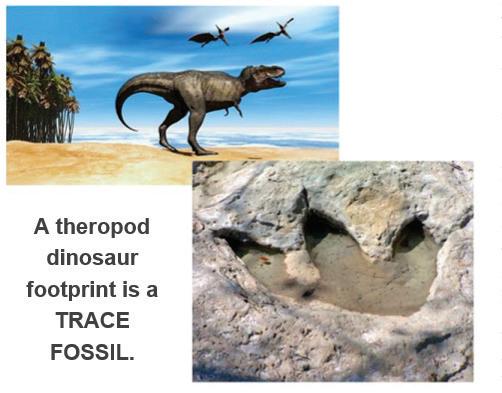
Trace fossils are footprints, burrows, or impressions that were made by an animal or a plant while it was living and that have hardened into stone. For example, huge dinosaurs left their footprints preserved in the soft mud of a shallow sea that covered Central Texas 113 million years ago. The fossilized tracks provide clues to the habits of the dinosaurs, such as traveling in herds, or which species became predator or prey. The soft limestone mud also had fossils of palm trees and fossil shells that provide clues that a shallow sea once covered the area.
Body fossils are the preserved parts of organisms or whole organisms. When most animals or plants die, they simply decay or are eaten by another animal. However, on rare occasions, an organism dies and is quickly covered by sediment at the bottom of a body of water.
After layers of sediment accumulate, pressure causes minerals to replace the organism’s cells, or fill in a mold where the plant or animal dissolved. Continued pressure causes the minerals to harden, and a fossil is formed if the rock layers are not disturbed. Sometimes, such as in the case of complete dinosaur skeletons, entire organisms are preserved.
Another example is the Petrified Forest in Arizona, where trunks of dead trees were washed up onto the sides of the rivers during big floods and buried in sediment (dirt, rocks, sand, volcanic ash). Over time, minerals replaced the wood, creating entire petrified (fossilized) tree trunks. Fossils also formed in ancient times when insects were preserved in amber (hardened tree sap) or when mammoths died and were permanently frozen. However, most fossils are simply fragments of the original organism.
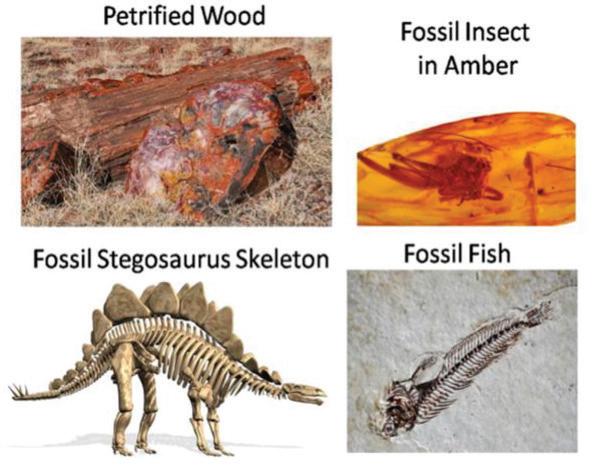
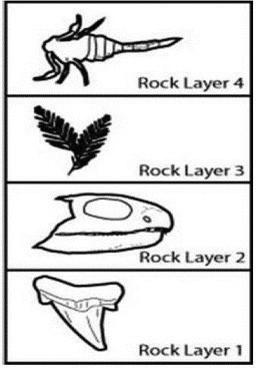
Of the three rock types formed during the rock cycle, fossils are formed only in sedimentary rocks. The heat involved in igneous and metamorphic rock formation would destroy any fossil remains. Fossils of the simplest organisms are found in older sedimentary rocks, while fossils of more complex organisms are found in newer rocks. This supports the theory of evolution in which simple lifeforms gradually evolved into more complex ones. The chronological order of rock layers is usually determined by their order in an undisturbed sequence of strata. In undisturbed sedimentary rock, the oldest layers are found at the bottom, and the youngest layers are found at the top. In disturbed rock layers, the determination must be made based on the presence of index fossils, comparison to undisturbed strata, or radiometric dating.
In undisturbed rock, the sequence here can be read in chronological order from bottom (oldest) to top (youngest). The shark tooth fossil in layer 1 is older than the fern fossil in layer 3.
The fossil record is not the only evidence that supports the common ancestry of organisms. Homologies, or similarities in characteristics between two organisms because they originated from a common ancestor, also support the common ancestry of organisms. A homologous structure is something that is similar in position, structure, or evolutionary origin.
Embryonic and developmental homologies: Comparison of the embryological development of different species also reveals similarities that show relationships not evident in the fully formed anatomy. Species with similar origins also show similar embryonic development patterns. We can learn a lot about a species by studying the embryo and patterns of development. For example, certain snake embryos have small buds that look like limbs. The buds disappear in later developmental stages. This suggests that snakes evolved from an ancestor that had limbs.
Anatomical homologies: Species with common origins (e.g., birds, reptiles, and mammals) all show similar patterns of anatomy, such as those in the bones of the forelimbs. Anatomical homologies are similar anatomical structures that exist between species and can be identified as a link to a common ancestor. Mammals share certain traits such as breathing air, having hair or fur, and producing milk for their young. All mammals show similar patterns of bone structures in their forelimbs. Although the function of each is different, this diagram shows similarities in the anatomical structure of forelimbs in mammals (bat and human), birds (penguin), and reptiles (alligator).
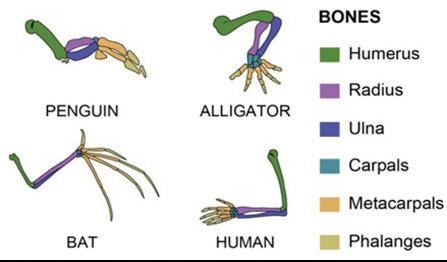
Species can also evolve if they are isolated geographically from their native populations, resulting in the formation of a new species. This process is called speciation. Evidence for this type of evolution is through the study of biogeography
Biogeography
Biogeography is another type of evidence that supports the theory of evolution by natural selection. Biogeography is the study of past and present geographical distribution of species.
Organisms have characteristics that allow them to survive in their environment. If the environment changes, some species may evolve over time to cope with the differences. Sometimes, part of a population is geographically separated from the main group. The isolated population is forced to adapt to different conditions and evolve separately. The lemur is one example. Some scientists believe lemurs crossed from Africa to the island of Madagascar millions of years ago by floating on vegetation. By 20 million years ago, the continents had drifted so far apart that the lemurs became permanently isolated on Madagascar. The splitting up of one massive landform named Pangaea explains why many species evolved into new species. As the land masses of Pangaea drifted apart, newly isolated species developed characteristics that distinguished them from their common ancestor.
The lemur is an example of an animal whose ancestors were geographically separated from their native population.
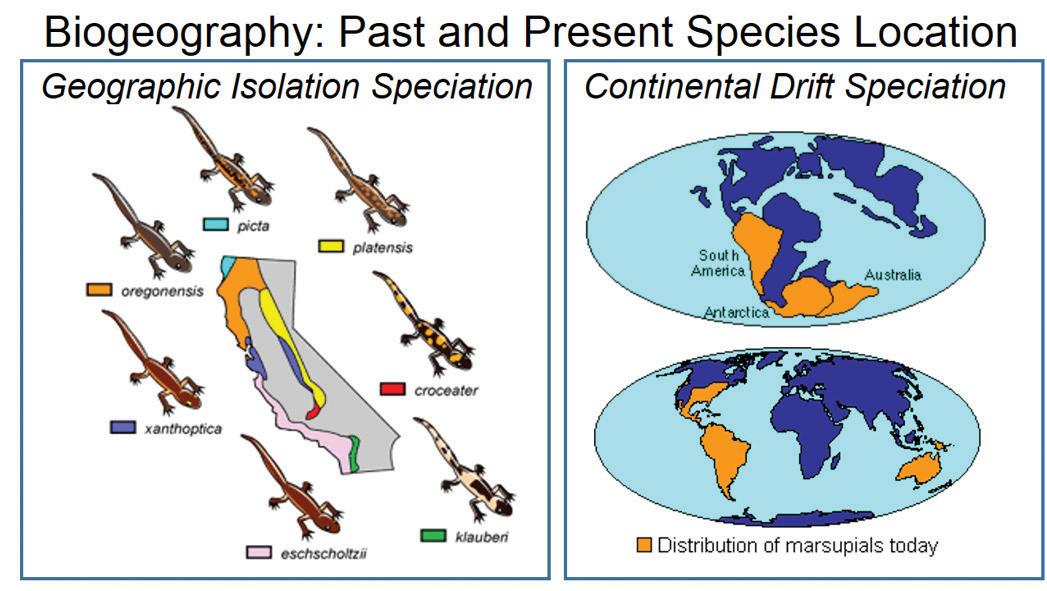
Take a look at the photographs below. Do you think the elephant on the left is a direct descendant of the woolly mammoth on the right? Explain your reasoning.
According to the theory of evolution, changes in species occur due to natural selection, reproduction, and environmental conditions. Charles Darwin proposed the theory of evolution by natural selection in 1859, which suggested that all creatures descended from common ancestors. His theory contended that organisms evolve through natural selection, a gradual process by which subsequent generations of organisms develop characteristics that help them survive in their surrounding conditions through mutations
Mutations that benefit an organism are passed on to subsequent generations. However, it is important to note that natural selection is not a deliberate process. Organisms do not choose which traits to pass on to their offspring—it is a natural process that favors certain traits in a particular environment. Organisms that do not have these favorable characteristics will gradually decrease in number, and the gene pool of the population will change. As Darwin’s theory was accepted, so too was the theory of gradualism. This is the idea that evolution occurs gradually. Changes or adaptations appear slowly and sequentially over time.
Usually, mutations are either harmful or neutral. In rare instances, a mutation proves beneficial to the organism. If it occurs in more organisms in the next generation, it can spread throughout the population.
In this way, natural selection affects the evolutionary process by keeping and adding up the beneficial mutations and eliminating the harmful ones.
The fossil record reveals major extinction events that reduced biodiversity. Ecosystems with a higher number of species are healthier and more sustainable than ecosystems that support only a smaller number of species. Most scientists agree that there have been five periods of mass extinction that drastically reduced biodiversity on Earth.
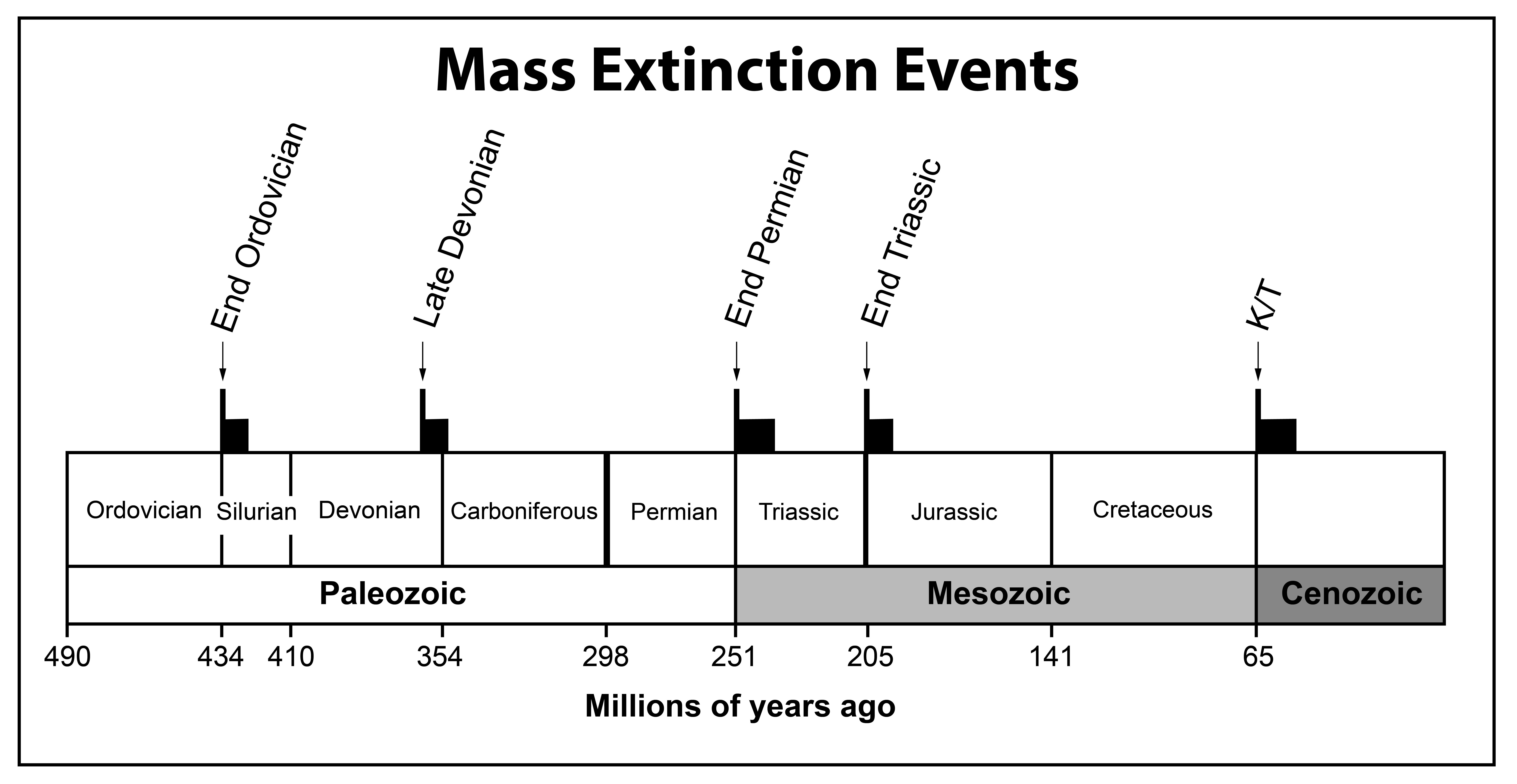
biodiversity: a measure of the number of different types of species in any given ecosystem
In fact, due to these massive extinctions and other smaller ones throughout history, an estimated 99.9% of all living things that ever lived on Earth have gone extinct. One of these mass extinction events occurred about 439 million years ago. This event was caused by a drop in sea levels and marked the disappearance of more than half of the plant and animal species living in the oceans. Other types of environmental change that can cause extinction include meteorite impact, climate change, volcanic eruptions, wildfires, drought, flooding, change in soil and water acidity, etc.
What we know about extinction of species comes from studying the fossil record. Scientists learn the types of organisms that were alive at certain points in Earth’s history and the lifestyles of those organisms by looking at the types of plants found in the same layer of rock at the same location. With clues from the fossil record, scientists can begin to understand what conditions on Earth were like during that time. By studying plant and animal fossils, the characteristics of the rock itself, and changes from one layer of rock to the next, scientists are able to formulate an idea of how species changed over time, which species have become extinct, and what conditions might have led to their extinction.
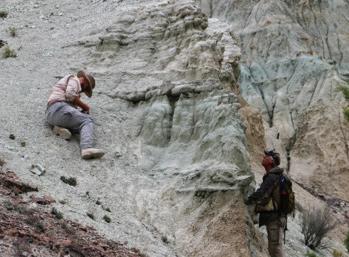
1. Describe how the fossil record gives evidence of evolution.
2. Explain how evolution accounts for the diversity of living things.
3. Describe what life might have been like millions of years ago. What evidence is there for this?
4. How do physical characteristics of organisms demonstrate/support the theory of evolution?
5. How does natural selection affect the evolution of species on Earth?
To help your child learn more about the theory of evolution, work together to create an evolutionary tree. Also called a phylogenetic tree or a tree of life, this diagram shows how species may be related to each other through physical characteristics, genetics, or character traits. According to Darwin’s theory of evolution by natural selection, all species share a common ancestor.
First, have your child choose 12 organisms to include in the evolutionary tree, including three aquatic animals, three land mammals, three insects, and three reptiles. Search for photographs of these creatures on the Internet or in old magazines.
Then get a large piece of poster board, a ruler, glue, and a pencil. This evolutionary tree will focus on the physical characteristics of organisms. Brainstorm with your child different characteristics to use on the tree. Some ideas include these:
• Presence or absence of a backbone
• Presence of hair, fur, or scales
• Warm- or cold-bloodedness
• Lungs or gills
• External structures such as fins, claws, or hooves
• Food preference (omnivore, carnivore, or herbivore)
Turn the poster board so that it has a landscape orientation. Write “Common Ancestor” at the bottom of the poster board, and draw a large Y above the term. Leave plenty of room above the Y to draw your tree’s “branches.”
Now choose a characteristic for each side of the Y (e.g., presence or absence of a backbone). Separate the 12 organisms into two piles according to this characteristic.
Now look at the organisms in each group and choose a characteristic to separate each of the two groups into smaller groups. You might find that one group, such as the organisms without backbones, cannot be further separated. If this is the case, glue these organisms onto the correct side of the Y at the top.
For any group(s) that can be further separated, draw a V on the correct side(s) of the Y at the top. Place the organisms on either side of the V. For characteristics such as hair, fur, or scales, you will need to draw an extra line or two on the V—one line for each form of the characteristic. Continue with this process until only one organism is left and glue the picture of the organism at the end of the branch.
For ideas about how evolutionary trees are drawn and organized, you may want to do an Internet search prior to this activity using the term evolutionary tree

1 The layers of rock found along the sides of canyons are like books telling the story of Earth’s past. The Grand Canyon, for example, tells more than one billion years of the story! The picture at right shows the many visible rock layers. These layers were exposed as the Colorado River cut through the rocks. The river has carved the canyon over the last five to six million years. Each layer has a different color and is found at roughly the same position on both sides of the canyon.
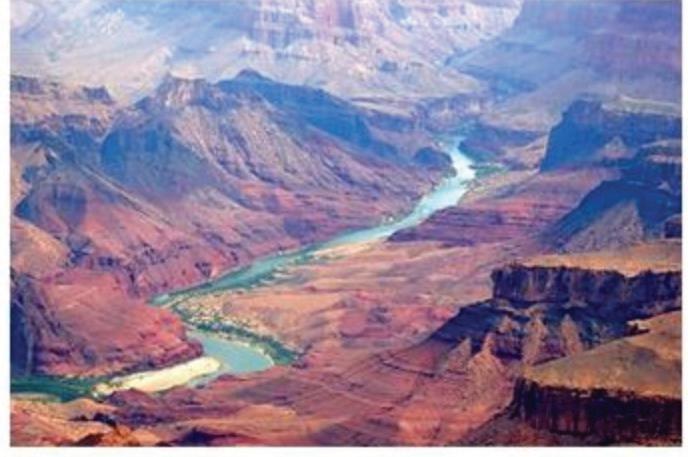
2 Stratigraphy is a scientific term used for the classification of sedimentary rock layers, or strata. It is used to determine the relative ages of rocks. In the 1600s, a man named Nicolas Steno became very interested in rock layers. He was nicknamed “Strata” by his friends. He came up with principles that are still used in stratigraphy today. The first principle states that older rocks are on the bottom, and younger rocks are on top. The next principle states that sediments are laid down horizontally. If layers are at an angle, they must have moved after they were deposited. Another principle Steno suggested was that sediments are deposited over a wide area. Therefore, the same stratum can be found in different locations. The last principle states that anything that cuts through the strata must have happened after the strata were deposited. Therefore, we know that all the strata found in the Grand Canyon must be older than the Colorado River’s path through them.
3 Sometimes strata give clues to a certain event. One such event is the extinction that marks the end of the Cretaceous period. This is the time when dinosaurs and many other life-forms suddenly vanished. The speed and pattern of extinction have given rise to several theories. First, the makeup of the stratum between the Cretaceous and Paleogene periods is unusual. This thin stratum, rich in iridium, is found all over the world. Iridium is a metal that is very rare in Earth’s crust but very common in asteroids. Scientists think an enormous asteroid containing large amounts of iridium hit Earth. As a result, iridium was spread over large amounts of Earth’s stratum. The asteroid theory is also supported by a huge impact crater near the Yucatan Peninsula of Mexico, as well as deposits that point to a tsunami that occurred after impact. Scientists believe that the impact of the asteroid caused major changes in climate that led to the extinctions.
4 When stratigraphy and the fossil record are combined, this allows scientists to extend Earth’s story to locations around the world. In the 1800s, a British geologist named William Smith first observed strata in coal mines. Smith noticed that strata were always present in the same order in each mine. He also discovered that each stratum could be identified through the unique combination of plant and animal fossils it contained. These combinations of fossils are known as assemblages. Smith saw that fossils found in older strata contained simpler organisms than fossils in younger strata. Due to his observations, Smith added another principle to those written by Steno. The principle of faunal succession states that each stratum contains a unique variety (assemblage) of organisms. Additionally, assemblages were observed in the same vertical order over large horizontal distances. This means that if the same assemblage is found in a stratum in a different location on Earth, both strata are assumed to have the same age.
5 The assemblage found in the rocks below the iridium-rich stratum contains the fossils of many familiar dinosaurs, such as Triceratops and Tyrannosaurus rex. Some areas of continents were covered in shallow oceans, leaving fossils of ammonite (a relative of squid) and carnivorous marine reptiles such as the mosasaur. While mammal fossils were present, they were less common and small. Early mammals were often no larger than today’s rats. Just above the iridium-rich boundary layer there are far fewer species found, and no dinosaur fossils exist. As the rocks move toward the surface from the iridium layer, there is a gradual increase in the number of different mammals and birds.
6 Stratigraphy can provide only the order of stratum formation. Scientists can determine that one rock is older than another but not exactly how old the rock really is. The location of specific fossils confirms the order. This is known as relative dating. But one can determine the actual age of rocks through the process of radiometric dating, which uses radioactive decay. Naturally occurring elements decompose (break down) into nonradioactive products. This happens at a predictable rate for each radioactive element. Scientists use this predictable rate to date the rocks found in the strata.
7 Several radioactive elements are commonly used by scientists. One is uranium. This radioactive element decays into lead over time. The decay of uranium was used to date the oldest rock on Earth, which is a crystal of zircon found on a sheep ranch in Australia. The crystal is tiny, about twice the thickness of human hair. Scientists measured the amount of uranium and lead in the crystal and found that it is about 4.4 billion years old! This suggests that Earth had a solid crust at that time.
8 The age of Earth itself, however, cannot be determined from Earth’s rocks. This is due to the fact that rocks are constantly recycled back into the mantle. Scientists hypothesize that meteorites formed at the same time as Earth. As meteorites do not recycle their components, the age of the meteorite is the same as the age of its formation. Radiometric dating of meteorites yields an age of about 4.5 billion years. While the oldest fossils of microscopic life-forms date back to 3.4 billion years ago, some scientists believe older lifeforms might have been lost to the recycling of Earth’s crust. Stratigraphy, combined with radiometric dating of Earth’s rocks, tells a fascinating story of Earth’s history. To figure out the true age of Earth itself, we have to look to space.
1 Which of the following statements is NOT true about the Grand Canyon?
A The Grand Canyon is older than the rocks in its walls.
B The oldest rocks in the canyon are found near the bottom.
C The rock layers on both sides are in the same order.
D The canyon is about five to six million years old.
2 Scientists observe several strata that are tilted at an angle. What most likely caused the tilting?
A The strata were deposited at an angle.
B Fossils were deposited within each stratum.
C The strata moved after they were deposited.
D The strata were deposited in a small area.
3 Scientists believe that the boundary stratum between the Cretaceous and Paleogene periods was caused by an asteroid. What evidence is most consistent with this theory?
A The stratum is found all over the world.
B The stratum is thin.
C The stratum contains iridium.
D Few fossils are found in the stratum.
4 Which statement best summarizes the principle of faunal succession?
A Different combinations of fossils are found in different strata.
B Some fossils are found in multiple strata; other fossils are found only in one stratum.
C Some strata contain marine fossils, while others contain fossils of terrestrial organisms.
D Fossils in older strata are more primitive than fossils in more recent strata.
5 What evidence is most consistent with dinosaurs becoming extinct at the end of the Cretaceous period?
A Mammal fossils are rare in the Cretaceous boundary and numerous in the Paleogene boundary.
B No dinosaur fossils are found above the Cretaceous-Paleogene boundary.
C The Cretaceous-Paleogene boundary layer contains few or no fossils.
D Dinosaur fossils are not found in the oldest rocks on Earth.
6 Which of the following statements is NOT true?
A The principle of stratigraphy states that sediments are laid down horizontally.
B The age of Earth can be determined from Earth’s rocks.
C Sedimentary rock layers are called strata.
D Radiometric dating can tell scientists the actual age of rocks.

1. The diagram below shows four columns of rocks from different regions. Each layer within a column represents a period of time. Which of the four fossils would be the most useful reference for determining the age of newly discovered fossils and why?
2. The rock cycle and plate tectonics are compatible processes that work together. Discuss how fossil evidence supports the theory of plate tectonics.
3. The data table below provides information on ancestors of the modern horse. How does this scientific evidence from fossils support claims that past and current life-forms are connected?
*mya = millions of years ago
4. Describe how natural heritable variation affects evolution.
5. Evolution can happen gradually, but it can also happen rapidly through mass extinction. Give an example of a mass extinction and how it shaped evolution on Earth.

The graph classifies the population levels of the different groups over millions of years. A fossil record refers to the total number of fossils that have been discovered for a population, in addition to any information obtained from those fossils. An archaeologist claims to have uncovered Group B fossils that are 40 million years old.
Write a scientific explanation that describes the impact that the discovery of 40-million-year-old Group B fossils would have on the fossil record.

Activity
1. Slide two blocks of modeling dough across your desk toward each other until they push together, making a mountain where the two blocks collide. This is a convergent boundary.
a. What happens to the dough at the point where the two blocks are pressing against each other?
b. What happens to the dough at points that are nowhere near the boundary between the two blocks?
c. Draw a diagram of the modeling dough smashed together, noting changes to the dough.
2. Shape the modeling dough back into smooth rectangular blocks. Press the two blocks against each other, and then pull the two blocks apart. This is a divergent boundary.
a. What happens to the dough at the point where the block has torn apart?
b. What happens to the dough at points that are nowhere near the tear?
c. Draw a diagram of the movement and position of the modeling dough blocks as they are separated, noting changes to the dough.
Activity, Continued
3. Re-form the modeling dough into rectangular blocks as needed. Place the two blocks side by side so that they are touching. Slide the two blocks past each other on the desk, making sure that they are making contact on one edge as they move. This is a transverse boundary.
a. What happens to the dough at the point where the two blocks are sliding past each other?
b. What happens to the dough at points that are nowhere near the boundary between the two blocks?
c. Draw a diagram of the modeling dough sliding past each other, noting changes to the dough.
4. Which one of your dough experiments most resembles the picture of the mountain range that your teacher has projected on the screen?
5. Explain your reasoning for your answer to the previous question.
Even though Alfred Wegener had various forms of evidence to support his idea that the continents had moved and changed position relative to each other and the poles, his theory was not accepted. A proposed theory must be able to provide an evidence-supported answer for every aspect of the phenomenon being addressed. When evidence was found to support how and why the continents moved, the plate tectonic theory was accepted.
Questions:
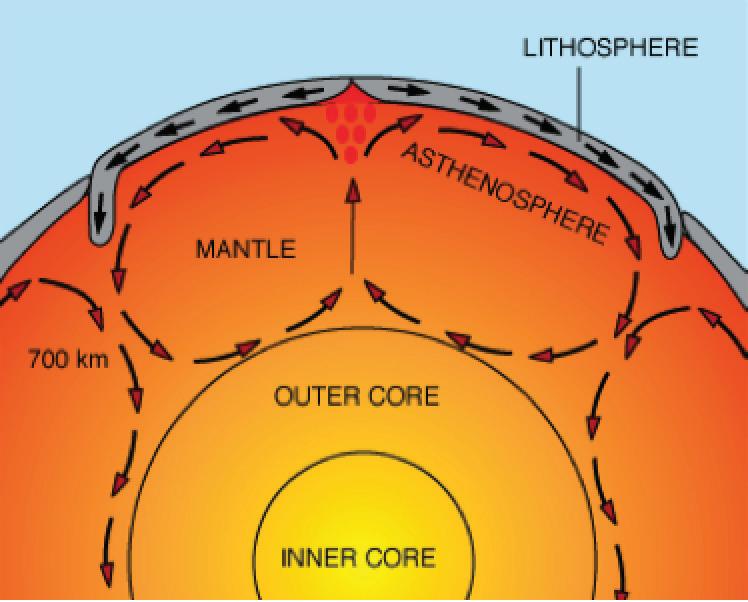
1. How does the development of the plate tectonic theory support the idea that scientific knowledge is based on empirical evidence?
2. Did the process of developing the theory demonstrate the use of evidence to evaluate explanations as used by various science disciplines? Explain.
3. What evidence about the current state of Earth’s surface did Wegener use to draw conclusions about the past surface of Earth?
4. What role did engineering play in providing evidence of plate movement?
5. How was research and development important to the development of plate tectonic theory?
Discuss and debate the following questions amongst your group until the group comes to a consensus about the correct answer. Then record the correct answer in the space below.
1. Was the evidence to support the theory of plate tectonics provided by one group of scientists working together? Explain.
2. How was the current surface of Earth used to draw conclusions about the appearance of the past surface of Earth?
3. What events spurred the development of the technology needed to gather evidence? Why?
4. Before the 1950s scientists did not understand the mechanisms behind earthquakes and volcanic eruptions. Why?
1. Record your observations of the model and draw a series of labeled and captioned diagrams describing what occurred.
2. What caused the pieces of foil to move?
3. If the purpose of the model is to show the mechanism that moves tectonic plates, what does the foil represent? What does the water represent?
4. What is the mechanism that causes tectonic plates to move?
1. What causes convection currents in the mantle?
2. Is it essential to know the source of energy in convection currents to understand plate tectonic theory?
3. What was the energy source for the model of convection currents in the beaker?
4. What does the hot plate represent in Earth’s system?
5. If new crust forms from magma welling up at divergent plate boundaries, why does Earth not continually get larger and larger?
Part I
The movement of tectonic plates is responsible for the formation of most of the continental and ocean floor features on Earth. Each plate consists of a piece of crust lying on top of the upper portion of the mantle. This combination of portions of two layers of Earth is referred to as the lithosphere. The part of the mantle directly below the lithosphere is the asthenosphere, a solid with the property of plasticity, meaning it can flow like putty.
1. Spread a heaping tablespoon of marshmallow fluff on the large cracker piece.
2. Cover the fluff with the two smaller cracker pieces.
3. The two small cracker pieces represent crustal plates of Earth. The marshmallow fluff represents the mantle of Earth. Draw a diagram of your model. Label the plates and the mantle.
4. Slide the two pieces of plate side to side, causing the edges to rub against each other in a transform boundary.
5. Observations and ideas about the modeled movement in your transform boundary:
6. Diagram of model:
7. Re-center the two smaller crackers.
8. Model plate movement at a convergent boundary by moving the two small graham crackers toward each other such that they form a small upside-down V on top of the marshmallow fluff. What features may be formed by this plate movement? Record your ideas.
9. Draw a diagram of the model. Include arrows to show the direction of movement, and label the type of plate boundary being modeled.
10. Re-center the two smaller crackers.
11. Model plate movement of divergent plates by moving the two small crackers away from each other so that they are slightly separated on the marshmallow fluff. What features may be formed by this plate movement? Record your ideas.
12. Draw a diagram of the model. Include arrows to show the direction of movement, and label the type of plate boundary being modeled.
13. Re-center the two smaller crackers.
14. Model plate movement of converging plates once again, by moving your two small graham crackers toward each other again. This time, push one graham cracker a little under the other graham cracker when they meet, so that one slightly overlaps the other. The prior model of converging plate movement modeled the meeting of two plates of continental crust; this model shows the collision of either continental crust and oceanic crust or two plates of oceanic crust. What features may be formed by this plate movement? Record your ideas.
15. Draw a diagram of the model. Include arrows to show the direction of movement and label the type of plate boundary being modeled.
1. How does the model of a transform boundary show the relationship between the parts of the system? What is not demonstrated?
2. How does the model of a divergent boundary show the relationship between the parts of the system? What is not demonstrated?
3. How do the models of convergent boundaries show the relationship between the parts of each system? What is not demonstrated?
Tectonic plates are in motion, even though in most cases it takes millions of years for results to become apparent. Mountains, volcanoes, new crust material, and earthquakes are some of the geological events that occur on and change Earth’s surface as a result of plate movement. Landmasses are still moving today as they are carried by the lithospheric plates. In March of 2011, parts of the coast of Japan were moved by as much as eight feet by an earthquake that occurred along the subduction zone along the Japan Trench.
1. Your teacher will provide you with pieces of continental plates reflecting a certain specific event in history. Working in your group, use the rock and fossil evidence to arrange your plates together into one or several continents.
2. My group’s time period:
3. Once your group has decided on the locations of your plates, draw your arranged continents in the space below, being sure to note the locations of oceans, rock formations, and fossil remains.
With two other groups, compare the continental maps generated by your groups.
1. Are the continents in the same space?
2. Do they move position?
3. In the space below, create a newspaper article describing either the past movement of the continents in your map or the future movement. Be sure to include any evidence available, including rocks and fossil locations. You will share your newspaper article with the class as a report.
4. What evidence do you have to support the idea that continents have moved?
5. How were fossils used to prove continent location?
6. How were rock strata used to prove continent location?
7. Were continent shapes useful in determining the positions of continents? Why or why not?
1. Read the descriptions of various plate boundary types below:
Transverse Plate Boundary: Crustal plates slide past each other. There is no significant amount of heat or pressure generated, so no metamorphosis takes place. However, transverse faults are capable of moving rock formations great distances, causing rocks formed in one location to be found in locations hundreds of miles away.
Convergent Plate Boundary: Oceanic subduction: The continental crust is formed primarily of various types of granite rock, while the oceanic crust is formed of basaltic rock. Basalt is much heavier than granite, so when oceanic crust meets continental crust in a convergent boundary, the oceanic crust sinks below the continental crust. The collision generates intense heat and pressure, inducing metamorphosis in some of the rock formations within the boundary. Portions of the oceanic crust melt as they sink into the mantle, forming magma. This magma rises upward and creates chains of volcanoes in the continental crust. Water that is found in ocean crust is squeezed out of the rock due to the pressure, dissolving metals in the rock and rising upward. As the water rises, the pressure drops, allowing the water to evaporate in the high heat. This leaves behind veins of metals and crystals within the rock already present in the crust.
Convergent Plate Boundary: Continental subduction: When two continental crusts collide in a convergent plate boundary, one plate is subducted, but with great difficulty. There is not a large amount of volcanism; instead, orogeny (or mountain formation) happens on a wide scale. This is due to the resistance of the plates to being subducted, causing one plate to be pushed together and upward, folding and distorting its rock layers. The vast majority of the great mountain ranges on Earth are formed by this process. The other, subducted plate is forced deep into Earth’s mantle, where pressure and heat are significantly higher than in oceanic-type subduction. Rocks undergo extreme high-pressure metamorphism at these depths and are pushed toward the surface by convection currents in the mantle.
Divergent Plate Boundary: When oceanic crust is stretched by the convection currents in the mantle, it can crack and be pulled apart. This exposes the magma beneath to ocean water, forming new basaltic rock. The crust is continually separated, forming new basaltic rock at the plate boundary. Basalt contains iron grains that align with Earth’s magnetic field. As plates diverge, new crust is formed with aligned iron grains. Examination of the basaltic crust demonstrates that the iron grains’ alignment alternates back and forth over millions of years, showing how Earth’s magnetic field alternates the location of magnetic north and south over hundreds of thousands of years.
2. Using your copy of Rock, Mineral, or Landform, identify which plate boundary is most likely responsible for each of the rocks, minerals, or landforms. Be sure to give your reasons why. Rock, Mineral, Landform
1. What did you notice about the size of the particles?
2. Draw what happened when you separated the soil types or Earth materials.
3. In the space below, draw a depiction of each component you separated from your soil sample.
Color?
Size?
Rock or living material?
Color?
Size?
Rock or living material?
Color?
Size?
Rock or living material?
Color?
Size?
Rock or living material?
Color?
Size?
Rock or living material?
Color?
Size?
Rock or living material?
4. For each component above, use the Internet to identify it and then research the possible origin of the material. Write your findings below.
Part II: How Did It Get Here?
1. You may be assigned a process, or you may get to pick your process. Either way, research with your group one of the following geological processes using resources found on the Internet and at the library:
A. Weathering: Breaks rock; can be ice driven, wind driven, or water driven
B. Decomposition: Changes chemistry of the material; can be organic (decaying of leaves) or inorganic (chemical weathering of rocks)
C. Erosion: Takes rock away; can be wind driven or water driven
D. Deposition: Makes new land with weathered rock
E. Volcanism: Makes new land with lava and pumice
F. Any other mechanisms from research done in Part I
2. Look for answers to the following questions:
A. Is your process destructive (breaks landforms down) or constructive (builds landforms)?
B. How does it change Earth’s surface?
C. What is the basic mechanism of your process? How does it work?
D. How long does it take for your process to occur? Tens of years? Thousands of years? Longer?
E. How does your geologic process contribute to the formation of soil?
It is important that you and your team members evaluate the sources used in your research. Use the Student Reference Sheet: Assessing Credibility, Accuracy, and Possible Bias to evaluate your sources. Record your analysis of your sources below.
Source
Part III: Investigating Geoscience Processes
Plan and conduct an investigation that models your geologic process from Part II and demonstrates how it works.
Step 1: Question
Step 2: Relevance
Step 3: Variables
Independent variable:
Dependent variable:
Controlled variable(s), group(s), and other constant(s):
Step 4: Hypothesis
Step 5: Materials
Step 6: Safety considerations
Step 7: Procedures
The following is given as an example procedure for water erosion of a rock. Your procedure will vary based on your chosen geologic process:
1. Make a “sand mountain” by piling sand up higher, making sure the sand is at least 10 cm higher than the surroundings.
2. Measure and record the height of the sand mountain. Draw a diagram of the sand mountain.
3. Make a “rain cup” by poking holes into the bottom of a small cup.
4. To simulate rainfall, hold the rain cup over the top of the sand mount and pour water into the rain cup.
5. After the rain has stopped, measure the height of the remaining sand and record observations of changes. Draw a diagram of the resulting landform.
8: Data Collection
9: Data Analysis
Step 10: Conclusion and Scientific Explanation
Claim:
Evidence:
Reasoning:
1. Outline the results of your research and experimentation below.
2. Create a short presentation or speech that conveys the information gathered in the question above. You will share this presentation with the class.
3. As other groups present, write notes about their findings below. What parts do you think are right? Which do you think are wrong?
4. Which group’s investigations were credible, if any? Credibility is earned by having an investigation that accurately models the geological process the group was researching.
5. Which group’s investigations were not credible, and why?
6. Which group had the most effective investigation, and why?
7. In the space below, create or outline an argument that shows the cause and effect of the Sun on erosion, weathering, and the processes that form soil.
1. Groundwater is a term that describes water found in soil and rock. If the water is in a porous rock, it is called an aquifer. How does this compare with surface water?
2. What is the primary source of most surface water, such as rivers and lakes?
3. Why would gravity be a useful topic to include in a description of the movement of water?
1. What is the major watershed in your community?
2. What major aquifer is in your community?
3. Are there any minor aquifers in your community? If so, which one(s)?
4. What is the flow direction in Mississippi, and what major body of water receives the drainage?
5. How can you use the direction of flow of the major rivers in Mississippi to determine the general changes in elevation of the land?
6. How do the characteristics of your home watershed compare to the delta or the coastal streams?
1. How are the sand and water interacting?
2. What do you call the spaces between the particles of sand?
3. Is the sand a permeable or impermeable layer?
1. How are the clay and the water interacting?
2. Is the clay layer permeable or impermeable?
1. How do the rocks/gravel interact with the water?
2. Does the rock layer have a higher or lower porosity than the sand layer?
3. Explain why the rock layer and the sand layer have different porosities.
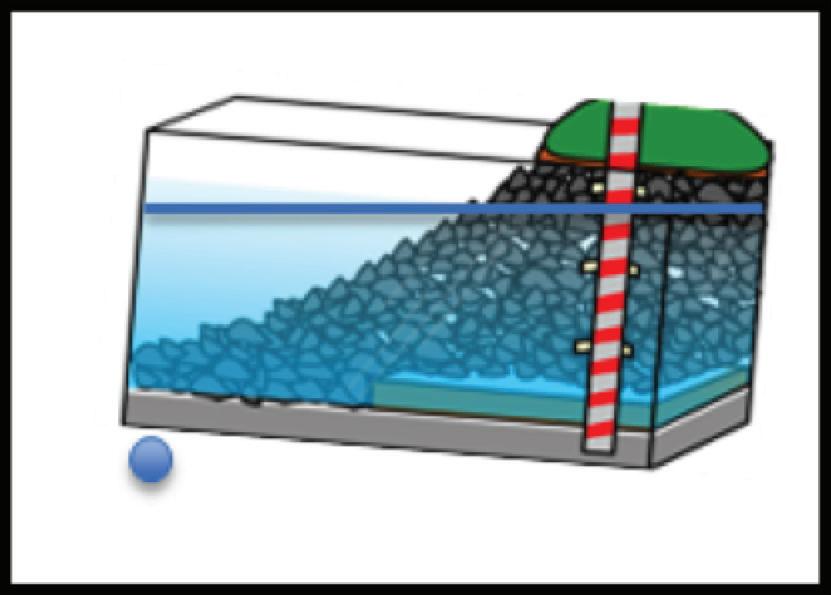
1. Discuss with your group which way the groundwater would be flowing in a real setting. This is tricky, so think it through. Then draw an arrow on the diagram to show the direction of the flow.
2. Determine what type of pollution the powdered drink mix represents and what type of pollution the food coloring represents.
A. Powdered drink mix:
B. Food coloring:
3. What is the location of the food coloring after 30 minutes?
1. What happened to the drink mix as a result of the rain?
2. Use the words elevation, surface water, filtering, groundwater, permeable, and impermeable to write five sentences about your observations of the two pollutants.
1. Is the water clear?
2. If this water was treated at the local water treatment facility, would you drink it? Explain.
3. Think about examples of point source pollution. List five things that the food coloring could represent in a real setting.
4. Think about examples of nonpoint source pollution. List five things that the drink coloring could represent in a real setting.
5. Examine your model’s permeable and impermeable layers. If the well is pumping water from the aquifer below the impermeable layer, how are the pollutants entering the aquifer?
6. What causes the water to move and contaminate the well area?
1. What is a watershed?
2. Describe how water flows in a watershed.
3. What major watersheds exist in Mississippi?
4. Use the terms porosity (or porous) and permeability (or permeable) to describe water movement in an aquifer.
5. What effect does surface water have on groundwater?
6. How does changing surface water alter groundwater?
7. What can be done to reduce the negative impact of pollution?
8. What is the cause and effect of energy from the Sun on the relationship between surface water and groundwater?
What is the fewest number of continents Earth has ever had?
The answer is one. Earth may have had only one continent more than once, but the most recent formation of the single continent was called Pangaea. It was comprised of all of Earth’s land about 300 to 200 million years ago. About 175 million years ago, Pangaea began to separate into two continents called Laurasia and Gondwana. Since then, Earth has continued to change into what we recognize as the seven (geologic) or eight (political) continents of Earth today.
Has Earth Always Looked the Same?
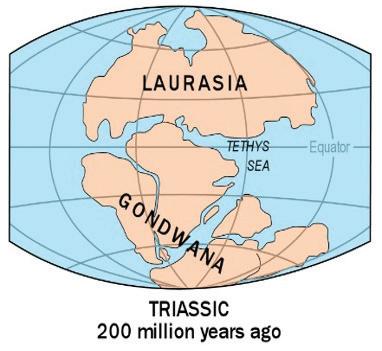
No, because Earth’s surface has always undergone constant change. Before Pangaea, the crust of Earth was on the move. Even in the early years of Earth’s formation, it was driven by the energy and heat emanating from below when the surface was just beginning to cool from molten rock into the solid crust.
Around 100 years ago, scientists began to suspect that the continents move. If you look at a map of the world, the east coast of South America looks like it would fit, like a puzzle piece, into the west coast of Africa. This visual pattern contributed to the development of the continental drift theory in the early 1910s. However, while scientists knew the continents were moving, no one knew quite how.
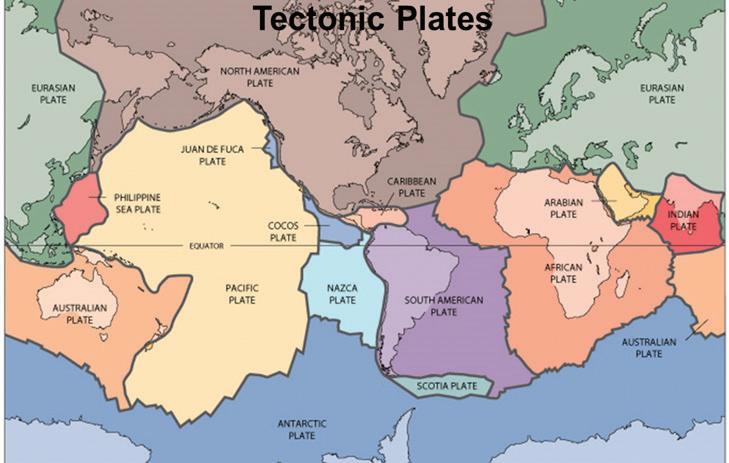
Since the 1960s, the theory of plate tectonics has explained the mechanism behind the past and current movement of Earth’s continents. Earth’s surface is divided into plates called the lithosphere, which contains the crust and upper mantle. These plates are moved by energy supplied from the lower mantle, called the asthenosphere, and the core of Earth. The plates interact at their boundaries, which creates landforms.
The theory of plate tectonics is considered to be a unifying theory because it can explain the distribution of geologic structures and phenomena related to the changing lithosphere of Earth such as earthquakes, volcanoes, mountain ranges, tsunamis, the young age of the seafloor, magnetism patterns in Earth’s crust, and the location of fossils. The plate tectonics theory even provides an explanation for historical atmospheric and biologic events, including mass extinctions, climate change on landmasses (e.g., mountain rain shadows), and the movement of ancient ocean currents.
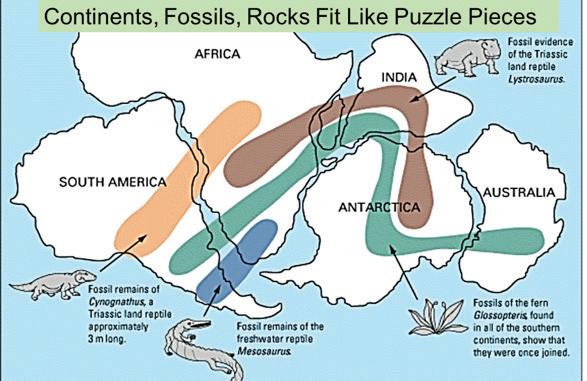
All good scientific theories are grounded in evidence and experimentation. Plate tectonics is no different. The first indication of plate tectonics is the presence of the same types and species of fossils on multiple continents. Lystrosaurus is a pig-like reptile that lived in the early Triassic period on the continents of Africa, India, and Antarctica. Mesosaurus is a swimming freshwater reptile found in southern South America and southern Africa.
In fact, if the distributions of fossils are placed on a map, it is even possible to see how the continents fit together in the past. At one point, South America, Africa, Australia, Antarctica, and India were all merged together into one supercontinent called Gondwanaland.
Other evidence for plate tectonics includes the pattern of magnetism found in rocks in the ocean floor. The natural convection of Earth’s mantle causes the ocean floor to be stretched and eventually separate. In between these separated plates of crust, a rift forms as lava flows out from the mantle. The lava hardens, forming new oceanic crust. This new crust is rich in iron, and as it cools, it forms magnetic crystals. These crystals align according to the magnetic field. Some of the time, the magnetic field is aligned north to south, and other times, it is aligned south to north. The pattern is a mirror image on either side of the rift. This shows that the crust is being generated at equal rates on both sides of the rift.
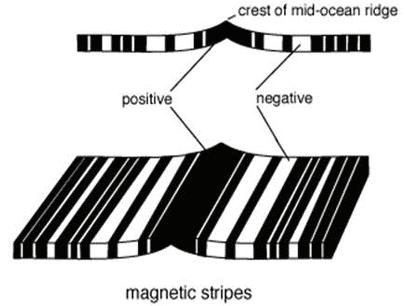
In addition to the fossil evidence, the shape of the continents, seafloor spreading, matching rock layers and geologic features, internal heat of Earth as a driving mechanism, and satellite data confirm the slow movement of the plates over time.
In addition to unraveling Earth’s structure, we can describe the mechanism by which Earth’s outer layers move. We have been able to determine the density of Earth’s layers, the movements of the layers, and the chemical processes that are responsible for the heat energy in Earth’s interior. We also know that thermal convection is the process by which Earth’s internal heat travels and, consequently, moves the mantle and crust. Plate tectonics can be viewed as the surface expression of mantle convection.
In the same way that wax moves in a lava lamp, Earth’s mantle is heated near the outer core. This mantle material becomes less dense and begins to rise through the surrounding cooler mantle. Likewise, as the heated mantle cools, it becomes denser and begins to sink back toward the outer core as a result of the force of gravity, where it is heated again, and the cycle begins all over. It is this rising and falling action that creates convection currents driven by the outward flow of energy from Earth’s interior. The convection currents, in turn, move the oceanic and continental plates along Earth’s surface.
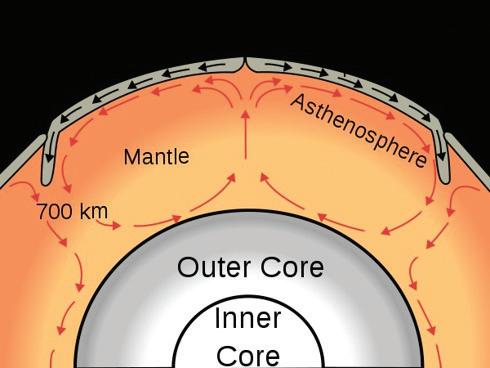

Some of the heat contained within Earth is a remnant from the formation of Earth. However, scientists believe that the majority of Earth’s current heat energy is the result of the process of radioactive decay of unstable isotopes.
This radioactive decay continuously generates energy within Earth. The decay is the primary source of energy contributing to the movement of tectonic plates at the surface that, in turn, creates continents, oceans, and landforms.
There are two types of tectonic plates: oceanic and continental The interaction of these plates produces the different types of plate boundaries (divergent, transform, and convergent), each with distinct landforms.
Divergent boundary: When oceanic plates move away from each other, oceans expand, rifts form, and chains of mid-ocean volcanoes form.
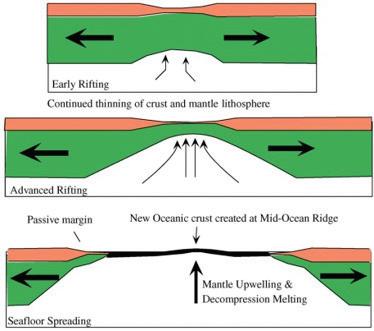
Transform boundary: When continental or oceanic plates grind past each other, surface faults are formed, and earthquakes occur more frequently.
Convergent boundary: When plates collide, the result depends on the type of plate. If two continental plates collide, rocks are pushed thousands of feet into the air, rock layers fold, tall mountain chains form, and earthquakes occur.
When a continental plate collides with an oceanic plate, the denser oceanic plate subducts beneath (i.e., is forced below) the less dense continental plate into the upper mantle and begins to melt. The newly melted material from the oceanic plate can rise to the surface and form volcanic mountain chains. Subduction also occurs when two oceanic plates collide. The denser oceanic plate sinks beneath the other oceanic plate.
Other Changes to Earth’s Surface
Plate tectonic theory discusses the forces that work deep within the lithosphere that create the major landforms we see today. Other constructive and destructive forces are at work that constantly change Earth. Weathering, erosion, and deposition of rock layers create soil that eventually becomes deltas, beaches, dunes, floodplains, glacial moraines, and alluvial fans.
Destructive forces of erosion tear down mountains, widen canyons, and eat away at sea cliffs. Earthquakes and volcanoes destroy surrounding landforms. Slow and rapid changes to Earth continually shape the land.
Soil Largest (like pebbles) Coarse Grey No
SAND
Soil Large (like salt) Gritty Light Brown Very Little
SILT
Soil Small (like flour) Silky Smooth Light Grey Yes CLAY Soil Smallest (like dust) Sticky When Wet Red or Yellow Too Much
TOPSOIL Soil All Sizes All Textures Dark Brown or Black Just Right
Soil particles. Soils differ in their observable properties, which can be sorted based on particle size, texture, color, and capacity to retain water.
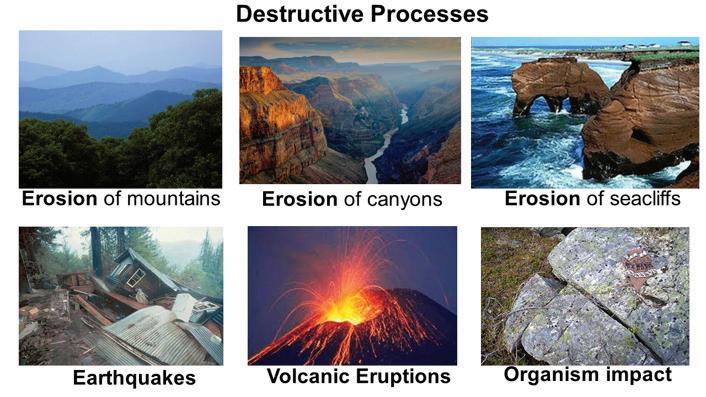
Look Out!
In the water cycle, the precipitation that falls collects as runoff and flows into major bodies of water. Other water drains down into groundwater and collects between rock layers in aquifers that become major sources of water for drinking and irrigation. The land basin that collects this water is called a watershed. The weather, erosion, and deposition along those watersheds continue to change the landscape in those river basins. The Mississippi Watershed is the largest in the United States.
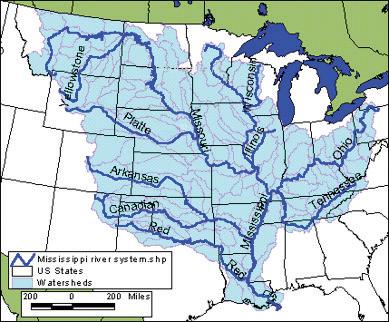
The images below show three different plate boundaries. Identify each boundary as convergent, divergent, or transform. Then place the following features or events beside the boundary type they are commonly associated with. (Some are commonly associated with several boundary types.)
• Mid-ocean ridge
• Mountain building
• Creation of new crust
• Subduction zone
• Volcanoes
• Fault
Boundary
This is a______________boundary.
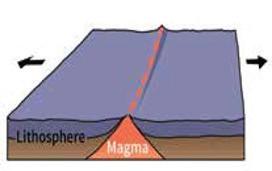
This is a______________boundary.
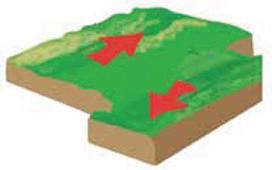
This is a______________boundary.
• Earthquakes
• Destruction of old crust
Associated Features or Events
Place a ball of Silly Putty on a flat surface. Make it as perfectly round as possible. Leave it alone for an hour or more. How has it changed? How is this change like the molten rock within Earth’s mantle? Draw illustrations in the boxes below of the Silly Putty before, during, and after.
To further explore this concept, record a video or use a time-lapse photography application to make a timelapse video of the putty’s motion.
1 Mount Everest is part of the Himalayan mountain chain. Adventurers from all over the world try to climb it. Mount Everest is the highest mountain in the world, so how could it have a connection to the Gobi Desert, over 1,000 miles away? The regions of Earth are linked in surprising ways through four connected systems. These systems are the lithosphere, the atmosphere, the hydrosphere, and the biosphere.
2 The four Earth systems are always interacting. A change in one system will often cause a change in the others. These changes can be small or far-reaching. But what exactly are these systems? The lithosphere is all of the rocks that make up the planet. The atmosphere is the blanket of gases that surround Earth. The hydrosphere includes all of the planet’s water, whether it is in the liquid, solid, or gaseous state. The biosphere is made of all living organisms on the planet.
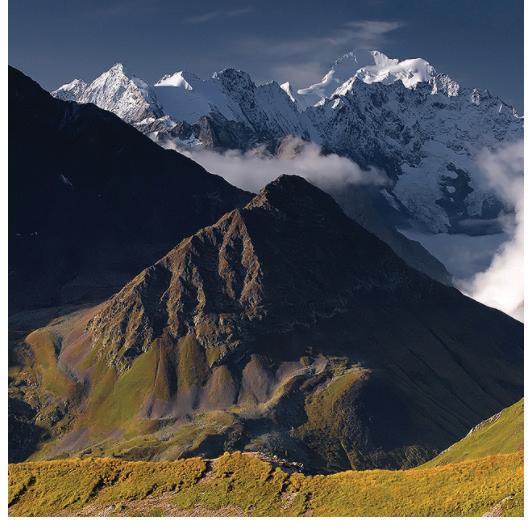
3 A very slow example of interactions among Earth’s systems is the process of building mountains. The surface of the lithosphere is rigid, and it is broken into seven huge pieces, including several smaller ones. These pieces of the rigid lithosphere are known as the tectonic plates. These plates move very slowly across the surface of the planet. They move anywhere between 1 and 10 cm per year. This movement causes the landmasses of Earth to change their position and their surface features.
4 The Eurasian tectonic plate is one of Earth’s largest plates. This plate contains most of the European and Asian continents. Even though the country of India is part of the Asian continent (on a map), it is attached to a different tectonic plate called the Indian Plate. One hundred million years ago, India was an island in the Southern Hemisphere and was closer to Australia than it was to Asia. The Indian Plate separated from Madagascar and slowly moved north. The Indian Plate and the Asian Plate collided about 50 million years ago. As these two huge plates slowly pushed against one another, the rigid rock crumpled and bent and was pushed upward to form the Himalayan mountain range. The Himalayan range is now the highest mountain range in the world. Peaks grew to an average height of around 6,000 m (20,000 ft). Mount Everest towers 8,848 m (29,029 ft) into the sky. The Himalayas are still rising up to 1 cm each year.
5 Over the last 10 million years, the Indian Plate eventually began to slide under the Eurasian Plate. This resulted in a very high, flat plateau being formed in the area we now know as Tibet. The Tibetan Plateau is about the same size as the eastern United States and is the highest land area in the world. It may actually be the highest plateau in Earth’s history. The average elevation in this area is over 5,000 m (16,400 ft), which is 2,000 m higher than before the collision with India. The plateau is still being lifted up today.
6 So far, only changes to the lithosphere have been described. What do changes in the lithosphere have to do with Earth’s other systems? First, tall mountain ranges, such as the Himalayas, affect atmospheric wind flows in the atmosphere. This mountain range acts as a barrier by blocking the cold air masses that come from the North Pole during winter. This blocking effect helps keeps India warmer in winter than other places that are the same distance from the equator.
7 The hydrosphere is also affected. The Himalayan range also plays an important role in precipitation patterns. India and the surrounding portions of southern Asia have a seasonal weather pattern called a monsoon. The monsoon is actually a wind pattern that happens in South and Southeast Asia, which includes the country of India. During the monsoon cycle, the wind blows from the southwest between May and September, creating a wet monsoon, and then from the northeast between October and April, creating a dry monsoon. As you can guess, there is an intense rainy season during the wet monsoon.
8 Why does this happen in India? The high, hot, and dry Tibetan Plateau and the Himalayan mountain range play a huge part. During summer, the Sun heats both the land and oceans, but the land heats up faster. As the air over land heats up, it expands, creating low pressure. The air over the oceans is at a lower temperature and has higher pressure. This pressure difference creates winds that blow from the Indian Ocean onto land.
9 As this warm, moist air from the ocean is pushed onto land, it cools. When this cooler air hits the Himalayan mountain range, it rises and cools even more. As the air cools so quickly, it can no longer hold all of the moisture in it, so it causes a huge amount of rain. This is why summer monsoons cause so much rain over India. But the Himalayas also cause an important lack of precipitation. As air travels over this mountain range, it loses most of its water content before it reaches Tibet and central Asia. In other words, the air gets very dry, bringing little rain to the land it blows over. This rain shadow cast by the Himalayan Mountains is the cause of the largest desert in Asia, known as the Gobi Desert. This desert covers parts of China and Mongolia and is about the same size as the country of Peru.
10 All of these interactions have had a big effect on the biosphere as well. Before the tectonic collision, most of Asia had the same habitats and wildlife. Now there are many different ecosystems in the mountains and valleys of the Himalayas and Tibetan Plateau. New ecosystems have also developed due to the differences in rainfall. Each area has its own unique wildlife. Bactrian camels roam the Gobi. Snow leopards stalk the Himalayan cliffs. The lithosphere’s tectonic plates have moved over many millions of years, forming both the Himalayan Mountains and the Tibetan Plateau. Interactions with the hydrosphere have changed where rain falls. The biosphere has changed with the other three systems.
1 What is the correct order of these Earth system processes from slowest to fastest?
A Collision of Indian tectonic plate with Eurasian plate; uplift of the Tibetan Plateau; formation of the Gobi Desert; yearly monsoon wind cycle
B Collision of Indian tectonic plate with Eurasian plate; uplift of the Tibetan Plateau; yearly monsoon wind cycle; formation of the Gobi Desert
C Uplift of the Tibetan Plateau; collision of Indian tectonic plate with Eurasian plate; yearly monsoon wind cycle; formation of the Gobi Desert
D Yearly monsoon wind cycle; formation of the Gobi Desert; uplift of the Tibetan Plateau; collision of Indian tectonic plate with Eurasian plate
2 Which word in Paragraph 1 can help the reader figure out the meaning of the term interrelated?
A Regions
B Linked
C Surprising D Systems
3 What is a monsoon?
A Very hot summer weather
B A large rainstorm with fast, circulating winds
C A type of climate often found in mountains and high-altitude regions
D A regional weather pattern characterized by a seasonal change in wind direction
4 How can a mountain range cause a large desert?
A The movement of tectonic plates squeezes the water from the area behind the mountain range.
B A link between the lithosphere and the hydrosphere changes where the rivers flow.
C A link between the lithosphere and the atmosphere changes where the rain falls.
D The extreme height of the mountains blocks the Sun during certain times of the year.
5 After reading this passage, what is the best conclusion the reader can make about Earth systems?
A Changes to patterns in the atmosphere do not affect the biosphere.
B Tectonic plates move too slowly to affect the other Earth systems.
C The atmosphere and the hydrosphere work independently of each other.
D Millions of years of gradual change can produce interactions that have a big effect.
6 Which of the following statements is NOT true?
A Tectonic plate movement affects only the lithosphere.
B The four Earth systems are always interacting.
C The Eurasian tectonic plate is one of Earth’s largest plates.
D The movement of tectonic plates causes Earth’s landmasses to change their position.
1. Examine the diagram and explain the role that Earth’s internal energy plays in convection currents, cycling of matter, and plate movement.
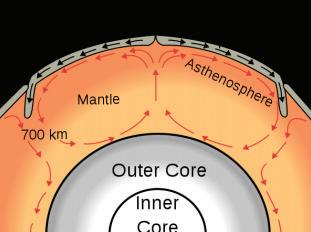
2. The data table below provides information on some constructive and destructive geologic processes that change Earth’s surface. Which process takes the longest time?
Geologic Process
Landslide
Geochemical reaction
Delta formation
Minutes
Seconds
Time Scale
Thousands of years
Earthquake Seconds
Area of Activity
Several square meters
Atomic scale
Several square kilometers
Several square kilometers
3. Examine the fossil map. How does it provide evidence that Earth’s plates have moved great distances throughout Earth’s history?
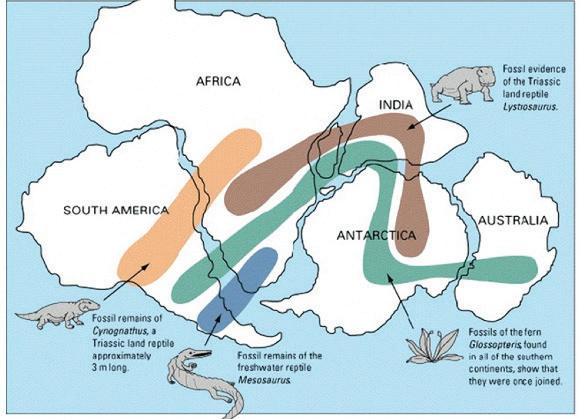
4. Look at the different plate boundaries. What do you think might be the result of each plate boundary movement?
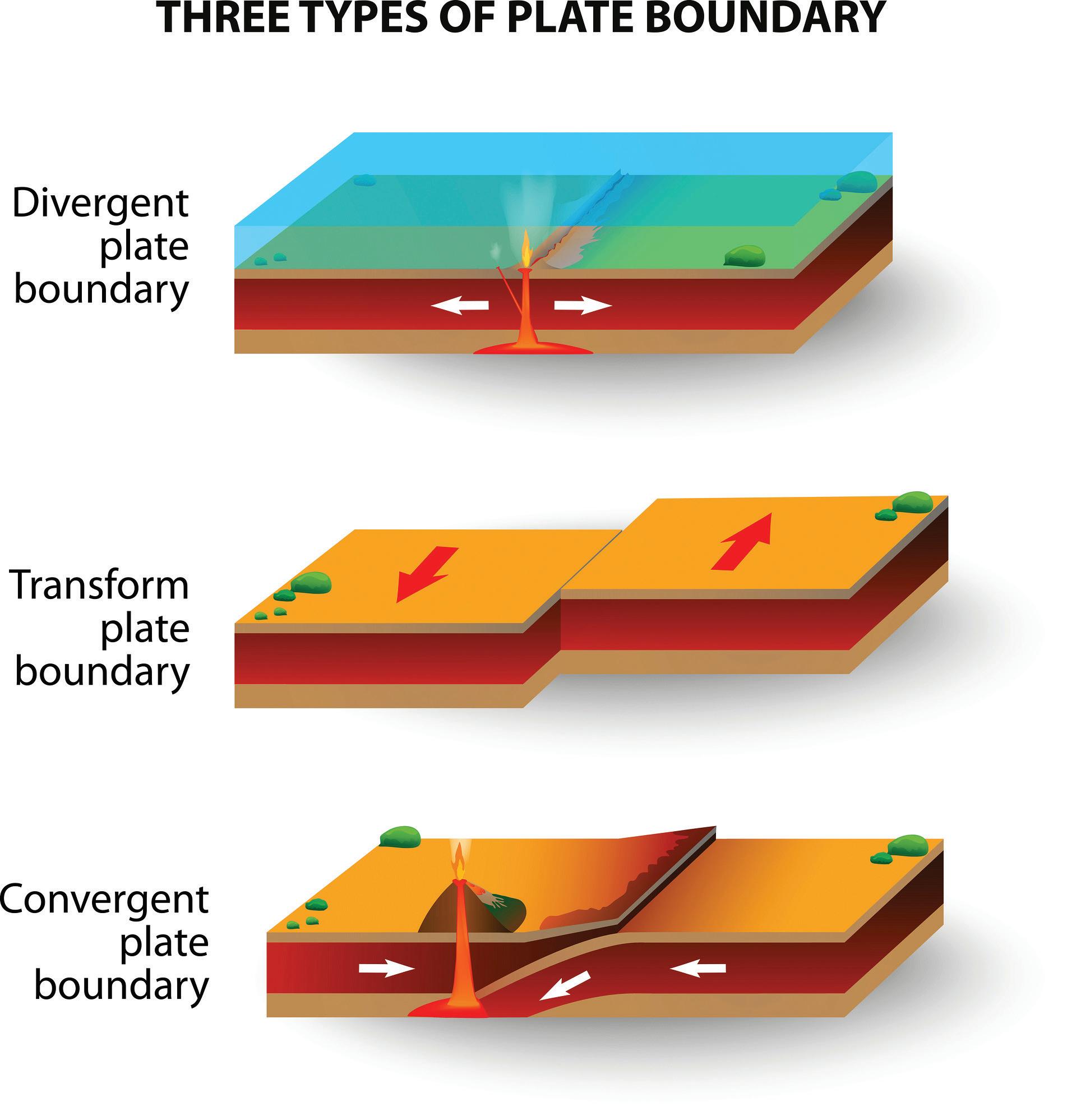
5. Examine the two diagrams and explain how surface water and groundwater are interconnected.
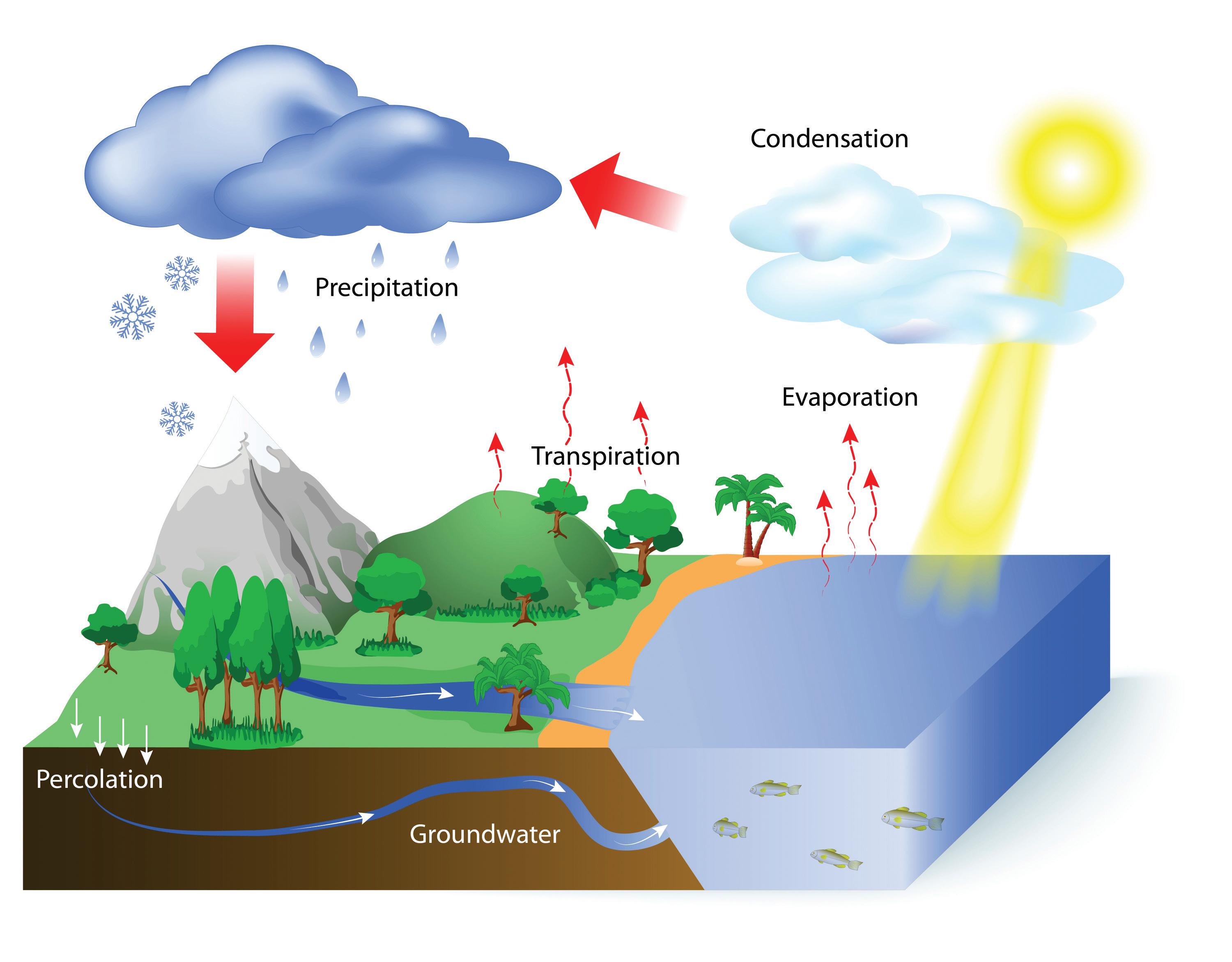
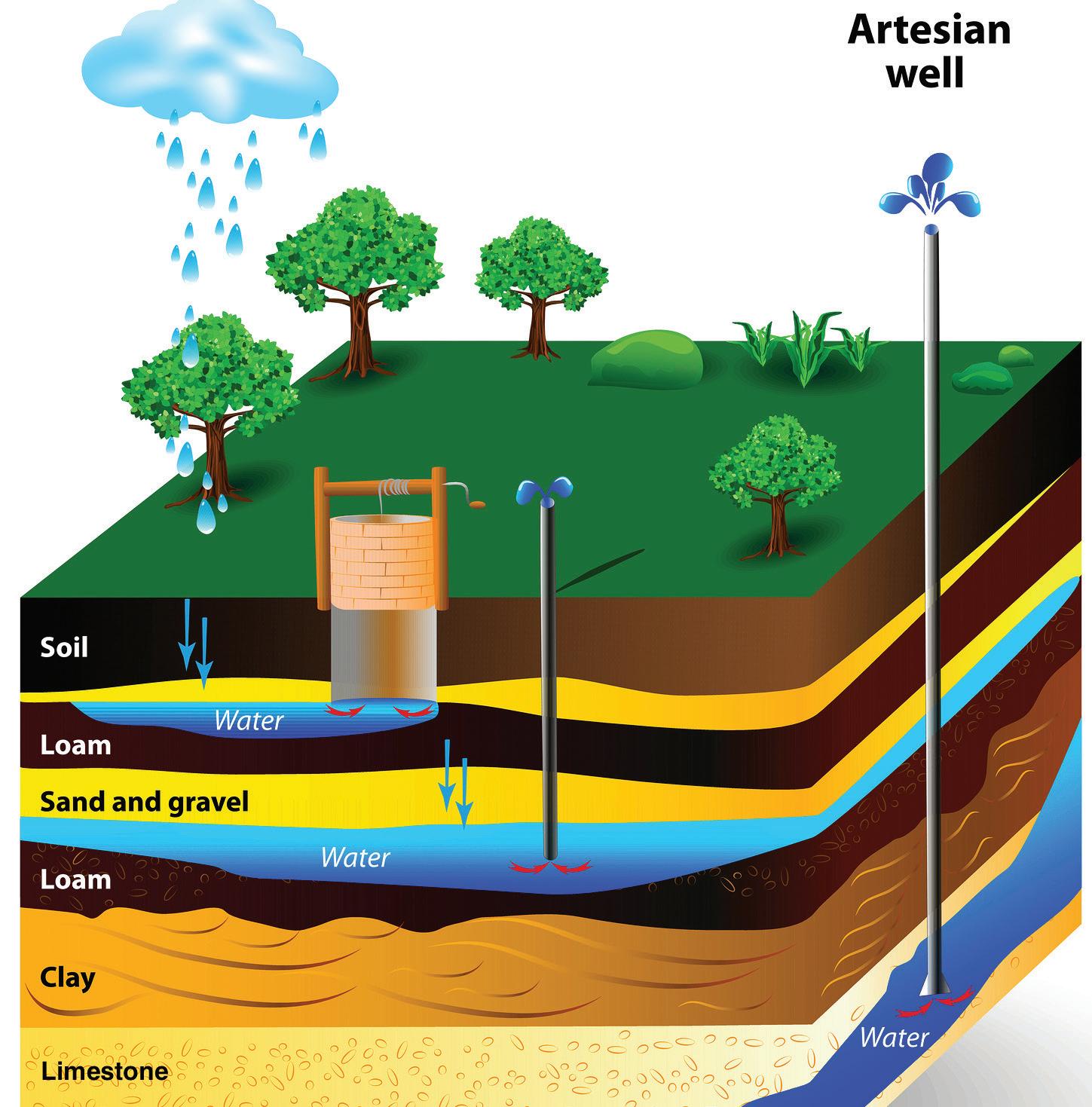
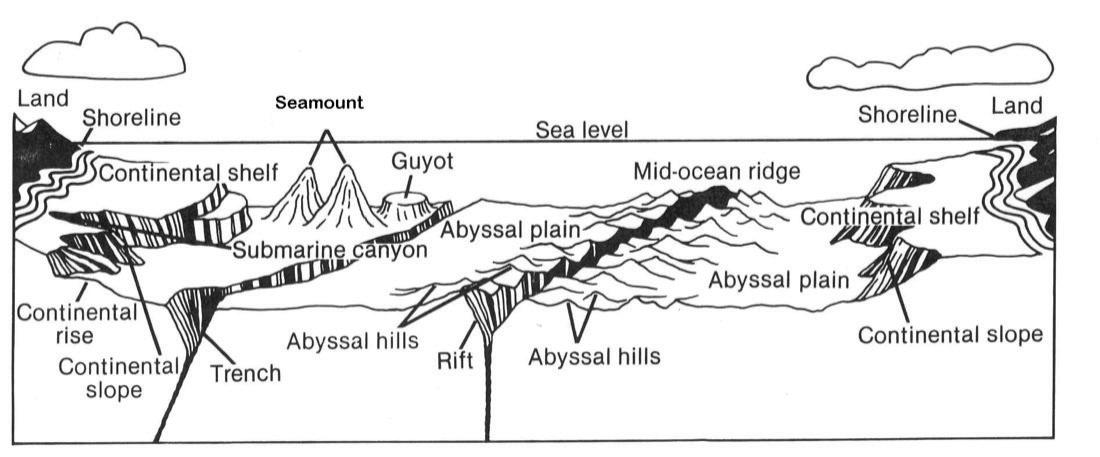
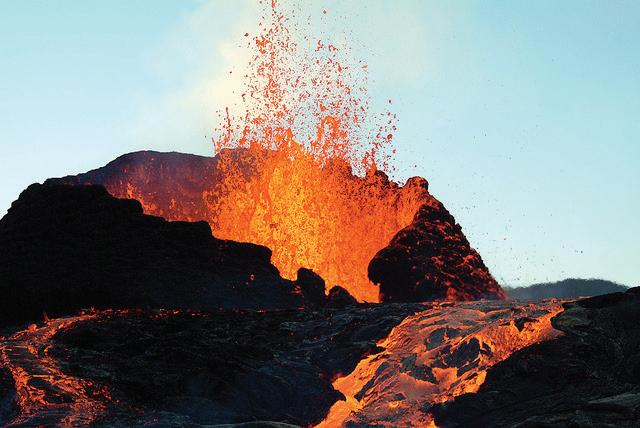
Using the provided websites and/or books, research your natural event and record what you find below. The following information must be included on the public service announcement that you create.
Name of the hazard:
Description of the hazard:
Picture of the hazard
How the hazard can impact humans:
Map of hazard sources or locations
How likely the hazard is to affect Mississippi:
How the hazard has affected Mississippi in the past:
Once all groups have completed their PSAs, present or complete a gallery tour of the events. As you read or listen about each event, complete the chart. Natural Event Brief Description or Picture
1. Complete the table below.
Volcanoes:
2. Complete the table below. Hazard
Earthquakes:
Flooding:
Thunderstorms and lightning:
3. Complete the table below.
4. Review the technologies listed on the previous pages. Compare and contrast them in the space below. Which seemed the most effective? Which was the least effective?
5. Choose one of the technologies above and write an argument that justifies why it is the most effective at predicting natural hazards.
6. As a group, share your arguments for the most effective prediction technology. Discuss each argument, and as a group decide the best technology with the best argument. Record that argument below.
7. As a class, share each group’s arguments for the most effective prediction technology. Discuss each argument, and as a class decide the best technology with the best argument. Record that argument below.
1. Were any technologies particularly ineffective? Why did you think this?
2. Did your original choice for best technology match the class’s decision for best technology?
3. If the class’s best technology is different than your original choice, how was your mind changed to support the class choice?
Natural hazards have affected humans in the past and will continue to do so in the future. The United Nations International Strategy for Disaster Reduction (UNISDR) is focused on mitigating the effects of natural and manmade hazards on humans.
One goal of UNISDR is for every at-risk community to have a viable plan for disasters and natural hazards. You will be assigned a natural hazard. Find a specific location (such as a city, state, or country) that could be affected by your assigned hazard to focus on as you write your priority action plan. Consider each of the priorities below when developing your plan. Create a multimedia presentation to communicate the plan to the community.
Priority 1: National and local policies and plans in place to address the natural hazard
Priority 2: Local hazards identified, assessed, and monitored with warning systems
Priority 3: Dissemination of hazard information and prevention measures to the public
Priority 4: Future development with hazard considerations
Priority 5: Natural hazard preparedness at all levels: authorities, communities, and individuals
Procedures
Record all of your steps and observations.
A. What is the problem? (State the problem in your own words.)
B. Explore and research the problem. List what you know and what you need to know.
1. Explain how your assigned hazard has affected humans in your chosen community in the past, and problems you predict for the future.
2. Review the UNISDR website for additional information about each priority.
B. Research, continued
C. Brainstorm and design a solution to the problem.
1. Summarize how previous problems you have explored will be helpful in solving the design challenge.
2. What information will you need for your solution?
3. Describe step by step the procedures you will use. Number each step.
4. Consider the cost, safety, reliability, and aesthetic impacts a solution may have on the community.
5. Consider possible social, cultural, and environmental impacts a solution may have.
D. Build, test, and analyze your solution.
1. Create a multimedia presentation to present to the local government of your affected area. Presentation must include the following:
a. The previous natural hazard information you researched to create your action plan, such as human and monetary impacts
b. Priority action plan, including all five priorities
c. At least one graph and/or chart to illustrate impacts of a previous occurrence of a natural hazard
d. Presentation should be at least 5 to 10 minutes in length.
E. Improve or redesign and retest the solution.
1. Are the procedures easy to follow so that others could follow the priority action plan?
2. Does your plan meet the criteria and constraints?
3. How does your plan affect the community? What are the cost, safety, reliability, and aesthetic impacts?
4. What are possible social, cultural, and environmental impacts of your solution?
5. Does your presentation clearly communicate the plan to the community?
F. Present and share your solution.
1. Decide how you will share your solution with the teacher or class.
2. Discuss who will talk about what you discovered.
3. Conclude with a class discussion.
4. Notes from presentations:
F. Notes from presentations, continued
G. Select one solution to evaluate.
1. Does the solution address the priorities of UNISDR?
2. What trade-offs will the community have to accept with this solution?
a. What are the costs associated with the solution?
b. Does the solution affect the safety of the community?
c. Is it reliable?
d. Does it affect the aesthetics of the area?
3. What are possible social, cultural, and environmental impacts of the solution?
4. Share your ideas with the authors of the solution you evaluated.
Have you ever been through a natural hazard? Those are events in nature that may have a negative effect on your community, such as an earthquake, volcanic eruption, or severe weather like a tornado, hurricane, flood, etc. Even if you have not, you have probably seen one of these events on the news or in a movie. When the effects of these natural hazards are devastating, we call them natural disasters. Natural hazards can happen anywhere, but they are more likely to happen in some areas than in others. Which areas of the country do you think are at highest risk for destructive weather events, such as floods, hurricanes, or tornadoes? Which areas do you think are likely to have earthquakes and volcanoes? Why do you think so?
Floods
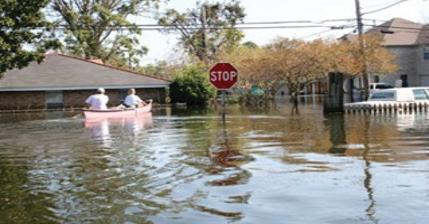
During a flood, water can rise to dangerous levels. Flooding can damage property and kill living things.
Normally, when it rains or snow melts, the ground absorbs the water, or it runs into reservoirs, such as streams or ponds. If more rain falls or snow melts than the ground can absorb or streams and ponds can hold, a flood can occur. This can happen for several reasons. When the ground is porous, or full of many small holes, it has the ability to absorb a lot of water. Loosely packed soil is more porous than packed soil, so flooding is more likely to occur where the ground has been packed—for example, where heavy machines have driven over the ground.
In addition, if it rains too hard, water will land on the ground faster than it can be absorbed by the soil. This can result in flooding until the rain stops or the excess water runs into a reservoir or evaporates. Flooding can also happen where the ground is not porous. For example, if the ground is frozen or mostly made of rock, it will not absorb much water. Cities are also at risk of flooding because much of the ground there is paved with cement. The nonporous pavement blocks water that the ground would normally absorb.
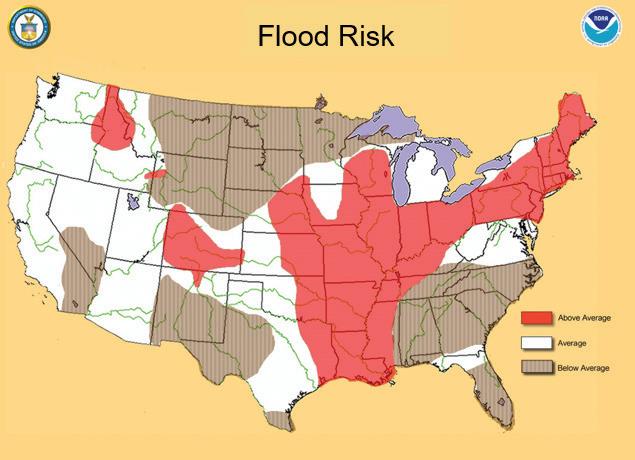
Those living near rivers or coastal areas are at the most risk for flooding. During severe flooding events, the rush of water picks up a lot of sediment and debris. The energy of the moving water, debris, and layers of sediment carried by water can do a lot of damage. Moving water can uproot or bury plants, reshape the land, and destroy roads and buildings. Even if floodwaters are not moving rapidly, they can rot wood over time and spoil other materials. This can cause a lot of damage to homes and other buildings.
In this photograph of a hurricane, the eye is a dark spot in the center of the storm. Although winds are calm in the eye, the area surrounding the eye is the most intense part of a hurricane.
Look at the ground where you live. Is it mostly solid rock or soft soil? Is the soil loose or tightly packed like clay? Is the ground mostly in its natural state, or is it mostly paved over? Does the ground slope into a reservoir such as a pond or stream? After examining these factors, what do you think the risk of flooding is during a period of intense rainfall in your area?
Hurricanes are violent storms that form over warm ocean waters. As some of the seawater evaporates, warm, wet air rises into the atmosphere. (Convection is the process by which warm fluids—including air—rise and cool fluids sink.)
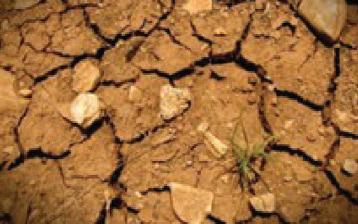
This rising of warm, moist air removes some of the air near the surface of the ocean water, creating an area of low pressure. Warm air continues to rise as more and more warm ocean water evaporates. This causes the atmospheric pressure to become even lower beneath the rising air.
New air rushes into the area beneath the rising air. Because this area is warm, the new air warms and rises too, continuing the cycle. As more air rushes in, the whole system begins to spin.
When the rising air gets high enough in the atmosphere, it cools. The moisture in this air forms clouds as it cools. The result is a massive, spinning cloud with intense winds and rainfall. The center of this spinning storm is called the eye
Hurricanes form over water but often move onto the land. On land, a hurricane is no longer powered by evaporating seawater, so it slowly weakens. Before the hurricane weakens, however, it may cause significant damage to the area over which it passes. The intense winds and rainfall can damage homes and other buildings and knock over power lines and trees. The winds and the low pressure can also affect the ocean, causing large waves called storm surges to flood the coast. These surges can cause erosion, the carrying away of sand from the beach to other locations. As the beach erodes, it becomes narrower and more vulnerable to future hurricanes and surges.
Scientists classify hurricanes by their wind speed and the amount of damage they cause. This categorization system is called the Saffir-Simpson Hurricane Wind Scale. The Saffir-Simpson scale divides hurricanes into five categories:
1 74–95 miles per hour
2 96–110 miles per hour
3 111–129 miles per hour
4 130–156 miles per hour
5 Greater than 156 miles per hour
Category 1 hurricanes can be very dangerous. They can cause minor damage to buildings, knock down power lines, and uproot small trees with shallow roots.
Category 2 hurricanes can be extremely dangerous. They can cause moderate damage to buildings, knock down power lines, and uproot larger trees.
Category 3 hurricanes can be devastating, causing major damage to buildings. They can uproot many trees and cause lengthy power outages even after the storm passes.
Category 4 hurricanes can be catastrophic; even well-built houses may be ripped apart, and most trees will be broken or uprooted. It may be months before people can return to the area.
Category 5 hurricanes can be catastrophic, causing many buildings to completely collapse and breaking or uprooting nearly all trees. It may be months before people can return to the area.
Hurricanes generally do the most damage in tropical areas near where the storm forms. However, hurricanes can damage areas far from where they form. A hurricane can move up or down the coast into cooler regions. Sometimes the hurricane will move over land. This can cause flooding and wind damage to areas where people are not generally prepared for hurricanes, as they are not used to them.
Tornadoes are spinning columns of air that are smaller than hurricanes. However, tornadoes may be more violent. This is because many tornadoes have stronger wind speeds than hurricanes. Unlike hurricanes, which form over tropical seas, tornadoes can form all over the world. Some areas record more tornadoes than others, such as the midwestern United States.
Scientists are still working to fully understand how tornadoes form. Tornadoes generally start as thunderstorms. Winds along the ground are slower due to friction along Earth’s surface. Winds in the clouds move faster due to less friction; they are also moister. If slower winds along the ground move in the opposite direction of faster, moister air in storm clouds, the air may begin to rotate when the winds meet. Scientists think this can create a tornado—a long funnel of swirling air extending from the storm cloud to the ground. Scientists are not sure why these conditions do not always create tornadoes. They hope that continued research and advances in technology will lead to a better understanding of how tornadoes form.
Tornadoes are categorized by their estimated wind speeds and the amount of damage they cause. This categorization system is called the Enhanced Fujita scale. The Enhanced Fujita scale breaks tornadoes into six categories. Scientists will use the amount of damage for 28 different types of construction (called damage indicators) to estimate the tornado’s wind speed and determine its EF category.
EF0 <85
EF1 86–110
EF2 111–135
EF3 136–165
EF4 166–200
EF5 >200
These relatively weak tornadoes cause minor damage to homes, small trees, and road signs.
These moderate tornadoes may blow roofs off houses, overturn mobile homes, and blow vehicles off the roads.
These tornadoes cause incredible damage to anything in their paths. Winds may rip houses from their foundations and throw them far away. Winds may throw cars over 100 yards through the air and rip the bark off trees. Look Out!
These significant tornadoes can destroy mobile homes, knock over train cars, and uproot large trees. Winds may shoot small objects through the air like bullets.
These severe tornadoes can rip apart even strongly built houses and throw large vehicles through the air. Winds may uproot entire forests.
These devastating tornadoes may destroy or blow away even very strong buildings. Winds may pick up and shoot large objects through the air like missiles.
While many scientists use computer modeling and lab simulations to study storms, real-life observations provide a unique perspective. Some scientists regularly chase after tornadoes in order to study them.
The National Oceanic and Atmospheric Administration (NOAA) has a National Severe Storms Laboratory (NSSL) for studying catastrophic storms. Storm chasers at the NSSL have several techniques for observing storms in the field. One of these techniques involves a probe called a Mobile Mesonet.
Storm chasing is a dangerous job, but it allows scientists to collect direct, real-time data of catastrophic weather events. Mapping the history of natural hazards in a region, combined with an understanding of related geologic forces, can help forecast the locations and likelihoods of future events.
The NSSL’s Mobile Mesonet has instruments that can measure air temperature, humidity, and wind speed and direction during a storm.
When you look at the map on the left, notice that the yellow circles (earthquake activity) and red lines (volcanic activity) both occur mainly around the Pacific Ocean coastline. Why do you think that is so?
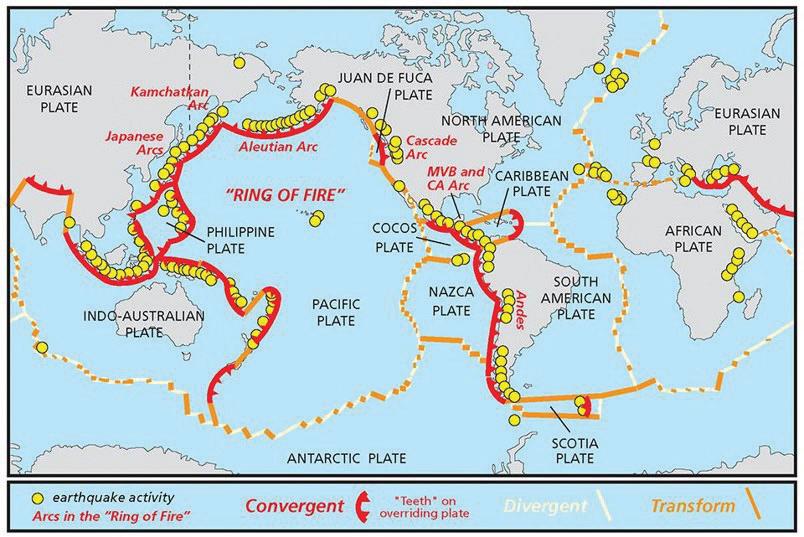
Looking more closely, you can see white lines that represent the boundaries of Earth’s tectonic plates, huge sections of the rocky lithosphere that slowly slip and slide, moving Earth’s crust in the process. Plate boundaries converge where an oceanic plate meets continental plates. Along these boundaries, the ocean crust is pushed down under continental crust, causing sudden shifts (earthquakes) and magma to push up and out in volcanic eruptions. This line of earthquake and volcanic activity is called the Pacific Ring of Fire.
When powerful forces, like volcanoes, act on the land, the changes can be dramatic and quick. In 1980, Mount St. Helens erupted in Washington State. The volcano blast was powerful. It created a big crater two miles wide. The top of the volcano was actually lost in the eruption. Take a look at the before and after pictures below. What differences do you see?
The photograph on the left shows Mount St. Helens before it erupted in 1980. The photograph on the right shows the crater that formed atop the volcano after the eruption.
Volcanoes allow melted rock to reach the surface of Earth. This liquid rock under Earth’s surface is called magma. When magma reaches the surface, it is called lava. When lava erupts quickly, it can change large areas of land. Over time, though, the lava cools and forms new rock and soil.
Want to spend your life studying volcanoes? Scientists who study volcanoes are called volcanologists. Many volcanologists study geology in school. Geology is the study of the solid parts of Earth, such as rocks. Some volcanologists study the kinds of lava from different volcanoes. From lava, they can learn what kinds of materials make up Earth’s interior. Another field of study is how to predict eruptions. We cannot yet predict eruptions accurately. Perhaps volcanologists will someday learn how.
The 1906 San Francisco earthquake damaged large parts of the city and killed thousands.
Earthquakes occur along cracks in Earth’s crust called faults. Some faults are no longer active and have not had an earthquake occur in millions of years. However, some faults, like the San Andreas fault in San Francisco, California, are very active and have had major earthquakes that caused a lot of damage. In 1906, a large earthquake hit San Francisco, California. The earthquake lasted only about a minute. Large cracks appeared in the ground. Many buildings were destroyed.
The severity of damage of an earthquake is measured on the Richter scale, where moderate damage is 3.0 and the most devastating damage is rated 9.0.
Meteorologists make weather predictions based on computer models that show the probability of events. Seismographs record tremors that can help predict earthquakes. Volcanologists study seeping gas and tremor activity from active volcanoes to help predict eruptions. Now complex mathematical models are being used by federal agencies to compute the statistical probability of such disasters to allow communities to take action. Prevention is the first step in protecting communities from natural disasters by such actions as building restrictions in flood or tidal zones, regional watershed management, and “firewise” construction that minimizes the spreading of fires.
Look Out!
Do Communities Protect Themselves from Natural Hazards?
The best way to stay safe during a natural disaster is to be prepared.
Hurricane
• Make a family disaster plan.
• Create an emergency supply kit.
• Listen to the news.
• A watch is issued 48 hours before damaging winds are possible.
• A warning is issued 36 hours before damaging winds are expected.
Flood
Tornado
Thunderstorm
• Have supplies on hand to protect your home.
• Do not walk or drive down flooded roads.
• Move to an area where there are as many walls as possible between you and the outside to protect you from debris.
• Listen to the news.
• A watch means conditions are favorable for a tornado to form.
• A warning means to take cover because a tornado is expected.
• If possible, go inside.
• Avoid wires, cables, and pipes that could carry an electrical charge if lightning strikes.
• If you are outside, avoid open areas.
• Try to find a car or building to go into.
• Do not stand under tall trees.
Earthquake
• Drop down onto your hands and knees so you do not get knocked down.
• Cover your head and neck with your arms to protect yourself from falling debris.
• Hold on to any sturdy covering so you can move with it until the shaking stops.
• Stay where you are until the shaking stops.
Volcanic eruption
• Prepare first aid and emergency supply kits.
• Make a family plan for an emergency evacuation.
• Listen and follow emergency radio announcements.
• Wear filter masks over mouth and nose to prevent breathing in harmful dust or gases.
Read the characteristics of natural hazards in the box below. Decide whether each characteristic describes a flood, hurricane, or tornado. Write each characteristic in the appropriate spot on the Venn diagram below.
• Can be caused by rainfall on nonporous ground
• Categorized using the Saffir-Simpson scale
• Develop over warm ocean waters only
• May happen anywhere
• Can result in damage to homes
• Violent, rotating columns of air extending from the base of intense storm clouds
• Categorized using the Enhanced Fujita scale
• Can be caused by rapid rainfall
• Categorized by wind speed and the amount of damage caused
When natural disasters strike, power outages are common due to the variety of severe weather situations. While many areas are using underground electricity lines to prevent the loss of power during a storm, it is still a good idea to have an emergency kit on hand in case your family is without power for extended periods of time.
With your child, make a list of the important things your family would not be able to do if your home was without power. For each item on the list, brainstorm a possible solution and write down the materials that would be needed for the solution to be put in action. Gather the items and put them in a large container that can be your emergency kit to use in the event of a natural disaster.
Here are some questions to discuss with your child:
1. What are some of the causes of a power outage?
2. How is a power outage reported?
3. How long will our emergency energy supply kit last?
4. Are there other places we could stay if our power was going to be out for a long period of time?
5. What are the dangers of a power outage that lasts for an extended period of time?
6. How can we protect ourselves and others (the elderly, pets, etc.) from these dangers?
1 It all starts out at sea. Warm ocean water mixes with warm, moist air. They swirl together in a deadly dance. These conditions can turn a mild thunderstorm into a powerful hurricane. This is how a destructive force of nature is born.
2 Hurricanes start in the southern Atlantic Ocean, the Gulf of Mexico, the Caribbean Sea, and the Pacific Ocean. At first, they are just small disturbances in the air. Heat from the ocean water warms the air above it. Evaporating seawater gives energy to the growing storm. These huge storms can bring heavy rainfall, giant waves, and powerful winds in their path. Hurricane winds range from 75 miles per hour to over 200 miles per hour. The center of a hurricane is the area of lowest air pressure. This center is called the hurricane’s eye. It is the calmest part of the storm; the air is surprisingly still, and there are no clouds. The storm swirls around the eye, rotating counterclockwise in the Northern Hemisphere.
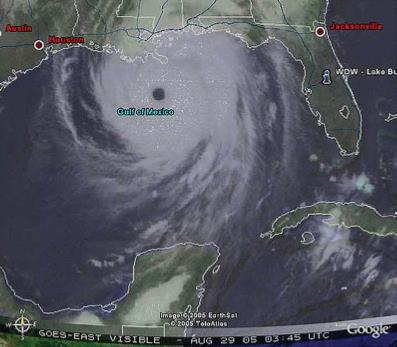
3 Hurricane season usually starts in the beginning of June and lasts until the end of November. Some years, many storms form. Other years, only a few storms form. Year after year, these violent storms have made their way onto shore, causing death and destruction. They do not just affect the coastline. Hurricanes continue inland, often causing flooding and wind damage all along their path.
4 One such hurricane was Katrina. This huge storm made landfall in New Orleans in August of 2005. Katrina was not the strongest hurricane recorded in the United States. However, it was the deadliest and costliest. It caused major damage to the Mississippi, Alabama, and Louisiana coasts. Its impact was felt for 90,000 square miles. It caused more destruction than any natural disaster in the history of the United States. Hurricane Katrina cost the United States approximately $75 billion in total damages. The picture shown above is of this very hurricane.
5 Hurricane Katrina’s 140-mile-per-hour winds caused giant storm surges. These storm surges had waves as high as 20 feet. The massive storm surge caused dams and levees to fail and flood low-lying areas. The waves and surge destroyed homes, schools, cars, and trees. Sadly, the death toll reached nearly 2,000 people. The impact of Hurricane Katrina can still be felt today. People are still rebuilding their cities and their way of life. It changed the way that the United States looks at hurricanes forever.
6 Another devastating hurricane blew in right on Hurricane Katrina’s tail. Hurricane Rita made landfall in September of 2005. This was just one month after the landfall of Hurricane Katrina. This storm developed in the same area of the Atlantic Ocean that Hurricane Katrina did. Hurricane Rita quickly became the strongest hurricane of 2005. Rita’s wind speeds reached 180 miles per hour. People had just started to recover from the destruction of Hurricane Katrina. Once again, they faced high winds, storm surges, heavy rain, and tornadoes. In Texas, more than three million residents were evacuated. This caused giant traffic jams for over two days. This was the largest evacuation in United States history. Unlike Hurricane Katrina, Hurricane Rita took the lives of only 120 people. Only seven deaths were directly caused by the hurricane itself. This time, the damage was estimated at approximately $10 billion.
7 Hurricanes are a deadly force of nature. Scientists study hurricanes to understand more about what causes them. Scientists are also trying to learn how to warn people sooner. This would give them more time to get to safety. Scientists believe that the average number of hurricanes per year is increasing. Hurricanes also seem to be getting stronger. This may be a result of global warming. It might also result from temperature changes deep in the Atlantic Ocean caused by natural environmental cycles. In either case, scientists predict that severe hurricanes will form more frequently in the future.
1 What conditions must be in place for a hurricane to form?
A A thunderstorm that forms over cool ocean water with cool, dry air
B The same conditions that form a tornado
C A thunderstorm that forms over warm ocean water with warm, moist air
D Heavy winds, torrential rain, and storm surges
2 Why can a hurricane cause so much destruction?
A Hurricanes have high winds with torrential rains, storm surges, and possible tornadoes.
B Hurricanes move fast, destroying everything in their path.
C When the eye of the hurricane reaches land, people think the storm is over.
D All forces of nature cause destruction.
3 Hurricane Katrina and Hurricane Rita are similar in what way?
A They began as small storms over the Atlantic Ocean.
B They caused major damage to the Texas coast.
C They had wind speeds of 140 miles per hour.
D They caused the biggest evacuations in United States history.
4 Hurricane Katrina and Hurricane Rita are different in what way?
A Hurricane Katrina had a very large storm surge, while Hurricane Rita did not.
B Hurricane Katrina caused more death and destruction than did Hurricane Rita.
C Hurricane Katrina was a much stronger storm than Hurricane Rita.
D Hurricane Katrina was the only one that made landfall.
5 What is the best summary of this passage?
A Hurricane Katrina was the deadliest and costliest hurricane in United States history.
B Hurricanes are destructive, but not as destructive as tornadoes.
C Hurricanes gain energy and develop over warm ocean water and can be costly to humans.
D Scientists study hurricanes to be able to better predict their formation and movement.
6 Which of the following is NOT true?
A Hurricane season starts in the beginning of June and lasts until the end of November.
B Hurricanes are a deadly force of nature.
C Evaporating, warm seawater gives energy to the growing hurricanes.
D Every year, there are a lot of hurricanes.
1. An image of the relative motion at a tectonic plate boundary is provided below. What type of boundary is this? The San Andreas Fault in California is this kind of fault. What type of event can occur along this fault that people living nearby need to be aware of and prepared for?
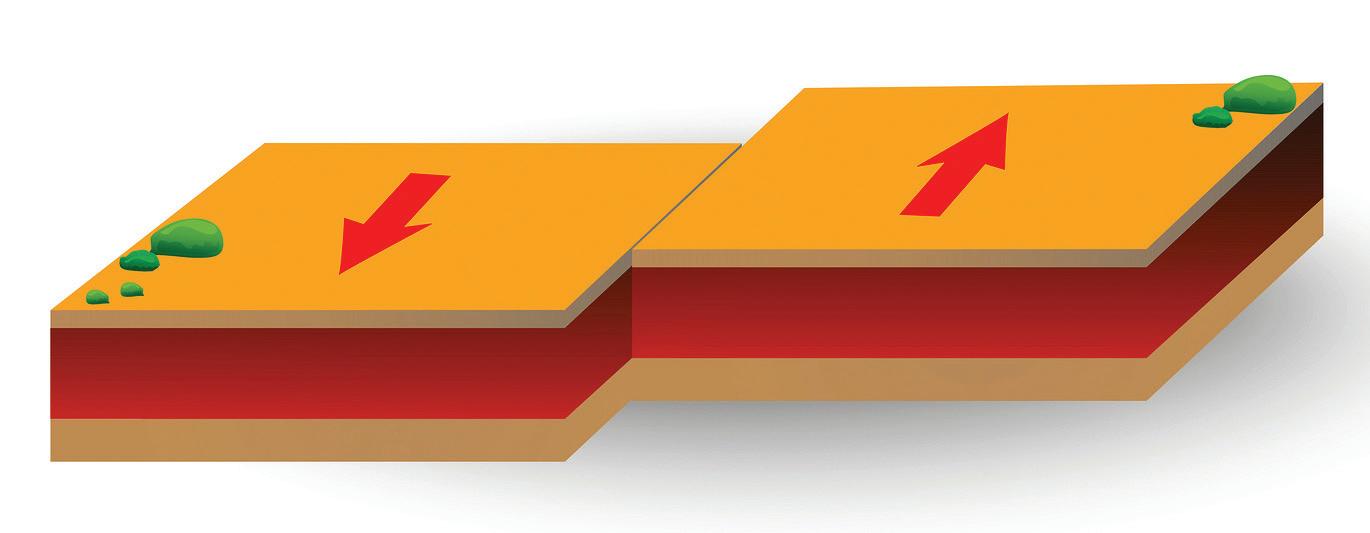
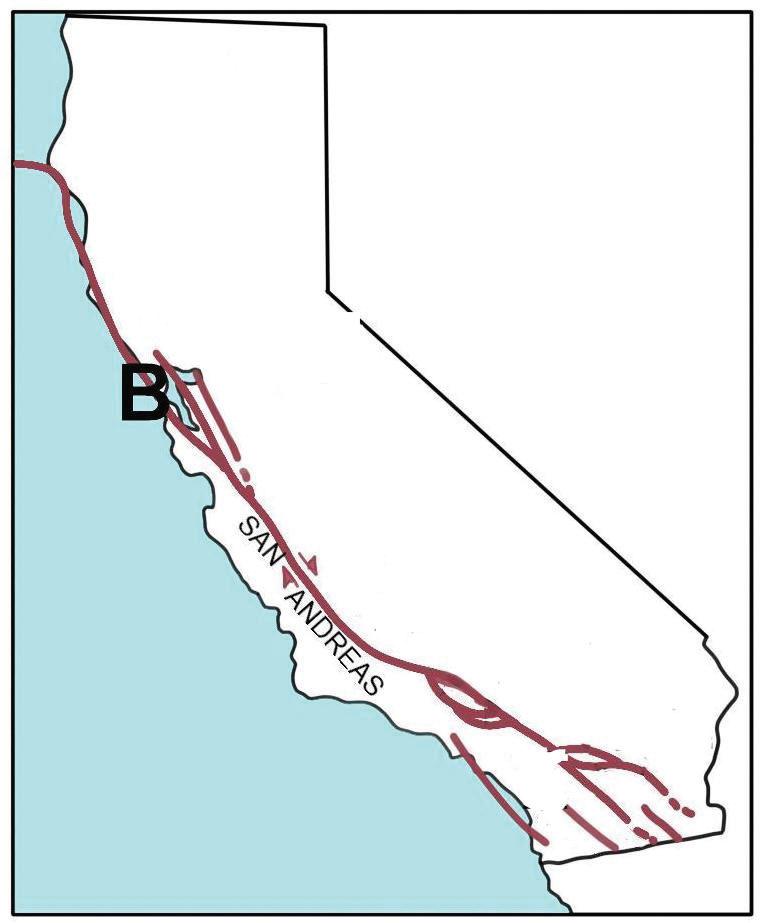
2. Describe the population density along the Ring of Fire (on the tectonic plate boundary of the Pacific Plate) and the effect that earthquakes or volcanic activity can have in this area.
3. What resources do scientists use to predict when and where future catastrophic events may occur? What are the most effective technologies?
4. What are some kinds of damage a hurricane can cause as it strikes land? A town on the coast of Mississippi wants to protect people and property from the storm surge that accompanies hurricanes. Design a process the town can follow to reduce the impact of a storm surge from a hurricane in the Gulf of Mexico that makes landfall nearby.
Earth’s surface can be changed through natural processes that can be gradual or sudden. Scientists are able to observe natural processes to predict future hazards to humans. Scenario 1
Write a scientific explanation to justify the need to prepare for natural hazards more in China than in Norway. Prompt 3
Claim:
Evidence:
Reasoning:
Rebuttal:
PEER EVALUATION
Peer Name:
Rebuttal:
1. Observe the quantity of classroom garbage (and recycling, if available) your class produces in a week. Note it in your lab journal.
2. With your group, look at the different kinds of waste produced, and make a list in your lab journal.
3. Did the amount of waste surprise or concern you? Record your reactions in your lab journal.
4. Did you find anything that could be recycled? Did you find anything that could be reused? Make a note in your lab journal.
5. With your group, brainstorm other ways your class can reduce garbage and recycling. Make a list in your lab journal.
6. Write a recommendation in your lab journal for one action that your class should take to reduce waste right away.
7. Help clean up after the activity as directed by your teacher.
As the global population expands, energy usage has become a major concern. There have been many advancements in the fields of both renewable and nonrenewable resources. The advancements in nonrenewable resources are focused on making the products of petroleum and coal more environmentally beneficial than harmful. Advancements in renewable resources are focused on replacing or at least conserving the use of nonrenewable resources. Both are focused on improving localized and global environmental problems.
The state of Mississippi is a coastal state that has access to all energy resources. There is even an active coal mine close to Ackerman, Mississippi, that has been in operation a little over ten years. Mississippi also has several renewable energy programs throughout the state, several of which are solar and wind based. Other types of renewable energy sources to consider in the state are biomass energy and hydroelectric energy.
A local community has been informed that a new energy plant is going to be built just outside the city limits. The state energy department has determined that the city should be the primary decision maker on the type of energy source that will power the plant. The role you will play is that of a community stakeholder group (a group or business that this plant will impact). The goal is to pick a type of renewable energy and prepare a presentation that will persuade the city to choose this type of energy. It is important to understand that citizens across the country are very sensitive to the idea of getting rid of nonrenewable resources such as petroleum and coal due to the fact that several jobs are tied to those resources. Your presentation should not consider those energy sources as negative but as resources that need to be conserved and advanced to be more efficient and beneficial to the environment nationally and globally.
Use a smart device, computer, and reference sheet to find information on energy sources for Mississippi. Work as a group of four to design the presentation listed below. Each member must present a part!
The presentation will be considered persuasive if it includes the following:
1. Identify a specific type of renewable energy source. (Do not simply say solar. Be specific about a plan; for example, panel fields or buildings equipped with panels wired to a grid.)
2. Explain in list or bullet form a set of technological advancements that benefit the consumers and environment.
3. Explain the negative aspects of your energy source, such as possible initial increased costs or vulnerability to weather.
4. Explain the reasons why other energy sources such as petroleum or coal would not be the right choice and how your energy source will help decrease national and global dependency on these resources. (Do not simply say they are bad for the environment.)
5. Explain what immediate results will come from your energy source and what results will be seen over a longer period of time.
A new energy plant is being built just outside the city. What type of energy would be the best source to improve the environment and decrease the need for nonrenewable resources locally, nationally, and globally?
Citizen Stakeholder Energy Type Proposal (Claim):
Citizen Stakeholder Proposal Points (Evidence and Reasoning):
Citizen Stakeholder Rebuttal Notes and Questions (for other proposals)
Notes to answer questions asked about your proposal:
Questions you have for other presenters:
1. What are some advancements in renewable energy that could help decrease dependence on nonrenewable resources?
2. What are some advancements in nonrenewable resources?
3. How can advancements in nonrenewable energy help on a national and global scale?
4. Why is it important to develop advancements in both renewable and nonrenewable resources instead of just eliminating the use of nonrenewable resources?
Part I: Environmental Issues
Station 1: Agriculture and Chemical Runoff
Prompt
Write a scientific explanation describing how agricultural practices could be altered or changed to help with the environmental impact without eliminating the need for agriculture.
Station 2: Global Average Temperature Increase
Prompt
Write a scientific explanation describing how average temperature could be altered or changed to help with the environmental impact without incurring significant high costs.
Station 3: Overfishing
Prompt
Write a scientific explanation describing how fishing practices could be altered or changed to help with the environmental impact without eliminating the need for fisheries.
Station 4: Deforestation
Prompt
Write a scientific explanation describing how forestry practices could be altered or changed to help with the environmental impact without eliminating the need for forestry.
Station 5: Industrial Growth and Pollution
Prompt
Write a scientific explanation describing how industrial practices could be altered or changed to help with the environmental impact, but without eliminating the need for the specific industrial practice you briefly researched.
Station 6: Population Increase
Prompt
Write a scientific explanation describing how population growth can be slowed or stopped to help with the environmental impact without eliminating human reproduction entirely.
Station 7: Transport and Fossil Fuels
Prompt
Write a scientific explanation describing how transport and fossil fuel consumption could be altered or changed to help with the environmental impact, but without eliminating the need for transportation completely.
1. Environmental issue: Which of the problems above do you think need to be fixed?
2. Policy or law you would create: How would you address your chosen problem?
3. Monitoring/implementation of policy or law: How would you make sure everyone follows your plan?
4. Issues that are raised by classmates: What are things that individuals affected by your proposed plan think should be addressed or fixed?
5. Your defensive responses to the issues: How do you make everyone happy about your plan, or at least willing to comply with your plan due to your explanations?
1. What are some ways humans have environmental impact?
2. What issue with your plan was the most difficult to address?
3. If you could rewrite your original plan or law, how would you alter or rewrite?
4. You created your own plan for repairing an environmental issue. How did your idea compare to what is currently out there for that specific environmental issue?
One of the major consumers of energy in the average home is the water heater. Water heaters use natural gas, propane, or electrical energy to heat water to 140°F (60°C), holding it at this constant temperature. Pipes distribute this hot water to the house, where it is used for cooking, cleaning, and bathing. Holding a large mass of water at a high temperature requires a large amount of energy. Our goal is to conserve natural resources, so how could you reduce energy consumption while still keeping hot water?
Earth’s temperature is maintained by the Sun. It should be possible to capture the Sun’s energy and use it to heat water. This is called a solar heater or solar oven. Using a combination of reflection of light, heat conduction, and heat radiation, it is possible to gather the Sun’s energy and use it to heat water. Materials that are good for reflection include foil and mirrors, while dark materials are better for heat radiation.
Test materials that could be used in a design model of a new device that will heat water to a desired temperature, draw a detailed diagram of a prototype of the new device that includes the transfer of energy through the designed system, and build a prototype of your solar heater that meets the goal criteria.
Criteria and Constraints
• Use materials easily accessible and typically found in your home or school environment.
• Device must be no larger than 24” x 24” x 24”.
• Must heat water to a temperature of _____________________ within ________________.
Procedures
Use your lab journal to record all of your steps and observations.
A. What is the problem? (State the problem in your own words.)
• Analyze the Criteria and Constraints to identify the scientific principles that apply and determine any limitations to possible solutions defined by the principles.
• Analyze what potential impact a design may have on people and/or the natural environment and how it may limit possible solutions.
B. Explore and research the problem. List what you know and what you need to know.
• Research information about the best materials to use for your project.
• Brainstorm and diagram possible designs for the model.
• Select the best design. Show the design to your teacher for approval.
C. Brainstorm and design a solution to the problem.
• Identify what materials you will use. Create some sketches or diagrams of your approach. You may need to brainstorm with other people on other teams to share ideas.
D. Build, test, and analyze your solution.
• What information will you include in your model?
• How will you determine whether or not the materials you choose will be effective for your design?
• Test your materials.
• Draw a diagram that shows the transfer of energy through the designed system.
E. Improve or redesign and retest your solution.
• What errors could have been made during testing, and how can you improve this technique?
• Were you able to find adequate materials for a solar heater that can maximize thermal energy collection and transfer? If not, what changes do you need to make to your material choices?
• Develop a detailed plan of your prototype, including diagrams and a parts list.
F. Present and share your solution.
• Build your prototype according to your designs and diagrams.
• Decide how you will share your prototype with the teacher or class.
• Discuss how you will test the effectiveness of your prototype.
• Conclude with a class discussion.
How do humans affect the environment? In general, very badly. Changes that are induced by human activity are called anthropogenic changes. Examples of anthropogenic changes include habitat destruction, pollution, introduction of invasive species, overexploitation, and climate change.
All anthropogenic changes can disrupt an ecosystem and threaten the survival of some of its species. Examples below describe different types of anthropogenic changes that disrupt the environment.
• Habitat destruction: Animal habitats are destroyed for a variety of reasons, such as the need for additional farmland, increased need for roads or bridges, new housing or business developments, etc. When a habitat is destroyed, such as with deforestation, the populations of many native species will decrease significantly.
• Pollution: Overuse of automobiles and factories releases gaseous waste, such as sulfur, sulfurous oxides, and nitrous oxides, which cause air pollution. Oil from roads, fertilizers from crops, and other chemical substances contaminate runoff and pollute the water. This pollution can harm animal and plant species and, in some cases, wipe them out completely from an area.
• Introduction of invasive species: Animals or plants that are not native to a particular area and seem to “take over” when introduced to it are considered invasive species.
Some invasive species happen intentionally by humans (e.g., planting things from their native country to feel more at home), while others happen accidentally (e.g., a box being shipped across the world accidentally carrying beetles).
Regardless of how they are introduced, the invaders take away the resources that native species need to survive.
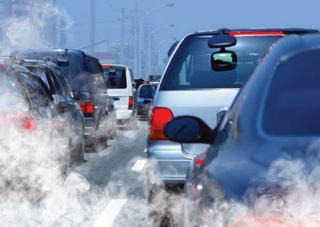
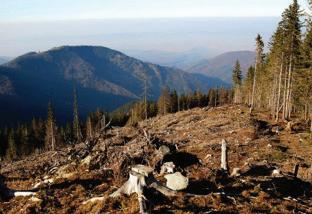
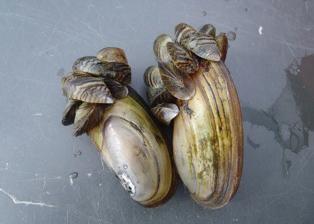
Anthropogenic Changes, continued
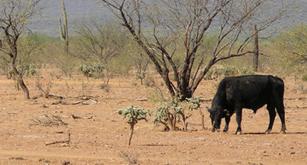
• Overexploitation: When a piece of land is overfarmed or overgrazed, the soil loses its nutrients and becomes useless. This is called overexploitation. When an area is overexploited by humans, the area is stripped of its resources and ability to keep living organisms in balance. Without this balance, the ecosystem collapses.
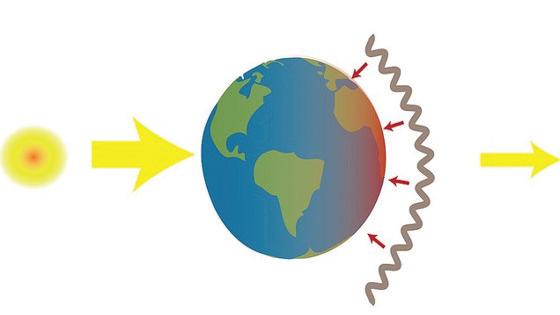
Greenhouse gases from human pollution are trapped by the Sun and contribute to Earth’s climate change.
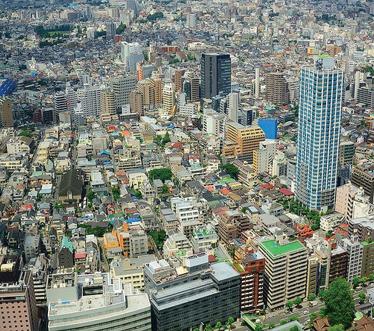
• Climate change: A change in the common weather patterns of an area constitutes climate change. Indicators of climate change are increased frequency of weather disasters, unseasonably cold/hot conditions, natural disasters occurring in locations in which they typically never do, etc. Some of the human activities discussed earlier have been linked to climate change, which is commonly called global warming.
Since humans depend on the living world for the resources and other benefits provided by biodiversity, why are we destroying the very resources we need to survive?
There are many reasons, but the most prevalent is overpopulation. There are more people on Earth than ever before, and every person requires food, housing, and other resources. With more humans competing for resources, the natural environment is being negatively affected more than ever.
The amount of different types of species in a specific ecosystem is its biodiversity. A lush rain forest, for example, has much more biodiversity than a tropical ocean. When a new species is formed, a process called speciation, its biodiversity increases. Alternatively, when an entire species becomes extinct, the biodiversity of the ecosystem decreases.
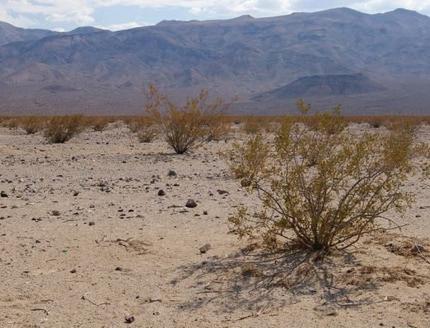
Sustaining Biodiversity
Why is sustaining biodiversity for the purpose of maintaining an ecosystem’s functions and productivity essential to supporting and enhancing life on Earth?
Biodiversity is necessary in an environment because it protects against a single disease destroying an entire ecosystem. The more diverse an area is, the healthier it is.
Sustaining biodiversity also aids humanity by preserving landscapes of recreational or inspirational value. We see this most often in the protected areas of our national parks and preserves.
speciation: the formation of a new species
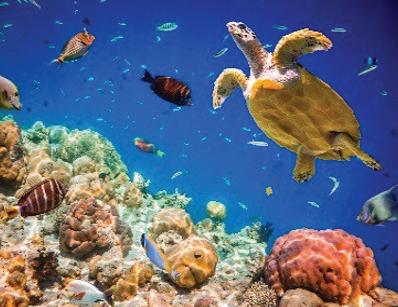
National parks allow people to preserve the biodiversity and natural beauty of different environments.
In order for people to sustain the quality of living to which they are accustomed, they need to responsibly manage the usage and treatment of natural resources. Think back to how much water you personally use on a daily basis. Now multiply that by the number of people in the world.
To help prevent the overuse of natural resources, such as water, policies have been established to manage it. Some cities regulate when and how often grass can be watered. Other communities recycle runoff water and use it to irrigate other areas without having to use drinkable fresh water. When policy decisions are made, there needs to be adequate monitoring of environmental parameters.

Individuals drink water, use it to cook, and bathe in it every day.
Water is not the only natural resource that needs to be responsibly managed. For example, modern societies require electricity to function— lots of electricity. How do the electrical companies find the energy to supply this electricity? They find it predominantly through natural resources, such as fossil fuels and coal.
These nonrenewable resources cannot be the sole answer to the world’s energy needs because, as the term indicates, once nonrenewable resources are used up, they are gone forever.
Therefore, in order to sustainably meet the energy needs of society, people have begun to invest time and money into developing alternative energy resources. The picture to the right shows two of these alternative energy options (solar and wind).
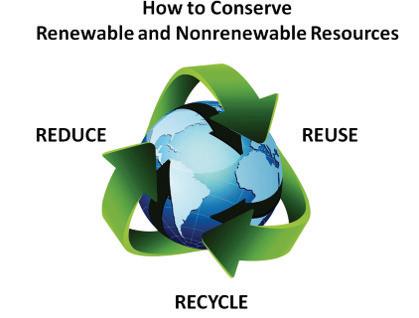
There are several benefits to using renewable resources over nonrenewable resources. First, alternative energy is renewable. There is no shortage of wind, Sun, or flowing water. Scientists predict that the oil we use to make gasoline might be used up as soon as the year 2050. Unlike fossil fuels, there is no need to worry about running out of alternative resources, because nature replenishes them.
Another advantage to alternative energy resources is that they are better for the environment. Fossil fuels pollute in two main ways: they have to be dug out of the ground by mining or drilling (which pollutes the air), and they pollute the air when they are burned. These processes damage the land and water, sometimes permanently. A major oil spill can kill aquatic animals and pollute beaches. This building produces ethanol, a biofuel made from corn. Corn is a renewable energy resource. However, making and using ethanol creates pollution.
Fossil fuels pollute when they are used (or burned). They must be burned in order to get energy out of them. The chemicals released by burning fossil fuels pollute the air, water, land, and living things, including our bodies.
Because we do not have to burn most alternative resources to release their energy, they do not pollute the air or water. The exception is biofuels, which are burned.
Alternative energy resources have lots of advantages, so why do we still use fossil fuels? The answer is that alternative energy resources also have some important disadvantages.
Capturing energy from alternative resources is still more expensive than using fossil fuels. Using alternative energy is rather new. Most machines and processes—including driving most vehicles—still rely on fossil fuels. Replacing these machines, developing new technologies, and changing processes are costly. However, the world is moving in the direction of using more alternative energy. Perhaps by the time you are grown up, you will be living in a solar house and driving a sugar-powered car!
Look Out!
When evaluating solutions, it is important to take into account a range of constraints, including cost, safety, reliability, and aesthetics, as well as any social, cultural, and environmental effect of the potential solution. This is because effective solutions to curb anthropogenic changes may be too expensive to be implemented. Solutions that are not safe or reliable are obviously discounted as well.
What are some ideas you can think of to help combat the anthropogenic changes that are currently occurring in our environment?
Try Now
People must work together to sustain the natural environment.
To illustrate the differences between the negative and positive impacts of human interactions with the environment, draw a six-panel comic below. In the top three squares, draw negative impacts humans have on the environment. In the bottom three squares, draw the positive impacts of sustaining the environment’s biodiversity.
To help your child learn about the benefits of sustaining high biodiversity in an ecosystem, explore your garden or plant a vegetable garden together. Ideally, you can even plant some additional things in your garden to help demonstrate the increase of biodiversity when new native species are added to an ecosystem.
If you do not have a garden, go on a walk in your neighborhood or community. Try to count all the different species you see in your garden or on your walk.
Here are some questions to discuss with your child:
• What is biodiversity?
• How does biodiversity help sustain an ecosystem?
• Were there any invasive species you encountered?
• How do invasive species impact an ecosystem?
1 There has been a huge growth of cities and other urban areas over the past 100 years. Older building practices led to an unexpected result. A phenomenon called urban heat islands were created as urban areas grew. An increased amount of asphalt and other dark materials used in construction absorbed more heat energy than grass and other natural ground materials.
2 More recently, scientists used satellite images to measure the air temperatures of cities and the surrounding areas. They also took careful air temperature readings. They found that the increase in the amount of glass on buildings and even parked cars increased the amount of heat that was found near the ground in urban areas. Therefore, many urban areas were (and still are) often hotter than the surrounding rural areas. These hot urban areas are known as heat islands.
3 Urban heat islands occur year-round but become especially important in the summer months. As average daily temperatures increase, the urban areas become much hotter than the surrounding areas. Even more interesting is that the temperature difference between the cities and the country is much larger at night. Urban areas retain more heat than the surrounding areas. Not only is this trend uncomfortable for the people who live in urban areas, but it can also have even farther-reaching effects. An increase in temperature causes a demand for an increase in air conditioning farther into the night. As a result, more CO2 is emitted into the atmosphere as energy demands increase.
4 A lot can be done to offset the effects of heat islands. Many modern builders are turning to what are called green building methods. This means that every aspect of the building process includes an effort to reduce environmental impact in some way. In order to be considered truly green, buildings must meet certain standards. They must be energy efficient, reduce waste, use water efficiently, reduce the amount of toxins produced, improve both indoor and outdoor air quality, and recycle. This includes all building types. Schools, businesses, health-care facilities such as hospitals and laboratories, factories, and even the homes we live in can be green. Even though many of these standards are for buildings that already exist, this is especially true for new construction.
5 New advances in building methods include using materials that do not absorb as much heat. Many builders are currently installing roofs that do not absorb as much heat as older types of roofs. This includes installing roofs that have a lighter color or that contain materials that reflect heat instead of absorbing it. Solar panels are often used on the roofs of modern buildings to help harness the energy from the Sun. The most exciting new roof system is called a green roof. This type of roofing system actually uses plants to help offset the urban heat island issues. The roof is typically covered with a waterproof membrane, and then vegetation is planted on the roof itself. These types of roofs trap rainwater for the plants and help with building insulation.
6 An even more beneficial result of using green roofs is an increase in the absorption of CO₂ emissions from urban areas. It has been shown that green roofs can actually extend the life of a building roof by almost 200%. They also reduce energy usage and provide a habitat for animals and birds in growing urban areas. Although the cost of installing a green roof can be higher than a traditional roof, the building will save money in the long run. Other efforts to reduce the effects of heat islands in urban areas include planting more trees and vegetation in new developments and using lighter materials for paving and building structures.
1 Many modern builders are using what are called green building methods to help lower our impact on natural systems. What is the correct definition of a green building practice?
A A practice in which every aspect of the building process works to reduce environmental impact in some way
B A building practice that uses materials that reflect heat instead of absorbing heat
C A building practice that reduces waste, improves air quality, and recycles
D All of the above
2 Urban heat islands occur as urban areas become more developed. Which of the following statements regarding urban heat islands is NOT true?
A Certain building materials retain more heat.
B Urban areas retain (hold) more heat than the surrounding countryside.
C Urban heat islands occur only in the summer.
D Hotter urban areas use more electricity than rural areas.
3 Human activities can have large effects on natural systems. Based on this reading, what is one of the largest positive effects that humans can have on their environment?
A Living in houses instead of large buildings
B Not using air-conditioning
C Using materials in buildings that do not absorb as much heat
D Removing electronic chargers from outlets
4 A city planner wants to help reduce the urban heat island effect in her community. What is the most important thing that the planner could suggest in order to help reduce this effect?
A Plant more trees and vegetation in both new buildings and other urban areas.
B Demand that fewer buildings be built.
C Encourage more people to move to the rural areas.
D There is nothing that can be done to reduce this effect.
5 Green roofs are being installed more often on both commercial buildings and homes. What is a major advantage of using a green roof?
A It increases building insulation.
B It provides a habitat for animals and insects.
C It absorbs CO₂ emissions.
D All of the above are true.
6 Which type of structure does not have the potential to contribute to urban heat islands?
A Large schools do not have that potential.
B Large businesses with large parking lots do not have that potential.
C Roads, highways, and rooftops do not have that potential.
D All structures have that potential.
1. Although solar energy, hydroelectric power, and wind energy are among the best-known renewable resources, in recent years geothermal energy has become popular as an alternative source of energy. List two advantages and two disadvantages of this energy source.
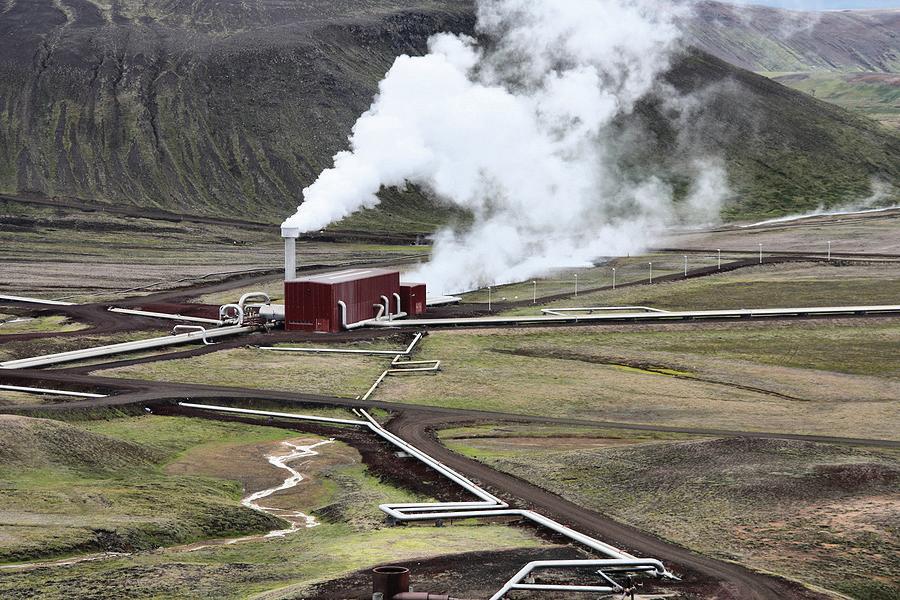
2. What are some actions that communities can take to help protect Earth’s resources and environments?
3. As technological advancements in renewable energy make renewable resources more appealing, what are the costs and benefits of using renewable and nonrenewable resources?
4. Solar energy is an appealing renewable resource, especially in locations that receive large amounts of sunlight. Develop a system to capture and distribute solar energy in a way that makes it easily available while reducing human impact on the environment. Draw and explain your design below.

absolute geologic dating chromosome
absolute geologic dating: the process of determining an approximate computed age in archaeology and geology; carbon dating is one example
adaptation: a process by which a population becomes better suited to its environment by increasing the frequencies of alleles that provide benefits to survival and reproduction
alleles: different versions of a gene
amplitude: the height of a wave from the origin to the crest
asexual reproduction: the reproductive process that involves one parent and produces offspring identical to the parent
asthenosphere: the solid layer with plasticity in the upper mantle that is located just below the lithosphere; lithospheric plates “float” and move on this layer
atmosphere: the layer of gas surrounding planet Earth, held in place by gravity and composed of a limited number of elements, primarily nitrogen and oxygen
binary fission: a type of asexual reproduction in which one cell divides to form two identical cells, such as what occurs in prokaryotic cells
budding: a type of sexual reproduction in which an offspring grows out of the parent organism
chromosome: a single, highly organized, and structured piece of DNA
common ancestry dominant
common ancestry: when organisms are descended from a single ancestor
conservation: efforts to wisely use, distribute, and protect valuable resources such as fresh water, soil, unique environments, and energy resources, as well as natural and human-made materials
convergent boundary: occurs when two tectonic plates move toward each other and collide
convergent boundary with mountain building: a major geological event; occurs when continental plates of equal density converge
convergent boundary with subduction: the boundary between two tectonic plates moving toward each other, resulting in volcanic activity when a denser oceanic plate subducts, or moves below, a continental plate or another oceanic plate
crest: the highest part of a wave
digitized signals: signals represented by a series of numbers
divergent boundary: the boundary between two tectonic plates moving away from each other—on land it creates rift valleys, on the seafloor it creates new ocean crust and mountainous ridges
dominant: an allele that is always expressed
earthquake: major geological event that occurs when plates shift suddenly and release stored energy; a frequent occurrence along all types of plate boundaries
Earth’s evolution: the geological history of Earth that contains the major events in Earth’s past; based on the geologic time scale, it’s a system of chronological measurement based on the study of Earth’s rock layers
environment: all of the living and nonliving factors in an area
evolutionary history: change in the frequencies of alleles in a population over time
favorable traits: traits that are beneficial to an organism and will likely be chosen by natural selection
fossil evidence: any remains, impression, or trace of a living thing of a former geologic age, such as a skeleton, footprint, etc.
fossil record: the mineralized remains of organisms and the rock layers in which they are found, showing when and where long-dead organisms lived and how their bodies were structured
fossils: the mineralized remains of organisms, showing how long-dead organisms lived and how their bodies were structured
fungi: heterotrophic eukaryotes that reproduce through asexual spores; they break down dead materials and can spread disease
gene geological time scale
gene: a segment of DNA that contains specific instructions for building a functional molecule; the basic unit of heredity
gene pool: all the genes in any population
generation: organisms of the same species that are at the same level of descent from a common ancestor; a parent is a member of one generation, and its offspring are members of the next generation
genes: carry information in living cells and determine an organism’s traits or characteristics; inherited from an organism’s parent(s)
genetic engineering: the process of genome engineering in order to favor the expression of desired physiological traits or the production of desired biological products
genetic variation: the reproductive process involving two parents whose genetic material is combined to produce a new organism different from themselves
genotype: the exact genetic information carried by a single individual geological event: disturbance caused by processes occurring within Earth’s crust
geological record: all of the layers of rock deposits laid down, including all their fossil contents and the information they contain about the history of Earth
geological time scale: system of chronological measurement that relates stratigraphy (study of rock layers) to time
geoscience process
geoscience process: any process that happens on Earth, such as weathering, erosion, or plate tectonics
geosphere: portion of Earth system that includes Earth’s interior, rocks and minerals, landforms, and the processes that shape Earth’s surface
hazardous weather: severe or dangerous weather phenomena that threaten life and property
human activity: things that humans do
hydrosphere: all of the water on Earth
infrared: electromagnetic waves with longer wavelengths than visible light but that are shorter than radio waves
inherited characteristic: a characteristic that is passed from parent to offspring
large-scale system interactions: earthquakes, volcanoes, etc.
light waves: electromagnetic waves with a shorter wavelength than visible light but that are longer than X-rays
lithosphere: the cool, rigid, outermost layer of Earth; consists of the crust and the uppermost part of the mantle; it’s broken into pieces or segments called plates
loudness: determined by the amplitude of the sound wave; the higher the amplitude, the louder the sound
meiosis: a process of cellular division whereby a single diploid cell divides into four haploid gametes
microwaves pedigree
microwaves: electromagnetic waves that are between radio waves and infrared waves in the electromagnetic spectrum
mid-ocean ridge: an underwater mountain system formed by plate tectonics; the largest single volcanic feature on Earth
mitosis: a process of cellular division whereby a single diploid cell divides into two identical diploid cells
mutation: a change in the DNA
natural hazard: an event in nature that may have a negative effect
natural resources: resources that exist in the environment without human intervention
natural selection: a process by which organisms with favorable traits produce more successful offspring than organisms with less favorable traits, causing the favorable traits to become more common in the population
nonrenewable: an energy resource that takes millions of years to form from the remains of plants and animals, such as coal, oil, and natural gas
offspring: product of reproduction of a new organism produced by one or more parents organic material: material from the remains of dead organisms and their waste products in the environment
pedigree: a diagram that shows how traits are passed through multiple generations
phenotype renewable
phenotype: the physical appearance of an organism
plate boundary: the place where two different plates have contact
plate tectonics: theory that the lithosphere is divided into tectonic plates that slowly move on top of the asthenosphere
pollution: the presence of harmful or unwanted levels of material in the environment
population: members of the same species that live in the same geographical area; may be distinctly different than populations living elsewhere due to the spread of local adaptations within a population
Punnett square: a chart that shows the likelihoods of all possible genotypes and phenotypes for a certain trait or traits resulting from a cross between two parents with known genotypes
radio waves: electromagnetic waves with long wavelengths and low frequencies
recessive: an allele that is only expressed if there is no different allele present
recycling: Reduce: to make smart purchasing decisions that result in less waste and packaging; Reuse: to find ways to reuse containers and products; Recycle: to properly dispose of used resources so they can be reprocessed into new products
renewable: able to be replaced or regenerated in a short period of time
rock strata
rock strata: a bed or layers of sedimentary rock having approximately the same composition throughout
selective breeding: a form of artificial selection whereby deliberate breeding results in desired traits in plants or animals
sexual reproduction: the reproductive process involving two parents whose genetic material is combined to produce a new organism different from themselves
sound wave: a sound wave is the pattern of disturbance caused by the movement of energy traveling through a medium such as air, water, or any other liquid or solid matter
spectrum: a continuum of all electromagnetic waves arranged according to frequency and wavelength
vegetative propagation
theory of evolution: an explanation for how living things change over time
topography: a description of land surface area with reference to elevation variations
trait: a characteristic of an organism; can be genetic or acquired
transform boundary: occurs when two tectonic plates slide past each other
trough: the lowest part of a wave
variation: the occurrence of an organism, trait, or gene in more than one form
vegetative propagation: a type of asexual reproduction by which one plant produces new plants that are genetically identical to the parent plant
wave speed: a wave property of how fast it is moving volcanic eruption wave speed
volcanic eruption: event in which molten rock spews out from the mantle to the surface of Earth as ash, lava, and gases
waste: unwanted materials that are disposed or recycled
wave: a rhythmic disturbance that moves through a medium or vacuum
wavelength: the distance between successive crests of a wave