Employees who feel valued and trusted are more likely to represent their workplace positively beyond its walls.
MOBILE APP
Download our Acacia Connection mobile app to get access to a wide range of resources and tools to help you navigate life’s challenges and prioritise your mental health.
Small, intentional leadership actions can significantly influence engagement, wellbeing, and outcomes during times of uncertainty.
MEETING FATIGUE WITH A CALENDAR THAT NEVER BREATHES
White space in a calendar isn’t laziness or inefficiency It’s where thinking happens It’s where decisions settle, insights connect, and stress dissipates
IMPACTS
OTHER SKIN CONDITIONS
Understanding the emotional and psychological dimensions of skin conditions is essential for both individuals and workplaces committed to holistic wellbeing
CREATING INCLUSIVE WORKPLACES
During periods of unrest, the workplace can quietly shift Some people may become withdrawn or less engaged Others may feel anxious, distracted or emotionally exhausted
FROM THE CEO
REBECCA WEISS CHIEF EXECUTIVE OFFICER
As we step into 2026, many organisations are moving with renewed focus and intention The beginning of the year often brings fresh goals, strategic planning, and a sense of momentum. Yet alongside ambition, there is also complexity Change, uncertainty, and global events continue to shape how people feel, think, and show up at work.
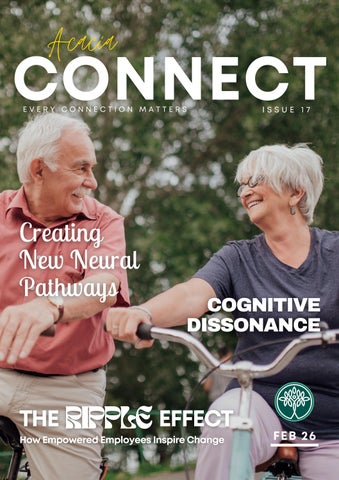
In this edition of Acacia Connect, we explore what it means to lead and live with awareness in times of tension and transition. From understanding cognitive dissonance and the discomfort that can arise when our values and actions do not align, to recognising the brain’s capacity to build new neural pathways through intention and practice, this issue highlights the power of reflection in driving meaningful growth.
We also examine the ripple effect of empowered employees and the critical role leaders play in creating environments grounded in trust and psychological safety Small actions, repeated consistently, shape culture more than any single initiative.
Importantly, we acknowledge the broader context in which workplaces operate. Periods of global unrest and social tension can quietly influence wellbeing, engagement, and inclusion Creating safe and respectful spaces is not a one time effort, but an ongoing commitment expressed through everyday interactions.
At Acacia, we believe that growth is not about dramatic transformation. It is about steady, thoughtful choices that align intention with action When individuals feel supported to reflect, adapt, and contribute authentically, organisations strengthen from the inside out.
As the year unfolds, I encourage you to consider what small shifts may create meaningful impact in your work, your leadership, and your wellbeing Thank you for continuing to prioritise connection, compassion, and care.
How Empowered Employees Inspire Change The Effect
In workplaces around the world, leadership conversations often focus on strategy, market trends, quarterly results and organisational goals. Yet in the quieter spaces between these priorities sits something just as powerful and often overlooked People Specifically, the impact that empowered employees have on culture, innovation, resilience and performance When individuals feel trusted, supported and confident to act, their influence extends well beyond their role They become catalysts for meaningful change, creating a ripple effect that can transform teams and organisations alike.
At its heart, employee empowerment is about autonomy, clarity and trust. It is not a trend or a leadership slogan It is a way of working that recognises employees as capable contributors rather than passive recipients of instruction. Empowerment builds ownership. It strengthens engagement It invites people to bring forward ideas, make decisions and take responsibility in ways that feel authentic and valued.
Why empowerment matters more than ever
Research consistently highlights the connection between empowerment and performance. Studies published by the Harvard Business Review show that employees who feel empowered report higher job satisfaction, stronger commitment to their organisation and improved performance outcomes. Empowered employees are also more likely to show initiative, propose innovative solutions and respond effectively to challenges without waiting for direction These behaviours not only improve efficiency, but also create momentum within teams as confidence and capability grow
In an environment shaped by rapid change, uncertainty and growing complexity, empowerment becomes even more critical Organisations need people who can think independently, adapt quickly and respond thoughtfully Empowerment supports this by enabling employees to engage with their work more deeply and act with confidence when situations shift. Employees who feel valued and trusted are more likely to represent their workplace positively beyond its walls. Employees who feel valued and trusted are more likely to represent their workplace positively beyond its walls.
From trust to wellbeing
The effects of empowerment extend beyond productivity measures. Feeling trusted at work has a direct impact on wellbeing. Employees who experience autonomy and respect tend to report lower stress levels and higher psychological resilience. They are more willing to communicate openly, more comfortable navigating change and more likely to support others
Over time, this contributes to healthier workplace relationships and a culture where people feel safe to contribute. When individuals believe their judgement is valued, they are less likely to disengage or withdraw under pressure Instead, they remain connected and invested, even during periods of challenge.
How empowerment spreads through teams
This ripple effect is often most visible in everyday interactions When an employee feels confident enough to speak up in a meeting, others notice When initiative is met with encouragement rather than criticism, it sends a clear message about what is valued These small moments accumulate, shaping shared expectations around behaviour, communication and accountability.
Empowerment spreads not through formal announcements, but through lived experience When people observe trust in action, they are more likely to extend it themselves Confidence becomes contagious Initiative feels safer Over time, this creates a collective mindset where contribution is expected and supported
Psychological safety plays a key role in this process Research from Google’s Project Aristotle found that the most effective teams were those where people felt safe to speak openly, ask questions and admit uncertainty In these environments, empowerment becomes tangible. People do not wait to be invited to contribute They step forward because they believe their voice will be respected.
The ripple effect also extends beyond the organisation itself. Employees who feel valued and trusted are more likely to represent their workplace positively in professional networks, customer interactions and community settings Their sense of purpose carries outward, reinforcing the organisation’s reputation and impact in subtle but meaningful ways.
Their sense of purpose carries outward, reinforcing the organisation’s reputation in subtle but meaningful ways. Their sense of purpose carries outward, reinforcing the organisation’s reputation in subtle but meaningful ways.
The role leaders play
Empowerment does not mean the absence of leadership In fact, it requires strong and intentional leadership. Leaders create the conditions where empowerment can thrive by setting clear expectations, sharing context and supporting learning when mistakes occur
Ultimately, the ripple effect begins with belief. Belief that people want to do meaningful work Belief that capability grows when trust is present. Belief that leadership is strengthened, not diminished, when responsibility is shared When organisations commit to empowering their people, the impact is felt far beyond individual roles.
In a world of constant change, empowered employees are not just an asset They are essential When people feel confident, trusted and supported, they inspire those around them Ripples expand Influence grows And change becomes something people create together
DATES & EVENTS
MARCH
ALL MARCH
Melanoma March
MARCH 1
Zero Discrimination Day
MARCH 6
Employee Appreciation Day
MARCH 8
International Women's Day
MARCH 13
World Sleep Day
MARCH 19
National Close the Gap Day
MARCH 20
International Day of Happiness
MARCH 21
International Day for the Elimination of Racial Discrimination
MARCH 21
Harmony Day
MARCH 30
World Bipolar Day
APRIL
APRIL 2
World Autism Day
APRIL 7
World Health Day
APRIL 14
International Moment of Laughter Day
APRIL 22
World Earth Day
APRIL 24 – 30
World Immunisation Day
MAY
ALL MAY
Mindfulness May
ALL MAY
Domestic and Family Violence Prevention Month
MAY 15 – 21
National Volunteer Week
MAY 24
World Schizophrenia
Awareness Day
MAY 26
National Sorry Day
MAY 27 – JUNE 3
Reconciliation Week
Download our Acacia Connection mobile app to get access to a wide range of resources and tools to help you navigate life’s challenges and prioritise your mental health. Wellbeing, wherever you are.
Personalised Dashboard
Wellbeing Resources Service Information Appointment Hub 24/7 Access
Managing Organisational Change
Organisational change is a constant in today’s workplaces. New systems, restructures, shifting priorities and external pressures all require people to adapt, often while continuing to deliver day to day work. While leaders may not always control the change itself, they play a critical role in how people experience it.
This tip sheet article is designed to support leaders to guide their teams through change with clarity, consistency and care
Small, intentional leadership actions can significantly influence engagement, wellbeing and outcomes during times of uncertainty
1. START WITH YOURSELF
Change affects leaders too Before supporting others, take time to reflect on your own response to the change Notice any concerns, assumptions or emotional reactions that may influence how you show up
Leaders who demonstrate self awareness are better placed to respond calmly, make considered decisions and model confidence for their teams
2. BE CLEAR ABOUT THE WHY
People cope better with change when they understand its purpose Clearly communicate why the change is happening and what it aims to achieve Where possible, link the change to broader organisational goals or values.
If details are still evolving, be honest about what is known and what is not yet confirmed. Transparency builds trust, even when the answers are incomplete.
3. COMMUNICATE EARLY AND OFTEN
During change, silence is often filled with speculation. Regular communication helps reduce uncertainty and prevents misinformation from taking hold
Use simple, consistent language and repeat key messages across different forums Encourage questions and check for understanding, remembering that people may need to hear information several times before it lands
4. NORMALISE HUMAN REACTIONS
Resistance, anxiety and frustration are common responses to change These reactions do not necessarily reflect a lack of commitment or capability
Create space for people to express concerns and acknowledge the impact the change may have on them. Listening without defensiveness can ease tension and strengthen relationships.
5. INVOLVE PEOPLE WHERE YOU CAN
Involvement increases ownership. Even when decisions are already made, there are often opportunities for people to contribute ideas, identify risks or shape how changes are implemented.
Ask for input on practical matters such as workflows, priorities or support needs. When people feel heard, they are more likely to engage positively with the change.
6. LEAD WITH CONSISTENCY AND FAIRNESS
In times of uncertainty, people closely observe leadership behaviour Consistency between what is said and what is done is essential
Apply decisions fairly, follow agreed processes and avoid mixed messages Treating people with respect and dignity, particularly during difficult conversations, reinforces trust and psychological safety.
7. SUPPORT CAPABILITY AND WELLBEING
Change often places additional demands on individuals and teams. Be mindful of workloads and competing priorities, and adjust expectations where possible
Ensure people have access to the skills, training and resources they need to adapt Encourage the use of wellbeing supports and model help seeking behaviour yourself
8. STAY VISIBLE AND PRESENT
Leadership presence matters most during change. Being available, approachable and responsive reassures people that they are not navigating uncertainty alone
Follow through on commitments, provide updates even when progress is slow, and acknowledge efforts along the way. Consistent presence builds confidence and momentum.
LEADING CHANGE WITH INTENTION
Successful organisational change is rarely about having all the answers. It is about leading with clarity, empathy and consistency while supporting people through transition
By focusing on communication, involvement and wellbeing, leaders can help create a more positive and sustainable change experience for their teams Support is available through Acacia for leaders and teams navigating organisational change
Meeting Fatigue with a calendar that never breathes
Why your diary needs white space
Fatigue: extreme tiredness resulting from mental or physical exertion or illness.
We live our lives at a faster pace than ever before, both at home and at work Technology is a wonderful tool, but it also means our calendars are not our own private space Historically a work calendar was a tool used to define scheduled working days, hours, and non-working times, such as holidays. It was also used to track, manage, and visualise project deadlines, meetings, and availability
However, our work calendars have instead become a public and visible reflection of how ‘busy’ we are This toxic detail can lead to an inaccurate correlation between being ‘busy’ and being ‘hard working’ or a ‘valuable’ employee It can lead to feeling pressure to have an overly full work calendar, which is actually proven to decrease productivity and increase fatigue and burnout.
The issue with calendars that never breathe
You are the expert at knowing yourself, and what you need to work efficiently and productively However, even if we plan our work calendar to ensure we are working at our best, our public and visible calendars are also subjected to having things added by others, as our colleagues and leaders might see a space and add a meeting, or another task. If your calendar isn’t bursting with tasks and meetings, then surely you have time to do more?
When every hour is booked back-to-back, your calendar stops being a planning tool and becomes a pressure device There’s no time to think, recover, or even transition. White space in a calendar isn’t laziness or inefficiency. It’s where thinking happens. It’s where decisions settle, insights connect, and stress dissipates
Without spaces in the day, you become reactive Decisions are made chaotically, you respond and rush. The creativity and strategy don’t have space or time You become relieved when a meeting gets cancelled or a client doesn’t show up, as you have a chance to grab a coffee or respond to overwhelming amounts of emails This isn’t who you want to be as a professional, as an employee, this isn’t you
Ask Yourself
Before starting the next item in your work calendar, ask yourself this one important question Am I in the right mindset to do this right now? If you haven’t had a five minute break to grab some water and reset you might not be.
Without any spaces, you also lose the ability to prepare, not all meetings are as important as each other. We need space to prepare and prioritise No white space buffer means no time for reflection and notes, no mental rest between tasks, no time to decompress
We have all been in the unfortunate situation where we go to an appointment, the GP for example, the GP is running late, we go in, the GP seems very busy and preoccupied and appears to have very limited time to help us with our needs We leave and the next person is immediately called in, we feel deflated and unheard Do you want to be the preoccupied, overly stressed professional in your next client or collegial interaction who leaves the other individual feeling invalidated and unheard?
How can we fix this?
The solution is simple, allow your calendar, and yourself to breathe.
It might include:
25- or 50-minute meetings instead of default half-hours and hours. Why do we make everything 30 or 60 minutes?
Having 5 or 10 minutes to allow a small breath space makes the world of difference
No-meeting mornings or afternoons, reserve these times for other work. Being interrupted by meetings when you’re in the flow of something is incredibly difficult By separating meetings and other tasks we maintain flow and momentum.
Buffer zones between meetings to allow for reflection and reset, display the buffer zone as a ‘task’ so it can’t be booked over. This buffer zone should be treated just as importantly as any other appointment
These practices don’t reduce pr They protect it. They acknowled thinking, synthesising, and decid not by-products of work they a work.
Remember
Burnout doesn’t arrive dramatically, it seeps in quietly, disguised as tiredness, irritability, or a creeping sense of disengagement. Let’s improve our productivity and our mental health, just because everyone else’s calendar looks the same, ours does not have to.
The March Challenge
Try it for the first few weeks of March Ensure you have white spaces in your calendar, some ‘buffer zones’ of white space that you protect each day to think, reflect and breathe.
Rate how you’re feeling at the end of each day, the same? More productive? Less fatigued?
We’re here to help! Don’t feel like you’re in this alone, if you’re struggling with this (or anything else), connect with us and get some support
Eating Patterns for Endometriosis Eating Patterns for Endometriosis
Women’s Health Nutrition Women’s Health Nutrition
Endometriosis is a chronic inflammatory condition affecting approximately 1 in 7 women in Australia and around 10% of women of reproductive age worldwide Despite how common it is, endometriosis is still frequently under-diagnosed and diagnosed late, often after many years of symptoms.
Awareness of the signs and symptoms of endometriosis is essential, so women feel empowered to raise concerns with their healthcare providers.
Alongside medical care, nutrition can play a supportive role in managing symptoms
This tip sheet article includes practical, evidence-based nutrition strategies that may help reduce inflammation, support hormone balance, and improve quality of life for women living with endometriosis.
While nutrition is not a cure, when combined with appropriate medical support it can be a valuable part of symptom management.
Common Signs & Symptoms of Endometriosis
Symptoms vary between individuals and may change over time.
Common symptoms include: Painful periods (dysmenorrhoea) that interfere with daily life
Chronic pelvic pain (outside of menstruation).
Heavy or prolonged menstrual bleeding.
Pain during or after sexual intercourse
Pain with bowel movements or urination
Nutrition Strategies for Endometriosis Management
1. Focus on Anti-Inflammatory Foods
Chronic inflammation plays a central role in endometriosis symptoms Include more: Oily fish (salmon, sardines, trout). Extra virgin olive oil Berries, cherries, and citrus fruits. Leafy greens (spinach, kale, rocket). Nuts and seeds (especially walnuts, chia seeds, and flaxseeds)
y p p , g, impacting your quality of life, it is important to seek medical advice Speak with your GP, gynaecologist, or a women’s health professional experienced in endometriosis
Ask about appropriate investigations such as a pelvic ultrasound and relevant blood tests to assess inflammation and hormone status. Early assessment and diagnosis are key first steps toward symptom improvement and effective management
k After Gut Health
ut plays a role in immune function, mation, and hormone clearance. include: Variety of fruits, and ables (aim for 3 different veg at , and 2 different fruits per day for ples) Fermented Foods (in ation), yogurts, sourdough. uate total fibre intake (30-35g daily) port regular bowel movements.
3. Balance Blood Sugar
Stable blood sugar levels may help reduce inflammation, fatigue, and hormone fluctuations. Practical tips: Eat regular meals Combine carbohydrates with protein and healthy fats. Limit highly processed and sugary foods
4. Consider Reducing Individual Trigger Foods
Some women notice symptom improvement by reducing certain foods, though responses are individual. Common triggers may include: Alcohol Caffeine
Highly processed foods. Excess red meat. Trans fats. Too many high FODMAP or fermentable foods like onion and garlic
Any elimination should be personalised and not overly restrictive
6. Hydration & Gentle Lifestyle Support
Aim for adequate daily hydration. Gentle movement (such as walking or yoga) can support circulation. Stress management is essential as stress may exacerbate
5. Prioritise Key Nutrients
Women with endometriosis may be at increased risk of nutrient deficiencies. Key nutrients to consider:
Iron (especially with heavy periods) Vitamin D (immune and hormone support) (it may be worth checking iron and vitamin D levels in a blood test).
Magnesium (muscle relaxation & pain support)
Women’s Health Awareness
Painful periods are not normal Symptoms such as severe pelvic pain, fatigue, bloating, or painful bowel movements deserve attention and investigation
Nutrition can be a powerful supportive tool, but women also deserve to be heard, believed, and supported with appropriate medical care If symptoms are affecting daily life, seek guidance from a qualified healthcare professional
Endometriosis New Zealand Support Line: 0800 733 277
FertilityNZ: https://www.fertilitynz.org.nz/
Psychological Impacts Of Eczema and other common skin conditions
The Visible Nature of Skin Conditions
Skin conditions such as eczema, psoriasis, acne, and dermatitis are often viewed primarily as physical health concerns Yet for many people, their impact extends far beyond the surface The skin is highly visible and deeply connected to identity, confidence, and social interaction. When skin health is compromised, psychological wellbeing can also be affected.
Understanding the emotional and psychological dimensions of skin conditions is essential for both individuals and workplaces committed to holistic wellbeing.
The skin is our most visible organ Unlike many medical conditions, skin concerns are often apparent to others. This visibility can heighten self consciousness and lead to fear of judgement or misunderstanding.
Individuals living with eczema or other chronic skin conditions may experience:
Social anxiety
Reduced self confidence
Body image concerns
Feelings of embarrassment
Withdrawal from social or professional settings
Even well meaning comments from others can increase discomfort Over time, the emotional burden can rival the physical symptoms
The Itch Stress Cycle
Conditions such as eczema are strongly influenced by stress. Psychological stress can trigger flare ups, which then increase discomfort and emotional strain.
This creates a reinforcing cycle:
→ Stress increases inflammation
→ Inflammation worsens symptoms
→ Worsening symptoms increase stress
Breaking this cycle requires attention to both physical treatment and emotional regulation
Sleep Disruption and Emotional Strain
Many skin conditions cause itching, irritation, and discomfort that interfere with sleep Chronic sleep disruption affects mood, concentration, and resilience. Over time, fatigue can increase vulnerability to anxiety and low mood
Workplace performance may also be impacted. Reduced focus, irritability, and exhaustion can compound the psychological strain already experienced
Identity and Self Perception
Skin conditions can affect how individuals see themselves. For some, visible symptoms challenge their sense of identity or attractiveness. For adolescents and young adults, this impact may be particularly significant during identity formation.
When self perception shifts negatively, individuals may avoid opportunities, hesitate in social interactions, or experience reduced confidence in professional environments
The Importance of Psychological Support
Acknowledging the psychological impact of skin conditions does not minimise the physical experience. Instead, it recognises the mind and body as interconnected Supportive approaches may include:
Stress Management
Mindfulness practices, breathing exercises, and gentle movement can help regulate stress responses that may influence flare ups
Cognitive Strategies
Challenging negative self talk and reframing unhelpful assumptions about appearance can strengthen self confidence
Social Connection
Staying connected to supportive people reduces isolation and reinforces self worth beyond physical appearance
Professional Support
Speaking with a psychologist can help individuals process the emotional impact of chronic conditions and develop coping strategies.
Workplace Awareness
Employers can contribute to psychological safety by fostering inclusive cultures where visible health conditions are met with understanding rather than stigma
Simple actions such as:
Avoiding comments about appearance
Offering flexible arrangements during flare ups
Promoting mental health resources
can reduce additional stress for affected employees
Moving Toward Compassion
Living with eczema or other skin conditions requires ongoing adaptation. The psychological effects are real and deserving of attention.
Self compassion plays a critical role Skin health may fluctuate, but personal worth remains constant When individuals approach themselves with patience rather than frustration, the emotional load lightens.
In workplaces and communities, empathy matters. By recognising that visible conditions often carry invisible emotional experiences, we create environments where people feel supported as whole individuals
Skin conditions may be seen on the surface, but their impact can run deeper. Addressing both physical and psychological wellbeing creates a pathway toward resilience, confidence, and connection
CREATING INCLUSIVE WORKPLACES
DURING PERIODS OF GLOBAL UNREST
Acacia works with organisations every day to support people through uncertainty, change and emotionally challenging moments. When events beyond the workplace begin to affect how people feel at work, small acts of care can make a meaningful difference.
When distressing events happen in the world or close to home, they do not stay neatly outside the workplace News of violence, terrorism, war or social unrest can affect people deeply, particularly when those events connect to culture, faith, ethnicity or identity
For some colleagues, these moments are not abstract news stories. They connect to family, history, community and personal safety. Yet many people continue to show up to work, attend meetings and meet deadlines while carrying emotions that may not be visible to others. What people bring with them during these times is often unseen and unspoken.
During periods of unrest, the workplace can quietly shift. Some people may become withdrawn or less engaged Others may feel anxious, distracted or emotionally exhausted There may be heightened sensitivity around certain topics, or uncertainty about what feels safe to say
Colleagues from Jewish, Muslim, Israeli, Palestinian or other backgrounds may feel particularly impacted Some may worry about being judged or misunderstood. Others may feel an unspoken pressure to explain, justify or speak on behalf of a group they are associated with, even when the events are outside their control Often, people are navigating these concerns silently
A SHARED RESPONSIBILITY
Creating a supportive and inclusive workplace during difficult times is not only the responsibility of leaders Workplace culture is shaped through everyday interactions between colleagues
Small moments matter. A comment made in passing, a joke, an assumption or even silence can either help someone feel respected or leave them feeling exposed and isolated.
Sensitivity does not require perfect words. It is often about listening, showing respect and allowing others to decide what they want to share.
Many people want to be supportive but feel unsure how to do so There can be a fear of saying the wrong thing or causing offence Others may avoid the topic altogether, believing that not acknowledging it is safer. Sensitivity does not require perfect words It is often about listening, showing respect and allowing others to decide what they want to share
Being supportive also means resisting the urge to make assumptions or to link individuals to global events simply because of their background No one person represents an entire culture, community or belief system. Sometimes the most helpful response is patience, kindness and space rather than questions or opinions
EVERYDAY WAYS WE CAN SUPPORT ONE ANOTHER
Support does not need to be complicated. Simple actions can make a meaningful difference.
Checking in privately with a colleague if you are concerned, being mindful of jokes or debates that could feel personal or unsafe, and focusing on the individual rather than stereotypes all help create a more inclusive environment
If a comment is made that misses the mark, acknowledging it and moving forward with care is often more constructive than becoming defensive or embarrassed.
WHEN CONVERSATIONS FEEL UNCOMFORTABLE
Difficult times can bring differences in perspective or emotion to the surface. Discomfort does not mean something has gone wrong, but it does require care.
Workplaces do not need to resolve global or political issues. What they do need is a shared commitment to respect, professionalism and psychological safety.
Pausing or redirecting a conversation when it becomes tense can help protect everyone involved
Care, empathy and respect are built through everyday choices, especially when times feel heavy
It is also important to recognise your own responses. You do not need to be directly connected to an event to feel affected by it Ongoing exposure to distressing news can take a toll, and people respond in different ways
Supporting others does not mean ignoring your own wellbeing Setting boundaries, stepping back from difficult conversations and accessing support when needed are all valid.
A CULTURE OF CARE
Moments of crisis or unrest often reveal how inclusive a workplace truly is. How people treat each other during these times can leave a lasting impression on whether colleagues feel they belong.
Care, empathy and respect are not grand gestures They are built through everyday choices, especially when things feel heavy. By being thoughtful in how we interact, listen and respond, we help create workplaces where people feel supported, even during the most challenging times
Small moments matter. A comment made in passing, a joke, an assumption or even silence can either help someone feel respected or leave them feeling exposed.
At Acacia, we believe inclusive workplaces are built in everyday moments When people feel safe, respected and supported, even during difficult times, they are better able to show up for themselves and for each other.
If you or someone you work with is finding these times difficult, Acacia’s confidential counselling and support services are available to help people talk, reflect and feel supported
Most people have experienced the uncomfortable feeling of holding two conflicting beliefs at the same time You might value health but skip exercise. You may believe in fairness yet avoid a difficult conversation That internal tension is known as cognitive dissonance.
Cognitive dissonance occurs when our thoughts, values, and behaviours do not align This psychological discomfort motivates us to reduce the tension, often without us realising it Rather than changing behaviour, we may justify it. Instead of adjusting our belief, we may minimise its importance
Understanding cognitive dissonance can help us make more intentional choices and reduce internal stress.
For example:
A leader values wellbeing but regularly works excessive hours
A person cares about the environment but frequently makes unsustainable purchases
An employee believes in teamwork but avoids collaboration
The discomfort is not a sign of failure. It is a signal that something requires attention
Common Signs of cognitive dissonance:
Justifying behaviour that does not align with your values
Feeling defensive when beliefs are challenged
Avoiding information that contradicts your views.
Experiencing guilt without taking corrective action.
Minimising the importance of a value to excuse behaviour.
What Is cognitive dissonance?
Cognitive dissonance is a psychological state that arises when there is inconsistency between beliefs and actions. The mind prefers coherence. When inconsistency appears, it creates discomfort that pushes us to restore balance
Why It Matters
Unresolved cognitive dissonance can contribute to stress, anxiety, and reduced self trust Over time, repeatedly acting against personal values may impact wellbeing and workplace engagement
On the other hand, when we respond to dissonance constructively, it becomes a powerful driver for growth. It encourages reflection, accountability, and alignment
Practical Strategies to Reduce Cognitive Dissonance
Pause and Notice
When discomfort arises, resist the urge to immediately justify your actions. Ask yourself what values may be in conflict.
Clarify Your Core Values
Take time to identify what truly matters to you. When values are clearly defined, it becomes easier to recognise when behaviour is misaligned
Choose Small Behaviour Shifts
Rather than aiming for dramatic change, start with one small adjustment that moves you closer to alignment Small consistent actions build integrity over time.
Challenge Rationalisations
Notice the stories you tell yourself Are they protecting comfort or supporting growth?
Practice Self Compassion
Cognitive dissonance is part of being human Approach the tension with curiosity rather than criticism.
Invite Feedback
Trusted colleagues or friends can gently highlight inconsistencies we may not see ourselves.
The Opportunity Within Discomfort
Cognitive dissonance is not something to eliminate It is something to understand The discomfort we feel when our actions and beliefs do not match is a valuable internal compass
When we respond with reflection instead of avoidance, we strengthen self awareness and psychological flexibility In workplaces, this leads to more authentic leadership, stronger ethical decision making, and cultures built on integrity
Alignment does not require perfection It requires intention Each time we notice the tension between what we believe and what we do, we are given an opportunity to grow.
Most of us have had the experience of reacting in a way we later wish we had handled differently. A sharp response in a meeting An anxious spiral before a presentation. A familiar inner voice that quickly jumps to self doubt In those moments it can feel as though our reactions are fixed, automatic, and impossible to change
Yet the human brain tells a different story
For many years, scientists believed that the brain stopped developing in early adulthood. It was thought that personality traits, habits, and emotional responses were largely set. Modern neuroscience has since reshaped that belief The brain is not static It is constantly adapting, reshaping, and building new connections through a process known as neuroplasticity.
Every thought we repeat, every behaviour we practice, and every emotion we reinforce strengthens certain neural pathways in the brain These pathways are networks of brain cells that communicate with one another The more frequently a pathway is used, the stronger and more efficient it becomes Over time, repeated thoughts and behaviours begin to feel automatic because the brain has built a well worn route
This is why habits can feel so deeply ingrained If someone has spent years responding to stress with avoidance, frustration, or self criticism, the brain has developed strong pathways that support those reactions The brain is not choosing what is helpful It is choosing what is familiar.
The encouraging truth is that familiarity does not equal permanence
New neural pathways can be created at any stage of life When we intentionally practice different thoughts or behaviours, even in small ways, the brain begins forming new connections At first, these new pathways feel effortful. They require conscious attention A person who chooses to pause and breathe before responding in a tense conversation may feel awkward or unnatural That is because the new pathway is still under construction
With repetition, however, the process changes What once required deliberate effort becomes more accessible. Gradually, the brain strengthens the new route. The old pathway does not disappear overnight, but it weakens as it is used less frequently. Over time, the new response becomes more natural.
Consider someone learning to challenge negative self talk. For years, their internal dialogue may have defaulted to criticism. When something goes wrong, the familiar pathway activates instantly. If they begin practicing a different response such as balanced self reflection or self compassion, it may initially feel forced. Yet each time they interrupt the old thought and choose a new one, they are laying down fresh neural connections The brain responds to repetition. What is practiced grows stronger
Attention plays a powerful role in this process The brain strengthens what we focus on. When attention repeatedly returns to worry, resentment, or fear, those circuits become dominant When attention is deliberately directed toward gratitude, problem solving, or constructive action, those pathways expand. This does not mean ignoring real challenges It means recognising that where we place attention shapes how the brain organises itself.
There is often discomfort in the early stages of change The brain prefers efficiency, and established pathways are efficient. Trying something new can feel slow and frustrating This discomfort is not evidence that change is failing. It is evidence that the brain is working in unfamiliar territory Just as muscles feel strain when building strength, the brain experiences effort when forming new connections.
Sleep, rest, and reflection also support this process. During sleep, the brain consolidates learning and strengthens newly formed connections. Without adequate rest, the process becomes less efficient Growth requires recovery
In workplaces, this understanding carries meaningful implications Leaders who practice calm regulation during high pressure periods are strengthening neural circuits that support emotional steadiness Employees who commit to ongoing learning are reinforcing adaptability and cognitive flexibility Teams that consistently engage in open, respectful communication are building collective patterns that become embedded in culture
Perhaps the most powerful aspect of neuroplasticity is the message it offers about change. Past experiences shape existing pathways, but they do not determine future capacity The brain remains responsive to intention. Small, repeated actions matter more than dramatic, short lived effort.
Creating new neural pathways is not about transforming overnight. It is about choosing, again and again, to practice the responses that align with the person we want to become. Each pause before reacting, each balanced thought replacing a harsh one, each new skill practiced with patience is a quiet act of rewiring
The brain adapts to what we repeatedly do. When we understand this, change feels less mysterious and more attainable. The pathways that shape our lives are not fixed roads. They are living networks, shaped by attention, repetition, and intention. With time and practice, new routes emerge, and what once felt automatic can become something different entirely.