HUNGARIAN ECONOMIC REVIEW/PREVIEW
Q3-Q4 2025, OUTLOOK Q1 2026
HUNGARIAN ECONOMIC REVIEW/PREVIEW
Q3-Q4 2025, OUTLOOK Q1 2026
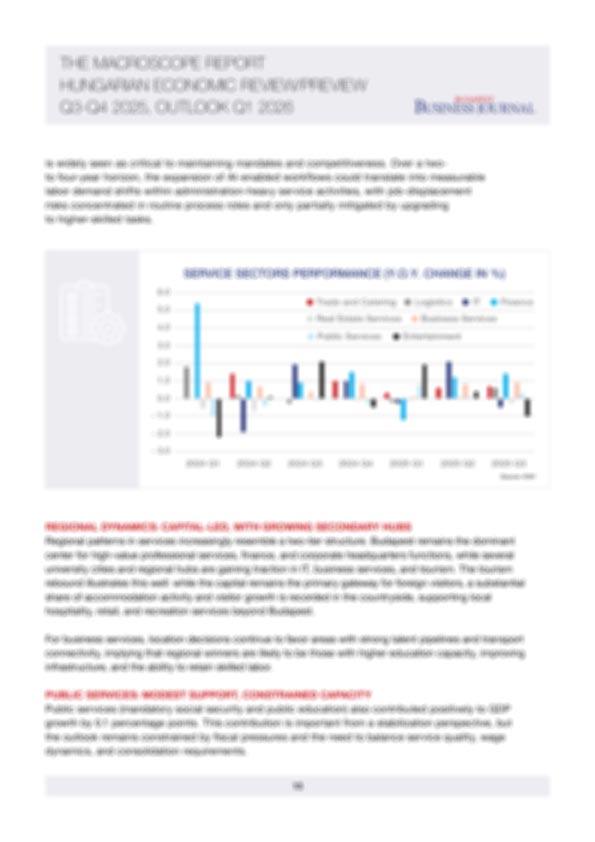
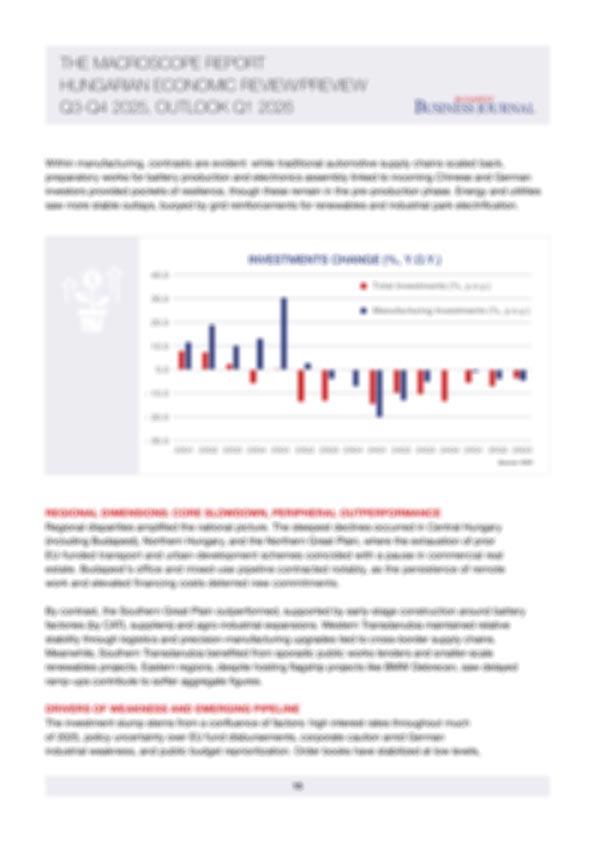
In the first three quarters of 2025, the Hungarian economy recorded only 0.3% GDP growth over the same period in 2024. Economic performance was supported primarily by household consumption (up 1.9%), while investments contracted; net exports made a negative contribution. On the production side, growth in services (+1.5%) offset declines in industry (-1.7%) and agriculture (-6.2%). With no dramatic improvement in Q4, 2025, full-year GDP growth was probably 0.4%. In 2026, GDP is projected to increase by around 1.8%, driven by accelerating private consumption growth supported by pre-election fiscal transfers and modest improvements in industrial and investment activity.

The labor market appeared stable in 2025, though structural pressures have begun to emerge. Total employment stagnated at 4.6 million, while the unemployment rate averaged 4.4%, masking widening regional disparities. Budapest and Western Transdanubia continued to show near-full employment, whereas Eastern Hungary lagged. Nominal wages rose by 9%, equivalent to approximately 4.5% in real terms, with significant sectoral and regional inequalities.
Despite an 11% minimum wage rise for 2026, nominal wage growth is expected to slow to around 7%, translating into a somewhat slower real increase than in 2025, but still decent at 3.5%. Unemployment may edge up to 4.5–5%.
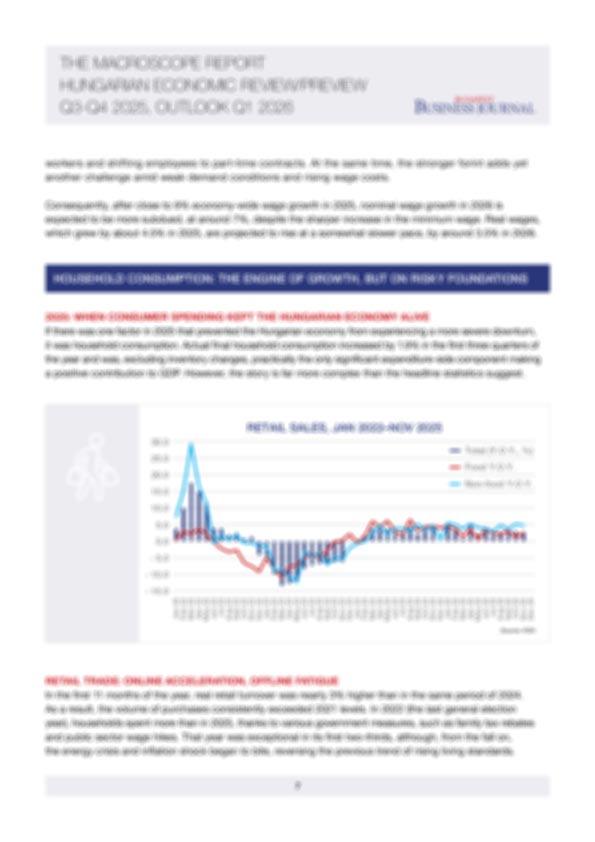
Private consumption remained the most stable component of growth in 2025. Retail sales turnover rose by 3%, and service consumption expanded by 2.6%, driven mainly by tourism and hospitality (on a yearly comparison).
Income-supporting measures for 2026 (such as expanding family tax benefits, the 13th month pension plus the first part of the 14th month pension, public sector wage adjustments and bonuses, etc.) are expected to provide additional support in the first half of the year. However, rising inflation and potential fiscal adjustments will likely slow household consumption growth in the second half of the year.
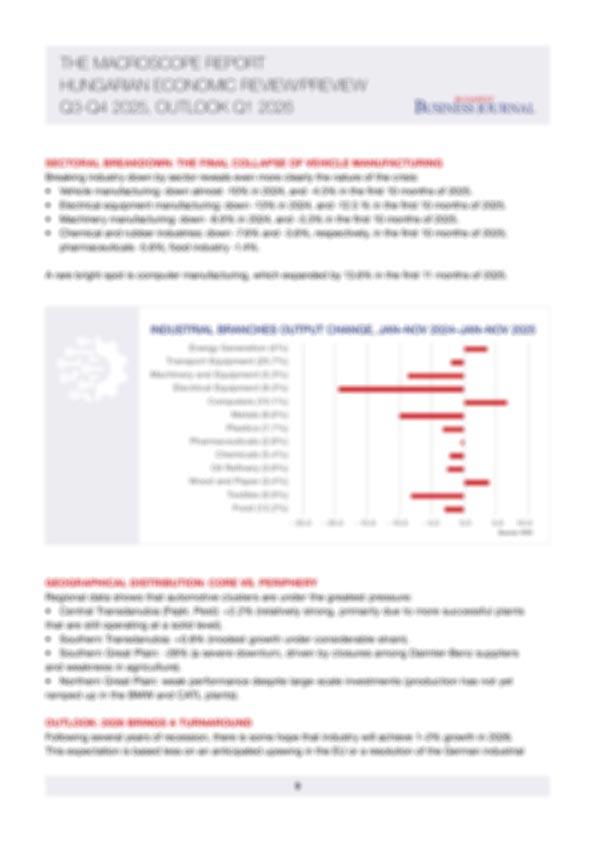
Industrial performance continued to decline for the third consecutive year in 2025, contracting by 3.5% (year-on-year). The weakest segments were vehicle and machinery manufacturing and electrical equipment production (mainly due to negative trends in battery production), while computer manufacturing provided the only positive contribution. Regional disparities remained significant, particularly within automotive clusters.
This year, industrial output is forecast to expand by 1-2%, supported by major new investments entering production, including a capacity expansion at Mercedes-Benz factory, the new BMW and BYD car plants, and the inauguration of Chinese battery production companies.
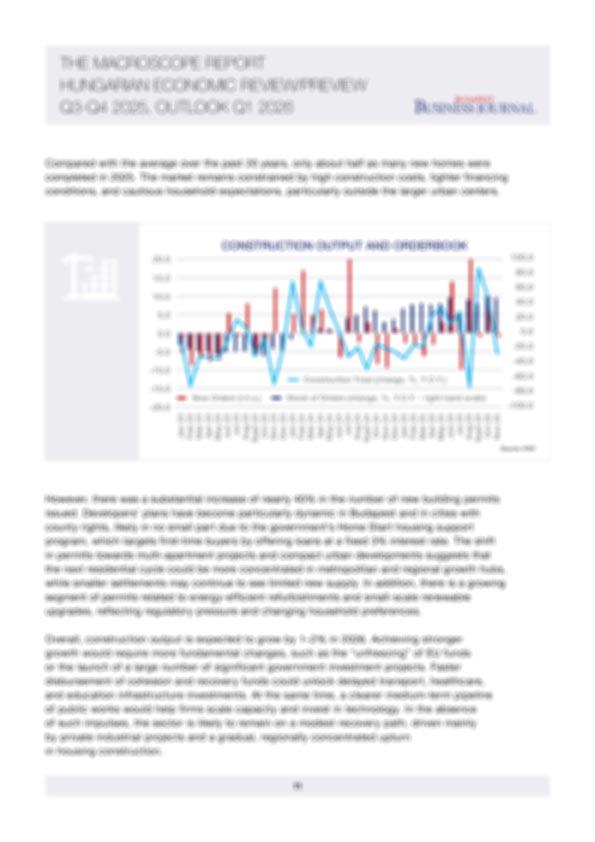
The construction sector posted limited growth of 1.6% in 2025 but remained 8% below the 2021 level. Residential construction reached a historic low, though the 40% increase in building permits indicates an impending recovery. A 1-2% growth rate is projected for 2026.
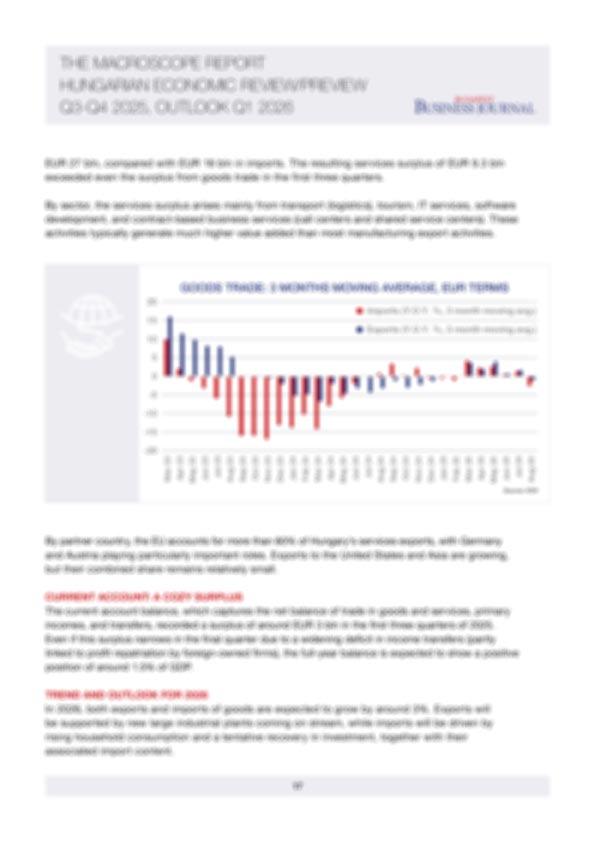
The trade in goods remained relatively stable, with exports rising by 1.1% and imports by 1.6% in the first 11 months of 2025, while service exports achieved a record EUR 9.3 billion surplus in Q1-Q3. The current account posted a nearly EUR 3 bln surplus over the first three quarters of 2025. The full-year external balance of the Hungarian economy remained in a comfortable surplus, a trend seen as likely to be repeated in 2026.
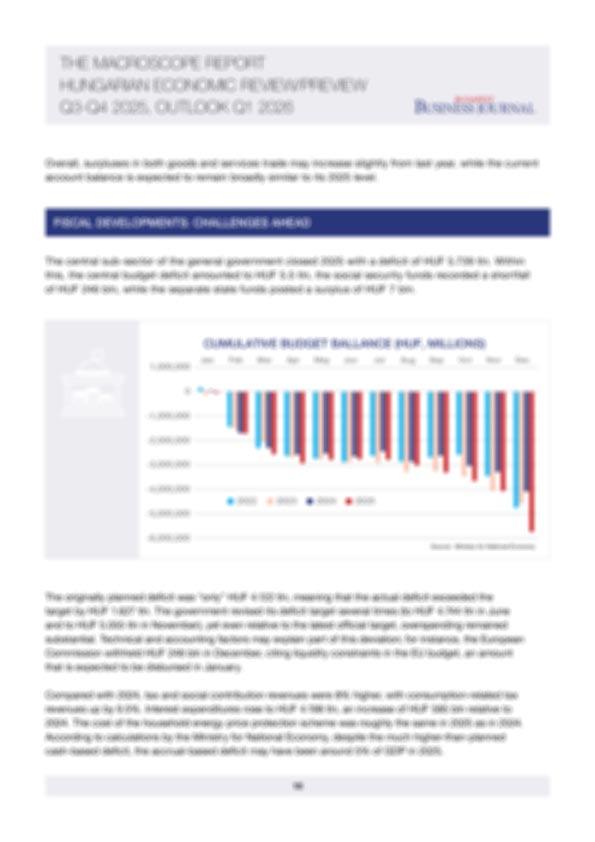
However, the fiscal deficit exceeded expectations, reaching HUF 5.739 trillion (on a cash basis), and public debt increased to 74.6% of GDP by year-end. Some fiscal adjustment measures may be necessary if the 5% budget deficit target is to be met; clearly, it is something the government to be formed after the April elections should address.
Inflation had moderated to 3.3% by the end of 2025, averaging 4.4% for the year. In early 2026, it is expected to fall within the 2–3% range but may rise again later in the year, depending partly on government price measures.
The National Bank of Hungary (MNB) held its key policy rate steady at 6.5% throughout 2025 and in its first rate setters’ meeting in January 2026. A gradual easing cycle is anticipated in 2026, with the base rate falling to around 5.75% by the year-end. Following last year’s strong forint appreciation, the exchange rate is expected to stabilize in 2026, fluctuating between HUF 385–395 per euro.