Welcome to our annual look at Hungary’s investment landscape. The country continues to do a remarkable job in attracting FDI. At the time of writing, the final figures for 2025 have not been published, but it is clear that the momentum generated last year has carried into this year. On Page 34, we highlight just some of the foreign direct investment projects that have been announced this year. These followed on from EUR 10.3 billion in new capital in 2024, the second consecutive year Hungary has surpassed the EUR 10 bln threshold.
Those sorts of results don’t come without a lot of hard work. If anything, Hungary is having to work even harder in the face of a changed global landscape. With European demand cooling, automotive transformation lagging, and regional competition intensifying, experts say Hungary must sharpen its service offering, improve talent development, and offer targeted incentives to secure investment growth in the decade ahead. “This is visible: there are fewer new investments,” warns Zsombor Tóth, partner and managing director of Investment and Business Services Hungary, on Page 56.
If you want a playbook for how to take a city that struggled when the market economy first came to Hungary, and turn it into the sort of FDI magnet that has the likes of BMW and CATL beating a path to it, the story of Debrecen, as featured on Page 18, shows how a well-crafted strategy can propel a city to new heights and turn it into an investment hub, regardless of today’s turbulent times. We trust you find these and the other stories in this issue informative and helpful in building an understanding of Investing in Hungary.
COMMERCIAL REAL ESTATE INVESTMENT SHOWS SIGNS OF RECOVERY
The Central and Eastern European real estate investment markets are showing signs of recovery with rising transaction volumes. Hungary offers quality assets with a significant yield premium on both Western Europe and other leading Central European investment markets. A longer-term recovery across the region is seen as being dependent on geopolitical issues and on markets overcoming international economic uncertainty. Analysts recorded “cautiously optimistic” sentiment regarding a sustainable investment recovery at the Expo Real 2025 commercial real estate exhibition.
By Gary J. Morrell
From a development perspective, there are strong pipelines in the industrial, hotel, and residential sectors in Hungary. At the same time, developers and asset owners must incorporate increasingly complex ESG features
and processes into assets to attract investors and enable an exit strategy.
Confidence is steadily returning across the region, with investor sentiment shifting from “cautious optimism” to “pragmatic execution,” according to the latest insights from “CEE Investment
Scene Q1-Q3 2025” by Colliers. The region continues to demonstrate resilience and opportunities, supported by moderating inflation, solid household consumption, and strong employment levels. Investment volumes across the CEE-6 (Bulgaria, the Czech Republic, Hungary, Poland, Romania, and Slovakia) exceeded EUR 7 billion in the first three quarters of 2025, a 38% year-on-year increase. The majority of capital flows were directed to the Czech Republic and Poland, which together accounted for more than 70% of total activity. Hungary and Slovakia also recorded strong rebounds, with Hungary’s investment volume tripling year-on-year, comments Colliers.
Péter Takács, partner at Newmark VLK Hungary, sees the reactivation of the investment markets in Central Europe. He says the region is back on the radar of international investors; once transactions are completed, there will be increased liquidity and, in turn, the markets will be able to attract more investment.
“As international investors are out-priced by the dominance of local investors in the Czech Republic, they could look to make acquisitions in Hungary with the favorable yield premium that Hungary provides. Further, national elections in Hungary in the spring of 2026 could remove political uncertainty. With predictable pricing and quality assets available in Hungary, this could lead to market liquidity, making Hungary more attractive to international investors,” Takács says.
Benjamin Perez-Ellischewitz, principal at Avison Young Hungary, expects around EUR 700 million in investment
Skanska has sold the 27,000 sqm first phase of H2Offices in the Váci út Office Corridor to the Hungarian Erste RE Fund.
ON THE VERGE OF A DIMENSION
SHIFT: HOW DEBRECEN BECAME AN FDI MAGNET
With global appetite for foreign direct investment waning, the race for impactful projects is fiercer than ever. The story of Debrecen shows how a well-crafted strategy and maxing out the local talent pool can propel a city to new heights and turn it into an investment hub, regardless of today’s turbulent times.
By BBJ Staff
If you are specifically headed there, you just can’t miss it: BMW Group has its own exit sign on the freeway just a few kilometers from Debrecen, Hungary’s second-largest city in terms of population, a city of 210,000 (according to its own website) located some 200 km east of Budapest by road. Signposting is very much needed, given
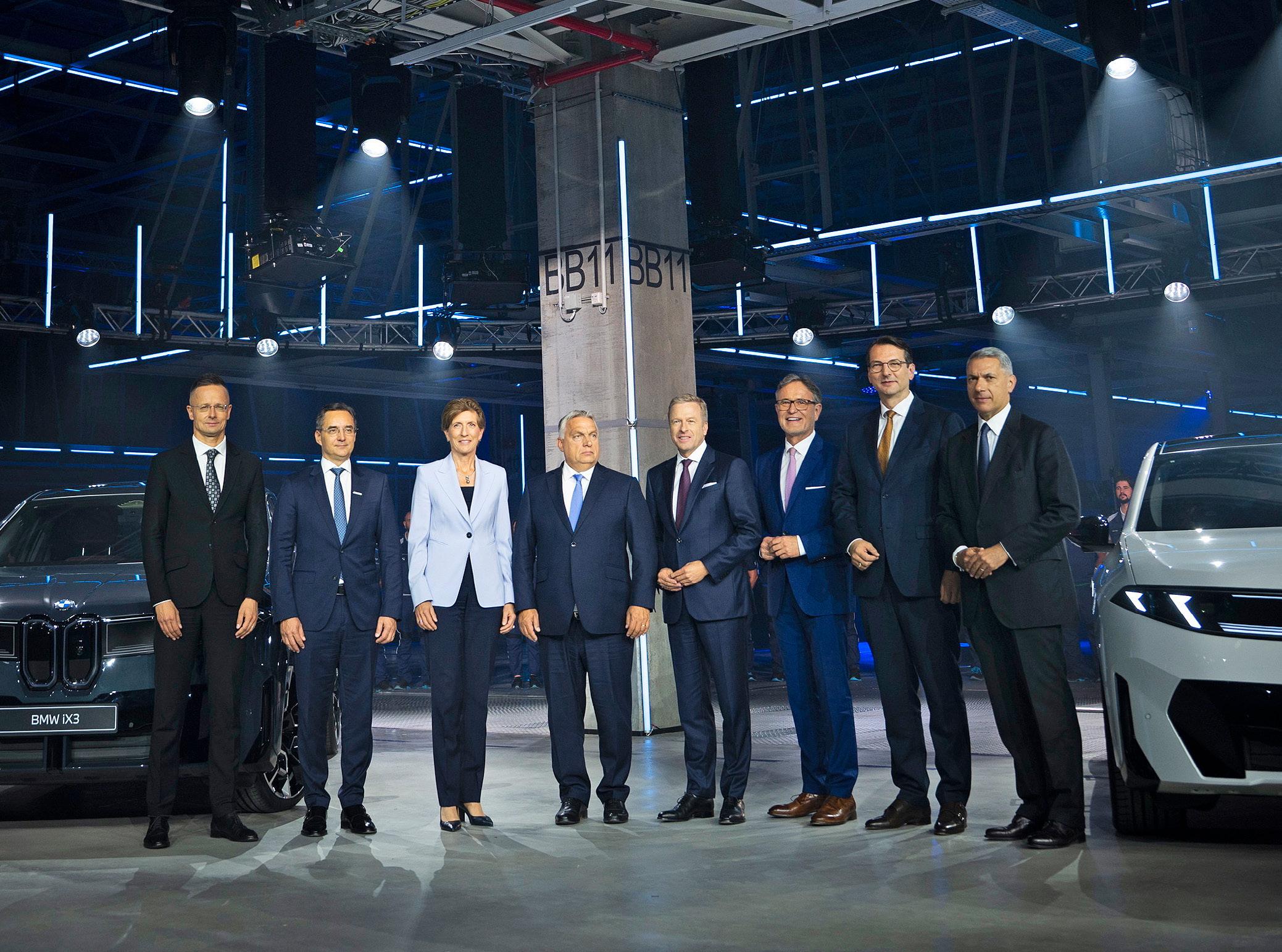
Photo by Benko Vivien Cher / Prime Minister’s Communications Department / MTI
In a photo released by the Prime Minister’s Communications Department, Prime Minister Viktor Orbán (center) at the inauguration of the BMW Group’s Debrecen factory. With him, from left to right, are: Minister of Foreign Affairs and Trade Péter Szijjártó; Debrecen Mayor László Papp; Ilka Horstmeier, BMW Group’s board member responsible for HR, real estate and labor relations; Oliver Zipse, CEO of BMW AG; Hans-Peter Kemser, president and CEO of BMW Manufacturing Hungary Kft.; Milan Nedeljkovic, BMW Group board member responsible for production, and Minister of Construction and Transport János Lázár.
CAREERS IN THE AGE OF AI: BUILDING A FUTURE-READY WORKFORCE
As artificial intelligence reshapes economies and transforms the skills demanded in the labor market, one question looms large in Hungary: how can the next generation, particularly young women, find their place in this evolving technological landscape? A new nationwide survey commissioned by Cetin Hungary suggests that while digital awareness is growing, a significant gender gap persists in STEM-related career ambitions, and that early education may hold the key to closing it.
By Gergely Herpai
The study, conducted with the Association of Women in Science (NaTE), paints a complex picture of Hungary’s readiness for an AI-driven future. According to the data, seven out of 10 Hungarian women say they would not consider pursuing a career in engineering, IT, or other technological fields. That is nearly double the rate for men. The findings also reveal that this reluctance is less about ability and more about environment: over one-third of respondents said schools do too little to spark girls’ curiosity in science and technology, while a quarter still encounter the notion that these careers are “for men.”
The research also highlights another challenge: digital fluency remains low across the general population. Only 3% of respondents described their AI skills as advanced, while nearly half said they possess only basic knowledge. And yet, optimism remains; almost 70% agreed that learning to use AI should begin in school, marking a cultural shift toward integrating digital competence into general education.
“The future of work will depend on more than technology,” said Judit Kübler-Andrási, CEO of Cetin Hungary, a company with a telecommunications infrastructure portfolio that comprises a range of mobile access networks, a fixed and wireless backbone network, and an aggregation network. “It will depend on how well we combine technological literacy with human creativity, empathy, and resilience. Our goal is to make sure young women see this combination as a strength, not an exception.”
Cetin has translated this philosophy into action through its STEMpowered by Cetin program, launched for the third consecutive year in partnership with NaTE. The initiative offers free training, mentoring, and networking opportunities to high school girls interested in STEM fields.
HOW A HOMEGROWN INNOVATION IS MAKING AUTOMATION ACCESSIBLE FOR ALL
Grif Tools Kft. is rewriting the rulebook for how industrial robots handle precision parts with its Multi Parallel Gripper, a modular, adaptive gripping system. It targets a niche of smaller companies for which automation was unthinkable until now. As CEO, István Forgács, says, now is the time to take a leap.
By BBJ Staff
Hungary prides itself on having exceptional brain power in natural sciences, not least because of the number of Hungarian Nobel Prizes per capita. Role models are abundant, most recently, Katalin Karikó and Péter Krausz, who were awarded
in medicine and physics, respectively, in 2023. Most of those laureates were recognized for their work abroad, though, a telling sign that there is room for improvement in fostering innovation on home turf. Hungary’s R&D spending was approximately 1.32% of GDP in 2024, lagging the EU average of 2.3%. According to the European Innovation
Scoreboard, the country is classified only as a “Moderate Innovator” with performance at 70.5% of the EU average.
The bulk of R&D spending comes from the business sector, specifically large enterprises with headcounts of 250plus; the notoriously undercapitalized SME segment can barely afford the resources for innovation. All of which makes it even more cheering to discover something “big” that has been achieved by a relatively small-sized entity. Grif Tools Kft. is making a name for itself through its Multi Parallel Gripper.
Headquartered in Eger (100 km east of Budapest by road), the company employs no more than 50. Yet, in its nearly two decades of existence, it has built a reputation across Central and Eastern Europe: two-thirds of its output is now exported.
“We wanted to build a gripper that behaves like a human hand; simple, robust, and adaptable,” Forgács tells the Budapest Business Journal. “Most grippers are designed for one task. We designed ours for many.”
As its name implies, the MPG, invented by Zsolt Csufor, with whom Forgács jointly owns the patent rights, deploys multiple parallel fingers that move independently yet are coordinated by a compact mechanical system. The result: greater precision, load stability, and modularity at a lower cost than comparable models. Its design allows it to adapt to irregular shapes and varying material textures,
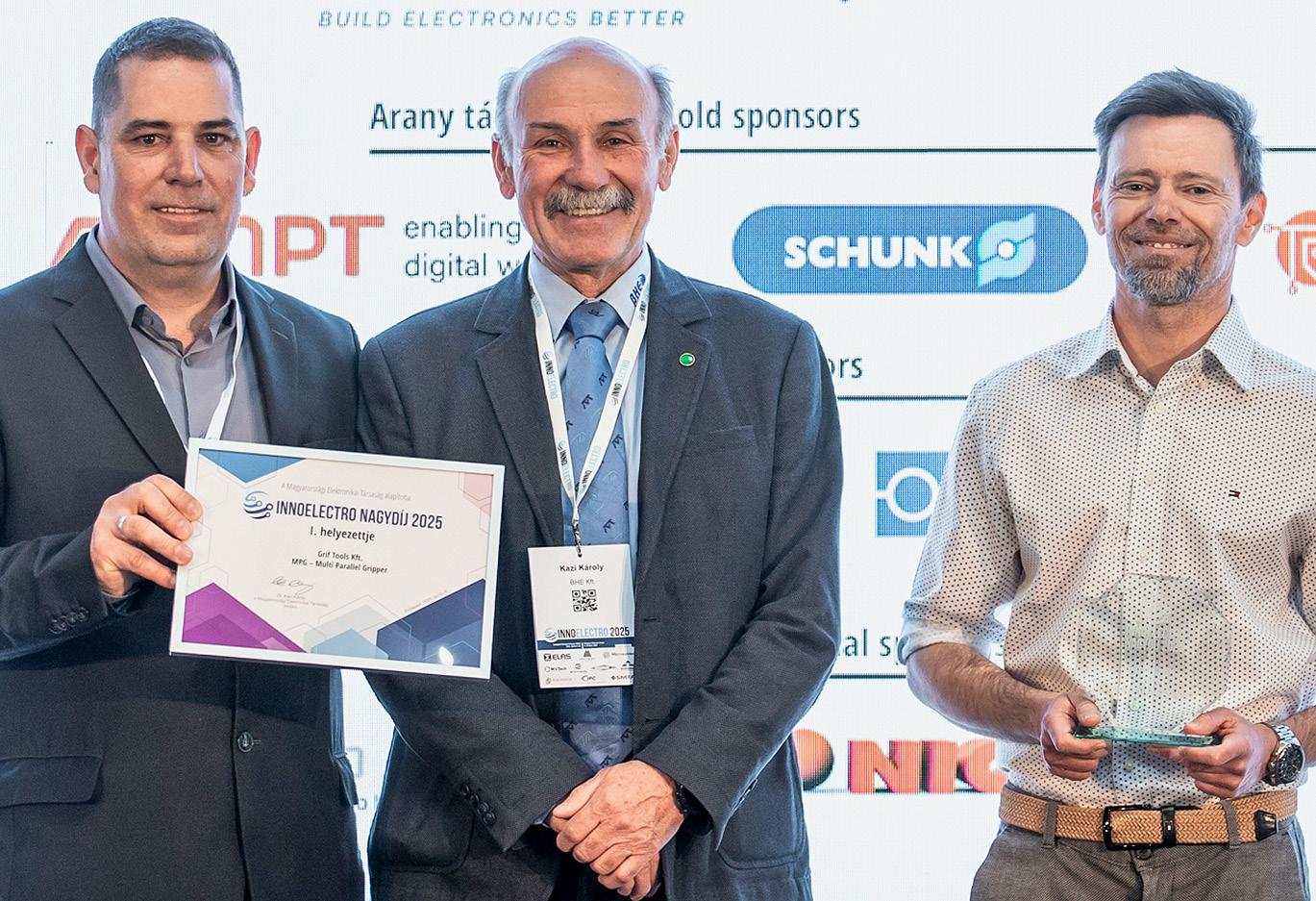
The Grif Tools team celebrate winning the Innoelectro Grand Prize in April 2025.
RELAUNCHED INNOVATION
GRAND PRIZE PUTS MEASURABLE RESULTS UP FRONT, AIMS TO OPEN GLOBAL DOORS
Hungary’s flagship innovation program is returning with a clearer focus on market-verified results. The 34th Hungarian Innovation Grand Prize will recognize innovations realized in 2025, with winners to be announced on March 2026 at the Museum of Ethnography during the InnoSummit.
By Gergely Herpai
The award is being organized by the Association of Hungarian Innovation (MISz), supported by the Ministry of Culture and Innovation and the National Research, Development and Innovation Office (SzTNH). The jury will be selected at the invitation of the board of trustees of the Hungarian Innovation Foundation and chaired by Minister of Culture and Innovation Balázs Hankó.
“The concept of innovation was articulated 110 years ago, but for a long time it was not integrated into the economy,” says János Pakucs, honorary president of the MISz. He pointed to the moment when decision-makers began to quantify its weight. “This year, three economists received the Nobel Prize for research on innovation, and both experts and policymakers now accept that where there is no innovation, there is no economic growth.”
Within that perspective, the award emphasizes implemented innovation and measurable benefit in the review year rather than intentions that have not yet reached the market.
Over more than three decades, the award has typically received
around 50 applications per year, with the organizers reporting 1,320 implemented innovations and 33 Grand Prize winners to date. Small- and medium-sized enterprises have taken a majority of the top honors, although larger companies have also featured among the winners. Organizers cite an annualized uplift in company results exceeding HUF 3 trillion across participating firms, together with additional savings achieved through
process improvements and more efficient use of materials and energy.
The 34th edition will cover innovation performances realized in the 2025 calendar year. Two routes feed the field. Firms may submit applications directly. In parallel, a recommendation channel allows sector bodies and partner organizations to put forward candidates. The intent is to widen participation and reduce the risk that viable entries are left out during busy
Csaba Bőthe, managing director of MISz and chair of the organizing committee.
The condition of the intestinal microbiome has become a central issue in modern healthcare and consumer markets. Once a marginal research area, it is now widely recognized that the diversity of intestinal flora affects immunity, metabolism, cardiovascular health, and the likelihood of chronic disease. Against this backdrop, gastroenterologist Richárd Schwab and his colleagues at the BiomTeam have launched the WellBiom menu in Hungary, a service designed to translate scientific evidence into accessible, everyday practice.
HUNGARY’S STARTUPS FACE FINANCIAL DROUGHT AND ACRISIS OF CONFIDENCE
Hungary’s entrepreneurs are not short on ideas, only on optimism and funding. That was the central message from STRT Holding’s leadership during a press conference in Budapest, where innovation-star and co-founder and CEO Petya Balogh spoke candidly about the state of Hungarian innovation. Balogh, who has long been a vocal advocate for the country’s startup ecosystem, argued that the narrative surrounding entrepreneurship in Hungary is far bleaker than reality.
By Gergely Herpai
A newly released global survey measuring countries’ support for entrepreneurship ranked Hungary second from the bottom, ahead of only Iran. The result, shocking at first glance, reflects what Balogh describes as a deep-seated cultural pessimism rather than an accurate picture of business conditions.
“We’re far too used to seeing the glass half-empty,” he said. “There’s talent, there’s creativity; what’s missing is belief.” According to Balogh, many Hungarian entrepreneurs underestimate the opportunities that exist.
Image by dizain / Shutterstock.com
STARTUP ECOSYSTEMS
PROVIDE FRESH DIRECTIONS FOR HUNGARY’S ENGAGEMENT WITH SOUTHEAST ASIA
Hungary’s “Eastern Opening” policy outlook has seen it draw in significant amounts of foreign direct investment from China and South Korea, in particular, as well as Japan. A stated goal has been to make Hungary a meeting place, bringing together Western automakers and Eastern battery producers, for example. But the outlook was never intended to be unidirectional. Here, father and son team David and George Abonyi make the case for Hungarian startups to, as Elvis Pressly once sang, “Go East, young man.”
HUNGARY CHASING A BIGGER SLICE OF A SHRINKING INVESTMENT PIE
Hungary’s years of strong investment inflows are facing a changed global landscape. With European demand cooling, automotive transformation lagging, and regional competition intensifying, experts say Hungary must sharpen its service offering, improve talent development, and offer targeted incentives to secure investment growth in the decade ahead.
By BBJ Staff
For much of the past decade, foreign direct investment into Hungary was driven by record industrial expansion, especially in automotive and electronics. Those conditions have changed sharply. Rising geopolitical tension, energy market volatility, and dropping European demand have made long-term manufacturing investment riskier.
For a country deeply integrated into industrial supply chains, the effect is disproportionately large.
“This is visible: there are fewer new investments,” says Zsombor Tóth, partner and managing director of Investment and Business Services Hungary.
The challenge for Hungary may be intensified by its industrial profile: automotive manufacturing and related supply chains account for a larger share of GDP and employment than in most neighboring EU markets.
What complicates matters further is an elevated level of competition. Hungary used to be the first choice for site selection scouts in Central Europe. Today, the list of rivals is long: Poland, Romania, Serbia, Slovakia,
and the Western Balkans are all lining up to offer an attractive alternative.
“The market is shrinking, and we need to take a bigger slice from a smaller pie,” observes Adrienn Oláh-Kántor, a partner at Investment and Business Services Hungary.
ADVANTAGE VS VISIBILITY
This means simply being visible is no longer enough. Attracting modern projects requires demonstrating clear-cut advantages from workforce quality and well-prepared industrial sites to power availability, permitting speed, and, where applicable, competitive incentive packages.
According to Oláh-Kántor, genuinely foreign firms entering Hungary for the first time remain a relatively limited group. That said, they account for a significant share of FDI value.
“Real greenfield investments, foreign investors coming here for the first time, average maybe 10–15 per year,” she explains.
Instead, the overwhelming majority of capital deployed in Hungary today is capacity expansion: foreignowned manufacturers reinvesting in existing sites. In practice, these expansion decisions are anything but automatic. Even companies already in Hungary benchmark local expansion against other countries.
This makes every local expansion a competition on a European scale. Decision-makers weigh logistic efficiency, electricity capacity, cost stability, labor-market depth, and incentive schemes across multiple countries before selecting a site.
SPECIALIZED SKILLS SEARCH
Hungary’s challenge is that the laborintensive model of competitiveness from previous decades (large workforces, industrial parks, and strong technical secondary school pipelines) is under