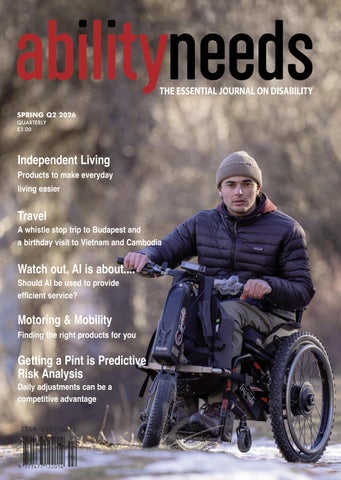
Ability Needs Spring Q2 2026

Page 1


THE ESSENTIAL JOURNAL ON DISABILITY

SPRING Q2 2026 QUARTERLY

£3.00

Independent Living

Products to make everyday living easier

Travel

A whistle stop trip to Budapest and a birthday visit to Vietnam and Cambodia

Watch out, AI is about....

Should AI be used to provide efficient service?

Motoring & Mobility

Finding the right products for you

Getting a Pint is Predictive Risk Analysis

Daily adjustments can be a competitive advantage

Making Postural Support

Easier to Get Right

For clinicians and services, selecting the right postural support can be unnecessarily complex, particularly when time and clarity are critical. With multiple product types, configurations and naming conventions to navigate, identifying the most appropriate solution can be challenging in busy environments where efficiency and accuracy are essential.

The impact of getting postural support right is significant. Effective positioning underpins comfort, stability and function, enabling children and adults with additional needs to participate more fully in everyday activities. When support is consistent and well fitted, it can support not only physical wellbeing, but also confidence, engagement and independence.

Discover our full range of postural support solutions manufactured for safety, comfort and reliability.

The PostureGuard® range brings together belts, harnesses and a broader range of positioning components and accessories within a clearly organised system, making it easier to identify, specify and order appropriate solutions.

As a British manufacturer, operating to ISO 13485, PostureGuard® has been developed to provide a clearer, more consistent approach to postural support.

Celebrating 50 years of improving lives

Over the past 50 years, RMS’s highly skilled team has continually refined and advanced the product range, drawing upon both internal expertise and valuable feedback from clinicians. Many of these bespoke modifications have informed and expanded the PostureGuard® range, ensuring commonly requested configurations are readily available within a structured, versatile catalogue of products.

Scan to download the catalogue or visit rms-rehab.co.uk 01795 477280

The individual is always at the heart of what we do. Creating clearer, more consistent postural support helps ensure the right solution is in place to support comfort, function and participation.

Designed to work across a wide variety of seating systems and clinical applications, the range supports both standard provision and more complex postural requirements. This enables clinicians to tailor support more precisely, supporting improved alignment and functional ability while maintaining comfort over longer periods of use.

For families and carers, this consistency can support greater confidence in day-to-day routines. When a child or adult is well supported, they are better able to focus on communication, learning and social interaction, rather than the effort required to maintain position.

email: info@abilityneeds.co.uk web: www.abilityneeds.co.uk

All Rights Reserved

No part of this publication may be reproduced or used in any way without written permission of the publisher. The views expressed in this magazine are not necessarily those of the publisher and although every effort has been made to ensure that the information is accurate, the publishers take no responsibility for errors and omissions. No responsibility can be accepted by the publishers for any claims made by the advertisers in this publication.

2 Motoring and Mobility

- Featuring the latest vehicles and products available in the

4 Isaac Harvey MBE

22

- Why I Am Done Letting The Algorithm Decide My Worth – Isaac explains why he has decided to use social media as a tool and stop relying on it to make things work

Cristian Brownlee

- Getting a Pint is Predictive Risk Analysis – Cristian looks at why the daily adjustments that disabled people are forced to make can be a competitive advantage

26 Tanni’s View

- Baroness Grey-Thompson DBE – Tanni discusses transport, including accessibility for taxis and step free trains and railway stations

32 Eddie Peacock

- Watch out, AI is about…. – Eddie shares a story which demonstrates why the use of AI should not replace the provision of a proper and efficient service

42

46

Industry Insight

- Vietnam and Cambodia – Angus recounts his trip to Vietnam and Cambodia and tells us about Anchagn Charity Community School

Cheryl Everitt

- A whistle stop trip to Budapest – Cheryl tells us about her ‘third time lucky’ trip to Budapest

THE ONE TO TRUST

Designed in the A nity’s image but created with greater accessibility in mind, our new Symphony home lift o ers a more spacious platform that comfortably accommodates wheelchair users, without compromising on style.

Thoughtfully engineered to support independence and future-proof the home, it delivers smooth and intuitive operation for everyday ease. With its light-filled design and seamless integration into a wide range of interiors, the Symphony, launching in Autumn, reflects Terry Lifts’ commitment to combining elegant design with practical innovation. Making beautifully accessible living a reality for more people.

From

Inspired by the Affinity Home Lift, launched in 2024, the Symphony builds on the success of our most compact home lift, carrying forward its open-concept design, transparent materials and signature personalisation.

Wide, spacious cabin

Easy-reach illuminated controls

Market leading weight capacity of 325kg (51st)

Discreet fire and smoke protection

Smooth-glide powered door system

Full safety suite: pressure-sensitive surfaces, in-car emergency lowering and battery backup

Whisper-quiet travel

Social media gave me a lot. But it also took a lot. And after years of showing up online, I had to ask myself whether the balance was really working in my favour.

I am a storyteller. It is genuinely at the core of who I am, and for years, sharing my story online felt like the most natural thing in the world. The audience I have grown has opened doors and created opportunities that may not have happened any other way. But somewhere along the way the joy of it got lost. I was spending two to three hours on a single post, putting real thought and effort into it, only for it to sometimes reach a handful of people. Not because the content wasn't good enough, but because that is just how the algorithm works. Being on platforms where you just don't know if your content is going to be shown to your followers.

We live in a world where social media is treated like the only way to be successful. If you are not on it, people assume you will miss out and fall behind. That idea is almost everywhere, and it does get to you, especially when you are self-employed and your next paycheck is never guaranteed.

But here is what I've come to realise. There are thousands, maybe millions, of people who are not relying on social media to make things work. They are building something real, finding opportunities in other ways and and just getting on with it. I want to be one of those people. And for anyone who knows me, yes, this

Isaac Harvey MBE

Why I Am Done Letting The Algorithm Decide

My Worth

is really happening. For years I told friends I was going to do this and not many believed me.

Apparently, I love social media too much to ever actually step back from it. Well, here I am.

The years I have spent on it have shaped a lot of what I have today and I will always be grateful for that. I am not disappearing from it completely, but there is a big difference between using it as a tool and letting it run the show, and that is the shift I am making.

That shift hasn't been easy. Growing up with the internet means it is deeply wired into how I think. Even now I can be out somewhere and automatically start thinking about how to turn the moment into a post, and I have to stop myself and ask whether that is actually useful or just an old habit. It is a strange thing to unlearn..

What has helped is just focusing on the work. I have been travelling around the UK, working on a short film, putting together a documentary and doing a lot of learning along the way. I feel more present and more focused. And I am slowly starting to believe that credibility will take me further than any follower count ever could.

Is it easy? No. Is it scary at times? Absolutely. But mentally I feel better than I have in a long time, and I am excited about where I am taking things next, just with a lot less reliance on the algorithm to get me there.

One partner. Every care setting...

From mobility and retail to community and long-term care, Drive supports people at every stage.

W WELCOME T TO S SCOOTER S STORE L LIMITED

Scooter Store Limited is an established company with over twentyhas become very popular especially with the elderly and disabled community nationwide.

The concept is a small, secure store designed specifically for mobility vehicles, to be operated with minimal effort. This provides the user with more independence and effective storage for their scooter at home.

The Scooter Store was designed in response to a demand from the public as many mobility scooter users have struggled to store their scooters in living rooms, communal hallways etc, causing fire hazards and limiting their space. The Scooter Store is a fireproof, theft proof, compact alternative that will enable the user to securely store their scooter.

Our product has been extremely popular with the elderly and disabled community for over twenty-five years. worked with a multitude of local Housing Trusts/Associations, charitable organisations, County, City and Borough Councils to install Scooter Stores across the UK.

All Scooter Stores are manufactured from 2mm steel with a powder coated finish, push button controlled, fully lockable and include a socket for charging the scooter is provided inside the store.

Standard, Double and Bespoke sizes are available. The stores are delivered flat packed to allow installation to awkward sites. Stores can be relocated if required.

We also offer free site surveys to give advice on store locations, hard standing areas etc, if required.

Over 48,000 people sign

RNIB’s Out of Sight petition

On 24 March 2026, blind and partially sighted campaigners handed in RNIB’s Out of Sight petition at the Department of Health and Social Care (DHSC) in Westminster. The hand-in followed a cane walk by the campaigners from Parliament Square – exemplifying mobility skills which are amongst many skills people with sight loss develop through vision rehabilitation.

Speaking outside the DHSC, Eleanor Thompson, RNIB Director of Policy, Campaigns and Social Action, said: "We’re here in Westminster because too many people are having their lives put on pause. No one should have to wait to receive vital support after sight loss. Health Secretary Wes Streeting can’t be in any doubt about public support for action to ensure effective vision rehabilitation services in England."

RNIB ambassador Claire Sisk and blind content creator and RNIB supporter Rob Sears took part in

the cane walk and petition hand-in. Claire said: "When I lost my sight, vision rehabilitation helped me learn how to use my cane and get out and about again. I had my independence back, I could be me again. Since then I’ve been able to develop my career as a TV presenter and social media influencer on campaign on the issues that matter to blind people. I wouldn’t have been able to do any of this if it wasn’t for vision rehabilitation."

Vision rehabilitation equips blind and partially sighted people with new ways to stay independent: to get out and about confidently, adapt at work, do the weekly shop, and enjoy the hobbies they love. Everyone with sight loss has a legal right to this support, but too many are falling through the cracks as services are pared back and delayed.

For more information visit www.rnib.org.uk

I n n o v a t i n g S o l u t i o n s F o r

S m a l l e r S i z e s

Silvalea continues to lead the way in innovation, delivering specialist transfer solutions. With an expanding portfolio designed specifically for paediatric and small-stature patients, Silvalea is redefining what’s possible in next-generation care. Most importantly, these solutions are purpose-built rather than just scaled-down adult sizes, prioritising comfort, support, and safer handling.

Designed for use across clinical, community, and educational settings, the right equipment does more than assist with care — it promotes independence, inclusion, and dignity.

Gary Bevan, President and Director of Silvalea added: ‘’Silvalea have been at the forefront of sling transfer designs for all body shapes, working alongside healthcare professionals for over 30 years. This has enabled us to create a library of unique designs either available as off-the-shelf solutions or bespoke options where required.’’

One of our newest products includes the Small Air Comfort Deluxe V2 Chair, a versatile seating system for those who require optimum comfort and pressure redistribution. The Air Comfort technology allows the seating surface to contour naturally to the body, helping to reduce pressure points while providing full support. The tilt-in-space and recline options give an enhanced seating experience for patients of varying needs, and the adjustable wings and drop-down arms allow for easier side transfers.

Silvalea’s wider paediatric and small-stature offerings include supportive transfer slings for various scenarios, as well as rehabilitation-focused designs that assist with standing and walking development.

One of our most established solutions, the In-Situ Deluxe Leg in Superfine with COOLMAX® EcoMade fabric, has a divided, shaped leg design and offers full body and head support. Proven to be successful for a

variety of scenarios, it remains one of our most popular sling styles.

A Paediatric Occupational Therapist from Devon added: "We love the paediatric In-Situ Deluxe Leg sling in Superfine for its lightweight design. It's helpful for children adjusting to being hoisted and still want to see their surroundings. Silvalea's paediatric products are excellent and designed with care.”

For more complex scenarios, such as those who have difficulty in maintaining body control, the Tinkham Sling is often a trusted choice. The padded head support, divided leg, and thoracic section offers full support and safety during transfers.

The Rachel Harness is part of our rehabilitation range, enabling children to safely engage in activities with stand and walk assistance. A lightweight design ensures a secure fit without restricting movement, allowing independence and empowering young people to take part with confidence.

In addition to this, Savaria’s Narrow Spreader Bar for Ceiling Hoists provides a reduced width and improved fit for paediatric slings, ensuring a better pick-up for safer transfers and enhanced user comfort.

At the heart of Silvalea’s paediatric and smallpersons range is a commitment to thoughtful design, clinical expertise, and exceptionally high-quality manufacturing standards — ensuring safer, more supportive care.

Groundbreaking public dialogue on AI and BSL begins

AI-enabled BSL translation could affect how the signing community, government, business and public services interact. However, done poorly and without meaningful community co-design and input into its appropriate use, it risks creating new barriers and even endangering the language itself.

This is why seven charity partners from across the deaf sector, coordinated by RNID, are leading this groundbreaking project. The project is a type of public dialogue, delivered under the UK Research & Innovation (UKRI) Sciencewise Programme.

Sciencewise public dialogues go beyond one-off engagements and provide a structured methodology to engage deeply with communities. This method allows time for participants to learn about AI and hear from specialists

about what current cutting-edge technologies can and can’t achieve in relation to BSL.

Participants can then combine this with their lived experience and vision for the future, to give nuanced and specific guidance to government, businesses and the technology industry.

More than 150,000 people in the UK are BSL users, 87,000 of whom are deaf. This is the first Sciencewise dialogue centred upon BSL signers and provides a valuable opportunity to demonstrate how these kinds of processes can be made more inclusive for BSL signers on a wide range of science and technology topics.

This project is being led by RNID, partnering with Action Deafness, British Deaf Association, Cambridgeshire Deaf Association, Deaf Plus, National Deaf Children’s Society, Royal Association for Deaf People and SignHealth.

The project is co-funded by UKRI through the Sciencewise programme and match funded by a consortium including: the UK Government, the British Academy, HSBC, NHS England, the Royal Society and the SignGPT Project.

Over the spring and summer of 2026, we will be working to engage the wider BSL community in this groundbreaking project and look forward to sharing more about our plans over the coming weeks and months.

For more information visit www.rnid.org.uk

Specialist residential care services for individuals with learning disabilities, autism and complex needs.

We offer outcomes-based services and create bespoke environments, care and support with a focus on meaningful pathways and wider life fulfilment.

Parents Through transparent and effective care and support, we enable your young person to achieve their goals and aspirations, focusing on independence, self-worth and new opportunities.

Teachers We build on the progress achieved through education to enable further progression with life skills, developing your students to their full potential.

Commissioners We are a successful social care alternative to Assessment and Treatment Units (ATUs) for individuals with behaviours of concern, or nursing services for individuals with complex health needs.

Learning Disabilities, Autism and Complex Physical and Mental Health

Medpage is transforming the way assistive technology supports independence and safety for disabled and vulnerable individuals. Our range of thoughtfully designed products blends cutting-edge innovation with a deep respect for user dignity.

The MP31TX11 Fall Detection Alarm Bracelet with Caregiver Pager is a standout solution. This lightweight, waterproof wristband combines automatic fall detection with an SOS call button, instantly notifying caregivers. Its shower-safe, antimicrobial design preserves privacy, empowering users to maintain confidence in daily activities. The pager supports up to three sensors, ideal for home, care, or travel environments.

For those needing added mobility support, Medpage’s GPS Location Tracker Watch offers discreet fall alerts, SOS calling, and real-time location tracking. It’s perfect for users with dementia or mobility challenges, providing caregivers peace of mind without limiting freedom.

Memory support is enhanced by the MemRabel 2 Calendar Clock, which offers audio-visual reminders for medication and appointments, easing daily routines for those with cognitive impairments.

Medpage also champions accessibility. The Easy Press Pillow Switch & MPPL Pager Kit lets users with limited dexterity call for help with a simple press, while the Bed Leaving Pressure Mat with Pager alerts caregivers when someone leaves their bed, reducing nighttime fall risks.

For smart home integration, the Dual-Mode Alert Hub with Portable Call Pendant connects via the Smart Life app for remote and local alerts, ideal for supported living.

Together, these products offer a complete ecosystem of care. Medpage isn’t just providing devices, we’re empowering independence, safety, and peace of mind with every innovation.

New study highlights impact of inequality in MS

We know the number of people living with MS in the UK is increasing And research tells us the difference in average life expectancy for people living with MS compared to other people, is getting smaller

There are several reasons for these changes, including earlier and more accurate diagnosis, and more effective disease modifying therapies (DMTs)

But a new study suggests not everyone with MS is benefitting equally from progress. The paper, from researchers at Imperial College London and University College London, analysed GP records from England, spanning more than three decades

W h a t i s s o c i o e c o n o m i c d e p r i v a t i o n ?

The researchers looked at socioeconomic deprivation amongst people living with MS in England. Deprivation isn't just about income.

Researchers look at a range of things including:

• employment levels

• health

• education

• housing

In this study, they used a standard tool which combines all these factors to rank areas across the UK from least to most deprived.

The study suggests the number of people living with MS in England has been increasing by about 6% each year And that the number of people with MS living past 80 years old has also increased Those diagnosed more recently were more likely to live past 80 years old

But results showed a difference depending on deprivation.

MS was recorded more often in less deprived areas. But the numbers of people passing away per year, from any cause, were higher in the most deprived areas

The researchers suggest this could be because people living in less deprived areas may:

• be more likely to be diagnosed early

• be less likely to live with other health conditions as well as MS

• have better access to treatments

We know that smoking makes MS worse It can

worsen symptoms and speed up progression Some research has also suggested obesity can worsen progression.

This study supports previous findings, by showing better outcomes were linked with not smoking and having an average weight.

But it also shows differences according to deprivation:

Sm o k i n g

More people with MS are now former smokers, which is positive news But this change has not been equal

People in the most deprived areas were less likely to have never smoked, and less likely to have previously been a smoker but now stopped

We i g h t

Levels of obesity and being underweight have increased over time And both obesity and being underweight were more common in more deprived groups.

We're pleased to see more research exploring the impact of inequality on MS This is one of the aims of our action plan for EEDI in MS research.

It's encouraging to see evidence showing improvements in life expectancy for people with MS But we need to see more consistent access to diagnosis, treatment, and support for people to manage the impact of MS So that everyone with MS, whatever their circumstances or where they live, can live well

This study suggests targeted support around stopping smoking and maintaining a healthy weight could also be crucial in reducing inequalities in MS outcomes.

More evidence that the number of people living with MS continues to rise is valuable too Our latest figures show over 150,000 people were living with MS in the UK between 2018-2020 That’s likely to be even higher now. So it's more important than ever that the growing needs of people with MS are well understood across health and care services, gover nment and employers

Seaside Breaks without Barriers: Accessible Travel in Dorset

Accessible travel is about confidence, independence and thoughtful design. In Bournemouth, the award winning Marsham Court Hotel demonstrates how practical accessibility and clear information can transform a coastal break into a relaxing and inclusive experience for travellers with a wide range of needs.

For many people, a trip to the coast represents relaxation, fresh air and a welcome change of pace. The sound of waves, the open horizon and the simple pleasure of time spent outdoors can be restorative. Yet for travellers with accessibility needs, the ease of a seaside break often depends on whether accommodation has been designed with inclusion in mind.

In Bournemouth, Marsham Court Hotel is helping to demonstrate how accessible coastal breaks can be approached with both understanding and practical design. From clear information before arrival to practical facilities during a stay, thoughtful planning can transform a holiday from complicated to genuinely relaxing. A

Marsham Court Hotel has developed its accessible accommodation with this principle in mind. By clearly outlining room types, accessible features and general facilities, the hotel aims to provide guests with the information they need to plan ahead with confidence. This transparency helps remove uncertainty, allowing guests to focus on enjoying their time away.

Being located in Bournemouth also brings additional advantages. The town is widely known for its award-winning beaches, attractive gardens and coastal promenade. For visitors with mobility considerations, being close to these open spaces can make a significant difference to the overall enjoyment of a stay. “

accessible public areas are all important elements in creating a welcoming environment. At Marsham Court Hotel, accessible accommodation has been designed to ensure that guests can move through the building comfortably and use facilities with confidence.

Clear layouts and well-planned public areas help create spaces that feel easy to navigate. These features may seem simple, but they can significantly improve the overall guest experience for travellers who rely on accessible facilities.

Detailed information, including video and 3D tours, about room options and accessibility features, enable guests to choose accommodation that best suits their individual needs before they arrive.

Bournemouth’s seaside setting offers an ideal environment for visitors seeking fresh air and a relaxed pace. The promenade, coastal views and surrounding gardens provide opportunities to enjoy the outdoors without needing to venture far from accessible facilities.

For guests staying at Marsham Court Hotel, this combination of accessible accommodation and coastal location helps create a break that feels both relaxing and practical.

Creating accessible travel experiences does not always require dramatic changes. Often, it is the result of thoughtful planning, attention to detail and an understanding of what guests truly need to feel comfortable and independent.

Travellers who prioritise accessibility often value consistency and reliability. Knowing that facilities have been considered in advance allows them to focus on enjoying their stay rather than navigating unexpected challenges.

When travellers search for accessible hotels, they are usually looking for specific and practical features that will support their comfort and independence.

Step-free access, adapted bedrooms and

By integrating accessibility into its wider guest experience, Marsham Court Hotel reflects a growing shift in the hospitality sector — one that recognises inclusive travel as an essential part of welcoming all guests.

With thoughtful planning and accessible facilities in place, a seaside break can be what it should always have been: relaxing, refreshing and open to everyone.

We’re making some changes to the Motability Scheme

In last year’s Autumn Budget, the UK Gover nment announced tax changes that will affect the Motability Scheme We’re making some changes to keep the Scheme as affordable as possible. These changes impact the Scheme throughout the UK, except customers who receive their allowance from Social Security Scotland

• E x c e s s m i l e a g e f e e s : We will be increasing the excess mileage fee to 25p per mile including standard rate VAT

• Ty r e r e pl a c e m e n t : You can now replace up to six tyres over a three-year lease, which includes up to four for damage throughout your lease If you have a five-year WAV lease, you can replace up to 10 tyres, with six included for damage

I wanted to personally explain some changes we’re making to the Motability Scheme from July 2026

Before I do, I want to acknowledge that some of these changes will be difficult and may affect you I understand that any increase in costs or changes to what you receive can be worrying and frustrating, particularly when you rely on the Scheme every day for your independence

From 1 July 2026, there will be four changes that will apply to new orders. These are reducing the annual mileage allowance, increasing the excess mileage fee, changing tyre replacement limits, and introducing a charge if you choose to take your car abroad

I also want to be clear about what is not changing Your lease will continue to include insurance, servicing, maintenance and breakdown cover. Protecting this all-inclusive package, and the independence it provides, has guided every decision we’ve made Scotland operates under its own distinct agreement called the Accessible Vehicle and Equipment Scheme (AVES). We are therefore working closely with the Scottish Gover nment to understand how any changes may affect customers who receive allowances through Social Security Scotland This work is ongoing with details still to be finalised

W h a t ’s c h a n g i n g ?

New orders placed on or after 1 July 2026 will include:

• M i l e a g e a l l o w a n c e : New orders will include a mileage allowance of 10,000 miles a year. So, 30,000 over a three-year lease and 50,000 over a five-year new Wheelchair Accessible Vehicle (WAV) lease

• E U b r e a k do w n : You’ll need to pay an admin fee and let the RAC know when you are travelling to the EU

We ’v e m a de t h e s e

In last year’s Autumn Budget, the UK Gover nment announced tax changes that affect the Scheme. From 1 July 2026, VAT and Insurance Premium Tax (IPT) will apply to most leases Together, these changes mean it will cost significantly more to run the Scheme If we did nothing, the average cost of a new lease would increase by around £1,100

It was clear tao me that simply passing all these costs on to customers was not an option We had to carefully consider how to reduce the tax impact as much as possible, but also focusing on changes that reflect how most customers already use their vehicles

For nearly 50 years, the Motability Scheme has supported disabled people to stay mobile We remain committed to that purpose, keeping the Scheme as affordable as possible, offering good value, and ensuring you have access to a wide choice of vehicles that meet your needs, including options with a no or low Advance Payment

If you already have a lease with us, nothing will change for you right now. These updates will apply only to new orders placed on or after 1 July 2026.

Full details of the changes, along with information about the support available, can be found on our website

Thank you for being part of the Motability Scheme, and for the trust you place in us.

Who Are BAS NW?

Official UK Distributors for Scan to view website

Over Ring Electronic Accelerator

Over Ring Accelerator Smooth, Intuitive Acceleration

The Over Ring Accelerator allows gradual, controlled acceleration by simply pushing the ring towards the steering wheel Designed for seamless integration, it enhances accessibility without compromising vehicle functionality. Available as a fixed or quick release option, with an Under Ring variant also available

Push brake not included.

Transfer Plates

Transfer Plates Seamless Vehicle Access Made Simple

A transfer plate bridges the gap between a vehicle seat and a wheelchair or scooter, allowing for smooth, comfortable transfers without lifting or awkward manoeuvring Once inside, the plate swings up or removes completely, taking up minimal space An electric option is also available for effortless operation at the touch of a button.

Electric Hatch Opener

Electric Hatch Openers Effortless Boot Access at the Touch of a Button

An electric hatch opener provides a simple and convenient solution for those who struggle to open or close their vehicle's boot Operated at the touch of a button, it removes the need for any physical effort making it an ideal aid for anyone requiring extra assistance with boot access

Are you missing the signs of hearing loss?

Struggling to hear certain everyday sounds could be a sign of undiagnosed hearing loss. More than half of the UK population over 55 have hearing loss, and for most, it happens gradually –which means the first early warning signs can be easy to miss.

To understand what people are already struggling to hear, we ran a new survey

What our survey found

Our survey has revealed the top ten most common sounds people not already diagnosed with hearing loss say they cannot hear very clearly – which could be an indication of hearing loss The sounds are:

1. Leaves rustling in trees on a windy day (47%)

2. Someone calling your name from another room (46%)

3. The sound of rain falling nearby (43%)

4 A cyclist ringing their bell (42%)

5 Someone knocking at the front door (40%)

6. A phone ringing in a nearby room (39%)

7 Birds singing (38%)

8. Approaching cars whilst crossing the road (38%)

9. Children laughing (36%)

10 Your name being called at the doctors or dentists (36%)

Everyday sounds aren’t the only clue Friends and family often notice changes before you do. Our survey also found the most common phrases people hear from loved ones:

1 “I already told you that” (54%)

2 “You’re not listening” (50%)

3 “The TV is turned up too loud” (47%)

4 “You heard that wrong” (44%)

5. “You miss things that people say to you” (43%)

6. “You’re ignoring me” (40%)

Understanding the signs of hearing loss

Crystal Rolfe, Director of Strategy at RNID, said: Hearing loss can happen at any time in life because there are many causes. You may also lose your hearing gradually over time due to age

“Hearing loss can also be caused by exposure to loud noise levels, injury or an infection – and these are all things that can affect the clarity of everyday sounds

“The sooner you recognise the signs and take action, the better. Getting support can bring huge benefits to people’s lives, so being aware of the sounds you might be missing is vital.”

Adam’s hearing loss journey

Adam Felman, 36, is a musician and freelance writer from West Sussex In his late 20s, he was updating an article about hearing loss when, as he puts it, “I noticed that I had most of the symptoms.” That realisation made him book a hearing check

After being fitted with hearing aids, Adam realised just how much he’d been missing.

“I was missing all sorts of sounds before getting my hearing aids. Birdsong was a big one for me – it’s so three dimensional and layered, and I was missing most of it.

“Getting hearing aids was wonderful It completely changed my life My relationships with others improved, and I felt more involved with my personal and professional lives ”

Check your hearing today

We are encouraging people to prioritise their hearing health and take our free online hearing check – something everyone can do from the comfort of their own home

Crystal Rolfe said: RNID’s free online hearing check is a great place to start It takes just three minutes, and you get the results straight away, along with information about what to do next.

There are huge benefits to taking action on undiagnosed hearing loss. People are suddenly able to communicate more easily and reconnect with friends, family and colleagues. A whole world of sounds you’d forgotten can suddenly open up People are often amazed at what they’ve been missing.”

Adam Felman

Travelling In Style

It was our privilege to hand over the keys to Wills for his long-awaited "dream wheels": a new wheelchair accessible Mercedes-Benz V-Class, featuring our hallmark Brotherwood ‘Klastar’ conversion.

While the aesthetic appeal of the vehicle is undeniable, this handover represents far more than an impulse purchase; for Wills, it is a gateway to enhanced wellbeing, social inclusion, and physical comfort.

Style as a Catalyst for Confidence

For professional model Wills, style isn't a luxury, but a non-negotiable. The V-Class offers unparalleled kerb appeal, featuring 19″ alloy wheels, LED lighting, and AMG-style chrome detailing, all wrapped in a stunning Sodalite Blue metallic finish.

From a user perspective, the psychological impact of a personal vehicle cannot be overstated. Transitioning into a vehicle that reflects one's personality, rather than just your clinical needs, fosters a sense of identity and self-worth. As Wills noted on delivery day: “This has been my dream car for years. It is going to make such a difference to my life!”

An Environment Tailored for Wellbeing

The interior of the V-Class is designed to be a sanctuary. With luxurious Nappa leather and a 64-colour ambient lighting system, the cabin provides a multi-sensory environment that the user can control, with Wills picking the music through the Burmester surround sound system via Apple CarPlay.

For many clients, the ability to regulate their environmentlighting, temperature, and soundis essential for managing fatigue and sensory processing. With four full-size seats and individually controlled climate zones, Wills can now travel inclusively and in comfort. This allows him to sit alongside his family as an equal participant in the journey, rather than an isolated passenger relegated to the rear.

W i l l s ’ D r e a m W h e e l s C o m e

Engineering to Enable

While the "lifestyle" benefits are clear, the Brotherwood conversion is rooted in ergonomic best practice. The unique lowered floor design is a critical feature for long-term health. By lowering the centre of gravity, the "body roll" felt by the wheelchair user is significantly reduced, which in turn minimises the physical effort required to maintain trunk stability. The flat travelling surface also promotes ideal posture in transit, meaning longer journeys can be enjoyed without fatigue or pain.

Clinical Benefits of the Klastar Conversion:

•Increased Visibility: A lower seating position provides a natural line of sight through the windows and windscreen, reducing travel sickness and cognitive fatigue.

•Superior Ride Quality: The V-Class comfort suspension pack delivers a smooth ride that protects the user from the high-frequency vibrations often found in standard accessible vans.

•Effortless Access: Our patented PAWRS (Power Assisted Wheelchair Restraint System) ensures safe, effortless loading, reducing the physical strain on both the user and their carers.

Safety Without Compromise

Stability is guaranteed by our STORQ self-tensioning restraints, which automatically tighten to ensure the wheelchair remains firmly restrained during transit. This combination of safety, comfort, and high-end design ensures that Wills is not just moving from A to B, but empowered to lead an active, visible, and stylish life.

About Brotherwood

The Mercedes-Benz V-Class ‘Klastar' is just one of the industryleading Wheelchair Accessible Vehicles available from Brotherwood. With small, medium and large WAVs available to buy, lease via the Motability Scheme, or hire flexibly, Brotherwood enable wheelchair users across the UK to enjoy inclusive, comfortable and safe travel.

Cristian Brownlee Getting a Pint is Predictive Risk Analysis

Everyone focuses on what we cannot do. It is time to focus on what we must do. You aren't a broken version of the default human; rather, you are a master of constraint-driven innovation. Society calls our daily routine 'coping.' The business world calls it a competitive advantage.

If you joined me in the last issue, you would remember our discussion about the "Energy Tax." I argued that the most powerful mobility aid in 2026 isn't a wheelchair, but a laptop. We looked at how technology offloads the heavy lifting and levels the playing field. Today, we go deeper. We are going to look at how you think.

The traditional care sector tends to treat disability and neurodivergence like a defect, viewing us as a bug in the system that desperately needs patching so we can function like "normal" people. Unsurprisingly, I look at it differently.

The Speedrunner Advantage

Think of a video game where the developers have carefully built a standard, expected path. Most players follow the rules, stick to the roads, and fight the standard battles. But then you have the Speedrunners. They refuse to play by the rules. They hunt for glitches in the code. They use those glitches to walk through walls, skip levels, and find shortcuts the developers never even knew existed.

That is exactly what we do. When the world isn't built for you, you are forced to hack your environment every single day just to participate. It is the physical equivalent of finding a propped-open side door at a stadium. While everyone else is stuck at the front gate waiting in a massive line, we just roll through the kitchen and grab a front-row seat. When the environment tries to keep you out, you get incredibly good at finding the loopholes. This isn't just a coping mechanism; it is an elite professional skill.

Predictive Risk Analysis (Over a Pint)

Let me give you a real-world example. Before I go to a new pub, I don't just show up and blindly hope for

the best. I pull up Google Street View. I look for the lip on the front door. I check where the dropped kerbs are. I am mapping points of failure before I even leave the house.

Corporations pay management consultants millions of pounds for "predictive risk analysis," but we just call it getting a pint.

It is a peculiar quirk of society that people observe us buying groceries and immediately label it 'inspiring'. I assure you, there is absolutely zero inspiration involved. I just wanted a loaf of bread, and I was forced to execute a multi-stage logistical operation to acquire it. The reason society confuses this with bravery is because they are entirely dependent on a frictionless world.

If you put the average able-bodied tech CEO in a wheelchair and asked them to navigate the London Underground, they wouldn't just miss their board meeting. They would be found three days later weeping in a broken lift at Covent Garden.

The daily adjustments you are forced to make train

you to treat friction as a feature, rather than a bug.

Stop Sanding Yourself Down

The problem is that society teaches us to hide this skillset. We go into job interviews or pitch a business, and we desperately try to blend in. We sand ourselves down to fit the standard corporate template, hoping they do not notice the variance. We need to stop doing that. Variance is a competitive advantage.

You need to translate your lived experience into tangible business value.

If you are writing a CV, don't just list your past jobs; highlight your proven ability to foresee roadblocks and manage complex logistics. Stop hiding your medical leaves and start framing them accurately: you have not been "out of action." You have been project

Five

additional Tube

access

managing a crisis scenario where your primary hardware, your own body, experienced catastrophic failure, and you still managed to keep the lights on.

If you sit in an interview, explain how you handle pressure. Able-bodied folks tend to get comfortable; they panic when their primary plan fails. For us, a failed plan is just a Tuesday, and we switch to Plan B, C, and D without even blinking.

If you are starting a business, lean into the fact that you already know how to stretch limited resources further than anyone else in the room. You don't need perfect conditions to get things done. You just need a goal.

You've spent your life operating in a world that assumes you do not exist. You survived by becoming adaptable, ruthless with your time, and incredibly sharp with your strategy. Don't let anyone tell you that you’re playing catch-up; you are playing a completely different game.

Stop apologising for the glitch. Start exploiting it.

Cristian Brownlee is a cynical optimist in a wheelchair and was awarded UK Disabled Entrepreneur of the Year. He argues that disability is not a deficit, but a driver of innovation, and currently advises global boards on turning constraints into capability. He always welcomes a sharp debate. Find him on LinkedIn. Bring a good argument.

stations to be assessed for step-free
feasibility as part of the Mayor and TfL’s ongoing work to improve transport network accessibility

Transport for London (TfL) has confirmed that five additional Tube stations will be assessed for step-free access feasibility, as part of the Mayor and TfL’s ongoing work to make the capital’s transport network more accessible.

Feasibility studies will be conducted at Barkingside, Brent Cross, Preston Road, Queensbury, and Totteridge & Whetstone Underground stations, examining the opportunities, options and constraints for making these stations step-free. This is in addition to the 40 Tube stations where step-free access feasibility or design work is already underway. Making London’s transport network as accessible and inclusive as possible is a key priority for the Mayor and TfL, with delivering step-free access at Underground stations a cornerstone of this work. More than a third of Underground stations across the city currently provide step-free access, with Colindale the most recent addition when it became the 94th Tube station to become step-free in December 2025. Work to make Northolt station step-free is due to be

completed this summer and Leyton station is scheduled to become step-free in spring 2027.

Seb Dance, Deputy Mayor of London for Transport, said: "London is for everyone, and the Mayor and I are committed to making our transport network as accessible as possible, so that more people can enjoy all our great city has to offer. We're pleased to see five more stations proceed to feasibility studies in the next stage of TfL’s step-free access programme, which is vital progress in improving accessibility across the network as we continue building a fairer, better London for everyone."

Alex Williams, TfL’s Chief Customer and Strategy Officer, said: "Making more Tube stations step-free is a major part of our work to make the transport network more accessible. This work always starts with conducting feasibility studies at stations to assess their suitability, so putting five additional stations under the spotlight is another important step towards making the Tube as accessible as possible."

The Carbon Flyer.

Exceptional performance. Ultra-lightweight. Travel friendly.

Built from carbon fibre and engineered for effortless handling, it combines agility, comfort and intelligent control in a compact, stylish design Easy to transport and intuitive to use, the Carbon Flyer supports confident independence wherever life takes you.

Remote controlled

Integrated spotlight for low-light use

Lightweight & travel friendly

No nuts, bolts, or permanent installation required Fits most standard vehicles

Tanni’s View

Baroness Grey-Thompson DBE writes for Ability Needs

Amongst the huge amounts of legislation that the Government is trying to get through, we are working on an English Devolution Bill at the moment. There is one small section in there where it might be possible to do something to improve accessibility of taxis. The Disability Discrimination Act felt like it promised so much. But sadly, in the end, it has been slightly disappointing. It said that trains would be step free by 1 January 2020, and we now know that it is going to be a hundred years before that happens. There should also have been quite a lot done on taxis, but this remains a challenge for accessibility outside some of the big cities. It is not always OK there.

I was talking to a transport expert this week and he told me that one of the issues with black cabs is legally they don’t have to pick someone up if they don’t want to. And while that is really frustrating for the many, many people I know that have been refused for a variety of reasons, it was something that I didn’t realise. I thought if their light was on or they were at a rank that they had to.

Driverless cars could potentially be a transformation for disabled people, but I suspect that inaccessibility will be baked into it. I have seen various bus designs which are going to be driverless and the space available for wheelchair users is pretty unimpressive. It also means that people with

other impairments might not get as much benefit as they could.

Electric chargers have long been a bug bear of mine. I wanted to look at changing to an electric car but there are so many inaccessible charging points, and even then they are not easy to use, that I gave up. But I do wonder if disabled people will get significant push back for not changing. On a tangent when Parliament was looking to ban plastic straws I know of disabled people who were targeted and told that they were destroying the planet for not moving over. The reality is that while glass and steel straws may work for some, they won’t work for everyone.

My frustration with the whole system of politics is that so often disabled people and any kind of adjustment are forgotten about, and their needs are not taken in to account until most of the major decisions have been taken. The Elizabeth Line was meant to be step free the whole way which would have been amazing, but in the end it was only the central part that was. That has made my life a lot easier in London and to be honest I have only needed to travel westbound on an inaccessible part once, but it would have opened up so much more of London if they could have made it happen. Inaccessibility on this line is now baked in forever. So in the next couple of months we are going to have a railways bill, and this is probably the best chance that we have to try and bring about some

real change. Trains are currently being ordered by companies, and if they are not step free this will push back the chance of step free by another forty years. Some of these trains will be on the network for at least that length of time. No one would ever design a railway system the way that we have in the UK. Great British Railways might solve some of the issues, but if inaccessibility is going to keep failing disabled people then the assistance needs to work.

Attempts to shut ticket offices and remove staff was reconsidered largely because disabled people shouted loudly. But asking for a ramp and the legal right to Turn Up and Go must be protected. It is a complete nonsense that there are train companies out there who appear to have a large number of staff not trained to use a ramp. I had a poor experience the other day when I had booked assistance. A member of staff told me that they would come up to the platform to help me on. They arrived late and then told me that they had an exemption so they couldn’t use the ramp. Luckily a member of staff on the train sorted it out. This is simply not acceptable. So, if there is one thing that we should be able to sort out it is not only better training, but staff that are able to help. There are many brilliant staff on the network, but having to almost beg to get on a train is also not acceptable. Disabled people should be able to take the same journeys as non disabled people and we are certainly not there yet.

The basic pleasures of being able to sleep in his own bed, have a bath and spend family time in the front room are now the ‘norm’ for Isaac Rimmer, all because of one piece of access equipment.

The equipment is an AAT Sella mobility stairclimber, prescribed through the Occupational Therapy service at Ainsdale Centre for Health & Wellbeing.

Dad Paul says the Sella has made a massive difference to family life: Isaac can have a bath again, sleep in his own bed in the room he shares with his brother, and they have space and freedom to be a family downstairs.

Isaac , 9, was born with Cerebral Palsy and has dystonia. A mistake during brain surgery meant to improve his quality of life made Isaac’s condition worse: he became less able and heavier.

Paul and his wife Rachel struggled to carry Isaac up and down the steep stairs in their Victorian home. The only answer for everyone’s safety until a solution was found was to move Isaac’s hospital bed into the front room.

The family’s Occupational Therapist Helen Murphy appreciated the family’s desire for Isaac to be able to access upstairs, to be in his own bedroom and be able to bath. So she reached out to AAT to assess Isaac, the family and the home environment to determine whether the

Sella mobility stairclimber would be appropriate.

Sella worked! Paul and Rachel found it easy to transport Isaac up, down the stairs and on to their final destination- the bathroom, bedroom, lounge, with no need to lift/transfer Isaac en-route…

Sella is the UK’s top-selling mobility stairclimbing wheelchair. Its light weight, high balance point and automatic braking make it easy for Paul and Rachel to use. Sella’s inbuilt seat, arms and lap belt mean Isaac is always safe and comfortable, even if he has a dystonic episode whilst on the stairs.

For the family, it was an added bonus that AAT made the effort to deliver the Sella the week before Christmas. “It made such a difference to our Christmas celebrations!” says Paul.

“Isaac could be with his siblings upstairs and have a stocking at the end of his bed on Christmas morning. We were able to celebrate as a family, with space, in the front room.

“And hopefully, in the summer, we can use it to get him out into the back garden too!”

Full details of the Sella stairclimbing wheelchair, how it works and how to book a free no obligation assessment can be found @ www.aatgb.com/s-max-sella/.

Swift Lift

The all new Swift Lift, from Des Gosling Mobility, is a compact boot hoist which allows for quick and easy loading of mobility devices weighing up to 60kg into the boot of a vehicle.

Packed with features to improve your experience, the Swift Lift does the heavy lifting so you can enjoy the journey ahead.

ELEVATE YOUR EXPERIENCE

Thanks to its folding arm design, the Swift Lift is suitable for most vehicles including SUVs, Hatchbacks, Estates, and MPVs.

In addition, various lifting attachments are available to suit all mobility devices. One hoist, endless possibilities.

Gosling Mobility has Arrived!

The Swift Lift occupies minimal space in the boot, maximising room for your mobility device and other luggage.

The folding arm removes any obstruction from your rear-view mirror when driving, and once folded down usually even allows the parcel shelf to be refitted if required.

The hoist arm is folded down in two simple stages after use to allow the boot to close. Single-handed operation for folding and unfolding makes this a breeze.

Designed to suit almost every vehicle.

Effortlessly loads any mobility device up to 60KG.

Easily transferable, no matter which car you choose next.

Optimised design to minimise distractions during your journey.

Zero power drain to protect the vehicle’s battery.

Available on the Motability Scheme.

Scan this QR code or go to www.desgoslingmobilityltd.co.uk for videos and more information of the Swift Lift online!

Sitting safely - especially when travelling - is difficult when you need posture stabilisation. No more!

Once someone is taller than 150cm they are too big for a conventional car seat, with all its associated support. AAT’s Voyageur Motability belt system means that problem is solved, quickly and unobtrusively.

The inventors themselves have a disabled child. It was their own personal experience that inspired the development of Voyageur, when their child grew too tall for a conventional car seat.

The resulting system is simple. It comprises just two elements - the Seat Grid tether system and XPosture Suit of positioning safety

M o t a b i l i

We’re introducing Drive Smart for people who are leasing their first car or Wheelchair Accessible Vehicle (WAV) on the Motability Scheme from Monday 13 April.

When you begin your first lease, there’s a lot to get used to: a new car, new features, and sometimes new adaptations.

That’s why all new customers begin with Drive Smart. It gives you extra support while you settle in and helps build good driving habits from the start.

Wh a t i s D r i ve Sm a r t ?

Drive Smart is a simple way to help you stay safe on the road. We’ll share helpful tips and insights, so you can feel more confident behind the wheel. You’ll also be able to see how your driving improves over time. It looks at how you drive your Scheme car and gives you a score each week. You’ll see a traffic light rating too: green, amber or red. It’s an easy way to understand how you’re getting on.

And there’s a reward for safer driving. If you drive safely, you could earn up to £160 a year in rewards. You can spend them with popular brands like Asda, M&S and Uber Eats.

belts. Each element is secured simply by magnetic buckles, so it is quick to attach, fit, and release - even with one hand. No tools are required.

Although designed primarily for car usage, the universal-sized Seat Grid can be attached to any seat where the straps can be passed between base cushion and back.

X-Posture Suit’s belt configuration with shoulder and hip straps means the torso is secure, stable laterally and vertically and correctly positioned with abduction to the thighs and stability to the pelvis. It is available in two sizes depending on the user’s waist and thigh dimensions.

“Voyageur extends the horizons for so many people who need postural support,” says Peter Wingrave, AAT Director. “So long as there is a suitable seat for Voyageur, it can provide the stable and comfortable support needed to safely enjoy sedentary activity- not just going out in the car, but sailing, cycling, flying to name a few!”

Voyageur sits alongside AAT’s Stabilo range of innovative postural support cushions, including the infinitely adjustable Chilli Bean vacuum posture seat.

Find out more www.aatgb.com/voyageur/

W h o h a s D r i v e Sm a r t ?

Drive Smart is currently included for:

•Customers starting their first lease on the Scheme •All customers under 30 years old (new, renewed and existing leases)

•Leases that include a named driver under 30

This means some drivers will have Drive Smart at the start of a new lease, while others will have it because of the age of a driver on the lease.

If you’re under 30 or have a named driver under 30, you’ll also have Drive Smart included as part of your lease. Younger drivers are more likely to be involved in accidents, especially when they’re new to driving. Drive Smart encourages safer driving and helps build confidence behind the wheel. It’s something commonly used across the insurance industry.

Driving Mobility Centres

Eddie Peacock

Watch out, AI is about….

Act 1, Scene 1 (The front room of

suburban semi in the leafy south of England.)

Elderly, genial chap is arranging an appointment at his local doctor’s surgery. He turns to his wife, “I used to do this by either popping in, or on the phone. This is not possible any more so now I am using their “app” for the first time. Let’s see how good it is.” His wife stiffens slightly, expecting the worst, and turns up the TV sound.

After 5 minutes or so of sniggers, grumbles and exclamations he declares with pride “Eureka, I have done it, Doctor Crippin, next Wednesday at 10.30. That was almost fun, and it was actually efficient. I am not sure why they asked so many questions, I have been going there for 20 years, and they already have all of the answers. But I do have my appointment.” Perhaps, he ruminated, that jolly Mr Streeting was on to something.

Act 1, Scene 2

(Next Wednesday, at the surgery)

Dr Crippen enters stage right. He is young, energetic, and calls out our chap’s name. “Mr Phniggs, please.”

Once in Crippen’s office the doctor smiles enthusiastically and asks, “What can I do for you today?”

your computer, I have a history of this sort of thing. I have this strange thing growing under my left eye.” He points to what his wife thinks is a skin tag. (How do wives always know so much?)

Crippen leaps into action with an impressive magnifying glass and scans it, and the rest of Phniggs face. After a comprehensive session of mms, aahs and other professional mutterings, he reassures Phniggs that the skin tag thing he was worrying about is harmless and, incredibly, it will “either just drop off, or you can lop it off yourself.”

Before he can respond, Crippen then declares that there is “Something worrying beneath your other eye. I will refer you to the facial clinic at the hospital, and they will sort it all out for you.”

Phniggs, suddenly alarmed by the thought of chopping off parts of his face, is then ushered out of the office by the avuncular Crippen.

Phniggs, exits stage left.

By the time he reaches home, he has received a text message from Sue at the surgery informing him of his referral. There is a small anecdote at the foot of this text informing him that if he has not received an appointment by a date 6 weeks hence, he should ring the phone number attached. Phniggs is impressed by the speed of action.

Act 2 Scene 1 (The

front room again, 6 weeks have passed without a response)

Phniggs, phone in hand is dialling the phone number Sue sent him.

Phniggs replies with gusto, “Well, as you will see in

“This is your NHS Primary Care Trust. Our telephone lines are exceptionally busy. One of our

Eddie Peacock has worked in the mobility industry for “rather a long time”. He enjoyed a challenging career having started by selling wheelchairs, scooters and stairlifts for Sunrise Medical, eventually working his way to the position of UK sales manager. After a period as a self-employed consultant he was invited to manage movingpeople.net, then Handicare Ltd, in the UK. In recent years he held the post of Marketing Manager for Mobility which also involved supporting and working with the BHTA. He has now retired and is looking forward to finding the time to perform useful tasks in the industry, playing drums in a blues band, travelling and most important, being silly with his grandchildren.

team will be with you within 5 minutes. You are number 1 in the queue.”

Six or seven minutes pass and the same message is repeated, although this time Phniggs will only have to wait for 4 minutes. He is still number 1 in the queue.

Phniggs waits patiently until, after 5 minutes more, he receives the message again.

Phniggs is now starting to feel somewhat agitated. He dials again, by now jabbing at the keys. This time the monologue ends with a new option.

“We are sorry for the delay, please put down your phone and we will call you back as soon as a team member is available CLICK.”

This process is repeated twice more over the next couple of days, but no callback is made. Phniggs is nothing if not dedicated and starts the process again. At last, after the same lengthy process, a weary female voice actually answers the call.

“Which department do you need” she asks. Once enlightened, she continues, “I will put you through now…” Phniggs punches the air with glee.

“Hi, my name is Angela and I am your AI assistant. I have a few questions for you.” Phniggs is becoming deflated. So near, but still so far away.

The ensuing questions are, largely, the same as the previous questions and after around 5 minutes of interrogation, AI Angela eventually puts him through to a fresh lady, surprisingly a human.

“Well, we do have you marked as urgent Mr Phniggs, but at the moment the waiting time is 31 weeks. We will notify you as soon your name reaches the top of the list.”

Phniggs, frustrated

and somewhat alarmed, attempts to clarify that he will really have to wait the best part of a year, but the unfortunate lady can offer no alternative assistance. He glumly hangs up. He is perplexed and disappointed, finding himself now part of the sad saga about which he reads in the newspapers and sees on the TV news reports.

This tale is based on a true experience. The names Phniggs and Crippen are, obviously, pseudonyms but the actual events are real and current. The moral of the story is twofold. First, I am sure that the increasing use of technology in our National Health Service is beneficial to us all. We all know someone who has benefitted from the undoubted skill and expertise of our doctors and nurses.

However, the use of AI should not be used to simply avoid providing a proper efficient service. Unfortunately, this little fable asks a few questions. Why did no-one call back (twice) when the voice mail service promised this seemingly helpful procedure?

Does anyone consider the effect all of this could have on a concerned patient?

How long would the queue be without the use of the AI bot?

Having spent a whole lifetime working at the sharp end of helping customers, I feel my experiences are valid. This sequence of events sadly suggests a lack of care and professional practice. I know this Phniggs fellow well and he will pursue the issue with vigour. The outcome will be interesting…. Both being positive thinkers, we look forward to a happy ending.

To contact Eddie send an email to info@abilityneeds.co.uk or write to him at Ability Needs, 5 Merrick Road, Kilmarnock, KA1 3TA

CAMPAIGNERS DEMAND URGENT ACTION ON SPEECH AND LANGUAGE THERAPY

Mikey Akers, founder of Mikey’s Wish Foundation, has led a group of campaigners and charities in demanding that the Prime Minister, Sir Keir Starmer, makes good on the Government’s pledge to publish a speech and language therapy action plan.

Mikey and other representatives from the Invest in SLT campaign team handed in a letter to 10 Downing Street calling for urgent action to improve access to speech and language therapy for people of all ages: babies, children and young people, and adults.

The letter, coordinated by Mikey’s Wish Foundation and the Royal College of Speech and Language Therapists, is signed by members of the campaign team, the campaign’s advisory group, over 50 charities and representative bodies and organisations - including Action for Stammering Children, the British Association of Social Workers, Different Strokes, the Disabled Children’s Partnership, the Down’s Syndrome Association, the MS Society, the Neurological Alliance, Parkinson’s UK and the SENCO Forum.

It is calling on the Prime Minister to take the lead in ensuring the promised speech and language therapy action plan is published. At a time when the Government is consulting on ambitious plans for reform of support for

children and young people with special educational needs and disabilities (SEND), the letter argues that the speech and language therapy action plan is needed more than ever, not just to deliver its plans for SEND, but also to guarantee that children and young people with the most complex needs who require specialised or intensive speech and language therapy will have access to timely, evidence-based intervention. Much more also needs to be done to improve access to speech and language therapy for adults with communication difficulties.

Mikey Akers commented: ‘I am very grateful to all the organisations and individuals who have urged the Prime Minister to act. He is uniquely placed to ensure that the speech and language therapy action plan is published. So, we are urging him to help tear down the barriers to opportunity that too many people of all ages with communication and/or swallowing needs and their families face.’

For more information visit www.mikeyswishfoundation.org

HRH The Duchess of Edinburgh attends event at Hever Castle as DEBRA Charity ambassador

HRH The Duchess of Edinburgh attended an important event at historic Hever Castle in Kent, which aims to accelerate the development of therapeutic treatments for a rare and little-known skin condition that causes the patient’s skin to blister and tear at the slightest touch.

Epidermolysis bullosa (EB) is a group of genetic skin conditions that makes the skin very fragile, as fragile as a butterfly’s wing. For this reason, it is often referred to as butterfly skin. EB can cause painful open wounds anywhere on the body, including the throat and oesophagus. Currently there are no cures, and existing treatments are largely focused on managing symptoms including open wounds, pain, and excruciating itch, as best as possible, whilst preventing further skin damage through extensive dressings.

Duchess joined 25 of the world’s foremost experts in EB, dermatology, paediatric care, pharmacology, and plastic and reconstructive surgery, plus leaders from the pharmaceutical industry at DEBRA’s inaugural 2-day Global EB Taskforce.

The objective of the taskforce was to develop a global 10-year strategic roadmap that will drive forward EB research, translational science, and patient-centred care. It is hoped that this strategy will accelerate the development of transformative therapies and improve quality of life for the estimated 500,000 children and adults globally who suffer with this incredibly painful condition.

In Her Royal Highness’s role as Patron of the charity DEBRA UK, the EB patient support organisation and one of the largest funders of EB research, The

HRH The Duchess of Edinburgh commented: "There is the passion and drive evident in the expertise in this room to truly make a difference. I am excited to see the impact that this EB Global Taskforce has on those directly affected by EB”.

Hidden ‘accessibility time tax’ exposes the everyday cost of poor accessibility information

“It

is tiring, frustrating, and sometimes I just give up and decide not to go if it all gets too hard.”

New data reveals thousands of disabled people across the UK are spending hours every week navigating poor accessibility information.

Nearly two thirds (65%) say they lose more than an hour each week due to the hidden ‘accessibility time tax’.

Findings from the latest Euan’s Guide Access Survey revealed that one in ten disabled people spend more than six hours a week planning routine activities, while 80% said checking the accessibility of venues increases their stress and anxiety.

The disabled access charity Euan’s Guide, supported by the Motability Scheme, is calling on businesses and service providers to review the information they publish online, ensuring it is clear, accurate and easy to find.

It also asks that disabled people are directly involved in designing and validating access information so it reflects lived experience.

From visiting a shop to catching a train or attending an event, disabled people have to carry out extensive research before leaving the house or preparing for the simplest of outings. This additional time, effort, and emotional strain that non disabled people do not have to face creates a significant barrier to participation and is often referred to as the ‘accessibility time tax’.

More than half (54%) of respondents said they felt excluded or left behind, while 47% reported missing out on opportunities altogether.

Euan’s Guide said the findings highlight a systemic issue in how services are designed and maintained with many organisations failing to provide up-to-date and reliable accessibility information.

Some 85% of disabled people said that better access information would significantly reduce the impact of the accessibility time tax on their lives, allowing them to plan with confidence and participate fully in everyday life. Seven in ten (70%) said being

able to book accessible tickets, facilities, or services online would make planning easier and reliable.

Sharon Docherty from Cambridgeshire has Multiple sclerosis (MS) and also suffers from mixed anxiety and depressive disorder.

A former civil servant, Ms Docherty has travelled around the world for her job, but despite her background managing demanding logistics across the UK and internationally, she finds the “accessibility landscape exhausting and confusing”.

She said: “What people don't realise is that this planning is not a single, linear process. It is a series of research layers, each dependent on the last. I cannot book a hotel until I know it has an accessible room with the right specifications. I cannot confirm the hotel until I know the nearest accessible tube station. I cannot plan the tube journey until I know whether the lifts are working. I have to build contingency plans into contingency plans. Every single outing involves this level of detail, and it never gets easier because venues change, websites update, and what was accessible last time may not be accessible next time.

“It is tiring, frustrating, and sometimes I just give up and decide not to go if it all gets too hard. But I want to be honest about what that phrase - 'give up and decide not to go' - actually costs me, because it is easy to say and hard to convey. Every time I make that decision, I am not just missing an event. I am losing something. A concert I was looking forward to.

A meal out with my daughter. A trip to a museum or a gallery. These are not luxuries - they are the things that give life quality and meaning, particularly for someone who has had to give up a career they loved.

“The Time Tax is not just the hours spent planning. It is the emotional labour that surrounds every single outing, before, during, and after.”

e e s S e s s i o n s G r o w n

y A l m o s t 4 0 % 2025 Impact Report

Wheels for All, the largest provider of inclusive cycling in the country, have today unveiled our 2025 Impact Report, showcasing a year of growth, strengthened national leadership and life-changing impact through inclusive cycling.

The report highlights how we are continuing to unlock health, inclusion and independence for disabled people and people living with long-term health conditions across England, whilst also building partnerships and a national network needed to support long-term change.

In 2025, we increased our reach, delivering 27,499 rides across 1,756 cycling sessions, an increase of 37%. We welcomed more first-time participants, strengthened our volunteer family, continued to create effective partnerships and generated significant social value through inclusive cycling.

To put this into perspective, Wheels for All invested just over £1 million in delivering inclusive cycling and strengthening our national network. Based on national research into the value of disabled people participating in physical activity, this represents an estimated £22.5 million in social value generated, equivalent to £22.50 of social value for every £1 invested. This is further evidenced by 73% of our participants stating that inclusive cycling helps them to manage or improve a health condition, whilst 69% report a reduction in loneliness and social isolation.

The report also shares powerful stories from participants, volunteers and partners whose lives have been transformed through access to adapted cycles and supportive environments.

Alongside delivery on the ground, 2025 marked an important year of organisational growth - from launching the Inclusive Cycling Network in Greater Manchester to strengthening governance and welcoming Chris Boardman CBE as our Patron.

Ian Tierney, CEO of Wheels for All, said: “This year’s Impact Report demonstrates not only the scale of what we are achieving together, but the depth of the difference inclusive cycling makes. Behind every statistic is a person whose confidence has grown, whose health has improved, or whose world has expanded because they were given the opportunity to ride. Positive impact is also clearly

demonstrated by the support around every individual including the carer workforce and family members.

“We are incredibly proud of our volunteers, partners and supporters who make this possible, and we remain committed to ensuring every local authority area in England has access to inclusive cycling.”

As we look ahead to 2026, our focus remains on expanding our reach, strengthening the quality of our delivery and accelerating the national movement for inclusive cycling. We’re inviting more people, partners and communities to join us and be part of this growing momentum, helping to bring high-quality inclusive cycling opportunities to even more places across the country.’’

For more information visit www.wheelsforall.org.uk

About Wheels for All

Wheels for All is the largest provider of inclusive cycling in the country, delivering life-changing opportunities for disabled children and adults and people with long-term health conditions across England. We dream of a world where every disabled person can feel the exhilaration, joy and empowerment of cycling.

Our goal is to ensure every local authority area in England has an inclusive cycling offer. To achieve this, we are establishing a Centre of Excellence in every region, collaborating with a nationwide network of passionate partners who share our vision, and providing unwavering support, guidance, specialist equipment and resources to help champion inclusive cycling in communities nationwide.

Through our growing network of local hubs, trained staff and dedicated volunteers, Wheels for All is breaking down barriers and creating lasting change through inclusive cycling.

For many disabled people, casting a vote is not a simple matter. Whether the barrier is physical, psychological or informational, from inaccessible instructions to a lack of practical support at the polling station, too many disabled voters have faced barriers when exercising a right that should belong to everyone.

The upcoming local elections are a chance for people to have their say on issues important to their local area. For that reason, everyone should have the right to vote on their own and in secret, and there should be no barriers to voting for disabled people.

That is why, ahead of the 2026 local elections on 7 May, the Electoral Commission has published updated guidance to improve support for disabled people at polling stations and reduce barriers to voting.

Returning Officers, who are responsible for administering local government elections, have a legal duty to support disabled voters. Between August and October 2025, the Electoral Commission conducted a consultation on how election staff could better support disabled people in polling stations. We spoke with a wide range of organisations representing disabled people. Their responses informed us about what the voting experience is like and what needs to change. The consultation received 72 responses from members of the public, electoral administrators, and charity, civil society and third sector organisations.

The guidance sets out how elections staff should ensure appropriate assistance is in place, so that everyone has the chance to cast their ballot. The guidance applies to elections across Scotland, Wales and Northern Ireland, providing consistency and clarity for disabled voters and polling station staff in these nations.

Key updates include strengthened advice to support those with hidden disabilities, including immunosuppressed people and those with post-viral complications such as long Covid, ensuring their needs

are recognised, planned for and not overlooked. Polling station staff training will now cover awareness of disabilities that are not visible or obvious, and that staff should not make assumptions about what equipment voters might need. The range of equipment available has been expanded to include the British Sign Language (BSL) Video Relay interpreting service. We also suggest that face masks be made available in polling stations and staff be trained to follow the protocol of ‘see a mask/wear a mask’ when supporting voters.

Voters, electoral staff and disability groups highlighted the specific needs of people who are clinically vulnerable or have hidden disabilities. As a result, we’ve made several changes to the guidance to ensure their needs are clearly recognised and planned for ahead of next year’s polls.

This updated guidance is intended to help electoral staff make polling stations more accessible — improving the support that is already available so that disabled people can vote independently, as is their right.

Voters can use the postcode look-up tool on the Electoral Commission’s website to find out which elections are happening in their area and where to vote. Registering takes minutes and can be done online or by sending a paper form to your electoral registration office. Voters need their name, address and National Insurance number. The deadline to register to vote is 11.59pm on Monday 20 April.

Voters in England will need to present an accepted form of photo ID at their polling station to be able to vote in May’s elections. Accepted forms of ID include a passport, driver's license, older person’s or disabled person’s bus pass. If you don’t have an accepted form of ID, it is possible to apply for a Voter Authority Certificate for free. Applications can be made online or by completing a paper form and sending it to your local council. The deadline to apply for a Voter Authority Certificate is 5pm on Tuesday 28 April. V

Deafinitely Theatre Announce UK Tour of Mike Bartlett’s Bull

In a Co-Production with Birmingham Rep and Park Theatre

The play explores how people will do anything to survive when the stakes are high; with this production presented in Deafinitely Theatre’s renowned bilingual style, combining British Sign Language, spoken English and creative captions.

The UK tour of Bull will open at Birmingham Rep from 12 to 19 September, it will then tour to HOME Manchester from 24 to 26 September and conclude at Park Theatre from 30 September to 24 October.

Paula Garfield, Artistic Director of Deafinitely Theatre said “Following the success of our Off West End Awardwinning production of Contractions by Mike Bartlett, I am thrilled to be returning to his writing with Bull. Bartlett’s work exposes the pressure and cruelty that can exist in everyday life. Bull feels especially relevant today as job security becomes more uncertain. The play shows how fear can change people’s behaviour; it is about how ambition, self-protection and silence can turn people into opponents.”

Artistic Director of Birmingham Rep, Joe Murphy also said, “We’re delighted to be collaborating once again with

c o t t i s h G o v e r n m e n t

Sight Scotland and Sight Scotland Veterans celebrate the Scottish Government announcement that free rail travel for companions of visually impaired people has been made a permanent policy across all ScotRail and Caledonian Sleeper services.

Sight Scotland and Sight Scotland Veterans have been campaigning for this ‘life-changing’ decision for over three

Deafinitely Theatre on this bold new production of Bull. Our previous partnerships on The Promise and BARRIER(S) demonstrated the power of deaf-led storytelling to challenge and inspire audiences and we’re proud to continue building on that relationship. This production promises to be a sharp, urgent and compelling addition to our programme.”

Artistic Director of Park Theatre Jez Bond added, “Park Theatre is committed to telling accessible, real-to-life stories that resonate with the world around us and the communities we serve. Deafinitely Theatre’s bold, Deaf-led approach brings an extraordinary new perspective to Mike Bartlett’s brilliant play, and we are absolutely thrilled to be working with them to bring it to the London stage.”

The Rep, Birmingham - 12 - 19 September at 7pm Box office: 0121 236 4455 / www.birmingham-rep.co.uk

HOME, Manchester- 24 - 26 September at 7:45pm Box office: 0161 200 1500 / www.homemcr.org

Park Theatre, London - 30 September - 24 October at 7:45pm

Box office: 020 7870 6876 / www.parktheatre.co.uk

years through its Fair Rail campaign. The call for a new national policy arose when veterans at Sight Scotland Veterans raised an equality issue: visually impaired people had to pay for a companion on every rail journey, making travel unaffordable, while travelling without support was unsafe. They also highlighted the confusing range of concession and companion schemes across Scotland. This news means that anyone with an Eye Plus One National Entitlement Card (NEC) can now travel with a companion throughout Scotland at no extra cost. The announcement follows a year-long pilot, during which feedback from over 1,500 visually impaired NEC holders was overwhelmingly positive. Among those who knew about the scheme and had travelled by rail:

•84 percent used it, showing how popular it became once people were aware of it.

•Over 95 percent of users reported benefits across every area measured, including independence, mobility, confidence when travelling, travel costs, and feeling safer and more supported.

•Nearly nine in ten said the scheme had changed how they use rail, with 84 percent taking more trips and 69 percent visiting new places they had not travelled to before.

Agnes Houston, 76, a former army nurse from Coatbridge, who lives with both dementia and visual impairment, says: “I am overwhelmed by this news. It means so much to me. Over the past year it has genuinely changed my life, and I was becoming quite worried about the pilot ending. Because of my visual impairment and dementia, I can no longer travel alone, especially over long distances, and I simply could not afford to pay for a companion. The difference the free companion rail travel has made to my mental health is extraordinary.”

For more information visit sightscotland.org.uk.

Sight Scotland staff and campaigners outside the parliament

Get out there with Triride

TRIRIDE ARE A market leader in the production of Power Add-on devices. Whether you want full electrical assistance, or a Hybrid assisted handcycle we have you covered. Simply attach to your manual wheelchair in seconds and discover a new Freedom.

The Triride Special Compact HT with all road tyre is a great all-rounder providing full electronic assistance. Small, compact, packed with plenty of

power to tackle those steeper inclines and handle some off-road use, but small enough and light enough to transport in the boot of your car. Triride technology compliments the drive performance with Intelligent Cruise Control and

Intelligent Braking System makes driving with family and friends a breeze. Paired with Triride’s patented attachment method, fitting to most manual wheelchair is possible and customisable to each individual user requirements. Wanting to go off the beaten track further? Combine any one of our Triride or Tribike models with the ground breaking MTW Trekking system. The Trekking Power system is an easily attachable rear axle system that provides you with three wheel drive power and ultimate traction to tackle almost any terrain, truly know no limits with Triride and the Trekking Power system. With it’s multi use you know have 3 systems in one, indoor with joystick, Triride only for the city and MTW power for your trekking desires.

FREEDOM

INDUSTRY INSIGHT

Vietnam and Cambodia

To celebrate turning 60, last year my wife and I decided to have a special holiday. We chose to visit Asia. Asia is very big with many countries and places to visit. We chose Vietnam and Cambodia. We went to Trailfinders travel in Newcastle to help plan the holiday. Trailfinders are very good at helping people to travel and visit exotic and faraway places with ease and peace of mind.

We landed at Ho-Chi-Min, the Capital of Vietnam, also known as Saigon. It was amazing, absolutely manic and very lively with loads of hotels, swanky bars, restaurants and shops. We found Asian food lovely, indeed in a typical family run restaurant a three course meal with a couple of drinks is only about £7.

We had a very packed schedule of visits and trips. I can’t describe them all, so here are some details of a few of the most memorable.

We didn’t realise that when we were there it was the 50th anniversary of the end of the

Vietnam War. Like many, we were aware of the war but didn’t really know much about it. So we visited the Vietnam War Museum. It was most informative and very graphic, leaving nothing to the imagination. It was clear all sides suffered badly. We were also amazed to learn that there were more bombs dropped during the Vietnam War than in both the first and second World Wars combined. Thankfully Vietnam has prospered well since the war ended. Surprisingly, Americans, along with Brits, are among the biggest tourists.

We took a fabulous cycle tour of the back tracks and rice fields, bumping into farmers who were very hospitable and happy to tell us about their farms and how they grow their crops. We learned that Vietnam is one of the world's richest agricultural regions and is the secondlargest exporter worldwide.

On another day, we took a Ninh Binh highlights tour from Hanoi. On this guided doorto-door experience we visited Hoa Lu, once capital of Vietnam, explored Mua Cave and the mountains above. We had a fabulous boat ride through the Tam Coc caves and visited a pearl farm and had a cycle through the fields to the Bich Dong Pagoda cave temples. Absolutely amazing.

No trip to Hanoi can avoid Train Street. Train Street is an alley in the heart of Hanoi where a train literally speeds through just inches from doorsteps, cafes, and people.

Locals have lived alongside these tracks for decades, turning it into a fascinating blend of everyday life and a thrilling spectacle. We sat and had a coffee and cake then shuddered

when the train flew by, just feet from where we were sitting. It’s one of the most popular tourist attractions. Totally mad.

Cambodia was much quieter than Vietnam. We stayed in Siem Reap and like Vietnam, the people were very friendly and spoke good English. While there it was interesting to learn that following the end of the despotic regime of Pol Pot, Cambodia went back to becoming a monarchy again with a King as head of State. Their monarchy is similar to that of the UK, with the King as a symbolic head of a state with an elected government running the country.

The main attraction for us in Cambodia was to visit Angkor Wat. Our personal guide, from Trailfinders, was Sokun Toun, who was incredibly informative and great fun. Sokun told us that Angkor Wat is a Hindu-Buddhist temple, located on a site measuring around 400 acres, within the ancient Khmer capital city of Angkor. It was originally constructed as a Hindu temple

dedicated to the deity Vishnu. It was later gradually transformed into a Buddhist temple towards the end of the century at the behest of the Khmer King Suryavarman. It is recognized as the largest religious structure in the world, and is one of the best examples of Khmer architecture and a symbol of Cambodia. Indeed, it’s depicted as a part of the Cambodian national flag. It was also featured in the Hollywood Indiana Jones movie starring Harrison Ford.

During our visit to Angkor Wat we got to know Sokun well and have kept in touch since. When he’s not giving tours of the Temple, Sokun helps run Anchagn Charity Community School, which he founded in 2021. This was because he observed that most of the children living in Siem Reap province face inequality, lack access to fair education and there are limited job opportunities.

He established the school for all the children in his village, to provide education plans including basic English classes and programmes to help empower them to be better in the future. More than a hundred students have registered for the school, which also teaches other things such as basic hygiene and sanitation, including how to clean their hands and brush their teeth.

Understandably, running a school is hard work and there are many costs, as we can imagine. Sokun relies on donations to help fund his school. Indeed, earlier this year storms severely damaged the school. As such, I have set up a Just Giving account to help raise funds to support this very worthy school. If any reader would like to know more about the Anchagn Charity Community School or donate then scan the QR code below.

I can thoroughly recommend visiting Vietnam and Cambodia. They are both wonderful countries with lovely people and many fantastic and interesting places to see and experience.

“I share your pain...” is more than just a glib remark for members of a support group set up by the University of Winchester for people who live with persistent pain.

Last year Stephen Martin and Dr David Wilson, Senior Lecturers in Physiotherapy, founded the Pain Peer Support Group in collaboration with the Winchester Health Clinic.

While group members receive expert advice on how to live with their conditions, Stephen says having the chance to share their experiences is equally important.

“Being in a room with other people who understand what you are going through can be very therapeutic in itself,” said Stephen. “Some members have told me that they stop feeling pain when they are at the group meetings.”

Persistent (or chronic) pain, defined as pain that last more than three months, has been described as a silent epidemic. It is estimated that 43 per cent of adults (just under 28 million people) currently live with a degree of chronic pain in the UK.

Pain's impact on the economy is huge. Of people who attended pain clinics in the UK, 41 per cent report that their pain has prevented them from working, and 13 per cent have had to reduce their working hours.

The Winchester group, which meets once a month, has members with a wide range of conditions including back pain, fibromyalgia and arthritis.

In addition to receiving advice on how to improve the quality of their life, group members take part in yoga, tai chi and meditation sessions.

Many of the group members live with daily pain which has not responded to traditional medical treatments such as painkillers.

“This isn’t a place where we will fix your pain – it’s a place where you learn to accept the pain and manage it in ways which improve the quality of your life,” said Stephen.

One group member said: “I came along to try to understand more about pain generally and to try to find a better way to live my life. All of those I have met at the group have pain of some sort, different causes but we all have pain in common. Chatting amongst ourselves it is sometimes possible to pick up ideas that can help one or other of us to reduce our pain in some way.

“I've found something to take away from most sessions that has helped me, sometimes in only a very small way, but if it gives me hope that there may be something I can do to help myself live with the pain and find ways of coping with it better that has to be a good thing.”

Stephen explained that living with persistent physical pain can have a knock-on effect on the person’s mental health and that anxiety and depression often go hand-in-hand with physical symptoms.

Persistent pain can often lead to loss of sleep which could also lead to further physical and mental ill-health.

In addition to helping its members, the group offers a real-world learning opportunity for the University’s Physiotherapy students who attend sessions and learn how people with pain communicate.

There is no charge for group membership although members are welcome to make donations towards its running costs. It meets at Winchester Health Clinic, based at Winchester Sport & Leisure Park in Bar End Road.

Pain Peer Support Group founders, Dr David Wilson and Stephen Martin, Senior Lecturers in Physiotherapy at the University of Winchester

An Eye Care Liaison Officer (ECLO) supporting people with sight loss in the Highlands is marking five years in post this year, helping more than one thousand patients access the emotional and practical support they need to adjust to life with visual impairment.

Roslyn Munro, who is based in Inverness, has supported more than 1,000 patients since starting in the role five years ago, contributing to a service that has been running locally for a decade.

ECLOs act as a vital bridge between hospital eye clinics and wider support services, offering patients a safe space to talk about the emotional impact of sight loss while also helping them access practical support to maintain their independence. The service is run in partnership between RNIB and NHS Highland.

'For me, being a clinic-based ECLO, means I am in the heart of patient care,' says Roslyn. 'I’m ready to provide emotional and practical support to anyone affected by sight loss.'

When Roslyn first began working as an ECLO five years ago, she was based in the Ophthalmology Outpatients Department at Raigmore Hospital in

Inverness. Now based at the National Treatment Centre – Highland, Roslyn continues to support patients at all stages of their eye health journey. In one case, a patient who experienced sudden sight loss following a medical emergency was initially being considered for permanent care due to the level of support they were expected to need. After speaking with the ECLO service, practical arrangements were put in place to help them return home safely.

'Finally! Someone gets it and gets me,' the patient said. 'Everyone was so negative telling me what I couldn’t do, but you told me that I could do it all!'

Roslyn says supporting people through difficult moments is a key part of the role.

'I love my role as an ECLO and find it incredibly rewarding when you see that glimmer of hope and confidence return, however small.'

Anyone living with sight loss or concerned about their vision can contact RNIB’s Helpline on 0303 123 9999 to find out more about support available in their area.

For more information visit www.rnib.org.uk

Personal care AND leisure answered in one

Young Eliza Rizk is benefitting from empowered physiotherapy and sibling engagement because of a “one of a kind” bathing aid- AAT’s Bagel.

Born with complex needs including severe cerebral palsy and dystonia, the youngster experiences very strong head movements. Submersion is of significant benefit for her, to encourage her muscles to respond. But enabling her to be supported in the bath - or swimming pool - has been a major issue because of her strong uncontrolled muscle contractions.

Mum Naomi, who is an Occupational Therapist, learnt about the Bath Bagel through an online support group. Thinking it may be her answer, she asked for a demonstration. It worked! The bagel-shaped mouldable bean cushion holds Eliza’s head safely above water, with the hook-and-loop straps holding it in place giving her body buoyancy without putting pressure on her head and neck. She achieves flotation with unrestricted body movement.

A successful application for funding from the charity React means that now Eliza can really

enjoy the benefits of water, both at home in the bath and hot tub, and the local swimming pool.

Bagel has brought the family additional benefits too. For the first time, her sister Bethany can interact and swim with her sister in the local pool. The family intends to use the Bagel in the garden hot tub, and on holiday.

“Being a special needs mum and an OT, I am really aware of the lived experience, and the challenges we can face in getting the right equipment to meet our children’s bespoke needs. Often the focus is on essential equipment such as postural seating, and the provision of equipment that supports leisure and wellbeing, and helps family interaction and sibling relationships is not prioritised.

“Thanks to the charity React, working alongside AAT with the provision of the Bath Bagel, we were able to find a solution which supports Eliza’s needs and improve our family’s wellbeing and relationships.”

A whistle stop trip to Budapest

This was my third attempt to visit Budapest. Two earlier tries had been thwarted at the very last minute, so I was determined that this was going to be a case of third time lucky. And lucky I definitely was.

Budapest was wonderful.

The city combines grandeur and elegance with a vibrant and bustling centre. On one side of the river is Buda. It feels regal with its impressive castle and magnificent views over the city. With many green spaces and its close proximity to the countryside, it seems relaxed and genteel. Conversely, Pest, on the other side, is the vibrant commercial hub and buzzes with bars and restaurants, many housed in stunning buildings.

Along with the city of Obuda, the three areas were distinctly separate cities for many yearsbetween 1839 and 1849 they were finally connected by the construction of the Szechenyi Chain Bridge before being united in 1873 to form Budapest as we know it today.

With only two and a half days there, it seemed sensible to dedicate one day to each side of the river, with a bit left over to just wander.

So, I headed off to Buda, a short walk from my hotel in the Jewish quarter and over a bridge to the majestic Buda Castle. Buda is the hilly side of the city so I was curious to find out what that would mean for accessibility. I was rather impressed. The castle occupies a hilltop location, which underscores its original purpose as both royal residence and a fortress to defend the city from invading forces.

From the riverside frontage, there were many steps. But there was also a lift which takes visitors to one level, where they then take a second lift to the top. Once there, everywhere was level with ramps into buildings and wide spaces with lots of room for manoeuvring. There were cobbled parts but even that seemed navigable. A funicular railway offered an alternative way to reach the top – however, it had a small step to access it and, while staff were extremely helpful, for non-ambulant wheelchair

The Szechenyi Chain Bridge with Buda Castle in the background
The glorious interior of St Stephen’s Hall

users this would only work if you had your own portable ramp.

The recently restored St Stephen’s Hall was definitely worth visiting – the room was considered the ultimate testament to Hungarian craftmanship when it was originally constructed in the early twentieth century. It won the Grand Jury Prize at the Paris World Fair in 1900. Heavily bombed and practically destroyed during WWII, extensive reconstruction enabled it to reopen in 2021. The double doors opened into an elaborate visual treat with every conceivable surface an homage to the skill of the people who worked on it.

St Matthias Church was also highly decorated, a riot of golds, blues and reds on every surface. It felt unexpected, the traditional exterior belying what was inside. For people with mobility difficulties, access is by two double doors which staff will unlock. Once inside, around two thirds of the church is fully accessible, with most of the remaining still being visible.

Every guide to Budapest mentions Fisherman’s Bastion – this collection of towers, turrets and parapets looks like it belongs in a Germanic fairytale, especially when viewed alongside its giant sweeping staircase. While the actual top would pose access challenges for many, the views were just as impressive from ground

level, where a stop in the restaurant, with a drink looking over the city at sunset, proved a wonderful way to round off the day.

Walking back across one of the many bridges at night, I was treated to a spectacular view of the Hungarian Parliament Building. Originally influenced by the British Houses of Parliament, this enormous building is a defining sight of Budapest and looked incredible when it was lit up at night, glowing gold and reflecting in the river.

But there is a sombre side too. Near the parliament, Shoes on the Danube is an incredibly moving tribute to the many Jews who were killed here during WWII. 60 pairs of cast iron shoes commemorate the many people who lost their lives along the banks of the river. They were shot here so that their bodies could easily be disposed of, after being forced to remove their shoes which could then be used as a commodity. Visiting it at night somehow felt even more poignant.

Day two saw me in Pest with my first stop at the Dohany Street Synagogue, the largest synagogue in Europe and the second largest in the world. The hefty entrance fee of thirty four pounds nearly put me off but I paid up and was rewarded in spades. The fee included a ‘free’ guided tour. The guide talked

Fisherman’s Bastion
The spectacular façade of the Hungarian Parliament Building
The Shoes on the Danube memorial

of the horrific devastation visited on Hungarian Jews during WWII. Around three quarters of Hungary’s Jewish community lost their lives, approximately six hundred thousand people. More than four hundred thousand of these were over a period of just a few months between March and July 1944, an inconceivable number. Outside is a memorial garden, a remnant of the ghetto, where more than two thousand people are buried in mass graves. The Tree of Life monument, a weeping willow tree, crafted out of metal, bears witness and is dedicated to all those who lost their lives. Inscribed on every leaf is the name of a family or individual who died. It is a powerful and deeply humbling testament.

Next to it, the Jewish Museum adjoins the synagogue and offers visitors an insight into Jewish culture and day to day life. A lift takes you up to a light filled space with the most wonderful, knowledgeable staff. There are parts of the museum that are not accessible for wheelchair users due to some steps, but staff will help in any way they can. There is even a secret accessible toilet, behind a hidden door, to ensure it is only used by those who actually need it!

The synagogue is right in the heart of Budapest’s Jewish quarter, seemingly the heart of the city. Here there are many cafes, bars and restaurants offering a wide selection of cuisines, whether you are looking for traditional Hungarian food or otherwise. I loved the paprikash – a delicious Hungarian speciality of tender chicken cooked in a creamy paprika based sauce. Rounded off with a cherry beer, I was good to go and see more.

With so much to see, Budapest certainly does grandeur well. The Opera House was another

spectacular example with a fabulous interior.

But my personal favourite was the Metropolitan Ervin Szabo Library. I don’t regularly visit libraries when I’m away, but this one was something special. Housed in a former palace, the fourth floor reading rooms are not your standard civic building. Instead, visitors can choose between beautiful Baroque ballrooms or elaborate carved reading rooms. A stunning space indeed – I didn’t want to leave. I barely scratched the surface in Budapest but loved what I did see. Beauty with depth, a fascinating if sobering history, all underscored with pretty good accessibility, …just don’t go for the shopping, as almost every shop seemed to have steps to get in. But it was really rather special and definitely left me wanting more.

Cheryl Everitt is the founder of A Wheel and Away, an accessible travel consultancy designed to help people with disabilities plan exciting and independent adventures. She is also mum to two young people who are wheelchair users and, as a family, they share a love of exploring new destinations. For more information about A Wheel and Away go to www.awheelandaway.com

The Smoking Room at the Metropolitan Ervin Szabo Library
The Memorial Garden at the Dohany Street Synagogue

With the impact of the cost-of-living crisis and the increase in NHS wait times, people are increasingly turning to used wheelchairs. However, buying secondhand could cause more problems than it solves.

As a medical device, a wheelchair must be tailored to the specific needs of the individual, as ill-fitted chairs could lead to long-term health risks and have a detrimental impact on skin and posture.

Wendy Busby, Clinical Trainer at Sunrise Medical, outlines key considerations when purchasing a secondhand wheelchair.

Is the chair fit for purpose?

One of the first considerations to be made is the size and fit of the chair. It’s not as simple as small, medium or large; for the wheelchair to sufficiently support your positioning and posture, it must be the perfect fit.

It’s critical to take your measurements to ensure the seat width and seat depth of the chair are suitable. If the seat is too tight or too loose, it could harm your skin and posture. Equally, if the seat depth is too long, this will negatively impact your posture, or if it is too short, could lead to pressure sores or discomfort.

Ensure the footplates can be raised or lowered to provide good support for your feet. If they are too high you will be uncomfortable and put undue pressure on your bottom.

These health issues can be exacerbated if the chair is used for long periods of time. The risk of developing postural issues, skin damage and pressure sores increases the more the individual uses the chair.

Is the chair in good condition?

The second-hand wheelchair market is currently unregulated, which can lead to consumers facing

various challenges, such as poor quality, substandard repairs, no way to get a refund if needed and inconsistent sales practices.

You wouldn’t buy a second-hand car without doing a test drive or having some form of warranty, and the same rules should apply to wheelchairs. As an invaluable medical aid, it’s important to be thorough when buying one second-hand.

You need to consider the quality of the chair, and ask questions such as: how old is the product? Has it been properly maintained? Will it need any repairs? It’s critical to be assured that the chair is in good condition to reduce the risk of it breaking while it’s being used.

You should also be mindful of the original ownership of the wheelchair. NHS wheelchairs can be mistakenly resold, so if you were to buy a second-hand chair that belongs to the NHS, it could be reclaimed by the service. To avoid this situation, look out for any signs that indicate the chair belongs to the NHS, such as a logo or sticker.

What is the solution?

Until the market is better regulated, it’s advisable to spend time measuring yourself to ensure the chair you’re hoping to buy is suitable – especially manual chairs which, unlike powerchairs, aren’t adjustable.

Even better, if you’re working with an occupational therapist, take them along with you when viewing second-hand chairs. They’ll be able to advise as to whether or not it’s appropriate for you or your needs. If not, I’d recommend seeking guidance from your local NHS service.

Finally, there are a lot of funding opportunities people may not be aware of. Before jumping to a second-hand wheelchair, it’s important to explore these options first.

For information on wheelchair funding options, go to: www.sunrisedice.com/asset-bank/assetfile/16661.pdf

Pioneering tool is transforming music education for disabled children

A groundbreaking digital tool is helping ensure that no child is left out of music lessons, especially those with upper limb impairments or absences, who may have been overlooked in the past

Developed by the charity The OHMI Trust and validated by researchers at Birmingham City University (BCU), OHMI Reveal is changing how schools identify and support children who need adapted instruments or different ways to take part in music

Now, an evaluation by the Birmingham Music Education Research Group (B-MERG) at BCU has found it is ready to be rolled out across England

OHMI Reveal is currently operating across nine music hubs and 377 schools in England.

Around 40% of schools identifying a child with physical needs are in the two most deprived areas, suggesting the tool is reaching those who need it most

It was also successful in understanding and uncovering access needs in all types of schools, challenging the assumption that physical disability is concentrated only in specialist settings.

Teachers and inclusion leads working with OHMI Reveal described a significant cultural shift in how music hubs approach inclusion, with staff more confident, more proactive, and more equipped to identify and respond to children's needs because of the tool

One inclusion lead reflected: “It's making us more aware of inclusion and making sure every child has the opportunity to learn alongside their peers ”

Professor Victoria Kinsella, Professor of Education at BCU, said: “We found that OHMI Reveal's effectiveness depends on professional judgement, relational knowledge, and pedagogical expertise, not just the tool

“The teachers and inclusion leads we interviewed described how some physical and sensory needs often emerge only through music-making itself and require interpretation, dialogue, and adaptation beyond what can be captured through survey data

“It's critical, therefore, that specialist expertise within music hubs is maintained, with peer-led professional learning fully supported ”

The tool is also proving that inclusion does not need to be expensive. The cost of adapted instruments and equipment identified as needed across all nine hubs came to just £2,346 in total, proving that removing barriers to music-making can be both achievable and affordable

However, the research is clear that greater investment and a national commitment are now needed if the full potential of OHMI Reveal is to be realised.

The report calls on policymakers to resource and align systems so that every child identified receives the adapted instruments and assessment they need from the very start of their musical journey

OHMI General Manager Rachel Wolffsohn said: “As a small charity, this is not work that we can do alone

“It's reassuring to know that the B-MERG findings affirm our view that OHMI Reveal has reached a level of maturity where its core principles, structure, and use are transferable beyond the current cohort of music hubs.

“We can put in place mechanisms that others can easily adopt to provide WCET

“In order to collectively implement this proven approach across all music hubs in the country, it will take both additional resources and funding ”

About The OHMI Trust

The OHMI Trust’s objective enables children and adults with physical impairments to play the instruments they want to play, when they want to play them and where they want to play them (whether at school, in the home or in a professional ensemble). It is based in Birmingham and supports musicians across the world.

Disability Awareness Day (DAD) 2026 –Sunday

12th July

Warrington Disability Partnership, the organisers of the UK’s and possibly, the worlds, largest free to enter voluntary led pan disability exhibition are finalising the plans for this year’s 35th annual show.

Held within the grounds of Walton Hall and Gardens, Warrington (off A56). DAD 2026 will be the finale of a week of ten complementary events that include:

•Carers Wellbeing Festival

•Evenings of entertainment

•Mental Health and Wellbeing

•Children’s Party in the Park

•SEND Employment Workshop

Local disability education specialists Expanse Learning Group and the north west’s water supplier United Utilities, are leading the list of sponsors.

DAD 2026 exhibitors will highlight solutions supporting independent living and mobility, with equipment, products, transport, employment, education, training, health and social care, leisure activities, alongside over 100 charities/support groups.

On the day, visitors can gain an insight into the help and support that is available locally, regionally and nationally from statutory organisations, businesses and voluntary sector groups.

A huge, tented village of marquees will house most

of the exhibitors that will be supported by: a Sports Zone, a Main Arena, a huge Performing Arts Marquee, two further marquees featuring art and crafts.

The Sports Zone offers “have a go” sports activities including Tennis, American Football, Snooker, Rugby League, Tai Chi, Football and Scuba Diving in the onsite pool.

Alternatively, sit alongside the Main Arena watching Reach Sled Dogs Display Team, Batida Rio Samba Band, Royal Marines Corps of Drums, sports demonstrations and Odinn Born, Vikings enactment.

All this and a Silent Disco, Circus Skills, Classic Car Show and play areas, plus Walton Gardens accessible onsite zoo, crazy golf, high ropes and pitch and putt.

Support services at DAD 2026 will include a free accessible Park and Ride service, free accessible buses from Warrington Town Centre, a free mobility scooter and wheelchair loan service (subject to availability), British Sign Language interpreters, additional unisex wheelchair accessible toilets and over 60 trained stewards and helper’s eager to make it a day to remember for everyone.

For more details and tickets for the evening events please contact Kate or a member of the DAD Admin team on 01925 240064 or visit www.disabilityawarenessday.org.uk

Discover the Future of Care at The Care & Occupational Therapy Show 2026

The Care & Occupational Therapy Show returns on 23rd June 2026 at Westpoint in Exeter, bringing together professionals, innovators, and suppliers from across the care and therapy sectors for a day of insight, networking, and discovery.

This highly anticipated event is designed for anyone working in health, social care, or occupational therapy who wants to stay ahead of the latest developments. Visitors will have the opportunity to explore a wide range of exhibitors showcasing cutting-edge products, services, and solutions aimed at improving quality of care and enhancing independence for individuals.

In addition to the exhibition, the show features an engaging agenda of expert-led seminars and workshops. These sessions will cover key industry topics, from evolving best practices in patient care to new technologies transforming the sector. Whether you're looking to expand your knowledge, gain practical advice, or be inspired by new ideas, there is something for everyone.

One of the biggest advantages of attending is the chance to connect with like-minded professionals. Networking opportunities throughout the day allow you to share experiences, build relationships, and discover collaborations that can benefit your work and organisation.

Best of all, attendance is completely free, making it an accessible and valuable day out for individuals and teams alike. However, tickets are expected to be in high demand, so early registration is strongly recommended to secure your place.

If you’re passionate about delivering better care, supporting independence, and staying informed about industry advancements, this event is not to be missed. Register for your free ticket today at careexhibition.co.uk and take the next step in enhancing your professional knowledge and connections.

For more information and to secure your free ticket, visit careexhibition.co.uk

S i g h t V i l l a g e

is the UK’s leading exhibition and an integral part of the

blind and low-vision landscape, attracting thousands of visitors each year. The exhibition provides a unique and welcoming space where people with visual impairments or low vision can explore the latest technology, products, and support services, engaging with new innovations in a sensory-rich environment designed to meet the needs of the low-vision community.

Sight Village delivers a national programme of events designed to ensure access to essential information and support across the UK. In 2026, Sight Village will host six events, beginning in Glasgow in March, followed by Exeter in April at a new venue, Leeds in June, Birmingham in July, North Wales in September — a new local event supported by North Wales Blind Society — and returning to London in October/November (dates to be confirmed). Visitors are encouraged to check the Sight Village website regularly for the latest updates, including confirmed dates, timings, venues, and travel information.

At Sight Village, attendees can engage with a wide array of exhibitors, including charities, commercial companies, and voluntary organisations from the UK, Europe, and beyond. This diversity allows visitors to learn about the latest advancements in assistive technology, gain insights into vital support services, and connect with experts dedicated to improving the lives of people with visual impairments or low vision.

Sight Village’s latest exhibition was held in London in November 2025 and attracted the interest of the Rt Hon Sir Stephen Timms MP, Minister for Social Security and Disability, who was welcomed to the event by Bev Jessop, Principal and Chief Executive of Queen Alexandra College (QAC). Reflecting on his visit, Minister Timms said:

“My visit to Sight Village has shown me again that it is Assistive and Accessible Technology that is key to enabling independence, greater inclusion and participation for disabled people. We are committed to increasing awareness of existing assistive technologies and exploring ways to build capacity and digital skills, to create opportunities for disabled people in all areas of life.”

Come along and see how Sight Village can help you today!

Tea Break

QUICK CROSSWORD

REMEMBER WHEN...

All these events occurred in the same year but in which year was it?

•Meryl Streep was born

•Starlings on the minute hand made Big Ben lose four and a half minutes

•Seven-inch records first became available in the USA

•Robert Mitchum did time at a Californian prison farm for smoking marijuana - the conviction was later overturned

THOUGHT FOR THE DAY

“ … We are shaped by our thoughts; we become what we think. When the mind is pure, joy follows like a shadow that never leaves ” Buddha

WORDPLAY: NICHE

The word may seem familiar but do you know what it means?

A – Maundy money

B – Something given as security

C – A species of mint

WHO AM I?

•A cartoonist, I was born in London in 1820.

•In 1845 I was selected to paint one of the frescoes in the Houses of Parliament.

•I was a celebrated Punch cartoonist for many years, but I’m best remembered for the illustrations that accompany the original publications of Lewis Carroll’s Alice’s Adventures on Wonderland and Through the Looking Glass. Who am I?

CROSSWORD CLUES

ACROSS

5. Are you kidding me? (9)

8. Durban currency? (4)

9. Hanover highway? (8)

10. Milky Way, e.g. (6)

11. Blue-red (6)

13. Loose one’s footing (4,2)

15. Protector (6)

16. Use board and sail (8)

18. Film bit (4)

19. Magistrates etc. (9)

QUIZ

DOWN

1. Front-of-car lights (8)

2. Tedious catalogue (6)

3. Squabble (4-2)

4. Driver or wedge? (4)

6. Bumbling (9)

7. Inflammation caused by cold weather (9)

12. Discount document for train users (8)

14. For a wall socket? (4-2)

15. Last morpheme, grammatically? (6)

17. Kettle or bongo instrument? (4)

1. The word hippopotamus stems from two Greek words. Hippo means horse, what does "potamus" mean?

2. What colour hair does the woman standing in the shell have in Botticelli's painting "The Birth Of Venus"?

3. What was the most populated city in the world in 1500 AD?

4. The movie poster tag line to which 1998 film was "On the air. Unaware."?

5. What is a flock of starlings called?

6. A famous 1958 film starring Kim Novak, a medical ailment, and a 2004 UK number one hit single (top 10 in the US). One word.

7. The American Civil War excluded; in which country did the largest surrender of American troops in US military history take place?

8. In which year was the first Superbowl held?

9. What was the name of the archaeologist who, in the year 1922 (along with Lord Carnarvon) was the first person to enter the tomb of 'King Tut' in over 3,000 years?

10. "Girl with a Pearl Earring" is a famous painting from Vermeer. Which actress played the girl in the film of the same name?

Quick Crossword

ACROSS

5. Seriously; 8. Rand; 9. Autobahn; 10. Galaxy; 11. Purple; 13. Trip up; 15. Shield; 16. Windsurf; 18. Clip; 19. Judiciary

DOWN

1. Headlamp; 2. Litany; 3. Bust-up; 4. Club; 6. Maladroit; 7. Chilblain; 12. Railcard; 14. Plug-in; 15. Suffix; 17. Drum

1. River (or stream); 2. Red; 3. Peking (Beijing); 4. The Truman Show; 5. Murmuration; 6. Vertigo; 7. Phillippines; 8. 1967; 9. Howard Carter; 10. Scarlett Johansson

Remember When... 1949

Word play C – species of mint Who Am I? Sir John Tenniel

Subscription Form

TERMS

To obtain the next four issues of Ability Needs Magazine, please tick box and attach a cheque for £14 made payable to Ability Needs at:

OF SUBSCRIPTION 5 Merrick Road, Kilmarnock, KA1 3TA Cheque attached

Featuring a wall-hung bidet which benefits from an adjustable height range, easy-to-use up/down buttons, and weight-loading fold-up arms, the Rise & Fall Bidet is suitable for people of different heights, ages and needs. www.akw-ltd.co.uk | Telephone: 01905

Turn static files into dynamic content formats.

Create a flipbook
Ability Needs Spring Q2 2026 by AbilityNeeds - Issuu