SEPTEMBER 2008, VOLUME 1, ISSUE 2
JOURNAL
OF
COUNSELING
AND
DISCIPLESHIP
A P UBLICATION OF THE A SSOCIATION OF B IBLICAL C OUNSELORS
Southern Baptists M ove To Biblical Counseling Brad Hambrick.… … … .1 Forgiveness Survey: Pursing a Biblical Perspective Jeremy Lelek………..….10 Survey: Self-Esteem Brad hambrick… … … 19 Conversations with Biblical Counseling Steve Farra…………..21 Many Faces of Biblical Counseling M ike Cleveland…….31 White Knuckling vs. Subdued Grace M ike Cleveland…….33 New ABC Rescources..45 Journal Ideas…………...45
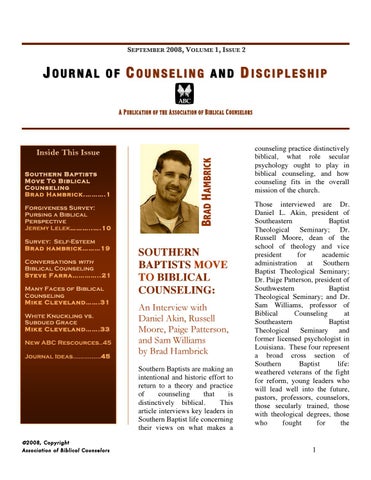
BRAD HAMBRICK
Inside This Issue
SOUTHERN BAPTISTS MOVE TO BIBLICAL COUNSELING: An Interview with Daniel Akin, Russell Moore, Paige Patterson, and Sam Williams by Brad Hambrick Southern Baptists are making an intentional and historic effort to return to a theory and practice of counseling that is distinctively biblical. This article interviews key leaders in Southern Baptist life concerning their views on what makes a
counseling practice distinctively biblical, what role secular psychology ought to play in biblical counseling, and how counseling fits in the overall mission of the church. Those interviewed are Dr. Daniel L. Akin, president of Southeastern Baptist Theological Seminary; Dr. Russell Moore, dean of the school of theology and vice president for academic administration at Southern Baptist Theological Seminary; Dr. Paige Patterson, president of Southwestern Baptist Theological Seminary; and Dr. Sam Williams, professor of Biblical Counseling at Southeastern Baptist Theological Seminary and former licensed psychologist in Louisiana. These four represent a broad cross section of Southern Baptist life: weathered veterans of the fight for reform, young leaders who will lead well into the future, pastors, professors, counselors, those secularly trained, those with theological degrees, those who fought for the
© 2008, Copyright Association of Biblical Counselors
1
www.christiancounseling.com authority of Scripture from a young age, and those who came to the conviction of Scripture’s sufficiency later in life. The purpose of the interview is three-fold. First, the interview intends to garner testimonial evidence that Southern Baptists are embracing the Biblical Counseling model of pastoral care over the “integrationist” or therapeutic model. Second, it is designed to allow the leaders to articulate their definition of “Biblical Counseling” as it relates to key areas of counseling and church life. Third, it should create a format in which the practical implications of this shift to Biblical Counseling can be communicated to pastors and other church leaders. The responses of each leader to the ten questions are unedited. Answers are attributed to the appropriate individual by means of his initials and arranged in alphabetical order by last name. 1. How do you define the difference between Biblical Counseling and other models of Christian Counseling (a.k.a. integration)? DA: I believe that Biblical Counseling defines itself as counseling that is intentionally biblical and theological. In other words, the starting point for doing counseling is the Bible. In a real sense Biblical Counseling is simply a form of Christian discipleship on a one on one and intentional basis. While it does not neglect insight from the human sciences, it places much less weight and value on these particular disciplines. Biblical counseling affirms both in theory and practice the sufficiency of scripture for the Christian life in all of its aspects. RM: I think the primary difference is a divergent understanding of general revelation. Integrationists would tend to see the thought of contemporary secular psychology issuing from God’s general revelation in nature and in humanity. We would affirm a robust doctrine of general revelation and common grace, but we would see secular psychology as being much more an ideology, a world-view.
A Biblical Counseling model understands depravity and the fall to the degree that they are able to see the way in which fallen self-interest masquerades as objective science. That is especially true with reference to psychology when this “science” seeks to explain and even prescribe a cure for the fallen condition of humanity. We believe in the primacy of the Scriptures, holding to a Reformation understanding of Sola Scriptura. We are able to understand general revelation through the lens of special revelation, through Scripture, and not the other way around. I believe that is the primary distinction between a Biblical Counseling model and integration. PP: 1 Peter 3:10 cites Psalm 34:12-16 making the statement “He who would love life and see good days, let him restrain…” The essential position of biblical counseling as opposed to all other models is that the overwhelming majority of men and women who wish to be in love with life and to see good days can achieve that by following biblical principles. Biblical counselors should be bornagain believers who have so thoroughly saturated themselves with the biblical witness that they know how the Bible speaks to all of the different kinds of problems that arise within the human family. Their counsel accordingly is based on biblical mandate and not on other philosophical assumptions of a humanistic origin. The reason I have said the vast majority is that I leave open for the moment that area of possible neurological malfunction as something that might happen to a very small percent of the total population. This has some potential in being treated by medication. It is also my persuasion, however, that at the present time it is completely over done, and in any event, lacking in hard scientific evidence. I have allowed it here, however, simply to be on the safe side, but at the same time stressing that the vast majority of human beings on the face of the globe can find an answer to all of life’s problems and difficulties within the pages of the Bible. SW: The difference is primarily in the central and active role assigned to the Scriptures, and in
© 2008, Copyright Association of Biblical Counselors
2
www.christiancounseling.com particular the Gospel, in both the conceptual model and the actual methods and practice of biblical counseling. God’s Word provides more than a filter or screen for errors and more than a set of control beliefs in the Biblical Counseling model. The Bible and practical theology play a dominant constitutive role in the formulation of the model and a creative and redemptive role in the actual counsel.
Dr. Daniel Akin
Dr. Russell Moore
Dr. Paige Patterson
2. Which approach to counseling, Biblical Counseling or integration, do you prefer? What aspects of doctrine and personal experience are most influential in your decision?
Dr. Sam Williams
DA: My preference is clearly for the Biblical Counseling model. In fact it is not a preference, it is a conviction. I do believe in the sufficiency of scripture. I believe the Bible provides wisdom and instruction for all aspects of life. This is not to negate the truths that we learn both from natural revelation and that are the overflow of common grace. However, even these avenues of knowledge must be filtered through the purifying Word of God. For me, doctrine is the starting point for doing counseling, not experience. Now of course that is a philosophical premise not a practical one. Practically speaking you must start where people are as you deal with them. However, you should come to the counseling room with a biblical framework already in place that informs your theology, psychology, and methodology of helping people in terms of soul care.
RM: We hold to a Biblical Counseling model that is very heavily influenced by David Powlison and the Christian Counseling and Education Foundation (CCEF). As a matter of fact, our academic personnel committee and trustees adopted two documents by David Powlison (including “Affirmations and Denials: A Proposed Definition of Biblical Counseling”), my manifesto on Biblical Counseling, and the Southern Baptist Resolution “On the Sufficiency of Scripture in a Therapeutic Culture” which lay out where we are moving as an institution. PP: While I do not like the term, nouthetic, because it is obscure to most people and also because it is associated with a particular school of biblical sufficiency advocates who hold some other views that I think to be wrong, I nevertheless, continue to advocate Biblical Counseling as the only appropriate thing in which the church should be involved. The church does not have medical training and should not attempt to do that which God has not called her to do in any event. We are called to seek and to save the lost and then to instruct them in how to have meaningful lives, which is something we can and should do on the basis of the Bible alone. SW: I was trained as a clinical psychologist and practiced as a licensed psychologist for 10 years. Even though my doctoral training was secular, I tried to “integrate” my faith and my psychology in my first 8 years of practice. At that point, as a result of frustration with the effectiveness of this method and also because of the lack of conceptual coherence of integrated approaches, I abandoned that project and converted to a Biblical Counseling approach. I would say that sin and grace are two key doctrinal concepts that I began to believe were crucial in the explanation of garden variety mental disorders and in their care and cure. In addition, I began to see that my role as a people helper was better defined as pastor/minister/discipler than as professional/clinical expert.
© 2008, Copyright Association of Biblical Counselors
3
www.christiancounseling.com 3. What do you believe the role of the Bible, the gospel, and the church ought to have in a distinctively biblical counseling model? What role does secular psychology have? DA: I believe the Bible, the gospel and the church ought to be primary. The churches indeed are to be a hospital for mending and bringing to health the souls of men and women. The primary means whereby we accomplish this is through biblical truth. At the heart of biblical truth of course is the life transforming gospel of Jesus Christ with all of its ramifications. Secular psychology again is not something we should ignore or neglect. We must be aware of it, we must understand it, we must be able to critique it and show its deficiencies. At the same time, as advocates of common grace, we realize that there will be times when they do have insight into particular issues. However, we will approach the secular disciplines with skepticism and caution. This is what sets Biblical Counseling apart from the traditional integrationist model. RM: I will deal with the second question first. Secular psychology can often be helpful in terms of raising questions. We seek for our students to be thoroughly familiar with secular psychology as well as with Biblical Counseling. The reason for this is because we believe that, just as Darwinism often asks questions and answers them wrongly, but you can discern a lot from just listening to the questions. What kind of questions are being asked by the culture? We need to be familiar with secular psychology missiologically, in terms of a Great Commission mindset. But we don’t need to adopt the world-view of secular psychology. The Bible is not just a casebook or a manual for counseling. The Bible is that, but the Bible also presents an over-arching world-view, a story line, that makes sense of the universe. In order for someone to be equipped as a counselor, they need not only to be equipped to know how to talk to people and pull out a few selected Proverbs and apply it to a situation. A person needs to be theologically grounded and understand the full biblical paradigm of Creation-Fall-Redemption, and to see how Creation-Fall-Redemption plays into the
lives of individual believers and into the corporate life of the church. So we believe not only in a biblically sound counseling model, but a counseling model that is theologically rich. One of the weaknesses to the way in which Biblical Counseling has sometimes been practiced in churches is that it is very proof-text oriented, isolated from the larger picture of Scripture. PP: The role of secular psychology has very little to contribute to the church. In laboratory situations, human behavior can be observed and conclusions of some kinds can be drawn that might be helpful to those working in the church. However, an overwhelming foundation for counseling for the church is discoverable in the triumvirate of regeneration, the permanent indwelling of the Holy Spirit, and the revelation of the mind of God that is revealed on the pages of Holy Scripture. SW: The Bible is our primary epistemological and conceptual source; although secondary sources may be utilized provided they are understood through and re-interpreted from the perspective of biblical presuppositions and biblical concepts and categories remain dominant. The gospel is central because it is only there that we apprehend the depth of our sin and the height of God’s love. When sin becomes a central explanatory concept for the problems and miseries of humanity, then the sin-bearing, sin-destroying Savior becomes the obvious solution, to the glory of God. As John Owen has said, “He that hath slight thoughts about sin never had great thoughts about God.” One of the functions of the church is to be God’s community mental health center – an authentic and genuine family in which humility about who we really are and courage in facing sin and suffering are central virtues. It is in this community of believers that the Gospel is preached and sung and taught and lived. It is in the Body of Christ that we taste and see that the Lord is good. 4. How does your school teach that Biblical Counseling should interact with the ministries of the church?
© 2008, Copyright Association of Biblical Counselors
4
www.christiancounseling.com DA: We believe, and are moving more in the direction, of showing how Biblical Counseling is a form of discipleship. In other words Biblical Counseling should be about the business of discipling people to walk in the ways of God, live in the blessings of His grace, and pursue His holiness with disciplines that will promote that holiness. RM: We do not think that counseling needs to be severed from the rest of the ministries of the church, which is what has happened in so many of our churches up until this point. Counseling needs to be an extension of the preaching ministry and of the Ephesians 4 up-building of the body. We believe counseling ought to be consistent with what is being said in the pulpit, what is being sung in the churches, and what is being practiced in the community life of the congregation. So ideally a counseling situation would be a face to face application of the theology that is being articulated within the life of the congregation. We believe that Biblical Counselors ought to be pastors. Whether or not these individuals are senior pastors of the congregation, we believe that they ought to have pastoral responsibility within the life of the church. PP: Our school teaches that every minister of the gospel, in whatever area of the ministry he works, will have to be a “biblical counselor.” This, it seems to me, is the unavoidable part of personal interface in ministry with people who need guidance, including hurting people. However, I also believe that pastors ought to give themselves primarily to the preaching and teaching of the Word of God, and hence, churches are certainly justified in adding to their staffs as early as possible people who will have as a major part of their assignment Biblical Counseling. SW: We believe that counseling is a ministry of the Word of God, and as such it is given to the church as one component of its evangelism and discipleship responsibilities. Counseling is one of the many ministries of the church that enables people to grow up and into Christ. Ideally, it is integrated with the other forms of ministry.
5. What questions would you ask a counselor you were considering referring to in order to assess whether their practice was distinctively biblical? What “red flags” are you screening for as you ask these questions? DA: That is a very good question. First of all, I am going to ask them about their own commitment to the Bible’s authority and sufficiency. I am going to inquire as to what they believe the role of psychotherapy and medications might play in the counseling experience. I am going to inquire concerning their theological orientation and the Christ centeredness of that theology. For me Jesus Christ is the starting point of my theology. Indeed He is the hub out of which all other spokes of theology naturally derives. I am looking for someone who is thoroughly Christo-centric in their approach to thinking, counseling and life. Red flags that would jump out at me would be a premature advocacy of medication, as well as the conviction that helping people almost always requires long term psychotherapy. Further, I am skeptical of those who believe that professionals always do the best counseling. I am a major advocate of a Titus 2 model of church life, which would also include counseling. I know of few better methods than to put a younger struggling believer under the watch care of a more mature godly believer. Such mentoring is thoroughly biblical, and has much greater potential for soul care of individuals who are working through sin patterns and issues in their life. RM: The first thing I would ask is a series of case studies. I would ask, “How would you deal with an individual who has an eating disorder? How would you deal with an individual who is grappling with anger? How would you deal with an individual who is dealing with same-sex attraction?” The red flags I would be looking for are, number one, a lack of directness. So someone who is not directly engaging the issues is someone I would not want counseling members of my congregation. Number two, I would look for the jargon of secular psychology. Number three, I would look for an end-run around the cross and the empty tomb; trying to treat issues in a medical sense without first
© 2008, Copyright Association of Biblical Counselors
5
www.christiancounseling.com addressing issues of regeneration and sanctification. That would be a huge red flag for me. PP: If I understand this question correctly, I would answer it by saying that any potential counselors teaching for us or going to the churches would be examined for their faithfulness to the concepts enunciated above, namely that conversion is the fist step to the healing of most human problems, then learning to be obedient to the Spirit of God, who lives within them, and to master and obey the biblical text. These would be paramount in my mind. If a potential counselor keeps using code words from secular counseling enterprise or thinking in those paradigms rather than in biblical paradigms and particularly invoking secular anthropology rather than biblical anthropology, I would not wish to proceed any further. SW: I’d ask them what books and authors they found particularly helpful in their counsel. I’d ask them what they thought about theology and whether or not they thought it had any relevance to everyday life or counseling. I’d ask them what makes their “Christian” counseling Christian. 6. Do you see any potential dangers with a church referring to integrationist counselors or using discipleship materials in their church that are from an integrationist perspective? DA: Yes, I do see dangers, though that would not rule out their use in every instance. Each of those persons and their materials should be carefully weighed. For example I personally have found a number of valuable things in the teachings of Willard Harley and Gary Chapman, John Trent and Gary Smalley, and of course James Dobson. All of these men would fall in to the category of integrationists. What is lacking in most of their teachings is a biblical orientation. However, many times they make practical suggestions and provide counsel that is thoroughly biblical; it is simply the case that they did not see the biblical moorings of what they were teaching. RM: Absolutely, because I think that it undercuts what a biblical church is trying to do in terms of
conforming members to the image of Christ. Integrationist materials, which are widespread, not only within the church but also radio and television programs, actually harden and callous hearts to conviction of sin. As long as I am able to see myself as a victim, or a diseased person who needs healing, rather than as someone who needs to take the sword of the Spirit and apply it to the issues of my life, I am less vulnerable—in a good sense—to the convicting power of the Holy Spirit. So if I were a pastor concerned about this I would make sure that my people had curricula that addressed not only the big questions, but also the small individual questions as well. PP: Yes, I see monumental problems in churches referring people to integrationist counselors and using discipleship materials in their churches that are taken from an integrationist perspective. Such perspectives often claim to be informed by the Bible, but, in fact, they seldom give much information of a biblical nature and tend to fall far more in the self help category than in biblical understanding. The church has been one of the major contributors actually to the success of integrationist approaches even while the integrationist approaches themselves have, as frequently as not, damaged the witnesses of the churches. SW: Yes, such materials would be against the grain of the teaching from the pulpit and the private counsel proffered by those that counsel. Mixed messages could result in confusion and even worse may shortchange those that need help. However, I would not say that to do so would be heretical or that God could not use integrated counselors or materials for His glory. If God could speak thru Balaam’s donkey and through this writer, then he can and certainly typically does work through flawed instruments. 7. What authors and organizations do you believe are doing the best work in presenting a biblical model of counseling? DA: I believe the two schools that stand out at this particular time are Westminster Seminary and
© 2008, Copyright Association of Biblical Counselors
6
www.christiancounseling.com Southeastern Seminary. I have been very impressed with the works of [David] Powlison and [Paul and Tedd] Tripp at Westminster. I am also quite encouraged at what I discovered in the counseling program at Southeastern. Southern Seminary is now moving rapidly in this direction. I still believe we have a long ways to go, but I am very much encouraged about the direction and orientation of these programs. RM: Well there are not many. I think the preeminent organization is CCEF and David Powlison, Paul David Tripp, and Ed Welch. I think the Journal of Biblical Counseling is an invaluable resource. PP: Presently, Southeastern Baptist Theological Seminary, Southern Baptist Theological Seminary, and, increasingly, Southwestern are doing the best work I know about in Biblical Counseling. I also believe that John MacArthur’s school, Master’s College and Seminary, is doing an outstanding job, as well as Westminster Seminary in Philadelphia. SW: The Christian Counseling & Education Foundation’s (CCEF) triumvirate – David Powlison, Paul Tripp, and Ed Welch are at the top of the ladder in the world of Biblical Counseling. Their gentle hearts and capacious minds are without equal in the domain of Christian Counseling. 8. Why do you think secular psychology has become such an attractive alternative for many church leaders and members? Why are Southern Baptists embracing Biblical Counseling at this time in their history? DA: The answer to the first question is simply this: we live in a culture that is awash in the therapeutic, and tragically the church is more influenced by the culture than it is in transforming it. However, Southern Baptists have always been a people of the book and so again, and again, and again, the Word of God has sometimes had to drag us back to our roots. I think that is perhaps what is happening now in the Biblical Counseling movement. It may also be the case, that we have seen that the integrationist
models as a whole are struggling to deliver what they hope to accomplish. This is not surprising with the newness of the whole Christian Counseling movement. It is, however, an indication that we must always be thoroughly biblical in all that we do. RM: Secular psychology is attractive for pastors and church leaders because it enables laziness. A pastor who wants to hide from people in his office and not equip members of his congregation to counsel the flock can simply refer someone to a “professional” outside the walls of the church, and he is simply now rid of these people. Also secular psychology is everywhere in the culture; we live in a therapeutic culture. Church members are listening to our preaching for a few hours each week, but many of them are watching Oprah for the rest of the week and they are reading books that encourage this kind of mindset. It’s a Romans 1 situation. We want to evade the conviction of sin and to justify, suppressing the truth of unrighteousness, our own sin. Secular psychology does that very well. Psychiatric and psychological establishments are turning against evangelical Christianity in such explicit ways. So for instance, on issues like homosexuality, the divergent world-views are just so clear that Southern Baptists are realizing that we cannot function in the atmosphere of secular psychology any more. PP: Secular psychology has mastered the ability to sound official, professional, and even therapeutic. This has caused many people to be deceived by it, and there have been broad scaled failures to look concretely at the general failure of secular psychology. A recent book that chronicles this failure is The Road to Malpsychia: Humanistic Psychology and Our Discontents by Joyce Milton, a book which focuses clearly on the origins of all of this. Some Southern Baptists are thankfully seeing through this now and coming to understand that the only thing churches are going to be able to do successfully is what Christ commissioned us to do, and that is to bring the lost to Christ and teach them how to live successful and meaningful lives by following the teachings of Jesus in the Bible. That
© 2008, Copyright Association of Biblical Counselors
7
www.christiancounseling.com is what we are trained to do, and that is what we ought to do. SW: The therapeutic has triumphed in our radically autonomous, hyper-individualized culture while the moral and communal elements of life have been marginalized. Even in the church, our understanding of personal problems has been dominated in secular therapeutic terms rather than moral and spiritual terms. Sin and salvation seem only to apply to our private little souls and little else. Theology has been marginalized as an irrelevant and academic thing that has no practical effect on how life is understood and lived. The understanding of the ministry of the Word of God has been constricted, so that it is equated with public preaching and teaching and the personal, one on one ministry has been forsaken. Counseling is messy work. Many pastors and churches would just as soon not get their hands sullied. It is so much easier to refer the dirty work to Dr. So and So. Secular psychology has successfully packaged and marketed its product to the medical establishment, health insurers, and employers. 9. How would you envision an ideal relationship between local churches and a parachurch ministry devoted to a biblical model of counseling? DA: Ideally they would mutually support one another. A parachurch group would perhaps provide top level counseling, but even more, they would be in the process of training other persons to do biblical discipleship, which is in my judgment Biblical Counseling. Again, even many professionals are now recognizing that lay persons are often as effective, if not more effective, than so called professionals. To train lay persons in skills of marital and family counseling, as well as biblical guidance in terms of developing discipleship skills to my way of thinking is a perfect way for these two entities to partnership with each other.
RM: I think parachurch ministry is important, but it has to truly be para-church not extra-church. Say there is a group of churches that are banding together supporting a counseling center, these counselors must be held accountable to the local congregations and must be involved in the lives of these local congregations. So that what the counselors are doing is coming from the overflow of the preaching, discipleship, and church discipline of these local congregations. I would want to know where the counselors were members of a church and how they function in the life of that congregation. Also, I would want to know how is this counseling center asking to be held accountable to these congregations. I would want to be meeting with the leadership of the counseling center on a regular basis to know that what is happening in the counseling center is consistent with what we are doing in the life of our congregation. PP: Local churches can have a good relationship with a parachurch ministry devoted to a biblical model of counseling. However, I believe that the major care of the body of Christ needs to be done by the body of Christ. That seems to be the emphasis of Paul in 1 Corinthians, so, while I am thankful for parachurch movements whether in Biblical Counseling, evangelism, or discipleship movements such as Campus Crusade for Christ, Navigators, etc‌, they only exist because of the failure of the local church. I believe that local churches ought to assume these responsibilities and minister to their own. SW: First, the parachurch ministry would recognize its barely legitimate status, and consider its role as provisional and temporary. Second, the parachurch should work toward its own extinction by training pastors and lay leaders, inviting them to counseling sessions, deferring to pastoral authority when warranted, and reminding the church of the crucial importance of Christian community in life change. Ultimately and ideally, counseling is a ministry of the church and should be subsumed under its authority and function as the intensive care unit within its community.
Š 2008, Copyright Association of Biblical Counselors
8
www.christiancounseling.com 10. What final words of advice would you give to pastors as they consider matters of counseling? DA: I would encourage pastors to recognize their own limitations. Pastors should realize and be honest in what they know and do not know, what they can do and cannot do. In my own life, for example, I recognize that I do a form of Biblical Counseling on a popular level through my family and marriage seminars. I am exegeting texts, drawing practical applications from those texts, and presenting those on a popular level. I realize that works well with a segment of our churches. However, some persons because of sin, experience, and deep hurt need more than I can give them in that format. Therefore, I do not hesitate to recommend them to persons who on a one on one basis are more trained and equipped to deal with them, and to bring them from where they are to the place of godliness and holiness that I know is God’s desire and plan for their life. RM: The primary word of advice would be that counseling is your job. That does not mean that every pastor must counsel every member of the congregation, but it means the counseling ministry of the congregation is a pastoral responsibility in shepherding the flock. So a pastor who out-sources counseling is out-sourcing his pastoral responsibility and he will be held accountable for that at judgment. That means thinking through issues of counseling and implementing counseling within the congregation is of utmost importance. PP: My strong advice to any young pastor is to learn everything he can from every single source. I require my theology students to read Sigmund Freud’s Totem and Taboo and Moses and Monotheism because I want them to know the background to the many heresies spawned by that. But, while we ought to know all of that, we ought to know the Bible better, and we ought, above all else, to be teachers of the Bible. This is both a pulpit ministry and an individual one-on-one counseling ministry of teaching the Bible and its precepts to people in order to enable them to navigate life’s
rough waters. That is our assignment. That is what we must do. SW: Spend time with your people, listen and learn about their lives. Teach your people to decipher life, including personal and relational problems, in biblical terms. Don’t just preach the Word, counsel the Word. Finally, continually remain aware of the difference between talking and communicating, monologue and dialogue, the bully pulpit and the pastoral pulpit. Concluding Remarks I would like to thank Dr.’s Akin, Moore, Patterson, and Williams, not only for their time in doing this interview, but also for their commitment to ensuring that Southern Baptists express their commitment to the sufficiency of Scripture, the necessity of the Gospel, and the centrality of the church for counseling. This interview evidences that, while there may be differences in how the leadership of Southern Baptist nuance their understanding of Biblical Counseling, there is unity on their commitment to the Biblical Counseling movement as a needed correction to the integrationist models. Undoubtedly, the years and decades ahead will be filled with efforts to unpack the core principles contained in this interview. It is desired that the reader will take at least four things from this interview. First, Southern Baptists, beginning in our seminaries, are transitioning to a Biblical Counseling model of pastoral care. This is a historic and significant shift. Second, the church need not compromise its theology or ethics in order to address the complex problems in living. Rather than being awkward tangents to counseling, theology and ethics are the core of a biblical philosophy of life that directs people to enjoy life as God intended. Biblical Counseling aspires to be a key component of the church’s efforts to spark revival in our day, by equipping people to understand their lives in biblical terms so that they will grasp the relevance of the gospel for all of life.
© 2008, Copyright Association of Biblical Counselors
9
www.christiancounseling.com Third, churches need to be discerning and intentional in screening when and to whom they hire and/or refer their members for counseling services. Counseling is a Great Commission activity. It is a part of “teaching them to obey everything Jesus commanded (cf. Matt 28:20a).” The magnitude of this task requires care in selecting those to whom this shepherding role is delegated to by local churches and pastors. Finally, God is a gloriously wise, loving Father who has instructed His people in how to live through His Word. We ought to praise Him for this lovingkindness and express our gratitude by using His Word for all He intended it to accomplish. Reflection upon the power and utility of Scripture ought to be an encouraging time that results in the settling of our souls and the fervent engagement of our minds in study.
Jeremy Lelek
********** Jeremy Lelek is a Ph.D. Candidate at Regent University, and serves as President of the Association of Biblical Counselors
FORGIVENESS SURVEY PURSUING A BIBLICAL PERSPECTIVE The following survey was conducted by the Association of Biblical Counselors, and the information provided is heavily based on the views offered by Dr. Jay Adams (1994; 1979). The rationales offered by this author are primarily applicable for those offenses made by individuals who profess faith in Jesus Christ, and do not necessarily apply to offenses made by non-believers. For further information on this topic, the author highly recommends a seminal work by Dr. Adams entitled, From Forgiven to Forgiving (Adams, 1994). 1. From a biblical perspective, forgiveness is best understood:
a. As a process that takes place only after emotional healing has occurred (emotional healing precedes forgiveness) b. A promise that is immediately granted to a repentant offender that serves as the basis for eventual emotional healing (forgiveness precedes emotional healing). c. Something that naturally happens with time but cannot be force or rushed. d. Irrelevant to the counseling process AUTHOR’S PROPOSED ANSWER: B AUTHOR’S RATIONAL While emotional healing is often an aspect of moving beyond the pain of an offense, in this author’s perspective, it is not the basis of forgiveness (as answer “A” would suggest). This author recognizes that such an assertion is strongly contrasted by much of the leading research. For example, Worthington, Sharp, Lerner and Sharp (2006) differentiate forgiveness into two parts citing that individuals may experience either or both of the following: decisional forgiveness and/or emotional forgiveness. Worthington et al. describe the former (e.g., decisional forgiveness) as being rooted in one’s ethical or moral framework, whereas emotional forgiveness is the “process of replacing negative emotions with positive other-oriented emotions” (p. 33). Worthington and his colleagues adhere to the idea that if decisional forgiveness is granted via moral or ethical conviction to the exclusion of emotional forgiveness, then such an experience would be considered “hollow forgiveness”. This paradigm therefore emphasizes the necessity of emotional healing as an essential component of the researchers conceptualization of true forgiveness. On the other hand, Jay Adams (1994; 1979) addresses the issue of forgiveness from a strictly theological position. Adams notes, “What does God do when He goes on record saying that our sins are forgiven? God makes a promise. Forgiveness is not a feeling; forgiveness is a promise” (Adams, 1994, p. 12). Conceptualizing the construct of forgiveness as a promise or covenant between two individuals removes the necessity of emotional congruence in
© 2008, Copyright Association of Biblical Counselors
10
www.christiancounseling.com order for an individual to say he or she has indeed forgiven another. According to Adams, once the promise is made, forgiveness has been completed, and the process of addressing negative or hurtful emotions may begin. As Adams (1979) points out, forgiveness “removes the liability of punishment”, but it does not “lift other consequences” (p. 230). As such, other “consequences” such as emotional turmoil and pain must be addressed. Yet, simply because emotional pain may still exist following the act of forgiveness does not diminish the validity of the forgiveness offered. This conceptualization allows the offended party to offer forgiveness immediately upon repentance even while negative emotions are intensely present. As such, forgiveness becomes the basis upon which emotional and relational healing are built. This stands in contrast to the views of Worthington et al. (2006) who assert that the highest order of forgiveness cannot ultimately be granted until negative emotions regarding the offender have dissipated.
Non ABC Counselor Non ABC Pastor Non ABC Layperson Non ABC Total Not a Christian
2. A biblical perspective of forgiveness: a. Requires the offended party to forget the offense b. Recognizes that forgetting the offense may never occur c. Views failure to erase the offense from memory as sin AUTHOR’S PROPOSED ANSWER: B AUTHOR’S RATIONALE
Question 1 ABC Counselor ABC Pastor ABC Layperson ABC Totals
answer for question one is “B”, forgiveness is a promise that is immediately granted to a repentant offender serving as the basis for eventual emotional healing (forgiveness precedes emotional healing). Conversely, across all categories, the least popular answer for question 1 is “D”, that forgiveness is irrelevant to the counseling process.
A 3 (8.6%)
B 29 (82.9%) 24 (92%) 45 (90%)
C 1 (2.9%) 1 (3.9%) 0
D 2 (5.7%) 0 0
9 (8.1%)
98 (88.3%)
2 (1.8%)
2 (1.8%)
2 (18.2%) 2 (12.5%) 4 (10.3%) 8 (8.1%)
9 (81.8%) 14 (87.5%) 34 (87.1%) 57 (86.4%)
0
0
0
0
1 (2.6%)
0
1 (1.6%)
0
1 (3.9%) 5 (10%)
AUTHOR’S ANALYSIS OF THE SURVEY DATA The above chart provides raw data from the present survey. According to the results above, the majority of individuals across all categories (83.3% members and 86.4% non-members) agree that the correct
Forgetting an offense is not the equivalent to “remembering the offense no more”. As a matter of fact, Enright (2001) emphasizes the fact that the brain is actually designed to catalogue painful experiences. While leading theorists such as Eright (2001), Worthington (1998), McCullough, Pargament, and Thorsen (2000) disagree with most of Adams’ (1994) perspectives on biblical forgiveness, all agree that actual “forgetting”, resembling amnesia (i.e., forgive and forget), is unlikely when someone experiences a painful offense. However, implicit in Christian forgiveness is the idea that an offended party must “remember the sin of the offender no more” once forgiveness has been granted. While this may appear confusing at first glance, there is a significant distinction between the idea of “forgive and forget” and “remembering one’s sins against him no more”. Adams (1994) points out that people have no control over forgetting in that such an experience is completely passive. Forgetting is not something one is able to do consciously. A person cannot force their mind to erase the event from memory. Therefore, answers “B” and “C” are not rational approaches to be sought or demanded
© 2008, Copyright Association of Biblical Counselors
11
www.christiancounseling.com from counselees. unbiblical (Adams, 1994).
They are ultimately
On the other hand, the active decision to “remember one’s sins against him no more” is the responsibility of the counselee who has offered forgiveness. Adams (1994) notes that this active decision is characterized by exercising one’s will not to bring up the offense to the offended party, others, or self anymore. Whereas forgetting is an involuntary process (outside of the control of the offended), remembering to keep one’s commitment (not to remember the offense against the offender) may be accomplished by volitional act of choice. For example, if a painful offense enters into one’s conscious thinking (evidence that one has not forgotten), then if the offended party has forgiven, he or she is responsible to remove the offense from conscious thought rather than ruminate on it and exacerbate anger, bitterness, and a sense of justice
Non ABC Counselor Non ABC Pastor Non ABC Layperson Non ABC Total Not a Christian
3. If someone is struggling with remembering an offense, a pastor/counselor should: a. Encourage them to re-experience the emotions evoked by such memories as a means of catharsis and healing. b. Point out that failing to “forgive and forget” is a sin. c. Acknowledge the validity of the struggle, and offer guidance on how to biblically “put off” the old thoughts, and “put on” thoughts that will honor the Lord. d. Counsel the person to ignore the memories since they will eventually go away. AUTHOR’S PROPOSED ANSWER: C
Question 2 ABC Counselor ABC Pastor ABC Layperson ABC Totals
true biblical forgiveness requires the offended party to forget the offense.
A 5 (14.3%) 2 (8%) 13 (26%) 20 (18%)
B 30 (85.7%) 24 (92%) 36 (72%) 90 (81.1%)
C 0 0 1 (2%) 1 (.9%)
2 (18.2%)
9 (81.8%)
0
2 (12.5%) 7 (18.4%)
14 (87.5%) 30 (80%)
0 1 (2.6%)
11 (16.9%)
53 (81.5%)
1 (1.6%)
AUTHOR’S ANALYSIS OF THE SURVEY DATA According to the data, 81.1% of all ABC members who responded to this survey agree with the author that a biblical perspective of forgiveness does not require forgetting on the part of the offended. Similarly, 81.5% of all non-ABC members who responded to the survey agree with the author. A fairly high number of ABC respondents (18%) and non-ABC respondents (16.9%) adhere to the idea that
AUTHOR’S RATIONALE This author outlined in the previous question the distinction between “forgetting” and choosing “not to remember”. In that explanation, it was asserted that the idea of “forgive and forget” is both irrational and unbiblical. Additionally, it was pointed out that the offended party holds the responsibility to no longer remember an offense (i.e., actively choosing not to bring up or ruminate on the offense to the offender, others or self) once repentance has been sought. From these assertions, it becomes clear that answers “A” and “B” are incorrect. The first answer is contrary to the principle that one is to actively “remember the sin no more”, and actually encourages the offended party not only to remember the offense as a means of healing, but to re-experience the emotion of the offense as well. Answer “B” points to the other extreme, and does not reflect the reasonable fact that forgetting an offense may never occur. At the same time, having the offense lodged in one’s memory does not automatically determine that a person will not be able to forgive and therefore move past the offense. Such a conclusion reflects a false “either/or” dichotomy, and lends to a profoundly
© 2008, Copyright Association of Biblical Counselors
12
www.christiancounseling.com insensitive approach to counseling those who have experienced the emotional pain of personal offense. Since a biblical approach to forgiveness does not support a “forgive and forget” philosophy, biblical counselors recognize that even when forgiveness is granted, the offended party may continue to struggle with what scholars refer to as cognitive rehearsal, or simply stated, ruminating on the offense in one’s mind (Enright & Gassin, 1992). In addition, biblical counselors understand that the emotional pain of an offense does not automatically disappear once forgiveness is granted. As such, biblical counselors are wise to equip themselves with scriptural methods to address such tendencies. Answer “C” reflects one particular method that might prove helpful to counselees in addressing both of these issues. Referring to Ephesians 4:17-24, and unpacking it with counselees might serve to equip them to successfully move beyond the temptation to ruminate or harbor sinful and destructive emotions (i.e. anger, bitterness, resentment, etc.). Question 3 ABC Counselor ABC Pastor
A 1 (2.9%)
B 2 (5.7%)
0
0
0
0
1 (1%)
2 (1.8%)
0
0
1 (6.3%)
0
2 (5.1%)
0
3 (4.5%)
0
ABC Layperson ABC Totals Non ABC Counselor Non ABC Pastor Non ABC Layperson Non ABC Total Not a Christian
C 32 (91.4%) 26 (100%) 50 (100%) 108 (97.2%)
D 0
11 (100%) 15 (93.7%) 37 (94.9%) 63 (95.5%)
0
0 0 0
0 0 0
AUTHOR’S ANALYSIS OF SURVEY DATA The vast majority of both ABC members (97.2%) and non-members (94.9%) who responded to this survey concur that counselors and pastors should
acknowledge the continued struggles implicit to offenses, and provide helpful methods (e.g., “put on/put off”) that will serve to assist the counselee in moving beyond the pain of their experience.
4. A biblical view of forgiveness: a. Is conditional upon the repentance of the offender. b. Is unconditional regardless of the offenders act of repentance c. Views unforgiveness and bitterness as one and the same. d. Requires the offended party to ignore the offense completely. AUTHOR’S PROPOSED ANSWER: A and B AUTHOR’S RATIONALE This question merits clarification, and in the author’s view is not well written as it is stated (though it is the author who formulated the question). A biblical view of forgiveness is actually reflected in both answers “A” and “B”. Answer “B” is quite self-explanatory and widely accepted within the church, and presumably does not merit a detailed explanation. That is not necessarily the case for answer “A” which purports a conditional view of forgiveness. Therefore, the rationale for answer “A” will be elaborated on in the following section. It is worth noting initially that there is much support in the Bible to encourage believers to offer unilateral (as well as conditional) forgiveness depending on the circumstances (MacArthur, 1998). For the biblical counselor, however, conditional forgiveness does merit a cursory examination of scriptural validity. First, it requires an accurate understanding of the current definition proposed in this survey. Forgiveness is defined here as a promise. It is actually a promise made via an interpersonal transaction in which confession and repentance are present. It is imperative to consult the Scriptures as it relates to this idea.
© 2008, Copyright Association of Biblical Counselors
13
www.christiancounseling.com In Luke 17: 3-4 Jesus says, “Pay attention to yourselves! If your brother sins, rebuke him, and if he repents forgive him, and if he sins seven times in the day, and turns to you seven times saying, ‘I repent’, you must forgive him.” Notice in both examples, Jesus says if your brother repents then forgive. In so doing he is placing a condition on forgiveness in that it is predicated upon the offender’s repentance. Jesus was literally speaking to the Jewish culture, and it is well known that in the traditions of Judaism a “return” (or confession) is strongly recommended prior to forgiveness being granted (Dorff, 1999, p. 39). Dorff highlights the rationale for such an approach in that failure to require a “return” may cause the offender to “think that one may commit that same offense many times without cost” (McCullough, Pragament, & Thoresen, 2000, p. 32). To actually grant forgiveness without contrition on the part of the offender could even be perceived as unloving since it does not call the offender to account (requiring repentance), and therefore awaken him or her to the evil that is being perpetrated (against God and others) through his or her actions. Some may object to this interpretation citing passages such as Mark 11:25 in which Jesus says, “And whenever you stand praying, forgive, if you have anything against anyone, so that your Father also who is in heaven may forgive you your trespasses” (ESV). Adams (1994) provides perspective on this passage: Here a nice distinction must be made. As we have seen, when God forgives us, he goes on record declaring that He will remember our sins no more. That is the granting of forgiveness by which He promises never again to use our sinful record against us. Forgiveness, however, does something…It lifts the guilt from the shoulders of another allowing reconciliation to occur. We must discuss reconciliation more fully later on, but in this verse Jesus is concerned about the attitude of the believer as he stands before God in prayer. If he is inwardly unwilling to forgive his brother or sister, he cannot expect forgiveness from his Father. Thus, preceding the promise (or granting) of forgiveness to another, one must prepare to lift that guilt so that the promise he makes,
even if against his feelings, will be sincerely meant and kept. He may not simply repeat a formula: he must forgive from his heart. Like his Heavenly Father, by prayer, the believer seeks to become “ready to forgive” (Ps. 86:5, MLB). That is the meaning of Mark 11:25…His prayer is to God, and since he is not granting God forgiveness, in the verse the word “forgive” must be used by extension to express the willingness to forgive another…Certainly, we can be sure of this much, that it is a prayer to take all resentment and bitterness from the heart of the supplicant” (p. 31). Additionally, Adams (1994) makes a provoking point when he refers to the exercise of church discipline as being antithetical to exclusive unilateral or unconditional forgiveness: If we are to forgive brothers and sisters purely on our own, apart from any whisper of repentance, in doing so, we promise them not to bring the matter up again—to them, to others, or to ourselves. Yet, that is exactly what the process of church discipline requires us to do—bring it up, again and again and again, to them and to others, until repentance and reconciliation are effected or the rebellious brother is evicted from the church (p. 33). Essentially, Adams is making a strong point that if unconditional forgiveness is the only mode of forgiveness, it creates a great incongruity in the Bible as it regards interpersonal sin and church discipline (Matthew 18). To help believers navigate the terrain as to when conditional forgiveness must be considered, MacArthur (1998) cites four guidelines: 1. If a person observes a serious offense that is committed against someone else, confront the offender. 2. When ignoring the offense could hurt the offender, confrontation is required.
© 2008, Copyright Association of Biblical Counselors
14
www.christiancounseling.com 3. When a sin is scandalous or otherwise potentially damaging to the body of Christ, confrontation is essential. 4. Any time the offense results in a broken relationship, formal forgiveness (a transaction) is an essential step toward reconciliation. In conclusion, the idea of conditional forgiveness upholds the belief that repentance is essential in order for the offended party to lift the debt, and make a promise to the offender. There does appear to be a precedent in the Bible for such an approach. This position has not been circulated much throughout most Christian circles, but does merit attention. First, such a perspective promotes interaction between believers with the ultimate goal of reconciliation. Secondly, it clears up potential misunderstandings. Simply because an offense is perceived by a person does not necessarily mean that was the intent of the accused offender. If confrontation takes place, such matters can be clarified, therefore protecting the offended party from carrying undue bitterness due to a misunderstanding. Finally, confronting others with sin, and choosing NOT to lift the burden of guilt until repentance occurs is a profoundly loving act (if carried out with humility and genuine concern for the other). Glossing over offenses that are harming the offender is not a true expression of biblical love. As Matthew 18 points out, demanding repentance is necessary in order to reconcile a person to God and to fellow believers. Additionally, Christians may use unilateral forgiveness as a means to avoid issues that must be confronted. In this author’s experience as a counselor for the past decade, this is a trend he has witnessed among believers. A balanced perspective is warranted between the two (conditional vs. unconditional forgiveness), and great prayer and thought must be exhibited in every circumstance as to which means of forgiveness is necessary, and which approach truly has love for God and neighbor as one’s final motivation.
ABC
Non ABC Counselor Non ABC Pastor Non ABC Layperson Non ABC Total Not a Christian
18 (16.2%)
77 (63.4%)
16 (14.4%)
0
3 (30%)
6 (60%)
1 (10%)
0
5 (31.3%) 5 (12.8%) 13 (20%)
9 (56.3%) 26 (66.7%) 41 (63.1%)
2 (12.4%) 7 (18%)
0
10 (15.4%)
1 (2.6%) 1 (1.5%)
AUTHOR’S ANALYSIS OF SURVEY DATA Corresponding with the author’s experience as a counselor, the data above illustrates that among those who participated in the survey, the majority of them believe “unconditional” forgiveness reflects a true biblical perspective of forgiveness. This author believes that the wording of the question serves as a significant limitation to the results, and would be interested in the percentages if answer “B” was stated as follows: “Is always unconditional regardless of the offender’s willingness to repent”.
5. Biblical forgiveness, once granted, requires the offended party to do all of the following except: a. Not bring up the offense to the offender in an accusatory manner b. Not be hurt by the initial offense. c. Not bring the offense up to others (gossip) d. Not allow the offense to ruminate in one’s mind AUTHOR’S PROPOSED ANSWER: B
Question 4 ABC Counselor ABC Pastor
Layperson ABC Totals
A 7 (20%) 3 (11.6%) 8 (16%)
B 22 (62.9%) 19 (73%) 36 (72%)
C 6 (17.1%) 4 (15.4%) 6 (12%)
D 0 0 0
AUTHOR’S RATIONALE Certainly it is unrealistic to assert that a person “should not be hurt by the initial offense”. Being sinned against is often painful, and much of
© 2008, Copyright Association of Biblical Counselors
15
www.christiancounseling.com counseling frequently focuses on addressing such pain. As has been stated, forgiveness, viewed as a promise, includes three components, each cited in answers “A”, “C”, and “D”. Question 5 ABC Counselor ABC Pastor ABC Layperson ABC Totals Non ABC Counselor Non ABC Pastor Non ABC Layperson Non ABC Total Not a Christian
A 1 (2.9%)
B 25 (71.4%) 17 (65.4%) 34 (68%)
C 6 (17.1%) 0
9 (8.1%)
76 (68.5%)
10 (9%)
16 (14.4%)
0
7 (63.6%) 9 (56.3%) 28 (71.8%) 44 (66.7%)
3 (27.3%) 2 (12.5%) 2 (5.1%)
1 (9.1%)
3 (11.6%) 5 (10%)
2 (12.5%) 4 (10.3%) 6 (9.1%)
4 (8%)
7 (10.6%)
D 3 (8.6%) 6 (23.1%) 7 (14%)
3 (18.7%) 5 (12.8%) 9 (13.6%)
AUTHOR’S ANALYSIS OF SURVEY DATA: It is interesting that among respondents, only 68.5% (ABC Members) and 66.7% (non-members) answered “B” on this question. In this author’s view, that is profoundly low percentage given how answer “B” is stated. A follow-up as to why respondents chose “A”, “C”, and “D” would be recommended so that a clearer understanding on this particular question might be ascertained.
6. Forgiveness always requires the forgiver to be open to restoring the harmed relationship. a. True b. False AUTHOR’S PROPOSED ANSWER: A, TRUE
AUTHOR’S RATIONALE Adams (1994) points out that forgiveness is not the end, but a means to the end. For believers, the ultimate end is reconciliation. As was necessary in understanding forgiveness, reconciliation must be defined. Citing 2 Corinthians 2:7-8, Adams highlights three components of reconciliation as being forgiveness, help, and reaffirmation of love. Regarding the idea of “help”, Adams writes, “The concern shown for the repentant person must be genuine. It must be done for his benefit in order to please God” (p. 72). As it pertains to “reaffirming love” he writes of the offender, “He should be restored with active, loving words and deeds by all” (p. 73). And while reconciliation is essential to the full act of forgiveness, Adams points out that reconciliation “need not always be to a level of deep friendship” (p. 73). Therefore, reconciliation is not considered rebuilding deep relationship with the offender necessarily, but is exhibited by one’s attitude and deeds towards that person. Individuals must exhibit an attitude of Christ’s love in such situations. In reference of how to treat repentant offenders who are fellow believers, 2 Corinthians 2:7-8 sums it up well: “so you should rather turn to forgive and comfort him, or he may be overwhelmed by excessive sorrow. So I beg you to reaffirm your love for him”. Question 6 ABC Counselor ABC Pastor ABC Layperson ABC Totals Non ABC Counselor Non ABC Pastor Non ABC Layperson Non ABC Total Not a Christian
True 23 (65.7%) 15 (57.7%) 39 (78%) 77 (69.4%)
False 12 (34.3%) 11 (42.3%) 11 (22%) 34 (30.6%)
4 (36.4%) 13 (81.3%) 15 (38.5%) 32 (48.5%)
7 (63.6%) 3 (18.7%) 24 (61.5%) 34 (51.5%)
AUTHOR’S ANALYSIS OF THE SURVEY DATA The most interesting response for this question rests in answers provided by non-ABC members. There is a virtual split among them with 51.5% believing that openness to reconciliation is not always required in
© 2008, Copyright Association of Biblical Counselors
16
www.christiancounseling.com the work of forgiveness.
Not a Christian
7. Forgiveness should primarily be concerned with bringing healing to the offended party. a. True b. False AUTHOR’S PROPOSED ANSWER: B,FALSE AUTHOR’S RATIONALE The priority of motivation that should prompt a person to forgive is summed up in the words of Jesus who said, “You shall love the Lord your God with all your heart and with all your soul and with all your mind. This is the great and first commandment. And a second is like it: You shall love your neighbor as yourself” (Matthew 22:37-39, ESV). Therefore, all one does, including choosing to forgive should reflect these commands. This means that the first and most important motivation in forgiving is to express one’s love to God. The second most important consideration to forgive is that it expresses love to the offender. As Adams (1994) points out, “When He forgave, what was Christ’s concern? His entire emphasis was on the honor of God and the blessing of the one whose sins were forgiven (see such passages as John 5:14; Mark 2:5, 12)” (p. 91). Such an emphasis is quite different than the idea that forgiveness is primarily centered in the healing of the offended (Enright, 2001). It is also worth noting that “healing” in the psychotherapeutic sense for the offended party is not the primary concern here either. Rather, it is restoring the offender to God. Question 7 ABC Counselor ABC Pastor ABC Layperson ABC Totals
True 15 (42.9%) 9 (36%) 25 (50%) 49 (44.5%)
False 20 (57.1%) 16 (64%) 25 (50%) 61 (55.5%)
Non ABC Counselor Non ABC Pastor Non ABC Layperson Non ABC Total
6 (54.6%) 8 (50%) 14 (36%) 28 (42.4%)
5 (45.4%) 8 (50%) 25 (64%) 38 (57.6%)
AUTHOR’S ANALYSIS OF THE SURVEY DATA The data in both member and non-member categories was very closely divided with a small majority disagreeing that the primary concern in the act of forgiveness is the healing of the offender. A good follow up question would include what respondents felt is the primary consideration in forgiving. Many emphasize the healing of the offended person as the focal concern, and this may have influenced respondents to answer “false” on this question.
8. Not forgiving an offender is the same thing as being bitter against an offender. a. True b. False AUTHOR’S PROPOSED ANSWER: B,FALSE AUTHOR’S RATIONALE Given that the definition of forgiveness in this article has been established as “a promise” made via an interpersonal verbal transaction, then unforgiveness is simply the act of not making such a verbal promise to a repentant believer (because forgiveness has not been sought or opportunity has not presented itself to have such a transaction). Since conditional forgiveness is literally telling someone he or she is forgiven then it is indeed possible to not forgive (because one has not been asked to do so), yet not harbor bitterness or resentment. Bitterness is an intrapersonal experience (within the individual), and deals with a person’s heart and attitude towards the offending party. As has been illustrated from Matthew 18:15-20 and Luke 17:3-10, there are times when forgiving someone (i.e., promising not to bring the offense up again to the offender, others, or self or erasing the guilt from the individual) is not the appropriate path to take. If the person is unrepentant before the Lord, then certain steps have been outlined by God to bring forth repentance so that forgiveness may take place. While in the midst of such a process
© 2008, Copyright Association of Biblical Counselors
17
www.christiancounseling.com (Matthew 18:15-20), the offended party/parties have not offered forgiveness, yet they cannot become bitter through the process either. As a result they may simultaneously not offer forgiveness and yet not harbor bitterness. Bitterness and unforgiveness are therefore distinct constructs, not one and the same. And while this is enlightening, it also presents another dilemma: If a person refuses to repent, how does the offended party move forward? First, the offended person must exercise due diligence before God, making sure their attitude is to forgive. Secondly, they are to walk in light of Paul’s counsel when he instructs “never avenge yourselves, but leave it to the wrath of God…To the contrary, ‘if your enemy is hungry, feed him; if he is thirsty, give him something to drink; for by so doing you will heap burning coals on his head.’ Do not be overcome by evil, but overcome evil with good” (Romans 12:19-21, ESV). Question 8 ABC Counselor ABC Pastor ABC Layperson ABC Totals Non ABC Counselor Non ABC Pastor Non ABC Layperson Non ABC Total Not a Christian
True 28 (80%) 20 (76.9%) 42 (84%) 90 (81.1%)
False 7 (20%) 6 (23.1%) 8 (16%) 21 (18.9%)
8 (72.7%) 14 (87.5%) 28 (71.8%) 50 (75.8%)
3 (27.3%) 2 (12.5%) 11 (28.2%) 16 (24.2%)
AUTHOR’S ANALYSIS OF THE SURVEY DATA This survey reveals that the vast majority of respondents hold the view that unforgiveness and bitterness are one and the same (81.1% of ABC members and 75.8% of non-members).
9. Forgiveness is best understood as a means to reconciliation with the repentant offender:
AUTHOR’S PROPOSED ANSWER: A, TRUE AUTHOR’S RATIONALE See Question 6 for detailed rationale. Question 9 ABC Counselor ABC Pastor ABC Layperson ABC Totals Non ABC Counselor Non ABC Pastor Non ABC Layperson Non ABC Total Not a Christian
True 22 (62.9%) 16 (61.5%) 34 (68%) 72 (64.9%)
False 13 (37.1%) 10 (38.5%) 16 (32%) 39 (35.1%)
6 (54.6%) 12 (75%) 19 (48.7%) 37 (56.1%)
5 (45.4%) 4 (25%) 20 (51.3%) 29 (43.9%)
AUTHOR’S ANALYSIS OF SURVEY DATA According to the above data, the majority of ABC members and non-members understand forgiveness as a means to reconciliation with the offender. There is a slightly higher percentage among members than non-members who hold to this perspective, however almost 40 more respondents held this position who were ABC members as compared to their counterparts (non-members). R EFERENCES Adams, J. (1970). A theology of Christian counseling: More than redemption. Grand Rapids, MI: Zondervan. Adams, J. (1994). From forgiven to forgiving: Learning to forgive one another God’s way. Amityville, NY: Calvary. Dorff, E. (1998). In Everett Worthington (Ed.). Dimensions of forgiveness: Psychological research and theological perspectives. Philadelphia, PA; Templeton Foundation Press. Enright, R. (2001). Forgiveness is a choice. A step-by-step process for resolving anger and restoring hope.
a. True b. False © 2008, Copyright Association of Biblical Counselors
18
Brad Hambrick
W HAT IS Y O UR V IEW O N S ELF -E STEEM ?
www.christiancounseling.com
CIRCLE THE ANSWER BELOW Washington, D.C.: American Psychological WITHS OF WHICH YOU MOST FOR 100 FREE Association AGREE. A OUNSELING COMPREHENSIVE DOWNLOADABLE C ARTICLE ON THIS TOPIC WILL
RESOURCES GO TO: Forgiveness: A Enright, R. & Gassin,,E. (1992). APPEAR IN THE of Moral NEXT developmental view. Journal Education, E J OURNAL . 21(2), pp. 99-114. WWW.CHRISTIANCOUNSLEING.COM
MacArthur, J. (1998). The freedom and power of forgiveness. Wheaton, IL: Crossway Books. McCullough, M. Pargament, K., & Thoresen, C. (Eds.) (2000). Forgiveness: Theory, research, and practice. New York: The Guilford Press. The Holy Bible, English Standard Version. Wheaton, IL: Crossway Bibles.
(2002).
Worthington, E. Jr., Sharp, C., Lerner, A., & Sharp, J. (2006). Interpersonal forgiveness as an example of loving one’s enemies. Journal of Psychology and Theology, 34(1), 32-42. Worthington, E. Jr. (Ed.) (1998). Dimensions of forgiveness. Psychological research and theological perspectives. Philadelphia, PA: Templeton Foundation Press.
**********
1. Many Christians believe that God wants them to have a high self-esteem. The American secular media, which does not typically espouse Christian virtues, also believes people should have a high self-esteem. How do you explain this? a. The media is agreeing with the Christian message on this subject. b. This is a reason to question the biblicalvalidity of self-esteem teaching. c. Christianity and secular media are using the same word to describe two different things. 2. What type of word is self-esteem? a. A noun – describing something people strive to attain. b. A verb – describing a method or means to attain something. c. An adjective – a descriptive term defining an attribute of certain people. 3. When someone says that they struggle with low self-esteem, what biblically legitimate deficiency might they be describing? Check all that you believe apply. a. A lack of confidence
© 2008, Copyright Association of Biblical Counselors
19
www.christiancounseling.com b. A lack of identity about who they are c. A lack of security in relationships d. A lack of purpose or direction e. A lack of wise decision making 4. In your opinion, is it fair to say that when someone believes that low self-esteem is the reason an individual would do bad things that this person necessarily believes that people are basically good and sometimes do bad things? a. I believe it is fair to make that assumption. b. I believe that is an unfair assumption to make. c. I believe that it is one possible assumption among others. 5. When you hear the two statements “we must love ourselves before we can love anyone else” and “if anyone would come after me [Jesus], he must deny himself” how do you describe their relationship? a. Each statement is talking about a different area of life; both are true in the appropriate context. b. The two statements are mutually exclusive; both cannot be true. c. I have not given it much thought, so I’m not sure how to reconcile them. 6. Christianity and the Gospel are meant to draw attention to and accentuate human potential and value. a. True
7. A Christian should have a greater sense of [blank] than a non Christian. [Check all that apply. a. Confidence b. Identity c. Security d. Purpose e. Wise Decision Making 8. How should we best understand the relationship between the cross and one’s selfworth? a. The cross raises self-worth by demonstrating how special God thinks I am. b. The cross destroys self-worth by demonstrating how much my sin costs to redeem. c. The cross makes self-worth increasingly irrelevant by taking the attention away from me. 9. Culturally, what do you believe to be selfesteem teaching’s overall affect on American culture? a. No Effect. People are going to do what people do regardless of what they are taught. b. Positively. Teaching the value of the individual has made us more loving and wise. c. Negatively. Emphasizing the individual over the community has made us more selfish and isolated.
b. False
********** © 2008, Copyright Association of Biblical Counselors
20
Steve Farra
Dr. Stephen Farra, PhD, LP, Director, www.christiancounseling.com Psychology Program, Columbia The Association of Biblical International Counselors runs two regular article series University in our journal: (Columbia, SC) “Conversations within Biblical Counseling” and “Conversations with Biblical Counseling.” Our goal is to enrich the entire discipline of Evangelical Christian Counseling by providing Biblical Counseling a forum for being part of the conversation: both as a genuine listener (with) and reflective contributor (within). “Conversations with Biblical Counseling” will consist of responses to a standardized interview by experts who are a part of the larger world of Evangelical Christian Counseling without being overtly committed to Biblical Counseling but who are familiar enough with the discipline to offer useful insight. The goal will be to provide ABC’s readership with an external perspective on the strengths and weaknesses of Biblical Counseling and critiques from neighboring Christian professionals to help Biblical Counseling enrich its counseling theory and practice. ABC holds firm to a “sufficiency view” of biblical counseling, and does not necessarily agree with some assertions made in this section. For ABC’s specific philosophy of biblical counseling refer to the following links: Affirmations and Denials and Truths That Should Permeate Counsel.
Conversations with Biblical Counseling 1.
How long have you been striving to find a satisfying relationship between counseling
and your Christian faith? What was it about Christian Counseling that initially drew you to it? What is the most rewarding thing for you about being a Christian Counselor? I have been attempting to find the best, proper, correct relationship between my Christian faith and specific counseling methods ever since I was 19 years old, when I first knew that I (as a committed Christian) would be heading in the direction of Psychology and professional counseling. That was 38 years ago – so, I’ve had plenty of time to reflect upon the relationship of Psychology and professional counseling to my Christian faith! Since psuche is a biblical word, used dozens of times in the NT to refer to the “soul” of the living human being, I do not hesitate to use the word psychology (meaning literally, “the study of the soul”) – even though I know that most of those in the biblical counseling movement shy away from using the word, because of its modern and post-modern psychodynamic and existentialist connotations. As a member of the Society for Christian Psychology, I am very aware of the damaging effects of neo-pagan and cynical agnostic thought coming over into the Christian community from Secular Psychology. Part of the good news that I hope to share in this interview is that a clinically powerful, genuinely Christian psychology really CAN be created that is freed – really cleared – of Freudian / psychodynamic and Rogierian / existentialist influence! I grew up in a missionary family. Like my parents, I wanted my life to count for Christ and His Kingdom. Unlike my parents I did not sense that I was called overseas, but called specifically to minister to people in this culture – the United States, North America. During High School I always hoped and planned on being a medical doctor, thinking that would be the best way to help people, and share the Gospel. I have always felt (and still do) that I must earn the right to be heard in a person’s life, often by helping them in a substantial way, before I share with them my understanding of the Gospel. Sharing the Gospel within the context of a helpful relationship is what I
© 2008, Copyright Association of Biblical Counselors
21
www.christiancounseling.com believed then (and still believe now) that I am called to. I may never have gotten to that divine calling, though, if it had not been for a redemptive house-church movement I experienced and participated in during the late 60’s. It was part of the “Jesus Movement” before they called it the Jesus Movement, and it made the cover of Time Magazine. As a reflective adolescent, I had seen awful things out of institutional Christianity in the Evangelical-Fundamentalist subculture – raw egotism, outright lying, backstabbing, careers and lives injured. As we traveled around, I noticed that every small, regional, denominational group felt they were absolutely right about their beliefs and behavior standards, yet they all disagreed with each other! The oxymoron, internalcontradiction nature of these assertions and behaviors never seemed to dawn upon, or bother, the participants. But, it bothered me! Just before my growing cynicism rose to the point that I may have completely turned away, I encountered this wonderful, redemptive house-church movement where I saw the love of God dramatically remaking the lives of troubled souls – right before my eyes. I came to understand that this redemptive love in action is what the New Testament describes, much more than the fame-and-money-based dynamics that often dominate the atmosphere inside of institutional/corporate Christianity. Having become serious about personal Christian discipleship, and the renewing work of the Holy Spirit, I went off to college to begin what I thought might be a pre-med program. During my Freshman year, however, it became clear to me that if I felt specifically called to this culture (and I did) that I should change my focus. This culture offered the best medical care in the world. What was lacking in this culture was good soul care. So, at the age of 19, I switched my focus from being a doctor of the body to becoming a doctor of the soul. I declared full Majors in both Psychology and Philosophy. I did not approach my studies either at The King’s College (New York) or Wheaton College (Illinois) so much as a search for truth, as a process of “learning the language system” of our culture. I specifically wanted
to avoid learning Psychology as a religion, which I saw so clearly in the devoted and doctrinaire followers of Freud, Jung, Rogers, and Skinner – whether they bothered to call themselves “Christian” or not. I was open to learning about logical and conceptual analysis and therapeutic procedures, as long as they were fully consistent with my prior commitments to biblical beliefs and behaviors. I still believe this is the key to having a more biblical / genuinely Christian future in our field of therapy and counseling – we must commit ourselves to creating a biblically consistent system of thought and set of counseling procedures. Many years later, after serving as a congregational Pastor, and earning my doctorate through an empirically rigorous department at the University of Minnesota, and running two mental health clinics with a combined professional staff of seven professionals for over a decade, and serving as a full time college professor for a combined 23 years, I believe more strongly than ever that this is the commitment we must not compromise: we must develop a biblically consistent way of caring for the eternal souls of men and women. This means that every personality theory developed or harvested and employed, and every clinical procedure used, must conceptually, logically, thoroughly be in line with what the Bible directly reveals to us about human beings and their relationships to God and one another. If we ever let go of this commitment, in order to accommodate the secular psychologies that are dominant in the general culture, then we are being unfaithful, and as Robert Roberts (the principal philosopher of the Christian Psychology movement) correctly warns, we will surely “lose touch with the apostolic faith.” The most rewarding thing that I experience as a Christian counselor is to use biblically consistent methods to help precious lives stabilize, and then to watch them “go and grow.” I love it when they are able to again do things they have not been able to do for many years, or become able to do things they have never been able to do before! I have always done my counseling in the name of Christ. Without preaching at them (or, even saying so in words) I gently
© 2008, Copyright Association of Biblical Counselors
22
www.christiancounseling.com encourage all my clients to make their peace with God and to contribute to His eternal Kingdom. The really good news I want to share is that there are biblically consistent, clinically powerful methods than can be used to help remake and redirect troubled lives. It is now possible to move from “integration” to biblical consistency, and from anecdote to evidence. A fuller treatment of these important concepts can be found in my monograph Accountability Psychology (a work in progress) that can be found on my faculty website at: http://www.ciu.edu/faculty/bio.php?id=12 2.
Describe the setting in which you currently minister or practice. How do you interact with local churches during the counseling process? How prevalent of a role does prayer, Bible references, or discussion of doctrinal implications play in your counseling?
After a decade of teaching Psychology at Northwestern College in MN, while I earned my doctorate, and another decade of clinical practice and supervising in Brainerd, MN, for the last 13 years now I have served as the Director of the Psychology Program at Columbia International University (CIU). CIU is a school that has always held a high view of Scripture and been serious about the Great Commission. My wife and I serve regularly in local, biblically grounded churches. We often teach Sunday School classes, help run evening Bible studies, and regularly help out with the morning services: my wife, Sharon, serves as an accomplished pianist on the praise and worship teams. I have helped run depression-recovery groups offered by local churches, and I occasionally serve as pulpit-fill, teaching/preaching for the Senior Pastor when he is out of town (or just needs a break!). As my Accountability Psychology monograph indicates, I primarily offer a biblically consistent Cognitive Behavioral Therapy (CBT) approach to gaining or re-
gaining mental health. CBT works from the assumption that there is a bigger picture, a larger reality, a true truth out there that needs to be found, embraced, and practiced regularly, if a person is to get well and stay well. As part of the therapeutic process, we require that clients regularly read and rehearse new thoughts, and practice new, healthier behaviors. Much of what we have them rehearse is the direct content of Scripture. That which is not Scripture, is consistent with the content of Scripture. And, we have them commit to new, biblically mandated or biblically consistent behavior patterns. When clients carefully “work the program” we help to set up for them, it is often surprising to everyone how quickly their lives turn around. After a person’s background has been discussed in some depth, and any mental health problems (symptoms) have been understood in context, and after emotional rapport (“therapeutic trust”) has been adequately established, and after a complete medical physical has been provided (including a complete blood profile), and any chemical imbalances have been properly addressed, we believe that the most pressing issues of life have to do with belief and behavior. We address these beliefs and behaviors in a biblical and biblically consistent manner. We believe that when troubled souls tell themselves the truth, and commit to living in a God-honoring and rational way, they are then set free from the worst of their fears and the destructive habits that hold them back. We take seriously and literally the passage from John 8, where the Lord Jesus says, “You will know the truth, and the truth will set you free.” 3. In your opinion, what are the essentials that someone must adhere to in order to be an Evangelical Christian Counselor? What are the non-essentials on which there can be diversity? By definition, a person must affirm the basics of Christian orthodoxy (the Nicene Creed) in order to be considered a biblical / Christian counselor. The counselor must maintain a high (authoritative, “abiding truths”) view of Scripture, and by so doing, consistently maintain a biblical view of the human being. In Accountability Psychology I list out seven
© 2008, Copyright Association of Biblical Counselors
23
www.christiancounseling.com “abiding truths” that must be maintained by the counselor in order for his or her method to be considered biblically consistent: The human being must be viewed as free and responsible, potentially rational yet sinful, valuable yet fallen, prone to internal struggle and inconsistency, desperately in need of salvation through Jesus Christ alone, and in need of an abiding meaning and purpose in life that is grounded and real. The counselor must also see human beings as created in the image of God – multidimensional and eternal. The really confusing and difficult part is that the counselor must maintain a biblical view of God and humanity not just in his or her declaration of theology, but in clinical procedure and practice, too. This is where most of the trouble develops. It comes from those who profess all the right things, but then do psychotherapy very much like Freud, or Jung, or Rogers, not realizing that the atheistic, neo-pagan, and/or cynical, agnostic beliefs of the founders are deeply woven into the very procedures of their therapeutic methods.
(1)
Those of us who are committed to a biblically consistent practice of Psychology must harvest out of Secular Psychology only those personality theories and therapeutic procedures that prove to be fully consistent with the biblical view of human beings and their Creator God. Otherwise, the embedded “control beliefs” in the methods of these neo-pagan and agnostic models will cause us to lose touch with the historic Christian faith, and in time, will almost certainly modify (corrupt) our personal faith, and the faith of those we counsel.
I generally agree with Robertson McQuilkin, and would take the argument a couple steps further. I believe a commitment to a biblically consistent Psychology means we have to leave behind Freud’s “iceberg” model of the human mind (as much as our psychodynamic practitioners want us to cling to it). Using this concept broadly, psychodynamic practitioners do not just apply it to the most troubled among us, but to the life of every person. The concept smacks of determinism, fatalism, and perpetual victimization in the life of every person. It robs a person of a necessary sense of freedom and responsibility. Freud, a strident atheist, did not believe that men and women live out their lives before their Creator, and are responsible for their thoughts and behaviors to their Creator. When we counsel Freud’s way, we further his atheistic, animalistic/instinctual point of view, not a biblical point of view.
Robertson McQuilkin, the former long-time President of Columbia Bible College and Seminary (now CIU), has recently written a book, The Five Smooth Stones (2007), on the essentials of an effective biblical ministry. In the book he has a valuable and provocative chapter entitled “Therapeutic Theology.” In this chapter he makes the observation that within the Evangelical community we generally “aren’t doing our behavioral sciences under the authority of Scripture.” He goes on to make several salient points, including:
(2) (3)
(4)
If we stress a heavy determinism in our psychological or sociological models, we undercut biblical concepts of personal freedom, sin, responsibility, and redemption. If we say that all emotions (feelings) are morally neutral, including potentially violent lust and hate, we depart from the witness of Scripture, If we label all guilt as “false” or “unwarranted” and quickly dismiss it, we again depart from the witness of Scripture, and undercut the work of the Holy Spirit within us, and If we say that the final goal of therapy is better personal adjustment (alone), and/or say that the final goal of therapy is greater self-love, we have entirely missed or ignored Scripture’s central commands to love God and often others before ourselves.
What we have created, writes McQuilkin, is a selfpitying “therapeutic culture” in which nearly everyone is a self-absorbed and self-declared victim.
On the far other end of the continuum in Secular Psychology, we must also let go of “selfactualization,” that is, the “actualization of the self by the self,” really “self-as-God” models developed by Jung and Rogers. We must let go of this concept, as
© 2008, Copyright Association of Biblical Counselors
24
www.christiancounseling.com much as the Jungians and Rogerian existentialists want us to cling to it. Make no mistake, the “fully functioning self” (not the one true God) is the ultimate authority and judge, the ultimate good and goal in the models of Jung and Rogers. Skinner’s radical operant behaviorism is openly Goddenying and obviously dehumanizing, if applied comprehensively and consistently. So, I believe we are left with very few options. Either we must then counsel in a preachy, Bible-only, exhortation-only sort of way (as many of the nouthetic counselors do), or I believe, we need to adopt a biblically consistent form of CognitiveBehavioral Therapy (CBT) in an attempt to effectively and efficiently help others. CBT, like Scripture itself, stresses coming to terms with a reality outside of ourselves, renewing the mind, and allowing ourselves to be held accountable to practice new and better behaviors on a consistent basis. After long reflection, I (and many other Christian professionals) have chosen to travel down this last road. I believe there can legitimately be diversity in how we do the “front end” of counseling (how we manage the first few sessions and how we work to establish rapport), and I believe that there can legitimately be diversity in how we wrap up and terminate our sessions, depending on our personalities and the personalities and needs of our clients. But, in the middle, the very essence of therapy must involve gently, but firmly helping the clients adopt new, true, healthier, more God-honoring thought and behavior patterns. This is the central, productive “engine of change” – it consistently, effectively, efficiently helps troubled persons get over the high hurdles of life, and it helps them get well. This way of proceeding often helps them to draw nearer to God. This way of proceeding is supported by the overwhelming majority of clinical outcome studies. Honest “clean” empirical research is the friend, not the foe of the biblical counselor. After all, this is our Father’s world. The heavens and the earth do declare the glory of God. Serious conceptual problems
emerged not when the founders of modern/postmodern Psychology pursued honest empirical research, but when Freud, Jung, Rogers, and Skinner (and their many assorted followers) regularly engaged in wild, unfounded philosophical speculations, using their blatantly non-biblical and anti-biblical assumptions as the basis for those speculations. Proceeding in an empirically informed, biblicallydriven manner will help to extend, not to undermine, the Kingdom of God on earth. 4. When someone asks you, “What is Biblical Counseling,?”, how do you describe it to them? Just as we find in other fields of inquiry and study, there are several different “types and stripes” of biblical counseling. There are the Bible-only, highly exhortational, nouthetic counselors who trace nearly every lingering problem to personal sin. And, then there are those (on the other end of the spectrum) who insist on maintaining a biblical view of human beings and our relationship to God, who also understand that we are in this life powerfully influenced by the sins of others, not just our own sins. Furthermore, they understand that Creation itself is fallen, and we must sometimes cope with illnesses (physical and mental) that are not “our own fault.” There are disorders that come from genetic fragments passed down from generation to generation, and there are disorders that emerge from grievous abuse early in life. These disorders are not likely to go away quickly with any method of counseling, including biblical counseling. There are Biblical Counselors who understand that effective counseling for some serious disorders will require an on-going relationship of trust, and a “working through” process that will take some time. There are biblical counselors (Ed Welch among them) who are partnering with us in the Society for Christian Psychology, seeking to find biblical answers to human need. Thus, we find quite a range of opinion and practice under the umbrella term Biblical Counseling. 5.
Who have you read or listened to that you identify as a Biblical Counselor (marked by
© 2008, Copyright Association of Biblical Counselors
25
www.christiancounseling.com the central themes of the sufficiency of Scripture, the necessity of the Gospel, and the centrality of the local church)? What was your first impression of their work? How has your opinion of the movement evolved? My understanding is that the movement (as a movement) really began with the work of Jay Adams and his early book, Competent to Counsel (1970). Over the next three decades, the substance of the movement was then further developed (and its arguments developed and presented in a more carefully crafted and nuanced way) by the CCEF counselors – most notably by David Powlison, the best known writer in that group. I have appreciated the biblically-based critical thinking that many of the Biblical Counselors have engaged in over the years, exposing much of “eclectic” and “integrationist” Psychology for what it is – a syncretism – a carelessly blended form of soul care that is often selfcontradictory, and often more neo-pagan or cynically agnostic than essentially Christian in its “control beliefs” (conceptual core). As I write in Accountability Psychology, the Biblical Counseling movement has been better at critique than positive creation, however. Whenever I seek for an answer as to whether Biblical Counseling has developed clinically powerful counseling methods to help meet the needs of most of those suffering from severe psychological disorders, all I find are a few anecdotal accounts of counselor-reported recoveries for a few individuals (how very, very disappointing!). To “get it right,” we do need to move from “integration” to biblical consistency, but we must also move from anecdote to evidence. The Biblical Counseling movement needs to squarely face up to its need to provide solid, empirical evidence of effectiveness and efficiency. Without a solid evidence-based, “best practices” approach, Biblical Counseling will continue to be seen by most Christian counselors in the country as primarily a theologicalcritique society, making some interesting and valuable points along the way, but without practical means for
helping many of the suffering souls who come to us seeking help. Theological consistency and doctrinal purity is vital, but it is just half the battle. The other half is showing that the recommended procedures really work for most people suffering with particular disorders. 6.
What authors within Biblical Counseling do you believe best represent the themes referenced above?
David Powlison immediately comes to mind. He typically writes and speaks in a clear and logical manner. For many years he has helped lead the movement by editing The Journal of Biblical Counseling. He certainly holds firmly to the themes of the sufficiency of Scripture, the necessity of the Gospel, and the centrality of the local church. He is less “bombastic” than some of the early nouthetic writers, and his training in the philosophy of science often comes through in carefully reasoned and well presented arguments. Yet, I do not agree with David that a deep knowledge of Scripture in and of itself is a “totally sufficient” resource for psychological understanding and therapy. It is vitally important that the Christian therapist know the Bible very well. But, it is not enough, it is not "totally sufficient" to just know the Bible very well, and to merely exhort people to follow the principles of Scripture. That approach may work well to resolve mild to moderate adjustment disorders. It will not consistently work well to address more serious disorders. A deep knowledge of Scripture is no more “totally sufficient” in mental medicine than it is in physical medicine – or aviation. There is a reason we typically do not ask our pastors to diagnose bipolar or schizophrenic disorders and write prescriptions for psychotropic medications, or ask them to operate on us in our local hospitals, or ask our seminary theologians to fly our jetliners through thunderstorms and violent windsheer! We love our pastors and theologians, and deeply respect the work of eternity to which they are devoted, yet we rightly understand that there are many other persons who have very different types of expertise, often scientific expertise,
© 2008, Copyright Association of Biblical Counselors
26
www.christiancounseling.com we frequently will need as we live out our lives before our Creator. I believe David Powlison gets many concepts right, right away, but the “totally sufficient” arguments and claims (1997) are not among them. My second nomination for an influential biblical counselor – Larry Crabb – will surprise, if not shock, many. This is because he was once at war with the early nouthetic / biblical counselors. But some unexpected and interesting things have happened over the decades. Biblical counselors became less bombastic, more careful, reflective, and reasoned in their arguments, and Larry Crabb has dramatically altered his position(s). Larry Crabb has moved from a much more wideopen, individualistic, "integrationist" approach to a much more structured, criteria-driven approach, saying that Christian mental health counseling should be offered within the church, and come under the authority of the church (1995). In 2000 he called for a whole new paradigm of human psychology, built directly out of a biblical theology of sanctification. In the last few years, Larry Crabb has moved even further away from traditional clinical practice. He has almost entirely abandoned traditional clinical care for a process of spiritual direction. In 2001, he founded New Way Ministries that specializes in spiritual direction. Crabb readily acknowledges that spiritual direction does not yield behavioral or symptom-relief results as quickly as does clinical psychology. In that sense, spiritual direction might not be considered as “clinically powerful” as the best psychological techniques, but the results of spiritual direction are often far more profound and longer lasting, Crabb claims. Following the logic of the approach, Crabb says he no longer looks upon himself and his work as that of a medical professional (like a physician or a dentist). Rather, he sees himself as a trained Christian “friend” who helps facilitate spiritual growth. The goal is “a deeper relationship with God, not a rearranging of the internal processes, so one feels better.” (Crabb, Decision Magazine, October, 2005)
I do not know if the members of the Biblical Counseling community now accept Larry Crabb as a biblical counselor, but I believe they should. With Larry now moving much more into that camp, though, I maintain that someone still must provide true mental medicine – from a biblically consistent point of view. Someone still has to provide a level of mental health care that goes beyond addressing adjustment disorders. 7.
What aspects of theory or practice do you believe have been under-developed in Biblical Counseling? To what do you attribute this omission? What resources have you found to be most helpful in these areas that would be a good starting place for someone wanting to think theologically on these subjects?
That’s an easy question from my point of view. Empirical research is the most underdeveloped area within Biblical Counseling. That’s why their counseling/clinical “evidence” isn’t really evidence at all, but merely a few carefully selected anecdotes. As much as I admire the tendency of biblical counselors to stay close to Scripture, and have sincerely appreciated their devastating critiques of eclecticism and integrationism, they (the biblical counselors) must understand that they will never command a large audience, or be able to claim scientific validation, if they continue to reject or ignore empirical research, and offer up only self-selected anecdotes. I suppose the reason some biblical counselors reject or ignore empirical research is that they feel they do not have the facilities or training to “do it right.” To them, I would offer cooperation. They can work with us in the Society for Christian Psychology to produce a clinically powerful, scientifically validated, biblically consistent model of human psychology. There are still some biblical counselors who believe their understanding of the Bible is in and of itself a “totally sufficient” resource for psychological understanding and therapy. I would submit that they are not correct in this assumption and assertion. Like all of us, they have much to learn about the problems of life, human disorders, and the capacities and
© 2008, Copyright Association of Biblical Counselors
27
www.christiancounseling.com limitations of human beings under many different sets of conditions and circumstances. As outlined earlier, I would suggest that their “totally sufficient” position applies no better to mental medicine and mental health needs than it does to physical medicine and physical health needs. We don’t get to skip the arduous process of gathering empirically measured outcomes and analyzing them through a long professional-dialogue / peer-review process. As challenging as this process is, when we offer mental health care, as when we offer physical health care, we simply cannot somehow skip to the end point, without doing the initial research, the empirical evaluations, and all the internal and external validity studies. For very good reasons, we don’t use Bible verses and prayers (alone) to treat diabetes or hepatitis B, and we cannot use Bible verses and prayers (alone) to successfully treat debilitating OCD, severe clinical depression, bipolar disorder, schizophrenia, or any number of other serious mental health disorders. 8.
If someone (i.e., friend, client, etc…) told you that they had been referred to a Biblical Counselor for a particular struggle, what would be your expectation of the quality of service they would receive? What encouragement or cautions would you give them as they started counseling?
If my friends or clients were suffering from primarily spiritual or relational issues (identity, direction issues, or issues having to do with marital negotiations, or child-rearing issues), I would be happy to support the work of the biblical counselor. Biblical counselors can and often do offer concrete and lasting help to individuals dealing with troubling “adjustment disorders.” Often, for this class of disorders, they offer much better care than what is offered by many psychiatrists and psychologists. If, however, someone referred to a biblical counselor the individual I call “Jennifer” in my Accountability Psychology monograph, I would attempt to intervene, right away. Jennifer was a young, sincere Christian
mother who was suffering from an intense postpartum depression, who felt isolated with her children, who intensely loved her children, but who also felt powerful impulses to kill her children (as the “born again” home schooling mother, Andrea Yates, actually did in Texas). Biblical counselors would not likely be able to address Jennifer’s needs in all her dimensions – physical, psychological, spiritual, and social – quickly enough to keep the tragedy from occurring. Biblical counselors have to understand that not every problem is at root a spiritual problem, just as psychiatrists must learn that not every problem is at root a physical (neurotransmitter or blood chemistry) problem, even though there are spiritual and neurotransmitter/blood chemistry implications to almost everything we think and do. Christian psychologists and social workers have to learn that not every problem is at root a thought-process, emotional, relational, or community-based problem, even though almost everything we think and do influences our thought processes, emotions, relationships, and communities. The common tendency to engage in a radical reductionism, that is, attempt to reduce everything in our clients’ lives into “a box” within our “favorite” dimension (and/or the one we feel most competent in) nearly always hinders effective health care – at many different levels. This particularly holds true for the more complex disorders and problems of life. As much as we might like to tell ourselves otherwise, none of us as individuals is adequately prepared to function as the transcendent Lone Ranger – to do intensive counseling (solo) with many different kinds of people, for a broad range of disorders. It was only because I was working with a team of physicians, and I had served as a congregational pastor before becoming a psychologist that I was able to quickly understand and address enough of the dimensions and needs in Jennifer to treat her for her dangerous disorder. By the grace of God, we were successful – but, I must say (as a father of six myself), I would have been terrified for Jennifer’s children, and Jennifer herself, if she had been referred to any counselor or health provider who took a narrow,
© 2008, Copyright Association of Biblical Counselors
28
www.christiancounseling.com single-dimensional perspective while treating her! That narrow-perspective counselor or health provider would likely not have been able help hold off the tragedy that was almost upon us. 9.
How many Biblical Counselors have you had the opportunity to interact with professionally or academically? What were the aspects of that interaction that made the greatest positive or negative impression upon you? What do you hope to see in future interactions with Biblical Counselors?
I have had the opportunity to interact with a number of biblical counselors over the years. Some of them have been connected to local churches. Others have in some way been associated with the colleges and universities where I have worked. I do not want to stereotype them. I have seen quite a range of personalities and ability levels – from the brash, misguided, and harsh to the much more perceptive, sensitive, thorough, and careful. Those that I have appreciated the most were those who a priori determined to remain completely faithful to Scripture, and yet also wanted to cooperate with physical and mental health care providers to see that their friends and clients received the very best help available. Since I am passionately devoted to seeing us produce a comprehensive, biblically consistent, clinically powerful model of human psychology, I would welcome comment on Accountability Psychology. Since it is a work in progress, constructive critique might actually influence the final expression of the model. In the next couple of years, I am hoping to have the time and energy to play a more active role in the Society for Christian Psychology. I am hoping David Powlison will become more active with us in the Society for Christian Psychology, along with Ed Welch. 10.
If you had the opportunity (as you do now) to speak to the larger world of Biblical Counseling what words of encouragement, admonishment, gratitude, or instruction would you give?
To the whole field of Biblical Counselors – including the early Nouthetic Counselors – I want to sincerely say, “bless you” for not caving in to the neo-pagan and cynically agnostic philosophies that served as the conceptual core of the older secular psychologies. If you had caved in, as many of the eclectic and “integrationist” counselors did during the 70s and 80s and early 90s, we (in our churches, particularly our megachurches) would have let go of the apostolic faith even more than we have already. Fortunately, since the late 1990s, the ideological and practical limitations of eclecticism and integrationism have been much better understood inside of the academy. Several of us believe Robert Roberts is right: we have to wade through all the “psychobabble”, and create a biblically consistent model of soul care. There is a lot of work to do. Certainly, we can do some of it together with all of you in the Biblical Counseling movement. As an admonition, I would share this thought: to your good work of conceptual critique, you must now add some solid empirical evidence. Solid empirical research can certainly help us to wade – and sometimes cut – our way through all the neo-pagan and cynically agnostic nonsense in Secular Psychology, and find that biblically consistent way of caring for eternal souls. The One who superintended the writing of Scripture also made the world and all that is in it. If you don’t want to have to do this “empirical research thing” alone, then partner with us in this necessary endeavor! To Brad Hambrick, I want to say, “thank you” for this opportunity, and for having the wisdom to develop this “conversations” format, as opposed to soliciting narrow, single-issue pieces, or critique pieces coming from one side or the other. This broad-brush format has the potential to open doors (not slam them), by allowing individuals to speak at length, in context, without distortion. I reviewed Psychology and Christianity: Four Views, edited by Jones and Johnson (2000) for Christian Scholar’s Review (2001). One of the four views presented was David Powlison’s portrayal of Biblical Counseling. I felt the “open forum” format clearly added value to the entire volume. I praised the book for both its format and “tone.” I
© 2008, Copyright Association of Biblical Counselors
29
Mike Cleveland
www.christiancounseling.com am hoping these “conversations” might help produce a similar atmosphere of openness, dialogue, mutual learning, mutual growth.
**********
• • • • • •
Higher Stakes: Gambling, greed and betting Door of Hope: Homosexuality Breath of Life: Smoking New Wine: alcohol and drugs In His Image: Starving and Purging A United Front: Course for spouses of those going through other courses
Follow up courses: •
Many Faces of Biblical Counseling 1. What is the mission of your organization? Imagine you are talking to a pastor who wants to learn more. Share with us your vision for this ministry both in content and passion. The mission of Setting Captives Free is to glorify God by using the liberating message of the gospel, the truth of the Word of God, to free sin captives. We produce interactive Bible studies designed to help men and women be free from life-dominating sin of all types. 2. Describe the setting in which you currently minister or practice. Who do you serve? What type of issues do you address or specialize in? What type of facility do you use? Haw many people work there? We believe that all sin is the same, and that the solution to all sin is the gospel of God’s grace and the implementation of biblical truth. The following is a list of our courses and the issues they address (most of these are 60-days in length): • • •
The Way of Purity: pornography and sexual impurity. Purity Challenge: a preventative for teens The Lord’s Table: Overeating and laziness
• • •
The Cross: Finding Life in Jesus’ Death Philemon: the gospel illustrated Ruth: the gospel in story form Psalm 1: the fruitful tree
We minister online through interactive course material, and offline through small groups meeting in churches. Typically, a small group starts in a local church when someone from the church graduates from one of the free online courses at Setting Captives Free and then they want to share the joy with others in their local congregation or community. We encourage them to approach their pastor or other church leader and get approval for the small group. We freely give permission for people to use the Setting Captives Free materials with the understanding that they will offer the material as is. We offer leader’s guides for The Lord’s Table course; and we offer a Men of Honor series for Men’s groups. The local groups are not accountable to Setting Captives Free but rather to their local church leadership. Our online Bible studies are all free and students that enroll in our courses are assigned a mentor who has been through the course and found freedom through the gospel, and is now volunteering his or her time to assist others. We have approximately 500 online mentors and 1500 active mentors worldwide. Our mentors have weekly check-ins (a Bible teaching with application questions) that we send out which mentors must answer in order to ensure their continuing growth and faithfulness. We also have “Men of Honor” conferences where we travel to churches and men’s groups and challenge men to
© 2008, Copyright Association of Biblical Counselors
30
www.christiancounseling.com “cleanse themselves” and thereby become Men of Honor, useful in the Master’s hands.
power of the gospel to forgive sins and break chains.
3. Provide some history on how you got started and how the ministry has grown. Where did the idea come from? Who helped you in the process of making the dream a reality? What did you have to start with? What mistakes or yours could others learn from? What were the vital aspects that enabled your organization to succeed? Who comprises the primary support base for the ministry?
3. Summarize the principles of freedom into a concise statement, so that people can grasp and implement them. We chose “radical amputation” (Matthew 5:29-30), “radical appropriation” (John 6), and “radical accountability” (Ecclesiastes 4:9-12).
I (Mike Cleveland) was born in sin; grew up in sin, and lived in life-dominating sin until the age of 36. In January of 1999, through Biblical a counselor, I heard, understood and applied the gospel my life dominating sins. My wife and I began experiencing new life and the enjoyment of God’s grace together. We then thought that there might be others who need help in these areas, and so I began writing Bible studies from the truths I was learning in church and studying on my own. These writings eventually became a 60-day course called “Way of Purity.” Others started getting free from sinful bondage in all areas of their lives and we began collaborating with some of them to write other courses to help other people. Also, people would get free and ask how they could begin helping others, so we made mentorship courses teaching how to help people enslaved to sin find freedom in Jesus. The vital aspects of fruitfulness in ministry that we have discovered are: 1. Make much of Jesus Christ. Those in bondage to sin do not see the glory of God, the beauty of Jesus, nor the power of His gospel. We are to simply take Jesus to them and encourage them to forsake their idols and embrace the true and living God. 2. Center all truth in and around the gospel of Jesus Christ. The gospel is the power of God unto salvation, but also the message that brings sanctification and satisfaction, and also is that which results in glorification of God in all areas of a person’s life. A person in bondage to sin does not as much need a list of “how tos” as he/she does to experience the
4. Keep all new content Christ-centered, calling people to a continual feast in Christ after they are liberated from sin’s bondage. 5. Walk with people in the ups and downs, the hard times and good, the difficulties and trials of life. Our mentors make our courses as they are there for people who are struggling. What I mean when I say “our mentors make our courses” is that it is the mentors walking alongside students that help the course material to be so effective. A mentor isn’t absolutely necessary to a student’s repentance and finding freedom in Christ but most students appreciate them greatly. 4. What do you see as the future of this ministry? How are you laying a foundation in order to accomplish these objectives? Who are the people that are involved in this type of strategic planning for the ministry? When is this planning done? How are these ideas communicated to your support base? The future of our ministry is to increase our Men of Honor conferences, as God has been using them to bring genuine repentance and real renewal into the hearts of men. These conferences typically begin on a Friday night with Pastor Mike Cleveland sharing his testimony and then leading a time of public confession and worship (based on James 4’s instruction to confess your sins one to another and be healed). Saturday consists of two teaching sessions on gospel freedom vs. worldly “management of the addiction” and the Biblical Foundations for Freedom (very specific and practical application time). Our Board of Directors is involved in the planning of this and the overseeing of the growth of it. Mike Cleveland does the preaching at the conferences. The
© 2008, Copyright Association of Biblical Counselors
31
www.christiancounseling.com ideas are communicated to our support base via newsletters. We are currently working on the translation of many of the courses into additional languages and also the publication of many of the courses into workbooks for offline study. Mike is currently preaching through the gospel of John and this material will be developed for website in the coming months. 5. How is the organization funded? What financial resources were necessary to begin? If you have multiple sources of financial support, how do you initiate contact with potential supporters and what is your process for educating them about the ministry to the point they are eager to support? Our organization is funded by donations. We do not charge for any of our services. We believe “freely you’ve received, freely give.” A rough estimate would be 60% support by individuals and 40% by churches, other charitable organizations, etc. Right now, we aren’t having any specific fund raising campaigns; however, we are in the middle of a website redesign to make the Setting Captives Free site more user friendly and accessible. We are also working on a video project. We stay in contact via our online newsletters and our quarterly print “thank you” notes. 6. How do you interact with the churches around you? What are the marks of an ideal relationship between your organization and the churches around you? Do you make resources available to the churches around you? If so, which ones have been most successful and how do the churches utilize them? Churches around us support us as a “missionary organization”, as they have appreciated the help we have been to those in bondage to pornography, alcohol, food, smoking and other life-dominating issues. Churches simply refer people to our website, often the person will get entirely free from his/her sinful bondage, and the church benefits thereby. We especially make our “Men of Honor” conferences available to them. Churches who implement the small group studies will often host conferences and/or support the ministry as a mission effort.
7. What unique developments of theory or practice do you believe your ministry offers Biblical Counseling? What is unique and good about your organization that you believe should be duplicated in other parts of the country or world? Our organization highlights the gospel. We continually preach it and try to apply it to every single issue of everyone’s life. We believe the church across the world should be focused squarely on the gospel, should “resolve to know nothing but Jesus Christ and Him crucified”, and should seek to apply that message to the hearts and lives of people. [Editor follow up question: How do you manage the breadth and diversity of the Setting Captives Free mentor program and what advise do you have for other ministries with mentor programs?] Groups of 10 to 12 mentors are overseen by Mentor Coordinators who have completed the Mentor Coordinator course. The Mentor Coordinator course consists primarily of foundational theology; our goal is to have all in leadership focused on Christ. We have learned that as we fix our eyes on Christ and keep the gospel central to our lives and counseling then everyone works together in harmony and unity and we have a fruitful ministry. Our advice for local lay counseling ministries would be to have all counseling flow out of the gospel. All of the “snake bites” of life can be cured by pointing people to the uplifted “pole” of the cross. So whatever the sin issue is the solution is Christ. 8. What level of education and/or experience do you believe would be necessary from someone wanting to start a ministry like this one? Where did you receive your education and training? What resources have been most helpful in helping you think theologically and practically about the ministry you do? “Education” in this area is simply to know the power of God’s grace in their own hearts, to know the gospel as that which alone is needed to both forgive and free men and women from their chains of sin. Beyond this, we do provide a 120 day mentorship course for those desiring to learn how to mentor
© 2008, Copyright Association of Biblical Counselors
32
www.christiancounseling.com others to freedom in Jesus Christ. [Editor follow up question: What is the basic outline of this study and what are you most trying to accomplish?] This question is hard to answer because the mentorship course varies based on the course taken; but there are some things that are the same. We take prospective mentors through a quick review of the foundational truths they have learned. We teach about how to interact with students in a gracious and truthful way. We teach on the importance of Biblical counseling as opposed to psychological or worldly methods. We teach the importance of the cross and the centrality of Christ in all things. All mentors must be members of a local Bible believing church and they must obtain the approval of their pastor or teacher. We also check in with local pastors on a quarterly basis to make sure that all is well with the mentor. Our intent in the course is to equip Christians to minister to others at Setting Captives Free and in their local church.
issues with the focus on God and His glory not the person and their problems. We do all we can to focus students on Christ. Most of us are like Peter, if we focus on the problem then we sink into it; we become afraid and disabled, but if we fix our eyes on Christ then we are able to "walk" through the storm on top of our problems.
I, Mike Cleveland, received my education at Liberty University, Bethany Bible College, and the Steven Olford Center for Preaching. Christians do not need a formal education to assist one another to freedom in Christ. We are competent to counsel not because of our education but rather because of our relationship with Christ. Formal education can be helpful, but it is not essential.
Fix your eyes on Jesus, make much of Jesus, use the Bible to point people to the cross, show the power of forgiveness, the glory of Calvary, the beauty of God’s character as revealed in the cross. He will set them free.
9. As you have worked in this capacity what areas of need have you seen for which you wish there were Biblical Counseling resources (i.e., articles, books, ministries, etc…)? What do you believe would be key elements of meeting these needs of growth in Biblical Counseling? Most areas treating of “addiction” do not seem to employ the MAIN teaching of Jesus on the subject, that of “radically amputating” access (Matthew 5:2930). This is one area that cannot be left out without detrimental consequences. Biblical counseling needs to focus squarely on the gospel of God’s grace, the cross of Jesus Christ, the power of His resurrection, so that the application of the gospel is the remedy for sin’s chains. [Editor follow up question: What does the emphasis of SCF change in how addictions are addressed?] We address sin
The local church is God's primary resource for aiding Christians in repentance and finding freedom. We also appreciate local Biblical counselors because sometimes students need face to face interaction. We appreciate the preaching and teaching ministries of many pastors: Alistair Begg, John MacArthur, John Piper, David Jeremiah, etc. 10. If you had the opportunity (as you do now) to speak to the larger world of Biblical Counseling, what encouragement, admonishment, or instruction would you give?
**********
White Knuckling Vs. Subdued by Grace By Mike Cleveland I want to share with you today something of which you are no doubt quite aware, yet it is good to remind ourselves of these things periodically. I'm referring to the futility of attempting to overcome our flesh through self-effort and determination of the will. We call this kind of gut-effort and sheer will-power "white knuckling it". The concept of "white knuckling" brings with it images of a man attempting to change his behavior or gain the victory over a bad habit, and though he is getting "clean" from it, he craves that from which he is turning. So through sheer self-effort (white knuckles) he grits his teeth and determines to avoid that which his heart truly loves. The co-pilot with whom I flew this week was an interesting man. He said he has been smoking for
© 2008, Copyright Association of Biblical Counselors
33
www.christiancounseling.com over 13 years, but on the first day of our four-day trip, he informed me that he would stop smoking. I encouraged him and told him I was glad to hear it, and said I would be praying for him. Over the course of the next three days, he became the most miserable, jittery, short-tempered, foul-mouthed, angry person I've seen in a long time. He talked about cigarettes continually, recalling with fondness the "good old days" when he would run out of the terminal of an airport and smoke 2 or 3 cigarettes between flights.
flesh craves, she is soon off her diet and making up for lost time.
Finally, on the last day of our trip, he informed me that he broke down and smoked a whole pack of cigarettes the night before, adding this tell-tale statement: "I didn't realize how much I love smoking until I went without it. Man do I feel better!" He also stated that he had quite a few drinks the night before, after telling me that he had not drunk alcohol in years.
The "alcoholic" who becomes a "dry drunk", but does not learn how to intoxicate himself in Jesus Christ, often returns to his attempts to quench spiritual thirst by drinking alcohol. And when he returns, he puts on a binge that can last several weeks.
Let's notice this familiar passage: 24
"When an evil spirit comes out of a man, it goes through arid places seeking rest and does not find it. Then it says, 'I will return to the house I left.' 25 When it arrives, it finds the house swept clean and put in order. 26 Then it goes and takes seven other spirits more wicked than itself, and they go in and live there. And the final condition of that man is worse than the first." Luke 11:24-26 (NIV) We notice that the man in the passage above had temporarily "cleaned house" but that the house was "empty". This is the condition of the one who "white knuckles" his way out of bad habits. He grits his teeth and through sheer determination and self-effort, he rids his life of that which he loves.
A man who decides to "kick the habit" with gambling can avoid the casinos for a time, but while he is "clean," he is also empty. Something is missing. His heart is longing for that which he has temporarily given up. Watch his life over the next few days or weeks, and you'll see him rushing with a passion back into gambling, and he will usually add some form of wickedness onto the habit to which he is returning.
I knew a man who had been dabbling in pornography and self-gratification for a period of a few months when he decided to quit. But he was absolutely miserable during that time. The reason? He was craving his "pacifier" and screaming like a baby because he couldn't have it for a time. When he returned to his impurity, he dove headlong into it and it wasn't long before his previous "dabbling" became a present and severe bondage. Give the devil an inch, and he will take over our lives! What is the difference between the above situations, with people who were clearly "white knuckling" their way out of bad habits, and the biblical method of godly sorrow and genuine repentance from sin? Just this: God's grace! Notice this passage: 15
But we notice that the house in the passage above doesn't stay empty, or clean, for long. All kinds of wickedness moves back in with a vengeance, as if making up for lost time. We see this happen time and time again, don't we? The lady who goes on a diet deprives herself of her favorite lover, food, for a time. She losses a few pounds, but because her heart loves that which her
But the gift is not like the trespass. For if the many died by the trespass of the one man, how much more did God's grace and the gift that came by the grace of the one man, Jesus Christ, overflow to the many! 16 Again, the gift of God is not like the result of the one man's sin: The judgment followed one sin and brought condemnation, but the gift followed many trespasses and brought justification. 17 For if, by the trespass of the one man, death reigned through that one man, how much more will those who receive God's abundant provision of grace and of the gift of
Š 2008, Copyright Association of Biblical Counselors
34
www.christiancounseling.com righteousness reign in life through the one man, Jesus Christ. Romans 5:15-17 (NIV) We notice here that to be in Adam means to be under condemnation and death. Indeed the passage says that "death reigned" through Adam. Those who are not born again into Jesus Christ are dead in sins and trespasses. Indeed, death "reigns", as a king, in their lives. They submit to and obey King Death, doing as he commands, for they are his subjects and unable to escape his kingdom. But those who receive God's grace and are born again come under the sweet power and influence of that grace. They are now happy and willing subjects of King Jesus, and grace begins to reign in their lives. Though they have godly sorrow over their previous sin, they have much joy in their present forgiveness, and they have much anticipation at the thought of spending eternity with Jesus Christ, anticipating sheer bliss. Grace-what a sweet fragrance. It is the greatest theme in the Bible. Abounding grace, wondrous grace, boundless grace, fountain of grace, unfailing grace, immeasurable grace, electing grace, matchless grace, overflowing grace, redeeming grace, pardoning grace, plenteous grace, unfailing grace, fullness of grace, efficacious grace, magnified grace, refreshing grace, sovereign grace, salvation by grace, grace rich and free! And what amazing power God's grace contains! Notice Titus 2:11-14: 11
For the grace of God that brings salvation has appeared to all men. 12 It teaches us to say "No" to ungodliness and worldly passions, and to live selfcontrolled, upright and godly lives in this present age, 13 while we wait for the blessed hope--the glorious appearing of our great God and Savior, Jesus Christ, 14 who gave himself for us to redeem us from all wickedness and to purify for himself a people that are his very own, eager to do what is good. Titus 2:11-14 (NIV)
In this wonderful passage we see grace in a threefold aspect: grace that brings salvation; grace for holy living; and grace for service. This is the power of God's grace. It saves us, enables godly living, and empowers us for serving Christ. But more, it actually changes the heart and the desires of the one who is being taught by it. This is the difference between those who "white knuckle it" and those who are subdued by grace. 26
I will give you a new heart and put a new spirit in you; I will remove from you your heart of stone and give you a heart of flesh. Ezekiel 36:26 (NIV) And even more yet, it actually "reigns", as a king, in the lives of those who are bought by the blood of Jesus. Grace woos us. Grace pursues us. And then grace subdues us. And the condition of this person, who has been won by grace, is one of delighting in freedom from past sins, joyous and happy to be worshipping Christ instead of idols, and pleasant and peaceful to be around. He is not "white knuckling" anything, but rather he is enjoying his Sabbath rest in Jesus' finished work on the cross. Now this is not to say that there is no more battle to be fought against sin; indeed, the battle just begins when we are changed by grace. The flesh wars against the spirit and the spirit against the flesh, so that often we do not do what we want. We are truly in a battle. But now it is a battle in which we are empowered to fight by God's grace and enabled to win by God's Spirit. Though we stumble and falter, we now have all the resources of God Himself on our behalf: the power of His Word, the presence of His Spirit, the help of His body, even the ministry of His angels (Hebrews 1:14). Oh what a difference there is in the life of those who are subdued by God's grace, versus those who whiteknuckle it. As I finished this letter, I walked outside the terminal to catch the bus to my car. Guess who was dragging on a cigarette with such passion I thought his cheeks would cave in. That's right, my co-pilot. My heart
Š 2008, Copyright Association of Biblical Counselors
35
www.christiancounseling.com ached to see such tragic failure. He went from determining not to smoke any more on the first day of our trip, to being miserable, irritable, stressed and angry during the middle two days, and finally caving to his craving on the final day. Such is the story of those who white knuckle it and grit their teeth in their attempts to break free of bad habits. Oh, to grace how great a debtor Daily I'm constrained to be! Let Thy grace, Lord, like a fetter, Bind my wandering heart to thee. Prone to wander, Lord, I feel itProne to leave the God I loveHere's my heart, oh take and seal it, Seal it for Thy courts above. I will close this writing to you with the testimony of a man who is being subdued by grace. This man had attempted suicide while in the midst of his sin. Compare, if you will, his life right now with that of the man with whom I flew this week: Brian writes: "I tried to kill myself by placing my car in the garage and hooking up a hose to the exhaust pipe and placing in my window... about 15 minutes later my son and his friends came home, broke my car window and fought with me until I got out of the car. That night I was admitted to a mental hospital, where I stayed for 12 days being treated for depression. Although I was not ready at the time they released me... a few days later I took an entire bottle of sleeping pills. I had been suffering from severe insomnia for 2 1/2 weeks... God woke me up the next morning at 7 am, my usual time to get up to go to work. I went, struggled through the day and it was that night I realized that God had spared my life twice for a reason... He was not done with me in this life... It was that night I began to pray aloud and God began to speak to me. The next morning I went to my doctor and told him that I was done taking the medicine. He asked why? I held my bible up in the air and told him "This is the only medicine I need, there is a prescription for everything that life could deal me".
That was 4 weeks ago... I have not turned back... The suicide attempt was a result of my sin and depression as the sin had affected my family. I've worked in full time ministry for several years, but I always knew there was something missing... Once I prayed for forgiveness and for God to remove my sin, I made a decision to change, turn away from my sin, I confessed my sin to my Pastor and wife, since then I have been on the road to GLORY. Some might've said recovery, but I've been redeemed, fully recovered, with no desire to turn back. I stepped a bit to the left and did not follow the Father as closely as I should and drifted away... I'm here to tell you brother that I have on my running shoes and I am running back to Jesus with open arms.... Praising His name every step of the way. The only problem with the 60-day thing is this... I can't get enough of the Word‌ I could sit and finish an entire weeks worth of lessons in one day... I consume my idle time with teachings, reading and listening to sermons... There was a time when I'd be on my computer for hours looking at sexual images.. Now.... I can't get enough of the Gospel! I literally had to force myself to go to bed last night.. I'm telling you brother, God is moving not only in my life but in the lives of people throughout the world. He is mobilizing strong Christians to lead the fight against sexual immorality and the forces Satan had put in place to distract Christians." Brian, above, is not miserable, gritting his teeth and white knuckling it to a behavior change. No, he can hardly go to sleep, not because of insomnia, but because he "can't get enough of the gospel." This is the sweet subduing of God's grace. Dear friend, may I encourage you to do as I am doing, and ask God for His sustaining grace, just as once you asked for His saving grace? He delights to give good gifts to His children, and will answer as we seek Him. grace and truth, Mike Cleveland
**********
Š 2008, Copyright Association of Biblical Counselors
36
www.christiancounseling.com
ABC RESOURCES RELEASED BETWEEN
ARTICLE IDEAS FOR NEW AUTHORS
MAY AND JULY 2008 ABC is frequently coming out with new resources. So frequently, in fact, that it can sometimes be difficult to keep up with all of the resources that are available with your membership. For this reason, in each edition of the journal, we will be providing a list of some of the resources that have been produced since the last journal was released. We hope this allows you to gain the full benefit from your ABC membership.
ü CEU Course: The Many Faces of Biblical Counseling
The Association of Biblical Counselors is committed to deepening and enriching Biblical Counseling. One of the key ways we hope to do this is by broadening the number of authors contributing to the field. With each edition of the journal, we will offer topics that we believe warrant further study and reflection within a Biblical Counseling framework. We invite you to consider taking up one of these subjects, developing an article, and submitting it to the Journal. •
ü CEU Course: Towards a Biblical Psychology ü Counseling Habitual Sin (Equip U Archive) ü Madness in the Hearts of Men (Equip U Archive)
•
•
ü The Bible: Lens or Encyclopedia? (Equip U Archive) ü Filling the Gap of Eternity Video: Matt Chandler (Spiritual Discovery) ü Why I Hate Religion Video:
•
Mark
Driscoll (Spiritual Discovery) •
ü Unshakable Confidence Video: Mike
Sharrett (Spiritual Discovery)
In II Corinthians 2:7 Paul warns against punishing someone to the point of “excessive sorrow.” How does this sorrow differ from the brokenness of genuine repentance? What are the implications for parenting, church discipline, or working with those whose sin has life altering consequences? One of the questions on which ABC members differed most on the forgiveness survey is whether or not forgiveness requires the forgiver to be open to restoring the harmed relationship. State and defend your position using both biblical exegesis and case study application. What are the appropriate usages of biblical characters (other than Jesus) as standards which should be followed? How do we prevent counseling/teaching from narrative passages from becoming moralistic or biblically-illustrated selfhelp? What are the components of one’s personal identity within a biblical world-view? How should these components be used diagnostically in counseling? Do certain emotional or relational struggles correlate heavily with certain aspects of identity confusion? What are effective methods or strategies for interrupting the argument patterns of a severely volatile couple so that effective conflict resolutions skills can be learned and implemented?
© 2008, Copyright Association of Biblical Counselors
37