Early Life and Education of Mehmed II
● Birth and Background
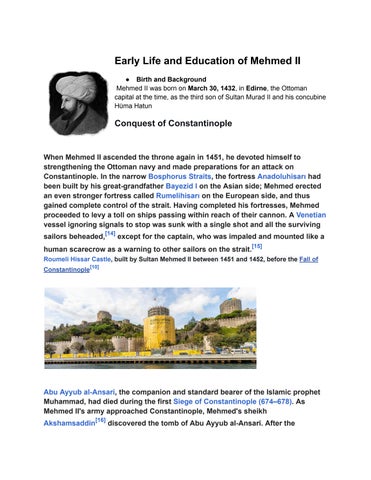
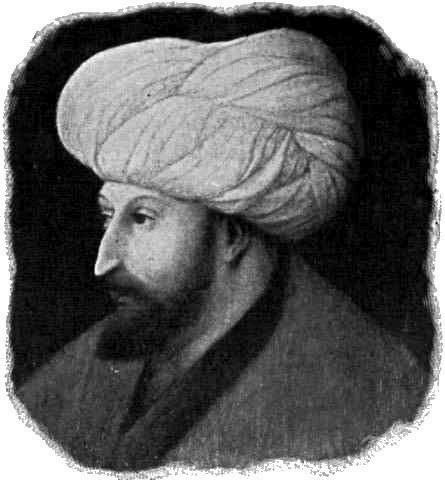
Mehmed II was born on March 30, 1432, in Edirne, the Ottoman capital at the time, as the third son of Sultan Murad II and his concubine Hüma Hatun
Conquest of Constantinople
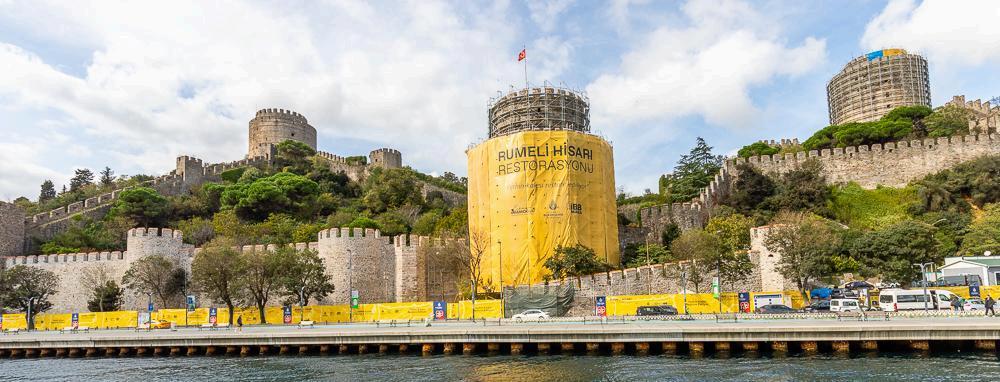
When Mehmed II ascended the throne again in 1451, he devoted himself to strengthening the Ottoman navy and made preparations for an attack on Constantinople. In the narrow Bosphorus Straits, the fortress Anadoluhisarı had been built by his great-grandfather Bayezid I on the Asian side; Mehmed erected an even stronger fortress called Rumelihisarı on the European side, and thus gained complete control of the strait. Having completed his fortresses, Mehmed proceeded to levy a toll on ships passing within reach of their cannon. A Venetian vessel ignoring signals to stop was sunk with a single shot and all the surviving sailors beheaded,[14] except for the captain, who was impaled and mounted like a human scarecrow as a warning to other sailors on the strait.[15] Roumeli Hissar Castle, built by Sultan Mehmed II between 1451 and 1452, before the Fall of Constantinople[10]
Abu Ayyub al-Ansari, the companion and standard bearer of the Islamic prophet Muhammad, had died during the first Siege of Constantinople (674–678). As Mehmed II's army approached Constantinople, Mehmed's sheikh Akshamsaddin[16] discovered the tomb of Abu Ayyub al-Ansari. After the
conquest, Mehmed built Eyüp Sultan Mosque at the site to emphasize the importance of the conquest to the Islamic world and highlight his role as ghazi.[16]
In 1453, Mehmed commenced the siege of Constantinople with an army between 80,000 and 200,000 troops, an artillery train of over seventy large field pieces,[17] and a navy of 320 vessels, the bulk of them transports and storeships. The city was surrounded by sea and land; the fleet at the entrance of the Bosphorus stretched from shore to shore in the form of a crescent, to intercept or repel any assistance for Constantinople from the sea.[14] In early April, the Siege of Constantinople began. At first, the city's walls held off the Turks, even though Mehmed's army used the new bombard designed by Orban, a giant cannon similar to the Dardanelles Gun. The harbor of the Golden Horn was blocked by a boom chain and defended by twenty-eight warships.
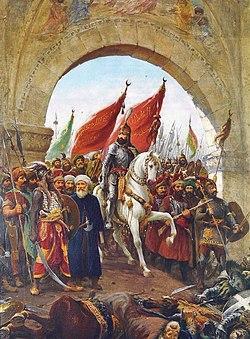
On 22 April, Mehmed transported his lighter warships overland, around the Genoese colony of Galata, and into the Golden Horn's northern shore; eighty galleys were transported from the Bosphorus after paving a route, little over one mile, with wood. Thus, the Byzantines stretched their troops over a longer portion of the walls. About a month later, Constantinople fell, on 29 May, following a fifty-seven-day siege.[14] After this conquest, Mehmed moved the Ottoman capital from Adrianople to Constantinople.
When Sultan Mehmed II stepped into the ruins of the Boukoleon, known to the Ottomans and Persians as the Palace of the Caesars, probably built over a thousand years before by Theodosius II, he uttered the famous lines of Saadi:[18][19][20][21]
The spider is curtain-bearer in the palace of Chosroes, The owl sounds the relief in the castle of Afrasiyab.
Some Muslim scholars claimed that a hadith in Musnad Ahmad referred specifically to Mehmed's conquest of Constantinople, seeing it as the fulfillment of a prophecy and a sign of the approaching apocalypse.[22]
Reaction to the collection
Mehmed's collection of Christian art and relics brought about various reactions from his contemporaries. Along with his general openness to Christianity, Mehmed's collection was a cause of an unfulfilled hope of some in the West that he would convert to Christianity. His son and successor, Bayezid II, suspected similarly, accusing Mehmed of "not believing in Muhammad." Although Mehmed's interest in Christianity and Christian culture caused concern among traditionalist factions, Gülru Necipoğlu writes, the sources written in Islamic languages do not support "such a perception of Mehmed's irreligiosity."[127] Upon his accession to the sultanate, Bayezid, who hated "figural images of any sort," sold his father's art collection and also offered the relics to the rulers of Rhodes, France, and Italy as ransom for his brother, Cem.[130]
Family
Mehmed II had at least eight known consorts, at least one of whom was his legal wife.
Consorts
Mehmed II was the last sultan to legally marry until 1533/1534, when Suleiman the Magnificent married his favorite concubine Hürrem Sultan.
Mehmed II's eight known consorts are:[131]
● Gülbahar Hatun[132][133] Mother of Bayezid II.
● Gülşah Hatun. Mother of Şehzade Mustafa.
● Sittişah Mukrime Hatun.[134] Sometimes mistakenly believed to be the mother of Bayezid II. Called also Sitti Hatun. Daughter of Dulkadiroğlu Süleyman Bey, sixth ruler of Dulkadir, she was his legal wife, but the marriage was unhappy and it remained childless. Her niece Ayşe Hatun, daughter of her brother, became a consort of Bayezid II.
● Çiçek Hatun. Mother of Şehzade Cem.
● Anna Hatun. Daughter of the Greek emperor of Trebizond David II Komnenos and his wife Helena Kantakuzenos. The marriage was initially proposed by her father, but Mehmed refused. However, after the conquest of Trebizond in 1461, Anna entered Mehmed's harem as a "noble tribute" or guest and stayed there for two years, after which Mehmed married her to Zaganos Mehmed Pasha. In exchange, Mehmed had the Zaganos's daughter as his consort.
● Helena Hatun (1442–1469). Daughter of the despot of Morea Demetrios Palaiologos, Mehmed asked her for himself after the Morea campaign, having heard of her beauty. However, the union was never consummated because Mehmed feared that she might poison him.
● Maria Hatun. Born Maria Gattilusio, she was widow of Alexander Komnenos Asen, brother of Anna Hatun's father and by him she had a son, Alexios, executed by Mehmed II. She was judicated as the most beautiful woman of her age and entered in the harem after her capture in 1462.[135]
● Hatice Hatun. Daughter of Zaganos Mehmed Pasha by his first wife Sitti Nefise Hatun. She entered the harem in 1463. In return, her father was able to marry Anna Hatun, Mehmed's consort or "noble guest". After Mehmed's death she remarried with a statesman.[135]
Sons
Mehmed II had at least four sons:[136][137]
● Bayezid II (3 December 1447 – 10 June 1512) – son of Gülbahar Hatun. He succeeded his father as the Ottoman Sultan.
● Şehzade Mustafa (1450, Manisa – 25 December 1474, Konya) – son of Gülşah Hatun. Governor of Konya until his death. He was the favorite son of his father.
● Şehzade Cem (22 December 1459, Constantinople – 25 February 1495; Capua, Kingdom of Naples, Italy) – son of Çiçek Hatun. Governor of
Konya after the death of his brother Mustafa, he fought for the throne against his half-brother Bayezid. He died in exile.
● Şehzade Nureddin. Probably died as an infant.
Daughters
Mehmed II had at least four daughters:[138][137]
● Gevherhan Hatun (1446 – Constantinople, 1514) – daughter of Gülbahar Hatun. She was the mother of Sultan Ahmad Beg.
● Ayşe Hatun.
● Kamerhan Hatun. She married her cousin Hasan Bey, son of Candaroğlu Kemaleddin İsmail Bey and Hatice Hatun, full-sister of Mehmed II. They had a daughter, Hanzade Hatun.
● Fülane Hatun.
Policy regarding fratricide
His grandfather, Mehmed I, struggled over the throne with his brothers Süleyman, İsa, and Musa during the Ottoman Interregnum. This civil war lasted eight years and weakened the empire due to the casualties it inflicted and the division it sowed in Ottoman society. As a result, Mehmed II formally legalized the practice of fratricide in order to preserve the state and not further place strain on the unity as previous civil wars did. Mehmed II stated, "Of any of my sons that ascends the throne, it is acceptable for him to kill his brothers for the common benefit of the people (nizam-i alem). The majority of the ulama (Muslim scholars) have approved this; let action be taken accordingly."[139]