AAPM Newsletter | January/February 2026 Vo l u m e 5 1 , N o . 1
Special Interest Feature: Working Group on Veterinary Radiation Therapy Oncology STANDARDIZING VETERINARY RADIATION THERAPY: AAPM WGVRTO Imran Shah, MS | Colorado Associates in Medical Physics Par minder Basran, PhD | Cor nell University Richard Mancine | Varian Advanced Oncology Solutions
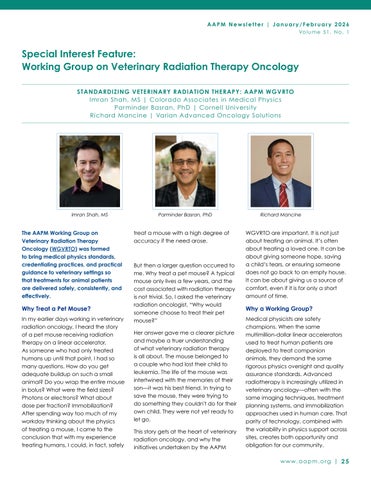
Imran Shah, MS
The AAPM Working Group on Veterinary Radiation Therapy Oncology (WGVRTO) was formed to bring medical physics standards, credentialing practices, and practical guidance to veterinary settings so that treatments for animal patients are delivered safely, consistently, and effectively.
Why Treat a Pet Mouse? In my earlier days working in veterinary radiation oncology, I heard the story of a pet mouse receiving radiation therapy on a linear accelerator. As someone who had only treated humans up until that point, I had so many questions. How do you get adequate buildup on such a small animal? Do you wrap the entire mouse in bolus? What were the field sizes? Photons or electrons? What about dose per fraction? Immobilization? After spending way too much of my workday thinking about the physics of treating a mouse, I came to the conclusion that with my experience treating humans, I could, in fact, safely
Parminder Basran, PhD
treat a mouse with a high degree of accuracy if the need arose.
But then a larger question occurred to me. Why treat a pet mouse? A typical mouse only lives a few years, and the cost associated with radiation therapy is not trivial. So, I asked the veterinary radiation oncologist, “Why would someone choose to treat their pet mouse?” Her answer gave me a clearer picture and maybe a truer understanding of what veterinary radiation therapy is all about. The mouse belonged to a couple who had lost their child to leukemia. The life of the mouse was intertwined with the memories of their son—it was his best friend. In trying to save the mouse, they were trying to do something they couldn't do for their own child. They were not yet ready to let go. This story gets at the heart of veterinary radiation oncology, and why the initiatives undertaken by the AAPM
Richard Mancine
WGVRTO are important. It is not just about treating an animal. It’s often about treating a loved one. It can be about giving someone hope, saving a child’s tears, or ensuring someone does not go back to an empty house. It can be about giving us a source of comfort, even if it is for only a short amount of time.
Why a Working Group? Medical physicists are safety champions. When the same multimillion-dollar linear accelerators used to treat human patients are deployed to treat companion animals, they demand the same rigorous physics oversight and quality assurance standards. Advanced radiotherapy is increasingly utilized in veterinary oncology—often with the same imaging techniques, treatment planning systems, and immobilization approaches used in human care. That parity of technology, combined with the variability in physics support across sites, creates both opportunity and obligation for our community. www.aapm.org | 25