AMERICAN ASSOCIATION of PHYSICISTS IN MEDICINE
IMPROVING HEALTH THROUGH MEDICAL PHYSICS
AAPM NEWSLETTER January/February 2026 | Volume 51, No. 1
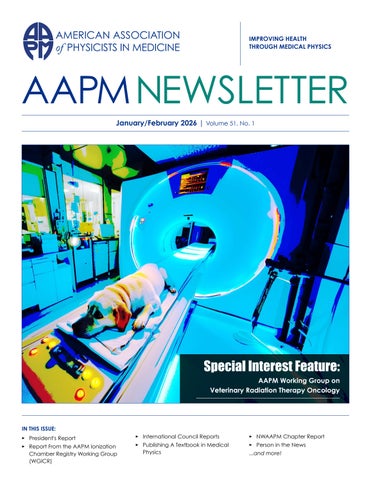
Special Interest Feature: AAPM Working Group on Veterinary Radiation Therapy Oncology
IN THIS ISSUE: ▶ President's Report
▶ International Council Reports
▶ NWAAPM Chapter Report
▶ Report From the AAPM Ionization
▶ Publishing A Textbook in Medical
▶ Person in the News
Chamber Registry Working Group (WGICR)
Physics
...and more!
RDCE NEWLY ADDED MPCEC QUIZZES IN THE AAPM ONLINE LEARNING CENTER Diagnostic Radiology | Current progress of digital twin construction using medical imaging Radiotherapy: Dosimetry | AAPM task group report 351: Protocol for clinical reference dosimetry in external beam MR-guided radiotherapy Diagnostic Radiology: Computed Tomography | The Balancing Act: Optimizing CT Image Quality and Dose Diagnostic Radiology: Mammography | A model-based method for reporting mammographic diagnostic reference levels for any compressed breast thickness Diagnostic Radiology: Mammography | A novel direct-indirect dual-layer flat-panel detector for contrast-enhanced breast imaging: Monte Carlo simulation Nuclear Medicine | The Use of Approved Radiopharmaceutical Therapies and a Review of NRC Regulations Radiotherapy: External Beam | Current Status and Future Directions in Photon and Proton Adaptive Therapy Radiotherapy | Advances in Intra-Operative Radiation Therapy I Radiotherapy | Advances in Intra-Operative Radiation Therapy II Radiotherapy: Quality Management | Systematic review of prospective hazard analysis in radiation therapy
AAPM MEETING CONTENT NOW AVAILABLE IN THE VIRTUAL LIBRARY AAPM Annual Meeting - 2024 AAPM Summer School - 2024 AAPM Spring Clinical Meeting - 2024
QUESTIONS OR CONCERNS? Contact Us: Online Learning Services Subcommittee
INTERESTED IN SUBSCRIBING TO THE ONLINE CONTINUING EDUCATION PROGRAM? Purchase a Calendar-Year Subscription: Online Continuing Education Program Subscription Payments
AAPM NEWSLETTER is published by the American Association of Physicists in Medicine on a bi-monthly schedule. AAPM is located at 1631 Prince Street, Alexandria, VA 22314
TABLE OF CONTENTS
January/February 2026 | Volume 51, No. 1 REPORTS IN THIS ISSUE 5 7 11 13 17 19 23 25 29 31 33 37 39 43 45 47
Newsletter Editor's Report President's Report Executive Director's Report Treasurer's Report Government Affairs Report Health Policy and Economic Issues Report Updates From ACR HQ Special Interest Feature: Working Group on Veterinary Radiation Therapy Oncology 25 Standard Veterinary Radiation Therapy: AAPM WGVRTO Report From the AAPM Ionization Chamber Registry Working Group (WGICR) ABR Update ASTRO Quality Improvement International Council Report #1 International Council Report #2 Publishing A Textbook in Medical Physics NWAAPM Chapter Report Person in the News: Cynthia McCollough, PhD
EVENTS/ANNOUNCEMENTS 2 4 6 9 10 15 22 22 24 36 41 48 48 49
RDCE 2026 AAPM Meetings Recognizing AAPM Leaders 2025 IOMP Award Recipient: Mary K. Martel, PhD AAPM Volunteer and Leadership Handbooks AAPM Committee Classifieds AAPM Call For Nominations 2026 AAPM Spring Clinical Meeting Grace Challenge AAPM Membership Benefits Our Condolences SDAMPP Mentorship Program 2026 AAPM Summer School 2026 AAPM Funding Opportunities
Jennifer Pursley, PhD, Editor Assistant Professor Mayo Clinic Radiation Oncology 200 First St SW Rochester, MN 55905 507-284-2511 newsletter@aapm.org
SUBMISSION INFORMATION To keep all reports uniform, we kindly request that submissions be made through a QuestionPro portal. Questions? Contact Nancy Vazquez
PUBLISHING SCHEDULE The AAPM Newsletter is produced bi-monthly. Next issue: March/April 2026 Submission deadline: January 30, 2026 Posted online: week of March 2, 2026
CORPORATE AFFILIATE ADVERTISING Advertising Rates & Deadlines
CONNECT WITH US!
EDITOR’S NOTE I welcome all readers to send me any suggestions or comments on any of the articles or features to assist me in making the AAPM Newsletter a more effective and engaging publication and to enhance the overall readership experience. Thank you.
All articles appearing in this newsletter are expressions of the authors' own personal views and are not a reflection of the views of their places of employment or of AAPM.
SAVE THE
DATES!
2026 AAPM
MEETINGS www.aapm.org/meetings
Mar JUN JUL Oct
21–24 Spring Clinical Meeting Hyatt Regency Orlando, Florida Registration Opens December 8, 2025
16–20 Summer School University of Michigan Ann Arbor, MI Registration Opens March 2, 2026
19–22 2026 Joint AAPM | COMP Annual Meeting & Exhibition Vancouver Convention Centre Vancouver, BC Registration Opens April 7, 2026
29–30 Physics Plan Review Tool Kit Virtual Meeting Registration Opens August 5, 2026
AAPM Newsletter | January/February 2026 Vo l u m e 5 1 , N o . 1
Ring in the New Year with AAPM!
NEWSLETTER EDITOR’S REPORT
H
appy new year to all, and welcome to the first edition of the 2026 AAPM Newsletter. I hope everyone had a safe and happy holiday season. The year starts off quickly at AAPM with the opening of the Awards and Honors Nomination Submissions System on January 5. This system is used to submit nominations for AAPM Fellow, the William D. Coolidge Gold Medal, the Edith H. Quimby Lifetime Achievement Award, the Marvin M.D. Williams Professional Achievement Award, the John Laughlin Early-Career Scientist Award, and AAPM Honorary Membership. The qualifications and application requirements differ for each award category and requirements are detailed on the website. The deadline for 2025 nominations is February 25, 2026. If you are participating in a nomination, start early to beat the deadline rush!
The Special Interest Group for this issue of the Newsletter is the Working Group on Veterinary Radiation Therapy Oncology (WGVRTO). See their article to learn about their efforts to improve safety and standardize the practice of veterinary radiation therapy. In this issue, you will find an update from incoming President Robin Miller with an inside scoop on what’s coming this year. There are also many exciting updates from AAPM’s new Director of Government Affairs and External Relations, Lauren DePutter. Other reports in this issue include a summary of the Northwest Chapter’s 50th anniversary meeting and a reflection from AAPM members who participated in the X Latin American Congress of Medical Physics (ALFIM 2025) held in La Antigua, Guatemala. You’ll find these and many other updates in this issue.
Jennifer Pursley, PhD Mayo Clinic
We hope every AAPM member finds something of interest in this issue of the Newsletter. All AAPM members are encouraged to submit content and ideas for the Newsletter either directly to the Editor or through the submission link on the Newsletter page. Please enjoy this issue of the Newsletter and send us your feedback and ideas for future editions. And as always, share the Newsletter articles you enjoy with your social media network; the Newsletter is available for all to read. ¢
www.aapm.org | 5
Honoring Dedicated Service Completing Their Service
Welcoming New Leaders
(Terms ending December 31, 2025)
Joining the AAPM Board
Elizabeth L. Bossart, PhD Florida Chapter-Elected Board Member
(Effective January 1, 2026)
Wesley S. Culberson, PhD, FAAPM North Central Chapter-Elected Board Member
Andrew D. Maidment, PhD, FAAPM President-Elect Zacariah E. Labby, PhD, FAAPM North Central Chapter-Elected Board Member Xiang Li, PhD New York (RAMPS) Chapter-Elected Board Member Virginia L. Lockamy, PhD Delaware Valley Chapter-Elected Board Member Dimitris N. Mihailidis, PhD, FAAPM, FASTRO, FACMP Board Member-At-Large Laura Padilla, PhD Board Member-At-Large Stephanie A. Parker, MS, FAAPM Board Member-At-Large Susan L. Richardson, PhD, FAAPM* AAPM’s Representative to the AIP Governing Board Peter Allan Sandwall II, PhD Ohio River Valley Chapter-Elected Board Member Diane M. Schott, PhD Missouri River Valley Chapter-Elected Board Member BC Schwarz, PhD Florida Chapter-Elected Board Member
Todd Pawlicki, PhD, FAAPM Chair of the Board Magdalena Bazalova-Carter, PhD, FAAPM Board Member-at-Large
Bruce H. Curran, MEng, FAAPM, FACR, FACMP* AAPM’s Representative to the AIP Governing Board Cesar Della Biancia, PhD New York (RAMPS) Chapter-Elected Board Member Katie W. Hulme, MS, FAAPM Board Member-at-Large Charles S. Mayo, PhD, FAAPM, FASTRO Board Member-at-Large Shannon E. O’Reilly, PhD Delaware Valley Chapter-Elected Board Member David Pearson, PhD Ohio River Valley Chapter-Elected Board Member Amelia (Amy) Wexler, PhD Missouri River Valley Chapter-Elected Board Member Qingrong Jackie Wu, PhD, FAAPM Board Member-at-Large Amy Shu-Jung Yu, PhD Northern California Chapter-Elected Board Member Yin Zhang, PhD New Jersey Chapter-Elected Board Member
Lawrie Skinner, PhD Northern California Chapter-Elected Board Member Timothy D. Solberg, PhD, FAAPM, FACR, FASTRO, FACMP Board Member-At-Large Xiao Wang, PhD New Jersey Chapter-Elected Board Member
*AIP Governing Board Representative term begins/ends on March 27, 2026.
AAPM extends its gratitude to all who serve through Board leadership.
AAPM Newsletter | January/February 2026 Vo l u m e 5 1 , N o . 1
Inside Scoop: What’s Next From the President
PRESIDENT'S REPORT
A Quick Recap I hope everyone has had a moment to catch their breath after a tumultuous 2025 and the always-busy holiday season. The start of a new year naturally invites reflection and reassessment, and stepping into my role as AAPM President provides an opportunity for me to do the same. I want to express my deep gratitude to Todd Pawlicki as he concludes his term on the AAPM Executive Committee, transitioning from his role as Chair of the Board. I also extend heartfelt thanks to the members of the Board of Directors who completed their service at the end of 2025. Your dedication and contributions to AAPM are truly appreciated. To our incoming Board directors—welcome. On behalf of the entire executive team, please know that we are here to support you; do not hesitate to reach out with any questions or concerns. This invitation extends to all members as well. EXCOM’s role is to help the Board guide and steward the organization, and open communication is essential to that mission.
Robin Miller, MS Northwest Medical Physics Center
Being Able to Pivot At the AIP Leadership Forum in 2024, I was introduced to the concept of Stop, Start, Continue. This year, a new framework caught my attention: I Like, I Wish, I Wonder. During a conversation with a colleague and friend, it was observed that the Stop, Start, Continue model can feel quite prescriptive, whereas I Like, I Wish, I Wonder is more exploratory and flexible. So, in true executive-order fashion, I’m pivoting. I recently used this framework during a meeting with medical physics graduate students and residents at the University of Pennsylvania. Rather than offering yet another PowerPoint presentation, I opted for a dialogue-based session using this construct as our guide. The turnout was larger than expected, and the discussion was candid, insightful, and energizing. Below are some of the highlights the students shared—presented in no particular order. I deeply appreciated their openness and the spirit of the conversation. I Like • Making someone’s life better by contributing directly to patient care. • Having an important role in improving a patient’s health and experience. • Being “like a firefighter for the patient.” • That we tend to support one another; we share similar goals, so the field feels less competitive than others.
www.aapm.org | 7
AAPM Newsletter | January/February 2026 Vo l u m e 5 1 , N o . 1
PRESIDENT'S REPORT, Cont.
I Wish • That the exam pass rates for the ABR Part 1 were higher. • That more resources were available for undergraduates. • That I had learned about medical physics and become involved earlier. • That navigating residency applications didn’t feel so overwhelming. • That there were more outreach efforts encouraging student participation in Hill Day. • That more proton centers were available. I Wonder • How medical physicists might be more directly recognized by patients. Therapists often receive cookies and thank-you notes, yet patients may not realize that medical physicists are also part of their care team.
Where Can We Connect? I will be continuing the tradition of the presidential monthly minutes established by Ehsan Samei. I am very much looking forward to the Spring Clinical Meeting, taking place March 21–24, 2026, in Orlando, Florida. Following that is the Summer School—another highlight for the medical physics community—which will focus on transforming technology, modern practice, and clinical impact. It will be held June 16–20, 2026, at the University of Michigan. Our Annual Meeting will follow shortly after, July 19–22, 2026, in beautiful Vancouver, BC. This year’s meeting is especially exciting as it will be held in conjunction with our colleagues from the Canadian Organization of Medical Physics (COMP). In addition to these major events, I look forward to attending many chapter meetings throughout the year and hope to meet many of you there as well.
What is New? AAPM will convene an invitation-only Summit from February 10–12, 2026, at the AIP headquarters in Washington, D.C. This Summit is closely aligned with our strategic plan and will center on three key areas: Artificial Intelligence, Theragnostics, and New Frontiers in Science. A dedicated group of AAPM members has been planning this event
8 | www.aapm.org
since early 2025, though the majority of participants will come from outside organizations to ensure a broad and forward-looking perspective. In 2024, the Board of Directors approved the use of reserve funds to support this initiative. We have engaged Seth Kahan of Visionary Leadership, https://visionaryleadership. com/, an experienced facilitator, to guide us through this effort. The goal of the Summit is to identify breakthrough ideas and envision where the field of medical physics could— and should—be ten years from now. Our council chairs will take part in the discussions to help shape pathways for turning these breakthroughs into reality. The foundational work informing the Summit stems from the Ad Hoc Committee chaired by Jim Dobbins, whose report can be found here: https://www.aapm.org/pubs/adhocreports/ detail.asp?docid=59 AAPM is organized into five councils—the Administrative, Education, International, Professional, and Science Councils. Each of these groups contributes extraordinary work to the organization. However, as AAPM continues to grow, it has become increasingly clear that we risk losing visibility into the activities and initiatives happening across councils. In alignment with our strategic plan, and with particular attention to sustainability, we are establishing a new Intercouncil Roundtable. This committee, composed of council chairs and vice chairs, is designed to enhance coordination, improve communication, and ensure that our collective efforts are aligned and mutually supportive.
How Did I Spend My President-Elect Year? We have 21 chapters, and I was honored to speak at eight of them this past year, including two virtual talks. I am also pleased to be participating in a cohort group, Pathways to Leadership, an initiative of the Medical Physics Leadership Academy. I am co-facilitating a cohort with Bruce Curran, and I encourage you to look for sign-ups after the Annual Meeting for the 2026–2027 cycle. In addition, I have spent a great deal of time simply talking with members. Many aspects of AAPM can seem opaque, and I am committed to helping clarify processes, improve
AAPM Newsletter | January/February 2026 Vo l u m e 5 1 , N o . 1
PRESIDENT'S REPORT, Cont.
transparency, and guide members toward the information and resources they need. I have also spent time discussing the importance of contributing to the Education and Research Fund. If you would like to see how these funds are used and the impact they make, you can review the annual report here.
idea is not necessarily to be wrong. The worst possible thing is for all of us to begin to look and talk and act and think alike.” — Robin Robin.miller95@gmail.com ¢
For those interested in getting more involved, I encourage you to explore current volunteer opportunities in the Committee Classifieds. I will leave you with a Gene Roddenbury quote: “To be different is not necessarily to be ugly; to have a different
From the International Day of Medical Physics at the University of Pennsylvania. Medical physicists, residents and graduate students are captured.
www.aapm.org | 9
Attention Volunteer Members! Volunteer Handbook Created by AAPM Headquarters, this guide provides essential information for volunteers during their service to the Association. Key features include: • HQ Staff Support: Get the help you
need. • Governance & Policies: Links to AAPM Policies, Position Statements, By-Laws, and Rules. • Budget Process: Guidance on accessing committee-specific financial details. • Scheduling Meetings: Tools for Zoom, F2F meetings, templates, and minutes. • Committee Rosters: Tips for filling positions with the "Committee Classifieds" system. • New Group Creation: Includes the New Group Creation Form. • Task Groups: Sunsetting policies and progress reporting tools. • AAPM Reports: Step-by-step guidance on how to get started and navigate the reporting process.
ow n k u o Did y has TWO
AAPM ources s e r l u f power ort you p p u s to unteer ? l o v r s in you ip role h s r e ad and le
Explore the Volunteer Handbook today to make the most of your volunteer experience!
Leadership Handbook Brought to you by the Medical Physics Leadership Academy (MPLA), this handbook is designed to equip medical physicists stepping into leadership roles. It offers: • Practical Tools: Set up AAPM Zoom calls, manage committee tasks, and more. • Professional Guidance: Learn how to review applications and fulfill leadership responsibilities. • Personal Development: Assess and refine your leadership style.
View the Leadership Handbook to take your leadership to the next level!
Medical Physics Leadership Academy American Association of Physicists in Medicine
AAPM Newsletter | January/February 2026 Vo l u m e 5 1 , N o . 1
Moving AAPM Forward
EXECUTIVE DIRECTOR'S REPORT
Strengthening the Systems That Support Our Community In my last column, I shared an overview of AAPM’s multi-year technology transformation, work that is modernizing our systems, strengthening security, and positioning the organization for long-term growth. As we move into 2026, I wanted to provide an update on that work, including where our timeline has shifted, what members are now seeing live, and what is coming next.
Progress, with a Reality Check on Timing Over the course of 2025, much of our staff team’s effort was devoted to untangling years of custom-built applications, migrating data into our association management system, and creating secure, standardized integrations across platforms. This work is largely invisible, but it is essential. It is what allows us to move from a fragile patchwork of systems to a stable, sustainable digital foundation.
C. David Gammel Executive Director, AAPM HQ
One area where this complexity became very visible was our dues renewal process. The launch of our new renewal system took longer than initially projected because we made the deliberate decision to prioritize data integrity, security, and reliability over speed. While this did push parts of our overall schedule later than originally planned, it was the right call, and one that will pay dividends for years to come as we build on this new foundation. The good news is that the new membership dues renewal system is now fully operational within our association management platform. This allowed us to retire a long-standing custom application that had become increasingly unstable and was built on outdated, less secure infrastructure. Members should now see a renewal experience supported by a far more secure and reliable system. As many of you renew in the coming weeks, your feedback will help us continue to refine the experience for future years.
Expanding How We Connect: Forj Community Platform Another major update is our new community engagement platform, Forj. Early testing with selected volunteer groups begins this January, with a broader rollout to follow as we move further into 2026. Forj will give our committees, councils, and working groups modern collaboration tools, making it easier to share resources, coordinate projects, and stay connected. It will also enable more dynamic, community-based interactions for the full membership. This is a significant upgrade in how AAPM will support collaboration across institutions, specialties, and time zones.
www.aapm.org | 11
AAPM Newsletter | January/February 2026 Vo l u m e 5 1 , N o . 1
EXECUTIVE DIRECTOR'S REPORT, Cont.
A New Website Design Coming into View
Strengthening Our Team
All of this foundational work supports one of our most visible forthcoming changes: the complete redesign of the AAPM website, now scheduled for launch in Q2 of 2026. The new site will deliver a cleaner design, improved navigation, stronger accessibility, and a more consistent experience across AAPM’s programs and services.
We have also continued to strengthen staff capacity in areas that support our strategic direction.
If you’d like an early look at what that future experience will feel like, I encourage you to visit our meeting websites which are already built using the new content management system and design framework. 2026 Spring Clinical Meeting 2026 Summer School 2026 Joint AAPM | COMP Annual Meeting & Exhibition What you see on those sites is the core architecture for the broader AAPM website that is coming soon.
Looking Ahead to Vancouver Planning is well underway for our 2026 Joint AAPM | COMP Annual Meeting & Exhibition in Vancouver, British Columbia, which we are proud to host in partnership with our colleagues at COMP. Vancouver is a terrific city for a scientific meeting. It is beautiful, walkable, culturally rich, and framed by both ocean and mountains. Our teams are working closely to design a program that brings together the medical physics community across borders and specialties, creating space for learning, collaboration, and shared exploration of where our field is headed. I hope you will plan to join us for what promises to be a truly outstanding meeting.
12 | www.aapm.org
This fall we welcomed Lauren DePutter, who joined AAPM to lead government relations and advocacy. Her early work strengthening relationships, assessing our advocacy tools, and positioning AAPM for greater policy impact has already made a positive difference. We are also actively recruiting for a Director of Digital Experience and Engagement, a new role that will guide our web, content, and member-facing digital strategy as our new platforms come online. This position is essential to ensuring that our technology investments translate into meaningful value for members.
Building Forward into 2026 2025 was, in many ways, a year of foundational work— unwinding legacy systems, stabilizing our infrastructure, and making the careful transitions that allow sustainable growth. While some elements took longer than originally envisioned, members are now beginning to see tangible progress, and you will see even more as we move through 2026. AAPM remains a community powered by volunteers and supported by a deeply committed staff team. Together, we are building the systems, relationships, and capacity needed to serve the profession with strength, security, and agility in the years ahead. Thank you for your continued engagement and patience as we’ve navigated this important transition. I look forward to all that lies ahead. ¢
AAPM Newsletter | January/February 2026 Vo l u m e 5 1 , N o . 1
2026 Budget: Continued Progress Towards the Goal
TREASURER'S REPORT
A
t this time of reflection on the past year and anticipation of the new year ahead, I wish to thank Robert McKoy and the AAPM financial team, the diligent members of FINCOM, and my trusted colleagues on EXCOM for their dedication to our Association's financial stewardship.
Financial Position and Estimates for 2025 The 2025 budget (approved by the Board in 2024) estimated revenue at $11.74M and expenses at $12.73M, resulting in a budget deficit of $0.99M. The finance team has analyzed year-to-date revenue and expenses compared with their budgeted amounts. At the time of this writing, we estimate actual revenue of $10.9M and actual expenses of $12.6M, resulting in an estimated year-end actual deficit of $1.7M for 2025. The higher deficit is primarily driven by decreased annual meeting revenue and general sponsorship revenue. Recent shifts in federal policy have created several practical challenges for scientific and medical research organizations, including AAPM. Federal research agencies have experienced slower growth in appropriations and, in some cases, year-over-year decreases in program funding, which have had a downstream effect on meeting attendance, federally funded project activity, and the availability of institutional support for travel and sponsorship. In addition, immigration and visa policies have changed frequently over the past year, resulting in longer processing times, increased uncertainty for international travelers, and higher rates of delayed or canceled attendance at U.S.-based scientific meetings. Economic factors have also played a role. Tariff adjustments, supply-chain variability, and broader economic uncertainty have contributed to more conservative corporate spending, including reduced budgets for scientific conference sponsorships and external engagement. Together, these dynamics have contributed to lower-than-expected domestic and international participation in key AAPM events and to more constrained sponsorship revenue, as reflected in our year-to-date financial performance.
Samuel G. Armato III, PhD The University of Chicago
2026 Budget One of the strategic priorities in the new Strategic Plan approved by the Board of Directors is Enhancing Organizational Sustainability, to achieve a balanced budget by 2027. The 2025 budget reflected the first initial steps towards this goal, and the 2026 budget shows even more progress towards that objective. While we may not achieve a balanced budget by 2027, we are making greater progress towards this goal, and ultimately, achievement is on the horizon.
www.aapm.org | 13
AAPM Newsletter | January/February 2026 Vo l u m e 5 1 , N o . 1
TREASURER'S REPORT, Cont.
FINCOM, staff, and volunteer leadership worked collaboratively to take the first steps toward this goal by diligently preparing the 2026 budget. During the 2025 budget cycle, all revenue and most expenses not under the Councils' direct control were removed from their budgets and consolidated centrally. For 2026, Councils were asked to submit budgets that removed the costs of inperson retreats but were otherwise flat from their 2025 budgets. I want to express my sincere thanks to the Council and committee chairs and their staff liaisons, who worked extremely hard together over the course of several months to meet the FINCOM-established targets for developing their draft budgets. FINCOM met face-to-face at AAPM Headquarters for half a day, unlike past years, where the meeting lasted a full day. This shift is indicative of the progress we are making in our budgeting process, becoming more strategic and focused on the desired outcomes of allocated resources rather than a line-by-line review of budgets.
Chart 1
14 | www.aapm.org
AAPM Newsletter | January/February 2026 Vo l u m e 5 1 , N o . 1
TREASURER'S REPORT, Cont.
Revenue and expense projections from the approved 2026 budget are provided below. 2026 Budget Total Revenue
$11,469,286
Total Expenses
$12,057,024
Deficit from Operations
$
587,738
The approved deficit of $587,738 represents a 41% reduction of the prior year's approved budget deficit and is a significant step towards achieving our goal of a balanced budget by 2027. As shown in the attached chart, which shows the budgeted deficit from operations by year, the trend is moving in the right direction. Although we have much more work ahead of us, I am confident that we will continue to progress toward our goal under the leadership of Executive Director David Gammel, the AAPM staff, and volunteer leadership. As we look to the future, we must be prepared to implement new spending priorities and seek new revenue sources to address the Association's ever-changing needs. AAPM is well-positioned to effect this change with dedicated volunteer and staff leadership. I want to thank Robert McKoy for his extraordinary assistance throughout the budget process and for writing this article. I look forward to his continued proficient guidance in the upcoming years. Please contact me (s-armato@ uchicago.edu) if you have any questions concerning this report. I look forward to a rewarding and fulfilling 2026! ¢
AAPM needs YOU! Volunteers are essential to furthering the AAPM mission of advancing medicine through excellence in the science, education, and professional practice of medical physics. Become a part of this dynamic community via the AAPM Committee Classifieds. Exciting new opportunities are posted regularly; bookmark or check back often to explore the latest possibilities to get involved!
www.aapm.org | 15
Which BEAMSCANNER are you? With their automated setup, rapid scanning and AI-powered data processing, BEAMSCAN® water phantoms save significant time and deliver results you can trust, time and time again. Which BEAMSCAN solution best fits your needs? All-in-one or flexible? One for all or a perfect fit? On-site or mobile? No matter your clinical environment, there is a BEAMSCAN that is just right for you. Ready to meet your new techmate?
ptwbeamscan.com
AAPM Newsletter | January/February 2026 Vo l u m e 5 1 , N o . 1
Legislative and Regulatory Update
GOVERNMENT AFFAIRS REPORT
A
s AAPM’s new Director of Government Affairs and External Relations, I am thrilled to join AAPM and to bring my background in federal advocacy, political strategy, and member-driven engagement to AAPM’s mission of advancing medicine through excellence in medical physics. Over the past decade I have led national advocacy efforts for major health care and scientific organizations, built bipartisan relationships on Capitol Hill, expanded volunteer networks, and developed communications that help members tell their story in ways policymakers remember. That experience shapes my approach at AAPM because the goal is not only to move individual policy priorities forward, but to raise the overall visibility of medical physics as an essential, trusted voice in health care and science policy. When lawmakers and regulators clearly understand how medical physicists are essential to imaging, radiation therapy, research, and patient safety, AAPM is better positioned to protect the field, support innovation, and advance patient care. Despite the longest government shutdown in the history of the United States, AAPM remained active until the very end of 2025 by advocating on policy issues affecting science, research, and health care. AAPM staff and members met with the offices of senators who sit on the Senate Veterans Affairs Committee to discuss H.R. 3489, Department of Veterans Affairs Medical Physicists Pay Cap Relief Act. AAPM also signed a coalition letter opposing a proposed NIH indirect cost cap, emphasizing the importance of indirect cost recovery for sustaining research infrastructure. Additionally, AAPM joined a Source Security Working Group letter supporting continued duty-free access to Canadian-origin Cobalt 60, given its essential role in sterilizing medical devices and treating certain cancers. On visa issues, AAPM signed a coalition letter addressing the H-1B weight lottery process. These actions reflect the organization’s dedication to protecting research institutions, the scientific workforce, and the broader health care supply chain.
Lauren DePutter Director of Government Affairs and External Relations, AAPM HQ
For questions related to Government Affairs and advocacy, please contact Lauren DePutter.
AAPM’s first Advocacy Day kickstarted an important education process on Capitol Hill. In nearly one hundred meetings with constituents, congressional offices learned directly how medical physicists contribute to patient safety, high quality imaging, accurate radiation therapy, and the responsible use of emerging technologies. The next step is to keep building on those early conversations by strengthening relationships in districts and states, where legislators can connect these issues to the communities they represent. Representative Bill Foster’s recent visit to the Midwest Chapter meeting, organized by Sebastien Gross, PhD, Chair of AAPM’s Government and Regulatory Affairs Committee, is a strong example of that follow-through. Rep. Foster is the only PhD physicist in Congress, and he spoke about his path into public service and the importance of scientific expertise in policymaking. His engagement with medical physicists in a local setting shows how continued www.aapm.org | 17
AAPM Newsletter | January/February 2026 Vo l u m e 5 1 , N o . 1
GOVERNMENT AFFAIRS REPORT, Cont.
outreach after Advocacy Day can deepen trust, reinforce shared priorities, and further raise the profile of medical physics with lawmakers over time.
CHAMPS and expanding the tools and support available to advocates throughout the year. CHAMPS members will play an especially important role during the midterms, with improved resources to monitor and respond to relevant state regulatory and legislative activity as it develops. The goal is sustained, year-round visibility so medical physics expertise is part of the conversation before policy is set.
Hyejoo Kang, PhD (former AAPM Midwest Chapter President), Rep. Bill Foster, PhD, (D-IL), and Sebastien Gross, PhD (AAPM GRAC Chair)
With the 2026 midterm elections approaching, this year presents a timely opportunity to raise the visibility of medical physics across federal and state policy debates. Decisions that affect imaging access, radiation therapy oversight, AI governance in health care, research stability, and scientific workforce development are moving quickly. Meanwhile, reductions in federal research funding, mounting pressure on the NIH, uncertainty in visa pathways such as the H-1B program, and broader strains on the scientific workforce are already disrupting the research and innovation ecosystem. In this environment, it is more important than ever for medical physicists to engage policymakers and clearly communicate the value of their work and the essential role the profession plays in safe and effective health care. Midterm years bring legislators back to their districts and states for extended stretches, creating a crucial local window for AAPM to build visibility where policymakers are listening most closely. Members have powerful, practical stories about how medical physics protects patients and supports innovation, and 2026 is the moment to ensure those stories are heard consistently at home. The CHAMPS program has grown rapidly since its inception and provides a strong foundation of state-level advocates who meet with legislators and regulators, track emerging proposals, and serve as trusted local contacts on issues affecting imaging, radiation therapy, and radiation safety. Building on that momentum, AAPM will continue strengthening
18 | www.aapm.org
To support that sustained engagement, AAPM will also broaden its grassroots network across the country. Grassroots advocacy is essential for shaping federal and state health care policies that influence the practice of medical physics and the safety of the patients who depend on it. A strong network of engaged volunteers in legislators’ districts helps ensure medical physicists are seen, heard, and recognized as trusted experts when decisions are made. You do not need to be a member of CHAMPS to participate in grassroots advocacy, and there will be flexible ways to get involved that match different schedules and interests. Site visits, in-district legislative meetings, and op-eds are all particularly effective tools in this effort. Bringing policymakers into clinical environments for site visits lets them see firsthand what medical physicists do and how their expertise strengthens patient care, safety, and quality. These experiences often leave a lasting impression that shapes how elected officials approach issues in imaging, radiation therapy, and scientific workforce development. Looking ahead, science communication will be a central focus of AAPM’s 2026 grassroots advocacy strategy. Policymakers consistently ask for clear, relatable explanations of complex scientific issues, and medical physicists are well positioned to meet that need. Members should look out for tools and resources that AAPM will provide throughout the year, including an upcoming AAPM Advocacy Town Hall and an advocacy toolkit with practical guidance on writing op-eds, drafting letters to the editor, and planning and conducting site visits with legislators, and other advocacy activities. As AAPM prepares for the work ahead, member participation will be essential to increasing the visibility of medical physics, strengthening influence in public policy, and ensuring the profession maintains a consistent, informed presence in policymaking discussions. ¢
AAPM Newsletter | January/February 2026 Vo l u m e 5 1 , N o . 1
CMS Makes Major Policy Changes to Physician Fee Schedule Payments in 2026 HEALTH POLICY AND ECONOMIC ISSUES REPORT
T
he Centers for Medicare and Medicaid Services (CMS) released the 2026 Medicare Physician Fee Schedule (MPFS) final rule on October 31. The finalized policies and payments are effective January 1, 2026. The MPFS specifies payment rates to physicians and other providers, including freestanding radiation therapy centers. It does not apply to hospital-based facilities.
CMS finalized the first positive physician fee schedule adjustment in years along with a slew of other policy updates. The agency finalized a controversial minus 2.5 percent efficiency adjustment and a 50 percent reduction in indirect practice expenses for services provided in a facility setting, like a hospital outpatient department or ambulatory surgical center (ASC). The 2026 MPFS policy changes result in estimated overall cuts of minus 1 percent to radiation oncology and minus 2 percent to radiology services. MPFS payments are based on the relative resources typically used to furnish the service. Relative value units (RVUs) are applied to each service for physician work, practice expense (PE) and malpractice. These RVUs become payment rates through the application of a conversion factor, which is updated annually.
Conversion Factor Beginning in calendar year (CY) 2026, there will be two separate conversion factors: one for qualifying alternative payment model (APM) participants (QPs) and one for physicians and practitioners who are not QPs. By statute, QPs are those that meet certain thresholds for participation in an Advanced APM, which means generally that the payment model has features to ensure accountability for quality and cost of care. Most providers are not QPs and are designated as non-qualified APM participants with a reduced conversion factor.
Wendy Smith Fuss, MPG Health Policy Solutions
For additional information including Medicare proposed rule summaries, 2026 proposed payments and impacts visit the AAPM website at: http://aapm.org/government_affairs/ CMS/2026HealthPolicyUpdate.asp
The 2026 non-qualifying APM conversion factor CF is $33.40, a 3.3 percent increase from the 2025 conversion factor of $32.35. The qualifying APM conversion factor is $33.57, a 3.8 percent increase from the current conversion factor.
Changes to Radiation Treatment Delivery Codes Effective January 1st, CMS will utilize three revised Radiation Treatment Delivery codes 77402, 77407 and 77412 and 4 new codes for Superficial Radiation Treatment (77436-77439). In addition, CMS will delete CPT codes 77014, 77385, 77386, 77401 and the seventeen (17) radiation oncology HCPCS G-codes.
www.aapm.org | 19
AAPM Newsletter | January/February 2026 Vo l u m e 5 1 , N o . 1
HEALTH POLICY AND ECONOMIC ISSUES REPORT, Cont.
• CPT 77402 Radiation treatment delivery; Level 1 (e.g., single electron field, multiple electron fields, or 2D photons), including image guidance, when performed • CPT 77407 Radiation treatment delivery; Level 2, single isocenter (e.g., 3D or IMRT), photons, including image guidance, when performed • CPT 77412 Radiation treatment delivery; Level 3, multiple isocenters with photon therapy (e.g., 2D, 3D or IMRT) OR a single isocenter photon therapy (e.g., 3D or IMRT) with active motion management, OR total skin electrons, OR mixed electron/photon field(s), including image guidance, when performed
CMS uses a similar approach to utilize the relationship between the HOPPS APC assignments for new Superficial Radiation Treatment (SRT) codes 77436, 77437 and 77438 when paid under the MPFS. The technical component of CPT 77439 will be packaged and not paid separately under the MPFS. Note that 77436 and 77439 may be reported once per course of treatment. • 77436 Surface radiation therapy; superficial or orthovoltage, treatment planning and simulation-aided field setting • 77437 Surface radiation therapy, superficial, delivery, <150 kV, per fraction (e.g. electronic brachytherapy)
Of note, the Level 3 treatment delivery code 77412 includes Medical Physicist time in the valuation.
• 77438 Surface radiation therapy, orthovoltage, delivery, >150-500 kV, per fraction
CMS finalized their proposal to utilize the relationship between the Hospital Outpatient Prospective Payment System (HOPPS) Ambulatory Payment Classification (APC) relative weights for APCs 5621 Level 1 Radiation Therapy, 5622 Level 2 Radiation Therapy and 5623 Level 3 Radiation Therapy to crosswalk the valuation of practice expense for technical component-only CPT codes 77402, 77407, and 77412 when paid under the MPFS. CMS believes that the relationship between the HOPPS APC relative weights more accurately reflects the relative resource costs associated with furnishing these services.
• 77439 Surface radiation therapy, superficial or orthovoltage, image guidance, ultrasound for placement of radiation therapy fields for treatment of cutaneous tumors, per course of treatment (List separately in addition to the code for primary procedure) CPT Code
2025 Payment
2026 Payment*
77436 SRT planning#
n/a
$80.16
77437 SRT superficial n/a delivery (electronic brachytherapy)
$118.91
CPT Code
2025 Payment
2026 Payment*
77402 Radiation treatment delivery; level 1
n/a
$79.49
77438 SRT orthovoltage delivery
n/a
$120.24
77407 Radiation treatment delivery; level 2
n/a
$317.64
77439+ SRT image guidance
n/a
$16.03 deleted
77412 Radiation treatment delivery; level 3
n/a
$391.46
77401 SRT superficial $39.79 or orthovoltage delivery $171.76
deleted
77014 CT guidance placement of radiation fields#
$115.80
deleted
G6001 US guidance placement of radiation fields#
G6015 IMRT delivery
$337.37
deleted
*Payment based on non-qualifying APM conversion factor #Global payment +Professional component payment
*Payment based on non-qualifying APM conversion factor #Global payment
20 | www.aapm.org
AAPM Newsletter | January/February 2026 Vo l u m e 5 1 , N o . 1
HEALTH POLICY AND ECONOMIC ISSUES REPORT, Cont.
Changes to Indirect Practice Expense RVUs
specialties), would likely see a decrease in RVUs.
CMS makes significant updates to the indirect practice expense (PE) methodology to better reflect current clinical practice. CMS will recognize greater indirect costs for practitioners in office-based settings (e.g., freestanding cancer centers) compared to facility settings (e.g., hospital outpatient departments) by implementing a site of service payment differential.
A coalition of over 30 medical groups is urging Congress to block CMS’ newly finalized 2.5 percent cut to physician work RVUs for non-time-based services in 2026, warning the agency's so-called “efficiency adjustment” is based on flawed assumptions and could undermine physician compensation for years to come. ¢
The current methodology allocates the same amount of indirect costs per work RVU, without regard to site of service for patient care. Beginning in CY 2026, CMS changes the methodology so that when work RVUs are used to allocate indirect PE to the facility (hospital based) RVUs, they are assigned at one-half the amount allocated to the nonfacility (freestanding cancer center) PE RVUs for that same service. Specialties that practice primarily in a freestanding cancer center (non-facility) setting will realize an increase in PE RVUs due to the redistribution, and those in the hospital (facility) setting will see a decrease in PE RVUs.
Changes to Physician Work RVUs CMS finalized the controversial efficiency adjustment policy, arguing that as services become more routinely furnished, providers gain efficiency through experience and improved workflows, which then warrants periodic payment reductions to reflect those gains. This policy applies to all codes except time-based codes, such as evaluation and management (E/M) services and other codes that have no physician work. CMS calculates a minus 2.5 percent efficiency adjustment for physician work RVUs for calendar years 2026-2028. To implement this efficiency adjustment, CMS decreases the work RVUs and make corresponding changes to the intra-service physician time for codes describing nontime-based services. This policy does not impact medical physics codes 76145, 77336 and 77370 or treatment delivery codes because they are technical component only codes with no physician work. In general, specialties that bill more often for timed codes, such as family practice, would likely see an increase in RVUs; while specialties that bill more often for procedures, diagnostic imaging, and radiology services (such as radiation oncology, radiology, and some surgical
For additional information including Medicare final rule summaries, 2026 payments and impacts visit the AAPM website at: http://aapm.org/government_affairs/ CMS/2026HealthPolicyUpdate.asp
CMS CHANGES CT DOSE QUALITY MEASURE REPORTING The Centers for Medicare and Medicaid Services (CMS) released the 2026 Hospital Outpatient Prospective Payment System (HOPPS) final rule, which was delayed by the federal government shutdown. Background • CMS introduced a measure called “Excessive Radiation Dose or Inadequate Image Quality for Diagnostic CT in Adults” (an electronic clinical quality measure, or eCQM). • Reporting was planned as: o Voluntary starting in 2025 o Mandatory starting in 2027, with payment impacts
beginning in 2029 What’s New • CMS has decided not to require mandatory reporting in 2027. • Instead, hospitals will continue voluntary reporting from 2027 onward. Why the Change • AAPM, ACR and other stakeholders including hospitals raised concerns about: o The technical difficulty of building and maintaining reporting systems o The cost of converting CT data into standardized formats o The overall feasibility of consistent reporting Next Steps • CMS encourages hospitals to use the voluntary period to: o Solve technical and operational challenges o Improve data submission processes • CMS plans to set a new mandatory reporting date in future rulemaking.
www.aapm.org | 21
Ca
s о i t a n i f N
Nominations will be accepted beginning January 5, 2026 for the following AAPM awards and honors: William D. Coolidge Gold Medal • Edith H. Quimby Lifetime Achievement Award • Marvin M.D. Williams Professional Achievement Award • AAPM Fellow • John Laughlin Early-Career Scientist Award • Honorary Membership All nominations must be completed by February 25, 2026 Visit the AAPM Awards and Honors website page for more information. https://aapm.secure-platform.com/awards/
Mark your calendar & make plans to attend.
MARCH 21–24
2026 Registration and Housing
NOW OPEN! aapm.me/2026SCM
Hy att R egency O r l ando | Orlando , FL
AAPM Newsletter | January/February 2026 Vo l u m e 5 1 , N o . 1
ACR Accreditation & More: Info for Medical Physicists
UPDATES FROM ACR HQ
PET QC Manual is Available! And You Can Submit Feedback on ACR QC Manuals Any Time The ACR PET QC Manual is available for free download on the acr.org Medical Physics Resources page. A huge thank you to all of the ACR membervolunteers who spent several years working to develop this manual. On the acr.org Medical Physics Resources page, just below the manuals, there is a link to provide feedback on any of the ACR QC manuals. You can submit feedback any time.
Advanced DICOE Tiers Now Available As most of you know, ACR’s Diagnostic Centers of Excellence program, DICOE, allows facilities to demonstrate the infrastructure, policies and procedures required to assure consistently high-quality care and service. New in November of 2025, ACR now offers two additional tiers of DICOE:
Dustin A. Gress, MS Senior Advisor for Medical Physics ACR Quality and Safety, Reston, VA
• DICOE With Distinction facilities meet DICOE requirements and demonstrate elements of outstanding performance in some advanced DICOE domains.
In each issue of this newsletter, I present
• DICOE Pinnacle facilities meet DICOE with Distinction criteria and demonstrate excellence in many advanced DICOE domains.
or relevance for medical physicists.
Beyond the Baseline Criteria, Advanced Criteria are now assessed for DICOE With Distinction and Pinnacle in the following areas: • Artificial Intelligence
information of particular importance You may also check out the ACR’s accreditation support page for more accreditation information and QC forms. Thank You to all the other staff that keep ACR programs running and assist with
• Quality Improvement Programs
creating the content in this column. This
• Registries/Outcomes
page has forms and quick links for all
• Designations/Certification of Focused Excellence
ACR accreditation programs.
• MR Safety Teams • Recommendation Tracking • Peer Learning • Critical Results • Utilization/Appropriateness Program • Radiology-Pathology Correlations Learn more on the DICOE landing page and see the comprehensive list of criteria here.
CMS reimbursement for FFDM & DBT services Breast imaging practices have reported occasionally experiencing payment problems with the CMS for FFDM and/or DBT services. The FDA does not provide MQSA certificates that specifically state that a facility is certified to www.aapm.org | 23
AAPM Newsletter | January/February 2026 Vo l u m e 5 1 , N o . 1
UPDATES FROM ACR HQ, Cont.
perform FFDM or DBT. Instead, they send CMS a weekly file containing the most recent approval information. Your payer must look at the current MQSA file to see whether your facility is certified to perform digital mammography or tomosynthesis. See CMS Transmittal 913 on the handling of these files and provide a copy to your local payer. You may contact the appropriate CMS headquarter representatives: CMM/PBG/DSC Teira Canty 410-786-1974 Teira.canty@cms.hhs.gov
Please provide them with your facility’s 6-digit FDA ID number from your MQSA certificate and your MQSA expiration date. If you continue to have problems after contacting the above individuals, please contact the ACR Economics Department for assistance at (800) 227-5463. Other updates on MQSA Regulations and Small Entity Compliance Guide have been posted to this Accreditation Support article.
BI-RADS© v2025 is released The Fifth Edition of BI-RADS has been updated. Breast imagers can find out what’s new and purchase hardcopy or digital copies from this page. ¢
CMS/OA Cindy Pitts 410-786-2222 cindy.pitts@cms.hhs.gov
GRACE CHALLENGE
24 | www.aapm.org
AAPM Newsletter | January/February 2026 Vo l u m e 5 1 , N o . 1
Special Interest Feature: Working Group on Veterinary Radiation Therapy Oncology STANDARDIZING VETERINARY RADIATION THERAPY: AAPM WGVRTO Imran Shah, MS | Colorado Associates in Medical Physics Par minder Basran, PhD | Cor nell University Richard Mancine | Varian Advanced Oncology Solutions
Imran Shah, MS
The AAPM Working Group on Veterinary Radiation Therapy Oncology (WGVRTO) was formed to bring medical physics standards, credentialing practices, and practical guidance to veterinary settings so that treatments for animal patients are delivered safely, consistently, and effectively.
Why Treat a Pet Mouse? In my earlier days working in veterinary radiation oncology, I heard the story of a pet mouse receiving radiation therapy on a linear accelerator. As someone who had only treated humans up until that point, I had so many questions. How do you get adequate buildup on such a small animal? Do you wrap the entire mouse in bolus? What were the field sizes? Photons or electrons? What about dose per fraction? Immobilization? After spending way too much of my workday thinking about the physics of treating a mouse, I came to the conclusion that with my experience treating humans, I could, in fact, safely
Parminder Basran, PhD
treat a mouse with a high degree of accuracy if the need arose.
But then a larger question occurred to me. Why treat a pet mouse? A typical mouse only lives a few years, and the cost associated with radiation therapy is not trivial. So, I asked the veterinary radiation oncologist, “Why would someone choose to treat their pet mouse?” Her answer gave me a clearer picture and maybe a truer understanding of what veterinary radiation therapy is all about. The mouse belonged to a couple who had lost their child to leukemia. The life of the mouse was intertwined with the memories of their son—it was his best friend. In trying to save the mouse, they were trying to do something they couldn't do for their own child. They were not yet ready to let go. This story gets at the heart of veterinary radiation oncology, and why the initiatives undertaken by the AAPM
Richard Mancine
WGVRTO are important. It is not just about treating an animal. It’s often about treating a loved one. It can be about giving someone hope, saving a child’s tears, or ensuring someone does not go back to an empty house. It can be about giving us a source of comfort, even if it is for only a short amount of time.
Why a Working Group? Medical physicists are safety champions. When the same multimillion-dollar linear accelerators used to treat human patients are deployed to treat companion animals, they demand the same rigorous physics oversight and quality assurance standards. Advanced radiotherapy is increasingly utilized in veterinary oncology—often with the same imaging techniques, treatment planning systems, and immobilization approaches used in human care. That parity of technology, combined with the variability in physics support across sites, creates both opportunity and obligation for our community. www.aapm.org | 25
AAPM Newsletter | January/February 2026 Vo l u m e 5 1 , N o . 1
STANDARDIZING VETERINARY RADIATION THERAPY: AAPM WGVRTO, Cont.
And it is not just about companion animals: veterinary models serve as translational models for treating animals with intact immune systems and spontaneous tumors, shortcircuiting oncologic innovation.
IROC infrastructure, and developing phantoms for veterinary radiation clinical trials—the group’s placement under the Therapy Committee in 2020 better reflects the radiotherapyfocused challenges it addresses.
The AAPM Working Group on Veterinary Radiation Therapy Oncology (WGVRTO) was formed to bring medical physics standards, credentialing practices, and practical guidance to veterinary settings so that treatments for animal patients are delivered safely, consistently, and effectively.
Our Partner: American College of Veterinary Radiology (ACVR)
What the Data Tell Us: AAPM WGVRTO Report 390 highlights that despite the advanced equipment and techniques, there is a gap in standardized programs for acceptance testing, commissioning and quality assurance tailored for veterinary centers. It further suggests that as veterinary radiation oncology residency positions are steadily increasing as equipment sophistication grows: the veterinary community would benefit from increased levels of formalized medical physics support, including standardized QA practices, training and infrastructure investment, to ensure safe, effective, and consistent delivery of care.
Where WGVRTO Sits in AAPM The Working Group on Veterinary Radiation Therapy and Oncology (WGVRTO), now under the Therapy Committee of the Science Council, has evolved from its early home in the Biological Effects Committee. While its goals have remained consistent— identifying clinical trials suitable for NIH funding, leveraging NRG and
26 | www.aapm.org
WGVRTO partners with ACVR to align physics guidance with clinical training and day-to-day veterinary practice. ACVR liaisons serve on WGVRTO to ensure our recommendations are practical, adoptable, and clinically grounded. This partnership is achieved through joint representations at each of our respective conferences (the AAPM and ACVR Annual Meetings), as well as appointments in our professional groups.
What We're Working On Baseline Survey and Gap Analysis: the recent AAPM survey (Report 390) conducted by the WGVRTO gives us a solid and recent snapshot of equipment, techniques, planning systems/algorithms, and physics staffing across veterinary practices. WGVRTO is using these findings to determine where to focus our efforts, in meeting clinics where they are and helping everyone move toward best practices. Clinical Trial Credentialing: We're evaluating pathways for independent end-to-end testing and credentialing, similar to that of NRG/RTOG clinical trials. The Veterinary Radiation Therapy Oncology Group (VRTOG) organizes clinical trials that shape dose fractionation prescription patterns and organ-at-risk endpoints used across the field. By establishing
minimum treatment planning and machine delivery requirements through standardized phantoms, we can help ensure that veterinary clinics participating in VRTOG trials meet the same standards we expect in human trials. Standardized Nomenclature: We are pursuing adoption of TG-263 style naming conventions in veterinary radiotherapy to reduce ambiguity, improve plan review and data reuse, provide AI-ready datatypes, and support multi-institutional research where consistent organ-at-risk and target labeling matter. Formal veterinary exemplars will be shared as they develop. Clinical Implementation Guidance (MPPG): Based on community input, we're aiming to publish concise and adoptable recommendations. Discussions are ongoing regarding the creation of Medical Physics Practice Guidelines for Veterinary Radiation Oncology.
Call for Participation If you're interested in shaping standards, building credentialing pathways, or developing practical tools for veterinary radiotherapy, we want to hear from you. AAPM members can view the WGVRTO roster and committee details on the AAPM website. If there's a recruitment notice active, check out the posting to apply. The WGVRTO is committed to making sure that veterinary radiation oncology meets the same rigorous standards we uphold in human medicine. Because every patient, regardless of species, deserves our best. ¢
AAPM Newsletter | January/February 2026 Vo l u m e 5 1 , N o . 1
STANDARDIZING VETERINARY RADIATION THERAPY: AAPM WGVRTO, Cont.
Figure 1: Volumetric arc radiotherapy for a dog with a meningioma receiving 28 Gy (with 36 Gy boost) in 4 fractions
Figure 2: Therapists setting up a canine patient for an emergency electron treatment. Image courtesy Carol Jennings, Cornell University
References: 1. AAPM WGVRTO report 390: A survey of veterinary radiation oncology equipment and infrastructure in 2022. Medical Physics. 2024. 2. AAPM TG-263: Standardizing Nomenclature in Radiation Oncology.
www.aapm.org | 27
AAPM Newsletter | January/February 2026 Vo l u m e 5 1 , N o . 1
Introducing the AAPM/IROC Houston Ionization Chamber Registry: A One-Stop Shop for External Beam Reference Dosimetry Data Using TG-51 REPORT FROM THE AAPM’S IONIZATION CHAMBER REGISTRY WORKING GROUP (WGICR)
I
t’s that time of year again and you are performing the annual TG-51 procedure to calibrate one of your center’s linacs. You need the most upto-date kQ factor for your reference chamber, but you’ve left your copies of TG-51, the Addenda, and some recent publications on Monte Carlo kQ calculations, at home. (You were in a rush this morning and left them in a pile on your nightstand). On top of that, you are using a new ionization chamber type which you are not familiar with, and for which data are not available in TG-51 or its Addenda. What can a physicist do? Worry, scour the literature, delay the task at hand? Well, there is now a solution: The AAPM’s Ionization Chamber Registry Working Group (WGICR), in collaboration with IROC Houston, is launching the Ionization Chamber Registry (ICR)—a centralized, online resource providing a one-stop repository for all ionization chamber data needed in external beam reference dosimetry. This resource was modelled on and is analogous to the Brachytherapy Source Registry.
Naresh Tolani, MS
Malcolm McEwen, PhD
ABR Board of Siemens Healthineer/ VARIAN AOS
National Research Council Canada
AAPM assembled an expert group of calibration laboratory metrologists, detector manufacturers, and leaders in reference dosimetry, along with members of IROC Houston, to develop a registry that unifies two key functions: 1. Comprehensive Compilation of Published Data The ICR provides a curated, quality-controlled compilation of kQ data recommended for use with AAPM dosimetry protocols. The ICR is currently focused on MV photon beams and MeV electron beams. In the future we plan to expand the ICR to encompass all external beam modalities—from kV x-rays to proton beams.
Bryan Muir, PhD National Research Council Canada
2. Reliable Dissemination of New Detector Data The registry establishes a transparent, standardized route for the validation and publication of kQ data for new ionization chamber types as they become available. The same level of scientific rigor applied in the TG-51 and its Addenda is maintained for all new entries. The data provided on the ICR will supersede that available in the published reports. Beyond data compilation, the ICR framework supports continuous quality control. It provides a defined process for updating chamber information— such as after manufacturing changes—or withdrawing detectors that no longer meet reference standards. For the first time ever, an ongoing review of reference-chamber data is possible (and mandatory for inclusion of a chamber on the ICR).
AAPM and IROC have developed a new online chamber registry to make external beam reference dosimetry with TG-51 safer, easier and more efficient for medical physicists. Inspired by the Brachytherapy Source Registry, this new tool will bring together all key chamber data in one place—no more searching through multiple documents or reentering information by hand.
www.aapm.org | 29
AAPM Newsletter | January/February 2026 Vo l u m e 5 1 , N o . 1
REPORT FROM THE AAPM’S IONIZATION CHAMBER REGISTRY WORKING GROUP (WGICR), Cont.
By providing a single, authoritative source for kQ data, the ICR reduces the need for frequent protocol revisions and ensures consistency in reference dosimetry across institutions. This harmonization directly benefits clinical implementation, facilitates compliance with IROC Houston audit programs, and supports more reliable dose delivery in multi-institutional clinical trials.
Learn more about the Joint AAPM/IROC Houston Ionization Chamber Registry. For details visit: https://irochouston.mdanderson.org/ ¢
The launch of the ICR marks an important milestone in advancing dosimetry standardization, ensuring that every AAPM member and international medical physicist will have online access to the most current and validated data.
Figure 1: Screenshot of the section of the ICR webpage displaying kQ data for photon beam reference dose measurements.
30 | www.aapm.org
AAPM Newsletter | January/February 2026 Vo l u m e 5 1 , N o . 1
Certification in Additional Medical Physics Specialties
ABR UPDATE
• More than 300 medical physicists hold at least two certificates from the ABR, reflecting their skills and knowledge in multiple specialties. Two pathways exist for physicists to obtain a second (or third) ABR certificate. • The ABR now recognizes CAMPEP-accredited residency programs located outside North America. For details, visit https://www.theabr.org/.
S
ome medical physicists find it valuable to acquire certification in more than one specialty. In fact, as of late September, 273 medical physicists are certified by the ABR in two specialties, and 30 are certified in all three. Some of this latter group hold the legacy “Radiological Physics” certificate, now discontinued. Perhaps most common is to become dual certified in diagnostic medical physics (DMP) and nuclear medical physics (NMP), but combinations with therapeutic medical physics (TMP) also occur frequently. There are essentially two pathways to acquiring an additional certificate:
Geoffrey Ibbott, Matthew Podgorsak, PhD ABR Associate PhD Executive Director Chair, ABR Board of for Medical Physics Trustees Roswell Park Cancer Institute
• A medical physicist trainee can enroll in a “2+1” residency program to receive training in both DMP and NMP. • A medical physicist who is certified in one specialty can acquire a year of training in an additional specialty. A resident following the “2+1” pathway will receive training in general imaging principles, diagnostic imaging physics, and nuclear medical physics. As is the case in three- or four-year residency programs, the trainee will be required to pass the MP Part 1 Qualifying Exam and complete the entire program before they are considered board eligible and able to register for the MP Part 2 Qualifying Exam in either specialty. Once certified in the first specialty, they will be board eligible in the second specialty. However, there is one exception: if the program is structured so that the first two years focus entirely on one of the specialties—for example, DMP—the resident may be considered board eligible in DMP and may take the Part 2 exam at the end of the second year while continuing into the third year of training. If successful on both the Part 2 and Part 3 (Oral Certifying) DMP exams, the resident will be certified in DMP. The resident will be board eligible in NMP once the third year of training is completed.
Jennifer Stickel, Sameer Tipnis, PhD PhD ABR Board of Trustees Colorado Associates in Medical Physics
ABR TrusteeDesignate Medical University of South Carolina
On the second pathway, a medical physicist who is certified in any specialty, is enrolled in the Continuing Certification program and is meeting all CC requirements for their first medical physics specialty may qualify for a second certificate by acquiring the equivalent of one year of training in the new specialty. The training must be structured and supervised by an ABR certified physicist in that specialty. In addition, the training plan must be approved by the ABR prospectively. The year of training may be spread over multiple years,
www.aapm.org | 31
AAPM Newsletter | January/February 2026 Vo l u m e 5 1 , N o . 1
ABR UPDATE, Cont.
although extending it more than three years would require approval. At the completion of training, the supervisor must attest that the trainee has acquired the equivalent of at least one year of clinical experience in the new specialty. The clinical experience must include the topics described by the ABR Standards of Clinical Training.
Upon ABR acceptance of the application, the diplomate will be admitted into the Part 2 and Part 3 exam processes. The diplomate is not required to repeat the Part 1 exam. The standard ABR exam fee schedule will apply. Once the diplomate is approved for Part 2 in the second specialty, they will be considered board eligible in this specialty and will be allowed six years to complete the certification process. ¢
APEx, Practice Accreditation, Radiopharmaceutical Therapy and You! ASTRO’s APEx - Accreditation Program for Excellence™ proudly partners with physicists in the pursuit and maintenance of practice accreditation. In addition, we recently added a new Radiopharmaceutical Therapy (RPT) designation. These activities highlight practice commitment to quality in your community. Visit APEx to learn more and set up your complimentary one-on-one session regarding practice accreditation and/or a Radiopharmaceutical Therapy designation.
Start your APEx journey today. www.astro.org/apexphysics
32 | www.aapm.org
AAPM Newsletter | January/February 2026 Vo l u m e 5 1 , N o . 1
Overlook No More: Managing Provider Wellness after Medical Error
ASTRO QUALITY IMPROVEMENT
E
ach radiation oncology practice strives to provide their patients with the best overall care and delivery of the most precise treatment. Yet, even the most diligent, well-staffed, collaborative teams with exceptionally trained individuals, errors and near misses can — and do — occur. The primary focus is on the patient affected by the event to attend to their immediate and longterm needs and address or rectify the issue, if possible. However, these events can have a significant impact on staff that may be overlooked. Dr. Albert Wu coined the term “second victim” to describe the phenomenon by which a health care provider is traumatized by an event.1 There has been some criticism on the use of this term by patient-advocate groups for fear that it minimizes the patient’s experience and also by clinicians who dislike being labeled as “victims.” However, if we can get past the specific label, we will find a hidden harm that can have lasting effects on individuals and teams.
Elizabeth Covington, PhD University of Michigan
Radiation oncology is a high-stakes, complex field with regular interdisciplinary handoffs and staff using multiple electronic systems and thus, there is prominent focus on patient safety. RO-ILS: Radiation Oncology Incident Learning System® is a critical patient safety program for the specialty to track, analyze, and learn from error pathways. Just as errors inherently occur at all radiation oncology practices — after all, to err is human2 — all radiation oncology professionals are at risk of being a “second victim.” Correspondingly, all staff should get involved in incident learning and understand the possible effects a safety event can have on staff and support options.
The “Second Victim” Experience In the wake of a safety event, staff can experience an acute stress reaction. Some of the possible psychological and physiological effects include entering a dazed state, tunnel vision, inability to comprehend stimuli, disorientation, withdrawal, impaired judgement, confusion, and amnesia. Individuals may have an out of body experience. This can mimic the effects of other stressful situations such as a car accident or being mugged. In the long term, the individual can experience feelings of shame, guilt, and self-doubt. Sleep can be disturbed; staff may have flashbacks and suffer from a lack of confidence or impaired functioning. A meta-analysis of 18 studies representing more than 11,500 providers found that the most common symptom was troubling memories, anxiety, and anger at oneself.3 It is important to note that the preceding event that triggered this response does not need to be a severe incident that rose to an elevated threshold, such as requiring reporting to the state or other regulatory bodies. Near misses — errors that were caught before reaching the patient — can also elicit this response from staff. The fact that an error almost occurred can still be traumatic for staff, especially trainees and those early in their career.
Wesley Talcott, MD, MBA Northwell Health
Ksenija Kujundzic American Society for Radiation Oncology
www.aapm.org | 33
AAPM Newsletter | January/February 2026 Vo l u m e 5 1 , N o . 1
ASTRO QUALITY IMPROVEMENT, Cont.
Additionally, no member on the radiation oncology team is immune to the second victim effect. Medical physicists, radiation oncologists, nurses, therapists, dosimetrists, and even administrative staff may need support in the wake of an event.
Broader Impact The impact of a safety event goes beyond the individual; the team and facility also suffer. Staff may call out sick or when they are present, they may be cynical or not performing at their full capacity. Individuals are often more prone to psychological distress and burnout. Individuals may try to avoid putting themselves in a similar situation; for example, preferring not to plan a case or shying away from using a treatment technique or certain technology. This may result in dysfunctional teams and ultimately increased turnover. Particularly worrisome is that staff may be more prone to make additional errors when they have an internal voice reliving past negative experiences.
Response and Recovery Confronting medical errors openly is critical to fostering healthy staff and organizational learning. Having a mechanism in place to support those involved in medical error can help move the practice and individuals towards “post-traumatic growth” where wisdom is gleaned from the experience of error. The available literature suggests that the support of peers can be critical to this process.4-9 The underlying premise is that humans are resilient. When individuals are pushed out of our standard “resilient zone”, they may need help returning to baseline.10 The support network after an event is there to listen and empower individuals to remember their resilience. Just talking about it (Figure 1) with someone who can understand where the individual is coming from is powerful. Formal counseling and support are additional services provided by professionals with expertise in their area. Johns Hopkins Medicine has developed a Resilience in Stressful Events (RISE) program whose mission is to “provide confidential, timely peer support to employees who encounter stressful work or patient-related events.”11 Psychological “first aid” is delivered by peer “responders” to any staff member in the organization. These volunteer responders work at the organization and go through formal
34 | www.aapm.org
training to provide 24/7 on-call support with a promise to respond to a colleague within 30 minutes. The principles for supporting clinician resilience is to: 1. Let people know you want to support them. 2. Make it easy for staff to get the support they need and feel safe while doing so. 3. Actively coordinate existing support services (e.g., employee assistant program, counseling). Data from 16 studies of 12 programs indicates beneficial effects not only for the affected staff but also for the peer responders.12 Hopkins has developed a curriculum to support other organizations interested in developing a RISE-like model at their facility.13 Whether through a formal practice-wide initiative such as RISE, or just check-in with oneself and colleagues after an event, we can help mitigate the potentially harmful effects on staff in the wake of an error. Additionally, leading through vulnerability can be another impactful tool. For example, sharing one’s own story can be healing for the individual but also allows others to not feel alone. During the 2024 ASTRO Annual Meeting, a storytelling session (by the same title as this article) included multiple radiation oncology clinicians sharing their personal experience. Whether in small intimate settings or at the main stage of a large conference, this is a powerful reminder that others have felt the negative psychological effects of a safety event and have been resilient and thrived. Strengthen Your Safety Approach Participating in incident learning and making concrete changes to prevent future recurrences is undoubtedly critical to the healing process after an error. This also helps to resolve the cognitive dissonance that may arise between oneself image as a competent and skilled individual contrasting against involvement in an error. RO-ILS reviewers are encouraged to think about the possible effect an event may have on staff and leverage the appropriate resources to support their colleagues. Additionally, RO-ILS education and events can also serve as another reminder that facilities are not alone in facing an error pathway and an opportunity to discuss and share best practices.
AAPM Newsletter | January/February 2026 Vo l u m e 5 1 , N o . 1
ASTRO QUALITY IMPROVEMENT, Cont.
By working together, practices can develop more robust processes and a stronger safety net. Ultimately, this is all only possible in a facility with a strong safety culture that creates a nurturing environment focused on learning and improvement without blaming individuals. Consider what you and your practice can achieve in 2026 to foster the appropriate culture, promote incident learning engagement, and support staff to strengthen your team and patient safety. ¢
Figure 1: What helped you in the wake of an error? [Adapted from Plews-Ogan et al4]
References 1.
Wu AW. Medical error: the second victim. BMJ. 2000;320(7237):726-727. doi:10.1136/bmj.320.7237.726
2.
Kohn LT, Corrigan JM, Donaldson MS, eds; Institute of Medicine, Committee on Quality of Health Care in America. To Err Is Human: Building a Safer Health System. Washington, DC: National Academies Press; 2000.
3.
Busch IM, Moretti F, Purgato M, et al. Psychological and Psychosomatic Symptoms of Second Victims of Adverse Events: a Systematic Review and Meta-Analysis. J Patient Saf. 2020 Jun;16(2):e61-e74. doi: 10.1097/PTS.0000000000000589.
4.
Adapted from Plews-Ogan M, May N, Owens J, Ardelt M, Shapiro J, Bell SK. Wisdom in Medicine: What Helps Physicians After a Medical Error? Acad Med. 2016 Feb;91(2):233-41.)
5.
Pratt S, Kenney L, Scott SD, Wu AW. How to develop a second victim support program: a toolkit for health care organizations. Jt Comm J Qual Patient Saf. 2012 May;38(5):235-40, 193.
6.
May N, Plews-Ogan M. Talking (or not talking) in the wake of a medical mistake. Patient Educ Couns. 2012;88:449–454.
7.
Tedeschi RG, Calhoun L. Posttraumatic growth: Conceptual foundations of empirical evidence. Psychol Inq. 2004;15:1–18.
8.
Scott SD, Hirschinger LE, Cox KR, et al. Caring for our own: Deploying a systemwide second victim rapid response team. Jt Comm J Qual Patient Saf. 2010;36:233–240.
9.
Hu YY, Fix ML, Hevelone ND, et al. Physicians’ needs in coping with emotional stressors: The case for peer support. Arch Surg. 2012;147:212–217.
10. Grabbe L, Duva IM, Nicholson WC. The Community Resiliency Model, an interoceptive awareness tool to support population mental wellness. Glob Ment Health (Camb). 2023 Jul 24;10:e43. doi: 10.1017/gmh.2023.27. 11. John Hopkins Medicine. Caring for the Caregiver: The RISE Program. https://www.hopkinsmedicine.org/armstronginstitute/training-services/caring-for-the-caregiver. Accessed December 10, 2025. 12. Busch IM, Moretti F, Campagna I, et al. Promoting the Psychological Well-Being of Healthcare Providers Facing the Burden of Adverse Events: A Systematic Review of Second Victim Support Resources. Int J Environ Res Public Health. 2021 May 11;18(10):5080. doi: 10.3390/ijerph18105080. 13. John Hopkins Medicine. RISE: Hospital Peer-to-Peer Support. https://www.johnshopkinssolutions.com/solution/rise-peersupport-for-caregivers-in-distress/. Accessed December 10, 2025.
www.aapm.org | 35
~
AAPM Newsletter | January/February 2026 Vo l u m e 5 1 , N o . 1
Strengthening Global Ties: AAPM’s Presence at ALFIM 2025 in Guatemala INTERNATIONAL COUNCIL REPORT #1
T
he Global Needs Assessment Committee (GNAC) and its Global Representatives Subcommittee (GRSC) were established by AAPM in the International Council (IC) to foster international engagement and advance the practice of medical physics around the world. The GRSC develops a network of regional representatives who serve as communication bridges to identify emerging needs, promote collaboration, and support the dissemination of educational resources. These efforts contribute to the AAPM’s strategic priorities of advancing the contributions of medical physics and promoting health equity globally.
From March 9–12, 2025, the X Latin American Congress of Medical Physics (ALFIM 2025) was held in La Antigua, Guatemala. ALFIM unites medical physics associations across Latin America and the Caribbean to exchange knowledge, build community, and explore regional advances in clinical and research medical physics. While many AAPM members attended the meeting, three members of GNAC, Drs. Izabella Barreto, Peter Sandwall, and Cesar Della Biancia, and the Vice-Chair of IC, Dr. Ana Maria Marques da Silva, reflect on their experiences and contributions below. In March, we traveled to the beautiful city of La Antigua, Guatemala, to participate in ALFIM 2025. The event brought together medical physicists from 24 countries, including 16 from Latin America, and featured strong representation from the Spanish Society of Medical Physics (SEFM), reflecting the close ties between ALFIM and SEFM, both of which were founded in part by Dr. Cari Borrás. Dr. Borrás (Spain/USA) chaired the scientific committee alongside Dr. Ana Maria Marques da Silva (Brazil), curating a diverse, bilingual program of presentations in Spanish and English. Talks spanned topics from FLASH therapy to radiosurgery, beginning with an inspiring keynote by Dr. Ramona Gaza from NASA titled “From LEO to Moon to Mars: Radiation Protection for Astronauts,” discussing the challenges for trustworthy artificial intelligence by Dr. Oliver Díaz (Spain), and concluding with a round table about alternative careers in medical physics, coordinated by the AAPM President, Dr. M. Mahesh. The historic venue, Hotel Casa Santo Domingo, provided a stunning backdrop for both formal sessions and informal networking.
Izabella Barreto, Peter Sandwall, PhD PhD University of Florida, College of Medicine
OhioHealth, Mansfield
Cesar DellaBiancia, PhD
Ana Maria Marques da Silva, PhD
Memorial Sloan Kettering Cancer Center
Universidade de São Paulo, Brazil
Dr. Izabella Barreto delivered an invited talk titled “The US Experience: Standards, Accreditations, & Certification” during the session “Challenges of Clinical Training Courses in Medical Physics.” This roundtable featured experts from Argentina, Brazil, and Colombia who discussed their national approaches to clinical training. The session highlighted a shared need for stronger certification pathways and institutional support, especially in countries where medical physics is not yet formally recognized as a profession. She also
www.aapm.org | 37
AAPM Newsletter | January/February 2026 Vo l u m e 5 1 , N o . 1
INTERNATIONAL COUNCIL REPORT #1, Cont.
moderated the session “IAEA Remote and Automated QC Program in Radiography and Mammography,” where Dr. Virginia Tsapaki (IAEA/Greece) presented results from a large-scale remote quality control initiative, with additional contributions from Dr. Patricia Mora (Costa Rica). This session demonstrated the feasibility of automation in routine QA processes and emphasized the importance of global standardization and scalability. Dr. Barreto identified regional gaps in certification, advocacy, and financial modeling, and emphasized the need for training in institutional leadership, strategic planning, and program sustainability. Dr. Peter Sandwall moderated a session featuring Dr. Ian Paddick, who presented a remarkable case study on retreating multiple brain metastases, 114 lesions over three and a half years. Dr. Sandwall also served on a professional development panel, concluding with a talk on “Mentorship and Professional Growth in Medical Physics.” His presentation paid tribute to Dr. Cari Borrás and her legacy of mentorship, underscoring the long-term value of building cross-generational, cross-border support networks in medical physics. Dr. Cesar Della-Biancia delivered an invited lecture titled “SRS and SBRT Automation”. The presentation detailed automation tools used in SBRT and SRS related Autosegmentation and treatment planning, and examples of SRS/SBRT treatment plans for spine, oligo-metastasis, lung, liver, prostate and cranial metastatic multi-lesion. Dr. Della Biancia also moderated two sessions: (1) session featuring Dr. Gustavo Olivera, who presented a great lecture about artificial intelligence (AI) in radiotherapy, and (2) session featuring Dr. Victor Bourel, who talked about radiobiological models of the radio-induced immunity with high dose per fraction and the synergy with immunotherapy.
38 | www.aapm.org
The congress additionally offered opportunities for continuing education in medical physics, which included early morning classes on the applications of artificial intelligence in radiation therapy, radiology, nuclear medicine, and molecular imaging, as well as presentations of open-source tools across various subspecialties of medical physics. During the ALFIM2025 congress, the IC chair and vice-chair, Drs. Robert Jeraj and Ana Maria Marques da Silva led a strategic meeting with ALFIM leaders and professors from medical physics graduate programs from Argentina, Brazil, Chile, Colombia, Costa Rica, Cuba, Guatemala, Mexico, and Uruguay. The goal of this meeting was to form a task group to assess the needs, challenges, and opportunities in Latin America and the Caribbean, to discuss ideas on promoting PhD programs and increasing the number of researchers within the medical physics community. The meeting was crucial for shaping the IC’s strategic planning and aligning it with the AAPM's future goals. Overall, the ALFIM 2025 meeting was an impactful gathering that allowed AAPM representatives to exchange ideas, build partnerships, and assess emerging needs in medical physics across Latin America. It provided a platform for identifying new international consultants, promoting IC initiatives, and sharing AAPM’s resources and values. The speakers seized this opportunity to establish partnerships with key educators and leaders in Latin America, all of whom shared innovative solutions and expressed interest in future collaboration with AAPM. Strengthening connections with educators, clinical physicists, and regulators in the region not only supports the development of training and certification pathways but also directly advances AAPM’s mission of global outreach and health equity. ¢
AAPM Newsletter | January/February 2026 Vo l u m e 5 1 , N o . 1
Third Interview with an International Medical Physics Trainer by Train-The-Trainer Working Group (TTTWG) INTERNATIONAL COUNCIL REPORT #2
T
Dr. Ana Maria Marques da Silva
rain-The-Trainer Working Group (TTTWG) is a working group under the Global Clinical Education and Training Committee (GCETC) within the International Council (IC). The purpose of TTTWG is to support AAPM members who participate in global outreach and international medical physics training by collecting the insights, lessons, and lived experiences of seasoned trainers. This series highlights the professional journeys, challenges, and best practices of international educators who have devoted their careers to training medical physicists worldwide.
Surendra Prajapati, PhD UT MD Anderson Cancer Center
Our third interview is with Dr. Ana Maria Marques da Silva, a medical physics educator and researcher from Brazil whose work in international training spans more than three decades.
Brief Biography Dr. Ana Maria Marques da Silva is a Full Professor of Physics at the University of São Paulo (USP) and an internationally recognized medical physicist specializing in nuclear medicine, image processing, imaging quantification, and dosimetry. She leads the Medical Imaging & Data Analytics consultancy company and has supervised numerous master’s and PhD students throughout her academic career. Dr. Marques da Silva currently serves as Vice-Chair of the AAPM International Council, contributing extensively to global outreach initiatives, international mentorship, and capacitybuilding programs. Beyond her academic work, she has collaborated with international organizations—IAEA, IOMP and ALFIM—on education, training, and accreditation activities, and has supported medical physics development across Latin America, Africa, and other regions. Her career reflects a long-standing commitment to strengthening the global medical physics community.
Hana Baroudi, MS UT MD Anderson Cancer Center
How did your journey in medical physics begin, and when did you become involved in training? I am a physicist; I earned a master’s degree in physics and then a PhD in Nuclear Physics. During my PhD, I worked on quantitative tomographic reconstruction in nuclear medicine, which was also the first time I collaborated directly with a hospital. I began my career primarily as an educator, holding a university position in the Physics department at the Federal University of Santa Maria. There, I taught physics courses for undergraduate students and www.aapm.org | 39
AAPM Newsletter | January/February 2026 Vo l u m e 5 1 , N o . 1
INTERNATIONAL COUNCIL REPORT #2, Cont.
supervised medical physics research. After 10 years, I moved to another university in Porto Alegre, PUCRS, where they have the first medical physics bachelor’s program in Brazil. I led a medical imaging research lab, worked with master’s and PhD students, and collaborated with hospitals and healthcare startups. For 13 years, I have also served as coordinator of the medical physics residency program and dean of the Physics faculty. I have never held a clinical role, but I have worked closely with the university hospital and medical physics residents. My primary focus has always been medical physics education and research. How did you start being an international trainer? I used to attend international conferences whenever I had the chance, presenting my group’s work. Then I volunteered to serve on one of the IOMP committees as a Brazilian representative. And at some point, this kind of participation leads you to the next step. After a while, I was invited to a conference as a faculty member. After some years, IOMP invited me to host the International Conference in Medical Physics, in Porto Alegre as president. Networking through the IOMP conference led me to other international opportunities. I have participated in IAEA regional and national projects, where I led and taught as an expert during scientific visits. I have taught online courses offered by NGOs and professional organizations, especially in non-English-speaking countries. Networking and volunteering to help organize international programs paved the way to my involvement in global medical physics training. Where have you provided training internationally, and what experiences stand out? I experienced two very different situations: ones where there is a lack of almost everything, and ones where there is an intermediate level of professional maturity. In Africa, I’ve visited Angola, for example, to assist in planning a solution for the biomedical technology workforce gap. They had two medical physicists from their country; the other two were from abroad. They needed to create an education and training plan. So, my work mainly involved proposing and discussing training solutions with the national government. In another experience in Mozambique, the government received a dozen CT scanners to install nationwide but had no training on how to operate or connect them. I helped build a project to enable
40 | www.aapm.org
teleradiology, train professionals like radiologists, physicists, and technologists, and address radiation protection issues. In Colombia, I worked with the IMPCB to accredit the medical physics graduate program. In this experience, I saw a mature country with advanced medical physics technology and education, and my role was to help consolidate the field. You need to be very careful to respect the local differences, strengths, and limitations, and not address their needs with prejudice. What were the biggest challenges you encountered? There are some barriers we often face. In my opinion, the language barrier is crucial when the audience isn't English-speaking, especially during on-site training where interaction is needed. Especially in Spanish- and Portuguese-speaking countries, they are not proficient in English, which makes fluent communication difficult when the trainer only speaks English. Sometimes, in very low-income countries, hospitals have very good, donated equipment, like digital mammography, but lack basic infrastructure. I've visited hospitals without the minimum infrastructure you might imagine is mandatory: internet and imaging servers. They cannot send images to a computer or PACS; all QC or radiologist interpretation occurs on the acquisition station when patients are absent. It happens because funding maintenance and hiring qualified staff are very difficult. You need to be empathetic enough to understand their needs and help properly. Another situation is how to handle cultural differences related to hierarchy or gender. Sometimes, if you are not a physician or a man, you might feel the local leaders are a bit uncomfortable and notice they don’t trust you, start interrupting you, or dismiss your competence. So, you need to build self-confidence, expand your support network, and handle all challenges with awareness, honesty, and empathy. Did you encounter any conflicts? Any example? At one point, I was proposing a training program to a medical imaging department, and the chief said the only people who mattered were the physicians. So, I argued for the importance of training all professionals, trying to convince him that everyone working in the medical imaging workflow was important, and gave examples of
AAPM Newsletter | January/February 2026 Vo l u m e 5 1 , N o . 1
INTERNATIONAL COUNCIL REPORT #2, Cont.
the lack of training that would affect diagnosis, or even the department’s productivity. You need to avoid using technical arguments and instead convince them by discussing factors that impact diagnostic accuracy and patient safety. So, you need to be careful and mindful about expectations from both sides. What did you find most rewarding? Mentoring students and residents, and helping them build connections, is always rewarding, especially when it involves building long-term relationships and maintaining them. Some of my relationships with former mentees have lasted over 20 years. I believe my role isn't to just impart knowledge but to help trainees connect theory and practice, build confidence, and encourage networking. One of my most rewarding experiences is when a former student or trainee tells me: “I was your student years ago, and now I am very happy working in the field.” Seeing my former students succeed is truly rewarding. What skills should future international trainers develop? Networking is essential— attending conferences, asking questions, and volunteering to serve on AAPM committees. It’s quite important not to be shy and talk with speakers, in meetings, conferences, and training courses. It’s not only about being visible, but also about engaging—asking for advice and seeking opportunities to contribute. Be proactive. Don’t wait around for opportunities; pursue them. Even as a junior, engaging with your peers will help. Your peers today will probably be your professional colleagues tomorrow.
Another essential skill is communication. Develop strong verbal communication and active listening, hearing, and asking questions during a dialogue. Train your ability to simplify complex ideas for different audiences. Finally, be open-minded and respectful of others’ cultures and knowledge. Don’t dismiss the fact that sometimes they haven’t had all the opportunities you’ve had. They can teach you or find creative solutions in tough environments. What would you improve in future trainings? We need to better know trainees’ and institutional needs before planning any training program to grasp their expectations and who the audience will be. If we lack prior information, training is based on our experience and expectations. If trainees’ needs remain unmet, we become frustrated. It is important to give trainees a voice after the training and to use their feedback to improve the training. To create a sustainable training program, I advocate for a back-and-forth process to sustain trainer-trainee relationships long-term. What advice would you give to AAPM members who want to participate in international training? One opportunity is the ICAMP, the international mentorship program, where you will engage in the IC’s projects in global education, training, and research. You can also request to serve as a guest member on IC committees. Another piece of advice is to attend international medical physics meetings abroad. In-person meetings are a great opportunity to build long-term professional connections. ¢
Our Condolences
Adel A. Mustafa, PhD, FAAPM • Daljit S. Saini, MS, DABR • Apparao Devata, PhD Our deepest sympathies go out to the families. We will all feel the loss in the Medical Physics community. If you have information on the passing of members, please inform HQ ASAP so that these members can be remembered appropriately. We respectfully request the notification via email to: 2025.aapm@aapm.org (Please include supporting information so that we can take appropriate steps.)
www.aapm.org | 41
AAPM Newsletter | January/February 2026 Vo l u m e 5 1 , N o . 1
Making an Impact: Experience with publishing a Medical Physics Textbook PUBLISHING A TEXTBOOK IN MEDICAL PHYSICS
A
Radiation Detectors and Methods in Medicine Therapy, Diagnostic and Radiation Protection
Das Ed.
ll medical physicists can list a few classic textbooks Radiation Detectors they used in classes, to study for and Methods in Medicine board exams, or as invaluable clinical resources. Faiz Khan’s Therapy, Diagnostic and Radiation Protection The Physics of Radiation Therapy Indra J. Das Editor and Jacob Van Dyk’s The Modern Technology of Radiation Oncology are two that live on my 123 bookshelf. However, technology and practices in radiation medicine continue to evolve, and new textbooks are needed to fill the gaps. Have you ever searched for a reference on a specific topic and failed to find one? Maybe that’s a great idea for a new textbook! But how do you go from an idea to a published book? Indra Das has recent experience with this process, as he is the Editor of a new book titled Radiation Detectors and Methods in Medicine. In this interview, he shares some of his experience. Indra J. Das Editor
This book comprehensively covers radiation detectors and their methods in medicine. An important and expanding topic, this text combines all radiation detector information into one single volume. The text is divided into five sections. The first introduces the topic and its history alongside the measuring devices used. The second section covers external beam, including absolute dosimetry, small field, and MR-Linac. The third section extensively covers brachytherapy. The fourth section covers diagnostic radiation detection, including diagnostic dosimetry, CT detectors, and nuclear medicine detectors. Finally, authors cover other detectors, like flash therapy, and explore the future of the field. This is an ideal guide for radiation oncologists and medical physicists.
9
Radiation Detectors and Methods in Medicine
ISBN 978-3-032-10158-7
783032 101587
Jennifer Pursley, PhD Mayo Clinic
Jen: How did you come up with the idea for this book, and how did you know it was worth pursuing? Indra: Radiation detectors are the backbone of all radiation fields including therapy, diagnostic radiology, nuclear medicine, and radiation protection. Even though the principles of ion chamber-based detectors have not changed much over 120 years, new detectors are constantly being made and updated. A book that includes every aspect of radiation detectors in medicine was needed. Also, having a single book on radiation detectors for every radiation modality was needed. To fill this niche, I initially approached the AAPM Summer School committee, as I had participated in writing for the book on Proton Therapy (2015). But it became obvious to me that due to budgetary limitations and the size of the book, including having participation of international experts, AAPM Summer School was not a good choice. Additionally, the Summer School is very competitive and the chance of success with a proposal is only 20%. Writing the book outside of the Summer School gave me the opportunity to expand on more topics and every field in medicine where radiation is used.
Indra J. Das, PhD Northwest University Feinberg School of Medicine
Publishing an article or a book chapter gives you euphoric joy that lasts a long time. It builds your CV and advertises you as an expert in that area.
Jen: What was the first step you took once you decided to write a book? Indra: First, I created a list of topics which become the chapters and expanded it to all fields of radiation medicine. Then I started searching for experts who could spare time to write the chapters.
www.aapm.org | 43
AAPM Newsletter | January/February 2026 Vo l u m e 5 1 , N o . 1
PUBLISHING A TEXTBOOK IN MEDICAL PHYSICS, Cont.
I approached several publishers with whom I had dealt with my previous books. I narrowed down to three and then finally Springer-Nature who was willing to take on this book. I sent them a detailed proposal containing chapters, authors, page length of the book, timeline, etc. The publisher did their own diligent research on marketing and asked for reviews from experts. Finally, Springer-Nature chose the proposal and the process started with signing a formal legal contract. Jen: Was it difficult to find contributing authors? How much information did you give each author about how to write their chapter? Indra: Senior and established physicists did not volunteer their spare time to write the chapters, so I approached mid-career physicists. The selection of the primary author was based on scholarly activities of individuals who had published on the topic of the chapter. I met them at inperson meetings or had virtual meetings via Teams and Zoom to solicit their help. I had given them my ideas, and together we sorted out the table of contents (TOC) for the chapter. This was a major effort to collect individuals who are passionate about writing a chapter in the book. I gave them full autonomy in selecting their co-authors but helped them find one if it was needed. A book needs to be uniform and cohesive, so I provided the primary author with guidelines on the chapter. Some details, e.g. timeline, formatting, figures, and references, were common and that guidance was sent to everyone. Jen: Do you have any tips on how to finish a big project like this on time? Indra: I created a working document with details of timeline and constant communication. Initially I sent an
44 | www.aapm.org
update every month and asked the primary author about progress. This was challenging as nearly 20% of primary authors required help in finding co-authors and meeting the deadline. An additional difficulty was managing institutional copyright issues with publishers. Copyrights of the figures were another issue that needed to be sorted out and in many places we needed to replace the figures as copyright was difficult to get. Near the end of the process, I read every line of the book and provided my edits. This was part of the challenging process to make it sound uniform. Jen: Were there any big surprises for you in this process? Was anything much easier or much harder than you expected? Indra: A project of this magnitude with 31 chapters and 85 authors, it is a long and arduous process with many surprises. The most difficult part was timeline as publisher had set a hard deadline. Also maintaining the quality of writing required constant communication. Since I had done this process for other books that I have written, I knew what to expect. In summary, I can only advise, patience, open communication, give a factor of additional time (20%), and trust in your authors. Jen: What is the benefit to the authors of publishing a textbook? Indra: Publishing an article or a book chapter gives you euphoric joy that lasts a long time. It builds your CV and advertises you as an expert in that area. It can also help you with academic promotion. From the publishers’ side, authors get a free copy of the book as well as a 40% discount on any purchase. ¢
AAPM Newsletter | January/February 2026 Vo l u m e 5 1 , N o . 1
Medical physics soars to new heights: NWAAPM celebrates 50 years of excellence at Seattle's Museum of Flight NWAAPM CHAPTER REPORT
O
n October 24, 2025, the Northwest Chapter of the AAPM (NWAAPM) celebrated its 50th anniversary with a landmark meeting at Seattle’s Museum of Flight. The event brought together physicists, dosimetrists, students, and other medical physics professionals from across the Pacific Northwest (and beyond!) to reflect on five decades of innovation, mentorship, and community. Against the backdrop of historic aircraft and exploration, attendees celebrated the pioneering spirit that has defined the chapter since its founding in 1975. We were pleased to welcome over 100 attendees, with over 90 physicists, dosimetrists, and trainee registrants. Founding NWAAPM member Larry DeWerd offered perspective on calibration, traceability, and the importance of maintaining standards across generations as a special address during the meeting. He took the opportunity to reconnect with two former advisees and current NWAAPM board members, Miriam Weiser and Jessica Fagerstrom, and said about the meeting, “Attendance at the NW AAPM chapter meeting was a pleasure for me. I thought it was a great celebration of the 50th year. Quite a difference from its first meeting. I especially commend the members and leadership of the chapter for their efforts. I would say well done for your growth and status. Congratulations.” NWAAPM President Isaac Bailey said about the experience of chairing the meeting, “The amazing success of the NWAAPM 50th anniversary chapter meeting was in no small part due to the significant effort of all chapter board members in organizing the meeting, the time and effort of speakers, and the fantastic turnout of fellow chapter members to show support for the speakers and the chapter. It was incredibly special to have a founding chapter member join it as we looked back at our roots and the future path of medical physics. Collaboration with fellow medical professionals was a common theme discussed, and we were extremely fortunate to have three Dosimetrists give talks emphasizing this. Overall, I am proud to have been part of this special celebration, and I am happy it turned out to be such a remarkable success.” The program featured an exceptional lineup of speakers spanning innovators and past, present, and future leadership within the field. AAPM President-Elect Robin Miller took attendees on “The Quantum Voyage: Exploring 50 Years of Medical Physics,” reflecting on how the field has evolved alongside the organization itself. John Bayouth, former AAPM President, shared his vision for “The Future Direction of Medical Physics,” while Ryan Moroose, current AAMD President, emphasized the growing synergy between physicists and dosimetrists in the age of artificial intelligence. Susan Richardson and Judith Rivera inspired attendees with a joint talk on advocacy and the physicist’s role in driving change. Other presentations and a dedicated poster session focused on a range of topics in imaging, therapy, and education in medical physics.
Jessica Fagerstrom, PhD University of Washington
Joseph DeCunha, PhD University of Washington
Karsten Wake, PhD University of Washington
www.aapm.org | 45
AAPM Newsletter | January/February 2026 Vo l u m e 5 1 , N o . 1
NWAAPM CHAPTER REPORT, Cont.
In addition to the scientific program, the chapter highlighted its enduring commitment to education and inclusion through its encouragement of early-career physicists through annual MedPhys SLAM and earlycareer symposia, as well as the chapter's ongoing financial support of AAPM’s Summer Undergraduate Fellowship Program (SUFP) and Driving Recruitment through Education and Mentoring (DREAM) initiatives. Fittingly, NWAAPM’s President-Elect Amanda Swanson and Board Representative Celeste Winters are proud alumni of these programs, both serving as examples of the chapter’s investment in cultivating future leaders within medical physics. After the meeting, attendees had the pleasure of networking with colleagues and touring the museum's beautiful J. Elroy McCaw Personal Courage Wing Gallery.
The meeting concluded with a celebratory reception overlooking the Museum of Flight’s galleries, where members reflected on the chapter’s remarkable history and looked ahead to the next 50 years of scientific discovery, mentorship, and collaboration. The NWAAPM serves physicists in Washington, Oregon, Idaho, Montana, and Hawaii. Being part of the chapter offers opportunities to connect with the medical physics community in the region and interested AAPM members can add NWAAPM membership through the AAPM website. All physicists are welcome to attend our meetings regardless of chapter membership. Mark your calendars: we're already looking forward to seeing everyone at our next meeting, which will be held May 1, 2026, at Hotel Indigo in Vancouver, WA. ¢
AAPM President Elect Robin Miller discusses the history and evolution of medical physics and the AAPM.
Former AAPM President John Bayouth considers future directions of AAPM.
AAMD President Ryan Moroose discusses collaborations between dosimetrists and physicists in the era of artificial intelligence.
A celebratory cake helped mark the chapter's 50th anniversary, cut during the reception following the meeting.
A historic aircraft from the J. Elroy McCaw Personal Courage Wing, where attendees enjoyed exclusive gallery access during the evening reception.
The T.A. Wilson Great Gallery offered a stunning view for the closing reception, providing the perfect backdrop to celebrate 50 years of NWAAPM.
46 | www.aapm.org
AAPM Newsletter | January/February 2026 Vo l u m e 5 1 , N o . 1
Cynthia McCollough Named 2025 Mayo Clinic Distinguished Investigator PERSON IN THE NEWS
T
he Mayo Clinic’s Distinguished Investigator award is presented annually to a member of the Mayo Clinic voting staff whose career demonstrates innovative and impactful contributions to human health through the invention of novel healthcare solutions. Cynthia McCollough, PhD, was announced as the 2025 recipient of the Distinguished Investigator award at the Mayo Clinic’s Meeting of the Staff on November 20, 2025. Dr. McCollough is a member of the Department of Radiology at the Mayo Clinic in Rochester, MN, holds the Brooks-Hollern Professorship in Research, and holds the academic ranks of Professor of Biomedical Engineering and Medical Physics. She is a Fellow of both the AAPM and the ACR, and received the AAPM’s William D. Coolidge Gold Medal award in 2024. She is the director of the Mayo Clinic’s CT Clinical Innovation Center, and has an incredible, lengthy resume highlighting her many accomplishments and contributions to the field of medical physics. The AAPM congratulates her on this further recognition of her achievements.
Jennifer Pursley, PhD Mayo Clinic
Dr. McCollough is not the first medical physicist to receive the Mayo Clinic Distinguished Investigator award; Stephen J. Riederer, PhD, Director of the Magnetic Resonance Laboratory in the Department of Radiology at Mayo Clinic in Rochester, MN, was honored with the award in 2021. Congratulations to both of these distinguished inventors, and it is inspiring to see the contributions of medical physicists being recognized through awards such as this. ¢
www.aapm.org | 47
2026
SUMMER SCHOOL
ADAPTIVE RADIOTHERAPY: Transforming Technology, Modern Practice, and Clinical Impact
SAVE the Date!
JUNE 16–20
UNIVERSITY OF MICHIGAN | ANN ARBOR, MI
AAPM.ME/2026SS
SCAN THE QR CODE AND VISIT: for regularly updated information on all AAPM funding opportunities.
gaf.aapm.org
AMERICAN ASSOCIATION OF PHYSICISTS IN MEDICINE
1631 Prince Street, Alexandria, VA 22314 | p. 571-298-1300 • f. 571-298-1301 | aapm.org