
















Clinton Brett Frank Massey Geoff Mutton
Sam Nazarian Jeff Smit
Jason Smith
Brendan Sorensen Jack Stepanian

Editorial Board
Geoff Mutton
Jeff Smit
Technical Editor
Jeff Smit
Sub-Editor
Cameron McGavin
Scan Data Director
Rod Maher
Technical Research
Brendan Sorensen
Technical Assistance Moderator
Scott Thomas
Technical Contributors
Brendan Sorensen
Mark Rabone
Frank Massey (UK)
Jack Stepanian
Sam Nazarian
Jason Smith
Clinton Brett (Diesel Help)
Technical Assistance Team
Deyan Barrie Andrew Kollosche
Sideth Chiv Maurice Donovan
Gil Sher Anthony Tydd
Wayne Broady Jason Smith
Marty Hosie Jack Stepanian
Mark Rabone Rob Romano
Daniel Armer Jack Mackay
Gary O’Riain
Associate Team Members
Gary Homan Peter Hinds
Columnists
Geoff Mutton (TaT Biz)
Advertising Enquiries
Paul Woods,
National Advertising Manager
E: pwoods@tat.net.au
Ph: 0494 044 958
Graphic Design
Brigid Fraser
E: production@tat.net.au
PH: 0413 009 122
Affiliated Associations
AAAA – info@aaaa.com.au
Capricorn Society Alliance Supplier
VASA – secretary@vasa.org.au



• TaT’s a fact • TaTassist • TaT Share
• TaT train • Tat Biz • TaT SD (Scan Data)
• TaT programs • TaT reviews
• TaT check • TaT find are all trade names of The Automotive Technician Pty Ltd
Automotive Technician


Brendan Sorensen
Welcome to 2026. I hope you managed to shut the roller doors for a few days and get some genuine downtime.
We often start the year talking about ‘the future’ of our industry – the shiny new tech and the innovations that keep us interested in this trade. But this year I want to talk about something far less exciting, but arguably much more important – compliance.
For the last decade we have treated things such as advanced driver-assist system (ADAS) technology, electrification and new refrigerants as ‘specialist’ areas. They were the domain of the early adopters.
In 2026, that luxury is gone. The ‘future’ is no longer an option; it is now the regulation.
What is the NVES?
If you haven’t been following the fine print, you may not have heard of the New Vehicle Efficiency Standard (NVES).
Put simply, it’s the government’s fairly new emissions scoreboard. It doesn’t ban utes or SUVs but it forces car manufacturers to meet an average emissions target across all the cars they sell.
Think of it like a salary cap in sport but for carbon. If a manufacturer sells a high-emitting diesel ute, they ‘spend’ a chunk of their allowance. To balance the books and avoid massive fines, they must sell low-emissions vehicles – electric vehicles (EVs) or highefficiency hybrids – to offset that diesel.
Why does it matter to us now? As of January 1, we entered the first full 12-month performance period where these targets get significantly harder. This has triggered a ‘Cap and Trade’ scramble behind the scenes.
Brands such as Isuzu or Ford, whose line-ups are heavy on diesel utes, are under immense pressure to balance their ledger. They can’t just keep selling the same old diesel tech. They have to rush new, lower-emissions variants into the market immediately to offset their sales. This means the fleet mix is changing right now, today. The ‘simple’ work ute is rapidly gaining mild-hybrid systems, active thermal management and complex aerodynamics just to hit the new targets.
There is a dangerous mindset floating around that we don’t need to worry about these new EVs and hybrids because ‘they’ll be stuck in the dealer network for the warranty period’. Don’t bet your business on that.
Firstly, ‘warranty’ doesn’t cover everything. These vehicles still crash, they still chew through tyres and they still need modifications and accessories. If a customer brings their new 2026 hybrid ute to you for a suspension upgrade or a bullbar and you can’t safely

depower the 48V system or recalibrate the ADAS because you waited, you might just have lost that customer for life.
This isn’t to say a five-figure ADAS set-up is needed in every workshop but the smart shops will at least plan how they will outsource that part of the job when required.
Secondly, the ‘Compliance Hybrid’ is here. To meet these NVES targets, manufacturers are bolting some form of hybrid system onto just about everything, even existing diesel engines. The repair reality for 2026 isn’t fewer moving parts; it’s more. You will be working on a vehicle with a common-rail diesel engine, a diesel particulate filter (DPF) and AdBlue system, a big lithium battery and an integrated motor-generator – all in one chassis.
If you wait until these cars are out of warranty to start training, you are already five years behind. The complexity is hitting the road now.
The ‘Super Duty’ loophole
You also need to watch your hoist capacity. NVES targets cover light vehicles, so the standard emissions test effectively tops out at 3500kg.
Manufacturers are exploiting this by building ‘Super Duty’ utes – such as the 2026 Ranger Super Duty (4500kg gross vehicle mass [GVM]) – that sit in the 3.5-4.5-tonne ‘NB1’ category, effectively dodging the penalty cap.
Put emissions to the side – the real danger is gravity. These are legally light trucks. Putting a 4500kg Ranger on a standard four-tonne hoist exceeds its safe limit. Don’t assume it fits just because it says Ranger. Check the plate.
The good news is the tools to handle all of this are ready and you have two massive opportunities to get tooled and skilled up this year.
First, the AAAA Auto Aftermarket Expo is back in Melbourne from May 14 to 16. The theme of this world-class event that’s always a highlight of the calendar is ‘Driving What’s Next.’
Next, the VASA Wire & Gas convention returns to Brisbane from July 31 to August 2. There is no better place in the Southern Hemisphere to get your head around the reality of modern heating, ventilation and a/c (HVAC) and electrical systems.
2026 is going to be a busy year. The manufacturers are chasing targets but we’re the ones keeping them on the road. Let’s make sure we’re up to the task. See you at the Expo.


It’s 2026 and ‘additives’ aren’t going away – but the tolerance for universal, miracle-claim chemistry is.
Australia’s cleaner petrol standards (now 10 parts per million [ppm] sulphur across all grades from December 15, 2025) and the steady march toward tighter emissions technology mean more vehicles are running particulate filtration, direct injection and high-output turbo strategies that punish poor maintenance – and punish the wrong chemical choice.
For workshops, that’s both a revenue opportunity and liability trap. The opportunity lies in restoration services (injectors, intake valves, aftertreatment). The trap is treating chemistry as a substitute for diagnosis, or worse, as a compatibility gamble – especially in modern drivelines where the fluid isn’t just lubrication; it’s a calibrated friction system.
Start with the mechanism, not the label
Most engine treatments worth discussing fall into four functional buckets:
1. Detergency (deposit control and removal).
2. Solvency/cleaning (varnish/soot softening, targeted flushes).
3. Aftertreatment support (diesel particulate filter [DPF]/gasoline particulate filter [GPF] soot management and capacity restoration).
4. Tribology (anti-wear and friction modification).
If a product can’t clearly explain which bucket it belongs to – and how it avoids collateral damage – it shouldn’t be in your workshop.
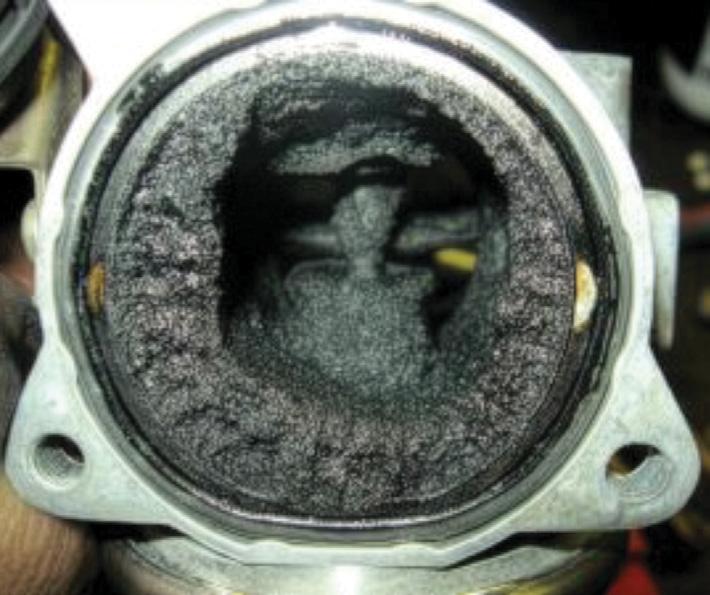
it’s end-of-life ash; sometimes it’s physical damage. Only the first scenario is a strong candidate for chemical intervention.
Direct injection (DI) – also known as gasoline direct injection (GDI) – has changed the deposit game. Because fuel no longer washes the back of the intake valves, deposits form more easily. That’s why service-applied induction cleaning or fuel-system additives have become a legitimate service offering.
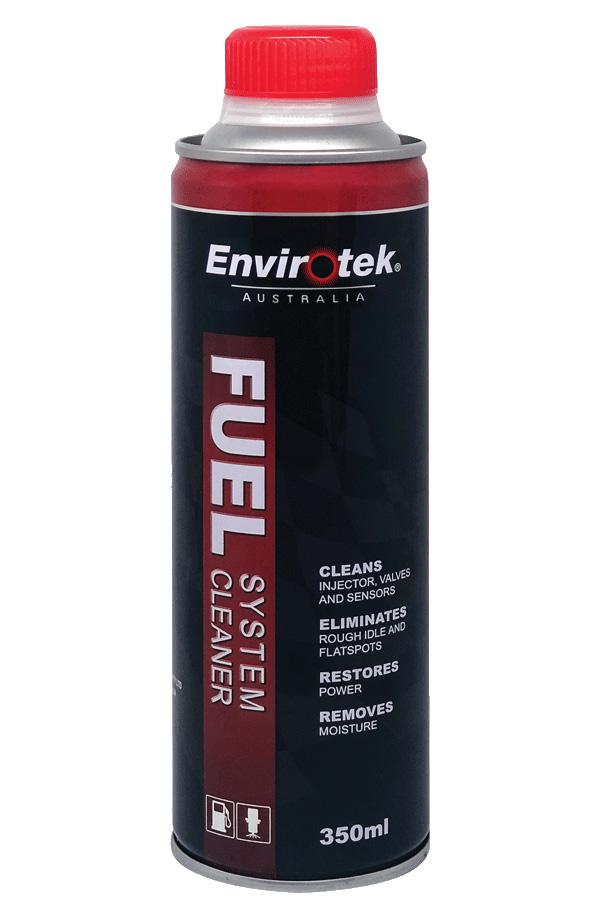
A good example of this is Envirotek’s Fuel System Cleaner. Deposits on inlet valves and injectors will adversely affect performance, fuel economy and the driveability of your customer’s car. A fuelsystem decarbonise or an injector-cleaning service will restore power and economy to your customer’s vehicle at minimal expense (pic 1).
There are several great products available to address GDI intake-valve build-up. They are sprayed through the air intake, use PEA detergency delivered to valve backs and backed by claims of up to 46 per cent carbon removal in the first 60 minutes, with no major teardown.
Your customers and your workshop will benefit from treating this as a repeatable process: confirm symptoms (idle quality, hesitation, airflow-related faults), document before and after and be honest about the limits. Light-to-moderate deposits respond well; severe cases still require physical cleaning. The key is that you’re selling restoration, not a promise of ‘like new’.
DPF/GPF chemistry: ‘Ash-free’ and ‘service-applied’ are the safe terms Particulate filters – diesel and petrol – don’t fail in one way. Sometimes it’s a soot load from low-speed duty cycles; sometimes
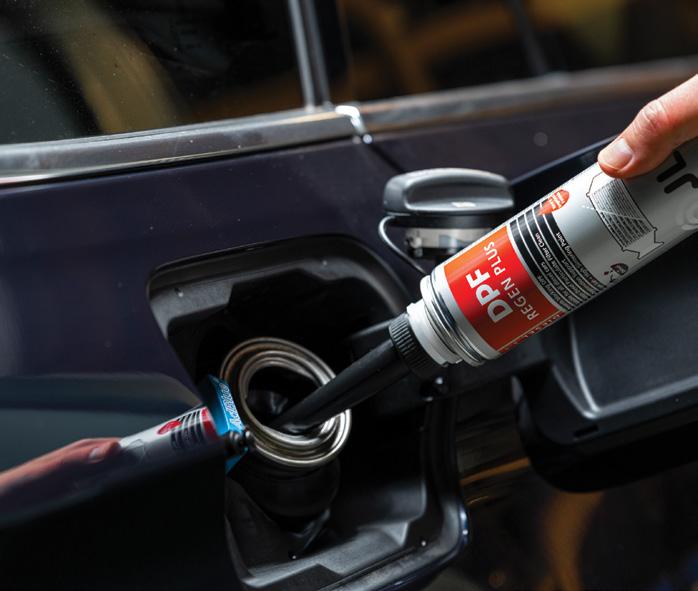
The most defensible products for workshops are those explicitly designed to restore absorption capacity without adding ash and used in a controlled service workflow. JLM’s DPF Regen Plus, for instance, claims to prevent DPF blockage, is suitable for all diesel vehicles, keeps the DPF clean, supports regeneration and has low ash and a high sintering point. It is applied during service without removing the filter (pic 2 and 3).
The business rule is simple: if it’s sootrelated and the substrate is intact, chemistry can help you complete a regeneration successfully. If it’s ash-packed or damaged, chemistry becomes a timewaster and risk of a comeback.
Oil additives: Useful in narrow lanes but risky as a ‘fix’
Anti-wear and friction-modifier treatments can have a place – especially in older engines operating under high load (towing, heat, long drain intervals when the oil spec still supports them). However, technicians need to treat modern oils as a balanced system: adding chemistry can alter the intended detergency/anti-wear balance and mask underlying faults (oil pressure problems, timing wear, bearing damage).
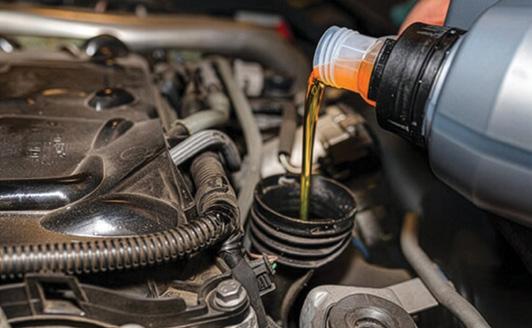
Reputable oil companies such as Atlantic Oil, which are committed to producing quality engine oils and lubricants for the automotive, industrial, agricultural and mining sectors, offer a broad range of highperformance oils and lubricants to meet the needs of all vehicles (pic 4 and 5).
The safe customer message in 2026 is: oil additives are supplemental protection, not
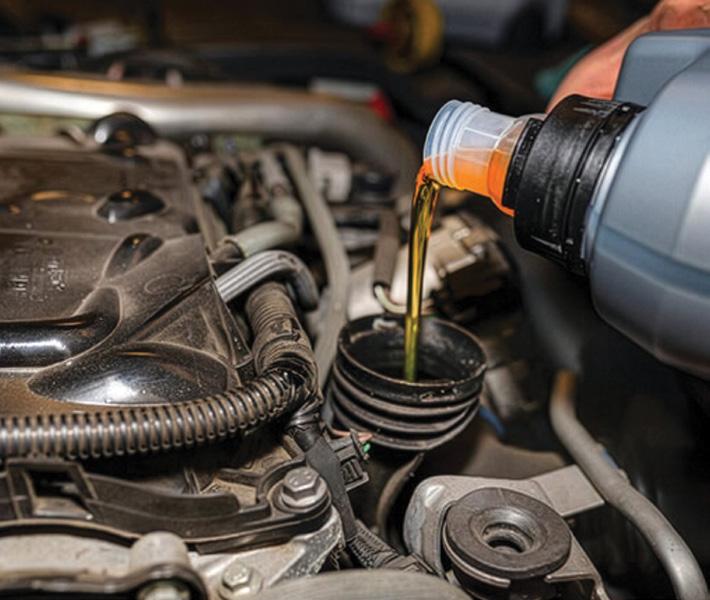
repair, and are used only after the correct oil grade/spec and service condition are confirmed.
Driveline additives: Modern transmissions are unforgiving
This is where workshops can protect themselves with one hard policy: follow the OEM fluid specification and avoid ‘universal’ additive solutions, especially in late-model automatics, dual-clutch transmissions (DCTs), continuously variable transmissions (CVTs) and all-wheel-drive (AWD) couplings. ZF’s own lubricant documentation is blunt:
additives added later change oil properties unpredictably and are not permitted, and ZF states it accepts no liability for damage resulting from such additives.
That stance aligns with real-world failure patterns: shift quality issues and shudder and clutch behaviour are often fluid-spec sensitive. In many cases, the correct professional response is not additive – it’s the correct fluid, the correct fill procedure, correct adaptation learning and correct diagnosis of mechanical wear.
Workshop highlights
• DO match the product to a mechanism (detergent, solvent, aftertreatment, tribology).
• DON’T sell additives as a substitute for diagnosis – confirm the fault mode first.
• DO treat DI/GDI intake cleaning as a service workflow with before/after documentation.
• DON’T expect in-tank cleaners to solve intake-valve deposits on DI engines.
• DO prioritise ash-free, service-applied
cleaners for particulate filters where appropriate.
• DON’T waste chemical treatments on ash-packed or physically damaged DPF/ GPF units.
• DO treat modern transmission fluids as engineered systems – use the approved spec.
• DON’T add driveline additives where the OEM or component manufacturers prohibit them.
• DO record product, dose, reason and outcomes like it’s a warranty file.

Brendan Sorensen
Go back 15 years and diagnosing a turbo fault was a physical fight. You hunted for split vacuum hoses, wrestled with stuck wastegate diaphragms or wiped oil off your face after peering into an intercooler. If the boost gauge didn’t match the manual, you adjusted a rod or replaced a solenoid. Job done.
Today, if you don’t fully consider the possibilities of a modern torque-based engine management system – such as a Volkswagen EA888, BMW B48 or Ford EcoBoost – you are going to load the parts cannon and fire it straight at your own profit margin.
We are in an era when the ECU treats boost pressure merely as a means to an end. The ECU doesn’t ‘want’ boost; it wants torque. This fundamentally changes how we interpret our scan data.
The ‘desired vs actual’ reality
Comparing desired boost (or specified charge pressure) against actual boost (manifold absolute pressure) is still a critical first step in your diagnostic path. However, the context has changed.
In the old days, desired boost was a relatively static target based on RPM and throttle. In a modern, torque-based ECU, desired boost is highly dynamic. If a safety limiter is active, perhaps for transmission protection or knock mitigation, the ECU will reduce the desired torque, which immediately lowers the desired boost.
This gives us two distinct diagnostic paths:
Scenario A: The mechanical gap
Desired boost is high (e.g. 18psi) but actual boost is low (e.g. 10psi).
Diagnosis: The ECU is commanding power but the hardware can’t deliver. You likely have a flow restriction, a boost leak or a failed turbo.
Scenario B: The logic gap
Here is where technicians get burned. You have low desired boost (10psi) and matching actual boost (10psi). Only if you’re familiar with the model would you know this engine should make 18psi for this throttle position/load.
Diagnosis: If you ignore the desired parameter ID (PID), you’ll tear the intake apart looking for a

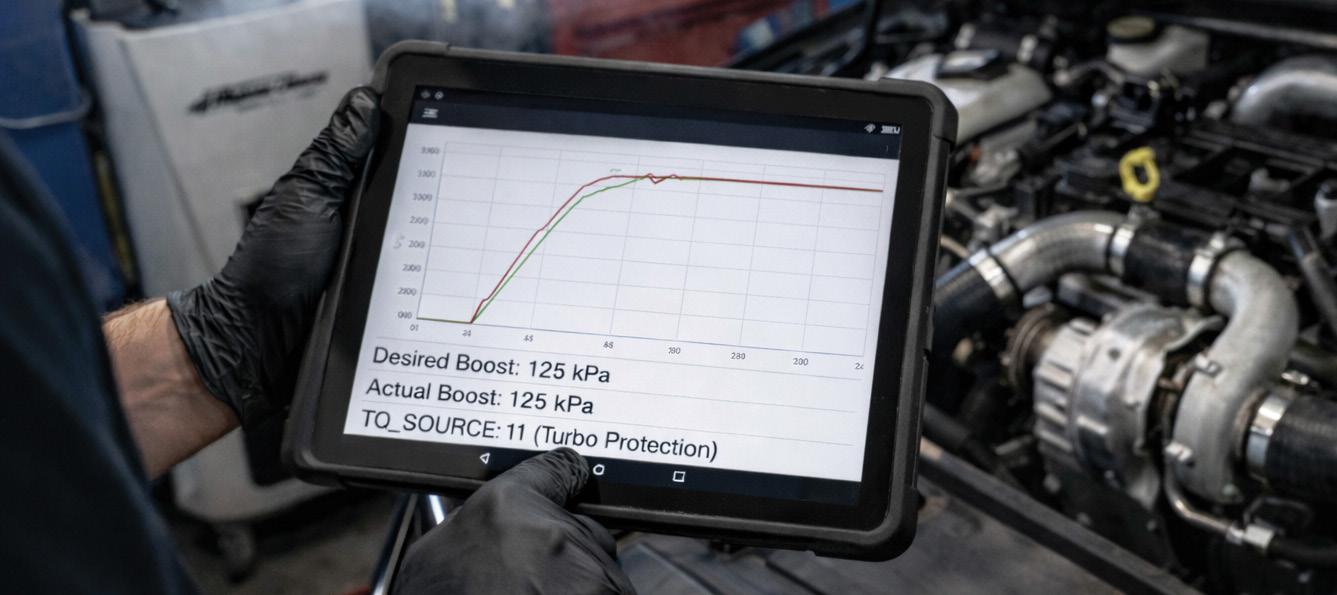
leak that doesn’t exist. The turbo isn’t broken; it’s doing exactly what it was told. The ‘fault’ is a logic limiter clamping the request. You don’t need a smoke machine; you need to find out why the ECU is pulling power (pic 1).
The ‘why’ PIDs
To diagnose the logic gap, we need to interrogate the ECU. We need the scan-tool data PIDs that tell us why torque is being limited.
Ford EcoBoost: The TQ_SOURCE
On Ford platforms, look for a PID called ‘TQ_ SOURCE’ (torque source) or ‘torque intervention reason’. This PID shows a single number which tells you exactly what logic gate is capping the fun (pic 2)
While these numbers vary by ECU family (Tricore vs Copperhead), these are the ones to watch for the EcoBoost family (Bosch MED17/ Tricore) found in Focus ST, Ranger and Mustang models:
• 0 = driver demand: The system is giving you what you asked for. If power is low but the source is 0, the software is commanding full power – you have
a mechanical issue (leak, restriction or fuel supply).
• 8 = oil-temp limit: The ECU calculates that engine oil is getting too hot and clamps torque to protect the bearings and variable cam-timing (VCT) phasers. Watch out for this one: I’ve been caught out by a faulty oil-temp sensor triggering this flag. The customer complains of low power, there’s no check-engine light (CEL) and the car feels otherwise feels smooth – until you look at this PID and realise the ECU thinks the oil is 150°C.
• 11 = turbo protection: The model predicts the turbo is over-speeding (often due to a boost leak) or approaching a thermal limit. The ECU is actively clipping boost to save the hardware.
BMW B48/B58: The torque-limit flag
BMW data takes a bit-encoded approach, which is as confusing as it sounds. We look for ‘torque-limit flags’. Across different models and tools, this data PID hides under many names such as ‘torque-limitation state’, ‘torque status’, ‘status torque limitation’ or ‘torque limit active’. A common specific
value to watch for in the Bosch MG1 architecture is 262144.
This corresponds to ‘Bit 18: MD_MOTOR’, which stands for ‘limitation by motor protection’. While this can theoretically trigger for various reasons, in the B58 context we often see it associated with the exhaust-gas temperature (EGT) model.
If the ECU calculates that the catalyst or turbine might be getting too hot, it triggers this flag and pulls the boost target. I’ve assisted a technician chasing boost leaks on a B48 engine when the real culprit was a coolingsystem fault in the water-to-air charge cooler circuit. The intake temps rose, the thermal model intervened, the ECU flagged 262144 and the car felt flat.
Platform specifics: Hardware failures
If your data confirms scenario A (the ECU wants boost but can’t get it), you are back to mechanical-hardware diagnostics but even here the rules have changed.
VAG EA888 Gen 3: The voltage trap
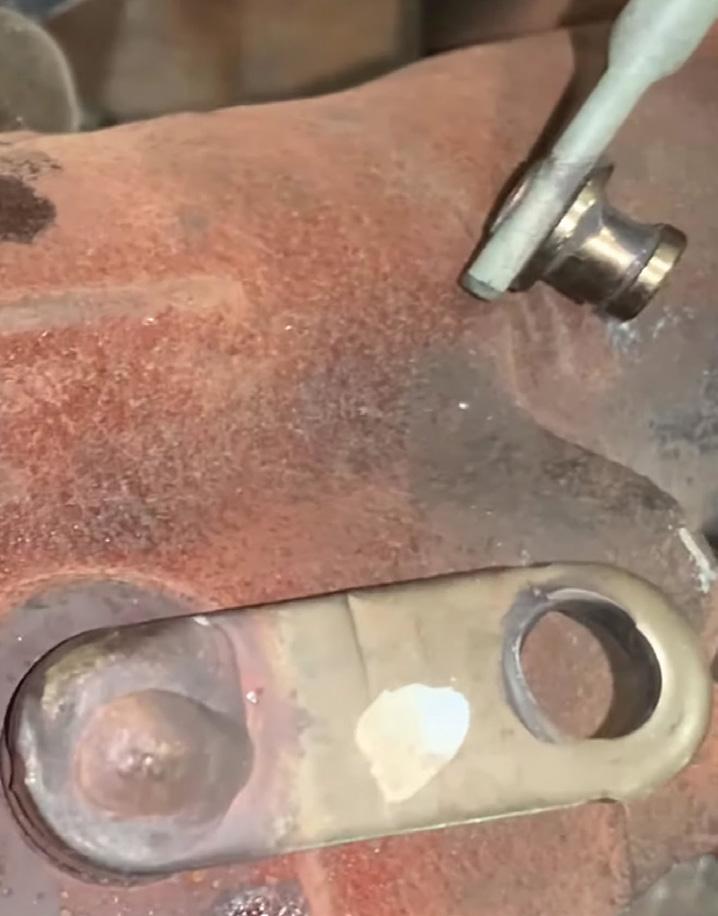
The electronic wastegate actuator on the IS20/IS38 turbos (Golf GTI, Audi S3) suffers from linkage wear. The wastegate arm and its connecting actuator wear each other (pic 3), causing significant slop. The bushing for the wastegate arm can also wear, creating wastegate rattle on deceleration and preventing a proper seal.
• The test: On VCDS or OBDeleven scan tool, look for IDE00396 – Charge air pressure actuator: acknowledgment.
• The field finding: A common known-good window for these actuators key off/engine off (KOEO) is 3.5-3.9V. If significant drift is seen (> 4.2V), the linkage is likely loose/ worn. If it reads low (< 3.4V), the rod may be bent or misadjusted.
• The trap: Many scan tools display this PID as a percentage by default. A reading of 80 per cent is not as helpful. You should hunt for the ‘unconditioned voltage’ PID or grab a multimeter and measure at the component to make a valid call.
BMW B48/B58: The 0.6mm tolerance
These engines use a strictly calibrated wastegate linkage. If you replace an actuator, you cannot just eyeball the rod length. The factory tolerance is typically ±0.6mm. The factory tool (ISTA) performs a ‘wear test’ where it actuates the linkage and checks for hysteresis (slop). If the turbine housing bushing is worn (common at higher kilometres), the new actuator will fail the adaptation test immediately. Do not quote an actuator replacement until you have physically checked the turbine bushing for radial play.
Ford EcoBoost: Vacuum vs pressure
Before diagnosing an EcoBoost wastegate, you must identify the control method. Many 1.6-litre (pic 4) and 2.0-litre GTDI engines use a vacuum-actuated wastegate, whereas others (like the 3.5-litre unit) may use pressure.
If it is vacuum-actuated, the logic is:
• Vacuum = closed (boost).
• No vacuum = open (spring pressure/ safety).
This gives the following failure modes:
• Solenoid stuck open (flowing): Vacuum is constantly applied to the actuator. Result: Overboost (P0234).
• Solenoid stuck closed (blocked): No vacuum reaches the actuator. Result: Underboost (P0299).
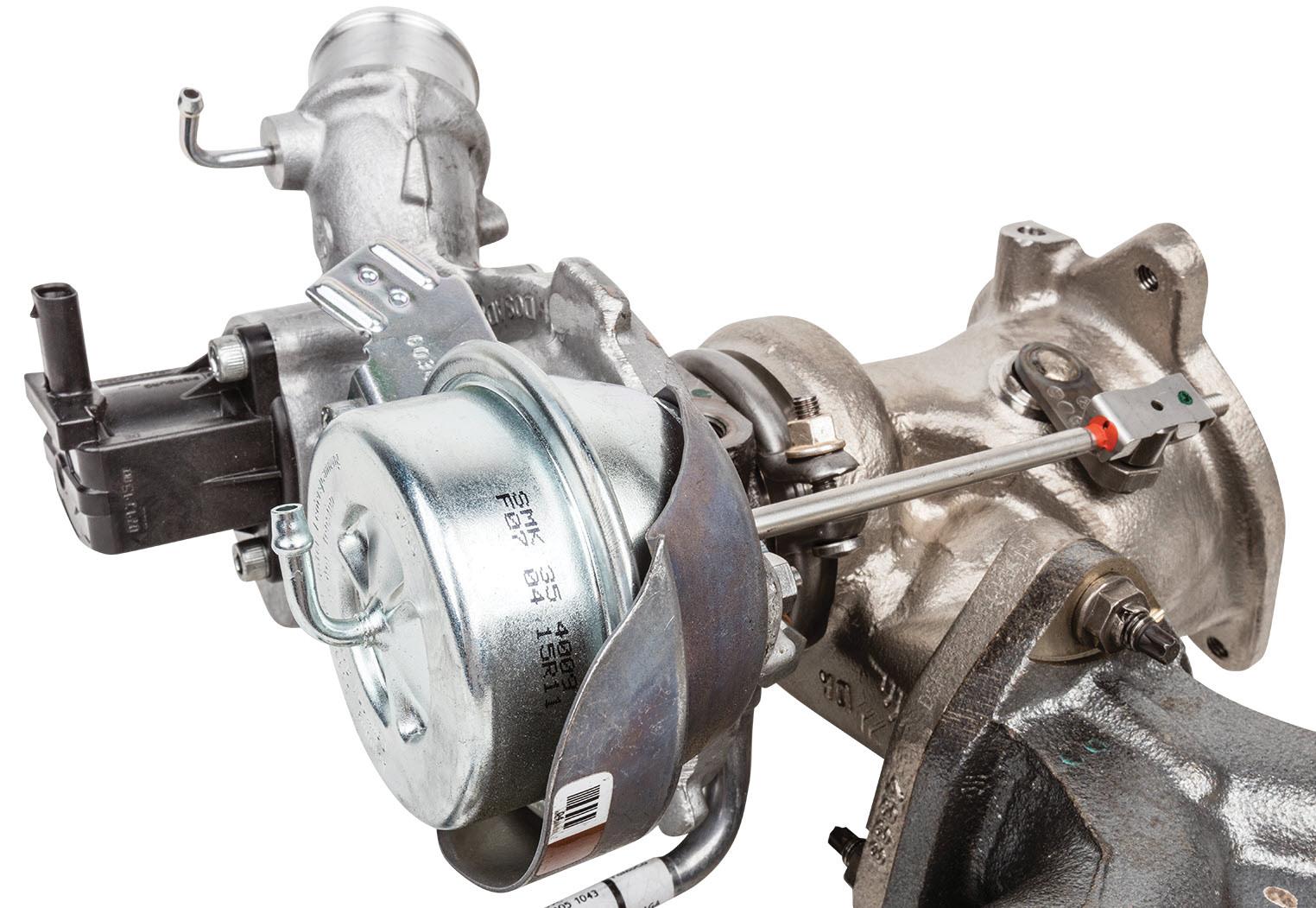
Quick Test: Remove the solenoid. With no power applied, try to blow air into the VAC (supply) port. It should be blocked. If air flows through to the wastegate port, the solenoid is mechanically stuck open.
Pro tip: Perform this test when the solenoid is hot as they often stick only after heat-soak.
If you suspect a boost leak (scenario A), be aware that your standard evap smoke machine putting out 0.5psi may miss leaks. A reinforced turbo hose can seal perfectly at idle pressure but split open under 15psi of boost load.
Technically, you need a machine capable of generating higher pressure to find these faults. However, you must be careful.
Volkswagen explicitly limits static charge-air testing to 0.5 bar (approximately 7psi). Ignore this at your peril.
The EA888 positive crankcase ventilation (PCV) system-check valves rely on pressure differentials and air velocity to seal. In a static engine-off test, or if the check valve is slightly aged/weak (very common on VWs), that valve may not seal perfectly. If you pump 15psi of smoke into that intake without isolating the system, that pressure can bypass the PCV, pressurise the crankcase and push the PTFE rear main seal right out of its housing.
You wanted to find a boost leak; you just bought yourself a rear main-seal job.
If you need to test at higher pressures to find a stubborn leak, you must isolate the engine breathing system.
1. Block off: Disconnect the PCV hose from the intake and install a block-off cap.
2. Vent: Remove the oil filler cap. This ensures the crankcase cannot build pressure even if some pressure gets past the rings.
3. Test: You can only safely increase test pressure to find that weeping manifold O-ring once the crankcase is isolated and vented.
Successful diagnosis on these platforms demands a new discipline. It requires us to integrate logic (torque flags/source PIDs), mechanics (isolated pressure testing) and electronics (scope verification) into a single workflow.
If you skip the logic step, you will waste hours chasing phantom leaks on a vehicle that is simply protecting itself. If you rush the mechanical step and ignore the safety protocols, you risk turning a routine boost leak repair into a catastrophic rear main-seal failure.
The ECU is telling you exactly what it wants and why it can’t have it – you just have to be willing to listen before you start turning spanners.

Clinton Brett
Most of you know me from my knowledge working with diesel systems for a very long time –more than 30 years – so there isn’t much I haven’t experienced.
Most of this stems back to my apprenticeship days, which was well before we were using computers in cars. Of course, it helps to have a photographic and a hard drive of a memory like I do.
I recall my first encounter of an engine running rough after a workshop had recently replaced the cylinder head and refitted a recently overhauled set of injectors. I would have been in my fourth year of apprenticeship working in the diesel shop. The mechanic was at the front counter having a meltdown with my boss because the set of injectors we’d overhauled a few weeks prior to this engine overheating were no longer operating correctly.
The injectors were not the cause of the overheating. It was a typical case of a poorly maintained vehicle which, due to a cooling-system failure, had lost coolant and overheated.
The vehicle was an early 2000 Mitsubishi Triton 4M40T 2.8-litre fitted with mechanical pintle-type indirect injectors. We had not seen the vehicle previously, as most of our clients would drop the fuel-system components over the counter for testing and assessment. At the time the injectors were overhauled, we were told they were chasing a black smoke issue.
I stood beside my boss as he copped a spray and calmly responded with, ‘I’ll have
our apprentice test and ultrasonic clean the injectors for inspection.’ My boss already knew what we would see but we needed to be sure we were dealing with the injectors we supplied originally.
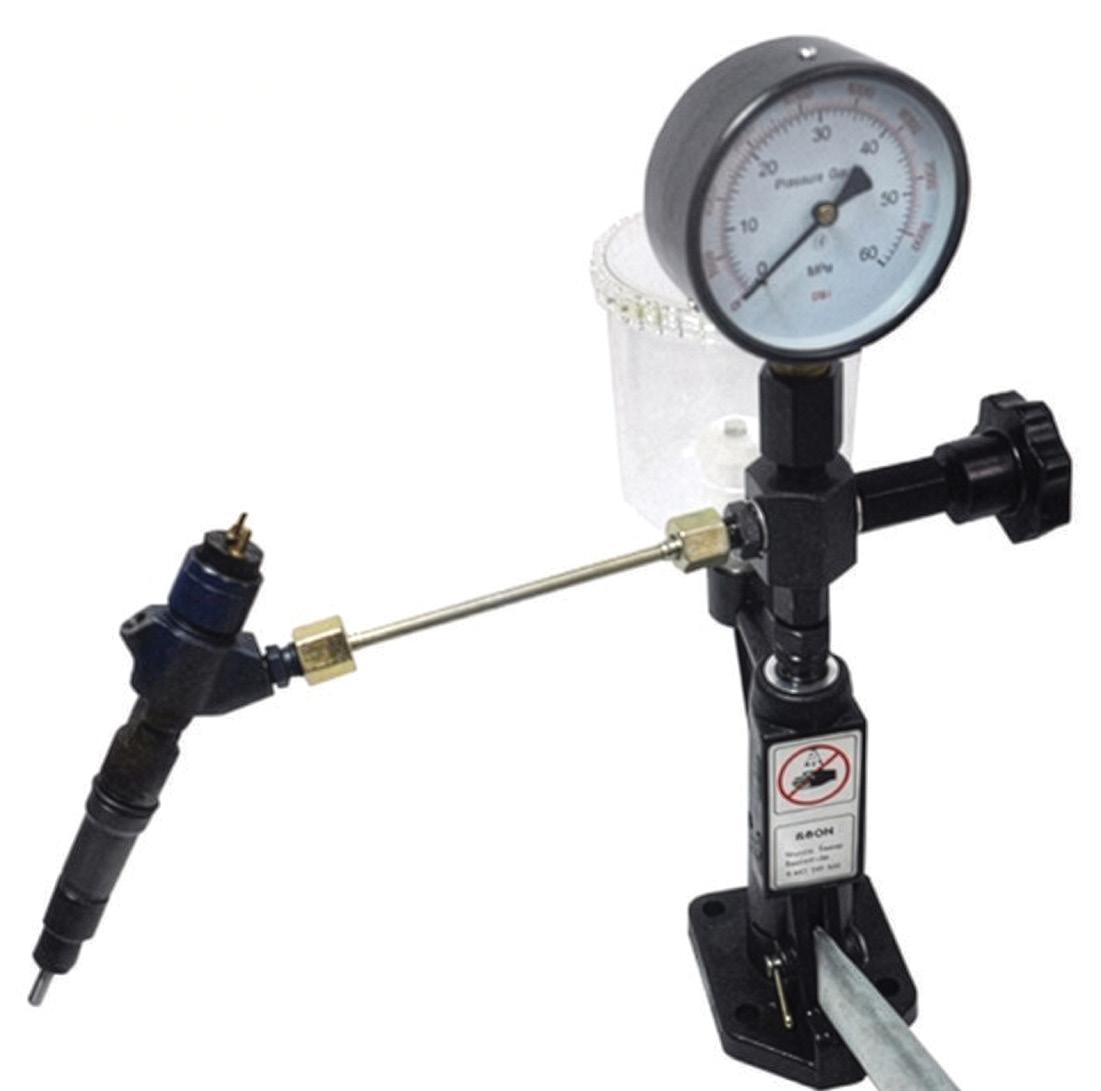
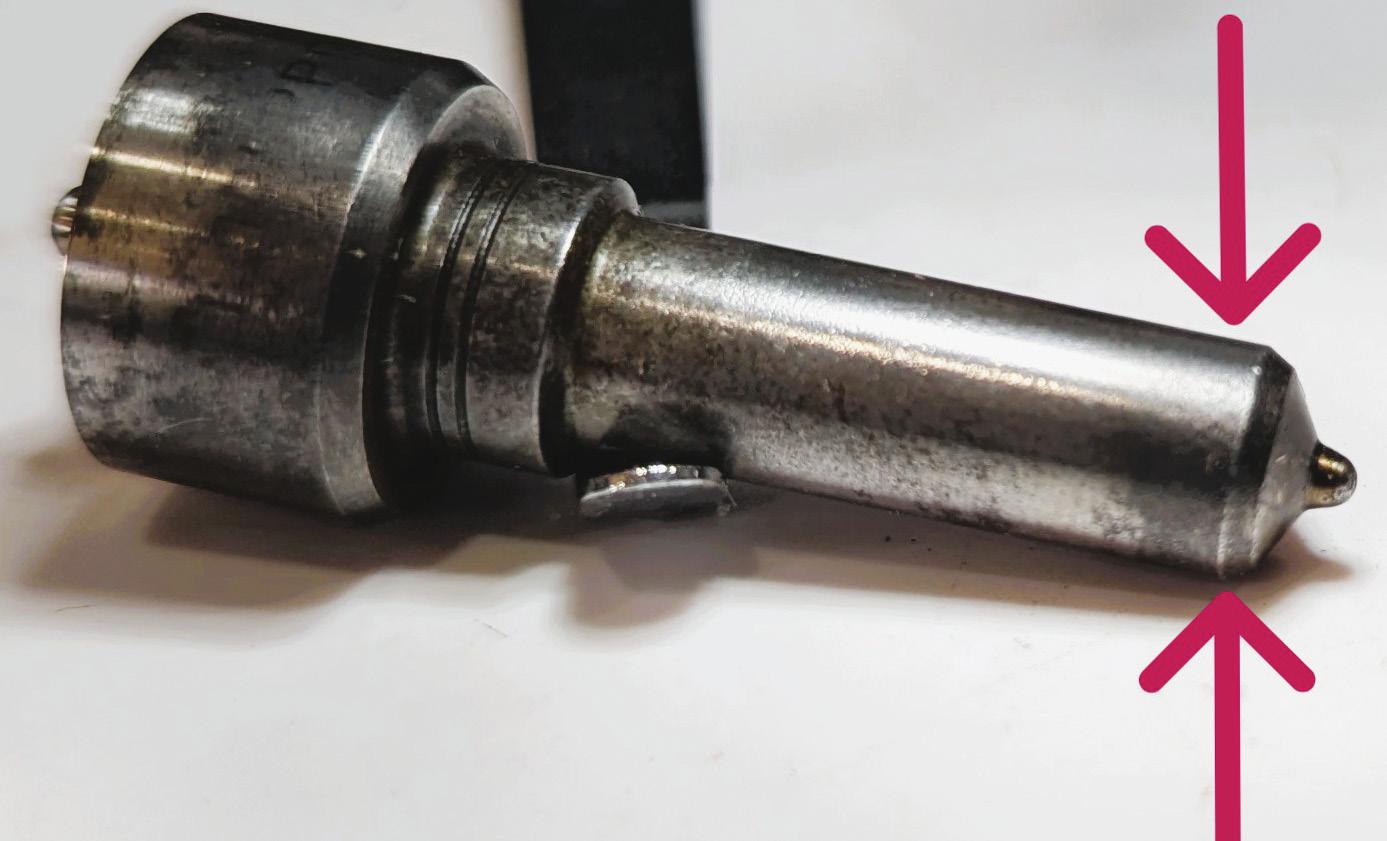
I tested the injectors on the pop tester (pic 1) and the spray was OK and pressure was good. After ultrasonic-cleaning the injector nozzles while still attached to the injector body, we noticed discolouration of the nozzle (pic 2). This blue/brown colour is the result of overheating, which confirmed my boss’ theory – these recently overhauled injectors were installed before the engine overheated and now, they were non-serviceable. Damaged injectors like this can test well on the tester but once they’re torqued into the cylinder head and the engine is warm, the nozzle changes shape. The simple explanation is when a metal object is exposed to extreme heat, it’s going to change the original shape.
After 30 years of dealing with this same problem week in, week out, I’ve decided enough is enough so I’m spreading the word via our technical bulletin library and this publication.
TB1283 – Engine overheated, new head, old injectors installed, low power
Models: All diesels, early and late-model diesels.
Symptoms: Engine feels sluggish. Low power. No turbo boost. Approximately 40 to 50 per cent down on performance. No smoke. In some cases the engine rattles and blows excessive black smoke when the engine is at operating temperature. No fault codes.
Failure/issue: Failed injectors. Original injectors reused after the replacement of head or head gasket due to the engine overheating.
Diagnosis and/or early detection of the fault: In any situation when a diesel engine has experienced overheating, injector replacement is a must.
Extremely high engine temperatures cause distortion of the injector nozzle. When high temperatures are applied to any metal object, it will change shape. For example, an oxygen/acetylene torch temperature of approximately 600°C can change the shape of steel and it will not return to its original form.
In the case of a diesel engine overheating, although it does not reach the temperature of an oxygen torch, the heat (approximately 120°C) is enough to distort an injector nozzle.
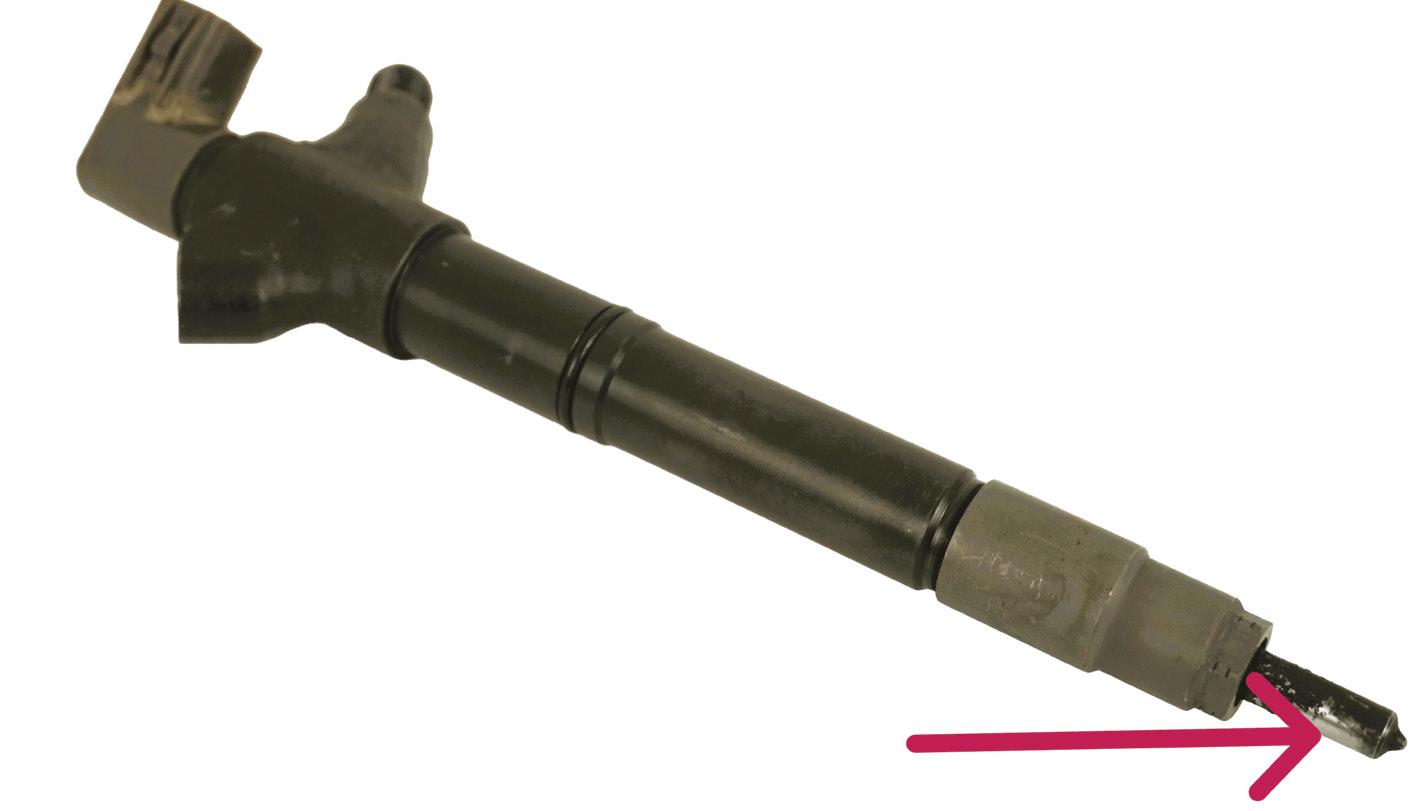
The injector nozzle is the end section of the injector (pic 3, red arrow) which protrudes into the combustion chamber. It comprises two parts – the needle valve and the nozzle body.
The needle body has multiple holes (five to eight) that allow the fuel to exit the nozzle into the cylinder. The tolerances between
the internal surface of the needle body and the nozzle needle are very small, around one to three micrometres (µm) or 0.0010.003mm, so there is not much give between the needle valve and body for alterations from the original shape.
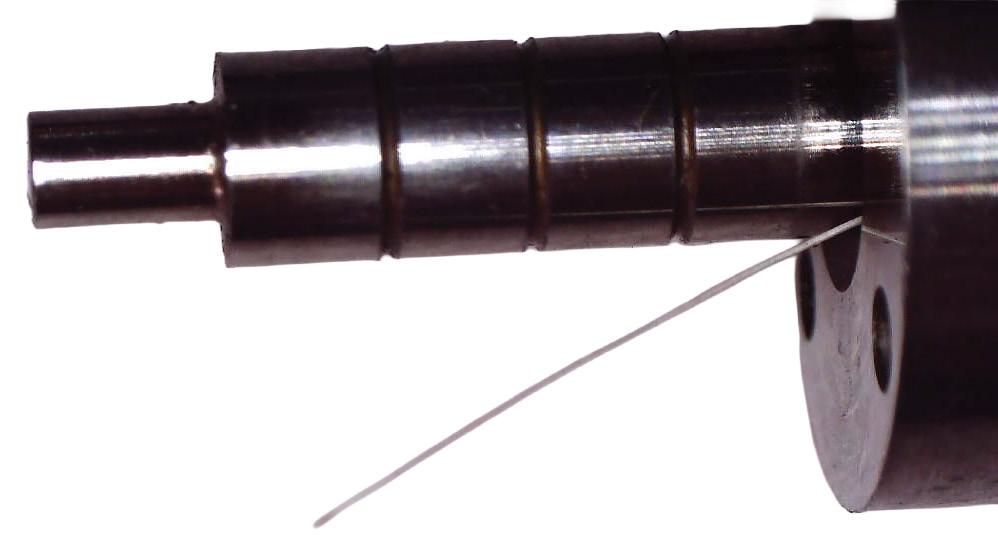
Just how fine are these tolerances? Take a look at the images here of a nozzle (pic 4) in which a hair follicle was placed into the internal section of the nozzle body. The average human hair follicle is roughly 60 to 80µm. In the image, after the follicle was inserted into the nozzle body, it was followed by the nozzle needle. Once it touched the follicle, resistance was felt, continuing to break the hair follicle.
When an injector nozzle has been exposed to excessive heat, the nozzle formation can alter as much as the thickness of that hair follicle, thereby causing the internal nozzle needle to grab, limiting its maximum movement and causing a reduction in the quantity of fuel injected.
In some cases, a sticking nozzle can cause excessive diesel knocking, rattling and a misfire, leading to excessive smoke and potentially even a catastrophic failure of the engine.
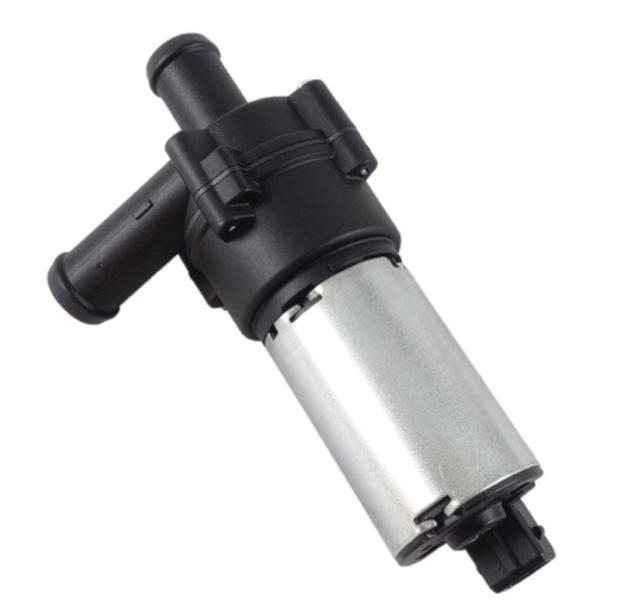
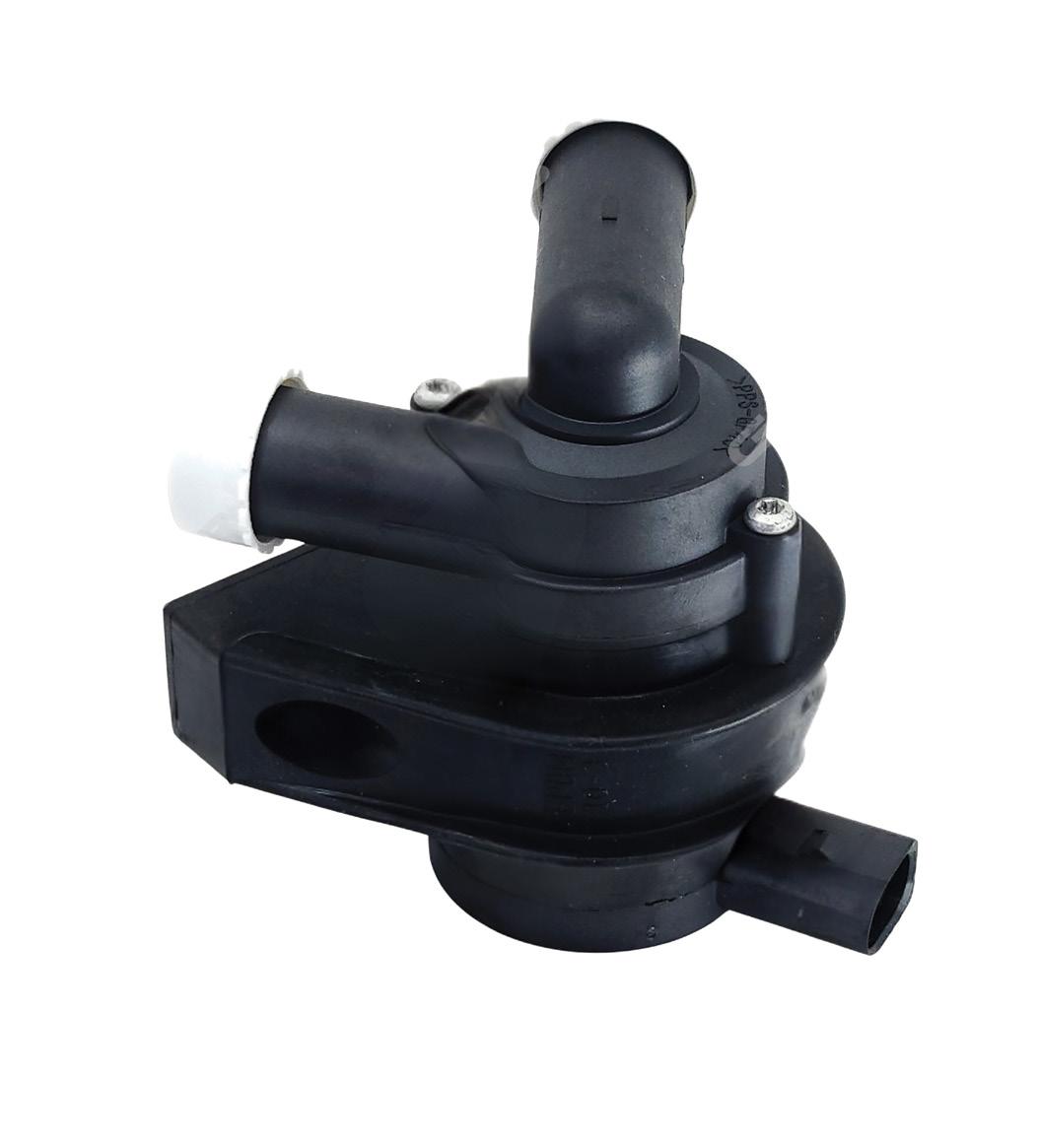
GMB leverages patented technology to manufacture an extensive range of water pumps for automotive manufacturers and the global aftermarket. As toward electrified mobility, GMB stands at the forefront of critical thermal delivering efficiency and reliability for new vehicle technology.
Not all electric water pumps are the same. GMB Electric Water Pumps feature highquality self-lubricating carbon steel in many internal components to prevent oxidation, ensure smooth rotation of the shaft, reduce operational noise and prevent premature failure.
Inferior-grade metals are more susceptible to premature wear and oxidation build-up, leading to excessive vibration, higher operational demands and even catastrophic failure.
Precision OEMspec housings and harnesses
GMB Water Pump Housings and Harnesses are manufactured to match the exact OEM material specifications. Each housing and harness is also precision-measured using state-of-the-art technology to ensure dimensional accuracy of up to 99.99 per cent and tight tolerance limits for proper fit, form and function.
Consolidation of materials with loose tolerances can cause fitment issues, poor connectivity, bearing failure, pump seizures, compromised flow rates, coolant leakage or inadequate performance.
Proprietary premium Korean laminates
GMB uses high-quality Korean-grade laminates engineered to maintain uniform magnetism, ensuring each pump efficiently delivers the correct amount of power. This ensures consistent flow rates below the highest demands a vehicle will experience. Many of the magnetic metals used in the manufacture of electronic water pumps come from countries with inconsistent regulations and widely varying quality from batch to batch. This inconsistent quality control can lead to improper output power and a wide range of performance levels, causing inadequate cooling-system function and unpredictable failure rates. Improper flow rates may also trigger the check engine warning light.
manufactured using only superior automotive-grade printed circuit board (PCB) components (capacitors, resistors, transistors, inductors and logic chips/ MCUs) to accommodate extreme operating temperatures ranging from minus 40°C to 120ºC or higher.
• Contact GMB on 1300 007 132 to find your nearest authorised GMB stockist
The Australian Automotive Aftermarket Association (AAAA) has officially launched the ADAS Vehicle Modifications Code of Conduct, introducing a standardised test protocol to ensure advanced driver-assist system (ADAS) technology such as advanced emergency braking (AEB) remains fully functional following common vehicle upgrades.
The code is designed to provide vehicle modifiers, engineers and certifiers with a repeatable, evidence-based approach to validate safety compliance when modifications to suspension, mass, tyres or frontal protection systems are made.
By clarifying when recalibration is required, the code helps industry professionals maintain Australian Design Rule (ADR) 98 compliance without the need for full firststage approval testing for every minor modification.
AAAA CEO Stuart Charity said the aftermarket industry had to evolve alongside vehicles as they became more technologically advanced.
‘The Australian aftermarket has a proud tradition of making vehicles fit for purpose –– whether for trade, towing or off-road touring,’ said Charity. ‘That isn’t going away. However, vehicles are increasingly defined by safety technologies designed to reduce the road toll, especially ADAS.
‘Our responsibility is simple: if we modify vehicles, we must protect the integrity of
those critical safety functions.’
Auto Innovation Centre (AIC) Managing Director Luke Truskinger highlighted the need for objective verification in this space.
‘The code sets out a repeatable postmodification verification method for AEB,’ said Truskinger. ‘It enables objective checks that AEB functionality is retained and performing as intended.
The code was developed by an expert technical working group (TWG), with rigorous testing and drafting performed by the AIC.
In addition to the ADAS modification code, the AAAA has announced a new TWG on airbag-compatibility testing for bullbars. This initiative aims to provide a clear, national definition of ‘airbag compatible’ – a term currently used widely but inconsistently across the industry.
The TWG is tasked with bringing together bullbar manufacturers, engineers, test facilities, certifiers and regulators to define ‘airbag compatible’ in a way that is scientifically testable and to establish a

contemporary, standardised test protocol for national adoption – ensuring that frontal protection systems meet modern safety expectations while providing clarity for businesses and vehicle owners alike.
‘This new working group is a deliverables group, focused on developing a contemporary, standardised test protocol for airbag compatibility that can be adopted nationally,’ said Truskinger.
The AAAA is calling for businesses with ‘skin in the game’ – including designers, manufacturers and engineers – to register their interest in the working group to help shape these vital industry standards.
• To find out more go to aaaa.com.au

Three of Australia’s best-known auto-electrical specialists, JAS Oceania, Baxters and Federal Batteries, have combined to form the JAS Auto Electrical Group, creating a single national destination for all things autoelectrical.
‘Bringing JAS Oceania, Baxters, and Federal Batteries together under the JAS Auto Electrical Group marks a defining moment for our industry and our customers,’ said JAS Auto Electrical Group General Manager Daniel Torre. ‘By unifying three trusted industry experts, we are creating a stronger, more innovative and more responsive partner for workshops nationwide.
‘Our customers will benefit from deeper expertise, an expanded product range, faster access to parts and the same dedicated support they have always relied on, with more branch locations than ever before.’
The new group provides extensive product coverage for customers across automotiveelectrical, air-conditioning, lighting, heavyduty and industrial applications, as well as battery and energy solutions.
JAS Auto Electrical Group said this would
result in a simpler purchasing experience, improved availability and access to specialist knowledge through a unified national network.
It said aligning the strengths of each business under the JAS Auto Electrical Group identity would benefit customers by giving them:
• A broader and more complete range across auto-electrical categories.
• Improved product availability supported by efficient national distribution.
• Faster access to parts through an expanded national branch footprint.
• Deeper technical support and specialist expertise for passenger, commercial, industrial and mining applications.
• More competitive pricing delivered through a larger, unified supplier network.
Together, the JAS Auto Electrical Group
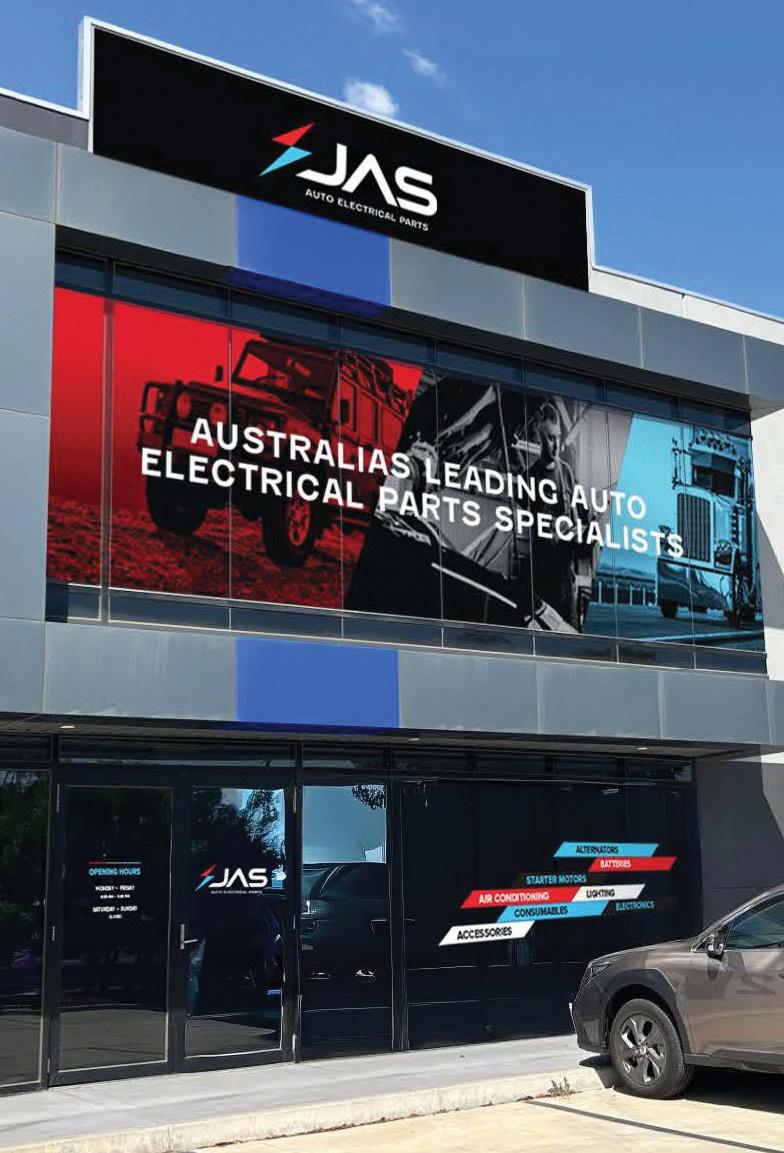
positions itself as a single source of autoelectrical solutions while maintaining the service, relationships and expertise customers already trust.
• To find out more contact JAS Auto Electrical Group on 03 9317 2600 or go to jasoceania.com.au


Frank Massey
Idid intend to write something completely different for this issue but I am hoping you have recently seen my article The value is in the process (TaT issue 107).
It focussed on a Kia Tucson 2.0-litre common-rail (CR) diesel with one of the most peculiar faults I have ever witnessed. The reason I am picking the story up again is the solution has been found.
I have tried to write this carefully and as respectfully as possible because it involves at least three other techs and, I suspect, involvement from the powers above.
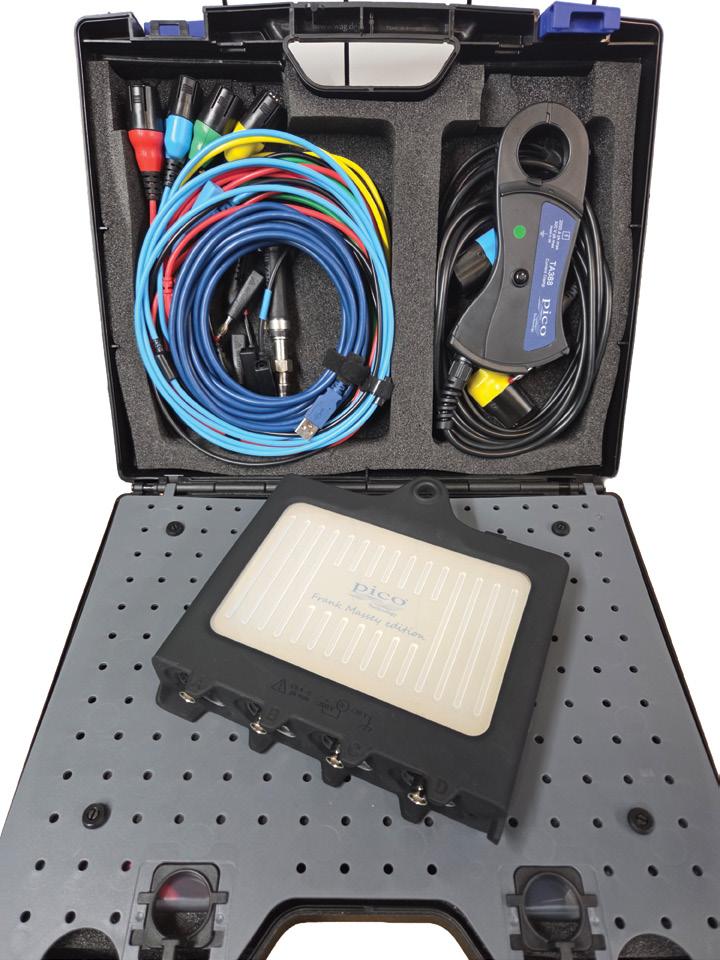
First things first, I officially retired from fulltime work last February, so imagine how I felt when invited to an evening meal courtesy of Pico Technology and then presented with a unique Frank Massey gold livery special-edition 4425 scope kit complete with my monogram (pic 1). To be valued and respected at this level was quite humbling and very much appreciated.
Which brings me back to the Tucson. In issue 107 I went into as much detail as the topic space allowed, including some of the evidential serial images captured during the dynamic road tests carried out with Dave Gore, who once worked for us and attended most, if not all, of my training events. He eventually left to set up his own mobile diagnostic business.
The waters get a little muddied here but it is important to explain them as it highlights why this repair went so badly wrong. The reason for my retirement was financial – my son wanted to take on a new diagnostic tech who also briefly worked for us.
As previously explained, I only became involved with the Tucson after a set of injectors and a rail pressure-control valve
(DRV) had been fitted. Initially, at this point working on my own, I wanted to exclude any possibility of poor fuel supply from the lowpressure system.
This is an absolute must, first go-to test when high-pressure (HP) faults are present. Look for flow rate, aeration/cavitation, pressure and pump current draw – especially start-up inrush.
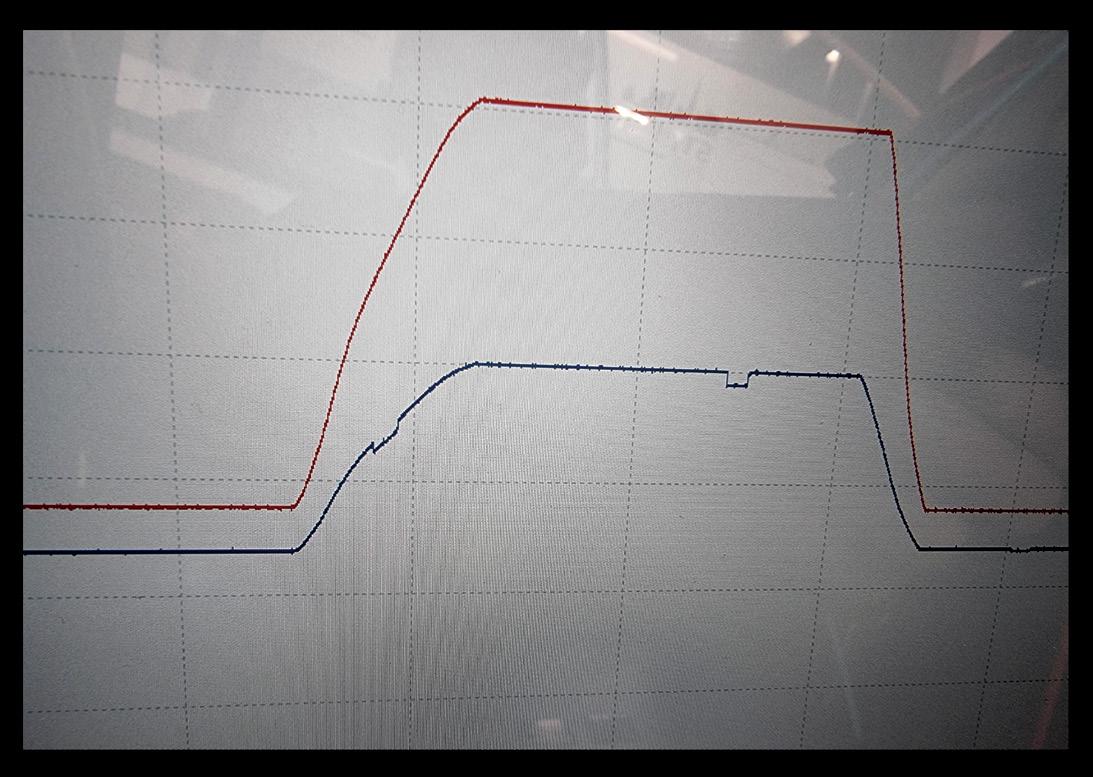
It was obvious from the symptoms that erratic rail pressure or fuel delivery could be a cause, so following a brief serial scan I decided to scope the DRV and rail pressure with my Pico, using cursors to clarify any erratic deviation between the two events. I chose a high sample rate, no filtering, with a trigger set on the rising edge of the DRV powertrain control module (PCM) control. No erratic behaviour was seen despite a very erratic idle accompanied by a discernible surging in crankshaft rotation speed (pic 2).
So far so good, no DTCs and the most appalling drive experience imaginable: erratic throttle response, no power, then too much, followed by severe engine surging. Returning to the workshop, I removed the accelerator pedal position (APP) assembly from the floorpan to accurately scope both potentiometer outputs. I was satisfied no faults were present.
However, there was a very discrete event present which I put down to either a highcurrent event causing radio-frequency (RF) induction or a diagnostic output from the PCM (pic 3).
At this point Dave Gore called into the

workshop and shared an interest in the fault. First rule of diagnostics: don’t run away from problems. The very first thing you are taught in a submarine is to run towards a leak, otherwise it will quickly find you.
I am not going to discuss all of the serial evidence David and I witnessed but will focus on our interpretation of the evidence and our opinion of the cause.
The very principle of diesel injection is based on the calculated injected fuel quantity as the prime responsibility for power delivery. Air mass then serves as a correction factor. Petrol systems generally meter and measure air mass then calculate correct fuel quantity later, although there are now lean-burn petrol systems that operate with open throttle, fuelled.
CR simplifies diesel injection as pressure is independently controlled with respect to pump rotation speed. The principal functions are APP request and PCM control of pressure via DRV/volume solenoids operating in closed loop, with fuel quantity per stroke as the final calculation.
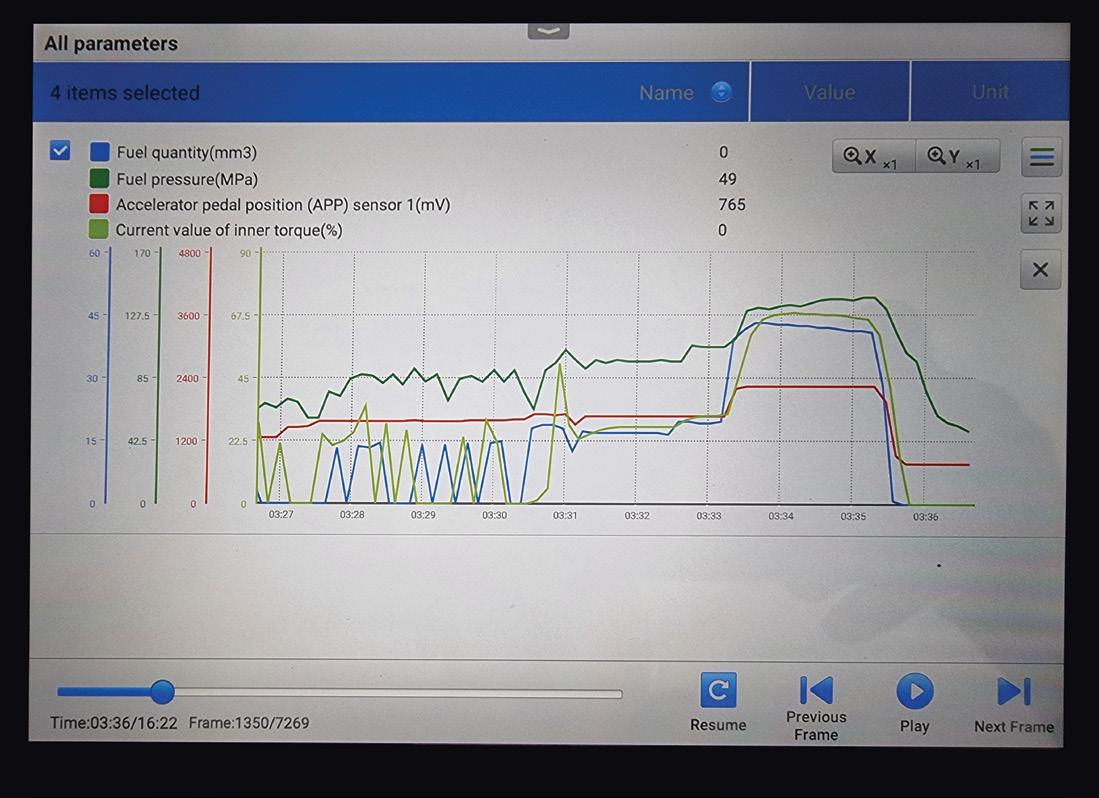
We can debate several correction inputs that affect this process – coolant temperature, fuel temperature, turbo-boost pressure, airmass value and so on – therefore our prime focus and the baseline observation during our serial evaluation was APP performance. With the caveat that I do not entirely trust serial data, it made total sense to log serial values from critical sensor inputs when compared with APP. These values represent the calculated values as understood by the PCM.
At all times the APP never displayed any erratic behaviour but despite this almost all other values showed severe random instability. The
PCM load calculation was especially erratic, as was fuel quantity per stroke, despite a stable APP input (pic 4).
Another golden rule of diagnostics: the cause of a fault will always be symmetrical with the error event. This was the main reason we excluded the APP track as being faulty as this previously discussed event was predictable and completely at odds with the driveability difficulties (pic 3).
We now arrive at the sensitive and respectful bit. Despite my absence and detailed appraisal of the evidence and having fully briefed the client, advising the fitting of a cloned PCM, the vehicle then stood idle with no progress for several weeks.
Eventually our new diagnostic tech took up the challenge, presumably ignoring our previous joint opinion and advice, something I often recommend. Start afresh, do not follow other mistakes.
Unfortunately, he jumped straight to the events we previously discovered with the APP, announcing our omission and mistakes, and then recommending a new APP as the repair solution. Fortunately, I was informed and managed to convince him otherwise, having explained why the APP was not the cause.
Several more weeks passed. Eventually a cloned PCM was fitted, completely rectifying all the faults.
I am not interested in vindication, pride or reputation – get the job right and the rest will follow on its own. But I felt we, as a company, failed our customer, failed to control the process, failed to communicate and failed to consult.
In short, we failed on everything I have taught over 30-plus years. I felt ashamed. Please do not make these mistakes.

Customer complaint
The car would take too long to start and stall when attempting to accelerate.
Problem summary
Verified the customer’s concern – the car was hard to start (extended cranking and misfiring) and when it started, the engine intermittently misfired. When the RPM was raised, the engine intermittently stalled.
Diagnostic sequence
Checked the battery voltage – it was OK, 12.5V.
Checked the charge rate – it was OK, 13.8V. Checked for diagnostic trouble codes (DTCs) and found a DTC related to the mass air flow (MAF) sensor.
Carried out a cranking cadence test – it was OK.
Checked the MAF, oxygen (O2) and fuel data and they all appeared within specification.
Note: The refresh rate of the data was very slow so I was unable to capture faults via the scan data.
Checked the operation of the throttle position sensor (TPS) – it was OK.
Checked the operation of the injectors when the engine stalled/stumbled – they were OK and still being driven.
Checked the operation of the spark/ignition coil when the engine stalled/stumbled and found the spark was extremely weak at idle and not able to jump a gap of more than 0.2mm – a fail.
Checked the operation of the engine position sensor (at the distributor) – it was OK (pic 1). Disassembled the distributor to gain access to the ignition coil.
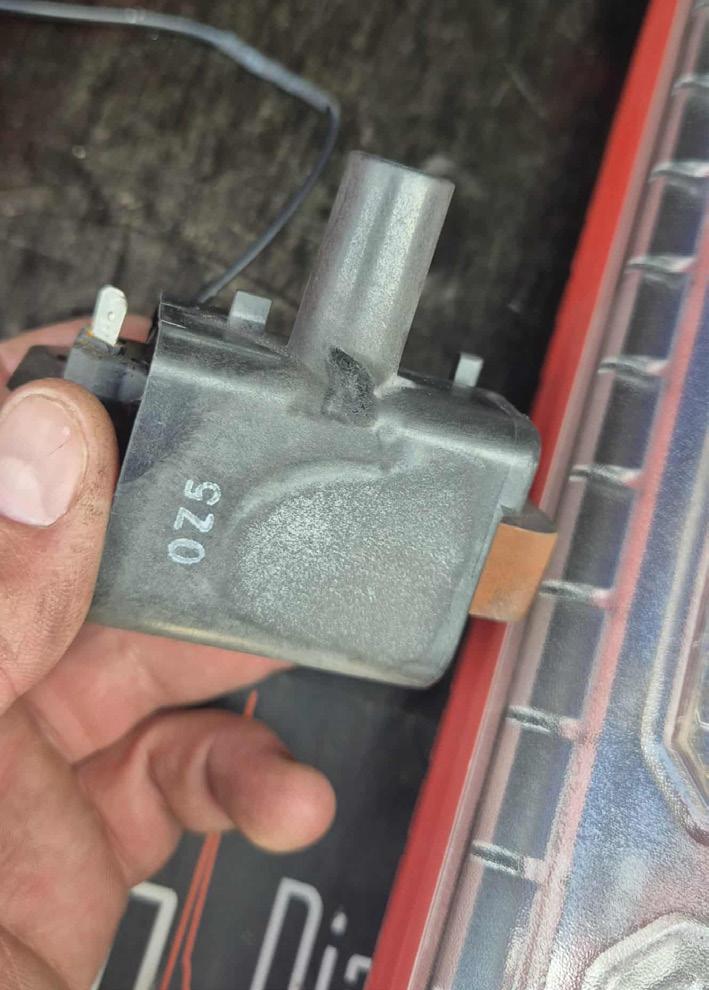

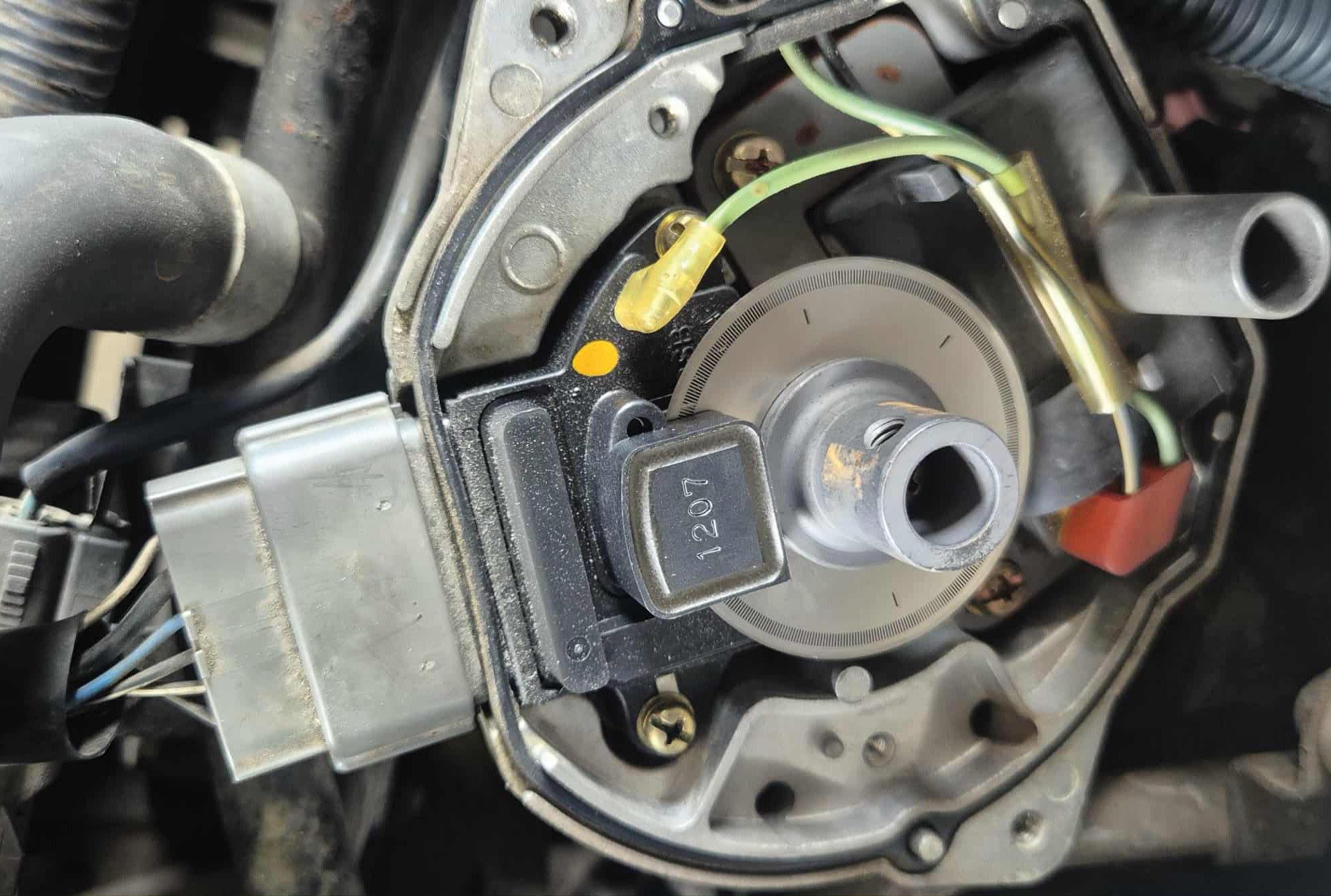
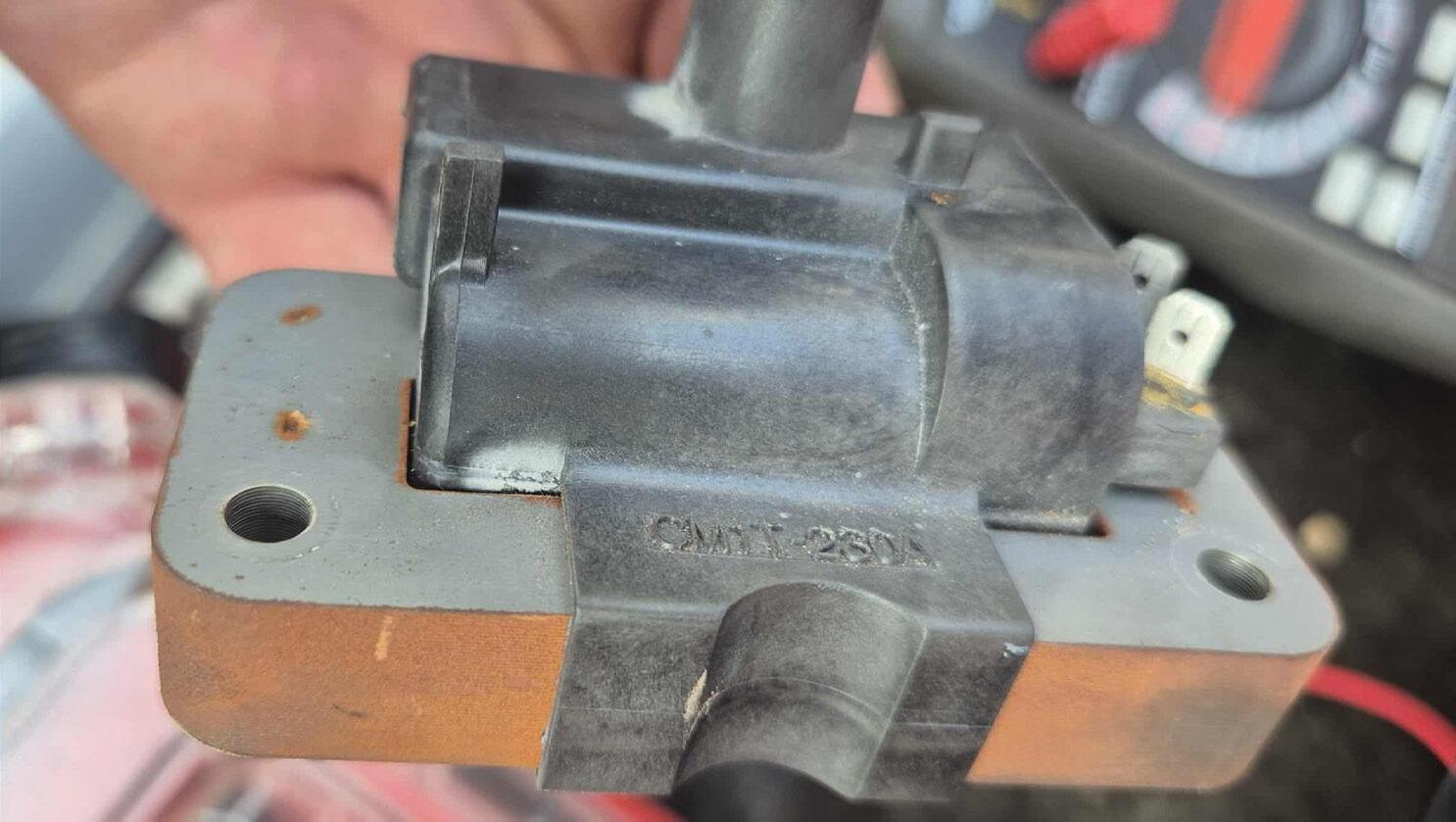
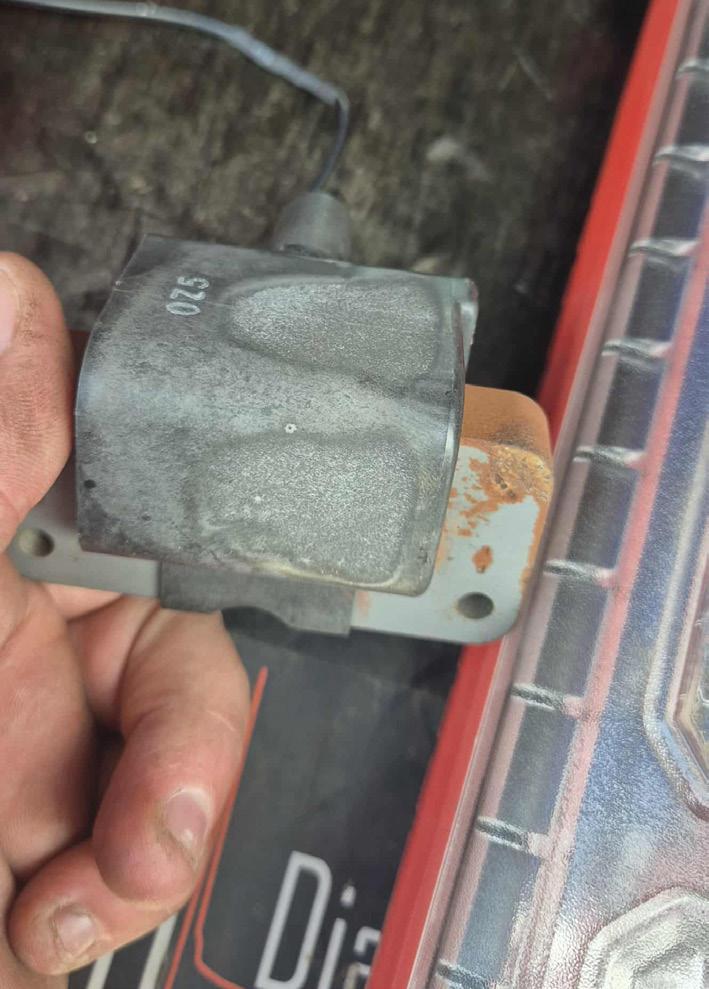
Visually inspected the ignition coil – it had failed, exhibiting evidence of spark carbon tracking/leaking and heat spots (pic 2, 3 and 4).
Recommended replacing the ignition coil. The workshop replaced the ignition coil and the fault was rectified.
Recommended time
Diagnostic time was 45 minutes, taking into account preparation and research.
Repair time not provided.
Repair Solution by TaT Tech Team member Gary O’Riain.
Customer complaint
The orange oil-can symbol was coming up on the dashboard and there was no a/c. The vehicle also had no rear parking-sensor function.
Problem summary
An inspection of the vehicle confirmed the customer’s complaints.
Diagnostic sequence
Carried out a pre-scan of the vehicle and retrieved the following codes:
• 08 Airco B10AE14 – High pressure sensor open or short.
• 17 Instrument cluster B104135 – Oil level thermal sensor signal too high for too long.
• U112300 – Data bus error value received.
• 19 Diagnostic Data Interface Gateway-0375 – Parallel parking assistance control module no signal no comms.

• 5F Information Electronics U111100 – Function restriction due to missing message.
• 69 Elect Trailer Module 00576 –Terminal 15 not plausible signal. Fuse 30 (10A) in the internal fuse box (lefthand centre) was also blown. A new fuse and everything worked.
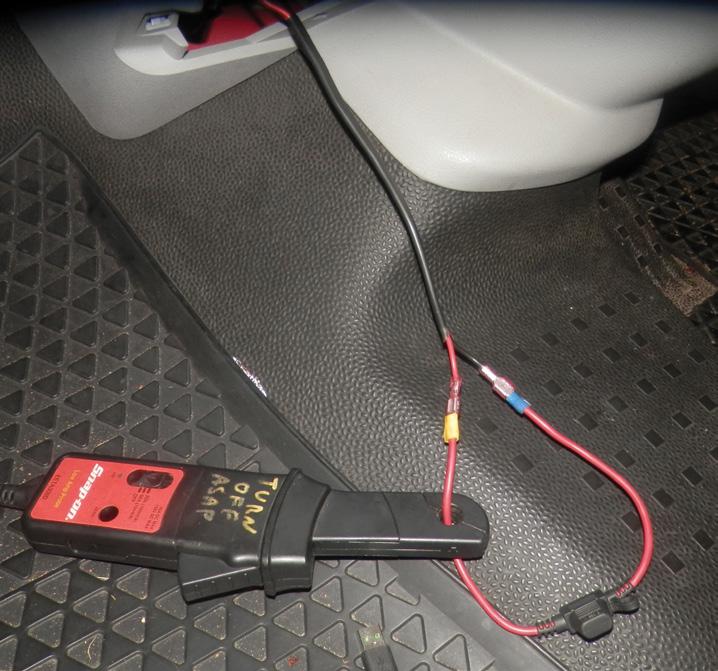
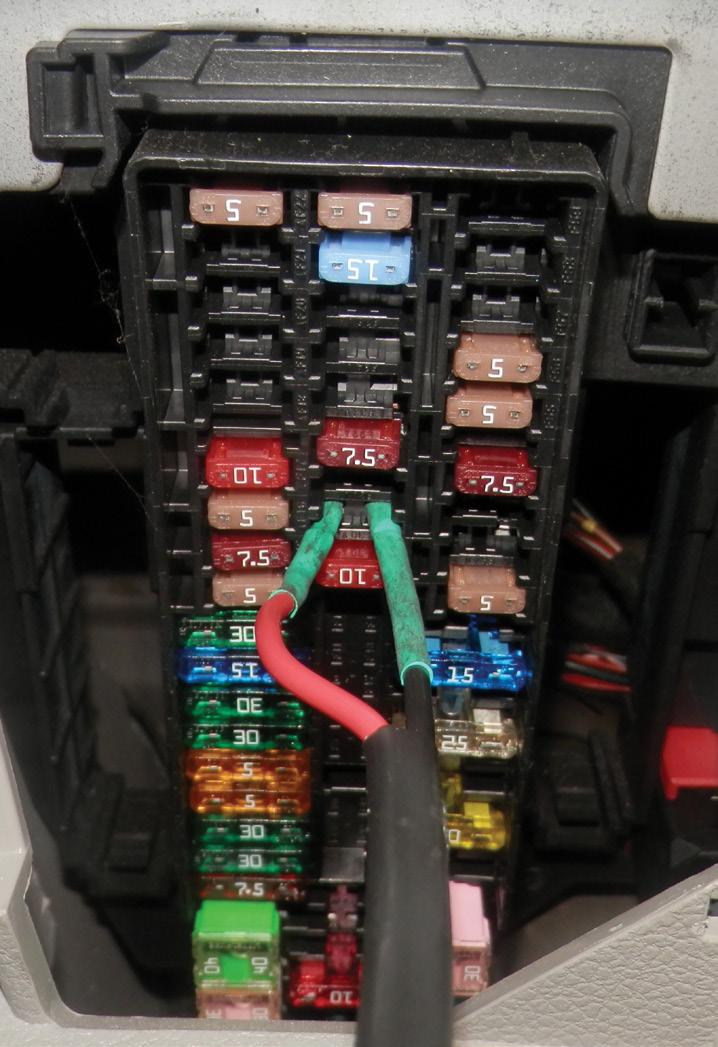
Next came multiple road tests with the current clamp on a fused loop wire and eventually we had the spike on the line (pic 1 and 2).
We narrowed it down to blows on forward acceleration but not backward and suspected wiring chafing due to engine torque.
Dropped the undertray and loaded the engine in gear and in reverse.
The oil-level sensor wires have only convoluted tubing over them and are clipped to a metal tag on the gearbox.
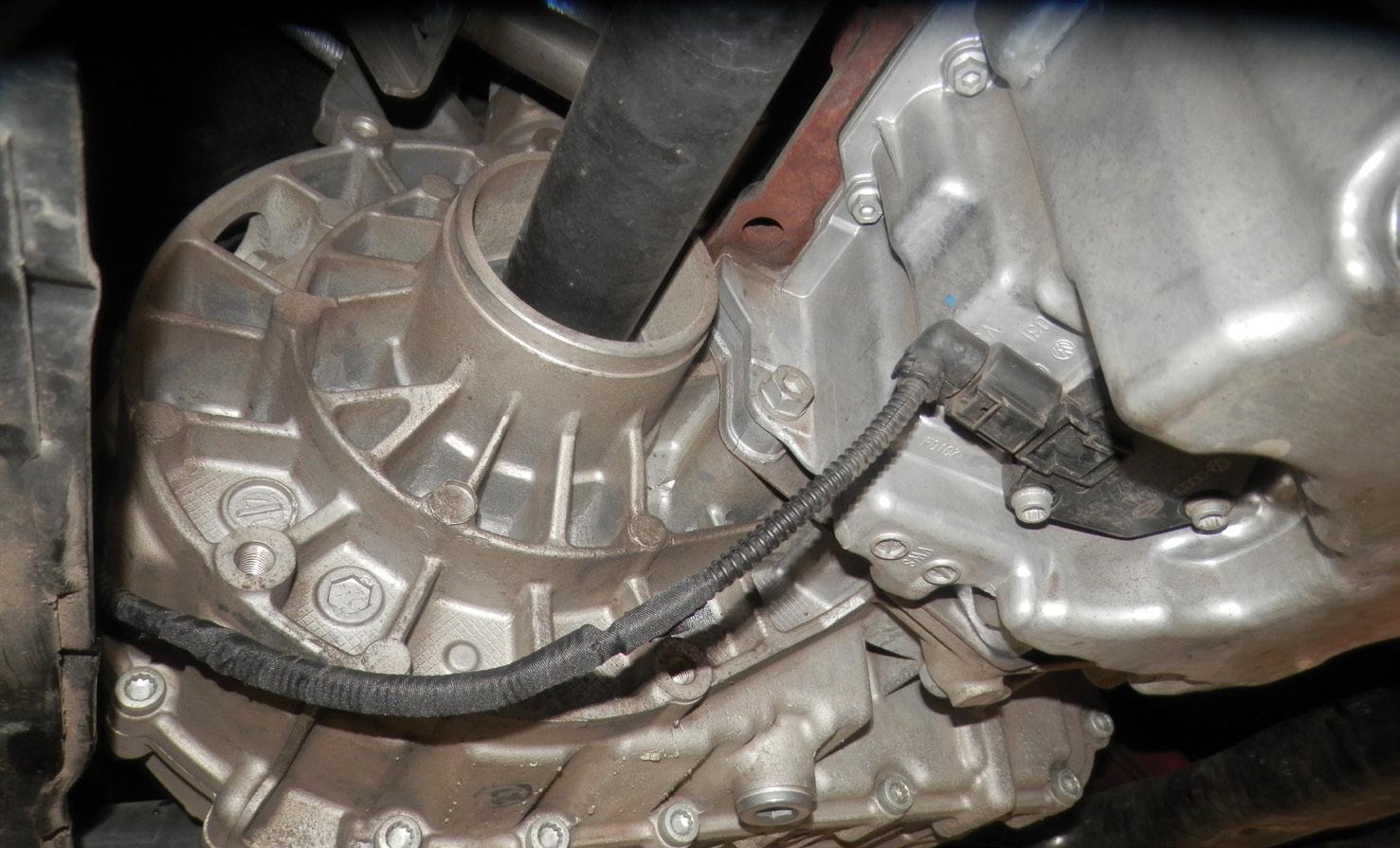
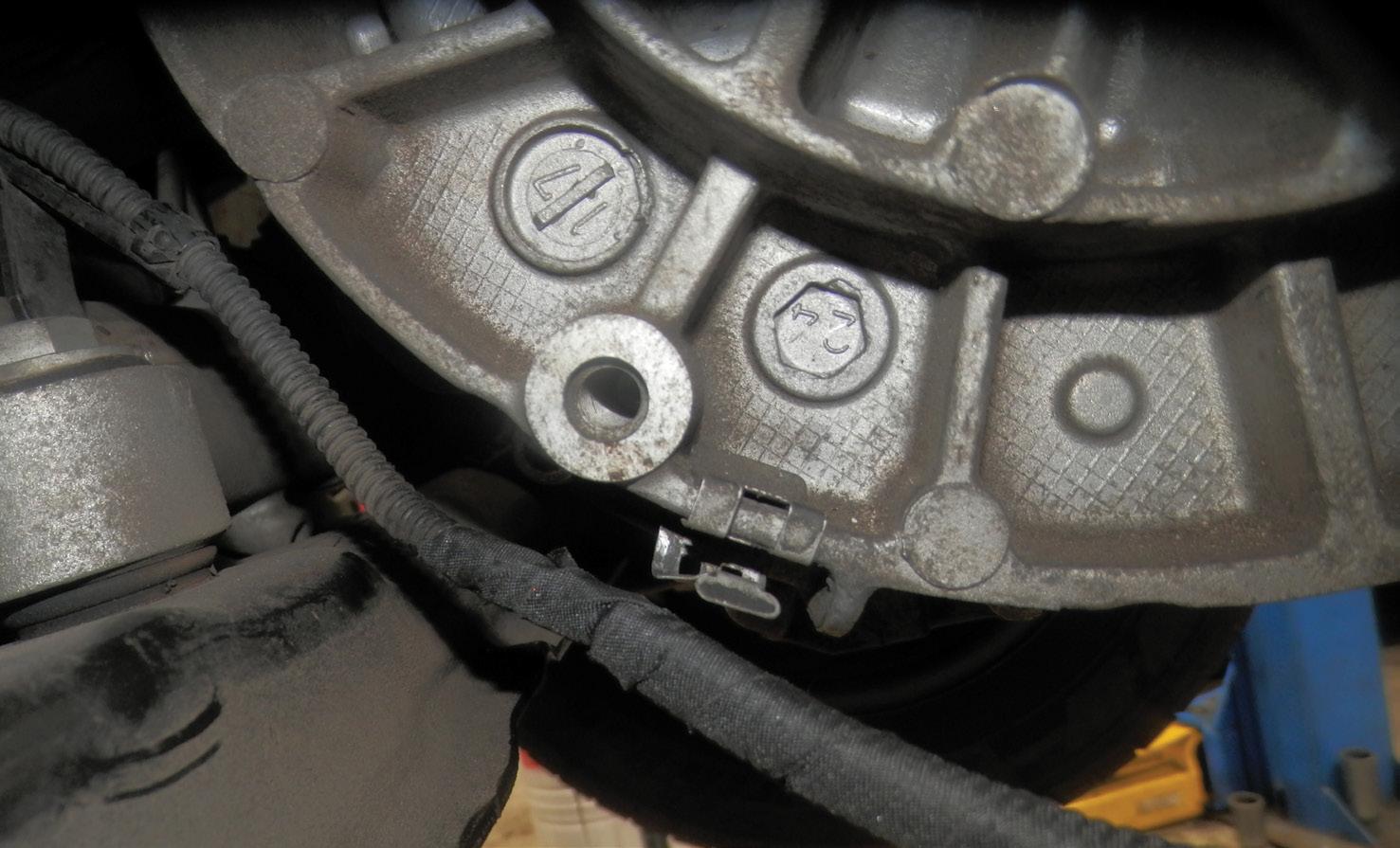
Over time the tubing wears out and in this case, then the insulation on one of the wires to the oil-level sensor (pic 3 and 4).
Fault description
The convoluted tubing over the oil-level sensor wires had worn, leading to wear on the insulation on one of the wires.
Fault solution
Repaired the oil-sensor wires and convoluted tubing before refixing them in a position to avoid wear – problem solved.
Recommended time
Diagnostic time was four hours, taking into account preparation and research. Repair time was 30 minutes, taking into account the location of parts and carrying out the repair to a tested outcome.
TaT thanks Gary Homan (Nudgee Automotive Services, Northgate, Qld) for providing this case study via TaT share, adapted for this Repair Solution.
Customer complaint
The brake lights were staying on and other lights were not working.
Problem summary
Confirmed the customer’s complaint – the vehicle had multiple lighting problems.
Diagnostic sequence
Carried out a full system scan and retrieved the following codes:
• P0141 – O2 sensor heater circuit malfunction (bank 1, sensor 2).
• P0161 – HO2S heater circuit low (bank 2, sensor 2).
• C0161 – ABS/TCS brake switch circuit malfunction.
• C0277-06 – Brake pedal position sensor circuit short to ground or open.
• C0890-07 – Device voltage reference output 3 circuit voltage.
• B3445 – Stop lamp circuit.
• U0159 – Lost communication with parking assist control module.
• B0021 – Passenger seat side airbag deployment loop.
• B0022 – Passenger seatbelt retractor pretensioner deployment loop.
• B0079 – Driver seat position sensor circuit.
• B0014-0D – Driver seat side airbag deployment loop resistance above threshold.
• B0015-0D – Driver seatbelt retractor pretensioner deployment loop resistance above threshold.
• U0140 – Lost communication with body control module.
• B1045-04 – Left rear audio output circuit open.

• B125A-02 – Aerial signal circuit short to ground.
Checked the brake-pedal position sensor and carried out the relearn procedure, then removed the lower dash panel and checked the operation of the brake sensor – it was OK.
Attempted to determine why the reverse lights were not working. Checked the operation of the body-control module (BCM) and it was activating the reverse lights
Removed the tail lights and found the incorrect reverse and brake-light globes had been installed, with one brake-light globe creating a short to ground (pic 1).
Installed all the correct globes and the reverse lights now operated. Found a blown fuse on the left-hand park light, so replaced and tested – it was now OK.
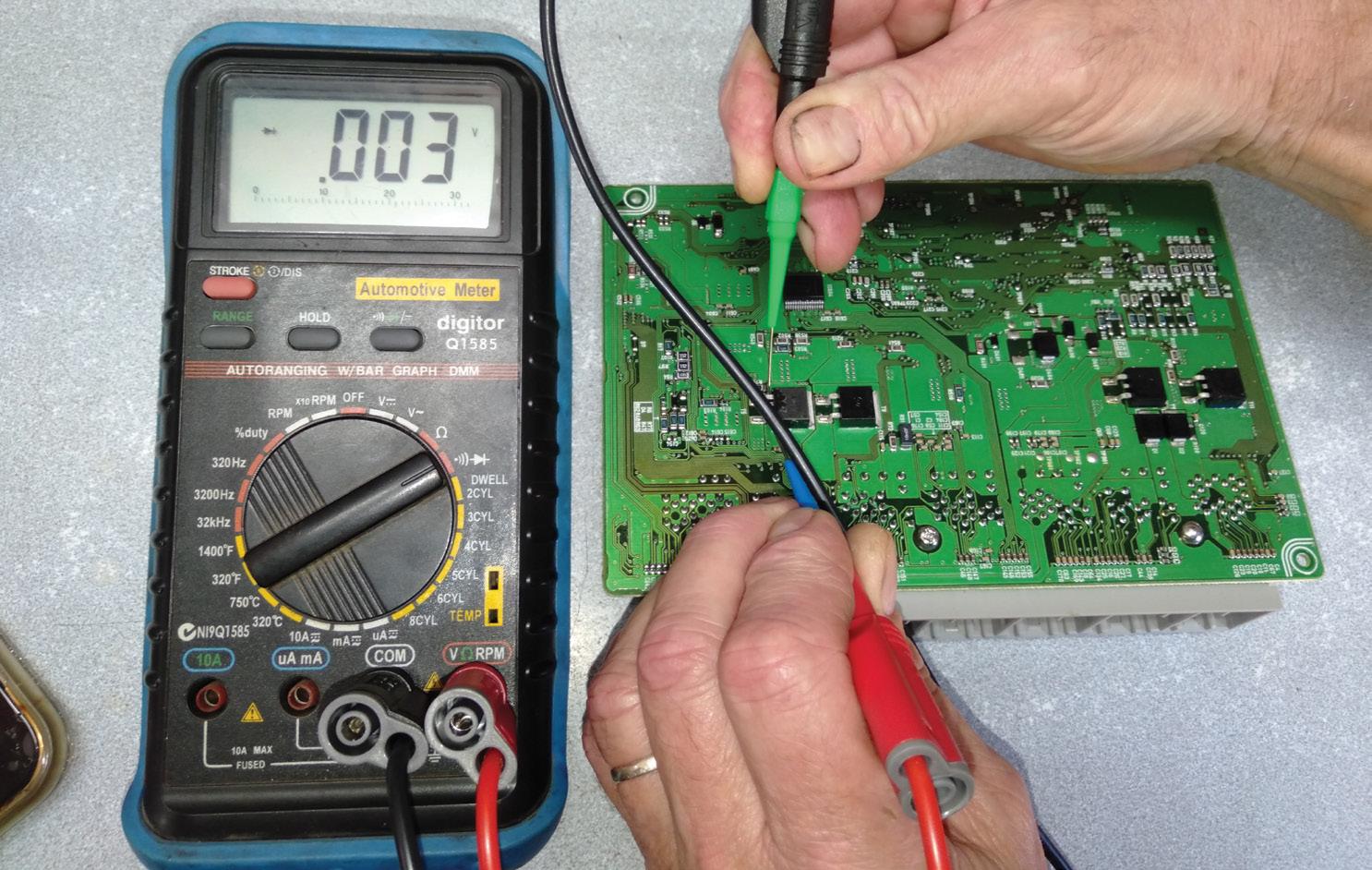
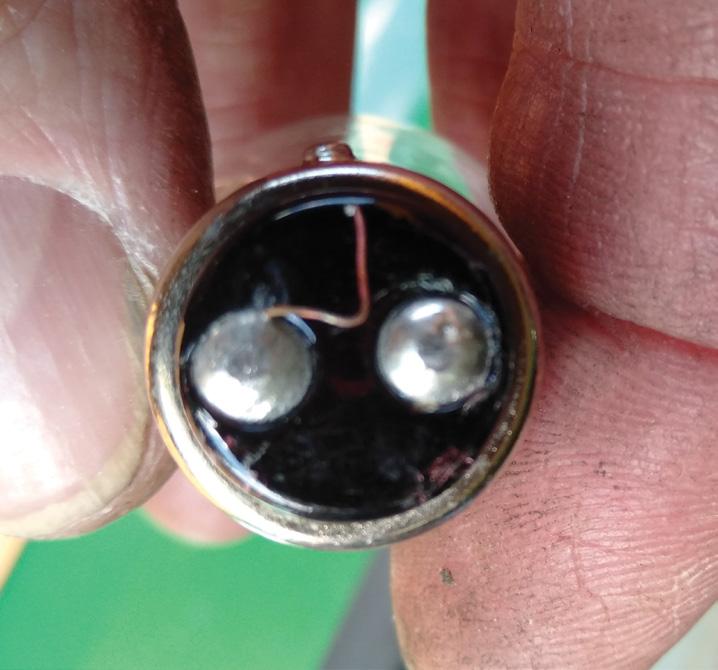
Next, removed and disassembled the BCM (pic 2, 3 and 4), which uncovered a damaged metal-oxide-semiconductor field-effect transistor (MOSFET). That had created a short to ground, leaving the brake lights turned on.
Reassembled all components and tested the lights.
Fault description
Faulty BCM, incorrect globes and blown fuses.
Fault solution
Replaced the BCM with a pre-programmed refurbished unit before successfully carrying out a brake-pedal position relearn and SDM primary-key relearn.
Cleared all fault codes but still had warnings on the dashboard for a stability-control fault, anti-lock braking system (ABS) fault and airbag fault.
Scanned the vehicle and retrieved the code, C0161 – Brake switch circuit malfunction. Checked the operation of the brake-pedal sensor, including the 5V reference, ground and signal – they were all OK, so tried disconnecting and reconnecting the battery. All dash warnings disappeared and all fault codes cleared
Repair Solution by TaT Tech Team member Mark Rabone.
Customer complaint
The engine warning light was illuminated on the dash and the vehicle was running in reduced-power mode.
The vehicle was referred to us from another repairer who had already replaced a sensor.
Problem summary
Verified the owner’s concern – the vehicle was low on power and warning lights had tripped.
Diagnostic sequence
Started with the usual diagnostic tests first – a battery test, charging-system test and all lights tests – before performing a full electronic scan of the vehicle, which showed up the powertrain control module (PCM) fault code, P0107 – Manifold absolute pressure circuit low.
Found that the previous repairer had fitted a new aftermarket manifold absolute pressure (MAP) sensor.
Live data showed a key-on/engine-off (KOEO) manifold pressure of 40 kilopascals (kPa), while the barometric pressure sensor showed a more believable pressure of 99kPa.
Testing the MAP sensor circuits showed the signal wire was being pulled down to close to ground.

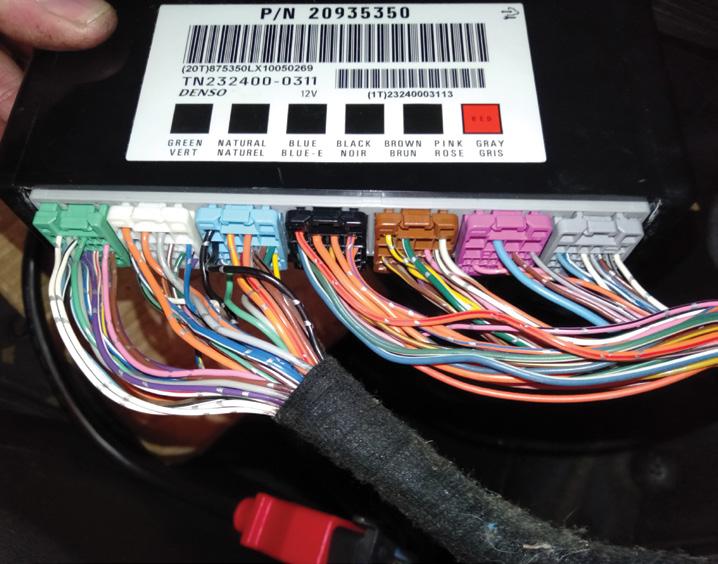
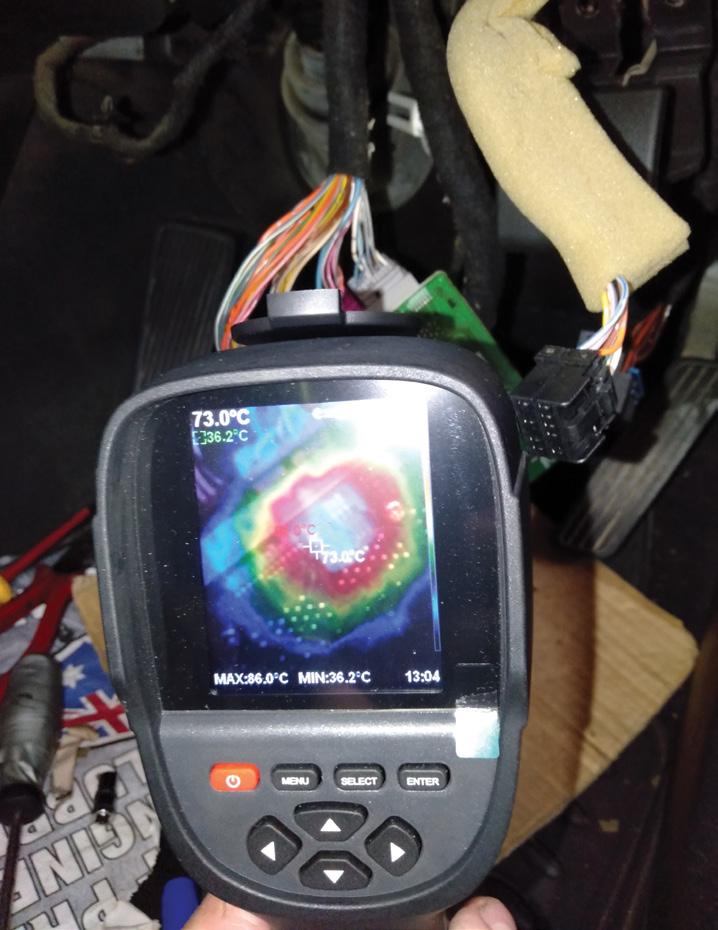
Disconnected the harness connectors at the PCM to verify the fault was in the wiring harness and not the PCM.
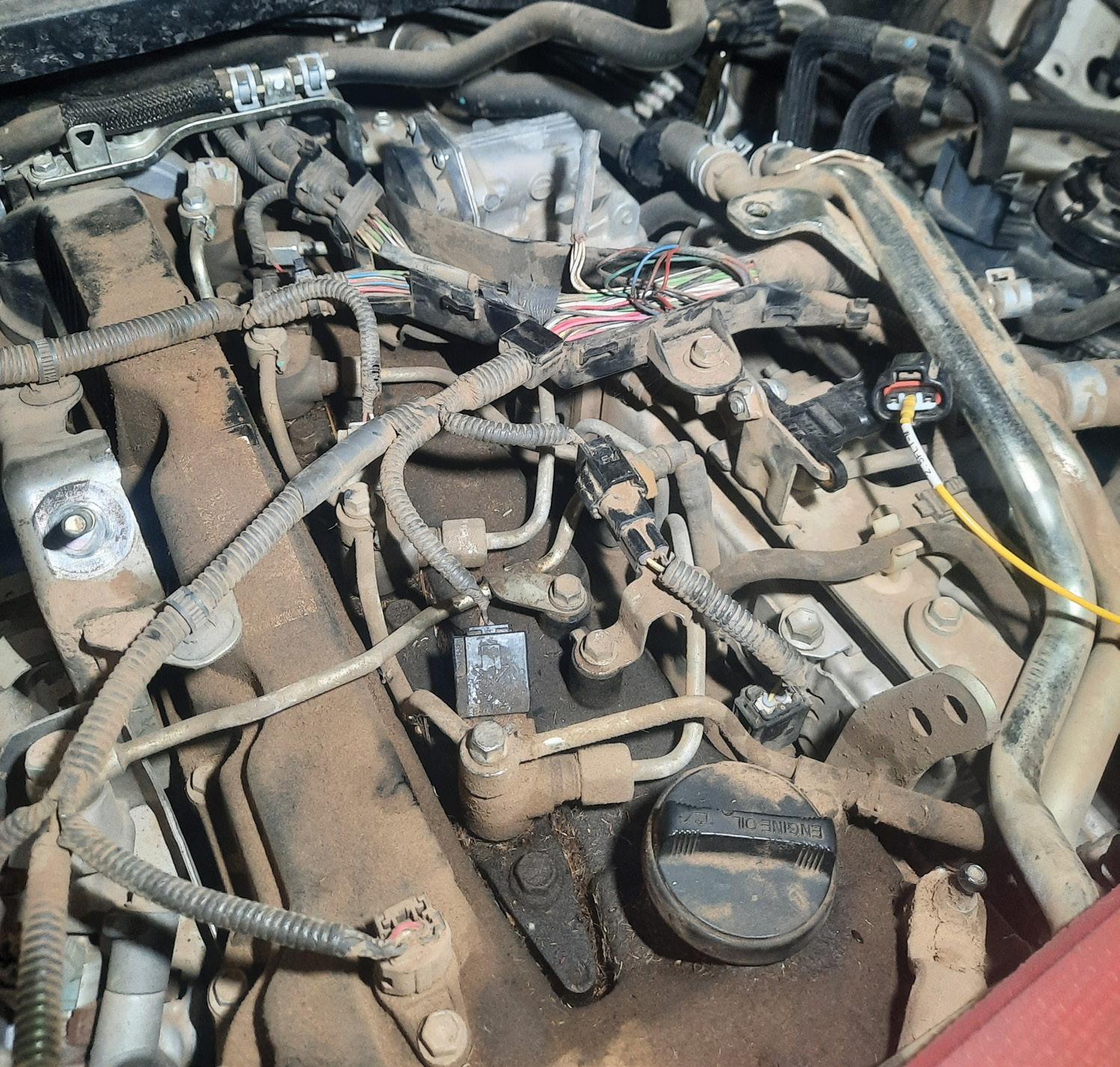
Traced and located damaged wiring in the plastic harness housing that had caused the short (pic 1 and 2).
Fault description
A damaged engine wiring harness was causing a short circuit to the MAP sensor signal wire.
Fault solution
Repaired the damaged section of wiring harness and resecured correctly, then removed the aftermarket MAP sensor and refitted the original Denso unit.
Erased the fault codes and retested the operation to verify the repairs.
Recommended time
Diagnostic time was two hours, taking into account preparation and research.
Repair time was 90 minutes, taking into account the location of parts and carrying out the repair to a tested outcome.
Repair Solution by TaT Tech Team member Marty Hosie.

RememberJason Smith
the old saying, ‘A stitch in time saves nine?’
If the customer in this case study had, he would have saved himself a lot of grief.
The car
Ford BF Falcon Ute, 03/2009, six-cylinder petrol engine, 295,000 km on the clock
Some time ago a customer contacted me saying he had a leaking radiator and asking if he could purchase a new radiator from me.
Of course, this is not normal practice for my business. I recommended he bring the car in for a professional assessment and report. However, he was a battler who worked as a gardener with a mowing round and was adamant he could do the job himself and probably save some money.
I ordered him a new radiator and asked him to at least bring in the old radiator when he came to pick it up so I could have a look at where the radiator had failed and why.
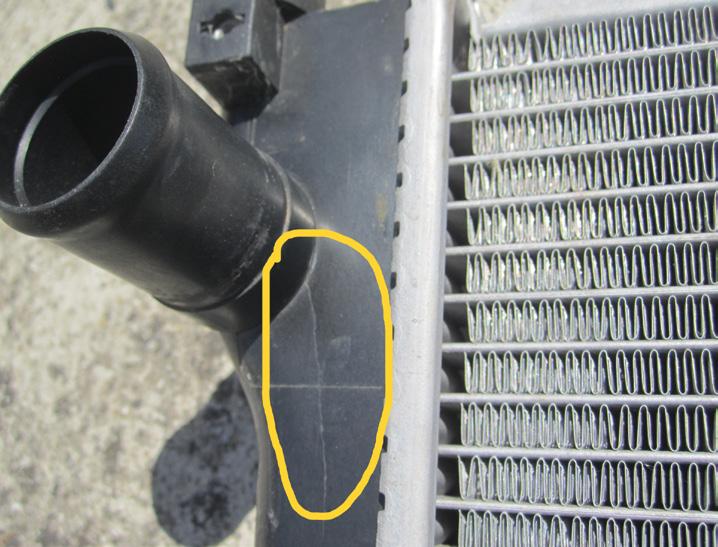
The old radiator had a cracked plastic tank at the top-hose fitting on the left/passenger side (pic 1). At the time I said it might be a good idea to make sure the cooling system wasn’t over-pressurising from a possible blown head gasket and check the engine
mounts for wear to make sure they were not causing strain on the top radiator hose during heavy acceleration.
The customer heard all of this and chose to go off on his merry way. Fifteen months later he contacted me again saying his radiator appeared to have a small crack on the left/ passenger side – again, he wanted me to order a new radiator.
He was not complaining or wanting to put it through warranty, he just wanted to purchase another radiator. Once again I asked to inspect and assess the car. He said that couldn’t happen – the car had been taken apart.
Once again I supplied a new radiator and inspected an ‘old’ radiator with a small crack on the left/passenger side (pic 2). The customer went onto say the car was a real workhorse, towed a trailer and he’d been giving it a real hard time, so he didn’t mind paying for another radiator.
As usual, I was thinking three steps ahead so I asked him, ‘How are your engine mounts?’ and he replied, ‘I have no idea’, so I suggested checking them before the new radiator was installed.
Two weeks later, the customer contacted me again saying he had a major transmission-fluid leak, the car was barely driving and could I have a look at it, please?
The car was promptly brought to me for assessment and, sure enough, there was a large transmission-fluid leak which, at a glance, appeared to be coming from the front of the transmission.
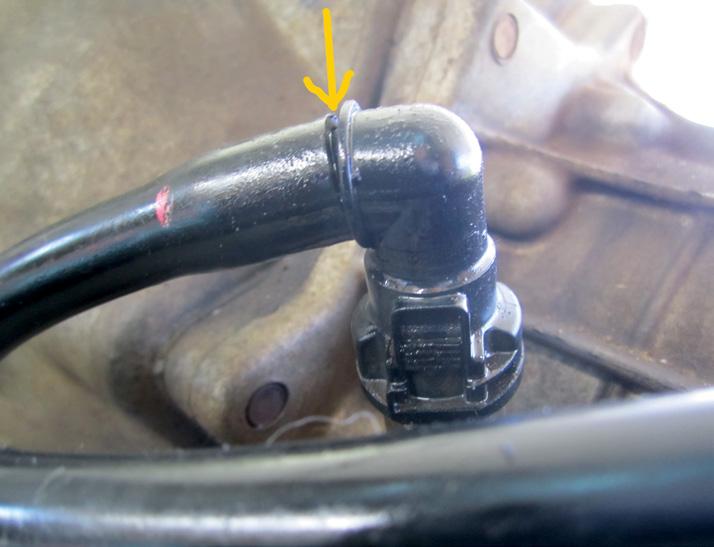
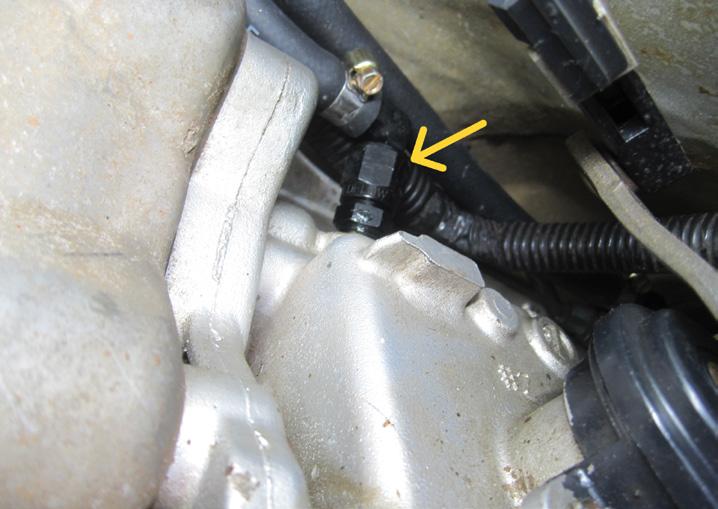
I put the car onto the hoist and when the engine was started, fluid poured out, probably from the pump at the front of the transmission. Importantly, I discovered a smaller leak at the front transmission-cooler pipe, specifically the plastic 90-degree fitting where it clips to the top of the transmission, on the left/passenger side. On even closer examination I could see a small witness mark where the plastic cooler-pipe fitting had been pushing on the transmission tunnel when the vehicle was under load or acceleration. This had ultimately cracked the pipe, causing a small leak (pic 3).
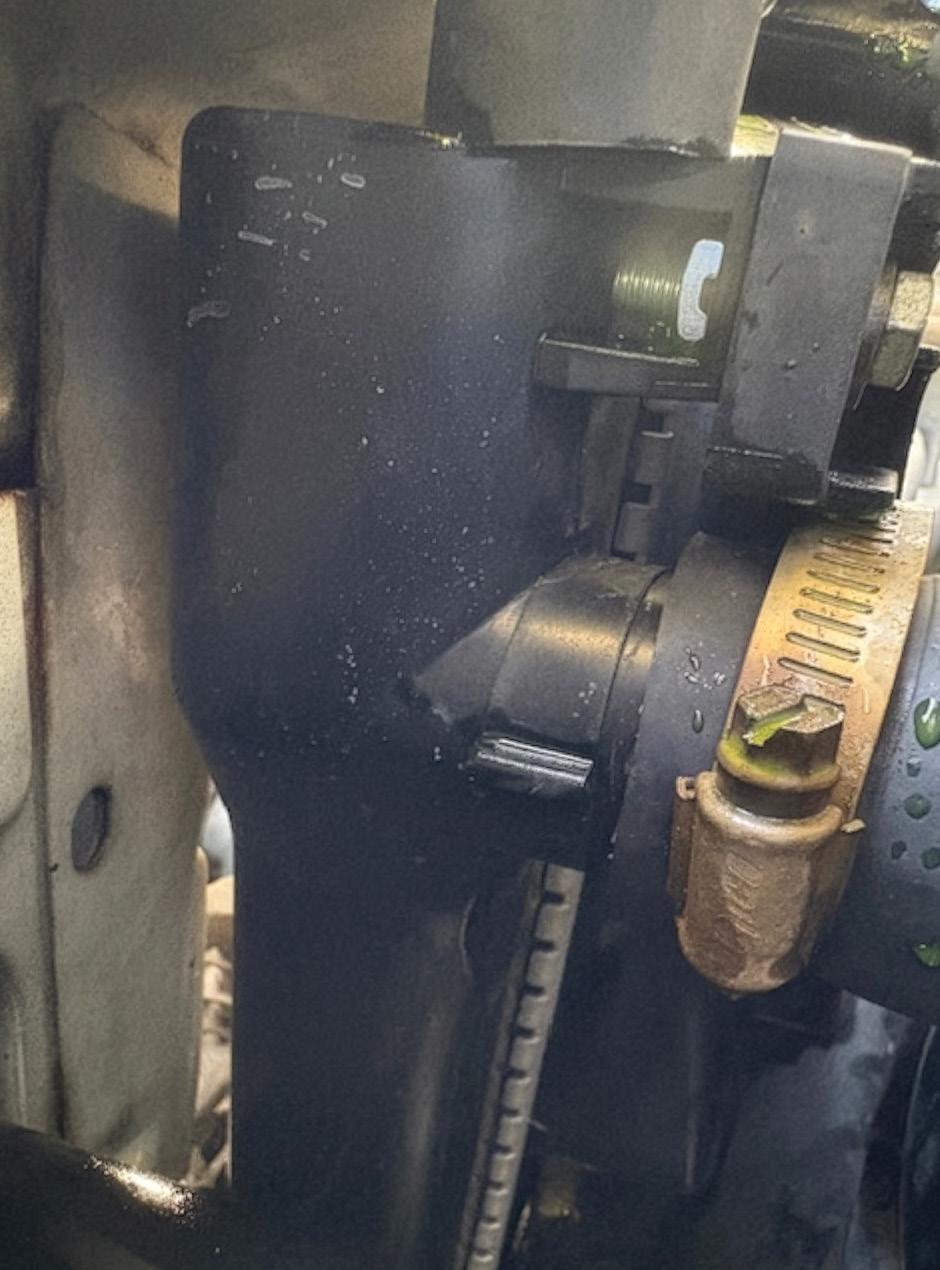
I promptly checked the engine mounts. With the car on the hoist and an adjustable prop stand and block of rubber placed under
the sump, I screwed the adjustable stand upwards. The left/passenger-side engine mount appeared to be broken, which would have caused excessive upwards movement of the engine and transmission during acceleration.
This was the evidence of the chain of events that had transpired over the last 16 months, with the broken engine mount being the root cause of all of the other problems.
Let’s review the events. Sixteen months previously, the left/passenger-side radiator tank had cracked, then 15 months later the tank had cracked again after the car, in the customer’s words, had been given a hard time.
This rogue engine mount had also allowed the transmission to lift enough to crack the front cooler-pipe fitting, causing a small leak that was left unchecked and caused the transmission fluid level to run very low. This had caused the pump in the front of
the transmission to starve of lubrication, causing it to wear and then chew out the front seal, causing the larger leak.
I contacted the owner with the report and a warning that a lot of parts for these vehicles are no longer available – it’s very sad and frustrating to see the spare-parts supplies dry up for vehicles that were proudly manufactured in Australia.
The repair
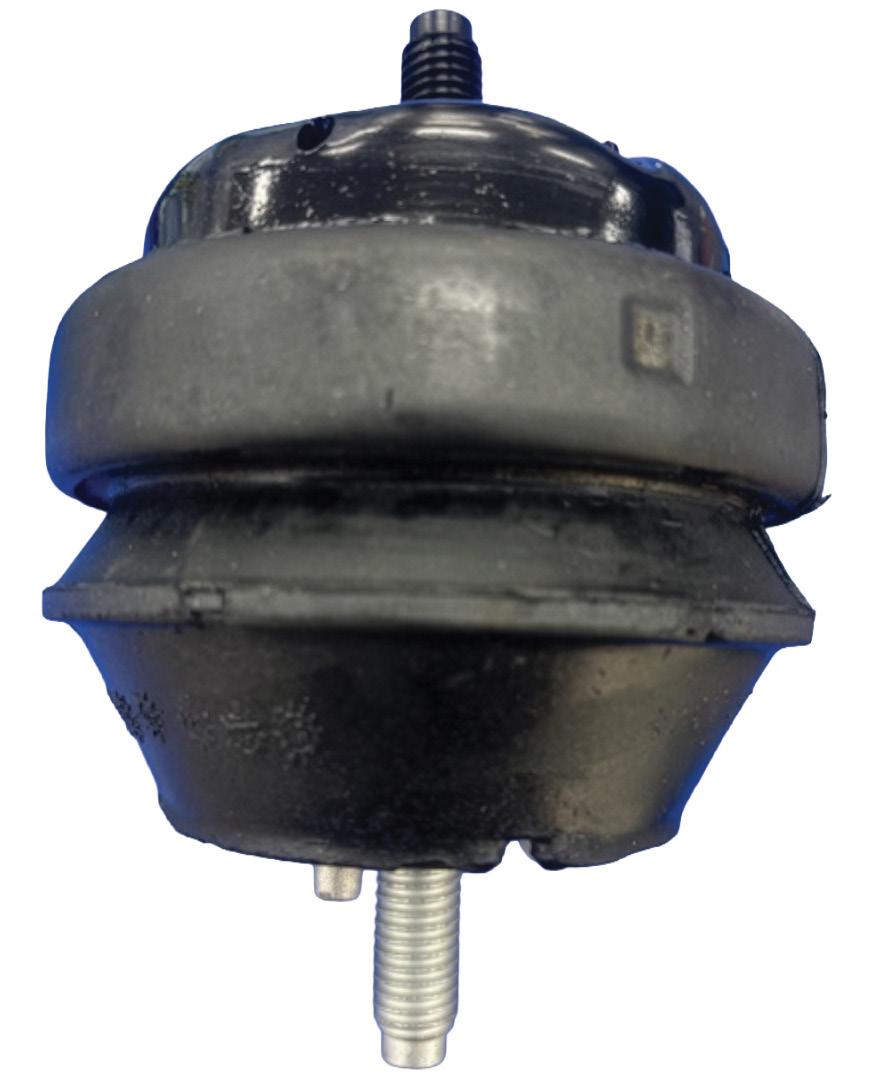
Sourced and fitted some aftermarket hydraulic engine mounts that were of a reasonable quality (pic 4). Carried out this job very carefully with the car on the workshop floor.
First, I removed the battery terminal and also drained the coolant. Because the engine needed to be raised quite high, I removed the top and bottom radiator hoses (I’d have hated to damage that new radiator), then removed the airbox and numerous other parts to allow access to the engine mounts.
Next, I unbolted the engine mounts and then – with a trolley jack and block of rubber located under the sump (you can also use wood) – carefully raised the engine just enough to remove the old engine mount
(pic 5 – mount removed) and install the new mounts. Then it was a case of aligning all the bolts, lowering the engine, tightening all bolts and refitted all parts in the reverse order.
Now for the transmission repair. New cooler pipes are no longer available and used pipes are undesirable and difficult to find, so that was a conundrum we would have to grapple with later.
The customer had sourced a known good used transmission (if there’s such a thing) with matching ID numbers, etc. The transmission looked like it had been reconditioned at some stage.
Removed the ‘old’ transmission and correctly installed the ‘new’ one. Inspecting the old transmission, I could see the front pump was badly worn.
What to do with the plastic cooler pipes? First came completely removing the old ones, then screwing metal unions with 90-degree barbs into the top of the transmission (pic 6).
I used the 90-degree unions and barbs for two reasons – one, the 90-degree angle allowed enough room between the floor tunnel and the transmission for flex during hard acceleration and two, the barbs allowed 10mm rubber transmission-cooler hose to be used to connect the transmission to the cooler (pic 6).
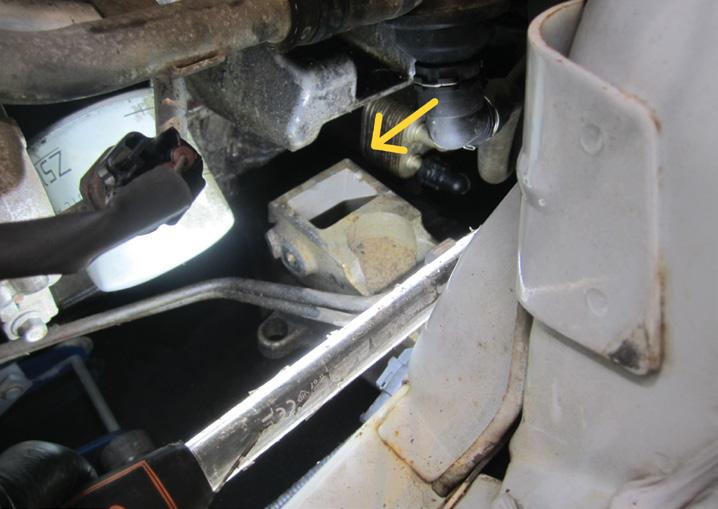
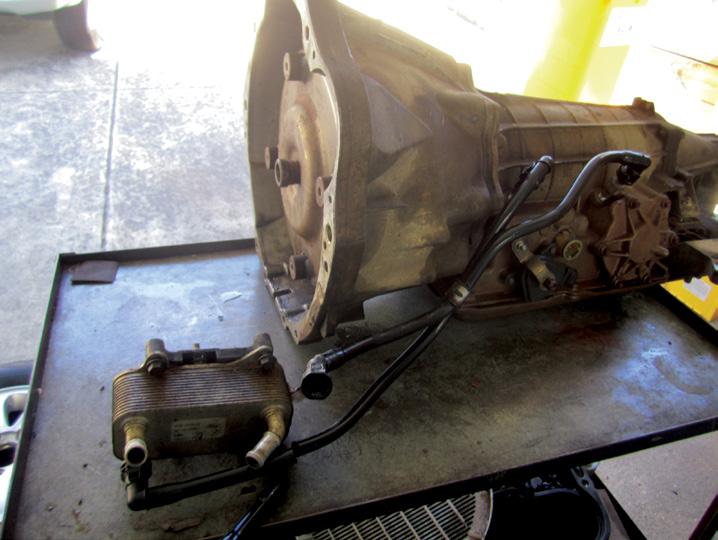
It’s important to mention I removed both the old cooler pipes and small (sometimes troublesome) aluminium rectangular cooler (pic 7) before looping the coolant pipes together. I was able to do this because this particular model – being a commercial vehicle from the factory – was fitted with an additional transmission cooler at the front near the radiator and steel pipes running along the left chassis rail to near where the old rectangular cooler once lived.
Next, I connected the new rubber hoses from the transmission to the steel cooler pipes and secured with hose clamps, then set the transmission level following correct procedures before connecting the scan tool and performing a full system scan, noting and clearing any diagnostic trouble codes (DTCs).
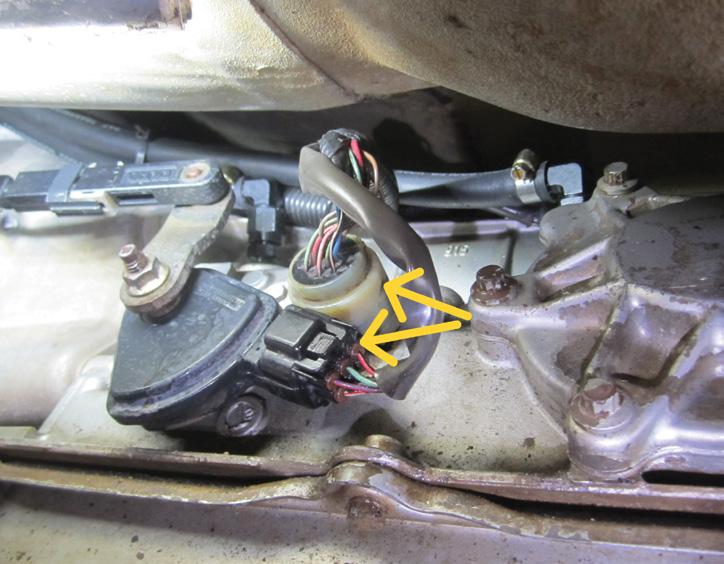
Now came road-testing the vehicle. The transmission initially performed well but after about three drive cycles went into limp mode. A scan of the vehicle brought up numerous shift-solenoid DTCs (pic 8), so checked the wiring harnesses and connectors on the side of the transmission. This led to the discovery of some pintension issues between the ‘new’ transmission and the car’s original wiring loom (pic 9), so re-tensioned the connectorpin receptacles and rescanned the vehicle.
The live data now checked out OK and road-tested the vehicle again with no further faults.
The owner was very happy with the outcome and when I contacted him some months later he said he was still working the car hard and was still very happy.
As always, remember the basics, even the old-fashioned engine mount can and still gives problems on vehicles today.
It’s a shame our once proud Australian car-manufacturing industry is now gone. Unfortunately this is leading to parts shortages and ultimately parts obsolescence for an increasing number of vehicles.
This is creating real problems for mechanics and technicians trying their best to fix cars in a professional and timely manner. Sometimes we must get creative with how we go about fixing and rectifying mechanical, electrical and electronic problems.
This can be time-consuming, so it’s important to be paid for all the time spent on a job – and yes, that includes researching and resourcing parts.
A lot of workshop owners would not have taken this job on and that’s completely understandable because of possible warranty or insurance concerns. This would ultimately have led to the vehicle being mechanically written off, which is also fine. Happy diagnosing and repairing!

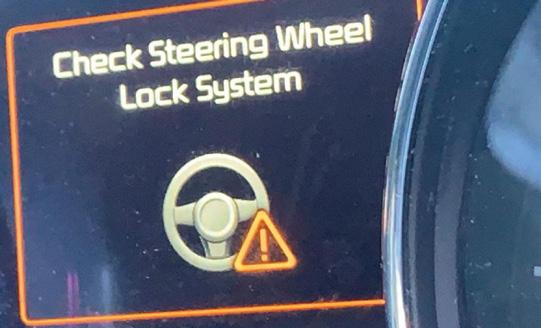
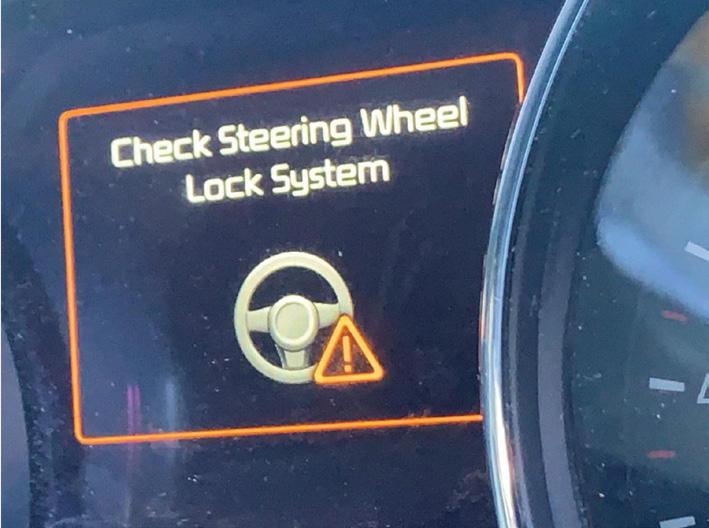
A 2015 Kia (YP) Carnival arrived on a tow truck with a no-start complaint. ’Check steering-wheel lock system’ was showing on the instrument cluster (pic 1).
In the customer’s words, ‘It drove fine, I parked it, came back later – and it just wouldn’t start.’
But the real mystery was this – the scan tool could not communicate with any major high-speed (CAN-H) CAN-bus modules yet it could still operate the windows and central locking perfectly.
From a diagnostic standpoint, this looked contradictory. How can the vehicle be dead and alive at the same time?
No diagnostic trouble codes (DTCs) were stored because the modules responsible for logging them were themselves offline and unable to communicate.
Here, we dive into how the real cause for this symptom was revealed by using the trilogy of diagnostic process (see TaT issue 36, pages 26-27)
Initial checks: Always start with the basics
Our initial reaction was this would be simple matter of procedure. Nevertheless, we started with the basics.
1. Battery supply: Verified battery voltage and ground integrity – all OK.
2. Fuses: Checked all underbonnet and incabin fuses – all OK.
3. When the scan tool was used, the CAN-H network failed completely – there was no communication with any of the main control modules. Yet the scan tool operated the power windows and central locking normally (pic 2).
4. Cyberspace: Scanned the internet for public Kia Technical Service Bulletins (TSBs) or OEM bulletins – found nothing

that exactly matched the symptoms, the steering-wheel lock system warning, the lack of DTCs or the fact that the local interconnect network (LIN) body functions were still alive.
This all meant we had to resort to following the standard CAN-bus fault-isolation method and procedures (see TaT issue 87, pages 12-14).
The first clue: Connect the scan tool
– mixed communication
Connection to the CAN-H bus had failed completely — there was no communication with the main control modules, yet the power windows and central locking still operated normally.
This immediately raised a question – how can part of the vehicle be alive while the rest appears dead?
After further testing, we discovered:
• Some modules could still communicate (e.g. door and body functions).
• Others were completely silent – no data, no response, no DTCs.
Interestingly, under ‘actuation test’ we could:
• Wind the windows up and down.
• Lock and unlock the doors.
However, there was no communication with:
• Anti-lock braking system (ABS).
• Transmission control module (TCM).
• Immobiliser (IMMO).
• Engine control module (ECM).
• Body control module (BCM)
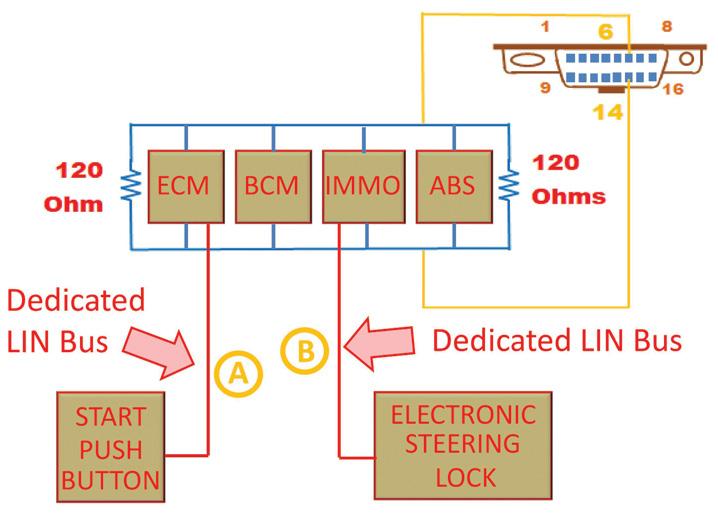
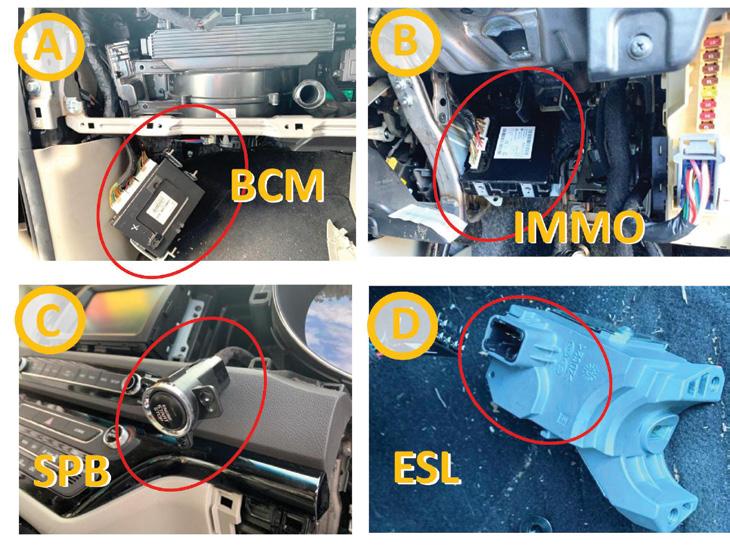
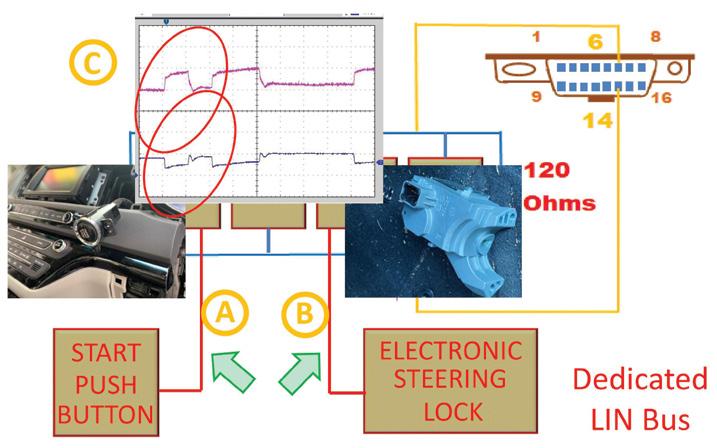
Network topology: The key insight Referring to the vehicle’s CAN-bus topology diagram, a clear pattern emerged (pic 3):
• The modules we could communicate with (doors, locks, windows, etc.) were all on a low-speed (CAN-L) single-wire network.
• The modules we couldn’t communicate with (ABS, ECM, TCM, IMMO, BCM) were all on the CAN-H bus (pic 3).
• Retrospectively speaking, nothing could have been observed or established from attempts or activities on:
A: The ‘dedicated’ LIN bus A – between the ECM and push-button start (SPB, pic 3a) – and…
B: The ‘dedicated’ line between IMMO and the electronic steering lock (ESL) – LIN bus B (pic 3b).

That was the ‘A-ha!’ moment. The CAN-H bus itself was down – that is, effectively the bus was electrically (or communication wise) inactive.
This condition explains why no DTCs were stored. When the communication backbone fails, the modules responsible for reporting the fault can’t talk. Therefore, no codes are logged.
Next step: Check the physical layer Before condemning any control unit, we confirmed:
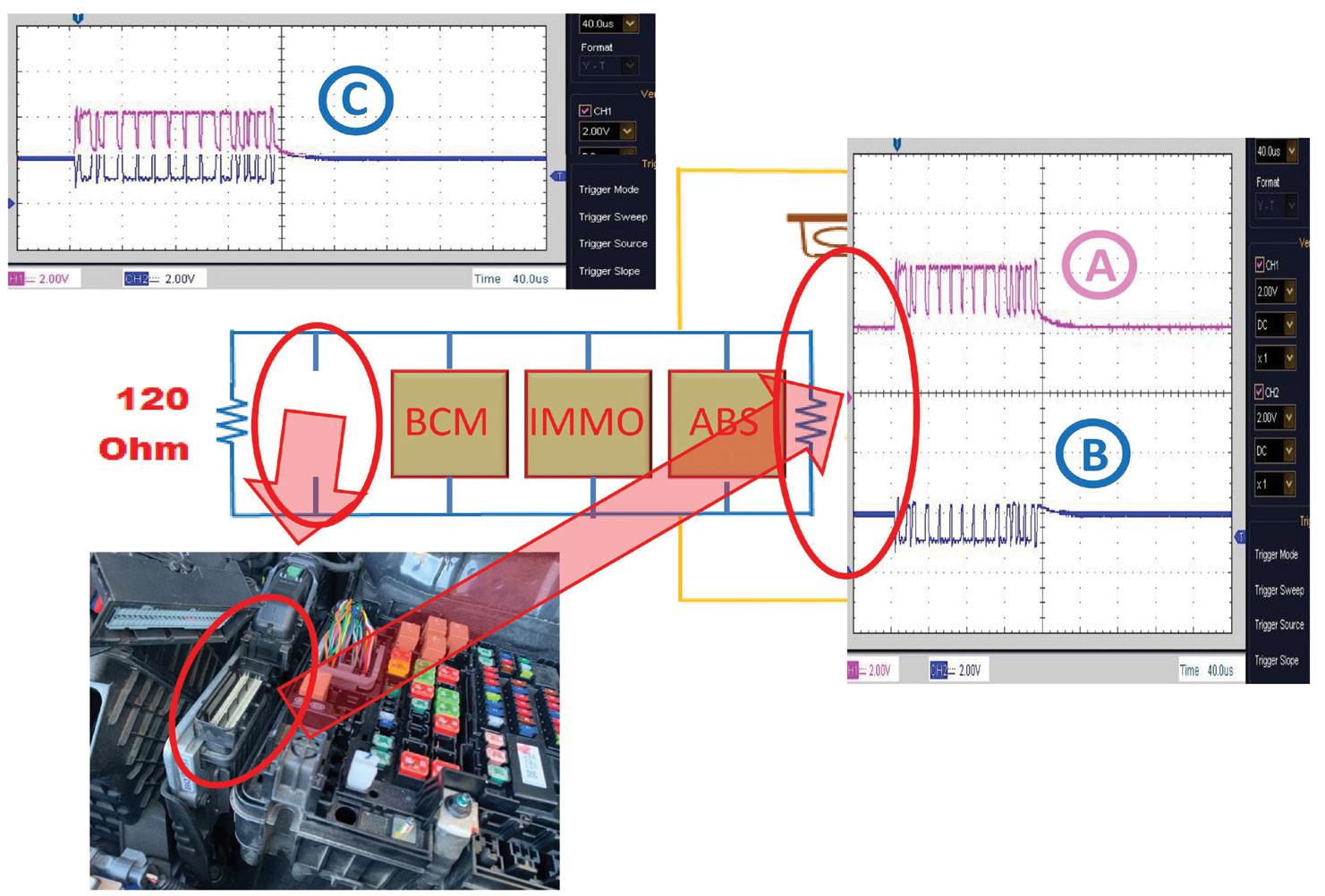
• Terminating resistor balance: Both 120-ohm (Ω) resistors (one at each end) should yield ~60Ω across pins six and 14 (pic 3).
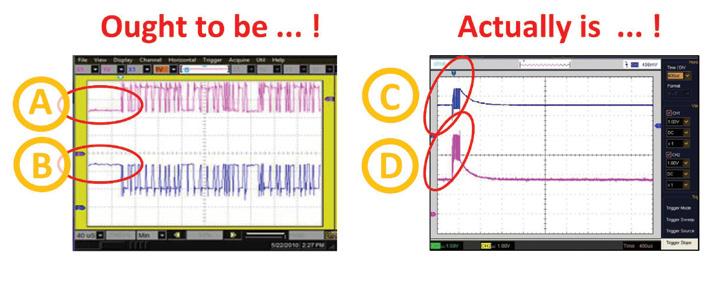
• Waveform integrity on pins six (CAN-H) and 14 (CAN-L) using an oscilloscope, equating to what it ought to be compared to what it actually is – or was (pic 4).
These waveforms did not resemble any absolute shorts of CAN-H or CAN-L to supply or to ground or even to ‘themselves’ (look for more detail on this in TaT issue 89, pages 12-14).
And so started the search for just which one of the ECUs on CAN-H was the culprit responsible for halting the bus. 1
Isolation process: Finding the culprit
So which ECU was pulling the bus down?
To determine this we had to systematically disconnect each and every ECM individually, one at a time, while observing the waveform after each step (pic 5):
1. BCM disconnected – no change (pic 5a).
2. IMMO disconnected – no change (pic 5b).
3. SPB – no change (pic 5c).
4. ESL – no change (pic 5d).
Once the ECM connector (away from the firewall) was unplugged, the CAN lines immediately sprang back to life – clean, balanced (pic 6). That is, both started at 2.5V (pic 6a and b) then:
- CAN-H oscillations swung plus 1V (pic 6a).
- CAN-L oscillations swung minus 1V (pic 6b).
This yielded healthy plus/minus 2V differential swings (pic 6c).
Connector and wiring verification
To confirm the diagnosis, we inspected the ECM connectors (pic 7) for:
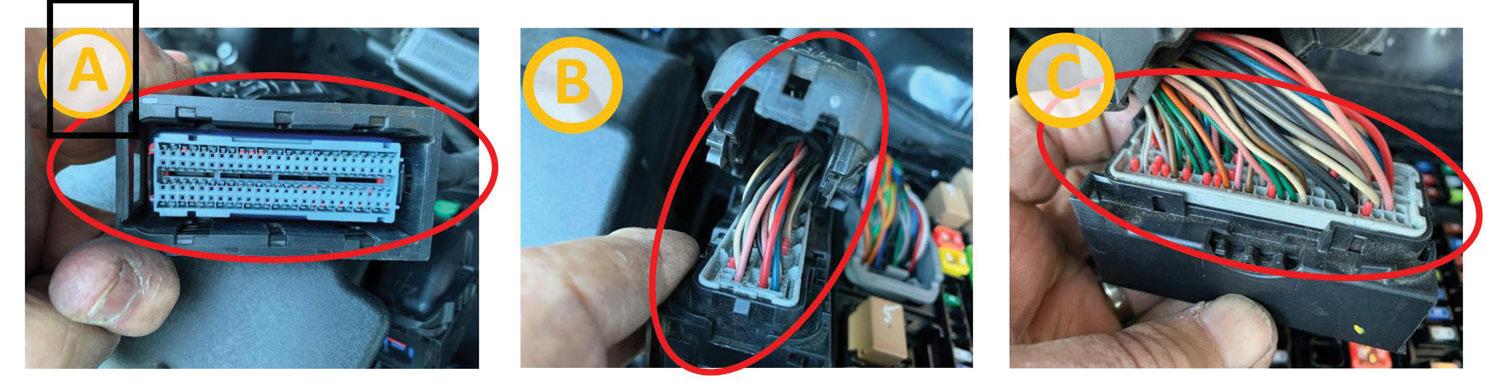
• Moisture and corrosion (pic 7a).
• Wiring damage, shorting and the pin tension (pic 7b).
• Fatigue (pic 7c).
All were OK, so all external factors had passed inspection.
This meant it was the ECM’s internal CAN transceiver that had failed and was effectively ‘interfering’ with the bus and silencing the entire CAN-H network (see TaT issue 88, pages 36-37).
Conundrum and additional notes
From the mechanic’s point of view (MPOV), why did disconnecting the SPB switch (pic 8a) and ESL module (pic 8b) have no effect on the CAN waveform (pic 8c)? After all, the dashboard message had warned the driver to check the steering-wheel lock system.
Reason: Both components are isolated from the CAN-H and CAN-L buses since they are on ‘dedicated’ LIN-bus devices. Therefore, by design (electronically speaking) they are isolated and do not load the CAN-H bus.
Summary: Key takeaways for technicians
• Network topology is critical – it shows which systems share which lines.
• Oscilloscope testing is essential – a digital multimeter (DMM) only shows
Until then, happy diagnosing! 5
9
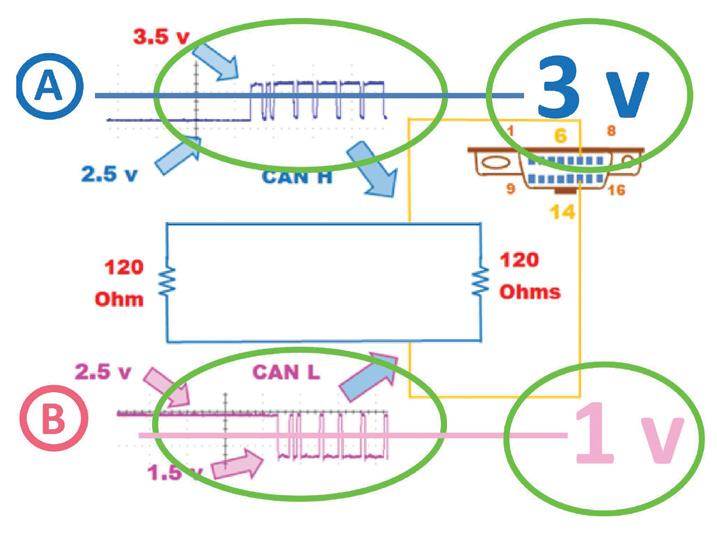
average and not waveform shape or activity (3V and 1V, pic 9a and 9b).
• Check terminating resistor balance: Two × 120Ω = ~60Ω total (while system ‘sleeps’).
• A ‘bus-down’ condition may not set any DTCs because the affected modules are unable to communicate.
• Systematic isolation (disconnecting ECUs one by one while monitoring the scope) remains one of the most reliable ways to find the culprit on a dead network.
• Failed CAN transceivers inside ECUs are a common but often overlooked cause of complete CAN-H collapse.
Until next issue
If you were tasked to design a heating, ventilation and a/c (HVAC) system for heating or cooling a medium-sized electric vehicle (EV), how many kilowatts (kW) would the system require – or how much electricity would your newly designed HVAC system draw – from the main traction battery? And how would this compare to, say, your home a/c system (either split-system or ducted)?
The engine-valley leak on the Volkswagen Group 3.0-litre turbodiesel (TDI) V6 from the EA897 family is fast becoming a common job in Australian workshops.
The most common model this engine is fitted to is the 2016-2022 2H Amarok (not the later Ford-based Amarok) but you may also find yourself carrying out the same repairs on a Touareg, Audi Q5/Q7/A6/A6 or Porsche Cayenne.
This is how we tackle it in our workshop, using one recent job to show the leak path and the parts we now treat as mandatory.
Most customer complaints will be water loss with no signs of leaking. This is because in the early stages the water evaporates as it pools in the hot valley. If you get up in the engine bay you can look down into the valley and usually see stains or crystalised dry coolant.
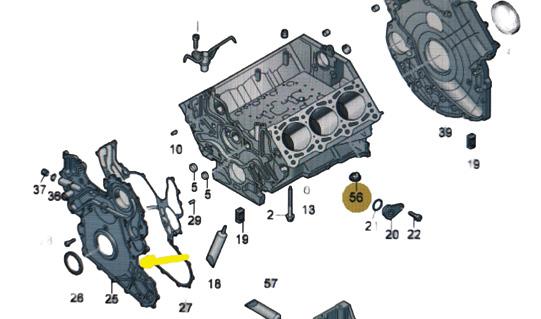
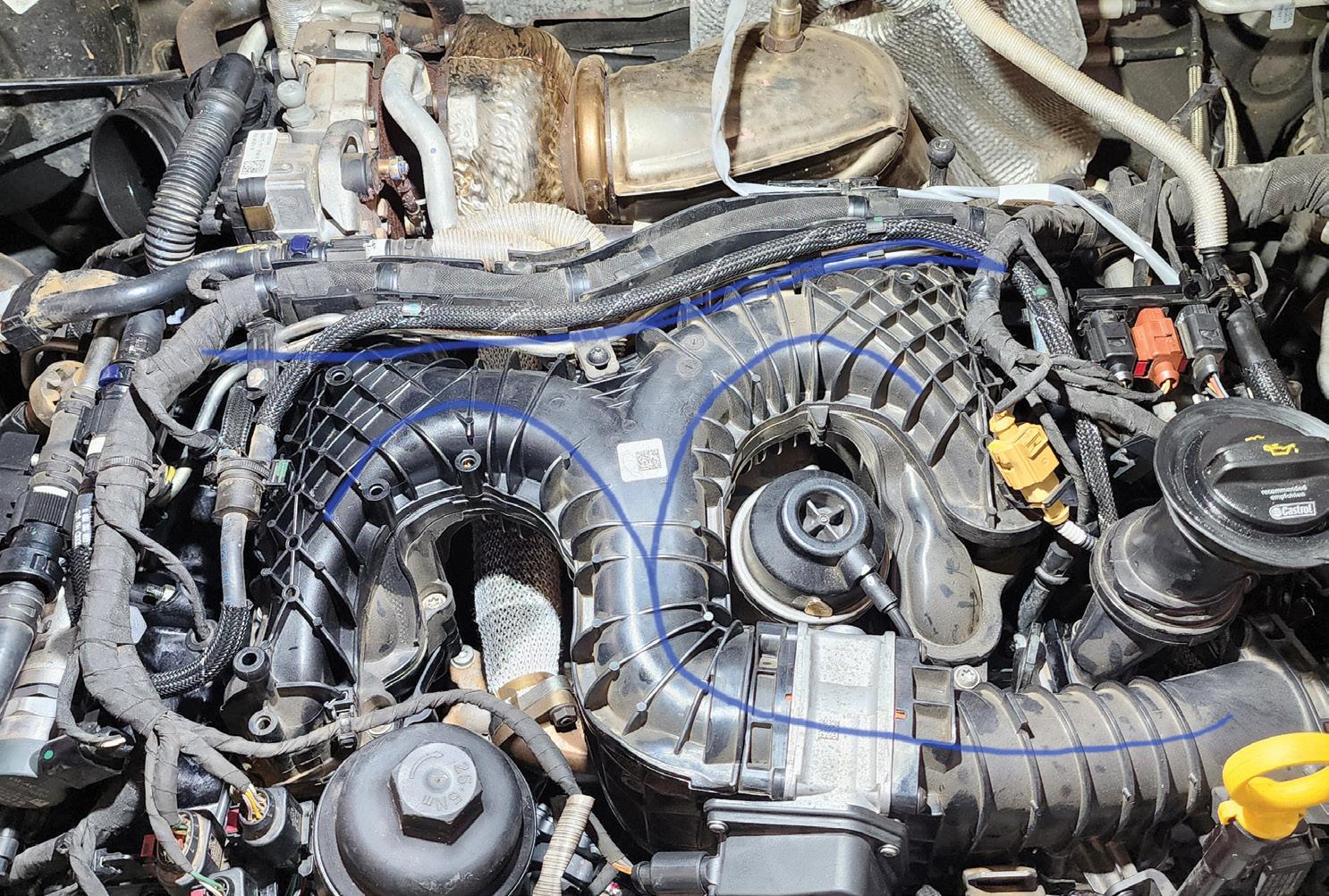
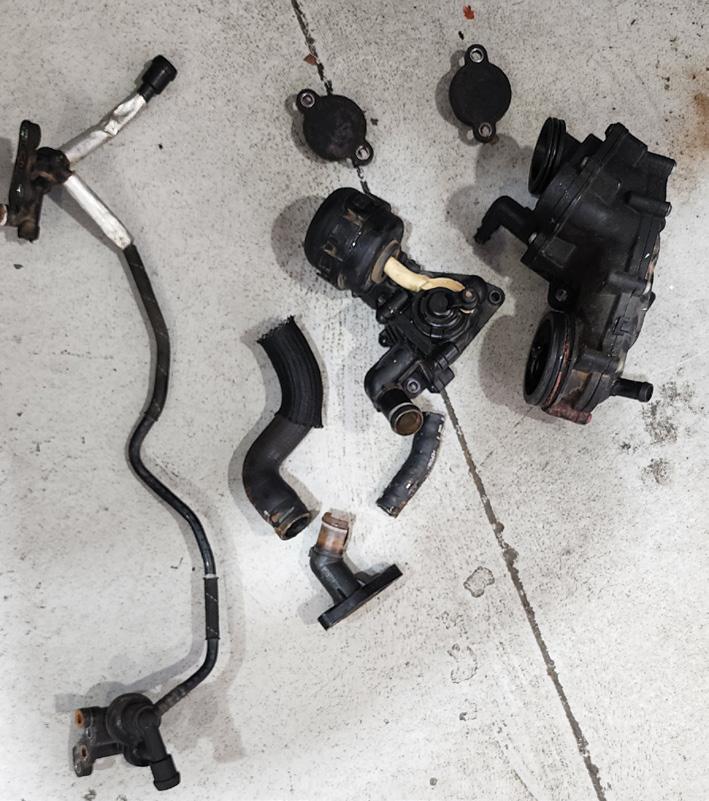
We have had vehicles come in from other shops that have been told it was a water pump. This is probably due to the coolant getting thrown around once it drops out the passenger-side bottom of the front cover (pic 1 and 2).
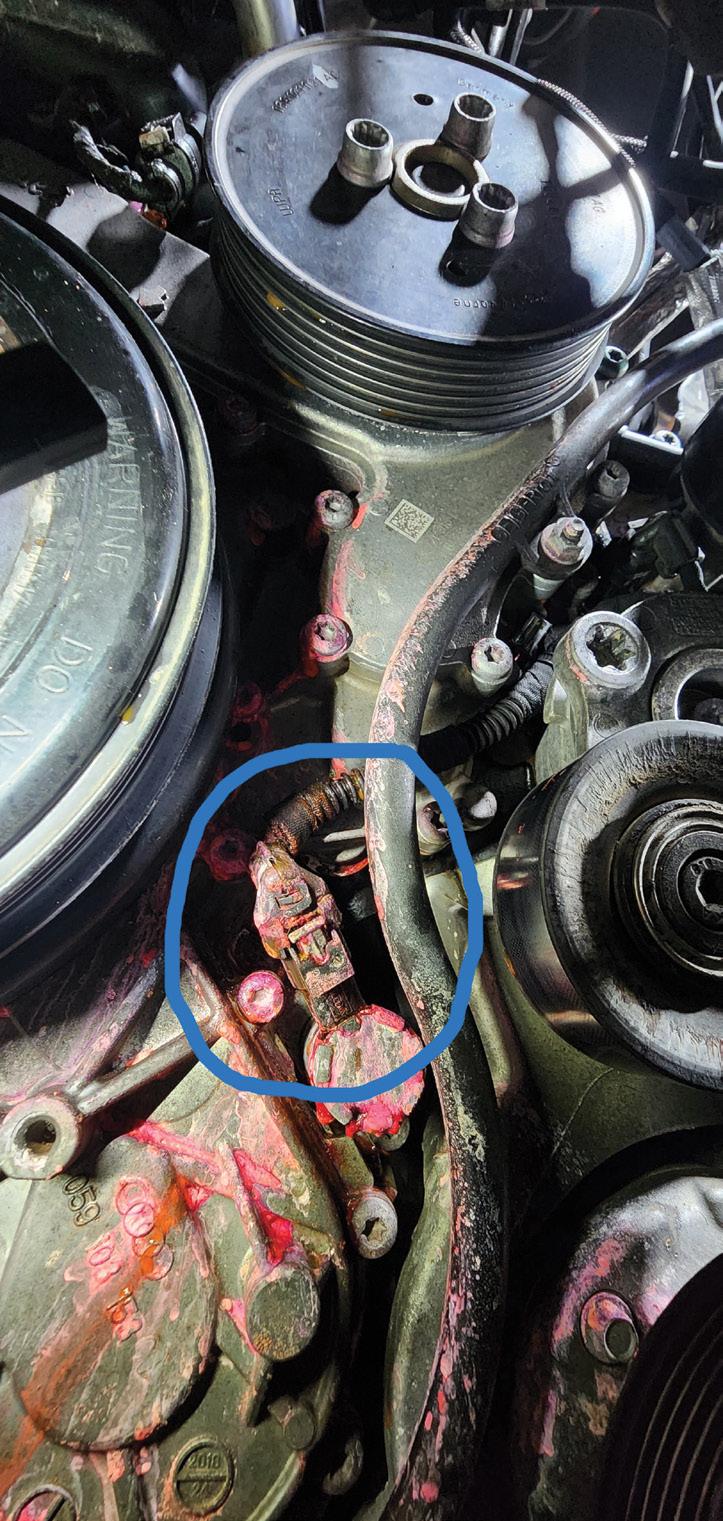
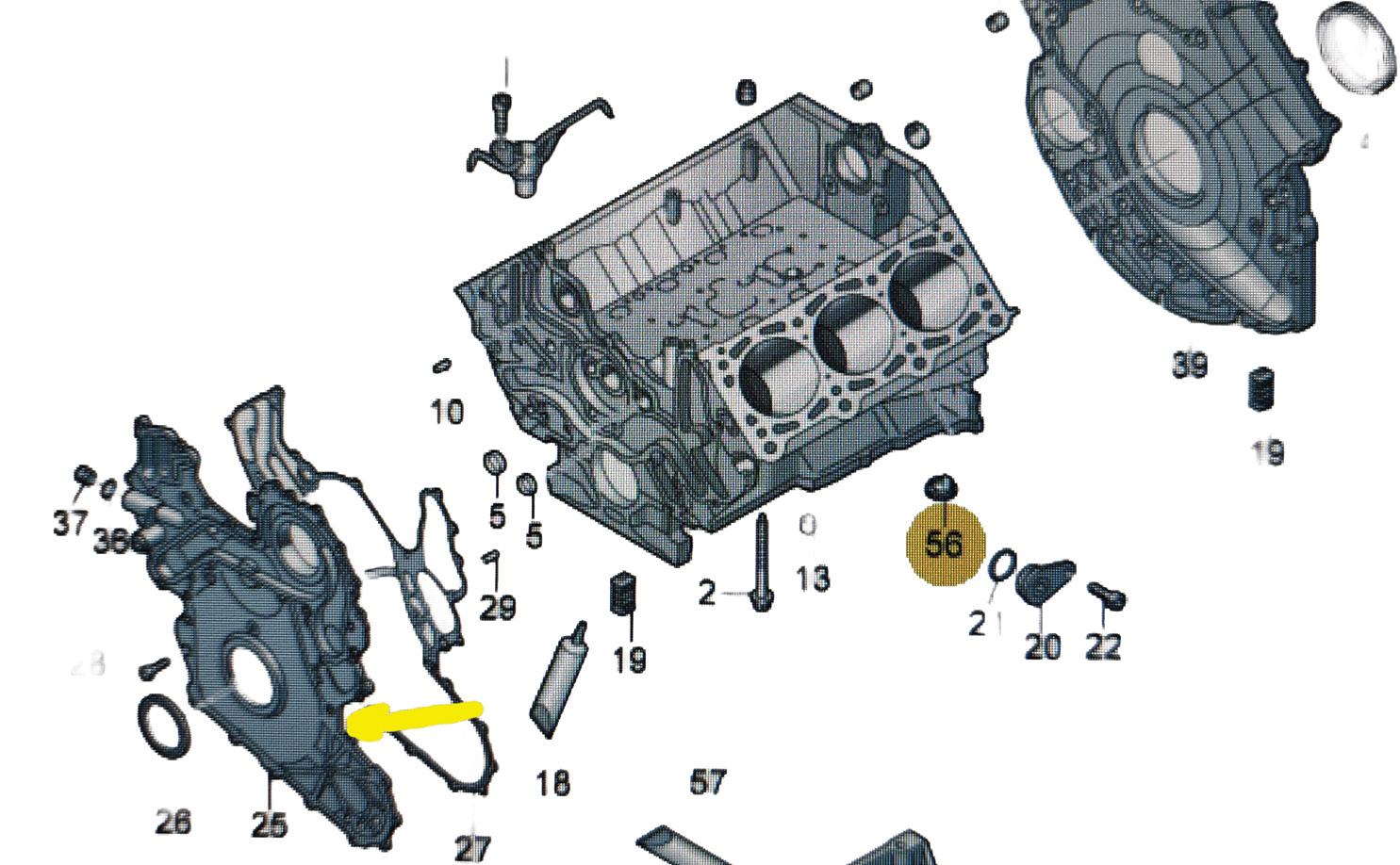
Pic 3 is a reminder of why this leak gets misdiagnosed so often. With the plastic intake in place, you cannot see any of the problem area and once the coolant finally finds its way out the front it does a good job of impersonating a water pump or frontcover leak.
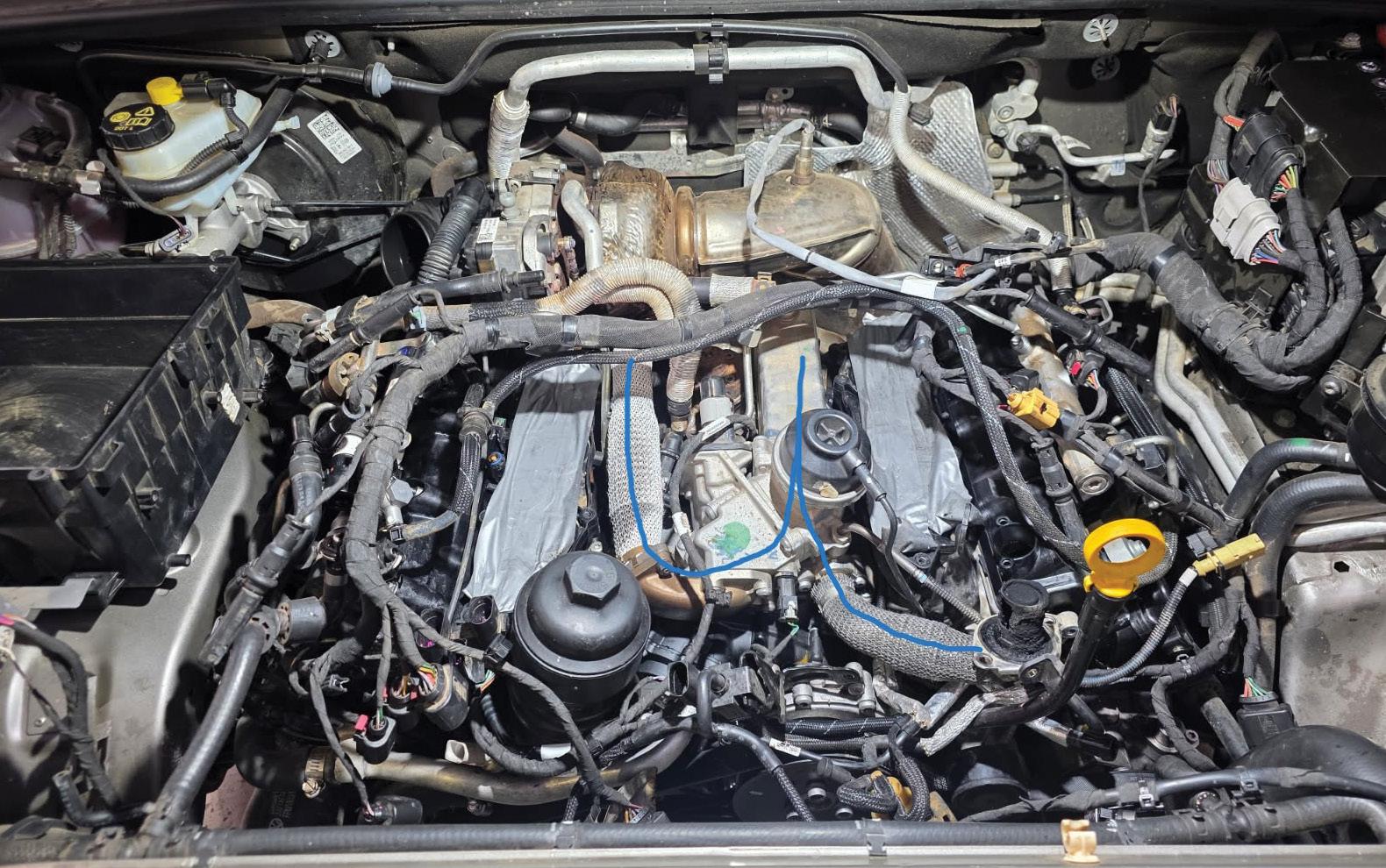
At first glance this looks like a big job and the first time you see one stripped it can be a bit intimidating. In reality there is nothing particularly tricky about it; it is just a lot of parts off and back on. For the first one allow yourself a solid eight hours.
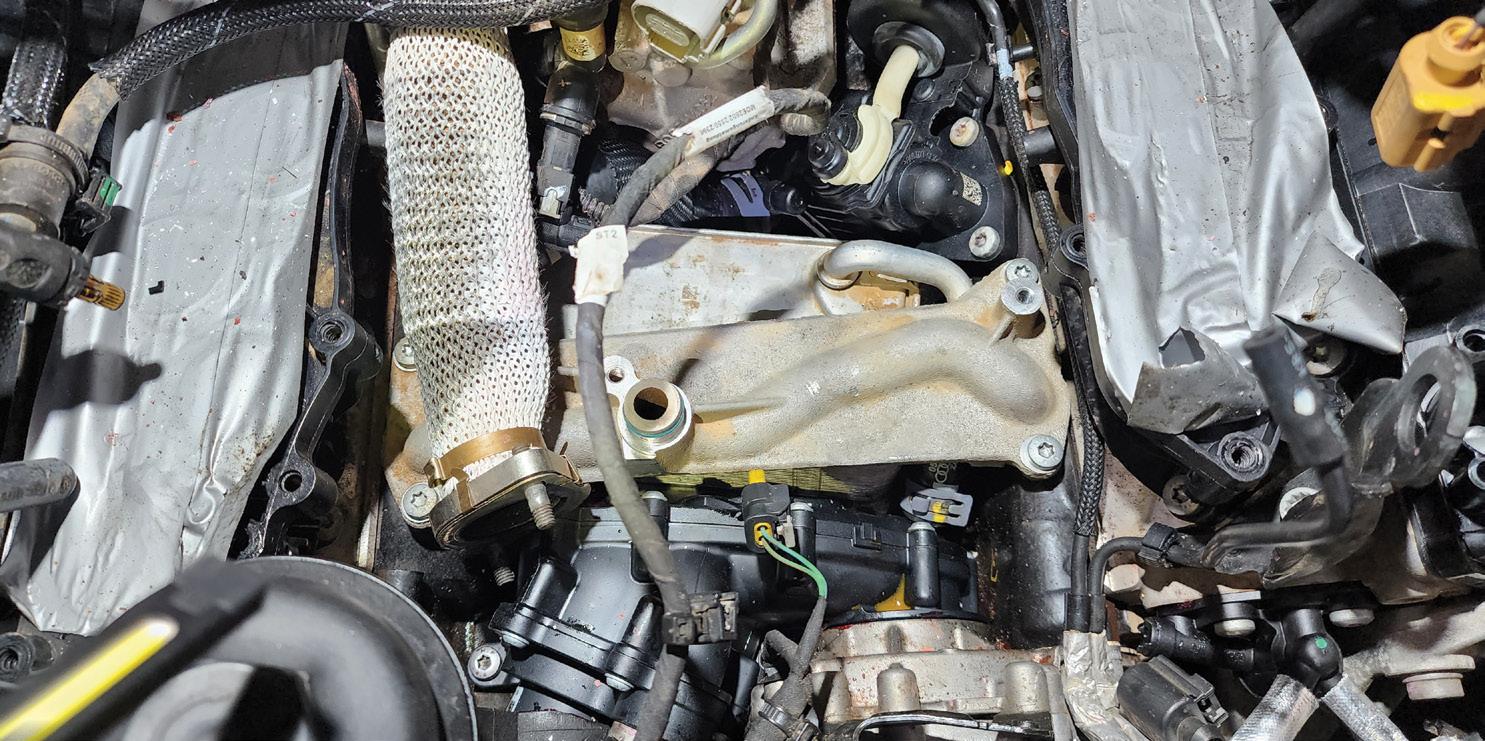
Once the airbox is out and you have some space, the basic sequence is throttle body off, fuel lines and fuel crossover pipe moved aside, then the intake manifold. With that gone you can see the exhaust-gas recirculation (EGR) cooler (pic 4) and once
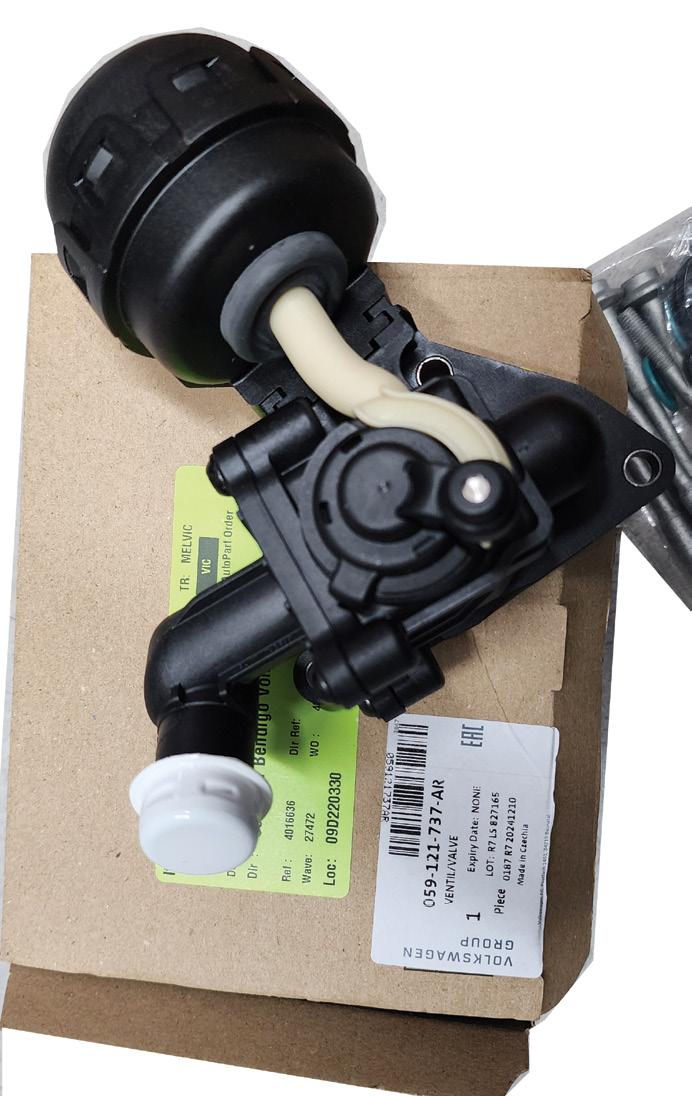
that is removed you see the alloy watercrossover plate that hides the valley (pic 5). With the cooler and crossover plate removed, you are now looking at the lower stack – coolant shut-off valve, oil cooler and thermostat housing. Pic 6 shows these layers numbered in the order we remove them.
By far the most common coolant leak we see is from the plastic coolant shut-off valve (pic 6). Once everything is off, you will usually see staining and crust around this unit and coolant tracks across the valley floor heading forward.
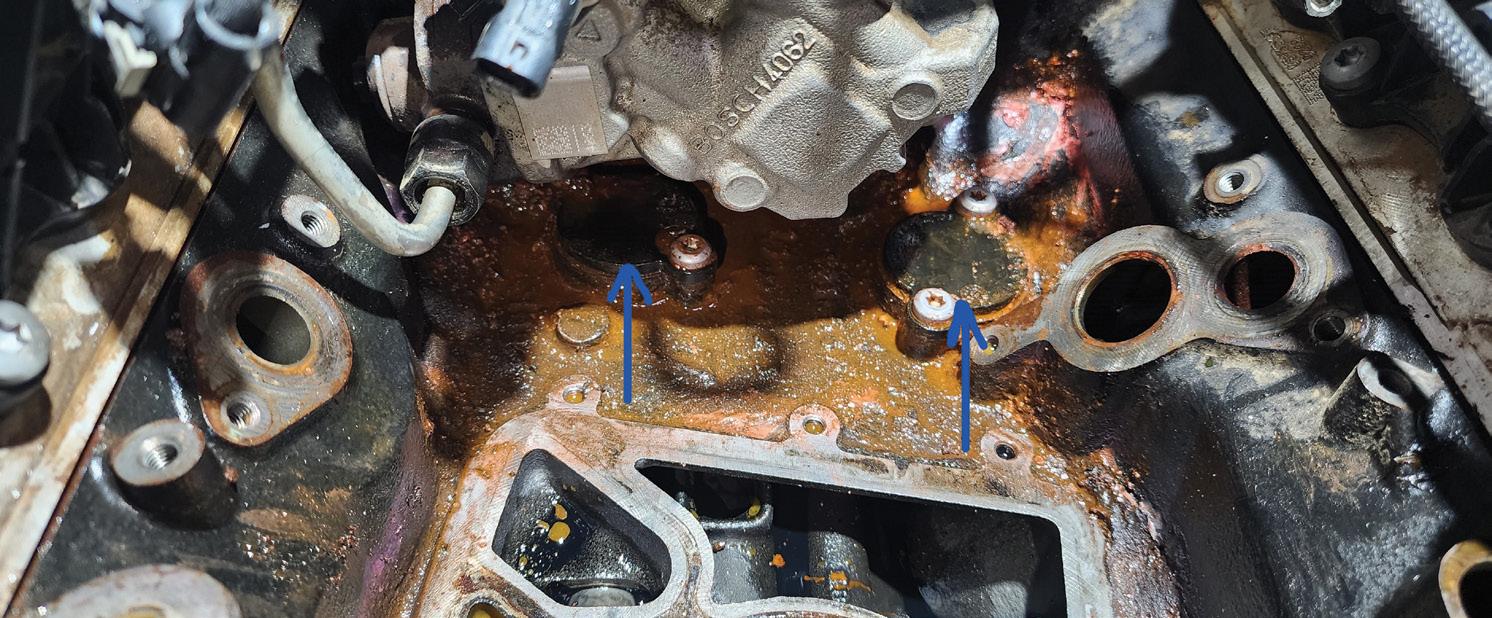
Oil leaks are usually from the rear oil-gallery blanking plugs. With the valley fully stripped, you can see these at the back of the block. The oil then runs down the same path as the coolant and exits at the front, which is why 1
so many front covers get changed for no gain. Pic 7 highlights the two gallery plugs sitting in the usual mess.
In the early days we replaced the oil cooler as insurance. After seeing a fair few of these jobs we have yet to see an oil cooler
itself leaking, so we stopped doing that automatically.
The coolant shut-off valve, on the other hand, is almost always involved, so it is now a given.
We have started doing the thermostats, which adds about another $450, but we’ve seen these fail and cause issues. It’s the second last thing you can get to, so it’s silly not to cover that fail point while in there.
After 37 years in this industry (damn, I feel really old), one thing I have learnt the hard way is there are some jobs that will just cost you money redoing the job if you try to save the customer money.
We have also found the skinny plastic pipe that runs from the front of the right-side head to the left-side head will break if you
look too hard at it, so we are starting to order that at the same time.
Pic 8 shows the typical parts pile on the floor – this pic does not include the O-rings for the crossover pipe or pipe to thermostat. Two of the three O-rings that go on the crossover pipe are the same as the watersupply pipe to the turbo and they are also a very common leaking point.
Once you have done one or two of these Amarok V6 valley jobs, they stop being scary and become a solid, profitable day’s work. The key is understanding where the coolant and oil actually leak from and not getting sucked into replacing front covers and pumps when the real problem is hiding in the valley.
Book plenty of time, have all your parts on the bench before you crack a bolt and treat the thermostat, shut-off valve, rear blanking plates, O-rings and brittle crosshead pipe as standard replacements. Do that and this ‘big’ job turns into a reliable fix instead of a comeback waiting to happen.
- Anthony Tydd
• To watch a video of the leak exit point, scan to QR code or go to youtube.com/ shorts/1KJx4OvA8gA

Liqui Moly has launched a new online tool designed to help technicians quickly and conveniently find the right problem solvers.
Liqui Moly said its new additive guide made finding the right chemical problem solver easier than ever, with the user-friendly online tool helping users identify the right product quickly and in a targeted manner.
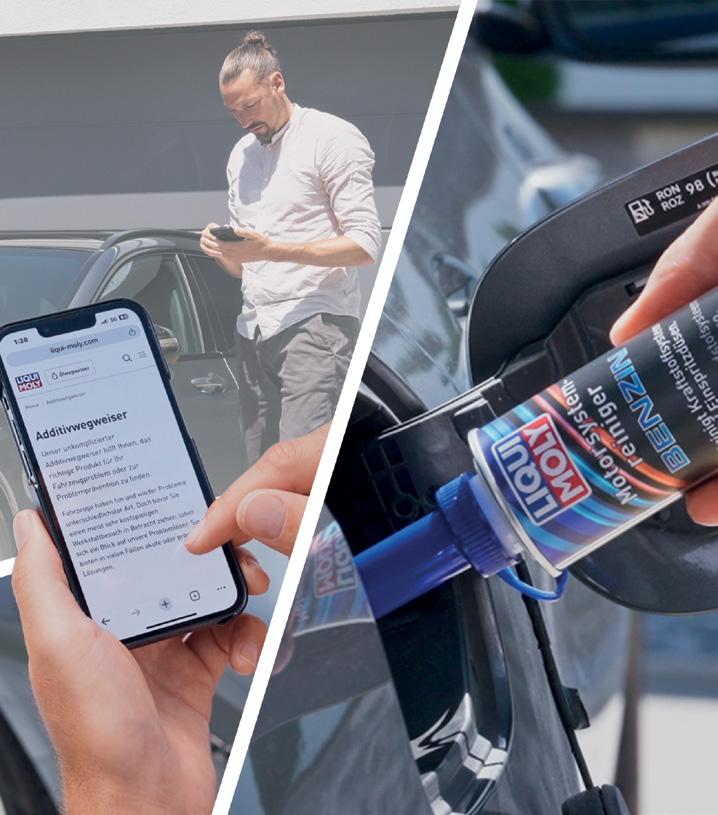
Does the engine run roughly, is the diesel particulate filter (DPF) clogged or is there a noticeable loss of power for the vehicle? There are many problems Liqui Moly additives can solve but when should you use which product?
This is where the new additive guide comes into play.
‘Our additives are highly effective problem solvers but the wide range can be overwhelming,’ said Liqui Moly Managing Director Günter Hiermaier. ‘With the additive guide, we offer a quick, uncomplicated and reliable solution for anyone who wants the best for their vehicle.’
The new tool combines several features in a single application. It offers a quick and targeted product recommendation in the event of problems with a vehicle. Thanks to the intuitive handling, users can easily filter by vehicle type or problem and get direct access to the entire Liqui Moly additive range.
The new tool is designed to save time and make it easier to choose without having to perform time-consuming searches or comparisons. The application is practically designed to reliably help find the optimum solution.
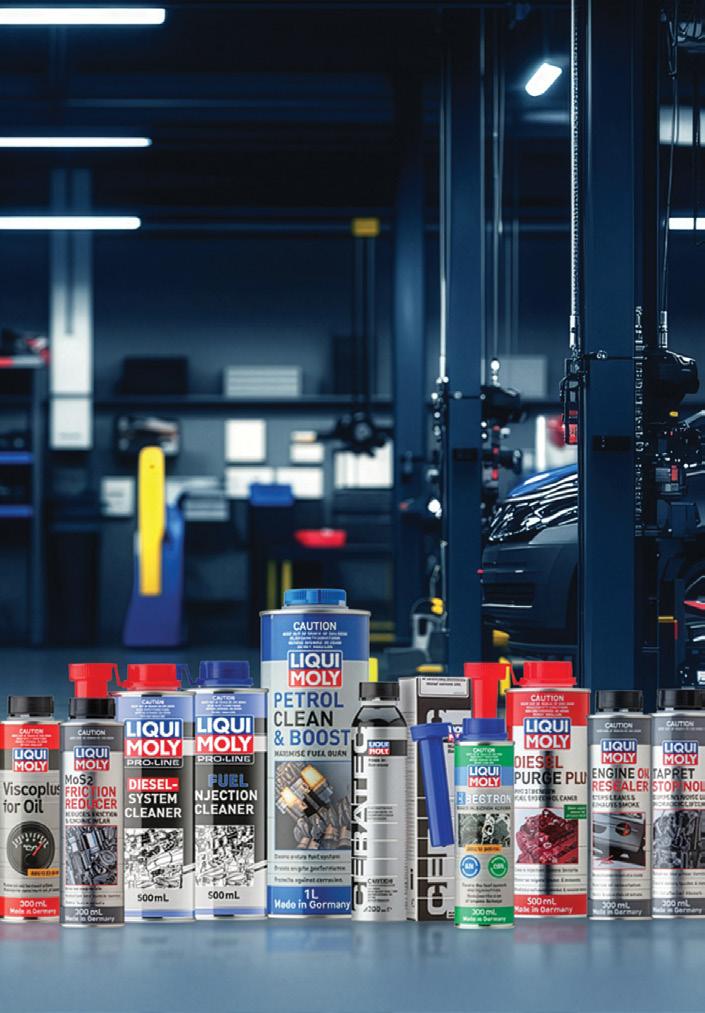
Liqui Moly’s oil guide served as the driving force behind the development of the additive guide. Thanks to many years of positive experience with this tried-andtested tool, which enables users to quickly and easily search for the right oil, the Ulm, Germany-based lubricant specialist was able to incorporate this know-how effectively into the development of the additive guide.
• Try out Liqui Moly’s new additive guide free of charge at liqui-moly.com
From electrical systems and heating, ventilation and a/c (HVAC) diagnostics to automotive maintenance, the ability to visualise temperature differences has become a decisive advantage.
Thermal imaging, once confined to bulky and costly equipment, is now evolving into an everyday diagnostic tool. The Topdon TC001 Max thermal camera reflects this shift, fitting naturally into modern inspection workflows.
Designed for automotive technicians and auto-electricians, the TC001 Max transforms a compatible smartphone, tablet or PC into a capable thermal-inspection devices. Its compact, plug-in design makes it easy to carry, while its performance is engineered to meet real-world diagnostic demands across multiple industries. At its core is a 256×192 infrared sensor, enhanced to 512×384 resolution with patented TISR (Thermal Image Super-Resolution) technology. This delivers detailed thermal imagery for applications ranging from electrical panels and HVAC systems to mechanical and automotive components.
With a 25 hertz (Hz) refresh rate and ≤40 millikelvin (mK) noise equivalent temperature difference (NETD), temperature variations
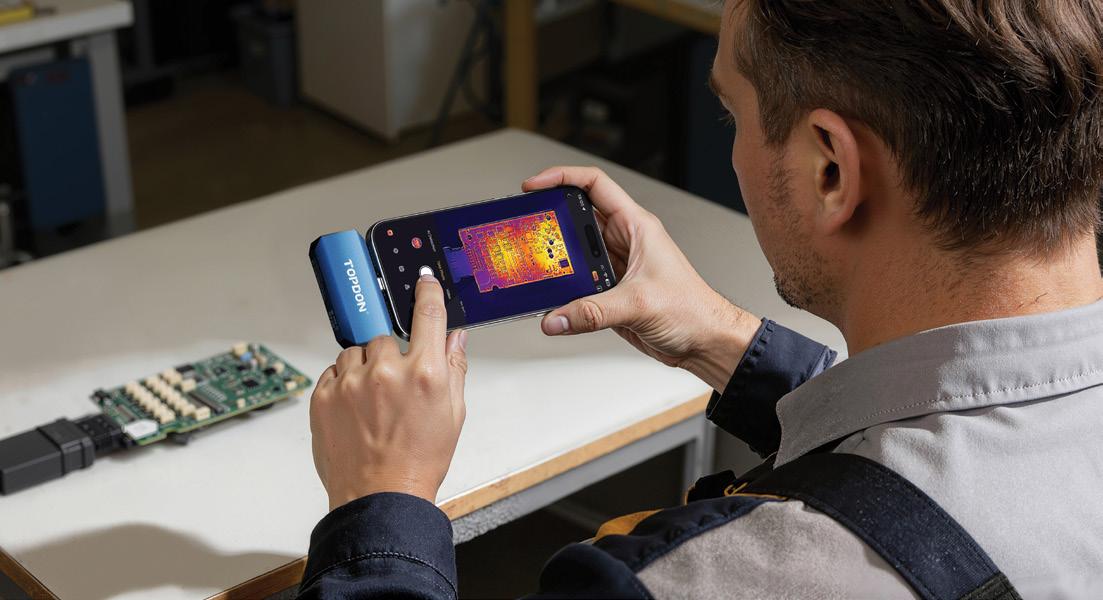

appear smooth and responsive, helping users identify early issues such as overheating components, loose connections or airflow inefficiencies.
The TC001 Max is also set apart by its dual-spectrum fusion capability. The integrated visible-light camera overlays visual details onto thermal images, providing sharper edges, readable labels and clearer context. This combination is designed to make it easier to pinpoint problem areas and communicate findings clearly, especially for professionals creating clear, actionable reports for their customers.
Beyond hardware, the TC001 Max introduces smarter diagnostics through TopFix, an AI-powered assistant within the TopInfrared app. Users simply capture a thermal image, ask a question and receive practical insights within seconds, lowering the barrier to thermal analysis for both professionals and DIY users.
Supporting iOS, Android and Windows and weighing just 33g, the Topdon TC001 Max demonstrates how advanced thermal diagnostics can be compact, intuitive and accessible, helping users not only see temperature problems but understand them and act with confidence.
• Find out more at au.topdon


Geoff Mutton Business Resources
I’ve written before about the staffing challenges facing our industry and unfortunately not much has changed.
Every week a workshop operates shortstaffed costs thousands of dollars in lost sales and puts extra strain on the people who are still there. The average workshop only employs between two to three technicians, so it only takes one to be missing to upset the whole balance.
This is why staff retention and morale remain a key area workshop owners need to focus on in 2026.
There’s no quick fix. The government, industry bodies, large corporates and training providers are all working on longterm solutions but the best thing you can do right now is focus on the people you already have. Keeping your current team happy and motivated should be priority number one. And yes, if you do need to hire you’ll want to recruit smartly, but let’s start with retention.
Pay fairly and review regularly
Money isn’t the only reason staff stay but it’s still top of the list. If you haven’t reviewed your pay rates in the last six to 12 months, do it now. Rising living costs mean techs know their worth and will leave if you’re behind the market.
To cover rising staff wages rates, you will need to adjust your workshop’s labour rate accordingly.
Offer simple meaningful perks
You don’t need the budget of a dealership group to give staff perks. For a small team, even little gestures make a big difference:
• Free coffee or Friday lunch shouts.
• Fuel vouchers or a loan car when needed.
• Flexible start/finish times to suit family life.
• A four-day week once in a while if the workload allows.
Perks show that you value your people as more than just workers. Flexible hours in particular can make a huge difference, especially for techs with kids or family responsibilities.
Keep the workshop clean and tidy
Morale drops fast if staff feel like they’re working in a dungeon. A clean, tidy
workshop and a lunchroom that isn’t a dumping ground set the right tone. Simple improvements such as decent heating or cooling, a fresh coat of paint or new lockers tell your team you care about their environment.
in training and skills
Even if your staff grumble about training, push it anyway. The industry is changing fast with electric vehicles (EVs), advanced driver-assist system (ADAS) technology and new diagnostic tools. If your people don’t keep learning they’ll fall behind – and they know it.
Send them to courses when you can and balance that with in-house learning. Let senior techs share knowledge or set aside time to go over a tricky job together. When staff see you’re committed to their development, they’re more likely to stay loyal.
Mix up the workload
We all know servicing and basic repairs pay the bills but variety keeps things interesting. Rotate jobs so everyone occasionally gets a go at more complex work. That feeling of nailing a tough job keeps morale high and builds confidence.
Communicate honestly and often
Lack of communication is one of the quickest ways to lose people. Hold short, regular team meetings to share what’s happening in the business. Ask for input and actually act on good suggestions. Even if you can’t implement an idea, acknowledge it and explain why.
A yearly one-on-one chat with each staff member is worth its weight in gold. Use it to give feedback, set goals and most importantly, listen.
Show genuine care
Your staff aren’t just techs – they’re people with lives outside of work. Take time to ask about their families, hobbies or weekend plans. Join them for lunch rather than eating at your desk. A boss who shows genuine interest will always have more loyal staff than one who doesn’t.
Try small traditions such as phone-free

Friday lunches or celebrating birthdays with a cake. These things build team spirit, especially in a small workshop.
Recognise milestones and wins
Don’t underestimate the power of recognition. A simple ‘good job’ after a tough repair or acknowledgment of a work anniversary makes people feel valued. Celebrate small wins together – it builds pride and camaraderie.
Recruitment tips (when you do need to hire)
Even with the best retention efforts, you will sometimes lose staff and you’ll need an extra set of hands. Recruiting is tough but here are some practical tips:
• Tap your network – Word of mouth is still king. Ask suppliers, industry contacts and even your customers if they know someone looking. A personal recommendation often beats a job ad.
• Offer flexible hours – Many techs now value lifestyle as much as pay. If you can give them flexibility for family or a shorter work week, you’ll stand out in a crowded market.
And remember, when you do bring someone new on invest time into onboarding properly. First impressions count.
Staff shortages aren’t going away anytime soon. For a small, aftermarket workshop, every employee is critical – lose one and the whole place feels it. That’s why retention and morale should be top of your priority list.
At the end of the day, tools and technology matter but it’s your people who keep the wheels turning.
Look after them and they’ll look after your business.
A 2009 Subaru WRX (G3) with 104,000km on the odo came in with the customer complaining the automatic transmission was shifting funny. They said it felt like it was in limp mode.
A brief road test confirmed the issue. The transmission did appear to be in limp mode and would not shift to higher gears. The next step was a full code scan and visual inspection. This was a JDM-imported Impreza WRX STI with a five-speed automatic transmission (5EAT) and paddle shifters.
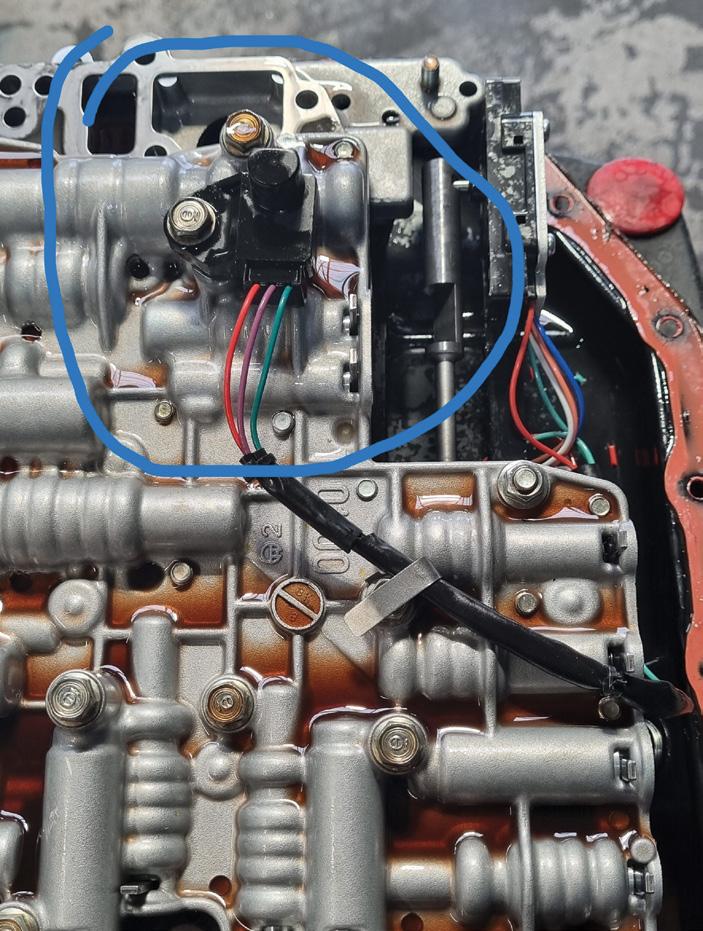
The fluid level and condition appeared OK but the transmission control module (TCM) had the following code, P1710 – Torque converter turbine two speed signal circuit malfunction
In live data, the sensor signal would start to drop out and glitch when the transmission fluid reached around 55°C.
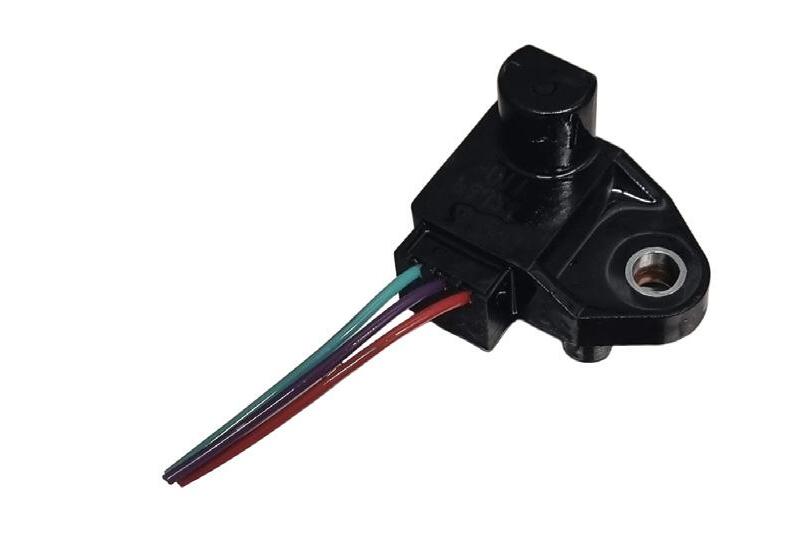
Removed the intercooler so I could gain access to the electrical connector on top of the bellhousing and scope the sensor signal, which was a standard 5V square wave. However, when the sensor heated up, the signal intermittently dropped to ground. Checked the powers and grounds, even though they were shared with other sensors. In this example, they were all three-wire Hall sensors. The offending sensor lived on top of the valve body and was part of the transmission wiring loom. The sensor was available separately but not from the dealer – they want you to buy an entire valve body.
Removed the valve body, installed a new sensor, refitted everything and filled with transmission fluid, then performed a relearn and road test with the scan tool.
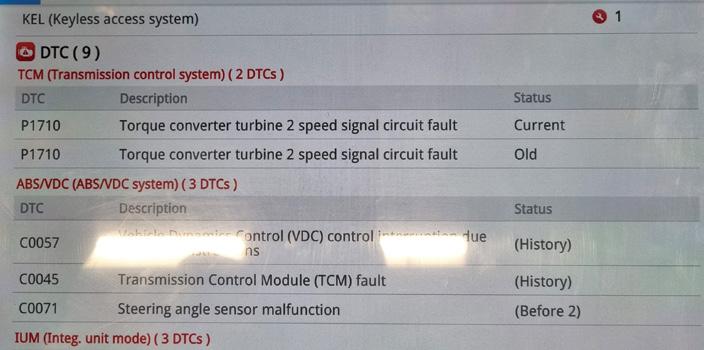
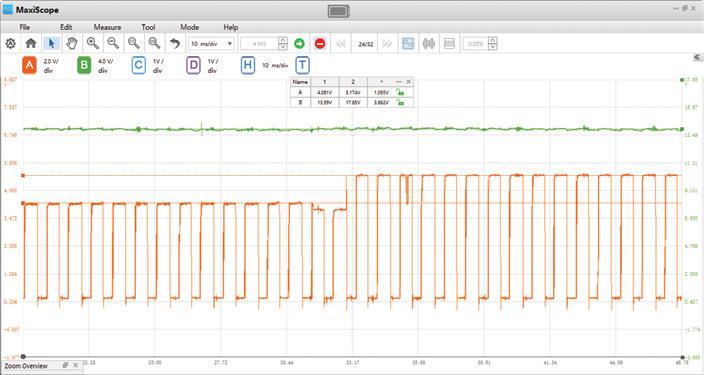
Diagnostic time for this job was three hours and repair time four hours.
Theo van de Steeg Wanganui Exhaust Centre WANGANUI, NZ


Injectronics continues to deliver industry-leading solutions with its remanufactured Mitsubishi ATE MK61 ABS Motor Exchange
Remanufacturing to meet or exceed OEM standards, these changeover anti-lock braking system (ABS) pump blocks are a fast, reliable and straightforward alternative to getting these units traditionally repaired.
A standout feature of this process is Injectronics’ use of ultrasonic wire-bonding technology, an advanced method that ensures robust internal connections and long-term durability, especially in highvibration environments.
Technicians benefit from reduced turnaround times and streamlined ordering. Once the faulty part number and vehicle details are confirmed, a pre-coded unit is dispatched promptly.


Programming is required on installation but Injectronics’ technical support and documentation help to make integration a seamless process.
Injectronics changeover units are engineered to resolve a soft pedal and other hydraulic issues and blockages, as well as a range of known faults, including:
• C1073 – Pump motor control circuit.
• C2116 – Pump motor voltage low.
• C121D – Pressure sensor circuit.
This remanufactured ECM is engineered to deliver value and performance. Whether addressing intermittent no-starts, misfires or fuel-control issues, Injectronics’ changeover service can ensure a vehicle gets back on the road quickly – with a reliable, thoroughly tested unit.
With a national distribution network and decades of expertise, Injectronics continues to set standards in automotive electronic remanufacturing.
• To find out more call 1300 308 060 or go to injectronics.com.au

In a traditional turbocharger, the flow of exhaust gases is controlled by a wastegate.
Mounted either internally within the turbine housing or externally, the wastegate regulates boost pressure by venting exhaust gases. This allows the turbo to build boost more quickly at low engine speeds (wastegate closed) and prevents overboosting at high revs (wastegate open).
The wastegate system is simple and reliable but it’s not very precise. The increasing demands of modern engines, as well as stricter emissions controls, have forced turbo manufacturers to look to a new solution to address these issues, the variable-nozzle turbocharger (VNT).
Instead of a wastegate, a VNT – also known as a variable-geometry turbocharger (VGT) – controls exhaust flow using a row of small, moving vanes placed around the inner perimeter of the turbine housing.
These vanes are controlled by an actuator that moves them into a closed position or progressively opens them fully.
In their closed position, the vanes reduce the internal diameter of the turbine housing, narrowing the available flow path for the exhaust gases. As the vanes move to the open position, exhaust flow gradually increases until the vanes are fully open and a full flow path is again available to the exhaust gases.
VNT technology allows a turbocharger to match the engine’s exact boost requirement, meaning the engine receives exactly the boost it needs, when it needs it.
At low engine speeds, the vanes close, restricting exhaust air flow, which increases turbine power and therefore boost pressure. This results in quicker response and less lag. At high engine speeds, the vanes open, maximising exhaust gas flow, preventing over-boosting and maintaining the required boost pressure.
The beauty of this system is that it’s linear. The vanes are constantly working, with the actuator adjusting the flow to suit the engine’s needs.
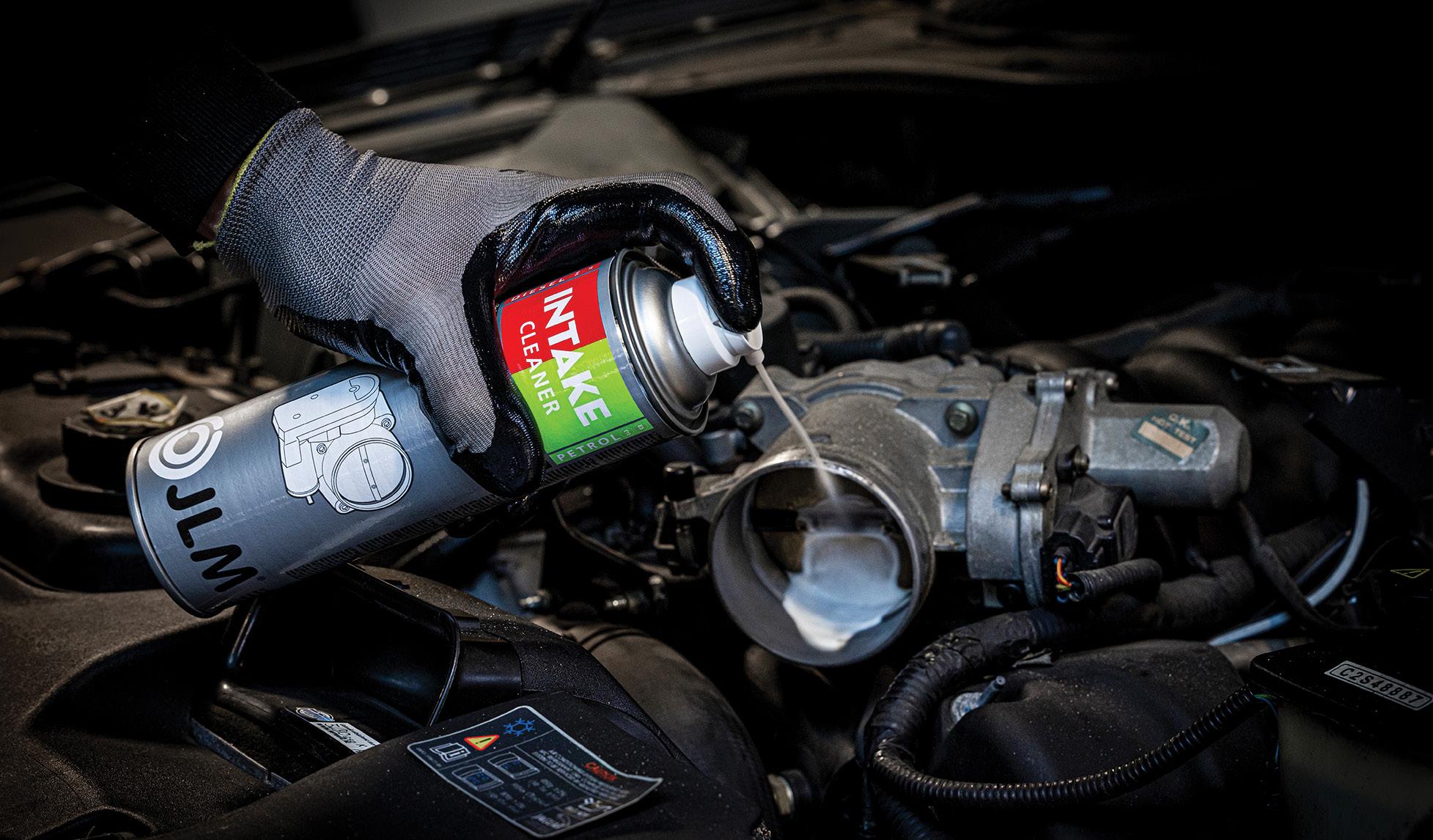
Compared with fixed-geometry turbos, the VNT offers better performance, more power and torque and reduced back-pressure. For the vehicle owner, that translates to better driveability, fuel efficiency and reduced emissions.
VNT technology was originally developed by Garrett and intended initially only for diesel applications. However, the brand has since adapted the technology for highertemperature petrol engines.
The first mass-produced petrol passenger car engine with a VNT was Volkswagen’s 2017 1.5-litre TSI unit.
With the European Union (EU) continually updating its CO2 emissions targets, more and more European auto manufacturers are favouring turbocharged petrol engines over their diesel counterparts because they offer better carbon dioxide (CO2) and nitrogen oxide (NOX) compliance.
How to avoid VNT failures
Just like standard turbos, VNTs are vulnerable to oil starvation and contamination.
Carbon build-up can impact the moving vanes, impeding their smooth operation or even causing a complete seizure.
Short trips, extended engine idling and stop/go driving that prevent the engine from reaching its optimal temperature all
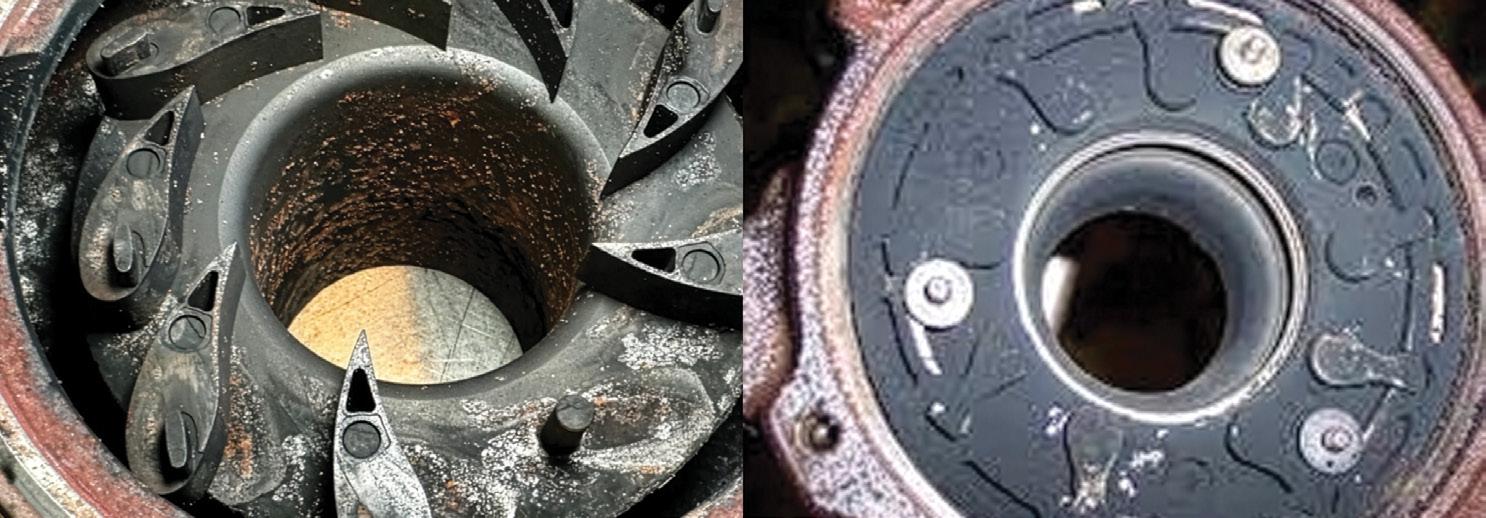
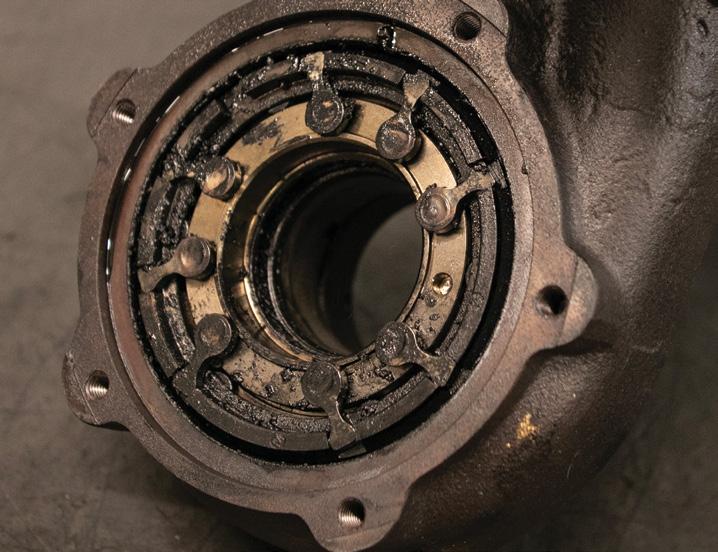
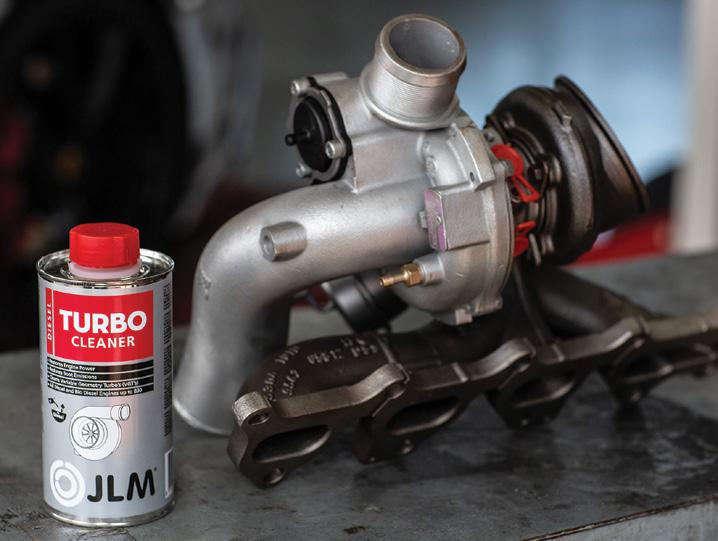
contribute to carbon build-up in the air intake, exhaust-gas recirculation (EGR) valves and turbochargers.
Preventative maintenance is key. Using products such as JLM’s Air Intake Cleaner, EGR Cleaner, Turbo Cleaner and DPF Cleaner to fight carbon build-up before it becomes a problem is recommended.
Regular, scheduled servicing, including oil flushing and oil changes, will go a long way to prevent oil contamination. Ensuring all turbo oil-feed lines are in good condition, free-flowing and free of kinks or leaks will prevent oil starvation.
GCG Turbochargers has been selling, repairing and building turbos for the Australian passenger, light commercial and heavy transport and mining industries since 1979.
• To find out more call 1300 TURBOS or go to gcg.com.au
Jrone’s range of turbochargers has expanded significantly since Adrad started distributing the brand in September 2024, now suiting more than 47 per cent of the turbo market for utes, SUVs, commercial, 4x4 and passenger vehicles.
Jrone turbochargers are produced by a world-leading OE and aftermarket turbocharger manufacturer, accredited to ISO 9001 and IATF 16949.
Jrone’s fully assembled products feature higher tolerances and a more precisely balanced centre housing rotating assembly (CHRA) than some OE parts. A superior CHRA produces less vibration at high RPMs, resulting in reduced accumulated wear over the turbocharger’s service life.
High-quality design and construction include nitride-hardened actuator components further contribute to extended service life. Jrone turbochargers also feature an aluminium compressor housing and castiron turbine housing.
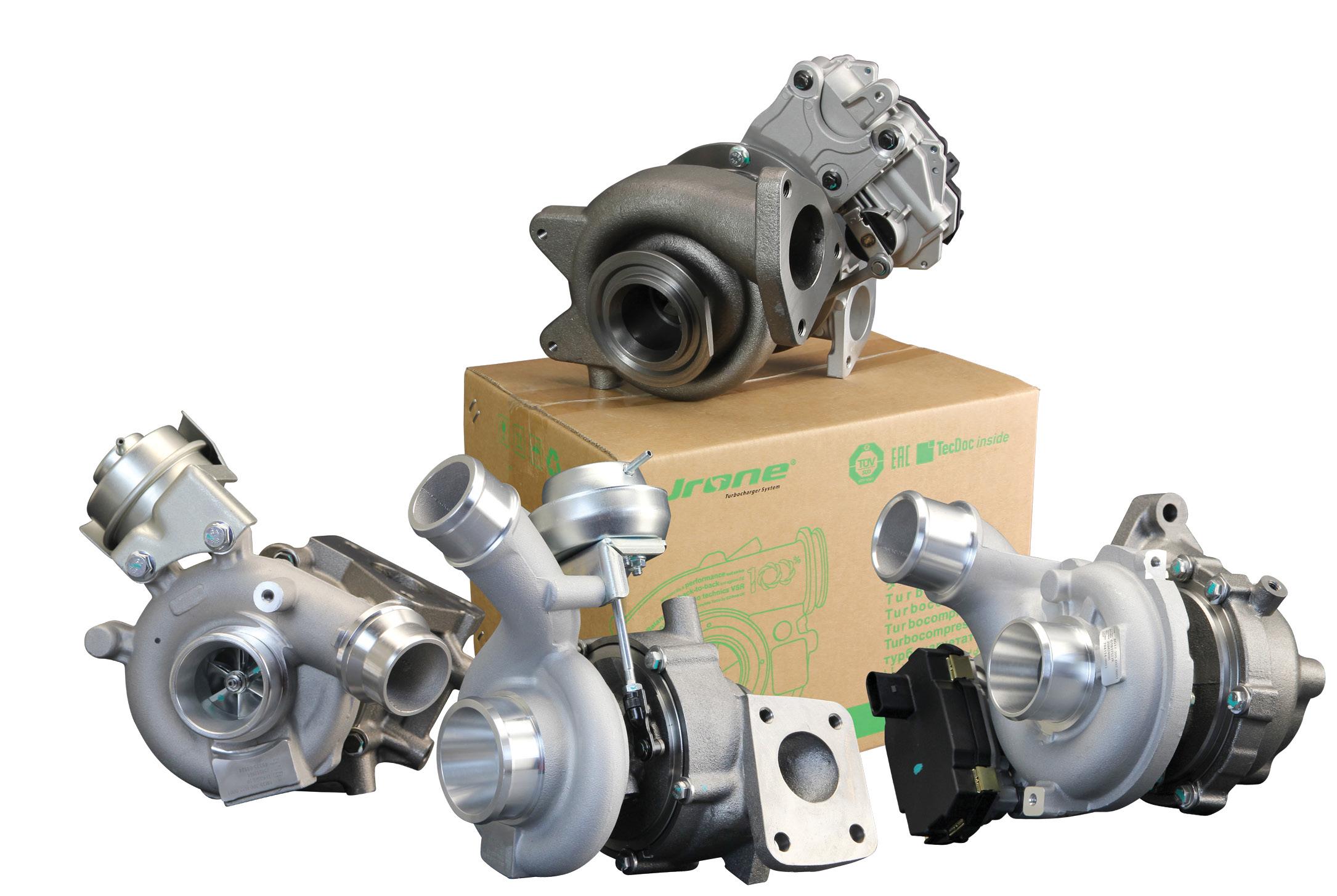
An elastic sealing gasket material for hightemperature areas utilises a special alloy resistant to fatigue, heat, oxidation and corrosion. Gaskets are included with each turbocharger.
A number of turbochargers in this range also feature rotary electric actuation (REA). This allows the vehicle’s ECU to control airflow through the turbocharger, delivering faster response times than pneumatic counterparts. Overall turbo control is made more precise with on-board position sensing. These features help improve engine performance, fuel efficiency and emissions control.
The Jrone range also includes variablenozzle turbochargers (VNTs). Used predominantly in diesel applications, VNTs utilise small shifting vanes around
the turbocharger’s turbine wheel to adjust the direction and speed of turbine gases. This helps minimise turbo lag, providing responsive throttle and improved torque at low speeds, and prevents over-boosting at high speeds.
Adrad’s range of Jrone turbos suits passenger and light-commercial makes including Audi, BMW, Ford, Haval, Hino, Holden, Honda, Hyundai, Isuzu, Kia, Land Rover, LDV, Mazda, Mercedes-Benz, Mitsubishi, Nissan, Range Rover, Renault, Subaru, Suzuki, Toyota and Volkswagen. Truck turbos are also being added to the range, with a unit to suit Volvo FH12 currently available.
Need accompanying hoses? Adradbrand intercooler hoses are available to suit popular SUVs, 4x4s and commercial vehicles.
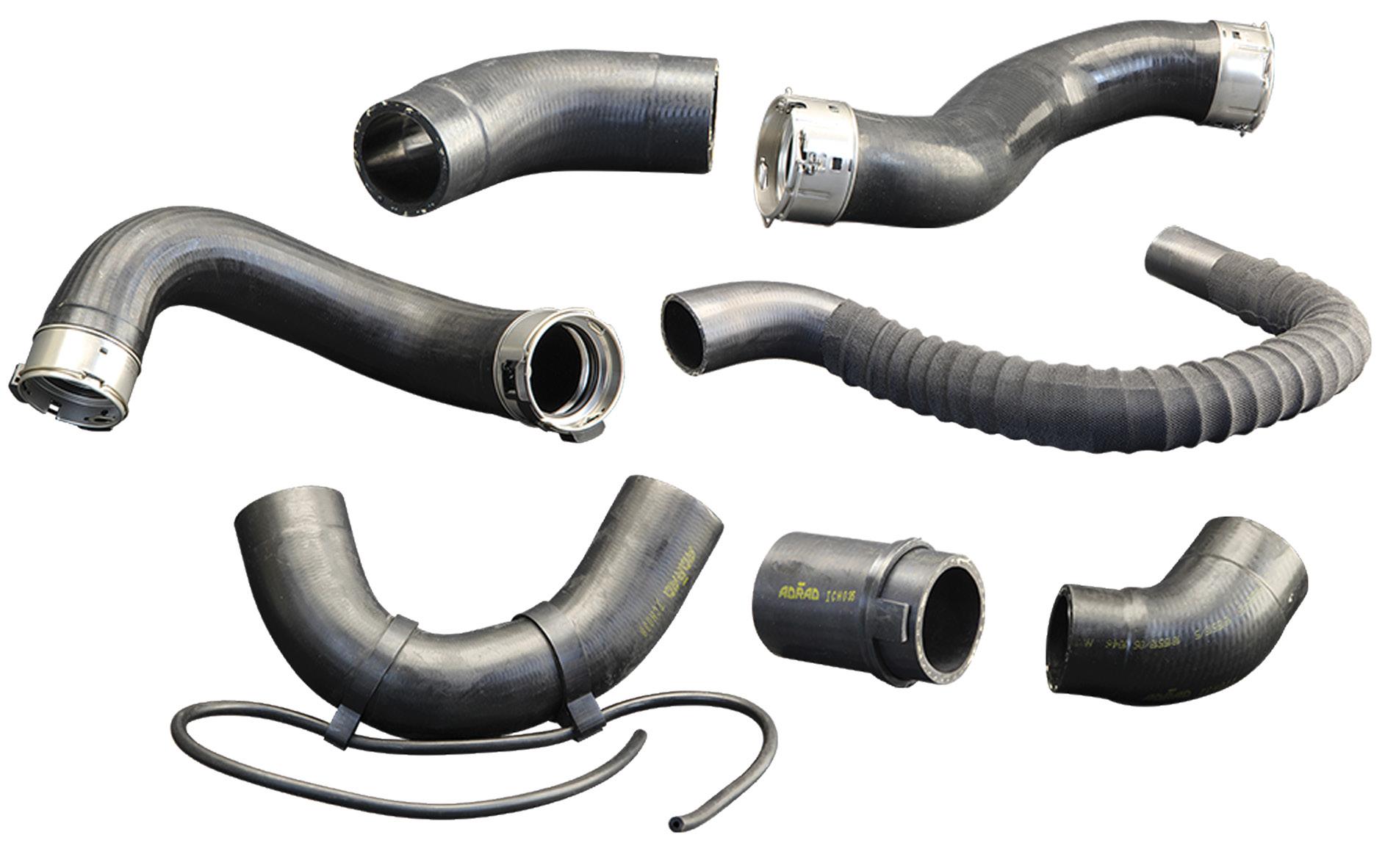
Sourced from an ISO-accredited European manufacturer, these intercooler hoses meet OE specifications for construction, materials and fitment, including where quick-release couplings are required.
Quick-release couplings facilitate fast, easy installation, providing a more secure attachment than traditional clamps and eliminating hose blow-off.
This helps ensure Adrad’s aftermarket intercooler hoses deliver the same performance and direct fitment as original parts while preserving the authentic appearance of the engine bay.
For ordering convenience, vehicle-specific intercooler hose kits (containing matching sets of hoses) are also available.
For extra assurance, online customers can refer to helpful diagrams that accurately show the appearance and location of each intercooler hose.
oil-feed lines – coming soon
Adrad plans to introduce turbo oil-feed lines as companion products to its Jrone turbochargers range in the first half of 2026. Oil-feed lines should be replaced when a new turbo is installed to ensure no residual debris can damage the new turbocharger unit.
Jrone turbochargers and Adrad intercooler hoses are backed by a 12-month warranty and are stocked in local warehouses across Australia for quick delivery.
• For product and fitment information, speak with an Adrad parts representative or distributor. Alternatively, contact Adrad on 1800 882 043, email customerservice@adrad.com.au or go to adrad.com.au