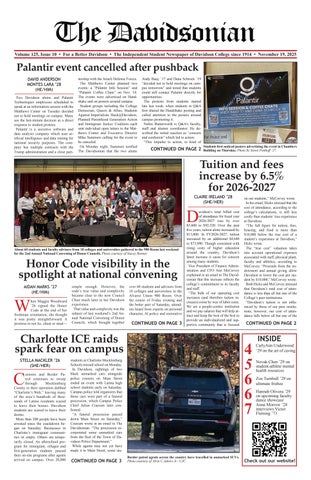
The Davidsonian 11/19/25

Page 1


Palantir event cancelled after pushback

DAVID ANDERSON MONTES LARA ’28 (HE/HIM)

Two Davidson alums and Palantir Technologies employees scheduled to speak at an information session with the Matthews Center on Tuesday decided not to hold meetings on campus. Many see the last-minute decision as a direct response to student protests.

Palantir is a secretive software and data analysis company which uses artificial intelligence and data mining for national security purposes. The company has multiple contracts with the Trump administration and a close part-

nership with the Israeli Defense Forces.

The Matthews Center planned two events: a “Palantir Info Session” and “Palantir Coffee Chats” on Nov. 18.

The events were advertised on Handshake and on posters around campus.

Student groups including the College Democrats, Queers & Allies, Students Against Imperialism, Hack@Davidson, Planned Parenthood Generation Action and Immigrant Justice Coalition each sent individual open letters to the Matthews Center and Executive Director Mike Summers calling for the event to be canceled.

On Monday night, Summers notified The Davidsonian that the two alums

Andy Baay ’17 and Dana Schrock ’19 “decided not to hold meetings on campus tomorrow” and noted that students could still contact Palantir directly for opportunities.

The protests from students started late last week, when students in Q&A first shared the Handshake posting and called attention to the posters around campus promoting it.

Nalini Butterworth is Q&A’s faculty, staff and alumni coordinator. He described the initial reaction as “concern and confusion” which led to action.

“This impulse to action, to kind of

Honor Code visibility in the spotlight at national convening

AIDAN MARKS ’27 (HE/HIM)

When Maggie Woodward ’26 signed the Honor Code at the end of her freshman orientation, she thought it was pretty straightforward. A promise to not lie, cheat or steal—

simple enough. However, the code’s true value and complexity became clear to the now Council Chair much later in her Davidson experience. That value and complexity was the subject of last weekend’s 2nd Annual National Convening of Honor Councils, which brought together

Charlotte ICE raids spark fear on campus

STELLA MACKLER ’26 (SHE/HER)

Customs and Border Patrol continues to sweep through Mecklenburg County in their operation dubbed “Charlotte’s Web,” leaving many of the area’s hundreds of thousands of Latino residents scared to leave their homes. Davidson students are scared to leave their dorms.

More than 200 people have been arrested since the crackdown began on Saturday. Businesses in Charlotte’s immigrant communities sit empty. Others are temporarily closed. An afterschool program for immigrant, refugee and first-generation students paused their on-site programs after agents arrived on campus. Over 20,000

students at Charlotte-Mecklenburg Schools missed school on Monday.

In Davidson, sightings of two black unmarked cars alongside police cruisers on Main Street ended an event with Latina high school students early on Saturday.

Campus police told organizers that those cars were part of a funeral procession, which Campus Police Chief Julian Coaxum later confirmed.

“A funeral procession passed down Main Street on Saturday,” Coaxum wrote in an email to The Davidsonian. “The procession incorporated some unmarked cars from the fleet of the Town of Davidson Police Department.”

While agents may not yet have made it to Main Street, some stu-

for 2026-2027

CLAIRE IRELAND ’28 (SHE/HER)

Davidson’s total billed cost of attendance for fiscal year 2026-2027 rose by over $5,600 to $92,520. Over the past five years, tuition alone increased by $13,000. In FY2026-2027, tuition increased by an additional $4,640 to $73,090. Though consistent with rising costs of higher education around the country, Davidson’s latest increase is cause for concern among many students.

over 60 students and advisors from 18 colleges and universities to the Alvarez Union 900 Room. Over the course of Friday evening and the better part of Saturday, attendees heard from experts on personal character, AI policy and restorative

Vice President of Finance Administration and CFO Ann McCorvey explained in an email to The Davidsonian that this increase reflects the college’s commitment to its faculty and staff.

“The bulk of our operating cost increases (and therefore tuition increases) come by way of labor costs. We are a people-centric institution and we pay salaries that will help attract and keep the best of the best to provide an individualized and supportive community that is focused

on our students,” McCorvey wrote.

In his email, Hicks stressed that the cost of attendance, according to the college’s calculations, is still less costly than students’ true experience at Davidson.

“The full figure for tuition, fees, housing, and food is more than $10,000 below the true cost of a student’s experience at Davidson,” Hicks wrote.

The “true cost” valuation takes into account operational expenses associated with staff, physical plant, faculty and athletics, according to McCorvey. “Proceeds from the endowment and annual giving allow Davidson to lower the cost per student by $10,000,” McCorvey wrote. Both Hicks and McCorvey stressed that Davidson’s total cost of attendance is less than all but one of the College’s peer institutions.

“Davidson’s tuition is not influenced by those of our peer institutions, however, our cost of attendance falls below all but one of the

CONTINUED ON PAGE 2

4 5 6 6 7

CarlyAnn Underwood ’29 on the art of caving

Novak Chen ’29 on student-athlete mental health resources

Zoe Turnbull ’29 on ultimate frisbee

Hannah Olivera ’29 on upcoming faculty dance showcase Anna Morrow ’28 interviews Victor Fleming ’73

Border patrol agents across the country have travelled in unmarked SUVs.
Photo courtesy of Alvin C Jabors Jr / CJC.
About 60 students and faculty advisors from 18 colleges and universities gathered in the 900 Room last weekend for the 2nd Annual National Convening of Honor Councils. Photo courtesy of Stacey Riemer.
Students first noticed posters advertising the event in Chambers Building on Thursday. Photo by Soren Potthoff ’27.

Palantir employees back out of info session on short notice

FROM PAGE 1

identify that this felt incongruent with what we understood our goals to be as students, as member[s] of this college [...] created conversation amongst people, which led to different ideas of different letters being written,” Butterworth said.

Julia Siqueira ’26 is co-president of the Davidson College Democrats. She stated similar concerns with this event not aligning with Davidson College’s views.

“It was deeply alarming that Davidson would even consider having such an event in any capacity,” Siqueira said.

Siqueira also brought up concerns with the lack of transparency regarding the location of the event, seeing it as a barrier to student protest.

“I thought that it was actually contrary to our principles of free expression to not post the location of the event,” Siqueira said.

The concern quickly spread to the IJC. Vice President Elizabeth Corral ’28 explained IJC’s involvement as part of their mission, noting members include people with personal or family immigration experiences.

The open letter, written by their publicity and outreach chairs, focused on raising awareness: “We wanted to show that students weren’t happy and, as a student organization, ask what you will do for us?”

Students Against Imperialism Secretary Eli Bassett ’28 organized efforts to disrupt the event but said that he did not actually know that much about the company at first.

“I didn’t really know a lot about Palantir […] once I started looking up the company and what they did, it was really just kind of awe-strucking,” Bassett said.

Before the events were cancelled, some students had planned to attend and pressure the Palantir employees with questions. SAI shared an open document with students to crowdsource questions intended to confront the speakers directly about Palantir’s contracts and alleged human rights violations.

Examples of questions include “How does your salary compare to the value of a human life?” and “How do you sleep at night knowing that you are supporting unjust deportation and genocide when you walk into work every day?”

Despite multiple coordinated letters, the Matthews Center offered minimal engagement with responses. While the initial acknowledgement was “acceptable,” Butterworth wished the Center had followed up.

“They said we will get back to you before next Tuesday, and I’d hoped that they would,” Butterworth said.

Students are not satisfied with the event being cancelled, and are looking for more communication from

the Matthews Center and an explanation for the event in the first place.

“It was not what it should have been. It was not an apology. It was not saying this is wrong. It was just saying the Palantir representatives canceled it,” Bassett said.

Still, students were encouraged to

see a rare moment of unity across organizations. “[This was] the most solidarity I’ve seen between groups on campus since we’ve been here,”

PPGA Co-Administrative Officer

Nora Fenn Gilman ’26 said. Siqueira shared Fenn Gilman’s sentiments, and hopes this collective

action and student scrutiny continues.

“It showed that we can work together, and that students are going to pay attention to who gets invited into our community,” Siqueira said.

Students with outside loans concerned about tuition increase

CONTINUED FROM PAGE 1

20 high-ranking liberal arts colleges with whom we compare Davidson on a range of factors,” McCorvey wrote. According to Director of Media Relations Jay Pfeifer, this comparison is based on tuition and cost of attendance for FY2025-2026. Davidson’s tuition this year is $68,450 and the total billed costs add up to $86,865. None of Davidson’s peer institutions have publicly released their total cost of attendance for FY2026-2027 which means it is unclear how Davidson’s tuition increase will reposition it relative to the group. As the total cost approaches a six-figure sum, students receiving fi-

nancial aid are concerned about how aid will be impacted.

Vice President and Dean of Admission & Financial Aid Chris Gruber emphasized that financial aid packages typically rise in accordance with tuition increases.

“Say it costs 100 units to go [to Davidson], and a family has capacity to pay 50. They would receive that other 50 by way of grant and the student having the job,” Gruber said. If tuition rises by five units, “their financial aid package goes to 55 so their amount of their job doesn’t change in a dramatic fashion, but the grant would.”

Davidson does not include loans in their financial aid packages and

Hicks’ email said that 75% of students graduate without debt. The College leverages grants and student employment to fill the gaps between total cost of attendance and a student’s calculated financial need. But for the other 25%, taking out loans is often a major portion of the debt they accrue over four years.

Delila Cruz ’28 explained that she has taken out loans her entire tenure at the College.

“It’s funny to me that they talk about how they have a no loan policy, because in my experience, all the years I’ve been here, I’ve had to take out loans,” Cruz said. “It’s primarily how I pay for college. And I wouldn’t consider myself to be from a completely

low income background, like super middle class, but it’s just not realistic for my parents to have to pay what the expected family contribution would be.”

Gruber explained that from the College’s perspective, loans are typically an elected form of payment.

“If [families and/or students] are taking that out, it is coming by way of the fact that they have elected to do so, because in an equitable way, across every student that has applied for financial aid, we are giving the amount that is the difference between cost and what we expect and believe a family can fairly pay,” Gruber said. When it comes to loans and their concurrent debt, Gruber said the College has already worked to alleviate that burden.

“The type of loan that they [students and/or families] take out, and the type of debt that they’re referring to, could be by way of a student loan, could also be by way of a parent loan as well,” Gruber said. “Is there an action that we would be taking right now to diminish that? We believe that we, in many ways, already have. The brief answer is: there is no current initiative that is directly geared towards reducing the amount of elected loans that families are taking out.”

Despite the administration’s efforts, some students fall through the cracks.

Isabel Romero-Avila ’26 relies on financial aid to attend Davidson. In her first two years at Davidson, she paid between $1000-2000. She received full aid last year. This year, Davidson determined that Romero-Avila’s non-custodial parent made too much money to qualify for assistance.

“The expected attendance for me for the year was $80,000 which is not something I can afford, so I had to

kind of go back and forth with financial aid trying to figure out how to be able to afford paying the rest of my year,” Romero-Avila said.

Romero-Avila secured a $25,000 merit based award. “I fought for them to apply for a presidential award because I had research I had since my freshman year, and it’s merit based, not financial need based,” Romero-Avila said.

To cover the gap, Romero-Avila also went into credit card debt and took out $5,500 in federal student aid subsidized loans—the maximum amount—and a little over $1,000 in unsubsidized loans. She was denied two private loans. “[I have] around $6,500-$6,000 in loans right now and I’m trying to work to pay everything off, the credit cards and the loans.” Romero-Avila decided to graduate from Davidson a semester early to avoid accruing more debt.

“I get it that it’s not part of [the Davidson financial aid policy], but they don’t really support you in any way if you do need to take those loans out, because I know that it’s a growing concern that the cost of attendance is increasing,” Romero-Avila said.

Gruber said the financial aid team is available to discuss concerns with students.

“If we can counsel with families, to say, here’s how we would anticipate that this is going to change, families can be getting their information in for the future year already, [...] and we can go through that assessment to say this is where you would likely be,” Gruber wrote. “So if there’s any type of extenuating circumstances as well, we can talk through all of that, and we’re happy to do so.”

The Betty & B. Frank Matthews II ’49 Center for Career Development is housed within the Alvarez College Union. Students were notified Monday night that the event had been cancelled. Photo by David Anderson Montes Lara ’28.
The Office of Financial Aid works out of the Harding House on Main Street. Photo by David Anderson Montes Lara ’28.

Features

Students discuss honor at convening

CONTINUED FROM PAGE 1

justice. Students discussed ethical leadership and Honor Council best practices in breakout sessions.

Alex Bruce is associate dean for undergraduate academic affairs and professor of English at Sewanee: The University of the South. Bruce’s main takeaway was a recognition and appreciation for the difficulty of enforcing an honor code.

“[I took] great joy in watching the students interact and learn from each other and similarly explore the very difficult topics that are part of their own growth and development as

leaders on their Honor Council and as young people,” Bruce said.

Student Government Association

President Connor Hines ’26 moderated a student session on ethical leadership. He said the conference helped him consider how to make the Honor Code a central part of life at Davidson.

“We talked a lot about [...] making the Honor Council no longer be this mysterious entity that operates in kind of the shadows of Davidson, but really something that’s at the forefront of our community,” Hines said.

Transparency is the key to maintaining trust among students, ac-

Politics

cording to Hines. A transparent process includes ensuring students understand how the Council works, how to report cases and what consequences look like. In the name of transparency, the Council plans to release data on the number of cases, types of violations and accountability plans over the past semester.

Woodward has been working toward just this goal alongside Honor Council Vice Chair Lily Radtke ’26.

“[We have been] really pushing to make sure that the Honor Council has a place on this campus that’s visible and that people are aware of the processes, people are aware of

the code, people know what that entails,” Woodward said.

Saturday’s conversation extends beyond Davidson. In the day’s last breakout session on best practices, about 30 student representatives from different schools rotated among tables, discussing and outlining procedures, governance structures, outreach initiatives and key challenges on Post-it easel pads while picking through heavily discounted Halloween candy.

A recurring challenge is overcoming information gaps. Rebeca Manzo is a junior at Bowdoin College where she is a member of the Conduct Review Board. She said the CRB often feels removed from the student body. Manzo—and Bowdoin—is not alone: addressing information gaps between the student body was a major point of discussion.

“It was affirming to hear that other schools felt that same distance, and we were talking about different ways we can approach that [...] to break that barrier down,” Manzo said.

Davidson’s Honor Council worked to narrow that distance by hosting a mock hearing in mid-October in an effort to show students how the process works. The fictional case followed the accountability process for a student accused of using AI to complete a writing assignment. Representatives presented evidence and witness testimony before deliberating and recommending an accountability plan.

Other measures proposed during Saturday’s breakout session include hosting educational events about the Honor Council in action, publishing procedures and launching social media campaigns to emphasize the im-

portance of integrity in student life. AI was also a central point of discussion. Senior Michael Pyo is cochair of Haverford College’s Honor Council, which he said saw an increase in AI violations over the past few years. Hearing about how peer institutions grapple with AI reassured him that Haverford is not alone.

“Too often college campuses and councils are kind of trapped in their little bubbles on campus,” Pyo said.

“I think that Haverford, at least as an Honor Council, will really take away some of the other AI policies that other councils have instituted, but also the different sanctions and the different—we call them resolutions—that have come out of these cases.”

Sophomore Lillian Regal is a member of Bowdoin’s CRB. She said talking with peers at other institutions was the most valuable part of the convening.

“I really would have loved to just talk with them more about their procedures and talk with them more about a lot of their nitty gritty thoughts on particular details of AI on campus or other issues affecting us. I just wish we had more time,” Regal said.

For Stacey Riemer, the director of the Center for Civic Engagement who played a major role in organizing the event, it all comes down to learning to live with each other.

“I think we’re uniquely situated at Davidson to do this work, to have this convening, because this is about how we live, learn and lead together,” Riemer said. “This is about how we’ll work together for a positive culture on campus.”

Border Patrol sweeps Charlotte, stirs fear on and off campus

CONTINUED FROM PAGE 1

dents are concerned about stepping off campus. Xaris Trigueros ’28 is the publicity chair for the Immigrant Justice Coalition and has been working for the past week to provide informational and advocacy resources for students. While she is well informed about her rights, she is still worried about driving around in Charlotte or home to Dallas for Thanksgiving.

“I’m so scared to go home now because we’re driving back, me and my friends,” Trigueros said. “But there’s probably more likelihood that something would happen here than me driving back home.”

Luisa Guzman ’26 is the president of the IJC. She said the videos and news reports out of Charlotte remind her of ICE’s deployment to her home of Washington D.C. earlier this year.

“There’s so much fear everywhere,” Guzman said.

The fear is visible in empty spaces. Delia is a Mecklenburg county resident, and has been in the US for 31 years. Delia, who is formerly undocumented and asked to only be referenced by her first name, became a citizen in 2010. She said she has noticed fewer neighbors going out in the community due to fear.

“People are not out on the streets,

people aren’t even in the stores, I’ve noticed that,” Delia said. “People are scared, they’re afraid to be outside, they’re afraid they might get taken away.”

The Davidsonian spoke with one woman who is undocumented and cleans houses for a living. She asked that her name not be used out of concern for her and her family’s safety. She has not gone to work since Border Patrol arrived in Charlotte.

“We can’t work comfortably anymore,” she said. “We are afraid to go out because of everything that is happening.

The woman lives in Mt. Holly, about 30 minutes south of Davidson. She came to the US seeking a better life for her daughter.

“We know there are rules in this country, but many of us, including myself, did not come here to harm anyone,” she said. “We came to work and to give our children a better future.”

Of the 130 people detained over the weekend, the Department of Homeland Security described 44 as “criminal.”

“We are not criminals. We came here to work and not to hurt anyone,” the woman said. “Border Patrol said they were only going after criminals, but that’s not what we are seeing. They are detaining people

who came here simply to work.”

She said some of her neighbors are scared to take their kids to school and are relying on support from members of their communities with legal status.

“The Latino community who does have papers is doing what they can

to support us,” she said. “There is a lot of unity, and they are helping us a lot.”

While she has found support in her local community, this past year challenged her belief in America as a safe place to live.

“We used to believe the U.S. was a more free and safe country for our children to grow up in,” the woman said. “But now, with everything that’s happening, discrimination has increased and we live with fear of being stopped and it’s not just being stopped but facing violence.”

Students and faculty finished lunch during a panel on restorative justice practices. Photo courtesy of Stacey Riemer.
Students spotted unmarked vehicles on Main Street on Saturday morning, prompting concerns that Border Patrol was in the area. Photo courtesy of the Town of Davidson.

Perspectives

The Art of Caving

In the wake of the longest government shutdown in U.S. history ending, there seems to be a brief pause for reflection before the outrage that is, in my opinion, justified. However, when a presidential administration has built their stance on a foundation of lies, rug-pulling, and grade-school-level distraction tactics, eight Democratic Senators somehow believed a vote on healthcare subsidies would actually happen. Did the Democrats leave their brains at the door, failing to anticipate that, once again, their soapbox would be purely performative, leaving Americans frustrated at the display of ineffectiveness? Almost immediately after the vote in the Senate, House Speaker Mike Johnson made it clear he would not commit to a vote on extending ACA subsidies, yet somehow Democrats seemed surprised, despite the fact that he couldn’t even swear in a duly elected congresswoman for nearly 50 days.

According to the eight moderate senators, they felt that they “didn’t want regular people [to] feel more unnecessary pain.” Yet for 43 days, millions of Americans endured exactly that. SNAP benefits were withheld, overwhelming food pantries and leaving families scrambling. Federal workers were forced to work without pay while members of Congress continued to collect their salaries, a hypocrisy

not lost on the public. Airports became chaotic, with long lines and canceled or rescheduled flights far beyond normal delays—I personally know several people affected. Meanwhile, a video of the Secretary of Homeland Security blaming Democrats for the shutdown was slated to play at TSA checkpoints, turning a space meant to be neutral into a playground for political theatrics, as Republicans cast themselves as the victims, despite controlling all three branches of government. And after all that? Democrats decided giving in was the only “necessary” option.

Now, if you’ll allow me to put on my tinfoil hat for a moment: earlier this year, during the last government shutdown, clear divides emerged between progressive and moderate Democrats. Senate Minority Leader Chuck Schumer was criticized for his inability to hold the line, eventually voting to fund the government through the end of September. ACA subsidies, which help over 24 million Americans afford their health insurance and prevent premiums from skyrocketing, were also a focal point— and yet nothing has changed.

Looking at this vote, we see eight supposedly moderate Democrats. None of these Senators are up for re-election in 2026; some are retiring within the year, and others won’t face voters until 2028. Now, why does this matter? For one, it means that there aren’t political ramifications for signing their name—the media moves so fast, allowing them to erase this tiny discretion

by the time 2028 rolls around. Here’s where the real tinfoil hat comes into play: who isn’t to say that top brass within the Democratic party pushed these Senators to sign their names? The end to this shutdown came out of nowhere. One day, media outlets are reporting “no end in sight,” and the next day, it’s off to the House. Tinfoil hats off—constituents have lost faith in both parties. Democrats resemble a retirement home where everyone moves slowly, bickers constantly, and spends more time preserving themselves than achieving anything. Yet just weeks ago, the November 4th special elections, including the energized campaign of Zohran Mamdani in New York, offered a glimpse of potential: candidates with momentum and popular appeal who could have shifted voter engagement. Instead, internal divisions and half-hearted support left these opportunities undercut, with the party claiming credit after the fact rather than seizing the moment.

Meanwhile, the Republican Party remains loud, flashy, and self-focused—like a chaotic, rainbow-filled Pinterest board imagined by a pre-teen plotting their wedding. I know because I had one. Trump’s polling is hitting record lows compared to his previous presidency, emphasizing the gap between voters’ expectations and what either party delivers.

So, what now? The shutdown’s over and everyone gets to go back to their usual debauchery! Airports will go back to the usual delays, while roughly 700,000 federal workers who kept the

The Diversity We Don’t Talk About Enough

speaker’s account of being “subtly groomed into white Christian nationalism” and his subsequent “anti-racist spiritual formation.”

Davidson is quick to celebrate diversity, but our community is far quieter when it comes to diversity of thought. Last month, I attended the Public Good in a Divisive Time event with Senators Tillis and Klobuchar. Watching two political opponents speak not only civilly but warmly led me to think about how we, as students, carry responsibility for strengthening Davidson’s commitment to open dialogue. If we want to truly be the model of intellectual curiosity that we advertise, we must be willing to engage with perspectives that are different from our own.

Campus events, particularly those with outside speakers, are the clearest place where different perspectives are either celebrated or condemned. Some events over the past month, including Professor Hadia Mubarak’s lecture on feminist interpretations of the Qur’an and General Jack Keane’s talk on U.S. foreign policy, demonstrated how to thoughtfully explore challenging topics. Neither of these speakers avoided controversy, yet they both welcomed disagreement. They acknowledged other schools of thought and clarified where their own interpretations fit into wider debates, encouraging the audience to wrestle with complexity rather than accept a predetermined narrative.

This openness contrasted sharply with Rev. Dr. Ben Boswell’s talk on Christianity and politics in the South. Advertised under the title Christians Right and Left and hosted for a Writing 101 class, the event promised a balanced exploration of Christian political expression. Instead, it centered almost exclusively on the

Boswell opened his talk by noting that it happened to fall on the anniversary of the second election of Donald Trump, which he characterized as having been won on an “explicitly white supremacist’ platform.” His talk continued as a series of anecdotes. Some of these rightly highlighted disturbing examples of racism he had encountered, but other claims (including his discussion of the 2016 election as shocking and appalling for everyone) were presented as self-evident truths, overlooking the fact that nearly half the country viewed that election differently.

Boswell framed his political and theological interpretations as objective reality, and charged the audience with engaging in anti-racist work, including promoting a course he hosts on “confronting whiteness.” When I approached him afterwards with questions, he went further, telling me that voting for Trump was a sin.

I respect Boswell’s personal commitments and the sincerity of his journey. However, the event itself was less of an invitation to dialogue and more of a testimony that sought to convert the audience to a particular political worldview. Rather than modeling the true diversity that exists within American Christians’ political engagement, he pared it down to a single acceptable path.

Davidson emphasizes inclusivity and remains committed to the Christian tradition, both of which emphasize the worth and dignity of all people. Genuine inclusion, however, applies to more than just demography. It means making

space for disagreement, ideological range, and honest debate. To truly uphold these values, we must take intellectual diversity just as seriously as other forms of diversity.

Academic spaces should absolutely welcome speakers with strong convictions. The problem is not that some events focus on moral or political issues, but rather that they sometimes fail to adequately differentiate between opinion and fact. When a speaker focuses too much on the former without qualification, students miss the opportunity to grapple with multiple points of view and make informed judgments on their own. We cannot learn in an echo chamber, regardless of how well-intentioned it may be

To build a healthier culture of dialogue on campus, we must be clearer about the intention of each speaker event. Are they meant to expose students to a range of interpretations? To model open inquiry? To advocate for a cause? All are legitimate aims, but they should not be conflated, particularly in academic settings. As students, we should approach such events ready to listen, question, and disagree. Intellectual curiosity does not require abandoning your own

government running without pay resume their jobs—apparently, work isn’t optional, even when compensation is. Meanwhile, food programs like SNAP, WIC, and EBT are thankfully funded through September 2026, so at least holding food hostage won’t be an option next time. Despite all this, the pattern is clear: Democrats cave, Americans suffer, and the cycle repeats, while the show goes on around them. Going back to regularly scheduled programming: the construction of Trump’s ballroom; whack-a-mole with tariffs, and the unconscionable closing act—the Epstein files, with thousands of emails entering the mainstream. And so as we approach “the most joyful time of the year,” it’s wise to brace for the next shutdown: if history is any guide, these cycles will repeat, with chaos once again dressed up as business as usual.

CarlyAnn Underwood is a freshman from Raleigh, North Carolina and is an undecided major. She can be reached for comment at caunderwood@davidson.edu.

convictions.

Senators Tillis and Klobuchar demonstrated that, despite our current polarization, genuine dialogue is possible. Their example echoes Martin Luther King Jr.’s statement that “men hate each other because they fear each other. They fear each other because they don’t know each other.” The only way to bridge the political divide that separates our campus and our nation is through open, honest communication and with the humility to distinguish between truth and interpretation.

If Davidson hopes to prepare students to be active citizens in a fractured society, then our speaker events must not transmit monologue but rather should model dialogue.

Maureen Cavanaugh is a history major from Winston-Salem, North Carolina. She can be reached for comment at macavanaugh@davidson.edu.

MAUREEN CAVANAUGH ’27 (SHE/HER)
CARLYANN UNDERWOOD ’29 (SHE/HER)

SPORTS

Students exhaust options amid mental health resource shortage

NOVAK

CHEN ’29

(HE/HIM)

Davidson is home to 21 Division I athletic teams and scholar-athletes make up about a quarter of Davidson’s student population. They all have the same therapist.

Madison See ’16 is the director of mental health for athletics at Davidson. Her role includes managing mental health programming, providing sports psychology and performance support for over 500 scholar-athletes.

“I’m able to help our athletes in any kind of mental wellness [topic], whether that’s sports performance, sports psychology or clinical mental health concerns like general support, stress, time management—they can come see me for that support,” See said.

See, who played women’s soccer for the ’Cats from 2012-2016, began her current role in 2024. Previously, she was a contract mental health provider with the athletic department. Students said See is a great resource whether talking about performance or general mental health concerns.

Nora Ratmeyer ’27 is a philosophy, politics and economics major who competes on Davidson’s swim and dive team. She said See’s popularity has made it difficult to schedule appointments with her.

“[See is] great, everybody would love to get appointments with her,

[so much so] that it’s hard to accommodate for the entire student-athlete population,” Ratmeyer said.

Ratmeyer is also a member of SAAC, where she serves on the mental health resource subcommittee. SAAC is composed of 37 coach-appointed scholar-athletes who represent their team in discussions with Davidson’s Athletics department. Expanding mental health resources for athletes is a frequent topic of discussion at SAAC meetings.

“We talk about getting another school psychologist, or talk about trying to create a website with resources on mental health for the entire student athlete population, to be able to find everything in one place,” Ratmeyer said.

Marc Koch ’26, a biology major on Davidson’s wrestling team, mirrored Ratmeyer’s sentiment.

“The availability is very difficult. Madison is typically booked and you have to work around both her schedule and your Davidson class and athletic schedule,” Koch said. “I wish we had more of her positions open. One per team would be most ideal.”

Although Davidson College only employs one sports psychologist, Vice President and Director of Athletics Chris Clunie has ensured that students can find support whenever needed.

“We trained all coaches and support staff in mental health first aid,”

Clunie wrote in an email to The Davidsonian. “Our teams, through the Cats’ Care program, often work with organizations like The Hidden Opponent to sponsor games and bring awareness to mental health issues for athletes.”

The Hidden Opponent is a mental health advocacy nonprofit that works with athletes. Clunie said the Athletic Department also works with SAAC to bring speakers to campus.

The past two years, Athletics hosted Victoria Garrick and Kaleb Joseph. Both are mental health awareness speakers, writers and former Division I athletes. Joseph has spoken at various liberal arts colleges including Wellesley College, Bowdoin College and Williams College.

Clunie also developed the Cats Care Mentorship Program in 2022, pairing incoming freshmen with upperclassmen student-athletes from a different sport. “We want that cross-pollinization, and those upperclassmen are helping them with adjusting to Davidson, time management and mental health,” Clunie said in an interview with the Charlotte Observer.

Much of that cross-pollination happens naturally. With official resources in short supply, teams often end up creating supportive communities of their own.

“Within teams, I feel like team captains are always a good resource, and then [specifically] for swimming and diving, our coaches have

Davidson ultimate fisbee blends camaraderie and competition

’29

Most Wildcats have probably heard about Davidson’s ultimate frisbee team or at least seen them tossing discs on the old tennis court lawn.

According to captain Josh Matushak ’26, DUFF are a tight knit, “great group of guys.” However, after an interview with DUFF’s four captains, it became clear the club is far more than that.

The four captains, Matushak, John Ready ’26, Wesley Smail ’26 and Truman Sandy ’27, have all been a part of DUFF since their freshman year. Matushak discovered ultimate frisbee at Davidson.

“Freshman year at the club fair, I saw it and I’d heard about it a little bit,” Matushak said. “Playing a new sport was fun to me.”

For Sandy, ultimate frisbee was already a big part of his lifestyle.

“I played for three years in high school and then I was involved in a club team in my area so I knew coming into it that I was interested,” Sandy said. “The team was super welcoming so I stuck with it.”

No matter how they got involved, the captains all noted being particularly attracted to the team’s welcoming spirit. For many, frisbee was a plus side of what was an otherwise social endeavor.

Even so, DUFF is first and foremost about ultimate frisbee. The biweek-

been great,” Ratmeyer said. “[Our] upperclassmen mentors are like your buddy for the year, who will check up on you and meet you throughout the semester. They’re someone you can always reach out to if you need someone to talk to.”

See’s busy schedule means that many have to wait up to a month before landing an appointment. Ratmeyer said that when talking with her peers was not enough, she had to try out all the resources available to her.

“I went to the Student Health Center last spring because I wanted to talk about how to gain more confidence before races in the swim meets,” Ratmeyer said. “It was kind of challenging, because you have to explain [to them] everything you’re thinking before a race, or explain how the sport works. It’s kind of

easier if you are speaking to someone who’s had the same experiences.”

The shortage of specialized mental health resources for Davidson student-athletes could affect performance in the classroom and on the field. Koch said that combining the academic pressure of Davidson’s learning environment with the significant time commitment of Division I athletics is a major challenge for all student-athletes.

“Obviously we all want to get As and good class grades, but it is really difficult for us to manage that stress and pressure with a sports schedule and the determination to represent ourselves and the school at the highest level,” Koch said. “Oftentimes success and low moments will influence both the academic and athletic side of things.”

ly practices are fun but rigorous; members of DUFF spend Monday and Wednesday nights conditioning, perfecting their throws and scrimmaging. DUFF competes at four or five tournaments per semester. Because the spring semester is DUFF’s competitive season, the club spends most of the fall and winter developing skills.

DUFF players take their history and traditions seriously, whether it be sending nonsensical emails or participating in a heritage of lighthearted games. Keepsakes like shirts, signs, jerseys and even fencing helmets are passed down from seniors to underclassmen. The club also prides itself on the DUFF history book: a running collection of photos, funny emails, strategies, and playbooks compiled over the last twenty years.

DUFF has some silly traditions as well. “We did this thing called ‘ice bath, hot seat,’ where after a day of playing we’d have an ice bath and someone would have to answer questions for two minutes,” Matushak said.

Random emails are another important aspect of DUFF. Sometimes as simple as an empty email with the subject “orcas,” DUFF emails are a signature part of the club’s fun and quirky identity.

DUFF involvement even goes beyond members’ four years at Davidson. Some of the coaches are Davidson DUFF alums who live in the Charlotte area and help out the team.

“If you’ve already played you have a shared connection, certain traditions. It’s cool to think they’ve gone back,” Ready said.

Over the summer, Matushak, Ready and Sandy played on a regional club team. While at a tournament in Asheville, they encountered a 2006 Davidson DUFF alumnus.

“We went up to talk to him,” Matushak said. “He had done some of the same traditions we had done twenty years ago. It was like an instant connection.”

DUFF’s ultimate goal during their competitive play is a victory at nationals. Two years ago, they were

one point away from being able to attend. Last year, they fell one game away, but the captains still possess a hunger to return. “There’s always more to give,” Ready said. DUFF’s strong chemistry and work ethic places its identity far beyond a club sport.

“DUFF is a place [where] people can express themselves however they want,” Smail said. “There’s a good mix of silliness but also commitment to working hard for each other and getting better as a team. It’s something I haven’t really found anywhere else.”

All Davidson scholar-athletes share the same therapist. Photo courtesy of Brendan Saak.
Athletes jog across the field during warmups. Photo courtesy of @omsystem. cameras on Instagram.
Captain John Ready ’26 jumps for the frisbee during a game in Charlotte this fall. Photo courtesy of @omsystem.cameras on Instagram

Arts & Entertainment

Students and staff prepare for upcoming dance showcase

HANNAH OLIVERA ’29 (SHE/THEY)

For the past two weeks, Davidson’s Dance Department has been busy preparing for the upcoming Annual Fall Faculty Dance Showcase. Now in its third year, the showcase is eager to put on a dynamic display of culture for the Davidson community.

The various dance numbers choreographed by faculty and guest artists will present an informal showing later this week ahead of the showcase on Dec. 5-6 in the Barber Theatre.

Visiting Assistant Professor of Dance Joy Davis is the artistic director for the showcase and Gamut Dance Company, Davidson’s audition-based student company. To Davis, the production would not be possible without the work of Chair and Associate Professor of Dance Alison Bory, who built the showcase from the ground up.

“[Bory] has been growing the dance minor and the dance department and the ways in which dance has been sort of embedded into the liberal arts here,” Davis said. “She’s done such an incredible job, and [...] the growth and the interest has sort of reached a point where we have this [student involvement].”

The 2025 production format is expected to set the formula for the showcase going forward. Starting this year, the department will invite guest directors to work with students, bringing specialized pieces to the showcase.

This year’s guest director is Gaspard Louis, a Haitian choreographer and founder of his dance company, Gaspard&Dancers. Louis is work-

ing with Davidson student dancers on “Around Within,” a routine that is currently travelling the country with Louis’ company.

All the dancers have a range of experience, from taking Assistant Professor of Dance Aparna Nambiar’s introductory dance class to being part of Gamut Dance Company, Davidson’s audition-based student company. Each choreographer—Nambiar, Davis, Bory and Louis—has four student dancers in each of their pieces. Each piece has its own story.

The students are not solely dance minors. The skills each dancer learns are relevant beyond the studio. “The embodied skills that we learn in the dance studio are transferable to all arenas of life: spatial awareness, non-violent communication, collaboration, creative critical thinking, problem solving, cultivating coordination, cultivating empathy and diversity of viewpoint,” Davis said.

Yutika Patel ’26 is a political science major and dance enthusiast.

Patel is trained in Bharatnatyam, a classical Indian dance form, and was formerly a choreographer for Davidson Bhangra.

Last spring, Patel took Nambiar’s Odissi Dance Technique class.

“I wanted to fulfill the visual art req[uirement] but thought it would be fun to return to classical Indian dance,” Patel said.

She deepened her working relationship with Nambiar through a dance intensive at Chowk Productions in Singapore this summer. At Chowk, she worked with the professor—and Nambiar’s own mentors— beyond the Davidson setting. Returning to campus this semester, Patel sought something new beyond heading stu-

dent dance organizations. The showcase was the perfect opportunity. The process of putting on this show has not been simple. Competitive auditions and regular rehearsals have tested the dancers’ passion with mental and physical workouts.

“There’s just so many moving parts,” Davis said. “That’s sort of the beauty and challenge of production.”

“We began the semester with concepts and ideas that Dr. Nambiar had in mind,” Patel said. “The image started out very apocalyptic in my mind — scorching sun, burnt grass, boundaries — [like] ‘Parable of the Sower’ and ‘Maze Runner.’ [...] We are still finishing up the piece, but it is very cool to see how it all came together and how Dr. Nambiar pulled

together all these ideas she had along with movement that we all workshopped together.”

Nambiar’s piece combines Odissi with abstract modernization. “I’m excited to show them ‘Slow, Still, Simple,’” Nambiar said.

Experimental choreography like Nambiar’s reminds that dance is dynamic and created through intercultural exchange. This approach has not come without challenges, though.

“It’s hard to be creative at the end of the day, especially when I am working in between different dance forms,” Patel said.

Davis acknowledged the challenges of being a student dancer and commended them for embodying dedication and devotion to their art.

“Davidson students are incredible, incredible humans, and [...] so richly involved in campus life. [...] Dance is hard, like it requires your entire presence,” Davis said.

Even so, Patel has cherished this experience. She believes that the most rewarding aspect of the entire process is working with talented artists like Nambiar and the other dancers and witnessing how individual ideas turn into magical collaboration. Both the professors and students are anxious but still excited to display their talent and labor that will culminate in breathtaking pieces. “I think there are a lot of really beautiful movements we do, and I’m excited to see people’s reactions to it,” Patel said.

Artist statements from zine-making workshop

Students Against Imperialism and Planned Parenthood Generation Action hosted a zine making event on Monday. Zines are small books or pamphlets that include anything from personal ideas to political statements. Students shared their zines and the meaning behind them. All photos by Jazmine Cordon ’28.

JAZMINE CORDON ’28 (SHE/HER)

It feels like not a day goes by without having a conversation centering around the destruction of family units and brutalization of everyday people at the hands of ICE. Striking fear into immigrants and anyone who has loved ones who are immigrants. The number of people detained by ICE without any criminal record is above the number with any criminal record at all. The

government has never cared about actual crimes, and in the Trump administration Latinos have become the easiest target for the growth of white nationalist rhetoric. That is why immigrants have been painted as “drug lords,” “rapists,” “animals” and any other dehumanizing phrase to justify the ongoing violence.

It can feel helpless just watching, waiting, from Davidson’s campus knowing that your loved ones can be kidnapped in broad daylight as there is racial profiling of anyone who looks “other.” What have students been doing? Using websites to track ICE and making an attempt to keep each other informed, here on campus and back home.

Organizations like the Immigrant Justice Coalition hosting a “Know Your Rights” event to spread information and foster community. There is only so much one can do with this crushing stress, and it brings me to question what Davidson is doing for their students dealing with this crisis. It seems that students are the ones who try and create community for one another, doing the job of the college. Of course Davidson was an institution built for the white man so many students of color have extremely low expectations.

(SHE/HER)

I chose the topic of digital privacy post-Roe vs. Wade because this is a very relevant topic in our current day and age, but it is not very well known or talked about. With the increase of “bounty hunter” laws in certain states and intense punishments for abortion on the horizon, it is important that people know their data can be tracked and used against them when seeking care online. It is even more important that people know how to protect their data and keep their information safe.

ANDERSON ’26 (SHE/HER)

I made this zine to highlight all the health resources that PPGA provides for Davidson students. As someone who has been involved with PPGA for four years now, I have come to realize that while I love our work, it should not be the responsibility of a student organization to ensure that students have the information and resources that they need. I want this zine to both celebrate everything that PPGA does and encourage the administration to do more to support our work!

’28 (HE/HIM)

I made a zine about Students Against Imperialism (SAI), talking about some of what we at SAI do and what we stand for. I loved the creative process of flipping through magazines and finding cool collage material. It was actually quite meditative and super low-pressure since zines are so small. The community aspect really made it fun. It was great to talk with other people and share ideas. Plus, we got to show off our zines afterwards. I think there is this misconception that art exists in a vacuum, made by just one individual in isolation. But that is often not the case, and some of my favorite experiences of creating art have been with other people, even if we are creating individual pieces of art together.

ELI BASSETT
Dancers at Chowk Productions’ summer intensive in Singapore. Photo courtesy of Yutika Patel ’26.
VICTORIA BURCH ’26
LUCY

Living Davidson

9 ___ quarter (refuse to seek leniency) 10 Thread’s home 11 Forgo a cab 12 New York City mayor from 1978 to 1989. 13 Patch up, as a lawn 21 ___ up (got ready) 22 Spending ___

Windy City train org.

Brown pad 28 Cause to yawn

29 Not boyish

30 Perimeter

33 Klinger on “M*A*S*H”

34 Decal direction

35 Ephron or Roberts

37 Clear, as a windshield

38 Beachgoer’s accessory

39 “One day only!” event

42 “The Simpsons” neighbor

43 Conservatory graduate

44 ___-on-the-spot

45 Appliance store array, perhaps

47 Pass, as time

49 January, in Madrid

50 Ascended

51 Thin cooked cereal

54 Close at hand

55 Melville tale

56 Payment option

60 St. Patrick’s Day mo.

61 Time of one’s life?

SClassic Clash

Crossword by Victor Fleming ‘73

New breakfast option on campus

ummit Outpost (Nummit) recently added a new option for breakfast on campus. This breakfast sandwich is made up of a biscuit, egg, cheese, and possibly bacon depending on your meat preferences. This sandwich is pre-made at the Summit bakery and heated up by student baristas for every order. At Nummit you can order a drip coffee or tea and a sandwich for $12; which fills a meal swipe for students

on the all-access meal plan. I was at Nummit this week and tried the sandwich and coffee combo. I was somewhat hesitant to try this as I am not the biggest fan of egg, which is an important preference of mine to understand before reading my review. Despite ambivalence, I enjoyed my breakfast choice. The sandwich was warm and paired well with my reliable Basecamp drip coffee with almond milk. I ate with a fork and knife out of fear of mess, which was a good choice due to the grease

from the cheese melted on the egg. Despite my lesser enjoyment of the egg, the biscuit was delicious. It was soft, flaky and very buttery, which is always a good combination.

I spoke to a few Nummit-goers eating the sandwich and while opinions varied, the consensus seems positive. Sophie Lymberis ’28 tried the egg and cheese biscuit sandwich and did not finish the whole thing. She prefaced by saying she did not love bread and cheese together, so would not get it again. On the other side of the

Lifelong Puzzler: Victor Fleming ‘73

ANNA MORROW ’28

Victor Fleming’s ’73 name frequently appears in the weekly crosswords byline as its author but has served numerous roles; English student at Davidson, creative, lawyer, judge, crossword puzzle creator, and recently as a grandparent. After graduating from Davidson in 1973, Fleming has published two books of legal humor and a volume of crossword puzzles, had puzzles published in newspapers including The New York Times, and appeared in the 2006 documentary, Wordplay, that featured Fleming’s original song about crossword puzzles. I spoke with Fleming to learn about his work in both law and crossword puzzles.

The Davidsonian: How did you get involved in designing and creating crossword puzzles?

Fleming: Well, crossword puzzles are something that I have taken an interest in since I was about 12 or 13 years old. I learned how to solve

crossword puzzles from my mother. I had specific papers in junior high and high school that I solved crossword puzzles in. And I, As I was going through law school in [...] there was someone from North Little Rock who showed me that crossword puzzles could easily be finished every day. And once I realized that I could solve the crossword puzzle every day, it was not so much of a challenge to me.

It wasn’t like there was anything about crosswords that was going to change the law. Crossword puzzles are a, they are a grand way to engage in problem solving, which is half of what law practice is, solving problems. I see that parallel there. [...]

My last year of law school tried to do something with [crosswords] and it didn’t work out. And so I just let it go. But then years later, when personal computers had been developed and the Internet had been developed, I came back to crossword puzzles.

[...] About 10 years [after he graduated law school in 1978], crossword puzzles were entrenched in newspa-

pers of the day as a problem solving tool, which is where I liked to be with them. So I stayed the course of crossword puzzles there.

The Davidsonian: How do you think completing a crossword puzzle or creating a crossword puzzle is helpful in a student’s life?

Fleming: Crossword puzzles are there for you in specific spots in newspapers and magazines. You can play or you can pass. If you play them, you will likely learn something that you did not learn before, and you will likely engage in some problem solving that you wouldn’t have otherwise.

Finishing a crossword puzzle is often dependent upon problem solving skills that don’t have anything to do with having a good vocabulary. But you have to come up with words that will fit with other words based upon the patterns of words that surround them. That’s a hard thing to do. And it’s a very fruitful thing to do. It feels very good when you’ve done it and you know you’ve done it correctly.

spectrum, Clara Benko ’28 loves the sandwich and orders it regularly. Ella Grace Dunn ’26 agreed. In regards to the egg, bacon and cheese biscuit sandwich, “I’m pro!”

Although I have no data to back this up, I am sure word of a meal swipe friendly breakfast option has attracted customers to the coffee shop. And while I am more likely to order a piece of avocado toast or yogurt with granola, I am not deterred from my nearly daily Nummit trips because in my opinion, it is more about the Nummit vibe than the food.

The Davidsonian: Why do you think crossword puzzles are so popular?

Fleming: Well, I think as much as anything else, it can be attributed to Will Shorts at the New York Times taking the position that everything that the New York Times covers should be fair game in its crossword puzzle. And that the crossword should and be available for commentary on anything that is being published by the New York Times. You just keep it on the floor of what’s being discussed in the news and treat it as a problem solving proposition.

Whether students turn to the puzzle for distraction from their studies or a true passion for vocabulary, the weekly crossword is attractive. Fleming’s puzzles are often the most popular part of the Living Davidson section or even The Davidsonian as a whole. As a writer and a student, I am grateful for Fleming’s contribution to the weekly editions of The Davidsonian that causes many students to open the paper and as a productive reprieve from my work each Thursday.

Preparing biscuits to be baked (top). Breakfast sandwich outside of Summit Coffee Outpost. Photos from @summitcoffeeoutpost on Instagram.
ANNA MORROW ’28 (SHE/HER)

Yowl The

Irreverent student journalism since 1984. Castigat Ridendo Mores.

yowl.com/EVILEMPIRE Surveillance Issue

Institute Of Pubic Evil Successfully Infiltrates Matthews Center. Brings Palantir And Tells You Your Industry Isn’t Hiring. Page Ur Resume Sucks

Perspective: Soren Mamdani Wants Lula Bells To Be Free? That’s Where All My Dining Dollars Have Been Going? Page Declining Balance

November 19, 2025

Palantir Extends Job Offer To Davidson Peeper Citing Extraordinary Surveillance Skills Page Alumni Nepotism

Matthews Center Invites Sauron to Campus

Despite backlash from the student body over inviting Palantir to campus, the Matthews Center is staying firm in its decision to host the company. It seems that Palantir’s mystical hold has reached deep into the hearts of the staff at the center, as they have recently announced that they will be welcoming the Dark Lord Sauron to Davidson. Soon, Sauron will be advancing his orc armies onto Chambers Lawn. Nazgul will be peering over every students’ back, ensuring the use of AI for every assignment. While Davidson does not have the one ring, Sauron is also partial to scoopies and high tuitions.

With this threat encroaching on Middle Davidson, who will stand to oppose such dark forces? Hobbits? Elves? Wizards….oh wait, that’s a different basketball team. Nonetheless, all that is good and pure in these lands must come together to face the incoming threat of the all-seeing eye.

Grab a Pitcher with the Catholic Campus Ministry!

In an effort to be more “in touch,” the Catholic Campus Ministry announced its first campus party next Friday night at Nummit. Catholic campus minister Scott Salvato met with Yowl reporters to discuss the event. According to him, he had noticed the Catholic vibe at Davidson was “too conservative” and “virgin-coded”. The occasional free doughnut event, mass every now and then, it’s fair to say it was lacking overall. “It’s time to lean into some good old Catholic stereotypes,” said the chaplain. With this in mind, the event advertises free beer pitchers for all and encourages “slutty nun, hot priest” attire (whatever that may mean). Campus Ministry is encouraging attendees to think along the lines of The Sound of Music and Fleabag. Nummit baristas assured Yowl reporters that they will exclusively play somber Gregorian chants throughout the evening. The event is predicted to be the party of the semester, leaving both Boiler Room and Halloweekend in the dust. Everyone is looking forward to the Catholic Campus Ministry’s sudden comeback; is it time for Davidson crusades?

Lack Of Funding Forces Davidsonian To Put The Yowl On A One Week Hiatus Page See You After Break

OTC To Be Turned Into Data Mining Station At The Cost Of Clean Water Page One Bitcoin per Student

Fthink...

Incident of The Week

Matthews Center Leaked Emails Reveal Palantir Not First Choice; Entrepreneur Jeffery Epstein Was Initially Reserved

School Biker Gang

Frat Pledges Unionize with Middle

ollowing last week’s wine and cheese event hosted by SAE, an overworked pledge revealed a shocking development: in retaliation to grueling hours spent in the SAE basement-turned-cheese-sweatshop, first-year pledges have officially unionized with the infamous Middle School Biker Gang. MSBG’s sudden arrival on campus has caused quite a stir among Davidson students, and scholar-athlete scooter users have already reported feeling threatened by the presence of much cooler motor vehicles driven by much cooler boys harassing unassuming students. According to an anonymous source, SAE pledges approached MSBG members last week to negotiate terms of an official union. In return for their sworn loyalty and a weekly supply of Commons chocolate milk, MSBG has promised to protect pledges from overly zealous upperclassmen and hours of unpaid labor leading up to frat events. But has MSBG already taken their protective measures too far? A recent botched attempt to blow up Armfield has raised suspicion that MSBG is to blame. SAE has denied these allegations, and when we tried to get a statement from the alleged leader of MSBG, he said that he had to be home in time for dinner and sped away. What does this union mean for Patterson Court, and where (or who) will M(SAE)BG strike next.

Matthews Center to Host Blackwater, DuPont, Marlboro, And More

Despite push-back on their upcoming decision to host representatives from Palantir, the technology company linked to civilian deaths in Gaza and the surveillance of Americans, the Matthews Center for Career Development has doubled down, announcing a new series of employer visits sponsored by the Institute for Public Evil.

“It’s Finance and Administration’s job to actually bankrupt you with tuition,” said Director of the Matthews Center, Mike Summers. “We view it as our division’s job to bankrupt you morally.”

The series will kick off in December, with a visit from Blackwater, the infamous private military contractor responsible for atrocities in Iraq. “It’s all very good to host Palantir”, said Director of Operations Saul Blackthorn, “but it will be amazing to recruit Davidson students into our company, where we directly commit the atrocities ourselves”.

DuPont Chemical will also be in attendance. They’re particularly interested in Chemistry Majors, who can develop new forever chemicals to dump into the water supply of Americans; and Environmental Science majors, who can abandon all of their ethics and pretend like everything is fine when talking to the press and regulators. This visit will also culminate in an interactive experience, where students will be able to travel with the DuPont representatives to dump toxic waste into Lake Norman.

In an event hosted jointly with Communication Studies, Marlboro will be recruiting for their advertising department. “We want students who will work tirelessly to convince the public that cigarettes are actually good for you”, said Oswald Cinder, the Advertising Director who will be visiting campus. “We were thrilled when the career center reached out to us, we thought that colleges were not pursuing public evil anymore”.

Some other organizations reportedly making an appearance are Immigration and Customs Enforcement, Monsanto, and Enron.

Quote of the Week

“Palantir should start a mass surveillance of the United States but only minorities” - actual Poly-Sci major

Note: The Yowl is a satirical supplement to The Davidsonian Hence, nothing in it should be taken as truth. Unless you feel like it.

Turn static files into dynamic content formats.

Create a flipbook
Issuu converts static files into: digital portfolios, online yearbooks, online catalogs, digital photo albums and more. Sign up and create your flipbook.
The Davidsonian 11/19/25 by The Davidsonian - Issuu