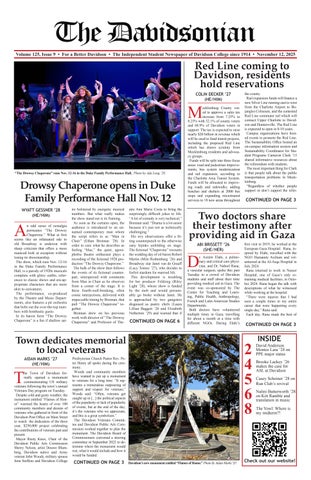
The Davidsonian 11/12/25

Page 1


Drowsy Chaperone opens in Duke Family

Performance Hall Nov. 12

ire bolstered by energetic musical numbers. But what really makes the show stand out is its framing.

An odd sense of nostalgia permeates “The Drowsy Chaperone.” What at frst seems like an infatuated ode to old Broadway is undercut with sharp criticism that offers a more nuanced look at escapism without losing its showmanship.

The show, which runs Nov. 12-16 in the Duke Family Performance Hall, is a parody of 1920s musicals complete with glitzy outfts, references to classic shows and era-appropriate characters that are more akin to caricatures.

The performance, co-produced by the Theatre and Music Departments, also features a pit orchestra that belts out the over-the-top numbers with bombastic gusto.

In its barest form “The Drowsy Chaperone” is a fun if shallow sat-

As soon as the curtains open, the audience is introduced to an unnamed contemporary man whom the script refers to as “Man in Chair” (Ethan Brennan ’28). In order to cure what he describes as feeling “blue,” the quiet, agoraphobic theatre enthusiast plays a recording of the fctional 1928 production “The Drowsy Chaperone.”

The bulk of the show then follows the events of its fctional counterpart, interspersed with comments from Man in Chair as he observes from a corner of the stage. It is these fourth-wall-breaking, often comic interjections, delivered with impeccable timing by Brennan, that pull “The Drowsy Chaperone” together.

Brennan drew on his previous work with director of “The Drowsy Chaperone” and Professor of The-

T(HE/HIM)

he Town of Davidson formally opened a monument commemorating US military veterans following the town’s annual Veterans Day program on Tuesday.

Despite cold and gusty weather, the monument entitled “Flames of Honor” warmed the hearts of over 100 community members and dozens of veterans who gathered in front of the Davidson Post Offce on Main Street to watch the dedication of the three year, $250,000 project celebrating the contributions of veterans past and present.

Mayor Rusty Knox, Chair of the Davidson Public Arts Commission

Sherry Nelson, artist Douwe Blumberg, Davidson native and Army veteran John Woods, military spouse Jenn Steffens and Davidson College

Presbyterian Church Pastor Rev. Peter Henry all spoke during the ceremony.

Woods said community members have wanted to put up a monument to veterans for a long time. “It represents a tremendous outpouring of support and respect for veterans,”

Woods said. “Often, veterans get caught up in [...] the political aspects of the popularity or lack of popularity of events, but at the end of the day, it’s the veterans who we appreciate, and this is a great symbolism.”

The Davidson Veterans Committee and Davidson Public Arts Commission worked together to plan the monument. The Davidson Board of Commissioners convened a steering committee in September 2022 to determine where the monument would rest, what it would include and how it would be funded.

Red Line coming to Davidson, residents hold reservations

the county.

Mecklenburg County voted to approve a sales tax increase from 7.25% to 8.25% with 52.1% of county voters and 68.9% of Davidson voters in support. The tax is expected to raise nearly $20 billion in revenue which will be used to fund transit projects, including the proposed Red Line which has drawn scrutiny from Mecklenburg residents and advocacy groups. Funds will be split into three focus areas: road and pedestrian improvements, bus system modernization and rail expansion, according to the Charlotte Area Transit System. Funds will be allocated to improving roads and sidewalks, adding benches and shelters at 2000 bus stops and expanding microtransit services to 18 new areas throughout

atre Ann Marie Costa to bring the surprisingly diffcult jokes to life.

“A lot of comedy is very technical,” Brennan said. “Drama is a lot easier because it’s just not as technically challenging.” His wry observations offer a ftting counterpunch to the otherwise zany hijinks unfolding on stage. The fctional “Chaperone” recounts the wedding day of oil baron Robert Martin (Milo Rothenburg ’26) and Broadway star Janet van de Graaff (Lucy Tomeo ’27), who decides to forfeit stardom for married life.

This development is troubling for her producer Feldzieg (Riley Light ’28), whose show is funded by the mob and would presumably go broke without Janet. He is approached by two gangsters disguised as pastry chefs (Laura Lillian Baggett ’26 and Elizabeth Netherton ’29) and warned that if

Rail expansion funds will fnance a new Silver Line running east to west from the Charlotte Airport to Bojangles Coliseum, and the contested Red Line commuter rail which will connect Upper Charlotte to Davidson and Huntersville. The Red Line is expected to open in 8-10 years. Campus organizations have hosted events to promote the Red Line. The Sustainability Offce hosted an on-campus information session and Sustainability Coordinator for Student Programs Cameron Clark ’15 shared informative resources about the referendum with students.

The most important thing for Clark is that people talk about the public transportation problems in Mecklenburg.

“Regardless of whether people support or don’t support the refer-

CONTINUED ON PAGE 3

Two doctors share their testimony after providing aid in Gaza

ABI BRISSETT ’26 (SHE/HER)

Dr. Azeem Elahi, a pulmonary and critical care physician, and Dr. Nabeel Rana, a vascular surgeon, spoke this past Tuesday to a crowd of Davidson students and staff about their time providing medical aid in Gaza. The event was co-sponsored by The Center for Teaching and Learning, Public Health, Anthropology, French and Latin American Studies Departments.

Both doctors have volunteered multiple times in Gaza, travelling for about a month at a time with different NGOs. During Elahi’s

frst visit in 2019, he worked at the European Gaza Hospital. Rana, inspired by Elahi, travelled with the NGO Humanity Axilium and volunteered at the Al-Asqa Hospital in July 2024.

Rana returned to work in Nasser Hospital, one of Gaza’s only remaining medical facilities, in October 2024. Rana began the talk with descriptions of what he witnessed while working at the hospital.

“There were injuries that I had seen a couple times in my entire career that were happening every single day,” Rana said.

Each day, Rana made the best of

ON PAGE 3

INSIDE

2 4 5 6

8

David Anderson Montes Lara ’28 on PPE major status

Brooke Lackey ’26 makes the case for ASL at Davidson

Casey Scheiner ’28 on Run Club’s revival

Nalini Butterworth ’28 on Kitt Ramble and translation in music

The Yowl: Where is my midterm?!

AIDAN MARKS ’27
Davidson’s new monument entitled “Flames of Honor.” Photo by Aidan Marks
WYATT GESSNER ’28 (HE/HIM)
“The Drowsy Chaperone” runs Nov. 12-16 in the Duke Family Performance Hall. Photo by Ada Long ’29.
COLIN DECKER ’27 (HE/HIM)

News 2

From Center to Department: PPE to become independent major

Davidson’s Philosophy, Politics and Economics major is preparing to stand on its own after living under the umbrella of the Center for Interdisciplinary Studies since 2022. PPE’s proposal to exit CIS was approved by the Educational Policy Committee. The fnal step is faculty-wide approval, expected by the end of the semester.

Daniel Layman is the chair of the PPE department, He said the move represents growth. “We’d like to be able to offer original PPE coursework,” Layman said. “It’s really about enriching and improving the quality of the major.”

“PPE has core faculty from Philosophy, Political Science, Economics, Educational Studies, and Africana Studies and includes in its curriculum courses from each of these disciplines as well as from Environmental Studies, History, and Public Health.

The result has been an unusually pluralistic and inclusive interpretation of

PPE that fts well with the college’s mission of helping students develop humane instincts and creative minds,” Layman wrote in an email to The Davidsonian.

PPE major Katie Jung ’28 stressed that the pluralistic nature of PPE is what necessitates its transition from the CIS. “[Criticisms of PPE often] misunderstands what PPE is trying [to do]: the goal isn’t to replicate three separate majors, it’s to create a framework for understanding how moral principles, political structures and economic systems interact in conjunction with each other,” Jung said.

The wide range of disciplines has helped the major thrive on cross-departmental collaboration since its founding. However, with approximately twenty juniors currently enrolled, its size has begun to strain the structure that housed it, as CIS was designed for smaller, more experimental majors.

“It just makes administrative sense,” Layman said. “The Center is designed to incubate brand new projects and majors. It’s not within their mission

to be running full-sized majors.” CIS has been part of Davidson’s academic structure since the 1970s. Today, it serves two main functions: supporting student-designed majors, where individuals build their own interdisciplinary course plans, and overseeing center-established majors like PPE, Communication Studies and Educational Studies. These center-established majors begin in the Center as experimental models and stay there for a number of years until they prove sustainable enough to operate independently.

CIS Director Britta Crandall explained CIS as a pillar for innovation.

“The job of the Center is to be an incubator of new majors. It’s a place to experiment, work out the kinks, and see how it goes.”

“Becoming a center-established major is in some ways an even bigger step than moving out,” Crandall noted. A major going from an individual student designing a major to a faculty team building a cohesive program requires a lot more administrative work.

“If you have twenty PPE majors that all need individual independent

Space Day shows physics can be fun

NOVAK CHEN ’29 (HE/HIM)

Students and community members gathered on Chambers Lawn on Saturday for the fourth annual Space Day. The event was sponsored by the Davidson Physics Department and the Society for Physics Students and marked Space Day’s formal return after a fve-year hiatus.

Associate Professor of Physics Kristen Thompson frst conceived of Space Day in 2017. This year’s event

featured guests from the Piedmont Amateur Astronomers Club, a lecture by NASA Solar System Ambassador Debra Lester and 10 unique stations designed and staffed by Thompson’s students in PHY106: Introductory Astronomy.

Thompson said the event is meant to connect physics and astronomy in an accessible, entertaining and informative way for young learners and adult hobbyists alike.

“Space Day is something that we try to create at an entry level. So even if kids don’t have experience, or maybe the adults and the grandparents,

the families don’t have a lot of experience, they can come and there’s something for everybody,” Thompson said.

Jacquelline Nyakunu ’26 is vice-president of the Society for Physics Students. She hopes the event can dispel stereotypes associated with studying physics.

“I think it’s important to have this event so that parents can also learn about physics more than the imagination and the ideas that they have, because there’s more to physics than they think,” Nyakunu said.

The event also translated classroom

studies […] there’s just not enough faculty to go around,” Crandall said.

This path is not unique to PPE. Other majors have followed a similar one away from the Center to full independence once their size and structure matured. Educational studies, for instance, made the same jump in 2019.

For Chair of Educational Studies Chris Marsicano, the department’s transition was not about breaking away but about preserving quality.

“The administrative hurdles in the Center are good; they ensure rigor,” he said. “But once you get big, those same processes can slow you down.”

Now, educational studies handles advising and course adjustments internally, but still credits the Center for shaping its foundation. “The same things that keep rigor in a small major can reduce quality in a big one,” Marsicano said. “That’s when it’s time to reevaluate. But make no mistake, the Center is where the best ideas start.”

As PPE prepares for its next step, Layman and his colleagues are developing a methods course, a gateway course and an advanced topics seminar to replace the traditional one-on-

learning from the introductory physics course into real-world scenarios.

“I’ve introduced a unit on communicating science to the public, because I think that’s an important thing to learn to do,” Thompson said. “Regardless of whether you’re going to go on and be a professional scientist or not, you’re still going to be a parent or a teacher or someone on Capitol Hill or a politician or someone who [...] should be able to communicate science effectively.”

Of the more than 20 exhibits on display at Space Day, Thompson’s students designed 10 of them. Groups collaborated on semester-long projects to bring to the event. Topics ranged from “How Big is the Universe?” to “When Cultures Look Up.”

Three students, Savannah Dowtin ’28, Annie Norman ’29 and Matteo Liu ’28, hoped their projects would inspire and educate younger students at the event.

“First of all, I hope they learn some basic facts on the topics they don’t know, and maybe they might get inspired to take a further path on physics or astronomy,” Liu said.

Norman hopes attendees come away less intimidated. “I feel like physics and astronomy really sound scary to younger kids. So showing this community how cool it can be and making it easier for them to understand is really important,” Norman said. “When I was a little kid, I didn’t learn that much about astronomy, and so it’s cool to be able to demonstrate that [interest] now.”

For sixth grader Jordan Bullock, as-

one capstone. “I’ve heard from a lot of students who are excited about the change […] Of course, students are also curious and in some cases a little confused. College processes can be confusing but I’ve told them all to hang on. We’ll have resolution on this within a month or two, and then we can proceed from there,” Layman said.

tronomy has lots of interesting quirks and fun facts.

“Yeah, [the] sundial was really interesting,” Bullock said. “Oh, in the northern hemisphere, it goes forwards, but in the southern hemisphere, it goes backwards!”

Kristie Kang ’28 enjoyed the event and looks forward to next year’s installment.

“It would be cool if they could cover something about wormholes, because I’m hearing so much stuff about other solar systems,” Kang said. “I don’t know much about it, but it sounds like a really interesting concept that talks about how different solar systems interact.”

Saya Geer-Hardwick ’29 enjoyed Space Day. “I was interested in going because there is so much about space that I don’t know, and I’m always captivated when I hear the ways these grand-scale processes connect to our everyday experiences,” Geer-Hardwick said.

Thompson hopes to keep connecting with the North Carolina community through astronomy events in the future, especially during the monthlong North Carolina Science Festival in April.

“In addition to Space Day we’ve regularly done a spring stargazing event in April, that we continued even through the pandemic––during Covid, we had a virtual star party that people could engage in,” Thompson said. “We do that as part of the North Carolina Science Festival every year, and we hope to be part of that again this coming April.”

FROM PAGE 1

The Town of Davidson donated $25,000 to the project. About 90% of funding came from private contributions.

Blumberg is a nationally renowned sculptor. Many of his previous works, including the Nevada State Veterans Memorial, depict the contributions of armed service members. Blumberg draws inspiration from his father and uncles who served in World War II, and from his grandfather who was killed by Nazis during the Holocaust.

“I have been glad to have many

wonderful opportunities to create artworks across the nation, and I can honestly say that those that have allowed me to use artistic gifts to acknowledge and honor those who have served and the armed forces, like this opportunity, are truly a highlight,” Blumberg said.

From its vantage point in front of the Post Offce, the monument faces Davidson College Presbyterian Church on the corner of campus. Woods hopes the town and college can continue to “come together and remember [veterans’] service to our nation.”

Town Manager James Justice said

he hopes the monument will be a lasting reminder to passersby of veterans’ contributions—especially of those who call Davidson home.

“I hope folks will realize the sacrifce the veterans and their families have made for all of us,” Justice said.

“I thought this is a great piece of art [and] a place of refection for folks to really think about that and honor those veterans and their family members.”

Woods had a simple message for all who pause at the memorial. “Share a respect and a memory [and] an attitude of ‘never forget.’”

Community members gathered outside the post offce to watch the dedication.
Photo by Aidan Marks
A family at one of 10 space-related activity stations made by Davidson students. Photo by Novak Chen ’29.
Daniel Layman speaking at a conference. Photo courtesy of Daniel Layman.

Doctors on Gaza: Resilience in the face of devestation

CONTINUED FROM PAGE 1

inadequate resources to treat catastrophic wounds on dozens of patients.

“There were no facilities, no beds. We were using delivery rooms as operating rooms with no lights. We had no sutures, we had no equipment, no supplies, no sterile gowns,” Rana said. “As you’re walking through the hospital, you can’t even walk on empty ground because of patients. Patients are being placed everywhere, inside, outside the courtyard, and displaced families are living in the halls of the hospital.”

For years, organizations such as Human Rights Watch and the Middle East Research and Information Project have called Gaza “the largest open air prison.” Elahi showed the crowd a map of Gaza. “Gaza is landlocked on all sides, entirely fenced in with a military blockade that controls the sea,” he said.

Nicole Akall ’29, an international student from the West Bank who attended the talk, confrmed how closed off Gaza is. “My house is around eight miles away from Gaza. I would wake up to a really loud noise from the military aircrafts. But I don’t have any access to [Gaza] because of the divide.”

Today, the only entry point into Gaza is through the northern Erez crossing. It is heavily guarded by Israeli forces and getting access is near impossible.

“The United Nations and World Health Organization combined are allowed two crossings per week with only 25 personnel entering from the entire world. Within those 25 about fve to seven are healthcare personnel,” Rana said.

Once allowed entry, Israeli authorities pick apart all the luggage and remove anything they deem unft for Gazans.

“It’s painful because you open up your suitcase and realize half of the supplies that you needed have disappeared,” Elahi said. “Put medical supplies aside; infant formula, can that be used in war? Not sure what anyone would do with infant formula, other than feed hungry children and babies.”

Blocking all external aid has worsened the medical crisis in Gaza. Both doctors discussed how easily treatable conditions, like diabetes, are suddenly becoming life threatening diseases. “I can’t tell you how many kids are coming to the ICU, completely unrelated to the bombs,” Rana said.

Diminishing resources coupled with the growing volume of patients made it impossible to provide basic needs.

“You’re sending patients home with open wounds and incisions just to make room for the next wave that’s going to come. And that was a constant, constant, never ending cycle,” Rana continued.

Despite existing in this debilitating cycle for over two years, the doctors

continually emphasized how strong and gracious everyone they met in Gaza was. “They just excel in ability, talent, motivation and kindness,” Rana said. “It’s amazing how they’re still advancing and fourishing as best they can under such an oppressive system.”

Elahi noted that Gazans have a 94% literacy rate, one of the highest in the world.

Akall appreciated the doctors’ focus on Gazans’ humanity. “The way the doctors shifted the attention to Gazans and how strong they are as people, rather than themselves, was very humble of them.”

In an interview with The Davidsonian, both doctors spoke extensively about the rare moments of peace and calm. “One day we went to the beach. It was just a few blocks from the hospital, absolutely beautiful. And there were kids playing, trying to fnd some moment of happiness,” Rana recalled.

Elahi smiled. “Somehow half of my photos [from my trip] are of kites, just what the kids are doing to occupy their time.”

Elahi said the happy memories were tainted by the constant reminder of surveillance. “When you watch my videos it’s this weird dichotomy of this beautiful site, a kite in the sky. But in the background there is the noise of the drone, a constant buzzing, humming, terrorizing sound.” Rana expressed a similar sentiment. “There’s always some reminder there

approved a

CONTINUED FROM PAGE 1

endum, I think there is consensus and understanding [that] it is a problem.

Public transit is not working for everyone in the county. We experience this with students where there’s pretty limited options,” Clark said.

The new rail line is enticing to Davidson residents, including Assistant Professor of Classics Tori Lee, who lives in faculty rental housing on Pinecrest Street. Lee voted in favor of the referendum.

“I am a big supporter of public transit,” Lee said. “I think that a commuter rail [...] would be great for Davidson as a town, for the students who

don’t have cars to get there, and also to alleviate some of the traffc.”

Lee is “suspicious” of the 10-year timeline, but said she thinks any progress is good progress.

“I think it’ll be worth it even if the whole thing isn’t fully realized by then,” Lee said. “Any improvements they can make to roads or [any] potential for rail transit in the area, I think would be great.”

Professor of Religious Studies and Davidson resident Greg Snyder also voted for the tax, citing his experiences with public transportation.

“I spent a lot of time around New York City. You can appreciate all the trains and the things that you can do

Rana and Elahi cited a 2009 location map of the Palestinian territory of Gaza, showing built-up areas, refugee camps and crossing points. Photo courtesy of Gringer, used under Creative Commons Attribution-Share Alike 3.0 Unported license.

that [Israel is] watching you. You’re not safe. Even when you’re sitting on the beach, closing your eyes, enjoying the breeze. You open your eyes

Features Politics 3

generally concern in some quarters about the fact that it’s a regressive tax and that people who have less income will be paying a higher proportion of their income as a tax than wealthy people.”

A regressive tax is a tax that burdens lower-income people more than middle- or upper-class people. Even though every person pays the same percentage of a sales tax, that sales tax is a larger percentage of a lower-income person’s earnings than a middle- or upper-income person’s.

Ismaail Qaiyim is a core member of the Housing Justice Coalition CLT, a grassroots organization in Charlotte that advocates for residents facing displacement, homelessness and unsafe living conditions. The HJC advocated against the referendum. Qaiyim, like Snyder, is concerned about the impact of the sales tax on lower-income Mecklenburg residents.

“If you make less income, then that means that you bear a greater proportion of that of that of that tax, and that tax also disproportionately falls on residents of Mecklenburg County,” Qaiyim said.

to get around without having a car,” Snyder said. “So, my baseline assumption is that transit options are a good thing, and that a car based economy comes with a lot of problems, from the standpoint of sprawl, pollution, congestion, all kinds of things. It would be nice to be able to get down to Charlotte without dealing with I-77.”

Although Snyder himself voted for the transit referendum, speaking with many people who opposed the tax has led him to conclude that the process is “no slam dunk.”

“I’ve been in conversation with these people, sort of inside and outside of government, [and] there’s

Displacement as a result of the Red Line is one of the HJC’s primary reasons for calling on people to vote no in the referendum.

“When we look at the plan, our opposition to it was obviously based on the fact that we believe that the extended rail projects will cause displacement, and a plan to avoid displacement didn’t make its way into the fnal bill at the state level,” Qaiyim said.

Instead, Qaiyim said, messaging in support of the Red Line attached the need for public transportation to fnancial gain. The “Yes for Meck” campaign raised $1.7 million from

and in the distance, you can see the silhouette of warships parked out in the ocean and you realize, this is their normal life.”

the Charlotte Regional Business Alliance and other corporations including American Airlines and Atrium Health. “Yes for Meck,” Qaiyim said, has the wrong priorities.

“We believe that this plan really is a plan for guiding corporate investment, capital investment, and really guiding the growth of the real estate market, or the growth of luxury real estate development,” Qaiyim said.

John Autry is a former state Representative and previously served on the Charlotte City council. He shares the same concerns as Qaiyim, also taking issue with the prioritization of the north-south Red Line over the east-west Silver Line.

“I represented the people in all the east side in the city council and in the General Assembly, in the House of Representatives. We’ve been waiting 30 years for that. It was just a little too easy for the city to put their thumb on the forehead of the east side and push it away from the table again,” Autry said.

Like Qaiyim, Autry was frustrated by the CRBA and Yes for Meck’s involvement in turning a public transportation issue into an opportunity for investment. Given his experience in state and local government, Autry knows what the prospect of a commuter rail meant to East Charlotte.

“Everybody should have the benefts of rail transportation in all directions into the center city and across the city,” Autry said.

According to Autry, the right changes are still yet to be made. Autry, who is 72, said he does not think they will happen in his lifetime.

“I’ll never live long enough to ride a train from East Charlotte into the center city,” Autry said. “That won’t happen.”

Almost 70% of Davidson voters
1% sales tax increase. Photo by David Anderson Montes Lara ’28.

Perspectives

The Research Behind These Hands

As I scanned comments about the dedication of With These Hands across social media, I noted criticism of the installation as performative. Some assumed it was the culmination of work that began in 2017 with the formation of the Commission on Race and Slavery by then-president Carol Quillen.

I served on that committee, and an obstacle to our work was the piecemeal understanding of the college’s history in relation to enslavement. Thanks to previous college archivist Jan Blodgett, community members (especially in west Davidson), and others who preserved and told the “unofficial” history of Davidson College, we knew enough specific information to confirm what professional historians know to be the general pattern: the growth of institutions of higher education was inseparable from white supremacist beliefs and exploitative labor practices.

An early goal of the commission was learning more; we as a college community had neither systemically interrogated all available records nor identified additional materials in archives off-campus for evidence of enslaved and exploited workers. We also suspected—as has turned out to be true—that descendants knew important information preserved in family records. History is not the past. History is a practice

through which the living answer our questions about the experiences of those who lived before us based on evidentiary material. Social historians (including me) would argue that we can’t understand processes like the growth of a college except through people. We need names and lives we can follow across records so that we can identify patterns of common experience and change.

In 2017, I knew as much about this as anyone on campus, and I could count the names of enslaved and exploited workers on two hands. Now, we know the names of over 500 people whose unpaid labor and, after 1865, whose undercompensated labor built Davidson literally and figuratively. When the college made the critically important hire of Prof. Hilary Green, the James B. Duke Professor of Africana Studies, we added an expert whose individual research and student collaboration in her Race and Campus Histories course (AFR 224) has provided needed intellectual leadership to this massive undertaking.

The response of the College Archives and Special Collections to this challenge has been impressive. The college’s archive was established in the 1970s by a historian whose interests focused on the slave-owning families of this region rather than the enslaved. To put it bluntly, our archives were not intended for the research for which the Commission asked. The leadership of Sara Swanson, Assistant Director for Archives and Special Collections; making permanent the position of Jessica Cottle-Hart, the Archivist

for Community Records; the addition of Molly Kunkel, Archivist for College Records; and the expansion of the archives’ footprint into the Oak Row museum and the renovated George Lawrence Abernethy Library means that all of us, especially members of the community and students, will have greater access to records and, as important, the ability to add more information.

Social history snowballs; the more we know, the more we can learn. This work completed since 2017 is significant and meaningful. For example, students in my HIS 306: Women and Gender in US History to 1900 have completed projects on white women’s involvement in enslavement on campus. Other faculty have included campus history research projects in classes. Students have written class papers, capstones, and theses on campus history and race. Students funded by the Chaplains’ Office created a powerful historical walking tour.

Public art should prompt robust discussion, and sculptor Hank Willis Thomas has provided a place to reflect and think so that we may act with deliberation and intention. For that, I am grateful. The information presented at Oak Row, coordinated by historic sites manager, Marty Gimson, and available through the college archives will guide our action. For the work of Green, college archives staff, and Marty Gimson, I am equally grateful.

Those who want to learn about this period in US history and who support reparations to descendants (including me), now have better re-

An Opportunity for Davidson: American Sign Language

(ASL) Courses

For almost my entire Davidson career, I have worked as the American Sign Language (ASL) conversation partner through our Self Instructional Languages Program (SILP). As a Child of Deaf Adults (CODA), I grew up using ASL fuently with both of my Deaf parents. Since the Spring of 2023, I have supported a growing number of students who signed up for the classes, despite SILP courses not counting for the foreign language requirement. I don’t have words for the joy that supporting ASL learning brought me each day (although, I do have signs!). When interest outpaced my capacity of twelve students, I helped hire two other conversation partners to satisfy demand. What started as teaching 11 students grew to almost 30 students last spring. This is a clear indicator that an offcial ASL program at Davidson would receive student support.

This upward trend is not unique to Davidson. Interest in ASL amongst undergraduate students has been steadily increasing across the United States, and more higher education institutions are refecting this in their course offerings. ASL as an academic discipline has boomed—yet, the feld is also described as “having growing pains.” Some challenges include a lack of standardization in curriculum and qualifcations for ASL professors, combatting misconceptions of ASL in predominantly hearing environments and a loss in clarity regarding the purpose of ASL education.

Before offering ASL through SILP, Davidson offered non-credit practicum classes open to students and community members every spring from 2000-2010 and again in 2012. These

classes were offered on Fridays, and were not credit-bearing for students—yet, they were consistently at the 18-student capacity. ASL was not offered again until 2019 under SILP, offering as many as three sections of fve students per semester. From there, ASL continued to expand, peaking at 26 total students in the Spring of 2025—15 students taking Beginning ASL, and 11 taking the second semester of Continuing ASL.

This long-term interest mirrors that of Arabic at Davidson. SILP offered a sequence of Arabic from beginning to advanced from the 1990s until the Arab Studies department was established in 2007. A number of factors were involved in Arabic’s establishment as a department, including political timing. However, ASL’s numbers are 3 to 4 times higher than that of Arabic’s at the time they became an offcial department (8 students were enrolled across all of the Arabic levels during its last semester in SILP). While an Advanced ASL course has yet to be offered, I argue that the high interest in Beginning and Continuing ASL indicate that an expansion of ASL would be successful.

While this expansion could look like offering higher levels of ASL within SILP, the program’s scheduling procedures become increasingly challenging as student numbers increase. SILP course meetings are not predetermined like typical courses. Instead, during the frst week of each semester, SILP students meet with their conversation partners and fnd time in their schedules to meet two to three times a week. This uncertainty has led to students dropping ASL. If Davidson is to consistently offer quality ASL teaching to its students, I would implore them to invest in professors or teaching staff to allow greater fexibility for students and relieve this responsibility

placed on conversation partners.

It can be diffcult to ensure an ASL program is housed somewhere that encourages its development and success within a college/university’s organizational system. Unfortunately, ASL is often offered in isolation from instruction regarding its Deaf community and cultural context. Housing ASL programs under departments such as Early Childhood Education, Speech Pathology and Communication Sciences and Disorders pathologizes the language and the Deaf people who predominantly use ASL. ASL is offered for a variety of reasons and fulflls diverse purposes from school to school. However, teaching the language cannot, and should not, be divorced from the Deaf culture and community from which it originates. It would be incomplete to offer Spanish or German without teaching its accompanying history and culture, yet ASL is often offered alone—without Deaf Culture, ASL Linguistics or other relevant courses.

Many universities beneft from offering ASL and disability-related content, yet do not make a commitment to disabled scholars or students. If

sources for the conversations we must have. The intergenerational genealogies telling Davidson’s history through the lives of real people are second to none in making transparent the patterns of exploitation.

I ask that those who criticize With These Hands as a performative gesture hold the college accountable while our work continues. The historical research completed with this sculpture enables us to understand our past in ways that would not have been possible in 2017. The addition of Dr. Brittany Brown, public archaeologist and inaugural director of research at Beaver Dam Plantation, to the Dept. of Anthropology will strengthen the foundation of research laid by our historians and archivists. The dedication of With These Hands is not an end but marks a moment in this process that will continue and fulfill Davidson College’s statement of purpose in extending our learning to the whole of humanity.

Rose Stremlau, Ph.D. is Charles A. Dana Associate Professor of History. She can be reached for comment at rostremlau@davidsn.edu.

Davidson were to establish an offcial program, this would be accomplished most equitably by offering ASL in conjunction with its Deaf context, and to deploy preferential hiring practices of Deaf professionals.

The Davidson College Statement of Purpose states that the college values diversity. Davidson’s website further elaborates: “cultivating a broadly diverse community is crucial to our educational mission.” I propose that investing in an ASL program would be highly aligned with the educational goals of Davidson, and better serve the Davidson student body. Our college has the opportunity to support the local Deaf community, and to center disability-related content for students—challenging and expanding what we typically privilege as knowledge within academia.

Brooke Lackey is a Psychology and Education Studies double major from Winstom-Salem, NC. She can be reached for comment at brlackey@ davidson.edu.

BROOKE LACKEY ’26 (SHE/HER)
PROF. ROSE STREMLAU (SHE/HER)

SPORTS

Davidson shocks Presbyterian in historic upset

avidson Football Head

DCoach Saj Thakkar has a 24 hour rule in his program.

“You can be down for 24 hours after a loss and celebrate for 24 hours after a win,” Thakkar explained in an email to The Davidsonian. For the frst time in 2025, Thakkar’s Wildcats (2-8, 1-5) spent their weekend celebrating a conference victory. In a stunning upset, Davidson took down No. 23 Presbyterian College in a 14-13 nailbiter on Nov. 8. It marked

Davidson’s second ever victory over an FCS ranked opponent and the frst since 2021, when the ‘Cats beat No. 25 San Diego 31 25.

Presbyterian made its frst ever appearance in the AFCA FCS Coaches Poll earlier this season. The Blue Hose (8-2, 4-2) have dropped fve straight matchups with the Wildcats.

Davidson now leads the all-time series 20-14-2 after claiming the 36th Battle for the 1919 Cup.

Thakkar’s team checked boxes for its gameplan in all three phases. “Going [into the game], the message to the team was effciency on offense,

tackling and turnovers on defense, and game changing plays on special teams,” Thakkar wrote.

“Offensively we had three ball carriers rush for over 4.0 yards per carry, defensively we forced three turnovers, and our punt unit on special teams pinned PC inside their own fve yard line late in the 4th quarter.”

Davidson’s 13 points allowed on Saturday were its fewest against a Division I opponent since Sep. 2, 2023 when they fell to VMI 7-12. The ‘Cats defensive leaders delivered in crucial moments to grow a lead and seal the victory. “I thought some key performances for us came from OLB Hayden Bender [‘27] who had a key interception to spark a 14-0 scoring start,” Thakkar wrote.

“Captain DL Mikah Kent [‘26] was in the backfeld all game making plays in the run and pass game. [Captain S] Dom Njoku [‘26] came back in after a minor injury and was able to come up with a key interception later in the fourth quarter.”

It has been a turbulent season for Davidson. After blowout losses to open the season, the ‘Cats have come close on several occasions to earning conference wins. In an Oct. 4 road matchup with Stetson University, Davidson led by three with

9:09 to play in the fourth quarter but ultimately fell three points short. Against the University of San Diego on Oct. 25, the score was tied at 28-28 going into the fourth quarter but the Toreros used a 12-0 run in the fnal ffteen minutes to defeat the ‘Cats. In a heart-breaker on Nov. 1, Davidson surrendered a game-winning touchdown to Morehead State University with 1:06 left after previously leading for the entirety of the second half.

“We have been so close in multple conference games this year that we just couldn’t fnish in the fourth quarter,” Thakkar wrote.

Despite the struggles, Thakkar’s team persevered through the adversity, culminating in one of the program’s biggest upsets of all time.

“The win was great for our program. For our players to be able to execute for four quarters in all three phases in that type of game against a great opponent is a great sign for things to come. For us to get these next two we need to build off what we did well and correct the mistakes we made. It is much more enjoyable to correct things after a win, though!”

Run Club sees revival in student interest

CASEY SCHEINER ’28 (HE/HIM)

When running enthusiast Andrew Denny ‘23 arrived at Davidson in 2019, he could not fnd an organized recreational running community on campus. Six years after Denny founded a club to fll that void, Davidson College Run Club has expanded into one of the College’s largest ftness communities, boasting over 140 members on WildcatSync and GroupMe. Run Club now organizes three practices a week, sends athletes to track and cross-country meets around the region, and hosts various team bonding events.

Credit for this shift over six years lies not only with the club’s founder Denny, but also with the leaders who succeeded him in charge of Run Club after he graduated: Addie Anderson ‘24, Michael Chapin ‘24, and Chelsea Gaesser ‘25. Now, having learned the ropes from Gaesser last year, three sophomores—Olivia Hess ‘28, Colin Richardson ‘28, and Sarah Tabor ‘28—now assume the leadership mantle as presidents.

Upon returning this fall, the trio wasted no time organizing programming to draw in new members. Even before the frst day of classes, Run Club was active, with Hess and Tabor leading an orientation week run for freshmen on campus looking to meet other runners and familiarize themselves with Davidson’s trail offerings.

“I went to the orientation run and it turned out to be a lot of fun,” Declan Lonergan ‘29 said. “I liked that there were groups of different paces. The social atmosphere was good. Everyone was talking and super friendly and inviting. The 5k run went by pretty quick just getting to talk to everyone.”

From there, the club did not relent.

For the frst time, Run Club co-hosted the Cake Race, operating a booth at Baker Sports Complex by the start/ fnish line to capitalize off the day’s enthusiasm for running to recruit new members. Alongside standard Monday afternoon and Thursday morning runs, the presidents have organized various “Friday Funday” practices such as a run to Carolina Cones ice cream parlor and a scavenger hunt around campus. The club also continues to host additional special events, including a pasta party before a meet, a Wildcat Weekend family jog, and an upcoming bakesale.

For this rise in participation, Hess credits not only the club’s special events, but also their general spirit of inclusivity and camaraderie that permeates all of their programming.

“We also emphasize the ‘no man left behind’ principle: if there’s someone who is running slower than you, and you’ll leave them in the dust if you continue at your pace, we encourage you to lower your ego and go with them, because the point of Run Club is to run, but also to make friends and form connections,” Hess said.

As Run Club continues to welcome new and seasoned runners alike with open arms, it has also looked to invest more in the competitive collegiate club running scene.

“We have a range of what people want to do: some people want to compete here and get faster, and then also, people want to just like frolic, have fun, and hang out with friends,” Hess said.

In September, the club traveled to Chapel Hill for the Carolina XC Classic, where they faced off against stalwart teams from University of Georgia, Clemson University, Duke University, and other large universities around the Southeast. Of the 13 schools competing, Davidson was the lone liberal arts college.

“It’s a big burst of pride to be able

to compete against and even beat many of these big time SEC or ACC schools while wearing Davidson’s logo,” Richardson said.

Despite Davidson’s smaller size, the Wildcats held their own in Chapel Hill, with Asa McCaleb ‘28 and Nathanael Fritz ‘28 leading the effort on the men’s side in the 8 kilometer race, both placing in the top quarter of the race with over 120 entrants. Both ran below 29:15, fnishing the nearly 5 mile course at a sub-6 minute/mile pace. In the women’s 6 kilometer, Tabor led the charge with a fnish in the top third with a 26:38, while rookies Elena Milsted ‘29, Emma Miller ‘29, and Nina Howards ‘29 also got valuable competitive experience in their frst collegiate meet while running in a pack together.

“What I especially enjoyed was the racing environment. Obviously, it was a very competitive feld, so a lot of good runners out there. It’s probably one of the most exhilarating feelings, just being able to go out and compete,” Fritz said. “I loved having my good friend Asa there too. It was great that not only could I race other people from other schools, but I could also work with Asa and pace off of him in order to feel really comfortable with my pace and my overall race strategy.”

The meet and the associated 250 miles of travel between Davidson and Chapel Hill also made for a day of teamwide bonding.

“Getting to ride in the van together to Chapel Hill, exploring downtown, and going to Raising Cane’s after the meet were all fun highlights that brought us closer together as a team,” Tabor said.

The presidents believe the Carolina XC Classic was just the start of a tradition of running excellence for Davidson Club Running. On the men’s side, they look to build on McCaleb and Fritz’s contributions with the

additions of Thomas Lane ‘26, Ryan Collins ‘28, Caleb Machorro ‘28, and Michael Hogan ‘29. For the women, the future is promising: Hess and Tabor paired with the trio of freshmen who competed in Chapel Hill make for a formidable unit that will be intact at Davidson through 2028. While injuries and absences meant the club could not feld a full 5 person team to compete in the team side of the competition at the Carolina XC Classic, the team is confdent that with its recent growth and renewed depth, it will be ready to put forward a full squad in no time.

Administratively, the club continues to take more steps to support this mission of competitive success. This year, in a culmination of efforts dating back to Gaesser’s time in charge, the club received certifcation from Davidson as a club sport, granting them access to additional funds to go towards club uniforms, registration fees, and other requisite expenses for the team’s competitive pursuits. Gaesser also registered Davidson with the National Intercollegiate Running Club Association (NIRCA), the organization that hosts and organizes the premier American univer-

sity run club meets. With Run Club now receiving the necessary funding, it can fnally fully participate in NIRCA’s slate of meets.

“We weren’t able to do any more cross country races because at the NIRCA level, there is a uniform requirement, and we don’t have the uniforms right now. We just put an order in, so once we get the uniforms, we can compete more,” Richardson said. “The competitive athletes on our team want to do well at regionals and do well at nationals in the future, and having uniforms will be a big step towards making that possible.”

Having seen Run Club change over the past four years through four distinct leadership teams, Lane refected on the club’s evolution over time.

“Freshman year, we had a good crew, but it was defnitely very small. Sophomore year it felt a little dead: people came and we ran each week, but there was very little community,” Lane said. “Last year, Chelsea, Sarah, Olivia, and Colin did a good job creating more of a community feel where we get to bond with each other.”

Run Club after the Carolina XC Classic. Photo courtesy of Sarah Tabor ‘28.
ALEX THOLE ’28
HE/HIM
The team gathered for a picture following their Nov. 8 win over Presbyterian. Photo courtesy of @davidsonfootball on Instagram.
‘Cats cheer from the sideline. Photo courtesy of @davidsonfootball on Instagram.

Arts & Entertainment

Spectacle and sentiment merge in “The Drowsy Chaperone”

debunking the show’s all-too-perfect world.

he cannot stop the wedding and appease their boss, it would be “a recipe for disaster” for Feldzieg.

Even as the opening numbers construct a grand and stylized depiction of 1920s life, one not dissimilar to that of actual early Broadway shows, Man in Chair is eager to share trivia

However, this is not done to disparage old musicals—quite the opposite. Even while poking holes in the Golden Age optimism of the fctional “Chaperone,” Man in Chair is more than willing to engage in its fabulous sensibilities.

Such a maneuver is essential for

the actual show. By acknowledging its own rose-tinted glasses, “The Drowsy Chaperone” opens the stage for a fascinating exploration of nostalgia and escapism that would otherwise be lost.

Still, the spectacle of the fctional show lands exceptionally well, in no small part thanks to the actors. The second number “Cold Feets” lets Rothenburg fex his impressive tap

dancing chops, while the proceeding “Show Off” is a tour de force for Tomeo, whose character begins to question the impending wedding.

In the meantime, Feldzieg recruits the self-described ladies’ man Adolpho (Ryaan Sabooni ’26) to seduce Janet, only for him to enchant the titular Drowsy Chaperone (Grace Gentile ’26), who has been tasked with keeping the soon-to-be bride from seeing her husband before the ceremony.

Needless to say, things do not go to plan. Act I ends with the wedding in shambles. (Though as Man in Chair points out, “everything always works out in musicals.”) There is no intermission, because Man in Chair has a disdain for them and insists on fipping the record over immediately.

The lack of intermission is no big deal, partially because of the show’s natural brevity but also because the frst musical number of the second act was cut.

In the original script, Man in Chair accidentally plays the wrong record, leading into “Message from a Nightingale,” which features the actors wearing oriental garb in what was intended to be a spoof of racist early musicals.

“When it was performed in 2009, I think it was problematic back then,” Costa said. “When it went into touring, I don’t know of one company that has used that song [...] Because it wasn’t really part of the story, it was easy to cut.”

Instead, the show continues with entertaining numbers that lean into the excess of Broadway. Madeline Kleiner ’28 and Evan Oldenburg ’28 display impressive chemistry (and serious commitment to craft) as Mrs. Tottenham and her aptly-named butler Underling in the spit-take-laden “Love Is Always Lovely in the End.” As the performance comes to a crescendo and the references pile up, the enthusiasm of the actors is apparent. “For someone who really likes musical theatre, there’s a ton of inside jokes which are super fun to be a part of,” Kleiner said. It is not all sunshine and rainbows though. As the show progresses, more and more details about Man in Chair’s life spill out. Amidst the triumphant ending of the faux show, he becomes increasingly distraught until it all spills out in a fnale that is eye-watering, cathartic and crushingly real.

Kitt Ramble performs songs from EP ‘Invocation,’ explores future of translation

point to the future potential of classical translation.

Last Thursday, singer-songwriter Kitt Ramble visited students and performed from her EP “Invocation” following an invitation to campus by Professor of Classics Keyne Cheshire. The EP’s fve songs cover a range of ancient Greek and Latin literature, spanning hundreds of years of mythology and poetry.

Cheshire discovered Ramble by chance, after being recommended her translation of Theocritus’ “Idyll 11” (her song “Galateia”) for his Advanced Greek class. “I looked her up and [saw] she’s in Raleigh, North Carolina. I was like, ‘what the heck?’ So it just seems like destiny,” Cheshire said.

Translation offered Ramble an initial vehicle for her primary creative impulse––telling a good story. While the logistical puzzle of Latin and ancient Greek translation was exciting, it was not enough. Translating into music presented a more compelling storytelling challenge: converting Latin and Greek texts to English prose, then adapting these translations into lyrics for her music.

“You have to puzzle together your instruments, your instrumental background, your lyrics, the sound as well as the sense of what you’re trying to convey,” Ramble said. And, if any one of these things is “out of whack,” then she has to scrap lines—sometimes whole stanzas—and start over. Ramble’s song project elicited excitement for many translators in the audience. Classics major Colby Johnson ’26 expressed his enthusiasm at the opportunities for creativity within translation practice. “I don’t need another prose translation of a poetic text,” Johnson said. For him, Ramble’s accessible adaptations

In fact, most extant ancient literature was performed on stage or to music.

Translation projects like Ramble’s which lean into the music are especially exciting for Assistant Professor of Classics Tori Lee, who specializes in Latin poetry and translation.

“This is great, [being able to have] an experience that ancient people had,” Lee said.

Ancient poetry had specifc meters that gave the text its own rhythm to align with the music. Ramble spoke of her troubles bringing the frst line of Homer’s “Iliad” into her song “Battle Cry” about Achilles and Patroclus. She had to tinker with her timing to ft the original line and meter into her music.

Ultimately, though, Ramble said she is moving away from translation.

“The longer I went, the more I realized, it’s not so much that the classical translations are the thing that I am rooted in. It is that storytelling aspect,” she said. Since releasing “Invocation,” Ramble has expanded her topics. Her latest song “Revelation,” answers the question that came to Ramble after bingeing NASA documentaries and Star Trek: What happens to space rovers in the apocalypse?

Translation aside, Ramble’s music is also notable for its intertext—the references she makes to other authors, stories and texts. Her song “Galateia,” about Polyphemus the Cyclops and his love interest Galateia, uses allusions to indicate the threatening nature of Polyphemus’ romantic pursuits. Similar to the references that Theocritus makes to Homer, Ramble opts for cheeky cultural references,

like Beauty and the Beast, to resonate more with her contemporary audience.

Beyond the lyrics, Ramble relies on other sounds in her storytelling.

She incorporates the frst line of the “Iliad” into her background vocals in “Battle Cry.” When Ramble reaches the Greek lyrics, the percussive elements, including the sound of marching feet and clanging armor, speed up to align with the Greek meter.

Besides being a satisfying crescendo, the sounds of marching in the background quite literally echo the knowledge that Achilles’ march to war sealed his death sentence. As the steps speed up, the listener feels an anticipation for what comes next.

What follows is a song about Eurydice, already dead and in the Underworld—a discreet implication of Achilles’ fate. The intricate connec-

tions to death and loss illuminate Ramble’s intention of using “Invocation” to examine “deep-seated questions about loss, grief, and purpose through the lens of [...] Greek and Roman mythology,” per the EP’s blurb.

Lee explained that a successful translation in classical studies is typically measured by its ability to emulate the source text—imagining only one way to express understanding. “To have translation only be used as a tool [to evaluate familiarity of a text] takes away from the art of it,” Lee said.

The discipline, as Lee frames it, determined that mastery could only look one way, even though artistic projects necessitate the same degree of knowledge. She noted that art is not how translation is typically done in higher education, though it ought to be. “[Translation is] an artistic choice, and a way of making a political statement, and a way of sharing your viewpoint,” Lee continued. Johnson similarly discussed his frustration with the history of classical translation. Even if the authors are long dead, they come from vibrant cultures, something often lost in conventional translation. “A lot of what people love about Classics is stories,” Johnson said. “But we are not doing anything new [today], as far as readability goes.”

If the standard of classical translation is stuffy and artless, then storytellers like Ramble offer a new (or ancient) option for both the art of translation and reception of these texts beyond the page—namely, through music.

“I have a real interest in reclaiming what we call poetry—we call it poetry, we call it literature, but really it was song,” Cheshire said.

NALINI BUTTERWORTH ’28
Kitt Ramble performs in the Carolina Inn. Photo by Kaspars Golos ’27.
Students on stage during a rehearsal. Photo by Ada Long ’29.
CONTINUED FROM PAGE 1

Living Davidson

Across 1. Chester’s orange puff

7. Gp. advising pres.

10. Loomed

14. Deep brass output

15. Single or twin

16. Sinatra: “____ it my way”

17. Pleasant sewn lines*

19. Taylor or Reinhart

20. Bikes have two

21. “I’m ____ loss…”

22. Snow pellets

23. Big baleen

24. Foe-pal

26. Smoothly and of assorted fabric*

32. Simpsons bartender

33. Husb.’s mom

34. Olga’s male counterpart

35. ATM device

39. Small snoozing sessions

41. Tilted type, abbr.

42. Title of revered Frenchwoman

44. Irritate

45. Culminating at the needle*

49. Proteges

50. Dark drink

53. Southend-on-Sea county

56. USSR’s Cold War foe

57. “Crazy” Patsy

59. What can cause a student’s debt

60. Craft an emotional outburst*

62. Follower of K or Wal?

63. Nay’s opposition

64. Heartfelt connections

65. Slides down a snowy hill

66. xxx-xx-xxxx ID

67. “Cheers!”es

Down

1. Goes for

ANNA MORROW ’28 (SHE/HER)

S2. “Deal or No Deal” host Mandel

3. Cajun celebrity chef

4. Fencing blade choice

5. Skin pics

6. “Really?” responses

7. Warriors, for one

8. Of the meanings of words

9. Cassettes’ successors

10. Chocolate Factory man

11. Garfeld’s nemesis

12. Despicable

13. Rework in a draft

18. Western Wyatt

22. Texter’s “unbelievable!”

24. Uses as sustenance

25. French custard-flled treats

27. Tools

28. RV stop

29. Pay addition?

30. Speedwagon initials

31. Mass measurements

35. Selfe, ex.

36. “Who am ____ judge?”

37. ‘60s war locale, shortly

38. Decrees

40. III in Italian

43. Summer wind in the Aegean

46. Lone Star State shortening

47. Reason for AC

48. Floats off

51. Eastern Catholic church member

52. Apportions, with “out”

53. Street-shading trees

54. Take a foot bath

55. South Asian garment

57. End of a sneeze?

58. Tomb raider Croft

60. GPS part, abbr.

61. Meower

So-Sew

Stripes on Monday

tripes Monday recently celebrated one year of capturing students faunting their striped wardrobes. On any given Monday in Nummit nearly everyone is in some sort of stripes. From a traditional horizontally striped t-shirt, a stripe down the side of a pair of pants, or lines that appear naturally are captured by stripes enthusiasts and sent to the Instagram account @stripesmonday to be posted for the community to view.

Statistics from the past year were recently tallied for Stripes Monday’s one year anniversary and concluded 1423 total submissions amongst 323 unique stripers. Charlotte Welsby ‘25 earned the title of most appearances on the account, with 52 striped Mondays. She is followed closely by many “prolifc stripers” who dedicate their frst outft of the school week to this celebratory weekly occurrence.

This tradition was started by Abby True ‘25 informally with her friends wearing stripes and eventually by documentation on Instagram. As True planned to step away from campus, she “anonymously tapped” Cate Goodin ‘26 and Ella Grace Dunn ‘26 to continue the tradition.

“It really got going last fall, and when I came back [from abroad] I knew what I was wearing every Monday,” Goodin said.

Goodin cites the tradition as an incentive to share clothes among friends. Stripes Monday does not encourage overconsumption, but asks students to mix up their striping habits because of the documentation of outfts.

Goodin commented on change in vision stripes has coaxed. “I don’t like to buy for Stripes Monday […] But when I go into Valley Village Thrift, I notice my eyes really being drawn to the stripes.”

The most critical piece to Stripes Monday is the community that has developed as a result. Community was a common word used

by stripers when they were asked to write in to the account about what stripes mean to them in preparation for Dunn and Goodin’s anniversary post. Dunn described striping as “the cynical nature of the world and harmony.”

Grace McGuire ‘25 is a celebrated stripe wearer featured 49 times on the account.

“Stipes Monday makes Mondays a little less scary and brings me a special joy when I see someone who is accidentally celebrating,” McGuire wrote.

Katherine Marshall ‘26 is another frequent stripe wearer. “My friends are near and far. But I hold them all close in my stripy adornments,” she wrote.

Goodin echoed Marshall. “It’s now a tie between the current Davidson student population and the graduated Davidson students,” Goodin said.

Because of this tradition, I am faced with a weekly dilemma of a striped pair of overalls.

In addition to Stripes Monday, Overalls

Thursday has developed as a tradition. Though less common than the popular choice of stripes to start each week, I feel the same pressure to show up to Nummit in stripes on Mondays and overalls on Thursday. Because of my great fear of missing out on this community, the only solution is to do laundry on Tuesdays.

Crossword by Katie Davis ’29
Answers to 11/05/2025 crossword:
Students showcasing their striped outfts from a Union Board meeting to the Colosseum in Rome. Photos courtesy of @stripesmonday on Instagram.

Yowl The

Irreverent student journalism since Just Now. Castigat Ridendo Mores.

yowl.com/MSBGBlitz Commons Issue

Meatball flavored vape in Wellness Wendy

Davidson’s Women’s Basketball Season Starts: Turner House + Half of Rusk Elated

Page Meathol

Page Dribbling

November 12, 2025

New Music class offered: Theory of the Brown Note

Page MUS 312 A

Tuition Increase Actually To Fund New Ballroom: Demolition Begins On Chambers East Wing

On Tuesday, November 4, President Doug Hicks sent an email detailing the 6.5% increase in tuition for the upcoming school year. Hicks claimed in his email that the increase will continue to support the school’s educational mission, but later in a press release and interview with The Yowl, he revealed the true reason: a new college ballroom being built adjacent to Chambers. The closest thing the college currently has to a ballroom is the Lily Family Gallery, which is currently serving as a library due to the ongoing renovation project. The gallery is housed in the Eastern Wing of Chambers, which also contains many faculty offces, classrooms, and computer labs. Hicks revealed that the new ballroom will be built in the same space, except that it will be much bigger. “We needed a ballroom as big as my ego,” Hicks reported, “so I told my people that I want it four stories tall, and make it stretch across to the library building too”. The library renovation has been put on hold, as a revised plan to incorporate the building into the new ballroom is being drawn up. When we asked what would happen to the library, Hicks had this to say: “books are quite frankly overrated, who needs them when you have my visionary statements and emails that are the length of one?”. Hicks then went on to proclaim that “I know words. I have the best words.” “President Hicks is a builder at heart and has an extraordinary eye for detail”, said Director of Media Relations Jay Pfeifer in a statement. “This will be a true monument to the greatness of President Hicks, the best President this college has ever seen, and will quite frankly ever see in the future”. The college is not yet sure who the ballroom will be named after, but it will likely be christened upon completion at the same time President Hicks holds his coronation ceremony.

The Real Reason Behind The Tuition Increase - A Yowl Investigation

Earlier this week, Davidson president Doug Hicks showcased his version of ethical AI use with an email declaring a 6.5% tuition increase for the 2026-27 school year. This increase, one of several totaling around $20,000 over the course over just the last four years, caused some polite, demure push back from the student body. Many are asking one simple question: “What is the money for?” What will actually be improved with this tuition increase. Well, The Yowl obtained exclusive access to the proposed budget, and we’re here to leak all of Dougie’s dirty little secrets.

The plans for the increase in cash have been divided into three distinct categories: Campus improvements, facilities, and “enhancing the student experience.”

Campus improvements: The proposed budget allows for Commons to enhance their already robust menu. An entire second meat (horse) is joining the already-beloved ‘mysterious roadkill’ and will gradually be worked into every applicable meal. The remaining funds will be used to research a way to somehow increase the grease-to-food ratio for the pizzas.

Facilities: Much of the funding here is focused on Davidson’s now-infamous football team. Davidson College has committed a frankly staggering amount of resources to the seemingly impossible task of attempting to teach the coaching staff how to win football games. An entire staff of coaches and psychologists have been hired to try to teach the current staff everything from what a touchdown is to the concept of a successful forward pass. The college hopes that this endeavor will counteract years of the football team exclusively practicing with frisbees.

The Student Experience: This is the most resource-intense aspect of the redesigned budget, but perhaps the part students will appreciate the most. Davidson College is investing heavily into increasing the security around parties, a situation they describe as “currently, far too accessible and convenient” to enter. The school has invested in massive TSA grade metal detectors which they intend to place outside of each party. Instead of simply having to scan their Student ID, students will now have to undergo multiple full body scans totaling around 46 minutes of additional probing before being blessed with the opportunity to enter the public gathering.

The budget ends with the following: “Davidson College is as committed as ever to charging more and providing less.”

-Doug Hicks

WRITERS

Sandy Loam

Clay

Silt

Loamy Sand

Silty Clay Loam

Incident of The Week

Davidson College in a state of impending war as MSBG claims to have launched the WMD Saturday night at F

Much Ado Catering Budget Error, 40 units of Commons Lobster ordered to KSIG for Boiler Room

Page Steamy

Connor Hines worried as a Democratic Nummit-alist gains sophomores’ SGA vote

Page Free Syrups

My Professor Still Won’t Give Me Back My Midterm

It’s been weeks since I was able to blame the messiness of my room and my bad attitude on the fact that I was in the depths of Hell at Davidson: midterm week. Halloween has passed, the leaves have fallen, and I’ve already begun working on my fnals. Yet my professor still won’t give me back my midterm.

They walk into class every week holding their Harvard coffee mug (just in case we forgot that they’re better than us) and talk at us for three hours straight with no break or even pauses for air.

“WHERE IS MY MIDTERM???” I telepathically scream at them while uncomfortably sitting in the same Chambers chair I choose to sit in every week.

I’ve gone to their offce hours, sent multiple emails to their outlook… I’ve even slid into their WhatsApp dm’s in a moment of weakness. Still no midterm.

I know I should enjoy the blissful ignorance I have right now while not knowing my midterm grade, but my professor hates us and has made this one paper 68.53% of our fnal grade. This is all I have.

I’m losing my mind. I can already see myself sitting at the dinner table at Thanksgiving mumbling to myself, “my midterm… where is my midterm”. I’m starting to wonder if I just imagined turning it in, and there never even was a midterm to begin with.

Please send your thoughts and prayers.

Haiku From The Yowl Poet

Laureate

F ootball home game win Addison Rae Grammy nom Our world is healing.

Let’s all think

~

Equine Announcement

Last Autumn, we saw record-breaking temperatures along with their devastating effects. The Yowl has previously covered one of these subjects: the equine infuenza scare from the Brazilian Horse Flu, which thrived in the warm, dry, winter weather. The BHF devastated livestock crop, glue production, and temporarily halted horse-drawn carriage rides in New York City, which, in turn, sent Wall Street into a tizzy and resulted in a brief destabilization of the surrounding economies. It’s clear: the Brazilian Horse Flu is no infection to be doubted. Meteorologists suggest this Autumn season to produce the perfect conditions for another BHF outbreak. Follow along the Yowl’s investigative journey into BHF outbreaks.

Quote of the Week

“No more scary emails”

Note: The Yowl is a satirical supplement to The Davidsonian Hence, nothing in it should be taken as truth. Unless you feel like it.

Turn static files into dynamic content formats.

Create a flipbook
Issuu converts static files into: digital portfolios, online yearbooks, online catalogs, digital photo albums and more. Sign up and create your flipbook.
The Davidsonian 11/12/25 by The Davidsonian - Issuu