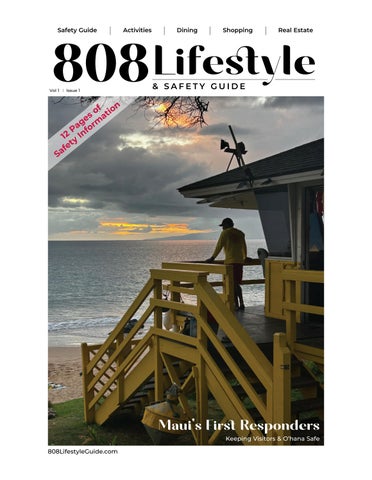
0101 High Res w_Links

Page 1


Aloha,

On behalf of the fire fighters and ocean safety lifeguards of the Maui Fire Department, I would like to welcome you to our islands. Our mission is to protect and preserve life, environment, and property but we also recognize the importance of prevention. Throughout this publication, you will find tips to ensure your time spent on Maui, Molokai, or Lanai is enjoyable and most importantly, safe. Whether you choose to hike our scenic and diverse trails, swim at one of our beautiful streams or waterfalls, or enjoy the sunshine at one of our spectacular beaches, there are actions you can take to ensure your safety. We highly recommend you adhere to all warning signs, check the island’s weather, and only visit guarded beaches. Our goal is to ensure you have a wonderful experience while visiting us.

Mahalo,

Brad Ventura

Maui Fire Chief

The Facts

Don’t leave your toddler or child alone in your hotel room. To find a babysitter, ask a concierge for the name of a qualified service that can provide trained short-term nannies.

Chdren

Lifeguards are not substitute babysitters.

Drownings

and non-fatal drownings occur in familiar surroundings during very short lapses in supervision. Do not expect a flotation device to protect your child. It is too easy for the child to become overconfident. Sunscreen should not be used on children under 6 months old. Keep them completely out of the sun. Don’t rely on swim lessons to protect your child. Swimming on vacation is very different from swimming at home. Ocean conditions can change minute to minute. And hotel pools vary in depth and size.

Stay Safe

• Supervise your children at all times, at the beach, at the pool, in the hotel or inn. Remember: water attracts toddlers and they can quickly crawl or toddle to it.

• Do not expect older children to supervise younger ones in the ocean or pool. They will be busy, distracted. . . and most likely do not have the skills to save a young child who needs help.

• Don’t send them in alone. Go into the water with your young children. Waves can be very rough; currents pull strong.

• Get reef shoes. Reef shoes are inexpensive and very effective for protecting children’s feet from beach rocks. Try to avoid touching or standing on coral.

Children who outgrow child safety seats (between 40 and 65 lbs. depending on seat weight limit) should be restrained in a booster seat until they are big enough to fit in an adult seat belt (approx. 80 lbs. and 4'9" tall).

Hawaii's Child Passenger Restraint Law requires children ages 4 - 7 years old ride in a child safety seat or booster seat when traveling in a motor vehicle. Children over 4’ 9”, or if the vehicle has lap-only seat belts in the rear seats.

• Protect your children from excessive sun and dress to avoid burn. The sun is strongest (between 10 am to 2 pm). Apply “reef safe” sunscreen liberally and frequently to children 6 months of age and older. Also, wearing protective clothing such as hats, long-sleeved shirts, sunglasses or rash guards and wetsuits in the water will help.

Waves intensity can change rapidly. Do not let your toddler play too close to the ocean.

Always take a charged cell phone with you to the beach or pool. Be ready to dial 911.

Maui County Rescue Tubes & Lifeguard Stations Locations

Drowning is the leading cause of death for children ages 1 to 15 in Hawai’i, drowning is also the leading cause of death amongst our visitors. Hawaii had an average of 80 drowning deaths per year in the 10 years from 2013 to 2022. Public Access Rescue Tubes save lives!

• Rescue Tubes are yellow flotation devices and are mounted on poles along the beaches. Each pole has an ID number at the top. They can be used by potential rescuers or tossed out to victims in distress, helping them stay afloat while waiting for first responders to arrive.

• How to Use the Rescue Tube: First Call 911 with your location and number of victims. Loop tethered strap over shoulders and swim to victim. Push the Rescue Tube toward victim from about 10 feet away. Do not get close to victim and instruct victim to hold on and rest. Do not attempt to climb back onto rocky shorelines. Kick or swim away from the rocks and await emergency responders.

For more information about Ocean Saftey go to: www.RescueTubeFoundation.org

Over 57 Rescue Tubes are on South Maui Beaches between Makena Surf Resort and Kalama Beach Park. Over 97 Rescue Tubes are on West Maui Beaches between Papalaua and DT Fleming Beach Parks. N
Approach the ocean with care. Slow and easy, take no chances.

• Talk to a LIFEGUARD before going into the ocean. We recommend swimming at lifeguarded beaches only.

• Lifeguards perform approximately 1,100 rescues annually at Hawai‘i’s guarded beaches. Visitors account for only 12.6% of Hawai’i’s population on any given day, yet comprises 44.2% of hospital admissions for water-related injuries.

• Head and spine injuries make up over two-thirds (68.2%) of these water related visitor injuries.

• Waves come in groups. A “soft” wave may be followed by several waves growing in size and intensity...and danger. NEVER TURN YOUR BACK ON THE OCEAN. You’ll hear that important message again and again while you are here. Because we care about you. Because it’s true.

• Never try to jump over a breaking wave. Dive under and through a breaking wave.

• Don’t attempt to ‘’do like the locals.” You’ll probably see some bold escapades while you’re here: amazing surfers, daring divers, wave maestros. Most local surfers and divers have spent many years surviving the often violent, always-unpredictable ocean. YOU stay safe!

Rip Currents

Rip currents, are long, narrow bands of water that quickly pull any objects in them away from shore and out to sea.

They are dangerous but are relatively easy to escape if you stay calm. If a tide catches you:

• Do not struggle against the current.

• Do not swim toward shore. If you are a strong swimmer, swim parallel to the shore, across the current.

• If you cannot swim out of the riptide, float on your back and allow the riptide to take you away from shore until you are beyond the pull of the current. Rob currents generally subside 50 to 100 yards from shore.

Wailea Golf Estates

A MASTERPIECE! This 4BD, 4BA + 2.5 half BA, ensuite bath residence

the home features a large gourmet kitchen, butler’s pantry, and

and

steam shower, a climate-controlled

an exclusive Wailea Golf Club membership with world class golf, stunning beaches, and renowned restaurants just moments away.

Po‘olenalena Beach, Makena

A rare chance to own Makena beachfront property awaits! Nestled along the pristine shores of Po‘olenalena Beach, commonly known as “Chang’s Beach,” this nearly one-acre parcel (.881 acre) boasts over 200 feet of uninterrupted beach frontage. With mesmerizing year-round sunsets and sweeping ocean views that capture Molokini, Kahoolawe, and Lanai, the setting is nothing short of spectacular. Already equipped with a county water meter and zoned R-3, the lot is primed for you TO COMPLETE THE ALREADY DESIGNED HOME OR to design and build your own vision. Detailed architectural plans, thoughtfully crafted by an experienced Makena/Wailea architect, can be passed on to the new owner—saving time and providing a seamless starting point. Ideally situated between the Wailea resort community and Makena Discovery resort, you’re just minutes from world-class golf, luxury shopping, resort hotels, and award-winning dining. This is a rare opportunity to create a beachfront masterpiece in one of Maui’s most coveted coastal settings. Embrace the beauty, serenity, and lifestyle that only Makena can offer. The house photos are renderings.

0 Makena Alanui Rd – Makena MLS # 407222 I $10,000,000
Photo Credit: Lukas Gonzales

Some Good Advice from Hawai‘i’s Cops

Look at that sunshine. Inhale that fragrant air. See the smiles. Feel the peace. Certainly you are safe in Hawai‘i, aren’t you? Yes...compared to most tourist destinations in the world. But, crime does occur even in paradise.

In

their own words, here is advice from 4 Hawai‘i police ofcers:

• There is that vacation mentality. Visitors forget that this is like any other city. Similar laws apply, common sense applies and nature certainly does not comply.

• Visitors need to slow down. A lot of the tourists come over and they are used to driving mainland roads. We have steep slopes, narrow winding roads.

• Don’t slow down in the middle of the road because you see something interesting. Pull over to avoid accidents.

• Don’t go someplace unless you know where you are going. Stay away from areas where people are partying or hanging out in groups. Use the same precautions you would in any city.

• Vehicle break-ins happen, especially when cars are parked at isolated beaches or trails. Don’t leave anything valuable or important in your car. Ever.

• When I go on vacation, I take one credit card and keep it on my person.

• Be careful. We see people on the way to airport, they want to take in one last spot and they have everything in their car. And it gets stolen from their car.

• Parents of visitors should not be encouraging underage drinking or letting their kids go out late at night. They can get their a$$ beat up. I’m sure there’s a better way to say that but it’s true. Parents really need to check on their kids.

• Burglaries. People staying in ground floor units… they are leaving (doors) wide open. If people would use the stick that is provided or whatever they use on the door, so (burglars) can’t just reach around and unlock the door.

• Always keep your ID with you, even out hiking and at the beach. Use the hotel safe. Leave nothing in your car.

• What we (police) see is people (visitors) who are out looking for drugs. These guys who are out selling dope… they aren’t exactly upstanding citizens. Just go a few days without your dope and just enjoy the scenery.

• We target criminals who target visitors. Some criminals target visitors because they will be gone, and the prosecution may be harder to go forward with. (In criminal cases, the state often pays for the victim to return for prosecution.)

On the Road

HONK! . . . Only If You Have To!

The Facts

We take our car horns seriously. In Hawai’i, a honking car horn is a mini emergency siren. It means something bad is about to happen. “Danger! Look OUT!”

Please use your horn judiciously. Don’t toot as a hoot, just to say hi to a friend. Don’t honk to urge someone or something (another driver?) to move. That’s considered rude. And it could get you some nasty comments or gestures from other drivers.

A friendly way to stay safe: It’s common on the islands for pedestrians and drivers to make eye contact.

A shaka sign or a nod of the head from both parties means they are focused on safety.

Getting where you want to go in these islands – whether you are walking, driving or biking – means you will encounter of variety of situations.

Our mountains also mean you’ll need to take extra caution. You’ll occasionally find yourself driving a narrow winding hillside with a mountain of earth on one side and a raging ocean on the other. Careful driving is more important than a glimpse at the scenery. Let the other occupants of your car enjoy the views. YOU keep your mind on your driving.

Stay Safe

For your own safety, use the crosswalk, even if it means walking a few extra feet. Follow these good rules from Hawai’i’s Department of Transportation: Walkers:

• Always cross at a crosswalk or at the corner.

• Look for oncoming vehicles before stepping down from sidewalk.

• When possible, establish eye contact with drivers and continue looking left-right-left while crossing. Remember that oncoming vehicles may approach quicker than anticipated.

• Make sure you are seen: wear bright or light colored clothing and use retro-reflective materials when dark outside.

Drivers:

• Stay focused and alert for sudden pedestrian movement in your car's direction when driving.

• Remember that pedestrians crossing multi-lane streets may be hidden from your view by a stopped car until they cross in front of you.

• Be extra vigilant when it is dark outside as most pedestrians fatalities occur at dawn or dusk.

• Be courteous! Stay to the right...pull over and let faster traffic pass.

Wailea Elua II #2201 – 3600 Wailea Alanui Dr, Wailea

$3,595,000 | 2 Bed | 2 Baths | 1,347 Living SF. | MLS: 406756

One of Wailea's premier properties situated on twenty-five acres with direct beach & ocean access. This ground floor unit offers easy access with complete pride of ownership as it has been meticulously maintained. Beautiful functional kitchen with top of line stainless appliances, separate dining area and nice comfortable living area that opens up to 450 feet of lanai lush green area off of lanai. Wailea Elua offers a world class beach and ocean resort, 24 hour gated and security, ocean front pavilion, world class shopping and dining.

“Selling Locally – Thinking Globally, Bridging The Future To The Present” Bruce

Mount Thomas #203 – 495 Liholiho St, Wailuku

$560,000 | 2 Bed | 2 Baths | 888 Living SF. | MLS: 406162

Experience breathtaking views from this exceptional condominium! Designed with comfort and accessibility in mind, it features an elevator, and a spacious main bathroom with a large shower and assist handles. Centrally located, it offers convenient access to shopping, dining, entertainment, the airport, and Maui Memorial Medical Center. Thoughtfully designed interior provides a welcoming and comfortable living experience. Freshly painted interior, and new flooring, this unit includes one parking stall (#19). A rare find that perfectly blends functionality and beauty.

Creatures

There’s a wonderful, colorful, exciting world waiting for you just below the sea’s surface. That world includes an amazing array of things you should watch, but not touch. The moray eel, for example, has a friendly face but sharp ragged teeth that can tear flesh easily and bacteria in its mouth can cause infection. Sea urchins, scorpion fish, cone snails, anemone sting upon contact with skin. Coral lining the ocean floor is sharp and jagged and will cut the skin. Wear footwear at all times when wading to avoid accidental cuts while diving or snorkeling near coral reefs.

Sharks

Incidents of sharks biting people are very rare, considering the number of people in Hawai‘i’s waters. About 3 or 4 people a year are bitten, Resources statistics. However:

• Swim or surf at beaches patrolled by lifeguards.

• Swim in guarded areas and stay close to the shore.

• Avoid swimming at dawn, dusk and at night.

• Don’t swim with bleeding wounds.

• Avoid murky water, harbor entrances and stream mouths.

• Don’t swim alone.

• Don’t wear bright jewelry or high contrasting colors.

• Refrain from excessive splashing.

• Don’t swim if sharks are known to be present.

• Avoid swimming near fishermen.

• Be alert if turtles and fish are fleeing the area.

• Late September thru early November are the most predominant period for shark encounters.

Jellyfish

Two kinds of jellyfish, Box jellyfish and Portuguese Man-of-War, show up in Hawai’i’s waters 8-10 days after each full moon. Neither is usually deadly, but the stings of either are extremely painful. If you see jellyfish while you are snorkeling, steer clear of the area. Watch for jellyfish warnings posted on beaches. If you are stung, see a lifeguard for assistance. If there is no lifeguard present:

• Immediately flood the sting area with water.

• Remove any tentacles from the skin using a credit card or other object. DO NOT USE YOUR FINGERS.

• Do not rub the sting with sand or anything else

• Apply vinegar and heat packs if available. Otherwise, take a hot shower or sit in a hot jacuzzi. Heat works best to neutralize the tentacles neurotoxins. Take Tylenol/ibuprofen for the pain.

• Call 911 or seek medical attention if victim has shortness of breath, weakness, muscle cramps or other signs of distress, or if a red streaks develop near the sting area.

The Hawaiian Lifeguard Association posts its monthly Box Jellyfish calendar at: oceansafety.hawaii.gov

Centipedes

Common on Maui, they thrive in the warm, damp environment. A bite is very painful, and the pain can be excruciating. If bitten, wash the wound with soap and water, apply a wrapped ice pack for 10-minute intervals, and take over-the-counter pain relievers and antihistamines as needed. If you are having a severe allergic reaction seek immediate medical care.

STAY SAFE

• Please be kind to our ocean creatures, for their safety and yours. The National Oceanic and Atmospheric Administration (NOAA) and the Hawai‘i Department of Land and Natural Resources (DLNR) recommend you stay at least 150 feet from all marine mammals and sea turtles.

• Keep your hands out of submerged, rocky holes and crevices.

• Do not touch, stand or walk on, kick, or collect coral. Coming in close contact hurts both you and the coral, which is a living organism.

• Do not touch or pick up animals in tide pools. Many animals have a natural defense and will sting or bite if they are touched.

Humpback Whales

Whale watching season in Maui is November-May with peak season typically running between mid-January and March. Whale watching boats on Maui must stay at least 100 yards away from whales to ensure the safety of both the animals and the observers.

Green Sea Turtle HONU

The most common species is the Hawaiian Green Sea Turtle (Honu), and it is illegal to touch, harass, or

Coral Reefs

They are actual living animals and can be harmed. Avoid standing, walking upon, or kicking coral. Never touch corals. They are sharp and can cut you. AND use a reef-safe sunscreen.

Safety GUIDE

Dolphins

The most frequently observed dolphins are the Spinner dolphin, and the Bottlenose dolphin. It is illegal to intentionally swim with wild dolphins in Hawaii. It's important to view them from a respectful distance and not disturb them.

The most endangered species found on Maui. View them from a distance of at least 50 feet (150 feet from a mother and pup), as they are protected species. It is illegal to disturb them. Volunteers often cordon off resting areas to keep the seals safe. It is crucial to follow their guidance. 13

Natul Disaers

Tsunamis

Historically, tsunamis have been a significant threat to Hawaii. There are 2 types of tsunamis: those created by an earthquake in the Pacific Rim and those locally-generated.

Locally Generated Tsunamis:

• If the tsunami is locally generated, the warning time can be just seconds or minutes. If the earth shakes, beachgoers must move to high ground, go far inland, quickly.

• If you’re at the beach and you feel the earth shake, run for high ground. Don’t worry about grabbing your blanket and equipment – get your family and run as far inland and as high as you can go.

Tsunamis Generated Elsewhere:

• For tsunami’s generated outside of Hawai‘i, but approaching the Hawaiian islands, Emergency Management sirens will sound at least 3 hours before the first wave arrival and you will have time to evacuate in an orderly way.

• Listen for further developments and obey instructions issued through the Emergency Alert System.

• Listen to your hotel representative for official Emergency Management announcements and instructions.

During and After:

• No surfing. Tsunami’s wall of water will be filled with debris.

• Never go down to investigate tsunami damage. More waves may be coming. Wait until Emergency Management gives the all-clear signal.

• Leave telephone and communications lines open for emergencies.

• If you are in hotel you may be asked to do a vertical evacuation, heading to the higher floors of the building instead of evacuating the area.

Hurricanes

A hurricane includes high winds, heavy rain, flooding, and high surf. Hawai‘i’s hurricane season runs from June 1 to November 30.

The Hawai‘i State Emergency Management provides an early warning system through the use of “Watches and Warnings” with statewide notification by sirens.

• A “watch” indicates that hurricane/tropical storm conditions are possible in the specified areas, usually within 36 hours.

• A “warning” indicates that a hurricane/tropical storm conditions are possible in the specified areas, usually within 24 hours.

Snorkeling

It looks easy, but it can be deadly!

In recent years, more than half of all visitors who drowned in Hawaii did so while snorkeling. Many were past middle age or had medical conditions.

• Familiarize yourself with your equipment. Practice in a pool or shallow water first.

• Always snorkel with a friend and stay in close visual contact with your partner.

• Acquaint yourself with the snorkeling area and the water conditions. Use caution when entering and leaving the water.

For beach and ocean conditions for all of Hawaii's guarded beaches visit: hawaiibeachsafety.com

The Ocean

• Swim only in designated, lifeguard-patrolled beaches. Check with lifeguards for today’s wave conditions.

• Read and observe posted sign warnings.

• If you need help, shout “help!” and wave an arm to get attention. Do not yell out a family member’s name; this limits the attention – and help – you will attract.

• Remain calm. Panic leads to drowning because of increased, useless movement and more oxygen usage. Read and memorize the rip current warning on the preceding page. Exhaustion is why people drown!

• People drown after being swept off rocks. Watching big waves from rocks next to the ocean is very dangerous. Numerous people have lost their lives when large waves knock them into the ocean.

• If you’ve indulged in alcohol or drugs (prescription or other) that may hamper your responses, STAY OUT OF THE WATER.

For beach and ocean conditions for all of Hawaii's guarded beaches visit: hawaiibeachsafety.com

At Marlow we specialize in artisan style, neapolitan sourdough pizza, as well as locally sourced meats and vegetables. Our menu, space, and offerings change seasonally. Chef/Owners Jeff and Kaili Scheer have always loved to entertain at their home in Kula. The concept for the restaurant is an extension of that warm hospitality felt while sharing good food and good wine around a table of family and friends. When the restaurant industry shut down in March of 2020, the pair began making sourdough pizza out of their outdoor oven at home. Milling whole wheat berries from a farm in Arizona, hand stretching mozzarella, whole-animal butchery, growing artichokes and summer squash for toppings - it was a true labor of love. What began as a ritual has grown into a restaurant. We look forward to seeing you at Marlow soon…

Open Daily

Breakfast 7am - 11am (Sunday 8am open)

Lunch 11am - 2pm (last seating 1:30)

Dinner 4:30 - 9pm (last seating 8:30)

30 Kupaoa Street, Pukalani, HI

The Facts

• Most accidents happen when hikers leave the established trail.

• Hawaiian forests are not like mainland forest – the growth is very dense and it is easy to become disoriented.

• Thick overgrowth can mask dangerously steep drop-offs.

• Thin, sharp lava rock above deep hole or lava tubes can crack when you step on it.

Stay Safe

• Stay on the trail.

• Read and heed warning signs.

• Don’t hike alone. Hike with friends and stay together.

• Tell someone your itinerary.

• Avoid undue risks.

– Don’t hike in mountains that are cloudy and if it’s raining.

– Don’t climb waterfalls or follow narrow ridge lines.

– Rock climbing is dangerous due to the crumbly, porous nature of volcanic rock.

• Watch the weather.

– Conditions can change quickly and rushing streams, wet trails are dangerous.

– Be careful crossing streams and creeks.

– Rainfall can suddenly raise the water level to dangerous levels and rushing water is powerful.

• Carry a charged cellphone.

• Take water. At least one quart per person and a simple snack too.

• Protect yourself from the sun.

Take only pictures... Leave only footprints.

• Watch the time. Start your hike early. Night falls quickly in the tropics.

Haleakala National Park

You pass through as many ecological zones on a 2-hour drive to the summit of Haleakala National Park on Maui as you would on a journey from Mexico to Canada. You can bike down the mountain, hike wilderness areas, drive to the summit to catch an amazing sunrise or drive the coast to “sacred” pools.

The Facts

The climate is ever-changing and unpredictable. In one day the temperatures in the park can range from a high of 80°F (27°C) along the coast to a low of 30°F (-1°C) at the summit. The temperature drops about 3°F for every 1,000 foot rise in elevation.

Call the visitor center at (808) 572.4400 to check whether Oheo Gulch or other park trails are closed due to dangerous conditions. Water is scarce. Bring plenty of water and any food you may need.

Sacred Pools

There have been numerous deaths in the popular Oheo Gulch or “Sacred Pools” area of Haleakala Park. About half of the deaths were due to drowning and half from falls, according to the Hawai'i Department of Health. The federal park service has in stalled gate and signs at the access stairway to keep visitors out when water reaches dangerous levels. It’s great fun but . . . OBEY SIGNS. TAKE NO CHANCES.

www.nps.gov/hale National Park Service photo

Stay Safe

Each year, hundreds of thousands of visitors are driven by commercial vans to park gates. They bicycle down Haleakala Mountain, mostly coasting, for about 38 miles along a 2-lane highway. From a variety of tour providers, these are suggestions for the strenuous Haleakala bike tour.

• Bike riding is strenuous. It’s not for beginners or folks who have not ridden within the past year.

• Wear closed-toed shoes, preferable rubber soled.

• Wear warm clothing in layers that can be removed as the climate changes.

• Riders should adhere to minimum age limits, usually at least age 12. Some tour companies also have max age restrictions.

• Very overweight people should refrain from riding, as should pregnant woman and people with heart or medical problems.

• Once on the tour, let the guide know if you are having any problems or if you cannot keep up with the group.

Here's to Living Maui

600 Middle Rd Unit B Kula, HI

MLS: 407177 | Price: $1,650,000

Perched high in Maui’s sought-after Upcountry, this 15+ acre CPR Unit B is a rare opportunity to create your dream retreat. Featuring its own private 5/8" water meter, septic system, dual road access from PoliPoli and Middle Roads, and multiple natural building sites, this property is ready for your vision. Imagine waking up to sweeping ocean, mountain, and sunset views from nearly every angle. This is rare property that features multiple island views! Zoned Agricultural, it allows for a 1,500 sqft dwellings — perfect for a private estate, hobby farm, or orchard. Enjoy mature trees, deer fencing, and Kula’s cool breezes just minutes from schools and markets. Schedule a visit to see this rare property!

Makawao Office 3681 Baldwin Ave I 808.572.6406

Turn static files into dynamic content formats.

Create a flipbook