SEVENDAYSVT.COM 09.27.17-10.04.17 SEVEN DAYS 32 FEATURE
few years ago, invited her to coffee and quizzed her on Vermont politics. “He was interesting and interested, which I thought was pretty neat,” she said. “I did not know who he was prior to him contacting me.” Last year, Stevens went further, offering informal advice to then-gubernatorial candidate Phil Scott. “I knew of him from strategist circles,” said Scott campaign aide Jason Gibbs, who served as an intermediary and later became the governor’s chief of staff. “When I heard his name, I was like, ‘Are you kidding me? He lives in Vermont?’” As Scott prepared to debate Democratic nominee Sue Minter, Stevens sat down with the future governor to share what he calls his “nutty theories about debate prep.” His advice? A candidate should do something enjoyable, such as exercise, before prep sessions and debates. Aim to create “two to four ‘moments’” focused on a winning argument and steer questions toward those arguments. Most importantly, avoid developing stock lines. “Having worked with a lot of actors, actors can’t deliver lines on the first take, much less politicians,” Stevens said with a laugh. “I mean, it’s the road to hell.” Scott’s takeaway from the session, according to Gibbs? Go for a pre-debate bike ride. The consultant has put his “nutty theories” into practice before, moderating mock debates for Bush and vice president Dick Cheney — and running Romney’s debate prep. While he’s only offered unpaid advice to Scott so far, he said he would “like to be more involved now” in Vermont politics. “I’m a big Phil Scott fan,” he said, pointing in particular to the Republican governor’s public chiding of the president. “I like how he’s been himself on the Trump stuff. I don’t think he’s going out of his way to pick a fight for political purposes. He’s just sort of said what he thought.”
‘Good on Race’ Stevens traces his political obsession and Republican allegiance to a childhood in the 1960s Deep South, which was dominated by segregationist Democrats. In The Last Season: A Father, a Son, and a Lifetime of College Football, his 2015 memoir, Stevens describes sitting in a high school locker room on a foggy night on the Gulf Coast in 1967. The 15-year-old watched his father, a prominent Jackson attorney and former
AP PHOTO/CHARLES DHARAPAK
GOP Refugee « P.31
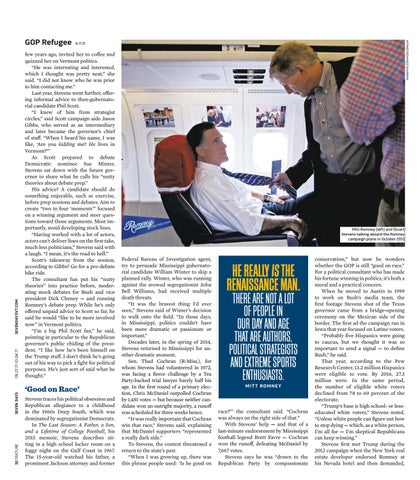
Mitt Romney (left) and Stuart Stevens talking aboard the Romney campaign plane in October 2012
Federal Bureau of Investigation agent, try to persuade Mississippi gubernatorial candidate William Winter to skip a planned rally. Winter, who was running against the avowed segregationist John Bell Williams, had received multiple death threats. “It was the bravest thing I’d ever seen,” Stevens said of Winter’s decision to walk onto the field. “In those days, in Mississippi, politics couldn’t have been more dramatic or passionate or important.” Decades later, in the spring of 2014, Stevens returned to Mississippi for another dramatic moment. Sen. Thad Cochran (R-Miss.), for whom Stevens had volunteered in 1972, was facing a fierce challenge by a Tea Party-backed trial lawyer barely half his age. In the first round of a primary election, Chris McDaniel outpolled Cochran by 1,481 votes — but because neither candidate won an outright majority, a runoff was scheduled for three weeks hence. “It was really important that Cochran win that race,” Stevens said, explaining that McDaniel supporters “represented a really dark side.” To Stevens, the contest threatened a return to the state’s past. “When I was growing up, there was this phrase people used: ‘Is he good on
HE REALLY IS THE RENAISSANCE MAN. THERE ARE NOT A LOT OF PEOPLE IN OUR DAY AND AGE THAT ARE AUTHORS, POLITICAL STRATEGISTS AND EXTREME SPORTS ENTHUSIASTS. MIT T R O MNE Y
race?’” the consultant said. “Cochran was always on the right side of that.” With Stevens’ help — and that of a last-minute endorsement by Mississippi football legend Brett Favre — Cochran won the runoff, defeating McDaniel by 7,667 votes. Stevens says he was “drawn to the Republican Party by compassionate
conservatism,” but now he wonders whether the GOP is still “good on race.” For a political consultant who has made his fortune winning in politics, it’s both a moral and a practical concern. When he moved to Austin in 1999 to work on Bush’s media team, the first footage Stevens shot of the Texas governor came from a bridge-opening ceremony on the Mexican side of the border. The first ad the campaign ran in Iowa that year focused on Latino voters. “Probably five Hispanics were going to caucus, but we thought it was so important to send a signal — to define Bush,” he said. That year, according to the Pew Research Center, 13.2 million Hispanics were eligible to vote. By 2016, 27.3 million were. In the same period, the number of eligible white voters declined from 78 to 69 percent of the electorate. “Trump’s base is high school- or lesseducated white voters,” Stevens noted. “Unless white people can figure out how to stop dying — which, as a white person, I’m all for — I’m skeptical Republicans can keep winning.” Stevens first met Trump during the 2012 campaign when the New York real estate developer endorsed Romney at his Nevada hotel and then demanded,