Nest — Winter 2026

Page 1


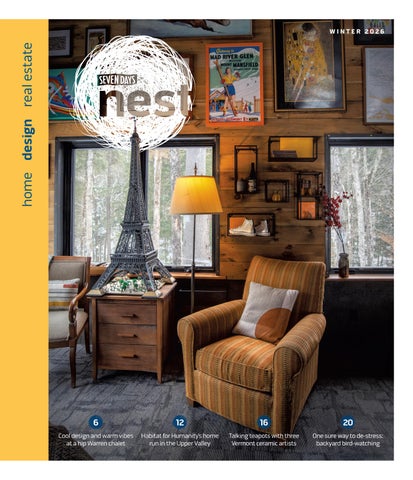
Cool design and warm vibes at a hip Warren chalet
Habitat for Humanity’s home run in the Upper Valley
Talking teapots with three Vermont ceramic artists

e stories in this issue of Nest — Seven Days’ quarterly magazine on homes, design and real estate — share an inadvertent theme: comfort. And isn’t that just what we need to get through winter, not to mention the chaos of world events? Find out how one Mad River Valley resident swaddles himself, architecturally speaking, in a COZY-CHIC CHALET. A little farther south, HABITAT FOR HUMANITY has fulfilled one family’s dream for the ultimate comfort: a home to call their own. Do you have a calming tea ritual, or aspire to? en you’ll want to learn about the ART OF TEAPOTS from three Vermont potters. Finally, many Vermonters recommend an avian antidote to stress: BACKYARD BIRD-WATCHING. Who’s unflappable now?

Steel Away ................................ 6

Industrial chic meets mountain chalet in a hip Mad River Valley bachelor pad

Under Construction 12

Upper Valley Habitat for Humanity strives to meet the demand for affordable homes

World Cuppa 16

Getting the tea on a globally brewed beverage and locally crafted pots

For the Birds 20

In winter, backyard bird-watching offers a chance to connect with nature

Lynds’ house in Warren

Steel Away

Industrial chic meets mountain chalet in a hip Mad River Valley bachelor pad

As you approach Andrew Lynds’ house in Warren, with its clean, single-sloped roof jutting toward the sky like a ski jump, the eye searches for what seems to be missing: a front door. But it’s only an illusion. The entranceway is hidden in plain sight in a recessed black cutout that faces the driveway.

“The idea was to make the front door disappear, like in a James Bond movie,” said Whitney Phillips, owner of W. Phillips Company, the Warren builder who worked with Lynds during the pandemic to make his vision a reality.

A 54-year-old native of Lawrence, Kan., Lynds is the owner and innkeeper of the Mad River Barn, 10 miles north in Waitsfield. For about a decade he has owned this three-acre, wooded and boulder-strewn property abutting the Mad River, where he had originally planned to build a house with his thenwife. After their divorce, he decided to go ahead with the project anyway — but do it his way.

“I wanted something different,” Lynds said.

Right: Andrew Lynds and Whitney Phillips at Lynds’ home in Warren
Above: The bedroom
PHOTOS:
LYNDS’ PRIDE AND JOY SITS AT THE TOP OF THE STAIRS ON THE SECOND FLOOR: A FULL-WALL DISPLAY OF HIS CONVERSE SNEAKER COLLECTION.

Because he had worked with Phillips on previous projects at the inn, he gave the builder free rein and a simple directive: “If you have an idea, run with it.”

And run he did. Both inside and out, Lynds’ 2,900-square-foot abode bears some of the stylistic influences of the late Dave Sellers, the iconoclastic architect and builder from Warren with whom Phillips apprenticed and worked for years. But unlike many of his mentor’s projects, Phillips’ houses have a more refined appearance while still defying stylistic convention. Lynds’ home, with its steel-cable railings, exposed steel I beams and radiant-heated, polished concrete floors, combines the minimalism of industrial chic with the comfy, lived-in charm of a mountain chalet.

Some of Phillips’ aesthetic touches, such as the mono-sloped roof, also served a dual purpose of saving time and money during the construction. Without dormers or sharp angles to build, Phillips could reduce his labor costs.

Another such decision: There’s not a speck of drywall in the entire house.

Why not? “I just don’t like white,” Lynds said.

The entrance

I PINCH MYSELF THAT I GET TO LIVE HERE.

Instead, most of the ceilings and walls are covered with sheet steel threeeighths of an inch thick, which is both aesthetically appealing and, surprisingly, labor-saving.

“When you do Sheetrock, you touch every square inch 12 times, from the moment it gets delivered, carried inside, installed, mudded and primed,” Phillips explained. “To be honest, this was less expensive.”

Having walls of steel poses a few logistical challenges, such as how to hang pictures, mirrors and shelves. Their solution: heavy-duty magnetic hooks, which are sturdy, easily moved, and require no drilling or stud finding.

“I can put a picture wherever I want without putting a hole in the wall,” Lynds said.

Because metal tends to sweat on hot and humid days, the house has to be climate controlled with dehumidifying heat pumps to prevent the walls from rusting.

Entering the house from the front vestibule, visitors pass a sliding metal door — taken off an old shipping container — that hides a utility closet and then step down into the open-floor-plan kitchen and den. The room’s expansive, nearly floor-to-ceiling windows, which have motorized shades, face the mountains to the west.

Embedded in a metal railing separating the foyer from the kitchen is a thick slab of live-edge walnut, cut from the same tree that Phillips used to build a bench for the foyer, the kitchen shelves and the step leading into the den. The railing and I beams are accented with colored lighting.

Because a room wrapped entirely in steel — the kitchen counters are also metal — might have felt cold and sterile, Phillips added warmth by installing cedar planks in the ceiling, island and kitchen cabinets. Above the island hangs a canopy that conceals a support beam, a stove vent, stereo speakers and lighting. In the den, a huge sliding glass door opens to a balcony overlooking the river.

For both the kitchen drawers and the staircase to the second floor, Phillips chose an unusual building material for a home: Skatelite. The highly durable, compressed-paper product, originally developed for skateboard parks, never needs to be painted or refinished.

Lynds isn’t a skateboarder himself. But about a decade ago Phillips had another company called Warren Pieces that repurposed salvaged lumber to build

ANDREW LYNDS

JNG CLEANERS

Steel Away « P.8

high-end wooden longboards. They were both functional and pieces of art.

Lynds said he implicitly trusted Phillips to make such stylistic decisions, sometimes just days before a section of the project began, because “he knows what I like.”

and workout area on the other side. It includes pieces of decking, steel from the kitchen backsplash, wood trimmings and leftover metal grates.

“They’re not the kind of things that people typically save for anything,” Phillips said.

on a submarine. In keeping with Lynds’ aversion to white, even the heat pumps are black. The only white visible in the house are the smoke detectors.

Like the kitchen, the primary bathroom features dark steel countertops, as well as a slate-colored basin sink and an unusuallooking toilet.

Even the welds on the black metal staircase railing, which builders typically try to conceal, were done using bronze to make them visually pop.

Similarly, when Phillips asked Lynds to make an aesthetic choice, such as the light switches that resemble the knobs on a 1970s stereo system, “Andy knocked it out of the park,” Phillips said.

“When I found out the name of the color, I was like, ‘Fuck yeah, I need a thunder-gray toilet in my house!’” Lynds said with a laugh.

Lynds’ pride and joy sits at the top of the stairs on the second floor: a full-wall display of his Converse sneaker collection — 142 pairs in all, accumulated over 20 years.

The mosaic isn’t the only recycled material incorporated into the house. Throughout it are African mahogany windowsills repurposed from an old deck that Phillips had dismantled on a previous job.

Indeed, the entire place has a playful and laid-back vibe, from the skateboard deck art on the walls to the Lego Eiffel Tower to the replica of the “major award” leg lamp from the holiday movie classic A Christmas Story. “Ted Lasso” fans will appreciate Lynds’ Kansas license plate that reads “BELIEVE.”

“I’ve been here five years, and I still come back to this house and it feels new,” he said. “I pinch myself that I get to live here. It’s that cool.” ➆

Opposite the sneaker wall is the building crew’s own pet project: a floor-to-ceiling mosaic, assembled by W. Phillips’ Mike Demarzo, composed of scrap materials from the jobsite. The decorative wall is structural and serves as a partition from an office

The second floor features cathedral ceilings, a raised platform bed with accent lighting above, and two large ceiling fans that resemble propellers

Learn more at instagram.com/ w.phillipscompany.

A floor-to-ceiling mosaic composed of scrap materials from the build site
A raised platform bed with accent lighting above
The bathroom

Upper Valley Habitat for Humanity strives to meet the demand for a ordable homes

Under Construction

Co ee cup in hand, Ashley Andreas watched with glee as a crane delivered two halves of a modular home to Nutt Lane in White River Junction. By summertime, the humble wooden shell will be a three-bedroom home for a mother and her three daughters.

The project is Andreas’ first as executive director of Upper Valley Habitat for Humanity, a nonprofit that has built a ordable homes in Vermont and New Hampshire for nearly 40 years.

Andreas, who started last October, took the helm at a time when inflation and an unstable economy have made building homes even more expensive. But she is unwavering in her mission.

Andreas aims to make Upper Valley Habitat a better-known entity — and hopes volunteers and donations will follow.

“Having us be one of the most visible nonprofits in the Upper Valley feels important to me,” she

Above: Upper Valley Habitat For Humanity executive director Ashley Andreas in White River Junction
Right: Hartford Area Career & Technology Center building trades instructor Lance Johnson speaking with students Quinn Eckler and Paige Stone

said. “We do have such an amazing, supportive community here, and I think that a lot of folks just don’t know about us.”

Andreas’ chapter is part of Habitat for Humanity International, a global nonprofit that operates in every state and more than 60 countries. Founded in 1976, Habitat rose to prominence in the 1980s, thanks to its most famous volunteer: former president Jimmy Carter, whose annual Carter Work Project renovated or repaired nearly 4,500 homes over 30-plus years.

Vermont has seven Habitat a liates that build about a dozen homes per year. Upper Valley Habitat contributes one home to that total. The organization also partners with COVER Home Repair, a local nonprofit that builds wheelchair ramps, replaces roofs and weatherizes homes for low-income Vermonters at no cost.

Habitat homes, however, don’t come for free. The nonprofit purchases the building materials and uses volunteer labor to buy down the

of construction down to a mortgage that the family can a ord,” Andreas said.

Nest caught up with Andreas to talk about how Habitat keeps homes a ordable and her goals for the organization.

People who qualify for Habitat homes are essentially getting a subsidized mortgage. What do they have to give in return?

Partner families have to contribute a certain number of sweat-equity hours, which is time that they are on-site helping to build the house. Or it could be stu ng envelopes and sending mailings or doing o ce work. We try to make it accessible to someone’s skills and abilities, but most families really enjoy being on-site and learning some construction skills and getting to be part of that process. They’re also agreeing to perpetual a ordability. We have a promise that you can’t just turn around and sell the home for whatever you want or to the highest bidder.

WE’RE BUILDING HOMES AFFORDABLY, YES, BUT ALSO WE’RE BUILDING A COMMUNITY THAT BUILDS HOMES TOGETHER.
ASHLEY ANDREAS

home’s cost, but the owner still pays a mortgage. Most end up financing between $100,000 and $150,000, Andreas said.

To be eligible for a home, applicants must meet certain income requirements and prequalify for a mortgage, which can be a barrier for some. Even so, the interest in Habitat homes greatly outpaces the nonprofit’s capacity to build them. Twenty people applied for the Nutt Lane project, according to Andreas.

As director, she is interested in finding creative ways to leverage Habitat’s limited funds, which primarily come from grants and donations. For the Nutt Lane project, for instance, Habitat got a zero-interest construction loan from the Vermont Community Loan Fund by partnering with the Hartford Area Career & Technical Center. Students from the school’s Building Trades program prepared the foundation and will help install drywall, cabinets and trim.

“Programs like that are really pivotal in being able to bring the cost

Does that requirement come with a catch?

I see two sides of it. The owners have a home that they can a ord to live in, but they may also struggle to buy their next home when they sell this one at an a ordable price. Hopefully they’ve been able to save money over the years and can pass that on to another family. It creates a guarantee that there’s a starter home available in the community for less than $400,000. It’s nearly impossible to find a basic home in the Upper Valley for less. Doing these perpetual a ordability covenants is really important because we’re passing on that gift, that step up, to future generations.

Has the increased cost of building materials made it more difficult for Habitat to build affordable homes? Yes! It’s like sticker shock to look at an estimate for a home. We’re having to work harder than ever to get creative to get costs down without sacrificing

Beyond Foreclosures: The Power of Real Estate Auctions

Custom Work in Fabric for the Home

Preserving the past and our future through reuse, sustainability & community.

Upholstery • Slipcovers • Cushions • Pillows • Linens • Windows BEFORE AFTER

Open: Tues-Fri 10-5, Sat 10-4

1140 Williston Rd. S. Burlington M joyo omevt.com 802-488-9037

What are you looking forward to this year?

quality or energy efficiency. Vermont does have an energy code, and it’s pretty rigorous. But we have successfully done our last three builds, Nutt Lane included, as all electric.

What’s special about the latest home on Nutt Lane?

It’s a single-family home, three bedrooms and one and a half baths, which I’m excited about. I’m always complaining that there’s not enough three-bedroom homes in the Upper Valley for families. I’m excited about the prospect of getting young families downtown and in these centers where they can walk to shops and shows at Northern Stage and be part of a community.

The Nutt Lane home is modular. Are those easier to build?

The jury is still out. On Nutt Lane, the modular doesn’t have drywall or flooring or doors, but it does have electrical and plumbing, so we’re getting the biggest lift of the build complete in a really short amount of time — and we can work through the winter. The downside is that we have to pay that modular builder; part of our affordability power is that we don’t have the labor cost. So, it’s definitely a trade-off. The Rutland affiliate is opening a workshop to build wall panels for its home projects, and other affiliates have discussed wanting to have a centralized shop to ship wall and roof panels across the state. Or maybe we could have a partnership with a modular company where we would standardize designs to bring the cost down. These are all approaches that we’re looking at.

We own a couple of properties where the land lends itself to be a larger, planned development. I’m really excited to start investigating which one of those projects should be next and what the designs will look like. Also, I’m excited about getting a renovation project going, something that would be easy for volunteers to do in six months to a year while we queue up a larger project. I’m also going to be working with the board on a three- to five-year strategic plan. Starting to look that far out and move some pieces into place feels like a really important next step.

What’s something you want people to know about Upper Valley Habitat? When you come to volunteer for us, you’re helping a family who needs it to get into a home. But we’re also providing an opportunity for people who are interested in learning new skills to come learn at no cost. If you’re interested in weatherization because you have an old, leaky home but can’t afford to pay someone to insulate it, come volunteer and learn about different types of insulation. If you’re interested in design but don’t want to start a new career, come work with our building committee. We’re building homes affordably, yes, but also we’re building a community that builds homes together. In my opinion, it’s radical; it’s mutual aid; it’s sustainability. It really is a living mission. ➆

This interview was edited for clarity and length.

Under Construction « P.13
Modular home delivery on Nutt Lane in White River Junction

World Cuppa

Getting the tea on a globally brewed beverage and locally crafted pots

Toward the end of 2025, I decided to learn all about tea. There were several reasons: It’s winter, when a warm mug is always welcome. I’m observing Dry January and need drinks that aren’t alcohol. And, let’s face it, 2025 was stressful; why not enter the New Year with a calming ritual and the beverage equivalent of monks walking for peace?

IT’S THE ULTIMATE COMBINATION OF FORM AND FUNCTION.

But first, I had to find the right teapot. So that’s where my research, and this story, began. The continent-hopping, millennia-long history of tea aptly includes the vessels in which to steep it. Every area of the globe has contributed to their design, though an Asian influence prevails. Today, the teapot inventory is vast, from squat cast-iron models to delicate fine-bone china and everything in between. No shade on manufactured wares, but my preference was for a pot handmade by one of Vermont’s many clay artists.

I started by perusing the websites of galleries and craft shops, as well as the Vermont Crafts Council and regional guilds. I visited Frog Hollow Vermont Craft Gallery in Burlington to meet some pots in person. And I picked three artists with distinctly di erent styles to interview about all things teapot. Kileh Friedman of Burlington, Frank Saliani of Montpelier and Cath Manegold of Bridport generously shared their time and knowledge.

Turns out, potters love to talk about teapots. And no wonder; they’re not easy to make. Having taken pottery classes myself — with primitive results — I’ve always considered a teapot the holy grail. What the

“Hurrah for the Morning” teapot by Cath Manegold
COURTESY OF HOPE
Cath Manegold

casual observer sees as a single object is actually the sum of multiple parts: a body and foot, a spout, a handle, and a lid. Ideally, the assembled elements are harmonious.

“Teapots are tough,” Manegold confirmed. “If you’re exploring, there’s going to be a lot of disasters.”

Manegold was an international journalist for 25 years and an author and college professor for two decades more. While teaching in Concord, Mass., she “picked up pottery” and found an instructive parallel to sentence structure. “I would tell my writing students that a teapot could look like anything, but it has to work,” she recalled. “It’s the ultimate combination of form and function.”

In 2013, Manegold left academia to become a “country potter” in Vermont, and she eventually established Bridport Hill Pottery. Her porcelain work has a serene palette — primarily pale blues, celadon and gold — and avian ornamentation. That is, one or more small clay birds perch atop lidded pots and serve as handles.

HOUSEWARES

delightful morning companion,” and she’s not wrong.

The teapot “Hurrah for the Morning” — Manegold titles her pieces — has a creamy celadon glaze with vertical scratches, or “chattering,” around the body for texture. The bold handle spans top to bottom of the pot, the plump spout has a whimsical face, and a single bird minds her clutch on the lid. Manegold describes this on her website as “a

drawings. These botanical elements

leaves and trees very comfortable,”

“Like many humans, I like birds and their energy,” Manegold said. For Friedman, the energy is in the brushstroke. The branches and blooms on her pottery recall the flowing lines of Japanese sumi-e ink drawings. These botanical elements are not realistic but convey a connection with nature. “I find flowers, leaves and trees very comfortable,” she said. “They don’t have to be perfect.” Her glaze palette — browns,

Teapot by Kileh Friedman COURTESY
Kileh Friedman
WORLD CUPPA » P.18

greens, terra-cotta, ocher — enhances the earthy aesthetic.

Brooklyn-born Friedman said she learned to make pottery at a community program while living in Atlanta in her late twenties. Two other moves took her across the country and to more studios, more classes. After relocating to Vermont with her son and then-husband, she set up a studio, taught pottery and cofounded a cooperative — still open in Montpelier as Artisans Hand Craft Gallery.

But in the early ’80s, Friedman pivoted: She returned to school, earned a psychology degree and worked as a psychotherapist for the next 20 years. “I gave all my tools away, loaned someone my wheel and threw out my glaze recipes,” she recalled.

Yet the clay called her back. Even as a therapist, Friedman ultimately began to “make pots at night” at Shelburne Craft School. Since retiring in 2011, she has devoted herself full time to pottery, which she views as both a tactile pursuit and a spiritual practice.

Friedman waxes eloquently about building teapots. “It begins with the body, the soul of the teapot,” she said. “The body has to be pleasing and have a lot of breath in it.” She describes herself as “definitely a rounded-teapot person.”

“Then I have to close it and make a lid for it,” Friedman continued. “And then comes the spout — I’ll make three or four and try them out.” She stressed that the spout must be attached high enough that the liquid doesn’t pour out too quickly. As for the handle, it can be on the side, at the top or 90 degrees from the spout, but the pieces should “come together with grace,” Friedman said. “A teapot is very graceful.”

Saliani takes this idea even further. “My work explores the idea that the whole is greater than the sum of its parts,” he writes on the website for his studio, Green House Pottery. He muses thoughtfully about the experiences, patterns and relationships “that make us who we are” and how that idea shows up in his work.

But to an observer — say, someone shopping

for a teapot — what catches the eye is that Saliani’s stylishly designed pottery looks like sculpture.

“In grad school [at Ohio University], I was making a lot of sculptural work, making parts to build sculpture,” he explained in a phone interview. “So that informed my pots. They’re really little functional sculptural objects.”

Some of his teapots are not exactly round. They have angles and seams and, well, attitude. The piece he calls “squarish teapot” simply begs to be anthropomorphized. In one iteration, the greenish body is wide at the bottom and tapers up to the lid like a Cinderella ball gown. Between the “skirt” and the foot is a heavily textured, recessed area — a recurring technique in Saliani’s work. The side handle, in pale blue, is pointy at the top curve (like an elbow) and white (like a gloved hand) at the bottom; it looks like an arm akimbo. The spout, also blue, is perky.

Saliani’s forms are unusual because he makes custom molds and casts porcelain clay in the desired shapes, a methodical process he said is “an art form in and of itself.” In other words, he makes parts for his parts.

His 36 years in clay work included residencies around the country. In 2020, he moved to Montpelier with his wife, a native Vermonter, and young daughter. At Green House Pottery, Saliani is a oneman studio, producing his own work and teaching classes for kids and adults.

So, I did buy a teapot, though I suspect it won’t be my last. It’s beautifully designed and glazed, the size is just right, the handle fits my hand, the spout doesn’t dribble, and the lid fits perfectly. Now I need to find a cozy to keep the pot warm. The way 2026 is going so far, I expect to be drinking a lot of tea. ➆

Learn more at bridporthill.com, kilehfriedmanpottery. com and greenhousepots.com.

Teapot by Frank Saliani COURTESY
Frank Saliani

For the Birds

In winter, backyard bird-watching offers a chance to connect with nature

In the world of birding, there are bird-watchers and bird-getters. The latter were lampooned in the 2011 comedy The Big Year, which starred an obsessed trio of Jack Black, Steve Martin and Owen Wilson crisscrossing North America to log the most bird sightings. This acquisitive style of road-trip birding recently resurfaced in the cultural stew thanks to the deftly made Listers: A Glimpse Into Extreme Birdwatching, watchable free on YouTube. The film has racked up 2.7 million views since its release six months ago.

Above: A titmouse
Right: Isaac Wood-Lewis and Maeve Kim with some of Kim’s backyard bird feeders at her home in Jericho

desk under the kitchen window closest to her feeders, often juggling her breakfast and a pencil while she takes a tally of species to submit to eBird and other Cornell Lab of Ornithology projects.

Such a daily practice not only helps science but also obliges the watcher to slow down. The retired special educator and birder of 50-plus years noted that this kind of activity has been shown to lower blood pressure and stress levels.

sure way to de-stress: backyard bird-watching
Backyard bird-watching, on the other hand, isn’t as compelling a movie subject. As compared with the getters or listers, non-extreme watchers are mostly content to stick close to home to observe what flies to them, rather than chasing birds down. But the lower-key activity has its own rewards — particularly in winter — as Maeve Kim, 82, and Isaac Wood-Lewis, 19, detailed on a snowy January morning in Kim’s Jericho kitchen, within view of her seasonal bird feeders.

Winter brings backyard birds into closer focus, led by the ability to feed them. To avoid attracting bears, the Vermont Fish & Wildlife Department recommends hanging feeders only from December 1 through March 31. Reduced foliage also allows for clearer views of backyard wildlife.

During bird-feeding season, Kim starts every day at a small wooden

IT’S BETTER FOR YOUR SOUL THAN DOOMSCROLLING.

MAEVE KIM

“It’s better for your soul than doomscrolling,” Kim said, after we watched a striking white-and-black hairy woodpecker with a splash of red on its head pluck a whole shelled, raw peanut from a feeder and dart away.

Wood-Lewis is able to bird-watch even from his University of Vermont dorm room, thanks to a feeder suctioncupped to the window by his bed. When he wakes, he said, there are always a few chickadees at the feeder. He now recognizes at least one, which will feed from his hand.

“You get to see how they each act differently,” he said. “I got kind of lucky because this one has some slightly different markings, and I think it’s braver than the others.”

Wood-Lewis and Kim met when she gave a talk about birds at his family’s home in Burlington’s South End. He was about 7 years old at the time and “knew more than almost any of the grown-ups there,” Kim marveled.

The young man is now studying wildlife and fisheries biology. From his first backyard chickadee sighting, Wood-Lewis’ interest in birding “snowballed,” he said. “I just love birds and all animals, so being able to watch how they interact with each other and their surroundings is really interesting for me.”

The avian population in Jericho is, naturally, more diverse than outside a dorm window.

PHOTOS COURTESY OF BERNIE PAQUETTE
Chickadee
Red-breasted nuthatch
House finch

For the Birds «P.21

Kim’s partner, Bernie Paquette, is a fellow accomplished citizen naturalist and self-taught expert in Vermont’s wild bee species. They met nine years ago on a bird walk that she led — although their love story has not been featured in Kim’s three published romance novels about a fictional Burlington bird club.

The pair have cultivated a wildlife oasis on their 1.3-acre property, adding many native plants and trees, nurturing diverse insect populations, and establishing brush piles for nesting materials and protected hiding spots. In January, they always add a couple of retired Christmas trees near their feeders to provide extra roosting quarters and cover from predators.

While fewer species come to the yard over the winter, Kim said, there are some, such as American tree sparrows and evening grosbeaks, that fly south from Canada for the relatively warmer weather or more abundant food sources.

On the morning of my January visit, Kim had recorded blue jays, black-capped chickadees, house finches, tufted titmice, eastern bluebirds and American tree sparrows, plus more than 30 goldfinches.

“They’re little pigs,” she said fondly of the fluffballs that looked like someone had dipped their heads and chests in lemon and honey.

A tiny, toffee-colored Carolina wren landed on the open tray feeder filled with hulled sunflower seeds. Kim noted that the species is a relatively new sighting in Vermont, as are the titmice.

Both Kim and Wood-Lewis said they’ve gone through phases when the lure of the checklist has enticed them into bird-getting behavior.

“I’d be impatient seeing something because there could be something else around the corner,” Kim said. “I was driving myself crazy, and I wasn’t enjoying the birds anymore.”

Generally, she said, she finds it more rewarding to spend time studying the National Geographic show in her backyard. Kim has no ticed, for example, that barred owls benefit from feeders even though they don’t eat from them directly. She has observed the majestic birds waiting patiently to swoop down on mice or voles feasting on fallen seed beneath her feeders.

Recently, Kim witnessed an interaction between a Cooper’s hawk — “a very handsome

HOW TO FEED BIRDS SAFELY

Kevin Tolan, staff biologist for the Vermont Center for Ecostudies in White River Junction, puts up seasonal bird feeders in his Roxbury backyard and believes they can help not only birds but people, too. “We talk about the ecological benefits, but the human benefit is often undersold,” Tolan said. “Watching birds is a way that you can escape the hecticness of everyday life.”

Tolan offered these tips for feeding birds safely:

DON’T FEED THE BEARS. Follow the Vermont Fish & Wildlife Department recommendation to put up feeders only December 1 through March 31.

POSITION FEEDERS CAREFULLY. They should not be out in the open but should have some nearby cover, such as trees or shrubs, in which birds can seek protection from predators. Window decals can help, but feeders should be at least 15 feet from windows (except in the case of on-window feeders) to reduce the risk of injury or death from birds flying into the glass when predators swoop in.

FILL FEEDERS WITH DIVERSE, PROTEIN-RICH FOODS. Tolan uses black oil sunflower seeds; unsalted, whole-shell peanuts; and mealworms.

PLANT FOR THE BIRDS Ideally, Tolan said, seeds and fruits of native plants also supply food for birds over the winter, and planning your garden to include those — and not cutting them back in the fall — is the best thing you can do. “Feeders are just making up for what we’ve removed,” he noted.

MONITOR CAREFULLY FOR DISEASE “When you have so many individuals from different flocks and different species coming together, the risk is high,” Tolan said. Finches, especially, are prone to conjunctivitis, from which they can die. He recommends regularly looking at their eyes through binoculars. If eyes appear swollen or sticky, take the feeders down, clean them well with a diluted bleach solution and keep them down for about two weeks. (Find detailed cleaning instructions at vtfishandwildlife.com/ watch-wildlife.)

KEEP NEIGHBORHOOD CATS INDOORS IF POSSIBLE “Bird feeders are just a baiting station for your neighbors’ cats,” Tolan said.

predator” — and a dark-eyed junco. The junco was hiding in a brush pile upon which the hawk had perched, she recounted, and every so often the junco would peek out tentatively and beat a quick retreat. “The hawk wanted that junco so badly,” Kim said, “but the junco outwaited it.” Wood-Lewis acknowledged that he enjoys both types of birding. He has plans to travel west this summer with a friend, and he’s excited to see some new species. But, he added, he’s also anxious to return from winter break to his dorm, where he hopes his chickadee friend will not have forgotten him. ➆

INFO

Maeve Kim will give a free talk on wildlifefriendly backyards on Thursday, April 2, 1:30 p.m., at the Richmond Free Library. Find out about more bird walks and talks by Kim at vtbirdsandwords.blogspot.com.

For backyard bird-feeding recommendations, go to vtfishandwildlife.com/watch-wildlife.

Learn more about the bird-tracking work of the Vermont Center for Ecostudies at vtecostudies.org.

PHOTOS
Red-bellied woodpecker
Pine siskin
Goldfinch

Turn static files into dynamic content formats.

Create a flipbook
Issuu converts static files into: digital portfolios, online yearbooks, online catalogs, digital photo albums and more. Sign up and create your flipbook.