
2025 Membership
Supreme Court Appointments
Harriet Miers, Chair*
Troutman Pepper Locke
Dallas
Pablo Javier Almaguer
Texas Immigration Law Council
Edinburg
Thomas S. Leatherbury
SMU Dedman School of Law
Dallas
Sandra L. Phillips Toyota Plano
Terry O. Tottenham* Norton Rose Fulbright US LLP
Austin
Roland K. Johnson, ViceChair* Harris, Finley & Bogle, PC Fort Worth
Judge Nicholas Chu Probate Court No. 2
Austin
David McAtee, Special Advisor * AT&T
Dallas
Hilary L. Preston Vinson & Elkins LLP
Austin
Gen. Alfred Valenzuela US Army, Retired San Antonio
Justice Brett Busby Supreme Court of Texas Liaison
Austin
Judge Roy B. Ferguson* Former Texas District Court
Judge Alpine
Judge Latosha Lewis Payne 55th Civil District Court
Houston
Brad Toben*
Baylor University School of Law
Waco
State Bar of Texas Appointments
Dr. Clen Burton
Blinn College District Brenham
Krisi Kastl
Kastl Law, PC
Dallas
Judge Penny A. Roberts
Tom Green County, Retired
San Angelo
Diana Gomez Jackson Walker LLP
Houston
Julia Raney Rodriguez** Texas RioGrande Legal Aid
San Antonio
Marshall Sales Hennan Culp, PLLC
Austin
Fabian Castillo, Sr.**
Fabian’s Construction
San Antonio
Ex-Officio Members
Trevor Ezell**
For the Office of the Governor Austin
Chair Emeritus
Harry M. Reasoner Vinson & Elkins LLP Houston
* Executive Committee ** New Appointment
Dean Senator Judith Zaffirini
For the Office of the Lieutenant Governor Laredo
Rep. Gene Wu
For the Speaker of the House Houston
This report describes the main activities undertaken by the Texas Access to Justice Commission (also referred to as “the Commission”) during the period from December 1, 2024, to November 30, 2025. As in prior years, much of the Commission’s work outlined in this report has been carried out in collaboration with other entities and individuals The Commission continues to bring together stakeholders across the Texas access to justice community to advance access to justice for the state’s most impoverished and underserved Texans. Following the completion of its strategic planning efforts and the approval of the Strategic Plan, the Commission is now focused on implementing that plan and strengthening its role and the efforts to increase access to justice within the broader access to justice landscape in Texas. An Implementation Plan has been approved. The Strategic Planning efforts are designed to help the Commission fulfill its intended function as the “umbrella” organization as directed by the Supreme Court when it created the Commission. The Commission also coordinates with national organizations to learn from their initiatives, and, where appropriate, to contribute to nationwide efforts that promote greater access to justice.
Following an in-depth strategic planning process, the Texas Access to Justice Commission adopted its strategic plan at its February 13, 2025, meeting. As recommended by Justice Brett Busby, an additional amendment was approved at the May 1, 2025, Commission meeting to emphasize the importance of technology in increasing access to justice The final Strategic Plan with its Amendment are attached as Exhibit A .
As previously reported, the strategic planning process was supported by two highly regarded consultants, Bruce Bower and John Tull. Informed by a framework developed by the National Center for State Courts, Mr. Tull and Mr. Bower assisted the Texas Access to Justice Commission in (1) identifying the most critical needs that the Commission with its partner institutions have the capacity to address and (2) then developing strategies and suggesting initiatives the Commission can consider and undertake to address those needs.
Early in the process, the consultants produced a report summarizing findings from an intensive fact-finding and research phase that involved approximately 60 interviews and a survey of 292 individuals active in and familiar with access to justice activities and needs in Texas. In some cases, the interviews and survey involved individual outside of Texas. After discussion with the full Commission, these reports led to the formation of six substantive working groups to address key initiatives identified by the strategic planners. The six key initiatives developed are: 1) increasing the availability of lawyers for representation of low-income Texans needing help; 2) increasing access to courts for low-income litigants; 3) improving the viability of self-help remedies; 4) addressing the challenge of rural access and “legal deserts”; 5) increasing resources available to support access to justice efforts; and 6) addressing structural and operational needs of the Commission to improve its effectiveness. Additionally, four cross- cutting themes were discussed within all the working groups: technology, law school partnerships, communications and outreach, and client
involvement. The working groups all produced detailed initiatives which informed the drafting of the final strategic plan.
Working with the Consultants, the Commission developed the Implementation Plan, attached to this Report as Exhibit B This Implementation Plan was considered by the Commission and was approved by the Commission in October 2025. The Commission’s Strategic Planning efforts are now and have been focused on the implementation stage, including the creation of three new committees of the Commission described below. The Commission considers the Strategic Plan and its Implementation Plan as living documents, to be modified and revised when circumstances justify adjusting or supplementing the Strategic Plan or the Implementation Plan.
In addition to receiving direction from the Supreme Court of Texas concerning the Commission’s role in enhancing access to justice, the Executive Committee performs decision-making functions as needed between Commission meetings. The Committee has met and conferred with the Commission’s Executive Director and designated staff as necessary and is involved significantly in the strategic planning process, managing the budget process, and working with committees on various assignments. It also leads, as appropriate, efforts to increase financial resources for access to justice in Texas and to promote Pro Bono service by Texas lawyers.
This year, the Executive Committee of the Commission worked with the State Bar in its implementation of certain structural changes to continue to have a Directorship to manage the State Bar’s Legal Access Department focusing on primarily Pro Bono efforts, with currently two employees assisting that Director, and, to separate those efforts and staff from the efforts and staff of the Access to Justice Commission The Commission will continue to have an Executive Director, and currently four other staff members, including a Deputy Executive Director. While being employees of the State Bar and subject to State Bar personnel rules and responsibilities, the Executive Director of the Commission and its staff will be overseen by the Commission and will carry out the directions of the Commission.
While the Commission will continue to have a role in promoting Pro Bono services, the Legal Access Department will have the major role in encouraging Pro Bono services and supporting the many lawyers providing Pro Bono services. The Commission as well as the Legal Access Department will encourage the development of resources to support Pro Bono services in Texas.
Two significant examples of this critical activity are the Take One Campaign for Veterans currently underway, and the efforts of the current President of the State Bar Santos Vargas focused on his Stand With Santos Campaign. The State Bar and Commission agree that consistent and everexpanding efforts to increase Pro Bono work by Texas lawyers and increased resources to support those efforts are critical to achieving success in access to justice work in Texas.
The Commission continues to be grateful to the State Bar for its agreement to provide staff and financial support to the Commission, subject to a budgeting process in place since 2001. The importance of the relationship between the State Bar and the Commission in Texas access to justice efforts is of inestimable value.
Pursuant to the Strategic Planning efforts, the Commission has created three new committees, as follows:
As a result of the strategic planning recommendations, the Commission created the Judicial Education Committee. The Committee is co - chaired by Kennon Wooten and Justice Lori Valenzuela. This Committee is proceeding with its formation and is beginning its work.
2.
As a result of the strategic planning recommendations, the Commission created the Rural Access Committee. The Committee is co - chaired by Roy Ferguson and Pablo Almaguer, with Eden Klein serving as vice- chair. This Committee is proceeding with its formation and is beginning its work.
3.
As a result of the strategic planning recommendations, the Commission created the Communications and Outreach Committee. The Committee is co - chaired by Marshall Sales and Tom Leatherbury. This Committee is proceeding with its formation and is beginning its work.
As a result of the strategic planning recommendations, the Commission has emphasized its ability to collaborate with law librarians and law libraries across the state. Law Libraries serve as invaluable resources for both attorneys and self-represented litigants, offering free resources and research expertise to patrons, regardless of economic status
Various law libraries in Texas provide a range of services, including assistance with required court forms and e-filing, free internet access for litigants and attorneys to attend remote hearings, and assisted legal research, among other services Law librarians serve as members of the Commission’s Technology Committee and were recruited to serve in the strategic planning process. They offer their expertise to help Commission efforts and foster greater partnership opportunities among legal services organizations
Similarly, law librarians have been regularly attending and participating in Commission meetings. Likewise, the Commission has had a staff member attending monthly meetings of state law librarians to learn more about their ongoing access to justice efforts, shared challenges, and opportunities for collaboration.
The Law School Advisory Committee is chaired by Dean Emeritus Brad Toben of Baylor Law School and Thomas S. Leatherbury of Southern Methodist University Dedman School of Law. The CoChairs convene the Law School Advisory Committee at least twice a year to discuss access to
justice initiatives for law students and law schools. All ten of the Deans of Texas’ law schools have agreed to serve on the Commission’s Law School Advisory Committee, and they attend meetings when they are able. As this Report is being completed, eight of the ten Deans were able to attend the last meeting of the Advisory Committee. The Committee includes additional representatives from law schools and others interested in access to justice work and the role of law schools in encouraging access to justice efforts.
The Commission coordinates internship opportunities for law students throughout the year –including Pro Bono Spring Break, Fall term and Spring term Access to Justice Interns and Summer Access to Justice Interns. This year, the Law School Advisory Committee Co -Chairs developed the Texas Law School Pro Bono and Public Interest Survey, which is designed to inform best-practices guidelines for law school clinics and Pro Bono programming Consideration of how the Survey will be managed is under continued study. Additionally, members of the Law School Advisory Committee have been actively involved in the Commission’s Strategic Planning work. Dean Emeritus Bradley J.B. Toben, former dean of Baylor University School of Law, serves on the Executive Committee of the Commission.
The Commission’s mission of increasing access to justice by enabling law students to intern with legal aid programs and serve low-income Texans is advanced through its year-round Access to Justice Internship Program (ATJIP). The ATJIP provides a $2,500 stipend to law students who commit to work 200 hours at a civil legal aid organization during either the fall or the spring semester, and a $5,000 stipend to students who participate during the summer and commit to working 400 hours of service with a civil legal aid program. Action has been taken to increase the amount of stipends to provide more competitive compensation for attracting students to participate in the internships. While formal budgeting the increased stipend amounts will need to be done in the future, the Commission is comfortable that it will be able to budget for and implement the increased amounts to keep the programs attractive for student participation for next year. It also is hoped that the more competitive stipend amounts will increase the number of interns successfully recruited.
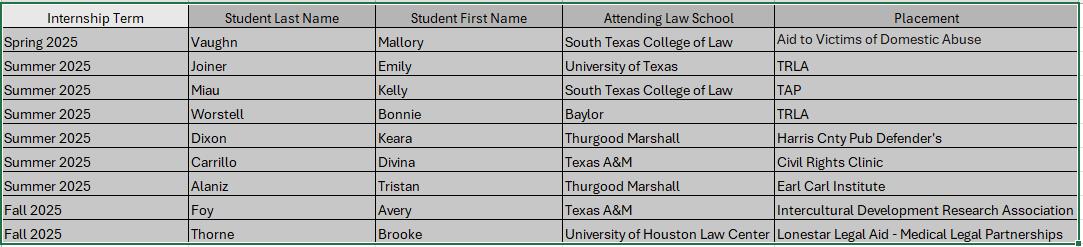
The 2025 ATJIP provided funding for nine law students: one in the spring program, six in the summer program, and two in the fall program. Details of the selected students and legal aid partners are included below. ATJIP interns are required to submit a 1000-word essay at the conclusion of their internship. Exhibit C contains sample essays by interns. The Commission has the goal of increasing the number of internships available and filled.
The Commission once again collaborated with the State Bar to offer its annual Pro Bono Spring Break program. This year ’s event was a hybrid format that included both in-person and virtual placement opportunities over two one-week periods, corresponding with the spring break schedules of Texas law schools. The Commission should explore how to obtain additional resources to fund more placements.
Five law schools observed spring break from March 10-14, 2025 (Baylor Law School, St. Mary’s University School of Law, Texas A&M School of Law, Thurgood Marshall School of Law, and UNTDallas College of Law) and five observed spring break from March 17-21, 2025 (SMU Dedman School of Law, South Texas College of Law, Texas Tech University School of Law, University of Houston Law Center, University of Texas School of Law).
The Commission’s strong partnership with legal aid organizations made it possible to offer twentyseven different host program locations across the state. Partner programs include:
• Texas Fair Defense Project
• Catholic Charities of Dallas
• ProBAR
• Estrella del Paso
• Earl Carl Institute for Legal & Social Policy Inc.
• Legal Aid of Northwest Texas (LANWT) (14 locations)
• Dallas Volunteer Attorney Program
• Texas Advocacy Project
• American Gateways
• Legal Hospice of Texas
• Human Rights Initiative of North Texas
• Disability Rights of Texas
• Texas Legal Services Center
• Lonestar Legal Aid
All Texas law schools were represented in the eighty- eight law students who were selected to participate and placed with twelve of the legal aid organizations listed above. Selected student reflections are excerpted below and attest to the value of this program:
This experience has influenced my career goals and approach to legal advocacy because I know now that no matter what area of law I end up in, I want to make sure that I am working with people who understand the importance and value of Pro Bono work and offer opportunities for me to continue to participate in it as I move forward in my career.
-Briana Bravin Interned at the Texas Advocacy Project St. Mary’s University School of Law
Reflecting on my internship experience, I am incredibly grateful for the opportunity to engage in meaningful legal work and witness the impact of legal advocacy firsthand. The experience broadened my understanding of various legal issues, from consumer protection to estate planning, and provided me with valuable exposure to both research and practical legal work. Most importantly, it reinforced my passion for law and my desire to use my legal education to advocate for those who need it most.
-Evan Curry
Interned at LANWT – Weatherford Office Baylor Law School
Overall, my Pro Bono Spring Break experience profoundly shaped my perspective on access to justice and serving low-income communities. I came away with a deeper appreciation for the challenges faced by survivors of domestic violence and a stronger commitment to using my legal skills to advocate for those who are most vulnerable. Moving forward, I hope to integrate these lessons into my future career by continuing to explore ways to improve legal protections for low-income individuals, particularly in areas such as consumer finance.
-Charlene Sun
Interned at Texas Advocacy Project University of Texas School of Law
Twenty- eight legal aid attorneys representing ten different legal aid organizations in eight cities attended the biannual Texas Pretrial Academy at the University of Texas School of Law held June 1011, 2025. The two -day intensive course highlighted pretrial advocacy skills presented by faculty from the prestigious American College of Trial Lawyers. This training benefits attorneys practicing in all areas of law.
Reagan Brown of Norton Rose Fulbright in Houston served as course director for the thirteenth and final time and recruited seventeen fellows from the American College of Trial Lawyers to volunteer as faculty. The fellows conducted demonstrations of pretrial skills in plenary sessions and served as instructors, observing and critiquing the Pretrial Academy “students” as they performed pretrial advocacy exercises in small-group workshops.
As in previous years, participants praised the training as one of the best litigation training opportunities available Students particularly valued the faculty feedback and found the critiques instrumental in improving their litigation skills.
The Commission extends its deep gratitude to Mr. Brown for his exceptional dedication and service in educating new attorneys through this program for thirteen consecutive summers He has been an invaluable resource for the Commission and the legal aid community, freely lending his expertise and working tirelessly to recruit highly qualified faculty members each year. Mr. Brown has graciously recommended Eric Nichols of Butler Snow in Austin to serve as course director for the 2026 Trial Academy, and Mr. Nichols has agreed to serve The Commission looks forward to Mr. Nichols’ leadership for this important program, and the Commission is grateful for his stepping forward to lead such a vital program.
The State Bar of Texas Local Bar Leaders Conference was held July 24–25, 2025, in Houston. As in previous years, the Texas Access to Justice Commission organized and presented four sessions comprising the Conference’s Access to Justice Track. Two of these sessions were developed in collaboration with the State Bar’s Legal Services to the Poor in Civil Matters Committee.
The presentations focused on raising awareness of access to justice issues and equipping local bar associations to advance this work in their own communities. Twenty-six attendees registered in advance for the Access to Justice Track, with attendance at some sessions reaching as high as thirty-five participants.
The Veterans Committee is co - chaired by Terry Tottenham and retired Major General Alfred Valenzuela. The Committee continues to make strides with its Take One campaign, which calls on lawyers across Texas to accept at least one Pro Bono case on behalf of a veteran.
At the Local Bar Leaders Conference in July, the campaign was featured prominently, and both the current President Santos Vargas and the President-elect G. David Smith are supporting the initiative. The Committee is also working to expand veterans’ clinics. Recent efforts include collaboration with the Tunnel to Towers Foundation in Houston and with Community First Village in Austin, where new legal clinics are being established to serve veterans in need.
The Technology Committee is chaired by Judge Nicholas Chu, Presiding Judge of Travis County Probate Court No. 2. In 2020, Judge Chu was the first judge in Texas to preside over a fully virtual jury trial, and first in the nation to preside over a fully virtual criminal jury trial. The Technology Committee includes attorneys and technology staff from legal services organizations, private attorneys, law librarians, and nonprofit technology professionals.
In 2025, the Technology Committee met seven times, hearing a variety of presentations regarding the impact of emerging technologies on access to justice. The Committee received multiple presentations from legal technologists who have developed innovative tools leveraging artificial intelligence to facilitate efficient and accessible legal research for attorneys and lay people. One presentation highlighted the Minnesota State Bar’s AI Sandbox project, which provides a controlled environment for organizations to experiment with artificial intelligence applications to improve access to justice.
The Committee has also engaged with representatives from the National Center for State Courts’ AI Policy Consortium to discuss the risks and benefits of artificial intelligence in legal practice and best practices for AI in courts. Members further met with representatives of the Texas Broadband Development Office to explore opportunities for collaboration on projects aimed at closing the justice gap. Finally, the Committee heard updates from the Texas State Bar’s Task Force for Responsible AI regarding its ongoing work and transition into the State Bar’s new permanent Emerging Technology Committee.
Two subgroups of the Committee completed projects in 2025. One produced a short instructional policy guide on best practices for legal services organizations to leverage artificial intelligence, which is currently being finalized for distribution. The other subgroup completed a survey to collect data on legal services organizations’ technology needs and capabilities. The Committee looks forward to reviewing the survey data and pursuing new projects in 2026 aligned with the Commission’s Strategic Plan.
Mr. Tom Leatherbury and the Honorable Ken Wise co - chair the Texas Access to Justice Commission Legislative Committee. The Legislative Committee Co -Chairs work closely with the Commission Executive Committee members, the members of the Legislative Committee, and the Commission’s Deputy Executive Director Sarah Mae Jennings on legislative initiatives at the state and Federal levels. The Commission also collaborates with counsel and the State Bar of Texas to ensure compliance with applicable laws.
Formerly Alistair Dawson also served as a Co -Chair of the Legislative Committee, and he was a former Commissioner of the Texas Access to Justice Commission. His sudden and unexpected death was tragic.
The Commission continues to extend its condolences to the Dawson family and expresses its profound gratitude for the life and service of Alistair B. Dawson, who passed away in August 2025 after years of exceptional leadership as a Commissioner and Co -Chair of the Legislative Committee. A pillar of the Texas legal community, Mr. Dawson exemplified integrity, generosity, and dedication to justice throughout his distinguished career at Beck Redden LLP and in numerous other professional and civic roles. His deep commitment to Pro Bono service and his tireless advocacy for expanding access to justice leave an enduring legacy that continues to inspire the Commission and the broader legal community.
On April 9-10, 2025, lawyers from Texas, including Supreme Court Justice Brett Busby and Justice Ken Wise, traveled to Washington, DC to meet with the members of our Texas Delegation and request their support of continued funding for the Legal Services Corporation. This year, teams from the sixteen Texas delegates who went to Washington, D. C. met with nearly all our Representatives offices and the offices of Senators John Cornyn and Ted Cruz. The delegates provided written educational materials for the offices related to the importance of providing legal help to lowincome Texans desperately needing help and to discuss the federal government’s role in the provision of civil legal services across the United States and in Texas. These discussions, as normally is the case, focused on the great unmet and dire needs for representation of low-income Texans unable to receive legal help, the sometimes lifesaving nature of the needs, and the provable
value to the State and the individuals served of provided legal services when needed. The delegates also provide to help the Congressional staffs materials to let them know to whom they can direct their constituents calling in seeking legal help and eligible to get free legal help.
The Texas delegation also attended a breakfast event honoring recently retired 27th Chief Justice of the Texas Supreme Court, the Honorable Nathan L. Hecht, who received the 2025 ABA Grassroots Award in recognition of his longstanding commitment to highlighting the grave need for access to justice for the poor in our country and his extensive work to effectively increase access to justice efforts across Texas and the Nation.
In May, the Legal Service Corporation invited civil justice stakeholders nationwide to submit recommendations for its FY27 congressional budget request. The Commission and the Texas Access to Justice Foundation submitted joint comments fully supporting sustained LSC funding. Exhibit D contains these comments.
The report of the Texas Access to Justice Foundation attached to this Report in Appendix 1 provides additional details on LSC funding in Texas. The Commission thanks the Texas Access to Justice Foundation for its leadership in the Nation and here in Texas. By way of example of some of its impact, the Foundation’s support for kiosks located around the State is part of what may be termed a revolutionary effort to provide greater access to justice for the unrepresented in our State. The Commission appreciates greatly the leadership of Justice Deborah Hankinson, Chair of the Foundation Board, Betty Balli Torres, the Executive Director of the Foundation, and all the members of the Foundation Board.
The Legislative Committee Co -Chairs and the Commission staff led the work with the Commission to develop a proposed legislative agenda for the 89th Regular Session of the Texas Legislature Four legislative proposals were submitted to and approved by the State Bar. These proposals included two language access bills and two record clearing bills to help close the access to justice gap in Texas
The Commission’s Ex Officio members assumed new leadership roles at the Texas Legislature. Representative Gene Wu, the Commission’s ex officio member from the House of Representatives, served as the Democratic Caucus Chairman. The Honorable Judith Zaffirini, the Commission’s ex officio member from the Senate, assumed her role as Dean of the Senate. Dean Senator Zaffirini filed all four of the Commission’s legislative proposals. Her record of service is historic, and we are most fortunate to have her serving with us on the Commission. The Commission was honored to present Dean Zaffirini with its Star of Justice Award in 2024
One of the Commission’s language access bills, SB 1537 (Zaffirini, 89R), was signed into law on May 30, 2025. The bill is designed to create uniformity among language access policies by amending Article 38.30(a) of the Code of Criminal Procedure to clarify that appointed interpreters are subject to requirements of Tex. Gov. Code § 57.002.
The Commission’s other language access bill, SB 1947 (Zaffirini, 89R), though it did not pass, embodied a desirable goal for clarity in the law. It sought to clarify that Tex. Gov. Code § 57.002, governing the appointment of licensed court interpreters, applies to Justice and Municipal Courts. Although the statute applies to all courts and both civil and criminal proceedings, it does not explicitly state that it covers Justice and Municipal Courts.
Another bill from this session, SB 303 (Perry, 89R) / HB 1748 (Darby, 89R), sought to exempt Justice and Municipal Courts from the Government Code’s language requirements, but it did not pass. That provision was duplicated in the Judicial Omnibus Bill draft during regular session (which did not pass) but was absent from the version enacted in the second special session, HB 16 (Leach, 89[2]), which ultimately became law.
One way to raise awareness of the legal needs of low-income Texans and to strengthen the justice system is by honoring those who contribute to these efforts. The Commission plays a key role in identifying and recognizing individuals and organizations that advance the justice system to better serve those who cannot afford legal services.
The Honorable Latosha Lewis Payne, Presiding Judge of the 55th Civil District Court in Houston, continues to lead this work as Chair of the Awards Committee. Below are descriptions of the 2025 honorees whose achievements are making a meaningful impact.
The Corporate Counsel Pro Bono Award was created to recognize outstanding corporate counsel attorneys who provide Pro Bono legal services for low-income Texans and promote Pro Bono culture within the corporate framework. The award is open to any individual corporate counsel or in-house attorney in Texas and is presented annually at the State Bar Annual Meeting in June.
The 2025 Corporate Counsel Pro Bono Award was presented to Dave Louie, Associate General Counsel at LyondellBasell. Mr. Louie recently assumed responsibility for coordinating LyondellBasell’s Pro Bono program and, under his leadership, the legal department accepted thirteen Pro Bono cases - more than doubling its prior commitment His efforts have made a tangible difference in the lives of clients in Texas. In addition to his Pro Bono work, Mr. Louie serves on the Editorial Board of The Houston Lawyer magazine, helping shape thought leadership on ethics, access to justice, and the legal profession’s civic responsibilities.
The Deborah G. Hankinson Awards honor local bar organizations and young lawyer organizations who demonstrate a commitment to access to justice in their communities, and who raise financial support for legal service providers on a local and statewide basis. There are three separate divisions for local bar associations: Division I is for those with a membership of 500 or fewer attorneys, Division II is for those with 501 – 1,999 members, and Division III is for those with 2,000 or more members. There is also an award for one Young Lawyer affiliate. These awards are presented at the Local Bar Leaders Conference.
The 2025 Division I award was presented to the Jefferson County Bar Association (JCBA), a small but remarkably impactful organization serving Jefferson, Orange, Liberty, and Hardin counties. With just two full-time staff members, JCBA delivers an impressive range of access to justice programs. In FY 2024–25, their Pro Bono Program engaged 37 volunteer attorneys who contributed 235 hours of civil legal assistance to low-income clients. JCBA’s Veterans Legal Initiative reached over 400 veterans through legal clinics, seminars, and Pro Bono representation. Its signature National Adoption Day event, now in its 22nd year, facilitated 17 adoptions in 2024 and drew national attention from NBC Nightly News. In April 2023, JCBA launched a Pro Se Clinic that has already helped finalize more than 300 uncontested family law cases.
The 2025 Division II award was presented to the Houston Lawyers Association (HLA) in recognition of its outstanding access to justice initiatives. A central component of HLA’s access to justice work is its expungement program, which offers free legal assistance to low-income Houstonians seeking to clear their criminal records. Conducted in partnership with community organizations, these clinics provide individualized support from volunteer attorneys and law students, guiding participants through legal advice, document preparation, and post-clinic filings. HLA further reduces barriers to access to justice by covering filing fees and related costs through targeted fundraising efforts. The organization also advances access to justice through community legal education and civic engagement, including its annual HLA Day at the Capitol, which raises awareness of legal system challenges at the policy level. In addition, HLA promotes a strong culture of service by encouraging its members to volunteer with legal aid providers, engage in Pro Bono work, and collaborate with legal services organizations across the region.
The 2025 Division III award was presented to the Austin Bar Association in recognition of its deep commitment to access to justice and its strong culture of service and volunteerism. The Family Law Section has been a particularly active force, partnering with Volunteer Legal Services of Central Texas (VLS) to support Pro Bono legal services. The section helped launch the annual Chili Cook-Off fundraiser for VLS, incorporates Pro Bono messaging into its monthly CLEs, and encourages law firm participation in VLS clinics. Beyond family law, the Austin Bar hosts monthly legal advice clinics for veterans, coordinates an Adoption Day project, offers estate planning assistance for cancer patients, and provides robust support for law student Pro Bono volunteers. Through its Pro Bono Committee, the association strengthens partnerships with legal aid providers, mobilizes volunteers, and helps ensure critical civil legal assistance reaches those most in need.
The 2025 Young Lawyer Affiliate award was presented to the Dallas Association of Young Lawyers (DAYL) for its sustained and multifaceted commitment to promoting access to justice in Dallas County. Since 2002, DAYL’s flagship fundraising event an annual wine tasting organized by the Equal Access to Justice Committee has raised over $147,000 for the Dallas Volunteer Attorney Program (DVAP). In addition to fundraising, DAYL operates the Pro Bono Partners (PBP) program, which connects young lawyers with opportunities to serve through DVAP, the Dallas Eviction Advocacy Center, and the Human Rights Initiative. In the past year, PBP participants staffed legal intake and advice clinics in both South and West Dallas, after having supported virtual clinics throughout the pandemic. To encourage a culture of service, DAYL invites members to report their annual Pro Bono hours in pursuit of a collective 2,500-hour goal, recognizing individuals who contribute 12, 30, or 50+ hours of volunteer legal work.
The Law School Commitment to Service Award honors a Texas law school that has carried forward one of the finest traditions of the legal profession by actively educating its students about access to justice issues. This award is presented at the New Lawyer Induction Ceremony.
The 2025 recipient of the Law School Commitment to Service Award was South Texas College of Law Houston. South Texas Law is dedicated to advocating for underserved populations, as is demonstrated by its curriculum, clinics, and student organizations. Through these programs, its students, staff, and faculty have made a significant impact on the community. In the past academic year, 172 students served real-world clients with free legal services, supervised by licensed attorneys in the clinics. Last year, the clinic staff closed 711 cases, affecting approximately 2,000 people.
The Law Student Pro Bono Award recognizes a student or recent graduate whose Pro Bono work has made a significant impact on the community and reflects a passion for advocating on behalf of underserved populations, substantial performance of Pro Bono service, and involvement in public service- oriented law student groups. The award is presented at the New Lawyer Induction Ceremony.
The Awards Committee awarded two 2025 recipients: MaKenna McGraw, from the University of Texas School of Law, and Brandon Yim, from Texas A&M University School of Law
MaKenna MacGraw has demonstrated exceptional commitment to public service as a Pro Bono Scholar with the Mithoff Program’s Parole Project. Beginning her first year of law school, she contributed more than 100 Pro Bono hours as a 1L, volunteering across multiple initiatives She was a recipient of the Pro Bono Beacon Award, given to the student donating the highest number of pro bono hours in the student’s class. She also has continued her service through various clinics in her 2L year.
Brandon Yim, as a recent graduate, has committed himself to public interest law and Pro Bono service. He contributed nearly 1,000 hours to public interest work through clinics, internships, externships, and services provided to nonprofit organizations. His experience includes work with veterans and family clinics and the Innocence Project. Mr. Yim continues to volunteer with the Texas Legal Services Center and recently completed an externship with the Federal Public Defender ’s Office for the Northern District of Texas, completing 175 hours of service.
The Emily C. Jones Lifetime Achievement Award reflects the highest honor given for a career dedicated to supporting legal services for poor Texans. This award, named for the first Executive Director of the Commission, recognizes an outstanding individual whose extraordinary spirit and demonstrated commitment to legal services has improved our society and inspired others. The award is not presented every year, and there was no awardee in 2025.
The Harry M. Reasoner Justice for All Award is named after Texas legal icon and Texas Access to Justice Commission Chair Emeritus, Harry M. Reasoner. This award is given to a Texas attorney, in good standing, who offers exemplary Pro Bono legal services to lowincome Texans, demonstrates dedication and commitment to providing Pro Bono civil legal services for the poor, and promotes a culture of Pro Bono within the Bar. This award is presented at the annual Champions of Justice Gala Benefiting Veterans.
The 2025 recipient of this award was Fred A. Krasny, whose decades-long career reflects tireless commitment to equal justice. Mr. Krasny began his career with the Office of the Texas Attorney General (1987-1992) and continued at Lone Star Legal Aid in Houston (19922008), where he advanced the rights of vulnerable Texans. He later joined the University of Houston Law Center as a clinical faculty member, mentoring future lawyers through the Family Law Clinic.
As past President of the Fort Bend Bar Association and Vice President of Fort Bend Lawyers Care, Mr. Krasny has volunteered extensively with the Houston Bar Association’s LegalLine Program and served on both the State Bar of Texas Unauthorized Practice of Law Committee and its District Grievance Committee. Recently, he became the first volunteer lawyer to serve as a settlement facilitator in eviction cases at the Harris County Justice of the Peace Court (Precinct 1, Place 2). His pioneering work in this Eviction Diversion Initiative Program, launched in 2024, is helping mitigate the devastating impact of evictions, and he is now working with the Houston Volunteer Lawyers to expand this model to other courts in Harris County.
The James B. Sales Boots on the Ground Award is given to a legal services program attorney or a Pro Bono attorney who is an exemplary advocate and gives selflessly of their time and talent to provide legal help to those with no voice. This award is presented annually at the Champions of Justice Gala Benefiting Veterans.
The 2025 recipient was Rebecca G. Flanigan, a dedicated advocate at Texas RioGrande Legal Aid (TRLA) whose career has been defined by service, leadership, and innovation. A legal aid executive by age twenty-six, Ms. Flanigan quickly became known for her skill in handling complex litigation, including a class action representing over four hundred plaintiffs. At TRLA, she has taken cases in family law, housing and public benefits, representing clients with persistence and compassion in both state and federal courts.
Beyond her caseload, Ms. Flanigan has distinguished herself as a mentor and educator. She trains new attorneys in areas such as discovery, mandamus practice, and compliance earning for her excellent presentations the nickname “Queen of the PowerPoint.” Her influence extends far beyond her individual clients, strengthening the capacity of the legal aid community and inspiring the next generation of public interest lawyers.
The Star of Justice Award recognizes individuals who have done exceptional work on behalf of legal services to the poor and who improve access to justice for all Texans. Recipients of the award have gone above and beyond the call of duty in their work and have advanced the access to justice movement.
This award is not given every year and can be bestowed on a nonlawyer. There was no awardee in 2025, although as mentioned the Award was bestowed on Dean Senator Zaffirini in 2024
The Chief Justice Nathan L. Hecht Access to Justice Leadership Award is given to honor an individual who has demonstrated through personal characteristics of perseverance, fortitude, compassion, and courage, the ability to convince others of the necessity of an American justice system that affords meaningful access to justice for all, from the wealthy to the poorest; through effective and tireless efforts, the ability to draw others to support greater meaningful access to justice for all and to champion themselves the cause of access to justice, as a righteous cause; and through skillful and reasoned advocacy, the ability to increase resources dedicated to ensuring access to the justice system and progress in the removal of barriers to all Americans achieving access to our justice system when needed. This award is given as the Commission deems appropriate.
The inaugural recipient of the Award in 2024 was Chief Justice Hecht, and there was no awardee in 2025.
The Justice for All Campaign encourages attorneys to enhance access to justice through voluntary financial contributions beyond their annual dues. Each year, lawyers are asked to voluntarily add a contribution to their dues statement, with a suggested amount of $150 (or any other amount of their choosing). Exhibits E and F are copies of solicitation letters. Electronic handling of firm dues statements has presented challenges to the effectiveness of this program. From September 1, 2024, to August 31, 2025, the campaign raised $1,742,853.64, a meaningful increase over last year
An end- of-year appeal soliciting further donations is scheduled before the close of 2025.
The Commission considers important measuring and tracking trends in Pro Bono legal services provided by Texas attorneys. Accordingly, the Commission supports a biennial survey of Pro Bono services conducted by the State Bar of Texas. Based on the most recent survey, distributed in 2023, it is estimated that Texas lawyers provided the equivalent of $11 million worth of services to legal aid and Pro Bono organizations. The next Pro Bono survey is scheduled to be distributed in April 2026.
The Commission established the Champions of Justice Society in 2012 for individuals who wish to show their strong support for access to justice in Texas. Membership levels are:
Guardian
Hero
Defender
Advocate
$1,000 (per year for five years)
$ 1,000
$ 500-$999
$ 250-$499
Between November 11, 2024, and November 11, 2025, there were 1,566 Society members. Champions of Justice Society members are recognized annually at the Access to Justice Reception held during the State Bar of Texas Annual Meeting. This year, Justice Brett Busby congratulated the Society members in attendance at the reception in San Antonio. The reception was well attended, and Justice Busby was joined by colleagues on the Texas Supreme Court. See Exhibit G for the list of Guardian, Hero and Defender Society members.
The Commission honored veterans throughout the state during its annual gala on Wednesday, April 30, 2025, at the Four Seasons Hotel in Austin. The event raised $1,034,918, the proceeds of which are distributed by the Texas Access to Justice Foundation to legal aid programs providing civil legal services to low-income Texas veterans.
This year’s event was chaired by David R. McAtee II, Senior Executive Vice President and General Counsel for AT&T Inc., and Van H. Beckwith, Executive Vice President, Secretary, and Chief Legal Officer at Halliburton. Texas Supreme Court Justice Brett Busby served as the master of ceremonies and throughout the evening emphasized the significant civil legal needs among veterans.
The Macey and Harry M. Reasoner Access to Justice Lecture Series Keynote Speaker was Bryan Stevenson, the founder and Executive Director of the Equal Justice Initiative, a human rights organization in Montgomery, Alabama. He has argued and won multiple cases at the United States Supreme Court and has initiated significant new anti-poverty and anti-discrimination efforts that challenge inequality in America. Mr. Stevenson is also the author of the critically acclaimed New York Times bestseller, Just Mercy, which became a major motion picture starring Michael B. Jordan and Jamie Foxx. His work has won him numerous awards, including the MacArthur Foundation “Genius” Prize, the ABA Medal, and the National Medal of Liberty from the American Civil Liberties Union.
This year’s Gala brought in sponsorships from 18 different companies and 23 law firms, as well as Foundation and individual supporters. The Presenting Sponsor was Paul Hastings. Champion-level sponsors contributing $35,000 each included AT&T; Baker Botts LLP; BakerHostetler; CenterPoint Energy; Chevron; Gibson, Dunn & Crutcher LLP; Greenberg Traurig; Halliburton; H-E-B; King & Spalding; Kirkland & Ellis; Latham & Watkins LLP; The David & Cristy McAtee Family Fund; The Moody Foundation; The Sullivan & Cromwell Foundation; Toyota Motor North America & Toyota Financial Services; Troutman Pepper Locke; and Vinson & Elkins LLP.
Other corporate sponsors included Atmos Energy; ConocoPhillips; Coterra, Diamondback Energy; Frost Bank; Meta Legal Pro Bono & Community Service Committee; NYSE Texas; Oracle; Phillips66; Plains All American Pipeline; Texas Instruments, and USAA.
Other Foundation, law firm or individual sponsors having contributed at least $5,000 include Bartlit Beck; Baylor Law School; Beck Redden; Texas Supreme Court Justice Jane Bland and Doug Bland; Blank Rome; Crowell & Moring LLP; Davis, Cedillo & Mendoza, Inc.; Gibbs & Bruns; Johnston Tobey Baruch, PC; Harriet E. Miers; Norton Rose Fullbright; O’Melveny & Myers LLP; Perkins Coie; Scott Douglass & McConnico; Sidley Austin; Kay Sim; Skadden, Arps, Slate, Meagher & Flom LLP; State Bar of Texas Corporate Counsel Section; The University of Texas School of Law; The Patricia Villareal, Thomas Leatherbury & The Dorothea L. Leonhardt Foundation; and Paul & Patti Yetter.
Two awards were presented at this year’s Gala. Justice Busby presented the 2025 James B. Sales Boots on the Ground Award to Rebecca Flanigan and the 2025 Harry M. Reasoner Justice for All Award to Fred Krasny, as mentioned above
The Commission continued to broaden and refine its communication and outreach with the public and the national access to justice community, aiming both to educate and to learn from initiatives in other jurisdictions.
The Commission’s website (www.texasatj.org) remains its primary digital outreach platform, with the News page providing updates on Commission activities. In 2025, the Commission has been redesigning its website to clarify and better organize materials and to align with contemporary website best practices. Additionally, the Commission partnered with the SBOT Legal Access Department to launch a user-friendly interactive map that presents the LAD Referral Directory by county and area of law. This Directory provides an improved avenue for the public to find available civil justice resources.
The Commission maintains an active presence on Facebook, LinkedIn, Twitter/X, and Instagram and uses targeted social media campaigns to raise awareness of legislative efforts, highlight programs and events on its annual calendar, and recognize award recipients. The Commission’s social media following grew across all platforms in 2025.
Commission staff also participate in various national conferences and meetings, including the National Legal Aid and Defender Association Annual Conference, the Equal Justice Conference, the Self Represented Litigants Network Conference, and the American Bar Association National Meeting of State Access to Justice Commission Chairs, and an invitation- only conference hosted by the Institute for the Advancement of the American Legal System on the topic of communications and messaging. Additionally, Commission staff join a monthly Access to Justice Commission staff call hosted by the American Bar Association. These gatherings provide the opportunity for the Commission to learn from access to justice initiatives in other jurisdictions and to share its work with the national community.
The Commission looks forward to continuing many of the above projects and exploring new initiatives to serve low-income Texans. These projects are all possible through the collaboration with access to justice stakeholders throughout the state who have contributed by their steadfast support for access to justice efforts in our State. These collaborators include, but are not limited to, representatives from:
· The Supreme Court of Texas
· The State Bar of Texas
The Access to Justice Foundation
· The Office of Court Administration
· The Texas Bar Foundation
· Texas Legal Services Center
· Legal Aid of NorthWest Texas
· Lone Star Legal Aid
· Texas RioGrande Legal Aid
The Commission expresses deep appreciation to Chief Justice Jimmy Blacklock and to the entire Supreme Court for its leadership and support of access to justice in Texas. The Commission also expresses deep appreciation to Justice Brett Busby for his tireless efforts on behalf of access to justice issues and service as liaison to the Commission and for his great efforts to increase access to justice.
The Texas Access to Justice Commission was created by the Texas Supreme Court in 2001 and is charged with the responsibility to develop initiatives to expand access to justice, and to enhance its quality for low-income Texans. The Commission’s planning process began in the Fall of 2023 with a stated goal of achieving the highest level of access to justice for low-income individuals and families in Texas. The goal is grounded in the understanding that a robust access to justice system redounds to the benefit of all Texans. Unresolved legal problems can lead to family instability, homelessness, unemployment, and generational poverty that undermine society’s overall strength.
This strategic action plan is the product of a thorough effort to identify challenges to providing access to justice to low-income Texans and to develop realistic strategies to make progress towards closing the justice gap in Texas. The planning process began with factfinding and research by the strategic planning consultants to identify issues that should be addressed in the plan. Their efforts involved a survey of staff of legal aid providers, leaders of access to justice organizations, leaders of client councils, judges and court administrators, bar leaders, members of the bar, representatives of law schools, representatives of social service organizations and others engaged in addressing the legal needs of low-income individuals. The consultants then interviewed nearly 60 people from those organizations and others in leadership roles to get their insights into areas that the Commission might address in its planning efforts.
The results of that fact-finding and research were discussed at length by the Commission and by a Strategic Planning Committee in a series of meetings over the course of the planning. Several themes emerged from those discussions.
An underlying reality in Texas courts is that a very high percentage of litigants are unrepresented, particularly in family law, eviction and consumer matters. The presence of large numbers of unrepresented litigants is a challenge to judicial efficiency as those litigants often stumble through their hearings delaying the proceedings, while at the same time often not getting a result to which they are entitled because of the inability effectively to present their case.
Although Texas excels at providing self-help materials and other support for the many litigants who do not have a lawyer, current efforts are not enough. There is an underlying need for many more lawyers who can provide legal representation in complex matters and other circumstances where self-represented litigants cannot successfully proceed on their own. In addition, there is a need to understand better how to increase the viability of self-help remedies for unrepresented persons.
The Commission also recognized that there are deep challenges in meeting the legal needs of low-income individuals in rural Texas, particularly in the many areas where there are few or no lawyers – what have come to be called “legal deserts.” There is also a challenge assuring access to courts for persons with a disability and persons with limited proficiency in English. Lack of access to technology also inhibits others from participating effectively in court matters.
Underlying all these issues is the need for more resources to support organizations that help meet the needs of low-income persons for legal assistance and provide assistance for the courts that serve them. There is a need to bring more people and interests to the table to understand the importance of access to justice and the need to support it.
Based on these findings, the Commission created six Working Groups: 1) Improving Access to the Courts, 2) Increasing the Availability of Lawyers for Low Income Persons, 3) Increasing the Viability of Self Help, 4) Improving Rural Access and Addressing Legal Deserts, 5) Resource Development and 6) Structure and Operation of the Commission. The Working Groups were asked to develop strategies to respond to the identified needs.
More than 100 people participated in the working groups. A concerted effort was made to recruit individuals and interests that had not previously been active with the Commission or access to justice initiatives. The Working Groups met numerous times over a fourmonth period, with some forming subgroups to address specific areas. Their work and commitment to the process were exemplary, entailing hundreds of hours of discussion and research.
The Working Groups produced 75 separate potential strategies, which were presented to the Commission and discussed in two separate meetings in December and January. 1 The result of this work is the following Strategic Action Plan, which, when considered, modified as necessary, and approved, will guide the work of the Texas Access to Justice Commission, working with its partners, for the next several years.
This Strategic Action Plan sets an ambitious agenda for expanding access to justice in Texas. It will not be successful without the engaged participation of many other entities that are identified in the plan. A few strategies will fall to the Commission to accomplish as the sole or primary actor. Others the Commission will jointly undertake with another organization sharing responsibility for its implementation. Many will be accomplished through the efforts of another organization or coalition of organizations where the Commission will only serve as a catalyst for the efforts to begin. Representatives from many of those organizations actively participated in developing the strategies recommended by the Working Groups that are included in this Strategic Action Plan.
1 To respond to the needs presented by the plan, the Structure and Operations Working Group will complete its work after the strategic plan is adopted by the Commission.
There are also other efforts underway in Texas independent of this strategic plan that will serve to increase access to justice in the state. The Commission’s Law School Advisory Committee, for instance, while started by the Commission, is engaged in important projects about which it reports to the Commission, but for which it has taken the initiative. The Texas Access to Justice Foundation is a partner in many of the strategies in this plan, particularly those related to resource development. As the primary state funder, it has long been a leader in access to justice efforts and is also pursuing a number of its own initiatives to meet access to justice needs in the state, including its recent Moonshot Grant Program. The leadership of the State Bar of Texas and its Sections and Committees are at the forefront of many efforts to improve access to justice in the state. The Texas Bar Foundation also grants funds to support access to justice efforts.
The Texas Legal Services Center, Disability Rights Texas, Lone Star Legal Aid, Texas RioGrande Legal Aid, Legal Aid of NorthWest Texas, other legal aid providers and pro bono programs are involved every day in directly addressing the needs of low-income Texans and creatively implement new strategies to meet those needs. The Office of Court Administration and many Texas courts have been willing to experiment in ways as well to increase meaningful access for low-income litigants. The private bar, private foundations, and corporations have also been partners in improving access to justice in Texas.
The backdrop to all of this is the unwavering support of the Supreme Court of Texas for access to justice, exemplified by its creation of the Access to Justice Commission more than 20 years ago.
- Establishing Permanent Capacity
o Communications and Outreach Committee
o Judicial Education Committee
- Increased Access to the Courts
o Language Access Plan
o Judicial Training Re Language Access
o Train Lawyers and Judges Re Access for Persons with a Disability
o Court Websites’ Info Re ADA Rights
o ADA Coordinators
o Training of ADA Coordinators
o Use of Assistive Technology
- Standardize and Plain Language
o Plain Language
o Standard Forms and Procedures
- Addressing Rural Access Needs and Legal
o Rural Access Committee
o Attracting Lawyers to Rural Texas
o Loan Forgiveness
o Remote Attorneys
o Protective Orders
o Rural Representation Section of State Bar
o Increase Rural Community Involvement
o Medical Legal Partnerships
o County Law and Public Libraries
- Remote
o Encourage Remote Hearings in Rural Areas
o Improved Technology to Support Remote Hearings
o Address the Digital Divide and Accessibility Challenges
- Limited Scope Representation
o Training Regarding Limited Scope Representation
o Mentoring
o Study Where Limited Scope Representation Would Be Most Useful
- Increasing Pro Bono
o Create a Culture of Pro Bono to Make it an Expected Part of a Legal Career
o Analyze various policy options
o Pro bono mentorship
o Amend rule 10
o Online pro bono law school
o Helpful mechanisms
- Special Projects to Increase the Availability of Lawyers …………………………………………………………………………………………………………….……31
o Mediation pilot project
o Mediation CLE
o Fee shifting
o Right to counsel
o Eviction diversion
- Increasing the Viability of Self-Help
o Study of self-help approaches
o Use of court navigators
- Resource Development …………………………………………………………………………………………….………………………………………………………………..……37
o Target new support for ATJ
o Improve Recognition Efforts
o Leaders Council
o Inventory Of ATJ Support in Firms and Corporations
o 3-Way Partnerships
o Fellowships
o Plaintiffs’ Bar
o Private Foundations
o Planned Giving
o Disaster Relief
o Community Outreach
- Addendum
OBJECTIVES
1. Communications and Outreach Committee 2
To maintain an open flow of communication with stakeholders and the public, in order to develop initiatives, customize Commission activities, and ensure better coordination as an umbrella organization.
Full strategy available here: https://t2m.io/SR2cpOHz, p. 4.
STRATEGY
Strategy: Establish a permanent Committee of the Commission to address communication and outreach
Implementation steps:
• Propose and pursue the creation of a new Commission Committee dedicated to communications and outreach
• Build engagement with client community and other organizations that pursue similar goals, including relevant sections of the State Bar
• Determine best ways to disseminate information about the Commission’s resources needs and activities
• Review and catalogue the feedback and ideas received from stakeholders, including the client community
BY WHOM? HOW MEASURED?
The Commission in coordination with the State Bar, the ATJ Foundation, and others active in the Access to Justice community
Level of unsolicited communications from outside of the Commission
Adoption of Commission initiatives by other entities and organizations
Development of healthy social media presence
2 The importance of educating the public in general and specific components of it about the benefit to the society at large of a robust access to justice capacity in Texas underlies many of the strategies that are part of this strategic plan. This proposed committee would serve as a support for those strategies as well as other initiatives undertaken by the Commission over the years.
OBJECTIVES
2. Judicial Education Committee 3
To increase the amount of judicial education related to unrepresented litigants in courts in order to improve judicial efficiency and increase the likelihood that unrepresented litigants will achieve outcomes to which they are legally entitled, given the facts and the law.
Full strategy available here: https://t2m.io/VYttL7VS
STRATEGY BY WHOM? HOW MEASURED?
Strategy: To form a judicial education committee consisting of lawyers, persons involved in supporting unrepresented litigants, and judges to evaluate possible topics and prepare educational materials to be submitted to judicial education organizations on a recurring basis.
Implementation steps:
• Define the Committee's Purpose and Scope.
• Identify key stakeholders and recruit members. Including particularly judges committed to access to justice
• Begin operations
• Develop a communication and collaboration plan
• Prioritize Topics for Initial Focus
• Assign tasks and set milestones for topic development
• Review and finalize educational materials for each topic
• Submit materials to judicial education provider
• Monitor progress and report on outcomes
• Evaluate committee performance annually
Members of the Working Group who will recruit the committee and then the Judicial Education Committee
Number of topics and their quality presented to educational groups and number of trainings presented.
Feedback from participants.
• Advocate for rule change to require judges to satisfy access to justice CLE requirements annually
3 There are several strategies in this strategic plan that call for judicial education. This committee’s agenda would include coordination among the various judicial education strategies to maximize their success. The access to justice community could also develop a uniform, underlying message to encourage a judicial culture that recognizes the importance of effective treatment of unrepresented litigants, persons with a disability and limited proficiency in English both for purposes of judicial efficiency and fair treatment of the litigants.
To increase awareness of language access rights in the courts subject to language access requirements and to increase language accessibility
Full strategy available here: https://t2m.io/wVHJscA1, pp. 24.
To assure that Court personnel know what to do and how to help an individual with limited English proficiency
Full strategy available here: https://t2m.io/wVHJscA1, p. 5
Strategy: Educate County Commissioners and the judiciary of federal regulations related to language access and provide resources to facilitate the development of effective language access plans
Implementation steps:
• Survey courts re language access plans
• Develop materials and resources for training and guidance for Courts re language access requirements and development of a plan
• Disseminate info through OCA
• Survey of effectiveness of materials
• Survey of courts that have complied, where compliance is required
Strategy: Work with the courts to develop and implement a training program for all staff regarding language rights, their language access plan, and where to find information
Implementation steps:
• Assemble resources and develop templates and guidelines for an effective staff training curriculum.
• Disseminate resources and material developed to all court staff.
• Work with the courts to ensure that this information is readily available to the public
Primary: Commission Committee
Office of Court Administration
Secondary: Texas Association of Counties
Texas Judicial Branch
Survey responses
Ongoing peer to peer support
Reporting of successes where achieved
Primary: Commission Committee
Secondary: OCA
Number trained
Observable increase in ability to work with litigants with limited English proficiency
Determine how best to determine compliance records
5. Train Lawyers and Judges re Access for Persons with a Disability
To empower and educate attorneys and judges on how to properly represent their clients or those litigants before their court who have disabilities by meeting their disability related needs so they can have equal access to the justice system.
To empower and educate all court personnel on how to properly respond to requests from individuals with disabilities so that they can have equal access to the justice system.
Full strategy available here: https://t2m.io/wVHJscA1, p. 8.
Strategy: 1) Develop a CLE training for attorneys and judges on representing individuals with disabilities, ADA requirements and accommodations, and motions to the court to obtain disability related accommodations for their clients
2) Develop a “ADA 101 Training” for all court personnel on the legal requirement for legal systems to provide reasonable accommodations to individuals with disabilities at all levels of involvement, including as litigants, jurors or visitors, what these accommodations might be and what that court’s policy/procedure is on obtaining accommodations for individuals.
Implementation steps:
• Research training modules that may be used by the Bar in other states
• Connect with experts in disability rights and accommodations to develop a training module like JAN, ADA Network, Tx Bar Disability Rights and Issues Committee
Members of the Working Group solicit engagement of the SBOT Disability Rights and Issues Committee
Office of Court Administration
Enlist support of Disability Rights Texas DRTx
Completion and presentation of CLE training
Survey the participants re accomplishment of the training objectives Reports from Courts
6. Court Websites’ Info re ADA rights
To educate the public about their rights under the ADA and the process by which they can request an accommodation.
Full strategy available here:
https://t2m.io/wVHJscA1, p. 14.
7. ADA Coordinators
To understand the scope of the need for municipal employees who are specifically trained on the ADA.
Full strategy available here: https://t2m.io/wVHJscA1, p. 11.
Strategy: Ensure every court website has a statement on how to request accommodations. Make sure the statement is easily found on the court website and has basic information about rights under the ADA.
Implementation steps:
• Draft language for courts’ usage
• Reach out to Courts and request that they add language to their website
Members of the Working Group solicit Disability Rights Texas to draft language and Texas Association for Court Administration and Office of Court Administration
Placement of the proposed language on courts’ websites
Strategy: Assessment of municipality’s obligation to have AD coordinator as required by Title II of the ADA for entities with more than 50 employees.
Implementation steps:
• Develop a questionnaire/survey to send to court administrators across the state regarding the use of ADA coordinators in their court.
Members of the Working Group develop survey and request circulation by the Office of Court Administration
High survey response
8. Training of ADA Coordinators
To help ADA coordinators to develop court policies for providing accommodations to pro se litigants with disabilities
Full strategy available here: https://t2m.io/wVHJscA1, p. 12.
Strategy: Provide ADA coordinators specific training on accommodations for a pro se litigant.
Implementation steps:
• Create training material for ADA coordinators regarding the ADA in a court setting and the common access issues pro se litigants face.
• Administer training to the ADA Coordinators
Members of the Working Group solicit commitment of the SBOT Disability Rights and Issues Committee and Disability Rights Texas to develop and administer the training
Number Of ADA Coordinators who are trained
9. Use of Assistive Technology
To help ADA coordinators and IT Staff develop plans and budgets to use Assistive Technology (AT) effectively as an accommodation in their courtroom.
Full strategy available here: https://t2m.io/wVHJscA1, p. 9.
Strategy: Provide ADA Coordinators and IT Staff information and guidance on the wide range of AT that could be used for accommodations in the courtroom for persons with a disability.
Implementation steps:
• Connect ADA Coordinators and IT staff with the Texas Technology Access Program | Texas Technology Access Program for information, guidance and training.
• Follow up to support development of plans and a budget to use AT
Members of the Working Group provide information re the Texas Technology Access Program to ADA Coordinators and IT staff and follow up regarding application in court.
At least 70% of ADA coordinators and IT Staff develop a plan and budget to obtain what is needed to use AT to accommodate needs of person with a disability
Strategy: Revise existing legal forms using plain language to help SRLs in rural areas and elsewhere more easily complete necessary paperwork. Assure that technology is effectively used to make plain language forms available to be filled out online, when appropriate.
To avoid unnecessary complexity and ensure that forms are accessible and effective through plain language, reducing procedural errors and improving access to justice for rural Texans. Note this strategy would benefit self-represented urban litigants as well.
Full strategy available here: https://t2m.io/SR2cpOHz, p. 7.
Implementation steps:
• Partner with language experts and other SBOT sections to simplify existing court forms.
• Engage technology experts regarding emerging technologies, including AI
• Distribute forms widely through local courts, libraries, and online platforms.
• Train court staff and other rural partners to assist SRLs in completing the forms.
• Enlist volunteer attorneys or legal aid organizations to review forms before submission.
• Remote assistance could be provided through LSA’s, OCA, kiosks, and implementation of emerging technologies like AI
Subcommittee or task force of Commission, National Center for State Courts, Office of Court Administration. Texas Judicial Council, SCAC, SBOT sections, legal aid organizations, clerks‘ associations, local courts, Civil Legal Services for the Poor Committee Technology experts, including from law firms and law schools regarding emerging uses of AI
Number of forms distributed,
User feedback,
Reduction in formrelated delays in court proceedings
11. Standard Forms and Procedures
To increase the number of lawyers who handle limited scope along with the number of litigants who utilize lawyers for limited scope representation by standardizing forms and processes in certain areas of practice.
This strategy would benefit lawyers and litigants in other areas as well.
Full strategy available here: https://t2m.io/ZPrHuz2B
Strategy: Standardize forms and processes in certain areas of practice to increase the number of lawyers who handle limited scope and offer their services statewide.
Implementation steps:
• Create a task force of lawyers and judges to survey which areas of practice and forms can be standardized statewide (uncontested divorce, QDROs, transfer of title, occupational drivers’ licenses, and expunctions).
• Draft and confirm forms and rules for court processes.
• Draft a rule pursuant to Judicial Rule of Administration Rule 10 adopting standardized forms and processes
• Implement rule regarding standardized forms and processes.
• Circulate standardized forms statewide
Subcommittee or task force of the Commission identifies areas where standardized forms are appropriate.
In collaboration with poverty law section, family law section, and legal aid providers, Committee would develop forms and solicit rule change as appropriate from the Supreme Court of Texas.
Monitoring district and county courts to ensure they are using standardized forms and complying with court processes.
Increased number of lawyers representing litigants in limited scope statewide.
To ensure that rural areas have a voice in Commission decisions at a committee, rather than just the Commission stage.
Full strategy available here: https://t2m.io/SR2cpOHz, p. 8.
To attract young lawyers to rural areas providing professional support and encourage new attorneys to establish lasting practices in underserved communities.
Full strategy available here: https://t2m.io/SR2cpOHz, pp. 1213.
Strategy: Establish a permanent Rural Access Committee of the Access to Justice Commission
Implementation steps:
• Propose and pursue the creation of a new Commission committee
The Commission Increased attention to the needs of rural Texas in deliberations and initiatives of the Commission
Strategy: To attract young lawyers to rural areas through structured mentorship opportunities. Partner with law schools to establish rural justice clinics to expose students to rural legal work and help them build connections in these communities.
Implementation steps:
• Identify counties or regions on which to focus
• Develop partnerships with law schools for rural justice clinics
• Establish a mentorship program (or expand the SBOT mentorship program) pairing young attorneys with experienced rural practitioners.
Rural Access Committee of the Commission in collaboration with the Law School Advisory Committee. Cooperative engagement with legal aid organizations, and state bar sections.
Number of young attorneys participating, geographic distribution, Number of lawyers on appointment wheels and retention rates of attorneys in practice after 3 years
To reduce the financial burden on lawyers considering practice in rural areas to encourage them to practice in underserved rural communities
Full strategy available here:
https://t2m.io/SR2cpOHz, pp. 9-10 and see pp. 12-13.
Strategy: Implement loan forgiveness programs and consider other subsidies to attract attorneys to practice in rural areas. Modeled after successful programs in other states like South Dakota and Montana, the proposal would shorten the standard loan forgiveness period and offer stipends to attorneys who commit to practicing in rural communities for a certain number of years.
Implementation steps:
Commission’s Rural Access Committee in partnership with the Texas Access to Justice Foundation
Number of participants claiming the program benefits, retention rates
• Investigate, evaluate and make recommendations for state, federal and other loan forgiveness programs, sponsorships and subsidies by corporations or other entities
• Partner with law schools to educate students on available loan forgiveness options.
• Establish a verification system to ensure compliance with rural service requirements.
• Explore other types of subsidies (beyond student loans)
To provide attorney support to rural courts with a high ratio of selfrepresented litigants and little or no staff support
Full strategy available here:
https://t2m.io/SR2cpOHz, p. 11.
Strategy: Provide rural counties with access to free or lowcost communal staff attorneys, who may work remotely, to handle local legal matters for certain cases involving low-income self-represented litigants. Help address the legal service gap in rural areas without requiring attorneys to be physically based in each county.
Implementation steps:
Commission’s Rural Access Committee in partnership with the OCA
Number of counties served by staff attorneys
• Identify counties that lack legal representation in cooperation with Resource and Needs Committee, if formed.
• Source grants or funds to pay for remote staff attorneys
• Work with OCA to institute a pilot program for certain courts
• Evaluate and survey success, maintain records, and recommend expansion or limitations for permanent program
To ensure protective orders are effectively prosecuted in low-income rural counties
Full strategy available here:
https://t2m.io/SR2cpOHz, p. 10.
Strategy: Address the lack of resources for prosecuting protective orders in rural counties by securing funding from federal, state, or local sources. Enable local prosecutors, such as county attorneys and district attorneys, to take on protective order cases, and possibly recommend changes to statute to make such prosecutions mandatory rather than discretionary.
Implementation steps:
Commission’s Rural Access Committee in partnership with legal aid organizations and county attorneys
• Identify rural counties that are not prosecuting protective orders
• Identify rural counties with other hurdles to filing protective orders
• Seek funding to assist low-income counties in prosecuting these cases
• Partner with organizations that can provide legal representation
• Evaluate whether amending the relevant statute would be beneficial and is possible
To increase awareness of and attention to rural practice issues in the State Bar of Texas
Full strategy available here:
https://t2m.io/SR2cpOHz, p. 10.
Strategy: Create a dedicated Rural Representation section within the State Bar to address legal issues specific to rural areas. This section would advocate for rural-specific legal issues, serve as a support network for rural practitioners, and organize specialized continuing legal education (CLE) events focused on rural practice areas.
Implementation steps:
Commission’s Rural Access Committee in partnership with the leadership of the State Bar of Texas
Increased protective order prosecution in low-income counties
Approval of the section by SBOT
Membership and retention numbers
Feedback from events
• Seek assistance in data gathering with SBOT and OCA to identify rural lawyers through existing SBOT data and court appointment reports, and then poll/survey those persons to measure interest.
• Propose the formation of the rural section to the State Bar leadership.
• Develop bylaws and structure for the section.
• Organize rural-focused continuing legal education (CLE) events
18. Increase Rural community involvement
To increase rural non-legal community involvement by partnering with local leaders and organizations to raise awareness about rights and available resources. Full strategy available here: https://t2m.io/SR2cpOHz, p. 6.
Strategy: To reach and educate people not yet pulled into the justice system who don’t realize they have cognizable legal rights or know how to pursue them. The initiative focuses on building partnerships with local community leaders, such as social workers, school officials, charities, local law enforcement, and healthcare providers, to increase awareness of legal rights and resources available in remote and rural areas.
Implementation steps:
• Identify and train community leaders (social workers, hospital staff, school officials, unique community entities, local law enforcement officials, etc.)
• Outreach to law libraries to understand the scope of their services and funding. (See Law Library strategy in the selfhelp component of this Strategic Action Plan at p. 36)
• Develop and distribute educational materials
Commission’s Rural Access Committee in partnership with legal aid providers, and identified Community leaders, schools, social services, and other key points of contact
• Host informational sessions in key community hubs like schools and church
Number of trained community leaders
Number of sessions held
Increase in legal service usage
Granular tracking of OCA regarding number of cases filed in various legal areas, counties, and courts
To embed legal services into existing healthcare systems to provide more holistic support for rural residents and improve both legal and health outcomes
Full strategy available here: https://t2m.io/SR2cpOHz, p. 5.
Strategy: To establish or expand medical-legal partnerships (MLPs) in rural areas that allow healthcare professionals to identify legal issues that impact patient health, such as housing, domestic violence, or access to public benefits, and refer patients to legal services.
• Identify rural healthcare providers willing to participate in MLPs
• Identify funding for training, materials, and medical and legal team capacity.
Commission’s Rural Access Committee in partnership legal aid providers
Number and type of legal referrals
Number and type of trainings
Number and type of professional consultations, Number, means, and outcomes of resolved legal issues through MLP
• Set up a system for initial and ongoing training of healthcare providers to recognize legal issues and refer patients
• Set up a system to connect referred patients with legal resources whose intervention may have a positive health impact
• Set up a system to close the loop on referred patients
• Set up a system for “moving from patients to policy”—i.e., detecting patterns in individual patients needs that reveal opportunities to advance healthy policy solutions for whole communities
20. County Law and Public Libraries
To cultivate a strong relationship between the access to justice community and public and county law libraries that are supporting selfrepresented litigants and encourage expansion of those efforts
Full strategy available here: https://t2m.io/rg2XJoo7
Strategy: To publicize and support the services of Texas libraries that serve self-represented patrons with form completion, research, website navigation, case setting, service of process, testimony, submission of evidence, obtaining adjudications and other activities that move cases through the legal system to completion.
Implementation steps:
Staff of the Texas Access to Justice Commission with the cooperation of the staff members of willing law libraries, and legal aid offices
By updating the compilation to show counties providing new services to selfrepresented litigants
• Compile information on the activities of Texas libraries that are assisting self-represented litigants Display the compilation in a manner that is searchable by relevant variables
• Communicate the availability of the compilation to those who may be interested in emulating effective activities of libraries helping self-represented litigants
• Facilitate and help expand ongoing library communication to encourage continued innovations and partnerships between libraries and the Access to Justice community
• See also, the parallel strategy to engage with public libraries, county law libraries. law school libraries and the equivalent in law firms at p. 36
21. Encourage Remote Hearings in Rural Areas
To encourage and expand the use of remote legal proceedings to improve access to justice
Full strategy available here: https://t2m.io/SR2cpOHz, pp. 1819 and https://t2m.io/wVHJscA1, pp.18-19.
Strategy: Advocate for statewide policies that support the continued use and expansion of remote hearings, particularly in rural counties where transportation and geographic isolation make in-person hearings difficult. Review and seek revisions as appropriate of the Texas Rules of Civil Procedure and Statutory Authority to reflect the importance of remote hearings and to ensure that participants can access justice equitably.
Implementation steps:
• Review data regarding remote proceedings
• Survey judges to determine how courts are currently using remote hearings and where inconsistencies exist
• Identify and analyze the opposition to remote proceedings and other uses of technology
• Clarify statutes and rules regarding remote proceedings, particularly RCP, Rule 21d and Rule 500.10 and statutory authority for expanding and codifying remote hearing practices
• Present ambiguities and areas appropriate for changes in the Rules governing remote proceedings to the Supreme Court Advisory Committee
• Advocate for statewide policies supporting and expanding remote hearings and remote legal assistance
Commission’s Rural Access Committee in partnership with legal aid providers, State Bar of Texas, Texas Council on Family Violence, the Texas Supreme Court Advisory Committee and Office of Court Administration
Increased consistency in how remote hearings are conducted across Texas courts
Increased number of remote hearings
Participant satisfaction studies
Reduction in failures to appear and defaults
Decrease in selfrepresented filings
OBJECTIVES STRATEGY BY WHOM? HOW MEASURED?
Strategy: To improve technology and technological tools available to rural courts and provide training in its use, so that they are able to conduct virtual hearings smoothly and efficiently
Implementation steps:
• Evaluate technology available in rural courts and survey judges regarding the degree to which they have adequate technology and staff to conduct remote proceedings
22. Improved Technology to Support Remote Hearings
To support the continuation and expansion of remote hearings by improving the technology infrastructure available in rural courts
Full strategy available here: https://t2m.io/SR2cpOHz, pp. 1819 and https://t2m.io/wVHJscA1, pp.18-19.
• Explore the creation of a technology think-tank to experiment with technological and automation advances to streamline efficiency and minimize unnecessary time for judges and lawyers
• In conjunction with the Office of Court Administration, develop a plan for upgrading technology in rural courts, where necessary
• Offer training to court staff, judges, and attorneys on how to effectively use remote technology for legal proceedings
• Develop guidance for litigants on how properly and effectively to participate
• Create guidelines for handling remote hearings, especially those cases involving participants with disabilities, limited English proficiency, or technology access
• Recommend that the Office of Court Administration adopt a standard platform across counties, integrating accessibility features like simultaneous interpretation and screen readers
• Continue providing and expand free Zoom accounts for rural courts
Commission’s Rural Access Committee in partnership with the Office of Court Administration, local courts, the National Center for State Courts, the Texas Center for the Judiciary and the Texas Association of Court Administration
Increased number of remote hearings
Positive feedback from participants, including judges and lawyers
23. Address the Digital Divide and Accessibility Challenges
To ensure that remote hearings serve all participants, including those with disabilities, limited computer access, or limited English proficiency
Full strategy available here: https://t2m.io/wVHJscA1, pp.1819. See also https://t2m.io/SR2cpOHz, pp. 1819
Strategy: Enhance accessibility to remote hearings for people with limited computer access, limited proficiency in English, disabilities or other factors that inhibit their participation in remote proceedings through the effective use of technology and other support
Implementation steps:
• Broadband Infrastructure: Develop partnerships with local governments and community organizations to offer free or subsidized internet access for litigants, especially in rural underserved or areas
• Language Access: Increase availability of remote court interpreters and ensure courts adopt platforms with integrated language access services, such as simultaneous interpretation and captioning
• Remote Participation Flexibility: Allow telephonic hearings when participants cannot access video technology or live in areas with unreliable internet, ensuring phone hearings remain an option for those without broadband.
• Scheduling and Flexibility: Provide flexible hearing times to accommodate participants who cannot take time off work and offer clear instructions on how to join hearings remotely
• Public Education: Improve the material available on www.texaslawhelp.org to educate the public on how to meaningfully participate in remote proceedings
• Expand the availability of kiosks, especially in rural counties.
Primary responsibility: Commission’s Rural Access Committee in partnership with the Texas Access to Justice Foundation and the Office of Court Administration
Secondary responsibility: collaboration with technology vendors, and local courts, community organizations supporting individuals with disabilities and nonEnglish-speaking populations
Improved satisfaction reported by litigants with disabilities or limited English proficiency
Decreased rates of defaults, missed or delayed hearings
24. Training regarding Limited Scope Representation
To increase the availability of legal representation for low-income litigants by training judges, lawyers and low-income clients about limited scope representation and thereby increasing its acceptance and use
Full strategy available here: https://t2m.io/DYhin02n (Judges), https://t2m.io/Uo6W7RGO (attys.) https://t2m.io/pD1VJjdF (Clients)
4 See page 7.
5 See page 6
Strategy: Educate judges and lawyers about how limited scope or unbundled representation can increase the availability of legal representation for low-income persons who are unable to pay for full representation and how it can properly be used within current Texas professional guidelines and procedural expectations. Educate potential litigants regarding the benefits and availability of unbundled representation.
Implementation steps:
• Develop a curriculum around unbundled services, including 1) benefits offered to litigants, lawyers, and courts, 2) process requirements, 3) appropriate areas of practice, and 4) discrete legal tasks that are appropriate for unbundled representation.
• Offer the curriculum in judicial trainings, including new judges training.
• Offer the curriculum in a CLE.
• Offer curriculum at local events, including libraries and legal clinics, including how clients may find lawyers who offer limited scope representation.
Development of the curriculum by members of the Working Group in consultation with other states that have developed a similar product.
Arranging the judicial training would be accomplished by the Judicial Training Committee. 4
Community trainings would be facilitated by the Communications and Outreach Committee 5
Increase in the number of attorneys offering unbundled legal services
Increase in the number of matters handled in court on a limited scope basis
To incentivize younger lawyers to handle limited scope and lowfee services by offering limited scope cases along with a mentor to introduce them to the area of practice.
Full strategy available here: https://t2m.io/U55c4ORv
Strategy: Increase the number of lawyers who handle limited scope and low-fee services by connecting mentors (semi-retired attorneys) with mentees (attorneys starting their own practice)
Implementation steps:
• Survey attorneys to identify those with experience in limited scope and low-fee services
• Update State Bar of Texas directory to specify low-fee law firms and lawyers who handle limited scope
• Create a task force of lawyers with experience in limited scope and low-fee services to research other organizations (such as the Texas Opportunity Justice Incubator) that could partner with this program or devise an organization committed to the program
• Connect mentors with mentees
Task force created by Texas Access to Justice Commission
Texas Opportunity Justice Incubator
Texas Access to Justice Commission in collaboration with poverty law section, family law section, and legal aid providers.
Increase in availability and use of lawyers working in a limited scope
Monitoring mentormentee program to ensure lawyers are being paired together and following through
To increase the use of limited scope representation by determining the issues and types of cases that are most appropriate for unbundled representation and whether uniform rules should be adopted to encourage wider usage
Full strategy available here: https://t2m.io/d6S0m3yw
Strategy: Analyze issues and case types that are the most frequently encountered by low-income persons that can most appropriately be addressed with limited scope representation and consider whether adoption of uniform rules regarding limited scope representation should be adopted
Implementation steps:
• Form a committee of advocates from pro bono programs and legal aid providers to identify most frequently occurring legal problems that low-income persons encounter
Committee of volunteers from the Working Group, including those identified in the Working Group’s strategy template
• Analyze how limited scope representation could be used to address that need
The number of people served using limited scope representation services.
• Prepare forms and other recommendations regarding how to provide unbundled legal assistance to persons encountering those problems
• Review state and local rules regarding limited scope representation and if appropriate, recommend changes to assure uniformity
Strategy: Provide a framework where pro bono work is seen as an expected part of business or professional development in a legal career, not as an act of charity.
Implementation steps:
• Conduct a comprehensive state-wide survey of current pro bono participation and determine average pro bono hours volunteered statewide
27. Create a Culture of Pro Bono to Make It an Expected Part of a Legal Career
To increase pro bono engagement by making volunteer legal work an accepted standard professional expectation within the legal community
Full strategy available here: https://t2m.io/kDw9SwT4 and https://t2m.io/qzQGY2Ew
• Develop specific pro bono project models targeting different legal practice areas with a focus on the ones with highest needs–family law, housing, consumer, estate planning, employment and public benefits
Commission Pro Bono Committee in partnership with pro bono programs and legal aid providers, State Bar Sections, law schools and local bar associations, large firms, corporations
Increased hours reported to the State Bar of Texas and metrics reported by the legal services programs and volunteer lawyer organizations
• Develop a centralized placement site to include a spectrum of case types and levels of involvement from which a volunteer can choose
• Design outreach campaign strategies and create or expand on recognition and incentive programs
o Publicity regarding successes
o CLE benefits
o Speaking, leadership and collaboration opportunities
o Mentorship possibilities (See p. 2828)
o Enhanced professional resources (See p. 30)
• Create training modules and resources for attorneys
• Develop comprehensive training and professional development materials by adding them to existing platforms like probonotexas.com
• Conduct comprehensive impact assessment of the strategies
• Fully integrate pro bono requirements into professional development frameworks similar to CLE reporting
• Promote positive reinforcement of pro bono attorneys through a variety of mechanisms
OBJECTIVES
Strategy: Analyze possible professional requirements and opportunities to determine their viability as mechanisms that will increase pro bono in Texas and recommend those that will.
Implementation steps:
To analyze possible policies and approaches to increasing pro bono to determine their viability in Texas
Full strategy available here: https://t2m.io/MYGSCUn5
• Form a group to study the effectiveness of various initiatives and policies adopted in other states to encourage pro bono.
Among the things to be studied:
Commission Pro Bono Committee in partnership with the State Bar of Texas leadership and relevant Committees
Agreement regarding viable options in Texas
o Adding pro bono discussion at CLE presentations where the greatest pro bono need exists, such as family law, probate, select property and consumer
o Make more CLE courses available at no-or low-cost for attorneys willing to accept one or two PB cases
o Consider rules such as that in NY that require pro bono hours to sit for the bar exam
o Require a certain amount of PB hours as part of the requirement for taking the Board of Specialization exam
o SBOT could require those seeking to be a part of the Bar College to provide pro bono work (i.e., handle cases, help at clinics
o Require a minimum amount of Pro Bono hours annually as with CLE requirements with multiple options to complete pro bono hours
• Make recommendations as appropriate
OBJECTIVES
To increase the number of attorneys willing to take a pro bono case outside their area of expertise by offering them a mentor to support their representation.
Full strategy available here: https://t2m.io/44D5DTrh
Strategy: Recruit and retain more experienced attorneys to act as mentors for attorneys considering taking a pro bono case in an unfamiliar area of law
Implementation steps:
• Recruit potential mentors, highlighting the benefits of mentoring and recognizing and rewarding their participation
• Identify potential mentors in pro bono programs and legal aid providers
• Assign mentors when appropriate when a case is transferred to the pro bono attorney
To increase pro bono participation by reducing the burden pro bono or legal aid lawyers have in their work due to court processes
Full strategy available here: https://t2m.io/6KOMA2qL
Strategy: Amend Rule 10(c)(5) of the Rules of Judicial Administration to require all local rules that govern the court systems in Texas counties to include a plan to increase attorney representation to low-income litigants by supporting pro bono and legal aid attorneys.
Implementation steps:
• Develop proposed rule in consultation with pro bono programs and legal aid providers. The Rule may include docket management to 1) prioritize pro bono and legal aid attorneys, 2) allow in-court assistance to unrepresented litigants
Possible hand-off of this strategy to pro bono programs, legal aid providers, and the appropriate Sections and committees of the State Bar with support of the Legal Access Department
Pro Bono Committee of the Commission in collaboration w/ pro bono program, legal aid providers, the Office of Court Administration and
Increase in the number of mentors and lawyers taking a pro bono case outside of their area of expertise
Survey of courts, pro bono programs and legal aid providers regarding implementation of the rule, if adopted
Increase in number of pro bono attorneys willing to take cases
• Present the proposed rule to the Supreme Court through the Supreme Court Advisory Committee
• If adopted support judicial training in the requirements of the Rule
• Work with the Office of Court Administration to support implementation
31. On-line “Pro Bono Law School”
To increase the knowledge and competence of pro bono attorneys by collecting, creating, and marketing training resources that are available to pro bono, legal aid lawyer, law school clinicians and advocates in legal topics, local practices, cultural competency, and client-centered advocacy
Full strategy available here: https://t2m.io/zYw5Rq08
Strategy: Create an online repository that houses training resources for pro bono programs, legal aid providers, and law school clinic. Resources could include subject matter information in poverty law, client interactions, such as trauma informed representation and cultural competency.
Implementation steps:
• Identify subject matter and training materials already available through Texas Law Help, other Texas organizations and law schools
• Identify gaps that exist in that training
Members of the Working Group collaborating with legal aid providers, law schools, Texas Law Help, Texas Young Lawyers Association.
• Plan for those gaps to be filled through creation of new online training materials
Metrics related to use of the Pro Bono Law School materials and user feedback
Reports from client surveys
• Disseminate and market existence of the Pro Bono Law School resource to appropriate stakeholders
• Monitor for viewing and usage
To increase the participation of pro bono lawyers by offering benefits that encourage their engagement and support effective representation by them Full strategies available here: Resources and benefits:
https://t2m.io/tAPUDRdv Interpretive services:
https://t2m.io/cejAen6c WestLaw Document & Form Builder:
https://t2m.io/LsYEuGsO NOVA
https://t2m.io/0oD4ycsK
Strategies: Increase awareness of and accessibility to existing resources and benefits available to attorneys providing pro bono services through direct communication and improvements to the centralized location of this information. Provide information about the availability of WestLaw Document & Form Builder, interpretive services and the New Opportunities for Volunteer Attorneys (NOVA) program of the State Bar of Texas
The Legal Access Department of the State Bar, TAJC, and the pro bono coordinators of the legal aid providers, Corporate Counsel’s Section of the State Bar
The number of pro bono attorneys taking on volunteer work. The number of pro bono coordinators contacted.
• Provide information on-line and through inserts in State Bar publications about the benefits available to pro bono attorneys (malpractice coverage, mentorships, CLE, substantive support, etc.)
• Provide interpretation and translation services for clients with limited proficiency in English, including the Language Access Fund and other supports. (See Language Access strategies beginning on p. 8)
• Increase pro bono attorneys’ utilization of the Westlaw Document & Form Builder made available through Pro Bono Texas
• Educate eligible in state and out of state attorney about pro bono opportunities under the New Opportunities Volunteer Attorney (NOVA) Pro Bono Program of the State Bar of Texas
• Develop a centralized and updated repository of contact information of local and national pro bono coordinators in non-profit organizations and firms
33. Mediation Pilot Project
To increase the availability of lawyers for full representation, by using mediation
Full strategy available here: https://t2m.io/jO0sttS3
Strategy: Establish a pilot project with pro bono attorneys from corporate counsel offices and “Big Law” to represent legal aid-eligible individuals in mediation
Implementation steps:
• Establish a task force with representatives from corporate counsel offices and large law firms
• Survey legal aid providers regarding areas appropriate for mediation
• Select legal aid provider or pro bono program to participate in a pilot project
• Get commitment for participation from law firms and corporate counsel
• Design and implement the pilot project
34. Mediation CLE
To educate legal aid attorneys and staff of pro bono programs on mediation so that appropriate use, with client consent or by court order, will occur
Full strategy available here: https://t2m.io/DQMSyhrd
Strategy: Conduct a CLE-accredited session on mediation at the annual Poverty Law Conference
Implementation steps:
• Recruit a panel of presenters to conduct a session at the annual Poverty Law Conference on mediation.
• Submit a proposal for the session.
• If the proposal is accepted, conduct the session.
• Follow-up by electronic survey with those who attended
• the session to determine the extent of increased use
Task force recruited by the Commission Representatives of large law firms and corporate counsel offices
Successful implementation of the project and increased use of mediation to
Presenters recruited by the Commission or its staff
The number of attendees at the session and by the increased use of mediation as verified by the follow-up survey
To increase the availability of lawyers for full representation by increasing use of Texas’ statutes authorizing the award of reasonable attorneys’ fees and expenses to provide access to counsel for low-income parties who would otherwise not be able to obtain it because of economic imbalance between the parties
Full strategy available here: https://t2m.io/zdzHuhDZ
Strategy: Seek to increase utilization of existing Texas statutes authorizing utilization of community property funds to pay attorney’s fees in family law cases where one party cannot afford an attorney and the other can
Implementation steps:
• Develop judicial training regarding Texas statutes authorizing shifting of fees in family law cases where only one party can pay attorneys’ fees
• Design and implement a pilot project in one county, getting the approval of the local court, reaching out to the family bar in the county and educating the public about the law
• Review data from the project and recommend steps to expand it, including any legislative changes that may be deemed appropriate
• Change the Texas Law Help forms to include questions that will indicate if there is an economic imbalance between the parties that would warrant application of the fee shifting statutes
A task force created by the Commission to carry out the strategy.
Texas Law Help based at TLSC
Local courts and local bar associations
The Family Section of the State Bar
Number of cases where the statues are applied and both parties have counsel when it is needed
36. Right to counsel
To stabilize current right to counsel efforts, as appropriate, and establish one or more new right to counsel pilot programs, with an eye toward replication or expansion of these efforts in the State of Texas
Full strategy available here: https://t2m.io/oOb6FtPP
Strategy: Review current right to counsel (RTC) efforts in Texas and determine localities with significant legal needs where new or continued right to counsel effort would be warranted
Implementation steps:
• Review current right to counsel efforts within Texas
• Investigate public and private funding possibilities either to sustain or expand current RTC efforts and for, as appropriate, new RTC pilot programs
• Investigate the possibility of local ordinance, administrative rules, or legislative efforts to support and institutionalize RTC efforts
• Determine localities with both high needs and funding possibilities for consideration of a pilot program
• Based on results of review and study, pursue the further development of an existing program and the development of one or more pilot programs
• Integrate an evaluation of the program, both to determine effectiveness as well as to demonstrate return on investment to make the case for further funding
Commission committee
Legal aid providers and pro bono programs
Continuation or expansion of current RTC efforts and creation of new ones
Improved outcomes for litigants represented through the programs
OBJECTIVES
37. Eviction Diversion
To make eviction diversion programs a robust and permanent part of the Texas judicial landscape
Full strategy available here: https://t2m.io/gxQbEAZe
STRATEGY
Strategy: Draw upon the experience of the Texas Eviction Diversion Program, and the Harris County Justice of the Peace Eviction Diversion Programs to establish such initiatives as a permanent part of the justice system in Texas and determine the effective use of paraprofessionals to assist in these efforts.
Implementation steps:
• Assess the eviction diversion efforts in Harris County JP Courts and across the state of Texas under the Supreme Court’s Emergency Orders and in Dallas with the Dallas Eviction Advocacy Center
• Interview judges and court personnel who were involved in Texas’ eviction diversion programs
• Interview staff of NCSC’s Eviction Diversion Initiative (EDI) and managers of eviction diversion programs to identify potential models for Texas
• Form a task force to develop and/or support a permanent eviction diversion program
• As appropriate, seek court orders to establish rent diversion programs in the state
• Identify potential support available for tenants threatened with eviction through existing capacity
• Design and approve eviction diversion models appropriate for Texas
• Develop a case for state and local funding of eviction diversion programs
• Seek federal, state and local funding for rent assistance programs for low-income Texans.
BY WHOM? HOW MEASURED?
Commission staff
TLSC and Legal aid providers
Housing advocacy organizations
Local courts Supreme Court Advisory Committee
The number of counties in which an eviction diversion program is established or continued
Outcome measures, such as the numbers of eviction matters dismissed or settled, the number of tenants who avoid eviction, the number of landlords satisfied with the outcome of the proceedings
Strategy: Review and analyze existing national studies of Initiatives to support self–represented low-income litigants to identify best practices and apply those best practices to current and future efforts by the Commission and its partners to support self-help In Texas for low-income Texans and conduct relevant studies in Texas to identify effective approaches
Implementation steps:
38. Study of self-help approaches
To align self-help strategies with research findings and known best practices to increase successful outcomes for self-represented litigants in Texas
Full strategy available here: https://t2m.io/TBQGeyYH
Commission in collaboration with the Office of Court Administration, legal aid providers and local courts
Comparative outcomes for self-represented litigants where best practices have been instituted
• Review available national studies of self help support mechanisms and codify best practices against which to measure current and future self-help support efforts Examine current efforts in Texas in the following areas:
o Compare outcomes for Pro Se litigants in counties with Self-Help resources like navigators/reference attorneys vs. similar sized counties without such resources.
o Conduct a comparative study in jurisdictions where court orders are translated into litigants‘ native language and where not to assess levels of compliance
o Collect data to learn what types of cases are more successfully completed by pro se low-income litigants
o Survey pro se petitioners who successfully obtain final court orders to learn more about what, if any, assistance they received
o Survey legal aid and social service programs to see what kinds of legal matters can be resolved successfully with demand letters and non-court intervention
o Study efficacy of simplifying court procedures for more successful outcomes for Pro Se low-income litigants
o Study when and how people with limited literacy, and/or English proficiency, and/or people with disabilities are prevented from accessing justice
• Publish results and support policies and approaches that reflect the learnings
39. Use of Court Navigators
To test the viability of navigator programs to improve outcomes for self-represented litigants
Full strategy available here: https://t2m.io/G6QJQpdM
Strategy: Review available literature on use of court navigators and their efficacy in improving outcomes for self-represented litigant and design a pilot project for testing in Texas
Implementation steps:
• Review literature on navigators in other state courts
• Design the pilot
• Gain agreement in a willing local court to implement the pilot
• Implement the pilot
40. Actively engage with libraries to support self-help
To increase support for unrepresented litigants though public and county law libraries
Strategy: Convene county law libraries, as well as public libraries, law school libraries and large law firm equivalents to draw upon current successful efforts to support pro se litigants and others in need of legal help and expand the use of those efforts
Implementation steps:
The Commission in collaboration with the Office of Court Administration and local courts Improved outcomes for low-income self-represented litigants
Commission Subcommittee, , Supreme Court Library Liaison, County Law Librarians, State Law Librarian public libraries
Increased use of library resources to provide support to persons with a legal problem who cannot afford a lawyer
• Convene a Law Library Subcommittee to connect county law libraries, the State Law Library law libraries in law schools and large law firms, as well as public libraries
• Inventory practices currently underway among libraries across the state and support adoption of those practices by others, including use of AI and technology
• Encourage use of unused county law library funds to support self-help capacity in county law libraries
6 Note that educating the judiciary regarding how to increase court efficiency and improve fair outcomes is also a strategy to improve the viability of self-help Judicial training was also a part of other strategies, such as increasing the use of limited scope representation Judicial education is presented as a component of this strategic plan at p. 7.
41. Target new support for access to justice
To raise awareness of the needs for legal services within groups not traditionally engaged in access to justice activities and increase participation in pro bono and raise over $2 million over 2 years from the groups
Full strategy available here: https://t2m.io/Y1Qr7xry
42. Improve Recognition Efforts
To encourage access to justice engagement from individuals, firms, organizations and law schools by coordinating and expanding recognition efforts to encourage broader knowledge of needs and good work being done
Full strategy available here: https://t2m.io/DX6DGQEg
Strategy: Engage targeted groups that have not traditionally been involved in sustained pro bono initiatives or funding for access to justice
Implementation steps:
• A committee is constituted to identify and prioritize the targeted groups and to create a statewide plan for each targeted group
• The Texas Access to Justice Foundation engages a resource development expert to assist with the effort
• Implementation of the plans for each group
Strategy: Expand and coordinate recognition efforts to increase access to justice engagement
Implementation steps:
• Assess the status and efficacy of current recognition efforts, including the Champion of Justice Society, the Pro Bono College, and various awards given by the Commission, State Bar and other entities. This includes an assessment of each effort individually as well as whether there are any recognition gaps left by these efforts
• Consider a strategic approach to adjusting these efforts to reach the broadest number of people
• Launch a communications plan to raise the profile of these efforts and ensure greater engagement
A Resource Development Committee of the Commission working with the Texas Access to Justice Foundation and the State Bar
Increased participation in access to justice efforts through financial support and pro bono participation
The Commission and the Commission staff with any help needed from State Bar staff
Commission subcommittee will determine subsequent steps
Increased engagement for each recognition effort (more Champion of Justice Members, more individuals in the Pro Bono College, more awards nominations, engagement in any new recognition efforts)
To increase the number of persuasive voices and advocates communicating about the importance of a robust access to justice system in Texas Full strategy available here: https://t2m.io/9YEMiSX3
Strategy: Create a Leaders Council for Texas specifically modeled after the LSC Leaders Council and approved by the Access to Justice Commission
Implementation steps:
• Review the membership of the LSC Leaders Council and how it contributes
• Research whether other states have this type of tool and what has been successful
• Determine how a Leaders Council would best function in Texas and the role it could play
• If appropriate, recommend the Commission approve creation of a Leaders Council
• Recruit leadership and members of the Texas Leaders Council
• Create a plan addressing actions to be taken by the Texas Leaders Council and development of a communications plan for it
• Analyze the expense of the development of the Texas Leaders Council and how to fund those expenses
Members of the Access to Justice Commission, members of the Access to Justice Foundation Board, Leadership of the State Bar, and other members of the access to justice community in Texas, working through a jointly created group of representatives
Creation of the Leaders Council
Over time accomplishment of its stated purpose
To expand support for Texas access to justice among law firms and corporations by identifying current effective activities among some firms and corporations and educating others on the possibilities
Full strategy available here: https://t2m.io/kEBsMFXt
To increase involvement of firms and corporations in access to justice efforts by engaging them in partnerships with community organizations
Full strategy available here: https://t2m.io/zBzonihP
Strategy: Research and catalogue efforts of firms and corporations to involve themselves in access to justice efforts in Texas, and, as examples, in other states
Implementation steps:
• Identify individuals who are knowledgeable about various efforts in firms and corporations to support access to justice activities in Texas and other states and catalogue their knowledge
Members of the Access to Justice Commission, Members of the Access to Justice Foundation Board, Leadership of the State Bar
Increased activity in new firms and corporations to implement efforts identified in the study.
• Identify and catalogue published or otherwise available materials that describe effective access to justice efforts in Texas and in other states
• Publish and circulate the findings to encourage the adoption of effective practices by a wide group of law firms and corporations
Strategy: Creation of Partnerships among a Firm, Corporation, and a community or service organization to reach indigent individuals needing legal services for protection or to achieve a rightful quality of life.
Implementation steps:
• Work with legal services organizations to identify unmet legal needs, such as homelessness, for which community or social service organizations provide supportive services
• Identify individual law firms and corporations to create a three-party partnership to help address the need
• Support the design and implementation of the partnerships
The Commission and A committee of volunteers formed to execute the strategy working with legal aid providers, community organizations and law firms and corporations
Numbers of persons helped through the partnerships
To inspire firms or corporations, individually or together, to create and fund named Fellowships for individuals to provide legal services to low-income persons needing it
Full strategy available here:
https://t2m.io/1z3ZFjK2
Strategy: Creation of named Fellowships to place lawyers in Texas legal aid organizations
Implementation steps:
• Recruit a firm or corporation to offer and fund the fellowship
• Identify legal aid organizations willing to host a fellow
• Coordinate with the Texas Access to Justice Foundation regarding their existing fellowships
• Agree on the terms and conditions for the placement
• Recruit and place the fellows
Strategy: Solicit financial support for access to justice initiatives activities from the plaintiffs’ bar
Implementation steps:
To gain the ongoing support of members of the plaintiffs‘ bar for access to justice through donations to the Access to Justice Foundation or other appropriate entity
Full strategy available here:
https://t2m.io/gjeY1VHJ
• Develop a compelling paper on how legal intervention and care can prevent horrific impacts on low-income individuals and families and give rise to profoundly more expensive needs and terrible results.
• Recruit a cadre of prominent Texas Plaintiffs’ attorneys to identify potential donors
• Identify potential donors from the plaintiffs’ bar
• Develop an appropriate sales message and supportive materials
• Identify the best member[s] of the donor solicitation group to approach identified attorneys
A committee of i representatives of law firms and corporations identified by the Commission; The Texas Access to Justice Foundation
Members of the Commission and Foundation, including a Resource Development Committee, if created The donor solicitation group recruited for the task
The Texas Access to Justice Foundation
The State Bar
By successful placement of fellows in legal aid providers
The number of plaintiffs’ attorneys that support access to justice financially The amount of money they donate and the duration of their commitment (one time or recurring donations)
• Reach out to identified attorneys and solicit their long-term support, tailoring the message to their particular interests and targeting their donation to those interests
• Facilitate the donations to the Foundation or other entity to which they are going
Strategy: Identify private and family foundations in Texas as potential donors to access to justice efforts in the state and to solicit one time and recurring donations from them
Implementation steps:
To obtain donations to access to justice efforts in Texas from Texas–based private and family foundations on a one time or recurring basis
Full strategy available here: https://t2m.io/109mYOKg
• Create a permanent or one-time Resource Development Committee made up of Commissioners and others with Commissioners and others who are a part of a Resource Development Committee
appropriate contacts and knowledge of the philanthropic community in Texas
The number of philanthropic foundations or individuals who donate to access to justice efforts in Texas
• Include Leadership from the legal aid provider community to provide input regarding work being done by the providers that may be responsive to the philanthropic mission of potential donors and to avoid competing for funds with providers
• Conduct research regarding foundations in the state, as well as wealthy individuals with a known philanthropic interest
• Identify work being done by legal aid providers or other initiatives in the access to justice community that are responsive to the concerns and areas of focus of the foundations and individuals identified in the research
• Develop specific strategies, whether through individual contacts by Commissioners or other formal application, for approaching foundations and wealthy individuals
• Make appropriate contacts and follow through
• Connect likely donors with the TX Access To Justice Foundation or other recipients of donated funds
49. Planned Giving
To obtain resources for access to justice efforts in Texas through a successful program of planned and estate giving
Full strategy available here: https://t2m.io/62ddy5We
Strategy: Develop a program for planned and estate giving to access to justice efforts in Texas
Implementation steps:
• Study the best practices for philanthropic giving through planned and estate giving
• Determine the potential and on-going target audience for such fundraising efforts
• To make information available to attorneys, financial advisors and others in estate planning on the possibilities of planned and estate giving to access to justice efforts in Texas
• Work with the Texas Access to Justice Foundation to establish the capability of supporting such giving
A Resource Development Committee working with Commissioners and volunteers involved in estate planning
Fundraising consultant
Texas Access to Justice Foundation
Reported bequests and actual receipt of them
50. Disaster Relief
To raise a minimum of a million dollars annually, to be administered by the Texas Access to Justice Foundation to support grantees’ legal services work during times of disasters, natural and manmade
Full strategy available here: https://t2m.io/WyDMN0Pm
Strategy: Create a targeted statewide fundraising campaign to fund specific initiatives related to disaster relief
Implementation steps:
• A committee is constituted to create a statewide plan, including advocates who have participated in disaster relief in the past
• TAJF engages a resource development person to assist with the effort
• The plan is implemented
The Texas Access to Justice Foundation, in conjunction with the Texas Access to Justice Commission
The State Bar
Preparation and response when the next natural disaster happens
To bring well-known individuals from diverse areas such as sports, arts and entertainment to reach out to communities served by the access to justice system in Texas
Full strategy available here: https://t2m.io/PUu2QTme
Strategy: Create a panel of representatives for social services\human services organizations, including representatives from business, arts, sports teams, media, and others reach out to targeted vulnerable populations to acquaint them with services and information sources available
• Implementation steps:
• Identify and deploy project staff or consultant
• Identify initial targeted populations, their geographic parameters, and effective modes of communication
The Commission Staff or consultant of the Commission
The Access to Justice Foundation
Community representatives
• Identify legal information resources and services available to them
Increased engagement of the target communities in utilization of available resources and information
• Identify individuals within each community through whom to broadcast availability of the resources and services,
• Using appropriate intermediaries, contact each targeted community to acquaint them with legal information resources and services designed to best work in their specific cultural milieu
At the Commission’s May 1st meeting, the following addition was approved:
[52] Assure that technology is efficiently and effectively used to make plain language forms available to be filled out online and, as needed, printed, i.e. through computers available to the public, kiosks, etc., as appropriate.
[53] Study and propose implementation in Texas of technological developments utilized in other States in access to justice efforts, as appropriate.
Approved by the Access to Justice Commission on October 20, 2025
This document places most of the TAJC Strategic Plan initiatives (numbered 1-54) with one of the current committees and three newly created committees of the Access to Justice Commission. Ideally, each committee would discuss and prioritize the assigned initiatives, producing a plan and timeline for addressing the initiatives assigned to the committee. The timelines should call for substantial progress in implementing each assigned initiative or completion of implementation as soon as practically possible. Where helpful, each committee assigned initiatives will be working with other committees, partners, and resources to make as much progress as possible as soon as possible.
Most of the committees, for example, the Legislative Committee and the Veterans Committee, have specialized assignments and programs underway that should be continued and expanded Consistent with the Strategic Plan, all of the existing Committees should focus upon other actions, programs, or collaborations that could increase access to justice for low-income Texans through legislation, fundraising, and creation of innovative programs throughout the State.
Specifically, the Legislative Committee has been requested to seek in-district meetings establishing relationships with every Federal and State office, as possible, and the committee is to constantly monitor legislation being proposed, needed, or being developed in other states related to access to justice. This Committee also aids in educating Congress and the Legislature about the value of Federal funding for the Legal Services Corporation and State funding for Texas-specific needs.
The Veterans Committee is tasked with Identifying the legal needs of indigent Veterans and attempting to meet those needs through increasing pro bono efforts and systemic changes, where necessary and possible. The Veterans Committee also works closely with the Texas Veterans Commission and coordinates, where feasible, with other national and state groups, including in building partnerships, such as, working with organizations like the Tunnel to Towers organization. The Veterans Committee also provides support for the Veterans Gala.
In an evergreen manner, these two committees should continue and refresh their activities. They also should provide recommendations for new programs deemed appropriate to address their goals, including implementation of programs determined successful in other States, but not yet implemented in Texas.
There are 28 strategic planning initiatives that do not fit entirely with any of the existing TAJC committees. These fall into the following categories: 1) pro bono initiatives, including those to be coordinated with the SBOT Pro Bono Working Group, 2) resource development initiatives, to be coordinated where appropriate with the State Bar and its leadership, the
Access to Justice Foundation, the State Bar Foundation and other relevant organizations, such as, local Bars, specialty Bars, community groups, and other interested organizations, and 3) initiatives that may need further study to determine how they are to be addressed. initially by one or more Commission Committees, a new Commission Committee, or the Executive Committee.
There may be times when the Commission determines to pass implementation efforts to other willing and capable recipients able to undertake the responsibility of the implementation of the initiative.
Three new committees have been created, as provided below. Steps to be taken consistent with the Strategic Plan are suggested below, including with identification of relevant initiatives in the Strategic Plan.
1. Determine membership: Chairs Tom Leatherbury and Marshall Sales will assist in identifying and recruiting members.
2. Discuss initiatives and help implement changes to increase access to justice by encouraging:
a. Resource Development efforts, such as, reexamining, updating, and improving Recognition Efforts (42) (awards, etc.), including considering whether to bring the Awards Committee as a subcommittee of this Committee or merging the Awards Committee into this Committee;
b. Resource Development: Community Outreach efforts (51) such as, engaging non-legal communities and leaders in advocacy efforts for legal services to the poor and for its funding;
c. Considering the benefits of Limited Scope Representation: Assist in training judges, lawyers, and court personnel as well as low-income individuals regarding limited scope representation, coordinating with the Judicial Education Committee;
d. Considering the benefits of Fee shifting (35) – beginning with an educational component to make lawyers aware of statutes authorizing the award of reasonable attorneys’ fees and expenses to provide access to counsel for low-income parties; and
e. Increasing awareness of language access rights in courts as an education effort primarily, including working with the Office of Court Administration and Texas Association of Counties. (3)
3. Developing other programs to increase awareness about the importance of meeting the access to justice needs of low-income Texans, the benefits of meeting such needs to the Texas court systems, to Texas society, and to individuals direly in need of legal help and unable to obtain it, and engaging a broad range of entities
and individuals to create a broad understanding of the adverse impacts of lack of access to justice on our justice in our society.
1. Determine membership; Chairs Kennon Wooten and Justice Lori I. Valenzuela to assist in identifying and recruiting members.
2. Discuss and help implement initiatives to assist in the education of the Judiciary in identified aspects of efforts to increase access to justice and assist the judiciary in education of society generally and the low-income public concerning the Texas court systems.
3. Assisting in creating subcommittees and identifying chairs of the subcommittees to increase access to justice in Texas courts and create subcommittees to help address:
a. Judicial Training Concerning Language Access (3, 4)
b. Training Lawyers and Judges re Access for Persons with Disabilities (5)
c. Improving Court websites’ information concerning ADA rights (6)
d. Assisting in educating the public participants in the justice system about their ADA rights, including working with Disability Rights Texas and the Office of Court Administration, and specifically addressing ADA coordinators (7) and their training (8)
e. Expanding Limited Scope Representation (24), including through:
1. efforts to train judges, lawyers, and court personnel as well as low-income individuals regarding limited scope representation (and as appropriate engaging also the Communications and Outreach Committee)
2. exploring ways to provide Mentorship for limited scope representation, including working with TYLA and Texas Opportunity Justice Incubator (25)
3. study of where limited scope representation would be most useful (26)
f. Study the use of Eviction diversion (37)
g. Study of self-help approaches (38)
h. Use of court navigators (39)
1. Determine membership: Chairs Judge Roy Ferguson, Pablo Almaguer, and ViceChair Eden Klein,
2. Continue to develop initiatives to address specifically legal needs in rural areas in connection with the general needs for:
a. Plain language forms (10) – Identify ongoing projects to create plain language forms and seek partnerships to further the efforts for use wherever helpful, including in rural areas.
b. Standard forms and procedures (11) – – Identify ongoing projects to create standard forms and procedures and seek partnerships to further the efforts for use wherever helpful, including in rural areas.
c. Loan Forgiveness (14)
d. Protective Orders (16)
e. Rural Representation Section of the State Bar (17)
f. Rural Community Involvement (18)
g. Medical Legal Partnerships (19)
h. County Law and Public Libraries (20)
i. Attracting Lawyers to Rural Texas (with the Law School Advisory Committee) (13)
j. Remote Attorneys (with Technology Committee) (15)
k. Encouraging Remote Hearings in Rural Areas (with Technology Committee) (21)
l. Improved Technology to Support Remote Hearings (with Technology Committee) (22)
m. Address the Digital Divide and Accessibility Challenges (with Technology Committee) (23)
n. Technology and plain language forms (May 1 addendum; with Rural Access Committee) (53)
Law School Advisory Committee
1. Continue its ordinary and planned efforts where, after study, the Committee determines it can help in implementing the Strategic Plan.
2. Developing programs to attract Lawyers to Rural Texas (with Rural Access Committee) (13)
Technology Committee
1. Continue its ordinary and planned efforts to use technology specifically to increase access to justice in Texas and to assist in implementation of the Strategic Plan.
2. Consider and make recommendations for additional committees and/or subcommittees to implement the Strategic Plan by encouraging:
a. Utilization of remote Attorneys (in cooperation with the Rural Access Committee) (15)
b. Remote Hearings in Rural Areas (with Rural Access Committee) (21)
c. Improved Technology to Support Remote Hearings (with Rural Access Committee) (22)
d. Addressing of the Digital Divide and Accessibility Challenges (with Rural Access Committee) (23)
e. Use of assistive technology for improving the abilities of the disabled to participate meaningfully in court procedures (9)
f. The use of technology and plain language forms, cooperating with the Rural Access Committee (53)
g. Consideration of further technology implementation as indicated by the May 1 addendum to the Strategic Plan (52)
1. Pro Bono Initiatives (And efforts to support the SBOT Pro Bono Working Group)
The below described activities indicated in blue font are proposed activities of the Pro Bono Working Group 1. These generally fit within the first two initiatives of the Commission’s Strategic Plan. The remaining initiatives, items 3-6 below do not fit with the pro bono working group’s plan and require further attention by the Commission and other entities as to implementation. (27)
a. Work on creating list of pro bono coordinators and plan targeted outreach
b. Obtain list of local bars, specialty bars and affinity groups (April already has this) and plan targeted outreach to determine best way to do presentations and other educational outreach (i.e. at their bar conference and other bar section convenings)
c. Educational document for judges, based on Lora Livingston’s article from a few years ago
d. Assess ways to reach out to corporate legal departments, including possibility of using the Gala as a touch-point (i.e. like the Take One Campaign QR code at this year’s gala)
e. Determine ways to remind the legal profession of the aspiration pro bono goal (50 hours), possibly at the end of CLEs offered by the State Bar of Texas
2. Analyze various policy options (28)
a. Review current status of pro bono policies and rules, review rules in other jurisdictions, and determine if any might be expanded/added here in TX.
b. Consider pursuing CLE for Free Legal Answers Initiative
c. Creation of a Mediation Program for otherwise self-represented litigants with Corporate and Law Firm lawyers acting as volunteer Mediators
d. Establish a Routine CLE (34), in connection with the Poverty Law Conference and otherwise, to educate legal services attorneys and staff to use mediation, with volunteer accomplished Mediators
1 Discussed presumably on July 17, 2025. The Pro Bono Working Group’s Strategic Plan aligns with the TAJC Strategic Plan with respect to items 1 (create a culture of pro bono) and 2 (analyze various policy options).
3. Consideration of providing Pro Bono mentorship where possible and needed and determination of ways to do so (29)
4. Consideration of Amending Rule 10 (c) (5) (30)
5. Consideration of the creation of an Online pro bono law school (31)
6. Helpful mechanisms to increase the participation of pro bono lawyers by offering benefits that encourage their engagement and support effective representation by them. (32)
2. Resource Development Initiatives to be considered/pursued:
i. Targeting of new general support for access to justice (41)
ii. Creation of a Texas Specific Leaders council (43)
iii. Development of an Inventory of Access to Justice support in firms (44)
iv. Development of 3-way partnerships, including law firms, corporations, and community service organizations (45)
v. Encouragement of Firm-sponsored fellowships (46)
vi. Engaging the Plaintiffs’ bar in Access to Justice efforts (47)
vii. Seeking support from Private foundations to support Access to Justice Initiatives (48)
viii. Encouraging Planned and Estate giving (49)
ix. Creating a fund (targeted at $1,000,000) for providing legal assistance in connection with other help needed in providing Disaster relief (50)
x. Review of current right to counsel efforts in Texas and, as appropriate, seeking to stabilize such efforts and considering establishing one or more new pilot programs (36)
xi. Working with public and private libraries, such as, law school libraries, to begin determining ways the Commission can support their efforts to support self-help programs and how the Commission can act as a convening entity (including possibly as a library track at the Poverty Law Conference)
This document should be considered a working draft. The Commission leadership always will appreciate comments and suggestions as to how implementation of the Commission’s Strategic Plan should be advanced and accomplished. As is known, the Strategic Plan intentionally is aggressive, given the amount of progress needed. To proceed successfully, the Commission will need to involve more organizations and individuals working on the Plan’s implementation.
i Red numbers refer to the number activity within the Strategic Planning Implementation spreadsheet and also as indicated on the Strategic Plan.
Thissummer,IhadtheprivilegeofservingasalegalinternthroughtheTexasAccessto JusticeInternshipProgramattheEarlCarlInstituteforLegalandSocialPolicy.Myplacement providedmewithhands-onlegalexperienceandadeeperunderstandingoftheuniquebarriers facedbylow-incomeandimmigrantcommunitiesastheyattempttonavigatethecomplexterrain oftheU.S.immigrationsystem.UndertheguidanceofJuanCanoandJoseEchezuria,I contributedtomeaningfulworkassistingclientsintheirpursuitofnaturalizationandlawful status—ofteninthefaceofsignificantlegalandproceduralchallenges.
MuchofmyworkthissummerfocusedonpreparingandreviewingN-400(Application forNaturalization)andN-600(ApplicationforCertificateofCitizenship)forms.Whilethe N-400isgenerallyusedbylawfulpermanentresidentsseekingtonaturalize,theN-600allows individualswhoarealreadyU.S.citizensbylaw—typicallythroughaU.S.citizenparent—to obtainformalproofoftheircitizenship.Whatstruckmemostaboutthesecaseswashowdeeply personal,yetlegallytechnical,thecitizenshipprocesscanbe.Onpaper,theseapplicationsare standardizedforms.Butinpractice,everyclientbroughtauniquesetoffacts—some straightforward,othersriddledwithlegalambiguity.
Someclientshadcleanrecordsandlengthyresidency,makingthepathwayclear.Others facedobstaclessuchasmissingdocumentation,unclearderivativecitizenshipclaims,orcriminal historythatrequiredfurtherlegalvetting.Myroleinvolvedinterviewingclients,gathering supportingdocuments,andhelpingstructuretheirapplicationstoensureaccuracyandclarity. Manyofourclientswerefirst-timeapplicantswholackedlegalrepresentationandEnglish fluency,sopartofmyjobwastoexplaincomplexprocessesinclear,digestibleterms.Theability totranslatethelawintosomethinghumanandhelpfulbecameoneofthemostmeaningfulskills Ideveloped.
Inadditiontodirectclientservices,asubstantialportionofmyinternshipwasdedicated tolegalresearch.Thiswork,whileoftenbehindthescenes,wascrucialtomanyofourcases.I researchedtopicssuchascrimesinvolvingmoralturpitudeandtheirimplicationson admissibilityandnaturalization,barstonaturalizationincludingconditionalbars,permanent bars,anddiscretionarydenialsunder8CFR§316.10,thegoodmoralcharacterstandardand howitinteractswithpriorarrests,probation,orexpungedrecords,derivationandacquisitionof citizenshipunderINA§§301,320,and322,andproceduralissuesrelatingtomisrepresentation, unlawfulpresence,andpriorremovalorders.
Theseissuesarenotsimplyabstractlegalquestions—theydirectlyaffectpeople’sability tobecomecitizens,reunitewithfamily,andbuildstablelivesintheU.S.Forexample,inone caseIhelpedanalyzewhetheraclient’smisdemeanoroffensewouldbeconsideredacrime involvingmoralturpitudeandifitcreatedaconditionalbartonaturalization.Afterthorough research,IdraftedalegalmemorandumdiscussingrelevantBIAprecedentandFifthCircuitcase
law,helpingthesupervisingattorneydeterminewhetheritwasadvisabletoproceedwithfiling theapplicationordelayuntilthestatutoryperiodpassed.
Anothermemorabletaskinvolvedinvestigatingderivativecitizenshipclaims.Some clientshadlivedintheU.S.sincechildhoodbutwereunsurewhethertheywerecitizensby operationoflaw.Thisrequiredcarefulreviewoftheirparents’immigrationhistory,marital status,datesofnaturalization,andphysicalpresence—alltodeterminewhetherthechildhad acquiredorderivedcitizenshipundertheINA.Iquicklylearnedhowevensmalldiscrepanciesin timingordocumentationcoulddramaticallyaltersomeone’seligibility
WorkingunderJuanCanoandJoseEchezuriawasaninvaluablepartofmyexperience. Theirmentorshipwasrootednotonlyinlegalknowledgebutalsoincompassionandcultural competency Bothofthememphasizedtheimportanceoftreatingeveryclientwithdignity, regardlessofhowcomplexordifficultthecasewas.Juantaughtmehowtobalancethelegal withthepractical—howtothinkthroughstrategicdecisionswhilekeepingtheclient’sbest interestsfrontandcenter.Josechallengedmetodigdeeperintothelaw,askingquestionsthat pushedmyanalyticalthinkingandwritingtoamoreprofessionallevel.Theyentrustedmewith realresponsibilitieswhileprovidingthoughtfulfeedback,andIemergedfromthesummermore confidentinmyabilitytoresearch,write,andadvocate.
Throughthisinternship,Isawclearlyhowdifficultitisforlow-incomeimmigrantsto accessjustice—evenforsomethingasfoundationalasprovingtheirowncitizenship.Manyof ourclientshadlivedintheUnitedStatesfordecades,contributedtotheircommunities,and raisedfamilieshere.Andyet,amissingbirthcertificate,aminorcriminalrecord,ora misunderstandingofcomplexeligibilityrulesstoodbetweenthemandformalrecognitionbythe countrytheycalledhome.TheATJIPhasreaffirmedmycommitmenttopublicinterestlaw.It hasshownmethataccesstojusticeisn’tjustaboutgettingintocourt—it’sabouthavingthe tools,knowledge,andsupporttoassertyourlegalrights.
Thisexperiencehasbeenadefiningpartofmyjourneyasafutureattorney AsImove forwardinlawschool,IwillcarrywithmethestoriesofthepeopleIhelped,thelessonsI learnedfrommymentors,andasharpenedsenseofpurpose.Mylong-termgoalistobecomea judge,andIfirmlybelievethatadeepunderstandingofthelegalneedsofeveryday people—especiallythosewhoaretoooftenoverlooked—isessentialforanyfair-mindedmember ofthebench.ThetoolsIdevelopedthissummer—clientcommunication,legalwriting,cultural humility,andstatutoryinterpretation—arethesametoolsIwillcontinuetosharpenthroughout mylegalcareer.
Inclosing,IamdeeplygratefultotheTexasAccesstoJusticeCommission,theEarlCarl Institute,andespeciallyJuanCanoandJoseEchezuriaforthisincredibleopportunity.This internshiphasreinforcedthevaluesthatdrewmetothelegalprofessioninthefirstplace: service,equity,andjusticeforall.
This summer, Ihadtheprivilegeofimmersingmyselfinmeaningfulcivilrightslitigation and communityadvocacy,experiencesthatdeepenedmyprofessionalskills,testedmyresilience, and reaffirmed my personal “why” forpursuingacareerinlaw Whatbeganasanopportunityto gain legal experience quickly became a transformative season of growth, connection, and rediscovery—shaped not only by the cases I worked on and the community members Imet,but alsobythepersonalchallengesIfacedalongtheway.
One of the most formative experiences of my internship was working on a religious freedom case where I drafted and submitted a 22-pageresponsetoopposingcounsel’smotionto dismiss. The task was daunting at first—an extensive, technical assignment that demandedboth legal precision and clarity of argument. Yet as I navigated complex constitutional questions, I began to trust myownabilitytoresearchdeeply,writepersuasively,andproduceworkthathada tangible impact on ongoing litigation. This project gave me a glimpse of the responsibility that attorneys carry: the power to defend fundamental rights through careful, thoughtful advocacy. Sitting in on depositions further solidified this professional growth. Observing the dynamics of questioning, tone, and strategy provided me with tools I will carry into the Civil Rights Clinic this fall when I begin conducting depositions myself. These experiences bridged theory with practice,transformingabstractskillsintolivedknowledge.Moreimportantly,theyinstilledinme confidence that I can and will continue to developasalitigatorwhocontributesmeaningfullyto thepursuitofjustice.
This summer also gave me the chance to connect with community organizations serving undocumented members of North Texas. Meeting advocates who dedicate themselves to providing resources and safety for immigrant communities reminded meofmyownupbringing. Raised in San Antonio under my grandmother’s roof, in an immigrant-richneighborhoodwhere
74 percent of residents were undocumented, I grew up translating at doctor’s appointments, witnessing the fear of uniformed officials, and grappling with the harsh realities of inequity.
Reconnecting with Latinx organizations this summer allowed me to rediscover the meaning behind my decision to attend law school. These organizations are doing the kind of work that could have supported my own family and neighbors, and being able to facilitate a new partnership between one such group and the Texas A&M Civil Rights Clinic was one of my proudest accomplishments. This partnership ensures that the clinic will remain connected to the lived realities of those most impacted by systemic inequities. In this way, I learned how advocacy extends beyond the courtroom—it is also about building relationships and creating sustainablenetworksofsupport.
Throughout my personal statement and early law school reflections, I emphasized my deep commitment to using law as a tool to bridge the gap between underrepresented communities and the justice system. This summer reaffirmed thatcommitmentinwaysIdidnot anticipate. Connecting withLatinxorganizationsremindedmethatpeoplewholooklikeme,and who have shared similar experiences, are still underrepresented in the legal field. Their trust in me reinforced the urgency of my work: to become part of the small five percent of Hispanic attorneys and to ensure that others see law as a space where they, too, belong. Workingdirectly with communities also allowed me to blend my legal education with the skills I first developed as a teacher, AmeriCorps member, and community advocate. Just as Ionceapproachedstudents holistically at HeartHouseandasaFulbrighter,Inowapproachclientsandcommunitymembers holistically—understanding that legal needs are often intertwined with social, cultural, and economic challenges. This alignment of past and presentexperiencesmademefeelmorecertain thaneverthatIamontherightpath.
This summer was also marked by personal hardship. Losing my grandmother—the woman whose story of migration and resilience shaped my own—was devastating. Yet, in the midst of grief, I found strength in the support of my supervising attorney, my peers, and my community Theytaughtmethatself-careisnotadistractionfromadvocacy,butanessentialpart of sustaining it. Paradoxically, my grandmother’s passingalsobroughtnewmeaningtothework I was doing. The communities I aim to serve are communities like hers—immigrant, hardworking, resilient, yet too oftenoverlookedbythelegalsystem.EverycaseIworkedonand every organization I met with felt like a way of honoring her legacy. My grief became interwoven with renewed passion: I realized that the work I do as an attorney could directly benefitpeoplelikemygrandmother,neighbors,andthecommunitythatraisedme.
Perhaps the greatest lesson I learned this summer was how to be confident in myself. I learned that it isokaytomakemistakes,toaskforhelp,andtogrowfromconstructivefeedback. My supervising attorney modeled that law is not about perfection, but about persistence, reflection,andhumility.Importantly,shealsoremindedmethatIdonothavetochooseonestrict area of law to committofortherestofmylife.Forsomeonelikeme—whoseinterestsspancivil rights, immigration, and community advocacy—this advice was liberating. It allowed me to see law not as a rigid career track, but as a lifelong opportunity to serve, adapt, and make impact whereitismostneeded.
As I continue working in the Texas A&M Civil Rights Clinic this fall, I carry forward every lesson from this summer: the technical skills of drafting motions and observing depositions, the joy of building community partnerships, the personal resilience forged through loss, and the rediscovery of my “why.” My goals remain consistent with those I outlinedbefore entering law school: to provide direct representation to underserved communities, to engage in
systemic advocacy, and to transform the barriers of legal literacy into bridges ofaccess.Butmy goals have also evolved. I now understandthatadvocacyisnotjustaboutlitigationorpolicy—it is about showing up authentically, with both competence and compassion. It is about using my own lived experiences as a first-generation Latina law student to remind others that they are seen,heard,andrepresented.
This summer internship was more than just a professional opportunity; it was apersonal journey of growth, healing, and recommitment. I strengthened my skills as an advocate, built meaningful community connections, and learned how to balance grief with purpose. Most importantly, I emergedmoreconfidentinmyvoiceasafutureattorneyandmorecommittedthan ever to using the law as a tool for equityandjustice.Mygrandmother’sstorycontinuestoguide me, as does the vibrantimmigrantcommunitythatraisedme.Witheachnewchallenge,Iremind myself that my achievements exist not only for me but in honor of those who made them possible. This summer reaffirmed that the work I do matters—and that I belong in this fightfor justice.

June 5, 2025
Ms. Carol Bergman
LSC Vice President for Governmental Relations & Public Affairs
Legal Services Corporation Board of Directors
3333 K Street, NW Washington, DC 20007
Via email transmission: bergmanc@lsc.gov
On behalf of the Texas Access to Justice Commission and Texas Access to Justice Foundation, we offer this written comment in strong support of the Legal Services Corporation (LSC) budget request of $2.132 billion for Fiscal Year 2026 and the maximum reasonable budget request for FY 2027. Sustained and expanded funding for LSC is essential to the economic stability and social fabric of our communities.
The Texas Access to Justice Commission, created by the Supreme Court of Texas in 2001, develops and implements initiatives to expand access to civil justice for low-income Texans. The Texas Access to Justice Foundation, established by the Supreme Court of Texas in 1984, is the leading state-based funding source for civil legal aid in Texas. Together, we work to expand access to the civil justice system and to help it function more fairly and effectively for those without means.
As in many states, the access to justice gap in Texas remains both urgent and vast. Each year, an estimated 3.7 million Texans face at least one civil legal problem ranging from domestic violence to illegal evictions, to wrongful denial of benefits but the majority will receive little to no legal assistance due to inadequate funding. The current ratio of one LSC-funded attorney for every 10,580 eligible low-income Texans is simply untenable.
The case for civil legal aid is compelling its value lies not only in advancing justice, but also in delivering measurable economic returns. Research shows that for every $1 invested in LSC-funded programs, $7 is returned in economic benefits. These returns stem from avoided costs in emergency shelter, healthcare, foster care, and law enforcement; increased access to wages, federal benefits, and child support; and reduced burdens on the courts. Dozens of independent studies in states across the country have confirmed a consistently positive return on investment results that are both rare and compelling in the realm of publicly funded programs.
Despite these impacts, legal aid organizations across Texas are forced to turn away nearly half of those who seek help due to lack of resources. This shortfall is particularly severe in rural areas, where geographic isolation compounds the difficulty of accessing legal help. Each of the three primary LSC-funded legal aid organizations in Texas Texas RioGrande Legal Aid, Lone Star Legal Aid, and Legal Aid of NorthWest Texas serve areas individually comparable in size to entire states, such as Oregon. Meeting the demand for services in such vast regions with limited staff is a daily struggle.
The legal community in Texas does its part. Just last month, the annual Texas Access to Justice Commission’s 2025 Champions of Justice Gala raised over one million dollars to support civil legal services to our low-income Texas Veterans. Texas attorneys contribute over 3 million hours of pro bono legal service annually and donate almost $1.6 million to support legal aid efforts as a voluntary contribution in addition to their annual bar dues. State-based funding sources such as IOLTA, state appropriations, and private foundation grants are essential and growing, but they cannot meet the need alone.
LSC funding is the cornerstone of civil legal aid in this country. Without it, families face unlawful evictions, veterans are denied benefits, survivors of domestic violence go without protection, and children are left without critical support. Civil legal aid protects lives, stabilizes families, and strengthens democracy by ensuring that justice is not reserved only for those who can afford it.
We urge Congress to fully fund the LSC FY2026 request of $2.132 billion and continue to invest in a justice system that works for all Americans Thank you for your consideration and your continued efforts to provide access to justice for all.
Sincerely,

Hon. Deborah Hankinson

Harriet E. Miers Chair, Texas Access to Justice Foundation Chair, Texas Access to Justice Commission
CHIEF JUSTICE
JAMES D. BLACKLOCK
JUSTICES
DEBRA H. LEHRMANN
JEFFREY S. BOYD
JOHN P. DEVINE
J. BRETT BUSBY
JANE N. BLAND
REBECA A. HUDDLE
EVAN A. YOUNG
JAMES P. SULLIVAN
CLERK BLAKE A. HAWTHORNE
GENERAL COUNSEL
MARTHA NEWTON
EXECUTIVE ASSISTANT
NADINE SCHNEIDER
DIRECTOR OF PUBLIC AFFAIRS
AMY STARNES
February 18, 2025
Dear Texas Lawyer:
The Texas Supreme Court has a long history of promoting access to competent representation for all Texans. Each year, many lawyers do their part by contributing financially to the Justice for All Campaign, which supports programs that provide access to justice for our neighbors in need. As the cost of basic civil legal services becomes increasingly unaffordable for most Texans, we encourage more lawyers to contribute this year.
The dollars you give make a real, tangible difference in the lives of your fellow Texans. These funds provide legal services that help women and children to escape abuse, veterans to receive service-related benefits, and families to avoid homelessness. Making legal representation available at the right time can save lives and help people and families across our great State to thrive.
When you pay your annual bar dues, please consider making at least the suggested $150 tax-deductible contribution to support access to justice. You may need to make an affirmative effort to record your desire to make this contribution. If your firm pays your bar dues, please either coordinate the contribution with your firm or contribute directly by logging into your MyBarPage at www.texasbar.com/ATJDonations. This extra effort will make a meaningful difference in providing legal assistance where it is sorely needed and otherwise not available.
Thank you in advance for your generosity and commitment to the people of Texas.









CHAIR
Harriet E. Miers
Dallas
VICE-CHAIR
Roland K. Johnson
Ft. Worth
SUPREME COURT OF TEXAS LIAISON
Hon. Brett Busby
Austin
COMMISSIONERS
Pablo Javier Almaguer
Edinburg
Dr. Clen Burton
Brenham
Hon. Nicholas Chu
Austin
Hon. Roy B. Ferguson
Alpine
Diana Gomez
Houston
Lisa Hobbs
Austin
Krisi Kastl
Dallas
Thomas S. Leatherbury
Dallas
David R. McAtee II
Dallas
Karen Nicholson
Midland
Hon. Latosha Lewis Payne
Houston
Sandra L. Phillips
Plano
Hilary L. Preston
Austin
Hon. Penny A. Roberts
San Angelo
Marshall Sales
Austin
Brad Toben
Waco
Terry O. Tottenham
Austin
Maj. Gen. Alfred Valenzuela
San Antonio
EX-OFFICIO MEMBERS
For the Governor
Trevor Ezell
Austin
For the Lieutenant Governor
Hon. Judith Zaffirini
Laredo
For the Speaker of the House
Rep. Gene Wu
Houston
CHAIR EMERITUS
Harry M. Reasoner
Houston
EXECUTIVE DIRECTOR
April Faith-Slaker
Dear Texas Lawyer,
Each year, the Texas Supreme Court asks your consideration of making at least the suggested $150 contribution to provide legal help to poor Texans direly in need of legal assistance. As you prepare to pay your State Bar dues this year or your firms are paying them, we join the Supreme Court in encouraging you to contribute at least the $150.00 suggested voluntary contribution to support civil legal aid for our low-income Texans. Making the gift requires your action. If you choose, you can give now to this Justice for All Access to Justice Contribution Campaign using this link: https://atj.texasbar.com/. The contribution is tax-deductible.
As you are aware, we continue to experience a growing poverty population with greater needs for basic civil legal services than can be met with existing funding In fact, we now can meet only a small fraction of the needs among our poor for legal help. This is true even with proven data that shows investing in providing counsel when needed results in a return on investment to our society of at least seven-fold.
While demand for legal aid services continues to rise particularly in matters involving housing, safety, family stability, and basic economic security the funding landscape for these services has become more difficult to evaluate and predict The commitment of the private bar is critical to ensuring that justice remains within reach for our most vulnerable Texas neighbors.
Texas lawyers have a record of showing up. For example, our most recent data shows that attorneys across the state contributed an estimated 3.18 million hours of pro bono service and last year contributed almost $1.6 million to the Justice for All Access to Justice Contribution Campaign. We are deeply grateful for this generosity. Still, an estimated 90% of low-income Texans facing civil legal problems receive little to no legal help. The consequences of this gap are profound and lasting. Your support can help close it.
In addition to the link above, your contribution to help this effort can be made along with paying your dues or through your My Bar Page at texasbar.com. If your firm offers donation matching, please include that information when you give.
Your decision to donate is more than a charitable act it reflects our shared values as a profession. Your commitment helps ensure that our legal system remains one of fairness and dignity, and it is accessible to all.
With gratitude,
Deborah Hankinson, Chair
Texas Access to Justice Foundation

Harriet E. Miers, Chair
Texas Access to Justice Commission
Thank you for making a difference in thousands of lives across Texas.
Guardian ($5,000/5years)
David Bertoch
David Anthony Bloomer
Loral Conrad
John C. Fleming
Hero ($1,000+)
Barry Abrams
Arnold Battise
Sharon Beausoleil
Tony Bertolino
Ron Betz
Rebecca Bishop
Hugh Blevins
Frank Branson
Brian Broussard
Andrea Cagle Villegas
Kevin Clark
Alexander Clark
Donald Davidson
Joseph Fielder
Kem Frost
Hon. Thomas Fuller
Defender ($500-$999)
Maria Alessandra
C.Amador
Theodora Anastaplo
Wayne Anderson
Carol Barger
John Beall
Aaron Blades
Emile Bolden
Scott Brann
Kae Brockermeyer
Cade Browning
Hon. Brett Busby
Tanya Chaney
Richard Cort
James Costello
Pierce Cox
Katrina Crenshaw
Caroline Cyrier
Thomas Daniel
Jacob Davidson
Mario Davila
Chad Davis
Robert Dawson
Mollie Duckworth
Davida Dwyer
Patricia Ebeling
Andrew Estes
John Evans
Quinton Farley
Michael Hilliard
Alexander Knapp
Dwaine Massey
Harriet E. Miers
Kevin Gerrity
David Haley
Holly Ryan Haseloff
Mark Heidenheimer
Paul Herz
Dee Dee Hoxie
Lynne Hudson
Kathleen Huggins
Roland Johnson
Kristina Kastl
Eileen Keiffer
Marc Lahood
Hon. Michael
Massengale
Meredith Morrill
Tammi Niven
Ann Ray
John Floyd
Merilee M. Fong
Michael Forbes
Lisa Frenkel
Marsella Fults
Michael Gainer
Kathryn Garner
Daniel Geyser
Michael Goldstone
Andrew Gould
P.Rowland Greenwade
William Hall
Nancy Hamren
John Hargrove
Fatima Hassan
Max Hendrick
Kathleen Henry
Nina Hess Hsu
Hon. Federico Hinojosa
Jeanine Hudson
Royal Hurrington
Monica Hwang
Robert Kamm
Lowell Keig
Corrie Reese
Terry O. Tottenham
Carlos Zaffirini, Jr.
Demetris Sampson
Kevin Simmons
Evan Singer
Matthew Stammel
Joel Steed
Macey Stokes
Jaime Suarez
William Sutton
Charles Towery
Cynthia Trochu
Patricia Villareal
Kristi Ward
Grace Weatherly
Clarence Weber
Allen White
Matthew Kolodoski
Stephanie Koury
Robert Laboon
Michael Legamaro
Jeanne Leslie
Larry Long
Nathaniel Lounsbury
Thomas Lowry
Carla Machnik
Elizabeth Mack
E. Pierce Marshall
Austin Mathis
David Matthews
Susham Modi
Brandon Mundt
James Perkins
Howard Prol
Mariben Ramsey
Alfred Richter
Hon. Frank Rynd
Stacey Saunders
Michael Steinmark
Julia Swallow
Linda Von Quintus
Margaret KeliherLuke Weedon
Thomas Kildebeck
Charles Kimbrough
Caroline Kirksey
Kortney Kloppe-Orton
Ed & Amy
Williamson
Hon. Don Windle
Lori Wrotenbery
Andrew Yeates
Join the Champion of Justice Society by visiting TexasATJ.org and become part of the expanding community dedicated to making access to the courts a reality for everyone.
Executive Committee – created by order of the Supreme Court of Texas in February 2020, the Executive Committee is responsible for implementing the Commission’s strategic plans, policies, and decisions and engage in decision making between Commission meetings or in urgent circumstances. The order sets forth its specific duties.
*Executive Committee members also attend Awards Committee and Budget Committee meetings.
Ms. Harriet Miers Chair Troutman Pepper Locke
Judge Roy B. Ferguson Member 394th Judicial District Court
Mr. Roland K. Johnson Member Harris, Finley & Bogle, P.C.
Mr. David R. McAtee II Member AT&T Services, Inc.
Dean Bradley J.B. Toben Member Baylor Law
Mr. Terry O. Tottenham Member Norton Rose Fulbright US LLP
Budget Committee – established in October 2021 by the Executive Committee to engage in the State Bar’s budgeting process for the Commission’s budget. It has two members to remain agile and able to meet on short notice.
Mr. Roland Johnson Chair Harris, Finley & Bogle, P.C.
Ms. Harriet Miers Member Troutman Pepper Locke
Awards Committee – identifies and recognizes the exceptional pro bono efforts of members of the legal profession and other access to justice partners.
Hon. Latosha Lewis Payne Chair 55th District Court
Mr. Joseph (Joe) Escobedo Member Escobedo & Cardenas
Hon. Pete Gallego Member Bexar County District Attorney's Office
Mr. Julian Honor Member Texas Legal Services Center
Mr. Daniel D. Hu Member US Attorney’s Office
Mr. William (Bill) Marple Member Legal Aid of North Texas
Ms. Harriet Miers Member Troutman Pepper Locke
Mr. Harry Max Reasoner Member Vinson & Elkins LLP
Ms. Lisa Tatum Member LM Tatum, PLLC
Law School Advisory Committee – (comprised of the deans and their designees from each Texas law school) examines the law schools’ role in addressing access to justice for the poor by supporting the development of programs that will expand the delivery of legal services in Texas through law students, faculty, and staff.
Dean Brad Toben Co-Chair Dean Emeritus Baylor Law School
Mr. Tom Leatherbury Co-Chair Director of First Amendment Clinic and Adjunct Clinical Professor of Law SMU Dedman School of Law
Dean Robert B. Ahdieh Member Dean and Anthony G. Buzbee Endowed Dean's Chair Texas A&M University School of Law
Dean Leonard M. Baynes Member Dean and Professor of Law University of Houston Law Center
Mr. Josh Borderud Member Director of Clinical and Pro Bono Programs Baylor Law School
Dean Cathy Burnett Member Vice President and Associate Dean of Experiential Learning South Texas College of Law Houston
Dean Laura Burstein Member Assistant Dean for Public Interest & Pro Bono SMU Dedman School of Law
Acting Dean McKen Carrington Member Acting Dean and Professor of Law Thurgood Marshall School of Law
Dean Robert M. Chesney Member Dean and James A. Baker III Chair in the Rule of Law and World Affairs
Dean Terrence Cook
University of Texas School of Law
Member Assistant Dean for Student Affairs and Admissions Texas A&M University School of Law
Dean Jeremy Counseller Member Dean of Baylor Law School Baylor Law School
Dean Angela Cruseturner Member Senior Assistant Dean
Mr. Phil Davies Member Director of Pro Bono Programs
Dean Felicia Epps Member Dean and Professor of Law
Baylor Law School
St. Mary's University School of Law
UNT Dallas College of Law
Ms. Alissa Gomez Member Clinical Associate Professor & Pro Bono Facilitator University of Houston Law Center
Ms. Sarah R. Guidry Member Executive Director, Earl Carl Institute for Legal & Social Policy Inc.
Dean Eden Harrington Member Chief of Staff, Associate Dean of Experiential Education
Dean Karen Kelley Member Assistant Dean for Clinical Programs | Clinical Professor of Law
Ms. Andrea Marsh Member Director, Richard & Ginni Mithoff Pro Bono Program
Dean Susan "Susie" Morse Member Associate Dean for Academic Affairs
Ms. Mary Murphy Member Public Interest and Public Defense Career Counselor
Dean Jason P. Nance Member Judge James Noel Dean and Professor of Law
Dean Jack Wade Nowlin Member Dean and W. Frank Newton Professor of Law and Alvin R. Allison Professor of Law
Thurgood Marshall School of Law
University of Texas School of Law
St. Mary's University School of Law
University of Texas School of Law
University of Texas School of Law
University of Texas School of Law
SMU Dedman School of Law
Texas Tech University School of Law
Dean Patricia Roberts Member Dean and Charles E. Cantu Distinguished Professor of Law St. Mary's University School of Law
Ms. Nicole Simmons Member Director, William Wayne Justice Center for Public Interest Law University of Texas School of Law
Mr. Larry Spain Member Director of Clinical Programs
Dean Rey Valencia Member President and Dean
Ms. Cheryl Wattley Member Professor & Director of Professional Responsibility
Dean Stephen Yeager Member Assistant Dean for Student Affairs
Ms. Sara Zampierin Member Clinical Associate Professor
Texas Tech University School of Law
South Texas College of Law Houston
UNT Dallas College of Law
SMU Dedman School of Law
Texas A&M University School of Law
Legislative Committee – monitors and proposes and/or supports legislation to further the availability of legal services to the poor.
Mr. Thomas Leatherbury Co-Chair SMU Dedman School of Law
Justice Kenneth Wise Co-Chair 14th Court of Appeals
Justice Brett Busby SCOTX Liaison Supreme Court Of Texas
Ms. Michelle Alden Member Dallas Volunteer Attorney Program
Justice Gina Benavides Member Thirteenth Court of Appeals
Mr. Chip Casey Member ExxonMobil Corporation
Hon. Debra Danburg Member Retired
Mr. Robert Doggett Member Texas Rio Grande Legal Aid, Inc
Justice Craig Enoch Member Enoch Kever PLLC
Mr. Paul Furrh Member Lone Star Legal Aid
Hon. Pete Gallego Member Law Firm of Pete Gallego, PC
Justice Deborah Hankinson Member Hankinson PLLC
Mr. Stuart Hene Member Tarry & Hene PLLC
Ms. Lisa Hobbs Member Kuhn Hobbs PLLC
Mr. Lamont Jefferson Member Jefferson Cano
Chief Justice Wallace Jefferson Member Alexander Dubose & Jefferson LLP
Mr. Roland Johnson Member Harris, Finley & Bogle, P.C.
Ms. Maria Thomas Jones Member Legal Aid of NorthWest Texas
Mr. John Jones Member J.R. Jones Law, PLLC
Ms. Krisi Kastl Member Kastl Law
Judge Lora Livingston Member Travis County District Court (Ret.)
Justice Michael Massengale Member JAMS / Massengale PLLC
Mr. David McAtee Member AT&T
Ms. Harriet Miers Member Troutman Pepper Locke
Mr. Harry Reasoner Member Vinson & Elkins LLP
Mr. Eduardo Roberto Rodriguez Member Atlas Hall & Rodriguez
Mr. Jason Ryan Member CenterPoint Energy
Mr. Steven Schulman Member Akin Gump
Mr. Mitch Smith Member Germer PLLC
Mr. Dick Tate Member Richard L. Tate Law
Mr. Terry Tottenham Member Norton Rose Fulbright US LLP
Ms. Kennon Wooten Member Scott Douglass & McConnico LLP
Technology Committee – explores and recommends technological solutions to improve the efficiency and effectiveness of legal services delivery.
Hon. Nick Chu Chair Probate Court No. 2
Ms. Martha BeardDuncan Member Texas Legal Services Center
Mr. Andre Davison Member Harris County Law Library
Mr. Michael Hofrichter Member
Mr. Casey Kennedy Member Office Of Court Administration Information Services
Ms. Ashley Oborn Member Lone Star Legal Aid
Ms. Alejandra Pena Member Office Of Court Administration Information Services
Mr. Stephen Rispoli Member Mayer, LLC
Ms. Amy Small Advisory Council Texas State Law Library
Hon. Andrea Thompson Member Judge, 416th District Court, Collin County, Texas
Mr. Aaron Varner Member Texas Legal Services Center
Mr. Carlton Whitmore Member Disability Rights Texas
Veterans Committee – explores and recommends solutions to improve the efficiency and effectiveness of legal services delivery to veterans.
Mr. Terry Tottenham Chair Norton Rose Fulbright
General Alfred Valenzuela Co-Chair United States Army South - Retired
Ms. Anne Chandler
Mr. Alexander "Alex" Clark
Mr. Otway Denny
Mr. David Glasheen
Mr. Michael Hanson
Ms. Laura Koerner
Mr. William Marple
Mr. Eddie Moreno
Ms. Karen Nicholson
Capt. Kiara MartinezBentley
Mr. Miguel Ortiz
Mr. Richard Pena
Mr. Kyle Ryman
Ms. Kay Sim
Ms. Tara Shockley
Ms. DeLaine Ward
Member Texas Immigration Law Council
Member Haynes and Boone
Member Norton Rose Fulbright - Retired
Member Glasheen, Valles, Inderman, LLP
Member Fort Ben District Attorney's Office
Member Chair, Texas Veterans Commission
Member Legal Aid of Northwest Texas
Member Kemp Smith Law
Member Board member, Texas Legal Services Center
Member US Army
Member Jackson Walker
Member Law Offices of Richard Pena
Member McKool Smith
Member Houston Bar Association - Retired
Member Communications Director of the Houston Bar Association - Retired
Member Austin Bar Association
Judge Roy Ferguson Co-Chair Private/Visiting Judge
Mr. Pablo Almaguer Co-Chair Texas Immigration Law Council
Ms. Eden Klein Vice Chair Texas Rio Grande Legal Aid
Justice Gina Benavides Member Retired, Former Justice at the Texas Thirteenth Court of Appeals
Ms. Natalie Denbow Member Former Trustee of the Texas Bar Foundation from Bosque County
Mr. Adam Dietrich Member Board Certified Family Law Attorney for Montgomery, Liberty, Grimes, San Jacinto, Polk, and Walker Counties
Ms. Sarah Giddings Miller Member Attorney in Lavaca, Colorado Gonzales, and Dewitt Counties
Judge Rob Hofmann Member 452nd District Judge of Kimble, McCulloch, Edwards, Menard, and Mason Counties
Ms. Christina Hollwarth Member Attorney in Gregg, Upshur, Harrison and Panola Counties
Mr. Landon Lambert Member Attorney in the Panhandle
Mr. Kim Leaverton Member Attorney in Erath, Bosque, Brown, Comanche, Eastland, Hood, Hamilton, Palo Pinto and Somerville Counties
Judge Cheryl Maybray Member Judge of the Child Protection Court of Llano, Burnet, Blanco, San Saba, Mills, Lampasas, Coryell Counties
Ms. Lucinda Price Vickers Member Attorney in Atascosa, Wilson, Karnes, Frio, Medina, McMullen, Live Oak, and LaSalle counties
Judge Ann Marie Saleh Member Former District Judge and Attorney in Lubbock, Crosby, Dawson, Gaines, Garza, and Lynn Counties
Mr. John Shaw Member Chairman of the Board of Texas Legal Services Center of Bexar and Surrounding Counties
Ms. Jessica Skinner Member Attorney in Tom Green, Sterling, Coke, Runnels, Concho
Ms. Brandy Taylor Manning Member Attorney in Howard County
(membership list pending)
Chair Ms. Kennon Wooten Scott Douglass & McConnico LLP
Chair Justice Lori Valenzuela 4th Court of Appeals
Mr. Tom Leatherbury Chair SMU Dedman School of Law
Mr. Marshall Sales Chair Hennan Culp, PLLC
Ms. Krisi Kastl Member Kastl Law, P.C
General Alfred Valenzuela Member US Army, retired
Ms. Deborah Cordova Member Walsh McGurk Cordova Nixon
Ms. Shelby Jean Member SBOT Committee for Legal Services to the Poor-Civil
Mr. Greg Zlotnik Member St. Mary’s University School of Law Center for Legal and Social Justice
Ms. Kelli Johnson Member Texas Appleseed
Ms. Melissa Thraikill Member State Bar of Texas Poverty Law Section
Ms. Kelly Wood Member Houston Volunteer Lawyers
Ms. Clarissa Ayala Member Lone Star Legal Aid
Mr. Chris Wrampelmeier Member Underwood Law
Mr. Jack Hurd Member J.D. Hurd Law, PLLC
Ms. Rebecca Johnson Member State Bar of Texas
The Texas Access to Justice Foundation (TAJF) is the state’s leading funder of civil legal aid. Since its inception in 1984, TAJF has granted more than $2 billion to nonprofit organizations in Texas to provide free legal services to disadvantaged Texans. Civil legal aid provides access to legal help for people to protect their livelihoods, their health, and their families, and is a vital component of a fair and equitable legal system.
With TAJF funding, 34 legal aid organizations assist more than 114,000 low-income Texas families in civil matters each year. Despite these efforts, the demand for services remains high. More than five million Texans qualify for legal aid. To qualify, an individual must not earn more than $19,563 per year; for a family of four, the limit is $40,188.
In 2025 the TAJF Board of Directors prioritized grant opportunities for legal services in the following four areas: children and families; housing; health, safety and access; and financial independence. TAJF-funded legal aid programs help low-income Texans with critical civil legal issues impacting their very existence, such as: mothers fleeing domestic abuse; elderly wrongly denied life-sustaining prescriptions, veterans denied critical disability benefits and families evicted from their homes.
Grantees funded by the Texas Access to Justice Foundation also continue serving those impacted by disasters, including survivors of the catastrophic July 4th weekend floods in Central Texas. TAJF funds legal aid for our veterans, pro bono programs of local bar associations, supports law school clinical programs, and administers a loan repayment assistance program for attorneys who choose public service law. TAJF sponsors post-graduate fellowships through the Equal Justice Works program, and in 2025 began providing a health and wellness training program to assist legal aid staff in managing the stress of their demanding work.
The Texas Access to Justice Foundation is committed to supporting the critical legal aid work in our state and finding additional ways to support these efforts to ensure justice for all.
In 2025, TAJF awarded 129 grants totaling approximately $184,490,000 to 34 nonprofit organizations that provide legal aid. TAJF grantees offer legal services from approximately 126 offices throughout Texas. Key focus areas developed in 2025 include:
• Ensuring safe, stable environments for children, youth and families
• Supporting safe and secure housing
• Providing access to safety, care and stability
• Supporting stability and financial independence
TAJF-funded grantees deliver critical legal help to Texans who cannot afford private counsel. These legal aid programs reach every community and region and address urgent needs, often for those in crisis. Here are the latest statistics showing the vital impact of TAJF-funded legal aid.
• TAJF grantees closed 114,197 cases in 2024, benefiting approximately 257,676 Texans.
• Legal aid secured more than $33.7 million in back awards or lump-sum settlements for its clients and helped win nearly $18 million in monthly benefits, including Social Security and SSI, child support, pensions, back wages, and unemployment compensation.
• More than 29,900 victims of domestic violence received legal help and protection.
• TAJF grantees assisted some 14,895 people experiencing homelessness.
• Approximately 27,123 people with disabilities received legal assistance.
• More than 2,312 law students volunteered to assist with cases or provide other services.
• Private attorneys offered 63,154 hours of pro bono legal services, successfully closing over 10,300 cases for low-income clients.
Legal aid grants administered by the Texas Access to Justice Foundation in 2023-25 include:
• $71,143,914 in Basic Civil Legal Services (BCLS) to 18 grantees
• $84,954,309 in Interest on Lawyers’ Trust Account (IOLTA) funds to 34 grantees
• Thirteen grantees received a total of $9 million in Legal Aid to Veterans funds.
• $10 million in Legal Aid for Survivors of Sexual Assault (LASSA) funds to six grantees.
• $1,849,066 in emergency funding to support Texans impacted by the catastrophic flooding in Central Texas.
• One grantee received a total of $284,282 for the Parent Resource Helpline and the Parental Order Legal Line, which is a long-standing partnership with the Office of the Attorney General.
• $5 million in Crime Victims Civil Legal Services (CVCLS) grants to eight grantees.
• $896,097 for the Virtual Court Access Project, which maintains legal kiosks throughout the state.
• $3.7 million for Legal Aid for Children’s Health Services focused on children and young people in the child welfare system, as well as those experiencing mental and physical health challenges in schools and communities.
• More than $46 million in system-changing, Moonshot IOLTA grants supporting five highly collaborative and innovative projects to improve access to justice in Texas significantly.
The Supreme Court of Texas received $7 million from the Texas Legislature for 2023-2025 to fund grants providing legal services to veterans and their families. TAJF granted this funding to 13 entities, including legal aid organizations, law school clinics, and bar association pro bono programs, all serving low-income Texas veterans.
In addition to the legislative appropriation, funds raised from the annual Champions of Justice Gala for Veterans support the grants for legal services for veterans. The Texas Access to Justice Commission and the State Bar of Texas co-sponsor the annual Gala, which raises hundreds of thousands of dollars annually. In 2025, the Gala raised a record-breaking $1 million.
These grants enable Texas veterans and their families to access critical civil legal services, including family law, employment, housing, consumer law, bankruptcy, probate, and disability benefits advocacy. During the grant term, TAJF grantees assisted 6,975 veterans. LAV grantees closed 6,370 cases for veterans and their families, and 10,984 veterans attended 1,321 veterans’ clinics. Legal aid organizations reach veterans by enhancing coordination with veterans’ service organizations and increasing medical-legal partnerships tied to VA Hospitals.
For the biennium 2023-2025, the Supreme Court of Texas received $10 million from the Texas Legislature for civil legal services for survivors of sexual assault, including human trafficking. The ongoing funding for these grants is obtained through a state fee levied on certain types of sexually oriented businesses. Nine organizations have received LASSA funds to provide a statewide network of access to civil legal services related to victimization, including a statewide hotline. LASSA Texas connects the statewide collaborative to better serve survivors
Since the LASSA program’s inception in October 2015, the LASSA network of legal aid providers has closed 33,801 cases for survivors of sexual assault. Many of these cases include protective and restraining orders, housing and employment issues, divorce and child custody issues, and public benefits and assistance to victims. The hotline, which provides coordinated referrals throughout the network, has answered 11,828 calls since 2015. LASSA grantees closed 5,400 cases for survivors of sexual assault from September 1, 2024, to August 31, 2025.
As Texans recover from the catastrophic flooding that occurred July 4th weekend in the Guadalupe River area and other Central Texas counties, legal aid is there to help with civil legal services. The Foundation granted $1,849,066 in emergency funding to support Texas RioGrande Legal Aid (TRLA) in this work to help recover and rebuild their lives. This grant will help survivors struggling with a wide range of issues including insurance and FEMA claims, replacing lost documents, housing problems, consumer-related issues, and many more. TRLA also established a site in Kerrville to better assist those where needed. This grant includes funding from the Texas Legislature, the Stand with Santos campaign, an initiative led by the State Bar of Texas
President Santos Vargas to raise support for legal aid disaster relief from the legal community, and the Fulbright & Jaworski Foundation.
TAJF grantees continued to provide a full range of legal services to tenants, negotiating with landlords, and incorporating rental assistance program benefits for those eligible individuals facing imminent eviction actions in justice of the peace courts or on appeal at the county court level. ERAP-2 work concluded on September 30, 2025, with TAJF grantees providing legal services in over 200 counties to 30,558 unique households.
Since 2008, the Supreme Court of Texas, the Office of the Attorney General of Texas (OAG), and TAJF have collaborated to provide free legal services to help Texas parents understand the rights and responsibilities in their parenting orders. The Parenting Order Legal Line (POLL) project at Texas Legal Services Center (TLSC) uses family law attorneys to offer limited legal representation to parents to increase their parenting time. In 2023-2025, TLSC provided brief services or settlement negotiations through the POLL project to resolve parenting conflicts for nearly 6,400 parents.
Also at Texas Legal Services Center, TAJF funds the Parent Resource Helpline (PRH). Attorneys help callers understand the details of the Child Protective Services system in a simple, meaningful way that is relevant to their unique situation. During the 2023-2025 grant term, the PRH handled nearly 2,100 calls and provided legal information and assistance with family court orders to more than 990 Texans. The Supreme Court of Texas, the Children’s Commission, and an anonymous donor funded this project.
TAJF has administered the Crime Victims Civil Legal Services funds on behalf of the Texas Supreme Court of Texas since 2002 to support civil legal services to victims of crime and their immediate family members. TAJF awarded 15 grants totaling $2,460,869 statewide to 14 CVCLS grantees for 2024-2025. The civil legal problems that crime victims often face requiring legal help include physical assault, attempted homicide, domestic violence, sexual assault, human trafficking, and child abuse. During the 2024-2025 grant year, legal services provided benefited 12,428 Texans across 168 counties.
The 88th Legislature appropriated $3.7 million to the Supreme Court for basic civil legal services to eligible children and young people in the child welfare system and to those experiencing mental and physical health challenges in schools and communities. The Legal Aid for Children’s Health and Security (LACHS) grant program funds the Family Help Link Portal (FHLP), an online application access point and referrals to project partners. The FHLP opened in February 2025 and through August 31, 2025, had 11,219 visitors; 207 eligible clients were referred to legal aid partners.
Applicants for these funds submitted data-driven proposals addressing children’s needs in targeted focus areas within specific locations. The seven grantees provide services in targeted geographic regions of the following focus areas: child welfare, foster youth, education, and access to benefits. During the grant term, grantees closed 793 cases and another 731 cases remain open
TAJF administered $5 million appropriated by the 87th Legislature for legal services for indigent Texans directly impacted by opioid-use disorders, including children who need basic civil legal services because of opioid-use disorders by a parent, legal guardian, or caretaker. This program concluded in 2025 by assisting in 1,546 cases, benefiting 3,244 Texans, in a full range of civil legal issues impacting housing, jobs, medical care, and families.
With funding from the Texas Access to Justice Foundation, the Texas Legal Services Center (TLSC) launched the Virtual Court Access Project in April 2023. The statewide project was designed to increase access to free legal services by deploying accessible, physical legal kiosks to communities across the state. The kiosks function as virtual legal aid centers, featuring computer stations in high-traffic locations where Texans can access life-changing community resources, such as connecting virtually with courts and receiving legal aid services.
During 2024-2025 the project focused on increasing the accessibility and usability of the legal kiosks, user testing, and redesigning the user interface. The kiosks have been augmented with the development of a Launchpad that mimics a kiosk using innovative software developed for the project. Real-time “live” chat sessions with attorneys totaled 288, with 2,170 hours spent on kiosks by legal aid seekers. As of October 2025, 44 kiosks and Launchpads in 32 counties are used by people seeking legal services.
In December 2023, the Texas Access to Justice Foundation Board announced one-time grants to address shortfalls and improve access to justice in ways that were previously out of reach; now known as the Moonshot Grants Program. The TAJF Board selected four projects for a three-year grant term beginning in 2024:
• Community Justice Worker Program
• Statewide Legal Aid Expunction Project
• Family Early Defense Project
• Debtors' Rights Initiative
• Economic Justice by Narrowing Texas Service Gaps
The Texas Access to Justice Commission created the Texas SLRAP in 2003 to assist attorneys who choose to pursue careers in legal aid in Texas. The Texas Access to Justice Foundation
currently administers this program and has been able to assist all qualified applicants up to the maximum monthly loan amount of $500 due to the generous support of the State Bar of Texas.
In 2025, TAJF increased the eligible salary for Student Loan Repayment Assistance from $80,000 to $110,000. This tracks with where salaries are likely to be for those in the program for up to 10 years when Texas legal aid lawyers can seek forgiveness under the federal Public Service Loan Forgiveness Program. The average salary of those currently enrolled in the Texas SLRAP is $79,915. The average total student loan debt is $157,490, and the average monthly SLRAP loan payment for these attorneys is $335
TAJF partners with Equal Justice Works to support post-graduate fellows who take an innovative and entrepreneurial approach to addressing critically needed legal services in partnership with their host organizations. TAJF is proud to support four fellows for the two-year term that began in September 2025 and continues to support five fellows from the 2024 class.
The 2025-2027 Fellowship Class, their legal aid sponsor, and projects include:
• Apurva Gunturu, American Gateways, Austin; working to provide pro se legal services to the Asian population in Central Texas.
• Hannah Greer, Legal Aid of NorthWest Texas, San Angelo; providing legal services to help low-income tenants in rural Texas
• Wyatt Beaver, Texas RioGrande Legal Aid, San Antonio; working to address age-related challenges with housing and public benefits.
• Nina Colombotos, Texas RioGrande Legal Aid, Austin; providing legal services and advocacy to eligible low-income immigrants
TAJF launched a new program in 2025 to stave off burnout among legal aid staff. TAJF is deeply committed to the success of the legal aid programs it funds and recognizes challenges faced by civil legal services staff who serve as front-line responders to crises.
WeCare® is a professional development opportunity designed to help individuals, connected by their shared profession, manage the stressors of work demands, process their common experiences, and access personal care for mental health concerns if needed. It is a free, voluntary program in which civil legal services staff can choose to participate.
The response to the first training course exceeded expectations, with 100 participants registering within minutes. TAJF quickly organized a second session for another 100 participants. Texas’ post-program participant feedback surveys have been overwhelmingly positive, scoring at or above the 90th percentile in value and satisfaction. TAJF plans to continue to offer civil legal aid staff WeCare classes in 2026.
Revenue from the Interest on Lawyers’ Trust Accounts (IOLTA) program has decreased in 2025 after the Federal Open Market Committee (FOMC) began reducing interest rates in the fall of 2024. After four rate cuts beginning in September 2024, the FOMC’s Federal Funds upper target range is now at 4.25%. Based on current projections, IOLTA revenue is expected to decline further in 2026 with additional cuts in interest rates anticipated.
TAJF continues to promote our Prime Partner program, which includes banks and credit unions that voluntarily pay 75% of the upper end of the Federal Funds Target Rate. There are currently 27 Prime Partner banks. Our Prime Partner banks account for only 17% of the total IOLTA bank balances but contribute 33% of the IOLTA revenue by voluntarily paying the higher rate.
The legal aid community, through the support of the Supreme Court of Texas and its partners in access to justice, was fortunate to maintain its general revenue appropriation for basic civil legal services, veteran legal services, legal aid for survivors of sexual assault, and legal aid for children’s health and safety in the 89th Texas Legislative Session
The funding currently administered by the Texas Access to Justice Foundation for the biennium 2025-27, includes:
• Basic Civil Legal Services (BCLS)
• Legal Aid to Veterans (LAV)
• Crime Victims Civil Legal Services (CVCLS)
• Legal Aid for Survivors of Sexual Assault (LASSA)
• Civil penalties from the Chief Justice Pope Act
• Legal Aid for Children’s Health and Security (LACHS)
In fiscal year 2025, the federally funded Legal Services Corporation received a Congressional appropriation of $560 million through a Continuing Resolution. This was level funding based on the FY 2024 appropriation from the federal government. Texas grantees received $47,226,808 in basic field funding for civil legal services. The three largest legal aid providers in Texas receiving funds from LSC are: Legal Aid of NorthWest Texas, Lone Star Legal Aid, and Texas RioGrande Legal Aid
The Texas Access to Justice Foundation is proud to work with State Bar of Texas President Santos Vargas as he helps bridge the justice gap for our fellow Texans. Vargas set a goal during his term as president in 2025-26 of generating $300,000 to help provide civil legal services. Shortly after establishing the Stand with Santos Campaign, the Central Texas flooding tragedy
hit close to home and Vargas chose to dedicate donations to the campaign during July, August, and September for those impacted by the disaster. In addition to donations, the campaign also highlights the need for pro bono and encourages lawyers to reach the aspirational goal of 50 hours a year for pro bono legal services to the poor.
The Foundation hosted the annual Luncheon with the Supreme Court of Texas, Oct. 20, in Austin to recognize National Pro Bono Week and access to justice efforts across the state. Justice Brett Busby presented the Access to Justice Award to the law firm of Greenberg Traurig for their continuing support of the Equal Justice Works Fellowship program, and to the Texas Department of Housing and Community Affairs for their partnership in keeping Texans housed through the Emergency Rental Assistance Program. Robert Doggett of Texas RioGrande Legal Aid, Kay Caballero of Family Legal Services of South Plains, and Zoe Dobkin a Fellow with Texas Legal Services Center shared snapshots of their respective programs with attendees.
TVLaw, a statewide effort in honor of Veterans Day coordinated by the Texas Access to Justice Foundation, took place Nov. 10-16. Legal aid programs, local bar associations, law schools and pro bono private lawyers provide free civil legal services to qualified Texas veterans through clinics, virtual events, social media presentations, and chat. Justice Brett Busby and Betty Balli Torres were featured in an Austin PBS segment for the event and many veterans participated in events throughout the state.
This year, the Texas Access to Justice Foundation introduced the Texas Justice Dispatch, a monthly LinkedIn newsletter designed to elevate voices, stories and solutions behind civil legal aid in Texas. Each edition features impact stories, grant updates, legislative highlights and insights from legal aid providers serving communities across the state. By sharing real-time impact and thought leadership, the Texas Justice Dispatch brings civil legal aid into focus, showcasing how access to justice strengthens families, supports economic stability and helps Texans overcome life’s toughest challenges. The Foundation also created an Instagram account to widen its reach among various audiences.
The Supreme Court of Texas appointed Zina Bush of Austin to the TAJF Board of Directors in September for a three-year term. Pepe Aranda, Joseph Barrientos and Lisa Tatum were reappointed to the three-year terms. Terry Tottenham and Kay Sim were also reappointed to the TAJF Board by the State Bar of Texas.

The State Bar of Texas’s disaster hotline, activated in response to the COVID-19 pandemic, has remained in operation since March 2020. Designed to help vulnerable Texans resolve legal issues arising from any disaster, the hotline routes callers to the appropriate legal aid provider for their area. The Legal Access Department continues handling these calls while also managing the general call queue. Callers who are unsure which legal aid organization serves their area may leave a message, and Legal Access Department staff return all such – including those unrelated to disasters – to provide referrals to the appropriate legal aid resources
When major disasters strike, the high volume of Texans seeking assistance requires legal aid organizations to devote substantial staff time to disaster-related issues. As a result, pro bono and legal aid attorneys are often asked to address matters outside their typical practice areas and rarely encountered in routine times. The Disaster Manual helps meet this need by offering a concise, practical resource on common disasterrelated legal issues and potential solutions. Topics include FEMA assistance, housing, consumer protection, disability law, and family law. Attorneys from Sidley Austin LLP, legal aid staff statewide, and the Legal Access Department conduct an annual review to ensure the manual’s continued accuracy. It is available digitally on TexasLawHelp.org, ProbonoTexas.org, and the State Bar’s website
On January 21, 2022, the Supreme Court of Texas issued Misc. Docket No. 22-9007, Emergency Order Regarding Indigent Defense and the Border Security State of Disaster Permitting Out-of-State Lawyers to Practice in Texas Temporarily. The Court has renewed this order to allow attorneys licensed in other U.S. jurisdictions to provide legal services – either as employees of a public defender offices or through managed assigned counsel programs - to indigent defendants arrested for misdemeanor offenses under Operation Lone Star.
The current order, Misc. Docket No. 24-9100 (issued on November 14, 2024), is set to expire on December 1, 2025. In accordance with the original order, the State Bar developed and maintains a registration process for participating attorneys. The Legal Access Department oversees this process and will continue doing so through the expiration of the renewal order. Since the program began, 40 attorneys have registered: 23 in 2022, 4 in 2023, 9 in 2024, and 4 in 2025.
Since May 2018, the NOVA Pro Bono Program has recruited inactive and retired Texas attorneys, as well as Texas-based attorneys licensed in other states, to provide pro bono legal services through approved legal aid organizations Participants must re-certify annually and complete three hours of continuing legal education remain in the program.

As of November 2025, 60 Texas organizations are approved to host NOVA volunteers, and 63 attorneys are currently approved (14 based in Texas and 49 out-of-state) See Exhibit A.
ProBonoTexas.org and Paladin
The State Bar of Texas launched ProBonoTexas.org in 2016 as part of its commitment to supporting and encouraging pro bono service statewide. The Legal Access Department maintains the website and continues to identify innovative ways to expand pro bono engagement. The site includes a resource library, a mentor-match program, and access to Westlaw’s document and form builder to assist pro bono attorneys in serving their clients.
The website’s current platform, Drupul, is being transitioned to WordPress. This upgrade will improve the user experience and will allow the Legal Access Department to make updates more easily to support greater engagement.
In January 2021, the State Bar launched the Pro Bono Opportunity Portal (https://app.joinpaladin.com/pbtx/) in partnership with Paladin, a justice-tech company. The portal, which is accessible through ProBonoTexas.org, offers a centralized platform where attorneys, law students, and legal professionals can search for and directly connect with pro bono opportunities across Texas. Legal aid and pro bono providers can update, manage, and track opportunities in real-time.
National Pro Bono Week took place October 19-25, 2025. Each year, Pro Bono Week provides an opportunity for legal organizations nationwide to highlight the critical contributions of legal professionals and to recruit and train the additional volunteers needed to address the widening access to justice gap. The celebration includes proclamations, awards, clinics, trainings, new project launches, media campaigns, strategic planning efforts, volunteer recruitment efforts, and social events
Texas attorneys are encouraged to participate by finding opportunities on Paladin, which features opportunities throughout the state, including a link to Texas Free Legal Answers. This platform allows attorneys to log pro bono hours from anywhere by answering civil legal questions online Most attorneys
take only a few minutes to register and an average of 20 minutes to answer a question. By bringing a walkin clinic model to any location with internet access, Texas Free Legal Answers significantly expands access for rural communities and legal deserts
Since 2001, the Legal Access Department has provided administrative support to the Family Law Section’s Pro Bono Committee since 2001 to support its Family Law Essentials Seminars (FLES). The program is structured as a two-part initiative benefiting both pro bono attorneys and Texas’s three main legal aid organizations. Attorneys who attend a seminar agree to accept at least two pro bono cases from their local legal aid program within a year, in exchange for receiving free CLE credit.
Members of the Family Law Section Pro Bono Committee select six rural locations annually, based on input from Legal Aid of NorthWest Texas, Lone Star Legal Aid, and Texas RioGrande Legal Aid regarding counties with the greatest need for pro bono support. Each seminar typically includes a one-hour judges’ panel and nine 30-minute sessions - eight covering substantive family law topics and one addressing legal aid involvement and case handling.
For the second consecutive year since the pandemic, the 2025 FLES was held in its original in-person format. Seminars were hosted in Laredo, Lubbock, McAllen, Midland, Richmond, and Tyler Across these six seminars, 84 attorneys collectively pledged to accept 168 cases. So far, 54 cases have been accepted by those attorneys.
Established in 1992, the Pro Bono College honors attorneys who significantly exceed the State Bar’s aspirational pro bono goal of 50 hours by completing at least 75 hours of pro bono service annually. In recent years, the program has expanded to recognize the important contributions of paralegals and law students.
The Pro Bono College currently includes 99 attorney members, 40 law student members, and 2 paralegal members. Each year, a brochure is distributed at the Annual Meeting recognizing all Pro Bono College members. See Exhibit B To grow participation - particularly among law students and paralegals – the Legal Access Department is planning targeted outreach initiatives to increase awareness and involvement
Established in 2013, the Language Access Fund connects legal aid organizations and their pro bono volunteers with essential translation and interpretation services for clients with limited English proficiency. This year, the fund supported legal aid advocates in serving clients speaking 69 different languages, facilitating 189,194 minutes of interpretation across 7,729 phone calls and providing 81 document translations.
The Communication Access Fund supports Texas attorneys assisting clients with disabilities who require auxiliary aids or services, such as ASL interpreters, to ensure effective communication. This year, the fund enabled 14 attorneys to deliver accessible legal services to Texans with disabilities.
The Legal Research Network is a partnership between the State Bar and qualifying civil legal aid and pro bono organizations. Through this program, civil legal aid attorneys, paralegals, and pro bono attorneys handling cases through approved legal services organizations can receive access to Westlaw’s legal research tools to support their work on litigation-related matters. In 2025, the Legal Access Department supported Westlaw and Westlaw Form Builder licenses to 300 attorneys and 26 paralegals across 39 participating organizations Additionally, 33 pro bono attorneys received access to Westlaw licenses through this network.
The Malpractice Insurance Program is a long-standing partnership between the State Bar and legal aid and pro bono programs to provide malpractice insurance at a reduced cost. For nearly 30 years, it has offered a critical benefit to attorneys who wish to provide pro bono services to low-income Texans but are reluctant to because, like many Corporate Counsel attorneys, they do not carry their own malpractice insurance. Under the program, the State Bar provides baseline professional liability coverage to eligible organizations. During the 2026 policy renewal process, 61 legal aid and pro bono organizations received coverage supporting 830 legal aid attorneys.
The Legal Access Department (LAD) hosted its annual Pro Bono Coordinators Retreat (PBCR) on August 26–27 and the Poverty Law Conference (PLC) on August 27–29 at the Hilton Austin. This year’s conference was fully in-person, bringing together legal aid providers from across the state for a week of community building and continuing legal education.
Fifty individuals attended the day-and-a-half Pro Bono Coordinators Retreat. LAD Director April Faith-Slaker opened PBCR with a welcome address, updates from the Texas Access to Justice Commission, and Legal Access Department updates Brittanny Perrigue Gomez (Texas RioGrande Legal Aid) then provided an update on the TRLA disaster relief efforts in response to the Hill Country Area Floods PBCR participants engaged in six interactive sessions covering topics such as marketing pro bono work to law libraries as resources for coordinators, supporting pro bono attorneys in delivering culturally competent services, and using technology to expand services in rural communities See Exhibit C for the PBCR agenda
Poverty Law Conference
A total of 254 individuals attended the Poverty Law Conference. Attendees chose from 61 sessions across six concurrent tracks. Topics included introductions and updates to key areas of poverty law such as disaster law, immigration law, housing law, and more. The keynote speaker, Keegan Warren, Executive Director of the Institute for Healthcare Access at Texas A&M Health Science Center, spoke about the connection between medical and legal services, her work developing Medical–Legal Partnerships to provide holistic support, and how attendees can begin building similar partnerships in their communities See Exhibit C for the PLC agenda
Last year, LAD partnered with Texas Free Legal Answers to host the first Free Legal Answers lunch at the Poverty Law Conference. This year, LAD expanded those efforts by hosting back-to-back Free Legal Answers lunches for both PBCR and PLC attendees. Participants competed in a one-hour team challenge to answer as many legal questions as possible from the Texas’s Free Legal Answers site. Across both sessions, attendees answered more than 30 legal questions.
On Friday morning, State Bar of Texas President Santos Vargas addressed the poverty law community about his #StandWithSantos campaign. In the days leading up to his remarks, PLC attendees were invited to share their legal aid stories with President Vargas via email or at an on-site recording room during Thursday’s conference events. He will use these stories in his #StandWithSantos campaign to raise funds for access to justice and encourage pro bono participation among Texas attorneys.
At the Poverty Law Conference, the Legal Aid Task Forces and the Poverty Law Section of the State Bar of Texas held their annual in-person meetings. Six of the eight Legal Aid Task Forces met. The Poverty Law Section hosted 77 attendees, presented its annual awards, and featuring Jim Harrington, founder of the Texas Civil Rights Project, in celebration of his new book The Texas Civil Rights Project: How We Built a Social Justice Movement (2025). All groups concluded the 2025 Poverty Law Conference with renewed energy.
Every other year, the Legal Access Department updates and publishes the Referral Directory of Legal Services and Other Resources for Low-Income Texans. The directory compiles legal service providers and related resources available across Texas into an accessible PDF available to the public at texasbar.com/referraldirectory. Physical copies are also distributed to all organizations listed in the directory, to the offices of all Texas congressional members, to the Supreme Court of Texas, the Court of Appeals, the Court of Criminal Appeals, and to every Texas Department of Criminal Justice unit. In 2025, a total of 1,058 directories were distributed.
Additionally, LAD partnered with the Texas Access to Justice Commission (TAJC) to create an online, interactive map version of the directory. Hosted on the TAJC website, the map allows users to select their county and the type of legal problem they are experiencing, automatically generating a list of relevant resources. The map will be updated with the new directory information each time LAD publishes an updated edition.
The Legal Access Department provides logistical support to eight Legal Aid Task Forces. These meetings allow legal aid attorneys to connect with peers in their practice area and stay informed about legal developments through CLE training The Legal Access Department supports the following task forces:
• Education and Juvenile Justice
• Employment Law
• Family Law
• Housing/Consumer
• Immigration
• Public Benefits/Health
• Disaster Law
• Community Redevelopment/Environmental Justice
During this year’s Poverty Law Conference, six of the eight task forces met, with more than 85 attendees participating.
Created in 2014, the Pro Bono Workgroup works to strengthen the culture of pro bono service in Texas by:
• educating the legal community in Texas about the value, types, and scope of pro bono service;
• supporting local pro bono efforts around the state;
• reducing barriers to pro bono participation; and
• fostering strategic partnerships to expand the capacity to meet the civil legal needs of low-income Texans.
In late 2024, the Workgroup adopted a new strategic plan covering 2025-2028. See Exhibit A Implementation of the plan is underway.
The Workgroup is co-chaired by Roland Johnson and Terry Tottenham. Members include:
Michelle Alden
Keri Brown
Judge Ann-Marie Carruth
Anne Chandler
Kevin Deitz
Christian Garza
Alisa De Luna
Alicia Hernandez
Bill Holston
Roland Johnson
Tristan Longino
Andrea Marsh
Cicely Reid
Mary Rios
Stephen Rispoli
Selena Solis
Frank E. Stevenson
Travis Torrence
Betty Balli Torres
Terry Tottenham
The Texas Coordinating Council for Veterans Services includes approximately twenty state agencies and operates nine workgroups, one of which focuses on pro bono legal services for veterans. The State Bar of Texas is among the state agencies involved, and the Legal Access Department staff the pro bono workgroup.
In each even numbered year, the Coordinating Council publishes a report for the public and the members of the Texas Legislature. The report identifies the needs of veterans, outlines services currently provided, and offers recommendations to the Texas Legislature for addressing unmet needs. The Coordinating Council’s Seventh Report was recently published in 2024 and planning for the 2026 Report is now underway.
Created in 1974, the Legal Services to the Poor in Civil Matters Committee is a standing committee of the State Bar of Texas Board of Directors. It promotes legal aid and pro bono efforts to ensure the delivery of
civil legal services to Texans who cannot afford an attorney. The committee also oversees the annual Pro Bono Excellence Awards.
Pro Bono Award
The Pro Bono Award honors a volunteer attorney organization – such as a legal aid program, local bar association, or non-profit - that has made an outstanding contribution to ensuring access to the legal system for low-income Texans.
2025 Winner: Mexican American Bar Association Houston (MABAH)
Consejos Legales began in 1986 under the leadership of then–Mexican American Bar Association of Houston (MABAH) President Berta Mejia. Since the late 1990s, the program has been chaired by Judge Joe Villarreal, who has devoted nearly three decades to its growth and success.
MABAH, founded in 1972, is one of the largest Hispanic legal organizations in Texas, serving both the Hispanic legal community and the broader public. Its membership includes law students, attorneys and judges from diverse Hispanic backgrounds including Mexican, Puerto Rican, Cuban, Guatemalan as well as non-Hispanic members committed to public service
Consejos Legales is a free telephone legal assistance program designed to eliminate language and financial barriers. Held on the first Thursday of each month, it provides Spanish-speaking callers with confidential legal guidance and referrals to additional resources or pro bono providers. Each month, 5 to 15 volunteer attorneys participate, contributing approximately 480 hours annually. Non-Spanish-speaking attorneys are paired with translators, broadening participation. Judge Villarreal also donates significant time coordinating logistics, training volunteers, and managing communication with Houston Volunteer Lawyers.
During the COVID-19 pandemic, the program successfully transitioned to a fully virtual format, allowing attorneys to field calls from anywhere while maintaining uninterrupted service. This remote model continues today, ensuring that Spanish-speaking residents across Houston can access trusted legal advice regardless of location.
The Frank J. Scurlock Award honors an individual attorney who has provided outstanding pro bono service. The award is named after the late Frank J. Scurlock, the first chair of the Legal Services to the Poor in Civil Matters Committee and a tireless advocate for expanding legal services to lowincome Texans.
2025 Winner: Christina Yarnell (Austin)
Over the past decade, Christina Yarnell has devoted more than a thousand pro bono hours representing vulnerable immigrant women in a complex human trafficking case against Austin Eco Bilingual and its owner.
Working largely on her own as a solo practitioner with no staff and often from home she faced threats and intimidation while steadfastly pursuing justice. When her resources were exhausted, she secured assistance from the Austin Police Department, U.S. Department of Homeland Security, and the Texas Attorney General’s Office.
Her relentless advocacy led to a historic 2025 settlement imposing the maximum civil penalties under Texas law, and her efforts helped her clients obtain U-visas as victims of labor trafficking.
The J. Chrys Dougherty Award recognizes an outstanding legal services staff attorney. Named for J. Chrys Dougherty, a private attorney and Bar leader who strengthened the partnership between the State Bar of Texas and legal services providers, the award includes a $1,500 stipend, funded in part by the Texas Bar Foundation.
2025 Winner: Ricardo Loza (San Antonio)
Ricardo (Richard) Loza has been repeatedly recognized as Distinguished Law Graduate and Hispanic Law Student Association Mentor of the Year by St. Mary’s University School of Law (2013, 2015, and 2024). He helped secure the grant establishing Texas RioGrande Legal Aid as co-partner of the Bexar County Family Justice Center and has been listed in Best Lawyers in San Antonio by Scene in SA since 2010.
Mr. Loza has supported TRLA by speaking on domestic violence to law students, professional associations, and San Antonio Police Department personnel. He has chaired People’s Law School for more than 15 years, delivering free “know your rights” classes in partnership with St. Mary’s University School of Law and local nonprofits. He also serves on the Collaborative Commission to Combat Domestic Violence, including its Judiciary and Firearms Committee, and provides frequent trainings on protective orders and domestic violence in Bexar County.
The W. Frank Newton Award recognizes attorney groups – such as law firms, corporate law departments, government offices, law school faculty, Bar section- that have made an outstanding contribution to pro bono legal services. The award honors the legacy of W. Frank Newton, former Dean of Texas Tech University School of Law and long-time pro bono advocate.
2025 Winner: Hunton Andrews Kurth LLP (Dallas)
Hunton Andrews Kurth LLP has made pro bono service a core part of its identity since its founding in 1901. For 15 consecutive years, every one of the firm’s 800+ U.S. lawyers has participated in pro bono work. The firm has pioneered neighborhood pro bono offices, internal fellowships, and innovative approaches to expanding access to justice.
The Dallas office has been central to these efforts, especially through its partnership with the Dallas Volunteer Attorney Program (DVAP). In 2020, Hunton helped DVAP develop its Virtual Clinic platform - led by Fawaz Bham - to continue serving clients safely during the pandemic. The firm
continues to maintain and improve the platform, which has since hosted nearly 300 clinics, processed more than 20,000 applications, and become a critical source of free legal help in Dallas
To date, Hunton lawyers across Texas have volunteered more than 1,000 hours and sponsoring 31 virtual clinics
The Dallas team also helped relaunch DVAP’s Small Business Clinic Program, partnering with the City of Dallas, WINGS, Texas C-Bar, LiftFund, and others to provide free one-on-one consultations to small and emerging business owners. These sessions allow clients to discuss legal issues directly with volunteer attorneys, gain practical insights, and access resources regardless of income qualification.
Through these initiatives, Hunton Andrews Kurth demonstrates a deep and sustained commitment to expanding access to justice and strengthening the Dallas community.
The Pro Bono Coordinator Award is presented to an individual – attorney or non-attorney - who has made an exceptional contribution to the delivery of pro bono legal services while serving as a pro bono coordinator for a volunteer attorney program, local bar association, law firm, law school, corporate legal office, governmental entity, or legal services organization.
For more than a decade, Brittany Krohn has been a driving force at Houston Volunteer Lawyers (HVL) Joining the organization in 2013 as Assistant Pro Bono Coordinator, she rose to Pro Bono Director in 2023 and has helped make HVL the largest provider of pro bono legal services in Texas. During her tenure, Brittany has placed more than 9,400 cases with volunteer attorneys, directly impacting thousands of Houstonians. Under her leadership, HVL’s volunteer network reached record levels over 3,100 attorneys in 2023 providing free legal help to 4,287 individuals, including nearly 900 full representations. Her work has supported vulnerable tenants, survivors of domestic violence, and families of adults with disabilities.
A creative and collaborative leader, Brittany designs pro bono projects, coordinates volunteer recognition, and ensures volunteers are supported and celebrated. She oversees HVL’s weekly LegalLines clinics, serving up to 100 clients each week, and recruits firm sponsors and attorneys months in advance. She also launched innovative efforts such as “Wipe Out the Waitlist” and the New Associate Pro Bono Bootcamp.
In 2023, she led the merger of the Houston Bar Association’s advice lines into HVL’s LegalLines program, creating a more client-centered, bilingual system that offers flexible scheduling and ensures clients receive direct legal advice rather than referrals.
Through her dedication, creativity, and leadership, Brittany has transformed HVL’s pro bono delivery model and strengthened Houston’s culture of volunteerism.
The Pro Bono Support Staff Award recognizes exemplary contributions by non-attorney volunteersincluding paralegals, administrative assistants, interpreters, and other support staff - who contribute legal assistance in a volunteer capacity requiring specialized legal skills, knowledge, or training under attorney supervision. Services may be provided through such organizations as, but not limited to, legal aid programs, community legal clinics, bar associations, courts, or government agencies.
As a Senior Paralegal in Baker Botts’ corporate department, Robert M. Caine handles a wide range of transactional work, managing 10–20 client matters daily, including drafting corporate documents, preparing UCC filings, conducting due diligence, and maintaining corporate records In addition, he manages data for approximately 300 Houston-based and 600 firmwide pro bono matters each year
Mr. Caine oversees the firm’s pro bono reporting to partners and external organizations, tracks attorney pro bono hours, coordinates awards, distributes pro bono communications, and helps attorneys find cases aligned with their interests. He also works with Houston Volunteer Lawyers to place new matters, track ongoing cases, and compile year-end reports for clients. His work supports numerous partner organizations by helping promote opportunities and facilitating new case placement.
The Judge Merrill Hartman Pro Bono Judge Award honors a judge, sitting or retired, who has demonstrated exemplary pro bono service by encouraging volunteerism, improving court processes, advocating for access to justice, or volunteering time in pro bono clinics or proceedings. The award is named after the late Judge Merrill Hartman of Dallas, a dedicated champion of access to justice.
Judge Roy Ferguson has demonstrated exceptional commitment to making justice accessible to those unable to afford it. He has established lasting local institutions to expand access to justice and has leveraged statewide platforms to advocate for the poor.
During the COVID-19 pandemic, Judge Ferguson quickly adopted Zoom to keep his dockets moving. Even after the returned to in-person hearings, he recognized the broader benefits of virtual participation - reducing default judgments, eliminating travel burdens for rural residents, and allowing parties and witnesses to participate even when unable to cross immigration checkpoints along the U.S.–Mexico border.
Today, virtual hearings remain available to anyone requesting them, with support from his court coordinator to ensure accessibility. Judge Ferguson also encourages pro bono work by inviting attorneys from urban areas to gain litigation experience in Far West Texas, addressing both geographic and legal deserts.
Judge Ferguson is dedicated to ensuring access for pro se litigants by carefully explaining processes and the reasoning behind his rulings. He carefully reviews proposed orders – particularly in divorce cases with lopsided property divisions or missing child support – and signs only those that reflect evidence, serve justice, and protect the best interests of children.
His judicial service exemplifies the ideals honored by the Judge Merrill Hartman Pro Bono Judge Award.
Created in 1994, the Legal Services to the Poor in Criminal Matters Committee is a standing committee of the State Bar of Texas Board of Directors The Committee studies systems of criminal defense for indigent persons in Texas - identifying issues, collecting data, and developing recommendations to improve the quality of representation available to indigent Texans in criminal matters.
The Committee is chaired by Mr. Paul Chambers (Far West Texas Regional Public Defender Office) and includes members of the judiciary, prosecution, and defense, as well as representatives from court administration, state agencies (including the Texas Indigent Defense Commission), and nonprofit organizations focused on indigent defense. The Committee meets quarterly on the third Thursday of every third month at 10:30am. The next meeting will be on Thursday, January 15, 2026 at 10:30am.
The Committee continues its work on guidelines for prosecutors interacting with indigent defendants and is launching several new projects this fiscal year related to indigence and community service, legal deserts, attorney wellness, language access, and a public education campaign on the importance of counsel on criminal cases.
Previously, the Committee drafted an “Ability to Pay Guidance” for indigent clients regarding fees assessed with community supervision. This guidance was adopted by the State Bar of Texas Board of Directors, and the Committee continues to address ongoing noncompliance with the adopted standards.
The Committee also selects recipients of the annual Indigent Defense Awards: the Warren Burnett Award and the Michael K. Moore Award for Excellence in Research or Writing in the Area of Indigent Criminal Defense. Honorees are recognized at the State Bar of Texas Annual Meeting.
This past year, the Committee approved a third award: the Jeff Blackburn Award. This award honors Jeff Blackburn’s legacy and his commitment to strengthening systems that support indigent criminal defense in Texas. It may be given to a Texas-based organization of any size, non-profit or otherwise, that demonstrates innovation in indigent criminal defense, advances systemic reform, and focuses on representation of indigent individuals
Warren Burnett Award
Named for the late legendary Texas Attorney Warren Burnett, this award recognizes extraordinary contributions to improving the quality of criminal legal representation for indigent Texans. The award honors either an individual or organization whose work in the courtroom, legislature, or in the community has created meaningful impact.
2025 Winner: The Office of Capital and Forensic Writs (OCFW)
The Office of Capital and Forensic Writs (OCFW) has significantly advanced the quality of capital postconviction representation in Texas. Under the leadership of Director Ben Wolff, OCFW employs a multidisciplinary team of attorneys, investigators, mitigation specialists, and administrative staff committed to ensuring that death penalty and forensic-related convictions are constitutionally sounds and supported by reliable evidence.
Prior to the establishment of OCFW, capital postconviction representation in Texas was often marked by limited investigation and repetitive filings. OCFW has transformed this landscape by implementing rigorous investigative practices, developing comprehensive mitigation, and producing high-quality legal briefing for individuals seeking state postconviction relief.
OCFW’s 25-member staff currently represents more than 70% of all individuals on Texas’s death row pursuing state postconviction relief. In the past three years alone, three OCFW clients have been removed from death row. Additionally, the United States Supreme Court unanimously ruled in favor of an OCFW client, vacating a Court of Criminal Appeals decision in a case involving flawed forensic evidence.
Beyond individual representation, OCFW has contributed to systemic improvements in forensic practices statewide. Its identification of deficiencies in crime lab disclosure practices prompted a Forensic Science Commission investigation and supported the passage of SB 991, establishing a statewide crime lab disclosure portal.
OCFW’s work reflects the commitment to excellence in indigent criminal defense that the Warren Burnett Award seeks to recognize.
Michael K. Moore Award for Excellence in Research or Writing in the Area of Indigent Criminal Defense
Named for Dr. Michael K. Moore in recognition of his pivotal role in research and writing that transformed indigent defense in Texas, this award honors an individual or organization whose exceptional research or writing significantly advances the knowledge and practices of the bench, bar, and scholarly communities.
PPRI’s report, Justice Beyond the Cities: The State of Rural Public Defense in Texas, has been instrumental in legislative appropriations efforts and invaluable to local stakeholders across Texas The report provides an evidenced-based assessment of attorney shortages and systemic challenges in indigent defense, with a focus on rural counties.
The study employed both quantitative and qualitative methods. The PPRI research team collected and analyzed more than 700 survey responses and conducted 49 stakeholder interviews, capturing input from all but three Texas counties. To contextualize findings, the team also analyzed data from the Texas Indigent Defense Commission, the Texas Commission on Jail Standards, the Office of Court Administration, and the State Bar of Texas.
From its opening sentence – “Half of criminal defendants in Texas are deemed indigent, and this number is growing” – the report draws attention to the severity of the attorney shortage and the systemic pressures facing rural indigent defense. It also examines the potential of Public Defender Offices to help address the challenges and documents local perceptions, financial needs, and opportunities to expand these efforts statewide.
The report offers critical insights into the indigent defense crisis in Texas and provides information essential to improving representation for indigent defendants, particularly in rural areas.
Throughout 2025, the Legal Access Department advanced its mission to expand access to justice by strengthening pro bono participation, supporting legal aid providers, enhancing language and communications access, and improving systems that serve low-income and vulnerable Texans. Through collaborative partnerships, innovative programs, and the dedication of countless volunteers and advocates, the Department continued to build a more accessible and equitable legal system across the state. These efforts reflect the State Bar of Texas’s ongoing commitment to ensuring that all Texans, regardless of income or circumstance, can obtain the legal help they need.
State Bar of Texas New Opportunities Volunteer Attorney (NOVA) Pro Bono Program
List of Approved Organizations
Current as of November 3, 2025
Advocate Legal Senior Center 3611 Ennis
Houston, Texas 77004
African Law Center
9898 Bissonnet St, Suite 589
Houston, TX 77036
Aid to Victims of Domestic Abuse (AVDA)
1001 Texas, Ste. 600 Houston, Texas 77002
American Gateways
314 E. Highland Mall Blvd., Ste. 501
Austin, Texas 78752
BakerRipley Immigration and Citizenship Program
4450 Harrisburg Blvd., Suite 200 Houston, Texas 77011
Baylor Law School Pro Bono and Public Service Program
1114 S. University Parks Dr. Waco, Texas 76798
Beacon Law
P.O. Box 53958
Houston, Texas 77052
Boat People SOS-Houston, Inc.
11360 Bellaire Blvd., Ste. 910
Houston, Texas 77072
Casa Marianella 821 Gunter Street
Austin, Texas 78702
Catholic Charities of Dallas Inc. 1421 W. Mockingbird Lane Dallas, Texas 75247
Catholic Charities of Galveston - Houston
2900 Louisiana St. Houston, Texas 77006
Catholic Charities of Lubbock 102 Avenue J Lubbock, Texas 77441
Catholic Charities of San Antonio 202 W. French Place San Antonio, Texas 78212
Community Christian Legal Aid
4747 Research Forest Drive, #180 The Woodlands, TX 77381
Dallas Volunteer Attorney Program (DVAP) 2101 Ross Avenue Dallas, Texas 75201
Diocesan Migrant & Refugee Services, Inc.
2400A East Yandell El Paso, TX 79903
Disability Rights of Texas
7800 Shoal Creek Blvd., Ste. 171-E
Austin, Texas 78757
Earl Carl Institute for Legal and Social Policy, Inc.
3100 Cleburne St. Houston, Texas 77004
Equal Justice Center
510 S. Congress Ave., Ste. 206 Austin, Texas 78704
Fair Housing Council of Greater San Antonio
4414 Centerview Dr. Ste. 229 San Antonio, Texas 78228
Family Eldercare, Inc.
1700 Rutherford Ln. Austin, Texas 78754
Family Violence Prevention Services, Inc. 7911 Broadway San Antonio, Texas 78209
Houston Volunteer Lawyers 1111 Bagby Street, FLB 300 Houston, Texas 77002
Human Rights Initiative of North Texas 2801 Swiss Ave. Dallas, Texas 75204
Jane's Due Process, Inc. P.O. Box 685137 Austin, Texas 78768
Jefferson County Bar Association 1001 Pearl Ste. 202 Beaumont, Texas 77701
Las Americas Immigrant Advocacy Center 1500 E. Yandall Dr. El Paso, Texas 79902
Legal Aid of NorthWest Texas 600 East Weatherford St. Fort Worth, Texas 76102
Legal Aid Society of Lubbock, Inc. 916 Main St., Ste. 103 Lubbock, Texas 79401
Legal Hospice of Texas 3626 N. Hall St., Ste. 820 Dallas, Texas 75219
Lone Star Legal Aid 1415 Fannin St. Houston, Texas 77002
Methodist Justice Ministry 750 West 5th Street Fort Worth, Texas 76102
Metroplex Veterans Legal Services
Montgomery County Women's Center 1401 Airport Rd. Conroe, Texas 77301
Mosaic Family Services, Inc.
4144 N. Central Expy., Ste. 530
Dallas, Texas 75204
ProBAR/ABA-FJE
301 E. Madison Ave.
Harlingen, Texas 78550
RAICES Refugee and Immigrant Center
1305 N. Flores St. San Antonio, Texas 78212
The SAFE Alliance
P.O. Box 19454 Austin, TX 78760
SafeHaven of Tarrant County 8701 Bedford Euless Rd., Ste. 600 Hurst, Texas 76053
San Antonio Legal Services Association
P.O. Box 12404 San Antonio, TX 78212
Shelter Agencies for Families of East Texas
P.O. Box 2337
Mount Pleasant, Texas 75456
South Texas College of Law Legal Clinics
1303 San Jacinto Houston, Texas 77002
Southern Disability Law Center
1307 Payne Ave. Austin, Texas 78757
St. Mary's University School of Law Center for Legal and Social Justice One Camino Santa Maria San Antonio, Texas 78228
State Bar of Texas Appellate Section
State Bar of Texas Tax Section
Tahirih Justice Center 1717 St. James Place, Ste. 320 Houston, Texas 77056
Tarrant County Bar Foundation 1315 Calhoun St. Fort Worth, Texas 76102
Texas A&M University School of Law - Law Clinic 1515 Commerce Street Fort Worth, Texas 76102
Texas Advocacy Project, Inc. P.O. Box 833 Austin, Texas 78767
Texas Civil Rights Project 1405 Montopolis Dr. Austin, Texas 78741
Texas Fair Defense Project 510 South Congress Avenue, Suite 208 Austin, Texas 78704
Texas Legal Services Center
815 Brazos, Ste. 1100 Austin, Texas 78701
Texas RioGrande Legal Aid, Inc.
300 S. Texas Blvd. Weslaco, Texas 78596
Texas Southern University Clinical Legal Studies Program
3100 Cleburne St. Houston, Texas 77004
Texas Tech University School of Law Clinical Programs
1802 Hartford Ave. Lubbock, Texas 79409
University of Houston Law Center Clinical Legal Education Programs
100 Law Center RM 56 TU II Houston, Texas 77204
University Of Texas Clinical Programs
727 Dean Keeton St. Austin, Texas 78705
Volunteer Legal Services of Central Texas (VLS) 86 Congress Ave. Austin, Texas 78701
YMCA International Services 6300 Westpark, Suite 600 Houston, Texas 77057
90001668
24029558
24100099
24074277
24038941
24127087
24142244
24026820
12855200
14006737
15707200
15939550
19135400
20927430
24145805
24145064
24147734
24147689
24147117
24145453
31993
24147629
24139807
24141849
Melanie Beck
Lynda Frost
Mary Gantenbein
Mary Gilbert
Liane Reiko Harrell
Pace Jaworski
Wai Yan Kok
Heather Laureles
Jorge Maldonado
Lee Michaels
Jane Peddicord
Philip Phillips
Mark Steiner
Katherine Watkins
Julie Aaron
Iris Anderson
Matthew Andrade
Monica Ayala
Feb Cabrasawan
Grace Cuda
Romulo Bautista Diaz
Elizabeth Dronkert
Grant Duffy
Adriana Dulic
24146972
24148712
24148221
24147070
24145063
24146209
24148245
24122028
24141027
24129499
24145778
24150592
24111424
24147137
24145568
24149938
24147628
24148714
24148222
24150679
24147630
24149937
24148713
24126348
24124538
24146971
24145454
24141281
24148668
24139865
24145109
24147116
24112859
24113010
24147176
Liping England
Rene Galicia
Kevin Geary
Brittney Gibbs
Lindsay Gray
Tiffany Gray
Yulia Griffith
Jimy Hu
James Jenkins
Alyssa Johnson
Madison Johnson
Nur Kara
Scott Kearns
Michael Kennedy
Dennis Klimmek
Kimberly Kooker
Jessica Lin
Emily Mack
Racquel Martin
Raul Martinez
Stephanie Masur
Amrita Mohan
Jesse Ondera
Vindra Richter
Allen Rothman
Mary Schrade
Joe Schulz
Jonathan Segraves
Musa Siam
Emad Siddiqi
John Sims
Alla Smirnova
Deborah Sonnenschein
Alexander Sonnenschein
William Stock
24145779
24145110
24147175
24135958
Total NOVA Members
Jennifer Suttles
Stephen Talipski
Vala Withrow
Justin Zabielski
63

In recognition and appreciation of the performance of 75 hours or more of pro bono legal assistance to the poor.
June 2025
See membership form on the back.
A
Aaron Neil Ackerman
Raquel Aguirre
Anietie Maureen-Ann Akpan
Russell Austin Aldrich
Brad Austin Allen
Allison Baker Allman
Yong Jun An
James Michael Archer
Michael Constantine Arianas
Bill Asher
Brooke Ann Cook Asiatico B
Edgardo Rafael Baez
Donald Lee Bailey
Rama Bar-Adon
Victoria Violet Barboza
Wallace P. Barlow Jr.
Jose Guillermo Baron
Rachel E. Barron
Edward J. Batis Jr.
Charles A. Beckham Jr.
Anne T. Beletic
Bailey Kathleen Benedict
Francine Marie Bennett
Fawaz Azam Bham
Gerald James Bierbaum
Anthony Joseph Blazi
Herschel Bowens
Darby Megan Branch
Linda Alice Brandmiller
Lauren Hunt Brogdon
James S. Bromberg
Carl Edward Bruce
Bridgett G. Brumbaugh
Tina Marie High Brumbelow
James Bruce Bryant
Benjamin Buford
Nina A. Bujosa
Amy Renee Cook Bythewood
Julie Katherine Camacho
Kenton P. Campbell
Jack Patton Caolo
Alberto Patricio Cardenas Jr.
Dominic G. Castillo
Marco Antonio Cervantes Jr.
Fernando Chacon
Lawrence M. Chamberlin Sr.
Ieshia N. Champs
Charles Edward Chapin
Hershel Robert Chapin
Randall D. Chapman
Kirk Anthony Chargois
Chloé Marie Chetta
Staci Danielle Childs
Susan Chmielowiec
Joshua Thomas Christopher
George Hugo Chumillo
Mark Anthony Cianciosi
Glenda C. Clausell
Michael Jerome Coleman
Teresa Ann Coles
Joseph Paul Collins
Elnora Destin Conley
Joseph A. Connors III
Sally Valaree Cook
Brandy Leigh Copley
Debra Cotton
Geoffrey Neil Courtney
Colin Giuseppe Cox
Maurice Cox
Ngoc-Anh Theresa Bui Creevy
Marcy Bryan Croft
John Cucci Jr.
J. Diane Garza Cummings
Edmund Milton Davis
Kelly Michelle Davis
Leonard E. Davis
Diamond Bleu De Leon
Juanita DeLoach
Ronald Ned Dennis
Emiley Elizabeth Dillon
Jana Diminnie
Robert D. Dittman
Curtis Francis Doebbler
Lydia Dohvoma
Justin Emroy Dolan
Paul Andrew Dyson
Ellen Catherine Earl
Roshni Edalur
Scott Lance Edmonds
Diane Denise Elizondo
Ronald L. Ennis
Yair Yiftach Even-Tal
Yu-cheng Fan
Cynthia Anne Figueroa
Emily Alison Fitzgerald
Robert Ray Flores
John Thomas Floyd III
Stephen Neil Foster
Laura Sanders Fowler
Tad Fowler
Erin Nicole Fuller
Thomas Anthony Fuller
Kevin Harold Fulton Jr.
Paul Edward Furrh Jr.
Bridget Marie Fuselier
Semaj Garrett
Paul Anthony Gaytan
Arthur Harold Geffen
Itamar Gelbman
Michael D. George
John Giardino
Lee M. Golden
Stefanie Michele Gonzalez
Lea Manganaro Goodman
Michael Edward Goodman
Emily Elizabeth Green
Marcy Hogan Greer
James David Groce
Alvino Guajardo
Uriel Alejandro Guajardo
John Anton Halbleib
Benjamin Lewis Hall III
Stacey Lyn Hall
Tracie Marie Hall
Caitlin Halpern
Jennifer Lee Hancock
Ronald Evans Harden
Barbara Kay Harris
Joshua Hiram Harris
Reginal Dwayne Harris
Tanner Elise Hartnett
Nicholas Michael Hasenfus
Fatima Hassan
Shaun William Hassett
Julia Catherine Hatcher
Mary Elizabeth Heard
Kristin M. Hecker
Micah Seth Heilbrun
Aimee Hess
Elizabeth S. Hilbun
Joseph Francis Hoelscher II
Ashley Chapman Hoff
Kristina Paige Horn
Daniel David Horowitz III
J.Marshall Horton
Brady Dillon Howell
William N. Hulsey III
Michelle Elizabeth Hunter
Neil Mohan Issar
William Tommy Jacks
Patrick Richmond Jackson
Vaughn Edward James
Timothy Daniel Japhet
Jennifer Rachelle Jenkins
Amy Priscilla Jetel
Lindsey Marie Jinright
James Joseph S. Johnson
Billy R. Jones
Chase Gregory Lucaissien Jones
Frances Jones
Lynne Marie Jurek
Tania Sethi Kamjula
Maria Aftab Kari
Amy Hilsman Kastely
Duane Francis Keating
Megumi Anne Kenworthy
Tychanika Jakara Kimbrough
Dawn LeAnnette Shappard King
L.Bruce Lambert
Lynda Joy Landers
Ryan D. Lantry
Michelle Julie Latray
Phuong Cac Julie Le
Rita J. Leader
Cristina Gussie Levine
Sarah Bethany Levy
Patrick Lewis
Jun Li
Emily Harrison Liljenwall
Eric Richard Little
Jonny Paul Lohman
Karina Loya
Julie Ann Lightfoot Lucio
Jeffrey Thomas Lucky
Christine Michelle Lugo
Roberto Maldonado
Adam A. Malik
Kurt A. Malmquist II
Kevin Sekaly Mantellini
Ewing Mason Martin III
Ignacio Gustavo Martinez
Timothy James McCarthy
Kate McConnico
Jerry L. McGonigal
David S. McKeand
Cameron Carlock McKee
William McManus
Michelle Marie Lindahl McPherson
C.Patrick Meece
Susan Bieber Meek
Barbara Ann Meeks
Zoe Ann Meigs
Armen Gabriel Merjanian
Katherine Buck Miller
Rain Levy Minns
Shirley Ann Mitchell
Daniela Mondragon
Lori Delgado Moore
Tammie Yvette Moore
Jennifer Ann Morales
Jacqueline Teresa Moran
Kaylie Michele Morgan
Steven Brian Mudd
Hollie Mahota Murphey
Ashley Michelle Murski
Alana J. Myers
NMir Sadra Nabavi Esq.
Shealea Christianna Nallie-Courtney
Agrippa Namatama
Analisa Nazareno
Christopher James Neal
Christi Lynn Nicolay
Audra Lanelle O' Connell
Omotola Ayodele Oresusi
Cynthia Eva Hujar Orr
Kara L. O'Shaughnessy
Alicia Muriel Banks Palmer
H. O. Quanah Parker
Tracey Michele Parker
Naval Hemendra Patel
Mickie Patterson
Timothy Patton
Alexander Patrick Paul
Johnelle R. Peer
Charles Stanton Perry
Caylee Michelle Phillips
Bill Piatt Jr.
Brandi Dashell Pikes
Joseph Barber Pinto
Allissa Aileen Rose Pollard
Molly Lochridge Powers
Laura Lee Prather
John A. Price
William Kelly Puls
Randy J. Pummill R
David Lane Ralston
Heriberto Ricardo Ramos
Luel Todd Rash
Ravi Patrick Ratnala
Virginia Marie Raymond
Thomas W. Reardon Jr.
David William Reddell
Taylor Olivia Reed
Kaydee McKenzie Reese
Michael Bechtel Regitz Jr.
Dominic Ribaudo
Cgc Ritchie
Gabriel Antonio Rivera
Roger Justin Rivera
Sonia Rivera-Suire
Penny R. Robe
Ruben Rodriguez
Aida Rodriguez Rojas
Jose Antonio Romanach
Arthur Joseph Rossi Jr.
Richard Wayne Rousseau
Griffin Simon Rubin
J.Patrick Ryan S
Kenneth Michael Sabath
Michael Saegert
Benjamin Kirke Sanchez
Luvenia Evett Sanchez
M.Rene' Sandel
Homer L. Sanders Jr.
Gregory Philip Sapire
David P. Schafer
Leigh Ann Schenk
A. A. George R. Schilter
Kenneth Mac Scott
Terry H. Sears
Sydney Symone Sexton
Joe Steven Sharp
Re'Necia Sherald
Douglas Richard Simek
Simran W. Singh
Percy Cornelius Singleton Jr
John Henry Skotnik
Natalie Anne Smeltzer
Dwayne Walter Smith
Gerald Jerome Smith Sr.
Victoria Quyen Smith
Jason Phillip Sosa
Mason Garrett Spiller
Gregory Glen Spivey
Isabella Kristie Stambolis
Mark E. Steiner
Tracy Lynne Sterling
Manfred Sternberg Jr.
Kaylen Elizabeth Strench
Christian James Strong
Billye F. Summers
Eli Svetlov
Jonathan M. Tanaka
K. Luther Tankersley
David Ross Noel Taubenfeld
James Eugene Thompson
Victoria Lee Thompson
Linda A. Thomson
Fangzhong Tian
Chelsea Ann Till
Cynthia Corrine Tirso
Charles David Towery
Michael Dennis Tracton
David A. Trausch
Mary Melissa Tyroch
Preston Tyson
Robert Clayton Uhl
Lois Katharine Valle
Robert Thomas Van Uden
Arturo Vazquez
Venere Diana Elena Velardo
Terry Lynn Velligan
Joseph Patrick Vredevelt
Martha Wach
John Francis Waldron
Amy Warr
John Philip Warren Jr.
Sandra Lynn Waters
Edward C. Wesley
Harriet Amelia Wessel
Guy Gerard Williams
Frederick Kendrick Wilson II
Tammy Lyn Wincott
Kennon Lily Wooten
Debra Anne Wray
Jason Wesley Wright
Joseph Lee Young
Hui Zhao

Created in 1992 by the State Bar of Texas, the Pro Bono College recognizes those attorneys who have far exceeded the State Bar’s aspirational pro bono goal in their efforts to address the vast unmet legal needs of the poor by providing a significant number of hours of eligible pro bono service during the previous year.
• AcandidateforthePBCcanbeanyattorneyingoodstandingwiththeStateBarofTexas.
• Theattorneymusthaveperformedaminimumof75hoursofeligiblelegalassistanceactivities duringthepastyear,whicharedefinedas:
o thedirectprovisionoflegalservicestothepoorwithoutanexpectationofcompensation, whethercivilorcriminal;
o serviceswithoutfeerelatedtosimplifyingthelegalprocessfor,orincreasingtheavailability andqualityoflegalservicesto,poorpersons;
o legalserviceswithoutfeerenderedtocharitable,publicinterestorganizationswithrespect tomattersorprojectsdesignedpredominantlytoaddresstheneedsofpoorpersons;or
o legislative,administrativeorsystemsadvocacyserviceswithoutfeeprovidedonbehalfof poorpersons.
• TheattorneymustcompleteandsubmittheProBonoCollegeformtotheLegalAccess Department (contactinformationincludedbelow).Pleasenote:Noretroactivecertificateswillbe issuedbeyondagraceperiodofoneyear.
• AcertificatesignedbytheStateBarpresidentandthechiefjusticeoftheSupremeCourtofTexas
• Afreeone-yearsubscriptiontoTexasBarCLE'sOnlineLibrary
• RecognitionintheStateBarAnnualMeetingmaterials
• AProBonoCollegebadgeonyourtexasbar.comprofilehighlightingyourphilanthropytowardsand hardworkonbehalfofyourfellowTexans
• ReducedtuitionattheannualPovertyLawConferencesponsoredbyLegalAccess Department of theStateBar
• Mostimportant,perhaps,istheintangiblebenefitofknowing you haveprovidedaccesstothelegal systemforpeoplewhootherwisewouldhavebeendeniedjustice

I affirm that I am an attorney in good standing with the State Bar of Texas and have, during the past year, performed a minimum of 75 hours of eligible pro bono legal assistance activities, defined as:
a)the direct provision of legal services to the poor without an expectation of compensation, whether civil or criminal;
b)services without fee related to simplifying the legal process for, or increasing the availability and quality of, legal services to poor persons;
c)legal services without fee rendered to charitable, public interest organizations with respect to matters or projects designed predominantly to address the needs of poor persons; or
d)legislative, administrative, or systems advocacy services without fee provided on behalf of poor persons.
Print Name:
TX Bar Card No.
Address
City/State
Total Pro Bono Hours in Calendar Year 2024:
All members will receive a Pro Bono College 2025 membership certificate. If you lost or need a replacement certificate for (one) prior year, please let us know and we will get you a new one at no cost.
Certificate for New/Renewing Members Replacement Certificate for the Year: _______
Bar Member's Signature Date
Please return the signed form to the address below no later than August 31, 2025.
For Office Use Only
Year:
Entry Date: By:
AUGUST 26 • TUESDAY
7:45am – 8:50am Breakfast
9:00am – 9:30am Opening Remarks
Speakers: April Faith-Slaker, Brittanny Perrigue Gomez
9:30am – 10:30am Helping Immigrants - Leveraging Volunteers in a Shifting Legal Landscape (0.5 ethics)
Speakers: Anne Chandler, Robert Painter
10:45am – 11:45am Beyond the Books: How Public Law Libraries Empower Pro Bono Services for Low-Income Texans (0.25 ethics)
Speakers: Amy Small, Andre Davison, Melody Barron
11:45am – 1:00pm Lunch
1:00pm – 2:00pm Data-Driven Insights: Using Automation to Improve Client Satisfaction (.25 ethics)
Speakers: Mary Molandes, Nick Whitaker, Ashley Oborn
2:15pm – 4:15pm VLS 101: Creating a Roadshow Presentation to Recruit, Orient, and Energize Volunteers
Speakers: Mary Margaret Roark, Alisa De Luna, Susanne Pringle
AUGUST 27 • WEDNESDAY
7:45am – 8:50am Breakfast
9:00am – 10:00am Lifting the Veil: What Non-Profits Need to Know When Working with Firms on Direct Representation (.25 ethics)
Speakers: Anne Chandler, Rachel Elkin
10:00am – 11:00am Leveraging Data for Advocacy: Addressing Legal Deserts and the Role of Metro Areas (.25 ethics)
Speakers: Eden Kriz Klein, Judge Roy Ferguson
11:00am – 12:00pm Interactive Free Legal Answers Luncheon
Speakers: Mary Rios
AUGUST 27 • WEDNESDAY
12:00pm – 1:00pm Interactive Free Legal Answers Luncheon
Speakers: Mary Rios
1:00pm – 2:00pm From Huge Challenge to Low-Hanging Fruit: Restyling (Instead of Sealing) Eviction Cases
Speakers: Galaganov, Talya
1:00pm – 2:00pm Improving Access to Justice for People Sued by Debt Collectors (.25 ethics)
Speakers: Aaron Varner, Judge Steven Duble, Ann Baddour
1:00pm – 2:00pm Mediation in Cases Involving Family Violence (.25 ethics)
Speakers: Melanie Morgan
1:00pm – 2:00pm Texas Council on Family Violence (TCFV)’s 89th Legislative Session Update (.25 ethics)
Speakers: Molly Voyles, Jen Mudge
1:00pm – 2:00pm The Emotional Cost of Lawyering; Lawyer Burnout: It's Real and What to Do About It
Speakers: Paul Jacobs
1:00pm – 2:00pm Your Honor, I Need a Nap: How to Lawyer Without Losing It (.25 ethics)
Speakers: Elizabeth Barrera-Sepulveda, Stephanie Medellin
2:15pm – 3:15pm A Muggle's Guide to Bankruptcy: What Every Non-Bankruptcy Attorney Must Know to Survive (.25 ethics)
Speakers: Amy Allen, Samantha A. Kehl
2:15pm – 3:15pm In and Outs of the OAG - Child Support Division
Speakers: Sharon T Forbes, Judge Shelly Dukes
2:15pm – 3:15pm Tackling Coerced Debt: Nuts and Bolts of Helping Survivors Recover (.25 ethics)
Speakers: Brittany Hightower
2:15pm – 3:15pm When Tech Turns Toxic: Digital Abuse & Intimate Partner Violence (.25 ethics)
Speakers: Kaitlyn Eberhardt, Beeral Gupta
2:15pm – 3:15pm H 2025 Legislative Update for Housing Advocates
Speakers: Nelson H. Mock
2:15pm – 3:15pm T Left Behind: Confronting Texas’s Legal Deserts with Data and Advocacy (.25 ethics)
Speakers: Eden Kriz Klein, Judge Roy Ferguson
3:30pm – 4:30pm Beyond Passive Debt Defense: Stronger Strategies for Current Challenges
Speakers: Melinda Lopez
3:30pm – 4:30pm Criminal Record Clearing Made Easy
Speakers: Brettney Moore, Justin Thompson, Angel G. Williams
3:30pm – 4:30pm Ethical Conundrums in Mandatory Reporting of Child/Elder abuse (.25 ethics)
Speakers: Jonna Treble
Salon E (500 E 4th St, Austin, TX 78701) Room 406 (500 E 4th St, Austin, TX 78701) Room 410 (500 E 4th St, Austin, TX 78701) Room 408 (500 E 4th St, Austin, TX 78701)
412 (500 E 4th St, Austin, TX 78701)
78701)
3:30pm – 4:30pm Help! I Need Somebody. Help!: Tears, Trauma, and Telling their Story - Working With Traumatized Clients (.25 ethics)
Speakers: Richard Bell, Eden Kriz Klein, Janet Heppard
3:30pm – 4:30pm Protective Order Toolkit: Updates and Improvements for your Practice (.25 ethics)
Speakers: Anwesha Sarkar, August Mustillo
TX 78701)
408 (500 E 4th St, Austin, TX 78701)
3:30pm – 4:30pm The Intersection of Human Rights, Domestic Violence, and Human Trafficking: Legal Frameworks and US Obligations (.25 ethics)
Speakers: Emily Gustafson
4:45pm – 5:45pm CREJ Task Force Meeting
4:45pm – 5:45pm Disaster Law Task Force Meeting
4:45pm – 5:45pm Family Law Task Force Meeting
4:45pm – 5:45pm Housing and Consumer Task Force Meeting
4:45pm – 5:45pm Public Health & Benefits Task Force Meeting
Room 412 (500 E 4th St, Austin, TX 78701) Room 415 (500 E 4th St, Austin, TX 78701) Room 406 (500 E 4th St, Austin, TX 78701) Room 410 (500 E 4th St, Austin, TX 78701) Room 408 (500 E 4th St, Austin, TX 78701) Room 412 (500 E 4th St, Austin, TX 78701)
7:45am – 8:50am Breakfast
8:00am – 5:00pm Stand With Santos Storytelling Collecting
9:00am – 10:00am Empowering Crime Survivors with Web3 Technologies: Decentralization, Immutability, and Data Ownership (.25 ethics)
Speakers: Davina Ugochukwu
9:00am – 10:00am B Benefits 101: A Practical Guide to Assessing Basic Client Eligibility
Speakers: Jeff Larsen, Gloretta Thornton, Kim Brown
9:00am – 10:00am E The Current State of Disasters: What the FEMA? (.25 ethics)
Speakers: Sapna Aiyer, Stephanie Duke, Amanda Bosley
9:00am – 10:00am H Update on Defending Evictions in Federally Subsidized Housing & Public Housing
Speakers: Fred Fuchs
9:00am – 10:00am T Data-Driven Insights: Using Automation to Improve Client Satisfaction (.25 ethics)
Speakers: Mary Molandes, Nick Whitaker, Ashley Oborn
9:00am – 11:00am P Empowering New Legal Professionals: Drafting Wills and TODDs for Low-Income Texans (.50 ethics)
Speakers: Karis Adams, Hannah Dyal, Brittanny Perrigue Gomez
10:15am – 11:15am Navigating New Laws: Legal Strategies for Assisting Defendants in Driver’s License Reinstatement (.25 ethics)
Speakers: Justin Thompson, Stephanie Marrone, Sam Marsh
10:15am – 11:15am B A Lawyer's Guide to Children’s Medicaid and Managed Care
Speakers: Elizabeth Green, Cristina Palacios
10:15am – 11:15am E Disaster Lawyering 5.0 (.25 ethics)
Speakers: Stephanie Duke, Sean Jackson
10:15am – 11:15am H Eviction Advocacy and Challenging Illegal Lease Provisions through the DTPA
Speakers: Benjamin Gerzik
10:15am – 11:15am T Generative AI as a Tool for Litigation (.25 ethics)
Speakers: Katie Valle, Andrew Edge
Keynote Luncheon: Keegan Warren (.25 ethics)
PINNED
11:30am – 1:00pm
Speakers: Keegan Warren, JD, LLM, April Faith-Slaker, Trey Apffel
1:00pm – 2:00pm B Social Security Appeals Process (.50 ethics)
Speakers: Renee Trevino
1:00pm – 2:00pm M Empowered Choices: Legal and Health Interventions for Pregnant and Parenting Youth (.25 ethics)
Speakers: Jessica Trevino, Kayla Mize
1:00pm – 2:00pm T AI Chatbot Development for Legal Services (.25 ethics)
Speakers: Martha Beard-Duncan, Aaron Varner, Ashley Oborn
1:00pm – 3:00pm E Community Empowerment to Enforce Environmental Protection Laws: How to Hold State and Federal Agencies Accountable
Speakers: Michael Bates, Adam Pirtle, Wendi Hammond
1:00pm – 3:00pm H Evidence: A Refresher and Demonstration
Speakers: Leesa Everitt, Eric Kwartler, Jonna Treble
1:00pm – 3:00pm P Empowering New Legal Professionals: Drafting Affidavits of Heirship for Low-Income Texans (.50 ethics)
Speakers: Karis Adams, Hannah Dyal, Brittanny Perrigue Gomez
2:15pm – 3:15pm Bridging the Justice Gap: The Legal Resource Center Model for Community-Centered Access to Justice (.25 ethics)
Speakers: Judge Steven Duble, Andre Davison
2:15pm – 3:15pm B Addressing SNAP Overpayments and Intentional Program Violations in Texas: Legal and Practical Perspectives (.25 ethics)
Speakers: Marty Orozco, Tobenna Okezie, Tunrayo Lumpkin
2:15pm – 3:15pm M Recipe for Success: Access to Justice through a Medical-Legal Partnership (.25 ethics)
Speakers: Susan Soto, Carol Luna, Darci Moore
3:30pm – 4:30pm Defying Gravity: Rising Above Credit Card Lawsuits
Speakers: Becky Moseley, Amy Allen, Samantha A. Kehl
3:30pm – 4:30pm Fighting the Good Fight - Self Care for Sustainable Client Advocacy (.50 ethics)
Speakers: Michael Bates, Adam Pirtle, Haley Varnadoe
3:30pm – 4:30pm B Legal Issues Regarding Mixed Immigration Status Families: Meeting Basic Needs with Public Benefits and Services (.50 ethics)
Speakers: Melissa M. Lopez, Bernadette Segura
3:30pm – 4:30pm H Data-Driven Strategy: How Data Analysis Has Helped in Housing and Can Be Used In Your Projects
Speakers: Erin Hahn, Lizbeth Parra Davila, Genevieve Hebert-Fajardo
3:30pm – 4:30pm M Indigent Healthcare in Texas - From COVID to Measles - Where Are We Now? (.25 ethics)
Speakers: Marty Orozco, Bruce Bower, Jeff Larsen
3:30pm – 4:30pm P Empowering New Legal Professionals: Understanding Capacity and Drafting Advanced Directives for Low-Income Texans (.25 ethics)
Speakers: Karis Adams, Hannah Dyal, Brittanny Perrigue Gomez
4:45pm – 5:45pm Poverty Law Section Meeting
6:30pm – 8:30pm 2025 TxMLPC Affinity Dinner
7:45am – 8:50am Stand With Santos Breakfast
Speakers: Santos Vargas
9:00am – 10:00am Emergency Preparedness for Immigrant Families at Risk of Detention & Removal (.25 ethics)
Speakers: Eva Sikes, Cori Hash
9:00am – 10:00am Paralegal Perspectives: Strategies for Legal Outreach and Education
Speakers: Gloretta Thornton, Doris Garcia Ruiz, Penelope Rodriguez
9:00am – 10:00am They Not Like Us: The Grit, Grind, and Heart of Legal Aid Attorneys (.25 ethics)
Speakers: Lindsay Eustace, LaRonda Pondexter
9:00am – 10:00am B #Winning Social Security Disability Benefits Claims For Veterans (.25 ethics)
Speakers: Sondra Haltom, Lori Fergie
9:00am – 10:00am P Wills & Estates for All: Estate Planning for You and Your Low-Income Clients
Speakers: Sheena Teague
9:00am – 11:00am H Housing Meets Consumer Law: Advocacy Without Silos
Speakers: K'Lisha Rutledge, Amir Befroui, Molly Rogers
10:15am – 11:15am Empowering Older Adults: Overcoming Legal Barriers to a Better Future
Speakers: Mariah Gorom, Fallon Hamilton Vaughn
10:15am – 11:15am Essentials for Non-Immigration Practitioners: 2025 Immigration Legal Updates and Practical Tips (.25 ethics)
Speakers: Jessica Cisneros
10:15am – 11:15am Huh? . . . Effectively Communicating Legal Topics to Those with Low Literacy Skills (.25 ethics)
Speakers: Melissa Waggoner, Stephanie Marrone, Sam Marsh
10:15am – 11:15am P Probate Mythbusters : Probate Methods for Low-Income Texans
Speakers: Sheena Teague
10:15am – 11:15am T Work Smarter, Not Harder: Tech Solutions for Client-Facing Tools and Internal Workflows Work Smarter, Not Harder: Tech Solutions for ClientFacing Tools and Internal Workflows (.25 ethics)
Speakers: Amy Dinn, Ashley Oborn
11:30am – 12:30pm Bridging the Justice Gap: Community Justice Workers in Texas and Beyond
Speakers: Bethany Carson, Cristian Sanchez, Sean Jackson
11:30am – 12:30pm Improving Advocacy for Veterans Claims by Using VA IT Systems (.25 ethics)
Speakers: Chris Rogers
11:30am – 12:30pm Municipalities and Legal Aid Organizations: Responding to Substandard Structures, Demolitions, and Heirs’ Properties”
Speakers: Jill Haning, Benjamin Gerzik, Kelsey Ciluffo
11:30am – 12:30pm Title IX: We’re Not in Kansas Anymore. How to Navigate the Yellow Brick Road to Keep Survivors in School (.25 ethics)
Speakers: Brittany Hightower
11:30am – 12:30pm E Beyond Natural Disasters: Expanding Legal Aid's Role in Crisis Response Session
Speakers: Amanda Bosley, Melissa Waggoner, Brittanny Perrigue Gomez
11:30am – 12:30pm P Guardianship Guide (.25 ethics)
Speakers: Tiffany C. Green
The Texas Access to Justice Foundation (TAJF) is the state’s leading funder of civil legal aid. Since its inception in 1984, TAJF has granted more than $2 billion to nonprofit organizations in Texas to provide free legal services to disadvantaged Texans. Civil legal aid provides access to legal help for people to protect their livelihoods, their health, and their families, and is a vital component of a fair and equitable legal system.
With TAJF funding, 34 legal aid organizations assist more than 114,000 low-income Texas families in civil matters each year. Despite these efforts, the demand for services remains high. More than five million Texans qualify for legal aid. To qualify, an individual must not earn more than $19,563 per year; for a family of four, the limit is $40,188.
In 2025 the TAJF Board of Directors prioritized grant opportunities for legal services in the following four areas: children and families; housing; health, safety and access; and financial independence. TAJF-funded legal aid programs help low-income Texans with critical civil legal issues impacting their very existence, such as: mothers fleeing domestic abuse; elderly wrongly denied life-sustaining prescriptions, veterans denied critical disability benefits and families evicted from their homes.
Grantees funded by the Texas Access to Justice Foundation also continue serving those impacted by disasters, including survivors of the catastrophic July 4th weekend floods in Central Texas. TAJF funds legal aid for our veterans, pro bono programs of local bar associations, supports law school clinical programs, and administers a loan repayment assistance program for attorneys who choose public service law. TAJF sponsors post-graduate fellowships through the Equal Justice Works program, and in 2025 began providing a health and wellness training program to assist legal aid staff in managing the stress of their demanding work.
The Texas Access to Justice Foundation is committed to supporting the critical legal aid work in our state and finding additional ways to support these efforts to ensure justice for all.
In 2025, TAJF awarded 129 grants totaling approximately $184,490,000 to 34 nonprofit organizations that provide legal aid. TAJF grantees offer legal services from approximately 126 offices throughout Texas. Key focus areas developed in 2025 include:
• Ensuring safe, stable environments for children, youth and families
• Supporting safe and secure housing
• Providing access to safety, care and stability
• Supporting stability and financial independence
TAJF-funded grantees deliver critical legal help to Texans who cannot afford private counsel. These legal aid programs reach every community and region and address urgent needs, often for those in crisis. Here are the latest statistics showing the vital impact of TAJF-funded legal aid.
• TAJF grantees closed 114,197 cases in 2024, benefiting approximately 257,676 Texans.
• Legal aid secured more than $33.7 million in back awards or lump-sum settlements for its clients and helped win nearly $18 million in monthly benefits, including Social Security and SSI, child support, pensions, back wages, and unemployment compensation.
• More than 29,900 victims of domestic violence received legal help and protection.
• TAJF grantees assisted some 14,895 people experiencing homelessness.
• Approximately 27,123 people with disabilities received legal assistance.
• More than 2,312 law students volunteered to assist with cases or provide other services.
• Private attorneys offered 63,154 hours of pro bono legal services, successfully closing over 10,300 cases for low-income clients.
Legal aid grants administered by the Texas Access to Justice Foundation in 2023-25 include:
• $71,143,914 in Basic Civil Legal Services (BCLS) to 18 grantees
• $84,954,309 in Interest on Lawyers’ Trust Account (IOLTA) funds to 34 grantees
• Thirteen grantees received a total of $9 million in Legal Aid to Veterans funds.
• $10 million in Legal Aid for Survivors of Sexual Assault (LASSA) funds to six grantees.
• $1,849,066 in emergency funding to support Texans impacted by the catastrophic flooding in Central Texas.
• One grantee received a total of $284,282 for the Parent Resource Helpline and the Parental Order Legal Line, which is a long-standing partnership with the Office of the Attorney General.
• $5 million in Crime Victims Civil Legal Services (CVCLS) grants to eight grantees.
• $896,097 for the Virtual Court Access Project, which maintains legal kiosks throughout the state.
• $3.7 million for Legal Aid for Children’s Health Services focused on children and young people in the child welfare system, as well as those experiencing mental and physical health challenges in schools and communities.
• More than $46 million in system-changing, Moonshot IOLTA grants supporting five highly collaborative and innovative projects to improve access to justice in Texas significantly.
The Supreme Court of Texas received $7 million from the Texas Legislature for 2023-2025 to fund grants providing legal services to veterans and their families. TAJF granted this funding to 13 entities, including legal aid organizations, law school clinics, and bar association pro bono programs, all serving low-income Texas veterans.
In addition to the legislative appropriation, funds raised from the annual Champions of Justice Gala for Veterans support the grants for legal services for veterans. The Texas Access to Justice Commission and the State Bar of Texas co-sponsor the annual Gala, which raises hundreds of thousands of dollars annually. In 2025, the Gala raised a record-breaking $1 million.
These grants enable Texas veterans and their families to access critical civil legal services, including family law, employment, housing, consumer law, bankruptcy, probate, and disability benefits advocacy. During the grant term, TAJF grantees assisted 6,975 veterans. LAV grantees closed 6,370 cases for veterans and their families, and 10,984 veterans attended 1,321 veterans’ clinics. Legal aid organizations reach veterans by enhancing coordination with veterans’ service organizations and increasing medical-legal partnerships tied to VA Hospitals.
For the biennium 2023-2025, the Supreme Court of Texas received $10 million from the Texas Legislature for civil legal services for survivors of sexual assault, including human trafficking. The ongoing funding for these grants is obtained through a state fee levied on certain types of sexually oriented businesses. Nine organizations have received LASSA funds to provide a statewide network of access to civil legal services related to victimization, including a statewide hotline. LASSA Texas connects the statewide collaborative to better serve survivors
Since the LASSA program’s inception in October 2015, the LASSA network of legal aid providers has closed 33,801 cases for survivors of sexual assault. Many of these cases include protective and restraining orders, housing and employment issues, divorce and child custody issues, and public benefits and assistance to victims. The hotline, which provides coordinated referrals throughout the network, has answered 11,828 calls since 2015. LASSA grantees closed 5,400 cases for survivors of sexual assault from September 1, 2024, to August 31, 2025.
As Texans recover from the catastrophic flooding that occurred July 4th weekend in the Guadalupe River area and other Central Texas counties, legal aid is there to help with civil legal services. The Foundation granted $1,849,066 in emergency funding to support Texas RioGrande Legal Aid (TRLA) in this work to help recover and rebuild their lives. This grant will help survivors struggling with a wide range of issues including insurance and FEMA claims, replacing lost documents, housing problems, consumer-related issues, and many more. TRLA also established a site in Kerrville to better assist those where needed. This grant includes funding from the Texas Legislature, the Stand with Santos campaign, an initiative led by the State Bar of Texas
President Santos Vargas to raise support for legal aid disaster relief from the legal community, and the Fulbright & Jaworski Foundation.
TAJF grantees continued to provide a full range of legal services to tenants, negotiating with landlords, and incorporating rental assistance program benefits for those eligible individuals facing imminent eviction actions in justice of the peace courts or on appeal at the county court level. ERAP-2 work concluded on September 30, 2025, with TAJF grantees providing legal services in over 200 counties to 30,558 unique households.
Since 2008, the Supreme Court of Texas, the Office of the Attorney General of Texas (OAG), and TAJF have collaborated to provide free legal services to help Texas parents understand the rights and responsibilities in their parenting orders. The Parenting Order Legal Line (POLL) project at Texas Legal Services Center (TLSC) uses family law attorneys to offer limited legal representation to parents to increase their parenting time. In 2023-2025, TLSC provided brief services or settlement negotiations through the POLL project to resolve parenting conflicts for nearly 6,400 parents.
Also at Texas Legal Services Center, TAJF funds the Parent Resource Helpline (PRH). Attorneys help callers understand the details of the Child Protective Services system in a simple, meaningful way that is relevant to their unique situation. During the 2023-2025 grant term, the PRH handled nearly 2,100 calls and provided legal information and assistance with family court orders to more than 990 Texans. The Supreme Court of Texas, the Children’s Commission, and an anonymous donor funded this project.
TAJF has administered the Crime Victims Civil Legal Services funds on behalf of the Texas Supreme Court of Texas since 2002 to support civil legal services to victims of crime and their immediate family members. TAJF awarded 15 grants totaling $2,460,869 statewide to 14 CVCLS grantees for 2024-2025. The civil legal problems that crime victims often face requiring legal help include physical assault, attempted homicide, domestic violence, sexual assault, human trafficking, and child abuse. During the 2024-2025 grant year, legal services provided benefited 12,428 Texans across 168 counties.
The 88th Legislature appropriated $3.7 million to the Supreme Court for basic civil legal services to eligible children and young people in the child welfare system and to those experiencing mental and physical health challenges in schools and communities. The Legal Aid for Children’s Health and Security (LACHS) grant program funds the Family Help Link Portal (FHLP), an online application access point and referrals to project partners. The FHLP opened in February 2025 and through August 31, 2025, had 11,219 visitors; 207 eligible clients were referred to legal aid partners.
Applicants for these funds submitted data-driven proposals addressing children’s needs in targeted focus areas within specific locations. The seven grantees provide services in targeted geographic regions of the following focus areas: child welfare, foster youth, education, and access to benefits. During the grant term, grantees closed 793 cases and another 731 cases remain open
TAJF administered $5 million appropriated by the 87th Legislature for legal services for indigent Texans directly impacted by opioid-use disorders, including children who need basic civil legal services because of opioid-use disorders by a parent, legal guardian, or caretaker. This program concluded in 2025 by assisting in 1,546 cases, benefiting 3,244 Texans, in a full range of civil legal issues impacting housing, jobs, medical care, and families.
With funding from the Texas Access to Justice Foundation, the Texas Legal Services Center (TLSC) launched the Virtual Court Access Project in April 2023. The statewide project was designed to increase access to free legal services by deploying accessible, physical legal kiosks to communities across the state. The kiosks function as virtual legal aid centers, featuring computer stations in high-traffic locations where Texans can access life-changing community resources, such as connecting virtually with courts and receiving legal aid services.
During 2024-2025 the project focused on increasing the accessibility and usability of the legal kiosks, user testing, and redesigning the user interface. The kiosks have been augmented with the development of a Launchpad that mimics a kiosk using innovative software developed for the project. Real-time “live” chat sessions with attorneys totaled 288, with 2,170 hours spent on kiosks by legal aid seekers. As of October 2025, 44 kiosks and Launchpads in 32 counties are used by people seeking legal services.
In December 2023, the Texas Access to Justice Foundation Board announced one-time grants to address shortfalls and improve access to justice in ways that were previously out of reach; now known as the Moonshot Grants Program. The TAJF Board selected four projects for a three-year grant term beginning in 2024:
• Community Justice Worker Program
• Statewide Legal Aid Expunction Project
• Family Early Defense Project
• Debtors' Rights Initiative
• Economic Justice by Narrowing Texas Service Gaps
The Texas Access to Justice Commission created the Texas SLRAP in 2003 to assist attorneys who choose to pursue careers in legal aid in Texas. The Texas Access to Justice Foundation
currently administers this program and has been able to assist all qualified applicants up to the maximum monthly loan amount of $500 due to the generous support of the State Bar of Texas.
In 2025, TAJF increased the eligible salary for Student Loan Repayment Assistance from $80,000 to $110,000. This tracks with where salaries are likely to be for those in the program for up to 10 years when Texas legal aid lawyers can seek forgiveness under the federal Public Service Loan Forgiveness Program. The average salary of those currently enrolled in the Texas SLRAP is $79,915. The average total student loan debt is $157,490, and the average monthly SLRAP loan payment for these attorneys is $335
TAJF partners with Equal Justice Works to support post-graduate fellows who take an innovative and entrepreneurial approach to addressing critically needed legal services in partnership with their host organizations. TAJF is proud to support four fellows for the two-year term that began in September 2025 and continues to support five fellows from the 2024 class.
The 2025-2027 Fellowship Class, their legal aid sponsor, and projects include:
• Apurva Gunturu, American Gateways, Austin; working to provide pro se legal services to the Asian population in Central Texas.
• Hannah Greer, Legal Aid of NorthWest Texas, San Angelo; providing legal services to help low-income tenants in rural Texas
• Wyatt Beaver, Texas RioGrande Legal Aid, San Antonio; working to address age-related challenges with housing and public benefits.
• Nina Colombotos, Texas RioGrande Legal Aid, Austin; providing legal services and advocacy to eligible low-income immigrants
TAJF launched a new program in 2025 to stave off burnout among legal aid staff. TAJF is deeply committed to the success of the legal aid programs it funds and recognizes challenges faced by civil legal services staff who serve as front-line responders to crises.
WeCare® is a professional development opportunity designed to help individuals, connected by their shared profession, manage the stressors of work demands, process their common experiences, and access personal care for mental health concerns if needed. It is a free, voluntary program in which civil legal services staff can choose to participate.
The response to the first training course exceeded expectations, with 100 participants registering within minutes. TAJF quickly organized a second session for another 100 participants. Texas’ post-program participant feedback surveys have been overwhelmingly positive, scoring at or above the 90th percentile in value and satisfaction. TAJF plans to continue to offer civil legal aid staff WeCare classes in 2026.
Revenue from the Interest on Lawyers’ Trust Accounts (IOLTA) program has decreased in 2025 after the Federal Open Market Committee (FOMC) began reducing interest rates in the fall of 2024. After four rate cuts beginning in September 2024, the FOMC’s Federal Funds upper target range is now at 4.25%. Based on current projections, IOLTA revenue is expected to decline further in 2026 with additional cuts in interest rates anticipated.
TAJF continues to promote our Prime Partner program, which includes banks and credit unions that voluntarily pay 75% of the upper end of the Federal Funds Target Rate. There are currently 27 Prime Partner banks. Our Prime Partner banks account for only 17% of the total IOLTA bank balances but contribute 33% of the IOLTA revenue by voluntarily paying the higher rate.
The legal aid community, through the support of the Supreme Court of Texas and its partners in access to justice, was fortunate to maintain its general revenue appropriation for basic civil legal services, veteran legal services, legal aid for survivors of sexual assault, and legal aid for children’s health and safety in the 89th Texas Legislative Session
The funding currently administered by the Texas Access to Justice Foundation for the biennium 2025-27, includes:
• Basic Civil Legal Services (BCLS)
• Legal Aid to Veterans (LAV)
• Crime Victims Civil Legal Services (CVCLS)
• Legal Aid for Survivors of Sexual Assault (LASSA)
• Civil penalties from the Chief Justice Pope Act
• Legal Aid for Children’s Health and Security (LACHS)
In fiscal year 2025, the federally funded Legal Services Corporation received a Congressional appropriation of $560 million through a Continuing Resolution. This was level funding based on the FY 2024 appropriation from the federal government. Texas grantees received $47,226,808 in basic field funding for civil legal services. The three largest legal aid providers in Texas receiving funds from LSC are: Legal Aid of NorthWest Texas, Lone Star Legal Aid, and Texas RioGrande Legal Aid
The Texas Access to Justice Foundation is proud to work with State Bar of Texas President Santos Vargas as he helps bridge the justice gap for our fellow Texans. Vargas set a goal during his term as president in 2025-26 of generating $300,000 to help provide civil legal services. Shortly after establishing the Stand with Santos Campaign, the Central Texas flooding tragedy
hit close to home and Vargas chose to dedicate donations to the campaign during July, August, and September for those impacted by the disaster. In addition to donations, the campaign also highlights the need for pro bono and encourages lawyers to reach the aspirational goal of 50 hours a year for pro bono legal services to the poor.
The Foundation hosted the annual Luncheon with the Supreme Court of Texas, Oct. 20, in Austin to recognize National Pro Bono Week and access to justice efforts across the state. Justice Brett Busby presented the Access to Justice Award to the law firm of Greenberg Traurig for their continuing support of the Equal Justice Works Fellowship program, and to the Texas Department of Housing and Community Affairs for their partnership in keeping Texans housed through the Emergency Rental Assistance Program. Robert Doggett of Texas RioGrande Legal Aid, Kay Caballero of Family Legal Services of South Plains, and Zoe Dobkin a Fellow with Texas Legal Services Center shared snapshots of their respective programs with attendees.
TVLaw, a statewide effort in honor of Veterans Day coordinated by the Texas Access to Justice Foundation, took place Nov. 10-16. Legal aid programs, local bar associations, law schools and pro bono private lawyers provide free civil legal services to qualified Texas veterans through clinics, virtual events, social media presentations, and chat. Justice Brett Busby and Betty Balli Torres were featured in an Austin PBS segment for the event and many veterans participated in events throughout the state.
This year, the Texas Access to Justice Foundation introduced the Texas Justice Dispatch, a monthly LinkedIn newsletter designed to elevate voices, stories and solutions behind civil legal aid in Texas. Each edition features impact stories, grant updates, legislative highlights and insights from legal aid providers serving communities across the state. By sharing real-time impact and thought leadership, the Texas Justice Dispatch brings civil legal aid into focus, showcasing how access to justice strengthens families, supports economic stability and helps Texans overcome life’s toughest challenges. The Foundation also created an Instagram account to widen its reach among various audiences.
The Supreme Court of Texas appointed Zina Bush of Austin to the TAJF Board of Directors in September for a three-year term. Pepe Aranda, Joseph Barrientos and Lisa Tatum were reappointed to the three-year terms. Terry Tottenham and Kay Sim were also reappointed to the TAJF Board by the State Bar of Texas.
The State Bar of Texas’s disaster hotline, activated in response to the COVID-19 pandemic, has remained in operation since March 2020. Designed to help vulnerable Texans resolve legal issues arising from any disaster, the hotline routes callers to the appropriate legal aid provider for their area. The Legal Access Department continues handling these calls while also managing the general call queue. Callers who are unsure which legal aid organization serves their area may leave a message, and Legal Access Department staff return all such – including those unrelated to disasters – to provide referrals to the appropriate legal aid resources
When major disasters strike, the high volume of Texans seeking assistance requires legal aid organizations to devote substantial staff time to disaster-related issues. As a result, pro bono and legal aid attorneys are often asked to address matters outside their typical practice areas and rarely encountered in routine times. The Disaster Manual helps meet this need by offering a concise, practical resource on common disasterrelated legal issues and potential solutions. Topics include FEMA assistance, housing, consumer protection, disability law, and family law. Attorneys from Sidley Austin LLP, legal aid staff statewide, and the Legal Access Department conduct an annual review to ensure the manual’s continued accuracy. It is available digitally on TexasLawHelp.org, ProbonoTexas.org, and the State Bar’s website
On January 21, 2022, the Supreme Court of Texas issued Misc. Docket No. 22-9007, Emergency Order Regarding Indigent Defense and the Border Security State of Disaster Permitting Out-of-State Lawyers to Practice in Texas Temporarily. The Court has renewed this order to allow attorneys licensed in other U.S. jurisdictions to provide legal services – either as employees of a public defender offices or through managed assigned counsel programs - to indigent defendants arrested for misdemeanor offenses under Operation Lone Star.
The current order, Misc. Docket No. 24-9100 (issued on November 14, 2024), is set to expire on December 1, 2025. In accordance with the original order, the State Bar developed and maintains a registration process for participating attorneys. The Legal Access Department oversees this process and will continue doing so through the expiration of the renewal order. Since the program began, 40 attorneys have registered: 23 in 2022, 4 in 2023, 9 in 2024, and 4 in 2025.
Since May 2018, the NOVA Pro Bono Program has recruited inactive and retired Texas attorneys, as well as Texas-based attorneys licensed in other states, to provide pro bono legal services through approved legal aid organizations Participants must re-certify annually and complete three hours of continuing legal education remain in the program.
As of November 2025, 60 Texas organizations are approved to host NOVA volunteers, and 63 attorneys are currently approved (14 based in Texas and 49 out-of-state) See Exhibit A.
ProBonoTexas.org and Paladin
The State Bar of Texas launched ProBonoTexas.org in 2016 as part of its commitment to supporting and encouraging pro bono service statewide. The Legal Access Department maintains the website and continues to identify innovative ways to expand pro bono engagement. The site includes a resource library, a mentor-match program, and access to Westlaw’s document and form builder to assist pro bono attorneys in serving their clients.
The website’s current platform, Drupul, is being transitioned to WordPress. This upgrade will improve the user experience and will allow the Legal Access Department to make updates more easily to support greater engagement.
In January 2021, the State Bar launched the Pro Bono Opportunity Portal (https://app.joinpaladin.com/pbtx/) in partnership with Paladin, a justice-tech company. The portal, which is accessible through ProBonoTexas.org, offers a centralized platform where attorneys, law students, and legal professionals can search for and directly connect with pro bono opportunities across Texas. Legal aid and pro bono providers can update, manage, and track opportunities in real-time.
National Pro Bono Week took place October 19-25, 2025. Each year, Pro Bono Week provides an opportunity for legal organizations nationwide to highlight the critical contributions of legal professionals and to recruit and train the additional volunteers needed to address the widening access to justice gap. The celebration includes proclamations, awards, clinics, trainings, new project launches, media campaigns, strategic planning efforts, volunteer recruitment efforts, and social events
Texas attorneys are encouraged to participate by finding opportunities on Paladin, which features opportunities throughout the state, including a link to Texas Free Legal Answers. This platform allows attorneys to log pro bono hours from anywhere by answering civil legal questions online Most attorneys
take only a few minutes to register and an average of 20 minutes to answer a question. By bringing a walkin clinic model to any location with internet access, Texas Free Legal Answers significantly expands access for rural communities and legal deserts
Since 2001, the Legal Access Department has provided administrative support to the Family Law Section’s Pro Bono Committee since 2001 to support its Family Law Essentials Seminars (FLES). The program is structured as a two-part initiative benefiting both pro bono attorneys and Texas’s three main legal aid organizations. Attorneys who attend a seminar agree to accept at least two pro bono cases from their local legal aid program within a year, in exchange for receiving free CLE credit.
Members of the Family Law Section Pro Bono Committee select six rural locations annually, based on input from Legal Aid of NorthWest Texas, Lone Star Legal Aid, and Texas RioGrande Legal Aid regarding counties with the greatest need for pro bono support. Each seminar typically includes a one-hour judges’ panel and nine 30-minute sessions - eight covering substantive family law topics and one addressing legal aid involvement and case handling.
For the second consecutive year since the pandemic, the 2025 FLES was held in its original in-person format. Seminars were hosted in Laredo, Lubbock, McAllen, Midland, Richmond, and Tyler Across these six seminars, 84 attorneys collectively pledged to accept 168 cases. So far, 54 cases have been accepted by those attorneys.
Established in 1992, the Pro Bono College honors attorneys who significantly exceed the State Bar’s aspirational pro bono goal of 50 hours by completing at least 75 hours of pro bono service annually. In recent years, the program has expanded to recognize the important contributions of paralegals and law students.
The Pro Bono College currently includes 99 attorney members, 40 law student members, and 2 paralegal members. Each year, a brochure is distributed at the Annual Meeting recognizing all Pro Bono College members. See Exhibit B To grow participation - particularly among law students and paralegals – the Legal Access Department is planning targeted outreach initiatives to increase awareness and involvement
Established in 2013, the Language Access Fund connects legal aid organizations and their pro bono volunteers with essential translation and interpretation services for clients with limited English proficiency. This year, the fund supported legal aid advocates in serving clients speaking 69 different languages, facilitating 189,194 minutes of interpretation across 7,729 phone calls and providing 81 document translations.
The Communication Access Fund supports Texas attorneys assisting clients with disabilities who require auxiliary aids or services, such as ASL interpreters, to ensure effective communication. This year, the fund enabled 14 attorneys to deliver accessible legal services to Texans with disabilities.
The Legal Research Network is a partnership between the State Bar and qualifying civil legal aid and pro bono organizations. Through this program, civil legal aid attorneys, paralegals, and pro bono attorneys handling cases through approved legal services organizations can receive access to Westlaw’s legal research tools to support their work on litigation-related matters. In 2025, the Legal Access Department supported Westlaw and Westlaw Form Builder licenses to 300 attorneys and 26 paralegals across 39 participating organizations Additionally, 33 pro bono attorneys received access to Westlaw licenses through this network.
The Malpractice Insurance Program is a long-standing partnership between the State Bar and legal aid and pro bono programs to provide malpractice insurance at a reduced cost. For nearly 30 years, it has offered a critical benefit to attorneys who wish to provide pro bono services to low-income Texans but are reluctant to because, like many Corporate Counsel attorneys, they do not carry their own malpractice insurance. Under the program, the State Bar provides baseline professional liability coverage to eligible organizations. During the 2026 policy renewal process, 61 legal aid and pro bono organizations received coverage supporting 830 legal aid attorneys.
The Legal Access Department (LAD) hosted its annual Pro Bono Coordinators Retreat (PBCR) on August 26–27 and the Poverty Law Conference (PLC) on August 27–29 at the Hilton Austin. This year’s conference was fully in-person, bringing together legal aid providers from across the state for a week of community building and continuing legal education.
Fifty individuals attended the day-and-a-half Pro Bono Coordinators Retreat. LAD Director April Faith-Slaker opened PBCR with a welcome address, updates from the Texas Access to Justice Commission, and Legal Access Department updates Brittanny Perrigue Gomez (Texas RioGrande Legal Aid) then provided an update on the TRLA disaster relief efforts in response to the Hill Country Area Floods PBCR participants engaged in six interactive sessions covering topics such as marketing pro bono work to law libraries as resources for coordinators, supporting pro bono attorneys in delivering culturally competent services, and using technology to expand services in rural communities See Exhibit C for the PBCR agenda
Poverty Law Conference
A total of 254 individuals attended the Poverty Law Conference. Attendees chose from 61 sessions across six concurrent tracks. Topics included introductions and updates to key areas of poverty law such as disaster law, immigration law, housing law, and more. The keynote speaker, Keegan Warren, Executive Director of the Institute for Healthcare Access at Texas A&M Health Science Center, spoke about the connection between medical and legal services, her work developing Medical–Legal Partnerships to provide holistic support, and how attendees can begin building similar partnerships in their communities See Exhibit C for the PLC agenda
Last year, LAD partnered with Texas Free Legal Answers to host the first Free Legal Answers lunch at the Poverty Law Conference. This year, LAD expanded those efforts by hosting back-to-back Free Legal Answers lunches for both PBCR and PLC attendees. Participants competed in a one-hour team challenge to answer as many legal questions as possible from the Texas’s Free Legal Answers site. Across both sessions, attendees answered more than 30 legal questions.
On Friday morning, State Bar of Texas President Santos Vargas addressed the poverty law community about his #StandWithSantos campaign. In the days leading up to his remarks, PLC attendees were invited to share their legal aid stories with President Vargas via email or at an on-site recording room during Thursday’s conference events. He will use these stories in his #StandWithSantos campaign to raise funds for access to justice and encourage pro bono participation among Texas attorneys.
At the Poverty Law Conference, the Legal Aid Task Forces and the Poverty Law Section of the State Bar of Texas held their annual in-person meetings. Six of the eight Legal Aid Task Forces met. The Poverty Law Section hosted 77 attendees, presented its annual awards, and featuring Jim Harrington, founder of the Texas Civil Rights Project, in celebration of his new book The Texas Civil Rights Project: How We Built a Social Justice Movement (2025). All groups concluded the 2025 Poverty Law Conference with renewed energy.
Every other year, the Legal Access Department updates and publishes the Referral Directory of Legal Services and Other Resources for Low-Income Texans. The directory compiles legal service providers and related resources available across Texas into an accessible PDF available to the public at texasbar.com/referraldirectory. Physical copies are also distributed to all organizations listed in the directory, to the offices of all Texas congressional members, to the Supreme Court of Texas, the Court of Appeals, the Court of Criminal Appeals, and to every Texas Department of Criminal Justice unit. In 2025, a total of 1,058 directories were distributed.
Additionally, LAD partnered with the Texas Access to Justice Commission (TAJC) to create an online, interactive map version of the directory. Hosted on the TAJC website, the map allows users to select their county and the type of legal problem they are experiencing, automatically generating a list of relevant resources. The map will be updated with the new directory information each time LAD publishes an updated edition.
The Legal Access Department provides logistical support to eight Legal Aid Task Forces. These meetings allow legal aid attorneys to connect with peers in their practice area and stay informed about legal developments through CLE training The Legal Access Department supports the following task forces:
• Education and Juvenile Justice
• Employment Law
• Family Law
• Housing/Consumer
• Immigration
• Public Benefits/Health
• Disaster Law
• Community Redevelopment/Environmental Justice
During this year’s Poverty Law Conference, six of the eight task forces met, with more than 85 attendees participating.
Created in 2014, the Pro Bono Workgroup works to strengthen the culture of pro bono service in Texas by:
• educating the legal community in Texas about the value, types, and scope of pro bono service;
• supporting local pro bono efforts around the state;
• reducing barriers to pro bono participation; and
• fostering strategic partnerships to expand the capacity to meet the civil legal needs of low-income Texans.
In late 2024, the Workgroup adopted a new strategic plan covering 2025-2028. See Exhibit A Implementation of the plan is underway.
The Workgroup is co-chaired by Roland Johnson and Terry Tottenham. Members include:
Michelle Alden
Keri Brown
Judge Ann-Marie Carruth
Anne Chandler
Kevin Deitz
Christian Garza
Alisa De Luna
Alicia Hernandez
Bill Holston
Roland Johnson
Tristan Longino
Andrea Marsh
Cicely Reid
Mary Rios
Stephen Rispoli
Selena Solis
Frank E. Stevenson
Travis Torrence
Betty Balli Torres
Terry Tottenham
The Texas Coordinating Council for Veterans Services includes approximately twenty state agencies and operates nine workgroups, one of which focuses on pro bono legal services for veterans. The State Bar of Texas is among the state agencies involved, and the Legal Access Department staff the pro bono workgroup.
In each even numbered year, the Coordinating Council publishes a report for the public and the members of the Texas Legislature. The report identifies the needs of veterans, outlines services currently provided, and offers recommendations to the Texas Legislature for addressing unmet needs. The Coordinating Council’s Seventh Report was recently published in 2024 and planning for the 2026 Report is now underway.
Created in 1974, the Legal Services to the Poor in Civil Matters Committee is a standing committee of the State Bar of Texas Board of Directors. It promotes legal aid and pro bono efforts to ensure the delivery of
civil legal services to Texans who cannot afford an attorney. The committee also oversees the annual Pro Bono Excellence Awards.
Pro Bono Award
The Pro Bono Award honors a volunteer attorney organization – such as a legal aid program, local bar association, or non-profit - that has made an outstanding contribution to ensuring access to the legal system for low-income Texans.
2025 Winner: Mexican American Bar Association Houston (MABAH)
Consejos Legales began in 1986 under the leadership of then–Mexican American Bar Association of Houston (MABAH) President Berta Mejia. Since the late 1990s, the program has been chaired by Judge Joe Villarreal, who has devoted nearly three decades to its growth and success.
MABAH, founded in 1972, is one of the largest Hispanic legal organizations in Texas, serving both the Hispanic legal community and the broader public. Its membership includes law students, attorneys and judges from diverse Hispanic backgrounds including Mexican, Puerto Rican, Cuban, Guatemalan as well as non-Hispanic members committed to public service
Consejos Legales is a free telephone legal assistance program designed to eliminate language and financial barriers. Held on the first Thursday of each month, it provides Spanish-speaking callers with confidential legal guidance and referrals to additional resources or pro bono providers. Each month, 5 to 15 volunteer attorneys participate, contributing approximately 480 hours annually. Non-Spanish-speaking attorneys are paired with translators, broadening participation. Judge Villarreal also donates significant time coordinating logistics, training volunteers, and managing communication with Houston Volunteer Lawyers.
During the COVID-19 pandemic, the program successfully transitioned to a fully virtual format, allowing attorneys to field calls from anywhere while maintaining uninterrupted service. This remote model continues today, ensuring that Spanish-speaking residents across Houston can access trusted legal advice regardless of location.
The Frank J. Scurlock Award honors an individual attorney who has provided outstanding pro bono service. The award is named after the late Frank J. Scurlock, the first chair of the Legal Services to the Poor in Civil Matters Committee and a tireless advocate for expanding legal services to lowincome Texans.
2025 Winner: Christina Yarnell (Austin)
Over the past decade, Christina Yarnell has devoted more than a thousand pro bono hours representing vulnerable immigrant women in a complex human trafficking case against Austin Eco Bilingual and its owner.
Working largely on her own as a solo practitioner with no staff and often from home she faced threats and intimidation while steadfastly pursuing justice. When her resources were exhausted, she secured assistance from the Austin Police Department, U.S. Department of Homeland Security, and the Texas Attorney General’s Office.
Her relentless advocacy led to a historic 2025 settlement imposing the maximum civil penalties under Texas law, and her efforts helped her clients obtain U-visas as victims of labor trafficking.
The J. Chrys Dougherty Award recognizes an outstanding legal services staff attorney. Named for J. Chrys Dougherty, a private attorney and Bar leader who strengthened the partnership between the State Bar of Texas and legal services providers, the award includes a $1,500 stipend, funded in part by the Texas Bar Foundation.
2025 Winner: Ricardo Loza (San Antonio)
Ricardo (Richard) Loza has been repeatedly recognized as Distinguished Law Graduate and Hispanic Law Student Association Mentor of the Year by St. Mary’s University School of Law (2013, 2015, and 2024). He helped secure the grant establishing Texas RioGrande Legal Aid as co-partner of the Bexar County Family Justice Center and has been listed in Best Lawyers in San Antonio by Scene in SA since 2010.
Mr. Loza has supported TRLA by speaking on domestic violence to law students, professional associations, and San Antonio Police Department personnel. He has chaired People’s Law School for more than 15 years, delivering free “know your rights” classes in partnership with St. Mary’s University School of Law and local nonprofits. He also serves on the Collaborative Commission to Combat Domestic Violence, including its Judiciary and Firearms Committee, and provides frequent trainings on protective orders and domestic violence in Bexar County.
The W. Frank Newton Award recognizes attorney groups – such as law firms, corporate law departments, government offices, law school faculty, Bar section- that have made an outstanding contribution to pro bono legal services. The award honors the legacy of W. Frank Newton, former Dean of Texas Tech University School of Law and long-time pro bono advocate.
2025 Winner: Hunton Andrews Kurth LLP (Dallas)
Hunton Andrews Kurth LLP has made pro bono service a core part of its identity since its founding in 1901. For 15 consecutive years, every one of the firm’s 800+ U.S. lawyers has participated in pro bono work. The firm has pioneered neighborhood pro bono offices, internal fellowships, and innovative approaches to expanding access to justice.
The Dallas office has been central to these efforts, especially through its partnership with the Dallas Volunteer Attorney Program (DVAP). In 2020, Hunton helped DVAP develop its Virtual Clinic platform - led by Fawaz Bham - to continue serving clients safely during the pandemic. The firm
continues to maintain and improve the platform, which has since hosted nearly 300 clinics, processed more than 20,000 applications, and become a critical source of free legal help in Dallas
To date, Hunton lawyers across Texas have volunteered more than 1,000 hours and sponsoring 31 virtual clinics
The Dallas team also helped relaunch DVAP’s Small Business Clinic Program, partnering with the City of Dallas, WINGS, Texas C-Bar, LiftFund, and others to provide free one-on-one consultations to small and emerging business owners. These sessions allow clients to discuss legal issues directly with volunteer attorneys, gain practical insights, and access resources regardless of income qualification.
Through these initiatives, Hunton Andrews Kurth demonstrates a deep and sustained commitment to expanding access to justice and strengthening the Dallas community.
The Pro Bono Coordinator Award is presented to an individual – attorney or non-attorney - who has made an exceptional contribution to the delivery of pro bono legal services while serving as a pro bono coordinator for a volunteer attorney program, local bar association, law firm, law school, corporate legal office, governmental entity, or legal services organization.
For more than a decade, Brittany Krohn has been a driving force at Houston Volunteer Lawyers (HVL) Joining the organization in 2013 as Assistant Pro Bono Coordinator, she rose to Pro Bono Director in 2023 and has helped make HVL the largest provider of pro bono legal services in Texas. During her tenure, Brittany has placed more than 9,400 cases with volunteer attorneys, directly impacting thousands of Houstonians. Under her leadership, HVL’s volunteer network reached record levels over 3,100 attorneys in 2023 providing free legal help to 4,287 individuals, including nearly 900 full representations. Her work has supported vulnerable tenants, survivors of domestic violence, and families of adults with disabilities.
A creative and collaborative leader, Brittany designs pro bono projects, coordinates volunteer recognition, and ensures volunteers are supported and celebrated. She oversees HVL’s weekly LegalLines clinics, serving up to 100 clients each week, and recruits firm sponsors and attorneys months in advance. She also launched innovative efforts such as “Wipe Out the Waitlist” and the New Associate Pro Bono Bootcamp.
In 2023, she led the merger of the Houston Bar Association’s advice lines into HVL’s LegalLines program, creating a more client-centered, bilingual system that offers flexible scheduling and ensures clients receive direct legal advice rather than referrals.
Through her dedication, creativity, and leadership, Brittany has transformed HVL’s pro bono delivery model and strengthened Houston’s culture of volunteerism.
The Pro Bono Support Staff Award recognizes exemplary contributions by non-attorney volunteersincluding paralegals, administrative assistants, interpreters, and other support staff - who contribute legal assistance in a volunteer capacity requiring specialized legal skills, knowledge, or training under attorney supervision. Services may be provided through such organizations as, but not limited to, legal aid programs, community legal clinics, bar associations, courts, or government agencies.
As a Senior Paralegal in Baker Botts’ corporate department, Robert M. Caine handles a wide range of transactional work, managing 10–20 client matters daily, including drafting corporate documents, preparing UCC filings, conducting due diligence, and maintaining corporate records In addition, he manages data for approximately 300 Houston-based and 600 firmwide pro bono matters each year
Mr. Caine oversees the firm’s pro bono reporting to partners and external organizations, tracks attorney pro bono hours, coordinates awards, distributes pro bono communications, and helps attorneys find cases aligned with their interests. He also works with Houston Volunteer Lawyers to place new matters, track ongoing cases, and compile year-end reports for clients. His work supports numerous partner organizations by helping promote opportunities and facilitating new case placement.
The Judge Merrill Hartman Pro Bono Judge Award honors a judge, sitting or retired, who has demonstrated exemplary pro bono service by encouraging volunteerism, improving court processes, advocating for access to justice, or volunteering time in pro bono clinics or proceedings. The award is named after the late Judge Merrill Hartman of Dallas, a dedicated champion of access to justice.
Judge Roy Ferguson has demonstrated exceptional commitment to making justice accessible to those unable to afford it. He has established lasting local institutions to expand access to justice and has leveraged statewide platforms to advocate for the poor.
During the COVID-19 pandemic, Judge Ferguson quickly adopted Zoom to keep his dockets moving. Even after the returned to in-person hearings, he recognized the broader benefits of virtual participation - reducing default judgments, eliminating travel burdens for rural residents, and allowing parties and witnesses to participate even when unable to cross immigration checkpoints along the U.S.–Mexico border.
Today, virtual hearings remain available to anyone requesting them, with support from his court coordinator to ensure accessibility. Judge Ferguson also encourages pro bono work by inviting attorneys from urban areas to gain litigation experience in Far West Texas, addressing both geographic and legal deserts.
Judge Ferguson is dedicated to ensuring access for pro se litigants by carefully explaining processes and the reasoning behind his rulings. He carefully reviews proposed orders – particularly in divorce cases with lopsided property divisions or missing child support – and signs only those that reflect evidence, serve justice, and protect the best interests of children.
His judicial service exemplifies the ideals honored by the Judge Merrill Hartman Pro Bono Judge Award.
Created in 1994, the Legal Services to the Poor in Criminal Matters Committee is a standing committee of the State Bar of Texas Board of Directors The Committee studies systems of criminal defense for indigent persons in Texas - identifying issues, collecting data, and developing recommendations to improve the quality of representation available to indigent Texans in criminal matters.
The Committee is chaired by Mr. Paul Chambers (Far West Texas Regional Public Defender Office) and includes members of the judiciary, prosecution, and defense, as well as representatives from court administration, state agencies (including the Texas Indigent Defense Commission), and nonprofit organizations focused on indigent defense. The Committee meets quarterly on the third Thursday of every third month at 10:30am. The next meeting will be on Thursday, January 15, 2026 at 10:30am.
The Committee continues its work on guidelines for prosecutors interacting with indigent defendants and is launching several new projects this fiscal year related to indigence and community service, legal deserts, attorney wellness, language access, and a public education campaign on the importance of counsel on criminal cases.
Previously, the Committee drafted an “Ability to Pay Guidance” for indigent clients regarding fees assessed with community supervision. This guidance was adopted by the State Bar of Texas Board of Directors, and the Committee continues to address ongoing noncompliance with the adopted standards.
The Committee also selects recipients of the annual Indigent Defense Awards: the Warren Burnett Award and the Michael K. Moore Award for Excellence in Research or Writing in the Area of Indigent Criminal Defense. Honorees are recognized at the State Bar of Texas Annual Meeting.
This past year, the Committee approved a third award: the Jeff Blackburn Award. This award honors Jeff Blackburn’s legacy and his commitment to strengthening systems that support indigent criminal defense in Texas. It may be given to a Texas-based organization of any size, non-profit or otherwise, that demonstrates innovation in indigent criminal defense, advances systemic reform, and focuses on representation of indigent individuals
Warren Burnett Award
Named for the late legendary Texas Attorney Warren Burnett, this award recognizes extraordinary contributions to improving the quality of criminal legal representation for indigent Texans. The award honors either an individual or organization whose work in the courtroom, legislature, or in the community has created meaningful impact.
2025 Winner: The Office of Capital and Forensic Writs (OCFW)
The Office of Capital and Forensic Writs (OCFW) has significantly advanced the quality of capital postconviction representation in Texas. Under the leadership of Director Ben Wolff, OCFW employs a multidisciplinary team of attorneys, investigators, mitigation specialists, and administrative staff committed to ensuring that death penalty and forensic-related convictions are constitutionally sounds and supported by reliable evidence.
Prior to the establishment of OCFW, capital postconviction representation in Texas was often marked by limited investigation and repetitive filings. OCFW has transformed this landscape by implementing rigorous investigative practices, developing comprehensive mitigation, and producing high-quality legal briefing for individuals seeking state postconviction relief.
OCFW’s 25-member staff currently represents more than 70% of all individuals on Texas’s death row pursuing state postconviction relief. In the past three years alone, three OCFW clients have been removed from death row. Additionally, the United States Supreme Court unanimously ruled in favor of an OCFW client, vacating a Court of Criminal Appeals decision in a case involving flawed forensic evidence.
Beyond individual representation, OCFW has contributed to systemic improvements in forensic practices statewide. Its identification of deficiencies in crime lab disclosure practices prompted a Forensic Science Commission investigation and supported the passage of SB 991, establishing a statewide crime lab disclosure portal.
OCFW’s work reflects the commitment to excellence in indigent criminal defense that the Warren Burnett Award seeks to recognize.
Michael K. Moore Award for Excellence in Research or Writing in the Area of Indigent Criminal Defense
Named for Dr. Michael K. Moore in recognition of his pivotal role in research and writing that transformed indigent defense in Texas, this award honors an individual or organization whose exceptional research or writing significantly advances the knowledge and practices of the bench, bar, and scholarly communities.
PPRI’s report, Justice Beyond the Cities: The State of Rural Public Defense in Texas, has been instrumental in legislative appropriations efforts and invaluable to local stakeholders across Texas The report provides an evidenced-based assessment of attorney shortages and systemic challenges in indigent defense, with a focus on rural counties.
The study employed both quantitative and qualitative methods. The PPRI research team collected and analyzed more than 700 survey responses and conducted 49 stakeholder interviews, capturing input from all but three Texas counties. To contextualize findings, the team also analyzed data from the Texas Indigent Defense Commission, the Texas Commission on Jail Standards, the Office of Court Administration, and the State Bar of Texas.
From its opening sentence – “Half of criminal defendants in Texas are deemed indigent, and this number is growing” – the report draws attention to the severity of the attorney shortage and the systemic pressures facing rural indigent defense. It also examines the potential of Public Defender Offices to help address the challenges and documents local perceptions, financial needs, and opportunities to expand these efforts statewide.
The report offers critical insights into the indigent defense crisis in Texas and provides information essential to improving representation for indigent defendants, particularly in rural areas.
Throughout 2025, the Legal Access Department advanced its mission to expand access to justice by strengthening pro bono participation, supporting legal aid providers, enhancing language and communications access, and improving systems that serve low-income and vulnerable Texans. Through collaborative partnerships, innovative programs, and the dedication of countless volunteers and advocates, the Department continued to build a more accessible and equitable legal system across the state. These efforts reflect the State Bar of Texas’s ongoing commitment to ensuring that all Texans, regardless of income or circumstance, can obtain the legal help they need.
State Bar of Texas New Opportunities Volunteer Attorney (NOVA) Pro Bono Program
List of Approved Organizations
Current as of November 3, 2025
Advocate Legal Senior Center 3611 Ennis
Houston, Texas 77004
African Law Center
9898 Bissonnet St, Suite 589
Houston, TX 77036
Aid to Victims of Domestic Abuse (AVDA)
1001 Texas, Ste. 600 Houston, Texas 77002
American Gateways
314 E. Highland Mall Blvd., Ste. 501
Austin, Texas 78752
BakerRipley Immigration and Citizenship Program
4450 Harrisburg Blvd., Suite 200 Houston, Texas 77011
Baylor Law School Pro Bono and Public Service Program
1114 S. University Parks Dr. Waco, Texas 76798
Beacon Law
P.O. Box 53958
Houston, Texas 77052
Boat People SOS-Houston, Inc.
11360 Bellaire Blvd., Ste. 910
Houston, Texas 77072
Casa Marianella 821 Gunter Street
Austin, Texas 78702
Catholic Charities of Dallas Inc. 1421 W. Mockingbird Lane Dallas, Texas 75247
Catholic Charities of Galveston - Houston
2900 Louisiana St. Houston, Texas 77006
Catholic Charities of Lubbock 102 Avenue J Lubbock, Texas 77441
Catholic Charities of San Antonio 202 W. French Place San Antonio, Texas 78212
Community Christian Legal Aid
4747 Research Forest Drive, #180 The Woodlands, TX 77381
Dallas Volunteer Attorney Program (DVAP) 2101 Ross Avenue Dallas, Texas 75201
Diocesan Migrant & Refugee Services, Inc.
2400A East Yandell El Paso, TX 79903
Disability Rights of Texas
7800 Shoal Creek Blvd., Ste. 171-E
Austin, Texas 78757
Earl Carl Institute for Legal and Social Policy, Inc.
3100 Cleburne St. Houston, Texas 77004
Equal Justice Center
510 S. Congress Ave., Ste. 206 Austin, Texas 78704
Fair Housing Council of Greater San Antonio
4414 Centerview Dr. Ste. 229 San Antonio, Texas 78228
Family Eldercare, Inc.
1700 Rutherford Ln. Austin, Texas 78754
Family Violence Prevention Services, Inc. 7911 Broadway San Antonio, Texas 78209
Houston Volunteer Lawyers 1111 Bagby Street, FLB 300 Houston, Texas 77002
Human Rights Initiative of North Texas 2801 Swiss Ave. Dallas, Texas 75204
Jane's Due Process, Inc. P.O. Box 685137 Austin, Texas 78768
Jefferson County Bar Association 1001 Pearl Ste. 202 Beaumont, Texas 77701
Las Americas Immigrant Advocacy Center 1500 E. Yandall Dr. El Paso, Texas 79902
Legal Aid of NorthWest Texas 600 East Weatherford St. Fort Worth, Texas 76102
Legal Aid Society of Lubbock, Inc. 916 Main St., Ste. 103 Lubbock, Texas 79401
Legal Hospice of Texas 3626 N. Hall St., Ste. 820 Dallas, Texas 75219
Lone Star Legal Aid 1415 Fannin St. Houston, Texas 77002
Methodist Justice Ministry 750 West 5th Street Fort Worth, Texas 76102
Metroplex Veterans Legal Services
Montgomery County Women's Center 1401 Airport Rd. Conroe, Texas 77301
Mosaic Family Services, Inc.
4144 N. Central Expy., Ste. 530
Dallas, Texas 75204
ProBAR/ABA-FJE
301 E. Madison Ave.
Harlingen, Texas 78550
RAICES Refugee and Immigrant Center
1305 N. Flores St. San Antonio, Texas 78212
The SAFE Alliance
P.O. Box 19454 Austin, TX 78760
SafeHaven of Tarrant County 8701 Bedford Euless Rd., Ste. 600 Hurst, Texas 76053
San Antonio Legal Services Association
P.O. Box 12404 San Antonio, TX 78212
Shelter Agencies for Families of East Texas
P.O. Box 2337
Mount Pleasant, Texas 75456
South Texas College of Law Legal Clinics
1303 San Jacinto Houston, Texas 77002
Southern Disability Law Center
1307 Payne Ave. Austin, Texas 78757
St. Mary's University School of Law Center for Legal and Social Justice One Camino Santa Maria San Antonio, Texas 78228
State Bar of Texas Appellate Section
State Bar of Texas Tax Section
Tahirih Justice Center 1717 St. James Place, Ste. 320 Houston, Texas 77056
Tarrant County Bar Foundation 1315 Calhoun St. Fort Worth, Texas 76102
Texas A&M University School of Law - Law Clinic 1515 Commerce Street Fort Worth, Texas 76102
Texas Advocacy Project, Inc. P.O. Box 833 Austin, Texas 78767
Texas Civil Rights Project 1405 Montopolis Dr. Austin, Texas 78741
Texas Fair Defense Project 510 South Congress Avenue, Suite 208 Austin, Texas 78704
Texas Legal Services Center
815 Brazos, Ste. 1100 Austin, Texas 78701
Texas RioGrande Legal Aid, Inc.
300 S. Texas Blvd. Weslaco, Texas 78596
Texas Southern University Clinical Legal Studies Program
3100 Cleburne St. Houston, Texas 77004
Texas Tech University School of Law Clinical Programs
1802 Hartford Ave. Lubbock, Texas 79409
University of Houston Law Center Clinical Legal Education Programs
100 Law Center RM 56 TU II Houston, Texas 77204
University Of Texas Clinical Programs
727 Dean Keeton St. Austin, Texas 78705
Volunteer Legal Services of Central Texas (VLS) 86 Congress Ave. Austin, Texas 78701
YMCA International Services 6300 Westpark, Suite 600 Houston, Texas 77057
90001668
24029558
24100099
24074277
24038941
24127087
24142244
24026820
12855200
14006737
15707200
15939550
19135400
20927430
24145805
24145064
24147734
24147689
24147117
24145453
31993
24147629
24139807
24141849
Melanie Beck
Lynda Frost
Mary Gantenbein
Mary Gilbert
Liane Reiko Harrell
Pace Jaworski
Wai Yan Kok
Heather Laureles
Jorge Maldonado
Lee Michaels
Jane Peddicord
Philip Phillips
Mark Steiner
Katherine Watkins
Julie Aaron
Iris Anderson
Matthew Andrade
Monica Ayala
Feb Cabrasawan
Grace Cuda
Romulo Bautista Diaz
Elizabeth Dronkert
Grant Duffy
Adriana Dulic
24146972
24148712
24148221
24147070
24145063
24146209
24148245
24122028
24141027
24129499
24145778
24150592
24111424
24147137
24145568
24149938
24147628
24148714
24148222
24150679
24147630
24149937
24148713
24126348
24124538
24146971
24145454
24141281
24148668
24139865
24145109
24147116
24112859
24113010
24147176
Liping England
Rene Galicia
Kevin Geary
Brittney Gibbs
Lindsay Gray
Tiffany Gray
Yulia Griffith
Jimy Hu
James Jenkins
Alyssa Johnson
Madison Johnson
Nur Kara
Scott Kearns
Michael Kennedy
Dennis Klimmek
Kimberly Kooker
Jessica Lin
Emily Mack
Racquel Martin
Raul Martinez
Stephanie Masur
Amrita Mohan
Jesse Ondera
Vindra Richter
Allen Rothman
Mary Schrade
Joe Schulz
Jonathan Segraves
Musa Siam
Emad Siddiqi
John Sims
Alla Smirnova
Deborah Sonnenschein
Alexander Sonnenschein
William Stock
24145779
24145110
24147175
24135958
Total NOVA Members
Jennifer Suttles
Stephen Talipski
Vala Withrow
Justin Zabielski
63
In recognition and appreciation of the performance of 75 hours or more of pro bono legal assistance to the poor.
June 2025
See membership form on the back.
A
Aaron Neil Ackerman
Raquel Aguirre
Anietie Maureen-Ann Akpan
Russell Austin Aldrich
Brad Austin Allen
Allison Baker Allman
Yong Jun An
James Michael Archer
Michael Constantine Arianas
Bill Asher
Brooke Ann Cook Asiatico B
Edgardo Rafael Baez
Donald Lee Bailey
Rama Bar-Adon
Victoria Violet Barboza
Wallace P. Barlow Jr.
Jose Guillermo Baron
Rachel E. Barron
Edward J. Batis Jr.
Charles A. Beckham Jr.
Anne T. Beletic
Bailey Kathleen Benedict
Francine Marie Bennett
Fawaz Azam Bham
Gerald James Bierbaum
Anthony Joseph Blazi
Herschel Bowens
Darby Megan Branch
Linda Alice Brandmiller
Lauren Hunt Brogdon
James S. Bromberg
Carl Edward Bruce
Bridgett G. Brumbaugh
Tina Marie High Brumbelow
James Bruce Bryant
Benjamin Buford
Nina A. Bujosa
Amy Renee Cook Bythewood
Julie Katherine Camacho
Kenton P. Campbell
Jack Patton Caolo
Alberto Patricio Cardenas Jr.
Dominic G. Castillo
Marco Antonio Cervantes Jr.
Fernando Chacon
Lawrence M. Chamberlin Sr.
Ieshia N. Champs
Charles Edward Chapin
Hershel Robert Chapin
Randall D. Chapman
Kirk Anthony Chargois
Chloé Marie Chetta
Staci Danielle Childs
Susan Chmielowiec
Joshua Thomas Christopher
George Hugo Chumillo
Mark Anthony Cianciosi
Glenda C. Clausell
Michael Jerome Coleman
Teresa Ann Coles
Joseph Paul Collins
Elnora Destin Conley
Joseph A. Connors III
Sally Valaree Cook
Brandy Leigh Copley
Debra Cotton
Geoffrey Neil Courtney
Colin Giuseppe Cox
Maurice Cox
Ngoc-Anh Theresa Bui Creevy
Marcy Bryan Croft
John Cucci Jr.
J. Diane Garza Cummings
Edmund Milton Davis
Kelly Michelle Davis
Leonard E. Davis
Diamond Bleu De Leon
Juanita DeLoach
Ronald Ned Dennis
Emiley Elizabeth Dillon
Jana Diminnie
Robert D. Dittman
Curtis Francis Doebbler
Lydia Dohvoma
Justin Emroy Dolan
Paul Andrew Dyson
Ellen Catherine Earl
Roshni Edalur
Scott Lance Edmonds
Diane Denise Elizondo
Ronald L. Ennis
Yair Yiftach Even-Tal
Yu-cheng Fan
Cynthia Anne Figueroa
Emily Alison Fitzgerald
Robert Ray Flores
John Thomas Floyd III
Stephen Neil Foster
Laura Sanders Fowler
Tad Fowler
Erin Nicole Fuller
Thomas Anthony Fuller
Kevin Harold Fulton Jr.
Paul Edward Furrh Jr.
Bridget Marie Fuselier
Semaj Garrett
Paul Anthony Gaytan
Arthur Harold Geffen
Itamar Gelbman
Michael D. George
John Giardino
Lee M. Golden
Stefanie Michele Gonzalez
Lea Manganaro Goodman
Michael Edward Goodman
Emily Elizabeth Green
Marcy Hogan Greer
James David Groce
Alvino Guajardo
Uriel Alejandro Guajardo
John Anton Halbleib
Benjamin Lewis Hall III
Stacey Lyn Hall
Tracie Marie Hall
Caitlin Halpern
Jennifer Lee Hancock
Ronald Evans Harden
Barbara Kay Harris
Joshua Hiram Harris
Reginal Dwayne Harris
Tanner Elise Hartnett
Nicholas Michael Hasenfus
Fatima Hassan
Shaun William Hassett
Julia Catherine Hatcher
Mary Elizabeth Heard
Kristin M. Hecker
Micah Seth Heilbrun
Aimee Hess
Elizabeth S. Hilbun
Joseph Francis Hoelscher II
Ashley Chapman Hoff
Kristina Paige Horn
Daniel David Horowitz III
J.Marshall Horton
Brady Dillon Howell
William N. Hulsey III
Michelle Elizabeth Hunter
Neil Mohan Issar
William Tommy Jacks
Patrick Richmond Jackson
Vaughn Edward James
Timothy Daniel Japhet
Jennifer Rachelle Jenkins
Amy Priscilla Jetel
Lindsey Marie Jinright
James Joseph S. Johnson
Billy R. Jones
Chase Gregory Lucaissien Jones
Frances Jones
Lynne Marie Jurek
Tania Sethi Kamjula
Maria Aftab Kari
Amy Hilsman Kastely
Duane Francis Keating
Megumi Anne Kenworthy
Tychanika Jakara Kimbrough
Dawn LeAnnette Shappard King
L.Bruce Lambert
Lynda Joy Landers
Ryan D. Lantry
Michelle Julie Latray
Phuong Cac Julie Le
Rita J. Leader
Cristina Gussie Levine
Sarah Bethany Levy
Patrick Lewis
Jun Li
Emily Harrison Liljenwall
Eric Richard Little
Jonny Paul Lohman
Karina Loya
Julie Ann Lightfoot Lucio
Jeffrey Thomas Lucky
Christine Michelle Lugo
Roberto Maldonado
Adam A. Malik
Kurt A. Malmquist II
Kevin Sekaly Mantellini
Ewing Mason Martin III
Ignacio Gustavo Martinez
Timothy James McCarthy
Kate McConnico
Jerry L. McGonigal
David S. McKeand
Cameron Carlock McKee
William McManus
Michelle Marie Lindahl McPherson
C.Patrick Meece
Susan Bieber Meek
Barbara Ann Meeks
Zoe Ann Meigs
Armen Gabriel Merjanian
Katherine Buck Miller
Rain Levy Minns
Shirley Ann Mitchell
Daniela Mondragon
Lori Delgado Moore
Tammie Yvette Moore
Jennifer Ann Morales
Jacqueline Teresa Moran
Kaylie Michele Morgan
Steven Brian Mudd
Hollie Mahota Murphey
Ashley Michelle Murski
Alana J. Myers
NMir Sadra Nabavi Esq.
Shealea Christianna Nallie-Courtney
Agrippa Namatama
Analisa Nazareno
Christopher James Neal
Christi Lynn Nicolay
Audra Lanelle O' Connell
Omotola Ayodele Oresusi
Cynthia Eva Hujar Orr
Kara L. O'Shaughnessy
Alicia Muriel Banks Palmer
H. O. Quanah Parker
Tracey Michele Parker
Naval Hemendra Patel
Mickie Patterson
Timothy Patton
Alexander Patrick Paul
Johnelle R. Peer
Charles Stanton Perry
Caylee Michelle Phillips
Bill Piatt Jr.
Brandi Dashell Pikes
Joseph Barber Pinto
Allissa Aileen Rose Pollard
Molly Lochridge Powers
Laura Lee Prather
John A. Price
William Kelly Puls
Randy J. Pummill R
David Lane Ralston
Heriberto Ricardo Ramos
Luel Todd Rash
Ravi Patrick Ratnala
Virginia Marie Raymond
Thomas W. Reardon Jr.
David William Reddell
Taylor Olivia Reed
Kaydee McKenzie Reese
Michael Bechtel Regitz Jr.
Dominic Ribaudo
Cgc Ritchie
Gabriel Antonio Rivera
Roger Justin Rivera
Sonia Rivera-Suire
Penny R. Robe
Ruben Rodriguez
Aida Rodriguez Rojas
Jose Antonio Romanach
Arthur Joseph Rossi Jr.
Richard Wayne Rousseau
Griffin Simon Rubin
J.Patrick Ryan S
Kenneth Michael Sabath
Michael Saegert
Benjamin Kirke Sanchez
Luvenia Evett Sanchez
M.Rene' Sandel
Homer L. Sanders Jr.
Gregory Philip Sapire
David P. Schafer
Leigh Ann Schenk
A. A. George R. Schilter
Kenneth Mac Scott
Terry H. Sears
Sydney Symone Sexton
Joe Steven Sharp
Re'Necia Sherald
Douglas Richard Simek
Simran W. Singh
Percy Cornelius Singleton Jr
John Henry Skotnik
Natalie Anne Smeltzer
Dwayne Walter Smith
Gerald Jerome Smith Sr.
Victoria Quyen Smith
Jason Phillip Sosa
Mason Garrett Spiller
Gregory Glen Spivey
Isabella Kristie Stambolis
Mark E. Steiner
Tracy Lynne Sterling
Manfred Sternberg Jr.
Kaylen Elizabeth Strench
Christian James Strong
Billye F. Summers
Eli Svetlov
Jonathan M. Tanaka
K. Luther Tankersley
David Ross Noel Taubenfeld
James Eugene Thompson
Victoria Lee Thompson
Linda A. Thomson
Fangzhong Tian
Chelsea Ann Till
Cynthia Corrine Tirso
Charles David Towery
Michael Dennis Tracton
David A. Trausch
Mary Melissa Tyroch
Preston Tyson
Robert Clayton Uhl
Lois Katharine Valle
Robert Thomas Van Uden
Arturo Vazquez
Venere Diana Elena Velardo
Terry Lynn Velligan
Joseph Patrick Vredevelt
Martha Wach
John Francis Waldron
Amy Warr
John Philip Warren Jr.
Sandra Lynn Waters
Edward C. Wesley
Harriet Amelia Wessel
Guy Gerard Williams
Frederick Kendrick Wilson II
Tammy Lyn Wincott
Kennon Lily Wooten
Debra Anne Wray
Jason Wesley Wright
Joseph Lee Young
Hui Zhao
Created in 1992 by the State Bar of Texas, the Pro Bono College recognizes those attorneys who have far exceeded the State Bar’s aspirational pro bono goal in their efforts to address the vast unmet legal needs of the poor by providing a significant number of hours of eligible pro bono service during the previous year.
A candidate for the PBC can be any attorney in good standing with the State Bar of Texas.
The attorney must have performed a minimum of 75 hours of eligible legal assistance activities during the past year, which are defined as:
o the direct provision of legal services to the poor without an expectation of compensation, whether civil or criminal;
o services without fee related to simplifying the legal process for, or increasing the availability and quality of legal services to, poor persons;
o legal services without fee rendered to charitable, public interest organizations with respect to matters or projects designed predominantly to address the needs of poor persons; or
o legislative, administrative or systems advocacy services without fee provided on behalf of poor persons.
The attorney must complete and submit the Pro Bono College form to the Legal Access Division (contact information included below). Please note: No retroactive certificates will be issued beyond a grace period of one year.
A certificate signed by the State Bar president and the chief justice of the Supreme Court of Texas
A free one-year subscription to TexasBarCLE's Online Library
Recognition in the State Bar Annual Meeting materials
A Pro Bono College badge on your texasbar.com profile highlighting your philanthropy towards and hard work on behalf of your fellow Texans
Reduced tuition at the annual Poverty Law Conference sponsored by Legal Access Division of the State Bar
Most important, perhaps, is the intangible benefit of knowing you have provided access to the legal system for people who otherwise would have been denied justice
I affirm that I am an attorney in good standing with the State Bar of Texas and have, during the past year, performed a minimum of 75 hours of eligible pro bono legal assistance activities, defined as:
a)the direct provision of legal services to the poor without an expectation of compensation, whether civil or criminal;
b)services without fee related to simplifying the legal process for, or increasing the availability and quality of, legal services to poor persons;
c)legal services without fee rendered to charitable, public interest organizations with respect to matters or projects designed predominantly to address the needs of poor persons; or
d)legislative, administrative, or systems advocacy services without fee provided on behalf of poor persons.
Print Name:
TX Bar Card No.
Address
City/State
Total Pro Bono Hours in Calendar Year 2024:
All members will receive a Pro Bono College 2025 membership certificate. If you lost or need a replacement certificate for (one) prior year, please let us know and we will get you a new one at no cost.
Certificate for New/Renewing Members Replacement Certificate for the Year: _______
Bar Member's Signature Date
Please return the signed form to the address below no later than August 31, 2025. For Office Use Only Year: Entry Date: By:
AUGUST 26 • TUESDAY
7:45am – 8:50am Breakfast
9:00am – 9:30am Opening Remarks
Speakers: April Faith-Slaker, Brittanny Perrigue Gomez
9:30am – 10:30am Helping Immigrants - Leveraging Volunteers in a Shifting Legal Landscape (0.5 ethics)
Speakers: Anne Chandler, Robert Painter
10:45am – 11:45am Beyond the Books: How Public Law Libraries Empower Pro Bono Services for Low-Income Texans (0.25 ethics)
Speakers: Amy Small, Andre Davison, Melody Barron
11:45am – 1:00pm Lunch
1:00pm – 2:00pm Data-Driven Insights: Using Automation to Improve Client Satisfaction (.25 ethics)
Speakers: Mary Molandes, Nick Whitaker, Ashley Oborn
2:15pm – 4:15pm VLS 101: Creating a Roadshow Presentation to Recruit, Orient, and Energize Volunteers
Speakers: Mary Margaret Roark, Alisa De Luna, Susanne Pringle
AUGUST 27 • WEDNESDAY
7:45am – 8:50am Breakfast
9:00am – 10:00am Lifting the Veil: What Non-Profits Need to Know When Working with Firms on Direct Representation (.25 ethics)
Speakers: Anne Chandler, Rachel Elkin
10:00am – 11:00am Leveraging Data for Advocacy: Addressing Legal Deserts and the Role of Metro Areas (.25 ethics)
Speakers: Eden Kriz Klein, Judge Roy Ferguson
11:00am – 12:00pm Interactive Free Legal Answers Luncheon
Speakers: Mary Rios
AUGUST 27 • WEDNESDAY
12:00pm – 1:00pm Interactive Free Legal Answers Luncheon
Speakers: Mary Rios
1:00pm – 2:00pm From Huge Challenge to Low-Hanging Fruit: Restyling (Instead of Sealing) Eviction Cases
Speakers: Galaganov, Talya
1:00pm – 2:00pm Improving Access to Justice for People Sued by Debt Collectors (.25 ethics)
Speakers: Aaron Varner, Judge Steven Duble, Ann Baddour
1:00pm – 2:00pm Mediation in Cases Involving Family Violence (.25 ethics)
Speakers: Melanie Morgan
1:00pm – 2:00pm Texas Council on Family Violence (TCFV)’s 89th Legislative Session Update (.25 ethics)
Speakers: Molly Voyles, Jen Mudge
1:00pm – 2:00pm The Emotional Cost of Lawyering; Lawyer Burnout: It's Real and What to Do About It
Speakers: Paul Jacobs
1:00pm – 2:00pm Your Honor, I Need a Nap: How to Lawyer Without Losing It (.25 ethics)
Speakers: Elizabeth Barrera-Sepulveda, Stephanie Medellin
2:15pm – 3:15pm A Muggle's Guide to Bankruptcy: What Every Non-Bankruptcy Attorney Must Know to Survive (.25 ethics)
Speakers: Amy Allen, Samantha A. Kehl
2:15pm – 3:15pm In and Outs of the OAG - Child Support Division
Speakers: Sharon T Forbes, Judge Shelly Dukes
2:15pm – 3:15pm Tackling Coerced Debt: Nuts and Bolts of Helping Survivors Recover (.25 ethics)
Speakers: Brittany Hightower
2:15pm – 3:15pm When Tech Turns Toxic: Digital Abuse & Intimate Partner Violence (.25 ethics)
Speakers: Kaitlyn Eberhardt, Beeral Gupta
2:15pm – 3:15pm H 2025 Legislative Update for Housing Advocates
Speakers: Nelson H. Mock
2:15pm – 3:15pm T Left Behind: Confronting Texas’s Legal Deserts with Data and Advocacy (.25 ethics)
Speakers: Eden Kriz Klein, Judge Roy Ferguson
3:30pm – 4:30pm Beyond Passive Debt Defense: Stronger Strategies for Current Challenges
Speakers: Melinda Lopez
3:30pm – 4:30pm Criminal Record Clearing Made Easy
Speakers: Brettney Moore, Justin Thompson, Angel G. Williams
3:30pm – 4:30pm Ethical Conundrums in Mandatory Reporting of Child/Elder abuse (.25 ethics)
Speakers: Jonna Treble
Salon E (500 E 4th St, Austin, TX 78701) Room 406 (500 E 4th St, Austin, TX 78701) Room 410 (500 E 4th St, Austin, TX 78701) Room 408 (500 E 4th St, Austin, TX 78701)
412 (500 E 4th St, Austin, TX 78701)
78701)
3:30pm – 4:30pm Help! I Need Somebody. Help!: Tears, Trauma, and Telling their Story - Working With Traumatized Clients (.25 ethics)
Speakers: Richard Bell, Eden Kriz Klein, Janet Heppard
3:30pm – 4:30pm Protective Order Toolkit: Updates and Improvements for your Practice (.25 ethics)
Speakers: Anwesha Sarkar, August Mustillo
TX 78701)
408 (500 E 4th St, Austin, TX 78701)
3:30pm – 4:30pm The Intersection of Human Rights, Domestic Violence, and Human Trafficking: Legal Frameworks and US Obligations (.25 ethics)
Speakers: Emily Gustafson
4:45pm – 5:45pm CREJ Task Force Meeting
4:45pm – 5:45pm Disaster Law Task Force Meeting
4:45pm – 5:45pm Family Law Task Force Meeting
4:45pm – 5:45pm Housing and Consumer Task Force Meeting
4:45pm – 5:45pm Public Health & Benefits Task Force Meeting
Room 412 (500 E 4th St, Austin, TX 78701) Room 415 (500 E 4th St, Austin, TX 78701) Room 406 (500 E 4th St, Austin, TX 78701) Room 410 (500 E 4th St, Austin, TX 78701) Room 408 (500 E 4th St, Austin, TX 78701) Room 412 (500 E 4th St, Austin, TX 78701)
7:45am – 8:50am Breakfast
8:00am – 5:00pm Stand With Santos Storytelling Collecting
9:00am – 10:00am Empowering Crime Survivors with Web3 Technologies: Decentralization, Immutability, and Data Ownership (.25 ethics)
Speakers: Davina Ugochukwu
9:00am – 10:00am B Benefits 101: A Practical Guide to Assessing Basic Client Eligibility
Speakers: Jeff Larsen, Gloretta Thornton, Kim Brown
9:00am – 10:00am E The Current State of Disasters: What the FEMA? (.25 ethics)
Speakers: Sapna Aiyer, Stephanie Duke, Amanda Bosley
9:00am – 10:00am H Update on Defending Evictions in Federally Subsidized Housing & Public Housing
Speakers: Fred Fuchs
9:00am – 10:00am T Data-Driven Insights: Using Automation to Improve Client Satisfaction (.25 ethics)
Speakers: Mary Molandes, Nick Whitaker, Ashley Oborn
9:00am – 11:00am P Empowering New Legal Professionals: Drafting Wills and TODDs for Low-Income Texans (.50 ethics)
Speakers: Karis Adams, Hannah Dyal, Brittanny Perrigue Gomez
10:15am – 11:15am Navigating New Laws: Legal Strategies for Assisting Defendants in Driver’s License Reinstatement (.25 ethics)
Speakers: Justin Thompson, Stephanie Marrone, Sam Marsh
10:15am – 11:15am B A Lawyer's Guide to Children’s Medicaid and Managed Care
Speakers: Elizabeth Green, Cristina Palacios
10:15am – 11:15am E Disaster Lawyering 5.0 (.25 ethics)
Speakers: Stephanie Duke, Sean Jackson
10:15am – 11:15am H Eviction Advocacy and Challenging Illegal Lease Provisions through the DTPA
Speakers: Benjamin Gerzik
10:15am – 11:15am T Generative AI as a Tool for Litigation (.25 ethics)
Speakers: Katie Valle, Andrew Edge
Keynote Luncheon: Keegan Warren (.25 ethics)
PINNED
11:30am – 1:00pm
Speakers: Keegan Warren, JD, LLM, April Faith-Slaker, Trey Apffel
1:00pm – 2:00pm B Social Security Appeals Process (.50 ethics)
Speakers: Renee Trevino
1:00pm – 2:00pm M Empowered Choices: Legal and Health Interventions for Pregnant and Parenting Youth (.25 ethics)
Speakers: Jessica Trevino, Kayla Mize
1:00pm – 2:00pm T AI Chatbot Development for Legal Services (.25 ethics)
Speakers: Martha Beard-Duncan, Aaron Varner, Ashley Oborn
1:00pm – 3:00pm E Community Empowerment to Enforce Environmental Protection Laws: How to Hold State and Federal Agencies Accountable
Speakers: Michael Bates, Adam Pirtle, Wendi Hammond
1:00pm – 3:00pm H Evidence: A Refresher and Demonstration
Speakers: Leesa Everitt, Eric Kwartler, Jonna Treble
1:00pm – 3:00pm P Empowering New Legal Professionals: Drafting Affidavits of Heirship for Low-Income Texans (.50 ethics)
Speakers: Karis Adams, Hannah Dyal, Brittanny Perrigue Gomez
2:15pm – 3:15pm Bridging the Justice Gap: The Legal Resource Center Model for Community-Centered Access to Justice (.25 ethics)
Speakers: Judge Steven Duble, Andre Davison
2:15pm – 3:15pm B Addressing SNAP Overpayments and Intentional Program Violations in Texas: Legal and Practical Perspectives (.25 ethics)
Speakers: Marty Orozco, Tobenna Okezie, Tunrayo Lumpkin
2:15pm – 3:15pm M Recipe for Success: Access to Justice through a Medical-Legal Partnership (.25 ethics)
Speakers: Susan Soto, Carol Luna, Darci Moore
3:30pm – 4:30pm Defying Gravity: Rising Above Credit Card Lawsuits
Speakers: Becky Moseley, Amy Allen, Samantha A. Kehl
3:30pm – 4:30pm Fighting the Good Fight - Self Care for Sustainable Client Advocacy (.50 ethics)
Speakers: Michael Bates, Adam Pirtle, Haley Varnadoe
3:30pm – 4:30pm B Legal Issues Regarding Mixed Immigration Status Families: Meeting Basic Needs with Public Benefits and Services (.50 ethics)
Speakers: Melissa M. Lopez, Bernadette Segura
3:30pm – 4:30pm H Data-Driven Strategy: How Data Analysis Has Helped in Housing and Can Be Used In Your Projects
Speakers: Erin Hahn, Lizbeth Parra Davila, Genevieve Hebert-Fajardo
3:30pm – 4:30pm M Indigent Healthcare in Texas - From COVID to Measles - Where Are We Now? (.25 ethics)
Speakers: Marty Orozco, Bruce Bower, Jeff Larsen
3:30pm – 4:30pm P Empowering New Legal Professionals: Understanding Capacity and Drafting Advanced Directives for Low-Income Texans (.25 ethics)
Speakers: Karis Adams, Hannah Dyal, Brittanny Perrigue Gomez
4:45pm – 5:45pm Poverty Law Section Meeting
6:30pm – 8:30pm 2025 TxMLPC Affinity Dinner
7:45am – 8:50am Stand With Santos Breakfast
Speakers: Santos Vargas
9:00am – 10:00am Emergency Preparedness for Immigrant Families at Risk of Detention & Removal (.25 ethics)
Speakers: Eva Sikes, Cori Hash
9:00am – 10:00am Paralegal Perspectives: Strategies for Legal Outreach and Education
Speakers: Gloretta Thornton, Doris Garcia Ruiz, Penelope Rodriguez
9:00am – 10:00am They Not Like Us: The Grit, Grind, and Heart of Legal Aid Attorneys (.25 ethics)
Speakers: Lindsay Eustace, LaRonda Pondexter
9:00am – 10:00am B #Winning Social Security Disability Benefits Claims For Veterans (.25 ethics)
Speakers: Sondra Haltom, Lori Fergie
9:00am – 10:00am P Wills & Estates for All: Estate Planning for You and Your Low-Income Clients
Speakers: Sheena Teague
9:00am – 11:00am H Housing Meets Consumer Law: Advocacy Without Silos
Speakers: K'Lisha Rutledge, Amir Befroui, Molly Rogers
10:15am – 11:15am Empowering Older Adults: Overcoming Legal Barriers to a Better Future
Speakers: Mariah Gorom, Fallon Hamilton Vaughn
10:15am – 11:15am Essentials for Non-Immigration Practitioners: 2025 Immigration Legal Updates and Practical Tips (.25 ethics)
Speakers: Jessica Cisneros
10:15am – 11:15am Huh? . . . Effectively Communicating Legal Topics to Those with Low Literacy Skills (.25 ethics)
Speakers: Melissa Waggoner, Stephanie Marrone, Sam Marsh
10:15am – 11:15am P Probate Mythbusters : Probate Methods for Low-Income Texans
Speakers: Sheena Teague
10:15am – 11:15am T Work Smarter, Not Harder: Tech Solutions for Client-Facing Tools and Internal Workflows Work Smarter, Not Harder: Tech Solutions for ClientFacing Tools and Internal Workflows (.25 ethics)
Speakers: Amy Dinn, Ashley Oborn
11:30am – 12:30pm Bridging the Justice Gap: Community Justice Workers in Texas and Beyond
Speakers: Bethany Carson, Cristian Sanchez, Sean Jackson
11:30am – 12:30pm Improving Advocacy for Veterans Claims by Using VA IT Systems (.25 ethics)
Speakers: Chris Rogers
11:30am – 12:30pm Municipalities and Legal Aid Organizations: Responding to Substandard Structures, Demolitions, and Heirs’ Properties”
Speakers: Jill Haning, Benjamin Gerzik, Kelsey Ciluffo
11:30am – 12:30pm Title IX: We’re Not in Kansas Anymore. How to Navigate the Yellow Brick Road to Keep Survivors in School (.25 ethics)
Speakers: Brittany Hightower
11:30am – 12:30pm E Beyond Natural Disasters: Expanding Legal Aid's Role in Crisis Response Session
Speakers: Amanda Bosley, Melissa Waggoner, Brittanny Perrigue Gomez
11:30am – 12:30pm P Guardianship Guide (.25 ethics)
Speakers: Tiffany C. Green