PLUS: Sweeeet! Inside The Reopening Of Casa Bonita With South Park Creators Trey Parker And Matt Stone PAGE 78




Leaders In Same Day Colorado’s Only Orthopedic Hospital

PLUS: Sweeeet! Inside The Reopening Of Casa Bonita With South Park Creators Trey Parker And Matt Stone PAGE 78
Pete Deol, DO Orthopedic Surgeon
William J. Peace, MD Orthopedic Surgeon
David Schneider, MD Orthopedic Surgeon

























Thousands
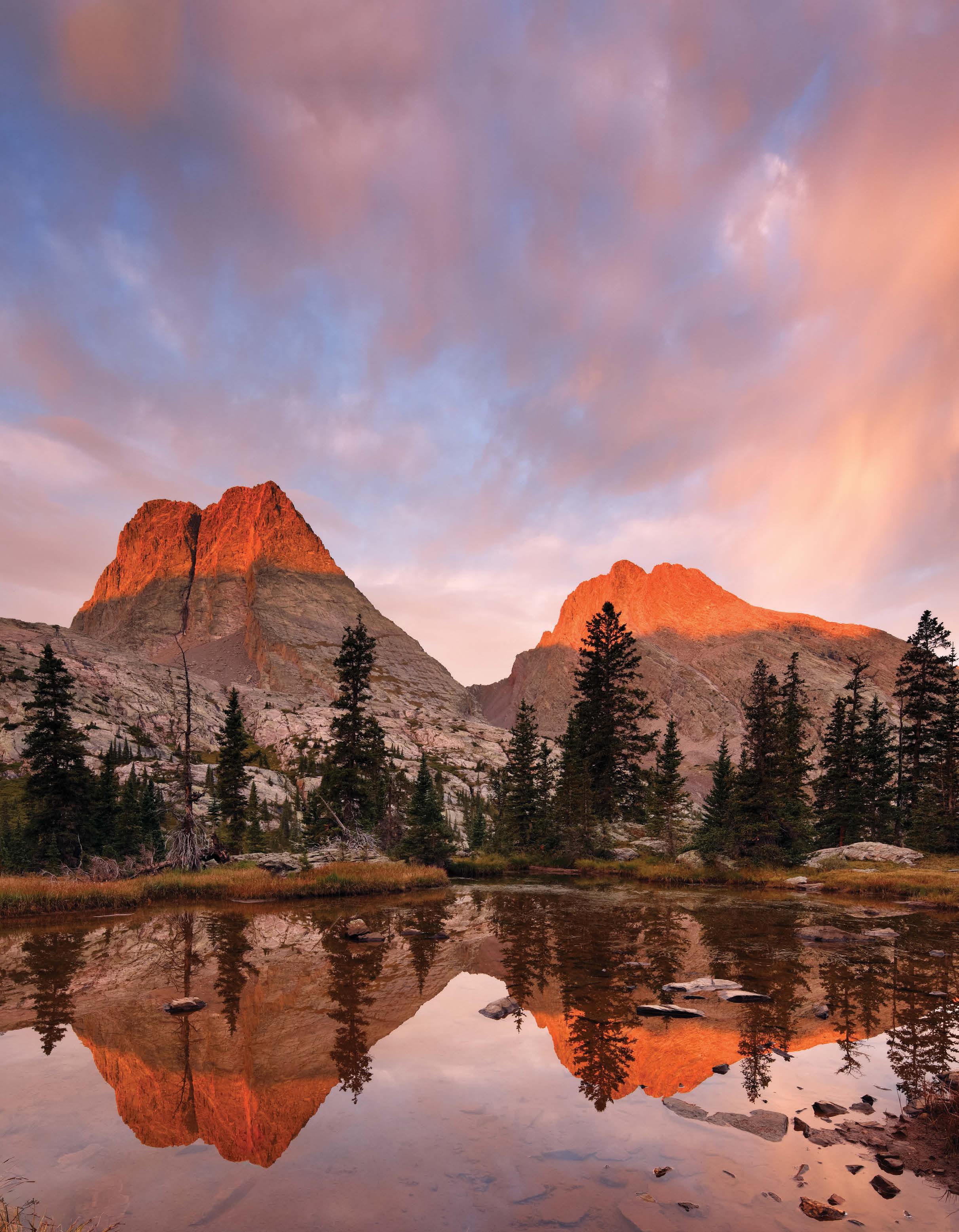
Very old rock and a dry climate give the Centennial State one of the richest dinosaur fossil records in the world. We dug in to find out where to see the coolest bones, tracksites, and more.
 BY JESSICA LARUSSO
BY ROBERT SANCHEZ
BY JESSICA LARUSSO
BY ROBERT SANCHEZ

16 A behind-the-scenes look at 5280’s redesign.
19 PROFILE
A new exhibit brings local lowrider culture to the world of high art.
20 INTERSECTIONS
Your guide to the breweries, parks, and shops injecting fresh life into a storied stretch of South Broadway.
22 SPORTS
One writer’s argument for paying your respects to Charlie Blackmon—before it’s too late.

24 BIG PICTURE
Could functional mushrooms become the next CBD?

26 POLITICS
Every July 1, a slew of laws goes into effect. We break down three regulations that are reshuffling the rulebooks.
38 TECHNOLOGY
After years of development, Broomfield’s Biofire
on the cusp of manufacturing a pistol that promises to make the world safer—that is, if anyone buys the thing.
BY SPENCER CAMPBELL48 ENVIRONMENT
How a small group of ecoactivists took western Colorado’s Holy Cross Energy from fossil fuels to the cutting edge of clean energy.

 BY ELISABETH KWAK-HEFFERAN
176 THE OVERSIMPLIFIED GUIDE TO: ADOPTING AN ADVENTURE DOG
Five tips for getting a rescue pup to accompany you on all your Colorado exploits. ON
Illustration by Studio Muti




Healthy breathing takes more than just your lungs.
That’s why the nation’s leading respiratory hospital is also a leader in heart and immune-related disorders.



Our cardiologists, pulmonologists and medical teams collaborate to help hearts and lungs work together, so you can feel your best.

Our commitment to research and early diagnosis in heart-related illnesses, combined with innovative treatments and clinical trials, helps thousands of kids and adults who struggle to breathe get back to breathing easy.
Healthy lungs, healthy heart, working together for a healthier you.
To learn more or make an appointment, call 800.621.0505 or visit njhealth.org.



EDITOR
Lindsey B. King
ART DIRECTOR
David McKenna
DIGITAL DIRECTOR

Maren Horjus
EDITORIAL
MANAGING EDITOR
Jessica LaRusso
SENIOR STAFF WRITER
Robert Sanchez
FEATURES EDITOR
Spencer Campbell
SENIOR EDITOR
Nicholas Hunt FOOD EDITOR
Patricia Kaowthumrong
SENIOR ASSOCIATE EDITOR


Jessica Giles
ASSOCIATE EDITORS
Madi Skahill, Chris Walker
ASSISTANT EDITOR
Barbara Urzua
ASSISTANT FOOD EDITOR
Ethan Pan
RESEARCH EDITOR
Visvajit Sriramrajan
COPY EDITORS
Shannon Carroll, Dougald MacDonald
CONTRIBUTING WRITERS


Kelly Bastone, Laura Beausire, Christine DeOrio, Clay Fong, Courtney Holden, Sarah Kuta, Elisabeth Kwak-Hefferan, Jenny McCoy, Allyson Reedy, Meredith Sell, Daliah Singer, Martin J. Smith, Andy Stein
EDITORIAL INTERNS
Kinzey Gill, Brock Muñoz
DESIGN & PHOTOGRAPHY
PHOTO EDITOR

Charli Ornett
DEPUTY ART DIRECTOR
Sean Parsons
DEPUTY PHOTO EDITOR
Sarah Banks
CONTRIBUTING ARTISTS
Michael Byers, Aaron Colussi, Marta Kochanek, Simone Massoni, Paul Miller, Arthur Mount, Agata
Nowicka, Jimena Peck, Antonio Rodríguez, Studio Muti, James Stukenberg, Alexander Wells, David Williams
Daniel Brogan
EDITORIAL DIRECTOR

ADVERTISING & MARKETING
CHIEF REVENUE OFFICER
Camille Hammond

ADVERTISING DIRECTOR
Ari Ben
MARKETING DIRECTOR
Piniel Simegn
SENIOR ADVERTISING EXECUTIVE
Molly Duran
ADVERTISING EXECUTIVES
Katie Duven, Heather Lowe, Angie Lund, Kara Noone
ADVERTISING & MARKETING COORDINATOR
Tamara Curry
MARKETING COORDINATOR
Grace Thomas
BRAND SERVICES

CHIEF BRAND OFFICER
Carly Lambert
PRINT OPERATIONS DIRECTOR
Megan Skolak
CREATIVE SERVICES MANAGER
Chelsea Conrad
DIGITAL OPERATIONS MANAGER
Shundra Jackson
SENIOR GRAPHIC & UI DESIGNER
Caitlin Brooks
AUDIENCE GROWTH COORDINATOR
Greta Kotova
P RODUCTION COORDINATOR
Alyssa Chutka
DES IGN COORDINATOR
Mylie Hiraoka
NEWS STAND CONSULTANT
Alan Centofante
CIRCULATION CONSULTANTS

Meg Clark, Greg Wolfe

ADMINISTRATION
HUMAN RESOURCES DIRECTOR
Derek Noyes
OFFICE MANAGER
Todd A. Black
BILLING & COLLECTIONS MANAGER
Jessica McHeard
Equinox Counseling & Wellness Center’s intensive out-patient treatment programs are designed to help our patients learn to function and to find meaning and purpose in their lives. The journey to wellness includes a safe, healing, and compassionate treatment experience for our patients and their families.
Anxiety & Depression
Neurodiversity – ADD/ADHD
• Mood Disorders
• Autism
• Technology Addiction
• Executive Functioning Deficits
• Trauma & Attachment
• Family Conflict

AGES 18-28
Through six core competency areas, our program helps patients who lack purpose and motivation make the successful transition from adolescence to healthy young adulthood.


AGES 10-13 • 14-17
Our comprehensive treatment approach combines the best elements of residential treatment and wilderness therapy, stopping the cycle of family distress & the need for out-of-home placement.
AGES 10-28
With a focus on purpose, planning and preparation, our treatment program is designed to help families reintegrate and reinforce the gains made in out-of-home placement.
A one-year subscription to 5280 costs $19.95 for 12 issues. A two-year subscription costs $34.95. Special corporate and group rates are available; call 303-832-5280 for details. To start a new subscription, to renew an existing subscription, or to change your address, visit 5280.com/subscribe; call 1-866-2715280 from 9 a.m. to 5 p.m. EST Monday through Friday; or send an email to circulation@5280.com.

Letters to the editor must include your name, address, and a daytime phone number (all of which can be withheld from publication upon request). Letters may be submitted via regular mail or email (letters@5280.com). To have a restaurant considered for our Dining Guide, contact us by phone or email (dining@5280.com) to receive a submission form. We also encourage you to contact us if your experience at a restaurant differs significantly from our listing. Information for these sections should be subm itted at least six weeks before the issue’s cover date.
Writer’s guidelines can be found online at 5280.com/writers-guidelines. To suggest a story idea, email us at news@5280.com.

5280 offers businesses the most costeffective way to reach Denver’s upscale consumers. Information about advertising is available on the web at 5280.com/ advertising. Call 303-832-5280 to request a printed media kit.
5280 actively supports organizations that make our city a better place to live and work. Submit sponsorship proposals to Piniel Simegn, marketing director, at sponsorship@5280.com.


However

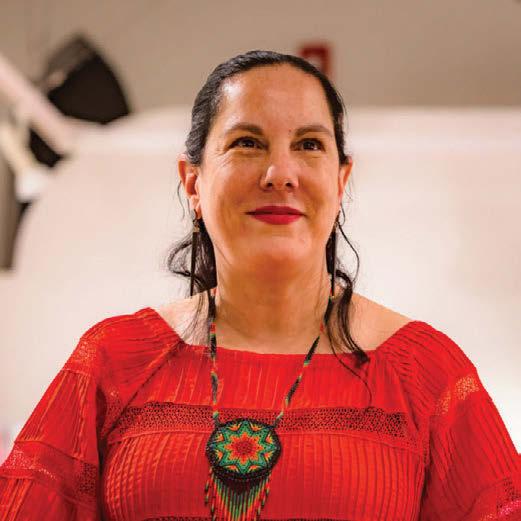
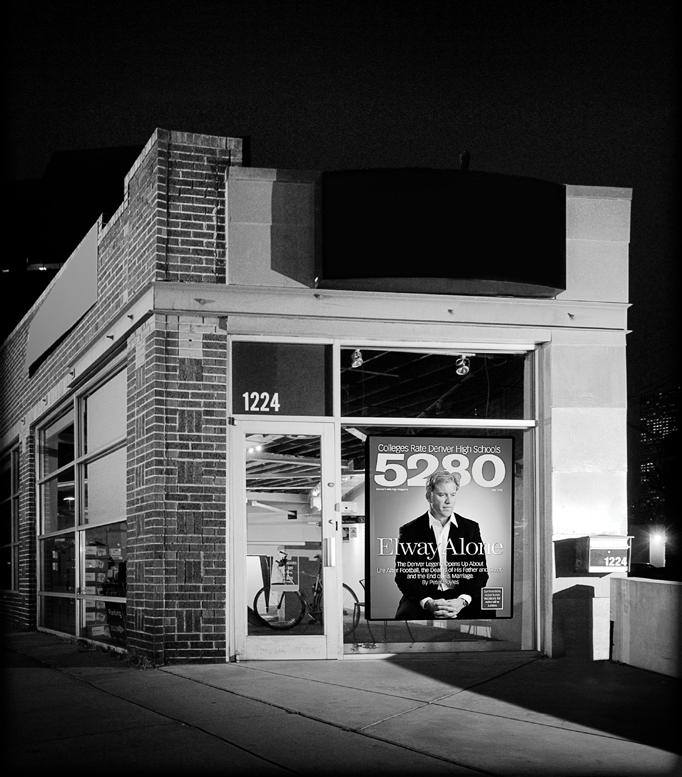
Tradition dictates that to celebrate an anniversary, one gives a formal, tangible gift. But the logistics, not to mention the cost, of handing out actual trinkets to 50,000 print subscribers and roughly 40,000 daily digital newsletter readers are, regrettably, prohibitive. To commemorate 5280 ’ s three decades of covering Denver, a milestone the magazine reaches this month, I thought I’d instead share what I think is the most valuable lesson I’ve learned during my 22-year journalism career, all of which has been spent within these walls.
Ready for it? Be generous.
That may not seem like an axiom one would glean from an industry built on delivering the truth at all costs. And if I had worked at another media company, my takeaway might’ve been very different. Fortunately, 5280 ’ s founder, Dan Brogan, hired me when I was 22 years old and—in ways both direct and indirect—helped instruct my view on what it means to be a journalist worthy of telling other people’s stories.

Throughout 5280 ’s 30-year history, Brogan has not personally approved every decision his editors and reporters have made, but he hasn’t had to: We have always known that along with his good-journalism-is-good-business motto, he also believes in a good-peoplemake-good-journalists maxim. And so,
for our team, being generous has meant understanding that many people have never spoken to a reporter before—and that it can be intimidating. Being generous has looked like telling sources a little bit about yourself so they can see you’re human, too. Being generous has meant holding sources’ hands in hospital beds, in courtrooms, at funerals. Being generous has involved taking blankets to a source experiencing homelessness long after a story has been published. It has meant deciding not to run a story that took months to report and write because the primary subject’s mental health had become too fragile. It has included asking a question again (and again) to ensure you understand
the necessary nuance. It has meant leaving out details that, as a reporter, you desperately want to include but that could’ve threatened someone’s safety.
I could be wrong, but I don’t think every editorial team has the imprimatur of the CEO to practice that rigorous-but-generous style of journalism. And I could also be biased, but I believe that’s a big part of what has made 5280 successful. Here’s to many more years.
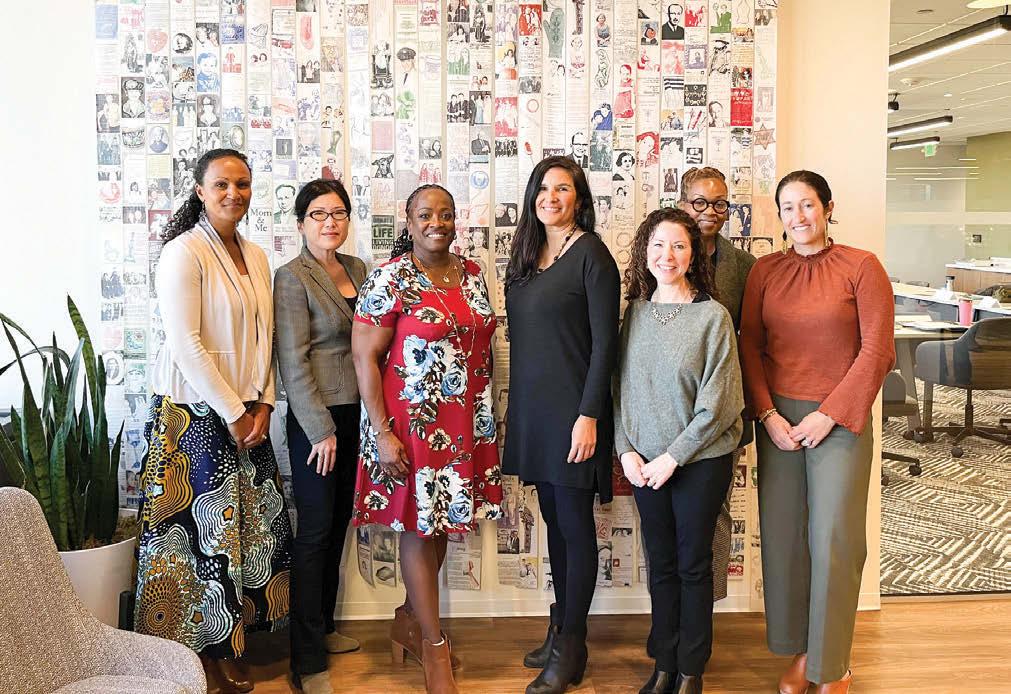
LINDSEY B. KING Editor lindsey@5280.comFor more than 13 years, 5280’s design has been stewarded by one of the best in the biz. In that time, David McKenna has thoughtfully evolved the look of the pages to visually engage readers and reflect a sense of place. There’s no question he’s realized his vision year after year. But evolution is an ongoing business, and to coincide with 5280’s 30th anniversary this month, McKenna undertook his fourth redesign—embracing an aesthetic he describes as strong, simple, and a little sophisticated. He didn’t do it alone, of course. Deputy art director Sean Parsons, photo editor Charli Ornett, and deputy photo editor Sarah Banks all leaned into the idea of pages with more white space and larger imagery. Among many other things, McKenna eyeballed a multitude of typefaces and pared back the color palette to let images and typography shine; Parsons reinvented page grids throughout the magazine and discovered new illustrators who will complement the design; and Ornett and Banks have plans to produce more shoots, which aligns with a renewed emphasis on more authentic photography. The result? A magazine that evokes the Centennial State’s wide-open spaces and Denver’s urban landscape while also highlighting the diverse array of people who call this place home. “We want every page in this redesign,” McKenna says, “to visually elevate the best of Denver and maybe inspire ideas for making it even better.”
DAVID Mc KENNA Art Director



Thanks to movies, the media, and plain ignorance, lowriders have been cast as the exclusive conveyance of drug dealers and gang members. That depiction couldn’t be further from the truth, says Carlos Frésquez, a local artist who has been creating vibrant paintings, prints, and murals inspired by the Mile High City for more than 40 years. Now he’ll help shatter the stereotype. Beginning July 9, the Denver Art Museum’s (DAM) Desert Rider: Dreaming in Motion exhibition will use the work of Latino and Indigenous artists to explore how vehicles have shaped Southwestern identity. Although the show originated at the Phoenix Art Museum, DAM curator Victoria Lyall tailored Denver’s version to the city by adding works—including Frésquez’s 1985 mixed media collage, “Cool Couple; Series #10” (pictured)—from seven Colorado artists. “To me,” Frésquez says, “it represents the urban nature of Chicano culture.” Desert Rider doesn’t stick to a single mode of transportation, but lowriders make up most of the traffic in the exhibit, which kicks off with a car show and free admission on opening day and runs through September 24. “The lowrider is representative of our culture, not lowlifes,” Frésquez says. “I hope people see that.”
—BARBARA URZUAThe stretch of South Broadway roughly between Mississippi and Evans avenues has a pair of monikers: the Green Mile, for its pot shops, and Antique Row, for its vintage stores. Neither, however, captures its vibe. “The breweries, the high-end housing, the shops,” says Michelle Kidd, marketing manager of Meier Skis, which moved to the neighborhood in 2019, “are bringing in a ton of energy.”
—NICHOLAS HUNT
1200 W. FLORIDA AVE.
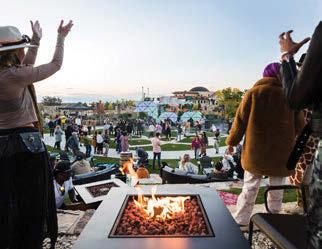
Although the 88-acre green space isn’t technically on South Broadway, Ruby Hill pairs so well with this stretch of the thoroughfare, we consider it annexed territory. Levitt Pavilion is a major reason why. Built in 2017 by the nonprofit Levitt Foundation, the amphitheater draws huge crowds to its free concert series each summer. Pregame for the July 1 show by Denver hip-hop group the FloBots at nearby Trashhawk Tavern. The dive is known for its menu of straightforward and irreverent cocktails such as the Pink Nasty (vanilla vodka and orange Fanta) and the Spaghetts (a Miller High Life with a squeeze of lemon and your choice of Campari or Aperol).
4 Spectra Art Space
1836 S. BROADWAY
Meow Wolf isn’t Denver’s only immersive experience. Six-year-old Spectra Art Space hosts two interactive shows a year: autumn’s Spookadelia, a psychedelic haunted house with themes of selfexploration and social awareness, and summer’s Novo Ita, which transports visitors to a botanical sci-fi city. “The intention is to inspire people to be better to the planet and to each other,” says owner Sadie Young. Spectra recently added performers to enhance the narrative-driven, self-guided experiences, and this season’s Novo Ita (through September) will feature a redesigned cityscape.

1874 S. BROADWAY
Sure, Fifty-two 80’s vintage offerings may be sourced from 1975 to 1995, but they’re far from stuffy heirlooms. And if the DayGlo kaleidoscope of He-Man and Star Wars action figures, Troll dolls, trading card packs, and other toys lining the shelves don’t thrill you, just come back later: Co-owners Tony Vecchio and Dede Thompson are always procuring new memories to stir multigenerational nostalgia.
1736 S. BROADWAY
No Denver hot spot would be complete without a beer hall (or five), and from Dos Luces Brewery’s Latin American–inspired libations to Grandma’s House’s buzzy crafting nights to Ratio Beerworks’ second location, South Broadway has plenty. After joining the crowd in 2022, Public Offering immediately stood out thanks to its industrialmodern build-out, sunny patio, and accessible tap list, including excellent hazy IPAs. But Meier Skis’ Kidd prefers the lemon-tinted Open Spaces Kölsch: “I love that Public Offering has really nice light beers, so you don’t have to drink eight percent ABV after work.”


Pay your respects to Charlie Blackmon—before it’s too late.
What’s behind the beard? It’s been almost a decade since Charlie Blackmon hid the lower half of his face behind a majestic mane, but we used to know. When the Rockies first called Blackmon up to the big leagues in 2011, he sported sideburns but left his plump 24-year-old cheeks exposed to the world.

Then he got hurt. Less than a week after hitting his first home run, Blackmon broke his left foot sliding into third. He grew a baby beard while rehabbing, shaved it for the start of the next season, bounced between the minors and majors for two more years, and then, finally, retired his razor for good before the 2014 season. Blackmon made his first All-Star team that year. He later told mlb.com that his facial hair made him feel like the Terminator, though he created his own alter ego and named him Chuck Nazty.
Blackmon is now 37 and in the final year of his contract with the Rockies. The trade deadline is July 31, meaning that, if Blackmon continues to post solid numbers this season, the team might flip the aging outfielder to a contender before the month is out. In other words: It’s time to discuss the Bearded Wonder’s legacy.
Blackmon doesn’t have the resumé for Cooperstown. Even the most ardent Chuck Nazty fans will admit that he doesn’t measure up to Todd Helton or Larry Walker, the only Denver players to have their numbers retired by the team. Confined to the lowly Rockies for the entirety of his career, Blackmon has never won a World Series, and thanks to injuries and other extenuating circumstances, he isn’t ending his career with the Blake Street Bombers with as many bombs as he might have.
But I hope Blackmon will be celebrated. Not for what he achieved, including a batting title and four AllStar games, but for how he achieved it.
Out of high school, Blackmon was a weak-tossing pitcher who didn’t garner a single Division I scholarship offer. So he transformed himself into an outfielder, first at community college and then at powerhouse Georgia Tech. After being drafted by the Rockies, his rise in the farm system stalled due to the especially long step he took toward the pitcher before swinging. So, he carried a cinder block with him everywhere—the locker room, the bus, his hotel—to hold his foot still while he practiced his cuts. After three years yo-yo-ing between the majors and the minors left many feeling that Blackmon wasn’t MLB material, he
grew a beard and gave birth to someone who was: Chuck Nazty.
It’s safe to say that the face beneath the beard has changed during the past decade. These days he looks less like a superhero and more like a spent moonshiner. That’s to be expected, though. Chasing greatness exacts a toll, especially for people who have to work so hard to attain it. For those of us in Denver who got to see Chuck Nazty streak across center field to erase a double or take the Padres deep to right again and again, his devotion to his dream was worth it. I hope Charlie Blackmon agrees. —SPENCER
CAMPBELL

Could functional mushrooms become the next CBD?
Fungi have long been symbols of decay and witchcraft, but recently, our cultural mycophobia has been giving way to wellness-driven mushroom mania. Studies suggest that pompom-shaped lion’s mane (pictured), for instance, can promote brain health and that cordyceps—the cause of the zombie apocalypse in HBO’s The Last of Us—exhibit cancer-fighting properties. “I think these types of functional mushrooms have more potential to help humanity than psychedelic mushrooms and CBD combined,” says veteran Colorado mushroom forager Del Jolly. That prospect inspired him to co-found Longmont-based Umbo in 2020 with Rashad Evans, a former UFC fighter based in Boca Raton, Florida, and retired Denver Broncos quarterback Jake Plummer. Plummer, who lives in Boulder, also co-owns MyCOLove Farms, a gourmet and functional mushroom grower in Fort Lupton. Umbo’s shroom-packed snack bars, tinctures, and supplements are intended to boost customers’ mental and physical well-being, though scientists still haven’t conclusively determined functional mushrooms’ health benefits. Neverthelesss, the value of the sector is expected to reach $20 billion worldwide by 2030, according to Allied Market Research. And with plans to launch a new line of recovery products tailored to athletes later this year, Umbo is positioned to mushroom along with the rest of the functional fungi industry.
 —CHRIS WALKER


Every July 1, when the state government resets its coffers with the new fiscal year, a slew of laws goes into effect. We asked Paul Teske, dean of the University of Colorado Denver’s school of public affairs, to break down three regulations that are reshuffling the rulebooks. —BU
Fentanyl killed more than 1,400 Coloradans in 2020 and 2021 combined.
Companies have been tracking and selling users’ internet data without their knowledge.
In Colorado, the cost of public preschool averages more than $17,000 per year.
Put stricter penalties on dealers while equipping victims and those who misuse substances with more support.
$6 MILLION
The state will reimburse hospitals for preemptively providing overdose medication and will give $6 million in grants to community groups for free test strips and syringe disposal equipment. Plus, possessing between one and four grams will now be a level four drug felony.
“This is partly a perceived course correction since the fentanyl crisis has gotten worse since 2019 [when the state de-felonized the possession of certain drugs for personal use].”
Give Coloradans power over their private information.
Any company that operates in the state and logs the personal data of more than 100,000 consumers (or sells the info of more than 25,000) must allow individuals to opt out of data collection. Coloradans will also be able to view and edit their personal details.
“There could eventually be some overlap with future federal bills, but for now, it’s a way to make sure businesses are being held accountable for what they do with our data.”

Make pre-K more affordable for families across the state.
Up to 15 hours of public pre-K per week (out of 35 hours for most full-day programs) will now be free, saving parents and guardians up to $6,000 annually. The state will pay for the subsidies by increasing the tax on nicotine products: Expect to pay $2.64 (currently $1.94) per pack by 2027.
“A lot of recent research shows that investments in preschool programs really pay off down the road when kids graduate from K–12 and give back economically.”



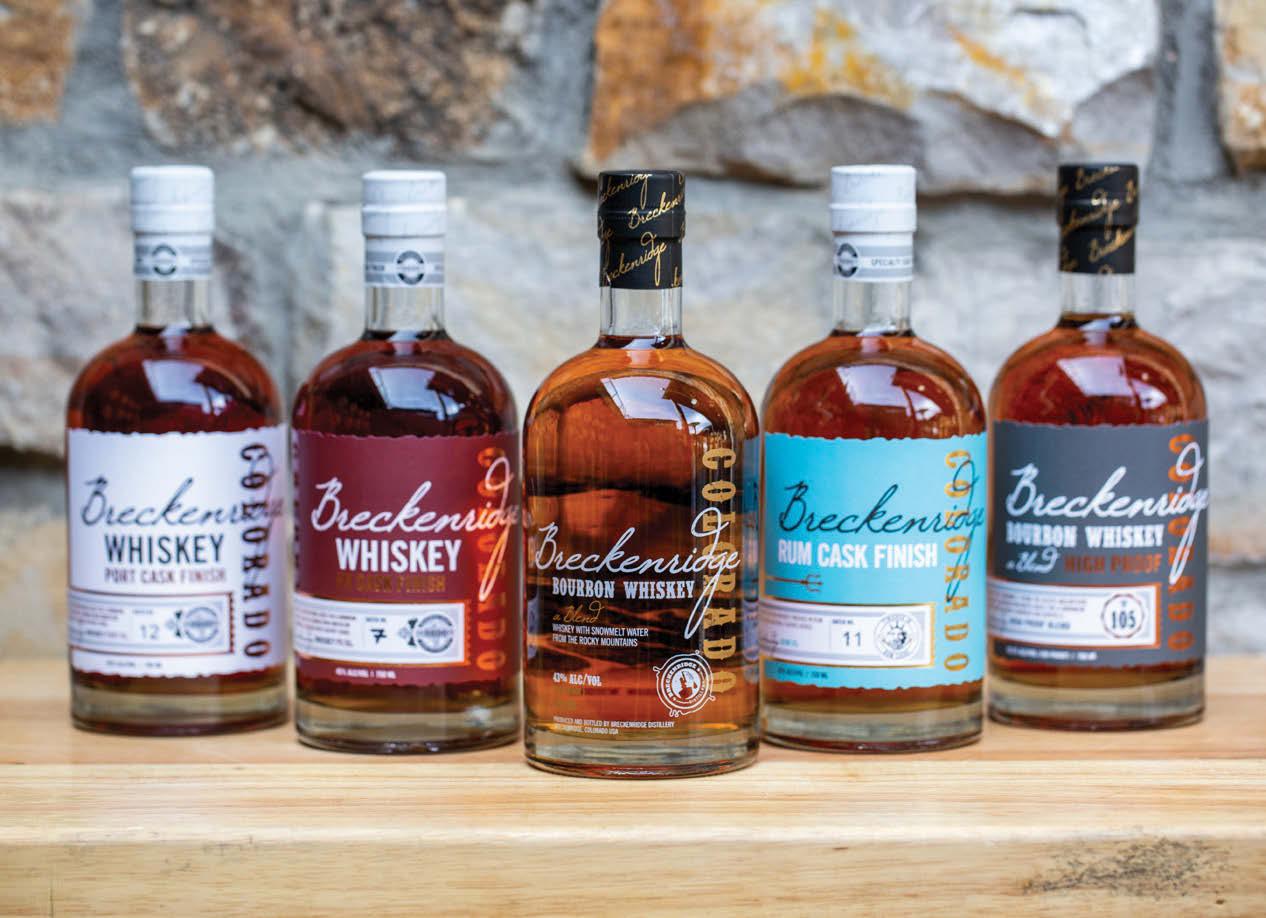
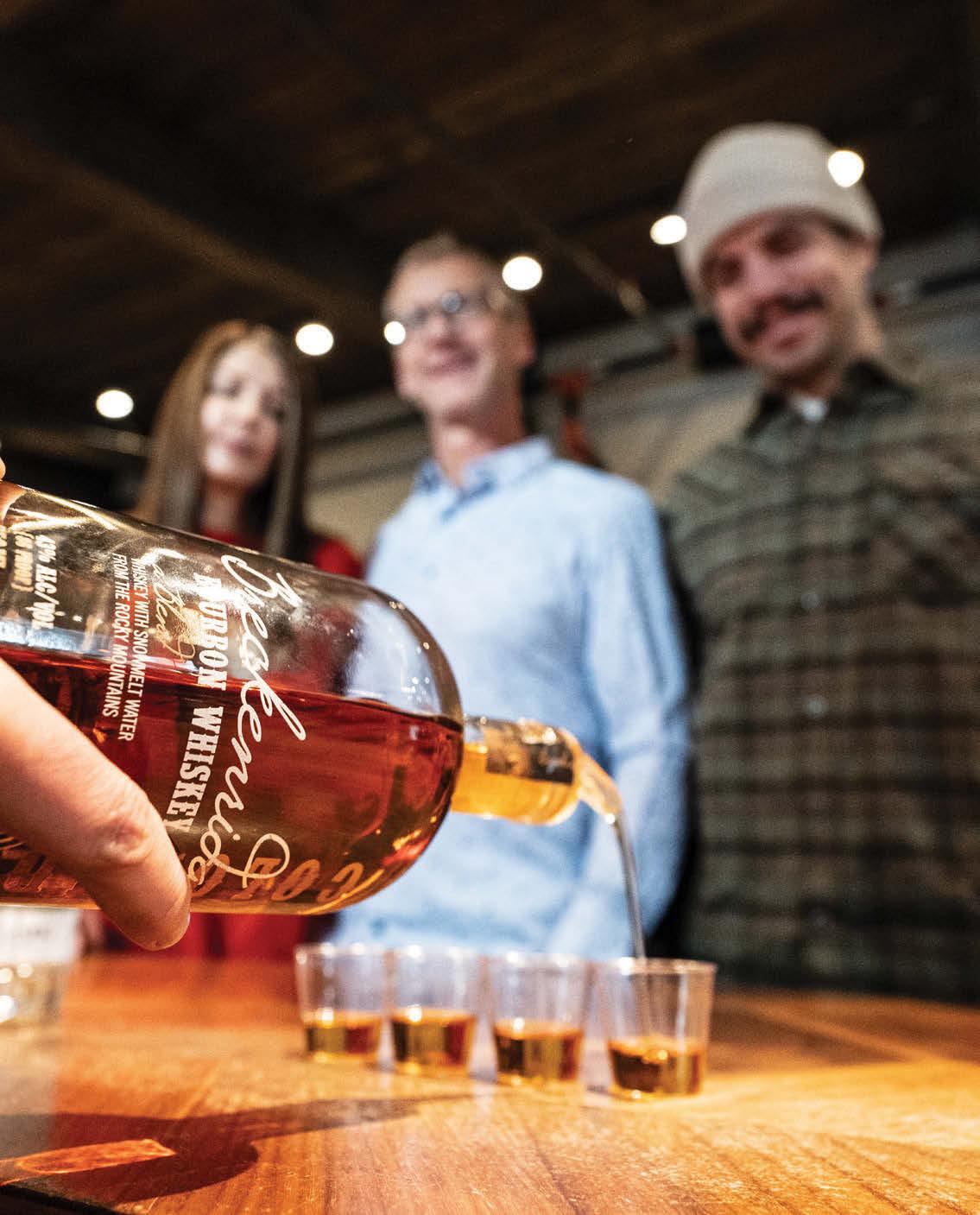
FROM TOURING THE AWARD-WINNING SPIRIT’S PRODUCTION FACILITY TO INDULGING IN WORLD-CLASS CUISINE, BRECKENRIDGE DISTILLERY IS TRULY AN ADVENTURE FOR THE SENSES. WHETHER YOU HAVE TIME FOR THE FULL EXPERIENCE AT THE DISTILLERY ON AIRPORT ROAD, OR YOU’RE SIMPLY CURIOUS ABOUT TASTING ITS AWARD-WINNING SPIRITS WHILE STROLLING MAIN STREET, THE DISTILLERY MAKES IT EASY, FUN AND DELICIOUS TO DISCOVER WHAT IT’S ALL ABOUT. HERE ARE 10 WAYS YOU CAN EXPERIENCE THE BRECKENRIDGE DISTILLERY.
Executive Chef Robbie Reyes’ style brings an international flare to the Breckenridge Distillery Restaurant’s menu. Their modern-American steakhouse atmosphere showcases seasonal and approachable dishes that impart not only the fantastic spirits of Breckenridge Distillery but also their upscale mountain dining experience. Their familystyle menu features a 45-ounce Aged Tomahawk Ribeye, 16-ounce Garlic Rubbed Creekstone Prime Rib and other seasonally focused dishes. As always, the menu revolves around local produce, comfort foods with a twist and shareable dishes meant to encourage interaction and conviviality. Enjoy Happy Hour with $13 plates.
If it’s edible, chances are Liquid Chef Billie Keithley has made a cocktail out of it. And that’s one of the reasons she loves working for the Distillery so much. Because of the Distillery’s special liquor license, Keithley can’t go out and buy spirits and cordials elsewhere, so she creates them herself. Products like amaros, bitters, vermouth and liqueurs are all made in-house. “Which means we can put our own twists on them,” she said. Keithley and Bar Manager Griffin Bovich are creating schnapps, shrubs, syrups and juices, among other fresh products, for every specialty cocktail. Popular menu staples include the ObiWan Old Fashioned, made with Breckenridge Port Cask Whiskey.
Every Sunday, guests are taken on a behind-the scenes tour of the Breckenridge Distillery’s production facility. This abbreviated tour starts by tasting their award-winning Breckenridge Vodka and Breckenridge Gin in their original production facility. Their expert guides will take guests on a one hour tour and finish up the experience with a tasting of their Breckenridge Bourbon Whiskey. Tours are reservation only and include a signature Glen Carin tasting glass. Book a tour.
There’s no need to drink and drive when you can drink and ride. The Breckenridge Distillery wants its guests to drink responsibly, which is why it offers a free shuttle for customers with pick-ups and drop offs anywhere within town limits. The shuttle fits up to 14 people—all you have to do is call the Distillery at 970-445-8613 to book your ride.
5 TASTINGS
The Breckenridge Distillery offers one of the most highly awarded craft bourbons on the market and you can try it for free. Guests are offered two complimentary samples from a limited menu and have the option to upgrade their tasting to try their high-end spirits. A great way to explore their awardwinning line of hooch.
Breckenridge Distillery offers guests a VIP experience during their After Hours Tours. Use your senses to experience the inner workings of how these hand-crafted spirits go from grain to bottle while learning about the history of whiskey and how the distillery was founded. Guests also have the opportunity to try spirits that have yet to be released to the public. Tours are offered at 5:00pm and 6:15pm by reservation only. Book a tour.

Nerd out with our distillers and become a master blender for a few magical hours. Breckenridge Distillery’s distillers are experts in nosing, flavor categorization and pairing substrates together to create a whole that far exceeds the expected sum of its parts. Guests will be taught to break down aggregate flavors while building a whiskey blend complete with mouth feel and finish. You will hand bottle your creation and complete the experience with a customized label. Reservations required. Book now.
8
Book a private dinner or event at the Breckenridge Distillery. Parties of up to 30 people can reserve our exclusive spaces surrounded by aging whiskey barrels, old barn wood, leather couches and an authentic mountain vibe. This exclusive, private dining area comes with a personal wait staff and can be used for families, micro-conferences, executive meetings or small parties. For inquiries and bookings, email events@breckenridgedistillery.com.
9 MAIN STREET TASTING ROOM IN DOWNTOWN BRECKENRIDGE
In the heart of downtown Breckenridge, get a taste of not only the Distillery’s spirits but also a taste of what the Breckenridge Distillery is all about. From merchandise to personable, knowledgeable staff, this small tasting room is a glimpse of what you can experience at their main location on Airport Rd. Learn more about current hours and offerings at breckenridgedistillery.com.
10 SHOP YOUR LOCAL RETAILER
Breckenridge Spirits are available nationwide at your local retailers. Don’t want to leave your house? Get home delivery on your favorite spirits through Caskers.com. If you’d like to practice your at-home bartending skills, head to Billie’s Cocktail Lab to get inspired.
You might not expect a less-is-more philosophy from an alum of Napa Valley’s three-Michelinstarred French Laundry. But you won’t find Jarred Russell, who took over as executive chef at 16-yearold Fruition late last summer, creating thymescented foam or freezing berries with liquid nitrogen in the Country Club establishment’s kitchen. Instead, at owner Alex Seidel’s classic farm-to-table eatery, Russell uses his love of working with local farmers and making ingredients shine with as few additives as possible to produce fare that’s approachable and injected with just the right touch of fanciness. That means serving dishes—such as asparagus with soft scrambled eggs and crispy prosciutto bits, roasted chicken with bacon-braised beans, and shrimp agnolotti with confit zucchini and basil (right)—that guests can feel comfortable enjoying any night of the week. This summer, look for plates featuring tomatoes, melons, peaches, and other coveted warm-weather crops. “It’s all about simplicity for me, really,” Russell says. “What grows together, goes together.”
 —PATRICIA KAOWTHUMRONG
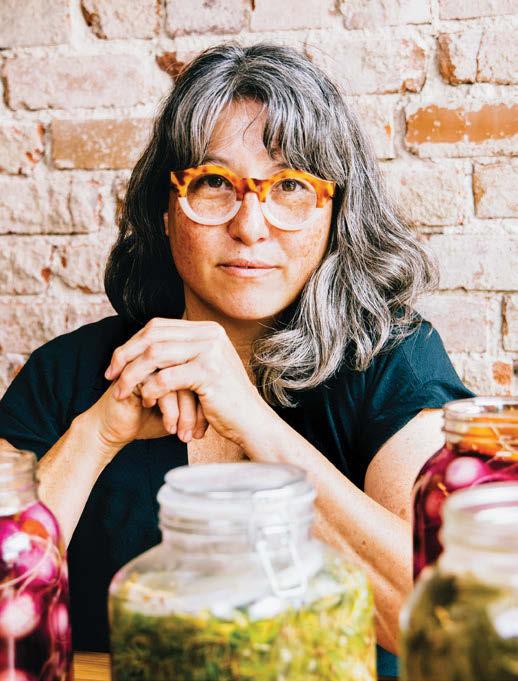
Lacto-fermentation, a bacteria-based method of creating basic pickles, kimchi, and krauts, is a good starting point for amateurs. Fresh produce already contains the lactobacillus bacteria necessary to break down sugars into lactic acid and carbon dioxide, so a salt brine is all that's needed to complete the process. Ferment okra, shred a head of cabbage for sauerkraut, or make giardiniera with peppers, carrots, celery, and cauliflower.
Immersing veggies in salt water creates a prime environment for fermentationfriendly microorganisms to thrive. First, submerge wide-mouthed, hinged glass jars and their rubber seals—which hold liquids in and keep air out—in boiling water to sanitize them. Then stuff with veggies, herbs, and spices (King likes cumin, mustard, or coriander seeds with fresh dill) and top with a five percent ratio of 50 grams kosher or sea salt (about 23∕4 tablespoons) to every liter of water. Note: Some veggies, such as cabbage, release enough of their own moisture that you can simply sprinkle the veggies with 1.5 to two percent of their weight in salt. Either way, ensure the produce stays submerged in liquid to prevent molding.
Mara King, director of fermentation for the Wolf’s Tailor, Brutø, and Hey Kiddo, shares her secrets for creating the perfect pickle.
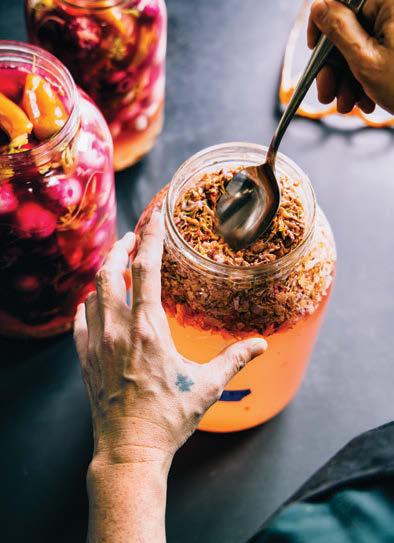
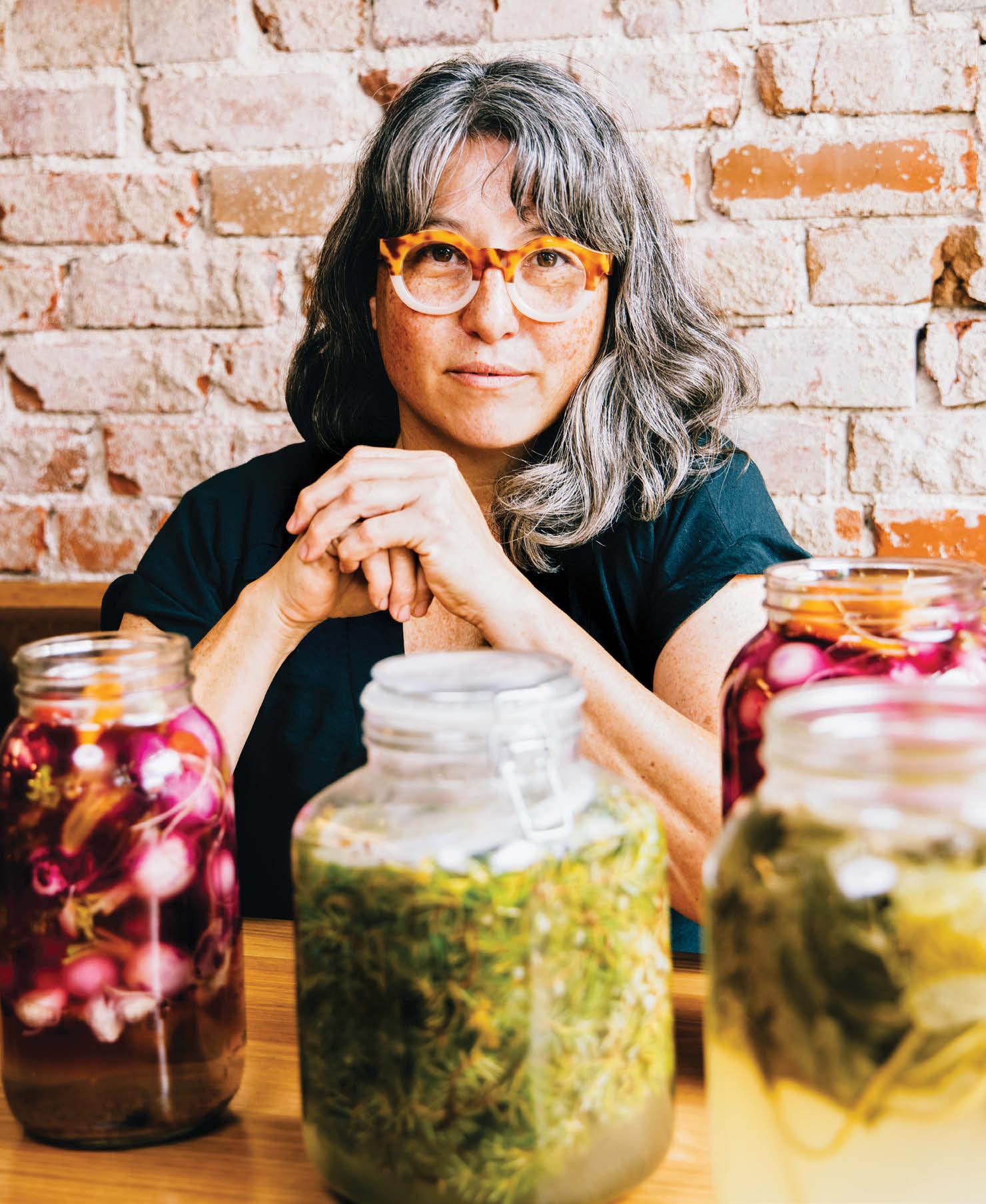
Wild yeast, mold, and bacteria have led Mara King on a wild ride over the past 15 years—from roving the streets of her native Hong Kong in search of fermented delicacies for a YouTube series to crafting koji (an East Asian mold essential for miso and sake) out of buckwheat grown and milled by Boulder’s Dry Storage. This summer, the fermentation director for Id Est Hospitality Group—chef Kelly Whitaker’s restaurant conglomerate comprising the Wolf’s Tailor, Brutø, and six-month-old
farm-to-table spot Hey Kiddo—is reducing food waste by crafting fermented sauces, soups, and side dishes from eatery extras. Favorites at Hey Kiddo include gochujang chile paste created with leftover sourdough bread and chiles, tian mian jiang (sweet bean sauce) made from stale Hokkaido milk rolls, and banchan (Korean side dishes such as pickled vegetables). Here, the curing connoisseur breaks down how to preserve your next garden or farmers’ market haul.
Once you’ve shut the lids and set the jars on a countertop away from direct sunlight, it’s time to let Mother Nature do her thing. But be vigilant: Ferments left unattended can build up CO2 and burst. To guard against bangs in the night, King recommends burping the mixtures twice daily by tugging at the rubber seals, which releases gas while keeping air (and the flavor-altering yeast it contains) out. Wait one to four weeks, sampling along the way until you’re satisfied with the tartness, then refrigerate to stop the fermenting process.
“The bacteria break things down, so you’re releasing flavor that wasn’t even available there before,” King says. The preserved goodies are also high in vitamins A and K and contain myriad gut-health-enhancing microbes that aid digestion. Add the ferments into your diet as accompaniments for brats or burgers; braised with meats; or puréed with tahini to make salad dressings.





Out here, a change in scenery creates a shift in perspective. Welcome to life magnified.



GOSNOWMASS.COM
















 Photo: Tamara Susa
Denver culinary pros are taking lamination—the process of folding butter into dough to produce flaky layers—to new heights.
Montclair
Since opening La Fillette as a mostly takeout, French-inspired operation in 2015, pastry chef Keturah Fleming has crafted steadily more ambitious croissants, and in late March, she brought them to a larger, full-service space in Montclair. There, customers can devour signature creations such as the croissant muffin, a true feat of engineering: Although they’re made with the same laminated dough as La Fillette’s other pastries, Fleming perfected a secret rolling technique to achieve a flawless cylindrical form (with the help of a mold). Then she adds toppings and fillings in rotating flavors (think: chocolate pistachio and sticky toffee pudding) to the canshaped beauties. While you’re there, scope out the new brunch menu, which has savory treats like a smash burger with melted white American cheese, caramelized onions, and hollandaise sauce sandwiched between two pucklike croissant buns.



Izzio Bakery RiNo
When the round, cream-filled croissants made by New York City’s Lafayette Grand Café & Bakery went viral in 2022, bakery pros around the world began churning out laminated homages of their own. That inspired Yasmín Lozada-Hissom, the pastry whiz behind Izzio Bakery inside Denver Central Market, to craft a version. To do so, she and her team came up with a four-day process. The painstaking steps include fermenting a mixture of freshly milled flour and imported Plugrá and Isigny Ste Mère butters (known for their high fat contents) overnight; using a trifold method to laminate the dough before it’s rolled, cut, and shaped; and baking the proofed pastries at 3 a.m. the day they hit the bakery counter. The result is a circular vessel for creamy fillings and colorful decorations that’s caramelized on the outside and flaky on the inside. Look for flavors such as dulce de leche, matcha crunch, and raspberry cheesecake, all of which are worthy of flaunting on TikTok and Instagram.
ELEMENT OF SURPRISE
Black Box Bakery Hale
Arielle Israel and Megan Read are drawn to difficult bakes. That’s why the pastry chefs—who met at the Culinary Institute of America in Hyde Park, New York—chose to focus on the notoriously fussy craft of lamination. In 2019, they launched Black Box, a croissant-centric, wholesale-only bakery, with co-founder Ty Webb. To everyday Denverites’ delight, the trio expanded the business with a retail storefront in Edgewater Public Market this past March. Menu highlights include the sausage roll and an exceedingly rare vegan croissant, but don’t skip the namesake Black Box pastry. The extra-elaborate, monthly rotating mystery croissant comes in renditions such as lemon meringue stuffed with lemon curd and crowned with torched meringue. Customers may only ask if it’s sweet or savory or if it contains any allergens before ordering and receiving the secret goodie, which comes (naturally) in a black box.
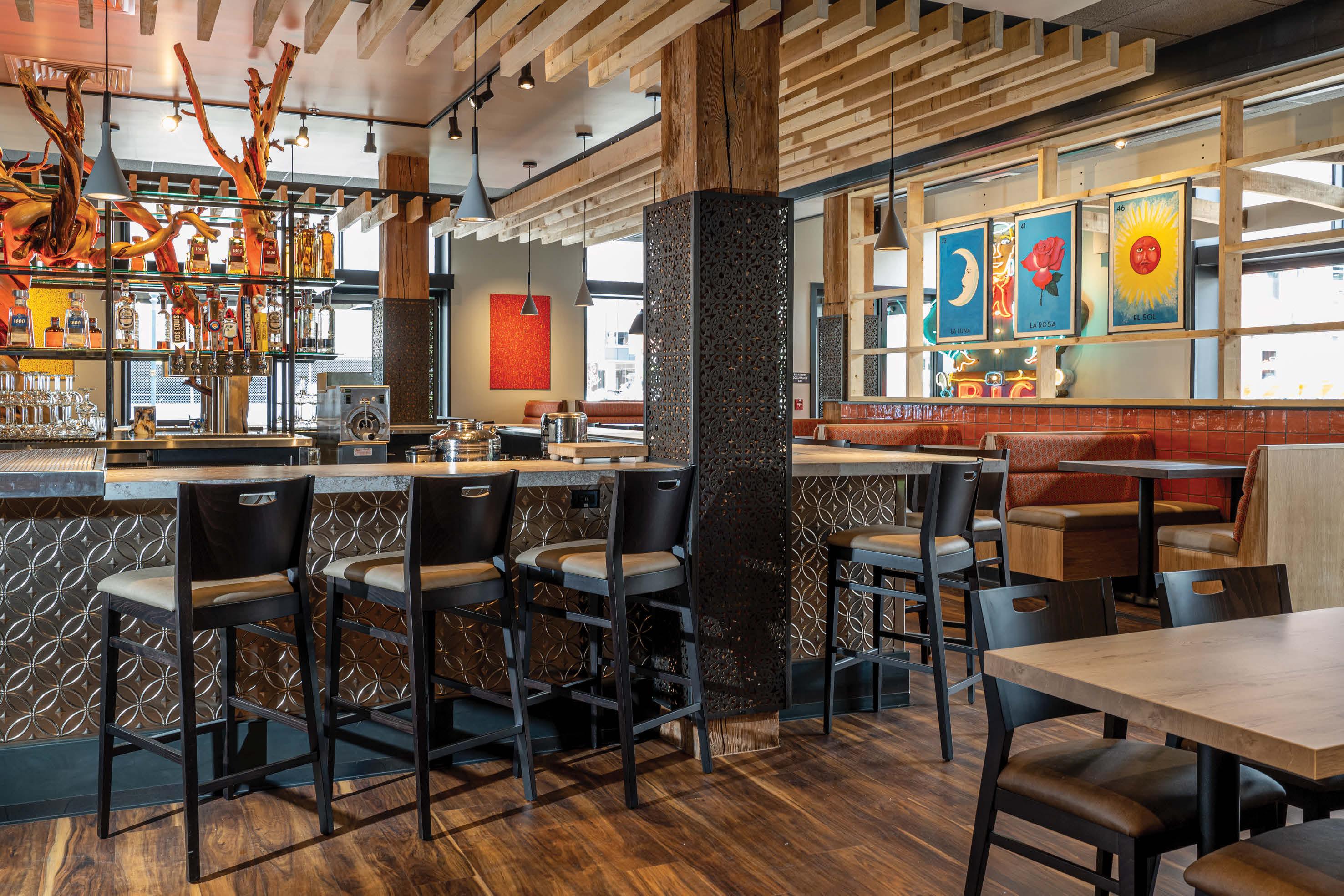

As a kid, I would silently groan when my mom would plunk down a steaming bowl of magenta borscht for dinner. Teenage angst in full effect, I was convinced that no one I knew was being forcefed anything resembling beet soup. Fast-forward several decades and Molotov Kitschen & Cocktails, a new Ukrainian and Eastern European enclave on East Colfax Avenue, has me not only thinking about borscht anew, but also craving it.
As our server explained it, there are a million and one versions of the soup,

all dependent on time and place. Not all are rib-sticking, not every bowl is served hot, and many don’t even feature beets. Borscht’s origins are Ukrainian, and that makes it a perfect centerpiece for Molotov’s menu: The restaurant, which took over To The Wind’s diminutive space in midJanuary, is chef-owner Bo Porytko’s ode to his Ukrainian roots. His grandparents immigrated to the United States from the Eastern European country after World War II, and he learned to cook with his grandmother. Porytko is quick to point out that the
restaurant isn’t named for one-time Soviet foreign minister Vyacheslav Molotov but for the handmade weapon that’s long symbolized opposition and that everyday Ukrainians have been deploying since Russia invaded the country in early 2022.
The 40-year-old chef’s menu is tightly edited: eight small plates, including borscht, a handful of entrées, and two desserts. The beauty of Porytko’s cooking—perhaps you’ve experienced it at Misfit Snack Bar— is its twists on flavor and texture, and my initial taste of his borscht is proof. On my first visit, I noticed that, instead of using beets, Porytko spun his broth from dehydrated (and rehydrated) sour cherries, and while
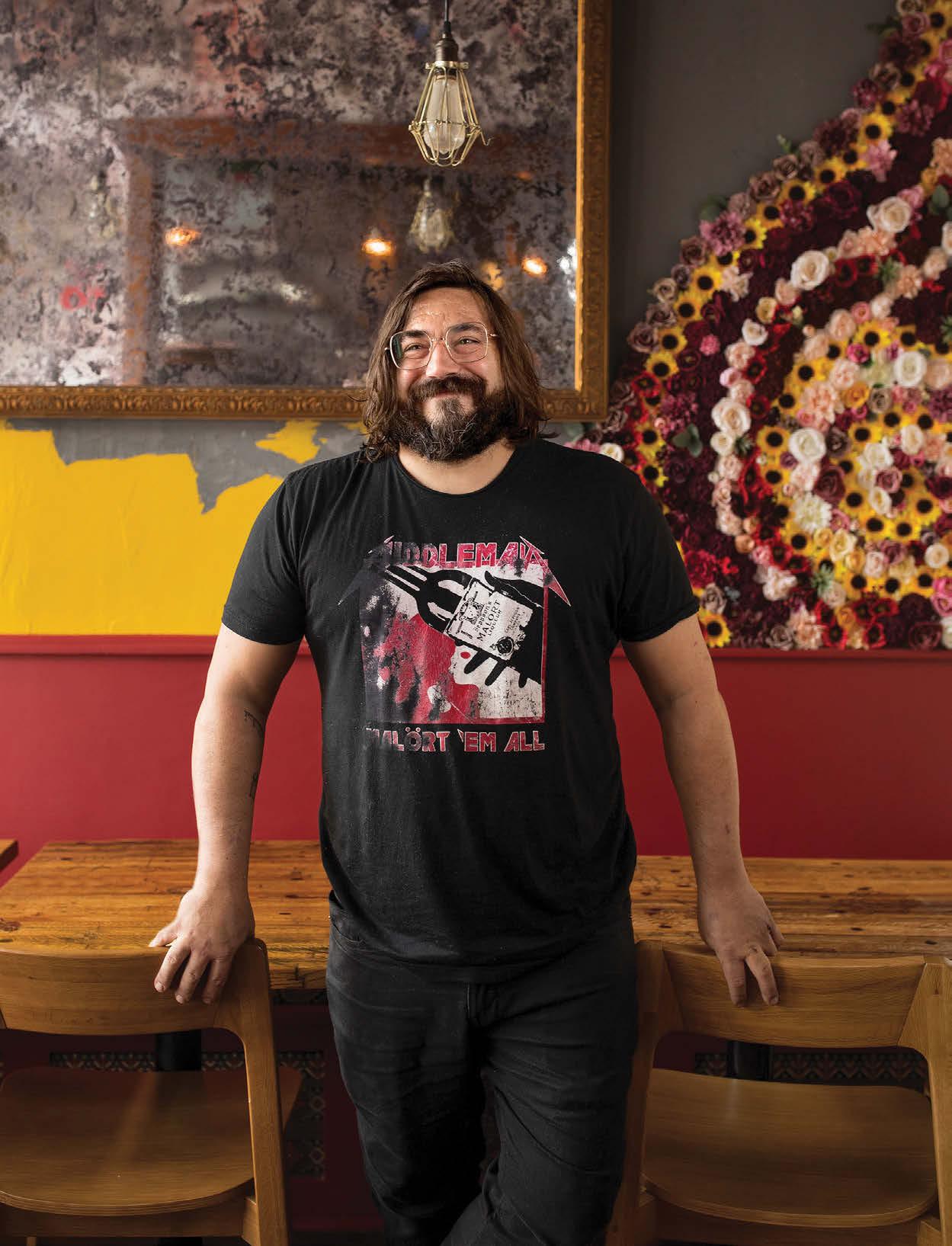
the color was the signature pink, the soup’s consommé was a savory, nuanced play on the red, tannic fruit. Three uszka (dumplings traditionally filled with mushrooms) anchored the bowl, along with meaty slices of trumpet mushroom. It’s dishes such as this that lend credence to Porytko’s 2023 James Beard Foundation nomination for Emerging Chef.
A month or so later, the menu had changed, and the borscht listed was a smoked chicken and nettle iteration with dill, cilantro, and radishes. “Sorrel is a huge part of the Ukrainian diet,” Porytko says. “We switched that out for nettles because we thought it would be fun to do something locally foraged.” The dish, which I enjoyed on what felt like Denver’s first real spring day, was a revelation: It tasted of green, of sunshine, of a season unspooling. The dillchicken broth was decanted tableside from a small rooster pitcher. Pomp and circumstance, perhaps, but not in a pretentious way; instead, the ceremony felt like a generous handshake.
In truth, the whole space—just 20ish seats—feels that way. The china is a mix of modern tableau and Old World sentimentality; bowls ringed with pink rosebuds make it feel like you’re slurping soup at Grandma’s table. A vast collection of cuckoo clocks decorates the open kitchen, and a large flower installation recalls a Ukrainian headdress worn at weddings, at harvest festivals, and as a symbol of resistance. A small wooden shrine holds the booze—from a delightful Greek sparkling rosé to infused horilka (vodka) ranging from a lush honey black currant to a clearyour-nostrils horseradish.
Borscht is the order of the day— Porytko assures it’ll be the rallying point of every menu—but Molotov’s dumplings should take equal billing. At times that means pelmeni: small spelt pillows stuffed with smoked duck pâté and blanketed with a tarragon béarnaise. Other times you can expect varenyky, which are similar to pierogi and served atop a lusty dill hollandaise and thinly shaved ribbons of pork fatback.
Mains, from a stuffed rabbit Kiev plied with herbed paprika butter and brandished with carrot soubise to a
whole pan-seared trout with an herby cream sauce and jumbo lump crab, are built for sharing around the table. When there are missteps here, they are minor, such as cabbage rolls stuffed with wild mushrooms and buckwheat that tasted slightly muddy and not at all bright like the rest of the menu. Some of the entrées—the smoked bone-in pork chop with farmer’s cheese or bison short ribs, both served with charred cabbage—can land heavy, especially in the heat of a mile-high summer. But if you lean into the accompaniments, such as the strawberry adjika, a spicy pestolike condiment for the short ribs, and the zingy poppyseed gastrique for the chop, you can taste the freshness. No one should leave Molotov without an order of bread, which you’ll want to keep at the table for the whole meal. My hope for you is that the salt-flecked marbled rye with trout roe compound butter is on the menu. Pair that decadence with a bowl of the borscht and I believe you, too, will relish the warmth and hospitality of Porytko’s newest venture.
In many countries in Eastern Europe, tables are loaded with plump dumplings, salty cheeses, and meats with heady spices like fenugreek and caraway—a showcase of the region’s vibrant cultures. Read on to find out where to taste those flavors in the Denver area. —AMF

Show us someone who doesn’t like dumplings, and we will show them hinkali. These Georgian-style nibbles are similar to Chinese soup dumplings, in that they are imbued with beef and broth, but are wrapped in a thicker dough. Masha and the Bear, a predominantly Russian cafe, serves them in a spicy tomato sauce. 12101 E. Iliff Ave., Aurora
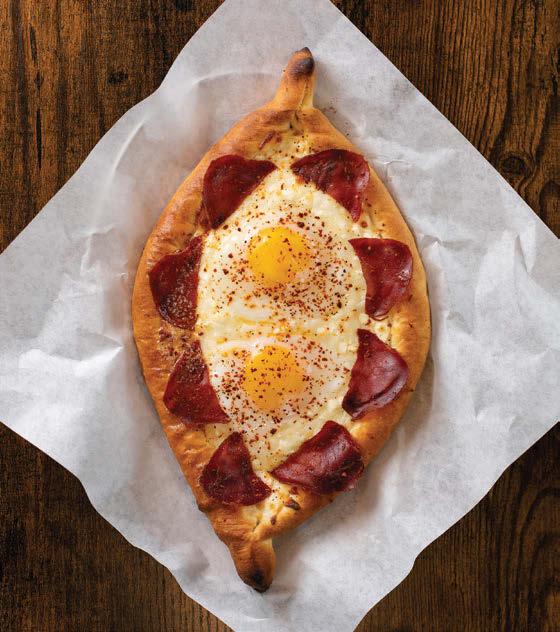
Khachapuri is Georgia’s famed cheese-laden bread. At this unexpectedly fancy, family-owned Aurora spot, the chewy bread, which is boatshaped and somewhat akin to pizza, is stuffed with cheese and often topped with an egg, prosciutto, and fresh herbs. 2630 S. Parker Road, Aurora
MOLOTOV
3333 E. Colfax Ave. molotovdenver.com
The Draw: Delicious Ukrainian and Eastern European dishes; a small but far-reaching wine list
The Drawback: A tiny space that can be frustrating for walk-ins
Noise Level: Low
Don’t Miss: The borscht, dumplings, bread service, infused vodkas
Think of south Denver’s House of Bread, an Armenian cafe specializing in Eastern European baked goods, as the embodiment of the two birds, one stone idiom: Here you can order hinkali and khachapuri. Get the latter with cheese, eggs, and stewed tomatoes. 2020 S. Parker Road
With blond hair cut high and tight and a bayonet-sharp jaw line, Kai Kloepfer bears a striking resemblance to Duke, the heroic (albeit fictional) G.I. Joe sergeant who spent the 1980s thwarting Cobra Commander’s plans for global domination. The backdrop for today’s Zoom call does little to quash the comparison.
Flanked by American and Colorado flags, Kloepfer sits in front of a solid blue wall with the name of his company, Biofire, stenciled across its surface. The effect is imposing—like he’s beaming in from the Pentagon. It’s also, however, a bit of a charade. Kloepfer rotates his computer to his left and, through a glass partition, reveals Biofire’s employee kitchen, which looks like your run-of-the-mill tech
BY SPENCER CAMPBELLcompany’s break room. There is fancy coffee, a pod for private phone calls, and a set of comfortable leather chairs under another Biofire sign, this one set into a leafy plant wall. “Pretend you never saw that,” Kloepfer jokes.
Kai Kloepfer went through hundreds of prototypes before unveiling Biofire’s 9 mm to the public.
If Biofire’s Broomfield headquarters feels like a movie set, that only makes sense. After all, a startup’s culture emanates from its founder, and this 26-yearold founder isn’t what he appears to be. Or, rather, he’s not only what he appears to be. Yes, Kloepfer’s firm makes pistols, but the Boulder-area native spent his formative years in a mostly gun-free household dreaming up science fair projects that were so sophisticated they sparked suspicions of undue parental influence. He attended the Massachusetts Institute of Technology (MIT) and peppers conversations with phrases such as, “so it was actually a very sophisticated seven-factor heterogeneous sensor fusion solution.” But he’s self-aware enough to follow that up with, “I feel like I just word-vomited a lot of things to you.”
While still in high school, Kloepfer turned his attention from science fairs to firearms after a man used a semiautomatic rifle, a 12-gauge shotgun, and a .40-caliber pistol to kill 12 people and wound 58 more at an Aurora movie theater. Horrified, Kloepfer decided to address gun violence by inventing a pistol that uses biometric
 BY JAMES STUKENBERG
After years of development, Broomfield’s Biofire is on the cusp of manufacturing a gun that might make the world safer—that is, if anyone buys the thing.PHOTOGRAPHY

technology to ensure that only the weapon’s owner can fire the arm, creating what’s known as a smart gun. He founded Biofire as a teenager in 2016 and this year finally unveiled a 9 mm that purports to accomplish that mission.

But during the past decade, Kloepfer, who now owns more firearms than he’s comfortable admitting to a member of the media, learned it wouldn’t be enough to design a handgun so sophisticated it couldn’t be used by anyone except an authorized shooter. He’d have to figure out a way to sell the product to gun-control-wary people worried that the technology could be used by legislators to infringe upon their constitutional rights. For his life’s work to succeed, Kloepfer needed to be two things at once—inventor and salesman—because while winning a science fair is nice, Kloepfer says, “that’s not actually how you have a real impact in the world.”
KLOEPFER DID NOT DREAM UP the concept of a smart gun. In the mid-1990s, the Judge Dredd comic book series introduced the Lawgiver, which recognizes its owner’s palm print (and self-destructs if anyone else tries to use it), while in 2012’s Skyfall, James Bond’s Walther PPK only activates for 007.


Science fiction became political reality in 2000, a year after the Columbine High School mass shooting. To avoid lawsuits stemming from the murders, gun manufacturer Smith & Wesson promised President Bill Clinton’s White House that it would, among other things, begin developing smart guns. The National Rifle Association (NRA) reacted by calling Smith & Wesson a “sellout.” Gun rights supporters organized a boycott of the company, forcing layoffs and the resignation of its CEO. The British conglomerate that owned Smith & Wesson sold
the brand for 15 percent of what it had paid for it, and the new buyers quickly pulled out of the federal agreement, which President George W. Bush’s administration had no interest in enforcing anyway.


Firearm safety legislation didn’t work, either. In 2002, New Jersey’s Childhood Handgun Law mandated that once a functional smart gun became available in the United States, every pistol sold in the state had to be equipped with the technology. Intended to motivate the development of personalized firearms, the rule had the opposite effect: No gun-maker wanted to introduce a product that could ostensibly make its other weapons illegal. And when, in 2014, a German startup did debut a supposed smart gun, the Armatix iP1, the few retailers who agreed to sell the .22-caliber pistol were besieged by angry callers and emailers—some of whom allegedly issued death threats—and abandoned their plans.
Organizations such as the NRA and the National Shooting Sports Foundation (NSSF), the firearm industry’s trade association, oppose legislation that requires smart guns because they view such laws as violations of the Second Amendment. But they







aren’t against the technology, per se. The problem, according to them, is that up until now, smart guns have been untrustworthy.
Take the Armatix iP1: Created by a veteran German weapons designer, the semiautomatic pistol connected wirelessly via radio frequency identification to a wristwatch that released a piece of metal that blocked the firing pin. If the gun wasn’t near the watch, it wouldn’t shoot. The Armatix was criticized by the gun community for being difficult to use. For example, according to an NRA review, the owner had to press seven buttons and wait 12 seconds before the gun could be fired, making the pistol impractical for home defense.
Moreover, it wasn’t smart enough. “If you weren’t the authorized user but you stole the watch and the pistol,” reported weapons reviewer Ian McCollum on his Forgotten Weapons blog, which has more than 2.5 million YouTube subscribers, “you could still shoot the gun.” The New Jersey attorney general agreed, determining that the Armatix’s safeguards were not stringent enough to activate the Child Handgun Law. (In 2019, the Garden State watered down the legislation by ruling that, should smart guns ever function as intended, stores only had to carry one offering.)
In short, says Mark Oliva, managing director of public affairs for NSSF, Armatix and other so-called smart guns that have hit the market haven’t delivered on their promises, creating doubt among gun owners that the technology will ever work. “We’ve seen prototypes delivered,” Oliva says, “and we’ve seen them fail.”
THE VAGARIES OF FIREARM POLITICS didn’t factor into the ambitions of an enterprising engineer still in high school when the Armatix debuted. Although the Aurora murders had originally inspired Kloepfer to focus on gun safety, he quickly came to see mass shootings as a complicated issue he couldn’t fix. By researching gun violence, however, he discovered a problem he thought could be mitigated through clever engineering.
Celebrate Aurora’s international community any day of the week with a dining adventure at one of the city’s 330+ ethnic and independent restaurants. GoAurora.org
Every year, firearms are involved in the deaths of thousands of young people, whether through suicides or accidental shootings. (In 2020, guns surpassed automobiles as the number one killer of children and adolescents in the United States, claiming the lives of more than 4,000 residents ages one to 19, according to the Kaiser Family Foundation. In no other comparable country, based on wealth or size, do firearms rank in the top four.) Surely, Kloepfer thought, a device like the one James Bond used in

Be Global. Support Local.
IN A
Skyfall would make it more difficult for kids and teens to fire their parents’ weapons.







Kloepfer estimates he spent 1,500 hours during his sophomore year at Fairview High School experimenting with pistols that his mother bought for him, and he eventually developed a rough prototype that came with a fingerprint reader in the grip. The idea won a prize from the Intel International Science and Engineering Fair and, later, a $50,000 grant from Smart Tech Challenges Foundation, a nonprofit that funds gun-safety innovations.
But if Kloepfer had grand visions of his creation being welcomed unreservedly by firearms fans, he was quickly disabused of that fantasy. Naturally, a teenage gun inventor became catnip for media outlets, who sometimes surprised Kloepfer—Jerry Springer–style—with gun enthusiasts eager to debate the merits of personalized technology. In one video, a gun store owner told Kloepfer, “Let’s face it, firearms have been used for many centuries, and [they’ve] worked perfectly,” and a former U.S. Marine maintained that smart guns would not have any military application because soldiers wear gloves. One exchange stands out in
Kloepfer’s mind, though. “I swear they found the most surly guy they could find,” Kloepfer says. “His big thing was, ‘What if my hands are wet?’ ” When Kloepfer was at MIT, his friends found the video and started greeting him with, Hey, Kai. What if my hands are wet?
Rather than get discouraged, Kloepfer spent much of the next few years using those interactions to shape the evolution of his
pistol. (After all, fingerprint scanners sometimes don’t register wet hands.) He dropped out of MIT in 2018 to focus on Biofire but remained in Boston until 2020, when the company moved to Colorado, a more gunfriendly state with a healthy supply of the kind of aerospace engineers Kloepfer wanted to hire. The company has raised more than $30 million in funding and now has 40 full-time employees, who continue to elicit feedback















The UPRIVER Experience Pools at Iron Mountain Hot Springs are inspired by world famous hot springs. Feel what it’s like to soak in water from Iceland’s Blue Lagoon to the tropical waters of Banjar Bali. With ten new adult only pools, you now have 32 pools to choose from. Located right o I-70 in Glenwood Springs. Book today at IronMountainHotSprings.com
from gun owners. The respondents’ ideal smart gun is almost always the same. “There are no extra things they have to do, no extra steps,” says Bryan Rogers, Biofire’s lead designer. “They just pick it up. It works for them. They put it down, it doesn’t work.” A smart gun could be different, but it couldn’t act different. After developing hundreds of prototypes, Biofire started taking orders for its production model, the aptly named Smart Gun, in April. To facilitate wet, dirty, or gloved hands, the firearm not only has a fingerprint reader but it also has face-recognition technology akin to an iPhone. Perhaps the gun’s most novel advancement is its guts. Traditional guns are mechanical. You pull the trigger, which drops the hammer, which hits the firing pin, which ignites the cartridge. Biofire’s 9 mm is electronic, meaning the trigger isn’t a trigger so much as a button, like on a microwave, that happens to launch a bullet. “This is more akin to an iPhone than it is to a Colt .45,” says retired U.S. Army Lieutenant General Guy Swan, who serves on Biofire’s board of directors. Nevertheless, gun enthusiasts wanted the trigger to match what they were used to, so Kloepfer made the resistance feel as strong as a regular firearm’s.
“This is more akin to an iPhone than it is to a Colt .45.”
July


 Desert Rider: Dreaming in Motion is organized by Phoenix Art Museum. It is presented with generous support from the Adolph Coors Exhibition Endowment Fund, U.S. Bank, the donors to the Annual Fund Leadership Campaign, and the residents who support the Scientific and Cultural Facilities District (SCFD). Promotional support is provided by 5280 Magazine and CBS Colorado.
IMAGE: Carlos Frésquez, The Obsidian Ranfla Series #1 (detail), 1999. Spray paint, screen print and oil paint on MDF panel; 13 x 20 in. From the collection of Manuel and Flo Ramos. © and courtesy of Carlos Frésquez.
Desert Rider: Dreaming in Motion is organized by Phoenix Art Museum. It is presented with generous support from the Adolph Coors Exhibition Endowment Fund, U.S. Bank, the donors to the Annual Fund Leadership Campaign, and the residents who support the Scientific and Cultural Facilities District (SCFD). Promotional support is provided by 5280 Magazine and CBS Colorado.
IMAGE: Carlos Frésquez, The Obsidian Ranfla Series #1 (detail), 1999. Spray paint, screen print and oil paint on MDF panel; 13 x 20 in. From the collection of Manuel and Flo Ramos. © and courtesy of Carlos Frésquez.
But Biofire’s unique contribution to the gun industry remains its promise of security. Milliseconds after both the face and fingerprint readers are inactivated, the firearm becomes an expensive paperweight. Drop the pistol and it’s disarmed by the time it hits the ground. The Armatix’s metal lock could be bypassed by placing cheap magnets alongside the gun, but that would be ineffective with Biofire’s model because, among other safeguards, it’s electronic. Its settings, including adding a new user, can only be changed when it’s in its dock, and that’s only accessible by the owner’s biometrics, which have to be approved at the beginning and end of the process. Although Biofire sells directly to consumers, the guns aren’t mailed to homes where they might be stolen by porch pirates; they are shipped to gun stores and handed off to the buyer. Theoretically, Kloepfer says, the Smart Gun could be broken apart and the security measures altered, but achieving the hostile takeover would be so complicated that a single unauthorized override would cost hundreds of thousands of dollars.
By studying the failures of other smart firearms and welcoming the feedback of the

gun community, Kloepfer believes Biofire has built a product that will appeal to all of America. “A gun that only works exactly the way you want it to is kind of obvious and uncontroversial, in my opinion,” Kloepfer says. “The challenge is nobody has ever built a product that actually fulfills that promise. Until Biofire.”
AS PART OF THE APRIL LAUNCH of its Smart Gun, Biofire invited Ian McCollum of Forgotten Weapons to Broomfield and asked him to evaluate the firearm. His biggest takeaway? “It shoots like a gun,” he says. It’s an accolade meant to convey the product’s inherent gun-ness: It might be packed with as much computing power as a smart phone, but as long as the shooter is an authorized user, it can be picked up and fired like a traditional 9 mm. For once, gun control advocates agree with McCollum. Nick Suplina, senior vice president for law and policy at the nonprofit Everytown for Gun Safety, has also tested Biofire’s prototype. “I think that they’ve created a functional handgun that is good for home use and that seems to do precisely what they say it does,” Suplina says, “which is prevent unauthorized
users from getting access.” Contrary to the New Jersey law’s original intent, McCollum doesn’t believe Kloepfer’s invention should replace all handguns, while Suplina knows it’s not a panacea to American’s gun violence problem. But both think it could prevent some of the more than 300 unintentional shootings each year by children, many of them accidentally injuring or killing themselves or a sibling or friend.
The gun lobby isn’t so sure. The NSSF’s Oliva has not yet fired the Smart Gun, and until it proves him wrong, the trade organization will continue recommending gun safes as the most secure way to store a handgun. He is also skeptical there will be much demand for the product. The U.S. government already requires all handguns to be sold with child-safety locks that, when used properly, should render pistols unfireable. Will gun

Neither the gun lobby nor legislators will decide Biofire’s fate.
owners want to pay $1,500 or more—three times the price of the average 9 mm—for Biofire’s additional security measures? Oliva’s not asserting a market won’t materialize, but he says “that’s something anyone building a better mousetrap needs to figure out.”





















To Suplina, the gun industry’s tepid acceptance of Biofire is based on an existential concern: “The reason is the same reason why the automobile companies didn’t want to introduce a seatbelt for a couple of decades. It draws attention to the fact that there is risk associated with a firearm in the home. And by having a smart gun that can only be used by an authorized user, what you are reminding the public is that—if you don’t have this technology—anybody can get access to a gun in your home.”

Kloepfer seems to have insulated Biofire from many of the roadblocks the Armatix faced. Rather than rely on parts made by other arms manufacturers, the company builds each piece of the Smart Gun itself. By selling directly to consumers, it avoids retailers who could pull the product due to pressure from consumers and the industry. And Biofire’s lobbyists actively advocate against any legislation that might mandate its technology, thereby diffusing any fears regarding the Second Amendment. Kloepfer has done all he can to ensure neither the gun lobby nor legislators will decide Biofire’s fate. The market will.
According to Kloepfer: so far, so good. Within a day of taking preorders on April 13, Biofire had made the front page on Reddit and registered hundreds of millions of social media impressions. The company’s website crashed under the flood of traffic, “which was not my favorite moment,” Kloepfer says. By May 1, Biofire had, according to a spokesperson, already sold out of its Launch Edition ($1,899), which is expected to be delivered to customers in early 2024. (The spokesperson declined to release specific sales numbers but says Biofire has received thousands of preorders.)


Inside Biofire, there was debate among employees about who those early customers would be. Gun enthusiasts on staff thought firearm lovers would make up the majority of sales, while others believed first-time buyers would tip the scales. Instead, it’s been a mix, a nearly representative demographic slice of the American public from every state—just like Kloepfer predicted. “That was my thesis for the most part,” he says. “I think I won.” m

Lynn Fisher-Dwyer didn’t need another job. Besides running Fisher-Dwyer Greens and Flowers, a nursery tucked into the ruddy hills of Garfield County’s New Castle, she had side gigs in landscape consulting and design, not to mention a teaching position at Colorado Mountain College. So when Auden Schendler called in 2008 and asked her to run for a seat on the board of their local electric utility, FisherDwyer said no.
Two weeks later, he called again: “We really need you,” he said. Schendler, then the director of environmental affairs for Aspen Skiing Company (SkiCo), had seen Fisher-Dwyer’s $100,000, ground-mounted solar array. He knew she heated her largest greenhouse with a solar thermal system. To him, she seemed like the perfect progressive candidate to help him lead a coup at Holy Cross Energy, the Glenwood Springs–based co-op that, at the time, used coal and natural gas almost exclusively to power the Roaring Fork and Eagle River valleys. Still, FisherDwyer demurred. “Auden,” she said, “I don’t have time for this.”
But Schendler kept calling. “He wore me down,” Fisher-Dwyer says. “I did some soulsearching and thought it was time for me to give back to the community.” She decided to enter the race, becoming the first in a line of Schendler-backed, climate-focused candidates to attempt to join the co-op’s board of directors. The challengers quickly discovered, however, that the then directors wouldn’t surrender their power easily. “It was a street fight,” Schendler says. At one point, Schendler joked in an email to supporters that he would bring his family to an election night event “so nobody tries to shoot me in the head.” Nevertheless, Fisher-Dwyer— who faced a longtime incumbent—won. And Schendler’s nominees kept winning. Within about three years, a newly created environmental bloc controlled a majority of Holy Cross’ seven-person board. Their goal? Rethink the energy provider’s reliance on fossil fuels.
BY ELISABETHTo limit global warming to manageable levels, the Intergovernmental Panel on Climate Change, a United Nations body charged with studying the climate crisis, has said the world needs to decrease carbon emissions by 45 percent by 2030 and reach net-zero emissions by 2050. Reforming utilities is critical to that effort. “Analysis after analysis has shown that the electric power sector is the linchpin for achieving our economywide climate goals,” says Pam Kiely, associate vice president of U.S. climate for the Environmental Defense

How a small group of environmentalists took western Colorado’s Holy Cross Energy from fossil fuels to the cutting edge of clean energy.
KWAK-HEFFERAN

 FORT COLLINS
Fund, a nonprofit whose mission is to mitigate climate change and other environmental problems. The question is: How do you green an industry that’s hardwired to carbon? Thanks to Schendler’s uprising, Holy Cross might have found the answer.
Today, 15 years after Fisher-Dwyer won her seat, the utility is a national leader in clean energy. Holy Cross has set an aggressive goal of supplying 100 percent carbon-free electricity by 2030, a mark that, with some creative thinking, seems imminently reachable. To finish the mission, Holy Cross’ leaders must not only continue investing in solar and wind projects, but they’ll also have to completely reimagine what a utility can be.
SCHENDLER’S FORAY INTO UTILITY politics started the year before he recruited FisherDwyer, as he sat in his office at the base of Snowmass Mountain poring over Excel spreadsheets. The company’s emissions numbers didn’t make sense to him.
Frustrated, Schendler stared out the window at his view of the resort’s snowcat diesel filling station. He had spent the past few years trying to lower SkiCo’s carbon footprint. He’d changed lightbulbs, replaced old boilers, retrofitted windows, installed insulation—all the things you’re supposed to do to cut carbon emissions. But after all that, his calculations showed the company’s output had actually increased. What the hell was happening? Schendler began to investigate, and he soon pinpointed the culprit.
Founded in 1939 as Holy Cross Electric Association Inc., the utility quite literally turned on the lights in the rural reaches of the Roaring Fork and Eagle River valleys. The utility grew along with the area’s resorts in the 1960s, eventually serving a 1,400-square-mile territory stretching west to Garfield County, east to Vail, and south to Aspen and Marble. But despite the influx of retirees and second-home owners, the board of directors continued to be dominated by ranchers and farmers, who were committed to providing reliable, affordable energy—which meant sourcing electricity from coal and natural gas. In 2007, Holy Cross’ power mix consisted of 59 percent coal, 29 percent natural gas, and 8.7 percent renewables, with three percent coming from a blend.
In those days, the utility showed no signs of enacting the eco-conscious changes Schendler believed were necessary: His detective work, in fact, revealed that Holy Cross had invested in the Comanche 3 coal plant near Pueblo in May 2006. Burning more of the dirtiest fossil fuel on the planet had spiked the emissions of Aspen Skiing Company as well as

every other business and household the utility served. “It was an epiphany,” Schendler says. “You’re not going to solve the climate problem by dinking around in your own operations. If you want to cut your own footprint and address the climate problem, you’ve got to think economywide.”
Others had tried—and failed—to persuade Holy Cross’ leadership to boost its investments in renewable energy. If the directors wouldn’t change their tack, Schendler realized he’d have to change the leadership. Unlike giant utilities such as Xcel Energy, which are
owned by investors, Holy Cross is a nonprofit co-op whose board is elected by its customers. Schendler recruited a group of like-minded co-op members who could help him overthrow the old guard. SkiCo even paid for ads, including one for Fisher-Dwyer and Megan Gilman—who ultimately joined the board in 2011 and now serves on the state Public Utilities Commission—featuring Rosie the Riveter and urging co-op members to “be a part of a clean energy future.”
Their opponents cast them as wealthy pawns serving the desires of resort-owning overlords. In 2009, for example, the Vail Board of Realtors urged its email list subscribers to vote for incumbent George Lamb, a local real estate agent: “Special-interest groups based out of Aspen are waging an unprecedented campaign to stuff the ballot box and take control of the board.” After hearing too much criticism from locals about SkiCo’s involvement in the elections, Schendler’s bosses asked him to stop invoking the company’s name in the campaigns. Tom Turnbull, a longtime director of Holy Cross’ board, delivered public endorsements of candidates who were in favor of renewables but still supported coal.
Nevertheless, the environmental faction continued gaining seats on the board. In 2012, after 33 years on the board, Turnbull retired. The Carbondale rancher declined to speak with 5280 but wrote in an email that, “I spent roughly a third of my lifetime
“Buying and selling electricity is no more complicated than buying and selling tomatoes. [Except] the grocery store doesn’t buy your tomatoes back.”


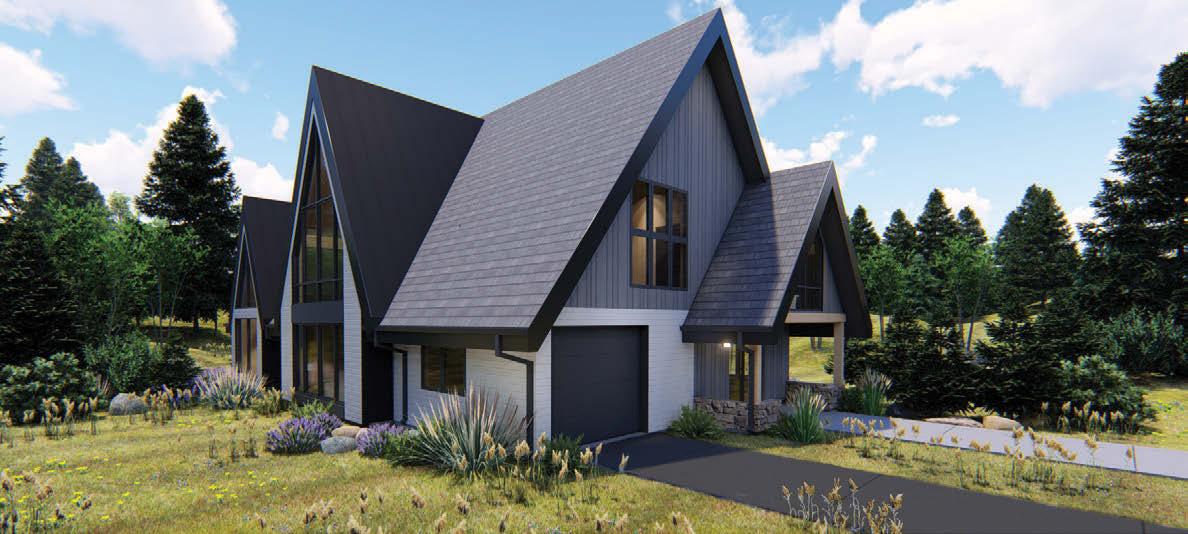
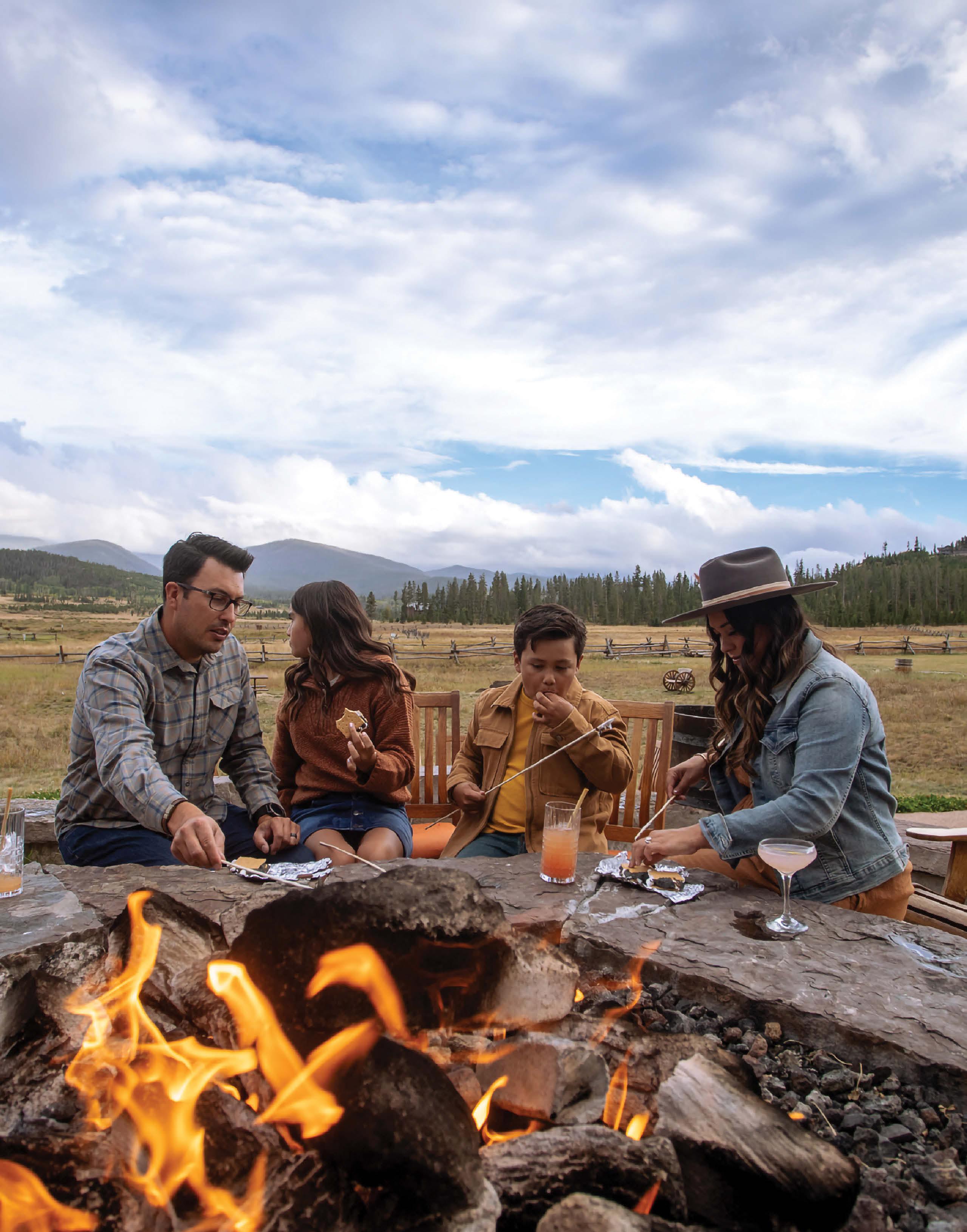
Whether you’re seeking fresh air or a fresh perspective, retreat to 6,500 pristine acres in the Rockies for repose, adventure, and inspiration. Private cabins and cozy lodge rooms set the stage for the perfect mountain getaway. Zoom through the treetops on our four zip lines. Ride through wildflower-dotted meadows on horseback. Conquer scenic single track on a bike. Our lovely landscape is your playground. Relax and refill your cup with refined on-site dining, a full-service spa, and a year-round outdoor pool and hot tub.
working to enhance [Holy Cross’] efforts to provide reliable and affordable electricity for the Roaring Fork and Eagle valleys, only to have it hijacked by the environmental wing of [Aspen Skiing Company] as they systematically infiltrated the board and changed the meaning of sustainability.”
THE FORMER BOARD’S reluctance to buy greater amounts of renewable energy had come down to two things. One, wind and solar power cost more than coal at the time. And two, there was an intermittency problem: Wind and solar only generate power when the wind is blowing or the sun is shining.
The market has solved the first issue. Once the environmentalist wing grabbed control in 2011—following the elections of Adam Palmer, Dave Munk, and Gilman—it upped investments in renewables by soliciting and buying power from third-party solar projects. At the same time, federal government subsidies and technological advancements caused prices to fall dramatically. The cost of utility-scale photovoltaic systems dropped 82 percent from 2010 to 2020, according to Boulder’s National Renewable Energy Laboratory (NREL). “We set a target,” says
current board chair Munk. “Can we move ahead to high levels of renewable energy and still preserve the affordability?” So far, the answer has been yes.
In 2022, Holy Cross inched over a significant threshold: 50 percent of its energy was coming from noncarbon sources. Yet Munk notes that Holy Cross’ rates are among the lowest in Colorado and says the utility had saved customers $29 million in power supply costs since 2019 by greening its product.
Holy Cross’ investments in renewables include a solar array with battery storage installed at Colorado Mountain College last year, as well as plans to contract with two more solar projects, in Rifle and Parachute, when they come online later this fall. After an additional wind power project and a solar project begin delivering power from the Eastern Plains in 2024, Holy Cross predicts it will be at 85 to 90 percent clean energy. That final 10 to 15 percent, however, will be the most difficult to attain. To close the gap to total renewable energy, Holy Cross has turned to an unlikely chief executive.
An enthusiastic, silver-haired man with a penchant for metaphors, Bryan Hannegan became Holy Cross’ president and CEO in
2017 after spending 17 years researching the U.S. electric grid at NREL, at the nonprofit Electric Power Research Institute, and for the federal government during President George W. Bush’s administration. Hannegan had never led a power company, but that’s part of what Holy Cross liked about him. “Utilities suffer from the that’s-the-way-they’ve-alwaysdone-it-here mentality,”Munk says.“Hannegan had much broader exposure to innovators throughout the industry.”
More specifically, Hannegan had a plan to fix the intermittency problem. “If you’re relying on solar, there’s this pesky thing called night,” he says. Battery storage is part of the solution, but today, grid-scale batteries can’t affordably hold enough juice to ensure 24/7 power should, say, the sun refuse to shine for a few days. So Hannegan is embracing a theoretical concept in the industry: Holy Cross hopes to not only make homes, businesses, and public buildings their own mini power plants by outfitting them with solar panels, storage batteries, and electric vehicle (EV) batteries, but it also wants to transform them into sources of electricity for the greater utility.
When demand for power is high, the company would be able to tap its customers’
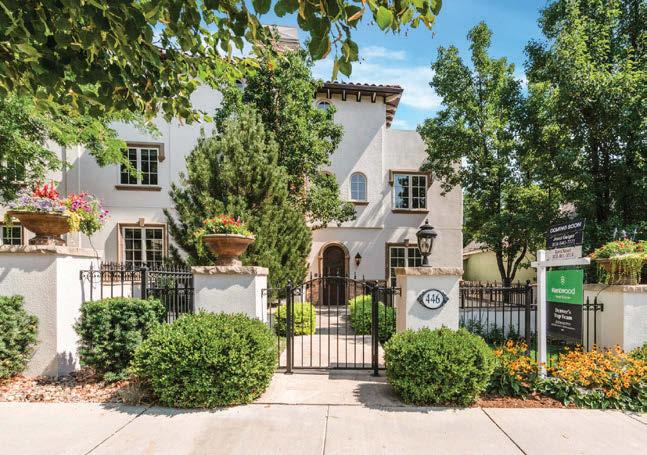
Your time is valuable, you have high expectations, you want to spend your efforts concentrating on your core business and personal life. You want to sell your home for top dollar and enjoy the return on your investment. You want to buy your next home and make sure your needs are met. YOUR




The award-winning* Club ULD, also known as U Lucky Dog, has all the services you expect from a well-trained staff and first-class facility. We strive to accommodate ALL dogs, big and little, and have indoor and outdoor play areas, individual play options, luxury suites, and MORE. We separate every dog by size, allowing them to play together in complete safety and comfort. Along with Day-Care, we also offer Dog Boarding, Bathing Servies, and One-on-One Dog Walks. Rest assured, your dog’s health and happiness is our #1 priority, which is why countless dog owners have been bringing their furry friends to Club ULD for over 12 years!



The smile on your dog’s face at the end of the day tells the story: “Every dog should be so lucky.”

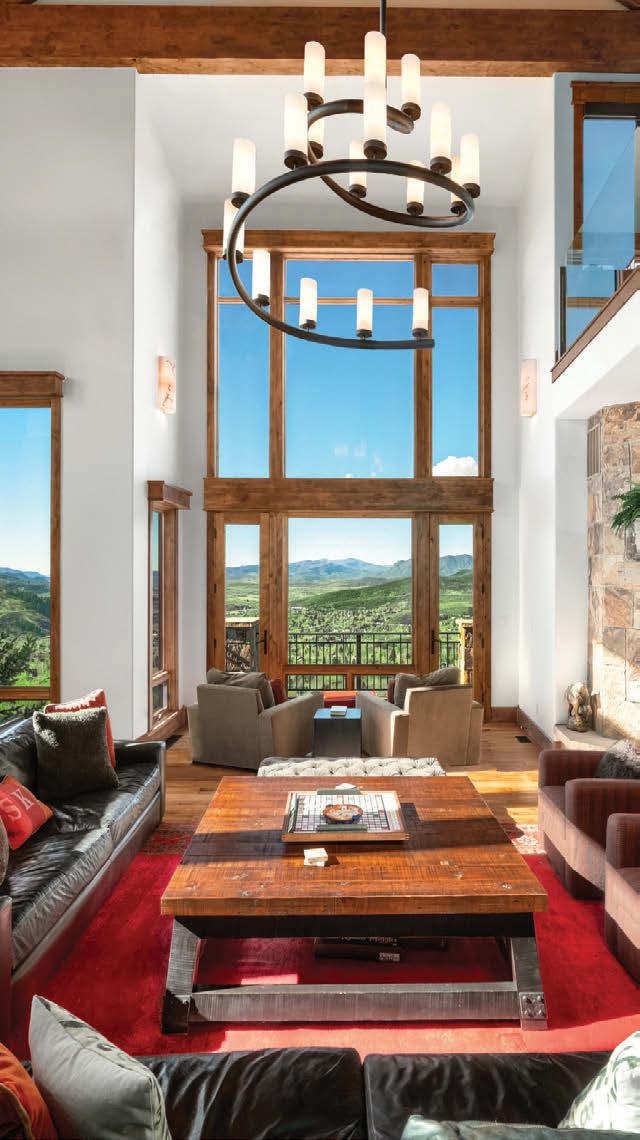
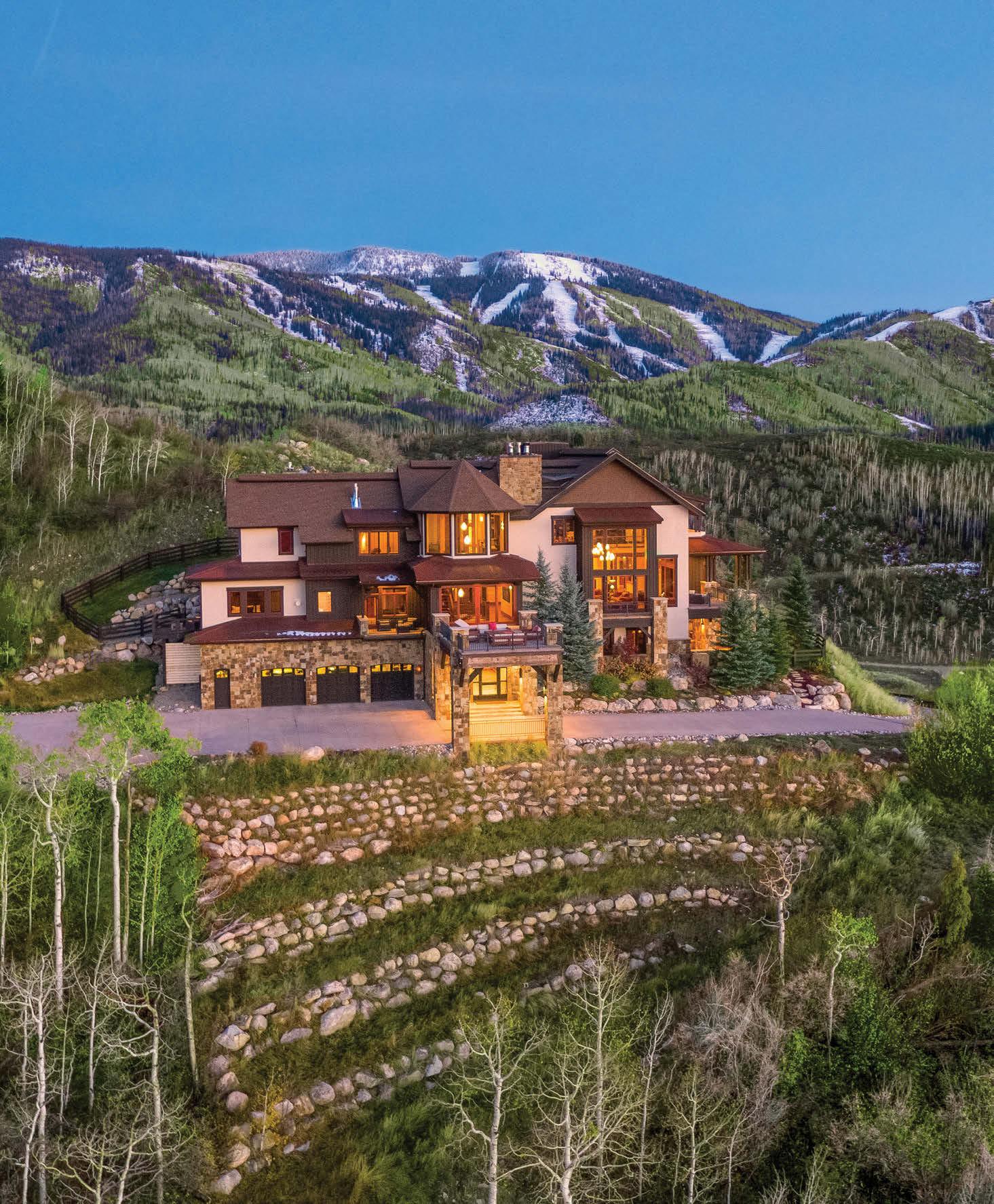
Nestled in the mountains of Northwest Colorado sits the world-renowned ski town of Steamboat Springs, best known for its light, fluffy snow and year-round recreation. One of Steamboat’s finest homes, the Majestic Overlook offers spectacular 270° views with thoughtful luxury mountain design, exquisite finishes, 7 en-suite bedrooms and nearly 5,000 sq ft of outdoor living space. Create memories that will last a lifetime in this magical legacy retreat.
THEMAJESTICOVERLOOK.COM
$12,985,000 #5524489
batteries to add electricity to the grid for all to share (paying the patron for what the utility consumes). When wind and solar plants produce more power than everyone needs, the utility could instruct participating buildings’ smart thermostats to preheat or precool spaces, thereby reducing the need to crank up the air conditioning during peak
demand hours. In this imagined world, Holy Cross wouldn’t be a provider simply selling a product, but rather a connector controlling the flow of power across its customer base. “Each of the homes and devices are like little instruments,” Hannegan says of the plan’s potential. “It takes an orchestra conductor—the utility—to say, ‘I need more electricity over here, less over here.’ ”
Currently, Holy Cross is using incentives to try to fill in that missing 10 to 15 percent. About 600 customers have enrolled in its four-year-old EV program, in which the co-op gives away a free high-speed car charger ($749) in exchange for the right to manage the charging rate so that the utility can slow the flow in case of a demand surge. Similarly, Holy Cross also offers zero-percent financing on a Tesla Powerwall home backup battery—which allows customers to store power generated by home solar panels or from the utility grid—as long as the utility can tap into the device when it needs a boost. In two years, about 120 households have signed up, adding nearly three megawatts of battery capacity to Holy Cross’ grid (enough to power 120 other homes for four to six hours). It’s a small increase, but these inducements are just the first steps toward Hannegan’s vision of a future where “buying and selling electricity is no more complicated than buying and selling tomatoes. [Except] the grocery store doesn’t buy your tomatoes back.”
AS TRANSFORMATIVE as its recent directors have been, Holy Cross is still a rural co-op serving only 46,000 members. Can a larger utility—such as Xcel Energy, with its 1.6 million customers in Colorado—follow its lead? Are other power providers even paying attention to the tiny nonprofit?
“It takes an orchestra conductor—the utility—to say, ‘I need more electricity over here, less over here.’ ”

“Everyone is interested in what Holy Cross is doing,” says Kent Singer, executive director of the Colorado Rural Electric Association, the state’s electric co-op trade association, “and their co-op colleagues are going to learn a lot from how they pursue the transition.”

But reaching zero emissions by 2030 isn’t feasible for a utility the size and complexity of Xcel, Colorado’s largest electric provider, says Hollie Velasquez Horvath, the company’s regional vice president of state affairs and community relations. As a wholesale provider to other utilities in the state, Xcel is legally required to maintain a certain baseload of power across the region. “We don’t believe that, at the moment, we can produce 100 percent renewable energy,” Velasquez Horvath says, “[because] batteries just aren’t there yet.”
Xcel has its own ambitious carbon-cutting plans, which it announced in 2018, even before a Colorado law mandated similar cuts for most utilities: an 80 percent reduction by 2030 and net-zero emissions by 2050. Xcel will rely on some of the same every-home-can-be-apower-plant strategies that Holy Cross has already begun implementing. “Distributed generation is going to be a big piece of the puzzle,” Velasquez Horvath says.


So, if successful, Holy Cross could provide the blueprint larger power companies need to make the transition to renewable energy. “Any time we’ve got a co-op like Holy Cross that is aggressively moving toward a carbonfree future on the electric system,” Velasquez Horvath says, “that allows for us to see how they’re doing it, what their best practices are, and how we can deliver that same type of service to our customers.”

The man who sparked Holy Cross’ revolution is buying into its plans. Schendler, now senior vice president of sustainability for SkiCo, has outfitted his Basalt house with rooftop solar and one of the utility’s first Powerwall batteries. His company-issued Audi E-tron uses a charger he got for free through the utility’s financing program. And although Fisher-Dwyer left the board in 2017, Schendler still recruits candidates and runs campaigns; he says that at least five of Holy Cross’ seven current board members are “all in” on the final push toward 100 percent renewable energy.
Thanks to Holy Cross’transformation, SkiCo has now exceeded its emissions reduction goals. But Schendler’s pride hardly stops there. “It’s this Podunk utility in the rural West, and they’re on the bleeding edge,” he says. “Where we are now is kind of mind-blowing.” m

From the tastiest scoop of ice cream to the most inviting patio for summer sips to the hippest new lodging in town, we tracked down the best of the best that the Mile High City has to offer. The result is a curated list of 37 editors’ choices that complement our 79 readers’ choice winners.
How we selected this year’s Top of the Town honorees.
How does 5280 pick Top of the Town winners?
Our reporters and editors spend months exploring the city to choose winners for select categories on the ballot. We try to do our research anonymously and pay for all meals and services, where possible. Our readers also pick their favorites for every category by casting votes via our online ballot. The businesses that receive the most votes win.
Don’t the magazine’s advertisers automatically win?
Nope. Top of the Town recognitions are based only on our research and readers’ votes; there is zero connection between advertisers and winners. The fact that some winners happen to be advertisers does not influence our selections. Sure, we could make some folks happy by “selling” winners, but in the end, we’d lose a lot more than we’d gain—like our integrity and credibility with you.
How can my business get on the ballot?
Our ballot is a write-in format, meaning we don’t provide multiplechoice options. Voters can suggest whatever restaurant, store, person, or service they deem worthy for every category.
I have a business that deserves an award. How can I win?
Reach out to our editors with your story. Encourage your customers to vote for you next year. (The readers’ choice ballot opens in January.)
How do I vote?
Visit vote.5280.com and cast your ballot. It’s that simple.

We’ll admit it. We sometimes substitute a sweet treat for a sandwich at our midday meal. There is no shame in our dessert-for-lunch game, and a recent order at Smith & Canon’s new Colorado Mills location in Lakewood proved just how winning a combination ice cream and coffee is when you need to fuel up—especially when it’s a gourmet Philly-style take (i.e., no eggs, for extra creaminess) with a made-from-scratch base (most ice cream makers use a pre-formulated mixture and add flavor). Owner Curt Peterson, who named the shop after his daughters, shut his doors on East Colfax Avenue and relaunched the shop in its sleek new home in February. The rich, silky flavors are zesty and unexpected. Think: Foxy Brown (cinnamon rolls and cheesecake), Strawbanero (strawberry and habanero), and Dew Sabi (honeydew and wasabi). We took down a nitro cold-brew float with Butter Brickle ice cream and Whiskey Barrel coffee while our friend ordered the shop’s signature foamy affogato. We agreed that no other lunch was needed.
In a lightly trodden corner of LoHi, Tim and Lillian Lu opened the elegant yet playful Noisette this past summer. Complete with charming mismatched floral chinaware, an impossibly chic, pastel midcentury vibe, and one of the most knowledgeable staffs we’ve encountered, the French eatery serves dinner Wednesday through Sunday and brunch on Saturday. The Lus’ adjacent bakery, which opened in the fall, doles out traditional croissants and delicate confections from 8 a.m. to 3 p.m., Wednesday through Sunday. In its first year, Noisette has dazzled Denver diners with its beautifully plated dishes and warm, sophisticated ambience. We caught up with the owners to get the lowdown on their style of French cuisine.
It’s not that complicated. “We’re trying to demystify [the idea] that French food is a fine dining thing,” Tim says. “We do use refined techniques we learned working in New York for over a decade. But we want to present it in a way that is basically just the protein,
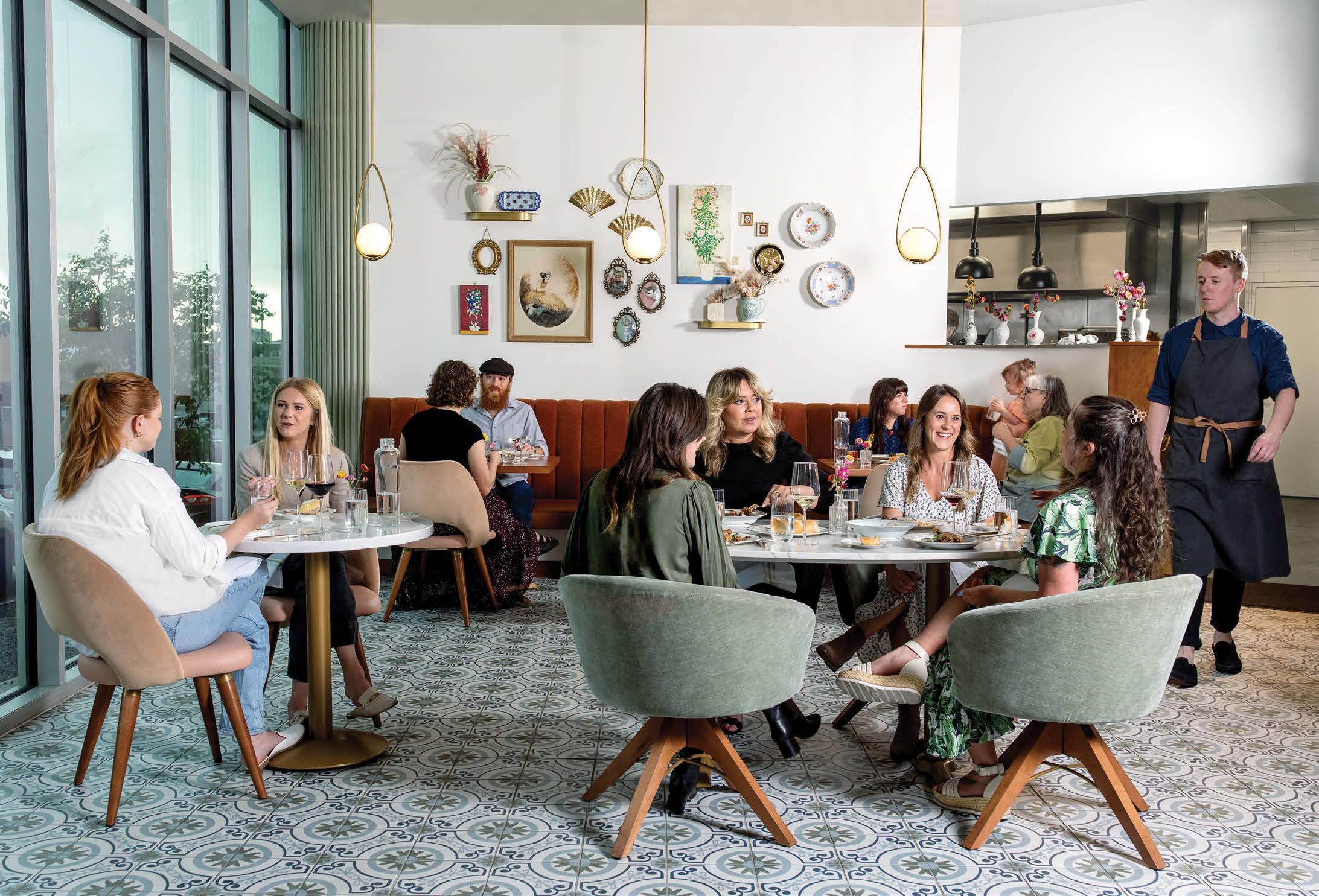
the sauce, and the potatoes— something you’d eat at home, but a little more refined. With French food, you either think of mussels and fries or really fancy stuff. We’re a middle ground between all the tripe dishes and steak frites.”
Classic is clutch.
“I’m trying to do a very classic French way of baking,” Lillian says. “I think that, in America, [California’s Tartine] has had a big influence on the modern bakery: Everybody likes to bake things really dark and get that deep caramelization. In the French way...our pastries are baked at a slightly lower temperature for less time [to a] golden brown. A croissant should not only be crispy on the outside but soft as well.”
It’s all in the sauce—and the wine matters.
“We use all the proper wines for our sauces; it’s not just some boxed wine,” Tim says. “Like the beurre blanc on the trout; it’s made with the same wine, Muscadet, [the French] would traditionally make it
with. For bordelaise, Bordeaux. And the first thing you learn in culinary school is to cook with wine that you’d drink. Because, once you reduce the wine, it brings all the bad or good flavors to the forefront.”
Regionalism elevates the menu.
“We try to do regional dishes,” Tim says. “We have a couple of Alsatian dishes right now, a sauce from Normandy.... French is not just one all-encompassing food. Our servers will tell someone that our pintade au Riesling is an Alsatian dish versus just general French food. We’re trying to expose more people to these [distinctions].”
Frequently added menu items and special dishes (we dream about the January-only lump crab fried rice) keep this modern eatery fresh no matter when you go. Exhibit A: the recently introduced Thaigerrr green curry.
The second outpost of the wildly successful Seattle original, Reckless opened its trendy digs in December and sizzles up a mélange of Asian ingredients but centers Vietnamese flavors in its spicy, snappy dishes.
This bamboo-chic neighborhood fave is an interactive, traditional, and hard-to-findelsewhere Japanese experience, including DIY Japanese hot pot, a full sushi menu, and small plates.

Khao soi kai (traditional curry noodles from northern Thailand) or the Bangkok ribs (a salty-sweet starter that owner Ounjit Hardacre says is a family recipe).
Crispy Saigon caramelized prawns, which are big, juicy, and cooked in a peppery, garlicky coating for an addictive blend of chewy and crunchy.
Shabu shabu (commonly called hot pot, this meat-in-a-bubblingstew meal is mesmerizing and delicious).
Thai flavor combos are nuanced, and Daughter Thai is one of the few local eateries that has mastered the tricky dichotomy of boldness and subtlety.
A killer happy hour (4 to 5 p.m. daily) offers sweet deals on starters such as the thịt nướng, a pork-stuffed roll with just the right blend of lemongrass, herbs, and Hanoi fish sauce.
First-timer at a cook-your-own-meat table? Don’t worry. Kobe An LoHi's website offers a video tutorial for hot pot and a helpful blog detailing the origins of the eatery’s American Kobe (wagyu) beef.
In October, James Beard Award semifinalist Edwin Zoe opened a second iteration of his Boulder-based Dragonfly noodle house— which offers steamy, umami-rich bowls and bao—on the 16th Street Mall.
Black tonkotsu ramen (a staff favorite with cherrywood-smoked pork belly, cloud ear mushrooms, and spicy sprouts bathed in a pork-bone broth laced with black garlic oil).
Dragonfly is one of only two local ramenyas that handcrafts its own noodles. “As a noodle nerd,” Zoe says, “I want our guests to enjoy fresh house-made ramen noodles— which are surprisingly rare.”
We were already enamored with this LoDo nook when we booked its chef’s tasting ($95 per person). Having previously inhaled chef Chris Henschen’s pastas, we couldn’t resist the chance to grab a reservation (720-541-7721) for the new-in-2022, up-close experience. The four-course menu changes daily, and Henschen’s offerings reflect the season’s bounty. Settled at the counter, we began with an oyster teaser, both raw and grilled with pancetta, followed by roasted tricolor carrots with burrata. Next we devoured handmade Yukon potato gnocchi pomodoro with chanterelle mushroom conserva, finished with balsamic vinegar and basil oil. But the star was a sliced New York strip settled in a bed of polenta over a red pepper coulis, accented by broccolini and black trumpet mushrooms. Welltimed appearances by a sommelier were enlightening, and between courses, Henschen’s amiable conversation made the evening special. Last out was a plate of triple dessert, anchored by a cannolo. We were almost too full to enjoy it.

Get your curries, rice, and everything nice at these flavor-packed spots serving Denver’s most mouthwatering Asian cuisine.From top: Sarah Banks; Courtesy of Jovanina’s Broken Italian
An eatery’s oyster service is a solid way to gauge quality seafood. That said, the pearly little shellfish at these three outlets were too outstanding to select one winner—so we sampled their other offerings to help you decide where to go.
We called in the experts—visiting lifelong New Englanders with discerning saltwater palates—for a recent meal at LoDo’s stateliest taste of the ocean, which opened in early 2022. The verdict: near universal perfection on the fish entrées. The tuna was seared and togarashi-spiced flawlessly; the black cod was highlighted by an herbed soba broth; and the rich sea bass swam in a delicate sage butter.
Oyster notes: “This is the way an oyster should be,” came the definitive declaration from our coastal Mainers as they polished off a half-dozen briny East Coast varieties.

A meal at this sleek Union Station ocean eatery never disappoints with its out-of-thebox takes on classic saltwater dishes. But a recent order of scallops—seared to a perfectly firm gold and dressed in a silky
chipotle-squash purée with chile oil and root veggies—left us salivating for more. Oyster notes: Half a dozen varieties from the East and West coasts arrived with a flavor profile card so we could identify the melon, brine, and mineral notes. Tip: Reserve a spot at the eatery’s oyster classes, which launched in February and are hosted by general manager Aaron Kimble one Sunday per month. Guests sample oysters with an optional wine pairing while they learn about the delicacies.
Amid a buzzy crowd in this industrial-chic RiNo seafood joint—known for its simple, flavorful takes on a rotating selection of fresh fish and shellfish—we were wowed by a plate of wood-grilled Spanish octopus balanced by a Romesco sauce.
Oyster notes: This is an excellent place for nonoyster people to score oysters. The grilled varieties—both the kicky devil butter and the comforting garlic butter versions—disappeared in seconds at the hands of our slurp-shy crew. (All oysters are $2.50 from 5 to 6:30 p.m., Tuesday through Saturday.)
Behind the 18-seat chef’s counter in the Dairy Block’s intimate Brutø, you’ll often find a storyteller. That is, you’ll likely meet executive chef Michael Diaz de Leon, the culinary force behind the omakase-style restaurant where he and his team treat patrons to a multicourse tasting menu inspired by Latin American culinary traditions, Japanese techniques, and a zero-waste ethos. Diaz de Leon was tapped in late 2020 by restaurateur Kelly Whitaker to bring his distinctive vision to Brutø after it launched in 2019. “I love to talk to people about my craft,” Diaz de Leon says. “You get to literally sit right in front of us, and we’ll have a conversation while I’m plating your food.”
That ability to translate the backstory of his dishes into a captivating dining experience is just one of the reasons the 35-year-old toque earned a 2023 James Beard Foundation Award nomination for Best Chef in the Mountain West. Among the other reasons are his work toward sustainable local agriculture and, largely, his prowess with culinary experimentation. “It’s thinking outside the box and saying, ‘How can we utilize the whole vegetable?’ ” he says. “In the summer, when we have an abundance of sweet corn in Colorado, we use it to smoke some dishes, and we use the strands of hair from the corn and fry them to make almost, like, a cotton candy of corn. We use the kernels for cooking and the husk for fueling the hearth and for stock to make sauces.”
Diaz de Leon hopes that Brutø’s rising reputation will be a catalyst for others to develop deeper connections with local food systems and educate the next generation of chefs to cement Denver as a Michelin-worthy culinary destination. In the meantime, we suggest you pull up a bar stool, order a drink, and get ready for story time.
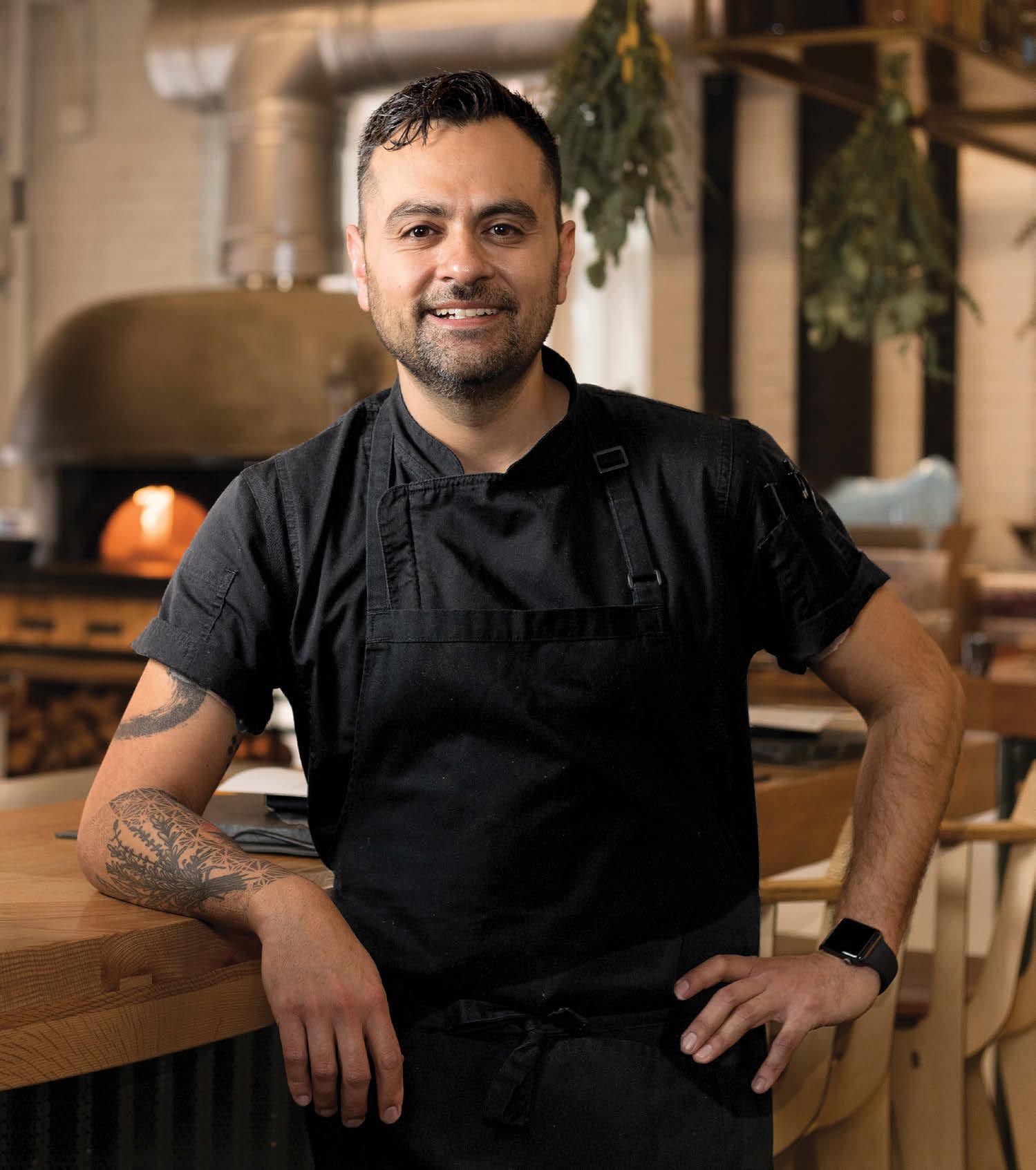
The best options for your daily crunchtime bite.
Were it up to us, we’d order a flaky handmade lemon croissant and call it a meal at this unassuming French bakery in Lafayette. But if a savory midday bite is more your jam, the curated selection of brunch fare (ham, cheese, and egg croissant sandwiches; quiche Lorraine; and croque monsieur and madame) will transport you right to the corner bakery of an idyllic French village. In fact, executive pastry chef Julien Jeannot, who launched the bakery in April 2022 with his wife, Teresa, spent his formative years sampling oven-fresh pastries in Provence.
The first time we walked into Freedom Street, a year-old, 12,000-square-foot space in northwest Arvada, we immediately wished we’d brought our (young) kids. While we enjoyed a build-your-own noodle bowl, self-ordered via a tablet at Balance Pan-Asian Grille, we could practically see our littles beelining for the play area located in the center of the hall. If you happen to be there sans entourage but with a laptop in tow, grab a bite from one of the nine vendors while you work. Argentina-inspired Gaucho Parrilla opened in March, but you can also order a macchiato from Pressed Coffee & Vinyl or nosh on birria tacos from Osito. Whatever you choose, take your setup to the adults-only (on the weekends!) second level till happy hour.
It may not be open for weekday lunches yet, but this camper is worth an Instagram follow (@lady_inthewild) for the lowdown on brewery pop-ups or its hours at the City Park farmers’ market on Saturdays this summer and fall. Since June 2022, the food truck, helmed by chef-owner Camille Shoemaker, has been plating locally sourced, Mediterranean-inspired fare, such as shawarma wraps with baba ghanoush and lamb meatballs over turmeric rice. Our tip: Go for the mezze platter and indulge in three hummus flavors plus other dips, salads, and veggies.
This 10-month-old eatery’s very name signals something coveted. And indeed, the New Orleans–inspired sandwich purveyor is a treasure chest of tantalizing lunchtime booty, like the roasted pork loin tonnato and the French club stuffed with red-wine chicken, bacon, and mushrooms. Tucked inside LoDo’s historic Ice House building, the deli runs on a pop-up schedule, so you’ll need to check Instagram (@piratealleydenver) for updates. No matter—we’ll take what we can get, even if it’s just a handful of times per month.

Flora House owner Jen Alderton, who traveled regularly for nearly two decades while working in the wine industry, knows what hotel guests need—and, thus, how to provide that in her 1892, six-bedroom Cheesman Park mansion. She purchased the property (a former inn called the Adagio) in 2022 and undertook a complete renovation of the dated space. Each guest room is named after a flower or plant and has live botanicals to match. The bold wallpaper and tiling, paired with original woodwork and antique furnishings, maintain the alluring Victorian vibe while also offering a fresh aesthetic that feels “time-appropriate and contemporary, but vintage,” Alderton says. Here, three reasons to skip the bustle of big-box downtown hotels and spend a cozy weekend at Flora House.
1. Just a handful of blocks from Cheesman Park and Denver Botanic Gardens (guests receive free passes), Flora House is also within walking distance—or biking distance, using one of the borrowable rides—of eateries and bars aplenty.

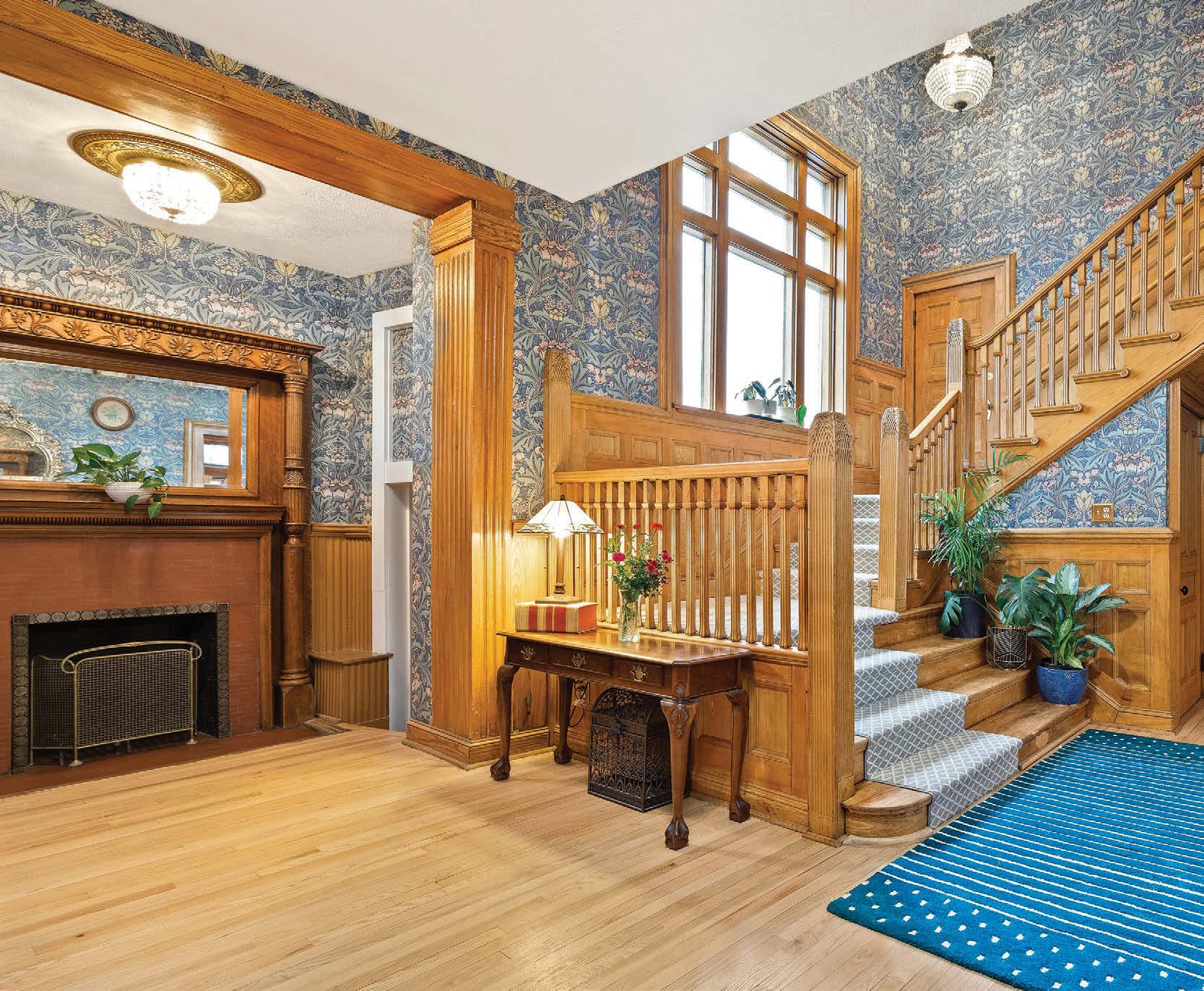
2. Depending on the day, guests can enjoy fruit, yogurt, cheeses, meats, pastries, and/or granola from 8 to 10 a.m., plus an allhours coffee bar and snacks in the guest fridge. Take your breakfast plate to a shady spot in the courtyard, then return later with a BYO beverage for a soak in the hot tub or s’mores around the fire pit.
3. Energy-efficient LED lighting, water-efficient plumbing, and water-saving landscaping— all installed during the 2022 renovation—plus a commitment to composting and reusable or refillable kitchen and bathroom products help Flora House minimize its footprint.


Meier Skis’ graphics—from Wild West–inspired designs such as the Annie Oakley and Big Hoss to a special Allman Brothers tribute this past season—are guaranteed chairlift conversation starters. But it’s what’s inside these eco-friendly planks, made in Meier’s South Broadway factory since 2019, that we can’t stop talking about. To see what makes the company’s rides some of the prettiest and toughest in the business, book a happy hour tour slot, 5:30 to 7 p.m. Labor Day through Memorial Day, online; your $20 ticket includes a local pint from the shop’s on-site taps. In the meantime, here’s a layer-by-layer breakdown based on what we learned by grabbing a beer and following Meier “skitender” Sean Lawson through the workspace.
Base: Ultra-high molecular weight plastic
“We use some of the hardest base material in the industry,” Lawson says, because it’s “able to take a hard hit from the sneaky rocks we so often find in Colorado.”
Core: Three types of wood “Maple is our hardwood, used in the middle so we can drill bindings into it,” production and engineering manager Parker Davis says. “Then there’s poplar on the edges to give it a soft, playful feel and local beetlekill pine as an aesthetic and to help pull deadfall out of the forest.”
Support layers: High-weave fiberglass or carbon fiber
“We can use different weights and lengths to stiffen or soften the flex profile of the ski,” Lawson says. The fiberglass is saturated in a sap-based eco-epoxy that employs no petroleum.
Edges: Steel
American-sourced, handbended, and glued to the base, Meier’s steel edges are thicker than what most ski makers use, helping the skis withstand more tunes and run-ins with rocks.
Sidewalls: Lightweight, high-density polymer “It protects our wood cores from outside water and air damage,” Lawson says, “and ensures impacts won’t penetrate to the core from the side.”
Topsheet:
Sublimation nylon Meier prints graphics on recycled paper with eco-friendly ink and then transfers (aka sublimates) the designs to a clear topsheet material. “We use the discarded paper as packing material for shipping skis and boards across the globe,” Lawson says. Buyers can customize their skis by supplying the team with their own graphics, images, or logos, with one caveat: “We require that at least 30 percent of graphics be transparent,” Davis says, “to show off our beautiful wood cores.”
Em Newton loves to talk about fascia. She will wax poetic about how the thin casing of slick connective tissue—which surrounds every organ, blood vessel, bone, nerve, and muscle and holds them in place—has historically been overlooked as a cause of pain in the human body. Then the licensed massage therapist, 35, will explain that to alleviate suffering caused by tight or hardened fascia, she breaks it back down into its natural, elastic state. Her particular brand of therapy, which she practices out of her Denver house (call 303-847-5158 to book), isn’t what you’ll find at most bliss-focused spas: Newton is more interested in reducing the agony of computer-weary neck muscles, chronic migraines, TMJ, or frozen shoulder than she is in delivering a dose of pampering. “I try to read the body and discover where the impingement is,” she says. “It could be the size of a pinhead, and it might not be located where the pain is.” When she does find it, she works her magic—and will likely ask for your help. “The grooves between muscles and bones and nerves should be slippery with fascia,” she says. “When areas aren’t stimulated, the fascia gets hard and sticks to things, causing pain. That’s why I ask my clients to move certain ways during therapy to stimulate the area and unstick things.” While the therapy might not be as relaxing as, say, a hot stone massage, it’ll likely give you something better: lasting relief. —Lindsey
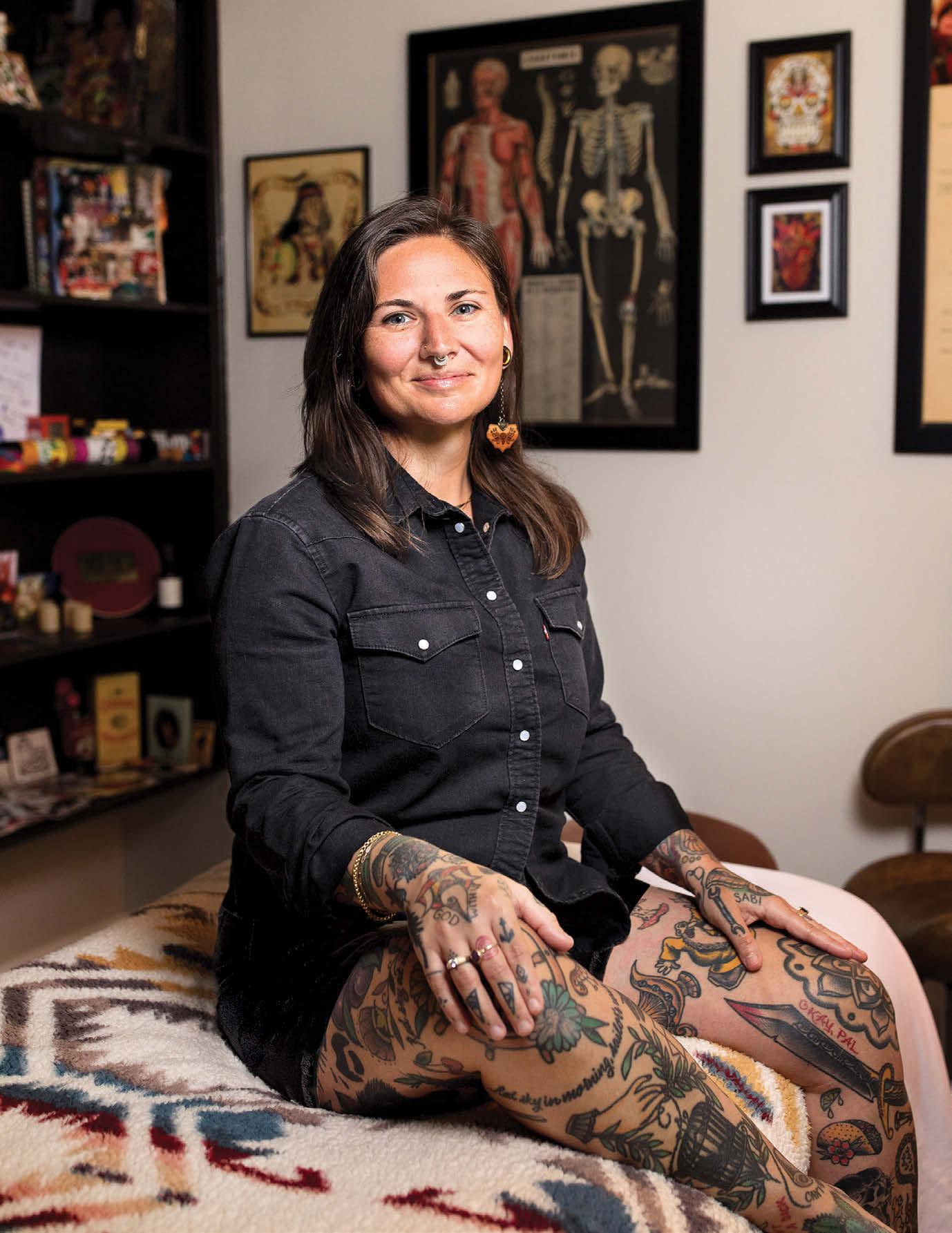 B. King
The problem with the hefty stock of Victorian and midcentury houses in the metro area’s most popular neighborhoods? The interiors are often saddled with decades of neutral walls, brown wood, and beige carpets—and that aesthetic is at odds with a current design trend that Boulder-based Istoria Interior Design owner Stephanie Waddell calls the “reversal of minimalism.” “It’s an anything-goes maximalist approach to design: layering pattern on pattern, a complex use of color, and an over-the-top array of decor items that have meaning to the inhabitants,” says Waddell, whose experiences working in art galleries and owning a textile design brand help her perfect the coveted look for her clients. Follow her advice to embrace bright hues, daring prints, and geometric wallpaper— maybe even all in the same room.
“We often start with one major piece that we love, like a rug, and then pull out its design details to riff on elsewhere. I love the styling process at the end, when I stand in a corner and figure out where we need to add a bit more emphasis, weight, or highlights. I don’t want your eye to get stuck. I want it to move around and delight in each new thing it sees.”
“Layering in modern elements gives a historical home a story: the sense of multiple inhabitants having lived there through the years, each adding their own personal touch. You can place a modern, clean-lined sofa against the backdrop of an original exposed-brick wall and, boom, it feels fresh. Or paint that old molding a bold color instead of traditional white.”
“I often hear this refrain: ‘I really love that green velvet sofa, but I’m afraid I’ll get tired of it.’ Well, I’m a strong believer that you are way more likely to get tired of that beige sofa than the one that lights you up when you walk in the room.”
When the pandemic hit, Natalie Baumchen was running fitness programs for Denver Parks and Recreation. Which is to say, her life’s work came to a screeching halt. Rather than let her charges melt into their couches, however, Baumchen designed a streaming exercise service for the city and county that eventually drew 13,000 participants in only seven weeks. Seeing how badly people were craving action, Baumchen decided to take her approach to a wider audience and founded Fit Collective in November 2020 as a virtual studio. And when that proved successful, she expanded again in 2021, pouring her savings into a shiny new 2,000-square-foot physical space in the Clayton neighborhood. Today, Fit Collective offers 35 in-studio classes per week, 18 live virtual classes every week, and more than 80 on-demand sessions through its website, ranging from yoga to kickboxing to weightlifting.
While all those options are nice, it became perfectly clear to us—10 minutes into a postwork, in-studio Grit (resistance-focused circuit training) class—that, with Baumchen, the medium doesn’t matter. The studio staffs 18 certified instructors, but the founder happened to be teaching our session. And although our quads burned, we felt energized, motivated, and not at all out of our league—a rarity for those of us in our 40s. She corrected clients’ form when they needed it, encouraged them when they really needed it, and maintained the necessary you got this vibe while somehow keeping the experience chill and, dare we say, fun. Although the classes are plenty challenging for even high-level athletes, “individuals who are newer to fitness, prenatal or postpartum, coming off of injury, or needing some extra attention seem to gravitate to my studio because the instruction method employed by staff is very inclusive,” Baumchen says. Fitness-phobes, welcome home.

Boulder’s renowned gear hub celebrated its 50th anniversary earlier this year—a milestone made possible by continued retail revolutions that are hyperfocused on serving Front Rangers’ expanding outdoor needs.
1973: Gary Neptune, an avid climber with a resumé full of formidable ski accomplishments and summits (including Mt. Everest), opens a small mountaineering shop in Boulder that repairs climbing and ski boots—and allows the owner to geek out with adventurers.
Late 1970s: Neptune begins building his signature in-shop mountaineering museum, which will come to hold illustrious artifacts such as boots from Sir Edmund Hillary’s Ever-
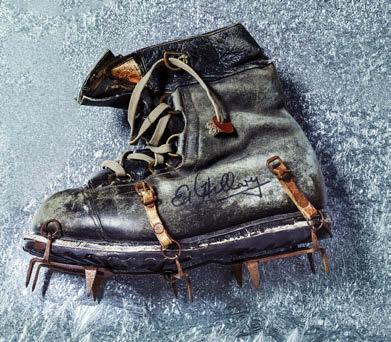
est summit (pictured), a down suit worn on the first nonoxygenated ascent of Mt. Everest, and examples of the evolution of the Chouinard carabiner.
Circa 1980: Neptune welcomes outdoor leaders through an informal speaker series. They include icons such as Peter Habeler and Reinhold Messner (the first climbers
to summit Everest without O’s) as well as other athletes who lecture on conservation.
1993: After several location changes, the store lands at its current home, a cavernous space in a South Boulder retail center. Neptune expands his inventory by stocking more mainstream outdoor equipment.
2013: Neptune retires and sells to Texas-based Backwoods Retail. But after four years of declining business stemming in part from customers’ disconnect with the absentee owners, Backwoods declares bankruptcy.
2017: Touting an ambitious revitalization plan, Boulder locals and longtime Neptune customers Andrew and Shelley Dunbar purchase the store and invest $1 million in renovations. The upgrades include a cafe, a climbing wall, and the Neptune Lab, a startup incubator for local outdoor companies.
2021: Having been restored to its former glory, Neptune is purchased by Bob Wade and Maile Spung, owners of another indie Colorado gear store, Aspen’s Ute Mountaineer.
2022: Semiregular
Thursday night speaker engagements make a comeback, featuring seminars, skills clinics, and film screenings.
Denver has more than 250 urban parks, which means picking the best one is difficult enough even before you factor in the wilder retreats just beyond city limits. In fact, it was so hard to choose between city and suburban escapes that we decided not to.

In spring 2022, Denver Parks and Recreation unveiled a $2.5 million overhaul that restored the shine to this hidden gem, which has been perched above northwest Denver since 1910. Listed on the National Register of Historic Places, Inspiration Point now boasts a modern, nature-inspired playground that’s split into big- and little-kid areas and resides in a meadow ringed by evergreen trees. Those pines provide a curtain from urban distractions without obscuring what’s drawn residents here for longer than a century: a killer panoramic vista of the Front Range.
Thirty minutes from downtown Denver, near Morrison’s quaint main drag, Lair o’ the Bear is a temple to the spoils that Mile High City residents can treat themselves to on a weekend. Need a kid-friendly hiking or mountain bike trail? Bruin Bluff is a 1.5-mile stroll that winds along a lush, picturesque hill. Want a tougher challenge? Enjoy a 12.6-mile round-trip journey on Bear Creek Trail, which passes through three Denver Mountain Parks. Trout await anglers in the clear waters of Bear Creek, while shaded woods welcome picnickers. Bonus: A new biker-only path, the four-mile Rutabaga Trail, opened this past spring.
This Boulder shop’s sporty-meets-nerdy-meets-hip-hop-meets-vintage vibe (yes, all those things) is carefully curated by co-owners Timothy Grindle and Bob Lamey to ensure the ever-changing inventory is a gold mine for those in the know. However, the six-year-old Pearl Street outpost’s eclectic high-end threads may intimidate many Coloradans, whose fashion comfort zone falls somewhere between the North Face and Patagonia. So in early 2023, Grindle and staffer Chase Brown launched a twice-weekly podcast called Customer Service as an unpretentious way to ruminate on personal style, share hot takes on culture and trends, and banter with retail industry guests. “We’re making every effort to make [the store] feel more approachable,” Grindle says. That includes giving us a rundown on three of Canoe Club’s coolest brands.
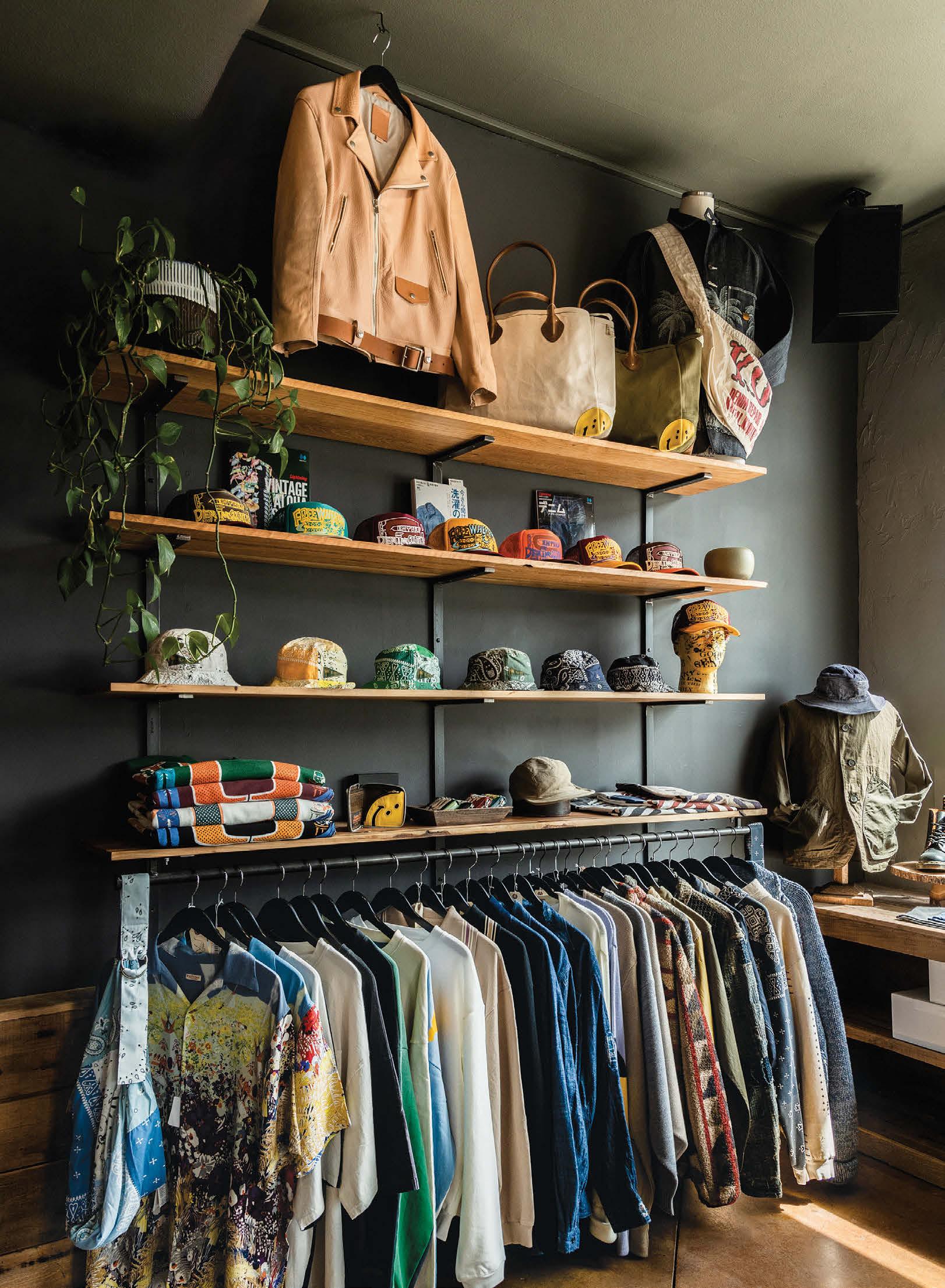
KAPITAL: To Grindle, the best fashion trends originate in Japan, and many of them are embodied in Kapital. Based in the country’s denim capital of Kurashiki, the label boasts a whimsical workwear energy, with its distressed denim patchwork, bright, luau-ready floral motifs, and Southwest-inspired fleeces. Put another way: These are clothes for the gentleman who’s not afraid to rock a yellow cartoon bunny on his oversize cotton blend sweater ($474).
ORSLOW: As its name suggests, this Japanese brand embodies what it means to eschew fast fashion in favor of investing in craftsmanship. An ode to classic denim and military design, OrSlow refuses to rush its olive fatigue jackets made of herringbone twill ($425), cotton, paint-splattered coveralls ($440), and 105 selvedge jeans ($335), a limited collaboration with Canoe Club that took more than two years to design to distressed perfection.
STORY MFG.: Proof that tree-huggers can still look chic, England-based Story Mfg., new to Canoe Club this year, uses environment-friendly materials that are vegan and crueltyfree, a dyeing procedure that fertilizes a replanted forest, and renewable energy to power production. Sure, the brand is pricey—earthy, organic-cotton woven jumpers are $520—but no one ever said looking fly while saving the planet would be cheap.
Longtime friends Lindsay Lobb and Jessica Siron feel similarly about traditional wedding dress shopping, when the betrothed tries on the most important garments of her life in front of friends and family—and any other stranger who wanders into the boutique. “We’ve heard some brides compare [it] to jeans or swimsuit shopping,” Siron says, “and you never want to feel that way when you’re looking for your wedding dress.” So, in 2020, the pair dreamed up Runaway Bridal, a traveling bridal boutique that, for a fee starting at $289, brings the entire experience into your home (within a 25-mile radius of Denver). Accessories, a full-length mirror, and handpicked dresses based on your stated style are packed into a floral-painted truck and then moved into the room of your choosing, creating a personal miniboutique. In November 2022, after an extended pop-up at Littleton’s Aspen Grove outdoor mall, Lobb and Siron realized they could provide the same private, curated service in a brick-and-mortar location and opened a free, appointmentonly studio in RiNo. The gals welcome the bride and her guests with complimentary glasses of wine while they settle into the glam/industrial/ bohemian space, complete with extra services such as charcuterie boards, appointment photography, and even a Botox bar—more ways Runaway Bridal makes the bride feel like the only one in the world.
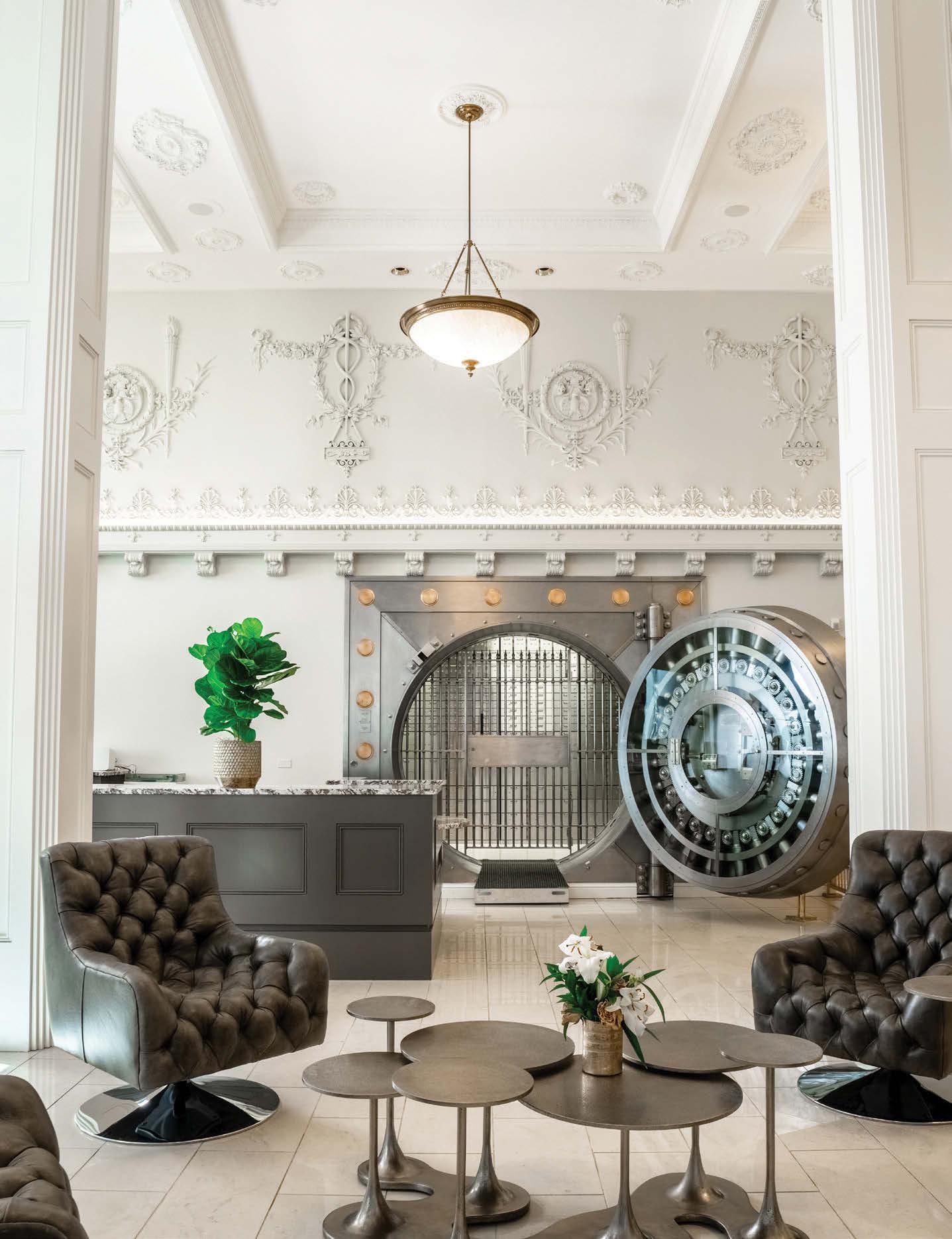
Simply walking through the historical Equitable Building lobby on the way to the Vault’s downtown store—with its marble floors, intricate mosaic ceilings, and grand staircase—is enough to make you feel like a VIP. That perception isn’t likely to fade when a member of the staff greets you at the door, takes your drink order (Coffee, tea, Champagne, or Scotch?), and escorts you past the namesake two-ton vault to your own private showroom to begin your one-hour appointment. There, handpicked pieces selected to meet your specific tastes await—though the Vault’s jewelers are also happy to create something original just for you.
What makes the Vault truly special, however, is what happens next. Opened in fall 2022, the boutique is the brainchild of Morgan Powell, a Gemological Institute of America alum who has been in the jewelry sales business for more than a decade. Powell specializes in ethically sourced diamonds, both earth-mined and lab-grown, and uses her knowledge and experience to educate her customers on the pieces they are about to spend thousands to buy. “There was a need in Denver for something that was a little more intimate, curated, and educational than going into a traditional jewelry store, looking through the cases, and not having a lot of direction,” Powell says. “That’s when the Vault was born.”
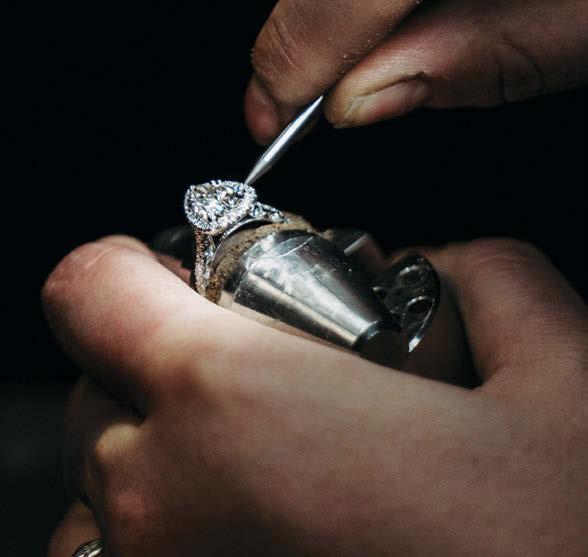
Need a special something for something special? Pop into one of these winners for a thoughtful token to brighten any occasion.
Thinking-of-you moments; self-care treats; birthday gifts; holiday goodies for the kids
Dinner parties; housewarmings; visual inspiration
A well-edited, ever-changing array of lovely sundries organized into easily navigable themed vignettes (think: bath and body, pets, kitchenware, coffee-table books, arts and crafts, kids, and gardening).
The country-cottage space, which opened in December 2022, is the latest Wash Park venture from Angela Pilloud, whose Devil’s Food bakery, and its delectable assortment of pastries and lattes, sits next door.
Teacher or coworker gifts; sprucing up your space with minimal effort; caffeinating while you browse
A collection of globally inspired, artisan-crafted furnishings, including pottery and textiles; accent pieces that walk the line between modern and rustic; and one of Denver’s few showrooms for California-based Noir Furniture LA. (The showroom is based inside the Modern Nomad design collective, which includes eight more vendors to browse.)
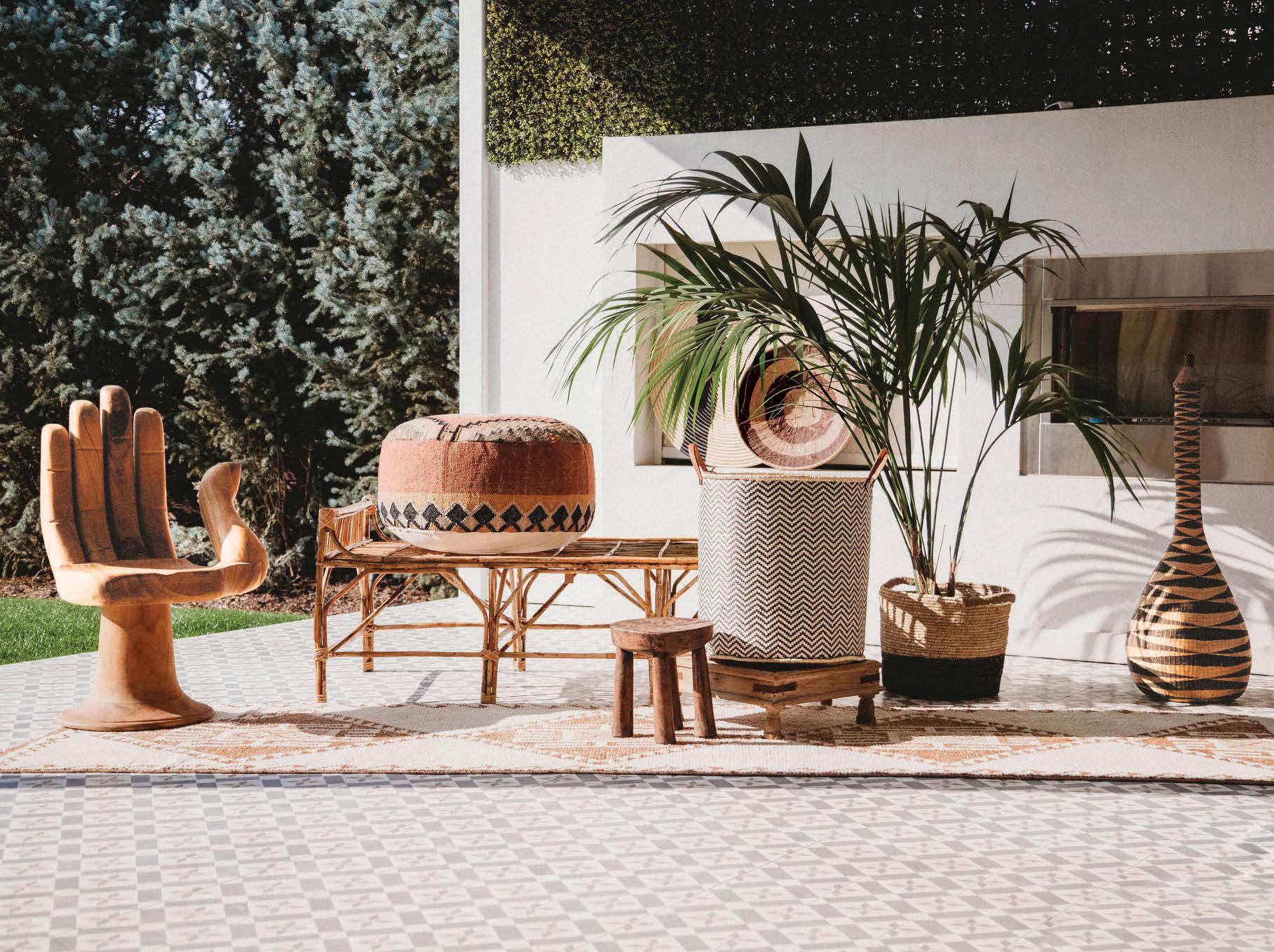
A legit greenhouse residing inside this coffeeshop— the reincarnation of a Zeppelin Station stall that was always punctuated with plants but shuttered during the pandemic—as well as tables and shelves overflowing with succulents, air plant containers, terrariums, and thoughtful extras like floral jewelry by Palisade-based Flora Petal Farm.
In March, owner Becky Miller launched the Perfect Strangers dinner concept—an in-store dinner series hosted every other month for a lucky 20 or so guests—to showcase a particular world culture. The first one, a Japanese-inspired omakase dinner ($95), sold out quickly.
We can’t get enough of the giant swing chairs affixed to the ceiling with ropes. Claim a seat and sway in the lush surroundings while you sip an artfully crafted matcha.
Painter. Activist. Storyteller. These identities all describe Danielle SeeWalker. She is also Húnkpapȟa Lakȟóta, a citizen of North Dakota’s Standing Rock Sioux Tribe—and it’s those ancestral roots that inform her creative passions. The Denver artist, who has a full-time job and co-chairs the Denver American Indian Commission, creates portraits and scenes meant to take back a narrative that’s been commandeered by non-Native people for centuries. “It’s always an outsider looking in, telling our stories for us,” she says. With her vibrant interpretations of what it means to be Native American in contemporary American
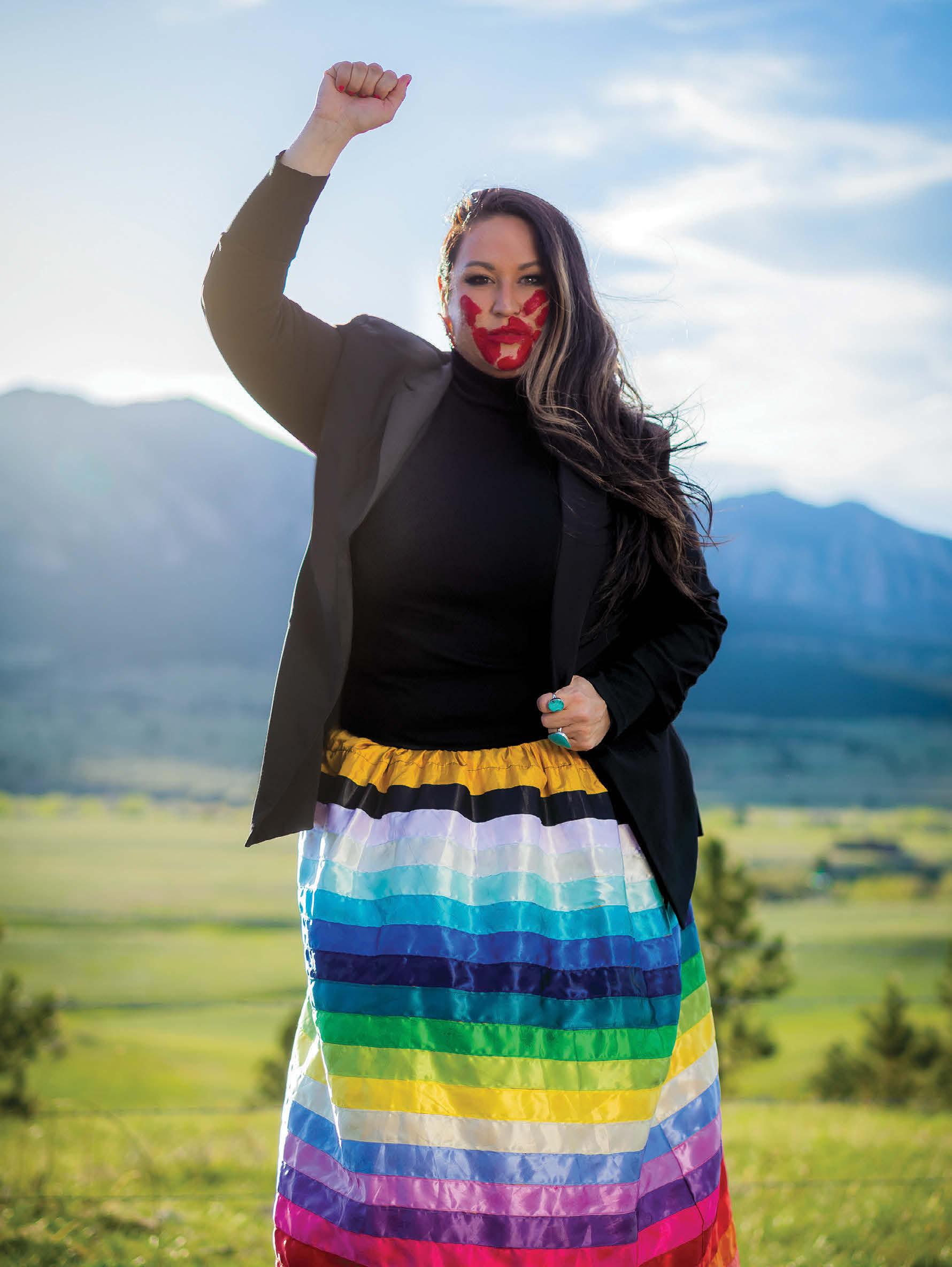
society, SeeWalker is reframing that one-sided perspective. “There’s this whole idea of what Indian art is, what Native art is, what Western art is,” she says. “A lot of people have this preconceived idea of what it should look like—like cowboys and Indians on a canvas. But I’m defining what Native American art is today. It’s something that people are not used to seeing. It’s not comfortable to look at.”
Currently, SeeWalker is working with gold leaf, oil, aerosol, and oil stick, sometimes painting public walls (including one outside Denver Central Market) in the metro area and other times working on rawhide and canvas, as she did for the Braided Women series, which will appear in a solo show at History Colorado that opens in October. “Each of the women in these portraits has a story to tell,” she says. “For instance, there’s one of these two women and their braids are sort of floating up into the air. It’s telling the stories of boarding schools and how our hair was forcibly cut…. It’s bringing these stories to the forefront for other people to learn and hear about.”
Above: “You Can’t Have Our Braids” (2021) is part of a series that tells the story of culture loss via, among other atrocities, the forcible cutting of hair during the Native American boarding school era.
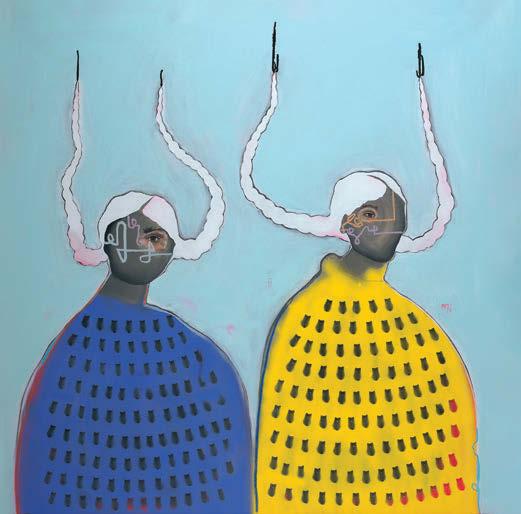
With its grassy slopes, community vibe, and robust lineup of more than a dozen ticketed shows and approximately 40 free concerts every summer, Levitt Pavilion at Ruby Hill Park has been a music lover’s happy place since it opened in 2017. And this past year, the outdoor amphitheater installed a sleek new setup from Meyer Sound that took the audio quality from good to incredible. Whether you bring the whole family or decide to make it a date night—“There’s this one couple who brings a coffee table and tablecloths and flameless candles,” director of marketing and development Jessi Whitten says—RSVP online for the free performances (like 2022’s the New Respects show) to get intel like weather delays and to help the venue book enough food trucks. Then snag one of Whitten’s favorite spots to drop her blanket.
1. Near the front, a large maple nicknamed the Tree of Life offers shade from the late afternoon sun.
2. The VIP section is strategically placed stage right—against the sound board—for the crispest audio quality and dedicated access to the dance floor, and for the free concert series, your $35 upgraded ticket (prepurchased online) includes one

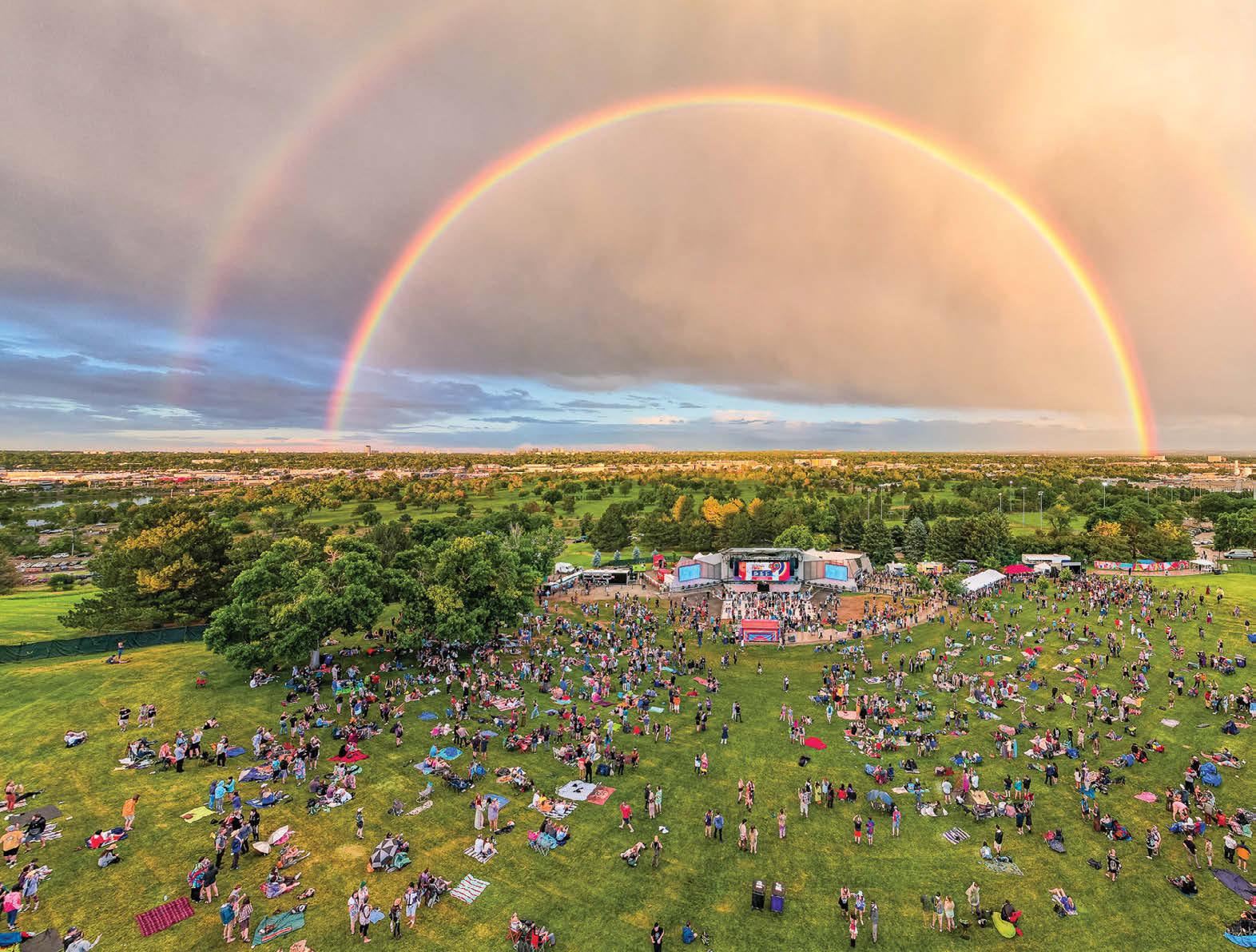
drink, a special bar line, and early entry.
3. Perching at the top of the hill toward the back of the venue gives you a gorgeous view of Denver’s skyline and your kids plenty of space to rock and (literally) roll: “My favorite thing is to look out over the whole venue and see the kids rolling down the hill behind the sound booth,” Whitten says.
When I decided to take my family ice skating at McGregor Square this past December, I knew the open-air locale was a warm-weather draw for Rockies fans. Tucked beside Coors Field at the base of the newish Rally Hotel, the 17,000-square-foot plaza is flanked by a string of eateries and anchored by a stadiumsize LED outdoor TV screen, providing fans with the buzzy atmosphere of a ballgame, no tickets required. What I didn’t realize was that the game-day ambience was alive and well in the winter, too. That is, until I watched my son stumbling around the rink because he couldn’t tear his eyes away from the Fiesta Bowl unfolding above the ice. He was mesmerized—along with nearly everyone else who was cheering on their teams from their outdoor tables while enjoying bites and sips from Milepost Zero’s half-dozen food stalls and 35-tap selfserve beer wall.
Eventually, my son dragged himself off the ice, his eyes shining. “Mom!” he squealed. “We can go ice skating and watch football at the same time!” I didn’t tell him that Tom’s Watch Bar, also in McGregor Square, has about 155 TVs inside or that in the summer he could play giant Jenga in the courtyard while watching the sports matchup du jour. We’ll be back for that action when the bats are swinging. —JD
Perched on a parcel of Lafayette land that overlooks the Flatirons, Acreage doesn’t have a patio, in the traditional restaurant sense: It’s more like a vast, multizone backyard with options for groups of all ages, appetites, and time constraints. Follow the prompts to find your ideal al fresco spot to sip a craft cider and/or enjoy tasty farm-to-fork bites.
Is it after dark?
On cool evenings, seats by the fire pits are coveted: They’re first-come, first-serve, so grab what you can, then get extra cozy by asking your server for the Pommeau, a sweet dessert wine made with unfermented apple juice and apple brandy that tastes like fortified cider, paired with an order of cider doughnuts.
Do you want a full-service meal?
Are you bringing the kids?
A University of Colorado Boulder English professor by day and prolific horror novelist by night, New York Times best-selling author Stephen Graham Jones has ascended the horror fiction throne by remaking the finalgirl trope (the morally virtuous female character who defeats the killer) with more nuanced, less angelic heroines. He’s currently wrapping up his first trilogy, the Indian Lake series, which reads like a cheeky tribute to every horror flick ever made. Following the February release of the second installment, Don’t Fear the Reaper, we asked Jones: What goes on inside your mind?

5280: So, how do you sleep at night?
Stephen Graham Jones: I’m not afraid
Make a reservation on the deck or in the cider garden to indulge in flights, shareables—such as the charcuterie board and soft pretzels with beer cheese—and entrées like seared salmon, Colorado lamb burger, and braised short ribs atop a sunwarmed picnic table.
Are they over 10?
Grab a cider (we favor Stem’s classic, nottoo-sweet Real Dry variety) from the main building’s service window, then settle into a stand-alone hammock on the west side of Acreage, where you can watch the setting sun do its thing over the foothills.
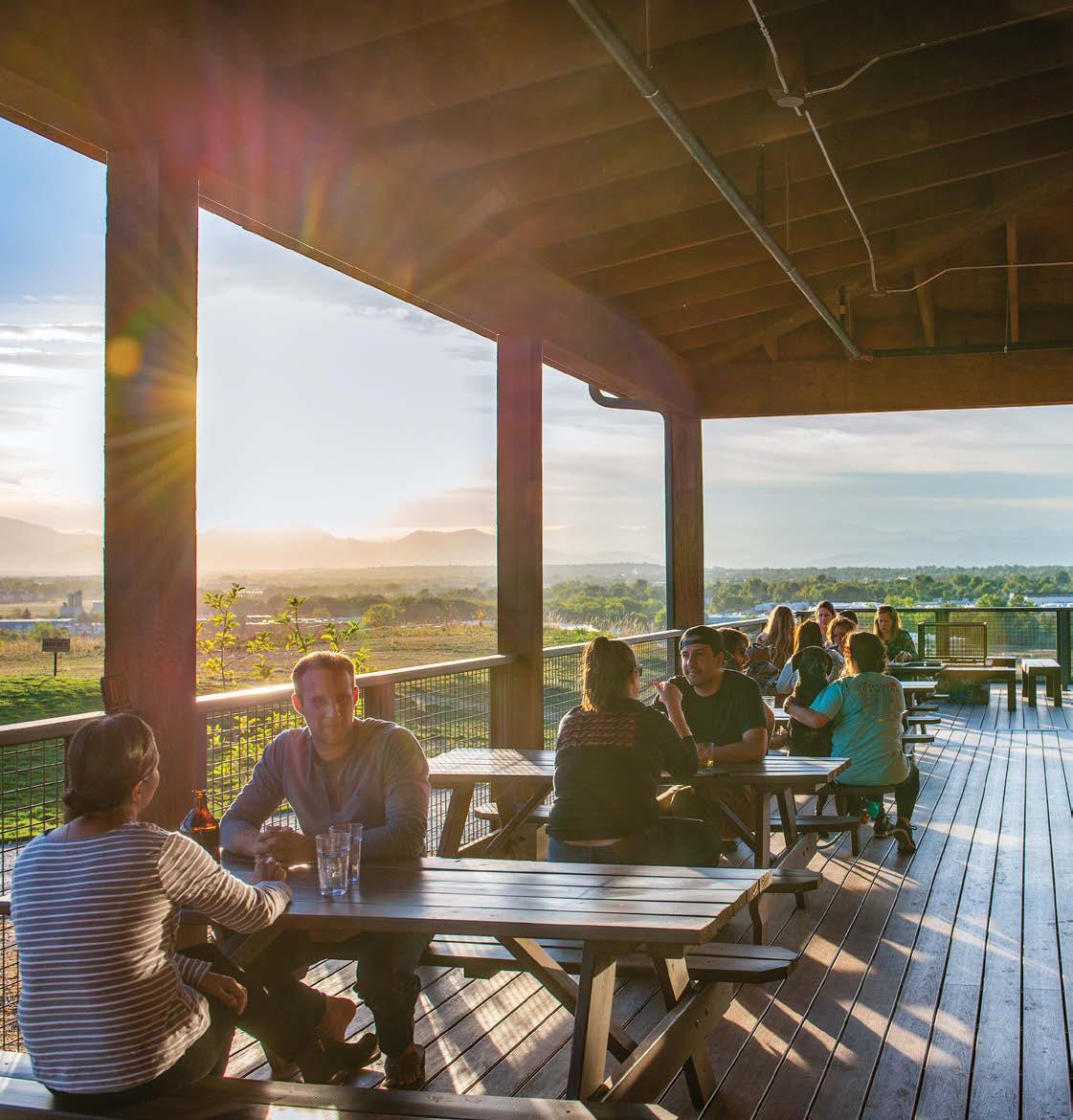
I’m going to do the things my characters do. When I can’t sleep, the reason is all this violent stuff in my head. Thoughts like: If I’m at a playground and see a mountain lion, how am I going to fight it? In my head, I’m a hero. But I think the real way it ends is the mountain lion opens me up and hollows me out. My mind goes to gory places.
What are you afraid of?
We all have different thresholds for what counts as scary. I don’t think mine is set particularly high. I’m terrified of the dark. I get scared of everything. If I wasn’t, I don’t think I would write horror.
Post up at a cornhole or ladder toss setup on the lawn. On weekend nights, everyone can celebrate victory at a nearby pallet table over bites from the Diggity Street Eats food truck while the grown-ups sample Stem’s newest botanical series release, Neural Nectar. The lemongrass cherry limeade cider, featuring lion’s mane mushrooms from Fort Lupton’s MyCOLove Farms, was made in collaboration with MyCOLove co-founder and former Broncos quarterback Jake Plummer.
Let your little ones take turns on the playground’s swings and slide while you channel your own childhood with a Tangerine Whip cider from Acreage’s new outdoor bar.
Do your stories have a universal message? I want people to believe in hope. The stories I tell are these long, dark, terrible, bloody, violent tunnels. But there’s a speck of light at the end. If you just keep moving through the darkness, that speck will grow bigger and bigger until you can walk into it. I want them to understand that in their own lives.
When Five Points’ swanky Welton Room expanded in November 2022, it not only added a new space next door, now called the Welton Room Lounge, but it also diverged from the original drinks-only concept to include seasonal modern small plates such as Colorado skirt steak, hamachi crudo, and duck croquettes. (The original room, where you can get snacky fare, has been rebranded as the Monkey Bar at Welton Room.)
The inventive cocktail menus in both spaces showcase molecular mixology—i.e., bartending that combines ingredients to create a reaction, kind of like a delicious chemistry experiment—and occasional activations such as smoking applewood chips, torching cinnamon or rosemary, using liquid nitrogen, and even employing a cotton candy machine. These showy techniques and methods were gleaned from the coowners’ time working in Los Angeles under Michelin-starred chef José Andrés. “We learned to play around,” co-owner Jorge Ortega says.
“From the visual to the olfactory to the tableside pace, we want to spur all of your senses when it comes to your cocktail experience.”

In early 2023, the Museum of Outdoor Arts (MOA) began a new era when it relocated to a three-acre green space in Greenwood Village. The move sparked the museum to shift its programming from gallery- and exhibit-based to immersive, experiential, and (mostly) outdoors. Below, a quick rundown of what you can see during this summer’s guided tours ($10)—or wandering around on your own ($5).
SCULPTURES
Alice in Wonderland
PAINTINGS
Fiddler’s Green Murals
A bronze series by Harry Marinsky depicting beloved scenes and characters from Lewis Carroll’s classic story, in seven installations around the park
A growing chain of vibrant wildlife murals by Colorado artists, curated by the museum and prompted by muralist Adden J. Davis, along the back of the amphitheater
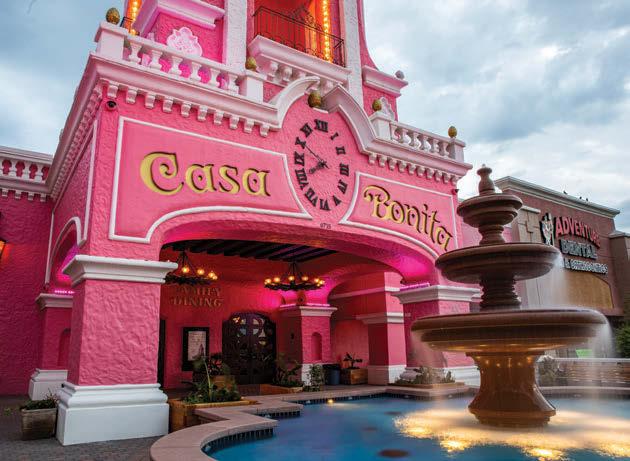
PLANTS
Panoramic Living Mural
The largest vertical garden in North America, replenished annually with more than 34,000 plants in different patterns on the amphitheater’s interior sound wall

CURATED CHAOS
Cabinet of Curiosities and Impossibilities
CINEMATIC ART
Cricket Cinema
An expanded version of maximalist installation artist Lonnie Hanzon’s longtime, immersive MOA exhibit featuring historical trinkets, whimsical art, and antiques that nod to fairy tales and nursery rhymes, plus specialized lighting, sound, video, and augmented reality elements; projected to reopen in a new 400-square-foot building within Marjorie Park this summer
A pop-up theater on a tiny trailer platform that plays film shorts and animations based around a theme (this summer’s is Colorado Outdoors) during park events and concerts
Unless you’ve been holed up under a rock...on Mars...wearing noisecanceling headphones... you know that everyone’s favorite West Colfax Mexican-restaurant-slashtropical-cliff-diving-show has reopened after a threeyear hiatus with an extensive top-to-bottom revamp. The intrepid new leadership trio comprises South Park creators and Colorado natives Trey Parker and Matt Stone plus high-profile Denver chef and restaurateur Dana Rodriguez, who is practically a regular on the James Beard Foundation Awards shortlist. The official opening date for the public was still hush-hush at press time, but the new menu—which offers a lineup of approachable yet elevated Mexican specialties, all made from scratch—was released in late May. (Yes, yes, there will still be sopaipillas.) But the real story about why Parker and Stone decided to revive the pink palace hasn’t been told—until now.
TURN THE PAGE for 5280’s behind-the-scenes story of a cultural icon returned to life by two of the planet’s most beloved comedy masterminds.
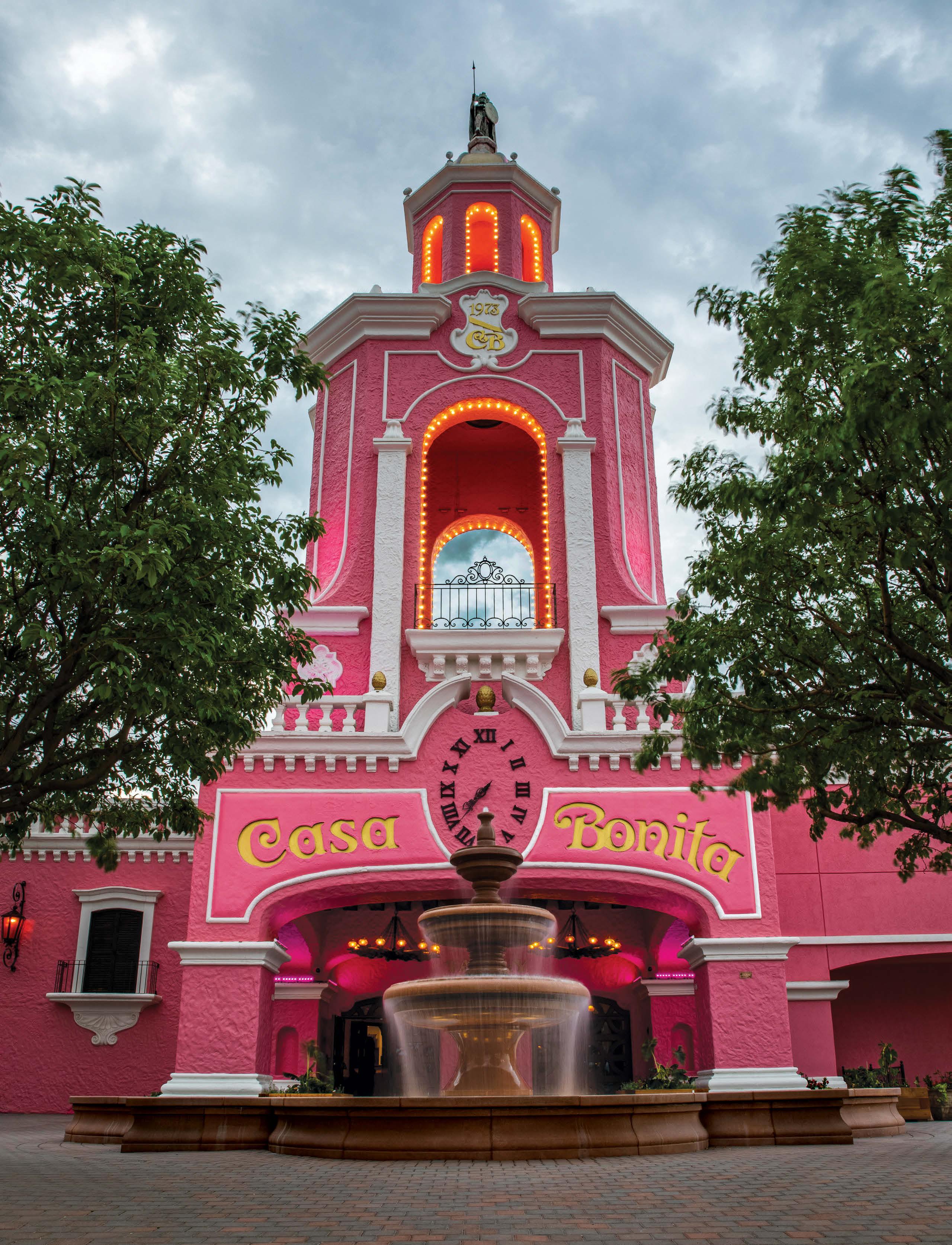
In an interview with 5280, Trey Parker and Matt Stone dish on whether buying Casa Bonita was a good business decision, how they used South Park to telegraph what was going on with the restaurant’s renovation, and which one of them will be dressing up in the infamous gorilla suit.
BY GEOFF VAN DYKE ● PHOTOGRAPH BY DAVID WILLIAMSYes, there is the famous episode from 2003 that introduced so many people outside of Colorado to Lakewood’s iconic Mexican restaurant—you know, the one in which Cartman convinces his friend Butters that a meteor is going to hit Earth, so Butters needs to stay in a bomb shelter. And while he’s hunkered down, Butters will conveniently miss Kyle’s
alluded to Parker and Stone’s challenges as new restaurant owners. The episode, called “DikinBaus Hot Dogs,” aired in March of this year, a bit more than a month before Parker and Stone were originally scheduled to reopen Casa Bonita. The plot loosely follows Cartman and Kenny’s attempt to turn the Coney Island Boardwalk hot dog stand (yes, of Bailey, Colorado, fame) into a destination restaurant complete with a massive slide and a zip line and a mermaid grotto. Hilarity ensues. Eager local television reporters say “DikinBaus” on air during the media frenzy; Cartman and Kenny go way over budget; and myriad, ridiculous logistical hurdles come up as they renovate the place. (“I think you gotta re-asphalt the entire parking area or just lose the zip line,” one of the contractors tells Cartman. “Well, obviously, we’re not going to lose the zip line,” Cartman says, “so let’s see what we can do.”)
they purchased the famous West Colfax restaurant for $3.1 million in 2021. Parker, 53, was wearing a black CU T-shirt, and Stone, 52, wore a white tee and white baseball cap, the latter of which he kept taking on and off throughout our conversation. Both looked tired, but neither sounded tired. They exuded the energy necessary for making a celebrated animated TV show and renovating a massive restaurant and parenting children and traveling back and forth between Los Angeles and Denver almost weekly. “We probably could have made a two- or three-hour show out of that,” Parker continued. “So much of the [“DikinBaus”] episode was about Cartman going $40 million over the budget.” He paused for a moment. “Kind of like we did.”
While that may be true, the duo have been recognized for their business savvy, and in 2021, they inked a $900 million deal with ViacomCBS (now Paramount+). Fourteen years before that, Parker and Stone negotiated a deal with Viacom that included the creation of South Park Digital Studios, a website where fans could watch episodes for free online. Part of that deal gave Parker and Stone “a 50 percent stake in all future online deals for the show,” according to Bloomberg. That stake became an umbrella entertainment company called Park County, which today has a valuation of more than $1 billion. So, I felt compelled to ask Parker and Stone if buying Casa Bonita was a good business decision.

“Only people as rich and silly as Trey and I would do this,” Stone said. “This is definitely an indulgence. We want to do it for the state of Colorado. The businesspeople would say ‘no’ to something like this—and they did.”
birthday party, which just so happens to be at Casa Bonita, Cartman’s favorite place in the world. So Cartman gets to go to Casa Bonita in Butters’ place. Well, sort of. The police find Butters and figure out Cartman’s plan, which means he has to rush through the eatery’s various attractions, ultimately eluding authorities by diving off the restaurant’s famous waterfall. When, at the end of the episode, the cops ask Cartman if it was all worth it, he says, floating on his back in Casa Bonita’s pool, “Totally.”
But there’s a more recent episode of South Park that, if you were watching closely,
The episode stands on its own as a sendup of post-pandemic workplace culture and as yet another example of Cartman’s narcissism (once again, he screws over Butters), but it was difficult to watch “DikinBaus Hot Dogs” and not think that Parker and Stone were telling South Park viewers something about how things were going at Casa Bonita. “The cool thing about South Park is it’s always where we are in our lives,” Parker said in an interview this past May. “It’s like a band making an album. We’re always going, OK, well, what’s going on? We were like, We’ll do another big Casa Bonita episode. And then it was like, No, no, that’s too on the nose. But we could do another one that has to do with it, but that’s not exactly it.”
Parker and Stone, who met at the University of Colorado Boulder and complete each other’s sentences like a longtime married couple, were in Casa Bonita while we were talking about what they’d bitten off since
“On paper, it’s a very, very bad idea,” Parker said, laughing.
“Listen, this restaurant went bankrupt twice,” Stone said. “So we would like to be successful. Obviously, to do all this work and go bankrupt—that would be stupid. But we’ll see. I don’t know. It’s not a slam dunk. Let me just say that: It’s not a slam dunk. It’s not a no-brainer.”
TUCKED INTO THE CORNER of an otherwise nondescript shopping plaza in Lakewood, Casa Bonita’s bright pink facade and Disneyland-esque atmosphere hold an outsize place in the minds of many Coloradans—and probably in the minds of children and adults from around the world. For Parker, apparently, Casa Bonita has the ability to warp the space-time continuum.
Not long ago, Parker told me, he was talking to his mom and told her the team at Casa Bonita was a little worried about people staying too long at the restaurant because they
would be having so much fun. Parker and Stone knew they would have to turn tables if they were going to have any sort of viable business.
“I was like, ‘I remember when I was a kid, we’d stay all day long,’ ” Parker said to his mom.
“You didn’t stay all day,” his mother said. “We’d go for two hours.” Parker laughed as he was recounting the story.
“No, we went all day!” he said.
“Trey, we went for two hours,” she said.
Of course, that’s likely how Bill Waugh wanted kids to feel when he opened the first Casa Bonita in Oklahoma City in 1968. Over
the following six years, he opened outposts of the restaurant, which was billed as “eatertainment,” in Tulsa, Oklahoma; Little Rock, Arkansas; Fort Worth, Texas; and, in 1974, Lakewood, Colorado. “It’s obviously fake, and it’s kitsch,” Stone said. “But coming in now, you get this cool sensation because nothing like this is built anymore.”
Nothing, really, was built like Casa Bonita back then, either. The space Waugh created was designed to evoke dining outside, under the stars, in different parts of Mexico, but along with these seating areas came a host of attractions, including an arcade, “mines,”
Black Bart’s Cave, a theater, and, famously, a 30-foot waterfall from which cliff divers would plunge into a pool to the delight of diners. The idea was to create an immersive experience for kids and adults while they ate their enchiladas and sopaipillas.
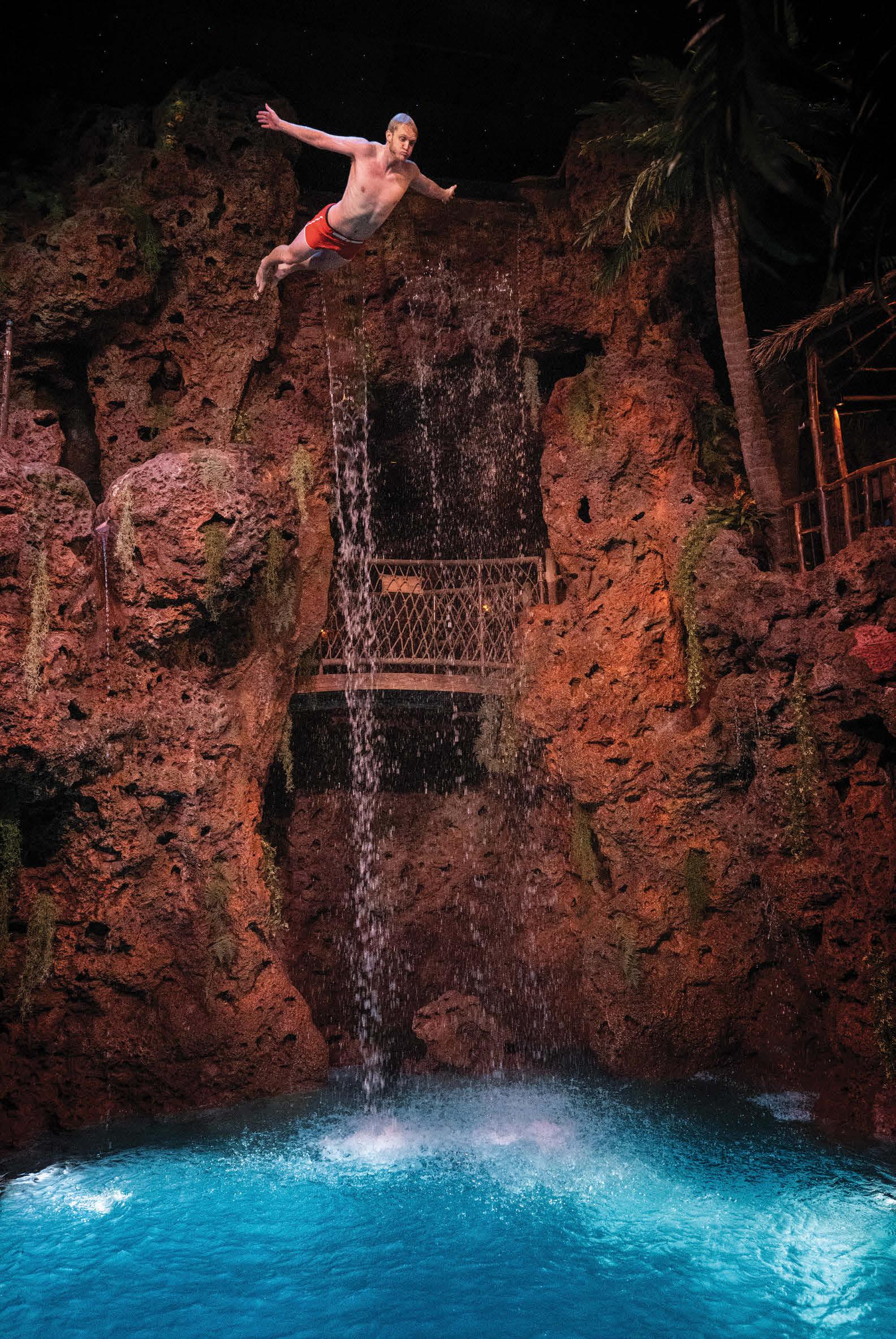
Parker and Stone wanted to keep all of that—they wanted the adults who’d come as kids to remember the place as it was—but to make it better. (“We’re hoping we’ve taken it from gross and charming to just charming,” Parker told me.) And they wanted to introduce Casa Bonita to a new generation, who they hope will get as excited about the restaurant as Kyle, Stan, Kenny, and, yes, Cartman were. “We’re trying to make a place that the kids like, and obviously the place is really made originally for kids and for families, and a lot of the creative work and a lot of what’s going on is for kids,” Stone said. “The number one customer is probably a six-yearold who’s hopefully going to think this place is great. But we want the parents to come and have a nice drink and like the fact that the place doesn’t smell like chlorine anymore.”
It has taken more than $40 million to take Casa Bonita from “gross and charming” to “charming.” Stone said there were a few times that they thought it would be smarter and cheaper to level the place and rebuild it. But that was a nonstarter—Parker and Stone knew they couldn’t demolish what Stone called “hallowed ground.” Instead, they spent lots and lots of money trying to make new things seem like they’d been there for decades.
The team ripped out the kitchen and built a more modern one capable of serving the masses. They made the pool safer by removing ledges inside that the divers had to avoid, and they fixed the leaks. They installed lighting and a sound system worthy of a Broadway production. They increased the number of bathrooms. They made the restaurant ADA-compliant and raised railings that were nonfunctional from a safety perspective. And they replaced the tile tabletops, where years of crumbs and honey from the sopaipillas had collected, cementlike, in the grout. “You can walk around today and say, ‘Oh, my goodness!’ ” said Alex Perez, who’s 69 and has worked at Casa Bonita for 28 years. “Everything smells new. The ceiling’s new. There are new bars, new tables, everything’s new. But it also feels the same.”
Perez, who has done just about every job at Casa Bonita—from janitor to bartender to floor supervisor—was one of dozens of employees Parker and CONTINUED ON PAGE 144
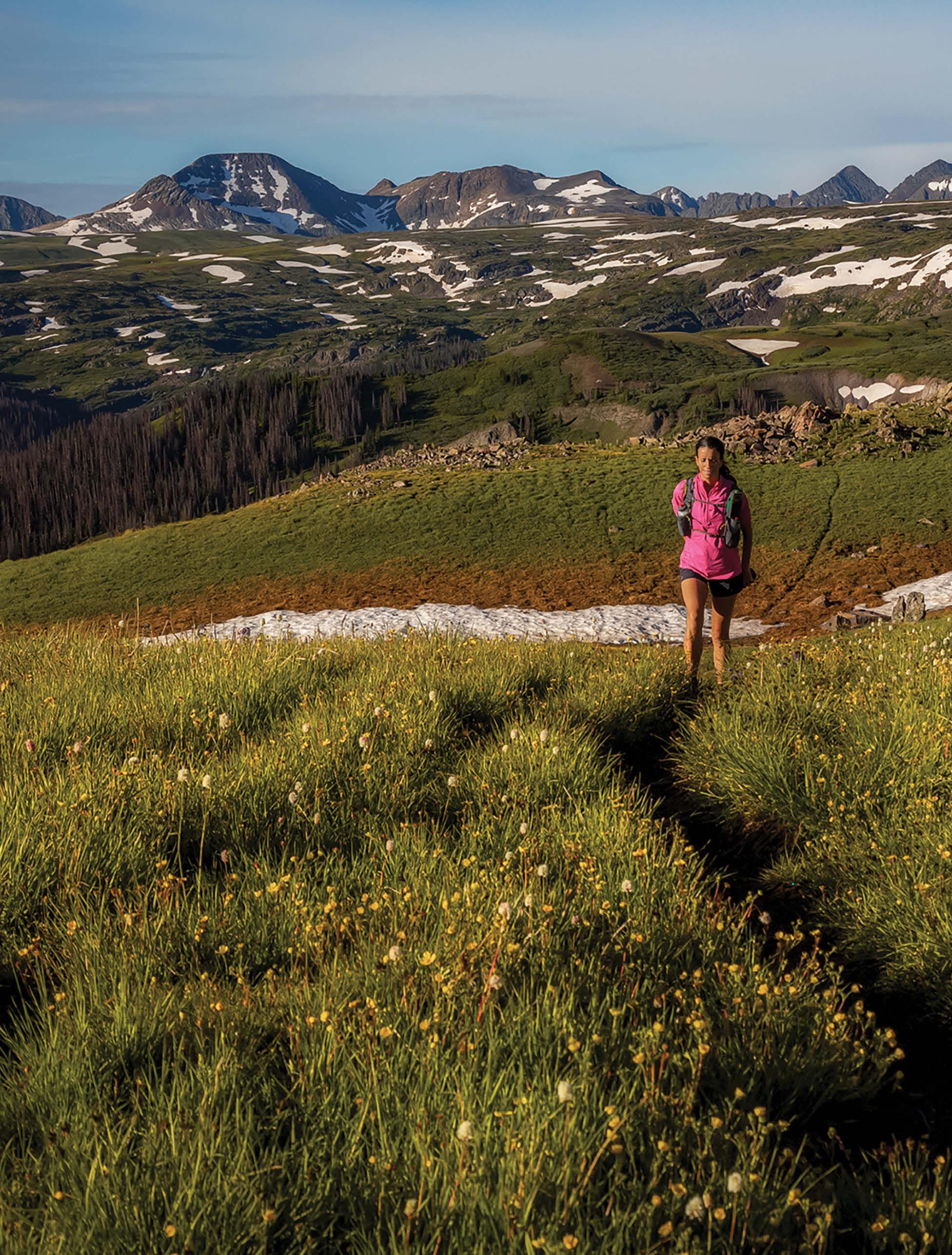
May we present the greatest distance-hiking route in the country.
 BY ELISABETH KWAK-HEFFERAN PHOTOGRAPH BY ERIC SCHUETTE
Stony Pass in the San Juan Mountains
BY ELISABETH KWAK-HEFFERAN PHOTOGRAPH BY ERIC SCHUETTE
Stony Pass in the San Juan Mountains
MORE BEAUTIFUL THAN THE APPALACHIAN TRAIL, more fun than the Continental Divide Trail, and easier to pull off than the Pacific Crest Trail, the Centennial State’s quintessential footpath is all highlights, no filler. Running for 567 total miles between Denver and Durango, the Colorado Trail (CT) winds through six wilderness areas and eight mountain ranges packed with craggy skylines, sparkling lakes, wide-open tundra, and an entire guidebook’s worth of wildflowers. And while the CT isn’t short, compared with marquee long trails that take six months to complete, it’s much more doable—in fact, you can hike the whole thing in perfect summer conditions. “Mile for mile, it’s the most scenic hike the United States has to offer,” says 2020 thru-hiker Robin Mino of Broomfield. The CT officially dates back to 1973, when U.S. Forest Service employee Bill Lucas embraced the notion of a cross-Colorado hiking route and magazine publisher Merrill Hastings helped spread Lucas’ idea in Colorado magazine, but the Ute people walked its terrain for thousands of years before that. “I was really fascinated by the significance of the land to the Nuche (Ute) people,” says 2020 thru-hiker Darrah Blackwater of Santa Fe, New Mexico. “I learned a lot of the trail is [made up of] trails the Nuche have used: trade routes and how people got from one place to another.” Today, the nonprofit Colorado Trail Foundation maintains the route with the Forest Service and publishes the path’s official guidebook, which breaks the trail into 28 segments. Hundreds of people from Colorado and the world over set out to trek the full trail every year (usually a four- to six-week endeavor), but many more choose to walk just fractions of the path for day, weekend, or weeklong trips.
“The Colorado Trail offers the incredible experience of exploring Colorado,” says Nika Meyers of Aspen, who set a female self-supported fastest known time record on the trail in 2021. “You hike through some of the most gorgeous landscapes ever.” But don’t just take her word for it. In these pages, we’ve divided the CT into four stretches and denoted their respective highlights so you can go see for yourself.
This vertiginous chain of peaks smack in the middle of ski country has plenty to recommend it on its own merits: Over 13.2 miles, you’ll get the trail’s first sustained tundra walking, carpets of wildflowers such as Ross avens and alpine forgetme-nots, and rooftop views over the surrounding ski towns. Its easy logistics, however, are the real beauty of this stretch of trail. “Of all the segments of the Colorado Trail, this is probably the best one for dayhikes because the Summit Stage bus runs from Copper Mountain to Frisco and Breckenridge,” says Kai Malloy, two-time thru-hiker from Moab, Utah. “You can park your car on one end or the other, hike over the range, then take the bus back.” We like starting at the Gold Hill trailhead, four miles north of Breck, which gives you a slightly gentler approach to the high country as you skirt Peaks 3, 4, and 5 of the ski resort en route to a high point of 12,495 feet. The next 3.5 miles scrape the sky (be mindful of thunderstorms) before plummeting back down to Copper Mountain Resort, where you can catch the free bus back to your car
MILES: 169.7
SEGMENTS: 1 to 10
(transfer in Frisco to get back to Gold Hill) and an après beer.
BEST
Don’t oversleep at your primo campsite flanking these two tiny lakes at 11,450 feet in the Holy Cross Wilderness: You won’t want to miss the tent-door view of morning alpenglow lighting up the shoulders of 12,893-foot Galena Mountain like a marquee. The quickest route to Porcupine Lakes (5.1 miles one way) departs from the Timberline Lake trailhead just west of Turquoise Lake near Leadville. The CT ascends north to treeline with views of Colorado’s two highest peaks, Mt. Elbert and Mt. Massive. Look for orchids and paintbrush lining the footpath in July.
BEST LONG WEEKEND
The CT really shows its swagger on this three-day, 32.7-mile stretch. Up until this point, the trail has snaked through lowerelevation forests, shrublands, and burn zones; Kenosha Pass marks the true entrée to the mountains.

Park at 10,000-foot Kenosha Pass, start among its famed aspen groves—expect peak fall color in mid- to late September—and hike through subalpine fir woodlands until the 1,900-foot climb to Georgia Pass begins at mile six. Scout for a sheltered campsite just below the pass (around mile 11). On day two, meet the Continental Divide at 11,874 feet on Georgia Pass, from where you’ll savor views of 13,370-foot Mt. Guyot. Drop 1,900 feet into a lodgepole-pineforested canyon crisscrossed with several babbling streams, then camp around mile 19.5 near the North Fork of the Swan River. Your final day features a ridge climb with views of Keystone Ski Resort, followed by a switchbacky descent to your ride or shuttle car at the Gold Hill trailhead just north of Breckenridge.
Before the U.S. Army’s 10th Mountain Division gained fame for harrowing World War II victories in the Italian Apennine Mountains
For most thru-hikers, Waterton Canyon, about 40 minutes from downtown Denver, marks the journey’s start. Heading southbound on the CT involves a more gradual elevation gain, giving backpackers time to develop their trail legs before hitting the really steep stuff, whereas hiking northbound from Durango tosses you right into the alpine crucible. The Colorado Trail Foundation breaks up the route into 28 segments, with the first starting here. Get ready for dramatic shifts in the landscape, from scrubby foothills to the tundra flanking Colorado’s tallest summits.
and helping birth the American ski industry, its soldiers trained in climbing, skiing, and winter survival at Camp Hale, a hastily built base at 9,200 feet. The CT tracks right by the remains of the site—which President Joe Biden designated as Camp Hale–Continental Divide National Monument this past fall—where hikers can take a short, selfguided history tour.
The former mining hub, which claims the title of the continent’s highest incorporated city, at 10,152 feet, caters to high-elevation hikers. Mustdo’s: Grab a latte at Zero Day Coffee, operated by two CT thru-hikers; sip a Camp Hale Pale Ale at Two Mile Brewery; and book a hard-to-get shopping appointment to buy a coveted Melanzana fleece. “Every single hiker that I meet on the Colorado Trail will be like, ‘Did you get a Melanzana store appointment?’ ” says four-time thru-hiker Lauren Veloz of Denver. “It’s everyone’s mission to get a Melly.”
Sold on the idea of traveling the whole thing? Join the nearly 5,000 people who’ve completed the CT on foot, bike, horseback, or some combo thereof. We tapped recent thru-hikers for their essential tips and tricks.
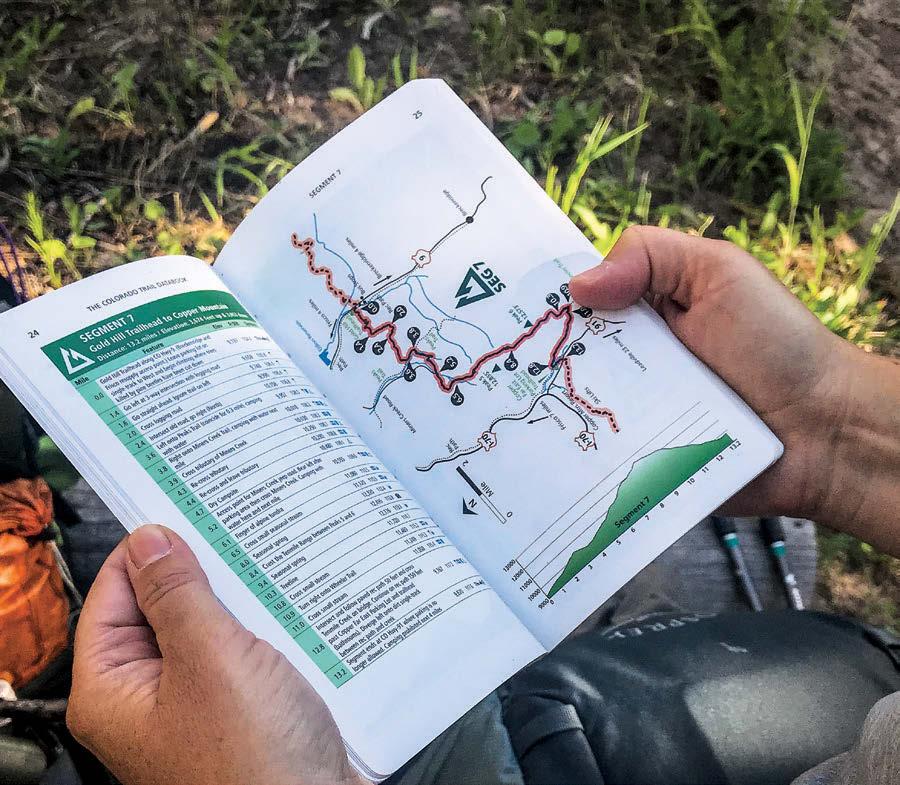
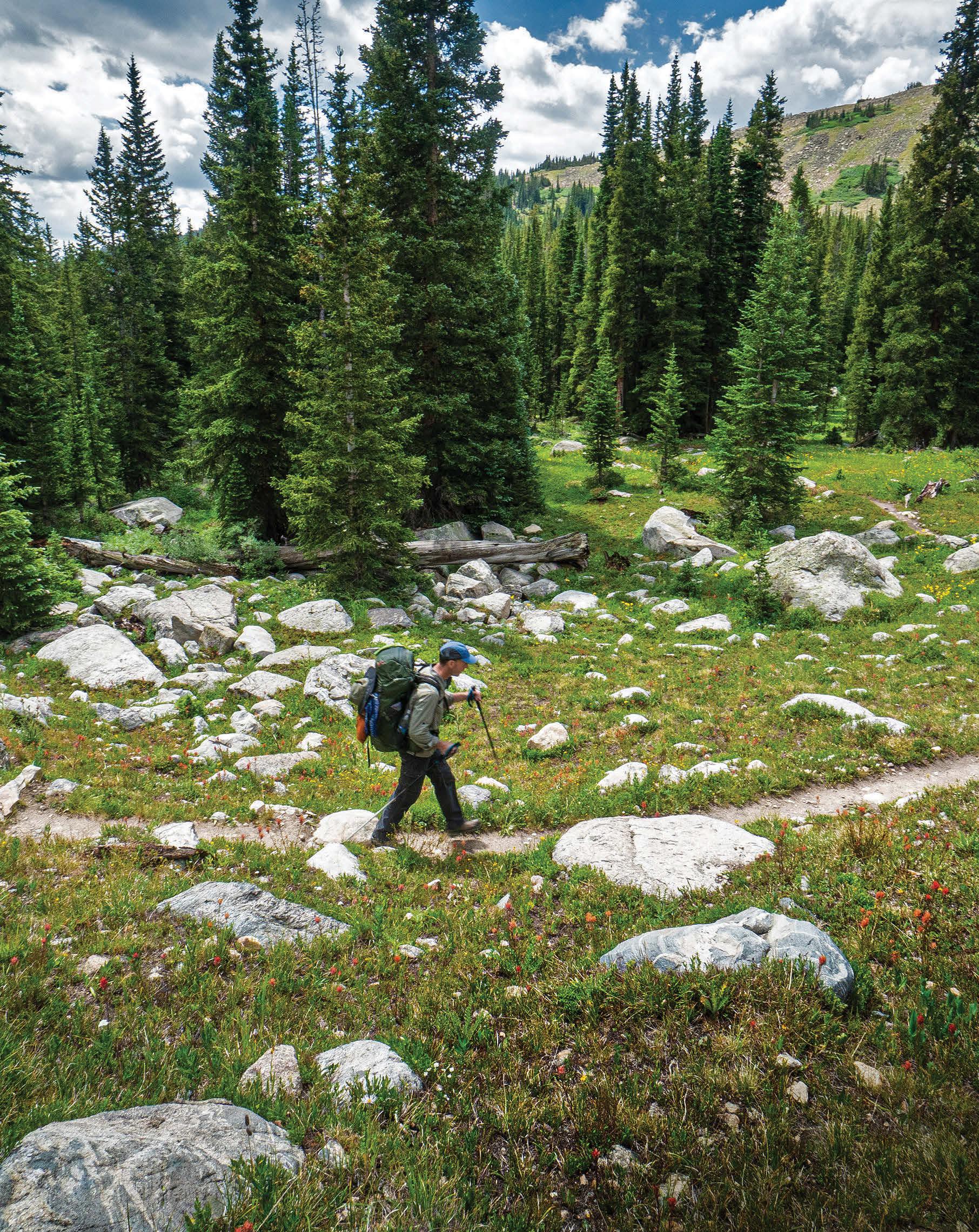
Time required: Most people take four to six weeks to hike it, though the quickest supported thru-hikers on record have finished in a week.
When to go: Late June through late September.
Do I need reservations? Nope, though you will have to fill out free permits in wilderness areas.
What about restocking my food?
There are two main ways: shopping in nearby trail towns and/or
mailing yourself “resupply boxes” ahead of time to businesses that agree to hold them for you (try general stores and hostels). How do I get to town? Some municipalities—such as Salida and Breckenridge, for example—offer buses or hiker shuttles (you might have to prearrange pickups), and you may be able to call an Uber, but many people hitchhike. For safety, go with a buddy and ask for rides at
trailhead parking lots before thumbing it on the highway.
What are the best resources? The Colorado Trail Foundation’s The Colorado Trail guidebook as well as its Databook (pictured) are indispensable, as is its website, coloradotrail.org. Also join the private Facebook group for your season’s trip—search “Colorado Trail Thru-Hike” and the year you intend to go—to ask questions, get route updates, and swap plans with other hikers.
MILES:
78.8 (Collegiate East)
84.8 (Collegiate West)
SEGMENTS:
Part of 11 to Part of 15 (official route) or Collegiate West 1 to 5
Come mile 183, thru-hikers have a decision to make: east or west?
The CT’s original path skirts the Collegiate Peaks’ eastern flanks, but in 2012, the Colorado Trail Foundation officially added an alternate route along the range’s western side. Fans of the OG path tout its easier resupply logistics, reduced thunderstorm exposure, and access to hot springs; westward walkers love that route’s higher elevations, more remote feel, and peerless views. Indecisive? Hardy folks can choose to hike the whole damn thing, a 160-mile life-lister called the Collegiate Loop.
This 14,196-foot giant of the Sawatch Range lies within easy (relatively speaking) reach of the Collegiate East route via its lesser-traveled east ridge, a 10.5-miler, round trip. Take off from the Silver Creek trailhead well before the sun rises to avoid afternoon thunderstorms. Climb southwest on the CT, and you’ll reach a saddle on the east ridge at mile 3.4. The next 2.1 miles hold narrow, steep, rocky Class II terrain before things open up to a summit that rewards you with sweeping views north and south to Yale’s fellow Collegiates.
Glittering waters, meadows thick with columbine, and views of peaks on all sides: This azure jewel embraced by a cirque of thirteeners is Colorado high country at its best. The 5.6-mile route (one way) from the South Winfield trailhead (highclearance, four-wheel-drive vehicles can park two miles farther up the track at the Clear Creek trailhead) follows Clear Creek into the Collegiate Peaks Wilderness. From there, you’ll hop onto the CT’s Collegiate West route and hike south between Granite Mountain and 14,012-foot Huron Peak before ascending to the Lake Ann basin, where there are campsites aplenty.
The whole 84.8-mile path from the Interlaken trailhead in Twin Lakes south to the Monarch Crest junction south of Monarch Pass tops many long-distance hikers’ all-star lists. “It’s just amazing country,” says hiker Kai Malloy. “It feels really remote and uniquely Colorado.” The trip, which takes roughly six to eight days, kicks off with a quadson-fire push up 12,548-foot Hope Pass, then tracks among the alpine tarns and dizzying summits of the Sawatch Range and Collegiate Peaks. The route traces the Continental Divide, traipsing up and down high passes and hanging out above
12,000 feet for miles at a time. With Collegiate West’s towering elevations and long hauls between resupply points, it offers bragging rights for those who tackle it.
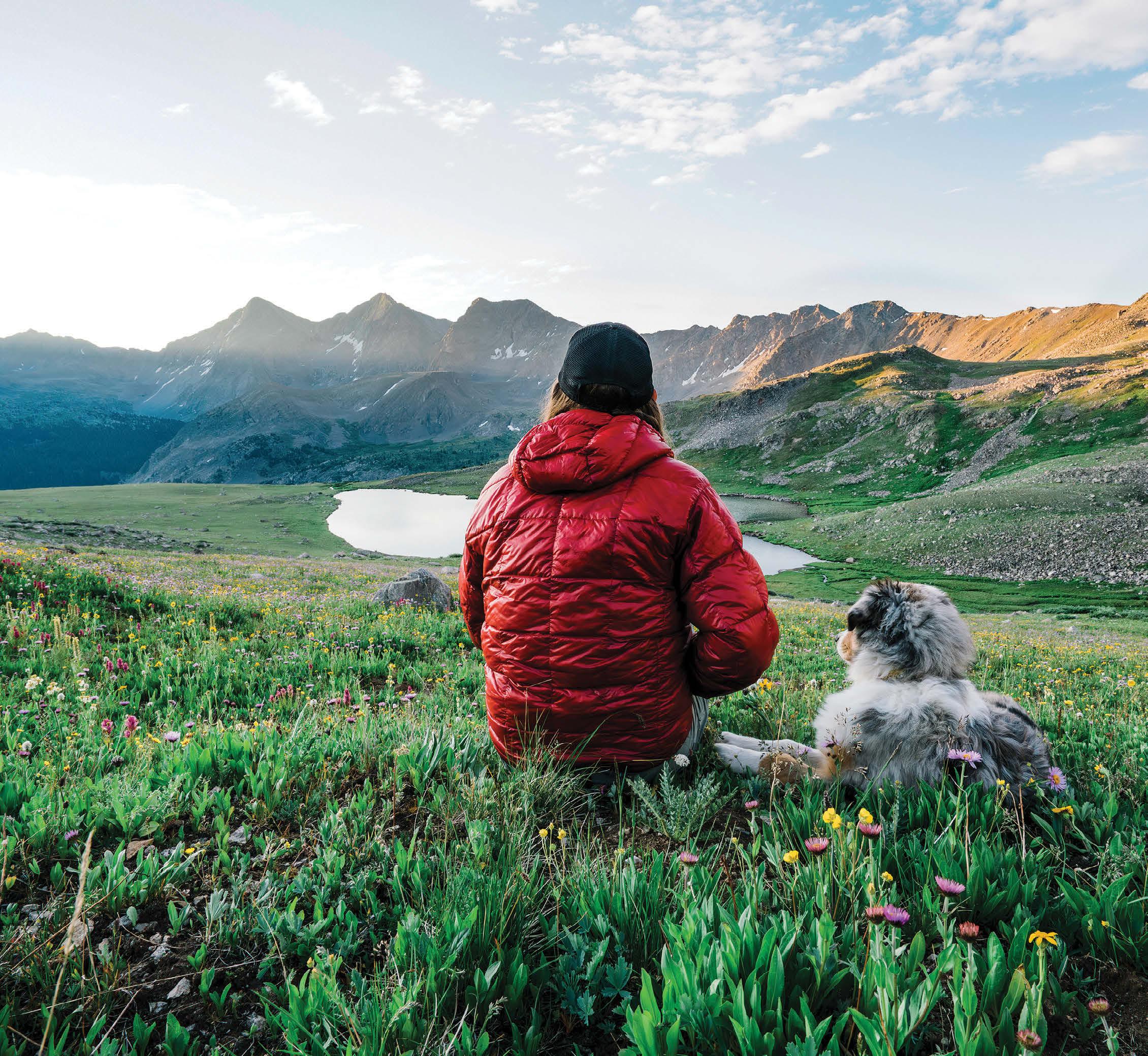
The Collegiate East route boasts not one but two opportunities for soaking those aching feet. Hiking south,
you’ll hit Cottonwood Hot Springs first (a four-mile walk or hitch east of the Avalanche trailhead on CO 306), a low-key, sustainabilityminded resort with mineral pools and a dry sauna. The CT then tracks right past Mt. Princeton Hot Springs, just west of Nathrop, where the dipping options range from a warm water slide to stony natural hot tubs on Chalk Creek.

Fat-tire aficionados revere the 34 miles of track that descend from Monarch Pass to Poncha Springs, rolling a little up and a lot down (a 4,000-foot descent over 30 miles) through the tundra with nonstop Collegiate Peaks views. The route syncs with the CT’s Collegiate West option until just south of Marshall Pass, where it then cruises down the Silver Creek and Rainbow trails into town. (Bike shuttles are available out of Poncha Springs.)
Hiker box: A shared bin of free food, gear, and clothes left behind by other hikers or trail angels; these are often found in trail-town hiker gathering spots.
Travelers have been kicking back in this tiny lakeside berg since at least the 1870s, and today it serves as a thru-hiker hub for both the CT and Continental Divide Trail. Must-do’s: Stop at Twin Lakes General Store, where you can pick up a resupply box, charge your phone, and score necessities like camp stove fuel and ice cream. Rent a kayak or stand-up paddleboard from Twin Lakes Canoe & Kayak Adventures for a mellow paddle on the lakes before rejoining the trail.
Trail name: By turns silly, serious, or tied to a great story, trail names identify thru-hikers more often than real names do. There’s only one rule: You can’t choose your trail name. It must be given to you.
Like all long trails, the CT has its ranks of socalled trail angels: good Samaritans who supply hikers with rides, kettle chips, and ice-cold La Croix. Some trail magic, like a friendly soul leaving snacks for hikers along the path, you just have to luck into. But some can be prearranged—like a free ride from Monarch Pass to Salida from trail angel Tom Syzek. “People, my
Tramily: Many thru-hikers end up traveling at the same pace as several others, forming a trail family that walks and camps together.
wife included, ask, ‘Why do you take smelly hikers to and from the trail in your car?’ ” he says. “I can’t explain it—it’s a passion for joining the hiker community.”

Request the list of current trail angels at coloradotrail.org.
Zero/nero day: A rest day, or a day you hike zero or nearly zero miles.
MILES: 123.7
SEGMENTS: 16 to 23
You’ll step off the beaten track (only metaphorically—the Colorado Trail Foundation meticulously maintains this path) in south-central Colorado, where the sky gets bigger, the water sources become scarcer, and a truly out-there vibe prevails. Hike across mesas, through cattle ranges, and into blossom-strewn alpine tundra with views of the Uncompahgre and San Juan peaks ahead. This spectacular stretch boasts the trail’s high point at 13,271 feet and entire days’ worth of hiking above 12,000 feet.
BEST DAYHIKE
The word “cataract” can be used to describe certain types of waterfalls, and waterfalls are exactly what you’ll get en route to this lake perched at 12,100 feet. Head south from Cataract Creek trailhead near Lake City to see one cascade after another, then traipse through meadows dotted with columbines and ponds. Hit Cataract Lake at mile 4.6, keeping a lookout for moose among the willows. Hiking another mile or so south will get you to the Continental Divide (and the CT proper) for views down the Pole Creek valley one way and up 14,004-foot Sunshine Peak the other.
Anglers, this one’s for you: The centerpiece of this trip, Cochetopa Creek, is home to plentiful brown and rainbow trout. And its wide, sage-and-willowstrewn valley—framed with views of 14,014-foot San Luis Peak and full of deer, elk, and moose—makes for a scenic spot to practice your casting. From the remote Eddiesville trailhead west of the town of Saguache, hike south on the CT to enter the La Garita Wilderness. The creek flows from its headwaters through the valley for about eight miles, with a wealth of
campsites along the way (we’re partial to the higher-elevation ones past mile seven). The trail is mostly mellow, but you can increase the challenge by hiking up to the saddle under San Luis Peak at mile 8.8 or even tagging the fourteener (another 1.2 miles and 1,400 feet of climbing).
Thru-hikers swear by these items for a CT journey.
Prohibitively long shuttle logistics make it tricky to pull off weekend-worthy point-to-point hikes in this section of the CT, but no matter. The breathtaking—literally, as you won’t drop below 12,000 feet—trail northeast of Stony Pass is pretty enough to hike twice on what is a 12- to 21-mile, out-and-back trip, depending on where you decide to camp. “It’s some of the best alpine hiking Colorado has to offer,” says thru-hiker Nika Meyers. From the four-wheeldrive-accessible Stony Pass trailhead outside Silverton, head north on the CT across wildflowery tundra with endless San Juan Mountain vistas as your constant companions. Pass the headwaters of the Rio Grande and hug the Continental Divide, scoping for ptarmigan and marmots as you look for a campsite. Best bets:
Trail running shoes: lightweight and quick-drying (such as the Altra Lone Peak or Hoka’s line)
Squeeze water filter: packable and effective (try Katadyn BeFree or Sawyer Squeeze)
the meadow just below the CT in Cuba Gulch at mile six or near the unnamed tarn above Cataract Lake around mile 10.4. Next day, turn around and go back the way you came. A clear weather window is critical for such an extended high-elevation trek; we suggest September.
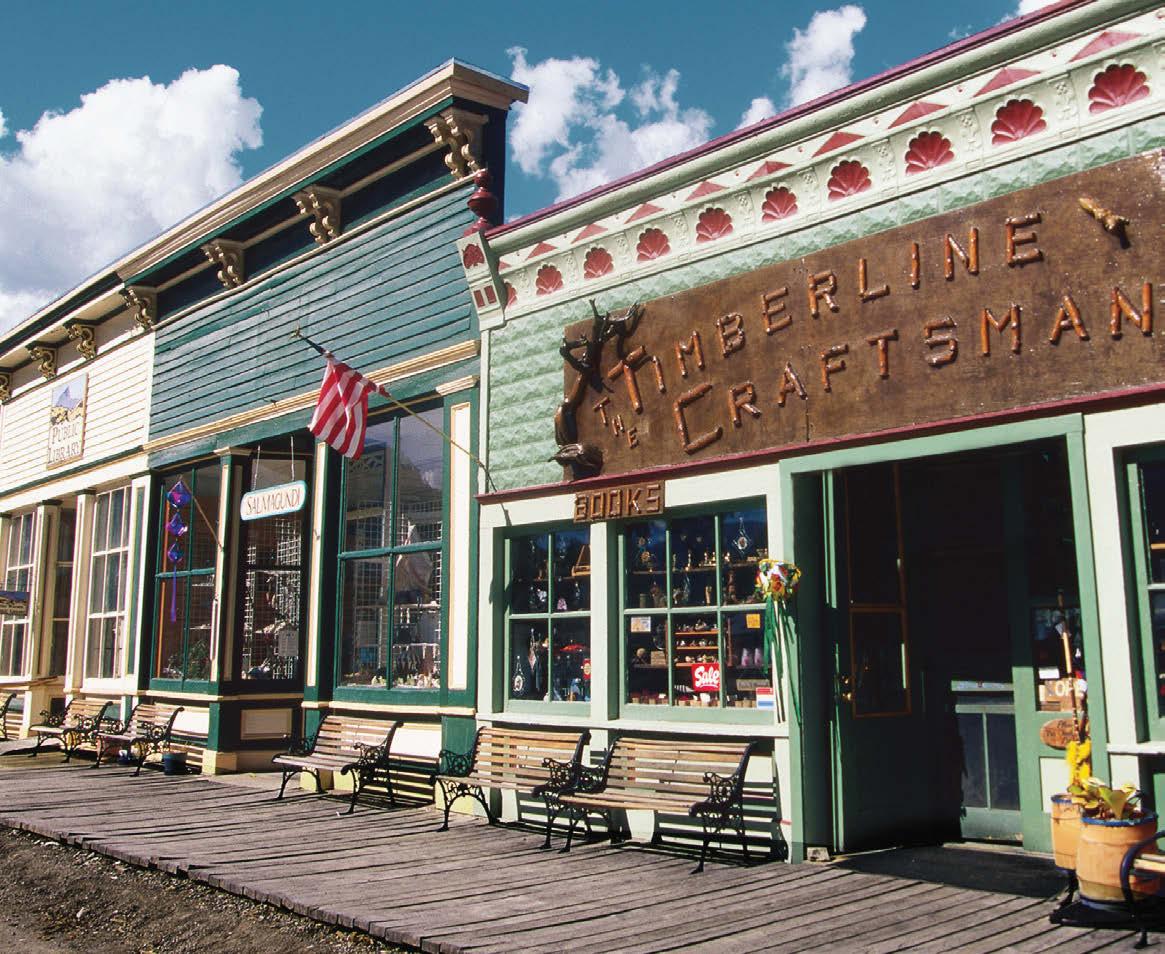
The 400-some residents of this idyllic mountain village gladly open up their arms to CT hikers. Must-do’s: Catch the shuttle from Spring Creek Pass (trail angels run a free one; the Sportsman Fly Shop offers another for $50 per carload); bed down at Raven’s Rest Hostel; and chow down on a free, homemade dinner Sunday nights during high summer at the Trail Hiker Center at the Community Presbyterian Church, which also has free Wi-Fi and espresso.
Trekking poles: help with stability on steep slopes
Extra sun protection: a UPF-rated hoodie and sun gloves
Rain shell: breathable; an ultralight hiking umbrella is also a good idea
Kai Malloy, a two-time thru-hiker who grew up in Colorado, earned the unofficial title “group expert” in the Colorado Trail’s Facebook group thanks to his wide-ranging backpacking expertise. Here, he answers the top three questions he gets about the CT.

How do I deal with the elevation?
“Ninety-nine percent of people—if they spend a few days at [elevation] before their hike, take things slowly, drink plenty of fluids and electrolytes, and eat fairly regularly while hiking—by the time they get to Kenosha Pass, they’re adjusted.”
What about bears?
“You need to protect your food. A lot of people opt for an Ursack, which is a fabric sack with an odorproof liner. In areas where I know there’s bear activity, I’ll hang it from a tree to add security.”
How do I avoid summertime lightning?
“Plan ahead. Set yourself up so that you’re going over the high passes or places prone to lightning early in the morning. The rule of thumb is to be well below treeline by noon.”
FarOut Guides Colorado Trail app: a detailed trail guide with mileages, water sources, and recent-hiker comments ($20; Apple and Android; faroutguides.com)
The CT has a rep for being exceptionally wellmaintained, thanks to dedicated volunteer crews that sling axes every summer (393 people contributed in 2022).
Westminster’s Scott Smith and Laura BrieserSmith have been leading crews that camp on the trail for up to a week at a time for the past nine years, starting after they finished their own CT section hike. “This is one way we can give back, but it’s also fun,” Smith says. “It draws out the inner child of playing in the dirt.” Brieser-Smith adds, “One of the big things about doing trail work is you will never hike the same way again.” Join the volunteer squad—no experience is required— at coloradotrail.org.

On a long-distance trail packed with superlatives, these 5.6 miles are in the running for the CT’s finest. From the Kennebec trailhead outside Durango, the CT gains the ridge in about two miles, then tiptoes north along a rocky, 12,000-foot-high spine with nonstop views of the polychrome San Juan and La Plata mountains. In high summer, the tundra is splashed
with alpine sunflower, phlox, and bluebells, and elk hang out on the green stretches below. “I actually went back [and hiked it again] because this was such a beautiful portion of the trail,” says thru-hiker Darrah Blackwater. Turn around at the junction with the Grindstone Trail for an 11.2-mile out-and-back that’ll go down in your personal hiking record books. Get an early start: There’s no cover from thunderstorms up here.
For once, here’s a CT view you don’t have to work for. With an access road navigable by the average Toyota Camry, the free, primitive Forest Service campground at Little Molas has 10 sites (five fit RVs) tucked in among the conifers ringing this lake that sits at 11,000 feet. Plus, it has far-range views east to the Weminuche Wilderness—which means an excellent sunset photo op. Expend the energy you’ve saved on a hike among legendary
blooms of paintbrush, fireweed, and gentian in July and August along the CT heading west from the campground to Lime Creek, a 12.1-miler, round trip.

One of the best vistas of the entire CT unfurls from the top of the Elk Creek drainage: The trail seemingly pours straight off a cliff into a multicolored canyon with the spires of the Grenadier Range peeking over it. Find the spectacular panorama at mile 7.4 of this 19.1-mile shuttle hike starting from Stony Pass trailhead and dipping into the Weminuche Wilderness; then grab your trekking poles and tackle the 28 switchbacks leading down to Elk Creek. Spend the night at one of the waterfront (side streams or a pond) campsites between miles nine and 11.6. If you have time, spend another day scouting out the hidden waterfall (near mile 9.6) and dayhiking some of
the climbers’ trails to Grenadier saddles. Then cross the Durango & Silverton Narrow Gauge Railroad tracks and the Animas River before hauling yourself up a steep canyon face with views of 13,074-foot Mt. Garfield, dropping down to Molas Lake Park & Campground at mile 18.7 and your shuttle car. (For one more night under the stars, get a reservation at the campground.) “It’s a wildly beautiful roller coaster,” says thru-hiker Nika Meyers. Tip: Shorten your shuttle drive by taking the San Juan Backcountry Shuttle from Silverton to Stony Pass ($60 per person).
MILES: 94.1
SEGMENTS: 24 to 28
If the CT were a fireworks show, this part would be the grand finale. Tucked deep inside the San Juan Mountains, the trail crackles with incredible peak views, rushing creeks, carpets of summer wildflowers, and roaming elk, bighorn sheep, pika, and marmots. From the start in the Weminuche Wilderness’ needle-sharp summits to its big finish in Durango, this area should rank number one on every hiker’s highlight reel.
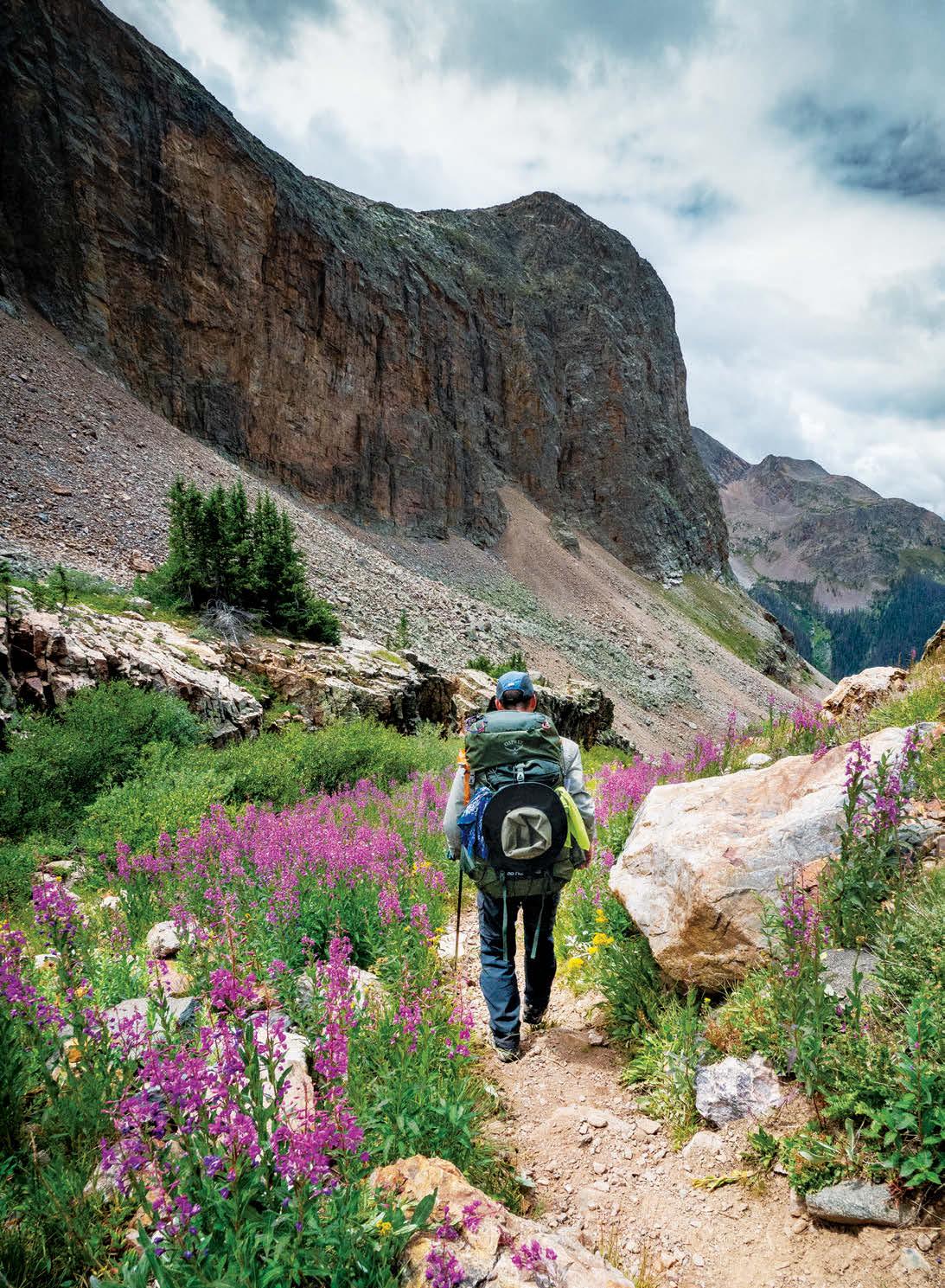
Ever dream about a backpacking trip that included a personal pack animal? Your wish comes true in the San Juans, where several outfitters can provide you with a big-eyed, fluffy llama to schlep your gear into the backcountry. (Redwood Llamas, based in Durango, rents llamas for $75 per day and offers guided trips starting at $1,600.)
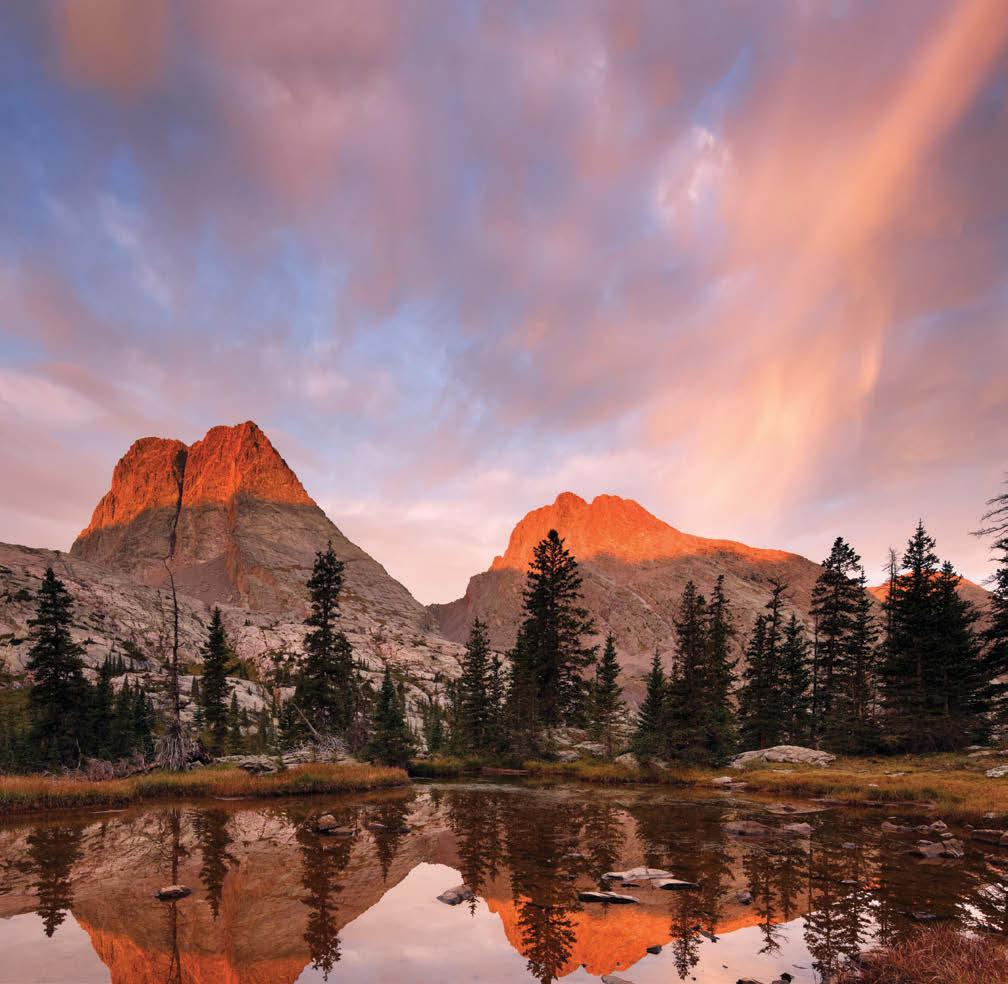
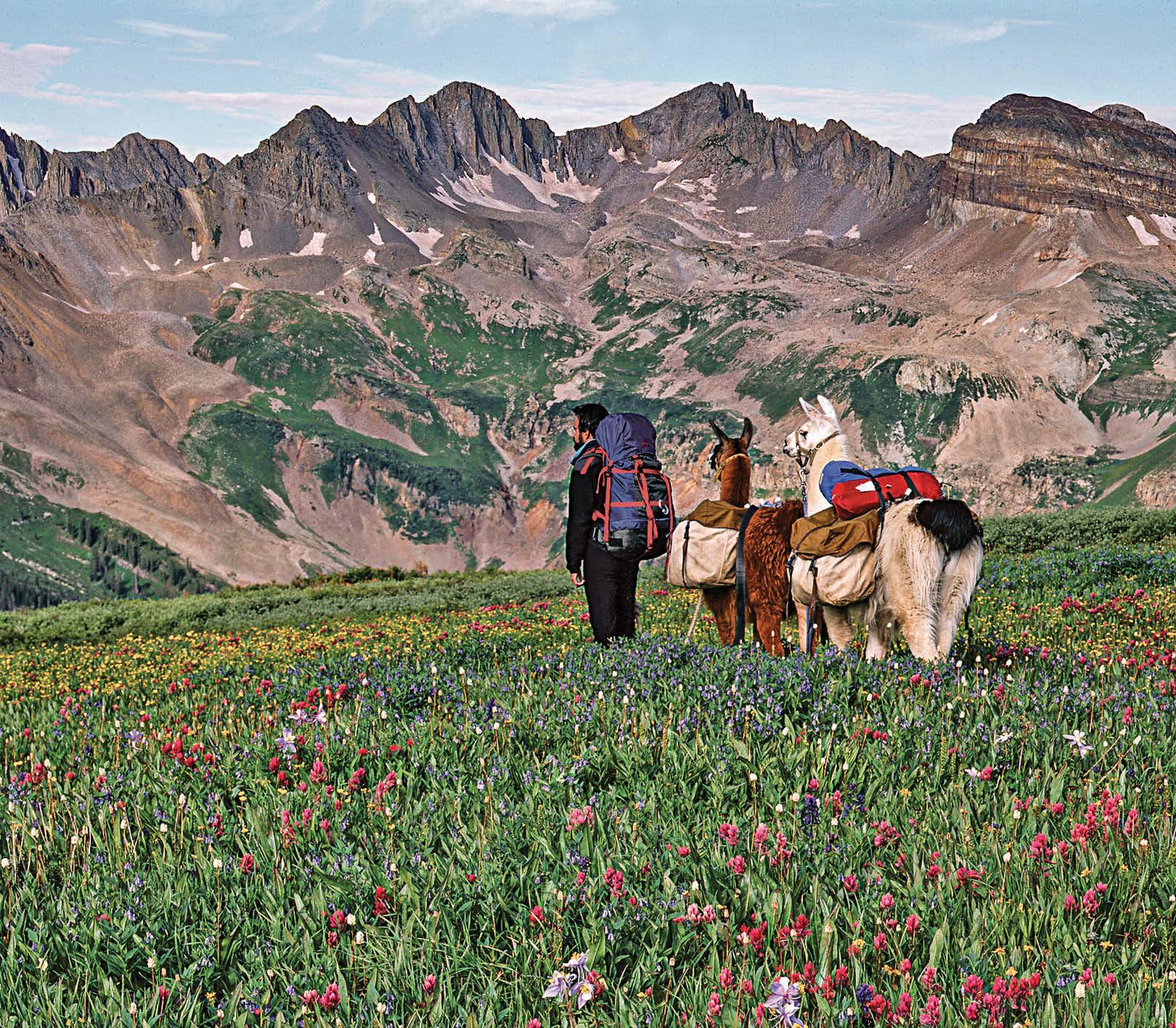
this scenic railroad also offer a stop on the CT at Elk Park. It’s an alternate way to approach our selection for best long weekend at Elk Creek, and it’s easily the coolest ride to a trailhead in the state.
DURANGO
The locomotives that chug along
Southbound hikers couldn’t ask for a better place to end their treks than historical Durango. Must-do’s: Pop Champagne at the Junction Creek trailhead, the CT’s endpoint; take a shower at Durango Community Recreation Center; grab pints at Ska Brewing; and take a soak at Durango Hot Springs. m
Llama-trekking on Indian Ridge Trail Arrow and Vestal peaks This spread, from left: Take a Hike Photography; John Fielder; Jack Brauer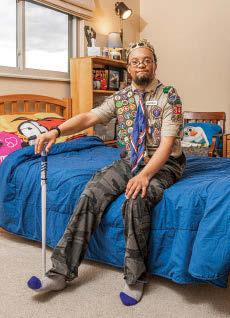 Alan Beals, who is 27 and living with Down syndrome, is an Eagle Scout.
Thousands of Coloradans are living with severe intellectual or developmental disabilities. In many of these cases, medical advances have increased life spans, but that newfound longevity has created a host of challenges for parents and other caregivers.
BY ROBERT SANCHEZ PHOTOGRAPHY BY DAVID WILLIAMSIt was early March, and morning sunlight filtered through the family room windows of the Hudsons’ rented Central Park home. Noah’s blue therapy mat was folded in one corner of the room; books written in Braille were on the kitchen countertop, next to a calendar Sarah filled with reminders for doctor visits and therapy sessions. A miniature backpack, with Noah’s feeding pump packed inside, leaned against a wall.
Born six weeks premature, Noah had missed most of the cognitive and physical benchmarks for children his age. His team of doctors—which had grown exponentially since his first weeks in the neonatal intensive care unit at Children’s Hospital Colorado—inundated his parents’ email inboxes with unpronounceable diagnoses. Noah lacked a right eye and much of his right ear and right nostril. He’d already undergone surgeries to fix a cleft palate and cleft lip; another would eventually be needed to increase the size of one of his orbital bones. A scan of his skull revealed an open canal that ran from his nasal cavity to his brain. His hypothalamus and pituitary glands—essential for regulating everything from organ function to heart rate—were “irregular,” according to one specialist. His one, blue eye had at least some vision, though it could take another year before doctors fully understood what Noah was seeing.
Spencer, Noah’s dad, 34, was at work as an account executive for an IT company, which meant Sarah, 33, would handle much of Noah’s day on her own. Today, there’d be a video call, an athome therapy session, an in-office therapy session, at least six feeding tube sessions, and—Sarah hoped—two naps.
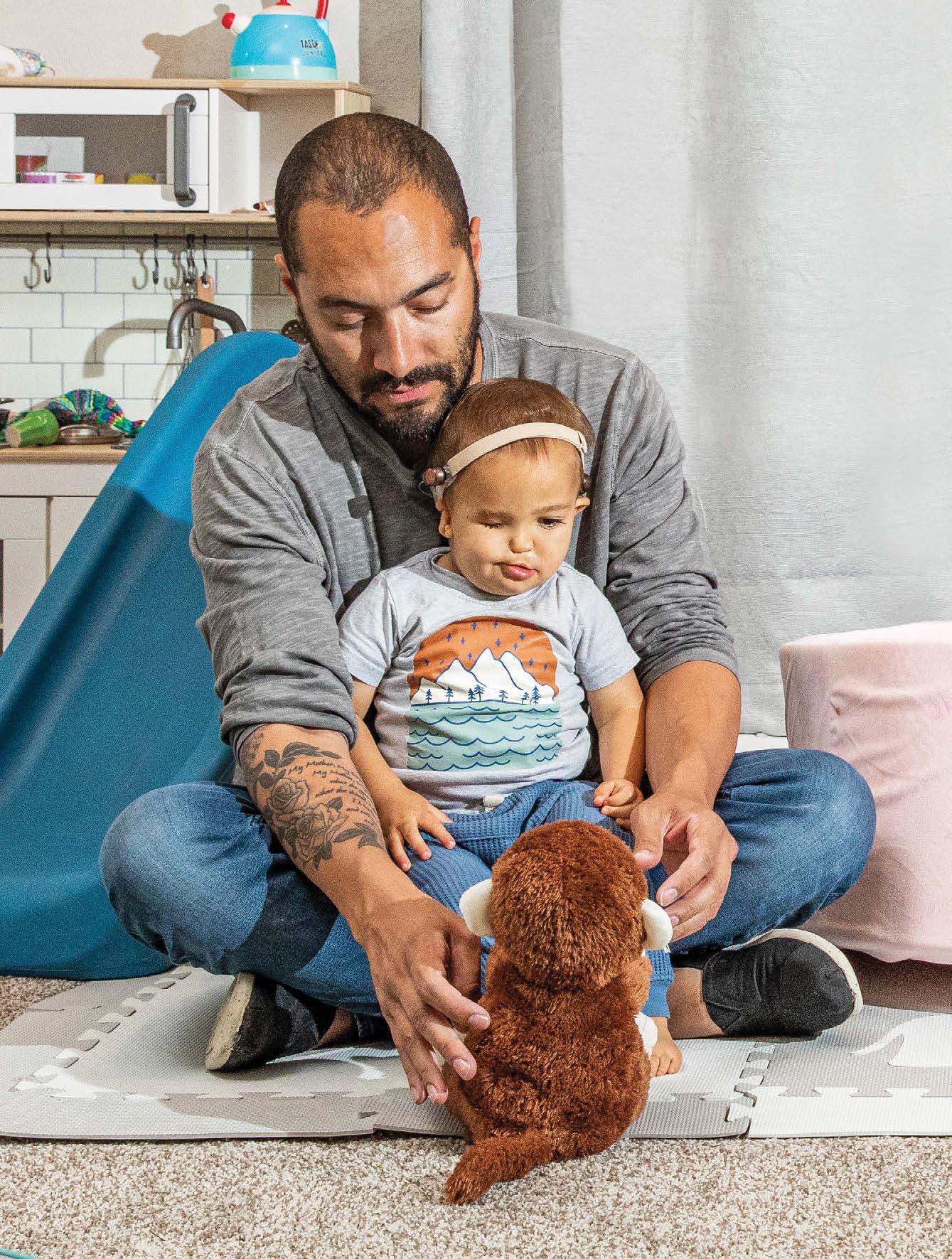
Noah is one of an estimated 7.4 million Americans living with intellectual and developmental disabilities. Known colloquially as IDDs, these disabilities can include a broad range of conditions such as cerebral palsy, Down syndrome, and autism spectrum disorder. Roughly 5,700 Colorado toddlers and infants have a diagnosed IDD, a number that has grown over recent years as the state’s population has increased. Once considered a marker for early death in the most serious cases, today people with IDDs are living longer lives. Adults with Down syndrome, for example, live nearly three times longer than they did three generations ago.
That longevity has delivered untold joyous moments, ones that were rare until recently: school graduations, first jobs and paychecks, and memories spun from being able to spend time with a loved one. Longevity has also created extraordinary challenges, most often revolving around finances and uncertainties surrounding the future. It’s more likely these days that someone with an IDD will outlive their parents, which has put pressure on familial caregivers to put in place supports that will last long after they’re gone.
Parents of those with IDDs—both young children and those who’ve grown into adults—swap stories on social media message boards dedicated to their worries and frustrations. Plans for adultoriented group homes have proliferated, as have demands among parents who’ve advocated to end Colorado’s waitlists for IDD services and for a
system that better integrates those with IDDs into society.
On that morning, though, Sarah couldn’t think much beyond Noah’s breakfast. “He did 15 minutes of eating, but he’s also still getting pumped through the stomach right now,” she told the therapist on the computer screen. “We’re supposed to cut those back and replace that with other food.”
“I think you’re sticking to the goals for the moment, and that’s good,” the therapist said. “Let’s get those calories any way we can.”
Noah squealed again. Sarah unbuckled her boy from his highchair and stood him up on the wooden floor. His rubber feeding tube peeked out from under his red shirt. Noah looked up at his threeyear-old sister, Kinsley, who was sitting at the table and watching a princess cartoon on the family’s iPad. Noah banged on a table leg and let out a playful baby growl. His sister eyed him suspiciously.
Up to this point, Noah’s life had been an unending cycle of specialists, therapists, and hospital rooms. It’s something his parents never could have imagined when Sarah learned she was pregnant in early 2021. Months later, at the 25-week
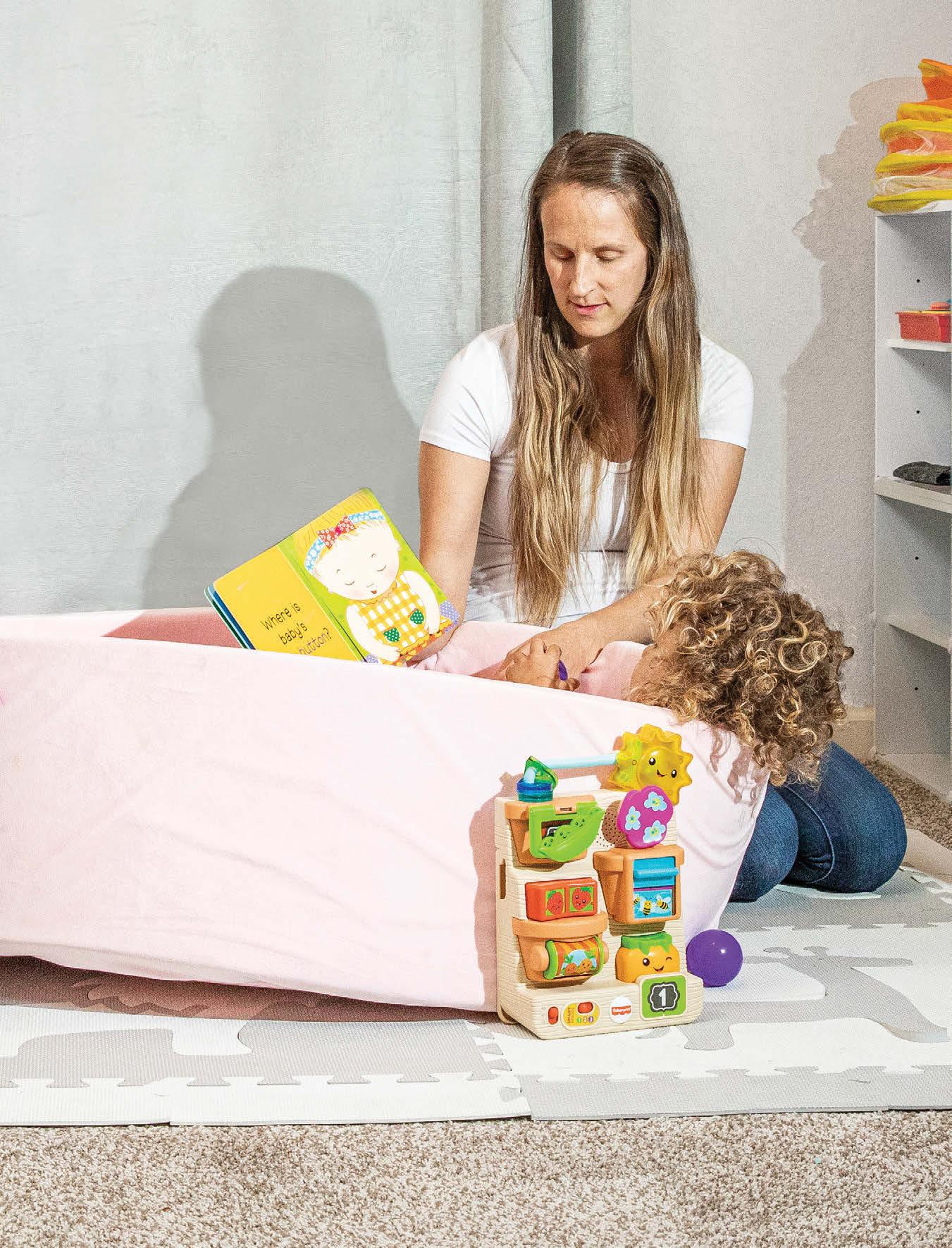
checkup, a scan showed that Noah’s face was malformed and that his brain and lungs weren’t developing properly.
Today, Sarah had taken to calling Noah her “beautiful boy.” Playful and full of energy, he always demanded to be the center of attention. Wherever he went, his high-pitched trill attracted smiles and laughs. He could crawl and walk and do a toddler sprint if he needed to chase down his sister or the family’s aging bulldog, Sandlot. On their best days, Sarah and Spencer could envision their son getting a driver’s license or dancing at his high school prom.
They knew, however, that these first years were the honeymoon period for care, when health professionals were at their most optimistic and helpful. It seemed every support was at their fingertips. Almost immediately after his birth, Noah was paired with a Denver clinic for blind and visually impaired children. Another company provided free books written in Braille. Therapists loved coming over for in-home visits. Still, Sarah never envisioned spending mornings talking to someone about how to get her kid to swallow a single, half-dollar-size pancake.
“Splash milk on it if you need to,” the therapist on the screen said. Sarah talked about weight checks and pediatrician visits and a meeting with a gastroenterology specialist in a couple of months. As Sarah spoke, Noah found a stainless steel bowl and pounded it on the floor. He banged on a kitchen wall and tried to climb the stairs. Kinsley asked for her princess doll.
“In a minute, honey,” Sarah said.
The therapist continued talking. Sarah stifled a yawn, and Noah returned to the table. His mother bent down to unwrap his feeding tube, which he’d tangled around one of the table’s legs. When the meeting finally ended a few minutes later, Sarah closed the laptop and exhaled.
FOR DECADES, IDD CHILDREN and adults were warehoused in state facilities, locked away in wards and largely forgotten by society. One of the most infamous institutions was Willowbrook State School in New York. In 1972, graphic accounts of filthy, “subhuman” conditions made headlines and led state and federal authorities to investigate. The school was closed in 1987.
Three years after the Willowbrook exposés, Congress passed the Individuals with Disabilities Education Act. IDEA, as it’s known, was landmark legislation that changed IDD education nationwide. Spawned in part by the civil rights movement of the 1950s and ’60s, the law mandated that public schools integrate students with disabilities into classrooms and develop a system of early support programs. Schools nationwide created classrooms and entire departments dedicated to special education. The concept of mainstreaming—of pushing some IDD children into standard classrooms, electives, and extracurriculars like art, music, and sports—became common. Soon, those children would begin to step out of the educational shadows and become visible in school hallways and at lunchroom tables across America.
Leana Viscardi had long been one of those students. One day this past spring, Leana opened the paper bag on the table in front of her and carefully took out its contents: milk and fruit-flavored cereal. She grabbed a bowl and filled it, then pulled out a plastic spoon. She ate in silence as her classroom came to life around her.
Kristy Bates, Leana’s special education teacher at Denver’s George Washington High School, watched the young woman and smiled. Bates called across the room to her paraprofessional, a young man named Phillip Dilosa.
“Can you guess whose birthday it is today?” Bates asked her co-worker with a wink.
Dilosa feigned ignorance. “I don’t know,” the 22-year-old said and then paused. “Is it Leana’s?”
Bates nodded her head. “Oh, my gosh!” Dilosa yelped. “Happy birthday! Leana, it’s a special day for you!”
Leana gave a sly side-eye.
“Leana, I hope this is a great day for you!” Bates said.
Diagnosed as being on the autism spectrum and nonverbal, Leana was turning 20. While most young adults her age were having late-night talks with college roommates or embarking on their first real jobs, Leana was in a special education classroom, preparing for her day. As part of IDEA, Leana was constitutionally guaranteed a “free appropriate public education” for one more year. By May 2024, she would officially graduate George Washington High with a diploma and then age out of the support system that had helped her through young adulthood.
The idea of losing their daughter’s primary form of assistance was concerning to her parents, Rolanda and Vittorio Viscardi, who’d come to Denver from Michigan five years earlier after spending Leana’s early life in Villasanta, Italy, near Vittorio’s hometown of Monza. Their daughter’s life was on the cusp of a tremendous shake-up. “It’s always on my mind,” Rolanda, 51, said earlier that morning outside the family’s apartment, as she watched her daughter head toward the school bus’ open doors. “What happens to Leana when one of the best things in her life gets taken away and she doesn’t understand why?”
While other students were busy with calculus and Shakespeare, Leana was learning skills and social cues that would help her adapt to life without a safety net. High school had also given her parents an eight-hour break, five days a week, for nine months a year while they pursued goals for their family. Vittorio was working toward a master’s degree in political science at the University of Colorado Denver and hoped to have a full-time job soon. Rolanda worked with adults living with disabilities. The idea that Rolanda and Vittorio would have to find daycare for their adult daughter—or possibly give up a job to stay home with Leana—was frightening to both of them.
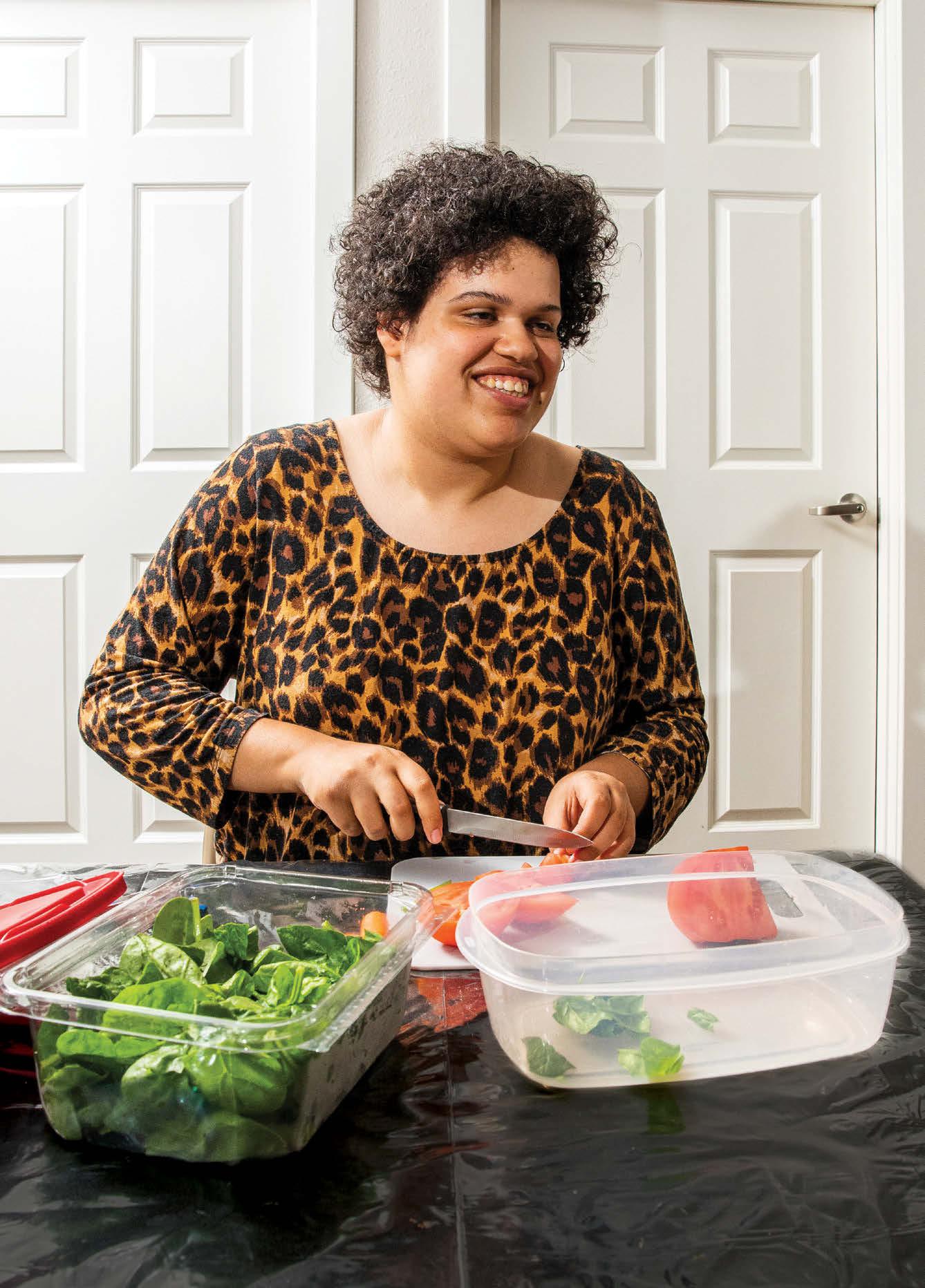
Leana’s classroom was warm and friendly, with a wall of windows at the back and an enormous television screen where classwork was displayed up front. There was a whiteboard on one wall, with words such as “big” and “can” and “see” and “want” stuck to it. On another wall were cutouts with students’ names and photos. Below Leana’s photo were several quotes. “I like to watch cooking and baking shows.” “I like to eat my papa’s Italian cooking.” “I love listening to music.”
Dressed in a black T-shirt with a tiger print on it and seafoam-colored sweatpants, Leana sat quietly at a table in the middle of her classroom and stared at an Inclusion Week slideshow her teacher loaded onto the big screen. “Inclusion is accepting people as equals,” Bates read from one of the slides, “and ensuring that they have access to the same services and opportunities as everyone else.” One of the students flipped over a table, and Bates stopped briefly to set it on its legs. Leana watched her teacher return to the front of the class and smiled.
“Leana’s an entirely different person from when she first arrived here,” Bates said after her nine students had finished a lesson in which she’d given them a dollar amount for several items and asked if they had enough money to cover the cost. Leana once had been shy and lacked confidence. Now, she ate with the rest of the school at lunchtime. She walked the basketball court three days a week with a friend from her integrated physical education class. She moved assuredly among the high school’s hallways, exchanging high-fives with students as she blazed past with her determined walk. “What I’ve seen from Leana is pretty amazing,” Bates said. “She went from a girl who would basically only communicate with her family to a young woman who seems totally at ease with herself.”
On this spring day, Leana celebrated her birthday inside the gymnasium with her integrated PE class. Her father had made two cakes—Italian-style Easter cake and Irish potato, Leana’s two favorites—and a teacher placed them on a folding table near the doorway. The class sang “Happy Birthday” before the students ate. Leana stood in the middle of the group and spun around slowly to see her classmates. Everyone clapped.
One of Leana’s friends, a senior named Mykalah Trimm, offered her hand to Leana. “Want some cake, buddy?” the 18-year-old asked. Leana nodded. Soon, everyone was splayed on the wooden basketball court, eating and talking and hanging
“You wonder what’s going to go wrong with the system, because you know it will.”
out. Leana was near the middle. She ate the Italian treat first, then the Irish potato cake. Mykalah peppered her with questions.
“Do you want to dance for your birthday? You wanna bust a move, buddy?”
“That’s really good cake, isn’t it?”
“You feel happy today?”
When Leana smiled, Mykalah gave a thumbsup with her right hand. Leana pointed at it with her index finger and touched it.
“Oh, my gosh,” Mykalah said and laughed. “Leana, did you like that cake?” She gave the thumbs-up again. Leana touched Mykalah’s thumb again. “Do you want more?” Thumbs-up. Touch.
Mykalah went to the line where the physical education teacher was dishing out slices. She told the teacher about the thumb touches. The teenager was beaming.
“How cool is that?” Mykalah said. She looked back at Leana and waved. “Leana’s great,” Mykalah said to her teacher. “I think we finally get each other.”
ALAN BEALS STOOD near the doorway of his childhood bedroom as his service dog dozed on the floor next to him. Alan was staring at a wide piece of posterboard taped to the wall. Written in broad strokes in blue and green marker by his sister a few years earlier, the list was a reminder of the many gifts Alan had to offer the world.
He marveled at the sign, as Alan often did when he stayed the night at his parents’ house, in Centennial. On it was written “gifts of the head” (the Eagle Scout project Alan completed a few years ago); “gifts of the heart” (Alan’s many family members and friends); and “gifts of the hands” (Alan’s volunteer job with Lions Clubs International sorting eyeglasses for the poor). “I have a lot of gifts,” the 27-year-old with Down syndrome said. Alan adjusted the device strapped to his right ankle, which allowed the Arapahoe Country Sheriff’s office to track his whereabouts in an emergency, then smoothed a sleeve on his favorite plaid shirt and walked downstairs.
Two chairs and an open laptop were waiting for him. “Big day,” his mother, Darlene Beals, said to Alan. The pair had a virtual appointment with Alan’s program approved service agency (PASA), which facilitated state payments for assistance, and with a caseworker from the Colorado Department of Health Care Policy & Financing (CDHCPF). Together, Darlene hoped, they’d decide whether Alan could qualify for the emergency service waiver his parents imagined would change their lives forever.
The video chat popped to life. Darlene and Alan sat close, their faces taking up the computer’s screen.
“Let’s do this,” Darlene said to her son.
“Let’s do this,” Alan responded.
It was the third time in 12 months that Darlene had tried to secure a developmental disabilities (DD) waiver for Alan. In its basic form, a DD waiver is the most comprehensive assistance the state of Colorado offers people like her son. Within the IDD community, the DD waiver is the proverbial golden ticket that not only opens up a host of services but also unlocks a lifetime of security, namely home-based care that can provide parents the certainty that their child will be supported indefinitely.
Some of Alan’s assistance had been covered by his supported living services (SLS) waiver, which is funded through the state’s Medicaid program and typically averages $15,000 a year per recipient. For Alan, the SLS waiver covered his job coach and some of the costs associated with his roommate, who helped Darlene with the day-to-day management of her son’s life.
More than 7,800 Coloradans today receive a DD waiver that offers round-the-clock help, according to the CDHCPF, an increase of roughly 80 percent from just a decade ago. At the same time, nearly 3,000 Coloradans—including Alan—are still awaiting their waivers. CDHCPF officials had talked often about shrinking the DD waitlist and increasing enrollments. (The average wait in 2014 was 15 years, but that has shrunk to about eight, in large part due to state earmarks that included more than $15 million in 2021 and moved roughly 700 people into DD waiver care.) For families like Alan’s, help couldn’t come fast enough. The IDD message boards Darlene frequented still had stories of parents whose children had been waiting decades for their waivers. Every story she read felt like her own: the constant battle for resources, worries about money and supports, and the fear and uncertainty that came with being an aging parent of an equally aging child with a disability.
Over nearly three decades, Darlene put herself in charge of virtually every part of her son’s world—from his education to the job coaching he received to
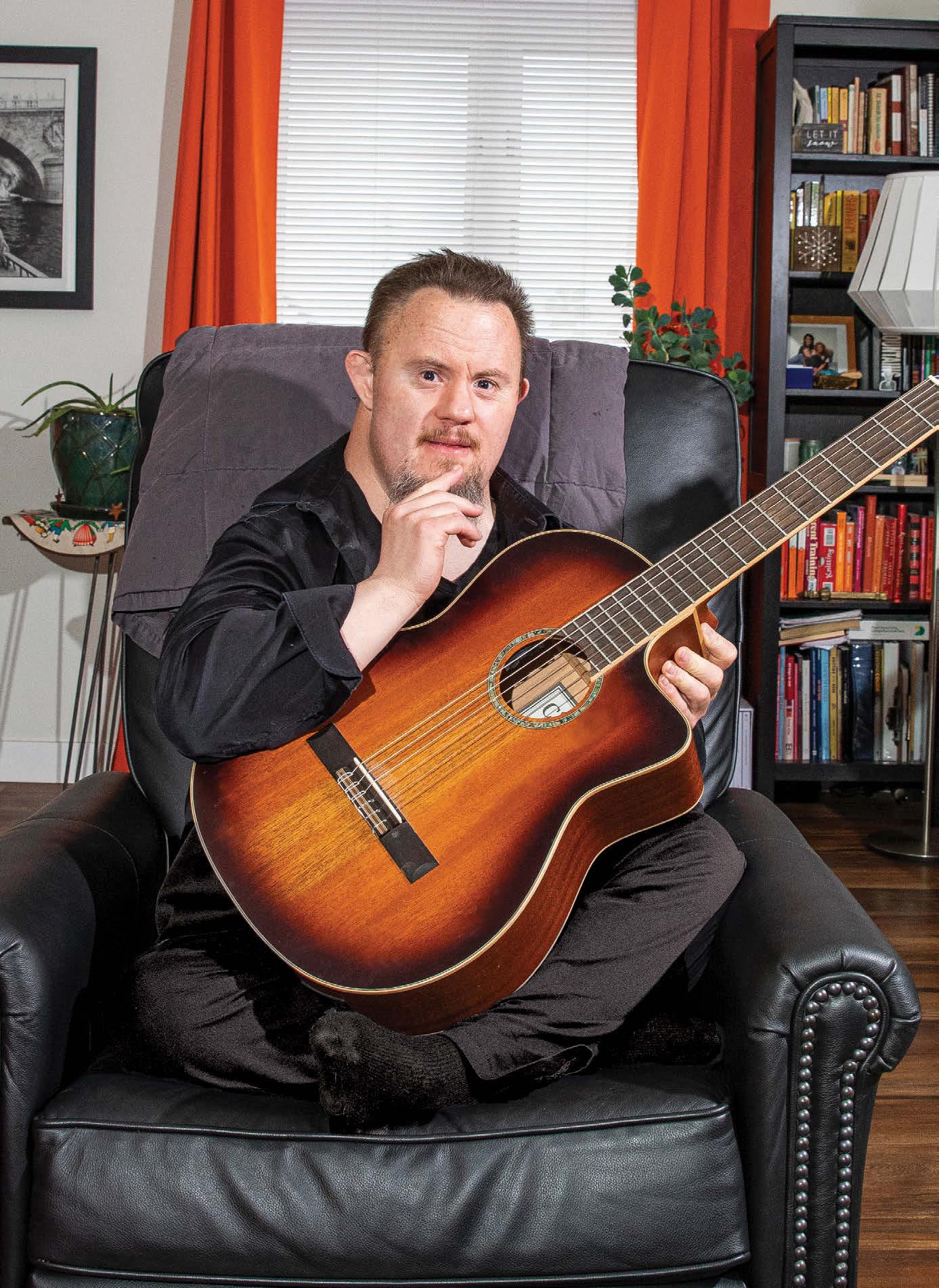

Very old rock and a dry climate give the American West one of the richest fossil records in the world. We dug into the history of dinosaur discoveries in the Centennial State, where to see the coolest bones, and what Coloradans who study the remains of Earth’s prehistoric inhabitants are learning today.
BY JESSICA L aRUSSO ILLUSTRATIONS BY MICHAEL BYERS
his grandparents’ home in south Boulder when he spotted what appeared to be an especially shiny rock. Curious, the then 14-year-old pocketed it. Later, after he washed off the dirt, he compared the serrations on the curved mass to images of fossilized dinosaur teeth online; it looked enough like what he was seeing for him to email a photo to the Denver Museum of Nature & Science (DMNS).
Charpentier didn’t have to wait long for an answer. “They told me it was definitely a T. rex tooth,” he says. Although the original is now in the museum’s collection, he has a cast of the relic—and a story that should inspire dinosaurloving Coloradans of all ages to look for signs of the creatures that roamed the Earth some 245 million to 66 million years ago. “It’s pretty crazy,” Charpentier says, “that you can find stuff like that right outside your house.”
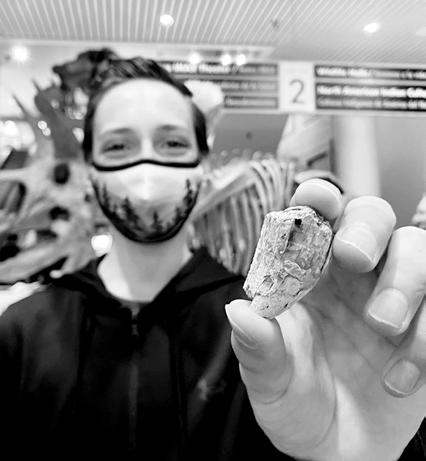
Stumbling upon an exposed Tyrannosaurus rex chomper may be a rare occurrence, but uncovering fossils in the West isn’t. The dinosaur bone rush began in America in the 1870s, and ever since then, people have been pulling plant and animal remains from Colorado’s layers of sediment, which were conveniently uplifted during the formation of the Rocky Mountains. Unobscured by water or thick vegetation, local rock— from early quarries around Morrison and Cañon City to current dig sites in eastern Colorado’s Comanche National Grasslands and Corral Bluffs near Colorado Springs—has revealed countless discoveries that add to our understanding of ecosystems and evolution in the Mesozoic Era and beyond.
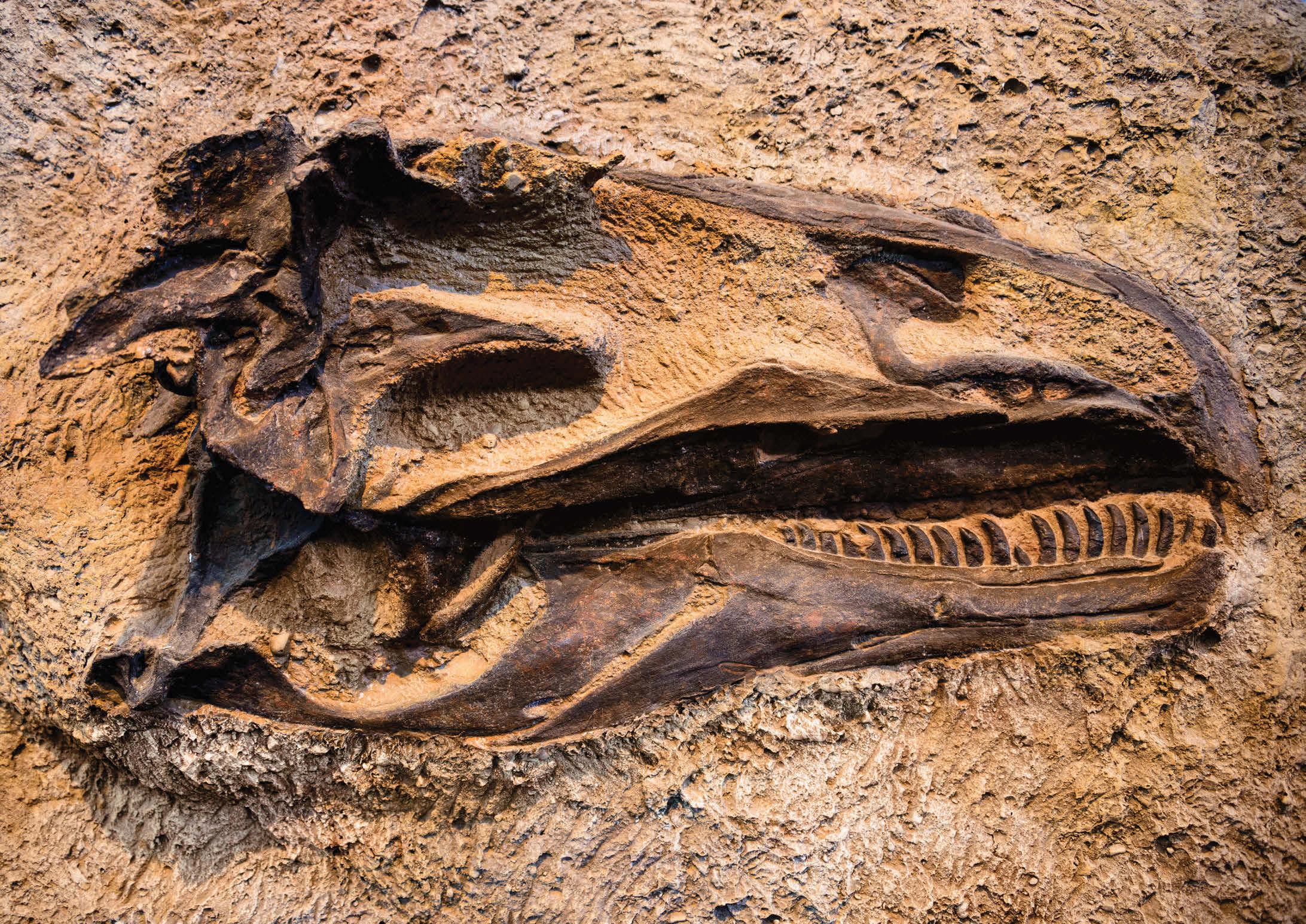
In recognition of the scientific value of that knowledge, in 2009, Congress passed the Paleontological Resources Preservation Act, which provided a framework and (some) funding for the protection of fossils on public lands. In the 1980s and ’90s, “you would come across pits where people had dug things out,” says Denver-based U.S. Forest Service national paleontologist Bruce Schumacher, one of just three paleontologists tasked with overseeing the Department of Agriculture–run agency’s 193 million acres, from Alaska to Florida. Even with official staff spread that thin, however, illegal pillaging by commercial collectors today is rare. The Forest Service credits the increased field presence of research teams—who hold permits issued by Schumacher and his counterparts at other federal agencies, such as the Bureau of Land Management—for the success of its fossil conservation efforts.
In Colorado, these legitimate fossil hunters are often groups of volunteers led by scientists from local organizations such as the DMNS. They mostly dig on remote public lands, but our fossil-friendly conditions mean that new construction in urban areas tends to turn up bones, too. “We’re always waiting for that phone call, because it is going to come every few years. The last one was 2019,” says Tyler Lyson, associate curator of vertebrate paleontology at the DMNS, referencing a triceratops that was uncovered in Highlands Ranch. “Usually, we get the picture and we say, ‘Well, it’s just a rock. It’s a cool rock. Keep the rock, treasure that rock.’ But then, every now and again, it’s something really, really cool.”
Pottery shards, arrowheads, and other archaeological artifacts on public lands have been protected for nearly 50 years, and such evidence of human activity should generally be left undisturbed. But federal law around collection of paleontological remains was only clarified relatively recently, in 2009, with a follow-up from the U.S. Department of the Interior this past summer. “It makes a distinction between kinds of fossils, particularly vertebrates,” U.S. Forest Service paleontologist Bruce Schumacher says. “It could be elephants, dinosaurs, ancient reptiles from before dinosaurs, fish, sharks—anything with bones and teeth are vertebrate animals and are protected.” So if you’re backpacking and come across something that looks like part of a prehistoric skeleton, snap some pictures, document the location, and share that information with a local museum, university, or public land manager. Those groups can then apply for permits to investigate and remove the fossils, which must be used for research or exhibition (i.e., not sold on the private market). Common plant, insect, and mollusk fossils, however, are fair game to collect in small quantities for your own enjoyment.
From the time humans enter what is now Colorado (by 11,500 BCE, though possibly earlier), they likely encounter fossilized teeth, bones, and tracks. The first records of such discoveries, however, come from more modern Indigenous peoples and their descendants. As noted in Stanford University historian Adrienne Mayor’s Fossil Legends of the First Americans, rock art and oral traditions centering on winged monsters and giant, primal beasts suggest that Native Americans across the West found remains and explained them, often via creation stories, over thousands of years. Navajo elders in the 1930s, Mayor writes, spoke of “places in the desert where one could see monstrous heads ‘sticking out from roots of trees and stones, from springs and swamps.’ ” Mayor also notes that in Delta, the Ute Council Tree, an important meeting place, stood just yards from a collection of distinct Jurassic theropod tracks.

1874: America’s intensely competitive rush on fossils—which involves bribery, sabotage, and a sense of urgency to name new species that often results in misidentifications—is heating up. Arthur Lakes, a teacher at a prep school in Golden who later becomes a professor at what is now the Colorado School of Mines (where the library bears his name), is hiking on South Table Mountain when his companion finds a large, serrated
tooth. It’s eventually sent to Othniel Charles Marsh, one of the era’s leading paleontologists and Bone Wars protagonists, at Yale University, but it isn’t until 2000 that it is rediscovered in the Yale Peabody Museum’s collection and recognized as an early Tyrannosaurus rex fossil discovery.
1876-’77: Lakes, now working for Marsh—after sending remains to both him and his bitter Bone Wars rival, Edward Drinker Cope of Philadelphia, when Marsh was slow to respond—excavates in the Morrison Formation and documents the work in watercolor paintings. The fossil-rich rock unit (named after the Colorado town in the wake of Lakes’ discoveries) stretches from southern Canada to New Mexico and hosts six established dig sites, or quarries, in the Morrison area alone. There, the rock yields fossils Marsh uses to first describe the Allosaurus fragilis, Apatosaurus ajax, and Stegosaurus armatus. Meanwhile, in the prolific Garden Park area near southern Colorado’s Cañon City, a Marsh-backed hunter finds bones that help define the first described Diplodocus longus.
1887: Outside of Denver, George Lyman Cannon—Lakes’ former student and a high school geology teacher— finds a pair of horns
attached to a skull that Marsh initially thinks is from a large bison but later uses to first describe the Triceratops alticornis.
1889: Cannon excavates remains near Denver that Marsh studies to first describe the Ornithomimus velox.
1993: The construction of Coors Field turns up dinosaur rib bones that are indeterminate but could be from a Triceratops—and thus, the Colorado Rockies’ mascot, Dinger, is born.

2017: While building a new police and fire department in Thornton, workers uncover what DMNS researchers at first believe are a Triceratops skull and partial skeleton. They turn out to be the most complete samples yet found of the rarer Torosaurus, which area elementary school students nickname Tiny.
2019: A large, adult Triceratops found during digging for a retirement community project in Highlands Ranch is estimated to be around 66 million years old, making it one of the last of its species to live before nonavian dinosaurs’ extinction.
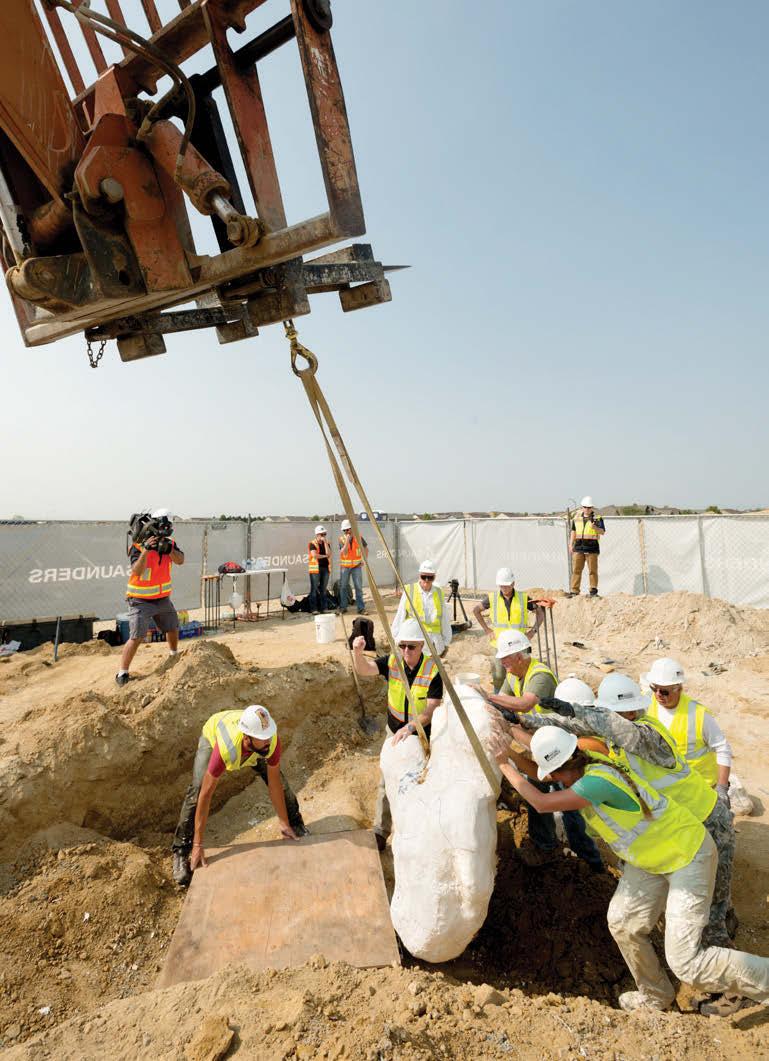
A three-part timeline of the Centennial State’s most significant dinosaur fossil finds and finders.
A PREHISTORIC FIELD GUIDE When dinosaurs ruled the Earth, Colorado looked a little different. This is what was flowing, growing, and roaming during the Centennial State’s most fossiliferous periods.
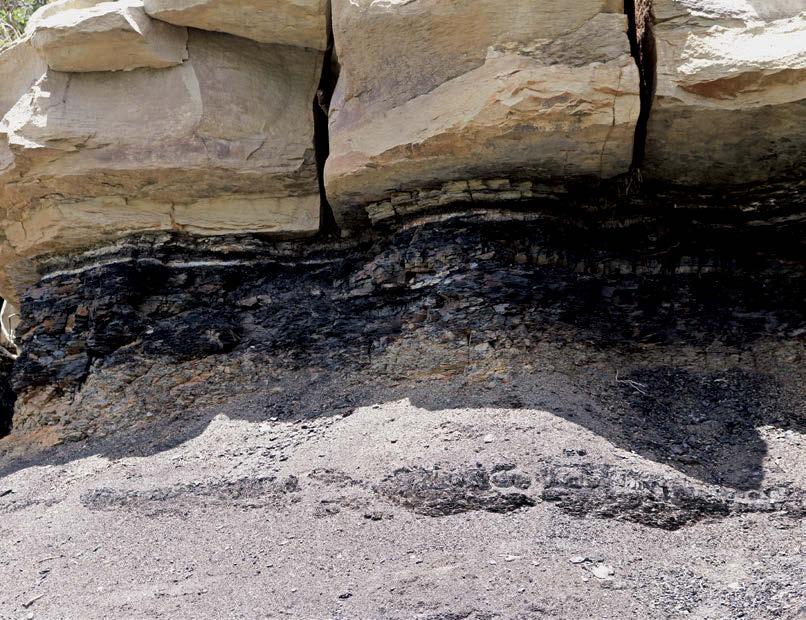
Although the Mesozoic Era—the age when dinosaurs lived—spans from 252 million to 66 million years ago, there’s not a lot in Colorado’s fossil record from the earliest period, called the Triassic, within that time frame. Why not? “The way I usually start this story is when the supercontinent Pangea begins to break apart,” Henry Fricke, a professor of geology at Colorado College, says. It’s a long story, involving huge land masses behaving like bumper cars and, crucially, high ocean levels that create the Western Interior Seaway, which floods the land that is now the Centennial State on and off over tens of millions of years.
“Whenever sea level is high and we’re underwater, that’s a bad time for dinosaurs, right?” Fricke says. When the water receded, however—particularly during later chunks of both the Jurassic (201 million to 145 million years ago) and Cretaceous (145 million to 66 million years ago) periods—the sludgy sediment left behind was ideal for capturing the animals and plants that flourished in the subtropical climate. “It would have been awesome,” Fricke says. “Mountains, then rivers, then an ocean; you could go skiing one day and go surfing the next.” Awesome, that is, until a six-mile-wide asteroid slammed into the Gulf of Mexico and wiped out 75 percent of life on Earth, including nonavian dinosaurs.
After that mass extinction event ended the giant reptiles’ 186-million-year reign, mammals began their rapid ascendancy, with Homo sapiens coming onto the scene around 250,000 to 200,000 years ago. Meanwhile, geologic and climatological forces shaped Colorado into the arid, exposed-rock-rich landscape that makes it such a fruitful place to find fossils today.
“You had the right conditions for preserving fossils back then because you had all this sediment and water,” Fricke says. “Now we’re in the opposite sort of climate state; it’s much drier, there’s not as much vegetation, and rather than sediment being deposited in this part of the world, it’s being eroded.”
Even if flora wasn’t present in the fossil record, we could surmise from the sheer size of herbivorous dinosaurs such as the sauropods that vegetation was thriving in Colorado during the Mesozoic Era. However, plant remains are so prevalent that people like Gussie Maccracken, assistant curator of paleobotany at the DMNS, devote their careers to searching for and studying them. This research informs the museum’s illustrations and dioramas (every leaf in the Prehistoric Journey exhibit is modeled off fossils from the appropriate time periods) and helps build fuller pictures of prehistoric ecosystems and the evolution of all species. “You’re thinking about, Who’s eating what? How is this food web structured? ” Maccracken says. When we asked her what plants fueled Colorado’s dinos, she broke things down into two distinct categories.
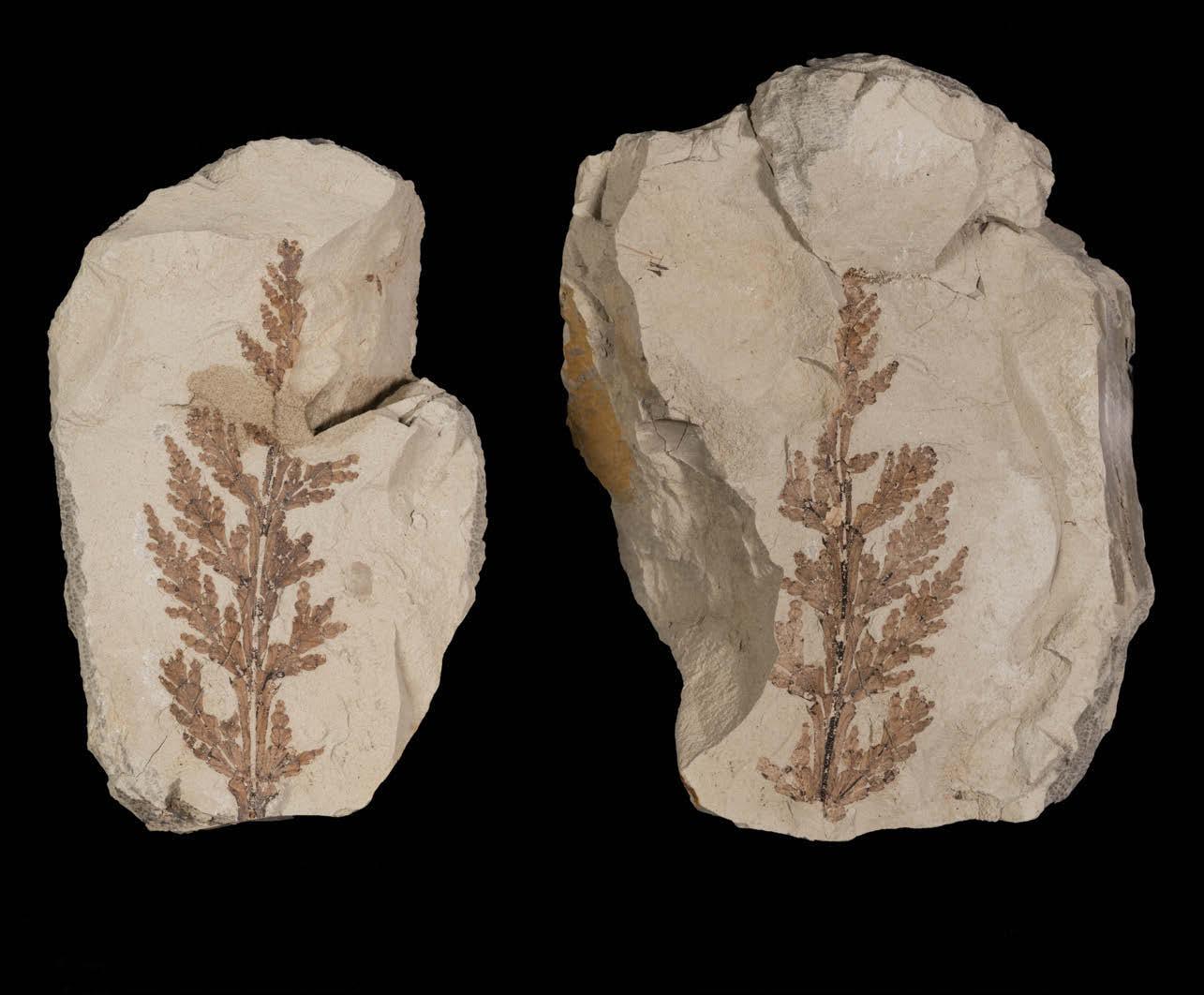
Today, 94 percent of described plant species on Earth are flowering varieties. In the late Jurassic period, the time most fossils in the Morrison Formation come from, however, angiosperms had not yet evolved. The forest then would have been made up of mosses, horsetails, ferns, cycads (which look like “short, stubby little palm trees,” Maccracken says), conifers, redwood trees, and ginkgos. “If you were to squint, you’d recognize the forms of things you’ve seen on Earth,” Maccracken says. “But if you looked closely at them, you’d feel like, Oh, well, obviously, this doesn’t grow in Colorado today. This doesn’t grow anywhere on Earth today.”
By the late Cretaceous— the age of the lower part of the Denver Formation that underlies the Mile High City area—angiosperms are present and “diversifying like crazy,” Maccracken says. “One of the things we think helps flowering plants dominate the Earth is that they can live in disrupted habitats. Along river channels, you could see lots of these newly evolved flowering plants, because when a flood comes through, they can pop up again really quickly. If you’re a redwood tree, you take a lot longer to grow.” Although nonangiosperms are still present, plants like laurels (relatives today include avocado and cinnamon trees) are abundant—and dinosaur diets are almost certainly changing to take advantage of the new food sources.
From giant sea turtles to small marsupials, many creatures lived in what is now Colorado during the Mesozoic Era—but land dinosaurs have left the biggest imprints on our rocks and our imaginations.
STEGOSAURUS

Lived: Late Jurassic
Average Size: ~7.7 tons With its upright ridge of diamond-shaped armor and spiky tail, the Stegosaurus— first described from remains found in Morrison—is a striking quadrupedal herbivore. In the late 1980s, new fossils from Cañon City helped paleontologists determine that its plates were staggered, rather than being in one straight row.
ALLOSAURUS
Lived: Late Jurassic
Average Size: ~2.8 tons
One of the first discovered theropods (a class of bipedal predators), the Allosaurus would have been a common sight in what is now the American West. The majority of Allosaurus remains on the planet come from the Morrison Formation, which entombed many creatures and plants during late Jurassic period flooding.
APATOSAURUS

Lived: Late Jurassic
Average Size: ~36.7 tons
This herbivorous, long-necked sauropod is the most abundant large dinosaur found in the Morrison area. There’s debate about whether the Brontosaurus is distinct from Apatosaurus, but they’re generally considered to be the same species, with Apatosaurus being the first name used and, thus, the scientifically preferred moniker.

ORNITHOMIMUS
Lived: Late Cretaceous
Average Size: ~400 pounds
A relatively small, birdlike theropod that may have been covered in feathers, the Ornithomimus was likely a swift runner that could have been omnivorous, using its toothless beak to feast on insects and lizards in addition to plants. It was first described by a partial hindlimb and forelimb that came out of the Denver Formation.
TRICERATOPS

Lived: Late Cretaceous Average Size: ~15 tons
Giant, three-horned skulls that could be up to a third of the length of its body characterize this herbivorous ceratopsian. Although rarer, remains of the closely related Torosaurus—with a larger frill that has two openings and sometimes reached nine feet long—have recently been uncovered in the Denver area.
TYRANNOSAURUS


Lived: Late Cretaceous Average Size: ~8.5 tons
Perhaps the world’s most famous dinosaur despite its relatively short tenure on Earth, the carnivorous Tyrannosaurus likely scavenged and hunted prey (including juvenile ceratopsians and hadrosaurs, aka duck-billed dinosaurs) in the Centennial State during the late Cretaceous period, just before the extinction event.
Today, dig sites focused on finding organic remains of prehistoric life— such as bones, teeth, and soft tissue impressions (from animals and plants)—are usually selected one of two ways.
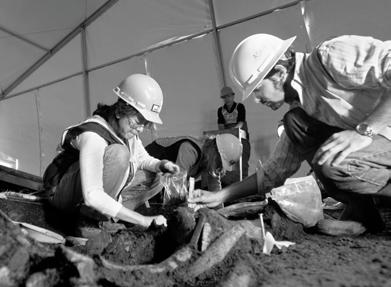
For the scheduled expeditions staffed by volunteers, interns, and visiting scientists the DMNS leads over some 20 weeks each year, it secures permits from land managers for sites—sometimes in Colorado, other times in Western locales such as Montana and the Dakotas—known to or suspected to hold fossils that could contribute to current research projects.
Other times, “things are prioritized because they’re opportunistic,” Salvador Bastien, a fossil preparator at the DMNS, says, citing the Ice Age mastodon and mammoth remains found during reservoir work near Snowmass Village in 2010. The DMNS moves quickly, mobilizing volunteers and borrowing construction equipment so as not to slow development.
Fossil hunters use whatever tools they can—from power drills and shovels to awls, chisels, and paintbrushes—to safely expose and stabilize the fossils. Then they wrap them, plus a lot of surrounding rock, with strips of burlap dipped in wet casting plaster to create casings called field jackets. Smaller items are hauled out in backpacks or on bodyboards, while tractors or even helicopters can be used for specimens such as a 13,000-pound Stegosaurus (on display at the DMNS) that was airlifted out of the Garden Park area near Cañon City by an Army Chinook in 1992.
Once the fossils have been liberated, DMNS staff or outside experts occasionally make replicas that can be shipped off for research or exhibition. Unless the originals are being sent elsewhere on loan, they reside at the DMNS.
Back at the DMNS, tall shelves in a second-floor storage area hold most of what’s been collected over the past decade or two—until the DMNS decides, based on museum needs and global requests, to crack the field jackets open in its labs, where fossils are prepped for display or study.
Part of the permanent Prehistoric Journey exhibit, the Schlessman Family Earth Sciences Laboratory is where most fossils are prepared by DMNS staff and 120-some volunteers. They use mini jackhammers, dental instruments, and sandblasters to painstakingly separate rock from bone; taxidermy putty fills cracks.
Larger field jackets—such as one holding the roughly 700pound scapula of a sauropod from Comanche National Grassland that two DMNS interns worked on this past spring—go to bigger labs with garage door entrances that are part of the 63,000-square-foot, newin-2014 Avenir Collections Center.
Only about one percent of the museum’s fossils ever make it to the exhibit floor. Those could be placed in cases or mounted (in combination with cast pieces to fill in missing bones) to create full skeletons. New hanging techniques are less damaging to the fossils than the old method of drilling holes in them, but the displays still pose challenges for scientists: “A couple of years ago, a researcher had to get up on a ladder next to the Diplodocus to study the bones,” Bastien says.
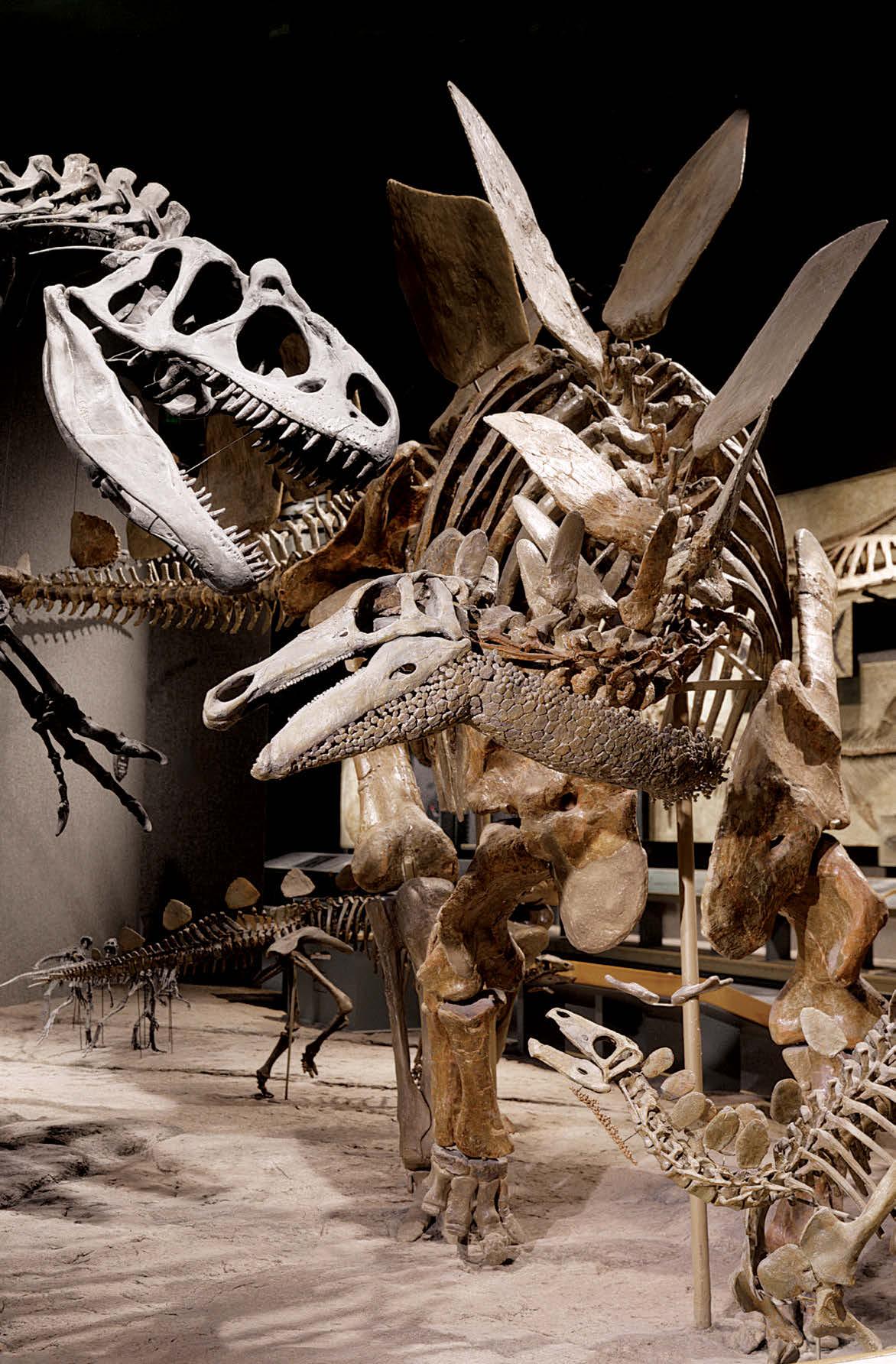
The rest of the DMNS’ twomillion-some vertebrate fossils live in a brightly lit subterranean room under the museum. Protected, ideally, in custom-made fiberglass and plaster cradles, they’re placed inside towering, rolling white cabinets, where resident and visiting scientists can access them.
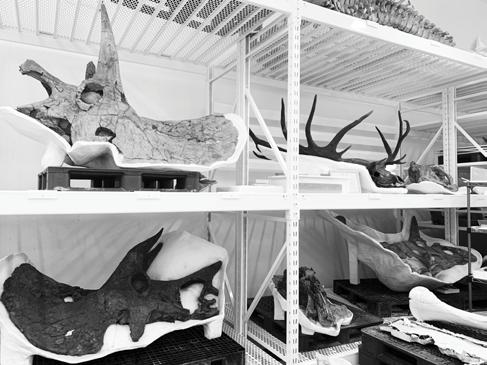
How fossils make their ways out of regional rock shelves and into DMNS storage and exhibits.
DMNS chief fossil preparator Natalie Toth on being a woman in paleontology and digging up dino bones, including in Madagascar.
Growing up in Chicagoland, Natalie Toth wasn’t dinosaur-obsessed, but geology courses in college showed her a way to marry her love of science with being outdoors. Since she got her master’s in paleontology and started at the museum in 2017, she’s done just that, splitting her time between fieldwork and overseeing volunteers and staff who clean up fossils in the prep labs. Usually, you’ll find Toth digging in the West, but we caught up with her this past spring the night before she embarked on a four-week trip into the Madagascar backcountry with an international group of researchers.
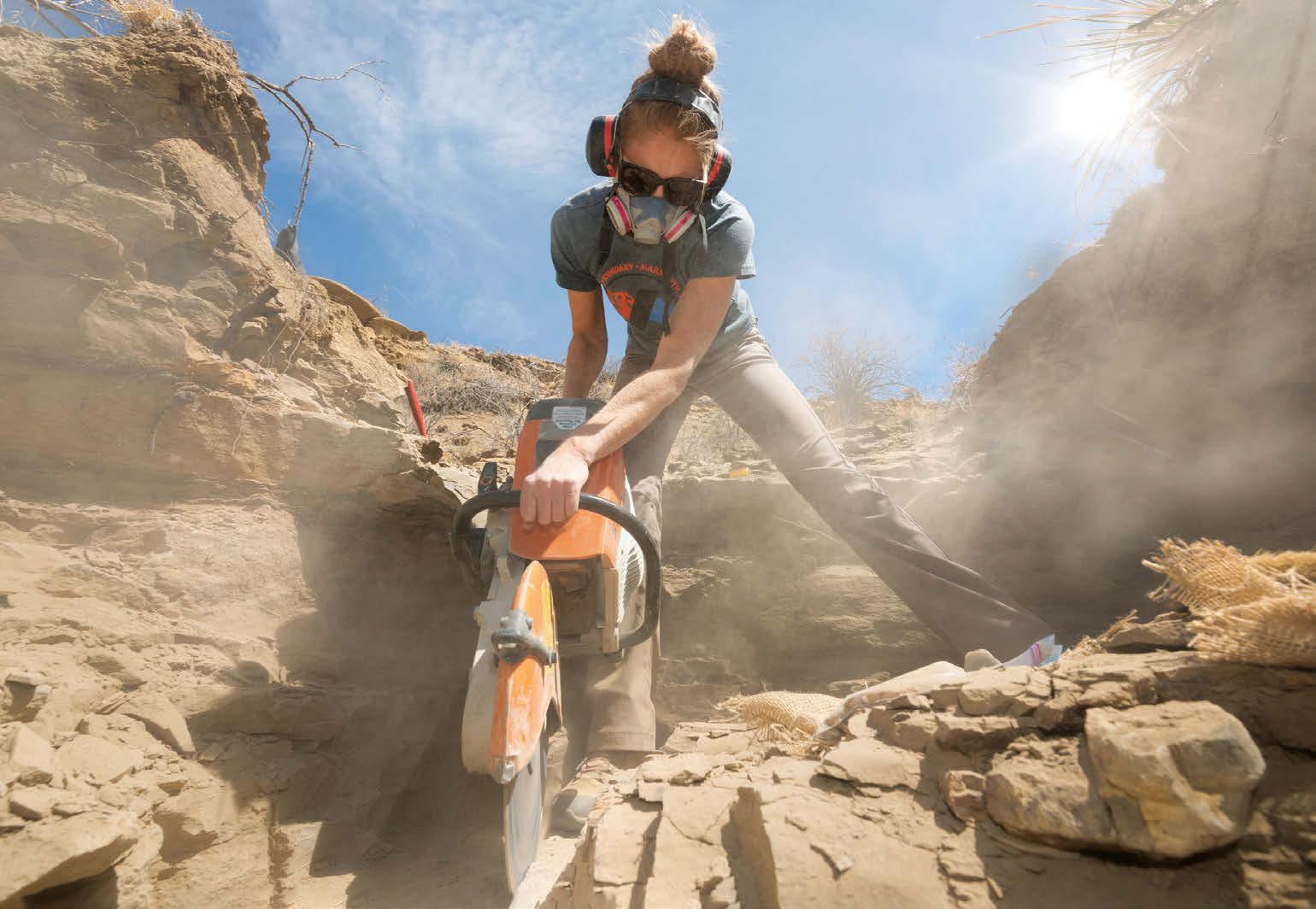
5280: How do people get into paleontology?
Natalie Toth: I work with Salvador Bastien, whose background is in biology, and my background, geology, is another traditional pathway. Paleontology is the perfect combination of those fields.
What’s a common misconception you encounter?
People think all fossils have already been found, but the history of living organisms on Earth goes back three billion years. Every field season we go out, we’re still collecting new fossils, and not just dinosaurs, right? It’s dinosaurs and turtles and mammals and crocodiles, really everything from across the whole ecosystem—fossil plants, fossil fungi, all of it.
Tell us about your favorite part of your job. I love the fieldwork. There’s something amazing about having a group of people who are off the grid, don’t have cell phones—all working toward a common goal. Then it’s really cool to watch interns or new volunteers have that same sense of wonder I had when I first picked up chunks of bone.
What will you be looking for in Madagascar?
We’re going to an area that has produced incredible meat-eating dinosaur fossils, crocodiles, fish—the entire vertebrate spectrum. Our main goal is to find fossil birds. Bird skeletons weigh just a few tens of grams, so it’s exceptionally rare to find them in the fossil record, but we have here. [We hope] the things we collect will help to inform the evolutionary pathway of birds we see in Colorado today. Of course, if we bump into other things, we’re not just going to leave them there.
Are there many women doing this work?
I’m the only woman from the United States on this trip, but there are women coming with us from the university in Madagascar’s capital. When I first got into paleontology, even going to professional conferences, I was hyper-aware of how few women there were. It has gotten exceptionally better over the last few years.
Attention, dino stans: Soon, you’ll be able to rep Colorado’s state fossil on your ride.

While all but six U.S. states have a designated fossil, few are as, well, cool as Colorado’s: the Stegosaurus. (Arizona’s? Araucarioxylon arizonicum…a petrified conifer.) A little more than a century after remains from the Jurassic dinosaur were discovered on a hogback in Morrison, a fourthgrade class at Denver’s McElwain Elementary petitioned the governor to claim it for the Centennial State, and it was officially designated in 1982. This past May, the Stegosaurus State Fossil License Plate bill was signed by another governor, Jared Polis. The paleontological swag will be available from the Department of Motor Vehicles starting in January 2024; to get it, you’ll need to make a donation to Dinosaur Ridge, the nonprofit that manages the site where those original Stegosaurus bones were found. “Our state fossil invokes curiosity and wonder in people of all ages,” state Representative Brianna Titone, a bill sponsor and former geologist, says. “This bill will help inspire that scientific curiosity as well as preserve our fossils.”
—Hen CarnellTen must-visit Colorado spots for prehistory enthusiasts. —HC & JL
This relatively small institution pairs Western Slope fossils with robotic reconstructions and an impressive collection of seven life-size skeleton casts, many of which were made by Fruita resident and worldclass restorer Robert Gaston (see “Finishing Touches” at right).
(round trip) paved trail up a hogback northeast of Red Rocks Amphitheatre, and Dinosaur Ridge also offers paid, guided walking and bus tours and runs two nearby, kidcentric educational centers. About five miles north, the 1.5-mile (one way) Triceratops Trail, maintained by the same nonprofit, boasts tracks from late Cretaceous dinos.
during the Bone Wars. Logically, its collection and research programs focus on regional finds. Included oneon-one guided tours will ensure you don’t miss Colorado bones that were used to first identify the Stegosaurus as well as rare juvenile tracks from the armored dinosaur.
The seven-year-old Royal Gorge Dinosaur Experience combines 12,800 square feet of exhibits—which hold fossils from the nearby Garden Park quarries (take the free-with-admission guided tour to learn more about the area’s Bone Wars history)—with a ropes course and a pea gravel pit where tots can dig for a T. rex cast.
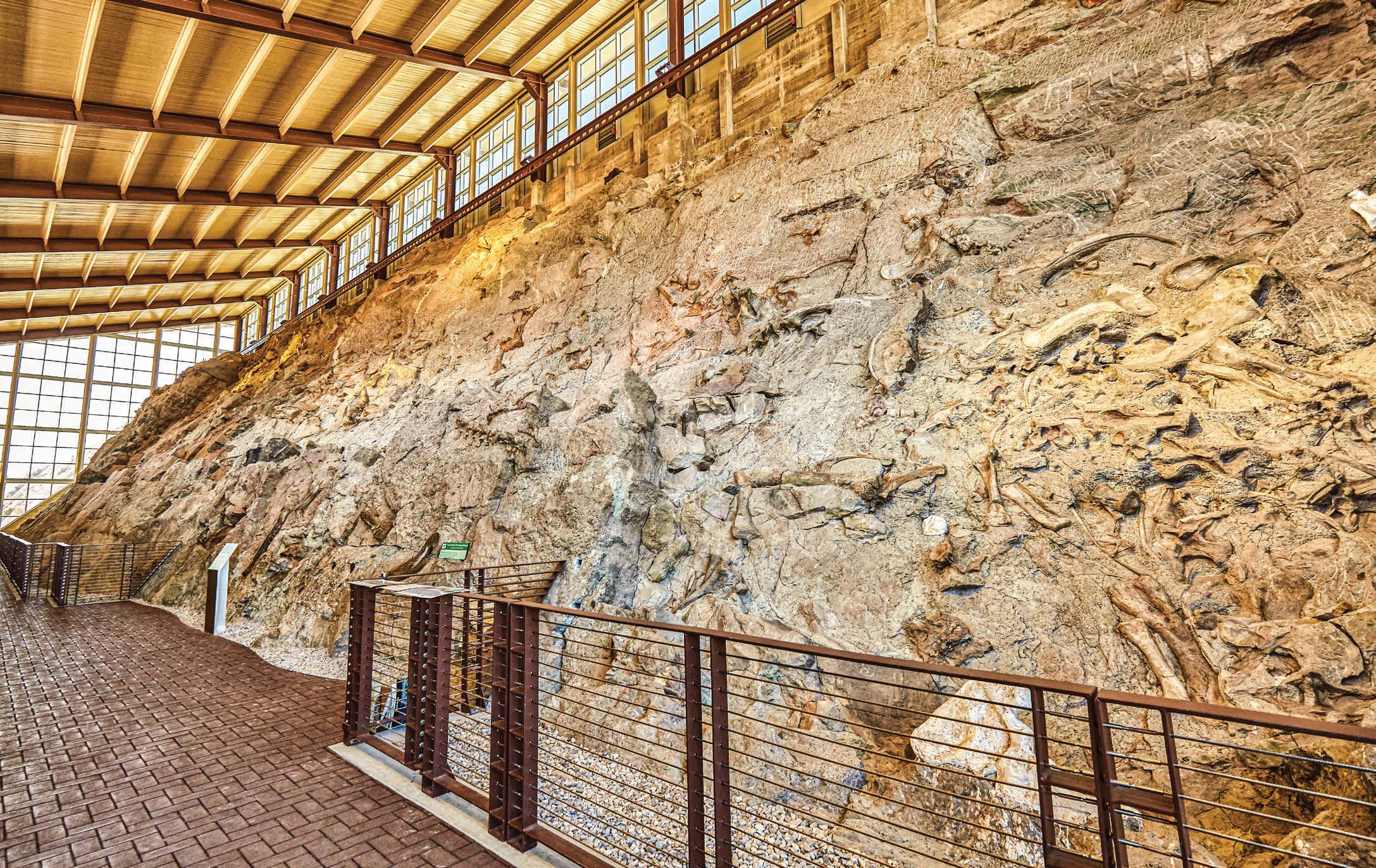
Although the showstopping Quarry Exhibit Hall—where you can view 1,500 late Jurassic fossils in a section of Morrison Formation rock—is technically in Utah, the 211,000-acre monument also spans northwestern portions of the Centennial State. Swing by Dinosaur, a nearby Colorado town where the streets are named after, you guessed it, dinosaurs.
This near-Denver spot is famous for its tracksite. The 250 prints on a slanted slab of rock can be accessed for free along the two-mile
The Mile High City’s nature and science museum is internationally recognized for its vertebrate paleontology research, which visitors can watch through windows into the Schlessman Family Earth Sciences Laboratory, where fossils are prepared. You can also just ooh and ahh at the Prehistoric Journey exhibit’s skeletons, including an 80-footlong Diplodocus and battling Allosaurus and Stegosaurus.
From the historical log cabin that houses this Morrison museum, you can see some of the hogbacks area resident Arthur Lakes excavated
Billy Doran opened the Museum at Dinosaur Junction in June 2022 to showcase Eagle County finds: 80 percent of the fossils used to create his casts were unearthed within a few miles of the museum.
A complement to Triebold Paleontology Inc.—which digs for bones, makes and sells skeleton casts to academics and institutions around the world, and creates traveling exhibits such as Darwin & Dinosaurs this museum shows off the work of its parent company and also hosts shops that sell real and replica fossils.
No, there aren’t any obvious dinosaur remains at this park in southern Colorado. But if you follow the 0.75mile (one way) Long’s Canyon Trail to outcroppings in its Trinidad K-Pg Boundary area, you can spot a strip of ash in the rock layers that documents the asteroid that struck Earth and wiped out our mighty friends.
Inside the free, 121-year-old natural history museum on CU Boulder’s campus, the Paleontology Hall’s newest exhibit, The Dinosaur Freeway, opened in March and provides a deep look into Earth’s Cretaceous residents.
Fruita’s Robert Gaston is a global leader in fossil restoration.
Dinosaur skeletons are museum fan favorites for a reason: Nothing makes the giant beasts come to life like gazing up at a 15-foot-tall T. rex. But not every bone in those displays is a real fossil—and that’s where Robert Gaston comes in. “When you find a skeleton,” Gaston says, “typically, you’re finding 50 percent or less. The pieces you do find usually have a lot of damage.”
Gaston would know, because his Fruita studio is where institutions from across the region send their finds to be restored, whether that means sealing cracks in the real fossils or consulting with paleontologists to fill in missing bones. One of only a handful of people doing this kind of work in America, Gaston doesn’t charge museums for his services. Instead, he creates molds of the fossils and uses them to make reproductions he sells to collectors and other museums; the original finders get a cut of the proceeds, too.
It’s a gig he stumbled into more than three decades ago in the Utah backcountry. During summers off from college, Gaston was working for a Moab-area rock shop when he came across bones that appeared to be from an armored dinosaur. A paleontologist passing through the store thought they might be from an unidentified species, so Gaston led researchers to the site. It ultimately yielded multiple new specimens, including an Ankylosaurus dubbed Gastonia burgei.

Around the same time, Gaston met a Utah man who created molds and taught him the craft. At first, casting teeth and claws was a hobby, but 26 years ago, the sculpture major began working with fossils and making silicone molds and resin reproductions full time, employing crews of six to 12 people. “You never know what’s going to happen,” Gaston says, “and take your life in a different direction.”
In addition to many Colorado museums, the Weld County Administration Building boasts a fossil that’s gotten the Gaston treatment: In April, Pops the Triceratops, a 69-million-yearold skull found near Greeley in 1982, returned from a trip to Gaston’s shop.
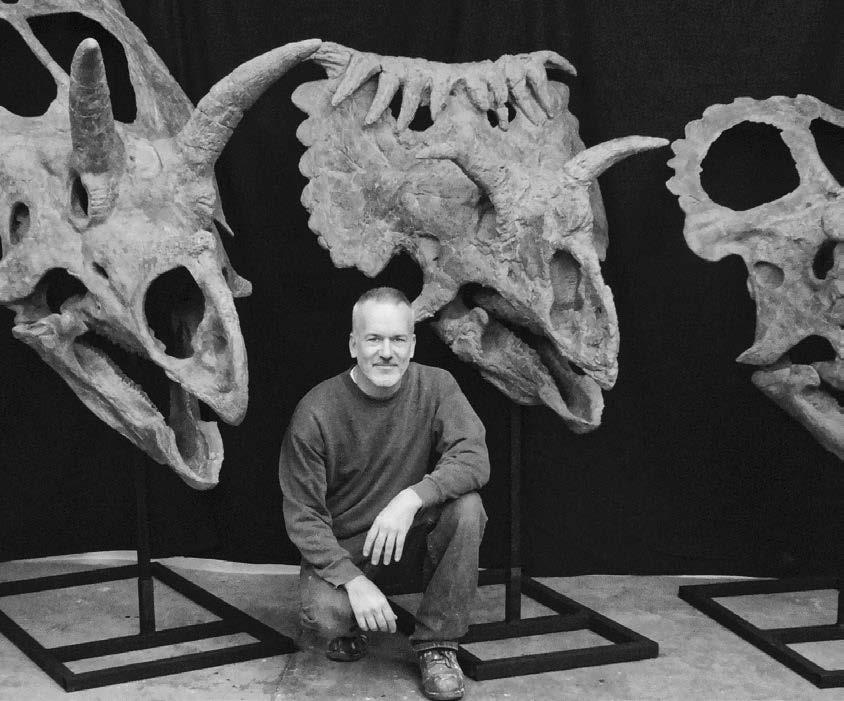
In southeastern Colorado’s Purgatoire River Canyon, you can stand in the footprints of Jurassic dinosaurs at North America’s largest tracksite.
Rumbling down a dirt road outside La Junta, cattle-dotted fields unfurl in every direction, but my eyes are searching for the canyon. We’d driven three hours from Denver and spent the night in a hotel to make the 8 a.m. start time of a full-day Picket Wire Canyonlands driving tour ($21 per adult, via recreation.gov). I’m ready for the adventure to begin.
Slowly, it does, as our caravan of four-wheel-drive vehicles moves through portions of Comanche National Grassland that are generally closed to automobile traffic. We angle our Toyota 4Runner around rocky outcrops and descend into the Purgatoire River Canyon. There are a couple of stops to view rock art that’s likely thousands of years old. Although the U.S. Forest Service guides’ interpretations are fascinating, we’re here to see something much more ancient: dinosaur prints left more than 150 million years ago. Around midday, we park at the tracksite and follow the quarter-mile footpath down to the riverbank. At first, it’s hard to tell normal divots in the exposed rock from prints, but our guide points out three-toed Allosaurus indents and larger, deeper Apatosaurus tracks. As we take photos with our feet inside the impressions, a volunteer who helped with the excavations tells us about nicknames he has for their makers. Limpy’s gait gives away an injury, and Stucky, well, his tracks abruptly—and likely tragically—stop.
Too soon, it’s time to head back to the car to finish the tour. Wistfully, I watch mountain bikers who’ve arrived via the 5.6-mile (one way) path from the Withers Canyon trailhead. Now that I know what to look for, I think, next time, I’ll come on my own—and spend more time searching for meaning among the marks left by giants that wandered these grounds long before me. —JL
When dinosaur bones were first discovered, you could forgive their finders for being smitten with the larger-than-life creatures—and leaving behind whatever else was entombed in the rock. Today, however, the scientific community is interested in compiling a more complete prehistoric picture.
The University of Colorado Boulder’s Karen Chin published a study in 2017 on fossilized feces found in Utah, likely from late Cretaceous duck-billed hadrosaurs, which indicate they ate crustaceans along with plants.
In 2016, DMNS associate curator of vertebrate paleontology Tyler Lyson was inspired to search the Corral Bluffs landscape east of Colorado Springs for concretions instead of bones. The rocks, which form around organic nuclei and date to just after the mass dinosaur extinction, contained a previously overlooked trove of mammal skulls
In 2007, Morrison Natural History Museum director and curator Matthew Mossbrucker noticed half-dollar-size, three-toed Stegosaur infant prints in a boulder pulled from a roadside near a historical quarry in the area.
Between 2014 and 2018, U.S. Forest Service paleontologist Bruce Schumacher led an excavation on the north bank of the Purgatoire River Canyon near La Junta that uncovered 800 Jurassic dinosaur tracks, bringing the area’s total to about 2,100.
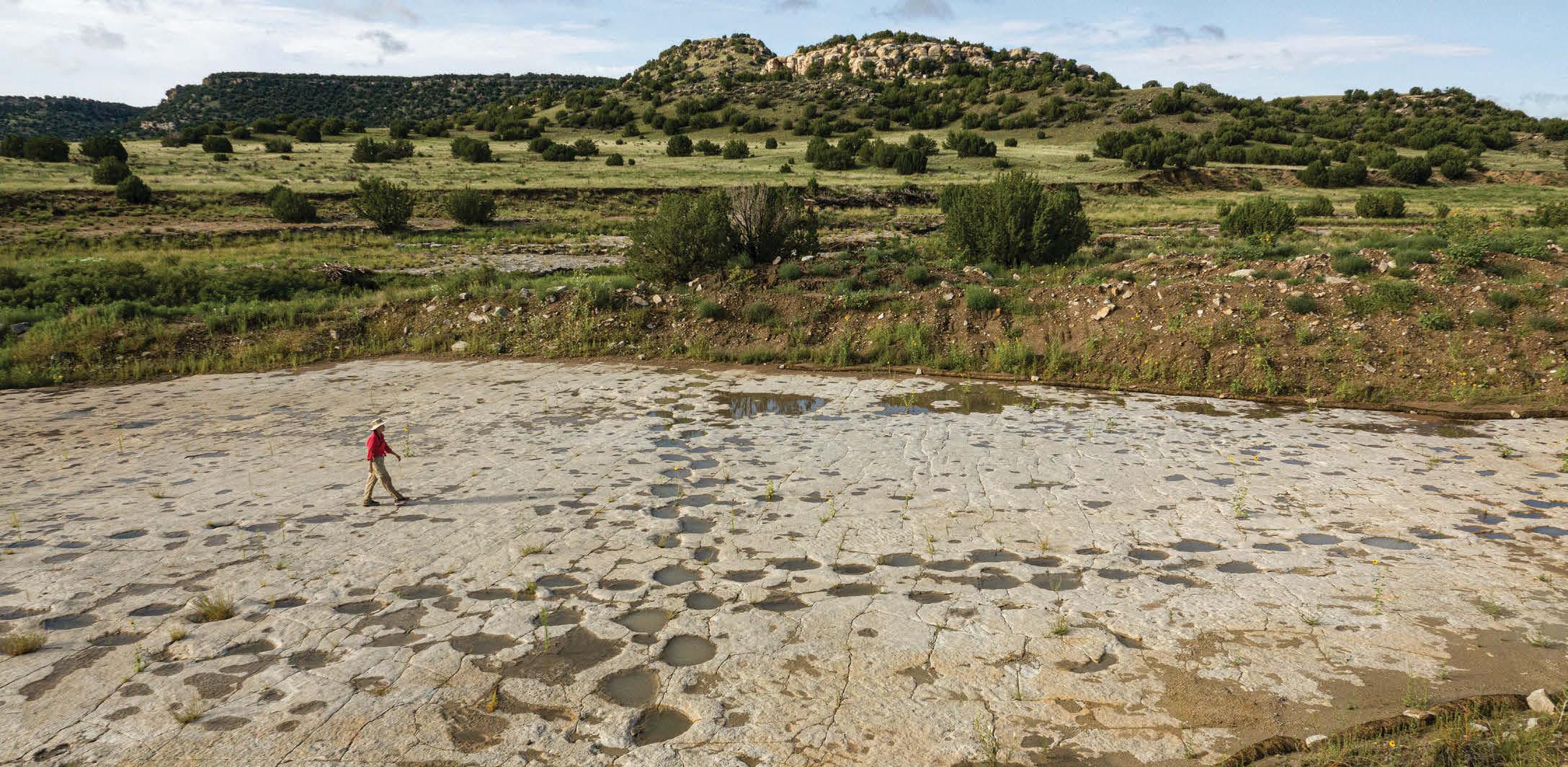
These dinosaurs, thought to be herbivores, may have consumed invertebrate-filled rotting wood for extra protein and calcium during egg-laying season—a diet-shifting behavior sometimes seen in modern birds.
The DMNS was able to lead a team that collected the world’s most complete record—some 1,000 vertebrate fossils, 6,000 plant fossils, and 37,000 pollen grains—of the era in which most of modern life emerged and diversified. (Note: The DMNS’ exhibit on the work, After the Asteroid, will close later this year.)
The herbivores were breeding in a spot with little plant evidence, supporting a hypothesis that they may have produced a substance like crop milk, which some modern birds secrete to feed their young.
New parallel sauropod tracks of varying sizes (read: ages) bolstered previous interpretations that these herbivorous giants moved in herds, unlike carnivorous theropods, whose track patterns suggest they hunted alone.
“It refines our diets of herbivorous dinosaurs,” Chin says. “So many of the dinosaur books show dinosaurs feeding on leaves of trees, and I’m sure many of them did. But natural history is more complex.”
“We found these amazing fossils in one of the most poorly understood intervals of time,” Lyson says. “It’s the first time that we can piece together four key things: the animals, plants, temperature, and then the timeline. We can really look at the recovery of a whole ecosystem.”
“Baby spike-tailed dinosaurs are rare,” Mossbrucker says, “and these tracks offer unique insight into the habitat where Stegosaurus grew up.”
“The tracks capture actual behavior, as it happened,” Schumacher says. “Reflecting on the past makes us understand what a precious thing we have to preserve— our environment on Earth, not just for humans, but for all species.”
How CU Boulder’s Karen Chin is studying the bodily waste dinosaurs left behind—and inspiring the next, more diverse generation of scientists via a children’s book out this month.
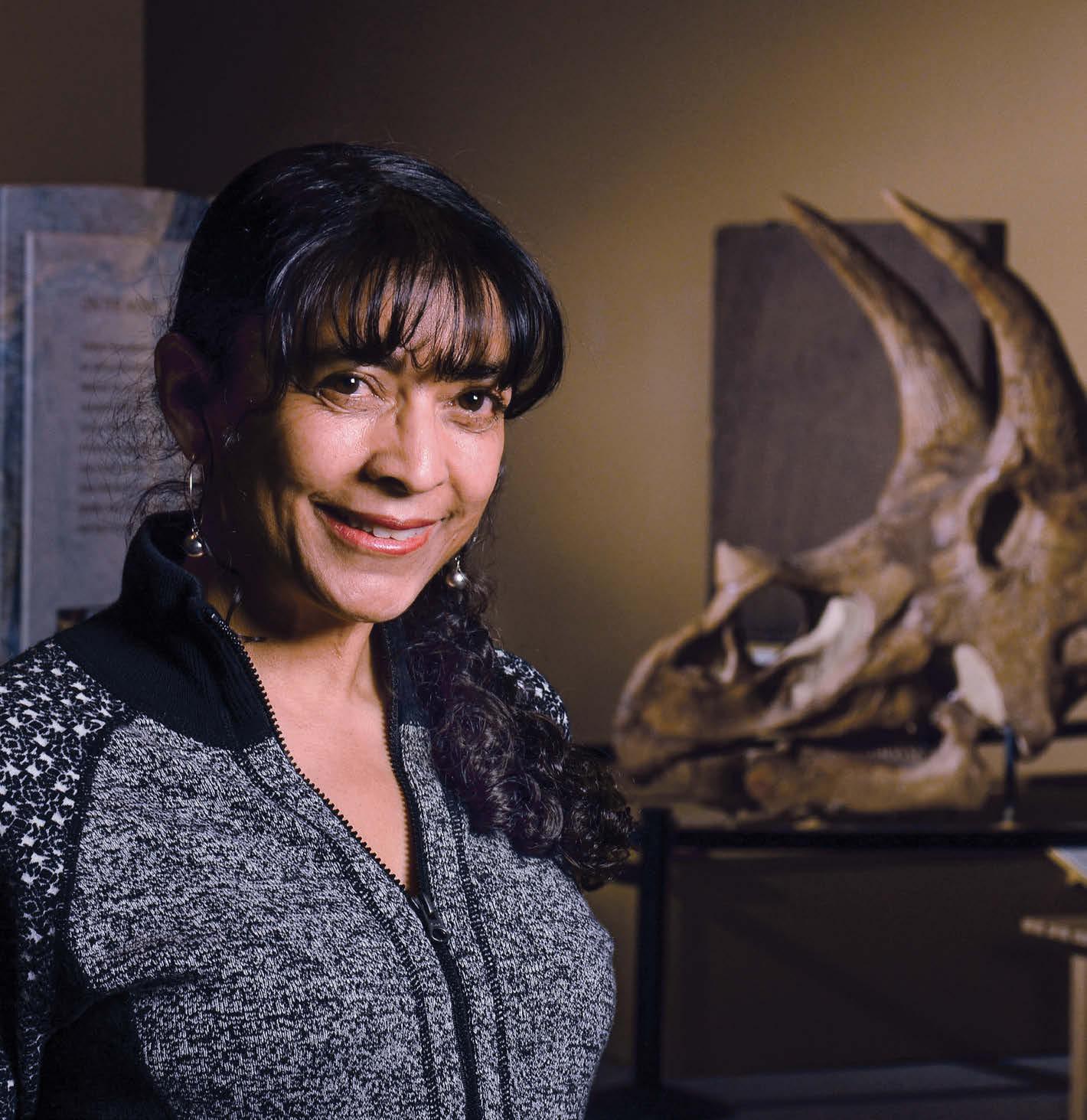
There are perhaps no two things more universally beloved by kids than dinosaurs and poop. So it makes sense that the work of Karen Chin, associate professor and curator of paleontology at the University of Colorado Boulder, is great fodder for juvenile nonfiction: The scientist, one of the world’s leading experts on fossilized feces (or coprolites), co-authored an elementary-level chapter book in 2005.
Much of her work has focused on what can be learned about dinosaur diets: If there is a snail in the coprolite, did the dinosaur definitely eat snails? (Nope; it likely slithered in afterward.) Do pieces of wood in a coprolite mean that dino ate trees? (Yes! Rotten wood was home to dinosaur delicacies like insects.) But her new picture book is just as much about how Chin—a woman of primarily African American and Chinese descent—came to work in a field where no one looked like her.
The Clues Are in the Poo: The Story of Dinosaur Scientist Karen Chin walks through her life experiences. Those include being inspired by her father, a member of the Tuskegee Airmen who later got a master’s degree in chemistry, as well as working as a rare woman ranger for the National Park Service in the early ’70s, when she first got interested in animal droppings while using them to teach visitors about modern animal behavior. “My hope is that the book will show that scientists, and people in any career, can come in many different flavors,” Chin says. The proof and inspiration for future generations, however, are in her work, which includes discoveries that changed the way we understand dinosaurs’ environments, diets, and more—all by studying their poop. —HC
Fossil work in the Centennial State is largely powered by citizen scientists. Here, four ways to become one of them. —HC & JL
At Denver’s pre-eminent dino institution, a devoted volunteer corps is entrusted with scraping sediment from previously collected bones and searching for new specimens. Following a two-day training, the museum asks for eight hours per week, and locals such as Don and Nikkie Brandborg—who’ve gone on 49 digs, from North Dakota to Cañon City— stick around for decades. “A lot of the people working here for free are some of the best preparators in the world,” DMNS preparator Salvador Bastien says.
Western Interior Paleontological Society
For nearly 40 years, the Western Interior Paleontological Society has connected area dinosaur lovers. The group’s 400-plus members ($25 per year for individuals, $30 for families) nerd out together during meetings at the Colorado School of Mines, expert lectures, and multiday symposiums. They also go on field trips, such as behind-the-scenes museum tours, plant and marine animal fossil hunts, and paleontologist-led digs. For children ages seven and older, the organization hosts youth-specific PaleoZone programming.
Fossil Posse Adventures
If your kids blast They Might Be Giants’ “I Am a Paleontologist” on repeat (IYKYK), it may be time to send them into the field in Eagle County. “There are no screens,” Fossil Posse organizer Billy Doran says. “It’s just old school, get in the dirt and find fossils.” During the three-hour, $70 experience, offered on Wednesdays and Fridays from June through September, campers ages six and up get to make dino footprint casts and dig in a private quarry, where they may find shells, ammonite imprints, and shark teeth to take home.
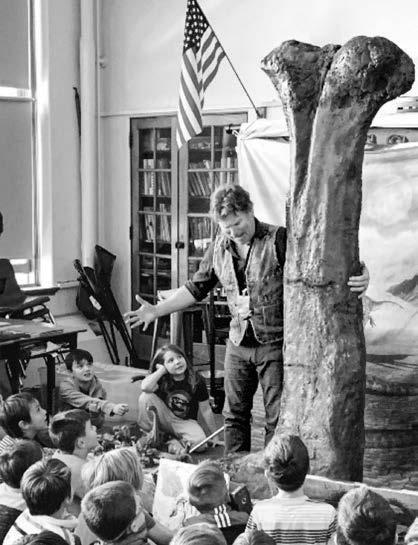
This museum group offers prehistoric fun for the whole family on its two-day, full-day, and half-day excursions, starting at $115 per person. Hosted by Fruita’s Dinosaur Journey Museum, all programming features digging for fossils—finds are retained for education and research—and the longer options can include collections tours and learning how to use lab equipment to clean and repair fossils back
museum. m
Step inside 5280’s Hall of Fame! In this exclusive special advertising section, we shine a spotlight on the outstanding professionals who have achieved unparalleled success in their respective fields. Discover the stories and achievements of these professionals who have been honored by 5280’s editorial team as the Mile High City’s best.
HONORING TOP OF THE TOWN WINNERS AND TOP LAWYERS, PRODUCERS, DENTISTS, AND DOCTORS.

Mark is a top producer with over 20 years experience in real estate, owning rental properties, flipping homes, and constructing houses and multimillion-dollar projects. He puts his insider’s view of the building industry and extensive training in negotiation, legal and regulatory issues, technology, professional standards, marketing, and the sales process to work for his clients.


“There’s a lot at stake if the wrong approach is taken with buying or selling. For sellers, the ramifications are numerous when a listing is slow to sell, receives few offers, sells for less profit, or a deal falls through because of appraisal, inspection, due diligence, or lender issues. For homebuyers, not finding the right property at the right price and time can mean they miss out on winning their dream home, overpay for a property, or don’t make enough on their sale property.”
“It’s critical to have a methodical system that ensures every detail is accounted for: whether the reason for selling or buying a home is due to needing more space, downsizing, marriage, divorce, retirement, or wanting investment properties.”
Mark has a proven process for his clients. This proven process, along with his genuine care about his clients’ results, knowledge of the ins and outs of the market, and skillful negotiation are just some of the reasons Mark’s clients always win!
“I want my clients to have a more enjoyable and seamless experience, make the most informed decisions, have more profit in their pockets, and build equity and wealth for their future.”

Stephanie Iannone and Mindy Nassar of the Iannone Group at Compass bring over 30 years of experience in the real estate, relocation and residential development industries. Their dedication to their clients, leadership in the community, strategic negotiation skills and marketing and design savvy have made them one of the most successful teams in Colorado. Nationally ranked, they have successfully closed over $670,000,000 in real estate transactions, won numerous awards and appeared on HGTV. They enjoy everlasting bonds with their clients who become friends for life and specialize in the Boulder and Denver Metro areas as well as Winter Park and Grand County.
stephanie@iannonegroup.com
mindy@iannonegroup.com
303.641.7484 | compass.com
MyRights Immigration Law Firm has represented non-citizens in all types of immigration cases for over 10 years. Thousands of clients have obtained lawful status including citizenship, permanent residence, and a variety of other non immigrant visas. MyRights Immigration also continues to defend and protect non-citizens who face removal, successfully defending these cases with the Immigration Judge, Board of Immigration Appeals, and at the Circuit Courts of Appeals.

In addition to their advocacy at the agency level, MyRights Immigration Law Firm’s founder, Shawn Meade, has filed hundreds of District Court cases under the Administrative Procedures Act, holding accountable USCIS and other government agencies for illegal actions, unreasonable delays, and other violations.

Stephen Burg is a shareholder and a trial attorney with Burg Simpson Eldredge Hersh & Jardine. As the Practice Group Leader of the firm’s Personal Injury Department, Stephen is focused on representing victims of automobile and motorcycle crashes, trucking collisions, product liability injuries, gas explosions, wrongful death, and harmful drugs and medical products. Mr. Burg’s most recent trial resulted in a $18,105,000.00 verdict.*
A dedicated advocate for those who have been harmed by the carelessness of others, Stephen Burg has a long-standing reputation for his formidable skills as a litigator and a negotiator. He has a passion for holding negligent parties accountable for their actions and for maximizing financial recoveries for his clients.

Mr. Burg has been recognized for his legal excellence both nationally and locally. He was named as a “Recommended Attorney” by the U.S. Legal 500, and has been consistently recognized by the National Trial Lawyers as a “Top 100 Trial Lawyer” since 2012. He has also been selected by his peers as a Best Lawyer in America and a Colorado Super Lawyer.
*past results do not guarantee future success
TOP LAWYER WINNER • 2015-2023
Mr. Chayet is the founder and Managing Partner of Chayet & Danzo LLC and ColoradoElderlaw.com. We specialize in the needs of your family, the elderly, disabled and at risk in our community including estate planning, probate litigation, guardianships & conservatorships. Mr. Chayet is the Public Administrator of the 18th Judicial District and an Adjunct Professor of Elder Law at the Univ. of Colorado School of Law.
650 S. Cherry Street, Suite 710 Denver, CO 80246 303.355.8500 | coloradoelderlaw.com

TOP LAWYER WINNER • 2020-2023
Counsel at Frazer-Abel Law specialize in elder law, probate administration and litigation, guardianships and conservatorships, estate and special needs planning, public benefits, settlement planning and fiduciary work. Attorneys Virginia Frazer-Abel, Eric Kelly, Geoffrey Carpenter, and Kailie Wilson are committed to providing clients with the highest level of legal representation and oversee legal needs with honesty and integrity.
4704 Harlan Street, Suite 250 Denver, CO 80212 720.638.1465 | vfalegal.com
TOP PRODUCER WINNER • 2021-2023

You probably approach real estate from a combination of lifestyle and investment goals. However, your specific goals and how you approach them are likely very unique. I curate your sale, purchase, or investment journey around your individual goals and lifestyle desires. I bring 12 years of experience in real estate sales and several investments and projects of my own so that I can deliver a knowledgeable, creative, and rewarding experience to you.
200 Columbine Street, Suite 500 Denver, CO 80206 303.912.5394 | colinco.com

Infinity Pros is a group of highly skilled and dedicated Realtors based in the Denver West office. They are known for providing exceptional knowledge, service, and care to their clients. Infinity Pros holds the distinction of being Coldwell Banker’s top-performing women’s team and ranks as the second top team in the state of Colorado. They have also earned recognition by the Wall Street Journal, being ranked 26th in the United States.
While each member of Infinity Pros operates independently, they collaborate closely through regular mastermind sessions and resource sharing. This collaborative approach allows them to continually improve their clients’ experiences and make a positive impact on the communities they serve. By leveraging the tools and experience provided by their brokerage partner, Coldwell Banker, Infinity Pros consistently achieves outstanding results in the Colorado real estate market.

When you choose to work with one member of Infinity Pros, you gain access to the collective expertise and support of the entire team. This ensures that you receive comprehensive assistance and guidance throughout your real estate journey.
Sarah Scott-Wilson: 303.250.5323
Kelly Paulk: 720.822.2159
Taylor Carpenter: 303.909.2108
Brandi Miller: 720.442.1681
Ashley Warren: 720.938.1129
As a trial lawyer with more than 30 years of trial experience, Daniel Reilly has served as outside lead litigation counsel for the Denver Broncos Football Club for over 20 years. He has also served as lead counsel for a broad spectrum of complex multi-jurisdictional commercial litigation matters, including both the prosecution and defense of class actions for individuals & major corporations. Reilly is well known for his court room skills & fact-based domination. Before teaming up with Fennemore, Dan founded Reilly Pozner LLP in Denver.

1700 Lincoln Street, Suite 2400
Denver, CO 80203
303.291.3200 | fennemorelaw.com

Peter specializes in water rights, water quality, and land and water conservation law at Berg Hill Greenleaf Ruscitti LLP. Peter defended the encumbrance of water rights in conservation easements, obtaining a legal precedent for land trusts nationally. His work continues with land trusts to creatively secure water for the future, including ground(water) breaking programs to address aquifer mining.
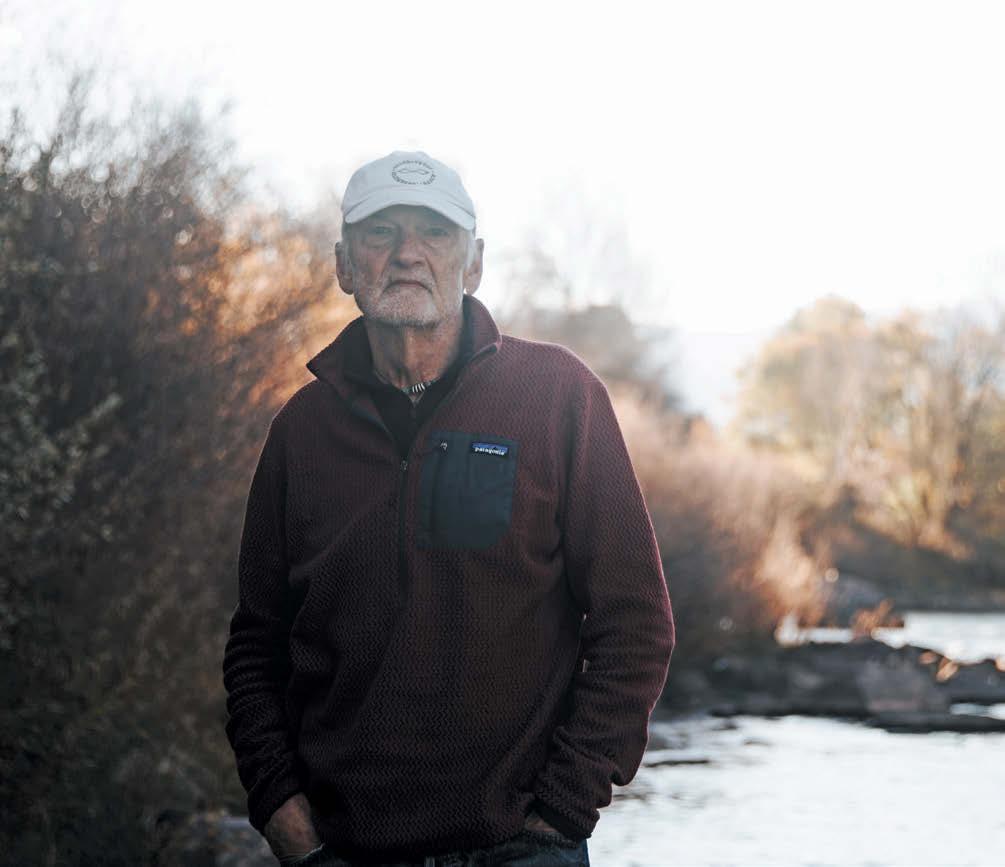
Boulder | Denver
303.402.1600
bhgrlaw.com
Readers' Choice Home Accessories/Furniture
Started in 2010 by world travelers and entrepreneurs Brad Grunewald and Tony Wilson, Rare Finds Warehouse has grown to become Colorado’s premier destination for unique home furnishings from around the world. We’re wholesalers to furniture stores around the country and operate two retail stores in Denver and Highlands Ranch. We’re committed to sourcing sustainable, reclaimed and repurposed furniture and home decor. We’re proud to have been voted Denver’s Best Furniture Store.
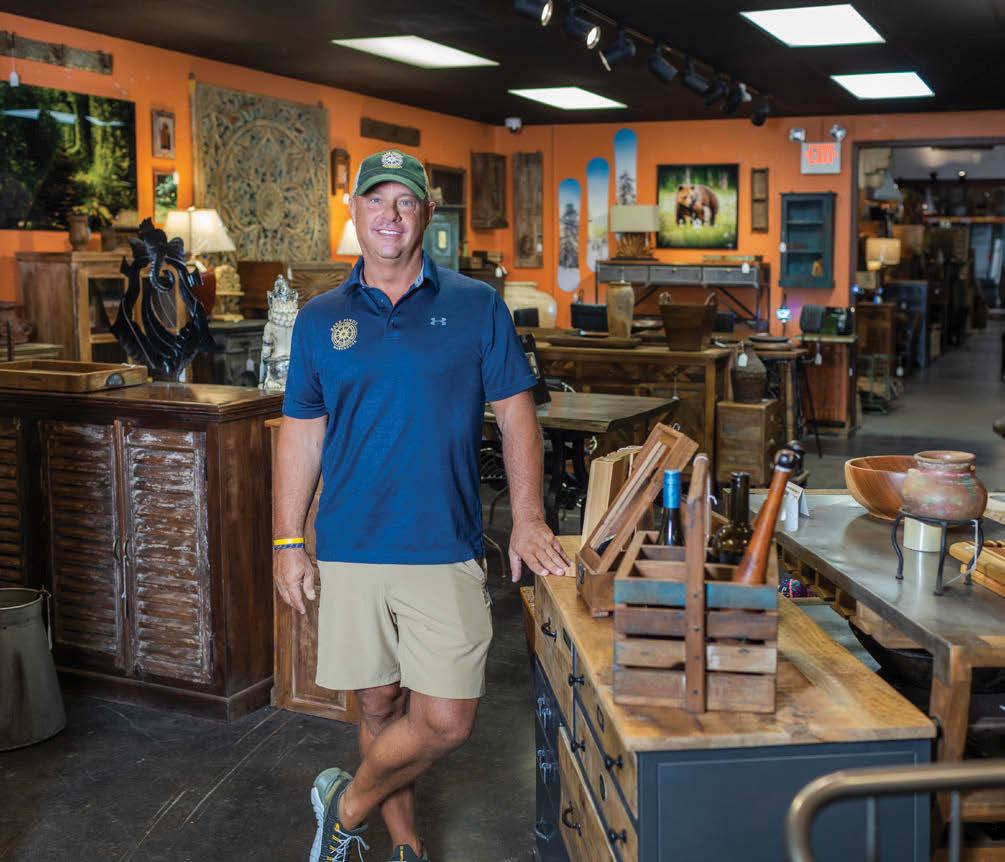
Denver | 303.990.9311
Highlands Ranch | 303.237.4470
rare-finds.com
Angelique Salazar is a Denver entrepreneur who is passionate about creating opportunities that meld neighborhood, community and business. She has successfully applied her management skills to businesses in dog care, real estate, restaurant/ hospitality, retail, and others.

She founded the award-winning U Lucky Dog boarding and daycare facility in Denver in 2010, and she upgraded it into a new location in 2021. Also known as Club ULD, the facility offers boarding, luxury suites, individual play, bathing services, one-on-one walks and more. Countless testimonials over the years contain a common thread in their praise of Angelique’s personal attention to the pets’ well-being.
Long time clients, Matt and Meredith Williams, recently wrote in a testimonial…”The ownership/management team clearly care about their customers and dogs because they are continuously evolving their business - whether it’s upgrading the play areas and overnight suites, adding more grooming services and playtime options for the dogs, or offering fun promos and contests for owners, it’s clear Angelique and her team genuinely love dogs. All in all, ULD has become a trusted partner for us since moving to Denver in 2013, and we have complete peace of mind that Layla and her brother Rigby (who has been a regular for 3 years now) are safe and in good hands.”
Angelique has underscored her interest in canine welfare with multiple charitable initiatives over the years. For instance, when a massive hurricane threatened dogs and cats with fast-rising floodwaters in the Bahamas in 2019, she raised thousands of dollars to support the humane society there.
Want to learn more about Club ULD?
Check out their website at ClubULDDogDaycare.com or call 720-328-8179. First day of daycare is free for new clients!


Dan Caplis is a true trial lawyer. He recently won five multimillion dollar jury verdicts in a row in less than two years. His firm believes that Dan is the only trial lawyer in Colorado history to accomplish that. One of those jury trials resulted in the largest trucking case verdict in Colorado history, twenty-six million dollars. In his last 14 trials Dan has won jury verdicts far beyond the best offers made before trial. Many of those verdicts were ten times or more the amount of the offer.
Dan quickly points out that all of these victories are a total team effort, starting with his partner Babar Waheed. Dan calls Babar “one of the great legal minds of our era” and says that Babar’s legal brilliance is essential to the firm’s success. Selected as a member of Colorado Super Lawyers, Babar consistently wins extremely high-stakes legal battles that pave the way for seriously harmed clients to recover many millions more than they otherwise would have. Many of Babar’s winning legal briefs and arguments also help pave the way to a safer and more just Colorado.
Dan has been honored with the Pro Vitae Award from the Archdiocese of Denver, which was presented by Archbishop Charles Chaput; the Humanitarian of the Year award, presented by now Archbishop of Los Angeles Jose Gomez; and was named one of the 25 most powerful people in Denver by 5280 magazine. Dan has also received a multitude of top legal honors including recognition by Super Lawyers, The Best Lawyers in America, the Million Dollar Advocates Forum, and The National Trial Lawyers Top 100 Trial Lawyers. Dan is an award-winning syndicated radio talk show host and a legal analyst who has been featured on Fox News, NBC, CNN, ABC, BBC, and in many of the nation’s top newspapers including The Washington Post and USA Today.
As a former seminarian and the son of a police officer, it has been Dan’s obsession to build a world-class firm for regular people. Dan believes that he and Babar have achieved that, and that their trial results prove it. As Dan likes to say “talk is cheap, actions speak louder than words, and results matter.”

5280 Home's eighth-annual Top Denver Design awards will honor the most stylish and inspiring residential spaces in Denver and surrounding areas, and celebrate the design experts who brought each project to life.

Local design professionals and style-savvy homeowners, we encourage you to submit individual rooms and full-home projects with a forward-thinking, elevated aesthetic.

The winning spaces will be featured in our December 2023 Top Denver Design issue.

TO STAY INFORMED ABOUT THE 5280 HOME TOP DENVER DESIGN BALLOT

Construction Law
Giovanni M. Ruscitti is one of the founding members of Berg Hill Greenleaf Ruscitti LLP and currently serves as the firm’s Managing Partner. Mr. Ruscitti works as a strategic adviser to boards of directors and general counsel in construction, real estate, and corporate law.

SPONSORED

SPONSORED BY





THURSDAY, JULY 20 · 6–9 PM FILLMORE STREET, BETWEEN 1 st + 2 nd AVENUE

HOSTED BY
CELEBRATE 30 YEARS OF 5280 MAGAZINE WITH US AT THIS a ll-incl usive BASH!

You are invited to an unforgettable Colorado summer evening filled with flavorful menus from top local restaurants, delightful drink offerings (read: open bars), thrilling entertainment (read: dance the night away), exquisite lounges, fun photo booths, and more. GET YOUR TICKETS TODAY!

SCAN HERE OR VISIT 5280SCENE.COM FOR TICKETS + TO LEARN MORE!




THANKS TO OUR SPONSORS

Indicates a restaurant featured in 5280 for the first time (though not necessarily a restaurant that has just opened).
Indicates inclusion in 5280’s 2022 list of Denver’s best restaurants. These selections are at the discretion of 5280 editors and are subject to change
A5 STEAKHOUSE $$$$
LoDo / Steak House The team behind Forget Me
Not and Tap and Burger offers a refreshing chophouse experience with a stellar lineup of steaks in a hip, delightfully funky bar and dining room. Reservations accepted. 1600 15th St., 303-623-0534. Dinner
ACREAGE BY STEM CIDERS $$
Lafayette / Seasonal Stem Ciders’ ciderhouse and eatery pairs its drinks with house-grown produce and sustainable sourcing. Save room for the cider doughnuts. Reservations accepted. 1380 Horizon Ave., Lafayette, 720-443-3007. Lunch, Dinner
AFRICAN GRILL & BAR $$$
Lakewood / African Head to this cheery African restaurant for rich stews, fried fish, rice dishes, and friendly service. Get the chakalaka, a traditional vegetarian South African stew. Reservations accepted. 955 S. Kipling Parkway, Lakewood, 303-985-4497. Lunch, Dinner
AJ’S PIT BAR-B-Q $$
Overland / Barbecue This wood-fired, Texas-style barbecue joint welcomes the public to savor lip-smacking dishes such as beef brisket, housecured and smoked pastrami, pit beans, and farm slaw. Reservations not accepted. 2180 S. Delaware St., 720-815-5571. Lunch, Dinner
ANNETTE $$$
Aurora / American Caroline Glover brings a warm dining experience to Stanley Marketplace with Annette. Enjoy a family-style menu featuring seasonal salads, toasts, and wood-grilled fare. Reservations accepted. 2501 Dallas St., Suite 108, Aurora, 720-710-9975. Dinner
ASH’KARA $$$
LoHi / Middle Eastern Chef Daniel Asher offers a playful take on Middle Eastern cuisine at this plant-bedecked eatery. Order the falafel. Also try the Boulder location. Reservations accepted. 2005 W. 33rd Ave., 303-537-4407. Dinner, Brunch
AUDREY JANE’S PIZZA GARAGE $$
Boulder / Pizza Expect perfect New York–style sourdough pies featuring inventive topping combos at this eatery. Try the Hot Honey Disco Pie. Reservations not accepted. 2675 13th St., Boulder, 303-442-2032. Lunch, Dinner

Empanadas aren’t the only South American pastries available to Denverites, thanks in part to Paula Lowery. In 2021, the Brazil native opened Padoca Bakery & Market in the Montclair neighborhood. There, she serves pão de queijo (cheese bread), savory croquettes, brigadeiros (fudgelike truffles), and other tasty treats she grew up eating. Pair a latte made with beans from Boulder-based Bona Coffee Roasters with a pão de frango: shredded chicken, hearts of palm, and cream cheese wrapped in a flaky pastry.
BANH & BUTTER BAKERY CAFE $ Aurora / French Thoa Nguyen crafts French pastries inspired by her Vietnamese heritage at this East Colfax cafe. Go for the dazzling crêpe cakes, each made with 25 to 30 layers. Reservations not accepted. 9935 E. Colfax Ave., Aurora, 720-513-9313. Breakfast, Lunch
BAR DOUGH $$$
LoHi / Italian Tuck into wood-fired pizzas, comforting pastas, and Italian-style cocktails from chef Russell Stippich at this casual gathering spot. Reservations accepted. 2227 W. 32nd Ave., 720-668-8506. Dinner, Brunch
BELLOTA $$
RiNo / Mexican Go for elevated regional Mexican fare like shrimp tacos basted in butter infused with shrimp shells and the popular fried quesadilla de requesón. Also check out the Boulder location. Reservations not accepted. 3350 Brighton Blvd., 720-542-3721. Lunch, Dinner
BEST PHILLY STEAK $$
Arvada / American A fusion joint specializing in Korean-influenced Philly cheese steak sand-
wiches. Try the Steak N’ Bacon. Reservations not accepted. 6350 Sheridan Blvd., Arvada, 720-6674702. Lunch, Dinner
BIKER JIM’S GOURMET DOGS $
Ballpark / American This spot’s unusual menu includes rave-worthy dogs in adventurous varieties (think: ostrich sausage and elk jalapeño). Reservations not accepted. 2148 Larimer St., 720-746-9355. Lunch, Dinner
THE BINDERY $$$
LoHi / Contemporary Linda Hampsten Fox’s eatery, market, and bakery offers worldly fare inspired by her travels. Settle in for the smoked rabbit pecan pie with mustard gelato. Reservations accepted. 1817 Central St., 303-993-2364.
Breakfast, Lunch, Dinner, Brunch
BLACKBELLY $$$
Boulder / American Chef Hosea Rosenberg’s carnivore-friendly menu focuses on charcuterie, small plates, and daily butcher specials. Also check out the grab-and-go market located next door. Reservations accepted. 1606 Conestoga St., Boulder, 303-247-1000. Dinner

With more than 30 crave-worthy toppings to mix and match, we've loved helping you make burger magic since 1945.

BRUTØ $$$$
LoDo / International At the Wolf’s Tailor’s sister restaurant, executive chef Michael Diaz de Leon highlights heritage grains and house ferments created by Mara King in a Latin-influenced tasting menu. Reservations accepted. 1801 Blake St., 720-325-2195. Lunch, Dinner
CHEZ MAGGY $$$$
LoDo / French Acclaimed chef Ludo Lefebvre plates up Colorado-inspired French classics at this brasserie inside the Thompson Hotel. Don’t miss the expertly prepared escargot in garlic butter or the burger à la française smothered in a peppery gravy. Reservations accepted. 1616 Market St., 720-794-9544. Breakfast, Lunch, Dinner, Brunch
COMAL HERITAGE FOOD INCUBATOR $$
Globeville / International Immigrant and refugee women from Latin America develop a rotating menu featuring their family recipes at this welcoming restaurant, which has a job training program. Reservations not accepted. 3455 Ringsby Court, Suite 105, 720-500-3455. Lunch
CORRIDA $$$$
Boulder / Spanish This elegant Spanish steak house offers stunning Flatiron views and fabulous cocktails and wines. Splurge on the Japanese wagyu or opt for a regeneratively sourced steak. Reservations accepted. 1023 Walnut St., Suite 400, Boulder, 303-444-1333. Dinner, Brunch
CUBA CUBA CAFE & BAR $$$
Golden Triangle / Latin American Don’t miss the mojitos at this authentic, family-owned Cuban restaurant. Try the vaca frita: mojo-marinated flank steak seared until crispy and served with rice, beans, and plantains. Reservations accepted. 1173 Delaware St., 303-605-2822. Dinner
DAE GEE $$
Congress Park / Korean Enjoy bold Korean flavors at this Congress Park eatery. Order the pork bulgogi or try the bibimbap. Multiple locations. Reservations accepted. 827 Colorado Blvd., 720-639-9986. Lunch, Dinner

DAUGHTER THAI KITCHEN & BAR $$$$
LoHi / Thai This upscale Thai restaurant from Ounjit Hardacre serves beautifully plated dishes and inventive cocktails with an elegant ambience to match. Try the lychee-kissed massaman curry with Colorado lamb or the larb: crispy soft-shell crab tossed with lime juice, mint, roasted rice, and shallots. Reservations accepted. 1700 Platte St., Suite 140, 720-667-4652. Lunch, Dinner
DEL FRISCO’S GRILLE $$$$
Cherry Creek / Contemporary A more casual iteration of the beloved steak house, this restaurant serves up classic dishes with modern twists and local ingredients. Don’t miss the cheesesteak egg rolls. Reservations accepted. 100 St. Paul St., Suite 140, 303-320-8529. Lunch, Dinner, Brunch
DIMESTORE DELIBAR $$
LoHi / American This restaurant, bar, convenience store, and market serves elevated deli fare in an eclectic setting. Reservations accepted. 1575 Boulder St., Suite A, 303-537-5323. Lunch, Dinner
DIO MIO $$$
RiNo / Italian One thing you can count on at Alexander Figura, Spencer White, and Lulu Clair’s fast-casual Italian eatery: perfect pasta. Try the cacio e pepe or the squid ink creste di galli. Reservations not accepted. 3264 Larimer St., 303-562-1965. Dinner
DOS SANTOS $$
City Park West / Mexican The menu at this modern taqueria features light, seafood-centric dishes, like a beer-battered fish taco. Reservations not accepted. 1475 E. 17th Ave., 303-386-3509. Lunch, Dinner, Brunch
DRAGONFLY NOODLE $$
LoDo / Asian This eatery from restaurateur Edwin Zoe serves a multinational variety of Asian dishes. Order any of the bowls of ramen. Also try the Boulder location. Reservations not accepted. 1350 16th St. Mall, 720-543-8000. Lunch, Dinner
EDGE RESTAURANT & BAR $$$$
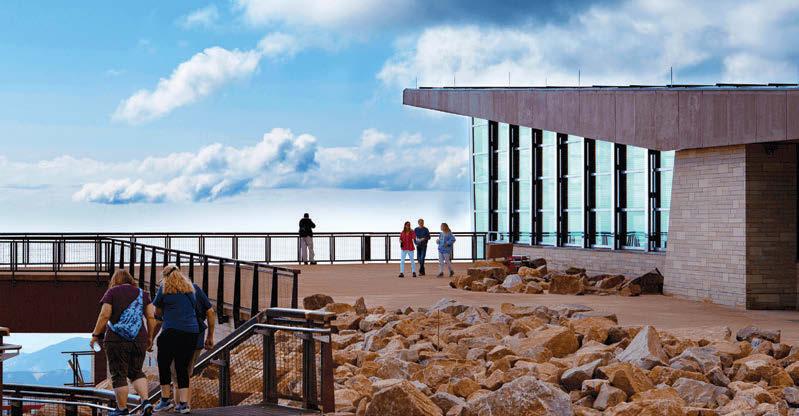
Downtown / Steak House Inside the Four Seasons Hotel Denver, this restaurant serves contemporary steak house fare by chef Craig Dryhurst. Reservations accepted. 1111 14th St., 303-3893050. Breakfast, Lunch, Dinner, Brunch
All aboard the most state-of-the-art cog railway in the world. While the entire experience of riding the railway has been enhanced, the journey itself and the iconic, breathtaking views as you ride to the summit of America’s Mountain remain the same. Visit cograilway.com to purchase your e-ticket today.

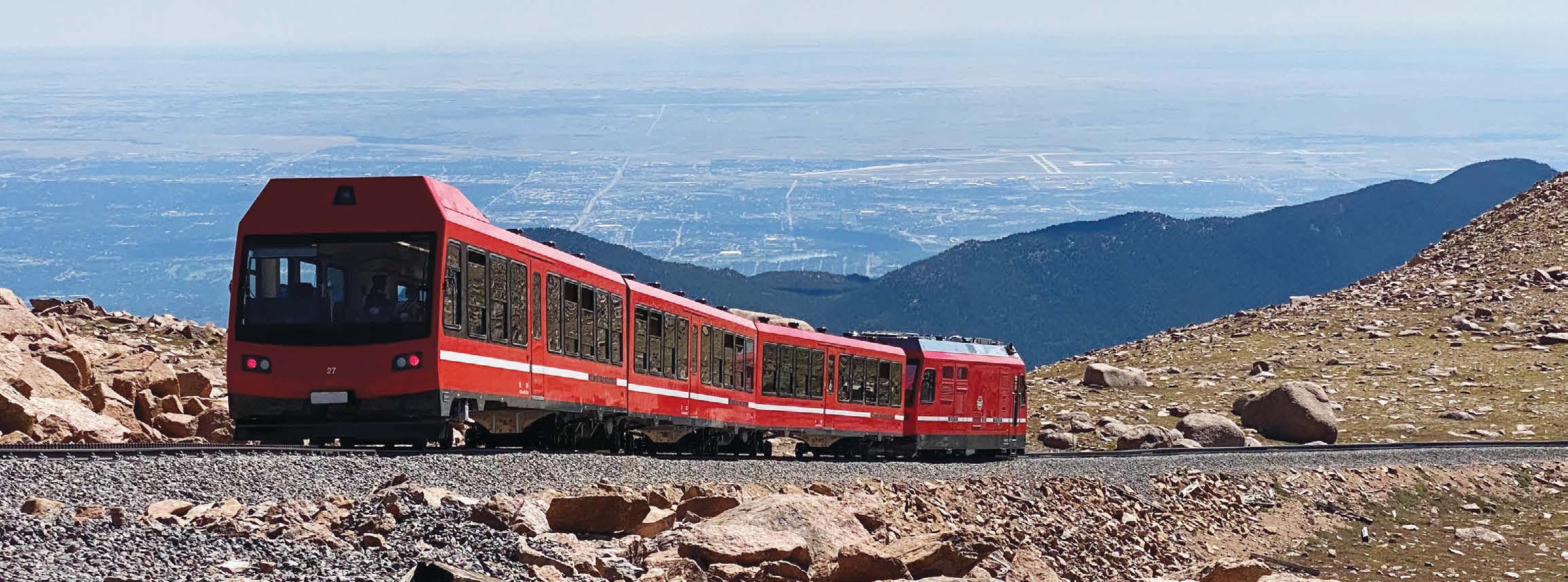
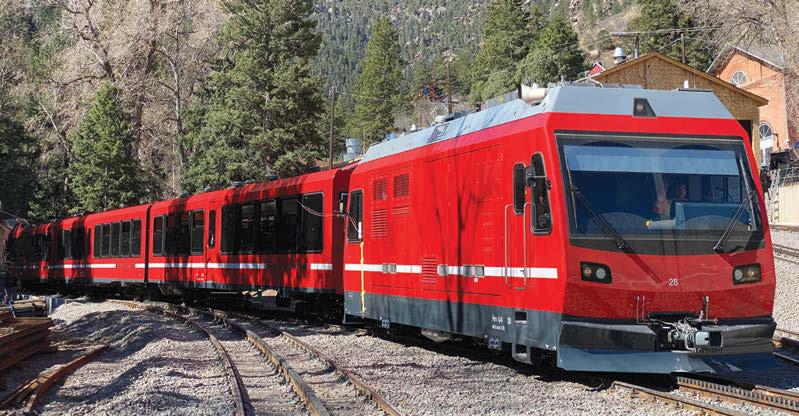
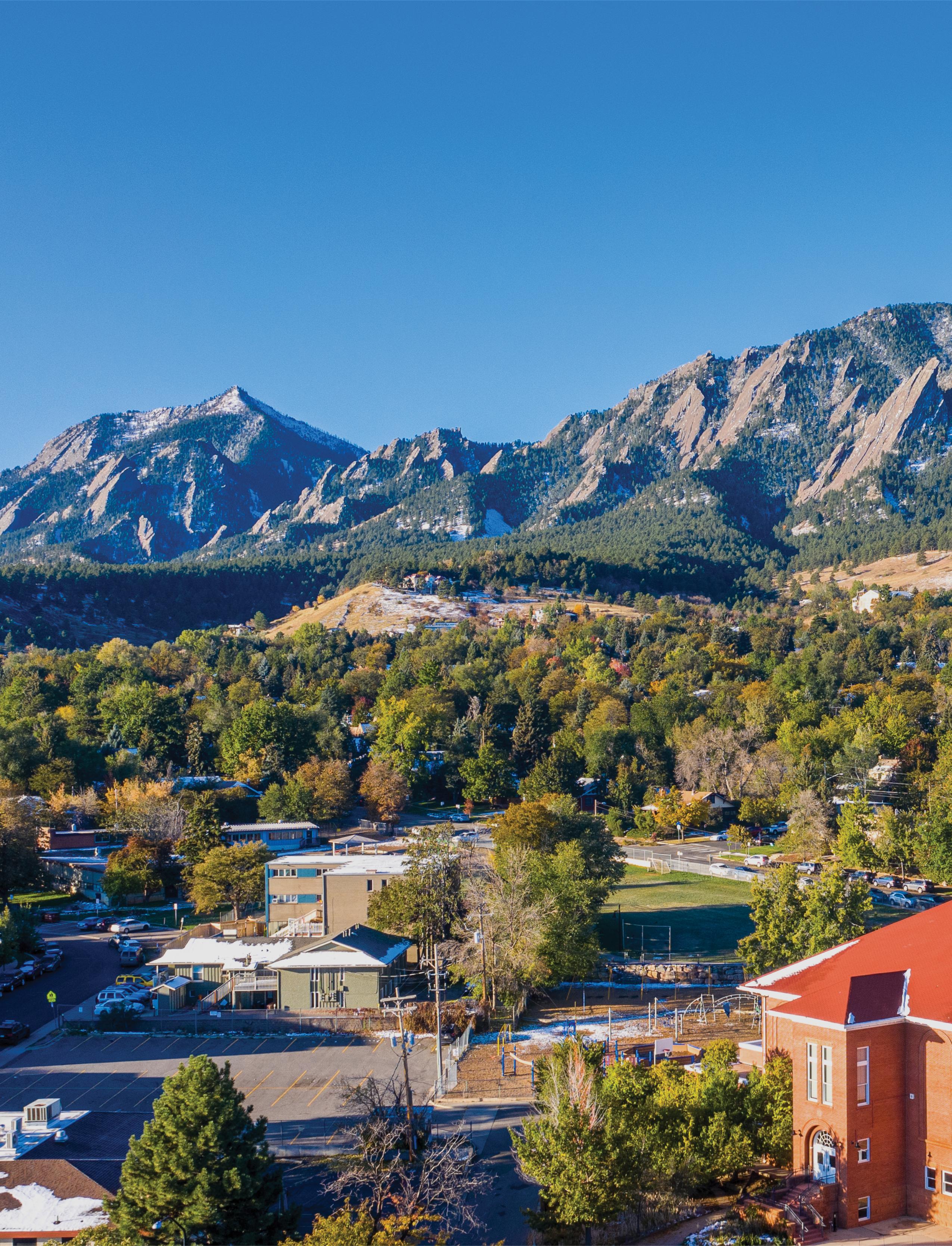
EDGEWATER INN $$
Edgewater / Pizza This pizzeria has been family owned and operated for more than 60 years. Try the Howdy Pizza, a combo of sausage, peppers, mushrooms, and jalapeños. Reservations not accepted. 5302 W. 25th Ave., Edgewater, 303-2373524. Lunch, Dinner
EDGEWATER PUBLIC MARKET $$
Edgewater / International Satisfy your cravings for everything from wild game sandwiches to Ethiopian fare at this collective of nearly two dozen food stalls and boutiques. 5505 W. 20th Ave., Edgewater, 720-749-2239. Breakfast, Lunch, Dinner
EL JEFE $$
Sunnyside / Mexican Farm-to-table Mexican fare will lure you to this welcoming Sunnyside haunt. Don’t miss the mushroom tacos or the grilled Spanish octopus. Reservations accepted. 2450 W. 44th Ave., 720-389-7615. Dinner, Brunch
EL TEPEHUAN $

Englewood / Mexican The team behind this Englewood restaurant has been serving its brand of authentic and affordable Mexican food for more than 40 years. Reservations accepted. 3495 S. Broadway, Englewood, 303-781-0243. Breakfast, Lunch, Dinner
ELLYNGTON’S $$$
Downtown / American Located in the Brown Palace Hotel, this is the home of Denver’s power meal. Indulge in the lavish brunch on Sundays. Reservations accepted. 321 17th St., 303-312-5924. Breakfast, Brunch
EVERYDAY PIZZA $$
Ballpark / Pizza The team behind Somebody People serves vegan pies, pastas, and small bites in neon-tinged environs. Reservations accepted. 2162 Larimer St., 303-953-0631. Dinner
FAMOUS ORIGINAL J’S PIZZA $$
Five Points / Pizza Joshua Pollack’s New York–style and rectangular “grandma” pies are totally customizable and available by the slice. Try the meat lover’s with sausage, pepperoni, and diced Taylor ham. Reservations not accepted. 715 E. 26th Ave., 720-420-9102. Lunch, Dinner
FARMHOUSE THAI EATERY $$
Lakewood / Thai This cozy spot offers flavorful specialties from multiple regions, including papaya pok pok and khao kha moo. Reservations not accepted. 98 Wadsworth Blvd., Suite 117, Lakewood, 303-237-2475. Lunch, Dinner
THE FIFTH STRING $$$$
LoHi / American At the Fifth String, chef Amos Watts offers his seasonally inspired cooking alongside an in-house beef butchering program. The results, such as the tallow candle bread service, are delicious and inventive. Reservations accepted. 3316 Tejon St., Suite 102, 720-420-0622. Dinner
FISH N BEER $$$
RiNo / Seafood Kevin Morrison offers approachable, fresh seafood and a hearty beer list at this casual oysterette. Try the ceviche or wood-firegrilled whole bass. Reservations accepted. 3510 Larimer St., 303-248-3497. Dinner
FRASCA FOOD AND WINE $$$$
Boulder / Italian Lachlan Mackinnon-Patterson, Peter Hoglund, and master sommelier Bobby Stuckey’s fine-dining mecca has racked up scores of accolades over the years. The elegant Friulano cuisine always wows. Reservations accepted. 1738 Pearl St., Boulder, 303-442-6966. Dinner
FRENCH 75 $$$
Downtown / French Mizuna’s younger, more casual sibling features approachable French bistro fare. Try the half rotisserie chicken served with garlic sage butter. Reservations accepted. 717 17th St., 303-405-7575. Lunch, Dinner
FRUITION $$$$
Country Club / American This farm-to-table restaurant led by executive chef Jarred Russell focuses on seasonal dishes that are big on flavor. Go for any produce-driven small plates. Reservations accepted. 1313 E. Sixth Ave., 303-831-1962. Dinner
GAKU RAMEN $$
Boulder / Japanese This Boulder ramen shop serves three of the most traditional types of the Japanese noodle soup: shoyu, miso, and tonkotsu. Also check out the steamed buns and rice bowls. Reservations not accepted. 1035 Pearl St., Boulder, 303-442-0782. Lunch, Dinner

GLO NOODLE HOUSE $$
West Highland / Asian Blackbelly’s Chris Teigland and Ariana Pope bring Asian fusion fare to West Highland with Glo Noodle House. Don’t miss the karaage. Reservations accepted. 4450 W. 38th Ave., Suite 130, 303-993-4180. Dinner
GQUE BBQ $$
Westminster / Barbecue This fast-casual joint serves award-winning hickory-smoked pork, brisket, chicken wings, ribs, and more. Also try the Lone Tree location. Reservations not accepted. 5160 W. 120th Ave., Suite K, Westminster, 303-379-9205. Lunch, Dinner
THE GREENWICH $$$
RiNo / Pizza Restaurateur Delores Tronco brings a slice of her favorite New York City neighborhood to RiNo at the Greenwich. Don’t miss the sourdough pizzas and inventive vegetable plates. Reservations accepted. 3258 Larimer St., 720-868-5006. Dinner
GUARD AND GRACE $$$$
Downtown / Steak House Chef Troy Guard’s modern steak house offers a chic setting for its elevated fare, which includes a raw bar and delicate salads. Reservations accepted. 1801 California St., 303-293-8500. Lunch, Dinner
Saturday & Sunday, July 15 & 16 9 a.m. – 4 p.m.

Tickets must be purchased in advance. C-470 & Wadsworth Blvd. | botanicgardens.org
HASU SUSHI & GRILL $$$
Cherry Creek / Asian Try the Amazing Roll: chopped fatty tuna, cucumber, and scallion on the inside; avocado, crispy kani, eel, and special sauce on the outside. Reservations accepted. 250 Steele St., Suite 104, 303-722-9968. Lunch, Dinner
HIGHLAND’S INDIAN CUISINE $$$
Highlands Ranch / Indian Enjoy upscale curries, biryani, and tandoori selections at the first Indian restaurant in Highlands Ranch. Reservations not accepted. 9344 Dorchester St., Suite 101, Highlands Ranch, 720-420-9374. Lunch, Dinner
HIRA CAFE & PATISSERIE $
Aurora / Ethiopian Pastry chef-owner Hiwot Solomon pairs her from-scratch desserts and Ethiopian breakfast plates with house-roasted, single-origin coffee at this cheery cafe. Reservations not accepted. 10782 E. Iliff Ave., Aurora, 720-949-1703. Breakfast, Lunch
HOP ALLEY $$
RiNo / Chinese From Tommy Lee of Uncle, this neighborhood hangout serves dishes rooted in Chinese tradition with a touch of distinctive flair. Reservations accepted. 3500 Larimer St., 720-379-8340. Dinner
HUDSON HILL $$
Capitol Hill / American Head to this plant-filled bar for cocktails like the pineapple daiquiri. Enjoy your drink with a cheese plate or spicy pickled okra. Reservations not accepted. 619 E. 13th St., 303-832-0776. Breakfast, Lunch, Dinner
IL PORCELLINO SALUMI $$
Berkeley / Deli This market and deli strives to provide the highest-quality locally raised cured meats in Colorado. Pick a selection to take with you or enjoy a fresh salumi platter or sandwich in-house. Reservations not accepted. 4324 W. 41st Ave., 303-477-3206. Breakfast, Lunch
IL POSTO $$$$
RiNo / Italian Sample Andrea Frizzi’s imaginative Italian cuisine in a sleek, metropolitan environment. Don’t miss the pineapple zeppole (Italian doughnut holes) with passionfruit coulis and coconut anglaise. Reservations accepted. 2601 Larimer St., 303-394-0100. Lunch, Dinner, Brunch
INDIA’S RESTAURANT $$
Hampden / Indian This spot serves traditional fare, including flavorful dishes like tandoori chicken. Take advantage of the lunch buffet, and be sure to try the cinnamon bread pudding. Reservations accepted. 8921 E. Hampden Ave., 303-755-4284. Lunch, Dinner
ISTANBUL CAFE & BAKERY $
Washington Virginia Vale / Middle Eastern Inside a shopping center on South Monaco Parkway, friendly owner Ismet Yilmaz prepares authentic Turkish pastries. Try the pistachio baklava. Reservations not accepted. 850 S. Monaco Parkway., Suite 9, 720-787-7751. Breakfast, Lunch, Dinner
IZAKAYA DEN $$$
Platt Park / Japanese Ultra-fresh sushi, sashimi, and creative small plates are on the menu at this local favorite. Reservations accepted. 1487-A S. Pearl St., 303-777-0691. Dinner
Monday Tuesday Wednesday Thursday Friday Saturday Sunday
Belleview Station Dog Park
Bring your pup to the park for a play and grab a coffee and pastry down the street while you’re out! All day
Belleview Station Happy Hour
Choose from one of six spots to meet friends for Happy Hour...check the website for details, Happy Hour isn’t only on Tuesday!
Music Bingo
Listen to tunes, fill in your bingo card, win little prizes! 7:00pm – 8:30pm in the Belleview Beer Garden.
Trivia Night
Grab a friend of two and flex your trivia muscles from 7:00pm – 8:00pm at the Belleview Beer Garden.
Live Music at Belleview Beer Garden

Enjoy live music by local bands while being outside! Sip your beers and ciders on South Denver’s sunniest, most dog friendly patio from 7:00pm – 8:00pm
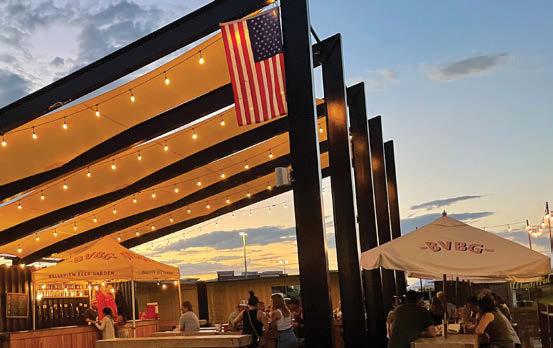
Outdoor Workout Class
Yoga or Barre class hosted by a local studio on the Beer Garden patio most Saturdays (check the calendar)! The $10 fee includes a free drink after the 10:00am – 11:00am class.
People + Produce (farmers market)
Local farmers and vendors along Newport Street from 9:00am – 1:00pm with live music from 11:00am – 2:00pm


In addition to weekly events and happenings, Belleview Station is the perfect location for foodies and those seeking farm to table freshness. It’s home to an array of dining options from casual to formal table settings and coffee to martini bars. After your meal, leave time to browse over 20 local shops and services and treat yourself, Belleview Station style.
Belleview Station is one block west of I-25 and can be accessed by light rail via the Belleview Station stop.
SATURDAY 100 MILES • 85 MILES • 50 MILES • 25 MILES Register now to save at D enver C entury R ide .com


J’S NOODLES STAR THAI 2 $
Westwood / Thai This traditional Thai spot has developed a cult following over the years. The tom yum soup, drunken noodles, and pad thai are regulars’ picks. Reservations not accepted. 945 S. Federal Blvd., 303-922-5495. Lunch, Dinner
JAMAICAN GRILLE $$
Lincoln Park / Jamaican This family-owned Jamaican restaurant serves classic Caribbean-centric dishes like jerk chicken, fried plantains, and rice and peas, accompanied by a menu of rum-infused cocktails. Reservations accepted. 709 W. Eighth Ave., 303-623-0013. Lunch, Dinner
JAX FISH HOUSE & OYSTER BAR $$$
LoDo / Seafood Enjoy sustainable seafood in an upbeat atmosphere. Specialties include the raw oyster bar and seasonally composed plates. Multiple locations. Reservations accepted. 1539 17th St., 303-292-5767. Dinner
JERUSALEM RESTAURANT $$
University / Middle Eastern You can’t beat this spot’s tasty, affordable, and traditional Middle Eastern fare, including gyros, baba ghanoush, and sambusas. Reservations accepted. 1890 E. Evans Ave., 303-777-8828. Lunch, Dinner
JOVANINA’S BROKEN ITALIAN $$$$

LoDo / Italian This gorgeous LoDo eatery expands on traditional Italian fare by incorporating unexpected, seasonal ingredients. Reservations accepted. 1520 Blake St., 720-541-7721. Dinner
KACHINA CANTINA $$$
LoDo / Southwestern Located in the Dairy Block, this spot specializes in Southwestern fare, such as pozole. Also try the Westminster-based sister location, Kachina Southwestern Grill. Reservations accepted. 1890 Wazee St., 720-460-2728. Lunch, Dinner, Brunch
TICKETS ON SALE TODAY
SEPT 23, 2023 BENEFITING: Discover Denver by bike on this ultimate urban cycling experience. ArvadaCenter.org - 720.898.7200 - 6901 Wadsworth Blvd. Arvada CO SPONSORED BY:



KAHLO’S MEXICAN RESTAURANT $$
Westwood / Mexican Enjoy plates of mole and enchiladas verdes, as well as a menu of almost 30 different juices and smoothies, in a space decorated with the art of Frida Kahlo. Reservations accepted. 3735 Morrison Road, 303-936-0758. Breakfast, Lunch, Dinner
KARMA ASIAN CUISINE $$
Speer / Asian Go out to this trendy eatery for a variety of Asian tapas (such as spicy edamame or calamari salad), or get more bang for your buck with the Thai bang bang chicken and shrimp. Reservations not accepted. 22 S. Broadway, 303-871-0167. Lunch, Dinner
KATSU RAMEN $$
Aurora / Japanese Satisfy a ramen craving with one of the traditional styles offered at this cozy spot. Try a combo meal, featuring your choice of ramen plus gyoza and a rice bowl. Reservations not accepted. 1930 S. Havana St., Aurora, 303-7512222. Lunch, Dinner
KP ASIAN CAFE $$
LA CALLE TAQUERIA Y CARNITAS $
Valverde / Mexican This is a must-visit destination for taco lovers. Try the tacos al pastor and carnitas, and don’t skip the salsa bar. Reservations not accepted. 1565 W. Alameda Ave., 720-583-6586. Breakfast, Lunch, Dinner
LA DIABLA $$
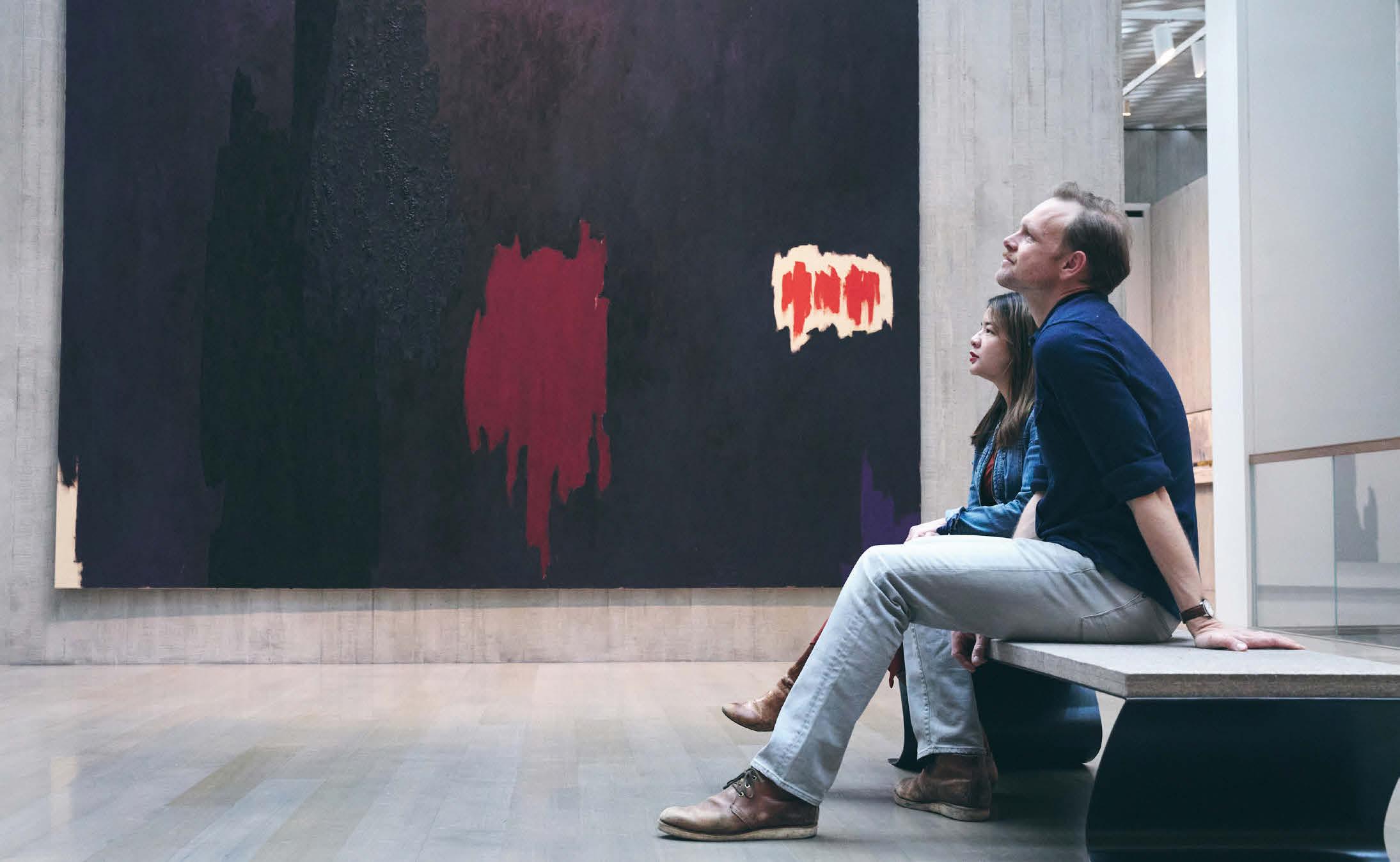
Ballpark / Mexican James Beard Award finalist
Jose Avila serves up comforting pozole and other traditional Mexican fare at this casual eatery. Don’t miss the weekend brunch for chilaquiles, huaraches, and a killer house michelada. Reservations not accepted. 2233 Larimer St., 720-5191060. Breakfast, Lunch, Dinner, Brunch
LA FILLETTE BAKERY $$
Montclair / French This French-inspired bakery makes magical laminated creations, including a brunch burger sandwiched between two croissant buns. Reservations not accepted. 6217 E. 14th Ave., 303-355-0022. Breakfast, Lunch, Brunch
LOGAN STREET RESTAURANT & BAR $$$
Speer / Mediterranean From the owners behind Carboy Winery, Logan Street serves wood-fired fare, fresh pastas, and flatbreads that pair well with the house-made vino. Reservations accepted. 400 E. Seventh Ave., 720-617-9400. Dinner
LOU’S FOOD BAR $
Capitol Hill / American To the delight of Nashville-style hot chicken fans, this Frank Bonnano eatery (formerly located in north Denver)
serves all manner of fried birds. Reservations not accepted. 701 Grant St., 303-860-2929. Lunch, Dinner
LOWRY BEER GARDEN $
Lowry Field / American This traditional, Germanstyle beer garden celebrates Colorado breweries with 16 draft lines (almost all of which serve local beer). Try the burgers or bratwurst with house-cut french fries. Reservations not accepted. 7577 E. Academy Blvd., 303-3660114. Lunch, Dinner
LUCILE’S CREOLE CAFÉ $
Speer / Southern Lucile’s offers Cajun and Creolestyle breakfasts and lunches with great service. Multiple locations. Reservations not accepted. 275 S. Logan St., 303-282-6258. Breakfast, Lunch
MAINE SHACK $$$
LoHi / Seafood New Englanders and seafood fans, rejoice: This fast-casual spot is slinging lobster rolls, fried whole-belly clams, chowder, roast beef sandwiches, and more. Multiple locations. Reservations not accepted. 1535 Central St., 303-997-2118. Lunch, Dinner
MANGO HOUSE $$
Aurora / International This immigrant- and refugeeled food hall is home to multiple outstanding culinary concepts: Urban Burma, Jasmine Syrian, Golden Sky Asian, Odaa Ethiopian, and Nepali Spice. 10180 E. Colfax Ave., Aurora, 303-9008639. Breakfast, Lunch, Dinner
MERCURY CAFE $$$
Five Points / Contemporary Enjoy live music and plenty of vegetarian options, as well as gnocchi and a bison burger. Reservations accepted. 2199 California St., 303-294-9258. Dinner, Brunch
MISFIT SNACKBAR $$
City Park / Contemporary Chef-owner Bo
Porytko serves a rotating lineup of imaginative but familiar pub fare at this walk-up kitchen inside Middleman cocktail bar. Try the chips and dip: smashed potatoes with an ever-changing house sauce. Reservations not accepted. 3401 E. Colfax Ave., 303-353-4207. Dinner
MIZU IZAKAYA $$
LoHi / Sushi This contemporary Japanese restaurant offers an impressive bar and a hip atmosphere. Reservations accepted. 1560 Boulder St., 720-3727100. Lunch, Dinner
MOLOTOV KITSCHEN & COCKTAILS $$$
City Park / European The ever-changing menu at this aptly kitschy restaurant celebrates the cuisine of Ukraine. Try creative takes on borscht and Eastern European dumplings. Reservations accepted. 3333 E. Colfax Ave., 303-316-3333. Dinner
MY BROTHER’S BAR $
LoHi / Pub Enjoy beers and burgers with classical music in one of Denver’s oldest bars. Reservations not accepted. 2376 15th St., 303-455-9991. Lunch, Dinner

NARRATIVE
$$$$
Cherry Creek / American Chef Paul Nagan serves gussied-up versions of American favorites at this sleek eatery. Reservations accepted. 222 Milwaukee St., 720-571-8080. Breakfast, Lunch, Dinner
NEW SAIGON $$
Westwood / Vietnamese This spot serves an extensive menu featuring delicious rice paper wraps, salads, pho, seafood dishes, duck, and more. Reservations accepted. 630 S. Federal Blvd., 303-936-4954. Lunch, Dinner
NI TUYO
$$$
Belcaro / Mexican Visit this Bonnie Brae eatery for bubbly molcajetes: piping-hot stone bowls of Mexican meats and veggies stewed in chile sauce. Reservations not accepted. 730 S. University Blvd., 303-282-8896. Dinner
NOISETTE
$$$$
LoHi / French Chefs Tim and Lillian Lu serve elegant renditions of French bourgeoisie-style specialties (home-cooked comforts) in a romantic, light-drenched space. Reservations accepted. 3254 Navajo St., Suite 100, 720-769-8103. Dinner
NOLA VOODOO TAVERN AND PERKS $$
Clayton / Southern New Orleans native and owner
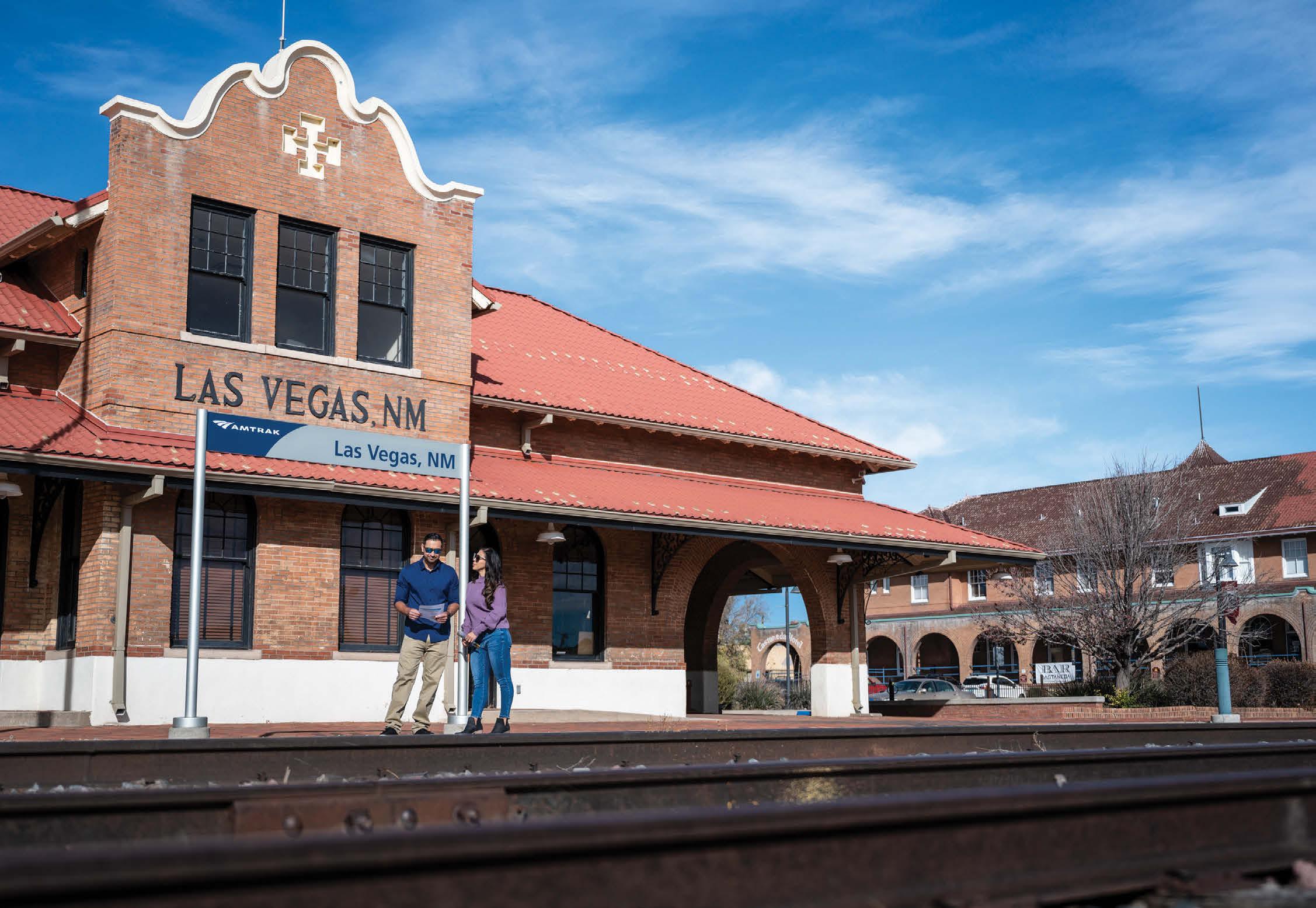
Henry Batiste serves his grandmother’s recipes for gumbo, po’ boys, and more at this Louisianainspired spot. Reservations accepted. 3321 Bruce Randolph Ave., 720-389-9544. Lunch, Dinner
NORTH COUNTY $$
Lowry Field / Mexican With a beach bar atmosphere in a landlocked state, this San Diego–inspired taqueria boasts a daily catch of grilled fish tacos and a bar full of tequila libations and spiked sodas batched and bottled in-house. Reservations accepted. 94 Rampart Way, 720-532-0106. Lunch, Dinner, Brunch
OAK AT FOURTEENTH $$$$
Boulder / Seasonal This bright, open space just off the Pearl Street Mall offers a diverse, ever-changing menu of seasonal, oak-fired eats from chef Steve Redzikowski and creative cocktails from Bryan Dayton. Order the kale and apple salad, oak-roasted ocean trout, or a handmade pasta dish. Reservations accepted. 1400 Pearl St., Boulder, 303-444-3622. Dinner
OFFICERS CLUB $$$
Lowry Field / American Nosh on American staples like cheddar biscuits, a prime rib French dip, and the juicy bacon burger at this neighborhood dining room and bar, which is inspired by the military legacy of the Lowry Air Force Base. Reservations accepted. 84 Rampart Way, 303-284-0714. Lunch, Dinner, Brunch
OHANA ISLAND KITCHEN $
LoHi / Seafood This Hawaiian-inspired eatery serves top-notch tuna poke, Spam musubi, Kalua pork, and more in a casual setting. Reservations not accepted. 2563 15th St., 303-718-6580. Lunch, Dinner
OLIVE & FINCH $$
City Park West / American Discover wholesome, inspired meals at this restaurant, bakery, and juice bar, where you’ll find a full coffee bar, artisan sandwiches, hearty soups, tasty salads, and house-made pastries made daily. Also try the Cherry Creek location. Reservations not accepted. 1552 E. 17th Ave., 303-832-8663.
Breakfast, Lunch
ONEFOLD $$
City Park West / Contemporary This eatery does early-day dining justice. Pair the bacon fried rice with house-made bone broth, Vietnamese iced coffee, or a local IPA. Also try the LoDo location. Reservations not accepted. 1420 E. 18th Ave., 303-954-0877. Breakfast, Lunch
OPHELIA’S ELECTRIC SOAPBOX $$
Ballpark / Contemporary This restaurant features quirky design details and a stage for live music. The “gastro-brothel” menu encompasses globally inspired pub fare like flatbreads, small plates, and burgers. Try the green chile cornbread with goat cheese. Reservations accepted. 1215 20th St., 303-993-8023. Dinner, Brunch
OSAKA’S $$
Boulder / Japanese Enjoy unique Japanese comfort food at this Boulder restaurant. Try one of the signature Osaka Burgers, which sub a savory Japanese pancake (okonomiyaki) for the traditional bun. Reservations accepted. 2460 Canyon Blvd., Boulder, 720-398-9115. Dinner

PADOCA BAKERY & MARKET $
Montclair / South American This Brazilian bakery serves an assortment of sweet and savory goodies. Try traditional items, like the brigadeiro or the pão de queijo, with a latte. Reservations not accepted. 950A Jersey St., 720-520-007.
Breakfast, Lunch
PARISI $$
Berkeley / Italian Enjoy quick, casual dining at this restaurant, whose menu includes pizzas, housemade pasta, salads, and gelato. Reservations not accepted. 4401 Tennyson St., 303-561-0234.
Lunch, Dinner
PARK & CO $
Uptown / American This casual tavern serves sandwiches and salads but specializes in gourmet burgers. Try the Hatch green chile burger. Reservations not accepted. 439 E. 17th Ave., 720-328-6732. Lunch, Dinner
PETE’S KITCHEN $

Cheesman Park / American A Denver landmark and a staple for late-night comfort food, Pete’s is known for its breakfasts but also serves burgers, gyros, and souvlaki sandwiches any time of day. Reservations not accepted. 1962 E. Colfax Ave., 303-321-3139. Breakfast, Lunch, Dinner
PHO 79 $

Broomfield / Asian Some of the best Vietnamese pho noodle soup you’ll find on the Front Range. Reservations accepted. 6650 W. 120th Ave., Suite 5, Broomfield, 303-439-0028. Lunch, Dinner
PIZZERIA LOCALE $
Speer / Pizza This fast-casual pizza spot offers family-friendly counter service with premium ingredients. Multiple locations. Reservations not accepted. 550 Broadway, 720-740-4020. Lunch, Dinner
POINT EASY $$$$
Whittier / Contemporary This casual, inviting farmto-table eatery produces feasts made with thoughtfully sourced ingredients, many of which are local. Reservations accepted. 2000 E. 28th Ave., 303-233-5656. Dinner
POST OAK BARBECUE $$
Berkeley / Barbecue Texas barbecue smoked over the restaurant’s namesake wood is the draw at this Tennyson Street joint. Don’t miss the certified Angus prime brisket and the house-made sausage. Reservations not accepted. 4000 Tennyson St., 303-458-1555. Breakfast, Lunch, Dinner
Q HOUSE $$
City Park / Chinese Enjoy a modern take on Chinese cuisine executed by chef Christopher Lin, an alum of Momofuku in New York City. Try the braised pork rice. Reservations accepted. 3421 E. Colfax Ave., 720-729-8887. Dinner
QUALITY ITALIAN $$$$
Cherry Creek / Steak House This upscale spot serves a smart mix of steak house fare and American-Italian favorites. Try the baked lasagna for two. Reservations accepted. 241 Columbine St., 303-532-8888. Dinner, Brunch
QUE BUENO SUERTE $$$

Platt Park / Mexican The menu at this vibrant restaurant offers familiar items like tacos and fajitas as well as upscale, regionally inspired Mexican fare. Reservations accepted. 1518 S. Pearl St., 720-642-7322. Dinner, Brunch
QUIERO AREPAS $

Platt Park / Latin American The entirely glutenfree menu offers delicious selections like the pollo guisado arepa, a flatbread that comes stuffed with shredded chicken, black beans, and cheese. Also check out the LoHi location. Reservations not accepted. 1859 S. Pearl St., 720-432-4205. Lunch, Dinner
RANDALL’S $$
Cole / Southern This neighborhood restaurant serves up comforting Southern fare with a side of warm hospitality. Try the fried catfish dinner. Reservations not accepted. 3349 York St., 720-583-0473. Lunch, Dinner
REDEEMER PIZZA $$$
RiNo / Pizza Spencer White and Alex Figura, the duo behind Dio Mio, bring perfectly blistered, New York City–style sourdough pizza to RiNo. Nosh on full pies in the dining room or nab a slice from the walk-up window in the back. Reservations accepted. 2705 Larimer St., 720-780-1379. Dinner
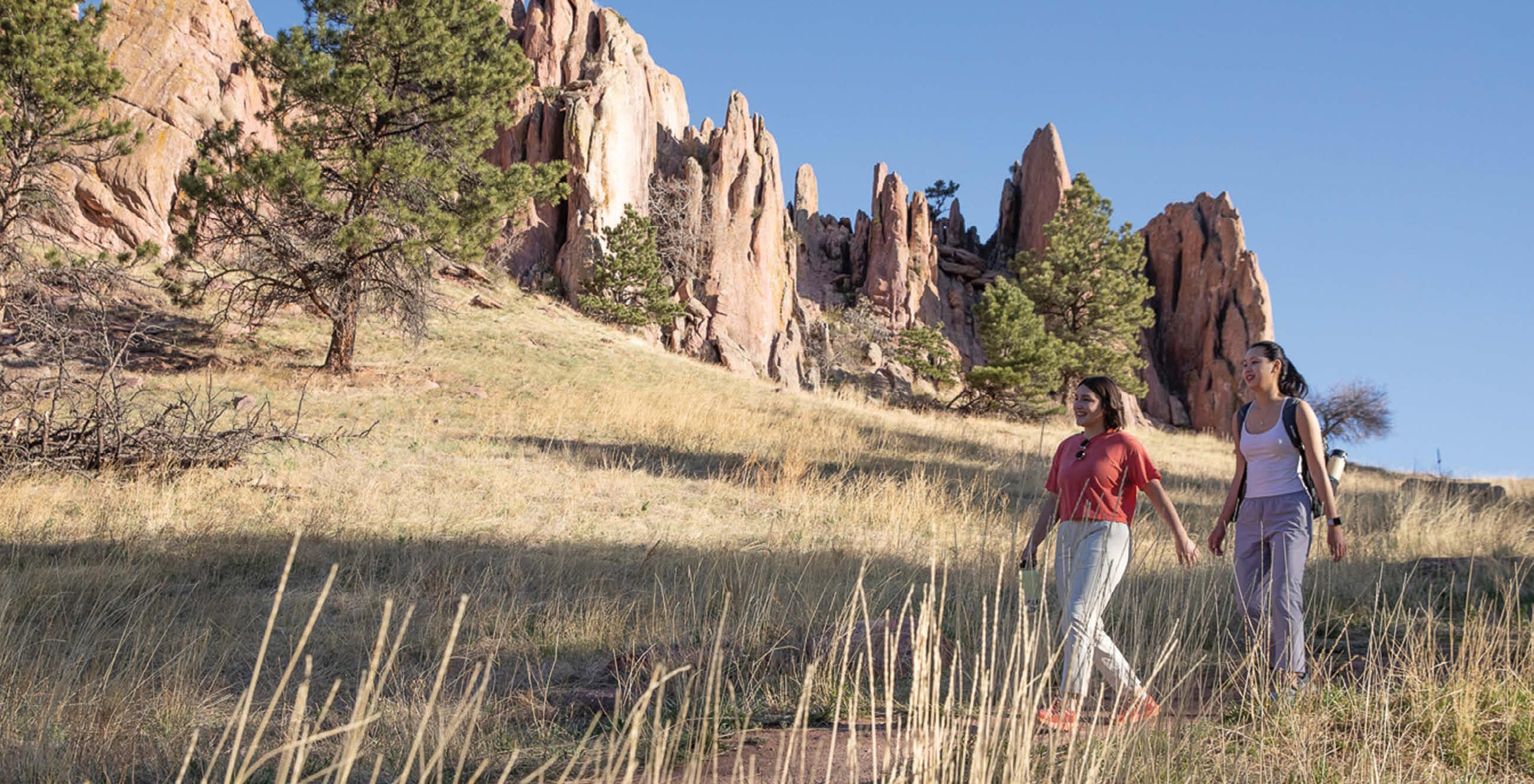

RESTAURANT OLIVIA $$$$
Washington Park / Italian This cozy yet modern neighborhood spot from the team behind Bistro Georgette specializes in fresh pastas and Italian classics like porchetta. Reservations accepted. 290 S. Downing St., 303-999-0395. Dinner
RIO GRANDE MEXICAN RESTAURANT $$$
LoDo / Mexican Natural ingredients, fresh produce, and unique flavors characterize this Mexican spot. Multiple locations. Reservations accepted. 1745 Wazee St., 303-623-5432. Lunch, Dinner, Brunch
ROOM FOR MILLY $$
LoHi / American A menu of refined small plates and killer cocktails complements a jazz-age ambience inspired by a fictional globe-trotting socialite at Room for Milly. Reservations not accepted. 1615 Platte St., Suite 145, 720-630-7020. Dinner
ROSETTA HALL $$
Boulder / International The tenants of Boulder’s first food hall include Amira, Shanghai Moon, Cruz, Petite Fleur, Amalfi, and more. 1109 Walnut St., Boulder. Breakfast, Lunch, Dinner
ROUGE WINE BAR & PATIO $$$
Greenwood Village / American From the team behind Pindustry, this 1920s-themed bar boasts an extensive wine list and international small plates. Reservations not accepted. 7939 E. Arapahoe Road, Suite 190, Greenwood Village, 720-864-9463. Dinner, Brunch
SAFTA $$$$
RiNo / Mediterranean Acclaimed chef Alon Shaya brings his modern Israeli fare to Denver. Start with the creamy hummus and pillowy wood-oven pita before moving onto dishes like tabbouleh salad, short-rib-stuffed cabbage, and harissa chicken. Reservations accepted. 3330 Brighton Blvd., Suite 201, 720-408-2444.
Dinner, Brunch
SHI MIAO DAO YUNNAN RICE NOODLE $$
Aurora / Asian This build-your-own rice noodle soup restaurant specializes in cross-the-bridge noodles from China’s Yunnan province and delicious boba milk teas. Reservations not accepted. 2000 S. Havana St., Aurora, 720-583-2839.
Lunch, Dinner
SOMEBODY PEOPLE $$$
Overland / Mediterranean At this vegan restaurant, Sam and Tricia Maher and head chef Art Burnayev run a pasta program with dishes that celebrate seasonal bounty. Try the Feed Me experience. Reservations accepted. 1165 S. Broadway, Suite 104, 720-502-5681. Dinner
SPUNTINO $$$$
Highland / Italian Enjoy the locally sourced menu at this Italian-inspired, husband-and-wifeowned spot. Try the seasonal pasta or any dish with Southern Indian influences. Don’t miss the house-made gelato for dessert. Reservations accepted. 2639 W. 32nd Ave., 303-433-0949. Dinner
STEVE’S SNAPPIN’ DOGS $
City Park / American Delicious hot dogs with all the fixings are served at this happy-to-please stand. Reservations not accepted. 3525 E. Colfax Ave., 303-333-7627. Lunch, Dinner
SUNDAY VINYL $$$

LoDo / European This Union Station restaurant offers warm hospitality, exquisite cuisine, and an extensive wine list, all to the soundtrack of a vinylonly playlist. Reservations accepted. 1803 16th St., 720-738-1803. Dinner
SUPER MEGA BIEN $$$
RiNo / Latin American Chef Dana Rodriguez offers a combo of large-format, shareable items and Pan-Latin small plates, the latter of which are served from roving carts. Reservations not accepted. 1260 25th St., 720-269-4695. Dinner
TABLE 6 $$$$
Speer / American This space’s warm and cozy atmosphere extends to the American bistro cuisine, which is elevated by haute foodie touches. Reservations accepted. 609 Corona St., 303-831-8800. Dinner
TAVERNETTA $$$$
LoDo / Italian The team behind Boulder’s acclaimed Frasca Food and Wine offers the same attention to hospitality at this more casual Denver restaurant, home to dishes from across Italy. Reservations accepted. 1889 16th St., 720-6051889. Lunch, Dinner












SATURDAY
&
TEMAKI DEN $$
RiNo / Japanese Chef Kenta Kamo and Sushi Den’s Toshi Kizaki team up to bring temaki (hand rolls), aburi (flame-seared) nigiri, and craft beverages to the Source Hotel. Reservations accepted. 3330 Brighton Blvd., Suite 110, 225-405-0811. Dinner
TESSA DELICATESSEN $
Montclair / Deli This modern all-day eatery from Vince Howard, formerly of Del Rey Deli in Los Angeles, has hot and cold sandwiches and salads. Reservations not accepted. 5724 E. Colfax Ave., 720-746-9138. Breakfast, Lunch, Dinner
THAI POT CAFE
Virginia Village / Asian Try a variety of curries, noodle bowls, soups, salads, and coconut-infused desserts at this cozy Thai restaurant. Reservations not accepted. 1350 S. Colorado Blvd., Suite 191, 303-63-6200. Lunch, Dinner

$

THE TRUFFLE TABLE $$
LoHi / Seasonal As an offshoot of the Truffle Cheese Shop, it’s no surprise that a variety of cheese boards and fromage-focused small plates color the menu. Reservations not accepted. 2556 15th St., 303-455-9463. Dinner
TOCABE, AN AMERICAN INDIAN EATERY $ Berkeley / American Feast on Indigenous fare like fry bread tacos, with bison, beans, lettuce, cheese, and salsas, or spicy potato- and corn-laden green chile stew at this fast-casual spot. Reservations not accepted. 3536 W. 44th Ave., 720-524-8282. Lunch, Dinner
UCHI DENVER $$$$
Curtis Park / Japanese James Beard Award–winning chef Tyson Cole combines unexpected flavors for his unique take on Japanese food. Visit for the daily happy hour, when nigiri and temaki are less than $10. Reservations accepted. 2500 Lawrence St., 303-444-1922. Dinner
ULTREIA $$$
LoDo / Spanish James Beard Award–winning chef Jennifer Jasinski brings Iberian fare to Union Station. Reservations accepted. 1701 Wynkoop St., Suite 125, 303-534-1970. Lunch, Dinner, Brunch
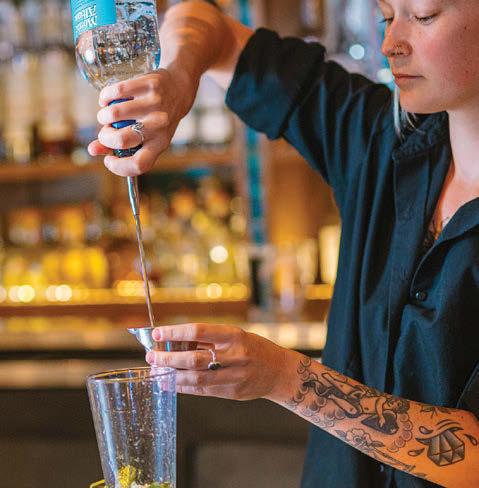

UNCLE $$
Speer / Asian A bustling atmosphere defines this popular noodle house. The concise menu includes dishes such as Chinese-style steamed buns and, of course, noodles. Also try the Highland location. Reservations not accepted. 95 S. Pennsylvania St., 720-638-1859. Dinner
URBAN FARMER $$$
LoDo / Seasonal This steak house features wholeanimal butchery and an excellent charcuterie program. Reservations accepted. 1659 Wazee St., 303-262-6070. Dinner, Brunch
URBAN VILLAGE GRILL $$$


VITAL ROOT $$
Berkeley / American Justin Cucci’s fourth eatery focuses on quick, healthy food. Grab a seat in the airy space and nosh on creative, wholesome fare such as cashew “queso” dip or a sunflower risotto. Reservations not accepted. 3915 Tennyson St., 303-474-4131. Lunch, Dinner, Brunch
VOGHERA RISTORANTE & APERICENA $$$
Berkeley / Italian Enjoy Italian-style tapas such as beef tartare, burrata, and pancetta-wrapped scallops at this rustic-chic Berkeley outpost. Reservations not accepted. 3963 Tennyson St., 303-455-9111. Dinner, Brunch
WATER GRILL $$$$
LoDo / Seafood Fresh seafood is flown in daily to this chic restaurant specializing in shellfish and raw bar offerings. Reservations accepted. 1691 Market St., 303-727-5711. Dinner
WEATHERVANE CAFE $
City Park West / American Enjoy a small but sumptuous menu of breakfast items, sandwiches, and salads at this cozy cafe. Reservations not accepted. 1725 E. 17th Ave. Breakfast, Lunch
WHITTIER CAFE $
Whittier / Cafe This espresso bar, which supports social justice causes, serves coffee, beer, and wine sourced from African nations and a small menu of pastries, burritos, panini, and more. Reservations not accepted. 1710 E. 25th Ave., 720-550-7440. Breakfast, Lunch
THE WOLF’S TAILOR $$$$
Sunnyside / American Chef Kelly Whitaker fuses Asian and Italian techniques and ingredients at this hip Sunnyside eatery. The results, such as 7X brisket braised in dashi and red wine, are uniquely delicious. Reservations accepted. 4058 Tejon St., 720-456-6705. Dinner
WYNKOOP BREWING COMPANY $$
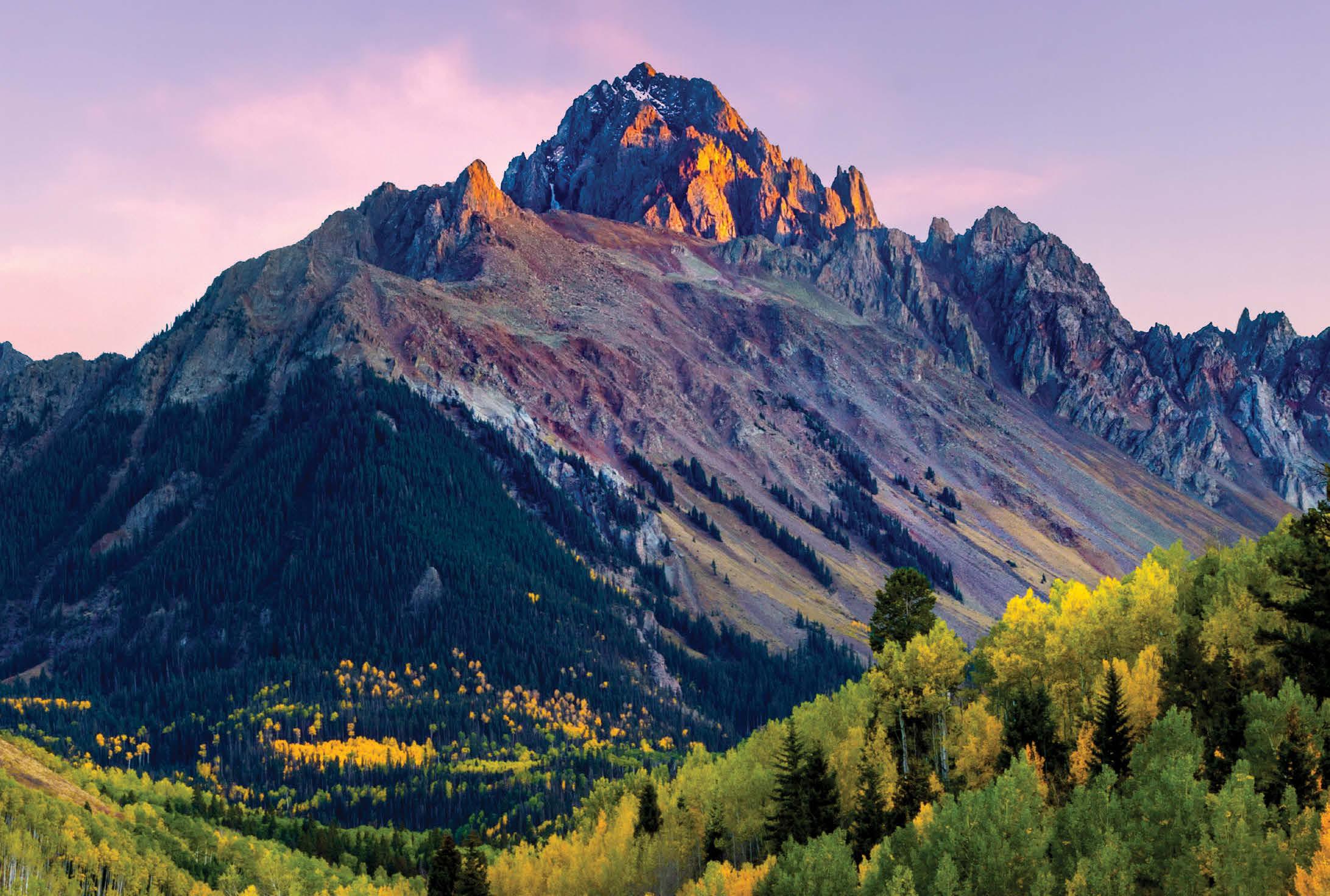
LoDo / Pub Enjoy freshly brewed beer and feast on pub favorites such as the bison burger or the fish and chips at one of Denver’s original brewpubs. Reservations accepted. 1634 18th St., 303-297-2700. Lunch, Dinner, Brunch
XICAMITI LA TAQUERÍA $$
Golden / Mexican This long-standing joint serves cooked-to-order burritos, tacos, quesadillas, and alambres (skillet dishes). Reservations not accepted. 715 Washington Ave., Golden, 303-2153436. Breakfast, Lunch, Dinner
YACHT CLUB $
Cole / American Enjoy classic and creative cocktails at this loungelike bar, alongside an array of snacks. Reservations not accepted. 3701 N. Williams St., 720-443-1135. Dinner
YARD HOUSE $$
Downtown / Fusion This fun and casual American eatery features a center island bar and classic rock tunes. Also try the Lakewood location. Reservations not accepted. 1555 Court Place, 303-5729273. Lunch, Dinner
Introducing the Colorado Rosé, a locally made rosé that celebrates the best of our Centennial State. To commemorate 5280 ’s 30-year anniversary we’ve partnered with Carboy Winery to bring you a delicious, Colorado-grown rosé that gives back to the community.

YAZOO BARBEQUE COMPANY $
Five Points / Barbecue This unpretentious barbecue joint offers a Deep South menu, featuring slow-smoked pork ribs and brisket. Reservations not accepted. 2150 Broadway, 303-296-3334. Lunch, Dinner
ZIN ZIN’S BURMESE CUISINE $
Aurora / Asian Sample traditional Burmese cuisine like beef samosas and mohinga (rice noodles in a split pea purée). Reservations not accepted. 14200 E. Alameda Ave., Aurora, 720-982-2477. Lunch, Dinner
ZOCALITO LATIN BISTRO $$$
Downtown / Mexican Formerly located in Aspen, chef/owner Michael Beary’s upscale Oaxacan eatery found a home in the heart of Denver. Try the pork tenderloin with red mole sauce. Reservations accepted. 999 18th St., Suite 107, 720-923-5965. Dinner
ZOMO $$
Englewood / Asian Owners Alysia Davey and Ryan Anderson serve family recipes inspired by their Vietnamese and Chinese roots. Reservations accepted. 3457 S. Broadway, Englewood, 720-739-8882. Lunch, Dinner
These listings are in no way related to advertising in 5280. If you find that a restaurant differs significantly from the information in its listing or your favorite restaurant is missing from the Dining Guide, please let us know. Write us at 5280 Publishing, Inc., 1675 Larimer St., Suite 675, Denver, CO 80202 or dining@5280.com.
A portion of all proceeds from this rosé will support We Don't Waste and their vision that food goes to people, not landfills, and is accessible to all.


Stone kept paying while the restaurant was first closed for COVID-19 and then for renovations. The employees couldn’t do anything at the site while it was under construction, so the leadership team decided to pay the staff to volunteer at a variety of local nonprofits. Perez worked in the kitchen at Project Angel Heart. Beau Gentry, a 29-year-old cliff diver, spent time with Habitat for Humanity ReStore. Meanwhile, native Spanish speakers were offered English classes, while native English speakers were offered Spanish. “They could have just let us all go,” Gentry said. “But they realized they wanted to keep us together, and then we all got to come back to Casa Bonita and keep that tight-knit family that we had created over time.”
Keeping the staff on payroll wasn’t simply about generosity, though. Parker and Stone have learned a few lessons over the years, and one of them is placing their trust


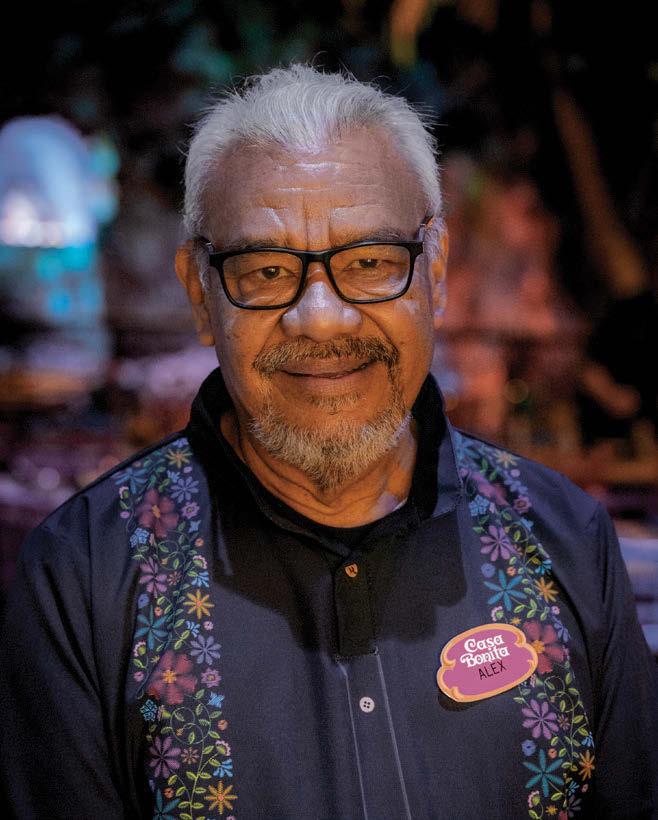

in the people who work for them. When they first began producing Book of Mormon, it quickly became clear that their creation was out of their hands; they weren’t the ones up onstage. Having always been so hands-on with South Park, it was difficult to relinquish control. Book of Mormon finally taught them how to let go.
“We don’t live here,” Stone said of Denver. “We’re not going to be here all the time. We’re going to continue to be involved with creating new content experiences, but other people are going to be doing the heavy lifting here. Our hope is to select those people and give them the tools they need.”

DANA RODRIGUEZ IS ONE of the people Stone and Parker chose early on, when they brought her on as executive chef. Ironically, it wasn’t the first time the Mexico native had considered a job at Casa Bonita. When she arrived in the United States from Chihuahua in 1998, then 23-year-old Rodriguez applied for a position in Casa Bonita’s kitchen. She didn’t have any professional experience at the time—she’d just cooked with her father—but, she figured, it was Casa Bonita. How hard could it be to open cans of enchilada sauce? When the restaurant finally got back to her, she was told she wasn’t qualified.
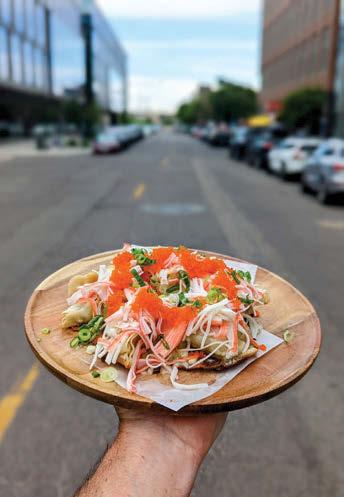
More than two decades later, Rodriguez’s resumé had improved considerably. She had opened two groundbreaking and successful restaurants in Denver, first Work & Class and then Super Mega Bien. She had founded a tequila and mezcal brand, Doña Loca, and opened a bar and restaurant called Cantina Loca. She had also received nominations for multiple James Beard Foundation awards. With that CV and the knowledge that Parker and Stone had purchased the restaurant, Rodriguez told her friend, chef Jen Jasinski, that she was going to drop off

What’s on your summer bucket list? A hike at Palmer Park and a 16th Street shopping spree? How about a concert at Red Rocks and a FoCo brewery tour? No matter what you do, Canvas is here to help you make the most of your Front Range experience.
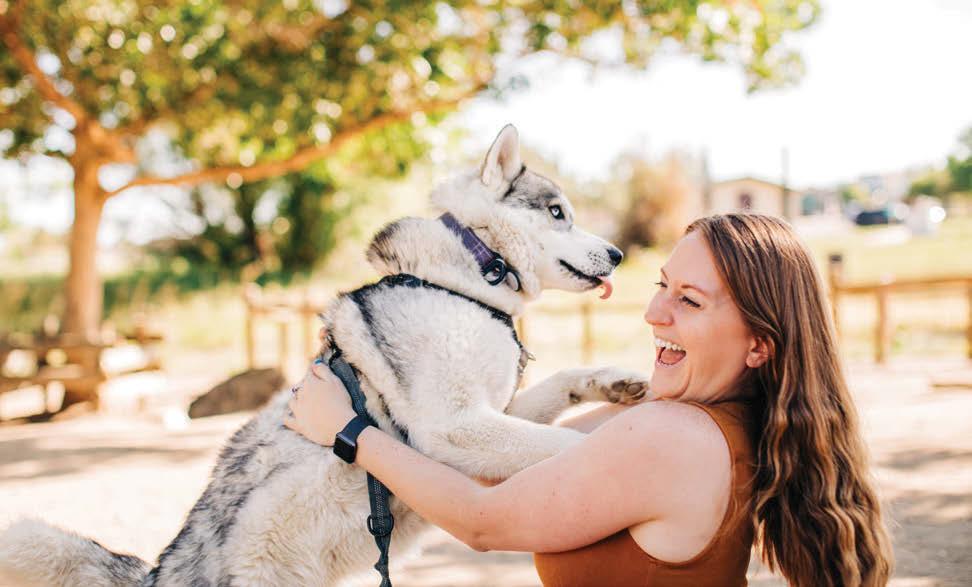

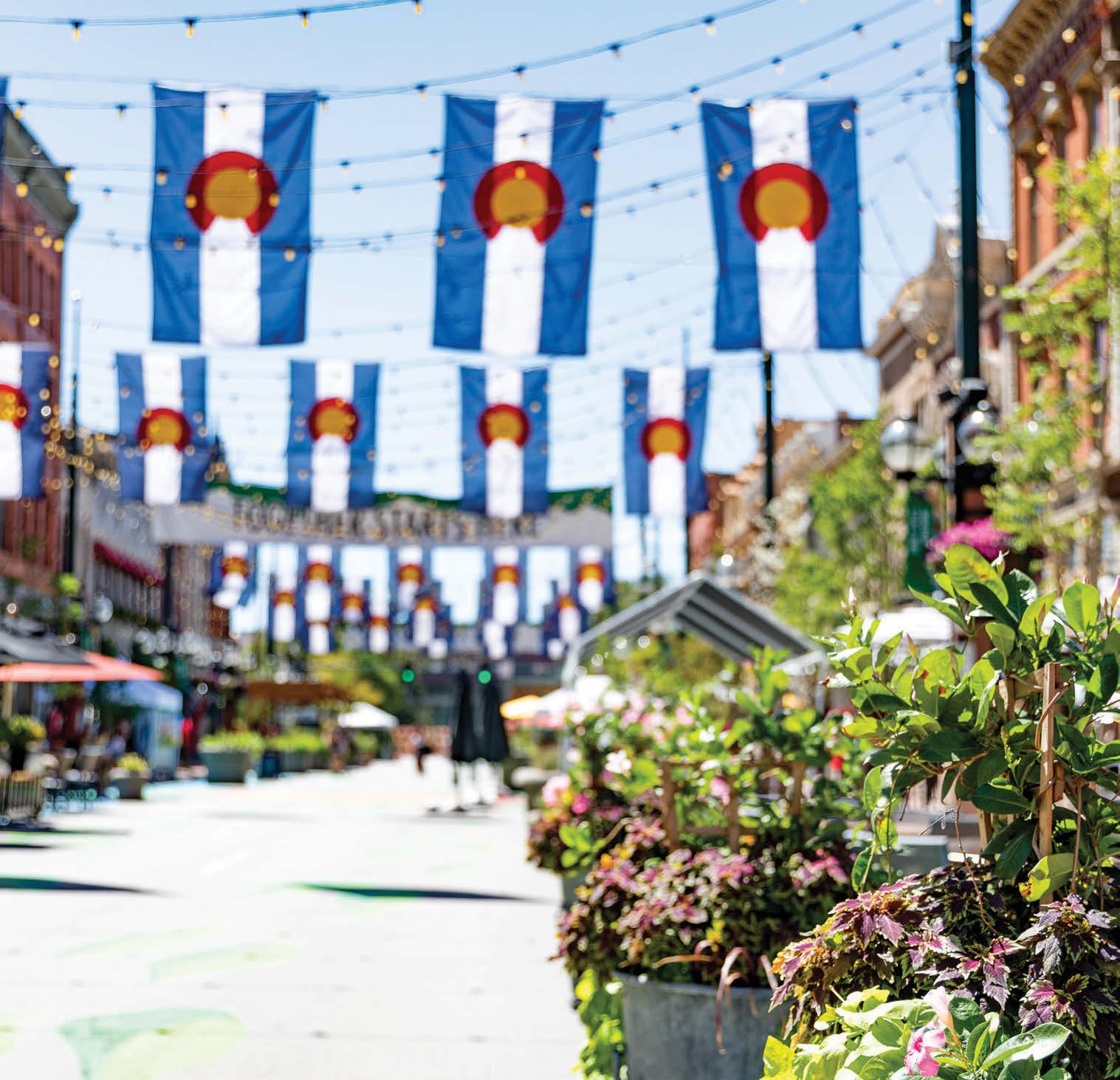
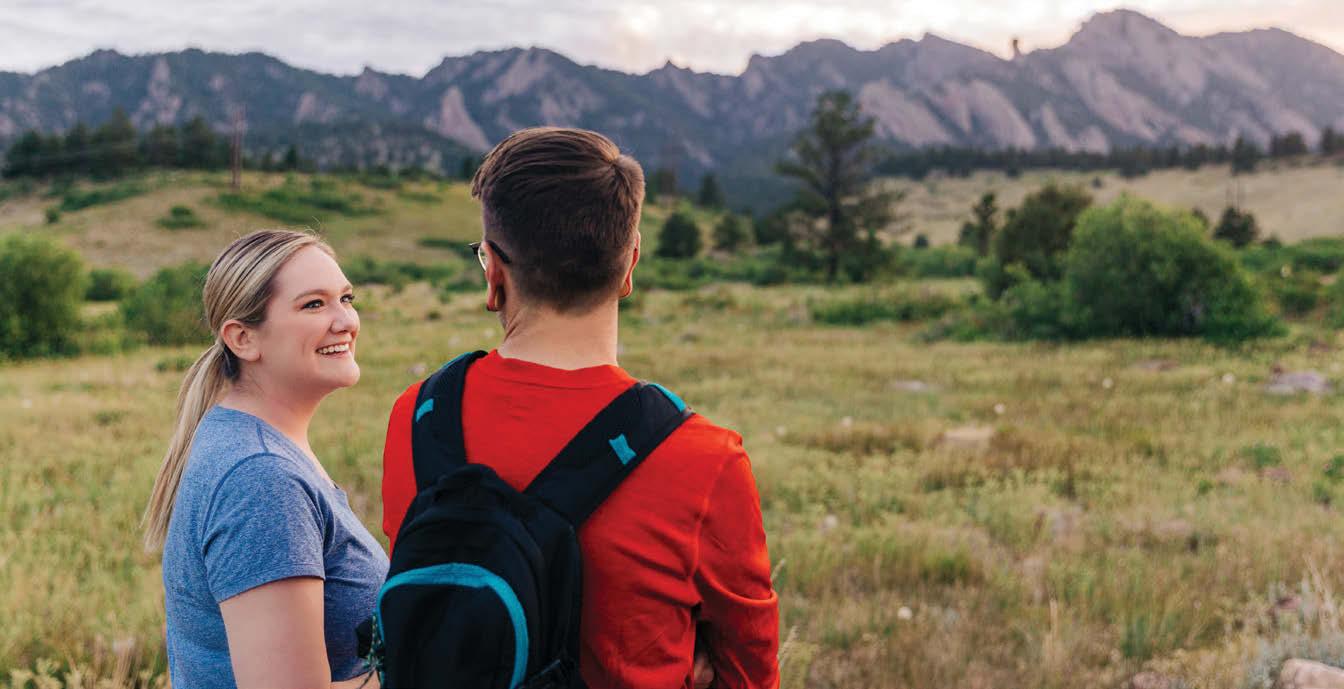
her resumé. “I bet I’m fucking qualified now,” she told Jasinski.

As it turned out, she didn’t need to apply. In October 2021, Rodriguez received a voicemail from an industry contact. The gist of the message was: Hear me out…do you want to be the executive chef at Casa Bonita? Rodriguez, who also goes by the nickname Loca (Spanish for “crazy”) and is arguably as fond of the F-word as Parker and Stone are, was interested in the
Keeper’s Heart is a remarkable new style of whiskey, blending Irish and American distilling traditions.


Created by WorldRenowned Master Distiller Brian Nation, formerly of Jameson, Midleton and Redbreast, Keeper’s Heart is the most awarded new whiskey of 2022.
proposition—with conditions. So in November 2021, Rodriguez met with Parker and Stone’s representatives at the Four Seasons on 14th Street in downtown Denver. She rolled up on her motorcycle and walked into the meeting with her helmet tucked under one arm and proceeded to tell everyone her plans. And they were very big plans—including preparing everything on Casa Bonita’s menu from scratch. “I’m going to make homemade sauces,” she said. “I’m
going to make homemade tortillas. It’s going to be amazing.” Parker and Stone’s people were excited about Rodriguez after the interview.
Although Stone and Parker had gone to extraordinary lengths to keep things the same at Casa Bonita, they knew the food had to be improved. The running joke in Denver had long been that you should eat dinner before going to Casa Bonita and then have the sopaipillas for dessert. Parker and Stone were adamant that whoever the chef was, that person needed to agree that the new Casa Bonita would be a place where adults wouldn’t “bitch about the food,” as Stone put it.
“I met her and was like, That’s the person,” Parker said. “She totally has the right energy, has the right confidence, but she’s also like us. She just wants people to love it.”
Rodriguez plans to serve items like asadero cheese enchiladas, roasted adobo chicken marinated in chipotle sauce, and slow-braised carnitas with green chile, which will be dished out from a Chipotle-like counter so diners can actually see what they’re ordering—an improvement from the food slots Casa Bonita veterans likely remember. Rodriguez is shaking up Casa Bonita’s bar program, too. There will be margaritas, of course, but they’ll be made with fresh ingredients. Adults will also be able to order a paloma that’s made with tequila, grapefruit liqueur, and Aperol. And there’s a rum old fashioned, if agave spirits aren’t your thing.
There will also be an element of theater to the drinks program. At the main bar, you’ll be able to order a beverage that’s a play on a margarita and serves four to six people. The twist? The bartenders include activated charcoal in the cocktail, so it’s black. Then they serve it in a bowl that mimics a volcano, flowing lava included. “Back in the day at Casa, there was one tiny bar, and you had to wait, like, 45 minutes to get a margarita, and there was no fun involved,” bar manager Jason Green said. “The biggest difference in the bar program specifically is that it’s definitely the most fun program I’ve been a part of.”
Please taste responsibly. @2023. Bottled by O’Shaughnessy Distilling Company, Minneapolis, MN
Rodriguez said that when Casa Bonita reopens, she will be there just about every day, if not every day. “I supervise all the food and drinks,” she said. “They’re my recipes, so I want to make sure there’s consistency. [We’re using] real cheese. And we have house-made tortillas, and we make our enchilada sauce in-house. We cook the rice in-house—the beans, the green chile, the roasted chicken. We’re still going to have chips and salsa and margaritas, but in our own way, in a better way.”



There was still one food item we hadn’t talked about. “It’s funny,” Rodriguez said. “When I started, I was nervous about the sopaipillas, because that’s what people ask for.” The Casa Bonita recipe Rodriguez got for the sopaipillas was not especially helpful. It read: one hundred pounds flour, water, and lard. That’s it. “I was like, OK, I’m going to start with those three ingredients,” she said, laughing. “But I need ratios. I need to know what temperature the water should be. So, I made the first batch, and we were lucky to have all of the employees who’d worked here and some of the actors, and I said, ‘I want you to be fucking honest. Are these what Casa used to serve?’ Because my fear was people would try them and say, ‘Oh, they’re different. They’re not the same.’ And they’re exactly the same.”
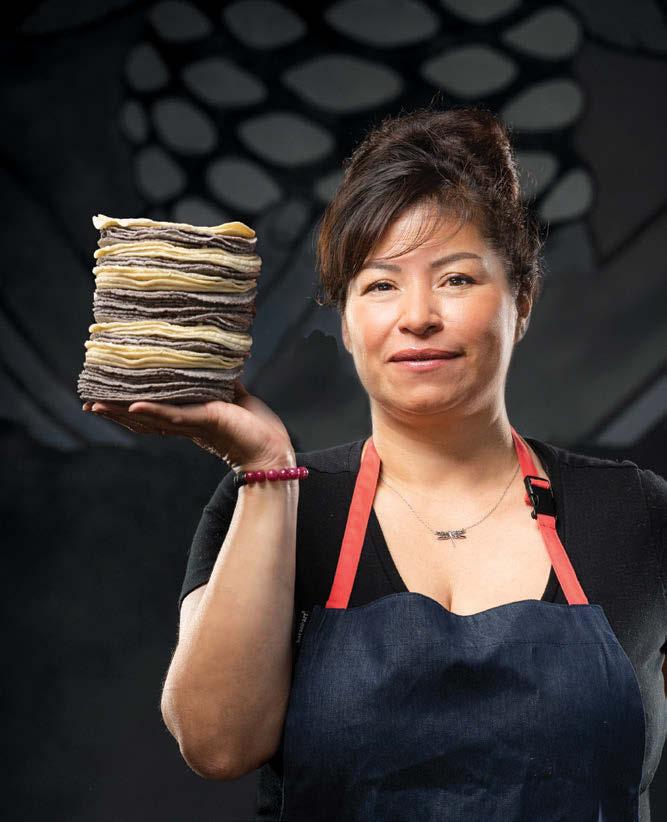
ON A CLEAR, WARM DAY this past May, more than 100 reporters, videographers, and photographers lined up outside the pink facade of Casa Bonita for a media preview of the space. In the days and weeks leading up to the showing, there had been fevered speculation about the restaurant’s opening date, which had not yet been released. Fans of
both Casa Bonita and South Park had hypothesized that, because there had been an official announcement that the restaurant would open sometime in May, the 26th might be the day. Their reasoning? May 26 is Kyle Broflovski’s birthday. (It also happens to be Stone’s birthday.)
The internet sleuths were wrong, and the restaurant didn’t open on the 26th—and, in fact, at press time in mid-June, Casa Bonita was still in a “soft opening” phase. Instead, members of the media were given a short, partial tour that day that was tightly controlled by handlers—and a not insignificant amount of security. Any news that
journalists wanted to push out to the world was embargoed until 1 p.m., and predictably, just about every local media outlet, including this one, pressed “publish” on stories early that afternoon.

I’d been fortunate enough to tour the space with Rodriguez and Chris Brion, the creative director of South Park Digital Studios, who was overseeing the Casa Bonita project, three weeks earlier. I saw the completely revamped theater; the new arcade, which has root beer on tap for the kids; and each of the new bars (there are four now instead of one)—none of which had been part of the media tour. That was very intentional. The new owners of Casa Bonita wanted to save some surprises for their inreal-life customers.
A few days after my tour, I chatted with Parker and Stone, who asked me what I thought of the renovation. When I told them I thought they’d done a good job of making it feel the same while removing what I called a “charming layer of grunge,” Parker and Stone said that a lot of what had gone into the renovation wasn’t sexy. “When we’re making movies, we have this saying: ‘We want to see it on the screen,’ ”
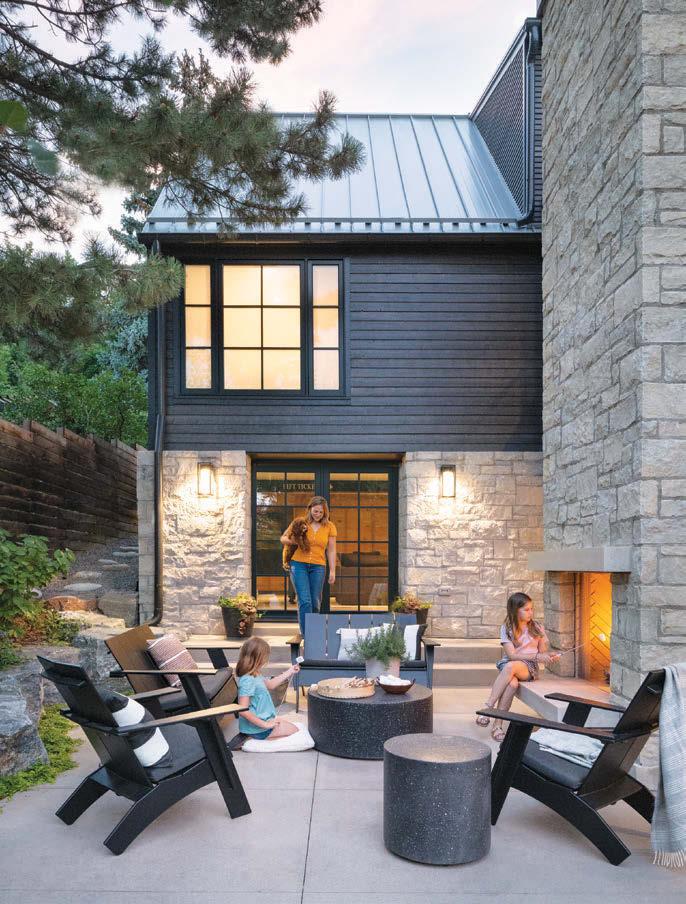

Stone said. “This is stuff you’re not seeing on the screen. There was a lot of that, and honestly, that was a bummer.”
At one point, Parker said, “I was like, Oh, man, we’re going to open this thing and no one is going to even notice the differences.”
That’s clearly not the case. Having been through the space already, I was able to gauge reporters’ reactions when they saw the renovated restaurant. Many, of course, had been there before and yet were still wideeyed, like children, upon seeing the new ticketing plaza, the gleaming kitchen, and the cliff divers set aglow by the new lighting system. One reporter, from the Weekly World News, said he might cry. A piece published by the Colorado Sun on the afternoon of May 26, a few hours after the media tour had ended, started: “You guys, you guys! We have awesome news: Casa Bonita is going to reopen soon.” That same afternoon, Casa Bonita was trending nationwide on Twitter.
“Obviously, we’ve never done a restaurant before,” Stone said. “People used to ask us, ‘What do you want out of Book of Mormon?’ And we came up with this line, ‘We want people to have a great night out.’ It was that humble, but it’s also not the
easiest thing. And I think about that when I think about Casa Bonita. We want people to have a great night out. That’s all—and that’s a lot.”
I was struck by Stone’s response. There’s an obvious—and maybe unexpected—earnestness in Stone and Parker’s effort to remake Casa Bonita. Their brand of humor has been built on offending everyone, all the time, whether it’s in TV form (South Park), on the big screen (South Park: Bigger, Longer & Uncut and Team America: World Police), or on the stage (Book of Mormon). What they’ve done with Casa Bonita is the opposite. It’s ardent and sincere. They resolved not to make Casa Bonita something that people who’d been there as kids—as they had—wouldn’t recognize. But they added to it in clever and unobtrusive ways. They’ve created details and storylines you might not notice after visiting a dozen times. That was their goal: to give visitors what they wanted but to also deliver something novel that would reveal itself slowly, over multiple visits.
No matter what you think of Parker and Stone and their irreverent body of work, it’s impossible not to see this project as a love
letter to the state of Colorado. Has Casa Bonita lost some of its authenticity now that it’s owned by a couple of multimillionaire Hollywood guys? Visitors will be the judge of that. Has the food, which had been an afterthought, gotten better? Certainly. Will the gorilla suit—which Parker said he’ll don from time to time—still be funny-scary to today’s disaffected youth? It’s difficult to say. Will any of the subtle adjustments the team has made piss people off? Probably.
One change that is unlikely to make anyone have a Cartman-style meltdown is the one and only nod to South Park in the entire 56,000-square-foot space. If you’ve seen 2003’s “Casa Bonita,” you’re aware that Cartman’s experience at the restaurant was, shall we say, truncated. That’s OK, because Cartman now has a permanent table at his favorite place in the world. That’s right: There’s a full-size, 3D replica of the foulmouthed fourth grader at Cartman’s Table, where you will be able to take a picture with Casa Bonita’s number one fan. As Cartman himself might say, “Sweeeeeeet.” m
Geoff Van Dyke is 5280’s editorial director. Email feedback to letters@5280.com.




selecting Alan’s roommate. She could spend hours talking with Alan about Disney cruises and NASA Space Camp and his wedding (Maroon 5’s “Sugar” definitely would be on the playlist). Alan had big dreams, which his mother was always willing to facilitate. He had a certificate for taking classes at Metropolitan State University of Denver and a blue belt in karate, and he’d earned his Eagle Scout rank. In nearly every way, Darlene had found no greater calling in life than ushering Alan through his.
But she was also exhausted. Fifty-nine, with two other adult children living in faraway states, plus a semiretired husband, Darlene had reached a point where she was finally ready to let go. She sometimes found herself daydreaming about long, hot baths without worrying whether Alan was turning on the oven or opening the front door to a stranger. She and her husband, 58-year-old Will, sometimes
wondered what their son’s life would look like if they were to suddenly die. Certainly, one of their other children would step in, but the pair was reluctant to push the demands of Alan’s life onto them. This was the life that had been handed to them. For better or worse, they’d made it work.
Despite the two failed tries at her son’s waiver, Darlene now felt like an expert. With the help of the CDHCPF caseworker, Darlene and Alan would answer a series of questions to determine Alan’s level of independence: Could he do laundry on his own? Did he know how to dial 911? Could he cook a meal? The verbal test, which lasted about an hour, would later be scored to determine whether Alan would qualify.
In the most extreme cases—when an adult was blind and deaf, for example, or needed regular tube feedings—the disability was obvious. Alan was different. He still had tremendous needs, but he’d always been a go-getter, the amiable kid turned respectful man who liked walking around his apartment in his Eagle Scout uniform and who’d had a warehouse job at Buckley Air Force Base before the pandemic.
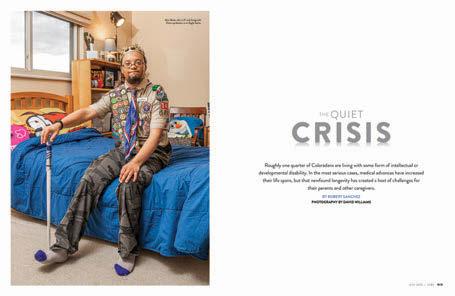

On Darlene’s message boards and in the support groups she attended, every parent of
an IDD child knew DD waivers were given to those who were deemed most vulnerable. In Alan’s case, that meant tossing aside the independence he’d achieved over his 27 years—the middle school basketball games, the scouting trips, the therapy work that Darlene made sure her son never missed.
The caseworker talked first. Alan needs supervision 24/7?
“Yes,” Alan said before his mother could say anything.
Instead of talking about Alan’s love of cooking, Darlene explained how her son once nearly set the kitchen on fire. Instead of discussing his love of movies, Darlene talked about when Alan thought an intruder was in the house and Spider-Man could help get him out.
When the conversation was over and the computer was off, Darlene turned to Alan. “I think that went well,” she said.
“Yeah, I think it went well,” Alan said.
A month later, the family got the news via a Zoom call with Alan’s PASA: By late spring, Alan finally would have his DD waiver. His parents were excited but apprehensive. “You wonder what’s going to go wrong with the system, because you know it will,” Darlene



said. In the coming weeks, she and Will would be proven right. There would be issues with paperwork and the signatures. The DD waiver was pushed to May, then to sometime later this summer. Darlene was frustrated, but she’d given up being mad a long time ago. And she had hope: She thought about the waiver— whenever it would come—and the freedom it would give her to let her son live his life without her constant presence, like any young man would want.
KRISTEN ADAMS WATCHED her brother from a chair a few feet away and begged him to speak. “C’mon, buddy,” she said. “Please, for me?” The two of them sat inside a white-tiled room in Denver with a speech pathologist named Aleaza Goldberg. The clock on the wall above them ticked away.
Goldberg set a plastic cash register in front of Kevin, who is 46 and has Down syndrome. Dressed all in black, with graying whiskers and a beanie atop his head, Kevin looked at the
blue and red toy. He frowned. Goldberg had promised to teach him how to use a register as part of his training to eventually get a job. Kevin hoped it would be at Olive Garden, his favorite restaurant.
Instead, he was staring at this piece of plastic. Kristen, 53, leaned into her brother. “Hey, Kevin?” she said. “I know this looks like a toy, but I need you to do this. If you want to work at Olive Garden, you need to know what this stuff looks like.” Her brother stared at his Nikes.
This was how it had gone for the past few months; Kristen pushing and Kevin pushing back harder. She’d moved her brother from New Mexico to Colorado nearly four years earlier, after their parents had died 18 months apart. Kevin lost nearly every support and person in his life in the move. He


Ì
Ì
Ì
Ì
no longer slept in the twin bed his mother bought for him when he was a teenager; he no longer ate dinner in front of the television next to his father.
He got new doctors and therapists. He and Kristen shared a rented ranch-style house with a small yard that sat along a busy street in Englewood. They played with Kristen’s 11-year-old, mixed-breed dog, Rosie. When Kristen was feeling spontaneous, she’d take Kevin to a bar a few blocks away from her house and they’d sit together with a vodka tonic (for her) and a Sprite (for him). She smiled, and wiped away tears, when her brother played the guitar she’d bought him for music therapy. She would laugh at his mishaps, like accidentally dumping an entire container of Parmesan cheese on his spaghetti at dinner. Kristen loved hearing Kevin’s confident voice, the one his therapist told him should come from deep inside his belly, the voice that told Kristen, “Hello!” and “Let’s go!”
Precise data on the number of siblings across the country who serve as primary caregivers doesn’t exist. The best estimate comes from a 2012 survey done by Easterseals, a nonprofit that advocates for those with disabilities, that showed roughly one in five American adults with special needs was cared for by a brother
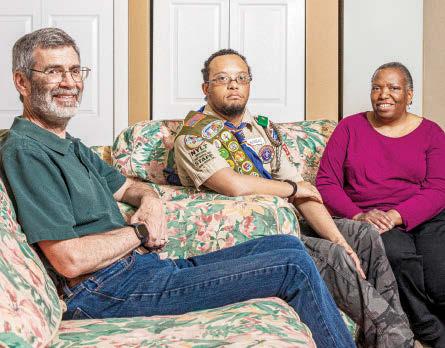












or sister. In other words, there are more than a million Kristens throughout the country.


“I need to know what’s going on with you,” Kristen pleaded with her brother as they sat in silence inside Goldberg’s room. Kevin still wouldn’t touch the plastic cash register. Kristen slid her chair closer. “Please,” she said, “let me in.”
Kevin mumbled a few words. “I’m sorry, but we can’t hear you,” Goldberg, the speech pathologist, said. Kevin flattened his right hand and pushed it out from his waist. The message was clear: Stop



Kristen worked as a therapist, primarily with adults, and running Kevin’s life felt like a second full-time job. What was good for Kevin (music therapy, for instance) seldom left room for Kristen’s modest desires (to work, to get a few moments alone to walk Rosie, to go on a date). Kristen handled nearly everything in Kevin’s life, from the time he woke up and she shuttled him into his morning shower, to the moment she closed his bedroom door at night.
“I’m trying to hang on, but it’s getting harder,” she told Goldberg. Kristen went through a list of challenges she’d experienced over the previous few months: In-home therapists were constantly moving to better-paying
jobs, and each switch meant another search for services, another trust-building acclimation period for Kevin. Kristen secured what’s known as an emergency DD waiver from the state—hoping it would free her to work without worrying about her brother—but three support homes had fallen through.
“I build all this up, and it gets taken away from him,” she told Goldberg. “The worst part is he thinks it’s his fault.”
“Oh, Kevin,” Goldberg said.
Kristen had started noticing the mood swings a couple of months before. Kevin was lethargic much of the time. “He’d sleep until noon if I allowed it,” Kristen told Goldberg. Kevin rarely spoke above a whisper these days, and the sudden change scared and angered his sister. Kristen was frustrated with her brother; she was mad at herself. What was
she doing wrong? she wondered. Kristen read academic papers on adults with Down syndrome and learned that patients sometimes developed something akin to early onset Alzheimer’s. Personalities rapidly devolved. Moods changed without notice. Was this happening to Kevin? she worried.
Goldberg touched the plastic register. “I know this looks baby-ish, Kevin,” she began. Goldberg looked at Kristen.
“I have to be honest with you,” she said. Goldberg had seen the moodiness, too, saw the ways Kevin pulled back. “I don’t think Kevin and I are connecting,” she told Kristen.
The previous week, Goldberg and Kevin had been using a computerized program that allowed him to speak through a hand-held device. The pair was sorting through words— “happy,” “sad,” “frustrated”—and people and

Kristen worked as a therapist, primarily with adults, and running Kevin’s life felt like a second full-time job.
JULY 20
Cherry Creek North | 6-9 p.m.
Celebrate 30 years of 5280 magazine with us at this all-inclusive bash! Enjoy flavorful menus from top local restaurants, delightful drink offerings, thrilling entertainment, lounges, photo booths, and much more. Get your tickets today! Sponsored by Lunazul Tequila Information and tickets at 5280scene.com.

JULY 22-23
Cheesman Park | 9 a.m.-5 p.m. 150 juried artists and craftsmen from across the nation will sell their work beneath the trees at the award-winning 10th Annual Cheesman Park Art Fest. Enjoy artist demonstrations, live music and food trucks!

Information at DashEvents.com.
AUG 25-27
Omni Interlocken Hotel | 6 p.m.
Colorado’s biggest night for pollinator conservation. Join Butterfly Pavilion for a gala like no other, including a magical stroll through the Monarch Menagerie filled with 400 live monarch butterflies. Enjoy a champagne welcome, cocktail reception, animal experiences, silent and live auctions, seated dinner, and dancing.

Information and tickets at ButterflyBallColorado.org.
Denver
Join thousands of survivors, families and friends who raise money each year to help end breast cancer. Walk with us one, two or all three days. Sign up at The3Day.org/5280. Use code 5280 to save 30% off your registration fee!

Information and registration at The3Day.org.
Denver Botanic Gardens Chatfield Farms
5:30-10 p.m.
Gather & Sow is an elevated, farm-to-table culinary experience featuring award-winning chefs and the best of Colorado’s agricultural bounty. All proceeds benefit Food Bank of the Rockies’ work to ignite the power of community to nourish people experiencing food insecurity.
Information at foodbankrockies.org/gather.
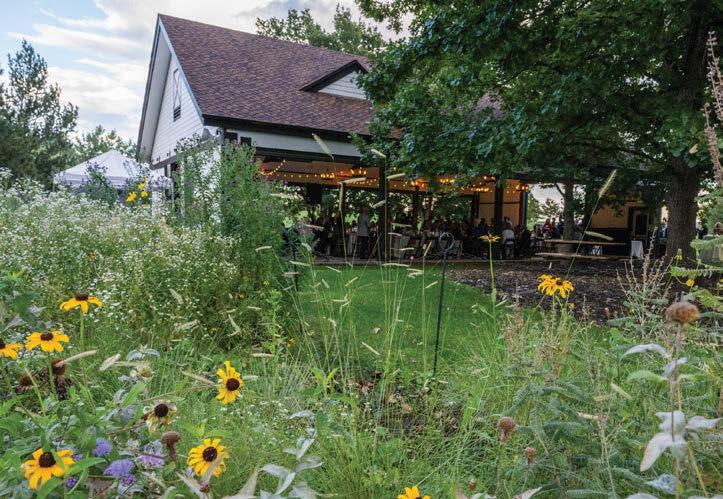
places that had been uploaded particularly for Kevin. As he flipped through the digital pages, Kevin came across photos of his parents. He touched the button for “Mom” and then for “Dad.” He started to cry. “I think there’s a lot in there, a lot of hurt,” Goldberg said. “Just like with a lot of siblings, I think there are probably some things you guys need to work out.”

Kristen covered her face. “Ahhhh, Jesus.”
She thought about what it would mean to find another speech pathologist, to get a family therapist, to start over again. Kristen couldn’t afford to take even more time away from her job to search for help, to change schedules, to drive to a new place, to meet new people, to get Kevin comfortable.
Kristen closed her eyes. Tears began to stream down her face. She turned to her brother again. “God, Kevin!” she finally said. “Look at me!”
She recoiled at the sound of her voice. “Kevin, are you worried? Are you sad?” Kristen asked. She put a hand on her brother’s shoulder, but he pulled away. “Please, Kevin,” Kristen pleaded. “I feel frustrated. Kevin, I’m sad. I’m sorry. My heart is sad, too. I’m so, so sorry.”
She reached for her brother’s device and began typing. “I… AM… SORRY.” She pressed sorry over and over.
Her brother glanced up from his sneakers and saw his sister’s tears. All at once, Kevin’s face twisted in pain. He slumped in his chair and began to cry.
At home later, Kristen read message-board posts from people caring for IDD adults. They were like her, trying to nurture these complicated lives amid constant setbacks. Kristen was more than a sister and a guardian; she also needed to advocate for Kevin and for herself. And right now, she needed to give herself a break. For years, she’d tried to replicate the life her brother once had. That night, she wondered if maybe she simply needed to embrace this new life she was creating with Kevin.
NOAH CLIMBED ATOP a wide drum on the floor inside a classroom at the Anchor Center for Blind Children in Denver. He pounded on the taut drumhead as a halfdozen infants snuggled in their parents’ arms. “Look at Noah go!” the therapist, who was playing an acoustic guitar, said.
His mother, Sarah, sat next to a man holding his son against his chest. A woman sitting in the back corner rocked her baby quietly while her husband stood next to her. Tired, shell-shocked looks covered both their faces. The therapist with the guitar started playing “The Wheels on the Bus.” Noah banged away on the drum.
Sarah was the veteran here. She was past those initial worries, beyond the all-consuming desperation that once had left her sleepless. She assumed these parents had spent weeks in the NICU, just like her and Spencer. She assumed that they had email inboxes filled with unpronounceable, frightening terms, too—that their kids had undergone surgeries and needed teams of doctors, just like Noah.
She was practicing Braille with Noah nearly every day now, and she and Spencer were learning American Sign Language with their son. Noah could already make the family’s sign for his sister, Kinsley: an ASL “K” on the forehead followed by a tiny twist of the wrist, to signify the little girl’s curly blond hair.
Noah crawled closer to the therapist and plucked a guitar string. Everyone laughed.
Earlier, Sarah had asked an Anchor therapist when Noah might move to the next group at the center. His pediatrician, she explained, said Noah was about six months behind similarly aged children when it came to language and cognition. Sarah didn’t want her son falling behind any more than he already was.
“Maybe he should be around some of the older kids?” Sarah asked. If she could somehow close her son’s cognitive gap, even just a little, she was going to push for it. “Like, can we be doing more?” Sarah added.
“I think you’re doing a lot right now,” the therapist assured her.

Back home later that day, Sarah was corralling the kids when Spencer arrived home for lunch. He kissed his wife and the kids, then leaned against a kitchen countertop to listen to Sarah’s rundown of the day so far. “I think Noah might be left-handed,” Sarah said. “And he gave the [ASL] sign for green.”
“Hey, that’s pretty cool,” Spencer said, picking his son off the ground. “A lefty, huh?”
A couple of weeks before, Kinsley had asked about her brother’s missing eye and his misshapen right ear, which looks something like a miniature cauliflower. Sarah explained that everyone has differences, that some people have blue eyes and some people have brown eyes; that some people have smooth ears and some have bumpy ones. “Kinsley’s like a little tester for us,” Spencer said. “What do we say to other kids when they have questions?” No one’s bothered to ask so far. “We’re just gonna roll with it,” Sarah said.
She took Noah upstairs for a nap. Kinsley wandered to another room with one of the family’s bulldogs. When Sarah returned to the kitchen, she was finally able to share a rare moment of peace with Spencer. They
talked about the neighborhood park and whether they might order dinner in that night. Eventually, as it usually did, the conversation turned to their son.
A precise diagnosis for Noah had been elusive. As he learns to communicate better— whether through his own words or through signing—Noah will be able to explain what he’s seeing and hearing. Until then, his parents will act like detectives, looking for clues about their youngest child.
“We have to believe everything will come with time, don’t you think?” Sarah asked.

“Some days I wonder, Are we doing the right things for him?” Spencer said. “Are we seeing the right doctors? Is there more we could do? But then, some days, I see real progress. You and I can’t change this. We’ve got to support Noah the best we can.”
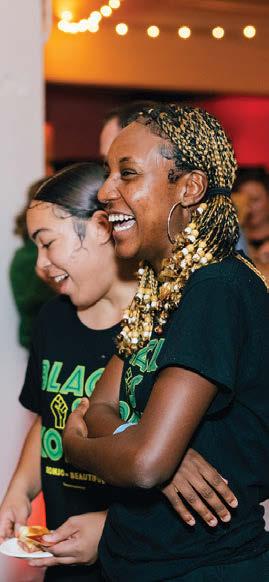
Sarah nodded. She was holding her calendar, the one with her son’s appointments, and flipping through the months. “We still have so much to learn,” she said. “We’re barely scratching the surface of what we’ll know. This is just the beginning.” m
Robert Sanchez is 5280’s senior staff writer. Email feedback to letters@5280.com.
Beautiful 5br/5ba traditional home with spectacular city and mountain views. Enjoy an open floor plan and panoramic views from the great room, kitchen and study. The gourmet kitchen hosts a large island with breakfast bar, stainless appliances, a walk-in pantry and dining area access to a deck. The living room has an electric fireplace. The owner’s suite occupies a five-piece bath and two walk-in closets. Complete with a lower-level and landscaped yard.
lois.meinerz@cbrealty.com

LOUISVILLE | $1,199,000



Beautiful 5br/4ba 3,900 sqft. home w/3-car garage in Coal Creek Ranch backs to open space and quick access to trails & shopping. Located at the end of a cul-de-sac and steps to golf course. HOA amenities include a community pool & clubhouse. Tesla Roof! Kitchen has copper tile & fixtures. Walk-out basement w/separate entrance could be used for rental income. Monarch schools.
nicole.grier@cbrealty.com | StylesGrier.com



guiding you home since 1906
DENVER
2br/2ba condo with downtown views, plus a multi-million dollar renovation to the lobby, 3rd-floor common area amenities & upgraded carpet & lighting on all residential common area floors. Located right in the heart of downtown within quick access to Ball Arena, Larimer Square, Market Station, Union Station, Dairy Block, McGregor Square & 16th Street Mall. Off-street visitor & contractor parking.


Jorge Gonzalez 720.352.4245
jorge.gonzalez2@cbrealty.com | JGDenverRealEsate.com
Located in North Longmont, this 2br/2ba attached patio home features a "sunroom." Chef's kitchen has a desk & dining area. Main room offers a fireplace, built-in bookshelves & pendant lights. Clubhouse amenities include outdoor pool, exercise room & more! Walk to Ute Creek Golf Course. Stunning views of the Front Range. HOA fee covers snow & trash removal, landscaping & exterior maintenance.



Nicole Grier 619.559.9914
nicole.grier@cbrealty.com | StylesGrier.com
LONGMONT | $3,997,000
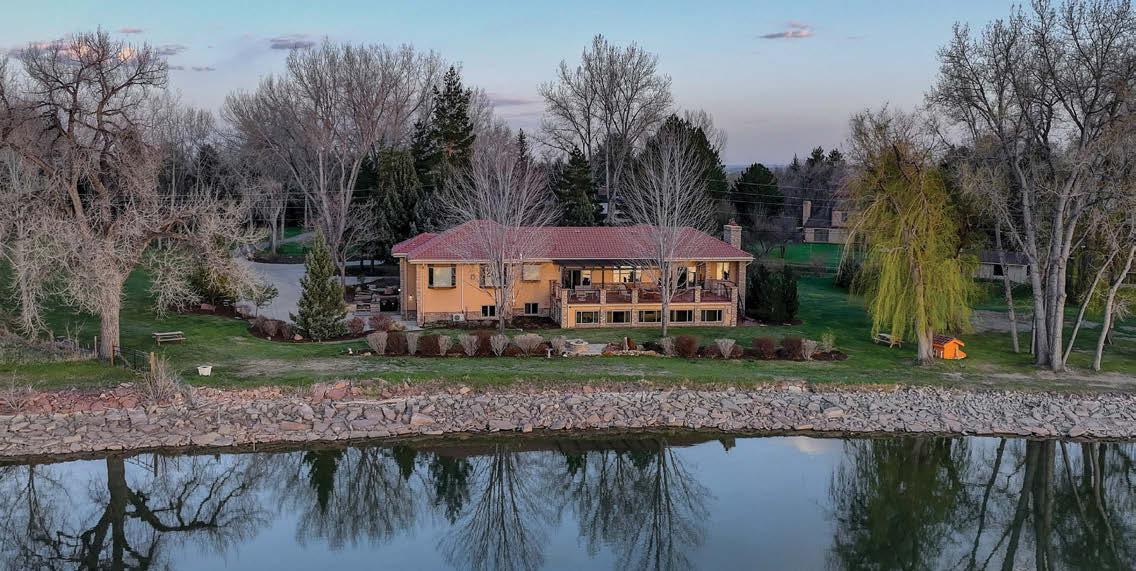
One-of-a-kind 3br/5ba home on the shores of Burch Lake. Featuring Longs Peak views, custom-designed kitchen w/premium appliances, owner's retreat w/fireplace & spa-like bath & barn.
Karen Bernardi 303.402.6000 karenb@thebernardigroup.com | TheBernardiGroup.com

DENVER | $2,900,000
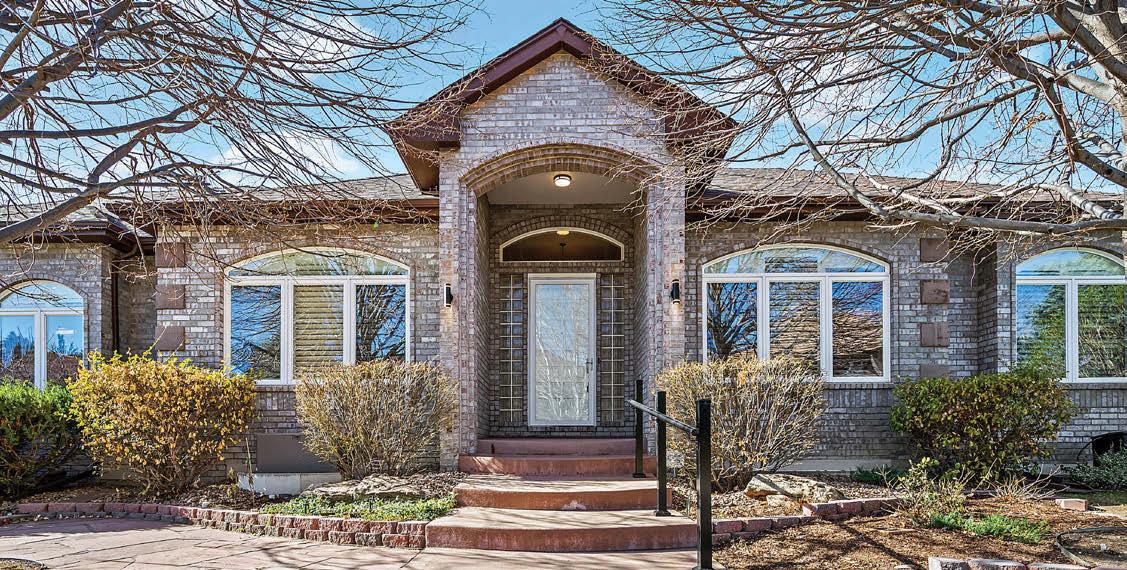
Observatory Park New Construction Custom Home. This beautiful home is a classic beauty with all the modern amenities & custom finishes showcased throughout. Truly a must see!
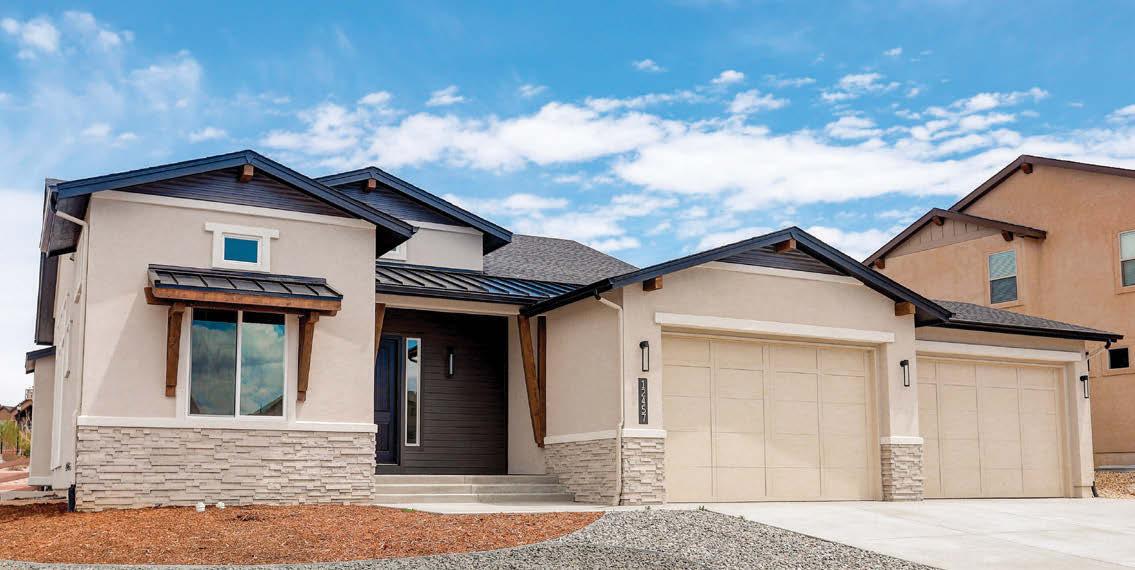
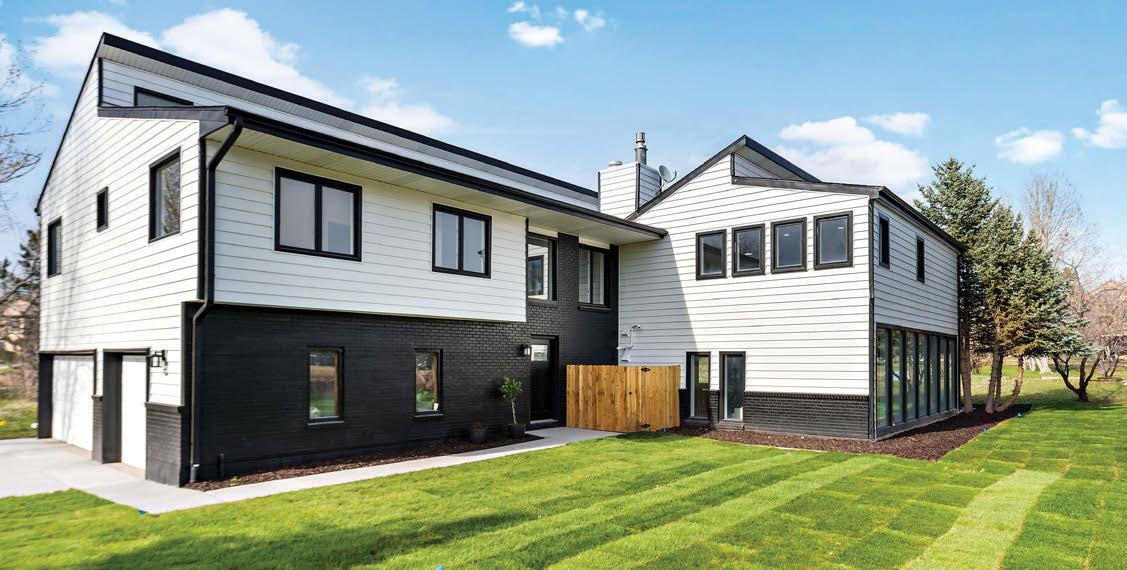
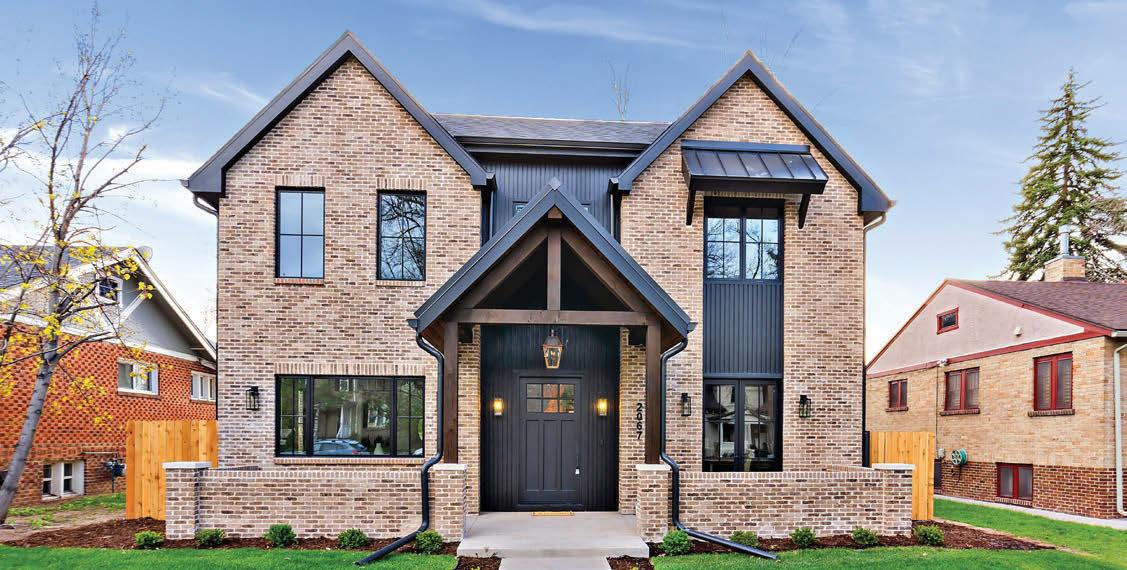
Darlene Emory 303.886.0671 samwyatthomes@comcast.net

LITTLETON | $1,495,000
4br/5ba home on a .33-acre lot. Living room w/a fireplace. Kitchen w/a gas cooktop, double ovens, granite countertops and a breakfast nook. Main floor primary bedroom w/a 5-piece bath and a walk-in closet. Complete w/a basement and backyard.
The Dudley Team 303.356.3947 g.dudley@att.net | GiffordDudley.com
LITTLETON | $1,495,000
4br/4ba custom home w/6,600+ sqft. Living room w/a gas fireplace. Kitchen w/a Subzero refrigerator, Thermador gas range and walk-in pantry. Primary bedroom w/a jacuzzi tub and walk-in closet. Complete w/a basement, landscaped yard and 3-car garage.
Art Recek 720.233.4100 artrecek@mountainlava.com | MountainLava.com
CENTENNIAL | $1,475,000
Stunning & spacious 5br/5ba home w/3-car garage situated on a cul-de-sac boasting over 2 acres of land. Inside, you'll find 4,444 SF of luxurious living space including a custom kitchen, large living & dining rooms & primary suite w/flex space.
Mitchell Liebel 701.570.9374 mitchell.liebel@cbrealty.com | LiebelHomes.com
COLORADO SPRINGS | $1,200,000
Stunning 5br/4ba ranch located on a corner lot in Flying Horse. With peek-a-boo mountain views, this semi-custom home w/4-car garage & finished basement has it all including many upgrades. Near Flying Horse Golf Club, Rec Center & miles of trails.
JJ Alexander 303.475.5905 jj.alexander@cbrealty.com | JJAlexanderRealty.com
SUPERIOR | $1,129,000
4br/4ba Rock Creek Home w/3-car garage offering a 10,445 SF lot. Featuring an eat-in kitchen, office w/built-ins, living room w/fireplace, finished basement & covered paver patio. Close to the tennis courts, pool, Superior Elementary & trails.
The Sartell Bliss Team 720.771.9345 bethanysartell@gmail.com | SartellBlissTeam.com
HIGHLANDS RANCH | $1,050,000
Stunning 6br/5.5ba home w/4 garage spaces has room for everyone with spacious open concept family room and kitchen. Formal living/ dining room. Three bonus rooms provide more space and flexibility plus the fully finished basement was recently updated.
Jill Nurse 303.241.4915 Jill@TheNurseSellsDenver.com | TheNurseSellsDenver.com
LAKEWOOD | $1,000,000
Stunning Green Mountain 6br/4ba home located in a cul-de-sac and surrounded by breathtaking mountain views. Featuring 4,462 finished SF w/high-end upgrades including a remodeled kitchen and finished walkout basement. Easy access to St. Anthony Hospital.
Vicky Limpede 303.881.4901 vickyl_coldwellbanker@yahoo.com | Colorado1stTeam.com

EVERGREEN | $1,050,000
Cape Cod style 5br/4ba mountain home features hardwood floors, kitchen with SS appliances & large, fenced yard. Lower level offers a private entrance, kitchen, living room, 2 bedrooms & full bathroom. Complete with a finished 600 SF workshop.
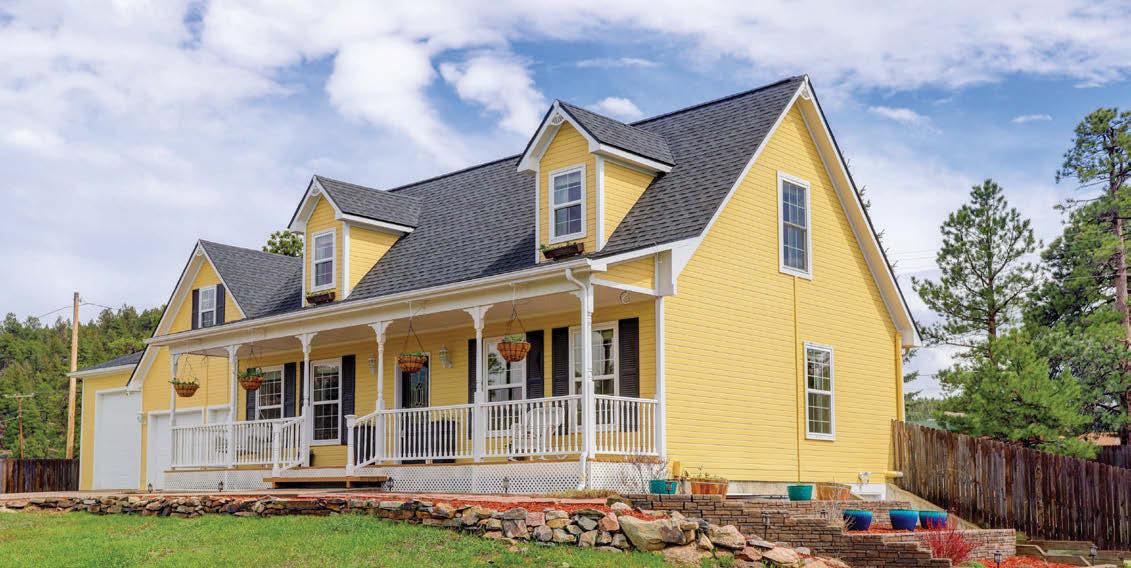
Vicki Wimberly 303.210.8577 vicki.wimberly@cbrealty.com

AURORA | Price Upon Request
Spacious 6br/4ba home in Ponderosa Estates featuring a formal dining room, huge kitchen, butler’s pantry, office & finished basement w/wet bar. Close to shopping & dining at Southlands.
Bobby Dusbabek 970.227.1997 5280HomesByBobby@gmail.com
EVERGREEN | $975,000
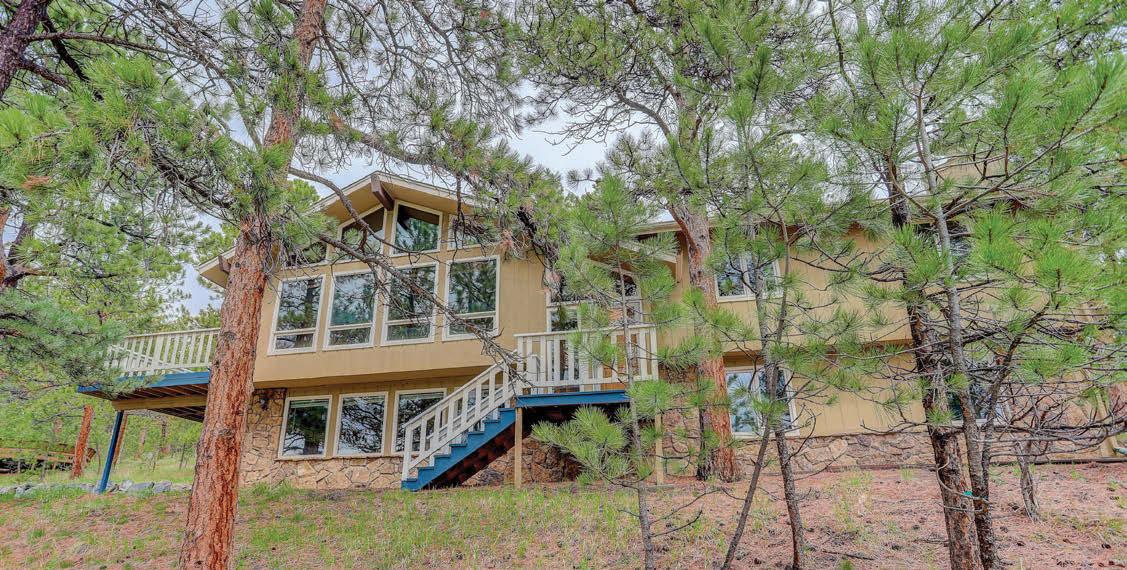
Located in the Hiwan neighborhood in north Evergreen, this 4br/3ba 2,363 SF custom home is in close proximity to everything Evergreen. Featuring an open-concept upper-level living area & wood-burning fireplace. Near Elk Meadow & minutes to I-70.
Bethany Chamberlain 720.205.4934 bethany.chamberlain@cbrealty.com | BethanyChamberlain.com

DENVER | $950,000
Newer 4br/4ba home w/a sleek and elegant layout. Gourmet kitchen w/stainless steel appliances, a tiled backsplash and ample cabinetry. Primary suite w/a spa-like 5-piece bath. Complete w/a finished basement, a fenced yard and a detached 2-car garage.
Katie K. Portenga 303.242.5062 katie.portenga@cbrealty.com | PortengaProperties.com
HIGHLANDS RANCH | $939,900
5br/5ba home in the desirable Falcon Creek community offers a dramatic curved staircase and high ceilings. Well-appointed kitchen opens to the family room. Primary suite w/skylights and dual walk-in closets. Complete w/a finished basement and garage.

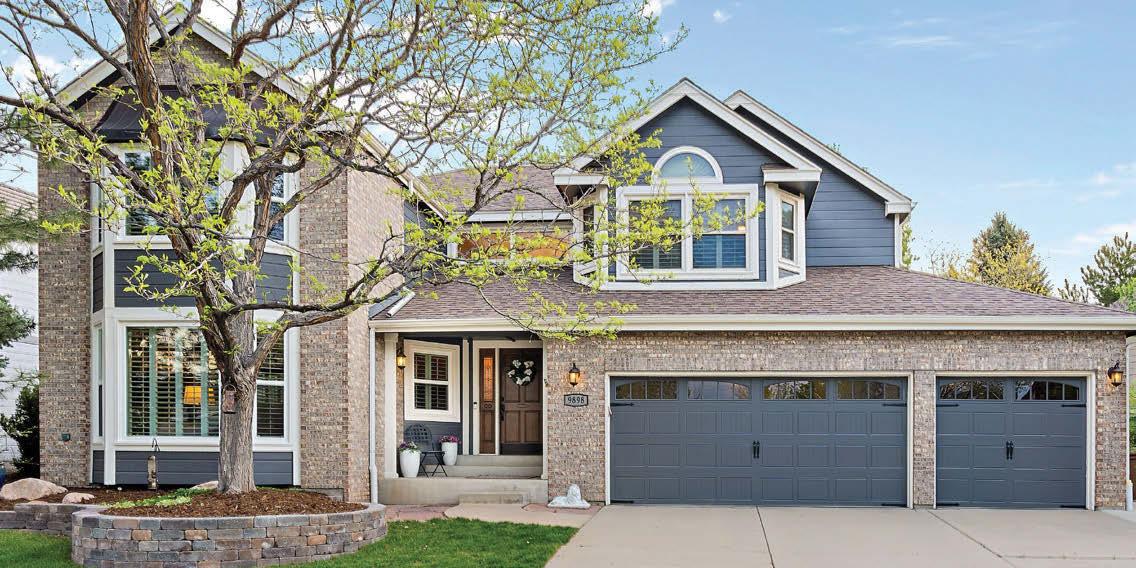
Chris Wright 720.312.8296 chris.wright1@cbrealty.com
LITTLETON | $900,000
Stunning 4br/3ba ranch home in Trailmark at Chatfield w/oversized 3-car garage! Smartly designed open floor plan allows for an abundance of natural light. New carpeting, painting and lighting. Gorgeous finished basement.
Shannon Pace 303.919.2611 shannon@yourfreshstartgroup.com | YourFreshStartGroup.com
DENVER | $900,000
3br/2ba craftsman bungalow in Denver Highlands near Highlands Square. Featuring original hardwood floors, updated eat-in kitchen w/granite counters & updated baths. Private, fenced backyard. Wired with optic fiber. 2-car garage w/220v wiring for EV.
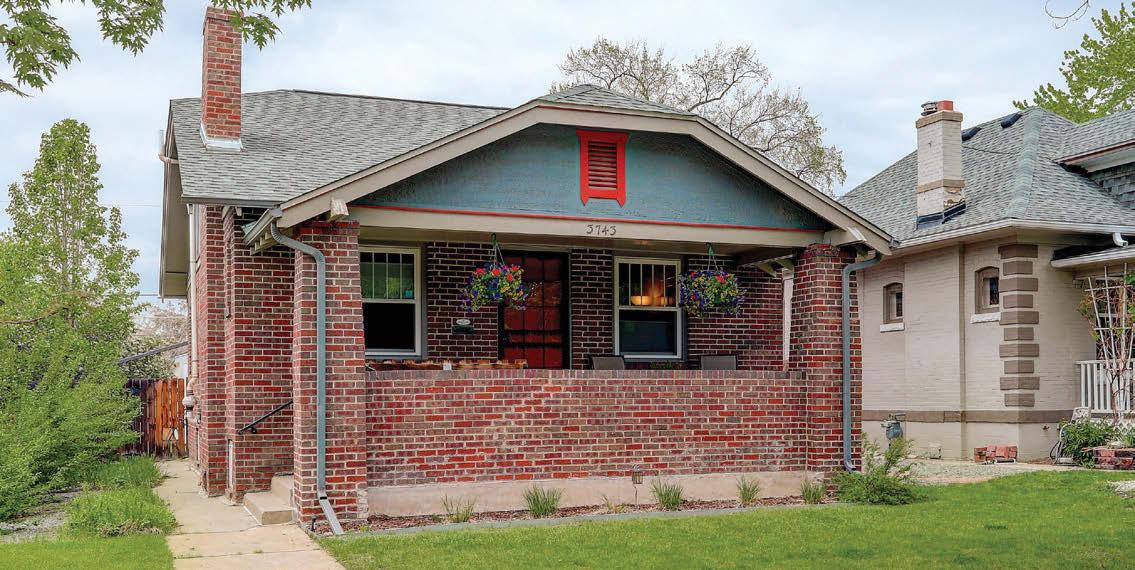
Michael & Laurie Marcus 303.550.0075 michael@marcusteam.com | MarcusTeam.com

3br/3ba home w/an open floor plan. Kitchen with all stainless appliances, a large island and granite counters. Great room w/a gas fireplace. Primary suite w/a 5-piece bath and walk-in closet. Complete w/a half-sized basement, backyard and 2-car garage.
Michael Brassem 303.494.0990
Jennifer Kiss 303.828.7472


Charming 1911 Congress Park bungalow consists of modern luxury upgrades throughout while still maintaining the craftsman character & charm of the original time period. 4br/2ba Denver home features an open floor plan w/fireplace & designer kitchen.
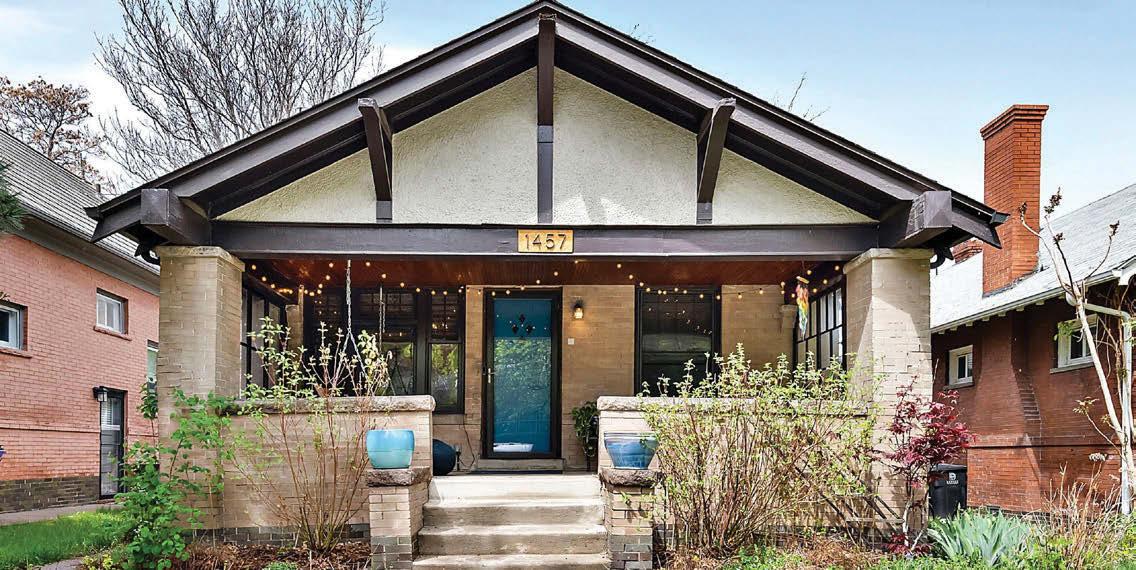
Shannon Pace 303.919.2611
shannon@yourfreshstartgroup.com | YourFreshStartGroup.com
LAKEWOOD | $825,000
3br/3ba Solterra home w/an open floor plan and main floor office. Unfinished basement is stubbed for a future bath. Easy access to Green Mountain, Downtown Denver and Rocky Mountains.
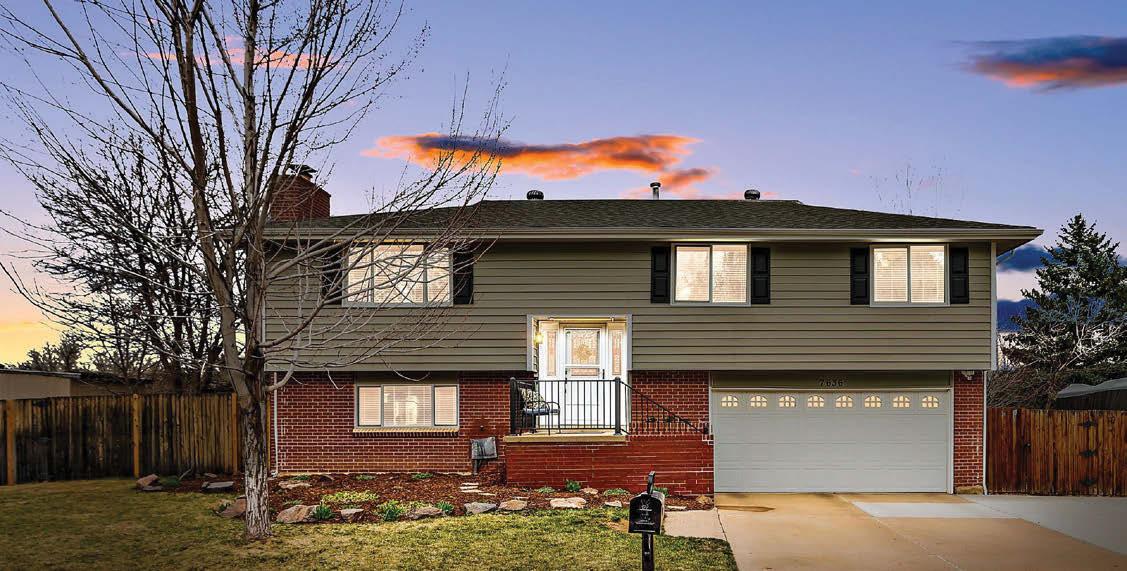
Lars Swenson 303.242.1968 Mike Atefi 720.220.7911
Stunning 4br/3ba ranch-style house w/3-car garage situated on a cul-de-sac in the Woodmoor neighborhood. Featuring a kitchen w/SS appliances & granite counters & finished basement w/wet bar. Easy access to I-25 & close to Woodmoor Country Club.
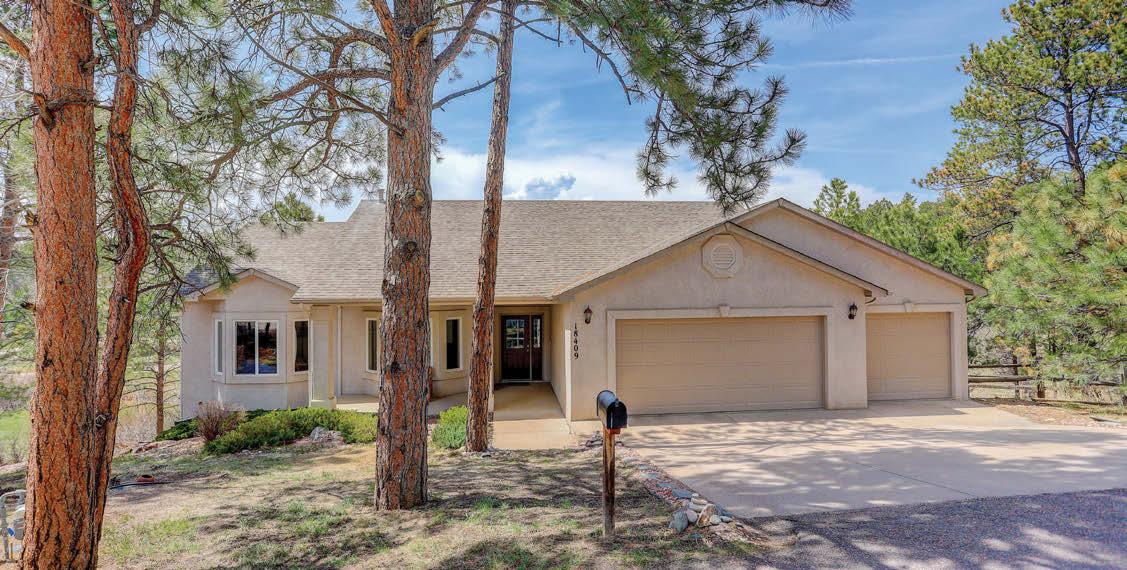
Anna Fish 719.650.9300
annafish.cohomes@gmail.com
COLORADO
3br/3ba home Banning Lewis Ranch in a stunning 55+ community w/3,978 sqft. and main level living. Kitchen w/Azul Celeste granite countertops and Whirlpool appliances. Enjoy a finished basement. Complete w/a deck, front-range views and a 2-car garage.

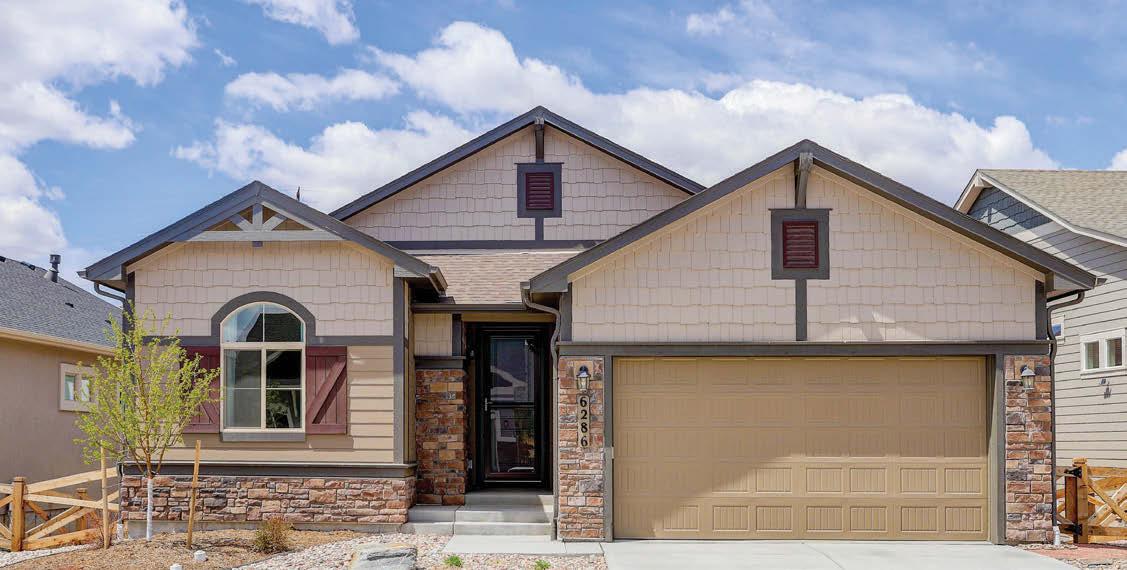
Rob Thompson 719.337.7254
rob.thompson@cbrealty.com | RobThompsonHomes.com
CONIFER | $798,000
3br/4ba, 2,147 sqft., .78 acre, 3-story home w/panoramic views of Pikes Peak & Kenoshas in highly sought after Kings Valley. Floor-to-ceiling windows, gourmet kitchen, new roof, many upgrades. Quick Denver commute, award winning schools, hiking, wildlife.
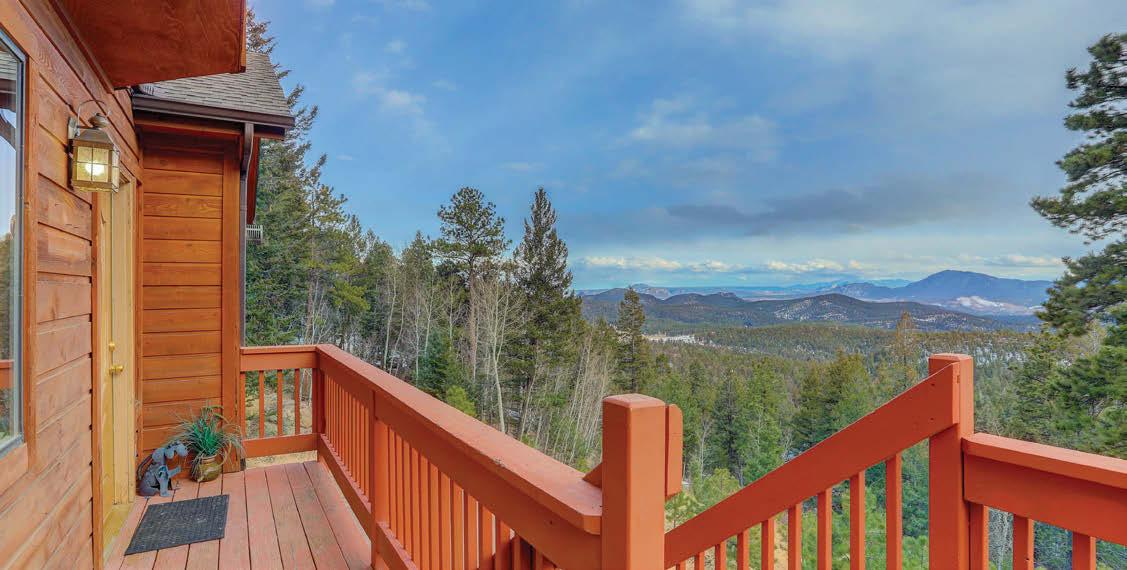
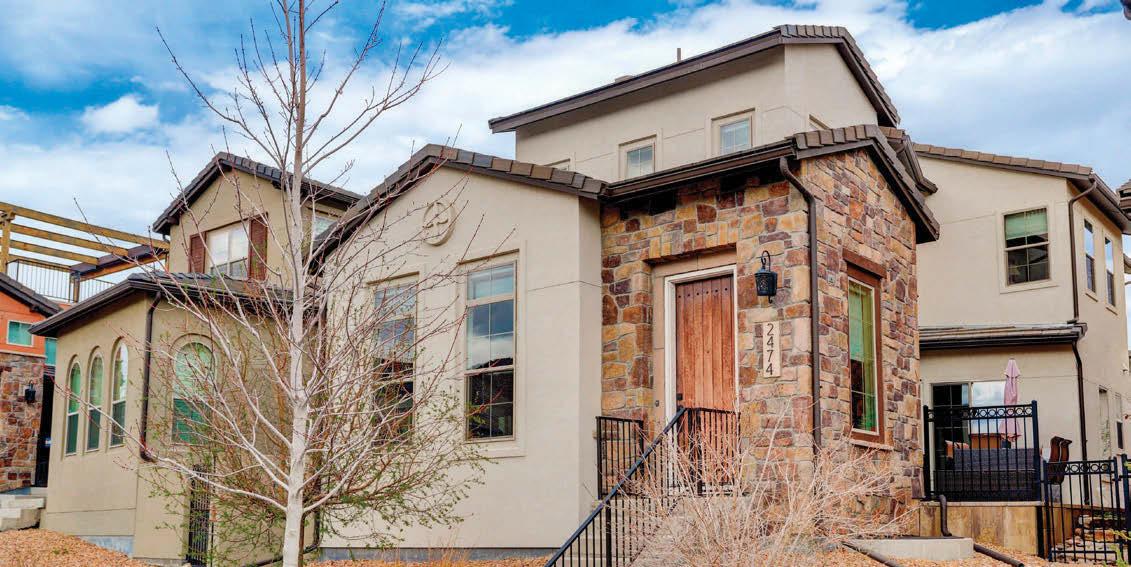
Alissa Skildheim 303.888.4814 alissa@comountainbroker.com | CoveringColoradoHomes.com
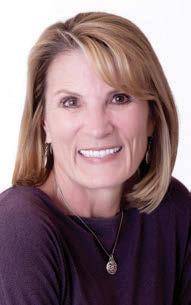
LITTLETON | Price Upon Request
5br/3ba semi-custom home in Columbine Hills w/3 living areas and 2 full kitchens. Great multi-gen home. Nearly 1,200 SF of decking, hot tub, gardens, chicken coop, 3 outbuildings, gazebo, private RV parking. Country in the city!
Kristine Stirling 303.881.4768 kristine.stirling@cbrealty.com | KristineStirling.com


CENTENNIAL
Located in a cul-de-sac, this amazing 4br/4ba Piney Creek home features a large, open living room w/vaulted ceilings, updated eat-in kitchen w/granite countertops, family & dining room, study, loft & finished basement. Updated HVAC, windows & roof.
Jeff McGinnity 303.345.7439
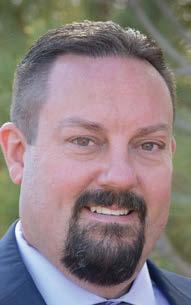
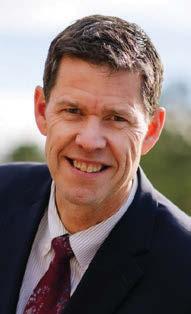

jeff.mcginnity@cbrealty.com | JeffMcGinnity.cbintouch.com
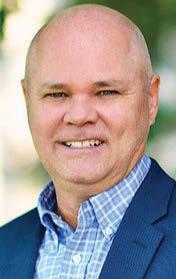
AURORA | $730,000
5br/4ba Richmond Hemingway home. Living room w/a fireplace. Kitchen w/SS appliances, double oven, granite countertops and an island. Owner suite w/an en-suite bath and a walk-in closet. Complete w/a finished basement, a back deck and a 3-car garage.
John Nichols 720.877.1940 CORealEstateJohn@gmail.com | ColoradoBuyAndSellHomes.com
COMMERCE CITY | $715,000
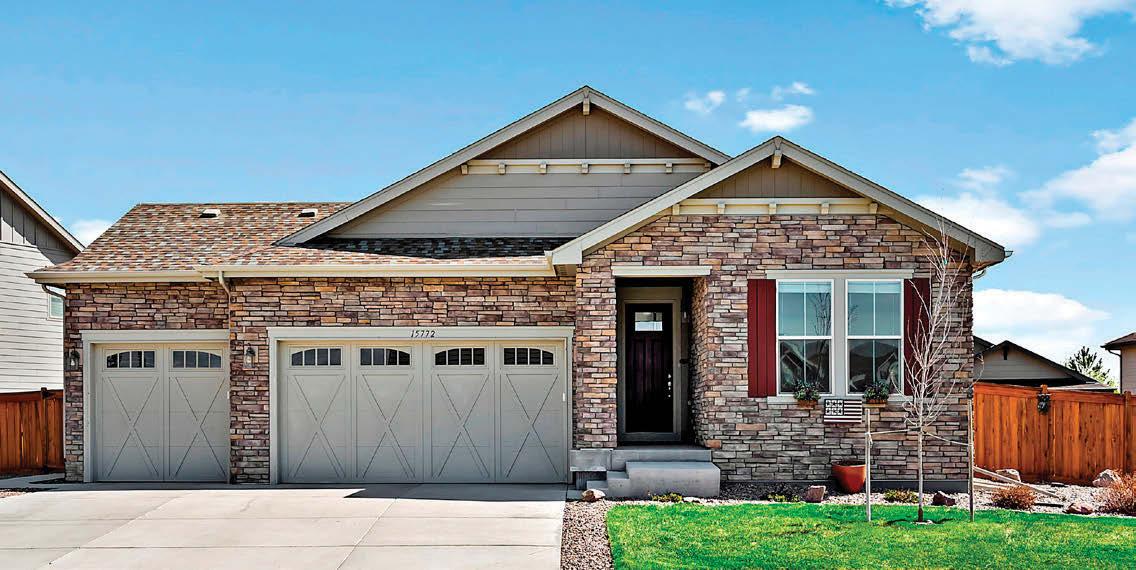
5br/5ba Hemingway Model by Richmond Homes w/a boastful kitchen that overlooks the family room and bump out dining area flanked with windows. Primary suite w/a private bath and a walk-in closet. Complete w/a finished basement and a large patio area.
Donna Jarock 303.718.6285 thanksdonna@gmail.com | HomesAndCondosDenver.com
THORNTON | $692,000
Stunning 3br/2ba home w/separate office/flex space, a large backyard (lot premium!), 3-car garage and the COMPLETE PACKAGE of upgrades. Located in the esteemed Trailside Community w/mountain views, 5-acre park & Adams 12 Five-Star School District.
Chris & Melissa Lombardo 303.917.1055
Melissa@HomeswithCM.com | HomeswithCM.com
LITTLETON | Price Upon Request

Stunning 4br/4ba home close to shopping centers, hospitals, Chatfield Reservoir & E-470. This 3,012 SF home features an open floor plan with lots of upgrades including an updated kitchen w/ss appliances & quartz counters plus a finished basement.
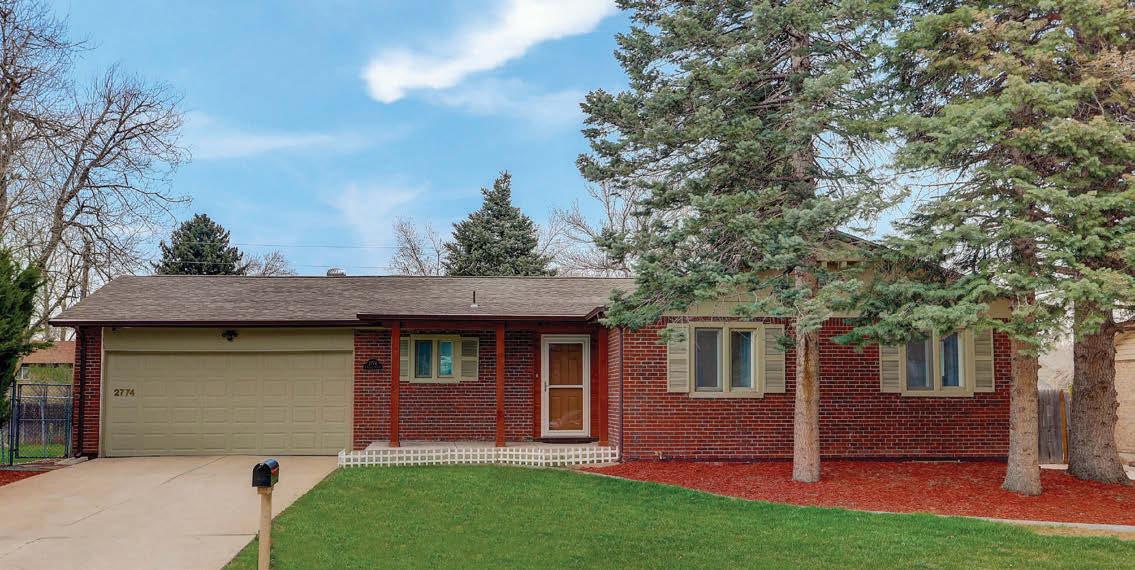
LaDawn Sperling 303.710.5817
ladawn.sperling@coloradohomes.com | LaDawnSperling.com
THORNTON | Price Upon Request
Delightful 3br/3ba home on the golf course in a 55+ community featuring rich wood flooring, high ceilings, fireplace & open floor plan. The community offers 2 pools, tennis/pickleball courts, a workout area, a library & multiple craft rooms.
Linda Gilbert 720.232.1990

linda.gilbert@coloradohomes.com | LindaGilbertHomes.com
DENVER |
Beautifully renovated midcentury 6br/3ba ranch with an updated kitchen & finished basement. Featuring a spacious bonus room off the 2-car garage, hardwood floors & open floor plan. Easy access to Bear Creek trail system. Less than a mile is Hwy 285.
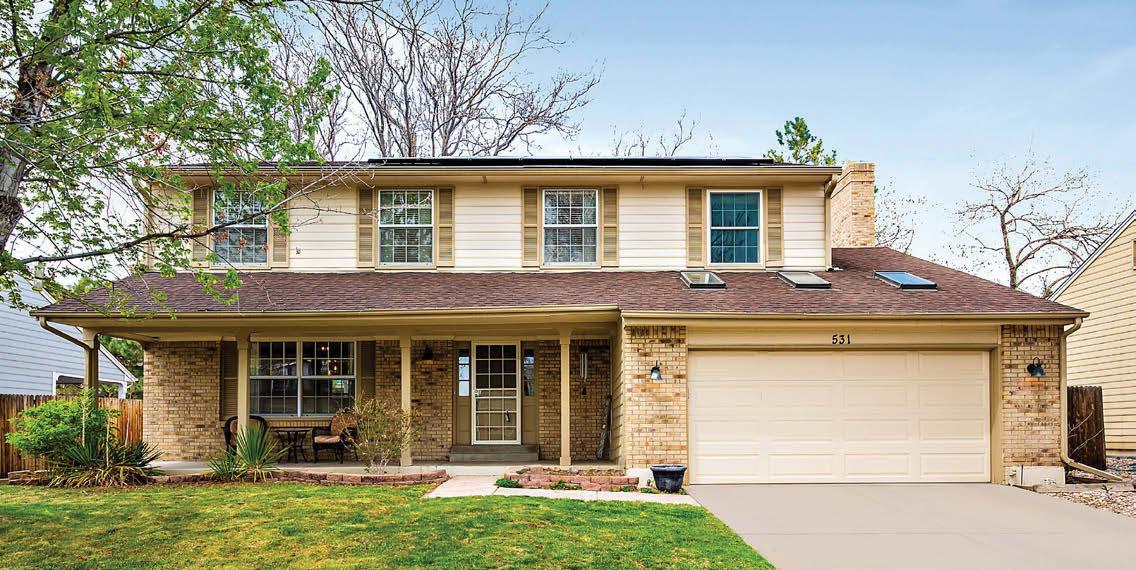
Trish Armstrong 303.378.9544
TrishDenverRealEstate@gmail.com
COLORADO SPRINGS | $650,000

4br/4ba home in the exclusive gated community of Broadview Terraces w/a total of 2,768 sq.ft. w/an open-concept great room and a large kitchen. There is a front patio as well as a backyard patio w/a pergola. Complete w/breathtaking mountain views.
Rob Thompson 719.337.7254 rob.thompson@cbrealty.com | RobThompsonHomes.com
HIGHLANDS RANCH | Price Upon Request
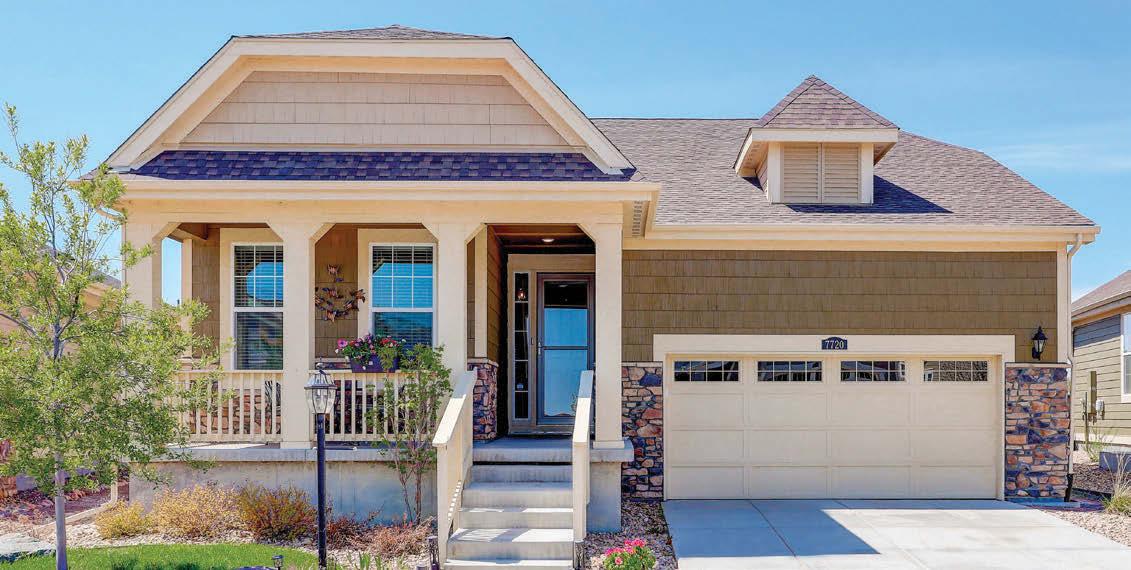
Maintenance-free living in this 55+ residential community called The Retreat. This 3br/3ba home features an open floorplan, vaulted ceiling, large windows & fireplace. Close to rec centers & parks, the Links golf course & easy access to C-470 & I-25.
Jennifer Vitella 303.210.3363

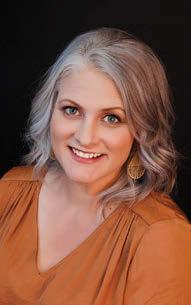
Jenn@JenniferVitellaRealty.com | JenniferVitellaRealty.com
THORNTON | $638,500
Oxord 2br/2ba home offers 1,738 SF w/wide plank flooring, kitchen w/ebony cabinets & ss appliances, great room w/gas fireplace & office w/French doors. Amenities include clubs, 2 pools, hot tub, tennis/ pickleball courts, golf course & restaurant.
Linda Gilbert 720.232.1990
Greg Gilbert 303.250.9007
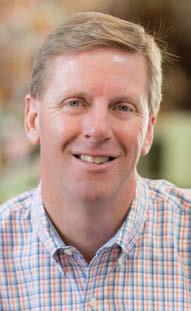
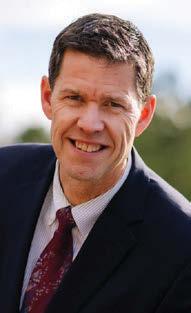
ARVADA | $650,000
Updated 5br/3ba home w/plenty of space. Updated living area opens to a covered composite deck. Remodeled kitchen w/a large island, quartz countertops and SS appliances. Backyard w/a dedicated garden area. Convenient access to the Yankee Doodle Trail.
Kelly Paulk 720.822.2159 kelly@InfinityProsRE.com | InfinityProKelly.com
ARVADA | $650,000
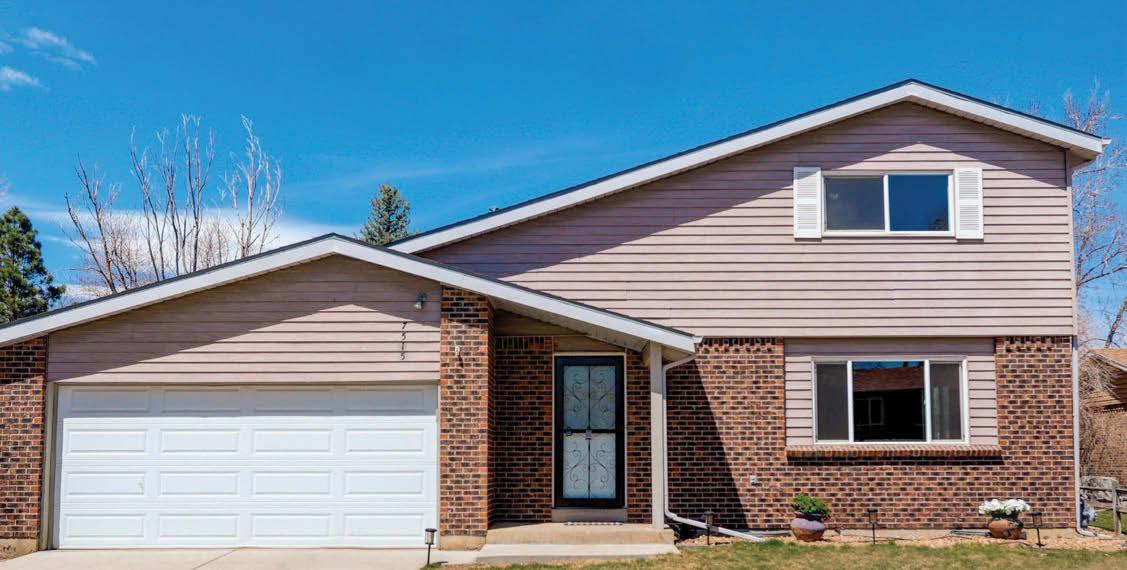
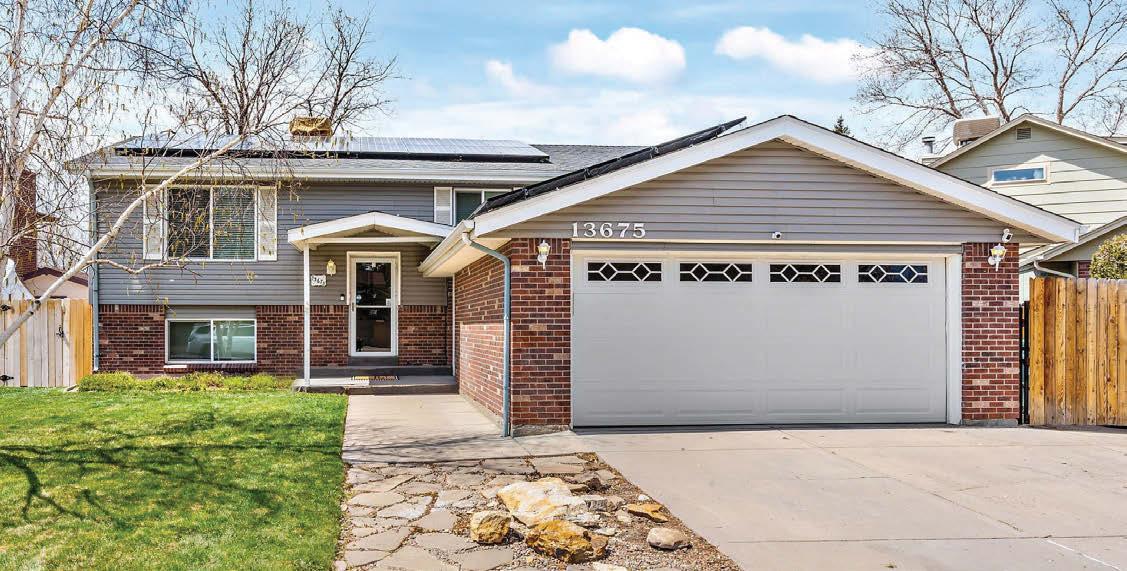
5br/4ba home in Ralston Valley. Remodeled kitchen w/granite counters, updated cabinets, tile backsplash and SS appliances. Family room w/a fireplace. Primary suite w/a 3/4 bath, walk-in closet and deck. Complete w/a finished basement and a backyard.
The Cybyske Home Team 303.635.1100 Lisa@cybyske.com | Cybyske.com
EVERGREEN | $625,000
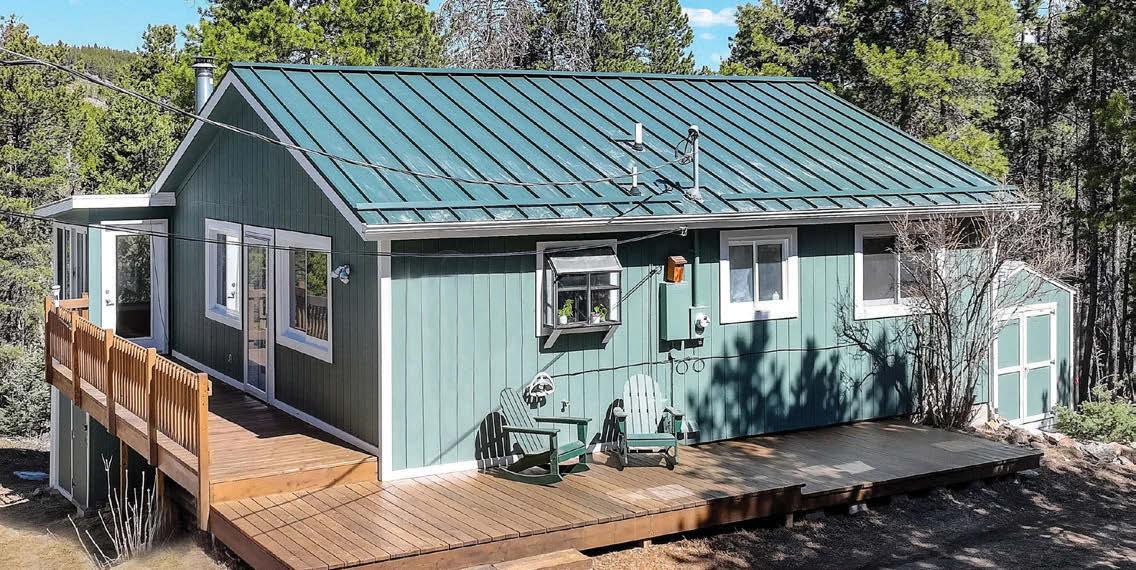

Secluded ranch-style 3br/2ba mountain home tucked away on a 1-acre setting. Featuring an open vaulted floorplan w/newly remodeled kitchen, brand new flooring, newer cedar tongue & groove wood paneling, stone, wood-burning fireplace & sunroom.
Lisa Keener 720.272.8593 lisa.keener@cbrealty.com | LisaKeener.com
LAKEWOOD | Price Upon Request
Charming 4br/2ba ranch w/walkout basement sits on nearly 1/3 of an acre & backs to open space. Conveniently located in Lakewood close to 6th Avenue & just minutes from shopping & restaurants. Featuring hardwood flooring & kitchen w/granite counters.
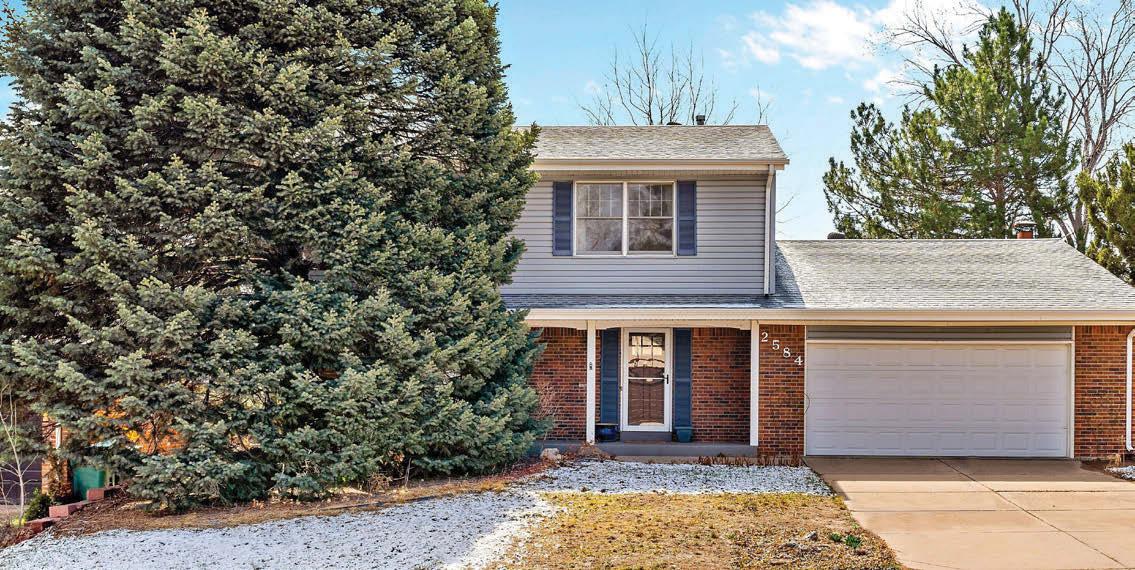
Cyndi DeLaney 303.204.3834 cyndi.delaney@cbrealty.com | CyndiDelaney.cbintouch.com
BRIGHTON | $610,000
Gorgeous 4br/3ba fully upgraded home w/2-car garage features a flowing floor plan designed to maximize the entertainment space. Including new luxury vinyl wood floors, vaulted ceilings & an eat-in kitchen. Minutes from trails, shopping & schools.
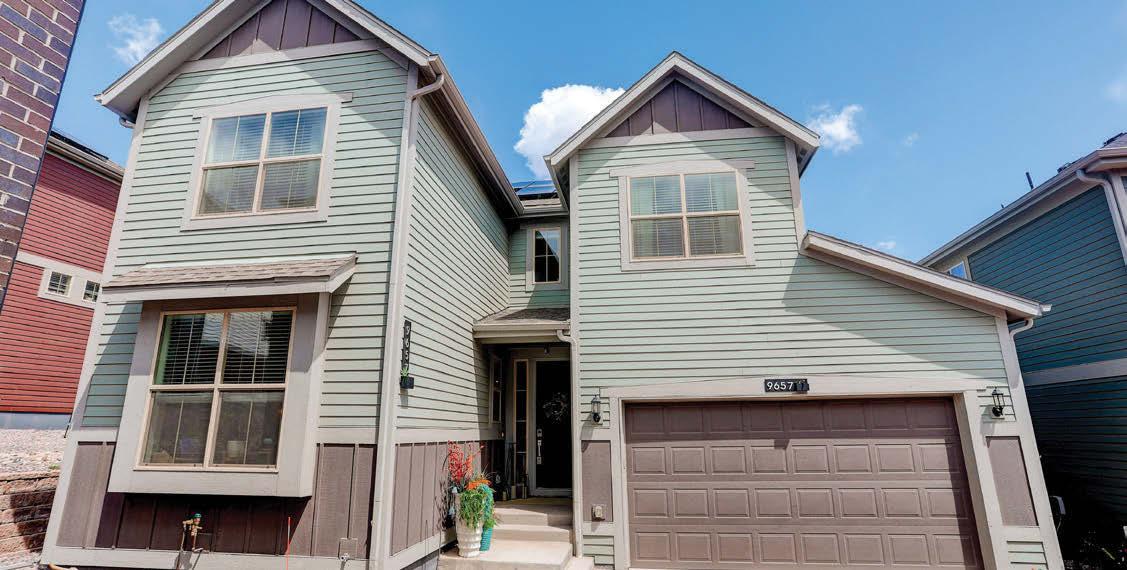
Lorri Orihuela 720.325.4675 listedwithlorri@gmail.com | ColoradoLuxeHomeGroup.com
ARVADA | $610,000
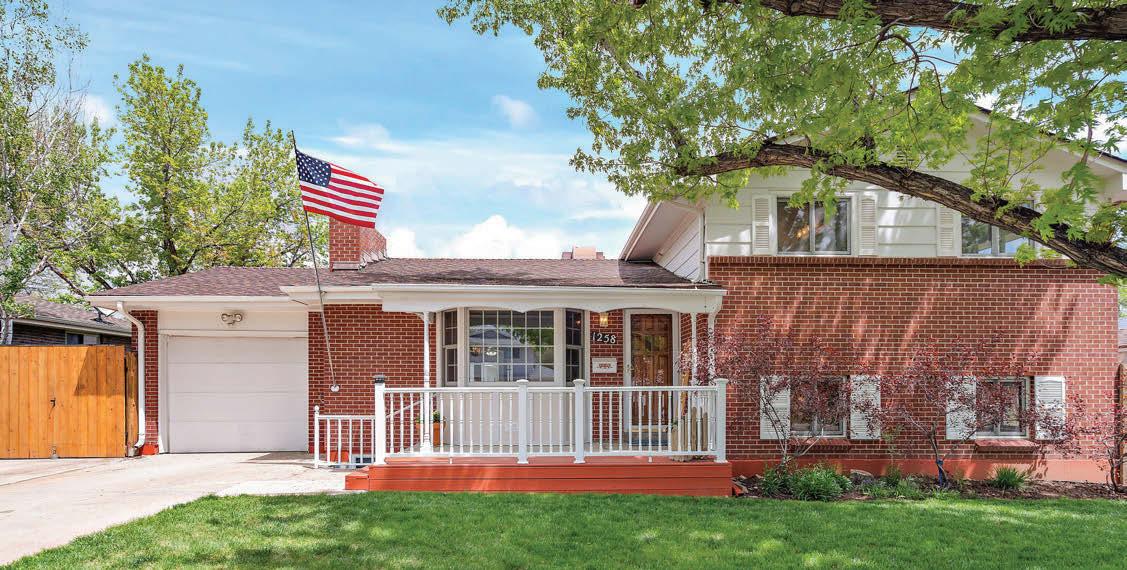
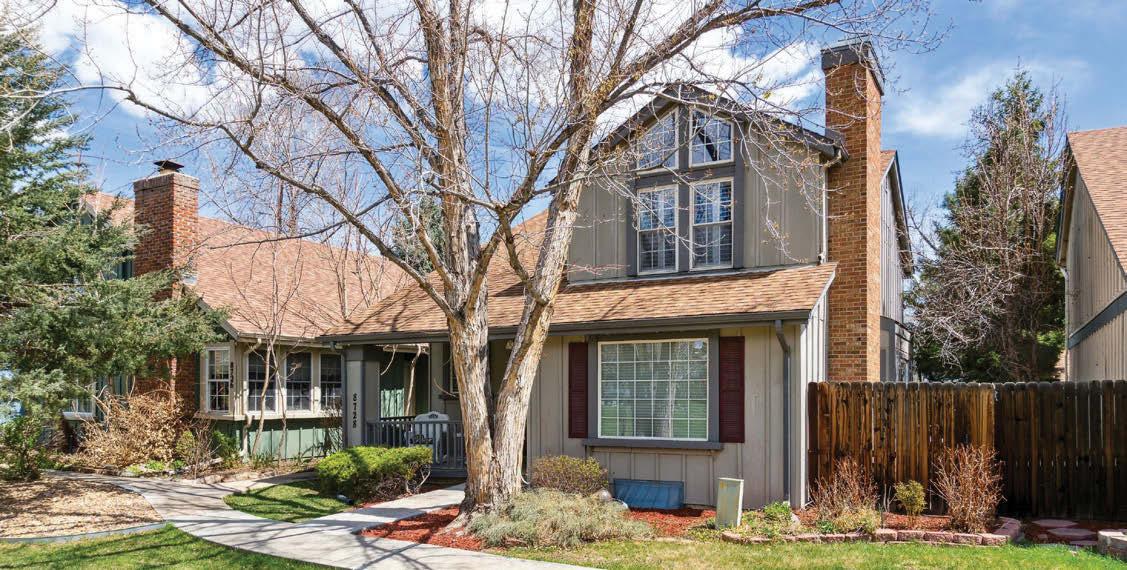

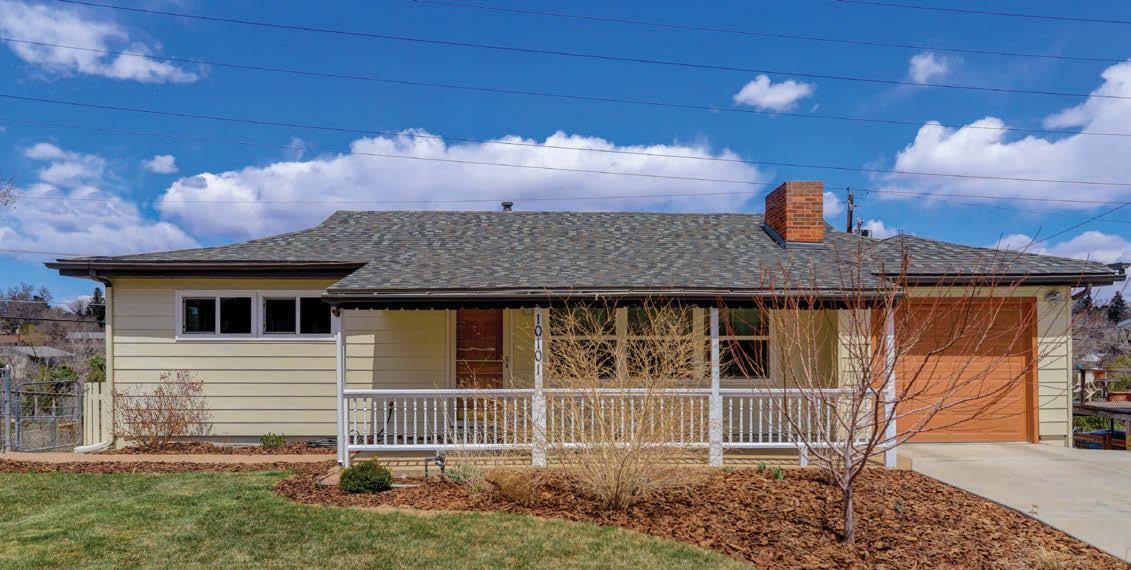
Stunning 3br/3ba home boasts a warm & inviting living area with plenty of natural light filtering through the large windows. Featuring a custom den addition, formal dining room & finished basement w/bar. Close to the community pools & parks.
Brittney Landers 720.560.0094 brittney.landers@cbrealty.com | REColoradoBrittneyLanders.com

LITTLETON | $600,000
Gorgeous, low maintenance 4br/3ba Jade model with an open-concept floor plan featuring large windows, 9’ ceilings, gourmet kitchen, loft & primary bedroom with walk-in closet customized by California closets. Close to the future Burns Regional Park. The Simonis Group 303.905.5137 Amber@TheSimonisGroup.com
AURORA | $555,000
Charming 5br/4ba Crestridge home boasts an open & spacious floor plan. Featuring a formal living & dining room, open kitchen, breakfast nook, den w/fireplace & finished basement. Complete with a large, fenced backyard & covered patio.
Kathy Casey 303.359.0579
kathy.casey@cbrealty.com


LAKEWOOD | $550,000
Unique multi-level 3br/2ba home boasting 2 wood-burning fireplaces, a 4-season sunroom, 2 furnaces & a detached oversized 2-car garage with heat & AC. Complete with an office, craft room & attached 1-car garage.
Christiana Barber 720.404.8757
cbhomesco@gmail.com | ChristianaBarber.com
LITTLETON | $550,000
2br/2ba condo nestled against the foothills in Trailmark w/an open floor plan. Enjoy a remodeled kitchen w/SS appliances and remodeled baths. Living room w/fireplace. Large front patio w/views of the mountains. No stairs, ADA, 2-car garage.
Kristine Stirling 303.881.4768 kristine.stirling@cbrealty.com | KristineStirling.com

LONGMONT | $539,000
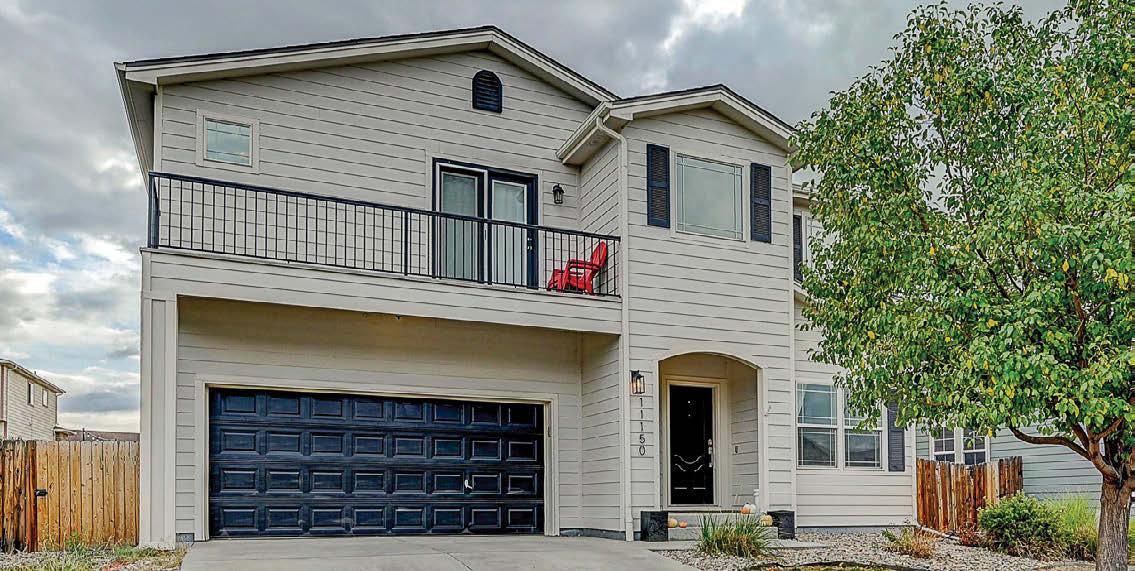
3br/3ba paired home backing up to the Ute Creek Golf course. Enjoy open concept living w/a gas fireplace, main floor en-suite bedroom and office. Upstairs w/2 bedrooms, 1 bath and an open area. Complete w/a back patio and a 2-car garage.
Marcelle Partridge 303.945.0553
Ellen Ross 303.720.8589
BOULDER | $515,000
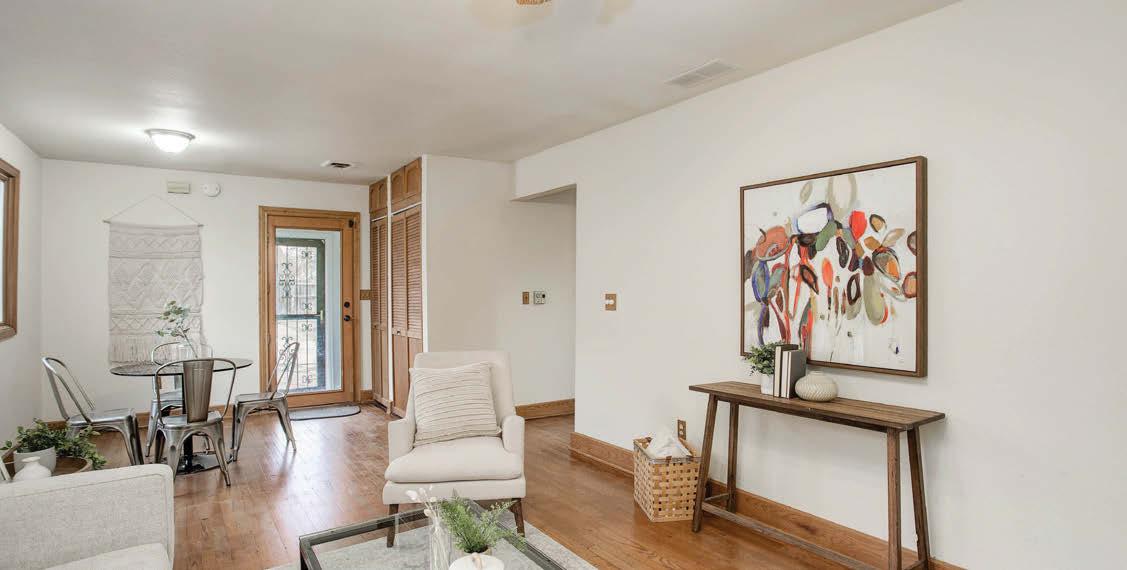
Amazing views of the Flatirons, CU campus & the Foothills. This light & bright 6th-floor end unit is the largest 1br/1ba model available in Horizon West. The complex is nestled in a park-like setting with a brook running through the property.
Deborah Pixler 303.917.6771
deborah.pixler@cbrealty.com | pixlerperfecthomes.com
LOVELAND |
Prime location in Loveland, just a few blocks from downtown! Mixed-use property has 2 office suites facing Lincoln (287). Large corner lot with 2br/1ba & several flex spaces. Backyard is fully fenced with a privacy fence all along 13th & the alley.
Rick Scott 970.449.2723
rsrenoco@gmail.com | RickSGotHomes.com
FOUNTAIN | $490,000
Beautiful 4br/4ba home in Countryside North offering an open floor plan featuring a living room w/fireplace, dining area w/patio access & kitchen w/SS appliances & granite counters. Minutes from Ft. Carson, schools, shopping, great parks & more!
Angie Chavez 719.491.0263

angie.chavez@cbrealty.com | 719dreamhomes.com
FORT COLLINS | $475,000 Stunning 2br/4ba townhome by Old Town Fort Collins w/mountain views, 2 primary suites, hardwood floors, modern kitchen, private yard and energy-efficient features in the Revive community. Near CSU, bike paths and shopping.

Colin Gilliland 970.980.8433
colin@corepropertygroupre.com | CorePropertyGroupRE.com
PARKER | $447,000
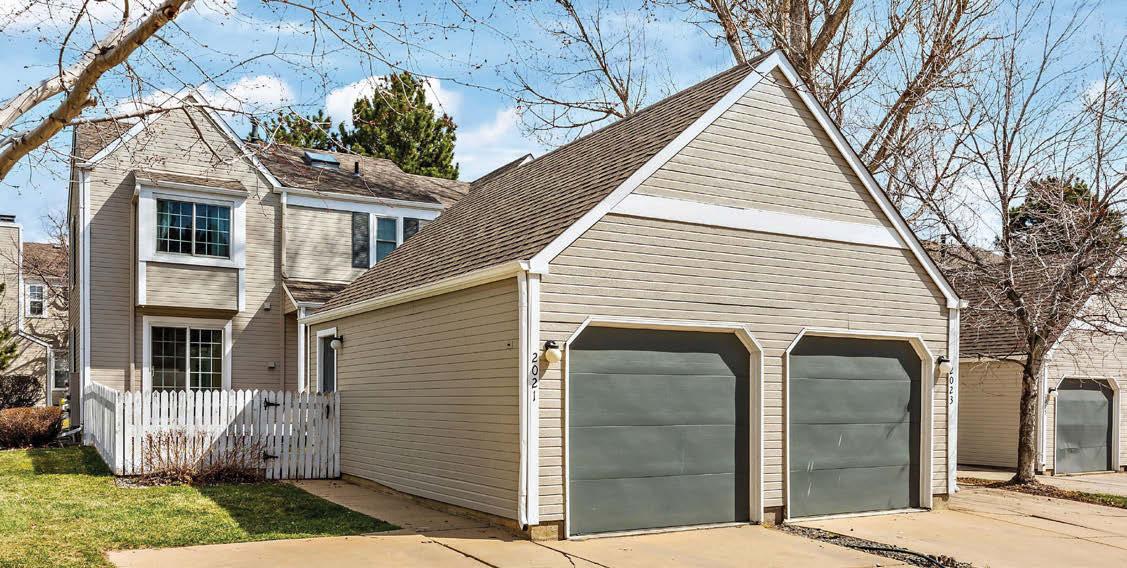
3br/2.5ba townhome facing greenbelt. Living room w/gas fireplace. Kitchen w/LG stainless appliances. Primary suite w/a remodeled 3/4 bath and walk-in closet. Complete w/a finished basement, a patio and a 1-car garage. Fantastic Parker location!
Kelly Redpath 303.548.4058
Kelly@kellyredpath.com | KellyRedpath.com

AURORA | $425,000
2br/2ba home w/modern updates and fresh paint throughout. Open and airy layout w/natural light pouring in from all angles. Enjoy a well-appointed kitchen, breakfast nook and a charming living room. Close to a variety of shopping and dining options.
Kimberly Brown 303.588.1768
Russell Brown 720.266.3005
LAKEWOOD | $425,000
Lovely 3br/3ba mid-century Belmar townhome located in the Villa West neighborhood! The floor plan boasts an open concept that has an easy flow out onto the private patio. The location is ideal with an easy commute to downtown Denver, I25 & 6th Ave.
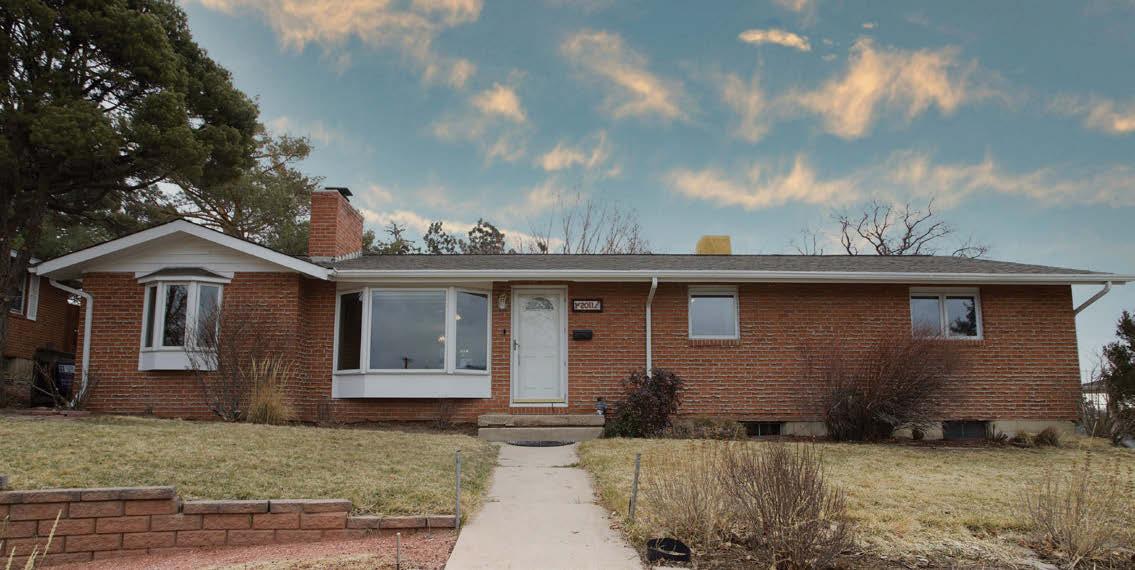
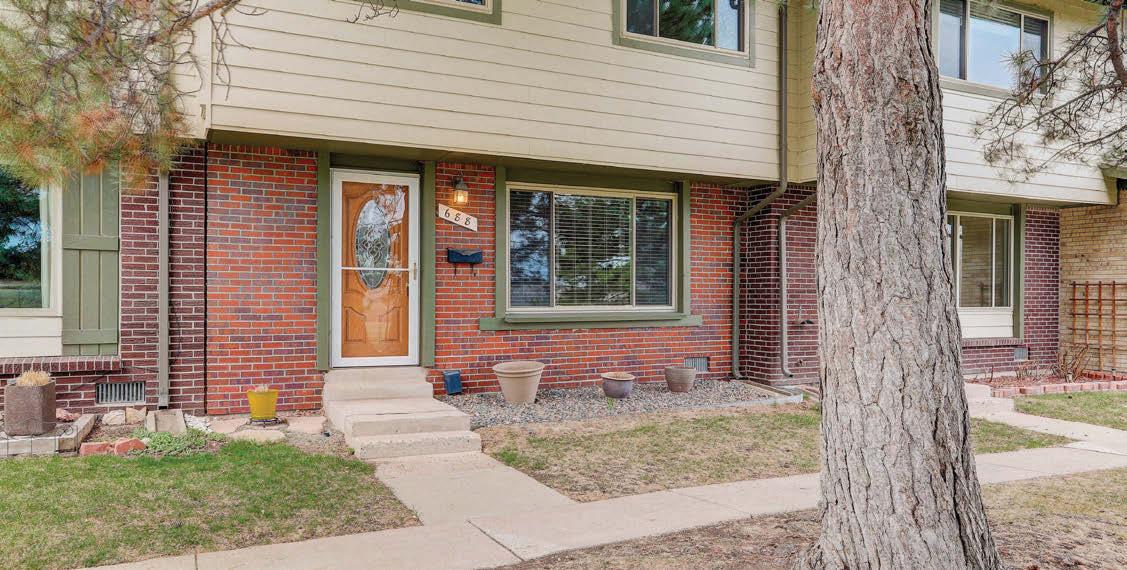
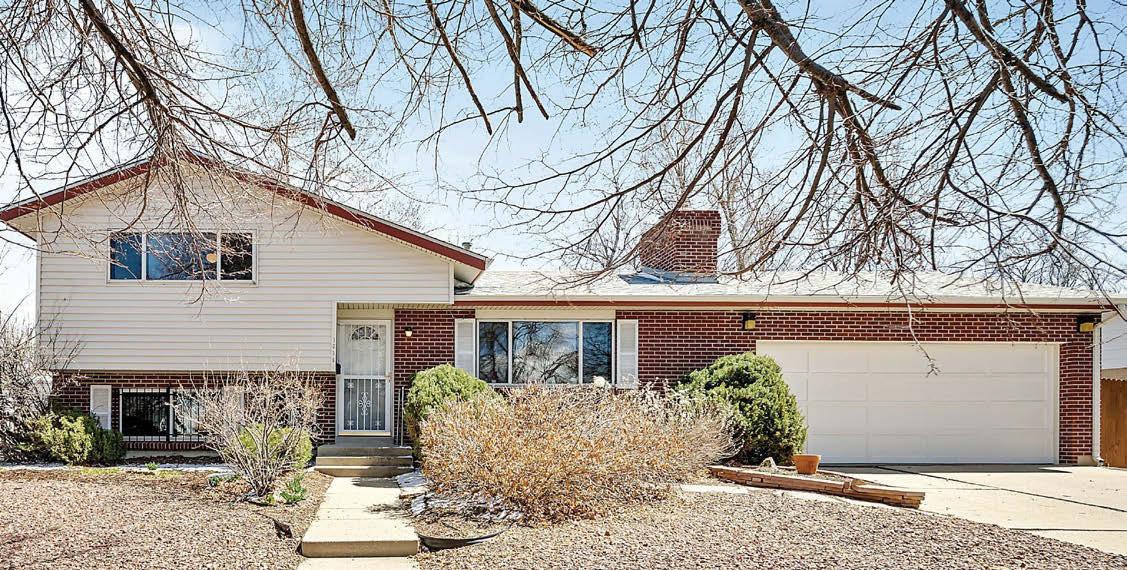

Lisa Keener 720.272.8593

lisa.keener@cbrealty.com | LisaKeener.com
COLORADO SPRINGS | $419,500
Charming 1955 ranch-style 4br/3ba home w/2-car garage boasting over 2,600 SQFT of living space. Main level showcases wood floors, living room w/wood-burning fireplace & well-equipped kitchen. Located in the desirable Audubon Gardens neighborhood.
Anna Fish 719.650.9300
annafish.cohomes@gmail.com
BROOMFIELD |
Charming 3br/2ba end-unit townhome featuring a gas fireplace & newer windows. Close to community pool & biking trails in Boulder County Open-Spaces. Minutes from grocery stores, gas stations, shopping & restaurants. Easy access to US-36 & Hwy 287.
Rachael Steinmetz 303.775.1516
rachael.steinmetz@cbrealty.com | RachaelColoradoRealty.com
1br/1ba Brooks Tower condo on the 40th floor offers mountain views along the front range. Featuring an eat-in kitchen w/SS appliances & 823 SF of living space. Pool & fitness center. Close to Coors Field, Pepsi Center & Denver Performing Arts Center.

Robb Green 303.885.2924
robb.green@cbrealty.com | RobbGreenRealtor.com
BOULDER | $3,250,000
4br/4ba home w/mountain, pond and Boulder Country Club golf course views. Enjoy a chef’s kitchen and great room w/fireplace. Complete w/main level owner’s suite, lower level and gazebo.
Karen Bernardi 303.402.6000
BOULDER | Price Upon Request
One-of-a-kind 4br/5ba property with the best views in Boulder & only minutes from downtown Boulder. Featuring an open-concept great room w/double-sided wood-burning fireplace.
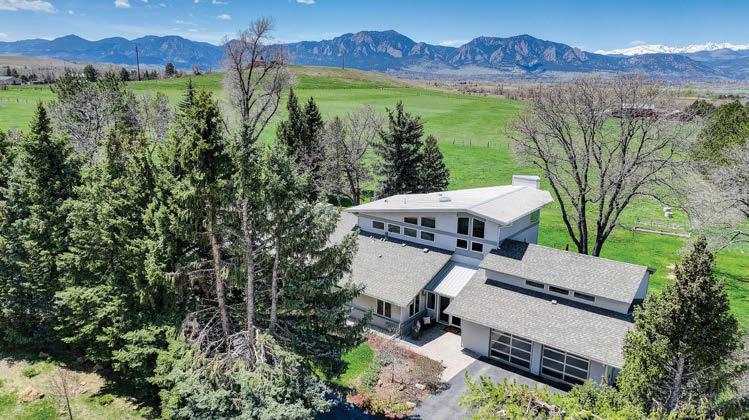
Karen Bernardi 303.402.6000
DENVER | Price Upon Request
1933 Hilltop 4br/4ba Tudor built by G.N. Smedegaard featuring original architectural detailing of arches, wrought iron railing, tile flooring & dramatic lighting. Near Cranmer Park. Eric Tack 303.295.2000 Karla Tack 303.956.8586
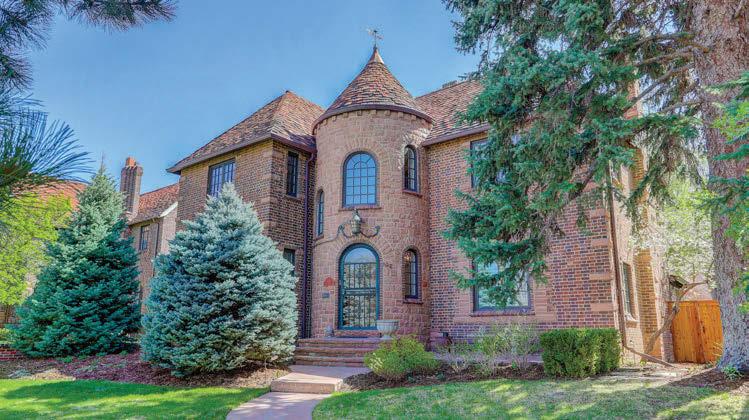
CASTLE PINES | Price Upon Request
5br/5ba custom ranch in Forest Park backs to The Ridge Golf Course & private greenbelt. Modern, entertainer’s dream home enjoys stunning views of majestic pines & rock outcroppings.
Kirk Nimtz 970.618.0069
DENVER | $1,399,000
3br/5ba townhome w/contemporary design and high-end finishes. Enjoy 4 story modern living, outdoor spaces and a private rooftop indoor/outdoor area w/breathtaking mountain range views.
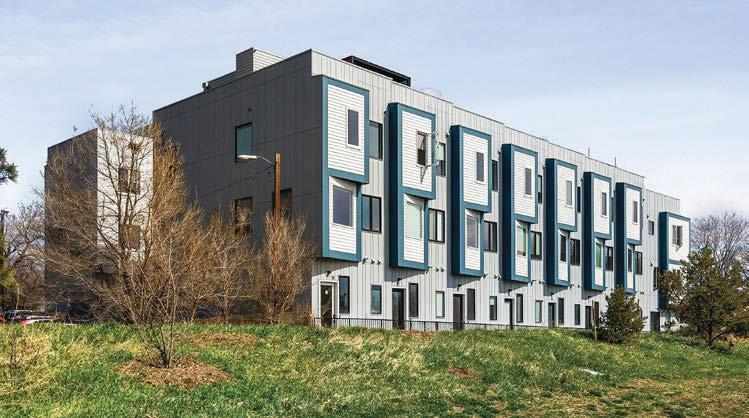
Brenda Bartoletti 303.941.8231
DENVER | $1,250,000

Custom urban contemporary 4br/4ba duplex in Berkeley featuring quartz throughout, top-of-the-line kitchen appliances & solid white oak floors. Nearby Cesar Chavez and Tennyson Shops. Patti Davis 303.550.5929
CENTENNIAL | $995,000
4br/4ba Executive model home in Heritage Place. Enjoy an updated kitchen and Pella windows w/in-glass louvers. Complete w/a finished basement, a landscaped yard and an expansive deck.
Lynne McKinley 303.618.2445
LITTLETON | Price Upon Request
4br/5ba home. Great room w/a fireplace. Kitchen w/granite countertops and SS appliances. Second kitchen in lower level. Complete w/a walkout lower-level basement and a private yard.
Dawn & Dennis Martin 303.870.5896
LONGMONT | $752,000
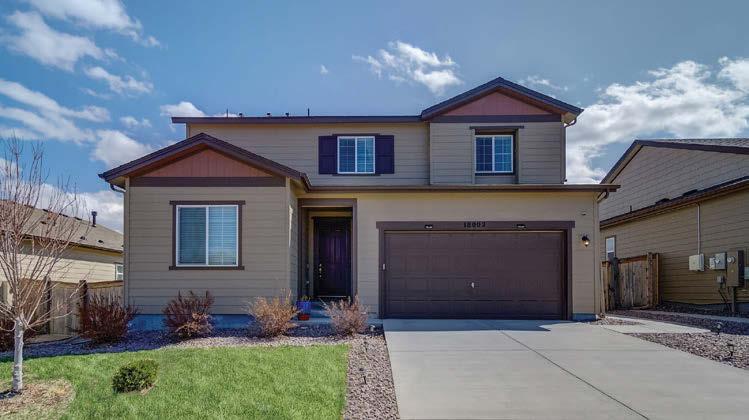
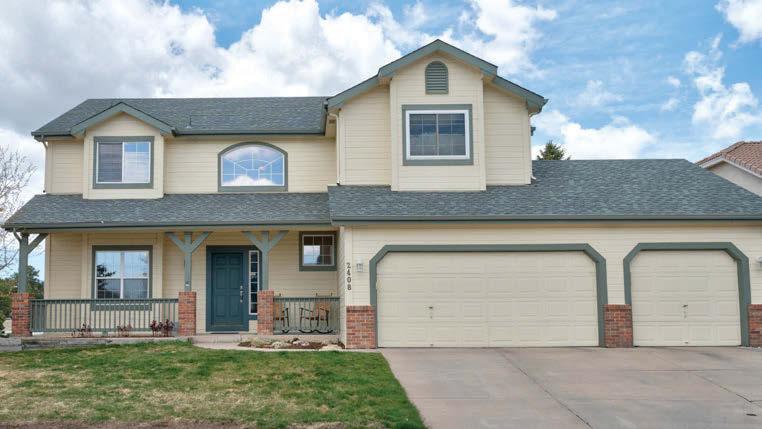

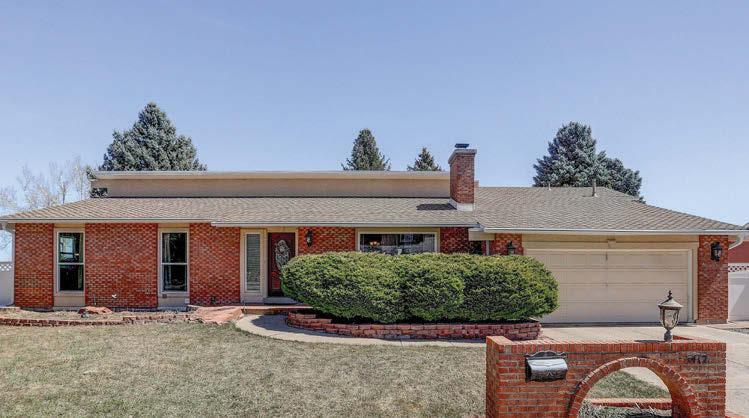
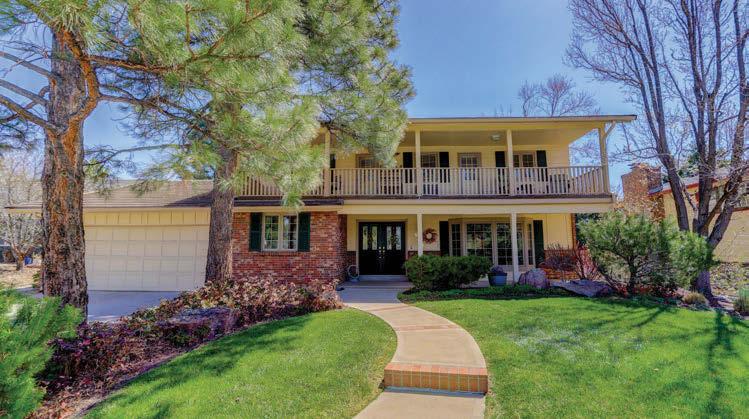
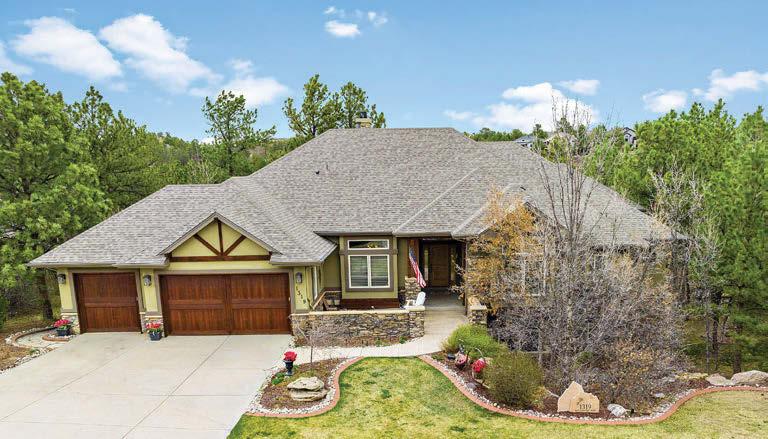
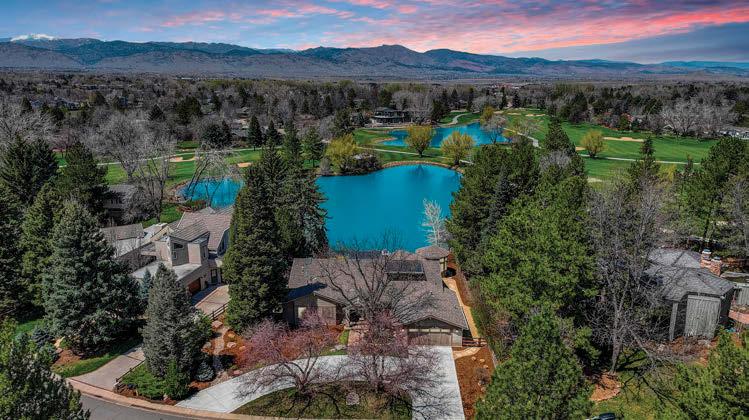
4br/3.5ba home. Dining room, kitchen and living room w/a gas fireplace are on one side of the home and bedrooms on the other side. Basement w/a bedroom and a bath. Backyard w/a patio. Marie Warren 303.884.2111
DENVER | $750,000

2br/3ba townhome located next to Rocky Mountain Lake. Scandinavian design with Unobstructed Mountain & Lake Views and an Amazing Rooftop. Garvin Laverick 720.245.9956
COLORADO SPRINGS | $695,000
Beautiful 6br/4ba home with over 3,500 SF of finished living space & unobstructed Pikes Peak views. Backs to Kathleen Marriage Park. Close to shopping, dining, schools, churches & more.
Becky Groe 719.640.8167
PARKER | $675,000
4br/3ba Parker home features an open floor plan with a beautiful kitchen w/granite countertops & walk-in pantry, dining area, spacious primary suite & newly built covered back patio.
Kaylee Murphy 303.956.2684
HIGHLANDS RANCH | $665,000
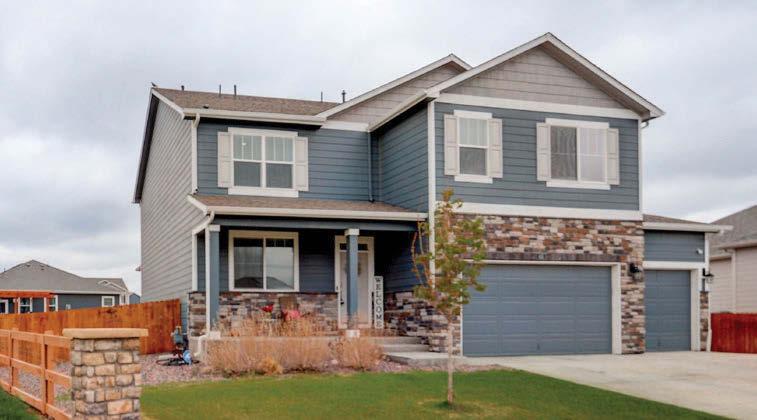


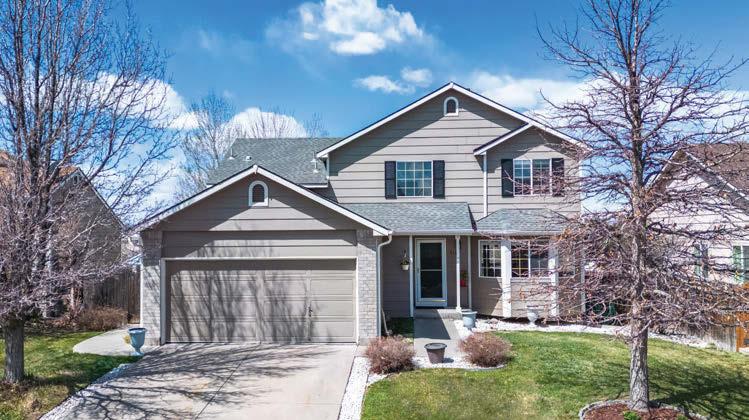

Updated 3br/3ba patio home w/an open floor plan. Enjoy a main floor bedroom and full bath. Primary suite w/5-piece bath and connected study. Complete w/a back patio and mountain views.

Jen Brink
303.653.2738
AURORA | Price Upon Request
3br/3ba home in Copperleaf w/an open floor plan. Kitchen with stainless appliances and a pantry. Primary bedroom w/an en-suite and walk-in closet. Complete w/a basement and covered patio.
Debbie Joseph 303.842.8331
BROOMFIELD | $650,000
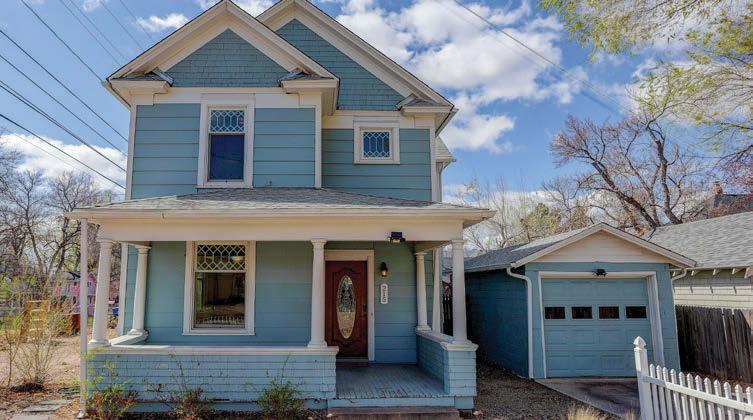
Broadlands 3br/3ba home around the corner from Plaster Reservoir & Park! Featuring a main floor study, kitchen w/breakfast nook, open living space, primary suite & unfinished basement.
Lori Vialpando 303.324.5731
ERIE | $640,000
Peaceful 3br/2ba former model home located in a cul-de-sac surrounded by a greenbelt & trail path. Featuring a main floor study, finished walk-out basement & 5-car garage w/heat & A/C.
Lori Vialpando 303.324.5731
FREDERICK | $600,000
4br/3ba home w/4-car tandem garage in No Name Creek! Featuring 9’ ceilings, hardwood floors, open kitchen, dining & living rooms & primary suite w/vaulted ceiling. No HOA & RV parking!
Marie Warren 303.884.2111
AURORA | Price Upon Request
3br/3ba Saddle Rock Ridge home w/finished basement is located in the Cherry Creek School District. Close to the elementary school & minutes to the grocery stores, retail & E470.
Karyn Walker 303.819.8910
LITTLETON | $595,000
Renovated 3br/3ba split-level home featuring an unrivaled outside living space. Complete with a remodeled kitchen w/granite counters & newer cabinets, gas fireplace & newer flooring.
Fred Kress 720.688.1554
LOVELAND | $575,000

5br/3ba home on .25 acres. Main floor w/a primary bedroom and bath as well as two more bedrooms. Complete w/a huge basement and a backyard w/a shed and your own swim/spa.
Marie Warren
303.884.2111
COLORADO SPRINGS | Price Upon Request

Historical 4br/2ba Old North End Charmer! This stunning home is updated & sure to impress with its curb appeal, pristine woodwork, cheerful kitchen w/quartz counters & patio w/yard.
CC Signature Group 719.550.2547
COMMERCE CITY | $579,900
Remodeled 4br/3ba home w/2,632 sq ft of living space. Updated kitchen w/stainless appliances and an island. Enjoy the newly renovated basement. Landscaped yard. Adjacent to a park.
Reuben McKelvey
720.840.7763
WINDSOR | $565,900

5br/3ba home w/an open floor plan. Great room w/a fireplace. Kitchen w/an island and SS appliances. Owner's suite w/a sitting area, walk-in closet and primary bath. Borders a greenbelt.
Michelle A. Nelson 303.748.5247
JOHNSTOWN | Price Upon Request
4br/3ba home w/an open floor plan. Kitchen w/newer SS appliances flows into the family room. Main level primary bedroom w/a bath. Complete w/an unfinished basement and a large backyard.
Greg Gilbert
303.250.9007
AURORA | $550,000
5br/3ba home w/over 3,200 SF of living space! Open-concept living room flows right into the kitchen & dining area. Less than a block from the bus line & 1.2 miles from the light rail!

Kelly Paulk 720.822.2159
AURORA | $550,000
3br/3ba ranch-style home boasting hardwood floors, vaulted ceilings, open-concept living room w/gas fireplace & partially finished basement. Close to Buckley Space Force Base & DIA.
Jennifer Oldham 720.234.3863
COLORADO SPRINGS | Price Upon Request
Private 5-acres offering Pikes Peak & mountain views with easy access to town! Lot was part of the Black Forest fire of 2013 & being sold AS IS. Electric/Natural Gas available.
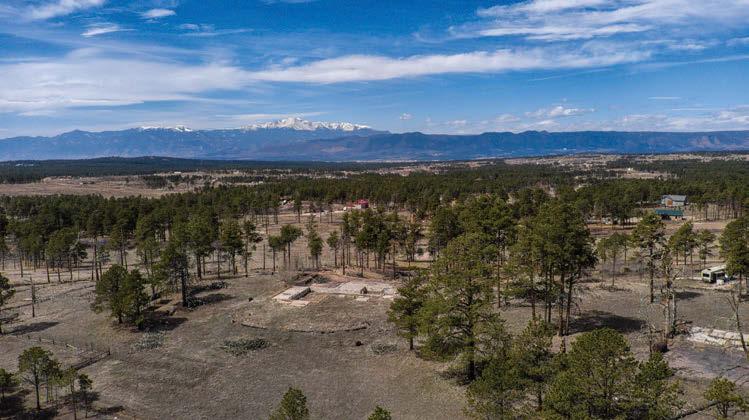
CC Signature Group 719.550.2547
HIGHLANDS RANCH | $549,000

Beautifully updated 2br/2ba townhome w/2-car attached garage in a well-maintained community. Conveniently located & includes a gas fireplace, granite countertops & primary suite.
Diane Vervaet 720.988.0425
AURORA | $530,000
1,850 sq. ft. 2br/2ba patio home w/30k+ in recent upgrades. Kitchen w/granite countertops and breakfast bar. Enjoy a bonus room w/wrap around windows and great room w/a gas fireplace.
Janine O'Neill 303.929.2799
WESTMINSTER | $525,000
Welcome home! This completely remodeled ranch home offers 5BR and 2BA, nearly 2,000 square feet of finished living space and a nice yard.
Amy Metz 720.272.7337
BROOMFIELD | $525,000
4br/2.5ba ranch-style home in the heart of Broomfield w/partially finished basement. Newly painted interior. Fiber optic internet available. Close to all 3 zoned Boulder Valley Schools.
Anne-Marie Torp 720.989.6500
CENTENNIAL | $525,000
4br/3ba home w/an open concept main floor. Primary bedroom w/private bath and walk-in closet. Finished basement w/another family room and a bedroom. Complete w/a huge backyard and deck.
Mark Landin 720.322.5878
LITTLETON | $520,000
3br/4ba townhome w/an open floor plan. Enjoy a basement storage area. Complete w/a deck, 2-car attached garage and 2 additional parking spaces. Community w/a pool and community center.
Derrek Patrick 720.987.5271
LAKEWOOD | $500,000
Lovely Mid-Century modern 4br/3ba brick ranch with a South facing 2-car garage & RV parking. Close to shopping, Target, Dick's, DSW, the movie theatre & lots of restaurants in Bel Mar.
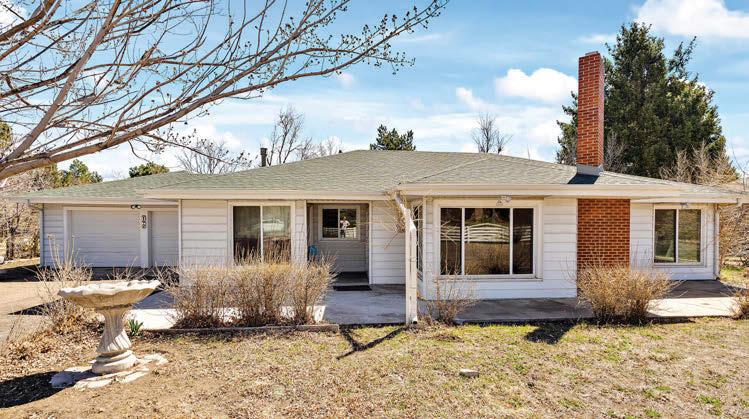
Nita Wassenaar 720.560.1319
LAKEWOOD | $475,000
4br/2ba gem in the heart of Lakewood on over 1/3 of an acre. This ranch has a large 2-car garage & backyard sheds. Located in an established neighborhood in close proximity to Belmar.
Tammy Breeser 720.323.7577
BOULDER | $465,000
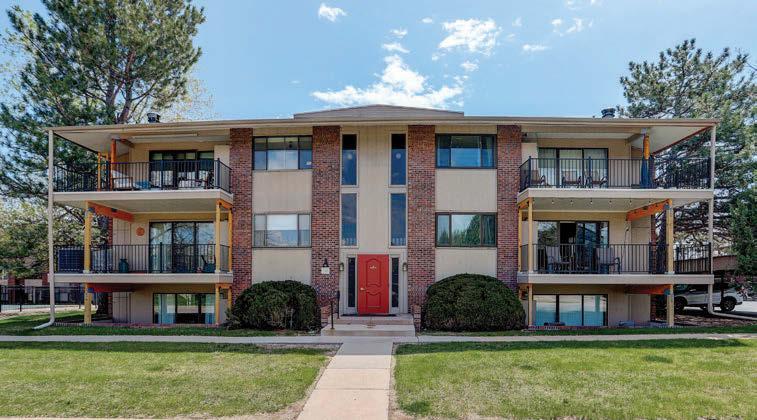
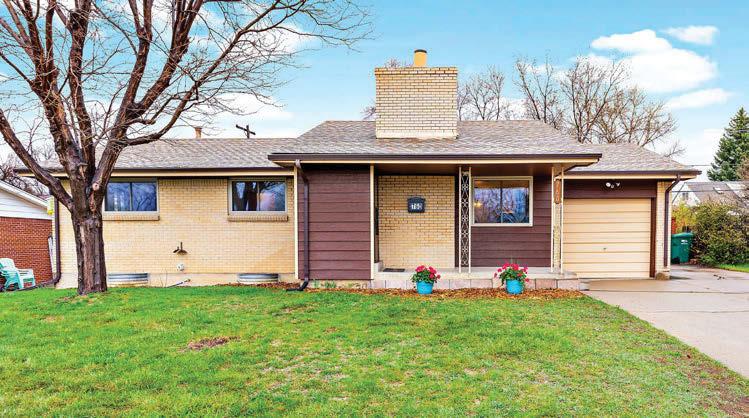
Beautiful 2br/2ba condo w/covered carport offers 1128 SF of comfortable living space & is located in a prime location close to the Safeway shopping center, CU & Table Mesa Park-n-Ride.
Mitchell Liebel 701.570.9374
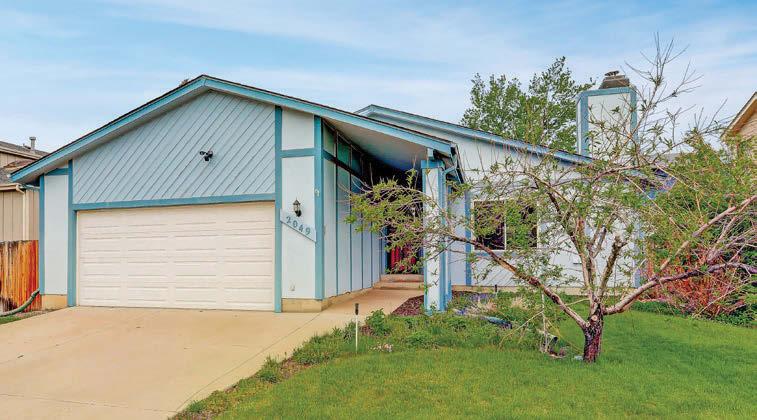
PEYTON | $450,000
4br/3ba home has 9’ ceilings, LVP flooring, office, eat-in kitchen w/upgraded cabinets & custom stamped concrete patio. Don’t miss all the amenities at Meridian Ranch Rec Center.
Jennifer Montoya, MBA
719.232.3397
COLORADO SPRINGS | Price Upon Request
Incredible 4br/2ba home w/updated kitchen & fully fenced yard.
Views of Pikes Peak & the Colorado Springs front range, a flagstone patio, 2 gardens & 10x10 storage shed.
CC Signature Group 719.550.2547
PARKER | $450,000
4br/2ba home in Cottonwood updated from top to bottom. Enjoy a renovated kitchen and a spacious living room. Primary bedroom w/a walk-in closet. Complete w/a downstairs and back patio.
The Dudley Team 303.356.3947
COLORADO SPRINGS | $425,000
Newly remodeled 3br/2ba home in a convenient location offers an open ranch floor plan, well-landscaped yard w/Front Range & Pikes Peak views, high-end finishes & many recent updates.
Vanessa Bivens
719.309.8933
AURORA | Price Upon Request
2br/3ba end unit backs to the 4th fairway of Heather Gardens Golf Club. Offering 2,000+ finished square-feet including a living room w/fireplace, kitchen w/SS appliances, study & finished basement.
Dawn & Dennis Martin 303.870.5896
COLORADO SPRINGS | Price Upon Request
Charming 3br/2ba home on a corner lot near numerous local attractions including shopping centers, Valley Hi Golf Course, Memorial Park & downtown Colorado Springs.
CC Signature Group 719.550.2547
DENVER | Price Upon Request
Mid-century modern Denver 2br/2ba condo w/mountain & city views, enclosed balcony & building amenities including a rooftop pool. Close to the Zoo, Botanic Gardens & Cherry Creek Mall.

Ashley Morrison 224.532.3483
CASTLE ROCK | $297,000
2br/2ba condo in Castle Rock w/vaulted ceilings and a wood burning fireplace. Primary bedroom w/2 closets and a private bath. Complete w/a private balcony and 2 reserved parking spaces.
Rae Marie Heard 720.234.7918
DENVER | $284,000
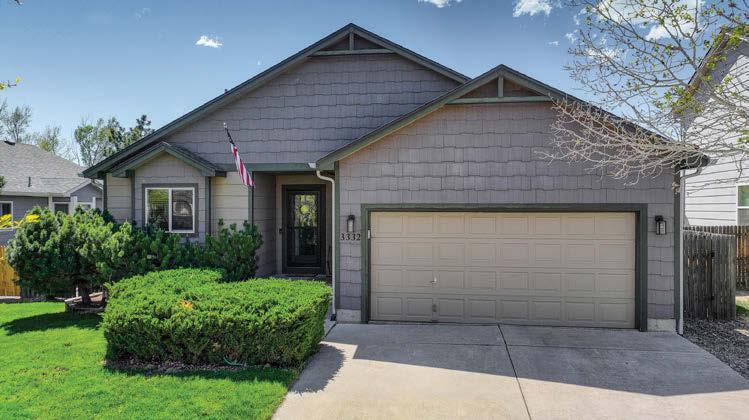

Updated 1br/1ba condo w/a large living room, newer kitchen and dining area. Expansive bedroom w/a walk-in closet and direct access to the newer bath. Complete w/a deck and a garage. Garth Criswell 303.669.0252
BYERS | $225,000
Roomy doublewide 3br/2ba manufactured home on a spacious owned double lot. Open concept floorplan boasts new flooring throughout, family room w/fireplace & large, covered back patio.
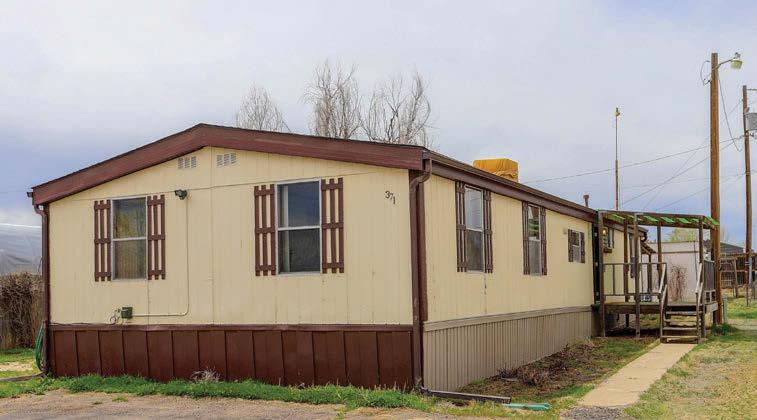
Dana Allen 303.944.7085
DENVER | $200,000
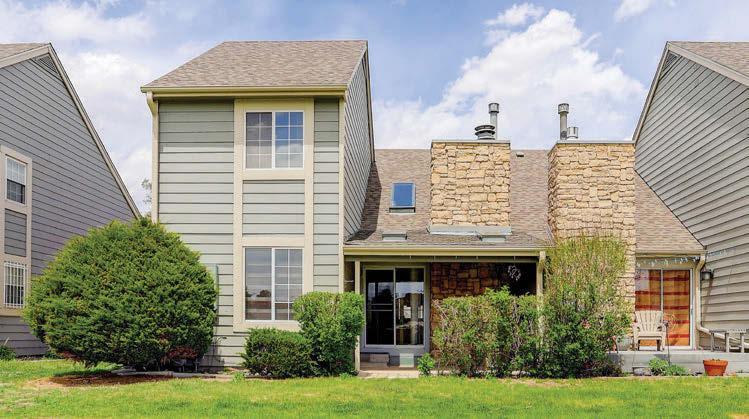
Beautifully updated 1br/1ba condo boasts sophistication and elegance. Located in the heart of the city, near Chuze Fitness and Starbucks. Easy access to public transportation & highways.


Amy Klin 303.946.6584
COLORADO SPRINGS | Price Upon Request
This spectacular lot offers privacy in a serene setting, surrounded by natural beauty. At just over 1/2 an acre, this property features both city & mtn. views perfect for a dream build.
CC Signature Group 719.550.2547

•Fitness Center
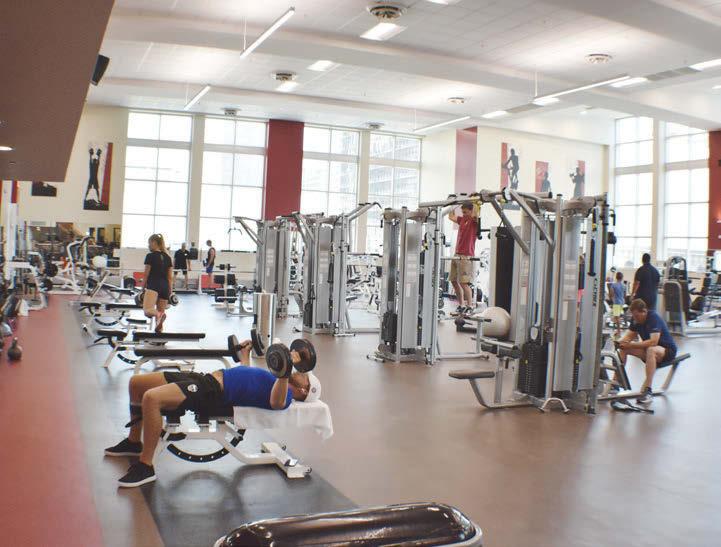
• 300+ group fitness classes each month
•Squash & Racquetball Courts
• Certified Childcare

• Multiple dining venues


• Meeting & Event Spaces
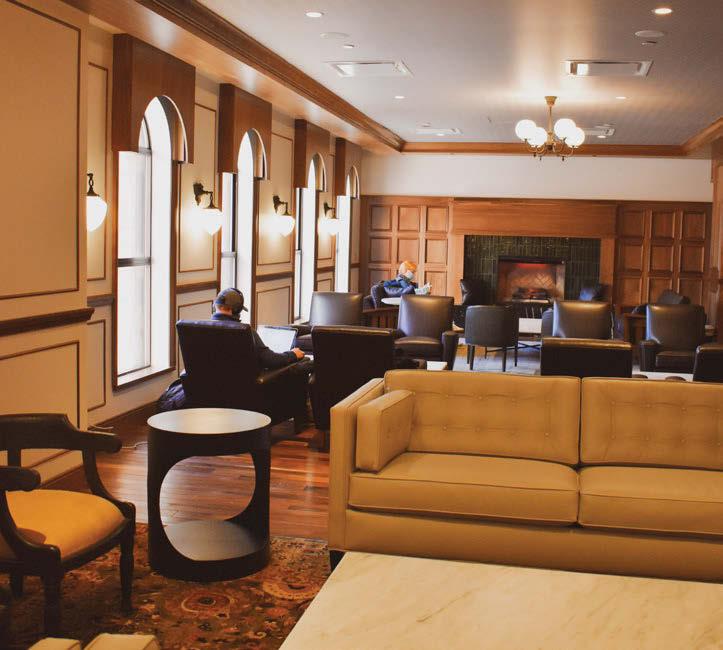
• Massage and Wellness Services LEARN
•Golf Simulator
•6,700 square feet of flexible workspace
• Soundproof rooms for private phone calls
•Access 24 hours a day, 7 days a week
The mountains called, and you answered. You splurged on a climbing rack, an inflatable paddleboard, and a tent that weighs less than a green chile breakfast burrito. Now you need a best friend with whom you can share it all. —MAREN HORJUS
Get yourself on an adoption list ASAP—it can take half a year or more to get your name called for your ideal dog by a reputable service such as Dumb Friends League. Things to consider: size (longer legs go farther), age (younger pups go harder), and majority breed (retrievers like water, hounds like squirrels, and herders like going and going).
Come up with a good name. Dog trainers often recommend two-syllable monikers beginning with consonants for more clarity when you’re yelling, which you will be when your pup sees a chipmunk and slips her collar at the climbing crag. Just beware of outdoor double entendres, such as Timber or Bear, that could confuse other adventurers.
Your floof doesn’t need a doggie daypack or doggles to get the most out of trail time. Instead, stock your pack with Fido-friendly first-aid supplies (such as tweezers to remove cactus spines), extra water and a collapsible bowl, and a roll of pickup bags. Get a leash that can lash to your belt and plan on using it—outside of dog parks, off-leash areas are rare on the Front Range.
Assemble a roster of trusted dog sitters and leave your pal at home whenever the forecast calls for extreme weather or if you’re traversing whitewater, avalanche terrain, or any place necessitating a rope and harness to travel safely. If you’re in a pinch, online pet-sitting services like rover.com can salvage an otherwise inflexible backcountry camping permit.
From rattlesnakes to cyanobacteria, the Rockies are filled with stuff that can send your pup to the ER. Create a line item in your budget (and strongly consider pet insurance) for veterinarian visits, so there’s no hesitation if your hiking partner has a run-in with harmful plants, wildlife, parasites, or yet another puddle of mystery-green water along the trail.
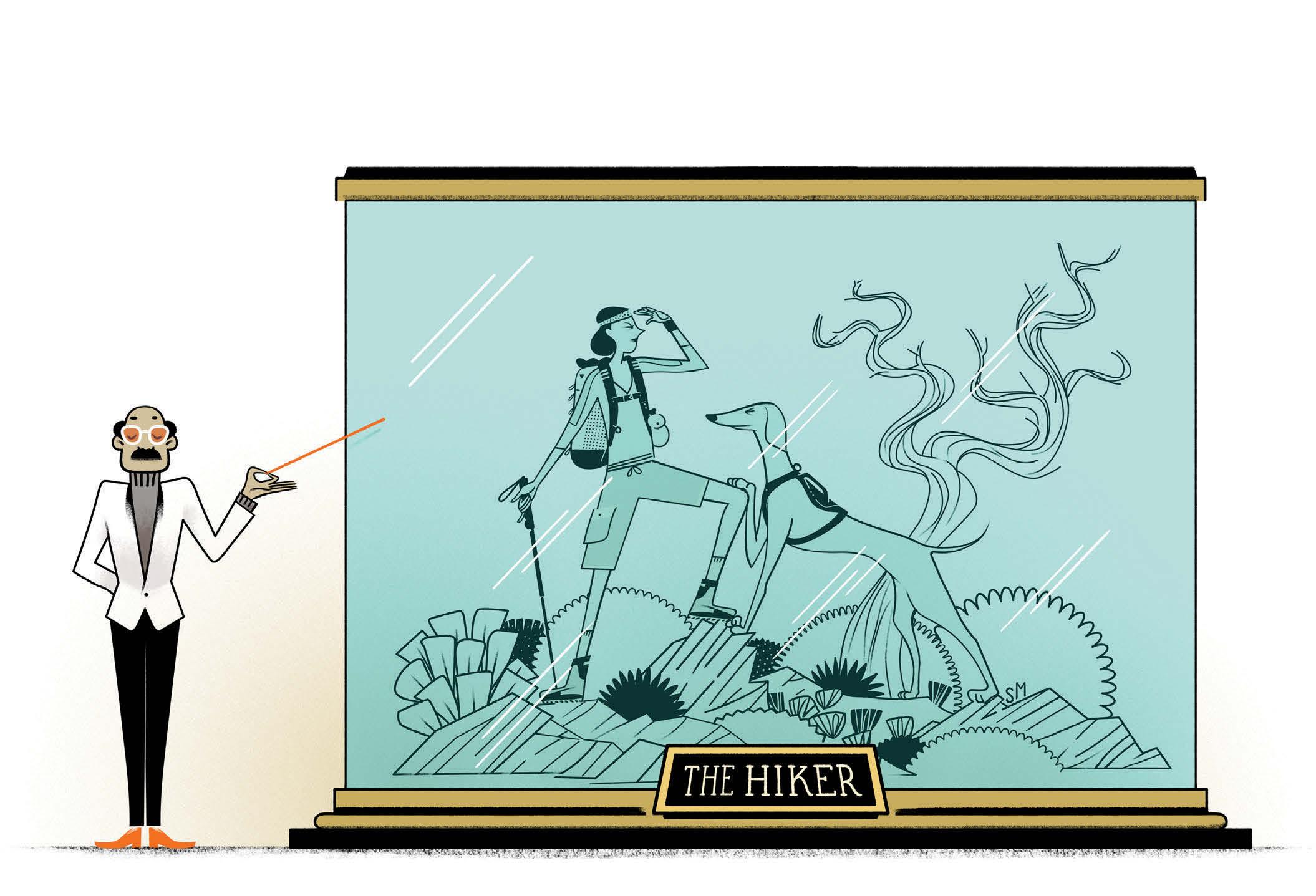
With the right attitude, any day can be a special occasion. All it takes is a little shopping, a lot of fresh air, and maybe a handcrafted cocktail or two. See? Easy.
LIFE IS SWEET

Our in-home design services offer a plethora of design solutions that are tailor-made for you. Explore our vast inventory of in-stock furniture for quick delivery. Serving the Colorado Front Range for over 20 Years.