
Offering 60+ eateries, stores, and entertainment venues, Shop Penn has what you need to welcome the spring season in style.
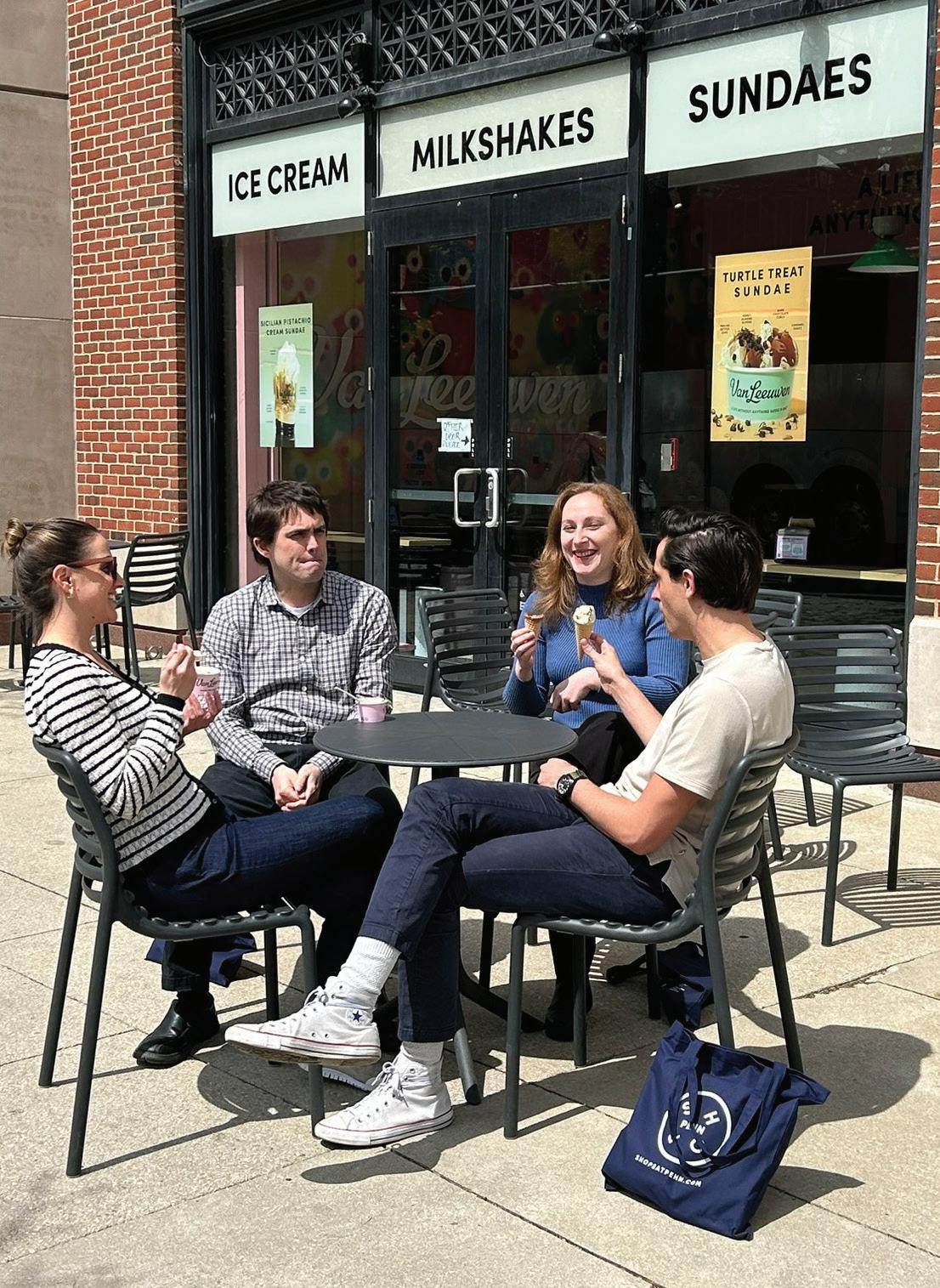
Warmer weather is right around the corner, so now is the time to get out and enjoy everything the Shop Penn Retail District has to offer.


Shop Local.
Shop Penn.

07 Ego of the Month: Norah Rami
Street’s former commander–in–chief on choices, childhood, and Andy Warhol.
20
Coding the Next Code
Does AI belong at a patient’s bedside?
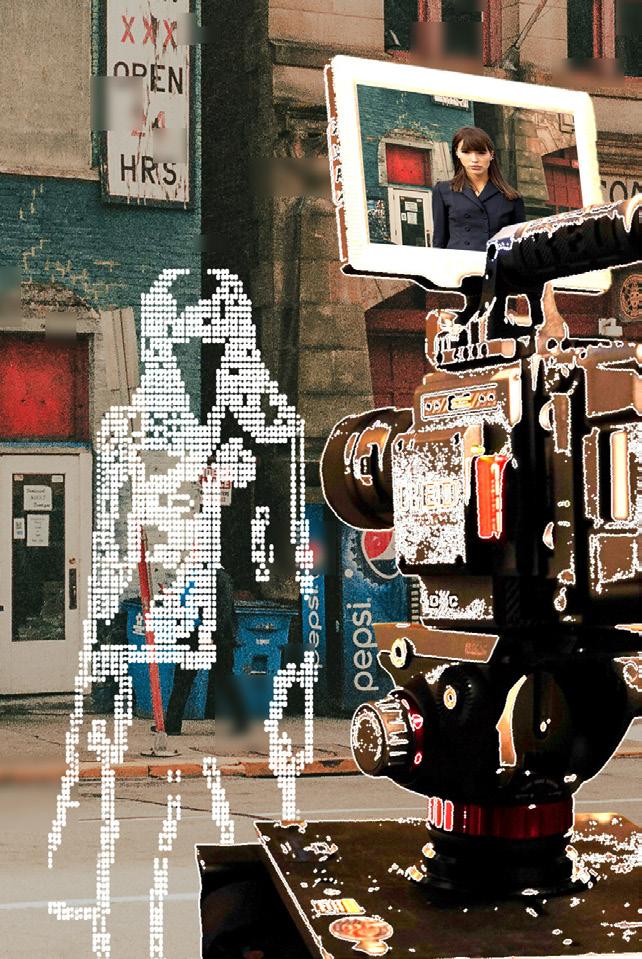
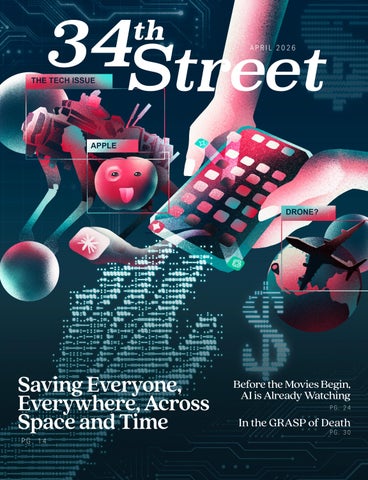
Before the Movies Begin,
AI is Already Watching
For Penn students pursuing a career in the film industry, artificial intelligence is altering both the work and the way in.
AI Artist: More Than an Oxymoron
Venture Lab’s Taylor Caputo dives into the intersection of technology and art.

Penn labs are building the future of robot warfare. Who’s building the ethics?
17776: or What Science Fiction Will Look Like in the Future
Jon Bois’ multimedia narrative abandons science fiction’s obsession with innovation to ask what remains when progress falters.

ON THE
AI is inescapable. It’s embedded in every facet of life. I've nothing witty to say, just praying for the day this bubble pops.
By Insia Haque
It’s no secret that I’m directionally challenged.
On the SEPTA, on campus, and on streets I’ve walked a hundred times, I am always staring at Google Maps, watching a line of blue dots tell me where to go. And somehow, I still miss turns. I end up somewhere close to where I’m supposed to be, only to realize that I’m on the wrong side of the street, or that I’m still a couple of minutes off from my true destination.
Honestly, it’s fascinating that I’ve never needed to get better at navigating. With technology, I am always corrected before I face any real consequences—a robotic voice tells me I’m going the wrong way, or a recalculated path shows up on my phone unprompted. Technology has made it possible for someone like me to move through the world without ever fully learning how to do it myself. I may be lost sometimes, but I’m never lost enough for it to matter.
Our daily lives have been shaped and reshaped by technology since its invention, and this dynamic has only become more pronounced with the rise of artificial intelligence. What once took five hours now takes five minutes. What once required patience, time, and tolerance for doing something badly can now quickly be bypassed with a ChatGPT input. We have outsourced our struggles so seamlessly and frequently that it has become an unconscious habit we can no longer get rid of.
But what we haven’t fully registered is what we’ve given up in the process. This issue explores the consequences of living in a world where technology renders struggle optional. What happens when we outsource patient care to a machine that cannot make any moral judgments? What happens when we outsource the work of acting to AI-generated actors? What happens when we outsource creative judgment to a platform that can process thousands of scripts, but only gravitates toward the ones that have already worked?
These are not hypothetical questions. These are
questions we are confronting in our lives, right now. The new technologies being built every day are less inventions than they are mirrors, reflecting back the fears, desires, and unresolved questions that we’ve always had. People never would’ve created Google Maps or the GPS if there was no one getting lost. They wouldn't have built any of it if people were not already struggling and searching for a way through.
The landscape of technology has shifted faster than any of us have been able to keep up with. These pages are an attempt to think about that shift, and to think about what becomes of us when we begin handing more and more of ourselves over to technology.
It’s one thing to let a GPS correct a wrong turn, and another to expect every human difficulty to be resolved just as quickly. n
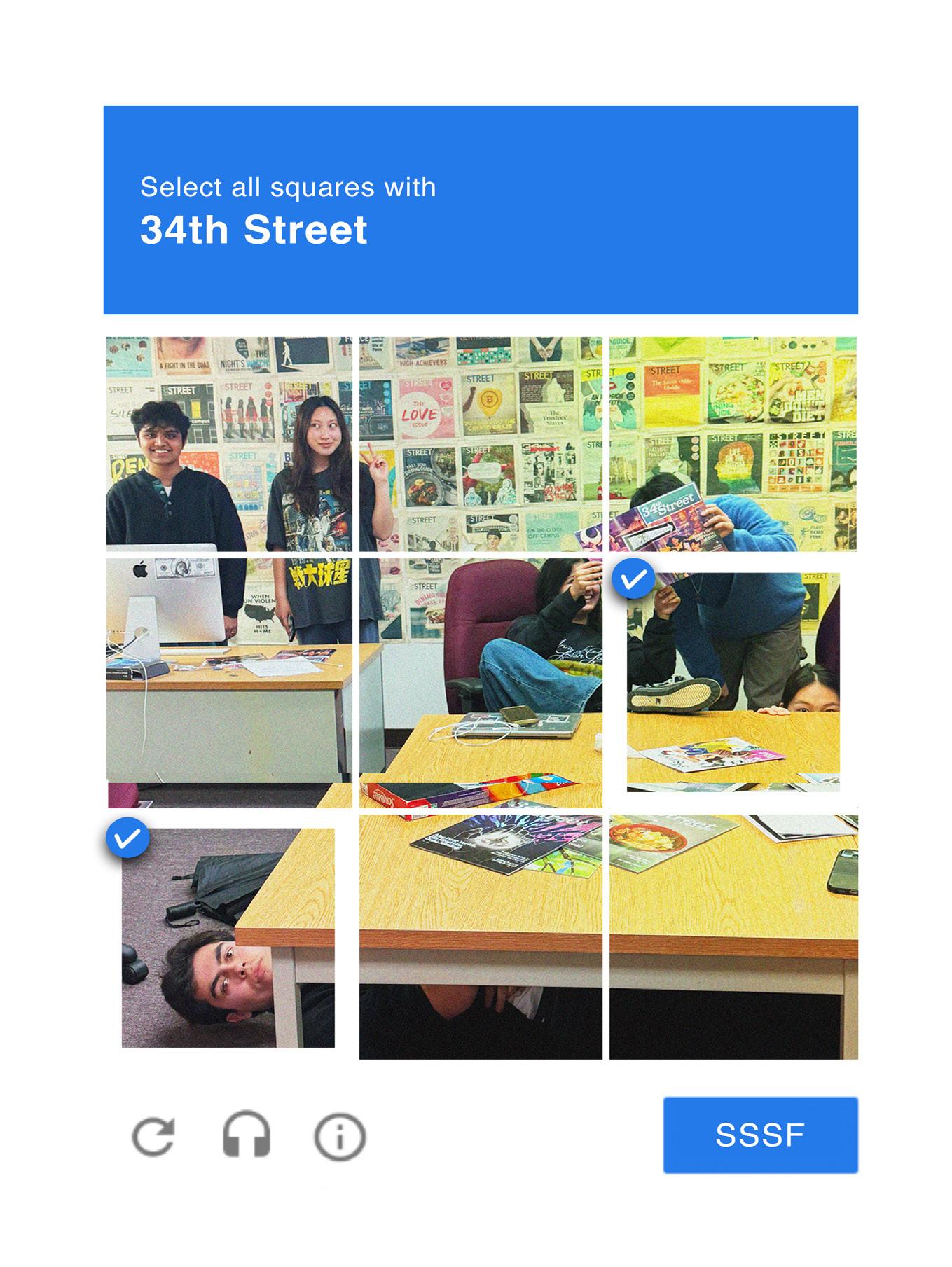
SSSF,


EXECUTIVE BOARD
Nishanth Bhargava, Editor–in–Chief
Samantha Hsiung, Print Managing Editor
Sophia Mirabal, Digital Managing Editor
Jackson Zuercher, Assignments Editor
Kate Ahn, Design Editor
EDITORS
Sadie Daniel, Features
Ethan Sun, Features
Sarah Leonard, Focus
Chloe Norman, Focus
Henry Metz, Film & TV
Mira Agarwal, Music
Laura Gao, Arts & Style
Insia Haque, Arts & Style
Fiona Herzog, Ego
THIS ISSUE
Executive Editor
Jasmine Ni
Copy Editors
Prashant Bhattarai, Jessica Huang
Street Photo Editor
Connie Zhao
Deputy Design Editors
Eunice Choi, Kiki Choi, Chenyao Liu, Amy Luo, Andy Mei, Julia Wang
Design Associates
Catherine Garcia, Insia Haque, Marcus Hirschman, Mariana Dias Martins, Alex Nagler, Maggie Wang
STAFF
Features Writers
Maddy Brunson, Diemmy Dang, Kayley Kang
Focus beats
Melody Cao, Vasanna Persaud, Saanvi Ram, Jessica Tobes
Film & TV beats
Julia Girgenti, Susannah Hughes, Shannon Katzenberger, Sophia Leong, Chenyao Liu, Élan Martin–Prashad, Liana Seale
Music beats
Leo Huang, Remy Lipman, Drew Neiman, Joshua Wangia, Brady Woodhouse
Style beats
Jordan Millar, Alex Nagler, Addison Saji, Adalia Vargas, Jason Zhao
Arts beats
Anjali Kalanidhi, Jack Lamey, Aaron Tokay, Lynn Yi
Ego beats
Rodin Bantawa, Sophie Barkan, Alexis Boland, Jackson Ford, Dedeepya Guthikonda, Jaya Parsa
Staff writers
Emma Katz, Jenny Le, Suhani Mittal, Irene Antón Piolanti, Henry Planet, Namya Raman, Alena Rhoades, Tanvi Shah, Sara Turney, Diamy Wang
LAND ACKNOWLEDGEMENT
The Land on which the office of The Daily Pennsylvanian, Inc. stands is a part of the homeland and territory of the Lenni–Lenape people. We affirm Indigenous sovereignty and will work to hold the DP and the University of Pennsylvania more accountable to the needs of Indigenous people.
CONTACTING 34 th STREET MAGAZINE
If you have questions, comments, complaints or letters to the editor, email Nishanth Bhargava, Editor–in–Chief, at streeteic@34st.com
You can also call us at (215) 422–4640.
www.34st.com © 2026 34th Street Magazine, The Daily Pennsylvanian, Inc. No part may be reproduced in whole or in part without the express, written consent of the editors. All rights reserved.
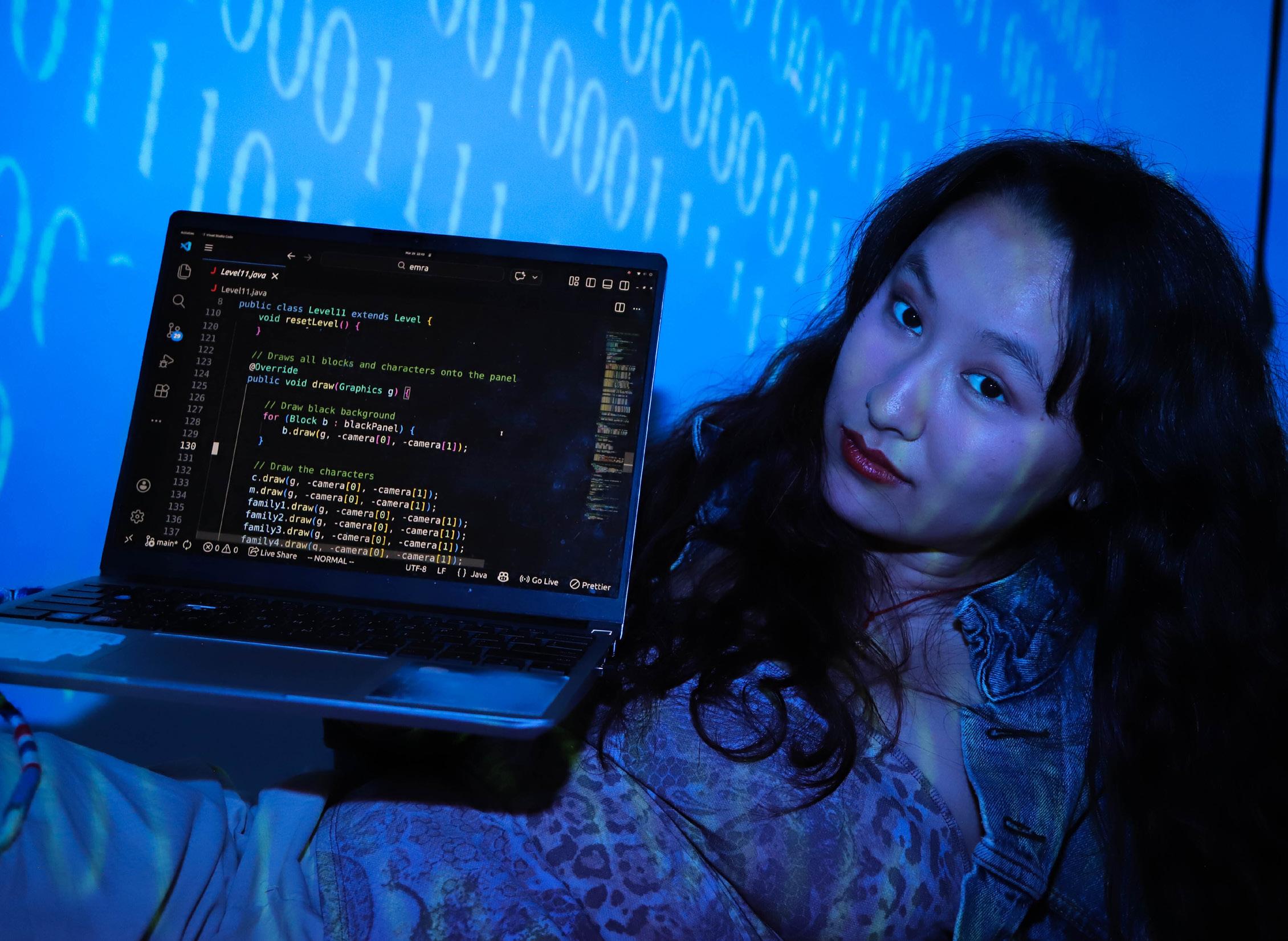
ITechnology taught me that I could achieve anything I put my mind to. But it didn’t teach me when to stop.
Design
By Laura Gao
started coding when I was 12 or 13, but I really started liking it when I was 15.
My friend Samson was just three years older than me and already charging $100 an hour for their freelance software engineering work. They showed me my first real codebase—it was a little social media app they built called Updately, where a group of friends wrote daily blog posts to each other.
It was a Sunday afternoon, and I remember opening up Updately’s files and messing around. I’d change a line of code and see how the webpage updated, then change something else and see how the page updated after that. Through this meddling, I began to learn
how this form of coding worked—a few days later, I was able to implement the first four features they had asked me to.
The next night, I logged in to write my daily blog post. I remember thinking, “Wow, that’s a button that I made! I can click on the right arrow and it takes me to the next page—I did that!” It just felt so cool. I was 15, and I’d never created something that anyone in the world could just log on and see—even if only the ten people on the platform actually used it.
I soon moved on to my own passion projects, making my own apps from scratch. I was skipping my Zoom classes and my family dinners to sit hunched over Visual Studio Code for ten, 12, 14
hours a day, seven days a week. But programming never felt like work—it just felt like a video game. You change something in the code and you immediately see it reflected on the webpage; you see the fruits of your labor so instantly and constantly.
This work better prepared me for the future than high school chemistry; many in tech say that employers care more about your GitHub than your degree. That summer, I got a software internship at a quantum computing startup. I worked on developing and maintaining Python libraries used by scientists and Fortune 500 companies, implementing the latest quantum algorithms into if statements and for loops.
I loved the work, and I felt unstoppable. I was a sophomore in high school—the youngest person at the company. It was also the middle of the pandemic. I had already lost contact with my school friends, and my mom and siblings were stuck in China. Gradually, I fell deeper into the tech space until it became my main community.
In tech circles, there was a certain myth built around San Francisco as the heart of all innovation. I remember an older friend trying to convince me and another 16–year–old to take solo trips to SF so we could meet founders and explore potential collaborations. It would “compound our careers,” he said. He gave us the emails of a few successful tech multimillionaires who had funded other teenagers’ SF trips.
I boarded my first five–hour cross–continental flight when I was 17. I attended conferences, networked with venture capitalists, and flirted with the idea of starting my own startup. I saw peers my age start companies and easily raise hundreds of thousands of dollars. One friend went to a conference afterparty, made up a term sheet on the spot, and got three drunk VCs to invest in his fake company. Another got half a million for his artificial superintelligence lab and instantly used it to rent a $16,000/ month mansion that doubled as his new company’s living and working space.
Throughout my senior year of high school, I kept returning. At my peak, I made the pilgrimage to SF five times in one year. I even skipped a month of school to live in a group house with other solo tech builders my age. I flew back on the day of my graduation and Ubered directly from the airport to my school auditorium.
When Alysa Liu was training for the 2020 Olympics, she’d Uber to the ice rink alone every day, skate for 12 hours, and then go back home. Every day was the same back and forth. “When COVID hit, all those birthdays were alone,” she said in a Rolling Stone interview.
Growing up in the tech space, I found myself internalizing its key scriptures.
I spent my formative years living with its anti–institution, pro–self–learning mindset, and I started to apply it everywhere. I applied it to my coding, and I was very efficient at debugging in Python and React. I applied it to my exams, and I aced subjects I knew nothing about just a few days prior. But when it came to interpersonal issues, this mindset began to show its cracks—I had a fair share of conflicts that I wasn’t able to “debug” the same way.
For the most part, I didn’t think about this too much. But then I was sexually assaulted, which forced me to confront these cracks in a way I didn’t have to before.It sent me to hell and back, and what followed was probably the worst pain I’d ever experienced. I pored over all the DSM manuals, feminist essays, and Chanel Miller memoirs I could, trying to find answers to my questions. Of course, nothing I read lessened the pain.
I couldn’t help but feel that the whole atmosphere of tech set me up for this. Besides the clearly skewed gender ratio—I was routinely one of only two women in a room full of men—there was also a certain fetishization of youth dressed up in professionalism. It wasn’t uncommon to hear things like, “Oh, you’re 17? You must be so smart, and school must be holding you back. When are you dropping out to build a startup?”
It was a truism that AI, gene editing, quantum computing, and other emerging technologies would completely revolutionize the world—just like how our current AirPods and instant FaceTimes would be science fiction to a person from 100 years ago. We, here, were the innovators; our generation of young builders was building the future with every step. Of course, my family protested every time I skipped school to go to SF, but they were just too old–fashioned to understand that the industry was changing. I thought that they’d only hold me back, that I was better off alone, and that I was mature enough to make such a decision—I distanced myself from my support network and took on the world.
All this was sold to me as cultivating
my skills, as being independent—and maybe it was. But it also brings you into the perfect situation to be preyed upon. My freshman year at Penn was when I began to understand what had been taken from me—suddenly, I had never felt so alone.
When you become Christian, a baptism is a public, unfettered declaration to the world that this is who you now are and what you now believe. There is no equivalent ceremony, however, when it comes to leaving a doctrine behind.
I craved one, though. I picked up a fine arts minor and threw myself into it completely, spending my nights with bristle paintbrushes and linseed oils. “Sure, I’m majoring in engineering,” I’d say, “but my true passion lies in my art minor.” I desperately wanted to redefine my identity around anything other than tech, and I made sure to tell everyone I met.
I appreciated how art treated the unquantifiable, amorphous experiences of being alive as valuable in and of themselves, without needing to be codified in objective terms. For my final project, I painted a nude woman suspended in the clouds, purple paint crawling down the canvas in little droplets around her.
Two years after Alysa quit skating, she went skiing with her friends. It was so fun to be gliding through the snow that she decided to try on her skates again. “I need[ed] to find a way to satisfy this urge to go fast,” she recalled. “And I thought, the rink is right there.”
It’s easy for me to demonize tech, but recently, I’ve mellowed out a bit. I’m currently designing and taping out my first computer chip end–to–end, and I’m reminded yet again of how fun engineering is; it’s like I’m solving one big logic puzzle. How lucky am I to partake in this delight?
Alysa ended up coming back to competitive skating—but this time, it was on her own terms. “No one tells me what I’m gonna wear,” she said. “No one tells me how my hair is gonna be. No one’s gonna try to change me.” If it flew in the face of figure skating norms and standards, then so be it. n
Sugar Land, Texas
Major in political science and English, minor in history
Street, Friars Senior Society, Pi Sigma Alpha, University Scholars
Ioften say that if I was hit by a laser that turned me into a girl, I would probably become Norah Rami (C ’26). I think she’d concur with that assessment. The two of us grew up in very tech–focused, very Indian suburbs. We both find pleasure in aimless and meandering conversations. And, of course, we both eventually found a home for ourselves at Street.
I first met Norah during my initiation into Penn’s mock trial team, when we traded Spotify usernames and talked about my then–pending application to be a Street Music beat. Countless production nights, edit sessions, and karaoke socials later, the first impression I formed of her still persists in my mind— that of a charismatic firebrand who’s never been afraid to chart her own course. While she’s always embraced spontaneity, Norah now has her next couple of years neatly planned out—she’ll spend a summer in New York as a reporter at Bloomberg, then study at the London School of Economics and the University of Oxford as a Marshall Scholar.
I sat down with Norah at the Marks Family Writing Center intending to discuss her storied career at Penn, and maybe let her wax poetic about how her time at Street shaped her life. We ended up discussing anything—and everything—but.
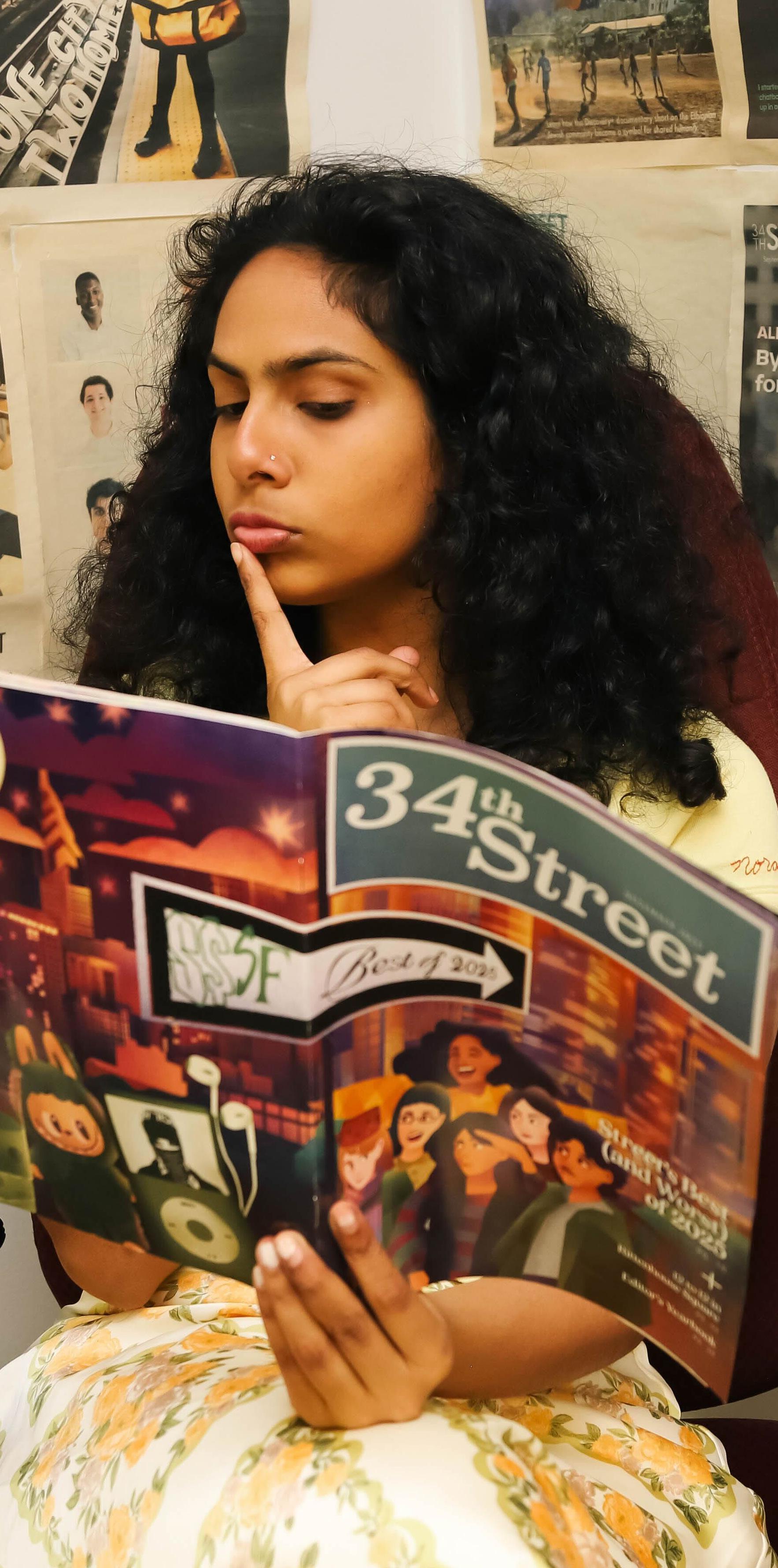
Street’s former commander–in–chief on choices, childhood, and Andy Warhol.
BY NISHANTH BHARGAVA
You’re in your last semester at Penn. What gives your life meaning?
To be honest, I feel like my life has only recently regained meaning. I turned in my thesis on Sunday, and I finally got my documents from Marshall today. Now I have nothing to worry about—and honestly, I was kind of worried about that. What do I do when I don’t have this existential fear of failure driving me? But now I feel like a human being rather than someone who just does stuff. I’ve wanted that feeling for so long, and now I suddenly have it.
Was it difficult to build structure out of this freedom?
Not really. I joke that if I had more time, I would probably just read and write more—which is what I have to do with my time anyway. When I first came into college, I think the lack of structure in my day really threw me off. In high school, I had every one of my hours scheduled, but when I got to Penn, I realized that if I made my life a jungle gym of Google Calendars, I wouldn’t be able to be a person. I barely use my calendar now—so sometimes I forget stuff, or I don’t come to work. But for the most part, it lets me be more free and intentional with what I’m doing.
What’s your most unorthodox conviction?
I think that everything is a choice. Like, yes, you have to work to survive, but you can also choose not to—you just don’t want to live with those consequences. There are certain consequences I don’t want to face, but it’s not that I have to do anything. I’m choosing to do that.
How does that change the way you live your life?
I think that it makes me think a lot about what I do as a person. You know, I chose to spend my whole
spring break in Vermont working on my thesis. I didn’t have to do that. And so if I’m unhappy writing in this tiny–ass cabin, that’s not my thesis advisor’s fault. It’s not my thesis’ fault. It’s nobody’s fault but mine, so I might as well enjoy it.
When I was a freshman at Penn, I felt a lot of pressure to make the “right choice.” I sometimes wished that I just had someone telling me what to do. But then I realized that even if I listened to that person, it would be my choice to listen to them. I think that owning up to everything being my decision has given me a lot more power to move around and make choices—but it’s also made me bear the responsibility for those choices.
You grew up in Sugar Land, Texas— it’s very STEM–heavy, very preprofessional. But you chose to go into the humanities. Do you think you would have been happier if you chose the conventional path?
I imagine this alternate version of myself who was very preprofessional, someone who went to medical school, followed in my father’s footsteps and became a heart surgeon. I think that version of myself could be very happy, but I wouldn’t be friends with her.
My parents really encouraged me to think for myself and do my own thing. In my senior year of high school, I started caring a lot more about classroom drama and social pressures. But one night, my mom came to me after I had been out late and said, “You just wrote all your college apps about how you wanted to change the world. You’re not going to change the world if you keep acting like this.” And I think about that all the time!
I was always a weird kid. Once you lean into your weirdness, you start to liberate yourself from other social pressures. It’s really freeing,
especially when it comes to pursuing a less orthodox career in the humanities.
Do you ever get concerned about the precarity of your career path?
I’m allergic to that question—I just have a mentality of presumptive failure. When I was thinking about studying computer science, or considering going to law school, I presumed that everything was going to fail. And if that’s your mindset, then you might as well do what’s unstable anyways, because everything is going to fail at an equal rate. It actually makes you more risk prone when you think that every plane you board is bound to crash.
You say that you were always a “weird kid.” Is that how you want other people to see you?
When I was on a PennQuest retreat, there was one night where we all talked about how we perceived each other. And everyone else got descriptors like “kind,” or “funny,” or, “someone I want to hang out with on campus.” But when it was my turn, everyone went, “You’re smart. You know a lot about a lot of things.” And you know what, that was my fault—I spent a lot of time on that hike explaining the Madonna–whore complex. But I don’t want the first thing people think about me to be “smart.” The best description I’ve ever gotten was from one of my oldest friends, who called me a “rogue nerd.” And I really like that. Actually, I changed my mind. I like being called smart— whatever—but I like the rogue nerd aspect of it.
If you had kids, would you raise them the same way you were raised?
I think people often consider having kids when they realize they’re not going to be fulfilled in this life.
Having kids is a kind of immortality, because your will continues on through them, right? My family very much believes in reincarnation. And everyone says that I’m a reincarnation of my great–grandma. My great–grandma sort of grew up very much confined by gender norms, but she really wanted to have a career, travel the world, and do all those things. She was a wonderful, wonderful person, but she wasn’t able to actually achieve any of the things that she dreamed about. And so, my family often says I’m my great–grandmother’s reincarnation, so what I achieve is her will manifested, her will actualized. And I think people often think about their children as an actualization of their will—at least, that’s my philosophy on children.
Do you think you’d be part of Andy Warhol’s Factory? ( Ed. note : Norah asked me this question, but answered it herself.)
I don’t think I’d be part of the Warhol Factory. I’m a disorganized person, and I really struggle with organized association.
I agree. If I’m at the Warhol Factory, and some other guy at The Factory sucks, I can’t really get rid of him. Unless you become a new Warhol.
Yeah, but it sucks to be the guy who has to lead something.
But you’re Street’s editor–in–chief!
I’m not responding to that.
In sixth grade—and this goes back to why I would be bad in the Warhol Factory ( Ed. note : It does not. ) There was this one teacher who once told me, “Stop being so annoying, Norah, be quiet.” And I just found it to be rude. So then the next day, somehow, I convinced
everyone in my class to refuse to speak. The teacher is asking questions to this 30–person class, and nobody’s answering. And he asks, “What’s going on?” And nobody’s saying anything. Then, finally, my friend slides a piece of paper to the edge of his desk. The teacher picks it up and goes, “Norah, you made them do this?”
Did you get in trouble?
No. Honestly, I think he admired it.
That’s a pretty good protest. What’s your ideal system of government?
I don’t know. My political science degree was a waste.
What are your favorite ways to spend time on campus?
Well, I discovered this hack my freshman year, which is that if you really need to get work done, you go to one of those cubicles on the third floor of Van Pelt. You go there late at night and you will get done what you need to get done, because you need to leave as soon as possible. You feel like you are being
transported into another world. See, I think to actually get work done, your study space should feel like torture—the basement of Gregory College House is another place where I have pulled many all–nighters.
What’s your favorite memory from your time at Penn?
Rephrase the question. Okay, the question is now, “What is a moment at Penn that you realized something new about yourself?”
There was this one time we were all sitting in my kitchen, and Nishanth ( Ed. note : That’s me! ) and our other friend were discussing who they thought the meanest people they knew were. And they both said I was one of the meanest! I think that really made me realize that I can be quite blunt, sometimes without intending to. I really never intend to be mean—but I guess that’s part of the problem.
If you had to envision the perfect future for yourself, ten years from now, where would you be?
I don’t know. n
Three people, living or dead, you’d want to get a beer with? Mindy Kaling, Susan Sontag, and former Street Editor–in–chief Walden Green (C ’24)
Favorite movie? Bend It Like Beckham
Least favorite song? “Close to You” by Gracie Abrams
There are two types of people at Penn: People who have a PennCard and people who don’t
And you are?
I don’t have a PennCard.
How the rise of artificial intelligence might leave working women behind.
BY NAMYA RAMAN DESIGN BY ANDY MEI AND TIFFANY ZHENG
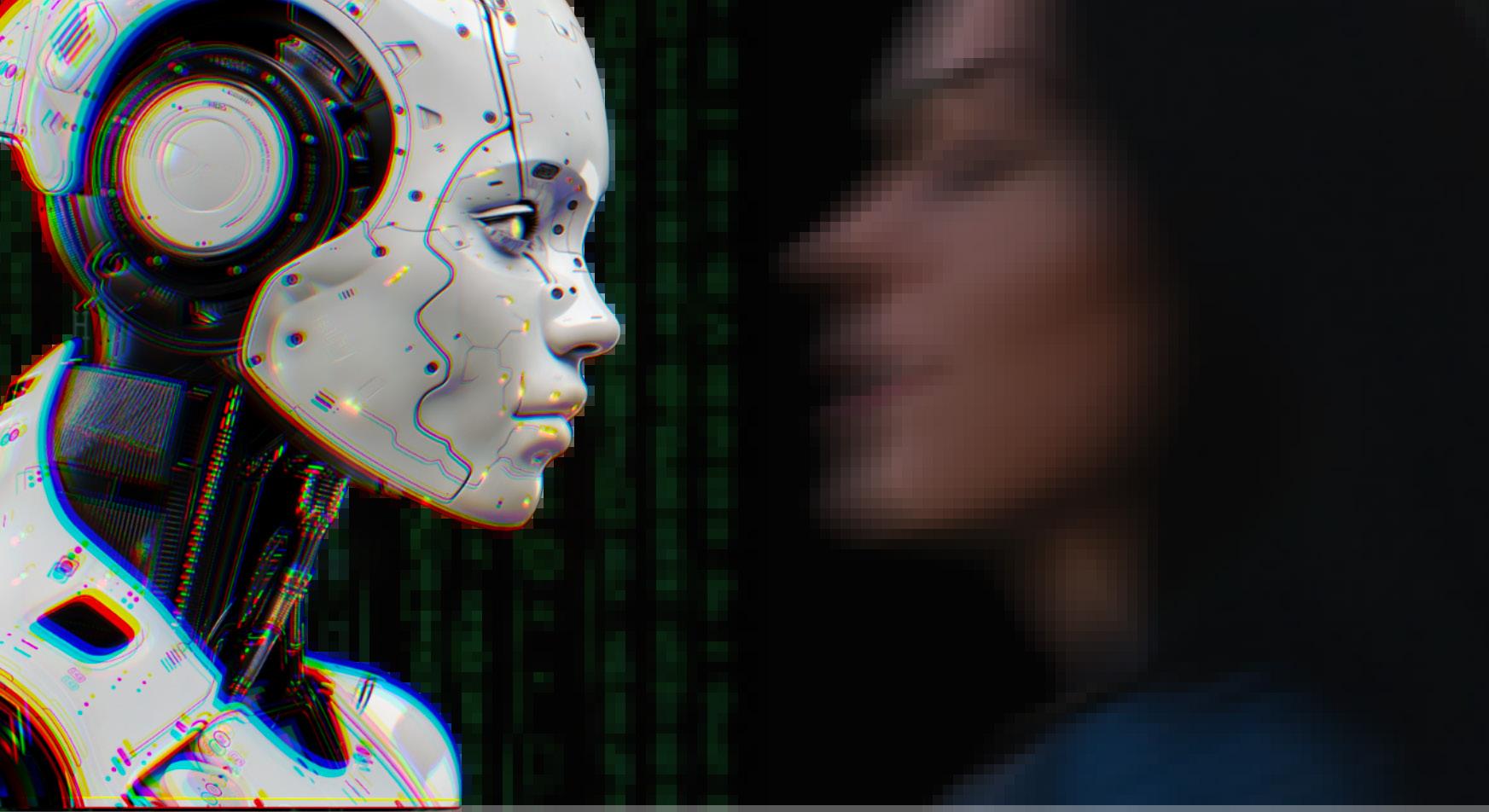
It’s no secret that women have been historically neglected and undermined in the workplace. They often have to work twice as hard to get paid less, while men can take credit for their work. Women have never had it easy— and while strides have been made in closing these gaps, the emergence of artificial intelligence has created a new gap altogether.
As working women watch AI adoption increase across sectors, many are far more skeptical than men about utilizing it. Though valid, this hesitancy might come at a cost. As companies begin to prioritize AI literacy as a key skill, their female employees might get left behind.
On average, women are 25% less likely to use AI than men. This is hardly surprising when we consider the harsh scrutiny they already experience compared to their male counterparts. A study conducted by the Harvard Business Review in 2025 examined how perceptions of competence changed if engineers had used AI. When an engineer was believed to have used AI for their code, they were thought to be less competent. Moreover, this penalty was twice as harsh for female engineers
compared to males. These results make it clear that relying on AI tools can call one’s professional ability into question, especially for women in the workforce. Generative AI also has a disproportionately harmful impact on women outside of the workplace. They are far more likely than men to be victims of AI–enabled abuse, defamatory image generation, and mishandling of private information. Tools like Grok, as well as “nudification” apps, have often been used to generate naked images of women without their knowledge. The use of deepfakes is overwhelmingly at the expense of women, with an estimated 90% of nonconsensual deepfake victims being female. Women tend to have greater overall concerns about the ethical issues with AI and are more likely to consider it useless or even harmful in their public, work, and personal lives. Women have always been underrepresented in the training samples used to develop new products. Often, this comes without regard for safety, as is the case with seatbelts. Because many are designed for the average male build and sitting posture, seatbelts are often less effective for female drivers
and increase their risk of death on the roads. Generative AI training functions similiarly. It relies on its input data to produce the output. When its input data skews towards men—as it seems to—the output will simply mirror their preferences and perspectives. It doesn’t matter how much we praise AI tools for their objectivity when their training data is already poisoned by biased social norms.
This is hardly a hypothetical problem: Generative AI tools have already been shown to reproduce social biases, often at the expense of women’s safety and comfort. In an article published by the MIT Technology Review, senior reporter Melissa Heikkilä recounted her experiences using Lensa AI to create an avatar for herself. As an Asian woman, she was subjected to far more explicit images of herself compared to the “realistic yet flattering avatars” of her colleagues. Lensa relies on a “massive open–source data set” which compiles prompts and images from all over the internet. Naturally, this data set is overpopulated with hypersexualized depictions of Asian women. AI is hardly the objective, intelligent tech-
nology that it was promised to be. Image generation is not the only issue. Aleksandra Sorokovikova and other scholars from universities across Europe shared similar results pertaining to large language models. When the team of researchers asked ChatGPT to produce strategies for salary negotiation after being given the user’s race, gender, and age, the model suggested lower salaries for women. Given that LLM adoption is rising rapidly in industry today, this isn’t just a harmless mistake. It reveals how AI can perpetuate the very biases it is supposed to be immune to.
As companies continue to incorporate AI into their recruitment processes, the impact of these biases becomes even more apparent and detrimental. In 2018, Amazon’s AI recruitment system was revealed to penalize resumes that used the word “women’s” in them and generally characterize male can-
didates as more desirable. While the issue of penalizing specific words was eventually resolved, it’s hard to ignore the fact that implicit biases, ingrained in the system, created this problem in the first place.
Closing the gender gap is a two–way street when it comes to companies and their employees. If AI is going to shape the workforce, half of our workers cannot be neglected. Women will have to push past their fears to contribute their perspectives so these tools can be further developed with them in mind. It’s also the responsibility of developers to confront these biases at the source. By diversifying training data, they can ensure AI tools support the experiences of all users rather than a select few.
Meanwhile, companies must support their female employees by addressing their concerns head–on. Eliminating vague policies surrounding AI would reduce many women’s fears of being
CIC Philadelphia offers flexible, professionally manages labs, offices, coworking, and event space.
penalized for using it. Companies can also address safety and bias concerns by increasing transparency between the user and the system. To overcome women’s fears, companies must keep them informed and reassure them that their personal information is being used properly.
AI certainly isn’t going anywhere, which makes addressing its fundamental flaws all the more pressing. It is easy to understand why women haven’t embraced these tools as readily as their male counterparts. However, it may only be a matter of time before they are completely left behind in their respective industries for lacking AI literacy. Meanwhile, male workers may get an even bigger advantage than they already have. All parties can make strides to close the gap and ensure that both companies and their female employees can reap the benefits of AI. n

BY DIEMMY DANG DESIGN BY ALEX NAGLER
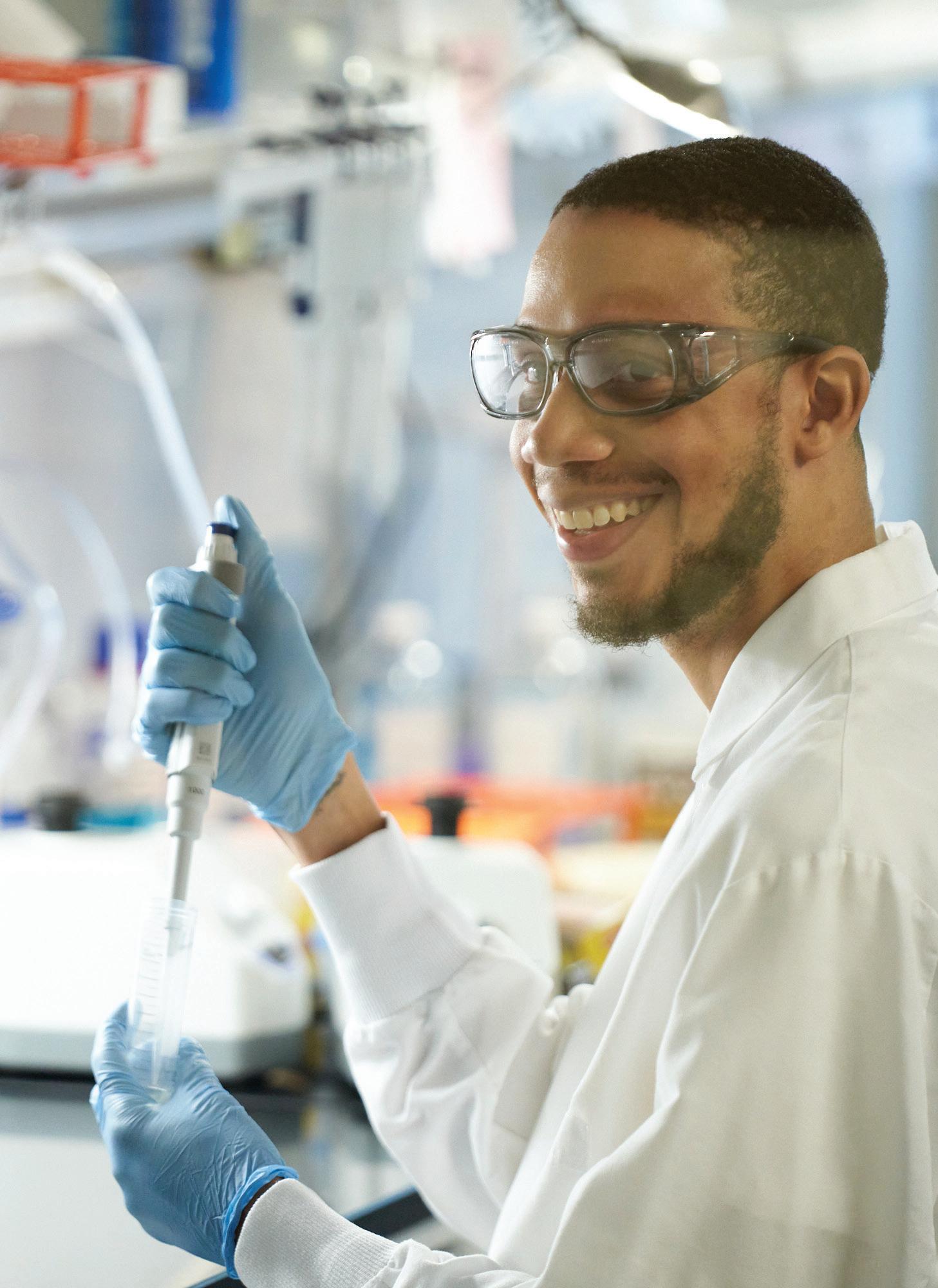
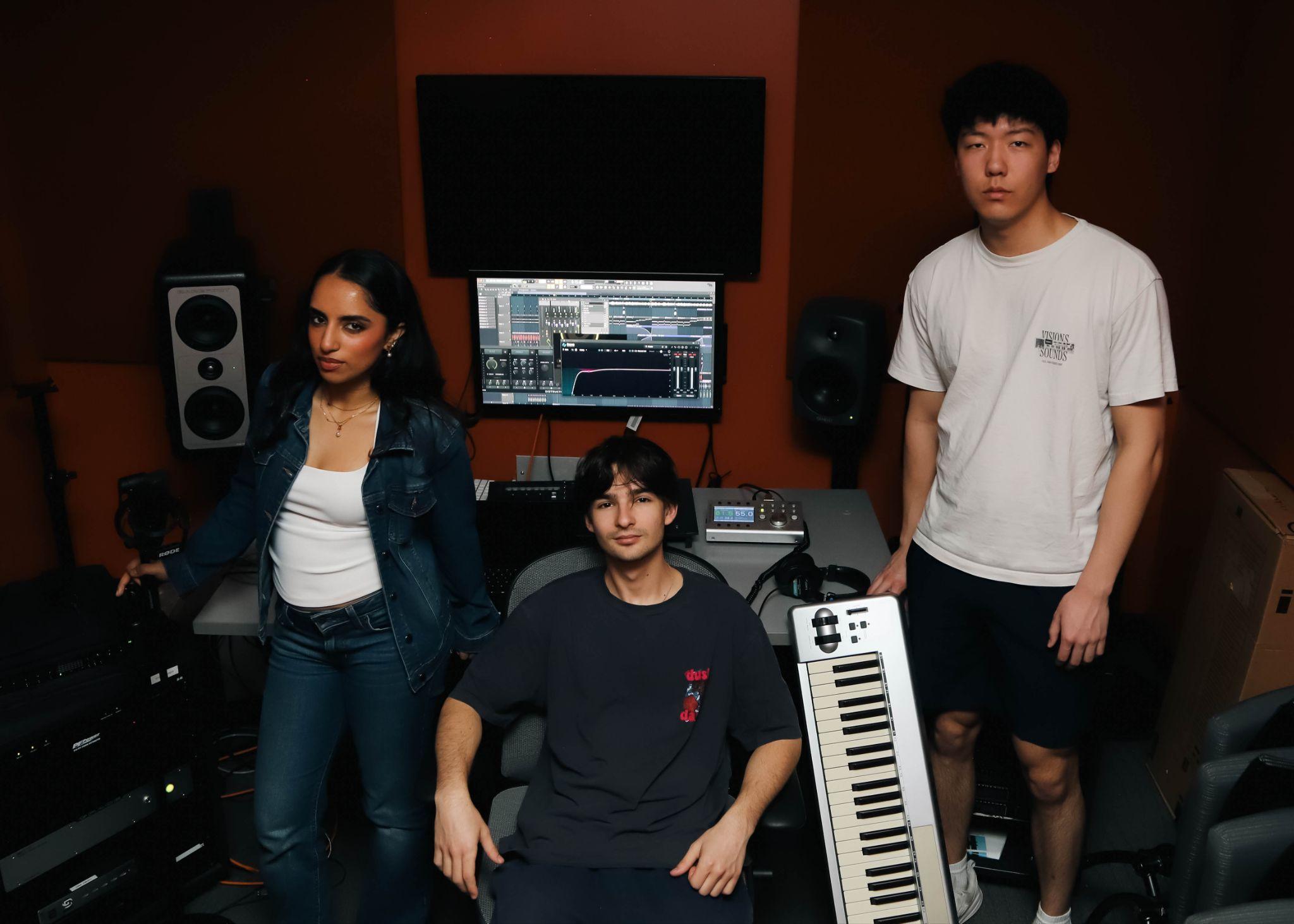
As a healthcare finance and philosophy double–major, Michael Lovaglio (C ’27) doesn’t seem like someone who would spend most of his time in Penn’s electronic music studio. But since opening up the music production software FL Studio when he was 11, Michael has been engrossed in understanding the mechanics of song creation. Like many other student producers at Penn, Michael is passionate about carving out a unique space for music in his life. By blending technology, theory, and creativity, students like Michael have turned to electronic music production as an art, one in which they are able to construct and define their own relationship to sound.
“When I was a kid, I had this big fixation on how sounds were made on the radio and anything I’d hear, I’d ask how they make this, how they do that,” Michael says. “I just thought it was the coolest thing ever to be able to do that. So I think it was definitely a combination of having the passion and the desire to really want to learn how to do it, but also accepting that [it was a] very tedious and difficult process.”
The process that Michael describes is
one that combines self–instruction and Penn’s unique course offerings in electronic music production. Although Michael began learning with YouTube tutorials, experimenting with beginner software and “trial and error” techniques, he has since been able to hone his expertise through a variety of classes focused on music production. On top of his two majors, he has recently declared a minor in music, taking courses that have taught him about everything from audio production to the history of electronic music.
“Most excitingly, I took ‘Musical Interfaces and Robotics,’” Michael says. “It taught me how to actually engineer and design synthesizers … That just brought a whole new level of the engineering side to me, and since then, I’ve been working on implementing that into my own music.”
Kevin Li (E ’28) is currently in the “Musical Interfaces and Robotics” course that Michael previously took. The final project for the innovative class—which teaches students how to integrate physical computing into sound–based creative work— is to create a working prototype for a new instrument. Kevin is working on using a
software called MaxMSP to generate new sounds, manipulating audio samples that can then be controlled by a joystick. Although the concept of the class might be novel for many students, it is not entirely new for Kevin, who has been producing music for the past four years under the name Impasta. Kevin primarily uses FL Studio to create loops for songs, constructing melodies that he often sends to other producers and artists to build on top of. This collaborative aspect of his work allows him to work with other Penn students—including Michael—to share audio samples and experiment with sounds and production styles.
As a computer science major, Kevin is constantly finding ways to combine his professional ambitions with his passion for music. This summer, he will work at the intersection of music and technology as an intern at Suno. Kevin explains that the software is like “ChatGPT for music,” where users can input prompts and receive AI–generated audio in return. Kevin has used the platform before in some of his own music, utilizing Suno to generate the
vocal samples he includes in his songs.
Like Kevin, Michael has also used music production as an avenue for professional development. In his freshman year, Michael co–founded the student–run record label 215Records. The group assists artists across various aspects of music creation, providing support with studio production, Spotify releases, and marketing strategies.
“It’s just been a big chance for me to not only enhance my own production skills, but also to learn a lot of music communication skills that hopefully could carry into my [professional life] one day,” Michael explains.
Meha Gaba (W, E ’27) is also a part of 215Records. Meha has been writing songs since she was 14, but only got involved with the production side of music over this past year. After joining the student record label, she was inspired to invest more heavily in her own music, working on a single that is set to be released by the end of the semester. In addition to learning from the other producers in the club, she also took “Introduction to Electronic Musicmaking,” which helped her hone many of the techniques she says let her “bring [her] vision to life.”
Although she is busy as a dual–degree student studying artificial intelligence and finance, Meha says that music is more than a simple hobby for her. “I would say music has always been a really big part of my life and getting my emotions out,” Meha explains. “I’ve always just turned to music as my inspiration.”
Meha adds that she wants to “take it pro someday,” and that she wants to see how her first single performs before making the decision. “I’m definitely open to [it] if something were to take off,” Meha says.
Michael expresses a similar sentiment, stating that his future career goals lie in pursuing music professionally.
“My dream is to do music in the most ideal world,” Michael says. “My dream is really to be my own artist, to make my own songs and put them out into the world.” n




























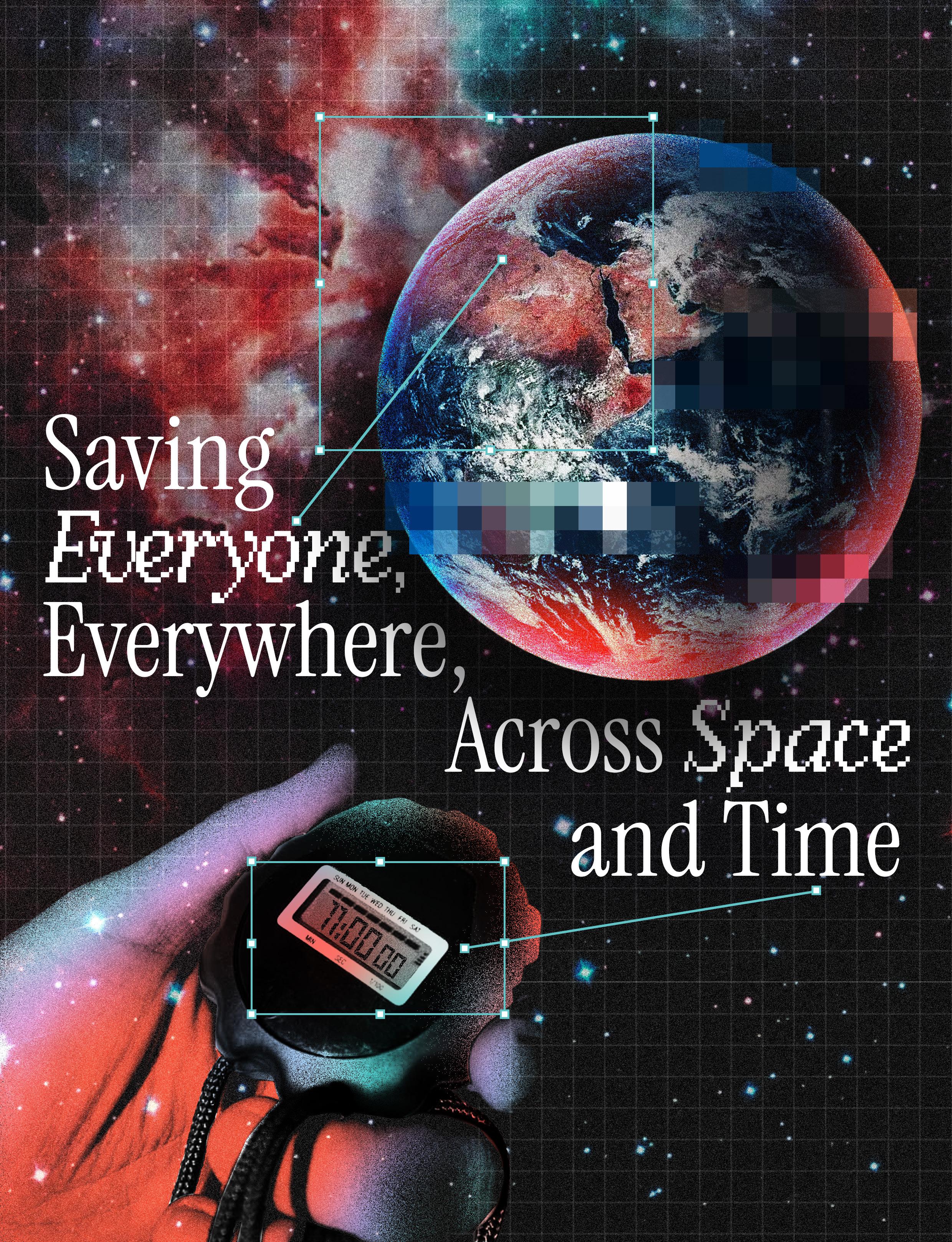
Why college–age effective altruists are determined to rescue humanity from artificial intelligence, and how it’s panning out.
In many respects, the first general body meeting of Penn’s revived Effective Altruism club is just like any other. Cheap pizzas are stacked up by the Lauder College House media room entrance; students sit on the University’s bare, standard–issue upholstery, chatting about their preprofessional trajectories. The Effective Altruism at Penn board paces back and forth by the front counter— Hazem Hassan (E ’29), the club’s intrepid president, is pulling his hair out trying to get his slides on screen.
In the meantime, EA@Penn’s tentative members share scraps of conversation. In one corner, a man leans forward in his seat, explaining policy—not any particular policy, just the concept of policy—to the young woman beside him. He wants to become a lobbyist, he explains, but is split on whether he should move to D.C. before or after finding a wife in Brooklyn, N.Y. The young woman nods along, not talking much. 15 minutes later, Hazem finally loses hope in the projector and opts to give his spiel impromptu.
“Doing good effectively is not just trivial,” Hazem tells his audience. “I mean, it’s trivial to accept it, but to do it is a different thing.” He explains, for example, that in 2013 it cost around $40,000 to train a guide dog for one blind American. At the same time, it cost less than $20 to fund a surgery that “reverse[s] the effects of trachoma in Africa.” Paying for guide dogs might seem like a great idea, but the same amount of money could be used to prevent 2,000 people from going blind at all. Humans, he explained, have a tenden-
cy to prioritize impact that is more tangible, visible, and closer to home, which often leads them to practice altruism “ineffectively.”
“From there,” Hazem says, “you should be able to see that going off of feelings is just unreliable in terms of doing good.”
Throughout the 21st century, EA blossomed from a loose intellectual movement to a network of thinkers, donors, and institutions that distribute billions of dollars to the most effective “cause areas.” Over time, EA’s priorities have shift-
ed as well; today, a plurality of its efforts are directed not toward global health and poverty, but toward preventing human extinction at the hands of a rogue artificial intelligence. An emerging cohort of university–aged students—those that grew up attending EA–adjacent summer camps in high school and joined EA clubs in college—almost exclusively belong to the latter category. To them, the present and future of humanity are imperiled, and they are among the only ones trying to save the world.

The intellectual groundwork for EA was set up in the late 20th century, with Australian philosopher Peter Singer’s 1972 essay “Famine, Affluence, and Morality.” In the now–famous text, Singer imagines a child drowning in a shallow pond. If someone is willing to jump in the pond and save the child, ruining their own expensive coat in the process, the same individual should be willing to donate their money to save starving children halfway across the world. It was fallacious, Singer argued, to help only those in one’s direct line of sight and disregard the plight of those in developing nations.
Brian Berkey, a Legal Studies and Business Ethics professor at the Wharton School, was among the aughts–era twenty–somethings profoundly moved by Singer’s drowning child, having read the essay as a freshman at New York University. “I read that when I was 18 and was just sort of gripped by it,” he says. For the rest of college, he would primarily eat cheap ramen and shave “as infrequently as possible” to set aside money for people he did not know and would never meet. Today, he still sports a well–kept salt–and–pepper beard.
When Berkey was completing his doctorate in the late 2000s, the first EA organizations were just starting to emerge. They sought to identify the best possible “cause areas” to which one could donate money and spent much time debating the merits of deworming initiatives versus trachoma surgeries versus malaria bed nets. When not on Penn’s dime, Berkey still prefers to travel by train or bus, books cheap places to stay in, and eats only low–cost meals. He donates the money he saves to GiveDirectly, his allocation service of choice.
However, Berkey’s academic writing engages a dated version of the movement. He represents a sort of old guard in EA—one still focused on living frugally and donating the bulk of their money to the global poor. The now–dominant faction of the movement is, in contrast, focused on a more ambitious project. Throughout the 2010s, EA amassed large amounts of power and money by
converting rich technology leaders— such as Coefficient Giving’s Dustin Moskovitz and FTX Future Fund’s Sam Bankman–Fried—to their cause. This expansion came with a peculiar new philosophy. Gradually, many EA leaders began to consider the plight not just of humans today, but those living in the far future—a concept that effective altruists call “longtermism.”
Like Singer’s argument for frugal living, the logic behind longtermism is simple, yet extremely demanding. If one accounts for the massive size of the future human population and the possibility for life to endure indefinitely in the universe, there exists an almost infinite reservoir of drowning children at the sluice gates waiting to be born. As Berkey puts it, when you adopt a longtermist perspective, something like global poverty becomes “a rounding error” when compared to the threat of human extinction.
Today, longtermists have identified AI as the most severe existential risk, or “x–risk,” of all—that perspective pervades discussions online and absorbs much of EA’s accumulated fortune. Suddenly, early effective altruists like Berkey found themselves an epistemic ocean away from their movement’s center. “This wasn’t on anyone’s mind in the early 2000s,” he says. While he thinks x–risks are “rightly” getting more consideration today, he still doesn’t buy the ethical framework that is a prerequisite for longtermist thinking. “I think there are strong arguments for … improving the lives of existing people as opposed to creating new people.”
At the very least, Berkey believes this shift in the movement’s priorities is terrible for PR. He thinks EA should be “a kind of broad progressive movement that will bring a lot of people on board.” But the direction of resources away from early EA priorities like global poverty, health, or animal suffering might reduce the movement’s appeal to the general public. Instead, Berkey fears, EA may attract “a narrow circle of people who want to think about preventing AI from killing us all.”


As a member of EA’s new guard, Hazem is more receptive to longtermism. Long before he assumed the presidency of EA@Penn, he was interested in how to do good effectively.
“I was always thinking about how I can be correct, morally and systemically,” he remembers. As a middle schooler in his home country of Egypt, he would try to find people whose actions and morals consistently aligned—or at least someone else who cared enough to try. Instead, he says, he felt that his peers suffered from logical fallacies and cognitive biases, or pulled on anecdotes and “mauvaise foi” religious arguments rather than statistics and data.
“When you adopt a longtermist perspective, something like global poverty becomes ‘a rounding error.’”
“Let’s say I’m telling somebody, ‘Oh, I wonder how we can help the highest amount of people in our community who are poor?’” Hazem says. “And they’re like, ‘There’s this scripture for my religion that tells me to do this.’ I’m like, ‘Okay, bro.’”
Hazem came upon EA in high school and admired the movement’s drive to action—instead of sitting around inventing new versions of the trolley problem, he says, these philosopher–altruists were asking themselves how to do good in the real world. When he arrived on Penn’s campus, Hazem was excited to finally join an organized EA community. “But then I entered the Slack, and there was nobody,” he says. By 2024, all the former organizers had either graduated or taken a leave of absence “to do AI safety.”
Hazem set out to revive EA@Penn. In the process, the president–to–be did a
deep dive into the online forums which foster much of EA thinking. Before interviewing with Street, he searched the same forum for advice on how to speak to journalists.
Gradually, EA also instilled a sense of dread in Hazem—stemming, predictably, from AI x–risk. He was especially moved by a 2025 paper by Penn professor Philip Tetlock, who brought together a team of superforecasters— individuals with remarkable math skills and intuition who, Tetlock claims, are “astonishingly good” at predicting the future—to quantify the likelihood that an advanced AI would orchestrate an existential catastrophe against humanity. Ultimately, even self–described “skeptical” superforecasters predicted a 7.6% chance that AI would wipe out more than half of humanity by 2100 or at least drop the average global score on the World Happiness Report to below four out of ten. The United States, for instance, currently has a happiness score of 6.82.
“It’s like saying … ‘Guess a number from one to 13. If [we] say the same number, I kill half of everybody,’” Hazem explains.
This framing was enough to make the young EA consider a career shift. Originally, he’d planned to become an entrepreneur, donate his income to effective cause areas, and potentially get into politics. But if the risk of AI was so immense and immediate, there was little excuse to pursue any career besides AI safety.
“If … you can bring up the number to, like, [one in] 13.1, would it be worth it?” Hazem asks in reference to Tetlock’s paper. “Obviously, the answer is yes.”
If Hazem were to pull the trigger on his career switch, he would find company amongst his age group. The newest batch of card–carrying effective altruists have grown up in a community that is eager to reinvest in itself and which encourages its members to consider careers in AI “alignment” research—ensuring AI acts in accordance with human values.
The summer before his senior year of high school, Evan Osgood (E, W ’28) was flown out from his home in Cincinnati to the University of California, Berkeley. This was for the Atlas Fellowship—a summer camp and $50,000 scholarship for 100 students aged 13–19, selected from over 4,000 applicants from all over the world in 2022. Funded by Open Philanthropy (now known as Coefficient Giving) and the FTX Future Fund, Atlas was one of the many fellowships that cropped up over the past decade aiming, in part, to expose high school students to EA and “EA–adjacent” ideas.
The fellowship was held in a three–story, 40–bedroom former Berkeley sorority house, where students lived and attended classes. For one class, AI alignment researchers were brought in to tell the students about the importance of their work. The claim that AI poses an existential threat to the human race might seem far–fetched, but after the presentation, Evan was convinced.
“I very much think that alignment is a serious problem,” he says.
Evan learned that there were around a hundred AI safety researchers in the world, compared to the thousands of researchers working to advance AI capabilities.
“You could probably fit them all in this one house,” Evan says. “The current structure and the current incentives are not very conducive to having [AI risk] be addressed and having the resources be dedicated.”
Today, Evan works on AI safety with Computer and Information Science professor Chris Callison–Burch. Evan’s research centers around prompt injection, a kind of security attack on large language models such as ChatGPT and Claude, and he plans to publish a paper soon. Alongside AI safety, Evan also works on using AI for social impact in more “traditional” ways: he is the Chief Data Officer at SafeR, a nonprofit organization dedicated to helping Ukrainian refugees escape the country
safely.
Samuel Ratnam, another Atlas fellow, explains the importance of alignment work through a different angle. A risk of misuse arises, for example, as terrorist cells could ask AI to build bioweapons that cause runaway pandemics. Additionally, as the focus of AI has shifted from chatbots to agents, Samuel believes that models could develop “inherent desires and preferences” that lead them to prioritize self–preservation and power accumulation.
Researchers like Samuel believe that if they cannot fix any misalignments by the time AI models start training the next generation of AI models themselves, the results could be di-
“I’m not really interested in having to defend that women deserve equal rights.”
sastrous. Samuel references one hypothetical scenario, now famous within the AI safety community, that predicts this point of no return will come as early as 2027.
After attending the Non–Trivial Fellowship—another high school program funded by Open Philanthropy that doles out scholarships ranging from $2,000 to $10,000— Samuel was “AI safety–pilled.” He explains that the worksheets which fellows receive during the program feel like they “indoctrinate you into an ideology.”
When he returned to Non–Trivial as a facilitator, he recalls “trying to AI safety–pill” others. Unsurprisingly, Samuel conducts AI alignment research and even lives in an “AI safety group house.”
If a tech billionaire catered your weekly vegan lunches, flew you out to San Francisco, funded your five–figure scholarship, and said you would help “steer the future of our civilization,” you, too, would hear them out. Exposure to the EA community thus easily becomes a transformative experience at a young age. For students who fit the mold—technically minded, ambitious, and eager to be taken seriously—the EA pipeline offers a fast track to a fulfilling career and like–minded community.
But when combined with its strict doctrine of moral responsibility, EA can take on a pseudo–religious mystique. As with any religion, adherents are implored to spread the good word. AI safety, as effective altruists say, is more constrained by “human capital” than money— so the most effective measure for helping AI safety research, and hence the world, is to recruit burgeoning talent into the field. When Hazem posted on the EA forum last winter, seeking co–organizers and advice in reviving the club, one reply lauded the effort and emphasized that the student group would be a “force multiplier” to create “value–aligned, high–agency kids” for the movement.
Crystal Lin, the former co–president of the EA club at the University of Toronto, was acutely aware of this objective. The Centre for Effective Altruism gave her club “a bunch of grant money” and connected her with mentors in the organization that, in her opinion, were “proselytize–y.” While the stated goal of the EA club was simply to introduce students to these ideas, it was hard to do so without “making a normative claim” that you ought to “make career choices that align with these beliefs.”
Even though Crystal found EA “intellectually interesting,” she quit being co–president. “I didn’t enjoy how instrumental I felt,” she says.
On the last night of the Atlas Fellowshship, students gathered around the house basement, sang karaoke, and played ping pong. Amidst the midnight celebration, an instructor pulled one student, Alice, aside, leading her into another room. This article uses a pseudonym in place of her real name, as she has experienced backlash for criticizing the EA movement and fears further retribution.
After learning that Alice identified as a feminist, the instructor was “scared” for the young camper and suspected that she was stuck in “echo chambers.” The instructor had pulled her into a discussion about the merits of sexism to test her “rational thinking.” Alice recounts that he wanted to argue “that the biological differences between men and women may account for why men are more likely to succeed in logic or rational based activities and succeed in EA spaces.”
The instructor had set a timer on his phone, and told Alice that when it went off, she’d be free to rejoin the celebration outside. “So there’s no pressure to stay,” he said.
“I remember the time the timer went off, I was crying,” Alice says. “I was like, ‘No, I’m not leaving right now, because what you’re saying is so deeply misogynistic and you don’t even understand.’”
This wasn’t an isolated incident. Across those two weeks, three different men came up to Alice to challenge her beliefs. During a s’mores night at the start of the program, for example, a campmate asked her if, since women deserved to be treated equally, they should be required to enter into the draft.
“I had just put my s’more in the fire,” Alice recounts. “Like, let my s’more cook first.”
Alice is one of many women who’ve experienced a hostile environment within EA spaces. A 2023 TIME article documented seven accounts of sexual harassment, coercion, and assault within the movement. Victims described learning to distrust their own instincts, because in EA, “you’re used to overriding these gut feelings because they’re not rational.” One describes it as “misogyny encoded in math.”
When asked about these patterns, Hazem says that radical moral progress calls for radical ideas; thus, being involved
in the movement requires one to hold “strong beliefs weakly.” Any belief is up to be challenged; any idea, no matter how fringe, should be engaged with, as long as the speaker is arguing with evidence and good faith.
“The idea of holding strong beliefs weakly invites all these weird ideas and makes it acceptable to be discussed,” Hazem says. “I wouldn’t engage with a Nazi for 100 hours, but you know what? I’d at least give him a second [and] see what he’s talking about.”
Alice, however, doesn’t buy that her combatants were seeking the truth.
“If you come up to me and you say something controversial that’s not well argued or well thought out,” Alice says, “what am I left to believe in, other than you wanted to
“Imagine you believe the entire world is ending in ten years, but nobody around you believes that."
make the point that you are smarter than me because you’re a man?”
Alice restricted her interactions with the EA community afterwards. “I was faced with so many of these comments, and I’m not really interested in having to defend that women deserve equal rights,” she says.
From the moment that AI alignment was introduced, Alice recalls thinking about the movement’s demographics—75% white, 68.8% male, and 30% from an elite college. “The reason why AI [x–risk] really scares very rich white men,” she says, “is because it’s the only thing they have to fear, right? They view it as a risk to the human race, because that’s the only risk that is to their race.”
Today, Alice leads many advocacy initiatives for minority students. This is, by no means, the most effective cause area according to EA analysis, but she nonetheless
believes it’s the best use of her time. Successfully solving a problem requires working intimately with people who are directly affected, having an intricate understanding of its ins and outs—and it’s easy for effective altruists, in their objective analysis, to fail to account for that.
“We can’t always be working on other people’s problems,” Alice says. “Otherwise, nobody’s an expert in it, right? If you want to do the most good, sometimes you got to stay at home.”
To its most ardent critics, the EA community has an air of Hegelian self–destruction. In this telling, a group of earnest, cerebral do–gooders were corrupted by money, hubris, and intellectual chauvinism into a secular doomsday cult. Their desire to win—to know better—has overpowered the part of them that wants to do better.
To its own members, the movement is one of the few spaces in which one can sanely discuss the future. If you look at the facts, they say, AI risk is huge; non–effective altruists simply can’t imagine how bad it could get, or lack the agency to turn their concern into action. In this telling, any quasi–religious aspects of the movement come out of a sober examination of facts which others might turn away from. Anything that can be called indoctrination arises out of an urgent need for young talent.
In this telling, the stakes could not be higher.
“A lot of people [in EA] actually have mental health issues,” Hazem says. “Because imagine you believe the entire world is ending in ten years, but nobody around you believes that.” Or put another way, “people get told that they have cancer, and their mental health just takes a huge toll. Now imagine if you think everybody effectively has cancer, like the world has cancer.”
Still, Hazem just hopes the effective altruists and the AI safety folks can save the world. He’s even willing to accept ridicule from the masses, as long as they’re still alive. “I want the outcome to be a self–defeating prophecy, where they’re like, ‘Oh, you guys were overblowing the whole thing all along.’” n
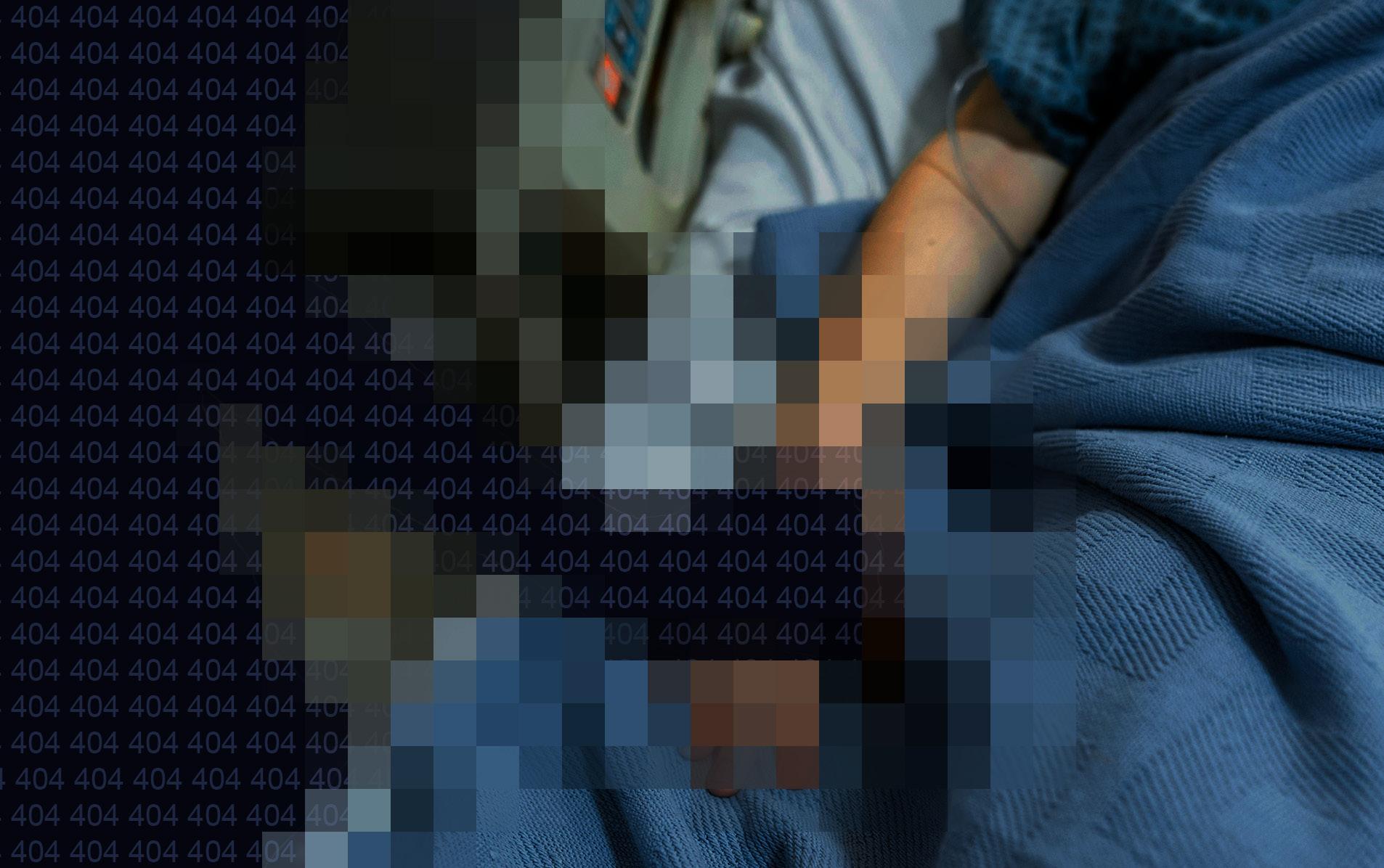
Does artificial intelligence belong at a patient’s bedside?
BY MADDY BRUNSON
DESIGN BY ALEX NAGLER
When you say you plan to become a nurse, the first response people give is often “Well, you’ll have a job for life,” or, “There’s always a need for nurses!” When it comes to the impact of artificial intelligence on workers, nurses are often the last profession mentioned in the conversation—despite the fact that patient lives have been directly affected by recent developments in AI.
The American Nurses Association’s official position on AI in nursing states, “ANA believes the appropriate use of AI in nursing practice supports and enhances the core values and ethical obligations of the profession. AI that appears to impede or diminish these core values and obligations must be avoided or incorporated only in such way that these values and obligations are protected.” Many nursing organizations have rushed to declare their positions on AI as investment in this new technology increases across the health care sector.
The rapid pace of AI’s development has people questioning whether nurses could potentially be replaced by advanced machines. “I don’t think it’s ever going to replace nurses. I think that’s a ridiculous claim. Anybody who says that doesn’t know what nurses do,” says Marion Leary, the director of innovation at Penn’s School of Nursing, who works to amplify nurse leaders in health and health care innovation.
Heidi, a new generative–AI platform, is already taking on the role of a medical scribe in patient rooms across the country. You can use platforms like Heidi to transcribe patient histories, ask for help when approaching difficult conversations with a patient, or develop treatment plans. Penn Medicine, along with other health systems across the country, is already using ambient listening platforms like Heidi to give health care workers more time face–to–face with patients.
But AI involvement in health care work is complicated by the fact that
nurses constantly have to act as moral agents when it comes to patient care. “This technology must not only protect my autonomy as a moral agent, but also my right as a nurse to make decisions that are in the beneficent care of my patient,” argues Connie Ulrich, a nurse bioethicist at the Nursing School. “How do we weigh the risks and benefits of this technology as we move forward?” Ulrich asks. “I think that will be the constant question we will have to be asking ourselves.”
In a recent article, Ulrich interrogates how AI will change the moral decisions nurses make every day. Her background as both a nurse and an ethicist gives her unique insight when it comes to examining how AI can be situated in health care. “Some believe that the human judgment that undergirds these qualities cannot be programmed and therefore cannot be executed by an AI algorithm,” she writes. “They are qualities cultivated through years of human experience, ethical reflection,
and human connection that go beyond surface–level responsiveness.”
A key consideration when approaching the question of AI in health care is the delicacy of human connection. “Nurses are the end users of AI, but [they’re] not involved in the initial discussion of development or implementation of AI,” Ulrich says. Shared governance over AI integration in health care is integral when it comes to assessing its impact on patients and health care workers. “As nurses, we have to advocate for where it’s appropriate to be used in our practice,” says Leary. Nurses must be part of conversations about AI use for the “human” in human–centered design to be emphasized.
“23% of nurses have no ethics training or education, which means they are less likely to take moral action,” Ulrich says, referencing her previous work in education research. When nurses are not equipped with the confidence or education to question ideas about the future of patient care, dangerous ideas may be left unchecked. The weight of caring for patients, advocating for patients’ loved ones, and ensuring licenses are protected can be impossible for many nurses to carry as they push forward in their careers.
While the ethical concerns of AI use are numerous, the technology also seems capable of solving many problems facing nurses today. Chief among them is exhaustion—nurses across the world report burnout symptoms at a rate of 11.23%. “There are concerns about staffing or there are concerns about just not having enough resources to provide beneficent patient care. So, it leads to moral distress and nurse burnout,” Ulrich says. Nurse burnout can be linked to administrative burden, poor nurse–to–patient ratios, and emotional exhaustion. Burnout has been a consistent, rising problem in the field of nursing that can decrease the quality of patient care.
Along with her work at the Nursing School, Leary leads the National Nurse Innovation Fellowship Program at Johnson & Johnson. “I’ve been working in innovation and entrepreneurial work for a really long time. The things I saw people pitching back then, [which] we had no idea how to make a reality, can now be a reality because of AI,” says Leary. AI seems able to address many longstanding problems in nursing, and may be able to make some of the most difficult parts of the job much easier. “I have teams that are considering using ambient listening and AI, mostly around workplace violence, [to detect] if patients are becoming agitated and potentially violent to nurses,” reports Leary.
AI has great potential to relieve nurses of the endless labor they often spend charting, delegating tasks, and doing monotonous administrative paperwork. This time can be given back to patients at the bedside, or to the nurses themselves for a much–needed respite from their work. Along with potentially decreasing burnout, AI can be used to empower nurse decision–making and detect patterns in patient tests long before any human might get a “nurse’s intuition.”
But not all health care professionals are sold on the benefits of AI. National Nurses United—the largest professional association of RNs in the United States—has been outspoken in challenging the use of AI in nursing. Over the past year, they’ve held numerous protests demanding better protections for patients against AI. Their position holds that while nurses don’t oppose technological advancement, they are opposed to algorithms replacing the hands–on expertise that trained nurses bring to patient care. A 2024 survey created by NNU found that 69% of nurses in workplaces that use algorithmic systems said their assessments don’t match the measurements generated
by computers. Nurses surveyed also found that AI models don’t take into account many of the complex social determinants that impact patient care.
“There’s something unique about being a compassionate and skilled caregiver that can provide care to a patient that AI cannot,” Ulrich says. The trust patients invest in navy–blue scrubbed nurses has been built over centuries, and AI poses a real threat to the delicate patient–nurse relationship. “I want us to retain our valued position within the health care system and the public because we’ve been trusted for so many years,” Ulrich hopes.
It’s inevitable that AI will soon have an unshakeable presence at a patient’s bedside. Instead of rejecting it outright, nurses must work with patients to create individualized approaches to AI–integrated care. “I think about it with informed consent—is there transparency about how AI is used with regard to clinical care that the patient received?” Ulrich asks. “Some patients would probably be fine without us, but some perhaps would not.”
Recognizing that patients have a right to control their own care also means that developers and health care workers must create a joint framework for patients to consent to AI use. “I am AI agnostic,” says Leary. “If AI is the solution that works for the population, then great. But if it’s not, then you shouldn’t use it.”
AI is a train that has already left the station when it comes to health care—now, nurses and patients must rush to catch up to it. Questions have to be raised as AI starts quietly standing next to nurses at the bedside. “We are still the humans, and we need to make the decisions,” argues Leary. Humanity is the sacred pillar upon which all ethical health care rests—in the age of AI, it is patients and nurses that must continue the fight to keep it standing. n
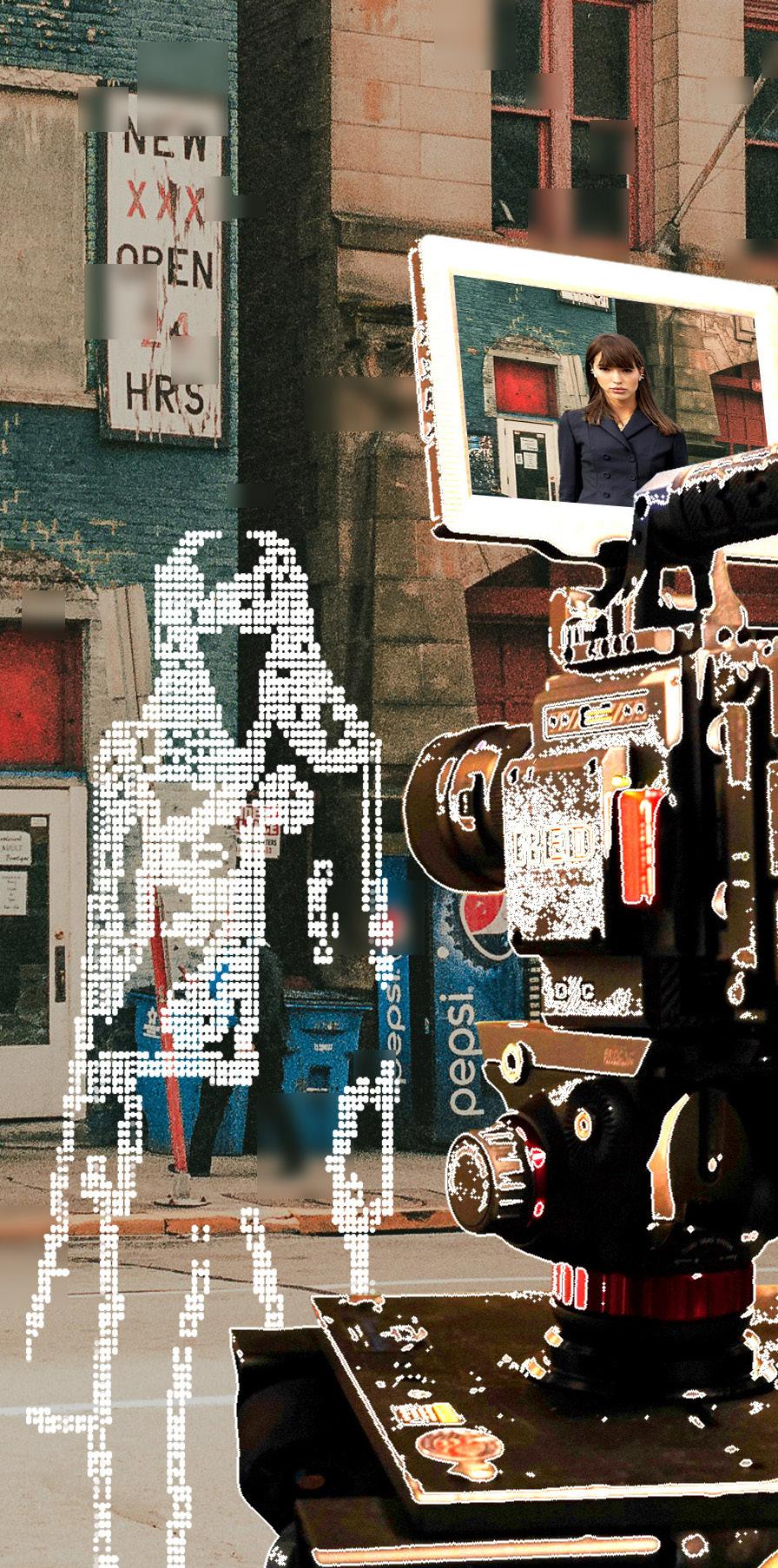
Why artificial intelligence actors will never replace movie stars in Hollywood.
BY ÉLAN MARTIN–PRASHAD
There’s something magical about watching an actor hold an Oscar. Maybe it’s the quiet tears glinting in their eyes—maybe it’s the quiet battles that we as the audience fight inside ourselves as we search their faces for a glimpse of authenticity. In an industry built on smokescreens and dream factories, is the actor’s tear–ridden acceptance speech just more acting? Or is it real?
Maybe it’s those rare candid moments, the ones where an actor says something so unexpected and so real in their acceptance speech that we can’t help but fall in love with them.
Or maybe it’s something we can’t explain, something we can only feel. It all boils down to the power of stardom— the captivating spell that actors cast, first on the agents who sign them and then on us, the audience.
Whatever the reason for this magic, one thing cannot be doubted: Actors are human. Their achievements— whether an Academy Award, a breakout role, or a real change they inspire through their art—are a testament to their hard work trying to break through in an industry hinged on prestige, nepotism, and backroom deals. No matter how highly we may idolize them, they are no different than us, and they are only irreplaceable because we, the audience, are the ones who gifted them with their stardom.
But how could we possibly gift that same stardom to an actor who isn’t even real?
In September of 2025, Hollywood sounded the alarm bells when it was discovered that talent agencies were considering signing Tilly Norwood, an artificial intelligence actor created by comedian Eline Van der Velden and her AI production company, Particle6. Van der Velden was unprepared for the massive backlash she received after posting a video of Norwood announcing herself as the world’s first AI actor. Later statements about Norwood receiving possible agency representation spurred further panic, and a recently released
Norwood music video that urges actors to embrace AI has kept debates about the Norwood spectacle raging through the industry.
So what about this debate has everyone in entertainment so riled up? It’s not news that production companies are using AI–generated actors as extras to lower production costs. AI has been praised by people like Kevin O’Leary for being a cost–cutting tool for film projects, allowing productions to save millions. Industry leaders like Ben Affleck and Pulp Fiction co–writer Roger Avary have been building up AI production companies—Netflix has already acquired Affleck’s company InterPositive, and Avary has said that attaching the terms “AI” and “technology” to his projects has attracted significant support from investors. Investors and other key industry players see AI as the new frontier of human storytelling. Major breakthroughs like talking pictures, home television, and computer–generated imaging transformed the entertainment industry—so too, it seems, will AI.
But just because AI can deliver results doesn’t mean that we should be quick to hop on the bandwagon. For one, audiences have already started experiencing AI fatigue, growing tired and annoyed of seeing so much AI–generated content on their feeds. Because of its universal accessibility and low learning curve, AI use has been linked by some researchers to “brain fry,” or cognitive decline. Members of Screen Actors Guild–American Federation of Television and Radio Artists have also become worried by AI platforms’ use of actor likenesses without compensation or consent, and are actively championing frameworks to protect member rights. Background actors hoping for their big breaks fear that AI–generated extras are creating additional barriers challenging their ability to get their start in the business.
So what is it about AI actors that has the industry so panicked? Perhaps it’s the fact that talent agencies were seriously considering signing Norwood for
representation. Despite the fears her creation has spurred, Van der Velden claims that people have no reason to believe Norwood will ever replace real human actors. Instead, she says that she created Norwood to live in an ecosystem of AI movies, a new genre she believes will eventually be populated with more AI–generated actors.
The biggest question is whether we should have reason to believe that audiences will consume this type of content. AI has already been slowly but surely creeping into traditional filmmaking. In 2025, Oscar front–runner The Brutalist was met with severe backlash after it was discovered that the filmmakers used AI to enhance Hungarian
“No matter where we look, we will continue to consume AI–generated content, whether we want to or not.”
language dialogue for its lead actors. Productions are using AI to resurrect deceased actors like Val Kilmer. Netflix recently announced its plans to roll out AI–generated advertising across its slate of shows and films. No matter where we look, we will continue to consume AI–generated content, whether we want to or not.
Is all of this an attempt to gradually desensitize audiences to AI–generated content? And if so, could we see the rise of an AI film genre that eventually becomes profitable and widely accepted by audiences?
Not necessarily. Norwood may have doe eyes, but she’s also limited by the digital space she occupies. And with ads, brain rot, and AI slop constantly
bombarding our feeds, it’s no surprise that we may move into an era where audiences seek greater authenticity away from the addictive world of screens. This year’s Academy Awards are surely a testament to our yearning for greater authenticity as we drown in digital media and nonstop stimuli. Sinners is Ryan Coogler’s original concept, born out of an unexpected but delightful melding of genres; Hamnet, at its core, urges us to get back in touch with the natural world and understand our place in it; Best Picture winner One Battle After Another is a testament to and a celebration of Paul Thomas Anderson’s entire career, built on original storytelling and his unique voice as a filmmaker.
Norwood can act in whatever Van der Velden wants her to. And Van der Velden, in turn, can argue that Norwood is an artistic creation that took real humans time and care to develop. But Norwood and any other AI–generated actors who may follow will never replace true stardom—especially since they will only live in AI–generated films audiences may not even embrace. The old saying still stands: stars aren’t born, they are made. They’re made not through zeroes and ones, but by commanding a presence on screen, building their body of work across multiple projects, and living with an unstoppable devotion to the craft of acting.
You might ask who makes the stars we know and love today. The most obvious answer would be talent agents— and you would be right, sort of. An agent’s job is to cultivate that initial spark of je ne sais quoi they glimpsed within an actor throughout negotiations and deals. But it is ultimately the audience that truly creates a star. We vote on the Oscars. We fill seats in theaters. We are the entire reason this industry exists in the first place. What we want dictates the future of storytelling.
And right now, more than ever, we want stories about humans, by humans. n
For Penn students pursuing a career in the film industry, artificial intelligence is altering both the work and the way in.

BY CHENYAO LIU
DESIGN BY KATE AHN AND ALEX NAGLER
On any given weekend in Hollywood, an assistant is staring down a stack of scripts they’ll never finish.
Script coverage is the first step in a film’s development. A reader summarizes a screenplay, evaluates its strengths and weaknesses, and passes that report up the chain. On one hand, it’s an on–the–fly way to learn structure and develop the elusive instinct for what makes a story worth telling. It is also cheap but time–consuming labor, the kind that quietly sustains this behemoth of an industry.
With thousands of scripts circulating and only a fraction getting read, script coverage is fertile ground for the nascent artificial intelligence revolution.
Kartik Hosanagar, a Wharton professor and founder of the AI script coverage platform ScriptSense, built his company with the goal of streamlining the script coverage process. “The vast majority of screenplays that are sent to agents and producers pretty much go unread,” Hosanagar says. “Even for the things that get read, there’s so much guesswork involved.”
His tool aims to process scripts at scale, summarizing, categorizing, and helping executives decide what to prioritize. After all, coverage takes time, and time costs money. AI is exceptionally good at distillation, able to generate loglines, produce clean synopses, and cross–reference a
script against hundreds of others in seconds. For an overworked reader assigned four scripts and two books in a weekend, that kind of speed means survival in an industry as fast–paced and cutthroat as Hollywood.
But efficiency is only part of the story. AI can be remarkably consistent as it summarizes and compares scripts at scale. It can quickly tell a reader what a script is about. It can identify patterns no human reader could reasonably track. What it cannot convincingly do, however, is care.
Hosanagar was explicit about this limitation when designing ScriptSense. The platform would generate anything from summaries to casting suggestions, but would leave blank the most subjective question in any coverage report: What did the script make you feel? It would not recommend whether a script should proceed or pass. That judgement, he insists, must remain human.
“There’s a lot of nuance to reading scripts,” he says. “It’s very easy to prompt an AI system and say, ‘Tell me what it makes people feel.’ It’ll make something up, but it doesn’t mean it’s real.”
Not all AI script coverage programs take such care in preserving the human role, though. Competing AI companies like Greenlight Coverage offer verdicts for those who don’t have the time to do
any reading themselves. The gap between information and interpretation is where much of the anxiety around AI in creative industries lives.
Nick Harty (W, E ’27), who’s worked coverage internships before and is interested in pursuing a career in film, sees the stakes in creative terms. “If the best scripts were always getting through, we’d have the worst slate of movies you could possibly imagine,” Nick says. The films that endure are often the “odd balls”—the ones that defy structure, resist easy categorization, or read unpredictably on the page. They don’t have to be the most polished, but the most singular.
AI, by contrast, tends toward the average. It predicts what works based on what has worked. “It just wants to please you,” Nick says. “It’s really not interesting.”
AI’s tendency to identify good scripts through familiar plot lines leads to a greater risk of homogenization within the industry. For writers, the possibility that AI will filter out strange, risky, and unclassifiable scripts feels personal. Aspiring screenwriter Henry Franklin (C ’27) puts it simply: “I would much rather have a human read my script.” To him, the idea that a screenplay might be reduced to a piece of data for a machine to process “doesn’t produce the warmest sensation.”
Despite these anxieties, the logic of the
economy continues to dominate. Development is the cheapest phase of filmmaking, but it’s also the easiest to cut. Hosanagar expresses concern that Hollywood studios and production companies will use AI as a tool to replace interns and freelance readers. “With a tool like AI, the worst–case scenario is a lot of these companies get lazy,” Hosanagar says. “I think that is bound to happen.”
Concerns around AI extend beyond efficacy and into industry access. “It’s a genuine concern that the entry point for a lot of people into this industry is impacted,” Hosanagar says. If AI reduces the need for coverage readers, there will be fewer and fewer of the entry–level roles that many young people rely on to break into film.
For decades, coverage has been more than a task—it’s been a rite of passage for aspiring filmmakers. Kaia Chambers (W ’26), who has done coverage for four years across classes, production companies, and talent agencies, describes it as “a training ground.” It’s where young people learn how to read critically, articulate their thoughts, and navigate an industry built as much on relationships as on scripts.
At the same time, access to that pathway has never been equitable. “The ugly truth of it is even if we all use AI for coverage, studios are never going to stop hiring talented young people from top schools,” Franklin says. “The people who go to Penn will be fine … Those entry jobs will exist for them.” For those trying to build a career with less connections, though, the outlook is less certain. “The people who get by with their living doing coverage hired by a studio, those are the people who are in trouble,” Franklin says.
As AI begins to absorb the busy work— with programs like ScriptSense already being used at major agencies like WME—the role of the human reader is beginning to shift rather than disappear. In the best–case scenario, something more meaningful remains. Hosanagar hopes that interns can spend less time recounting plots and more time identifying talent, contextualizing projects, or advocating for scripts they believe in. Chambers also notes the shift. Though plot summaries were handled by
internal AI systems at her last internship, human readers were still expected to provide the commentary. “I think AI just regurgitates what it thinks it knows. That’s not enough,” Chambers says. “What has impressed [my bosses] the most is if I’m able to have an opinion.”
There’s still a risk embedded in that transition. Coverage, for all its tedium, has always been a volume game. Reading hundreds of scripts builds intuition. Hosanagar says that executives in the industry are worried that relying on AI will erode that foundation, and young professionals “will lose the ability to read a screenplay and say why [it] is interesting and unique.”
Franklin remarks that there are historical parallels to AI’s rise. The transition from physical film editing to digital software was once seen as a disruption. It was faster, more flexible, and ultimately inevitable. But, as Harty notes, the editors who thrived were those who were trained on the old ways and understood the underlying craft. Technology changed the tool, but not the outcome.
The rise of computer–generated imagery also transformed filmmaking, enabling new kinds of spectacle while also inviting overuse and audience fatigue. Chambers says that at a certain point, “it’s not alluring and cool anymore.” Audiences and filmmakers will adapt to the new realities of filmmaking as they always do, she says, as “culture shifts with what’s counterculture.”
AI may follow the same trajectory. As a tool, it can reduce friction, lower costs, and expand access. Hosanagar points to the possibility of a more decentralized industry, where creators can bypass traditional studios and use AI to develop, produce, and distribute content independently. At the same time, studios facing financial pressures may lean into cost cutting, prioritizing speed over nuance. “All of it’s about money,” Chambers says. If reducing a film’s budget is better for the bottom line than gambling on potential box office gains, companies will make those cuts. But audiences, she argues, can tell the difference. “People are realizing who’s using [AI] as a shortcut versus who’s using it in an inno-
vative way.”
That distinction may define the future of AI in the film industry. For students trying to break in, the question of AI looms over everything. Harty says that AI fluency can be a signaling tool—executives may not fully understand the technology, but they are eager to invest in it. “If you can show that you’re adept at using AI to parse through more scripts, but your personal taste is what makes you stand out, that’s going to be huge,” Harty says.
The emphasis on taste recurs across every conversation about the future of film. Coverage, in its ideal form, isn’t about the ability to be correct, but the ability to have conviction. “The best scripts that I read, I wouldn’t even do my coverage,” Chambers recounts. “I’d run into the office and … throw the script on [my] boss’ desk.” AI can simulate feedback, guess at analysis, and even mimic the language of enthusiasm, but it can’t replicate real human urgency. Despite that, it’s already here. Interns are already using it—sometimes against company policy. Studios and talent agencies are experimenting with internal systems. The industry is in transition, and for students planning on entering Hollywood, AI is less of an existential threat and more an opportunity to rethink the system.
Chambers predicts a counterreaction—a resurgence of independent, countercultural filmmaking that rejects the polish of AI in favor of something more tangible and personal. “Every ten years we hear, ‘Cinema’s dying.’ And it doesn’t,” Chambers says. “It has changed and morphed over the years, but I don’t think that means that AI is going to kill it.”
Franklin agrees. “[Some say] all content is going to be made by AI, but I don’t think humans can fundamentally accept that,” he says. “I don’t think people watch things so passively. There will always be value put on human creation.”
With AI seeping into every aspect of human life, the future of cinema isn’t about labor or technology, but what audiences choose to value. If AI handles the first pass of coverage, someone still has to decide what comes next. That decision, for now, remains human. n
BY ANJALI KALANIDHI
DESIGN BY ALEX NAGLER
How biomaterials, robotics, and 3D printing are quietly revolutionizing the way we dress
At first glance, fashion and engineering couldn’t be more different. From ancient Mesopotamia to the 21st century, humans have been developing creative garment–making techniques, which successive generations of designers are constantly in conversation with. Engineering, meanwhile, seems to only look forward, focusing on endless progress toward a perfectly optimal solution. But beneath the surface, these fields are closer than they appear. Whether designing haute couture or building an autonomous robot, innovation in both fields stems from human necessity and requires constant collaboration. At their core, both engineering and fashion reveal something vital about what we value as a society through what we create.
Given their curiously similar philosophies, it is no surprise that a growing number of creatives are bridging the gap between fashion and engineering. Take, for example, Italian architect and professor
Niccolo Casas, whose avant–garde acceptance of the digital age allows him to work productively in interdisciplinary spaces like fashion technology. Casas’ work spans many mediums and industries, with his long list of collaborators including fashion designers, medical startups, and environmental organizations. “My work is fundamentally driven by an interest in the notion of the limit— understood not as a separation, but as a space of simultaneity where two distinct conditions coexist,” Casas says. “These situations may manifest aesthetically and organizationally as patterns, thematically as fields of inquiry or experientially as bodies of knowledge and intellectual stances.”
What draws me to Casas’ art is how I can feel the meticulous intentionality in every single piece. By building dialogues between technology and the human experience into his work, every piece invites the audience to search for deeper meaning. Smoke Dress, created in collaboration with Dutch designer Anouk Wipprecht,
uses a microcontroller to emit a veil of smoke when a viewer gets too close. It’s an allusion, perhaps, to how technology may be depriving us of human connection and making it easier to hide behind screens.
Much of Casas’ work involves 3D printing, a process that requires extensive planning. Aware of the inherent tension between calculation and movement, Casas consciously introduces “small imperfections and unresolved moments” in his work. These small imperfections, arising from using technology in unconventional ways and preserving any accidental irresolutions, allow his patterns to feel organic rather than purely algorithmic. Casas uses this purposeful ambiguity as a tool when crafting a narrative within his piece: “Two patterns, two systems, two logics can coexist within the same space without being fully reconciled,” Casas says, “and it is precisely this ‘tension’ that keeps the work alive and generative.”
Casas thinks it will be a long time
before 3D—printed clothes enter our everyday wardrobes—but that doesn’t diminish the technology’s potential to transform the fashion industry. “Research that originated from purely aesthetic concerns, driven by the demands of haute couture to produce singular, unrepeatable pieces, ultimately evolved into a production methodology with significant ecological potential, should it be democratized across large–scale fashion manufacturing,” he says.
Sustainability is a key driver of the fashion tech industry, and Casas’ work reflects this. To raise awareness about plastic use, he partnered with the environmental awareness organization Parley for the Oceans to build Plasticity—a 3D–printed sculpture made from upcycled plastic waste found on remote islands. Casas believes that interdisciplinary collaboration is essential to solving ecological challenges. “One does not learn from what is already familiar,” he says. “Engaging in multidisciplinary discourse is among the most effective means of generating genuine novelty, particularly in relation to ecological questions.”
A sustainable future is an interdisciplinary one, and Casas thinks artificial intelligence is the technology that will have the most impact in developing interdisciplinary spaces. “[AI] is an instrument for recognizing analogous patterns and discoveries across fields that would otherwise rarely intersect—a tool for dismantling the boundaries between knowledges,” he says.
Another major application of fashion tech is in the creation of sustainable replacements for common textiles. The global fashion industry produces 92 million tons of textile waste annually—with the rise of fast fashion, this number will only increase unless action is taken.
In 2021, Penn’s DumoLab—spearheaded by Stuart Weitzman School of Design faculty member Laia Mo-
gas–Soldevila—successfully manufactured a completely biodegradable, leather–like material made with silk protein and chitosan, a material made of shrimp shells. They used this material to create a dress called DERMA, which they unveiled at the Wharton Charity Fashion Show at the Philadelphia Museum of Art. “The cool thing about this fashion piece is that it’s soft and flexible
“The fashion–tech space is still young, but the pace of innovation suggests its influence will only grow as more designers, engineers, and scientists find common ground in its possibilities.”
at the hips … and stiff as a corset [above],” Mogas–Soldevila says.
Similar to Casas, DumoLab is experimenting with the use of 3D printing techniques for fashion. Using a retrofitted computer numerical control machine, they built a pneumatic extrusion system that Mogas–Soldevila calls “a two–and–a–half D printer.” Rather than printing layer by layer, the machine prints a hierarchical surface, manipulating the biomaterials’ properties throughout. “You can mediate the material properties of
these gels by using a low molecular weight formula in the hips so that it’s more stretchy, and a high molecular weight [to make a] stiffer corset part that stands,” Mogas–Soldevila explains.
These biomaterials also have huge potential in fields beyond fashion—they can be used to manufacture plastic bags, cutlery, packaging, and much more. “The biomaterials revolution is coming,” Mogas–Soldevila says. “There are many consumables [that] can be replaced by biopolymers, I’m certain.”
One major barrier to long–term use of biomaterials is longevity, and DumoLab is currently trying to develop sustainable coatings to address this. “We are looking at ancient waxes, shellacs from bugs, and different types of coatings that can still allow all these leathers and surfaces to biodegrade at the end of life,” Mogas–Soldevila says.
Looking further ahead, Mogas–Soldevila points toward food waste as a potential driver of the biomaterials revolution. “[Think of] the leaves, the stems, the shells of shrimp that nobody wants—all that unavoidable waste that we have in our food systems [and] construction systems,” she explains. “If that can become the material that makes buildings, furniture, and fashion, then it’s a win–win situation.”
The fashion–tech space is still young, but the pace of its growth suggests that it has a promising future. Through interdisciplinary work across architecture, engineering, and material science, pioneers such as Casas and Mogas–Soldevila are already pushing the boundaries of fashion and technology. To them, technology is no longer just a means to facilitate art—it’s become a mode of creative expression in its own right, ushering design into a more sustainable future. n

Venture Lab’s Taylor Caputo dives into the intersection of technology and art.
BY ALEXANDRIA BOLAND DESIGN BY CATHERINE GARCIA AND ANDY MEI
Upon entering Tangen Hall for the first time, one word came to mind: alive. The large workshop hummed with the whir of 3D printers and the chatter of students. As I was led through a tour of the space, careful to not bump into any student projects, all I could focus on was how full of life, passion, and creativity it was. No one embodies the energy of this space like its director, Taylor Caputo.
Caputo oversees all of the work that occurs in the Engineering Studios at Venture Lab, the first–floor makerspace in Tangen Hall. She helped design the space at its inception, using it to both teach students and conduct independent professional projects. She is also a pioneer in the incorporation of artificial intelligence into various artistic fields, most notably in physical product design.
Caputo’s journey to Tangen began at Temple University’s Tyler School of Art and Architecture, where she started off with an interest in ceramics and textiles. She always knew that making art would be a central focus in her life, and she couldn’t see a future in which she wasn’t pursuing a creative career. She was first exposed to digital fabrication, the process of turning digital designs into physical objects, in a jewelry–making class at Temple. “I was just like, ‘This is my jam,’” she says. Another important part of Caputo’s creative practice was
the design and production of practical things. “That’s why ceramics and textiles always interested me, because inherently they’re used to create functional objects,” she explains. She discovered her love for education when she was given the opportunity to teach an introduction to metalworking class while in graduate school at Penn. Although showing students how to wield torches and hammers at 8 a.m. was hard work, she found it so rewarding that she chose to return the following semester.
Unlike a traditional campus space like a lecture hall or library, the Engineering Studio is inherently collaborative. Its open floor plan and wide tables easily facilitate group work or parallel projects. And the best part: All of its resources are free for students, no matter the purpose. Building an easily accessible, low–barrier place to create and collaborate was important to Caputo, who wanted the space to mimic a studio in its culture. “That means you come and work in a studio every day, your friends are here, you’re all working on the same stuff,” she says. “It’s a slightly different type of educational experience, and it was such a great sense of community. You learn from everyone else as much as from your classes.”
Caputo believes the foundation of creativity lies in allowing everyone to “make weird stuff.” Two recent graduates of
Penn’s Integrated Product Design master’s program were featured on Shark Tank for their product ChompSaw, a kid–safe cardboard cutter. The product was made possible by the resources and community of Venture Lab, and Caputo credits both the makerspace and the program for transforming two students with no business background into successful entrepreneurs.

Caputo continues to offer one course, “How to Make Things,” that is designed to build students’ hands–on abilities, helping them create objects that are fully functional while still maintaining aesthetic value. On the table between us, she laid out some examples of past work to better explain how her class works. The first project is a laser–cut jigsaw puzzle, where students learn how to use tools for image creation and curate an experience with their piece. The rest of the semester has students incorporate AI into their design processes. Caputo presents a hot pink resin bow ring, her final product, to explain the second major project. Students use either text–based or image–based prompts to generate a 3D model of a meaningful symbol of their choosing. That model gets combined with a ring band, printed, and used to design a mold of the final product. Throughout the class, students combine their design concepts with Meshy, an AI model, to produce pendants and other works.
Caputo’s use of AI in her works is something that sets her apart from many oth-
er artists, even those in her own field. While explaining this side of her work, she pulls out some of her more recent pieces as demonstratives. The first one, a small periwinkle heron, was generated through Meshy. Caputo notes that modeling organic materials like feathers is incredibly difficult, even for experienced users, so utilizing AI in that part of the process helps to streamline things. But technology is not just a means to a predetermined creative end—Caputo is also exploring the limits of these new programs by prompting them to visualize abstract concepts. Picking up a white bangle decorated with flora and birds, she explains that it was part of a personal project where she got Meshy to create a piece modeled after the themes of “life, liberty, and the pursuit of happiness.”
Upon closer inspection, those themes become clearer in the bangle’s design: leaves and other natural elements encircle a Statue of Liberty–esque torch centerpiece. Though 3D–printed, the bangle has some of the fuzziness we have come to associate with AI–generated work.

Caputo doesn’t consider this an inherent flaw, noting that she’s “still exploring the weird mushiness that AI produces,” as well as asking herself questions in the process: “When is that an advantage? Or when do you design around it?”
“Technology is not just a means to a predetermined creative end.”
In creative spaces, AI use remains a hot topic. When it should be tolerated, if at all, is always under contestation— many people consider any application of AI to be an insult to “true art.” As made clear by her projects, Caputo disagrees. “AI is a tool,” Caputo says. “It’s used in tandem with anything else, whether that’s a CAD program or a laser cutter.” She acknowledges that there are limits to using AI—while it’s a valuable source for information or inspiration, using it expressly to generate concepts and recreate them as her own betrays her own identity as a creative.
No one who steps foot in Tangen Hall, which is brimming with Caputo’s creations, could deny that she is an artist. Her jewelry, models, and even the cardboard chairs that sit on the makerspace floor are manifestations of her spirit, put forth by the work of her hands. The incorporation of AI into her process doesn’t take any from that; it merely bolsters it. As mediums like photography show, artists are always the first to adopt new technologies, even though points of contention arise with every innovation.
“Why would you preclude yourself from using the internet 30 years ago, like a lot of people did, or from using 3D printing in the world of jewelry?” Caputo says. “There were a lot of people that were like, ‘No, this isn’t traditional.’ But like it or not, it’s going to be around.” n
Penn’s labs are building the future of robot warfare. Who’s building the ethics?
BY NISHANTH BHARGAVA
DESIGN BY CATHERINE GARCIA AND ANDY MEI



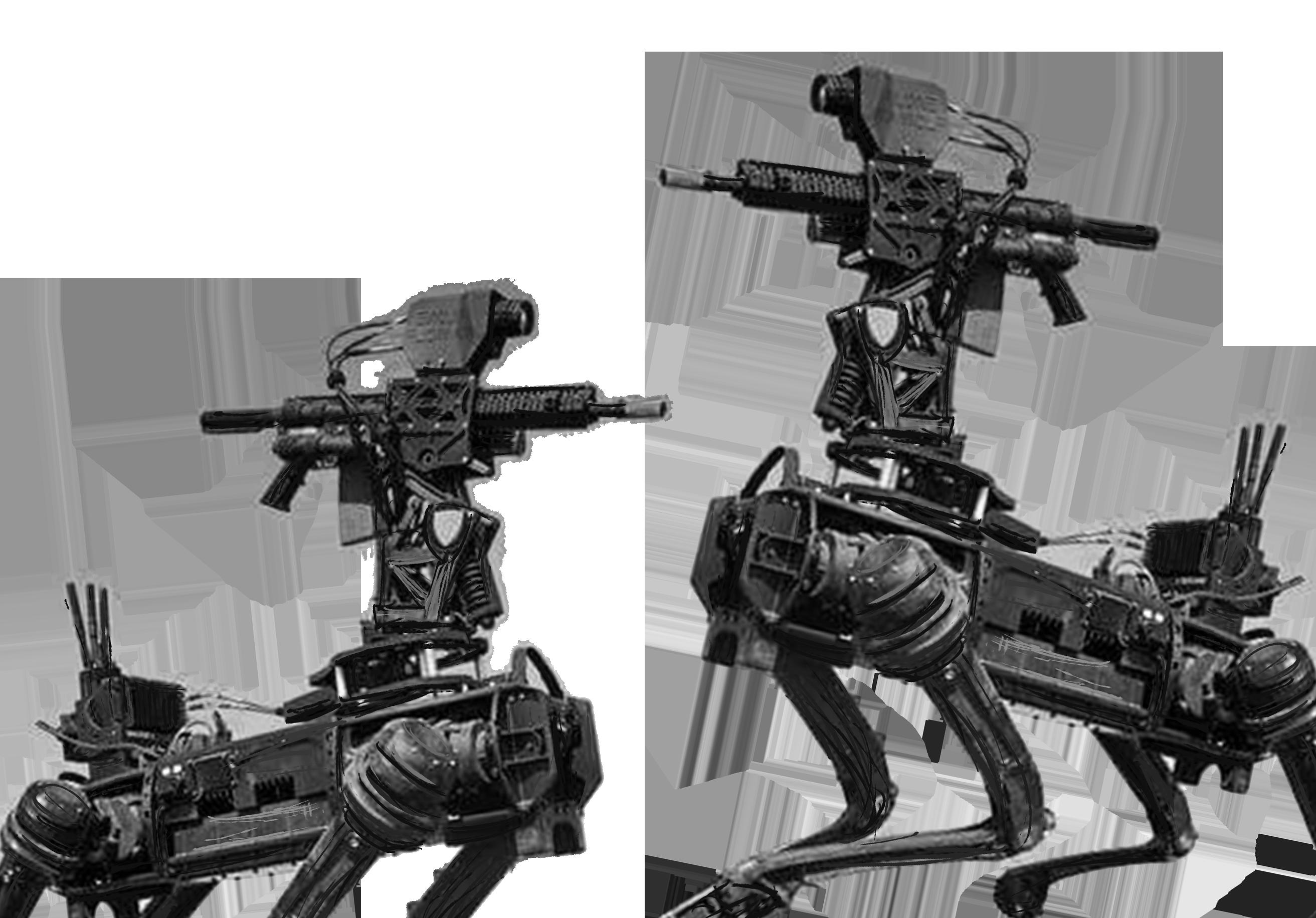
Cameras for eyes, the playful gait of a Labrador, plating wrapped around its torso like a onesie— walk up to Ghost Robotics’ Vision 60 robot dog, and you might think it’s a mechanical “man’s best friend.” Then you see the assault rifle strapped to its back.
In 2021, Ghost Robotics made headlines for showcasing their sniper–rifle–armed dog at the Association of the United States Army’s annual conference, fueling endless articles about the dystopian future of war. Now, Vision 60 dogs prowl the Gaza Strip—a 2023 Israeli TV segment showcases the dogs firing assault rifles wildly into the distance. They’ve since doubled as mobile deployment platforms for Israeli Rooster drones, whose manufacturer has recently marketed them as weapons capable of conducting “surgical strikes inside buildings.”
Autonomous weaponry is nothing
“As the Pentagon marches into the age of autonomy, labs like GRASP are building the future of warfare— but no one quite knows what that future holds.”
new—plenty of existing technologies, from point–defense cannons to bomber drones, involve some level of automation. But the sheer spectacle of the Vision 60 seemed to presage a future in which wars are fought by killer robots unburdened by conscience, spraying bullets or shooting missiles all on their own accord.
At the center of that future is Penn.
Ghost Robotics’ co–founders, Avik De (E ’17) and Gavin Kenneally (E ’21), met when they were both Ph.D. candidates at Penn’s General Robotics, Automation, Sensing and Perception Laboratory. Ghost Robotics is one of 13 companies listed on GRASP Lab’s startup directory, alongside a defunct company producing “flying security guards” and an industrial propulsion firm building parts for both civilian and military drones. Not all GRASP spinoffs focus on defense, but the Department of Defense is one of the biggest patrons of GRASP’s work, whether it comes to funding the basic research Penn conducts or buying up its results down the line.
As the Pentagon marches into the age of autonomy, labs like GRASP are building the future of warfare—but no one quite knows what that future will hold.
From 2023 to 2024, Perry World House Director and Penn professor Michael Horowitz served in the Pentagon as the deputy assistant secretary of defense for force development and emerging capabilities. A key part of his work involved accelerating the Pentagon’s adoption of artificial intelligence and automation, as well as developing norms and guidelines to govern their responsible use. “I think the Pentagon has now had, like, four AI strategies in the last five years,” he reflects, addressing the sheer pace at which the technology has evolved.
Horowitz is careful to point out that the Pentagon doesn’t get to set policies all of its own accord. “There are both federal law and treaty obligations … that determine the rules that the Pentagon has for the use of force,” Horowitz says. The DOD’s job is to translate those broader commitments into specific policies that its various arms can implement in action. “If you have big obligations and responsibilities, [they] fundamentally don’t change,” Horowitz explains. “The way that those are implemented can change.”
Many of those implementation shifts have been spurred by new developments in defense technology, which have led stakeholders at every level to question whether the U.S. military is ready to meet the moment. In Horowitz’s words, “Countries or violent nonstate actors can [now] use commercial manufacturing … to generate very low–cost short and long–range strike systems.” Alarmingly, says Horowitz, “the U.S. has really been behind in developing these kinds of systems. [We] already have the best military in the world, and that can sometimes make the U.S. slow when it comes to innovation adoption.”
When people picture the U.S. defense industry, they often imagine a World War II–era scene of massive factories pumping out planes and tanks by the thousands. The modern defense ecosystem, however, is far more decentralized. At the center of it all, of course, remains the DOD and its vast reserves of cash. Some of their funding goes towards the basic scientific research conducted at higher education institutions like Penn. That
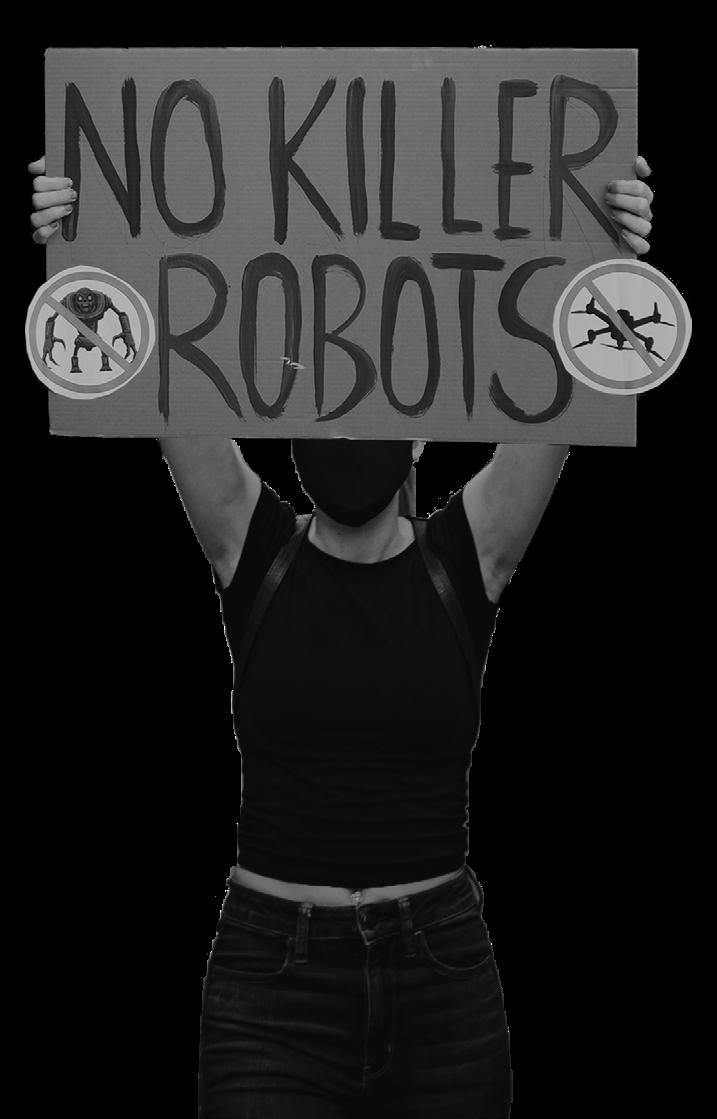
basic research can come in many forms, with GRASP Lab researchers engaged in projects that range from building navigationally autonomous flying robots to creating algorithms designed to learn continuously.
Equally important to the U.S. defense community, however, are the private corporations that apply this research towards practical ends. In recent years, more and more of that practical work has moved out of traditional powerhouses, like Raytheon and Lockheed Martin, and into smaller startups that seem better poised to innovate at the necessary scale. “The traditional defense industry is not delivering at the speed and scale that they need to, people like me have been arguing,” Horowitz says. “We’re in a bad spot when it comes to [our] defense industrial base, and it is time to push the ‘I believe’ button and give some of these smaller companies the opportunity to try to scale their capabilities.”
With startups like Ghost Robotics handling the work of implementation, the job of Penn researchers is simply to get the ball rolling. “Anybody at Penn that’s building a weapon, they’re not doing it on Penn’s time,” Horowitz says.
Though he may not be building a weapon himself, Penn Electrical and Systems Engineering professor Daniel Koditschek has become increasingly concerned with the ways in which his research is being applied. The basic technology that Ghost Robotics built off of came out of Koditschek’s lab, a GRASP subsidiary dedicated to research robot locomotion. In 2021, Koditschek published an open letter that demanded Ghost Robotics remove all references to his Kod*Lab from their website and any other promotional literature. Ghost Robotics’ work, the letter claimed, “corrupts the very aims and nature of robotics research.”
Though Koditschek got his Ph.D. in 1983, he admits that the social im-
pacts of his research only dawned on him about ten years ago. “Long before the Ghost thing blew up, I was quite concerned that I had miscalculated in my notion that I didn’t have to worry about the implications of the research,” Koditschek says. “I came to see that that was an error on my part, and I’ve been working away at that as best I know how for the last six, seven years.” Part of that work has been in spurring others to consider how new developments in robotics are poised to reshape warfare—Horowitz and
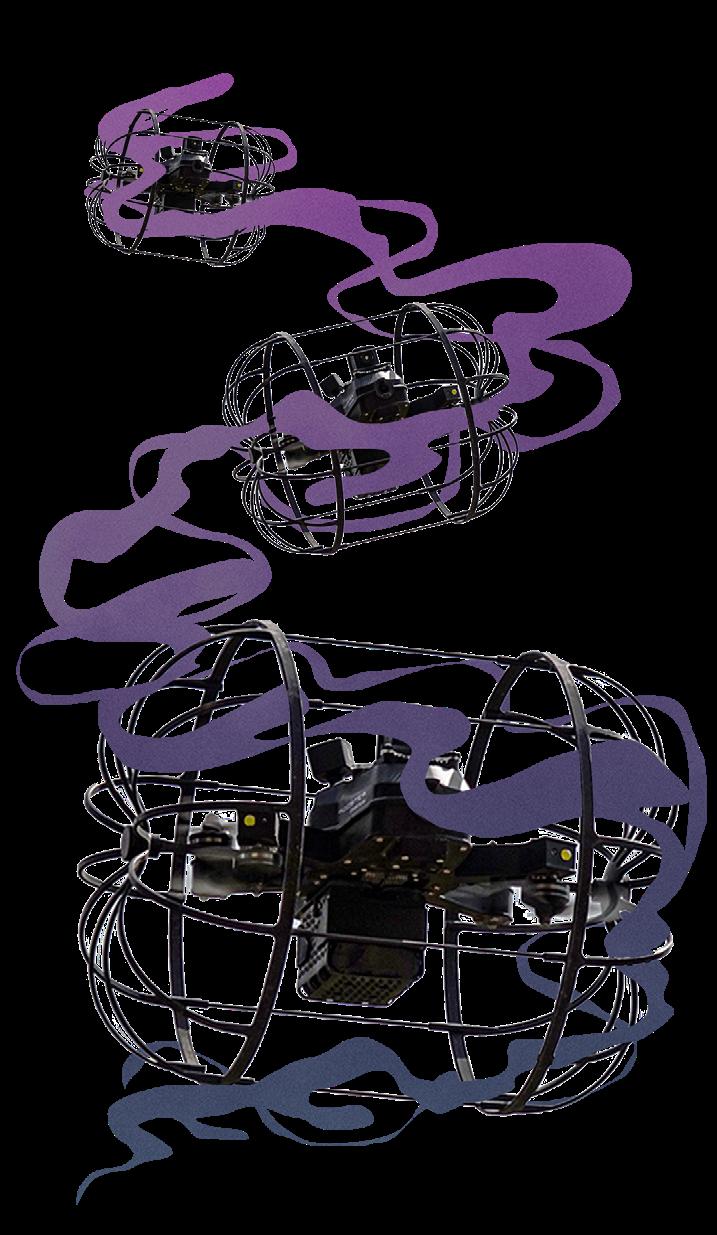
Koditschek were both members of a joint PWH–GRASP initiative on the social implications of autonomous weapons systems.
These initiatives haven’t gained as much traction as Koditschek hoped. He says that a complicated nexus of problems has prevented researchers from grappling with their work’s implications—not least of which is “the huge flows of money that disincentivize interest in carefully understanding … the capabilities and limitations
of [our] machines.” Despite this, Koditschek still believes defense–adjacent researchers can act morally. “We’ve been distracted from thinking ethically, but no citizens have been prevented from thinking ethically,” Koditschek says. Yet, as he acknowledges, “very few of us choose to do so, right?”
When Koditschek began his career, the thought of robots roaming the streets felt like something ripped from the pages of a science fiction novel. Now, however, the real–world applications of his and his colleagues’ research have become impossible to ignore. Robot drones have become angels of death from Ukraine to the Strait of Hormuz. The United States and China have found themselves locked in an arms race to build the automated weapons of the future. Dogs from Ghost Robotics—direct descendants of Koditschek’s work—have found new life as tools of the Israel Defense Forces’ brutal siege on the Gaza Strip. “I’m not the only one who got surprised at how suddenly things became useful,” Koditschek says.
But Koditschek’s ethical qualms haven’t prevented him from taking funds from the DOD—since 2017 alone, his research has received just over $10 million in grant money from the DOD. That’s hardly out of the ordinary for GRASP’s researchers. Vijay Kumar, dean of Penn’s School of Engineering and Applied Science and leader of GRASP’s Kumar Lab, received a $5.5 million DOD grant in 2015 and $2.03 million since 2017 for his research in autonomously navigating drones. GRASP faculty members like Cynthia Sung and Mark Yim have also received six–figure grants for the DOD to fund their robotics research. “There are very few robotics faculty,” Koditschek says, “who don’t have a close association with [the] DOD.”
A key draw of defense money is its relative stability amidst immense federal turmoil. When the Department of Government Efficiency embarked

upon their unsuccessful mission to aggressively cut federal spending, one of the few departments that escaped their watchful eye was the DOD. In fiscal year 2025, Congress approved a $895.2 billion budget for the DOD, allowing the Pentagon to foot the bill for plenty of potentially useful research.
Koditschek explains that some robotics researchers are able to conduct their work without taking DOD money—but he isn’t one of them. His first faculty appointment came in 1983, and his work at the time was entirely underwritten by grants from the National Science Foundation. In 1996, however, he received his first DOD grant— and he continues to take Pentagon funding today. “If you add up the actual dollar amounts,” Koditschek says, “roughly 85% of my support has come from DOD over the course of my career.”
The speed and scale of robotics development over the past decade have certainly surprised Koditschek, in both good and bad ways. “I’m horrified by the evolution of drone warfare. I’m horrified by the use of robots in warfare in general,” he says. With defense technology evolving at a dizzying speed, Koditschek thinks he bears at least some responsibility to help curtail its excesses. “It is the responsibility of the scientists and engineers who develop these technologies,” he says, “to help educate our citizens concerning the opportunities and risks so incurred.” In the final instance, however, he believes that regulation is a task for the American people. “I’m still convinced that the voice of democracy is going to have to be decisive here,” Koditschek says.
The Trump administration, however, seems more interested in cutting red tape around technology than regulating it. The Judge Advocate General’s Corps, responsible for providing legal advice to service members and prosecuting
court martials, has been ordered by Defense Secretary Pete Hegseth to “execute a ruthless, no–excuses review” and slim down its bureaucracy. The directive to clean house comes a little more than a year after Hegseth purged top lawyers in the Army, Air Force, and Navy for being “potential roadblocks” to the orders of President Trump (W ’68). The Pentagon’s Civilian Harm Mitigation and Response Plan and its associated Center for Excellence have been similarly gutted, with its staffing reduced by almost 90% and its framework for reducing collateral damage scrapped by Trump administration officials. In the wake of massive cuts and persistent interference from the White House, federal regulators seem less and less capable of ensuring that the future of warfare proceeds along ethical lines.
Despite these setbacks, Koditschek holds on to hope that America will come to its senses. “This is not the nation that we hold ourselves to be,” Koditschek says. “I’m convinced that the American
“With the amount of funding the federal government is willing to throw at the words ‘autonomy’ or ‘drone,’ the policy gradient for robotics firms points in only one direction.”
citizenry are going to correct that as quickly as—I don’t know how quickly, but I’m convinced that we will correct that as the democracy
that we are.”
But if the government refuses to hold itself accountable, do researchers themselves have to step in to regulate their work? “Great question. That’s a great question. That’s a great question,” Koditschek says. It’s a question he doesn’t have an answer to. Recent changes to federal policy, he says, have “been a shock for a lot of us in academia … I’ve never thought about this scenario before.”
Though Ghost Robotics is best known for their Vision 60’s quadruped offensive firepower, CEO Gavin Kenneally says that it’s all about defending our troops. “Ghost has always been committed to supporting our US and Allied Government customers,” Kenneally says in a written statement to Street. “[That] may mean weaponized payloads on the robots to keep our armed service members out of harm’s way.” While many GRASP startups have attempted to market their technology to both civilian and defense authorities, Ghost Robotics has pursued military applications from the start. Their first–ever contract, in fact, came from the Naval Special Warfare Command. When asked about Ghost Robotics’ ethical commitments as a company, Kenneally simply says that they are “always in compliance with government rules and regulations.” Those regulations, for the moment, prohibit weapons from firing with true autonomy. “The robot’s chain of command starts—and ends—with people,” Kenneally says.
Ghost’s embrace of weaponization is far from universal in the robotics industry. In 2022, six of the world’s top robotics firms signed a pledge not to weaponize any of their products. That pledge may soon be broken—Unitree Robotics, one of the pact’s signatories, has begun collaborating with the Chinese military to strap assault rifles to their own
robot dogs. Put another way, however, five of the six firms that signed the pact have kept their promises of peace, despite enormous financial rewards for defection.
For its part, Ghost Robotics has put up its own code of conduct—one that critiques the aforementioned pact for its nebulous language and lofty ideals. Ghost
“Penn has a [motto]— it says, ‘Laws without morals are useless,’ Similarly, money without morals is useless; power without morals is useless.”
Robotics’ “Our Philosophy” page reads, “even with the best intentions, questions justifiably arise as to the efficacy of this ambiguous pledge.” Instead, they outsource ethics to the experts—the military bureaucrats and political actors who can be held directly accountable to the American people. The same page states that “in a democracy such as ours, the role of policy is so critical that it should be determined by the elected government and not by individual companies.”
While defense applications of robotics may garner the most media attention, plenty of GRASP startups also build civilian technology. GRASP spinoff Exyn Technologies develops hardware and software for autonomous drones, drawing off of breakthroughs in drone research made by Kumar and his team. Exyn Chief Operating Officer and Chief Product Officer Ben Williams explains that most of
the company’s work is focused on geospatial surveys, creating digital reconstructions of the physical world. Their technology has been adopted by firms operating in a variety of industries, from mining to oil and construction. Their conviction to focus on civilian technology was evident from the words displayed front and center on their website’s “Policies” page. “We are committed,” the page stated plainly, “to ensuring the technology we develop does not put lives at risk. We do not support the weaponization of our autonomous systems, and we oppose fully autonomous lethal weapons systems.”
As of March 29, that page is no longer accessible.
In 2025, Exyn began exploring applications of its technology in a new sector—defense. Exyn’s “Company” page states that Range, their new wholly owned subsidiary, was created to deliver “mission-ready autonomy and modular robotic capabilities for defense and other high-consequence environments.” Williams explains that the subsidiary’s focus is “not defense specifically. It’s intended for working with government customers.” Despite this, a blurb at the top of Range’s homepage says that they are “structured explicitly to serve the defense community.” Their website’s “About Us” page says that it is “focused exclusively on defense” by working with “U.S. and NATO-aligned integrators to advance the future of robotic warfare.” Nearly every page on the website is adorned with images of armed soldiers or desolate environments, emphasizing both the ruggedness and the intended use cases of Range’s technologies. Williams says that despite Exyn’s recent expansion, their policy on weaponization remains functionally unchanged. “It’s not something that we’re pursuing,” he affirms. Nevertheless, Exyn’s shift from
civilian to defense applications is hard to ignore—and it’s hardly unique within the robotics industry. From Unitree to Saildrone, company after company founded with noble intentions has shifted their focus to lucrative government use cases. With the amount of funding the federal government is willing to throw at the words “autonomy” or “drone,” the policy gradient for robotics firms points in only one direction.
Koditschek made headlines for publicly breaking from Ghost Robotics in 2021, with his letter calling their robots nothing less than “weapons of mass destruction.” Today, however, his view of the company is more sympathetic. “I’m quite comfortable with the Ghost Robotics position,” Koditschek
“You, and your generation, and generations after, should hold me accountable.”
says. “They’re no more going to be able to direct the use of those machines in the military laboratories than the car companies can direct the use of those machines when they get turned over to the military labs.”
As he sees it, the final choice on weaponization lies outside the scope of any one researcher—or any one company. “I am not going to render judgment on arms manufacturers,” Koditschek says, “any more than I’m going to render judgment on the people fighting for their liberty in Ukraine.”
Others have not been so sympathetic. At the height of Penn’s Gaza Solidarity Encampment in 2024, protestors hung a massive banner


between two trees on College Green that bore a single message for the University’s researchers: “UPENN, STOP ENGINEERING GENOCIDE.”
Though Penn conducts no classified research on campus, it still remains very much invested in the private sector applications of its discoveries. “What you’ll often see,” Williams explains, “is a combination of Penn taking equity in the startup and licensing technology.” Williams says that Penn still holds an equity stake in Exyn, though he declined to disclose the specific amount. Kumar, while not involved in the company’s decision making, also holds stock in the corporation. Though researchers at Penn might not build weapons themselves, they and the University still receive the dividends.
Eric—a Penn student who requested anonymity out of fear of disciplinary action—was involved in the encampment and remains a member of both Penn Students Against the Occupation and Philadelphia Students for Justice in Palestine. When it comes to the applications of robotics research, Eric says that scientists knew exactly what they were getting themselves into. “Basic research was the pact that science made with the U.S. government,” Eric says. “Science shook the government’s hand and said, ‘You give us funding to let us research the things we find interesting, and in exchange, our findings will be useful to you, eventually, to further U.S. security interests, U.S. hegemony, U.S. destruction abroad.’”
Horowitz, however, explains that the question of defense research isn’t so simple. In fact, Penn’s relationship with the DOD comes with key benefits for the undergraduate student body. “For every student that might be concerned about the relationship that the University has with the defense world,” he says,
“there’s probably a student who’s getting summer money, working on a Defense–funded project at a lab, or a student who’s writing a senior thesis based on research that’s being done for a federal grant. Students actually benefit enormously—and directly—from the resources that the University gets from the government.”
Eric isn’t quite swayed by that argument. The University, he thinks, maintains an affirmative responsibility to serve the people independent of their material interests.
“Penn has a [motto]—it says, ‘Laws without morals are useless,’” he says. “Similarly, money without morals is useless; power without morals is useless.” That same responsibility of care extends to science as a whole. “The promise of science was that science could be a net positive. If it’s not doing that, why are you doing it?” Eric asks. “Yes, knowledge for knowledge’s sake—but at a certain point, people’s lives come first.” The basic research Penn conducts has a clear impact on the world— and for that, he thinks, it must be held accountable.
Eric is hardly the first to fight this battle. In 1969, a group of students opposing war research and gentrification staged a sit–in at College Hall, calling for Penn to end all classified research at the Penn–affiliated University City Science Center. Unlike the encampment, this protest was largely successful—in the end, the board of the UCSC agreed not to conduct research aimed at the “destruction or incapacitation of human life.”
The decentralized defense technology landscape of today, however, is far more difficult for activists to oppose. That dispersal also makes it easier for those involved to turn a blind eye to the real–world consequences of their research. Engineers feel unequipped to regulate their own work; startups, meanwhile, are
content with outsourcing the hard work of ethics to the invisible hand of Democracy. Democracy, however, is not in the room with us—the institutions meant to ensure defense technology is deployed ethically are increasingly under siege, leaving them incapable of meeting the present moment. Everyone agrees that ethical guidelines are important—but no one wants to make them.
When it comes to defense devel-
“Though researchers at Penn might not build weapons themselves, they and the University still receive the dividends.”
opment, the genie can hardly be put back in the bottle. Because both the United States and China have not yet deployed their most bleeding–edge weaponized robots, the real potential of today’s technology has yet to be unleashed. “We’re putting stuff out into the wild that we really don’t understand very well. It’s much more powerful than we understand it,” Koditschek says. “It’s not as powerful as it will become.”
Koditschek holds no illusions about the destructive power of his technology, but he hopes that others will be able to solve the ethical problems that he and his colleagues still haven’t.
“You, and your generation, and generations after, should hold me accountable.” n
BY CHENYAO LIU
Jon Bois’ multimedia narrative abandons science–fiction’s obsession with innovation to ask what remains when progress falters.
DESIGN BY ALEX NAGLER
It’s April 7, 2026, and humans no longer die.
That’s the premise of 17776 (also known as What Football Will Look Like in the Future), a speculative fiction narrative by Jon Bois that unfolds through seas of text, video, scrolling interfaces, and Google Maps zooms. The work imagines a distant future where humanity must confront the problem of living post–scarcity. With no death and no birth, the humans alive in 2026 are frozen in place, able to live, breathe, and advance forever.
There’s a certain kind of future that science fiction once trained us to expect, from Isaac Asimov’s gleaming rationalism to Jules Verne’s mechanical wonders or H. G. Wells’ far–off fears. Bois, however, imagines something stranger. 17776 is a story about immortality—but more than that, it’s about what happens when humanity discovers that eternal life is a permanent threat to fulfillment.
Though the story is told from the perspective of three sentient space probes, it moves like an episodic travelogue through Americana—small Midwestern towns, untouched sidewalks, flooded
coastlines, and an embarrassing human attachment to inanimate objects. Not much has changed—especially not America’s national obsession with football.
Culture hasn’t moved on, but the rules of football certainly have. A play might last years. A game might be stalled permanently by impenetrable geography. One match becomes a crawl through impossible terrain. Another turns into an industrial–scale scavenger hunt. It’s football—but it’s not, because the point is no longer winning in any conventional sense. It’s less of a sport and more of a civilizational hobby—and perhaps that’s what football has always been for America.
Though 17776 was published nearly a decade ago, it is (like all good science fiction) uncannily current. In the traditional sci–fi model, progress is both the plot and the promise. Humans advance to escape scarcity, labor, and our own limitations. But 17776 questions whether striving for a higher purpose actually makes life more tolerable. Bois couldn’t have told us that by 2026, humans would have created large language models that collapse our
thoughts into instantaneous answers. But he can tell us exactly why we’ll regret it. “If they advanced too much further technologically, those advances would inevitably intrude on their humanity,” the satellite Pioneer 10 says of 17776's humans. “They wanted those precious three minutes between asking a question and knowing the answer.”
Science fiction once meant dreams of flying cars, utopian societies, and social equality. What we actually got was algorithmic feeds, gig economy precarity, and digital exhaustion. Theorist Mark Fisher described the “slow cancellation of the future” as the sense that modern society has stopped producing genuinely new ideas, and nowhere is that clearer than in our generation’s sci–fi. Alien invasions, time travel, and robots were codified long ago by Wells, Verne, Capek, and Asimov. Today’s sci–fi stories are just variations of these seminal works. Even when they’re brilliant, they’re still only operating inside a language that was written long ago. 17776 isn’t just a sci–fi story with multimedia flourishes—its web–native form is the whole point. The narrative unfolds
through embedded videos, Google Earth images, chat logs, fake archives, and nested pages that feel less like chapters than detours. At a moment when online storytelling has been flattened into a standardized grid on a feed, 17776 uses that same environment to make the reader feel disoriented and strangely alive. In doing so, it suggests a path forward for science fiction itself—progress will not come by recycling century–old tropes, but by interrogating the anxieties of our own moment, where stagnation, over–optimization, and the limits of imagination have replaced rockets and robots as the genre’s central concerns.
And at the center of all this is my least–favorite sport: football. Football produces structure out of chaos, ritual out of contact, and narrative out of repetition. It creates artificial stakes, which turns out to be exactly what an immortal civilization needs. The games in 17776 are ridiculous because they have to be. If eternity is the setting, then the game must become enormous enough to hold it.
Bois understands that people will build strange systems around themselves no matter what the future looks like. Innovation is not always about progress. Sometimes, it just comes out of the desperate need to keep wanting. Maybe our own advancement is just an elaborate way of staying entertained.
In the end, 17776 mourns the loss of the classic sci–fi future while exposing what was always hiding inside it—a fantasy of progress concealing a fantasy of relief. Bois’ future isn’t a destination, but a condition. Humanity is stuck with it, and that is what makes the story feel so human. The focal point is not the immortality, nor the satellites, nor the absurd field dimensions or the endless football logistics. It’s the refusal to stop making meaning even after meaning has become almost impossible. 17776 imagines a world where humanity has everything except the ability to be finished. In that sense, it’s not really a story about the future at all. It’s a story about the stubborn, ridiculous, deeply familiar fact that people will keep going, inventing, and playing—at least as long as they can still desire. n





As an artificial intelligence–driven language model, I can’t finish this puzzle for you.
BY NIRA GOYAL, INSIA HAQUE, AND SRIKAR VENKATESAN
DESIGN BY ANDY MEI
1 Actress Jovovich of Resident Evil 6 B2B ___
Chlamydia symptom 14 Actress Falco of The Sopranos and actress Sedgwick of Andy Warhol films
15 “Up and ___!”
16 Nut partner
17 ___ and I, “Dance Monkey” creator
18 Museum featuring many Warhol works
19 Things sinners beat?
20 Effective ___, lesswrong.com ideology
22 Hit hay
24 1099 reviewer, briefly
25 Director of OBAA
26 Friend.com purchases, seen in the New York subway
27 ___’s, first
women’s sports bar in Philly
31 AWS issue
33 “@___, is this true?”, X.com reply
34 TLC destinations
37 Descriptor for Eric Zhu, entrepreneur who recently hosted a Sperm Racing event
39 “___F”, Street’s slogan, abbr.
40 Palantir founder, who claims not to be the antichrist
44 Selena Gomez did this for Benny Blanco
47 Amazon smart speaker
48 More sore
50 Taylor Swift might say that these daughters are the first to the slaughter
52 Every single one
53 Mil. leadership position
54 ChatGPT saved mine
55 Description for the color with RGB code (123,129,153)
57 Output of many a Sora prompt?
62 Hometown for the Hawkeyes
63 Shapes featured in psychological tests
65 Actress Shire of Rocky
66 LiAngelo and LaVar
67 Karan Brar, in Jessie
68 Hard to miss
69 Taylor–Joy who voices Princess Peach and starred in Split
70 ___AI, Sam Altman company
71 What 中華 or 美 國精神 come in
1 Creators and destroyers of a $77 billion universe
2 Jungkook or Jennie?
3 Belly button contents
4 Squint (at)
5 Per se
6 Guy who’s now a cockroach for some reason
7 DC Comics character with size–changing powers
8 Organization for indigenous rights in the 1960s, abbr.
9 What your stupid engineer roommate might be building
10 Old PCs
11 Corpse identifier
12 Artificial intelligence agent named after researcher Shannon
13 “Are you ___?
Cuz without you I’m just ://”
21 ___ baby, many a Cocomelon enjoyer
23 Bother
25 Young ___, fK–pop group
27 One of the Las Vegas casinos that was robbed in Ocean’s 11
28 Aster who directed Hereditary and Eddington
29 Howard who directed Solo: A Star Wars Story
30 A little bit
32 Took the edge off, while taking the edge off?
35 Prefix with biologist and a description for Ryland Grace in Project Hail Mary
36 French luxury fashion house, abbr.
38 ___ in, to assert control
41 Kristi Noem spent millions to advertise this organization
42 Verbal shrugs
43 Biblical figure notable for his incestual daughters
45 Your stupid engineer roommate
46 Tina, molly, or snow?
48 What Andrew Tate and Myron Gaines fans would like to think they are
49 The first artificial
intelligence startup with a fursona?
51 Vibe coder’s apparatus
52 Common rhyme scheme
54 What many readers had done, on Ivy Day
56 “La ___ Bonita,” 1987 Madonna hit
57 Chocolate and deodorant brand
58 Bean type
59 Baldwin who played the Boss Baby
60 Post–mortem appearance in many a 57–Across
61 Penn ___, how one orders from Houston Market
64 They’re done to prepare for the Love Run, maybe?