Drones in Humanitarian Action
A guide to the use of airborne systems in humanitarian crises
2
© FSD
3
This work is a product of our common vision in which drones serve as tools to enhance human dignity and to prevent and alleviate human suffering.
4
Acknowledgements We would like to thank the many people who have been involved in helping us put the report and the many case studies and meeting summaries on which this report is based together: Our colleagues, Audrey Lessard-Fontaine, Sylvie deLaborderie, Timo Luege, Martin Noblecourt, Friederike Alschner, Fanny Bas and Jessica Du Plessis from CartONG; Otto Simonett, Carolyne Daniel, Christina Stuhlberger at Zoï Environment Network for design and creative guidance; Patrick Meier and Peter Mosur, independent consultants from the Humanitarian UAV Network; Kristin Sandvik at the Peace Research Institute Oslo; David Guerin at International Federation of Air Traffic Controllers’ Association and Bert Rijk at FSD/Aurea Imaging. We would also like to thank the many experts in the humanitarian community who provided information and advice: Joel Kaiser at Medair; Sebastian Ancavil at the International Organization for Migration (IOM); Oriol Lopez at Medicins Sans Frontiers; Edward Anderson at the World Bank; Ruslan Bobov at Focus Humanitarian Assistance; Manuel Fiol at UNITAR/UNOSAT; Paul Vermeulen at Handicap International, Nate Smith at HOTOSM/OpenAerialMap, Haidar Baqir, Jose Odini and Luca Palermo at the World Food Programme; Andrea Cippa at SDC; Chris Habib at iMMAP; Inna Cruz and Olivier Cottray at GICHD, Katy Qutub at USAID; Mark Iliffe, cartographer; Allison Burtch at UNICEF; Daniel Clauss and Romain Gauduchon at the EC Humanitarian Aid and Civil Protection (DG ECHO). We would like to thank the funders for their support: EC Humanitarian Aid and Civil Protection (DG ECHO) and Green Cross Switzerland. This report was authored by Denise Soesilo, Patrick Meier, Audrey Lessard-Fontaine, Jessica Du Plessis and Christina Stuhlberger, and led by Valeria Fabbroni. Denise Soesilo was the project manager. Christina Stuhlberger managed editorial production. Graphic design and layout was created by Carolyne Daniel and Maria Libert. Timo Luege provided editorial guidance; Geoff Hughes was the copy editor. Images were provided by Mark Iliffe, Mapbox, OpenStreetMap, Drone Adventures and Aris Messinis/Matternet and FSD. Thank you. This report was implemented with the financial assistance of the European Union. The views expressed herein should not be taken, in any way, to reflect the official opinion of the European Union, and the European Commission is not responsible for any use that may be made of the information it contains. http://ec.europa.eu/echo
Funded by European Union Humanitarian Aid
5
Table of Contents Acknowledgements 4 Acronyms and abbreviations 6 Executive summary 7 1. Introduction 9 2. Technology and actors 15 2.1. 2.2. 2.3. 2.4.
Drone types Partnerships Humanitarian aid workers on the use of drones  Applications
3. Mapping 23 3.1. Drone mapping workflow 3.2. Drones versus the alternatives 3.3. Data processing and analysis 3.4. Costs 3.5. Emergency response mapping 3.6. The way forward on mapping
4. Cargo delivery 35 4.1. 4.2. 4.3. 4.4. 4.5. 4.6. 4.7.
Technology: State of the art Actors Business models Cargo drones in conflict zones Drones versus helicopters and planes Regulations The way forward for cargo drones
5. Other applications 47 5.1 Search and rescue 5.2. Monitoring and real-time information
6. Conclusions 53 Resources 55 Annex 57
6
Acronyms and abbreviations BVLOS DVLOS ELRHA GAHI GIS GMFRS GSD HERMES HOT ICAO ICARUS IOM MSF NGO OAM OCHA OSM PacDID RMA RPAS SAR UAS UAV UNDAC UNFPA UNICEF UNITAR UNOSAT UPS VLOS VTOL WFP
Beyond Visual Line of Sight Digital Visual Line of Sight Enhancing Learning and Research for Humanitarian Assistance Global Alliance for Humanitarian Innovation Geographic Information System Greater Manchester Fire and Rescue Service Ground Sample Distance Highly Extensible Resource for Modeling Supply Chains Humanitarian OpenStreetMap Team International Civil Aviation Organization Integrated Components for Assisted Rescue and Unmanned Search Operation International Organization for Migration Médecins Sans Frontières Non-governmental Organization OpenAerialMap United Nations Office for the Coordination of Humanitarian Affairs OpenStreetMap Pacific Drone Imagery Dashboard Belgian Royal Military Academy Remotely Piloted Aircraft System Search and Rescue Unmanned Aircraft System Unmanned Aerial Vehicle United Nations Disaster Assessment and Coordination United Nations Population Fund United Nations Children’s Fund United Nations Institute for Training and Research UNITAR Operational Satellite Applications Programme United Parcel Service Visual Line of Sight Vertical Take-off and Landing United Nations World Food Programme
7
Executive summary This in-depth investigation of the use of drones in humanitarian crises is the first of its kind to determine if, how, and under what circumstances drones can add value to humanitarian operations in disaster areas. The most promising uses of drones include: • Mapping • Delivering lightweight essential items to remote or hardto-access locations • Supporting damage assessments • Increasing situational awareness • Monitoring changes Mapping is the most evolved form of drone use in the humanitarian sector today. The technology is mature and skilled users can quickly produce information products that are of immediate use for humanitarian programmes. Lightweight, consumer-friendly designs and automated workflows make the use of drones for mapping a possibility even for non-technical users. Mapping drones have shown their greatest potential during the recovery phase after a disaster, or for disaster risk reduction work. The delivery of cargo with drones is a rapidly emerging field that may offer the option to transport small items with high frequency, thus complementing traditional means. Most cargo drone models under development are still prototypes, and pilot projects are currently limited to lightweight, high-value goods. The use of drones in monitoring and in the delivery of real-time information remains controversial, and the humanitarian community is taking a cautious look at the prospects. Small drones have streamed live video mostly in tactical situations to provide an understanding about potential road blockages or to quickly assess structures and infrastructure.
Interest within the humanitarian community in functions that would allow the assessment and monitoring of large areas is balanced by concerns about perceptions. These applications would require mid- to large-sized drones, which are often associated with military uses. The protection of people’s privacy is a separate concern related to monitoring, regardless of the size of the drone. Interest is building in the use of drones to assist in search and rescue, particularly when drones can be equipped with infrared or other specialized cameras. In the United Kingdom, the use of drones by fire-fighters is catching on. The initial results are promising, but this application is still experimental with too few concrete examples from which to draw general conclusions. In many situations, drone deployments can deliver a better return on investment than satellite images or aerial photography from helicopters or planes. This is particularly true when detailed imagery of localized events is needed and in cases where imagery has to be taken repeatedly. As drones are becoming easier to use, the main challenges are shifting from flying the drones to processing, analysing and storing the data that the drones capture. This requires capacity-building within humanitarian organizations or cooperation agreements with NGOs or companies that provide these services. Presently, humanitarian organizations are choosing to work with service providers or in partnership with other non-profit actors or local communities that have an active field capacity for drone deployments. Drones frequently arrive too late to be useful in the immediate aftermath of a disaster. Organizations can address this issue by building local or regional capacity and integrating drones into their emergency response toolkits. Inadequate regulations can be a substantial hindrance to deploying drones in crises. In many countries, regulations do not exist and where they do exist, they typically do not include provisions for emergencies.
8
1. © Mark Iliffe/CC BY-NC-SA
9
Introduction
10
Drones are rapidly emerging as a potentially useful tool for addressing the needs of people in humanitarian crises. As prices drop and the technology becomes easier to use, many barriers to their use are disappearing. But does that mean that it make sense to use a drone after an earthquake, flood, storm or landslide? Or is a drone just another toy that absorbs organizational resources? “Drones in Humanitarian Action” is the first in-depth investigation of the appropriateness of using drones in humanitarian crises, with an emphasis on natural disasters. It summarizes the findings of more than a year of research, stakeholder consultations and field deployments. The concept of the use of drones is relatively new in mainstream discussions of humanitarian action, and is a high-profile albeit controversial component of the humanitarian innovation agenda. Humanitarian drone use emerged initially from the drone industry’s interest in acquiring legitimacy and moral capital, but the focus has since shifted to how drones can assist in humanitarian action. The applications have broadened from an exclusive focus on monitoring capacities, and now include a host of small and medium drones equipped with thermal cameras and listening devices and a range of cargo capacities. Drones have become part of the broader discussions on humanitarian technology and innovation, on remote management and on the relationship between humanitarian action and international peacekeeping. In response to the unprecedented management challenges due to the frequency and scale of humanitarian emergencies, the 2016 Agenda for Humanity of the United Nations Secretary General states that to deliver collective outcomes, the humanitarian sector must promote a strong focus on innovation.1 Hopes are high that drones will improve humanitarians’ capacity to assess needs, to monitor changes on the ground and even to deliver relief items. At the same time, critics voice their scepticism regarding the actual usefulness of drones in humanitarian settings. This project has made a systematic effort to understand if, how, and in what circumstances the use of drones can deliver added value to humanitarian work in disaster areas. While the use of drones is proliferating, this is the first undertaking of its kind to consolidate existing knowledge regarding humanitarian applications and to test, promote, and share information about the appropriate use and best practices within the humanitarian community. Such an evidence-based approach is key for the successful and ethical integration of drones into humanitarian work. This initiative includes the following elements:
1. Agenda for Humanity - Annex to the Report of the Secretary-General for the World Humanitarian Summit
INTRODUCTION
• Conducting a survey on perceptions to gain an understanding of the perception and the level of experience on the use of drones by staff from organizations involved with humanitarian aid and civil protection • Building the knowledge base by documenting past deployments and deploying drones in collaboration with partner organizations • Organizing stakeholder sessions to share information and discuss outstanding issues and ways forward for the safe and appropriate integration of drones in humanitarian work • Researching the current regulations of 30 of the most disaster-prone countries in the world The project encompasses research, consultations, events, and deployments documented and available at: http:// drones.fsd.ch. This guide is intended as an entry point to the collected materials, providing an overview of key findings, case studies and background information with the aim of answering the following key questions: • • • •
What are the uses for drones in humanitarian action? Do drones provide added value to humanitarians? What is the applicable drone technology? How difficult is it to make use of drones in humanitarian action?
While this guide aims to shed light on the most effective uses of drones in humanitarian action with a view to improving the efficiency and quality of humanitarian aid, a secondary aim is to demystify the technology and to make it more understandable and accessible to a general humanitarian audience. The guide offers a broad overview of the current technology and potential future trends, and discusses issues that may arise with the use of the technology. The insights provided in this document come from 14 months of stakeholder consultations, primary and secondary research and fieldwork. Overall, representatives from 42 humanitarian organizations including United Nations agencies were involved in the process. To the extent that it reveals any particular world view, this document is based on the conviction that drones, regardless of their origin, deserve consideration for humanitarian use when and if their use can support humanitarian objectives. In the context of the rapidly developing technology, the project team hopes that this document can influence the positive evolution of the use of drones to improve the quality and efficiency of humanitarian aid.
11
Figure 1 Drones in humanitarian action case studies Fire and rescue services Greater Manchester fire and rescue service
#12
Spatial modeling of displaced landmines Belgian Royal Military Academy
Disaster risk reduction FSD
#4 Hurricane damage analysis
Postearthquake census IOM
#11
#15
#7
Earthquake damage analysis UAViators
Trimodex
Hurricane damage analysis
#3
IOM
Medair
#6 #8
Post-earthquake road damage mapping UAVIATORS
Search and rescue
Camp management
Flood mapping for disaster risk reduction
IOM
#13 #1
#14 Building damage assesment GlobalMedic
World Bank and Humanitarian OpenStreetMap Team
#5
Real-time information after Typhoon Haiyan
#9
Medical payload delivery MÊdecins Sans Frontières
#2
Team Rubicon and Palantir)
#16 Flood risk mapping FSD
#10 Disaster damage assessments World Bank
Mapping
Search & Rescue
Monitoring
Delivery
Regulating the use of drones Those seeking authorization for the use of drones in humanitarian contexts face uncertainty in the regulatory environment at this time. Many countries still lack a clear regulatory framework for drones, or, in many places, their use is regulated to the extent that requirements are nearly impossible to fulfil for humanitarian actors in urgent humanitarian contexts. Governments around the world are currently working on creating and adapting legislation to ensure both safety and development, and the regulatory landscape is rapidly evolving. A coalition of non-profit actors and researchers is providing regulatory updates at: www.droneregulations.info.
12
This guide can assist humanitarian organizations and donors in determining when and how drones can support aid workers in delivering assistance, and in understanding where their use clearly adds value; help decision makers decide whether or not to use drones; and provide links to additional resources. This guide can also assist regulators and governments to understand humanitarian uses for drones, and encourage them to regulate the various drone types and applications in a way that facilitates the safe and responsible use of the technology. Similarly, this guide can help companies and manufacturers gain a better understanding of humanitarian needs and applications for the technology so that they may better support and advise non-technical humanitarian aid professionals. Information presented in this publication is largely drawn from materials produced as part of this initiative. The following materials are available at drones.fsd.ch: • Drones in Humanitarian Action – A survey on perceptions and applications • Cargo Drones in Humanitarian Contexts: Meeting summary • Mapping Drones in Humanitarian Action: Meeting summary • Case Studies 1. Flood mapping for disaster risk reduction: Obtaining high-resolution imagery to map and model flood risks in Dar es Salaam 2. Using drones for medical payload delivery in Papua New Guinea 3. Small-scale mapping with consumer drones in Nepal 4. Deploying drones for spatial modeling of displaced landmines after floods in Bosnia Herzegovina 5. Testing the utility of mapping drones for early recovery in the Philippines 6. Mapping rapid damage assessments of Tabarre and surrounding communities in Haiti following Hurricane Sandy 7. Using high-resolution imagery to support the post-earthquake census in Port-au-Prince, Haiti 8. High-resolution UAV imagery for camp management in Haiti 9. Using drone imagery for real-time information after Typhoon Haiyan in the Philippines 10. Using drones for disaster damage assessments in Vanuatu 11. Simulation: using drones to support search and rescue 12. Using drones in fire and rescue services in the United Kingdom 13. Using drones to inspect post-earthquake road damage in Ecuador 14. Using drones to create maps and assess building damage in Ecuador 15. Disaster risk reduction in Tajikistan 16. Flood risk mapping in Malawi
INTRODUCTION
13
Terminology The most common terms for drones are Unmanned Aerial Vehicle or UAV and Unmanned Aircraft Systems or UAS. The European Union uses the term Remotely Piloted Aircraft Systems or RPAS – a more formal term frequently used by international and national aviation agencies such as the International Civil Aviation Organization. For the sake of simplicity this publication uses the term “drone”.
14
2.
15
Technology and actors
Š Werobotics
16
TECHNOLOGY AND ACTORS
To date, the drones used in humanitarian efforts have been small or mini-sized devices that weight a few kilograms or less. These models are relatively easy to handle but are limited in flight range and time. Humanitarian use has evolved closely with the consumer and civilian market. Models manufactured for this market are developed with ease of use and safety in mind and can often be operated with minimal training. These factors have made the technology accessible to civilians and to humanitarian actors alike. Contrary to perceptions, long-range aircraft-sized drones have rarely been used for humanitarian purposes. These larger drones require similarly larger budgets as well as increased coordination and specialized staff, and are typically operated by
military or state actors. As the civilian drone market develops, however, increased accessibility for larger craft may be expected in the future. The technology and operationalization of drones for cargo delivery is still nascent in both commercial and humanitarian applications but the field is rapidly advancing. Given the rapidly developing market and technology – the global commercial drone market size was valued at approximately €450 million in 2014 and is expected to grow to €1.8 billion by 2022 – technology, cost, applications and accessibility of drones are expected to continue to develop at a high rate in the coming years.
Figure 2 Examples of drone models used in humanitarian action Zip by Zipline Fixed-wing Used for cargo delivery
ARF OktoXL 6S12 by MikroKopter Multi-rotor Used for mapping €6 500*
Vayu Hybrid fixed wing and multi-rotor Used for cargo delivery €12 000*
Tron by Quantum Systems Hybrid fixed-wing and multi-rotor Used for cargo delivery €60 000* Huggin X1 by Sky-Watch Multi-rotor Used for live video feed €40 000*
Matternet ONE by Matternet Multi-rotor Used for cargo delivery
Phantom by DJI Mult-irotor Used for mapping €500-1 500 *
Cumulus 1 by Danoffice IT Fixed wing Used for mapping €10 000* MD4-1000 by Microdrones Multi-rotor Used for live video feed €42 000*
*Estimated commercial retail price
eBee by SenseFly Fixed wing Used for mapping €20 000*
17
2.1.
2.1.2. Multi-rotor drones
  Drone types  A wide variety of drones are already being used for humanitarian purposes and more applications are expected to emerge. Currently, the areas that have been explored the most for practical applications within the humanitarian context are mapping and monitoring. The choice for a particular drone platform and deployment strategy is guided by application type, environmental conditions, organizational needs and associated costs, among other considerations. (See Table 1 in the annex for a summary of organizations, applications and drones deployed in the past.)
2.1.1. Fixed-wing drones
Fixed-wing drones have a two-wing design, and are typically used to cover longer distances and carry heavier loads. Fixed-wing drones are often preferred for larger mapping projects or for projects that require the transportation of cargo over longer distances. They can operate in up to 50 km/hour winds and can typically stay in the air between 30 minutes and several hours, depending on the model. Most fixed wing drones fly on autopilot, following predetermined flight paths that are uploaded ahead of the flight. A pilot on the ground merely monitors the flight progress and makes adjustments when necessary. A major drawback of fixed wing drones is that they usually require a strip of open space for landing and take-off. Such spaces may be difficult to find in mountainous, densely forested or densely built environments.
Multi-rotor drones are typically used for shorter flight times and shorter distances to record pictures or to transport light cargo. The most widely used multi-rotor drones have four propellers, which is why they are often called quad-copters. But models with one rotor (helicopter) or with as many as eight rotors (octo-copters) exist as well. Their main advantage is that they take off and land vertically thus do not require much space, and improved controls and software enable automatic stabilization and steering by remote control or autopilot. The trade-off, however, is that flight times are severely shortened: many small consumer drones have a battery life of only about 10 minutes. Models that can fly longer are significantly more expensive.
2.1.3. Hybrid drones
Hybrid drones are relatively new and are equipped with both wings and rotors. This hybrid configuration allows for vertical take-off and landing, and provides the drones with the ability to fly horizontally like fixed-wing drones. This means that they can cover far longer distances and carry heavier cargo than multi-rotor drones. These hybrid drones look promising for cargo delivery where the combination of long flight time and vertical take-off and landing are important features.
18
2.2.
TECHNOLOGY AND ACTORS
Partnerships
Only a few organizations that have used drones in humanitarian efforts have developed their own internal capacity. Instead, most humanitarian organizations are choosing to work with service providers or in partnership with other non-profit actors or local communities that have an active field capacity for drone deployments. Often, agencies from other fields such as geology, forestry and construction have drone capacities for applications that can easily be adapted for humanitarian missions. In addition, technology companies may also provide pro bono services for certain projects. Companies in the early stages of service development often provide their technology free of charge to humanitarian organizations so they can test their prototypes and perfect their technology in field conditions and in countries where regulations are more favourable. In addition, companies might seek association with humanitarian organizations to profile their services and distinguish themselves from their competitors. In this case it is advisable to have clear guidelines in place to ensure that actual use cases are tested and that resulting information or data is shared equitably without emphasizing or extolling one company over another. Many organizations and agencies have developed internal guidelines on how to handle pilot projects with new technologies. In addition, UAViators has developed a comprehensive code of conduct that can serve as a resource to any organization that is beginning to explore the use of drones.
2.3.
Humanitarian aid workers on the use of drones
To establish a baseline for perceptions of drone proliferation and the degree of acceptance in the humanitarian sector, the authors of this study conducted a comprehensive survey of how humanitarian professionals view drones. Close to 200 disaster responders working in 61 different countries took part. The results show that a substantial majority of respondents (60 per cent) believe that drones can have a positive impact in disaster response operations, while less than a quarter (22 per cent) see their use negatively – at least when used following natural disasters. The opinions shift significantly on the use of drones in conflict zones. Here, humanitarian workers are sharply split: while 40 per cent stated that drones should never be used by humanitarian organizations in conflict settings, 41 per cent said they would consider using drones even during armed conflicts. The survey also shows that much more needs to be done within the humanitarian sector to build knowledge about the advantages, disadvantages, capabilities and limitations of drones. The vast majority (87 per cent) of respondents said that they did not have first-hand knowledge of using drones. Many of them explained that they were looking for guidance and needed experience to make the best use of the technology. Overall, there was confidence among two thirds of respondents that drones have a large potential to strengthen humanitarian work and especially that drones can greatly enhance the speed and quality of localized needs assessments. The full report “Drones in Humanitarian Action – A survey on perceptions and applications” is available at drones.fsd.ch.
19
2.4.
Applications The following chapters discuss the four most common applications: mapping, search and rescue, monitoring, and cargo delivery. Drones have been used to speed up or increase the quality of localized damage assessments, planning for disaster risk reduction, planning of humanitarian interventions, improving camps and shelter units and in the delivery of small essential items. Drones also show great potential in tactical settings such as supporting the work of search and rescue teams and field teams. Other functions, such as the provision of Internet and the use of drone-derived footage for public relations are not treated in detail here. Large technology companies such as Facebook and Google are currently exploring the provision of Internet and connectivity, and the service will presumably become available to humanitarians once the technology reaches civilian markets.1, 2
1 Project Loon. Google X. Retrieved at https://www.solveforx. com/loon/ 2 The technology behind Aquila. Zuckerberg, M. 21 July 2016. Retrieved at https://www.facebook.com/notes/mark-zuckerberg/the-technology-behind-aquila/10153916136506634/
20
What do humanitarian professionals think about the use of drones in humanitarian crises? We asked 194 humanitarian aid professionals who work in 61 different countries, what they think about the use of drones. The first of its kind, this survey measures perceptions about the use of drones in humanitarian action.
“Drones allow for a bird’s-eye view; assessments can be done very rapidly [...] and it would enable more systematic assessment and monitoring.”
In general, how do you view the use of drones for humanitarian work?
“We already use a lot of GIS and technology approaches and support the United Nations Office for the Coordination of Humanitarian Affairs in information management.”
“[Drones are] too distant from people and inhumane.”
“Access is key and sometimes impossible with traditional transportation resources.” “A tool that can easily be used to assess and get a clear situation in areas that cannot be accessed in the shortest time without involving many people.”
60% Favorable
“[... the use of drones] will first and foremost contribute to the current trend to remove actors from field operations and beneficiaries, which leads to deterioration of the quality of aid [...]” “I have observed the use of drones and think they can only have a very limited use in humanitarian aid.”
“The result of the drone work must produce a good added value for my job. Pictures are not enough.” “Proponents of UAVs need to be very careful about showing impact of their use and mitigating risks.”
18%
“How do we insure the difference between a military instrument and a civilian aid?”
Neutral
22%
Unfavorable
“Usefulness of the technology depends on the type of operation, expertise, experience and area. [Drones] must be used together with other technologies that can provide a complete picture of a situation. Rapid development of drone technology could increase the number of applications.”
“Whether we like it or not, UAVs are confused with weaponized drones and are perceived by the general public as related to military operations and/or intelligence gathering. In countries and contexts with conflict environment, it is illusory to imagine that the general public, authorities and the armed actors will make a distinction between good ‘humanitarian/ civilian’ drones and bad ‘military’ drones. The reputational risk on humanitarian organizations would be too high and could jeopardize the operational humanitarian space.”
What drone use would be of most interest to you?
Mapping
89%
Monitoring
68%
Search & Rescue
49%
Delivery
Public information
36% 30%
Other
14%
21
Please evaluate the following statements concerning humanitarian applications of drones “Drone technology is still too limited for humanitarian use.”
30% Agree
25%
“Drones should be a standard element of deployment by humanitarians”
42% Agree
57% Agree
21%
Neutral
Neutral
45%
19%
37%
Disagree
40%
Neutral
Disagree
67%
Agree
“Drones should never be employed in conflict settings”
“Local populations feel threatened by the use of drones”
19% Neutral
24% Disagree
Agree
Disagree
14%
11%
19%
18%
Neutral
Disagree
In order for drones to be useful in humanitarian action... Organizations need more experience.
70%
Clear guidance and rules need to be established. Coordination should be improved and institutionalized.
55%
Dedicated service providers should be available to work with humanitarians. Other
33%
61%
Agree
“Drones can greatly enhance the speed and quality of localized needs assessments”
“Drones have a large potential to strengthen humanitarian work”
41%
71%
86%
Neutral
Disagree
22
3. © Mapbox ©OpenStreetMap
23
Mapping
24
MAPPING
Mapping is the most common and most popular drone application to date. Lightweight, consumer-friendly designs and automated workflows make this technology accessible even to non-technical users. Mapping drones have been used to make accurate, two-dimensional maps, elevation models, and 3D models of terrain. The use of drones for mapping has shown significant advantages compared to other methods in the following cases: • Capturing aerial imagery and making base maps of relatively small areas (<15 km²) • Collecting optical imagery where cloud cover precludes the use of satellites and airplanes • Operating in dense and fast-changing environments such as urban areas and refugee camps • Creating accurate elevation models needed for flood, avalanche and debris flow modelling and rubble volume calculations • Making 3D renderings of buildings and geographic features
Humanitarians and civil protection actors began using drones for mapping and aerial imagery within the past decade. In Haiti, the International Organization for Migration (IOM) created maps to prepare the census1 and manage IDP camps2 after the 2010 earthquake. Since then, IOM has institutionalized the use of drones for camp management in Haiti. The World Bank together with the Humanitarian OpenStreetMap (OSM) community followed closely behind in Tanzania, mapping informal settlements to increase resilience to seasonal floods.3 1 Using High-resolution imagery to support the post-earthquake census in Port-au-Prince, Haiti. Case Study. FSD. 2016. http://drones.fsd.ch/en/homepage/ 2 High-resolution UAV imagery for camp management in Haiti. Case Study. FSD. 2016. http://drones.fsd.ch/en/homepage/ 3 Flood mapping for disaster risk reduction: obtaining high-resolution Imagery to map and model flood risks in Dar es Salaam. Case Study. FSD. 2016. http://drones.fsd.ch/en/ homepage/
Field experience Post-earthquake census in Haiti Type of system Swinglet Fixed Wing Mapping Drone Deploying Agency IOM Piloting Agency IOM Dates of Deployment May 2012 In collaboration with the National Statistics Office of Haiti, IOM conducted a census of areas and populations affected by the 2010 earthquake. They initially used satellite imagery and GPS, but the GPS was not sufficiently precise in densely populated urban areas, and the available reference imagery was largely outdated. IOM therefore conducted drone flights to obtain the base maps essential to the preparation of assessments in Haiti’s densely populated slums. The drone imagery enabled the creation of precise maps of the enumeration areas, and these maps enabled the enumerators to pinpoint exactly which buildings to assess, and to link individual buildings to their owners. Local support included volunteers from the Haiti OpenStreetMap community, who contributed directly to the project by digitizing buildings and roads and uploading the city maps to OpenStreetMap. For IOM the great advantage of drones lies in their ability to acquire aerial imagery whenever needed. The availability of the imagery does not depend on a stable Internet connection (in contrast to satellite imagery, which must be downloaded), and the use of drones might prove less expensive in the long run, since new aerial images are required at regular intervals to represent the fast-changing reality on the ground). In fact, the costs for purchasing the drone and its maintenance was about €23 000 excluding costs for repair. In contrast, one satellite image of a specific area at a certain date and with good resolution can cost up to €4 500. In terms of social acceptance, IOM realized that it was important to be in direct contact with the local community and to explain and demonstrate the use of drones. IOM reports that they were met with no animosity towards the drones in the field, but rather with a sense of excitement about the new technology. Source: http://drones.fsd.ch/
25
3.1.
Drone-mapping workflow
In most cases, using drones to create maps entails retrofitting regular (point-and-shoot) cameras and mounting them on a small drone that then flies with the help of an autopilot in predefined patterns, taking pictures in certain intervals. The pilot merely launches the drone and monitors the flight progress from a laptop or tablet as all other functions are fully automated.
For more detailed maps, the drone has to be flown closer to the ground or it needs to be equipped with a higher-resolution camera. For maps with less detail, the drone flies at higher altitudes so that each picture covers a wider area. Typical altitudes for a mapping drone may range between 80 and 300 metres, and in some instances even higher.
Figure 4 Drone-mapping workflow
A drone takes a series of images along its pre-programmed flight path above the mapping area.
After downloading the images from the drone camera, mapping software matches and stitches them together.
Example of an ortho-mosaic of Mponda in Malawi.
The resulting geometrically correct aerial image is called an ‘orthomosaic’.
26
3.1.1. Mapping area size and image resolution One or several drone flights are needed to cover a designated mapping area. The larger the area and the higher the resolution required, the more time is needed for data collection and processing. Larger areas or higher resolutions also increase the amount of data that is produced. This in turn increases the need for storage capacity, processing capacity and processing time, all of which can increase costs. Spatial resolution is measured in Ground Sample Distance (GSD) and refers to the distance between pixel centres measured on the ground. In an image with a one-metre GSD, for example, adjacent pixels image locations are one metre apart on the ground.
MAPPING
3.1.2. Outputs The individual pictures taken from the air are “stitched” together to create one large picture, also known as an ortho-mosaic. This is a series of overlapping aerial photographs that have been geometrically corrected (ortho-rectified) to give them a uniform scale. This process removes perspective distortion from the aerial photos, which can be used without further processing as base maps or can be further processed into other maps and information products. Specialists in geographic information systems (GIS) can use the ortho-mosaics to produce a variety of advanced information products in processes that are similar to those that would be applied to satellite images. The Humanitarian OpenStreetMap community, in particular, has made use of ortho-mosaics derived from images captured by drones in a number of projects around the world.
Drone images of Port-au-Prince, Haiti, and the OpenStreetMap of the same area.
One of the greatest advantages of this mapping method with drones is the ability to easily create 3D elevation models like this one of Darjomj valley in Tajikistan.
A digital surface model (DSM) is a threedimensional representation of the earth’s surface. It includes trees, buildings and any other objects. A digital terrain model (DTM) shows the earth’s surface, but not the objects on it.
27
Figure 5 Mapping products Ortho-mosaic
Map
3-Dimensional model
Digital surface model
Digital terrain model
28
MAPPING
Drones can employ a number of different types of sensors besides cameras that operate in the visible light spectrum. Near-infrared sensors are used for Normalized Difference Vegetation Index maps, which indicate whether an area has green vegetation or not, based on the amount of infrared light reflected by living plants. Such maps are most often used in the agricultural sector to monitor plant growth productivity, but this information can also be used for other purposes such as detecting changes in the ground cover. For thermal imaging, a drone is equipped with an infrared
sensor. Thermal maps are used for detecting structural damage to roads or identifying the source of a groundwater discharge. In search and rescue, live video feeds of thermal images can be used to find people in inaccessible areas or at night. The output from a drone flight is only the initial data for a project and is tailored to a specific technical need. A hydrologist, geologist, site planner or GIS specialist makes the output operationally useful as a tool for decision makers.
Field experience Flood mapping for disaster risk reduction Type of system eBee Fixed Wing Mapping Microdrone Deploying Agency World Bank and Humanitarian OpenStreetMap Team Piloting Agency Drone Adventures Dates of Deployment February and March 2015 With an estimated population of 5 million and an annual growth rate of 8 per cent, Dar es Salaam, Tanzania, is Africa’s fastest growing city. Over 70 per cent of the people live in informal, unplanned settlements with inadequate infrastructure. In addition, heavy rainfalls twice a year result in significant flood risks. The creation of an updated city map for Dar es Salaam was beneficial because it makes available a map that actually reflects the city, rather than merely showing official roads and boundaries. A coalition comprising local authorities, the Tanzania Commission for Science and Technology, two universities and the Buni Innovation Hub spearheaded a project to produce a detailed map of the city in early 2015. The map was developed based on aerial imagery captured by eBee drones that were piloted by the volunteer organization, Drone Adventures. The majority of the data was obtained during two weeks of mapping, including 20 000 optical images covering an area of 88 km2 with an average resolution of about 5 cm. By the end of the year, and with additional support by the Humanitarian OpenStreetMap Team, the aerial imagery data had been converted into a complete map of the city, with houses and other infrastructure mapped at unprecedentedly detailed levels. The detailed map serves to support urban planning with a particular emphasis on disaster risk reduction and preparedness for natural disasters such as floods as well as health emergencies such as cholera.
Figure 6 Comparison between the same part of Dar es Salam in Google maps (left) and OpenStreetMap (right)
Source: http://drones.fsd.ch/
29
3.2.
Drones versus the alternatives
Satellites, airplanes and helicopters are the three most commonly used alternatives to drones in aerial mapping and assessments. These are not considered opposing methods; rather these tools are complementary and, at times, the collected data overlap to reinforce maps and strengthen the quality of information. After floods in Bosnia, for example, drones were shown to be more efficient and suitable than available helicopters or small planes when small areas of moving minefields needed to be mapped, but for larger areas, helicopters were deployed.1 Satellite imagery is another common solution for base maps. In general, satellite imagery has lower resolution but covers larger areas than mapping drones. When ultra-high resolutions are not necessary, satellites may provide imagery at a much lower price. Resolutions range from 30 cm to 30 m, and images covers a minimal area of 25-100 km². Service providers offer the option of purchasing existing high-resolution archive imagery that can be several days or weeks old. They cost around €250-400 for 25 km² and
1
Deploying drones for spatial modeling of displaced landmines after floods in Bosnia Herzegovina. Case Study. FSD. 2016 http://drones.fsd.ch/en/homepage/
delivery of these images might take between a half a day and four days. Alternatively, customers can commission new images to be taken once the satellite passes the area in question and weather conditions are suitable. Prices for this service range between €1 400 and €6 000 for minimum areas of 25 or 100 km². Delivery time depends on satellite availability and cloud cover at the imaging site. For large-scale disasters, the international Charter on Space and Major Disasters may be activated and free access to satellite-derived information products are then made available to support disaster response. On the other hand, most mapping drones can cover up to 3 km² in one day or 10 km² in one week of data collection and processing. Their image resolution ranges from 3.5-8.0 cm. It is also becoming more common for single operators to fly multiple drones at the same time to cover larger areas in less time. The cost for drone images depends largely on the production conditions, and cannot be estimated in a generalized manner. In addition to the higher resolution, drones are able to capture images from below clouds, a capability that provides additional flexibility and faster response time compared to satellites. For example, in Haiti following Hurricane Sandy, cloud cover prevented satellites from acquiring imagery, while drones were able to fly. Heavy cloud cover is often present for several days following extreme weather events such as typhoons, cyclones and hurricanes.
Figure 7 High-resolution drone images and lower-resolution satellite images
Drone imagery Imagery Data Swinglet CAM Drone Imagery Dates 10 February 2012 Resolution 5 cm Copyright UNITAR/UNOSAT 2012 Analysis UNITAR/UNOSAT
Satellite imagery Imagery Data DigitalGlobe WorldView-02 Imagery Dates 8 February 2012 Resolution 50 cm Copyright 2012 DigitalGlobe Analysis UNITAR/UNOSAT
30
MAPPING
3.3.
Data processing and analysis
As the technology advances and drones become easier to operate, more data are collected. As a result, data processing and analysis require more attention – especially in large-scale projects. The data collected for the Dar es Salaam flood risk map, for example, had to be processed externally, and took six weeks with high-speed processors. Mapping an area of 88 km2 with an average resolution of 5 cm created a data set containing 20 000 optical images. After processing, the resulting files added up to 700 gigabytes, and the data could only be moved by physical transfer on a hard disk. Clearly, requirements such as these make it challenging to operationalize the technology in a crisis. On the other hand, in situations where information is required for smaller areas, in lower resolution, and processed with less elaboration – aerial photography instead of GIS-compatible maps, for example – results can be achieved in a fraction of the time. The following figure compares mapping products from the previously mentioned case studies with their respective data collection and processing times to further illustrate how mapping dimensions influence related efforts:
3.4. Cost factors While the rapidly evolving market and the specific conditions of each case will determine the costs of drone deployments, a number of factors typically influence the budgets: • Preparation – applying for licenses, negotiations with ministries or competent authorities, and engagement with local communities • Data collection – preparing flight plans, piloting and equipment maintenance • Data processing – uploading, processing, and rendering of the collected data to create ortho-mosaics, base maps, and 3D models where access to power, Internet and processing platforms may be restricted • Data analysis – obtaining actionable information from data analysed by specialists
The successful operation of mapping drones requires clearly defined project needs, an assessment of available capacities and the consideration of safety, situational suitability and external factors such as weather. These steps help humanitarians confirm that drones are indeed the best tools as compared to the alternatives.
Field experience Small-scale mapping with consumer drones in Nepal Type of system DJI Phantom 3 Advanced with Pix4Dcapture mobile app Deploying Agency UAViators Piloting Agency DJI Dates of Deployment September 2015 After the magnitude 7.8 earthquake in Nepal in 2015, the lack of high-resolution and up-to-date imagery became acute as communities and non-governmental organizations worked with images of insufficient quality. UAViators and their technology partners became involved with the aims of providing training sessions and field missions using affordable consumer drones and demonstrating the potential of drones in humanitarian missions. The team of pilots and students took aerial imagery of one of the hardest hit communities in Katmandu. Mapping the community that had an area of 1.5 km² took nearly two days of flying six consumer-type drones (DJI Phantoms) for a resolution of 3.4 cm. For comparison: it takes about 1-2 hours to achieve the same results with a single professional mapping drone. The imagery was then processed overnight directly by Pix4D staff on laptops. The resulting ortho-mosaics were then printed on simple roll-up posters that were then given to the local Community Disaster Management Committee who worked directly with the community to use these maps for local planning. Source: http://drones.fsd.ch/
31
Figure 8 Data processing time and data size examples
Mapping 88 km2 Image resolution 5 cm Data volume 700 GB Processing time 6 weeks Flight time Unknown Products Digital street map, District drainage system map, 3D surface model Case study: Flood mapping for disaster risk reduction in Tanzania
Mapping 1.5 km2 Image resolution 3.4 cm Data volume 1-2 GB Processing time 2 days overnight Flight time Unknown Products Ortho-rectified aerial photograph Case study: Post earthquake mapping in Nepal
Mapping 23 km2 Image resolution 15.8 cm Data volume 37 GB Processing time 2 weeks Flight time 11.6 hours Products Ortho-rectified aerial photograph, DSM Case study: Disaster risk reduction Tajikistan
Mapping 2 km2 Image resolution 4 cm Data volume 3 GB Processing time few hours Flight time 2 hours Products Ortho-rectified aerial photograph, 3D surface model Case study: Hurricane flood damage analysis Haiti
32
MAPPING
3.5.
Emergency response mapping
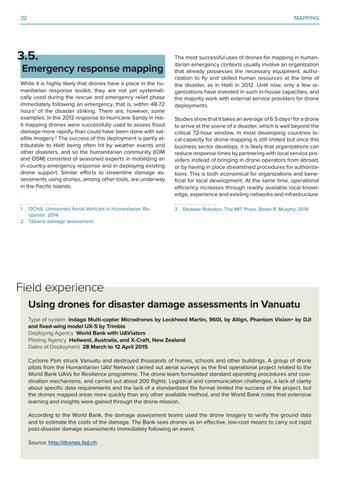
While it is highly likely that drones have a place in the humanitarian response toolkit, they are not yet systematically used during the rescue and emergency relief phase immediately following an emergency, that is, within 48-72 hours1 of the disaster striking. There are, however, some examples: In the 2012 response to Hurricane Sandy in Haiti mapping drones were successfully used to assess flood damage more rapidly than could have been done with satellite imagery.2 The success of this deployment is partly attributable to Haiti being often hit by weather events and other disasters, and so the humanitarian community (IOM and OSM) consisted of seasoned experts in mobilizing an in-country emergency response and in deploying existing drone support. Similar efforts to streamline damage assessments using drones, among other tools, are underway in the Pacific Islands.
1 OCHA. Unmanned Aerial Vehicles in Humanitarian Response. 2014 2 Tabarre damage assessment
The most successful uses of drones for mapping in humanitarian emergency contexts usually involve an organization that already possesses the necessary equipment, authorization to fly and skilled human resources at the time of the disaster, as in Haiti in 2012. Until now, only a few organizations have invested in such in-house capacities, and the majority work with external service providers for drone deployments. Studies show that it takes an average of 6.5 days3 for a drone to arrive at the scene of a disaster, which is well beyond the critical 72-hour window. In most developing countries local capacity for drone mapping is still limited but once this business sector develops, it is likely that organizations can reduce response times by partnering with local service providers instead of bringing in drone operators from abroad, or by having in place streamlined procedures for authorizations. This is both economical for organizations and beneficial for local development. At the same time, operational efficiency increases through readily available local knowledge, experience and existing networks and infrastructure. 3 Disaster Robotics. The MIT Press. Robin R. Murphy. 2014
Field experience Using drones for disaster damage assessments in Vanuatu Type of system Indago Multi-copter Microdrones by Lockheed Martin, 960L by Allign, Phantom Vision+ by DJI and fixed-wing model UX-5 by Trimble Deploying Agency World Bank with UAViators Piloting Agency Heliwest, Australia, and X-Craft, New Zealand Dates of Deployment 28 March to 12 April 2015 Cyclone Pam struck Vanuatu and destroyed thousands of homes, schools and other buildings. A group of drone pilots from the Humanitarian UAV Network carried out aerial surveys as the first operational project related to the World Bank UAVs for Resilience programme. The drone team formulated standard operating procedures and coordination mechanisms, and carried out about 200 flights. Logistical and communication challenges, a lack of clarity about specific data requirements and the lack of a standardized file format limited the success of the project, but the drones mapped areas more quickly than any other available method, and the World Bank notes that extensive learning and insights were gained through the drone mission. According to the World Bank, the damage assessment teams used the drone imagery to verify the ground data and to estimate the costs of the damage. The Bank sees drones as an effective, low-cost means to carry out rapid post-disaster damage assessments immediately following an event. Source: http://drones.fsd.ch
33
3.6.
The way forward on mapping
Mapping drones have shown their greatest potential during the recovery phase after a disaster, or for disaster risk reduction work. These findings do not preclude the use of drones during an emergency, but this use usually takes a larger degree of preparedness and coordination, which many actors and processes are now starting to address. Decision makers in government and in humanitarian organizations are at times suspicious of the use of mapping drones, a reluctance that may be due in part to the military use of drones. The perception of the drones based on military craft, however, overlooks the reality that many mapping drones weigh less than a kilogram and are the size of a large bird. At the same time civilians are often already using these technologies in the same or similar settings in which humanitarians propose to deploy the technology. Questions regarding the protection of privacy and the ethical collection and use of data have come up, especially since many mapping projects take place in densely settled places and capture high-resolution images. Only one study has been conducted to date that has looked at the local perception on the use of mapping drones: In Dar es Salaam,1 the nonprofit human development organization, FHI 360, found that by and large, both “community witnesses and government officials were positive about the potential of [drone] technology in Tanzania.� Nonetheless, the study on humanitarian perceptions indicates that the use of drones is still associated with military uses.2 For this reason, it is all the more important to be transparent and to fully inform the stakeholders about the technology and the intended uses and outputs. Currently, the main issues on the technical level are the management and sharing of data, including the time it takes to analyse the data. Practitioners should reinforce and help develop an open data ecosystem that is available to all humanitarian actors and a local mapping capacity similar to OpenStreetMap in Haiti. As more information is collected, more attention needs to be placed on storing and analysing aerial data. The OpenAerialMap (OAM) project provides the tools and an open service to store, search, and find imagery that attempts to address these issues. In addition, the Pacific Drone Imagery Dashboard (PacDID) project, spearheaded by the Humanitarian OpenStreetMap Team (HOT), is developing the idea of applying the OAM concept together with guidance for improving the workflows of disaster mapping in the Pacific Islands.
1 Eichleay M, Mercer S, Murashani J, Evens E. Using Unmanned Aerial Vehicles for Development: Perspectives from Citizens and Government Officials in Tanzania. FHI 360. 2016. Published on ICT works January 2016: http://www. ictworks.org/wp-content/uploads/2016/02/UAV-public-perceptions-tanzania.pdf 2 Drones in Humanitarian Action – A survey on perceptions and applications. FSD. 2016. http://drones.fsd.ch/en/homepage/
34
4. Š Aris Messinis/Matternet
35
Cargo delivery
36
The delivery of cargo with drones is a rapidly emerging field, but – unlike mapping drones – the technology has not matured to the degree that it is available as off-the-shelf gear. While most models under development are still prototypes, with the rapid developments in recent years and industry interest in this application, more advances in this technology can be expected in the coming years. The humanitarian sector will not be a primary driver for this technology, but there are other fields that can guide humanitarians in adapting the technology to emergency contexts. The rapid, reliable and cost-effective delivery of life-saving supplies to communities affected by major disasters is a central element of humanitarian relief efforts. The success or failure of a response hinges in large part on the humanitarian supply chain as the “backbone of humanitarian operations and its functions are vital to reaching beneficiary populations.”1 The transportation of this cargo, however, can be hampered by a number of factors. These include damaged or unreliable ground infrastructure, road blockages due to landslides and flooding, and the limited availability of transport solutions, not to mention restricted access due to security issues. Cargo delivery by manned aircraft, while relatively expensive, is often the only other option following major disasters. This in part explains why the humanitarian supply chain represents 60-80 per cent of humanitarian expenditures.2 Drones may offer the option of transporting smaller payloads across shorter distances at high frequency, thus complementing traditional means.
1 http://www.logcluster.org/sites/default/files/gm_files/whs_ humanitarian_supply_chain_paper_ final_160524.pdf 2 Peter Tatham, and S.J. Pettit, “Transforming humanitarian logistics: the journey to supply network management”, International Journal of Physical Distribution and Logistics Management, Vol. 40 No. 8/9 (2010), pp. 609-622.
CARGO DELIVERY
One of the largest growth sectors for cargo drones is development. One third of the world’s population lacks regular access to essential medicines. The causes include poor infrastructure in developing countries, complex logistics and lack of money. Poor “last mile” delivery logistics is the critical constraint preventing medical supplies from reaching these areas, and causes 40 per cent of vaccines supplied to parts of the underdeveloped world to expire before they can be administered. Especially with regard to last mile delivery, the use of drones might help optimize the supply chain and increase efficiency in the humanitarian sector. Because drones are flexible and deploy quickly (once the appropriate infrastructure is provided), they can play an important role in last mile delivery. Health workers can contact suppliers with exact requirements based on actual demand. In return, the drones deliver exactly what is needed with no supply guesswork required. Delivery can often be carried out irrespective of ground conditions or infrastructure. Severe weather conditions still present important challenges for most platforms but even with weather delays, drones may offer cost savings over traditional delivery methods. Drones can provide more reliable and consistent deliveries, and multiple deliveries per day can improve the responsiveness of the delivery system.
37
Figure 9 Examples of humanitarian and development cargo drone pilot projects
In 2014, Matternet field-tested three drones using both piloted and autonomous navigation in urban and rural locations in the Dominican Republic. The trials included discussions with local aviation authorities and government officials. Matternet still works in the DR, connecting eight clinics to regional hospitals. It is unclear exactly how many flights are being carried out.
The South Korean startup called AngelsWing carried out test flights between a reconstruction site and a health camp in Nepal in early 2016 to deliver medical supplies such as needles, medicines and vaccine vials as well as purified water bottles. The total distance flown was limited to 2 km due to visual line of sight regulations.
Matternet carried out demos with the World Health Organization (WHO) in Bhutan in 2014. For the pilot project, Matternet used four drones to connect the Jigme Dorji Wangchuck National Referral Hospital in Thimphu, Bhutan’s capital, with three small healthcare units. It is unclear how many flights were carried out.
At the end of 2015, the United Nations Population Fund (UNFPA), Drones for Development and the Ghana Health Service piloted the use of Dr. One, a hybrid platform, from the premises of the District Hospital in Sandema, in the Upper East Region in Ghana. The purpose of the project was to deliver contraceptives to women living in remote rural areas in Ghana.
In 2016, Zipline began operating delivery services of blood to 21 blood transfusion clinics in Rwanda. The company’s mission is to deliver critical medical products to health centers and hospitals that are either difficult or impossible to reach via traditional modes of transportation. In Rwanda, Zipline expects to carry out hundreds of autonomous flights every week by the end of the year.
UNICEF conducted a study in Malawi using the Matternet platform to assess the feasibility of using UAVs to transport laboratory samples for early infant diagnosis of HIV in order to reduce the time between sample collection and delivery of samples to labs. The test flights completed a 10 km route from a community health center to the Kamuzu Central Hospital laboratory in the capital Lilongwe. A total of 93 flights were carried out, ranging from 1 km, 5 km and 10 km. The concurrent cost analysis comparing UAVs and motorbikes to transport the samples demonstrated the potential to cut turnaround times dramatically at higher transportation costs for the cargo UAVs.
MSF collaborated with Matternet in Papua New Guinea in 2014. The fieldtesting focused on the collection of Tuberculosis sputum samples. Findings from this pilot project suggested that multi-rotor platforms may not be the best fit for the distances necessary in Papua New Guinea. Instead, platforms should be hybrid designs, automatic and very simple to use with a range minimum of 60 km and a minimum payload capacity of 1 kg. New field tests will be carried out.
38
CARGO DELIVERY
4.1.
Technology: State of the art
While the rate of change in civilian drone technology is rapid, the cargo drone technology for humanitarian uses is still nascent and largely unproven. There is, however, a large field of actors ranging from start-ups to global logistics companies, many of them partnering with universities, NGOs and aid organizations, who are working enthusiastically towards making the cargo drone a reality. Multiple humanitarian drone delivery field tests and actual delivery services are already in the works, including efforts in Ghana, Malawi, Rwanda, Tanzania, Papua New Guinea, Peru, Nepal, the Philippines and elsewhere. In addition, supply chain optimization studies specifically geared towards drones are currently being carried out in half a dozen countries. The drones currently used in field-testing can carry a few kilograms of payload and fly up to 150 km, so at the moment most applications entail high-value/low-volume cargo such as medicines and vaccines. Other suitable products could be first-aid kits, food, water, information (leaflets), prosthetics, and communication technologies such as mobile phones. Larger payload drones could also carry heavier items, such as small generators and folded water tanks. The types of cargo and destinations are likely to broaden with the rapidly evolving technology. For cargo delivery, two main approaches are currently pursued: either landing the drone on the ground to deliver its payload or parachuting the parcel. Both approaches have advantages and disadvantages in terms of reliability and safety, and many countries currently do not allow the dropping of items. Although regulations are now undergoing revisions and adaptation around the world, unless the value of dropping payload is articulated, it might be difficult to move forward in this direction. Being able to drop cargo is potentially an important feature in cargo deliveries. Informed decisions regarding suitable technology, safety measures and overall applicability, will require proper field-testing in controlled environments.
The currently available cargo drones include fixed-wing, rotor and hybrid models, each with its own capacities and features. The Zipline fixed-wing platform has a cargo capacity of 1.5 kg and a range of up to 150 km at a speed of 100 km/hour. The Zip requires a catapult for launch and does not require a runway to land. The delivery mechanism is automated and uses a simple paper parachute dropped at a low altitude. Zip flight plans are preprogrammed and monitored on the ground via tablets. Individual plans are stored on SIM cards. For flight navigation Zips rely on GPS using the available cellular network. Companies using quad-copters for cargo delivery include Matternet and DHL. Matternet’s latest iteration carries a payload of 1 kg over a distance of 20 km. DHL originally used a modified version of the Microdrones MD4-1000 to carry up to 1.2 kg over 12 km. Fixed-wing platforms used for cargo transportation often require a catapult or a dedicated runway for launch. In contrast, hybrid drones perform well vis-à-vis flight speed, flight time, ease of handling and vertical take-off and landing (VTOL). Companies focused on building hybrid drones include Amazon, Vayu and Quantum Systems. Vayu’s platforms seek to transport up to 2 kg over 80 km while Quantum’s drone seeks to transport up to 2 kg over 100 km. Quantum Systems has developed the Quantum TRON VTOL drone, which has a range of 150 km and payload capacity of 2.5 kg. Quantum Systems recently partnered with the German Coast Guard to field test landing the TRON on a Coast Guard ship off the coast of Germany. The cost of the TRON is about €60 000. Renting the TRON through third parties is expected to become an option. These drone platforms all use rechargeable batteries to power their engines, but there are also drones using gas-powered engines that enable longer distances and heavier payloads. Organizations like UAVaid and Wings for Aid are currently exploring the use of gas-powered drones, and UAVaid expects that their solution will enable them to carry up to 10 kg over 150 km before the end of 2016. See Table 2 in the Annex for a summary of the operational parameters of the cargo drone platforms.
39
Field experience Medical payload delivery in Papua New Guinea Type of system Matternet One Prototype, Multi-copter Microdrone Deploying Agency Médecins Sans Frontières (France) Piloting Agency Matternet Dates of Deployment September 2014 In 2014 Médecins Sans Frontières (MSF) was one of the first humanitarian organizations to test delivery drones because of the logistical constraints that limit access to healthcare diagnostics in Papua New Guinea. MSF and Matternet carried out test flights to transport diagnostic samples from remote health centres to an MSF laboratory in the shortest amount of time. The total distance between the two selected points is 63 km by road, requiring a four-hour drive. By air, the distance is 43 km. Given the Matternet drone range of 28 km, the team decided to swap batteries at a village midway. The drone travelled the distance between the hospital and the clinic in 55 minutes, including the time it takes to swap the batteries. According to Matternet, a total of 35 flights were carried out, 30 of which were fully autonomous. The drone was flown with a 200-500 gram payload and was able to operate in winds of up to 36 km/hour. MSF reported “very good acceptance” of the technology by the local population and cites the fact that of two of the Matternet drones lost in the jungle, one was retrieved by the local community and returned to MSF. The pilot project revealed that the maximum range of 28 km of the drone was a notable constraint. The need for someone to swap batteries midway was subsequently considered to be an important disadvantage. At the time, the Matternet platform was still under development and thus not yet as mature as the Matternet One version. MSF considered this pilot project to be just a trial of the technology, and did not carry out a comparative analysis of costs to determine whether payload delivery by drone would be less costly than by car. MSF also notes that the question of effectiveness goes beyond cost, and includes consideration of the time it takes to deliver the payload and the potential risks regarding not being able to access certain health clinics by road due to heavy rains. The Matternet team highlighted the key importance of local knowledge and local skills as instrumental for the success of operating any drone project effectively. They also emphasized the importance of developing robust and reliable technology rather than using fancy gadgets coming out of Silicon Valley. Source: http://drones.fsd.ch/
40
CARGO DELIVERY
4.2.
Actors
The mix of actors in this field is relatively new. Aircraft and drone manufacturers, airspace regulators, insurance companies, as well as public health, development and humanitarian assistance experts have not had to work so closely together before. Ministers of Health and national aviation authorities typically don’t interact with each other. This certainly presents a challenge in terms of communication given the different areas of expertise and vocabulary. Organizations active in the humanitarian field such as Médecins Sans Frontières (MSF), the United Nations Population Fund (UNFPA) and the United Nations Children’s Fund (UNICEF) are each actively exploring the use of drones for cargo delivery. Donors, including the US Agency for International Development (USAID), the Gates Foundation and the Rockefeller Foundation, also have grantees working on cargo drone projects. As a result of the USAID multimillion-dollar Grand Challenge on Combating Zika, several applications have specifically focused on the use of cargo drones to eradicate Zika and other future threats. The solutions proposed include the use of drones to spread pesticides and to release sterilized mosquitoes that prevent wild mosquitoes from reproducing. One or more of these drone projects is likely to become operational in 2017. Commercial cargo drone services are being developed by major companies such as Amazon, DHL, Google and United Parcel Service (UPS) as well as start-ups including Flirtey, Matternet, Vayu and Zipline. UPS is partnering directly with Zipline in Rwanda. The Amazon Drone Team and Google are continuing to work on developing their platforms although it is not yet clear whether they will be involved in humanitarian uses.
Meanwhile, start-up companies are becoming increasingly engaged: In April 2016 Zipline announced their plans for frequent long-range deliveries in Rwanda. Matternet has field tested prototypes in Bhutan, the Dominican Republic, Haiti and Papua New Guinea. Quantum Systems has carried out field tests in Dubai and Germany. They expect to carry out additional field tests with Médecins Sans Frontières in Papua New Guinea this year. Quantum Systems may also carry out field tests in the Philippines and Peru in the next six months. UAVaid is exploring a pilot project in the Philippines for 2016. Vayu also expects to field test their platform in Papua New Guinea, Nepal, the Philippines and an undisclosed country in Africa before the end of 2016. Some companies specialize in designing better supply chains for drones. Llamasoft, for example, quantifies the cost of transport, infrastructure, inventory holding and expiry as well as response time and stock availability in order to quantify and improve supply chain benefits. These models then provide a decision support platform for logistics optimization. Llamasoft is carrying out in-depth research in Rwanda, Tanzania, Mozambique and the Democratic Republic of the Congo, modelling the opportunities for cargo drones. Whether drones can indeed add operational benefits to existing supply chains remains to be seen, according to the company. Other companies are conducting cost analyses. VillageReach, for example, compared the value added of using drones over existing transportation solutions for the UNICEF and Matternet project in Malawi. The project reviewed different delivery scenarios for dried blood spot sample tests for HIV. According to their cost analysis, in all but one scenario the transportation cost was higher for cargo drones than for the existing motorcycle system. Motorcycles can transport more goods and therefore service more facilities in one tour, while drones, which take the shortest path between two points, are faster. This speed reduces the vehicle- and personnel-related costs, but the analysis did not quantify how the faster delivery improved the overall efficacy of the logistics system.
Pioneering work Zipline is a Silicon Valley start-up working with UPS and the vaccine alliance Gavi to deploy a fleet of drones in Rwanda to deliver medical supplies. The goal is to see 15 autonomous aircraft flying out of a centralized hub make 150 deliveries each day to 21 medical stations throughout the western half of the country. Their drone, called a Zip, provides rapid, on-demand aerial deliveries for a payload of up to 1.5 kg. Zips drop their payload at 5 metres altitude and then return home. The plan calls for each Zip to make up to 15 deliveries of blood per day to rural transfusing clinics across Rwanda. Ultimately, Zipline seeks to have Rwanda’s 11 million citizens within 30-minute delivery of any medical product. Zips do not need a runway to land or take off. They use a catapult for take-off, and a special method to land within the size of two parking spaces. Zips are operated from a hub, which is a modified shipping container. These hubs are located next to existing government medical warehouses. Each hub, which is operated by 2-3 employees, has a service radius of 75 km. Zipline has secured a partnership with a company that allows the company to deploy a hub anywhere in the world within 24 hours in order to support rapid response efforts following major disease outbreaks such as Ebola. For its regulatory approval, Zipline secured direct agreements with the Government of Rwanda and the country’s Civil Aviation Authority.
41
A number of universities are actively engaged in aerial robotics and in supply chain modelling. These include the Ecole Polytechnique Federale de Lausanne, the Swiss Federal Institute of Technology in Zurich, The University of Sheffield, the Massachusetts Institute of Technology and Johns Hopkins University, among others. Johns Hopkins and Carnegie Mellon’s Pittsburgh Supercomputing Center recently modelled the value added of vaccine delivery via drone in Mozambique as part of their HERMES programme. The calculation showed that delivery of vaccines via drone could cut costs compared to traditional ground transportation options by approximately 20 per cent.1 1 Drones could be cheaper alternative to delivering vaccines in developing world. Johns Hopkins University Bloomberg School of Public Health. Published: 21 June 2016. Retrieved at https://www.sciencedaily.com/ releases/2016/06/160621112101.htm
The regulatory environment for drone flights can be a major obstacle to the provision of drone cargo services. Some areas have no regulations, and some have restrictive regulatory frameworks. In any case, governments are important actors, and have to evaluate safety concerns, macroeconomic impacts, and fair distribution of benefits as they adapt the legal requirements in the face of rapid technological development and the rise in humanitarian applications. To date, the developing countries that have created regulatory environments most conducive to cargo delivery via drone include Rwanda, Tanzania and Malawi. While in some cases drones are able to carry out work without official approval to fly, humanitarian actors should take such a step with caution, as the spontaneous use of drones in disaster response can interfere with response activities and even endanger first responders.
Visionary work Afrotech is a technology innovation project set up by the Ecole Polytechnique Federale de Lausanne in Switzerland. Afrotech seeks to pioneer high intensity cargo drone routes in the lower sky in Africa and in other emerging economies, but is less advanced than Zipline at the moment. Their goal is develop and operate two transport lines. The Red Line will be a cargo drone route for medical and emergency use, and the Blue Line will be a commercial cargo drone route in and around cities. Once the Red Line humanitarian routes have been established and proven to work, they open up the potential for commercial services to operate in cities. Afrotech is also developing “Droneports” to service the next generation of cargo drones in the future. Droneports will include a dedicated runway to accommodate drones from various companies including the Red Line and Blue Line. The droneports are intended to be open to multiple drone companies just like airports are available to multiple airlines. While the idea of droneports may sound futuristic, the company is committed to building the first of three droneports in Rwanda by mid-2017. The goal is to have 44 per cent of the country’s population serviced by three droneports. Blood deliveries will be made only to larger district hospitals, and not to smaller rural clinics
Figure 10 Artist rendering of the “droneports” as envisioned by Redline
© Redline and Norman Foster Foundation
42
CARGO DELIVERY
4.3.
4.4. Business models
Two distinct transportation management business models are currently being developed for the use of cargo drones. The first includes companies that sell their technology and train their customers on how to operate the platforms for cargo delivery. The second has companies themselves operating their own platforms while charging a fee per kilogram delivered. In either scenario, the cost to aid organizations may present a substantial barrier to using cargo drones in humanitarian and development efforts. As technologies, infrastructure, regulations and markets are still developing, drone cargo services are in an early phase of commercialization, and determining the costs for humanitarian organizations is difficult at this point. Competition is likely to develop among cargo drone operators once the field advances on key issues, and first movers may secure an important competitive advantage vis-à-vis securing rights to certain corridors in a given country. Ultimately, a system may be needed to enable dozens of different drones to operate in any given air corridor at the same time, but the demand for such a high volume and frequency of air cargo delivery needs to be obvious.
Cargo drones in conflict zones Although some attempts have been made to set up the delivery of humanitarian goods in conflict zones (the failed Syria Airlift Project,1 for example), there are currently no public examples of drones used in conflict zones for cargo delivery. This is despite the fact that conflict zones are increasingly where the agencies involved in humanitarian assistance to civilian communities conduct their work. Syria has offered the most intense example over the past five years of how providing assistance in a conflict involving multiple combatant forces with fast shifting front lines places pressure on agencies to adapt their responses to battlefield conditions. To be sure, “the current conflicts in Syria demonstrate the difficulties in maintaining secure supply lines and access to beneficiaries during complex emergencies.”2 Innovative solutions such as the use of drones warrant further exploration, but the use of any new technologies in conflict zones present a number of risks and possible complications. Where combatants and international observers use drones in asymmetrical conflicts such as in Syria and Yemen, their use may raise suspicions about the impartiality of the humanitarian agencies using them. The deployment of drones by humanitarian agencies in conflict zones would require substantial training and staffing and would need to be fully supported by the international donor community. Despite these risks and challenges, some argue that the aid community cannot afford to dismiss the use of any technology that may provide the means to save lives and maintain humanitarian support to civilians trapped in conflict. 1 Uplift Aeronautics Final Letter. Uplift. 31 December 2015. Retrieved at http://uplift.aero/?p=324 2 Delivering in a Moving World…looking to our supply chains to meet the increasing scale, cost and complexity of humanitarian needs. WHS Supply Chain Paper. May 2016. Retrieved at http://www.logcluster.org/sites/default/files/ whs_humanitarian_supply_chain_paper_final_24_may.pdf
43
4.5.
Drones vs. helicopters and planes
Helicopters and airplanes are indispensable for delivering lifesaving supplies such as water, food, medication and shelter to areas where ground transportation is difficult and/or slow, but they come at a steep price and face a number of challenges in certain circumstances. Following the earthquakes in Nepal in 2015, for example, the United Nations World Food Programme (WFP) helicopter pilots logged close to 2 500 hours of flight time to transport over 2.5 million kilograms of humanitarian cargo. Even then, WFP reports that there was a significant backlog of cargo that needed to be transported across Nepal and there were not enough helicopters available. Other typical challenges that WFP faces include the need for spare parts, customs clearances, aircraft clearances, access to fuel supply, availability of crew accommodation and visas. Ageing aircraft and aircraft availability are also challenges. When an aircraft is no longer available to service a route due to technical problems, for example, this can cause serious disruption to the supply chain since finding replacement aircraft is particularly difficult at short notice. In countries such as the Democratic Republic of the Congo, some pilots have also refused to fly certain routes due to safety issues on the ground, a decision that also disrupts the supply chain. In contrast, drones can perform deliveries at much greater frequency and in some cases at lower cost, but payloads are currently limited to several kilograms and their range is generally limited to 150 km. Humanitarian cargo, however, is often measured in metric tonnes rather than in kilograms and is typically transported across hundreds if not thousands of kilometres. Given these current trade-offs relative to manned aviation, the specific cases in which cargo drones can currently add value are particularly narrow in the context of the universe of needs that humanitarian organizations typically face.
The World Food Programme, for example, says that in order to use drones for payload delivery it would need to develop an internal operational concept and standard operating procedures. Any use of cargo drones would have to ensure high accuracy of location delivery if parachutes are used and very high accuracy of flight paths, especially when operating in complex airspace. The current range and payload capacity of drones limit where drones could add value to the servicing of insecure areas that are within 100 km, but adopting that application could have an important positive impact on overall logistics efforts. Ideally, however, WFP would want to use drones with a 100-500 km range and a 200-500 kg payload capacity.1 Any use of drones to transport food would have to take into account best practice related to food airdrops as developed by WFP and others humanitarian organizations. This includes having staff on the ground in the drop zone. Airdrops without a presence on the ground are a measure of last resort, among other reasons because of the immense difficulties of ensuring that the food is distributed to those most in need. 2 Drone deliveries would not change this vital, human element of the food distribution pipeline. MSF works in some isolated places with difficult access. In contrast to WFP, the ability to send small goods using drones could therefore improve the organization’s capacity to save lives and could enable MSF to become more efficient with their resources. Besides lab samples, MSF is also interested in exploring the use of drones to transport blood, vaccines, antivenom and medication. In 2014, in collaboration with Matternet, MSF conducted field testing in Papua New Guinea for the collection of tuberculosis sputum samples. Findings from this pilot project suggest that multi-rotor platforms may not be the best fit for the distances necessary in Papua New Guinea. Instead, platforms should be hybrid designs, automatic and simple to use with a range minimum of 60 km and a minimum payload capacity of 1 kg. 1 Cargo Drones in Humanitarian Contexts: Meeting Summary. FSD. 2016. http://drones.fsd.ch/en/homepage/ 2 What you need to know about humanitarian airdrops. Giugni, P. ICRC. 13 April 2016. Retrieved at http://intercrossblog.icrc. org/blog/what-you-need-to-know-about-humanitarian-airdrops
44
4.6.
CARGO DELIVERY
Regulations
Regulatory issues present a big challenge to the use of drones for both commercial purposes and in humanitarian settings. Often drone regulations do not yet include provisions on cargo delivery, and those that do make delivery difficult or illegal. Some regulations will permit cargo delivery but only when the cargo is not dropped or parachuted. Dropping items is currently not allowed in many countries and may not be considered when regulations are revised unless the value to humanitarian aid groups is articulated. Being able to drop cargo is potentially an important feature in cargo deliveries. Another regulatory challenge relates to the limitations imposed on operators to maintain visual contact with the drone at all times. So-called Visual Line of Sight (VLOS) operations require keeping the drone in a visual line of sight at all times. This means not flying an unmanned aircraft into clouds or fog, behind trees, buildings or other (even partial) obstructions. VLOS also means unaided vision except for prescription glasses or sunglasses, and not having to use binoculars, telescopes or zoom lenses to see the unmanned aircraft. A number of national regulations allow the VLOS operation of small drones but gaining permissions for Beyond Visual Line of Sight (BVLOS) is almost always a longer, more drawn out and complicated process. Some have promoted the notion of Digital Visual Line of Sight (DVLOS) for the use of digital technologies such as digital cameras to keep drones in the line of sight. BVLOS permissions are far more critical for cargo drones than for mapping drones. Without regulatory changes, the field use of cargo drones will be greatly limited.
Experts interviewed as part of this project point out that the drone industry is changing at dramatic rates, reinventing itself every eight years. In contrast, the older conventional aviation industry moves much more slowly. Civil aviation authorities are accustomed to adapting their guidelines at a pace that matches the new developments in the aviation industry, but now must regulate drones as well. Unfortunately, the traditional regulatory pace for conventional aviation cannot keep up with the innovations and demands of the drone sector, and the authorities find themselves under pressure to act quickly. Powerful companies with substantial economic interests may seek to exploit this situation by trying to influence the development of drone regulations for their own advantage, and the decision-making of the authorities needs to remain thorough and focused on public safety and equity. How the civil aviation authorities can provide the best guidance is currently the subject of discussions in the drone community, with some participants advocating for a more proactive involvement and faster decision-making on the part of the authorities. The International Civil Aviation Organization (ICAO), the regulating body responsible for international aviation, does not yet stipulate regulations for autonomous or low-level operations but only for cross border operations. Thus, member states are currently formulating their own regulations, a situation that leads to a patchwork of different policies and a lack of standardization across countries.
45
4.7.
Way forward for cargo drones
The technology is still in its early stages and many of the largest drone manufacturers – many of which develop drones for military applications – have not yet entered the civilian drone market, supposedly due to the restrictive regulatory environment. This situation might change were these large manufacturers able to adapt their highly sophisticated technology to humanitarian applications. The arrival of these actors on the civilian market may be ethically problematic for humanitarian partners. In the meantime, considerably more field testing with comparable performance indicators is needed in order to evaluate the platforms. Humanitarian organizations considering the use of cargo drones need statistics on flights performed, hours logged, failure rates and other performance measures.
46
5. © Mark Iliffe/CC BY-NC-SA
47
Other applications
48
OTHER APPLICATIONS
Two other functions are gaining interest, and some limited fieldwork is taking place. The use of drones in search and rescue (SAR) is catching on in the United Kingdom, and the initial results are promising. The use of drones in monitoring, on the other hand, remains controversial. This is in part due to the fact that the existing equipment that could be used for large-scale monitoring and real time information is still limited to military players. The humanitarian community is taking a cautious look at the prospects.
5.1.
Search and rescue
Interest is building in the use of drones to assist in search and rescue, particularly when drones can be equipped with infrared, or other specialized cameras. SAR is not traditionally an activity that is done by humanitarian NGOs but rather is a technical task performed by civil protection bodies or by the members of affected communities. Deployment of drones in SAR aims in particular at increasing observational awareness of ground teams to improve safety, as well as aiding in locating missing people. To date, few SAR field missions have been conducted using drones, and even fewer are documented. Most were simulations with the task of locating missing persons, and were conducted by local civil security bodies in industrialized countries – the United States, Australia or in Europe. SAR teams deploy at the earliest stages of an emergency and
Figure 11 Thermal drone image
this is precisely when teams have the least time available for integrating new technologies and running tests. SAR operations are, in fact, highly codified and planned to ensure optimal impact despite the complex environments of emergency responses. Best use of drones in this context may be made if they are properly integrated and when SAR teams train in their use before they deploy in actual emergencies. As an investment in furthering support for the use of drones in emergency response, the European Commission funded a â‚Ź17.5 million research project to develop robotic tools that can assist human crisis intervention teams with search and rescue and emergency response. The Integrated Components for Assisted Rescue and Unmanned Search (ICARUS) project 1 seeks to equip first responders with drones and other robots that qualify as unmanned search and rescue tools to reduce response times and costs. ICARUS focuses on the development of search and rescue robots and other technologies that can detect, locate and rescue humans as part of an overall search and rescue endeavour. The project also works to integrate these tools into the standard operating procedures of the humanitarian actors and national civil protection bodies, thus bridging the gap between technical developers and practitioners. The ICARUS project has researched the use and integration of drones for SAR activities, and has developed drones to be deployed alongside search and rescue teams. The drones deployed by ICARUS aim to provide fast and reliable aerial information to the SAR teams during their planning and mission phase improving the time to rescue and the efficient allocation of the SAR resources. 1 http://www.fp7-icarus.eu/sites/fp7-icarus.eu/files/ publications/Public%20Report%20-%20ICARUS.pdf
49
Field experience Manchester fire and rescue service Type of system Aeryon Skyranger Deploying Agency Greater Manchester Fire and Rescue Service Piloting Agency Greater Manchester Fire and Rescue Service Dates of Deployment July 2015 - Present The Greater Manchester Fire and Rescue Service (GMFRS) added a drone to its emergency response toolkit in July 2015. The primary objective was to improve the safety of personnel. The GMFRS is one of the world’s first fire and rescue services to have adopted an around-the-clock drone capacity to respond to a range of crises, and they appear to be motivating other fire departments across the United Kingdom to do the same. The Aerial Imagery Reconnaissance Unit, known as the AIR Unit is the only one of its kind in the United Kingdom and possibly in the world. The AIR Unit responds to incidents on a nearly daily basis, from aerial imaging of incidents to carrying out search and rescue with thermal cameras. The GMFRS has become accustomed to having drones as part of their search and rescue toolkit. Between July 2015 and May 2016, the AIR Unit flew 161 missions, with up to three flights per day. To determine if a drone would add value to the firefighting teams and to gauge whether or not it was possible to justify the cost, the GMFRS began by running an initial trial with a drone and a few trained pilots. The GMFRS initially had temporary contracts with drone companies to lease equipment. Firefighters were trained to operate the drone and analyse the data collected. At one point during the trial, a drone accompanied several firefighters inside a building and was able to detect that the firefighters were working on an unsupported wall – which could have had disastrous consequences. The drone operator informed the team, and they took measures to ensure their safety. For GMFRS, this instance proved the concept of drones in firefighting. Source: http://drones.fsd.ch/
50
5.2.
OTHER APPLICATIONS
Monitoring and real-time information
Using drones for real-time information – live video feeds streamed directly from the drone to the operator, for example – presents additional opportunities that have not yet been sufficiently explored in the field. Small drones have streamed live video mostly in tactical situations to provide an understanding about potential road blockages or to quickly assess structures and infrastructure. Within the humanitarian community, however, there is much interest in functions that would allow the assessment and monitoring of large areas, in particular: • Identifying and tracking displaced populations, their movements and temporary settlements • Making large-scale assessments of an affected region or assessing remote and difficult-to-reach areas • Monitoring logistics convoys in real time These functions would require mid- to large-sized drones and sophisticated data transmission technology, and there is currently no evidence of drones being used for these humanitarian purposes. In one case, the deployment by the United Nations Organization Stabilization Mission in the Democratic Republic of the Congo of a military-grade monitoring drone was controversial in the humanitarian community, and many rejected the data provided by this deployment because of its links to military actors.1 The use of drones in monitoring is still developing as an application, and the humanitarian sector shows much interest. 1 Drones in Humanitarian Action – A survey on perceptions and applications. FSD. 2016. http://drones.fsd.ch/en/homepage/
51
Field experience Real-time information after Typhoon Haiyan in the Philippines Type of system Huginn X1 Quad-copter Deploying Agency Danoffice IT (with support from Team Rubicon and Palantir) Piloting Agency Danoffice IT Dates of Deployment November 2013 Following Typhoon Haiyan in the Philippines in 2013, Danoffice IT supported disaster response activities in the particularly hard-hit city of Tacloban in cooperation with NGOs such as Team Rubicon, and other organizations, including a South Korean search and rescue team and the Canadian Red Cross, and in collaboration with the United Nations Disaster Assessment and Coordination (UNDAC) teams. The Huginn X1 quad-copter drone came equipped with two cameras, one with high-definition colour and one with thermal bands, which allowed live, on-screen observation of the area captured by the camera. It can fly as far as 2 km from its controller and has a maximum flight time of 25 minutes. Danoffice IT conducted a number of missions in and around Tacloban and provided an aerial view of roadways, damaged buildings and other important real-time information. One such mission included flying over a hospital that had reportedly been damaged by the storm. Roadways to reach the hospital were difficult to access and there was concern for the security of teams that would be sent out to assess the state of the building. The deployment of the Huginn X1 quad-copter provided aerial imagery of the hospital, allowed Team Rubicon to assess the damage from the air and provided accurate information on the needs for repairs and materials. This was one of a handful of useful examples of drone deployment in the context of Typhoon Haiyan and provides a framework for further use of drones in emergency response activities. One of the central lessons learned from this deployment, however, is that deployments can be time sensitive. In this case, drones were deployed later than anticipated, thus limiting the impact of the use of drones in decision-making or planning. By the time the drone was authorized to fly, most of the roads had already been cleared and the major search and rescue work was coming to an end. UNDAC had already moved on to a phase of the emergency where the benefits of the drone were less clear. Source: http://drones.fsd.ch/?p=3642
52
6. Š Drone Adventures
53
Conclusions
54
The evidence that drones can indeed help humanitarian professionals improve the quality and effectiveness of aid in specific applications is mounting. The most promising uses of drones in humanitarian action include: • Mapping • Delivering lightweight essential items to remote or hardto-access locations • Supporting damage assessments • Increasing situational awareness • Monitoring changes Some of the drones deployed for these uses require only limited technical skills especially if used at small scale where the aim is to support localized damage assessments or other processes with simple aerial photographs and video footage. A greater variety of user-friendly drones will become available in the near future, making the technology further accessible to humanitarian users. The success of the consultations in this project suggests that continued sharing and coordination within existing forums will help facilitate the innovation process. The project identifies a great variety of uses that now span several areas of expertise, and concludes that sharing cases and experiences with the wider humanitarian community and its various stakeholders would aid in the pursuit of progress. At the same time, humanitarians and their potential partners need to continue to assess the true impacts of employing the drone technology, with particular attention to the opportunity costs. Humanitarian aid requires efficient human-to-human interactions and a context-specific understanding of the situation on the ground, and while drones, with their bird’s-eye view, can significantly contribute to the comprehension of the conditions in a crisis, they cannot replace professional programme staff that work directly with the affected communities. Privacy, security and ethical concerns related to the use of data may arise in certain scenarios, especially where the collection, aggregation and sharing of large amounts of data occurs. Humanitarian actors need to address these concerns on a case-by-case basis, and to tackle the issues as a matter of general interest within the community as a whole. These discussions should be integrated in other data ethics discourses that are currently taking place in the humanitarian community. Examples include programmes at Elhra, the Harvard Humanitarian Initiative and the newly formed Global Alliance for Humanitarian Innovation.
CONCLUSIONS
Drones are a tool, not in themselves a solution to any of the vast problems that humanitarians are currently facing. Drones are a rapidly developing technology, and the humanitarian community has limited experience in their use. The full impact of drone use in the field is not yet known or predictable. As the exploration of humanitarian applications for drones moves forward, this uncertainty need not stymie the innovation process. Pilot deployments must and can uphold core humanitarian principles, and the decisions to make such deployments can and should be based on a reasonable belief in the potential for substantial benefits. The humanitarian community needs to openly share both successes and failures in the ongoing effort to inform future practices. The most effective use of drones is usually linked to deployments that are well coordinated with local communities and placed in local contexts. Especially because of lingering military connotations, all processes should be implemented as transparently as possible with full disclosure of the reasons and outcomes of the use of the technology. Connotations of secrecy, stealth and spying precede drones, maybe more than any other emerging tool, and an open approach, sharing and transparency may soften lingering prejudices. Surprisingly, evaluations have shown that using drones for mapping has generated much interest in communities and has leveraged successful participatory processes to improve communities through community mapping. The potential humanitarian added value needs to be clearly articulated and communicated to regulators especially in the next few years when the landscape of possible drone uses will take shape. To increase the chances of a regulatory environment that is receptive to humanitarian uses, humanitarians and their partners need to speak out and to continue their engagement with either national or international regulatory bodies. Collaboration is key. In the words of the United Nations Office for the Coordination of Humanitarian Affairs, “What many actors are now calling for is not a traditional coordination mechanism but rather a functional ecosystem in which actors can work collaboratively together.”1 This ecosystem of actors is already well placed to address the variety of questions that arise from the use of drones in humanitarian contexts, and the community is fully capable of continuing to support and encourage an open learning environment in this evolving process.
1 Humanitarian Innovation: The State of the Art. UN OCHA. Retrieved at https://docs.unocha.org/sites/dms/Documents/ OP9_Understanding%20Innovation_web.pdf
55
Additional resources available at www.drones.fsd.ch: Drones in Humanitarian Action – A survey on perceptions and applications To find out what exactly humanitarian aid workers think about the use of these unmanned aerial vehicles (UAV), the Swiss Foundation for Mine Action (FSD) with funding from EU Humanitarian Aid has now published a survey. In total, close to 200 disaster responders working in 61 different countries took part in what is the first comprehensive survey of how humanitarian professional view drones.
Meeting Summary: Cargo Drones in Humanitarian Contexts A meeting was convened in June 2016 to bring together the principle stakeholders interested in the use of cargo drones for the delivery of essential humanitarian payloads. The purpose of this meeting was to advance the effective use of this emerging technology in humanitarian efforts actively, responsibly and effectively. This document summarizes the presentations and main discussion items of this meeting.
Case Studies to document and evaluate past deployments in humanitarian contexts: 1. Flood mapping for disaster risk reduction: Obtaining high-resolution imagery to map and model food risks in Dar es Salaam 2. Using drones for medical payload delivery in Papua New Guinea 3. Small-scale mapping with consumer drones in Nepal 4. Deploying drones for spatial modeling of displaced landmines after foods in Bosnia Herzegovina 5. Testing the utility of mapping drones for early recovery in the Philippines 6. Mapping rapid damage assessments of Tabarre and surrounding communities in Haiti following Hurricane Sandy
Meeting Summary: Mapping Drones in Humanitarian Action
7. Using high-resolution imagery to support the post-earthquake census in Port-au-Prince, Haiti
The meeting took place in March 2016 with the objectives to provide a progress update on the use of drones in emergency response, to discuss new case studies and to consolidate findings and outputs.
8. High-resolution UAV imagery for camp management in Haiti
Short Information video on Drones in Humanitarian Action The video summarizes types of drones and some of the most effective uses, https://youtu.be/ZouG8waDlyA
9. Using drone imagery for real-time information after Typhoon Haiyan in the Philippines 10. Using drones for disaster damage assessments in Vanuatu 11. Simulation: using drones to support search and rescue 12. Using drones in rescue services in the United Kingdom 13. Using drones to inspect post-earthquake road damage in Ecuador 14. Using drones to create maps and assess building damage in Ecuador 15. Disaster risk reduction in Tajikistan 16. Flood risk mapping in Malawi
56
Further resources ICARUS
OpenAerialMap (OAM)
ICARUS is an EU-funded research project aiming to develop robotic tools that can assist search and rescue teams in the field. ICARUS concentrates on the development of unmanned SAR technologies for detecting, locating and rescuing humans in disaster situations both in urban and maritime environments. Project period: 2012-2016 – www.fp7-icarus.eu
OpenAerialMap is an open service run by the Humanitarian OpenStreetMap Team along with partners Development Seed, Azavea, and Stamen to provide access to a commons of openly licensed imagery and map layer services. Both satellite and drone images can be accessed from this repository. – openaerialmap.org/
UAViators Code of Conduct
Disaster Robotics
The humanitarian UAV Code of Conduct aims to inform the safe, coordinated and effective use of UAVs in a wide range of humanitarian and development settings. It is a guide for all actors involved in the use of UAVs to support the delivery of humanitarian assistance in disasters and situations of conflict. Acceptance and adherence to this code will contribute to safety, professionalism and increased impact while building public confidence in the use of UAVs. – uaviators.org/docs
Written by Robin R. Murphy, this book offers a guide to the theory and practice of disaster robotics. It can serve as an introduction for researchers and technologists, a reference for emergency managers, and a textbook in field robotics.
Humanitarian OpenStreetMap Team (HOT) The Pacific Drone Imagery Dashboard (PacDID) by HOT supports aerial imagery used in Pacific island communities through the building of tools and guidance for a UAV mapping workflow. In places like Fiji and Vanuatu, which have experienced significant typhoon damage in recent years, the view provided by satellites, aircraft and more recently by drones, is a crucial resource needed in any phase of disaster risk management, from preparedness to response to recovery. – www.hotosm.org
Global Drone Regulations Database This is currently the most up-to-date and comprehensive openly available database on drone regulations. UAViators originally launched the database in 2014 as an open wiki. From 2015 to 2016, it was enhanced thanks to funding provided by DG ECHO as part of the Drones in Humanitarian Action Initiative. Additional projects and collaborators are now populating the database with regulatory information. – www.droneregulations.info – http://wiki.drones.fsd.ch/doku.php
57
Annex
Table 1: Operational parameters for cargo drone services currently under development Company
Type
Cargo
Range*
Power
Delivery
Hours Logged
Amazon
Hybrid
25 kg
16 km
Battery
Land
1 000s
DHL
Hybrid
1.2 kg
12 km
Battery
Land
100s
Drones for Development
Hybrid
unknown
unknown
Battery
Land
100s
Flirtey
Multi-rotor
2.2 kg
16 km
Battery
Hover
Confidential
Hybrid
25 kg
16 km
Battery
Land
1 000s
Matternet
Multi-rotor
1 kg
20 km
Battery
Land
1 000s
Quantum System
Hybrid
2.5 kg
100 km
Battery
Land
100s
Wings for Aid
Fixed-wing
100 kg
500 km
Gas
Parachute
0
UAVaid
Fixed-wing
10 kg
150 km
Gas
Parachute
100s
Vayu
Hybrid
2 kg
80 km
Battery
Land
100s
Zipline
Fixed-wing
1.5 kg
150 km
Battery
Parachute
1 000s
* Maximum range assuming that the drone can land and be recharged/refilled and launched at the destination. In cases where the drone needs to return to the place of departure without landing, the effective operational range is half the maximum range.
58
Table 2: Drones in Humanitarian Action case studies Case Study
1
2
3
4
Application
Flood mapping for disaster risk reduction
Medical payload delivery
Earthquake damage analysis
Location
Tanzania
Papua New Guinea
Extent
Mapping area: 88 km2
Distance covered per flight: 23km
Outputs
6
7
Spatial modelling Hurricane of displaced damage landmines analysis
Hurricane damage analysis
Postearthquake census
Nepal
Bosnia and Herzegovina
Philippines
Haiti
Haiti
Mapping area: 1.5 km2
13 mapping locations, the largest with 2.5 km2
Mapping area: 48.6 km2
Mapping area: 2 km2
Mapping area: 30 km2
Digital street Deliveries of maps medical supplies 3D surface model
Aerial photographs and maps
Aerial photographs 3D models
Aerial photographs and maps
Aerial photographs 3D models
Aerial photographs and maps
Deploying Agency
World Bank and Humanitarian OpenStreetMap Team
MÊdecins Sans Frontières
UAViators
Belgian Royal Medair Military Academy
IOM
IOM
Piloting Agency
Drone Adventures
Matternet
DJI training stuBelgian First Aid dents from Kath- and Support mandu University Team (B-FAST) and Kathmandu Living Labs
Drone Adventures
IOM
IOM
Drone type
Sensefly eBee
Matternet One Prototype, Multi-copter Microdrone
DJI Phantom 3 Advanced
Sensefly eBee
Sensefly Swinglet
Sensefly Swinglet and eBee
MD4-1000 Multi-copter Microdrone
5
59
9
10
Real-time information after Typhoon Haiyan
11
12
13
14
15
16
Disaster Damage Emergency Assessments Response Simulation
Fire and rescue services
Post-earthquake road damage inspection
Mapping and building damage assessment
Disaster Risk Reduction of Remote Hazards in the Tajik Pamir Mountains
Mitigate loss of Livelihood support through Flooding and Droughts
Philippines
Vanatu
France
UK
Ecuador
Ecuador
GBAO, Tajikistan
Malawi
Several missions
Mapping area: 10 km2
n/a
n/a
Inspection area: 1 000 kilometres of roadways
Mapping area: 3.2 km2 and 5 km2
Mapping area: 23km2 and 28 km2
Mapping area: 15km2
Live feed of HD Video, aerial video and thermal photographs, images 3D models
Search and rescue
Search and rescue
Aerial photographs and maps
Aerial photographs and maps
Aerial photographs and 3D model
Aerial photographs and 3D model
Danoffice IT (with World Bank Team Rubicon and Palantir)
CartONG/FSD
Greater Manchester Fire and Rescue Service
UAViators
GlobalMedic
FSD and Focus Humanitarian Assistance
FSD and COOPI
Danoffice IT
Heliwest, Australia, and X-Craft, New Zealand, coordinated by UAViators
Omnisight, Drone Greater ManAdventures chester Fire and Rescue Service
UAViators
AeroVision Canada, GlobalMedic
FSD and CartONG
FSD
Huginn X1 Quad-copter
Indago Multicopter, 960L, DJI Phantom 2 Vision+, UX-5
albris, Sensefly eBee, MD4-200
DJI Phantom 3 Professional, Inspire 1, Sensefly eBee
Inspire 1 Pro; SkyRanger
Sensefly eBee
Sensefly eBee
Aeryon SkyRanger
Contact: Swiss Foundation for Mine Action (FSD) 7bis, Avenue de la Paix - Floor 2 CH-1202 Geneva Switzerland Phone +41 22 907 36 05 Fax +41 22 907 36 01 space@fsd.ch drones.fsd.ch