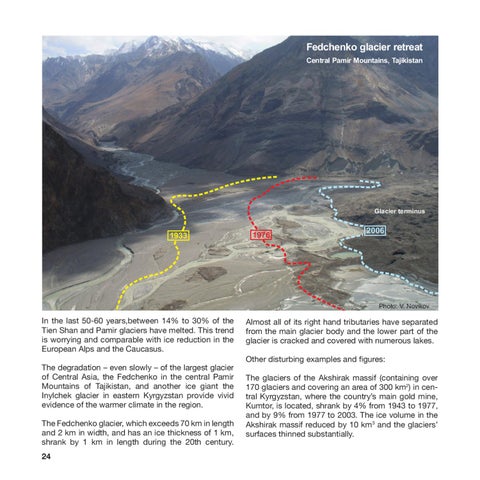
Fedchenko glacier retreat Central Pamir Mountains, Tajikistan
Glacier terminus
1933
1976
2006
Photo: V. Novikov
In the last 50-60 years,between 14% to 30% of the Tien Shan and Pamir glaciers have melted. This trend is worrying and comparable with ice reduction in the European Alps and the Caucasus. The degradation – even slowly – of the largest glacier of Central Asia, the Fedchenko in the central Pamir Mountains of Tajikistan, and another ice giant the Inylchek glacier in eastern Kyrgyzstan provide vivid evidence of the warmer climate in the region. The Fedchenko glacier, which exceeds 70 km in length and 2 km in width, and has an ice thickness of 1 km, shrank by 1 km in length during the 20th century. 24
lmost all of its right hand tributaries have separated A from the main glacier body and the lower part of the glacier is cracked and covered with numerous lakes. Other disturbing examples and figures: The glaciers of the Akshirak massif (containing over 170 glaciers and covering an area of 300 km2) in central Kyrgyzstan, where the country’s main gold mine, Kumtor, is located, shrank by 4% from 1943 to 1977, and by 9% from 1977 to 2003. The ice volume in the Akshirak massif reduced by 10 km3 and the glaciers’ surfaces thinned substantially.